


Abstract
Ethnobiological gardens conserve both biological and cultural diversity, but their permeable boundaries may expose native wildlife inside the garden to chronic domestic carnivore activity. In this single-garden case study, we compare small mammal assemblages between the Jardín Etnobiológico Tlaxcallan (JET), a periurban ethnobiological garden in Tlaxcala, Mexico, and its adjacent, heterogeneous Periphery of native vegetation and agricultural matrix, using live traps, camera traps, and direct observations over nine months. Across 162 detections of 9 species, the Periphery consistently showed higher richness and diversity than the JET at every Hill number order and the two assemblages were compositionally distinct (Bray–Curtis = 0.679), with the JET dominated by disturbance-tolerant species and the Periphery additionally harboring habitat-sensitive natives that were largely or entirely absent from the JET. Domestic cats were detected almost exclusively within the JET, while dogs were recorded at both sites. Dog and cat detection rates were both positively associated with species richness in generalized linear mixed models, a pattern that most plausibly reflects spatial co-occurrence between carnivores and disturbance-tolerant species within the JET rather than a facilitative effect of carnivores on richness. Because our design contrasts a single garden with a single Periphery, these results cannot separate the influence of domestic carnivores from co-varying differences in habitat structure, sampling geometry, or human activity. We therefore present the observed compositional turnover as a hypothesis-generating pattern consistent with—but not evidence of—carnivore-associated ecological filtering that warrants testing through replicated, multi-site designs before informing carnivore management in periurban ethnobiological gardens.
1. Introduction
Urbanization ranks among the most pervasive forms of habitat transformation globally, fundamentally altering ecological communities through direct habitat loss, fragmentation, and the introduction of novel species interactions [1,2]. Within urban and periurban landscapes, small mammal assemblages face multiple pressures, including reduced habitat availability, altered vegetation structure, increased human disturbance, and elevated exposure to domestic carnivores—primarily free-ranging dogs (Canis lupus familiaris) and cats (Felis catus) [3,4]. While the direct predation impacts of domestic carnivores on wildlife are well documented globally, with cats implicated in billions of bird and mammal deaths annually and dogs contributing substantially to wildlife mortality [5,6], the non-consumptive effects of these predators—mediated through fear-driven behavioral changes, habitat avoidance, and altered activity patterns—remain poorly quantified, particularly in Latin American contexts.
The ecological impacts of domestic carnivores extend beyond direct predation. The “landscape of fear” framework, originally coined by Laundré et al. [7] to describe how predation risk shapes prey space use across landscapes, posits that prey species perceive predation risk across space and respond behaviorally by avoiding high-risk areas, altering activity timing, or reducing foraging efficiency, even in the absence of actual predation events [8]. For small mammals, the mere presence or scent of domestic carnivores can trigger anti-predator responses analogous to those elicited by native predators. Dogs and cats deposit chemical cues—urine, feces, and scent marks—that persist in the environment and may signal elevated predation risk to native small mammals [9,10]. Even when domestic carnivores do not actively hunt, their regular presence and territorial marking can generate chronic stress and habitat displacement in native fauna, potentially restructuring entire assemblages [11,12]. We treat this framework throughout as a candidate mechanism motivating our expectations rather than as something we test directly (see Section 2.3 and Section 4).
In Mexico, domestic carnivore impacts on wildlife have received increasing attention in recent years. Studies in Mexico City’s Reserva Ecológica del Pedregal de San Ángel (REPSA) documented significant negative associations between free-ranging dog and cat abundance and native mammal occurrence, with domestic carnivores affecting both medium-sized mammals and small rodents [13,14], including direct dietary evidence of predation on native vertebrates within urban ecological reserves [15]. Similarly, research in urban protected areas of Xalapa, Veracruz, found that free-ranging dogs and cats altered medium-sized wild mammal assemblages, with effects varying by carnivore species and mammal guild [16]. These studies suggest that domestic carnivores exert measurable pressure on urban wildlife communities across Mexican cities, yet the mechanisms—whether through direct predation, interference competition, or non-consumptive intimidation—remain incompletely resolved.
Ethnobiological gardens serve as crucial ex situ conservation spaces that safeguard both biological and cultural diversity, particularly in regions where traditional ecological knowledge intersects with biodiversity hotspots. In Mexico, home gardens and ethnobiological spaces function as living repositories of native plant species while preserving traditional knowledge systems associated with their use and management [17,18]. These institutions bridge conservation science with community engagement, offering opportunities for research, education, and the maintenance of biocultural heritage in increasingly urbanized landscapes. However, ethnobiological gardens present a unique conservation challenge: unlike strictly protected reserves, these spaces are often characterized by permeable boundaries that facilitate community access while attempting to maintain ecological integrity. This permeability may inadvertently allow domestic carnivores to access the grounds while constraining the movement of native wildlife [19,20]. This asymmetry raises the possibility—untested here—that the Jardín Etnobiológico Tlaxcallan (JET), the periurban garden examined in this study, could function as an ecological trap [21]: a setting whose structural resources (dense plantings, water features, shelter) attract native small mammals while its permeable boundary exposes them to elevated predation risk without commensurate opportunity for spatial avoidance. We return to this possibility, and to what evidence would be required to establish it, in the Discussion.
Here, we examined associations between domestic carnivore activity and small mammal assemblages in the JET, a 1-hectare periurban ethnobiological garden in Tlaxcala, central Mexico, and adjacent areas retaining native vegetation. Because our sampling contrasts a single garden with a single adjacent Periphery, we treat the study as a descriptive case study and frame the following as associational expectations rather than as tests of causal effects. We anticipated that the presence and activity of domestic cats and dogs would co-vary with differences in assemblage structure and community composition of native small mammals, in a manner consistent with an ecological filtering process rather than with a simple reduction in species richness. Specifically, we expected that: (Prediction 1) small mammal assemblages in the JET would differ in species composition and community structure from those in adjacent native vegetation, a pattern consistent with a filtering process associated with chronic domestic carnivore presence rather than a simple reduction in species richness; (Prediction 2) the site with higher domestic carnivore activity would be associated with assemblages dominated by disturbance-tolerant and synanthropic species, with native habitat-sensitive species absent or underrepresented relative to the other site; and (Prediction 3) domestic cats and dogs would differ in their association with small mammal assemblage structure, with cats expected to show a stronger association than dogs given their more specialized predatory behavior and greater stealth in hunting small mammals.
2. Materials and Methods
2.1. Study Area
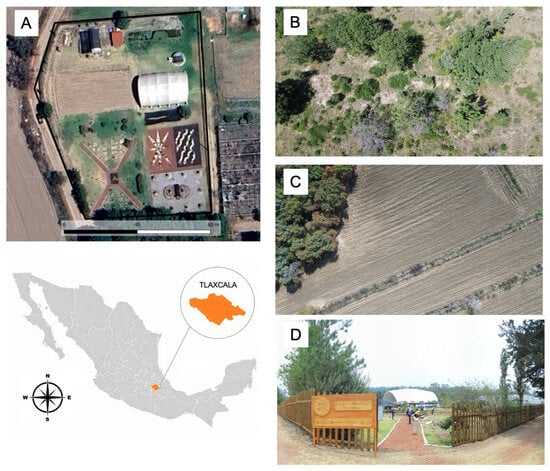
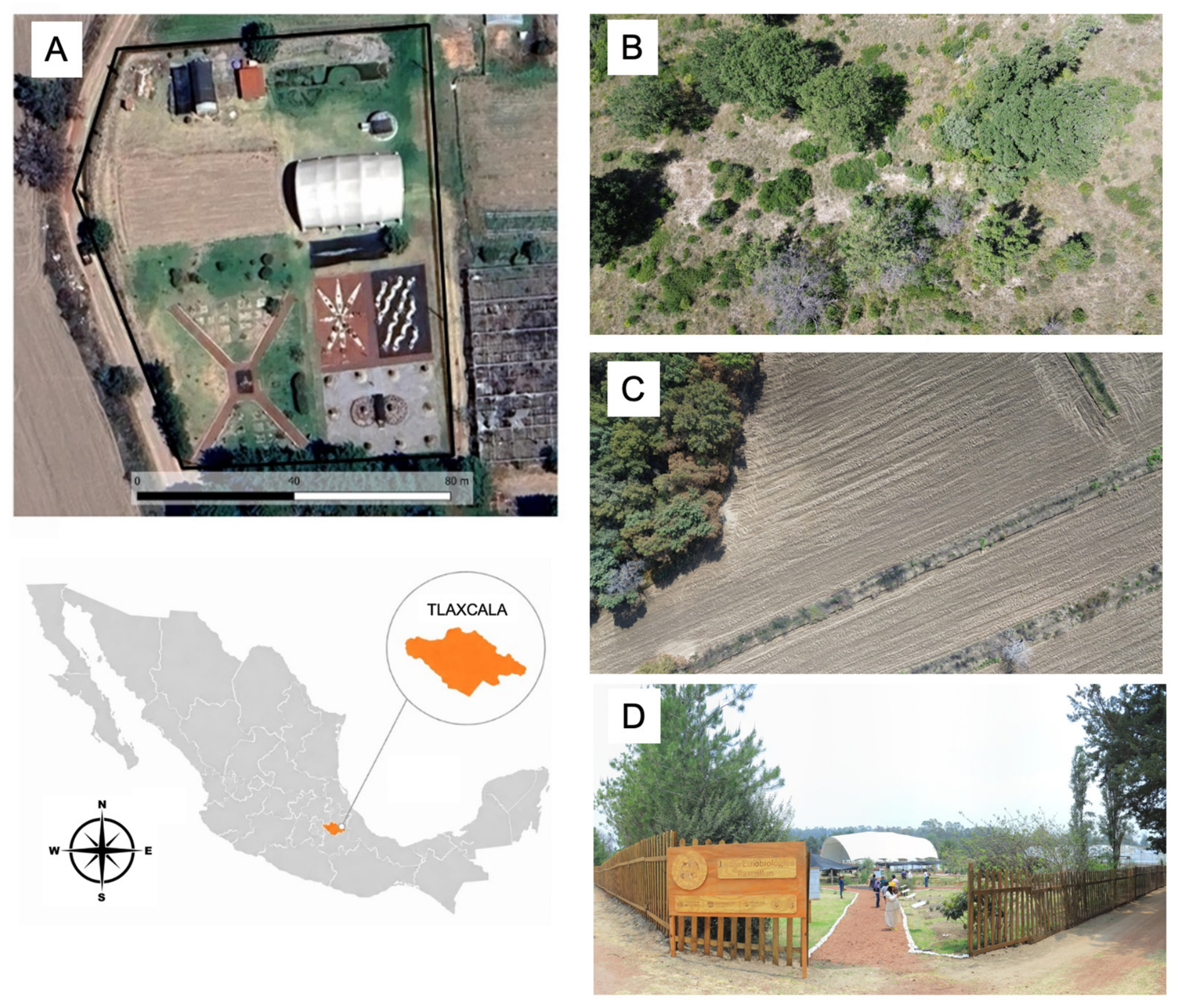
The study was conducted at the Jardín Etnobiológico Tlaxcallan (hereafter JET) and its Periphery, located in the municipality of Ixtacuixtla de Mariano Matamoros, Tlaxcala, Mexico (19°19′49.5″ N, 98°21′58″ W), at elevations ranging from 2200 to 2500 m above sea level (Figure 1). The region experiences a temperate subhumid climate with a rainy season from May to September. Mean annual minimum and maximum temperatures are 6.1 °C and 24.6 °C, respectively, with monthly precipitation ranging from 7.9 to 131.6 mm. The dominant vegetation type in the area is Juniperus deppeana (sabino) woodland.
Figure 1.
Location of the study area. The lower left panel shows the position of the state of Tlaxcala within Mexico. Panel (A) shows a satellite view of the Jardín Etnobiológico Tlaxcallan, delimited by chain-link fencing, with living plant collections including medicinal, food, agave, and cactus species, a pollinator garden, a small pond with aquatic plants, and a greenhouse visible; scale bar = 80 m. Panels (B,C) show representative habitat patches in the Periphery of the JET: native Juniperus deppeana woodland (B) and agricultural matrix (C), both depicted in aerial drone photographs. Panel (D) shows the chain-link fencing enclosing the JET, which despite delimiting the property boundary remains permeable to small and medium-sized mammals.
The JET encompasses 1 hectare and functions as a biodiversity refuge and cultural heritage site for Tlaxcala, hosting native plant species while conducting research, outreach, and knowledge exchange activities with local communities. The garden is enclosed by chain-link fencing that, while delineating the property boundary, is permeable to small and medium-sized mammals, including domestic cats and dogs from surrounding neighborhoods. The Periphery of the JET (19°20′05.3″ N, 98°21′55.9″ W) is a heterogeneous matrix—not a uniform low-disturbance reference area—that includes native vegetation patches, ravines, irrigation canals, and agricultural areas that collectively function as biological corridors across the periurban landscape. This matrix is itself subject to human activity (e.g., agriculture) and, as discussed below (Section 4.1), the exclusive detection of the synanthropic Mus musculus there illustrates that “Periphery” should not be read as synonymous with “undisturbed”.
2.2. Small Mammal Sampling
We employed three complementary methods to survey small mammals: Sherman live traps, camera traps, and direct observations. Field sampling was conducted biweekly from September 2025 to May 2026 (9 months, 18 sampling occasions), encompassing a complete seasonal cycle from the end of one rainy season through the dry period and into the onset of the next rainy season.
We deployed aluminum Sherman traps (3″ × 3.5″ × 9″, model VEN-CSE) baited with a custom seed-and-insect mixture. The bait consisted of oat flakes (20%), cracked corn (20%), sorghum (20%), wheat (20%), sunflower seeds (10%), and a commercial insect blend (10%; Redkite: mealworm, black soldier fly larvae, and cricket).
Within the JET, we established two 40 × 50 m quadrats; in the Periphery, two 200 m transects positioned in native vegetation. Both units contained 40 traps at 10 m intervals. Traps were set at 18:00 h and checked at 06:00 h. Trapping sessions were conducted biweekly (2 days per occasion), totaling 2880 trap-nights per site. We note that trap geometry differed between sites (quadrats in the JET vs. transects in the Periphery), reflecting the contrasting spatial configuration of the two areas. This is a substantive, not merely superficial, methodological limitation: differential encounter probability with a heterogeneous habitat is a plausible alternative explanation, independent of carnivore activity, for part of the richness and compositional contrasts we report (Section 3.2, Section 4.1 and Section 4.4). Trap number (40), spacing (10 m), and effort (trap-nights) were nevertheless held constant across sites, and we standardized diversity comparisons by sample coverage (Section 2.3.2) to mitigate differences in detectability arising from this design difference. All captured individuals were identified to species and marked with white acrylic paint for individual recognition across recaptures. Marked individuals were released at their capture location following standard protocols [22].
We placed four camera traps per site (three Cuddeback IR 20 model 1453, Non Typical Inc., De Pere, WI, USA; one Hapimp PH770-8D, Shenzhen Pinbo Culture Media Co., Ltd., Shenzhen, China). At both sites, cameras followed the same placement criteria, targeting wildlife and human trails to keep microhabitat selection comparable across sites; cameras were positioned 20–30 cm above ground and remained active continuously with a 5 s inter-trigger delay. Camera data provided continuous monitoring of native fauna and domestic carnivores (144 camera-nights per site over the full study).
During each biweekly visit, we conducted standardized walking surveys along established paths within both sites, recording all visual detections. Each sampling occasion included 8 h of direct observations (4 h per day over 2 days), supplementing our understanding of diurnal activity patterns and contributing to species inventories for taxa with low trappability.
2.3. Data Analysis
2.3.1. Data Structure and Detection Rates
Detection rates for small mammals were calculated as captures per trap-night (Sherman traps) or independent photographic events per camera-night (camera traps; independence threshold = 24 h). Data from all three methods were pooled per site per sampling period, with individuals detected by multiple methods within the same period counted only once. Sampling effort was standardized across all periods: 4 camera traps per site (144 camera-nights per site total), 160 trap-nights of Sherman trapping per site per occasion (2880 per site, 5760 total), and 8 h of direct observations. The data structure comprised 36 site × sampling occasion combinations (2 sites × 18 biweekly periods).
2.3.2. Diversity Metrics and Sampling Completeness
We assessed sampling completeness using sample coverage [23]. Alpha diversity was quantified using Hill numbers of order q = 0 (species richness), q = 1 (exponential of Shannon entropy), and q = 2 (inverse of Simpson concentration) [24,25]. Hill numbers were calculated for each site pooled across the study period and compared using 95% confidence intervals. We calculated Pielou’s evenness index (J′) and quantified compositional dissimilarity between sites using Bray–Curtis distance based on species abundances. Species were assigned a priori to one of four ecological categories for interpretative purposes—domestic carnivore, synanthropic/invasive, disturbance-tolerant native, and habitat-sensitive native—based on published accounts of habitat association and disturbance tolerance for each taxon (e.g., Megascapheus umbrinus and Sylvilagus sp. as widespread, disturbance-tolerant taxa; Heteromys irroratus, Reithrodontomys spp., and Bassariscus astutus as habitat-sensitive taxa associated with dense native vegetation cover [14]; Mus musculus as a synanthropic/invasive species [1]); this classification is descriptive and intended to aid interpretation of the results, not an independently tested trait axis.
2.3.3. Effects of Site and Domestic Carnivores on Small Mammal Assemblages
We used generalized linear mixed models (GLMMs) to evaluate site differences and the association between domestic carnivore activity and small mammal assemblage metrics. Fixed effects included site (JET vs. Periphery), dog detection rate (continuous), and cat detection rate (continuous). Biweekly sampling period (18 levels) was included as a random effect to account for temporal autocorrelation [26]. We used negative binomial error distributions after detecting overdispersion (residual deviance/df > 1.5). Model selection was based on AICc, with ΔAICc < 2 considered as substantial support [27]. We report marginal and conditional R2 values [28]. Spearman rank correlations were calculated separately per site as supplementary evidence. Because the design includes a single site per condition, the site term cannot be statistically separated from other site-level differences (e.g., vegetation structure, patch area, human activity, sampling geometry), and dog and, especially, cat detection rates are strongly structured by site rather than varying independently of it (cats were detected in the Periphery in only 1 of 18 periods). The 18 biweekly observations therefore constitute repeated temporal measures on a single site pair, not 18 independent replicates of carnivore presence/absence. Under this structure, the standard assumptions behind the reported p-values (independent sampling units) are not fully met, and formal significance should be read as an internal, descriptive summary of the strength of association within this case rather than as a generalizable statistical test [26]. We interpreted all model coefficients and Spearman correlations accordingly throughout Section 3 and Section 4. All analyses were conducted in R version 4.3.0 [29] using the iNEXT [30], vegan [31], lme4 [32], MASS [33], and MuMIn [34] packages.
3. Results
3.1. Sampling Completeness and Species Inventory
A total of 162 individual detections were recorded across both sites over the 9-month sampling period, comprising 104 in the JET and 58 in the Periphery. Combined across methods, we detected 9 species. Sample coverage was excellent at both sites (JET: SC = 0.983; Periphery: SC = 0.976), indicating that detected assemblages represent a reliable estimate of the true community at each site.
3.2. Assemblage Structure and Diversity
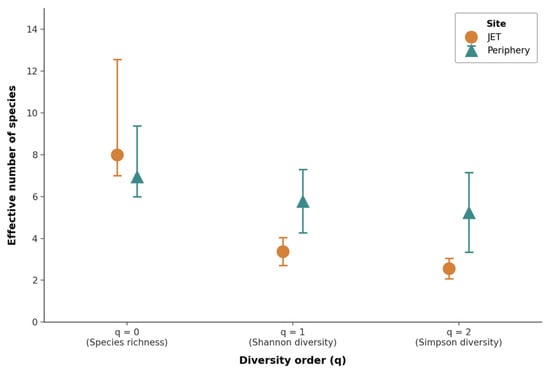
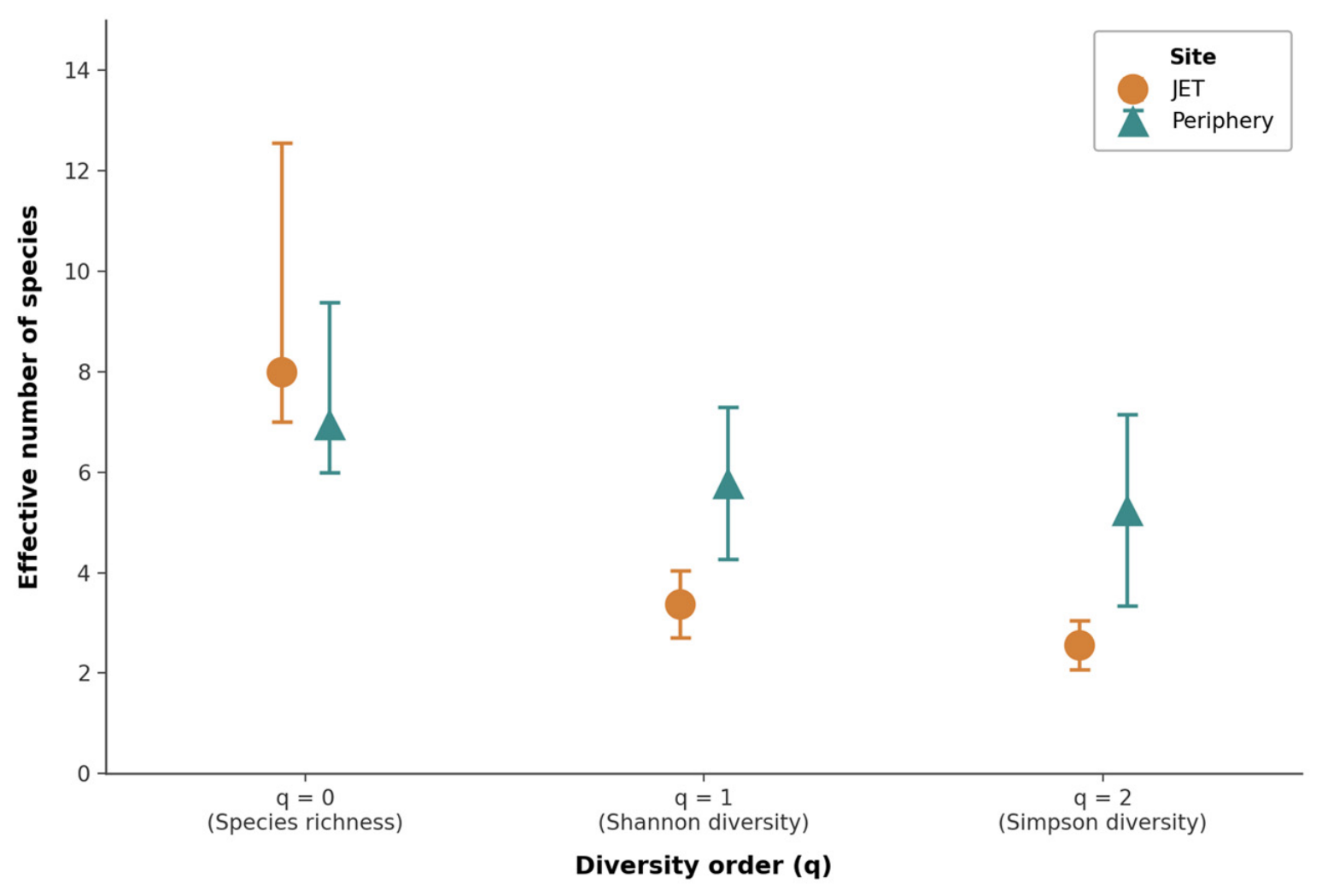
Species richness (q = 0) was substantially higher in the Periphery (8 species) than in the JET (4 species). Diversity profiles at all Hill number orders confirmed this pattern (Figure 2): the Periphery consistently exceeded the JET in Shannon diversity at q = 1 (Periphery = 5.77, JET = 2.96) and Simpson diversity at q = 2 (Periphery: 4.96; JET: 2.44), indicating a more species-rich and equitable assemblage in the Periphery. Pielou’s evenness confirmed this pattern (Periphery: J′ = 0.842; JET: J′ = 0.783). The Periphery exceeded the JET at every order of q, reflecting both higher species richness and more equitable abundance distributions. Asymptotic species richness estimates indicated that the JET harbors approximately 4 species and the Periphery approximately 8 species if sampling was exhaustive. As noted in Section 2.2, part of this gap may reflect the differing sampling geometry between sites (quadrats vs. transects) rather than a purely ecological difference; we revisit this alternative explanation in Section 4.1 and Section 4.4.
Figure 2.
Diversity profiles across Hill number orders (q = 0, 1, 2) for small mammal assemblages at the Jardín Etnobiológico Tlaxcallan (JET) and its Periphery. Points represent observed diversity values (filled circles = JET; filled triangles = Periphery) and error bars indicate 95% bootstrap confidence intervals; at q = 0, the upper confidence bound incorporates the Chao1 asymptotic richness estimator. q = 0 corresponds to species richness (JET = 4, Periphery = 8), q = 1 to Shannon diversity (JET = 2.96, Periphery = 5.77), and q = 2 to Simpson diversity (JET = 2.44, Periphery = 4.96). The Periphery consistently exceeded the JET across all diversity orders with no profile crossing, reflecting simultaneously higher richness and greater evenness (Periphery: J′ = 0.842; JET: J′ = 0.783).
3.3. Species Composition and Turnover
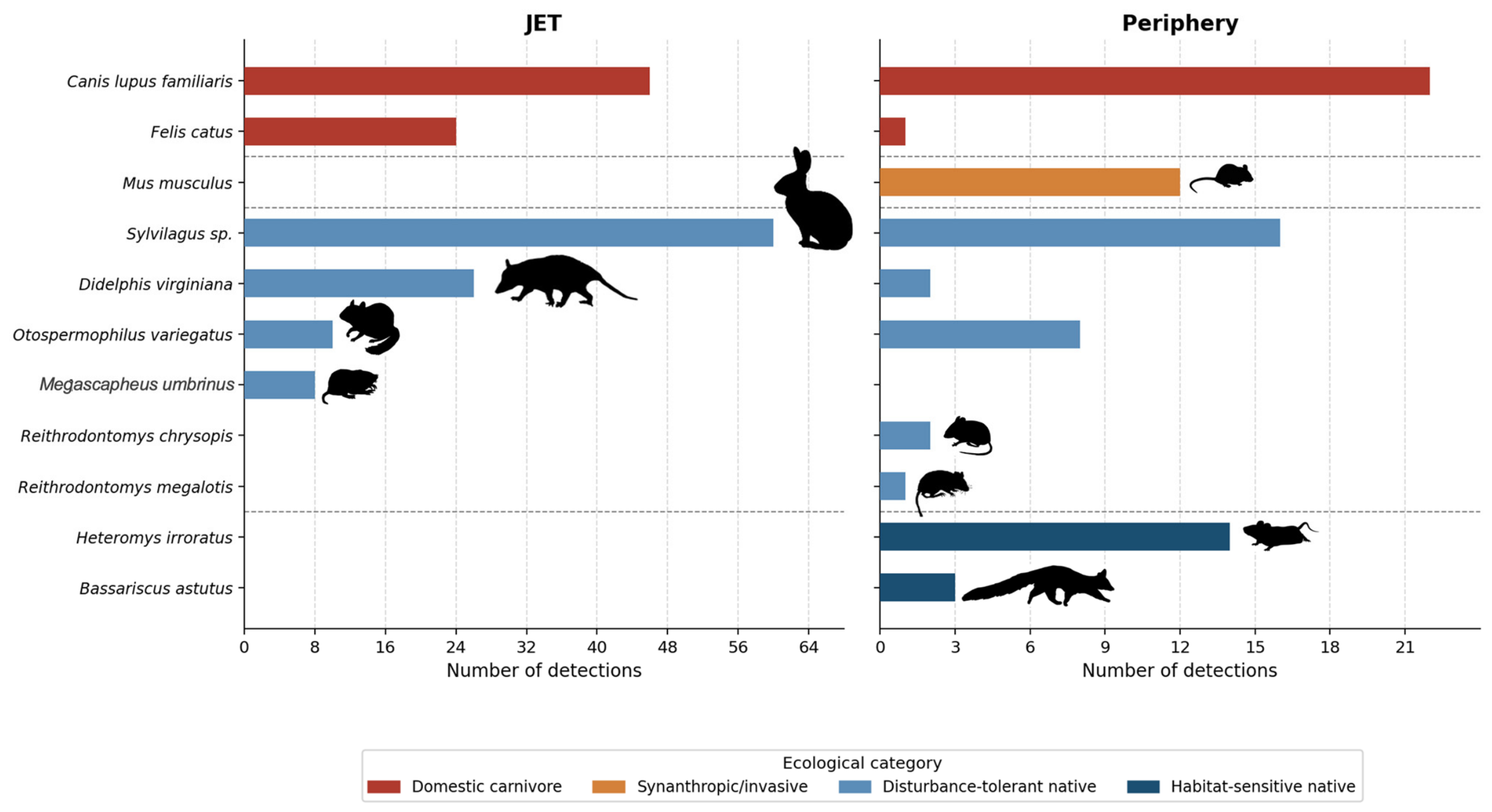
Compositional dissimilarity between sites was high (Bray–Curtis = 0.679). Of the 9 species detected, three were shared between sites (Didelphis virginiana, Otospermophilus variegatus, and Sylvilagus sp.), one was exclusive to the JET, and five were exclusive to the Periphery (Figure 3). We emphasize this compositional turnover, rather than the site-level richness contrast alone, as the most informative signal in the dataset: a simple reduction in richness could arise from many causes, whereas the near-complete replacement of the rodent and small-carnivore fauna between two adjacent sites is a stronger, more specific pattern.
Figure 3.
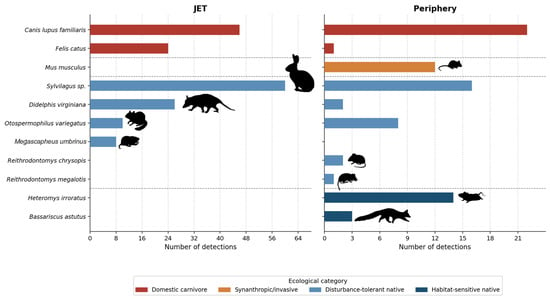
Total detections by species and site at the Jardín Etnobiológico Tlaxcallan (JET) and its Periphery over the 9-month sampling period (September 2025–May 2026). Species are grouped by ecological category (domestic carnivores, synanthropic/invasive, disturbance-tolerant natives, habitat-sensitive natives; see Section 2.3.2 for classification criteria), and sorted by abundance within each category. Dashed lines delimit category boundaries. Domestic carnivores are shown for context but excluded from diversity analyses (162 native detections: JET = 104, Periphery = 58). Megascapheus umbrinus was exclusive to the JET, while Bassariscus astutus, Heteromys irroratus, Mus musculus, and Reithrodontomys spp. were restricted to the Periphery. The marked asymmetry in species composition between sites is consistent with a filtering pattern, whereby the JET was associated mainly with disturbance-tolerant species and the Periphery additionally harbored habitat-sensitive natives. Animal silhouettes obtained from Phylopic (phylopic.org; Creative Commons license).
The only taxon exclusive to the JET was Megascapheus umbrinus. Species exclusive to the Periphery were Bassariscus astutus, Heteromys irroratus, Mus musculus, Reithrodontomys chrysopsis, and Reithrodontomys megalotis. The marked asymmetry—one JET-exclusive taxon vs. five Periphery-exclusive taxa—is consistent with a filtering pattern, whereby the JET was associated mainly with disturbance-tolerant widespread species while the Periphery additionally harbored native habitat-sensitive taxa and disturbance-associated species absent from the garden. We note, however, that differences in habitat structure, patch area, and sampling geometry between the two sites may also contribute to this contrast (Section 4.4).
The complete absence of Heteromys irroratus from the JET (0 detections) despite being the second-most abundant species in the Periphery (14 detections) is one of the most informative contrasts in the dataset. This spiny pocket mouse is strongly associated with dense native vegetation and has been reported to be among the species sensitive to domestic carnivore disturbance [14]. The JET assemblage was strongly dominated by Sylvilagus sp. (60 detections) and Didelphis virginiana (26 detections), together accounting for 83% of all JET detections. In the Periphery, Sylvilagus sp. remained the most abundant taxon (16 detections), but Heteromys irroratus (14) and Otospermophilus variegatus (8) contributed more equitably to assemblage structure.
3.4. Associations Between Domestic Carnivore Activity and Assemblage Metrics
Model selection based on AICc indicated that the model including site, dog detection rate, and cat detection rate received the highest support (AICc = 113.9, weight = 0.463), with the model including only site and dogs as the next best candidate (ΔAICc = 1.29, weight = 0.243; Table S1). Cumulative Akaike weights were higher for dog-containing models (w = 0.706) than for cat-containing models (w = 0.617), though both received substantial support.
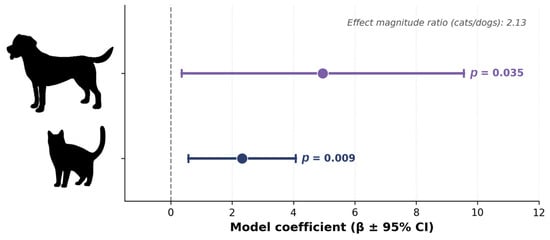
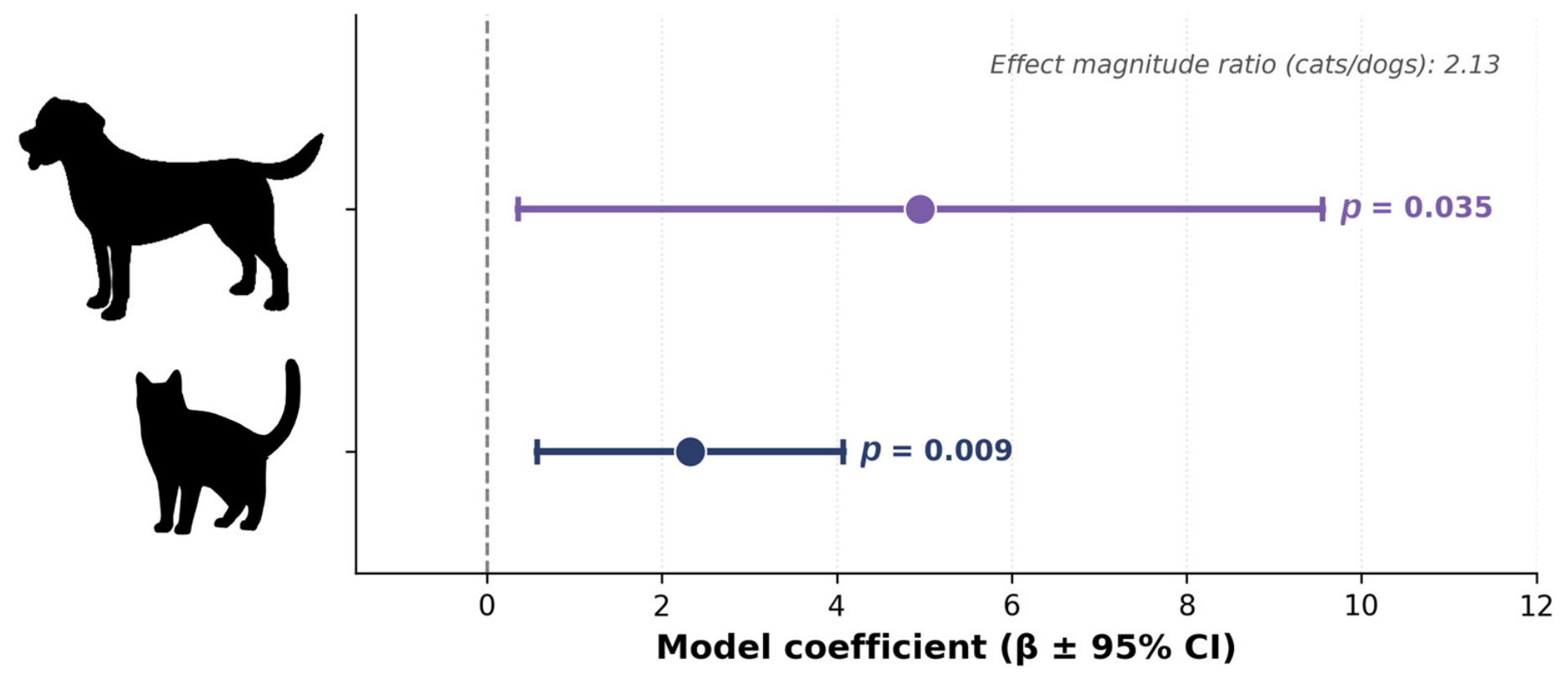
In the full model, both dog detection rate (β = 2.32, SE = 0.89, z = 2.61, p = 0.009) and cat detection rate (β = 4.96, SE = 2.35, z = 2.11, p = 0.035) were statistically significant positive predictors (associations) of species richness (Figure 4, Table 1). Cats showed a larger effect magnitude than dogs (β cats/β dogs = 2.13), consistent with Prediction 3’s expectation about relative magnitude—a separate question from the direction of the association, addressed next. The model explained 19% of variance through fixed effects alone (marginal R2 = 0.19), rising to 34% when the random effect of sampling period was included (conditional R2 = 0.34).
Figure 4.
Associations between domestic carnivore detection rates and small mammal species richness at the Jardín Etnobiológico Tlaxcallan (JET) and its Periphery, based on a negative binomial generalized linear mixed model (GLMM) with biweekly sampling period as a random effect (marginal R2 = 0.19; conditional R2 = 0.34). Points represent model coefficient estimates (β) and horizontal bars indicate 95% confidence intervals. Both dog and cat detection rates were statistically significant predictors (associations) (dogs: β = 2.32, p = 0.009; cats: β = 4.96, p = 0.035). The dashed vertical line at zero represents no association. Cats showed a larger association magnitude than dogs (β cats/β dogs = 2.13). Positive coefficient values reflect the spatial co-occurrence of domestic carnivores and disturbance-tolerant species in the JET rather than a direct facilitative or causal effect on species richness (see Section 4). Animal silhouettes obtained from Phylopic (phylopic.org; Creative Commons license).
Table 1.
Parameter estimates from the best-supported negative binomial generalized linear mixed model (GLMM) examining the associations between site identity and domestic carnivore detection rates and small mammal species richness at the Jardín Etnobiológico Tlaxcallan (JET) and its Periphery.
We flag the direction of these coefficients explicitly: it runs counter to a straightforward reading of the filtering hypothesis, under which higher carnivore activity would be expected to co-occur with lower, not higher, richness. As detailed in Section 2.3.3, cat detections are almost entirely confined to the JET and dog detection rates also differ strongly between sites; the positive coefficients most plausibly reflect the spatial co-occurrence of domestic carnivores with the disturbance-tolerant species that dominate the JET (Sylvilagus sp., Didelphis virginiana), rather than a facilitative or causal effect of carnivores on richness. We treat this result as descriptive of within-study covariation and return to its interpretive limits in Section 4.3.
Spearman rank correlations were consistent with GLMM results. In the JET, cat detection rate was significantly correlated with species richness (ρ = 0.549, p = 0.018) and abundance (ρ = 0.612, p = 0.007), while dog detection rate showed non-significant trends (richness: ρ = 0.259, p = 0.299; abundance: ρ = 0.242, p = 0.333). In the Periphery, dog detection rate was strongly correlated with both richness (ρ = 0.721, p = 0.001) and abundance (ρ = 0.836, p < 0.001). Periphery cat correlations were non-significant (ρ ≈ 0.30, p ≈ 0.22) and, given a single positive detection across 18 periods (Table S2), should not be over-interpreted. Because these correlations are calculated within a single site each, and because carnivore detection rates are themselves structured by site, we present them as supplementary, exploratory evidence rather than as independent confirmatory tests (Section 2.3.3).
4. Discussion
Our results describe a pronounced difference in small mammal assemblage structure between the JET and its Periphery, in a pattern consistent with an ecological filtering process rather than a simple reduction in species richness. Because the comparison involves a single garden and a single Periphery, we interpret this pattern as associational and do not treat it as evidence that domestic carnivores cause the reorganization. The most striking pattern is the consistent superiority of the Periphery across all Hill number orders: the Periphery harbors twice as many species (8 vs. 4) and achieves substantially higher diversity at all weighted orders (q = 2: 4.96 vs. 2.44). The high compositional dissimilarity (Bray–Curtis = 0.679) reflects extensive species turnover, driven primarily by the restriction of five species to the Periphery. It is this turnover, more than the raw richness contrast, that we consider the paper’s central finding (Section 3.3).
4.1. Community Structure and the Filter Effect of Domestic Carnivores
The Hill number profiles provide the clearest support for Prediction 1. Consistent with a filtering pattern, the JET harbored fewer species (q = 0: 4 vs. 8) and lower effective diversity at all weighted orders. The sole JET-exclusive taxon was Megascapheus umbrinus, a disturbance-tolerant burrowing rodent. The Periphery’s eight-species assemblage was richer and more equitable (J′ = 0.842 vs. 0.783) at every diversity order. This pattern is compatible with the ecological filter hypothesis, under which chronic domestic carnivore pressure could selectively admit disturbance-tolerant species while suppressing sensitive ones [1,13,35]. Sampling geometry (quadrats in the JET vs. transects in the Periphery) is a plausible alternative explanation for this same contrast, which need not exclude a role for carnivore pressure, since transects can encounter a wider range of microhabitats than fixed quadrats of similar total effort; together with vegetation structure and patch area, this means carnivore pressure should be read as one candidate contributor among several rather than as the demonstrated cause (Section 4.4).
The restriction of Mus musculus to the Periphery rather than the JET is noteworthy, and illustrates why the Periphery should not be read simply as a “low-disturbance” reference site. As arguably the most synanthropic mammal globally, M. musculus thrives in disturbed agricultural margins and open habitats [1]. Its detection exclusively in the Periphery—where agricultural matrix and open edges surround native vegetation patches—suggests it exploits edge conditions and food subsidies from adjacent cropland, a form of disturbance distinct from, and not obviously facilitated by, domestic carnivore presence inside the garden [11].
4.2. Species Turnover and the Landscape of Fear
The pattern of species exclusivity is consistent with Prediction 2 and with the landscape-of-fear framework [7,8], although our data do not allow us to test the underlying mechanism directly. The complete absence of Bassariscus astutus from the JET [36,37] is consistent with, but does not demonstrate, the deposition of chemical and behavioral cues by domestic carnivores that generates a persistent landscape of fear that could plausibly deter even relatively mobile native carnivores [9,38].
We therefore invoke predator chemical cues only as a candidate mechanism from the literature [9,38], not as something measured here; the behavioral and physiological evidence that would be needed to test this mechanism directly is discussed in Section 4.4.
The complete absence of Heteromys irroratus from the JET (0 detections) despite being the second-most abundant species in the Periphery (14 detections) constitutes compelling individual-species evidence for the filtering pattern. This spiny pocket mouse is strongly linked to native vegetation cover—the type of habitat less available in the JET [14]. Conversely, Reithrodontomys chrysopsis and R. megalotis, detected exclusively in the Periphery, are small-bodied mice associated with disturbed and open habitat edges, reinforcing the interpretation that the Periphery’s heterogeneous matrix supports a broader range of species than the enclosed garden [16].
The high abundance of Sylvilagus sp. in the JET (60 detections vs. 16 in the Periphery) likely reflects the garden’s structural characteristics—dense vegetation, water features, and protection from hunting—rather than a positive response to carnivore presence. The enclosed nature of the JET, combined with permeable fencing that restricts rabbit dispersal more than carnivore entry, may generate a concentration effect that inflates local rabbit densities independently of carnivore pressure.
4.3. Associations Between Cats and Dogs and Small Mammal Assemblages
The results are directionally consistent with Prediction 3. Cats showed a substantially larger effect magnitude than dogs (β cats/β dogs = 2.13), and both associations were statistically significant (dogs: β = 2.32, p = 0.009; cats: β = 4.96, p = 0.035), in line with the expectation that felids—as obligate carnivores with greater stealth and specialized predatory behavior—may exert stronger non-consumptive effects on small mammals than dogs [39,40]. We emphasize, however, that both coefficients were positive with respect to richness (Section 3.4), the opposite sign from what a facilitation-free filtering effect would predict; we read this as reflecting spatial covariation between carnivore activity and the disturbance-tolerant species dominating the JET, rather than as support for a carnivore-driven reduction in richness. The Periphery correlations pointed in the opposite direction for dogs (strong positive associations with richness and abundance), underscoring that these site-specific patterns are descriptive and should not be generalized into a ranking of dog versus cat impact from this two-site dataset. Because carnivore detection rates are themselves structured by site rather than independently distributed (Section 2.3.3), these associations should be read as internal, descriptive patterns rather than as generalizable effect estimates.
In the JET, Sylvilagus sp. and Didelphis virginiana dominate the assemblage, together accounting for 83% of all JET detections. This pattern parallels findings from other periurban reserves in Mexico [13,14]. The ecologically meaningful difference associated with domestic carnivores, if any, would operate at the level of community composition —species turnover and dominance structure (Section 3.3)—rather than in overall richness, where the direction of association runs the other way.
Cats were detected almost exclusively within the JET; a single incidental detection was recorded in the Periphery during the final biweekly period (May 2026). This isolated detection—one out of 18 Periphery sampling occasions—most likely represents a transient incursion rather than established use of the Periphery. The Periphery’s native vegetation patches, ravines, and open agricultural matrix offer fewer refugia and food-subsidy infrastructure for domestic cats than the enclosed garden environment [15,40,41]. The near-exclusive spatial restriction of cats to the JET means their potential non-consumptive effects would remain concentrated within the garden.
4.4. Limitations
Several limitations constrain the strength of inference and warrant explicit acknowledgment. First, and most importantly, spatial replication is limited to a single garden and a single Periphery. With one site per condition, the effect of domestic carnivores cannot be statistically separated from other site-level differences, and the design does not support causal inference or generalization beyond this case. The temporal structure (18 biweekly occasions) provides repeated measures within each site but does not constitute spatial replication, and—as noted in Section 2.3.3—it means the reported p-values should be read as descriptive of within-case association strength rather than as tests generalizable to other gardens.
Second, trap geometry and the spatial configuration of sampling differed between sites (40 × 50 m quadrats in the JET vs. 200 m transects in the Periphery). Although trap number, spacing, and effort were held constant and diversity was compared using coverage-based standardization (sample coverage > 0.97 at both sites, which mitigates differences in detectability), we cannot fully exclude that the difference in sampling geometry—which can alter the probability of encountering species in heterogeneous habitat independently of any carnivore effect—contributed to the observed disparity in richness and composition.
Third, we did not measure or control for several obvious confounders that differ between the two sites—including vegetation structure (e.g., canopy cover, NDVI, patch size), the intensity and timing of human activity, and the distribution of food and water subsidies. Each of these could contribute to, or wholly account for, the between-site contrasts we report. Deriving such proxies from existing drone and satellite imagery (Figure 1) and from camera-trap human-detection rates, and incorporating them as covariates in replicated, multi-site models, is a priority for future work; we did not attempt these analyses here because a single site per condition would leave such covariates confounded with site identity.
Fourth, we did not collect direct behavioral or physiological evidence of non-consumptive effects (e.g., vigilance, foraging time, or stress hormones), nor did we systematically document predator chemical cues or direct predation events. Our inferences about the landscape of fear rest on consistency with established literature rather than on mechanism measured in situ. Consequently, the relative contributions of direct predation, interference, and non-consumptive intimidation to the observed patterns remain unresolved.
Fifth, the single cat detection in the Periphery during the final sampling period introduces minor uncertainty, although the overall pattern across 17 of 18 periods with zero Periphery cat detections is robust, and the 9-month sampling window may not capture inter-annual variation in assemblage structure. Sixth, the ecological-trap framing introduced in Section 1 requires evidence [21,42,43]—habitat preference, survival, and reproductive data—that this single-site study did not collect.
Multi-site, multi-year designs that quantify habitat, human activity, and resource covariates—and that ideally include direct behavioral or dietary measures—will be necessary to test the mechanisms proposed here. Our camera-trap records are structured at the level of the individual camera and night, and a natural extension of this work would be a taxon-specific, finer-grained analysis of rodent detections relative to carnivore activity at that resolution. We flag this as a promising direction for a future, adequately replicated study rather than attempting it post hoc within the present single-site design. A camera-night-level breakdown would still be confounded with site identity in exactly the way described throughout this section and would sharpen the resolution of the pattern without resolving its central limitation.
4.5. Conservation Implications
Interpreted cautiously and as a single case, our findings have tentative implications for the management of the JET and similar ethnobiological conservation spaces. The permeable chain-link fencing creates a fundamental asymmetry: it provides relatively unrestricted access to domestic carnivores while constraining native wildlife movement. The JET may create conditions consistent with a potential ecological trap, insofar as garden resources and structural cover could attract small mammals while permeable boundaries permit domestic carnivore access [21,42,43]. As detailed in Section 4.4, establishing this would require evidence—habitat preference, survival, and reproductive data—that this single-site study did not collect; we treat it as a hypothesis for future work, not a claim we make here.
Correspondingly, we present potential mitigation measures—such as carnivore-exclusion infrastructure, community engagement, or buffer zones of native vegetation—as candidate strategies warranting empirical testing, not as recommendations ready for implementation: whether such measures would shift the JET assemblage toward the more equitable, native-dominated community of its adjacent Periphery remains an empirical question that this single-site, associational study cannot answer, and we do not intend our results to be read as sufficient justification for carnivore-management action on their own.
More broadly, ethnobiological gardens cannot be evaluated solely on plant conservation value without simultaneously assessing the vertebrate communities they support and the carnivore pressure those communities face. Integrating small mammal monitoring using diversity metrics sensitive to abundance structure, such as Hill numbers [25], together with explicit measurement of habitat and disturbance covariates and replication across multiple gardens, would provide a more complete assessment of conservation effectiveness in increasingly urbanized landscapes [18].
Supplementary Materials
The following supporting information can be downloaded at https://www.mdpi.com/article/10.3390/ecologies7030073/s1, Table S1: Model selection results for negative binomial generalized linear mixed models (GLMMs) examining the associations between site identity and domestic carnivore detection rates and small mammal species richness at the Jardín Etnobiológico Tlaxcallan (JET) and its periphery; Table S2: Spearman rank correlations between domestic carnivore detection rates and small mammal assemblage metrics at the Jardín Etnobiológico Tlaxcallan (JET) and its periphery.
Author Contributions
Conceptualization, P.S.-C. and C.L.; methodology, P.S.-C., C.L., G.A.P.-F., J.V.-P. and M.R.-P.; formal analysis, P.S.-C. and C.L.; investigation, P.S.-C., C.L., G.A.P.-F., J.V.-P. and M.R.-P.; writing—original draft preparation, C.L.; writing—review and editing, P.S.-C., C.L., G.A.P.-F., J.V.-P. and M.R.-P.; supervision, P.S.-C., C.L., G.A.P.-F., J.V.-P. and M.R.-P.; project administration, C.L. and G.A.P.-F.; funding acquisition, C.L. and G.A.P.-F. All authors have read and agreed to the published version of the manuscript.
Funding
This research received no external funding.
Institutional Review Board Statement
This study was approved by the Ethics Committee of the Universidad Autónoma de Tlaxcala (approval date: September 2025). The study relied primarily on camera trapping and non-invasive field observations. Live trapping was conducted solely for species identification; no permanently invasive or lethal procedures were performed, and all captured individuals were released immediately at their capture sites. All procedures followed institutional and national wildlife guidelines.
Data Availability Statement
The raw data supporting the conclusions of this article will be deposited in a public repository upon acceptance of the manuscript.
Acknowledgments
We thank María Guadalupe Martínez-Mastranzo, Ángel Gabriel Monarca-Pérez, and Ovier Cabrera-Paredes for their invaluable support in the fieldwork, and the staff of Jardín Etnobiológico Tlaxcallan for the facilities to conduct our research.
Conflicts of Interest
The authors declare no conflicts of interest.
References
- McKinney, M.L. Urbanization as a major cause of biotic homogenization. Biol. Conserv. 2006, 127, 247–260. [Google Scholar] [CrossRef] [Scilit]
- Grimm, N.B.; Faeth, S.H.; Golubiewski, N.E.; Redman, C.L.; Wu, J.; Bai, X.; Briggs, J.M. Global change and the ecology of cities. Science 2008, 319, 756–760. [Google Scholar] [CrossRef] [Scilit] [PubMed]
- Shochat, E.; Warren, P.S.; Faeth, S.H.; McIntyre, N.E.; Hope, D. From patterns to emerging processes in mechanistic urban ecology. Trends Ecol. Evol. 2006, 21, 186–191. [Google Scholar] [CrossRef] [Scilit] [PubMed]
- Alberti, M. Eco-evolutionary dynamics in an urbanizing planet. Trends Ecol. Evol. 2015, 30, 114–126. [Google Scholar] [CrossRef] [Scilit] [PubMed]
- Young, J.K.; Olson, K.A.; Reading, R.P.; Amgalanbaatar, S.; Berger, J. Is wildlife going to the dogs? Impacts of feral and free-roaming dogs on wildlife populations. BioScience 2011, 61, 125–132. [Google Scholar] [CrossRef] [Scilit]
- Loss, S.R.; Will, T.; Marra, P.P. The impact of free-ranging domestic cats on wildlife of the United States. Nat. Commun. 2013, 4, 1396. [Google Scholar] [CrossRef] [Scilit] [PubMed]
- Laundré, J.W.; Hernández, L.; Altendorf, K.B. Wolves, elk, and bison: Reestablishing the ‘landscape of fear’ in Yellowstone National Park. Can. J. Zool. 2001, 79, 1401–1409. [Google Scholar] [CrossRef]
- Frid, A.; Dill, L. Human-caused disturbance stimuli as a form of predation risk. Conserv. Ecol. 2002, 6, 11. [Google Scholar] [CrossRef] [Scilit]
- Apfelbach, R.; Blanchard, C.D.; Blanchard, R.J.; Hayes, R.A.; McGregor, I.S. The effects of predator odors in mammalian prey species: A review of field and laboratory studies. Neurosci. Biobehav. Rev. 2005, 29, 1123–1144. [Google Scholar] [CrossRef] [Scilit] [PubMed]
- Banks, P.B.; Bryant, J.V. Four-legged friend or foe? Dog walking displaces native birds from natural areas. Biol. Lett. 2007, 3, 611–613. [Google Scholar] [CrossRef] [Scilit] [PubMed]
- Lowry, H.; Lill, A.; Wong, B.B.M. Behavioural responses of wildlife to urban environments. Biol. Rev. 2013, 88, 537–549. [Google Scholar] [CrossRef] [Scilit] [PubMed]
- Doherty, T.S.; Ritchie, E.G. Stop jumping the gun: A call for evidence-based invasive predator management. Conserv. Lett. 2017, 10, 15–22. [Google Scholar] [CrossRef] [Scilit]
- Coronel-Arellano, H.; Rocha-Ortega, M.; Gual-Sill, F.; Martínez-Meyer, E.; Ramos-Rendón, A.K.; González-Negrete, M.; Gil-Alarcón, G.; Zambrano, L. Raining feral cats and dogs? Implications for the conservation of medium-sized wild mammals in an urban protected area. Urban Ecosyst. 2021, 24, 83–94. [Google Scholar] [CrossRef] [Scilit]
- Ramos-Rendón, A.K.; Gual-Sill, F.; Cervantes, F.A.; González-Salazar, C.; García-Morales, R.; Martínez-Meyer, E. Assessing the impact of free-ranging cats (Felis silvestris catus) and dogs (Canis lupus familiaris) on wildlife in a natural urban reserve in Mexico City. Urban Ecosyst. 2023, 26, 1341–1354. [Google Scholar] [CrossRef] [Scilit]
- Hortelano-Moncada, Y.; Ramos-Rendón, A.K.; Gil-Alarcón, G.; Landeta-Solís, L.J.; Vilchis-Conde, J.M.; Flores-Martínez, J.J.; Rodríguez-Medina, R.; Cervantes, F.A. Diet of free-ranging cats (Felis silvestris catus) and dogs (Canis lupus familiaris) in an urban ecological reserve in Mexico City. Rev. Mex. Biodivers. 2024, 95, e955280. [Google Scholar] [CrossRef] [Scilit]
- Mella-Méndez, I.; Flores-Peredo, R.; Bolívar-Cimé, B.; Vázquez-Domínguez, G. Effect of free-ranging dogs and cats on medium-sized wild mammal assemblages in urban protected areas of a Mexican city. Wildl. Res. 2019, 46, 669–678. [Google Scholar] [CrossRef] [Scilit]
- Larios, C.; Casas, A.; Vallejo, M.; Moreno-Calles, E.; Blancas, J. Plant management and biodiversity conservation in Náhuatl homegardens of the Tehuacán Valley, Mexico. J. Ethnobiol. Ethnomed. 2013, 9, 74. [Google Scholar] [CrossRef] [Scilit] [PubMed]
- Moreno-Calles, A.I.; Casas, A.; Rivero-Romero, A.D.; Romero-Bautista, Y.A.; Rangel-Landa, S.; Fisher-Ortíz, R.A.; Alvarado-Ramos, F.; Vallejo-Ramos, M.; Santos-Fita, D. Ethnoagroforestry: Integration of biocultural diversity for food sovereignty in Mexico. J. Ethnobiol. Ethnomed. 2016, 12, 54. [Google Scholar] [CrossRef] [Scilit] [PubMed]
- Fardell, L.L.; Pavey, C.R.; Dickman, C.R. Backyard biomes: Is anyone there? Improving public awareness of urban wildlife activity. Diversity 2022, 14, 263. [Google Scholar] [CrossRef] [Scilit]
- Kristancic, A.R.; Kuehs, J.; Richardson, B.B.; Baudains, C.; Hardy, G.E.S.; Fleming, P.A. Biodiversity conservation in urban gardens–Pets and garden design influence activity of a vulnerable digging mammal. Landsc. Urban Plan. 2022, 225, 104464. [Google Scholar] [CrossRef] [Scilit]
- Battin, J. When good animals love bad habitats: Ecological traps and the conservation of animal populations. Conserv. Biol. 2004, 18, 1482–1491. [Google Scholar] [CrossRef] [Scilit]
- Sikes, R.S.; Animal Care and Use Committee of the American Society of Mammalogists. 2016 Guidelines of the American Society of Mammalogists for the use of wild mammals in research and education. J. Mammal. 2016, 97, 663–688. [Google Scholar] [CrossRef] [Scilit] [PubMed]
- Chao, A.; Jost, L. Coverage-based rarefaction and extrapolation: Standardizing samples by completeness rather than size. Ecology 2012, 93, 2533–2547. [Google Scholar] [CrossRef] [Scilit] [PubMed]
- Hill, M.O. Diversity and evenness: A unifying notation and its consequences. Ecology 1973, 54, 427–432. [Google Scholar] [CrossRef] [Scilit]
- Chao, A.; Gotelli, N.J.; Hsieh, T.C.; Sander, E.L.; Ma, K.H.; Colwell, R.K.; Ellison, A.M. Rarefaction and extrapolation with Hill numbers: A framework for sampling and estimation in species diversity studies. Ecol. Monogr. 2014, 84, 45–67. [Google Scholar] [CrossRef] [Scilit]
- Zuur, A.F.; Ieno, E.N.; Walker, N.J.; Saveliev, A.A.; Smith, G.M. Mixed Effects Models and Extensions in Ecology with R; Springer: New York, NY, USA, 2009. [Google Scholar]
- Burnham, K.P.; Anderson, D.R. Model Selection and Multimodel Inference: A Practical Information-Theoretic Approach, 2nd ed.; Springer: New York, NY, USA, 2002. [Google Scholar]
- Nakagawa, S.; Schielzeth, H. A general and simple method for obtaining R2 from generalized linear mixed-effects models. Methods Ecol. Evol. 2013, 4, 133–142. [Google Scholar] [CrossRef] [Scilit]
- R Core Team. R: A Language and Environment for Statistical Computing; R Foundation for Statistical Computing: Vienna, Austria, 2023; Available online: https://www.R-project.org/ (accessed on 25 May 2026).
- Hsieh, T.C.; Ma, K.H.; Chao, A. iNEXT: An R package for rarefaction and extrapolation of species diversity (Hill numbers). Methods Ecol. Evol. 2016, 7, 1451–1456. [Google Scholar] [CrossRef] [Scilit]
- Oksanen, J.; Simpson, G.L.; Blanchet, F.G.; Kindt, R.; Legendre, P.; Minchin, P.R.; O’Hara, R.B.; Solymos, P.; Stevens, M.H.H.; Szoecs, E.; et al. vegan: Community Ecology Package. R Package Version 2.6-4. 2022. Available online: https://CRAN.R-project.org/package=vegan (accessed on 25 May 2026).
- Bates, D.; Mächler, M.; Bolker, B.; Walker, S. Fitting linear mixed-effects models using lme4. J. Stat. Softw. 2015, 67, 1–48. [Google Scholar] [CrossRef] [Scilit]
- Venables, W.N.; Ripley, B.D. Modern Applied Statistics with S, 4th ed.; Springer: New York, NY, USA, 2002. [Google Scholar]
- Bartoń, K. MuMIn: Multi-Model Inference. R Package Version 1.47.5. 2023. Available online: https://CRAN.R-project.org/package=MuMIn (accessed on 25 May 2026).
- Lokatis, S.; Jeschke, J.M. Urban biotic homogenization: Approaches and knowledge gaps. Ecol. Appl. 2022, 32, e2703. [Google Scholar] [CrossRef] [Scilit] [PubMed]
- Ramírez-Cruz, G.A. Analysis of the effect of recreational dog walking on the occupancy probability of the ringtail Bassariscus astutus (Carnivora: Procyonidae) within an urban ecosystem. Urban Ecosyst. 2020, 23, 107–115. [Google Scholar] [CrossRef] [Scilit]
- Avendaño-Díaz, M.; Delfín-Alfonso, C.; García-Feria, L.; Hidalgo-Mihart, M.; Lagunes-Merino, O.; Morales-Mávil, J.E. Foraging patterns and spatial distribution of synanthropic mammals and their interaction with dogs. Rev. Biol. Trop. 2025, 73, e61727. [Google Scholar] [CrossRef] [Scilit]
- Parsons, M.H.; Apfelbach, R.; Banks, P.B.; Cameron, E.Z.; Dickman, C.R.; Frank, A.S.K.; Jones, M.E.; McGregor, I.S.; McLean, S.; Müller-Schwarze, D.; et al. Biologically meaningful scents: A framework for understanding predator–prey research across disciplines. Biol. Rev. 2018, 93, 98–114. [Google Scholar] [CrossRef] [Scilit] [PubMed]
- Loss, S.R.; Marra, P.P. Population impacts of free-ranging domestic cats on mainland vertebrates. Front. Ecol. Environ. 2017, 15, 502–509. [Google Scholar] [CrossRef] [Scilit]
- Fardell, L.L.; Pavey, C.R.; Dickman, C.R. Fear and stressing in predator–prey ecology: Considering the twin stressors of predation risk and contest competition in free-living prey animals. PeerJ 2023, 11, e15578. [Google Scholar] [CrossRef] [Scilit] [PubMed]
- Zapata-Ríos, G.; Branch, L.C. Altered activity patterns and reduced abundance of native mammals in sites with feral dogs in the high Andes. Biol. Conserv. 2016, 193, 9–16. [Google Scholar] [CrossRef] [Scilit]
- Tanalgo, K.C.; Dela Cruz, K.C.; Russo, D. Susceptibility of bats to ecological and evolutionary traps. Biol. Conserv. 2025, 305, 111110. [Google Scholar] [CrossRef] [Scilit]
- Russo, D.; Tanalgo, K.; Rebelo, H.; Cistrone, L. To improve or not to improve? The dilemma of “bat-friendly” farmland potentially becoming an ecological trap. Agric. Ecosyst. Environ. 2024, 375, 109215. [Google Scholar] [CrossRef] [Scilit]

Disclaimer/Publisher’s Note: The statements, opinions and data contained in all publications are solely those of the individual author(s) and contributor(s) and not of MDPI and/or the editor(s). MDPI and/or the editor(s) disclaim responsibility for any injury to people or property resulting from any ideas, methods, instructions or products referred to in the content. |
© 2026 by the authors. Licensee MDPI, Basel, Switzerland. This article is an open access article distributed under the terms and conditions of the Creative Commons Attribution (CC BY) license.