This is an early access version, the complete PDF, HTML, and XML versions will be available soon.
Open AccessArticle
Temperature Distribution and Control in Ultrasound-Based Therapy: An Ex Vivo Study with Bioheat Transfer Modeling
by
Ali Dahaghin
 Ali Dahaghin
Milad Salimibani
Milad Salimibani  and
and
Paria Jahansa
Paria Jahansa
1
Department of Anthropology, Hirszfeld Institute of Immunology and Experimental Therapy, Polish Academy of Sciences, 53-114 Wrocław, Poland
2
Department of Optics and Photonics, Wroclaw University of Science and Technology, 50-370 Wrocław, Poland
3
Department of Psychology, Carl von Ossietzky Universität Oldenburg, 26129 Oldenburg, Germany
*
Authors to whom correspondence should be addressed.
Biophysica 2026, 6(4), 54; https://doi.org/10.3390/biophysica6040054 (registering DOI)
Submission received: 17 April 2026
/
Revised: 15 June 2026
/
Accepted: 16 June 2026
/
Published: 25 June 2026
Abstract
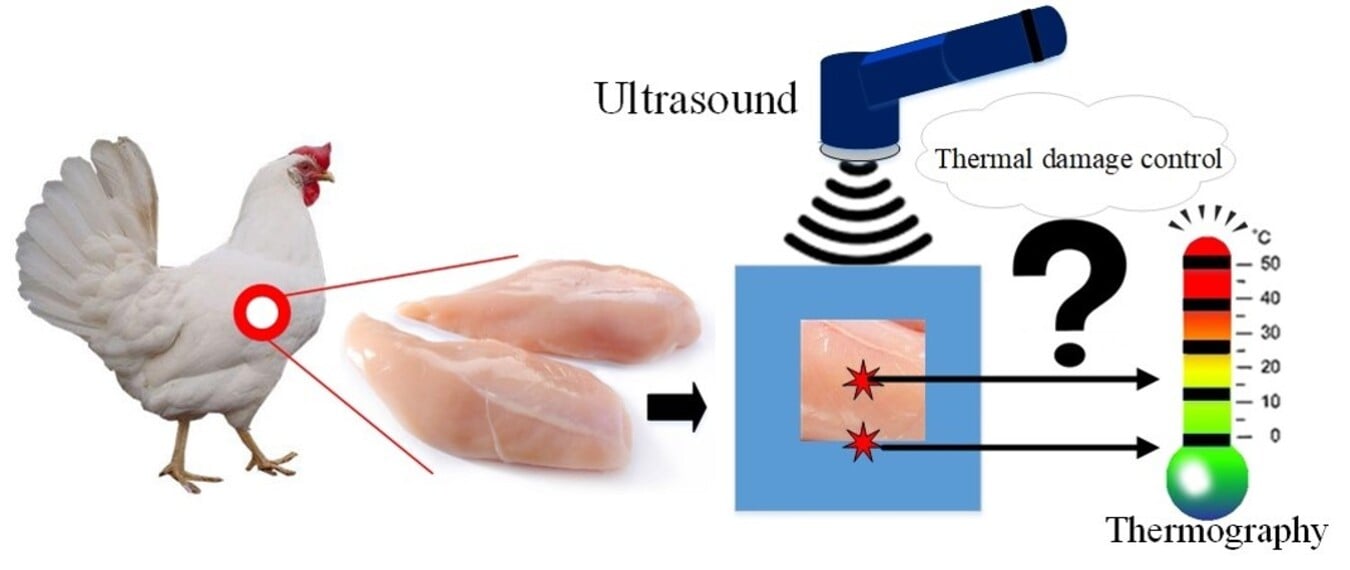
In therapeutic applications, ultrasound is widely used in physiotherapy, tissue repair, and cancer treatment. Regarding cancer treatment, as an emerging field for technology, significant research efforts have been devoted to the area of ultrasound therapy. The derived energy from beams can be deposited in tissues not only through heating but also through non-thermal mechanisms, whereby cancer cells are subject to cell death. Ultrasound-induced heating can generate localized temperature elevations within biological tissues, making it a subject of interest for thermal therapeutic applications. Nevertheless, excessive temperature elevations outside the primary exposure region may result in undesirable thermal effects within the surrounding tissue. In this study, we used continuous 3 MHz ultrasound waves at the powers of 0.4 to 1.4 W on ex vivo chicken breast tissue in a water bath to prevent fluctuations in temperature. The process was also numerically modeled with a maximum error of 0.4% from the measured data. Temperature measurements revealed a significant difference between the region of maximum acoustic pressure along the beam axis and deeper tissue locations (in some cases, above 3.5 °C). These findings indicate that temperature gradients can develop within homogeneous tissue during ultrasound exposure, emphasizing the importance of controlling acoustic power and exposure conditions. Moreover, increasing the temperature was significant during the first moments of treatment, which highlights the importance of precise controls for rate and precision in therapy. The numerical simulations also showed that increasing acoustic power elevates tissue temperature while simultaneously producing a less uniform temperature distribution. These observations may be useful for the optimization of future ultrasound-based thermal treatment strategies; however, direct clinical extrapolation requires further investigation using physiologically representative tissue models.
Share and Cite
MDPI and ACS Style
Dahaghin, A.; Salimibani, M.; Jahansa, P.
Temperature Distribution and Control in Ultrasound-Based Therapy: An Ex Vivo Study with Bioheat Transfer Modeling. Biophysica 2026, 6, 54.
https://doi.org/10.3390/biophysica6040054
AMA Style
Dahaghin A, Salimibani M, Jahansa P.
Temperature Distribution and Control in Ultrasound-Based Therapy: An Ex Vivo Study with Bioheat Transfer Modeling. Biophysica. 2026; 6(4):54.
https://doi.org/10.3390/biophysica6040054
Chicago/Turabian Style
Dahaghin, Ali, Milad Salimibani, and Paria Jahansa.
2026. "Temperature Distribution and Control in Ultrasound-Based Therapy: An Ex Vivo Study with Bioheat Transfer Modeling" Biophysica 6, no. 4: 54.
https://doi.org/10.3390/biophysica6040054
APA Style
Dahaghin, A., Salimibani, M., & Jahansa, P.
(2026). Temperature Distribution and Control in Ultrasound-Based Therapy: An Ex Vivo Study with Bioheat Transfer Modeling. Biophysica, 6(4), 54.
https://doi.org/10.3390/biophysica6040054
Article Metrics
Article metric data becomes available approximately 24 hours after publication online.