


Abstract
Objective and reproducible characterization of visual behavior under ecologically valid conditions remains a methodological challenge in precision sports. This pilot feasibility study presents a multimodal engineering framework that integrates progressive virtual reality (VR) visual training, standardized clinical assessment, wearable binocular eye tracking, inertial measurement unit (IMU) sensing, and fully automated Quiet Eye (QE) extraction. Eight competitive archers were recruited; six completed the full protocol (final analytical sample n = 6). Participants underwent a progressive three-session VR training program targeting smooth pursuit, fusional vergence, and eye–hand coordination, delivered with the Eyesoft EMAA Pro 2 platform. Clinical visual function was assessed before and after the intervention. Following training, gaze behavior during standardized blank-bale shooting was recorded with the Pupil Labs Neon head-mounted binocular eye tracker synchronized with its onboard 9-DoF IMU. An automated analysis pipeline combined fixation detection, IMU-based release detection, and acoustic verification of bowstring release to extract QE duration with minimal observer intervention. The short intervention was associated with a significant increase in the number of successful visuomotor responses (TSM; p = 0.026, r = 0.91). An increase in the slowest reaction time (LSM; p = 0.028, r = 0.90) was also observed and is interpreted as greater response variability rather than an improvement. Accommodative, binocular, and dynamic visual acuity measures showed no statistically significant changes. Automated analysis revealed substantial inter-individual variability in QE duration (median range 155–4975 ms) together with relatively homogeneous fixation, saccade, and pupil metrics. The principal contribution of this work is a complete, largely automated workflow that enables objective and reproducible assessment of gaze behavior during archery performance under ecologically valid conditions. Given the small sample size, short training period, and absence of a control group, all findings must be regarded as preliminary. The framework provides a technical platform for future longitudinal studies, individualized visual training systems, and potential real-time biofeedback applications in precision sports, contingent upon larger controlled trials and formal validation of the automated pipeline.
1. Introduction
Visual information plays a fundamental role in the regulation of motor behavior across virtually all sporting disciplines. In precision sports such as archery, performance depends on the accurate execution of highly reproducible motor actions. The visual system must identify and maintain fixation on a distant target while coordinating eye movements, postural control, and visuomotor processing under tight temporal constraints. Successful performance therefore relies on the efficient integration of multiple visual functions—including accommodation, vergence, smooth pursuit, dynamic visual acuity, and eye–hand coordination—rather than on visual acuity alone [1,2]. Growing evidence indicates that these visual and oculomotor processes constitute a trainable component of athletic performance [3,4,5].
Among the perceptual variables investigated in aiming sports, the Quiet Eye (QE) has become one of the most extensively studied indicators of expert visual behavior. Originally described by Vickers as the final fixation or tracking gaze directed toward a task-relevant location before initiation of the critical movement [6,7], QE has consistently been associated with superior performance across a wide range of self-paced motor tasks. Meta-analytic evidence shows that expert performers typically exhibit longer Quiet Eye durations than novices and that successful attempts are generally preceded by longer QE periods than unsuccessful ones [8,9]. Recent work has emphasized that Quiet Eye should be interpreted as one component of a broader perceptual-cognitive strategy involving fixation behavior, eye movements, and visuomotor coordination [2].
Virtual reality (VR) has emerged as an attractive platform for structured visual training because it enables immersive, highly controlled environments in which visual stimuli, task difficulty, and progression can be standardized and objectively quantified. When combined with wearable eye-tracking systems, VR also permits continuous monitoring of gaze behavior, providing objective metrics that complement conventional clinical assessment [1]. Despite these technological advances, important methodological limitations remain. Previous research investigating Quiet Eye in archery has primarily focused on describing differences between expert and novice performers or on validating detection methods. Gonzalez et al. [10] demonstrated that experienced archers exhibited longer Quiet Eye durations than novices during both field- and laboratory-based tasks. More recently, Söğüt et al. [11] reported the feasibility of automatically detecting Quiet Eye using deep-learning models applied to electro-oculographic signals. However, studies that integrate progressive VR-based visual training with comprehensive clinical assessment and subsequent characterization of gaze behavior using wearable binocular eye tracking remain scarce.
To address these limitations, the present pilot study was conceived from an engineering perspective. Its dual aims were (i) to develop and evaluate a progressive three-session virtual reality visual training protocol targeting visual functions essential for precision sports, and (ii) to establish a largely automated multimodal workflow for objective assessment of visual behavior during archery shooting under ecologically valid conditions. The proposed methodology integrates automated fixation detection, inertial sensing, and acoustic confirmation of arrow release into a single analysis pipeline, thereby reducing observer dependency and improving reproducibility. It was hypothesized that the short intervention would produce measurable changes in selected visuomotor variables, while the post-intervention eye-tracking assessment would demonstrate the feasibility of automated Quiet Eye extraction under realistic training conditions. Because eye-tracking data were acquired only after the intervention, the study does not claim that VR training altered gaze behavior during shooting; the two components are sequential rather than causally linked.
2. Materials and Methods
2.1. Participants
Eight competitive archery athletes from the Centro Especializado de Tecnificación Deportiva de Tiro con Arco were prospectively recruited for this pilot feasibility study. Inclusion criteria were: (i) active participation in the high-performance training program, (ii) ability to complete the intervention protocol and scheduled assessments, and (iii) absence of acute ocular pathology at the time of evaluation. Two athletes did not complete the post-intervention clinical assessment and were therefore excluded from the pre–post statistical analysis, leaving a final analytical sample of six participants. The small final sample size is a major limitation of the study and is emphasized throughout the interpretation of results.
The study protocol was approved by the Clinical Research Ethics Committee of the Universidad Complutense de Madrid (protocol 24/117-E). Written informed consent was obtained from all participants, and all procedures were conducted in accordance with the Declaration of Helsinki.
2.2. Clinical Visual Assessment
Clinical visual assessment was performed immediately before the first virtual reality training session (PRE) and repeated after completion of the intervention (POST) using an identical examination protocol. The assessment included monocular and binocular distance visual acuity (ETDRS charts), objective refraction, accommodative facility, near phoria, accommodative convergence/accommodation ratio (AC/A), near point of convergence (NPC), stereopsis (Howard–Dolman test), binocular dynamic visual acuity, and Hess–Lancaster examination. Only variables measured with the same procedure at both time points were included in the pre–post statistical analysis.
2.3. Virtual Reality Visual Training
The intervention consisted of a progressive virtual reality-based visual training program delivered with the Eyesoft EMAA Pro 2 platform (Eyesoft Medical, Bordeaux, France; https://www.eyesoft.fr/logiciels/emaa-pro2/; accessed on 10 September 2026), a CE-marked Class I medical device specifically designed for immersive visual assessment and training. Participants completed three supervised training sessions distributed over a 14-day period. Each session comprised six five-minute modules targeting stereo convergence, voluntary convergence, stereo divergence, voluntary divergence, smooth pursuit eye movements, and eye–hand coordination, resulting in a total training time of 30 min per session. Visual demands were progressively increased across the three sessions while maintaining the same training domains. All participants were trained individually under identical environmental conditions by an experienced optometrist. Visuomotor reaction-time measures (TSM, PRSM, RSM, LSM) were obtained from the same commercial platform used for training. TSM denotes the total number of successful visuomotor responses in a timed reaction task; PRSM is the mean reaction time; RSM is the fastest (shortest) reaction time; and LSM is the slowest (longest) reaction time. Because these measures are derived from the training device itself, observed changes may partly reflect task familiarity rather than transfer to archery-specific visual performance.
2.4. Post-Intervention Eye-Tracking Assessment and Automated Pipeline
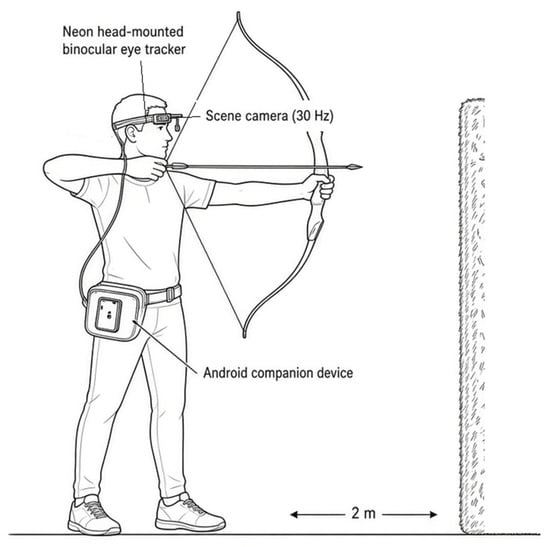
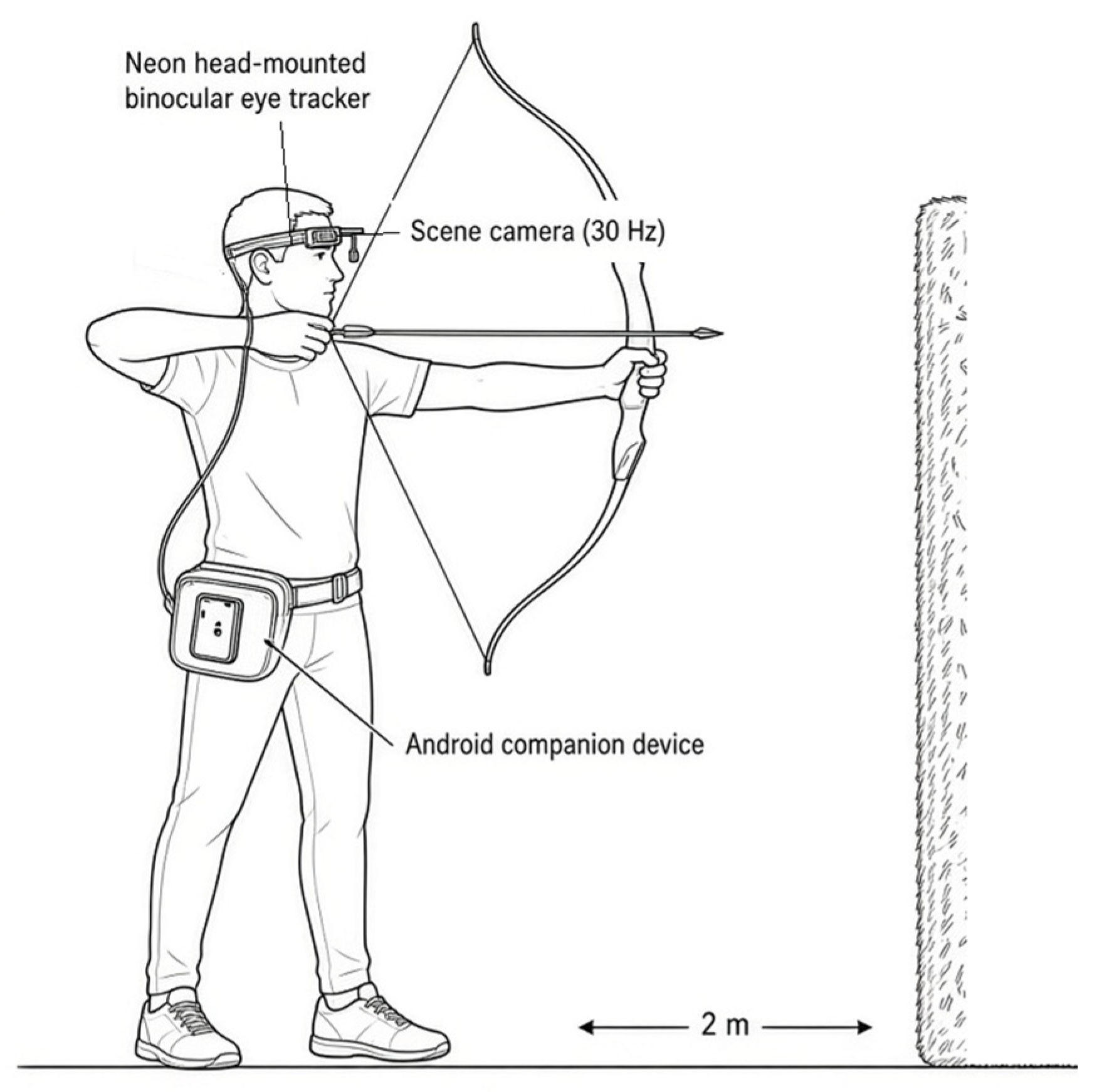
Following completion of the VR program, gaze behavior during archery shooting was recorded with the Neon head-mounted binocular eye-tracking system (Pupil Labs GmbH, Berlin, Germany; https://pupil-labs.com/products/neon); accessed on 31 October 2026. The Neon system incorporates two hardware-synchronized infrared eye cameras recording binocular gaze at 200 Hz, an egocentric scene camera operating at 30 Hz, and a nine-degree-of-freedom inertial measurement unit (IMU) comprising a tri-axial accelerometer, gyroscope, and magnetometer sampled at 110 Hz.
To minimize the influence of aiming accuracy while preserving ecologically valid shooting conditions, athletes performed the shooting task using the blank-bale methodology at a distance of 2 m. This approach is routinely employed by elite archery training centers and allows athletes to focus on shooting mechanics and visuomotor control.
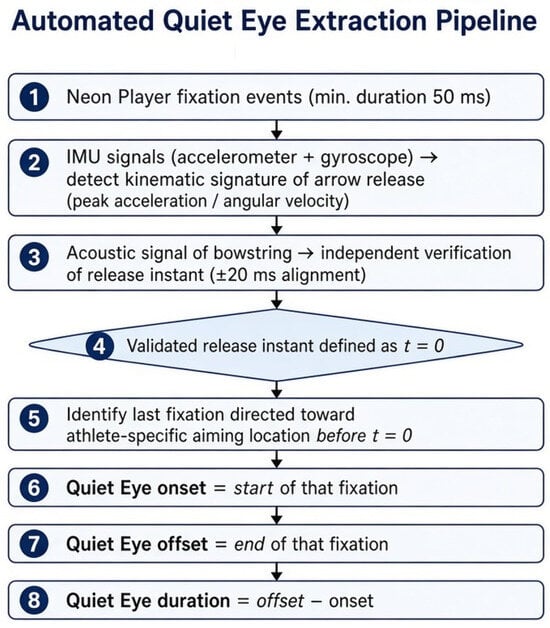
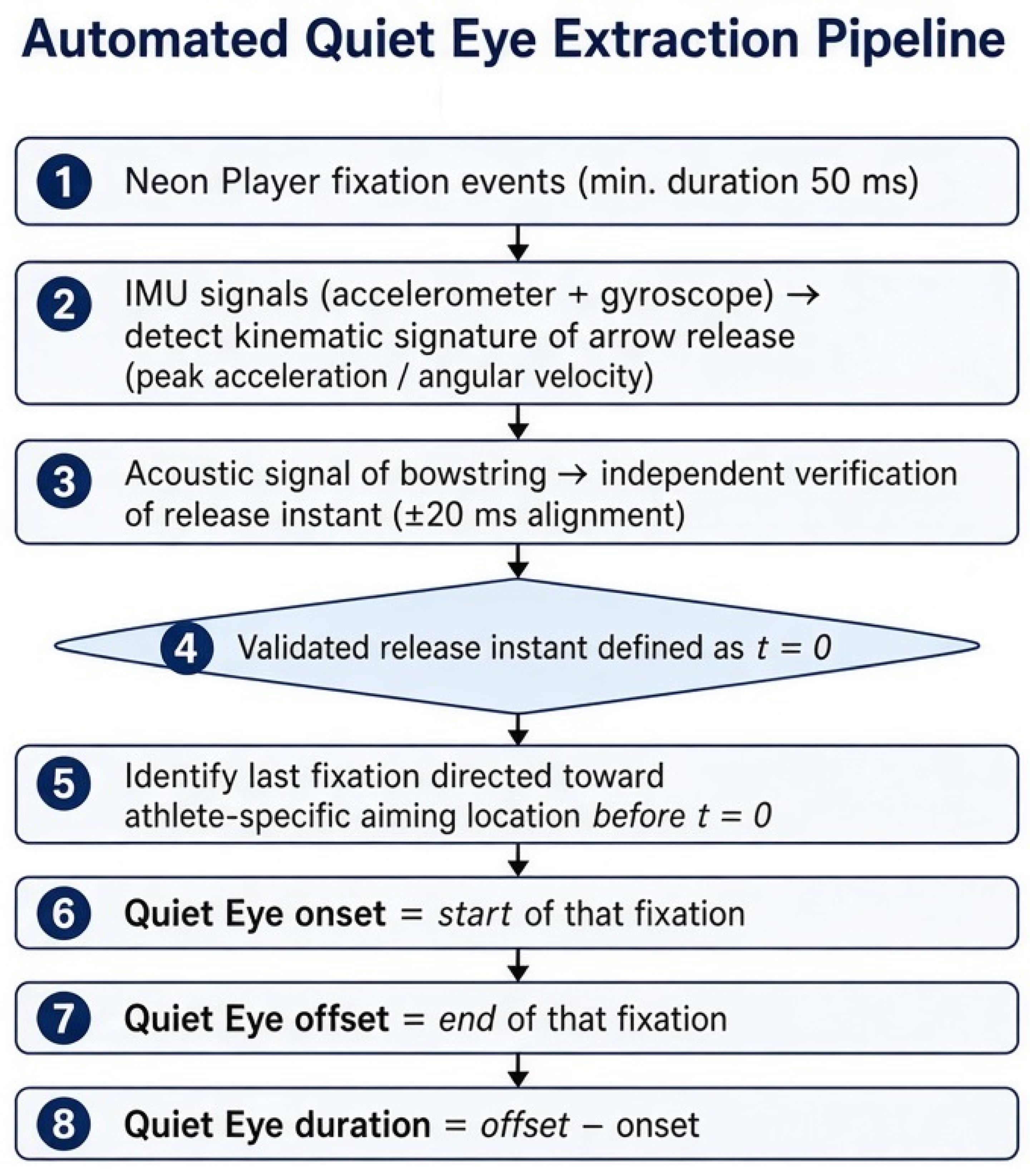
Eye-movement recordings were analyzed with Neon Player (Pupil Labs GmbH, Berlin, Germany) version 6.1x, which automatically identified fixation events using the manufacturer’s head-mounted fixation detection algorithm (default parameters: minimum fixation duration 50 ms, maximum dispersion threshold consistent with the Neon documentation [12]). These fixation events constituted the input for the subsequent Quiet Eye analysis [13]. Quiet Eye extraction was performed with a custom automated algorithm developed for the present study. The algorithm integrated three data streams:
- Fixation events detected by Neon Player;
- IMU signals used to identify the kinematic signature of arrow release (peak acceleration and angular-velocity change exceeding adaptive thresholds derived from the first derivative of the gyroscope and accelerometer traces);
- Acoustic signal generated by the bowstring at release, used as an independent verification of the release instant (onset of the acoustic transient aligned within ±20 ms of the IMU peak).
The validated release instant was defined as t = 0, allowing automatic temporal synchronization of all gaze data. Quiet Eye onset corresponded to the beginning of the last fixation directed toward the predefined athlete-specific aiming location before arrow release; Quiet Eye offset corresponded to the end of this fixation. Quiet Eye duration was calculated as the interval between these two events. The pipeline was designed to minimize observer intervention; however, no formal validation against manual frame-by-frame annotation was performed in the present pilot study. This limitation is acknowledged and should be addressed in future work. Calibration of the Neon system followed the manufacturer’s recommended single-point or multi-point procedure at the start of each recording session. Temporal alignment between the 200 Hz gaze stream, 110 Hz IMU stream, and the acoustic channel was achieved by hardware timestamping within the Neon ecosystem and subsequent software verification of the acoustic–IMU lag window. A schematic overview of the experimental setup is provided in Figure 1.
Figure 1.
Schematic overview of the experimental setup.
A flowchart of the automated Quiet Eye extraction pipeline is shown in Figure 2.
Figure 2.
Flowchart of the automated Quiet Eye extraction.
2.5. Outcome Measures
The study comprised two complementary evaluation components. The first component assessed changes in clinical visual function (accommodative facility, near phoria, induced phoria, AC/A ratio, near point of convergence, stereopsis, visuomotor reaction-time measures, and binocular dynamic visual acuity) before and after the VR training program. The second component consisted of the descriptive characterization of visual behavior during archery shooting after completion of the intervention, including Quiet Eye duration, fixation metrics, saccadic metrics, blink behavior, pupil diameter, and head kinematics derived from the IMU.
2.6. Data Analysis
Statistical analyses were performed with IBM SPSS Statistics (version 30.0; IBM Corp., Armonk, NY, USA). Descriptive statistics were calculated for all variables. Normality was assessed with the Shapiro–Wilk test. Because several clinical variables did not meet the assumption of normality, pre–post comparisons were performed with the Wilcoxon signed-rank test; the corresponding Z statistics and exact p-values are reported. For variables that satisfied normality, paired Student’s t-tests were used. Statistical significance was established at p < 0.05. Effect sizes for Wilcoxon tests were calculated as r = |Z|/√N. Eye-tracking variables obtained during the final shooting assessment were analyzed descriptively only. No correction for multiple comparisons was applied; given the small sample and exploratory nature of the pilot study, all p-values must be interpreted with caution.
3. Results
3.1. Participant Characteristics
Eight competitive archers were included in the baseline assessment. Six participants were right-handed and two were left-handed; the same distribution was observed for ocular dominance. Most participants were emmetropic (n = 6), while one participant was hyperopic and one presented myopia managed with orthokeratology. Two athletes did not complete the post-intervention assessment, resulting in a final analytical sample of six participants. Baseline characteristics are summarized in Table 1.
Table 1.
Baseline characteristics of the study participants.
3.2. Changes in Clinical Visual Function Following VR Training
Clinical variables measured before and after the virtual reality training program are summarized in Table 2. Significant changes were observed in visuomotor performance: the total number of successful responses (TSM) increased (Wilcoxon signed-rank test: Z = −2.232, p = 0.026, r = 0.91) and the slowest reaction time (LSM) also increased (Z = −2.201, p = 0.028, r = 0.90). No significant changes were observed in mean (PRSM) or fastest (RSM) reaction times, nor in accommodative facility, near phoria, induced phoria, or AC/A ratio. Binocular dynamic visual acuity measured at different stimulus speeds is presented in Table 3. Although no statistically significant differences were observed at any stimulus speed, the largest numerical improvement was detected at 40 km/h.
Table 2.
Clinical visual outcomes before and after the virtual reality training program (n = 6). Wilcoxon signed-rank tests were used for all comparisons.
Table 3.
Binocular dynamic visual acuity before and after the virtual reality training program (n = 6). Wilcoxon signed-rank tests were used.
3.3. Eye-Tracking Characteristics During Archery Shooting
Eye-tracking and inertial variables recorded during the final shooting assessment are summarized in Table 4. Because these measurements were acquired only after completion of the intervention, they are presented descriptively. Overall, fixation, saccadic, and pupil metrics showed relatively homogeneous values across participants, whereas substantial inter-individual variability was observed for Quiet Eye duration and several head-movement variables derived from the IMU.
Table 4.
Descriptive eye-tracking and IMU variables obtained during the final shooting assessment (n = 6).
3.4. Quiet Eye Variability During Archery Shooting
Quiet Eye duration exhibited marked inter-individual variability among participants (Table 5). Median Quiet Eye duration ranged from 155 ms to 4975 ms. The longest Quiet Eye durations were observed in participants TA08 and TA05, whereas TA07 consistently exhibited the shortest fixation periods immediately preceding arrow release.
Table 5.
Individual Quiet Eye characteristics during the final shooting assessment.
4. Discussion
The present work should be interpreted as a pilot feasibility study designed to develop and evaluate a progressive virtual reality visual training protocol while establishing an automated workflow for the objective characterization of visual behavior during archery shooting. The relatively small analytical sample (n = 6) is consistent with previous ecological eye-tracking research in archery and reflects the practical complexity of high-quality wearable data acquisition under realistic training conditions [9,10]. Beyond the clinical findings, the study’s primary contribution is methodological: a reproducible experimental framework that combines standardized clinical assessment, progressive VR training, wearable binocular eye tracking, inertial sensing, and automated Quiet Eye extraction.
4.1. Clinical Visual Outcomes Following VR Training
The short virtual reality intervention produced limited changes in the clinical variables evaluated. A significant increase was observed in the total number of successful responses during the visuomotor reaction task (TSM; p = 0.026, r = 0.91). An increase in the slowest reaction time (LSM; p = 0.028, r = 0.90) was also detected; this finding is interpreted as greater variability in the slower responses rather than an overall speeding of reactions and should not be regarded as a performance improvement. Accommodative function, binocular vision parameters, and binocular dynamic visual acuity did not show statistically significant modifications. These results are consistent with the short duration of the program (three sessions over two weeks) and with the largely normal baseline visual function of the competitive archers. The increase in successful responses suggests that the intervention may have enhanced visuomotor efficiency or familiarity with rapid visuomotor processing rather than producing measurable changes in basic sensory visual functions. Similar observations have been reported in sports vision research, where structured visual training often yields task-specific performance gains before conventional clinical measures change [3,4].
4.2. Engineering Contribution: Automated Multimodal Pipeline
The core engineering contribution of this study is a largely automated analysis pipeline. By integrating fixation events from the Neon system, IMU-derived kinematic signatures of arrow release, and independent acoustic verification of bowstring release, the workflow achieves temporal synchronization and Quiet Eye extraction with minimal observer intervention. This approach reduces the subjectivity inherent in purely manual QE identification and enhances reproducibility—an essential requirement for engineering and scientific validation. The simultaneous recording of gaze and head kinematics further enables a multidimensional description of visuomotor control under ecologically valid conditions.
Recent work by Söğüt et al. [10] demonstrated the potential of artificial intelligence for automated Quiet Eye detection from electro-oculographic signals. The present framework extends that concept by combining commercial binocular wearable eye tracking with inertial sensing and acoustic confirmation within a single, deployable workflow. Although the pipeline was designed to minimize observer dependency, formal validation against manual frame-by-frame annotation was not performed in this pilot study and remains an important next step.
4.3. Quiet Eye Variability in Competitive Archers
One of the most notable findings was the considerable inter-individual variability in Quiet Eye duration (median range 155–4975 ms) despite all participants belonging to the same competitive training environment. These results support the view that gaze strategies during archery shooting are highly individualized and should not be interpreted against a single normative value. Differences in aiming strategy, movement preparation, and visuomotor control may all contribute to the observed range. From an applied engineering perspective, this variability underscores the value of individualized visual profiling rather than one-size-fits-all performance indicators.
4.4. Methodological Implications and Future Engineering Applications
The proposed multimodal framework offers several avenues for future development. First, the automated pipeline can be extended to real-time biofeedback systems that provide athletes with immediate information on fixation stability or Quiet Eye duration during training [14]. Second, simultaneous analysis of clinical visual function, gaze behavior, and head kinematics may support the design of personalized visual training programs. Third, because the hardware (Neon eye tracker and EMAA Pro 2) is commercially available and the analysis steps are algorithmic, the workflow can be adapted to other precision sports in which gaze stabilization is critical (e.g., shooting, golf, darts). Future studies should evaluate the reproducibility of the approach in larger cohorts, incorporate pre- and post-intervention eye-tracking measurements, include a control group, and formally validate the automated QE extraction against manual annotation.
4.5. Strengths and Limitations
The principal strengths of the study are the integration of standardized clinical assessment, progressive VR training, wearable binocular eye tracking, inertial sensing, and automated Quiet Eye extraction within a single experimental protocol, and the ecological validity conferred by the blank-bale shooting methodology. Several important limitations must be acknowledged. First, the sample size was small (n = 6 analytical), limiting statistical power and generalizability. Second, the intervention consisted of only three sessions over two weeks and lacked a control group, so training-related changes cannot be unambiguously attributed to the VR protocol. Third, eye-tracking variables, including Quiet Eye, were recorded only after the intervention; consequently, training-related changes in gaze behavior cannot be inferred. Fourth, the automated QE extraction pipeline was not formally validated against manual frame-by-frame annotation in the present pilot study. Several important limitations must be acknowledged and are central to the interpretation of the present findings: (1) The final analytical sample size was small (n = 6), limiting statistical power, generalizability, and the stability of effect-size estimates. (2) The intervention consisted of only three sessions over two weeks and lacked a control group; therefore, training-related changes cannot be unambiguously attributed to the VR protocol. (3) Eye-tracking variables, including Quiet Eye, were recorded only after the intervention; consequently, training-related changes in gaze behavior cannot be inferred. The training and QE components are sequential rather than integrated in a pre–post design. (4) The automated QE extraction pipeline was not formally validated against manual frame-by-frame annotation. (6) The blank-bale task at 2 m minimizes the influence of aiming accuracy and does not provide a discrete visual target or scoring data; relationships between objective metrics and actual archery performance therefore cannot be examined. (7) Visuomotor reaction-time measures were obtained from the same commercial platform used for training, raising the possibility of familiarity effects. (8) Substantial inter-individual variability in QE duration may reflect both genuine strategic differences and residual measurement factors. These limitations are typical of early methodological work and define clear directions for subsequent controlled trials.
5. Conclusions
This pilot study developed and evaluated a progressive three-session virtual reality visual training protocol for competitive archers while establishing an integrated, largely automated methodology for the objective assessment of visual behavior during archery shooting under ecologically valid conditions. The short intervention was associated with a significant increase in successful visuomotor responses (TSM); an increase in the slowest reaction time (LSM) was also observed and is interpreted as greater response variability rather than improvement. Most conventional clinical visual variables remained unchanged. Substantial inter-individual variability in Quiet Eye duration highlights the complexity of visual strategies in archery and supports the need for individualized assessment tools.
The principal achievement is a complete multimodal framework that combines commercial wearable eye tracking, inertial sensing, and acoustic verification to deliver Quiet Eye extraction with minimal observer intervention. Given the small sample size, short training period, absence of a control group, and lack of formal pipeline validation, all findings must be regarded as preliminary. This engineering workflow provides a technical foundation for future longitudinal studies, adaptive visual training systems, and real-time gaze-based biofeedback applications in precision sports, provided that larger controlled trials and formal validation of the automated pipeline are undertaken.
Author Contributions
Conceptualization, R.B.-V.; methodology, R.B.-V., C.O.-C. and F.J.P.-M.; investigation, C.O.-C. and R.G.-J.; data curation, C.O.-C. and J.E.C.-S.; formal analysis, R.B.-V. and F.J.P.-M.; writing—original draft preparation, R.B.-V.; writing—review and editing, all authors; supervision, R.B.-V. All authors have read and agreed to the published version of the manuscript.
Funding
This research received no external funding.
Institutional Review Board Statement
This study was approved by CEIm Hospital Clínico San Carlos on 14 October 2025 (Approval No. 25/698-IC_P_CE).
Informed Consent Statement
Written informed consent was obtained from all subjects involved in the study.
Data Availability Statement
The datasets generated and analyzed during the current study are available from the corresponding author on reasonable request.
Conflicts of Interest
The authors declare no conflicts of interest.
References
- Kredel, R.; Vater, C.; Klostermann, A.; Hossner, E.-J. Eye-Tracking Technology and the Dynamics of Natural Gaze Behavior in Sports: A Systematic Review of 40 Years of Research. Front. Psychol. 2017, 8, 1845. [Google Scholar] [CrossRef] [Scilit] [PubMed]
- Dalton, K. Review: The Quiet Eye in Sports Performance—Is the Quiet Eye the Ultimate Explanation or Only the Beginning? Optom. Vis. Sci. 2021, 98, 732–737. [Google Scholar] [CrossRef] [Scilit] [PubMed]
- Lochhead, L.; Feng, J.; Laby, D.M.; Appelbaum, L.G. Training vision in athletes to improve sports performance: A systematic review of the literature. Int. Rev. Sport Exerc. Psychol. 2026, 19, 333–355. [Google Scholar] [CrossRef] [Scilit]
- Minoonejad, H.; Barati, A.H.; Naderifar, H.; Heidari, B.; Kazemi, A.S.; Lashgari, M. Effect of four weeks of ocular-motor exercises on dynamic visual acuity and stability limit of female basketball players. Gait Posture 2019, 73, 286–290. [Google Scholar] [CrossRef] [Scilit] [PubMed]
- Mann, D.T.Y.; Williams, A.M.; Ward, P.; Janelle, C.M. Perceptual-cognitive expertise in sport: A meta-analysis. J. Sport Exerc. Psychol. 2007, 29, 457–478. [Google Scholar] [CrossRef] [Scilit] [PubMed]
- Vickers, J.N. Visual control when aiming at a far target. J. Exp. Psychol. Hum. Percept. Perform. 1996, 22, 342–354. [Google Scholar] [CrossRef] [PubMed]
- Vickers, J.N. Perception, Cognition, and Decision Training: The Quiet Eye in Action; Human Kinetics: Champaign, IL, USA, 2007. [Google Scholar]
- Lebeau, J.-C.; Liu, S.; Sáenz-Moncaleano, C.; Sanduvete-Chaves, S.; Chacón-Moscoso, S.; Becker, B.J.; Tenenbaum, G. Quiet eye and performance in sport: A meta-analysis. J. Sport Exerc. Psychol. 2016, 38, 441–457. [Google Scholar] [CrossRef] [Scilit] [PubMed]
- Rienhoff, R.; Tirp, J.; Strauß, B.; Baker, J.; Schorer, J. The Quiet Eye and motor performance: A systematic review. Sports Med. 2016, 46, 589–603. [Google Scholar] [CrossRef] [Scilit] [PubMed]
- Gonzalez, C.C.; Causer, J.; Grey, M.J.; Humphreys, G.W.; Miall, R.C.; Williams, A.M. Exploring the Quiet Eye in archery using field- and laboratory-based tasks. Exp. Brain Res. 2017, 235, 2843–2855. [Google Scholar] [CrossRef] [Scilit] [PubMed]
- Söğüt, F.; Yanık, H.; Değirmenci, E.; Kesilmiş, İ.; Çömelekoğlu, Ü. Automated detection of Quiet Eye durations in archery using electrooculography and comparative deep learning models. BMC Sports Sci. Med. Rehabil. 2025, 17, 234. [Google Scholar] [CrossRef] [Scilit] [PubMed]
- Pupil Labs GmbH. Neon Documentation. Available online: https://docs.pupil-labs.com (accessed on 10 September 2026).
- Drews, M.; Dierkes, K. Strategies for enhancing automatic fixation detection in head-mounted eye tracking. Behav. Res. Methods 2024, 56, 6276–6298. [Google Scholar] [CrossRef] [Scilit] [PubMed]
- Vine, S.J.; Moore, L.J.; Wilson, M.R. Quiet eye training facilitates competitive putting performance in elite golfers. Front. Psychol. 2011, 2, 8. [Google Scholar] [CrossRef] [Scilit] [PubMed]

Disclaimer/Publisher’s Note: The statements, opinions and data contained in all publications are solely those of the individual author(s) and contributor(s) and not of MDPI and/or the editor(s). MDPI and/or the editor(s) disclaim responsibility for any injury to people or property resulting from any ideas, methods, instructions or products referred to in the content. |
© 2026 by the authors. Licensee MDPI, Basel, Switzerland. This article is an open access article distributed under the terms and conditions of the Creative Commons Attribution (CC BY) license.