


Abstract
Background: Acute appendicitis is the leading pediatric surgical emergency. Identifying drivers of disease severity and laparoscopic-to-open conversion remains critical for surgical planning. We evaluated the discriminative performance of clinical scores and inflammatory biomarkers for both peritonitis and surgical conversion, and explored combined clinical–laboratory models among children with acute appendicitis undergoing an initially attempted laparoscopic appendectomy. Methods: A retrospective study was conducted, including pediatric patients with acute appendicitis who underwent surgical treatment. Clinical scores (Alvarado score and Pediatric Appendicitis Score) and laboratory parameters (C-reactive protein, neutrophil count, and neutrophil-to-lymphocyte ratio) were analyzed. Receiver operating characteristic (ROC) curve analysis was used to assess discriminative ability, with calculation of the area under the curve (AUC). Combined models based on standardized variables were constructed and evaluated. Comparisons between AUCs were performed using DeLong’s test. Results: For prediction of peritonitis, clinical scores suggested good discriminative ability within the sample, with AUC values of 0.805 for the Alvarado score and 0.812 for the Pediatric Appendicitis Score, whereas C-reactive protein showed moderate performance (AUC = 0.735). Combined models achieved AUC values of 0.823 for both zPAS + zCRP and zAlvarado + zCRP, and 0.773 for zCRP + zNLR. For surgical conversion, higher within-sample AUC values were observed, reaching 0.879 for the Alvarado score and up to 0.932 for the combined models (zAlvarado + zCRP), followed by 0.926 for zPAS + zCRP and 0.874 for zCRP + zNLR. However, these results should be interpreted with caution due to the limited number of conversion events. Conclusions: Clinical scoring systems and inflammatory biomarkers suggested good ability to predict peritonitis in pediatric acute appendicitis, while their performance for predicting surgical conversion appeared higher but remains exploratory. Combined clinical–laboratory models showed promising within-sample discriminative ability; however, given the very small number of conversion events, these findings should be regarded as exploratory and hypothesis-generating only.
1. Introduction
Acute appendicitis remains the most common surgical emergency in children, representing the leading cause of acute abdominal pain requiring operation in this age group [1]. The estimated annual incidence in the pediatric population ranges from 80 to 150 cases per 100,000 children, with increased frequency around 10–15 years of age and a slight male predominance (male-to-female ratio approximately 1.2–1.4:1) [2,3]. The disease spectrum is age-dependent: younger children, particularly those under 5 years, are more prone to develop complicated appendicitis, with perforation rates reaching 70–80%, compared with less than 40% in older children [4,5]. This age-related difference is attributed to diagnostic delays, atypical presentations, and difficulty in clinical assessment [6]. Epidemiologic trends show seasonal variation, with increased incidence in summer and autumn, and hospital referral patterns also influence disease stage and outcomes [7,8].
Systemic factors influencing healthcare access can significantly impact both disease complexity and surgical outcomes. Studies evaluating healthcare disruptions, such as during the COVID-19 pandemic, demonstrated that delayed hospital presentation led to an increased proportion of complicated or perforated cases, elevated inflammatory markers, and higher rates of conversion to open appendectomy [4,9,10]. These observations underline how delayed presentation and severe intraoperative inflammation increase technical challenges during laparoscopic surgery.
Laparoscopic appendectomy (LA) is the gold standard for pediatric appendicitis [11], offering reduced pain, shorter hospitalizations, faster recovery, and fewer wound complications compared with open appendectomy (OA) [12,13,14]. In a multicenter analysis of 1220 patients, Bancke Laverde et al. (2023) reported a 5.5% conversion rate, identifying elevated white blood cell count, C-reactive protein, perforation, gangrene, abscess, and peritonitis as independent predictors [13]. Although that study included adults, subsequent pediatric series have confirmed that conversion rates typically range from 1% to 7%, increasing significantly in cases of complicated or perforated appendicitis [15,16]. Pediatric series by Pogorelić et al. (2023) also found comparable outcomes between daytime and nighttime LA, with no significant difference in conversion or complication rates, emphasizing that center experience and perioperative logistics matter more than timing [7,15].
Conversion from laparoscopic to open appendectomy may become necessary because of intraoperative difficulties such as poor visualization, dense adhesions, excessive inflammation, bleeding, or unexpected anatomic variations [17]. While the goal of minimally invasive surgery is to complete the operation laparoscopically, timely conversion in the face of high risk remains an important safety decision. Persisting with a difficult laparoscopic dissection may be associated with longer operative time, increased blood loss, and increased risk of iatrogenic injury [18]. Therefore, understanding risk factors and anticipating challenging situations preoperatively—based on laboratory results, imaging, and intraoperative findings—can improve decision-making and outcomes [19].
Postoperative outcomes vary by disease stage and surgical approach. In uncomplicated appendicitis, laparoscopic surgery allows rapid recovery and even same-day discharge in selected children [20,21]. However, converted or complicated cases often show longer operative times, extended hospitalization, higher rates of wound infection and intra-abdominal abscess, and higher readmission rates [19,22,23]. Son et al. (2024) identified postoperative intra-abdominal abscess (IAA) in 10.9% of children with perforated appendicitis treated laparoscopically, with free appendicolith and severe local inflammation as strong predictors [24]. Other authors have emphasized that early identification of IAA risk allows optimized antibiotic therapy and drainage strategy, thereby mitigating morbidity [21,22,25].
Thus, acute appendicitis in children remains a dynamic field of study linking epidemiologic, clinical, and operative factors. The balance between the benefits of minimally invasive surgery and the safety of timely conversion continues to define surgical quality. Identifying factors associated with the need for conversion and evaluating postoperative outcomes by disease severity and timing may contribute to preoperative planning, resource allocation, and parental counseling.
The aim of this study was to evaluate the rate of conversion from laparoscopic to open appendectomy in pediatric patients with acute appendicitis in whom laparoscopy was selected as the initial surgical approach and to investigate preoperative factors associated with surgical conversion and disease severity (peritonitis). Specifically, we analyzed the diagnostic performance of clinical scoring systems (Alvarado score and Pediatric Appendicitis Score) and inflammatory biomarkers (C-reactive protein, neutrophil count, and neutrophil-to-lymphocyte ratio), determined their optimal cut-off values, and assessed their sensitivity, specificity, and predictive values. In addition, we explored whether combining clinical and laboratory parameters into standardized composite models could improve the ability to predict these outcomes compared with individual variables. The main novelty of this study lies in the simultaneous evaluation of risk factors for both peritonitis and surgical conversion in a well-defined pediatric cohort selected for initial laparoscopy. Furthermore, we introduced standardized composite models (z-scores) combining established clinical scores with laboratory biomarkers to explore potential additive discriminative performance for these outcomes.
2. Materials and Methods
This retrospective observational study was conducted in the Department of Pediatric Surgery and Orthopedics at the Bihor County Emergency Clinical Hospital, in Oradea, Romania, over a 15-month period from October 2022 to December 2023. All patients were managed under standard, non-pandemic hospital protocols, since Romania officially ended the COVID-19 state of alert on 8 March 2022, when SARS-CoV-2 testing at hospital admission was no longer mandatory.
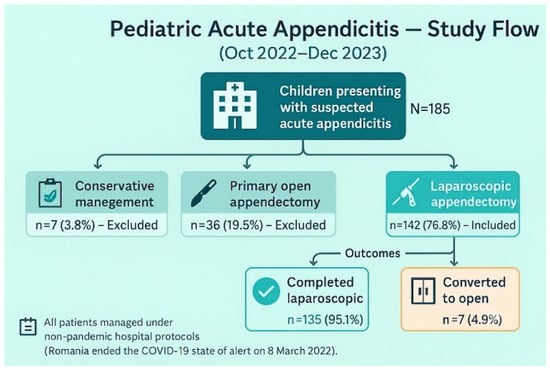
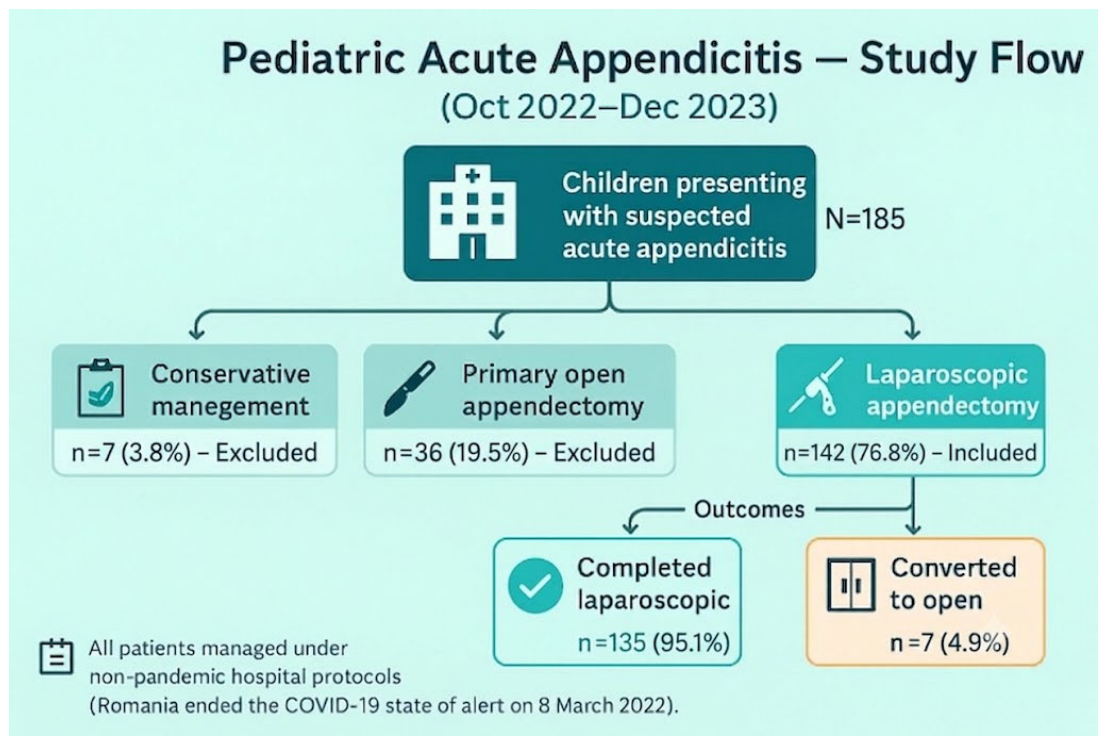
A total of 185 pediatric patients presenting with suspected acute appendicitis were evaluated during the study period. Of these, seven children received conservative treatment, thirty-six underwent primary open appendectomy, and one hundred forty-two underwent laparoscopic appendectomy. The latter group constituted the study cohort. Accordingly, all subsequent analyses were restricted to patients in whom laparoscopy was selected as the initial operative approach. Within this cohort, 135 procedures were completed laparoscopically, while seven required conversions to the open approach. The patient selection process and study cohort distribution are illustrated in Figure 1.
Figure 1.
Study Flowchart of pediatric patients with acute appendicitis.
Inclusion criteria comprised patients aged 3 to 18 years with acute appendicitis, confirmed intraoperatively or histopathologically, who underwent an initially attempted laparoscopic approach, and whose complete clinical and operative data were available for analysis. Exclusion criteria were limited to patients treated non-surgically or with primary open appendectomy, and to those who underwent incidental appendectomy during other surgical procedures.
Clinical, intraoperative, and postoperative data were retrospectively retrieved from hospital records, operative protocols, and discharge summaries. Variables of interest included demographic characteristics, clinical presentation, laboratory parameters, intraoperative findings, histopathological results, postoperative complications, and length of hospital stay. All blood samples for laboratory parameters (CRP, WBC, neutrophil count, NLR) were collected at hospital admission prior to the initiation of intravenous antibiotic therapy. All surgical procedures and perioperative care followed a standardized institutional protocol.
To enhance predictive performance, combined models integrating clinical scores and inflammatory markers were developed. For each variable, standardized values (z-scores) were calculated using the formula z = (X − μ)/SD, where X represents the individual value, μ the mean, and SD the standard deviation of the variable. Composite scores were then obtained by summing the corresponding standardized variables, resulting in three combined models: zPAS + zCRP, zAlvarado + zCRP, and zCRP + zNLR. This approach allows the integration of parameters measured on different scales into a single metric, improving comparability and enabling a more balanced contribution of each component to the final score. The diagnostic performance of these combined models was subsequently evaluated using ROC curve analysis. Because of the limited number of conversion events, the combined models were developed exclusively as exploratory within-sample analyses intended to generate hypotheses for future studies rather than to establish validated clinical prediction models.
Statistical analyses were performed using Jamovi 2.6.26 and R v4.5 (The Jamovi project, 2024; R Core Team, 2024). Missing data were handled using an available-case analysis. Consequently, the number of observations varied across analyses depending on data availability, and the corresponding sample size (n) was reported where applicable. The distribution of continuous variables was assessed using the Shapiro–Wilk test. Continuous variables were summarized as mean ± standard deviation for consistency, although some variables showed non-normal distributions, and comparisons between groups were performed using the independent samples Student’s t-test or Mann–Whitney U test. Categorical variables were compared using the Chi-square test or Fisher’s exact test (two-tailed), as appropriate.
We evaluated discriminative performance using receiver operating characteristic (ROC) curves and calculated the area under the curve (AUC). Youden’s index established optimal cut-offs, with corresponding sensitivity, specificity, positive predictive value (PPV), and negative predictive value (NPV). Comparisons between AUCs were performed using DeLong’s test. A p-value < 0.05 (two-tailed) was considered statistically significant.
3. Results
A total of 142 pediatric patients with acute appendicitis were included in the study. The mean age was 11.1 ± 3.45 years, with a predominance of male patients (61.3%) compared with females (38.7%). Mean height was 1.47 ± 0.19 m, mean weight 45.0 ± 18.6 kg, corresponding to a mean BMI of 20.2 ± 5.55 kg/m2; obesity was present in 32.4% (46/142) of cases. Regarding inflammatory markers, the mean C-reactive protein (CRP) was 40.3 ± 54.0 mg/L. Leukocytes averaged 13.7 ± 5.21 × 10⁹/L, while neutrophils averaged 10.8 ± 5.02 × 10⁹/L. The group average neutrophil-to-lymphocyte ratio (NLR) was 7.46 ± 5.35. Peritonitis was identified intraoperatively in 28.2% (40/142) of patients, with generalized peritonitis in 22.5% (32/142) and localized peritonitis in 5.6% (8/142). The average surgery duration over the sample was 71.7 ± 33.1 min, with an average duration before conversion of 38.6 ± 12.1 min. Operative time was significantly longer in converted cases (144.28 ± 45.77 min vs. 67.95 ± 27.81 min, p < 0.001), reflecting an intraoperative outcome measure directly prolonged by the conversion procedure rather than a preoperative predictive variable. The median length of postoperative stay was 4.0 days (IQR 3–5), with a mean of 4.34 ± 1.65 days. For 5 cases (3.5%), the operating surgeon had performed fewer than 20 laparoscopic appendectomies prior to the intervention, with 1 conversion (20.0%), whereas the remaining 137 cases (96.5%) were operated on by surgeons with experience exceeding 20 laparoscopic procedures, with 6 conversions (4.4%). This difference was not statistically significant (p = 0.226, Fisher’s exact test).
The overall laparoscopic-to-open conversion rate was 4.9% (7/142). Conversion occurred in 4.59% of male and 5.45% of female patients (p = 0.99—Fisher’s exact test), showing no relevant sex differences (OR = 1.2, 95% CI: 0.25–5.56). Among converted cases, 6 of 7 (85.7%) presented with peritonitis, whereas among non-converted patients, peritonitis was present in 34 of 135 cases (25.2%). This association was statistically significant (p = 0.002—Fisher’s exact test), corresponding to an odds ratio of 17.82 (95% CI: 2.07–153.38). Conversion rates were comparable between obese and non-obese patients, occurring in 4.35% and 5.21% of cases, respectively. No significant association was identified between obesity and conversion (p = 1.000—Fisher’s exact test; OR = 0.83, 95% CI: 0.15–4.43).
For subgroup analysis, patients were stratified according to the need for laparoscopic-to-open conversion (n = 7) versus non-conversion (n = 135). Descriptive statistics for age, anthropometric parameters, inflammatory markers, and postoperative evolution are summarized in Table 1. Because an available-case approach was used for variables with missing data, the number of observations (n) varies across analyses and is indicated where applicable.
Table 1.
Comparison of demographic, laboratory, and perioperative parameters between conversion and non-conversion groups.
Table 2 summarizes the diagnostic performance of clinical and laboratory parameters for predicting peritonitis and surgical conversion. For each variable, the optimal cut-off value was determined, and the associated sensitivity, specificity, positive predictive value, negative predictive value, and Youden index are reported.
Table 2.
Diagnostic performance of clinical and laboratory parameters for predicting peritonitis and surgical conversion among patients with acute appendicitis.
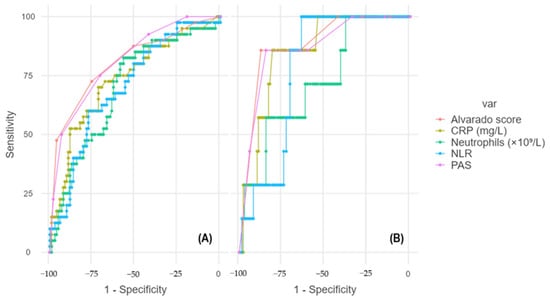
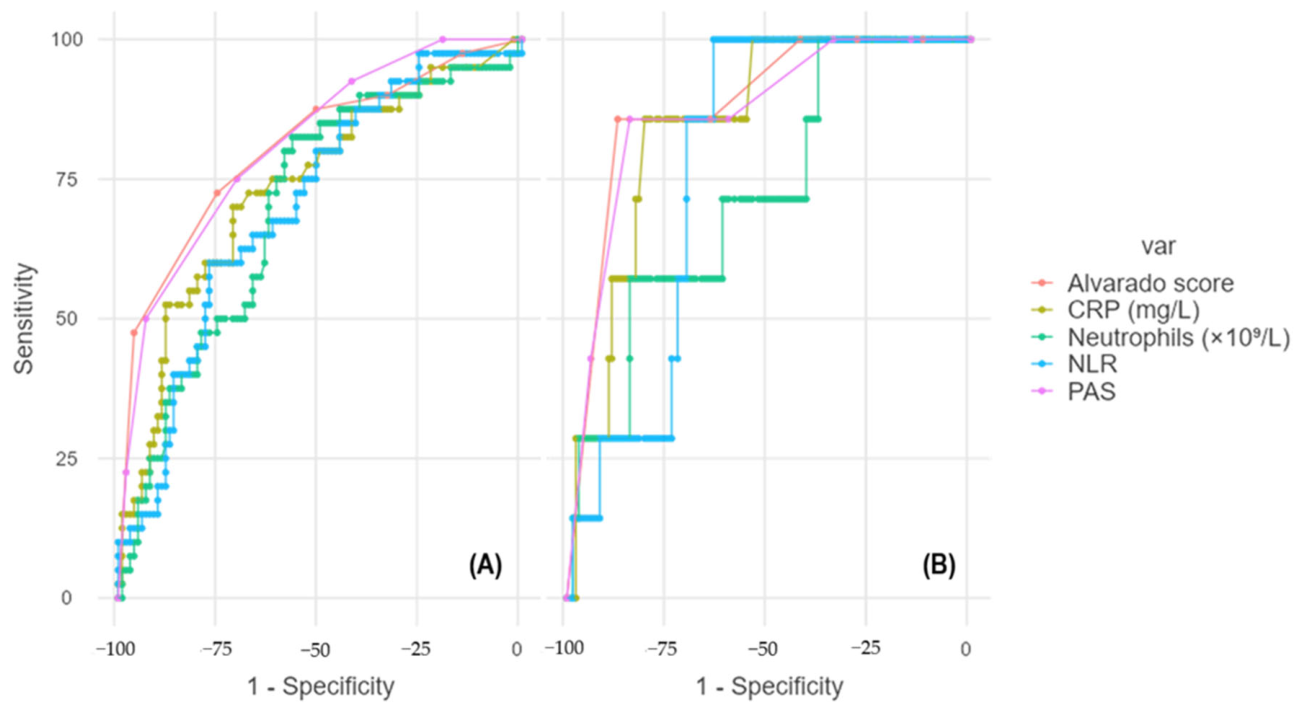
To complement the numerical results presented in Table 2 and to facilitate visual comparison of the discriminative performance, receiver operating characteristic (ROC) curves were constructed for all evaluated clinical and laboratory parameters (Figure 2).
Figure 2.
Receiver operating characteristic (ROC) curves comparing the discriminative ability of clinical scores and inflammatory biomarkers in predicting peritonitis (A) and surgical conversion (B). Note: Abbreviations: CRP—C-reactive protein; NLR—neutrophil-to-lymphocyte ratio; PAS—Pediatric Appendicitis Score. For panel (A) (peritonitis), the AUCs (95% CIs) were as follows: Alvarado score, 0.805 (95% CI: 0.721–0.890); PAS, 0.812 (95% CI: 0.737–0.888); CRP, 0.735 (95% CI: 0.640–0.830); neutrophil count, 0.699 (95% CI: 0.603–0.794); and NLR, 0.704 (95% CI: 0.610–0.797). For panel (B) (surgical conversion), the AUCs (95% CIs) were as follows: Alvarado score, 0.879 (95% CI: 0.762–0.996); PAS, 0.866 (95% CI: 0.729–1.000); CRP, 0.848 (95% CI: 0.731–0.964); neutrophil count, 0.721 (95% CI: 0.526–0.915); and NLR, 0.774 (95% CI: 0.663–0.884).
For predicting peritonitis (Figure 2A), the Pediatric Appendicitis Score showed the highest area under the curve (AUC = 0.812, Youden index = 0.456, cut-off ≥ 4), followed closely by the Alvarado score (AUC = 0.805, Youden index = 0.480, cut-off ≥ 5). Among inflammatory biomarkers, C-reactive protein suggested moderate performance (AUC = 0.735, Youden index = 0.416, cut-off ≥ 26 mg/L), whereas the neutrophil-to-lymphocyte ratio (AUC = 0.704, Youden index = 0.375, cut-off ≥ 9.7) and neutrophil count (AUC = 0.699, Youden index = 0.394, cut-off ≥ 11.1 × 10⁹/L) showed lower discriminative ability.
A similar analytical approach was applied to evaluate the ability of clinical scores and inflammatory biomarkers to predict surgical conversion (Figure 2B). The Alvarado score suggested the highest discriminative performance (AUC = 0.879, Youden index = 0.731, cut-off ≥ 6), followed by the Pediatric Appendicitis Score (AUC = 0.866, Youden index = 0.702, cut-off ≥ 5). Among laboratory markers, C-reactive protein showed higher within-sample discrimination (AUC = 0.848, Youden index = 0.665, cut-off ≥ 67 mg/L), whereas the neutrophil-to-lymphocyte ratio (AUC = 0.774, Youden index = 0.637, cut-off ≥ 7.9) and neutrophil count (AUC = 0.721, Youden index = 0.416, cut-off ≥ 15.38 × 10⁹/L) exhibited lower discriminative ability.
To further explore whether combining clinical scores with inflammatory biomarkers improves diagnostic performance, composite indices were constructed using standardized (z-score) values of the selected variables. These combined models were designed to integrate clinical assessment with laboratory inflammatory response into a single metric, aiming to enhance discrimination between patients with and without peritonitis, as well as those requiring surgical conversion.
The diagnostic performance of these combined clinical–laboratory models, including optimal cut-off values, sensitivity, specificity, predictive values, and Youden index, is summarized in Table 3.
Table 3.
Diagnostic performance of combined clinical–laboratory models for predicting peritonitis and conversion in acute appendicitis.
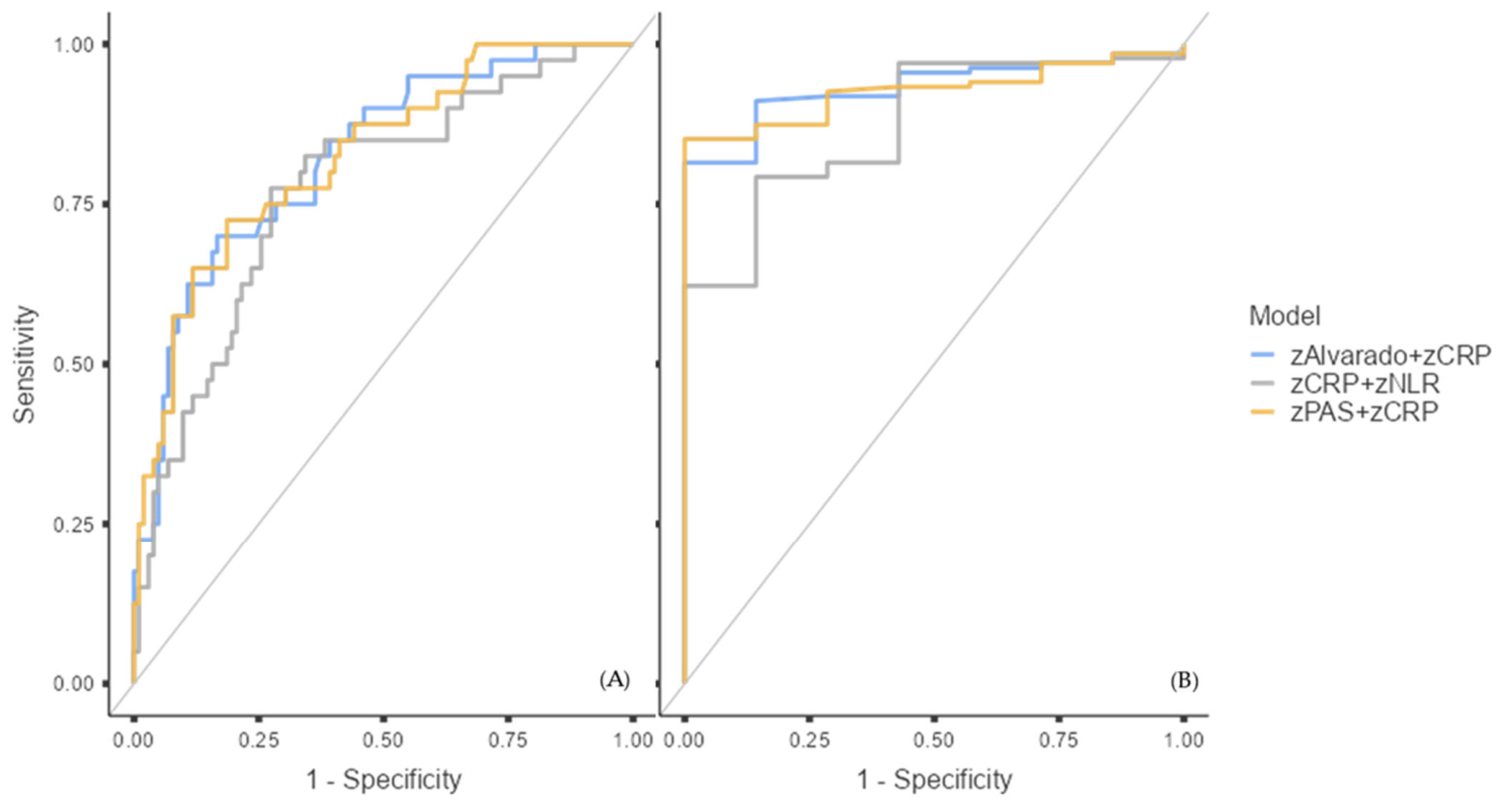
Further exploratory ROC analysis of the combined models suggested moderate-to-good within-sample discriminative performance (Figure 3). For predicting peritonitis, the AUC values were 0.823 (95% CI: 0.747–0.899) for zPAS + zCRP, 0.823 (95% CI: 0.747–0.899) for zAlvarado + zCRP, and 0.773 (95% CI: 0.687–0.860) for zCRP + zNLR. For predicting conversion, the corresponding AUC values were higher, reaching 0.926 (95% CI: 0.877–0.976), 0.932 (95% CI: 0.880–0.984), and 0.874 (95% CI: 0.773–0.976), respectively. Pairwise comparisons using DeLong’s test showed no statistically significant differences between models for either peritonitis or conversion (all p > 0.05), indicating comparable overall performance.
Figure 3.
Receiver operating characteristic (ROC) curves of combined clinical–laboratory models for predicting (A) peritonitis and (B) conversion. Note: Abbreviations: CRP = C-reactive protein; NLR = neutrophil-to-lymphocyte ratio; PAS = Pediatric Appendicitis Score; AUC = area under the curve. For panel A (peritonitis), the AUCs (95% CIs) were as follows: zPAS + zCRP, 0.823 (95% CI: 0.747–0.899); zAlvarado + zCRP, 0.823 (95% CI: 0.747–0.899); and zCRP + zNLR, 0.773 (95% CI: 0.687–0.860). For panel B (surgical conversion), the AUCs (95% CIs) were as follows: zPAS + zCRP, 0.926 (95% CI: 0.877–0.976); zAlvarado + zCRP, 0.932 (95% CI: 0.880–0.984); and zCRP + zNLR, 0.874 (95% CI: 0.773–0.976). Combined models were constructed using standardized variables (z-scores), calculated as z = (X − μ)/SD, where X represents the individual value, μ the mean, and SD the standard deviation. The composite scores were obtained by summing the corresponding standardized variables: zPAS + zCRP, zAlvarado + zCRP, and zCRP + zNLR.
4. Discussion
Laparoscopic appendectomy is currently regarded as the standard surgical approach for acute appendicitis in children, owing to its well-documented advantages in postoperative recovery and length of hospital stay [2,9,17]. Nevertheless, the procedure may become technically challenging in advanced inflammatory disease, where conversion to an open approach may be necessary to ensure patient safety. Conversion is multifactorial and typically reflects a complex interplay between disease severity and intraoperative findings (such as local inflammation, contamination, and anatomical distortion) rather than patient demographics alone. In this context, conversion should be interpreted as a dynamic intraoperative safety adjustment rather than an adverse surgical outcome [12,14,19,25,26]. To address existing gaps in preoperative evaluation, this study offers two novel contributions: the simultaneous evaluation of risk factors for both peritonitis and surgical conversion in a homogeneous pediatric cohort selected for initial laparoscopy, and the development of exploratory standardized composite models (z-scores) that combine clinical scoring systems with laboratory biomarkers to assess potential additive discriminative performance.
The present study reports a 4.9% conversion rate from laparoscopic to open appendectomy in pediatric patients with acute appendicitis. Peritonitis, elevated inflammatory markers (particularly CRP and NLR), and higher clinical scores (Alvarado and PAS) were significantly associated with the need for conversion. Converted cases experienced significantly longer operative times, increased postoperative drainage volumes, and prolonged hospital stays compared to successfully completed laparoscopic procedures.
Our 4.9% conversion rate aligns with contemporary pediatric series, such as the 5.5% reported by Bancke Laverde et al. (2023) and broader meta-analyses on preoperative risk factors [13,14]. This favorable rate likely reflects dedicated pediatric surgical expertise, an older cohort (mean age 11.1 years), and normalized healthcare-seeking behavior after Romania ended the COVID-19 state of alert on March 8, 2022. Unlike pandemic-era studies, which documented presentation delays, increased complicated appendicitis, higher conversion rates, and prolonged operative times [4,5,10], our post-pandemic timing facilitated more timely hospital presentations and less complex intraoperative findings [4,10].
The most striking finding was the strong association between peritonitis and conversion, with 85.7% of converted cases presenting with peritonitis compared with only 25.2% of non-converted cases (OR 17.82, 95% CI: 2.07–153.38, p = 0.002). This finding is consistent with the literature, which shows that peritonitis significantly increases conversion risk. Bancke Laverde et al. (2023) identified peritonitis as an independent predictor of conversion in their multivariable analysis [13]. Monrabal Lezama et al. (2022), in their 15-year single-center analysis of 2193 adult patients, also found that complicated appendicitis was associated with higher conversion rates and worse outcomes [19].
The underlying mechanism is multifactorial: peritonitis creates dense adhesions and inflammatory phlegmon that obscure tissue planes, increases tissue friability, distends bowel loops to limit working space, and raises bleeding risk from hyperemic tissues [26]. As Pushpanathan et al. (2022) emphasized, these intraoperative findings drive conversion decisions, where converting represents sound surgical judgment prioritizing patient safety over minimally invasive completion [11].
Although the Alvarado score and PAS were originally developed as diagnostic tools for acute appendicitis rather than for predicting surgical conversion, both showed good discriminative performance for identifying patients who subsequently required conversion, with AUC values of 0.879 and 0.866, respectively. The optimal cut-off values (Alvarado ≥ 6, PAS ≥ 5) achieved sensitivities exceeding 85% and specificities above 84%, with negative predictive values approaching 99%. Rather than representing validated predictors of conversion, these findings likely reflect the ability of both scores to identify patients with more severe inflammatory disease, who consequently have a higher likelihood of requiring conversion during surgery.
The observed association between these clinical scores and conversion most likely reflects their ability to capture disease severity rather than a direct capacity to predict conversion itself. Jukić et al. (2023) emphasized the importance of clinical scoring systems in reducing negative appendectomy rates and improving diagnostic accuracy in their single-center retrospective study [7,15]. The Romanian context of this study is particularly relevant, as Bălănescu et al. (2022) documented significant variation in appendicitis management practices among pediatric surgeons in Romania, with the majority reporting use of clinical scoring systems [8].
Interestingly, the Alvarado score slightly outperformed PAS in predicting conversion (AUC 0.879 vs. 0.866), despite PAS being specifically designed for pediatric populations. This may reflect the fact that conversion is driven more by inflammatory severity—which both scores capture through fever, leukocytosis, and neutrophilia—than by pediatric-specific examination findings. Rentea and St. Peter (2017) provided a comprehensive review of pediatric appendicitis, highlighting the importance of clinical assessment in diagnosis and management [2].
CRP showed the strongest individual discriminative performance for conversion (AUC 0.848, optimal cut-off ≥ 67 mg/L), outperforming neutrophil count (AUC 0.721) and NLR (AUC 0.774). The mean CRP was 109.92 mg/L in converted cases compared with 36.67 mg/L in non-converted cases (p = 0.002), representing a threefold difference. This finding is consistent with recent literature demonstrating that CRP and other inflammatory biomarkers are valuable for identifying complicated appendicitis and stratifying disease severity [25,27,28,29,30,31].
In our sample, composite models (zPAS + zCRP, zAlvarado + zCRP, zCRP + zNLR) showed strong discriminative capacity (AUCs 0.874–0.932). However, this high performance reflects severe appendicitis identification rather than independent conversion prediction. Furthermore, these high AUC values should be interpreted with caution. The wide 95% confidence intervals observed across these analyses directly reflect the statistical uncertainty stemming from the very small number of conversion events (), indicating that these discriminative metrics are likely optimistic within-sample estimates that require validation in larger cohorts. This interpretation is further supported by the fact that 85.7% of converted patients presented with peritonitis, suggesting that the observed associations between inflammatory biomarkers and conversion are likely mediated, at least in part, by disease severity rather than representing direct prediction of conversion itself. Among the exploratory composite models, zAlvarado + zCRP showed the highest within-sample AUC (0.932), with 100% sensitivity and 81.48% specificity at the optimal cut-off. However, given the limited number of conversion events and the lack of internal or external validation, these findings remain strictly hypothesis-generating. At present, these composite models cannot be applied in clinical practice to guide decision-making and must be regarded purely as preliminary, exploratory within-sample observations.
The integration of clinical scores with inflammatory biomarkers addresses a key limitation of either approach alone. Clinical scores may miss early complicated appendicitis in stoic patients or those with atypical presentations, while isolated biomarkers lack the clinical context necessary for accurate risk stratification [27,32]. Skjold-Ødegaard and Søreide (2022) discussed the challenge of diagnostic differentiation in acute appendicitis, emphasizing the need to distinguish between uncomplicated and complicated appendicitis [6]. The standardized z-score approach employed in this study enables balanced contributions from each component. While this methodology provides a framework for integrating multiple parameters, future prospective research is needed to determine whether standardized models can eventually offer value in risk stratification.
Converted cases suggested significantly worse postoperative outcomes across multiple domains. Operative time was more than doubled (144.28 vs. 67.95 min, p < 0.001), though this includes the initial laparoscopic attempt (mean 38.6 min) before conversion. First-day drainage volume was 70 mL higher in converted cases (180 vs. 109.46 mL, p = 0.022), suggesting greater inflammatory exudate and tissue trauma. Most clinically relevant, hospital stay was prolonged by more than 2 days (6.42 vs. 4.23 days, p = 0.001).
These findings align with the existing literature on conversion outcomes. Alotaibi et al. (2022) suggested that complicated appendicitis increases the length of hospital stay [22]. Leandri et al. (2025) emphasized that postoperative infections after appendectomy are influenced by disease severity and surgical factors, providing a surgeon’s checklist for prevention [18].
These worse outcomes likely reflect underlying disease severity rather than the conversion procedure itself [22]. Converting serves as a marker of severe inflammation rather than a cause of complications, a concept supported by Son et al. (2024), Cho et al., and Fraser et al. (2010), who demonstrated that local inflammation, appendicoliths, and preoperative inflammatory markers drive postoperative complication risks such as intra-abdominal abscesses [23,24,26].
In the present cohort, obesity was not associated with conversion (OR 0.83, p = 1.000). Given the very small number of conversion events, this finding should be interpreted cautiously and does not allow firm conclusions regarding the role of obesity. The observed lack of association may reflect the limited statistical power of the study, as well as differences in obesity severity or surgical technique across study populations. Previous studies have reported inconsistent findings. Zavras et al. (2023), in a systematic review, found mixed results, with some studies reporting increased perioperative complications in obese children, whereas others found no significant differences [20,33]. Similarly, Garey et al. (2011) reported that obesity did not significantly affect outcomes in children with perforated appendicitis [34].
Surgeon experience was not significantly associated with conversion in the present cohort (p = 0.226, Fisher’s exact test). However, the small number of procedures performed by less-experienced surgeons (n = 5, 3.5%) limits meaningful analysis. Previous literature suggests that institutional volume and pediatric specialization are significant factors. Johnson et al. (2018) suggested that dedicated children’s hospitals had significantly lower conversion rates than adult hospitals treating children, emphasizing the importance of the hospital setting and expertise [21]. Bhatnagar et al. (2023) similarly found that the hospital setting significantly influenced outcomes after pediatric appendectomy [3].
Because the study was conducted during the post-pandemic period (October 2022–December 2023), the relatively low conversion rate may partly reflect the normalization of healthcare-seeking behavior following the COVID-19 pandemic [35].
Pogorelić et al. (2023) found comparable outcomes for daytime and nighttime laparoscopic appendectomy in children, with no significant differences in conversion or complication rates. They emphasize that center experience and perioperative logistics matter more than timing [7,15]. This suggests that well-organized pediatric surgical centers can maintain consistent outcomes regardless of operative timing.
The findings support a preoperative risk stratification approach using readily available clinical and laboratory data. Based on these exploratory findings, patients presenting with an Alvarado score ≥ 6 or PAS ≥ 5, particularly when combined with CRP ≥ 67 mg/L or NLR ≥ 7.9, were associated with conversion within this cohort. This information, if confirmed in larger prospective studies, allows for informed consent discussions that prepare families for the possibility of conversion and a longer recovery, as emphasized in Romanian practice patterns [8]. Operative planning, including ensuring the availability of experienced surgical assistance and appropriate instrumentation for open conversion. Resource allocation, such as scheduling higher-risk cases appropriately when full support staff are available [36]. Postoperative planning, including anticipating longer hospital stays and closer monitoring for complications such as intra-abdominal abscess [37,38].
Importantly, a high conversion risk should not necessarily preclude laparoscopic surgery, as even in complicated appendicitis, most cases can be completed laparoscopically with superior outcomes. Rather, risk stratification enables appropriate preparation and timely decision-making when conversion becomes necessary. Jukić et al. (2022) suggested that same-day discharge after laparoscopic appendectomy for simple appendicitis in pediatric patients is possible, highlighting the benefits of successful laparoscopic completion [17]. Stringel et al. (1997) were among the early pioneers describing laparoscopic appendectomy in children, establishing the foundation for minimally invasive approaches [9].
Because multivariable logistic regression analysis was not performed due to the small number of conversion events, none of the evaluated clinical scores or inflammatory biomarkers can be considered independent predictors of conversion. The observed univariable associations and discriminative abilities must be interpreted with caution, as they are largely confounded and mediated by overall disease severity, particularly the presence of intraoperative peritonitis.
This study has several limitations that should be acknowledged. First, only seven patients required conversion from laparoscopic to open appendectomy. This very small number of events substantially limits statistical power and increases the uncertainty of diagnostic performance estimates. Consequently, the reported cut-off values and AUC estimates should be interpreted as exploratory rather than definitive. Second, because of the limited number of conversion events, multivariable modeling was not considered statistically appropriate, and the observed associations should not be regarded as independent predictors of conversion. Third, the combined models may be susceptible to overfitting, as their performance was evaluated in the same dataset in which they were developed and no internal or external validation was performed. Finally, the retrospective single-center design and the inclusion of only patients who underwent an initially attempted laparoscopic approach limit the generalizability of our findings to other pediatric populations and clinical settings. Because the study included only patients in whom laparoscopy was initially attempted, the findings should not be extrapolated to the overall pediatric acute appendicitis population, including patients managed conservatively or by primary open appendectomy. Although this study provides clinically relevant preliminary evidence, its exploratory nature and limited number of conversion events warrant cautious interpretation. Thus, these combined models cannot be applied in clinical practice at present, require external validation in larger prospective cohorts, and must be regarded strictly as hypothesis-generating. Larger prospective multicenter studies are needed to validate these preliminary observations.
5. Conclusions
Pediatric laparoscopic appendectomy maintains a low conversion rate (4.9%). Elevated preoperative clinical scores and inflammatory markers are associated with conversion indirectly, driven primarily by underlying disease severity. Within this cohort, peritonitis appeared to be the dominant risk factor, while combined models integrating Alvarado or PASs with CRP showed good discriminative performance (AUC > 0.90). Combined clinical–laboratory models showed promising within-sample discrimination; however, because they were derived from a very limited number of conversion events without internal or external validation, these findings should be considered exploratory and hypothesis-generating only. Converted cases were associated with significantly longer operative times and hospital stays, reflecting underlying disease severity rather than the conversion itself. These findings suggest that readily available clinical scores and inflammatory biomarkers may contribute to preoperative risk stratification among children selected for an initial laparoscopic approach, potentially supporting surgical planning, resource allocation, and family counseling, while reinforcing that laparoscopic appendectomy remains the preferred approach, even in complicated cases, with conversion reserved for situations where patient safety requires it. Given the retrospective single-center design, the limited number of conversion events, and the lack of external validation, these findings should be considered exploratory and require confirmation in larger prospective multicenter studies.
Author Contributions
Conceptualization, V.-I.N., P.T.T. and I.C.P.; methodology, V.-I.N.; software, V.-I.N.; validation, V.-I.N., P.T.T. and I.C.P.; formal analysis, V.-I.N.; investigation, P.T.T., S.M.B. and F.M.; resources, I.C.P., E.I.M. and S.A.M.; data curation, P.T.T., A.I. and K.K.; writing—original draft preparation, V.-I.N., P.T.T. and A.I.; writing—review and editing, V.-I.N., I.C.P., E.I.M., S.A.M. and A.I.; visualization, V.-I.N.; supervision, I.C.P.; project administration, A.I. All authors have read and agreed to the published version of the manuscript.
Funding
The APC was funded by the University of Oradea.
Institutional Review Board Statement
The study was conducted in accordance with the Declaration of Helsinki and approved by the Ethics Council of the Bihor County Emergency Clinical Hospital, Oradea, Romania (Approval No. 14612/27.04.2023, date 27 April 2023), as well as by the Ethics Council of the same institution (Approval No. 14689/28.04.2023; date 28 April 2023).
Informed Consent Statement
Patient consent was waived due to the retrospective nature of the study, with anonymized data and no identifiable patient information.
Data Availability Statement
The database supporting the findings of this study is available from the corresponding authors at reasonable request.
Conflicts of Interest
The authors declare no conflicts of interest.
References
- Addiss, D.G.; Shaffer, N.; Fowler, B.S.; Tauxe, R.V. The Epidemiology of Appendicitis and Appendectomy in the United States. Am. J. Epidemiol. 1990, 132, 910–925. [Google Scholar] [CrossRef] [Scilit] [PubMed]
- Rentea, R.M.; Peter, S.D.S. Pediatric Appendicitis. Surg. Clin. N. Am. 2017, 97, 93–112. [Google Scholar] [CrossRef] [Scilit] [PubMed]
- Bhatnagar, A.; Mackman, S.; Van Arendonk, K.J.; Thalji, S.Z. Associations between Hospital Setting and Outcomes after Pediatric Appendectomy. Children 2023, 10, 1908. [Google Scholar] [CrossRef] [Scilit] [PubMed]
- Owczarzak, M.J.; Biela, M.; Paplicki, M.; Rąpała, M.; Jakubaszko-Jabłońska, J.; Kozakiewicz, M.; Miśkiewicz, P.; Niewińska, K.; Godzińska, E.J.; Godziński, J. The Advancement of Appendicitis in Children in the Pre-Pandemic and the Pandemic Year. J. Clin. Med. 2024, 13, 6137. [Google Scholar] [CrossRef] [Scilit] [PubMed]
- Pogorelić, Z.; Anand, S.; Žuvela, T.; Singh, A.; Križanac, Z.; Krishnan, N. Incidence of Complicated Appendicitis during the COVID-19 Pandemic versus the Pre-Pandemic Period: A Systematic Review and Meta-Analysis of 2782 Pediatric Appendectomies. Diagnostics 2022, 12, 127. [Google Scholar] [CrossRef] [Scilit] [PubMed]
- Skjold-Ødegaard, B.; Søreide, K. The Diagnostic Differentiation Challenge in Acute Appendicitis: How to Distinguish between Uncomplicated and Complicated Appendicitis in Adults. Diagnostics 2022, 12, 1724. [Google Scholar] [CrossRef] [Scilit] [PubMed]
- Jukić, M.; Nizeteo, P.; Matas, J.; Pogorelić, Z. Trends and Predictors of Pediatric Negative Appendectomy Rates: A Single-Centre Retrospective Study. Children 2023, 10, 887. [Google Scholar] [CrossRef] [Scilit] [PubMed]
- Bălănescu, R.; Bălănescu, L.; Kadar, A.M.; Enache, T.; Moga, A. The Management of Pediatric Acute Appendicitis—Survey among Pediatric Surgeons in Romania. Medicina 2022, 58, 1737. [Google Scholar] [CrossRef] [Scilit] [PubMed]
- Stringel, G.; Zitsman, J.L.; Shehadi, I.; Kithir, S. Laparoscopic Appendectomy in Children. JSLS 1997, 1, 37–39. [Google Scholar] [PubMed]
- Augustin, G.; Žedelj, J.; Jeričević, K.; Knez, N. Comparison of Clinical, Pathological, and Procedural Characteristics of Adult and Pediatric Acute Appendicitis before and during the COVID-19 Pandemic. Children 2024, 11, 641. [Google Scholar] [CrossRef] [Scilit] [PubMed]
- Pushpanathan, N.R.; Hashim, M.N.M.; Zahari, Z.; Aziz, S.H.S.A.; Zain, W.Z.W.; Ramely, R.; Wong, M.P.-K.; Mohamad, I.S.; Mokhter, W.M.W.; Yahya, M.M.; et al. Conversion Rate and Risk Factors of Conversion to Open in Laparoscopic Appendicectomy. Ann. Coloproctol. 2022, 38, 409–414. [Google Scholar] [CrossRef] [Scilit] [PubMed]
- Karakaya, A.E. The reasons for conversion from laparoscopic appendectomy to open surgery in children: The first experience on 100 cases in a single center. Dicle Med. J. 2021, 48, 65–71. [Google Scholar] [CrossRef] [Scilit]
- Bancke Laverde, B.L.; Maak, M.; Langheinrich, M.; Kersting, S.; Denz, A.; Krautz, C.; Weber, G.F.; Grützmann, R.; Brunner, M. Risk Factors for Conversion from Laparoscopic to Open Appendectomy. J. Clin. Med. 2023, 12, 4299. [Google Scholar] [CrossRef] [Scilit] [PubMed]
- Mirdamadi, A.; Javid, M.; Amini-Salehi, E.; Mohammadyari, F.; Tavakoli, S.; Javid, M.; Keivanlou, M.-H.; Samidoust, P.; Nayak, R.; Lincango, E.P.; et al. Preoperative Risk Factors for Laparoscopic to Open Appendectomy Conversion: A Systematic Review and Meta-Analysis. Int. J. Surg. 2025, 111, 5435–5450. [Google Scholar] [CrossRef] [Scilit] [PubMed]
- Pogorelić, Z.; Janković Marendić, I.; Čohadžić, T.; Jukić, M. Clinical Outcomes of Daytime Versus Nighttime Laparoscopic Appendectomy in Children. Children 2023, 10, 750. [Google Scholar] [CrossRef] [Scilit] [PubMed]
- Taskent, I.; Ece, B.; Narsat, M.A. Are Preoperative CT Findings Useful in Predicting the Duration of Laparoscopic Appendectomy in Pediatric Patients? A Single Center Study. J. Clin. Med. 2024, 13, 5504. [Google Scholar] [CrossRef] [Scilit] [PubMed]
- Jukić, M.; Tesch, A.; Todorić, J.; Šušnjar, T.; Milunović, K.P.; Barić, T.; Pogorelić, Z. Same-Day Discharge after Laparoscopic Appendectomy for Simple Appendicitis in Pediatric Patients—Is It Possible? Children 2022, 9, 1220. [Google Scholar] [CrossRef] [Scilit] [PubMed]
- Leandri, M.; Vallicelli, C.; Santandrea, G.; Perrina, D.; Bravi, F.; Sartelli, M.; Coccolini, F.; Ansaloni, L.; Agnoletti, V.; Catena, F. Postoperative Infections After Appendectomy for Acute Appendicitis: The Surgeon’s Checklist. Antibiotics 2025, 14, 954. [Google Scholar] [CrossRef] [Scilit] [PubMed]
- Monrabal Lezama, M.; Casas, M.A.; Angeramo, C.A.; Bras Harriott, C.; Schlottmann, F. Conversion from Laparoscopic to Open Appendectomy: Trends, Risk Factors and Outcomes. A 15-Year Single-Center Analysis of 2193 Adult Patients. World J. Surg. 2022, 46, 2642–2647. [Google Scholar] [CrossRef] [Scilit] [PubMed]
- Zavras, N.; Vaou, N.; Zouganeli, S.; Kasti, A.; Dimitrios, P.; Vaos, G. The Impact of Obesity on Perioperative Outcomes for Children Undergoing Appendectomy for Acute Appendicitis: A Systematic Review. J. Clin. Med. 2023, 12, 4811. [Google Scholar] [CrossRef] [Scilit] [PubMed]
- Johnson, K.N.; Linnaus, M.; Notrica, D.M. Conversion from Laparoscopic to Open Appendectomy: Decreased Risk at Dedicated Children’s Hospitals. Pediatr. Surg. Int. 2018, 34, 873–877. [Google Scholar] [CrossRef] [Scilit] [PubMed]
- Alotaibi, A.M.; Alfawaz, M.; Felemban, L.; Moshref, L.; Moshref, R. Complicated Appendicitis Increases the Hospital Length of Stay. Surg. Open Sci. 2022, 9, 64–68. [Google Scholar] [CrossRef] [Scilit] [PubMed]
- Fraser, J.D.; Aguayo, P.; Sharp, S.W.; Snyder, C.L.; Holcomb, G.W.; Ostlie, D.J.; St Peter, S.D. Physiologic Predictors of Postoperative Abscess in Children with Perforated Appendicitis: Subset Analysis from a Prospective Randomized Trial. Surgery 2010, 147, 729–732. [Google Scholar] [CrossRef] [Scilit] [PubMed]
- Son, J.; Han, J.-W.; Oh, C. Risk Factors for Postoperative Intra-Abdominal Abscess in Pediatric Perforated Appendicitis Following Laparoscopic Appendectomy: A Multicenter Analysis. Children 2024, 11, 1385. [Google Scholar] [CrossRef] [Scilit] [PubMed]
- Yuan, Z.; Chen, C.; Liu, K.; Chen, F. A Prospective Comparative Study on the Clinical Diagnostic Performance of Blood Inflammatory Markers in Acute Appendicitis. J. Inflamm. Res. 2024, 17, 7521–7534. [Google Scholar] [CrossRef] [Scilit] [PubMed]
- Cho, J.; Park, I.; Lee, D.; Sung, K.; Baek, J.; Lee, J. Risk Factors for Postoperative Intra-Abdominal Abscess after Laparoscopic Appendectomy: Analysis for Consecutive 1,817 Experiences. Dig. Surg. 2015, 32, 375–381. [Google Scholar] [CrossRef] [Scilit] [PubMed]
- Fawkner-Corbett, D.; Hayward, G.; Alkhmees, M.; Bruel, A.V.D.; Ordóñez-Mena, J.M.; Holtman, G.A. Diagnostic Accuracy of Blood Tests of Inflammation in Paediatric Appendicitis: A Systematic Review and Meta-Analysis. BMJ Open 2022, 12, e056854. [Google Scholar] [CrossRef] [Scilit] [PubMed]
- Ding, X.; Li, Y.; Yu, D.; Huang, Q.; Wang, S.M.; Bai, J.; Pan, Y.; Mahamat, D.A.; Yang, L.; Wu, K. The Predictive Value of Neutrophil, C-Reactive Protein, Fibrinogen, and Chloride for Acute Complicated Appendicitis in Children: A Multicenter Retrospective Study. Pediatr. Surg. Int. 2025, 41, 129. [Google Scholar] [CrossRef] [Scilit] [PubMed]
- Fennell, J.; Territo, H.M.; Telt, N.; Wrotniak, B.H.; Kozielski, R.; Pape, E.; Penque, M. The Association Between C-Reactive Protein Levels and Pediatric Appendicitis Score and the Severity of Appendicitis in Children. J. Emerg. Med. 2024, 66, e508–e515. [Google Scholar] [CrossRef] [Scilit] [PubMed]
- Zani, A.; Teague, W.J.; Clarke, S.A.; Haddad, M.J.; Khurana, S.; Tsang, T.; Nataraja, R.M. Can Common Serum Biomarkers Predict Complicated Appendicitis in Children? Pediatr. Surg. Int. 2017, 33, 799–805. [Google Scholar] [CrossRef] [Scilit] [PubMed]
- Sobczak, J.; Burzyńska, M.; Sikora, A.; Wysocka, A.; Karawani, J.; Sikora, J.P. Post-Traumatic Stress Response and Appendicitis in Children-Clinical Usefulness of Selected Biomarkers. Biomedicines 2023, 11, 1880. [Google Scholar] [CrossRef] [Scilit] [PubMed]
- Thompson, L.; Cohen, B.L.; Wolde, T.; Yeh, D.D.; Ramsey, W.A.; Byers, P.M.; Namias, N.; Meizoso, J.P. Open Versus Laparoscopic Appendectomy: A Post Hoc Analysis of the EAST Appendicitis MUSTANG Study. Surg. Infect. 2023, 24, 613–618. [Google Scholar] [CrossRef] [Scilit] [PubMed]
- Hu, H.; Lin, M.; Li, W.; Chen, J.; Su, C.; Wang, C.; Li, Y.; Li, J.; Huang, J.; Luo, Y. The Significance of Combined Detection of Ultrasonography, Pediatric Appendicitis Score, and C-Reactive Protein in the Diagnosis and Pathological Type of Acute Appendicitis in Children. Clin. Pediatr. 2026, 65, 826–834. [Google Scholar] [CrossRef] [Scilit] [PubMed]
- Garey, C.L.; Laituri, C.A.; Little, D.C.; Ostlie, D.J.; St Peter, S.D. Outcomes of Perforated Appendicitis in Obese and Nonobese Children. J. Pediatr. Surg. 2011, 46, 2346–2348. [Google Scholar] [CrossRef] [Scilit] [PubMed]
- Gauderer, M.W.L. An Individualized Approach to Appendectomy in Children Based on Anatomico-Laparoscopic Findings. Am. Surg. 2007, 73, 814–817. [Google Scholar] [CrossRef] [Scilit]
- Fujishiro, J.; Watanabe, E.; Hirahara, N.; Terui, K.; Tomita, H.; Ishimaru, T.; Miyata, H. Laparoscopic Versus Open Appendectomy for Acute Appendicitis in Children: A Nationwide Retrospective Study on Postoperative Outcomes. J. Gastrointest. Surg. 2021, 25, 1036–1044. [Google Scholar] [CrossRef] [Scilit] [PubMed]
- Cramm, S.L.; Lipskar, A.M.; Graham, D.A.; Kunisaki, S.M.; Griggs, C.L.; Allukian, M.; Russell, R.T.; Chandler, N.M.; Santore, M.T.; Aronowitz, D.I.; et al. Association of Gangrenous, Suppurative, and Exudative Findings With Outcomes and Resource Utilization in Children With Nonperforated Appendicitis. JAMA Surg. 2022, 157, 685–692. [Google Scholar] [CrossRef] [Scilit] [PubMed]
- Kelly, K.N.; Fleming, F.J.; Aquina, C.T.; Probst, C.P.; Noyes, K.; Pegoli, W.; Monson, J.R.T. Disease Severity, Not Operative Approach, Drives Organ Space Infection After Pediatric Appendectomy. Ann. Surg. 2014, 260, 466. [Google Scholar] [CrossRef] [Scilit] [PubMed]

Disclaimer/Publisher’s Note: The statements, opinions and data contained in all publications are solely those of the individual author(s) and contributor(s) and not of MDPI and/or the editor(s). MDPI and/or the editor(s) disclaim responsibility for any injury to people or property resulting from any ideas, methods, instructions or products referred to in the content. |
© 2026 by the authors. Licensee MDPI, Basel, Switzerland. This article is an open access article distributed under the terms and conditions of the Creative Commons Attribution (CC BY) license.