


Abstract
This research examined the long-run effect of climate change on food security in Malawi, Madagascar, Mozambique and Zimbabwe using the Autoregressive Distributed Lag (ARDL) model. The study used nine variables for quantitative analysis using data for the four countries from the World Bank spanning from 2000 to 2023, using two models. The results were validated using the pooled mean group (PMG) estimator. The results from model 1 show that environmental temperature, fertiliser consumption, credit access, age dependency ratio, urbanisation and land size significantly affect the percentage of crop yields. The model 2 results show that all the aforementioned factors, including cereal temperature and yields, have an effect on the prevalence of malnutrition, which was a proxy for food security in this study. Furthermore, the study used the Granger causality test to indicate a unidirectional causality direction from both models’ independent variables to dependent variables. From the econometric analysis conducted, the findings highlight the urgent need for targeted interventions, such as promoting climate-resilient agriculture, expanding access to credit and social protection policies, to enhance nutritional well-being and improve resilience to climate shocks.
1. Introduction
Food security is at the centre of global development, as emphasised in key international frameworks such as the Millennium Development Goals (MDGs) and Sustainable Development Goals (SDGs). However, the persistent threat of climate change (CC) has been a pressing global concern, prompting different global stakeholders to collaborate, share knowledge, and strategies for mitigation and adaptation. Although CC is primarily driven by developed countries due to their high levels of greenhouse gas emissions associated with manufacturing, mining, and burning fossil fuels for energy, its adverse effects are disproportionately experienced by developing countries. These nations, despite their minimal contribution to global emissions, face significant socio-economic vulnerabilities, particularly in the agriculture and health sectors. Climate change is a major threat to food security and agricultural livelihoods, especially in sub-Saharan Africa. It is marked by changing rainfall patterns, rising temperatures and more frequent extreme events such as droughts, floods and heat stress, which undermine production and increase vulnerability among poor, rain-fed farming households. Ref. [1] stresses that these physical changes interact with low adaptive capacity, weak infrastructure and resource constraints in many African countries, making them highly exposed to climate risks.
Recent studies highlight evidence that climate change reduces agricultural productivity and increases food insecurity. Ref. [2] report that higher temperatures shorten crop growth duration and lower yields, with aggregate production of major cereals expected to fall under a 2 °C warming scenario. Ref. [3] find similar negative effects of extreme temperature changes on cereals, while Ref. [4] document that cereal production in Southern Africa is highly sensitive to climate shocks and spatial differences in rainfall and temperature. These results highlight that agriculture is one of the sectors most exposed to climate risks across the regions. Studies have linked climate variables to various dimensions of food security. Refs. [5,6] show that carbon emissions are positively associated with some food availability and accessibility indicators in sub-Saharan Africa. In contrast, Refs. [7,8] find that higher greenhouse gas emissions and climate stress increase the prevalence of malnutrition and worsen food security in the region. Ref. [9] further link climate change to chronic food insecurity, while Ref. [10] shows that climate shocks reduce food availability in northern and eastern Africa.
Regarding food access, Ref. [8] highlights that climate-induced disruptions to agricultural trade raise food prices and reduce access, especially in Southern African economies. Studies also emphasise the role of socio-economic factors in influencing food security. Fertiliser access remains a major constraint across farming households. Refs. [11,12] show that limited and costly fertiliser use holds back yield growth in sub-Saharan Africa. In contrast, Refs. [13,14] argue that appropriate fertiliser use is crucial for closing yield gaps and reducing hunger. Refs. [15,16,17] find that credit access among rural households improves productivity, market participation and diets, thereby strengthening food security. Urbanisation further influences vulnerability, with Refs. [18,19,20] showing that rapid urban growth and high dependency ratios can strain household resources and increase malnutrition risks.
Climate change also affects food utilisation and nutrition through its influence on soil and crop quality. Ref. [21] reports that rising carbon dioxide alters the mineral and vitamin composition of food crops, a finding supported by [22,23,24,25] for key nutrients in cereals. These changes reduce the nutritional quality of staple foods and can worsen hidden hunger in low-income, cereal-dependent populations. For Southern Africa, recent assessments show that climate shocks translate into recurrent food crises. The SADC Vulnerability Assessment Programme estimates that more than 40 million people in the region face food insecurity annually, with El Niño-related droughts and floods in Malawi, Madagascar, Mozambique and Zimbabwe sharply increasing the number of people in need of food assistance. Recent reports from the authors of [26,27,28] highlight rising malnutrition, especially among children, following these shocks. Ref. [29] further report that more than 20 percent of households in sub-Saharan Africa are food insecure, with this share projected to rise under continued climate variability.
Despite this growing body of evidence, there is still limited empirical work that jointly estimates the long-run and short-run effects of climate variability on cereal yields and nutritional outcomes for Malawi, Madagascar, Mozambique and Zimbabwe using comparable panel data. It is worth mentioning that many existing studies are either global or cross-regional and do not fully capture SADC-specific shocks such as recurrent tropical storms and strong El Niño occurrences. The review of the literature indicates that a consensus on the long-run effect of climate change on food security in Southern Africa has not been reached. While prior studies employ advanced methods, they overlook SADC’s contextual and empirical gaps, yielding inconsistent long-run insights for targeted SADC policy. Most importantly, other studies have examined the climate–yield and yield–malnutrition statuses in isolation.
This study fills these gaps by quantifying the long-run effects of climate change on food security in Malawi, Madagascar, Mozambique and Zimbabwe as a regional cluster, generating novel evidence on climate–yield–malnutrition pathways to guide SDG-aligned interventions. This is done through a unified ARDL framework that jointly estimates climate–yield and yield–malnutrition pathways. To the scholarly community, the study will contribute to a large body of climate and food security causality knowledge gap to help in reaching a consensus on the subject matter. To the policymakers, the study will help in determining whether individual or integration efforts are needed to mitigate or adapt to climate change to enhance food security for citizens. Below is a synthesis table highlighting key studies in the literature and notable findings (Table 1).
Table 1.
Synthesis of literature review.
Theoretical Framework
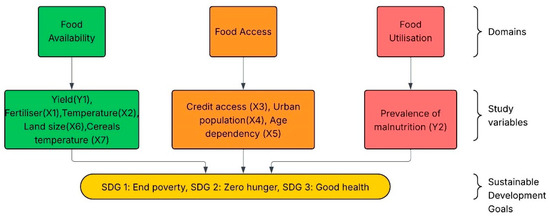
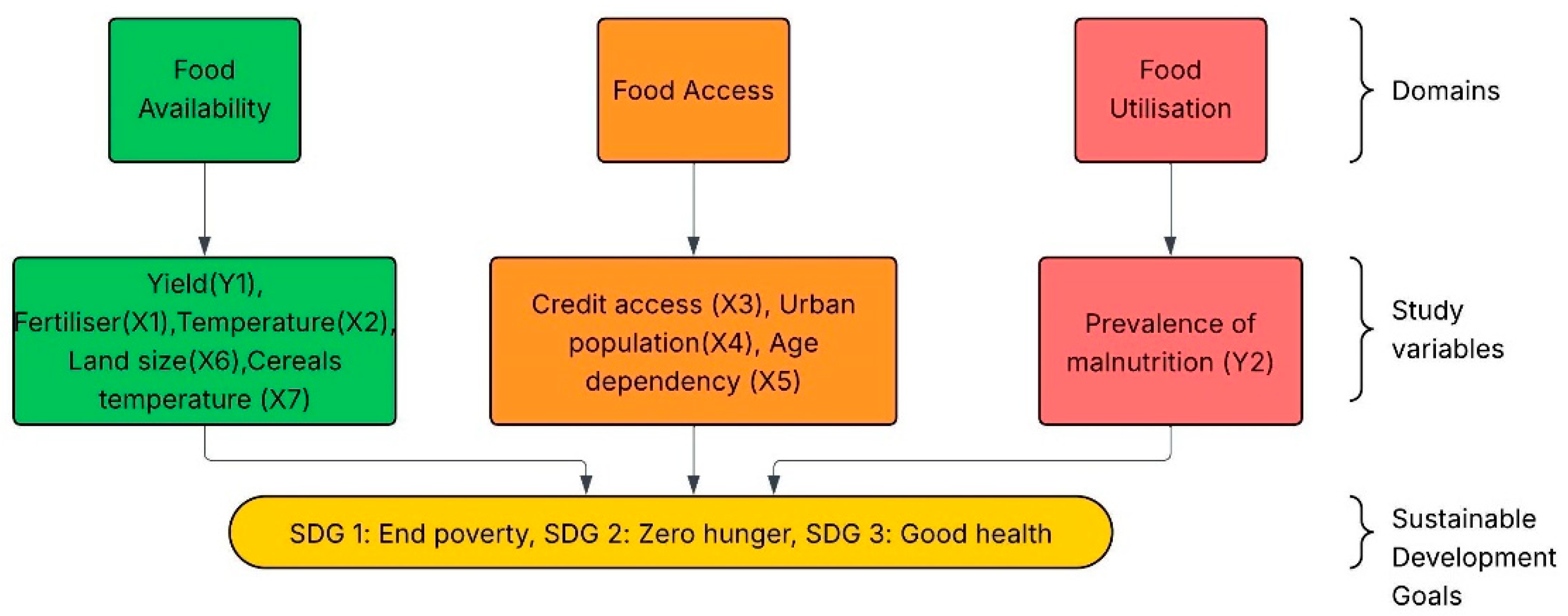
Figure 1 presents the adapted FAO three-pillar framework for food security under climate change in Malawi, Madagascar, Mozambique, and Zimbabwe. Climate variability (e.g., temperature, cereal temperature), socio-economic factors and prevalence of malnutrition as a food insecurity proxy emerge from the three domains. These have significant policy relevance embedded within the Sustainable Development Goals for food security advancement.
Figure 1.
Theoretical framework. Source: Author’s construction.
In the empirical implementation, the framework has been used as a conceptual guide and maps the observed variables to these domains as follows: The availability pillar is represented by cereal yield (Y1), land size and the input and biophysical conditions for production (fertiliser use, temperature and cereal temperature). The access pillar is captured by credit access, age dependency ratio and the share of the population residing in urban areas, which influence households’ economic and physical access to food. The utilisation pillar is proxied by the prevalence of malnutrition (Y2), which is treated as an outcome-based indicator of nutritional status.
2. Materials and Methods
2.1. Sample Description
Evaluation of the long-run effects of climate change and food security was conducted in four countries: Malawi, Madagascar, Mozambique and Zimbabwe. These countries were purposefully chosen because they have been affected by multiple storms since 2015 in the Southern Africa region. Furthermore, the inquiry spanned from 2000 to 2023. Data were harmonised from the World Bank, FAOSTAT, and the National Statistical Office (NSO) (Malawi only) websites between 2000 and 2023. The data were analysed using Stata 17.
2.2. Model Variables
Table 2 reports the exogenous and endogenous variables that were used in the model. The choice of the variables is supported by the literature. It is worth mentioning that to reduce the influence of extreme values, especially in the cereals’ temperature variable, we applied winsorisation. Specifically, values below the 5th percentile and above the 95th percentile were replaced with the 5th and 95th percentile values, respectively.
Table 2.
Model variables used in the study.
2.3. Model Description
This study used the Autoregressive Distributed Lag (ARDL) model to examine the effect of climate change on food security. An ARDL (p,q) is a linear regression model that regresses a dependent variable p against its lags, and on q lags of a simultaneous additional regressor. The ARDL model has gained much prominence in the recent literature when examining the cointegrating relationship between and among I(0) and I(1) variables. Thus, in this study, the model allows us to examine both long-run equilibrium relationships and short-run dynamics among climate-related and socio-economic variables. Using the ARDL estimation, the study distinguishes between short-run dynamic adjustments and long-run equilibrium relationships between climate-related and socio-economic variables and the food security outcomes. The long-run coefficients capture the average equilibrium associations over the sample period, while the short-run coefficients capture temporary deviations and adjustment dynamics.
A general ARDL model is given as follows:
where is the dependent variable, are k non-deterministic regressors, is the constant, and are linear trend coefficients, is a lag of , while is the lag of k regressors for whereby j = 1… k. Using L, the lag operator, for lag polynomial and vector polynomial , Equation 1 is further written as follows:
Furthermore, Ref. [47] propose a bounds test to minimise the underlying problems that can arise when variables are explicitly classified as I(0) and/or I(1). The bounds test has the following null and alternative hypotheses:
H0:
Variables are not cointegrated.
Ha:
Variables are cointegrated.
2.4. Model Specification
The panel ARDL model was estimated because of its ability to estimate a mixture of I(0) and I(1) variables. Furthermore, the model was used to correct heterogeneity bias, which arises from panel estimations. In the simplest form, the model was specified as follows.
where is the dependent variable; is the exogenous variables, and
are the parametric coefficients, and is the stochastic error term.
To minimise bias and provide a comprehensive understanding of the effect of climate change on food security, the effect of climate change on yield (Equation (4)) was first modelled, and the effect of yield on the prevalence of malnutrition as a proxy for food security (Equation (5)). To make sure that the results are sufficient and accurate, different validation tests were conducted. Again, to test for model adequacy, the cumulative sum of residuals (CUSUM) and cumulative sum of squared residuals (CUSUMSQ) parameter stability tests were conducted. However, following [47], a vector error correction model (Equations (6) and (7)) is first estimated, and the stability tests (Equations (8) and (9)) are later applied. The CUSUM is used to test stability over time, and the CUSUMSQ is used for variance stability.
where
- : Crop yield (kg/ha) for country i in year t.
- : Constant term for crop yield.
- : Coefficient for lagged crop yield (Yi,it−l) up to p lags.
- : Coefficients for exogenous variables X1 to X6.
- : Coefficients for lagged exogenous variables Xj,it-m, up to q lags.
- : Error term.
- : Prevalence of malnutrition (% of population) for country i in year t.
- : Constant term for malnutrition prevalence.
- : Coefficients for lagged malnutrition (Y2,it−l) up to p lags.
- : Coefficient for contemporaneous crop yield (Y1,it−l).
- : Coefficients for exogenous variables X1 to X8.
- : Coefficients for lagged exogenous variables Xk,it-m up to q lags.
- : Error term.
- Δ: First-difference operator.
- , and : Short-run coefficients for lagged differences.
- , : Speed of adjustment coefficients for error correction terms (ECTs).
- : Deviation in crop yield from its long-run equilibrium in period t − 1.
- : Deviation in malnutrition prevalence from its long-run equilibrium in period t − 1.
The optimal lag (p,q) in this study will be determined using the Likelihood Ratio (LR), Akaike Information Criterion (AIC), Bayesian Information Criterion (BIC), and Hannan–Quinn Information Criterion (HQIC). The optimal lag will be the one with the smallest values in the parameters. The use of the LR, AIC, BIC and HQIC is supported by the literature.
3. Results and Discussion
3.1. Descriptive Statistics
Table 3 presents the descriptive statistics for the econometric model variable for Malawi, Madagascar, Mozambique and Zimbabwe from 2000 to 2023. As shown in the table, the average prevalence of malnutrition was 28% among the countries, with values ranging from 14.3% to 39.5%. Ref. [29] report that more than 20% of the people living in sub-Saharan Africa are food insecure, with projected estimates of above 20% due to climate variability. The findings, which are consistent with this study’s findings, indicate that malnutrition rates are closely linked with agricultural productivity, as similarly echoed by [48]. Regarding yield, the study found that the average yield for cereals was 6.9 metric tonnes per hectare, with a maximum yield of 7.58 metric tonnes per hectare. It is worth noting that the literature [49,50] indicates regional averages of 1 to 3 t/ha for cereals under rain-fed systems in Africa. Thus, the higher yields reported in the study are a result of crop intensification across years and countries with more favourable conditions. Ref. [4] argue that production in Southern Africa is sensitive to climatic shocks and changes in geographical locations. This justifies the variability in the cereals in the four countries.
Table 3.
Descriptive statistics.
As far as temperature was concerned, the study found that the average temperature for cereal production was 34.62 °C, with the lowest value being 26.02 °C. Very high and very low temperatures result in reduced cereal yields, as observed in our study [3]. The study also assessed the fertiliser consumption per hectare of land by cereals. The study found that the average consumption was 19.06 kg per hectare. This low mean consumption aligns with other authors [11,12] who state that access to fertilisers among farmers in Southern Africa is a major constraint on improving cereal yields. The average annual temperature on a normal day across the sample countries was 21.82 °C, as indicated in Table 3 above. Regarding access to credit, the study found that access to credit from the formal or informal markets in the countries was 46%. Our results show that financial constraints are faced by many farmers in the region. This negatively affects financial efforts to achieve climate change resilience and remains a barrier to yield productivity. On urbanisation, the study found that, on average, 28 people were residing in the urban area in the four countries. Urbanisation shifts labour from rural to urban areas, altering food demands and consumption patterns, potentially affecting food security. The study found that the average dependency ratio was 89 for the age dependency ratio. This indicates a large proportion of dependents to the working-age population, which strains household resources and reduces resilience to food insecurity [20]. Lastly, on land size, the study found that the average hectares for the countries spanning from 2000 to 2023 was 43.57. Land size significantly influences food availability for food security.
3.2. Correlation Matrix
In Table 4, the authors computed a correlation matrix to measure the presence of multicollinearity among the exogenous variables using the Spearman correlation coefficients. The values in the correlation matrix range from −1 to +1, where −1 means strong negative correlation, +1 means strong positive correlation, and 0 means zero correlation.
Table 4.
Correlation matrix.
According to Ref. [51], a multilinear model exhibits a low or a negligible collinearity problem if the coefficient value ranges between 0.5–0.3 and 0.3–0.00, respectively. As indicated in Table 4, the absolute correlation values for the exogenous variables are less than 0.3. This implies that multicollinearity is not a significant problem in this study.
3.3. Panel Unit Root Tests
In this study, the authors conducted the panel unit root tests to determine whether there is cross-sectional independence among the units. This minimises the risks of spurious and unreliable results on the variables. The literature indicates that panel unit root tests such as the Im, Pesaran and Shin (IPS) and Levin, Lin and Chu (LLC) are commonly used to determine whether variables are stationary or not. In this study, we applied both the IPS and LLC tests to the dependent and independent variables.
The results in Table 5 indicate that all variables in the sample are stationary either at zero difference I (0) or first difference I (I) as indicated by the p-values below the significant thresholds.
Table 5.
Panel unit root tests for the variables from 2000 to 2023.
3.4. Cointegration Tests
In this enquiry, we conducted Pedroni tests for cointegration. Refs. [52,53] proposed seven statistics that are used to test for a long-run cointegration relationship among the variables under the null hypothesis of no cointegration. The Pedroni test groups the seven statistics into two categories, namely, group mean and panel statistics. The group mean pools the test statistics by averaging the results of the individuals (group dimension), while the panel statistics are specific (within dimension). It is worth reporting that the seven cointegration statistics were disaggregated with and without a deterministic trend. This was done to account for heterogeneity and acted as a robustness check to avoid overfitting or underfitting the model.
The results for the Pedroni tests are presented in Table 6 and Table 7 for the yield and prevalence of malnutrition models, respectively. The yield model resulted in 12 of the 14 test statistics being significant, and the prevalence of malnutrition model resulted in all 14 test statistics being significant. This implies that a long-run cointegrating relationship exists and an ARDL analysis can be estimated.
Table 6.
Cointegration tests for yield.
Table 7.
Cointegration tests for prevalence of malnutrition.
3.5. Optimal Lag Selection
Table 8 and Table 9 present the optimal lag for the study’s model specifications. Notably, the optimal lag for the yield model is 1, as denoted by the asterisks (*) on HQIC and SBIC. Similarly, the optimal lag for the prevalence of malnutrition model is 1.
Table 8.
Optimal lag for the yield model.
Table 9.
Optimal lag for the prevalence of the malnutrition model.
3.6. Model Results
Table 10 presents the long-run and short-run coefficients of the estimated ARDL models for the yield and prevalence of malnutrition dependent variables. Notably, Table 10 has three ARDL model estimators, and these include pooled mean group (PMG), mean group (MG) and difference fixed effect (DFE). The study used the Hausman test to determine the best estimator on which inference can be made. In both models, the Hausman test compares the MG and DFE, as well as the DFE and PMG. Notably, for the MG and DFE, the null hypothesis is that the DFE is efficient and consistent. For the DFE and PMG, the null hypothesis is that the PMG estimator is efficient and consistent. The former comparison finds the DFE is better and more reliable than the MG, while the latter finds the PMG to be better than the DFE. All this is being deduced from the insignificant values of the panel-p tests [54]. Therefore, the conclusion is that the long-run PMG is the best estimator, which was used in the study. It is worth reporting that Table 10 presents the average convergence parameter (ECT) to quantify the speed of adjustment from short-run disequilibrium to long-run equilibrium. Notably, the ECT coefficients are negative and significant. This implies that a long-run stable relationship exists between the model variables.
Table 10.
Model results.
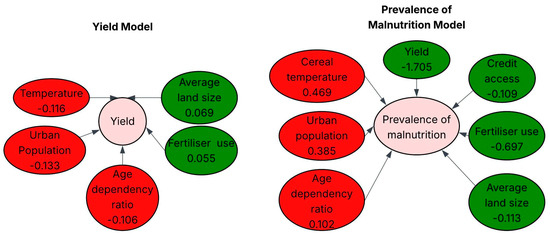
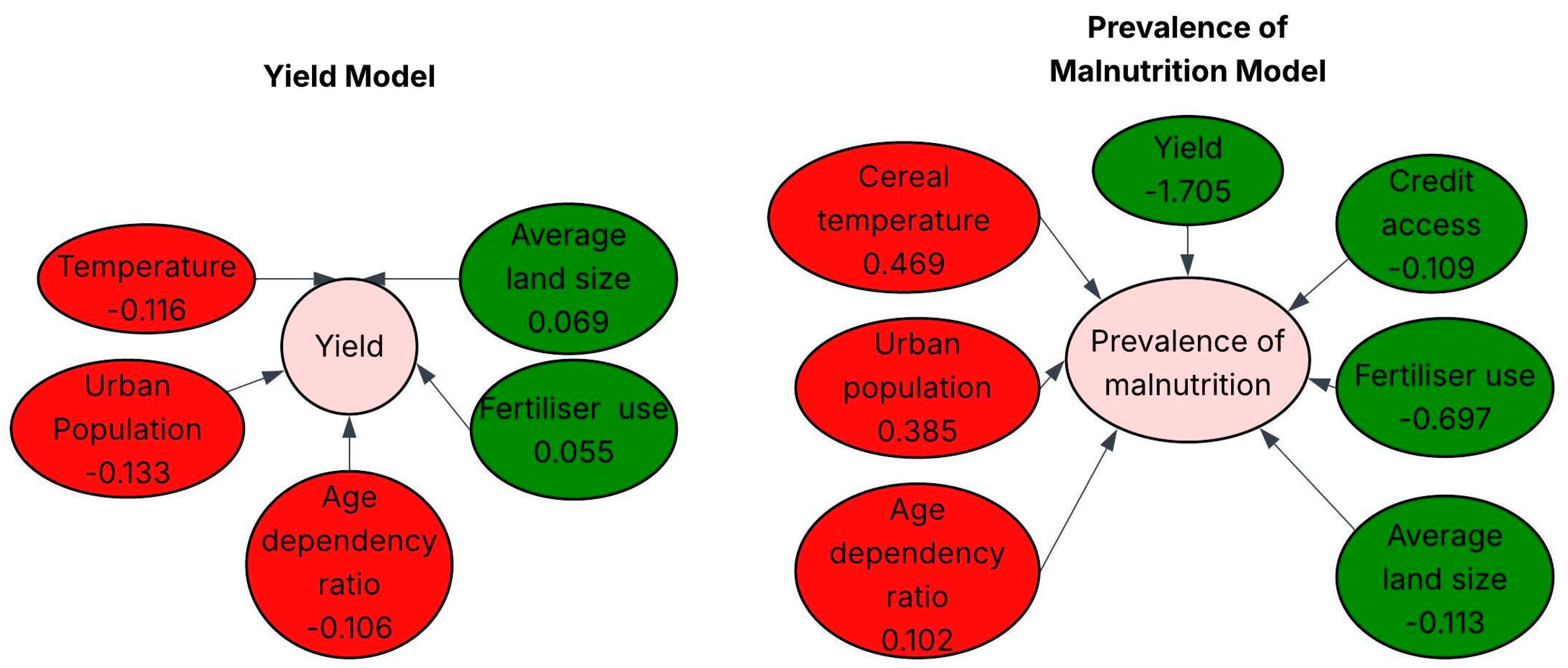
The respective model’s long-run coefficients, which are central, are also presented graphically in Figure 2.
Figure 2.
Graphical presentation of the PMG results.
From the yield model, the study found fertiliser to have a significant positive long-run relationship with yield. Specifically, the long-run coefficient in fertiliser application results in a 0.055 increase in yield. This finding supports previous research findings by [55,56] that argue that sustained application of fertilisers—whether organic or inorganic—contributes to significant improvements in crop yields, soil fertility and nutrient cycling. This effect aligns with Southern African patterns, where low fertiliser rates limit yields, but higher use could raise output per kg applied. In our study’s context, this fertiliser application counters climate shocks like droughts in these smallholder-dominated areas by enhancing the food availability pillar. This further highlights policy needs for affordable fertiliser access to support SDG 2 on zero hunger.
On temperature in the long run, this enquiry found a decrease in cereal yield by 0.11. The results are congruent with [46,57] who postulate that elevated temperatures and heat stress disrupt physiological and developmental processes in the plant. Specifically, the authors indicate that high temperatures increase plant respiration and divert energy away from grain production, leading to a loss in yield. Thus, a temperature increase distorts food availability at the household and country level, further promoting food insecurity.
Similarly, the study found that urbanisation had a significant negative long-run relationship with cereal yields. Notably, an increasing number of people relocating to the urban population leads to a 0.13 decrease in cereal yields. This finding is similar to that of [58]. This is because urban sprawl results in farmland fragmentation, and it leads to smaller, less efficient farming units, which decreases crop productivity. It is worth mentioning that rising urban populations may also divert labour, public investment and services away from rural farming areas, weakening food production efforts and reducing the available food. In our context, the result suggests that unmanaged urban growth can trap these economies into a low-productivity agricultural path, increasing vulnerability to climate shocks.
As far as age dependency was concerned, the study found that an increase in the number of dependents leads to a 0.11 decrease in yields in the long run. This finding supports previous empirical research [59]. The reasons behind this are multi-fold. Firstly, a high dependency ratio reduces the availability of both the quantity and quality of agricultural labour, and directly impacts the ability to maintain or improve crop yields, including cereals. Secondly, looking at the countries of interest, their agricultural systems are highly subsistence, with household labour being intensive. A high age dependency ratio implies that a large share of the population is not actively engaged in productive agricultural work. This further places a strain on the workforce, and it leads to farm management inefficiencies and lower yields.
Lastly, on land size, the long-run coefficient is 0.07. Much as this finding might appear counterintuitive, it is in line with [60], who argue that farmers with smaller land sizes are efficient and are more productive than farmers with larger land sizes. It is worth mentioning that the areas where this study is rooted are agrarian, and most of the farmers are smallholders. These farmers are faced with economic constraints, of which an increase in land only increases production rather than productivity, through economies of scale. This study concurs with empirical findings that large farms are associated with inefficient input management. This also poses the risks of input underutilisation, resulting in lower yields.
On the long-run relationship of climate change on food security through the prevalence of malnutrition indicator, the study found that cereal yield has a significant negative effect on malnutrition. Notably, the coefficient is negative, which implies that as yield increases, the prevalence of malnutrition decreases approximately by 1.7 points. Empirical evidence from [61], which is consistent with our finding, suggests that higher cereal yields increase the availability and supply of foods, making the food more available and accessible to the poor and vulnerable populations, which reduces the prevalence of malnutrition. Again, higher cereal output buffers against shocks like droughts and floods, supporting household stability in most smallholder farming households.
Furthermore, the study found a long-run effect of fertiliser application to reduce the prevalence of malnutrition by 0.70. Global studies [13,14,62] indicate that a large share of crop yields are attributed to fertilisers. These high crop yields help to reduce hunger and malnutrition. In the context of Malawi, Madagascar, Mozambique, and Zimbabwe, this finding aligns with our theoretical framework’s food availability pillar of food security under climate conditions. Fertiliser boosts staple crop output like maize despite shocks such as droughts and floods, directly supporting household calorie needs and cutting malnutrition rates in vulnerable rural areas.
Similarly, the study found that credit access has a long-run coefficient of −0.11 on the prevalence of malnutrition. This finding supports previous research findings by [16,17]. Credit access increases the mechanisms for improved nutrition through increased market participation, productivity and household income. These mechanisms can be used to access a more diverse and nutritious diet. This result aligns with the study’s theoretical framework access pillar, and it implies that policies expanding rural credit, such as microfinance programmes, can build household resilience against climate shocks like droughts and floods, helping farmers invest in resilient seeds or livestock to stabilise nutrition over time. This also supports long-term adaptation in these vulnerable Southern African regions by enhancing financial access directly to reduce malnutrition risks.
Regarding urbanisation, it was found that urban growth results in a 0.39 increase in the prevalence of malnutrition in the long run. This finding is supported by [19] but contradicts findings from [63]. It is worth reporting that urbanisation is associated with the double burden of nutrition, where undernutrition (stunting and wasting) and overnutrition (overweight, obesity) are prevalent. Again, the popular notion is that rural–urban dependency in agrarian economies includes food spill-overs from the production engines (rural) to access-driven points (urban). However, this assumption is mostly problematic as it limitedly highlights the hurdles within the rural–urban food supply chains. Further to that, economic challenges attributed to urban growth in agrarian economies further challenge the accessibility attribute, creating a bigger challenge as own production in urban settings is yet to be fully embraced. Overall, urban growth disrupts the food utilisation and stability pillars of food security. This finding highlights the need for region-specific policies, such as urban farming programmes and nutrition education, to counter how rapid urbanisation, driven by climate shocks, forces reliance on low-quality diets and strains rural–urban food supply chains.
A long-run analysis of the age dependency ratio was found to have a 0.10 significant positive effect on the prevalence of malnutrition. High dependency ratios strain household resources and capabilities, reducing food security and increasing malnutrition risk. This is consistent with [64]. It is worth mentioning that high dependency burdens poor families during climate shocks, such as droughts and floods, which cut farm output and raise food prices. On a macro perspective, this high dependency attribute is mostly associated with social programmes; however, for economies that are low-income in nature, the support towards these social programmes is very limited, further exposing vulnerabilities. This further supports the theoretical framework’s access pillar, as strained households cannot buy or grow enough nutritious food, worsening malnutrition.
On land size, the study found that land size decreases the prevalence of malnutrition by 0.11 in the long run. It is worth noting that larger landholdings provide sufficient capacity for more food production and income, thereby increasing food security and reducing malnutrition. This finding is supported by the literature [65,66]. This result aligns with the study’s theoretical framework, where land size affects food availability for food security under climate shocks. It means that policies promoting secure land access for smallholder farmers can build resilience against storms and droughts, helping these countries to end malnutrition and advance Sustainable Development Goal 2 for zero hunger.
Lastly, the study found an increased prevalence of malnutrition with increased cereal temperature by 0.47. The study’s findings are concurrent with [57], who found that temperature and heat stress negatively affect crop productivity. This creates a food scarcity environment and allows malnutrition to flourish. In the context of Malawi, Madagascar, Mozambique, and Zimbabwe, this result means higher cereal temperatures reduce yields of key staples like maize, leading to less food availability for poor households. This links to the study’s theoretical framework (Figure 1), where climate variability directly threatens the availability pillar of food security.
3.7. Panel Granger Causality Tests
The existence of cointegration does not entail causality between the variables. Thus, to provide a way map for policymakers, this study estimated the causal relationship between the models’ variables using the panel VEC Granger causality tests. The results for the Granger causality tests are presented in Table 11. Column 1 of Table 11 shows the causal relationships when yield is the dependent variable, and Column 2 shows the causal relationships when prevalence of malnutrition is used as the dependent variable. It was observed that a one-way causal relationship exists from the independent variables to the dependent variables for both models. Among others, this calls for policy interventions related to increased credit access, increased fertiliser use, increased crop yield and land reforms where smallholder farmers can own land in all the study’s countries.
Table 11.
Panel Granger causality tests.
3.8. Stability Tests
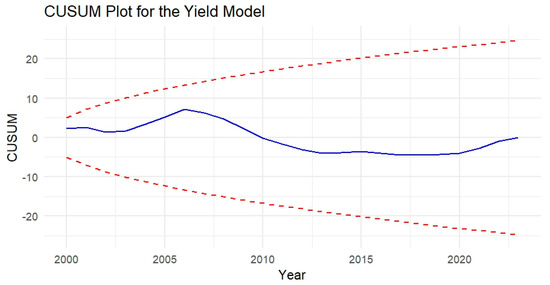
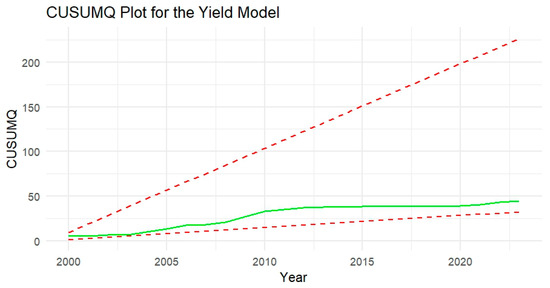
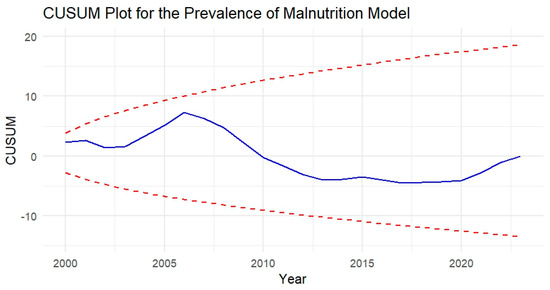
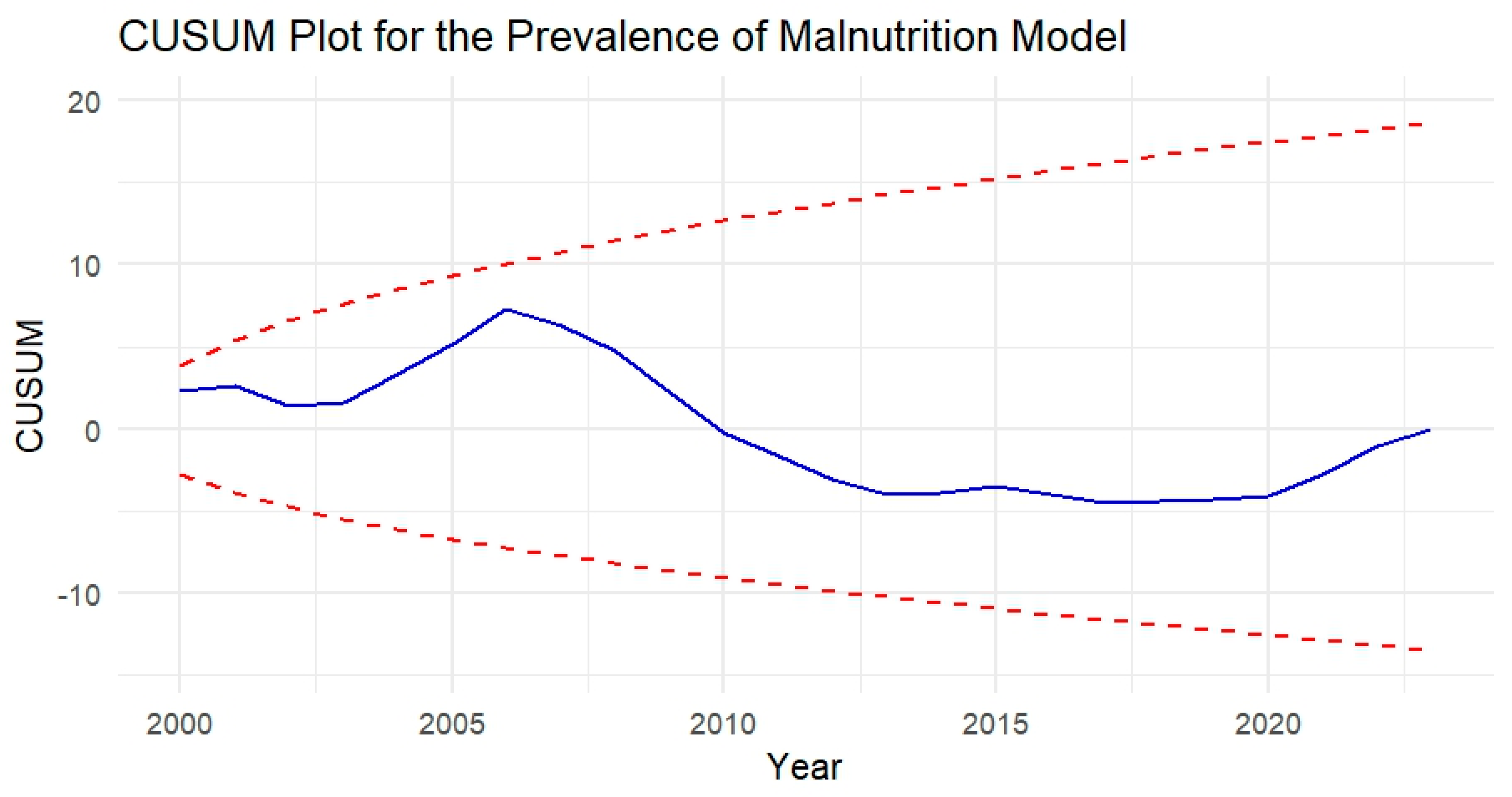
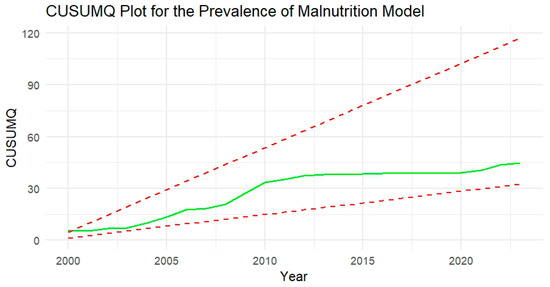
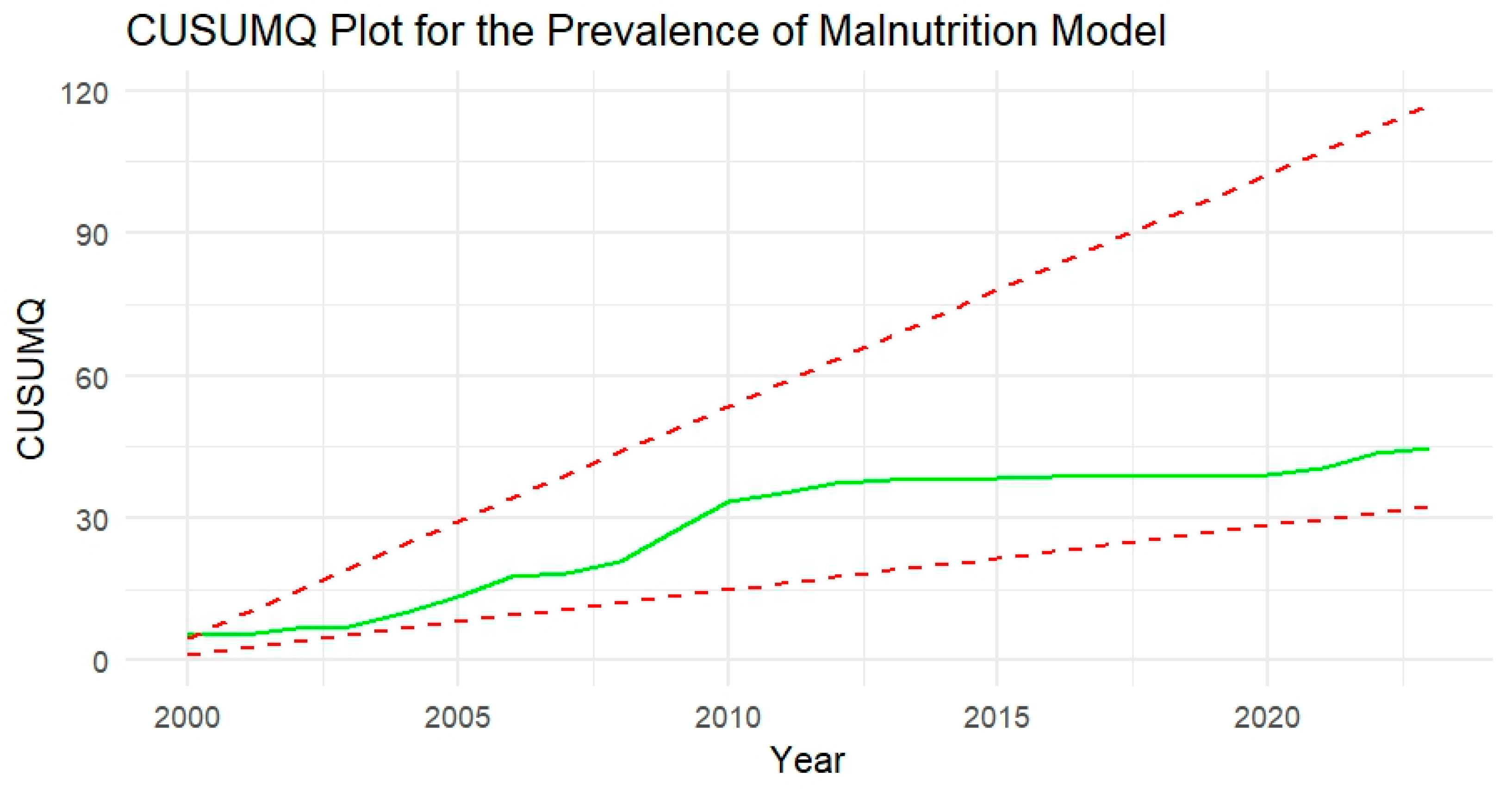
For the robustness of the results, the study assessed the long-run and short-run coefficients using the stability tests mentioned in the previous section. The authors applied the cumulative sum of recursive residuals (CUSUM) and the cumulative sum of recursive residuals squared (CUSUMSQ). The rule of thumb is that the plots of the CUSUM and CUSUMSQ should be within the 5% critical bounds to ensure stability. The results for stability in this study are shown in Figure 3, Figure 4, Figure 5 and Figure 6. Notably, all the plots are within the 5% significance critical bounds, suggesting the absence of instability with the model residuals.
Figure 3.
CUSUM plot for the yield model.
Figure 4.
CUSUMSQ plot for the yield model.
Figure 5.
CUSUM plot for the prevalence of malnutrition model.
Figure 6.
CUSUMSQ plot for the prevalence of malnutrition model.
4. Conclusions and Recommendations
This empirical study examines the long-term impact of climate change on food security in Malawi, Madagascar, Mozambique, and Zimbabwe. The analysis is based on two pathways through which climate variability affects nutritional outcomes. Firstly, increased environmental temperature has a positive effect in reducing cereal yields. Secondly, lower yields, coupled with factors such as limited credit access, high age dependency ratios, and rapid urbanisation, resulted in a higher prevalence of malnutrition. The study’s key findings indicate that a 1% rise in temperature decreases cereal yield by 12%, while a 1% increase in yield reduces malnutrition by approximately 1.7 percentage points. Furthermore, limited access to agricultural credit and larger age dependency ratios influence food insecurity, whereas increased fertiliser use and secure land access have a positive effect in improving both yield and nutrition. The unequivocal message that this study communicates is that addressing food insecurity in Southern Africa requires integrated policies that enhance agricultural resilience to climate change and strengthen the socio-economic characteristics of vulnerable households.
Specifically, the following targeted interventions are recommended:
- Approximately 30% of the smallholder farms, representing a share of beneficiaries under the input subsidy program, should be supported with heat-tolerant and drought-resistant cereal varieties in the respective countries. This can mitigate the significant negative impact of rising temperatures on staple crop yields towards climate-resilient agriculture.
- Scaling up microfinance and credit guarantee schemes to enhance farmers’ access to capital through public–private partnerships. This will enable investments in resilient inputs and technologies, thereby improving food availability and access to end malnutrition.
- Scale up social safety net programmes, such as cash transfers or insurance schemes, targeted at households with high dependency ratios (>1.5). This will build economic resilience against climate shocks that strain household resources.
- Develop urban agriculture initiatives and nutrition education programmes to support disrupted rural–urban food supply chains. This can be done through distributing low-cost sack gardens and improved poultry breeds to peri-urban households.
5. Study Limitation
Regardless of the robust empirical analysis of the climate–food security nexus, the study has some limitations. Firstly, the PMG estimator assumes homogeneity in these long-run coefficients across countries. This assumption may not fully capture the country-specific socio-economic and agro-ecological differences between Malawi, Madagascar, Mozambique, and Zimbabwe. Again, food security is multidimensional, yet this study used the prevalence of malnutrition as its proxy. Thus, the analysis may underestimate the full welfare effect of climate shocks. Furthermore, climatic effects were proxied by temperature variables only, which may underestimate the climatic effect. Future research would benefit from the use of other food security measures, such as the Food Insecurity Experience Scale, and other climate variables, such as precipitation, to fully understand the climate–food security nexus. Lastly, the study focused on four nations severely impacted by climatic shocks. Thus, their specific experiences may not be directly representative of the entire Southern African Development Community (SADC) region. Broader regional generalisations should therefore be made with caution.
Author Contributions
Conceptualisation, S.N. and M.M.; methodology, S.N. and J.M.; formal analysis, S.N., M.M. and J.M.; resources, S.D.; data curation, S.N. and M.M.; writing—original draft, S.N., M.M., V.L. and L.M.; writing—review and editing, S.N., M.M., V.L., S.D., J.M. and L.M.; project administration, V.L. All authors have read and agreed to the published version of the manuscript.
Funding
The research received no external funding.
Institutional Review Board Statement
Not applicable.
Informed Consent Statement
Not applicable.
Data Availability Statement
The data that support the findings of this study are available from the corresponding author upon reasonable institutional request.
Conflicts of Interest
The authors declare no conflicts of interest.
Appendix A
Table A1.
Data source table.
References
- IPCC. Climate Change 2021: The Physical Science Basis. Available online: https://www.ipcc.ch/report/ar6/wg1/ (accessed on 8 June 2025).
- Malhi, G.S.; Kaur, M.; Kaushik, P. Impact of climate change on agriculture and its mitigation strategies: A review. Sustainability 2021, 13, 1318. [Google Scholar] [CrossRef] [Scilit]
- Wang, J.; Vanga, S.K.; Saxena, R.; Orsat, V.; Raghavan, V. Effect of climate change on the yield of cereal crops: A review. Climate 2018, 6, 41. [Google Scholar] [CrossRef] [Scilit]
- Nhamo, L.; Matchaya, G.; Mabhaudhi, T.; Nhlengethwa, S.; Nhemachena, C.; Mpandeli, S. Cereal production trends under climate change: Impacts and adaptation strategies in southern Africa. Agriculture 2019, 9, 30. [Google Scholar] [CrossRef] [Scilit]
- Affoh, R.; Zheng, H.; Dangui, K.; Dissani, B.M. The impact of climate variability and change on food security in sub-saharan Africa: Perspective from panel data analysis. Sustainability 2022, 14, 759. [Google Scholar] [CrossRef] [Scilit]
- Mumuni, S.; Aleer, J.M. Zero hunger by 2030—Are we on track? Climate variability and change impacts on food security in Africa. Cogent Food Agric. 2023, 9, 2171830. [Google Scholar] [CrossRef] [Scilit]
- Adesete, A.A.; Olanubi, O.E.; Dauda, R.O. Climate change and food security in selected Sub-Saharan African Countries. Environ. Dev. Sustain. 2023, 25, 14623–14641. [Google Scholar] [CrossRef] [Scilit]
- Sabola, G.A. Climate change impacts on agricultural trade and food security in emerging economies: Case of Southern Africa. Discov. Agric. 2024, 2, 12. [Google Scholar] [CrossRef] [Scilit]
- Baptista, D.M.S.; Farid, M.M.; Fayad, D.; Kemoe, L.; Lanci, L.S.; Mitra, M.P.; Muehlschlegel, T.S.; Okou, C.; Spray, J.A.; Tuitoek, K.; et al. Climate Change and Chronic Food Insecurity in Sub-Saharan Africa; International Monetary Fund: Washington, DC, USA, 2022. [Google Scholar]
- Fusco, G. Climate change and food security in the northern and eastern African Regions: A panel data analysis. Sustainability 2022, 14, 12664. [Google Scholar] [CrossRef] [Scilit]
- Bonilla-Cedrez, C.; Chamberlin, J.; Hijmans, R.J. Fertilizer and grain prices constrain food production in Sub-Saharan Africa. Nat. Food 2021, 2, 766–772. [Google Scholar] [CrossRef] [Scilit]
- Sedibe, M.M.; Mofokeng, A.M.; Masvodza, D.R. Soybean production, constraints, and future prospects in poorer countries: A review. In Production and Utilization of Legumes-Progress and Prospects; IntechOpen: London, UK, 2023. [Google Scholar]
- Hu, H.-W.; Chen, Q.-L.; He, J.-Z. The end of hunger: Fertilizers, microbes and plant productivity. Microb. Biotechnol. 2022, 15, 1050–1054. [Google Scholar] [CrossRef] [Scilit]
- Saqib, M.; Yasin, R.; Akhtar, J. Inorganic Fertilizers: Necessity to Achieve Global Zero Hunger Target. In Zero Hunger; Springer: Berlin/Heidelberg, Germany, 2020; pp. 414–424. [Google Scholar]
- Diamoutene, A.K.; Jatoe, J.B.D. Access to credit and maize productivity in Mali. Agric. Financ. Rev. 2021, 81, 458–477. [Google Scholar] [CrossRef] [Scilit]
- Salima, W.; Manja, L.P.; Chiwaula, L.S.; Chirwa, G.C. The impact of credit access on household food security in Malawi. J. Agric. Food Res. 2023, 11, 100490. [Google Scholar] [CrossRef] [Scilit]
- Kehinde, A.D.; Kehinde, M.A. The impact of credit access and cooperative membership on food security of rural households in Southwestern Nigeria. J. Agribus. Rural Dev. 2020, 57, 255–268. [Google Scholar] [CrossRef] [Scilit]
- Tacoli, C. The urbanization of food insecurity and malnutrition. Environ. Urban. 2019, 31, 371–374. [Google Scholar] [CrossRef] [Scilit]
- Szabo, S.; Padmadas, S.; Falkingham, J. Is Rapid Urbanisation Exacerbating Wealth-Related Urban Inequalities in Child Nutritional Status? Evidence from Least Developed Countries. Eur. J. Dev. Res. 2018, 30, 630–651. [Google Scholar] [CrossRef] [Scilit]
- Mengistu, S.W.; Kassie, A.W. Household level determinants of food insecurity in rural Ethiopia. J. Food Qual. 2022, 2022, 3569950. [Google Scholar] [CrossRef] [Scilit]
- Schmitt, K. Less Nutritious Crops: Another Result of Rising CO2. 2024. Available online: https://magazine.publichealth.jhu.edu/2024/less-nutritious-crops-another-result-rising-co2 (accessed on 3 May 2025).
- Beach, R.H.; Sulser, T.B.; Crimmins, A.; Cenacchi, N.; Cole, J.; Fukagawa, N.K.; Mason-D’Croz, D.; Myers, S.; Sarofim, M.C.; Smith, M.; et al. Combining the effects of increased atmospheric carbon dioxide on protein, iron, and zinc availability and projected climate change on global diets: A modelling study. Lancet Planet. Health 2019, 3, e307–e317. [Google Scholar] [CrossRef] [Scilit]
- Zhu, C.; Kobayashi, K.; Loladze, I.; Zhu, J.; Jiang, Q.; Xu, X.; Liu, G.; Seneweera, S.; Ebi, K.L.; Drewnowski, A.; et al. Carbon Dioxide (CO2) Levels this century will alter the protein, micronutrients, and vitamin content of rice grains with potential health consequences for the poorest rice-dependent countries. Sci. Adv. 2018, 4, eaaq1012. [Google Scholar] [CrossRef] [Scilit]
- Ziska, L.H. Rising carbon dioxide and global nutrition: Evidence and action needed. Plants 2022, 11, 1000. [Google Scholar] [CrossRef] [Scilit]
- Ben Mariem, S.; Soba, D.; Zhou, B.; Loladze, I.; Morales, F.; Aranjuelo, I. Climate change, crop yields, and grain quality of C3 cereals: A meta-analysis of [CO2], temperature, and drought effects. Plants 2021, 10, 1052. [Google Scholar] [CrossRef] [Scilit]
- United Nations. Impact of El Niño in Mozambique. 26 April 2024. Available online: https://www.unocha.org/publications/report/mozambique/impact-el-nino-mozambique-26-april-2024-enpt (accessed on 2 January 2026).
- United Nations. Zimbabwe Faces Worsening Food Crisis Due to El Niño Droughts. UN News. Available online: https://news.un.org/en/story/2024/08/1152936 (accessed on 2 January 2026).
- Save the Children. MADAGASCAR: Cases of Child Malnutrition Jump by 50% as Drought Crisis Worsens. Available online: https://www.savethechildren.net/news/madagascar-cases-child-malnutrition-jump-50-drought-crisis-worsens (accessed on 2 January 2026).
- FAO; IFAD; WHO; UNICEF. Food Security and Nutrition in the World Financing to End Hunger, in All Its Forms; FAO: Rome, Italy, 2024; ISBN 9789251388822. [Google Scholar]
- Knox, J.; Hess, T.; Daccache, A.; Wheeler, T. Climate change impacts on crop productivity in Africa and South Asia. Environ. Res. Lett. 2012, 7, 34032. [Google Scholar] [CrossRef] [Scilit]
- Karimi, V.; Karami, E.; Keshavarz, M. Climate change and agriculture: Impacts and adaptive responses in Iran. J. Integr. Agric. 2018, 17, 1–15. [Google Scholar] [CrossRef] [Scilit]
- Mihret Dessie, W.; Shumetie Ademe, A. Training for creativity and innovation in small enterprises in Ethiopia. Int. J. Train. Dev. 2017, 21, 224–234. [Google Scholar] [CrossRef] [Scilit]
- Islam, M.S.; Wong, A.T. Climate change and food in/security: A critical nexus. Environments 2017, 4, 38. [Google Scholar] [CrossRef] [Scilit]
- Nelson, R.; Kokic, P.; Crimp, S.; Martin, P.; Meinke, H.; Howden, S.M.; de Voil, P.; Nidumolu, U. The vulnerability of Australian rural communities to climate variability and change: Part II—Integrating impacts with adaptive capacity. Environ. Sci. Policy 2010, 13, 18–27. [Google Scholar] [CrossRef] [Scilit]
- He, W.; Liu, Y.; Sun, H.; Taghizadeh-Hesary, F. How does climate change affect rice yield in China? Agriculture 2020, 10, 441. [Google Scholar] [CrossRef] [Scilit]
- Muluneh, M.G. Impact of climate change on biodiversity and food security: A global perspective—A review article. Agric. Food Secur. 2021, 10, 36. [Google Scholar] [CrossRef] [Scilit]
- Neupane, D.; Adhikari, P.; Bhattarai, D.; Rana, B.; Ahmed, Z.; Sharma, U.; Adhikari, D. Does climate change affect the yield of the top three cereals and food security in the world? Earth 2022, 3, 45–71. [Google Scholar] [CrossRef] [Scilit]
- Singh, A.; Arora, K.; Chandra Babu, S. Examining the impact of climate change on cereal production in India: Empirical evidence from ARDL modelling approach. Heliyon 2024, 10, e36403. [Google Scholar] [CrossRef] [Scilit]
- Beyene, S.D. The impact of food insecurity on health outcomes: Empirical evidence from Sub-Saharan African countries. BMC Public Health 2023, 23, 338. [Google Scholar] [CrossRef] [Scilit]
- Boonwichai, S.; Shrestha, S.; Babel, M.S.; Weesakul, S.; Datta, A. Evaluation of climate change impacts and adaptation strategies on rainfed rice production in Songkhram River Basin, Thailand. Sci. Total Environ. 2019, 652, 189–201. [Google Scholar] [CrossRef] [Scilit] [PubMed]
- Carr, T.W.; Mkuhlani, S.; Segnon, A.C.; Ali, Z.; Zougmoré, R.; Dangour, A.D.; Green, R.; Scheelbeek, P. Climate change impacts and adaptation strategies for crops in West Africa: A systematic review. Environ. Res. Lett. 2022, 17, 53001. [Google Scholar] [CrossRef] [Scilit]
- Warnatzsch, E.A.; Reay, D.S. Assessing climate change projections and impacts on Central Malawi’s maize yield: The risk of maladaptation. Sci. Total Environ. 2020, 711, 134845. [Google Scholar] [CrossRef] [Scilit] [PubMed]
- Mekonnen, A.; Tessema, A.; Ganewo, Z.; Haile, A. Climate change impacts on household food security and farmers adaptation strategies. J. Agric. Food Res. 2021, 6, 100197. [Google Scholar] [CrossRef] [Scilit]
- Akanni, S.B.; Garba, M.; Banjoko, A.; Afolayan, R. Econometric analysis of the effects of land size on cereals production in Nigeria. Islam. Univ. Multidiscip. J. 2020, 7, 252–258. [Google Scholar]
- Jan, I.; Ashfaq, M.; Chandio, A.A. Impacts of climate change on yield of cereal crops in northern climatic region of Pakistan. Environ. Sci. Pollut. Res. 2021, 28, 60235–60245. [Google Scholar] [CrossRef] [Scilit]
- Stone, P. The effects of heat stress on cereal yield and quality. In Crop Responses and Adaptations to Temperature Stress; CRC Press: Boca Raton, FL, USA, 2023; pp. 243–291. [Google Scholar]
- Pesaran, M.H.; Shin, Y.; Smith, R.J. Bounds testing approaches to the analysis of level relationships. J. Appl. Econom. 2001, 16, 289–326. [Google Scholar] [CrossRef] [Scilit]
- Masters, W.A.; Finaret, A.B.; Block, S.A. The economics of malnutrition: Dietary transition and food system transformation. Handb. Agric. Econ. 2022, 6, 4997–5083. [Google Scholar]
- Kubiku, F.N.M.; Mandumbu, R.; Nyamangara, J.; Nyamadzawo, G. Sorghum (Sorghum bicolor L.) yield response to rainwater harvesting practices in the semi-arid farming environments of Zimbabwe: A meta-analysis. Heliyon 2022, 8, e09164. [Google Scholar] [CrossRef] [Scilit]
- Nyagumbo, I.; Mupangwa, W.; Chipindu, L.; Rusinamhodzi, L.; Craufurd, P. A regional synthesis of seven-year maize yield responses to conservation agriculture technologies in Eastern and Southern Africa. Agric. Ecosyst. Environ. 2020, 295, 106898. [Google Scholar] [CrossRef] [Scilit]
- Leiby, B.D.; Ahner, D.K. Multicollinearity applied stepwise stochastic imputation: A large dataset imputation through correlation-based regression. J. Big Data 2023, 10, 23. [Google Scholar] [CrossRef] [Scilit]
- Pedroni, P. Purchasing power parity tests in cointegrated panels. Rev. Econ. Stat. 2001, 83, 727–731. [Google Scholar] [CrossRef] [Scilit]
- Pedroni, P. Chapter 10—Panel Cointegration Techniques and Open Challenges. In Panel Data Econometrics; Tsionas, M., Ed.; Academic Press: Cambridge, MA, USA, 2019; pp. 251–287. ISBN 978-0-12-814367-4. [Google Scholar] [CrossRef] [Scilit]
- Busu, M. Analyzing the impact of the renewable energy sources on economic growth at the EU level using an ARDL model. Mathematics 2020, 8, 1367. [Google Scholar] [CrossRef] [Scilit]
- Abbas, S. Climate change and major crop production: Evidence from Pakistan. Environ. Sci. Pollut. Res. 2022, 29, 5406–5414. [Google Scholar] [CrossRef] [Scilit]
- Gul, A.; Chandio, A.A.; Siyal, S.A.; Rehman, A.; Xiumin, W. How climate change is impacting the major yield crops of Pakistan? An exploration from long- and short-run estimation. Environ. Sci. Pollut. Res. 2022, 29, 26660–26674. [Google Scholar] [CrossRef] [Scilit]
- Chandio, A.A.; Ozturk, I.; Akram, W.; Ahmad, F.; Mirani, A.A. Empirical analysis of climate change factors affecting cereal yield: Evidence from Turkey. Environ. Sci. Pollut. Res. 2020, 27, 11944–11957. [Google Scholar] [CrossRef] [Scilit]
- Bambi, P.D.R.; Pea-Assounga, J.B.B. Assessing the influence of land use, agricultural, industrialization, CO2 emissions, and energy intensity on cereal production. J. Environ. Manag. 2024, 370, 122612. [Google Scholar] [CrossRef] [Scilit]
- Sisha, T.A. Household level food insecurity assessment: Evidence from panel data, Ethiopia. Sci. Afr. 2020, 7, e00262. [Google Scholar] [CrossRef] [Scilit]
- Girma Asefa, Y.; Ayalew Muluken, A. Land size and efficiency in agriculture: The case of Ethiopian smallholder farmers. A meta-analysis. Front. Sustain. Food Syst. 2024, 8, 1447186. [Google Scholar] [CrossRef] [Scilit]
- Akano, O.I.; Oderinde, F.O.; Omotayo, A.O. Agricultural yield, food nutrition and dietary energy supply in Nigeria: Evidence from nationally representative data. J. Agric. Food Res. 2023, 11, 100525. [Google Scholar] [CrossRef] [Scilit]
- Morning AgClips. How Do Fertilizers Help with Food Security? Available online: https://www.morningagclips.com/how-do-fertilizers-help-with-food-security/ (accessed on 1 June 2025).
- Ngounou, B.A.; Tekam Oumbe, H.; Fowagap, J.-M.G.; Domguia, E.N. Is rapid urbanisation in Africa jeopardising the health and education of the population? Rev. Dev. Econ. 2025, 29, 499–547. [Google Scholar] [CrossRef] [Scilit]
- Gebre, A.; Reddy, P.S.; Mulugeta, A.; Sedik, Y.; Kahssay, M. Prevalence of malnutrition and associated factors among Under-five children in pastoral communities of Afar Regional State, Northeast Ethiopia: A community-based cross-sectional study. J. Nutr. Metab. 2019, 2019, 9187609. [Google Scholar] [CrossRef] [Scilit]
- Mozumdar, L. Agricultural productivity and food security in the developing world. Bangladesh J. Agric. Econ. 2012, 35, 53–69. [Google Scholar]
- Mulugeta Habtewold, T.; Heshmati, A. Impacts of improved agricultural technologies on food security and child nutrition in rural ethiopia. Cogent Food Agric. 2023, 9, 2276565. [Google Scholar] [CrossRef] [Scilit]

Disclaimer/Publisher’s Note: The statements, opinions and data contained in all publications are solely those of the individual author(s) and contributor(s) and not of MDPI and/or the editor(s). MDPI and/or the editor(s) disclaim responsibility for any injury to people or property resulting from any ideas, methods, instructions or products referred to in the content. |
© 2026 by the authors. Licensee MDPI, Basel, Switzerland. This article is an open access article distributed under the terms and conditions of the Creative Commons Attribution (CC BY) license.