Article

Visibility Without Feasibility: Media Discourse and Institutional Stabilization of Pesticide-Free Farming in a High-Regulation Context (Denmark, 2000–2025)

1
Department of Business and Sustainability, University of Southern Denmark, Degnevej 14, 6705 Esbjerg, Denmark
2
Department of Food Science, University of Copenhagen, Rolighedsvej 26, 1958 Frederiksberg C, Denmark
*
Author to whom correspondence should be addressed.
World 2026, 7(3), 34; https://doi.org/10.3390/world7030034
Submission received: 8 January 2026 / Revised: 24 February 2026 / Accepted: 25 February 2026 / Published: 27 February 2026

Abstract

Denmark is internationally recognized for its stringent pesticide regulatory and monitoring regime, yet it remains unclear how sustained media attention has shaped the discursive feasibility of pesticide-free farming (PFF) as a scalable transition pathway. This study analyses the construction of PFF as a policy issue in Danish news media using 453 newspaper articles (2000–2025). Using a discursive-institutionalist framework, the analysis integrates quantitative text-analytic methods with qualitative contextual interpretation. The results show that media visibility does not translate into an expanded articulation of feasible transition pathways. Coverage is structured primarily around solution-oriented and regulatory debates, yet many solution narratives remain conditional and incremental, while health-related concerns, everyday farming practices, and livelihood dimensions remain marginal and weakly integrated. Government authorities, farming organizations, and industry actors occupy the communicative core of the discourse, whereas NGOs, consumers, and public health actors remain peripheral. Media attention peaks around regulatory debates but fails to generate cumulative discursive momentum toward integrated and scalable transition pathways. The study suggests that media narratives play a constitutive role in shaping the publicly articulated feasibility of pesticide-free agricultural transitions, highlighting the importance of plural, health-integrated, and practice-oriented media discourse.

1. Introduction

The 2025 EAT–Lancet Commission places agriculture at the center of planetary-boundary exceedance, emphasizing synthetic chemicals as a defining element of the already-transgressed “novel entities” boundary [1]. Against this global sustainability backdrop, research on agriculture’s growing dependence on synthetic pesticides has a long tradition, and it has become one of the most contested sustainability challenges of the twenty-first century. Recent evidence links intensive pesticide use to biodiversity loss, drinking-water contamination, and long-term health effects [2,3,4], encouraging scientists and civil-society organizations to put forward pesticide-free farming (PFF) as a more sustainable production model. In this study, PFF refers to farming practices and policy arrangements framed as eliminating synthetic pesticide use or strongly achieving pesticide-reduced cultivation. References to organic farming are considered relevant only when pesticide avoidance constitutes a central element. This definition reflects the study’s focus on the discursive construction of PFF as a distinct sustainability pathway, rather than on organic production more broadly.
Despite rising scientific attention and recurrent public debate, the institutionalization of PFF as a scalable and mainstream agricultural pathway remains constrained in many high-income countries [5,6]. While pesticide regulation has intensified, policy responses have largely focused on risk reduction, monitoring, and compliance rather than on enabling systemic transitions away from pesticide-dependent production systems. This apparent mismatch between sustained public visibility and limited transformation in agricultural policy and practice raises a recurring puzzle in sustainability-transition research: how can prolonged public debate and media attention coexist with institutional stability rather than transformative change?
This study addresses that puzzle by examining the media-policy interface in Denmark. Importantly, Denmark is not characterized by regulatory neglect. On the contrary, it is widely recognized for its stringent pesticide governance, supported by successive national pesticide action plans, a differentiated pesticide taxation scheme introduced in 2013, legally binding treatment frequency targets, and comprehensive groundwater monitoring programs. Together, these instruments position Denmark among the most regulatory-intensive pesticide regimes in Europe (see Appendix A, Table A1 for a chronological overview of major policy developments). Rather than questioning the strength of regulation, the study asks why sustained media visibility has not expanded the discursive construction of PFF as a broadly feasible and legitimate transition pathway within this high-capacity regulatory context.
To address this question, the study conceptualizes news media not as a neutral mirror of policy developments, but as a central communicative arena in which agricultural futures are negotiated and the feasibility of policy alternatives is publicly articulated. Building on agenda-setting and framing theory [7,8,9], media coverage is understood to shape which issues gain salience, which solutions appear legitimate, and which actors are granted credibility in public debate. At the same time, ideological orientations, commercial pressures, and journalistic routines shape which environmental narratives are amplified, marginalized, or reframed [10,11].
In pesticide-related debates, environmental and public health actors typically emphasize ecological risks and health impacts, while agricultural organizations and industry representatives foreground food security, competitiveness, and rural livelihoods [12]. Rather than translating automatically into reform, these competing narratives may stabilize existing institutional arrangements by constraining how alternative agricultural futures are framed as feasible, desirable, or politically realistic. From a discursive-institutionalist perspective, visibility can therefore function not only as a driver of change, but also as a mechanism through which critique is absorbed and channeled into incremental, risk-oriented policy responses.
Denmark provides a particularly instructive case for examining these dynamics. Its high-trust, consensus-oriented governance system and well-developed environmental institutions might be expected to facilitate evidence-based learning and ambitious sustainability transitions [13]. Yet progress toward PFF has remained largely bounded, with policy developments oriented towards pragmatic adjustment and risk management rather than structural transformation of production systems. Similar patterns of discursive stabilization have been observed in other European pesticide governance contexts [14,15,16]. Moreover, Denmark’s digitally mature and ideologically diverse media ecosystem, spanning national broadsheets, public-service outlets, regional papers, and agricultural trade publications, creates a rich arena to examine how environmental discourse reflects and reproduces tensions between ecological-modernization narratives and productivity-oriented paradigms.
To investigate this puzzle empirically, the study analyses a large, fully digitized corpus of Danish news coverage captured via Infomedia, including mainstream, regional, digital, and agricultural press. Methodologically, it employs Latent Dirichlet Allocation (LDA) to identify thematic trends, lexicon-based evaluative tone classification to capture overall stance toward PFF, and stakeholder co-occurrence network analysis to map discursive visibility asymmetries. These computational tools are complemented by qualitative close reading of high-attention and thematically diverse articles to interpret metaphors, rhetorical strategies, and responsibility frames [17,18]. In line with mixed-method discourse research, automated outputs are treated as indicators requiring interpretive triangulation rather than as definitive measurements.
The analysis points to patterned regularities in how PFF is constructed in Danish news media, indicating that sustained visibility does not necessarily expand the publicly articulated feasibility of transformative policy pathways. Instead of generating cumulative, solution-oriented discursive momentum, media attention tends to privilege specific problem definitions, actor positions, and interpretations of feasibility, thereby contributing to a persistent visibility–feasibility gap in agri-environmental governance debates [19]. The study focuses on the communicative dynamics of news media discourse and does not estimate causal effects of media coverage on policy outcomes.
Existing research on media discourse and pesticide governance has shown that public controversies unfold through competing frames and discourse coalitions, which may either destabilize or re-stabilize pesticide regimes [15,16]. Related work in sustainability-transition research further demonstrates that such discursive struggles often integrate critique incrementally, resulting in adaptive policy responses rather than systemic change. However, comparatively little is known about how sustained, long-term media visibility interacts with institutional cultures in high-trust governance systems, or how visibility itself may function as a mechanism of discursive stabilization rather than policy transformation. By tracing long-term media discourse on PFF, the study contributes in three ways. First, it shows how sustained visibility can coexist with institutional stability when dominant frames constrain the imagination of feasible alternatives. Second, it advances discursive-institutionalist analyses by demonstrating how consensus-oriented governance cultures can channel contestation into incremental reform rather than systemic change. Third, it contributes methodologically by integrating computational text analysis with qualitative discourse interpretation in a longitudinal research design, addressing the limited availability of mixed-method studies of media–policy interaction in agri-environmental governance. Against this backdrop, the study addresses the following research questions:
RQ1: How has pesticide-free farming been thematically constructed in Danish news media over time?
RQ2: Which narrative frames structure media discourse on pesticide-free farming, and how do these frames shape the public articulation of policy feasibility?
RQ3: How are stakeholders positioned within the media discourse, and which actors occupy central versus peripheral communicative roles?
RQ4: To what extent does sustained media visibility contribute to integrative transition narratives versus discursive stabilization?

2. Theoretical Background

2.1. Media Discourse, Agenda-Setting, and Framing

It is widely recognized that public debates about environmental policy do not simply reflect external events but are actively shaped by media institutions that define which problems matter, and which solutions appear legitimate. In agri-environmental controversies such as pesticide governance, media discourse plays a central role in shaping how risks, responsibilities, and feasible policy responses are publicly constructed. Agenda-setting theory posits that the press influences public priorities by determining issue salience [7,9], while framing theory focuses on how journalists and sources select and emphasize interpretive schemata that guide meaning-making [8,20]. Frames not only highlight certain aspects of reality but also connect problem definitions, causal interpretations, and normative evaluations, thereby structuring how audiences and decision-makers perceive policy feasibility [21].
Previous studies have shown that media coverage of agriculture and risk technologies is shaped by commercial imperatives and news routines that favor personalization, conflict, and dramatization over structural or policy-oriented narratives [10,11,22]. Such tendencies amplify immediate events, including chemical spills, contamination scandals, and pesticide bans, while obscuring long-term governance mechanisms [23,24]. As a result, high media visibility does not necessarily translate into sustained diagnostic or solution-oriented discourse.
At the same time, the distribution of voice and credibility among stakeholders strongly conditions how risks and solutions are framed: actors with greater communicative resources, such as farm lobbies or government agencies, tend to achieve disproportionate visibility compared with NGOs, consumers, or scientists advocating precautionary approaches [25]. This asymmetry matters not only for issue salience but also how feasible policy alternatives are discursively bound.
From this perspective, the media function both as an arena for contestation and as an actor that reproduces institutional hierarchies by privileging certain frames and sources over others [26]. Consequently, sustained media attention may contribute to a visibility–feasibility gap, in which public awareness increases without expanding the perceived range of legitimate or actionable policy options.

2.2. Discursive Institutionalism and Policy Feedback

Discursive institutionalism (DI) offers a complementary lens to examine how ideas and communication shape institutional continuity or change [27,28,29]. DI emphasizes that policy paradigms are not fixed structures, but dynamic constellations of meanings and discourse coalitions that define what is considered legitimate, feasible, or politically acceptable within a given governance system. Public discourse thus operates as a mechanism through which institutions are both contested and stabilized.
In agricultural governance, ongoing struggles between ecological-modernization narratives and productivity-oriented paradigms illustrate how contestation is often channeled into incremental adaptation rather than structural transformation [14,15]. Environmental NGOs and scientific actors seek to delegitimize chemical-intensive farming systems, while agricultural industries and allied institutions re-legitimize them through narratives of efficiency, innovation, and controllable risk [16]. Rather than producing abrupt regime shifts, such discursive struggles frequently result in adaptive stabilization, whereby critique is selectively absorbed without challenging core institutional arrangements [30].
Within sustainability-transitions research, these processes are increasingly understood as central to regime (de)stabilization dynamics [31]. Pesticide governance provides a particularly illustrative case, as policy debates often oscillate between calls for precaution and narratives emphasizing technological substitution and risk management. Discursive institutionalism helps explain how repeated public contestation can coexist with long-term policy continuity, especially in consensus-oriented governance systems.
Applied to the Danish context, this perspective suggests a discursive feedback loop in which media narratives shape public expectations and problem definitions, which are then filtered through organized, negotiation-oriented policy arenas that favor gradualism over confrontation [32]. The outcome is not discursive silence, but discursive containment, in which critique remains visible while transformative alternatives remain weakly articulated.

2.3. Analytical Implications

Integrating agenda-setting, framing, and discursive-institutionalist perspectives enables a multi-level understanding of how media discourse interacts with institutional stability. At the micro-level, frames structure how individual issues are narrated; at the meso-level, discourse coalitions compete for visibility and legitimacy; and at the macro-level, institutional contexts shape which narratives become dominant and durable. The analytical focus of this study lies at the intersection of media framing dynamics and discursive institutional feedback mechanisms.
From a discursive-institutionalist perspective, actor centrality is treated not merely as a descriptive network property but as a stabilizing mechanism. Actors occupying central communicative positions, particularly governmental authorities, industry representatives, and dominant producer organizations, gain disproportionate capacity to define problem boundaries, articulate feasible policy responses, and delimit the range of legitimate alternatives. Peripheral actors, by contrast, face structural constraints in advancing counter-narratives capable of reconfiguring dominant interpretive frames. In this study, the core–periphery structure is therefore operationalized as an indicator of discursive power asymmetry: stabilization is inferred when incumbent actors are consistently co-positioned at the center of media narratives while transformative perspectives remain episodic or weakly integrated. Although this design does not establish causal media effects, it enables theoretically grounded inference about the communicative conditions under which institutional continuity is more likely to be reproduced than disrupted.
Rather than testing causal media effects, the analysis traces patterned regularities in discourse that signal how feasibility is constructed and constrained over time. Guided by this theoretical framework, the study examines whether (i) episodic rather than cumulative media attention, (ii) contestation and risk to be salient features of media discourse, with solution and progress framing more likely to appear in conditional or incremental forms rather than as fully articulated transition pathways, and (iii) a core–periphery actor structure privileging incumbent governmental and agricultural voices.

3. Materials and Methods

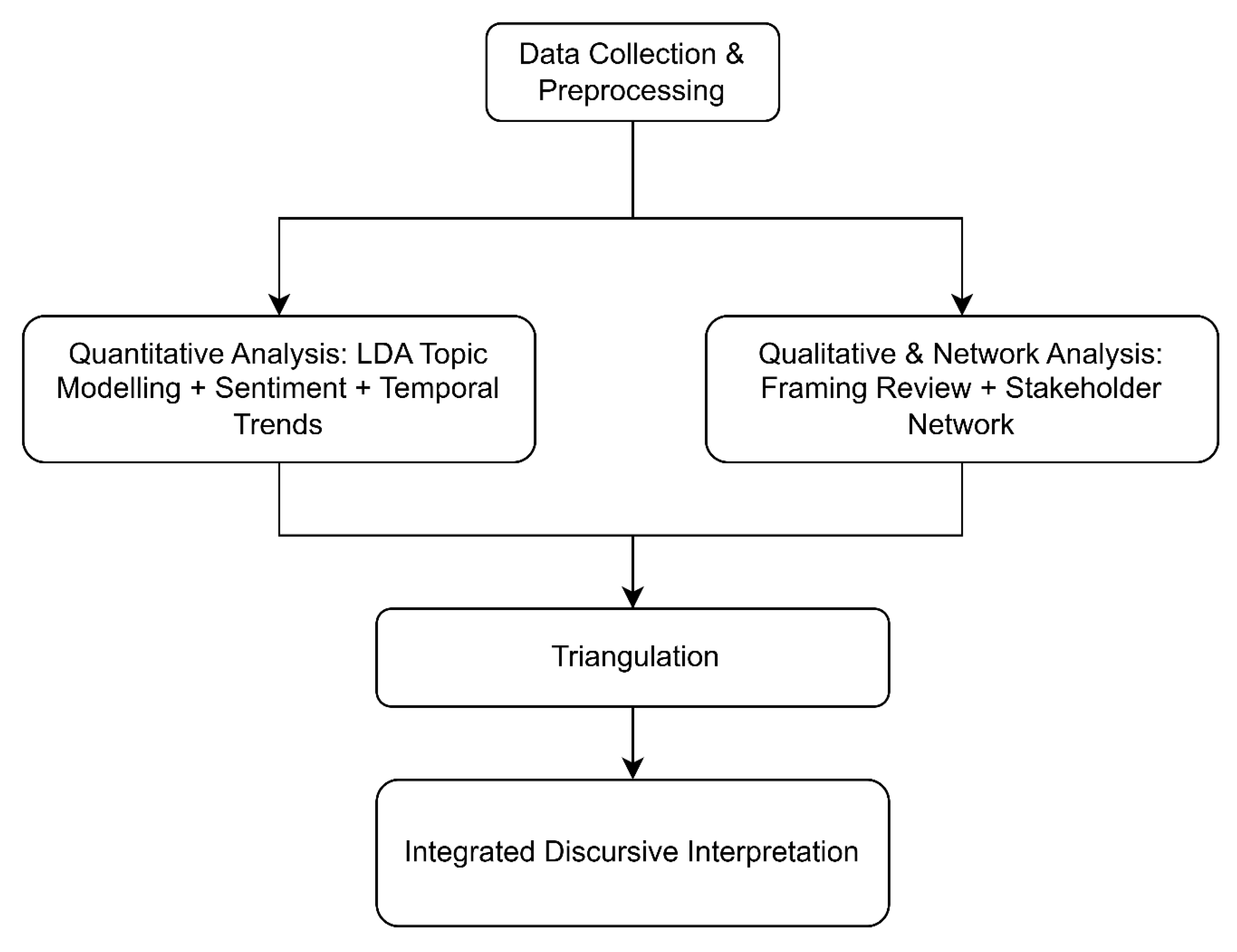
This study employs a mixed-methods design to trace the evolution of Danish media discourse on PFF between 2000 and 2025 (through March 2025) (Figure 1). The research design follows established mixed-method principles that integrate computational text analysis with qualitative interpretation to support both pattern detection and contextual explanation [33].
The design examines how issue visibility, narrative framing, evaluative tone, and actor configurations evolve over time within news media coverage. It integrates topic modelling, generic news frame detection, evaluative stance analysis, qualitative contextual interpretation, and stakeholder co-occurrence network analysis to capture both longitudinal patterns and interpretive dynamics. Such designs are increasingly employed in media and policy research to combine the scalability of computational methods with the interpretive depth of qualitative analysis.

3.1. Data Collection

Data were collected from Infomedia’s National News Database, which archives Danish print and online newspapers. The search covered the period 1 January 2000 to 31 March 2025 and was restricted to Danish-language content. In an initial retrieval step, approximately 1000 articles were identified using the following Boolean query applied to headlines and full text:
(pesticidfri [pesticide-free] OR pesticidfrit [pesticide-free] OR sprøjtefri [spray-free] OR giftfri* [toxin-free/chemical-free] OR “kemikaliefrit landbrug” [chemical-free agriculture] OR “kemikaliefri landbrug” [chemical-free agriculture] OR “sprøjtegiftfri landbrug” [spray-chemical-free-agriculture] OR “pesticidfrit landbrug” [pesticide-free agriculture] OR “pesticidfri dyrkning” [pesticide-free cultivation] OR “sprøjtefri dyrkning” [spray-free cultivation] OR “økologisk landbrug” [organic agriculture] OR “økologisk jordbrug” [organic farming] OR “bæredygtigt landbrug” [sustainable agriculture])
The query deliberately included broader sustainability-related terms (e.g., økologisk landbrug, bæredygtigt landbrug) to minimize false negatives at the retrieval stage, recognizing that debates on PFF are often embedded within wider sustainability narratives. To ensure conceptual consistency, a structured relevance screening was subsequently applied. Because policy and media terminology can evolve over time, the search strategy intentionally combined pesticide-specific keywords with broader sustainability and organic agriculture expressions to reduce the risk of temporal retrieval bias. Iterative test searches indicated substantial continuity in key discursive labels across the study period, supporting the robustness of the longitudinal retrieval approach.
Articles were included in the final corpus if PFF, pesticide avoidance, or strong pesticide reduction constituted a central analytical focus, defined by at least one of the following criteria:
  • Explicit discussion of pesticide-free or pesticide-reduced practices in the headline or lead paragraph;
  • Substantive discussion of pesticide use, avoidance, or regulation in at least one full paragraph (e.g., environmental risk, governance, feasibility, or implementation);
  • Primary focus on policies, bans, compensation schemes, or farming practices explicitly framed as eliminating or substantially reducing pesticide use.
Articles were excluded if:
  • Search terms appeared only in passing (e.g., as background context);
  • Organic or sustainable farming was discussed without explicit reference to pesticide use or avoidance;
  • Pesticides were mentioned only incidentally in unrelated environmental or food-quality reporting;
  • The item consisted of non-editorial material (e.g., advertisements or event listings).
Two coders independently screened all retrieved articles against these criteria. Disagreements were resolved through discussion, resulting in substantial agreement (Cohen’s κ = 0.82). The screening process yielded a final corpus of 453 articles. For the purposes of frame prevalence analysis, duplicate records were removed and articles lacking clearly identifiable dominant framing signals were excluded. This resulted in an analytic subset of 123 articles used for frame classification.
To preserve longitudinal comparability, all relevant articles were retained without within-year sampling, enabling full temporal coverage from 2000 to 2025. The corpus spans mainstream national newspapers, regional outlets, agricultural trade publications, and digital news media. Because publication volume varies over time, issue visibility is interpreted as within-corpus salience, and annual article counts are reported alongside compositional measures.
All analyses were conducted on the original Danish texts. Analytical outputs (e.g., topic labels and visualisations) are reported in English. Where relevant, quotations were translated by the authors with attention to preserving semantic nuance [11,34].

3.2. Text Preprocessing

All articles were prepared for computational analysis using standard Danish-language text preprocessing procedures appropriate for newspaper corpora. Preprocessing focused on removing non-substantive material while preserving domain-specific meaning. Non-content elements such as copyright notices, navigation text, wire-service markers, and other boilerplates were removed. Text was normalized to ensure consistent treatment of domain-relevant compound terms, for example by harmonizing hyphenated and non-hyphenated forms (e.g., pesticid-fri and pesticidfri).
Preprocessing followed established practices in computational text analysis designed to enhance semantic validity while reducing noise in large textual corpora [35,36].
A custom Danish stopword list was applied to reduce noise from high-frequency but semantically empty journalistic expressions (e.g., archive labels, attribution formulas, and date markers), while explicitly retaining substantively meaningful agricultural and environmental terms (e.g., landbrug, miljø, pesticider). Lemmatization was not applied, as Danish agricultural discourse relies heavily on compound nouns whose meaning may be distorted by aggressive stemming or lemmatization.
All preprocessing decisions were applied uniformly across the corpus and were validated through iterative inspection of high-frequency tokens and random sample documents to ensure that relevant concepts and terminological distinctions were preserved. This approach ensured a balance between noise reduction and semantic fidelity in subsequent computational analyses.

3.3. Topic Modelling and Thematic Salience

Topic modelling was conducted using Python 3.12 (Python Software Foundation, Wilmington, DE, USA) and the scikit-learn library (v1.4; scikit-learn Developers, USA), applying the LatentDirichletAllocation with CountVectorizer [37] modelling and operationalized agenda-setting by capturing the relative salience and temporal evolution of dominant issue themes in media discourse. Document–term matrices were constructed using the count vectorizer with the custom stopword list. LDA was selected because it remains one of the most robust and widely validated topic-modelling approaches for large text collections [38], including recent work in food systems and consumer behaviour research (e.g., [39,40]).
Models with topic numbers ranging from k = 5 to k = 30 were evaluated using C_v coherence, UMass coherence, and held-out perplexity. The six-topic model produced a C_v coherence score of 0.446, UMass coherence of −1.266, and a held-out perplexity of 1671.98, indicating a substantively interpretable and analytically coherent topic structure. Although the five-topic model yielded lower perplexity (1027.37), manual inspection showed that it merged conceptually distinct themes, thereby reducing analytical resolution. A seven-topic model generated a marginally higher coherence score (C_v = 0.447; perplexity = 1694.5) but increased thematic fragmentation without improving interpretive clarity.
To further ensure semantic validity, two subject-matter experts independently reviewed the top terms and a sample of high-probability articles for each candidate model. Only models in which topics corresponded to coherent and analytically distinct themes (e.g., policy, environment, innovation, economics, technical farming, health) were retained. Consistent with methodological guidance emphasizing semantic interpretability over statistical fit alone, the six-topic model was therefore selected as offering the most robust balance between coherence, parsimony, and analytical usefulness [41,42]. This approach aligns with mixed-method computational research that prioritizes human interpretability when models are used for substantive inference rather than prediction.
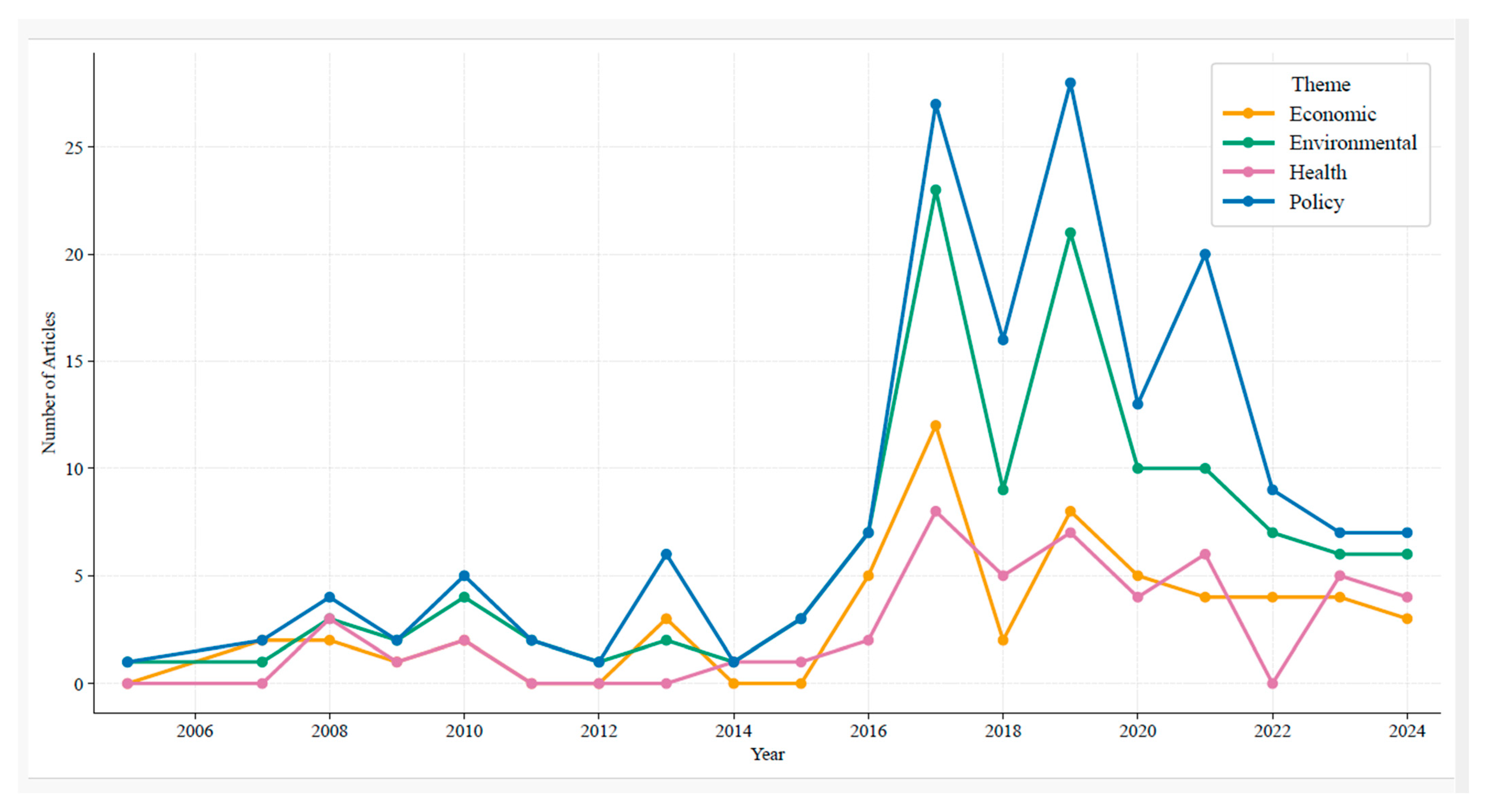
For each article, we computed topic prevalence scores and aggregated them by year to examine temporal dynamics of thematic attention (Section 4.1.1; Figure 2). Yearly theme trends are computed as the mean topic proportion across articles within each year (i.e., compositional salience), and we report annual article counts to distinguish compositional change from volume effects.

3.4. Evaluation Tone

To capture evaluative tone, we implemented an article-level stance classification (positive, neutral, negative) using a lexicon-based approach adapted to Danish agricultural and environmental discourse. We started from an existing Danish sentiment lexicon and expanded it with domain-specific terms identified in an initial scan of the corpus (e.g., resistens, giftfri, forurenet, sikkerhed). Lexicon extensions were validated through consultation with a Danish linguist and an agricultural policy expert. The base lexicon was derived from the Danish Sentiment Lexicon, a widely used resource for computational sentiment analysis in Danish-language texts [43]. Domain-specific expansions followed an inductive calibration process to ensure contextual relevance for agricultural policy reporting.
To assess plausibility, we conducted a manual audit of a randomly selected subset of articles, comparing automated labels with close reading. The audit indicated conservative classification behaviour, with ambiguous cases systematically coded as neutral, thereby reducing the risk of overstating evaluative polarization.
Sentence-level scoring incorporated rule-based handling of Danish negation and intensifiers (e.g., meget, helt, ikke). Article-level stance was computed by aggregating sentence scores, assigning greater weight to headlines and lead paragraphs to reflect journalistic front-loading. All preprocessing, lexicon application, and scoring procedures were applied uniformly across the corpus to support methodological transparency and reproducibility. Results are reported as annual distributions of evaluative tone, interpreted as broad patterns of orientation rather than as precise measures of sentiment strength.

3.5. Quantitative Narrative Frame Detection

To examine how PFF is narratively constructed, the analysis identifies five generic news frames commonly used in environmental and policy reporting: Problem, Solution, Conflict, Progress, and Risk. Frames are treated as narrative functions that structure meaning-making (e.g., diagnosing harm, proposing remedies, emphasizing dispute, signaling forward movement, or highlighting uncertainty and threats).
The use of generic frames builds on a well-established tradition in media-framing research, where such interpretive structures are employed to systematically analyze how policy issues are constructed in public discourse [44,45].
Frame detection was operationalized using theory-informed lexical dictionaries designed to systematically capture characteristic framing language associated with each narrative function [46,47]. Frame lexicons were constructed through a combined deductive–inductive procedure: initial keyword sets were derived from established framing scholarship and subsequently refined through iterative reading of a stratified sample of articles to ensure semantic alignment with Danish agricultural discourse [48]. Each dictionary included theoretically grounded markers (e.g., threat and uncertainty terms for Risk, dispute-related language for Conflict, and remedy-oriented vocabulary for Solution). Ambiguous or context-sensitive terms were removed during calibration to minimize false positives and enhance classification reliability, consistent with best practices in dictionary-based content analysis [46]. For each article, frame signals were aggregated and normalized to produce a frame score ranging from 0 to 1 for each frame, reflecting the relative strength of that frame’s indicators within the article. A dominant frame was assigned only when one frame achieved the highest score and exceeded the second-highest frame score by a minimum margin of 0.20. Articles that did not meet this dominance criterion were classified as mixed or non-dominant and were excluded from dominant-frame frequency analysis.
All lexicon construction and scoring procedures were applied consistently across the corpus to ensure methodological transparency and reproducibility. This conservative binary operationalization is intentionally employed to support longitudinal comparison of frame prevalence rather than to capture subtle within-article framing mixtures. Frame detection is used as a heuristic mapping tool rather than a substitute for detailed manual coding. Quantitative frame patterns are therefore triangulated with qualitative contextual reading to ensure semantic validity and to interpret how responsibility, feasibility, and contestation are constructed within frame-specific narratives.

3.6. Qualitative Contextual Interpretation

To contextualize quantitative patterns, we conducted a structured qualitative review focusing on how meanings, responsibility, and feasibility are constructed in media narratives. Two coders with expertise in agricultural policy and environmental communication developed a codebook through iterative reading of a stratified sample of 50 articles. The codebook covered (i) issue-specific interpretive emphases, (ii) narrative structure, and (iii) stakeholder positioning.
Inter-coder reliability, calculated using Cohen’s κ, ranged from 0.76 to 0.84 across categories. Disagreements were resolved through discussion and, where necessary, adjudication by a third reviewer. A verification reading confirmed consistent application across outlet types and time periods.
This qualitative component is used analytically rather than exhaustively, focusing on recurring narrative logic and representative textual evidence (Section 4.2.2). In addition, a randomly selected subset of 60 articles was examined in greater depth to support comparative interpretation across frames and periods, following qualitative content-analysis procedures [49].

3.7. Stakeholder and Network Analysis

For stakeholder analysis, each article was coded for the presence of key actor categories (e.g., farmers’ organisations, individual farmers, government agencies, political parties, industry associations, NGOs, scientists, consumer groups, retailers). Actor categories were coded at the article level based on explicit attribution (direct quotation, named organizational representation, or clearly identifiable institutional role). Passing mentions without attribution were not coded as actor presence. We constructed a co-occurrence network in which nodes represent actor categories and edges denote joint mention within the same article. Edge weights reflect the number of articles in which two actor categories co-occur. All network metrics are based on article-level co-occurrence rather than raw mention counts. Co-occurrence network analysis is widely used in communication and policy research to examine relational structures, influence patterns, and discursive centrality among actors [50,51].
Network metrics, including degree centrality, betweenness centrality, and eigenvector centrality, were computed using NetworkX (v3.2) to identify core and peripheral actors. From a discursive-institutionalist perspective, these co-occurrence networks operationalise discursive centrality and connectedness within the communicative arena, indicating which actor categories are most consistently co-positioned in media narratives of PFF [19,52]. Results are reported as the core–periphery discourse structure (Section 4.3.1).

3.8. Ethical Considerations

All data were obtained from publicly accessible news archives. No personal data beyond what is already published in news texts were processed, thus ensuring compliance with the General Data Protection Regulation (GDPR). Interpretations were made with utmost care to avoid misrepresenting stakeholder positions and to reflect the diversity of viewpoints present within the corpus.

4. Results

Across these analytical layers, the findings converge on a consistent pattern indicating PFF achieves recurrent media visibility without generating discursive conditions that consistently support transformative implementation. More precisely, this visibility does not translate into a sustained discursive expansion of transformative feasibility frames. Attention is episodic rather than cumulative, framing privileges contestation and negotiated feasibility over integrated problem–solution reasoning, and communicative centrality is concentrated among incumbent actors.

4.1. Quantitative Overview: Thematic Salience and Evaluative Tone

4.1.1. Temporal Dynamics of Thematic Attention

The LDA-derived theme time series reveals a highly uneven and episodic agenda structure (Figure 2). Environmental themes dominate coverage throughout the period, exhibiting pronounced peaks in 2017 (the single highest annual value) and again in 2019. These spikes coincide with major policy developments, including the launch of Denmark’s National Pesticide Strategy 2017–2021 [53] and a subsequent 2019 policy addendum [54] that introduced stricter regulatory measures such as expanded groundwater monitoring and tighter controls on pesticide sales. The alignment between thematic peaks and regulatory activity suggests that institutional policy processes played a key role in structuring media attention. Policy-related attention increases more gradually, with a noticeable rise after the mid-2010s and a local maximum around 2021.
In contrast, health-related coverage remains consistently marginal across the entire period, registering only minor and short-lived upticks. Economic themes are comparatively limited in the topic model. Rather than reflecting a multidimensional sustainability debate, the agenda signal is therefore strongly skewed toward environmental governance concerns, with limited integration of health, farming practice, or livelihood dimensions.

4.1.2. Evaluative Tone over Time

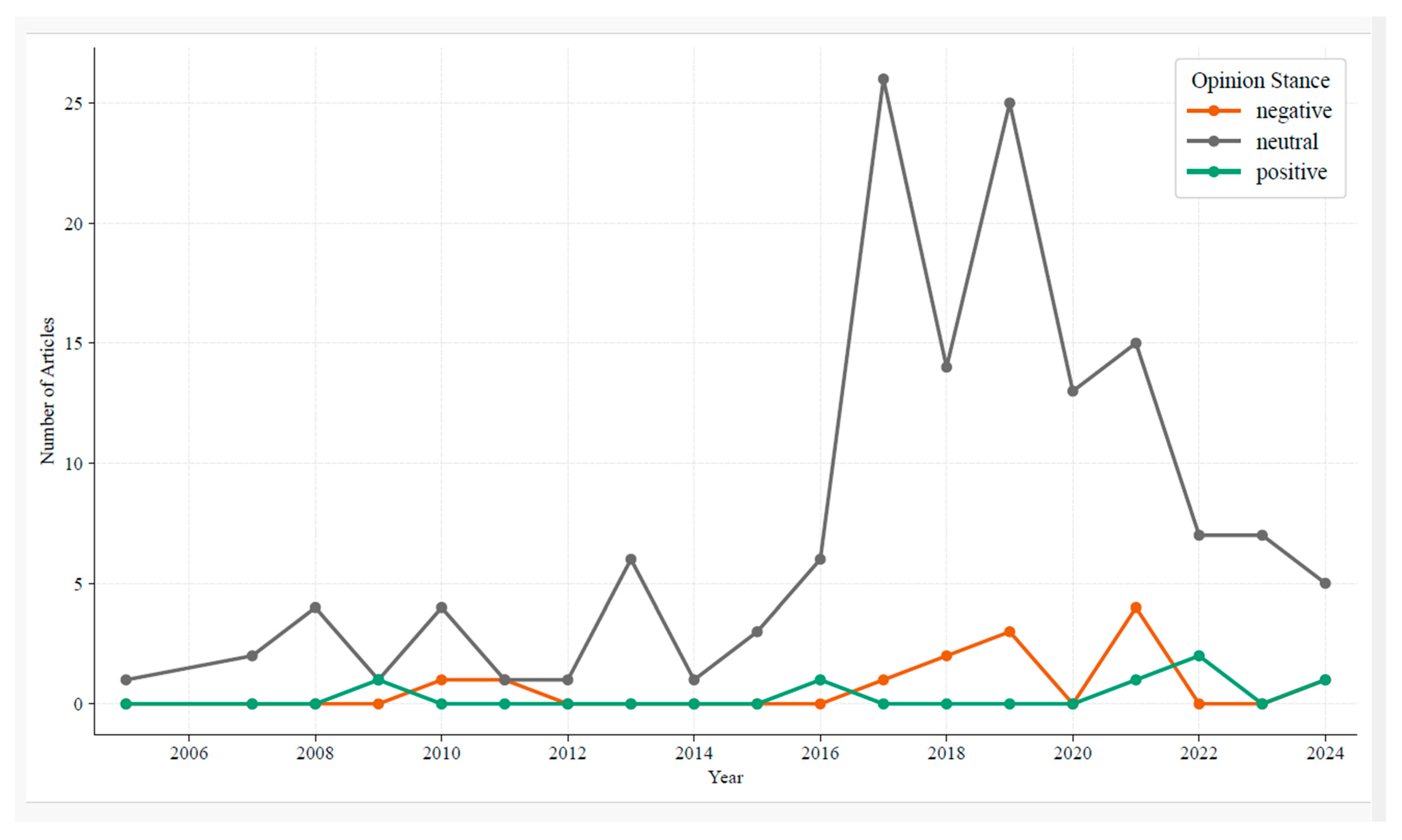
Evaluative stance analysis shows a persistent dominance of neutral reporting across the full observation period (Figure 3). Neutral articles increase sharply during peak-attention years, while negative and positive stances remain comparatively limited.
Negative sentiment displays short-lived spikes—most notably around 2021—typically associated with regulatory disputes, contamination events, or acute policy conflicts. Positive sentiment is rare and intermittent, with modest increases between 2021 and 2024, often following policy announcements or claims of technological progress.
This pattern is consistent with episodic mobilization followed by a return to affective neutrality: media attention intensifies during controversies but quickly stabilizes around a neutral baseline. We interpret this cautiously, as lexicon-based sentiment analysis captures general evaluative orientation rather than rhetorical intensity. Nonetheless, the results align with comparatively restrained evaluative reporting and incremental issue processing rather than sustained polarization or mobilization for systemic change.

4.1.3. Thematic Relationships and Discursive Fragmentation

Correlation analysis reveals weak integration across thematic domains, pointing to a fragmented discursive structure rather than a coherent transition narrative. Pearson correlations were computed between article-level topic proportions across the corpus (N = 453). While innovation and environmental themes show the strongest association (r = 0.18), correlations between health and environment (r = 0.04) and between policy and agricultural-technical themes (r = 0.06) remain minimal.
Empirically, this fragmentation manifests in three recurring patterns:
  • Stories about technological change rarely integrate health or ecological implications;
  • Policy reporting seldom engages with on-farm implementation practices;
  • Environmental reporting often omits public health connections.
Rather than converging around shared causal logics, PFF is constructed through parallel issue domains that rarely intersect.
Lexical patterns reinforce this finding. Health-related expressions are largely absent from high-frequency keyword lists, consistent with their low thematic salience. Vocabulary related to farmer livelihoods and production feasibility appears primarily in agricultural outlets, while governance-oriented terms dominate across the corpus. Representative keywords include bæredygtig/økologisk/miljø (sustainable/organic/environment), forbud/afgift/lovgivning (ban/tax/legislation), and teknologi/udvikling/løsninger (technology/development/solutions). Together, these lexical profiles confirm that governance and feasibility disputes structure the dominant interpretive field, while integrated socio-technical transition narratives remain weak.

4.2. Narrative Framing and Meaning Making in Context

4.2.1. Frame Prevalence

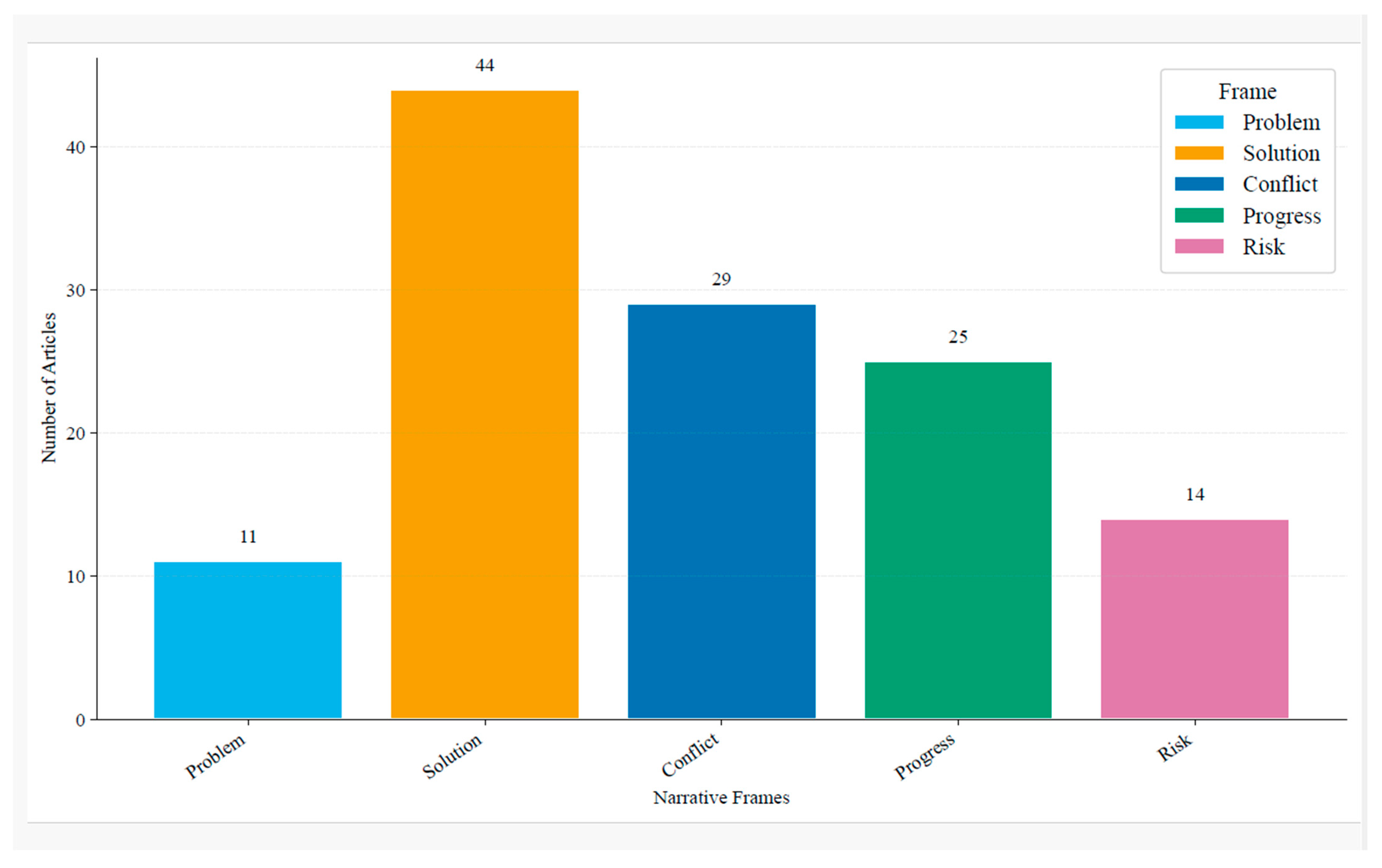
Quantitative frame detection within the dominant-frame analytic subset (n = 123) shows a diverse distribution of dominant narrative frames (Figure 4). Solution is the most prevalent narrative function (n = 44), followed by Conflict (n = 29) and Progress (n = 25). Risk (n = 14) and Problem (n = 11) appear less frequently.
Rather than indicating a uniformly risk-oriented discourse, this distribution suggests a heterogeneous framing environment in which both solution-oriented and contestational narratives are visible. The prominence of solution framing points to the presence of forward-looking perspectives within Danish media coverage, while the continued visibility of conflict and progress frames reflects ongoing negotiation over the direction and implementation of pesticide-free transitions.
Frame prevalence results are interpreted as analytic patterns triangulated with qualitative reading rather than as definitive population-level estimates.

4.2.2. Quantitative Interpretation of Dominant Frames

Problem frames appear primarily in episodic contexts such as environmental degradation, regulatory shortcomings, or unintended consequences of pesticide-dependent agriculture. When they do appear, narratives stress contamination, uncertainty, or ecosystem harm. For example:
“Pyrethrum… kan forøge forekomsten af leukæmi blandt avlere med 3.7 gange.”
(“Pyrethrum… can increase the incidence of leukemia among growers by a factor of 3.7.”)
Here, the article reports research suggesting elevated health risks, positioning pesticide exposure as a salient harm claim within the narrative. A second pattern appears when regulatory processes are portrayed as inconsistent or inadequate:
“Det er meget vigtigt, at det bliver en individuel forhandling hver gang.”
(“It is very important that it becomes an individual negotiation each time.”)
Here, the article uses a regulatory dispute to illustrate administrative weakness, framing institutional uncertainty as a problem rather than a conflict.
Solution frames are particularly prominent in agricultural, organic, and municipal news coverage. They tend to construct PFF as feasible through incremental and conditional measures (compensation, technical substitution, local regulation), rather than as a systemic reconfiguration of production. A central storyline emphasizes compensation: “Nu må vi se, om de vil betale nok for pesticidfri drift.” (“Now we must see whether they will pay enough for pesticide-free farming.”) Here, PFF is framed as feasible only if market or state actors ensure adequate payment schemes.
A second storyline stresses technical adjustment: “Landbruget er allerede på vej med nye metoder og bedre mekanisering.” (“Agriculture is already moving forward with new methods and improved mechanization.”)
Municipal governance supplies a third pathway, framing local bans as practical tools: “Aarhus vedtager sprøjteforbud for at beskytte drikkevandet.” (“Aarhus adopts a spraying ban to protect drinking water.”)
Organic outlets additionally connect solutions to consumer choice: “Økologi giver nyfødte en pesticidfri start.” (“Organic production gives newborns a pesticide-free start.”) This implicitly positions consumer demand as a pathway to scaling pesticide-free production. Scientists and agronomists propose knowledge-driven solutions, often highlighting the need for advisory services and applied research: “Vi har brug for bedre rådgivning og kontinuerlig udvikling af alternativer.” (“We need better advisory services and continuous development of alternatives.”)
Conflict frames reveal multiple arenas of contention: local disputes over groundwater protections, identity conflicts between organic and conventional producers, compensation disputes, and legitimacy conflicts around EU regulation. For example:
“Kommunen tvinger landmændene væk fra regelret landbrugsdrift” (“The municipality forces farmers away from normal agricultural practice”).
Identity contestation appears in claims such as:
“Økologer sprøjter også” (“Organic farmers also spray”) while organic outlets counter by portraying ecological benefits as distinct and superior. Market-justice conflicts recur: “Vi kan ikke leve af gode intentioner alene” (“We cannot make a living on good intentions alone”). Finally, broader legitimacy disputes appear in reactions to EU regulations, “EU’s planteregler er på gal kurs” (“The EU’s plant rules are heading in the wrong direction”), showing resistance to external rulemaking. These conflicts repeatedly locate disagreement around authority, fairness, and feasibility, thereby shifting debate toward negotiable adjustments rather than structural transformation. Such narratives repeatedly locate disagreement around authority, fairness, and feasibility, channeling debate toward negotiable adjustments rather than structural transformation.
Progress frames construct PFF as a forward-moving, socially desirable transition driven by innovation, consumer demand, local governance, and ecological recovery. Organic-oriented outlets frequently celebrate sector-wide momentum: “Økobølgen skyller hen over det danske landbrug” (“The organic wave is washing over Danish agriculture”) but other articles portray progress as emerging from growing consumer willingness to support pesticide-free products: “Flere forbrugere vælger pesticidfri frugt og grønt” (“More consumers are choosing pesticide-free fruit and vegetables”). Municipal initiatives, especially in Aarhus, are framed as pioneering steps: “Aarhus vedtager sprøjteforbud for at beskytte drikkevandet” (“Aarhus adopts a spraying ban to protect drinking water”), positioning local governance as an active driver of change. Profiles of young farmers further link PFF to generational renewal: “Jeg vil præge fremtidens landbrug” (“I want to shape the agriculture of the future”). However, these narratives rarely address the structural constraints limiting widespread implementation.
Risk frames, when present, convey significant concerns across ecological, public health, and socio-economic domains. Environmental risk dominates, particularly in articles documenting the decline of pollinators and ecosystem health: “Bier og insekter forsvinder i takt med sprøjtningen” (“Bees and insects disappear as spraying intensifies”). Groundwater protection constitutes another major risk category, especially in Aarhus and other municipalities facing contamination threats: “Udfaset pesticid lukker vandværk” (“A phased-out pesticide shuts down a waterworks”) and “Grundvandet kan vi ikke flytte” (“We cannot move the groundwater”). Human-health risks surface intermittently through medical or scientific reporting, such as evidence of exposure among children: “Børn i regionen er udsat for øget risiko for hjernesvulster” (“Children in the region are exposed to an increased risk of brain tumours”) or narratives linking organic production to reduced exposure in infancy. A smaller set of articles highlights systemic vulnerabilities, including climate-related cultivation risks and threats to farmer livelihoods: “Vi kan ikke leve af gode intentioner alene” (“We cannot make a living on good intentions alone”). Despite this diversity, risk frames rarely trigger sustained coverage or thematic integration, reinforcing the quantitative finding that risk—particularly human-health risk—remains episodic and overshadowed by solution- or policy-driven narratives.

4.3. Stakeholder Networks: Discursive Centrality and Feasibility Construction

4.3.1. Core-Periphery Structure of the Discourse

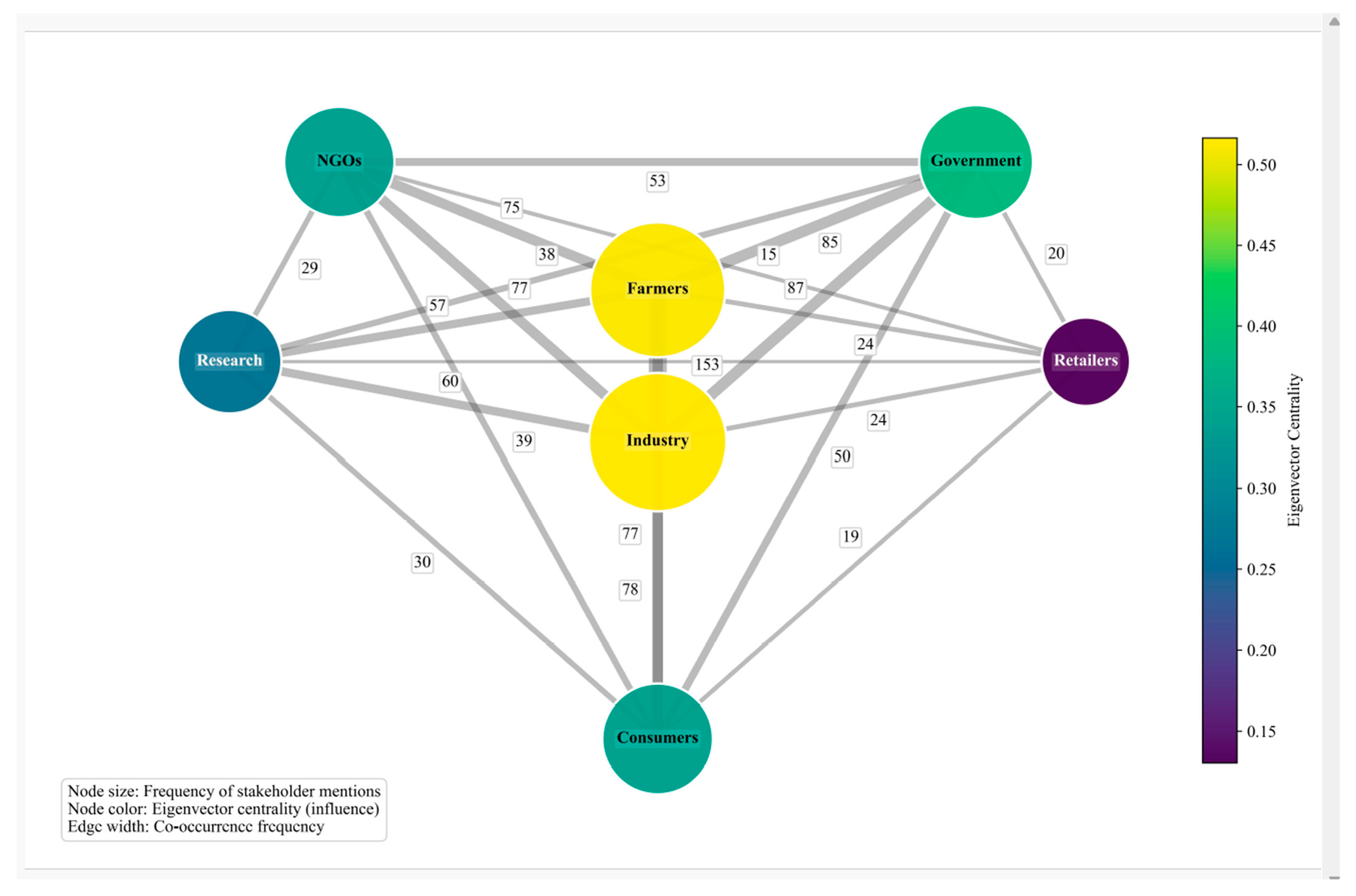
Stakeholder co-occurrence analysis reveals a pronounced core–periphery structure (Figure 5). Farmers and industry actors occupy the most central positions, closely interconnected with government authorities, forming a dense communicative core. These actors co-occur most frequently and jointly structure the narrative space in which PFF is discussed.
NGOs, consumers, and public health actors occupy peripheral positions. Although connected to the core, they appear less frequently and rarely serve as primary definers of policy feasibility. Retail actors are the most marginal, with minimal integration into the dominant discourse coalition.
This concentration of ties among farmers, industry, and government indicates that public debate is predominantly organized through incumbent production and governance coalitions, rather than broad multi-stakeholder engagement.

4.3.2. Actor Positioning and Discursive Filtering

Evaluative stance analysis by source type reinforces the network findings. Mainstream and national outlets predominantly adopt a neutral stance, academic sources tend to be more supportive of PFF, and industry-affiliated sources are more frequently critical. Agricultural trade outlets closely mirror producer concerns, combining skepticism with conditional acceptance tied to compensation, feasibility, and regulatory flexibility. Government sources are overwhelmingly neutral, reinforcing their role as procedural mediators rather than advocates of transformative change.
Temporally, mentions of farmers, industry, and government intensify during policy windows, whereas NGOs, consumers, and health-oriented actors remain event-driven and weakly visible. Even when environmental or health risks enter the agenda, they are most often articulated through central actors rather than by peripheral challengers.
From a discursive-institutionalist perspective, this configuration is consistent with a filtering of contestation through negotiated feasibility, cost considerations, and incremental adjustment, rather than narratives of systemic reconfiguration. Assessing how such configurations translate into policy outcomes would require additional evidence from coordinative arenas.

4.4. Triangulation & Synthesis: Explaining the Visibility–Implementation Gap

Taken together, the results indicate that sustained media visibility of PFF in Denmark operates through a discursive configuration that amplifies public attention while constraining the articulation of policy feasibility. Triangulating thematic trends, evaluative tone, narrative framing, and stakeholder networks shows that media discourse consistently increases issue salience without generating the integrative problem definitions or actor reconfigurations typically associated with transformative policy change.
Across analytical layers, visibility is structured in episodic and compartmentalized ways. Peaks in coverage coincide with regulatory debates or conflictual events, but attention does not accumulate into a coherent transition narrative. Instead, thematic domains (environment, policy, health, farming practice), interpretive frames, and actor positions remain weakly connected. This segmentation limits the capacity of public discourse to stabilize causal diagnoses, attribute responsibility across domains, or sustain solution-oriented narratives over time, resulting in visibility without cumulative discursive momentum.
From a framing perspective, dominant coverage is split primarily between solution-oriented and conflict-oriented narratives, with risk and problem frames less frequently represented as dominant frames. Qualitative evidence suggests that solution narratives are often conditional and incremental, which sustains visibility but rarely consolidates into socially anchored pathways for system-level transition. Media attention is repeatedly mobilized around urgency, controversy, and uncertainty, yet rarely translated into narratives that link identified problems to implementable and socially anchored policy pathways. This pattern sustains awareness while narrowing the publicly articulated range of feasible responses.
Stakeholder configurations further condition how visibility translates into feasibility. The persistent centrality of governmental authorities, farming organizations, and industry actors’ channels of contestation through negotiation-oriented logics that prioritize manageability, compensation, and incremental adjustment. In contrast, perspectives emphasizing health, consumer engagement, or broader societal transformation—most often articulated by NGOs, scientists, and consumer-oriented actors—remain peripheral and episodic. In discursive-institutional terms, critique is not excluded from media discourse but selectively filtered, reinforcing adaptive stabilization rather than discursive conditions conducive to transformative reconfiguration.

5. Discussion

5.1. Overall Policy Focus and Partial Understanding

The results highlight a persistent imbalance in Danish media coverage of PFF since 2000, characterized by a strong emphasis on environmental risks and policy processes, with increasing attention to regulatory issues after the mid-2010s. While consumer health concerns are frequently assumed to play a central role in public debates on agricultural chemicals, the analysis shows that health considerations remain comparatively marginal in Danish newspaper coverage, moderating earlier expectations that health risks would function as a primary driver of sustained media attention [55,56]. While these patterns point to fragmentation across thematic dimensions, it would be reductive to interpret Danish media coverage as wholly lacking narrative coherence. Rather, a form of selective coherence emerges around regulatory governance and environmental stewardship. Across outlets, PFF is consistently positioned as a matter of institutional responsibility, technical management, and policy design, thereby supporting a predominantly technocratic narrative of transition. The limitation, therefore, is less a lack of coherence than the relative under-articulation of a multidimensional societal transformation extending beyond administrative reform.
Instead, dominant coverage centers on legislative agendas, such as the introduction of pesticide taxes or chemical bans, and environmental priorities, such as biodiversity conservation [57,58]. This alignment suggests not narrative fragmentation alone, but a degree of narrative narrowing, in which governance mechanisms become the primary lens through which agricultural transition is interpreted. This pattern is consistent with scholarship suggesting that sustainability transitions are often mediated through institutional governance frameworks rather than participatory societal narratives [59,60,61]. These storylines foreground important governance mechanisms, but they also narrow the public construction of PFF by underrepresenting everyday dimensions such as farmer livelihoods, local practices, and consumer-level benefits [62]. A similar pattern has been documented beyond agriculture. For example, media analyses of aquaculture show that news coverage tends to prioritize institutional action, regulation, and high-level debates while downplaying everyday practices and social or health implications [63]. From an agenda-setting perspective, this policy-centered orientation places governmental decision-making at the core of public attention, reinforcing a top-down narrative of agricultural transition [64]. While such coherence may enhance the perceived legitimacy of regulatory intervention, it may simultaneously displace alternative narratives rooted in health, consumption, and civic engagement, thereby contributing to a comparatively technocratic public imaginary of agricultural change.
Consequently, Danish media coverage appears less characterized by an absence of direction than by the predominance of a state-centered transition imaginary, within which PFF is framed primarily as an administrative and policy challenge rather than as a broad-based societal transformation involving multiple forms of agency.

5.2. Environmental Risks and Governmental Measures

Danish newspapers consistently focus on stories that deal with environmental risks and government measures related to the PFF. This prevalence of policy and ecological framing aligns with scholarship suggesting that the media can contribute to the salience and perceived legitimacy of regulatory reform agendas by drawing on high-stakes narratives, such as the urgency to halt biodiversity loss or reduce waterway contamination [65,66]. The episodic peaks in coverage during periods of regulatory debate, such as parliamentary discussions on pesticide strategies or revisions to taxation instruments, illustrate how institutional processes can structure the rise and fall of media attention [67].
Instead of building on the PFF as a continuously evolving practice affecting multiple sectors, news channels tend to cluster around official government actions and legislative changes [68,69]. This pattern may inadvertently reinforce the perception that agricultural transformation is driven primarily by top-down directives, rather than by bottom-up experimentation or community-led adaptation [70].
Temporal patterns further show that environmental narratives often rise in tandem with policy milestones, amplifying major political decisions while providing limited insight into everyday implementation by farmers, cooperatives, and NGOs [71]. Although policy coverage is essential, the relative absence of sustained reporting on day-to-day implementation challenges may constrain public understanding of how pesticide-free transitions unfold in practice [72]. In framing terms, this reflects strong diagnostic framing alongside more conditional and fragmented prognostic narratives that highlight individual or collective agency, thereby reinforcing reliance on centralized state solutions.

5.3. Marginal Health Coverage and Fragmentation

The limited integration of health considerations in Danish media coverage of PFF is notable not only because of its empirical marginality, but because health represents one of the most intuitively compelling frames for public engagement. Rather than functioning as a sustained interpretive anchor, health concerns appear primarily in episodic contexts such as residue controversies or isolated exposure reports, without being systematically linked to everyday practices, long-term wellbeing, or broader transition pathways.
This pattern suggests that the marginal role of health is not simply a matter of journalistic oversight but reflects a discursive incompatibility between health narratives and the dominant policy-regulatory framing of pesticide governance. Health risks are typically individualized, experiential, and embodied, whereas PFF is predominantly constructed as a technical and institutional problem governed through regulation, taxation, and expert management. As a result, health concerns struggle to attach themselves to prevailing narratives of feasibility and implementation.
From a second-level agenda-setting perspective, health is not excluded from the discourse but weakly coupled to other salient attributes such as environmental risk and regulatory action [9,73]. This weak coupling contributes to discursive fragmentation, in which PFF is rarely articulated as an integrated sustainability transition encompassing environmental protection, public health, and socio-economic livelihoods. Instead, health remains an intermittent supplementary concern, limiting its potential to broaden public identification with pesticide-free transitions.

5.4. Neutral Reporting and Conditional Solution Narratives

The predominance of neutral reporting alongside episodic and conditional solution narratives has important implications for the accumulation of discursive momentum. While neutrality reflects professional norms of journalistic objectivity, it may also contribute to depoliticizing effects by presenting contested policy issues within the sphere of legitimate consensus rather than sustained controversy [74,75]. Event-driven coverage tends to privilege immediate developments over structural conditions, limiting opportunities for cumulative interpretive framing [76]. As a result, solution narratives often appear as discrete innovations rather than components of a broader socio-technical transition. Presenting solutions without sustained contextualization risks generating a “novelty” effect, in which regulatory or technological advances are highlighted without equivalent scrutiny of scalability, distributional consequences, or long-term feasibility. Consequently, audiences may perceive transition pathways as more straightforward than they are, potentially weakening support for deeper institutional or cultural change.

5.5. Stakeholder Dynamics and Media Power

Stakeholder network analysis shows that farmers, government institutions, and industry actors form a tightly interconnected communicative core in Danish PFF coverage, while NGOs, consumer groups, and health advocates remain comparatively peripheral. This configuration aligns with research on structural power in agricultural discourse, where actors with lobbying capacity and institutional authority disproportionately shape problem definitions and feasibility boundaries [77,78]. Government representatives appear primarily through authoritative statements, industry actors foreground economic feasibility, and farmers’ associations emphasize production stability and costs, collectively reinforcing a negotiated, top-down discourse [17,79]. In contrast, consumer- and NGO-led perspectives related to environmental justice, food safety, or citizen engagement appear less frequently, limiting their discursive reach [71].
Differences between specialized agricultural outlets and mainstream national media further reinforce these dynamics. Trade publications tend to provide more detailed discussions of implementation and technical feasibility, while mainstream outlets focus on legislative milestones and political conflict [52,80]. If so, the broader public, more likely to encounter PFF through widely read national outlets, may receive a comparatively high-level depiction oriented toward policy moments rather than day-to-day transformations [81]. From a discursive-institutionalist perspective, this pattern would be consistent with a situation in which the communicative discourse of news coverage partially mirrors the restricted coordinative discourse of policy negotiation. By privileging incumbent actors (farmers, government, industry) in both areas, the media system may contribute to discursive stabilization rather than paradigm contestation. This remains an interpretive implication rather than a direct test of media effects, and future research could explicitly compare framing patterns and actor centrality across outlet types, including systematic contrasts between trade, regional, and national media [82].

5.6. Toward Holistic Policy Communication

Thematic gaps and stakeholder imbalances underscore the need for more holistic policy communication around PFF. While Denmark’s regulatory instruments have reduced pesticide reliance in several domains [6,83], media narratives rarely integrate health outcomes, on-farm practices, and consumer relevance in a sustained manner.
From a policy and communication perspective, greater inclusion of farmer experiences, consumer perspectives, and public health implications could strengthen multi-actor engagement and broaden societal ownership of pesticide-free transitions. Without such integrative narratives, even well-designed policy reforms risk being perceived as top-down interventions, potentially limiting adoption and mobilization.

5.7. Methodological Reflections and Limitations

Notwithstanding the systematic design and robust longitudinal dataset, this study highlights the inherent complexities of applying automated text-analytic methods to the study of media discourse on PFF. Topic modelling and network analysis are well suited for mapping large-scale patterns, such as clustering dominant themes or identifying central stakeholder configurations [18,84]. At the same time, purely algorithmic approaches inevitably abstract from linguistic nuance, including context-dependent meaning, irony, and rhetorical strategies that shape how audiences interpret news coverage [85]. Although the inclusion of targeted qualitative coding and close reading mitigates this limitation, some subtleties may remain underrepresented.
A related methodological challenge concerns corpus construction. The dataset was derived from a keyword-based search of Infomedia’s national news archive. While the search strategy was deliberately broad and followed by structured manual relevance screening, it remains possible that articles discussing pesticide-free practices using unanticipated terminology or indirect references were not captured. Similar constraints apply to stakeholder identification: actors may implicitly advance positions or perspectives that do not register clearly in rule-based or category-based coding schemes. Future research could address these limitations by refining retrieval strategies and extending validation procedures, including the use of supervised classifiers capable of capturing greater semantic variation in Danish-language media.
The analysis is confined to a single national case. Denmark’s high-trust governance system, advanced pesticide regulation, and strong agricultural institutions provide a theoretically informative context but also limit generalizability. Patterns of episodic visibility, actor centralization, and discursive stabilization observed here may manifest differently in countries with other media systems, political cultures, or regulatory capacities. At the same time, this case offers analytical leverage for understanding how sustained media attention can coexist with institutional inertia in consensus-oriented governance settings.
By design, the study focuses exclusively on editorial news content and therefore captures a specific communicative genre rather than the full public discourse on pesticide governance. News production is structured by professional norms and established news values, including conflict, timeliness, and political relevance, which systematically shape issue visibility [86]. As such, straight news reporting is less oriented toward sustained normative argumentation, while cohesive advocacy narratives are often articulated in arenas centered on persuasion, such as opinion pages, editorials, and civil society communications. The findings should therefore be interpreted as characterizing the mainstream news media arena rather than the broader communication landscape. Future research could extend the analysis across media genres to capture how integrative transition narratives are constructed and contested.

6. Conclusions and Implications

The Danish media landscape examined in this study reflects both the possibilities and the limitations of contemporary reporting on PFF. The findings demonstrate that media attention to PFF is recurrent yet episodic, strongly centered on institutional actors, and only weakly integrated with health- and implementation-related dimensions, including farming practice and livelihoods. While policy announcements and environmental imperatives have succeeded in keeping PFF on the public agenda, the broader potential of low-chemical agriculture to address interconnected socioecological challenges, spanning public health, rural livelihoods, and consumer engagement, remains only partially articulated in mainstream news coverage.
From a communicative perspective, this pattern helps explain the persistence of the visibility–feasibility gap identified in this study. Media discourse generates salience without consistently expanding the range of publicly articulated transition pathways. By privileging regulatory milestones, environmental risk, and negotiated feasibility concerns, coverage reinforces a framing of PFF as a predominantly institutionally mediated and technocratic endeavor, rather than a transformation involving everyday practices, consumer choices, and collective responsibility. Consequently, media discourse may stabilize existing policy orientations while limiting the public imagination of alternative or more participatory transition trajectories.
The findings also carry implications for sustainability, governance and policy communication. When health benefits, farmer experiences, and consumer-facing outcomes remain peripheral, opportunities for broader public mobilization and cross-sector coalition-building are constrained. More inclusive media narratives, those that consistently connect policy instruments to on-farm practices, environmental outcomes, and human health, could support a richer and more integrated understanding of pesticide-free transitions and their societal relevance. Such narratives may help counteract the perception of PFF as a narrow regulatory issue and instead position it as a shared socioecological project.
For journalists and media organizations, the results highlight the importance of moving beyond episodic coverage driven by policy events and controversies. Sustained attention to implementation processes, local experimentation, and distributional consequences of pesticide reduction could enhance the explanatory depth of reporting and reduce reliance on episodic, conflict-centered, and event-driven narratives. Similarly, policymakers and civil-society actors seeking to advance PFF may benefit from engaging more strategically with media logic, ensuring that health-oriented, practice-based, and citizen-relevant perspectives are not overshadowed by institutional discourse.
More broadly, this study demonstrates the value of examining sustainability transitions through the lens of media discourse. By showing how visibility can coexist with discursive stabilization, the Danish case illustrates that attention alone is insufficient to drive transformative change. What matters is not only whether PFF is discussed, but how it is framed, which actors are authorized to speak, and which dimensions of sustainability are rendered meaningful to the public. Understanding these communicative dynamics is essential for translating environmental concern into durable policy momentum and socially embedded agricultural transformation.

Author Contributions

Conceptualization, S.T. and M.B.; methodology, S.T. and M.B.; software, S.T. and M.B.; validation, S.T. and M.B.; formal analysis, S.T.; investigation, S.T. and M.B.; resources, S.T. and M.B.; data curation, S.T.; writing—original draft preparation, S.T. and M.B.; writing—review and editing, S.T. and M.B.; visualization, S.T.; supervision, S.T. and M.B.; project administration, M.B. All authors have read and agreed to the published version of the manuscript.

Funding

This research received no external funding.

Institutional Review Board Statement

Not applicable.

Informed Consent Statement

Not applicable.

Data Availability Statement

Data will be made available upon request.

Conflicts of Interest

The authors declare no conflicts of interest.

Appendix A. Danish Pesticide Policy and Regulatory Framework

Table A1. Chronological overview of key Danish pesticide policies and regulatory instruments demonstrating the development of a high-regulation framework.
YearPolicy/InstrumentDescriptionSource
1986First National Pesticide Action PlanAimed to reduce pesticide consumption by 50% over ten years to protect human health and the environment.[87]
1996Ad Valorem Pesticide TaxIntroduced a tax based on the value of pesticides to discourage excessive use.[88]
1998Increased Pesticide Tax RatesTax rates were doubled to further incentivize reduction in pesticide usage. [88]
2013Differentiated Pesticide TaxShifted to a tax based on the environmental and health load of pesticides, encouraging the use of less harmful substances.[89]
2017–2021National Action Plan on PesticidesFocused on reducing pesticide loads, enhancing control measures, and promoting sustainable use.[53]
2022–2026Plant Protection Products StrategyEmphasizes Integrated Pest Management (IPM), precision spraying, and reduction in pesticide loads through innovative farming practices.[90]
2025Ban on 33 PFAS-containing PesticidesDenmark banned several PFAS-based pesticides to protect groundwater from persistent pollutants.[91]

References

  1. Rockström, J.; Thilsted, S.H.; Willett, W.C.; Gordon, L.J.; Herrero, M.; Hicks, C.C.; Mason-D’Croz, D.; Rao, N.; Springmann, M.; Wright, E.C.; et al. The EAT–Lancet Commission on healthy, sustainable, and just food systems. Lancet 2025, 406, 1625–1700. [Google Scholar] [CrossRef] [Scilit] [PubMed]
  2. Hansen, A. The media and the social construction of the environment. Media Cult. Soc. 1991, 13, 443–458. [Google Scholar] [CrossRef] [Scilit]
  3. Møller, A.P. Parallel declines in abundance of insects and insectivorous birds in Denmark over 22 years. Ecol. Evol. 2019, 9, 6581–6587. [Google Scholar] [CrossRef] [Scilit] [PubMed]
  4. Pathak, V.M.; Verma, V.K.; Rawat, B.S.; Kaur, B.; Babu, N.; Sharma, A.; Dewali, S.; Yadav, M.; Kumari, R.; Singh, S.; et al. Current status of pesticide effects on environment, human health and it’s eco-friendly management as bioremediation: A comprehensive review. Front. Microbiol. 2022, 13, 962619. [Google Scholar] [CrossRef] [Scilit] [PubMed]
  5. Barzman, M.; Dachbrodt-Saaydeh, S. Comparative analysis of pesticide action plans in five European countries. Pest. Manag. Sci. 2011, 67, 1481–1485. [Google Scholar] [CrossRef] [Scilit]
  6. Böcker, T.; Finger, R. European pesticide tax schemes in comparison: An analysis of experiences and developments. Sustainability 2016, 8, 378. [Google Scholar] [CrossRef] [Scilit]
  7. McCombs, M.E.; Shaw, D.L. The Agenda-Setting Function of Mass Media. Public. Opin. Q. 1972, 36, 176. [Google Scholar] [CrossRef] [Scilit]
  8. Entman, R.M. Framing: Toward Clarification of a Fractured Paradigm. J. Commun. 1993, 43, 51–58. [Google Scholar] [CrossRef] [Scilit]
  9. Scheufele, D.A.; Tewksbury, D. Framing, Agenda Setting, and Priming: The Evolution of Three Media Effects Models: Models of Media Effects. J. Commun. 2007, 57, 9–20. [Google Scholar] [CrossRef] [Scilit]
  10. Boykoff, M.T.; Boykoff, J.M. Climate change and journalistic norms: A case-study of US mass-media coverage. Geoforum 2007, 38, 1190–1204. [Google Scholar] [CrossRef] [Scilit]
  11. Carvalho, A. Ideological cultures and media discourses on scientific knowledge: Re-reading news on climate change. Public. Underst. Sci. 2007, 16, 223–243. [Google Scholar] [CrossRef] [Scilit]
  12. McCluskey, J.J.; Kalaitzandonakes, N.; Swinnen, J. Media Coverage, Public Perceptions, and Consumer Behavior: Insights from New Food Technologies. Annu. Rev. Resour. Econ. 2016, 8, 467–486. [Google Scholar] [CrossRef] [Scilit]
  13. Meier, T.; Schade, S.; Forner, F.; Eberle, U. Bridging Nutritional and Environmental Sustainability Within Planetary Boundaries in Food Life Cycle Assessments: SWOT Review and Development of the Planet Health Conformity Index. Sustainability 2024, 16, 10658. [Google Scholar] [CrossRef] [Scilit]
  14. Leipold, S.; Winkel, G. Discursive Agency: (Re-)Conceptualizing Actors and Practices in the Analysis of Discursive Policymaking. Policy Stud. J. 2017, 45, 510–534. [Google Scholar]
  15. Frank, L.; Schanz, H. Three Perspectives on Regime Destabilisation Governance. A Metatheoretical Analysis of German Pesticide Policy. Environ. Innov. Soc. Transit. 2022, 44, 245–264. [Google Scholar] [CrossRef] [Scilit]
  16. Kaiser, A. Discursive struggles over pesticide legitimacy in Switzerland: A news media analysis. Environ. Innov. Soc. Transit. 2023, 49, 100777. [Google Scholar] [CrossRef] [Scilit]
  17. Bohr, J. Reporting on climate change: A computational analysis of US newspapers and sources of bias, 1997–2017. Glob. Environ. Change 2020, 61, 102038. [Google Scholar] [CrossRef] [Scilit]
  18. Boussalis, C.; Coan, T.G. Text-mining the signals of climate change doubt. Glob. Environ. Change 2016, 36, 89–100. [Google Scholar] [CrossRef] [Scilit]
  19. Kaiser, M. Designing ethical strategies for global food security. In Global Food Security: Ethical and Legal Challenges; Wageningen Academic: Wageningen, The Netherlands, 2023; pp. 31–36. Available online: https://www.scopus.com/inward/record.uri?eid=2-s2.0-85199078830&doi=10.3920%2f9789086867103_004&partnerID=40&md5=b2cd34e745b1eb1eab46703c2f0e5dc5 (accessed on 2 December 2025).
  20. Gamson, W.A.; Modigliani, A. Media Discourse and Public Opinion on Nuclear Power: A Constructionist Approach. Am. J. Sociol. 1989, 95, 1–37. [Google Scholar] [CrossRef] [Scilit]
  21. Iyengar, S.; Simon, A. News Coverage of the Gulf Crisis and Public Opinion: A Study of Agenda-Setting, Priming, and Framing. Commun. Res. 1993, 20, 365–383. [Google Scholar] [CrossRef] [Scilit]
  22. Schäfer, M.S.; Painter, J. Climate journalism in a changing media ecosystem: Assessing the production of climate change-related news around the world. WIREs Clim. Change 2021, 12, e675. [Google Scholar] [CrossRef] [Scilit]
  23. Corbett, J.B.; Durfee, J.L. Testing Public (Un)Certainty of Science: Media Representations of Global Warming. Sci. Commun. 2004, 26, 129–151. [Google Scholar] [CrossRef] [Scilit]
  24. Frewer, L.J.; Miles, S.; Marsh, R. The Media and Genetically Modified Foods: Evidence in Support of Social Amplification of Risk. Risk Anal. 2002, 22, 701–711. [Google Scholar] [CrossRef] [Scilit]
  25. Lewis, J.; Williams, A.; Franklin, B. A compromised Fourth Estate?: UK news journalism, public relations and news sources. J. Stud. 2008, 9, 1–20. [Google Scholar] [CrossRef] [Scilit]
  26. Carvalho, A.; Burgess, J. Cultural circuits of climate change in UK broadsheet newspapers, 1985–2003. Risk Anal. Int. J. 2005, 25, 1457–1469. [Google Scholar]
  27. Schmidt, V.A. Discursive Institutionalism: The Explanatory Power of Ideas and Discourse. Annu. Rev. Polit. Sci. 2008, 11, 303–326. [Google Scholar] [CrossRef] [Scilit]
  28. Hajer, M.; Versteeg, W. A decade of discourse analysis of environmental politics: Achievements, challenges, perspectives. J. Environ. Policy Plan. 2005, 7, 175–184. [Google Scholar] [CrossRef] [Scilit]
  29. Pavenstädt, C. Hajer, Marteen J. The Politics of Environmental Discourse. Ecological Modernization and the Policy Process. In Soziologie der Nachhaltigkeit, 1st ed.; Ibrahim, Y., Rödder, S., Eds.; Transcript Verlag: Bielefeld, Germany, 1995; pp. 101–108. Available online: https://www.transcript-open.de/doi/10.14361/9783839456668-016 (accessed on 8 January 2026).
  30. Turnheim, B.; Geels, F.W. The destabilisation of existing regimes: Confronting a multi-dimensional framework with a case study of the British coal industry (1913–1967). Res. Policy 2013, 42, 1749–1767. [Google Scholar] [CrossRef] [Scilit]
  31. Lee, R.; Den Uyl, R.; Runhaar, H. Assessment of policy instruments for pesticide use reduction in Europe; Learning from a systematic literature review. Crop Prot. 2019, 126, 104929. [Google Scholar]
  32. Meier, F.; Eskjær, M.F. Topic modeling three decades of climate change news in Denmark. Front. Commun. 2024, 8, 1322498. [Google Scholar] [CrossRef] [Scilit]
  33. Creswell, J.W.; Plano Clark, V. Revisiting mixed methods research designs twenty years later. Handb. Mix. Methods Res. Des. 2023, 1, 21–36. [Google Scholar]
  34. Blok, A.; Jensen, M.; Kaltoft, P. Regulating pesticide risks in Denmark: Expert and lay perspectives. J. Environ. Policy Plan. 2006, 8, 309–330. [Google Scholar] [CrossRef] [Scilit]
  35. Grimmer, J.; Stewart, B.M. Text as data: The promise and pitfalls of automatic content analysis methods for political texts. Political Anal. 2013, 21, 267–297. [Google Scholar] [CrossRef] [Scilit]
  36. Boumans, J.W.; Trilling, D. Taking stock of the toolkit: An overview of relevant automated content analysis approaches and techniques for digital journalism scholars. In Rethinking Research Methods in an Age of Digital Journalism; Routledge: London, UK, 2018; pp. 8–23. [Google Scholar]
  37. Pedregosa, F.; Varoquaux, G.; Gramfort, A.; Michel, V.; Thirion, B.; Grisel, O.; Blondel, M.; Prettenhofer, P.; Weiss, R.; Dubourg, V.; et al. Scikit-learn: Machine learning in Python. J. Mach. Learn. Res. 2011, 12, 2825–2830. [Google Scholar]
  38. Blei, D.M.; Lafferty, J.D. Topic models. In Text Mining; Chapman and Hall/CRC: Cambridge, UK, 2009; pp. 101–124. [Google Scholar]
  39. Budhathoki, M.; Lincen, L.; Xu, H.; Zhang, W.; Li, S.; Newton, R.; Campbell, D.; Little, D. Understanding farmed salmon imports and e-commerce consumer satisfaction in China: A text mining approach. J. Agric. Food Res. 2024, 18, 101342. [Google Scholar] [CrossRef] [Scilit]
  40. Budhathoki, M.; Li, L.; Xu, H.; Zhang, W.; Ma, X.; Pandey, S.; Thomsen, M.K. Market dynamics and E-commerce satisfaction in China’s aquatic food sector: Machine learning and data insights. Aquaculture 2026, 610, 742904. [Google Scholar] [CrossRef] [Scilit]
  41. Chang, J.; Gerrish, S.; Wang, C.; Boyd-Graber, J.; Blei, D. Reading tea leaves: How humans interpret topic models. In Proceedings of the Advances in Neural Information Processing Systems 22: 23rd Annual Conference on Neural Information Processing Systems 2009, Vancouver, BC, Canada, 7–10 December 2009. [Google Scholar]
  42. Röder, M.; Both, A.; Hinneburg, A. Exploring the space of topic coherence measures. In Proceedings of the WSDM 2015: Eighth ACM International Conference on Web Search and Data Mining, Shanghai, China, 2–6 February 2015; pp. 399–408. [Google Scholar]
  43. Nimb, S.; Olsen, S.; Pedersen, B.S.; Troelsgård, T. A thesaurus-based sentiment lexicon for Danish: The Danish sentiment lexicon. In Proceedings of the 13th Conference on Language Resources and Evaluation, Marseille, France, 20–25 June 2022; pp. 2826–2832. [Google Scholar]
  44. Semetko, H.A.; Valkenburg, P.M.V. Framing European politics: A Content Analysis of Press and Television News. J. Commun. 2000, 50, 93–109. [Google Scholar] [CrossRef] [Scilit]
  45. De Vreese, C.H. News framing: Theory and typology. Inf. Des. J. 2005, 13, 51–62. [Google Scholar]
  46. Neuendorf, K.A. The Content Analysis Guidebook; Sage: Thousand Oaks, CA, USA, 2017. [Google Scholar]
  47. Krippendorff, K. Content Analysis: An Introduction to Its Methodology; Sage: Thousand Oaks, CA, USA, 2018. [Google Scholar]
  48. Fereday, J.; Muir-Cochrane, E. Demonstrating rigor using thematic analysis: A hybrid approach of inductive and deductive coding and theme development. Int. J. Qual. Methods 2006, 5, 80–92. [Google Scholar] [CrossRef] [Scilit]
  49. Schreier, M. Qualitative Content Analysis in Practice; SAGE: Los Angeles, CA, USA; London, UK; New Dehli, India; Singapore; Washington, DC, USA, 2012; 272p. [Google Scholar]
  50. Borgatti, S.P.; Mehra, A.; Brass, D.J.; Labianca, G. Network analysis in the social sciences. Science 2009, 323, 892–895. [Google Scholar] [CrossRef] [Scilit]
  51. Grill, G. Network Analysis on the Austrian Media Corpus: Examining Measures of Co-Occurrence Between Entities in Austrian Media; Technische Universität Wien: Vienna, Austria, 2023; 129p. [Google Scholar]
  52. Young, J.C.; Calla, S.; Lécuyer, L.; Skrimizea, E. Understanding the social enablers and disablers of pesticide reduction and agricultural transformation. J. Rural. Stud. 2022, 95, 67–76. [Google Scholar] [CrossRef] [Scilit]
  53. Ministry of Environment and Food of Denmark. Pesticidstrategi 2017–2021: Fakta, Forsigtighed og Omtanke; Miljø-og Fødevareministeriet: Copenhagen, Denmark, 2017.
  54. Ministry of Environment and Food of Denmark. Addendum to the Agreement on Pesticide Strategy for 2017–2021; Danish Ministry of Environment and Food: Copenhagen, Denmark, 2019; Available online: https://food.ec.europa.eu/system/files/2019-03/pesticides_sup_nap_dan-rev1_en.pdf (accessed on 5 January 2025).
  55. Bakker, L.; Sok, J.; Van Der Werf, W.; Bianchi, F. Kicking the habit: What makes and breaks farmers’ intentions to reduce pesticide use? Ecol. Econ. 2021, 180, 106868. [Google Scholar] [CrossRef] [Scilit]
  56. Chèze, B.; David, M.; Martinet, V. Understanding farmers’ reluctance to reduce pesticide use: A choice experiment. Ecol. Econ. 2020, 167, 106349. [Google Scholar] [CrossRef] [Scilit]
  57. Meunier, E.; Smith, P.; Griessinger, T.; Robert, C. Understanding changes in reducing pesticide use by farmers: Contribution of the behavioural sciences. Agric. Syst. 2024, 214, 103818. [Google Scholar] [CrossRef] [Scilit]
  58. Nielsen, H.Ø.; Konrad, M.T.H.; Pedersen, A.B.; Gyldenkærne, S. Ex-post evaluation of the Danish pesticide tax: A novel and effective tax design. Land. Use Policy 2023, 126, 106549. [Google Scholar] [CrossRef] [Scilit]
  59. Smith, A.; Stirling, A.; Berkhout, F. The governance of sustainable socio-technical transitions. Res. Policy 2005, 34, 1491–1510. [Google Scholar] [CrossRef] [Scilit]
  60. Meadowcroft, J. What about the politics? Sustainable development, transition management, and long term energy transitions. Policy Sci. 2009, 42, 323–340. [Google Scholar] [CrossRef] [Scilit]
  61. Avelino, F.; Grin, J.; Pel, B.; Jhagroe, S. The politics of sustainability transitions. J. Environ. Policy Plan. 2016, 18, 557–567. [Google Scholar] [CrossRef] [Scilit]
  62. Kuhn, T.; Möhring, N.; Töpel, A.; Jakob, F.; Britz, W.; Bröring, S.; Pich, A.; Schwaneberg, U.; Rennings, M. Using a bio-economic farm model to evaluate the economic potential and pesticide load reduction of the greenRelease technology. Agric. Syst. 2022, 201, 103454. [Google Scholar] [CrossRef] [Scilit]
  63. Budhathoki, M.; Tunca, S.; Martinez, R.L.; Zhang, W.; Li, S.; Le Gallic, B.; Brunsø, K.; Sharma, P.; Eljasik, P.; Gyalog, G.; et al. Societal perceptions of aquaculture: Combining scoping review and media analysis. Rev. Aquac. 2024, 16, 1879–1900. [Google Scholar] [CrossRef] [Scilit]
  64. Vogeler, C.S.; Schwindenhammer, S.; Gonglach, D.; Bandelow, N.C. Agri-food technology politics: Exploring policy narratives in the European Parliament. Eur. Policy Anal. 2021, 7, 324–343. [Google Scholar] [CrossRef] [Scilit]
  65. Ollinaho, O.I.; Pedlowski, M.A.; Kröger, M. Toxic turn in Brazilian agriculture? The political economy of pesticide legalisation in post-2016 Brazil. Third World Q. 2023, 44, 612–630. [Google Scholar] [CrossRef] [Scilit]
  66. Schaub, S. Public contestation over agricultural pollution: A discourse network analysis on narrative strategies in the policy process. Policy Sci. 2021, 54, 783–821. [Google Scholar] [CrossRef] [Scilit]
  67. Jun, I.; Feng, Z.; Avanasi, R.; Brain, R.A.; Prosperi, M.; Bian, J. Evaluating the perceptions of pesticide use, safety, and regulation and identifying common pesticide-related topics on Twitter. Integr. Environ. Assess. Manag. 2023, 19, 1581–1599. [Google Scholar] [CrossRef] [Scilit]
  68. Pedersen, A.B.; Nielsen, H.Ø.; Christensen, T.; Hasler, B. Optimising the effect of policy instruments: A study of farmers’ decision rationales and how they match the incentives in Danish pesticide policy. J. Environ. Plan. Manag. 2012, 55, 1094–1110. [Google Scholar] [CrossRef] [Scilit]
  69. Angler, M. Science Journalism: An Introduction; Routledge: London, UK, 2017. [Google Scholar]
  70. Tambo, J.A.; Mugambi, I.; Onyango, D.O.; Uzayisenga, B.; Romney, D. Using mass media campaigns to change pesticide use behaviour among smallholder farmers in East Africa. J. Rural. Stud. 2023, 99, 79–91. [Google Scholar] [CrossRef] [Scilit]
  71. Manetti, G. The quality of stakeholder engagement in sustainability reporting: Empirical evidence and critical points. Corp. Soc. Responsib. Environ. 2011, 18, 110–122. [Google Scholar] [CrossRef] [Scilit]
  72. Metag, J. What drives science media use? Predictors of media use for information about science and research in digital information environments. Public. Underst. Sci. 2020, 29, 561–578. [Google Scholar] [CrossRef] [Scilit]
  73. Weaver, D.H. Thoughts on Agenda Setting, Framing, and Priming. J. Commun. 2007, 57, 142–147. [Google Scholar] [CrossRef] [Scilit]
  74. Schudson, M. The objectivity norm in American journalism. Journalism 2001, 2, 149–170. [Google Scholar] [CrossRef] [Scilit]
  75. Hallin, D.C. The Passing of the “High Modernism” of American Journalism. J. Commun. 1992, 42, 14–25. [Google Scholar] [CrossRef] [Scilit]
  76. Bennett, W.L. Toward a Theory of Press-State Relations in the United States. J. Commun. 1990, 40, 103–127. [Google Scholar] [CrossRef] [Scilit]
  77. Herremans, I.M.; Nazari, J.A.; Mahmoudian, F. Stakeholder Relationships, Engagement, and Sustainability Reporting. J. Bus. Ethics 2016, 138, 417–435. [Google Scholar] [CrossRef] [Scilit]
  78. Mack, G.; Finger, R.; Ammann, J.; El Benni, N. Modelling policies towards pesticide-free agricultural production systems. Agric. Syst. 2023, 207, 103642. [Google Scholar] [CrossRef] [Scilit]
  79. Chuan, C.H.; Tsai, W.H.S.; Cho, S.Y. Framing Artificial Intelligence in American Newspapers. In Proceedings of the 2019 AAAI/ACM Conference on AI, Ethics, and Society; ACM: Honolulu, HI, USA, 2019; pp. 339–344. Available online: https://dl.acm.org/doi/10.1145/3306618.3314285 (accessed on 8 January 2026).
  80. Tschötschel, R. Polarisation vs consensus-building: How US and German news media portray climate change as a feature of political identities. Environ. Politics 2023, 32, 1054–1076. [Google Scholar] [CrossRef] [Scilit]
  81. Sehl, A. Public Service Media in a Digital Media Environment: Performance from an Audience Perspective. Media Commun. 2020, 8, 359–372. [Google Scholar] [CrossRef] [Scilit]
  82. Rajak, P.; Roy, S.; Ganguly, A.; Mandi, M.; Dutta, A.; Das, K.; Nanda, S.; Ghanty, S.; Biswas, G. Agricultural pesticides—Friends or foes to biosphere? J. Hazard. Mater. Adv. 2023, 10, 100264. [Google Scholar] [CrossRef] [Scilit]
  83. Finger, R.; Droste, N.; Bartkowski, B.; Ang, F. A note on performance indicators for agricultural economic journals. J. Agric. Econ. 2022, 73, 614–620. [Google Scholar] [CrossRef] [Scilit]
  84. Hase, V.; Mahl, D.; Schäfer, M.S.; Keller, T.R. Climate change in news media across the globe: An automated analysis of issue attention and themes in climate change coverage in 10 countries (2006–2018). Glob. Environ. Change 2021, 70, 102353. [Google Scholar] [CrossRef] [Scilit]
  85. Murakami, A.; Thompson, P.; Hunston, S.; Vajn, D. ‘What is this corpus about?’: Using topic modelling to explore a specialised corpus. Corpora 2017, 12, 243–277. [Google Scholar] [CrossRef] [Scilit]
  86. Harcup, T.; O’neill, D. What is news? News values revisited (again). J. Stud. 2017, 18, 1470–1488. [Google Scholar]
  87. Gravesen, L. Pesticide Action Plans in Denmark; Danish Environmental Protection Agency: Copenhagen, Denmark, 2004. Available online: https://www.pan-europe.info/old/Archive/conferences/bestpractice2004/gravesen.pdf (accessed on 8 January 2025).
  88. Pedersen, A.B.; Nielsen, H.Ø.; Andersen, M.S. The Danish pesticide tax. In Use of Economic Instruments in Water Policy: Insights from International Experience; Springer: Cham, Switzerland, 2015; pp. 73–87. [Google Scholar]
  89. Danish Environmental Protection Agency. Pesticide Tax; Danish Environmental Protection Agency: Odense, Denmark, 2013. Available online: https://eng.mst.dk/chemicals/pesticides/pesticide-tax (accessed on 5 February 2026).
  90. Ministry of Environment and Food of Denmark. Sprøjtemiddelstrategi 2022–2026: Handlingsplan for Reduktion Afsprøjtemiddelbelastning i Dannmark; Miljøministeriet: Copenhagen, Denmark, 2022.
  91. Pesticide Action Network Europe. Denmark Bans More PFAS Pesticides to Protect Groundwater; Pesticide Action Network Europe: Brussels, Belgium, 2025; Available online: https://www.pan-europe.info/blog/denmark-bans-more-pfas-pesticides-protect-groundwater (accessed on 12 January 2025).
Figure 1. Integrated mixed-methods framework for analyzing Danish media discourse on pesticide-free farming (2000–March 2025). Note: LDA represents Latent Dirichlet Allocation.
World 07 00034 g001
Figure 2. Temporal distribution of dominant themes in Danish media coverage of pesticide-free farming (2000–2025).
World 07 00034 g002
Figure 3. Temporal evolution of evaluative tone in Danish news coverage (2006–2025). Evaluative tone results are reported from 2006 onward because of low article volumes in early years.
World 07 00034 g003
Figure 4. Overall narrative frame distribution: Problem, Solution, Conflict, Progress, and Risk.
World 07 00034 g004
Figure 5. Stakeholder co-occurrence network in Danish pesticide-free farming coverage. Node size represents the frequency of stakeholder mentions; node color represents eigenvector centrality (influence); edge width represents co-occurrence frequency. Numbers on the edges indicate the absolute frequency of co-occurrence between stakeholder pairs.
World 07 00034 g005
Disclaimer/Publisher’s Note: The statements, opinions and data contained in all publications are solely those of the individual author(s) and contributor(s) and not of MDPI and/or the editor(s). MDPI and/or the editor(s) disclaim responsibility for any injury to people or property resulting from any ideas, methods, instructions or products referred to in the content.