


Abstract
Active molecules derived from traditional Chinese medicine (TCM) represent a valuable source of lead compounds for modern drug discovery, demonstrating considerable potential in the prevention and treatment of chronic diseases, cancer therapy, and immune modulation. Nevertheless, their clinical translation is often impeded by intrinsic limitations such as poor aqueous solubility, low bioavailability, inadequate chemical stability, and significant gastrointestinal irritation. Cyclodextrins (CDs) and their derivatives, characterized by a hydrophobic internal cavity, are capable of forming inclusion complexes with TCM and their derived active constituents, thereby improving their physicochemical and pharmacokinetic profiles. Over the past five years, substantial progress has been made in this domain. CD-based inclusion strategies have been shown to markedly enhance the solubility and dissolution rate of poorly water-soluble TCM compounds, including flavonoids, alkaloids, and terpenoids. Moreover, this approach contributes to improved drug stability, effective taste masking, and the achievement of modified release profiles, such as sustained or targeted delivery, ultimately leading to enhanced therapeutic efficacy and reduced adverse effects. The development of novel CD derivatives and smart delivery systems has further broadened their application potential. This review summarizes recent advances in the CD-based encapsulation of TCM active molecules, highlighting key formulation strategies that address persistent challenges in the modernization of TCM. It also provides a foundation for future research and development in natural product-based therapeutics.
1. Introduction
With the increasing emphasis on healthcare, the “safe, comprehensive, and long-acting” active compounds derived from traditional Chinese medicine (TCM) have gained broader clinical application [1]. TCM active molecules, originating from natural sources, generally demonstrate favorable safety profiles, as evidenced by centuries of empirical use. In terms of therapeutic mechanisms, they are distinguished by their ability to exert multi-target synergistic regulation. Unlike most chemical drugs, which often rely on a “precision strike” strategy targeting single sites, TCM active molecules typically function through multiple components and pathways within disease networks [2]. For example, flavonoids are known to simultaneously modulate multiple signaling pathways involved in inflammation, oxidative stress, and apoptosis [3]. Moreover, many TCM-derived active molecules are valued not only for the treatment of established diseases but also for their immunomodulatory effects. For instance, ginsenosides and polysaccharides exhibit notable immunoregulatory properties, endowing them with distinctive advantages in disease prevention, progression management, and long-term care for chronic conditions [4].
Nevertheless, the broader clinical application of TCM active molecules is constrained by several inherent physicochemical and biological limitations. Many of these molecules exhibit high hydrophobicity and poor aqueous solubility [5]. Additionally, certain phenolic compounds are prone to oxidation, while terpenoids and alkaloids are often sensitive to light, heat, or pH variations, leading to insufficient chemical stability [6]. Poor solubility coupled with instability in the gastrointestinal environment often results in low systemic bioavailability. For instance, the oral bioavailability of curcumin and tanshinone remains as low as 1–5%, largely due to their extremely low water solubility [7]. Moreover, the multi-target nature of TCM active molecules presents a double-edged sword: while beneficial for synergistic effects, it can also lead to nonspecific tissue distribution, resulting in accumulation in healthy tissues and potential toxicological risks [8]. Furthermore, certain TCM active molecules possess unfavorable organoleptic properties, such as undesirable odors, or can induce gastrointestinal irritation. Collectively, these factors significantly limit the therapeutic potential and clinical translation of TCM-derived active molecules.
Fortunately, cyclodextrins (CDs), which possess an amphiphilic structure characterized by a hydrophobic inner cavity and a hydrophilic outer surface, can effectively address many of the physicochemical and pharmaceutical limitations of TCM active molecules, including poor solubility, low stability, and insufficient targeting [9]. In recent years, the use of CD inclusion technology to overcome these challenges has gained significant attention, with related research exhibiting rapid growth. For example, previous reviews have elucidated the advantageous attributes of CDs as supramolecular carriers in drug delivery systems, particularly concerning bioactive secondary metabolites [10] and CD-in-liposomes therapeutic applications [11]. Therefore, a systematic review of the literature concerning CD-TCM active molecule interactions is highly needed, one that also evaluates the advantages, limitations, and challenges associated with current strategies. This work primarily focuses on the CD-based encapsulation of active molecules from TCM, specifically investigating how CD complexation enhances their critical properties including solubility, stability, and targeting abilities.
We compile the present review to provide a clear and structured reference framework to guide future research in this field. This review systematically summarizes the formation and applications of CDs inclusion complexes with four major classes of TCM active molecules. It covers the structural features of TCM active molecules, the properties of CDs and their derivatives, the mechanisms underlying complex formation, characterizing methods for the complexes, as well as their practical applications and resulting performance enhancements. The review aims to provide both theoretical guidance and practical insights to advance the modernization of CD-based TCM formulations.
2. Characteristics of CDs and CD Derivatives
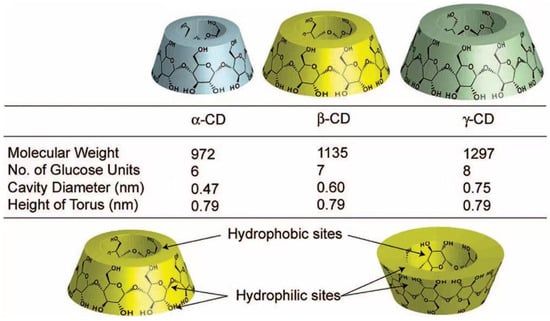
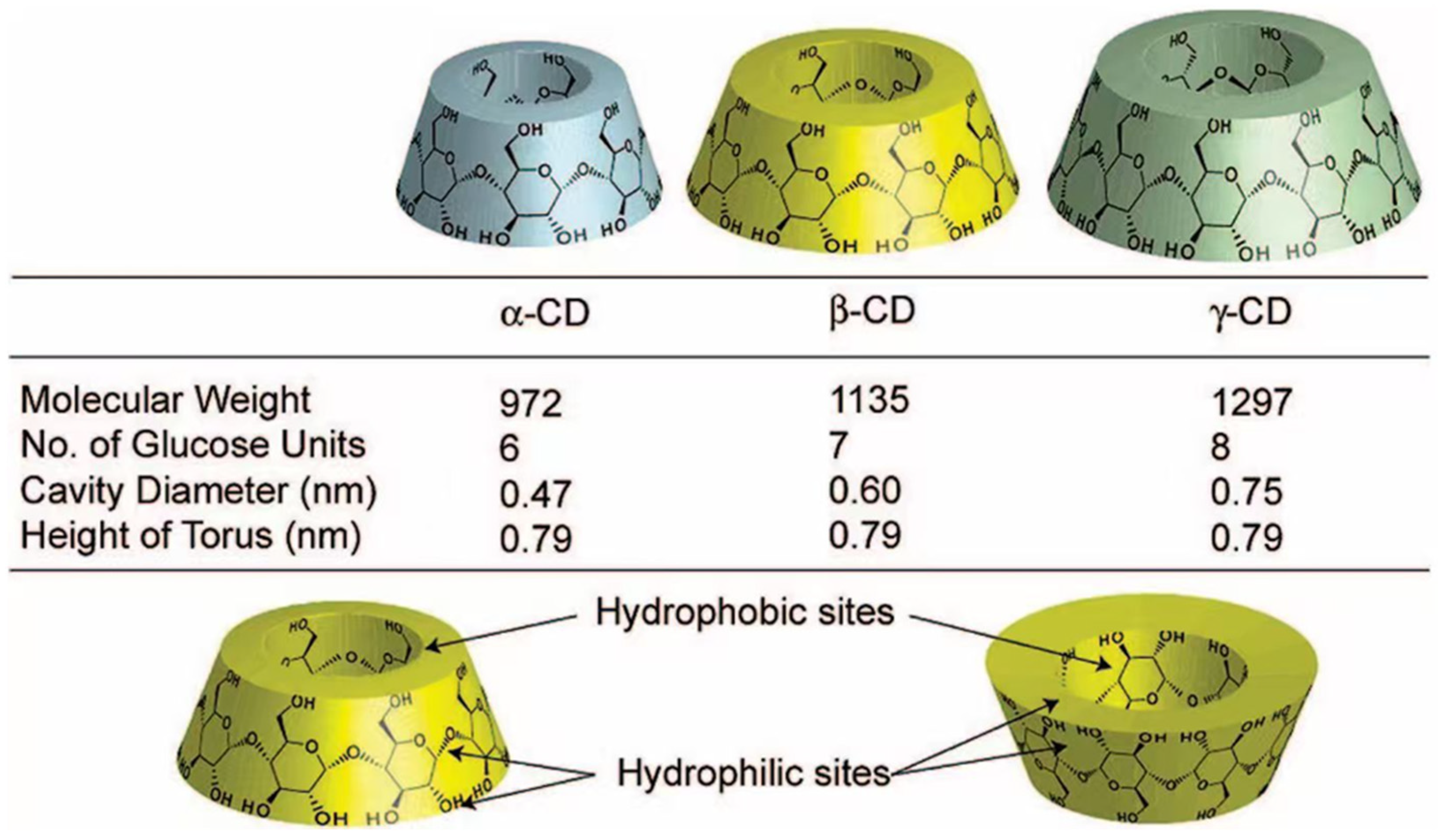
CDs are biocompatible and biodegradable oligosaccharides produced through the enzymatic degradation of starch, offering the advantage of low production costs [12]. The most common types include α-, β-, and γ-CD, which consist of six to eight α-D-glucopyranose units linked by α-1,4 glycosidic bonds. Due to the chair conformation of the glucopyranose units, CDs adopt a truncated cone structure, with a wider rim on one side and a narrower rim on the other, forming a cavity accessible from both ends. The outer surface of the cone is rich in hydroxyl groups, rendering it hydrophilic, while the internal cavity is lined with C–H bonds, creating a hydrophobic environment. This amphiphilic nature contributes to the solubility of CDs in aqueous media. For example, at room temperature, the solubility of α-, β-, and γ-CD in water is approximately 14.5, 1.8, and 23.2 g/100 mL, respectively [13]. The unique structure of CDs enables them and their derivatives to form inclusion complexes with a variety of organic guest molecules, such as adamantane, berberine, and bile acid, thereby significantly enhancing the solubility, stability, and bioavailability of these compounds [14]. Importantly, the cavity size varies depending on the number of glucopyranose units in the CD. Figure 1 illustrates the chemical structures of α-, β-, and γ-CDs along with a comparison of their key structural parameters.
Figure 1.
Comparison of α-, β- and γ-CD in terms of their chemical, structural, and physical properties. Reprinted with the permission from ref [15].
Furthermore, the hydroxyl groups on the outer surface of CDs can be chemically modified, enabling the preparation of various derivatives [15]. Although the reactivity of hydroxyl groups varies among the D-glucose units, functionalization of CDs is readily achievable. For instance, hydroxypropyl-β-cyclodextrin (HP-β-CD) synthesized through the reaction of hydroxyl groups with oxirane shows enhanced water solubility and relatively low toxicity [16]. Similarly, sulfobutylether-β-cyclodextrin (SBE-β-CD) exhibits exceptionally high water solubility and demonstrates negligible nephrotoxicity [17]. Compared to the native CDs, these modified CD derivatives exhibit enhanced aqueous solubility and reduced biotoxicity. Consequently, they are better suited for the delivery of bioactive molecules. Such functionalized CD derivatives have found widespread applications across diverse fields, including pharmaceuticals, food, cosmetics, and environmental science [18].
3. Structures of TCM Active Molecules
3.1. Molecular Structure and Biological Activity of Terpenoids
Terpenoids, which are derivatives of isoprene (C5H8)n, are a structurally diverse class of natural products widely distributed in plants, animals, and microorganisms. Based on the number of isoprene units, terpenoids are categorized into monoterpenes, sesquiterpenes, diterpenes, and triterpenes. They are commonly found in gymnosperms and are often aromatic liquids at room temperature. Numerous natural terpenoid small molecules exhibit notable anti-cancer activity and hold significant promise in drug development [19]. Examples include betulinic acid (BA), isolated from white birch, and oleanolic acid (OA), extracted from Ligustrum lucidum. Beyond their antitumor effects, many terpenoids also demonstrate a range of valuable biological activities, including hepatoprotection and the ability to suppress drug resistance.
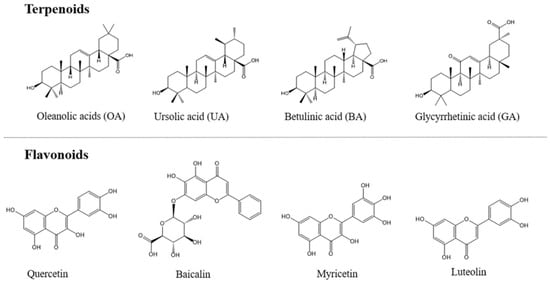
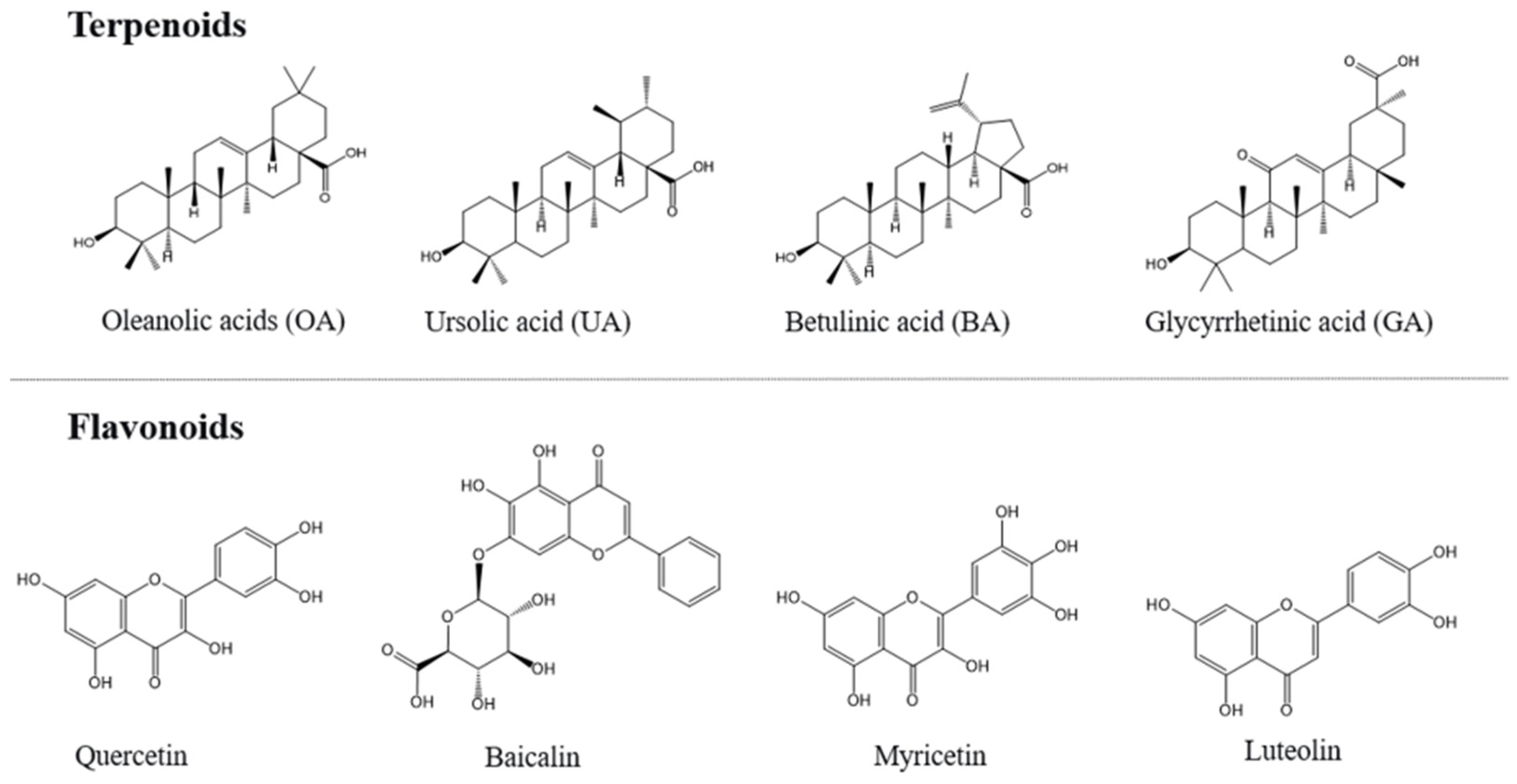
Natural terpenoid molecules are predominantly composed of hydrocarbon chains and cycloalkane rings, with limited polar functional groups such as hydroxyl or carboxyl moieties. This structural feature contributes to their typically poor aqueous solubility, which remains a major obstacle to achieving adequate oral bioavailability [20]. Conversely, the hydrophobic nature of these molecules enables favorable interactions with the hydrophobic inner cavity of cyclodextrins (CDs), facilitating the formation of stable inclusion complexes. For instance, smaller terpenoids such as monoterpenes and sesquiterpenes, whose molecular dimensions align well with the cavity size of typical CDs, tend to form inclusion complexes in a molar ratio of 1:1 [21]. In contrast, larger terpenoids such as diterpenes and triterpenes often require more than one CD molecule for effective encapsulation, resulting in complexes with stoichiometries of n:1 [22]. The mechanisms underlying the formation of these inclusion complexes will be discussed in detail in the following section. Figure 2 illustrates the molecular structures of selected terpenoids reviewed in this work.
Figure 2.
The chemical structures of some terpenoids and flavonoid.
3.2. Molecular Structure and Biological Activity of Flavonoids
Flavonoids constitute a large and structurally diverse group of active molecules of TCM [2]. The term originally referred to compounds derived from the 2-phenylchromone scaffold, but it now encompasses a broader series of natural products in which two aromatic rings are linked by a three-carbon chain, generally described by the C6–C3–C6 skeleton. Flavonoids are divided into several subclasses, including flavones, flavonols, isoflavones, chalcones, and anthocyanins. For example, quercetin, characterized by an additional hydroxyl group at the 3-position of the C-ring, belongs to the flavonol subclass. Notably, many flavonoids are sensitive to light and heat, which makes them prone to oxidative degradation under common storage and processing conditions.
Similar to many other natural small molecules, flavonoids exhibit a wide range of biological activities, including antibacterial, antiviral, hypoglycemic, antitumor, anti-inflammatory, and antioxidant effects. However, their poor aqueous solubility and susceptibility to photolytic and thermal degradation significantly limit their application in the pharmaceutical industry and clinical practice. Selected flavonoid compounds discussed in this review are presented in Figure 2.
3.3. Molecular Structure and Biological Activity of Alkaloids
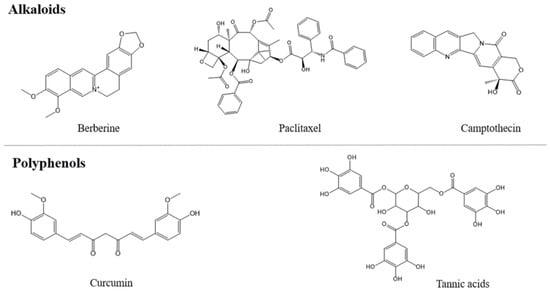
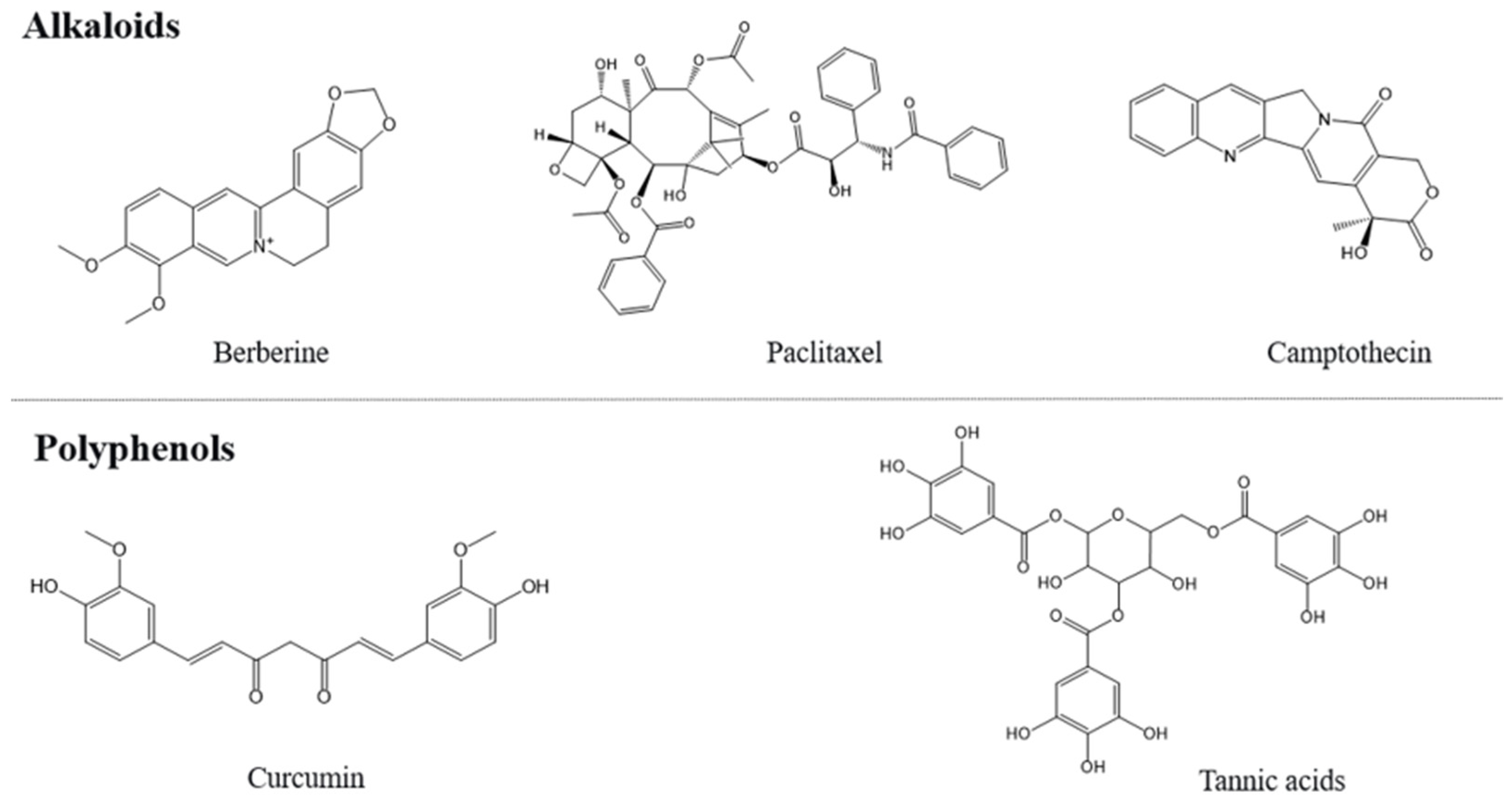
Alkaloids represent a class of nitrogen-containing basic organic compounds widely distributed in plants, including well-known TCM species such as Coptis chinensis (huanglian), Ephedra sinica (mahuang), and Aconitum carmichaelii (chuanwu). Structurally diverse and typically heterocyclic in nature, their basic character facilitates salt formation under physiological conditions. As key bioactive constituents in traditional medicine, alkaloids display a broad spectrum of pharmacological effects, including antibacterial, anti-inflammatory, analgesic, sedative, and antitumor activities, along with modulatory functions in the cardiovascular and respiratory systems [23]. Representative examples include morphine (analgesic) [24], berberine (antibacterial/anti-inflammatory) [25], and quinine (antimalarial) [26], paclitaxel (Anti-tumour) [27], and camptothecin (antitumor) [28]. Nonetheless, the clinical translation of alkaloids is often hindered by several inherent limitations: their strong alkalinity can provoke gastrointestinal irritation, while issues such as poor aqueous solubility, limited stability, and a narrow therapeutic window further constrain their practical utility [29]. Figure 3 shows the structure of some alkaloids.
Figure 3.
The chemical structures of some alkaloids and polyphenols.
3.4. Molecular Structure and Biological Activity of Polyphenols
Polyphenols are a diverse class of organic molecules characterized by the presence of one or more aromatic rings bearing hydroxyl groups, commonly in ortho-dihydroxy or ortho-trihydroxy arrangements. Their structural complexity and variability contribute to their broad natural distribution in sources such as vegetables, fruits, spices, herbs, tea, and grapes [30]. These compounds exhibit a wide spectrum of bioactivities, including anti-inflammatory, antitumor, antiangiogenic, antioxidant, and antibacterial effects [31]. Their functional properties, such as antioxidant capacity, anti-aging potential, substrate adsorption, surface adhesion, enzyme inhibition, and biocompatibility, are closely linked to specific structural features, including carbon–carbon double bonds, phenolic hydroxyl groups, and carbonyl substituents. In recent years, polyphenols have attracted growing research interest for biomedical applications, ranging from bioimaging to drug delivery, owing to their favorable physicochemical and bioactive profiles [32].
4. Formation and Analysis of Inclusion Complexes
4.1. Formation Mechanism
The complexation between CDs and active molecules derived from TCM is a supramolecular physical process driven primarily by multiple non-covalent interactions. Hydrophobic interaction serves as the main driving force for inclusion. As noted earlier, the internal cavity of CDs is hydrophobic, while non-polar moieties in TCM molecules, such as aromatic rings, terpene skeletons, or alkyl chains, tend to partition from the aqueous environment into the hydrophobic CD cavity [9]. When host and guest molecules approach each other closely, weak intermolecular attractions (van der Waals forces) further stabilize the complex. Additionally, hydrogen bonding networks can form between the hydroxyl groups located at the rim of the CD and suitable donor/acceptor groups present in TCM molecules (e.g., –OH, –COOH), enhancing both binding affinity and specificity.
Spatial complementarity serves as the fundamental geometric determinant for both the formation and stability of host–guest complexes [33]. Effective complexation requires that the size and three-dimensional shape of the guest molecule be appropriately matched to the volume and topology of the host cavity: an excessively small guest may not achieve sufficient intermolecular contact, while an overly large guest cannot be fully accommodated within the cavity. For example, small monoterpenes typically form inclusion complexes with β-CD at a molar ratio of 1:1, whereas larger triterpenoids often engage multiple CD molecules, resulting in complexes with varied stoichiometries (e.g., n:1 or 1:n) [10,34]. Thus, CD-guest interactions are governed by a combination of non-covalent forces and size of molecules, including van der Waals, electrostatic, and hydrophobic interactions [35] (pp. 45–65). The efficiency of complexation, along with the stability of the resulting inclusion complexes, is largely determined by the physicochemical characteristics of the guest molecule. Consequently, CDs function as protective molecular hosts that can encapsulate pharmaceutical actives or various primary and secondary metabolites, enhancing their suitability for therapeutic and formulation applications [36].
4.2. Confirmation and Analysis of Inclusion Complexes of CDs
Fourier transform infrared spectroscopy (FTIR) is a widely employed analytical technique for characterizing chemical compounds by detecting shifts or intensity changes in the characteristic absorption peaks associated with specific functional groups. It has also been effectively applied to verify the formation of inclusion complexes involving CDs such as β-CD [37] and its derivative HP-β-CD [38] with various guest molecules. Representative examples include complexes with quercetin [39], epigallocatechin-3-gallate (EGCG) [40], chrysin [41], luteolin [42], curcumin [43], and resveratrol [44].
Nuclear magnetic resonance (NMR) spectroscopy is one of the most powerful techniques for characterizing CD-based inclusion complexes [45,46]. Its principle relies on detectable changes in chemical shifts caused by host–guest binding. When a guest molecule enters the hydrophobic cavity of the CD, it perturbs the local magnetic environment, leading to observable shifts, particularly for the H-3 and H-5 protons of the CD, which are oriented toward the interior of the cavity. This approach has been applied, for instance, to confirm the formation of inclusion complexes between β-CD and quercetin [38], as well as between ursolic acid and poly-β-CD [47].
X-ray diffraction (XRD) is a classical technique for characterizing inclusion complexes based on changes in crystallinity and diffraction patterns. Upon complex formation, the original crystalline structure of CD is destroyed, leading to the disappearance or significant attenuation of its characteristic diffraction peaks, often accompanied by the emergence of new peaks indicative of the complex. This method has been widely applied to study various inclusion systems, including those reported in references [48].
Quantitative assessment of host–guest binding affinities relies fundamentally on thermodynamic parameters, specifically the Gibbs free energy (ΔG) and the association constant (Ka), which are typically determined using isothermal titration calorimetry (ITC) [49,50]. Within the context of mechanistic elucidation, ITC has proven particularly instrumental in deconvoluting the thermodynamic driving forces of CD–guest interactions [51]. Such calorimetric analyses have been pivotal in establishing the complexation stoichiometry and binding modes of diverse guest molecules with a spectrum of CD derivatives. Furthermore, comprehensive thermodynamic profiling reveals that the complexation between CD and guest molecules is predominantly by non-covalent interactions, specifically van der Waals forces and hydrophobic effects [52,53].
In some cases, UV-Vis spectrophotometry can reveal spectral differences between the inclusion complex and the free guest molecule, providing evidence for host–guest interactions. For example, inclusion complexes of β-CD with luteolin [54] and of α- or β-CD with hydroxytyrosol [55], prepared by freeze-drying, have been characterized using this technique.
Scanning electron microscopy (SEM) is employed to examine morphological changes in the surface structure of inclusion complexes compared to uncomplexed CD. This technique is often used in combination with other analytical methods such as XRD, FT-IR, and DLS to provide comprehensive characterization. Representative SEM studies have been reported for various inclusion complexes involving β-CD and HP-β-CD, including those with curcumin, chrysin, resveratrol, catechin, gallic acid, epigallocatechin gallate, curcumin, and ellagic acid [56].
Thermogravimetric analysis (TG) combined with differential scanning calorimetry (DSC) is frequently used to study the thermal behavior of inclusion complexes, providing information on mass changes over a defined temperature range and revealing characteristic endothermic or exothermic events relative to the host material. The formation of an inclusion complex is typically indicated by the disappearance or high-temperature shift in weight-loss peaks associated with the guest in the TG curve, as well as the absence or alteration of the guest’s melting/decomposition peaks in the DSC profile. This approach has been applied, for example, to characterize inclusion complexes such as β-CD–curcumin and HP-β-CD–curcumin, γ-CD–phloroglucinol, and HP-β-CD–ellagic acid [10].
Dynamic Light Scattering (DLS) is employed to determine the particle size, polydispersity index, and zeta potential of prepared inclusion complexes [57] (pp. 16-11–16-25). Characterization typically involves comparing these parameters with those of the individual host, guest, or their physical mixtures to confirm successful complexation. For example, DLS has been applied to analyze complexes such as HP-β-CD with resveratrol and quercetin [58], as well as various composite systems containing β-CD, HP-β-CD, or methyl-β-CD complexed with polyphenol-rich extracts.
Other techniques such as high-performance liquid chromatography (HPLC), and electrospray ionization tandem mass spectrometry (ESI-MS) were successfully applied to analyze some CD-based inclusion complexes [59,60,61] (pp. 259–280).
5. Benefits of Inclusion Complexes
5.1. Improving Solubility and Stability
As discussed previously, CDs are amphiphilic molecules characterized by a unique cavity structure that presents a hydrophilic exterior and a hydrophobic interior. This structural feature confers good aqueous solubility while enabling the hydrophobic cavity to encapsulate poorly soluble compounds through host–guest complexation. By forming inclusion complexes with bioactive molecules derived from TCM, CDs can significantly improve the aqueous solubility and dissolution behavior of these hydrophobic compounds, thereby enhancing their potential for pharmaceutical application.
Oleanolic acid (OA) and ursolic acid (UA) are pentacyclic triterpenoids known for their diverse pharmacological activities, including anticancer, hepatoprotective, hypoglycemic, and antiviral effects. However, their therapeutic potential is limited by poor aqueous solubility. Structurally, OA and UA are closely related isomers, differing only in the position of a single methyl group. As illustrated in Figure 2, both compounds can form inclusion complexes with β-CD, a strategy employed to enhance their solubility and bioavailability.
The encapsulation of OA within CD-based systems has been shown to markedly enhance its aqueous solubility. For instance, Li et al. designed a CD-metal–organic framework (CD-MOF) via a co-crystallization method to obtain an OA inclusion complex (OA@CD-MOF) [62], seamlessly integrate the merits of both MOFs and CDs. OA was also encapsulated into γ-CD to obtain OA@γ-CD. Compared to γ-CD, the CD-MOF exhibited a superior drug loading capacity, substantially increasing the apparent solubility of OA to 269.27 ± 19.40 μg/mL. The calculated binding constant was 42,034.47 M−1, confirming the strong interaction between OA and the CD-MOF.
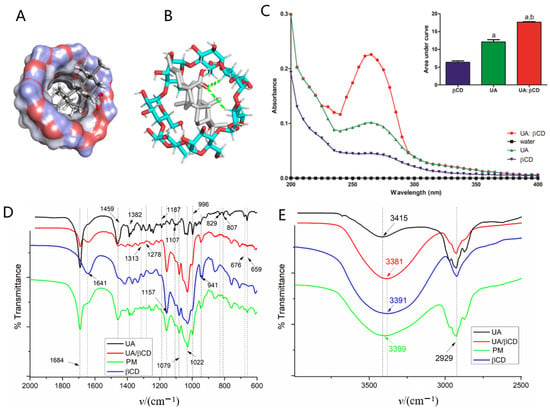
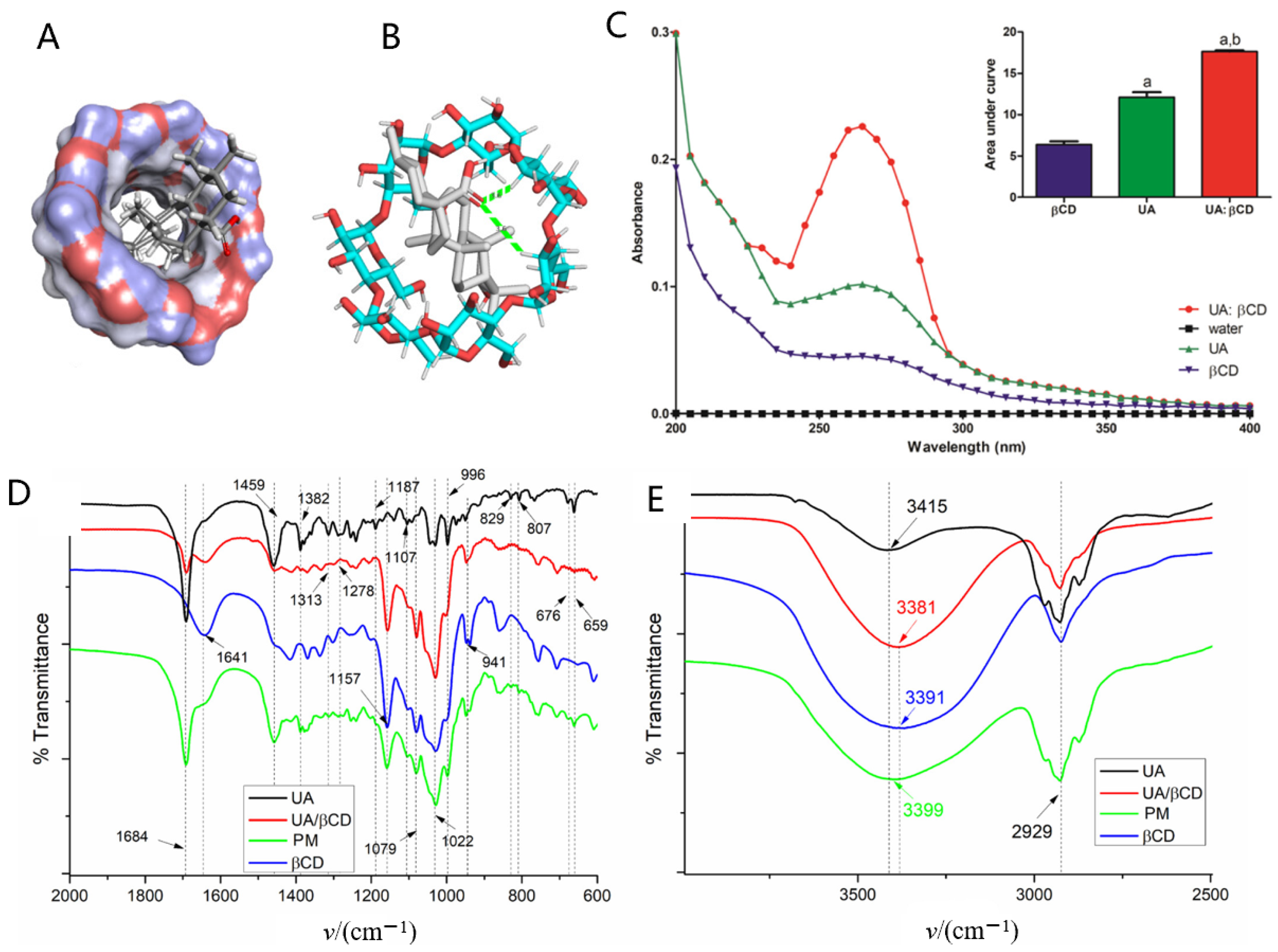
Similarly, to improve the solubility and thermal stability of UA, Sandra and colleagues developed a complex of UA with poly-β-CD (UA/pβ-CD) and evaluated it in an experimental autoimmune encephalomyelitis (EAE) model [63]. In another approach, Yutaka et al. employed a three-dimensional ground mixture (3DGM) method using γ-CD and CD-MOF-1 to form inclusion complexes with UA [47]. Dissolution studies revealed that after 5 min in distilled water, the dissolution rate was approximately 0.35% for UA intact, 3.92% for UA/γ-CD, and 97.8% for UA/CD-MOF-1. In extended solubility tests (96 h, distilled water), UA exhibited a solubility of 0.28 μg/mL, while the values for 3DGM (UA/γ-CD) and 3DGM (UA/CD-MOF-1) reached 53.56 μg/mL and 1083.92 μg/mL, respectively. In the 30 min solubility test (FaSSIF, 30 min), solubility increased from 0.55 μg/mL for pure UA to 411.08 μg/mL for UA/γ-CD and 143.93 μg/mL for UA/CD-MOF-1. These results suggest that such inclusion complexes could broaden the formulation options for UA. Further supporting these findings, Fajardo et al. demonstrated through solubility assays that the aqueous solubility of UA increased by approximately 35.85% upon stable inclusion complex formation with β-CD as shown in Figure 4 (AUC: UA = 12.72, β-CD = 6.78, UA/β-CD = 17.28, p < 0.05) [64]. The results demonstrate that the formation of the UA-CD complex significantly enhances both the aqueous solubility and stability of UA. Simultaneously, the aqueous solubility of OA and UA is markedly improved upon complexation with CD-MOF.
Figure 4.
(A) Interaction of UA with the inner cavity of β-CD. (B) Hydrogen bonding of the carbonyl group of UA with the hydrogens of glucose residues present in β-CD (dashed green lines). (C) Diagram of the solubility of UA, β-CD, and UA/β-CD in an aqueous solution of UV−vis spectral. The insert one is area under curve of UV−vis spectral. (D) FTIR spectra of UA, UA/β-CD, PM, and β-CD in transmittance mode, range from 600 to 2000 cm−1 and (E) range from 2500 to 4500 cm−1. UA/β-CD = UA/β-CD inclusion complex; PM = physical mixture between β-CD and UA [64]. Reprinted with the permission from ref [64].
Alishahiet et al. investigated the inclusion complexation of quercetin with hydroxypropyl-β-CD (HP-β-CD) and hydroxypropyl-γ-CD (HP-γ-CD) [65]. The formation of 1:1 molar ratio inclusion complex with HP-β-CD and HP-γ-CD significantly enhanced the aqueous solubility of quercetin by approximately 15-fold and 20-fold, respectively. The superior solubility enhancement observed with HP-γ-CD is attributed to a more favorable size match between the quercetin molecule and the larger cavity of γ-CD, as well as the intrinsically higher aqueous solubility of γ-CD derivatives compared to their β-CD counterparts.
A similar trend was reported for curcumin, where UV spectroscopic analysis indicated that complexation with CDs increased its water solubility by approximately 50-fold [66]. These results collectively suggest that HP-γ-CD tends to form more stable and effective inclusion complexes with such hydrophobic bioactive molecules compared to HP-β-CD [65].
5.2. Enhancing Bioavailability
The limited bioavailability of many active molecules in TCM can be attributed to several interrelated factors. First, a substantial portion of TCM constituents, including hydrophobic terpenoids, steroids, and polycyclic flavonoids, are highly lipophilic, resulting in extremely low solubility in the aqueous gastrointestinal environment. Second, many TCM molecules possess relatively high molecular weights and complex structural configurations, as exemplified by berberine and paclitaxel, which hinder their diffusion across the lipid bilayer of intestinal epithelial cells. Finally, these compounds are often susceptible to enzymatic degradation and extensive pre-systemic metabolism. Collectively, these physicochemical and physiological barriers significantly restrict the oral bioavailability of numerous TCM actives.
Encapsulation within suitable host cavities represents an effective strategy to enhance the solubility and stability of bioactive compounds, thereby overcoming key limitations associated with their bioavailability [67]. For instance, complexation with γ-CD was shown to improve the bioavailability of myricetin [68]. In vitro digestion simulations and cytotoxicity assays further indicated that encapsulation within γ-CD-based metal–organic frameworks (γ-CD-MOFs) could achieve controlled release of myricetin while maintaining satisfactory bioavailability.
Similarly, Ca2+-stabilized nanoparticles composed of zein coated with hydroxypropyl-β-cyclodextrin (HP-β-CD) demonstrated sustained release properties and exhibited strong potential for enhancing the oral bioavailability of curcumin [69]. In another example, spray-dried powder containing dihydroartemisinin (DHA) complexed with β-CD showed a significantly enhanced dissolution rate while preserving its antimalarial activity [70]. These diverse CD-based delivery systems successfully tune the physicochemical characteristics of active compounds and bypass physiological barriers, ultimately achieving improved bioavailability.
5.3. Improving Targeted and Controlled-Release
Inclusion complexes offer a versatile platform for targeted drug delivery, holding significant promise in biomedical applications. By facilitating the co-delivery of multiple therapeutic agents to specific cells, these systems enable synergistic combination therapies. Furthermore, they enhance drug stability by protecting encapsulated molecules from degradation, allow for controlled temporal release, improve therapeutic efficacy, and reduce off-target toxicity, key advantages that underscore their potential in advanced drug delivery strategies [71,72,73].
To improve targeted drug delivery for tumor therapy, a nanocomposite was synthesized consisting of magnetic Fe3O4 nanoparticles functionalized with β-CD and folic acid, and loaded with UA [74]. This design enables the controlled release of UA into tumor cells under an applied magnetic field. To assess the role of β-CD in modulating drug delivery performance, the release profile of UA from the nanocomplex was evaluated. The results demonstrated a pH-dependent release behavior, with a significantly higher UA concentration observed at pH 5.4 compared to pH 7.4. Specifically, after 50 h, approximately 25% of UA was released at physiological pH (7.4), whereas about 80% was released under acidic conditions (pH 5.4), mimicking the tumor microenvironment.
Incorporation of berberine hydrochloride (BBH) into a thermosensitive hydrogel based on a CD-grafted chitosan (CD-g-CS) derivative resulted in sustained and controlled drug release over 36 h, with a cumulative release of 59.87% [75]. In contrast, free BBH displayed a sharp burst release within the first 4 h, reaching over 87.89% cumulative release and rapidly achieving equilibrium. The CD-g-CS hydrogel system effectively mitigated the initial burst effect and provided prolonged release, demonstrating its potential as an effective carrier for controlled drug delivery.
Oral gels incorporating the inclusion complex of quercetin with hydroxypropyl-β-CD (HP-β-CD) significantly enhance quercetin dispersion and prolong its release in the intestinal tract. Free quercetin, being poorly water-soluble, exhibited a cumulative release of only about 20% after 24 h. In contrast, the quercetin–HP-β-CD inclusion complex alone reached approximately 40% cumulative release over the same period. Notably, when formulated as a quercetin inclusion complex gel (QICG), cumulative release increased to around 80% at 24 h. This marked enhancement is likely due to the gel matrix promoting greater dispersion of the inclusion complex, as well as facilitating its dissociation and drug release in the intestinal environment. Together, these effects contribute to a pronounced sustained-release profile, which substantially improves the dispersibility and intestinal release of quercetin.
Jabbari et al. synthesized a novel 21-arm star like diblock polymer of β-CD-[poly(ε-caprolactone)-poly(2-aminoethylmethacrylate)] [76], which further functionalized with the nucleolin-targeting aptamer AS1411. Camptothecin (CPT) was encapsulated into this polymer with high entrapment efficiency (~65%). In vitro release studies performed under acidic conditions mimicking the tumor microenvironment showed sustained CPT release, reaching approximately 50% over 72 h. MTT cytotoxicity assays revealed that the complex significantly enhanced cell death in MCF-7 and 4T1 cancer cell lines, while maintaining high viability in normal L929 cells. These results indicate selective internalization of the complex into target cancer cells. These works demonstrate versatile strategies for controlled release. Examples include the functionalization of carriers with β-CD to enable targeted release, and the complexation of hydrophobic drugs with HP-β-CD to augment solubility and accelerate the release rate.
5.4. Modulating the Fluorescent Properties
Certain active molecules in TCM, such as berberine, myricetin, and curcumin, exhibit intrinsic fluorescence due to their extended conjugated π-systems and rigid molecular structures. This property allows them to emit detectable fluorescence upon ultraviolet excitation. When these molecules are encapsulated within the hydrophobic cavity of cyclodextrins, the restriction of molecular motion often alters their fluorescence intensity. Consequently, the changes in the fluorescence intensity upon inclusion complex formation can be exploited for the design of sensitive and selective fluorescent sensors.
Li et al. constructed a two-element sensor array comprising Al3+-CD-modified copper (Al3+-CD@Cu) and Mg2+-CD-modified copper (Mg2+-CD@Cu) for the simultaneous discrimination of multiple flavonols [77]. Upon complexation with metal ions (Al3+ or Mg2+) and subsequent confinement within the CD cavities on the CD@Cu surface, the flavonols exhibited pronounced fluorescence enhancement. By applying machine learning classification and regression algorithms, the system successfully predicted both the relative proportions and absolute concentrations of kaempferol (Kae), quercetin (Quer), and myricetin (Myri) in complex samples such as flavonol-rich Kaempferia galangal L. extracts and honey. This approach demonstrates that fluorescence modulation via inclusion complexation can serve as a generalizable strategy for detecting and quantifying various TCM-derived bioactive molecules.
Lin et al., developed a pH-responsive bilayer film composed of chitosan (CS), zein (Z), a curcumin-β-CD inclusion complex (Cur-β-CD), alizarin (AL), and cinnamaldehyde (CIN) for real-time monitoring of pork spoilage and shelf-life extension [78]. The incorporation of Cur-β-CD not only enhanced the antioxidant and antibacterial properties of the film but also conferred fluorescence responsiveness. During pork spoilage, alkaline compounds released from the meat cause swelling of the outer CS layer, leading to changes in the fluorescence intensity of the inner sensing layer. By tracking these fluorescence variations, the film enables visual and quantitative monitoring of pork freshness.
Yang et al. developed a colorimetric/fluorescent dual-channel smart film using betanin (BET), corn amylose (CA), β-CD, and berberine (BBR), which exhibits aggregation-induced emission (AIE) properties [79]. Notably, the film displayed high sensitivity to volatile ammonia, a key indicator of seafood spoilage. Under 365 nm ultraviolet light, the film initially emitted faint yellow-green fluorescence. In an alkaline environment, the fluorescence intensity of the CA/BET@β-CD/BBR film increased significantly. This enhancement is attributed to the accumulation of BBR within the β-CD cavities, where restricted intramolecular vibration and promoted charge transfer activate the AIE effect of BBR, leading to pronounced fluorescence amplification. Additionally, the shift in fluorescence color from yellow-green to blue-green serves as a visual indicator for the presence of biogenic amines, enabling real-time monitoring of food freshness.
Leveraging the intrinsic fluorescence of TCM, CD-based delivery systems offer unique functionalities, such as fluorescence responsiveness or aggregation-induced emission (AIE) behavior. These properties facilitate the quantitative detection of TCM bioactive molecules, thereby broadening the application scope of CD-TCM complexes.
5.5. Minimizing Side Effects
Certain bioactive components in TCM, such as aconitine and strychnine alkaloids, possess notable pharmacological activities but are often accompanied by toxicity or gastrointestinal irritation. These adverse effects significantly limit their clinical applicability. The formation of inclusion complexes between such active molecules and CDs can effectively reduce direct contact of the compounds with the gastrointestinal mucosa, thereby alleviating local irritation and enhancing their safety profile.
For example, studies have shown that encapsulating aconitine within β-CD significantly reduces its cardiac toxicity while preserving its analgesic activity [80]. Similarly, berberine, the principal active compound in Coptis chinensis, often induces gastrointestinal disturbances such as abdominal distension and loose stools upon oral administration [77]. CD-based encapsulation has been found to markedly decrease this gastrointestinal irritation, thereby improving patient tolerance and safety. Curcumin, derived from Curcuma longa, exhibits low toxicity at lower doses, yet high oral doses can lead to adverse effects including acid reflux and abdominal discomfort. Following complexation with hydroxypropyl-β-cyclodextrin (HP-β-CD), the aqueous solubility and dissolution rate of curcumin are enhanced [81]. This prevents localized high concentrations of the compound in the gastrointestinal tract, reducing mucosal irritation while simultaneously improving its bioavailability.
5.6. Improving the Taste
Numerous TCM extracts, including alkaloids and volatile oils, possess bitter, pungent, or otherwise unpleasant tastes, which often limit the acceptability of oral dosage forms such as liquids and granules. CD-based inclusion complexation offers an effective strategy to mask these undesirable sensory attributes, thereby enhancing patient compliance. For instance, the characteristic bitterness of berberine can be significantly reduced through CD encapsulation [82]. Similarly, the strong, irritating odors associated with peppermint oil and patchouli volatile oil have been shown to be mitigated following complexation with CDs [83].
6. Conclusions and Outlook
CDs and their derivatives are widely regarded as ideal supramolecular carriers for improving the physicochemical and biological properties of active compounds derived from TCM. Their utility stems from a distinctive hydrophobic cavity structure and favorable biocompatibility. This review systematically summarizes recent advances in the complexation of representative TCM actives, including terpenoids, flavonoids, alkaloids, and phenolics, with CDs. Evidence indicates that these active molecules can form stable inclusion complexes with CDs and their derivatives via non-covalent interactions, such as hydrophobic effects, hydrogen bonding, and van der Waals forces.
CD-based complexation exhibits both broad applicability and targeted efficacy in enhancing the performance of the four major classes of TCM active molecules as shown in Table 1. On a physicochemical level, this approach significantly improves aqueous solubility, enhances the stability of oxidation- or degradation-prone compounds (e.g., phenolics and certain alkaloids), and effectively masks undesirable odors, thereby overcoming sensory barriers in formulation design. Furthermore, certain inclusion complexes can function as fluorescent sensors for the detection of specific flavonols. At the biological level, unfavorable odor delivery properties, enabling the precise and controlled release of therapeutic agents.
Table 1.
Complexation of main types of TCM with CDs and their main benefits.
In summary, CD-based complexation offers an effective supramolecular strategy to address challenges associated with TCM active compounds, including poor solubility, limited stability, low bioavailability, and unfavorable odor. This approach provides a robust foundation for the modern development and advanced formulation of TCM-derived active molecules.
Despite significant progress in the application of CD-based complexation technology to TCM active molecules, current research remains constrained by insufficient mechanistic understanding and limited capacity for targeted performance optimization. Future investigations should focus on the following directions:
First, a more detailed understanding of the differential complexation mechanisms is required. Due to the substantial structural diversity of TCM active molecules, key parameters, such as binding sites, stoichiometric ratios, and the relative importance of various non-covalent interactions (e.g., hydrophobic, hydrogen bonding, and van der Waals forces) with CDs, remain inadequately characterized. Future studies should integrate quantum chemical calculations, molecular dynamics simulations, and advanced high-resolution analytical techniques to establish predictive structure–complexation–performance models that correlate molecular structural features and CDs types with complexation efficacy. Such models would provide a robust theoretical basis for the rational design of optimized, high-performance inclusion systems.
Second, there is a clear need to establish a multidimensional evaluation system that strengthens the correlation between in vitro and in vivo. While current studies have predominantly focused on in vitro physicochemical characterization, such as solubility, stability, and release profiles, comprehensive assessments of in vivo pharmacokinetics, pharmacodynamics, and long-term safety remain limited. Future research should prioritize well-designed in vivo studies to elucidate the metabolic patterns of CD-based complexation systems, clarify their mechanisms of efficacy enhancement under physiological conditions, and systematically supplement safety data. These efforts will provide essential scientific support for the clinical translation of CD-based complex with TCM active molecules.
Author Contributions
Conceptualization, L.C. and Y.-G.J.; writing—original draft preparation, L.C. and S.W.; writing—review and editing, J.C. and S.H. All authors have read and agreed to the published version of the manuscript.
Funding
This research was funded by the Tri-level Talents Development Project of Zhuhai College of Science and Technology.
Data Availability Statement
No new data were created or analyzed in this study. Data sharing is not applicable to this article.
Conflicts of Interest
The authors declare no conflicts of interest.
References
- Zhao, W.; Zheng, X.-D.; Tang, P.Y.-Z.; Li, H.-M.; Liu, X.; Zhong, J.-J.; Tang, Y.-J. Advances of antitumor drug discovery in traditional Chinese medicine and natural active products by using multi-active components combination. Med. Res. Rev. 2023, 43, 1778–1808. [Google Scholar] [CrossRef] [Scilit] [PubMed]
- Zou, Q.; Chen, Y.; Qin, H.; Tang, R.; Han, T.; Guo, Z.; Zhao, J.; Xu, D. The role and mechanism of TCM in the prevention and treatment of infectious diseases. Front. Microbiol. 2023, 14, 1286364. [Google Scholar] [CrossRef] [Scilit] [PubMed]
- Ribeiro, D.; Freitas, M.; Lima, J.L.F.C.; Fernandes, E. Proinflammatory Pathways: The Modulation by Flavonoids. Med. Res. Rev. 2015, 35, 877–936. [Google Scholar] [CrossRef] [Scilit] [PubMed]
- Ghosh, R.; Bryant, D.L.; Farone, A.L. Panax quinquefolius (North American Ginseng) Polysaccharides as Immunomodulators: Current Research Status and Future Directions. Molecules 2020, 25, 5854. [Google Scholar] [CrossRef] [Scilit] [PubMed]
- Zhai, Z.; Niu, J.; Xu, L.; Xu, J. Advanced Application of Polymer Nanocarriers in Delivery of Active Ingredients from Traditional Chinese Medicines. Molecules 2024, 29, 3520. [Google Scholar] [CrossRef] [Scilit] [PubMed]
- Parvin, N.; Aslam, M.; Joo, S.W.; Mandal, T.K. Nano-Phytomedicine: Harnessing Plant-Derived Phytochemicals in Nanocarriers for Targeted Human Health Applications. Molecules 2025, 30, 3177. [Google Scholar] [CrossRef] [Scilit] [PubMed]
- Yu, H.; Subedi, R.K.; Nepal, P.R.; Kim, Y.G.; Choi, H.-K. Enhancement of solubility and dissolution rate of cryptotanshinone, tanshinone I and tanshinone IIA extracted from Salvia miltiorrhiza. Arch. Pharmacal Res. 2012, 35, 1457–1464. [Google Scholar] [CrossRef] [Scilit] [PubMed]
- Kang, C.; Wang, J.; Li, R.; Gong, J.; Wang, K.; Wang, Y.; Wang, Z.; He, R.; Li, F. Smart Targeted Delivery Systems for Enhancing Antitumor Therapy of Active Ingredients in Traditional Chinese Medicine. Molecules 2023, 28, 5955. [Google Scholar] [CrossRef] [Scilit] [PubMed]
- Musuc, A.M. Cyclodextrins: Advances in Chemistry, Toxicology, and Multifaceted Applications. Molecules 2024, 29, 5319. [Google Scholar] [CrossRef] [Scilit] [PubMed]
- Nicolaescu, O.E.; Ionescu, C.; Samide, A.; Tigae, C.; Spînu, C.I.; Oprea, B. Advancements in Cyclodextrin Complexes with Bioactive Secondary Metabolites and Their Pharmaceutical Applications. Pharmaceutics 2025, 17, 506. [Google Scholar] [CrossRef] [Scilit] [PubMed]
- Gerges, P.; Gerges, R.; Nguewa, P.; ElKhoury, N.; Fourmentin, S.; González-Gaitano, G.; Greige-Gerges, H. Cyclodextrin-in-Liposome for therapy: Advances and challenges. Carbohydr. Polym. 2026, 372, 124573. [Google Scholar] [CrossRef] [Scilit] [PubMed]
- Szejtli, J. Introduction and general overview of cyclodextrin chemistry. Chem. Rev. 1998, 98, 1743–1753. [Google Scholar] [CrossRef] [Scilit] [PubMed]
- Crini, G. Review: A History of Cyclodextrins. Chem. Rev. 2014, 114, 10940–10975. [Google Scholar] [CrossRef] [Scilit] [PubMed]
- Liu, Z.; Liu, Y. Multicharged cyclodextrin supramolecular assemblies. Chem. Soc. Rev. 2022, 51, 4786–4827. [Google Scholar] [CrossRef] [Scilit] [PubMed]
- Harada, A.; Hashidzume, A.; Yamaguchi, H.; Takashima, Y. Polymeric Rotaxanes. Chem. Rev. 2009, 109, 5974–6023. [Google Scholar] [CrossRef] [Scilit] [PubMed]
- Malanga, M.; Szemán, J.; Fenyvesi, É.; Puskás, I.; Csabai, K.; Gyémánt, G.; Fenyvesi, F.; Szente, L. “Back to the Future”: A New Look at Hydroxypropyl Beta-Cyclodextrins. J. Pharm. Sci. 2016, 105, 2921–2931. [Google Scholar] [CrossRef] [Scilit] [PubMed]
- Stella, V.J.; Rajewski, R.A. Sulfobutylether-β-cyclodextrin. Int. J. Pharm. 2020, 583, 119396. [Google Scholar] [CrossRef] [Scilit] [PubMed]
- Kali, G.; Haddadzadegan, S.; Bernkop-Schnürch, A. Cyclodextrins and derivatives in drug delivery: New developments, relevant clinical trials, and advanced products. Carbohydr. Polym. 2024, 324, 121500. [Google Scholar] [CrossRef] [Scilit] [PubMed]
- Sahoo, B.M.; Banik, B.K.; Sharma, S.; Singh, B. Current Insights into Therapeutic Potential of Terpenoids as Anticancer Agents. Anti-Cancer Agents Med. Chem. 2025, 25, 339–356. [Google Scholar] [CrossRef] [Scilit] [PubMed]
- Li, Q.; Lianghao, Y.; Shijie, G.; Zhiyi, W.; Yuanting, T.; Cong, C.; Chun-Qin, Z.; Xianjun, F. Self-assembled nanodrug delivery systems for anti-cancer drugs from traditional Chinese medicine. Biomater. Sci. 2024, 12, 1662–1692. [Google Scholar] [CrossRef] [Scilit] [PubMed]
- Mai, R.; Xue, S.; Ren, J.; Fan, G.; Yang, J.; Huang, L.; Li, G.; Cheng, Y.; Wang, Q.; Yang, Y.; et al. Mechanism and Multilayer Perceptron prediction model of the removal of α-terpineol, terpinen-4-ol and carvone from pasteurized citrus juices by β-cyclodextrin encapsulation. Front. Nutr. 2025, 12, 1557934. [Google Scholar] [CrossRef] [Scilit] [PubMed]
- Wu, K.; Zhang, T.; Chai, X.; Duan, X.; He, D.; Yu, H.; Liu, X.; Tao, Z. Encapsulation Efficiency and Functional Stability of Cinnamon Essential Oil in Modified β-cyclodextrins: In Vitro and In Silico Evidence. Foods 2023, 12, 45. [Google Scholar] [CrossRef] [Scilit] [PubMed]
- Ali, S.A.; Singh, G.; Datusalia, A.K. Potential therapeutic applications of phytoconstituents as immunomodulators: Pre-clinical and clinical evidences. Phytother. Res. 2021, 35, 3702–3731. [Google Scholar] [CrossRef] [Scilit] [PubMed]
- Liang, X.; Liu, R.; Chen, C.; Ji, F.; Li, T. Opioid system modulates the immune function: A review. Transl. Perioper. Pain Med. 2016, 1, 5–13. [Google Scholar] [PubMed]
- Xiao, Y.; Cui, Y.; Zhang, Y.; Fu, W.; Liu, Y.; Liu, F. Berberine hydrochloride enhances innate immunity to protect against pathogen infection via p38 MAPK pathway. Front. Immunol. 2025, 16, 1536143. [Google Scholar] [CrossRef] [Scilit] [PubMed]
- Tisnerat, C.; Dassonville-Klimpt, A.; Gosselet, F.; Sonnet, P. Antimalarial drug discovery: From quinine to the most recent promising clinical drug candidates. Curr. Med. Chem. 2022, 29, 3326–3365. [Google Scholar] [CrossRef] [Scilit] [PubMed]
- Yu, D.-L.; Lou, Z.-P.; Ma, F.-Y.; Najafi, M. The interactions of paclitaxel with tumour microenvironment. Int. Immunopharmacol. 2022, 105, 108555. [Google Scholar] [CrossRef] [Scilit] [PubMed]
- Ghanbari-Movahed, M.; Kaceli, T.; Mondal, A.; Farzaei, M.H.; Bishayee, A. Recent advances in improved anticancer efficacies of camptothecin nano-formulations: A systematic review. Biomedicines 2021, 9, 480. [Google Scholar] [CrossRef] [Scilit] [PubMed]
- Loh, J.S.; Tan, L.K.S.; Lee, W.L.; Ming, L.C.; How, C.W.; Foo, J.B.; Kifli, N.; Goh, B.H.; Ong, Y.S. Do Lipid-Based Nanoparticles Hold Promise for Advancing the Clinical Translation of Anticancer Alkaloids? Cancers 2021, 13, 5346. [Google Scholar] [CrossRef] [Scilit] [PubMed]
- Yang, X. Molecular Mechanisms of Plant Polyphenols Inhibiting the Formation of Heterocyclic Amines in Roasted Meat. Ph.D. Thesis, Universite de Liege, Liège, Belgium, 2025. [Google Scholar]
- Fantini, M.; Benvenuto, M.; Masuelli, L.; Frajese, G.V.; Tresoldi, I.; Modesti, A.; Bei, R. In vitro and in vivo antitumoral effects of combinations of polyphenols, or polyphenols and anticancer drugs: Perspectives on cancer treatment. Int. J. Mol. Sci. 2015, 16, 9236–9282. [Google Scholar] [CrossRef] [Scilit] [PubMed]
- Guo, Y.; Sun, Q.; Wu, F.G.; Dai, Y.; Chen, X. Polyphenol-containing nanoparticles: Synthesis, properties, and therapeutic delivery. Adv. Mater. 2021, 33, 2007356. [Google Scholar] [CrossRef] [Scilit] [PubMed]
- Sarkar, S.; Ballester, P.; Spektor, M.; Kataev, E.A. Micromolar affinity and higher: Synthetic host–guest complexes with high stabilities. Angew. Chem. Int. Ed. 2023, 62, e202214705. [Google Scholar] [CrossRef] [Scilit] [PubMed]
- Prodea, A.; Mioc, A.; Banciu, C.; Trandafirescu, C.; Milan, A.; Racoviceanu, R.; Ghiulai, R.; Mioc, M.; Soica, C. The Role of Cyclodextrins in the Design and Development of Triterpene-Based Therapeutic Agents. Int. J. Mol. Sci. 2022, 23, 736. [Google Scholar] [CrossRef] [Scilit] [PubMed]
- Koyuncu, A.; Ciftci, F. Role of Weak Interactions and Steric Effect in Chemosensing Using Cyclodextrins. In Cyclodextrins for Chemosensing; Springer: Berlin/Heidelberg, Germany, 2025; pp. 45–65. [Google Scholar]
- Pirvu, A.S.; Varut, R.-M.; Trasca, D.-M.; Stoica, G.A.; Radivojevic, K.; Carmen, S.; Arsenie, C.C.; Popescu, C. Cyclodextrins as Active Therapeutic Agents: Beyond Their Role as Excipients. Pharmaceuticals 2025, 18, 1592. [Google Scholar] [CrossRef] [Scilit] [PubMed]
- Simsek, T.; Rasulev, B.; Mayer, C.; Simsek, S. Preparation and characterization of inclusion complexes of β-cyclodextrin and phenolics from wheat bran by combination of experimental and computational techniques. Molecules 2020, 25, 4275. [Google Scholar] [CrossRef] [Scilit] [PubMed]
- Kim, J.-S. Study of flavonoid/hydroxypropyl-β-cyclodextrin inclusion complexes by UV-Vis, FT-IR, DSC, and X-Ray diffraction analysis. Prev. Nutr. Food Sci. 2020, 25, 449. [Google Scholar] [CrossRef] [Scilit] [PubMed]
- Rajamohan, R.; Ashokkumar, S.; Murugavel, K.; Lee, Y.R. Preparation and Characterization of a Nano-Inclusion Complex of Quercetin with β-Cyclodextrin and Its Potential Activity on Cancer Cells. Micromachines 2023, 14, 1352. [Google Scholar] [CrossRef] [Scilit] [PubMed]
- Xu, H.; Liu, T.; Xu, J.; Li, J.; Chen, F.; Xiang, Z.; Huang, Y.; Zhang, D.; Hu, L.; Zhang, B. Interactions between β-cyclodextrin and tea catechins, and potential anti-osteoclastogenesis activity of the (−)-epigallocatechin-3-gallate–β-cyclodextrin complex. RSC Adv. 2019, 9, 28006–28018. [Google Scholar] [CrossRef] [Scilit] [PubMed]
- Lavania, K.; Garg, A. Inclusion complex of chrysin with hydroxypropyl-β-cyclodextrin (HP-β-CD) preparation, characterization, and dissolution study. BioNanoScience 2023, 13, 616–624. [Google Scholar] [CrossRef] [Scilit]
- Song, M.; Wang, C.; Zhang, S.; Song, J.; Hu, Z.; Zhou, S.; Li, Y.; Wang, L.; Cao, F. Screening and inclusion of luteolin for β-cyclodextrin: Molecular simulations and experiments. Green Mater. 2024, 14, 57–70. [Google Scholar] [CrossRef] [Scilit]
- Cabrera-Quiñones, N.C.; López-Méndez, L.J.; Guadarrama, P. Inclusion and Non-Inclusion Complexes Between Curcumin and β-Cyclodextrin with High-Curcumin Loading and Enhanced Aqueous Solubility Obtained by Mechanochemistry. ChemistrySelect 2023, 8, e202303254. [Google Scholar] [CrossRef] [Scilit]
- Catenacci, L.; Sorrenti, M.; Bonferoni, M.C.; Hunt, L.; Caira, M.R. Inclusion of the Phytoalexin trans-Resveratrol in Native Cyclodextrins: A Thermal, Spectroscopic, and X-Ray Structural Study. Molecules 2020, 25, 998. [Google Scholar] [CrossRef] [Scilit] [PubMed]
- Mazurek, A.H.; Szeleszczuk, Ł. A review of applications of solid-state Nuclear Magnetic Resonance (SSNMR) for the analysis of cyclodextrin-including systems. Int. J. Mol. Sci. 2023, 24, 3648. [Google Scholar] [CrossRef] [Scilit] [PubMed]
- Betlejewska-Kielak, K.; Bednarek, E.; Budzianowski, A.; Michalska, K.; Maurin, J.K. Comprehensive characterisation of the ketoprofen-β-cyclodextrin inclusion complex using X-ray techniques and NMR spectroscopy. Molecules 2021, 26, 4089. [Google Scholar] [CrossRef] [Scilit] [PubMed]
- Inoue, Y.; Motoda, A.; Tanikawa, T.; Takao, K.; Arce, F., Jr.; See, G.L.; Ishida, Y.; Nakata, D.; Terao, K. Inclusion complexes of Ursolic acid with Cyclodextrin-based metal-organic Framework-1 enhance its solubility. J. Drug Deliv. Sci. Technol. 2023, 89, 104986. [Google Scholar] [CrossRef] [Scilit]
- Novac, M.; Musuc, A.M.; Ozon, E.A.; Sarbu, I.; Mitu, M.A.; Rusu, A.; Petrescu, S.; Atkinson, I.; Gheorghe, D.; Lupuliasa, D. Design and Evaluation of Orally Dispersible Tablets Containing Amlodipine Inclusion Complexes in Hydroxypropyl-β-cyclodextrin and Methyl-β-cyclodextrin. Materials 2022, 15, 5217. [Google Scholar] [CrossRef] [Scilit] [PubMed]
- Park, J.; Park, J.; Lee, J.; Lim, C.; Lee, D.W. Size compatibility and concentration dependent supramolecular host–guest interactions at interfaces. Nat. Commun. 2022, 13, 112. [Google Scholar] [CrossRef] [Scilit] [PubMed]
- Bouchemal, K.; Mazzaferro, S. How to conduct and interpret ITC experiments accurately for cyclodextrin–guest interactions. Drug Discov. Today 2012, 17, 623–629. [Google Scholar] [CrossRef] [Scilit] [PubMed]
- Wszelaka-Rylik, M.; Gierycz, P. Isothermal titration calorimetry (ITC) study of natural cyclodextrins inclusion complexes with drugs. J. Therm. Anal. Calorim. 2013, 111, 2029–2035. [Google Scholar] [CrossRef] [Scilit]
- Kou, X.; Xu, X.; Gao, N.; Zhang, Y.; Huang, X.; Chen, F.; Ke, Q.; Meng, Q. Supramolecular chemistry in cyclodextrin inclusion complexes: The formation rules of terpenes/β-cyclodextrin inclusion complexes. Food Hydrocoll. 2024, 157, 110441. [Google Scholar] [CrossRef] [Scilit]
- D’Aria, F.; Pagano, B.; Giancola, C. Thermodynamic properties of hydroxypropyl-β-cyclodextrin/guest interaction: A survey of recent studies. J. Therm. Anal. Calorim. 2022, 147, 4889–4897. [Google Scholar] [CrossRef] [Scilit]
- Liu, B.; Li, W.; Zhao, J.; Liu, Y.; Zhu, X.; Liang, G. Physicochemical characterisation of the supramolecular structure of luteolin/cyclodextrin inclusion complex. Food Chem. 2013, 141, 900–906. [Google Scholar] [CrossRef] [Scilit] [PubMed]
- Stergiou, A.; Binou, P.; Igoumenidis, P.E.; Chiou, A.; Yannakopoulou, K.; Karathanos, V.Τ. Host–guest inclusion complexes of hydroxytyrosol with cyclodextrins: Development of a potential functional ingredient for food application. J. Food Sci. 2022, 87, 2678–2691. [Google Scholar] [CrossRef] [Scilit] [PubMed]
- dos Santos Lima, B.; Shanmugam, S.; de Souza Siqueira Quintans, J.; Quintans-Junior, L.J.; de Souza Araujo, A.A. Inclusion complex with cyclodextrins enhances the bioavailability of flavonoid compounds: A systematic review. Phytochem. Rev. 2019, 18, 1337–1359. [Google Scholar] [CrossRef] [Scilit]
- Shukla, V.; Niveria, K.; Shashidhar, P.; Verma, A.K. Dynamic light scattering (DLS) particle size analysis for biomedical nanotechnology. In Analytical Techniques for Biomedical Nanotechnology; IOP Publishing: Bristol, UK, 2023; pp. 16-1–16-25. [Google Scholar]
- Krstić, L.; Jarho, P.; Ruponen, M.; Urtti, A.; González-García, M.J.; Diebold, Y. Improved ocular delivery of quercetin and resveratrol: A comparative study between binary and ternary cyclodextrin complexes. Int. J. Pharm. 2022, 624, 122028. [Google Scholar] [CrossRef] [Scilit] [PubMed]
- Mendes, C.; Buttchevitz, A.; Kruger, J.H.; Bernardi, L.S.; Oliveira, P.R.; Silva, M.A.S. Quantitative Analysis of Norfloxacin in β-Cyclodextrin Inclusion Complexes—Development and Validation of a Stability-indicating HPLC Method. Anal. Sci. 2015, 31, 1083–1089. [Google Scholar] [CrossRef] [Scilit] [PubMed]
- Zhao, G.; Tong, Y.; Luan, F.; Zhu, W.; Zhan, C.; Qin, T.; An, W.; Zeng, N. Alpinetin: A Review of Its Pharmacology and Pharmacokinetics. Front. Pharmacol. 2022, 13, 814370. [Google Scholar] [CrossRef] [Scilit] [PubMed]
- Cheng, K.-W.; Chen, F.; Wang, M. Liquid chromatography-mass spectrometry in natural product research. In Bioactive Natural Products; CRC Press: Boca Raton, FL, USA, 2007; pp. 259–280. [Google Scholar]
- Li, M.; Hu, D.; Zhang, D.; Xu, G.; Wu, D.; Gao, C.; Meng, L.; Feng, X.; Cheng, W.; Wang, Z. Encapsulation of oleanolic acid into cyclodextrin metal-organic frameworks by co-crystallization: Preparation, structure characterization and its effect on a zebrafish larva NAFLD model. Food Res. Int. 2025, 204, 115936. [Google Scholar] [CrossRef] [Scilit] [PubMed]
- Salvador, M.R.; Carneiro, M.A.; Viana, J.C.; Lopes, V.A.; Gomes, G.L.; Junior, O.C.; Rezende, M.A.; Silva, J.G.; Azevedo, E.G.; Carli, A.P. Immunomodulatory Effect of the Ursolic Acid/Poly-β-cyclodextrin Complex in an Experimental Model of Multiple Sclerosis. J. Braz. Chem. Soc. 2025, 36, e-20250156. [Google Scholar] [CrossRef] [Scilit]
- Fajardo, J.B.; Vianna, M.H.; Ferreira, T.G.; de O.Lemos, A.S.; Souza, T.d.F.; Campos, L.M.; Paula, P.d.L.; Andrade, N.B.; Gamarano, L.R.; Queiroz, L.S. Enhanced Antitumor and Antibacterial Activities of Ursolic Acid Through β-Cyclodextrin Inclusion Complexation. ACS Omega 2025, 10, 12906–12916. [Google Scholar] [CrossRef] [Scilit] [PubMed]
- Alishahi, M.; Xiao, R.; Kreismanis, M.; Chowdhury, R.; Aboelkheir, M.; Lopez, S.; Altier, C.; Bonassar, L.J.; Shen, H.; Uyar, T. Antibacterial, Anti-Inflammatory, and Antioxidant Cotton-Based Wound Dressing Coated with Chitosan/Cyclodextrin–Quercetin Inclusion Complex Nanofibers. ACS Appl. Bio Mater. 2024, 7, 5662–5678. [Google Scholar] [CrossRef] [Scilit] [PubMed]
- Kolay, S.; Apohan, N.K.; Babuç, E.; Gün, G. Investigation of Curcumin-β-cyclodextrin complex release in injectable hyaluronic acid/quince seed gum hydrogel. AAPS PharmSciTech 2025, 26, 99. [Google Scholar] [CrossRef] [Scilit] [PubMed]
- Klojdová, I.; Milota, T.; Smetanová, J.; Stathopoulos, C. Encapsulation: A strategy to deliver therapeutics and bioactive compounds? Pharmaceuticals 2023, 16, 362. [Google Scholar] [CrossRef] [Scilit] [PubMed]
- Chen, Y.; Wei, J.; Chu, Y.; Zhu, P.; Zhang, T.; Mao, L.; Gao, Y.; Chen, L.; Yuan, F. Sonochemical synthesis of γ-CD-MOFs microcapsule for myricetin delivery: Study of adsorption mechanism, molecular simulation, solubility, antioxidation, biocompatibility, and in vitro digestion. Food Hydrocoll. 2024, 147, 109318. [Google Scholar] [CrossRef] [Scilit]
- Zhang, Z.; Miao, W.; Ji, H.; Lin, Q.; Li, X.; Sang, S.; McClements, D.J.; Jin, Z.; Qiu, C. Interaction of zein/HP-β-CD nanoparticles with digestive enzymes: Enhancing curcumin bioavailability. Food Chem. 2024, 460, 140792. [Google Scholar] [CrossRef] [Scilit] [PubMed]
- Pongsamart, K.; Limwikrant, W.; Ruktanonchai, U.R.; Charoenthai, N.; Puttipipatkhachorn, S. Preparation, characterization and antimalarial activity of dihydroartemisinin/β-cyclodextrin spray-dried powder. J. Drug Deliv. Sci. Technol. 2022, 73, 103434. [Google Scholar] [CrossRef] [Scilit]
- Niazvand, F.; Cheshmi, A.; Zand, M.; NasrAzadani, R.; Kumari, B.; Raza, A.; Nasibi, S. An overview of the development of composites containing Mg and Zn for drug delivery. J. Compos. Compd. 2020, 2, 193–204. [Google Scholar] [CrossRef] [Scilit]
- Azari, H.; Mousavi, P.; Karimi, E.; Sadri, F.; Zarei, M.; Rafat, M.; Shekari, M. The expanding role of CDR1-AS in the regulation and development of cancer and human diseases. J. Cell. Physiol. 2021, 236, 771–790. [Google Scholar] [CrossRef] [Scilit] [PubMed]
- Cho, H.-J. Recent progresses in the development of hyaluronic acid-based nanosystems for tumor-targeted drug delivery and cancer imaging. J. Pharm. Investig. 2020, 50, 115–129. [Google Scholar] [CrossRef] [Scilit]
- Ghasemzadeh, F.; Mohammadi, M.; Najafpour, G.D.; Moghadamnia, A.A. Ursolic acid loaded β-cyclodextrin/folic acid/Fe3O4 nanocomplex for drug delivery to tumor cells. J. Drug Deliv. Sci. Technol. 2022, 72, 103412. [Google Scholar] [CrossRef] [Scilit]
- Jiang, S.Q.; Dai, S.P.; Wang, Y.; Zhou, D.J.; Chen, Y.W.; Zhou, H.Y.; Park, H.J. Design and properties of cyclodextrin grafted chitosan/sodium alginate dual-network hydrogel based on physical cross-linking. Int. J. Biol. Macromol. 2025, 319, 145434. [Google Scholar] [CrossRef] [Scilit] [PubMed]
- Jabbari, A.; Yaghoobi, E.; Azizollahi, H.; Shojaee, S.; Ramezani, M.; Alibolandi, M.; Abnous, K.; Taghdisi, S.M. Design and synthesis of a star-like polymeric micelle modified with AS1411 aptamer for targeted delivery of camptothecin for cancer therapy. Int. J. Pharm. 2022, 611, 121346. [Google Scholar] [CrossRef] [Scilit] [PubMed]
- Li, M.; Wang, D.; Peng, C.; Wang, Z. Simultaneous qualitative and quantitative analysis of flavonols in Kaempferia galangal L. and honey by machine learning-based fluorescence sensor array. Sens. Actuators B Chem. 2023, 378, 133183. [Google Scholar] [CrossRef] [Scilit]
- Lin, W.; Zhang, Y.; Huang, J.; Li, Z. pH-responsive double-layer film based on chitosan/curcumin-β-cyclodextrin complex/cinnamaldehyde and zein/alizarin for pork freshness monitoring and maintaining. Food Res. Int. 2023, 173, 113460. [Google Scholar] [CrossRef] [Scilit] [PubMed]
- Yang, Z.; Wang, Z.; Liu, P.; Liu, W.; Xu, Y.; Zhou, Y.; Yu, Z.; Zheng, M.; Xiao, Y.; Liu, Y. Development of dual-channel starch-based film incorporated with betanin@ β-cyclodextrin inclusion complex and berberine for indicating shrimp freshness. Food Chem. 2024, 454, 139830. [Google Scholar] [CrossRef] [Scilit] [PubMed]
- Hirave, K.; Morya, N.; Banerjee, S.; Singh, A.; Saharan, V.A. Phytoconstituents and Plant Extract-Based Formulations for Wound Healing. In Formulating Pharma-, Nutra-, and Cosmeceutical Products from Herbal Substances: Dosage Forms and Delivery Systems; Wiley: Hoboken, NJ, USA, 2025; pp. 549–598. [Google Scholar]
- Tolun, A.; Sharifuzzaman, M.; Altintas, Z. Electrospun nanofibers of curcumin/HP-beta-CD/pullulan complex with enhanced solubility and controlled release in food and drug delivery applications. Int. J. Biol. Macromol. 2025, 300, 140064. [Google Scholar] [CrossRef] [Scilit] [PubMed]
- Rincón-López, J.; Almanza-Arjona, Y.C.; Riascos, A.P.; Rojas-Aguirre, Y. Technological evolution of cyclodextrins in the pharmaceutical field. J. Drug Deliv. Sci. Technol. 2021, 61, 102156. [Google Scholar] [CrossRef] [Scilit] [PubMed]
- Khanna, S.; Yadav, M.; Singh, N. Functionalization of outdoor cotton textiles: Combining fragrance and uv protection through β-cyclodextrin derivative inclusion complexes infused with peppermint and clove essential oils. Cellul. Chem. Technol. 2024, 58, 5–6. [Google Scholar] [CrossRef] [Scilit]
- Liu, T.; Zhu, Y.; Wang, J.; Hong, X.; Liu, M.; Kong, C.; Zhou, R.; Li, X.; Yang, L. Antibacterial effects and mechanisms of quercetin-β-cyclodextrin complex mediated photodynamic on Escherichia coli O157: H7. Arch. Microbiol. 2024, 206, 445. [Google Scholar] [CrossRef] [Scilit] [PubMed]
- Ye, L.; Wang, Y.; Lu, X. Pickering emulsion stabilized by quercetin-β-cyclodextrin-diglyceride particles: Effect of diglyceride content on interfacial behavior and emulsifying property of complex particles. Food Chem. 2024, 455, 139901. [Google Scholar] [CrossRef] [Scilit] [PubMed]
- Nagaraj, K.; Karuppiah, C.; Wadaan, M.A.; Maity, P.; Kaliyaperumal, R.; Vaishnavi, E.; Rajaraman, D.; Abhijith, S.; Ramaraj, S.K.; Mathivanan, I. Synthesis, characterization, molecular modeling, binding energies of β-cyclodextrin-inclusion complexes of quercetin: Modification of photo physical behavior upon β-CD complexation. Spectrochim. Acta Part A Mol. Biomol. Spectrosc. 2024, 313, 124091. [Google Scholar] [CrossRef] [Scilit] [PubMed]
- Maxwell, A.; Modi, P.; Sequeira, K.; Punja, M.; Lewis, S. A novel In situ gelling system of Quercetin/Sulfobutyl-Ether-β-Cyclodextrin Complex-Loaded Chitosan nanoparticles for the treatment of vulvovaginitis. Assay. Drug Dev. Technol. 2024, 22, 308–324. [Google Scholar] [CrossRef] [Scilit] [PubMed]
- Wangsawangrung, N.; Choipang, C.; Chaiarwut, S.; Ekabutr, P.; Suwantong, O.; Chuysinuan, P.; Techasakul, S.; Supaphol, P. Quercetin/Hydroxypropyl-β-Cyclodextrin inclusion complex-loaded hydrogels for accelerated wound healing. Gels 2022, 8, 573. [Google Scholar] [CrossRef] [Scilit] [PubMed]
- Hu, J.; Jiao, W.; Tang, Z.; Wang, C.; Li, Q.; Wei, M.; Song, S.; Du, L.; Jin, Y. Quercetin inclusion complex gels ameliorate radiation-induced brain injury by regulating gut microbiota. Biomed. Pharmacother. 2023, 158, 114142. [Google Scholar] [CrossRef] [Scilit] [PubMed]
- Yang, X.; Long, L.; Ge, Z.; Wang, Q.; Ma, J.H.; Ji, D.; Tang, S. An injectable hyaluronic acid hydrogel protects against retinal pigment epithelial injury induced by sodium iodate. Carbohydr. Polym. Technol. Appl. 2025, 12, 101020. [Google Scholar] [CrossRef] [Scilit]
- Zhou, D.J.; Liu, W.M.; Dai, S.P.; Jiang, S.Q.; Wang, Y.; Yang, J.J.; Chen, Y.W.; Chen, J.L.; Park, H.J.; Zhou, H.Y. Inclusion complex of berberine hydrochloride with serine-β-cyclodextrin: Construction, characterization, inclusion mechanisms, and bioactivity. New J. Chem. 2024, 48, 15884–15893. [Google Scholar] [CrossRef] [Scilit]
- Hasan, F.F.; Sarkar, S.; Chakraborty, G. Berberine and cyclodextrin based supramolecular assembly for the detection of a cancer biomarker in complex biomatrices via indicator displacement assay. Microchem. J. 2023, 194, 109366. [Google Scholar] [CrossRef] [Scilit]
- Chakraborty, G.; Chittela, R.K.; Jonnalgadda, P.N.; Pal, H. Supramolecular modulation in photophysical features of berberine and its application towards ATP sensing. J. Mol. Liq. 2022, 359, 119316. [Google Scholar] [CrossRef] [Scilit]
- Liang, N.; Yan, C.; Liu, Z.; Hu, W.; Jiang, K.; Li, G.; Sun, S. Functionalized hydroxypropyl-β-cyclodextrin derivative as a versatile nanovehicle for delivery of paclitaxel. J. Polym. Sci. 2024, 62, 2399–2409. [Google Scholar] [CrossRef] [Scilit]
- Fu, J.; Zhao, W.; Liang, N.; Sun, S. Functionalized hydroxypropyl-β-cyclodextrin inclusion complex for combined tumor therapy through intelligent delivery of paclitaxel and polarization of M2-like tumor associated macrophages. Colloids Surf. B. Biointerfaces 2025, 252, 114654. [Google Scholar] [CrossRef] [Scilit] [PubMed]
- Velhal, K.; Sah, P.; Patil, S.; Raut, R.; Yamgar, R.; Lakkakula, J.; Uddin, I. B-cyclodextrin inclusion complex as a potent delivery system for enhanced cytotoxicity of paclitaxel in triple-negative breast cancer cells. J. Nanopart. Res. 2025, 27, 30. [Google Scholar] [CrossRef] [Scilit]
- Rajendran, J.V.; Parani, S.; Remya, V.P.R.; Lebepe, T.C.; Maluleke, R.; Aladesuyi, O.A.; Thomas, S.; Oluwafemi, O.S. Preparation of β-cyclodextrin conjugated, gelatin stabilized SBA 15-CuInS2/ZnS quantum dot nanocomposites for camptothecin release. J. Inorg. Organomet. Polym. Mater. 2024, 34, 93–99. [Google Scholar] [CrossRef] [Scilit]
- Schoeman, C.; van Niekerk, S.; Liebenberg, W.; Hamman, J. Cyclodextrin inclusion complex and amorphous solid dispersions as formulation approaches for enhancement of curcumin’s solubility and nasal epithelial membrane permeation. Futur. J. Pharm. Sci. 2024, 10, 85. [Google Scholar] [CrossRef] [Scilit]
- Morchang, A.; Somsuan, K.; Rongjumnong, A.; Weeraphan, C.; Pramual, S.; Ruangjaroon, T.; Chokchaichamnankit, D.; Jaidee, W.; Hankittichai, P.; Pramvichai, C.; et al. Proteomic analysis reveals a potential anticancer mechanism for a novel effervescent curcumin-ascorbic acid-polysaccharide-β-cyclodextrin inclusion complex towards colorectal cancer cells through modulation of ribosome biogenesis. Carbohydr. Polym. Technol. Appl. 2025, 10, 100775. [Google Scholar] [CrossRef] [Scilit]

Disclaimer/Publisher’s Note: The statements, opinions and data contained in all publications are solely those of the individual author(s) and contributor(s) and not of MDPI and/or the editor(s). MDPI and/or the editor(s) disclaim responsibility for any injury to people or property resulting from any ideas, methods, instructions or products referred to in the content. |
© 2026 by the authors. Licensee MDPI, Basel, Switzerland. This article is an open access article distributed under the terms and conditions of the Creative Commons Attribution (CC BY) license.