


Abstract
Reliable solder joint formation in electronic packaging depends on the coupled effects of solder composition and pad finish on molten solder wetting, yet direct comparisons of Bi-modified SAC305 and SAC405 solders on common surface finishes remain limited. In this study, nominal SAC305- and SAC405-based solders with Bi additions up to 3 wt.% were evaluated on ENIG and Cu-OSP finishes at 250 °C under forming gas. Sessile drop testing was used to measure contact angles, and atomic force microscopy and surface free energy measurements were used to characterize the substrates. The work of adhesion was calculated using the Young–Dupré relationship from contact angle and liquid surface tension values. For both alloy series, contact angle generally decreased with increasing Bi content, indicating improved spreading, with a stronger effect for SAC305 on Cu-OSP. ENIG produced lower contact angles and higher calculated work of adhesion than Cu-OSP. SAC405-based solders generally showed higher calculated work of adhesion than SAC305-based solders because of their higher liquid surface tension. However, the lowest contact angle did not always correspond to the highest calculated work of adhesion. These results show that Bi content, Ag level, and pad finish jointly influence the apparent wettability and calculated solder–substrate interaction of SAC-Bi solders.
1. Introduction
Alloy composition and pad surface finish play important roles in solder wetting and joint formation during reflow soldering. Poor wetting can lead to defects such as non-wetting and bridging, thereby adversely affecting assembly quality and reliability [1]. Contact angle () is widely used for wettability comparison because it provides a practical measure of the apparent wetting behavior of a solder on a given substrate under controlled conditions [2]. Although the measured contact angle depends not only on alloy composition but also on factors such as surface condition, oxidation, flux activity, and test atmosphere, meaningful comparisons can still be made when sample preparation and testing conditions are kept consistent, allowing relative trends in wettability to be evaluated under controlled conditions [3].
Sn-Ag-Cu (SAC) alloys, including SAC305 (Sn-3.0Ag-0.5Cu) and SAC405 (Sn-4.0Ag-0.5Cu), are among the most widely used Pb-free solders in electronic assembly [4,5,6]. Bismuth (Bi) additions to SAC alloys have attracted attention because Bi can modify melting behavior, microstructure, and mechanical properties, and has been associated with improved properties including strength and creep resistance [7,8,9,10]. Bi has also been reported to affect solder wettability. Prior studies have shown that Bi additions can reduce the contact angle of SAC-based solders on Cu-containing substrates and alter wetting kinetics during reflow [11,12,13,14,15,16,17]. Independent measurements of liquid solder properties have likewise indicated that Bi can reduce the surface tension of Sn-Ag-Cu melts [11,12,13,14,15,16,17]. Together, these findings suggest that Bi may influence wetting through changes in both liquid surface tension and solder–substrate interaction.
Pad surface finish is another important variable because the solder/substrate interface evolves during reflow, and the resulting wetting response depends on the interfacial chemistry that develops as the solder spreads. Electroless nickel immersion gold (ENIG) and organic solderability preservative-coated Cu (Cu-OSP) are both widely used in electronic packaging, but they present different surface conditions and reaction pathways during soldering, including Au dissolution and Ni–Sn intermetallic formation for ENIG, and direct Cu–Sn reactions for Cu-OSP [18,19,20]. Prior work has shown that substrate metallization can affect the wetting behavior of SAC-based solders [14,17]. However, most published contact-angle studies focus on Cu-based substrates or a limited set of solder compositions. Systematic comparisons of SAC305 and SAC405 with controlled Bi additions on both ENIG and Cu-OSP under the same reflow-relevant testing conditions remain limited.
In addition to contact angle measurements, substrate characteristics can provide useful context for interpreting finish-dependent wetting behavior. Surface roughness may influence the apparent contact angle, while the surface free energy of the substrate provides information about the surface condition that can affect wetting [21,22]. For this reason, combining sessile drop measurements with substrate characterization can offer a more complete picture of the factors governing apparent wettability.
In this study, the wettability of nominal SAC305- and SAC405-based alloys with varying Bi additions was evaluated on ENIG and Cu-OSP substrates at 250 °C using the sessile drop method. Contact angle is used to compare apparent wetting behavior across alloy compositions and pad finishes under a common reflow-relevant condition. The ENIG and Cu-OSP surfaces are further characterized by atomic force microscopy (AFM) and surface free energy measurements to aid interpretation of the observed wetting trends. In addition, the calculated work of adhesion () is determined using the Young–Dupré relationship together with liquid surface tension values, providing a comparative measure of solder–substrate interaction. The results are used to examine how Bi content, Ag level, and pad finish affect the apparent wettability of SAC-based solders under practically relevant processing conditions and show the relative roles of contact angle and liquid surface tension in determining the calculated work of adhesion.
2. Materials and Methods
2.1. Materials and Specimen Preparation
Nominal Sn-3.0Ag-0.5Cu (SAC305) and Sn-4.0Ag-0.5Cu (SAC405) solder alloys, along with their Bi-containing variants, were supplied as ingots by Accurus Scientific Co. Ltd. (Tainan City, Taiwan). The alloy set included nominal SAC305- and SAC405-based alloys with nominal Bi contents of 1–3 wt.% Bi. For brevity, these alloys are denoted as SAC305, SAC305-1Bi, SAC305-2Bi, SAC305-3Bi, SAC405, SAC405-1Bi, SAC405-2Bi, and SAC405-3Bi, respectively. These designations refer to the supplier-provided nominal base alloy and nominal Bi addition. To verify the actual alloy compositions, X-ray fluorescence (XRF; PANalytical Epsilon, PANalytical B.V., Almelo, The Netherlands) analysis was performed on specimens taken from spatially separated locations within each ingot. The measured elemental compositions of the alloys used in this study are summarized in Table 1. Because the XRF-measured Ag contents differ from the ideal SAC305 and SAC405 compositions, the alloys are described as nominal SAC305-based and SAC405-based solder series. The measured compositions listed in Table 1 should be used for quantitative interpretation of composition-dependent trends. The SAC405-3Bi alloy exhibited larger standard deviations in the measured Sn, Ag and Cu contents than the other alloys, indicating greater local compositional variation within the ingot. Its Bi content remained comparatively consistent.
Table 1.
Nominal and XRF-measured compositions of the solder alloys used in this study.
To obtain solder specimens with consistent geometry for sessile drop testing, solder spheres were prepared before contact angle measurements. Small pieces were cut from the solder ingots, placed on a glass slide with soldering flux (Quinway Soldering Flux Paste), and heated in a temperature-controlled chamber under forming gas (5% H2/95% N2). Upon melting, the solder assumed a spherical shape through surface tension minimization and then solidified into solder spheres upon cooling.
Two pad finishes were examined: electroless nickel immersion gold (ENIG) and organic solderability preservative-coated copper (Cu-OSP). These finishes were selected because they are widely used in electronic assembly and represent different surface chemistries during soldering. Before sessile drop testing, the substrates were cleaned with isopropanol (IPA) and deionized (DI) water, then dried. A thin layer of soldering flux was applied to the pad surface immediately before testing to minimize oxidation and promote consistent wetting across samples.
2.2. Substrate Surface Roughness Characterization
To examine how flux and thermal exposure affected surface topography, the ENIG and Cu-OSP surfaces were characterized by atomic force microscopy (AFM; Park NX10, Park Systems Corp., Suwon, Republic of Korea) operated in non-contact mode. Images were collected over a 10 × 10 µm2 scan area at a resolution of 512 × 512 pixels using a PPP-NCHR probe (NANOSENSORS, Neuchâtel, Switzerland; nominal spring constant: 22–27 N/m; resonance frequency: 300–330 kHz) and a scan rate of 0.2–1 Hz. Two surface conditions were evaluated: (i) untreated, as-received substrates at room temperature and (ii) the surface after flux application and heating at 250 °C for 5 min under forming gas as a reflow-relevant treatment condition. Image leveling and three-dimensional rendering were performed using Gwyddion. Large artifacts were masked and interpolated to avoid biasing the roughness analysis. Areal mean roughness, , was calculated from the AFM height images using N = 7 scans per group. Statistical comparisons among groups were performed using one-way analysis of variance (ANOVA) followed by Tukey post hoc test. Statistical significance was indicated as * p < 0.05, ** p < 0.01, *** p < 0.001, and n.s. = not significant.
2.3. Sessile Drop Contact Angle Measurement
Contact angle measurements were performed using a goniometer (DSA25, KRÜSS GmbH, Hamburg, Germany) equipped with a temperature-controlled chamber. The chamber was preheated to 250 °C before testing. Prepared solder spheres were placed on the substrate, and flux was applied to both the solder sphere and the pad surface to minimize surface oxidation and promote consistent wetting conditions. Forming gas (5% H2/95% N2) was continuously supplied at approximately 1–2 psi throughout the measurement. Each sample was held at 250 °C for 5 min before image acquisition to promote complete melting and thermal equilibration and allow the droplet shape to reach quasi-equilibrium.
Images were captured after the 5 min dwell with the sessile drop and substrate fully in frame. Contact angles were determined from the droplet profile using drop-shape analysis software (ADVANCE software, https://www.kruss-scientific.com/en/products-services/advance-software, accessed on 27 July 2026, Krüss GmbH, Hamburg, Germany) by fitting the droplet contour and defining the baseline at the solid–liquid interface. The left and right contact angles were measured and averaged to obtain a single θ value for each droplet. For each condition, three independent droplets were measured on fresh substrate areas, and the mean value is reported. Standard deviations were calculated and are shown in the corresponding figures. Formal pairwise statistical comparisons were not performed for the contact-angle dataset because each solder/substrate condition was evaluated using three independent droplets. Instead, the contact angle results are reported as mean ± standard deviation and discussed as experimental trends.
2.4. Substrate Surface Free Energy Determination
To determine substrate surface free energy, room-temperature contact angles were measured using two probe liquids with known polar and dispersive surface tension components: deionized water and diiodomethane. The measured contact angles were then used to calculate the surface free energy of ENIG and Cu-OSP by the Owens–Wendt–Rabel–Kaelble (OWRK) method. To examine the effects of flux exposure and thermal treatment on surface condition, contact angle and surface free energy measurements were performed for ENIG and Cu-OSP under four conditions: (i) at room temperature (RT) without flux, (ii) at room temperature with flux, (iii) after heating at 250 °C with flux, and (iv) after heating at 250 °C without flux. All specimens were cleaned with isopropyl alcohol (IPA) and deionized (DI) water before the specified treatment using the same procedure described above. For the thermally treated conditions, the specimens were cooled to room temperature before the probe-liquid measurements. No post-treatment cleaning was performed before these measurements. The 100 s exposure at 250 °C was selected as a representative reflow-relevant thermal exposure for evaluating changes in the substrate surface condition before room temperature probe-liquid measurement. The AFM and surface free energy measurements used different thermal exposure times because they were performed for different characterization purposes. The AFM treatment used 5 min at 250 °C to match the dwell time used in the sessile-drop solder contact angle experiments, whereas the surface free energy treatment used 100 s at 250 °C as a representative thermal exposure before room-temperature probe-liquid measurements. Therefore, the surface free energy results are used as supporting substrate characterization to help interpret finish-dependent wetting behavior, rather than as a direct input to the work of adhesion calculation described in the next section.
2.5. Work of Adhesion Calculation
For each solder/substrate combination, the calculated work of adhesion, , was determined using the Young–Dupré relationship: , where is the liquid surface tension of the molten solder and is the measured contact angle. The values were calculated using the mean contact angle for each solder/substrate condition and the corresponding mean value measured at 250 °C. The values used in the calculation were measured by the authors using the pendant-drop method at 250 °C under forming gas on the same nominal solder alloy compositions used for the sessile-drop experiments. Briefly, each solder alloy was placed in a porcelain crucible with a small amount of no-clean flux and melted at 250 °C in a temperature-controlled chamber under flowing forming gas. The molten solder was aspirated into a syringe needle and then dispensed from the needle tip to form a pendant drop. The droplet profiles were optically captured and analyzed using drop-shape fitting software to determine . For consistency among alloys, the same temperature, forming gas atmosphere, and drop-shape analysis procedure were used for all surface tension measurements. Pendant drops were selected after a stable droplet profile had formed, before detachment from the needle tip. For each alloy composition, three pendant drops were analyzed, and the reported values represent the mean ± standard deviation.
The uncertainty in was calculated by propagating the uncertainties in and : , where were converted to radians for the uncertainty calculation. Because is a calculated quantity from and , its uncertainty was evaluated by propagating the measured uncertainties in and , rather than by a separate pairwise statistical comparison. The calculated values provide a comparative measure of solder–substrate interaction under the present test conditions.
3. Results and Discussion
3.1. Substrate Surface Free Energy and Roughness
The measured substrate surface free energy values are summarized in Table 2. Under all surface conditions examined, ENIG exhibited higher total surface free energy than Cu-OSP. For both finishes, SFET followed the same order: flux + 250 °C < no flux at RT < flux at RT < no flux + 250 °C. The lowest SFET occurred after combined flux and thermal treatment, which is the most relevant of the four conditions for interpreting the solder wetting experiments. For both finishes after this treatment, the polar component (SFEP) became very small, accounting for less than 2% of the total surface free energy, and the measured surface free energy was therefore dominated by the dispersive component (SFED). At 250 °C, the no-clean flux is activated, and a low-polarity flux-derived residue can remain on the surface after cooling. The reduced SFET and nearly negligible SFEP are consistent with such a residue reducing the apparent surface energy measured by the probe liquids. The SFET measured after flux application at room temperature was higher than both the no flux at RT and the flux + 250 °C conditions and was dominated by the dispersive component, while the polar component remained very small. This observation is consistent with the probe liquids interacting primarily with the as-applied organic flux layer present on the substrate surface. The no flux RT surfaces showed intermediate SFET values, which may reflect the presence of adsorbed organic contaminants. For corresponding substrates heated without flux, the highest SFET values were observed, consistent with partial removal of these weakly adsorbed surface contaminants without the deposition of a flux residue. Because the probe-liquid measurements were performed after cooling, the reported values represent the apparent room-temperature surface free energy of the treated surfaces rather than the in situ surface energy of the solder–substrate interface during wetting. Despite these treatment-dependent changes, ENIG remained a higher-energy surface than Cu-OSP under all four conditions, indicating that the relative difference between the two finishes was not eliminated. These surface free energy results are consistent with the finish-dependent contact-angle trends observed in the solder wetting tests, although they are not used directly in the calculation.
Table 2.
Total, dispersive, and polar surface free energy components of ENIG and Cu-OSP substrates under different flux and thermal treatment conditions.
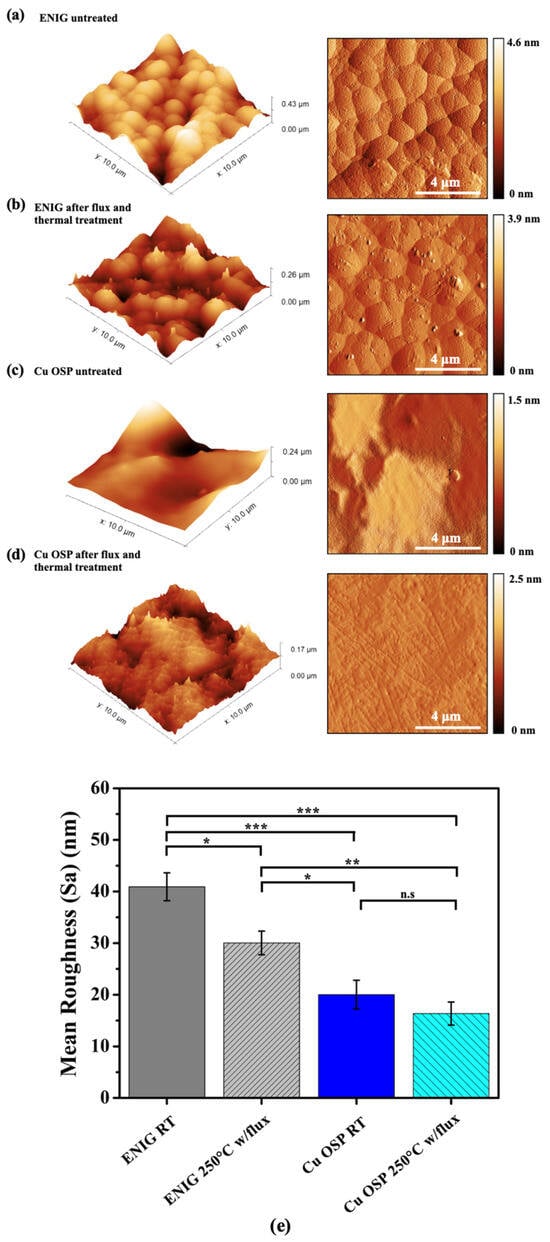
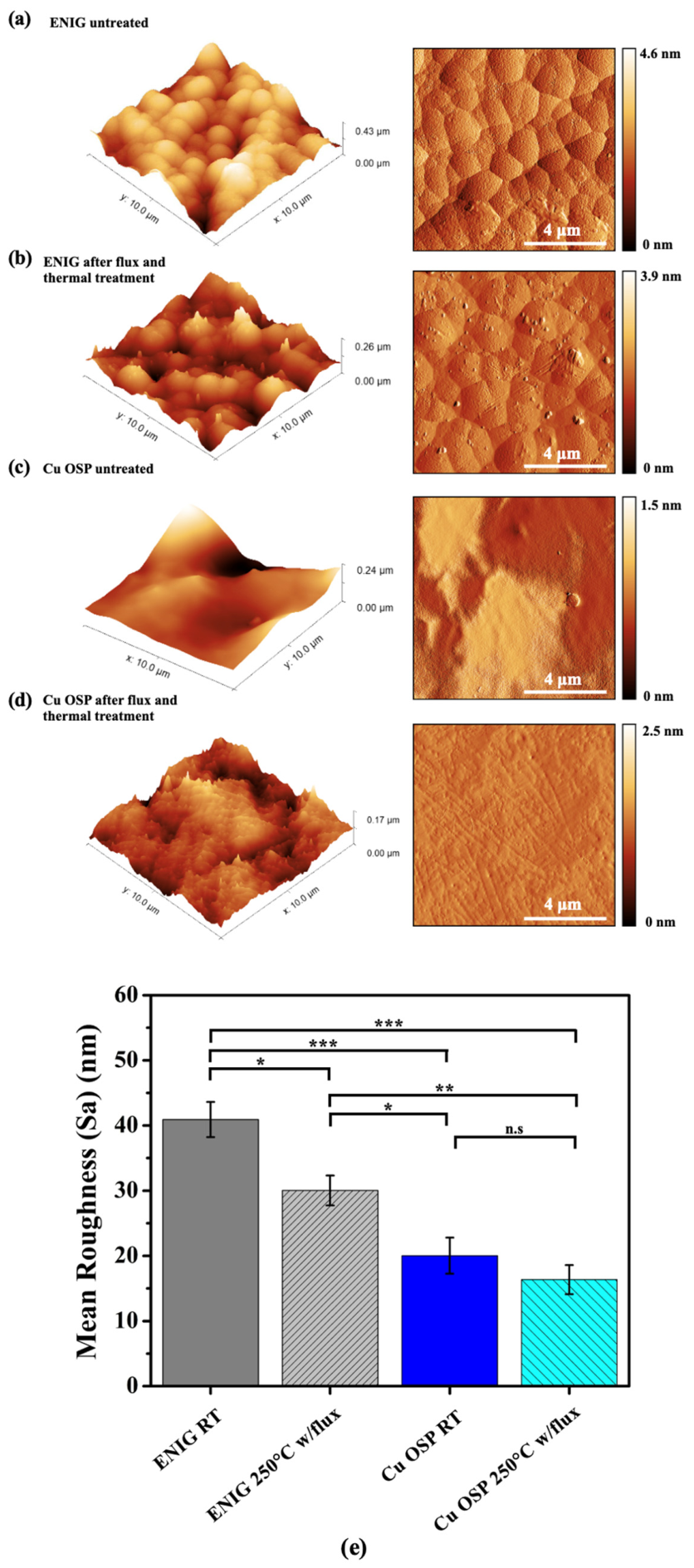
Representative AFM height and amplitude images of the ENIG and Cu-OSP surfaces are shown in Figure 1. In the as-received condition, ENIG displayed more pronounced surface texture and higher mean roughness, , than Cu-OSP, with corresponding values of 40.9 ± 2.7 nm for ENIG and 20.0 ± 2.8 nm for Cu-OSP, respectively. After flux and thermal treatment, decreased to 30.0 ± 2.3 nm for ENIG and 16.4 ± 2.2 nm for Cu-OSP, where the uncertainties represent standard error of the mean. The reduction in roughness after flux and thermal treatment may result from surface smoothing from oxide removal and/or redistribution of surface residues during heating. Despite this change, ENIG remained rougher than Cu-OSP, which may contribute to differences in the apparent contact angle. The values differed significantly among the four AFM sample groups: ENIG RT, ENIG after flux and thermal treatment, Cu-OSP RT, and Cu-OSP after flux and thermal treatment, based on one-way ANOVA (). Pairwise Tukey post hoc comparisons are shown in Figure 1. These roughness results should be interpreted together with the surface free energy data. The lower contact angles measured on ENIG cannot be attributed to surface free energy alone because ENIG and Cu-OSP differ simultaneously in surface free energy and roughness. Since the measured solder contact angles are below 90°, increased roughness may further reduce the apparent contact angle according to the Wenzel model [22]. Therefore, the lower apparent contact angles on ENIG are interpreted as reflecting the combined effects of higher surface free energy and greater roughness. The present experimental design does not fully decouple these two contributions, so the substrate characterization results are used to provide context for the wetting behavior rather than to isolate a single controlling factor.
Figure 1.
Representative AFM 3D height and amplitude images of ENIG and Cu-OSP surfaces before and after flux and thermal treatment: (a) Untreated ENIG, (b) ENIG after flux and thermal treatment, (c) untreated Cu-OSP, and (d) Cu-OSP after flux and thermal treatment. (e) Areal mean roughness, , calculated from AFM height images. Error bars represent standard error of the mean, . Statistical comparisons were performed using one-way ANOVA followed by Tukey post hoc testing: * p < 0.05, ** p < 0.01, *** p < 0.001, and n.s. = not significant.
3.2. Contact Angle and Wettability
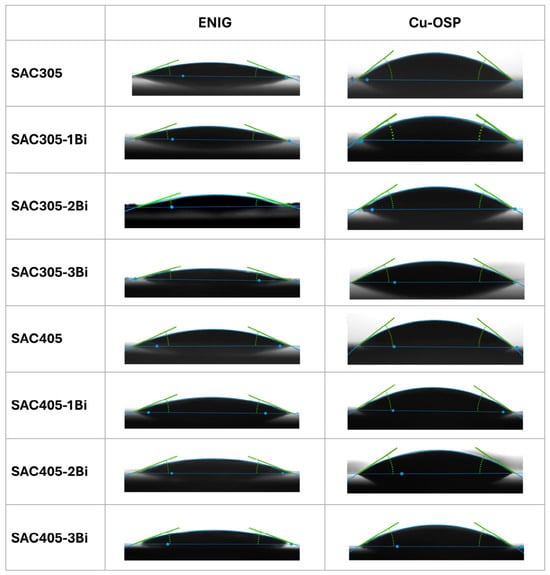
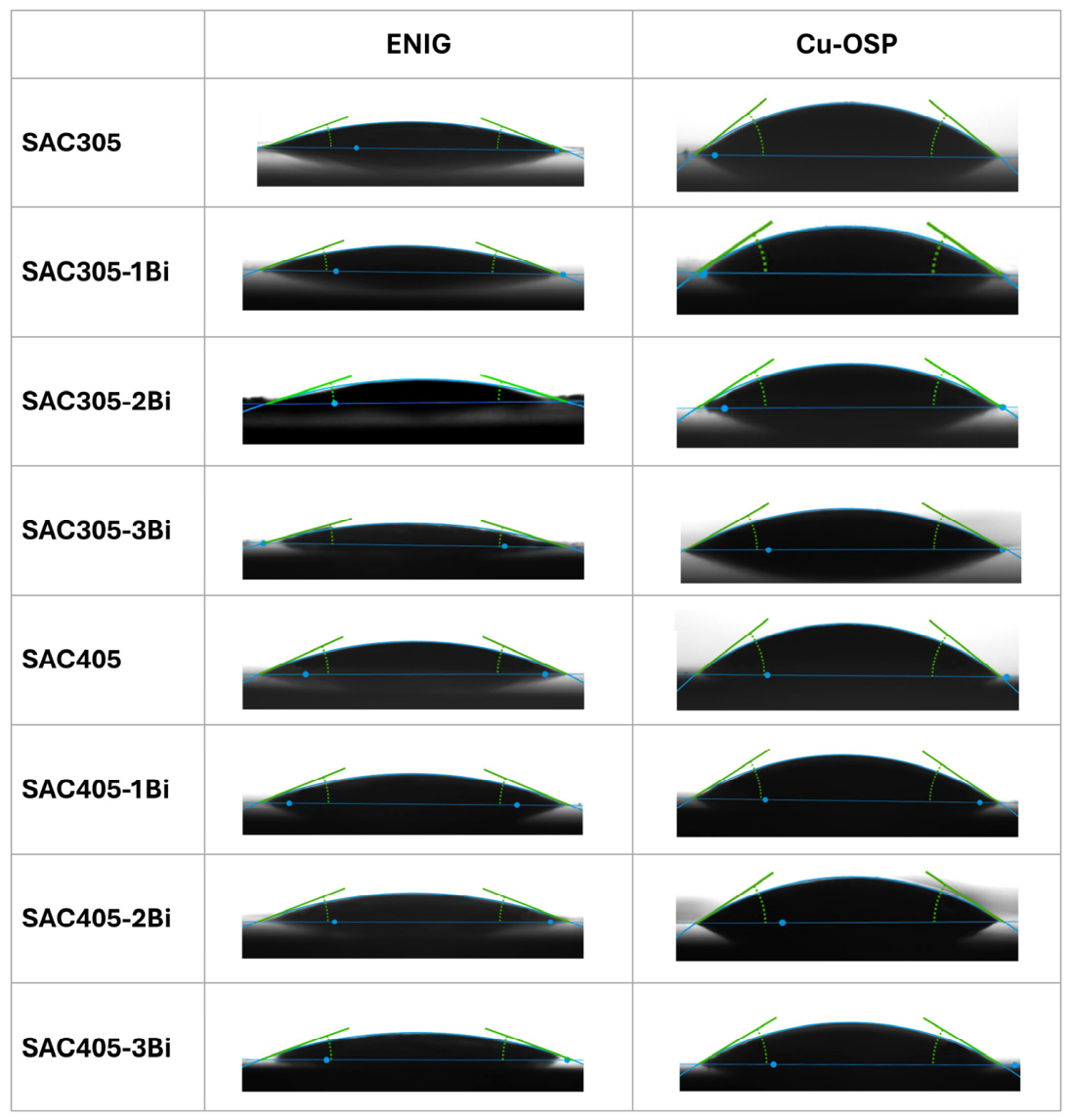
Representative sessile-drop images for the solder/substrate combinations are shown in Figure 2. These images illustrate the droplet profiles used for determining the contact angle after the 5 min dwell at 250 °C under forming gas.
Figure 2.
Representative sessile-drop images used for contact angle measurement of nominal SAC305- and SAC405-based solders on ENIG and Cu-OSP substrates at 250 °C under forming gas. Each image shows one representative droplet from the corresponding solder/substrate condition after the 5 min dwell at 250 °C.
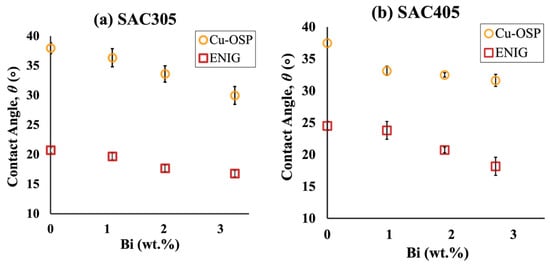
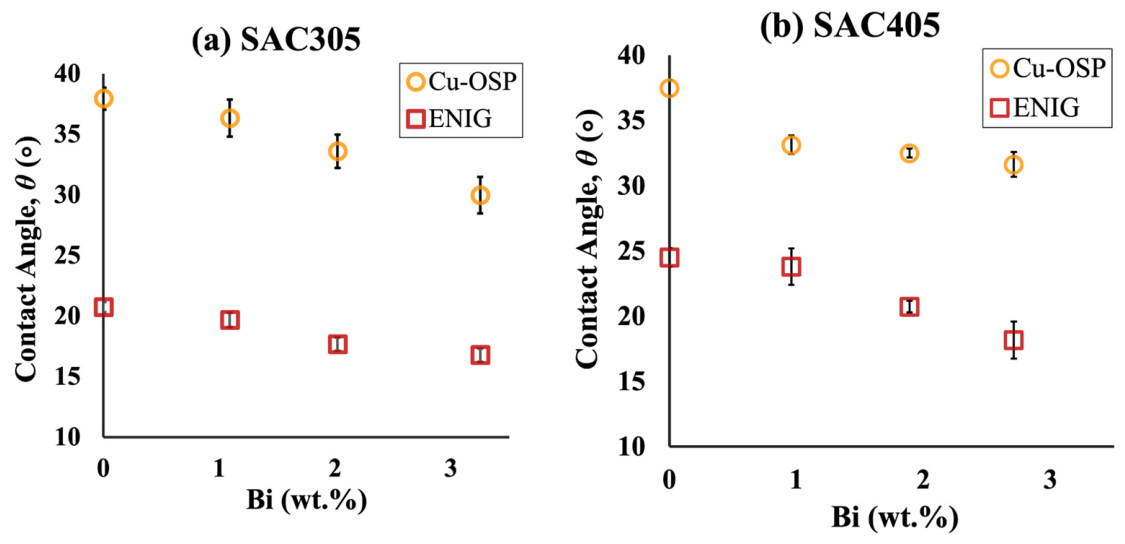
The measured contact angle results are shown in Figure 3. For both nominal SAC305- and SAC405-based series, the contact angle generally decreased as Bi content increased on both ENIG and Cu-OSP, indicating improved spreading with Bi addition. This trend was more pronounced for the SAC305 compositions, particularly on Cu-OSP, where the reduction in contact angle with Bi content was larger. Because all sessile-drop measurements were performed using the same temperature, dwell time, atmosphere, flux application procedure, and image analysis method, the contact angle results are best interpreted as relative comparisons among solder compositions and pad finishes under a common test condition. The stronger decrease observed for the SAC305-based alloys, especially on Cu-OSP, indicates that the influence of Bi addition depends on the base alloy composition and substrate finish rather than on Bi content alone.
Figure 3.
Measured contact angles () of (a) nominal SAC305- and (b) SAC405-based solders on ENIG and Cu-OSP at 250 °C, plotted as a function of the XRF-measured Bi content. Error bars represent standard deviation from three measurements.
For comparable alloy compositions, ENIG consistently showed lower contact angles than Cu-OSP, indicating more favorable wetting on ENIG. At the same time, SAC305-based solders generally exhibited lower contact angles than SAC405-based solders, especially on ENIG. These results indicate that both alloy composition and pad finish influenced the apparent wettability. The lower contact angles observed on ENIG are consistent with the combined influence of higher surface free energy and greater roughness, as discussed in the previous section.
Although Bi addition generally lowered the contact angle, the extent of the reduction depended on the base alloy and substrate finish. In the nominal SAC305-based series, the decrease in contact angle with increasing Bi content was relatively strong on both finishes. In the nominal SAC405-based series, the same overall trend was observed, but the change with Bi addition was smaller, particularly on Cu-OSP. These differences suggest that the effect of Bi on wettability depends on both alloy composition and substrate condition and may be related to changes in liquid surface tension and solder–substrate interactions.
3.3. Calculated Work of Adhesion
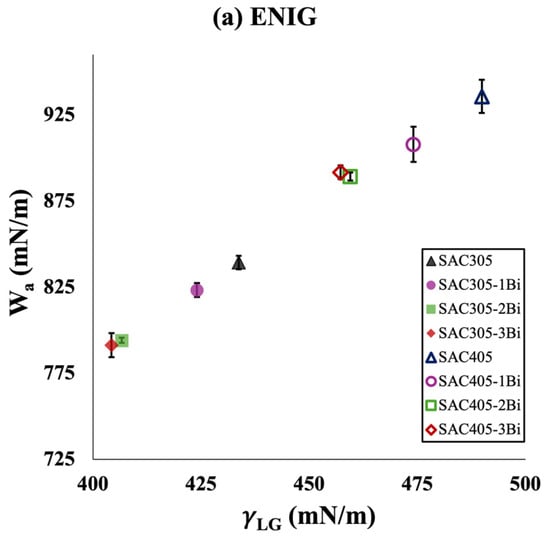
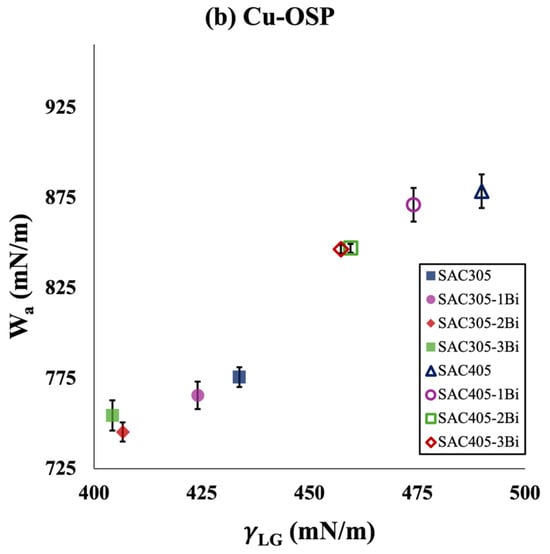
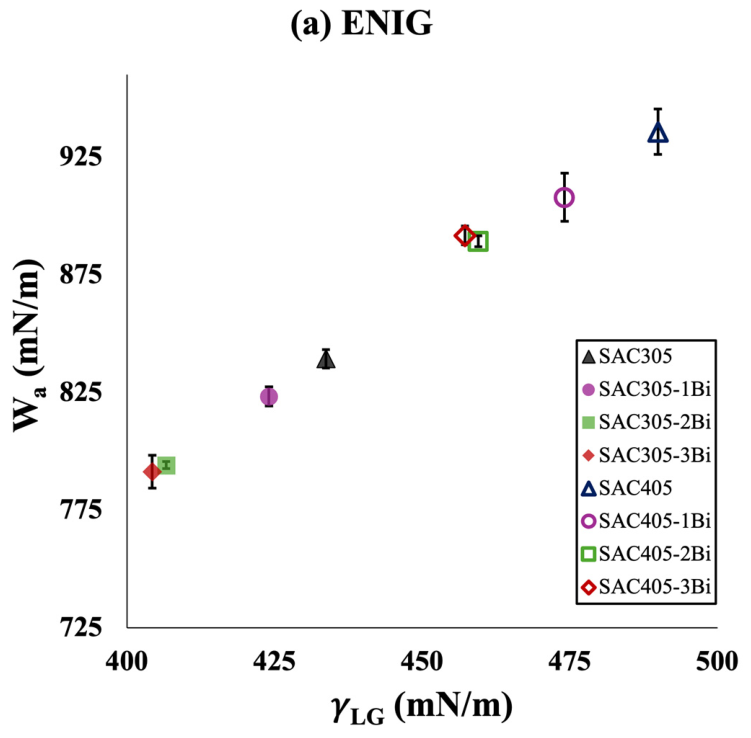
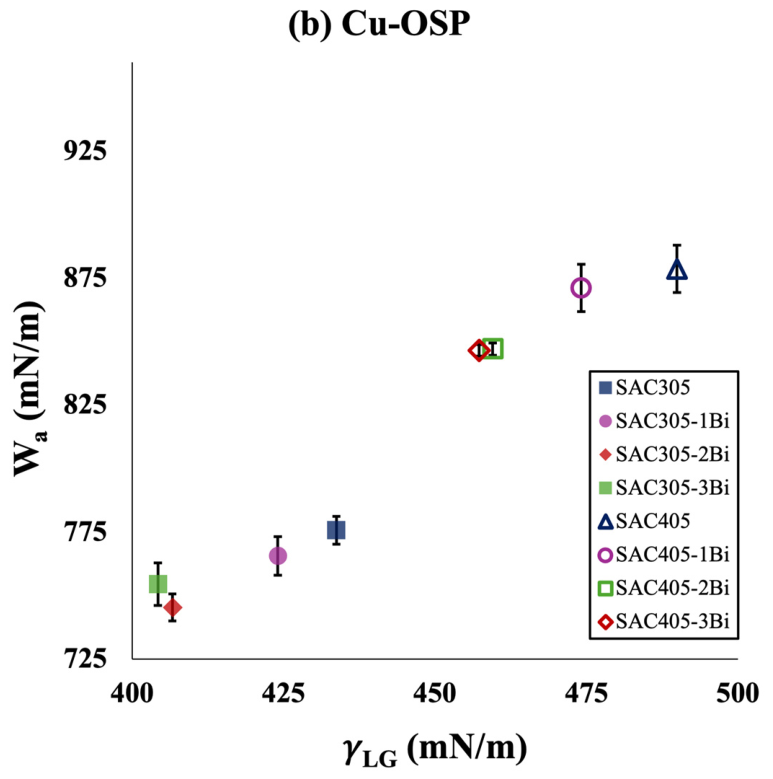
The liquid surface tension values, measured contact angles shown in Figure 3, and calculated values are summarized in Table 3. The calculated values are also plotted against liquid surface tension to show how the calculated adhesion values vary with solder surface tension for the different alloy compositions, as shown in Figure 4.
Table 3.
Liquid surface tension at 250 °C, contact angles at 250 °C, and calculated work of adhesion of nominal SAC305- and SAC405-based solders on ENIG and Cu-OSP substrates. Values are reported as mean ± standard deviation for and . The uncertainty in was calculated by propagating the uncertainties in and .
Figure 4.
Calculated work of adhesion () as a function of liquid surface tension () for nominal SAC305- and SAC405-based solders on (a) ENIG and (b) Cu-OSP substrates. Error bars represent the propagated uncertainty in calculated from the uncertainties in and .
It should be noted that the calculated values should be interpreted as apparent values for the present solder/substrate systems, where interfacial reactions can occur, rather than as absolute thermodynamic work of adhesion for an inert equilibrium interface. The Young–Dupré relationship assumes an equilibrium balance of interfacial energies, whereas prior studies have shown that in reactive wetting systems, reaction products formed at the interface can influence the measured apparent contact angle and the corresponding work of adhesion [7]. In the present study, molten SAC-Bi solders can react with ENIG and Cu-OSP through processes such as Ni-Sn and Cu-Sn intermetallic formation [23], and these reactions are expected to promote wetting relative to an inert substrate surface. Therefore, the calculated values may be higher than the values that would be obtained for a purely nonreactive interface. For this reason, the calculated values are most appropriately used as apparent, comparative values for the solder/substrate combinations tested under identical conditions, rather than as reversible thermodynamic values. This interpretation does not prevent comparison among the solder/substrate combinations, because all values were calculated using the same measurement procedure and test temperature. However, the values should be compared together with the contact angle results and substrate characterization rather than treated as standalone adhesion constants. In particular, differences in pad finish may reflect not only equilibrium interfacial energy differences, but also differences in surface roughness, surface free energy, and interfacial reaction behavior under the present measurement conditions.
For both substrate finishes, a positive correlation can be seen in the - plots (Figure 4), where solders with higher surface tension generally have larger . However, this trend reflects the combined influence of liquid surface tension and contact angle in the Young–Dupré relationship, rather than a direct dependence on surface tension alone. In particular, alloys with similar values can exhibit different values when the measured contact angles differ, highlighting the role of wetting behavior in determining the calculated adhesion. This effect is more evident in the Cu-OSP data.
The ENIG data are consistently shifted to higher values than the Cu-OSP data, indicating stronger calculated adhesion on ENIG for all alloys examined. Based on the calculated results, ranged from approximately 791 to 936 mN/m on ENIG and from approximately 745 to 879 mN/m on Cu-OSP. Since a given solder has the same liquid surface tension regardless of substrate, the higher values on ENIG are consistent with the lower contact angles measured on ENIG relative to Cu-OSP. This finish-dependent difference is also consistent with the higher surface free energy of ENIG and the different surface chemistry of the two finishes.
Alloy composition also affected the calculated work of adhesion. Across both finishes, the SAC405-based alloys showed higher values than the SAC305-based alloys, while Bi additions produced a finish- and alloy-dependent response. For the SAC305-based series, Bi addition caused a clear reduction in contact angle, especially on Cu-OSP, but the corresponding calculated values did not increase in the same manner. For the SAC405-based series, Bi addition also reduced the contact angle, while the calculated values remained relatively high across the series. These trends indicate that Bi addition improves apparent spreading, while the resulting calculated adhesion response depends on both the base alloy and pad finish.
The greater local compositional variation observed by XRF for SAC405-3Bi introduces some uncertainty when interpreting its composition-dependent behavior. Nevertheless, the standard deviations of its contact-angle and liquid-surface-tension measurements were within the ranges observed for the other alloys, and its contact-angle and calculated values followed the overall trends observed for the SAC405-based series. These observations support the repeatability of the measured wetting response and the resulting calculated values for the specimens tested. Accordingly, the SAC405-3Bi results remain useful for comparison within the present dataset, while composition-property trends involving this alloy should be interpreted based on the overall SAC405-based series rather than on this composition alone.
Overall, the results reinforce the substrate-dependent wetting behavior observed from the contact angle measurements. ENIG produced higher calculated values than Cu-OSP for all solder compositions, consistent with the lower contact angles measured on ENIG. The results also show that Bi addition improves wettability primarily by reducing contact angle, but its effect on calculated is alloy- and finish-dependent.
4. Conclusions
The wettability of nominal SAC305- and SAC405-based solders with Bi additions was evaluated on ENIG and Cu-OSP substrates by sessile drop testing, together with substrate characterization by AFM and surface free energy measurements. For both nominal SAC305- and SAC405-based alloy series, the contact angle generally decreased with increasing Bi content on both finishes, indicating improved spreading with Bi addition. ENIG consistently showed lower contact angles than Cu-OSP for comparable alloy compositions, indicating more favorable wetting on ENIG under the present test conditions.
The substrate characterization results showed clear differences in surface free energy and roughness between ENIG and Cu-OSP, and these differences remained evident after pretreatment. The calculated work of adhesion was higher on ENIG than on Cu-OSP across the alloy set, consistent with the lower contact angles measured on ENIG. Bi addition generally reduced the contact angle, indicating improved spreading, but it did not lead to a simple monotonic increase in the calculated because Bi also reduced the liquid surface tension of the solder. As a result, the calculated values reflect the balance between improved spreading and reduced . These results show that pad finish, Bi content, and base alloy composition all influence the apparent wettability and calculated work of adhesion of SAC-based solders. The results also show that the lowest contact angle does not necessarily produce the highest calculated work of adhesion because depends on both the contact angle and the liquid surface tension.
Author Contributions
Conceptualization, O.A., P.S., K.M. and T.J.; methodology, Z.C.C., T.V.D., and T.J.; investigation, Z.C.C. and T.V.D.; formal analysis, Z.C.C. and T.J.; writing—original draft preparation, Z.C.C. and T.V.D.; writing—review and editing, Z.C.C., T.V.D., O.A., P.S., E.H.K., K.M. and T.J.; supervision, E.H.K., K.M. and T.J.; resources, O.A., P.S., E.H.K., K.M. and T.J.; funding acquisition, T.J. All authors have read and agreed to the published version of the manuscript.
Funding
This research was funded by Hewlett Packard Enterprise (HPE).
Data Availability Statement
The data presented in this study are available from the corresponding author upon reasonable request.
Acknowledgments
The authors thank Kirk Scammon at the UCF Materials Characterization Facility for his assistance with XRF measurements.
Conflicts of Interest
Authors O.A. and P.S. are employees of Hewlett Packard Enterprise. The remaining authors declare no conflicts of interest.
References
- Takeda, S.; Masuko, T. Novel die attach films having high reliability performance for lead-free solder and CSP. In 2000 50th Electronic Components and Technology Conference; IEEE: Piscataway, NJ, USA, 2000; pp. 1616–1622. [Google Scholar] [CrossRef] [Scilit]
- Mittal, K.L. Advances in Contact Angle, Wettability and Adhesion, 1st ed.; John Wiley & Sons: Hoboken, NJ, USA, 2018; Volume 3. [Google Scholar]
- Bozack, M.J.; Suhling, J.C.; Zhang, Y.; Cai, Z.; Lall, P. Influence of Surface Segregation on Wetting of Sn-Ag-Cu (SAC) Series and Pb-Containing Solder Alloys. J. Electron. Mater. 2011, 40, 2093–2104. [Google Scholar] [CrossRef] [Scilit]
- Depiver, J.A.; Mallik, S.; Amalu, E.H. Effective solder for improved thermo-mechanical reliability of solder joints in a ball grid array (BGA) soldered on printed circuit board (PCB). J. Electron. Mater. 2021, 50, 263–282. [Google Scholar] [CrossRef] [Scilit]
- Manoj Kumar, P.; Gergely, G.; Horváth, D.K.; Gácsi, Z. Investigating the microstructural and mechanical properties of pure lead-free soldering materials (SAC305& SAC405). Powder Metall. Prog. 2018, 18, 49–57. [Google Scholar] [CrossRef] [Scilit]
- Abtew, M.; Selvaduray, G. Lead-free solders in microelectronics. Mater. Sci. Eng. R Rep. 2000, 27, 95–141. [Google Scholar] [CrossRef] [Scilit]
- Griffiths, S.; Wedi, A.; Schmitz, G. Work of adhesion and reactive wetting in SnPb/Cu,Ni and SnBi/Cu,Ni soldering systems. Mater. Charact. 2021, 178, 111304. [Google Scholar] [CrossRef] [Scilit]
- Moser, Z.; Gasior, W.; Bukat, K.; Pstruś, J.; Kisiel, R.; Sitek, J.; Ishida, K.; Ohnuma, I. Pb-Free Solders: Part III. Wettability Testing of Sn-Ag-Cu-Bi Alloys with Sb Additions. J. Phase Equilibria Diffus. 2007, 28, 433–438. [Google Scholar] [CrossRef] [Scilit]
- Plevachuk, Y.; Sklyarchuk, V.; Gerbeth, G.; Eckert, S.; Novakovic, R. Surface tension and density of liquid Bi–Pb, Bi–Sn and Bi–Pb–Sn eutectic alloys. Surf. Sci. 2011, 605, 1034–1042. [Google Scholar] [CrossRef] [Scilit]
- Shukla, V.; Ahmed, O.; Su, P.; Tian, T.; Jiang, T. Effect of Bi on the Tensile and Viscoplastic Behavior of Sn-Ag-Cu-Bi Alloys Used for Microelectronics Applications. Metals 2024, 14, 803. [Google Scholar] [CrossRef] [Scilit]
- Bukat, K.; Sitek, J.; Kisiel, R.; Moser, Z.; Gasior, W.; Koscielski, M.; Pstrus, J. Evaluation of the influence of Bi and Sb additions to Sn-Ag-Cu and Sn-Zn alloys on their surface tension and wetting properties using analysis of variance—ANOVA. Solder. Surf. Mt. Technol. 2008, 20, 9–19. [Google Scholar] [CrossRef] [Scilit]
- Hou, D.; Cai, P.; Luan, J.; Yu, Z.; Zhang, J.; Chou, K.-C. Application of surface tension in the design of novel Sn-Ag-Cu-based solders. J. Non-Cryst. Solids 2022, 582, 121444. [Google Scholar] [CrossRef] [Scilit]
- M’Chaar, R.; Sabbar, A.; El Moudane, M. Temperature dependences of surface tension, density and viscosity study of Sn-Ag-Cu with Bi additions using theoretical models. Sci. Rep. 2019, 9, 14177. [Google Scholar] [CrossRef] [Scilit] [PubMed]
- Moser, Z.; Gąsior, W.; Bukat, K.; Pstruś, J.; Kisiel, R.; Sitek, J.; Ishida, K.; Ohnuma, I. Pb-Free solders: Part 1. Wettability testing of Sn−Ag−Cu alloys with Bi additions. J. Phase Equilibria Diffus. 2006, 27, 133–139. [Google Scholar] [CrossRef] [Scilit]
- Moser, Z.; Gąsior, W.; Pstruś, J.; Dębski, A. Wettability Studies of Pb-Free Soldering Materials. Int. J. Thermophys. 2008, 29, 1974–1986. [Google Scholar] [CrossRef] [Scilit]
- Ohnuma, I.; Ishida, K.; Moser, Z.; Gąsior, S.; Bukat, K.; Pstruś, J.; Kisiel, R.; Sitek, J. Pb-Free solders: Part II. Application of ADAMIS database in modeling of Sn−Ag−Cu alloys with Bi additions. J. Phase Equilibria Diffus. 2006, 27, 245–254. [Google Scholar] [CrossRef] [Scilit]
- Sona, M.; Prabhu, K.N. Effect of Reflow Time on Wetting Behavior, Microstructure Evolution, and Joint Strength of Sn-2.5Ag-0.5Cu Solder on Bare and Nickel-Coated Copper Substrates. J. Electron. Mater. 2016, 45, 3744–3758. [Google Scholar] [CrossRef] [Scilit]
- Mechael, S.S.; Wu, Y.; Chen, Y.; Carmichael, T.B. Protocol for fabricating electroless nickel immersion gold strain sensors on nitrile butadiene rubber gloves for wearable electronics. STAR Protoc. 2021, 2, 100832. [Google Scholar] [CrossRef] [Scilit] [PubMed]
- Son, J.; Hong, Y.; Yavuz, C.T.; Han, J.-I. Thiourea-Based Extraction and Deposition of Gold for Electroless Nickel Immersion Gold Process. Ind. Eng. Chem. Res. 2020, 59, 8086–8092. [Google Scholar] [CrossRef] [Scilit]
- Teoh, A.L.; Mohd Salleh, M.A.A.; Halin, D.S.C.; Foo, K.L.; Abdul Razak, N.R.; Yasuda, H.; Nogita, K. Microstructure, thermal behavior and joint strength of Sn-0.7Cu-1.5Bi/electroless nickel immersion gold (ENIG). J. Mater. Res. Technol. 2021, 12, 1700–1714. [Google Scholar] [CrossRef] [Scilit]
- Adamson, A.W.; Gast, A.P. Physical Chemistry of Surfaces, 6th ed.; Wiley: New York, NY, USA, 1997. [Google Scholar]
- Law, K.-Y.; Zhao, H. Wetting on Rough Surfaces. In Surface Wetting: Characterization, Contact Angle, and Fundamentals; Springer International Publishing: Cham, Switzerland, 2016; pp. 55–98. [Google Scholar] [CrossRef] [Scilit]
- Laurila, T.; Vuorinen, V.; Kivilahti, J.K. Interfacial reactions between lead-free solders and common base materials. Mater. Sci. Eng. R Rep. 2005, 49, 1–60. [Google Scholar] [CrossRef] [Scilit]

Disclaimer/Publisher’s Note: The statements, opinions and data contained in all publications are solely those of the individual author(s) and contributor(s) and not of MDPI and/or the editor(s). MDPI and/or the editor(s) disclaim responsibility for any injury to people or property resulting from any ideas, methods, instructions or products referred to in the content. |
© 2026 by the authors. Licensee MDPI, Basel, Switzerland. This article is an open access article distributed under the terms and conditions of the Creative Commons Attribution (CC BY) license.