1. Introduction
Perovskite-like manganites and their derivatives continue to attract considerable attention in materials chemistry owing to the possibility of fine-tuning their phase composition and physical properties through chemical doping and structural modification [
1,
2,
3]. These oxide systems exhibit remarkable functional properties, including colossal magnetoresistance (CMR), giant magnetostriction, and a high sensitivity of transport characteristics to compositional variations, which makes them highly promising for applications in spintronics and advanced functional electronics. Particular interest is associated with the potential use of manganite-based systems as a platform for the development of high-temperature superconducting materials, since their structural flexibility and chemical diversity enable the realization of electronic configurations closely related to those observed in cuprate superconductors.
Classical high-temperature superconductors of the YBa
2Cu
3O
7-δ (YBCO, T
c ≈ 90 K) type clearly demonstrate that the superconducting state is primarily governed by the CuO
2 planes, the mixed valence states of Cu
2+/Cu
3+, the optimal oxygen nonstoichiometry (δ ≈ 0.1–0.2), and the carrier concentration (~0.16 holes per Cu atom) [
4,
5,
6,
7,
8]. Recent studies further confirm the decisive role of the electronic structure of the CuO
2 layers, strong electron correlations, and phase fluctuations in achieving elevated T
c values [
6,
7,
8]. Importantly, similar crystal-chemical and electronic factors—including the presence of Cu–O bonds, mixed valence states of transition metal cations, and oxygen nonstoichiometry—are also observed in Cu- and V-doped La–Mn–O manganite systems, thereby creating favorable prerequisites for the emergence of superconducting-like behavior [
9,
10,
11,
12].
Doping at the B-site of the perovskite lattice (Mn → Cu/V) significantly modifies the structural and functional properties of manganite systems. In particular, Cu substitution (x = 0.05–0.15 in La
0.7Sr
0.3Mn
1−xCu
xO
3) preserves the orthorhombic perovskite Pnma structure, while altering the Mn
3+/Mn
4+ valence ratio, enhancing metallic-like charge transport, and intensifying the magnetoresistive response, which may contribute to the optimization of the carrier concentration required for possible pairing interactions [
13,
14,
15,
16,
17]. Similarly, the introduction of V dopants (x = 0.05–0.10 in LaMn
1−xV
xO
3 or La
0.65Sr
0.35Mn
0.95V
0.05O
3) affects the crystal symmetry, superexchange interactions, and the charge transport mechanism, leading to a reduction in the activation energy (E
g) [
18,
19,
20]. These crystal-chemical and electronic modifications are directly related to parameters that are considered critical for the emergence of superconducting-like states in cuprate-based systems.
A-site lanthanide and alkaline-earth doping (La/Sr/Ce) offers particularly broad opportunities for tailoring the electronic structure and transport properties of oxide systems, as extensively demonstrated in classical cuprate superconductors such as La2−xSrxCuO4 and La1.85Sr0.15CuO4, where hole doping levels of x ≈ 0.15–0.20 are known to maximize Tc. In manganite-based matrices, the substitution of Sr or Ce for La further modulates the BO6 octahedral distortion, lattice parameters, and charge carrier mobility, thereby strongly affecting the electronic transport mechanism. A similar crystal-chemical approach has been implemented in the present work for the design of multicomponent La–Ca–Cu–V–Mn–O oxide systems.
Perovskite-like manganite oxides are regarded as promising functional materials due to the strong coupling between charge, spin, orbital, and lattice degrees of freedom, which gives rise to their pronounced electrophysical and magnetotransport properties. Such systems have attracted considerable attention as prospective materials for spintronic devices, magnetic sensors, functional electronics, oxygen-permeable membranes, and components of solid oxide fuel cells (SOFCs) [
21,
22].
In turn, YBa
2Cu
3O
x (YBCO) is one of the most extensively studied high-temperature cuprate materials due to its high electrical conductivity, oxygen-content-dependent transport behavior, and unique structural features associated with the CuO
2 planes. YBa
2Cu
3O
x-based systems are actively investigated for applications in superconducting electronics, coated conductors, electronic devices, and multifunctional oxide composites [
8,
23,
24].
Thus, the combination of manganite oxide matrices with YBa2Cu3Ox is of particular interest, since interfacial interactions, oxygen redistribution, and structural integration effects may significantly influence the transport, dielectric, and thermophysical properties of complex oxide composites.
The scientific significance of the LaCaCuVMnO7.5 system is associated with the possibility of combining within a single oxide matrix several functionally active structural fragments related to manganite, vanadate, and cuprate oxide systems. Such multicomponent oxide systems may exhibit enhanced interphase interactions, local structural distortions, mixed-valence states of transition metal ions, and oxygen-deficient regions, which can significantly influence their transport, dielectric, and thermophysical behavior.
The incorporation of YBa2Cu3Ox into the LaCaCuVMnO7.5 matrix is expected to modify the electrophysical response of the composite through the formation of additional conductive pathways, interfacial polarization effects, redistribution of oxygen vacancies, and changes in charge carrier transport at the phase boundaries.
The novelty of the present study lies in the synthesis of new oxide compositions based on La–Ca–Cu–V–Mn–O7.5 and their composites with YBa2Cu3Ox (10:90 wt.%) by the solid-state reaction method in the 600–1000 °C temperature range, as well as in the comprehensive investigation of their structural, thermodynamic, and electrophysical properties. The obtained results reveal collective effects arising at the interphase boundaries, which significantly influence the transport and thermophysical behavior of the systems, and indicate the presence of complex interphase electronic interactions characteristic of multicomponent oxide systems.
Thus, complex oxides based on La–Ca–Cu–V–Mn–O systems are of considerable interest as potentially multifunctional materials, in which structural and physicochemical features characteristic of cuprates, vanadates, and manganites may coexist and interact. Such a combination creates favorable conditions for the emergence of collective interphase effects, which can substantially influence the transport, dielectric, and thermophysical properties of the material. Additional opportunities arise from the formation of composite systems with high-temperature superconductors, such as YBa2Cu3Ox, which may further enhance the functional response of the investigated oxide systems and provide a basis for future studies aimed at multifunctional electronic and sensor-related materials.
Therefore, the main objective of the present work was to synthesize and comprehensively investigate the structural, thermophysical, and electrophysical properties of the multicomponent LaCaCuVMnO7.5 oxide system and its composite modified with YBa2Cu3Ox, with particular attention to interphase effects arising in the structurally integrated multiphase material.
Despite the large number of studies devoted to manganite- and cuprate-based oxide systems, information on multicomponent La–Ca–Cu–V–Mn–O systems combined with YBa2Cu3Ox remains extremely limited. Most previously published works have focused either on conventional manganites or on separately Cu- or V-doped perovskites, whereas the present study investigates a structurally integrated multiphase oxide composite that combines the properties of manganite, vanadate, and cuprate components within a single system.
The novelty of the present study lies in the synthesis of a new multiphase oxide system based on LaCaCuVMnO7.5 and its composite with YBa2Cu3Ox, the comprehensive investigation of its structural, thermophysical, and electrophysical properties, as well as the analysis of interphase effects arising from the interaction between the orthorhombic, cubic, and cuprate phases. Unlike previously studied manganite systems, the introduction of YBa2Cu3Ox results in significant changes in heat-capacity behavior, electrical resistance, and dielectric response, thereby demonstrating an effective approach for tuning the functional properties of complex oxide materials.
2. Results and Discussion
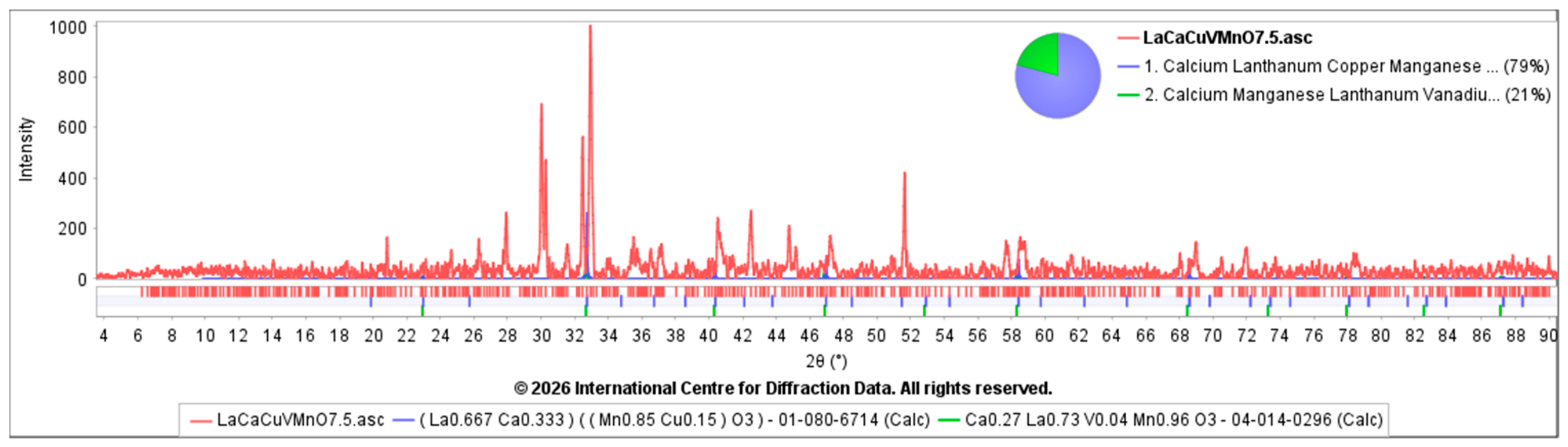
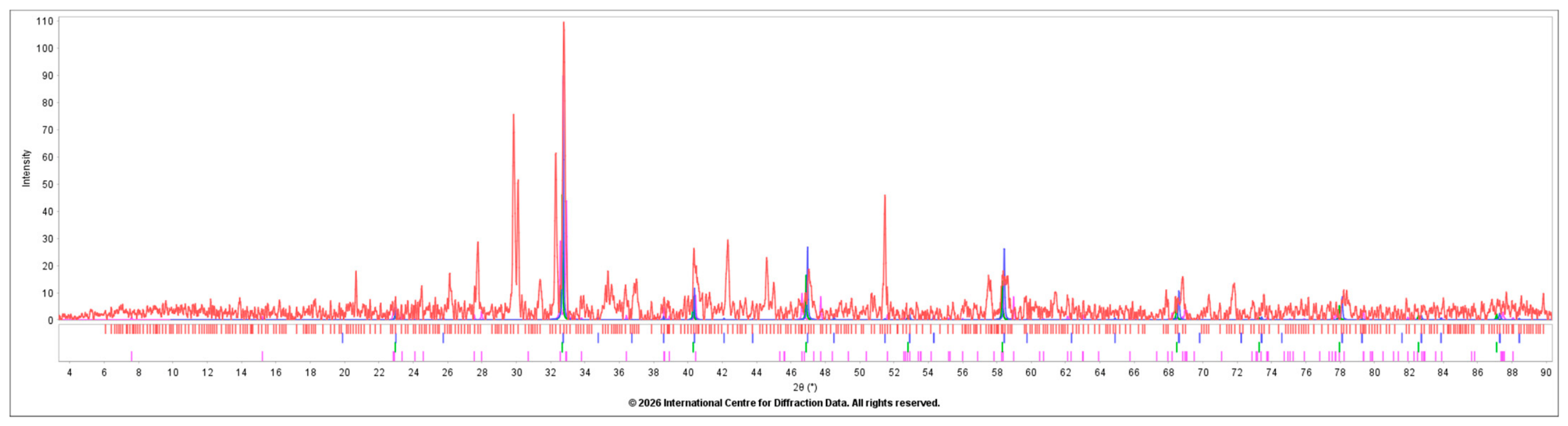
X-ray diffraction analysis combined with Rietveld refinement demonstrated that the parent LaCaCuVMnO
7.5 compound forms a two-phase system. Phase identification was carried out by comparison of the experimental diffraction patterns with the ICDD PDF-5+ database. The major phase (79 wt.%) was assigned to (La
0.667Ca
0.333)(Mn
0.85Cu
0.15)O
3, showing good agreement with PDF card No. 01-080-6714. The minor phase (21 wt.%) was identified as Ca
0.27La
0.73V
0.04Mn
0.96O
3, corresponding to PDF card No. 04-014-0296. The analysis revealed that the experimental diffraction peaks can be divided into two distinct groups, corresponding to reflections of the cubic phase (Pm-3m) and the orthorhombic phase (Pnma), which confirms the two-phase nature of the synthesized oxide system (
Table 1).
The main diffraction maxima are in good agreement with the calculated positions of the two identified phases: the orthorhombic perovskite-like phase (La
0.667Ca
0.333)(Mn
0.85Cu
0.15)O
3 (~79%) and the cubic phase Ca
0.27La
0.73V
0.04Mn
0.96O
3 (~21%). In general, the total calculated profile satisfactorily describes the experimental diffractogram (
Figure 1).
Quantitative phase analysis based on Rietveld refinement therefore confirms that the parent LaCaCuVMnO7.5 system is predominantly composed of the orthorhombic perovskite-like phase, while the cubic phase represents a minor structural component.
At the same time, some deviations of individual reflections from the ideal Bragg positions are observed, particularly an additional maximum in the ~30° region and peak splitting near ~32°. These features are characteristic of multicomponent perovskite-like oxides and are attributed to the intrinsic structural defectiveness of the material.
Cation substitutions (La/Ca, Mn/Cu, and Mn/V), together with oxygen non-stoichiometry, lead to shifts and broadening of the diffraction maxima [
16,
25]. Therefore, the observed deviations reflect the complex defective nature of the real crystal structure and do not contradict the established two-phase composition.
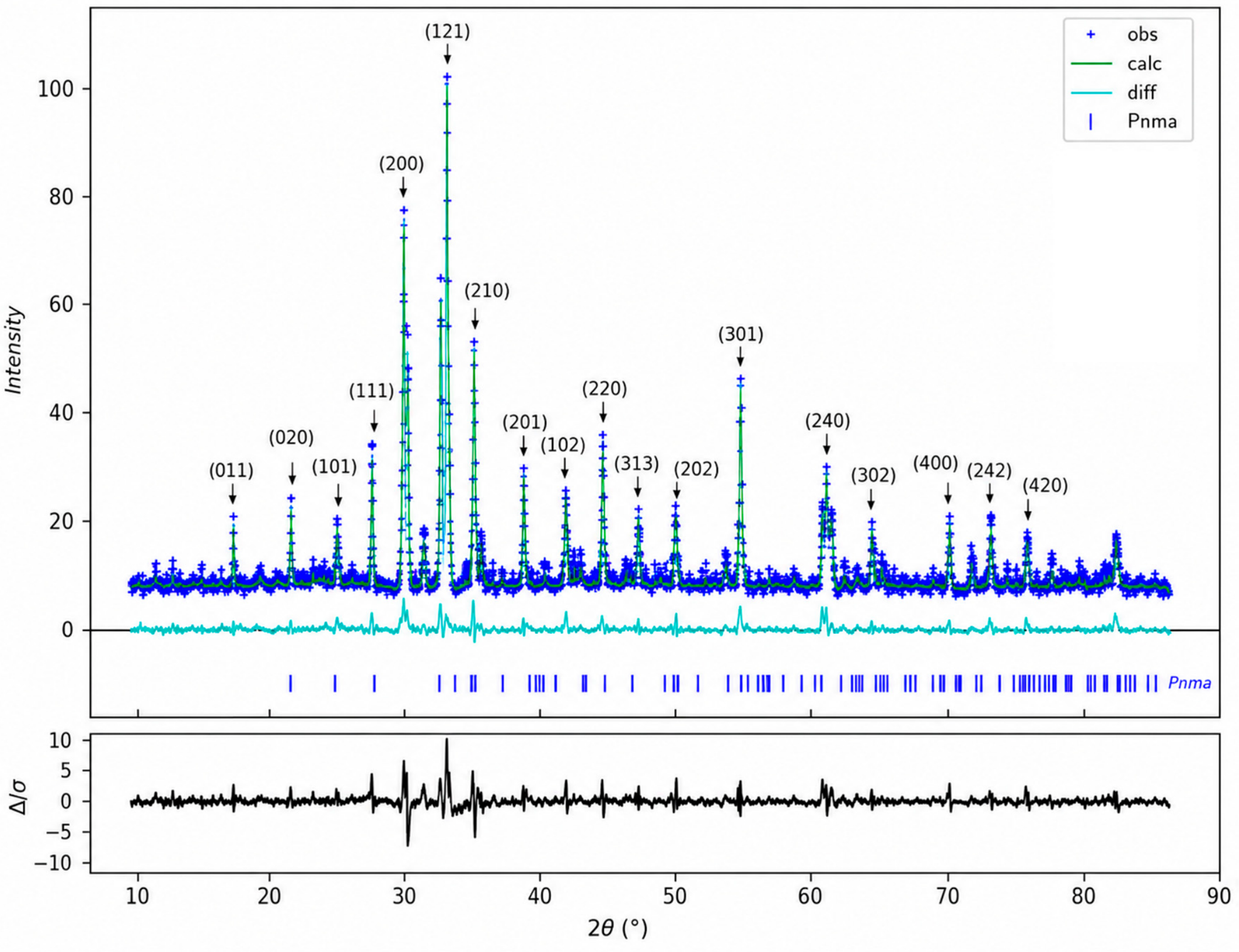
The Rietveld refinement yielded agreement factors of Rp = 55.2%, Rwp = 77.3%, Rexp = 48.6%, χ
2 = 2.54, and GOF = 1.59. The difference curve (cyan line) shows that the main discrepancies are predominantly localized in the 2θ ≈ 30–33° region (
Figure 2). These deviations are most likely associated with the partial overlap of reflections from the orthorhombic and cubic phases, anisotropic peak broadening, and local lattice distortions induced by cation substitution (La/Ca, Mn/Cu, Mn/V), which are typical of multicomponent perovskite-like oxide systems.
The most pronounced differences between the calculated and experimental intensities are observed in the region around 30° (2θ). Detailed analysis demonstrated that this region corresponds to overlapping reflections of the orthorhombic Pnma structure. Furthermore, the principal reflections of the cubic (Pm-3m) and orthorhombic (Pnma) phases occur at nearly identical diffraction angles (~32.7°), rendering them practically indistinguishable within the resolution limits of laboratory X-ray diffraction measurements.
Accordingly, the observed discrepancies in this region are attributed to the superposition of several reflections, anisotropic peak broadening, structural distortions induced by cation substitution, and local disorder within the perovskite lattice. Overall, the refinement results confirm the formation of a two-phase system predominantly composed of an orthorhombic perovskite-like phase with a minor contribution from the cubic phase.
The X-ray diffraction pattern of the composite material, based on the two-phase LaCaCuVMnO
7.5 system and its modification with YBa
2Cu
3O
x (LCCVMO–YBCO), revealed the presence of three crystalline phases, confirming the multiphase nature of the composite (
Figure 3).
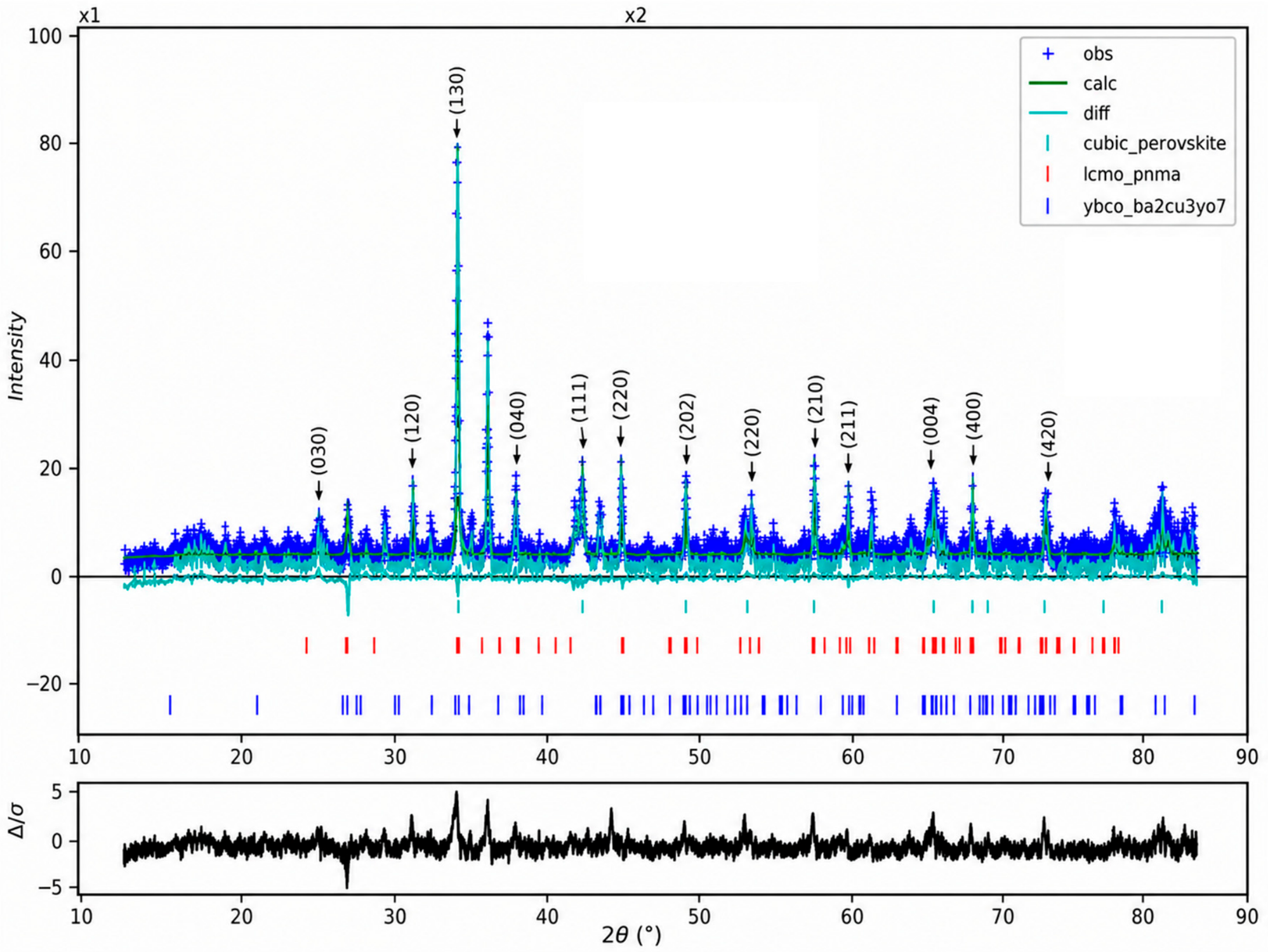
To verify the three-phase nature of the composite and to obtain a more reliable semi-quantitative assessment of the phase composition, the experimental XRD data were further analyzed by Rietveld refinement using the GSAS-II software package.
The refinement results confirmed the presence of three crystalline phases, namely the orthorhombic YBa2Cu3Ox phase, the perovskite-like phase (La0.667Ca0.333)(Mn0.85Cu0.15)O3, and the cubic phase Ca0.27La0.73V0.04Mn0.96O3, and enabled the estimation of their relative weight fractions.
As shown in
Figure 4, the calculated diffraction profile satisfactorily reproduces the main diffraction maxima over the entire 2θ range, confirming the correctness and applicability of the selected three-phase structural model.
The Rietveld refinement was performed in a stepwise manner, taking into account the structural complexity of the investigated system. In the first stage, each phase (Pnma, cubic, and YBa2Cu3Ox) was refined separately, which revealed the inadequacy of a single-phase model and further confirmed the multiphase nature of the composite.
Subsequently, a two-phase model comprising the orthorhombic and cubic phases was employed; however, a pronounced correlation between the refined phase scale factors was observed.
The final refinement was performed using a stabilized three-phase model with the sequential inclusion of phases and profile parameters. During the refinement process, the phase scale factors, unit-cell parameters, background parameters, and the profile parameter W, which accounts for Gaussian peak broadening, were refined sequentially. The U parameter was excluded from the refinement procedure due to its instability and the divergence of the minimization process.
As a result of the refinement, the following goodness-of-fit indicators were obtained: Rp = 55.96%, Rwp = 74.39%, Rexp = 38.70%, χ2 = 1.92, and GOF = 1.39. Despite the relatively high values of the profile agreement factors, which are typical of structurally complex multiphase oxide systems with substantial overlap of diffraction reflections, the low χ2 value and the satisfactory reproduction of the principal diffraction maxima indicate that the proposed three-phase model adequately describes the experimental data and can be used for phase identification and semi-quantitative phase analysis.
The main diffraction maxima are in good agreement with the calculated positions of all three phases. Local deviations between the experimental and calculated profiles are predominantly observed in the 2θ = 30–32° region, which is most likely associated with the overlap of intense reflections from multiple phases, as well as with lattice microstrain and the intrinsic structural disorder of the multiphase composite.
The Rietveld refinement was carried out in a stepwise manner, taking into account the structural complexity of the investigated system. In the first stage, each phase (Pnma, cubic, and YBa2Cu3Ox) was refined separately, which revealed the inadequacy of a single-phase model and further confirmed the multiphase nature of the composite.
Subsequently, a two-phase model comprising the orthorhombic and cubic phases was employed; however, a pronounced correlation between the refined scale factors was observed.
The final refinement was performed using a stabilized three-phase model with the sequential inclusion of phases and profile parameters. During refinement, the phase scale factors, lattice parameters, background parameters, and the profile parameter W, responsible for the Gaussian broadening of the diffraction peaks, were refined sequentially. The U parameter was excluded from the refinement due to its instability and the divergence of the minimization procedure.
The principal diffraction maxima are satisfactorily described by the calculated positions of all three phases. The local deviations between the experimental and calculated profiles are mainly observed in the 2θ = 30–32° range, which is most likely associated with the superposition of intense reflections from multiple phases, as well as with lattice microstrain and the intrinsic structural disorder of the multiphase composite.
The peak splitting observed in the 2θ = 30–33° region is associated with the overlap of the YBa2Cu3O7 (130) reflection located at 32.53° and the orthorhombic Pnma reflections (002) and (200) located at 32.62° and 32.73°, respectively. The proximity of these reflections results in the formation of a complex composite diffraction maximum. The refined Bragg positions closely coincide with the experimental diffraction maxima, confirming the correctness of the phase assignment.
Such local discrepancies are typical of structurally complex multiphase oxide systems and are mainly caused by reflection overlap, lattice microstrain, and local structural disorder.
The semi-quantitative phase analysis suggests that the orthorhombic perovskite-like phase is dominant, whereas the cubic phase represents a minor contribution. The content of the YBa2Cu3Ox phase is estimated to be below 5 wt.%.
In comparison with the parent LaCaCuVMnO7.5 system, the incorporation of YBa2Cu3Ox leads to a relative increase in the contribution of the orthorhombic perovskite-like phase and a corresponding decrease in the fraction of the cubic phase, indicating structural redistribution within the multiphase composite.
It should be emphasized that these values are semi-quantitative estimates and should be considered with caution due to the correlation between the refined scale factors and the significant overlap of diffraction reflections.
The observed changes in the diffraction pattern after the introduction of YBa2Cu3Ox are attributed to the redistribution of relative peak intensities, the overlap of reflections from different crystalline phases, and the increased structural complexity of the system.
Accordingly, the composite with the nominal composition LaCaCuVMnO7.5–YBa2Cu3Ox should be interpreted as a three-phase heterogeneous composite system, rather than as the formation of a new single-phase crystalline structure.
The excellent agreement between the experimental diffraction peaks and the corresponding ICDD reference patterns confirms the formation of a three-phase system, with no detectable impurity phases observed (
Table 2).
The oxygen stoichiometry of the YBa2Cu3Ox phase after composite formation was not quantitatively determined in the present study. Therefore, the notation YBa2Cu3Ox was retained to indicate the possible oxygen nonstoichiometry characteristic of this cuprate phase. Consequently, the discussion of oxygen redistribution and its influence on transport behavior should be considered qualitative rather than a direct determination of the oxygen content.
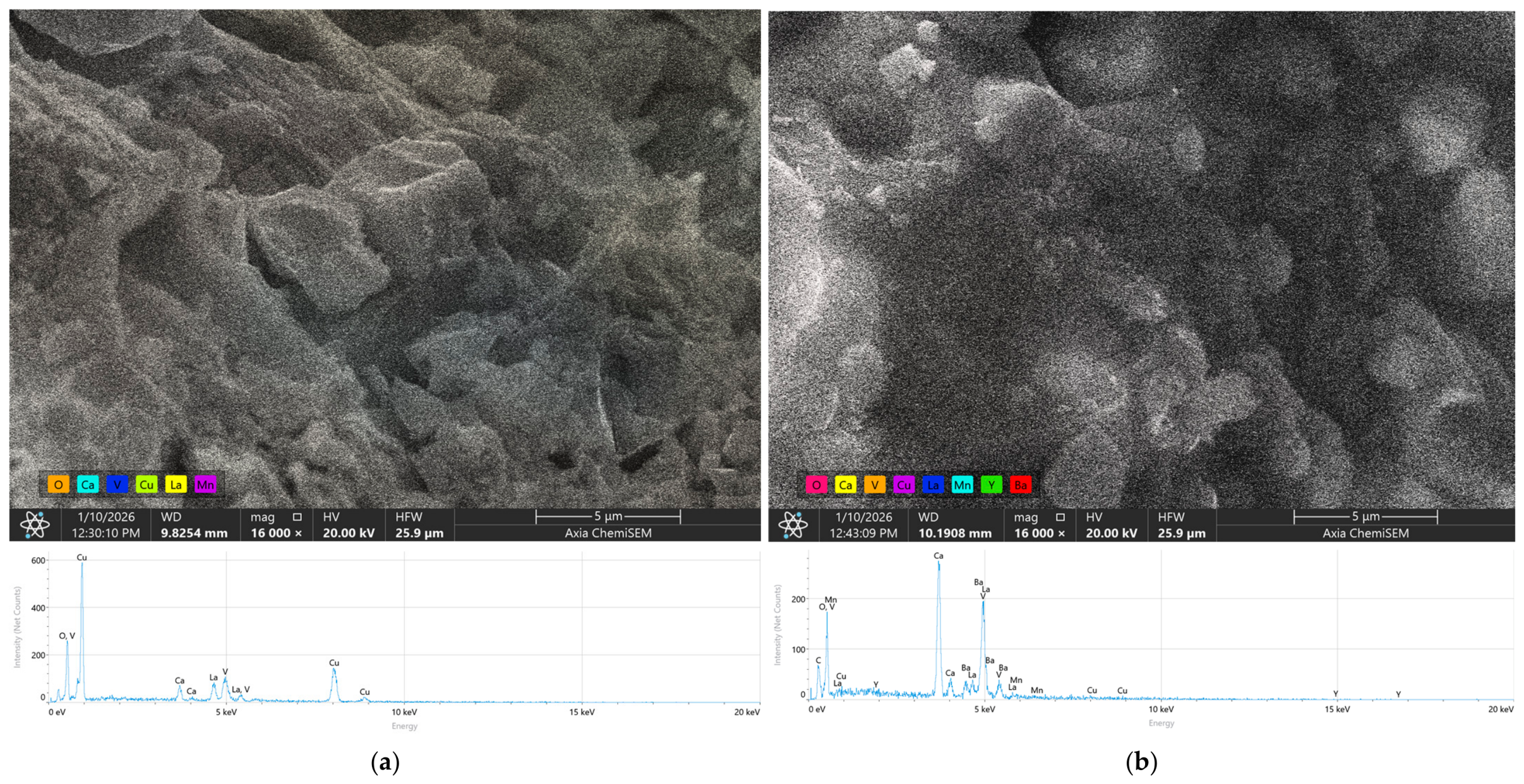
The SEM micrographs (
Figure 5a) reveal the formation of a dense aggregated microstructure consisting of irregularly shaped particles in the micrometer size range. The particles form compact agglomerates with a highly developed surface, which is characteristic of solid-state synthesized oxide systems. No pronounced morphological phase contrast is observed across the examined areas, indicating a high degree of macroscopic homogeneity and uniform phase distribution within the material.
It should be emphasized that the absence of pronounced contrast in the SEM images does not contradict the two-phase structural nature (Pnma + Pm-3m) established by X-ray diffraction analysis, since the corresponding phases are characterized by similar chemical compositions and comparable average atomic masses, which limits the possibility of their clear morphological differentiation in SEM mode.
The EDX spectra confirmed the presence of all elements corresponding to the nominal composition, namely La, Ca, Cu, V, Mn, and O, while no foreign impurity elements were detected. The quantitative analysis of the elemental atomic fractions showed satisfactory agreement with the calculated stoichiometric composition, which confirms the high degree of chemical homogeneity of the synthesized multicomponent oxide system.
Therefore, the SEM–EDX results indicate the formation of a chemically homogeneous perovskite-type oxide system without pronounced macroscopic elemental segregation.
The SEM micrographs of the composite (
Figure 5b) also reveal an aggregated microstructure consisting of irregularly shaped particles in the micrometer size range. No obvious macroscopic phase segregation is observed, indicating a high degree of morphological uniformity of the composite.
The EDX spectrum confirms the presence of the elements of the main matrix (La, Ca, Cu, V, Mn, and O), as well as the characteristic elements of the superconducting phase, namely Y and Ba. The elemental mapping results demonstrate a fairly uniform distribution of all components across the sample surface, indicating good interphase contact and effective integration of the phases within the composite.
The weak carbon signal observed in the spectrum is attributed to the use of a carbon conductive substrate and/or carbon coating during sample preparation and was therefore excluded from the quantitative analysis.
Thus, the introduction of YBa2Cu3Ox does not lead to pronounced macroscopic segregation and ensures the formation of a structurally and chemically integrated multiphase composite system.
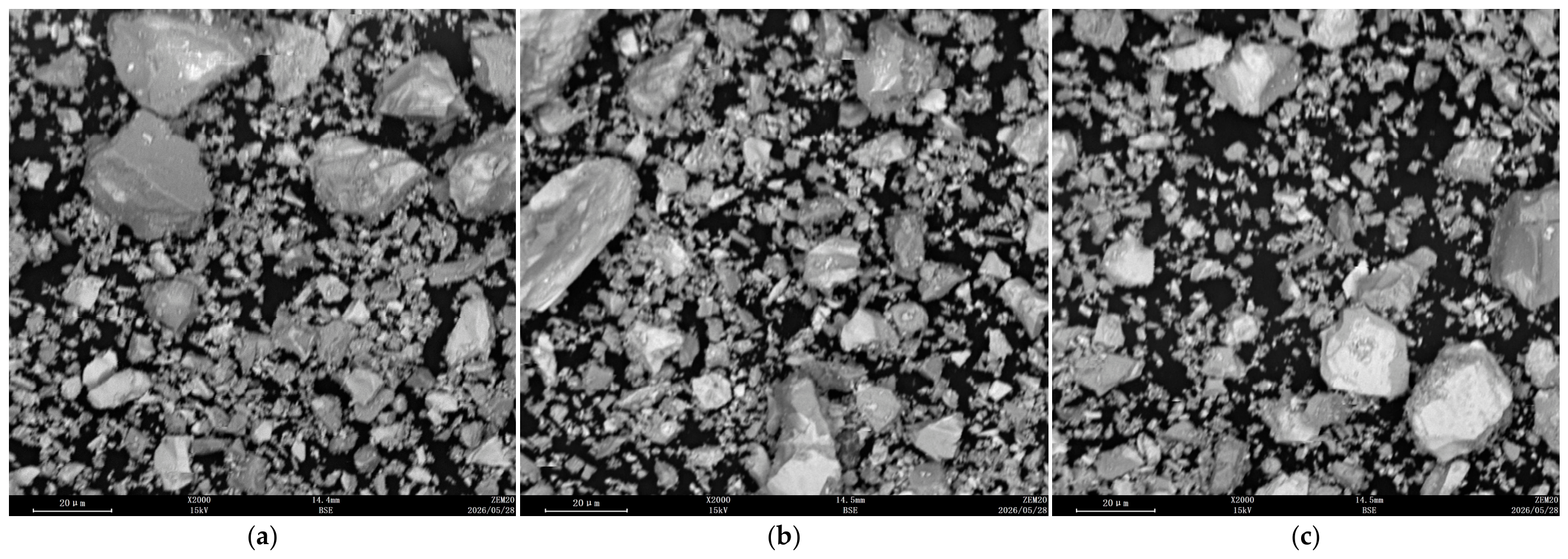
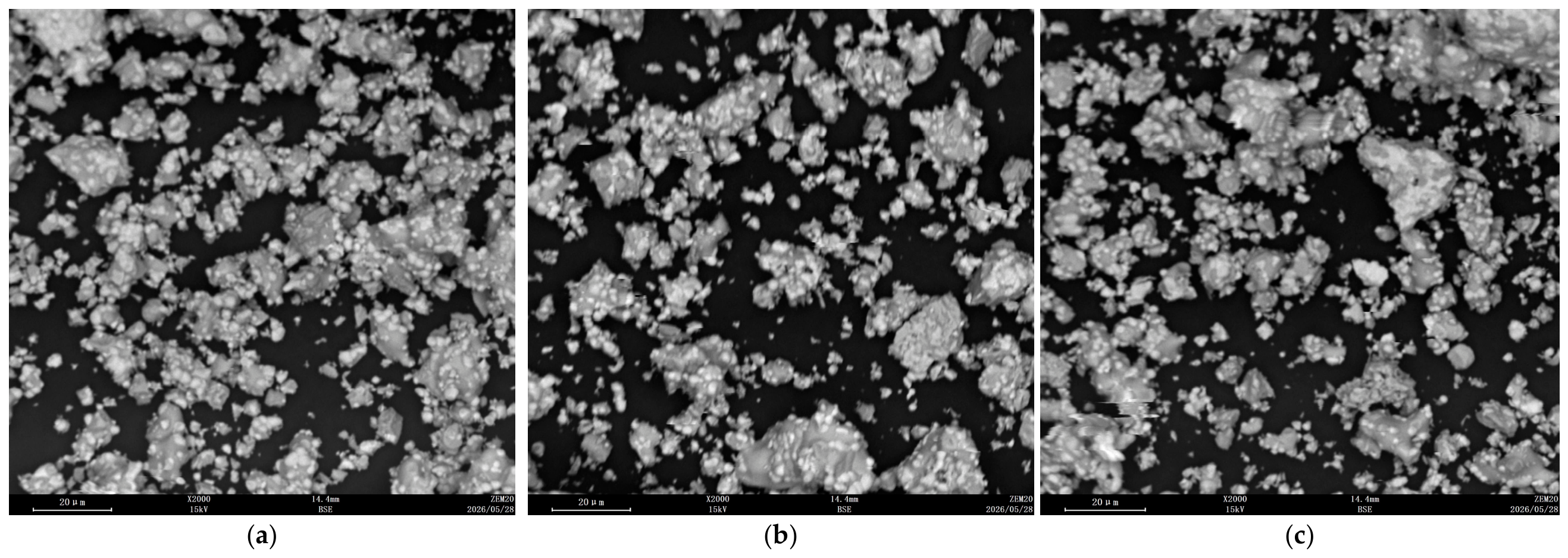
Figure 6a–c show agglomerated particles predominantly exhibiting irregular polyhedral shapes with a broad size distribution. In addition to large, well-faceted grains, a fine-dispersed fraction is present and uniformly distributed between the larger particles. The similarity of the morphological features observed in different regions of the sample indicates that the identified microstructure is representative of the entire investigated material.
As shown in
Figure 7a–c, the sample consists of agglomerated particles with a broad size distribution. Large and medium-sized particles coexist with a fine-dispersed fraction that is uniformly distributed throughout the sample volume. The similar morphological features observed in different regions indicate that the revealed microstructure is representative of the entire material and that no pronounced macroscopic phase segregation is present.
The introduction of 10 wt.% YBa2Cu3Ox leads to the formation of a more heterogeneous and highly developed fine-dispersed microstructure, which contributes to an increase in the interfacial interaction area and improves interparticle contacts, thereby influencing the electrophysical properties of the composite material.
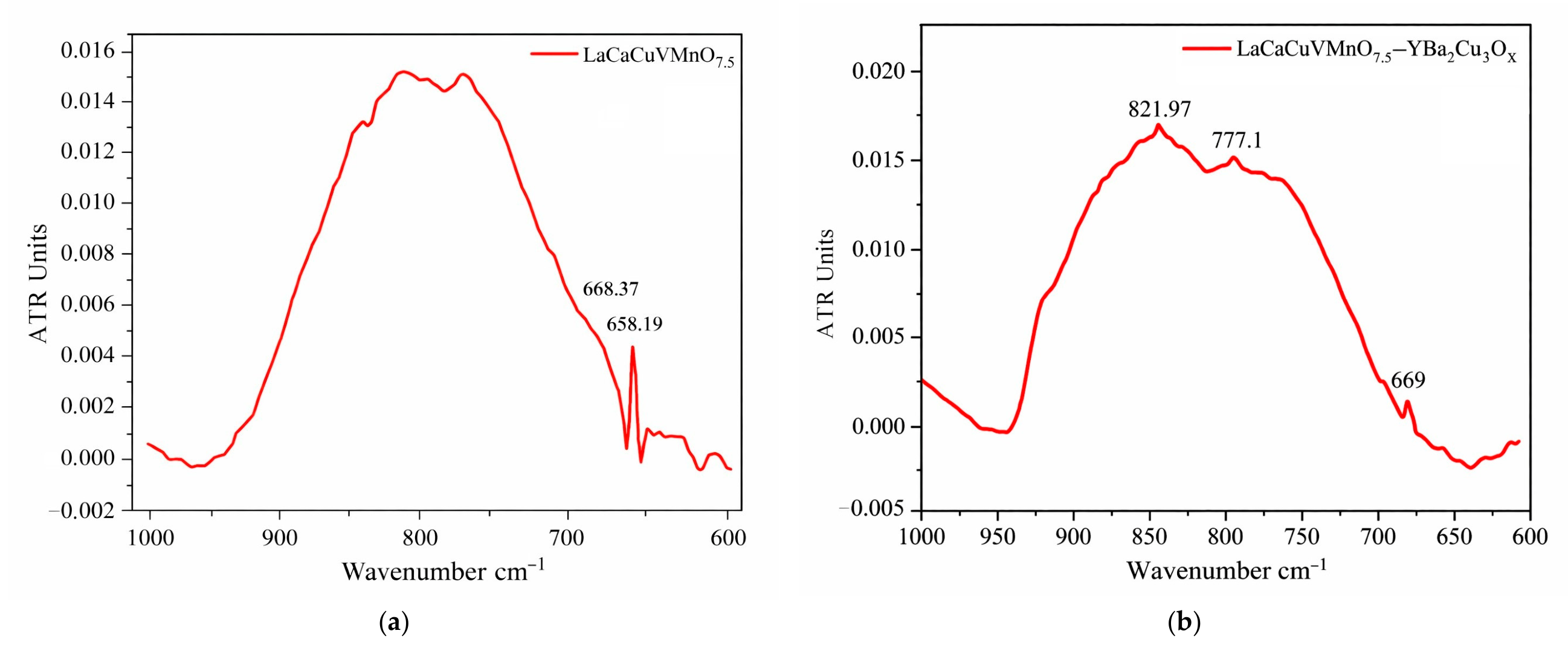
The spectrum of the material with the nominal composition LaCaCuVMnO
7.5 is characterized by a broad absorption band centered in the 750–800 cm
−1 region and two pronounced sharp peaks at 668.37 and 658.19 cm
−1 (
Figure 8a). These absorption bands are attributed to the stretching vibrations of Mn–O, Cu–O, and V–O bonds in the octahedral BO
6 coordination environment typical of perovskite-type structures. The broad band observed in the 800–900 cm
−1 region is associated with the overlapping asymmetric bridging vibrations of M–O–M bonds, indicating the presence of local lattice distortions characteristic of oxygen-deficient and doped manganite oxides.
Taking into account the two-phase composition of the material, comprising the orthorhombic phase (Pnma, ~79 wt.%) and the cubic phase (Pm-3m, ~21 wt.%), the observed FTIR spectrum should be regarded as a superposition of the vibrational modes originating from both crystalline phases. The dominant contribution to the intense bands at 658–668 cm−1 is most likely associated with the Cu-doped orthorhombic phase, due to its substantially higher weight fraction. In contrast, the minor V-containing cubic phase may additionally contribute to the broadening of the wide absorption band as a result of local distortions of the Mn/VO6 octahedral units and increased lattice disorder.
The absence of additional absorption bands confirms the chemical purity of the synthesized material and indicates the absence of detectable impurity phases within the sensitivity limits of the FTIR method. Furthermore, the obtained spectrum is in good agreement with literature data reported for transition-metal-doped La–Ca–Mn–O perovskite systems, which further supports the formation of the target perovskite-type oxide structure.
Following modification with 10 wt.% YBa
2Cu
3O
x, the FTIR spectrum undergoes significant changes (
Figure 8b), characterized by the appearance of a broad absorption band centered in the 800–850 cm
−1 region, together with additional pronounced peaks at 821.97 and 777.1 cm
−1, as well as a distinct shoulder/peak shift near 669 cm
−1.
The new absorption bands observed in the 777–822 cm−1 region are characteristic of Cu–O vibrational modes associated with the CuO2 planes and chains, as well as Ba–O vibrations characteristic of the YBa2Cu3Ox structure. The persistence of the band near ~668–669 cm−1 suggests that the manganite perovskite matrix is largely preserved after composite formation. However, the observed modifications in the band intensity and spectral shape may indicate possible interphase interactions, oxygen-vacancy redistribution, and local lattice distortions within the composite system.
The absence of extraneous absorption bands confirms the chemical purity of the synthesized material and indicates the absence of significant impurity phases within the detection limits of FTIR spectroscopy. Furthermore, the obtained spectra show good agreement with literature data reported for transition-metal-doped La–Ca–Mn–O perovskites and for YBa2Cu3Ox-based composite systems, which additionally confirms the successful formation of the target structurally integrated oxide composite. Since detailed peak deconvolution and quantitative fitting analysis were not performed in the present study, the observed spectral changes should be considered as qualitative evidence supporting structural modification and possible interphase interactions in the composite system.
The spectra are in good agreement with literature data reported for transition-metal-doped La–Ca–Mn–O perovskite systems and YBa
2Cu
3O
x-based composites [
26,
27,
28,
29,
30,
31], which further confirms the successful formation of the target structurally integrated oxide composite.
To investigate the redox behavior and oxygen mobility of the synthesized materials, temperature-programmed oxidation (TPO–O
2) was carried out after preliminary reduction of the sample. This technique is widely used for studying the stepwise reoxidation processes and oxygen transport characteristics in perovskite-like and mixed transition-metal oxide systems [
32,
33,
34].
Before the oxidation experiment, the samples (63 mg, particle size 0.300–0.50 mm) were subjected to in situ pre-reduction in a hydrogen flow (30 mL·min−1) at 465 °C for 40 min. After reduction, the samples were purged with helium and cooled to 50 °C at a rate of 15 °C·min−1, followed by an isothermal hold for 30 min. Subsequently, a He/O2 gas mixture (30 mL·min−1, 5 vol.% O2 in He) was introduced, and the temperature was increased at 10 °C·min−1 up to 950 °C. After completion of the TPO experiment, the samples were purged with helium and cooled to 100 °C at 15 °C·min−1.
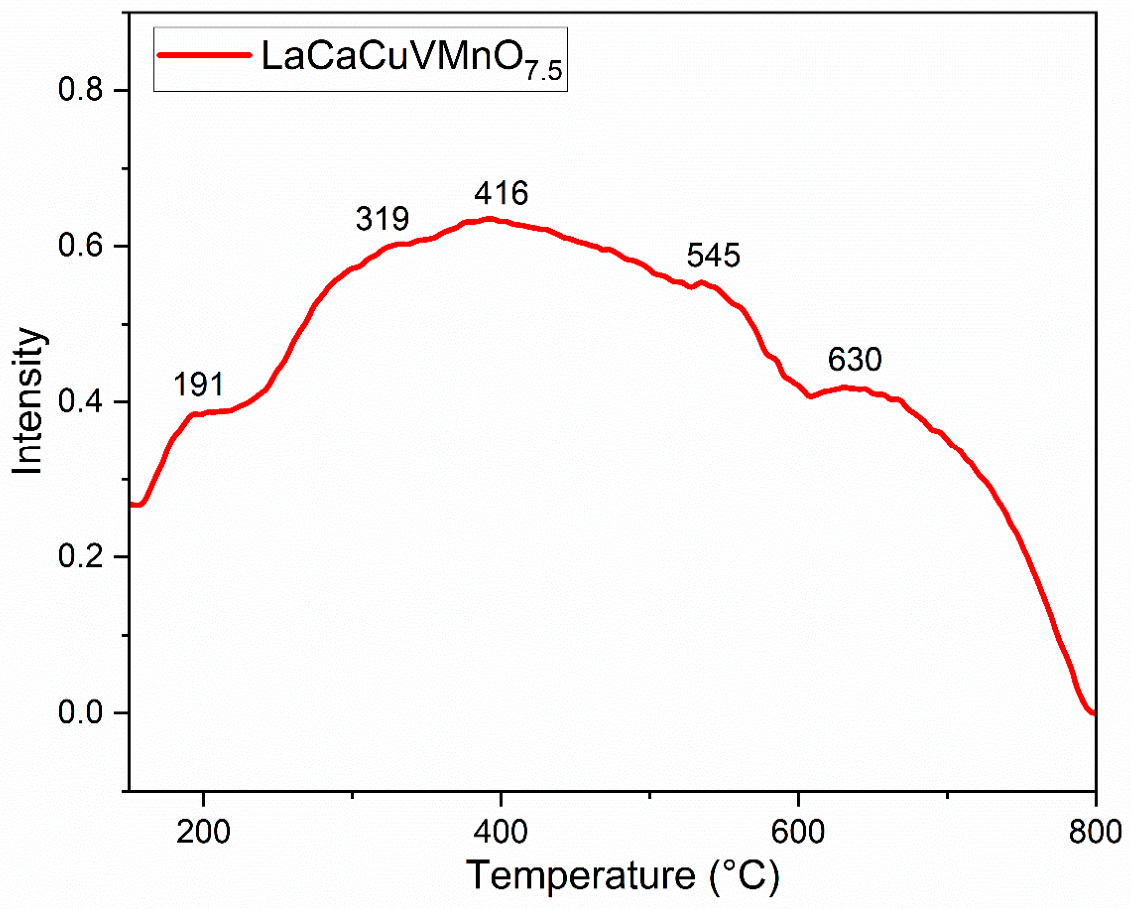
To investigate the redox behavior and oxygen mobility, TPO profiles were recorded for the pre-reduced sample with the nominal composition LaCaCuVMnO
7.5 (
Figure 9).
The TPO profile of the material with the nominal composition LaCaCuVMnO7.5 exhibits a pronounced multistage reoxidation behavior. The observed maxima at approximately 191, 319, 416, 545, and 630 °C are attributed to the sequential activation of surface and bulk redox domains, together with the stepwise incorporation of oxygen into vacancy sites. These temperature regions are more appropriately interpreted in terms of redox-active domains and oxygen exchange processes, rather than as isolated individual ionic transitions.
The low-temperature peak observed at ~191 °C is attributed to the oxidation of the most reactive surface-reduced centers. In Cu-containing oxide systems, similar low-temperature TPR/TPO maxima are commonly associated with the reoxidation of surface Cu-containing redox-active sites [
32,
35].
The medium-temperature maxima observed at ~319 and ~416 °C are characteristic of mixed Mn- and Cu-containing oxide systems, particularly perovskite-type structures, and can be attributed to subsurface and bulk reoxidation processes, accompanied by rearrangement of the oxygen sublattice and redistribution of oxygen vacancies [
22,
23,
24,
25,
26,
27,
28,
29,
30,
31,
32,
33,
34,
36].
The high-temperature maxima observed at ~545 and ~630 °C are attributed to diffusion-controlled bulk oxidation processes, which are typical of Mn- and V-containing complex oxide systems, including perovskite-like structures [
33,
34,
37].
The presence of multistage maxima in the TPO profiles suggests the existence of several types of redox-active centers, indicating the mixed-valence nature of the transition metal ions. Furthermore, the XRD analysis demonstrated that the compound with the nominal composition LaCaCuVMnO7.5 is formed as a two-phase system, comprising approximately 79% of the orthorhombic perovskite-like phase and 21% of the cubic phase.
The characteristic valence states of Cu, Mn, and V for similar phases have been reported in the literature and were taken into account in the present interpretation. Thus, the combination of the experimental findings with literature data enables a qualitative indirect evaluation of the valence states, which is sufficient for discussing the redox behavior of the investigated multiphase system [
13,
16,
19,
25,
38].
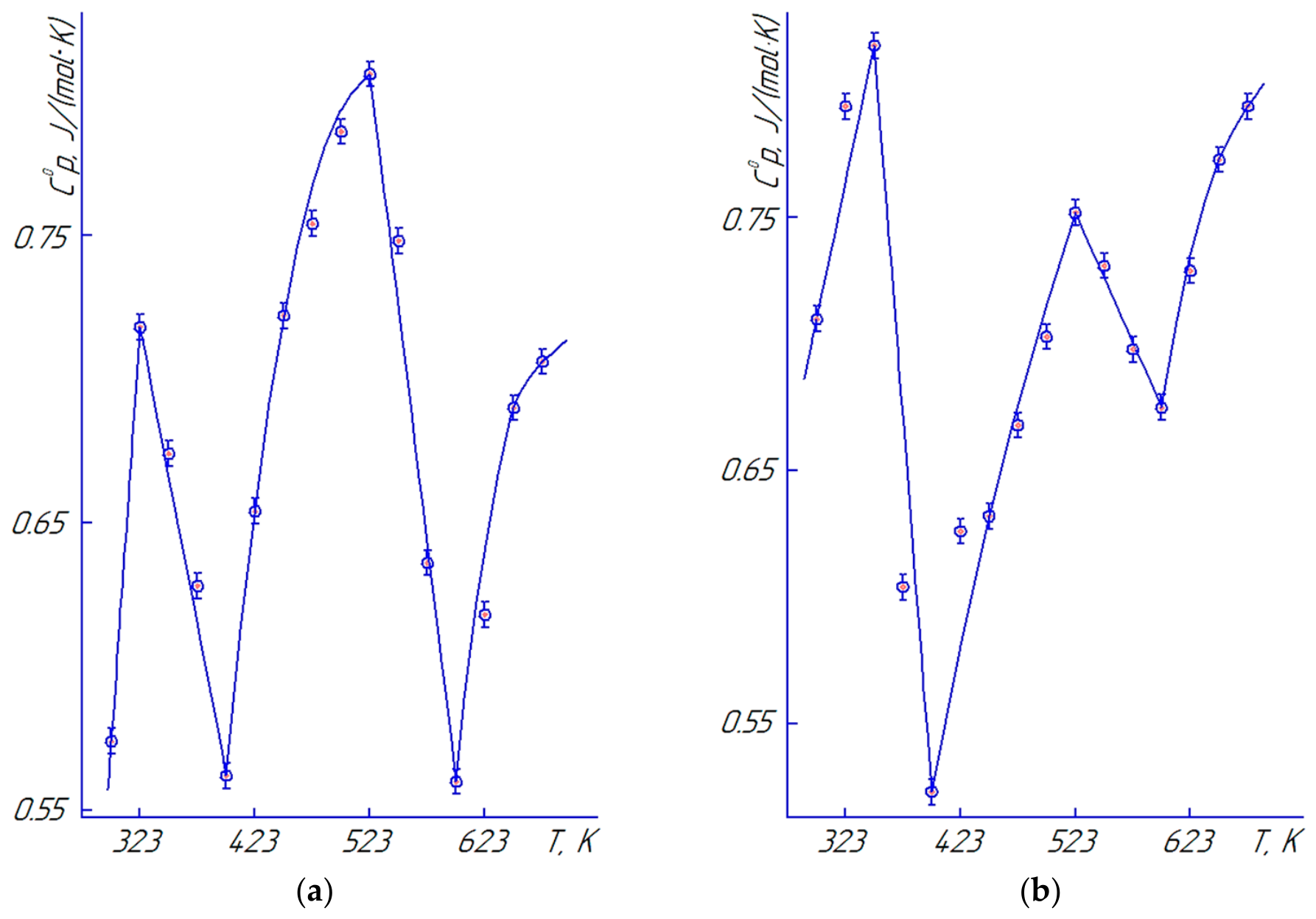
It should be noted that the heat-capacity measurements were performed with a temperature interval of 25 K; therefore, the observed anomalies should be considered qualitative indicators of possible phase-transition-like behavior rather than definitive confirmation of a continuous second-order phase transition.
Pronounced λ-type-like anomalies were observed in the temperature dependence of the heat capacity of the investigated compounds at different temperatures, which may be associated with possible structural, electronic, or interphase transformations in the investigated oxide systems.
For the two-phase perovskite system with the nominal composition LaCaCuVMnO7.5 (Pnma + Pm-3m), λ-type-like anomalies in the heat capacity were observed near 373 and 523 K, whereas for the composite modified with YBa2Cu3Ox, similar anomalies were detected near 348 and 523 K. These features may be associated with complex cooperative processes in the multiphase oxide system, including possible changes in charge-carrier transport, interfacial polarization effects, local structural rearrangements, and other temperature-induced transformations. Due to the limited temperature resolution of the calorimetric measurements, the observed anomalies should be considered qualitative indicators of possible phase-transition-like behavior.
Based on the experimentally established phase transition temperatures, a set of analytical equations was derived to accurately describe the temperature dependence of the heat capacity, C°
p ~ f(T), for the two-phase perovskite system with the nominal composition LaCaCuVMnO
7.5 (Pnma + Pm-3m) (Equations (1)–(5)), and for the corresponding YBa
2Cu
3O
x—modified composite system (Equations (6)–(10)).
The specific heat capacity (Cp) of the two-phase perovskite system with the nominal composition LaCaCuVMnO7.5 (Pnma ~79 wt.% + Pm-3m ~21 wt.%) was determined to be 0.71 J/(g·K) at 298 K. A pronounced decrease in Cp to approximately 0.52–0.62 J/(g·K) was observed within the 373–423 K temperature interval, indicating the presence of thermally induced structural or electronic transformations.
Following the introduction of 10 wt.% YBa2Cu3Ox, the anomalous regions in the Cp(T) profile were preserved; however, their shape and amplitude underwent significant modification. Specifically, the temperature dependence became smoother in the low-temperature region, while the characteristic anomalies in the 373–423 K interval remained clearly distinguishable.
The observed anomalies can most likely be attributed to local structural distortions of the perovskite matrix, the redistribution of oxygen vacancies, and electronic correlation effects characteristic of La–Ca–Mn–O manganite systems. Considering the predominance of the orthorhombic phase (Pnma), this structural modification is expected to make the major contribution to the temperature-dependent features of the heat capacity. At the same time, the minor cubic phase (Pm-3m), together with the introduction of YBa2Cu3Ox, may contribute to the broadening of the transition regions as a result of interphase interactions, local strain effects, and possible percolation phenomena at the phase boundaries.
For additional verification of the reliability of the calorimetric measurements, the heat capacity of the α-Al
2O
3 reference sample was determined and compared with literature data, as summarized in
Table 4 [
39].
As shown by the data presented in
Table 4, the obtained results for the temperature dependence of the heat capacity of α-Al
2O
3 in the 300–673 K range are in good agreement with the literature values reported in [
39], within the instrumental accuracy limits of the IT-C-400 calorimeter.
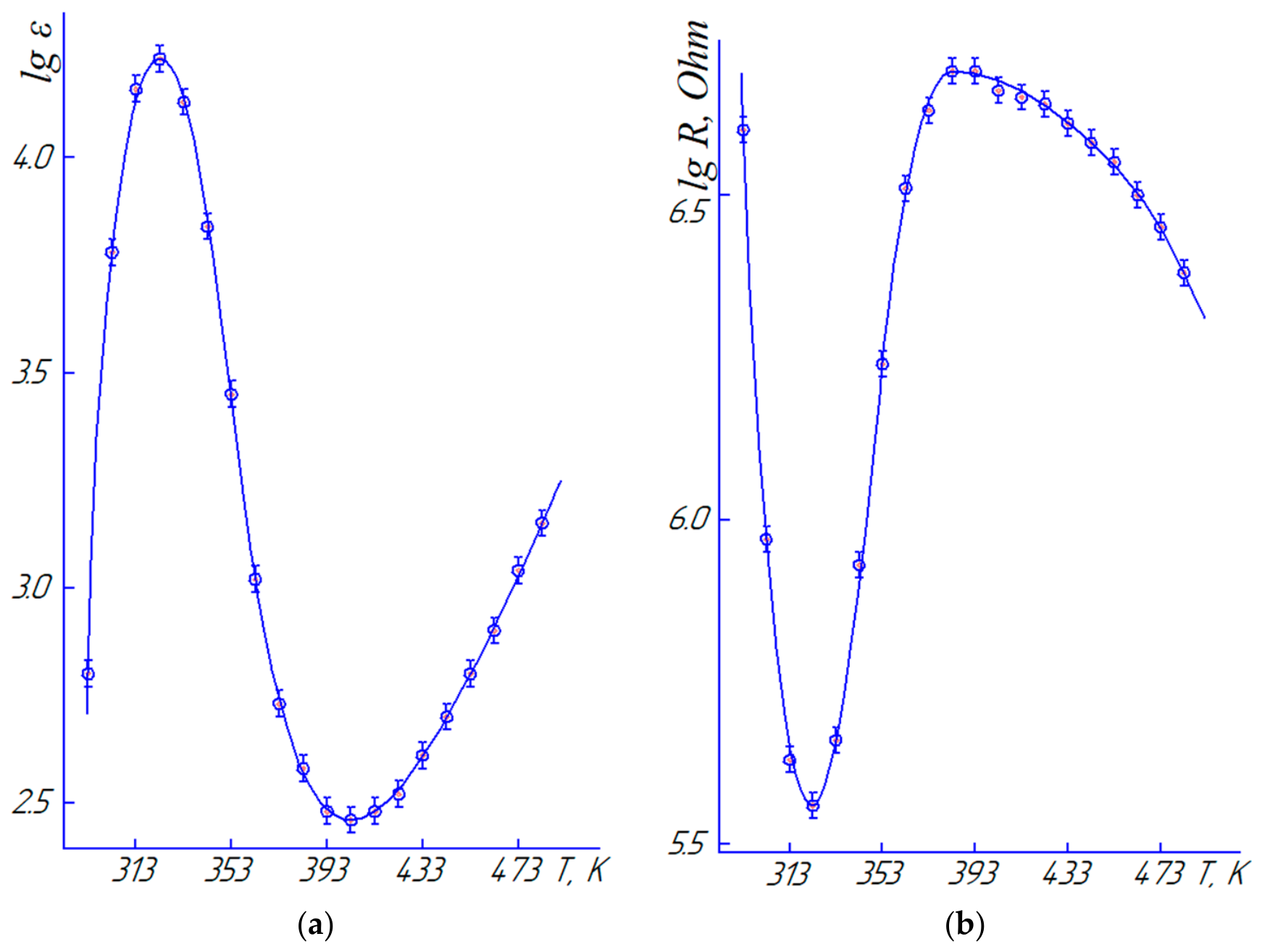
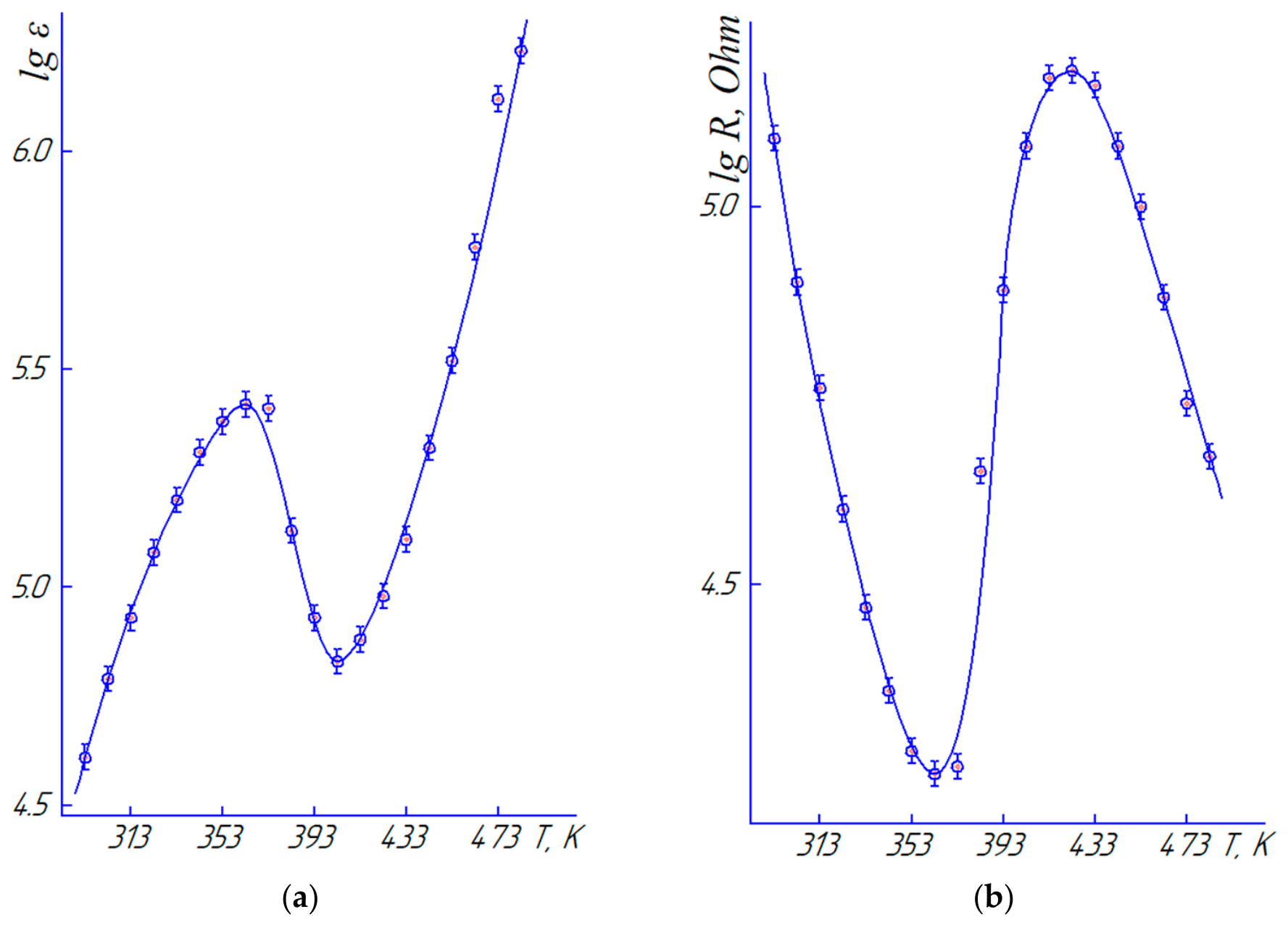
The electrophysical results summarized in
Table 5 and
Figure 11 and
Figure 12 enable a detailed analysis of their correlation with the structural state of the two-phase system, as well as an assessment of the influence of the superconducting YBa
2Cu
3O
x phase on the temperature dependence of the electrical characteristics.
Table 5 presents the temperature-dependent electrical resistance (R), dielectric permittivity (ε), and their corresponding logarithmic values (lgR and lgε) for the two-phase oxide system LaCaCuVMnO
7.5 (sample I) and its YBa
2Cu
3O
x-modified composite (sample II), measured at a frequency of 1 kHz.
For the initial system (I), consisting of orthorhombic and cubic perovskite phases, a non-monotonic temperature dependence of the electrical resistance and dielectric permittivity was observed. In the 293–353 K temperature range, the resistance decreases, which is characteristic of thermally activated conductivity typically observed in mixed transition-metal oxides with variable valence states of Mn and V cations. With a further increase in temperature, an increase in R is recorded, which may be associated with the redistribution of charge carriers and a modification of the charge transport mechanism, including the contribution of oxygen vacancies, intergranular potential barriers, and interphase effects inherent to the two-phase structure.
For sample I, the dielectric permittivity (ε) exhibits a pronounced maximum in the 313–323 K temperature range, followed by a gradual decrease with further temperature increase. This behavior indicates the relaxation nature of the polarization processes and may reflect a local structural rearrangement in the vicinity of the phase boundaries. Considering the two-phase nature of the system, the observed anomalies can most likely be attributed to the heterogeneous distribution of regions with different electrical conductivity, as well as to possible interfacial polarization effects and defect-related charge accumulation.
For the composite sample II, a pronounced decrease in electrical resistance is observed throughout the entire investigated temperature range in comparison with the parent oxide, which is most likely associated with the incorporation of the highly conductive YBa2Cu3Ox copper-containing phase. In the 293–343 K temperature interval, a marked reduction in R, together with a sharp increase in the dielectric permittivity (ε), is observed, indicating the formation of an efficient percolation-type conducting network and a significant enhancement of intergranular and interphase polarization effects.
The temperature dependence of the electrical properties of the investigated samples indicates a semiconducting nature of conductivity, which is typical of perovskite-like transition metal oxides. The observed changes in the electrical properties of the composite are associated with the combined contribution of the semiconducting perovskite phases of the La–Ca–Cu–V–Mn–O matrix and the highly conductive cuprate phase YBa2Cu3Ox.
The incorporation of YBa2Cu3Ox promotes the formation of additional conductive pathways within the bulk of the material, which may lead to a decrease in electrical resistance and an enhancement of the dielectric response. It should be noted that, in a multiphase system, the transport properties may be governed not only by the bulk conductivity of the individual phases but also by their mutual spatial distribution and the presence of interfacial boundaries, which can significantly affect the redistribution of charge carriers.
A similar influence of the conductive cuprate phase on the transport and dielectric properties has previously been reported for YBCO-containing composites, where the introduction of YBa
2Cu
3O
x was associated with improved conductivity and a modified electrical response of the system [
40,
41].
At temperatures above ~360 K, the dielectric permittivity of the composite increases by more than one order of magnitude, reaching approximately 106 in the 473–483 K range, which clearly indicates the dominance of interfacial (Maxwell–Wagner-type) polarization and intensified charge accumulation at the boundaries between the perovskite matrix and the YBa2Cu3Ox conductive phase. Within the investigated temperature interval (293–483 K), the superconducting transition of YBa2Cu3Ox is not realized, since this range lies well above its characteristic Tc; however, its high intrinsic electronic conductivity significantly affects the macroscopic electrophysical response of the composite system.
Thus, the incorporation of YBa2Cu3Ox results in a pronounced reduction in the specific electrical resistance, a substantial enhancement of the dielectric response, and a more clearly expressed temperature dependence of lgε and lgR, reflecting the strong influence of the conductive phase on the macroscopic electrophysical behavior of the composite.
The obtained results are fully consistent with the two-phase microstructure revealed by X-ray diffraction analysis and confirm that the electrophysical response of the composite system is governed by the synergistic contribution of the La–Ca–Cu–V–Mn–O perovskite matrix and the highly conductive YBa2Cu3Ox phase.
According to the technical specifications of the measuring system, the instrumental error for capacitance, dielectric permittivity (ε), and electrical resistance (R) does not exceed ±0.05%, which confirms the high reliability, precision, and reproducibility of the obtained experimental data. An additional validation of the measurement methodology was performed using a reference BaTiO
3 sample, which showed satisfactory agreement between the measured ε value at 293 K (1296) and the recommended literature interval of 1400 ± 250 [
42,
43,
44,
45], thereby further confirming the accuracy and validity of the measurement protocol.
Overall, the combined temperature-dependent behavior of ε(T) and R(T) reflects the complex mechanisms of charge transport and polarization in the multiphase composite system and provides an important basis for a more detailed interpretation of the role of interfacial interactions, defect chemistry, and oxygen ion mobility in governing the macroscopic electrophysical properties of the material.
The correlation between the heat capacity behavior and the electrophysical characteristics of the investigated compounds reflects the complex coupled processes occurring in the material as its structural state evolves with temperature. The observed heat-capacity anomalies are accompanied by pronounced variations in the electrical resistance and dielectric permittivity, clearly indicating the interdependent nature of the thermal and electrical responses of the system.
Such features can most likely be attributed to the redistribution of charge carriers, variations in the oxygen vacancy concentration, as well as local structural rearrangements and changes at the interphase boundaries of the two-phase matrix.
The activation energy of electrical conductivity (E
a) was calculated according to the methodology reported in Ref. [
46]. For the two-phase oxide system with the nominal composition LaCaCuVMnO
7.5, the E
a value was derived from the temperature dependence of the electrical resistance, as described by Equation (11):
where R denotes the electrical resistance, R
0 is the pre-exponential factor, E
a is the activation energy of electrical conductivity, k is the Boltzmann constant, and T is the absolute temperature.
After logarithmic transformation, the expression takes the following linearized form (Equation (12)):
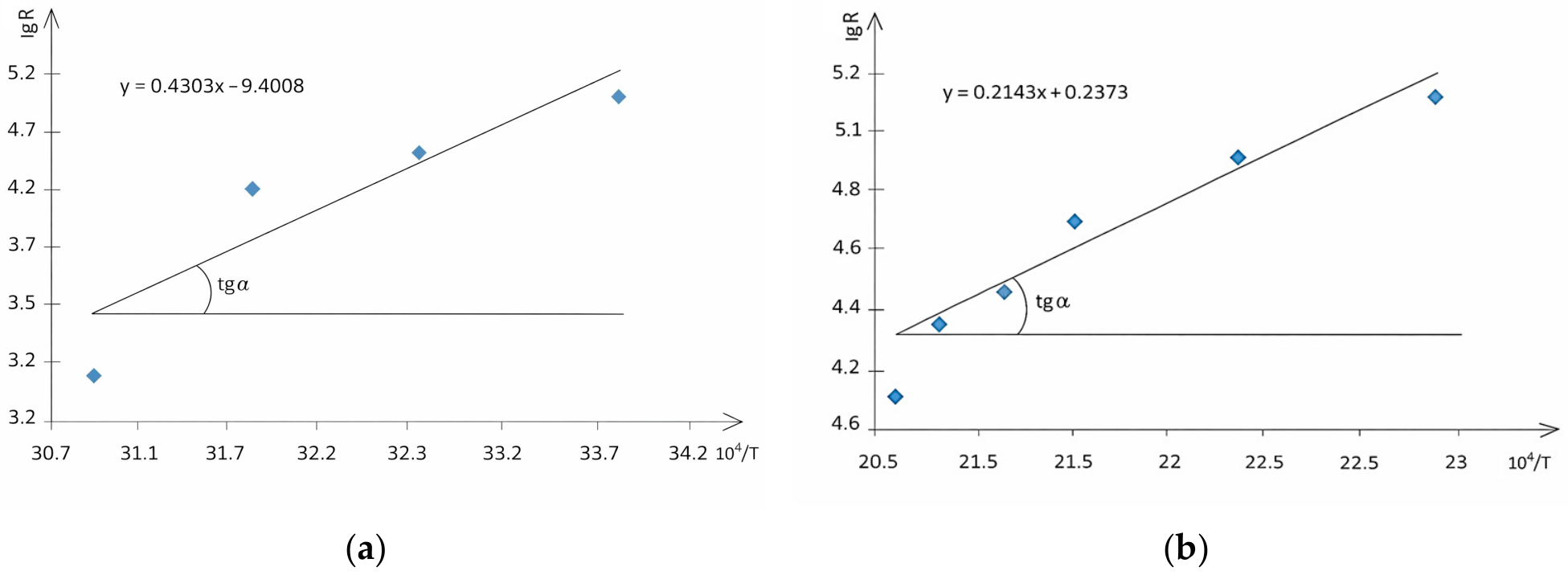
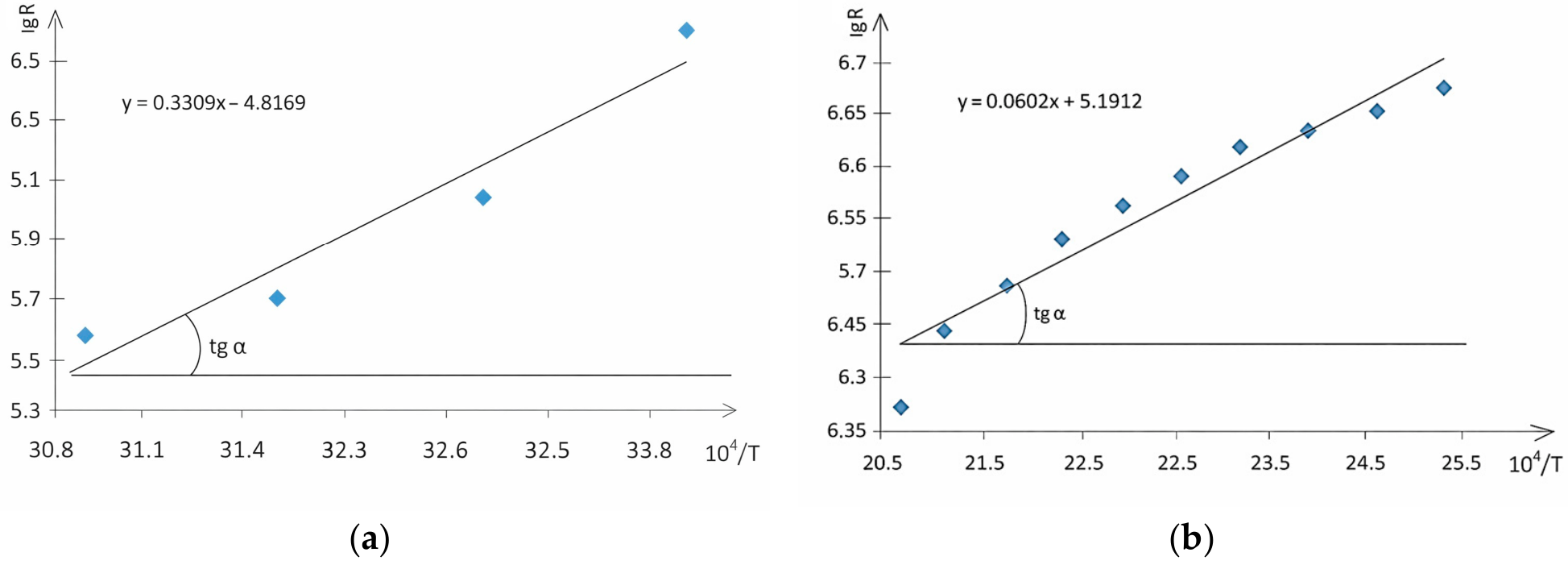
For the analysis of the experimental data, the Arrhenius-type dependences of lgR versus 104/T were constructed, allowing the activation energy of electrical conductivity (Ea) to be determined from the slope of the linear regions of the plots.
The activation energy was determined by constructing an Arrhenius-type scatter plot of lgR versus 10
4/T based on the experimental data, followed by linear regression analysis, or equivalently by solving the linear relation lg y = a + bx (where y = lgR and x = 10
4/T) (
Figure 13).
The experimental dependences were linearly fitted using the least-squares method. The resulting linear regression equation is expressed in the form of Equation (13):
where the slope coefficient (b) is directly related to the activation energy of electrical conductivity (E
a) through the following expression (Equation (14)):
where the slope coefficient (b) is related to the activation energy of electrical conductivity (E
a) according to the following expression, when the data are plotted in the 10
4/T coordinates.
Based on the slopes of the linear regions of the Arrhenius-type plots, the activation energy of electrical conductivity (Ea) for the system with the nominal composition LaCaCuVMnO7.5 was determined to be 0.66 eV in the 293–323 K temperature interval and 0.12 eV in the 393–483 K interval.
The observed decrease in the activation energy with increasing temperature indicates a facilitation of charge transport processes and suggests a possible transition in the dominant conduction mechanism within the investigated material. It should be emphasized that the calculated activation energy should be regarded as an effective parameter of the heterophase system rather than a phase-specific characteristic. Because the electrical resistance measurements were performed on a macroscopic bulk specimen, the obtained values inherently reflect the combined contribution of all structural components, including the individual crystalline phases, interphase boundaries, and intergranular regions. Accordingly, the calculated activation energy characterizes the integral charge transport behavior of the multiphase system and cannot be directly attributed to any single crystalline phase.
The band gap energy (E
g) was estimated from the temperature dependence of the electrical resistance using the following expression (Equation (15)):
where 0.43 ≈ 1/2.303 is the conversion factor arising from the transformation between natural logarithm (ln) and decimal logarithm (lg) in the Arrhenius equation, k = 8.617 × 10
−5 eV/K is the Boltzmann constant, and R
1 and R
2 are the resistances at temperatures T
1 and T
2, respectively.
For the 293–323 K temperature range, the corresponding calculation can be written in the following form (Equation (16)):
For the 393–483 K temperature range, the corresponding calculation can be written in the following form (Equation (17)):
Such values are typical of oxide semiconductor systems and further confirm the semiconducting nature of the investigated compound. The decrease in the effective band gap energy with increasing temperature is most likely associated with enhanced charge carrier mobility, thermally activated defect states, and possible modifications of the prevailing conduction mechanism.
It should be emphasized that the obtained Ea and Eg values should be considered as effective integral parameters of the heterogeneous composite system, rather than as characteristics of the individual crystalline phases.
For the LaCaCuVMnO
7.5 + YBa
2Cu
3O
x composite system, the activation energy of electrical conductivity was determined analogously from the temperature dependence of the electrical resistance (
Figure 14).
For this purpose, Arrhenius-type dependences of lgR versus 104/T were constructed. The presence of well-defined linear regions in these coordinates confirms the applicability of the thermally activated charge transport model.
For the 293–323 K temperature range, the Arrhenius-type dependence of lgR versus 1/T can be described by the following linear equation (Equation (18)):
Based on the slope of the linear region, the activation energy of electrical conductivity (E
a) was determined using the following expression (Equation (19)):
which yields an activation energy (E
a) of 0.74 eV.
For the 433–483 K temperature range, the corresponding dependence can be expressed in the following form (Equation (20)):
which yields an activation energy of electrical conductivity (E
a) of 0.37 eV.
It should be noted that the investigated composite contains approximately 10 wt.% of the YBa2Cu3Ox phase, which is a high-temperature superconductor with a critical temperature of Tc ≈ 90 K. However, within the considered temperature range of 293–483 K, the temperature is substantially higher than Tc; therefore, the YBa2Cu3Ox phase remains in its normal (non-superconducting) state, exhibiting the properties of a highly conductive oxide phase.
Accordingly, the obtained activation energy values should be regarded as effective parameters characterizing the electrical properties of the entire heterogeneous system, rather than those of the individual crystalline phases.
The band gap energy of sample II [(Pnma + Pm-3m) + YBa2Cu3Ox] was estimated from the temperature dependence of the electrical resistance using Equation (15). The calculations showed that for this sample, the band gap energy (Eg) is 1.79 eV in the 293–323 K interval and 1.85 eV in the 433–483 K interval. The obtained values fall within the range typical of oxide semiconductors.
It should be emphasized that the calculated Ea and Eg values should be regarded as effective integral parameters of the entire multiphase system, since the measurements were carried out on a macroscopic bulk specimen. Accordingly, these values reflect the combined contribution of all structural components of the material, including the individual crystalline phases, interphase boundaries, and intergranular regions. The incorporation of the YBa2Cu3Ox superconducting phase significantly modifies the electrophysical response of the parent perovskite system, resulting in a pronounced decrease in electrical resistance and a substantial enhancement of the dielectric response. These findings demonstrate the considerable potential of such multiphase oxide systems as functional elements of advanced complex oxide materials and composite structures for electronic applications.



 ,
, 



 —experimental data, calculated data.