


Abstract
Background/Objectives: GLP-1 receptor agonists (GLP-1RAs) and the dual GIP/GLP-1 receptor agonist tirzepatide reduce body weight, but their effects on muscle-related body-composition measures and physical function remain uncertain. We evaluated changes in skeletal muscle mass (SMM), lean mass, and related outcomes and performed a focused meta-analysis of compatible bioelectrical impedance analysis (BIA) cohorts. Methods: PubMed, Embase, and the Cochrane Library were searched for studies published from 2009 through 30 April 2026. Eighteen unique studies reported in 19 publications were included. A post hoc quantitative synthesis pooled five BIA-derived cohorts from four studies in adults with type 2 diabetes using a random-effects model. Results: Nineteen publications describing 18 unique studies (total n = 3541; age range 45.4–76.7 years) were included. The pooled within-group change across compatible BIA cohorts was −0.90 kg (95% CI −1.21 to −0.59; I2 = 57.3%). This estimate does not establish a causal drug effect. DXA and BIA outcomes were synthesized separately because they are not interchangeable. Conclusions: GLP-1RA treatment was accompanied by a small within-group reduction in heterogeneous BIA-derived muscle-mass estimates, but the certainty of this evidence was very low. DXA-derived lean mass, BIA-derived muscle mass, and sarcopenia are not interchangeable outcomes. The available data do not establish a drug-specific loss of contractile muscle or functional decline. Standardized controlled studies incorporating muscle strength and physical performance are required.
1. Introduction
Glucagon-like peptide-1 receptor agonists (GLP-1RAs) improve glycemic control and reduce body weight through complementary metabolic and appetite-mediated mechanisms [1,2,3,4,5,6,7,8]. Large randomized trials have established clinically meaningful weight loss with liraglutide, semaglutide, and tirzepatide [7,9,10,11]. Because weight loss may include lean as well as fat tissue, preservation of muscle mass and function is clinically important, particularly in older adults and people at risk of sarcopenia [12,13,14,15,16,17,18]. Table 1 presents the recommended terminology.
Table 1.
Recommended body composition terminology.
Previous syntheses used broader but different evidence bases. Anyiam et al. included 38 studies, of which 34 entered quantitative syntheses, and reported a T2DM subgroup estimate of −0.74 kg (95% CI −1.61 to 0.14) [19]. Karakasis et al. pooled controlled lean-mass outcomes from 22 randomized trials and reported −0.86 kg (95% CI −1.30 to −0.42) [20]. Our within-group BIA estimate (−0.90 kg; 95% CI −1.21 to −0.59) is not directly comparable because the modality and estimand differ. The present review adds a modality-stratified synthesis, explicit data transformations and sensitivity analyses, and three additional eligible pre-cutoff reports identified during revision.
2. Materials and Methods
2.1. Systematic Review Tool
This systematic review was conducted according to PRISMA 2020 [21] and reported with reference to MOOSE [22]. The completed PRISMA 2020 checklist is provided as Supplementary Table S1. The protocol was registered in PROSPERO (CRD420251271695). The focused BIA quantitative synthesis and its restriction to adults with type 2 diabetes were added after protocol registration in response to peer review and are therefore explicitly identified as post hoc.
2.2. Study Identification
PubMed, Embase, and the Cochrane Library were searched from 1 January 2009 through 30 April 2026 using controlled vocabulary and free-text terms for GLP-1 receptor agonists and individual agents, tirzepatide, skeletal muscle, lean mass, fat-free mass, sarcopenia, strength, physical function, and body composition. Database-specific reconstructed strategies are provided in Supplementary Table S2; historical exports and exact run dates were not retained. Scopus, Web of Science, and grey-literature sources were not searched. Two reviewers independently screened records and assessed retrieved reports. In the original search flow, 35 reports were sought, 15 could not be retrieved, and 20 were assessed. Targeted verification during revision identified three additional eligible reports published before the cutoff date; all three were assessed and included. The archived materials did not retain the identifiers of the 15 unavailable reports or the identities and study-specific reasons for four full-text exclusions. Aggregate counts and this archival limitation are reported transparently.
2.3. Risk of Bias Assessment
Risk of bias was assessed independently by two reviewers. Comparative observational studies were evaluated with the Newcastle–Ottawa Scale (NOS) [23]. Uncontrolled before–after studies were evaluated with the NIH Quality Assessment Tool for Before–After (Pre–Post) Studies With No Control Group [24]; they were not scored with the NOS. Domain-level judgments are reported in Table 2A,B.
Randomized trials were evaluated with the Cochrane Risk of Bias 2 tool [25]. Certainty of evidence for the focused quantitative synthesis was evaluated using GRADE [26].
Table 2.
(A). Risk of bias in randomized studies assessed with RoB 2. (B). Risk of bias in observational studies. NOS was used only for comparative cohorts; the NIH before–after tool was used for uncontrolled studies.
2.4. Selection Criteria
Inclusion criteria were: (a) original human studies evaluating a GLP-1RA and a muscle-related body-composition outcome; (b) adults aged ≥18 years; (c) longitudinal randomized, crossover, prospective, retrospective, or comparative designs with extractable data; (d) a stated body-composition method; and (e) full-text availability for eligibility assessment. Tirzepatide was retained only in the narrative controlled-evidence synthesis because it is a dual GIP/GLP-1 receptor agonist and was not included in the BIA meta-analysis.
Exclusion criteria were: (a) case reports, abstracts without sufficient data, letters, editorials, systematic reviews, and meta-analyses; (b) non-English reports; (c) animal or in vitro studies; and (d) reports without an extractable muscle-related body-composition outcome.
2.5. Data Extraction and Statistical Imputation
Extracted items were design, country, sample size, sex, age, intervention, comparator, duration, body-composition device, reported tissue compartment and unit, absolute and relative change, and muscle strength, performance, or quality outcomes. Devices, compartments, and terminology for every study are summarized in Table S4.
The primary quantitative outcome was within-group mean change (follow-up minus baseline) in BIA-derived muscle mass, in kilograms. Missing SDs of change were derived from confidence intervals or baseline and follow-up SDs with an explicitly stated pre–post correlation [46]. Random-effects models used restricted maximum likelihood; heterogeneity was summarized with Cochran’s Q, I2 and its uncertainty interval, and τ2. The model was used to obtain pooled results when at least three estimates were available. Reproducible R code using meta::metagen is provided in File S1. The principal estimate is an uncontrolled temporal change, not treatment efficacy. Active-comparator observational contrasts were analyzed separately. Funnel plots and asymmetry tests were not used because fewer than ten estimates were available.
Study-Specific Data Processing
- Keskin et al. (2022) [36]: Data for the Liraglutide + Metformin group (n = 138) were extracted directly from the primary source. The study provided the mean change (−0.97 kg) and the SD of the change (1.59 kg) in Table 2. The availability of both baseline/final SDs and the change SD allowed for the empirical calculation of a correlation coefficient (r) of approximately 0.95, indicating high intra-subject measurement stability.
- Rodríguez Jiménez et al. (2024) [33]: This study reported outcomes for subcutaneous (SS) and oral (OS) semaglutide. The mean changes were −1.1 kg (SS) and −0.5 kg (OS). The SDs of the change were back-calculated from the provided 95% Confidence Intervals (CI) using the inverse t-distribution (1.66 kg for SS and 1.55 kg for OS); the published mean changes were retained, and only the half-width of each CI was used. The correlation coefficients derived were 0.98 (SS) and 0.97 (OS).
- Yajima et al. (2018) [37]: among hemodialysis participants receiving dulaglutide (n = 11), the reported value was the median of individual SMM changes (−0.6 kg; IQR −1.0 to −0.1), not the difference between two medians. The mean and SD of change were estimated using Wan et al. (−0.57 kg; SD 0.76 kg). Multifrequency BIA (MLT-550N) was performed after hemodialysis at dry weight. Exclusion was examined in the leave-one-out analysis.
- Agcakaya et al. (2023) [35]: For the Exenatide + Metformin group, absolute muscle mass values in kg were derived by multiplying total body weight by the muscle mass percentage at each time point. Muscle mass was measured with a TANITA MC 780-MA analyzer and reported as total body muscle mass percentage. This resulted in a calculated mean change of −1.92 kg. Because body weight decreased (from 106.27 to 99.23 kg) while the muscle mass percentage increased (from 55.47% to 57.47%), the change is positive on the relative scale and negative on the absolute scale; the increase reported by the authors refers to the percentage. SDs in kg were obtained by error propagation for a product, and the SD of change was imputed (Section 2.6).
2.6. Justification for Correlation Coefficient Imputation
Only Agcakaya et al. required an imputed pre–post correlation [35]. The primary value (r = 0.95) was informed by correlations derivable from Keskin (0.95) and Rodríguez Jiménez (0.98 and 0.97), but it was not treated as known. Models were repeated with r = 0.30, 0.50, 0.70, 0.90, and 0.95 for Agcakaya alone (Table S5) [35,36].
Because a high imputed correlation can narrow the variance of a change score, the full range of assumptions was used to assess stability rather than to assert that r = 0.95 was correct.
Sensitivity analyses comprised leave-one-out models; alternative interpretation and exclusion of Agcakaya; and change as a percentage of baseline. Percentage scaling did not make device-specific compartments equivalent. Differences in change were pooled exploratorily for the three studies with active comparators. Rodríguez Jiménez compared oral and subcutaneous semaglutide; both were GLP-1RA arms [33]. Data, transformations, and code are in Tables S6–S9 and File S1.
3. Results
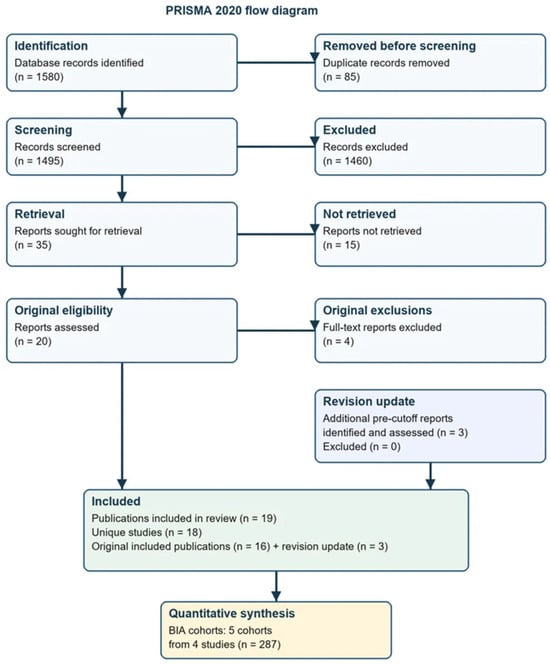
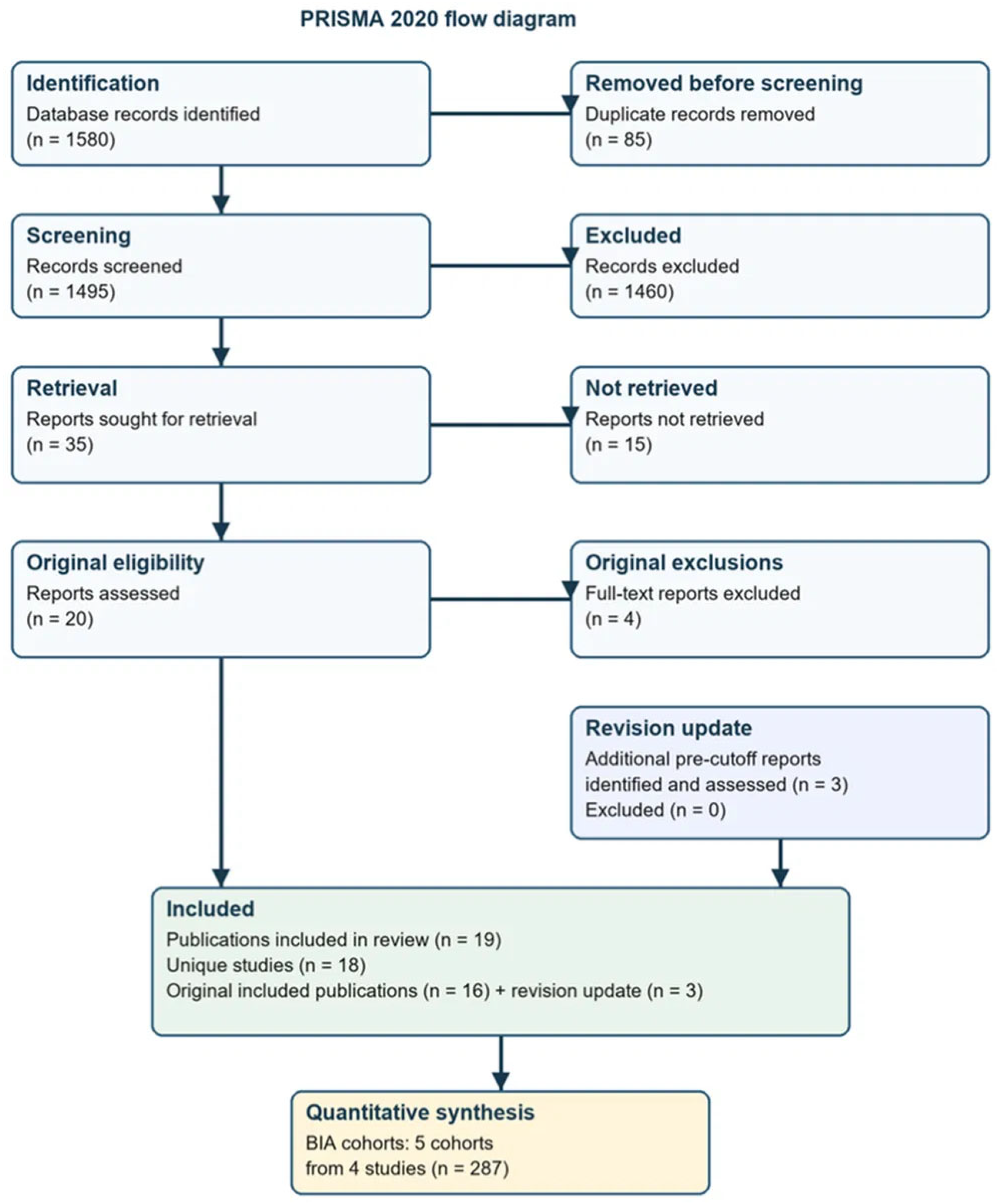
The searches yielded 1580 records (PubMed 143, Embase 697, Cochrane Library 740). After removal of 85 duplicates, 1495 records were screened. The study selection process is summarized in the PRISMA 2020 flow diagram (Figure 1).
Figure 1.
PRISMA 2020 flow diagram. The original search flow yielded 16 included publications; three additional eligible pre-cutoff reports were identified during revision, giving 19 publications (18 unique studies). Fifteen reports from the original search remained unavailable.
- After title/abstract screening, 1460 records were excluded. In the original search flow, 35 reports were sought; 15 could not be retrieved, and 20 were assessed. Four were excluded, and 16 publications representing 15 unique studies were included. Targeted verification during revision identified three additional eligible pre-cutoff reports, all of which were assessed and included. The final review therefore contains 19 publications representing 18 unique studies and 3541 participants (Table 3). STEP-1 and its exploratory report describe the same 140-person substudy and were counted once. The focused BIA meta-analysis included five cohorts from four studies (n = 287).
Table 3.
Characteristics of the 18 unique studies (19 publications). STEP-1 publications are consolidated into one row; participants are counted once (total n = 3541).
3.1. Study Characteristics
Eighteen unique studies were described in 19 publications [27,28,29,30,31,32,33,34,35,36,37,38,39,40,41,42,43,44,45]. Study designs included randomized trials, prospective and retrospective cohorts, and uncontrolled before–after studies.
The studies included 3541 participants. Designs comprised uncontrolled cohorts, comparative observational cohorts, parallel randomized trials, and one crossover trial. Sample sizes ranged from 11 to 1809 and mean or median ages from 45.4 to 76.7 years. The three additional reports identified during revision comprised a small liraglutide DXA cohort, the SEMALEAN semaglutide cohort with DXA and handgrip follow-up, and a large clinical BIA cohort receiving semaglutide or tirzepatide, analyzed alongside a bariatric-surgery cohort without a randomized head-to-head design. Tirzepatide was treated separately as a dual GIP/GLP-1 agonist. Chun et al. studied compounded semaglutide/cyanocobalamin, limiting attribution to approved semaglutide alone [40].
Four reports focused on older populations or had mean age ≥65 years: Osaka (76.7 years), Perna (68.2), Yajima (approximately 68), and Volpe (66.3) [34,37,42]. Their designs and outcomes were too heterogeneous for an age subgroup meta-analysis. Osaka reported a short-term increase in appendicular SMM with lixisenatide plus basal insulin; Perna reported no incident sarcopenia in nine participants [42]; Volpe reported stable SMM [41]; and Yajima reported lower dialysis-specific BIA SMM with dulaglutide [37]. These small studies do not establish efficacy or safety in frail older adults.
Absolute lean or muscle-related mass often decreased while its proportion relative to body weight increased because fat mass fell more. These findings are compatible: improved relative proportion is not muscle gain or absolute preservation. Functional outcomes were uncommon and insufficiently standardized to support conclusions about strength, performance, disability, or sarcopenia.
Controlled DXA evidence was summarized separately (Table S10). It was not pooled with the BIA analysis because DXA lean-mass outcomes and between-group contrasts differ from the BIA-derived within-group outcome. A recent randomized-trial synthesis already addressed the controlled DXA question [20].
Four studies (five BIA-derived cohorts; n = 287) provided sufficient compatible pre–post data for the focused meta-analysis [33,35,36,37]. Other studies reported DXA lean tissue, lacked compatible change data, or used estimands that could not be harmonized without additional assumptions.
3.2. BIA Meta-Analysis Results
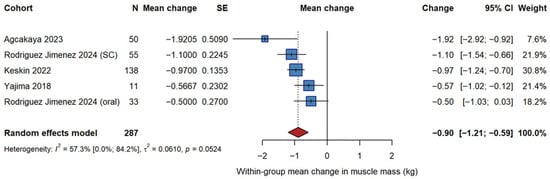
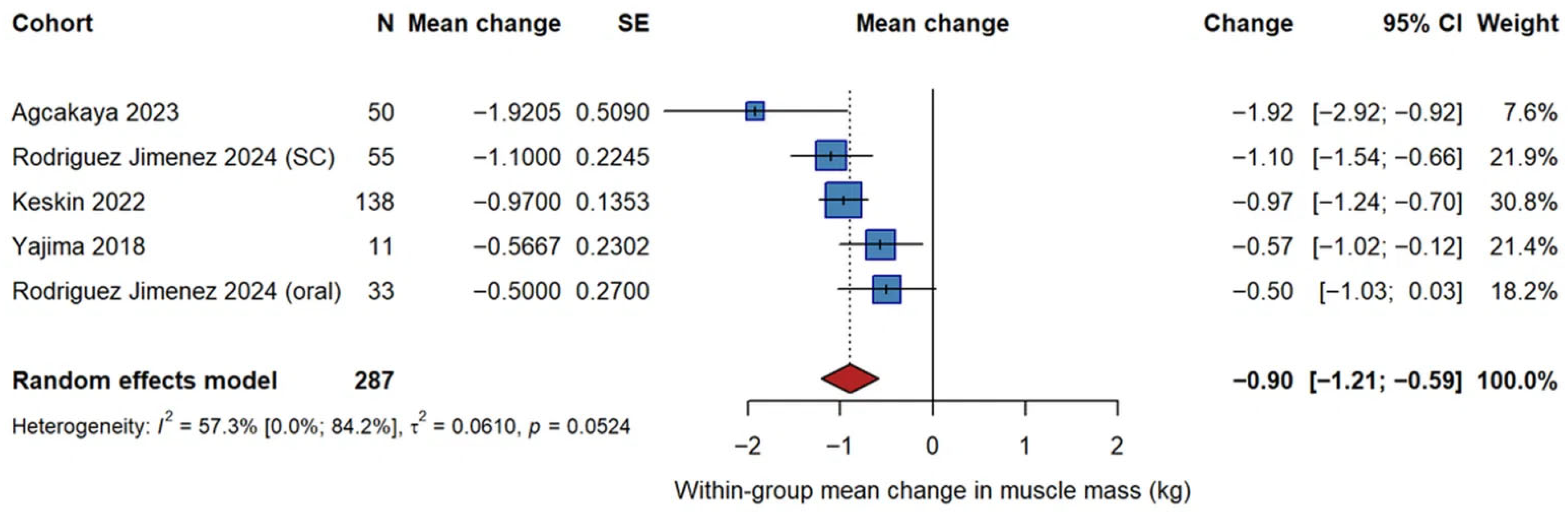
Cochran’s Q was 9.37 (df = 4, p = 0.052). Using the conventional p < 0.10 threshold for this low-power test, heterogeneity was considered potentially important. I2 was 57.3% (95% CI 0–84.2%) and τ2 was 0.061, with wide uncertainty because only five estimates were available. The random-effects pooled within-group mean change was −0.90 kg (95% CI −1.21 to −0.59; p < 0.0001). It describes a temporal change in heterogeneous BIA-derived quantities and is not a controlled treatment effect. It cannot distinguish drug exposure from weight loss, diet, disease course, co-therapy, or measurement variability. Keskin contributed the largest random-effects weight (30.8%) [36]. All point estimates were negative, but the result depended materially on how Agcakaya’s percentage values were interpreted (Figure 2).
Figure 2.
Forest plot of meta-analysis results in changes in skeletal muscle mass (SMM) during GLP-1 receptor agonist therapy. Random-effects (REML) pooled within-group mean change (post–pre): –0.90 kg (95% CI –1.21 to –0.59); I2 = 57.3% [33,35,36,37].
Sensitivity Analysis
When the imputed correlation for the Agcakaya cohort was varied, the pooled decrease remained statistically significant across all tested values [35]. As detailed in Table S5 (Supplementary Materials), even under the most conservative assumption, the pooled mean change was −0.83 kg (95% CI: −1.10 to −0.57, p < 0.001). Notably, a lower imputed correlation was linked with a progressive decrease in statistical heterogeneity, with the index dropping from 57.3% (at r = 0.95) to 27.5% (at r = 0.3). Throughout all iterations, the p-value consistently remained below 0.001, confirming the stability of the primary meta-analytic findings.
In the leave-one-out analysis (Table S8, Figure S1), the pooled change ranged from −0.83 kg (95% CI −1.09 to −0.56; Agcakaya et al. omitted) to −0.99 kg (95% CI −1.34 to −0.64; Yajima et al., the cohort on hemodialysis, omitted), and all confidence intervals excluded zero [35,37]. Heterogeneity was lowest when the Agcakaya cohort was omitted (I2 = 42.4%) [35]. If the muscle mass values of Agcakaya et al. were taken as kilograms rather than as percentages of body weight, this cohort would show an increase of 2.0 kg and the pooled change would be −0.25 kg (95% CI −1.34 to 0.83; I2 = 93.9%) (Table S7); the pooled estimate therefore depends on the interpretation of this single cohort [35].
Expressed as a percentage of the baseline value, the pooled within-group change was −2.48% (95% CI −3.14 to −1.82; I2 = 11.6%) (Figure S2).
In the exploratory comparison with active comparator arms (Table S9, Figure S3), the difference in change between arms was 1.08 kg (95% CI 0.75 to 1.41) for liraglutide plus metformin versus metformin alone (Keskin et al. [36]), indicating a smaller loss in the GLP-1RA arm; −0.93 kg (95% CI −1.67 to −0.19) for dulaglutide versus teneligliptin (Yajima et al. [37]); and −0.08 kg (95% CI −1.53 to 1.37) for exenatide plus metformin versus an SGLT2 inhibitor plus metformin (Agcakaya et al. [35]). The pooled difference was 0.07 kg (95% CI −1.21 to 1.34; I2 = 92.0%, 95% CI 79.6–96.8%), so no difference between GLP-1RAs and active comparators could be established, and the direction of the difference was inconsistent across studies.
3.3. Small-Study Effects
Small-study effects and publication bias were not assessed because fewer than ten estimates were available; no funnel plot or formal asymmetry test was interpreted.
4. Discussion
4.1. Comparison with Previous Syntheses and New Evidence
Anyiam et al. included 38 studies, of which 34 entered quantitative syntheses, and reported −0.74 kg (95% CI −1.61 to 0.14) in the T2DM subgroup [19]. Karakasis et al. pooled controlled lean-mass outcomes from 22 randomized trials and reported −0.86 kg (95% CI −1.30 to −0.42) [20]. Our estimate (−0.90 kg; 95% CI −1.21 to −0.59) is a within-group change in heterogeneous BIA-derived quantities and should not be interpreted as confirming or contradicting those controlled or broader estimates.
This update adds eight reports/studies not represented in the earlier comparison set: Vozza, Caballero-Mateos, Chun, the SURMOUNT-1 DXA substudy (Look), Gutierrez de Piñeres, Basolo, Alissou (SEMALEAN), and Wang [28,29,38,39,40,43,44]. The last three were additional eligible pre-cutoff reports identified during revision. The review also consolidates duplicate STEP-1 reports, maps devices and compartments, reconstructs Agcakaya’s percentage data, handles dialysis timing in Yajima, and tests correlation, scale, and influential-cohort assumptions [30,31,35,37].
Evidence relevant to older adults remains limited. Osaka, Perna, Volpe, and Yajima included older populations, but samples were small, and settings ranged from inpatient care to hemodialysis [34,37,41,42]. No age-stratified meta-analysis was feasible; the data neither demonstrate harm nor establish preservation of muscle health in frail older adults.
Absolute and relative outcomes must be interpreted together. Absolute lean or muscle-related mass may fall while its percentage of body weight rises because fat mass falls more. An increased proportion therefore reflects preferential fat loss, not skeletal-muscle gain. Different devices and proprietary equations also mean that kilogram values do not necessarily represent the same anatomical compartment.
4.2. Body Composition, Physical Function, and Sarcopenia
Sarcopenia cannot be inferred from body composition alone. Consensus definitions require muscle strength, with muscle quantity or quality confirming the diagnosis and physical performance grading severity [18]. Most studies did not measure handgrip strength, gait speed, chair-rise performance, or another standardized functional endpoint. The SEMALEAN cohort reported improved handgrip strength, but it was uncontrolled and does not establish a drug effect [44]. DXA lean soft tissue includes non-muscle components, and BIA estimates depend on hydration and device equations.
4.3. Interpretation of the Meta-Analysis
The pooled estimate was directionally stable in leave-one-out analyses, but heterogeneity was imprecise. The alternative interpretation of Agcakaya changed the estimate to −0.25 kg (95% CI −1.34 to 0.83), showing sensitivity to one reconstructed cohort [35]. Percentage scaling reduced heterogeneity but not device/outcome indirectness. The exploratory active-comparator synthesis was highly heterogeneous (I2 = 92.0%) and did not establish a difference.
The data are compatible with modest lean or muscle-related mass loss during weight reduction but do not demonstrate a direct myopathic drug effect. Protein-adequate nutrition and resistance exercise are reasonable supportive strategies [47,48], but they were not tested as co-interventions in this meta-analysis and are not demonstrated findings of the included studies.
4.4. Limitations
The review was restricted to English and did not search Scopus, Web of Science, or grey literature. Fifteen of 35 reports sought in the original search were not retrieved, creating selection-bias risk. The archived materials did not retain their identifiers or the identities and study-specific reasons for four full-text exclusions, limiting reproducibility of the historical screening process. The T2DM restriction and focused quantitative synthesis were post hoc. Potential overlap could not be excluded for same-centre reports, although only one member of each potentially overlapping pair entered the quantitative analysis. Three additional eligible pre-cutoff reports were identified during revision and added qualitatively; their outcomes were incompatible with the BIA pool.
The main meta-analysis contained five cohorts from four studies and used uncontrolled within-group change. BIA devices and compartments differed; one cohort required correlation imputation, one conversion from percentage to kilograms, and the hemodialysis cohort a dialysis-specific equation. Subgroups by age, drug, duration, or co-therapy, meta-regression, and publication-bias assessment were not feasible. GRADE certainty was very low. Older-adult evidence was descriptive and rarely included strength or performance.
Future studies should prespecify compartments, distinguish absolute from relative change, use calibrated imaging or standardized BIA, and report controlled changes with variances. Trials in older and frail adults should include handgrip strength, chair-rise or gait-speed tests, and clinically meaningful functional outcomes.
5. Conclusions
This review found a small within-group reduction in heterogeneous BIA-derived muscle-mass estimates among adults with type 2 diabetes, but certainty was very low and causal attribution to GLP-1RA treatment is not possible. Controlled DXA studies assess lean tissue rather than skeletal muscle and were synthesized separately. Relative lean proportion may improve despite absolute loss because fat mass decreases more. Evidence does not establish sarcopenia or functional decline, including in older adults. Supportive nutrition or resistance exercise may be considered by individual risk, but prevention efficacy must be tested prospectively.
Supplementary Materials
The following supporting information can be downloaded at: https://www.mdpi.com/article/10.3390/endocrines7040072/s1: Table S1: PRISMA 2020 Checklist; Table S2: Database search strategy and verification log; Table S3: GRADE certainty of evidence; Table S4: Measurement method, device, compartment, and terminology by unique study; Table S5: Sensitivity analysis according to the imputed pre–post correlation coefficient; Table S6: Data extraction and transformations for the pooled cohorts; Table S7: Sensitivity analysis for the Agcakaya et al. cohort; Table S8: Leave-one-out analysis; Table S9: Exploratory comparisons with active comparator arms; Table S10: Controlled DXA evidence and rationale for separate synthesis; Table S11: Reports not retrieved and full-text exclusions; Table S12: Assessment of duplicate reports and potentially overlapping cohorts; Figure S1: Leave-one-out analysis [34,36,38,39]; Figure S2: Within-group change in muscle mass as a percentage of the baseline value [34,36,38,39]; Figure S3: Exploratory comparisons with active comparator arms [36,38,39]; Figure S4: Conceptual framework distinguishing absolute and relative body-composition change from functional outcomes; File S1: R code of the analyses.
Author Contributions
Conceptualization, G.S. (Giovanni Sartore); Methodology, G.S. (Giovanni Sartore), C.C. and M.V.P.; Software, D.I.; Validation, A.A., M.V.P. and C.C.; Formal Analysis, D.I.; Investigation, B.D.M., M.V.P. and A.P.; Data Curation, M.V.P., A.P. and B.D.M.; Writing—Original Draft Preparation, B.D.M., M.V.P. and A.P.; Writing—Review and Editing, B.D.M., M.V.P., A.P., A.A., C.C., M.D.R., G.S. (Giuseppe Sergi), G.G. and G.S. (Giovanni Sartore); Visualization, not specified; Supervision, C.C., G.S. (Giuseppe Sergi), G.G. and G.S. (Giovanni Sartore); Project Administration, G.G. and G.S. (Giovanni Sartore). All authors have read and agreed to the published version of the manuscript.
Funding
This research received no external funding.
Institutional Review Board Statement
Ethics approval and consent to participate: not applicable. This is a systematic review of previously published papers. Ethical approval was not required for this secondary research.
Informed Consent Statement
Not applicable.
Data Availability Statement
Extracted aggregate data, transformations, and code are provided in Tables S2–S12 and File S1. No individual participant data were available.
Conflicts of Interest
The authors declare that they have no financial or non-financial competing interests that are directly or indirectly related to the work submitted for publication.
Abbreviations
The following abbreviations are used in this manuscript.
| GLP-1 | Glucagon-like Peptide-1 |
| GLP-1RA/GLP-1RAs | Glucagon-like Peptide-1 Receptor Agonist(s) |
| SMM | Skeletal Muscle Mass |
| PRISMA | Preferred Reporting Items for Systematic Reviews and Meta-Analyses |
| MOOSE | Meta-analysis Of Observational Studies in Epidemiology |
| NOS | Newcastle–Ottawa Scale |
| RCT | Randomized Controlled Trial |
| RoB 2 | Risk of Bias Tool version 2 |
| SD | Standard Deviation |
| CI | Confidence Interval |
| SE | Standard Error |
| REML | Restricted Maximum Likelihood |
| BIA | Bioelectrical Impedance Analysis |
| DXA | Dual-Energy X-ray Absorptiometry |
| MRI | Magnetic Resonance Imaging |
| CT | Computed Tomography |
| LST | Lean Soft Tissue |
| LM | Lean Mass |
| FFM | Fat-Free Mass |
| FM | Fat Mass |
| BMC | Bone Mineral Content |
| ALST | Appendicular Lean Soft Tissue |
| SMI | Skeletal Muscle Index |
| ADP | Air Displacement Plethysmography |
| 3DO | Three-Dimensional Optical Imaging |
| US | Ultrasound |
| T2DM | Type 2 Diabetes Mellitus |
| IQR | Interquartile Range |
| Q | Cochran’s Q Statistic |
| I2 | Higgins’ Inconsistency Statistic |
| τ2 (tau2) | Between-study Variance |
| kg | Kilogram |
| r | Correlation Coefficient |
| LEAD | Liraglutide Effect and Action in Diabetes trial programme |
| STEP | Semaglutide Treatment Effect in People with Obesity trial programme |
| SUSTAIN | Semaglutide Unabated Sustainability in Treatment of Type 2 Diabetes Trial Programme |
| SURMOUNT | Tirzepatide Clinical Trial Programme in Obesity |
| SS | Subcutaneous Semaglutide |
| OS | Oral Semaglutide |
| SGLT2 | Sodium-Glucose Cotransporter-2 |
References
- Nauck, M.A.; Quast, D.R.; Wefers, J.; Meier, J.J. GLP-1 receptor agonists in the treatment of type 2 diabetes-state-of-the-art. Mol. Metab. 2021, 46, 101102. [Google Scholar] [CrossRef] [Scilit] [PubMed] [PubMed Central]
- Mariam, Z.; Niazi, S.K. Glucagon-like peptide agonists: A prospective review. Endocrinol. Diabetes Metab. 2024, 7, e462. [Google Scholar] [CrossRef] [Scilit] [PubMed] [PubMed Central]
- D’Alessio, D. Is GLP-1 a hormone: Whether and When? J. Diabetes Investig. 2016, 7, 50–55. [Google Scholar] [CrossRef] [Scilit] [PubMed] [PubMed Central]
- Blundell, J.; Finlayson, G.; Axelsen, M.; Flint, A.; Gibbons, C.; Kvist, T.; Hjerpsted, J.B. Effects of once-weekly semaglutide on appetite, energy intake, control of eating, food preference and body weight in subjects with obesity. Diabetes Obes. Metab. 2017, 19, 1242–1251. [Google Scholar] [CrossRef] [Scilit] [PubMed] [PubMed Central]
- Ard, J.; Fitch, A.; Fruh, S.; Herman, L. Weight Loss and Maintenance Related to the Mechanism of Action of Glucagon-Like Peptide 1 Receptor Agonists. Adv. Ther. 2021, 38, 2821–2839. [Google Scholar] [CrossRef] [Scilit] [PubMed] [PubMed Central]
- Wang, J.-Y.; Wang, Q.-W.; Yang, X.-Y.; Yang, W.; Li, D.-R.; Jin, J.-Y.; Zhang, H.-C.; Zhang, X.-F. GLP-1 receptor agonists for the treatment of obesity: Role as a promising approach. Front. Endocrinol. 2023, 14, 1085799. [Google Scholar] [CrossRef] [Scilit] [PubMed] [PubMed Central]
- Davies, M.; Færch, L.; Jeppesen, O.K.; Pakseresht, A.; Pedersen, S.D.; Perreault, L.; Rosenstock, J.; Shimomura, I.; Viljoen, A.; Wadden, T.A.; et al. Semaglutide 2.4 mg once a week in adults with overweight or obesity and type 2 diabetes (STEP 2): A randomised, double-blind, double-dummy, placebo-controlled, phase 3 trial. Lancet 2021, 397, 971–984. [Google Scholar] [CrossRef] [Scilit]
- Karagiannis, T.; Tsapas, A.; Athanasiadou, E.; Avgerinos, I.; Liakos, A.; Matthews, D.R.; Bekiari, E. GLP-1 receptor agonists and SGLT2 inhibitors for older people with type 2 diabetes: A systematic review and meta-analysis. Diabetes Res. Clin. Pract. 2021, 174, 108737. [Google Scholar] [CrossRef] [Scilit] [PubMed]
- Pi-Sunyer, X.; Astrup, A.; Fujioka, K.; Greenway, F.; Halpern, A.; Krempf, M.; Lau, D.C.W.; Le Roux, C.W.; Ortiz, R.V.; Jensen, C.B.; et al. A randomized, controlled trial of 3.0 mg of liraglutide in weight management. N. Engl. J. Med. 2015, 373, 11–22. [Google Scholar] [CrossRef] [Scilit]
- Jastreboff, A.M.; Aronne, L.J.; Ahmad, N.N.; Wharton, S.; Connery, L.; Alves, B.; Kiyosue, A.; Zhang, S.; Liu, B.; Bunck, M.C.; et al. Tirzepatide once weekly for the treatment of obesity. N. Engl. J. Med. 2022, 387, 205–216. [Google Scholar] [CrossRef] [Scilit]
- Frías, J.P.; Davies, M.J.; Rosenstock, J.; Pérez Manghi, F.C.; Fernández Landó, L.; Bergman, B.K.; Liu, B.; Cui, X.; Brown, K. Tirzepatide versus Semaglutide Once Weekly in Patients with Type 2 Diabetes. N. Engl. J. Med. 2021, 385, 503–515. [Google Scholar] [CrossRef] [Scilit]
- Mitchell, W.K.; Williams, J.; Atherton, P.; Larvin, M.; Lund, J.; Narici, M. Sarcopenia, dynapenia, and the impact of advancing age on human skeletal muscle size and strength: A quantitative review. Front. Physiol. 2012, 3, 260. [Google Scholar] [CrossRef] [Scilit]
- Volpi, E.; Nazemi, R.; Fujita, S. Muscle tissue changes with aging. Curr. Opin. Clin. Nutr. Metab. Care 2004, 7, 405–410. [Google Scholar] [CrossRef] [Scilit]
- Coin, A.; Sergi, G.; Minicuci, N.; Giannini, S.; Barbiero, E.; Manzato, E.; Pedrazzoni, M.; Minisola, S.; Rossini, M.; Del Puente, A.; et al. Fat-free mass and fat mass reference values by dual-energy X-ray absorptiometry (DEXA) in a 20–80 year-old Italian population. Clin. Nutr. 2008, 27, 87–94. [Google Scholar] [CrossRef] [Scilit] [PubMed]
- Ponti, F.; Santoro, A.; Mercatelli, D.; Gasperini, C.; Conte, M.; Martucci, M.; Sangiorgi, L.; Franceschi, C.; Bazzocchi, A. Aging and Imaging Assessment of Body Composition: From Fat to Facts. Front. Endocrinol. 2020, 10, 861. [Google Scholar] [CrossRef] [Scilit] [PubMed] [PubMed Central]
- Tinsley, G.M.; Heymsfield, S.B. Fundamental Body Composition Principles Provide Context for Fat-Free and Skeletal Muscle Loss With GLP-1 RA Treatments. J. Endocr. Soc. 2024, 8, bvae164. [Google Scholar] [CrossRef] [Scilit] [PubMed] [PubMed Central]
- Prado, C.M.; Gonzalez, M.C.; Norman, K.; Barazzoni, R.; Cederholm, T.; Compher, C.; Jensen, G.L.; Abe, T.; Barbosa-Silva, T.G.; Bosy-Westphal, A.; et al. Methodological standards for body composition-an expert-endorsed guide for research and clinical applications: Levels, models, and terminology. Am. J. Clin. Nutr. 2025, 122, 384–391. [Google Scholar] [CrossRef] [Scilit] [PubMed] [PubMed Central]
- Cruz-Jentoft, A.J.; Bahat, G.; Bauer, J.; Boirie, Y.; Bruyère, O.; Cederholm, T.; Cooper, C.; Landi, F.; Rolland, Y.; Sayer, A.A.; et al. Sarcopenia: Revised European consensus on definition and diagnosis. Age Ageing 2019, 48, 16–31. [Google Scholar] [CrossRef] [Scilit]
- Anyiam, O.; Ardavani, A.; Rashid, R.S.A.; Panesar, A.; Idris, I. How do glucagon-like Peptide-1 receptor agonists affect measures of muscle mass in individuals with, and without, type 2 diabetes: A systematic review and meta-analysis. Obes. Rev. 2025, 26, e13916. [Google Scholar] [CrossRef] [Scilit] [PubMed] [PubMed Central]
- Karakasis, P.; Patoulias, D.; Fragakis, N.; Mantzoros, C.S. Effect of glucagon-like peptide-1 receptor agonists and co-agonists on body composition: Systematic review and network meta-analysis. Metabolism 2025, 164, 156113. [Google Scholar] [CrossRef] [Scilit] [PubMed]
- Page, M.J.; McKenzie, J.E.; Bossuyt, P.M.; Boutron, I.; Hoffmann, T.C.; Mulrow, C.D.; Shamseer, L.; Tetzlaff, J.M.; Akl, E.A.; Brennan, S.E.; et al. The PRISMA 2020 statement: An updated guideline for reporting systematic reviews. BMJ 2021, 372, n71. [Google Scholar] [CrossRef] [Scilit]
- Brooke, B.S.; Schwartz, T.A.; Pawlik, T.M. MOOSE Reporting Guidelines for Meta-analyses of Observational Studies. JAMA Surg. 2021, 156, 787–788. [Google Scholar] [CrossRef] [Scilit] [PubMed]
- Wells, G.A.; Shea, B.; O’Connell, D.; Peterson, J.; Welch, V.; Losos, M.; Tugwell, P. The Newcastle–Ottawa Scale (NOS) for Assessing the Quality of Nonrandomised Studies in Meta-Analyses; Ottawa Hospital Research Institute: Ottawa, ON, Canada, 2014. [Google Scholar]
- National Heart, Lung, and Blood Institute. Study Quality Assessment Tool for Before–After (Pre–Post) Studies with No Control Group; National Institutes of Health: Bethesda, MD, USA, 2021. Available online: https://www.nhlbi.nih.gov/health-topics/study-quality-assessment-tools (accessed on 30 October 2026).
- Sterne, J.A.C.; Savović, J.; Page, M.J.; Elbers, R.G.; Blencowe, N.S.; Boutron, I.; Cates, C.J.; Cheng, H.Y.; Corbett, M.S.; Eldridge, S.M.; et al. RoB 2: A revised tool for assessing risk of bias in randomised trials. BMJ 2019, 366, l4898. [Google Scholar] [CrossRef] [Scilit]
- Guyatt, G.H.; Oxman, A.D.; Vist, G.E.; Kunz, R.; Falck-Ytter, Y.; Alonso-Coello, P.; Schünemann, H.J. GRADE: An emerging consensus on rating quality of evidence and strength of recommendations. BMJ 2008, 336, 924–926. [Google Scholar] [CrossRef] [Scilit]
- Jendle, J.; Nauck, M.A.; Matthews, D.R.; Frid, A.; Hermansen, K.; Düring, M.; Zdravkovic, M.; Strauss, B.J.; Garber, A.J.; LEAD-2 and LEAD-3 Study Groups. Weight loss with liraglutide, a once-daily human glucagon-like peptide-1 analogue for type 2 diabetes treatment as monotherapy or added to metformin, is primarily as a result of a reduction in fat tissue. Diabetes Obes. Metab. 2009, 11, 1163–1172. [Google Scholar] [CrossRef] [Scilit] [PubMed]
- de Piñeres, V.G.; Ramirez-Cisneros, A.; Tamayo-Torres, C.S.; Angelidi, A.M.; Kavelidou, M.; Stefanakis, K.; Mantzoros, C.S. Effects of liraglutide treatment for 35-days on total and regional fat free, lean, and bone mass, and on the Myostatin-Activin-Follistatin-IGF-1 axes: A secondary analysis of a randomized placebo-controlled crossover study. Diabetes Res. Clin. Pract. 2026, 233, 113113. [Google Scholar] [CrossRef] [Scilit] [PubMed]
- Look, M.; Dunn, J.P.; Kushner, R.F.; Cao, D.; Harris, C.; Gibble, T.H.; Stefanski, A.; Griffin, R. Body composition changes during weight reduction with tirzepatide in the SURMOUNT-1 study of adults with obesity or overweight. Diabetes Obes. Metab. 2025, 27, 2720–2729. [Google Scholar] [CrossRef] [Scilit] [PubMed] [PubMed Central]
- Wilding, J.P.H.; Batterham, R.L.; Calanna, S.; Davies, M.; Van Gaal, L.F.; Lingvay, I.; McGowan, B.M.; Rosenstock, J.; Tran, M.T.; Wadden, T.A.; et al. Once-Weekly Semaglutide in Adults with Overweight or Obesity. N. Engl. J. Med. 2021, 384, 989–1002. [Google Scholar] [CrossRef] [Scilit]
- Wilding, J.P.H.; Batterham, R.L.; Calanna, S.; Van Gaal, L.F.; McGowan, B.M.; Rosenstock, J.; Tran, M.T.D.; Wharton, S.; Yokote, K.; Zeuthen, N.; et al. Impact of Semaglutide on Body Composition in Adults With Overweight or Obesity: Exploratory Analysis of the STEP 1 Study. J. Endocr. Soc. 2021, 5, A16–A17. [Google Scholar] [CrossRef] [Scilit]
- McCrimmon, R.J.; Catarig, A.-M.; Frias, J.P.; Lausvig, N.L.; le Roux, C.W.; Thielke, D.; Lingvay, I. Effects of once-weekly semaglutide vs once-daily canagliflozin on body composition in type 2 diabetes: A substudy of the SUSTAIN 8 randomised controlled clinical trial. Diabetologia 2020, 63, 473–485. [Google Scholar] [CrossRef] [Scilit] [PubMed] [PubMed Central]
- Jiménez, B.R.; Gómez, P.R.d.V.; Lomas, S.B.; Díaz, Á.M.M.; Mateos, I.C.; Galán, I.; Portillo, C.M.; Martínez-Brocca, M.A. Transforming body composition with semaglutide in adults with obesity and type 2 diabetes mellitus. Front. Endocrinol. 2024, 15, 1386542. [Google Scholar] [CrossRef] [Scilit] [PubMed] [PubMed Central]
- Osaka, T.; Hamaguchi, M.; Fukui, M. Favorable Appendicular Skeletal Muscle Mass Changes in Older Patients with Type 2 Di-abetes Receiving GLP-1 Receptor Agonist and Basal Insulin Co-Therapy. Clin. Med. Insights Endocrinol. Diabetes 2023, 16, 11795514231161885. [Google Scholar] [CrossRef] [Scilit] [PubMed] [PubMed Central]
- Agcakaya, E.; Mutlu, H.H.; Erbakan, A.; Sargin, M. Comparison of the Impact of SGLT2-Inhibitors and Exenatide on Body Fat Composition. J. Coll. Physicians Surg. Pak. 2023, 33, 308–313. [Google Scholar] [CrossRef] [Scilit] [PubMed]
- Keskin, L.; Yaprak, B. Comparison of the effect of liraglutide and metformin therapy on the disease regulation and weight loss in obese patients with Type 2 diabetes mellitus. Eur. Rev. Med. Pharmacol. Sci. 2022, 26, 6813–6820. [Google Scholar] [CrossRef] [Scilit] [PubMed]
- Yajima, T.; Yajima, K.; Takahashi, H.; Yasuda, K. The effect of dulaglutide on body composition in type 2 diabetes mellitus patients on hemodialysis. J. Diabetes Its Complicat. 2018, 32, 759–763. [Google Scholar] [CrossRef] [Scilit] [PubMed]
- Vozza, A.; Triggiani, D.; Fanelli, M.; Lisco, G.; Coletto, D.; Custodero, C.; Volpe, S.; Racaniello, D.; Colaianni, V.; Lavarra, V.; et al. Predictive factors of body weight loss in patients with type 2 diabetes treated with GLP-1 receptor agonists: A 52-week prospective real-life study. Front. Endocrinol. 2025, 16, 1674308. [Google Scholar] [CrossRef] [Scilit] [PubMed] [PubMed Central]
- Caballero-Mateos, I.; Morales-Portillo, C.; Aguilera, B.G. Once-Weekly Semaglutide Improves Body Composition in Spanish Obese Adults with Type 2 Diabetes: A 48-Week Prospective Real-Life Study. J. Clin. Med. 2025, 14, 5434. [Google Scholar] [CrossRef] [Scilit] [PubMed] [PubMed Central]
- Chun, E.; Rivera, D.; Reyna, K.; Legere, H.; Joseph, R.; Pojednic, R. Weight loss and body composition after compounded semaglutide treatment in a real world setting. Diabetes Obes. Metab. 2025, 27, 1536–1543. [Google Scholar] [CrossRef] [Scilit] [PubMed]
- Volpe, S.; Lisco, G.; Fanelli, M.; Racaniello, D.; Colaianni, V.; Lavarra, V.; Triggiani, D.; Crudele, L.; Triggiani, V.; Sabbà, C.; et al. Oral semaglutide improves body composition and preserves lean mass in patients with type 2 diabetes: A 26-week prospective real-life study. Front. Endocrinol. 2023, 14, 1240263. [Google Scholar] [CrossRef] [Scilit] [PubMed] [PubMed Central]
- Perna, S.; Guido, D.; Bologna, C.; Solerte, S.B.; Guerriero, F.; Isu, A.; Rondanelli, M. Liraglutide and obesity in elderly: Efficacy in fat loss and safety in order to prevent sarcopenia. A perspective case series study. Aging Clin. Exp. Res. 2016, 28, 1251–1257. [Google Scholar] [CrossRef] [Scilit] [PubMed]
- Basolo, A.; Paolucci, G.; Piaggi, P.; Angeli, V.; Genzano, S.B.; Fierabracci, P.; Vignali, E.; Bologna, C.; Salvetti, G.; Chiovato, L.; et al. Effects of 6-month treatment with the GLP-1 receptor agonist liraglutide on 24-hour energy metabolism and body composition in adults with obesity. J. Endocrinol. Investig. 2025, 48, 2735–2745. [Google Scholar] [CrossRef] [Scilit] [PubMed]
- Alissou, M.; Demangeat, T.; Folope, V.; Van Elslande, H.; Lelandais, H.; Blanchemaison, J.; Cailleaux, P.; Guney, S.; Aupetit, A.; Aubourg, A.; et al. Impact of semaglutide on fat mass, lean mass and muscle function in patients with obesity: The SEMALEAN study. Diabetes Obes. Metab. 2026, 28, 112–121. [Google Scholar] [CrossRef] [Scilit] [PubMed]
- Wang, Z.; Wang, L.; Zhang, X.; Lowery, B.D.; Shaffer, L.L.; Chen, Y.; Wells, Q.S.; Flynn, C.R.; Williams, B.; Spann, M.; et al. Body composition changes after bariatric surgery or treatment with GLP-1 receptor agonists. JAMA Netw. Open 2026, 9, e2553323. [Google Scholar] [CrossRef] [Scilit]
- Wan, X.; Wang, W.; Liu, J.; Tong, T. Estimating the sample mean and standard deviation from the sample size, median, range and/or interquartile range. BMC Med. Res. Methodol. 2014, 14, 135. [Google Scholar] [CrossRef] [Scilit]
- Verreijen, A.M.; Verlaan, S.; Engberink, M.F.; Swinkels, S.; de Vogel-van den Bosch, J.; Weijs, P.J. A high whey protein-, leucine-, and vitamin D-enriched supplement preserves muscle mass during intentional weight loss in obese older adults: A double-blind randomized controlled trial. Am. J. Clin. Nutr. 2015, 101, 279–286. [Google Scholar] [CrossRef] [Scilit] [PubMed]
- Cava, E.; Yeat, N.C.; Mittendorfer, B. Preserving Healthy Muscle during Weight Loss. Adv. Nutr. 2017, 8, 511–519. [Google Scholar] [CrossRef] [Scilit] [PubMed] [PubMed Central]

Disclaimer/Publisher’s Note: The statements, opinions and data contained in all publications are solely those of the individual author(s) and contributor(s) and not of MDPI and/or the editor(s). MDPI and/or the editor(s) disclaim responsibility for any injury to people or property resulting from any ideas, methods, instructions or products referred to in the content. |
© 2026 by the authors. Licensee MDPI, Basel, Switzerland. This article is an open access article distributed under the terms and conditions of the Creative Commons Attribution (CC BY) license.