


Abstract
This work reports the synthesis of the organic–inorganic copper chloride perovskite (C6H5CH2NH3)2[CuCl4] and its application as an electrode material for lithium-ion batteries. Hybrid copper halide perovskites have emerged as environmentally friendly alternatives to lead-based systems due to their structural versatility and chemical stability; however, their electrochemical energy storage properties remain largely unexplored. To the best of our knowledge, this is the first report investigating (C6H5CH2NH3)2[CuCl4] as an electrode material for lithium-ion batteries. The structural and morphological characteristics of the material were investigated by X-ray diffraction (XRD), scanning electron microscopy (SEM), and infrared spectroscopy (IR), confirming the formation of a layered perovskite structure. Electrochemical performance was evaluated by cyclic voltammetry and galvanostatic charge–discharge measurements. The material delivered an initial specific capacity of 114 mAh g−1 at a current density of 20 mA g−1 and maintained a coulombic efficiency around 99% after 100 cycles, indicating good cycling stability. The electrochemical behavior suggests that the reversible redox activity of Cu species contributes significantly to the charge storage mechanism. Postmortem XRD analysis revealed that the original perovskite framework was only partially retained after cycling, as several characteristic diffraction peaks remained while others disappeared, indicating partial structural decomposition. These results highlight the potential of chlorocuprate-based hybrid perovskites as alternative electrode materials for lithium-ion batteries.
1. Introduction
Numerous studies have investigated the energy storage properties of perovskite materials, which are strongly influenced by their chemical composition and crystal structure. Organic–inorganic hybrid perovskites have attracted substantial attention because of their ability to combine the functional versatility of organic components with the structural robustness of inorganic frameworks within a single molecular system. As a result, these materials have been widely explored in diverse applications, including photovoltaic devices [1], piezoelectric generators [2], photonic technologies [3], and, more recently, electrochemical energy storage systems [4].
Hybrid perovskites exhibit remarkable structural diversity, as the incorporation of different organic cations or inorganic anions enables the fine-tuning of multiple physicochemical properties. These include crystal symmetry and dimensionality (from three-dimensional networks to two-dimensional layered structures), electronic band structure (bandgap width and band-edge positions), charge-carrier transport pathways, dielectric response, ionic conductivity, thermal stability, and electrochemical redox activity. Based on their structural configuration, these materials are commonly classified into two main families, AMX3 and A2MX4, according to the molar ratio between the organic and inorganic counterparts (A = organic cation, M = transition metal, X = halogen) [5,6].
To date, most research efforts have been focused on lead-based hybrid perovskites due to their superior optoelectronic properties [7,8]. However, the toxicity and environmental concerns associated with lead have significantly restricted their large-scale application, thereby motivating the search for environmentally benign alternatives.
In this context, hybrid perovskites based on transition-metal halides, such as Sn [9], Ge [10], and Cu-based systems [11], have emerged as promising candidates. Despite their potential, Sn- and Ge-based halide perovskites often suffer from limited moisture stability and poor solubility, which hinder their practical implementation. In contrast, copper halide perovskites exhibit improved chemical stability, good solubility, and rich structural versatility, making them attractive for functional applications beyond optoelectronics [12]. Cu-based hybrid materials have demonstrated tailorable band edges, efficient intrinsic hole-transport behavior, and distinctive optical properties which have been extensively explored in photovoltaic and photonic devices [13].
More recently, attention has been directed toward the structural engineering of hybrid copper chloride perovskites through the incorporation of a wide variety of organic cations, leading to the formation of low-dimensional architectures with enhanced functional properties [14]. For instance, the introduction of dimethylammonium (DMA+) and acetamidinium (Ac+) cations into CuCl-based systems has resulted in the synthesis of several novel crystalline phases, such as DMACu2Cl3, DMACuCl2, DMA4[Cu2Cl6], DMA3CuCl4, and AcCuCl2, highlighting the remarkable flexibility of chlorocuprate frameworks [15,16]. Additionally, more complex chlorocuprates, including bis(dodecylammonium) tetrachlorocuprate (C12H28N)3CuCl4, have been investigated for thermal energy storage, demonstrating their potential as phase-change materials capable of storing energy through polymorphic transitions [17].
Although hybrid organic–inorganic perovskites have been investigated for optoelectronic, solar cells and thermal energy applications, their use as electrode materials for lithium-ion batteries remains largely unexplored. To the best of our knowledge, only a limited number of studies have evaluated these materials in cathodic configurations. Jaffe and Karunadasa first demonstrated reversible lithium cycling in a layered Cu-Cl hybrid perovskite, reporting capacities of 52 mAh g−1 and a Coulombic efficiency of 92%, while maintaining stable cycling for more than 200 cycles [18]. Subsequently, Mathieson et al. investigated layered Ruddlesden–Popper hybrid perovskites as lithium-storage electrodes, obtaining a high initial capacity of 575.5 mAh g−1; however, the material showed a capacity retention of 15.6%, highlighting the limited structural stability of these compounds under electrochemical operation [19]. More recently, copper-based layered hybrid perovskites, including Butylammonium copper chloride (BACC) and Methylammonium copper chloride (MACC), exhibited improved electrochemical behavior, delivering initial capacities of approximately 200 and 160 mAh g−1 at 20 mA g−1, respectively. After 100 cycles, BACC retained about 65% of its initial capacity, whereas MACC achieved a capacity retention of 90%, with both materials maintaining Coulombic efficiencies close to 100%. Nevertheless, post-cycling structural analyses revealed partial decomposition of the perovskite framework, indicating that high Coulombic efficiency does not necessarily imply structural reversibility [20].
Despite these advances, studies exploring the electrochemical energy storage performance of hybrid copper chloride perovskites remain scarce. In particular, the compound (C6H5CH2NH3)2[CuCl4], commonly referred to as benzylamine copper chloride (BZACC), has been reported to crystallize in a two-dimensional layered perovskite structure and to exhibit successive magnetic phase transitions associated with strong ferromagnetic behavior [21]. It has been employed as a precursor for oxidation reactions to obtain novel Cu-based materials and as a model compound to investigate the role of CuCl and CuCl2 species in organic synthesis [22,23]. However, the electrochemical properties of BZACC have not yet been reported, and its potential as an active material for electrochemical energy storage devices remains unexplored. Its potential as an active material lies in its hybrid layered structure, consisting of Cu-Cl inorganic sheets separated by benzylammonium organic cations. This structural arrangement provides an interlayer environment that may facilitate Li+ accommodation, while the Cu-based inorganic framework can participate in electrochemical redox processes.
Although related metal-halide and hybrid organic–inorganic materials have been investigated for electrochemical energy storage, the electrochemical behavior and structural evolution of BZACC during Li+ cycling remain insufficiently understood. Therefore, the interest in BZACC is not solely related to its limited investigation, but rather to its distinctive layered structure and the opportunity to establish the relationship between Li+ storage, electrochemical performance, and structural stability.
Based on previous reports, the lithium storage mechanism in BZACC is expected to proceed through a combination of Li+ insertion into the inorganic Cu–Cl framework. The inorganic layers provide the electrochemically active sites, whereas the benzylammonium cations primarily act as structural spacers that regulate the interlayer distance and may facilitate lithium-ion diffusion while contributing to structural flexibility. However, as observed for other hybrid halide perovskites, repeated lithiation/delithiation may induce partial structural rearrangement or decomposition of the inorganic framework, which can influence the long-term cycling stability.
In this work, we address this knowledge gap by systematically investigating the electrochemical behavior of BZACC as an electrode material for lithium-ion batteries. Electrochemical performance is evaluated in terms of capacity and cycling stability and the results are discussed in comparison with previously reported Cu-based hybrid and inorganic electrode materials, providing new insights into the viability of chlorocuprate-based perovskites for energy storage applications.
2. Materials and Methods
2.1. BZACC Synthesis
BZACC single crystals were prepared by dissolving (C6H5CH2NH3)·HCl (obtained from Sigma-Aldrich, St. Louis, MO, USA; 97.5%) and CuCl2·H2O (St. Louis, MO, USA; 99.999%) in distilled water under stirring. The molar ratio was 2:1. Then, the resulting solution was heated at 60 °C until complete water evaporation, yielding a golden powder. The obtained crystals were subsequently collected and dried under vacuum at 70 °C for 24 h.
2.2. Batteries Fabrication
Electrode fabrication: BZACC powder was combined with carbon black (Carbon Super P, TIMCAL, Bodio, Switzerland) and polytetrafluoroethylene (PTFE, powder 35 μm particle size, St. Louis, MO, USA) in a mass ratio of 70:20:10. The components were manually mixed until a homogeneous paste was obtained.
The selected ratio was adopted based on previously reported composite-electrode formulations, where the relatively high active-material content is combined with carbon black to provide sufficient electronic conductivity and PTFE to ensure adequate mechanical integrity of the electrode [24,25].
The resulting paste was mechanically pressed onto a stainless-steel mesh to obtain the final electrode. After that, the electrodes were vacuum-dried at 60 °C for 24 h to minimize moisture content. Finally, the electrodes were transferred to an argon-filled dry box (Omni-Lab 0210 glovebox (Vacuum Atmospheres Company, Hawthorne, CA, USA)) with a water concentration below 5 ppm.
Battery assembly: Coin-type cells were assembled inside an argon-filled glove box using metallic lithium foil as both the counter and the reference electrode, while the prepared BZACC electrode served as the working electrode. A microporous Celgard 2325-1750-A separator (Celgard, LLC, Charlotte, NC, USA) was placed between the electrodes. The batteries were filled with 120 μL of 1 M LiPF6 electrolyte in EC/DMC (1:1 v/v, Sigma-Aldrich, St. Louis, MO, USA). This electrolyte volume was selected based on commonly used coin-cell configurations, which provide sufficient wetting of all parts [26,27].
To enclose the components, a 1-ton pressure was applied on the final device. At least 25-coin cells were assembled and tested during this study using the different electrochemical techniques described below. However, the electrochemical curves presented in this work correspond to the most representative cell for each experiment.
2.3. Structural Characterization
The crystal structure of BZACC was investigated by X-ray diffraction (XRD) using a D2 PHASER diffractometer (Bruker, Karlsruhe, Germany) equipped with a Cu Kα radiation source (λ = 1.5418 Å). The diffraction patterns were collected over a 2θ range of 5–50° at a scanning rate of 0.05° s−1.
The morphology of the BZACC samples was examined by scanning electron microscopy (SEM) using a JSM-6701F microscope (JEOL Ltd., Tokyo, Japan).
Fourier-transform infrared (FTIR) spectra were recorded at room temperature over the 1000–3500 cm−1 range with a spectral resolution of 4 cm−1 using an Interspec 200-X FTIR spectrometer (Interspectrum OU, Toravere, Estonia).
2.4. Electrochemical Characterization
Cyclic voltammetry (CV) measurements were conducted using a MacPile II potentiostat (Bio-Logic Science Instruments, Claix, France) at a scan rate of 125 μV s−1 over a potential range of 0.01–2.0 V. Galvanostatic charge–discharge measurements were carried out using a BTS-3500 multichannel battery cycler (Neware Electronic Co., Ltd., Shenzhen, China) within the same voltage window, applying current densities ranging from 20 to 200 mA g−1, corresponding to 0.17–1.7 C, respectively.
3. Results and Discussion
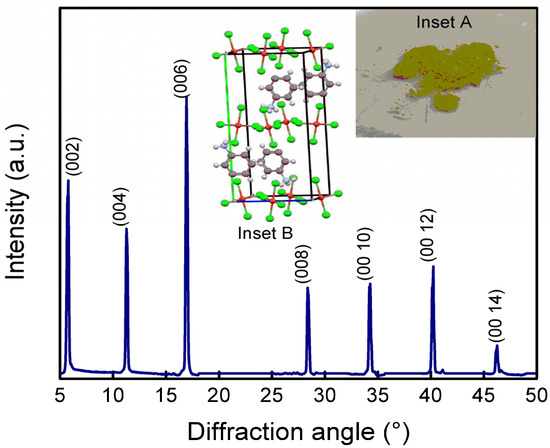
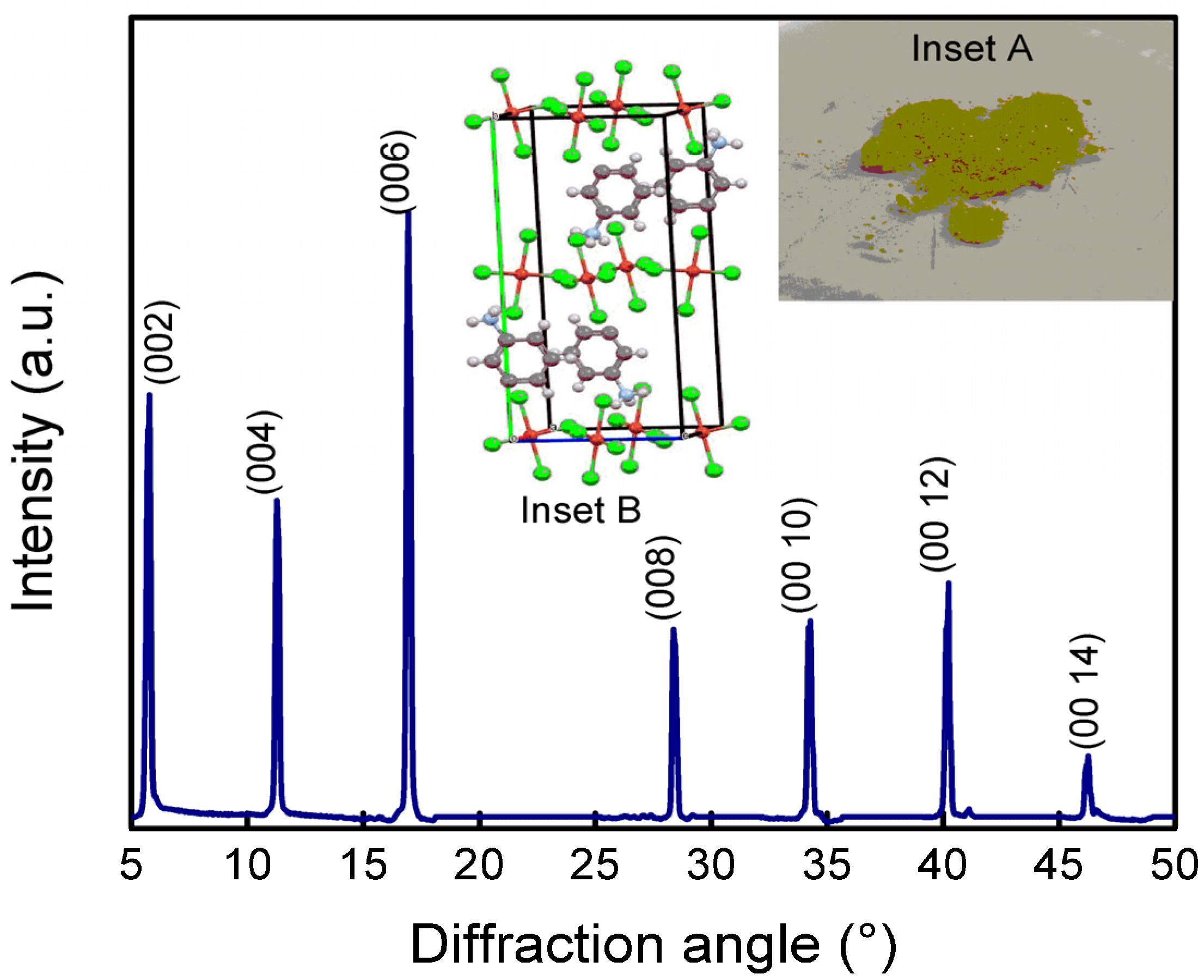
Room-temperature powder X-ray diffraction was employed to confirm the structural properties of BZACC; the corresponding diffraction pattern is depicted in Figure 1. The peaks are labeled according to their symmetry plane corresponding to the reflections of (00L) (where l = 2, 4, 6, 8, 10, 12, 14), indicating the highly oriented layered perovskite structure present in the crystal. Based on our results, the crystallites belong to the orthorhombic system with a Pbca space group, which is consistent with that reported in the literature [28].
Figure 1.
X-Ray diffraction patterns of BZACC. All the peaks match those reported in the literature. The inset A shows an image of BZACC powder after the drying process and Inset B depicts a structural diagram of the synthetized sample; red, green, purple and white spheres represent copper, chlorine, carbon and hydrogen atoms, respectively.
Regarding the structure of BZACC, it consists of an inorganic layer composed of [CuCl4]2− octahedra and an organic layer of [C6H5CH2NH3]+, which extends between the [CuCl4]2− arrangement. The hydrogen ions of the ammonium cation bond to the halogens of the inorganic layer, and the organic R-group extends into space between the inorganic layers in a strong preferential orientation, typical of a 2D perovskite structure [29]. A diagram of the BZACC structure is displayed in Inset B in Figure 1 for better understanding.
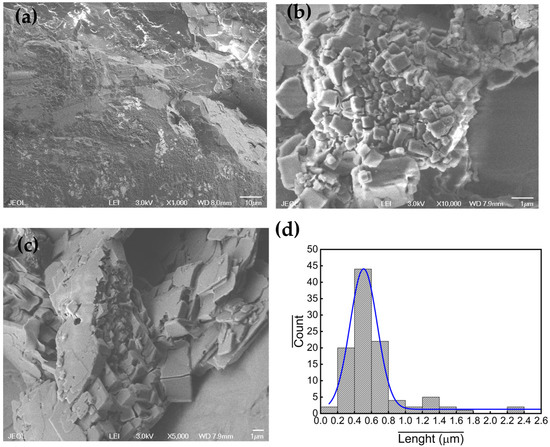
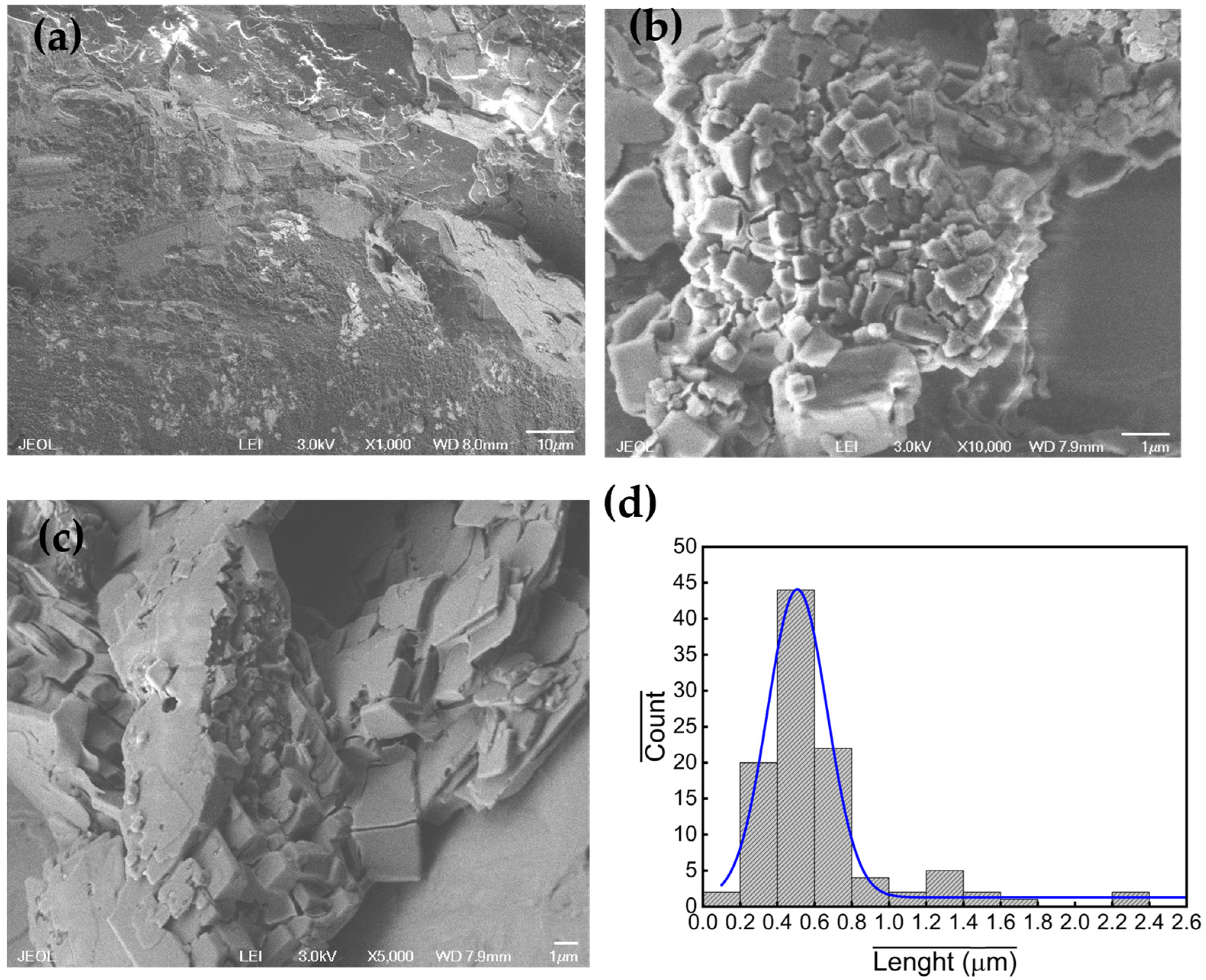
To further investigate the structural characteristics of BZACC, scanning electron microscopy (SEM) analysis was carried out to examine the morphology, particle distribution, and surface characteristics of the synthesized material, as displayed in Figure 2.
Figure 2.
SEM micrographs of benzylamine copper chloride (BZACC): (a) surface morphology at 1000× magnification, showing an eroded surface without the presence of cavities or tunnel-like features; (b) higher-magnification image (10,000×) highlighting the surface texture; (c) micrograph revealing the formation of layered platelet-like structures associated with preferential crystallite growth; and (d) particle size distribution obtained from the statistical analysis of crystallite lengths measured from the SEM image shown in (b).
As observed in Figure 2a, the material morphology exhibits an irregular surface with clear signs of surface erosion, characterized by fractured regions and rough textures. Despite this eroded appearance, no well-defined cavities, tunnels, or highly porous features are detected at this magnification, suggesting that the degradation is mainly superficial rather than associated with deep void formation.
At higher magnification (Figure 2b), the surface is resolved into aggregates composed of distorted cubic microcrystals of several sizes. These microcrystals appear tightly packed and partially fused, forming larger platelet-like assemblies. The irregular edges and non-uniform crystal shapes indicate anisotropic growth and possible stress-induced deformation during crystallization or post-synthesis processing.
Furthermore, the arrangement of these platelets into stacked and layered structures, as evidenced by the overlapping morphology, suggests preferential crystallite orientation and directional growth, as observed in Figure 2c. This layered organization is consistent with the crystallographic features inferred from the XRD analysis and may play a significant role in governing the electrochemical behavior of the material by influencing transport pathways and interfacial processes. Figure 2d shows the particle size distribution obtained from measurements performed on the micrograph presented in Figure 2b. A total of 104 crystallites were analyzed, yielding an average particle length of 0.63 ± 0.38 µm. The distribution is asymmetric, with most particles falling between approximately 0.2 and 0.8 µm, while a long tail extending up to 2.4 µm indicates the presence of larger crystallites or agglomerated domains. This broad distribution reflects the heterogeneous nature of the material, where distorted cubic microcrystals partially coalesce to form larger platelet-like structures, as observed in the SEM images. The relatively large standard deviation evidences a wide dispersion of particle sizes, consistent with anisotropic growth and strong aggregation effects, which might reduce the effective electrochemically active surface area and may contribute to diffusion-related limitations.
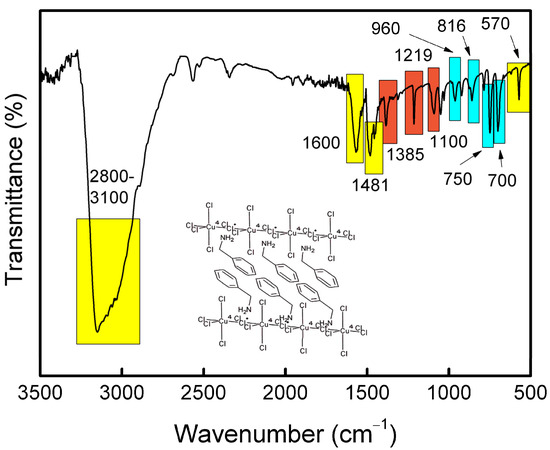
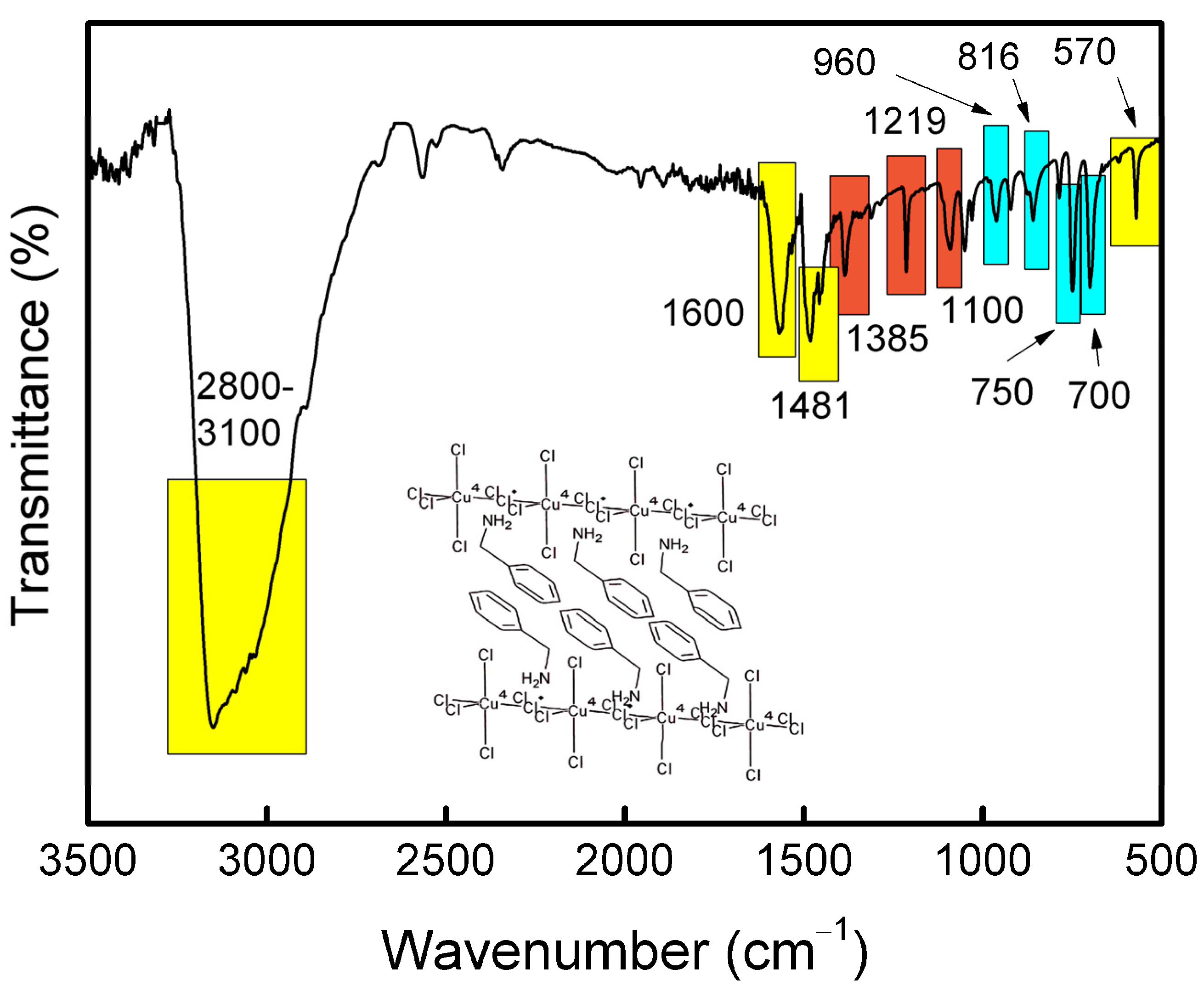
To gain further insight into the structural features of BZACC, the infrared transmittance spectrum was recorded and is presented in Figure 3. The spectrum exhibits several characteristic vibrational modes associated with benzylamine-derived groups that are summarized in Table 1.
Figure 3.
Infrared (IR) transmittance spectrum of the BZACC perovskite, showing the characteristic absorption bands associated with the vibrational modes of benzylamine-derived groups, including N–H, C–H, and C–N vibrations. The main bands are identified and indexed to facilitate assignment. A schematic representation of the BZACC molecular structure is included as a reference to help in the interpretation of the observed vibrational features.
Table 1.
FTIR vibrational modes and corresponding band assignments of the BZACC material.
The spectrum displays the characteristic vibrational modes of the benzylammonium cation, with N-H and aromatic C-H stretching vibrations in the 2800–3100 cm−1 region [30] and an NH3+ deformation band at 1600 cm−1 [31]. The bands observed in the fingerprint region are mainly associated with CH2, C-N, and aromatic C-C vibrations [32], while the bands at lower wavenumbers are assigned primarily to out-of-plane C-H bending modes of the phenyl ring [31]. Vibrational features below the 600 cm−1 region are associated with the inorganic Cu-Cl framework characteristic of the layered benzylammonium copper chloride structure [33]. These vibrational features are consistent with the formation of the benzylammonium-based Cu-Cl hybrid structure [34,35].
Following the structural characterization, the electrochemical performance of BZACC as an energy storage material was systematically evaluated.
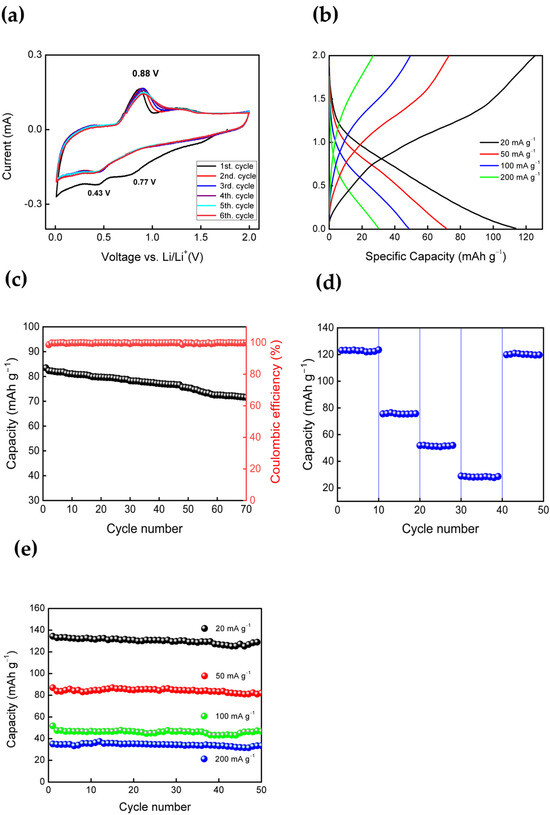
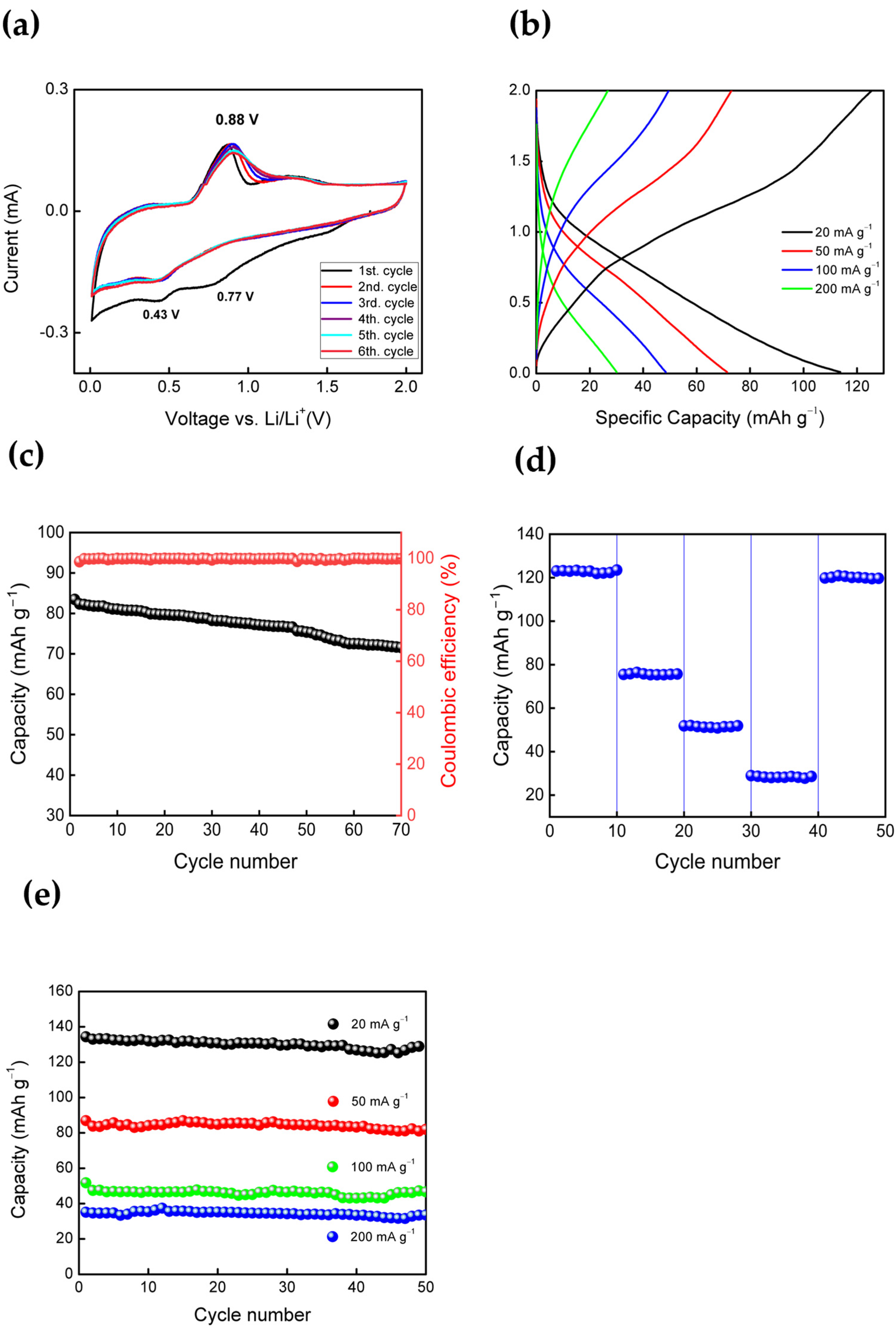
The electrochemical behavior of BZACC was first evaluated by cyclic voltammetry (CV) using a McPile potentiostat/galvanostatic system over a voltage range of 0.01–2.0 V. The corresponding CV curves are shown in Figure 4a.
Figure 4.
Electrochemical characterization of BZACC perovskite: (a) cyclic voltammetry curves recorded at a scan rate of 0.125 mV s−1 within the selected voltage window; (b) galvanostatic charge–discharge profiles obtained at different current densities ranging from 20 to 200 mA g−1 (0.17 C to 1.7 C); (c) cycling performance and coulombic efficiency measured at a constant current density of 50 mA g−1 (0.42 C) over 70 cycles; (d) rate capability of BZACC evaluated at various current densities from 20 to 200 mA g−1 (0.17 C to 1.7 C), highlighting the capacity evolution under stepwise changes in current density; and (e) capacity retention behavior of BZACC over 50 cycles at different fixed current densities.
The first cycle reveals two cathodic peaks located at 0.43 V and 0.77 V, together with an anodic peak at 0.88 V. These features suggest the involvement of two separate electrochemical processes or reactions, each associated with specific redox transitions. During the second cycle, the peak at 0.77 V completely disappears and its presence might be related to the formation of the Solid Electrolyte Interphase (SEI) layer, which is a consequence of the electrolyte decomposition [36,37].
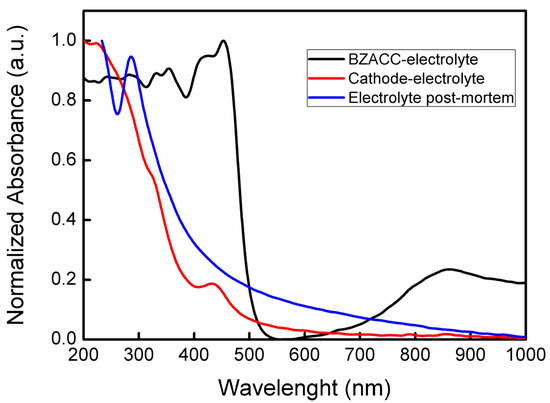
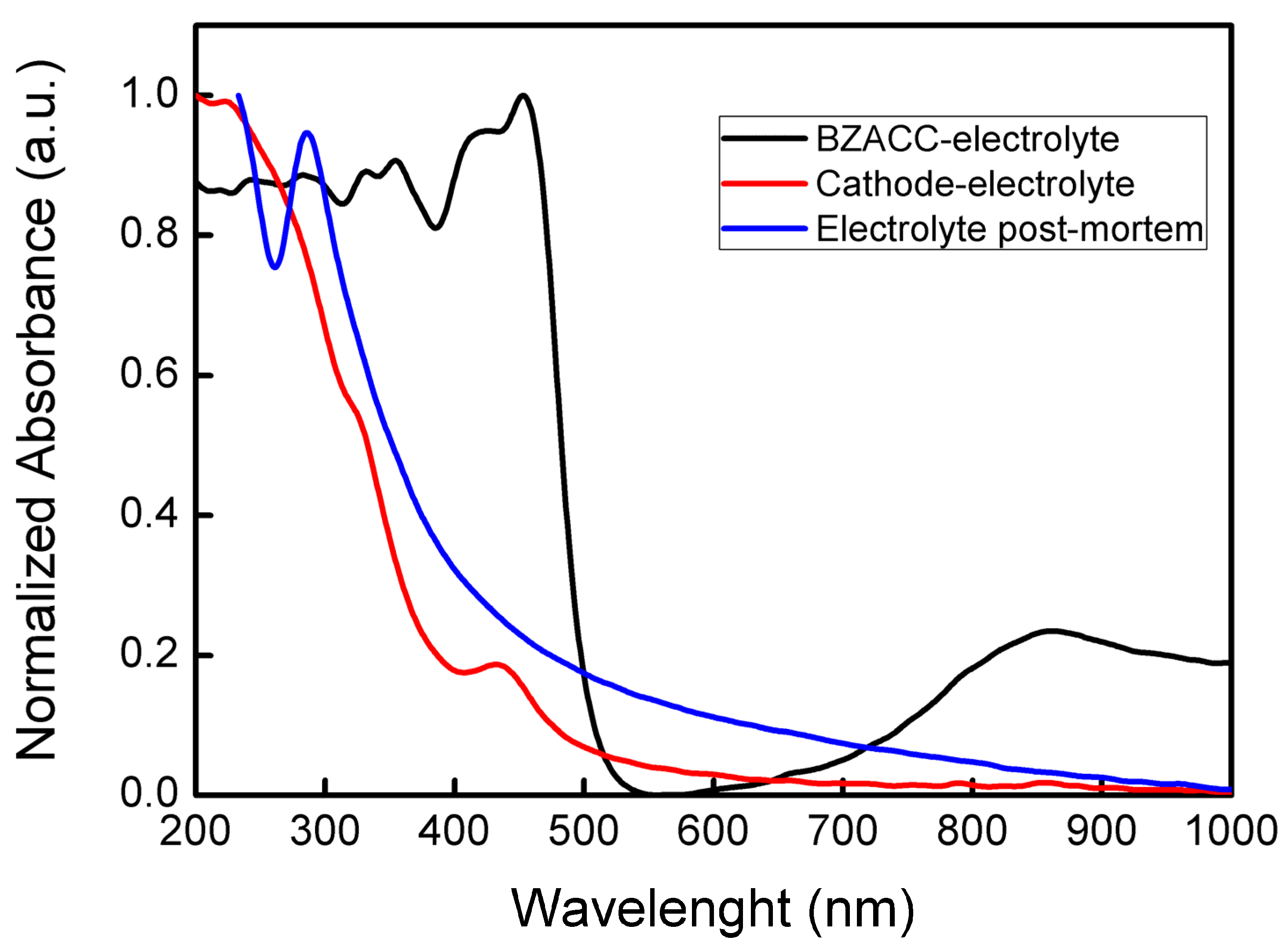
To further investigate whether this feature could be associated with the dissolution or leaching of BZACC into the electrolyte solution, instead of the SEI layer formation, a post-cycling electrolyte characterization through UV-Vis was carried out and it is displayed in Figure 5. The figure compares the normalized UV-Vis spectra of the BZACC dissolved in the electrolyte (black line), the electrolyte in contact with the BZACC/carbon/PTFE cathode (red line) and the postmortem electrolyte (blue line).
Figure 5.
Normalized UV-Vis absorption spectra of the BZACC-containing electrolyte, electrolyte in contact with the BZACC/carbon/PTFE cathode, and electrolyte extracted from the postmortem battery, highlighting the differences in their absorption profiles and the absence of the characteristic absorption features of the BZACC-containing electrolyte in the cathode-contact and postmortem electrolytes.
The BZACC-containing electrolyte exhibits several absorption features in the UV–visible region between 200 and 500 nm, followed by a pronounced decrease in absorbance at approximately 500 nm. In addition, a broad absorption feature is observed in the near-infrared region, centered at approximately 860 nm. This feature is present in the BZACC-containing electrolyte but is not observed in the electrolyte in contact with the BZACC/carbon/PTFE cathode. The absence of the corresponding absorption feature in the cathode-contact electrolyte suggests that BZACC is predominantly retained within the cathode matrix rather than being present in significant amounts in the electrolyte solution. Furthermore, the electrolyte extracted from the postmortem cell exhibits a markedly different spectral profile and does not reproduce the absorption features observed for the BZACC-containing electrolyte, including the broad feature around 860 nm. These results indicate that no significant leaching or dissolution of BZACC into the EC/DMC electrolyte is detected after cycling, supporting the conclusion that BZACC remains predominantly within the cathode matrix.
These results indicate that significant dissolution of intact BZACC into the EC/DMC electrolyte is not evident after cycling. Therefore, together with the complete disappearance of the 0.77 V peak after the first cycle, the UV–Vis results support its assignment primarily to the formation of the SEI during the initial electrochemical reduction process.
To obtain more information about the electrochemical behavior of assembled batteries, galvanostatic charge–discharge (GCD) tests were carried out to evaluate the rate capability and specific capacity of the studied material at several charge densities ranging from 20 mA g−1 (0.17 C) to 200 mA g−1 (1.7 C); the results are plotted in Figure 4b. To evaluate whether BZACC approaches its maximum theoretical charge-storage capacity, its theoretical specific capacity was calculated and then compared with the experimental values. The calculation was estimated by following the Faraday law described as , where is the theoretical specific capacity (mAh g−1), is the number of electrons transferred per formula unit, is Faraday’s constant (96,485 C mol−1), and is the molar mass of BZACC (421.69 g mol−1). For our calculations, .
This formula gives a theoretical capacity of 117 mAh g−1, which was used as the reference capacity for expressing the applied current densities as C-rates. Accordingly, the current densities of 20, 50, 100, and 200 mA g−1 correspond to approximately 0.17, 0.42, 0.85, and 1.7 C, respectively.
According to the discharge profiles, specific capacities of approximately 114, 72, 48, and 30 mAh g−1 were obtained at current densities of 20, 50, 100, and 200 mA g−1, respectively. These results clearly indicate a progressive decrease in capacity with increasing current density, a behavior typically observed in lithium-ion storage materials [38,39].
At the lowest current density (20 mA g−1), the material delivers its highest specific capacity, approaching the theoretical value, which suggests that benzylammonium copper chloride enables efficient lithium-ion storage under slow charge–discharge conditions. This behavior can be attributed to sufficient time for lithium-ion diffusion and complete utilization of electrochemically active sites within the electrode structure.
As the current density increases to 50 mA g−1 until reaching 200 mA g−1, the specific capacity gradually decreases to 72, 48, and 30 mAh g−1, respectively. This reduction reflects kinetic limitations associated with faster charge–discharge processes, where lithium-ion diffusion and charge-transfer reactions become increasingly constrained. Nonetheless, the material retains a measurable capacity even at 200 mA g−1 (1.7 C), indicating reasonable rate performance during high-rate cycling.
Regarding the shape of the charge–discharge curves, no plateau was observed that could be correlated directly with the oxidation/reduction peaks observed in the voltammetry characterization. This apparent disruption can be reconciled by considering that a sloppy charge/discharge curve is commonly observed in materials with solid-solution behavior or surface-dominated redox reactions where a potential could change continuously [40]. Thus, the combination of sloping galvanostatic curves and defined redox peaks in the CV points to a complex charge storage mechanism involving both capacitive and faradaic processes due to kinetic limitations, particle size effects, or pseudocapacitive contributions [41]. Augustyn et al. reported that pseudocapacitive materials commonly display sloping galvanostatic curves together with broad redox features in cyclic voltammetry, reflecting fast surface or near-surface faradaic reactions rather than classical phase-transition-controlled intercalation processes [42]. Likewise, Jiang et al. highlighted that nanostructured battery materials can develop pseudocapacitive behavior due to shortened ion diffusion paths and the increased contribution of electrochemically active surface sites [43]. These characteristics may be particularly relevant for BZACC, where particle size effects and structural disorder can facilitate rapid charge-transfer reactions while simultaneously limiting long-range lithium diffusion.
Additional experiments were performed to analyze the electrochemical stability of BZACC after 70 cycles at a charge rate of 50 mA g−1; the plot in Figure 4c displays the results.
The electrochemical cycling results show an initial specific capacity of approximately 85 mAh g−1, which progressively decreases to about 72 mAh g−1 upon continued cycling. Throughout the measurements, the coulombic efficiency remains close to 99%, indicating a high degree of charge balance between the charge and discharge processes. Furthermore, the capacity retention after 70 cycles is approximately 77%, reflecting the evolution of the discharge capacity during the early stages of cycling.
To further evaluate the electrochemical response of BZACC, capacity measurements were performed at different current densities ranging from 20 mA g−1 (0.17 C) to 200 mA g−1 (1.7 C), and the corresponding results are presented in Figure 4d.
Initially, the electrode delivers a specific capacity of approximately 120 mAh g−1 during the first ten cycles at a current density of 20 mA g−1 (0.17 C), with only minor fluctuations between cycles. When the current density is increased to 50 mA g−1 (0.42 C) for the subsequent ten cycles, the specific capacity decreases to around 75–80 mAh g−1. A further reduction in capacity is observed at higher current densities of 100 (0.85 C) and 200 mA g−1 (1.7 C), where average capacities of approximately 50 mAh g−1 and 30 mAh g−1 were obtained, respectively. These capacity values are in good agreement with those derived from the galvanostatic charge–discharge curves shown in Figure 4b. Finally, when the current density is returned to 20 mA g−1, the specific capacity recovers and it shows values close to 120 mAh g−1, indicating a good electrochemical response under varying current densities.
Figure 4e shows the cycling performance of the electrode at different current densities ranging from 20 to 200 mA g−1. At 20 mA g−1 (0.17 C), the capacity decreases slightly from 135 to 129 mAh g−1 over 50 cycles, corresponding to a capacity retention of approximately 96%. Similarly, capacity retentions of 95%, 92%, and 94% are estimated at 50 (0.42 C), 100 (0.85 C), and 200 mA g−1 (1.7 C), respectively. These results indicate that, despite the expected decrease in absolute capacity at higher current densities, the electrode maintains a comparable capacity retention across the investigated rates.
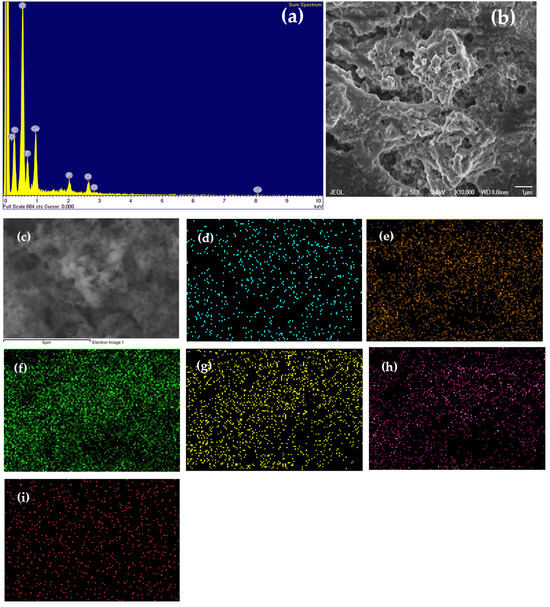
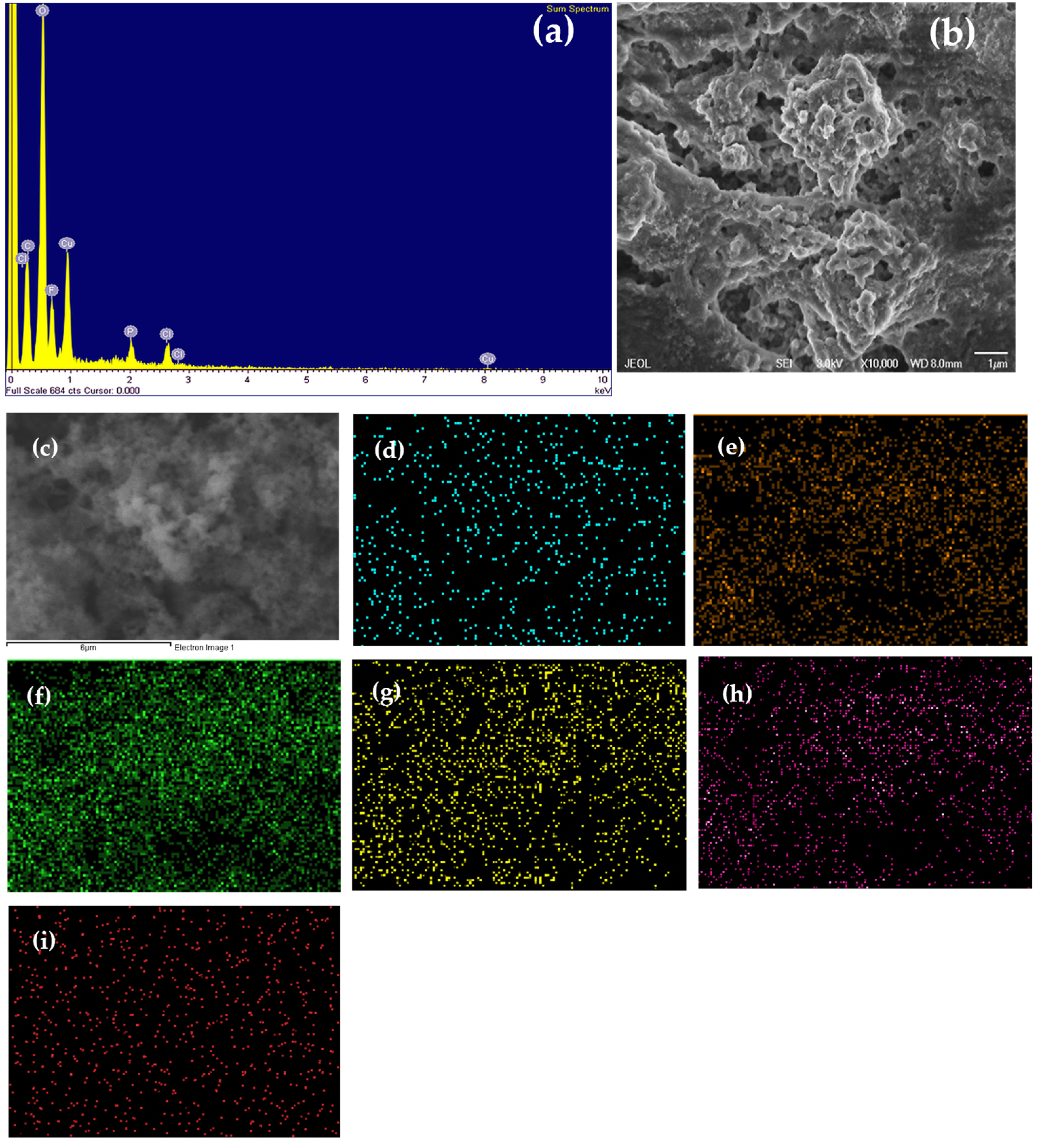
To establish a correlation between the electrochemical behavior of BZACC electrodes and their structural features and chemical composition, postmortem analyses were conducted after electrochemical cycling. Specifically, energy-dispersive X-ray spectroscopy (EDX) and X-ray diffraction (XRD) measurements were performed on electrodes extracted from the batteries after cycling, and the corresponding results are presented in Figure 6 and Figure 7, respectively.
Figure 6.
Energy-dispersive X-ray spectroscopy (EDX) analysis and elemental mapping of the postmortem BZACC electrode surface after electrochemical cycling. (a) EDX spectrum showing the elemental composition of the electrode, including contributions from both the active material and electrolyte-related species; (b) SEM micrograph acquired at 10,000× magnification; (c) electron image of the analyzed region; and elemental distribution maps of (d) chlorine, (e) copper, (f) oxygen, (g) carbon, (h) fluorine, and (i) phosphorus across the electrode surface.
Figure 7.
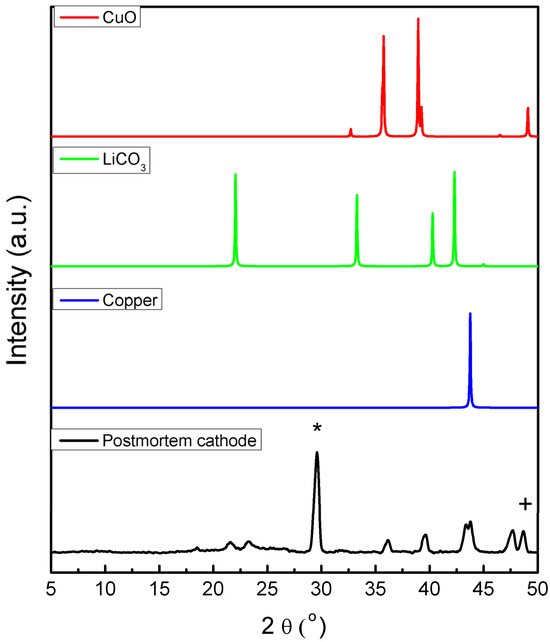
X-ray diffraction (XRD) patterns of the postmortem electrode (black) compared with the reference patterns of CuO (red), L2CO3 (green), and metallic Cu (blue). The asterisk (*) indicates the characteristic diffraction peak of the stainless-steel mesh. The + sign suggests the presence of a Li-Cu alloy.
EDX spectra from Figure 6a allowed us to identify elements related to the chemical composition of BZACC and the elements present in the electrolyte solution (carbon, oxygen, phosphorus and fluorine). Regarding the structure of the postmortem electrode, an additional SEM image is presented in Figure 6b. The identification of distinct morphological features exclusively associated with BZACC is challenging, as the electrode is a composite material that also contains conductive carbon and a polytetrafluoroethylene (PTFE) binder. Consequently, the observed surface morphology reflects the combined contributions of the active material, conductive additive, and binder, rather than the intrinsic morphology of BZACC alone.
Figure 6c shows an electron image of the area of interest and Figure 6d reveals the mapping analysis of the electrode surface; the identification of elements matches that of those observed in the EDX spectrum. As observed, the distribution of carbon, fluorine, phosphorus and oxygen, elements belonging to the electrolyte solution, is extended all over the surface as expected. The presence of copper and chlorine is clearly evidenced, and their spatial distributions suggest a close association between both elements after the electrochemical cycling process. However, copper appears to be present at a higher relative concentration than chlorine, suggesting that part of the copper may have reacted with oxygen-containing species from the electrolyte to form copper oxides or related compounds, while another fraction could remain in the metallic state.
The elemental distribution analysis suggests changes in the chemical environment of copper after electrochemical cycling; however, compositional information alone is insufficient to identify the crystalline phases present in the postmortem electrode. To further clarify whether structural modifications occurred and to assess the possible formation of secondary phases during cycling, X-ray diffraction measurements were performed on the BZACC postmortem electrode. The corresponding diffraction pattern is presented in Figure 7.
The diffractogram reveals the limited stability of BZACC; since peaks at low angles were not detected, only the presence of the peak linked to the (002) plane was revealed. On the other hand, the presence of peaks at higher diffraction angles was still detected and corresponds to the planes (00 10), (00 12) and (00 14).
The combined evidence suggests that benzylammonium copper chloride undergoes partial decomposition during the lithiation/delithiation processes associated with charge–discharge cycling. Furthermore, the X-ray diffraction pattern indicates the possible formation of secondary phases arising from interactions between lithium and copper species. The experimental XRD pattern of the postmortem electrode was compared with the corresponding CIF reference patterns of the expected decomposition products, namely CuO [44], Li2CO3 [45] and metallic Cu [46], in order to identify the crystalline phases generated during electrochemical cycling.
As indicated in Figure 7, the peak located at 43° is linked to the presence of metallic copper, which, according to the EDX presented in Figure 6, is gathered over the surface of the postmortem electrode, reinforcing the evidence of the decomposition of BZAAC. Additionally, the formation of lithium carbonate as a subproduct was also detected and its presence might be linked to the SEI layer formation.
Finally, it was discovered that CuO is also formed since several small peaks were identified and match those reported in the literature, which are consistent with our observations in the EDX mapping (see Figure 6). This observation suggests that chemical transformations involving copper occur during cycling, potentially leading to the formation of copper-rich secondary phases, including metallic copper or copper oxides.
Similar degradation mechanisms involving copper redistribution have been previously reported in lithium-ion battery systems. For instance, Langner et al. [47] demonstrated that copper dissolution and subsequent redeposition can occur during deep discharge or extended cycling in layered oxide electrodes, leading to the formation of metallic copper on the electrode surface and contributing to capacity decay. Likewise, Huang et al. [48] reported that interactions between transition metals and oxygen-containing electrolyte species promote the formation of metal oxides and other secondary phases, particularly under repeated lithiation/delithiation conditions. These findings are consistent with the copper-rich regions observed in the present postmortem EDX analysis and the XRD measurements.
Comparable structural degradation has been described by Kraytsberg and Ein-Eli, who highlighted that phase transformations, lattice distortion, and metal segregation are common degradation pathways in lithium-ion battery electrodes and often manifest as peak broadening or the appearance of new reflections in post-cycling XRD patterns [49].
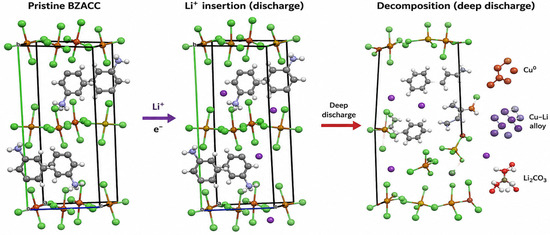
To illustrate the degradation mechanism, Figure 8 displays the proposed Li+ storage and degradation pathway of BZACC during electrochemical discharge. Initially, Li+ ions are inserted into the layered BZACC structure, accompanied by electron transfer to the inorganic Cu–Cl framework. Upon further discharge to very low potentials, the structure undergoes progressive destabilization, leading to the decomposition of the Cu–Cl framework. Under these deep-discharge conditions, conversion reactions become predominant, resulting in the formation of metallic Cu and Li2CO3 phases, as identified by postmortem XRD. Therefore, the capacity delivered at low potential is proposed to be part of two contributions, from a combination of Li+ insertion and subsequent conversion reactions rather than from a reversible intercalation process.
Figure 8.
Schematic representation of the proposed Li+ insertion and subsequent decomposition mechanism of BZACC during deep discharge. Li+ insertion into the BZACC structure is followed, at low potentials, by structural breakdown of the Cu–Cl framework and the formation of metallic Cu and Li2CO3, as identified by postmortem XRD.
To further contextualize the relevance of the present results, a comparative analysis with representative electrode materials commonly reported in the literature is provided. Accordingly, Table 2 summarizes selected electrode materials used in lithium-ion batteries and compares their electrochemical performance with those reported in this work.
Table 2.
Main electrode materials applied as electrodes in lithium-ion batteries compared with those reported in this work.
As observed, the BZACC electrode has shown a capacity lower than the main materials’ electrodes but an excellent capacity retention that makes it competitive. In comparison with previous works adopting hybrid materials, the retention efficiency increases significantly, suggesting that the presence of copper as a metallic center significantly improves the electrochemical performance of batteries.
Overall, this study contributes to and recognizes the potential of a new material with magnetic and optical properties described before but not in applications such as lithium-ion batteries. This is an advancement to broaden the applications of organic–inorganic hybrid compounds in the storage energy field.
4. Conclusions
Benzylammonium copper chloride (BZACC) represents an alternative approach for the development of novel electrode materials for lithium-ion batteries, further expanding the limited known hybrid perovskite electrodes investigated for electrochemical energy storage. Electrochemical evaluation demonstrates that BZACC delivers a specific capacity of up to 114 mAh g−1 at low current density, with coulombic efficiency remaining close to 99% during cycling and a capacity retention of approximately 77% after the initial cycle. In addition, the material exhibits a clear rate-dependent behavior, with capacities decreasing as the current density increases, a behavior consistent with the values obtained from galvanostatic charge–discharge measurements.
Postmortem structural and compositional analyses reveal that BZACC undergoes partial decomposition during repeated lithiation/delithiation processes, leading to the formation of secondary phases. Notably, the presence of copper-rich species, including metallic copper, suggests that electrochemical cycling induces chemical transformations that may influence the electronic properties of the electrode. Although this structural evolution limits the long-term structural integrity of the material, the formation of conductive copper-related byproducts is proposed to contribute to the electrochemical response of the composite electrode. However, this interpretation is based on the postmortem characterization results and requires further investigation for definitive confirmation.
Finally, these results highlight both the opportunities and challenges associated with BZACC as a lithium-ion battery electrode material. Further optimization of the material composition and electrode formulation will be required to better control structural degradation and to fully assess the role of the generated byproducts in enhancing electrochemical performance.
Author Contributions
A.R.-C.: conceptualization, methodology, investigation, formal analysis, data curation, visualization, writing—original draft preparation, and writing—review and editing. T.S.-Q.: validation and writing—review and editing. M.A.-B.: validation and writing—review and editing. A.E.-R.: validation and writing—review and editing. E.S.-C.: conceptualization, formal analysis, resources, supervision, project administration, funding acquisition, and writing—review and editing. All authors have read and agreed to the published version of the manuscript.
Funding
This research was funded by the Secretaría de Ciencia, Humanidades, Tecnología e Innovación (SECIHTI), Mexico, and Secretaría de Investigación Científica y Desarrollo Tecnológico de la UANL through Project No. 33-BYQ-2026.
Institutional Review Board Statement
Not applicable.
Informed Consent Statement
Not applicable.
Data Availability Statement
Dataset available on request from the authors.
Acknowledgments
Authors acknowledge to Secretaria de Ciencias Humanidades Tecnología e Innovación (Secihti), Mexico, for financial support. A. Romero-Contreras acknowledges Secihti for the invaluable opportunity granted through the postdoctoral fellowship 2025.
Conflicts of Interest
The authors declare no conflicts of interest.
Abbreviations
The following abbreviations are used in this manuscript:
| BZACC | Benzyl-ammonium copper chloride |
| PTFE | Polytetrafluoroethylene |
| XRD | X-ray diffraction |
References
- Li, M.; Zhu, Z.; Wang, Z.; Pan, W.; Cao, X.; Wu, G.; Chen, R. High-Quality Hybrid Perovskite Thin Films by Post-Treatment Technologies in Photovoltaic Applications. Adv. Mater. 2023, 36, e2309428. [Google Scholar] [CrossRef] [Scilit] [PubMed]
- Bagheri, M.H.; Khan, A.A.; Shahzadi, S.; Rana, M.M.; Hasan, M.S.; Ban, D. Advancements and challenges in molecular/hybrid perovskites for piezoelectric nanogenerator application: A comprehensive review. Nano Energy 2023, 120, 109101. [Google Scholar] [CrossRef] [Scilit]
- Islam, M.J.; Pal, K.; Harun-Ur-Rashid, M.; Kumar, A.; Hossain, M.F.; Asthana, N.; Rajendran, S.; Vallinayagam, S.; Malik, A. Optical maneuvering of photofunctioning hybrid perovskite for future photonics potential application. J. Mol. Liq. 2024, 408, 125343. [Google Scholar] [CrossRef] [Scilit]
- Jia, Z.; Cheng, C.; Chen, X.; Liu, L.; Ding, R.; Ye, J.; Wang, J.; Fu, L.; Cheng, Y.; Wu, Y. Applications of all-inorganic perovskites for energy storage. Mater. Adv. 2022, 4, 79–104. [Google Scholar] [CrossRef] [Scilit]
- Milić, J.V.; Zakeeruddin, S.M.; Grätzel, M. Layered Hybrid Formamidinium Lead Iodide Perovskites: Challenges and Opportunities. Acc. Chem. Res. 2021, 54, 2729–2740. [Google Scholar] [CrossRef] [Scilit] [PubMed]
- Groeneveld, B.G.H.M.; Duim, H.; Kahmann, S.; De Luca, O.; Tekelenburg, E.K.; Kamminga, M.E.; Protesescu, L.; Portale, G.; Blake, G.R.; Rudolf, P.; et al. Photochromism in Ruddlesden–Popper copper-based perovskites: A light-induced change of coordination number at the surface. J. Mater. Chem. C 2020, 8, 15377–15384. [Google Scholar] [CrossRef] [Scilit]
- Li, J.; Zhu, Y.; Huang, P.; Fu, D.; Jia, Q.; Lu, H. Ferroelasticity in Organic–Inorganic Hybrid Perovskites. Chem.-Eur. J. 2022, 28, e202201005. [Google Scholar] [CrossRef] [Scilit] [PubMed]
- Moeini, A.; Martínez-Sarti, L.; Zanoni, K.P.S.; Sessolo, M.; Tordera, D.; Bolink, H.J. Semitransparent near-infrared Sn–Pb hybrid perovskite photodetectors. J. Mater. Chem. C 2022, 10, 13878–13885. [Google Scholar] [CrossRef] [Scilit]
- Huang, Z.; Yeh, C.; Wang, M.; Lau, V.W.; Tian, H.; Shih, C. Comprehensive study on phase stability of lead-free Sn-based perovskite FAxMA1-xSnI3. Mater. Today Adv. 2024, 24, 100534. [Google Scholar] [CrossRef] [Scilit]
- Chiara, R.; Morana, M.; Malavasi, L. Germanium-Based Halide Perovskites: Materials, Properties, and Applications. ChemPlusChem 2021, 86, 879–888. [Google Scholar] [CrossRef] [Scilit] [PubMed]
- Mitzi, D.B.; Chondroudis, K.; Kagan, C.R. Organic-inorganic electronics. IBM J. Res. Dev. 2001, 45, 29–45. [Google Scholar] [CrossRef] [Scilit]
- Bourwina, M.; Msalmi, R.; Walha, S.; Turnbull, M.M.; Roisnel, T.; Costantino, F.; Mosconi, E.; Naïli, H. A new lead-free 1D hybrid copper perovskite and its structural, thermal, vibrational, optical and magnetic characterization. J. Mater. Chem. C 2021, 9, 5970–5976. [Google Scholar] [CrossRef] [Scilit]
- Qu, J.; Xu, S.; Shao, H.; Xia, P.; Lu, C.; Wang, C.; Ban, D. Recent progress of copper halide perovskites: Properties, synthesis and applications. J. Mater. Chem. C 2023, 11, 6260–6275. [Google Scholar] [CrossRef] [Scilit]
- Chakraborty, A.; Pai, N.; Zhao, J.; Tuttle, B.R.; Simonov, A.N.; Pecunia, V. Rudorffites and Beyond: Perovskite-Inspired Silver/Copper Pnictohalides for Next-Generation Environmentally Friendly Photovoltaics and Optoelectronics. Adv. Funct. Mater. 2022, 32, 2203300. [Google Scholar] [CrossRef] [Scilit]
- Han, C.; Bradford, A.J.; Slawin, A.M.Z.; Bode, B.E.; Fusco, E.; Lee, S.L.; Tang, C.C.; Lightfoot, P. Structural Features in Some Layered Hybrid Copper Chloride Perovskites: ACuCl4 or A2CuCl4. Inorg. Chem. 2021, 60, 11014–11024. [Google Scholar] [CrossRef] [Scilit] [PubMed]
- Belikova, D.E.; Fateev, S.A.; Khrustalev, V.N.; Kozhevnikova, V.; Ordinartsev, A.A.; Dzuban, A.V.; Goodilin, E.A.; Tarasov, A.B. Bright luminescence of new low-melting copper(i) chlorides with compact organic cations. J. Mater. Chem. C 2024, 12, 13537–13544. [Google Scholar] [CrossRef] [Scilit]
- Salgado-Pizarro, R.; Barreneche, C.; Fernández, A. Synthesis optimisation of copper-based layered perovskites as thermal energy storage materials. Mater. Today Chem. 2023, 30, 101491. [Google Scholar] [CrossRef] [Scilit]
- Jaffe, A.; Karunadasa, H.I. Lithium Cycling in a Self-Assembled Copper Chloride–Polyether Hybrid Electrode. Inorg. Chem. 2014, 53, 6494–6496. [Google Scholar] [CrossRef] [Scilit] [PubMed]
- Mathieson, A.; Rahil, M.; Zhang, Y.; Dose, W.M.; Lee, J.T.; Deschler, F.; Ahmad, S.; De Volder, M. Ruddlesden Popper 2D perovskites as Li-ion battery electrodes. Mater. Adv. 2021, 2, 3370–3377. [Google Scholar] [CrossRef] [Scilit]
- Romero-Contreras, A.; García-Gomez, N.A.; Cervantes, E.S. Comparative study of 2D perovskite electrodes: Impact of organic cation variation on electrochemical performance in lithium-ion batteries. J. Electrochem. Sci. Eng. 2026, 16, 3234. [Google Scholar] [CrossRef] [Scilit]
- Kimishima, Y. Magnetic phase transitions in (C6H5CH2NH3)2CuCl4. J. Magn. Magn. Mater. 1990, 90–91, 301–302. [Google Scholar] [CrossRef] [Scilit]
- Becker, S.; Behrens, U.; Schindler, S. Synthesis, Structure and Reactivity of the Compound [Cu(C7H7NH2)Cl]4 derived from CuCl and Benzylamine (C7H7NH2). Z. Anorg. Allg. Chem. 2014, 641, 430–435. [Google Scholar] [CrossRef] [Scilit]
- Löw, S.; Becker, J.; Würtele, C.; Miska, A.; Kleeberg, C.; Behrens, U.; Walter, O.; Schindler, S. Reactions of Copper(II) Chloride in Solution: Facile Formation of Tetranuclear Copper Clusters and Other Complexes That Are Relevant in Catalytic Redox Processes. Chem.-Eur. J. 2013, 19, 5342–5351. [Google Scholar] [CrossRef] [Scilit] [PubMed]
- Lee, J.; Papp, J.K.; Clément, R.J.; Sallis, S.; Kwon, D.; Shi, T.; Yang, W.; McCloskey, B.D.; Ceder, G. Mitigating oxygen loss to improve the cycling performance of high capacity cation-disordered electrode materials. Nat. Commun. 2017, 8, 981. [Google Scholar] [CrossRef] [Scilit] [PubMed]
- Lin, F.; Wang, J.; Jia, H.; Monroe, C.W.; Yang, J.; NuLi, Y. Nonflammable electrolyte for rechargeable lithium battery with sulfur based composite electrode materials. J. Power Sources 2012, 223, 18–22. [Google Scholar] [CrossRef] [Scilit]
- Liu, X.; Elia, G.A.; Gao, X.; Qin, B.; Zhang, H.; Passerini, S. Highly Concentrated KTFSI: Glyme Electrolytes for K/Bilayered-V2O5 Batteries. Batter. Supercaps 2020, 3, 261–267. [Google Scholar] [CrossRef] [Scilit]
- Shang, W.; Li, Q.; Jiang, F.; Huang, B.; Song, J.; Yun, S.; Liu, X.; Kimura, H.; Liu, J.; Kang, L. Boosting Zn||I2 Battery’s Performance by Coating a Zeolite-Based Cation-Exchange Protecting Layer. Nano-Micro Lett. 2022, 14, 82. [Google Scholar] [CrossRef] [Scilit] [PubMed]
- Zou, L.; Liu, H.X.; Guo, L.; Xu, G.T.; Xue, G.F. Preparation and Characterization of Organic-Inorganic Hybrid Perovskite (C6H5CH2NH3)2CuCl4. Adv. Mater. Res. 2011, 311–313, 2146–2150. [Google Scholar] [CrossRef] [Scilit]
- Kim, Y.H.; Hur, N. Magnetic Properties and Magnetodielectric Effect in (C6H5CH2NH3)2[CuCl4] with Organic-Inorganic Hybrid Layered Structure. J. Korean Phys. Soc. 2020, 77, 1026–1030. [Google Scholar] [CrossRef] [Scilit]
- Craver, C.D. (Ed.) The Coblentz Society Desk Book of Infrared Spectra, 2nd ed.; The Coblentz Society: Kirkwood, MO, USA, 1982. [Google Scholar]
- Lavan, S.N.; Sanni, A.M.; Rury, A.S.; Liu, Z. Characterization of the Ammonium Bending Vibrations in Two-Dimensional Hybrid Lead-Halide Perovskites from Raman Spectroscopy and First-Principles Calculations. J. Phys. Chem. C 2021, 125, 223–236. [Google Scholar] [CrossRef] [Scilit]
- Khoma, R.E.; Ennan, A.A.; Gelmboldt, V.O.; Shishkin, O.V.; Baumer, V.N.; Mazepa, A.V.; Brusilovskii, Y.E. Preparation and some physicochemical properties of benzylammonium sulfates. Russ. J. Gen. Chem. 2014, 84, 637–641. [Google Scholar] [CrossRef] [Scilit]
- Han, C.; Bradford, A.J.; McNulty, J.A.; Zhang, W.; Halasyamani, P.S.; Slawin, A.M.Z.; Morrison, F.D.; Lee, S.L.; Lightfoot, P. Polarity and Ferromagnetism in Two-Dimensional Hybrid Copper Perovskites with Chlorinated Aromatic Spacers. Chem. Mater. 2022, 34, 2458–2467. [Google Scholar] [CrossRef] [Scilit] [PubMed]
- Asandulesa, M.; Topala, I.; Legrand, Y.; Roualdes, S.; Rouessac, V.; Harabagiu, V. Chemical Investigation on Various Aromatic Compounds Polymerization in Low Pressure Helium Plasma. Plasma Chem. Plasma Process. 2014, 34, 1219–1232. [Google Scholar] [CrossRef] [Scilit]
- Ljubijankić, S.; Galijašević, S.; Davidović-Plavšić, B.; Balaban, M.; Ljubijankić, N. Synthesis, IR characterization and antioxidant capacity of Cu(II) complexes with amino acids and melatonin. Bull. Chem. Technol. Bosnia Herzeg. 2022, 58, 19–32. [Google Scholar]
- Lee, C.R.; Jang, H.Y.; Leem, H.J.; Lee, M.A.; Kim, W.; Kim, J.; Song, J.H.; Yu, J.; Mun, J.; Back, S.; et al. Surface Work Function-Induced Thermally Vulnerable Solid Electrolyte Interphase Formation on the Negative Electrode for Lithium-Ion Batteries. Adv. Energy Mater. 2023, 14, 2302906. [Google Scholar] [CrossRef] [Scilit]
- Jassar, M.B.; Michel, C.; Abada, S.; De Bruin, T.; Tant, S.; Nieto-Draghi, C.; Steinmann, S.N. A Perspective on the Molecular Modeling of Electrolyte Decomposition Reactions for Solid Electrolyte Interphase Growth in Lithium-Ion Batteries. Adv. Funct. Mater. 2024, 34, 2313188. [Google Scholar] [CrossRef] [Scilit]
- Lee, Y.; Ryu, K. Study of the lithium diffusion properties and high-rate performance of TiNb6O17 as an anode in lithium secondary battery. Sci. Rep. 2017, 7, 16617. [Google Scholar] [CrossRef] [Scilit] [PubMed]
- Tian, R.; Park, S.; King, P.J.; Cunningham, G.; Coelho, J.; Nicolosi, V.; Coleman, J.N. Quantifying the factors limiting rate performance in battery electrodes. Nat. Commun. 2019, 10, 1933. [Google Scholar] [CrossRef] [Scilit] [PubMed]
- Chang, X.; Zhou, X.; Buangam, P.; Kamonsutthipaijit, N.; Tunmee, S.; Cabot, A. Key factors influencing the plateau region in N-doped hard carbon for sodium storage. EES Batter. 2025, 1, 1583–1595. [Google Scholar] [CrossRef] [Scilit]
- Chen, H.; Qiu, N.; Wu, B.; Yang, Z.; Sun, S.; Wang, Y. Tunable pseudocapacitive contribution by dimension control in nanocrystalline-constructed (Mg0.2Co0.2Ni0.2Cu0.2Zn0.2)O solid solutions to achieve superior lithium-storage properties. RSC Adv. 2019, 9, 28908–28915. [Google Scholar] [CrossRef] [Scilit] [PubMed]
- Augustyn, V.; Simon, P.; Dunn, B. Pseudocapacitive oxide materials for high-rate electrochemical energy storage. Energy Environ. Sci. 2014, 7, 1597. [Google Scholar] [CrossRef] [Scilit]
- Jiang, Y.; Liu, J. Definitions of Pseudocapacitive Materials: A Brief Review. Energy Environ. Mater. 2019, 2, 30–37. [Google Scholar] [CrossRef] [Scilit]
- U.S. Department of Energy Office of Scientific and Technical Information. Materials Data on CuO by Materials Project [Conjunto de Datos]; En OSTI OAI (U.S. Department of Energy Office of Scientific and Technical Information): Oak Ridge, TN, USA, 2020. [Google Scholar] [CrossRef] [Scilit]
- U.S. Department of Energy Office of Scientific and Technical Information. Materials Data on Li2CO3 by Materials Project [Conjunto de Datos]; En OSTI OAI (U.S. Department of Energy Office of Scientific and Technical Information): Oak Ridge, TN, USA, 2020. [Google Scholar] [CrossRef] [Scilit] [PubMed]
- U.S. Department of Energy Office of Scientific and Technical Information. Materials Data on Cu by Materials Project; OSTI OAI (U.S. Department of Energy Office of Scientific and Technical Information): Oak Ridge, TN, USA, 2020. [Google Scholar] [CrossRef] [Scilit] [PubMed]
- Langner, T.; Sieber, T.; Acker, J. Studies on the deposition of copper in lithium-ion batteries during the deep discharge process. Sci. Rep. 2021, 11, 6316. [Google Scholar] [CrossRef] [Scilit] [PubMed]
- Huang, D.; Engtrakul, C.; Nanayakkara, S.; Mulder, D.W.; Han, S.; Zhou, M.; Luo, H.; Tenent, R.C. Understanding Degradation at the Lithium-Ion Battery Cathode/Electrolyte Interface: Connecting Transition-Metal Dissolution Mechanisms to Electrolyte Composition. ACS Appl. Mater. Interfaces 2021, 13, 11930–11939. [Google Scholar] [CrossRef] [Scilit] [PubMed]
- Kraytsberg, A.; Ein-Eli, Y. Degradation Processes in Current Commercialized Li-Ion Batteries and Strategies to Mitigate Them. Annu. Rev. Mater. Res. 2024, 54, 143–173. [Google Scholar] [CrossRef] [Scilit]
- Mizushima, K.; Jones, P.; Wiseman, P.; Goodenough, J. LixCoO2 (0 < x ≤ 1): A new cathode material for batteries of high energy density. Solid State Ion. 1981, 3–4, 171–174. [Google Scholar] [CrossRef] [Scilit]
- Padhi, A.K.; Nanjundaswamy, K.S.; Goodenough, J.B. Phospho-olivines as Positive-Electrode Materials for Rechargeable Lithium Batteries. J. Electrochem. Soc. 1997, 144, 1188–1194. [Google Scholar] [CrossRef] [Scilit]
- Ohzuku, T.; Makimura, Y. Layered Lithium Insertion Material of LiCo1/3Ni1/3Mn1/3O2 for Lithium-Ion Batteries. Chem. Lett. 2001, 30, 642–643. [Google Scholar] [CrossRef] [Scilit]
- Thackeray, M.; David, W.; Bruce, P.; Goodenough, J. Lithium insertion into manganese spinels. Mater. Res. Bull. 1983, 18, 461–472. [Google Scholar] [CrossRef] [Scilit]
- Romero-Contreras, A.; Serrano-Quezada, T.; Garcia-Gomez, N.A.; De la Parra-Arcinega, S.M.; Sanchez-Cervantes, E.M. Synthesis and characterization of Ammonium Hexachlorostannate perovskite and its application as cathode material in Lithium-ion batteries. Ionics 2025, 31, 229–238. [Google Scholar] [CrossRef] [Scilit] [PubMed]
- Romero-Contreras, A.; Gonzalez-Juarez, E.; Briones-Martínez, R.; Sanchez-Cervantes, E.M. Butylammonium Hexachlorostannate for Lithium-Ion Batteries: An Experimental Application. J. Electron. Mater. 2025, 54, 4597–4605. [Google Scholar] [CrossRef] [Scilit]

Disclaimer/Publisher’s Note: The statements, opinions and data contained in all publications are solely those of the individual author(s) and contributor(s) and not of MDPI and/or the editor(s). MDPI and/or the editor(s) disclaim responsibility for any injury to people or property resulting from any ideas, methods, instructions or products referred to in the content. |
© 2026 by the authors. Licensee MDPI, Basel, Switzerland. This article is an open access article distributed under the terms and conditions of the Creative Commons Attribution (CC BY) license.