


Abstract
The growing demand for more sustainable construction materials has driven the development of composites incorporating industrial and agricultural residues, contributing to the reduction in virgin raw material consumption and the valorisation of by-products. In this context, the present study investigated the influence of incorporating rice husk subjected to different chemical treatments and the partial replacement of commercial gypsum with recycled gypsum on the flexural strength, compressive strength and microstructural characteristics of gypsum-based composites. Initially, formulations containing 5 wt.% and 10 wt.% rice husk in three different conditions, untreated, treated with calcium hydroxide, and treated with acetic acid, were produced and evaluated in terms of compressive strength and flexural strength. The formulation containing 5 wt.% rice husk treated with acetic acid exhibited the best overall performance and was therefore selected for the subsequent stage of the study. In the second phase, mixtures incorporating 20 wt.%, 30 wt.% and 40 wt.% recycled gypsum, with and without the addition of 5 wt.% treated rice husk, were investigated. Furthermore, particle size distribution, X-ray diffraction (XRD), scanning electron microscopy (SEM), and energy-dispersive X-ray spectroscopy (EDS) analyses were performed. The results demonstrated that the acetic acid treatment resulted in higher flexural and compressive strength compared with the other treatment conditions evaluated. Partial replacement with recycled gypsum also yielded promising results, with the formulation containing 70 wt.% commercial gypsum and 30 wt.% recycled gypsum exhibiting the highest mechanical strength among the composites without lignocellulosic reinforcement. Microstructural characterisation revealed the preservation of the principal mineralogical phases following the recycling process, and SEM micrographs showed the incorporation of rice husk within the gypsum matrix. Overall, the combination of 30 wt.% recycled gypsum and 5 wt.% rice husk treated with acetic acid represents a technically viable alternative for the development of gypsum composites intended for non-structural applications in the construction industry, while promoting the beneficial utilisation of waste materials.
1. Introduction
The construction industry plays a fundamental role in economic development and improving quality of life by providing infrastructure, housing, and public facilities. However, it is also recognised as one of the sectors with the highest consumption of natural resources and one of the largest generators of solid waste worldwide. As highlighted by [1], construction and demolition waste management has become one of the major challenges for achieving sustainable development, reinforcing the need to adopt circular economy strategies based on waste reduction, material reuse, and recycling. Similarly, ref. [2] emphasised that the transition towards low-carbon construction requires the incorporation of sustainable materials and the efficient use of secondary raw materials throughout the production chain.
Among the various materials employed in the construction industry, gypsum has gained increasing importance owing to its rapid setting, ease of application, smooth surface finish, good thermal and acoustic insulation, low density, and excellent fire resistance [3,4]. These characteristics have favoured its extensive use in plastering, ceiling systems, partition walls, decorative components, and prefabricated elements [4,5]. Nevertheless, the continuous expansion of gypsum applications has also resulted in a significant increase in the generation of gypsum waste during manufacturing, transportation, installation, renovation, and demolition activities, creating important environmental and economic challenges [6].
Unlike many construction materials, gypsum can be recycled several times through drying, grinding, and calcination processes, allowing its reincorporation into new products with properties comparable to those of commercial gypsum. Ref. [7] demonstrated that recycled gypsum preserves satisfactory physical and technological properties over successive recycling cycles, while [6] reported that gypsum recycling represents an environmentally viable alternative capable of substantially reducing the disposal of construction waste in landfills. More recently, ref. [4] demonstrated that the calcination parameters adopted during recycling significantly influence the physical and mechanical properties of recycled gypsum, highlighting the importance of controlling processing conditions to ensure adequate material performance.
Although gypsum recycling has become increasingly feasible from both technical and environmental perspectives, considerable quantities of gypsum waste are still disposed of inappropriately. Besides representing the loss of a valuable mineral resource, inadequate disposal may contribute to environmental problems, particularly under anaerobic landfill conditions, where sulphate-reducing bacteria can promote the formation of hydrogen sulphide (H2S), a toxic and malodorous gas. Consequently, improving recycling technologies and increasing the use of recycled gypsum have become strategic priorities for reducing environmental impacts and promoting circular economy principles within the construction sector [6,7]. This scenario has recently been reinforced by [8], who reviewed the current applications of industrial by-product gypsum and highlighted its considerable potential for reducing raw material consumption and improving the sustainability of construction materials.
In addition to environmental benefits, gypsum recycling contributes to reducing the extraction of natural gypsum deposits and decreasing the energy demand associated with raw material production. Nevertheless, several factors, including particle size distribution, grinding efficiency, calcination temperature, and water demand, directly influence the performance of recycled gypsum composites. Ref. [9] demonstrated that the grindability, grading, and wettability of recycled plaster significantly affect its processing behaviour, whereas [10] confirmed the technical feasibility of incorporating recycled gypsum into prefabricated building components. More recently, ref. [11] reported the successful development of sustainable gypsum panels reinforced with recycled fibres, further demonstrating the growing interest in gypsum-based composites incorporating recycled constituents.
Despite these advances, further investigations remain necessary to optimise recycled gypsum formulations while maintaining satisfactory flexural and compressive strength. This requirement becomes even more relevant when recycled gypsum is combined with renewable lignocellulosic materials, since the interaction between the mineral matrix and plant-derived reinforcements directly influences the physical, flexural, compressive and microstructural behaviour of the resulting composites.
In parallel with the recycling of mineral binders, increasing attention has been directed towards the incorporation of agricultural residues into construction materials as an alternative for reducing environmental impacts while improving the sustainability of the construction sector. Among the numerous lignocellulosic residues investigated, rice husk has attracted particular interest because of its high worldwide availability, low density, renewable nature, and favourable chemical composition [12,13,14]. As one of the main by-products generated during rice milling, rice husk is produced in large quantities every year, and although part of this material is used for energy production or agricultural applications, a significant proportion is still inadequately disposed of, creating environmental concerns.
Rice husk is mainly composed of cellulose, hemicellulose, lignin and a relatively high silica content, which distinguishes it from most other lignocellulosic residues [12,13]. This unique composition provides low density, good thermal insulation and satisfactory dimensional stability, making rice husk a promising reinforcement for cementitious and gypsum-based composites. Furthermore, its utilisation contributes simultaneously to reducing agricultural waste disposal and decreasing the consumption of non-renewable raw materials, which is fully consistent with the principles of sustainable construction and circular economy.
Several studies have demonstrated the technical feasibility of incorporating rice husk and other agricultural residues into mineral composites. Ref. [15] reported that the incorporation of rice husk into biodegradable composites resulted in satisfactory material performance, highlighting the reinforcing potential of this agricultural residue. Similarly, ref. [16] demonstrated the successful production of gypsum-based composites reinforced with cocoa agro-industrial waste particles, confirming that lignocellulosic residues can be effectively incorporated into gypsum matrices without compromising their technological potential. These investigations reinforce the growing interest in replacing conventional reinforcements with renewable bio-based materials.
Specifically regarding gypsum composites, ref. [17] observed that the incorporation of rice husk fibres into plaster of Paris improved both flexural and compressive strength when appropriate addition levels were adopted. Likewise, ref. [18] reported that the incorporation of waste cellulose acetate fibres enhanced the thermal and flexural and compressive strength of gypsum composites, demonstrating that gypsum presents excellent compatibility with different types of recycled and lignocellulosic reinforcements. More recently, ref. [19] investigated gypsum composites reinforced with rice husk and coir fibres, reporting improvements in thermal and acoustic performance while emphasising that the mechanical behaviour depends strongly on fibre content, dispersion and fibre–matrix adhesion.
Despite these promising results, the direct incorporation of untreated rice husk into mineral matrices still presents important challenges. The hydrophilic nature of lignocellulosic materials promotes high water absorption, which may interfere with gypsum hydration and increase the porosity of the hardened composite. Furthermore, the presence of waxes, lignin and other surface impurities reduces interfacial adhesion between the reinforcement and the mineral matrix, limiting stress transfer during mechanical loading [20]. Consequently, improving the compatibility between rice husk and gypsum remains one of the principal challenges for obtaining composites with satisfactory flexural and compressive strength.
Chemical surface modification has therefore become one of the most widely adopted strategies for improving the performance of natural-fibre composites. According to [21], chemical treatments promote the removal of superficial impurities and modify the surface chemistry of rice husk, increasing its adsorption capacity and altering its interaction with surrounding matrices. Similar mechanisms have been reported for lignocellulosic reinforcements incorporated into cementitious materials, where alkaline and acidic treatments improve fibre wettability, increase surface roughness and promote stronger interfacial bonding [20]. Nevertheless, relatively few studies have evaluated these treatments specifically in gypsum composites incorporating recycled gypsum, demonstrating that important knowledge gaps still remain.
Although considerable progress has been achieved in the development of sustainable gypsum-based composites, several scientific and technological challenges remain unresolved. Most previous studies have investigated recycled gypsum and lignocellulosic reinforcements separately, focusing either on the recycling process or on the incorporation of natural fibres into mineral matrices. Consequently, there is still limited understanding of the combined influence of recycled gypsum and chemically modified rice husk on the mechanical and microstructural behaviour of gypsum composites.
One of the main limitations associated with the direct incorporation of untreated rice husk into gypsum matrices is its limited compatibility with the mineral binder. According to [13], the external surface of rice husk contains lignin, waxes and other extractives that hinder adhesion between the lignocellulosic reinforcement and inorganic matrices. In addition, the hydrophilic nature of cellulose and hemicellulose promotes greater water absorption, modifying the effective water-to-gypsum ratio during mixing and potentially increasing the porosity of the hardened composite. These factors directly affect stress transfer across the fibre–matrix interface and may reduce the flexural and compressive strength of the composite.
To overcome these limitations, several authors have proposed chemical treatments capable of modifying the surface characteristics of lignocellulosic materials. Ref. [21] demonstrated that chemical treatment effectively alters the surface chemistry of rice husk by removing impurities and increasing the availability of reactive sites. Similarly, ref. [20] reported that alkaline and acidic treatments improve the compatibility between plant fibres and cementitious matrices by partially removing hemicellulose, lignin and surface extractives while increasing surface roughness and wettability. These modifications favour stronger interfacial bonding and more efficient stress transfer, contributing to improved composite performance.
In parallel, the characteristics of recycled gypsum also play a decisive role in the behaviour of gypsum-based composites. Ref. [9] demonstrated that particle size distribution, grindability and wettability significantly influence the hydration behaviour and workability of recycled gypsum, whereas [4] highlighted the importance of controlling calcination parameters to recover satisfactory physical and mechanical properties. Furthermore, ref. [22] reported that particle size distribution strongly affects the behaviour of gypsum composites reinforced with lignocellulosic materials, reinforcing the need to investigate not only the chemical treatment of the reinforcement but also the characteristics of the mineral matrix.
More recently, ref. [19] evaluated gypsum composites reinforced with rice husk and coir fibres and demonstrated that rice husk, when incorporated individually, tended to reduce flexural strength because of its limited interaction with the gypsum matrix, whereas hybrid reinforcements produced more favourable results. The authors emphasised that improving fibre–matrix compatibility remains one of the principal challenges for maximising the flexural and compressive strength of rice husk-reinforced gypsum composites.
Despite these important contributions, relatively few studies have simultaneously investigated the effects of chemically treated rice husk and recycled gypsum within the same experimental programme. Likewise, comprehensive analyses combining mechanical testing with particle size distribution, X-ray diffraction (XRD), scanning electron microscopy (SEM) and energy-dispersive X-ray spectroscopy (EDS) remain scarce. Such integrated approaches are essential for supporting the interpretation of the flexural and compressive strength results based on complementary physical, mineralogical and microstructural characterisation.
Therefore, further investigations are required to determine whether appropriate chemical modification of rice husk can compensate for the changes introduced by recycled gypsum while maintaining satisfactory flexural and compressive strength. Addressing this knowledge gap may contribute to the development of more sustainable gypsum-based materials capable of simultaneously valorising agricultural and construction waste within the framework of the circular economy.
Based on the current state of knowledge, it is hypothesised that the combined incorporation of chemically treated rice husk and recycled gypsum can produce sustainable gypsum composites with improved flexural and compressive strength while simultaneously increasing the valorisation of agricultural and construction waste. It is further hypothesised that appropriate chemical treatment enhances the compatibility between rice husk particles and the gypsum matrix, reducing the detrimental effects commonly associated with untreated lignocellulosic reinforcements and improving stress transfer across the fibre–matrix interface.
Therefore, the present study aimed to investigate the flexural strength, compressive strength and microstructural characteristics of gypsum composites incorporating chemically treated rice husk and recycled gypsum. The experimental programme was divided into two complementary stages. In the first stage, untreated rice husk and rice husk treated with calcium hydroxide and acetic acid were incorporated into commercial gypsum at addition levels of 5 wt.% and 10 wt.% to investigate the influence of chemical modification on the flexural and compressive strength of the composites. Based on the flexural and compressive strength results obtained, the treatment presenting the best overall results was selected for the subsequent stage.
In the second stage, commercial gypsum was partially replaced with recycled gypsum at replacement levels of 20 wt.%, 30 wt.% and 40 wt.%, both in the absence and in the presence of the selected chemically treated rice husk. In addition to the evaluation of flexural and compressive strength, the materials were characterised by particle size distribution analysis, X-ray diffraction (XRD), scanning electron microscopy (SEM), and energy-dispersive X-ray spectroscopy (EDS), allowing the flexural and compressive strength results to be interpreted in conjunction with the particle size distribution, mineralogical composition and microstructural characteristics of the materials.
The novelty of this study lies in the integrated evaluation of two complementary waste valorisation strategies within a single experimental programme: the chemical modification of rice husk and the partial replacement of commercial gypsum with recycled gypsum. While previous studies have predominantly investigated recycled gypsum and lignocellulosic reinforcements separately, the present study demonstrates that their combined use with chemically treated rice husk can produce gypsum composites with satisfactory flexural and compressive strength while preserving the mineralogical integrity of the gypsum matrix.
The outcomes of this study are expected to provide both scientific and practical contributions by improving the understanding of the interactions between recycled gypsum and chemically treated rice husk. Furthermore, the proposed approach supports circular economy principles by simultaneously valorising construction and agricultural waste, contributing to the development of sustainable gypsum-based materials for non-structural building applications.
2. Materials and Methods
2.1. Materials
The mineral binder used in this investigation was commercial construction-grade gypsum, consisting predominantly of calcium sulphate hemihydrate, supplied by 3R Gesso (Pelotas, RS, Brazil). The recycled gypsum used in this study was obtained from waste generated during the manufacturing process of the same company, including production offcuts and discarded hardened gypsum products.
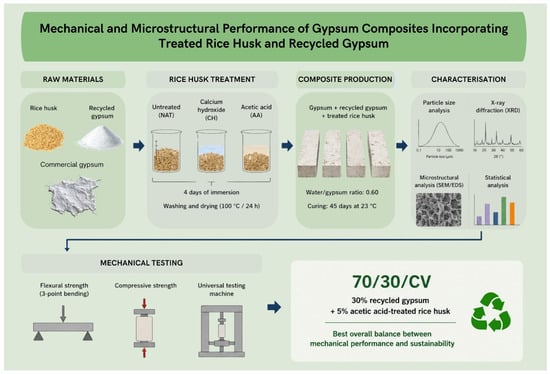
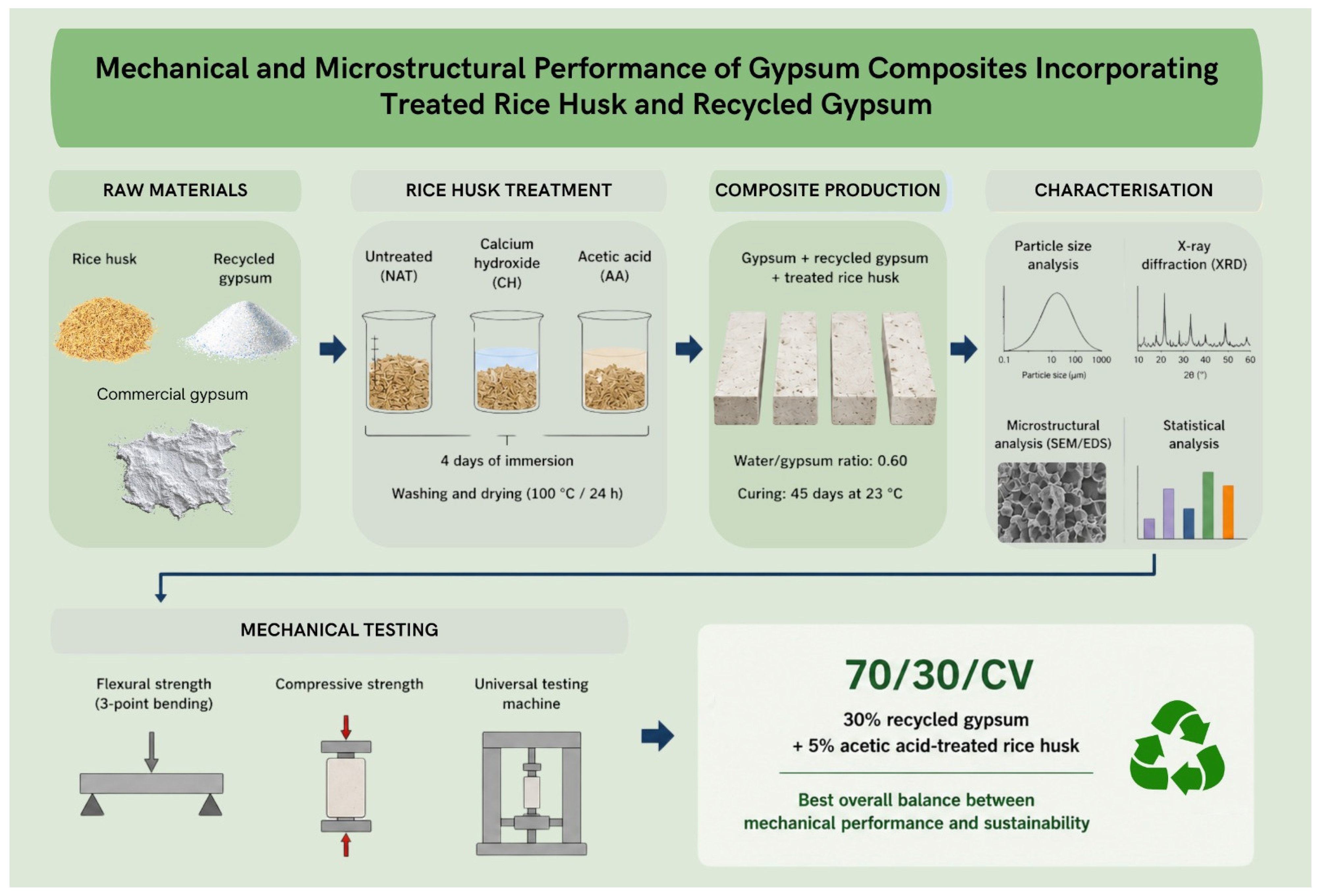
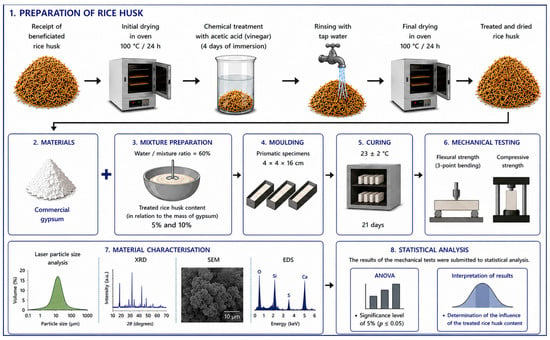
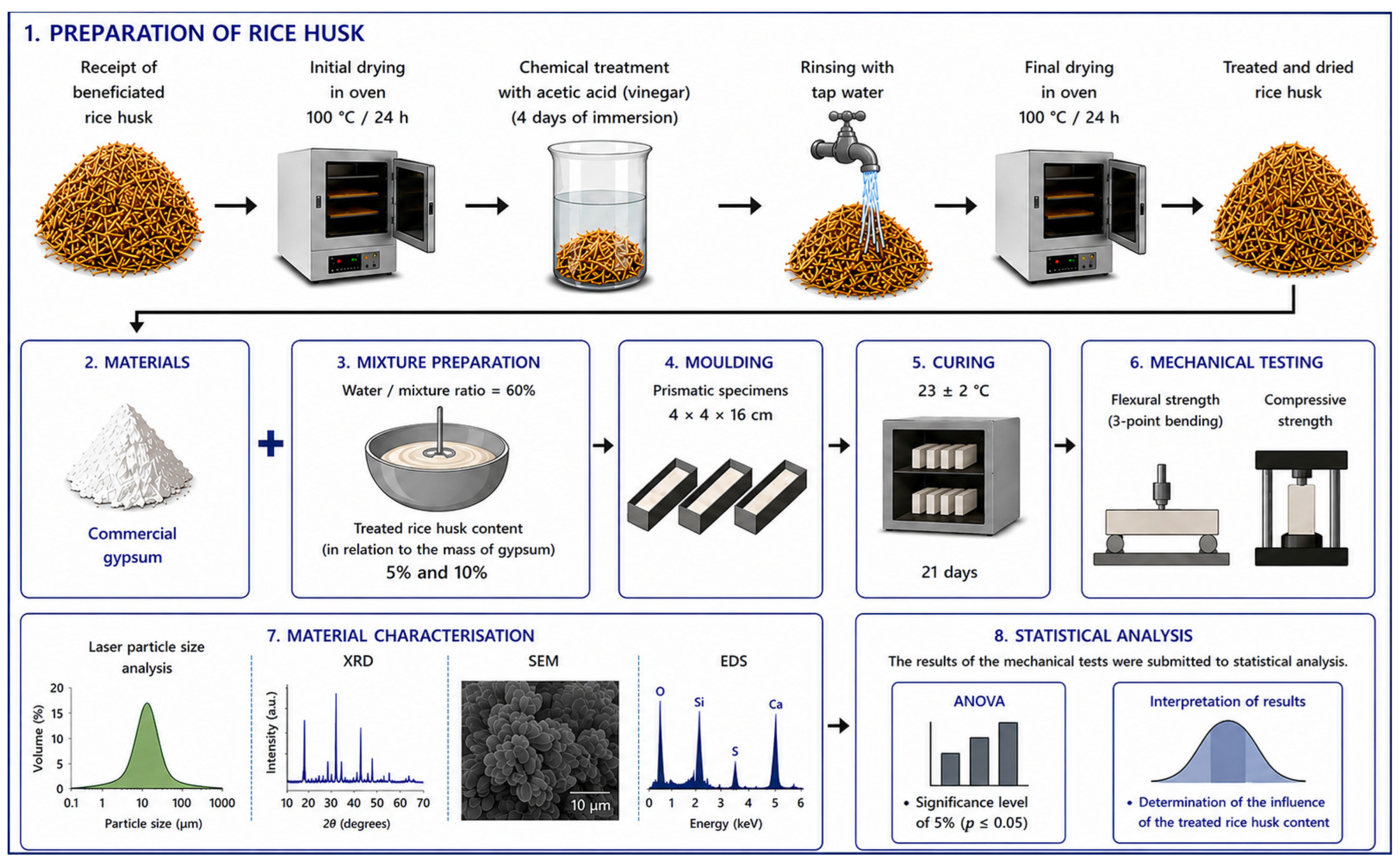
The experimental procedure adopted in this study is summarised in the flowchart shown in Figure 1, which includes the preparation of the raw materials, the treatments applied to the rice husk, the processing of the recycled gypsum, the production of the composites, the mechanical testing programme, and the physical, mineralogical, and microstructural characterisation carried out throughout the investigation.
Figure 1.
General flowchart of the experimental procedure.
To enable its reuse as a partial replacement for the commercial binder, the gypsum waste was initially dried in a laboratory oven at 100 °C for 24 h to remove residual moisture. The material was subsequently subjected to manual mechanical disaggregation using a mortar and pestle to reduce the size of the agglomerates formed during the hardening process. It was then sieved through a No. 8 sieve to standardise the particle size distribution and remove oversized particles prior to the subsequent processing and characterisation stages.
For the production of the composites, the matrix consisted of commercial gypsum and recycled gypsum, while rice husk was used as the reinforcing phase. The rice husk was obtained as a by-product of the industrial rice dehusking process at a rice-processing facility located in Pelotas, Rio Grande do Sul, Brazil. The rice husk was used under three different conditions: (i) untreated; (ii) treated in an alkaline solution containing CH-II hydrated lime; and (iii) treated in a solution of commercial white vinegar (4% acetic acid) diluted with water. Following the treatments, the rice husks were thoroughly washed with running water to remove any residual treatment solution and subsequently oven-dried to constant mass before being incorporated into the composites.
2.2. Rice Husk Treatment
Two chemical surface treatment procedures were applied to the rice husk based on the methodologies described by [15,21,23,24]. For the alkaline treatment, a solution was prepared by dissolving 10 g of hydrated lime CH-II (Hidracal, Canoas, RS, Brazil) in 1000 mL of potable water. Subsequently, 80 g of rice husk was immersed in the solution and kept fully submerged for four days. After the immersion period, the husks were washed with running water to remove excess calcium hydroxide and then dried in a laboratory oven at 100 °C for 24 h.
For the acid treatment, a solution consisting of 500 mL of potable water and 500 mL of commercial white vinegar (4% acetic acid; Castelo Alimentos S/A, Jundiaí, SP, Brazil) was prepared. Subsequently, 80 g of rice husk was immersed in the solution and maintained fully submerged for four days under laboratory conditions. After the immersion period, the husks were thoroughly washed with running water to remove residual acetic acid and then dried in a laboratory oven at 100 °C for 24 h. The treated material was subsequently stored in sealed plastic containers until composite production.
The chemical treatments applied to the rice husk were intended to modify its surface characteristics in order to improve the interaction between the lignocellulosic reinforcement and the gypsum matrix. In particulate- and plant fibre-reinforced composites, the flexural and compressive strength depends largely on the quality of the matrix–reinforcement interface, which governs stress transfer between the constituent phases. Both treatments were performed using the same immersion period and drying conditions so that any differences observed in the composites could be attributed primarily to the chemical treatment rather than to variations in the preparation procedure.
2.3. Experimental Design and Composite Production
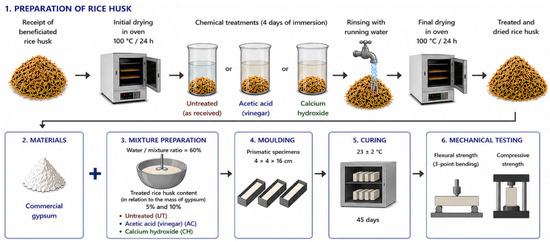
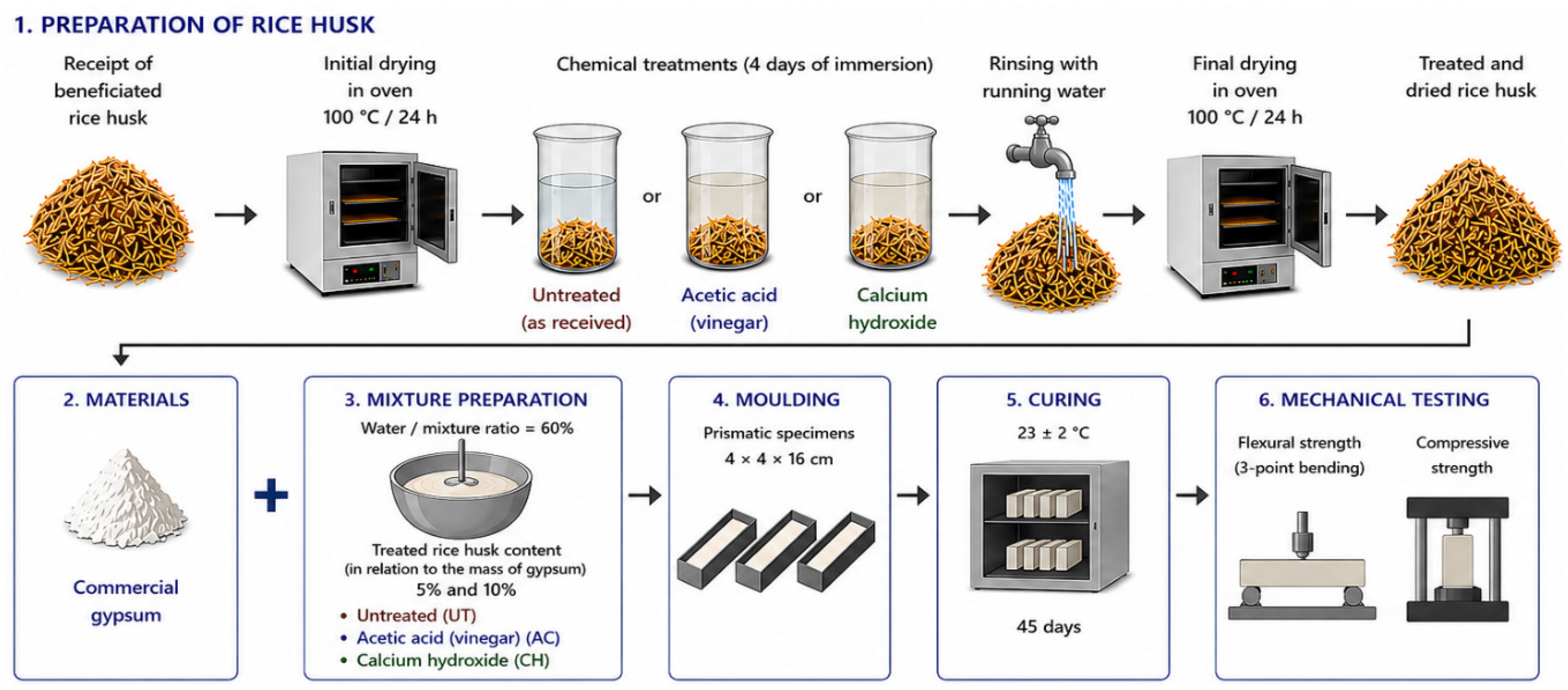
The experimental programme was structured into two sequential and complementary stages designed to progressively evaluate the influence of rice husk surface treatment and recycled gypsum incorporation on the flexural and compressive strength of gypsum composites. This experimental strategy enabled the selection of the most suitable reinforcement condition before assessing the influence of recycled gypsum, thereby reducing the number of experimental variables and allowing a more reliable interpretation of the obtained results. Figure 2 summarises the overall experimental workflow adopted in this study.
Figure 2.
Graphical summary of the first experimental stage.
During the first stage, the influence of three rice husk conditions—untreated, calcium hydroxide-treated, and acetic acid-treated—was investigated at two incorporation levels (5 wt.% and 10 wt.% relative to the gypsum mass). A reference formulation containing only commercial gypsum was also produced. The objective of this stage was to identify the treatment and incorporation level capable of providing the highest flexural and compressive strength through flexural and compressive strength tests.
Based on the results obtained in the first stage, the formulation exhibiting the best overall flexural and compressive strength was selected for the second stage. This subsequent phase evaluated the influence of partially replacing commercial gypsum with recycled gypsum at replacement levels of 20 wt.%, 30 wt.% and 40 wt.%, while maintaining the rice husk treatment identified as the most favourable in the previous stage. Consequently, the second stage focused exclusively on assessing the effect of recycled gypsum incorporation without the interference of additional variables associated with different rice husk treatments.
2.3.1. First Stage: Evaluation of Rice Husk Treatments and Incorporation Levels
In the initial stage, illustrated in Figure 2, composites containing untreated rice husk, rice husk treated with calcium hydroxide solution, and rice husk treated with acetic acid solution were produced. Each treatment was incorporated at levels of 5 wt.% and 10 wt.% relative to the mass of commercial gypsum, while maintaining a constant water content of 60 wt.% relative to the total mass of the mixture (gypsum + rice husk). In addition, a reference mixture consisting solely of commercial gypsum was prepared for comparative purposes.
This stage was designed as a screening phase to identify the most suitable rice husk treatment for the production of gypsum composites. Three surface conditions were evaluated: untreated rice husk, rice husk treated with calcium hydroxide, and rice husk treated with acetic acid. Each condition was incorporated at two addition levels (5 wt.% and 10 wt.%), enabling the influence of both chemical treatment and reinforcement content on the mechanical behaviour of the composites to be assessed.
The proportions of all constituent materials were kept constant across the different formulations, as presented in Table 1.
Table 1.
Compositions of the mixtures developed during the first experimental stage.
After homogenisation, the mixtures were poured into metallic prismatic moulds with nominal dimensions of 40 mm × 40 mm × 160 mm, in accordance with [25]. The material was manually compacted within the moulds to minimise entrapped air voids and promote a more uniform internal structure of the composites. Three specimens were produced for each formulation to ensure the statistical reproducibility of the subsequent mechanical tests.
2.3.2. Mechanical Testing
The flexural and compressive strength of the gypsum composites was evaluated in accordance with [25]. All specimens were tested after the curing period using an EMIC universal testing machine equipped with a calibrated 300 kN load cell and a computerised data acquisition system controlled by TESC software (EMIC/Instron, Brazil). The testing configuration, specimen positioning, support span and loading procedure complied with the requirements established by the Brazilian standard.
For each formulation, three prismatic specimens measuring 40 mm × 40 mm × 160 mm were produced. Following the testing sequence prescribed by ABNT NBR 13279 (2005) [25], each prism was first subjected to the flexural strength test. After fracture, one half of each prism was selected for the compressive strength test, resulting in three flexural strength tests and three compressive strength tests for each formulation. The mean values obtained from these measurements were subsequently used for the statistical analysis (ANOVA). This procedure enabled both flexural and compressive strength to be evaluated using the same set of specimens while ensuring consistency throughout the experimental programme.
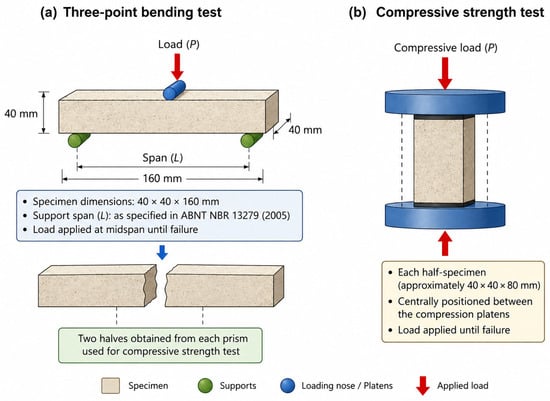
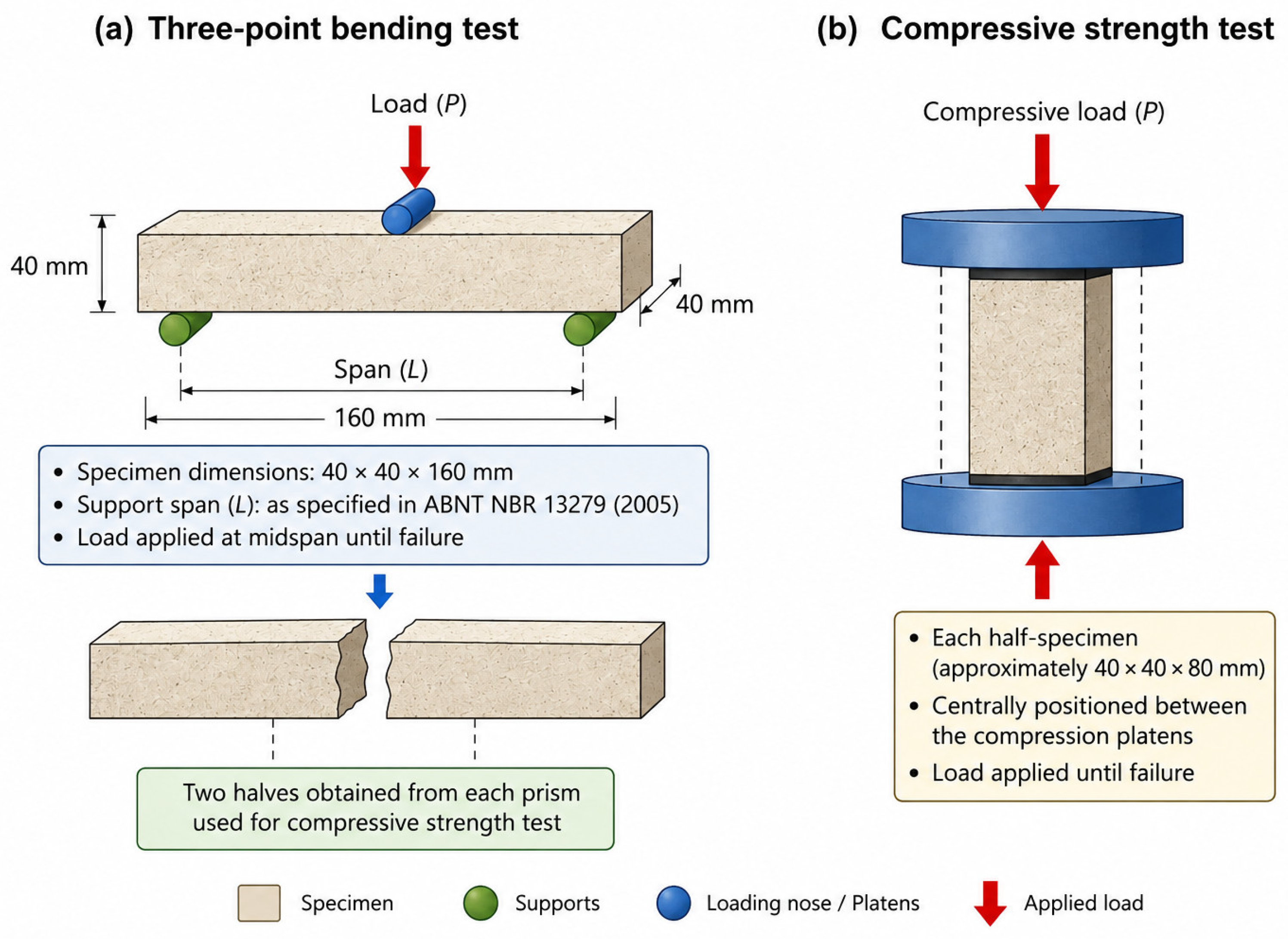
A schematic representation of the flexural and compressive strength tests is presented in Figure 3.
Figure 3.
Schematic representation of the mechanical tests performed according to [25]: (a) three-point bending test for flexural strength determination; (b) compressive strength test performed using the fractured halves obtained after the flexural test.
- Flexural strength test
Flexural strength was determined using a three-point bending configuration, as specified by ABNT NBR 13279 (2005). The prismatic specimens were positioned on two supports with the span length established by the standard, and a concentrated load was applied at the midpoint until failure. The maximum load recorded during the test was used to calculate the flexural strength of each specimen.
- Compressive strength test
Immediately after the flexural strength test, one fractured half obtained from each prism was subjected to compressive strength testing. Each specimen was centrally positioned between the compression platens of the testing machine, and a continuously increasing compressive load was applied until failure in accordance with ABNT NBR 13279 (2005). The maximum load recorded for each specimen was used to calculate the compressive strength of the composites.
Although the compressive strength test was performed using fractured specimens obtained from the flexural test, the procedure established by ABNT NBR 13279 (2005) was consistently applied to all formulations. Therefore, despite the heterogeneous nature of the composites, all specimens were evaluated under identical experimental conditions, allowing a reliable comparative assessment of the influence of rice husk treatment and recycled gypsum incorporation on flexural and compressive strength.
The average values obtained from the three flexural strength tests and the three compressive strength tests were subsequently used for the statistical analysis (ANOVA). Based on the statistical results, the formulation exhibiting the highest combined flexural and compressive strength was selected as the reference mixture for the subsequent stage involving the incorporation of recycled gypsum.
2.3.3. Second Stage: Incorporation of Recycled Gypsum
The second stage was conducted only after analysing the results obtained in the first experimental phase. Since the composites containing 5 wt.% acetic acid-treated rice husk exhibited the most favourable overall flexural and compressive strength, this formulation was selected as the reference mixture for evaluating the incorporation of recycled gypsum. This approach ensured that the influence of recycled gypsum could be investigated under the most favourable reinforcement condition identified during the experimental programme. Based on the flexural and compressive strength obtained in the previous stage, the second experimental phase focused on the evaluation of composites containing mixtures of commercial gypsum and recycled gypsum combined with the incorporation of rice husk treated with acetic acid, as illustrated in Figure 4.
Figure 4.
Graphical summary of the second experimental stage.
A 5 wt.% incorporation of rice husk treated with acetic acid was adopted, as this condition exhibited the best performance in the compressive and flexural strength tests carried out during the first experimental stage. Specimens containing mixtures of commercial gypsum and recycled gypsum at proportions of 80/20, 70/30, and 60/40 (commercial/recycled) were produced, corresponding to the partial replacement of the virgin binder by mass. These proportions were selected to evaluate the influence of increasing recycled gypsum content on the physical characteristics together with flexural and compressive strength of the composites, as presented in Table 2.
Table 2.
Compositions of the mixtures developed during the second experimental stage.
In parallel, formulations containing the same proportions of commercial and recycled gypsum, supplemented with 5 wt.% rice husk treated with acetic acid, were produced to evaluate its influence on the flexural and compressive strength of the composites. Reference specimens consisting solely of commercial and recycled gypsum, without the addition of lignocellulosic residue, were also prepared. The mixtures were prepared following the same methodology adopted in the previous stage, ensuring experimental consistency. After a curing period of 21 days under laboratory conditions, the specimens were subjected to flexural strength testing followed by compressive strength testing, in accordance with the procedures specified in [25].
2.4. Material Characterisation
2.4.1. Mineralogical and Microstructural Characterisation
Microstructural characterisation was performed using a JEOL JSM-6610LV scanning electron microscope equipped with an energy-dispersive X-ray spectroscopy (EDS) detector (JEOL Ltd., Tokyo, Japan). Representative samples of the following formulations were analysed: 100% commercial gypsum, 100% recycled gypsum, the 70/30 mixture (commercial/recycled gypsum), and the 70/30 mixture containing 5 wt.% rice husk treated with acetic acid. The analysed specimens measured approximately 15 × 15 × 10 mm. The formulation containing 70 wt.% commercial gypsum, 30 wt.% recycled gypsum, and 5 wt.% rice husk treated with acetic acid was selected for detailed microstructural analysis because it exhibited the best flexural and compressive strength among the hybrid composites.
2.4.2. Particle Size Distribution Characterisation
Particle size distribution was determined using a CILAS 1190 L laser particle size analyser (CILAS, Orléans, France). The analysis was performed using Size Expert software. This equipment enables high-resolution measurement of the particle size distribution of powdered materials. The comparison between commercial gypsum and recycled gypsum made it possible to evaluate particle size changes resulting from the recycling process, including manual crushing and sieving. Variations in particle size distribution may influence particle packing density, the internal porosity of the specimens, and consequently the flexural and compressive strength of the composites.
2.5. Statistical Analysis
The flexural and compressive strength results were analysed using analysis of variance (ANOVA) in Microsoft Excel (Microsoft Corporation, Redmond, WA, USA) at a 5% significance level (p ≤ 0.05). For each formulation, the statistical analysis was performed using the average values obtained from three flexural strength tests and three compressive strength tests. Accordingly, each prism was considered one independent experimental unit for both the flexural and compressive strength analyses. The ANOVA was used to determine the influence of the rice husk treatments and incorporation levels on the flexural and compressive strength of the composites. Statistical analysis enabled significant effects of the experimental factors to be distinguished from the inherent variability of the tests, thereby increasing the reliability of the interpretation of the results. Furthermore, the ANOVA results were used to identify the formulation exhibiting the highest combined flexural and compressive strength, which was subsequently selected for the second experimental stage involving recycled gypsum incorporation.
3. Results
3.1. Mechanical Properties: First Experimental Stage
During the first experimental stage, composites produced with commercial gypsum incorporating rice husk at levels of 5 wt.% and 10 wt.% were evaluated. Three surface conditions of the rice husk were considered: untreated, treated with calcium hydroxide solution, and treated with acetic acid solution (Table 3).
Table 3.
Mean mechanical properties obtained during the first experimental stage.
Overall, the incorporation of rice husk significantly influenced the mechanical behaviour of the composites. Formulations containing untreated rice husk exhibited the greatest reductions in strength, particularly at the 10 wt.% incorporation level, with decreases of approximately 35.3% in compressive strength and 54.5% in flexural strength compared with the reference gypsum. The lower flexural and compressive strength observed for the composites containing untreated rice husk can be attributed to the presence of waxes, lignin, extractives and other non-cellulosic compounds naturally present on the rice husk surface. These constituents reduce the wettability of the particles and limit the adhesion between the lignocellulosic reinforcement and the gypsum matrix, impairing stress transfer during mechanical loading [13,20]. Conversely, the chemical treatments improved flexural and compressive strength, with formulation G5%vinag exhibiting the highest compressive strength, representing an increase of 9.7% relative to the reference material, followed by G10%vinag, which achieved an increase of 4.9%. These results indicate that acetic acid treatment enhanced the interaction between the rice husk and the gypsum matrix, mitigating the adverse effects commonly associated with the incorporation of lignocellulosic residues.
The improvement observed may be attributed to the surface modifications promoted by the chemical treatment, which removes impurities and extractives from the rice husk, thereby enhancing adhesion between the lignocellulosic reinforcement and the mineral matrix [20]. Chemical treatments are widely employed to modify the surface characteristics of lignocellulosic materials by partially removing surface impurities and extractives, increasing surface roughness and improving fibre–matrix adhesion [26]. In the present study, calcium hydroxide treatment likely promoted mild surface cleaning and slight modifications to the rice husk surface, whereas acetic acid treatment appears to have been more effective in removing superficial contaminants and improving the interaction between the rice husk particles and the gypsum matrix. Similar findings were reported by [15,21], who associated the improvements in flexural and compressive strength with increased surface roughness and enhanced mechanical interlocking of the particles. Ref. [17] observed that low rice husk fibre contents may act as dispersed reinforcement, contributing to stress redistribution when adequate interfacial bonding is achieved. By contrast, increasing the rice husk content to 10 wt.% resulted in a reduction in flexural and compressive strength, particularly for untreated and calcium hydroxide-treated husks. This behaviour is associated with increased porosity and greater discontinuity within the matrix, impairing load transfer, as also reported by [22]. The superior performance obtained for formulation G5%vinag suggests that the acetic acid treatment provided the most favourable compatibility between the rice husk and the gypsum matrix. Although no direct chemical characterisation of the treated surface was performed in the present study, the mechanical results indicate that the treatment promoted a more efficient fibre–matrix interaction, improving stress transfer within the composite. The experimental results were analysed by analysis of variance (ANOVA) using a significance level of 5% (p ≤ 0.05) to assess the influence of surface treatment and incorporation level on the flexural and compressive behaviour of the composites (Table 4 and Table 5).
Table 4.
Analysis of variance (ANOVA) for compressive strength.
Table 5.
Analysis of variance (ANOVA) for flexural strength.
ANOVA demonstrated that, for compressive strength, both the rice husk treatment and the incorporation level significantly affected composite performance (p ≤ 0.05). Moreover, the interaction between these factors was statistically significant, indicating that the effectiveness of the treatment depended on the amount of rice husk incorporated. In contrast, for flexural strength, only the surface treatment had a statistically significant effect, demonstrating that chemical modification of the rice husk exerted a greater influence on flexural and compressive strength than the incorporation level itself.
These statistical findings corroborate the experimental observations and indicate that the acetic acid treatment provided the most effective interaction between the rice husk and the gypsum matrix. This behaviour is likely associated with the greater removal of surface impurities and extractives, improving the compatibility between the lignocellulosic reinforcement and the gypsum matrix and consequently enhancing stress transfer within the composite. Formulation G5%vinag exhibited the best overall performance, achieving a compressive strength of 8.34 MPa, approximately 9.7% higher than the reference gypsum, while also displaying low experimental variability. This behaviour is consistent with the findings of [17,20], who reported that low incorporation levels combined with appropriate surface treatments improve compatibility between lignocellulosic residues and mineral matrices. Accordingly, formulation G5%vinag was selected for the second experimental stage, in which the partial replacement of commercial gypsum with recycled gypsum was investigated.
3.2. Mechanical Properties: Second Experimental Stage
Following the identification of the optimum rice husk treatment during the first experimental stage, the second stage evaluated formulations incorporating 20 wt.%, 30 wt.% and 40 wt.% recycled gypsum as partial replacements for commercial gypsum, both in the absence and in the presence of 5 wt.% rice husk treated with acetic acid. Initially, composites containing only commercial and recycled gypsum were produced. Subsequently, mixtures incorporating the same replacement levels together with the selected treated rice husk were evaluated, as summarised in Table 6.
Table 6.
Mean mechanical properties obtained during the second experimental stage.
Among the formulations evaluated, the 70/30/CV composite (70 wt.% commercial gypsum, 30 wt.% recycled gypsum and 5 wt.% rice husk treated with acetic acid) exhibited the best balance between compressive and flexural strength among the hybrid composites. Although the incorporation of acetic acid-treated rice husk reduced the flexural strength compared with the corresponding formulations without rice husk, the 70/30/CV formulation maintained compressive strength above that of the reference commercial gypsum while providing the highest flexural strength among the hybrid composites. These results indicate that the incorporation of treated rice husk involves a trade-off between flexural strength and sustainability, while maintaining satisfactory overall mechanical behaviour.
Unlike the formulations without rice husk, the compressive strength of the composites containing acetic acid-treated rice husk did not exhibit a progressive increase with increasing recycled gypsum content. In particular, the comparatively lower compressive strength observed for the 80/20/CV formulation may be associated with the intrinsic heterogeneity of lignocellulosic composites, including local variations in particle distribution and stress transfer within the gypsum matrix. Since XRD analyses did not reveal significant mineralogical changes and SEM observations indicated adequate matrix–reinforcement interaction, this behaviour is more likely related to the heterogeneous distribution of the reinforcement than to the recycled gypsum content itself.
The performance of the 70/30/CV formulation suggests that replacing 30 wt.% of the commercial gypsum with recycled gypsum promoted favourable particle packing, while the acetic acid treatment enhanced the interaction between the rice husk and the gypsum matrix. According to [16], the incorporation of lignocellulosic residues generally increases porosity and water absorption, which may reduce the flexural and compressive strength of composites. Similarly, ref. [22] reported that increasing the content of plant particles promotes the formation of internal voids and decreases the efficiency of stress transfer. Despite these effects, the 70/30/CV formulation maintained satisfactory flexural and compressive strength, indicating that acetic acid treatment effectively mitigated these limitations.
The improvement observed in the composites containing recycled gypsum demonstrates that recycling did not impair matrix performance and, at certain replacement levels, even enhanced its mechanical properties. In terms of compressive strength, the values obtained exceeded those reported by [5,10,11]. Overall, these findings indicate that the combination of recycled gypsum and chemically treated rice husk represents a technically viable approach for the production of sustainable gypsum composites, enabling the simultaneous valorisation of construction and agricultural waste without significantly compromising flexural and compressive strength.
ANOVA was also performed for the formulations combining commercial and recycled gypsum with rice husk, as presented in Table 7 and Table 8. The results revealed a strong interaction between the variables, indicating that compressive strength was significantly influenced by the interaction between the constituent materials.
Table 7.
Analysis of variance (ANOVA) for compressive strength of composites containing rice husk.
Table 8.
Analysis of variance (ANOVA) for flexural strength of composites containing rice husk.
The incorporation of 5 wt.% rice husk treated with acetic acid significantly influenced the flexural and compressive strength of the gypsum composites. Among all formulations, 70/30/CV exhibited the most favourable performance, surpassing that of the reference commercial gypsum. The results of the second experimental stage demonstrated that the formulation containing 70 wt.% commercial gypsum, 30 wt.% recycled gypsum, and 5 wt.% rice husk treated with acetic acid (70/30/CV) provided the best balance between flexural and compressive strength and sustainability. Among the composites containing rice husk, this formulation exhibited both the highest compressive strength and the highest flexural strength. Consequently, it was selected for SEM/EDS analyses to investigate the microstructural mechanisms responsible for the experimentally observed behaviour.
3.3. Microstructural Analysis by Scanning Electron Microscopy (SEM/EDS)
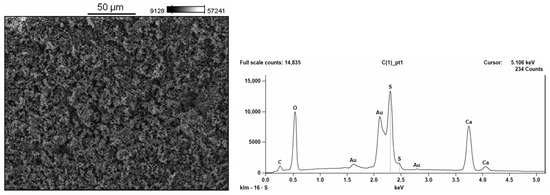
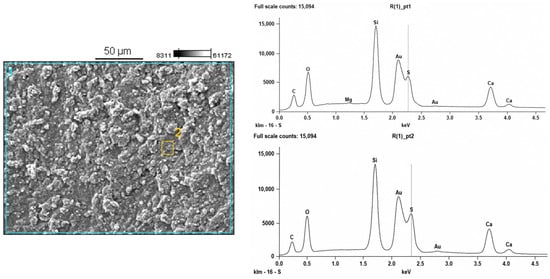
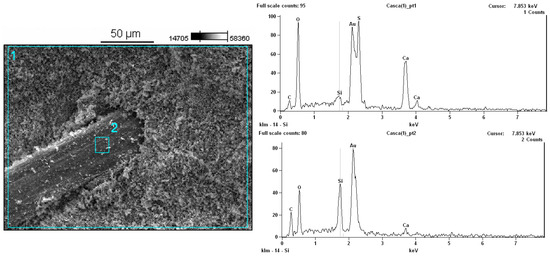
Microstructural characterisation by SEM coupled with EDS was performed to evaluate the morphology of the commercial gypsum matrix, the recycled gypsum matrix, and the composite selected for detailed investigation (70 wt.% commercial gypsum, 30 wt.% recycled gypsum, and 5 wt.% rice husk treated with acetic acid). The corresponding micrographs are presented in Figure 5, Figure 6 and Figure 7, respectively.
Figure 5.
SEM micrographs of the commercial gypsum matrix.
Figure 6.
SEM micrographs of the recycled gypsum matrix. The coloured boxes indicate the regions selected for EDS analysis: region 1 corresponds to the upper spectrum, while region 2 corresponds to the lower spectrum.
Figure 7.
SEM micrographs of the composite containing 70 wt.% commercial gypsum, 30 wt.% recycled gypsum, and 5 wt.% rice husk treated with acetic acid. The cyan boxes indicate the regions selected for EDS analysis: region 1 corresponds to the upper EDS spectrum, whereas region 2 corresponds to the lower EDS spectrum.
Overall, the commercial gypsum exhibited a more homogeneous matrix, characterised by fine, uniformly distributed crystalline aggregates with a low occurrence of visible voids. In contrast, the recycled gypsum displayed a rougher and more heterogeneous surface, with particles of varying sizes, a characteristic attributed to the recycling process. Despite these morphological differences, the EDS spectra revealed a predominance of calcium (Ca), sulphur (S), and oxygen (O) in both matrices, indicating that the recycling process did not produce significant chemical changes in the calcium sulphate. This behaviour is consistent with the findings of [4,6,7], who reported that the chemical characteristics of recycled gypsum are largely preserved and highlighted that finer particles may improve matrix packing, thereby enhancing flexural and compressive strength.
The SEM micrograph of the 70/30/CV composite revealed good incorporation of the rice husk within the gypsum matrix, with no significant interfacial gaps surrounding the particles and relatively continuous contact between the constituent phases. This microstructural behaviour is consistent with the expected effects of the acetic acid treatment on the rice husk surface. The partial removal of superficial impurities and extractives likely improved the wettability of the particles and promoted more effective contact with the gypsum matrix. Consequently, a more continuous fibre–matrix interface was established, contributing to improved stress transfer during mechanical loading and explaining the superior flexural and compressive strength observed for the 70/30/CV formulation. These observations provide microstructural evidence that the acetic acid treatment enhanced the compatibility between the rice husk and the gypsum matrix, corroborating the mechanical test results obtained during the first and second experimental stages. The EDS spectra confirmed the presence of the characteristic elements of gypsum (Ca, S, and O), together with carbon (C) and silicon (Si), the latter being associated with the silica naturally present in rice husk [12,13].
The high quality of the matrix–reinforcement interface observed explains the flexural and compressive strength of the 70/30/CV formulation, particularly the preservation of flexural strength following the incorporation of rice husk. According to [20], chemical treatments remove surface impurities and promote stronger bonding between lignocellulosic materials and mineral matrices. Similarly, refs. [17,18,23] reported that a well-developed interface contributes to more effective stress redistribution and delays crack propagation. Therefore, the SEM/EDS analyses corroborate the mechanical test results, demonstrating that the combination of 30 wt.% recycled gypsum and 5 wt.% rice husk treated with acetic acid provided adequate compatibility between the matrix and the reinforcement, highlighting the potential of this formulation for the development of sustainable gypsum composites.
3.4. Mineralogical Analysis by X-Ray Diffraction (XRD)
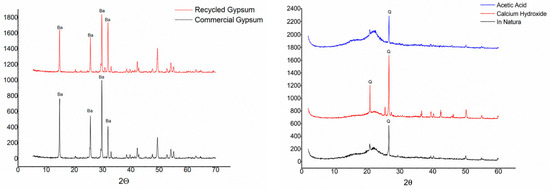
The X-ray diffraction (XRD) patterns of the commercial gypsum, recycled gypsum, and rice husk samples (untreated, calcium hydroxide-treated, and acetic acid-treated) are presented in Figure 8.
Figure 8.
X-ray diffraction (XRD) patterns of commercial gypsum, recycled gypsum, and rice husk samples.
The XRD patterns of the commercial and recycled gypsum exhibited a high degree of similarity, with the predominance of the characteristic diffraction peaks of bassanite (calcium sulphate hemihydrate), indicating that the recycling process preserved the mineralogical composition of the material. Although the recycled gypsum showed slight variations in the relative intensity of some diffraction peaks, attributed to the hydration, dehydration, and recalcination cycles, no significant new crystalline phases were identified. Similar findings were reported by [4,6,7], who associated these variations with the reorganisation of the crystalline structure without compromising the chemical composition of the gypsum. The preservation of the crystalline phases helps to explain the favourable flexural and compressive strength of the formulation containing 30 wt.% recycled gypsum, suggesting that the observed improvements are primarily related to enhanced particle packing, as discussed by [9].
The XRD patterns of the rice husk samples exhibited the typical behaviour of predominantly amorphous materials, characterised by a broad diffraction band between approximately 15° and 30° (2θ), associated with amorphous silica, together with diffraction peaks assigned to quartz, in agreement with the findings of [12,13,14]. This finding suggests that the improvements observed in the flexural and compressive strength were primarily associated with surface modifications rather than significant alterations in the crystalline structure of the rice husk, reinforcing the importance of fibre–matrix interfacial optimisation. This behaviour indicates that the treatments acted predominantly on the surface of the material, as also reported by [15,20,21].
The combined interpretation of the XRD and SEM results demonstrates that the improvements observed in the mechanical properties were not associated with changes in the crystalline phases of the constituent materials, but rather with modifications at the interface between the rice husk and the gypsum matrix. The preservation of the mineralogical composition of the recycled gypsum, together with the surface modification promoted by the acetic acid treatment, enhanced the compatibility between the composite constituents, contributing to the superior performance of the 70/30/CV formulation. These findings corroborate the studies of [6,7,20], which emphasise the importance of microstructural organisation and interfacial quality in determining the flexural and compressive strength of gypsum-based composites.
3.5. Particle Size Distribution Analysis
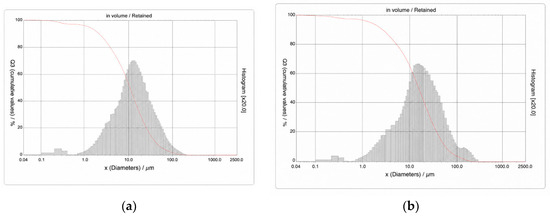
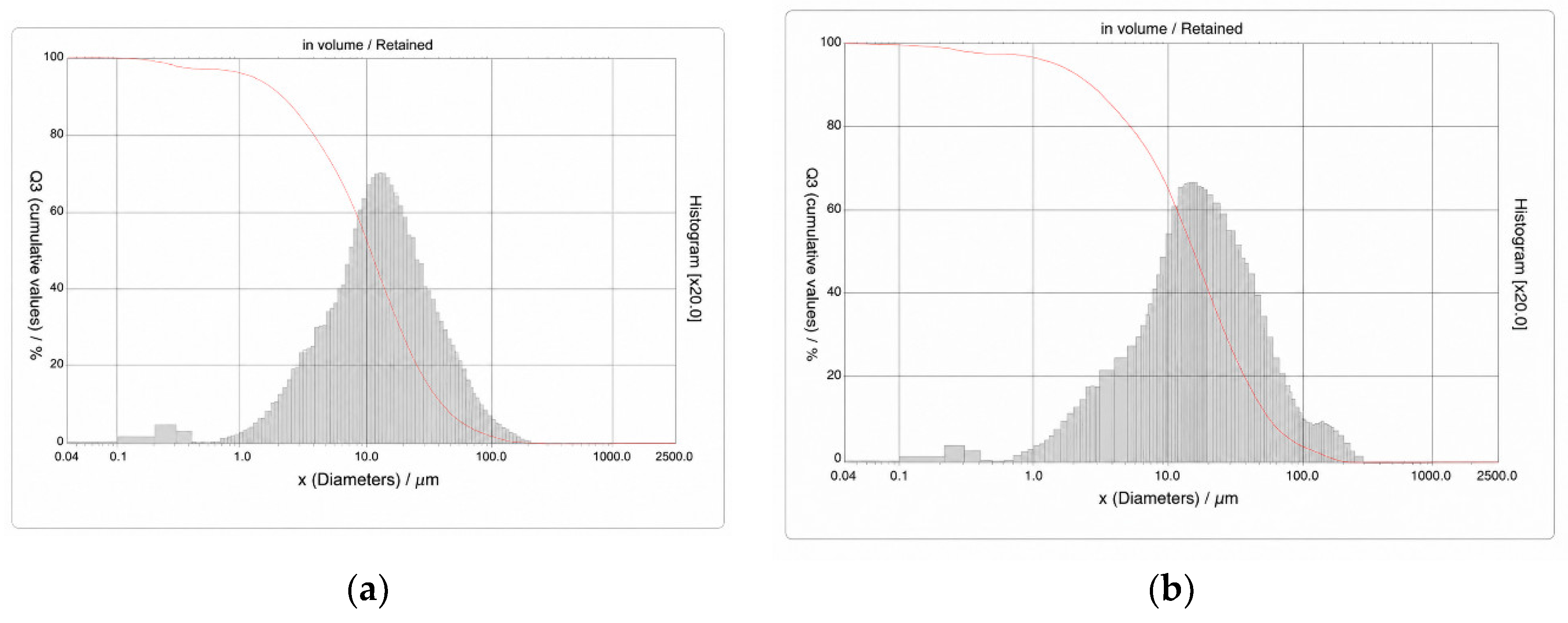
The particle size distributions of the commercial and recycled gypsum are presented in Figure 9, allowing comparison of the particle size and distribution of the two materials and evaluation of their influence on matrix packing, composite microstructure, and, consequently, flexural and compressive strength.
Figure 9.
Particle size distribution of commercial gypsum (a) and recycled gypsum (b).
Commercial gypsum exhibited a more uniform particle size distribution, characterised by a predominance of fine particles, whereas recycled gypsum showed a broader particle size distribution with a greater proportion of coarse particles, a behaviour attributed to the grinding and recalcination processes involved in recycling [9]. Although recycled gypsum exhibited greater particle size heterogeneity, the combination of particles of different sizes promoted improved matrix packing, reducing internal voids and contributing to the densification of the hardened material [22]. This behaviour explains the superior performance of the formulation containing 70 wt.% commercial gypsum and 30 wt.% recycled gypsum, which exhibited the highest compressive and flexural strengths. Similar findings were reported by [4,6,7], who observed improvements in flexural and compressive strength resulting from the particle size redistribution promoted by recycled gypsum.
The particle size distribution analysis, together with the XRD and SEM results, indicates that the superior performance of the 70/30 formulation is associated with the preservation of the mineralogical composition and improved particle packing, promoting the formation of a denser and more homogeneous matrix.
4. Discussion
The present study demonstrated that the flexural and compressive strength of gypsum composites is governed by the combined effects of rice husk surface treatment, recycled gypsum incorporation, and the resulting microstructural organisation of the composite. Although each experimental stage evaluated different variables, the results consistently indicate that the optimisation of the fibre–matrix interface and the preservation of the gypsum matrix integrity are the primary factors controlling composite performance. The statistical analyses further confirmed that surface treatment significantly influenced the mechanical behaviour of the composites, while the incorporation of recycled gypsum became advantageous when combined with the most suitable rice husk treatment.
The results obtained during the first experimental stage revealed that chemical modification of the rice husk surface plays a decisive role in improving compatibility with the gypsum matrix. Untreated rice husk produced the lowest flexural and compressive strength owing to the presence of surface impurities and extractives that limit adhesion with mineral binders. In contrast, the acetic acid treatment promoted the highest compressive and flexural strengths among the treated formulations, indicating a more efficient fibre–matrix interaction. These observations agree with previous studies reporting that chemical treatments improve the interfacial adhesion of lignocellulosic reinforcements by increasing surface cleanliness and promoting more effective stress transfer between the reinforcement and the surrounding matrix [20,21,26].
The second experimental stage demonstrated that recycled gypsum can be incorporated without compromising the structural performance of gypsum composites when appropriate replacement levels are adopted. The formulation containing 70 wt.% commercial gypsum, 30 wt.% recycled gypsum and 5 wt.% acetic acid-treated rice husk (70/30/CV) exhibited the best balance between compressive and flexural strength among the investigated formulations. This behaviour indicates that the incorporation of recycled gypsum is not only technically feasible but may contribute to improving matrix packing while maintaining a favourable balance between flexural strength, compressive strength and environmental sustainability when combined with an appropriate reinforcement treatment. Similar behaviour has been reported by [4,6,7], who demonstrated that the recycling process preserves the essential characteristics of gypsum and enables its successful reincorporation into new products.
The microstructural, mineralogical and particle size analyses provide a coherent explanation for the mechanical behaviour observed throughout the experimental programme. SEM observations revealed good adhesion between the treated rice husk and the gypsum matrix, with no significant interfacial gaps surrounding the reinforcement particles, indicating that the acetic acid treatment improved the fibre–matrix interface. These observations are fully consistent with the statistical analysis, which identified the acetic acid treatment as the factor exerting the greatest influence on composite performance. Likewise, the EDS analyses confirmed that the recycled gypsum preserved the characteristic chemical composition of calcium sulphate, while the presence of silicon reflected the incorporation of rice husk into the composite. XRD analyses further demonstrated that the recycling process did not significantly alter the crystalline phases of the gypsum, whereas the rice husk treatments produced only minor variations in diffraction peak intensity, without significant changes in the crystalline phases, indicating that the improvements were predominantly associated with surface modifications rather than changes in the bulk composition of the materials. Finally, the particle size analysis showed that the combination of commercial and recycled gypsum promoted more efficient particle packing, contributing to matrix densification and explaining the balanced mechanical behaviour observed for the 70/30/CV formulation. Together, these complementary characterisation techniques provide consistent evidence that the improvements observed in flexural and compressive strength are primarily governed by interfacial optimisation rather than changes in the chemical or mineralogical composition of the constituent materials. Therefore, the combined interpretation of the mechanical, SEM/EDS, XRD and particle size analyses consistently supports the conclusion that the observed balance between flexural strength, compressive strength and sustainability resulted from the synergistic effect of improved interfacial adhesion and optimised matrix organisation.
From the perspective of sustainable construction, the proposed composite represents an effective strategy for simultaneously valorising construction and demolition waste and agricultural residues. The incorporation of recycled gypsum reduces the demand for virgin raw materials, while the reuse of rice husk provides an environmentally responsible destination for an abundant agricultural by-product. Consequently, the developed composite contributes to the principles of the circular economy by extending material life cycles and reducing waste generation without significantly compromising flexural and compressive strength.
While previous studies have predominantly investigated recycled gypsum and lignocellulosic reinforcements separately, which have generally investigated either recycled gypsum or lignocellulosic reinforcements separately, the present study demonstrates that the combined use of recycled gypsum and chemically treated rice husk can produce gypsum composites with satisfactory flexural and compressive strength while preserving the mineralogical integrity of the gypsum matrix. Moreover, the integration of mechanical, statistical, microstructural, mineralogical and particle size analyses provides a comprehensive understanding of the mechanisms governing composite performance. These findings contribute to the advancement of sustainable gypsum-based materials and provide useful guidance for future developments involving the simultaneous valorisation of construction and agricultural wastes.
Despite the promising results obtained, some limitations should be recognised. The present investigation focused primarily on the mechanical, microstructural and mineralogical characterisation of the developed composites. Additional studies evaluating long-term durability, water absorption, thermal conductivity, fire resistance, dimensional stability and long-term environmental exposure are recommended before large-scale applications can be proposed. In addition, future studies may include independent compressive strength tests using cubic specimens to further assess the applicability of the standard testing procedure to gypsum composites reinforced with lignocellulosic materials and to provide additional validation of the mechanical behaviour observed in the present study. Furthermore, advanced surface characterisation techniques, such as FTIR or XPS, could provide additional information regarding the physicochemical modifications promoted by the chemical treatments and contribute to a more comprehensive understanding of the fibre–matrix interaction mechanisms.
5. Conclusions
Based on the experimental results obtained in this study, the following conclusions can be drawn:
- The surface treatment of rice husk significantly influenced the flexural and compressive strength of the gypsum composites. Among the treatments investigated, acetic acid treatment provided the highest flexural and compressive strength, increasing the compressive strength from 7.60 MPa for the reference gypsum to 8.34 MPa, corresponding to an improvement of approximately 9.7%. In contrast, untreated rice husk produced the greatest reductions in both compressive and flexural strength, confirming that surface modification is essential for improving the compatibility between the lignocellulosic reinforcement and the gypsum matrix.
- The incorporation of recycled gypsum proved to be technically feasible and positively influenced the mechanical behaviour of the composites. The formulation containing 70 wt.% commercial gypsum and 30 wt.% recycled gypsum exhibited the highest flexural and compressive strength among the recycled gypsum mixtures, reaching 4.14 MPa in flexural strength and 13.00 MPa in compressive strength, representing increases of approximately 20.7% and 71.1%, respectively, compared with the reference commercial gypsum.
- Among the hybrid composites incorporating both recycled gypsum and rice husk, the formulation containing 70 wt.% commercial gypsum, 30 wt.% recycled gypsum and 5 wt.% acetic acid-treated rice husk (70/30/CV) achieved the best overall balance between flexural and compressive strength, with values of 3.01 MPa and 8.89 MPa, respectively. These results demonstrate that the simultaneous incorporation of recycled gypsum and chemically treated rice husk is technically feasible and provides a suitable balance between flexural strength, compressive strength and sustainability, although the incorporation of rice husk resulted in lower flexural strength than the corresponding formulations without reinforcement.
- The complementary characterisation techniques provided a consistent explanation for the mechanical behaviour of the composites. SEM/EDS analyses demonstrated good interfacial adhesion between the treated rice husk and the gypsum matrix, XRD confirmed that the recycling process preserved the mineralogical composition of gypsum, and the particle size analysis indicated that the combination of commercial and recycled gypsum promoted improved particle packing and matrix densification. Together, these findings demonstrate that the enhanced flexural and compressive strength was primarily associated with improved fibre–matrix interaction and microstructural organisation rather than significant changes in the chemical or mineralogical composition of the constituent materials.
- Therefore, the objectives of this study were successfully achieved. The results demonstrated that chemical treatment of rice husk, particularly using acetic acid, effectively improves its compatibility with gypsum; that recycled gypsum can partially replace commercial gypsum while maintaining satisfactory compressive strength and an acceptable level of flexural strength, depending on the reinforcement content and treatment. In addition to contributing to the valorisation of construction and agricultural wastes, the proposed material supports circular economy principles and provides a technically viable alternative for more sustainable building materials.
The findings presented in this study provide a scientific basis for the development of environmentally responsible gypsum composites and may support future investigations aimed at optimising recycled gypsum-based materials reinforced with agricultural residues for civil construction applications.
Author Contributions
Conceptualization, M.d.C.D., R.B. and F.C.d.M.; methodology, M.d.C.D., R.B. and F.C.d.M.; validation, M.d.C.D., R.B. and F.C.d.M.; formal analysis, M.d.C.D., R.B., F.C.d.M. and K.T.B.; investigation, M.d.C.D.; resources, R.B. and F.C.d.M.; data curation, M.d.C.D. and R.d.P.N.; writing—original draft preparation, M.d.C.D.; writing—review and editing, M.d.C.D., R.B., F.C.d.M., K.T.B., R.d.P.N., A.B.T. and J.L.S.B.; visualization, M.d.C.D.; supervision, R.B., F.C.d.M. and R.d.A.D.; project administration, R.B.; funding acquisition, R.B. All authors have read and agreed to the published version of the manuscript.
Funding
This study was financed in part by the Coordenação de Aperfeiçoamento de Pessoal de Nível Superior—Brazil (CAPES)—Finance Code 001.
Data Availability Statement
The data presented in this study are available on request from the corresponding author due to privacy.
Conflicts of Interest
The authors declare no conflicts of interest.
References
- Hasibuan, G.C.R.; Al Fath, M.T.; Yusof, N.; Dewi, R.A.; Syafridon, G.G.A.; Jaya, I.; Anas, M.R.; Syahrizal. Integrating circular economy into construction and demolition waste management: A bibliometric review of sustainable engineering practices in the built environment. Case Stud. Chem. Environ. Eng. 2025, 11, 101159. [Google Scholar] [CrossRef] [Scilit]
- Sarju; Setyawan, A.; Wibowo, M.A.; Handayani, F.S. Realization of Low Carbon Housing Construction: Analysis of Materials, Energy, Technology, and Policies. E3S Web Conf. 2025, 650, 02058. [Google Scholar] [CrossRef] [Scilit]
- Bezerra, I.M.T.; Souza, J.; Carvalho, J.B.Q.; Neves, G.A. Application of rice husk ash in masonry mortars. Rev. Bras. Eng. Agrícola Ambient. 2011, 15, 639–645. [Google Scholar] [CrossRef] [Scilit]
- Cipriano, P.B.; Galdino, T.S.G.; Sá, C.S.; Ferraz, A.d.V. Evaluation of the calcination parameters of the gypsum waste on the properties of recycled plaster. Rev. Mater. 2021, 26, e13026. [Google Scholar] [CrossRef] [Scilit]
- Rohden, A.B.; Mecabô, R.A. Ceiling panels made from a composite of gypsum and recycled EPS. Rev. Estud. Ambient. 2016, 17, 60–73. [Google Scholar] [CrossRef][Green Version]
- Geraldo, R.H.; Pinheiro, S.M.M.; Silva, J.S.; Andrade, H.M.C.; Dweck, J.; Gonçalves, J.P.; Camarini, G. Gypsum plaster waste recycling: A potential environmental and industrial solution. J. Clean. Prod. 2017, 164, 288–300. [Google Scholar] [CrossRef] [Scilit]
- Erbs, A.; Nagalli, A.; de Carvalho, K.Q.; Mymrin, V.; Passig, F.H.; Mazer, W. Properties of recycled gypsum from gypsum plasterboards and commercial gypsum throughout recycling cycles. J. Clean. Prod. 2018, 183, 1314–1322. [Google Scholar] [CrossRef] [Scilit]
- Xie, Z.; Liu, X.; Zhang, Z.; Wei, C.; Gu, J. Application of the Industrial Byproduct Gypsum in Building Materials: A Review. Materials 2024, 17, 1837. [Google Scholar] [CrossRef] [Scilit] [PubMed]
- Li, Z.; Peng, J.; Zhao, H.; Qiu, X.; Zhao, M. Grindability, grading and wettability of recycled plaster. Trans. Tianjin Univ. 2016, 22, 480–485. [Google Scholar] [CrossRef] [Scilit]
- Savi, O.; Souza, R.A.; Mascia, N.T.; Souza, M.H. The physical and mechanical properties of recycled gypsum and potential application of pre-molded panels. Rev. Bras. Eng. Susten. 2017, 4, 21–27. [Google Scholar] [CrossRef] [Scilit][Green Version]
- Lima, L.; Zaragoza-Benzal, A.; Ferrández, D.; Santos, P. Eco-Gypsum Panels with Recycled Fishing NET Fibers for Sustainable Construction: Development and Characterization. Materials 2025, 18, 4305. [Google Scholar] [CrossRef] [Scilit] [PubMed]
- Della, V.P.; Kühn, I.; Hotza, D. Rice husk ash as an alternate source for active silica production. Mater. Lett. 2002, 57, 818–821. [Google Scholar] [CrossRef] [Scilit]
- Kuan, C.; Yuen, K.; Liong, M. Physical, chemical and physicochemical characterization of rice husk. Br. Food J. 2012, 114, 853–867. [Google Scholar] [CrossRef] [Scilit]
- Kordi, M.; Farrokhi, N.; Pech-Canul, M.I.; Ahmadikhah, A. Rice Husk at a Glance: From Agro-Industrial to Modern Applications. Rice Sci. 2024, 31, 14–32. [Google Scholar] [CrossRef] [Scilit]
- Azevedo, J.B.; Viana, J.D.; de Carvalho, L.H.; Canedo, E.L. Characterization of composites obtained from a biodegradable polymer and rice husk using two processing techniques. Rev. Mater. 2016, 21, 391–406. [Google Scholar] [CrossRef] [Scilit]
- Veloso, M.C.R.d.A.; Villela, L.S.; Mesquita Júnior, M.; Valle, M.L.A.; Mendes, L.M.; Guimaraes Júnior, J.B. Production and characterization of gypsum-based composites reinforced with cocoa agroindustry waste particles. Rev. Mater. 2021, 26, e12945. [Google Scholar] [CrossRef] [Scilit]
- Pirman, F.; Awang, A. Enhanced Mechanical Properties Plaster of Paris with Addition of Rice Husk Fibers. IOP Conf. Ser. Earth Environ. Sci. 2022, 1103, 012008. [Google Scholar] [CrossRef] [Scilit]
- Romero-Gómez, M.I.; Silva, R.V.; Costa-Pereira, M.F.; Flores-Colen, I. Thermal and mechanical performance of gypsum composites with waste cellulose acetate fibres. Constr. Build. Mater. 2022, 356, 129308. [Google Scholar] [CrossRef] [Scilit]
- Aramwit, P.; Sheng, D.D.C.V.; Moorthy, G.K.; Guna, V.; Reddy, N. Rice husk and coir fibers as sustainable and green reinforcements for high performance gypsum composites. Constr. Build. Mater. 2023, 393, 132065. [Google Scholar] [CrossRef] [Scilit]
- Vo, L.T.T.; Navard, P. Treatments of plant biomass for cementitious building materials—A review. Constr. Build. Mater. 2016, 121, 161–176. [Google Scholar] [CrossRef] [Scilit]
- Penha, R.S.; Santos, C.C.; Cardoso, J.J.F.; Silva, H.A.S.; Santana, S.A.A.; Bezerra, C.W.B. Chemically treated rice husk as low-cost adsorbent for metal ions uptake (Co2+ and Ni2+). Rev. Virtual Quim. 2016, 8, 588–604. [Google Scholar] [CrossRef] [Scilit]
- Rocha, T.M.S.; Miranda, L.F.R.; Parchen, C.F.A. Influence of wood waste particle size distribution on the properties of mineral composites: Part 2: Gypsum-wood. Ambiente Construído 2019, 19, 195–206. [Google Scholar] [CrossRef] [Scilit]
- Reichert, A.A.; de Sá, M.R.; da Silva, G.E.H.; Beatrice, C.A.G.; Fajardo, A.R.; de Oliveira, A.D. Utilization of pineapple crown fiber and recycled polypropylene for production of sustainable composites. J. Renew. Mater. 2020, 8, 1327–1341. [Google Scholar] [CrossRef] [Scilit]
- Zucco, L.L. Feasibility Study on the Manufacturing of Cement and Rice Husk-Based Composite Boards. Master’s Thesis, State University of Campinas, Campinas, Brazil, 1999. [Google Scholar]
- ABNT NBR 13279; Mortar for Laying and Rendering Walls and Ceilings—Determination of Flexural Tensile Strength and Compressive Strength. Brazilian Association of Technical Standards: São Paulo, Brazil, 2005.
- Kabir, M.M.; Wang, H.; Lau, K.T.; Cardona, F. Chemical treatments on plant-based natural fibre reinforced polymer composites: An overview. Compos. B Eng. 2012, 43, 2883–2892. [Google Scholar] [CrossRef] [Scilit]

Disclaimer/Publisher’s Note: The statements, opinions and data contained in all publications are solely those of the individual author(s) and contributor(s) and not of MDPI and/or the editor(s). MDPI and/or the editor(s) disclaim responsibility for any injury to people or property resulting from any ideas, methods, instructions or products referred to in the content. |
© 2026 by the authors. Licensee MDPI, Basel, Switzerland. This article is an open access article distributed under the terms and conditions of the Creative Commons Attribution (CC BY) license.