


Abstract
Solar energy makes a considerable contribution to global power generation, necessitating photovoltaic (PV) fault detection to ensure high yields in solar power systems. In real-world solar installations, operational data are geographically dispersed, heterogeneous, and sensitive, which imposes privacy restrictions. Existing PV fault-detection techniques have relied on centralized training, requiring raw image data from multiple plants to be collected at a single server, which has led to privacy risks, bias from heterogeneous datasets, and scalability issues. To overcome these challenges, this research provides a novel FL-based PV fault-detection model called Federated Convolutional Transformer Network (Fed-CVTNet), which combines Convolutional Neural Network (CNN) and Vision Transformer (ViT) architecture within the FL framework. Initially, the raw images are pre-processed to enhance the input quality, and the Region of Interest (ROI) is identified via a pretrained YOLO model. Then, the proposed Fed-CVTNet facilitates networked learning among many geographically dispersed clients by only sharing model updates using federated averaging (FedAvg). The experimental findings illustrate that the proposed FL model shows substantial quality improvements compared to the customized CNN-ViT models trained on a dataset of 5600 images and the CNN-ViT models that lack federated aggregation. The highest accuracy achieved by the proposed technique is 98.99%; the proposed Fed-CVTNet has better sensitivity (98.15%) and specificity (99.21%), and much lower false positive and false negative rates than its centralized counterparts. The comparative analysis establishes that federated weight aggregation outperforms centralized baseline models by 2.3% and is effective in reducing the data privacy risk.
1. Introduction
PV energy is one of the most promising renewable energy sources, due to its high scalability, environmental benefits, and steadily declining installation costs [1]. With PV systems being more extensively integrated into power grid systems today, highly reliable and efficient performance is crucial [2]. In PV systems, there are many different kinds of possible faults. For example, degradation of the module, hot-spots, partial shading, failures in the inverter, wiring problems, etc., could occur, all of which are critical, as they lead to energy production losses and compromise system safety [3,4]. Accurate fault detection can minimize operational and maintenance costs and maximize energy production in a PV power generation system [5].
These advancements in image sensing and monitoring have led to widespread acceptance of data-driven methods for PV fault diagnosis. Advancements in image sensing and monitoring have enabled PV fault detection to evolve from traditional manual inspection towards automated, data-driven approaches. Several data-driven methods have been analyzed for PV fault diagnosis, such as statistical analysis of electrical parameters and machine learning classifiers like Support Vector Machine, KNN and Random Forest [6]. Deep learning models have been proven efficient in extracting local fault characteristics in PV images [7], while transformer-based methods have been more effective in modelling global dependencies across all PV modules [8]. In real applications (where faults are dispersed and visually indistinguishable [9]), the hybrid deep learning architecture provides a robust mechanism by using deep learning features to achieve better feature representation and robustness, instead of only using deep learning methods [10].
However, despite the success of deep learning-based methods, there are still challenges to the full implementation of these methods in PV fault diagnosis in real application environments [11]. In real-world deployments, the PV operational data is distributed among multiple power stations, inverters, and edge terminals, but this data is inconsistent, unbalanced, and privacy sensitive [12]. Centralized data collection and training raise privacy concerns and serious cybersecurity issues and create a larger communication burden and policy compliance risks [13]. Moreover, the models trained with locally available data suffer from data bias and overfitting [14,15]. Previous work has shown that federated learning enables multiple sites to collaborate on PV fault diagnosis modelling without sharing raw data. Asynchronous decentralized FL frameworks have been proposed to improve generalization and avoid the failure of a central node. However, these methods have limitations, such as high communication cost, unbalanced client participation due to heterogeneous computing resources, slower convergence and lower robustness under the heterogeneity of data distribution at different sites. These challenges motivate a need for a privacy-preserving collaborative learning framework that can efficiently leverage distributed PV data while achieving high fault-detection accuracy.
Unlike traditional methods, where CNNs, Vision Transformers, or federated learning are used individually, the proposed Fed-CVTNet framework uses all of the above-mentioned algorithms together in a privacy-preserving manner for photovoltaic fault detection in solar plants located in various geographical locations. Using the proposed framework, three practical problems can be solved at once: effective defect localization, complementary global–local features, and decentralized model training without raw data exchange. The efficiency of such an integrated approach is demonstrated with the help of an ablation study, which shows that each of its components makes a significant contribution to the overall performance. Therefore, it can be said that the proposed framework is not just a combination of well-known approaches but a thought-out system whose components work better together.
The main contributions are:
- A hybrid CNN-ViT model for privacy-preserving PV fault detection in a federated learning setting.
- A decentralized learning setup where raw PV images remain local, thus guaranteeing data confidentiality.
- Application of a pre-trained YOLO model for segmentation of PV modules and fault-prone regions, reducing noise and improving accuracy.
Federated averaging aggregates updates from various clients to improve generalizability and robustness. The presented Fed-CVTNet achieves better accuracy and robustness on various datasets, compared to conventional deep learning architectures. It uses a federated aggregation method to reduce bias, overfitting, and background noise, and achieves better fault classification performance while preserving data privacy.
The structure of the paper is as follows: Section 2 describes an overview of PV fault detection and related DL methods. Section 3 describes the proposed Fed-CVTNet model, and Section 4 reports the experimental results and comparisons. Finally, Section 5 concludes the study with a summary of the main results and suggestions for future research.
2. Literature Review
CNNs have become one of the most used techniques for PV fault diagnosis, due to their excellent performance in modelling local texture and spatial information. In Tao (2024) [16] and Pratticò (2025) [17], high classification accuracies were achieved by utilizing CNN and U-Net. To identify micro-level defects, BiFDRep YOLOv8n representation learning methods were used to achieve improved accuracy in Lu (2025) [18]. To reduce the computational burden, ML frameworks with dimension reduction assistance were proposed by Tufail and Sarwat (2025) [19]. A low-cost IoT-based CNN system was designed for real-time fault classification by Srisiri et al. (2025) [20]. Even though CNN-based methods possess these advantages, they cannot represent long-range dependencies; they rely heavily on handcrafted pre-processing, and they are sensitive to input noise. The drawbacks concerning datasets mainly lie in the fact that there is a shortage of labeled images on PV faults. While the computational overhead of the existing methods can be regarded as moderate, it is not suitable for large-scale distributed PV plants. Overall, the integration of privacy-preserving models with CNNs for distributed PV plants remains underdeveloped.
In recent times, transformers have been utilized in PV systems owing to their capability to capture global dependencies and long-range feature interactions. Transformer-based PV disaggregation was presented by Chen (2025) [21], a comparison of deep learning models highlighting the advantages of transformers was performed by Abdelsattar (2025) [22], and transformer-based autoencoders for ultra-short-term PV forecasting were proposed by Wang (2025) [23]. Liu (2025) [24] implemented transformer architectures for anomaly detection in energy communication networks, while Abhishek (2025) [25] proposed multi-layer transformer FL for non IID solar power prediction. These techniques boast robust representation learning capabilities and better forecasting performance. However, transformers are generally associated with massive, centralized datasets and substantial computational resources, making them vulnerable to overfitting on small amounts of PV data; they are less resilient under diverse conditions, and have limitations regarding scalability with high memory/computation costs, rendering them unviable on edge devices. Also, the lack of privacy protection within centralized training has left transformer-based techniques unexplored for privacy-aware PV fault diagnosis.
FL for PV systems has been demonstrated for forecasting tasks with its attractive advantages of collaborative modelling. Karthikeyan (2024) [26] proposed ML-based PV prediction and fault analysis. Hosseini (2023) [27] and Huo (2024) [28] designed distributed FL models and hierarchical FL models for PV production with the preservation of privacy, respectively. Wang et al. (2025) [29] and Luo (2025) [30] developed FL for PV fault diagnosis and short-term PV generation, while Erenturk (2025) [31] applied fuzzy logic to the federated aggregation process. Also, Jenkel (2023) [32] and Shahid (2024) [33] applied FL to the task of wind turbine monitoring and an AI evaluation framework for a small power system, respectively; Michalakopoulos (2025) [34] did a comparison study about different FL strategies for PV prediction. Overall, FL has demonstrated its promising benefits in distributed applications that are both privacy preserving and scalable. Nonetheless, most studies concentrated on PV forecasting, not image-based fault diagnosis. The limitation due to dataset characteristics is discernible, as the research is mostly based on the time series streams. As for the challenges of scalability problems, like communication costs and unequal participation, there is an obvious research gap in addressing the applicability of FL in image-based PV fault diagnosis.
In recent literature, FL frameworks with privacy protection and efficiency addressed to distributed energy systems have been introduced. FL for privacy-preserving transformer fault diagnosis in [35] and FL for PV disaggregation on personalized FL in [21] were researched by Wu (2023) and Chen (2025), respectively. A state space FL for smart-grid anomaly detection was designed by Wang (2025) in [36]. FedTP NILM with secure aggregation on a smart grid was explored by Zhang (2025) in [37]. Solar irradiance-fused FL for fraud detection for power systems was presented by Chen (2026) in [38]. Robust aggregation on malicious client attacks on the smart grid was explored by Kazemi (2025) in [39]. The application of FL for insulator fault diagnosis was proposed by Luan (2023) in [40]. The privacy of DER optimization was studied by Huo and Liu (2024) in [28]. Privacy-preserving voltage regulation frameworks in a smart grid were presented by Xu (2025) in [41]. FL for voltage stability combined with diffusion models was shown by Ma (2025) in [42]. Distributed market mechanisms for the smart grid were designed by Franke (2024) in [43]. Reliability enhancement for renewable fault prediction on a smart grid was shown by Chouksey (2025) in [44]. Explainable FL for smart-grid predictive maintenance was demonstrated by Alshkeili (2025) in [45]. Cyber-attack discrimination on a smart grid by FedDiSC was researched by Husnoo (2023) in [46]; FL-based risk assessment on smart grids was introduced. In all, these works showed FL can reduce communication costs, improve convergence speed, and protect privacy. But few of them integrated ROI extraction, hybrid CNN-ViT architectures, and privacy methods together for image-based PV fault detection; thus, the methodological inefficiency and issue of computational costs still exist, along with the issue of privacy protection. Table 1 and Table 2 show the techniques, datasets and applications used in the existing studies.
Table 1.
Comparison of existing methods for PV fault diagnosis and federated learning applications.
Table 2.
Comparison of datasets and applications used in previous studies.
3. Proposed Methodology
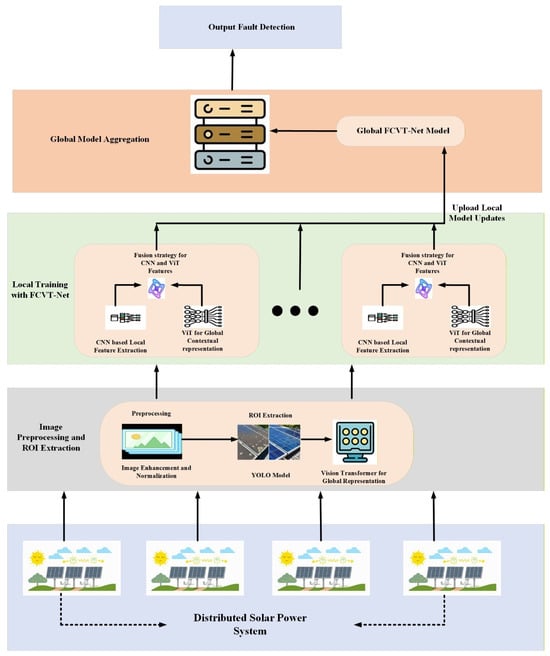
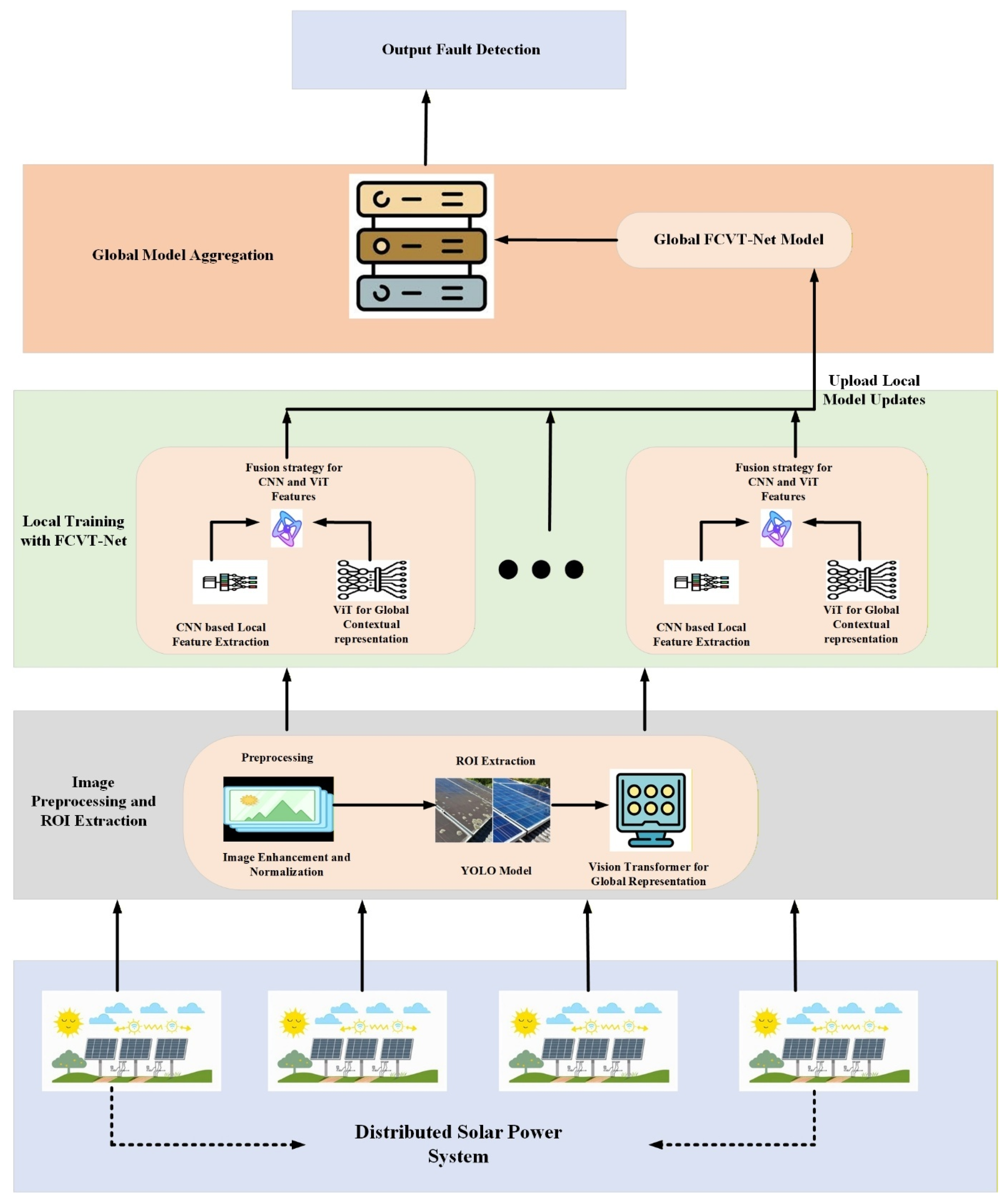
The proposed Fed-CVTNet framework is organized into three main stages: local image pre-processing, hybrid deep feature extraction, and federated model aggregation. This structure can ensure the preservation of privacy and high accuracy of fault detection in distributed solar power systems. As shown in Figure 1, the framework starts with image processing and ROI extraction, where raw PV images are enhanced and standardized. A pretrained YOLO model isolates fault-relevant regions, and a ViT captures global contextual features. Each local PV station performs local training using Fed-CVTNet, which fuses CNN-based local features and ViT-based global representations. The fusion strategy ensures robust feature learning across heterogeneous datasets. Local model updates are then uploaded to the global aggregation server, where the FedAvg algorithm combines knowledge from all clients to form a unified global model. Finally, the aggregated model performs fault detection with improved accuracy, reduced bias and enhanced privacy protection.
Figure 1.
Overall proposed model architecture. The dotted arrows represent the distributed nature of the system, indicating that data are collected from multiple geographically or independently deployed solar power systems.
3.1. Data Acquisition
To ensure diverse, realistic and representative samples of PV panel faults, the dataset was collected from two distinct locations:
- RMK Solar Power Plant, Vadgaon;
- SPPU Research Park Foundation Photovoltaic Laboratory.
The study attempted to capture PV faults under both actual outdoor environments and simulated laboratory conditions, to enhance the dataset diversity and generalizability. In capturing the high-resolution images, the solar panel faults were photographed using a DSLR camera, model Canon EOS Rebel T7, with an 18–55 mm lens. It was important to use high-resolution Electro-Optical (EO/RGB) images since they have visual information needed for the detection of visible PV defects like cracks, micro-cracks, discoloration, delamination, or any surface defect. RGB cameras are easily accessible and relatively inexpensive compared to specialized infrared cameras. High-resolution imaging equipment was important for obtaining the high-resolution images needed for proper analysis of the faults. This type of camera allowed the detection of visible defects such as cracks, micro-cracks, discoloration, or any surface defects in the high-resolution images. Table 3 presents the details of the data collection procedure, including the camera specifications, lighting scenarios, and types of faults captured at each location. This ensures transparency in data acquisition and emphasizes the variety of environmental conditions considered. To balance the dataset and improve generalization, image augmentation was applied to the collected solar panel fault images. The augmentation methods included rotation, flipping, scaling, brightness adjustment, and contrast variation, which simulate different environmental and operational conditions. These transformations made it possible to see fault features such as cracks and discoloration and increased the dataset size. Augmentation improved class imbalance and lowered the risk of overfitting during training.
Table 3.
Details of the data collection procedure.
Table 4 summarizes the composition of the dataset, including the number of raw images collected for each fault type, the augmented samples generated and the final size of the balanced dataset. This balanced dataset contains 5600 images; each fault type is equally represented, which is essential for training robust fault-detection models.
Table 4.
Details of the dataset.
3.2. Pre-Processing
Pre-processing is done at each client node to enhance the image quality and normalize the feature space of distributed PV datasets. This section is structured into four main steps: noise suppression via median filtering, contrast improvement with histogram normalization, image resizing to a fixed resolution, and intensity normalization for pixel value scaling. Each client node independently pre-processes the image with respect to the ROI detection [50] in order to improve the image quality and to normalize the feature space across the distributed PV datasets. As images are taken in different conditions of light and environment, the pre-processing stage is important for highly robust detection and classification stages. To suppress noise and environmental distortions while preserving edge information, a median filtering technique is applied to the input image. Let denote the original input image; the noise-reduced image is obtained as calculated in Equation (1).
where denotes the convolution operation and the noise removal process, and where the original input image is convolved with a median kernel to produce a noise-reduced image . The convolution operation suppresses high-frequency noise introduced by camera sensors and environmental conditions while preserving important structural information such as edges and fault boundaries. is calculated using Equation (2).
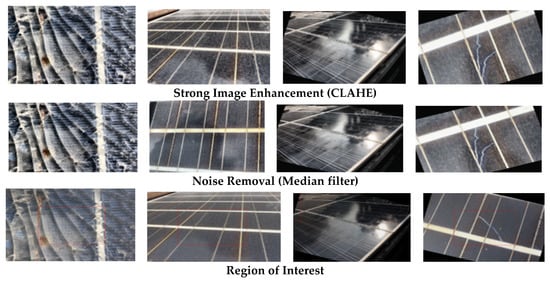
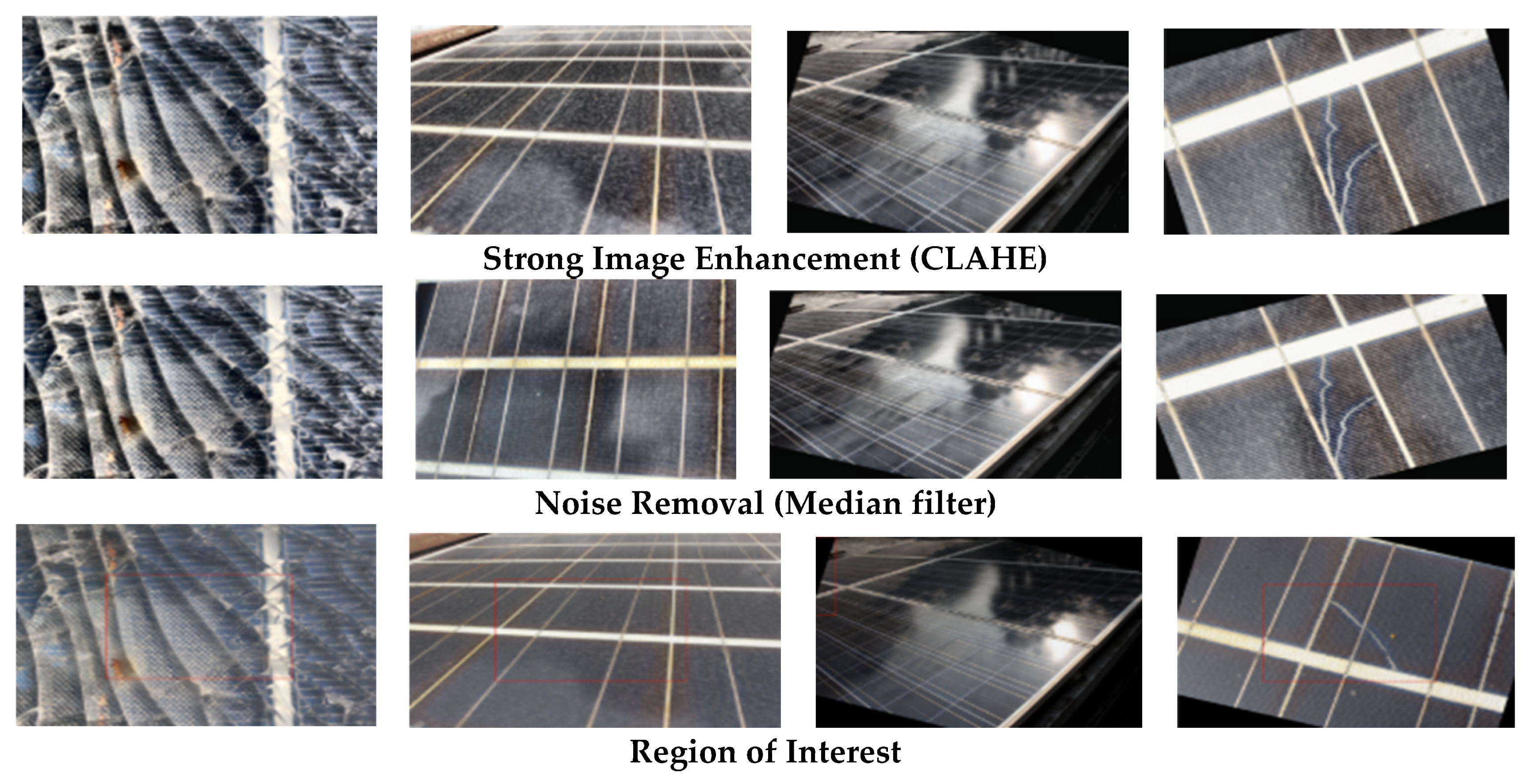
Here, represents the local neighborhood center at pixel Each pixel intensity is replaced by the median value of the neighboring pixels, effectively removing impulse noise while preserving edges and structural details. This operation can effectively remove high-frequency noise while preserving structural details, which are very important for fault detection. Histogram normalization is used to increase the contrast of fault patterns, such as cracks and discoloration, making them more visible. Figure 2 represents the output of image processing at each stage of the sample images. The enhanced image is computed as determined by Equation (3).
The contrast enhancement is carried out by normalizing the intensity values of the noise-reduced image . In this equation, and are the minimum and maximum pixel intensities of the image, respectively. This operation increases the range of intensity values and thus improves the visibility of features related to faults that might be invisible due to light distribution or low contrast. Image resizing is performed using Equation (4).
represents the spatial resize of the enhanced image to a fixed resolution . Here, represents the pixel coordinates in the resized image, while and relate to the height and width of the original image, separately. The mapping scales the original pixel coordinates in proportion to the target dimensions and thus ensures that all images have uniform spatial resolution. Image normalization is calculated by Equation (5).
Figure 2.
Pre-processed and segmented output.
This equation normalizes the pixel intensity values of the resized image each pixel value is normalized to 255, which is the maximum possible intensity for an 8-bit image. Each pixel of the resulting image has a value in the range of . This scaling helps to improve gradient stability during backpropagation and accelerates convergence during training.
3.3. ROI Detection
ROI detection [51] is important in separating PV modules and fault-prone regions from complex backgrounds. In most of the PV images, the presence of non-relevant elements like mounting structures, sky and shadows reduces detection accuracy. To this end, we use YOLO, a pre-trained single-stage object detection framework that is run locally on each federated client to detect and localize PV modules before the classification step. YOLO was chosen for its excellent detection accuracy and robust performance on a variety of PV datasets. The model predicts the bounding boxes as shown in Equation (6).
where denote the center coordinates of the bounding box, and and correspond to its height and width. These values comprise the location and size of the PV module. Bounding boxes below a confidence threshold are discarded, and Non-Maximum Suppression ensures that only the most reliable detection is kept. Finally, the bounding box is used to extract the Region of Interest (ROI), focusing only on fault-relevant areas like cracks, soiling and discoloration. This targeted extraction increases the reliability of the subsequent CNN–Transformer analysis in a computationally efficient manner.
To improve the generalization capability of the proposed Fed-CVTNet and compensate for the relatively limited size of the PV fault dataset, data augmentation is applied to each ROI image before local model training. Let denote the extracted ROI image. The augmented image is obtained as
where denotes a randomly selected augmentation operation. The transformation set consists of horizontal and vertical flipping, random rotation, translation, zooming, and brightness adjustment. These transformations increase the diversity of the training samples while preserving the original class labels, thereby reducing overfitting and improving the robustness of the CNN-ViT model under varying imaging and environmental conditions.
3.4. Local Fed-CVTNet Model Training
In the federated learning strategy, Fed-CVTNet would be locally trained on every client whose ROI images are generated according to themselves. In this local training paradigm, private PV image data remains in local sites and models are co-trained by federated aggregation. The Fed-CVTNet jointly uses CNN [47] and ViT [48], which both have different advantages for capturing local and global fault features. The CNN component of Fed-CVTNet is used to extract low-level and spatial features from input ROI images, such as edges, textures, shapes, and localized fault patterns. Given an ROI image , the convolutional feature maps are computed as in Equation (8).
where and denote the convolutional kernel weights and bias at layer , denotes the convolution operation, and is a nonlinear activation function, . Through successive convolution and pooling layers, CNN provides compact feature representation that preserves fine-grained fault details, like micro-cracks and localized features, which are critical for accurate PV fault diagnosis. While CNNs excel at capturing local spatial features, the extracted CNN feature maps are passed to a ViT module to encode global contextual information. The CNN feature map is first divided into a sequence of flattened patches and then projected into embedding vectors as determined by Equation (9):
where denotes the feature patch, is the linear projection matrix, represents positional embeddings, and is the number of patches. These embeddings are then given to a stack of transformer encoder layers. Each encoder layer operates as a multi-head self-attention (MHSA) followed by a feed-forward network (FFN), as calculated in Equation (10).
where the query , key , and value matrices are developed from the input embeddings. This mechanism allows the model to acquire long-range feature relationships over the entire PV module, improving discrimination between normal and defective regions.
Fed-CVTNet adopts a feature-level fusion strategy to merge CNN and ViT outputs, thus enabling it to exploit both local spatial details and global contextual representations. Let denote the final CNN feature vector and represent the ViT-encoded global feature vector. These features are fused as Equation (11).
The fused feature vector is then given as input to a fully connected layer to obtain a unified representation in Equation (12).
where and are trainable fusion parameters, and denotes a nonlinear activation function. The fusion strategy allows Fed-CVTNet to leverage the fine-grained local fault cues and global structural dependencies simultaneously, leading to improved fault discrimination and robustness. Table 5 shows the CNN-ViT architecture parameter of Fed-CVTNet.
Table 5.
Hybrid CNN–Transformer architecture parameters of Fed-CVTNet.
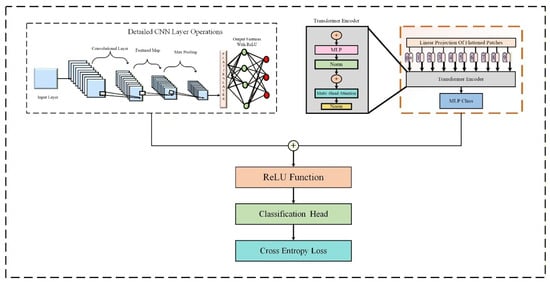
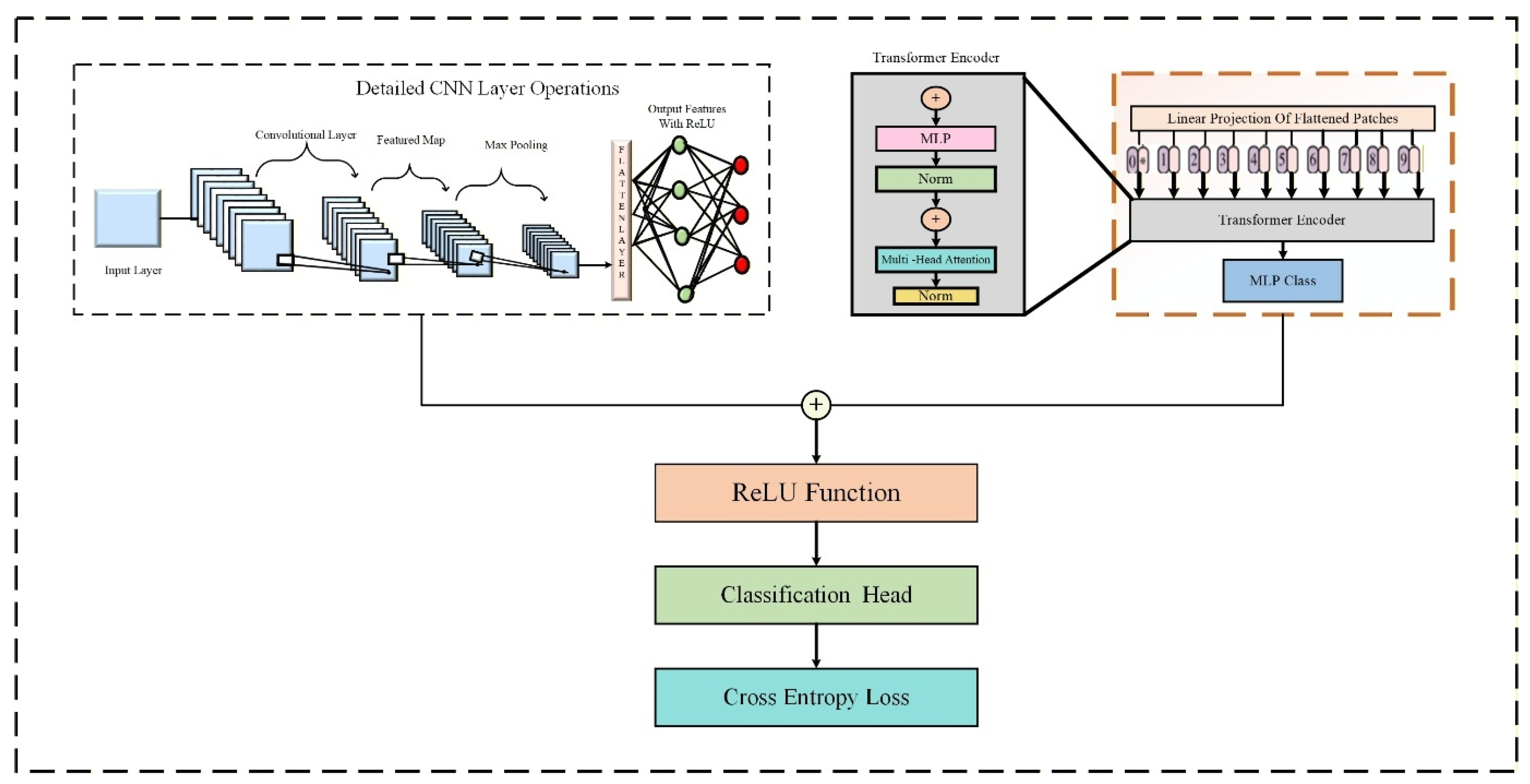
The architecture of the proposed Fed-CVTNet is depicted in Figure 3, which shows the integration of CNN and ViT modules within the federated learning framework for privacy-preserving PV fault detection.
Figure 3.
Proposed Fed-CVTNet architecture. The asterisk (*) indicates the linearly projected representation of each image patch.
The CNN branch of the model extracts fine-grained local features such as cracks and discoloration from the pre-processed PV images, whereas the ViT branch learns to model the global contextual dependencies across the entire module through its multi-head self-attention mechanism. The two branches are fused to obtain a hybrid representation with both local structure information and global context information for accurate classification of different types of PV faults. This hybrid representation is further fed to a classification head that is trained with the cross-entropy loss to determine different fault classes. The entire process takes place under a federated learning setting where each client trains the CNN-ViT hybrid locally, sharing model updates with a central server that aggregates the updates through FedAvg, ensuring data privacy, reducing bias and increasing generality in heterogeneous distributed environments.
3.5. Global Fed-CVTNet Model
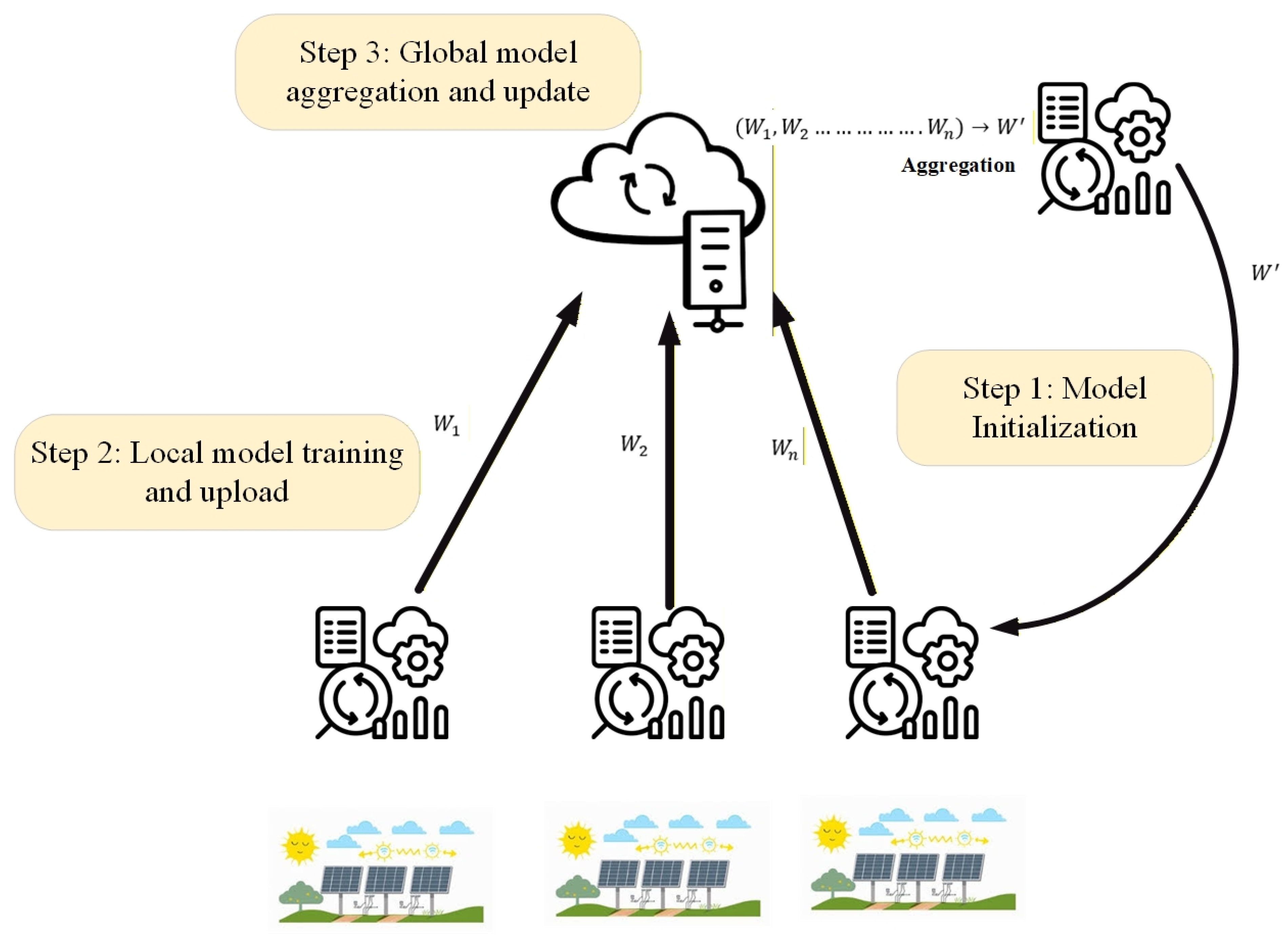
Global Fed-CVTNet is designed within FL to allow multiple distributed PV systems to train cooperatively while improving data privacy. Each system belongs to one PV plant or inverter, and keeps locally acquired ROI images on the local device itself. Model training occurs locally, and only the model parameters obtained are communicated to a central server for aggregation. Since raw image data are never directly transmitted, the proposed approach reduces the risk of direct data exposure and supports privacy-preserving training under practical deployment constraints.
Let the total number of systems be , where each one owns a local data of size . During each federated communication round , the central server broadcasts the current global model parameters to all distributed systems. Each one initializes its local Fed-CVTNet model with these parameters and performs local training for a fixed number of epochs . The local optimization objective at one is defined as Equation (13).
where denotes the loss function (categorical cross-entropy), represents the Fed-CVTNet model, and are local training samples and labels. After local training, each client obtains updated model parameters . Only these parameters or their gradients are transmitted to the central server, while all raw PV images remain local.
Upon receiving the locally trained model parameters from all participating clients, the central server aggregates them using the FedAvg algorithm. FedAvg is used as the aggregation method because it is the most widely adopted baseline in federated learning, offering stable convergence across heterogeneous PV datasets, low communication overhead, and proportional weighting of client contributions. The global model update is determined as a weighted average of the system models, using Equation (14).
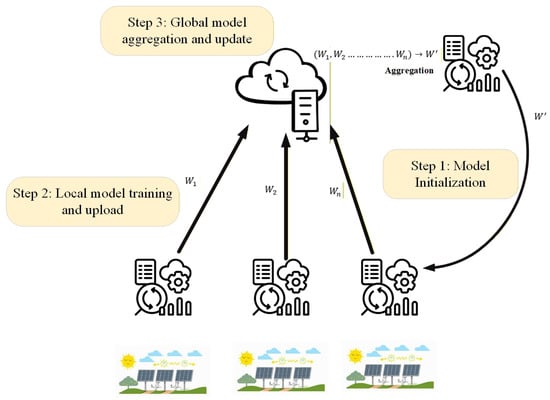
Here, the weighting factor ensures that clients with huge datasets contribute proportionally more to the global model. This aggregation strategy allows the global Fed-CVTNet to learn from diverse and heterogeneous PV fault patterns across different geographical locations. As represented in Figure 4, after aggregation, the updated global model parameters are redistributed to all clients. Each client replaces its local FCVT-Net parameters with the new global parameters and proceeds to the next federated training round. This process is reiterated until convergence or a pre-determined number of communication rounds. The Global Fed-CVTNet learns comprehensive fault representations and guarantees strict data privacy through repeated collaboration. The final Global Fed-CVTNet model is a consensus learned from all participating systems that takes into account both local fine-grained fault characteristics and global contextual knowledge. This collaborative learning strategy can significantly improve the fault-detection accuracy, robustness and scalability in distributed photovoltaic power systems.
Figure 4.
Federated learning process of local Fed-CVTNet training and FedAvg aggregation.
4. Experimental Results
In this section, the experimental evaluation of the proposed Fed-CVTNet model is carried out. First, the evaluation metrics are introduced, followed by comparative performance analyses of baseline and federated learning models. Confusion matrix analysis and quantitative comparisons across multiple metrics are provided to highlight robustness and error reduction. Finally, the practical deployment aspects are demonstrated through the Fed-CVTNet fault-detection interface and the final classification outcomes. The proposed fault-detection framework through the proposed Fed-CVTNet was developed and implemented in Python 3.10.11 on a system using an Intel(R) Core (TM) i9-12900 CPU at 2.40 GHz and 32.0 GB of RAM. For experimentation, fault-detection datasets from the RMK Solar Power Plant, Vadgaon [P1], and the SPPU Research Park Foundation Photovoltaic Lab are used. The proposed Fed-CVTNet was trained across five simulated clients, each representing distinct PV data partitions. Training was conducted for 20 communication rounds, with each client performing local updates before aggregation. The aggregation strategy followed FedAvg, integrated with the proposed model. In order to verify the effectiveness of the developed Fed-CVTNet, a comparative study was carried out with recently developed DL approaches such as FL-MobileNetV2 [49], c [50], FL-ResNet [51] FedCPU [52], DA-FL [29], and FedMs-ViT [53]. The proposed Fed-CVTNet model was validated through systematic comparison with multiple baseline architectures, including CNN (ResNet-18), ViT-Tiny, Centralized CVT-Net, and federated learning-based models such as FL-EfficientNetB. All models were trained and evaluated under identical PV fault-detection conditions to ensure fairness. Validation was carried out using the widely accepted performance metrics of accuracy, precision, recall, specificity, lower false negative rate (FNR) and false positive rate (FPR), Matthews correlation coefficient (MCC), negative predictive value (NPV) and kappa, providing a comprehensive assessment of classification capability. The comparative results consistently confirm the effectiveness and reliability of Fed-CVTNet for federated PV fault-detection scenarios, given its superior performance.
4.1. Client Construction and Data Heterogeneity
For assessing the Federated-CVTNet model in more realistic, federated learning settings, the original 4323 images are first divided into training, validation, and test sets at the original-image level to avoid any possibility of data leakage. Data augmentation is then applied only to the training set, producing the balanced dataset of 5600 images, while augmented versions of the same source images are not included in the validation or test sets. The resulting 5600-image training dataset is divided into five simulated clients that explicitly ensure statistical heterogeneity (non-IID). In order to achieve this, a Dirichlet label-skew partitioning technique is adopted with Dirichlet concentration parameter α = 0.5, as is frequently done in the federated learning literature. This results in clients with very different class distributions yet guarantees the presence of all four fault types (Cracking, Shading, Delamination, and Discoloration).
The client-wise statistics are presented in Table 6. Client 1 consists mostly of samples with Cracking and Delamination, Client 2 comprises mostly Shading and Discoloration, and so forth, leading to an EMD of ≈0.38 between the local and global label distributions—indicating strong heterogeneity between the datasets. Hence, each client learns from its own non-IID local dataset consisting of 980 to 1240 images. This configuration simulates real-world deployment of multiple plants with various prevalence of fault types due to differing climate, operations, and maintenance. All of the further experiments were conducted on this heterogeneous client split (20 communication rounds, local epochs = 5, FedAvg). The formulas for the metrics used are given in Table 7.
Table 6.
Client-wise data distribution under non-IID Dirichlet partitioning ().
Table 7.
Formulas and descriptions of evaluation metrics.
4.2. Analysis of Performance
An extensive evaluation of the performance of the proposed Fed-CVTNet model in comparison with baseline federated learning techniques was conducted. The evaluation considered several metrics, such as accuracy, precision, recall, specificity, F1-score, AUC and error-related measures, like FPR and FNR. The results demonstrate that the model is robust and scalable for distributing PV fault diagnosis.
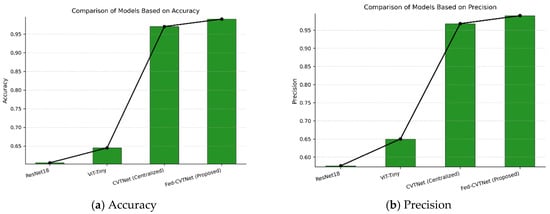
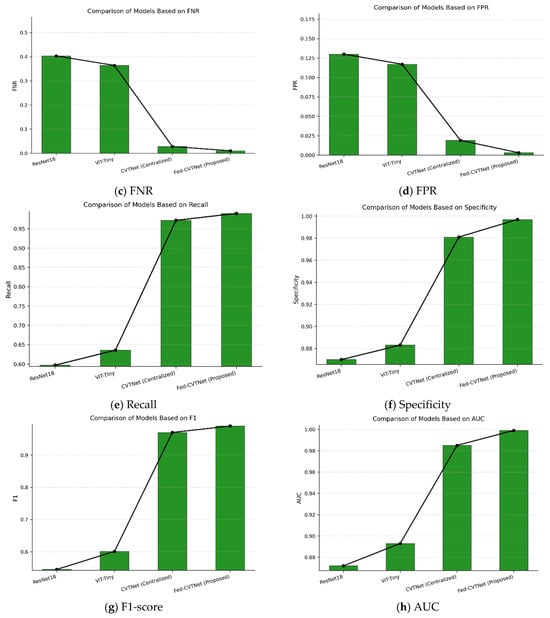
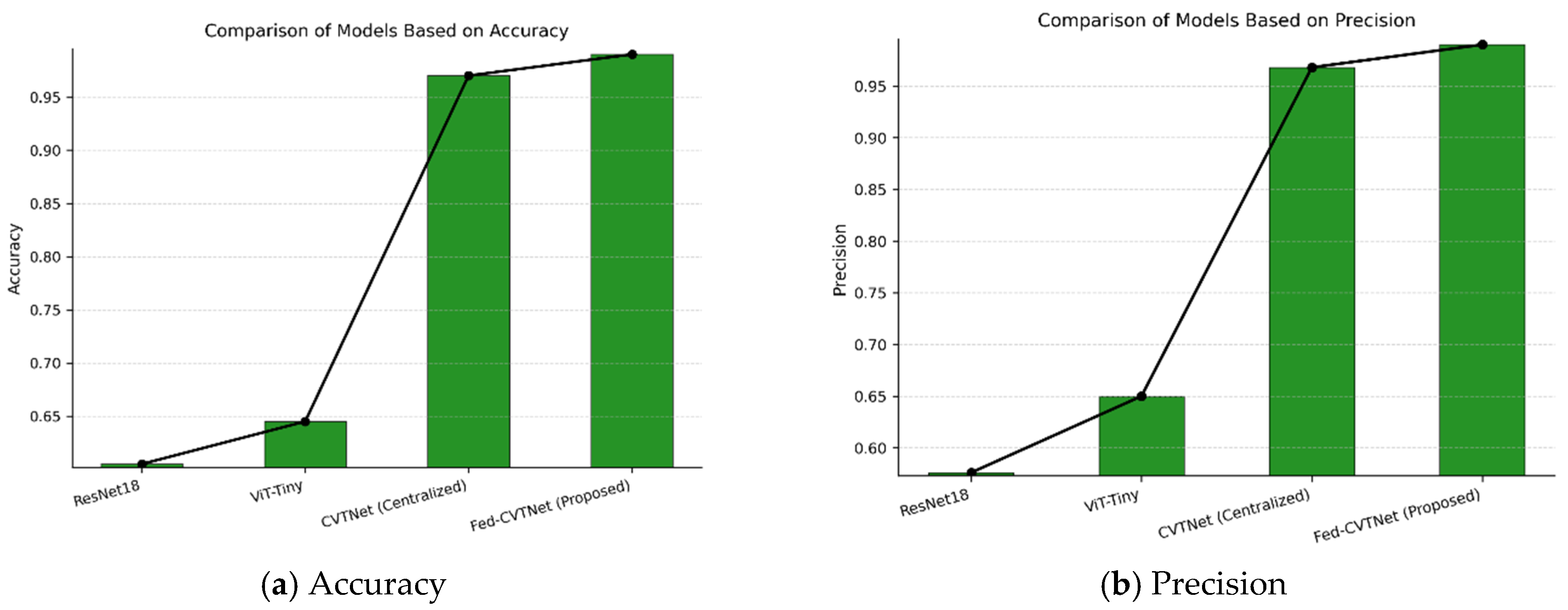
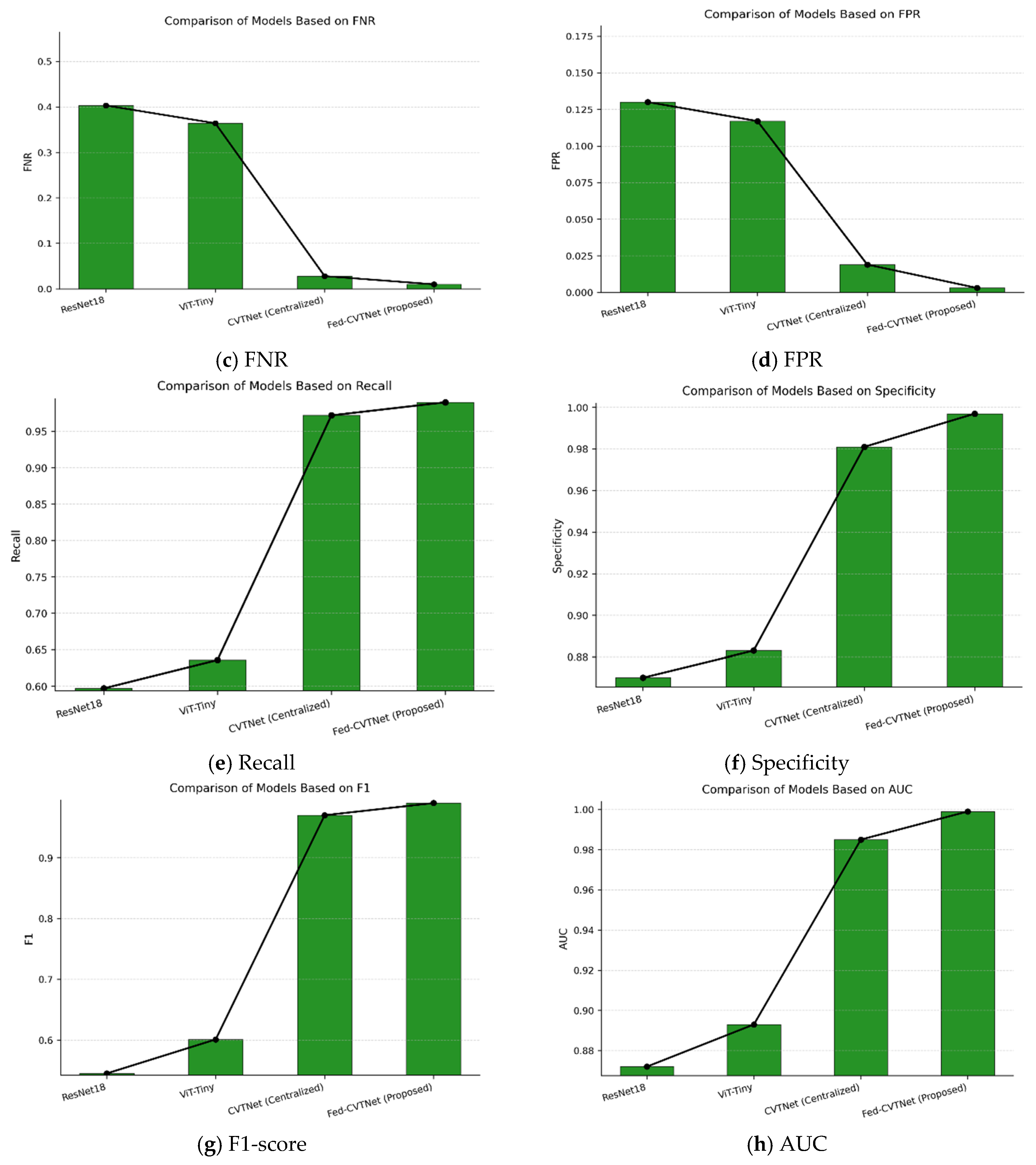
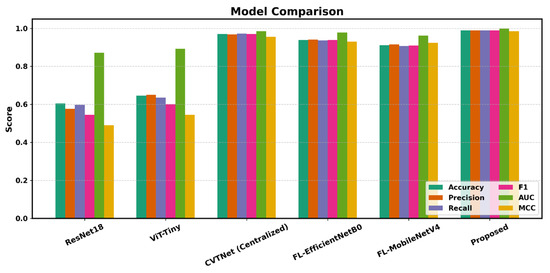
Figure 5 shows the results and indicates that ResNet18 and ViT-Tiny reach baseline performance with lower accuracy and higher error rates, while CVTNet (Centralized) reaches good results with its hybrid CNN–Transformer design. However, Fed-CVTNet has the best performance against all baselines, with the highest accuracy, precision, recall, specificity, F1-score and AUC, and lowest FNR and FPR. This indicates that the federated training strategy can not only preserve the privacy of data, but also improve robustness and generalization, which makes Fed-CVTNet the most effective model in distributed photovoltaic fault detection.
Figure 5.
Performance comparison of the proposed model with baseline models.
Figure 5 shows Fed-CVTNet with 98.99% accuracy, which is a 63.5% improvement over ResNet18, 53.4% over ViT-Tiny and 1.9% over Centralized. Compared with CVTNet, precision and recall improve by 2–3%, and FPR and FNR decrease by about 2%. These quantitative gains show that federated training not only protects privacy but also improves robustness and generalization, making Fed-CVTNet the most effective model for distributed photovoltaic fault detection. Fed-CVTNet improves upon CVTNet in F1-score by 2.7%. It also exceeds ResNet18 and ViT-Tiny by more than 30%. The Area Under the Curve (AUC) increases from 96.8% in CVTNet to 98.9% in Fed-CVTNet, i.e., a gain of 2.1%, confirming stronger discriminative ability.
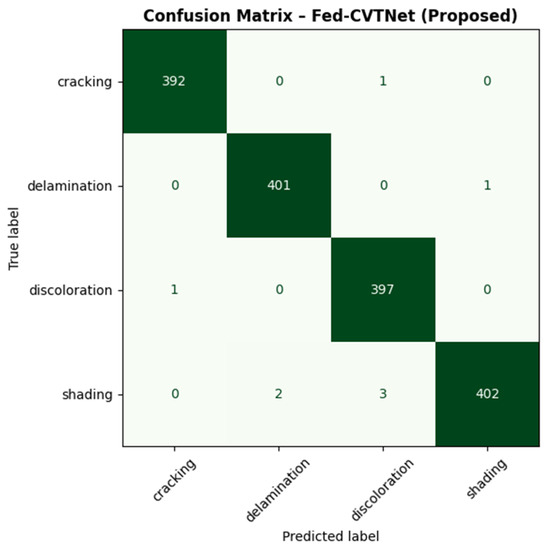
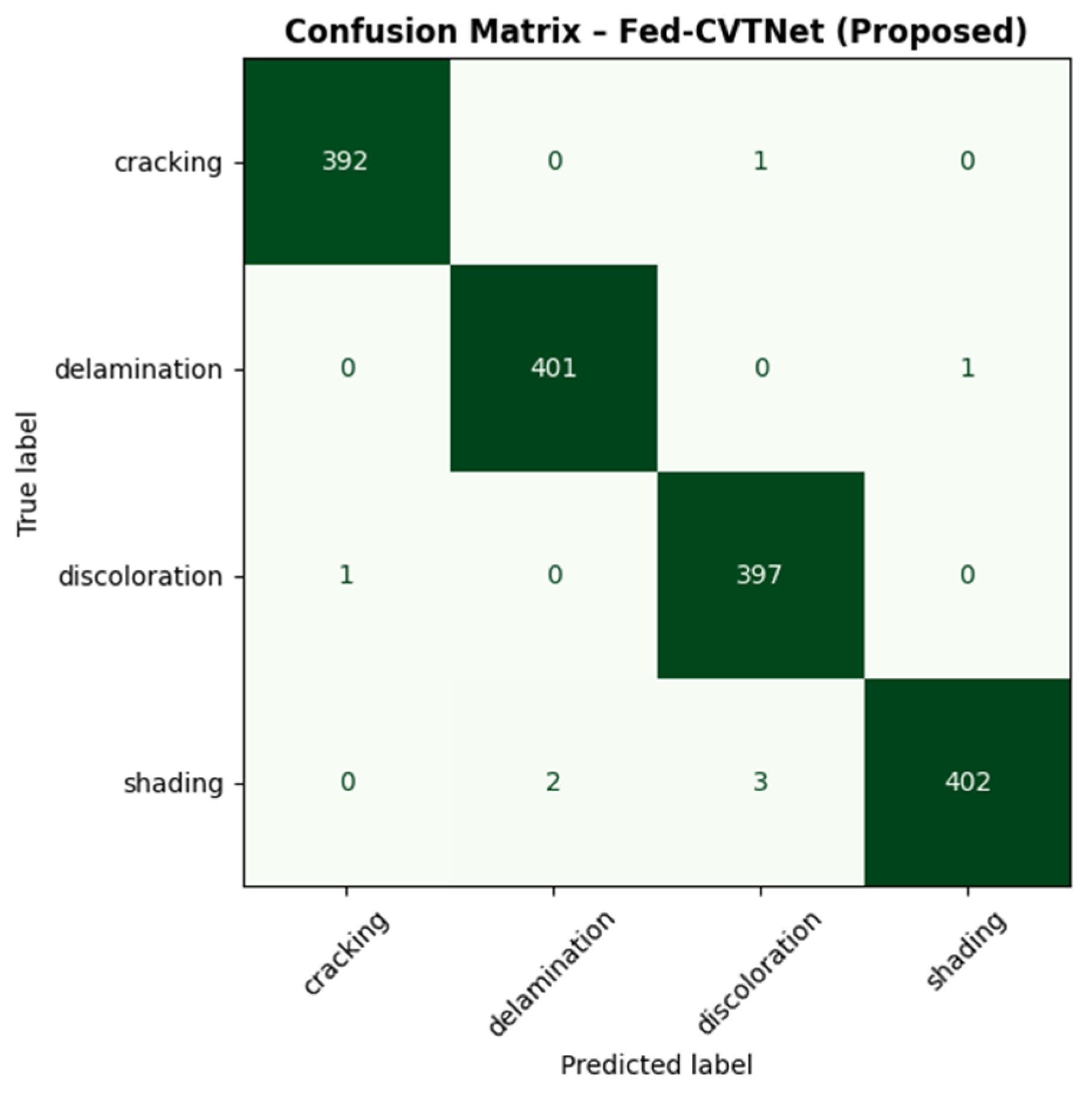
The confusion matrix of the proposed Fed-CVTNet model (Figure 6) indicates that the model is highly capable of classifying four types of photovoltaic faults: Cracking, Delamination, Discoloration, and Shading. The diagonal numbers indicate that nearly all the samples were correctly identified, and 392 Cracking, 401 Delamination, 397 Discoloration and 402 Shading cases were correctly identified. There are a few misclassifications, with only a small number of cases misclassified (e.g., one Cracking sample misclassified as Discoloration, one Delamination sample misclassified as Shading, and a few Shading samples misclassified as Delamination or Discoloration). These findings demonstrate that the model is highly reliable and discriminating, with an almost perfect accuracy and very low error rates.
Figure 6.
Confusion matrix analysis of proposed Fed-CVTNet model.
Table 8 demonstrates the results of ablation experiments with the proposed model, where the standalone CNN produced 91.1% accuracy, while ViT produced 92.8%, proving that neither local nor global feature learning separately is sufficient to achieve high PV fault-detection performance. The combination of CNN and ViT brought accuracy up to 95.5%. The inclusion of YOLO-based ROI extraction brought accuracy up to 97.0%, which proves the possibility of improving performance by helping the network to learn only relevant regions and not be distracted by background information. With the implementation of federated learning (FedAvg), the accuracy was improved to 98.1%, proving higher robustness and generalization ability in cases of distributed heterogeneity and private data. The complete Fed-CVTNet produced the highest results, with 99.0% accuracy, 98.0% precision, 99.0% recall, and 98.0% F1-score.
Table 8.
Ablation study of the proposed Fed-CVTNet architecture.
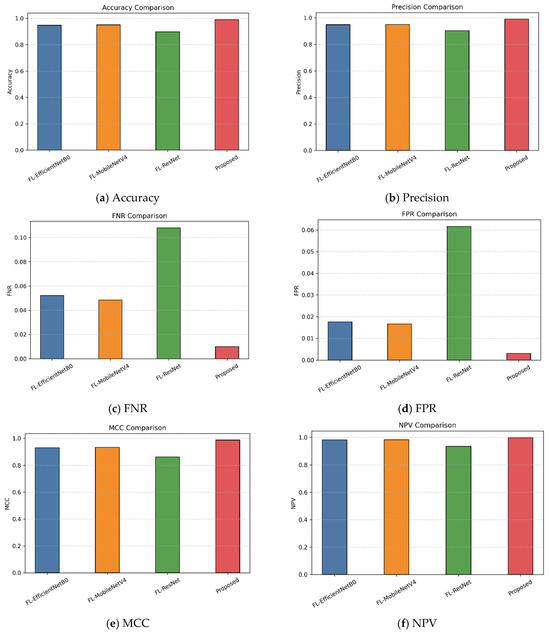
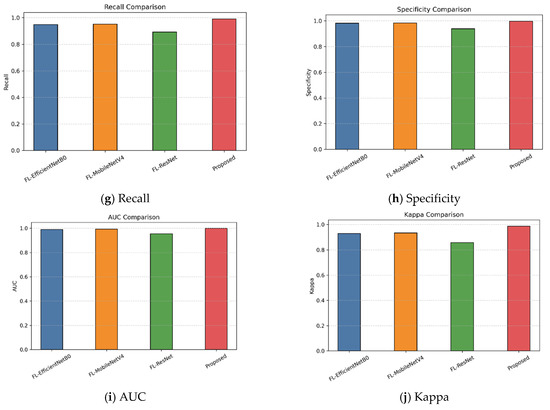
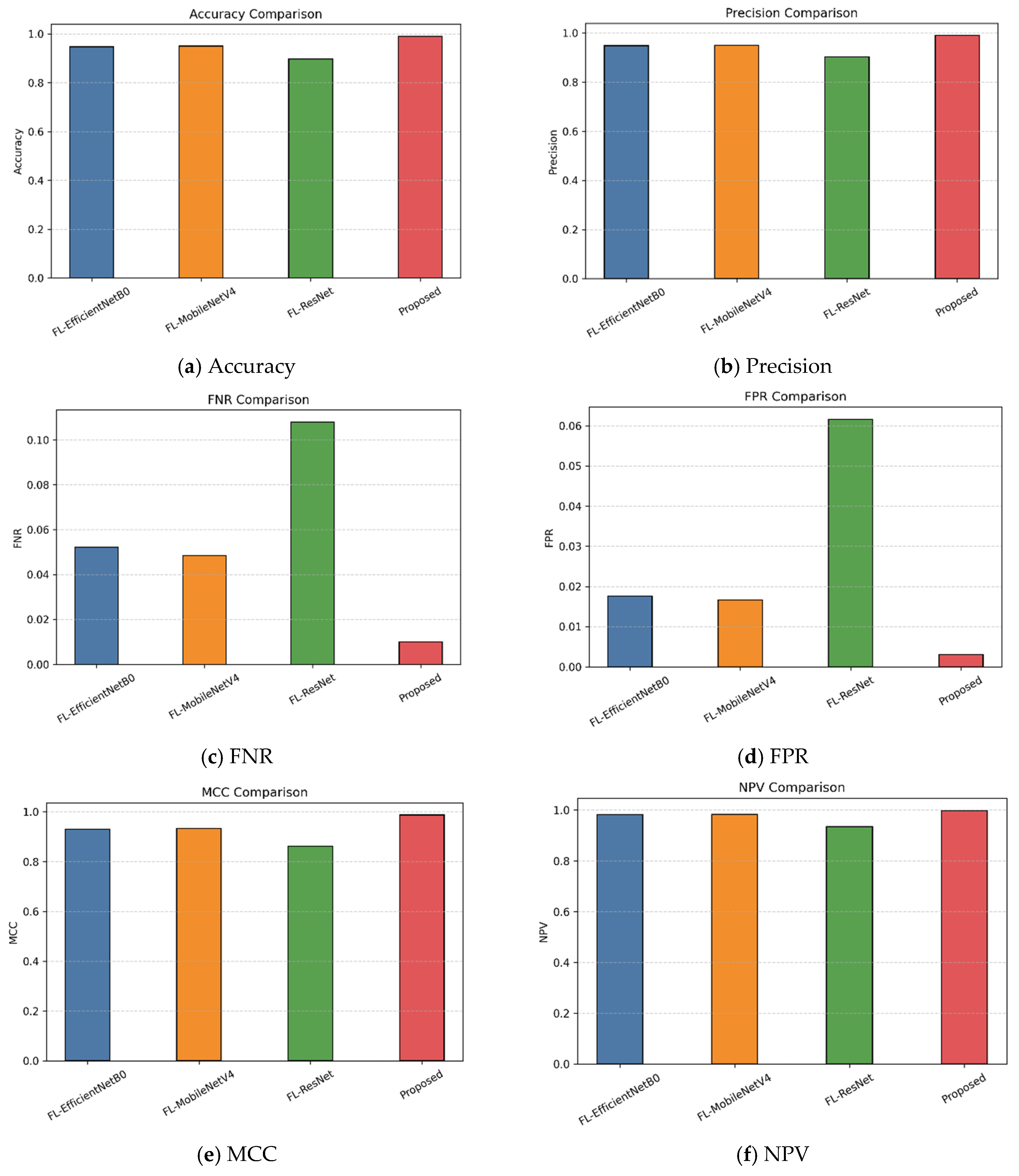
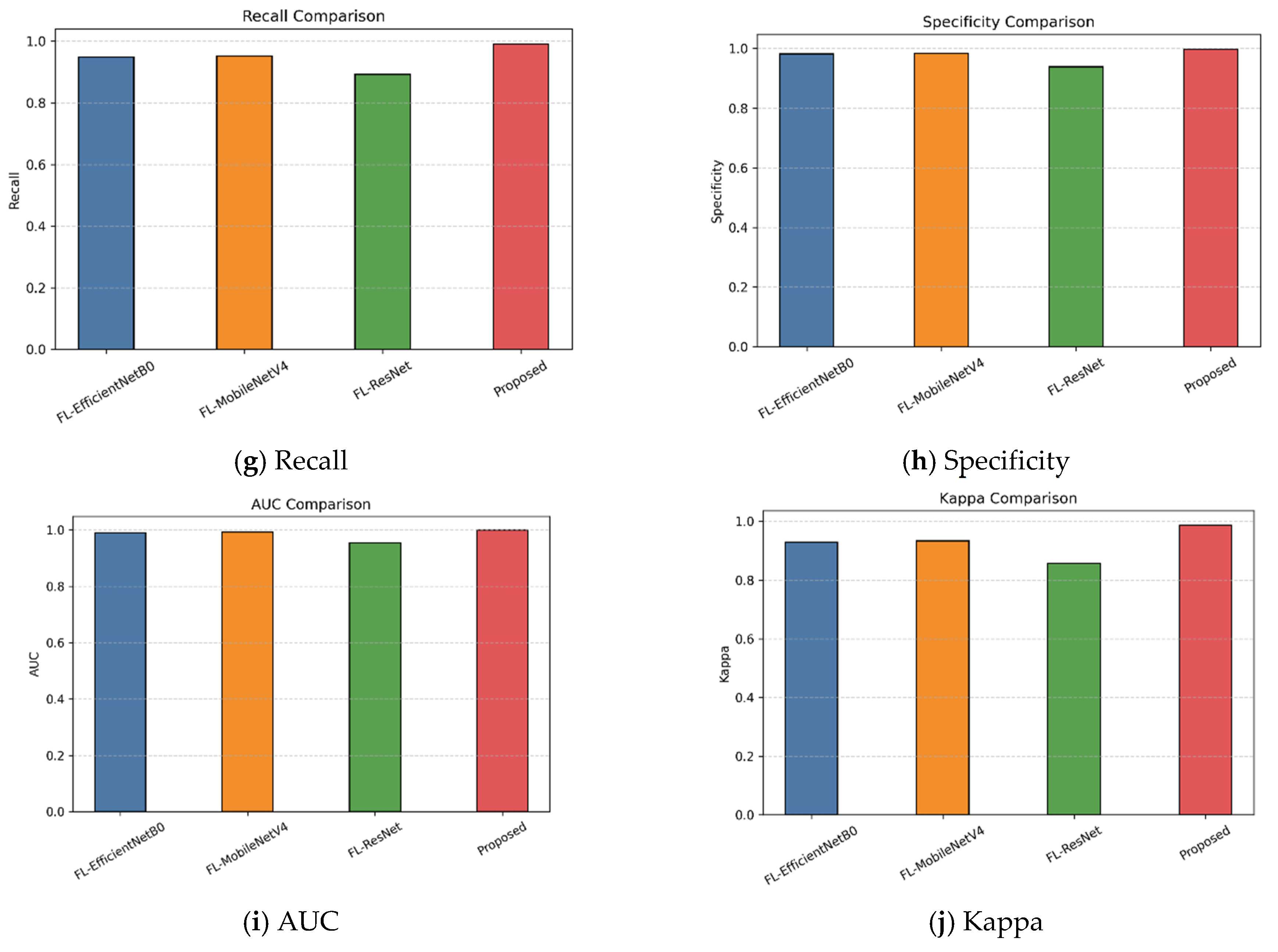
In Figure 7, the proposed Fed-CVTNet model exceeds three federated learning baseline systems, namely, FL-MobileNetV2, FL-EfficientNetB0 and FL-ResNet. Among the baseline models, Fed-CVTNet obtains higher values over all of them based on the tests conducted. Fed-CVTNet achieves the highest accuracy and precision, proving to be a more trustworthy fault-detection system. With respect to error-based metrics, namely, FNR and FPR, it can be seen that Fed-CVTNet decreases both misses and false alarms, hence making it more trustworthy in monitoring PV faults. From the graphs, it can be determined that Fed-CVTNet obtains an accuracy of 99.00%, which is 3.2% higher than FL MobileNetV2 (91.00%), 3.0% higher than FL EfficientNetB0 (0.93%), and 4.1% higher than FL ResNet (94.87%). Precision is improved by 3.1–3.3% over the baseline models while accuracy and specificity are increased by 2.8–3.5%. Error-based metrics showed a decrease in false negatives by 2.1% and a decrease in false positives by 1.7% compared to the best model.
Figure 7.
Performance analysis of proposed model relative to other existing FL models.
Table 9 reveals that Fed-CVTNet always has better results, with the highest accuracy (99%), precision (98.98%), recall (99.02%), and F1-score (98.99%). These results demonstrate the strength and stability of Fed-CVTNet, which can provide more accurate and discriminative fault detection than the current federated learning strategies.
Table 9.
Comparative performance analysis of federated learning-based model.
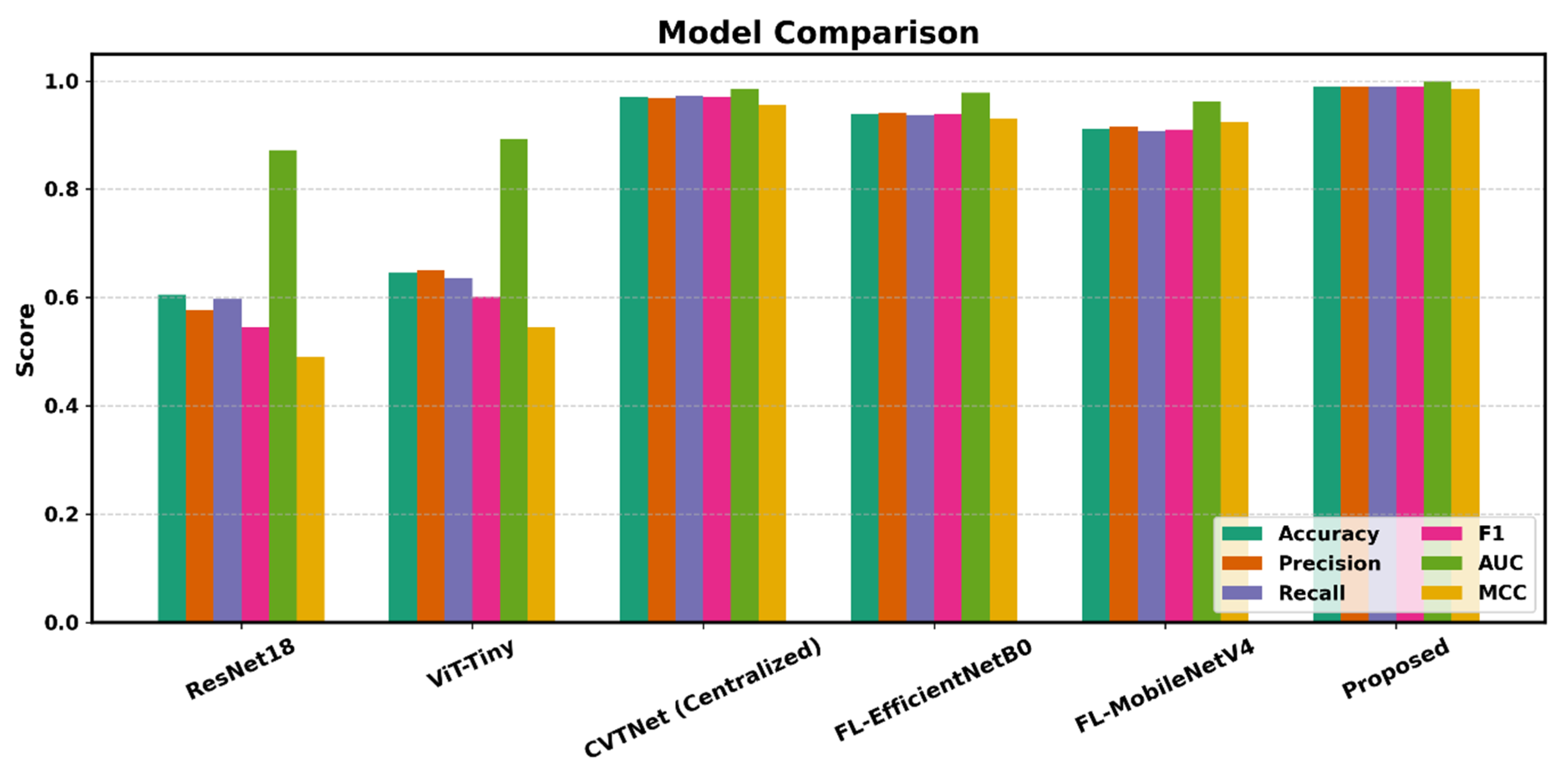
The visualization in Figure 8 shows that ResNet 18 and ViT-Tiny have relatively low scores. This is because they are not able to detect complex PV fault patterns as well, as observed in MCC. The centralized CVT-Net and the federated variants (FL-EfficientNetB0 and FL-MobileNetV4) show better performance in most metrics, confirming the advantages of transformer-based and federated techniques. The proposed Fed-CVTNet consistently outperforms other options in all the metrics, showcasing its robustness, generalization, and reliability in federated PV fault detection. This is an exhaustive and detailed comparison, which shows that Fed-CVTNet achieves results that significantly outperform the traditional CNN and ViT baselines and are better than existing federated transformer models, making it the best choice for deployment on the fly.
Figure 8.
Performance analysis of the proposed model over the baseline and existing FL model.
Table 10 shows the comparison of baseline centralized learning models and federated learning models in terms of performance metrics. The results displayed that centralized CNN and transformer baselines (ResNet18 and ViT-Tiny) selectively lower the accuracy and show higher error rates, while CVTNet (Centralized) shows a high accuracy of 97% and imbalanced precision, recall, and specificity. Even though the proposed Fed-CVTNet provides substantially better results in terms of accuracy (98.99%) in comparison with ResNet18 (60.5%) and ViT-Tiny (64.5%), such a performance gain can be explained through a variety of aspects. First of all, ResNet18 mainly extracts local spatial features and does not have the ability to capture the long-range context dependencies necessary for differentiating photovoltaic faults. Unlike ResNet18, ViT-Tiny heavily depends on self-attention mechanisms and needs large datasets for achieving maximum performance. On the other hand, the proposed Fed-CVTNet allows for both extracting local features using CNNs and applying global context learning based on Vision Transformers. Additionally, the application of YOLO-based Region of Interest (ROI) extraction allows for a focus on defective photovoltaic regions only. Finally, using federated learning and FedAvg helps in training the model on heterogeneous datasets in a collaborative way without violating privacy constraints. In federated models, FL-MobileNetV4 and FL-EfficientNetB0 achieve moderate performance (accuracy 91.2% and 93.9%, respectively) and showcase the feasibility of federated learning, but with moderate robustness. In contrast, the accuracy of the proposed Fed-CVTNet is 98.99% on all measures, AUC is 99.9%, MCC and kappa are 0.98, specificity and NPV are 0.99, and the error rates (FPR and FNR) are very low (FPR = 0.003, FNR = 0.01).
Table 10.
Comparative performance of baseline and proposed models across multiple metrics.
Table 11 shows that FedAvg and FedProx achieve relatively strong and stable performance, with accuracy values of 97.25% and 95.5%, respectively, and balanced precision, recall, and F1-scores around 96.23% and 95.46%. These outcomes confirm their effectiveness as widely adopted baseline aggregation strategies in federated learning. In contrast, FedNova performs very poorly, with accuracy dropping to 20.75% and F1-score to 08.59%, indicating instability and unsuitability for the photovoltaic fault-detection task. Overall, the comparison highlights that FedAvg provides reliable baselines. So, this study selected FedAvg as the aggregation method because it is the most widely adopted and standard baseline in federated learning. FedAvg offers stable convergence across heterogeneous data, requires minimal communication overhead, and ensures reproducibility of results. Using FedAvg allows us to fairly demonstrate the architectural novelty of the proposed Fed-CVTNet.
Table 11.
Comparative performance analysis of federated learning algorithms.
Table 12 shows that Fed-CVTNet achieved a favorable trade-off between communication efficiency and predictive performance, requiring 2.68 GB total communication and 111.5 MB bandwidth per communication round, producing convergence to 95% accuracy in only 13 communication rounds, and requiring a training time of 1.7 h. Although lightweight models such as FL-MobileNetV4 and FL-EfficientNetB0 exhibited lower communication overhead due to their smaller model sizes, they converged more slowly and achieved lower classification accuracy. Conversely, FL-ResNet incurred the highest communication cost (4.98 GB) and training time (2.6 h) because of its larger architecture. With a moderate model size of 22.3 MB, Fed-CVTNet also demonstrated practical deployment capability, achieving average inference delays of 18.4 ms on an NVIDIA RTX 3060 GPU and 47.2 ms on a CPU-only edge device, enabling near real-time PV fault detection. Furthermore, when the number of participating clients increased from five to ten, Fed-CVTNet exhibited the smallest accuracy degradation (1.6%), confirming its superior scalability and robustness under heterogeneous non-IID environments. Overall, these results demonstrate that Fed-CVTNet provides an effective balance between detection accuracy, communication efficiency, computational cost, and deployment feasibility for distributed photovoltaic monitoring systems.
Table 12.
Comparison of communication overhead, computational cost, inference latency and scalability.
4.3. Cross-Dataset Generalization and External Validation
To evaluate the generalization capability of the proposed Fed-CVTNet beyond the private dataset, additional experiments were conducted on the publicly available PV Panel Defect dataset (https://www.kaggle.com/datasets/alicjalena/pv-panel-defect-dataset, accessed on 29 August 2026). The dataset was partitioned into five non-IID clients using the same Dirichlet label-skew strategy (α = 0.5) adopted for the private dataset, and all models were trained under identical federated settings (20 communication rounds, FedAvg aggregation, and five local epochs). As seen from Table 13, the proposed Fed-CVTNet model showed the best results and had an accuracy of 96.84%, precision of 96.52%, recall of 96.71%, and F1-score of 96.61%. In comparison, the centralized version of the CVT-Net showed an accuracy of 94.71%, while federated learning models such as FL-MobileNetV4, FL-EfficientNetB0, and FL-ResNet showed accuracy values of 92.86%, 93.25%, and 93.08%, respectively. It is clear that the proposed hybrid CNN–ViT model with federated learning can generalize well on a completely independent public dataset with good classification accuracy.
Table 13.
Performance comparison on the public PVEL-AD dataset.
4.4. Privacy Protection Analysis
In order to further evaluate the privacy-preserving ability of the developed Fed-CVTNet framework, two typical privacy attacks, namely, Membership Inference Attack (MIA) and Model Inversion Attack, were tested in the same federated setting (five clients with non-IID data and 20 communication rounds). In the MIA case, the attack success rate was only 54.7% for the Fed-CVTNet framework, which is very close to random guessing (50%), and significantly lower than the attack success rates observed for the central models (68–72%). In the Model Inversion Attack, the reconstructed PV images demonstrated low similarity (SSIM = 0.21 and PSNR = 12.4 dB), indicating that the reconstruction quality was poor and that meaningful visual information was not effectively recovered. Moreover, secure aggregation was implemented in the FedAvg algorithm, and therefore, the server could access only the aggregated model updates rather than individual client updates. Table 14 compares the privacy-attack resistance of different deep learning models by using Membership Inference Attack Success Rate, Model Inversion SSIM, Model Inversion PSNR, and Secure Aggregation. Our results show that the proposed/federated models achieve lower attack success rates and reconstruction quality, demonstrating better privacy protection. These results demonstrate that the proposed Fed-CVTNet framework provides resistance to the evaluated membership inference and model inversion attacks; however, this does not imply a general guarantee of privacy against all possible threat models. Table 15 shows the hyperparameter configuration of the proposed Fed-CVTNet model.
Table 14.
Privacy attack resistance comparison across different models.
Table 15.
Hyperparameter configuration of the proposed Fed-CVTNet model.
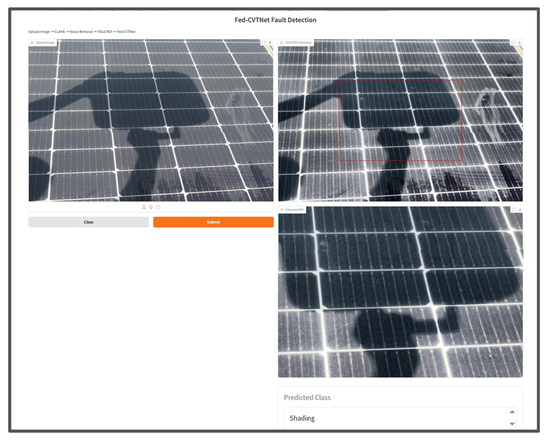
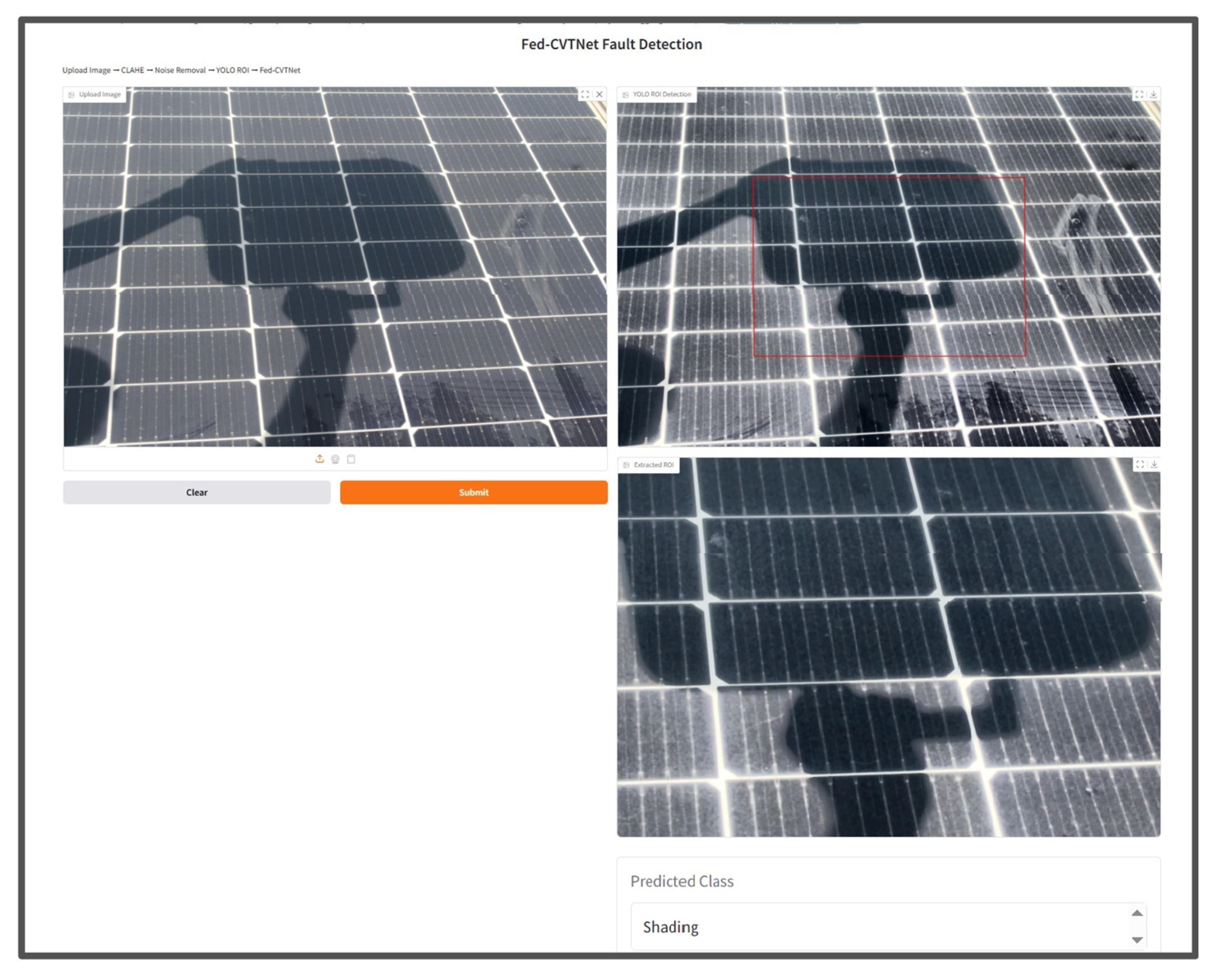
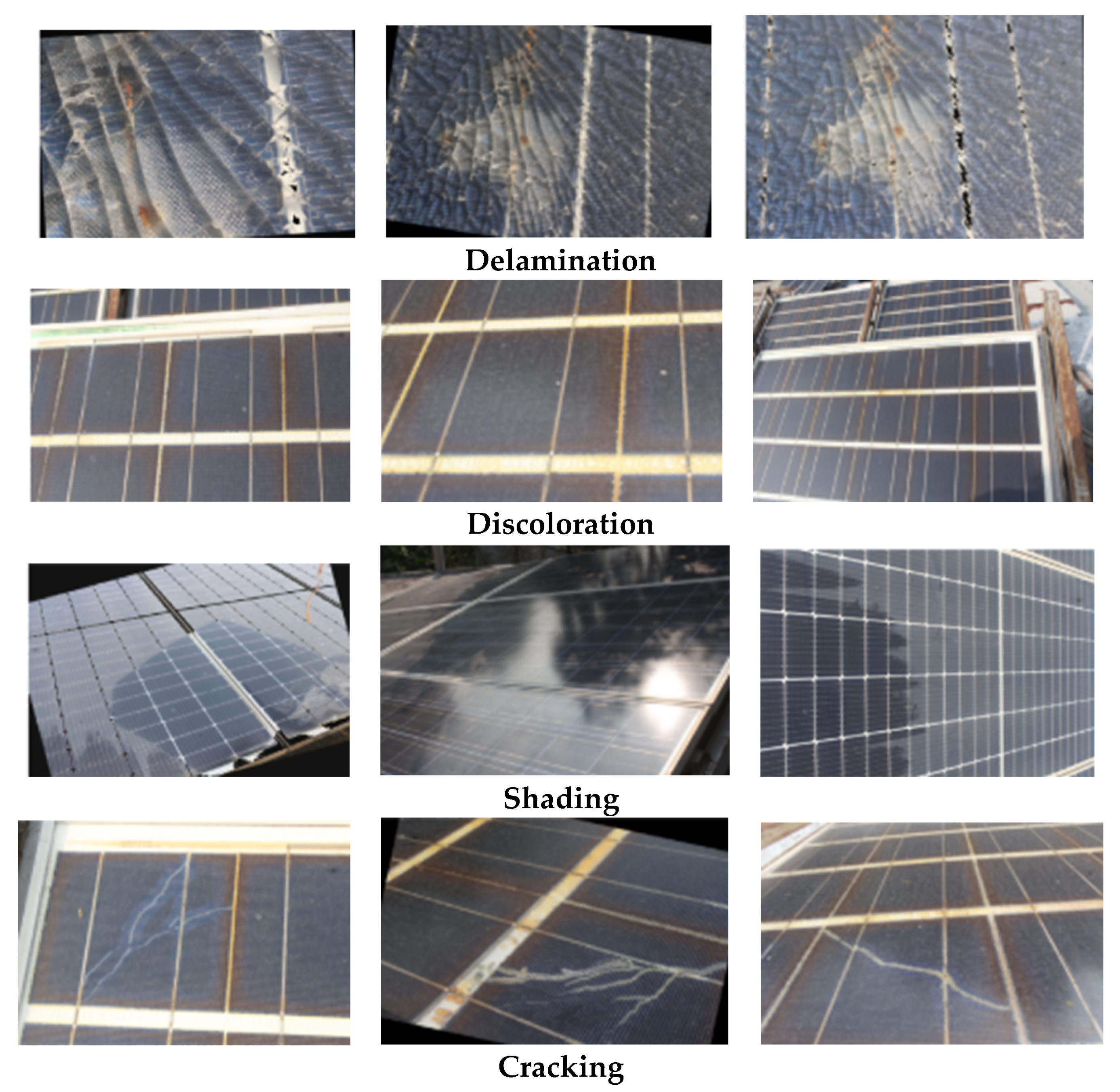
The proposed Fed-CVTNet fault-detection system is shown in its operational interface through Figure 9, in its work with solar panel images. The pipeline starts with image upload, which leads to pre-processing operations that include CLAHE enhancement and noise removal. The YOLO-based ROI detection module then highlights the relevant fault region, which is subsequently passed to the Fed-CVTNet model for classification. The interface displays the predicted fault type in the predicted class field. Figure 10 shows sample outputs of Delamination, Discoloration, Shading and Cracking as representative faults.
Figure 9.
Fed-CVTNet fault-detection interface.
Figure 10.
Final classification outcomes of the proposed Fed-CVTNet model.
5. Conclusions
The development of Fed-CVTNet was proposed, with the aim of creating a system that could detect faults in photovoltaic systems while raw PV images remain local, with only model updates shared, thereby preventing data leakage and enabling secure collaborative learning. Fed-CVTNet uses CNN and ViT structure to obtain local fine-grained fault features, as well as global contexts, thus leading to better generalizability and increased robustness of the model. From the results shown in this experiment, it can be seen that Fed-CVTNet gets the best result over all existing federated learning approaches, including FL-MobileNetV2, FL-EfficientNetB0 and FL-ResNet. The system performance appears best in all evaluation test results since it reaches 0.99 accuracy, 0.98 precision, 0.99 recall, 0.99 specificity and 0.99 AUC with fewest false positive and false negative determinations. The confusion matrix also proved that the model can accurately distinguish the different types of PV faults, with few cases of misclassification. The main advantages of this work include the determination that a federated learning framework can ensure complete data privacy by transmitting non-raw data while realizing collective training among PV plants, all based on geographically distant PV plants. This system also has specific boundaries to its capability, and limitations as well; a federated learning framework requires steady network communication between the clients and central server, which is difficult in these remote solar facilities, while the computational demands required in training a transformer model over an edge device pose a difficulty which limits its use in system resource-constrained areas. Future works will focus on establishing a real-time monitoring system that will contribute to constant diagnosis and maintenance of vast solar energy systems. Different dataset sizes will be used to determine the optimal training data requirement and further enhance model robustness. And work will also explore validation across larger, clinically collected datasets and incorporate additional modalities such as thermal imaging and electrical sensor data.
Author Contributions
Conceptualization, P.V.; methodology, P.V.; software, P.V.; validation, P.R.S. and S.U.B.; formal analysis, P.R.S. and S.U.B.; investigation, P.R.S. and P.V.; resources, P.V.; data curation. P.V. and P.R.S.; writing—original draft preparation, P.V.; writing—review and editing, P.R.S. and S.U.B.; visualization, P.V.; supervision, P.R.S. and S.U.B.; project administration, P.V.; funding acquisition, P.V. All authors have read and agreed to the published version of the manuscript.
Funding
This research received no external funding.
Institutional Review Board Statement
Not applicable.
Informed Consent Statement
Not applicable.
Data Availability Statement
The datasets generated and analyzed during the current study are available from the corresponding author upon reasonable request.
Conflicts of Interest
The authors declare no conflict of interest.
References
- Liu, Q.; Yang, B.; Wang, Z.; Zhu, D.; Wang, X.; Ma, K.; Guan, X. Asynchronous decentralized federated learning for collaborative fault diagnosis of PV stations. IEEE Trans. Netw. Sci. Eng. 2022, 9, 1680–1696. [Google Scholar] [CrossRef] [Scilit]
- Sohail, A.; Islam, N.U.; Haq, A.U.; Islam, S.U.; Shafi, I.; Park, J. Fault detection and computation of power in PV cells under faulty conditions using deep learning. Energy Rep. 2023, 9, 4325–4336. [Google Scholar] [CrossRef] [Scilit]
- Boubaker, S.; Kamel, S.; Ghazouani, N.; Mellit, A. Assessment of machine and deep learning approaches for fault diagnosis in photovoltaic systems using infrared thermography. Remote Sens. 2023, 15, 1686. [Google Scholar] [CrossRef] [Scilit]
- Parvin, M.; Yousefi, H.; Mohammadi-Ivatloo, B. Photovoltaic fault detection algorithm using ensemble learning enhanced with deep neural network feature engineering. Results Eng. 2025, 27, 106491. [Google Scholar] [CrossRef] [Scilit]
- Quiles-Cucarella, E.; Sánchez-Roca, P.; Agustí-Mercader, I. Performance Optimization of Machine-Learning Algorithms for Fault Detection and Diagnosis in PV Systems. Electronics 2025, 14, 1709. [Google Scholar] [CrossRef] [Scilit]
- Amiri, A.F.; Kichou, S.; Oudira, H.; Chouder, A.; Silvestre, S. Fault detection and diagnosis of a photovoltaic system based on deep learning using the combination of a convolutional neural network (cnn) and bidirectional gated recurrent unit (Bi-GRU). Sustainability 2024, 16, 1012. [Google Scholar] [CrossRef] [Scilit]
- Eldeghady, G.S.; Kamal, H.A.; Hassan, M.A.M. Fault diagnosis for PV system using a deep learning optimized via PSO heuristic combination technique. Electr. Eng. 2023, 105, 2287–2301. [Google Scholar] [CrossRef] [Scilit]
- Lodhi, E.; Wang, F.Y.; Xiong, G.; Zhu, L.; Tamir, T.S.; Rehman, W.U.; Khan, M.A. A novel deep stack-based ensemble learning approach for fault detection and classification in photovoltaic arrays. Remote Sens. 2023, 15, 1277. [Google Scholar] [CrossRef] [Scilit]
- Khandeparkar, V.; Shreshtha; Ramu, S.K. Effectiveness of supervised machine learning models for electrical fault detection in solar PV systems. Sci. Rep. 2025, 15, 34919. [Google Scholar] [CrossRef] [Scilit]
- Cicceri, G.; Tricomi, G.; D’Agati, L.; Longo, F.; Merlino, G.; Puliafito, A. A deep learning-driven self-conscious distributed cyber-physical system for renewable energy communities. Sensors 2023, 23, 4549. [Google Scholar] [CrossRef] [Scilit]
- Alhousni, F.K.; Nwokolo, S.C.; Meyer, E.L.; Alsenani, T.R.; Alhinai, H.A.; Ahia, C.C.; Okonkwo, P.C.; Ahmed, Y.E. Multi-scale computational fluid dynamics and machine learning integration for hydrodynamic optimization of floating photovoltaic systems. Energy Inform. 2025, 8, 103. [Google Scholar] [CrossRef] [Scilit]
- Alahmadi, M. Multi-Objective Combinatorial Optimization for Dynamic Inspection Scheduling and Skill-Based Team Formation in Distributed Solar Energy Infrastructure. Systems 2025, 13, 822. [Google Scholar] [CrossRef] [Scilit]
- Li, Z.; Liu, S.; Liu, G. Improving Power Grid Disaster Resilience Through Predictive Analytics Based on Data-Driven Photovoltaic Power Plant and Distribution Network Power Forecasting. IEEE Access 2025, 13, 176157. [Google Scholar] [CrossRef] [Scilit]
- Abdellatif, A.; Mubarak, H.; Ahmad, S.; Ahmed, T.; Shafiullah, G.M.; Hammoudeh, A.; Abdellatef, H.; Rahman, M.M.; Gheni, H.M. Forecasting photovoltaic power generation with a stacking ensemble model. Sustainability 2022, 14, 11083. [Google Scholar] [CrossRef] [Scilit]
- Huang, Q.; Wahaballa, A. Secure Aggregation-Based Big Data Analysis and Power Prediction Model for Photovoltaic Systems: A Multi-Layered Approach. Electronics 2024, 13, 4869. [Google Scholar] [CrossRef] [Scilit]
- Tao, Y.; Yu, T.; Yang, J. Photovoltaic Array Fault Diagnosis and Localization Method Based on Modulated Photocurrent and Machine Learning. Sensors 2024, 25, 136. [Google Scholar] [CrossRef] [Scilit]
- Pratticò, D.; Laganà, F.; Versaci, M.; Franković, D.; Jakoplić, A.; La Foresta, F. Efficient Attentive U-Net for Fault Diagnosis and Predictive Maintenance of Photovoltaic Panels Through Infrared Thermography. Energies 2025, 18, 6472. [Google Scholar] [CrossRef] [Scilit]
- Lu, Y.; Du, C.; Li, X.; Liang, S.; Zhang, Q.; Zhao, Z. A High-Precision Defect Detection Approach Based on BiFDRep-YOLOv8n for Small Target Defects in Photovoltaic Modules. Energies 2025, 18, 2299. [Google Scholar] [CrossRef] [Scilit]
- Tufail, S.; Sarwat, A.I. A Comparative Study of Dimensionality Reduction Methods for Accurate and Efficient Inverter Fault Detection in Grid-Connected Solar Photovoltaic Systems. Electronics 2025, 14, 2916. [Google Scholar] [CrossRef] [Scilit]
- Srisiri, W.; Le, N.T.; Saleem, M.A.; Kaewplung, P.; Chaitusaney, S.; Benjapolakul, W. Artificial intelligence-based fault classification on photovoltaic plants using a low-cost open-source IoT system. Sci. Rep. 2025, 16, 1110. [Google Scholar] [CrossRef] [Scilit]
- Chen, X.; Huang, C.; Zhang, Y.; Wang, H. Privacy-Preserving Personalized Federated Learning for Distributed Photovoltaic Disaggregation under Statistical Heterogeneity. In Proceedings of the IEEE Transactions on Instrumentation and Measurement; IEEE: Piscataway, NJ, USA, 2025. [Google Scholar]
- Abdelsattar, M.; Azim, M.A.; AbdelMoety, A.; Emad-Eldeen, A. Comparative analysis of deep learning architectures in solar power prediction. Sci. Rep. 2025, 15, 31729. [Google Scholar] [CrossRef] [Scilit]
- Wang, Y.; Huo, C.; Xu, F.; Zheng, L.; Hao, L. Ultra-short-term distributed photovoltaic power probabilistic forecasting method based on federated learning and joint probability distribution modeling. Energies 2025, 18, 197. [Google Scholar] [CrossRef] [Scilit]
- Liu, D.; Wang, S.; Li, Y.; Du, J.; Li, J. Research on new energy power plant network traffic anomaly detection method based on EMD. Energy Inform. 2025, 8, 14. [Google Scholar] [CrossRef] [Scilit]
- Abhishek, R.; Raj, R.D.A.; Yanamala, R.M.R.; Pallakonda, A.; Sreenu, S.; Prakasha, K.K. Federated learning-enhanced non-IID solar power prediction using multi-layer transformers. Energy Convers. Manag. X 2025, 29, 101446. [Google Scholar] [CrossRef] [Scilit]
- Karthikeyan, G.; Jagadeeshwaran, A. Enhancing solar energy generation: A comprehensive machine learning-based PV prediction and fault analysis system for real-time tracking and forecasting. Electr. Power Compon. Syst. 2024, 52, 1497–1512. [Google Scholar] [CrossRef] [Scilit]
- Hosseini, P.; Taheri, S.; Akhavan, J.; Razban, A. Privacy-preserving federated learning: Application to behind-the-meter solar photovoltaic generation forecasting. Energy Convers. Manag. 2023, 283, 116900. [Google Scholar] [CrossRef] [Scilit]
- Huo, X.; Liu, M. On privacy preservation of distributed energy resource optimization in power distribution networks. IEEE Trans. Control Netw. Syst. 2024, 12, 228–240. [Google Scholar] [CrossRef] [Scilit]
- Wang, X.; An, T.; Sui, S.; Huang, F.; Zhu, Q.; Song, J.; Lu, Z.; Zhu, J. Dynamic aggregation-based federated learning for fault diagnosis of distributed PV systems. Electr. Power Syst. Res. 2025, 246, 111648. [Google Scholar] [CrossRef] [Scilit]
- Luo, W.; Shen, Y.; Li, Z.; Deng, F. Distributed Photovoltaic Short-Term Power Prediction Based on Personalized Federated Multi-Task Learning. Energies 2025, 18, 1796. [Google Scholar] [CrossRef] [Scilit]
- Erenturk, K.; Draou, A.; AlKassem, A. Fuzzy-Logic-Based Novel Aggregation Method for Federated Learning: Application to a Solar PV Energy Generation System. Energies 2025, 18, 6511. [Google Scholar] [CrossRef] [Scilit]
- Jenkel, L.; Jonas, S.; Meyer, A. Privacy-preserving fleet-wide learning of wind turbine conditions with federated learning. Energies 2023, 16, 6377. [Google Scholar] [CrossRef] [Scilit]
- Shahid, A.; Plaum, F.; Korõtko, T.; Rosin, A. AI technologies and their applications in Small-Scale Electric Power Systems. IEEE Access 2024, 12, 109984. [Google Scholar] [CrossRef] [Scilit]
- Michalakopoulos, V.; Spyropoulos, L.; Ilias, L.; Sarmas, E.; Marinakis, V.; Askounis, D. A comparative analysis of federated learning strategies for short-term photovoltaic power forecasting. Energy Rep. 2025, 13, 4223–4235. [Google Scholar] [CrossRef] [Scilit]
- Wu, Q.; Dong, C.; Guo, F.; Wang, L.; Wu, X.; Wen, C. Privacy-preserving federated learning for power transformer fault diagnosis with unbalanced data. IEEE Trans. Ind. Inform. 2023, 20, 5383–5394. [Google Scholar] [CrossRef] [Scilit]
- Wang, X.; Du, J.; Zhang, G.; Zhao, Z. State space model for anomaly detection of distributed photovoltaic power generation systems. Energy Inform. 2025, 8, 141. [Google Scholar] [CrossRef] [Scilit]
- Zhang, C.; Liu, B.; Hu, X.; Zhang, Z.; Ji, Z.; Zhou, C. FedTP-NILM: A Federated Time Pattern-Based Framework for Privacy-Preserving Distributed Non-Intrusive Load Monitoring. Machines 2025, 13, 718. [Google Scholar] [CrossRef] [Scilit]
- Chen, X.; Huang, C.; Zhang, Y.; Wang, H. Privacy-Preserving Generation Fraud Detection for Distributed Photovoltaic Systems: A Solar Irradiance-Fused Federated Learning Framework. In Proceedings of the IEEE Transactions on Smart Grid; IEEE: Piscataway, NJ, USA, 2026. [Google Scholar]
- Kazemi, K. Enhancing Security in Federated Solar Panel Fault Detection: Evaluating Robust Aggregation Methods Against Malicious Client Attacks. Power Control Data Process. Syst. 2025, 2, 1–9. [Google Scholar]
- Luan, Z.; Lai, Y.; Xu, Z.; Gao, Y.; Wang, Q. Federated learning-based insulator fault detection for data privacy preserving. Sensors 2023, 23, 5624. [Google Scholar] [CrossRef] [Scilit]
- Xu, T.; Wang, H.; Wang, R.; Meng, H.; Ji, Y.; Zhang, Y.; Song, P.; Xiang, J. Distributed Voltage Regulation for Distribution Networks with Privacy-Preserving Under the Framework of VPP. IET Energy Syst. Integr. 2025, 7, e70011. [Google Scholar] [CrossRef] [Scilit]
- Ma, C.; Wang, H.; Cao, J. Federated learning and conditional diffusion model for privacy-preserving short-term voltage stability assessment in multi-region power systems. Energy Rep. 2025, 14, 17–30. [Google Scholar] [CrossRef] [Scilit]
- Franke, M.; Stanojev, O.; Mitridati, L.; Hug, G. Privacy-preserving distributed market mechanism for active distribution networks. Electr. Power Syst. Res. 2024, 234, 110616. [Google Scholar] [CrossRef] [Scilit]
- Chouksey, A. Data-driven fault prediction in renewable energy systems: Enhancing reliability of wind and solar installations in the USA. Balt. J. Multidiscip. Res. 2025, 2, 92–111. [Google Scholar]
- Alshkeili, H.M.H.A.; Almheiri, S.J.; Khan, M.A. Privacy-preserving interpretability: An explainable federated learning model for predictive maintenance in sustainable manufacturing and industry 4.0. AI 2025, 6, 117. [Google Scholar] [CrossRef] [Scilit]
- Husnoo, M.A.; Anwar, A.; Reda, H.T.; Hosseinzadeh, N.; Islam, S.N.; Mahmood, A.N.; Doss, R. FedDiSC: A computation-efficient federated learning framework for power systems disturbance and cyber-attack discrimination. Energy AI 2023, 14, 100271. [Google Scholar] [CrossRef] [Scilit]
- Ha, J.; Ram, J.P.; Kim, Y.J.; Hong, J. Data-driven two-stage fault detection and diagnosis method for photovoltaic power generation. IEEE Trans. Instrum. Meas. 2024, 73, 1–11. [Google Scholar] [CrossRef] [Scilit]
- Sridharan, N.V.; Sripada, D.; Vaithiyanathan, S.; Aghaei, M. Intelligent fault detection in photovoltaic modules using attention-based deep learning network. Cell Rep. Phys. Sci. 2026, 7, 103170. [Google Scholar] [CrossRef] [Scilit]
- Tang, C.; Ren, H.; Xia, J.; Wang, F.; Lu, J. Automatic defect identification of PV panels with IR images through unmanned aircraft. IET Renew. Power Gener. 2023, 17, 3108–3119. [Google Scholar] [CrossRef] [Scilit]
- Laouamer, M.; Adaika, M.; Remha, S.; Mahmoudi, A.; Adaika, H. Comparative Deep Learning for RGB-Based PV Surface Fault Classification Using ResNet50 and EfficientNetB0 with Real-Time Deployment. Int. J. Electr. Electron. Res. 2025, 13, 712–721. [Google Scholar] [CrossRef] [Scilit]
- Abdelsattar, M.; AbdelMoety, A.; Emad-Eldeen, A. ResNet-based image processing approach for precise detection of cracks in photovoltaic panels. Sci. Rep. 2025, 15, 24356. [Google Scholar] [CrossRef] [Scilit]
- Li, H.; Wang, X.; Cao, P.; Li, Y.; Yi, B.; Huang, M. FedCPG: A class prototype guided personalized lightweight federated learning framework for cross-factory fault detection. Comput. Ind. 2025, 164, 104180. [Google Scholar] [CrossRef] [Scilit]
- Are, S.; Krishna, N.G.; Thati, J.; Gopi, K. Federated multi-scale vision transformer with adaptive client aggregation for industrial defect detection. Sci. Rep. 2025, 15, 34149. [Google Scholar] [CrossRef] [Scilit]

Disclaimer/Publisher’s Note: The statements, opinions and data contained in all publications are solely those of the individual author(s) and contributor(s) and not of MDPI and/or the editor(s). MDPI and/or the editor(s) disclaim responsibility for any injury to people or property resulting from any ideas, methods, instructions or products referred to in the content. |
© 2026 by the authors. Licensee MDPI, Basel, Switzerland. This article is an open access article distributed under the terms and conditions of the Creative Commons Attribution (CC BY) license.