


Abstract
Artificial intelligence (AI) is increasingly being incorporated into oral healthcare and dental education, yet the quality and effectiveness of randomized evidence supporting these interventions remain uncertain. We systematically reviewed randomized controlled trials (RCTs) evaluating AI-based interventions in oral healthcare and dental education. A comprehensive literature search was conducted in PubMed, Embase, ClinicalTrials.gov, and OpenGrey from database inception to 30 June 2026. Twenty-eight published RCTs involving 2306 participants and 26 registered unpublished RCTs were identified. Educational applications represented the largest category (53.6%), followed by diagnosis and clinical decision support, treatment planning, and disease monitoring. Across the included RCTs, AI-based interventions were more frequently associated with improvements in educational performance, diagnostic accuracy, treatment planning, clinical decision-making, and periodontal monitoring than conventional approaches, although findings were heterogeneous, several studies reported no significant differences, and a small number favored conventional methods. No serious adverse events were reported, but safety reporting was inconsistent. Most published RCTs presented some concerns regarding risk of bias (82.1%), primarily related to randomization, deviations from intended interventions, and selective reporting. APPRAISE-AI demonstrated predominantly moderate methodological quality (median score 44%), with recurrent weaknesses in robustness, reproducibility, and data quality. The identification of 26 registered RCTs without published results also suggests a potential risk of dissemination bias. These findings indicate that AI-based interventions show promise across multiple applications in oral healthcare and dental education, but improvements in trial methodology, reporting quality, and transparency are needed to strengthen the evidence base and support clinical implementation.
1. Introduction
Artificial intelligence (AI) is being increasingly incorporated into healthcare systems [1], and oral and dental healthcare is no exception [2]. From diagnosis and treatment planning to patient education, clinical decision support, and dental training, AI adoption is accelerating in dental practice and education [2]. Although numerous systematic reviews have evaluated AI applications in dentistry, the existing evidence base has predominantly focused on algorithmic or diagnostic performance, including measures such as accuracy, sensitivity, specificity, and the area under the receiver operating characteristic curve, and has largely relied on retrospective, observational, or model-development and validation studies [3,4,5]. Such evidence is essential for establishing technical performance but does not necessarily demonstrate whether incorporating an AI system into clinical or educational practice improves outcomes compared with conventional approaches.
In clinical AI tools, independent real-world evaluation is mandatory before they enter clinical settings [6,7]. But it is not surprising that this holds true across all areas without exception, especially given the speed at which AI is taking hold [8]. That is why randomized controlled trials (RCTs) offer the most robust evidence for assessing the effectiveness of healthcare interventions and are crucial for understanding the real-world impact of AI [9]. RCTs address a complementary and clinically important question: whether allocation to an AI-assisted intervention produces measurable benefits relative to an appropriate comparator under controlled prospective conditions. Randomization can reduce confounding and enable assessment of the incremental effect of AI on patient-, clinician-, workflow-, or learner-level outcomes rather than algorithmic performance alone. Nevertheless, RCTs are one component of the AI evidence lifecycle, together with external validation, prospective observational evaluation, implementation research, and post-deployment surveillance.
Evaluating AI RCTs presents methodological challenges that differ from conventional healthcare interventions. AI systems are complex, adaptive, and often highly dependent on the context in which they are implemented. Unlike pharmacological interventions, AI tools evolve continuously (through algorithm refinement, retraining, or changes in underlying datasets), potentially affecting reproducibility and external validity [10]. Furthermore, blinding of clinicians and participants is frequently impractical, intervention fidelity may vary according to user interaction, and outcomes may reflect a combination of algorithm performance and human decision-making rather than the AI system alone. These characteristics introduce challenges in trial design, conduct, and interpretation that are not fully addressed by conventional RCT reporting and appraisal frameworks such as the CONSORT Statement or the Cochrane Risk of Bias 2 tool. Although extensions including CONSORT-AI [11] and SPIRIT-AI [12] have been developed to improve the reporting of AI clinical trials, important methodological gray areas remain regarding the evaluation of algorithm updates, transparency, reproducibility, implementation context, generalizability, and the assessment of AI-specific sources of bias [13]. Consequently, when appraising AI RCTs, other aspects are required to be analyzed, such as transparency, reproducibility, data quality, robustness, and clinical relevance.
Despite the rising interest in AI within the field of dentistry [2], there has been no systematic review specifically concentrating on RCTs that evaluate AI-based interventions in oral and dental research. As such, how AI has been tested in rigorous experimental settings, the clinical areas where it has been applied, the types of AI technologies assessed, and the methodological quality of these trials remain to be extensively appraised.
Accordingly, this systematic review aimed to evaluate the effectiveness, methodological quality, and risk of bias of RCTs of AI-based interventions in oral healthcare and dental education, while characterizing how AI technologies have progressed from assessments of technical performance toward prospective evaluation of their incremental value in clinical and educational practice.
2. Materials and Methods
2.1. Protocol, Registration
This systematic review protocol was designed and approved by all authors and registered in the Open Science Framework (link via https://doi.org/10.17605/OSF.IO/GT52U). The review was reported following the Preferred Reporting Items for Systematic Reviews and Meta-Analyses (PRISMA) guidelines 2020 [14] (Table S1).
2.2. Focused Question and Eligibility Criteria
The review addressed the following PECO question: “What is the effectiveness of artificial-intelligence-based interventions compared with conventional approaches or other comparators in randomized controlled trials conducted in oral and dental research?”
The corresponding criteria were defined as follows:
- Population (P): Human participants of any age receiving oral or dental healthcare or participating in dental education.
- Exposure/Intervention (E/I): Artificial intelligence (AI)-based technologies used within oral and dental research or practice, including machine learning, deep learning, artificial neural networks, computer vision, generative artificial intelligence, large language models (e.g., ChatGPT), AI-assisted diagnostic systems, clinical decision-support systems, AI-assisted treatment planning, AI-enhanced educational platforms, and other AI-based applications.
- Comparison (C): Conventional clinical practice, clinician assessment, standard digital technologies without AI, placebo, sham intervention, no intervention, or any active comparator evaluated without AI within a randomized controlled trial.
- Outcome (O): Any clinical, diagnostic, educational, behavioral, workflow, patient-reported, implementation, or performance-related outcome evaluating the effectiveness of AI-based interventions.
Studies were eligible for inclusion if they met the following criteria: (1) RCTs, because they are the study design least susceptible to major sources of bias when evaluating the effectiveness of interventions [9]; (2) studies involving human participants of any age receiving oral or dental healthcare or participating in dental education; (3) studies evaluating an AI-based technology as the primary intervention within an oral health or dental context; and (4) studies comparing the AI intervention with conventional clinical practice, clinician assessment, standard digital technologies, another AI system, placebo, sham intervention, or no intervention. Studies conducted in any dental specialty or healthcare setting were considered eligible.
Exclusion criteria comprised studies conducted exclusively using animal, in vitro, ex vivo, phantom, or simulation models without human participants; studies in which AI was used solely for data analysis, image processing, statistical modeling, or algorithm development without evaluating its clinical or educational application; quasi-randomized and non-randomized studies; observational studies; case reports; case series; conference abstracts; study protocols; editorials; letters; reviews; systematic reviews; and meta-analyses.
2.3. Search Strategy and Study Selection
The identification of relevant studies was carried out using a detailed search strategy developed for each database (PubMed, Embase, and Clinicaltrials.gov, from inception until 30 June 2026). The search algorithms are available on Table S2. No restrictions were applied regarding publication year or language. Additionally, Grey literature was searched via http://www.opengrey.eu/. The search results were uploaded into Microsoft Excel.
Two independent reviewers (CS and JB) screened titles and abstracts. Full-text evaluation was performed for all studies judged potentially eligible by at least one reviewer. Disagreements were resolved by discussion or by consultation with a third reviewer (VM). Inter-rater reliability was assessed using Cohen’s kappa statistics [15], calculated separately for title/abstract screening and full-text assessment.
2.4. Data Extraction Process and Data Items
Data extraction was conducted independently and in duplicate by two reviewers (CS and JB). The level of agreement between the reviewers was evaluated using kappa statistics. Disagreements were resolved through discussion with a third reviewer (VM). Regarding outcomes of interest, we categorized them as follows: Clinical effectiveness (e.g., treatment success, procedural accuracy, complication rates, clinical indices); Diagnostic performance (e.g., diagnostic accuracy, sensitivity, specificity, or agreement with reference standards); Educational effectiveness (e.g., knowledge acquisition, technical skills, clinical competence, or learning outcomes); Decision-making performance (e.g., diagnostic or treatment planning accuracy); Patient-related outcomes (e.g., patient satisfaction, quality of life, treatment acceptance, adherence, or experience); and Procedural efficiency (e.g., treatment time, workflow efficiency, or resource utilization). Additional outcomes were extracted: Type of artificial intelligence technology (e.g., machine learning, deep learning, computer vision, large language models, generative AI); Dental specialty and clinical application; Study characteristics (country, continent, setting, sample size, participant characteristics); Comparator type; Duration of follow-up; Adverse events and safety outcomes; Funding source and conflicts of interest; Reporting characteristics relevant to AI interventions (where available), including model transparency, validation, and explainability.
2.5. Risk of Bias (RoB)
RoB was independently assessed by two reviewers (CS and JB) using the revised Cochrane Risk of Bias tool for randomized trials (ROB 2) [16,17]. This tool comprises five predefined domains of bias: (1) randomization process; (2) intended interventions; (3) missing outcome data; (4) measurement of the outcome; and (5) selection of the reported result. Domain-level judgements were classified as “low risk of bias”, “some concerns”, or “high risk of bias”. An overall risk-of-bias judgement was subsequently derived by integrating the domain-level assessments according to the ROB 2 guidance: low risk of bias—all domains were rated as low risk; some concerns—at least one domain raised some concerns without meeting the criteria for high risk; high risk of bias—at least one domain was judged to be at high risk of bias, or multiple domains raised some concerns such that confidence in the overall validity of the study was substantially reduced.
To quantitatively assess research quality across the included AI RCTs, we employed the APPRAISE-AI [18], a tool comprising 24 items. This instrument includes a scale from 0 to 100 across six domains: clinical relevance, data quality, methodological conduct, robustness of results, reporting quality, and reproducibility. Then, the score is categorized for quality as very low (0–19), low (20–39), moderate (40–59), high (60–79), and very high (80–100) quality [18].
2.6. Summary Measures and Synthesis of Results
The primary objective is to systematically identify, critically appraise, and synthesize randomized controlled trials evaluating AI-based interventions in oral and dental research and to assess their effectiveness compared with conventional approaches or other comparators.
The secondary objectives include: identification of dental specialties and clinical settings in which AI has been evaluated; characterization of types of AI technologies investigated (e.g., machine learning [ML], deep learning [DL], large language models [LLMs], computer vision [CV], clinical decision-support systems [CDSSs], and others); summarization of comparators and outcomes assessed across studies; and evaluation of methodological quality and risk of bias of the included randomized controlled trials.
As per the review protocol, a random-effects meta-analysis was planned where at least two studies were considered sufficiently homogeneous with respect to participants, interventions, comparators, and outcome measures. Following study selection and data extraction, however, it became evident that the included RCTs exhibited substantial clinical and methodological heterogeneity. Studies evaluated diverse AI technologies, addressed heterogeneous educational and clinical applications, included different populations and comparators, and reported a wide range of outcome measures using non-comparable metrics. Consequently, quantitative pooling was considered inappropriate and unlikely to produce clinically meaningful summary estimates, and thus, we deviated from the initial protocol by describing the results of the included studies narratively.
Accordingly, findings were synthesized using a structured narrative approach following the Synthesis Without Meta-analysis reporting guidelines [19]. Studies were grouped according to dental specialty, type of AI technology, clinical application, comparator, and outcome domain. Within each group, the direction and consistency of effects, together with key methodological characteristics and AI-specific considerations, were summarized descriptively.
3. Results
3.1. Study Selection
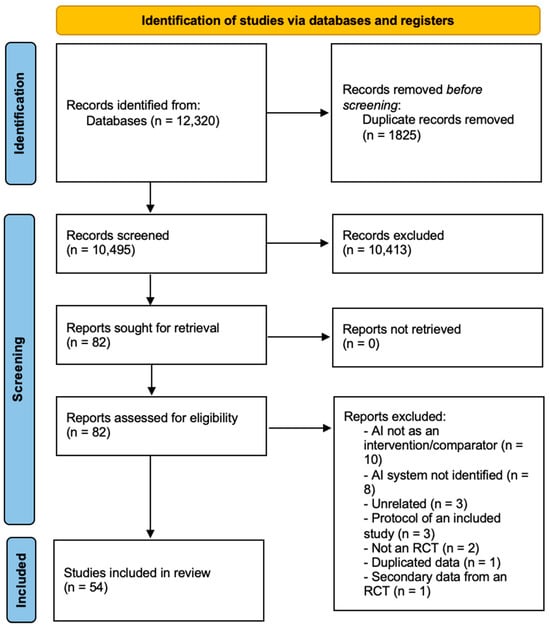
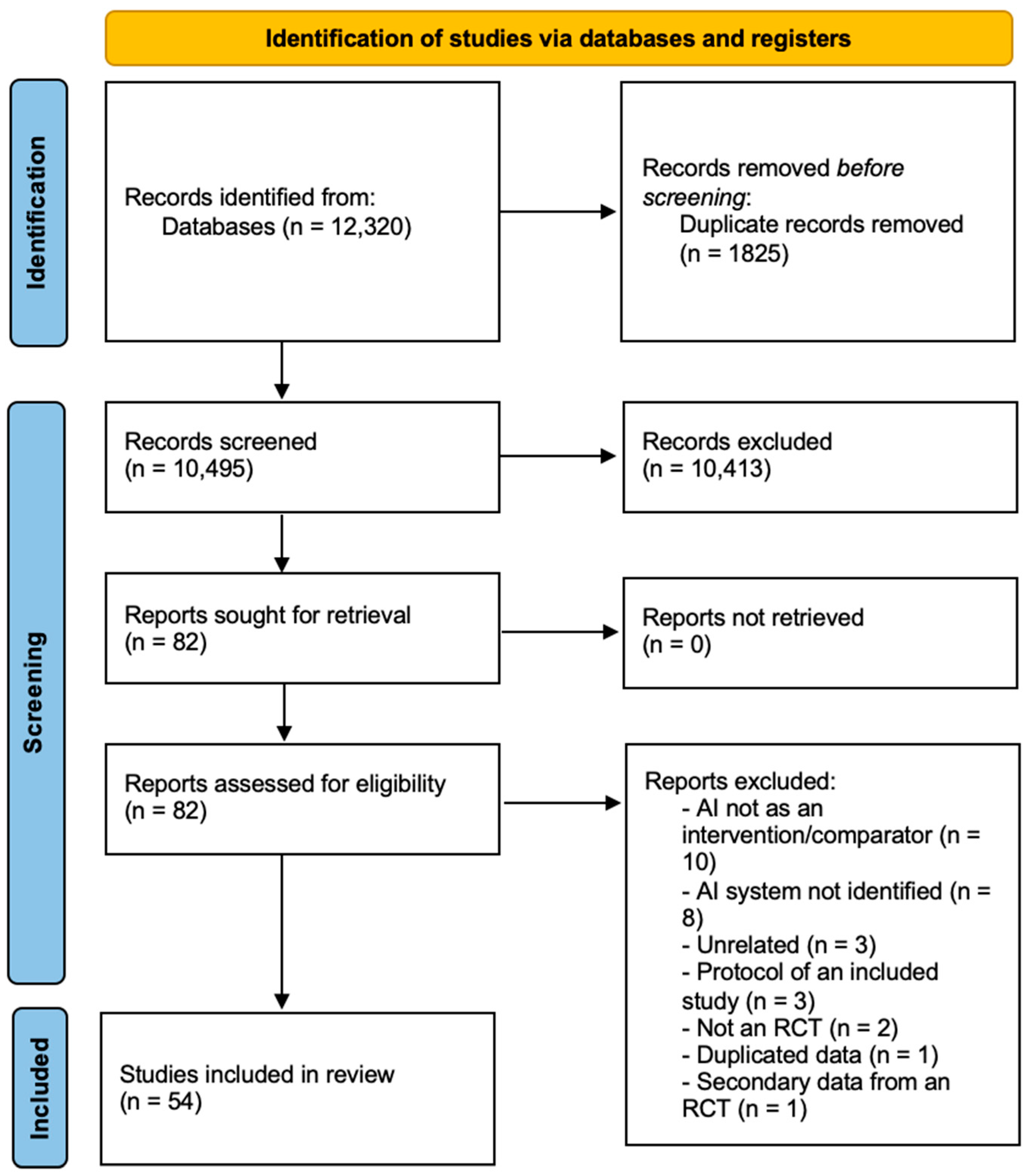
The database search identified 12,320 records. After the removal of 1825 duplicate records, 10,495 unique records remained for title and abstract screening (Figure 1). During the first screening round, 10,413 records were excluded, and 82 studies were considered potentially eligible for full-text review. Full-text analysis resulted in the exclusion of 28 studies (see Table S3 for details), totaling 54 studies that met the eligibility criteria and were included in the systematic review. Inter-observer reliability for full-text screening was excellent (kappa = 0.92, 95% CI 0.90–0.94).
Figure 1.
PRISMA flowchart.
3.2. Study Characteristics
Overall, 28 peer-reviewed [20,21,22,23,24,25,26,27,28,29,30,31,32,33,34,35,36,37,38,39,40,41,42,43,44,45,46,47] (Table 1) and 26 registered RCTs (in clinicaltrials.gov; detailed information is present in Table S4) were included. The registered RCTs were not included in the evidence synthesis for lack of results but were considered when assessing potential publication bias.
Table 1.
Characteristics of the studies included.
The 28 included RCTs were published between 2021 and 2026, with most studies published in 2024–2026. Most studies were primarily conducted in Asia (n = 17, 60.7%), particularly in China (n = 7, 25.0%), followed by Europe (n = 7, 25.0%) and the USA (n = 4, 14.3%). Sample sizes ranged from 20 to 289 participants, with a total of 2306 participants enrolled across all studies. Participants included undergraduate and postgraduate dental students, practicing dentists, adults receiving dental care, and children undergoing preventive or restorative treatment. Follow-up duration varied considerably according to the study objectives, ranging from immediate post-intervention assessment to six months. Immediate outcome assessment was the most common design, particularly in educational and diagnostic studies.
Educational applications constituted the largest category (n = 15, 53.6%), encompassing undergraduate and postgraduate dental education, communication skills training, radiographic interpretation, prosthodontic procedures, operative dentistry, periodontology, dental trauma, orthodontics, and assessment development. The remaining studies (n = 13, 46.4%) evaluated clinical applications (including oral radiology, orthodontics, periodontology, implant dentistry, pediatric dentistry, oral health promotion, intraoral photography, and patient education).
The most frequently investigated AI technology was LLMs, particularly ChatGPT and its newer versions (ChatGPT-4o and ChatGPT-5.0) (n = 11, 39.3%). Other AI approaches included convolutional neural networks for image analysis and lesion detection, DL models, commercial AI-assisted diagnostic software, AI-enabled remote monitoring platforms, multimodal sensing devices, robotic guidance systems, rule-based expert systems, AI-driven three-dimensional performance assessment, personalized video modeling, custom educational chatbots, and computer vision algorithms such as YOLOv5, YOLOv8-cls, and U-Net. Most trials were conducted in single-center university settings.
The included interventions also differed substantially in their input modalities and functional objectives. Image-based systems primarily processed radiographs, intraoral photographs, or other visual/three-dimensional data and were generally used for lesion detection, classification, diagnostic assistance, procedural assessment, or monitoring. In contrast, LLM- and generative-AI-based interventions predominantly processed natural-language inputs and were used for educational tutoring, personalized feedback, communication training, knowledge support, and clinical decision assistance. Other systems incorporated structured clinical information, sensor-derived data, or multimodal inputs for monitoring, treatment planning, or procedural guidance. Accordingly, evaluation metrics varied according to task: diagnostic systems were primarily assessed using accuracy or agreement measures, whereas educational systems were evaluated using knowledge, skills, competence, satisfaction, or learning-related outcomes, and workflow-oriented systems included measures of efficiency, procedural performance, or clinical decision-making.
Comparator groups most frequently received conventional teaching methods, standard clinical care, faculty or instructor feedback, peer role-play, printed educational materials, manual image interpretation, conventional workflows, or unaided diagnostic assessment. Reporting of safety outcomes was inconsistent across studies. Among trials that evaluated adverse events, no serious AI-based adverse events were reported. Studies involving clinical AI-assisted interventions consistently demonstrated safety profiles comparable to conventional care. Educational and diagnostic trials generally considered adverse events not applicable or did not report safety outcomes.
Funding sources were heterogeneous, ranging from governmental, university, hospital, or competitive research funding, whereas others reported no external financial support or did not report funding sources. Adherence to reporting guidelines was inconsistent, with half of the studies not adhering to a reporting guideline (n = 14, 50.0%). The other half adhered to CONSORT (either 2010 or 2025), CONSORT without clarifying which version, CONSORT-EHEALTH, or CONSORT-AI or presented inconsistent references to CONSORT elements (flowchart mainly).
3.3. Risk of Bias
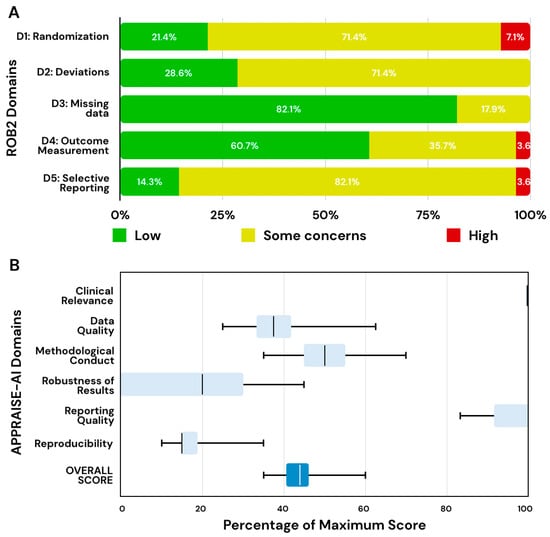
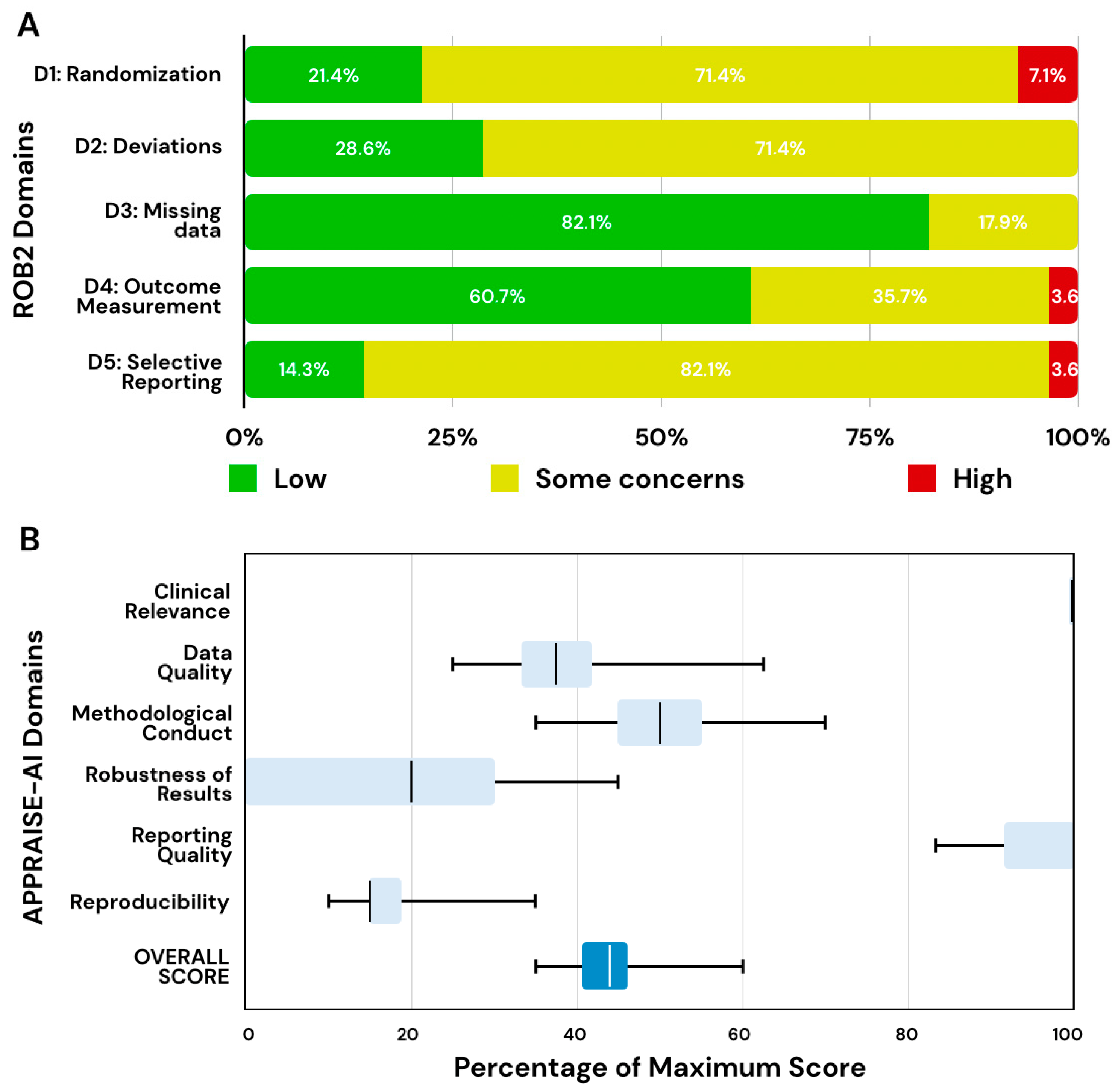
In what ROB2 concerns, three studies (10.7%) were judged to be at low risk of bias, 23 (82.1%) raised some concerns, and two (7.1%) were judged to be at high risk of bias (Figure 2). Across individual domains, concerns were most frequently identified in the randomization process, deviations from intended interventions, and selective reporting. Missing outcome data and outcome measurement presented better scoring. Twenty-two studies (78.6%) and 17 studies (60.7%) were judged to be at low risk for missing outcome data and outcome measurement, respectively. More detailed information is present in Table S5.
Figure 2.
ROB2 and APPRAISE-AI graphical summaries. (A) Plot showing the ROB2 domain analysis. (B) Box plot showing the APPRAISE-AI domain-specific scores and overall scores determined from the included studies—scores are presented as a proportion of the overall score (percentages), vertical bars show median values, boxes demonstrate the interquartile range (25th to 75th percentile), and whiskers show the bounds of the 5th and 95th percentiles.
The intraclass correlation coefficient (ICC) for reviewers was 0.88 (95% CI: 0.84–0.92) for the overall APPRAISE-AI score, demonstrating excellent agreement. The ICC ranged from 0.78 to 0.94 (moderate to good agreement) across domains.
The median overall APPRAISE-AI score was 44% (IQR, 40.8–46.0%), indicating an overall moderate methodological quality of the included studies (more detailed information is present in Table S6). Overall scores ranged from 35% to 60%, with most studies (n = 23, 82.1%) classified as moderate quality. Only one study (3.6%) was classified as high quality, while the remaining four studies (14.3%) were of low quality. Across individual APPRAISE-AI domains, robustness of results demonstrated the lowest median score (20%), followed by reproducibility (15%) and data quality (37.5%). In contrast, clinical relevance achieved the maximum median score (100%), while reporting quality also performed strongly, with a median score of 91.7% (Figure 2).
3.4. Synthesis of Results
3.4.1. AI Model Types, Data Modalities, and Application Tasks
The included RCTs evaluated heterogeneous AI technologies (Table 1). LLMs, including ChatGPT, DeepSeek, and Doubao-Pro, were primarily used for natural-language applications in dental education, virtual patient simulation, and decision support. Image-based applications employed CNNs and computer-vision architectures, including U-Net, YOLO variants, and ResNet-based systems, for segmentation, classification, detection, and diagnostic assistance. Other technologies included rule-based systems, geometric analysis tools, personalized video modeling, and machine-vision-assisted robotic guidance.
Input modalities included text, panoramic, bitewing, and periapical radiographs, intraoral photographs, three-dimensional scans, video, and clinical or sensor-derived data. Accordingly, application tasks ranged from diagnostic support and treatment planning to virtual patient simulation, automated assessment and feedback, procedural training, patient education, and remote monitoring. This technological and functional diversity highlights substantial heterogeneity in how AI was implemented and evaluated across the included RCTs.
3.4.2. Technical Transparency, Validation, and Reproducibility of AI Systems
Technical reporting varied considerably across the evaluated AI systems (Table 1). Some computer-vision studies provided detailed architectures, including U-Net, YOLOv8-cls, and modified YOLOv5 models, whereas the internal architectures and parameters of proprietary LLMs and commercial AI systems were generally unavailable. Training data were predominantly derived from institutional datasets and annotated using expert-defined reference standards, while commercial systems frequently relied on undisclosed proprietary datasets.
Validation was mainly internal, using held-out test sets, or prospective within the same institutional setting, with limited independent external validation (Table 1). Public availability was also uncommon, particularly for clinical datasets because of privacy restrictions and for proprietary systems because model parameters were not disclosed. Exceptions included Wang et al. (2026) [20], who provided access to their trained YOLOv8 model, and Ayan et al. (2024) [42], who reported detailed training parameters. Overall, limited external validation and restricted availability of training data, model parameters, and implementation details constrained the reproducibility and generalizability of many evaluated AI systems.
3.4.3. AI-Specific Methodological Challenges and Sources of Uncertainty
Data distribution shift was a particular concern because some models were developed using geographically or technically restricted datasets, potentially limiting performance when applied to different populations, imaging systems, or clinical environments [42,46]. Moreover, improvements demonstrated on curated datasets did not necessarily translate into equivalent benefits in clinical settings, reflecting differences in workflow and human–AI interaction [29,46].
Model updating and version instability represented additional challenges, particularly for continuously evolving generative AI systems [32]. Proposed approaches included documenting model provenance and versioning and maintaining audit trails [20], as well as using retrieval-augmented generation to ground outputs in updated and verified clinical knowledge [26]. Interpretability was addressed through mechanisms such as visual overlays [23], explanatory scoring and feedback [24], and assessment of AI-induced changes in clinician attention and gaze patterns [39].
The deployment environment also emerged as an important consideration. Studies addressed differences between local and cloud-based deployment and associated data-security considerations [24], as well as the importance of standardized operating conditions during AI-assisted interventions [28]. More broadly, the predominance of single-center evaluations limits assessment of transferability across institutions and settings, reinforcing the need for multicenter evaluation under diverse real-world deployment conditions.
3.4.4. Dimensions of AI-Associated Benefits Across Application Tasks
The nature of the benefit associated with AI varied according to the application and task. In diagnostic applications, improvements were predominantly related to diagnostic performance. AI-assisted detection of periapical radiolucencies improved overall accuracy primarily through increased specificity and fewer false-positive decisions [29], whereas AI-assisted caries detection showed benefits mainly through increased sensitivity for early lesions [42,46]. These effects were also influenced by user experience, with greater improvements observed among less-experienced clinicians in some studies, while experienced practitioners derived more limited additional benefit [29,46].
In workflow-oriented applications, the principal benefit was efficiency rather than consistently improved accuracy. AI-assisted dental trauma assessment reduced task-completion time while maintaining comparable performance across intervention groups [32]. Similarly, AI-assisted radiographic full-mouth-series mounting substantially reduced completion time, although this efficiency gain was accompanied by lower accuracy in some circumstances [47]. In contrast, AI-guided intraoral photography improved image quality to a level comparable with human-assisted photography but did not significantly reduce task-completion time [20], indicating that improvements in quality and efficiency did not necessarily occur concurrently.
In educational and skill-training applications, favorable outcomes were more closely associated with interactive and feedback-based functions. AI-supported crown-preparation training provided immediate and objective performance feedback and was associated with greater improvement among students who engaged more extensively with the system [35]. Virtual-patient systems enabled repeated, risk-free practice and structured feedback for communication and clinical reasoning [24,26], while other AI-assisted educational approaches supported personalized explanations and knowledge acquisition [33,34]. Overall, the findings indicate that AI-associated benefits were heterogeneous and task-dependent, encompassing improved diagnostic accuracy, greater workflow efficiency, enhanced decision support, and interactive educational feedback, rather than representing a uniform advantage over conventional approaches.
4. Discussion
4.1. Summary of Main Results
This systematic review shows that educational applications represented the largest group of studies, followed by diagnosis and clinical decision support, treatment planning, and disease monitoring. Overall, AI-assisted interventions demonstrated inconsistent improvements in educational performance, diagnostic accuracy, clinical decision-making, treatment planning, and patient monitoring compared with conventional approaches. However, benefits were not universal, with several studies reporting inconclusive performance between AI-assisted and traditional methods, and a small number favoring conventional approaches. Importantly, studies evaluating safety consistently reported no serious AI-based adverse events, although safety outcomes were inconsistently assessed and reported. Due to the heterogeneity observed, pooled estimates were not possible to obtain.
Despite these generally encouraging findings, the certainty of the available evidence remains limited by methodological limitations. Most trials raised some concerns regarding risk of bias, particularly in the randomization process, deviations from intended interventions, and selective reporting. Similarly, APPRAISE-AI demonstrated predominantly moderate methodological quality, with important deficiencies in robustness of results, reproducibility, and data quality despite consistently high scores for clinical relevance and reporting quality. Furthermore, the identification of 26 registered RCTs without published results suggests a substantial risk of dissemination bias, indicating that the current published literature may overestimate the effectiveness of AI interventions.
4.2. Evidence Quality and Potential Bias in the Review Process
In dental education and training, AI-assisted interventions consistently enhanced learner engagement, motivation, procedural performance, communication skills, personalized feedback, and diagnostic competence. Knowledge acquisition was generally comparable to conventional methods but not clearly superior. Thus, despite the lack of quantitative estimates, qualitative evidence seems to suggest AI functions most effectively as an adjunctive educational tool that complements, rather than replaces, conventional teaching and faculty supervision in undergraduate dental education. Methodological quality was generally acceptable but limited by single-center designs, short follow-up, heterogeneous outcomes, limited external validation, and incomplete reporting of AI specifics.
In diagnosis and clinical decision support, AI-based instruments consistently enhanced diagnostic support by improving accuracy, reducing false-positive findings, increasing detection of early lesions, or optimizing clinicians’ visual search strategies. However, these benefits were accompanied by important trade-offs, including reduced specificity for enamel caries detection and changes in treatment recommendations that may increase intervention rates. Similar to education, AI seems to be a valuable adjunct to radiographic interpretation, particularly for less experienced clinicians, but should complement rather than replace clinical judgment owing to persistent concerns regarding calibration of treatment decisions and generalizability across clinical settings.
In what disease monitoring and behavioral support regards, AI interventions showed to improve oral hygiene adherence, plaque control, and periodontal clinical outcomes compared with conventional management. However, improvements in behavioral or motivational outcomes were less consistent, with one study reporting no additional effect of AI on protection motivation despite significant improvements in self-care behaviors and periodontal parameters. Methodological heterogeneity was limited, as all three trials evaluated patients with Stage II–IV periodontitis receiving nonsurgical periodontal therapy and employed similar AI-assisted remote monitoring platforms. Nevertheless, the interventions differed in the degree of human support provided, ranging from fully automated monitoring to hybrid AI–clinician counseling and AI-enabled smart toothbrushes integrated with personalized mHealth messaging. Collectively, these findings suggest that AI-assisted remote monitoring can enhance patient adherence and improve periodontal treatment outcomes when integrated into supportive periodontal care.
In treatment planning and clinical management, evidence was limited by considerable clinical and methodological heterogeneity. The included studies evaluated fundamentally different AI applications, ranging from decision-support algorithms and robotic surgery to personalized behavioral interventions and educational feedback systems. Outcome measures were similarly diverse, encompassing occlusal indices, implant positional accuracy, educational performance, behavioral outcomes, and physiological markers, precluding quantitative synthesis. Moreover, several interventions represented integrated digital workflows in which AI constituted only one component of a broader intervention, making the independent contribution of AI difficult to determine. Although randomized evidence consistently favored AI-assisted approaches for treatment planning and clinical management, the certainty and generalizability of these findings remain limited by the diversity of interventions and incomplete reporting of AI-specific methodological characteristics.
Methodologically, this systematic review benefits from having a protocol based on the Cochrane Handbook and being reported according to the PRISMA guidelines. We employed two methodological quality instruments as complementary tools for RCTs and AI dimensions. Nevertheless, this systematic review has nearly half of the included entries as registered trials but not peer-reviewed, which may limit a broader comprehension of the available evidence, and also completed but not published trials that may raise concerns about publication bias. Another potential bias is that registered trials were searched on clinicaltrials.gov because it is a reference search engine for trials, and the lack of others may not be captured by our registry search. In addition, the methodological quality of RCTs presented some concerns of high risk of bias, as well as primarily moderate-quality AI studies. Another drawback is the fact that half of the RCTs have not followed appropriate reporting guidelines with the associated risks for reporting errors and consequent implication for risk of bias and methodological quality.
4.3. Agreements and Disagreements with Other Reviews or Studies
To the best of our knowledge, this is the first systematic review exclusively synthesizing AI RCTs across oral and dental research. Previous systematic reviews have focused on dental shade matching [48], cephalometric landmark detection [49,50], tooth segmentation [51,52], approximal caries detection [53], periapical radiolucency detection [54], early childhood caries detection [55], periodontitis prediction [56], orthognathic treatment planning [57], and AI-based dental education [58]. Our findings are in line with these previous reviews, which consistently show that AI presents interesting diagnostic performance and considerable potential across multiple dental specialties. Meta-analyses have reported excellent accuracy for cephalometric landmark detection [49,50], reliable diagnostic performance for approximal caries [53] and periapical radiolucencies [54], and promising applications in orthodontic treatment planning [57] and periodontal prediction [56]. Likewise, recent evidence suggests that AI-enhanced educational strategies improve learner engagement and educational performance, particularly in problem- and case-based learning environments [57]. Our review extends these findings by demonstrating that many of these technical advantages translate into improved outcomes under randomized experimental conditions, particularly in dental education, diagnostic support, periodontal monitoring, and treatment planning, although superiority over conventional approaches was not universal.
A major distinction between our review and previous systematic reviews is the appraisal of evidence quality rather than algorithm performance alone. By combining the ROB 2 tool with the AI-specific APPRAISE-AI framework, our review demonstrates that, despite encouraging clinical findings, the current body of randomized evidence is limited by moderate methodological quality, frequent concerns regarding risk of bias, limited reproducibility, insufficient external validation, and inconsistent reporting of AI-specific characteristics. These observations suggest that excellent algorithmic performance does not necessarily equate to high-certainty clinical evidence.
Another relevant input of our review is the assessment of dissemination bias. By identifying registered RCTs without publicly peer-reviewed results, our review provides a more balanced perspective on the maturity of the evidence and underlines the need for prospective registration, transparent reporting, and publication of neutral and negative findings. Another potential limitation of our review is that our interpretation of the results is solely based on the individual study results without any evidence syntheses. This may reduce the level of the evidence/conclusion of the review.
4.4. Future Perspectives
Considering the limitations observed, future RCTs should be adequately powered, multicenter, prospectively registered, and conducted according to established reporting standards. Greater methodological rigor is also needed through robust randomization procedures, predefined statistical analysis plans, comprehensive reporting of adverse events, and transparent description of AI development, validation, versioning, and updates to enhance reproducibility and external validity.
Future studies should also move beyond proof-of-concept evaluations and assess the real-world clinical impact of AI technologies across diverse healthcare settings and populations. Standardized core outcome sets would benefit from comparisons between studies, and standardized quantitative evidence synthesis is required for future meta-analyses. In addition to conventional measures of diagnostic accuracy or educational performance, future trials should incorporate patient-reported outcomes, clinician acceptance, workflow efficiency, implementation outcomes, health economic evaluations, and long-term clinical effectiveness. Appropriate external validation, including but not restricted to healthcare systems, settings, and demographic populations, will be essential to ensure the generalizability and fairness of AI systems while minimizing algorithmic bias.
Beyond methodological improvements, future evaluation should adopt a risk-based approach to the clinical translation of AI. Multicenter and multinational validation will be particularly important for determining whether performance is maintained across different patient populations, healthcare systems, languages, imaging devices, and clinical workflows. For generative AI and emerging medical foundation models, safety assessment should extend beyond conventional adverse-event reporting to include hallucinated or inaccurate outputs, automation bias, inappropriate user reliance, uncertainty in recommendations, and the downstream consequences of erroneous clinical decisions. Regulatory frameworks for AI-assisted diagnosis and treatment should also account for the intended use and degree of autonomy of the system, requirements for human oversight, transparency and traceability of model updates, and criteria for revalidation following substantial modifications. These requirements should be proportionate to clinical risk, with higher-risk or autonomous diagnostic and therapeutic applications requiring stronger prospective evidence, independent external validation, and continuous post-deployment monitoring.
Rapid advances in generative AI and LLMs further emphasize the need for continuous evidence generation, as commercially available systems may evolve faster than traditional clinical research cycles. Adaptive trial designs, living systematic reviews, and real-world post-deployment surveillance may therefore complement conventional RCTs to ensure that evidence remains current. Ultimately, successful implementation will depend not only on technical and clinical performance but also on interoperability with existing workflows, ethical governance, data privacy, clinician training, patient acceptance, and health-economic sustainability. Multidisciplinary evaluation incorporating clinical, patient-centered, economic, ethical, and implementation outcomes will therefore be essential for the safe, equitable, and sustainable integration of AI into oral healthcare.
5. Conclusions
These findings suggest that while AI has considerable potential to improve multiple aspects of oral healthcare and dental education, stronger, multicenter, adequately powered, transparently reported randomized trials with standardized outcome measures are required before definitive conclusions regarding clinical effectiveness and implementation can be drawn.
Supplementary Materials
The following supporting information can be downloaded at https://www.mdpi.com/article/10.3390/ai7090337/s1, Table S1: PRISMA checklist, Table S2: Search strategies, Table S3: List of excluded studies with reasons, Table S4: List of registered trials included in this systematic review, Table S5: Detailed results of the ROB2 analysis2, Table S6: List of registered trials included in this systematic review.
Author Contributions
Conceptualization, C.S., J.V., V.M., and J.B.; methodology, C.S., J.V., V.M., and J.B.; formal analysis, C.S., J.V., J.J.M., L.P., V.M., and J.B.; investigation, C.S., V.M., and J.B.; data curation, C.S., V.M., and J.B.; writing—original draft preparation, C.S. and J.B.; writing—review and editing, C.S., J.V., J.C., F.H., N.S., J.J.M., L.P., V.M., and J.B. All authors have read and agreed to the published version of the manuscript.
Funding
This research was funded by for financial support from FCT/MCTES, grant number 10.54499/UID/04585/2025 to CiiEM through national funds.
Institutional Review Board Statement
Not applicable.
Informed Consent Statement
Not applicable.
Data Availability Statement
No new data were created or analyzed in this study. Data sharing is not applicable to this article.
Acknowledgments
The authors used an AI-assisted language editing tool solely to improve the language and readability of the manuscript. All scientific content, interpretations, and conclusions were reviewed and verified by the authors, who take full responsibility for the final version of the manuscript.
Conflicts of Interest
The authors declare no conflicts of interest.
Abbreviations
The following abbreviations are used in this manuscript:
| AI | Artificial Intelligence |
| APPRAISE-AI | Assessment of the quality of Artificial Intelligence research (AI appraisal tool) |
| BDS | Bachelor of Dental Surgery |
| CBCT | Cone-Beam Computed Tomography |
| CDSS | Clinical Decision-Support System(s) |
| CFSS-DS | Children’s Fear Survey Schedule–Dental Subscale |
| CI | Confidence Interval |
| CNN | Convolutional Neural Network |
| CONSORT | Consolidated Standards of Reporting Trials |
| CONSORT-AI | CONSORT Extension for Artificial Intelligence |
| CONSORT-EHEALTH | CONSORT Extension for Electronic and Mobile Health Applications and Online Telehealth |
| CV | Computer Vision |
| DFG | Deutsche Forschungsgemeinschaft (German Research Foundation) |
| DL | Deep Learning |
| FCNN | Fully Convolutional Neural Network |
| HR | Heart Rate |
| ICC | Intraclass Correlation Coefficient |
| IQR | Interquartile Range |
| LLM | Large Language Model |
| ML | Machine Learning |
| NA | Not Applicable |
| NR | Not Reported |
| OSCE | Objective Structured Clinical Examination |
| OSF | Open Science Framework |
| PAR | Peer Assessment Rating |
| PECO | Population, Exposure/Intervention, Comparison, Outcome |
| PRISMA | Preferred Reporting Items for Systematic Reviews and Meta-Analyses |
| RCT | Randomized Controlled Trial |
| ROB 2 | Revised Cochrane Risk of Bias Tool for Randomized Trials |
| RPD | Removable Partial Denture |
| SPIRIT-AI | Standard Protocol Items: Recommendations for Interventional Trials–Artificial Intelligence Extension |
| SpO2 | Peripheral Oxygen Saturation |
| USA | United States of America |
| VR | Virtual Reality |
| XAI | Explainable Artificial Intelligence |
References
- Show Us the Evidence for the Value of Medical AI. Nat. Med. 2026, 32, 1163. [CrossRef] [Scilit] [PubMed]
- Lu, W.; Yu, X.; Li, Y.; Cao, Y.; Chen, Y.; Hua, F. Artificial Intelligence-Related Dental Research: Bibliometric and Altmetric Analysis. Int. Dent. J. 2025, 75, 166–175. [Google Scholar] [CrossRef] [Scilit] [PubMed]
- Han, R.; Acosta, J.N.; Shakeri, Z.; Ioannidis, J.P.A.; Topol, E.J.; Rajpurkar, P. Randomised Controlled Trials Evaluating Artificial Intelligence in Clinical Practice: A Scoping Review. Lancet Digit. Health 2024, 6, e367–e373. [Google Scholar] [CrossRef] [Scilit] [PubMed]
- von Gerich, H.; Moen, H.; Block, L.J.; Chu, C.H.; DeForest, H.; Hobensack, M.; Michalowski, M.; Mitchell, J.; Nibber, R.; Olalia, M.A.; et al. Artificial Intelligence -Based Technologies in Nursing: A Scoping Literature Review of the Evidence. Int. J. Nurs. Stud. 2022, 127, 104153. [Google Scholar] [CrossRef] [Scilit] [PubMed]
- Lal, A.; Nooruddin, A.; Umer, F. Concerns Regarding Deployment of AI-Based Applications in Dentistry—A Review. BDJ Open 2025, 11, 27. [Google Scholar] [CrossRef] [Scilit] [PubMed]
- Vishwanath, K.; Alyakin, A.; Ghosh, M.; Hage, A.; Neifert, S.N.; Orillac, C.; Mandelberg, N.J.; Khan, H.A.; Lee, J.V.; Yao, J.J.; et al. General-Purpose Large Language Models Outperform Specialized Clinical AI Tools on Medical Benchmarks. Nat. Med. 2026, 32, 2405–2409. [Google Scholar] [CrossRef] [Scilit] [PubMed]
- Rollwage, M.; McFadyen, J.; Juchems, K.; Balogh, A.; Pisupati, S.; Mircea, M.-T.; Hauser, T.U.; Prichard, G.; Harper, R. A Cognitive Layer Architecture to Support Large-Language Model Performance in Psychotherapy Interactions. Nat. Med. 2026, 32, 1717–1725. [Google Scholar] [CrossRef] [Scilit] [PubMed]
- Hajkowicz, S.; Sanderson, C.; Karimi, S.; Bratanova, A.; Naughtin, C. Artificial Intelligence Adoption in the Physical Sciences, Natural Sciences, Life Sciences, Social Sciences and the Arts and Humanities: A Bibliometric Analysis of Research Publications from 1960–2021. Technol. Soc. 2023, 74, 102260. [Google Scholar] [CrossRef] [Scilit]
- Higgins, J.P.; Thomas, J.; Chandler, J.; Cumpston, M.; Li, T.; Page, M.J.; Welch, V.A. Cochrane Handbook for Systematic Reviews of Interventions, 2nd ed.; Wiley: Hoboken, NJ, USA, 2019. [Google Scholar]
- Hutson, M. Artificial Intelligence Faces Reproducibility Crisis. Science 2018, 359, 725–726. [Google Scholar] [CrossRef] [Scilit] [PubMed]
- Liu, X.; Cruz Rivera, S.; Moher, D.; Calvert, M.J.; Denniston, A.K.; The SPIRIT-AI and CONSORT-AI Working Group; SPIRIT-AI and CONSORT-AI Steering Group; Chan, A.-W.; Darzi, A.; Holmes, C.; et al. Reporting Guidelines for Clinical Trial Reports for Interventions Involving Artificial Intelligence: The CONSORT-AI Extension. Nat. Med. 2020, 26, 1364–1374. [Google Scholar] [CrossRef] [Scilit] [PubMed]
- Cruz Rivera, S.; Liu, X.; Chan, A.-W.; Denniston, A.K.; Calvert, M.J.; SPIRIT-AI and CONSORT-AI Working Group. Guidelines for Clinical Trial Protocols for Interventions Involving Artificial Intelligence: The SPIRIT-AI Extension. Lancet Digit. Health 2020, 2, e549–e560. [Google Scholar] [CrossRef] [Scilit] [PubMed]
- Ibrahim, H.; Liu, X.; Rivera, S.C.; Moher, D.; Chan, A.-W.; Sydes, M.R.; Calvert, M.J.; Denniston, A.K. Reporting Guidelines for Clinical Trials of Artificial Intelligence Interventions: The SPIRIT-AI and CONSORT-AI Guidelines. Trials 2021, 22, 11. [Google Scholar] [CrossRef] [Scilit] [PubMed]
- Page, M.J.; McKenzie, J.E.; Bossuyt, P.M.; Boutron, I.; Hoffmann, T.C.; Mulrow, C.D.; Shamseer, L.; Tetzlaff, J.M.; Akl, E.A.; Brennan, S.E.; et al. The PRISMA 2020 Statement: An Updated Guideline for Reporting Systematic Reviews. Syst. Rev. 2021, 10, 89. [Google Scholar] [CrossRef] [Scilit] [PubMed]
- Edwards, P.; Clarke, M.; DiGuiseppi, C.; Pratap, S.; Roberts, I.; Wentz, R. Identification of Randomized Controlled Trials in Systematic Reviews: Accuracy and Reliability of Screening Records. Stat. Med. 2002, 21, 1635–1640. [Google Scholar] [CrossRef] [Scilit] [PubMed]
- Sterne, J.A.C.; Savović, J.; Page, M.J.; Elbers, R.G.; Blencowe, N.S.; Boutron, I.; Cates, C.J.; Cheng, H.-Y.; Corbett, M.S.; Eldridge, S.M.; et al. RoB 2: A Revised Tool for Assessing Risk of Bias in Randomised Trials. BMJ 2019, 366, l4898. [Google Scholar] [CrossRef] [Scilit] [PubMed]
- Viana, J.; Machado, V.; Proença, L.; Chambrone, L.; Mendes, J.J.; Botelho, J. Comparative Assessment of Cochrane’s ROB and ROB2 in Dentistry Trials: A Meta-Research Study. Syst. Rev. 2025, 14, 154. [Google Scholar] [CrossRef] [Scilit] [PubMed]
- Kwong, J.C.C.; Khondker, A.; Lajkosz, K.; McDermott, M.B.A.; Frigola, X.B.; McCradden, M.D.; Mamdani, M.; Kulkarni, G.S.; Johnson, A.E.W. APPRAISE-AI Tool for Quantitative Evaluation of AI Studies for Clinical Decision Support. JAMA Netw. Open 2023, 6, e2335377. [Google Scholar] [CrossRef] [Scilit] [PubMed]
- Campbell, M.; McKenzie, J.E.; Sowden, A.; Katikireddi, S.V.; Brennan, S.E.; Ellis, S.; Hartmann-Boyce, J.; Ryan, R.; Shepperd, S.; Thomas, J.; et al. Synthesis without Meta-Analysis (SWiM) in Systematic Reviews: Reporting Guideline. BMJ 2020, 368, l6890. [Google Scholar] [CrossRef] [Scilit] [PubMed]
- Wang, Y.; Feng, Q.; Chu, S.; Huang, Y.; Xu, C.; Wang, Y. Real-Time AI Feedback for Novice Intraoral Imaging—A Pilot Three-Arm Randomized Study. BMC Med. Educ. 2026, 26, 710. [Google Scholar] [CrossRef] [Scilit] [PubMed]
- Xiaoting, X.; Ismail, N.A.; Alhoot, M.A.; Ying, L.; Abbas Helmi, R.A.; Song, Q.; Ruiting, L. Randomized Controlled Trial Comparing AI-Assisted Digital and Conventional Orthodontics: Superior PAR Reduction and Occlusal Outcomes. PLoS ONE 2026, 21, e0347499. [Google Scholar] [CrossRef] [Scilit] [PubMed]
- Keles, M. A Randomised Study of ChatGPT-4o vs. Written Materials for Teaching Periodontal-Systemic Relationships in Dental Education. Eur. J. Dent. Educ. 2026, 1–9. [Google Scholar] [CrossRef] [Scilit] [PubMed]
- Lim, J.-N.; Nhu Ngoc, V.T.; Vu, T.M.; Lee, J.-Y. Experimental Validation of an AI-Driven Digital Healthcare Platform for Oral Health Behavior and Plaque Assessment among Vietnamese Children. Methods 2026, 254, 50–58. [Google Scholar] [CrossRef] [Scilit] [PubMed]
- Xie, Y.; Ou, Z.; Huang, Y.; Huang, H.; Ran, X.; Dai, H.; Huang, B.; Shu, L. An Exploratory Study of the Use of Artificial Intelligence-Based Virtual Patients to Enhance Dentist-Patient Communication Training. BMC Med. Educ. 2026, 26, 1185. [Google Scholar] [CrossRef] [Scilit] [PubMed]
- Veerabhadrappa, S.K.; Vadivel, J.K.; Yadav, S.; Jain, V.K.; Marya, A.; Selvaraj, S. Effectiveness of ChatGPT-Assisted and Drawing-Based Learning in Enhancing Understanding of Intraoral Radiographic Anatomy among Dental Students: A Comparative Study. BMC Oral. Health 2026, 26, 1048. [Google Scholar] [CrossRef] [Scilit] [PubMed]
- Zhang, Y.; Zhou, H.; Huo, H.; Yue, Y.; Wang, J.; Zhu, J. AI-Based Virtual Patient Training for Clinical Communication Skills in Dental Undergraduates: A Randomized Controlled Mixed Methods Study. Med. Teach. 2026, 1–12. [Google Scholar] [CrossRef] [Scilit] [PubMed]
- Benli, M. Impact of AI-Generated Feedback on Dental Student Performance in Preclinical Prosthodontics Education. J. Dent. Educ. 2026. early view. [Google Scholar] [CrossRef] [Scilit] [PubMed]
- Tasgaonkar, A.; Rathi, N.; Tasgaonkar, M.; Agrawal, P.; Tapkir, A.; Mehta, V. A Randomised Controlled Trial Comparing Effectiveness of Audio–Visual Aid and Ai-Personalised Video Self-Modelling Interventions to Reduce Dental Fear and Anxiety in Paediatric Patients. Eur. Arch. Paediatr. Dent. 2026. [Google Scholar] [CrossRef] [Scilit] [PubMed]
- Pul, U.; Tichy, A.; Pitchika, V.; Schwendicke, F. Impact of Artificial Intelligence Assistance on Diagnosing Periapical Radiolucencies: A Randomized Controlled Trial. J. Dent. 2025, 160, 105868. [Google Scholar] [CrossRef] [Scilit] [PubMed]
- Santonocito, S.; Cicciù, M.; Ronsivalle, V. Evaluation of the Impact of AI-Based Chatbot on Orthodontic Patient Education: A Preliminary Randomised Controlled Trial. Clin. Oral Investig. 2025, 29, 278. [Google Scholar] [CrossRef] [Scilit] [PubMed]
- Hu, Y.-J.; Lin, P.-C.; Lin, P.-C.; Huang, C.-L.; Chen, C.-C.; Matsuo, K.; Lee, C.-H.; Huang, H.-L. Effects of Mobile-Based AI-Enhanced Health Counseling on Protection Motivation, Self-Care Behaviors, and Periodontal Treatment Outcomes in Patients With Periodontitis: Randomized Controlled Trial. J. Med. Internet Res. 2025, 27, e78211. [Google Scholar] [CrossRef] [Scilit] [PubMed]
- Haupt, F. Evaluating ChatGPT-4o as an Educational Support Tool for the Emergency Management of Dental Trauma: Randomized Controlled Study Among Students. JMIR Med. Educ. 2025, 11, e80576. [Google Scholar] [CrossRef] [Scilit] [PubMed]
- Gokkurt Yilmaz, B.N.; Ozbey, F.; Yilmaz, B.E. Effect of Artificial Intelligence-Assisted Personalized Feedback on Radiographic Diagnostic Performance of Dental Students: A Controlled Study. BMC Med. Educ. 2025, 25, 1403. [Google Scholar] [CrossRef] [Scilit] [PubMed]
- Huang, S.; Wen, C.; Bai, X.; Li, S.; Wang, S.; Wang, X.; Yang, D. Exploring the Application Capability of ChatGPT as an Instructor in Skills Education for Dental Medical Students: Randomized Controlled Trial. J. Med. Internet Res. 2025, 27, e68538. [Google Scholar] [CrossRef] [Scilit] [PubMed]
- Fang, Q.; Reynaldi, R.; Araminta, A.S.; Kamal, I.; Saini, P.; Afshari, F.S.; Tan, S.-C.; Yuan, J.C.-C.; Qomariyah, N.N.; Sukotjo, C. Artificial Intelligence (AI)-Driven Dental Education: Exploring the Role of Chatbots in a Clinical Learning Environment. J. Prosthet. Dent. 2025, 134, 1296–1303. [Google Scholar] [CrossRef] [Scilit] [PubMed]
- Mankar, P.; Mankar, D.V.; Khiyani, S.; Kumar, M.; Jadhav, V.; Shah, S.P. AI versus Human-Designed Exam Questions in Undergraduate Dental Education: A Randomized Controlled Study. Bioinformation 2025, 21, 4701–4705. [Google Scholar] [CrossRef] [Scilit] [PubMed]
- Li, Y.; Wu, X.; Liu, M.; Deng, K.; Tullini, A.; Zhang, X.; Shi, J.; Lai, H.; Tonetti, M.S. Enhanced Control of Periodontitis by an Artificial Intelligence-enabled Multimodal-sensing Toothbrush and Targeted mHealth Micromessages: A Randomized Trial. J. Clin. Periodontol. 2024, 51, 1632–1643. [Google Scholar] [CrossRef] [Scilit] [PubMed]
- Chang, J.; Bliss, L.; Angelov, N.; Glick, A. Artificial Intelligence-assisted Full-mouth Radiograph Mounting in Dental Education. J. Dent. Educ. 2024, 88, 933–939. [Google Scholar] [CrossRef] [Scilit] [PubMed]
- Arsiwala-Scheppach, L.T.; Castner, N.J.; Rohrer, C.; Mertens, S.; Kasneci, E.; Cejudo Grano De Oro, J.E.; Schwendicke, F. Impact of Artificial Intelligence on Dentists’ Gaze during Caries Detection: A Randomized Controlled Trial. J. Dent. 2024, 140, 104793. [Google Scholar] [CrossRef] [Scilit] [PubMed]
- Schropp, L.; Sørensen, A.P.S.; Devlin, H.; Matzen, L.H. Use of Artificial Intelligence Software in Dental Education: A Study on Assisted Proximal Caries Assessment in Bitewing Radiographs. Eur. J. Dent. Educ. 2024, 28, 490–496. [Google Scholar] [CrossRef] [Scilit] [PubMed]
- Shi, J.; Liu, B.; Wu, X.; Liu, M.; Zhang, Q.; Lai, H.; Tonetti, M.S. Improved Positional Accuracy of Dental Implant Placement Using a Haptic and Machine-vision-controlled Collaborative Surgery Robot: A Pilot Randomized Controlled Trial. J. Clin. Periodontol. 2024, 51, 24–32. [Google Scholar] [CrossRef] [Scilit] [PubMed]
- Ayan, E.; Bayraktar, Y.; Çelik, Ç.; Ayhan, B. Dental Student Application of Artificial Intelligence Technology in Detecting Proximal Caries Lesions. J. Dent. Educ. 2024, 88, 490–500. [Google Scholar] [CrossRef] [Scilit] [PubMed]
- Bhatia, A.P.; Lambat, A.; Jain, T. A Comparative Analysis of Conventional and Chat-Generative Pre-Trained Transformer-Assisted Teaching Methods in Undergraduate Dental Education. Cureus 2024, 16, e60006. [Google Scholar] [CrossRef] [Scilit] [PubMed]
- Mahrous, A.; Botsko, D.L.; Elgreatly, A.; Tsujimoto, A.; Qian, F.; Schneider, G.B. The Use of Artificial Intelligence and Game-based Learning in Removable Partial Denture Design: A Comparative Study. J. Dent. Educ. 2023, 87, 1188–1199. [Google Scholar] [CrossRef] [Scilit] [PubMed]
- Shen, K.; Huang, C.; Lin, Y.; Du, J.; Chen, F.; Kabasawa, Y.; Chen, C.; Huang, H. Effects of Artificial Intelligence-assisted Dental Monitoring Intervention in Patients with Periodontitis: A Randomized Controlled Trial. J. Clin. Periodontol. 2022, 49, 988–998. [Google Scholar] [CrossRef] [Scilit] [PubMed]
- Mertens, S.; Krois, J.; Cantu, A.G.; Arsiwala, L.T.; Schwendicke, F. Artificial Intelligence for Caries Detection: Randomized Trial. J. Dent. 2021, 115, 103849. [Google Scholar] [CrossRef] [Scilit] [PubMed]
- Devlin, H.; Williams, T.; Graham, J.; Ashley, M. The ADEPT Study: A Comparative Study of Dentists’ Ability to Detect Enamel-Only Proximal Caries in Bitewing Radiographs with and without the Use of AssistDent Artificial Intelligence Software. Br. Dent. J. 2021, 231, 481–485. [Google Scholar] [CrossRef] [Scilit] [PubMed]
- Shetty, S.; Gali, S.; Augustine, D.; Sv, S. Artificial Intelligence Systems in Dental Shade-Matching: A Systematic Review. J. Prosthodont. 2024, 33, 519–532. [Google Scholar] [CrossRef] [Scilit] [PubMed]
- Schwendicke, F.; Chaurasia, A.; Arsiwala, L.; Lee, J.-H.; Elhennawy, K.; Jost-Brinkmann, P.-G.; Demarco, F.; Krois, J. Deep Learning for Cephalometric Landmark Detection: Systematic Review and Meta-Analysis. Clin. Oral Investig. 2021, 25, 4299–4309. [Google Scholar] [CrossRef] [Scilit] [PubMed]
- de Queiroz Tavares Borges Mesquita, G.; Vieira, W.A.; Vidigal, M.T.C.; Travençolo, B.A.N.; Beaini, T.L.; Spin-Neto, R.; Paranhos, L.R.; de Brito Júnior, R.B. Artificial Intelligence for Detecting Cephalometric Landmarks: A Systematic Review and Meta-Analysis. J. Digit. Imaging 2023, 36, 1158–1179. [Google Scholar] [CrossRef] [Scilit] [PubMed]
- Polizzi, A.; Quinzi, V.; Ronsivalle, V.; Venezia, P.; Santonocito, S.; Lo Giudice, A.; Leonardi, R.; Isola, G. Tooth Automatic Segmentation from CBCT Images: A Systematic Review. Clin. Oral Investig. 2023, 27, 3363–3378. [Google Scholar] [CrossRef] [Scilit] [PubMed]
- Bonfanti-Gris, M.; Herrera, A.; Salido Rodríguez-Manzaneque, M.P.; Martínez-Rus, F.; Pradíes, G. Deep Learning for Tooth Detection and Segmentation in Panoramic Radiographs: A Systematic Review and Meta-Analysis. BMC Oral Health 2025, 25, 1280. [Google Scholar] [CrossRef] [Scilit] [PubMed]
- Carvalho, B.K.G.; Nolden, E.-L.; Wenning, A.S.; Kiss-Dala, S.; Agócs, G.; Róth, I.; Kerémi, B.; Géczi, Z.; Hegyi, P.; Kivovics, M. Diagnostic Accuracy of Artificial Intelligence for Approximal Caries on Bitewing Radiographs: A Systematic Review and Meta-Analysis. J. Dent. 2024, 151, 105388. [Google Scholar] [CrossRef] [Scilit] [PubMed]
- Pul, U.; Schwendicke, F. Artificial Intelligence for Detecting Periapical Radiolucencies: A Systematic Review and Meta-Analysis. J. Dent. 2024, 147, 105104. [Google Scholar] [CrossRef] [Scilit] [PubMed]
- Rokhshad, R.; Banakar, M.; Shobeiri, P.; Zhang, P. Artificial Intelligence in Early Childhood Caries Detection and Prediction: A Systematic Review and Meta-Analysis. Pediatr. Dent. 2024, 46, 385–394. [Google Scholar] [PubMed]
- Polizzi, A.; Quinzi, V.; Lo Giudice, A.; Marzo, G.; Leonardi, R.; Isola, G. Accuracy of Artificial Intelligence Models in the Prediction of Periodontitis: A Systematic Review. JDR Clin. Trans. Res. 2024, 9, 312–324. [Google Scholar] [CrossRef] [Scilit] [PubMed]
- Salazar, D.; Rossouw, P.E.; Javed, F.; Michelogiannakis, D. Artificial Intelligence for Treatment Planning and Soft Tissue Outcome Prediction of Orthognathic Treatment: A Systematic Review. J. Orthod. 2024, 51, 107–119. [Google Scholar] [CrossRef] [Scilit] [PubMed]
- Wei, H.; Dai, Y.; Yuan, K.; Li, K.Y.; Hung, K.F.; Hu, E.M.; Lee, A.H.C.; Chang, J.W.W.; Zhang, C.; Li, X. AI-Powered Problem- and Case-Based Learning in Medical and Dental Education: A Systematic Review and Meta-Analysis. Int. Dent. J. 2025, 75, 100858. [Google Scholar] [CrossRef] [Scilit] [PubMed]

Disclaimer/Publisher’s Note: The statements, opinions and data contained in all publications are solely those of the individual author(s) and contributor(s) and not of MDPI and/or the editor(s). MDPI and/or the editor(s) disclaim responsibility for any injury to people or property resulting from any ideas, methods, instructions or products referred to in the content. |
© 2026 by the authors. Licensee MDPI, Basel, Switzerland. This article is an open access article distributed under the terms and conditions of the Creative Commons Attribution (CC BY) license.