


Abstract
Background: 3D-printed resin composite and hybrid ceramic materials are widely used in prosthetic dentistry for their esthetic, mechanical advantages, and digital compatibility, though their surface properties may be affected by drinking habits. This study aimed to evaluate the influence of a carbonated nutritional beverage multivitamin drink (Oronamin C) on the surface microhardness, roughness, solubility, and color changes in a recently introduced 3D-printed resin composite (Permanent Crown Resin), hybrid ceramic material (Vita Enamic) and a nanohybrid resin composite (Luna). Methods: A total of 120 disk-shaped specimens were distributed according to the type of material into three groups (n = 40). These were divided into four subgroups of specimens for each test (n = 10). The specimens were examined before and after immersion in Oronamin C solution for 12 days. Results: The results showed that there was no significant change in surface microhardness and surface roughness in both 3D-printed resin composite and hybrid ceramic after immersion, while microhardness decreased significantly in the nanohybrid resin composite with an increase in surface roughness. Solubility increased significantly in the nanohybrid and 3D-printed resin composites, but not in the hybrid ceramic. All materials presented clinically acceptable color changes, with mean values lower for both nanohybrid and hybrid ceramic. Conclusions: This study concluded that the hybrid ceramic and 3D-printed resin composite exhibited good stability after Oronamin C beverage exposure, whereas the nanohybrid resin composite exhibited the most impairment among all materials. All materials demonstrated clinically acceptable color changes.
1. Introduction
The emergence of digital dentistry has facilitated a rapid growth in the use of 3D-printed resin composite and hybrid ceramic materials in prosthetic dentistry. These materials have received considerable attention because they can combine the favorable mechanical properties with high esthetic potential and are used for various prosthetic applications, such as crowns, veneers, inlays, onlays and provisional restoration [1]. Innovative advances in surface qualities of dental prosthetic materials have focused on improving surface microhardness, decreasing surface roughness, esthetic enhancements, increasing color stability, and minimizing solubility to optimize long-term clinical behavior [2,3]. These innovations involve the preparation of nanohybrid resin composites [4]; 3D-printed composite resin materials with nano-fillers have been developed to mimic the mechanical properties of CAD/CAM-milled materials; however, they still exhibit lower hardness and color stability when compared with them [5]. In addition, polymer-infiltrated ceramics network materials (PICNs), well-known as hybrid ceramics, are another excellent breakthrough that combines the benefits of both polymers and ceramics, which yield improved surface integrity, excellent color stability, and lower solubility [6].
Luna (SDI limited, Bayswater, VIC, Australia) is a direct nanohybrid resin composite with a multi-functional methacrylic ester-based resin matrix, usually a high-viscosity resin such as Bis-GMA combined with diluent as the backbone and the binder for the material. The matrix is heavily filled with inorganic fillers—77% by weight (61% by volume)—including a radiopaque glass and mixed particle size range of silica to provide high strength [7].
On the other hand, The Permanent Crown Resin (Formlabs Inc., Somerville, MA, USA) is an additive manufacturable photopolymer formulated with a reduced viscosity matrix of urethane methacrylate (UDMA) and proprietary methacrylate monomers to promote flow during 3D printing. The matrix is reinforced with ceramic fillers, but at a lower concentration than in packable composites (30 to 50% by weight), enabling curing of the material layer-by-layer and achieving adequate mechanical properties for permanent indirect restorations [6,8].
Finally, Vita Enamic is a polymer-infiltrated ceramic network material (VITA Zahnfarik, Bad Sackingen, Germany) with a dual-network structure of pre-sintered porous feldspathic ceramic block (silicon dioxide and aluminum oxide 86% by weight) as the primary support. The ceramic is subsequently infiltrated with a pressure-polymerized polymer (14 wt%) made up of UDMA and TEGDMA, so that the elastic modulus of the natural dentin is closely matched through close integration of the weak phases (ceramic and resilient network) [9,10].
A carbonated nutritional beverage is a liquid multivitamin drink designed to provide essential nutrients, including fats, proteins, vitamins, and minerals. It typically contains carbon dioxide, organic acids like citric and ascorbic acid, and water-soluble vitamins such as vitamin C and B-complex vitamins, with some formulations also including minerals like calcium, magnesium, or zinc. Carbonation enhances taste and sensory appeal, while acidic components improve flavor, nutrient dissolution, and micronutrient stability [11].
Carbonated multivitamin beverages are mainly designed to maintain daily nutritional requirements and favor biological functions such as energy production, immunization and antioxidant activity. Although they are marketed as dietary supplements and not medicinal drugs, due to their acidic content and the frequent use of these agents, adverse effects on oral health may occur such as enamel erosion [12]. Furthermore, their effect may compromise dental restorations [13].
The clinical performance, durability, and biocompatibility of resin-based restorative materials depend largely on their surface properties. Surface microhardness reflects the material’s resistance to scratching and occlusal forces and is closely related to the degree of polymerization of the resin matrix. Surface roughness, commonly measured by the average roughness value (Ra), is another critical factor; when Ra is below 0.2 µm, the surface is considered smooth and less prone to bacterial adhesion. In addition, excessive solubility can lead to the release of residual monomers and inorganic fillers, weakening the resin matrix and creating voids or microcracks [14]. Color change is an important esthetic property of resin-based restorative materials that describes the extent to which their color changes under the influence of time, as they are subjected to the oral environment and some staining agents. Spectrophotometry is widely used to assess color stability of resin composites [15]. Evaluation of the color change with ΔE00 metrics enables academic researchers and dentists to evaluate objectively how restorative composites perform after some years in different environments. Values of clinical acceptability thresholds (ΔE00 ≤ 1.8) allow defining if observed color changes are clinically noticeable and would be acceptable, driving material selection and patient management decisions [16].
This study uniquely assesses the influence of a carbonated multivitamin beverage, Oronamin C, on the surface properties of a recently developed 3D-printed definitive crown material (Permanent Crown Resin) in direct comparison with a hybrid ceramic (Vita Enamic) and a nanohybrid composite (Luna). Unlike most previous studies that focus on highly acidic beverages, this research investigates a nutritionally fortified carbonated drink that reflects contemporary consumption patterns. The study is important because it provides clinically relevant information on the mechanical stability, surface integrity, solubility, and color stability of modern digital prosthetic materials, thereby supporting evidence-based material selection in prosthodontics.
In the current study, surface properties were extensively examined. The Vickers hardness number was used to assess the surface microhardness. A profilometer was used to determine surface roughness. The solubility percentage was assessed by weight difference measurements. The spectrophotometer was used for color stability evaluation, while the pH of the storage solutions was measured to determine the degree of acidity of the beverage. The aim of the study was to evaluate how a carbonated nutritional beverage (Oronamin C) can affect the surface microhardness, roughness, solubility, and color stability of the nanohybrid resin composite (Luna), 3D-printed resin composite (Permanent Crown Resin) and hybrid ceramic materials PNCs (Vita Enamic).
The null hypothesis was that there will be no statistically significant difference in surface microhardness (VHN), surface roughness (Ra), solubility, or color stability (ΔE00) between nanohybrid resin composite (Luna), 3D-printed resin composite (Permanent Crown Resin), and hybrid ceramic materials (Vita Enamic) after immersion in a carbonated nutritional beverage (Oronamin C).
2. Materials and Methods
One type of direct resin-based composite, nanohybrid resin composite, was used (Luna; SDI limited, Bayswater, VIC, Australia). Two types of innovative indirect resin-based composite materials were used, which are 3D-printed hybrid resin (3D-printed permanent crown; Formlabs Inc., Somerville, MA, USA) and polymer-infiltrated ceramic network (VITA ENAMIC; VITA Zahnfarik, Bad Sackingen, Germany). The three resin-based restorative materials were examined and tested for their surface microhardness, surface roughness, solubility, and color changes before and after immersion in the carbonated nutritional beverage (Oronamin C; Otsuka Pharmaceuti-cal, Tokyo, Japan) for seven days. The specimens for each type of test were immersed in 10 mL distilled water as a control group and examined according to each test. Then, the same specimens were immersed in 10 mL Oronamin C for 12 days and then examined again to evaluate the effect of the beverage immersion on each type of material. The materials used in the study are presented in Table 1.
Table 1.
The materials used in the study.
2.1. Sample Size Calculation
Sample size estimation was based on previous work [17,18]. The required sample size was calculated using G*Power (Heinrich Heine University Düsseldorf, Düsseldorf, Germany). Assuming a medium effect size (Cohen’s d = 0.5), a statistical power of 0.85, and a significance level of α = 0.05, the analysis indicated that a minimum of 10 specimens per group (n = 10) would be sufficient to detect statistically significant differences. Based on these parameters, the corresponding confidence level was set at 95%, and the calculated sample size provided adequate precision to estimate group differences within this confidence interval. The primary variable for power calculation was surface microhardness, with secondary outcomes including roughness, solubility, and ΔE00 values.
2.2. Study Design
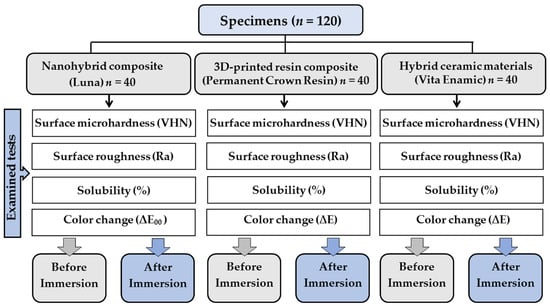
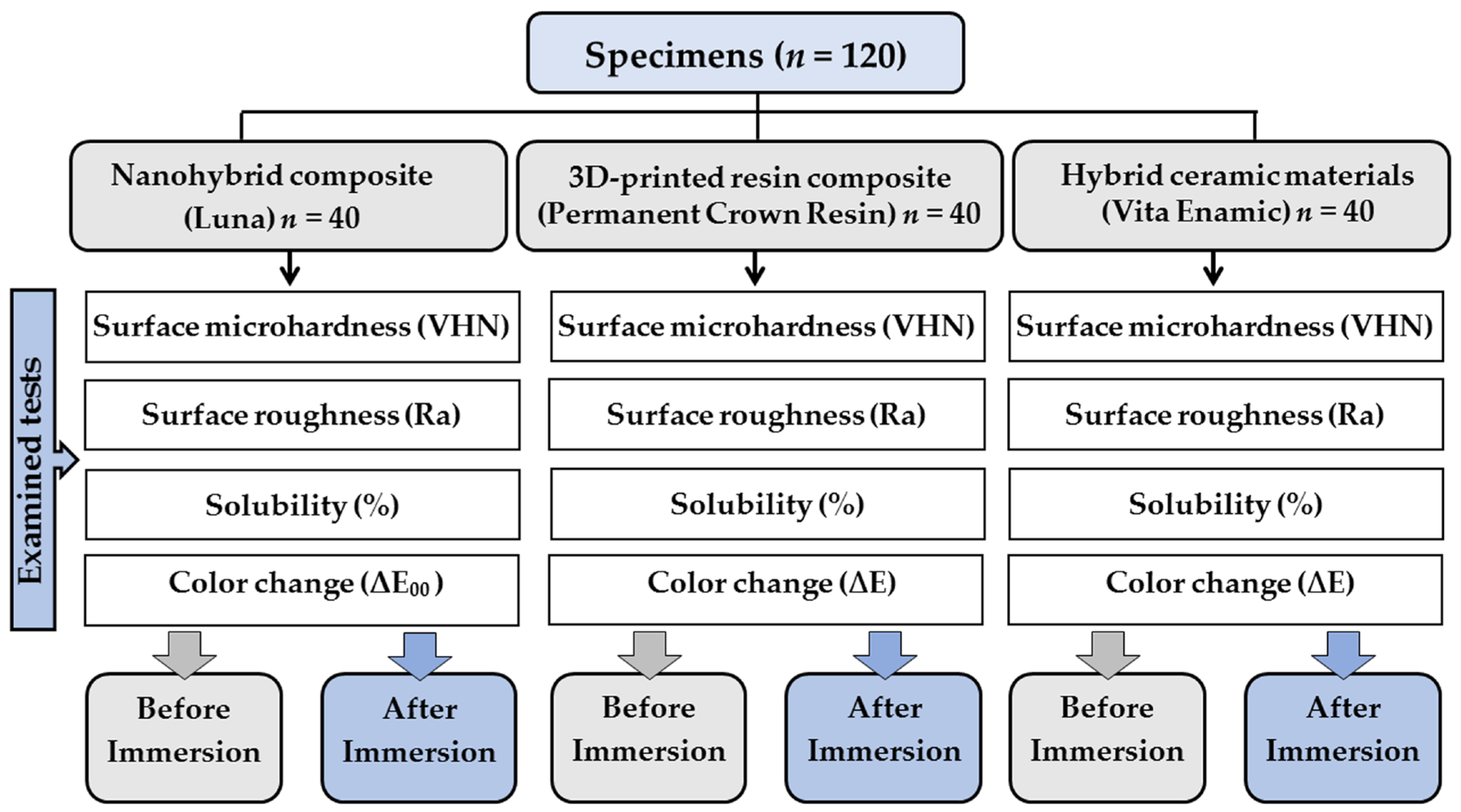
A total of 120 specimens (40 specimens each material) were prepared according to each test. The specimens were distributed into three groups according to each type of material (n = 40). These were divided into four subgroups of specimens (n = 10) for the examination of surface microhardness, surface roughness, solubility, and color changes. Each specimen was tested before and after immersion in Oronamin C solution. The beverage was refreshed daily to maintain consistent chemical composition and acidity. A flowchart for the study design is presented in Figure 1.
Figure 1.
Flowchart of the study design.
2.3. Specimen Preparation
The specimen’s preparation was performed according to each type of resin composite to get a disk-shaped specimen with 8 mm diameter and 1 mm thickness, to ensure uniform surface area for reliable microhardness, roughness, solubility, and color measurements. This size also facilitates standardization during immersion and optical color evaluation [19,20,21]. The direct nanohybrid resin composite specimens were prepared using a Teflon mold with 8 mm diameter and 1 mm depth [19,20]. After the resin composite was filled into the Teflon mold, a clear celluloid strip (Mylar strip; SS White Co., Philadelphia, PA, USA) and glass plate was placed on it and slight pressure was applied with this after removal of excess material to obtain a well-smoothed surface. The samples were then cured for 40 s from the surface using a light emitting diode (LED) curing unit (LED device Mini LED, Satelec, Acteon, France), which emitted light at a wavelength of 400–500 nm and an intensity of 1000 mW/cm2. The distance from the specimens to light source was normalized with a glass slide (1 mm thickness). After the curing process, they were polished on both sides with a composite polishing kit (Shofu Composite Polishing Kit, Shofu Dental GmbH, Ratingen, Germany).
The indirect hybrid ceramic (PICN) specimens were created from their blocks in accordance with the manufacturer’s instructions [22]. Specimens were created by standardizing the same dimensions in a CAD/CAM Machine. Each specimen was then polished using the VITA ENAMIC polishing kit (VITA Zahnfabrik, Germany) to produce a 1 mm thick, disk-shaped specimen with a diameter of 8 mm.
The specimens of the 3D-printed resin composite were fabricated using 3D printing technology to get a disk-shaped specimen with 8 mm diameter and 1 mm thickness according to ISO 4049:2019 [21]. SelfCAD (software; CrossBrowser 3D LLC, Brooklyn, NY, USA) was used to generate the design of each specimen in STL [5,23]. The models were subsequently printed with 3D-printed Permanent Crown Resin material (Formlabs Inc., Somerville, MA, USA) via a high-resolution SLA 3D printer (Formlabs Inc., Somerville, MA, USA). The samples were then washed in an ultrasonic bath in isopropanol for 3 min to remove any unpolymerized resin on the surface. The samples were then air-dried and post-cured in a two-step mode using a post-curing unit (UV-01 Thermostatic, Shenzhen PioCreat 3D Technology Co., Ltd, Shenzhen, China). Afterwards, the specimens were polished using pumice stone followed by professional polishing paste (Renfert GmbH, Hilzingen, Germany) [5,23]. All 3D-printed specimens were fabricated with identical build orientation relative to the tested surface to minimize anisotropic effects on surface integrity.
2.4. pH Measurement
The pH value of the Oronamin C solution was measured before immersion of the specimens using a portable pH meter (Milwaukee Electronics Kft., Szeged, Hungary) to evaluate the acidic nature of the used carbonated nutritional beverage. Before the measurement, the pH meter was calibrated using standard solutions; the electrode was washed with distilled water for each step.
2.5. Examination Tests
2.5.1. Surface Microhardness
Surface microhardness was examined using a Vickers hardness tester (Shimadzu, HMVG31ST microhardness, Kyoto, Japan) before and after immersion of the specimen in the beverage solution. The indenter is held at load 100 g for 15 s at a magnification of 20×. The average surface microhardness value from five measurements of five indents per sample is calculated. Indentations were made on new, untested regions of the same specimen surface to avoid influence from prior indentations [24].
2.5.2. Surface Roughness
Surface roughness (Ra) measurements were examined with a digital profilometer (Amtast USA Inc., AMT211, Lakeland, FL, USA) with a measuring distance of 4 mm and a cut-off value of 0.8 mm. Three measurements obtained from the center of each specimen surface were averaged and Ra values (µm) were recorded [3].
2.5.3. Solubility
Solubility tests were performed according to ISO 4049 [21]. A digital caliper (Digital Vernier Caliper, Mitutoyo, Japan) was employed to measure diameter and thickness. The diameter of each sample was measured at two perpendicular points, and its mean value was calculated. The thickness of each sample was determined at the midpoint and from four directions to the center, and an average value was taken. The volume (V) of each sample was calculated in mm by V = π × r2 × h where the value of r is the mean radius (diameter/2) and h is the mean thickness.
Specimen weight was measured using a precision analytical balance to the nearest 0.0001 mg (Adam Equipment 4-digit precision weighing balance, Adam Equipment Inc., Oxford, UK). All specimens were maintained in an oven desiccator at 37 °C until a constant mass was achieved. The drying cycle was performed for 24 h initially, followed by repeated 1 h cycles until a stable weight (mass variation less than 0.1 mg) was obtained (m0). The specimens were then immersed in a glass vial containing 10 mL of the beverage solution for 12 days, taken out, and re-dried until reaching a constant weight, and the weights were measured again (m1). The solubility % was recorded as the change in weight before and after immersion using the formula [25] (m0 − m1)/V × 100.
2.5.4. Color Changes
Oronamin C has a bright yellow color. Prior to immersion of the specimens in the beverage solution, color was registered for all groups as a baseline value. At the end of the immersion period, final color values were recorded for each specimen by an extra-oral spectrophotometer (Cary 5000; Agilent Technologies, Santa Clara, CA, USA). The color difference (ΔE00) was employed with the CIEDE2000 (Commission Internationale de l’Eclairage) Lab* system, against a black background under an illuminant D65 [16]. The formula used for this calculation is [16,26,27]:
where ΔL = lightness difference; ΔC = chroma difference; ΔH= hue difference; and kL, SL, KC, SC, KH and SH are constant coefficients. The measured ΔE00 values were compared with established clinical thresholds, including the perceptibility threshold (ΔE00 = 0.8), defined as the lowest color difference detectable by the human eye, and the acceptability threshold (ΔE00 = 1.8), beyond which color differences are considered clinically unacceptable by observers [28].
2.6. Statistical Analysis
The Statistical Package for the Social Sciences (SPSS, Version 27.0; IBM Corp., Armonk, NY, USA) software was used for statistical analysis. The data were presented as mean ± SD and normal distribution was confirmed by applying the Shapiro–Wilk and Kolmogorov–Smirnov tests. The level of significance was p ≤ 0.05. The analysis used paired t-test to compare the mean VHN and Ra values of the specimens before and after immersion in the beverage within material. One-way ANOVA and post hoc tests were performed to compare the differences between the three materials.
3. Results
3.1. pH Measurement
The pH of Oronamin C was mildly acidic (6.2).
3.2. Examination Tests Results
3.2.1. Surface Microhardness (VHN) Results
The mean surface microhardness values of the resin-based materials before and after immersion are presented in Table 2. There was a statistically significant decrease (p = 0.003) in the microhardness after immersion from 75.4 to 64.2 VHN in the nanohybrid groups. There was no statistically significant difference in microhardness (p = 0.155) after immersion from 37 to 35.7 VHN in the 3D-printed resin composite groups. Also, there was no statistically significant difference in microhardness (p = 0.057) after immersion from 226.3 to 225 VHN in the hybrid ceramic groups.
Table 2.
Mean, standard deviation (SD), and statistical comparison for surface microhardness.
Comparing the different materials, there was a significant difference in the hardness between the three materials; the hybrid ceramic was the hardest while the 3D-printed resin was the least, either before or after immersion.
3.2.2. Surface Roughness (µm) Results
The mean surface roughness (Ra) values of the resin-based materials before and after immersion are presented in Table 3. There was a statistically significant difference (p = 0.005) in the surface roughness after immersion from 0.430 to 1.247 μm in the nanohybrid groups. There was no statistically significant difference in surface roughness (p = 0.134) after immersion from 0.022 to 0.034 μm in the 3D-printed resin composite groups. Also, there was no statistically significant difference in surface roughness (p = 0.374) after immersion from 0.0077 to 0.008 μm in the hybrid ceramic groups.
Table 3.
Mean, standard deviation (SD), and statistical comparison for surface roughness.
Comparing the different materials, there was a significant difference in the surface roughness between the three materials; the nanohybrid displayed the highest roughness values while the hybrid ceramic showed the least roughness, either before or after immersion.
3.2.3. Surface Solubility (%) Results
The mean solubility percentage values of the resin-based materials after immersion are shown in Table 4. There was a statistically significant difference among the groups (p < 0.001). Nanohybrid groups had the highest solubility (0.6%), followed by 3D-printed resin composite groups (0.23%). The hybrid ceramic groups showed no solubility (0%).
Table 4.
Mean, standard deviation (SD), and statistical comparison for solubility %.
3.2.4. Color Changes (∆E00) Results
The mean color change (∆E00) values of the resin-based materials after immersion are presented in Table 5. There was a statistically significant difference between the groups (p < 0.001). The 3D-printed resin composite groups showed significantly higher color change than the other two groups. The nanohybrid and hybrid ceramic groups displayed low color change values. However, all groups showed acceptable color changes. Both the nanohybrid composite and hybrid ceramic groups showed minimal color changes below perceptibility and acceptability thresholds, while the 3D-printed resin composite presented a color change below the acceptability threshold.
Table 5.
Mean, standard deviation (SD), and statistical comparison for color changes (∆E00).
4. Discussion
Innovative dental restorative materials, such as nanohybrid composites, 3D-printed resins and hybrid ceramics, have been developed to meet clinical needs, although they pose new challenges with regard to the surface quality and stability [4].
Nanohybrid resin-based composites have become a benchmark for direct restorations due to the use of nano-fillers which offer excellent initial microhardness and polishability, although this material is susceptible to hydrolytic degradation of its resin matrix with time [4,29].
However, 3D-printed indirect resin-based composites may have decreased surface microhardness, solubility and a naturally roughened surface with a layer-by-layer manufacturing technique. Nevertheless, 3D-printed resins have significant advantages such as high fabrication accuracy, reproducibility potential, low waste of material and capability of efficient manufacture of complex and customized restorations and are a good alternative for the advanced digital restorative workflow provided that appropriate post-processing is done [8].
Hybrid ceramics or PICN present a materialistic advantage because they combine key characteristics of ceramics and polymers. The polymer–ceramic design enables accurate milling and limits the occurrence of catastrophic fractures in function. They imitate the elastic modulus of natural dentin, and possess greater resistance to solubility and color change than pure resins [6,7,30].
Although beverages with pH 2.5–3.5 produce stronger erosive effects, this study aimed to simulate realistic exposure to commonly consumed drinks rather than extreme acidic conditions. Oronamin C, despite its moderate pH (6.2), is carbonated and contains ascorbic acid and other components that may interact with restorative materials. Evaluating repeated exposure to such a beverage enhances clinical relevance by reflecting everyday patient consumption patterns.
Therefore, an optimum surface property is essential for increased restoration viability; the rise in surface microhardness has to be sufficient to withstand scratching, while a decrease in roughness less than 0.2 um is necessary to avoid bacterial biofilm fixation and abrasion of the antagonist dentition [31,32]. In addition, maximum color stability is also necessary to prevent esthetic failure whereas solvent uptake must be minimized to avoid leaching of cytotoxic monomers and long-term structural integrity of the restoration against hydrolytic degradation in the oral cavity [33].
High surface microhardness is critical as it gives an indication of the ability of a restoration to resist surface deformation, wear and erosion during chewing and parafunctional activities. Materials with high microhardness are capable of resisting occlusal forces, retaining the anatomical shape and minimizing wear. This is relevant, especially for indirect resin restorations that are frequently subjected to higher functional loads and for direct restorations in posterior teeth [34].
Furthermore, it is crucial to minimize surface roughness, as smoother restorative surfaces accumulate less plaque and bacterial biofilm. A highly smoothed surface with minimized surface roughness reduces risk of gingival inflammation, secondary caries and periodontal disease. Furthermore, a smooth surface is more resistant to extrinsic staining and wear resulting in better esthetics and comfort for the patient. Surface morphology also affects the durability of restorations through the increase in mechanical and chemical attack on roughened surfaces [35].
Improving color stability is a critical esthetic necessity; color changes are inevitable for resinous materials owing to water sorption, staining agents and chemical alteration of the polymer matrix. Color stability has been optimized, so shade match will remain consistent over time with natural teeth, minimizing the need for replacement of restorations and increasing patient satisfaction in both direct and indirect indications [36].
Reducing the solubility is important to maintain the structural and chemical integrity of resin-based restorations. Low solubility reduces the plasticizer and additive leaching that can decrease the material strength, creating a rougher surface and affecting biocompatibility. Moreover, lower solubility increases resistance towards acid challenges from food and oral fluids, promoting stability in a mechanical and clinical sense of restorations [37]. Optimizing surface and material characteristics of resin-based restorations is important for function, esthetics, and biological compatibility to provide better clinical results as well as patient health in the long-term [34].
The pH value is deemed as one of the factors that are likely to influence the organic resin matrix. Therefore, it was assessed in this study [38]. The immersion protocol was designed to simulate intermittent beverage consumption rather than continuous exposure. Specimens were immersed in Oronamin C for 5 min, three times daily, over 12 days at 37 °C to reflect average oral temperature. In accelerated aging models, one day of cumulative laboratory immersion approximates one month of intra-oral exposure. Accordingly, this protocol simulates long-term clinical conditions, allowing standardized evaluation of material behavior over approximately one year of service [20,30,39]. Color measurements are made by a spectrophotometer instrument to obtain accurate, reliable and repeatable results. It was used for color measurement in reflection or transmission of a sample and is frequently used to study the color changes in restorative materials [40].
The null hypothesis was partially rejected, as there was no significant difference in the tested groups after immersion among 3D-printed resin composite and hybrid ceramic groups as regards surface microhardness and surface roughness. Meanwhile, there was a significant decrease in the surface hardness and increase in the surface roughness in the nanohybrid resin composite after the immersion. Additionally, there was a significant difference in the solubility in the nanohybrid composite and 3D-printed resin composite groups, while no significant changes were noticed in the hybrid ceramics. Regarding the color changes, all groups showed acceptable color changes. Both the nanohybrid composite and hybrid ceramic groups showed minimal color changes below perceptibility and acceptability thresholds, while the 3D-printed resin composite presented a color change below the acceptability threshold.
The results revealed that the highest mean microhardness value (226 VHN) was observed in the hybrid ceramic group before exposure to the immersion solution. These findings may be due to the unique dual-network architecture consisting of ceramic nano-filler and polymer phase in an indissoluble compound. The ceramic is a continuous or well interconnected inorganic network which provides high intrinsic hardness [41].
Moreover, the results showed that the carbonated nutritional beverage (Oronamin C) provided no statistically significant difference among 3D-printed resin composite and hybrid ceramic groups as regards surface microhardness and surface roughness which may be due to the innovation in the surface properties of the tested materials as they contained a highly cross-linked resin matrix with a great extent of polymerization, restricting the softening or plasticizing effect under the action of the solutions [42,43]. Moreover, they are loaded with a high level of inorganic nano-sized filler particles that enhance its hardness by decreasing the interstitial spaces, and permit a high bonding between the filler–matrix interface which limits debonding of the filler [44].
Additionally, the presence of ceramic phase in 3D-printed resin composite and hybrid ceramic is of great significance for the enhancement of resistance to surface scratching and roughening [45,46]. While the lower surface hardness and higher surface roughness values in the nanohybrid resin composite could be explained by a greater quantity of the resinous component with a lack of ceramic component, this composition is more prone to surface degradation in acidic environments because the resin matrix softens and chemically degrades at a greater rate under such conditions [47]. Moreover, the Ra increase in nanohybrid composites (>0.2 µm) may enhance plaque accumulation and influence long-term restoration performance [47]. In addition, Oronamin C exhibited a mild acidity that may have restricted the scratching and roughening capability [3].
The results also showed that immersion in the carbonated nutritional beverage increased the solubility of the nanohybrid composite and the 3D-printed resin composite groups, while no effect on the hybrid ceramic was detected. The effect of the solubility is more pronounced in the nanohybrid composite. These findings may be attributed to the possible solubility and leaching of the resinous part of the matrix [48], which is about 23 wt% in the Luna nanohybrid composite and ranges from 30 to 50 wt% in the 3D-printed resin composite. The lowest value was about 14 wt% in the hybrid ceramic. Meanwhile, the hybrid ceramic and 3D-printed resin composite contained a ceramic part which resisted the solubility [45,46].
The spectrophotometer used has a reported repeatability of ±0.1 ΔE00 units. Given that all observed ΔE differences were larger than this variability, the measured differences are reliable and meaningful, and all remained within clinically acceptable thresholds [49]. This indicates that the esthetic impact of Oronamin C exposure is minimal for hybrid ceramic and 3D-printed resin, whereas nanohybrid composites may experience slightly higher, but still acceptable, perceptible changes. The hybrid ceramic manifested a high color stability, which is likely contributed to by the ceramic phase, usually made of glass or feldspathic ceramics with high chemical and stain resistance [43,50]. Furthermore, the milled hybrid ceramic blocks are polymerized under high temperatures and pressure in a factory, which results in less residual monomer and a higher conversion rate [50]. The nanohybrid composite showed more color stability than the 3D-printed resin composite which may be attributed to their higher inorganic filler content (77 wt%) [47]. Although the 3D-printed resin composites provide acceptable color changes after the immersion in the carbonated nutritional beverage, they exhibit lower color stability values than the other groups which may be attributed to the fact that they typically have a lower conversion rate, making them more chemically unstable [23]. Patients with frequent consumption of carbonated or mildly acidic beverages should be counseled on potential effects, and that material selection should favor hybrid ceramics or 3D-printed resins in high-risk individuals to maintain long-term surface and color stability. Additionally, these effects may be minimized by surface polishing (or glazing) which restricts surface roughness, solubility, and limits stain accumulation [51].
The improved resistance observed in the hybrid ceramic may be due to its microstructure, as polishing could preferentially expose ceramic-rich regions resulting in an intrinsically more stable surface. It might minimize the dissolution of the matrix and surface degradation [17]. The results of the present study agreed with the study conducted by El-ghobashy et al., which reported that different beverages affected the surface roughness of bulk fill resin composites [52]. Moreover, the results come in agreement with the investigation carried out by Sushma et al., which demonstrated that the carbonated beverages have a detrimental effect on the flexural strength of composite restorative materials [13]. Additionally, our findings agreed with the results reported by Da Silva et al. that alcoholic beverages led to an increase in surface roughness and a decrease in microhardness of nanohybrid resin composites. They also reported that the impact on dental composites is related to chemical composition, solution acidity, and exposure duration [53]. Additionally, our findings are consistent with another study by Szalewski et al. that reported Coca-Cola, Red-Bull, and sparkling water reduce the surface microhardness and flexural strength of microhybrid and nanohybrid resin composites [54]. Furthermore, our results verify the findings of Almansour et al., who reported that all coffee, tea, cola, and mineral water beverages cause a color change with polymethyl methacrylate (PMMA) as well as 3D-printed denture base resins. They also reported that beverage type and immersion time affected color stability [55].
Although these in vitro findings provide insight under simulated aging conditions, clinical performance is influenced by factors such as occlusal loading, saliva, thermal changes, and biofilm activity. Therefore, long-term survivability should be interpreted cautiously. As 3D-printed permanent crowns are relatively new, further prospective clinical studies are needed to confirm durability. This investigation reveals the intrinsic limitation of an in vitro study, as other factors, such as salivary dilution may cause dilution of the beverage and alter the effect. Situations such as short immersion time and masticatory forces should be considered. Hence, additional research is warranted to evaluate the in vivo effects of these beverages. Moreover, further studies are recommended to investigate the bulk mechanical properties in more detail by additional experiments. Additionally, SEM imaging should be performed to validate resin matrix softening and filler debonding.
5. Conclusions
Within the limitations of this in vitro study, the hybrid ceramic appeared to show a high stability upon exposure to Oronamin C carbonated nutritional beverage multivitamin drink, showing no effect in microhardness or surface roughness, alongside solubility. Similarly, the 3D-printed resin composite maintained its surface microhardness and surface roughness. In contrast, the nanohybrid resin composite exhibited a deterioration in surface microhardness, surface roughness, and the highest solubility. They all displayed acceptable color changes.
Author Contributions
Conceptualization, T.M.H.; investigation, T.M.H., M.M.K., A.A., S.A.A., A.A.A. and M.S.O.; methodology, T.M.H., M.M.K., A.A., S.A.A., A.A.A. and M.S.O.; validation, M.M.K., A.A., S.A.A., A.A.A. and M.S.O.; resources, M.M.K., A.A., S.A.A., A.A.A. and M.S.O.; visualization, M.M.K., A.A., S.A.A., A.A.A. and M.S.O.; supervision, T.M.H.; writing—original draft, T.M.H., M.M.K., A.A., S.A.A. and A.A.A., M.S.O.; writing—review and editing; T.M.H., M.M.K., A.A., S.A.A., A.A.A. and M.S.O. All authors have read and agreed to the published version of the manuscript.
Funding
This research received no external funding.
Institutional Review Board Statement
Not Applicable.
Informed Consent Statement
Not Applicable.
Data Availability Statement
The corresponding author can provide the data described in this study upon request.
Acknowledgments
The authors gratefully acknowledge Ahmad M. ElShennawy, Orthodontics Department and Director of the Innovative Digital Centre for Orthodontics at the Faculty of Dentistry, The British University in Egypt, for his valuable support and assistance throughout the construction of the 3D-printed specimens. The authors would like to express their sincere gratitude to Roger Watson, Faculty of Health Sciences, University of Hull, United Kingdom, for his valuable support and assistance with the English language editing of this manuscript.
Conflicts of Interest
The authors declare no conflicts of interest.
References
- Yüceer, Ö.M.; Kaynak Öztürk, E.; Çiçek, E.S.; Aktaş, N.; Bankoğlu Güngör, M. Three-Dimensional-Printed Photopolymer Resin Materials: A Narrative Review on Their Production Techniques and Applications in Dentistry. Polymers 2025, 17, 316. [Google Scholar] [CrossRef] [Scilit]
- Hamdy, T.M.; Abdelnabi, A.; Othman, M.S.; Bayoumi, R.E.; Abdelraouf, R.M. Effect of Different Mouthwashes on the Surface Microhardness and Color Stability of Dental Nanohybrid Resin Composite. Polymers 2023, 15, 815. [Google Scholar] [CrossRef] [Scilit] [PubMed]
- Hajdu, A.I.; Dumitrescu, R.; Balean, O.; Lalescu, D.V.; Buzatu, B.L.R.; Bolchis, V.; Floare, L.; Utu, D.; Jumanca, D.; Galuscan, A. Enhancing Esthetics in Direct Dental Resin Composite: Investigating Surface Roughness and Color Stability. J. Funct. Biomater. 2024, 15, 208. [Google Scholar] [CrossRef] [Scilit]
- Păstrav, M.; Păstrav, O.; Chisnoiu, A.M.; Chisnoiu, R.M.; Cuc, S.; Petean, I.; Saroși, C.; Feștilă, D. Properties of Nanohybrid Dental Composites—A Comparative In Vitro Study. Biomedicines 2024, 12, 243. [Google Scholar] [CrossRef] [Scilit]
- Neoh, S.P.; Khantachawana, A.; Santiwong, P.; Chintavalakorn, R.; Srikhirin, T. Effect of Post-Processing on the Surface, Optical, Mechanical, and Dimensional Properties of 3D-Printed Orthodontic Clear Retainers. Clin. Oral Investig. 2025, 29, 48. [Google Scholar] [CrossRef] [Scilit]
- Hafny, W.M.; Ibrahim, I.M.; El-Demellawy, M.; Abdel Sadek, H.M. Effects of Home Bleaching Agents on Hybrid Ceramics: Mechanical Properties and Color Change. BMC Oral Health 2025, 25, 41. [Google Scholar] [CrossRef] [Scilit]
- Hamdy, T.M.; Abdelnabi, A.; Othman, M.S.; Bayoumi, R.E. Alterations in Surface Gloss and Hardness of Direct Dental Resin Composites and Indirect CAD/CAM Composite Block after Single Application of Bifluorid 10 Varnish: An In Vitro Study. J. Compos. Sci. 2024, 8, 58. [Google Scholar] [CrossRef] [Scilit]
- del Hougne, M.; Di Lorenzo, I.; Höhne, C.; Schmitter, M. A Retrospective Cohort Study on 3D Printed Temporary Crowns. Sci. Rep. 2024, 14, 17295. [Google Scholar] [CrossRef] [Scilit]
- Manziuc, M.; Khechen, A.A.; Negucioiu, M.; Poiană, I.; Kui, A.; Mesaroș, A.; Buduru, S. Survival Rates of Glass versus Hybrid Ceramics in Partial Prosthetic Restorations: A Scoping Review with Emphasis on Adhesive Protocols. J. Clin. Med. 2023, 12, 6744. [Google Scholar] [CrossRef] [Scilit]
- Bajraktarova-Valjakova, E.; Korunoska-Stevkovska, V.; Kapusevska, B.; Gigovski, N.; Bajraktarova-Misevska, C.; Grozdanov, A. Contemporary Dental Ceramic Materials, a Review: Chemical Composition, Physical and Mechanical Properties, Indications for Use. Open Access Maced. J. Med. Sci. 2018, 6, 1742–1755. [Google Scholar] [CrossRef] [Scilit] [PubMed]
- Doğu Kaya, B.; Yılmaz Atalı, P.; Özmen, S.; Öztürk, S.; Tarçın, B. Effect of an Effervescent Multivitamin on Color and Surface Roughness of Micro-Hybrid Dental Resin Composites. Materials 2024, 17, 1040. [Google Scholar] [CrossRef] [Scilit]
- Gradinaru, I.; Vasiliu, A.L.; Bargan, A.; Checherita, L.E.; Ciubotaru, B.I.; Armencia, A.O.; Istrate, B.; Dascalu, C.G.; Antohe, M.E. The Influence of Beverages on Resin Composites: An In Vitro Study. Biomedicines 2023, 11, 2571. [Google Scholar] [CrossRef] [Scilit]
- Sushma, B.; Balaji Ganesh, S.; Jayalakshmi, S. Effect of Carbonated Beverages on Flexural Strength of Composite Restorative Material. J. Adv. Pharm. Technol. Res. 2022, 13, 160–163. [Google Scholar] [CrossRef] [Scilit]
- Silva, F.P.; Vilela, A.L.R.; Almeida, M.M.G.; Oliveira, A.R.F.; Raposo, L.H.A.; Menezes, M.S. Surface Topography, Gloss and Flexural Strength of Pressable Ceramic after Finishing-Polishing Protocols. Braz. Dent. J. 2019, 30, 164–170. [Google Scholar] [CrossRef] [Scilit]
- Abdelraouf, R.M.; Moussa, T.A.; Hamdy, T.M.; Abuhaimed, R.A.; Alotaibi, A.M.; Jurado, C.A.; Alhotan, A.; Alhelal, B.; Habib, N.A. Effect of Ceramic Thickness and Technician Variability on the Shade Duplication of Dental Ceramo-Metallic Restorations. J. Funct. Biomater. 2024, 15, 12. [Google Scholar] [CrossRef] [Scilit]
- Sharma, G.; Wu, W.; Dalal, E.N. The CIEDE2000 Color-Difference Formula: Implementation Notes, Supplementary Test Data, and Mathematical Observations. Color Res. Appl. 2005, 30, 21–30. [Google Scholar] [CrossRef] [Scilit]
- Elmalawany, L.M.; El-Refai, D.A.; Alian, G.A. Change in Surface Properties of Two Different Dental Resin Composites after Using Various Beverages and Brushing. BMC Oral Health 2023, 23, 966. [Google Scholar] [CrossRef] [Scilit]
- Bengal, S.; Badole, G.P.; Shenoi, P.R.; Kubde, R.; Shahu, S. Evaluation of Surface Roughness and Microhardness of Bulk-Fill and Nanohybrid Composite after Exposure to Different Beverages at Various Time Intervals—An In Vitro Study. Ann. Afr. Med. 2024, 23, 466–473. [Google Scholar] [CrossRef] [Scilit]
- García-Contreras, R.; Scougall-Vilchis, R.; Acosta-Torres, L.; Arenas-Arrocena, C.; García-Garduño, R.; de la Fuente-Hernández, J. Vickers Microhardness Comparison of 4 Composite Resins with Different Types of Filler. J. Oral Res. 2015, 4, 313–320. [Google Scholar] [CrossRef] [Scilit]
- El-Rashidy, A.A.; Abdelraouf, R.M.; Habib, N.A. Effect of Two Artificial Aging Protocols on Color and Gloss of Single-Shade versus Multi-Shade Resin Composites. BMC Oral Health 2022, 22, 321. [Google Scholar] [CrossRef] [Scilit] [PubMed]
- ISO 4049:2019; Dentistry—Polymer-Based Restorative Materials. International Organization for Standardization: Geneva, Switzerland, 2019.
- Habib, S.R.; Al Rashoud, A.S.; Safhi, T.A.; Almajed, A.H.; Alnafisah, H.A.; Bajunaid, S.O.; Alqahtani, A.S.; Alqahtani, M. Variations in the Shades of Contemporary Dental Ceramics: An In Vitro Analysis. Crystals 2021, 11, 1288. [Google Scholar] [CrossRef] [Scilit]
- Lassila, L.; Mangoush, E.; He, J.; Vallittu, P.K.; Garoushi, S. Effect of Post-Printing Conditions on the Mechanical and Optical Properties of 3D-Printed Dental Resin. Polymers 2024, 16, 1713. [Google Scholar] [CrossRef] [Scilit]
- Comba, A.; Scotti, N.; Maravić, T.; Mazzoni, A.; Carossa, M.; Breschi, L.; Cadenaro, M. Vickers Hardness and Shrinkage Stress Evaluation of Low and High Viscosity Bulk-Fill Resin Composite. Polymers 2020, 12, 1477. [Google Scholar] [CrossRef] [Scilit]
- Gaeta, C.; Marruganti, C.; Mignosa, E.; Malvicini, G.; Verniani, G.; Tonini, R.; Grandini, S. Comparison of Physico-Chemical Properties of Zinc Oxide Eugenol Cement and a Bioceramic Sealer. Aust. Endod. J. 2023, 49, 187–193. [Google Scholar] [CrossRef] [Scilit]
- Soveral, M.; Machado, V.; Botelho, J.; Mendes, J.J.; Manso, C. Effect of Resin Infiltration on Enamel: A Systematic Review and Meta-Analysis. J. Funct. Biomater. 2021, 12, 48. [Google Scholar] [CrossRef] [Scilit]
- ElAziz, R.H.A.; Gadallah, L.K.; Saleh, R.S. Evaluation of Charcoal and Sea Salt–Lemon-Based Whitening Toothpastes on Color Change and Surface Roughness of Stained Teeth. J. Contemp. Dent. Pract. 2022, 23, 169–175. [Google Scholar] [CrossRef] [Scilit]
- Erturk-Avunduk, A.T.; Cengiz-Yanardag, E.; Karakaya, I. The Effect of Bleaching Applications on Stained Bulk-Fill Resin Composites. BMC Oral Health 2022, 22, 392. [Google Scholar] [CrossRef] [Scilit]
- Hamdy, T.M. Interfacial Microscopic Examination and Chemical Analysis of Resin-Dentin Interface of Self-Adhering Flowable Resin Composite. F1000Research 2017, 6, 1688. [Google Scholar] [CrossRef] [Scilit]
- Kandil, M.M.; Abdelnabi, A.; Hamdy, T.M.; Bayoumi, R.E.; Othman, M.S. Home Bleaching Effects on the Surface Gloss, Translucency, and Roughness of CAD/CAM Multi-Layered Ceramic and Hybrid Ceramic Materials. J. Compos. Sci. 2024, 8, 541. [Google Scholar] [CrossRef] [Scilit]
- Rosentritt, M.; Schneider-Feyrer, S.; Kurzendorfer, L. Comparison of Surface Roughness Parameters Ra/Sa and Rz/Sz with Different Measuring Devices. J. Mech. Behav. Biomed. Mater. 2024, 150, 106349. [Google Scholar] [CrossRef] [Scilit]
- Taşın, S.; Ismatullaev, A.; Usumez, A. Comparison of Surface Roughness and Color Stainability of 3-Dimensionally Printed Interim Prosthodontic Material with Conventionally Fabricated and CAD-CAM Milled Materials. J. Prosthet. Dent. 2022, 128, 1094–1101. [Google Scholar] [CrossRef] [Scilit] [PubMed]
- AL-Omiri, M.K.; Abuherra, D.S.H.; AL-Omiri, K.M.; Alsaeed, A.Y.; Alamri, M.; Alqahtani, A.M.; Alqahtani, S.A.; Alwadai, G.S.; Abogazalah, N.; Lynch, E. Comparative Evaluation to Composite Resin Bleaching Using Ozone-Enhanced Low-Concentration Hydrogen Peroxide. Sci. Rep. 2025, 15, 34062. [Google Scholar] [CrossRef] [Scilit]
- Hamdy, T.M. Evaluation of Compressive Strength, Surface Microhardness, Solubility and Antimicrobial Effect of Glass Ionomer Dental Cement Reinforced with Silver Doped Carbon Nanotube Fillers. BMC Oral Health 2023, 23, 777. [Google Scholar] [CrossRef] [Scilit] [PubMed]
- Meniawi, M.; Şirinsükan, N.; Can, E. Color Stability, Surface Roughness, and Surface Morphology of Universal Composites. Odontology 2026, 114, 149–160. [Google Scholar] [CrossRef] [Scilit] [PubMed]
- Zhang, L.; Yu, Y.; Li, S.; Yang, F.; Liang, S.; Xing, W. Effect of Staining Solutions on Color and Translucency Stability of Resin-Composite Computer-Aided Design and Computer-Aided Manufacturing Blocks. J. Am. Dent. Assoc. 2024, 155, 1012–1021. [Google Scholar] [CrossRef] [Scilit]
- Ismail, A.G.; Galal, M.M.; Hamdy, T.M. Comparative Analysis between Resin-Based Root Canal Sealer and Recent Bioceramic-Based Root Canal Sealers Using MicroCT, Film Thickness, and Solubility. J. Oral Biol. Craniofacial Res. 2026, 16, 101400. [Google Scholar] [CrossRef] [Scilit]
- Baliga, S.; Muglikar, S.; Kale, R. Salivary pH: A Diagnostic Biomarker. J. Indian Soc. Periodontol. 2013, 17, 461–465. [Google Scholar] [CrossRef] [Scilit]
- El-Rashidy, A.A.; Shaalan, O.; Abdelraouf, R.M.; Habib, N.A. Effect of Immersion and Thermocycling in Different Beverages on the Surface Roughness of Single- and Multi-Shade Resin Composites. BMC Oral Health 2023, 23, 367. [Google Scholar] [CrossRef] [Scilit]
- Bozoğullari, H.N.; Çitir Yücel, H. Effect of Mouthwashes on Color Stability of Artificial Gingival Materials Used in Implant Retained Hybrid Prostheses. Selcuk Dent. J. 2021, 8, 538–544. [Google Scholar] [CrossRef] [Scilit]
- Hamdy, T.M. Dental Biomaterial Scaffolds in Tooth Tissue Engineering: A Review. Curr. Oral Heal. Rep. 2023, 10, 14–21. [Google Scholar] [CrossRef] [Scilit]
- Mahran, G.A.; El-Banna, A.; El-Korashy, D.I. Evaluation of a 3D-Printed Nanohybrid Resin Composite versus a Milled Resin Composite for Flexural Strength, Wear and Color Stability. BMC Oral Health 2025, 25, 572. [Google Scholar] [CrossRef] [Scilit] [PubMed]
- Alanazi, K.K.; Alzaid, A.A.; Elkaffas, A.A.; Bukhari, S.A.; Althubaitiy, R.O.; Alfaifi, K.A.; Alfahdi, I.M.; Alqahtani, H.A. Mechanical Assessment of CAD/CAM Fabricated Hybrid Ceramics: An In Vitro Study. Appl. Sci. 2024, 14, 7939. [Google Scholar] [CrossRef] [Scilit]
- Farghal, N.S.; Abu Shamleh, A.; Al Hurmuzi, O.; Mahmoud, O. The Effects of a Carbonated Beverage on the Optical Properties and Microhardness of Preheated Bulk-Fill Composite Resin Restorations. Front. Oral Heal. 2025, 54, 331–342. [Google Scholar] [CrossRef] [Scilit]
- Killedar, S.M.; Marwaha, J.; Sinha, R.R.; Devi, N.N.; Langpoklakpam, C.; Neeraja, B. Wear Resistance and Surface Roughness of Hybrid Ceramic Crowns Compared to Lithium Disilicate: An In Vitro Study. J. Pharm. Bioallied Sci. 2025, 17, S3108–S3110. [Google Scholar] [CrossRef] [Scilit]
- Alharbi, S.; Alshabib, A.; Algamaiah, H.; Aldosari, M.; Alayad, A. Influence of Post-Printing Polymerization Time on Flexural Strength and Microhardness of 3D Printed Resin Composite. Coatings 2025, 15, 230. [Google Scholar] [CrossRef] [Scilit]
- Moradi, K.; Mahmoudinezhad, S.S.; Mapar, M. Microleakage Evaluation of Two Methacrylate-Based Composites (GC Kalore and Luna SDI) in Class II Restorations: A Laboratory Study. Int. J. Biomater. 2022, 2022, 3835694. [Google Scholar] [CrossRef] [Scilit] [PubMed]
- Ozer, S.; Sen Tunc, E.; Tuloglu, N.; Bayrak, S. Solubility of Two Resin Composites in Different Mouthrinses. Biomed Res. Int. 2014, 2014, 580675. [Google Scholar] [CrossRef] [Scilit]
- Olgar, İ.E.; Yağcı, Ö.; Fidan, M. Repeatability of Color Measurements in Multi-Shade and Single-Shade Resin Composites of Different Thicknesses at Different Times: Spectrophotometer versus Mobile Phone Color Applications. BMC Oral Health 2025, 25, 1175. [Google Scholar] [CrossRef] [Scilit]
- Paolone, G.; Mandurino, M.; De Palma, F.; Mazzitelli, C.; Scotti, N.; Breschi, L.; Gherlone, E.; Cantatore, G.; Vichi, A. Color Stability of Polymer-Based Composite CAD/CAM Blocks: A Systematic Review. Polymers 2023, 15, 464. [Google Scholar] [CrossRef] [Scilit]
- Cho, Y.; Cho, M.G.; Ryu, J.H.; Kim, J.Y.; Choi, S.H.; Shim, H.; Hong, M.H.; Lee, D.Y. Influence of Machining, Polishing, and Glazing on Surface Properties and Biological Performance of Zirconia and Lithium Disilicate Dental Ceramics. J. Funct. Biomater. 2025, 16, 400. [Google Scholar] [CrossRef] [Scilit]
- El-ghobashy, M.; Mehesen, R.; Ali, A.I. Effect of Different Beverages on Surface Roughness of Resin Composite Restorations. Mansoura J. Dent. 2023, 10, 230–235. [Google Scholar] [CrossRef] [Scilit]
- Da Silva, M.A.B.; Vitti, R.P.; Sinhoreti, M.A.C.; Consani, R.L.X.; Da Silva, J.G.; Tonholo, J. Effect of Alcoholic Beverages on Surface Roughness and Microhardness of Dental Composites. Dent. Mater. J. 2016, 35, 621–626. [Google Scholar] [CrossRef] [Scilit]
- Szalewski, L.; Wójcik, D.; Bogucki, M.; Szkutnik, J.; Różyło-Kalinowska, I. The Influence of Popular Beverages on Mechanical Properties of Composite Resins. Materials 2021, 14, 3097. [Google Scholar] [CrossRef] [Scilit]
- Almansour, S.H.; Alkhawaja, J.A.; Khattar, A.; Alsalem, A.M.; Alessa, A.M.; Khan, S.Q.; Ellakany, P.; Gad, M.M.; Fouda, S.M. The Effect of Different Beverages on the Color Stability of Nanocomposite 3D-Printed Denture Base Resins. Prosthesis 2024, 6, 1002–1016. [Google Scholar] [CrossRef] [Scilit]

Disclaimer/Publisher’s Note: The statements, opinions and data contained in all publications are solely those of the individual author(s) and contributor(s) and not of MDPI and/or the editor(s). MDPI and/or the editor(s) disclaim responsibility for any injury to people or property resulting from any ideas, methods, instructions or products referred to in the content. |
© 2026 by the authors. Licensee MDPI, Basel, Switzerland. This article is an open access article distributed under the terms and conditions of the Creative Commons Attribution (CC BY) license.