Review

Driving Simulators for Autonomous Vehicles: Comprehensive Review of Current Applications and Research Trends


McMaster Automotive Resource Centre, McMaster University, Hamilton, ON L8P 0A6, Canada
*
Author to whom correspondence should be addressed.
Vehicles 2026, 8(7), 158; https://doi.org/10.3390/vehicles8070158
Submission received: 6 May 2026 / Revised: 1 July 2026 / Accepted: 4 July 2026 / Published: 7 July 2026
(This article belongs to the Topic Dynamics, Control and Simulation of Electric Vehicles)

Abstract

Driving simulators have become essential tools for accelerating the development of advanced driver assistance systems (ADASs) and autonomous vehicles (AVs) by enabling safe, repeatable, flexible, and cost-effective experimentation across increasing levels of vehicle automation. Despite their growing adoption in both academia and industry, the recent literature lacks a comprehensive review that captures recent advancements and the expanding role of simulators in both feature-level ADAS development and fully autonomous driving research. This paper addresses this gap by presenting a systematic review of the evolution of driving simulators and their critical contributions to automotive research, testing, and validation. A structured taxonomy of contemporary simulators is introduced, encompassing fidelity, physical configuration, scale, licensing, and system integration strategies. Key application domains are examined, including driver-centred behaviour and human–machine interaction studies, traffic modelling and control, vehicle dynamics and powertrain development, and the testing of ADAS and autonomous driving subsystems across perception, planning, control, and vehicle-to-everything (V2X) communication. This review highlights driving simulators as foundational enablers for the safe, efficient, and scalable deployment of increasingly automated vehicle technologies.

1. Introduction

The automotive industry is undergoing a major transformation toward cleaner and safer transportation. Two key trends are driving this change: 1. the growing adoption of electrified powertrains to reduce greenhouse gas emissions [1]; 2. the rapid deployment of advanced driver assistance systems (ADAS) to advance driving safety and traffic efficiency [2].
Common ADAS features include adaptive cruise control and lane-keeping assistance. These are foundational for technologies such as vehicle platooning, connected vehicle technologies and vehicle-to-everything (V2X) studies, which can cut travel time by up to 64% [2,3,4]. These systems form important blocks on the path toward AVs deployment that can perform the full driving task without human intervention.
For terminological consistency, this review distinguishes autonomous driving (system) (AD/ADS) from autonomous vehicles (AVs). AD refers to the technological capability or system that performs the driving task, including perception, decision-making, planning, and control, whereas AVs refer to the physical vehicle platforms equipped with AD or ADAS functions.
AVs could fundamentally reshape transportation. They lower the impact of human error, help alleviate traffic congestion, and enhance overall accessibility [5]. However, despite early optimism and major investments, real-world AV deployments have highlighted serious challenges. High-profile accidents [6] have underscored the need for stronger testing and validation frameworks, particularly in areas such as perception robustness, decision-making reliability, and human–machine interaction (HMI).
Evaluating AV performance in varied and unpredictable traffic conditions remains a major obstacle. Real-world testing is essential but is limited by high costs, safety risks, and ethical concerns. This makes extensive pre-deployment testing in controlled environments critical. Driving simulators have become key tools for this purpose, offering safe, repeatable, and cost-effective platforms to test AV technologies, enabling sensor validation, control system tuning, and behavioural analysis for both human drivers and autonomous systems.
Simulators can recreate rare, dangerous, or ethically sensitive situations that would be impractical or even impossible to stage on public roads [5]. The value of simulation has already been demonstrated in other safety-critical domains. For instance, studies in the aviation industry show that for pilot training, every 10 h of high-fidelity simulator time corresponds to approximately 3 h of reduced real-flight training time. It has been reported that up to 75% of pilot training time is now spent in flight simulators, and that simulator use can reduce accident rates by up to 50% [7]. By enabling safe, repeatable evaluation of hazardous scenarios, simulators help close the gap between early system design and real-world deployment.
Driving simulators are commonly classified into three categories based on their primary applications: entertainment, training, and research. Entertainment simulators emphasize high-fidelity vehicle physics and dynamics to replicate competitive racing experiences [8]. Training simulators support driver education, emergency response preparation, and defensive driving programs, enabling skill acquisition and behavioural conditioning [9]. Research-oriented simulators are designed for academic and industrial investigations, facilitating detailed studies of driver behaviour, HMI, and artificial intelligence (AI)-based control systems for AVs [5].
Beyond peer-reviewed research, company and news reports provide supplementary examples of simulator adoption in commercial vehicle development. These sources are treated here as illustrative evidence of industrial practice rather than independently validated safety evidence. Major automotive manufacturers such as General Motors (GM), Toyota, and Honda have reported the use of simulators in different stages of vehicle development. They are reported to enable early testing in virtual environments, reducing the need for physical prototypes until later in the design process. This approach may shorten development cycles and support the integration of new features. For instance, Toyota’s Higashi-Fuji research facility has been reported to employ simulator-based driver behaviour analysis to enhance vehicle safety features [10], and Honda has announced investment in advanced simulation technology to facilitate future automotive innovations [11]. Similarly, a news report stated that GM used advanced simulations to refine the Chevrolet Corvette ZR1, supporting the vehicle’s successful 233 mph record-setting performance in 2025 [12]. Moreover, according to GM company communications, GM employs a simulation-first verification pipeline to validate its Super Cruise and Ultra Cruise hands-free driving systems prior to large-scale road deployment. GM also reports that Super Cruise has accumulated over 700 million hands-free miles since 2017 [13].
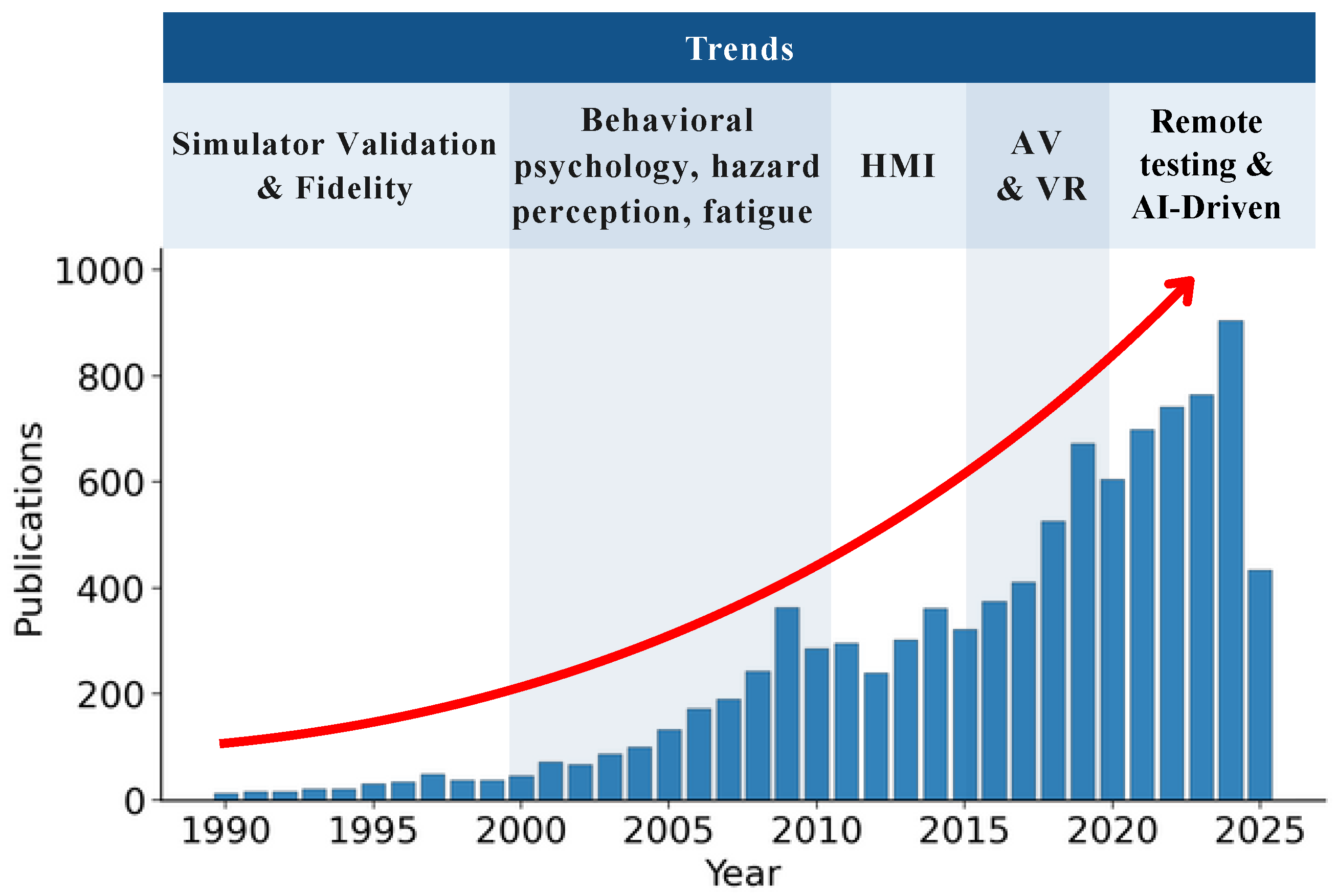
As illustrated in Figure 1, simulated-driving research has followed an overall exponential growth in publication volume over the last three decades, rising from only a handful of papers in the mid-1990s to several hundred per year by the early 2020s. Early work (1990s to 2000s) focused on basic validation of simulator fidelity against on-road performance; the late 2000s saw growing interest in driver vigilance, fatigue, and impairment. From around 2010 onward, distraction and human–automation interaction (e.g., trust in driver-assist systems) became central topics, followed after 2015 by a surge in studies of autonomous driving and virtual reality (VR)-based training. In the most recent years (2020–2025), open-source urban simulators, high-fidelity scenario testing for AVs, and abnormal-behaviour detection in simulators have emerged as hot topics, alongside continued work on clinical assessment and automated-vehicle take-over training.
Despite the expanding use of driving simulators across multiple domains, a critical gap remains in the recent literature. Although several reviews discuss simulation technologies and configurations, none provide a systematic, up-to-date synthesis of driving simulator applications specifically for AV development and industrial practice after 2021. Existing surveys tend to focus on isolated technical aspects rather than offering a comprehensive, application-oriented perspective.
Bruck et al. [5] explain the mechanisms of driving simulation technology by describing its architecture and its different component technologies (e.g., motion cueing; dynamics modelling). However, the review predates recent AV-centric developments and does not examine emerging research trends or industrial adoption.
Ghafarian et al. [2] focus on motion platform technologies and motion cueing algorithms, comparing filter-based, optimal control (e.g., Model Predictive Control (MPC)), and learning-based approaches. The review emphasizes the challenges of replicating realistic inertial sensations within the limited motion-platform workspaces and discusses emerging methods to improve motion realism and user perception. While technically detailed, their analysis is limited to motion realism and does not address broader AV testing or system-level evaluation.
Li et al. [14] focus on open-source simulation platforms specifically designed for autonomous driving research. It critically evaluates simulators like CARLA, LGSVL, and SUMO in terms of capabilities such as sensor modelling, realism, extensibility, and support for testing perception, planning, and control algorithms. The paper is intended as a guide for researchers selecting the appropriate simulator for specific AV development tasks.
Zhang et al. [15] research driving simulator validation, focusing on how to evaluate simulators using both objective measures like driving performance data and physiological signals and subjective feedback from questionnaires. They also look at key issues that affect validity, such as how a simulator’s degrees of freedom and level of realism influence results, and how to measure discomfort or disorientation caused by simulators. Table 1 provides a comparison between this review and other recent closely related reviews in the literature.
These reviews address a research gap by providing the applications of driving simulators in AV research and industry practices post-2021, an area inadequately covered by previous reviews. Therefore, earlier reviews have generally focused on technical aspects such as motion cueing algorithms, comparisons of open-source simulators, and foundational technology classifications. However, this review provides an up-to-date, comprehensive exploration of the practical impacts of driving simulators in AV-specific contexts. It systematically highlights real-world industrial implementations and investigates recent technological advancements in sensor modelling, artificial intelligence integration, and AV subsystem evaluations.
The literature search was conducted mainly through IEEE Xplore, using the query ((“driving simulator” OR “vehicle simulator” OR “driving simulation”) AND (“autonomous vehicle” OR “AV” OR “ADAS” OR “autonomous driving” OR “driver-in-the-loop” OR “hardware-in-the-loop” OR “vehicle-in-the-loop” OR “HMI” OR “vehicle dynamics” OR “V2X”)). The final literature search was conducted on 10 February 2026, and the formal database search covered publications from 2021 to 2026. Additional sources were manually added from relevant websites and citation searching to broaden the coverage. These supplementary sources were used selectively. Peer-reviewed sources found through citation tracking were included in the evidence synthesis when they met the same eligibility criteria as the database records. Company websites, platform documentation, and industrial/news reports were used mainly as contextual examples of industrial practice, not as independently validated safety evidence. To avoid restricting this review to a single publication venue, the IEEE-based results were complemented by backward and forward citation tracking, targeted searches of major simulator and automotive-industry sources, and selected non-IEEE publications that directly supported the review scope. These supplementary records were included only when they addressed driving-simulator technology, ADAS/AV testing, human-in-the-loop evaluation, vehicle dynamics, traffic modelling, or industrial simulator use. General transportation databases and publisher platforms such as Scopus, Web of Science, ScienceDirect, SAE Mobilus, and SpringerLink were not searched as separate systematic sources; this is acknowledged as a scope limitation of this review. To reduce author-selection effects, all supplementary sources were screened using the same relevance criteria applied to the IEEE records: exclusion of entertainment-only simulators, papers without an ADAS/AV development link, and sources with insufficient technical or methodological detail.
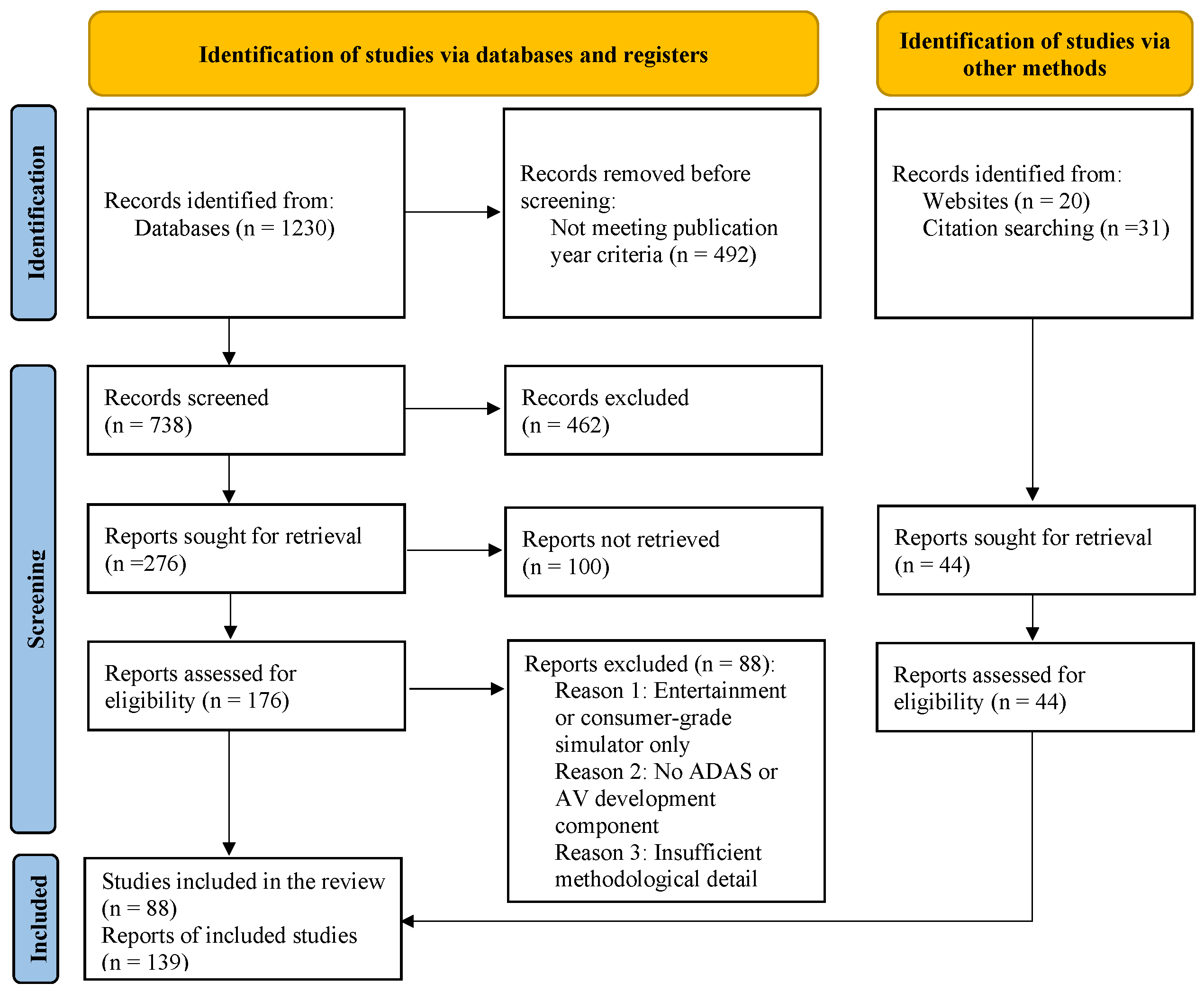
The initial IEEE-based search identified 1230 records. After removing 492 records that did not meet the publication-year criteria, 738 records were screened by title, and 462 records were excluded as irrelevant. The remaining 276 reports were sought for retrieval, of which 100 were not retrieved because the full text was either unavailable through accessible sources or, after closer inspection of the available record, did not provide sufficient technical detail to support the scope of this review. A total of 176 reports were assessed for eligibility, and 88 reports were excluded based on exclusion criteria such as entertainment or consumer-grade simulation, lack of ADAS or AV development components, and insufficient methodological detail. Finally, 88 studies were included in this review, while 51 manually identified supplementary sources were also used, resulting in 139 total references supporting the analysis. Figure 2 shows the flow diagram of this review.
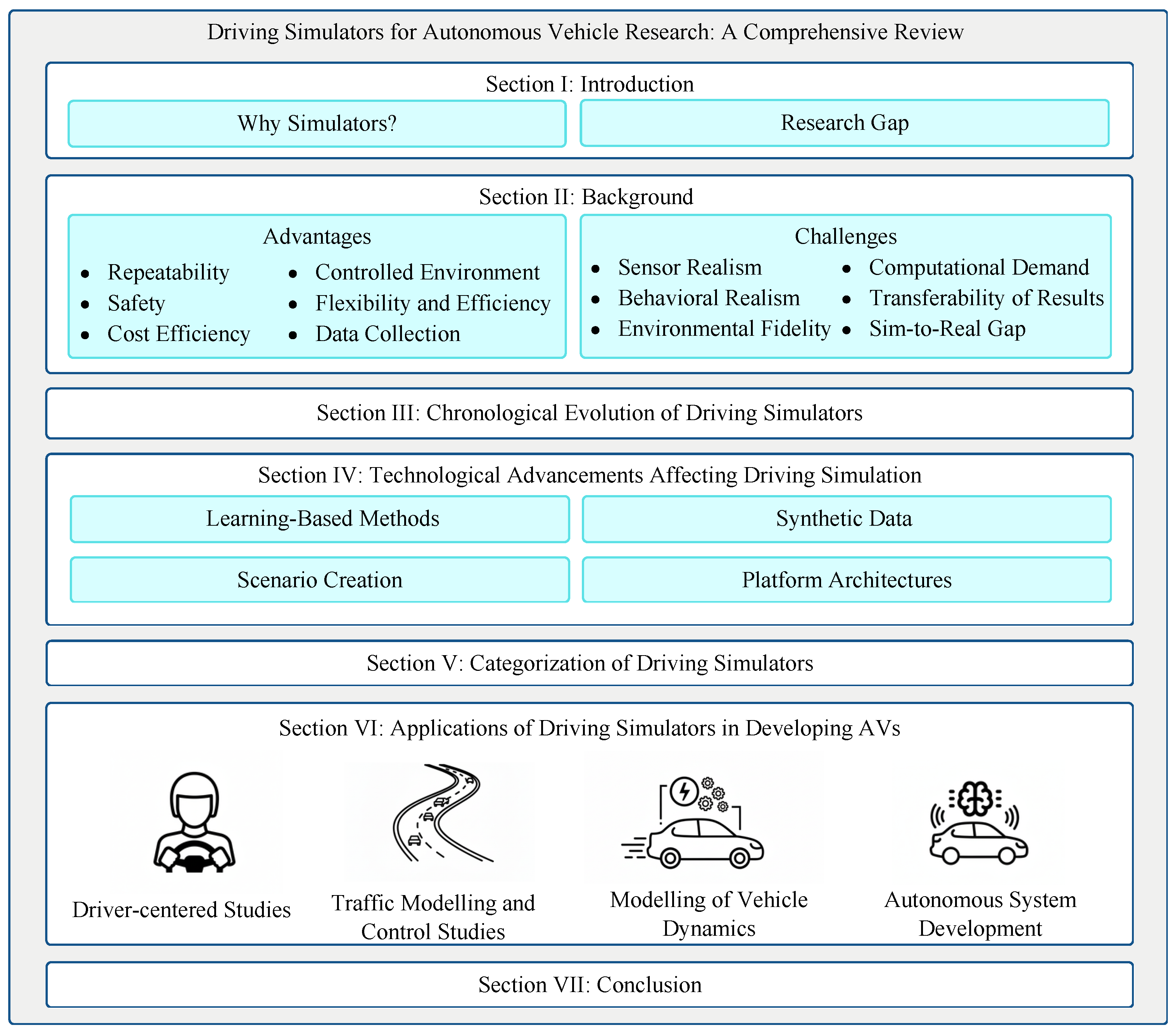
The remainder of this paper is organized as follows. Section 2 discusses real-world AV testing platforms and outlines the associated validation and safety challenges, motivating the need for driving simulators. Section 3 reviews the chronological evolution of driving simulators, highlighting key technological milestones from early mechanical systems to modern AI-driven virtual environments. Section 4 synthesizes the technological and methodological advances that enable modern driving simulators to evolve from basic testing tools into high-fidelity, scalable platforms for training, validation, and large-scale evaluation of autonomous vehicle systems. Section 5 presents a structured categorization of existing simulators based on purpose, fidelity, configuration, and integration level. Section 6 examines the role of driving simulators in AV development and validation. Finally, Section 7 concludes this work and states the prospects for driving simulators. Figure 3 illustrates the overall organization of this paper.

2. Background

2.1. Limitations of Real-World AV Testing

AV research originated from early experimental platforms, including Stanford’s lunar navigation cart (1961) and the University of Tsukuba’s self-driving vehicle (1977), which demonstrated the feasibility of machine-based navigation [16]. Subsequent large-scale initiatives, such as DARPA’s Autonomous Land Vehicle project in the 1980s [17], accelerated progress in perception, control, and on-road autonomy.
As AV technologies matured, formal safety and validation frameworks were introduced. Standards such as ISO 26262 and ISO 21448 establish systematic approaches for functional safety and the safety of intended functionality, providing structured methodologies for hazard analysis, risk assessment, and verification [18,19].
Despite these advances, real-world testing remains inherently costly, time-consuming, and safety-critical. On-road trials expose both the public and test operators to risk and provide limited coverage of rare or hazardous scenarios [20,21]. High-profile AV crashes like Uber’s 2018 fatal test accident [22], Google’s 2016 bus collision [23], and Tesla’s 2018 Autopilot crash [24], highlight persistent challenges in perception robustness, decision-making reliability, and system-level safety under complex environmental conditions.
These concerns expose two fundamental challenges: ensuring thorough and safe validation prior to public deployment, and increasing the likelihood of identifying potential risks and system failures before real-world road testing.

2.2. Advantages of Simulation-Based Testing

Driving simulators enable evaluation capabilities that are difficult or infeasible to achieve through exclusive reliance on on-road testing. In particular, simulators support controlled and repeatable execution of safety-critical scenarios, allowing identical experimental conditions to be reproduced across multiple trials. This capability is essential for systematically assessing rare and hazardous situations, such as near-collisions, aggressive cut-ins, extreme braking, and occlusions, that are statistically uncommon and ethically impractical to stage in public traffic without endangering human lives [20,21].
Simulators also reduce reliance on physical vehicles, fuel, and infrastructure, resulting in high cost and logistical advantages [25]. Facilities such as the National Advanced Driving Simulator (NADS) demonstrate the feasibility of conducting large-scale, safe, and cost-effective driver behaviour studies [20].
Furthermore, simulators enable ethical investigation of risky or sensitive driving behaviours, including distraction, fatigue, cognitive load, and novice driver performance, without exposing participants or the public to danger [26].
Owing to their scalability and environmental controllability, simulators are widely used for the development and validation of ADAS and AVs, enabling systematic testing under diverse traffic densities, weather conditions, and complex urban scenarios [20,25,27].

2.3. Limitations of Simulation-Based Testing

Despite their advantages, driving simulators cannot fully replace physical testing because replacing real-world validation requires comparable measurement fidelity, behavioural validity, and scenario coverage. In practice, four limitation classes systematically introduce domain mismatch: (1) sensor-model fidelity, (2) behavioural and environmental realism, (3) software/model-complexity constraints under real-time execution, and (4) hardware and motion cueing restrictions, which together exacerbate sim-to-real transfer gaps.
Virtual sensor models often approximate the behaviour of real cameras, LiDAR, and radar systems, limiting their ability to accurately reproduce sensor noise, environmental effects, and physical phenomena such as road adhesion and visibility degradation [28,29]. These simplifications can lead to discrepancies between simulated perception outputs and real-world measurements [30].
Moreover, simulators struggle to capture the diversity and unpredictability of human behaviour and complex multi-agent interactions. Li et al. [14] reported that simulators inadequately represent heterogeneous human behaviours, while Mütsch et al. [31] highlighted difficulties in modelling dense urban environments and dynamic traffic scenarios, potentially overlooking safety-critical corner cases [32].
Further, achieving high fidelity is constrained by real-time requirements and model availability. To maintain interactive execution, simulators often simplify traffic, weather, and dynamic phenomena, while robust validation remains limited by the scarcity of high-quality ground-truth data for calibration and verification [14]. In addition, accurately reproducing the coupled visual, auditory, and motion cues experienced by drivers remains challenging, affecting HIL realism and behavioural validity [33].
This results in simplified representations of complex urban traffic, weather conditions, and unpredictable behaviours. Obtaining robust, high-quality validation data remains challenging.
Hardware limitations further constrain realism. Although full-motion platforms can simulate realistic sensory cues, their physical limitations concerning range and dynamic response inherently compromise their effectiveness. Adaptive motion cueing algorithms, such as nonlinear washout filters, address some limitations but introduce trade-offs that affect responsiveness and may cause simulator sickness [34].
These limitations contribute to the sim-to-real transferability problem, where behaviours observed in simulation do not consistently generalize to physical vehicles. Empirical studies, such as Stocco et al. [35], show that simulated and physical AVs can exhibit different susceptibilities to adversarial conditions and differing trajectory outcomes despite similar control predictions, attributable to unmodelled friction, actuation latency, and environmental disturbances. They also report scenario-dependent discrepancies (e.g., blurred imagery causing more frequent/severe failures in physical tests), illustrating that simulation-only evaluation can miss critical vulnerabilities.

2.4. Simulator Validation and Sim-to-Real Transfer

Simulator validation must be treated as purpose-dependent rather than as a single global fidelity score. For driver-centred studies, validation commonly distinguishes subjective validity, relative behavioural validity, and absolute behavioural validity. Subjective validity concerns perceived realism; relative validity means that simulator and field studies show the same direction or ranking of effects; and absolute validity requires numerical agreement between simulator and real-world measurements [36,37]. For ADS testing, validation also occurs at multiple technical levels: component-level validation of sensors, vehicle dynamics, traffic agents, and human-behaviour models; scenario-level validation of road geometry, traffic density, weather, and event timing; and system-level closed-loop validation of perception, planning, control, communication, and actuation under realistic latency constraints [38,39].
Recent validation practices therefore combine calibration data, hold-out real-world data, uncertainty analysis, and staged testing. Proving-ground, naturalistic-driving, track-test, and fleet data can be used to calibrate model parameters and then evaluate hold-out scenarios using statistical distance measures, trajectory error, time-to-collision (TTC) distributions, speed and acceleration profiles, detection/false-alarm rates, workload measures, and equivalence testing. Cross-simulator benchmarking and staged MIL, SIL, PIL, DIL, VIL, HIL, and road testing further reduce the risk that a result is valid only for one simulator configuration. Simulation-based evidence should therefore be interpreted as one layer in a validation argument: it can increase coverage of rare or hazardous cases, but it does not remove the need for physical testing and traceable assumptions about the operational design domain.
The most suitable external validation evidence depends on the simulator application area. Driver-centred studies should be compared with on-road, proving-ground, or naturalistic-driving behaviour, including reaction time, takeover time, gaze behaviour, lane keeping, speed choice, workload, and TTC. Traffic studies should be validated against observed traffic flow, headways, travel times, conflict indicators, and real trajectory data. Vehicle dynamics and powertrain studies should be compared with instrumented-vehicle, track-test, or dynamometer measurements, including acceleration, yaw rate, steering torque, actuator delay, energy use, and battery or powertrain response. For ADAS and ADS studies, validation should prioritize synchronized sensor and trajectory evidence, such as camera/LiDAR/radar outputs, detection and false-alarm rates, object tracks, safety margins, TTC, trajectory prediction, and closed-loop control behaviour. These validation needs correspond to the application domains reviewed in Section 6.

3. Chronological Evolution of Driving Simulators

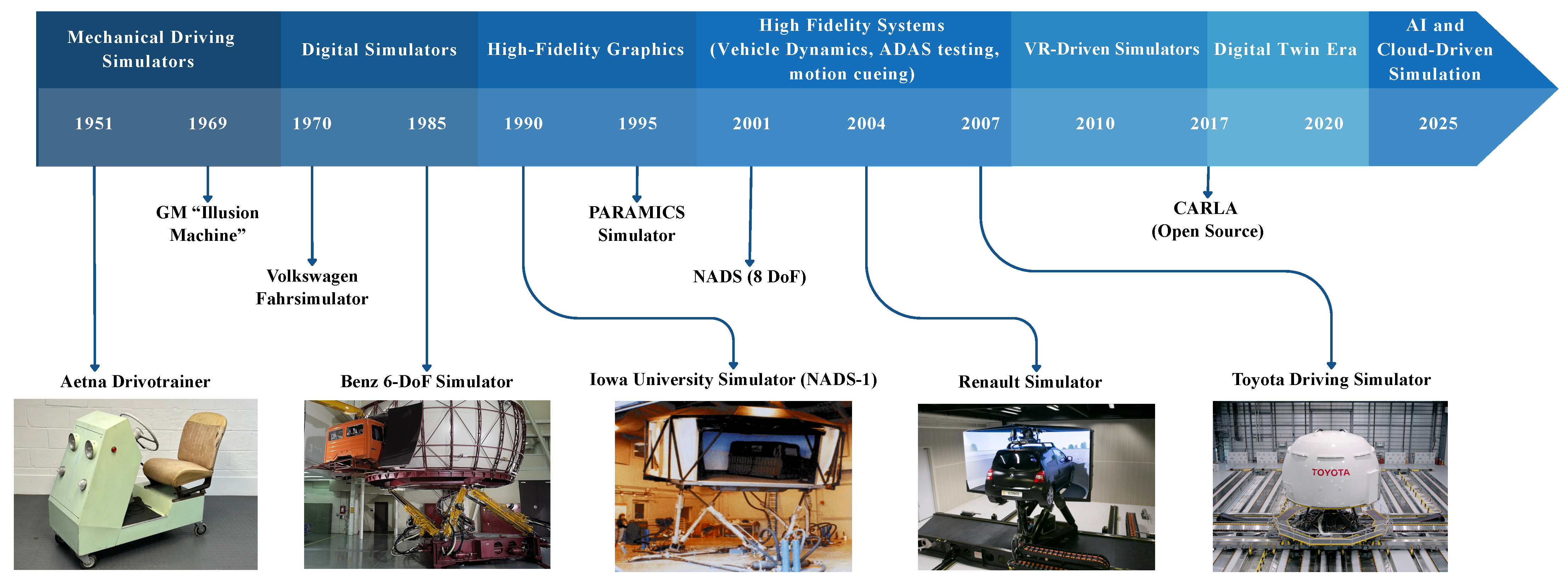
In this review, a driving simulator is defined broadly as a system that reproduces road-driving tasks by coupling driver inputs or vehicle-control algorithms with simulated vehicle, road, and feedback responses. Early devices such as the Aetna Drivotrainer in 1951 and GM’s “Illusion Machine” in 1969 are therefore treated as precursor training simulators. The 1970s mark the transition toward more research-oriented and computer-supported driving simulators with closed-loop vehicle response and improved motion or visual feedback.
Driving simulators evolved from these early training-oriented systems into more advanced research platforms during the 1970s as primarily mechanical systems designed to replicate basic driving tasks such as steering and braking [5]. These early platforms were used mainly for driver training and simple performance evaluation, offering limited dynamic realism. Subsequent developments introduced three-degrees-of-freedom (DoFs) motion systems, enabling pitch, roll, and yaw movements that enhanced immersion and improved the accuracy of dynamic vehicle response simulations [5]. A pivotal shift in simulator development occurred with the move from mechanically or film-based devices toward analytically designed, task-driven simulation. Wierwille and Fung [40] showed that computer-generated, closed-loop displays improve dynamic realism by coupling driver inputs directly to vehicle motion and visual feedback, establishing that accurate perception–action coupling is essential for valid driver performance measurement. In parallel, Valverde’s synthesis of flight-simulator transfer studies demonstrated that training effectiveness depends on preserving task-critical stimulus–response relationships rather than duplicating full physical realism, emphasizing functional fidelity over physical replication.
By the 1990s, driving simulator technology had advanced rapidly, driven by the emergence of high-performance computing and real-time graphics capabilities. This era, highlighted in [41], saw a surge in research-driven simulators with enhanced vehicle dynamics and improved driver interaction. Concurrently, the introduction of powerful graphics processing units (GPUs) enabled more realistic simulations of intricate road networks, dynamic traffic conditions, and environmental factors such as weather and lighting. The development of PARAMICS [42] advanced traffic flow analysis, incorporating multi-model transport models and examining driver behaviour in varied scenarios.
In the early 2000s, driving simulators continued to evolve, with increased computational power enabling more sophisticated motion cueing and higher graphical fidelity. Industry leaders such as Mechanical Simulation [43] and IPG Automotive [44] introduced advanced platforms like CarSim and Virtual Test Driving, greatly enhancing the ability to simulate real-world automotive behaviours and environments.
During the 2010s, technological advancements led to the integration of VR, AI, and deep learning into driving simulator environments, greatly enhancing realism and interactivity. VR introduced fully immersive 3D experiences, substantially improving users’ sense of presence. Simulators increasingly supported AV development by incorporating platforms such as SUMO [45] for simulating vehicular ad hoc networks (VANETs). Mohajer et al. [46] further highlighted the vital role of motion simulators in improving the fidelity of vehicle dynamics modelling.
In the 2020s, modern platforms integrate high-fidelity physics engines, advanced sensor modelling, and AI-driven environments to support perception, planning, and control testing. Platforms such as rFpro [47] and Siemens Simcenter Prescan [48] exemplify this cutting-edge integration, providing precise testing environments for AD algorithms. Industry partnerships further illustrate this trend: in 2025, GM and NVIDIA expanded their collaboration to leverage AI, accelerated computing, and simulation technologies for AVs, ADAS, and digital twin factory planning, signalling how AI-powered simulation is being embedded in both vehicle design and production processes [49].
This evolution sets the stage for modern, data-driven methods, as kis shown in Figure 4, that enhance simulator fidelity beyond hardware improvements alone, as discussed in the following section.

4. Advances in Driving Simulation: Fidelity Enhancement and Application Expansion

Recent advances in driving simulation have fundamentally reshaped how AVs are trained, tested, and validated. Modern simulators have evolved from static evaluation tools into dynamic development platforms capable of supporting large-scale learning, systematic validation, and safety-critical testing. This evolution is driven by four interrelated technological and methodological trends: learning-based methods, synthetic data generation, scenario creation, and advanced simulation platform architectures.
Modern driving simulators for AV research differ fundamentally from earlier human-driver training systems. While earlier simulators primarily emphasized visual realism, cockpit layout, or motion cueing, current platforms must also reproduce perception inputs, closed-loop decision-making, traffic-agent interactions, sensor degradation, communication latency, and rare safety-critical events. Consequently, recent research has shifted toward software and data-centric simulation methods that improve both fidelity and scalability. The following subsections summarize the main technical trends enabling this evolution.

4.1. Learning-Based Methods

Learning-based methods form a core component of modern driving simulators because AV algorithms must be evaluated under changing traffic, environmental, and behavioural conditions. The ego vehicle is the primary vehicle under control and observation in the simulation, typically representing the ADS being tested. Rather than replaying only pre-defined trajectories, learning-based simulation allows the ego vehicle, surrounding agents, or perception modules to adapt to new simulated conditions.
Online imitation learning updates the driving policy during simulation by comparing ego-vehicle behaviour with expert or reference behaviour, reducing compounding errors when a learned controller encounters states outside its original training distribution [50]. Deep learning, particularly convolutional neural networks (CNNs), has been applied to hazard perception by learning visual features associated with collision risk, obstacles, and unsafe situations in simulated environments [51]. Similarly, data-driven vehicle-speed estimation from synthetic simulator images demonstrates how visual simulation data can train perception modules when labelled real-world data are limited [34]. Reinforcement learning (RL) further supports policy optimization through repeated interaction with simulated traffic; however, RL-based controllers remain sensitive to adversarial perturbations, reward design, and sim-to-real distribution shifts. Recent work on deep Q-learning under cyberattack scenarios shows that simulators can also serve as controlled environments for robustness evaluation [52]. Overall, learning-based simulation supports policy learning, perception-model training, and stress testing, but learned behaviours still require validation against real driving data to avoid overfitting to simulator-specific visual styles, traffic-agent models, or reward structures.

4.2. Synthetic Data Generation, Neural Rendering, and Generative AI

Synthetic data generation plays a crucial role in AV development because perception and planning systems require diverse, labelled, and safety-critical examples that are difficult to collect on public roads. Earlier workflows relied mainly on graphics rendering, controlled environment parameters, and manually designed object layouts. Recent work improves both image quality and controllability by learning mappings from driving states, such as speed and angular velocity, to generated driving scene images [53].
Sensor realism is a major requirement for synthetic data. LiDAR simulation must reproduce geometry, intensity, reflectivity, sparsity, range noise, weather effects, and material-dependent returns. Virtual LiDAR intensity modelling improves the physical plausibility of simulated point clouds by explicitly modelling return intensity, which is important for downstream perception algorithms [54]. Neural radiance fields (NeRFs) and related neural rendering methods further improve environmental reconstruction by learning continuous scene representations from images. For example, NeRF-based road-surface extraction and object elimination support more realistic autonomous-driving simulators by reconstructing road geometry while separating dynamic objects from static background structure [55]. Large-scale neural scene disentanglement decomposes complex scenes into controllable components, enabling scene editing and new configuration generation [56]. Self-supervised depth completion also improves 3D reconstruction by filling missing depth information and increasing geometric consistency [57].
Generative AI has become a key recent breakthrough in synthetic driving scene generation. GAN-based methods showed that photorealistic image synthesis can be blended with conventional rendering to reduce the visual domain gap between simulation and real camera data [58]. More recent diffusion models improve controllability, temporal consistency, and photorealism compared with earlier GAN-only pipelines. MagicDrive uses diffusion-based street-view generation conditioned on camera poses, road maps, 3D bounding boxes, and text prompts, with cross-view attention for multi-camera consistency [59]. DrivingDiffusion extends this direction to layout-guided multi-view video generation using latent diffusion with cross-view and cross-frame consistency, which is important for AV perception systems operating on synchronized multi-camera streams [60]. Diffusion-based world models further move beyond static scene generation: DriveDreamer predicts structured traffic constraints and future scene evolution from driving videos [61], while UniSim converts recorded driving logs into modifiable closed-loop camera and LiDAR simulations in which actors can be added, removed, or moved [62]. These methods expand synthetic data from isolated images toward temporally coherent, geometrically controlled, and interactive sensor simulation; however, photorealistic outputs still require validation for geometry, sensor physics, temporal coherence, and sim-to-real transfer.

4.3. Scenario Creation, Coverage, and Automated Dataset Construction

Scenario creation is central to simulator utility, as the effectiveness of AV validation depends on exposure to diverse, rare, and complex traffic situations. Scenario generation must therefore cover the operational design domain (ODD), including ordinary traffic, near-miss events, vulnerable-road-user interactions, adverse weather, and edge cases that are unsafe to reproduce on public roads.
Risk-based scenario design organizes simulator experiments around specific hazard mechanisms such as tailgating, illegal overtaking, vulnerable-road-user conflict, distraction, and adverse weather [63]. Probabilistic methods expand these base cases by varying initial conditions, agent behaviour, traffic density, and environmental parameters. Monte Carlo sampling, for example, can generate families of related autonomous-driving scenarios rather than a single scripted event, improving coverage across plausible operating conditions [64].
Scenario generation also supports automated dataset construction. CARLA-based labelling tools reduce the manual effort required to produce object annotations for synthetic datasets [65]. This is important because simulators can provide consistent labels for object classes, bounding boxes, segmentation masks, depth, trajectories, and traffic-light states. Efficient 3D environment-generation methods further improve scalability by reducing the effort required to build large urban worlds with roads, intersections, buildings, and traffic infrastructure [66]. Data-reduction methods, although older, remain relevant because high-fidelity simulators can generate large volumes of redundant data; reducing duplicated or low-information samples helps preserve computational efficiency while retaining safety-relevant events [67]. The main challenge is that scenario quantity alone does not guarantee validation quality; generated cases must remain realistic, non-redundant, and representative of ODD-specific hazards.

4.4. Advanced Platform Architectures and Real-Time Integration

Advanced platform architectures provide the physical infrastructure that enhances the realism of simulations. They also provide the hardware and software infrastructure required for synchronized interaction between humans, vehicle controllers, sensors, and simulated environments.
High-fidelity platform designs, such as 6-DoF hydraulic platforms, provide nuanced motion feedback by simulating forces in multiple directions, which is ideal for high-speed or abrupt manoeuvrers [68]. Additionally, 4-DoF Stewart platforms offer flexible motion control and efficient integration with simulation software [69]. However, motion fidelity also depends on motion cueing algorithms, latency, actuator bandwidth, steering wheel feedback, visual update rate, and synchronization between vehicle dynamics and the display system.
Real-time synchronization between hardware and software is particularly crucial for vehicle-in-the-loop (VIL) testing, where the simulation must respond instantaneously to changing dynamics. In VIL, HIL, and DIL configurations, real vehicle hardware, controllers, sensors, actuators, or human drivers interact with the simulated environment through deterministic communication pipelines. High-speed emulation in VIL simulators demonstrates how physical steer-by-wire vehicles can reproduce high-speed driving dynamics at lower and safer physical speeds by coordinating visual, vestibular, and haptic feedback [33]. This shows how simulator architectures are shifting from desktop or software-only tools toward hybrid physical–virtual testbeds. The remaining challenge is maintaining real-time execution without oversimplifying sensor models, graphics rendering, traffic-agent behaviour, controller execution, or actuator response.
These innovations identify the key technological and methodological trends that enabled modern driving simulators to meet the fidelity, scalability, and validation requirements of AV development.

5. Categorization of Driving Simulators

Driving simulators can be differentiated according to their intended applications and technical capabilities. Simulator selection, therefore, depends on the specific research or development objectives. To systematize these differences, Table 2 summarizes a classification framework based on six dimensions: (1) Licensing and Source Availability, (2) Fidelity and Realism, (3) Physical Configuration, (4) Scale and Environment, (5) Simulation Integration and Verification Techniques, and (6) Application or Purpose.
The labels in Table 2 were assigned using a source-based coding procedure. Each simulator was reviewed using its official documentation, developer publications, or peer-reviewed studies cited in the corresponding table row. Licensing was coded according to whether the platform provides open-source access or is distributed as a commercial/proprietary tool. Fidelity was coded as high only when the cited source reported closed-loop vehicle dynamics, sensor or environment modelling, visual rendering, and real-time execution capability; otherwise, it was coded as low. Physical configuration, simulation scale, and MIL/SIL/PIL/DIL/VIL/HIL support were marked only when the cited source explicitly described or demonstrated that capability. When a feature could not be verified from the cited evidence, the corresponding cell was left blank. Therefore, Table 2 reports documented platform capabilities rather than subjective ranking.
Simulators are commonly deployed for driver training, entertainment, or research and development purposes [14]. This review focuses exclusively on research-oriented platforms.
From a software perspective, simulators are categorized as open-source or proprietary. Open-source platforms provide full access to source code and application programming interfaces (APIs), enabling algorithm customization, model modification, and reproducible experimentation. These characteristics are advantageous for academic research and rapid prototyping. Proprietary solutions typically provide optimized, tightly integrated toolchains with commercial support and validated components; however, restricted source access limits extensibility and experimental transparency.
Simulation fidelity denotes the accuracy with which real-world vehicle dynamics, sensor behaviour, and environmental interactions are reproduced. Fidelity depends on factors including dynamic model accuracy, numerical solver resolution, rendering quality, sensor emulation, and system latency. High-fidelity simulators are required for safety-critical validation and closed-loop controller testing [71], whereas lower-fidelity systems are generally sufficient for early-stage algorithm development or behavioural analysis.
Driving simulators are typically classified into desktop, fixed-base, motion-based, and dynamic configurations, depending on their level of physical realism and motion capability. Fixed-base simulators provide visual and control realism without motion feedback, while motion-based simulators use multi-DoF platforms to reproduce acceleration and vehicle dynamics. Advanced configurations such as VIL integrate real vehicle hardware for high-fidelity testing of autonomous driving and ADAS systems.
Simulation environments also differ in scale. Single-vehicle configurations emphasize detailed vehicle dynamics analysis, while multi-agent environments model interactions among multiple vehicles, infrastructure, and traffic participants.
Modern simulators further incorporate multiple integration and verification strategies. Model-in-the-Loop (MIL) and Software-in-the-Loop (SIL) enable virtual testing of control algorithms [79]. Processor-in-the-Loop (PIL), HIL, VIL, and Driver-in-the-Loop (DIL) integrate real controllers, sensors, or human drivers to improve real-time fidelity and experimental realism [80].

6. Applicationsof Driving Simulators in Developing AVs

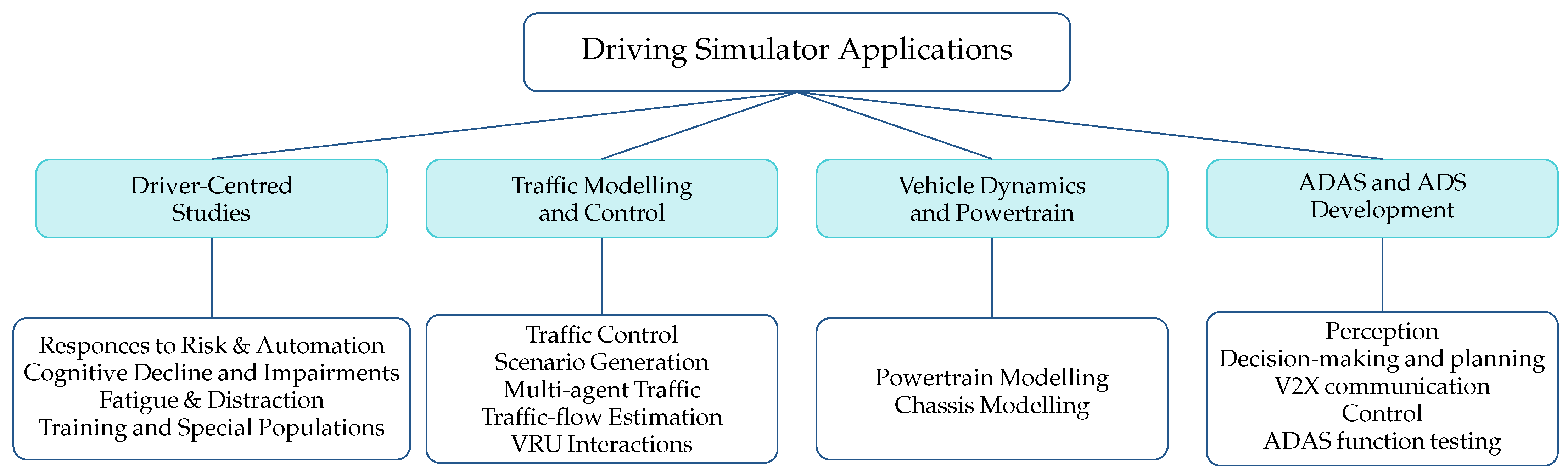
This section summarizes the principal applications of driving simulators in AV research and development. Figure 5 categorizes these applications, including driver-centred studies and AV system modelling and validation.
The studies reviewed in Section 6 differ not only in application domain, but also in simulator configuration, scenario design, measured variables, and validation limitations. Table 3 synthesizes these dimensions across the four major application groups: driver-centred studies, traffic modelling and control, vehicle dynamics and powertrain validation, and ADAS/ADS development. This comparison provides a structured overview before the following subsections discuss the individual evidence streams in more detail.

6.1. Driver-Centred Studies

Driving simulators are widely used for human factors evaluation and driver behaviour analysis independent of vehicle automation. Since ADAS and SAE 2–3 automation are shared-control systems, system safety depends on both automation performance and human response. DIL configurations enable real-time observation of perception, decision-making, reaction time, and control actions. These measurements inform the design, calibration, and validation of warning strategies, control authority transitions, and HMI [95].

6.1.1. Behavioural Responses to Risk and Automation

Driving simulators enable controlled evaluation of driver behavioural responses to risk and automation under safety-critical yet repeatable conditions (e.g., dense-traffic overtaking or near-collision events) [96]. Quantitative measures such as reaction time, gap acceptance, manoeuvrer selection, and behavioural adaptation characterize how drivers perceive hazards and regulate risk, supporting the development of predictive safety and intervention systems.
In partially automated driving, driver behaviour is additionally influenced by trust in automation in shared-control settings. Simulator-based DIL experiments quantify trust using Likert-scale subscales and objective behavioural indicators, including gaze allocation and minimum TTC. Increased trust has been associated with greater eyes-off-road time and reduced safety margins, demonstrating measurable interactions between attention diversion and collision risk [97]. These findings inform calibration of HMI strategies to maintain appropriate driver engagement.
Recent simulator-based takeover studies further connect driver-centred behaviour with proactive safety modelling. Shao et al. [81] developed a CatBoost-based takeover-time prediction framework using data from 44 participants in a high-fidelity driving simulator representing urban expressway ramp scenarios. The model integrated eye-tracking-derived mental workload, risk perception, driving style, ramp type, driver role, and surrounding-vehicle interactions. Their results showed that higher mental workload prolonged takeover time, especially in visually low-risk but cognitively demanding scenarios, while aggressive drivers tended to respond faster but exhibited lower post-takeover stability. In contrast, cautious drivers showed slower but more stable takeover behaviour. The study also showed that ramp type and interaction events such as lane cut-ins modulated takeover risk, with the model anticipating risk-inducing interactions up to 0.78 s before their actual onset. These findings demonstrate how driving simulators can move takeover research from retrospective behavioural measurement toward predictive and personalized safety intervention, including adaptive takeover prompt timing and role-aware assistance.
Driving simulators are also used to evaluate HMI designs that shape driver understanding and acceptance of automated functions. For instance, a VR-based simulator study evaluates user acceptance and exposure to automation [98]. Furthermore, in [99], an explanation-aware HMI is presented that communicates system intent and risk information, further improving interaction quality. This reduced the reported discomfort by approximately 5–6%, increased complete understanding by up to 14%, and decreased manual takeover intention by up to 50% in complex scenarios.
Beyond subjective factors, simulators support predictive modelling of driver behaviour for automated planning and control. Lane-changing intention recognition has been demonstrated up to 6.6 s prior to manoeuvrer execution with accuracies exceeding 98% [100]. Mixed-traffic studies similarly quantify adaptations in car-following behaviour through changes in time headway, string stability, and TTC, revealing trade-offs between traffic stability and driver attention [101]. Crowd-based simulation further estimates visual and comprehension loads induced by environmental complexity, enabling identification of violation-prone scenarios [102].

6.1.2. Cognitive Decline and Impairments

Driving simulators provide a controlled platform for quantifying cognitive and physiological impairments that directly affect driving performance. Simulator-derived behavioural features have enabled automated classification of safe versus unsafe driving in cognitively impaired populations with 85% accuracy compared to expert assessments [103].
Physiological monitoring further supports early detection of impairment. EEG-based approaches improved micro-sleep detection performance by approximately 30%, enabling identification of transient 1–30 s lapses in alertness that critically affect supervision reliability [104]. This helps to detect subtle cognitive and emotional impairments before they manifest in unsafe driving behaviours.
HMI design also influences cognitive demand. NASA-TLX workload scores differed significantly across three HMI designs, with the transparent interface reducing perceived workload by approximately 18–22%. EEG alpha/theta spectral power showed only non-significant trends [105].
Simulator experiments additionally quantify substance-induced degradation of vehicle control. Research involving alcohol shows a clear link between rising blood alcohol concentration (BAC) and increased risk-taking behaviour, supporting stricter BAC regulations. These studies indicate that intoxication increases the standard deviation of lane position by 4 cm and speed variability by 0.38 km/h, while reducing TTC, indicating elevated risk-taking behaviour [106,107] Similar studies on cannabis have revealed impairments in reaction time and vehicle control, reinforcing the need for targeted interventions [108,109].

6.1.3. Fatigue and Distraction

Driver fatigue and distraction remain critical human factors challenges in the transition toward higher levels of vehicle automation. Driving simulators enable evaluation of fatigue, distraction, and vigilance degradation under conditions that are unsafe or impractical to reproduce in real traffic.
Multimodal physiological sensing has been widely used to detect reduced alertness. Fusion of eye-movement and EEG features supports reliable identification of low-vigilance states in simulated driving by [110]. Real-time eye-tracking systems using fixation duration and pupil metrics achieve approximately 89% fatigue-classification accuracy [111]. Non-contact brain-signal monitoring has similarly demonstrated 78.8% overall accuracy and 95% drowsiness detection rate, with strong correlation to PERCLOS [112]. For conditional automation, multi-camera fusion approaches achieve up to 95.8% accuracy in classifying takeover readiness [113]. These results establish measurable thresholds for real-time driver monitoring systems, enabling AVs to detect loss of alertness and trigger warnings or fallback control.
Visual distraction studies further quantify the performance degradation associated with secondary tasks. Eye-gaze and visual behaviour also provide measures of distraction. Simulator studies show that increased visual distraction duration leads to longer reaction times, degraded vehicle control, and elevated mental workload [82]. Gaze-based metrics further enable estimation of cognitive load using non-intrusive eye tracking [114]. More on the prediction performance of lane-changing behaviour by integrating environmental and eye-tracking data in a driving simulator can be found in [115]. Such measurements can directly inform HMI design constraints by defining safe glance durations and attention requirements for in-vehicle displays and infotainment systems.
Environmental conditions also influence supervision reliability. Simulator experiments show that darkness increases subjective sleepiness, EEG alpha/theta activity, and blink duration while reducing driving speed [116]. Furthermore, the cabin environment influenced takeover performance. The research in [83] measures elevated CO2 and demonstrated degraded longitudinal speed control and increased fatigue-related gaze indicators. Environmental temperature modulation has also been evaluated in [117]. It says that a cooler temperature reduced mean reaction time by about 4%, decreased the eyelid closure ratio (PERCLOS), and lowered the EEG vigilance ratio by 18–33%, indicating improved alertness. Environmental factors have also been assessed in [118], where the presence of roadside vegetation was found to affect driver attention, speed regulation, and lane positioning. Furthermore, ref. [119] reports reaction time delays of 0.13–0.33 s during mobile-phone conversation, accompanied by 2–5% speed reductions and 10–40% increases in headway, indicating degraded hazard response and compensatory behaviour. Table 4 shows a summary of driver monitoring and fatigue/distraction studies.

6.1.4. Training and Special Populations

Simulators are extensively applied in driver training and rehabilitation, particularly for novice drivers and individuals with medical or neurological conditions. In a recent synthesis of simulator-based driver training, 14 out of 15 studies (93.3%) reported performance improvements following simulator training, with 11 studies (73.3%) showing significantly greater gains in trained groups than controls and with only 1 study (6.7%) finding no effect, underlining the robustness of simulator-mediated learning for procedural and higher-order driving skills [120]. Complementing this, ref. [121] shows that simulators are now the dominant tool for controlled behavioural measurement—especially for speed choice, lateral control, and acceleration/braking profiles—across domains such as distraction, fatigue, drugs, and adverse weather.
Training-focused work in at-risk older drivers illustrates how simulators can both remediate performance and expose detailed metrics that can be fed into AV models. In a single-session intervention suspected of reduced fitness to drive, simulator-based training produced measurable gains in road-sign knowledge, general driving performance, and specific behaviours such as average speed and hazard response time; critically, these improvements were observed across groups, indicating that even short, context-specific training can shift clinically relevant indicators in higher-risk populations [122]. Because these protocols record second-by-second trajectories, speeds, and reaction times, they yield precisely the sort of age- and impairment-stratified datasets AV developers need to (i) tune prediction models for older drivers’ speed choice and gaps and (ii) design takeover requests and shared-control strategies that respect slower processing but avoid overload. In more specialized contexts, dedicated simulators have been used to assess and tailor driving experiences for individuals with neurological or physical impairments, such as those living with Multiple Sclerosis (MS). Drivers with MS had higher median collision and infraction rates and drove at lower maximum speeds while maintaining similar mean speeds across urban and highway-like environments [123].
In overtaking manoeuvrers, Calvi et al. [9] used a fixed-base driving simulator to prototype an AR-based ADAS that trains drivers in safe gap selection, in a manner directly transferable to connected AV systems. The system emulates V2V/V2I connectivity by switching a head-up display traffic light to green only when the oncoming-traffic gap is objectively sufficient for a 10 s overtake. While AR did not significantly alter the kinematics of the manoeuvrer, it substantially changed when and where drivers chose to pass. The average waiting time before a lane change decreased from about 37.01 s (no AR) to 23.4 s with AR, with the virtual traffic light plus countdown timer configuration yielding roughly a 40% reduction. The proportion of drivers using the first safe gap increased from 17% (no AR) to 71–78% with AR, whereas unsafe gap choices fell from 5% (no AR) to 0–2% and to 0% under the virtual traffic light with audio condition.

6.2. Traffic Modelling and Control Studies

One central research focus is the synchronization between micro-level driving behaviour and macro-level traffic dynamics. For example, ref. [124] presents an integration of a non-real-time microscopic traffic simulation with a real-time driving simulator using model-based prediction. This setup enabled more accurate modelling of how individual driver behaviours respond to traffic control interventions, such as signal timing and lane management.
Kang et al. [84] present a behaviour Tree-based framework integrated with the CARLA simulator to automate scenario generation for AV testing. This approach enables realistic modelling of multi-actor traffic interactions and supports the evaluation of control algorithms under diverse traffic conditions. The work highlights how driving simulators can aid traffic modelling and control studies in AV development by facilitating systematic scenario creation and map-based coverage analysis.
Kumar et al. [125] employ the CARLA driving simulator to establish a vision-based approach for vehicle re-identification and trajectory reconstruction, utilizing multiple moving cameras. By simulating diverse traffic scenarios, the authors demonstrate how driving simulators can support citywide traffic flow analysis and AV perception research without the limitations of real-world data collection. Their work highlights the utility of simulation for modelling multi-vehicle interactions and evaluating computer vision algorithms crucial for autonomous navigation and traffic control.
Kumar et al. [85] employ the CARLA simulator to evaluate a computer vision-based framework for estimating citywide traffic flow using vehicle-mounted cameras. The study demonstrates how simulators can support scalable testing of traffic estimation algorithms under varied controlled scenarios by replicating diverse traffic conditions across seven virtual environments. Their work showcases the simulator’s role in validating vehicle detection, localization, and tracking pipelines critical for AV perception and traffic monitoring, achieving traffic volume estimation accuracies of up to 84.2% against synthetic ground truth.
Simulating pedestrian and cyclist interactions has also become a focal point as urban mobility evolves. For example, ref. [86] enhanced pedestrian dynamics modelling to understand how vehicles and pedestrians share space, informing the development of safer crosswalks and pedestrian zones. Likewise, as cycling gains popularity, particularly in urban areas, understanding vehicle–bicycle interactions becomes increasingly important. Ref. [87] investigated these dynamics using simulation tools to identify safety concerns and refine AV behaviour to ensure safe coexistence with cyclists.
Maroto et al. [126] present a real-time microscopic traffic simulation model tailored for integration with driving simulators. The model emphasizes dynamic interaction between a user-driven vehicle and surrounding traffic within a mobile control zone, enabling localized yet realistic simulation of urban traffic flow. It supports applications in AV development by replicating complex traffic conditions, including variable vehicle behaviour, signal regulation, and pedestrian interaction, making it useful for traffic control studies and real-time behavioural testing in simulated environments.

6.3. Modelling of Vehicle Dynamics

In AV development, driving simulators support detailed vehicle dynamics studies, particularly in chassis and powertrain modelling. Chassis modelling focuses on tuning suspension, steering, and stability systems, while powertrain modelling evaluates energy management and propulsion strategies.

6.3.1. Chassis Modelling

Modern driving simulators serve as analytical and experimental platforms in chassis modelling, particularly in developing steering systems, driver interaction models, and dynamic validation of control strategies. Their integration with data-driven approaches and real-time control systems progressively closes the gap between virtual and real-world testing.
One central area of application is the development of realistic steering feedback. Damian et al. [88] propose a torque-based control strategy that improves steering stability and fidelity compared to traditional position-based methods. DIL experiments in a high-fidelity simulator showed up to 46% higher perceived steering realism, 35.7% lower steering effort, and about 30% reduction in on-centre “stuck” behaviour, together with reduced hysteresis and fewer steering wheel oscillations.
To enhance the perceived realism and steering haptics, Zhao et al. [127] introduced a long short-term memory-based data-driven method for predicting steering feedback torque. This approach addresses the limitations of physics-based models by learning nonlinear steering dynamics from real-world data, showing strong generalization even under unconventional conditions. Böhle et al. [128] examined how high-frequency content in steering wheel vibrations and vehicle body motion influences subjective assessments of road feedback. Their findings indicate that a realistic representation of steering system bandwidth and vehicle motion frequency content is crucial for capturing subtle road texture and dynamics cues.
Driving simulators are also applied in studies of HMI. For instance, shared control models such as those explored by Wang et al. [129] highlight how varying levels of haptic steering feedback influence gaze behaviour and steering performance. Their simulator-based study demonstrates that Strong haptic guidance reduced the gaze–steering lead time by approximately 200 ms (from 1.23 s to 1.01 s), indicating tighter temporal coupling between gaze and steering under higher automation.
In semi-automated and teleoperated scenarios, driving simulators enable supervised experimentation with driver intent and system intervention. Muslim’s study [130] on adaptive lane-change assistance leverages simulation to evaluate haptic and autonomous steering interventions. The results show that driver acceptance and safety outcomes vary with the intervention strategy, underscoring the value of simulators in fine-tuning the distribution of control authority between the driver and the system.
Finally, Weiss and Gerdes [33] present an advanced application of VIL simulation using four-wheel steer-by-wire systems. Their setup emulates high-speed dynamics at lower physical speeds by decoupling visual, vestibular, and haptic feedback. This approach is beneficial for emulating highway manoeuvrers within constrained spaces.

6.3.2. Powertrain Modelling

Driving simulators have increasingly been integrated into powertrain modelling workflows, especially for electric vehicles (EVs), to facilitate system-level evaluation, enhance testing safety, and optimize DIL dynamics.
Simulators enable evaluating electric motor control strategies under diverse driving conditions, such as rapid acceleration or regenerative braking scenarios. These experiments help refine motor response models and assess thermal dynamics in real-time. The transition from internal-combustion powertrains to electrified and new energy vehicles introduces additional simulator requirements. Unlike conventional powertrains, EV propulsion, regenerative braking, brake blending, and torque-vectoring functions can generate rapid torque changes that must be synchronized with vehicle dynamics, driver inputs, sensor feedback, and communication delays. Therefore, EV-oriented driving simulators require higher temporal fidelity in drivetrain, battery, inverter, and actuator models, particularly in HIL, DIL, and real-time co-simulation settings. If these fast transient effects are simplified, simulators may fail to capture drivability issues such as torque discontinuities, regenerative-braking transitions, gear-shift jerk in multi-speed BEVs, and energy-efficiency/control trade-offs [89,131].
Xue et al. [90] developed iCO2, a massively multiplayer online eco-driving simulation game to collect large-scale driving behaviour data in a virtual environment. Though primarily designed for behavioural research, iCO2 integrates dynamic fuel consumption feedback and vehicle upgrade mechanics, enabling analysis of how driver interactions and in-game vehicle configurations affect energy efficiency. The real-time feedback and player-controlled driving inputs provide a simulated platform for studying powertrain responses to various driving styles. This makes it applicable for evaluating energy-saving strategies in EV powertrain modelling.
Jeschke et al. [132] introduced a HIL simulation framework with an interactive driving simulator built on MATLAB/Simulink to evaluate EV drivetrains across various operational conditions. The setup incorporated a modular drivetrain comprising a lithium-ion battery, inverter, and induction motor physically linked to a dynamic simulator via CAN and LAN networks. The simulator delivered realistic torque demands to the drivetrain and enabled assessment of battery current, voltage response, and torque generation under predefined cycles (e.g., US06) and real-driver inputs. The experimental results confirmed a strong correlation between measured and simulated values, validating the system’s ability to accurately replicate transient dynamics and energy consumption profiles.
Further advancing this approach, Chada et al. [131] employed a 6-DoF dynamic driving simulator for real-time evaluation of driver behaviour models and delay compensation in an eco-driving assistance system (EDAS) for EVs. Through DIL simulations, drivers tracked advisory speeds influenced by predictive models trained on stochastic and deterministic frameworks. The simulator provided sensory feedback and effectively mitigated the predicted driver delay, improving energy efficiency and trajectory tracking accuracy.
Louback et al. [89] examined the drivability of clutchless multi-speed gearboxes in battery electric vehicles (BEVs) using a static simulator. They analysed energy efficiency, gear shift strategies, and longitudinal jerk across urban and highway driving modes. The results underscored the need for calibrated shift maps to avoid gear-hunting behaviours and emphasized the simulator’s role in assessing transient ride comfort and torque delivery characteristics.
Moreover, Xue et al. [90] highlighted the importance of dynamic simulators for evaluating the trade-off between energy savings and passenger comfort in eco-driving strategies such as Pulse-and-Glide (PnG). The dynamic simulator enabled objective measurements of longitudinal jerk and subjective feedback from participants, revealing that while PnG can reduce energy use by up to 5%, it risks diminishing comfort unless optimized within acceptable jerk thresholds.

6.4. Applications of Driving Simulators in Developing AD/ADAS

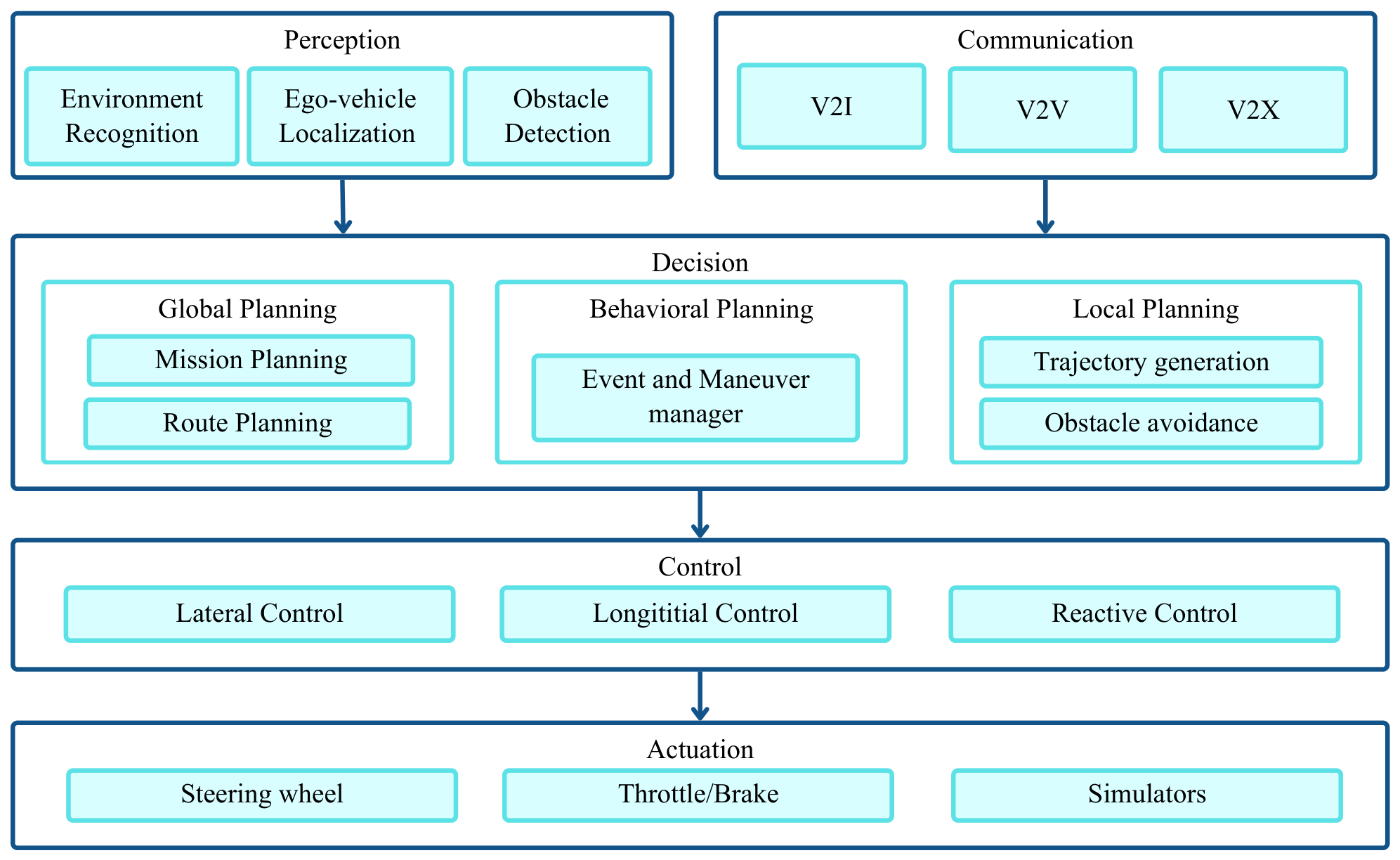
ADs consist of multiple interconnected subsystems, including perception, decision-making, communication, and control, as illustrated in Figure 6. These subsystems require extensive testing to ensure safety, reliability, and user acceptance.
Perception is at the core of ADS operation, enabling the vehicle to detect and interpret its surroundings. Simulators can recreate varied environmental and sensor conditions to validate ADs’ perception systems. For instance, Lee et al. [91] addressed the challenge of degraded LiDAR performance in foggy conditions, demonstrating that simulators are not only effective for testing perception algorithms but also for generating synthetic sensor data, which is especially valuable since collecting real-world LiDAR data in adverse weather is both costly and time-consuming.
Beyond perception, simulators play a critical role in validating decision-making and motion planning systems, which must generate safe, efficient, and adaptive responses to complex and uncertain traffic environments. Simulation-based validation enables controlled testing of planning algorithms under realistic multi-agent interactions, ensuring robust performance in dynamic scenarios. Studies have demonstrated the use of HIL simulators to evaluate safety models such as Responsibility-Sensitive Safety for adaptive cruise control (ACC), allowing simultaneous assessment of system safety and driver acceptability [133]. Similarly, simulation environments have been used to validate motion planning frameworks under realistic traffic behaviours, ensuring that planning algorithms are robust against unpredictable and non-scripted vehicle interactions [134]. Zhou et al. [92] introduced an interaction-aware MPC framework that integrates interaction modelling and multi-modal uncertainty into AD planning. It predicts probable behaviours (lane changes; braking) of surrounding vehicles and associated trajectory uncertainties. These predictions are then embedded into the MPC formulation to guide safe, proactive trajectory planning. Their method allows tuning between conservative and aggressive behaviour via a safety-awareness parameter, and was validated through synthetic and real-world dataset-based simulations. This provides a sophisticated approach to modelling realistic traffic interactions within simulated environments.
Recent advances in generative AI and digital twin technologies have further expanded simulation capabilities. For instance, ref. [135] developed a digital twin of highway on/off-ramps to identify potential conflict zones and traffic risks before deployment. This tool supports decision-making by allowing pre-emptive simulation of complex merging, exiting, and congestion conditions. These risk maps enhance strategic planning in navigation stacks and can be integrated into AV simulators to test route selection or manoeuvrer initiation.
Communication systems also represent a critical component of AV architectures. Connected vehicle (CV) technologies enhance AV situational awareness and cooperative behaviour, particularly in complex scenarios like intersection negotiation and platooning [4]. To support the development and validation of such capabilities, Dokur and Katkoori [93] introduced CARLA Connect, an extension of the CARLA simulator that incorporates communication elements, including on-board and roadside units. Their work demonstrated the simulation of V2X algorithms and the real-time exchange of basic safety messages, highlighting the framework’s value for testing cooperative behaviours under communication uncertainties. This simulation-based validation approach helps ensure algorithm robustness while reducing the risks and costs associated with physical testing. Ko et al. [94] took this approach further by applying a multi-agent driving simulator to evaluate the safety benefits of CV. Their results showed that CV-CV configurations achieved up to 45% CPI reduction, demonstrating the potential of communication-enhanced safety and providing a rigorous validation through driving simulation.
Simulators are essential not only for evaluating high-level planning but also for validating the low-level control stack. Control systems form the critical bridge between perception, planning, and physical actuation. These systems, responsible for translating decisions into smooth and safe vehicle motion, require rigorous testing across diverse operational scenarios, making them the backbone of any effective ADAS architecture. ADAS includes features such as lane departure warning, automatic emergency braking and adaptive cruise control. Testing these systems requires a vast range of scenarios, which is difficult, costly, and sometimes dangerous to replicate in the real world. For instance, Wang et al. developed a personalized ACC that learns individual drivers’ car-following behaviour and generates customized acceleration profiles. HIL driving simulator experiments showed that the controller reduced driver override duration by 60–85% compared with standard ACC models, indicating improved comfort and user acceptance. Another study has focused on evaluating specific ADAS functions where surface electromyography-controlled pedestrian collision avoidance demonstrated that simulators can effectively test system responsiveness in scenarios involving vulnerable road users [136].
As the line between ADAS and fully autonomous systems blurs, simulators are increasingly used to test autonomous driving functionalities. Dedicated simulation environments have been developed to assess steering angle prediction and dynamic motion planning for safely navigating unpredictable traffic conditions [134,137].
Another study [138] focused on the driving simulation of AVs, evaluating the performance of ADS control strategies under different driving conditions. It allows researchers to fine-tune AD algorithms and assess their effectiveness in a simulated, risk-free environment. The simulator enabled the testing of steering, acceleration, and braking algorithms and their ability to respond to various road conditions and obstacles.

7. Conclusions

This review has presented a comprehensive examination of driving simulators and their critical role in ADS development and AV validation. The fundamental motivations for simulation were first established by examining the limitations, risks, and constraints of real-world AV testing, thereby highlighting the need for safe, repeatable, and scalable validation platforms. The evolution of driving simulators was then traced from early mechanical systems to modern high-fidelity, AI-driven simulation environments, illustrating the technological progression that has enabled increasingly realistic and capable simulation platforms. In addition, key technological advancements were discussed, including learning-based simulation methods, synthetic data generation, scenario creation techniques, and advanced platform architectures, all of which have significantly enhanced the realism, scalability, and effectiveness of simulation-based validation.
This review has also presented a structured categorization of contemporary driving simulators based on licensing models, fidelity levels, physical configurations, scale, and system integration capabilities. These classifications provide a systematic framework for understanding simulator capabilities and selecting appropriate platforms for specific research and development objectives. Furthermore, major application domains were examined in detail, including driver-centred human factors studies, traffic modelling and control research, vehicle dynamics and powertrain modelling, and the development and validation of autonomous driving subsystems. These applications demonstrate that driving simulators serve not only as testing tools but also as integrated development environments that support the development of AD functions and the broader AV validation lifecycle.
The reviewed literature highlights several key benefits of driving simulation, including enhanced safety by eliminating risks to human participants, reduced development time and cost through early virtual testing, and the ability to reproduce rare, hazardous, and complex scenarios under controlled and repeatable conditions. These capabilities are particularly important for validating AD perception systems, decision-making algorithms, control strategies, and HMI in AV platforms. At the same time, this review identified important challenges, including limitations in sensor modelling accuracy, environmental and behavioural realism, computational constraints, and the sim-to-real transfer gap. These limitations emphasize that while simulation is indispensable, it must be complemented by real-world testing and supported by ongoing improvements in fidelity and validation methodologies.
Future research should move toward evidence-calibrated simulator ecosystems that address fidelity, scalability, real-time execution, and ethical validation together. Sensor-model fidelity can be improved through physics-informed models, data-driven noise and degradation models, and validation against synchronized road datasets, while behavioural realism requires larger naturalistic-driving datasets, driver-state modelling, and calibrated multi-agent traffic models. Real-time constraints can be mitigated through model reduction, parallel simulation, deterministic co-simulation, hardware acceleration, and edge-assisted execution, particularly for latency-sensitive HIL, VIL, and DIL workflows. Beyond conventional digital twins, metaverse-based and cloud/edge-enabled simulation frameworks may support distributed collaborative testing, shared virtual proving grounds, and large-scale scenario evaluation. Simulators can also contribute to ethical AV validation by enabling controlled assessment of rare safety-critical dilemmas, vulnerable-road-user interactions, perception or decision-making bias, and policy choices that cannot be safely or ethically evaluated directly on public roads.

Author Contributions

Conceptualization, T.R.N.; methodology, T.R.N.; software, T.R.N.; validation, T.R.N.; formal analysis, T.R.N.; investigation, T.R.N.; resources, T.R.N.; data curation, T.R.N.; writing—original draft preparation, T.R.N.; writing—review and editing, E.L.; visualization, T.R.N.; supervision, R.A. and A.E.; project administration, R.A. and A.E. All authors have read and agreed to the published version of the manuscript.

Funding

This research received no external funding.

Data Availability Statement

No new empirical data were generated in this review. The sources analyzed are cited in the article, and the literature search and selection procedure is described in Section 1. Data sharing is not applicable to this article.

Conflicts of Interest

The authors declare no conflicts of interest.

References

  1. Hu, X.; Han, J.; Tang, X.; Lin, X. Powertrain Design and Control in Electrified Vehicles: A Critical Review. IEEE Trans. Transp. Electrif. 2021, 7, 1990–2009. [Google Scholar] [CrossRef] [Scilit]
  2. Ghafarian, M.; Watson, M.; Mohajer, N.; Nahavandi, D.; Kebria, P.M.; Mohamed, S. A Review of Dynamic Vehicular Motion Simulators: Systems and Algorithms. IEEE Access 2023, 11, 36331–36348. [Google Scholar] [CrossRef] [Scilit]
  3. Abdi, B.; Mirzaei, S.; Adl, M.; Hidajat, S.; Emadi, A. Advancing Vulnerable Road Users Safety: Interdisciplinary Review on V2X Communication and Trajectory Prediction. IEEE Trans. Intell. Transp. Syst. 2025, 26, 2921–2943. [Google Scholar] [CrossRef] [Scilit]
  4. Nezhad, T.R.; Marufkhani, H.; Khosravi, M.A. Sliding Mode Control for a Platoon of Vehicular with DoS Attacks and Obstacles. In Proceedings of the 2023 31st International Conference on Electrical Engineering (ICEE), Tehran, Iran, 9–11 May 2023; pp. 738–744. [Google Scholar] [CrossRef] [Scilit]
  5. Bruck, L.; Haycock, B.; Emadi, A. A Review of Driving Simulation Technology and Applications. IEEE Open J. Veh. Technol. 2021, 2, 1–16. [Google Scholar] [CrossRef] [Scilit]
  6. Chougule, A.; Chamola, V.; Sam, A.; Yu, F.R.; Sikdar, B. A Comprehensive Review on Limitations of Autonomous Driving and Its Impact on Accidents and Collisions. IEEE Open J. Veh. Technol. 2024, 5, 142–161. [Google Scholar] [CrossRef] [Scilit]
  7. Fly Pure Flight. Unlocking Pilot Potential with Flight Simulators. 2023. Available online: https://flypureflight.com/blog/pilot-potential-with-flight-simulators/ (accessed on 5 November 2025).
  8. Kandhai, K.; Smith, M.; Kanneh, A. Immersive driving simulation for driver education and analysis. In Proceedings of the 2011 16th International Conference on Computer Games (CGAMES), Louisville, KY, USA, 27–30 July 2011; pp. 288–292. [Google Scholar] [CrossRef] [Scilit]
  9. Calvi, A.; D’Amico, F.; Ferrante, C.; Ciampoli, L.B. A Driving Simulator Study for Assessing the Potential of Augmented Reality Technology to Improve the Safety of Passing Maneuvers. In Proceedings of the 2021 7th International Conference on Models and Technologies for Intelligent Transportation Systems (MT-ITS), Heraklion, Greece, 16–17 June 2021; pp. 1–6. [Google Scholar] [CrossRef] [Scilit]
  10. Toyota Pressroom. TRI Supports Development of Open-Source Automated Driving Simulator. 2025. Available online: https://pressroom.toyota.com/tri-supports-development-open-source-automated-driving-simulator/ (accessed on 12 March 2025).
  11. Honda Newsroom. Honda Invests in Revolutionary Driving Simulator for Future R&D Activities. 2025. Available online: https://hondanews.eu/eu/fi/cars/media/pressreleases/123982/honda-invests-in-revolutionary-driving-simulator-for-future-randd-activities (accessed on 12 March 2025).
  12. The Verge. Chevy Corvette ZR1 Speed Record Simulation. 2025. Available online: https://www.theverge.com/chevrolet/624087/chevy-corvette-zr1-speed-record-simulation (accessed on 12 March 2025).
  13. General Motors Canada. GM Canada–News and Events. 2026. Available online: https://news.gm.ca/en/home.html (accessed on 6 February 2026).
  14. Li, Y.; Yuan, W.; Zhang, S.; Yan, W.; Shen, Q.; Wang, C.; Yang, M. Choose Your Simulator Wisely: A Review on Open-Source Simulators for Autonomous Driving. IEEE Trans. Intell. Veh. 2024, 9, 4861–4876. [Google Scholar] [CrossRef] [Scilit]
  15. Zhang, S.; Zhao, C.; Zhang, Z.; Lv, Y. Driving simulator validation studies: A systematic review. Simul. Model. Pract. Theory 2025, 138, 103020. [Google Scholar] [CrossRef] [Scilit]
  16. Mobileye. A Brief History of Autonomous Vehicles–from Renaissance to Reality. 2023. Available online: https://www.mobileye.com/blog/history-autonomous-vehicles-renaissance-to-reality/ (accessed on 11 February 2025).
  17. Strat, T.; Chellappa, R.; Patel, V. Vision and Robotics. AI Mag. 2020, 41, 49–65. [Google Scholar] [CrossRef] [Scilit]
  18. ISO 26262-1:2018; Road Vehicles—Functional Safety—Part 1: Vocabulary. International Organization for Standardization: Geneva, Switzerland, 2018.
  19. ISO 21448:2022; Road Vehicles—Safety of the Intended Functionality. International Organization for Standardization: Geneva, Switzerland, 2022.
  20. Schwarz, C.; Ahmad, O.; Brown, T.; Gaspar, J.; Wagner, G.; McGehee, D.V. The Long and Winding Road: 25 Years of the National Advanced Driving Simulator. IEEE Comput. Graph. Appl. 2023, 43, 121–128. [Google Scholar] [CrossRef] [Scilit] [PubMed]
  21. Seymour, J.; Ho, D.T.C.; Luu, Q.H. An Empirical Testing of Autonomous Vehicle Simulator System for Urban Driving. In Proceedings of the 2021 IEEE International Conference on Artificial Intelligence Testing (AITest), Oxford, UK, 23–26 August 2021; pp. 111–117. [Google Scholar] [CrossRef] [Scilit]
  22. BBC News. Uber’s Self-Driving Operator Charged over Fatal Crash. 2020. Available online: https://www.bbc.com/news/technology-54175359 (accessed on 22 January 2025).
  23. SXSW Interactive. Google Self-Driving Car Project. 2016. Available online: https://schedule.sxsw.com/2016/events/event_PP91541 (accessed on 16 December 2018).
  24. National Transportation Safety Board. Collision Between a Sport Utility Vehicle Operating with Partial Driving Automation and a Crash Attenuator, Mountain View, California, 23 March 2018. 2020. Available online: https://www.ntsb.gov/investigations/AccidentReports/Reports/HAR2001.pdf (accessed on 3 July 2026).
  25. Zhou, J.; Zhang, Y.; Guo, S.; Guo, Y. A Survey on Autonomous Driving System Simulators. In Proceedings of the 2022 IEEE International Symposium on Software Reliability Engineering Workshops (ISSREW), Charlotte, NC, USA, 31 October–3 November 2022; pp. 301–306. [Google Scholar] [CrossRef] [Scilit]
  26. Chan, E.; Pradhan, A.K.; Pollatsek, A.; Knodler, M.A.; Fisher, D.L. Are driving simulators effective tools for evaluating novice drivers’ hazard anticipation, speed management, and attention maintenance skills? Transp. Res. Part F Traffic Psychol. Behav. 2010, 13, 343–353. [Google Scholar] [CrossRef] [Scilit] [PubMed]
  27. Birchler, C.; Ganz, N.; Khatiri, S.; Gambi, A.; Panichella, S. Cost-effective Simulation-based Test Selection in Self-driving Cars Software with SDC-Scissor. In Proceedings of the 2022 IEEE International Conference on Software Analysis, Evolution and Reengineering (SANER), Honolulu, HI, USA, 15–18 March 2022; pp. 164–168. [Google Scholar] [CrossRef] [Scilit]
  28. Hanke, T.; Hirsenkorn, N.; Dehlink, B.; Rauch, A.; Rasshofer, R.; Biebl, E. Classification of sensor errors for the statistical simulation of environmental perception in automated driving systems. In Proceedings of the 2016 IEEE 19th International Conference on Intelligent Transportation Systems (ITSC), Rio de Janeiro, Brazil, 1–4 November 2016; pp. 643–648. [Google Scholar] [CrossRef] [Scilit]
  29. Holder, M.; Rosenberger, P.; Winner, H.; D’hondt, T.; Makkapati, V.P.; Maier, M.; Schreiber, H.; Magosi, Z.; Slavik, Z.; Bringmann, O.; et al. Measurements revealing Challenges in Radar Sensor Modeling for Virtual Validation of Autonomous Driving. In Proceedings of the 2018 21st International Conference on Intelligent Transportation Systems (ITSC), Maui, HI, USA, 4–7 November 2018; pp. 2616–2622. [Google Scholar] [CrossRef] [Scilit]
  30. Haider, A.; Pigniczki, M.; Koyama, S.; Köhler, M.H.; Haas, L.; Fink, M.; Schardt, M.; Nagase, K.; Zeh, T.; Eryildirim, A.; et al. A Methodology to Model the Rain and Fog Effect on the Performance of Automotive LiDAR Sensors. Sensors 2023, 23, 6891. [Google Scholar] [CrossRef] [Scilit] [PubMed]
  31. Kunishige, M.; Fukuda, H.; Iida, T.; Kawabata, N.; Ishizuki, C.; Miyaguchi, H. Spatial navigation ability and gaze switching in older drivers: A driving simulator study. Hong Kong J. Occup. Ther. 2019, 32, 22–31. [Google Scholar] [CrossRef] [Scilit] [PubMed]
  32. Morales-Alvarez, W.; Certad, N.; Roitberg, A.; Stiefelhagen, R.; Olaverri-Monreal, C. On Transferability of Driver Observation Models from Simulated to Real Environments in Autonomous Cars. In Proceedings of the 2023 IEEE 26th International Conference on Intelligent Transportation Systems (ITSC), Bilbao, Spain, 24–28 September 2023; pp. 3129–3134. [Google Scholar] [CrossRef] [Scilit]
  33. Weiss, E.; Gerdes, J.C. High Speed Emulation in a Vehicle-in-the-Loop Driving Simulator. IEEE Trans. Intell. Veh. 2023, 8, 1826–1836. [Google Scholar] [CrossRef] [Scilit]
  34. Martinez, A.H.; Díaz, J.L.; Daza, I.G.; Llorca, D.F. Data-driven vehicle speed detection from synthetic driving simulator images. In Proceedings of the 2021 IEEE International Intelligent Transportation Systems Conference (ITSC), Indianapolis, IN, USA, 19–22 September 2021; pp. 2617–2622. [Google Scholar] [CrossRef] [Scilit]
  35. Stocco, A.; Pulfer, B.; Tonella, P. Mind the Gap! A Study on the Transferability of Virtual Versus Physical-World Testing of Autonomous Driving Systems. IEEE Trans. Softw. Eng. 2023, 49, 1928–1940. [Google Scholar] [CrossRef] [Scilit]
  36. Wynne, R.A.; Beanland, V.; Salmon, P.M. Systematic Review of Driving Simulator Validation Studies. Saf. Sci. 2019, 117, 138–151. [Google Scholar] [CrossRef] [Scilit]
  37. Himmels, C.; Parduzi, A.; Fischer, M.; Riener, A. Towards a Common Understanding of Driving Simulator Validity. In Proceedings of the Adjunct Proceedings of the 15th International Conference on Automotive User Interfaces and Interactive Vehicular Applications, Ingolstadt, Germany, 18 September 2023; pp. 191–196. [Google Scholar] [CrossRef] [Scilit]
  38. Li, C.; Sifakis, J.; Wang, Q.; Yan, R.; Zhang, J. Simulation-Based Validation for Autonomous Driving Systems. In Proceedings of the 32nd ACM SIGSOFT International Symposium on Software Testing and Analysis, Seattle, WA, USA, 13 July 2023; pp. 1099–1110. [Google Scholar] [CrossRef] [Scilit]
  39. de Gelder, E.; Buermann, M.; Op den Camp, O. Coverage Metrics for a Scenario Database for the Scenario-Based Assessment of Automated Driving Systems. In Proceedings of the 2024 IEEE International Automated Vehicle Validation Conference, Pittsburgh, PA, USA, 22–23 October 2024; pp. 1–8. [Google Scholar] [CrossRef] [Scilit]
  40. Wierwille, W.W.; Fung, P.P. Comparison of Computer-Generated and Simulated Motion Picture Displays in a Driving Simulation. Hum. Factors 1975, 17, 577–590. [Google Scholar] [CrossRef] [Scilit]
  41. Blana, E. A Survey of Driving Research Simulators Around the World; Technical Report; University of Leeds: Leeds, UK, 1996. [Google Scholar]
  42. Smith, M.; Duncan, G.; Druitt, S. PARAMICS: Microscopic traffic simulation for congestion management. In Proceedings of the IEE Colloquium on Dynamic Control of Strategic Inter-Urban Road Networks; Institution of Electrical Engineers (IEE): London, UK, 1995; pp. 8/1–8/3. [Google Scholar] [CrossRef] [Scilit]
  43. Mechanical Simulation Corporation. CarSim, TruckSim, and BikeSim–Vehicle Simulation Software. 2025. Available online: https://www.carsim.com/ (accessed on 31 January 2025).
  44. IPG Automotive GmbH. IPG Automotive–Virtual Test Driving Solutions. 2025. Available online: https://www.ipg-automotive.com/en (accessed on 31 January 2025).
  45. Lim, K.G.; Lee, C.H.; Chin, R.K.Y.; Beng Yeo, K.; Teo, K.T.K. SUMO enhancement for vehicular ad hoc network (VANET) simulation. In Proceedings of the 2017 IEEE 2nd International Conference on Automatic Control and Intelligent Systems (I2CACIS), Kota Kinabalu, Malaysia, 21 October 2017; pp. 86–91. [Google Scholar] [CrossRef] [Scilit]
  46. Mohajer, N.; Abdi, H.; Nelson, K.; Nahavandi, S. Vehicle motion simulators, a key step towards road vehicle dynamics improvement. Veh. Syst. Dyn. 2015, 53, 1204–1226. [Google Scholar] [CrossRef] [Scilit]
  47. rFpro. rFpro: Automotive and Autonomous Driving Simulation. 2025. Available online: https://rfpro.com/ (accessed on 31 January 2025).
  48. Siemens. Simcenter Autonomous Vehicle Solutions. 2025. Available online: https://plm.sw.siemens.com/en-US/simcenter/autonomous-vehicle-solutions/ (accessed on 31 January 2025).
  49. NVIDIA Newsroom. General Motors and NVIDIA Collaborate on AI for Next-Generation Vehicle Experience and Manufacturing. 2025. Available online: https://nvidianews.nvidia.com/news/general-motors-and-nvidia-collaborate-on-ai-for-next-generation-vehicle-experience-and-manufacturing (accessed on 3 July 2026).
  50. Zhang, Z.; Zhao, S. Online Imitation Learning for Self-Driving Simulation. In Proceedings of the 2021 16th International Conference on Computer Science & Education (ICCSE), Lancaster, UK, 17–21 August 2021; pp. 810–815. [Google Scholar] [CrossRef] [Scilit]
  51. Pawar, P.; McManus, B.; Anthony, T.; Stavrinos, D. Hazard Detection in Driving Simulation using Deep Learning. In Proceedings of the SoutheastCon 2021, Atlanta, GA, USA, 10–13 March 2021; pp. 1–8. [Google Scholar] [CrossRef] [Scilit]
  52. Aikins, G.; Jagtap, S.; Gao, W. Resilience Analysis of Deep Q-Learning Algorithms in Driving Simulations Against Cyberattacks. In Proceedings of the 2022 1st International Conference on AI in Cybersecurity (ICAIC), Victoria, TX, USA, 24–26 May 2022; pp. 1–6. [Google Scholar] [CrossRef] [Scilit]
  53. Imai, Y.; Senda, T.; Kajiwara, Y. Improving Image Quality and Controllability in Speed + Angular Velocity to Image Generation Through Synthetic Data for Driving Simulator Generation. IEEE Access 2025, 13, 12168–12177. [Google Scholar] [CrossRef] [Scilit]
  54. Lee, D.J.; Im, J.; Won, J.H. Virtual Lidar Sensor Intensity Data Modeling for Autonomous Driving Simulators. IEEE Access 2023, 11, 120694–120706. [Google Scholar] [CrossRef] [Scilit]
  55. Hosoya, K.; Okuyama, Y.; Sugaya, S.; Oyama, R.; Nisimura, S.; Tomioka, Y.; Shin, J. Road Surface Extraction and Object Elimination for Autonomous Driving Simulators Based on Neural Radiance Field. In Proceedings of the 2024 IEEE 17th International Symposium on Embedded Multicore/Many-Core Systems-on-Chip (MCSoC), Kuala Lumpur, Malaysia, 16–19 December 2024; pp. 24–31. [Google Scholar] [CrossRef] [Scilit]
  56. Jiang, C.; Niu, R.; Chen, Z.; Hua, C.; Kuang, X.; Fu, X.; Yu, B.; Zhu, H. Large-Scale Neural Scene Disentanglement Approach for Self-Driving Simulation. IEEE Trans. Intell. Veh. 2026, 11, 15–26. [Google Scholar] [CrossRef] [Scilit]
  57. Zhang, Y.; Zheng, X.; Liang, H. Self-driving simulation scene reconstruction using self-supervised depth completion. In Proceedings of the 2022 7th International Conference on Automation, Control and Robotics Engineering (CACRE), Xi’an, China, 14–16 July 2022; pp. 254–263. [Google Scholar] [CrossRef] [Scilit]
  58. Yurtsever, E.; Yang, D.; Koc, I.M.; Redmill, K.A. Photorealism in Driving Simulations: Blending Generative Adversarial Image Synthesis With Rendering. IEEE Trans. Intell. Transp. Syst. 2022, 23, 23114–23123. [Google Scholar] [CrossRef] [Scilit]
  59. Gao, R.; Chen, K.; Xie, E.; Hong, L.; Li, Z.; Yeung, D.Y.; Xu, Q. MagicDrive: Street View Generation with Diverse 3D Geometry Control. In Proceedings of the Twelfth International Conference on Learning Representations, Vienna, Austria, 7–11 May 2024. [Google Scholar]
  60. Li, X.; Zhang, Y.; Ye, X. DrivingDiffusion: Layout-Guided Multi-View Driving Scenarios Video Generation with Latent Diffusion Model. In Proceedings of the Computer Vision–ECCV 2024, Milan, Italy, 25 October 2024; pp. 469–485. [Google Scholar] [CrossRef] [Scilit]
  61. Wang, X.; Zhu, Z.; Huang, G.; Chen, X.; Zhu, J.; Lu, J. DriveDreamer: Towards Real-World-Driven World Models for Autonomous Driving. In Proceedings of the Computer Vision–ECCV 2024, Milan, Italy, 27 November 2024; pp. 55–72. [Google Scholar] [CrossRef] [Scilit]
  62. Yang, Z.; Chen, Y.; Wang, J.; Manivasagam, S.; Ma, W.C.; Yang, A.J.; Urtasun, R. UniSim: A Neural Closed-Loop Sensor Simulator. In Proceedings of the IEEE/CVF Conference on Computer Vision and Pattern Recognition, Vancouver, BC, Canada, 17–24 June 2023; pp. 1389–1399. [Google Scholar] [CrossRef] [Scilit]
  63. Amini, R.E.; Michelaraki, E.; Katrakazas, C.; Al Haddad, C.; De Vos, B.; Cuenen, A.; Yannis, G.; Brijs, T.; Antoniou, C. Risk scenario designs for driving simulator experiments. In Proceedings of the 2021 7th International Conference on Models and Technologies for Intelligent Transportation Systems (MT-ITS), Heraklion, Greece, 16–17 June 2021; pp. 1–6. [Google Scholar] [CrossRef] [Scilit]
  64. Liu, Y.; Lv, J.; Zhao, Y. Generalization of Autonomous Driving Simulation Scenarios with Monte Carlo Sampling. In Proceedings of the 2023 8th International Conference on Intelligent Informatics and Biomedical Sciences (ICIIBMS), Okinawa, Japan, 23–25 November 2023; Volume 8, pp. 481–485. [Google Scholar] [CrossRef] [Scilit]
  65. Benčević, Z.; Grbić, R.; Jelić, B.; Vranješ, M. Tool for automatic labeling of objects in images obtained from Carla autonomous driving simulator. In Proceedings of the 2023 Zooming Innovation in Consumer Technologies Conference (ZINC), Novi Sad, Serbia, 29–31 May 2023; pp. 119–124. [Google Scholar] [CrossRef] [Scilit]
  66. Wagener, N.; Beckmann, J.; Eckstein, L. Efficient Creation of 3D-Virtual Environments for Driving Simulators. In Proceedings of the 2022 International Conference on Electrical, Computer, Communications and Mechatronics Engineering (ICECCME), Male, Maldives, 16–18 November 2022; pp. 1–6. [Google Scholar] [CrossRef] [Scilit]
  67. Pawar, P.; Anthony, T.; McManus, B.; Stavrinos, D. Data Reduction Solution for Driving Simulator. In Proceedings of the 2020 SoutheastCon, Raleigh, NC, USA, 28–29 March 2020; pp. 1–7. [Google Scholar] [CrossRef] [Scilit] [PubMed]
  68. Adel, A.; Mahmoud, M.; Sayed, N.; Hisham, O.; Ossama, O.; Adel, P.; Ayman, Y.; Awad, M.I.; Maged, S.A.; Umer, S.M.; et al. Design of A 6-DOF Hydraulic Vehicle Driving Simulator. In Proceedings of the 2020 International Conference on Innovative Trends in Communication and Computer Engineering (ITCE), Aswan, Egypt, 8–9 February 2020; pp. 170–175. [Google Scholar] [CrossRef] [Scilit]
  69. de la Rosa Garcia, A.; Garcia-Luna, F.; Rodriguez-Ramirez, A. 4-DoF Stewart Platform Interface for Driving Simulator Software Data. In Proceedings of the 2021 International Conference on Advanced Mechatronic Systems (ICAMechS), Tokyo, Japan, 9–12 December 2021; pp. 1–6. [Google Scholar] [CrossRef] [Scilit]
  70. The Eclipse SUMO Project. Eclipse SUMO: Simulation of Urban MObility. 2025. Available online: https://eclipse.dev/sumo/ (accessed on 3 July 2026).
  71. Rong, G.; Shin, B.H.; Tabatabaee, H.; Lu, Q.; Lemke, S.; Možeiko, M.; Boise, E.; Uhm, G.; Gerow, M.; Mehta, S.; et al. LGSVL Simulator: A High Fidelity Simulator for Autonomous Driving. In Proceedings of the 2020 IEEE 23rd International Conference on Intelligent Transportation Systems (ITSC), Rhodes, Greece, 20–23 September 2020; pp. 1–6. [Google Scholar] [CrossRef] [Scilit]
  72. Microsoft AI & Research. AirSim Open Source Simulator for Drones, Cars and More. 2025. Available online: https://microsoft.github.io/AirSim/ (accessed on 3 July 2025).
  73. IPG Automotive GmbH. CarMaker—IPG Automotive Simulation Software. 2025. Available online: https://www.ipg-automotive.com/en/products-solutions/software/carmaker/ (accessed on 3 July 2025).
  74. Mechanical Simulation Corporation. CarSim Vehicle Dynamics Simulation Software. 2025. Available online: https://www.carsim.com/products/carsim/ (accessed on 3 July 2025).
  75. CARLA Team. CARLA: Open-Source Simulator for Autonomous Driving Research. 2025. Available online: https://carla.org/ (accessed on 7 February 2025).
  76. Siemens Digital Industries Software. Simcenter Prescan Software. 2025. Available online: https://plm.sw.siemens.com/en-US/simcenter/autonomous-vehicle-solutions/prescan/ (accessed on 3 July 2025).
  77. rFpro Limited (an AB Dynamics Company). rFpro Engineering Grade Vehicle Simulation Software. 2025. Available online: https://rfpro.com/simulation-software/ (accessed on 3 July 2025).
  78. McMaster University Faculty of Engineering. McMaster Automotive Resource Centre Adopts Static Driving Simulator from VI-Grade. 2025. Available online: https://www.eng.mcmaster.ca/news/mcmaster-automotive-resource-centre-adopts-static-driving-simulator-from-vi-grade/ (accessed on 7 February 2025).
  79. Bruggner, D.; Hegde, A.; Acerbo, F.S.; Gulati, D.; Son, T.D. Model in the Loop Testing and Validation of Embedded Autonomous Driving Algorithms. In Proceedings of the 2021 IEEE Intelligent Vehicles Symposium (IV), Nagoya, Japan, 11–17 July 2021; pp. 136–141. [Google Scholar] [CrossRef] [Scilit]
  80. Oh, T.; Ha, Y.; Yoo, D.; Yoo, J. AD-VILS: Implementation and Reliability Validation of Vehicle-in-the-Loop Simulation Platform for Evaluating Autonomous Driving Systems. IEEE Access 2024, 12, 164190–164209. [Google Scholar] [CrossRef] [Scilit]
  81. Shao, Y.; Xu, Y.; Zhang, Y.; Ye, Z. From prediction to prevention: Safety modeling of driver takeover time with mental workload, risk perception, and driving style in ramp scenarios. Accid. Anal. Prev. 2026, 233, 108565. [Google Scholar] [CrossRef] [Scilit] [PubMed]
  82. Liang, Z.; Wang, Y.; Qian, C.; Wang, Y.; Zhao, C.; Du, H.; Deng, J.; Li, X.; He, Y. A Driving Simulator Study to Examine the Impact of Visual Distraction Duration from In-Vehicle Displays: Driving Performance, Detection Response, and Mental Workload. Electronics 2024, 13, 2718. [Google Scholar] [CrossRef] [Scilit]
  83. Wang, Z.; Sheng, H.; Gu, F.; Zhao, L.; Wang, Z.; He, D. The influence of cabin environment on takeover performance in conditional automated driving. Transp. Res. Part F Traffic Psychol. Behav. 2026, 117, 103478. [Google Scholar] [CrossRef] [Scilit]
  84. Kang, S.; Hao, H.; Dong, Q.; Meng, L.; Xue, Y.; Wu, Y. Behavior-Tree Based Scenario Specification and Test Case Generation for Autonomous Driving Simulation. In Proceedings of the 2022 2nd International Conference on Intelligent Technology and Embedded Systems (ICITES), Chengdu, China, 23–26 September 2022; pp. 125–131. [Google Scholar] [CrossRef] [Scilit]
  85. Kumar, A.; Kashiyama, T.; Maeda, H.; Omata, H.; Sekimoto, Y. Citywide reconstruction of traffic flow using the vehicle-mounted moving camera in the CARLA driving simulator. In Proceedings of the 2022 IEEE 25th International Conference on Intelligent Transportation Systems (ITSC), Macau, China, 8–12 October 2022; pp. 2292–2299. [Google Scholar] [CrossRef] [Scilit]
  86. Neubauer, M.; Ruddeck, G.; Schrab, K.; Protzmann, R.; Radusch, I. A Pedestrian Movement Model for 3D Visualization in a Driving Simulation Environment. In Proceedings of the 2022 IEEE/ACM 26th International Symposium on Distributed Simulation and Real Time Applications (DS-RT), Ales, France, 26–28 September 2022; pp. 17–24. [Google Scholar] [CrossRef] [Scilit]
  87. Lindner, J.; Keler, A.; Grigoropoulos, G.; Malcolm, P.; Denk, F.; Brunner, P.; Bogenberger, K. A coupled driving simulator to investigate the interaction between bicycles and automated vehicles. In Proceedings of the 2022 IEEE 25th International Conference on Intelligent Transportation Systems (ITSC), Macau, China, 8–12 October 2022; pp. 1335–1341. [Google Scholar] [CrossRef] [Scilit]
  88. Damian, M.; Shyrokau, B.; Carrera Akutain, X.; Happee, R. Experimental Validation of Torque-Based Control for Realistic Handwheel Haptics in Driving Simulators. IEEE Trans. Veh. Technol. 2022, 71, 196–209. [Google Scholar] [CrossRef] [Scilit]
  89. Louback, E.; Machado, F.; Bruck, L.; Kollmeyer, P.J.; Emadi, A. Real-Time Performance and Driveability Analysis of a Clutchless Multi-Speed Gearbox for Battery Electric Vehicle Applications. In Proceedings of the 2022 IEEE Transportation Electrification Conference & Expo (ITEC), Anaheim, CA, USA, 15–17 June 2022; pp. 1041–1046. [Google Scholar] [CrossRef] [Scilit]
  90. Xue, H.; Ballo, F.; Previati, G.; Gobbi, M. Eco-Driving of Electric Vehicles: Objective and Subjective Evaluation of Passenger Comfort by a Dynamic Driving Simulator. IEEE Trans. Veh. Technol. 2025, 74, 402–412. [Google Scholar] [CrossRef] [Scilit]
  91. Lee, J.; Shiotsuka, D.; Nishimori, T.; Nakao, K.; Kamijo, S. LiDAR Translation Based on Empirical Approach between Sunny and Foggy for Driving Simulation. In Proceedings of the 2022 25th International Symposium on Wireless Personal Multimedia Communications (WPMC), Herning, Denmark, 30 October–2 November 2022; pp. 430–435. [Google Scholar] [CrossRef] [Scilit]
  92. Zhou, J.; Olofsson, B.; Frisk, E. Interaction-Aware Motion Planning for Autonomous Vehicles With Multi-Modal Obstacle Uncertainty Predictions. IEEE Trans. Intell. Veh. 2024, 9, 1305–1319. [Google Scholar] [CrossRef] [Scilit]
  93. Dokur, O.; Katkoori, S. CARLA Connect: A Connected Autonomous Vehicle (CAV) Driving Simulator. In Proceedings of the 2022 IEEE International Symposium on Smart Electronic Systems (iSES), Warangal, India, 18–22 December 2022; pp. 656–659. [Google Scholar] [CrossRef] [Scilit]
  94. Ko, J.; Jang, J.; Oh, C. A Multi-Agent Driving Simulation Approach for Evaluating the Safety Benefits of Connected Vehicles. IEEE Trans. Intell. Transp. Syst. 2022, 23, 4512–4524. [Google Scholar] [CrossRef] [Scilit]
  95. Federal Highway Administration. FHWA Highway Driving Simulator: A Tool for Highway Safety and Operations Studies; Technical Report; U.S. Department of Transportation: Washington, DC, USA, 2003.
  96. Zhang, J.; Geng, D.; Guo, F.; Yang, Z.; Shi, J. Research On Influencing Factors of Overtaking Behavior Based On Six-Degrees-Of-Freedom Driving Simulator. In Proceedings of the 2021 4th International Symposium on Traffic Transportation and Civil Architecture (ISTTCA), Suzhou, China, 12–14 November 2021; pp. 18–22. [Google Scholar] [CrossRef] [Scilit]
  97. Yin, W.; Chai, C.; Zhou, Z.; Li, C.; Lu, Y.; Shi, X. Effects of trust in human-automation shared control: A human-in-the-loop driving simulation study. In Proceedings of the 2021 IEEE International Intelligent Transportation Systems Conference (ITSC), Indianapolis, IN, USA, 12–22 September 2021; pp. 1147–1154. [Google Scholar] [CrossRef] [Scilit]
  98. Qiao, Z.; Sun, X.; Loeb, H.; Mangharam, R. Drive Right: Shaping Public’s Trust, Understanding, and Preference Towards Autonomous Vehicles Using a Virtual Reality Driving Simulator. In Proceedings of the 2023 IEEE Intelligent Vehicles Symposium (IV), Anchorage, AK, USA, 4–7 June 2023; pp. 1–8. [Google Scholar] [CrossRef] [Scilit]
  99. Goldman, C.V.; Bustin, R. Trusting Explainable Autonomous Driving: Simulated Studies. In Proceedings of the 2022 IEEE Intelligent Vehicles Symposium (IV), Aachen, Germany, 4–9 June 2022; pp. 1255–1260. [Google Scholar] [CrossRef] [Scilit]
  100. Zhang, H.; Gao, S.; Guo, Y. Driver Lane-Changing Intention Recognition Based on Stacking Ensemble Learning in the Connected Environment: A Driving Simulator Study. IEEE Trans. Intell. Transp. Syst. 2024, 25, 1503–1518. [Google Scholar] [CrossRef] [Scilit]
  101. Zhou, A.; Liu, Y.; Tenenboim, E.; Agrawal, S.; Peeta, S. Car-Following Behavior of Human-Driven Vehicles in Mixed-Flow Traffic: A Driving Simulator Study. IEEE Trans. Intell. Veh. 2023, 8, 2661–2673. [Google Scholar] [CrossRef] [Scilit]
  102. Jiang, Z.; He, X.; Lu, C.; Zhou, B.; Fan, X.; Wang, C.; Ma, X.; Ngai, E.C.; Chen, L. Understanding Drivers’ Visual and Comprehension Loads in Traffic Violation Hotspots Leveraging Crowd-Based Driving Simulation. IEEE Trans. Intell. Transp. Syst. 2022, 23, 23369–23383. [Google Scholar] [CrossRef] [Scilit]
  103. Wallace, B.; Gagnon, S.; Stinchcombe, A.; Yamin, S.; Goubran, R.; Knoefel, F. Preliminary Results for the Automated Assessment of Driving Simulation Results for Drivers with Cognitive Decline. In Proceedings of the 2021 IEEE Sensors Applications Symposium (SAS), Sundsvall, Sweden, 23–25 August 2021; pp. 1–6. [Google Scholar] [CrossRef] [Scilit]
  104. Kweon, Y.S.; Kwak, H.G.; Shin, G.H.; Lee, M. Automatic Micro-sleep Detection under Car-driving Simulation Environment using Night-sleep EEG. In Proceedings of the 2021 9th International Winter Conference on Brain-Computer Interface (BCI), Gangwon, South Korea, 22–24 February 2021; pp. 1–6. [Google Scholar] [CrossRef] [Scilit]
  105. Liu, Y.C.; Figalova, N.; Baumann, M.; Bengler, K. Human-Machine Interface Evaluation Using EEG in Driving Simulator. In Proceedings of the 2023 IEEE Intelligent Vehicles Symposium (IV), Anchorage, AK, USA, 4–7 June 2023; pp. 1–6. [Google Scholar] [CrossRef] [Scilit]
  106. Irwin, C.; Iudakhina, E.; Desbrow, B.; McCartney, D. Effects of acute alcohol consumption on measures of simulated driving: A systematic review and meta-analysis. Accid. Anal. Prev. 2017, 102, 248–266. [Google Scholar] [CrossRef] [Scilit] [PubMed]
  107. Van Dyke, N.A.; Fillmore, M.T. Laboratory analysis of risky driving at 0.05% and 0.08% blood alcohol concentration. Drug Alcohol. Depend. 2017, 175, 127–132. [Google Scholar] [CrossRef] [Scilit] [PubMed]
  108. Tank, A.; Tietz, T.; Daldrup, T.; Schwender, H.; Hellen, F.; Ritz-Timme, S.; Hartung, B. On the impact of cannabis consumption on traffic safety: A driving simulator study with habitual cannabis consumers. Int. J. Leg. Med. 2019, 133, 1411–1420. [Google Scholar] [CrossRef] [Scilit]
  109. Hartley, S.; Simon, N.; Larabi, A.; Vaugier, I.; Barbot, F.; Quera-Salva, M.A.; Alvarez, J.C. Effect of smoked cannabis on vigilance and accident risk using simulated driving in occasional and chronic users and the Pharmacokinetic–Pharmacodynamic relationship. Clin. Chem. 2019, 65, 684–693. [Google Scholar] [CrossRef] [Scilit] [PubMed]
  110. Wang, B.; Wang, J.; Wang, X.; Chen, L.; Jiao, C.; Zhang, H.; Liu, Y. An Identification Method for Road Hypnosis Based on the Fusion of Human Life Parameters. Sensors 2024, 24, 7529. [Google Scholar] [CrossRef] [Scilit] [PubMed]
  111. Xu, J.; Min, J.; Hu, J. Real-time eye tracking for the assessment of driver fatigue. Healthc. Technol. Lett. 2018, 5, 54–58. [Google Scholar] [PubMed]
  112. Soleymanpour, R.; Shishavan, H.H.; Heo, J.S.; Kim, I. Novel Driver’s Drowsiness Detection System and its Evaluation in a Driving Simulator Environment. In Proceedings of the 2021 IEEE International Conference on Systems, Man, and Cybernetics (SMC), Melbourne, Australia, 17–20 October 2021; pp. 1204–1208. [Google Scholar] [CrossRef] [Scilit]
  113. Rezaei, M.; Azarmi, M. Driver-Net: Multi-Camera Fusion for Assessing Driver Take-Over Readiness in Automated Vehicles. In Proceedings of the 2025 IEEE Intelligent Vehicles Symposium (IV), Cluj-Napoca, Romania, 22–25 June 2025; pp. 1841–1848. [Google Scholar] [CrossRef] [Scilit]
  114. Pillai, P.; Balasingam, B.; Kim, Y.H.; Lee, C.; Biondi, F. Eye-Gaze Metrics for Cognitive Load Detection on a Driving Simulator. IEEE/ASME Trans. Mechatron. 2022, 27, 2134–2141. [Google Scholar] [CrossRef] [Scilit]
  115. Deng, Q.; Wang, J.; Hillebrand, K.; Benjamin, C.R.; Söffker, D. Prediction Performance of Lane Changing Behaviors: A Study of Combining Environmental and Eye-Tracking Data in a Driving Simulator. IEEE Trans. Intell. Transp. Syst. 2020, 21, 3561–3570. [Google Scholar] [CrossRef] [Scilit]
  116. Ahlström, C.; Anund, A.; Fors, C.; Åkerstedt, T. The effect of daylight versus darkness on driver sleepiness: A driving simulator study. J. Sleep Res. 2018, 27, e12642. [Google Scholar] [PubMed]
  117. Guo, Z.; Yuan, B.; Zhou, M.; Li, G.; Xu, H.; Li, Z.; Zhang, Y. Using Cool Stimulation as a Strategy to Keep High Vigilance Level of High-Speed Railway Driver. IEEE Sens. J. 2025, 25, 1086–1103. [Google Scholar] [CrossRef] [Scilit]
  118. Fitzpatrick, C.D.; Samuel, S.; Knodler, M.A., Jr. Evaluating the effect of vegetation and clear zone width on driver behavior using a driving simulator. Transp. Res. Part F Traffic Psychol. Behav. 2016, 42, 80–89. [Google Scholar] [CrossRef] [Scilit]
  119. Wijayaratna, K.P.; Cunningham, M.L.; Regan, M.A.; Jian, S.; Chand, S.; Dixit, V.V. Mobile phone conversation distraction: Understanding differences in impact between simulator and naturalistic driving studies. Accid. Anal. Prev. 2019, 129, 108–118. [Google Scholar] [CrossRef] [Scilit] [PubMed]
  120. Paul, N.; Moncion, B.; Cao, S. An experimental comparison on the effectiveness of various levels of simulator fidelity on ab initio pilot training. Ergonomics 2025, 68, 2029–2045. [Google Scholar] [CrossRef] [Scilit] [PubMed]
  121. Hussain, M.; Baikejuli, M.; Shi, J.; Pervez, A.; Albrecht, M.A.; Hussain, E.; Hasan, R.; Senserrick, T. Driving Simulator-Based Driving Behavioural Research: A Bibliometric and Narrative Review Providing Key Insights for New and Emerging Researchers. Vehicles 2026, 8, 32. [Google Scholar] [CrossRef] [Scilit]
  122. Urlings, J.H.; Roelofs, E.; Cuenen, A.; Brijs, K.; Brijs, T.; Jongen, E.M. Development of single-session driving simulator-based and computer-based training for at-risk older drivers. Educ. Gerontol. 2019, 45, 283–296. [Google Scholar] [CrossRef] [Scilit]
  123. Pierella, C.; Romani, P.; Gandolfi, F.; Podda, J.; Massone, A.; Tacchino, A.; Brichetto, G.; Canessa, A.; Ricci, S.; Casadio, M. Driving Simulator for Assessing Driving Skills of People with Multiple Sclerosis: A Pilot Study. In Proceedings of the 2022 9th IEEE RAS/EMBS International Conference for Biomedical Robotics and Biomechatronics (BioRob), Seoul, South Korea, 21–24 August 2022; pp. 1–5. [Google Scholar] [CrossRef] [Scilit]
  124. Maddipatla, S.P.; Brennan, S. Synchronization and Feedback Loop Integration of a Non-real Time Microscopic Traffic Simulation with a Real-time Driving Simulator using Model-Based Prediction. In Proceedings of the 2021 American Control Conference (ACC), New Orleans, LA, USA, 25–28 May 2021; pp. 4376–4382. [Google Scholar] [CrossRef] [Scilit]
  125. Kumar, A.; Kashiyama, T.; Maeda, H.; Zhang, F.; Omata, H.; Sekimoto, Y. Vehicle re-identification and trajectory reconstruction using multiple moving cameras in the CARLA driving simulator. In Proceedings of the 2022 IEEE International Conference on Big Data (Big Data), Osaka, Japan, 17–20 December 2022; pp. 1858–1865. [Google Scholar] [CrossRef] [Scilit]
  126. Maroto, J.; Delso, E.; Felez, J.; Cabanellas, J.M. Real-Time Traffic Simulation With a Microscopic Model. IEEE Trans. Intell. Transp. Syst. 2006, 7, 513–527. [Google Scholar] [CrossRef] [Scilit]
  127. Zhao, R.; Deng, W.; Wang, Y.; Huang, K.; Zheng, B.; Ding, J. An Improved Data-Driven Method for Steering Feedback Torque of Driving Simulator. IEEE/ASME Trans. Mechatron. 2023, 28, 2953–2963. [Google Scholar] [CrossRef] [Scilit]
  128. Böhle, M.; Schick, B.; Müller, S. Steering Feedback in Dynamic Driving Simulators: The Influence of Steering Wheel Vibration and Vehicle Motion Frequency. IEEE Trans. Intell. Veh. 2024, 9, 7781–7796. [Google Scholar] [CrossRef] [Scilit]
  129. Wang, Z.; Zheng, R.; Kaizuka, T.; Nakano, K. Relationship Between Gaze Behavior and Steering Performance for Driver–Automation Shared Control: A Driving Simulator Study. IEEE Trans. Intell. Veh. 2019, 4, 154–166. [Google Scholar] [CrossRef] [Scilit]
  130. Muslim, H. Design and Evaluation of Lane-Change Collision Avoidance Systems in Semi-Automated Driving. IEEE Trans. Veh. Technol. 2023, 72, 7082–7094. [Google Scholar] [CrossRef] [Scilit]
  131. Chada, S.K.; Görges, D.; Ebert, A.; Teutsch, R.; Min, C.G. Learning-Based Driver Behavior Modeling and Delay Compensation to Improve the Efficiency of an Eco-Driving Assistance System. In Proceedings of the 2022 IEEE International Conference on Systems, Man, and Cybernetics (SMC), Prague, Czech Republic, 9–12 October 2022; pp. 415–422. [Google Scholar] [CrossRef] [Scilit]
  132. Jeschke, S.; Hirsch, H.; Koppers, M.; Schramm, D. HiL simulation of electric vehicles in different usage scenarios. In Proceedings of the 2012 IEEE International Electric Vehicle Conference, Greenville, SC, USA, 4–8 March 2012; pp. 1–8. [Google Scholar] [CrossRef] [Scilit]
  133. Chai, C.; Zeng, X.; Alvarez, I.; Elli, M.S. Evaluation of Responsibility-Sensitive Safety (RSS) Model based on Human-in-the-loop Driving Simulation. In Proceedings of the 2020 IEEE 23rd International Conference on Intelligent Transportation Systems (ITSC), Rhodes, Greece, 20–23 September 2020; pp. 1–7. [Google Scholar] [CrossRef] [Scilit]
  134. Li, Y. Motion Planning for Dynamic Scenario Vehicles in Autonomous-Driving Simulations. IEEE Access 2023, 11, 2035–2047. [Google Scholar] [CrossRef] [Scilit]
  135. Liu, C.; Zhang, C.; Wang, B.; Tang, Z.; Xie, Z. Digital Twin of Highway Entrances and Exits: A Traffic Risk Identification Method. IEEE J. Radio Freq. Identif. 2022, 6, 934–937. [Google Scholar] [CrossRef] [Scilit]
  136. Nacpil, E.J.C.; Wang, Z.; Yan, Z.; Kaizuka, T.; Nakano, K. Surface Electromyography-Controlled Pedestrian Collision Avoidance: A Driving Simulator Study. IEEE Sens. J. 2021, 21, 13877–13885. [Google Scholar] [CrossRef] [Scilit]
  137. Benja, B.; Mijić, D.; Vranješ, M.; Grbić, R. Steering Angle Prediction and Algorithm Performance Testing in Autonomous Driving Simulators. In Proceedings of the 2024 International Symposium ELMAR, Zadar, Croatia, 16–18 September 2024; pp. 25–30. [Google Scholar] [CrossRef] [Scilit]
  138. Xu, Z.Y.; Jiang, J.F.; Wei, H.Y.; Hsu, K.S. Driving Simulation of Autonomous Vehicle with ADS Control. In Proceedings of the 2020 IEEE Eurasia Conference on IOT, Communication and Engineering (ECICE), Yunlin, Taiwan, 23–25 October 2020; pp. 374–377. [Google Scholar] [CrossRef] [Scilit]
Figure 1. Number of studies on driving simulators and trends.
Vehicles 08 00158 g001
Figure 2. Selection of papers for this review.
Vehicles 08 00158 g002
Figure 3. Overview of the main topics and research themes discussed in each section of this study.
Vehicles 08 00158 g003
Figure 4. Driving simulators’ evolution over time.
Vehicles 08 00158 g004
Figure 5. Applications of driving simulators.
Vehicles 08 00158 g005
Figure 6. General architecture of an ADS within an AD/ADAS.
Vehicles 08 00158 g006
Table 1. Comparison of topic coverage across driving simulator review papers.
PaperYearEnhancements in Simulator Capability and ScopeClassification of Driving SimulatorsDriving Simulators Human-Behavior Centered ApplicationsDriving Simulators AV-Centered Applications
This paper2026
Zhang et al. [15]2025
Li et al. [14]2024
Ghafarian et al. [2]2023
Bruck et al. [5]2020
Table 2. Comparison of driving simulators.
SimulatorLicensingFidelityPhysical ConfigurationScaleSimulation IntegrationApplication
Open Source Proprietary Single Multi MIL SIL PIL DIL VIL HIL
SUMO [70] L *F **
LGSVL [71] HF ②, ④
AirSim [72] HF
IPG CarMaker [73] HF
CarSim [74] HF
CARLA [75] HF ②, ③, ④
PreScan [76] HF
rFpro [77] HF ②, ③, ④
NVIDIA DRIVE Sim HF ②, ③, ④
VI-grade [78] HF/M ①, ②, ③, ④
* L: Low; H: High. ** F: Fixed-based; M: Motion-based. ➀ Driver-centred studies; ➁ Traffic modelling and control studies; ➂ Modelling of vehicle dynamics; ➃ AD system development and AV validation.
Table 3. Comparative synthesis of studies reviewed in Section 6.
DomainClassificationTypical EvidenceScenario TypeMeasured Variables Across StudiesMain Limitation
Driver-centred studiesHuman-in-the-loop validationDIL/VR/fixed-base studies [81,82,83].Takeover, trust/HMI, fatigue, distraction, impairment, training.Reaction/takeover time, gaze, EEG/PERCLOS, workload, TTC, trust, comfort.Small/controlled samples; limited real-road transfer.
Traffic modelling and controlTraffic- and scenario-level validationCo-simulation, CARLA, pedestrian and bicycle–AV simulation [84,85,86,87].Traffic control, scenario generation, flow reconstruction, VRU interaction.Scenario coverage, traffic volume, trajectories, detection/tracking, conflict indicators.Synthetic agents and VRU behaviour need real-data calibration.
Vehicle dynamics and powertrainHardware/vehicle-response validationDIL/VIL/HIL and dynamic/static simulator studies [33,88,89,90].Steering haptics, shared control, EV drivetrain, eco-driving, and drivability.Steering torque/effort, actuator delay, jerk, battery response, and energy use.Results depend strongly on simulator hardware and model fidelity.
ADAS/ADS developmentAutonomy-stack validationSensor simulation, HIL/SIL, digital twins, and V2X and ADAS prototypes [91,92,93,94].Perception, planning, V2X, collision avoidance, and ADS control.Sensor realism, safety margin, trajectory feasibility, V2X exchange, and control stability.Requires stronger sim-to-real validation of sensors, scenarios, and traffic agents.
Table 4. Summary of driver monitoring and fatigue/distraction studies.
Ref.FactorKey Result
[110]Eye + EEG fusionLow vigilance detection
[111]Eye-tracking89% fatigue accuracy
[112]Brain monitoring95% drowsiness detection
[113]Multi-camera95.8% takeover accuracy
[82]Visual distractionSlower reaction time
[114]Gaze metricsWorkload estimation
[115]Eye + environmentLane-change prediction
[116]DarknessHigher fatigue indicators
[83]CO2Reduced control, more fatigue
[117]TemperatureImproved vigilance (cooler)
[118]VegetationAffects attention/lane position
[119]Mobile phoneReaction time delay
Disclaimer/Publisher’s Note: The statements, opinions and data contained in all publications are solely those of the individual author(s) and contributor(s) and not of MDPI and/or the editor(s). MDPI and/or the editor(s) disclaim responsibility for any injury to people or property resulting from any ideas, methods, instructions or products referred to in the content.