
Generation of Vehicle Crash Deformation Fields from Limited Simulation Data Using Machine Learning Approach

 ,
,
Abstract
1. Introduction
2. Concept of the Proposed Approach
2.1. Generation of Data for Occupant Sled Analysis (First Stage)
2.2. Modeling for Lower-Limb Injury Prediction (Second Stage)
3. Numerical Data of Vehicle Body Deformation
3.1. Numerical Analysis Setup and Results
3.2. Definition of Input and Output Variables
4. Machine Learning Method
4.1. Overview of Gradient Boosting
4.2. XGBoost Model Formulation
4.3. Workflow and Performance Metrics
5. Evaluation of Vehicle Body Deformation Prediction
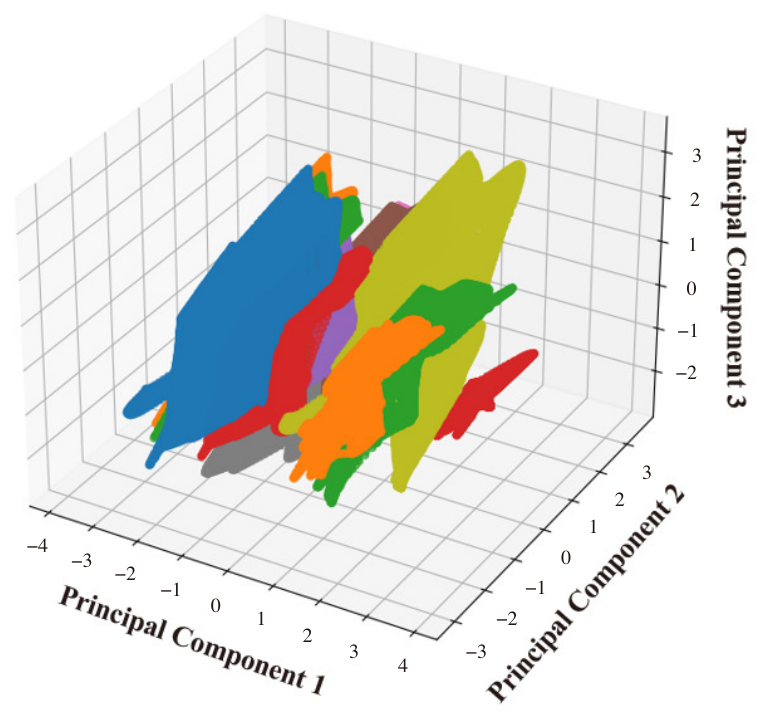
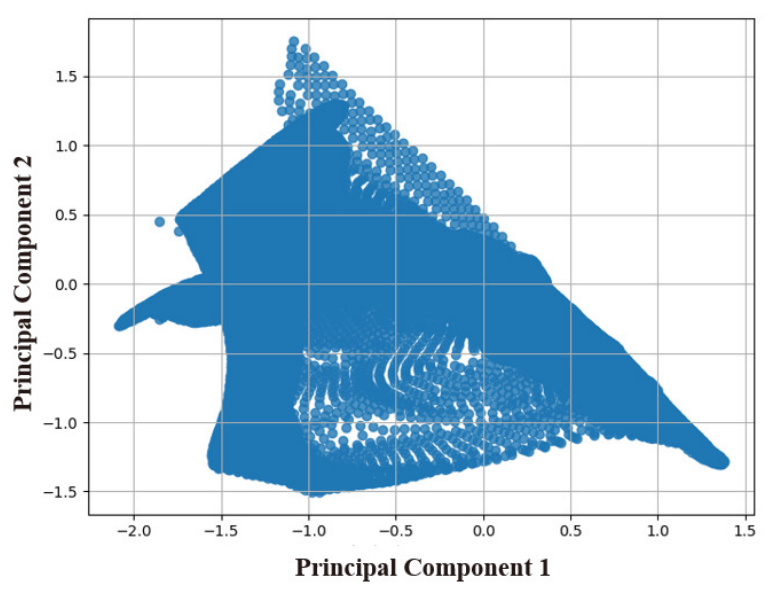
5.1. Representation of Deformation Using Principal Components
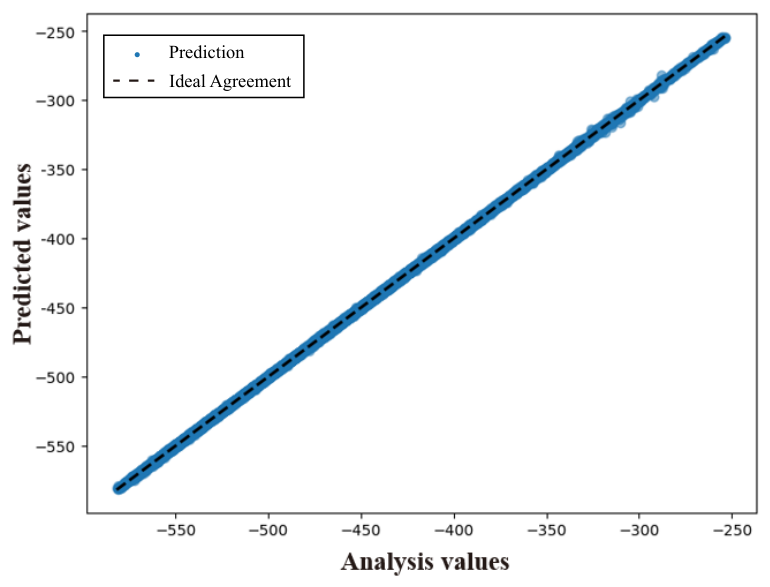
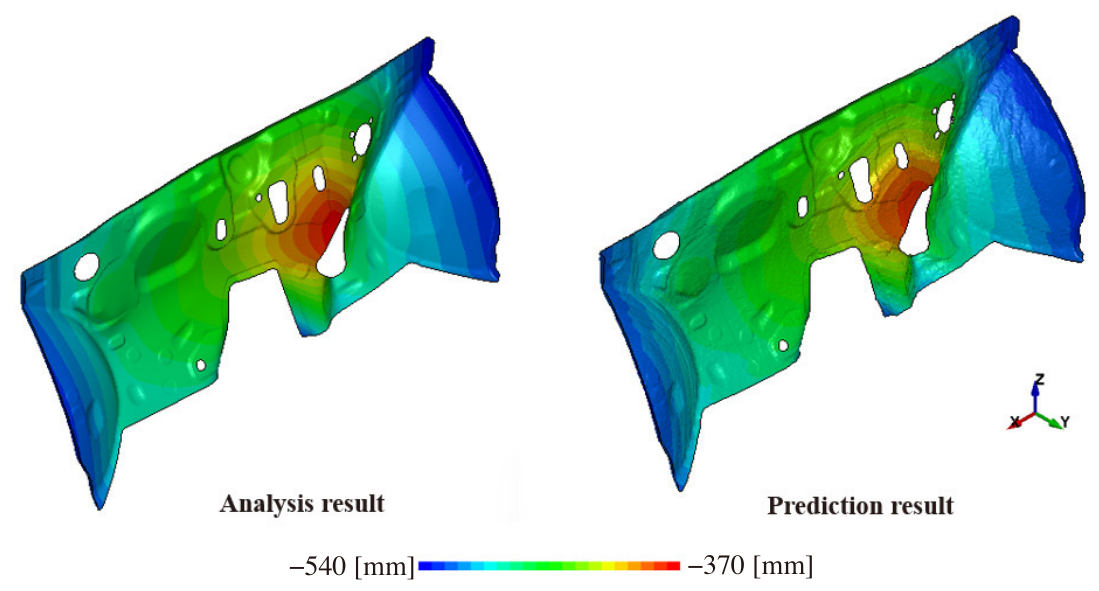
5.2. Prediction Accuracy and Performance Evaluation
6. Conclusions
Author Contributions
Funding
Institutional Review Board Statement
Informed Consent Statement
Data Availability Statement
Conflicts of Interest
References
- Li, N.; Fang, H.; Zhang, C.; Gutowski, M.; Palta, E.; Wang, Q. A numerical study of occupant responses and injuries in vehicular crashes into roadside barriers based on finite element simulations. Adv. Eng. Softw. 2015, 90, 22–44. [Google Scholar] [CrossRef] [Scilit]
- Gao, W.; Zhao, G.; He, X.; Chen, S.; Wang, C. A high-fidelity numerical approach for dummy head-windshield contact interactions. Int. J. Impact Eng. 2023, 176, 104560. [Google Scholar] [CrossRef] [Scilit]
- Deng, X.; Potula, S.; Grewal, H.; Solanki, K.N.; Tschopp, A.A.; Horstemeyer, M.F. Finite element analysis of occupant head injuries: Parametric effects of the side curtain airbag deployment interaction with a dummy head in a side impact crash. Accid. Anal. Prev. 2013, 55, 232–241. [Google Scholar] [CrossRef] [Scilit] [PubMed]
- Xiao, S.; Yang, J.; Huang, J.; Crendall, J.R. Development of a belted occupant FE model for prediction of chest injury risk based on stress and strain analysis. J. Mech. Med. Biol. 2017, 17, 5. [Google Scholar] [CrossRef] [Scilit]
- Ekambaram, K.; Frampton, R.; Lenard, J. Factors associated with chest injuries to front seat occupants in frontal impacts. Traffic Inj. Prev. 2019, 20, S37–S42. [Google Scholar] [CrossRef] [Scilit] [PubMed]
- Berthelson, P.R.; Ghassmei, P.; Wood, J.W.; Liu, Y.; Al-Graitti, A.J.; Jones, M.D.; Chowdhury, S.; Prabhu, R.K. Evaluation of occupant neck injury response to varied impact conditions using a finite element-mathematical surrogate modeling approach. Int. J. Crashworthiness 2022, 27, 1726–1742. [Google Scholar]
- Xiao, S.; Shi, X.; Sun, X.; Zhang, H.; Ma, W.; Liu, Z. Impact overlaps on occupant lower limb injuries under car frontal crash. Int. J. Automot. Technol. 2022, 23, 659–665. [Google Scholar] [CrossRef] [Scilit]
- Ye, X.; Gaewsky, J.P.; Miller, L.E.; Jones, D.A.; Kelly, M.E.; Suhey, J.D.; Koya, B.; Weaver, A.A.; Stitzel, J.D. Numerical investigation of driver lower extremity injuries in finite element frontal crash reconstruction. Traffic Inj. Prev. 2018, 19, S21–S28. [Google Scholar] [CrossRef] [Scilit] [PubMed]
- Benson, D.J. Computational methods in Lagrangian and Eulerian hydrocodes. Comput. Methods Appl. Mech. Eng. 1992, 99, 235–394. [Google Scholar] [CrossRef] [Scilit]
- Belytschko, T.; Liu, W.K.; Moran, B.; Elkhodary, K. Nonlinear Finite Elements for Continua and Structures, 2nd ed.; Wiley: Hoboken, NJ, USA, 2014. [Google Scholar]
- Vurtur Badarinath, P.; Chierichetti, M.; Davoudi Kakhki, F. A Machine Learning Approach as a Surrogate for a Finite Element Analysis: Status of Research and Application to One Dimensional Systems. Sensors 2021, 21, 1654. [Google Scholar] [CrossRef] [Scilit] [PubMed]
- Jokar, M.; Semperlotti, F. Finite element network analysis: A machine learning based computational framework for the simulation of physical systems. Comput. Struct. 2021, 247, 106484. [Google Scholar] [CrossRef] [Scilit]
- Capuano, G.; Rimoli, J.J. Smart finite elements: A novel machine learning application. Comput. Methods Appl. Mech. Eng. 2019, 345, 363–381. [Google Scholar] [CrossRef] [Scilit]
- Kohar, P.C.; Grave, L.; Eller, K.T.; Connolly, S.D.; Inal, K. A machine learning framework for accelerating the design process using CAE simulations: An application to finite element analysis in structural crashworthiness. Comput. Methods Appl. Mech. Eng. 2021, 385, 114008. [Google Scholar] [CrossRef] [Scilit]
- Shao, Y.; Shi, X.; Zhang, Y.; Shiwakoti, N.; Xu, Y.; Ye, Z. Injury severity prediction and exploration of behavior-cause relationships in automotive crashes using natural language processing and extreme gradient boosting. Eng. Appl. Artif. Intell. 2024, 133, 108542. [Google Scholar] [CrossRef] [Scilit]
- Ahn, H.; Yu, Y.; Lee, S.; Cho, J.Y. Machine learning model incorporating domain knowledge for predicting maximum deflection of reinforced concrete beams under low-velocity impact. Int. J. Impact Eng. 2026, 207, 105483. [Google Scholar]
- Zheng, H.; Li, C.; Sun, Y.; Han, Q.; Yao, X. Impact protection mechanism and failure prediction of modular hierarchical honeycomb system with self-locking effect. Int. J. Impact Eng. 2025, 201, 105274. [Google Scholar] [CrossRef] [Scilit]
- Li, H.; Zhao, Y.; Zhou, H.; Pfaff, T.; Li, N. A graph neural network surrogate model for mesh-based crashworthiness prediction of vehicle panel components. Results Eng. 2026, 30, 110925. [Google Scholar] [CrossRef] [Scilit]
- Czech, C.; Lesjak, M.; Bach, C.; Duddeck, F. Data-driven models for crashworthiness optimisation: Intrusive and non-intrusive model order reduction techniques. Struct. Multidiscip. Optim. 2022, 65, 190. [Google Scholar] [CrossRef] [Scilit]
- You, J.; Zhao, Y.; Jia, L.; Wang, N.; Sun, Z.; Zou, W.; Hu, Y.; Liu, L.; Zhang, C. A fast crashworthiness assessment framework: Sectional force-based multi-stage physics informed surrogate model. Adv. Eng. Softw. 2026, 213, 104090. [Google Scholar]
- Gider, V.; Ekinci, S.; Izci, D.; Gokalp, I.; Rashdan, M.; Salman, M. Comparative evaluation of XGBoost, TabNet, and FT transformer models for fatal crash prediction under extreme class imbalance. Sci. Rep. 2026, in press. [Google Scholar] [CrossRef] [Scilit] [PubMed]
- Shwartz-Ziv, R.; Armon, A. Tabular data: Deep learning is not all you need. Inf. Fusion 2022, 81, 84–90. [Google Scholar] [CrossRef] [Scilit]
- Grinsztajn, L.; Oyallon, E.; Varoquaux, G. Why do tree-based models still outperform deep learning on tabular data? arXiv 2022, arXiv:2207.08815. [Google Scholar]
- Abdi, H.; Williams, L. Principal component analysis. Wires Comput. Stat. 2010, 2, 433–459. [Google Scholar] [CrossRef] [Scilit]
- Friedman, J.H. Greedy function approximation: A gradient boosting machine. Ann. Stat. 2001, 29, 1189–1232. [Google Scholar] [CrossRef] [Scilit]
- He, Z.; Lin, D.; Lau, T.; Wu, M. Gradient Boosting Machine: A Survey. arXiv 2019, arXiv:1908.06951. [Google Scholar]
- Chen, T.; Guestrin, C. XGBoost: A scalable Tree Boosting System. In Proceedings of the 22nd ACM SIGKDD International Conference on Knowledge Discovery and Data Mining, San Francisco, CA, USA, 13–17 August 2016; pp. 785–794. [Google Scholar]
- Akiba, T.; Sano, S.; Ohata, T.; Koyama, M. Optuna: A Next-generation Hyperparameter Optimization Framework. In Proceedings of the 25th ACM SIGKDD International Conference on Knowledge Discovery and Data Mining, Anchorage, AK, USA, 4–8 August 2019; pp. 2623–2631. [Google Scholar]









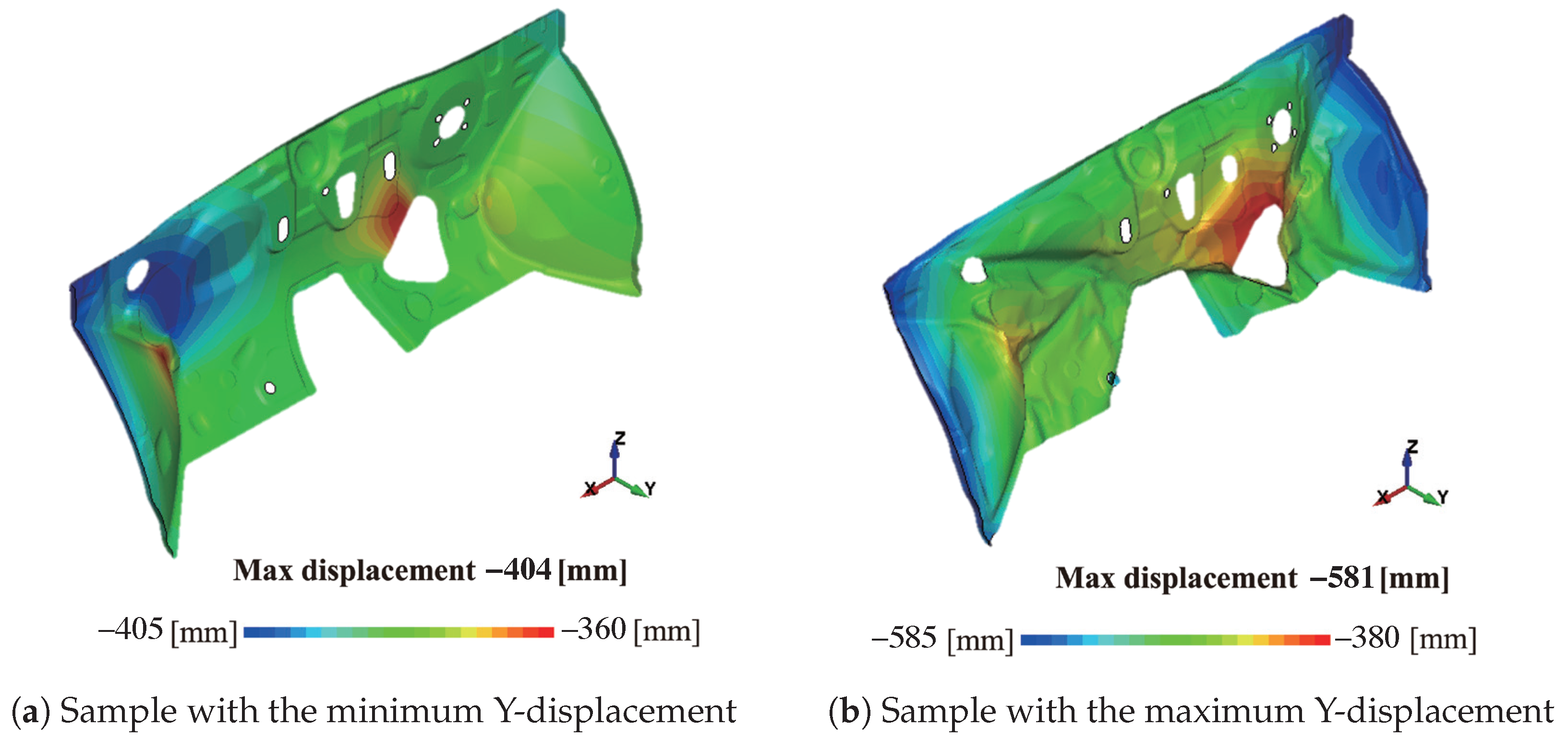
| Case | Max. Y Displacement [mm] |
|---|---|
| 1 | −581 |
| 2 | −580 |
| 3 | −578 |
| 4 | −546 |
| 5 | −536 |
| 6 | −525 |
| 7 | −520 |
| 8 | −517 |
| 9 | −506 |
| 10 | −504 |
| 11 | −503 |
| 12 | −474 |
| 13 | −470 |
| 14 | −404 |
| Hyperparameter | Value |
|---|---|
| maximum depth of trees | 1∼15 |
| learning rate | 0.01∼0.1 |
| number of trees | 1000∼7000 |
| Hyperparameter | Value |
|---|---|
| maximum depth of trees | 13 |
| learning rate | 0.019 |
| number of trees | 6658 |
| Direction | MAE | |
|---|---|---|
| X | 0.0527 | 0.9999 |
| Y | 0.2302 | 0.9999 |
| Z | 0.1254 | 0.9999 |
| Direction | MAE | |
|---|---|---|
| X | 1.3765 | 0.9466 |
| Y | 2.2951 | 0.9926 |
| Z | 1.1259 | 0.9826 |
Disclaimer/Publisher’s Note: The statements, opinions and data contained in all publications are solely those of the individual author(s) and contributor(s) and not of MDPI and/or the editor(s). MDPI and/or the editor(s) disclaim responsibility for any injury to people or property resulting from any ideas, methods, instructions or products referred to in the content. |
© 2026 by the authors. Licensee MDPI, Basel, Switzerland. This article is an open access article distributed under the terms and conditions of the Creative Commons Attribution (CC BY) license.
Share and Cite
Sugiyama, H.; Noguchi, K.; Nagasaka, K.; Masuda, I.; Yokoyama, Y.; Okazawa, S. Generation of Vehicle Crash Deformation Fields from Limited Simulation Data Using Machine Learning Approach. Vehicles 2026, 8, 159. https://doi.org/10.3390/vehicles8070159
Sugiyama H, Noguchi K, Nagasaka K, Masuda I, Yokoyama Y, Okazawa S. Generation of Vehicle Crash Deformation Fields from Limited Simulation Data Using Machine Learning Approach. Vehicles. 2026; 8(7):159. https://doi.org/10.3390/vehicles8070159
Chicago/Turabian StyleSugiyama, Hirofumi, Kyohei Noguchi, Kei Nagasaka, Idemitsu Masuda, Yuta Yokoyama, and Shigenobu Okazawa. 2026. "Generation of Vehicle Crash Deformation Fields from Limited Simulation Data Using Machine Learning Approach" Vehicles 8, no. 7: 159. https://doi.org/10.3390/vehicles8070159
APA StyleSugiyama, H., Noguchi, K., Nagasaka, K., Masuda, I., Yokoyama, Y., & Okazawa, S. (2026). Generation of Vehicle Crash Deformation Fields from Limited Simulation Data Using Machine Learning Approach. Vehicles, 8(7), 159. https://doi.org/10.3390/vehicles8070159