


Abstract
With the rapid development of Formula Student competitions, higher demands are being placed on the vehicle performance of race cars. To further enhance vehicle performance, this study investigates the optimization of three key indicators: maximum speed, 0–100 km/h acceleration time, and energy consumption under the NEDC driving cycle. First, a vehicle physical model was established on the AVL CRUISE 2019 R2 platform based on the vehicle parameters, and corresponding simulation tasks were configured. Meanwhile, a numerical model was developed in MATLAB R2022a and validated by comparing the predicted maximum speed, acceleration time, and energy consumption with the CRUISE simulation results. On this basis, a genetic algorithm was employed to optimize the battery pack parallel number and the total reduction ratio so as to improve the vehicle performance. The optimized parameters were then re-imported into the CRUISE model for further simulation verification. The results indicate that, compared with the original configuration, the optimized scheme leads to a slight increase in acceleration time, while significantly improving the maximum speed and reducing the energy consumption under the NEDC cycle. Overall, the proposed optimization method effectively enhances the vehicle performance of the Formula Student electric race car.
1. Introduction
1.1. Background
The Formula Student Electric China (FSEC) competition presents significant dual challenges to the performance of electric race cars. On the one hand, the 75 m acceleration event requires excellent transient power output, demanding a high peak power-to-weight ratio. On the other hand, the 22 km endurance event imposes stringent demands on vehicle energy utilization efficiency and powertrain management [1]. According to the 2025 FSEC regulations, the maximum allowable voltage of the tractive system accumulator is capped at 600 V, while the available tractive power is limited to 80 kW during dynamic events. Additionally, the battery pack must meet strict safety, monitoring, and isolation requirements, such as continuous measurement of cell voltages and temperatures via a Battery Management System (BMS), ensuring reliable shutdown behavior during fault conditions for driver and vehicle protection.
These regulatory constraints heavily influence the race car’s design and performance [2]. For example, limiting the maximum power drawn from the battery pack directly impacts the selection of motor and inverter ratings, the sizing of the battery pack, and the drivetrain gear ratio. Any deviation from these limits can lead to disqualification, even if the hardware could theoretically provide higher outputs. Furthermore, constraints on voltage, cell configuration, and safety systems demand a balanced approach in accumulator design, weighing energy capacity, peak discharge capability, total mass, and thermal behavior [3,4]. Increasing battery capacity or parallel cell count improves energy availability but also adds mass, negatively affecting acceleration and handling. Conversely, opting for a high reduction ratio enhances launch torque but may limit the maximum speed and worsen energy consumption during endurance events.
Therefore, optimizing the battery pack configuration in harmony with drivetrain parameters within the framework of these stringent regulations is not just an academic challenge but a crucial engineering process [5]. A systematic optimization framework is essential to address the interdependence of battery design, traction system constraints, drivetrain reduction ratio, and dynamic performance. These factors are pivotal to achieving a competitive balance between power output, energy efficiency, and vehicle handling, ensuring success in both acceleration and endurance events within the FSEC competition.
1.2. Literature Review
In the development of electric race-car powertrains, parameter matching is one of the key factors affecting vehicle performance. While conventional parameter matching methods for electric vehicle power systems have become relatively mature, they cannot be directly applied to Formula Student electric race cars due to their complex operating conditions, high dynamic response requirements, and stringent performance targets [6].
To accommodate the specific operating conditions of racing tracks, existing studies have primarily focused on the optimization of control strategies and energy management. Szántó et al. [7] established a race-car model in MATLAB/Simulink and conducted simulation studies, utilizing a filtering method with Gaussian distribution characteristics to optimize relevant parameters, which significantly improved optimization efficiency. Moreover, model predictive control (MPC), direct collocation, offline optimization, and convex optimization frameworks have been applied to the simulation and optimization of parameter allocation, dynamic torque distribution, mass distribution, regenerative braking, and power regulation in race cars [8,9,10,11,12]. These studies demonstrated positive effects on lap time, endurance capability, and overall vehicle performance. However, most of these efforts have primarily focused on software-level strategy development, while relatively limited attention has been given to the strong coupling among key physical parameters, such as battery pack mass and total reduction ratio, and their fundamental constraints on vehicle performance [13].
In terms of physical parameter matching, the Porsche Taycan adopts a heterogeneous transmission architecture for the front and rear axles. By employing different total reduction ratios across varying vehicle speed ranges and matching these with a high-power-density battery system, it achieves a balance between low-speed acceleration performance and high-speed energy conversion efficiency [14]. Similarly, in the Formula Student Electric Car (FSEC) competition, participating teams continuously optimize the total reduction ratios and battery pack parameters to achieve more effective powertrain parameter matching for the 0–75 m straight-line acceleration event and enhanced endurance performance during the 22 km endurance race [15,16]. However, such physical parameter matching still largely relies on engineering experience, and systematic multi-objective optimization studies aimed at the coordinated improvement of dynamic performance and energy efficiency remain insufficient. Consequently, achieving an optimal balance among the key performance attributes of the race car continues to be a challenge [17].
Recent advancements in design automation provide promising solutions to these challenges. Borowski and Rudolph [18] introduced a graph-based design language (GBDL) to automate and formalize the engineering process for Formula Student race cars. Their methodology, applied to the suspension system, demonstrates how an ontology-based vocabulary and model transformations can automate the creation of consistent design graphs. These design graphs integrate all aspects of vehicle design, enabling the automated generation of 3D CAD models, kinematic simulations, and domain-specific analyses. By supporting variant generation and dynamic simulation for performance validation, the approach eliminates the need for manual updates between different tools, ensuring digital consistency and addressing challenges such as data handling and tool fragmentation.
Furthermore, Borowski et al. [19] tackled the issue of managing design variants in Formula Student race cars using an integrated digital engineering framework. This study emphasizes the importance of a centralized design graph to ensure digital consistency and streamline cross-domain integration, especially when multiple teams are working on different subsystems. Automated variant generation and design optimization significantly reduce design iteration time, allowing the team to explore a wider range of design possibilities. The framework also incorporates natural language interfaces to make the design graph more accessible to team members without formal modeling expertise, thereby enhancing collaboration and knowledge transfer across teams.
To overcome the limitations in physical parameter matching and multi-objective optimization, this study establishes a vehicle dynamic model and employs a multi-objective optimization method to determine the optimal combination of battery pack mass and total reduction ratio. The effects of these parameters on key performance indicators, such as 0–100 km/h acceleration time, maximum vehicle speed, and energy consumption, are systematically analyzed to achieve a coordinated improvement in vehicle performance.
1.3. Main Contributions and Paper Organization
This study aims to improve both the competition performance and the vehicle performance of a four-wheel-drive Formula Student electric race car by optimizing key parameters of the powertrain system. First, a four-wheel-drive Formula Student electric race-car model is established based on vehicle dynamics theory. A baseline vehicle model is then developed in the AVL CRUISE simulation platform using the physical parameters of the vehicle. By comparing the simulation results under the NEDC driving cycle, the CRUISE model is used to validate the economic performance simulation model established in MATLAB, thereby verifying its accuracy and reliability. After model validation, the battery pack parallel number and total reduction ratio are selected as the core optimization variables. In combination with the FSEC competition regulations and practical engineering constraints of the race car, the value ranges and boundary conditions of these two parameters are determined. Subsequently, a genetic algorithm-based parameter optimization program is developed in MATLAB, and iterative optimization is carried out to obtain the optimal parameter combination for improving the vehicle performance of the electric race car. Finally, the optimal parameters obtained by the genetic algorithm are incorporated into the CRUISE model for simulation-based verification, and the effectiveness of the proposed parameter optimization method is confirmed by comparing the vehicle performance before and after optimization.
This study presents several key contributions to the field of electric race-car design:
- Multi-objective Optimization Framework:
A multi-objective optimization framework based on the MATLAB numerical model and genetic algorithm was proposed, specifically targeting electric race cars in the Formula Student competition. This framework uniquely incorporates practical engineering constraints, such as battery configuration and competition rules, providing an effective and feasible optimization solution that aligns with real-world applications.
- b.
- Consideration of Practical Engineering Constraints:
Unlike traditional theoretical optimization methods, this study takes into account real-world constraints such as battery pack parallel number and total reduction ratio. These constraints are optimized within the framework of competition rules, ensuring that the results not only meet theoretical goals but are also directly applicable to practical engineering challenges faced by electric race cars in competitions.
- c.
- Optimization Results and Performance Balance:
The optimization of the battery parallel number and reduction ratio resulted in a slight decline in acceleration performance (1.07%), while energy consumption was reduced by 1.86%, and the maximum vehicle speed increased by 7%. These results illustrate a clear balance between dynamic performance and energy efficiency, achieving improvements in both areas while maintaining overall vehicle functionality. The optimized configuration ensures better endurance, which is critical in long-distance race events like Formula Student.
- d.
- Application to Electric Race-car Design:
This study presents a novel approach to electric race-car design, particularly when facing the challenges of real-world vehicle design and competition requirements. The proposed model can accurately predict vehicle performance across different configurations, offering engineers a powerful decision-making tool to optimize design parameters for better performance, efficiency, and competitiveness.
- e.
- Expansion to the Electric Vehicle Domain:
The optimization methods proposed in this study extend beyond electric race-car design and can be applied to the optimization of powertrains for various types of electric vehicles. This contributes to the ongoing technological advancement of the electric vehicle industry, offering a foundation for future optimization processes in both competitive and commercial vehicle applications.
The remainder of this paper is organized as follows. Section 2 introduces the construction process of the full-vehicle model, including the modeling of key components such as the battery pack and traction motor, and describes the multi-objective parameter optimization method based on the genetic algorithm. Section 3 validates the accuracy of the proposed model and presents the analysis and discussion of the simulation results. Section 4 summarizes the main conclusions of this study and outlines directions for future research.
2. Vehicle Modeling and Optimization Algorithm
2.1. Vehicle Parameters
2.1.1. Vehicle Model Establishment
The establishment of the vehicle model requires accurate determination of the fundamental vehicle parameters. In this study, the vehicle model was developed on the basis of measured data collected from the race car. The detailed vehicle parameters are presented in Table 1.
Table 1.
Basic vehicle parameters.
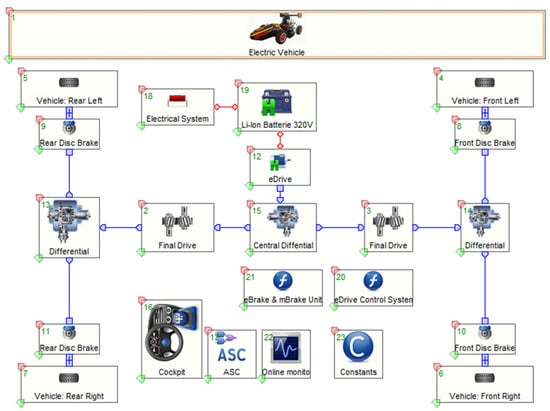
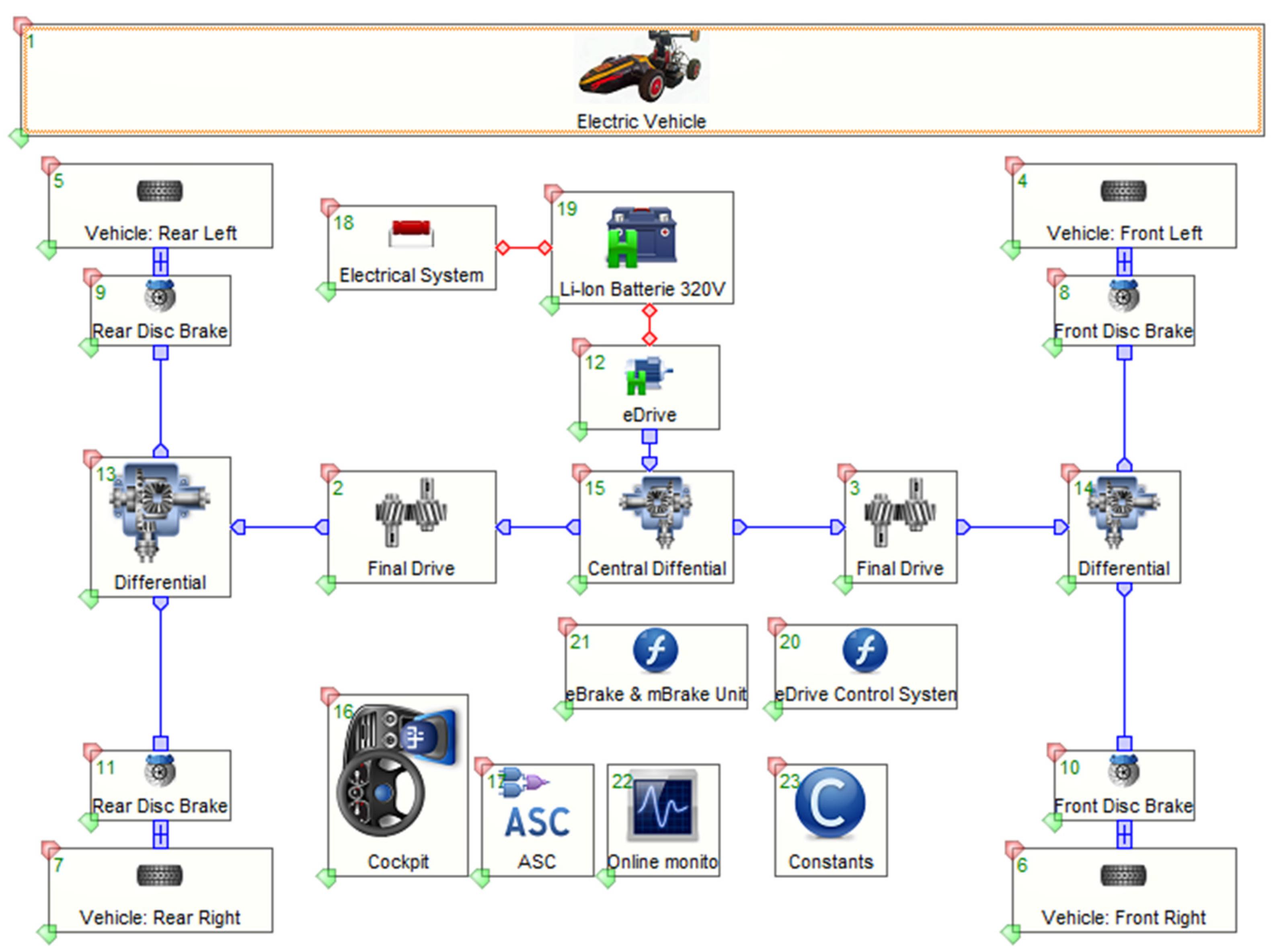
The architecture of the vehicle model is shown in Figure 1. The model adopts a four-wheel-drive configuration and primarily consists of an electrical auxiliary load module, a battery pack module, a traction motor module, a central differential module, front and rear reducer modules, front and rear differential modules, as well as braking and wheel modules. The electrical system, battery pack, and traction motor are interconnected by green lines representing electrical signals, while the traction motor, powertrain, and wheels are connected by blue lines representing mechanical signals. After completing the connections, vehicle parameters and powertrain parameters are input into each module. Finally, simulation tasks are set up to evaluate the vehicle’s energy consumption and acceleration performance. The energy flow and power transmission process are as follows: The battery pack supplies electrical energy to the traction motor, which converts electrical energy into mechanical power. The output torque is then distributed through the central differential, reducers, and differentials, and is ultimately transmitted to the wheels to drive the vehicle [20].
Figure 1.
Full-Vehicle Simulation Model.
2.1.2. Race-Car Performance Design Targets
Based on the FSEC scoring rules and previous competition experience, the target values for the dynamic and economic performance of the race car were determined in this study, as summarized in Table 2. For dynamic performance, the race car was required to achieve a 0–100 km/h acceleration time of less than 4.5 s and a maximum vehicle speed greater than 140 km/h. For economic performance, the vehicle was required to exhibit an energy consumption of less than 10 kW·h/100 km under the NEDC driving cycle and a driving range of more than 22 km.
Table 2.
Overall performance targets.
2.2. Powertrain Modeling
The battery pack is one of the most critical components of the powertrain system in a Formula race car. Its primary function is to provide electrical energy to the traction motor, thereby propelling the vehicle. The battery pack not only directly affects the driving range of the race car, but also has a significant influence on the vehicle mass distribution and running resistance. Therefore, its selection and parameter design are of great importance [21]. The FSEC competition imposes stringent requirements on the lightweight design, transient power response, and continuous output capability of the race-car powertrain [22,23,24]. Compared with conventional lead-acid batteries and nickel-metal hydride batteries, lithium-ion batteries offer several advantages, including high energy density, high charge–discharge rate capability, low mass, and low self-discharge rate, making them more suitable for the combined requirements of high power density and lightweight design in race cars [25]. Therefore, considering both the performance advantages of lithium-ion batteries and the practical requirements of the competition, a lithium-ion battery cell with a rated voltage of 3.6 V, a rated capacity of 2 Ah, and an internal resistance of 0.02 Ω was selected as the basic cell of the battery pack in this study.
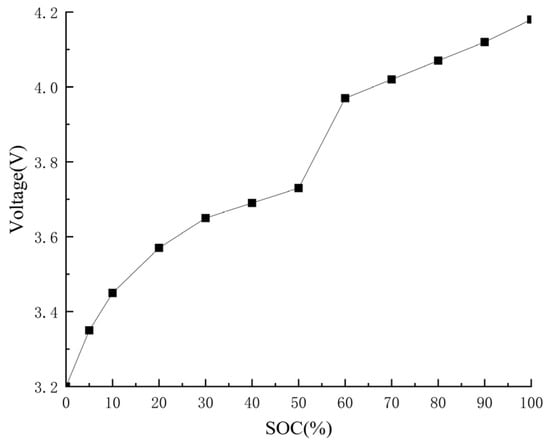
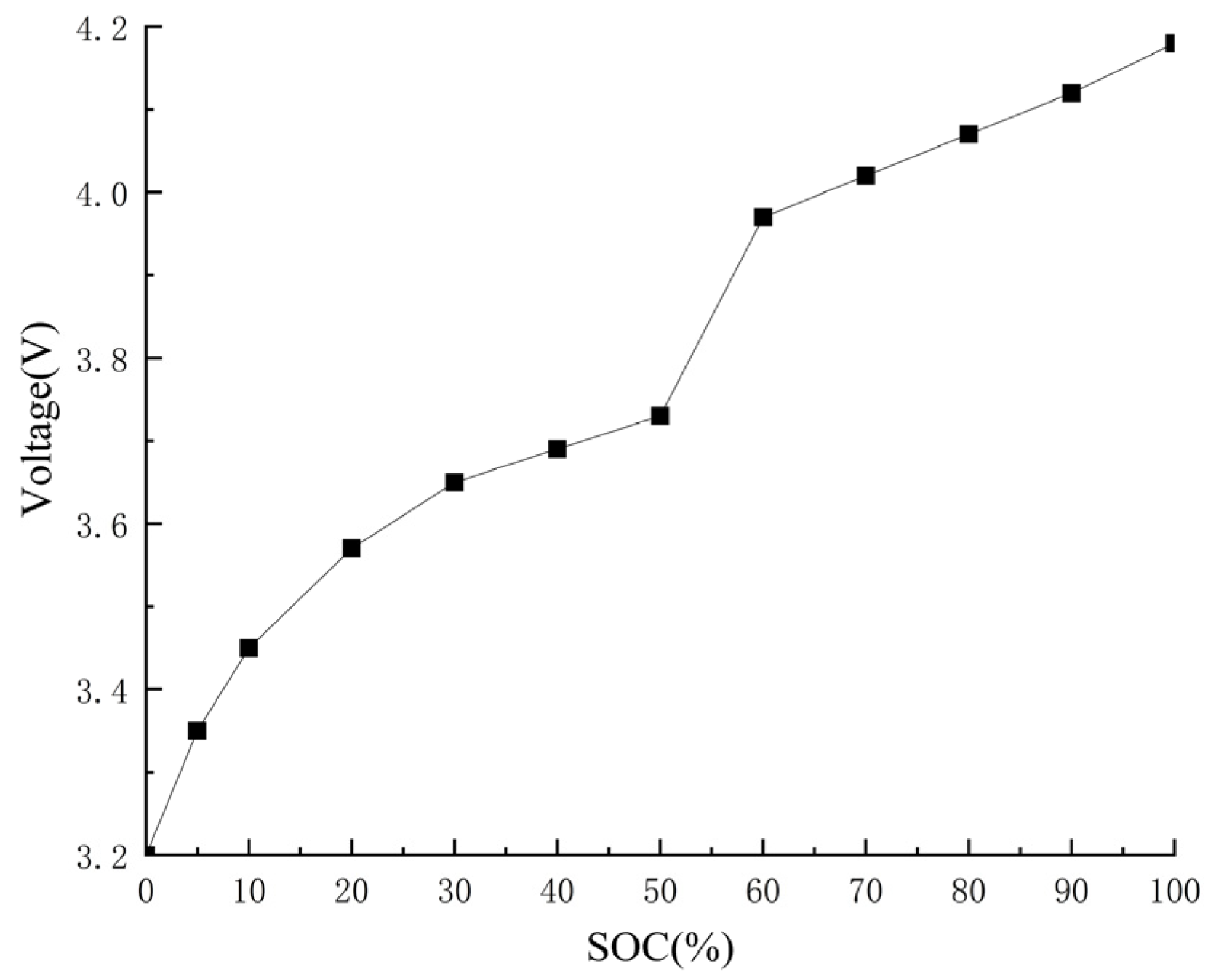
The specific parameters of the battery pack are listed in Table 3. To satisfy the voltage requirement of approximately 300 V for the race car, the battery pack model was configured with 84 cells in series and 9 cells in parallel, and the battery pack parallel number, denoted by a, was selected as one of the optimization variables. In addition, the relationship between the battery state of charge (SOC) and discharge voltage is shown in Figure 2 [26].
Table 3.
Battery pack parameters.
Figure 2.
Relationship between SOC and voltage.
The traction motor is also one of the core components of the race-car powertrain. Its primary function is to convert the electrical energy supplied by the battery pack into mechanical energy and to drive the wheels directly or indirectly, thereby enabling vehicle motion. The performance of the traction motor has a substantial influence on the maximum vehicle speed, driving range, and acceleration capability of the race car, and is also closely related to vehicle operational safety and handling stability [27]. Considering the stringent requirements of Formula race cars for lightweight design and vehicle performance, permanent magnet synchronous motors exhibit significant advantages over induction motors and switched reluctance motors, including high power density, a wide speed range, and low mass [28,29]. Therefore, a permanent magnet synchronous motor with a maximum speed of 7500 r/min was selected as the traction motor in this study.
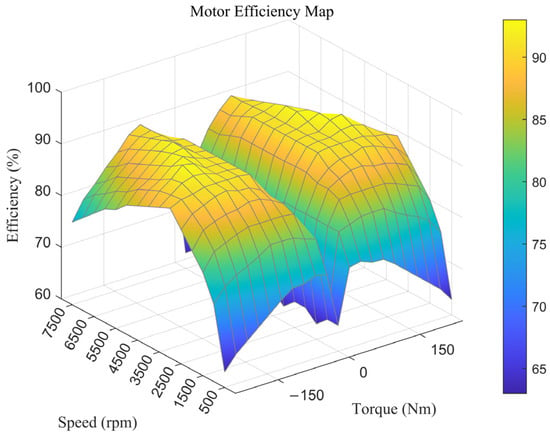
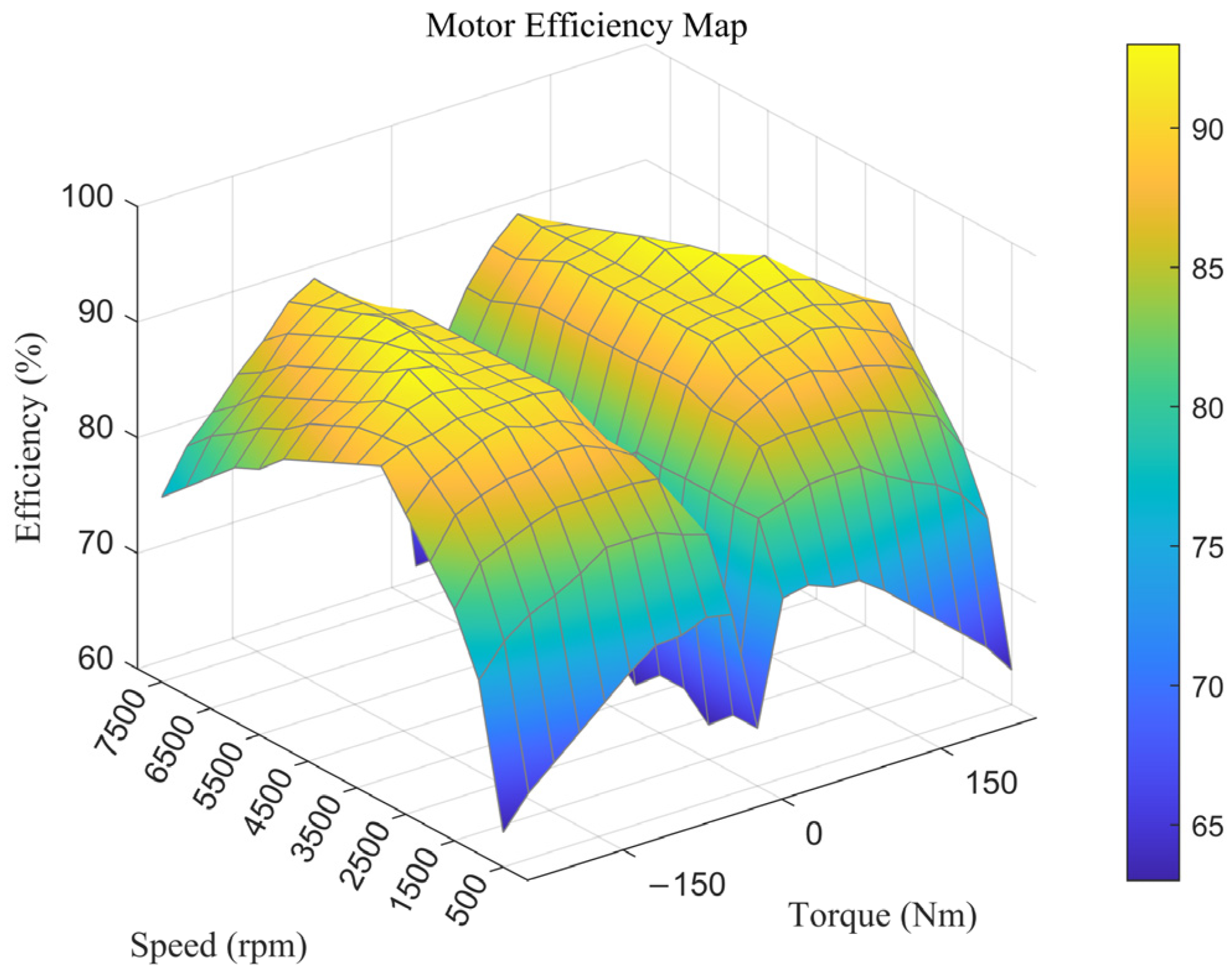
The specific parameters of the traction motor are listed in Table 4. To more accurately calculate the energy consumption under the NEDC driving cycle, the traction motor efficiency map shown in Figure 3 was imported into AVL CRUISE to characterize the efficiency distribution of the traction motor over its entire operating range [30]. Meanwhile, the corresponding efficiency map data were also implemented in the MATLAB model to ensure the accuracy and consistency of the simulation results.
Table 4.
Traction motor parameters.
Figure 3.
Traction motor efficiency map.
Finally, a single-stage reducer was employed in the transmission system, and the reduction ratio of the front and rear reducers, denoted by b, was chosen as one of the optimization variables [31,32]. As a critical intermediate component between the traction motor and the driving wheels, the reducer not only increases the output torque, but also plays an essential role in optimizing the operating state of the transmission system and enhancing both the dynamic performance and energy efficiency of the vehicle.
2.3. MATLAB-Based Numerical Model
In this study, a MATLAB-based numerical model was developed to evaluate the effects of the battery pack parallel number and the total reduction ratio on vehicle performance. The model was implemented after the CRUISE vehicle model was established. The NEDC speed profile was imported as the driving cycle, and the vehicle speed was converted to meters per second. The acceleration at each time step was computed using the finite-difference method.
Since the battery pack parallel number affects the battery pack mass and the total vehicle mass, the vehicle mass is expressed as a function of as follows:
In this equation, 365 kg represents the baseline total vehicle mass, and 3.78 kg represents the mass variation due to changes in the battery pack parallel number. This value was calculated based on the 84-series battery pack configuration and a single-cell mass of 45 g.
2.3.1. Maximum Vehicle Speed Calculation
The maximum vehicle speed is determined by comparing the maximum available motor torque with the required motor torque . Under steady-state driving conditions, rolling resistance and aerodynamic drag are considered, while acceleration resistance is excluded. The reason for excluding the acceleration resistance term is that the vehicle is assumed to be in a steady-state condition when calculating the maximum speed, where the acceleration is negligible. Therefore, only the constant resistive forces (rolling and aerodynamic) are considered. The required wheel torque is calculated as:
In this equation, and denote the rolling resistance and aerodynamic drag, respectively, and is the rolling tire radius. The maximum available motor torque is then converted to the wheel-side maximum driving force as:
When becomes less than the required motor torque , the corresponding vehicle speed is considered the maximum speed.
2.3.2. 0–100 km/h Acceleration Time
The 0–100 km/h acceleration process involves calculating the maximum driving force at the wheels. The maximum driving force is calculated similarly, based on the motor torque, total reduction ratio, and rolling tire radius. The remaining driving force available for acceleration is then given by:
In this equation, is the total driving resistance, and is the total transmission efficiency. After considering tire adhesion limitations, the vehicle acceleration is limited as follows:
In the equation, is the rotational mass factor. The acceleration time is then computed by numerical integration over the speed range:
In this equation, represents the speed increment between adjacent speed points, and is the corresponding acceleration at each speed point.
2.3.3. Energy Consumption Calculation
Energy consumption is calculated under the NEDC cycle, considering rolling resistance, aerodynamic drag, and acceleration resistance. The required wheel torque is given by:
The motor torque is calculated by:
The battery-side power demand is computed as:
In this equation, is the motor speed, and is the motor efficiency. The total energy consumption is then calculated by integrating the battery-side power over time:
Finally, the energy consumption per 100 km is calculated by normalizing the total energy consumption over the driving distance:
In the equation, is the energy consumption per 100 km, is the total energy consumed over the NEDC cycle, and is the total driving distance in kilometers.
In this study, the MATLAB-based numerical model was used to calculate the maximum vehicle speed, 0–100 km/h acceleration time, and energy consumption for different combinations of battery pack parallel number and total reduction ratio . These results provide a numerical basis for the subsequent optimization using genetic algorithms, ensuring that the vehicle’s performance is accurately evaluated under various configurations.
2.3.4. Endurance Performance Optimization
In this study, vehicle performance is evaluated based on three key indicators: maximum speed, 0–100 km/h acceleration time, and energy consumption under the NEDC cycle. While maximum speed and acceleration time are typically core performance metrics, endurance is equally crucial in competitions, especially in events like Formula Student. Therefore, we use energy consumption under the NEDC cycle to represent the vehicle’s endurance performance.
In this section, the energy consumption per 100 km is calculated by integrating the energy demand at each time step during the driving cycle. By optimizing energy efficiency and reducing energy consumption, we directly enhance the vehicle’s endurance. Through the optimization of the battery pack parallel number and the total reduction ratio, energy consumption is minimized, which contributes to improved endurance performance in long-distance races, especially under sustained driving conditions. These parameter optimizations ensure that the vehicle operates efficiently in both acceleration and endurance events.
Incorporating NEDC energy consumption into the optimization process ensures that the vehicle’s endurance performance meets the strict requirements of the competition. The energy consumption is based on the vehicle’s driving resistance, including rolling resistance, aerodynamic drag, and motor efficiency. However, in the maximum-speed calculation, since steady-state driving conditions are assumed, acceleration resistance is excluded. By minimizing energy consumption, we optimize the vehicle’s endurance, contributing to better overall performance in long-distance events.
2.4. Genetic Algorithm-Based Optimization
Given the nonlinear, non-convex, and mixed discrete-continuous characteristics of the relationship between the objective functions and the decision variables, traditional gradient-based optimization algorithms are not well suited to this problem. Therefore, the genetic algorithm available in the MATLAB Global Optimization Toolbox was employed for parameter optimization. This algorithm simulates the mechanisms of natural selection and genetic inheritance in biological evolution and gradually approaches the global optimum through iterative population evolution [33].
While the genetic algorithm was chosen for its capability to handle complex, multi-variable, and non-linear problems, it is worth noting that other optimization techniques, such as particle swarm optimization (PSO) or simulated annealing, could also serve as viable alternatives. These methods have been successfully applied in vehicle performance optimization in several studies, each offering unique advantages. For instance, PSO is known for its fast convergence speed, whereas simulated annealing can help avoid local optima by employing a cooling schedule. Despite the availability of these alternatives, the genetic algorithm was selected for this study due to its ability to conduct global searches across large solution spaces and its established success in solving multi-objective optimization problems. The key advantage of genetic algorithms in this context lies in their ability to maintain population diversity, thereby preventing premature convergence, which is crucial for optimizing the parameters of electric race cars.
On this basis, a multi-objective and multi-parameter collaborative optimization study was carried out, in which the energy consumption under the NEDC driving cycle, the 0–100 km/h acceleration time, and the maximum vehicle speed of the electric race car were taken as the optimization objectives, while the battery pack parallel number and the total reduction ratio were selected as the decision variables.
2.4.1. Basic Procedure of the Genetic Algorithm
- Population Initialization
An initial population containing N individuals is randomly generated. Each individual represents a potential solution vector to the optimization problem, including the discrete variable of battery pack parallel number, denoted by a, and the continuous variable of total reduction ratio, denoted by b.
- b.
- Fitness Evaluation
According to the fitness functions corresponding to the optimization objectives, the fitness value of each individual in the population is calculated and evaluated. This value quantitatively reflects the quality of the solution represented by each individual and serves as the basis for subsequent evolutionary operations.
- c.
- Selection Operation
A binary tournament selection method or roulette wheel selection method is employed to select superior individuals with relatively high fitness values from the current population as parent individuals. Individuals with higher fitness values have a greater probability of being retained and passed on to the next generation, thereby reflecting the evolutionary principle of survival of the fittest.
- d.
- Genetic Operations
Crossover: Parent individuals are randomly paired, and parts of their chromosomes are exchanged with a given crossover probability to generate offspring individuals with new characteristics. This is the primary mechanism by which the algorithm performs global search and generates new candidate solutions.
Mutation: With a small mutation probability, the values of certain genes in the offspring individuals are randomly altered. This operation introduces population diversity, effectively prevents premature convergence to local optima, and enhances the local search capability of the algorithm.
- e.
- Population Update
The offspring generated through the genetic operations are used to replace the parent population, thereby forming a new generation. The processes of evaluation, selection, crossover, and mutation are repeated until the preset maximum number of iterations is reached or no significant improvement is observed. The non-dominated solution set obtained in the final population is then regarded as the Pareto front.
2.4.2. Genetic Algorithm Parameter Settings
The genetic algorithm solver in the MATLAB Optimization Toolbox was employed, and the corresponding fitness function, number of decision variables, and constraint conditions were defined accordingly. To ensure sufficient diversity in the initial population, the population size was set to 100. In addition, the maximum number of iterations was specified as 50 to balance computational cost and optimization accuracy. In this study, two optimization variables were considered: the battery pack parallel number, denoted by a, and the total reduction ratio, denoted by b. In the optimization process, the battery pack parallel number a was constrained to the range of 8–15, whereas the total reduction ratio b was constrained to the range of 5.5–8.0. In this multi-parameter collaborative optimization of vehicle performance, the range of variables is set to address the interdependence between the battery pack parameters and the total reduction ratio. The battery pack parallel number is constrained between 8 and 15, based on real vehicle constraints, to ensure the system’s maximum power output capability while avoiding excessive increases in battery weight, which could negatively impact the power-to-weight ratio and handling performance. Similarly, the total reduction ratio is constrained between 5.5 and 8.0, with these limits also derived from real vehicle considerations, to achieve an optimal balance between sufficient launch torque, the required top speed, and the efficient operation of the traction motor.
3. Optimization Results and Validation
3.1. Model Validation
To verify the accuracy of the developed model, simulation analysis was carried out under the NEDC driving cycle, and the corresponding results are presented in Table 5.
Table 5.
Model validation results.
Based on the measured vehicle data, the original vehicle configuration in this study was defined with a battery pack parallel number a of 9 and a total reduction ratio b of 6. The accuracy of the developed model was validated in both CRUISE and MATLAB by comparing three key performance indicators, namely the 0–100 km/h acceleration time, energy consumption, and maximum vehicle speed. The simulation results show that the differences in acceleration time, energy consumption, and maximum speed were 0.5%, 1.0%, and 0.006%, respectively. All errors were within the acceptable engineering tolerance of 3%, and the results exhibited a high degree of consistency. These results demonstrate that the model accuracy is sufficient for the subsequent optimization study.
3.2. Analysis of Optimization Results
The simulation results of the original vehicle configuration, the lower- and upper-bound configurations, and the optimized configuration were organized in MATLAB in terms of three key performance indicators, namely 0–100 km/h acceleration time, energy consumption, and maximum vehicle speed. The detailed simulation results are presented in Table 6.
Table 6.
Simulation results obtained from the MATLAB model.
It can be seen from the simulation results that, compared with the original vehicle configuration, the optimized configuration exhibits a shorter 0–100 km/h acceleration time, although the improvement is relatively limited, at approximately 0.3%. The energy consumption is reduced by about 2%, while the maximum vehicle speed is increased more significantly, by approximately 7%. Meanwhile, the optimized configuration also results in a lower vehicle mass, which decreases from 365 kg to 361.22 kg. This mass reduction is primarily due to the decrease in the battery pack parallel number from 9 to 8. Given that each battery cell weighs 45 g and the battery pack adopts an 84-series configuration, the removal of one parallel branch reduces the total battery pack mass by 3.78 kg. Therefore, the optimized configuration not only improves dynamic performance and energy efficiency, but also contributes to vehicle lightweighting, further demonstrating the effectiveness of the proposed parameter optimization method.
3.3. Validation of the Optimization Results
The optimized parameters were then imported into AVL CRUISE for vehicle performance simulation, and the corresponding results are presented in Table 7.
Table 7.
Simulation results obtained from the CRUISE model.
In terms of endurance performance, the reduction in energy consumption is particularly important. The optimized configuration led to a 1.86% reduction in energy consumption compared to the original vehicle, as shown in the CRUISE results. This reduction in energy consumption directly contributes to improved endurance performance, as the vehicle can travel longer distances with the same amount of energy, increasing its efficiency in endurance events.
While maximum speed and acceleration time are often prioritized in racing, endurance performance-especially energy efficiency over extended periods-remains equally critical. In endurance events, such as the 22 km endurance race in the FSEC competition, the vehicle’s ability to maintain performance without excessive energy consumption is crucial. Therefore, the optimization of energy consumption in this study not only improved dynamic performance (with a 7.10% increase in maximum speed) but also resulted in a better balance between energy consumption and overall performance. The reduction in energy consumption directly contributes to improved endurance, making the vehicle more efficient in long-duration events, where maintaining performance over time is essential.
4. Conclusions
To improve the vehicle performance of the electric race car, a vehicle dynamic model was first established in MATLAB and then rigorously validated against the AVL CRUISE model. On this basis, a genetic algorithm was employed to optimize two key parameters, namely the battery pack parallel number and the total reduction ratio. The results show that, although the optimized parameter combination resulted in a slight deterioration in acceleration performance of 1.07%, it reduced the energy consumption by 1.86% and increased the maximum vehicle speed by approximately 7% to 151.93 km/h, thereby achieving a favorable balance between dynamic performance and energy efficiency.
The novelty of this study lies in its optimization design based on actual vehicles, such as Formula Student race cars. Unlike traditional theoretical optimization methods, this study takes into account the practical constraints of the battery pack parallel number and reduction ratio, and conducts an in-depth quantitative analysis of electric race cars in the context of competition rules. By employing a genetic algorithm to optimize these two key parameters, this study not only proposes a multi-objective optimization framework but also effectively integrates the practical engineering application requirements. This ensures that the model is not only theoretical but also highly practical.
This study provides a new approach for the design and optimization of electric race cars, particularly in the context of actual vehicle design and competition applications, especially when facing specific constraints such as those in the Formula Student competition. Through this model, it is possible to more accurately predict vehicle performance under different configurations, assisting engineers in making informed design decisions and improving competitiveness in the competition. More broadly, the MATLAB-based numerical model developed here provides an effective tool for research in the electric racing car field and offers insights for the optimization of powertrains in other electric vehicles.
Although meaningful progress was made in parameter optimization, the optimized parameter set has not yet been validated through real-vehicle testing. Therefore, future work will focus on experimental validation using the race car in a real-world setting, thereby establishing a complete validation pathway from theoretical optimization to practical engineering application. Additionally, future work will further expand this model by considering more complex track conditions and operational scenarios, with a particular emphasis on the collaborative optimization of the battery and electric motor. Furthermore, the optimization methods proposed in this study can be applied to the design of other types of electric vehicles, contributing to the advancement of electric vehicle technology.
Author Contributions
Methodology, C.R., Z.X., K.L., J.S. and D.S.; Software, C.R., Z.X., K.L., J.S. and D.S.; Validation, C.R., K.L. and D.S.; Formal analysis, C.R., Z.X., K.L. and J.S.; Resources, C.R., K.L., D.S. and X.Y.; Data curation, Z.X., J.S., D.S. and X.Y.; Writing—original draft, C.R.; Writing—review & editing, Z.X., K.L., D.S. and X.Y.; Visualization, C.R. and X.Y.; Supervision, C.R., D.S. and X.Y.; Project administration, C.R. and X.Y. All authors have read and agreed to the published version of the manuscript.
Funding
This research was funded by the Inner Mongolia Autonomous Region Undergraduate Innovation and Entrepreneurship Training Program, grant number S202514532009, and the Ordos Youth Science and Technology Talent Support Program, grant number RC20250116.
Data Availability Statement
The data presented in this study are available on request from the corresponding authors due to privacy and commercial confidentiality restrictions.
Conflicts of Interest
The authors declare no competing interests.
References
- Pires, T.R.; Fernandes, J.F.; Branco, P.J.C. Driving Profile Optimization for Energy Management in the Formula Student Técnico Prototype. Energies 2024, 17, 6313. [Google Scholar] [CrossRef] [Scilit]
- Guan, K.; Huang, Z.; Chang, T.; Wu, Y.; Li, F.; Li, H. Hierarchical Sizing Optimization for Electric Racing Cars with Hybrid Energy Storage System. J. Energy Storage 2025, 140, 119041. [Google Scholar] [CrossRef] [Scilit]
- Wang, Z.; Zhang, W. Battery System Matching and Design for a Formula Student Electric Racecar. In Proceedings of the 2014 IEEE Conference and Expo Transportation Electrification Asia-Pacific (ITEC Asia-Pacific), Beijing, China, 31 August–3 September 2014; pp. 1–6. [Google Scholar]
- Ghabech, C.; Yadav, A.K.; Khaligh, A.; Singhabahu, C.; Roehsler, R. Systematic Modelling and Design of a Battery Pack for Formula Electric Vehicles; SAE Technical Paper 2021-01-0762; SAE International: Warrendale, PA, USA, 2021. [Google Scholar]
- Liu, Y.; Guo, Z.; Yao, H. Power Parameter Allocation of Electric Vehicles by Integrating Optimized AFSA and System Parameter Classification. Front. Mech. Eng. 2025, 11, 1702693. [Google Scholar] [CrossRef] [Scilit]
- Ning, G.; Xiong, L.; Zhang, L.; Yu, Z. Method of Electric Powertrain Matching for Battery-Powered Electric Cars. Chin. J. Mech. Eng. 2013, 26, 483–491. [Google Scholar] [CrossRef] [Scilit]
- Szántó, A.; Ádámkó, É.; Sziki, G.Á. Filtering Process to Optimize the Technical Data of Prototype Race Cars. Appl. Sci. 2025, 15, 6889. [Google Scholar] [CrossRef] [Scilit]
- Maull, T.; Schommer, A. Optimizing Torque Delivery for an Energy-Limited Electric Race Car Using Model Predictive Control. World Electr. Veh. J. 2022, 13, 224. [Google Scholar] [CrossRef] [Scilit]
- Jiménez Elbal, A.; Zarzuelo Conde, A.; Siampis, E. Simultaneous Optimisation of Vehicle Design and Control for Improving Vehicle Performance and Energy Efficiency Using an Open Source Minimum Lap Time Simulation Framework. World Electr. Veh. J. 2024, 15, 366. [Google Scholar] [CrossRef] [Scilit]
- Bai, Y.; Kong, W.; Zang, L.; Zhang, W.; Zhou, C.; Cui, S. Coordinated Slip Ratio and Yaw Moment Control for Formula Student Electric Racing Car. World Electr. Veh. J. 2025, 16, 421. [Google Scholar] [CrossRef] [Scilit]
- Broere, S.; Van Kampen, J.; Salazar, M. Minimum-Lap-Time Control Strategies for All-Wheel Drive Electric Race Cars via Convex Optimization. In Proceedings of the 2022 European Control Conference (ECC), London, UK, 12–15 July 2022; pp. 1204–1211. [Google Scholar]
- Biswas, A.; Yadav, R. Modeling and Simulation of Launch Control System for Formula Student Electric Vehicle. In Proceedings of the 2021 IEEE Transportation Electrification Conference (ITEC-India), New Delhi, India, 16–18 December 2021; pp. 1–7. [Google Scholar]
- Purohit, K.; Srivastava, S.; Nookala, V.; Joshi, V.; Shah, P.; Sekhar, R.; Kapoor, A.; Shum, C. Soft Sensors for State of Charge, State of Energy, and Power Loss in Formula Student Electric Vehicle. Appl. Syst. Innov. 2021, 4, 78. [Google Scholar] [CrossRef] [Scilit]
- Fadili, S.; German, R.; Bouscayrol, A.; Mayet, C.; Fiani, P.; Noirtat, E. Comparison of High-Energy Density and High-Power Density Batteries for an Electric Vehicle. IEEE Open J. Veh. Technol. 2025, 6, 1910–1919. [Google Scholar] [CrossRef] [Scilit]
- Martellucci, L.; Giannini, M. Analysis of the Performance and Overall Efficiency of a Formula Student Electric Car. J. Transp. Technol. 2022, 12, 111–122. [Google Scholar]
- Gomez-Miranda, I.N.; Villa-Salazar, A.F.; Pérez-González, A.; Romero-Maya, A.F.; Velásquez-Gómez, J.D.; Gonzalez, E.M.; Estrada, S. Enhancing Multi-Objective Performance: Optimizing the Efficiency of an Electric Racing Vehicle. World Electr. Veh. J. 2025, 16, 551. [Google Scholar] [CrossRef] [Scilit]
- Guo, R.; Zeng, J.; Yang, Y.; Hou, Y.; Zhu, Z.; Xiong, J. A Design of Electric Drive System for All-Wheel Drive Formula Student Racing Car to Improve Racing Performance. In Proceedings of the WCX SAE World Congress Experience, Detroit, MI, USA, 8–10 April 2025. SAE Technical Paper. [Google Scholar]
- Borowski, J.; Rudolph, S. Graph-Based Design Languages for Engineering Automation: A Formula Student Race Car Case Study. Vehicles 2026, 8, 24. [Google Scholar] [CrossRef] [Scilit]
- Borowski, J.; Emsmann, H.; Kneule, J.; Ruess, R.; Rudolph, S. Managing Design Variants in Formula Student Race Cars: A Digital Engineering Approach Across Multiple Teams. Vehicles 2026, 8, 43. [Google Scholar] [CrossRef] [Scilit]
- Ezugwu, E.O.; Bhattacharya, I.; Ayomide, A.I.; Antony Dhason, M.V.; Soyoye, B.D.; Banik, T. Powertrain in Battery Electric Vehicles (BEVs): Comprehensive Review of Current Technologies and Future Trends among Automakers. World Electr. Veh. J. 2025, 16, 573. [Google Scholar] [CrossRef] [Scilit]
- Riva, G.; Radrizzani, S.; Panzani, G. Battery Model Impact on Time-Optimal Codesign for Electric Racing Cars: Review and Application. IEEE Trans. Transp. Electrific. 2024, 11, 1346–1358. [Google Scholar] [CrossRef] [Scilit]
- Hemlecki, P.; Fabiś, P. Formula Student Class Electric Vehicle Energy Storage—Study and Design Assumptions. Combust. Engines 2024, 63, 54–61. [Google Scholar] [CrossRef] [Scilit]
- Martellucci, L.; Capata, R. Optimization of an Innovative Cooling System for Motorsport Application. Int. J. Thermofluids 2024, 24, 100944. [Google Scholar] [CrossRef] [Scilit]
- Wankhede, S.; Pingale, A.D.; Kale, A. Experimental Investigation on Thermal Management of Lithium-Ion Battery Pack for Formula Student Electric Vehicle Using Air-Cooling System. Energy Storage Sav. 2025, 4, 38–47. [Google Scholar] [CrossRef] [Scilit]
- Baťa, M.; Mikle, D. Battery Management System Hardware Design for a Student Electric Racing Car. IFAC-PapersOnLine 2019, 52, 74–79. [Google Scholar] [CrossRef] [Scilit]
- Zhang, Y.; Xiong, R.; He, H.; Shen, W. Lithium-Ion Battery Pack State of Charge and State of Energy Estimation Algorithms Using a Hardware-in-the-Loop Validation. IEEE Trans. Power Electron. 2016, 32, 4421–4431. [Google Scholar] [CrossRef] [Scilit]
- Eberleh, B.; Hartkopf, T. A High Speed Induction Machine with Two-Speed Transmission as Drive for Electric Vehicles. In Proceedings of the International Symposium on Power Electronics, Electrical Drives, Automation and Motion, SPEEDAM 2006, Taormina, Italy, 23–26 May 2006; pp. 249–254. [Google Scholar]
- Ibrahim, M.; Järg, O.; Seppago, R.; Rassõlkin, A. Performance Optimization of a High-Speed Permanent Magnet Synchronous Motor Drive System for Formula Electric Vehicle Application. Sensors 2025, 25, 3156. [Google Scholar] [CrossRef] [Scilit]
- Carraro, E.; Degano, M.; Morandin, M.; Bianchi, N. Formula SAE Electric Competition: Electrical Motor Design. In Proceedings of the 2013 International Electric Machines & Drives Conference, Chicago, IL, USA, 12–15 May 2013; pp. 1142–1148. [Google Scholar]
- Ren, W.; Li, Y. Torque Distribution of Distributed Drive Electric Vehicle Based on Efficiency Map of Drive System. J. Phys. Conf. Ser. 2024, 2879, 012064. [Google Scholar] [CrossRef] [Scilit]
- Nguyen, C.T.; Nguyễn, B.H.; Trovao, J.P.F.; Ta, M.C. Optimal Drivetrain Design Methodology for Enhancing Dynamic and Energy Performances of Dual-Motor Electric Vehicles. Energy Convers. Manag. 2022, 252, 115054. [Google Scholar] [CrossRef] [Scilit]
- Spanoudakis, P.; Moschopoulos, G.; Stefanoulis, T.; Sarantinoudis, N.; Papadokokolakis, E.; Ioannou, I.; Papadakis, A.; Tsourveloudis, N.C. Efficient Gear Ratio Selection of a Single-Speed Drivetrain for Improved Electric Vehicle Energy Consumption. Sustainability 2020, 12, 9254. [Google Scholar] [CrossRef] [Scilit]
- Deb, K.; Pratap, A.; Agarwal, S.; Meyarivan, T. A Fast and Elitist Multiobjective Genetic Algorithm: NSGA-II. IEEE Trans. Evol. Comput. 2002, 6, 182–197. [Google Scholar] [CrossRef] [Scilit]

Disclaimer/Publisher’s Note: The statements, opinions and data contained in all publications are solely those of the individual author(s) and contributor(s) and not of MDPI and/or the editor(s). MDPI and/or the editor(s) disclaim responsibility for any injury to people or property resulting from any ideas, methods, instructions or products referred to in the content. |
© 2026 by the authors. Licensee MDPI, Basel, Switzerland. This article is an open access article distributed under the terms and conditions of the Creative Commons Attribution (CC BY) license.