


Highlights
What are the main findings?
- Inclusion of 12% DM ensiled red grape pomace throughout an 8-month lactation maintained milk yield, body weight, and physiological status of dairy goats.
- The 12_RGP diet increased milk fat and protein contents while reducing milk urea, plasma urea, and blood urea nitrogen concentrations.
What are the implications of the main findings?
- Ensiled red grape pomace can be incorporated into dairy goat diets as an alternative feed resource without adverse effects on productive performance or animal health.
- Economic estimates suggested a potential improvement in net margin; however, these results should be interpreted cautiously because they depend on feed and milk prices and were not statistically evaluated.
Abstract
This work examined the impact of incorporating 12% of dry matter (DM) of ensiled red grape pomace (12_RGP) into dairy goat diets, focusing on productive traits, metabolic adjustments, and economic performance. The trial spanned an entire 8-month lactation, during which profitability indicators were also monitored. Two diets with equivalent energy and protein levels (Control and 12_RGP) were prepared, and 40 Murciano-Granadina goats were allocated to the treatments in a balanced manner according to milk yield, somatic cell count, parity, and body weight. Animals were further organized into four uniform batches to allow measurement of feed and water intake at the batch level. Following an initial baseline sampling, individual records of body weight, milk yield, milk composition, and SCC were obtained every six weeks. Metabolic status was characterized at early, mid, and late lactation through hematological and serum biochemical analyses, complemented by the determination of oxidative and inflammatory biomarkers: 2.2′-azino-bis(3-ethylbenzothiazoline-6-sulfonate) reduction power (ABTS), Ferric Reducing Antioxidant Power (FRAP), Superoxide Dismutase (SOD), and serum amyloid-A (SAA). Statistical evaluation of individual variables was performed using mixed linear models (PROC GLIMMIX, SAS v9.4), including diet, sampling time, and their interaction, with a pre-experimental covariate and goat as a random factor. A compound symmetry covariance structure was selected based on Akaike Information Criterion (AIC) and Bayesian Information Criterion (BIC). Least squares means were used to interpret fixed-effect differences. Goats fed the 12_RGP diet showed no differences in body weight or milk yield compared with the Control group but produced milk with significantly higher fat and protein (FPM) and somatic cell count (SCC), and lower milk urea concentrations. Plasma Blood Urea Nitrogen (BUN) and UREA were also significantly lower in 12_RGP goats, whereas cholesterol was significantly higher, though within physiological limits. No dietary effects were detected for oxidative or inflammatory biomarkers. The economic evaluation indicated that goats receiving the 12_RGP ration achieved an additional net return of €38.9 per animal throughout the 8-month trial. These results support the consideration of red grape pomace silage as a practical and economically advantageous feed resource for dairy goat production.
1. Introduction
Food security—understood as reliable access to sufficient, safe, and nutritious food—remains a central priority for agricultural and food-production systems [1]. Meeting future demand will become increasingly challenging, as global population is projected to reach nearly 10 billion people by 2050, requiring an estimated 70% increase in agricultural output [2,3,4]. These pressures are compounded by climate change, resource depletion, and economic instability, all of which intensify competition for land, water, and food commodities [5,6]. Livestock production is particularly affected, as feeding systems rely heavily on crops such as maize, barley, wheat, and soy—resources that are also suitable for direct human consumption. This dependence heightens vulnerability to volatile international grain markets, increasingly disrupted by pandemics, wars, and regional conflicts. In parallel, the agro-industrial sector generates substantial quantities of fibrous residues and by-products—approximately 57 million tonnes annually in the European Union—representing a major loss of high-value biomass and nutrients [7,8]. The transition toward circular-economy strategies is therefore gaining momentum, as valorizing these residues can reduce pressure on natural resources, lower reliance on imported feed ingredients, and enhance overall system resilience [9]. Evidence from environmental assessments supports this approach: a Cambridge University study showed that diverting food waste to animal feed outperforms anaerobic digestion and composting in 12 of 14 environmental and health indicators, with even greater potential when renewable energy is used for waste processing [10]. Within this framework, reintegrating plant-derived by-products into livestock diets offers a promising pathway to improve the sustainability of food chains. Their inclusion in ruminant feeding systems can reduce environmental impacts, decrease feeding costs, and promote nutrient recycling while providing animals with beneficial bioactive compounds.
Ruminants play a central role in circular food systems by converting agro-industrial by-products into nutrient-dense animal products. This function is particularly relevant for global food security, as ruminant meat and milk provide highly digestible protein with a balanced essential-amino-acid profile [11], currently supplying 16% of global protein intake and 8% of total caloric consumption [12]. Their ecological importance is further underscored by their natural adaptation to fibrous feeds and slowly degradable bioactive compounds [13,14,15]. Goats in particular exhibit a high tolerance to tannins due to salivary proteins with strong affinity for tannin binding, which helps mitigate the antinutritional effects such as reduced intake and impaired rumen function [16,17,18]. Grape pomace is the main solid residue from winemaking, with about 25 kg generated per 100 kg of processed grapes [19]. Annual production can reach 1200 tons in major wine-producing regions [20] and exceeds 260,000 tons worldwide. This by-product is rich in bioactive compounds such as flavonoids, tocopherols, antioxidants, and polyunsaturated fatty acids [21,22]. These constituents have been linked to improved rumen function, including reduced methane formation and enhanced post-ruminal protein flow [15]. Polyphenols also provide strong antioxidant protection and exert anti-inflammatory and antibacterial effects, contributing to better vascular function [23,24].
A growing body of research indicates that grape pomace can be incorporated into ruminant diets without impairing productive outcomes. Nevertheless, its use as silage in goat feeding systems remains poorly documented. In dairy ewes, moderate inclusion levels have produced mixed responses: ref. [25] observed a slight decline in dry matter intake at 40 g/kg dry matter (DM) of dried grape pomace, yet body weight and condition were maintained and milk yield increased, suggesting improved metabolic efficiency. In dairy cows, ref. [26] reported that up to 60 g/kg DM of dried grape pomace did not modify intake, milk production, or composition, and supported a rumen fermentation profile compatible with sustainable feeding practices. Comparable findings have been described in sheep, where diets containing 55–70 g/kg DM of dried grape pomace did not alter intake or major milk components [27], although higher inclusion levels have been associated with increased monounsaturated fatty acids in milk destined for cheesemaking [28,29]. In goats, ref. [30] found no effects on milk yield, composition, or principal fatty acids when 60 g/kg DM of dried grape pomace was fed during early lactation. Similarly, ref. [31] reported that 50 and 100 g/kg DM of grape seed cake did not affect milk traits or hematological and biochemical parameters in French Alpine goats, although milk antioxidant activity increased. These responses are consistent with the bioactive profile of grape residues. Earlier work showed immunomodulatory effects in sheep fed grape seeds at 122 g/kg DM without compromising productive or metabolic traits [23]. Enhanced antioxidant defenses have also been documented in lambs supplemented with grape pomace, including elevated catalase and glutathione activity and reduced lipid and protein oxidation in blood and tissues [32]. Overall, the inclusion levels tested have been lower than those evaluated in the present study, and the effects of grape pomace during a complete lactation period have not yet been investigated. Furthermore, most studies have evaluated dried grape by-products or grape seed derivatives, whereas information on grape pomace preserved as silage remains extremely limited.
In addition, in a previous study carried out by the research group on dairy goats, three inclusion levels of ensiled red grape pomace were evaluated (6%, 12%, and 18% DM) in a short-term trial (8-week) and it was concluded that 12% DM provided the most favourable productive and metabolic responses [33]. These findings highlighted the need to assess this inclusion level under a longer experimental period. In this context, the objective of the present study was to evaluate the impact of including 12% DM of ensiled red grape pomace (RGP) in the diet of dairy goats over a full lactation cycle, with particular emphasis on productive performance, physiological status, and economic viability. The evaluation covered a broad set of indicators, including individual milk yield, gross milk composition and somatic cell count, body weight dynamics, hematological and biochemical traits, and oxidative and inflammatory biomarkers. Additionally, the economic outcomes were also assessed.
2. Materials and Methods
2.1. Animals and Facilities
The experiment took place at the teaching and experimental dairy goat unit of Miguel Hernández University (Spain). The trial encompassed an entire lactation, starting in late February and extending through mid-September 2024. The herd comprised Murciano-Granadina dairy goats managed under a free-stall system. Animals were housed in pens bedded with straw, each provided with 1.5 m2 of functional floor space and 35 cm of linear access to the feed barrier, together with unrestricted availability of drinking water. Goats received feed twice daily at 09:00 and 15:00, and milking was carried out once per day immediately before the morning feeding using a parallel milking parlor (2 × 12 × 12; GEA, Düsseldorf, Germany), following prevailing management protocols in the region. The milking system operated at a vacuum level of 40 kPa, with a pulsation rate of 90 pulses/min and a pulsation ratio of 60:40. Ethical approval for the study was granted by the Office of Responsible Research at Miguel Hernández University (reference UMH.DTA.JDS.03.21).
2.2. Experimental Design
At five weeks into lactation, an initial pool of 80 Murciano-Granadina goats receiving a conventional diet was evaluated. From this group, 40 animals were selected according to parity, body weight (35.70 ± 5.84 kg), daily milk yield (2.26 ± 0.80 kg/day), and SCC (2.38 ± 0.53 log10 103 cells/mL). These goats were then allocated into four homogeneous batches, ensuring balanced distribution across all selection criteria. After a one-week acclimation period within their assigned batches, a pre-experimental sampling (sampling 0) was conducted, covering all variables included in the study. Following this baseline assessment, the two experimental diets were randomly assigned to the batches (2 diets × 2 groups/diet): a Control diet (conventional ration without agro-industrial by-products) and a 12_RGP diet (including 12% DM of ensiled red grape pomace). Animals underwent a two-week adaptation period to the assigned diet before the experimental phase began. Subsequently, we performed five additional samplings at six-week intervals to record individual body weight, milk yield, and gross milk composition. Physiometabolic status was evaluated at three key stages of lactation—early, mid, and late—through individual blood collection, which was later analyzed for hematological and serum biochemical parameters. Feed and water intake were monitored every two weeks at the batch level.
The diets used in the trial were developed to satisfy the nutritional demands of Murciano-Granadina goats producing approximately 2.5 kg of milk per day, following the recommendations provided in [34]. Both feeding treatments supplied equivalent levels of energy and protein, and animals received fixed daily portions divided into two meals, without free-choice access. The diet consisted of a pelleted commercial concentrate representing 62% of the ration—formulated from maize, soybean meal, wheat, rice bran, barley, beet pulp, sunflower meal, beet molasses, and mineral supplements—combined with a forage fraction (38%) composed of alfalfa hay and cereal straw. The specific ingredient profile, chemical composition, and daily allowances are detailed in Table 1.
Table 1.
Ingredients and chemical composition of experimental diets.
The red grape pomace silage used in this study came from the quality-evaluation work carried out by Romero et al. [36]. In that process, fresh material was prepared by combining red grape pomace with cereal straw at a 90:10 ratio. The mixture was conserved in airtight commercial bales for a 180-day period, each weighing roughly 300 kg, and showed a pH of 4.2 and a dry matter content of 54%. Its average chemical composition—8.5% ether extract, 10.5% crude protein, 50% neutral detergent fiber, and 40% acid detergent fiber—indicates that red grape pomace is a structurally rich feed ingredient that supplies a moderate amount of energy when incorporated into ruminant diets.
2.3. Variables Analyzed
The chemical and nutritional characterization of the experimental rations (Table 1) was carried out using standardized analytical methodologies [37]. Dry matter (DM; method 930.5), organic matter (OM; method 942.05), ether extract (EE; method 920.39), crude protein (CP; method 984.13), and total sugars (method 974.06) were quantified following AOAC procedures. The fiber fractions—neutral detergent fiber (NDF), acid detergent fiber (ADF), and acid detergent lignin (ADL)—were determined according to the protocol of Van Soest et al. [38]. Starch content was assessed using the polarimetric technique described by Ewers [39]. Total polyphenols, expressed as gallic acid equivalents per kilogram of DM, were analyzed using the Folin–Ciocalteu method as outlined by Kim et al. [40].
Mineral composition was evaluated after acid digestion of the samples using an Inductively Coupled Plasma Mass Spectrometer (ICP-MS; Agilent 7700x, Santa Clara, CA, USA), following the procedure detailed by González Arrojo et al. [41]. Apparent in vitro dry matter digestibility (IVDMD; g/kg DM) was estimated using technique developed by Menke and Steingass [42], incorporating the minor adjustments proposed by Yáñez-Ruiz et al. [43]. Neutral detergent fiber degradability (IVDNDF; g/kg DM) was calculated from the digested residue according to the methodology of Van Soest et al. [38]. IVDMD, IVOMD (in vitro organic matter digestibility), and IVNDFD were calculated by difference between the amount of DM, OM, and NDF incubated and the corresponding undegraded residue recovered after incubation.
At each sampling event, individual body weight (kg) was recorded using a high-precision scale integrated into the handling chute (Accurex RX Fox, Gram Group, Barcelona, Spain; ±100 g accuracy), allowing continuous monitoring of weight changes throughout the trial. Daily milk yield (kg/day) was quantified for each goat using a Lactocorder® unit/milking unit (Typ 201509, WMB AG, Balgach, Switzerland). Milk composition variables, including fat, crude protein, lactose, fat-and-protein milk (FPM), non-fat dry matter (NFDM), and urea, were quantified by mid-infrared spectroscopy (CombiFoss™ 7 DC, Foss, Hillerød, Denmark). The instrument combines Fourier-transform infrared (FTIR) technology for milk composition analysis with flow cytometry for somatic cell counting. Somatic cell count (SCC; 103 cells/mL) was therefore determined by flow cytometry using the same equipment. Analyses were performed following the manufacturer’s standard operating procedures and routine calibration protocols.
The calculation of Fat-Corrected Milk at 3.5% fat (FCM3.5%) followed the equation proposed by Gravert [44]:
Fat- and Protein-Corrected Milk (FPCM) was derived according to CVB [45], using the expression:
Feed intake and water intake (WI) were monitored at the batch level every two weeks, over two consecutive days, providing three replicate measurements per sampling event. Feed intake was calculated as the difference between the amounts of feed distributed and the refusals, expressed as fresh matter (FMI) and dry matter (DMI). To determine DM content, representative subsamples of offered and refused feed were dried at 105 °C for 48 h. Water intake was recorded by difference using water meters installed in each pen (Fenix Hidroconta, SV-RTK E4® Flow Systems, Murcia, Spain).
Fasting blood was sampled at three strategic points of the lactation curve—early, mid, and late—with all collections performed at 08:00 h. Blood was drawn from the jugular vein using an Eclipse™ needle (BD Vacutainer, Franklin Lakes, NJ, USA) and immediately dispensed into three types of BD Vacutainer tubes, each corresponding to a specific analytical purpose: EDTA K2 tubes (4 mL) for hematological determinations, Serum CAT tubes (10 mL) containing clot activator for biochemical profiling, and lithium-heparin tubes (10 mL) for oxidative-status analyses. Blood samples were processed immediately after collection, and the resulting serum and plasma were stored at −80 °C and analysed within 1 month of sampling. Hematological variables were quantified using an Element HT5 analyzer (SCIL VET, Tudela, Spain) calibrated for adult female goats. The panel included WBC, LYM, MON, NEU, RBC, HGB, and HCT, from which NLR and MLR were subsequently derived. Serum biochemical traits were assessed using the “Diagnostic II” rapid-analysis disk compatible with the Element RC3X system (SCIL VET, Tudela, Spain). The analytes measured comprised ALP, GGT, AMY, LYPA, BUN, CREA, urea, TP, GLOB, ALB, GLU, CHOL, Ca, and P. Oxidative status was evaluated through total antioxidant capacity assays, including ABTS [46] and FRAP [47]. Specific antioxidant activity was determined by measuring superoxide dismutase (SOD) activity using the DetectX® Superoxide Dismutase Activity Kit (Arbor Assays, Ann Arbor, MI, USA). Serum amyloid-A (SAA), an acute-phase protein, was quantified as an inflammatory biomarker using a species-specific ELISA kit ((Goat SAA ELISA Kit, EG0007; FineTest®, Wuhan Fine Biotech Co., Ltd., Wuhan, China)).
The economic performance of the feeding strategy was assessed considering the cost of RGP silage, including its processing and ensiling (125 €/t DM, Table 2), the cost of conventional forages used in ruminant diets, such as alfalfa hay (240 €/t DM, according to average price records from trial period from February to September 2024 [48]), and the cost advantage introduced by incorporating RGP silage into the diet, jointly with the observed milk production performance (FPM) and the market price of fat- and protein-corrected milk (€/FPCM).
Table 2.
Estimates of manufacturing costs (EUR/t) of RGP in baled silage (commercial scale) and selling price of RGP silage compared to alfalfa hay.
2.4. Statistical Analysis
For statistical processing, SCC values were converted to their base-10 logarithmic form [47]. Variables recorded at the individual level were analyzed using a mixed linear modeling approach (PROC GLIMMIX, SAS v9.4). The model incorporated the pre-experimental measurement as a covariate, along with the fixed effects of diet, sampling time, and their interaction. In addition, batch was included as a factor nested within diet. The analytical structure used can be expressed as:
where Y is the dependent variable, µ is the intercept, Di represents the fixed effect of diet (i = Control and 12_RGP), Sj is the fixed effect of sampling (j = 1, 2, 3, 4, 5), Di × Sj represents the interaction between diet and sampling (10 levels), covY0 accounts for the effect of Y in the pre-experimental sampling, Bk(Di) is the batch nested within diet.
Y = µ + Di + Sj + Di × Sj + covY0 + Bk(Di) + Ak + e
For variables analyzed on blood/plasma/serum samples, the model included the fixed effects of diet (i = 2 levels), sampling (3 levels, j = 1, 3, 5), their interaction (6 levels), covY0 accounts for the effect of Y in the pre-experimental sampling, and batch(diet).
In both analytical frameworks, the individual goat was incorporated as a random factor (Ak), while e denoted the residual error term. To model the correlation inherent to repeated measurements, a compound symmetry covariance structure was selected, as it yielded the lowest AIC and BIC values among the alternatives evaluated.
Least squares means were calculated to interpret differences between levels of the fixed effects. The null hypothesis was rejected at p < 0.05, indicating statistically significant differences between levels.
For batch-level data (FMI, DMI, WI), observed means and standard deviations were calculated for every treatment and sampling.
3. Results
3.1. Feed Intake, Body Weight, Milk Yield and Quality
Dry matter intake (DMI; observed mean ± standard deviation) was slightly lower in goats fed the Control diet (2.01 ± 0.20 kg/day) compared with those receiving the 12_RGP ration (2.04 ± 0.21 kg/day). Differences were more evident when intake was expressed on a fresh-matter basis (FMI), with Control animals consuming 2.21 ± 0.22 kg/day vs. 2.34 ± 0.25 kg/day in the 12_RGP group. In contrast, water intake (WI; observed mean ± standard deviation) was higher in batches assigned to the Control diet than in those offered the 12_RGP ration (6.16 ± 0.57 kg/day vs. 5.66 ± 0.32 kg/day).
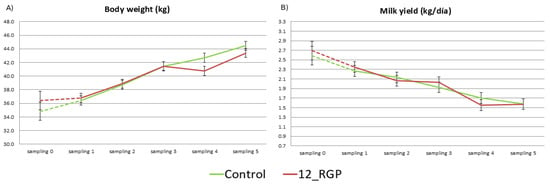
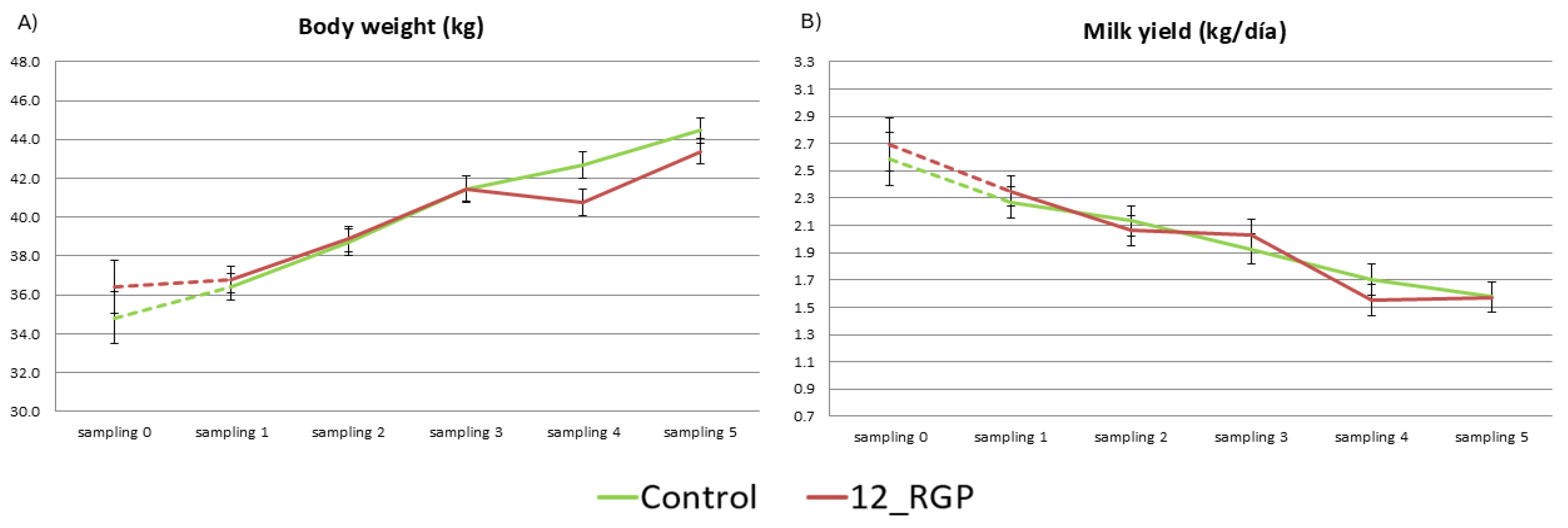
The inclusion of RGP silage did not significantly affect most variables related to productive performance (Table 3). Body weight did not differ between the Control and 12_RGP, and both showed a similar increasing trend as the trial progressed (Figure 1A). Milk yield did not differ between dietary treatments, and it followed the same gradual decline as lactation progressed in both diets (Figure 2A). Both FPM (%) and LSCC were significantly higher in milk from goats fed the 12_RGP diet, whereas milk urea concentrations were significantly lower in this same treatment compared with the Control diet (Table 3). The covariate was significant across all parameters, indicating that baseline differences contributed to the variability observed.
Table 3.
Main productive performance traits: least squares means (±SEM) by diet, and effects considered in the statistical model (p-value).
Figure 1.
Body weight (A) and Milk yield (B) recorded throughout the experiment (least square means ± SEM; dotted lines indicate the 2-week adaptation period to the experimental diet).
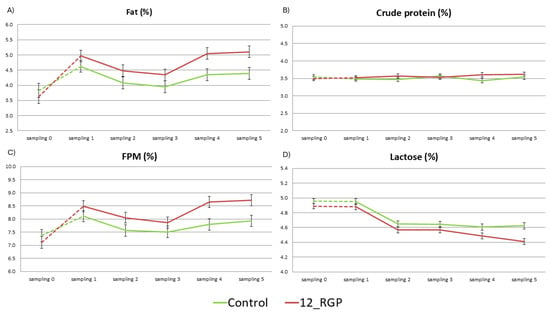
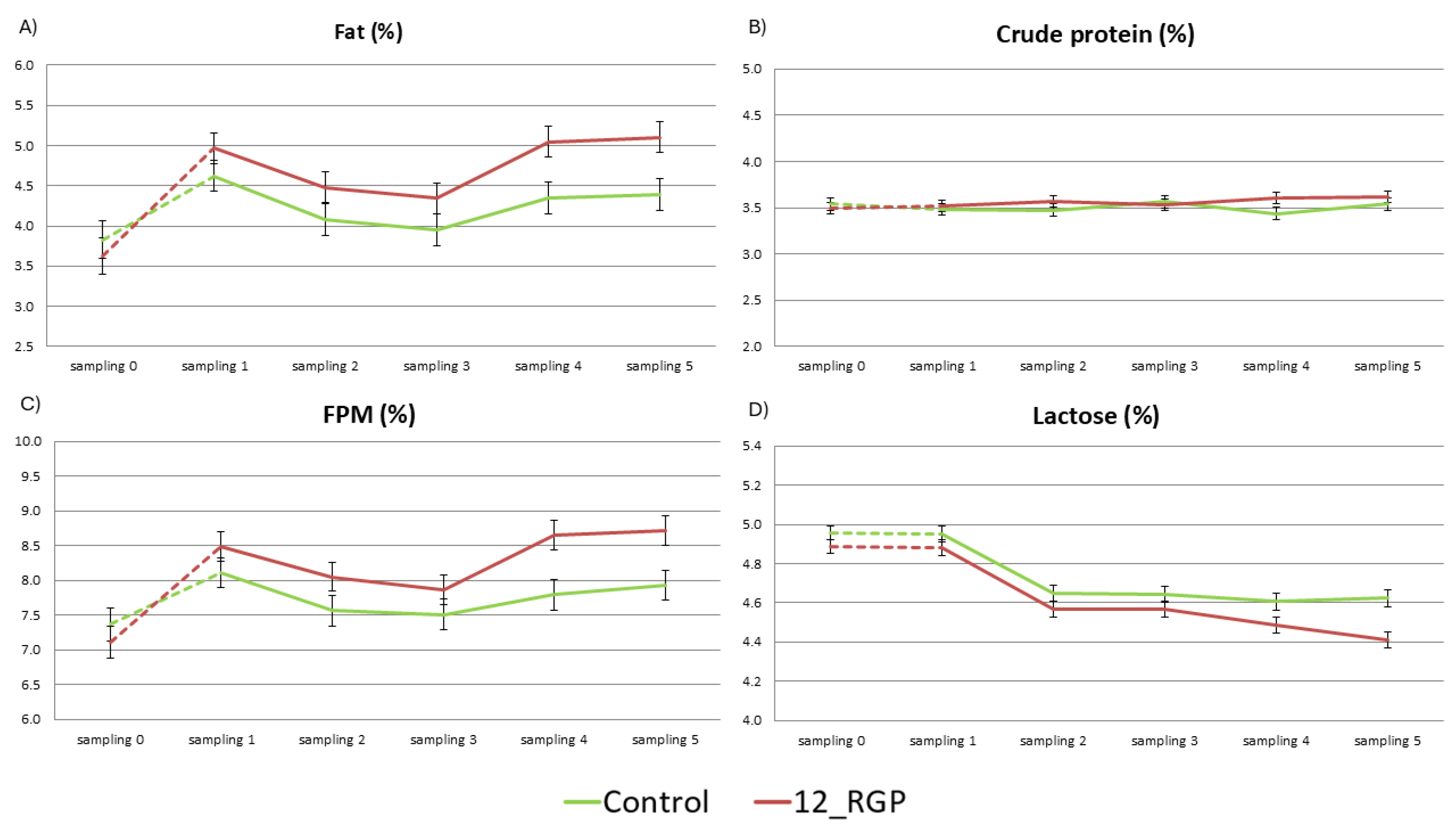
Figure 2.
Milk composition—Fat (A); Crude protein (B); Fat and Protein in Milk (FPM) (C); Lactose (D)—recorded throughout the experiment (least square means ± SEM; dotted lines indicate the adaptation period).
The evolution of milk composition throughout lactation is shown in Figure 2. Milk fat increased from early to late lactation, following a parallel trend in both dietary treatments; however, by the end of lactation, fat content was significantly higher in milk from goats fed the 12_RGP diet (Figure 2A). A comparable pattern was observed for FPM (Figure 2C). Crude protein content remained stable across the lactation period, with no significant differences between diets (Figure 2B). Milk lactose concentration declined progressively in both groups as lactation advanced, and by late lactation it was significantly lower in the 12_RGP treatment (Figure 2D).
3.2. Hemogram, Serum Biochemical Profile, and Oxidative Stress
As shown in Table 4, the inclusion of RGP silage did not produce any significant changes in the hemogram. Regarding the serum biochemical profile, BUN and UREA were significantly affected by dietary RGP inclusion. Goats fed the 12_RGP diet exhibited significantly lower values for both urea-related parameters compared with the Control goats (Table 5). Conversely, CHOL concentrations were significantly higher in goats receiving the 12_RGP diet than in those fed the Control diet (Table 5).
Table 4.
Hemogram: least squares means (± SEM) by diet, and effects considered in the statistical model (p-value).
Table 5.
Serum biochemical profile: least squares means (±SEM) by diet, and effects considered in the statistical model (p-value).
No significant differences between diets were observed in oxidative and inflammatory biomarkers (Table 6).
Table 6.
Oxidative and inflammatory biomarkers: least squares means (±SEM) by diet, and effects considered in the statistical model (p value).
3.3. Economic Performance of the Feeding Strategy
Analysis of the economic indicators (Table 7) showed that the inclusion of red grape pomace silage would lead to an improvement in profitability. The greatest contribution to this difference came from milk income, which was €26.7 higher per goat over the 245-day evaluation period compared with the Control diet. Feed expenditure also shifted slightly in favor of the 12_RGP treatment, reducing costs by €12.2 per goat during the same timeframe. When these components were considered together, the diet containing 12% DM RGP silage could provide an overall economic advantage of €38.9 per animal across the 8-month lactation.
Table 7.
Economic outcomes of incorporating red grape pomace silage (RGP 12% DM) into the diet of Murciano-Granadina dairy goats over an 8-month lactation period (€/goat).
4. Discussion
In this trial, goats receiving the 12_RGP ration produced similar amounts of milk to those fed the Control diet, a result that is favorable from a herd-management standpoint. Body weight followed a comparable pattern in both groups, with animals showing the expected gradual recovery of condition after kidding and a progressive increase as gestation advanced toward the next lactation, as previously described for dairy goats [49,50]. The simultaneous maintenance of milk output and body condition indicates that including red grape pomace silage at 12% DM does not interfere with the productive capacity of Murciano-Granadina goats. The values recorded for these traits, together with dry matter intake, fell within the normal range reported for this breed during lactation [33,51]. Similar milk yields under comparable physiological conditions have been documented in earlier studies on Murciano-Granadina goats [52,53,54]. Dry matter intake also remained consistent with previous observations in goats managed under analogous conditions [34,55,56], supporting the conclusion that the 12% inclusion level does not negatively affect feed consumption.
Findings from other species help contextualize these results. Martins Flores et al. [57] observed that lambs exhibited reduced intake when grape pomace silage was incorporated at substantially higher proportions (20–50% DM). Likewise, Moate et al. [58] reported that doubling the inclusion level used in the present study (333 g/kg DM) in dairy cattle reduced methane emissions but also resulted in a measurable decline in productive performance. These findings suggest that the response to grape pomace inclusion is dose-dependent and that the maximum tolerable inclusion level may be constrained by its chemical composition. In particular, grape pomace is characterized by a relatively high fiber content and a high concentration of phenolic compounds, including tannins, which at excessive inclusion rates may reduce palatability, alter nutrient digestibility, and ultimately limit voluntary feed intake. Therefore, the absence of intake depression observed in the present study may be explained by the moderate inclusion level evaluated (12% DM), which appears to remain below the threshold at which these constraints become biologically relevant. Additional research using grape pomace [59] and other agro-industrial by-products [55,60,61] has similarly demonstrated that, when diets are properly balanced and inclusion levels are carefully selected, these alternative feed resources can be incorporated without detrimental effects on productive performance or product quality.
Furthermore, goats receiving the 12_RGP ration showed a reduction in water intake, a response that can be explained by the higher moisture content supplied through the silage, which also increased the amount of fresh matter consumed. As noted by Van Soest [62], feeds with substantial moisture—such as silages or fresh forages—can partially fulfill the animals’ free-water needs under temperate conditions. This physiological adjustment becomes especially relevant when animals face heat stress or when access to drinking water is limited [63]. From a practical standpoint, the decrease of roughly 0.5 L of water per goat per day represents a meaningful saving in regions where arid climates constrain water availability and restrict livestock productivity. This consideration is even more pertinent within the broader context of competition for water resources, as livestock production increasingly shares this essential input with crop agriculture and other human activities, highlighting the importance of efficient water use in integrated production systems [64].
Milk from goats receiving the 12_RGP ration showed a clear increase in fat percentage. This outcome mirrors the higher fat concentration measured in these animals, while crude protein levels remained unchanged between treatments. The greater NDF content supplied by the 12_RGP diet, together with similar IVNDFD values, suggests that the additional fermentable fiber likely improved the supply of fermentation-derived energy available for milk-fat synthesis [65,66], without requiring extra feed consumption. The fact that this response appeared progressively over time indicates that rumen microorganisms may need an extended period of continuous exposure to the diet before fully adjusting to the new substrate profile [67,68]. Such microbial adaptation is essential for stabilizing fermentative activity and ensuring an efficient flow of fermentation-derived energy to the host [62,69]. A targeted analysis of rumen-liquid microbiota in goats consuming RGP would help clarify the microbial changes responsible for this pattern.
Comparable productive outcomes have been reported in studies incorporating dried grape pomace at 60 g/kg DM, grape seed cake up to 100 g/kg DM, red grape pomace silage at 120 g/kg DM, or white grape pomace silage at 150 g/kg DM [30,31,33,70]. However, those experiments were limited to short evaluation periods during early lactation. In contrast, the present study spans an entire lactation cycle, providing stronger evidence that RGP silage can be used as a partial substitute for conventional forages without impairing key production traits. The consistent productive responses observed at a 12% DM inclusion level indicate that Murciano-Granadina goats can adapt effectively to diets containing moderate amounts of polyphenol-rich agro-industrial by-products, reinforcing their suitability within circular and sustainable feeding strategies.
Goats receiving the RGP diet showed lower milk urea concentrations, accompanied by reduced plasma indicators of nitrogen metabolism, specifically lower BUN and UREA values in the 12_RGP group. Together, these findings suggest alterations in nitrogen-related metabolic pathways in response to dietary RGP inclusion. However, as nitrogen-use efficiency was not directly assessed in the present study, these responses should be interpreted as indirect indicators of changes in nitrogen metabolism rather than direct evidence of improved nitrogen utilization. Several mechanisms may contribute to this pattern. Milk urea is strongly influenced by crude protein intake and by the dietary balance between protein and energy [71], yet both rations in this study were formulated to supply equivalent amounts of these nutrients, minimizing their role in explaining the observed differences. The higher NDF content associated with RGP inclusion [72] represents another factor known to modulate milk urea. Under isoproteic conditions, Bonanno et al. [73] reported a negative association between NDF and milk urea, which aligns with the lower values detected in goats fed the 12_RGP diet. In addition, red grape pomace contains notable quantities of tannins [21,74], compounds capable of binding ruminal proteins and forming complexes that limit their degradation [14,15]. Reduced ruminal proteolysis lowers ammonia (NH3) production, and urea is the main excretory product derived from this pathway [13]. Goats, as natural browsers, tolerate dietary tannins better than sheep or cattle because their salivary proteins exhibit a strong affinity for tannin binding [17,75,76], which may have contributed to the alterations in nitrogen-related indicators observed in the present study.
Plasma cholesterol levels were higher in goats receiving the 12_RGP ration than in those fed the Control diet. Although grape pomace contains substantial amounts of unsaturated fatty acids [36,77,78], the extensive ruminal biohydrogenation of these compounds limits the extent to which dietary PUFA are directly reflected in systemic circulation. Therefore, the increase in plasma cholesterol observed in the present study cannot be attributed directly to the PUFA content of grape pomace [79]. The underlying mechanisms remain unclear and may involve alterations in lipid metabolism and lipoprotein dynamics; however, further studies including additional lipid biomarkers would be required to elucidate the pathways involved. Despite this statistical rise, all measured values remained within the physiological range established for dairy goats (80–130 mg/dL), indicating that metabolic health was not compromised.
No differences attributable to diet were detected in hematological or other biochemical traits. Both blood cell counts and serum biochemical indicators stayed within the reference intervals described for dairy goats [80,81,82]. Comparable findings have been reported in small ruminants supplemented with grape-derived ingredients: Alba et al. [83] observed no alterations in Lacaune sheep receiving 20 g/kg DM of grape pomace flour; similar outcomes were documented in French Alpine goats fed 100 g/kg DM of grape seed cake [31], and Saanen goats offered 150 g/kg DM of dried grape by-products also showed stable hematological and biochemical profiles [84].
Moreover, no dietary effects were detected for oxidative or inflammatory biomarkers. This lack of variation is compatible with the known antioxidant activity of grape pomace, whose polyphenols possess strong radical-scavenging properties and contribute to cellular protection against oxidative damage [21,22,74,85]. Nevertheless, the moderate inclusion level used in this trial may have limited the extent to which these bioactive compounds could exert measurable physiological effects, offering a plausible explanation for the absence of detectable changes in oxidative or inflammatory status.
With respect to udder health, LSCC values were slightly higher in milk from goats fed the 12_RGP diet, although the magnitude of this difference is unlikely to be biologically relevant. LSCC should be interpreted in conjunction with other productive and physiological indicators rather than as a standalone marker of intramammary health, particularly in goats, whose milk secretion occurs predominantly through an apocrine mechanism [86,87,88]. In the present study, the absence of negative effects on milk yield, milk composition, and the remaining health-related parameters suggests that the inclusion of ensiled red grape pomace did not adversely affect mammary status.
From an economic perspective, the use of RGP silage provides a clear cost advantage. Its processing and ensiling cost is approximately 125 €/t DM, substantially lower than the price of conventional forages such as alfalfa hay (240 €/t DM, [48]). When this cost differential is evaluated alongside the productive outcomes—particularly the fat- and protein-corrected milk yield (€/FPCM)—the most notable economic improvement relative to the Control diet stems from milk revenue, which increased by 26.7 €/goat. Feed costs also decreased slightly, by 12.2 €/goat, resulting in a total net benefit of 38.97 €/goat over the 8-month lactation. These findings are especially relevant given the growing economic, environmental, and structural pressures faced by livestock systems, largely driven by limited feed-resource availability and competition for raw materials. Numerous studies have highlighted the economic viability of incorporating agro-industrial by-products into ruminant diets [89,90,91], yet grape pomace remains insufficiently explored in goat production. Rising production costs—without proportional increases in farm-gate milk prices—continue to erode profitability. Because feed accounts for 55–65% of total operating expenses in dairy systems [92], nutritional strategies that improve feed efficiency or incorporate alternative, locally available ingredients are essential for enhancing economic sustainability and reducing environmental impact [93], in alignment with circular-economy principles. However, the economic outcomes reported herein should be interpreted with caution, as their reproducibility may be influenced by fluctuations in feed ingredient and milk prices over time, as well as by the specific conditions under which the present experiment was conducted.
5. Conclusions
In conclusion, the present study evaluated the long-term inclusion of 12% DM ensiled red grape pomace in the diets of dairy goats throughout a complete lactation cycle. Under the conditions of this study, this feeding strategy maintained milk yield, body weight, and physiological status, while increasing milk fat content and reducing nitrogen-related metabolic indicators. Hematological, oxidative, and inflammatory biomarkers were not adversely affected, supporting the physiological safety of including ensiled red grape pomace at this level. The economic assessment suggested a potential reduction in feeding costs and an improvement in net margin compared with the control diet. However, these economic estimates were not subjected to statistical analysis and should be interpreted with caution, as they are influenced by the specific market conditions and ingredient prices considered during the study period. Overall, the results indicate that ensiled red grape pomace can be incorporated at 12% of dietary DM as a viable feed resource for dairy goats. Further research should assess its effects on nutrient utilization, long-term feed efficiency, and economic performance under different production and market scenarios.
Author Contributions
Conceptualization, G.R. and J.R.D.; methodology, C.P., G.R. and J.R.D.; formal analysis, M.G.-L. and G.R.; investigation, M.G.-L., E.P.; resources, G.R. and J.R.D.; data curation, M.G.-L. and G.R.; writing—original draft preparation, M.G.-L.; writing—review and editing, J.R.D., G.R. and M.G.-L.; visualization, C.P. and J.R.D.; supervision, G.R. and J.R.D.; project administration, G.R. and J.R.D.; funding acquisition, G.R. and J.R.D. All authors have read and agreed to the published version of the manuscript.
Funding
This research was funded by the Ministry of Science and Innovation of Spain and FEDER/EU, grant number PID2021–122962OB-C31, MCIN/AEI/10.13039/501100011033/FEDER, EU.
Institutional Review Board Statement
The study was conducted according to the guidelines of EU Directive 2010/63 and the ARRIVE guidelines and approved by the Ethics Committee of Universidad Miguel Hernández de Elche (UMH.DTA.JDS.03.21, approval date: 9 October 2022).
Informed Consent Statement
Not applicable.
Data Availability Statement
The raw data supporting the conclusions of this article will be made available by the authors on request.
Acknowledgments
The Authors acknowledge technical personnel from Granja Caprina at Miguel Hernández University (Alfonso Navarro and Amparo Roca) for their implication in the welfare and management of animals.
Conflicts of Interest
The authors declare no conflicts of interest. The funders had no role in the design of the study; in the collection, analyses, or interpretation of data; in the writing of the manuscript, or in the decision to publish the results.
Abbreviations
| ABTS | 2.2′-azino-bis(3-ethylbenzothiazoline-6-sulfonate) |
| ADF | Acid Detergent Fiber |
| ADL | Acid Detergent Lignin |
| AIC | Akaike Information Criterion |
| ALB | Albumin |
| ALP | Alkaline Phosphatase |
| AMY | Amylase |
| BIC | Bayesian Information Criterion |
| BW | Body Weight |
| BUN | Blood Urea Nitrogen |
| CHOL | Cholesterol |
| CP | Crude Protein |
| CREA | Creatinine |
| DM | Dry Matter |
| DMI | Dry Matter Intake |
| EE | Ether Extract |
| FCM | Fat-Corrected Milk |
| FM | Fresh Matter |
| FMI | Fresh Matter Intake |
| FPCM | Fat and Protein-Corrected Milk |
| FRAP | Ferric Reducing Antioxidant Power |
| GGT | Gamma-Glutamyl Transferase |
| GLOB | Globulin |
| GLU | Glucose |
| HCT | Hematocrit |
| HGB | Hemoglobin |
| IVDMD | In Vitro Dry Matter Digestibility |
| IVNDFD | In Vitro Neutral Detergent Fiber Digestibility |
| IVOMD | In Vitro Organic Matter Digestibility |
| LSCC | Log10 Somatic Cell Count |
| LYM | Lymphocytes |
| LYPA | Lipase |
| ME | Metabolizable Energy |
| NDF | Neutral Detergent Fiber |
| NFDM | Non-Fat Dry Matter |
| OM | Organic Matter |
| RBC | Red Blood Cells |
| RGP | Red Grape Pomace |
| RLN | Ratio Lymphocytes/Neutrophils |
| RLM | Ratio Lymphocytes/Monocytes |
| SAA | Serum Amyloid-A |
| SCC | Somatic Cell Count |
| SEM | Standard Error of the Mean |
| SOD | Superoxide Dismutase |
| TP | Total Protein |
| UDM | Useful Dry Matter |
| VFA | Volatile Fatty Acids |
| WBC | White Blood Cells |
| WI | Water Intake |
References
- Manners, R.; Blanco-Gutiérrez, I.; Varela-Ortega, C.; Tarquis, A.M. Transitioning European Protein-Rich Food Consumption and Production towards More Sustainable Patterns—Strategies and Policy Suggestions. Sustainability 2020, 12, 1962. [Google Scholar] [CrossRef] [Scilit]
- Godfray, H.C.J.; Beddington, J.R.; Crute, I.R.; Haddad, L.; Lawrence, D.; Muir, J.F.; Pretty, J.; Robinson, S.; Thomas, S.M.; Toulmin, C. Food security: The challenge of feeding 9 billion people. Science 2010, 327, 812–818. [Google Scholar] [CrossRef] [Scilit] [PubMed]
- Fogarassy, C.; Nagy-P’ercsi, K.; Ajibade, S.; Gyuricza, C.; Ymeri, P. Relations between circular economic “principles” and organic food purchasing behaviour in Hungary. Agronomy 2020, 10, 616. [Google Scholar] [CrossRef] [Scilit]
- Food and Agriculture Organization of the United Nations. Faostat Statistical Database (FAO). 2024. Available online: https://www.fao.org/faostat/en/#data/QCL (accessed on 4 September 2026).
- Ishangulyyev, R.; Kim, S.; Lee, S. Understanding food loss and waste: Why do we lose and waste food? Foods 2019, 8, 297. [Google Scholar] [CrossRef] [Scilit] [PubMed]
- Benton, T.G.; Froggatt, A.; Wellesley, L.; Grafham, O.; King, R.; Morisetti, N.; Nixey, J.; Schröder, P. The Ukraine War and Threats to Food and Energy Security; Chatham House Report 2022–2004; Royal Institute of International Affairs: London, UK, 2022. [Google Scholar]
- Kilama, J.; Yakir, Y.; Shaani, Y.; Adin, G.; Kaadan, S.; Wagali, P.; Sabastian, C.; Ngomuo, G.; Mabjeesh, S.J. Chemical composition, in vitro digestibility, and storability of selected agro-industrial by-products: Alternative ruminant feed ingredients in Israel. Heliyon 2023, 9, e14581. [Google Scholar] [CrossRef] [Scilit] [PubMed]
- Malenica, D.; Kass, M.; Bhat, R. Sustainable management and valorization of agri-food industrial wastes and by-products as animal feed: For ruminants, non-ruminants and poultry. Sustainability 2022, 15, 117. [Google Scholar] [CrossRef] [Scilit]
- Islam, M.Z.; Zheng, L. Why is it necessary to integrate circular economy practices for agri-food sustainability from a global perspective? Sustain. Dev. 2025, 33, 600–620. [Google Scholar] [CrossRef] [Scilit]
- Salemdeeb, R.; Zu Ermgassen, E.K.H.J.; Kim, M.H.; Balmford, A.; Al-Tabbaa, A. Environmental and health impacts of using food waste as animal feed: A comparative analysis of food waste management options. J. Clean. Prod. 2017, 140, 871–880. [Google Scholar] [CrossRef] [Scilit] [PubMed]
- Castillo, C.; Abuelo, A.; Hernandez, J. Ruminant (bovine, caprine, and ovine) milk and meat production: The challenge of food quality and sustainability through the use of plant extracts. In Encyclopedia of Food Security and Sustainability; Ferranti, P., Berry, E.M., Anderson, J.R., Eds.; Elsevier: Amsterdam, The Netherlands, 2019; pp. 25–42. [Google Scholar]
- FAO; IFAD; UNICEF; WFP; WHO. The State of Food Security and Nutrition in the World 2023: Urbanization, Agrifood Systems Transformation and Healthy Diets Across the Rural–Urban Continuum; FAO: Rome, Italy, 2023. [Google Scholar]
- Makkar, H.P.S. Effects and fate of tannins in ruminant animals, adaptation to tannins, and strategies to overcome detrimental effects of feeding tannin-rich feeds. Small Rumin. Res. 2003, 49, 241–256. [Google Scholar] [CrossRef] [Scilit]
- Frutos, P.; Hervás, G.; Giráldez, F.J.; Mantecón, A.R. Review: Tannins and ruminant nutrition. Span. J. Agric. Res. 2004, 2, 191–202. [Google Scholar] [CrossRef] [Scilit]
- Patra, A.K.; Saxena, J. Exploitation of dietary tannins to improve rumen metabolism and ruminant nutrition. J. Sci. Food Agric. 2011, 91, 24–37. [Google Scholar] [CrossRef] [Scilit] [PubMed]
- Ventura-Cordero, J.; Sandoval-Castro, C.A.; Torres-Acosta, J.F.J.; Hoste, H.; Chan-Pérez, J.I.; Aguilar-Caballero, A.J. Foliage from tropical deciduous forest as a nutraceutical feed and its anthelmintic potential in small ruminants. Rev. Asoc. Interam. Prot. Veg. 2017, 37, 4–15. [Google Scholar]
- Schmitt, M.H.; Ward, D.; Shrader, A.M. Salivary tannin-binding proteins: A foraging advantage for goats? Livest. Sci. 2020, 234, 103974. [Google Scholar] [CrossRef] [Scilit]
- Correddu, F.; Lunesu, M.F.; Buffa, G.; Atzori, A.S.; Nudda, A.; Battacone, G.; Pulina, G. Can agro-industrial by-products rich in polyphenols be advantageously used in the feeding and nutrition of dairy small ruminants? Animals 2020, 10, 131. [Google Scholar] [CrossRef] [Scilit] [PubMed]
- Taladrid, D.; Laguna, L.; Bartolomé, B.; Moreno-Arribas, M.V. Aplicaciones y Nuevos Usos de Subproductos de la Vinificación. Interempresas. 2019. Available online: https://www.interempresas.net/Vitivinicola/Articulos/245686-Aplicaciones-y-nuevos-usos-de-subproductos-de-la-vinificacion.html (accessed on 7 September 2026).
- Bordiga, M.; Travaglia, F.; Locatelli, M.; Arlorio, M.; Coïsson, J.D. Spent grape pomace as a still potential by-product. Int. J. Food Sci. Technol. 2015, 50, 2022–2031. [Google Scholar] [CrossRef] [Scilit]
- Tangolar, S.G.; Özogul, F.; Tangolar, S.; Yağmur, C. Tocopherol content in fifteen grape varieties obtained using a rapid HPLC method. J. Food Compos. Anal. 2011, 24, 481–486. [Google Scholar] [CrossRef] [Scilit]
- Galanakis, C.M. Recovery of high added-value components from food wastes: Conventional, emerging technologies, and commercialized applications. Trends Food Sci. Technol. 2012, 26, 68–87. [Google Scholar] [CrossRef] [Scilit]
- Nudda, A.; Correddu, F.; Marzano, A.; Battacone, G.; Nicolussi, P.; Bonelli, P.; Pulina, G. Effects of diets containing grape seed, linseed, or both on milk production, liver and kidney activity, and immunity in lactating dairy ewes. J. Dairy Sci. 2015, 98, 1157–1166. [Google Scholar] [CrossRef] [Scilit] [PubMed]
- Qiu, Y.; Zhao, H.; He, X.; Zhu, F.; Zhang, F.; Liu, B.; Liu, Q. Effects of fermented feed of Pennisetum giganteum on growth performance, oxidative stress, immunity, and gastrointestinal microflora of Boer goats under thermal stress. Front. Microbiol. 2023, 13, 1030262. [Google Scholar] [CrossRef] [Scilit] [PubMed]
- Nudda, A.; Buffa, G.; Atzori, A.S.; Cappai, M.G.; Caboni, P.; Fais, G.; Pulina, G. Small amounts of agro-industrial by-products in dairy ewes diets affect milk production traits and hematological parameters. Anim. Feed Sci. Technol. 2019, 251, 76–85. [Google Scholar] [CrossRef] [Scilit]
- Fonseca, A.J.M.; Cabrita, A.R.J. Grape pomace as a replacement for soybean hulls in corn silage-based diets for dairy cows. Vet. Sci. 2026, 13, 87. [Google Scholar] [CrossRef] [Scilit] [PubMed]
- Carta, S.; Correddu, F.; Steri, R.; Meo Zilio, D.; Cesarani, A.; Pulina, G.; Nudda, A. Effect of grape pomace supplementation in mid-lactation dairy ewes on production and quality of milk and methane emissions. J. Anim. Sci. 2025, 103, skaf237. [Google Scholar] [CrossRef] [Scilit] [PubMed]
- Bennato, F.; Martino, C.; Ianni, A.; Giannone, C.; Martino, G. Dietary grape pomace supplementation in lambs affects the meat fatty acid composition, volatile profiles and oxidative stability. Foods 2023, 12, 1257. [Google Scholar] [CrossRef] [Scilit] [PubMed]
- Gálvez-López, M.; Viuda-Martos, M.; Saldo, J.; Sendra, E.; Romero, G.; Díaz, J.R. Dietary white grape pomace silage for goats: Assessing the impact of inclusion level on milk processing attributes. Appl. Sci. 2025, 15, 12791. [Google Scholar] [CrossRef] [Scilit]
- Renna, M.; Martínez Marín, A.L.; Lussiana, C.; Colonna, L.; Mimosi, A.; Cornale, P. Caprine milk fatty acid responses to dietary dried grape pomace. Ital. J. Anim. Sci. 2023, 22, 1186–1194. [Google Scholar] [CrossRef] [Scilit]
- Antunović, Z.; Novoselec, J.; Klir Šalavardić, Ž.; Steiner, Z.; Drenjančević, M.; Pavić, V.; Đidara, M.; Ronta, M.; Barron, L.J.; Mioč, B. The effect of grape seed cake as a dietary supplement rich in polyphenols on the quantity and quality of milk, metabolic profile of blood, and antioxidative status of lactating dairy goats. Agriculture 2024, 14, 479. [Google Scholar] [CrossRef] [Scilit]
- Kafantaris, I.; Kotsampasi, B.; Christodoulou, V.; Makri, S.; Stagos, D.; Gerasopoulos, K.; Petrotos, K.; Goulas, P.; Kouretas, D. Effects of dietary grape pomace supplementation on performance, carcass traits and meat quality of lambs. In Vivo 2018, 32, 807–812. [Google Scholar] [CrossRef] [Scilit] [PubMed]
- Gálvez-López, M.; Donné Kiatti, D.; Atzori, A.S.; Roca, A.; Fernández, N.; Romero, G.; Díaz, J.R. Short-term effect of different inclusion levels of dietary red grape pomace silage on productive performance, milk composition, and health indices in dairy goats. Anim. Feed Sci. Technol. 2026, 342, 116860. [Google Scholar] [CrossRef] [Scilit]
- Fernández, C.; Sánchez-Seiquer, P.; Navarro, M.J.; Garcés, C. Modelling the voluntary dry matter intake in Murciano-Granadina dairy goats. In Sustainable Grazing, Nutritional Utilization and Quality of Sheep and Goat Products; Alcaide, M.E., Salem, B.H., Biala, K., Morand-Fehr, P., Eds.; CIHEAM: Zaragoza, Spain, 2005; pp. 395–399. [Google Scholar]
- Jarrige, R.; De Blas, J.C.; Fraga, M.J. (Eds.) Alimentación en Rumiantes; INRA: Paris, France; Mundi-Prensa: Madrid, Spain, 1981. [Google Scholar]
- Romero, G.; Nieddu, L.; Mouhssine, A.; Nowicka, P.; Bueso-Ródenas, J.; Fernández, N.; Díaz, J.R. Bale ensiling preserves nutritional composition and phenolic compounds of red grape pomace. AgriEngineering 2025, 7, 172. [Google Scholar] [CrossRef] [Scilit]
- Association of Official Analytical Chemists. Official Methods of Analysis, 16th ed.; AOAC: Washington, DC, USA, 1999. [Google Scholar]
- Van Soest, P.J.; Robertson, J.B.; Lewis, B.A. Methods for dietary neutral detergent fibre and non-starch polysaccharides in relation to animal nutrition. J. Dairy Sci. 1991, 74, 3583–3597. [Google Scholar] [CrossRef] [Scilit] [PubMed]
- ISO 10520; Native Starch—Determination of Starch Content—Ewers Polarimetric Method. International Organization for Standardization: Geneva, Switzerland, 1997.
- Kim, D.; Jeong, S.W.; Lee, C.Y. Antioxidant capacity of phenolic phytochemicals from various cultivars of plums. Food Chem. 2003, 81, 321–326. [Google Scholar] [CrossRef] [Scilit]
- González-Arrojo, A. Changes on levels of essential trace elements in selenium naturally enriched milk. J. Food Nutr. Res. 2016, 4, 303–308. [Google Scholar]
- Menke, K.H.; Steingass, H. Estimation of the energetic feed value obtained from chemical analysis and in vitro gas production using rumen fluid. Anim. Res. Dev. 1988, 28, 7–55. [Google Scholar]
- Yáñez-Ruiz, D.R.; Bannink, A.; Dijkstra, J.; Kebreab, E.; Morgavi, D.P.; O’Kiely, P.; Reynolds, C.K.; Schwarm, A.; Shingfield, K.J.; Yu, Z.; et al. Design, implementation and interpretation of in vitro batch culture experiments to assess enteric methane mitigation in ruminants—A review. Anim. Feed Sci. Technol. 2016, 216, 1–18. [Google Scholar] [CrossRef] [Scilit]
- Gravert, H.O. Dairy Cattle Production; Elsevier Science: Amsterdam, The Netherlands, 1987. [Google Scholar]
- Centraal Veevoederbureau. CVB Table Booklet Feeding of Ruminants; CVB Series No. 43; CVB: Lelystad, The Netherlands, 2008. [Google Scholar]
- Leite, A.V.; Malta, L.G.; Riccio, M.F.; Eberlin, M.N.; Pastore, G.M.; Maróstica Júnior, M.R. Antioxidant potential of rat plasma by administration of freeze-dried jaboticaba peel. J. Agric. Food Chem. 2011, 59, 2277–2283. [Google Scholar] [CrossRef] [Scilit] [PubMed]
- Oyaizu, M. Studies on products of browning reaction: Antioxidative activities of products prepared from glucosamine. Jpn. J. Nutr. Diet. 1986, 44, 307–315. [Google Scholar] [CrossRef] [Scilit]
- Lonja Agropecuaria de Albacete, Cotizaciones de Cereal. Interempresas. 2024. Available online: https://www.interempresas.net/Ganadero/632624-Lonja-Agropecuaria-de-Albacete-Cotizaciones-de-Cereal-html (accessed on 21 May 2026).
- Ali, A.K.A.; Shook, G.E. An optimum transformation for somatic cell concentration in milk. J. Dairy Sci. 1980, 63, 487–490. [Google Scholar] [CrossRef] [Scilit]
- Widiyono, I.; Sarmin, S.; Yanuartono, Y. Influence of body condition score on metabolic and reproductive status of adult female Kacang goats. J. Appl. Anim. Res. 2020, 48, 201–206. [Google Scholar] [CrossRef] [Scilit]
- Chaves, A.S.; Silva, F.; Valentim, R.; Quintas, H. Body condition in small ruminants—Effects of nutrition on the hypothalamic–pituitary–gonad axis and ovarian activity. Physiologia 2024, 4, 213–225. [Google Scholar] [CrossRef] [Scilit]
- Ministerio de Agricultura, Pesca y Alimentación (MAPA). Datos Productivos de la Raza Caprina Murciano-Granadina. Available online: https://www.mapa.gob.es/ (accessed on 3 September 2026).
- Fernández, C.; Sánchez, A.; Garcés, C. Modeling the lactation curve for test-day milk yield in Murciano-Granadina goats. Small Rumin. Res. 2002, 46, 29–41. [Google Scholar] [CrossRef] [Scilit]
- Monllor, P.; Muelas, R.; Roca, A.; Atzori, A.S.; Díaz, J.R.; Sendra, E.; Romero, G. Long-term feeding of dairy goats with broccoli by-product and artichoke plant silages. Animals 2020, 10, 1670. [Google Scholar] [CrossRef] [Scilit] [PubMed]
- Monllor, P.; Zemzmi, J.; Muelas, R.; Roca, A.; Sendra, E.; Romero, G.; Díaz, J.R. Long-term feeding of dairy goats with 40% artichoke by-product silage. Animals 2023, 13, 3585. [Google Scholar] [CrossRef] [Scilit] [PubMed]
- Ibáñez, C.; Criscioni, P.; Arriaga, H.; Merino, P.; Espinós, F.J.; Fernandez, C. Murciano-Granadina goat performance and methane emission after replacing barley grain with fibrous by-products. PLoS ONE 2016, 11, e0151215. [Google Scholar] [CrossRef]
- Martins Flores, D.R.; da Fonseca, P.A.F.; Schmitt, J.; Tonetto, C.J.; Rosado, A.G., Jr.; Hammerschmitt, R.K.; Facco, D.B.; Brunetto, G.; Nörnberg, J.L. Lambs fed increasing levels of grape pomace silage: Productive performance. Livest. Sci. 2020, 240, 104169. [Google Scholar] [CrossRef] [Scilit]
- Moate, P.J.; Jacobs, J.L.; Hixson, J.L.; Deighton, M.H.; Hannah, M.C.; Morris, G.L.; Ribaux, B.E.; Wales, W.J.; Williams, S.R.O. Effects of feeding red or white grape marc. Animals 2020, 10, 976. [Google Scholar] [CrossRef] [Scilit] [PubMed]
- Martins Flores, D.R.; Patrícia da Fonseca, A.F.; Schmitt, J.; Tonetto, C.J.; Rosado, A.G., Jr.; Hammerschmitt, R.K.; Facco, D.B.; Brunetto, G.; Nörnberg, J.L. Lamb meat quality after grape pomace silage. Small Rumin. Res. 2021, 195, 106234. [Google Scholar] [CrossRef] [Scilit]
- Dentinho, M.T.P.; Paulos, K.; Costa, C.; Costa, J.; Fialho, L.; Cachucho, L. Silages of agro-industrial by-products in lamb diets. Anim. Feed Sci. Technol. 2023, 298, 115603. [Google Scholar] [CrossRef] [Scilit]
- Díaz, J.R.; Galvez-Lopez, M.; Kiatti, D.D.; Roca, A.; Ilea, M.I.; Atzori, A.S.; Romero, G. Dairy Goats’ Responses to Different Levels of Pomegranate By-Product Silage in the Diet: Productive Performance and Metabolic Indicators. Animals 2025, 16, 2456. [Google Scholar] [CrossRef] [Scilit] [PubMed]
- Van Soest, P.J. Intake. In Nutritional Ecology of the Ruminant, 2nd ed.; Cornell University Press: Ithaca, NY, USA, 1994; pp. 337–353. [Google Scholar]
- Van Soest, P.J. Water balance. In Nutritional Ecology of the Ruminant, 2nd ed.; Cornell University Press: Ithaca, NY, USA, 1994; pp. 342–344. [Google Scholar]
- Wisser, D.; Grogan, D.S.; Lanzoni, L.; Tempio, G.; Cinardi, G.; Prusevich, A.; Glidden, S. Water use in livestock agri-food systems. Water 2024, 16, 1681. [Google Scholar] [CrossRef] [Scilit]
- Van Soest, P.J. Chapters 5–7. In Nutritional Ecology of the Ruminant, 2nd ed.; Cornell University Press: Ithaca, NY, USA, 1994; pp. 137–232. [Google Scholar]
- Chilliard, Y.; Ferlay, A.; Rouel, J.; Lamberet, G. Nutritional and physiological factors affecting goat milk lipid synthesis. J. Dairy Sci. 2003, 86, 1751–1770. [Google Scholar] [CrossRef] [Scilit] [PubMed]
- Weimer, P.J. Manipulating ruminal fermentation: A microbial ecological perspective. J. Anim. Sci. 1998, 76, 3114–3122. [Google Scholar] [CrossRef] [Scilit] [PubMed]
- Ricci, S.; Pacífico, C.; Castillo-Lopez, E.; Rivera-Chacon, R.; Schwartz-Zimmermann, H.E.; Reisinger, N.; Berthiller, F.; Zebeli, Q.; Petri, R.M. Microbial adaptation to dietary starch. Front. Microbiol. 2022, 13, 920427. [Google Scholar] [CrossRef] [Scilit] [PubMed]
- Newbold, C.; Ramos-Morales, E. Ruminal microbiome and metabolome. Animal 2019, 14, S78–S86. [Google Scholar] [CrossRef] [Scilit] [PubMed]
- Galvez-Lopez, M.; Sandoval-Castro, C.A.; Pérez, E.; Rodríguez, M.; Peris, C.; Romero, G.; Díaz, J.R. Short-term feeding of white grape pomace silage. Front. Anim. Sci. 2025, 6, 1675085. [Google Scholar] [CrossRef] [Scilit]
- Bendelja, D.; Dolenčić, I.; Prpić, Z.; Vnučec, I.; Samaržija, D. Urea concentration in goat milk. J. Cent. Eur. Agric. 2020, 21, 707–721. [Google Scholar] [CrossRef] [Scilit]
- Criscioni, P.; Fernández, C. Rice bran replacing oat grain in goats. J. Dairy Sci. 2016, 99, 280–290. [Google Scholar] [CrossRef] [Scilit] [PubMed]
- Bonanno, A.; Todaro, M.; Di Grigoli, A.; Scatassa, M.L.; Tornambè, G.; Alicata, M.L. Relationships between dietary factors and milk urea nitrogen level in goats grazing herbaceous pasture. Ital. J. Anim. Sci. 2008, 7, 219–235. [Google Scholar] [CrossRef] [Scilit]
- Harbeoui, H.; Rebey, I.B.; Ouerghemmi, I.; Wannes, W.A.; Zemni, H.; Zoghlami, N.; Khan, N.A.; Ksouri, R.; Tounsi, M.S. Grape seed oils from Tunisian varieties. J. Food Biochem. 2017, 42, e12595. [Google Scholar] [CrossRef] [Scilit]
- Hofmann, R.R. Ecophysiological adaptation of ruminants. Oecologia 1989, 78, 443–457. [Google Scholar] [CrossRef] [Scilit] [PubMed]
- Launchbaugh, K.L.; Walker, J. Targeted grazing. In Targeted Grazing: A Natural Approach to Vegetation Management; Society for Range Management: Denver, CO, USA, 2006; pp. 2–8. [Google Scholar]
- Blasi, F.; Trovarelli, V.; Mangiapelo, L.; Ianni, F.; Cossignani, L. Grape pomace for feed enrichment. Foods 2024, 13, 3541. [Google Scholar] [CrossRef] [Scilit] [PubMed]
- Galvez-Lopez, M.; Navarro, A.; Muelas, R.; Roca, A.; Peris, C.; Romero, G.; Díaz, J.R. Potential of Baled Silage to Preserve White Grape Pomace for Ruminant Feeding. Agriculture 2025, 15, 974. [Google Scholar] [CrossRef] [Scilit]
- Delavaud, C.; Fougère, H.; Bertrand-Michel, J.; Bernard, L. Milk fat depression and plasma lipids. Animal 2022, 16, 100635. [Google Scholar] [CrossRef] [Scilit] [PubMed]
- Kaneko, J.J.; Harvey, J.W.; Bruss, M.L. Appendixes. In Clinical Biochemistry of Domestic Animals, 5th ed.; Academic Press: San Diego, CA, USA, 1997; pp. 885–905. [Google Scholar]
- Russell, K.E.; Roussel, A.J. Evaluation of ruminant serum chemistry profile. Vet. Clin. North Am. Food Anim. Pract. 2007, 23, 403–426. [Google Scholar] [CrossRef] [Scilit] [PubMed]
- Merck Veterinary Manual. Serum Biochemical Analysis Reference Ranges. Available online: https://www.merckvetmanual.com/ (accessed on 3 September 2026).
- Alba, D.F.; Campigotto, G.; Cazarotto, C.J.; Dos Santos, D.S.; Gebert, R.R.; Reis, J.H.; Souza, C.F.; Baldissera, M.D.; Gindri, A.L.; Kempka, A.P.; et al. Grape residue flour in dairy sheep under heat stress. J. Therm. Biol. 2019, 82, 197–205. [Google Scholar] [CrossRef] [Scilit] [PubMed]
- Badiee Baghsiyah, M.; Bashtani, M.; Farhangfar, S.H.; Sarir, H. Effect of grape by-products on ruminal fermentation and milk fatty acids in Saanen goats. Iran. J. Appl. Anim. Sci. 2023, 13, 731–742. [Google Scholar]
- Ovcharova, T.; Zlatanov, M.; Dimitrova, R. Chemical composition of seeds of Bulgarian grape varieties. J. Vitic. Enol. 2016, 31, 31–40. [Google Scholar] [CrossRef] [Scilit]
- Paape, M.J.; Poutrel, B.; Contreras, A.; Marco, J.C.; Capuco, A.V. Milk somatic cells and lactation in small ruminants. J. Dairy Sci. 2001, 84, E237–E244. [Google Scholar] [CrossRef] [Scilit]
- Díaz, J.; Romero, G.; Muelas, R.; Sendra, E.; Pantoja, J.; Paredes, C. Analysis of the influence of variation factors on electrical conductivity of milk in Murciano-Granadina goats. J. Dairy Sci. 2011, 94, 3885–3894. [Google Scholar] [CrossRef] [Scilit] [PubMed]
- Podhorecká, K.; Borková, M.; Šulc, M.; Seydlová, R.; Dragounová, H.; Švejcarová, M.; Peroutková, J.; Elich, O. Somatic cell count in goat milk. Foods 2021, 10, 1046. [Google Scholar] [CrossRef] [Scilit] [PubMed]
- Molosse, V.L.; Deolindo, G.L.; Lago, R.V.P.; Cécere, B.G.O.; Zotti, C.A.; Vedovato, M.; Copetti, P.M.; Fracasso, M.; Morsch, V.M.; Xavier, A.C.H.; et al. Ensiled and dehydrated grape pomace in beef cattle. Anim. Feed Sci. Technol. 2023, 302, 115671. [Google Scholar] [CrossRef] [Scilit]
- Baker, L.; Bender, J.; Ferguson, J.; Rassler, S.; Pitta, D.; Chann, S.; Dou, Z. Upcycling culled citrus fruit. Resour. Conserv. Recycl. 2024, 203, 107452. [Google Scholar] [CrossRef] [Scilit]
- Galvez-Lopez, M.; Romero, G.; Roca, A.; Rodríguez, M.; Díaz, J.R. White grape pomace bale silage in dairy goats. Front. Anim. Sci. 2026, 7, 1940034. [Google Scholar] [CrossRef] [Scilit]
- Gocsik, E.; Mulder, N.D.; Nikolik, G.; Sharma, N.; McCracken, C.; Zimmerman, L.; Talbott, C.; Pan, C.; Yanaguizawa, W.; Corkran, J.; et al. Global Animal Protein Outlook 2026; Rabobank: Utrecht, The Netherlands, 2025. [Google Scholar]
- Marques, J.G.O.; de Oliveira Silva, R.; Barioni, L.G.; Hall, J.A.J.; Fossaert, C.; Tedeschi, L.O.; Garcia-Launay, F.; Moran, D. Environmental and economic trade-offs in cattle feed strategies. Agric. Syst. 2022, 195, 103308. [Google Scholar] [CrossRef] [Scilit]

Disclaimer/Publisher’s Note: The statements, opinions and data contained in all publications are solely those of the individual author(s) and contributor(s) and not of MDPI and/or the editor(s). MDPI and/or the editor(s) disclaim responsibility for any injury to people or property resulting from any ideas, methods, instructions or products referred to in the content. |
© 2026 by the authors. Licensee MDPI, Basel, Switzerland. This article is an open access article distributed under the terms and conditions of the Creative Commons Attribution (CC BY) license.