


Abstract
In this work, the effect of chitosan concentration in chitosan/nickel composite coatings on their morphology and electrocatalytic activity in hydrogen evolution reaction (HER) was investigated. A series of Chitosan/Ni coatings with chitosan content from 0 to 0.7 wt.% was obtained by nickel electrodeposition onto a preformed biopolymer matrix, enabling targeted control of the roughness and specific surface area of the nickel layers. Morphology and roughness parameters were studied using atomic force microscopy and confocal microscopy. Electrochemical activity in the HER was examined by linear sweep voltammetry. Among the studied electrocatalysts, the Chitosan(0.6)/Ni system showed the best HER efficiency, with an overpotential of −200 mV at a current density of 10 mA/cm2. Electrochemical impedance spectroscopy was used to determine the real surface area of the coatings. The Chitosan(0.6)/Ni sample exhibited the largest surface area, explaining its high HER activity. The obtained data revealed a correlation between chitosan concentration, composite morphology, and electrochemical activity, and allowed determination of the optimal composite composition. The results demonstrate the potential of chitosan as an effective structural modifier of nickel coatings and open up possibilities for the targeted design of composite materials with tailored electrochemical properties.
1. Introduction
The development of hydrogen energy is considered one of the main pathways for transitioning to environmentally friendly energy sources [1,2]. In this context, the electrochemical hydrogen evolution from water (Hydrogen Evolution Reaction, HER) plays a central role in producing “green” hydrogen [3,4,5,6]. To date, platinum group metals remain the most effective catalysts for the HER [7,8,9,10]; however, their high cost and limited natural reserves hinder the widespread implementation of water electrolysis. Therefore, there is an urgent need to develop inexpensive, abundant, and stable non-noble metal catalysts capable of providing high activity and long-term durability under cathodic polarization conditions.
Among non-noble metals, nickel attracts particular attention due to its high catalytic activity in the HER and relatively low cost [11,12]. However, the activity of smooth nickel is significantly inferior to that of platinum catalysts, stimulating the search for approaches to enhance it. The main strategies for modifying nickel electrodes include nanostructuring (increasing the real surface area), alloying (introducing elements that alter the electronic structure), and the fabrication of composite materials in which the metal is combined with a matrix possessing catalytic or structuring properties [13,14,15].
Of particular interest in recent years are metal–polymer composites. In most cases, polymers in composites act as a matrix for dispersing metal particles. For example, Al-Betar [16] investigated the catalytic activity of polyaniline (PANI) and cobalt-based composites in the HER. Films were formed by two methods: either sequential electrochemical deposition of Co3O4 onto a PANI layer deposited on an indium tin oxide (ITO)-coated glass electrode (PANI/Co sample), or simultaneous deposition of both materials onto the same substrate (PANI-Co sample). Surface morphology analysis showed that the PANI/Co sample represented a smooth polymer layer with uniformly distributed cobalt nanoparticles. In contrast, the PANI-Co structure on the substrate was characterized by complexity and high porosity. During HER testing, despite its developed porous surface, the PANI-Co sample exhibited a higher overpotential (0.81 V) compared to PANI/Co (0.65 V) at a current density of 1 mA·cm−2. In Ref. [17], a bilayer electrocatalyst based on a three-dimensional porous array of nickel nanoparticles in an aniline and pyrrole matrix was proposed for the HER. The developed electrode demonstrated an overpotential of 520 mV at a current density of 10 mA·cm−2. The Tafel slope was 90 mV·dec−1. Such high activity is explained by the synergistic interaction between the three-dimensional nickel layer and the copolymer layer. This is confirmed by the fact that each individual layer did not possess significant catalytic activity.
Along with synthetic polymers, biopolymers are of considerable interest [18]. Their environmental friendliness, low toxicity, and renewability make them an alternative for creating “green” electrocatalytic systems [19,20,21,22]. A well-known biopolymer is cellulose, which is widely used in paper production, animal feed, cosmetic products, textiles, and pharmaceuticals [23,24,25,26]. Other sought-after biopolymers are chitin and chitosan, which find extensive applications in biomedicine, particularly in wound healing, as well as in drug and vaccine delivery systems [27,28,29,30]. All of these biopolymers have proven themselves as effective heterogeneous supports for various catalysts [31,32]. Due to the ease of chemical modification of these polymers, a wealth of information has been accumulated in the literature regarding their interaction with transition metals [33,34,35,36,37]. Cellulose, chitin, and carboxymethylcellulose can effectively sorb metal cations due to the large number of heteroatoms in their structure. In particular, carboxymethylcellulose and chitin, containing nitrogen atoms, rapidly form complexes with metals such as palladium, platinum, cobalt, and gold [38,39,40,41]. The composites obtained on their basis can be used for the catalytic production of green hydrogen [42].
Among systems based on these and other biopolymers, composites with chitosan hold a special place. Chitosan is a biocompatible, biodegradable polymer [43] containing reactive amino and hydroxyl groups. Due to its ability to form complexes and structure surfaces, chitosan is considered an effective modifier of the morphology of metal coatings [44]. In Ref. [45], Kayan et al. modified an aluminum electrode with a polypyrrole–chitosan composite film with a low loading of gold nanoparticles (approximately 2 wt.%). Chitosan ensured high dispersion of nanoparticles and the formation of a branched hybrid network. The obtained electrode showed a Tafel slope of −152 mV/dec, indicating a Volmer–Heyrovsky mechanism with the proton discharge step as rate-limiting, and remained stable for 8 h. In Ref. [46], a ZnO–chitosan nanocomposite (Zn-Chit) was synthesized using deposition methods. In the HER in an acidic medium, the modified Zn-Chit-based electrode showed significantly lower overpotential compared to pure ZnO. To achieve a current density of 50 mA·cm−2, −0.2 V was required for Zn-Chit and −0.31 V (vs. RHE) for ZnO. Long-term chronoamperometric measurements over 5 h revealed high electrode stability: the loss of initial current was 8% for GC/ZnO and 9% for GC/Zn-Chit.
Khramenkova and co-workers [47] proposed a hybrid material based on chitosan polyelectrolytes with nickel and cobalt oxycompounds. Tests in alkaline medium showed that during the first four hours of electrolysis, the hydrogen evolution overpotential significantly decreases, after which it reaches a steady-state level for a long time. The overpotential value decreases from 0.289 V to 0.21 V at a current density of 10 mA·cm−2. The Tafel slope for the hybrid material is 110 mV/dec, indicating a Volmer–Heyrovsky mechanism for the HER with the Volmer reaction as the rate-determining step. The authors of [48] developed a Co@Chitosan composite based on chitosan and Co2O3 nanoparticles. A comparison of the catalytic properties of Co2O3 and Co@Chitosan in the hydrogen evolution reaction showed that the composite material exhibits higher efficiency in hydrogen production. The overpotential values at a current density of 50 mA·cm−2 for Co2O3 and Co@Chitosan are –0.55 V and –0.43 V, respectively. In reference [49], a multifunctional composite based on chitosan and ZrO2–Bi2O3 oxides was synthesized. The composite material demonstrated a hydrogen evolution overpotential of 135.2 mV. In work [50], Yılmaz and colleagues developed a nickel-doped composite electrode consisting of polypyrrole and chitosan (PPy/Chi/Ni). The combination of nickel with a conductive polymer–biopolymer composite matrix leads to an increase in the activity of the resulting PPy/Chi/Ni material toward the HER. In alkaline medium, PPy/Chi/Ni provides an overpotential of 78 mV at a current density of 10 mA·cm−2 with a Tafel slope of 93 mV/dec. The catalyst also exhibits excellent stability during prolonged electrolysis: over 15 h of continuous operation, the increase in overpotential was only 22 mV. In study [51], HER electrocatalysts were synthesized by depositing platinum nanoparticles onto carbon nanotubes derived from cellulose and chitosan, with commercial carbon nanotubes used as a support. In acidic medium, the Pt-Cellulose-CA and Pt-Chitosan-CA catalysts showed hydrogen evolution overpotentials of 46.6 mV and 49.5 mV, respectively, at a current density of 10 mA·cm−2. In work [52], the authors combined Fe2O3 and Ni with microcrystalline cellulose (MCC) to develop a new Fe2O3–Ni–MCC electrocatalyst. The obtained material provides a hydrogen evolution overpotential of 163 mV at a current density of 10 mA·cm−2. In reference [53], bacterial cellulose (BC) nanofibers served as a matrix for in situ deposition of ZIF-67. Carbonization of the ZIF-67/BC precursor yielded a nitrogen-doped CoP-NC/CBC composite material. The hydrogen evolution reaction was investigated both in 0.5 M H2SO4 and in 1 M KOH. The obtained composite achieves a current density of 10 mA·cm−2 at overpotentials of 182 mV in acidic and 151 mV in alkaline electrolyte.
Despite the existence of studies on the fabrication of HER catalysts based on metal–chitosan composites [54,55], the question of the effect of polymer concentration on the set of electrochemical characteristics of the resulting coating—such as double-layer capacitance, charge transfer resistance, and activation energy, as well as the relationship between these parameters and surface morphology—remains insufficiently understood. Such systematic understanding is necessary for the targeted regulation of composite properties and the selection of optimal synthesis conditions.
In this regard, the aim of this work is a comprehensive study of Chitosan/Ni composite coatings synthesized at various chitosan concentrations (from 0 to 0.7 wt.%). The obtained results will allow determination of the optimal composite composition for the fabrication of efficient non-noble metal-based HER catalysts.
2. Materials and Methods
The synthesis of Chitosan/Ni composite coatings was carried out in two steps on a glassy carbon substrate. In the first step, chitosan solutions were prepared in an aqueous acetic acid solution. The polymer concentration was varied from 0 to 0.8 wt.%. To ensure homogeneity, the solutions were subjected to ultrasonic treatment for 1 h. The polymer solution was applied to the working electrode using a dispenser in a volume of 30 µL. Subsequently, the substrates with the polymer layer were kept in a drying oven at 50 °C for 15 min. In the second step, nickel was deposited onto the preformed polymer matrix by cathodic electrodeposition from an electrolyte containing 0.7 M NiCl2·6H2O. The process was carried out at a current density of 24 mA/cm2 under an inert gas atmosphere. To ensure a fair comparison across all samples, the Ni loading was kept constant. Ni was electrodeposited using identical conditions (deposition time: 90 s; applied current density: 24 mA/cm2) for all electrodes. The composite coatings obtained in this manner will be denoted hereafter as Chitosan/Ni with the corresponding polymer mass concentration (e.g., Chitosan(0.5)/Ni). All reagents were purchased from Sigma-Aldrich (St. Louis, MO, USA).
The electrocatalytic properties of the obtained Chitosan/Ni composites in the HER were studied in a 0.5 M sulfuric acid solution (pH = 0) over the temperature range of 298–303 K. All experiments were performed in a conventional three-electrode cell under an oxygen-free atmosphere; for this purpose, the electrolyte was preliminarily saturated with argon. During the measurements, the electrolyte was also continuously purged with argon. A graphite rod served as the counter electrode, and a silver/silver chloride electrode (Ag/AgCl) was used as the reference electrode. During data processing, the measured potentials were converted to the reversible hydrogen electrode (RHE) scale using the Nernst equation [56]:
where is the experimentally measured potential, and is the standard potential of the silver/silver chloride electrode. Polarization curves were recorded using a P-45X potentiostat (Electrochemical Instruments, Chernogolovka, Russia) at a scan rate of 2 mV/s. All HER polarization curves were iR-corrected using a post-measurement correction method. The uncompensated resistance (Ru) was determined from the high-frequency intercept of the Nyquist plot obtained from electrochemical impedance spectroscopy (EIS) measurements (10 kHz–10 Hz) prior to each polarization scan. The iR-corrected potential was calculated as Ecorr = Emeasured − i × Ru.
Electrochemical impedance spectroscopy (EIS) was performed using a P-45X potentiostat–galvanostat (Electrochemical Instruments, Chernogolovka, Russia) equipped with a frequency response analyzer. The measurements were carried out in a standard three-electrode cell at a temperature of 25 ± 1 °C. The frequency range of the measurements was from 500 kHz to 0.1 Hz. Impedance spectra for the studied samples were recorded at fixed overpotential values within the potential range from the equilibrium potential (EOCP) to (EOCP − 200 mV).
The surface morphology of the obtained electrocatalytic layers was studied by atomic force microscopy (AFM). AFM images were obtained using a MultiMode V atomic force microscope (Veeco, Plainview, NY, USA) in tapping mode. To ensure the reliability of the results, scanning was performed on several surface areas of each sample. The scanning area varied from 5 × 5 µm2 to 20 × 20 µm2, the resolution was 512 × 512 pixels, and the scanning rate was 0.5–1.5 Hz.
Surface topography and roughness studies were performed using a Leica DCM3D confocal microscope (Leica Microsystems, Wetzlar, Germany). The studies were carried out in 3D topography scanning mode. For each sample, at least three different surface areas were analyzed.
The elemental composition of the materials was analyzed using a Thermo Fisher Scientific energy dispersive X-ray spectrometer (EDS) (Thermo Fisher Scientific, Waltham, MA, USA).
The FT-IR spectra of the samples were recorded on a Tensor-27 FT-IR spectrometer (Bruker, Bremen, Germany) using the KBr pellet technique. The spectra were collected in the wavenumber range of 400–4000 cm−1 with a resolution of 1 cm−1.
3. Results and Discussion
Previously, we developed an electrocatalytically active material for the hydrogen evolution reaction (HER) based on chitosan and nickel structured as an anisotropic fiber network (Chitosan/Ni+NiFs) [44]. In that work, we focused primarily on the structure of the nickel layer and its effect on the electrocatalytic activity in the HER. A logical continuation of the study is to investigate the influence of the polymer structure within the composite material. We assume that the chitosan morphology will have a significant impact on the electrocatalytic properties.
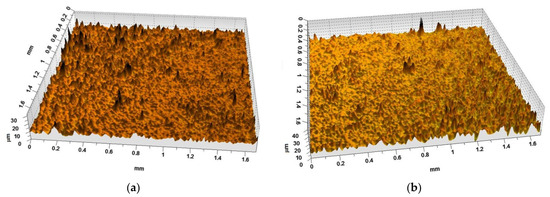
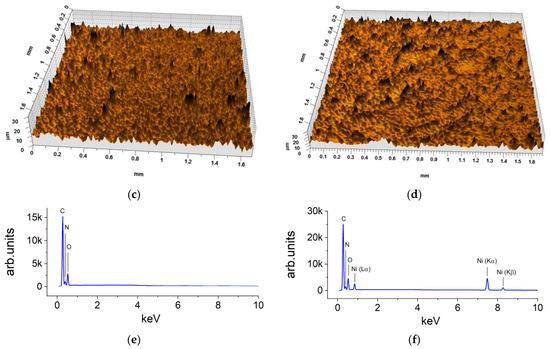
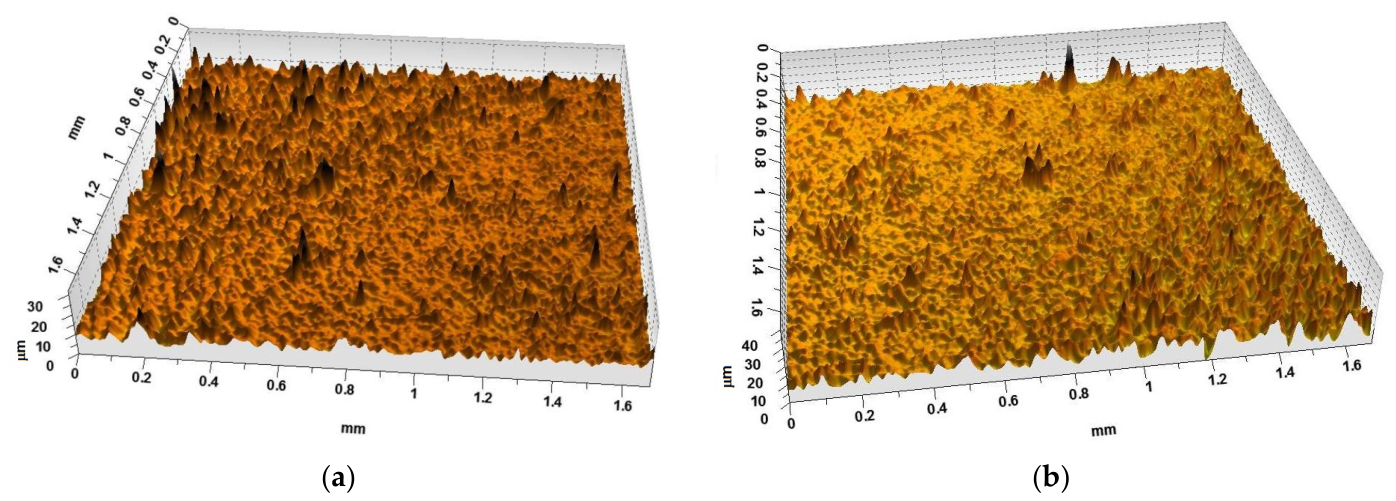
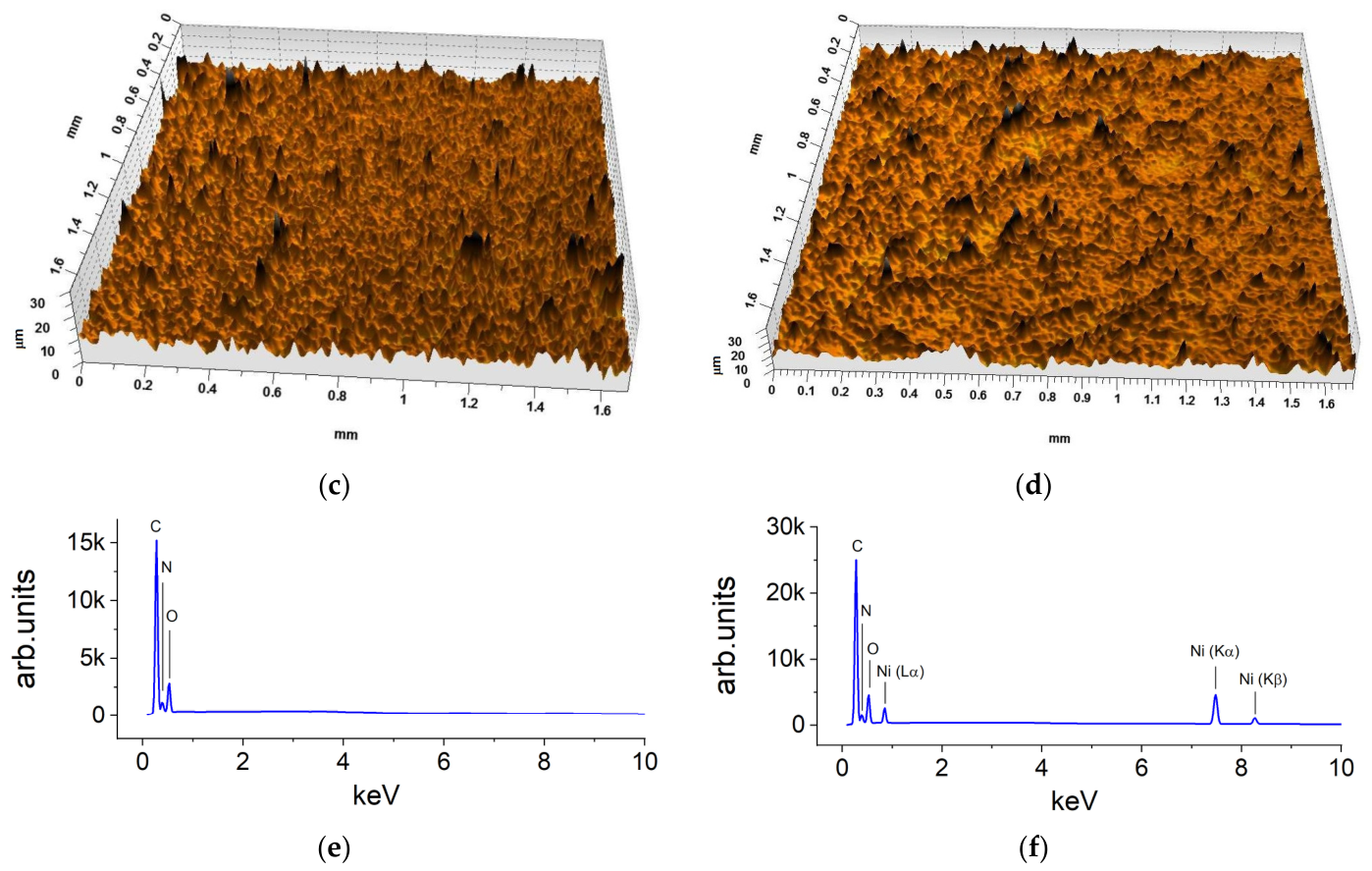
To study the surface morphology of the Chitosan/Ni composite coatings over a larger area and to obtain statistically more reliable information on roughness and height distribution, confocal microscopy was employed. Figure 1 shows three-dimensional surface images of a pure nickel layer (Figure 1a) and of the composite coatings Chitosan(0.05)/Ni (Figure 1b), Chitosan(0.2)/Ni (Figure 1c), and Chitosan(0.6)/Ni (Figure 1d). The scan area for these samples was 1.7 × 1.7 mm2. According to the obtained data, the surface roughness of nickel is 1.9 µm. For the Chitosan(0.05)/Ni and Chitosan(0.2)/Ni composites, the roughness is 1.89 and 1.82 µm, respectively. At a chitosan content of 0.6 wt.% in the composite, the roughness increased to 2.26 µm. The elemental composition and structure of the composite material were studied in detail in our previous work [44]. Figure 1e,f show the EDS spectra of the polymer before and after nickel electrodeposition. The EDS spectrum shows the C, O, and N lines associated with the chitosan matrix, as well as the lines associated with nickel: Lα1 = 0.85 keV, Kα1 = 7.48 keV, and Kβ1 = 8.27 keV, after nickel electrodeposition.
Figure 1.
(a) 3D confocal image of the Ni surface; (b) Chitosan(0.05)/Ni; (c) Chitosan(0.2)/Ni; (d) Chitosan(0.6)/Ni; (e) EDX spectrum of Chitosan(0.6); (f) EDX spectrum of Chitosan(0.6)/Ni.
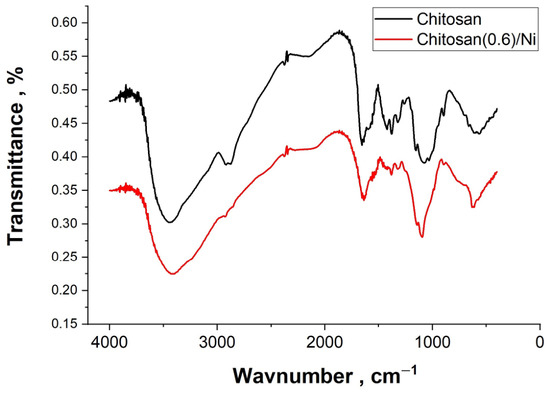
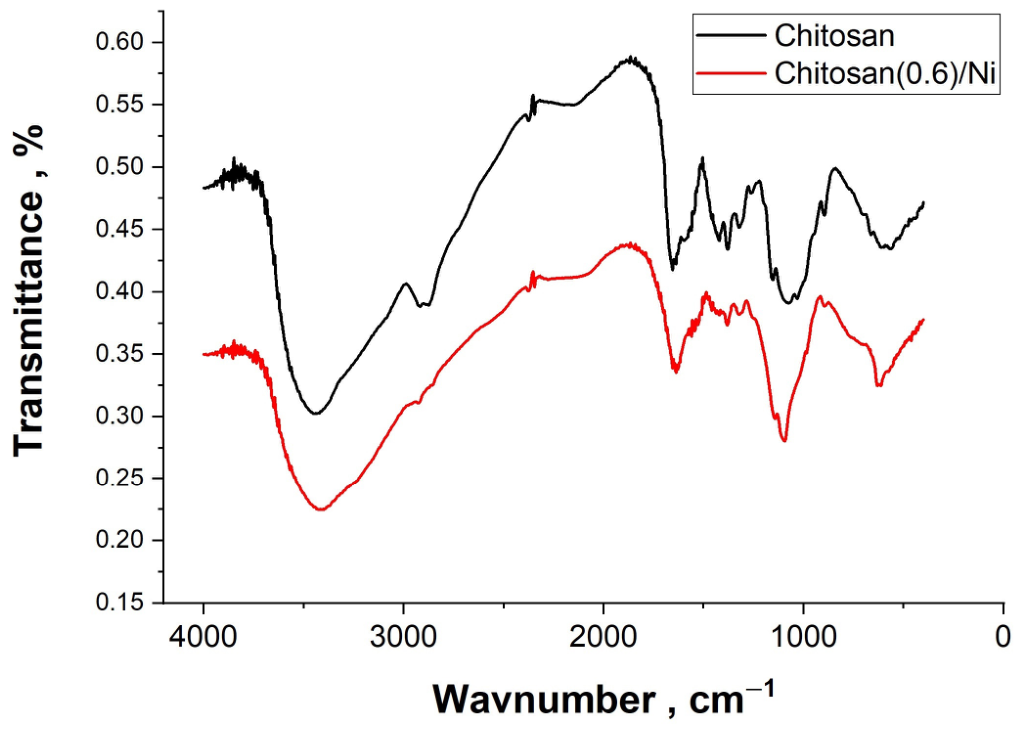
Figure 2 represents the FT-IR spectra of pure Chitosan and of the composite coating Chitosan(0.6)/Ni. A broad band at around 3360 cm−1 corresponds to N–H and O–H stretching along with intramolecular hydrogen bonds [57]. The bands at approximately 2920 and 2875 cm−1 are assigned to asymmetric and symmetric C–H stretching, respectively, matching literature values of 2921 and 2877 cm−1 [57]. The band at 1595 cm−1 is attributed to N–H bending of the primary amine [57]. The feature at 1155 cm−1 arises from asymmetric stretching of the C–O–C bridge, while the bands at 1080 and 1030 cm−1 are associated with C–O stretching [57]. The observed peaks at 1650 and 1375 cm−1 reflect C=O stretching and C–H deformation, respectively [58]. All of these bands are typical of chitosan spectra, as documented in previous publications [57,58]. For the Chitosan/Ni composite, the FT-IR spectrum showed no significant shifts or disappearance of the characteristic chitosan bands. Only minor changes in relative peak intensities were observed. This indicates that Ni is physically adsorbed onto the chitosan surface rather than forming strong chemical bonds with the metal (e.g., coordination via –NH2 or –OH groups).
Figure 2.
The FT-IR spectra of Chitosans and Chitosan(0.6)/Ni.
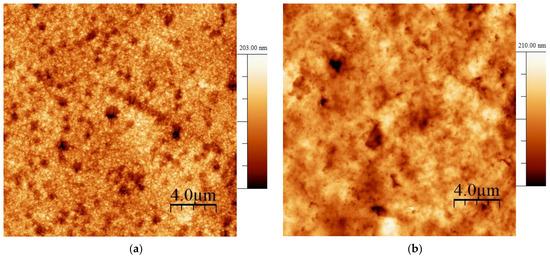
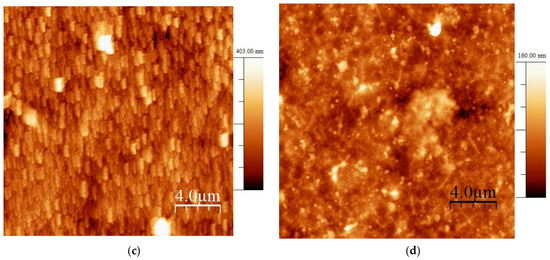
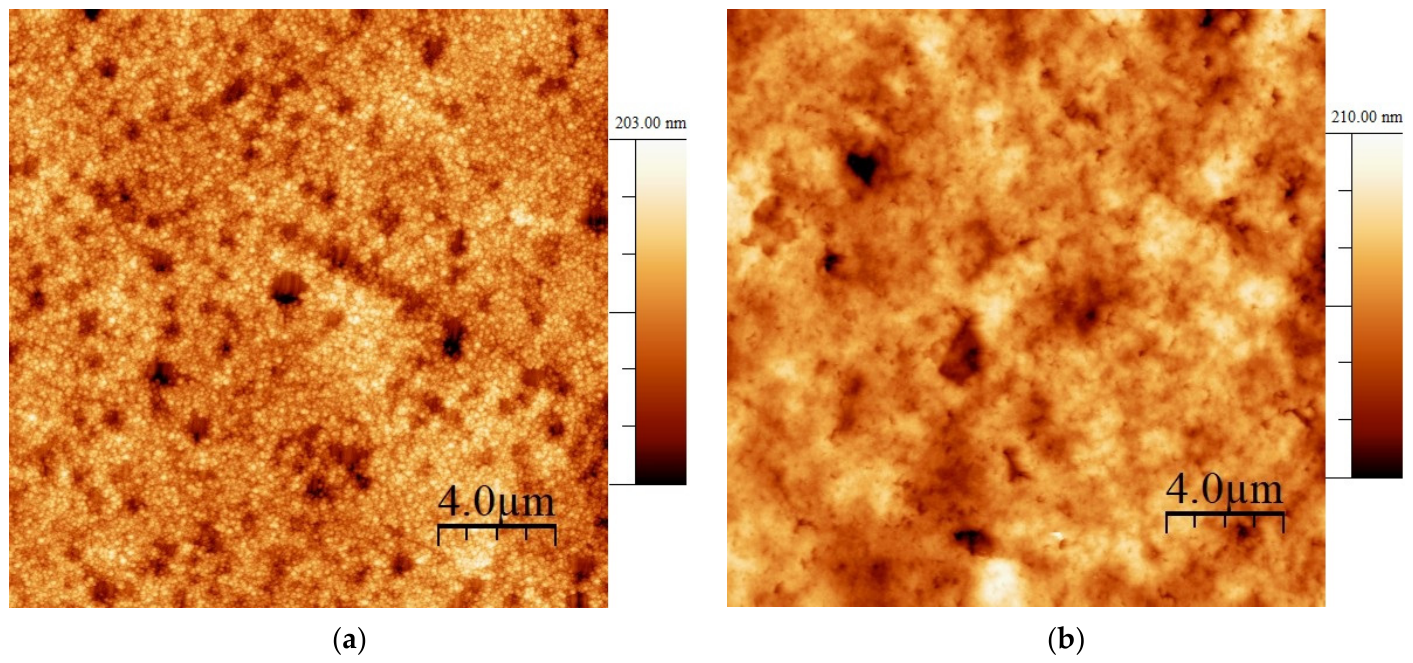
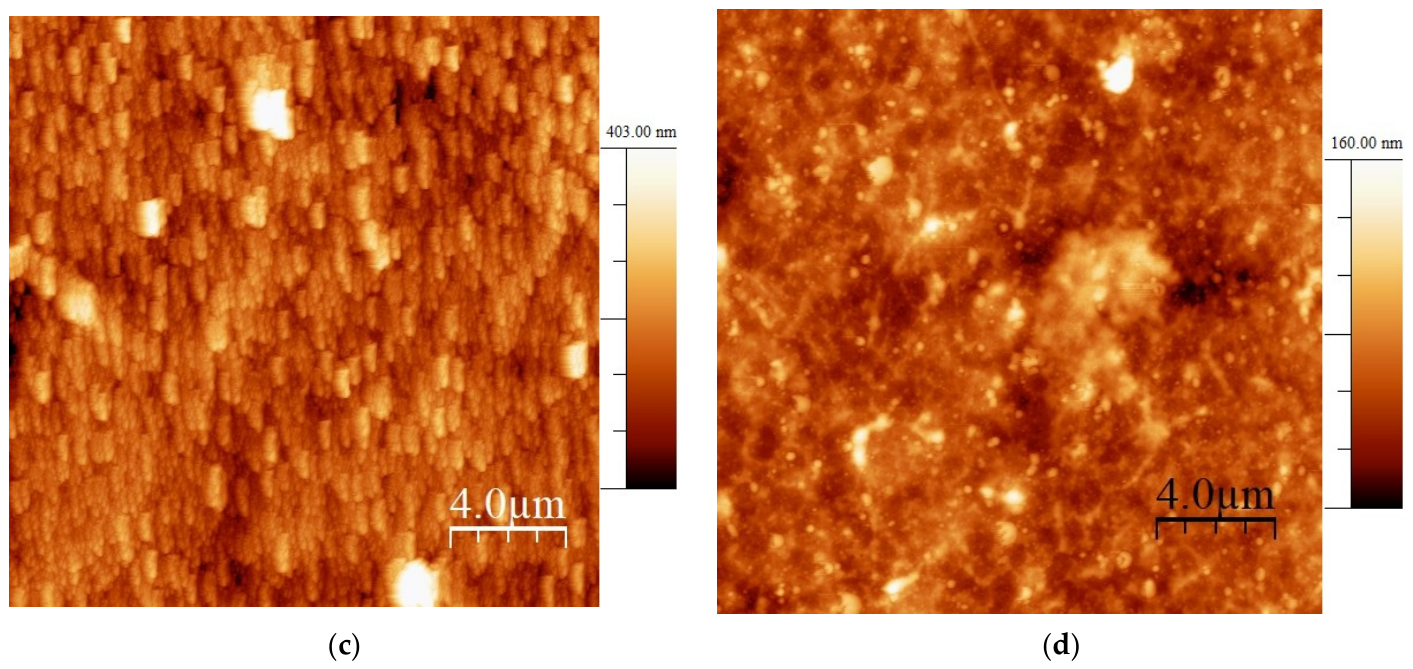
Along with confocal microscopy, atomic force microscopy (AFM) was used to study the morphology of Chitosan/Ni composite coatings obtained at various chitosan concentrations. This method allows examination of the sample surface with much higher resolution. Figure 3 shows AFM images of the coatings with chitosan contents of 0.05%, 0.2%, and 0.6% (Figure 3b–d) in comparison with the pure nickel layer (Figure 3a). The scan area for these samples was 20 × 20 µm2. The obtained images demonstrate differences in the morphology of the studied samples. Pure nickel (without a chitosan sublayer) is characterized by a structure consisting of densely packed spherical nanoparticles. The nanoparticle sizes range from 50 to 150 nm. The surface roughness over a 20 × 20 µm2 area is 25 nm. Optical microscopy images (Figures S1–S4) and additional AFM images are provided in the Supplementary Materials (Figures S5–S8).
Figure 3.
(a) AFM image of the surface morphology of Ni; (b) Chitosan(0.05)/Ni; (c) Chitosan(0.2)/Ni; and (d) Chitosan(0.6)/Ni.
The introduction of a small amount of chitosan does not lead to significant changes in the coating morphology. Thus, at a polymer content of 0.05% in the composite, the surface roughness does not differ greatly from that of the nickel layer and amounts to 27 nm. Presumably, at this concentration, the polymer does not yet form a continuous matrix, so the roughness remains at the level of pure nickel. These data are in good agreement with the confocal microscopy results. A further increase in the polymer concentration to 0.2% leads to an increase in roughness to 335 nm. However, confocal microscopy data showed that the surface roughness of the Chitosan(0.05)/Ni and Chitosan(0.2)/Ni composites is almost identical. This can be explained by the fact that at a polymer concentration of 0.2%, the increase in roughness occurs primarily at the nanoscale, while the microrelief remains close to that of nickel. It is logical to assume that a further increase in the chitosan content in the composite would lead to an even greater increase in roughness. However, for the Chitosan(0.6)/Ni sample, this parameter is only 18 nm, and a discrepancy with confocal microscopy data (2.26 µm) is observed. These data indicate that at the nanoscale, the composite surface is smooth, while the roughness at the microlevel is determined by the morphology of the polymer matrix itself. Most likely, at high polymer concentrations, macroscopic fold-like irregularities arise on the electrode surface, resulting in increased roughness.
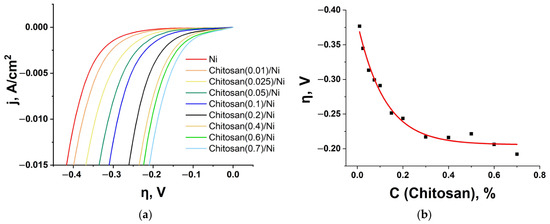
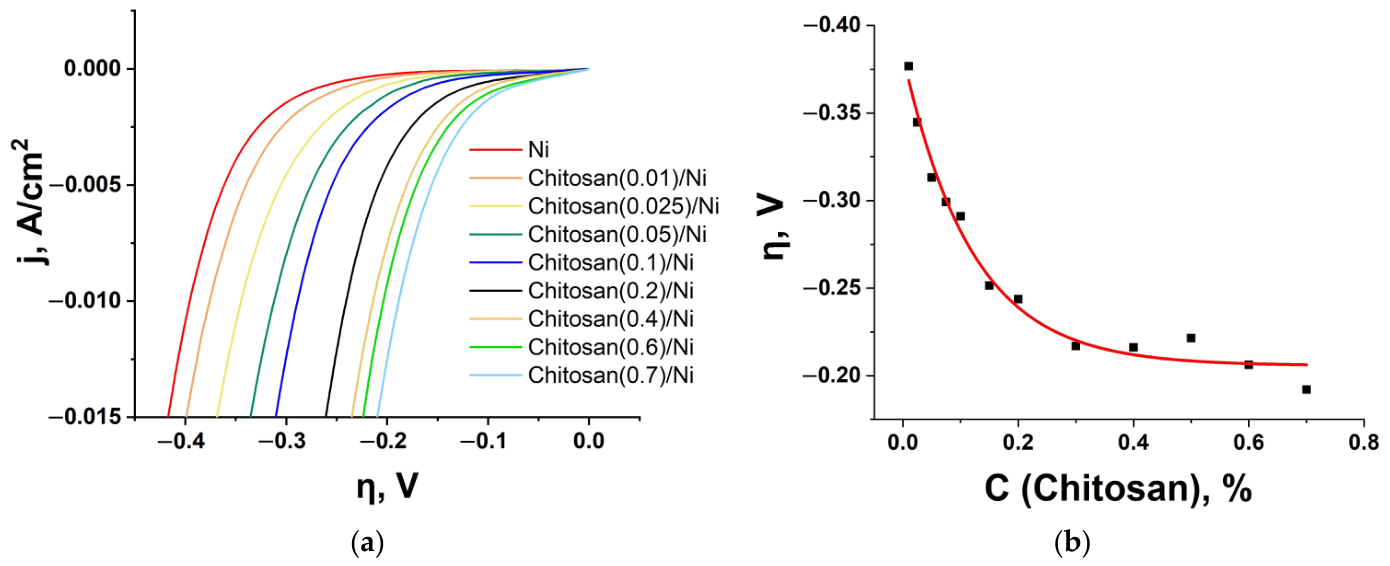
To evaluate the electrocatalytic activity of the synthesized coatings in the hydrogen evolution process, linear sweep voltammetry (LSV) was employed. Figure 4a shows the polarization curves obtained for all studied Chitosan/Ni systems. The results of the electrochemical studies showed that an increase in the chitosan concentration in the matrix leads to a successive decrease in the hydrogen evolution overpotential (Figure 4b). The lowest overpotential value, equal to 191 mV at j = 10 mA·cm−2, was achieved for the composite coating with a chitosan concentration of 0.7 wt.%.
Figure 4.
(a) Cathodic polarization curves of Chitosan/Ni-based electrocatalysts at various chitosan concentrations, obtained in a 0.5 M H2SO4 aqueous solution at a scan rate of 2 mV/s; (b) dependence of the HER overpotential on Chitosan/Ni systems at various chitosan concentrations.
However, during the recording of linear voltammograms for the Chitosan(0.7)/Ni sample, local swelling of the polymer matrix was observed on certain areas of the electrode. This led to jumps in the measured current, and the results were not always reproducible upon repeated measurements. Thus, 0.7% is the maximum working concentration at which the composite is still formed, but signs of instability are already observed.
Composite coatings with higher chitosan contents (0.8 wt.% and above) were also studied in the HER. However, at such concentrations, the adhesion of the polymer matrix to the electrode surface deteriorated, leading to its delamination. Such coatings exhibited an irreproducible and unstable response during electrochemical studies. Apparently, at high concentrations, a critical thickness of the polymer matrix is reached, which reduces its adhesion to the electrode. Since these composite films do not meet the stability requirements, they will not be considered further in this work.
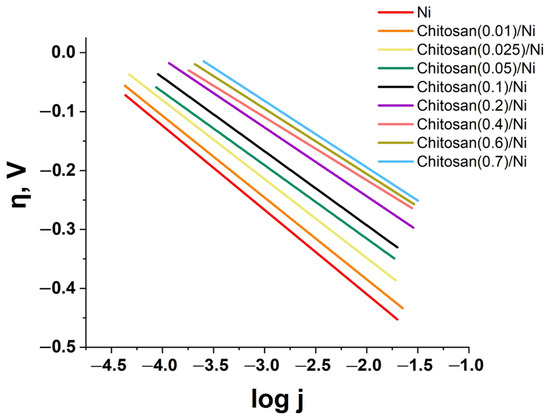
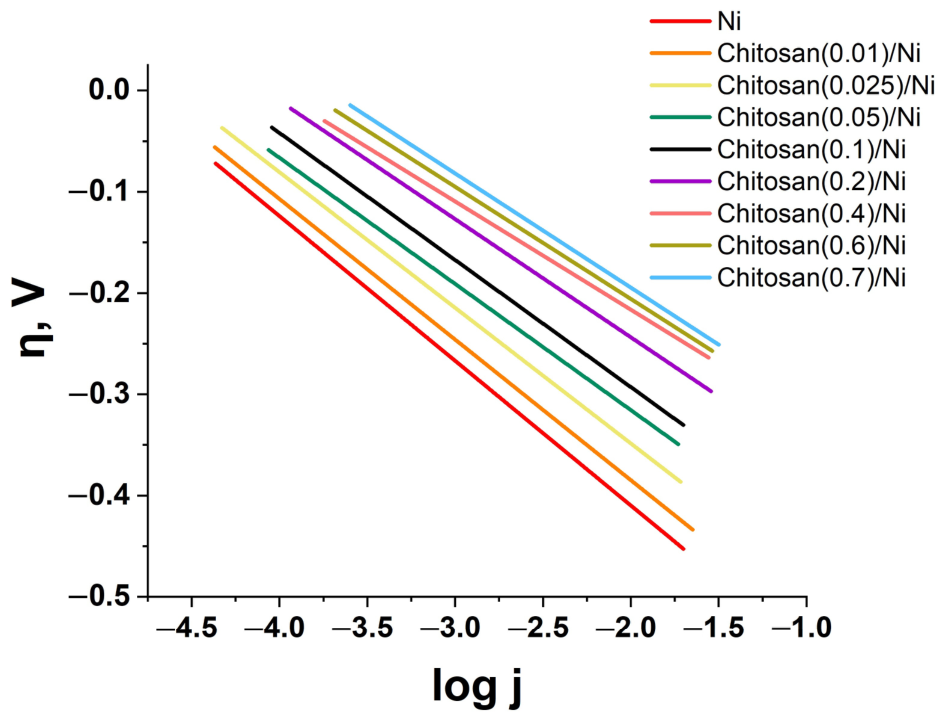
The kinetic parameters of the HER on Chitosan/Ni composite coatings at various chitosan concentrations were determined by analyzing Tafel plots. Figure 5 shows the Tafel plots for some of the studied systems.
Figure 5.
Tafel plots for Chitosan/Ni-based electrocatalysts at various chitosan concentrations; scan rate = 2 mV/s.
From the obtained dependences, the key electrochemical parameters were calculated: Tafel slope (b), charge transfer coefficient (α), and exchange current density (j0). All data are presented in Table 1. As can be seen from the table, among the studied composite coatings, there is a gradual decrease in the Tafel slope from −143 mV/dec for pure nickel to –110 mV/dec for Chitosan(0.6)/Ni. Based on the Tafel slope values, it can be concluded that for both pure nickel and Chitosan/Ni composite coatings with various chitosan contents, the rate-determining step in the HER remains the discharge of ions with the formation of adsorbed hydrogen atoms (the Volmer step). However, in the studied series of catalysts, an increase in the charge transfer coefficient (α) is observed, indicating facilitation of the ion discharge step and acceleration of the HER. It can also be seen from the table that among the studied electrocatalysts, the exchange current density (j0) increases with increasing polymer concentration. The maximum j0 value, equal to 1.39 × 10⁻⁴ A/cm2, corresponds to the electrode with a chitosan concentration of 0.6% (Chitosan(0.6)/Ni). It should be noted that for the sample with a chitosan concentration of 0.7%, even higher j0 values were observed. However, as noted above, local swelling of the polymer matrix led to instability of the results.
Table 1.
Kinetic parameters of the HER (b, j0, α) for Chitosan/Ni systems obtained by analyzing Tafel plots. For comparison of the electrocatalytic activity of the studied catalysts, the table also shows the overpotential η required to achieve a current density of 10 mA/cm2 and the geometric surface area of the working electrodes.
The dependences obtained from the electrochemical studies can be explained by changes in the morphology of electrodeposited nickel in the presence of chitosan. As shown by the microscopic studies, an increase in chitosan concentration in the composites leads to an increase in roughness. In the absence of a chitosan film, a pure nickel film with a less developed surface is formed on the working electrode. The use of chitosan makes it possible to create a more developed electrochemically active surface.
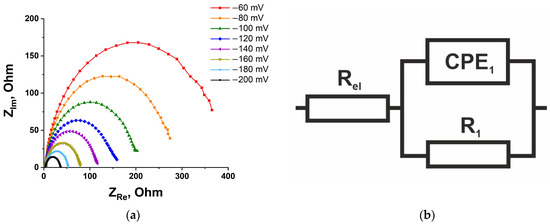
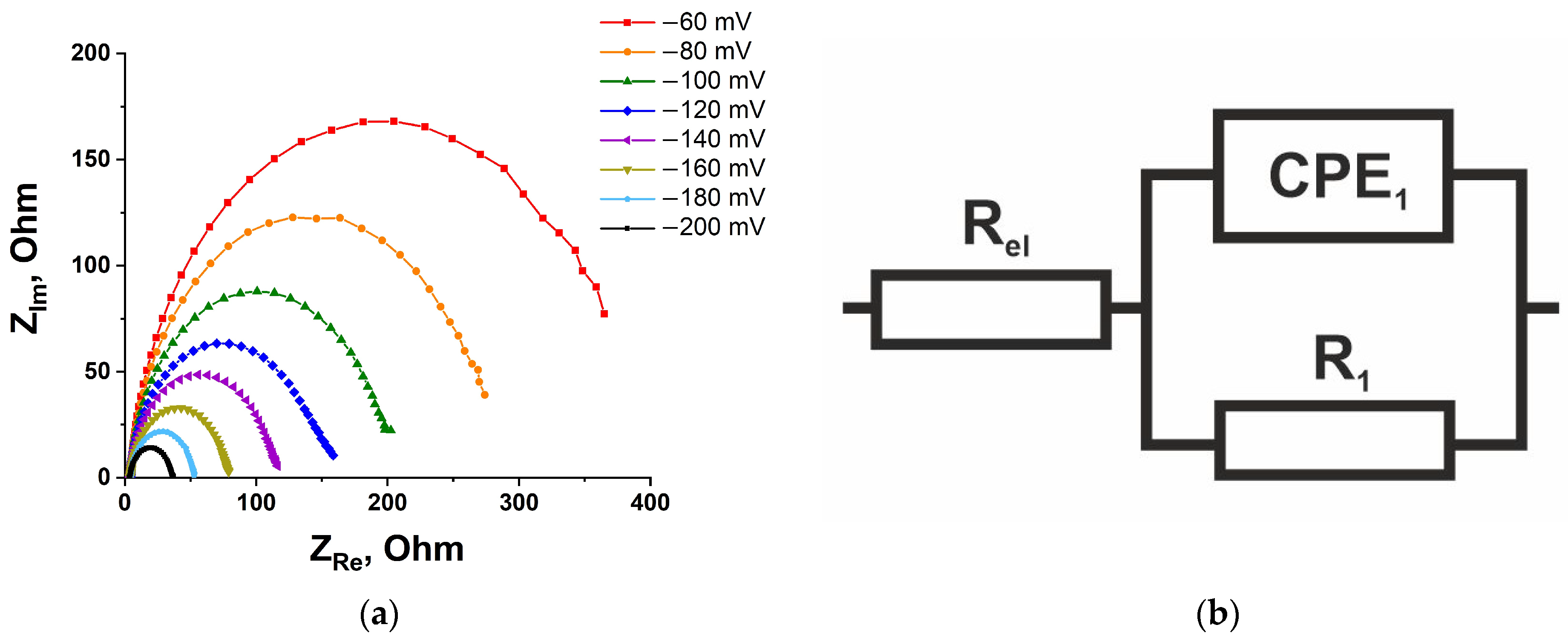
To study the properties of the electrode/electrolyte interface and the processes occurring on the surface of Chitosan/Ni composite films, electrochemical impedance spectra [59,60] were recorded. The measurements were carried out in the frequency range from 500 kHz to 0.1 Hz at various overpotentials relative to the equilibrium potential. Analysis of the impedance spectra presented in Nyquist coordinates showed that for all studied systems, the impedance hodographs are semicircular in shape. The presence of a single semicircle in the diagrams indicates one relaxation process (τ1) in the studied systems. As an example, Figure 6a shows impedance hodographs for the Chitosan(0.6)/Ni composite obtained at various overpotentials. The equivalent circuit describing this process can be represented as a parallel combination of the charge transfer resistance (Rct) and a constant phase element (CPE) (Figure 6b). The goodness-of-fit (relative error) was ≤3% for all samples, indicating high reliability of the fits. The fitted CPE exponent (n) was approximately 0.85 for all Chitosan/Ni electrodes. This value, being significantly less than 1.0, quantitatively confirms the heterogeneous and non-ideal nature of the electrode surface, consistent with the increased roughness. The use of a CPE is necessary to account for the non-ideal capacitive behavior of the systems. According to Figure 6a, for the Chitosan(0.6)/Ni system, an increase in overpotential leads to a decrease in the semicircle in the Nyquist plot, indicating a decrease in the charge transfer resistance Rct. A similar dependence is characteristic of all other studied Chitosan/Ni composites. The preservation of the semicircular shape of the hodographs throughout the entire studied overpotential range and the absence of a second semicircle or an inclined line (Warburg impedance) at low frequencies indicate that the rate of electrochemical processes at the Chitosan/Ni/electrolyte interface is limited by the charge transfer step. These data are in good agreement with the electrochemical study results, where, based on the Tafel slope b, it was shown that the reaction on the studied systems is controlled by the Volmer step.
Figure 6.
(a) Nyquist plot showing the electrochemical response of the Chitosan(0.6)/Ni system at various overpotentials; (b) Equivalent electrical circuit (EEC model) used to describe the HER on the studied electrocatalysts.
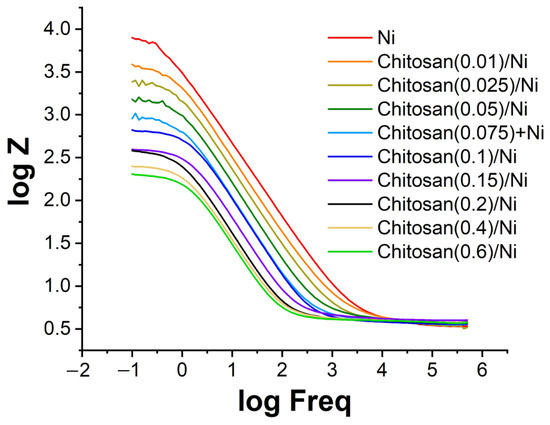
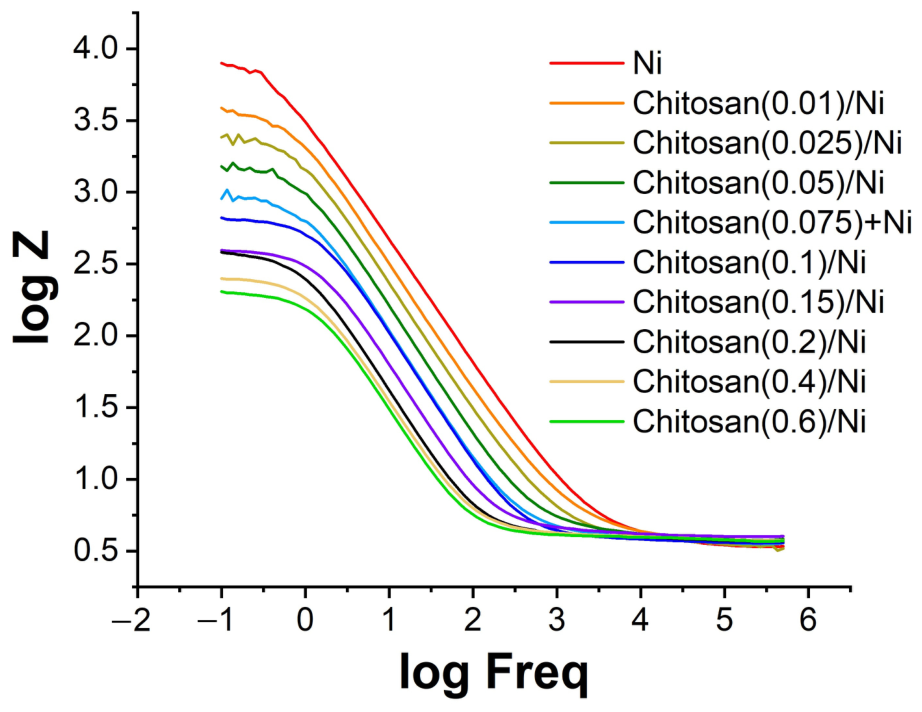
Figure 7 shows the dependences of the logarithm of the impedance modulus (log |Z|) on the logarithm of frequency (log f) for Chitosan/Ni composite coatings with various chitosan contents. The measurements were performed at an overpotential of −100 mV relative to the equilibrium potential (EOCP).
Figure 7.
Dependence of the logarithm of the impedance modulus (log |Z|) on the logarithm of frequency (log f) for Chitosan/Ni composites.
The obtained data indicate that an increase in chitosan content in Chitosan/Ni composite coatings leads to a systematic decrease in the charge transfer resistance. For the pure nickel coating, the Rct value is 7945 Ω. The introduction of even a small amount of chitosan (e.g., the Chitosan(0.01)/Ni sample) causes an almost twofold decrease in this parameter, down to 3862 Ω. For the Chitosan(0.6)/Ni system, the charge transfer resistance is already 39 times lower compared to pure nickel, amounting to 204 Ω. The observed decrease in charge transfer resistance with increasing chitosan concentration is mainly due to the growth of the electrochemically active surface area of the composite coatings, which facilitates the electrode reactions. Along with this, an increase in chitosan concentration leads to improved contact between the glassy carbon electrode and the composite material due to an increase in the contact area. Both of these factors contribute to a reduction in the overall resistance of the system and facilitate charge transfer.
For a quantitative assessment of the real surface area of Chitosan/Ni composite coatings, electrochemical impedance spectroscopy was used in combination with equivalent circuit modeling. Fitting of the equivalent circuit shown in Figure 6b allowed determination of the CPE parameters for all studied Chitosan/Ni-based systems. Subsequent calculation of the double-layer capacitance (CDL) made it possible to estimate the real surface area of the electrodes, based on the known specific capacitance of smooth nickel, taken as 20–40 μF/cm2 [44,61]. The calculated values of the double-layer capacitance (CDL), real electrochemically active surface area (Sreal), and surface roughness factor of the catalytic layers σ (σ = Sreal/Sgeometric) for the samples obtained at various chitosan concentrations are presented in Table 2. The data presented in the table demonstrate the influence of chitosan concentration on the electrochemical and morphological characteristics of Chitosan/Ni composite coatings.
Table 2.
Double-layer capacitance CDL (normalized to the geometric electrode area) and the surface roughness factor σ of the studied electrocatalysts, calculated based on EIS data.
As can be seen from the table, an increase in the chitosan concentration in Chitosan/Ni composite coatings leads to an increase in the double-layer capacitance, the real surface area, and the surface roughness factor σ. The obtained data further confirm that an increase in the chitosan content promotes the formation of a more developed surface of the composite coatings. Thus, the data from impedance spectroscopy, linear sweep voltammetry, and microscopy are consistent with each other and unequivocally indicate the key role of chitosan in modifying the morphology and electrochemical activity of the final coating. It should be noted that, while this work establishes a clear correlation between enhanced HER kinetics, increased surface roughness, and favorable interfacial effects, direct mechanistic evidence—such as changes in the Ni electronic structure (e.g., from XPS) or quantitative hydrogen adsorption energetics—is not provided. This limitation should be addressed in future studies employing spectroscopic and computational approaches.
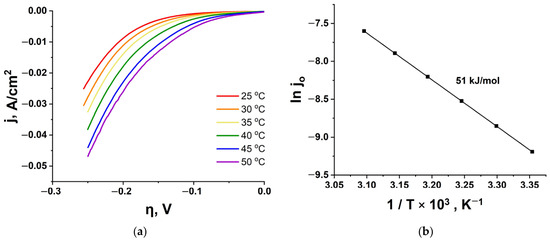
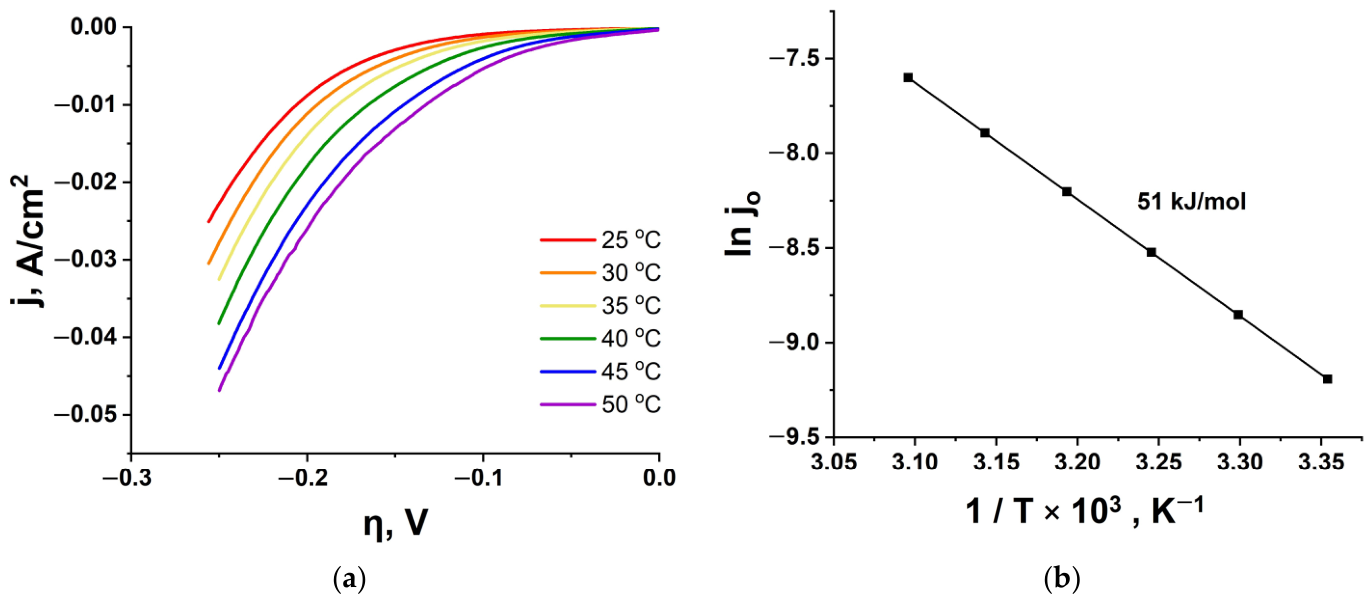
To quantitatively assess the effect of temperature on the rate of the HER on the studied electrocatalysts, polarization curves were recorded in the temperature range from 303 to 323 K. Figure 8a shows the corresponding voltammetric dependences for the Chitosan(0.6)/Ni system obtained at different temperatures. As expected, an increase in temperature leads to an increase in current density. Similar behavior was observed for all other studied systems.
Figure 8.
(a) Cathodic polarization curves of the Chitosan(0.6)/Ni-based electrocatalyst obtained at various temperatures in a 0.5 M H2SO4 aqueous solution at a scan rate of 2 mV/s; (b) dependence of the logarithm of the exchange current density on the inverse temperature.
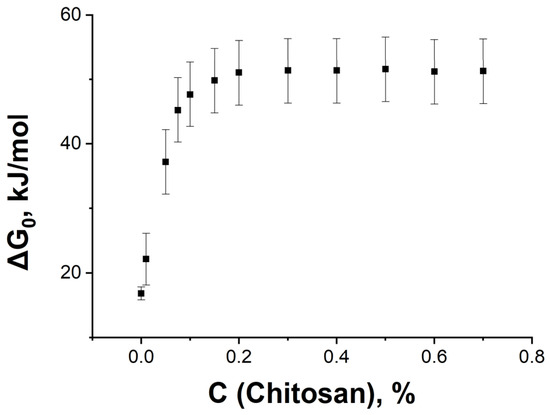
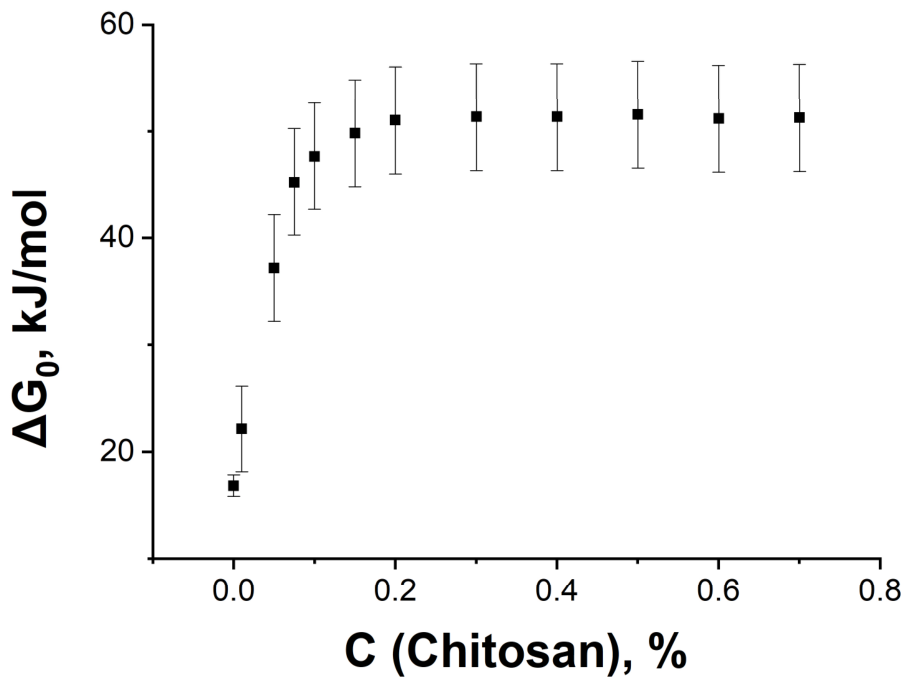
Figure 8b shows the dependence of the logarithm of the exchange current density (ln j0) on the inverse temperature (1/T × 103) for Chitosan(0.6)/Ni. As can be seen, a linear dependence is observed over the entire studied temperature range. This behavior corresponds to the classical Arrhenius law: ln j0 = –Ea/(2.3RT) + ln A0, where T is the temperature, R is the universal gas constant, and A0 is the pre-exponential factor [62]. Using the Arrhenius law, the activation energy (Ea) at zero overpotential was calculated for the Chitosan(0.6)/Ni system. It was found to be 51 kJ/mol. Similar calculations were performed for all other studied electrocatalysts. The results illustrating the dependence of the activation energy on the chitosan concentration in Chitosan/Ni composites are shown in Figure 9.
Figure 9.
Dependence of the activation energy (Ea) on the chitosan concentration in Chitosan/Ni composites.
It can be seen that the dependence is nonlinear. The minimum activation energy value corresponds to the pure nickel film and amounts to 17 kJ/mol. Deposition of chitosan onto the electrode and a further increase in its concentration in the composite lead to an increase in the activation energy. This is quite expected. The presence of a polymer layer between the electrode and nickel leads to the appearance of an additional interface. Overcoming this barrier requires additional energy compared to a homogeneous metal surface. However, despite this, the electrochemical activity of Chitosan/Ni composite films is significantly higher than that of the pure nickel film and increases with increasing chitosan concentration. The higher activation energy values of the Chitosan/Ni composites are compensated by the large specific surface area provided by the chitosan matrix, which ensures an increase in exchange currents and a decrease in the reaction overpotential compared to pure nickel.
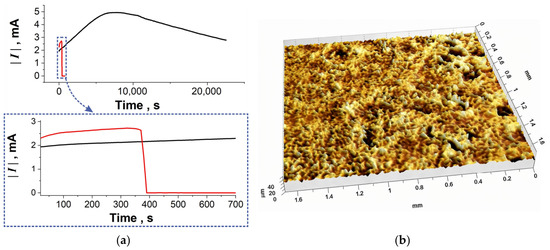
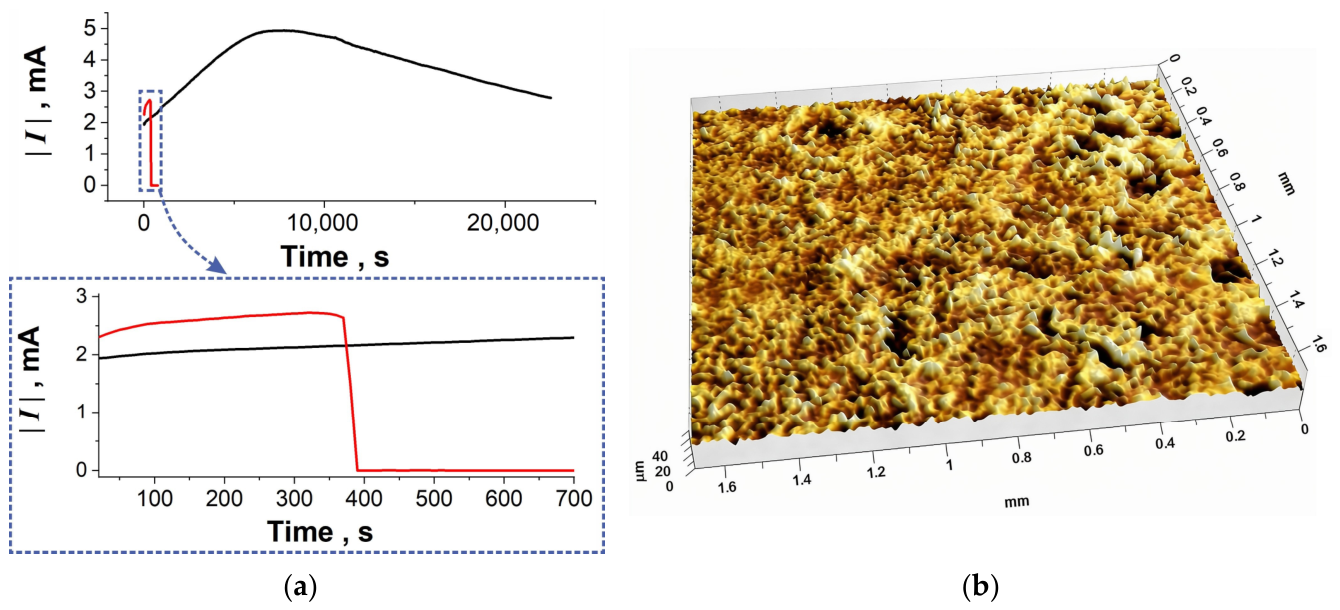
To evaluate the long-term stability of the electrocatalytic properties of the Chitosan(0.6)/Ni composite material in the hydrogen evolution reaction, chronoamperometric measurements were performed. The measurements were carried out in 0.5 M H2SO4 at a constant potential corresponding to a current density of 10 mA/cm2 for 24,000 s. The resulting cathodic current vs. time dependence is shown in Figure 10a. At the beginning of the reaction, a monotonic increase in the absolute current value from 2.2 mA to 4.8 mA is observed, indicating an electrochemical surface activation process. Subsequently, the current begins to decrease and gradually returns to its initial value. This decrease points to partial surface passivation during prolonged operation. For comparison, the lower part of Figure 10a presents the chronoamperometric results for the Chitosan(0.8)/Ni system. During the first 370 s, an increase in cathodic current is observed, indicating surface activation and the occurrence of the desired electrochemical reaction. However, after this period, a critical change in the system behavior occurs: the current value instantly drops to zero and remains at this level for the remainder of the experiment. Such a sharp current cutoff indicates a complete and irreversible loss of the electrode’s electrochemical activity. This is attributed to mechanical delamination of the catalytic layer from the substrate, which was confirmed visually. This phenomenon was previously noted during the recording of linear voltammograms and was described above.
Figure 10.
(a) Long-term stability of Chitosan(0.6)/Ni (black line) and Chitosan(0.8)/Ni (red line) at a constant potential corresponding to a current density of 10 mA/cm2; (b) 3D confocal image of the Chitosan(0.6)/Ni surface after long-term stability testing.
Figure 10b presents confocal microscopy image collected after long-term chronoamperometry to assess the morphological stability of the optimal composite. The post-stability images revealed no noticeable changes in surface morphology—no cracking, swelling, or delamination was observed. The average surface roughness was measured to be 2.2 μm, demonstrating that the chitosan coating remains intact and mechanically robust under extended cathodic operation.
Table 3 summarizes the comparative HER performance (overpotential at 10 mA/cm2 and Tafel slope) of our optimized Chitosan(0.6)/Ni composite along with recently reported high-performance HER catalysts, including Pt-based and non-noble metal systems. As expected, Pt-based catalysts exhibit superior HER activity with lower overpotentials and smaller Tafel slopes. However, our Chitosan(0.6)/Ni composite shows HER performance that is comparable to or even better than many recently reported non-noble metal catalysts. Notably, this performance is achieved using a simple and inexpensive preparation method based on commercially available chitosan and electrodeposited nickel, without the need for complex synthesis procedures or precious metals. These results position the Chitosan/Ni composite as a cost-effective, earth-abundant, and easily scalable alternative to noble metal catalysts for the hydrogen evolution reaction in acidic media.
Table 3.
Comparison of HER performance of the optimized Chitosan/Ni composite with previously reported similar catalytic systems.
4. Conclusions
In this work, Chitosan/Ni composite coatings obtained at various biopolymer concentrations (from 0 to 0.7 wt.%) were investigated as electrocatalysts for the hydrogen evolution reaction. Chitosan was used as a matrix for nickel layer deposition. Atomic force and confocal microscopy revealed that the use of chitosan as a matrix makes it possible to form a developed surface with a high specific area. Linear sweep voltammetry and electrochemical impedance spectroscopy showed that an increase in the real surface area leads to a decrease in the HER overpotential and a reduction in the charge transfer resistance. For the Chitosan(0.6)/Ni composite, the overpotential at a current density of 10 mA/cm2 is 200 mV, which is two times lower compared to the pure nickel coating. It was found that with increasing chitosan concentration in the composites, the Tafel slope decreases from 143 to 110 mV/dec, while the charge transfer coefficient α increases. A chitosan concentration of 0.7 wt.% is the boundary for forming a stable composite coating. At this concentration, the coating still remains intact; however, its electrochemical characteristics show instability. At higher polymer contents (0.8 wt.% and above), delamination of the biopolymer matrix from the electrode surface is observed, leading to irreproducible results. Thus, the optimal stable composition that combines high catalytic activity and reproducibility is the Chitosan(0.6)/Ni composite. The optimal chitosan loading was determined as 6% based on the combination of electrochemical activity, stability under extended cathodic operation, and the absence of swelling/delamination. While higher loadings showed similar activity, their mechanical instability precluded practical use. Lower loadings, although stable, exhibited inferior HER kinetics.
Supplementary Materials
The following supporting information can be downloaded at: https://www.mdpi.com/article/10.3390/chemistry8060078/s1, Figure S1: Optical image of the Chitosan(0.05)/Ni; Figure S2: Optical image of the Chitosan(0.2)/Ni; Figure S3: Optical image of the Chitosan(0.6)/Ni; Figure S4. Optical image of the Chitosan(0.7)/Ni; Figure S5. AFM image of the Chitosan(0.01)/Ni; Figure S6. AFM image of the Chitosan(0.3)/Ni; Figure S7. AFM image of the Chitosan(0.4)/Ni; Figure S8. AFM image of the Chitosan(0.7)/Ni.
Author Contributions
Conceptualization, G.R.N. and I.R.N.; methodology, G.R.N. and I.R.N.; investigation, G.R.N., E.M.L., V.V.V., R.M.S. and I.R.N.; resources, I.R.N. and O.G.S.; writing—original draft preparation, G.R.N., E.M.L. and I.R.N.; writing—review and editing, G.R.N. and I.R.N.; supervision, G.R.N.; project administration, I.R.N. and O.G.S.; funding acquisition, I.R.N. All authors have read and agreed to the published version of the manuscript.
Funding
This research was funded by the government assignment for FRC Kazan Scientific Center of RAS.
Data Availability Statement
The original contributions presented in this study are included in the article/supplementary material. Further inquiries can be directed to the corresponding author.
Conflicts of Interest
The authors declare no conflicts of interest.
Abbreviations
The following abbreviations are used in this manuscript:
| HER | Hydrogen Evolution Reaction |
| PANI | polyaniline |
| ITO | indium tin oxide |
| RHE | reversible hydrogen electrode |
| EIS | electrochemical impedance spectroscopy |
| ACM | atomic force microscopy |
| LSV | linear sweep voltammetry |
| CPE | constant phase element |
References
- Behera, D.; Mukherjee, S.K. Optoelectronics and transport phenomena in Rb2InBiX6 (X= Cl, Br) compounds for renewable energy applications: A DFT insight. Chemistry 2022, 4, 1044–1059. [Google Scholar] [CrossRef] [Scilit]
- Liu, L.; Ding, X.; Qin, H.; Tang, S.; Xu, L.; Song, F. High-Entropy Alloys for Electrocatalytic Water Oxidation: Recent Advances on Mechanism and Design. Chemistry 2025, 7, 190. [Google Scholar] [CrossRef] [Scilit]
- Horri, B.A.; Ozcan, H. Green hydrogen production by water electrolysis: Current status and challenges. Curr. Opin. Green Sustain. Chem. 2024, 47, 100932. [Google Scholar] [CrossRef] [Scilit]
- Franco, A.; Giovannini, C. Recent and future advances in water electrolysis for green hydrogen generation: Critical analysis and perspectives. Sustainability 2023, 15, 16917. [Google Scholar] [CrossRef] [Scilit]
- Kumar, S.S.; Lim, H. An overview of water electrolysis technologies for green hydrogen production. Energy Rep. 2022, 8, 13793–13813. [Google Scholar] [CrossRef] [Scilit]
- Panigrahy, B.; Narayan, K.; Rao, B.R. Green hydrogen production by water electrolysis: A renewable energy perspective. Mater. Today Proc. 2022, 67, 1310–1314. [Google Scholar] [CrossRef] [Scilit]
- Niu, H.; Wang, Q.; Huang, C.; Zhang, M.; Yan, Y.; Liu, T.; Zhou, W. Noble metal-based heterogeneous catalysts for electrochemical hydrogen evolution reaction. Appl. Sci. 2023, 13, 2177. [Google Scholar] [CrossRef] [Scilit]
- Zhang, Y.; Yan, R.; Xu, X.; He, C.; Zhou, M.; Zeng, Z.; Ma, T.; Wang, M.; Li, S. Next generation noble metal-engineered catalysts: From structure evolution to structure-reactivity correlation in water splitting. Adv. Funct. Mater. 2024, 34, 2308813. [Google Scholar] [CrossRef] [Scilit]
- Liu, W.; Xiang, Z.; Tan, A.; Wan, K.; Fu, Z.; Liang, Z. Single-layer platinum cluster catalyst for efficient hydrogen electro-production. Adv. Funct. Mater. 2023, 33, 2212752. [Google Scholar] [CrossRef] [Scilit]
- Zeng, H.; Chen, Z.; Jiang, Q.; Zhong, Q.; Ji, Y.; Chen, Y.; Li, J.; Liu, C.; Zhang, R.; Tang, J.; et al. Sustainable and cost-efficient hydrogen production using platinum clusters at minimal loading. Nat. Commun. 2025, 16, 4314. [Google Scholar] [CrossRef] [Scilit] [PubMed]
- Ding, X.; Liu, D.; Wang, A.; Zhang, P.; Oropeza, F.E.; Zhao, P.; Gorni, G.; Barawi, M.; O’Shea, V.L.P.; Wu, R.; et al. In situ reconstruction of nickel selenide for enhanced hydrogen evolution reaction. Adv. Funct. Mater. 2026, 36, e21566. [Google Scholar] [CrossRef] [Scilit]
- Ning, J.; Xu, L.; Xu, W.; Li, G.; Zhang, W. In-Site Growth of Efficient NiFeOOH/NiFe-LDH Electrodes: A Streamlined One-Step Methodology. Chemistry 2024, 6, 312–322. [Google Scholar] [CrossRef] [Scilit]
- Huo, L.; Jin, C.; Jiang, K.; Bao, Q.; Hu, Z.; Chu, J. Applications of nickel-based electrocatalysts for hydrogen evolution reaction. Adv. Energy Sustain. Res. 2022, 3, 2100189. [Google Scholar] [CrossRef] [Scilit]
- Khan, N.A.; Rahman, G.; Nguyen, T.M.; Shah, A.U.H.A.; Pham, C.Q.; Tran, M.X.; Nguyen, D.L.T. Recent development of nanostructured nickel metal-based electrocatalysts for hydrogen evolution reaction: A review. Top. Catal. 2023, 66, 149–181. [Google Scholar] [CrossRef] [Scilit]
- Hu, C.; Lv, C.; Zeng, N.; Liu, A.; Liu, Y.; Hu, L.; Li, P.; Yao, Y.; Cai, J.; Tang, T. Recent advances in Ni-based electrocatalysts for hydrogen evolution reaction. Energy Technol. 2023, 11, 2201048. [Google Scholar] [CrossRef] [Scilit]
- Al-Betar, A.R.F. Enhanced electrocatalytic water oxidation using cobalt-based polyaniline hybrid assembly. Synth. Met. 2021, 275, 116738. [Google Scholar] [CrossRef] [Scilit]
- Ashassi-Sorkhabi, H.; Kazempour, A.; Moradi-Alavian, S.; Asghari, E.; Lamb, J.J. 3D nanostructured nickel film supported to a conducting polymer as an electrocatalyst with exceptional properties for hydrogen evolution reaction. Int. J. Hydrogen Energy 2023, 48, 29865–29876. [Google Scholar] [CrossRef] [Scilit]
- Gutierrez-Alvarado, K.; Chacón-Cerdas, R.; Starbird-Perez, R. Pectin microspheres: Synthesis methods, properties, and their multidisciplinary applications. Chemistry 2022, 4, 121–136. [Google Scholar] [CrossRef] [Scilit]
- Rupar, J.; Tekić, D.; Janošević Ležaić, A.; Upadhyay, K.K. ORR catalysts derived from biopolymers. Catalysts 2022, 13, 80. [Google Scholar] [CrossRef] [Scilit]
- Jumadi, J.; Harun, W.S.W.; Kadirgama, K.; Samylingam, L.; Aslfattahi, N.; Kok, C.K.; Kiai, M.S. Green Energy Materials: Unlocking the Potential of Chitosan and Cellulose in Energy Storage. J. Inorg. Organomet. Polym. Mater. 2026, 36, 2074–2098. [Google Scholar] [CrossRef] [Scilit]
- Raja, A.G.; Arasu, K.A.S.; Rajaram, R. Chitosan–sodium Tripolyphosphate–CuO Biopolymer–nanocomposite as an Efficient Electrocatalyst for Water Splitting. Curr. Anal. Chem. 2025, 21, 923–935. [Google Scholar] [CrossRef] [Scilit]
- Hasan, M.; Jihad, M.; Susan, M.A. Biopolymers for Fuel Cells. In Bio-Based Polymers: Farm to Industry; Gupta, R., Ed.; Volume 3: Emerging Trends and Applications; American Chemical Society: Washington, DC, USA, 2024; pp. 121–142. [Google Scholar] [CrossRef] [Scilit]
- Li, X.; Wan, C.; Tao, T.; Chai, H.; Huang, Q.; Chai, Y.; Wu, Y. An overview of the development status and applications of cellulose-based functional materials. Cellulose 2024, 31, 61–99. [Google Scholar] [CrossRef] [Scilit]
- Silva, I.G.R.D.; Pantoja, B.T.D.S.; Almeida, G.H.D.R.; Carreira, A.C.O.; Miglino, M.A. Bacterial cellulose and ECM hydrogels: An innovative approach for cardiovascular regenerative medicine. Int. J. Mol. Sci. 2022, 23, 3955. [Google Scholar] [CrossRef] [Scilit]
- EFSA Panel on Additives and Products or Substances Used in Animal Feed (FEEDAP); Bampidis, V.; Azimonti, G.; Bastos, M.D.L.; Christensen, H.; Dusemund, B.; Durjava, M.; Kouba, M.; López-Alonso, M.; Puente, S.L.; et al. Safety of feed additives consisting of microcrystalline cellulose and carboxymethyl cellulose for all animal species (International Cellulosics Association). EFSA J. 2024, 22, e8625. [Google Scholar] [CrossRef] [Scilit]
- Lima, N.F.; Maciel, G.M.; Lima, N.P.; Fernandes, I.D.A.A.; Haminiuk, C.W.I. Bacterial cellulose in cosmetic innovation: A review. Int. J. Biol. Macromol. 2024, 275, 133396. [Google Scholar] [CrossRef] [Scilit]
- Yang, X.; Yang, S.; Wang, L. Cellulose or chitin nanofibril-stabilized latex for medical adhesion via tailoring colloidal interactions. Carbohydr. Polym. 2022, 278, 118916. [Google Scholar] [CrossRef] [Scilit]
- Masimov, R.; Wasan, E.K. Chitosan non-particulate vaccine delivery systems. J. Pharm. Pharm. Sci. 2024, 27, 12921. [Google Scholar] [CrossRef] [Scilit]
- Pal, R.; Pandey, P.; Rai, B.; Koli, M.; Chakrabarti, M.; Thakur, P.; Rizwan, M.; Saxena, A. Chitosan: As highly potential biopolymer obtainable in several advance drug delivery systems including biomedical applications. Eur. Chem. Bull. 2023, 12, 322–344. [Google Scholar] [CrossRef]
- Sarath Chandran, C.; Sajayan, K.; Kappally, S.; Gowtham, M.; Raj, A.; Swathy, K. Chitosan-based drug delivery systems for respiratory diseases. In Natural Polymeric Materials Based Drug Delivery Systems in Lung Diseases; Dureja, H., Adams, J., Löbenberg, R., Andreoli Pinto, T.J., Dua, K., Eds.; Springer Nature: Singapore, 2023; pp. 201–215. [Google Scholar] [CrossRef] [Scilit]
- Velpula, S.; Beedu, S.R.; Rupula, K. Biopolymer-based trimetallic nanocomposite synthesis, characterization and its application in the catalytic degradation of 4-nitrophenol. J. Mater. Sci.-Mater. Electron. 2022, 33, 2677–2698. [Google Scholar] [CrossRef] [Scilit]
- Shi, C.; Zhang, L.; Shi, Z.; Ma, J.; Wang, Z. Cellulose template designed porous ZnO based catalysts with different valence copper for solar photocatalytic CO2 conversion. Ind. Crops Prod. 2022, 186, 115223. [Google Scholar] [CrossRef] [Scilit]
- Xu, L.; Wang, P.; Wu, S. Chelation-assisted synthesis of chitosan-derived Mn-NC electrocatalyst for efficient oxygen reduction reaction. Inorg. Chem. Commun. 2023, 156, 111227. [Google Scholar] [CrossRef] [Scilit]
- Medany, S.S.; Nafady, A.; Soomro, R.A.; Hefnawy, M.A. Construction of chitosan-supported nickel cobaltite composite for efficient electrochemical capacitor and water-splitting applications. Sci. Rep. 2024, 14, 2453. [Google Scholar] [CrossRef] [Scilit]
- Lima, M.A.; Raimundo, R.A.; Araújo, A.J.; Oliveira, J.F.D.A.; Loureiro, F.J.; Macedo, D.A.; Morales, M.A. Nickel-Copper-Carbon based electrocatalysts for oxygen evolution reaction: Sol-gel synthesis using chitosan. Int. J. Hydrogen Energy 2024, 51, 663–675. [Google Scholar] [CrossRef] [Scilit]
- Rashid, S.; Shen, C.; Yang, J.; Liu, J.; Li, J. Preparation and properties of chitosan–metal complex: Some factors influencing the adsorption capacity for dyes in aqueous solution. J. Environ. Sci. 2018, 66, 301–309. [Google Scholar] [CrossRef] [Scilit] [PubMed]
- Saba, R.; Kashifaziz, M.; Mustafa, G.; Srivastava, A.; Srivastava, S. Schiff’s base of Fe3O4@ chitosan with 4, 4′-diselenobisbenzaldehyde: Preparation, characterization and its catalytic activity for oxidation of sulphides. J. Polym. Mater. 2021, 38, 153–166. [Google Scholar] [CrossRef] [Scilit]
- Liu, Z.; Nie, L.; Pei, X.; Zhang, L.; Long, S.; Li, Y.; Jiao, H.; Gong, W. Seafood waste derived Pt/Chitin nanocatalyst for efficient hydrogenation of nitroaromatic compounds. Int. J. Biol. Macromol. 2024, 264, 130598. [Google Scholar] [CrossRef] [Scilit]
- Li, Y.; Lu, L.; Jiang, X.; Yang, D.; Chen, J.L.; Dutta Chowdhury, A.; Li, W.; Pei, X.; Lei, A. Dynamic boron-doping switched chitin-based single-atom Pt catalyst for chemo-selective hydrogenation. Nat. Commun. 2025, 16, 2296. [Google Scholar] [CrossRef] [Scilit]
- Zhang, M.; Peng, L.; Dong, Z.; Yan, J.; Wang, C.; Sun, Y.; Zhao, L. Highly efficient and selective recovery of Au (III) by cellulose microspheres bearing nucleobase and their applications in gold slag treatment. Sep. Purif. Technol. 2023, 314, 123669. [Google Scholar] [CrossRef] [Scilit]
- Zhang, L.; Long, S.; Jiao, H.; Liu, Z.; Zhang, P.; Lei, A.; Gong, W.; Pei, X. Cellulose derived Pd nano-catalyst for efficient catalysis. RSC Adv. 2022, 12, 18676–18684. [Google Scholar] [CrossRef] [Scilit] [PubMed]
- Nasrollahzadeh, M.; Shafiei, N.; Nezafat, Z.; Bidgoli, N.S.S.; Soleimani, F. Recent progresses in the application of cellulose, starch, alginate, gum, pectin, chitin and chitosan based (nano) catalysts in sustainable and selective oxidation reactions: A review. Carbohydr. Polym. 2020, 241, 116353. [Google Scholar] [CrossRef] [Scilit]
- Ibrahim, A.G.; Elgammal, W.E.; Eid, A.M.; Alharbi, M.; Mohamed, A.E.; Alayafi, A.A.; Hassan, S.M.; Fouda, A. New functionalized chitosan with thio-thiadiazole derivative with enhanced inhibition of pathogenic bacteria, plant threatening fungi, and improvement of seed germination. Chemistry 2023, 5, 1722–1744. [Google Scholar] [CrossRef] [Scilit]
- Nizameeva, G.R.; Lebedeva, E.M.; Vorobieva, V.V.; Soloviev, E.A.; Sarimov, R.M.; Nizameev, I.R. A Biopolymer System Based on Chitosan and an Anisotropic Network of Nickel Fibers in the Hydrogen Evolution Reaction. Molecules 2026, 31, 150. [Google Scholar] [CrossRef] [Scilit] [PubMed]
- Kayan, D.B.; Ilhan, M.; Kocak, D. Chitosan-based hybrid nanocomposite on aluminium for hydrogen production from water. Ionics 2018, 24, 563–569. [Google Scholar] [CrossRef] [Scilit]
- Al-Kadhi, N.S.; Hefnawy, M.A.; Nafee, S.S.; Alamro, F.S.; Pashameah, R.A.; Ahmed, H.A.; Medany, S.S. Zinc nanocomposite supported chitosan for nitrite sensing and hydrogen evolution applications. Polymers 2023, 15, 2357. [Google Scholar] [CrossRef] [Scilit]
- Khramenkova, A.V.; Izvarina, D.N.; Moshchenko, V.V.; Smoliy, V.A.; Klimova, L.V.; Polozhentsev, O.E.; Kuznetsov, A.N.; Popov, K.M. Chitosan complex based hybrid material as catalyst for hydrogen evolution reaction. Front. Chem. Sci. Eng. 2025, 19, 49. [Google Scholar] [CrossRef] [Scilit]
- Hefnawy, M.A.; Abdel-Gaber, R.; Gomha, S.M.; Zaki, M.E.; Medany, S.S. Green synthesis of Cobalt oxide decorated Chitosan substrates for electrochemical detection of nitrite and hydrogen evolution reactions. Electrocatalysis 2024, 15, 496–506. [Google Scholar] [CrossRef] [Scilit]
- Varghese, A.; Sunaja Devi, K.R.; Pinheiro, D.; Jomy, J. Electrochemical investigations of chitosan/ZrO2-Bi2O3 composite for advanced energy and environmental applications. J. Environ. Chem. Eng. 2024, 12, 113824. [Google Scholar] [CrossRef] [Scilit]
- Yılmaz, S.M.; Dağcan, C.; Kantürk Figen, A. Ni-Doped PPy/Chitosan Composite Coatings on Stainless Steel as Efficient Electrocatalysts for Hydrogen Evolution. Energies 2026, 19, 1749. [Google Scholar] [CrossRef] [Scilit]
- Alsuhile, A.; Pein, P.S.; Barım, Ş.B.; Bozbağ, S.E.; Smirnova, I.; Erkey, C.; Schroeter, B. Synthesis of Pt Carbon Aerogel Electrocatalysts with Multiscale Porosity Derived from Cellulose and Chitosan Biopolymer Aerogels via Supercritical Deposition for Hydrogen Evolution Reaction. Adv. Energy Sustain. Res. 2025, 6, 2400433. [Google Scholar] [CrossRef] [Scilit]
- Thangarasu, S.; Baby, N.; Bhosale, M.; Lee, J.; Jeong, C.; Oh, T.H. Fe2O3/Ni nanocomposite electrocatalyst on cellulose for hydrogen evolution reaction and oxygen evolution reaction. Int. J. Mol. Sci. 2023, 24, 16282. [Google Scholar] [CrossRef] [Scilit] [PubMed]
- Wang, T.; Sun, B.; Tang, K.; Shen, W.; Chen, C.; Sun, D. Sustainable bacterial cellulose derived composites for high-efficiency hydrogen evolution reaction. Int. J. Biol. Macromol. 2023, 242, 125173. [Google Scholar] [CrossRef] [Scilit]
- Pi, Y.; Wu, X.; Zheng, Z.; Ma, L.; Wang, T. Chitosan–lignin carbon framework-encapsulated Cu catalyst facilitates base-free hydrogen evolution from methanol/water. Catal. Sci. Technol. 2022, 12, 1941–1949. [Google Scholar] [CrossRef] [Scilit]
- Nasri, A.; Jaleh, B.; Khazalpour, S.; Nasrollahzadeh, M.; Shokouhimehr, M. Facile synthesis of graphitic carbon nitride/chitosan/Au nanocomposite: A catalyst for electrochemical hydrogen evolution. Int. J. Biol. Macromol. 2020, 164, 3012–3024. [Google Scholar] [CrossRef] [Scilit]
- Moradi, K.; Ashrafi, M.; Salimi, A.; Melander, M.M. Hierarchical MoS2@NiFeCo-Mo (doped)-layered double hydroxide heterostructures as efficient alkaline water splitting (photo) electro-catalysts. Small 2025, 21, 2409097. [Google Scholar] [CrossRef] [Scilit]
- Queiroz, M.F.; Teodosio Melo, K.R.; Sabry, D.A.; Sassaki, G.L.; Rocha, H.A.O. Does the use of chitosan contribute to oxalate kidney stone formation? Mar. Drugs 2014, 13, 141–158. [Google Scholar] [CrossRef] [Scilit]
- Azzam, E.M.; Elsofany, W.I.; Abdulaziz, F.; AlGhamdi, H.A.; Al Alhareth, A.Y. Ecofriendly Elimination of Ni (II) Using Fabricated Nanocomposite Based on Chitosan/Silver Nanoparticles/Carbon Nanotubes. Polymers 2023, 15, 2759. [Google Scholar] [CrossRef] [Scilit]
- Vivier, V.; Orazem, M.E. Impedance analysis of electrochemical systems. Chem. Rev. 2022, 122, 11131–11168. [Google Scholar] [CrossRef] [Scilit]
- Lazanas, A.C.; Prodromidis, M.I. Electrochemical impedance spectroscopy—A tutorial. ACS Meas. Sci. Au 2023, 3, 162–193. [Google Scholar] [CrossRef] [Scilit] [PubMed]
- Rajalakshmi, R.; Srividhya, G.; Viswanathan, C.; Ponpandian, N. Hydrogen spillover effect–harnessing hydrogen evolution reaction from diverse carbon-based supports with a tungsten oxide catalyst. J. Mater. Chem. A 2023, 11, 15889–15905. [Google Scholar] [CrossRef] [Scilit]
- Velasco-Plascencia, M.; Vázquez-Gómez, O.; Olmos, L.; Reyes-Calderón, F.; Vergara-Hernández, H.J.; Villalobos, J.C. Determination of activation energy on hydrogen evolution reaction for nickel-based porous electrodes during alkaline electrolysis. Catalysts 2023, 13, 517. [Google Scholar] [CrossRef] [Scilit]
- Kita, H. Horiuti’s generalized rate expression and hydrogen electrode reaction. J. Mol. Catal. A Chem. 2003, 199, 161–174. [Google Scholar] [CrossRef] [Scilit]
- Song, X.; He, Y.; Wang, B.; Peng, S.; Tong, L.; Liu, Q.; Yu, J.; Tang, H. PtNi alloy coated in porous nitrogen-doped carbon as highly efficient catalysts for hydrogen evolution reactions. Molecules 2022, 27, 499. [Google Scholar] [CrossRef] [Scilit]
- Do, H.H.; Tekalgne, M.A.; Le, Q.V.; Cho, J.H.; Ahn, S.H.; Kim, S.Y. Hollow Ni/NiO/C composite derived from metal-organic frameworks as a high-efficiency electrocatalyst for the hydrogen evolution reaction. Nano Converg. 2023, 10, 6. [Google Scholar] [CrossRef] [Scilit] [PubMed]
- Faiz, A.; Safra, I.; Aldhafeeri, T.R.; Ali, S.K.; Kumar, A. Spinel-type nickel iron oxide anchored on conducting polymer PANI: A novel electrocatalyst for hydrogen evolution reaction (HER). Chem. Phys. 2025, 597, 112775. [Google Scholar] [CrossRef] [Scilit]
- Bojîncă, R.; Muntean, R.; Crişan, R.; Kellenberger, A. Nickel Electrocatalysts Obtained by Pulsed Current Electrodeposition from Watts and Citrate Baths for Enhanced Hydrogen Evolution Reaction in Alkaline Media. Materials 2025, 18, 2775. [Google Scholar] [CrossRef] [Scilit] [PubMed]
- Paz-Castany, R.; Eiler, K.; Nicolenco, A.; Lekka, M.; García-Lecina, E.; Brunin, G.; Rignanese, G.; Waroquiers, D.; Collet, T.; Hubin, A.; et al. Hydrogen Evolution Reaction of Electrodeposited Ni-W Films in Acidic Medium and Performance Optimization Using Machine Learning. ChemSusChem 2025, 18, e202400444. [Google Scholar] [CrossRef] [Scilit] [PubMed]

Disclaimer/Publisher’s Note: The statements, opinions and data contained in all publications are solely those of the individual author(s) and contributor(s) and not of MDPI and/or the editor(s). MDPI and/or the editor(s) disclaim responsibility for any injury to people or property resulting from any ideas, methods, instructions or products referred to in the content. |
© 2026 by the authors. Licensee MDPI, Basel, Switzerland. This article is an open access article distributed under the terms and conditions of the Creative Commons Attribution (CC BY) license.