



Organic and Organoelement Chemistry—A Themed Issue in Honor of Professor Oleg G. Sinyashin on the Occasion of His 70th Birthday
A Special Issue of Chemistry (ISSN 2624-8549) belonging to the section "Molecular Organics".
Deadline for manuscript submissions: 31 October 2026 | Viewed by 5549
Editors

Interests: calixarenes; podands; macrocycles; hindered phenols; hybrid compounds; catalysts; nanoparticles; saturated five-membered heterocyclic compounds; benzofuroxans; cascade reactions; wireframe organophosphorus compounds

Interests: benzofuroxans; bacteriostatic activity; fungistatic activity; antioxidants; benzothiazole; photochromic compounds; phenols

Interests: hydrogen & high-value utilization of hydrogen sulfide; green utilization of natural gas; ammonia development & utilization; environment functional materials; new catalyst system; novel catalytic reactor
Special Issue Information
Dear Colleagues,
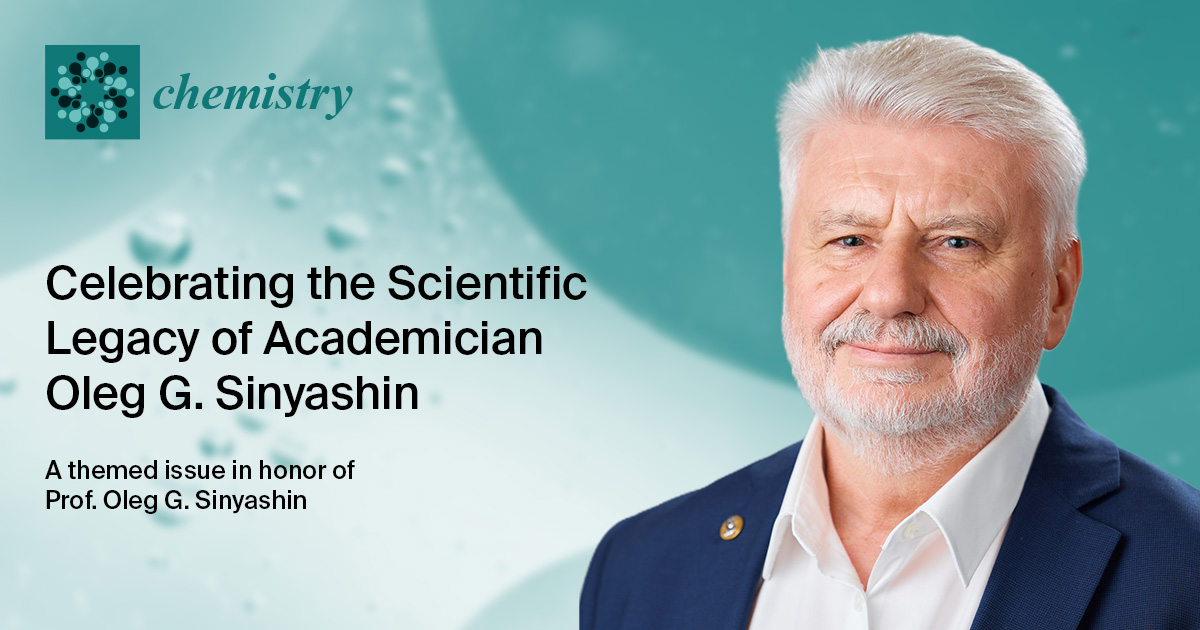
We are pleased to invite you to contribute to a Special Issue of Chemistry dedicated to celebrating the outstanding scientific achievements of Academician Oleg Geroldovich Sinyashin.
Professor Sinyashin is an internationally recognized leader in organic and organoelement chemistry. Over the course of his distinguished career, he has authored more than 800 publications and 46 patents, pioneering advances in organophosphorus chemistry, coordination compounds, electrochemistry, medicinal chemistry, and the organic chemistry of fullerenes. His work has led to the development of general methods for phosphorylation and thiolation, innovative strategies for heterocyclic and cage-like ligands, the discovery of macrocyclic phosphines for supramolecular chemistry, and the creation of biomimetic catalysts for hydrogen electrosynthesis and fuel cell applications. He also pioneered a new direction in metal complex catalysis for the selective electrochemical activation and functionalization of organic molecules.
Beyond his research, Professor Sinyashin has had a transformative impact on the chemical community through his leadership at the A.E. Arbuzov Institute of Organic and Physical Chemistry, the Kazan Scientific Center of the Russian Academy of Sciences, and his editorial stewardship of the Russian Journal of General Chemistry. His service to science and society has been recognized with numerous prestigious awards, including the Nesmeyanov Prize (2016) and the Chugaev Prize (2018).
This Special Issue aims to honor Professor Sinyashin’s legacy by gathering cutting-edge contributions and perspectives in areas reflecting his lifelong scientific vision, including but not limited to the following:
- Organophosphorus chemistry and organometallic chemistry;
- Coordination compounds and supramolecular chemistry;
- Catalysis and electrochemical activation of organic molecules;
- Chemistry of fullerenes and advanced carbon materials;
- Medicinal and bioinspired chemistry;
- Fundamental and applied organic synthesis;
- Optical and electronic sensors, including environment-related probes.
We invite researchers worldwide to contribute original research articles, reviews, and perspectives to this Special Issue. Together, these contributions will highlight the far-reaching impact of Professor Sinyashin’s scientific career and showcase new directions in organoelement and organic chemistry inspired by his work.
We look forward to your contributions in celebrating the remarkable legacy of Professor Oleg G. Sinyashin.
Prof. Dr. Alexander Burilov
Prof. Dr. Elena Alexandrovna Chugunova
Prof. Dr. Ying Zhou
Guest Editors
Manuscript Submission Information
Manuscripts should be submitted online at www.mdpi.com by registering and logging in to this website. Once you are registered, click here to go to the submission form. Manuscripts can be submitted until the deadline. All submissions that pass pre-check are peer-reviewed. Accepted papers will be published continuously in the journal (as soon as accepted) and will be listed together on the special issue website. Research articles, review articles as well as short communications are invited. For planned papers, a title and short abstract (about 250 words) can be sent to the Editorial Office for assessment.
Submitted manuscripts should not have been published previously, nor be under consideration for publication elsewhere (except conference proceedings papers). All manuscripts are thoroughly refereed through a single-anonymized peer-review process. A guide for authors and other relevant information for submission of manuscripts is available on the Instructions for Authors page. Chemistry is an international peer-reviewed open access monthly journal published by MDPI.
Please visit the Instructions for Authors page before submitting a manuscript. The Article Processing Charge (APC) for publication in this open access journal is 1800 CHF (Swiss Francs). Submitted papers should be well formatted and use good English. Authors may use MDPI's English editing service prior to publication or during author revisions.
Keywords
- organophosphorus chemistry
- fullerenes
- heterocyclic and cage-like ligands
- macrocyclic phosphines
- biomimetic catalysts
- metal complex catalysis
Benefits of Publishing in a Special Issue
- Ease of navigation: Grouping papers by topic helps scholars navigate broad scope journals more efficiently.
- Greater discoverability: Special Issues support the reach and impact of scientific research. Articles in Special Issues are more discoverable and cited more frequently.
- Expansion of research network: Special Issues facilitate connections among authors, fostering scientific collaborations.
- External promotion: Articles in Special Issues are often promoted through the journal's social media, increasing their visibility.
- Reprint: MDPI Books provides the opportunity to republish successful Special Issues in book format, both online and in print.
Further information on MDPI's Special Issue policies can be found here.
