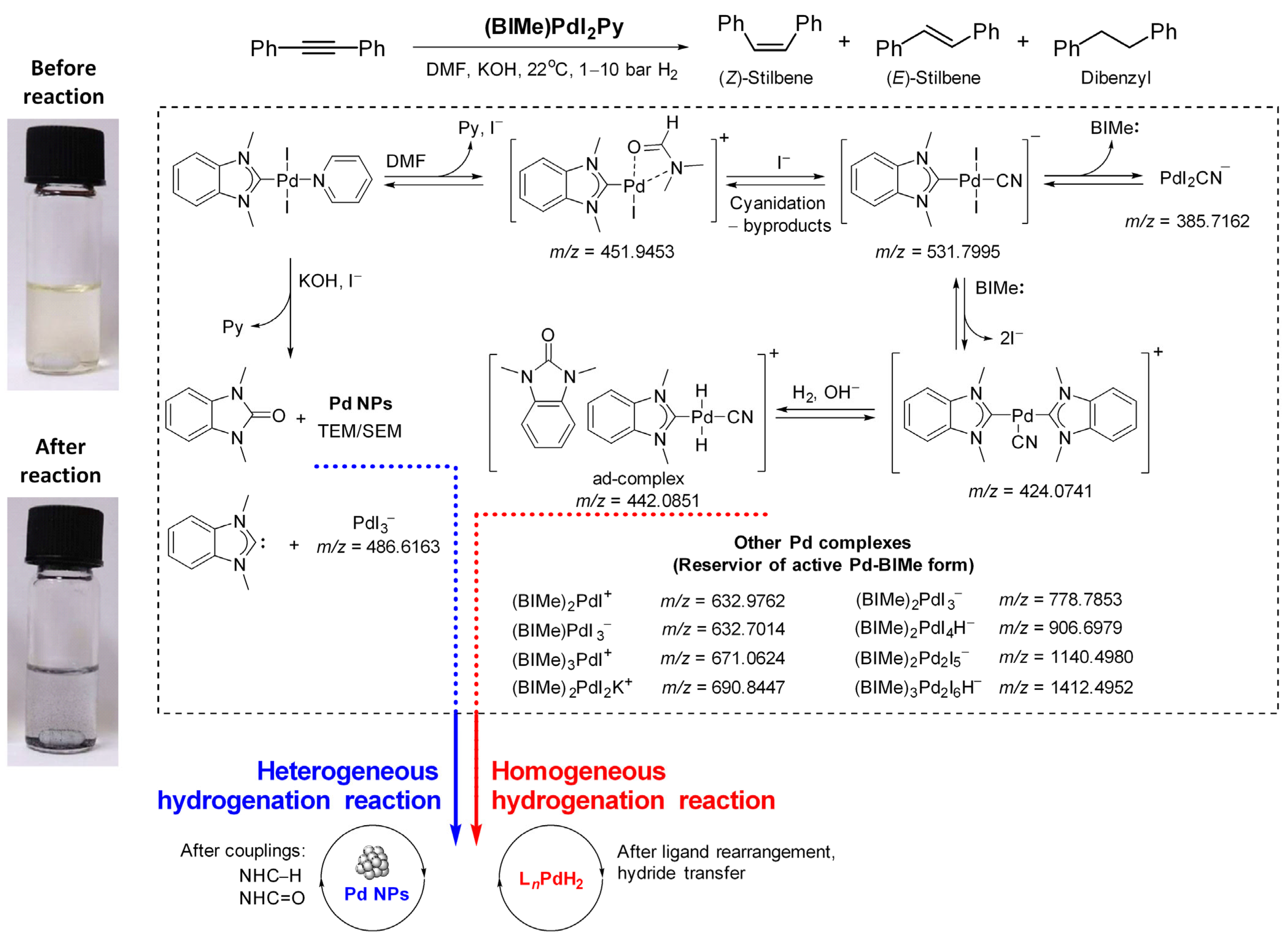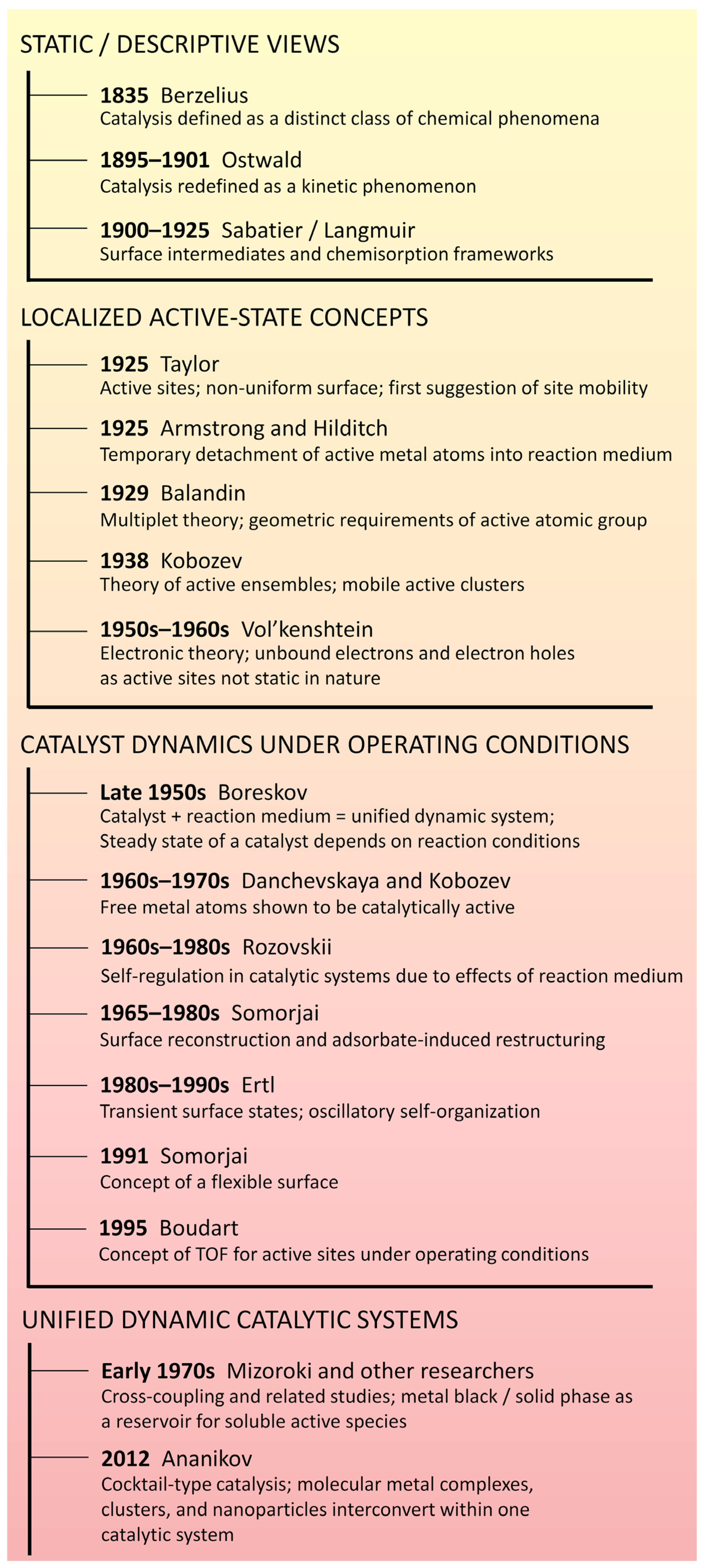

Review

Dynamic Behavior of Catalysts Under Operating Conditions: Part 1—Origin and Development of the Ideas †
by
Roman M. Mironenko
1,*,
Vladimir A. Likholobov
2 and
Aleksandr V. Lavrenov
1
1
Center of New Chemical Technologies BIC, Boreskov Institute of Catalysis, Neftezavodskaya Street 54, Omsk 644040, Russia
2
Boreskov Institute of Catalysis, Lavrentiev Avenue 5, Novosibirsk 630090, Russia
*
Author to whom correspondence should be addressed.
This article was prepared for the Special Issue dedicated to Academician Valentine P. Ananikov.
Chemistry 2026, 8(6), 79; https://doi.org/10.3390/chemistry8060079
Submission received: 28 April 2026 / Revised: 31 May 2026 / Accepted: 4 June 2026 / Published: 8 June 2026
(This article belongs to the Special Issue Celebrating the 50th Anniversary of Professor Valentine Ananikov)

Abstract

Currently, the concept of catalyst dynamics, which expresses the phenomena of change in the chemical composition and structure of the catalyst under the action of a reaction medium, has become an integral part of modern catalysis science. However, for the view of the catalyst as a dynamically changing component of a catalytic system to become generally accepted, the catalysis science had to come a long way. The present review provides a retrospective analysis of the development of catalysis with the aim of finding out at what point and under what circumstances the ideas about the dynamic nature of catalysts arose, were experimentally confirmed, and how they were further elaborated. The results of this analysis indicate the universal nature of dynamic catalytic phenomena, which inevitably raises the question of considering them from a broad and unified perspective.

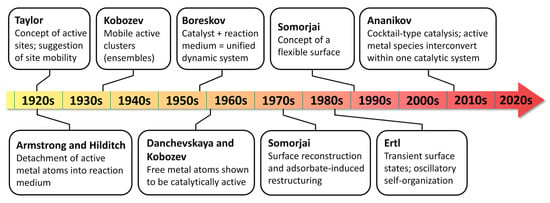
Graphical Abstract
The progress of knowledge is to be measured not by the questions that it has answered but by the questions that it provokes us to ask.”
Arthur Eddington, New Pathways in Science, 1934

1. Introduction

Catalysis is an extremely common chemical phenomenon in the surrounding world. In living nature, apparently all syntheses of the complex natural compounds occur catalytically, with Nature choosing for this purpose exclusively rational routes starting from simple substances. Even today, the action of natural catalysts—biocatalysts, primarily enzymes—remains a kind of ideal for chemists who strive to comprehend and imitate the amazing craftsmanship of Nature. For this reason, in catalysis science and engineering, nature-inspired (biomimetic) approaches have recently been actively developed and involved to create new highly efficient catalysts, such as single-atomic-site systems, hierarchically structured zeolites, metal–organic frameworks [1,2,3,4]. On the other hand, artificial catalysis, being an indispensable tool for the synthesis of various natural and unnatural compounds, is the cornerstone of the modern chemical industry, since approximately 85–90% of all industrial chemical processes are implemented using the catalysts at least at one stage [5,6]. It is no exaggeration to say that human civilization as it exists today would be impossible without the following numerous catalytically produced chemicals and materials: fuels, polymers, fertilizers and other agrochemicals, pharmaceuticals, dyes, and many consumer goods. Catalytic technologies are indispensable in solving problems of environmental protection by neutralizing hazardous waste and pollutants.
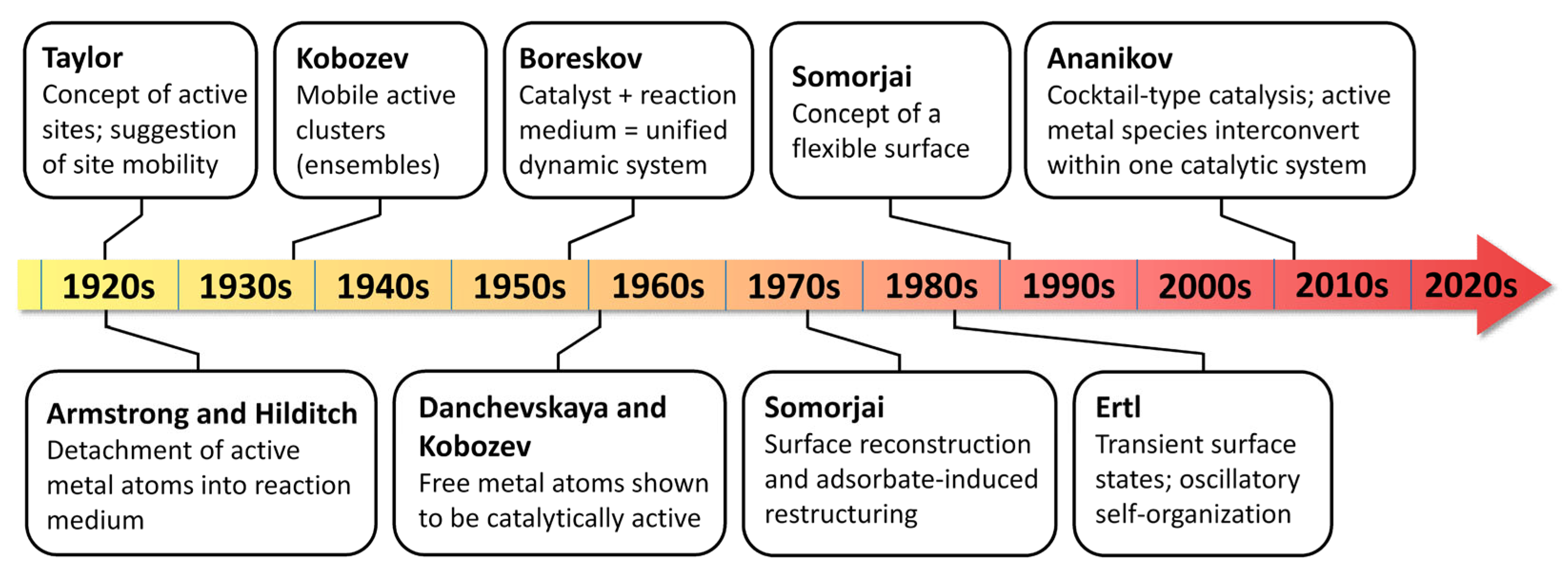
It is this practical significance of catalytic processes that is the major factor determining the overall progress of catalysis. This “applied” factor is particularly important and efficient for the development of heterogeneous catalysis, whose percentage in industrial catalytic processes is currently estimated at 80–85% [6,7]. The demands of industrial development have certainly left their mark on the approach to catalytic research, which remains largely empirical. Almost 70 years ago the eminent English chemist Hugh Taylor noted in this regard [8]: “It is a marked characteristic of catalytic development that the empirical art has always been in advance of the science.” However, he went on to add: “The theoretical study of basic principles has been the catalyst for an increasing tempo of technical development”. Obviously, the progress of catalysis is also determined by an internal factor, i.e., the logic of the development of science, although the influence of this factor is sometimes underestimated due to the fact that the progress of applied catalysis significantly outpaces the accumulation of basic knowledge about catalytic phenomena (Figure 1). Of course, catalysis science and catalytic technology cannot be considered in isolation from each other. Their interconnection and the impact of fundamental catalysis research on the development of industrial catalytic processes have recently been analyzed in detail by Rutger van Santen [9].
From the earliest stages of the evolution of catalysis science, attempts have been made to create theories that would unify all types of catalysis or at least some of their aspects, allowing catalytic phenomena to be considered as a unified whole. Serious difficulties along this path are due to the constant and inevitable differentiation in the development of catalysis and even its individual branches (as is typical for other areas of natural science), the extraordinary diversity of catalytic processes and existing catalysts, and finally the fact that catalysis is a complex field of science, bordering on a number of areas of physics, chemistry, and even biology. However, despite these circumstances, continuous progress in catalysis science, manifested in an increased level of understanding of the essence of catalysis, can generally be recognized (see Figure 1). Further development must include the mutual penetration of the rational aspects of existing concepts, leading to a deeper understanding of the essence of catalytic phenomena and, at the same time, to the establishment of commonalities between them in order to achieve the main goal—the creation of approaches to the prediction of catalytic action.
The concept of catalyst dynamics, which expresses the phenomena of change in the chemical composition and structure of the catalyst under the influence of a reaction medium, has now received convincing confirmation in numerous studies and has become an integral part of the modern catalysis science. However, this concept has not yet been formulated in a general form in which the numerous phenomena occurring with the catalyst during its operation would be considered from a unified perspective for various types of catalysis, although such attempts have been made previously. For example, the prominent Soviet and Russian physical chemist Kirill I. Zamaraev, having considered several striking cases of homogeneous and heterogeneous catalytic reactions, came to the conclusion that the reconstruction of the initial state of a catalyst under operating conditions is a general phenomenon in catalysis [10] (pp. 23–28).
In modern heterogeneous catalysis, the dynamic behavior of a catalyst is generally understood to mean the processes of reactant-induced restructuring of the catalyst surface, resulting in the generation of active species/structures that actually catalyze a particular reaction [11,12,13,14,15,16]. At the same time, researchers admit that in reality the dynamics of a solid catalyst during operation turns out to be even more complex, often including migration of the active component along the surface, destruction and enlargement of clusters or particles, surface phase transformations, segregation phenomena, detachment of active species from the surface, etc. The extreme diversity of dynamic phenomena makes it difficult to express the catalyst dynamics within the framework of a single model. This is further aggravated by the one-sided view of many dynamic processes as catalyst degradation. In particular, the processes of removing some portion of the catalytically active component into the reaction medium are usually ignored from the viewpoint of the participation of the removed active species in the catalytic reaction, and in general such phenomena are viewed negatively as catalyst deactivation, which must be prevented by one means or another [17,18,19,20,21,22]. Nevertheless, in some cases of heterogeneous catalysis in liquid–solid systems, the leaching of the active component from the catalyst is a mandatory stage of the homogeneous–heterogeneous mechanism of the catalytic reaction (e.g., C–C cross-coupling reactions [23,24,25]) and thus cannot be considered as a catalyst deactivation process. The removal of a portion of the active component from the catalyst surface is a common phenomenon also in gas–solid systems, especially under harsh operating conditions [19,26,27], but the subsequent participation of the catalytically active species released into the gas phase in the overall catalytic process remains poorly understood and is often ignored.
In homogeneous and enzymatic catalysis, the dynamic phenomena are also diverse and widespread, although it was long believed that in these types of catalysis the initial state of catalysts does not change during their operation. As is now well known, the mechanism of even seemingly simple cases of homogeneous catalysis, for example, organic reactions catalyzed by mineral acids, should be elucidated, taking into account a number of interactions in the substrate–solvent–catalyst system, resulting in the formation of various catalytically active molecular or ionic species [28,29]. Large protein molecules of enzymes also cannot be considered static and unchanging during the reaction because they are subject to reconstruction due to internal motions and conformational fluctuations, determining the catalytic efficiency and selectivity of an enzymatic reaction [30,31,32].
Based on the above, it seems appropriate to evaluate the universality of dynamic phenomena in catalysis in a broad sense and to determine whether the concept of catalyst dynamics can play a key unifying role in the modern science of catalysis, having first analyzed its origin and development. The present review, being the first part of a larger investigation devoted to examining these issues, provides a retrospective analysis of the development of catalysis with the aim of finding out at what point and under what circumstances the ideas about the dynamic nature of catalysts arose, were experimentally confirmed, and how they were further elaborated. The necessity of such a historical survey lies in the fact that the emergence and evolution of views on a catalyst as a dynamic system to our knowledge has not yet been properly analyzed, which sometimes leads to a misjudgment of these ideas and their universality. However, a detailed historical consideration is beyond the scope of the present work, and several books and review articles on the history of fundamental catalysis can be recommended for further reading [33,34,35,36,37,38,39,40,41,42,43]. Therefore, attention will be paid here primarily to the logic of the development of catalysis science and to those milestones in its evolution that influenced the emergence of ideas about the dynamic behavior of catalysts. Another limitation we have to impose on our survey is the following. Considering a catalyst as the “main actor” in the catalytic “arena”, it is advisable to isolate within the entire system of catalytic theories and concepts, especially in the case of heterogeneous catalysis, only those that explain the behavior of a catalyst on the basis of its structure (the necessity of such an approach has been justified earlier [36,44]). Therefore, focusing on concepts that deal with the reasons for the appearance of catalytic activity in certain substances, the nature of catalytically active entities and their behavior during the catalytic process (the “anatomy” of catalysis) forces us to exclude for the time being from consideration theories of the catalytic act (the “physiology” of catalysis), such as transition state theory, collision theory, catalytic resonance theory, Marcus theory of electron-transfer processes, and various theories elucidating kinetics and mechanism of catalytic reactions. This limitation does not imply that these theories are of secondary importance to catalysis. On the contrary, they are essential for understanding reaction dynamics, activation barriers, solvent reorganization, and transition-state stabilization. However, in the present historical survey, these theories are mentioned only insofar as they help to define the scope of the article, because the central object of analysis is the catalyst itself as a structurally and chemically evolving component of the catalytic system.

2. The Early Stage of Catalysis Research

As is known, the term “catalysis” (from the Greek words “κατα” meaning down and “λύω” meaning loosen) was introduced into chemical science by Jacob Berzelius in 1835 [45,46], who thereby united various unexplained cases of non-stoichiometric participation of some substances in chemical reactions and thus distinguished such phenomena from well-known reactions that obey stoichiometric laws (curiously, the term “catalyst” came into use only 50 years later when it was first proposed by Henry Armstrong [47]). Berzelius’ concept together with the research by Eilhard Mitscherlich, who around the same time proposed the terms “contact substances” [48,49] and “reactions through contact” [50] in relation to the similar phenomena, became the first generalizations in the history of catalysis. It is necessary to remind here that by the first third of the 19th century, a lot of information has already been accumulated about such “unusual” reactions caused or accelerated by some substances that remain unaffected. However, before Berzelius and Mitscherlich, no one had the idea of looking for any analogies between completely different phenomena such as for example the conversion of starch into grape sugar in the presence of mineral acids (K. S. Kirchhoff, 1812), the decomposition of hydrogen peroxide under the action of metals and their oxides (L.-J. Thénard, 1818), and the ignition of hydrogen in air over spongy platinum (J. W. Döbereiner, 1823). At the same time, Berzelius, while singling out catalysis into a separate category of chemical phenomena, omitted from consideration the chamber process for producing sulfuric acid, a case of homogeneous catalysis studied by Charles Désormes and Nicolas Clément back in 1806 [51]. This was clearly not a happenstance. The point is that the apparent non-stoichiometric participation of nitrogen oxides in the oxidation of sulfurous anhydride was well explained by the occurrence of multiple reaction cycles through the formation and decomposition of stoichiometric intermediate compound (nitrosylsulfuric acid, as pointed out by H. Davy in 1812). Therefore, Berzelius saw in this process only familiar chemical transformations, rather than the action of “catalytic force” as in heterogeneous reactions involving metals or in conversions of complex natural substances such as starch. Justus Liebig, who strongly disagreed with Berzelius’ catalysis concept and soon created his own universal theory [52], also considered the oxidation of sulfurous anhydride in the chamber production of sulfuric acid as a simple chemical process [53] (p. 84). It can be assumed that this circumstance significantly influenced the further development of homogeneous and heterogeneous catalysis. We can trace the evolution of these types of catalysis from the mid-19th century until the 1920s and clearly see some distinctive features.

2.1. Homogeneous Catalysis

Homogeneous catalysis became widespread in chemical research beginning in the second half of the 19th century, when numerous homogeneously catalyzed organic reactions were discovered, e.g., aldol condensation, Claisen condensation, Perkin reaction, pinacol rearrangement, different polymerization and isomerization reactions [34,35,36,54]. However, many organic chemists, when using homogeneous catalysts in organic synthesis, either said nothing about catalysis at all or briefly mentioned it as a simple multistep process. For example, Marcellin Berthelot, one of the founders of organic synthesis, noted that the cause of catalytic (contact) action is “the production of intermediate compounds, for the formation of which the elements of the contacting agents chemically contribute, but these compounds are destroyed as they are formed, so as to disappear in the final metamorphosis” [55] (p. 79). The theory of intermediate compounds, elucidating homogeneous catalytic reactions within the framework of stoichiometric principles, was based firstly on the aforementioned study on the homogeneous oxidation of sulfurous anhydride, and secondly on the later studies of the dehydration of ethyl alcohol to diethyl ether in the presence of sulfuric acid, which has been reliably established to proceed through the repeated cycles of formation and destruction of ethyl sulfate (A. W. Williamson, 1852). It is therefore not surprising that homogeneous catalysis did not deem to be an unusual phenomenon, and for a long time, homogeneous catalysts used in organic reactions were considered as synthetic reagents whose reactivity should be studied subordinately, solely for the purposes of synthesis. Moreover, organic chemists often did not even consider catalysts as objects of separate study. Henry Armstrong, noting the advances in the discovery and study of homogeneously catalyzed catalytic reactions, pointed out that “so little has been done to ascertain the nature of the influence of the contact-substance, or catalyst, as I would term it, the main object in view being the study of the product of the reaction, that the importance of the catalyst is not duly appreciated” [47] (p. 467).
On the other hand, the predominance of a simple stoichiometric representation of homogeneous catalysis turned out to be very beneficial for further progress, since homogeneous catalytic reactions in comparison with heterogeneous ones seemed convenient and understandable for their mechanistic-kinetic investigations. For example, the first detailed kinetic studies were carried out for homogeneous acid-catalyzed reactions, such as hydrolysis of cane sugar (L. F. Wilhelmy, 1850; J. Löwenthal and E. Lenssen, 1862) and esterification of carboxylic acids with alcohols (M. Berthelot and L. Péan de Saint-Gilles, 1862; N. A. Menshutkin, 1877–1906) [56,57]. Beginning in 1882, Wilhelm Ostwald studied the kinetics of a large number of hydrolytic reactions of organic compounds catalyzed by acids. Based on his quantitative research, Ostwald advanced the concept [58,59,60] which considered catalysis from the standpoint of physical chemistry and primarily as a kinetic phenomenon taking the reaction rate as a definite criterion of catalysis. According to Ostwald, the catalyst does not change the chemical equilibrium but only affects the reaction rate: “A catalyst is any substance which alters the velocity of a chemical reaction without appearing in the final product” [59] (p. 523). Thanks to the introduction of chemical thermodynamics and kinetics into the practice of catalytic research, catalysis became a scientific discipline [42]. In particular, the chemical thermodynamics developed by the efforts of many scientists towards the end of the 19th century [56] became the rational basis for catalytic studies, since it strictly defines the reaction conditions at which a particular substance should be tested as a catalyst. The application of the principles of physical chemistry to the study of homogeneous catalytic reactions in liquid phase eventually led to the creation of the theory of acid-base catalysis in aqueous solutions (J. N. Brønsted, T. M. Lowry, N. Bjerrum, J. A. Christiansen, 1922–1929) [39,61,62] and the general theory of homogeneous catalysis as a quantitative extension of the theory of intermediate compounds (E. I. Shpital’skii, 1925–1927) [61,63,64].

2.2. Heterogeneous Catalysis

Since the time of Berzelius, heterogeneous catalysis has been regarded as a distinctly non-stoichiometric phenomenon and far more enigmatic than homogeneous catalysis. A lot of different substances and materials proposed as heterogeneous catalysts have themselves always been and remain the objects of thorough research. In the 19th century many authors put forward various theories to explain the action of solid catalysts, primarily metals and their oxides. These early theories of heterogeneous catalysis can be divided into chemical and physical ones, depending on which factor was considered to be the cause of the catalytic action (see especially Refs. [33,34]). For example, according to the physical theory proposed by Michael Faraday, a solid catalyst concentrates reagents on its surface, thereby facilitating the interaction between the reagents [65], while the chemical theory developed by Lyon Playfair explains the action of a catalyst “by adding its own affinity to that of another body” [66] (p. 370). In general, the chemical and physical theories were quite disparate, as they did not have the necessary interconnections with each other and reflected different aspects of heterogeneous catalysis. Only at the beginning of the 20th century did it become clear that an adequate description of heterogeneous catalysis requires taking into account both its chemical and physical causes. It is relevant to quote here the words of Irving Langmuir, whose outstanding research works can be considered the first in this direction: “Most chemists seem to feel that the nature of catalytic action is almost as great a mystery to-day as it was in Faraday’s time. With our increasing knowledge of the structure of solid bodies and the atoms and molecules of which they are built, we should now, however, gradually begin to gain a clear insight into the mechanisms of such surface actions” [67] (p. 621).
However, the absence of a generally accepted theoretical framework of heterogeneous catalysis in the late 19th and early 20th centuries did not hinder the development and successful industrial implementation of important heterogeneous catalytic processes (see Figure 1) such as the contact process for producing sulfuric acid, the ammonia synthesis, the nitric acid production by ammonia oxidation, the fat hydrogenation process, and the methanol production from syngas [37,42,68,69]. This circumstance together with significant achievements in preparative organic synthesis mediated by solid catalysts [69,70] served as an incentive for further in-depth research and theoretical justification of heterogeneous catalytic phenomena. We can highlight the following theories that emerged during the first quarter of the 20th century to explain the essence of heterogeneous catalysis and that largely determined the subsequent development of catalysis science.
  • The chemical theory of catalysis put forward by Paul Sabatier [71,72,73]. According to this theory, a catalytic reaction proceeds through the chemical interaction of a catalyst with one of the reactants to form a temporary unstable intermediate compound that participates in further transformations but is absent from the final products. For example, according to Sabatier’s theory, the dehydration of saturated alcohols to alkenes over aluminum oxide proceeds via unstable aluminum alcoholates [73] (p. 53):
    Al2O3 + 2CnH2n+1OH → Al2O2(OCnH2n+1)2 + H2O,
    Al2O2(OCnH2n+1)2 → 2CnH2n + Al2O2(OH)2,
    Al2O2(OH)2 → Al2O3 + H2O.
    The reaction rate reaches a maximum at an optimal strength of interaction between catalyst and reactant, which should be neither too weak nor too strong. This important statement is known as the Sabatier principle (the Sabatier–Balandin volcano plots [40]). The chemical theory made it possible to explain the selectivity of solid catalysts based on their chemical nature, regardless of their physical state. Obviously, Sabatier’s theory largely repeats the theory of intermediate compounds, which was adopted by organic chemists to elucidate homogeneous catalytic reactions. This is not surprising given that Sabatier, being a student of Berthelot, adhered to the above-mentioned ideas of his teacher [72] (p. 4). The invaluable contribution made by Sabatier, among other things, lies in extending the theory of intermediate compounds to a wide range of heterogeneous catalytic reactions. According to Sabatier, surface intermediate compounds have a definite stoichiometric composition, as in homogeneous catalysis. However, efforts to detect them were unsuccessful until the 1930s.
  • The physical theory of catalysis developed primarily by Max Bodenstein and Walther Nernst [74,75] on the basis of earlier physical theories of heterogeneous processes and Ostwald’s concept (see also Ref. [76]). According to this theory, no chemical involvement of the catalyst is implied, and its role is limited merely to condensing (concentrating) the reacting substances around the surface. For this reason, the overall rate of catalytic process is governed by the diffusion of reactants and products through the thick layer of adsorbed molecules. In a later version of this theory, Bodenstein argued that the surface of a solid catalyst not only concentrates but also “deforms” the reactant molecules with its “force fields”, thereby causing a catalytic reaction [77]. Nikolai D. Zelinsky held the same view on the essence of heterogeneous catalysis, rejecting the concept of intermediate compounds [78].
  • The adsorption theory worked out by Irving Langmuir [67,79,80,81]. An extremely important statement of this theory is that the primary act of heterogeneous catalysis is chemisorption which consists of the valence interaction of reactant molecules with the catalyst crystal. The “checkerboard” model with a uniform distribution of static adsorption sites in accordance with the crystal lattice structure was assumed to describe the catalyst surface. In essence, Langmuir’s theory first combined the physical and chemical aspects of heterogeneous catalysis, considering catalytic phenomena at the solid surface from a molecular-kinetic point of view.
  • The concept of active sites proposed by Hugh Taylor [82,83].
There is no need to cover here all the details and evolution of the first three theories, especially considering that this has already been done in many works [36,37,38,39,40,41,42,43,56,61,69,84,85,86,87,88]. At the same time, the concept of active sites deserves special attention, since it can be deemed as the starting point for the origin of ideas on the dynamic behavior of catalysts.

3. The Concept of Active Sites and Its Evolution

3.1. The Emergence of the Concept

The concept of active sites in essence became a development of Langmuir’s adsorption theory. In this theory, as noted above, the adsorbing surface is assumed to be uniform. However, in the early 1920s many researchers studying adsorption came to the conclusion that the surfaces of solid substances commonly used as adsorbents and catalysts are not actually uniform [61,89,90]. Thus, it was established that only a small fraction of molecules adsorbed on the catalyst surface participated in the catalytic reaction, which indicated the presence of a small number of surface sites exhibiting catalytic activity. For example, Eric Rideal found that only 0.04% of the surface area of dispersed metallic nickel promotes the hydrogenation of ethylene [91].
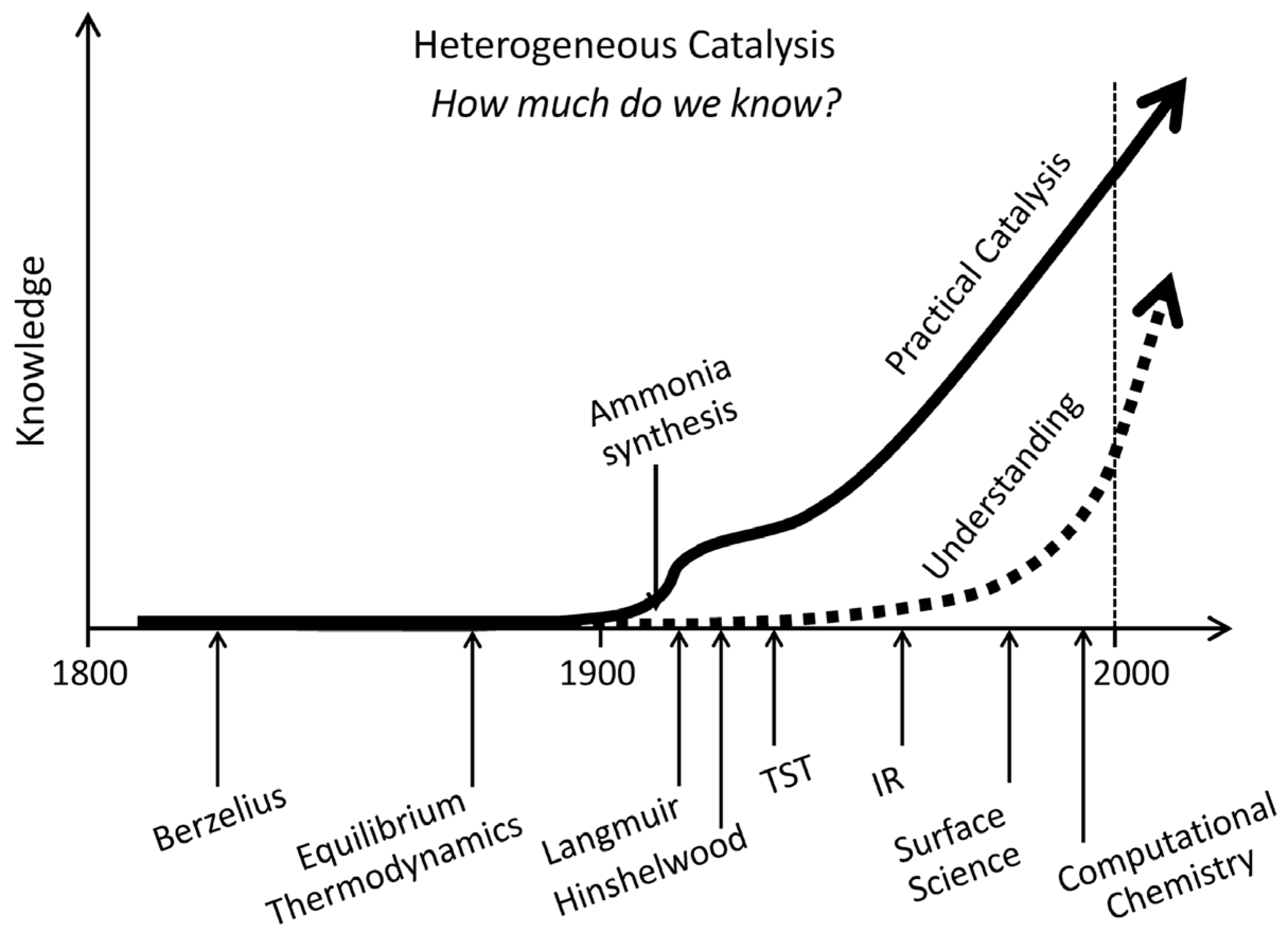
Based on this and many other prerequisites, Taylor in 1925 put forward the hypothesis [82] that the entire catalyst surface can be divided into several parts depending on their activity in a particular reaction. The most catalytically active part which was called “available” [89] (pp. 75–79) constitutes only a very small fraction of the total exposed surface (the Taylor ratio which is always much less than 1). To specify his hypothesis, Taylor postulated that this “available” part of the catalyst surface, such as nickel, consists of the least mutually saturated atoms protruding above the surface (Figure 2). The degree of unsaturation of atoms varies depending on their localization on the surface as follows: singly unsaturated atoms are located on a flat surface, while doubly or triply unsaturated atoms belong to various edges, corners, and ledges. It is these most coordinatively unsaturated surface atoms, at which a particular catalytic reaction takes place, that were designated as active centers, or as they are now more commonly termed, active sites (The terms “active center” and “active site” are often used interchangeably. However, the term “active center” may refer to a group (ensemble) of sites at which a catalytic reaction occurs [92]).
The protruding areas of the catalyst surface where the active sites are concentrated have been called “peaks” by some authors [69]. Of course, these peaks are not the only ones that provide the catalyst with activity in a particular reaction. In fact, catalytic activity is distributed in a certain way among all the atoms of the catalyst surface [93]. For instance, the atoms of the flat surface also participate in the catalytic reaction but to an incomparably lesser extent than the active sites of peaks. Moreover, each active site, due to its inherent high degree of unsaturation, is capable of adsorbing several reacting molecules at once. This differs from Langmuir’s theory, according to which one adsorption site binds only one molecule and adsorption continues until an oriented monomolecular layer of adsorbate is formed on the surface.
Taylor assumed that the active sites should have some mobility influenced by external factors, i.e., they are supposedly dynamic in nature. He attributed this to the fact that highly unsaturated atoms are weakly bound to the crystal lattice and therefore acquire a certain degree of freedom especially at elevated temperatures. In particular, Taylor noted: “The atoms of metal loosely held will have a greater freedom of motion, will be relatively sensitive to thermal influence. They will show greater volatility” [82] (p. 108).
Overall, the concept of active sites has proven to be extremely fruitful for the further development of heterogeneous catalysis. First of all, this concept made it possible to provide a reasonable explanation for various important effects observed in experiments such as changes in catalytic activity depending on the conditions of catalyst preparation or treatment, an increase in activity due to the addition of promoters, and conversely a dramatic decrease in activity as a result of poisoning by trace amounts of certain substances. On the other hand, Taylor’s concept was initially put forward as an ad hoc hypothesis to fit a number of known experimental facts by postulating the presence of coordinatively unsaturated atoms on the catalyst surface. Although the basic principle of the concept, the non-uniformity of the surface of real adsorbents and catalysts, has hardly been questioned, various interpretations of this principle have led to the emergence of a number of hypotheses and concepts that define the nature of active sites in different ways.

3.2. The Armstrong–Hilditch Hypothesis

Already in the same year of 1925, Edward Armstrong and Thomas Hilditch evolved Taylor’s idea on the dynamic nature of active sites, suggesting that the affinity between the reacting molecule and the catalyst may be sufficient to break the bond between the unsaturated catalytically active atom and neighboring atom(s) in the crystal lattice [94,95,96]. They note that “the acting (nickel) atom is, at the moment when catalytic change occurs, not merely held to the rest of the solid surfaces by a single constraint, but can be actually, momentarily, detached therefrom; in physico-chemical parlance, it has become for the time being a gaseous (nickel) atom” [94] (p. 111). Such an extra-lattice metal atom appearing in the reaction medium due to its detachment from the catalyst surface should have the maximum degree of unsaturation and therefore exhibit the highest catalytic activity in a particular reaction. Considering as an example the hydrogenation of natural oils over a nickel-kieselguhr catalyst, Armstrong and Hilditch further proposed that detached nickel atoms either remain in the reaction medium and participate in transformations or return to the catalyst surface: “When the catalytic change is complete, the nickel is again momentarily free, and one of several things might happen: (i) it might take part in further momentary unions with unsaturated molecules; (ii) it might remain suspended as a nickel sol in the liquid; (iii) it might become attached again by the attraction to the solid surface” [95] (p. 705). As evidence for their proposal, Armstrong and Hilditch cited cases of the appearance of colloidal nickel in the reaction mixture, which coats the inner walls of the reactor with a thin film. In addition, they pointed to oft-quoted cases of the roughening of a smooth metal surface during gas-phase oxidation processes in which they believe that metal atoms are transferred from one position on the surface to another. Note that these etching phenomena were discovered and intensively studied long before the work of Armstrong and Hilditch [26,27,97]. One of the most well-known etching phenomena in catalysis occurs during the long-term operation of a platinum gauze in the ammonia oxidation process and is accompanied by surface restructuring and coating of the Pt wires with tinsel. The interest in studying this particular case of the dynamic behavior of a catalyst under the influence of a reaction medium has not waned for more than a century [18,19,68,89,98,99,100].
Taylor, having analyzed the Armstrong–Hilditch hypothesis and calling it “a constructive extension of the preceding theory”, nevertheless expressed doubt that the detachment of metal atoms from the catalyst surface under the action of reagents is a common phenomenon and is unlikely to occur in heterogeneous reactions catalyzed, for example, by platinum metals in colloidal form and by refractory oxides [83] (pp. 155–157). It should be added that the experimental methods of the time did not allow for direct confirmation of this hypothesis, i.e., for identification of the metal species removed from the catalyst and establishment of their role in the catalytic process. Except for occasional mentions in some publications [69,90], the Armstrong–Hilditch hypothesis did not attract much attention from the scientific community and was forgotten for almost 30 years until research began to confirm one of the consequences of the theory of active ensembles (see below). Nevertheless, it is precisely this hypothesis that can be considered the first idea on the dynamic catalyst behavior in the full sense of this term and the prototype of the modern cocktail-type catalysis concept (see below Section 5).

3.3. Active Site as a Cluster of Atoms and Kobozev’s Theory

The controversy that erupted in the 1920s and 1930s over Taylor’s concept gave rise to various hypotheses and even well-founded theories, in which the nature of active sites was determined by the geometric heterogeneity of a solid surface. One viewpoint was to consider active site as a group of atoms bonded to each other, and many researchers believed that such a catalytically active group, i.e., cluster, should be an element of the crystal lattice. Georg-Maria Schwab and Erich Pietsch, based on a series of experiments, advanced the adlineation theory which speculated that active sites are boundary lines (“active lines”) between chemically and crystallographically different parts of the surface: crystal corners, grain boundaries, and one-dimensional defects [61,101,102]. In 1929 Aleksei A. Balandin, based on the kinetic studies on the dehydrogenation of cycloalkanes over platinum catalysts, proposed that the active site is an atomic group with a strictly defined configuration and which is included in the crystal lattice of the catalyst [103,104,105]. In fact, Balandin began working out the multiplet theory back in 1926. This theory arose not only as a development of Taylor’s concept and Langmuir’s adsorption theory but also, as Balandin later noted [106], as a continuation of the research of his teacher Zelinsky, who at that time was developing Bodenstein’s theory of deformations (it was mentioned above on p. 7). The essence of Balandin’s theory is that each such atomic group of a certain size forms a multiplet complex with the reactant molecule in accordance with the principles of structural and energetic conformity [107,108]. The structure of active sites can be distorted but is generally assumed to be static, since the atoms belong to the crystal lattice. Without being able to provide all the details, we only note that this coherent quantitative theory based on rigorous physical principles was developed using extensive experimental data and proved to be effective in practical terms, allowing to a certain extent the selection of catalysts, regulation of their activity, and avoidance of poisoning. For this reason, Balandin’s theory was considered as one of the elements to construct a unified theory of catalysis [36,38,44,109].
If the catalyst atoms are not part of the crystal lattice, then according to Taylor’s concept, they should be highly reactive. Rideal and Taylor pointed this out back in 1926: “In addition to the micro-crystalline material present in a metal surface there are present a number of isolated atoms, and groups of atoms which are not in a space lattice and may be designated as amorphous material. These are, as anticipated, even more reactive, as far as adsorption and solution are concerned, than the crystals themselves” [89] (p. 76).
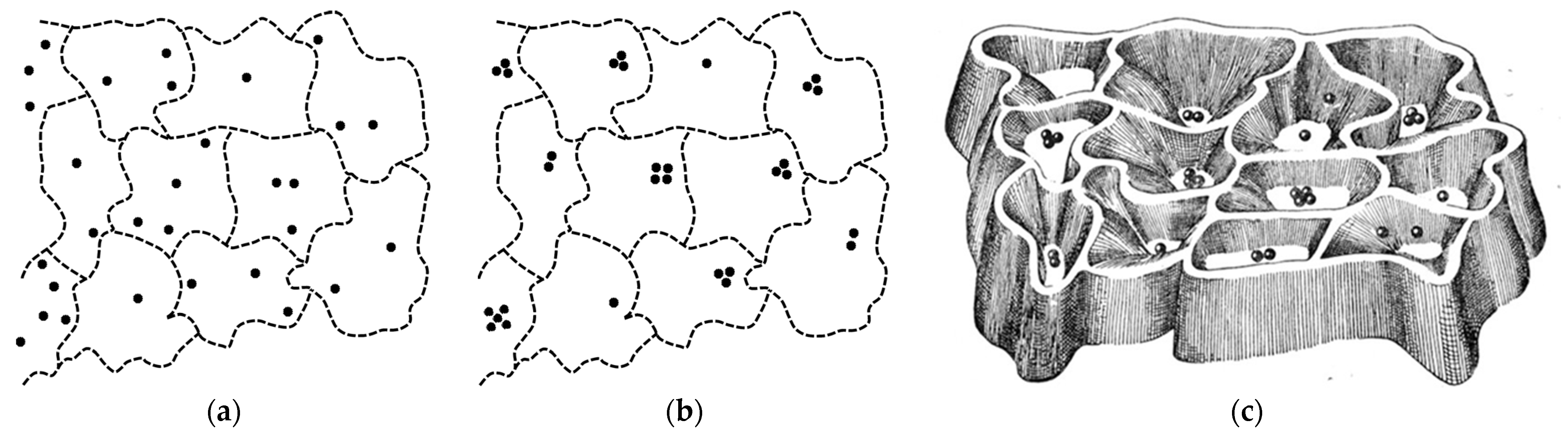
This idea was later developed by Nikolai I. Kobozev. In 1938 he advanced the theory of active ensembles [110,111,112,113,114] according to which catalytic activity is only exhibited by atomic ensembles (clusters) held on the catalyst surface by adsorption forces. The crystalline phase of the catalyst serves as an inert support. The surface of the crystalline phase has a mosaic structure and consists of closed cells which can be represented by exposed faces of crystallites. These cells or migration regions, as Kobozev called them, are separated from each other by energetic and geometric barriers (e.g., microfissures), which is typical for the non-uniform surface of real catalysts. Catalyst atoms that randomly ended up in one migration region fall into a potential well and associate there into an n-atomic ensemble (Figure 3). Kobozev’s theory implies that the crystalline support and the precrystalline (amorphous) phase of active ensembles may differ in chemical nature, as for supported metal catalysts, or may be identical when dealing with bulk (unsupported) catalysts. In the latter case, it has been proven that a thermodynamically unstable phase consisting of single atoms and their ensembles spontaneously forms and is always present on the surface of crystal faces [112].
Using mathematical statistics, Kobozev showed the possibility of calculating the number of atoms in an active ensemble, the size of the migration region, and the catalytic activity of a single ensemble. Based on the Poisson distribution, the following equation can be obtained for the amount of migration regions containing n-atomic ensembles at a given degree of coverage (α):
Z n = Z 0 p α n n ! e p α = S p σ p α n n ! e p α ,
where Z0 is the total amount of migration regions, p is the amount of catalyst atoms required to cover the migration region with a monatomic layer, S is the specific surface area of the support, and σ is the area occupied by one catalyst atom. Equation (1) allows one to express the total catalytic activity (A) and the specific catalytic activity (a) through the activity of one n-atomic ensemble (rn):
A = r n Z n = r n Z 0 p α n n ! e p α ,
a = r n Z n α = r n Z 0 p n α n 1 n ! e p α .
The composition of the active ensemble and the size of the migration region can be determined by solving Equations (2) and (3) for the extremum. On the other hand, taking the logarithm of Equation (2) yields a dependence on α:
ln A α n = ln r n Z 0 p n n ! p α ,
which is linear if n actually corresponds to the composition of the active ensemble. Thus, the latter expression allows one to graphically determine the number of atoms in the active site based on the experimental values of A and α. In addition, knowing the specific surface area of the support, it is possible to calculate the amount of migration regions and their size, i.e., to evaluate the mosaic structure of the support surface.
A specific reaction requires an active ensemble consisting of a certain number of atoms. Interpreting numerous experimental results within the framework of his theory, Kobozev found that n is an integer ranging in most cases from 1 to 3. For example, the active site for ammonia synthesis on iron catalysts is an ensemble consisting of three Fe atoms; the hydrogenation of C=C bonds in organic compounds in the presence of supported platinum and palladium catalysts occurs on diatomic Pt or Pd ensembles, while oxidation reactions of SO2 to SO3 and NH3 to NO on supported platinum catalysts require single Pt atoms [111,112,113,114]. Note that Kobozev did not limit himself to considering only metal catalysts and extended the theory of active ensembles to other types of solid catalysts including those containing enzymes.
An important statement of Kobozev’s theory is that active ensembles are not valence-bonded to the crystal lattice but are held on the surface by adsorption forces and therefore can move within migration regions. Moreover, if the reagent molecules interact strongly enough with the atoms of active ensembles, the latter can completely leave the catalyst surface and catalyze the reactions beyond the surface. Kobozev first drew attention to this possibility arising from his theory only more than 20 years after the theory’s inception. Somewhat earlier, in 1956, Paul Bussière and co-authors [115], studying the combustion of an air-methane mixture on a heated platinum ribbon containing the radioactive isotope 197Pt, found that the oxidation process occurs not only on the platinum surface but also in the gas phase where it continues to be catalyzed by platinum species that have left the surface and were detected using a Geiger–Müller counter. Considering this work and the Armstrong–Hilditch hypothesis, Kobozev undertook a series of experiments, the results of which would serve as proof of one of the aspects of his theory—the possibility of a catalytic reaction occurring on atomic ensembles or free atoms completely detached from the catalyst surface. Research in this direction was carried out in the 1960s and 1970s by Marina N. Danchevskaya, Kobozev, and co-authors [114,116,117,118,119,120,121,122,123,124]. The experiments consisted in determining the catalytic performance of free metal atoms obtained by evaporation of relatively volatile metals such as zinc and cadmium when heated in a vacuum. The reactions were performed by dosing the starting compound into a reactor containing metal vapor. Some experiments were carried out using a mass spectrometer attached to the reactor. In this way, Danchevskaya with co-workers studied the conversion of alcohols [116,117,118,122,123,124], cracking of hydrocarbons [119], H2-D2 exchange [120], and ortho-para hydrogen conversion [121]. As a result, it was reliably proven that free metal atoms (especially zinc) exhibit sufficient catalytic activity and their role in the reaction mechanism was established directly by mass spectrometry detection of key intermediates. For example, it was shown that the Zn-catalyzed decomposition of methanol to CO and H2 proceeds through an unstable zinc compound(s) [117,118]:
CH3OH + Zn → [(H)···64ZnOCH3] → CO + H2 + Zn.
m/z 95 ± 1
A kinetic study showed that reactions occurring in the gas phase on free metal atoms do not differ significantly from the same reactions in the presence of solid catalysts containing the same metal. Therefore, the results of these studies not only confirmed one of the statements of Kobozev’s theory concerning the dynamic nature of the active sites of metal catalysts but also, in a broader sense, clearly demonstrated that there is in fact no distinct boundary between heterogeneous and homogeneous catalysis. Subsequently, the study of gas-phase catalytic reactions mediated by isolated metal atoms, ions, metal or metal-oxide clusters became a distinct field of catalytic research [125,126,127,128,129]. Interest is driven by the fact that isolated gas-phase atoms, clusters, or ions of transition metals can serve as models of active sites for real catalysts in a condensed state, and research in this field gains insight into the functioning of practically important catalysts at a strictly molecular level.
In concluding the discussion of the theory of active ensembles, we note that the basic principles of the theory and the validity of its equations have been repeatedly verified experimentally by Kobozev himself, by his students, and by a number of other researchers [7,111,112,113,114,130,131,132,133,134,135,136,137,138,139]. When studying reactions in the presence of supported metal catalysts with a low content of active metal (adsorption catalysts), dependences of catalytic activity on the metal content (coverage degree α) were found that correspond to those predetermined by theory. The composition of active ensembles was verified by depositing ready-made metal ensembles on the support, for example, Pt2 in the form of appropriate coordination complex. Another test of the theory that can be considered is the explanation of the phenomena of catalyst poisoning which is usually expressed by an exponential dependence on the amount of poison introduced. It turned out that the law of distribution of poison molecules among active sites coincides with the law of formation of active ensembles. Finally, the above-mentioned results of catalytic studies with free metal atoms can also be considered as confirmation of the theory. However, it should be understood that the theory of active ensembles, like any scientific theory, certainly has the limits of applicability. In particular, this theory was developed primarily for adsorption catalysts with a low metal content corresponding to α less than 10−2. As Kobozev himself admitted, the theory’s conclusions for α > 10−2 are ambiguous and not always applicable. At a sufficiently high metal content, more complex seven- or even 12-atomic sites become active. This limitation of the theory and the postulation of the absence of catalytic activity of the crystalline phase (which was not confirmed by many observations) were the main objects of criticism.
Nevertheless, there is no doubt that the theory of active ensembles together with Balandin’s multiplet theory played an exceptionally important role in the development of theoretical concepts in heterogeneous catalysis. Considering the active site as a cluster of atoms, these theories were the first to quantitatively elucidate the geometric factor, i.e., the effect of the atomic geometry of the active site and its environment on the catalytic behavior, which is the cornerstone of modern heterogeneous catalysis [7,12,16]. In the late 1960s, taking into account the theory of active ensembles and the data of its independent verification, Michel Boudart introduced the concept of structure sensitivity/insensitivity, according to which metal-catalyzed reactions can be divided into facile (or structure-insensitive) and demanding (or structure-sensitive) ones depending on the effect of metal particle size on catalytic performance [140,141]. In the 1970s the principles of ensemble model were extended to metal alloy catalysts. Dennis Dowden combined the basic ideas of Kobozev’s theory and the electronic model (see below) by suggesting that the heat of adsorption on a particular metal atom in a bimetallic ensemble is affected by the nature of other metal atoms in the immediate environment [142]. Wolfgang Sachtler, Vladimir Ponec, and other researchers developed the concept of the ensemble effect in bimetallic catalysts, according to which the alloying of an active metal with an inert one separates the active sites, which leads to the suppression of side reactions requiring large ensembles (e.g., hydrogenolysis of C–C bonds in hydrocarbons) and to an increase in selectivity to reactions catalyzed by small ensembles or single atoms (e.g., dehydrogenation of hydrocarbons) [143,144]. Until now, efforts in the clarification and improvement of the concept of active ensembles (the so-called ensemble model) in catalysis by metals and alloys have not weakened [145,146,147,148,149,150,151].
On the other hand, an important distinction should be made between Kobozev’s theory and the modern ensemble effect in alloy catalysis. Kobozev’s theory primarily concerned the statistical formation of mobile n-atomic ensembles on a support and the dependence of catalytic activity on the number of atoms in such ensembles. In contrast, the modern alloy ensemble concept typically considers the local atomic environment within a metal surface or nanoparticle as a factor controlling adsorption strength, reaction pathway, and selectivity. Thus, the two concepts are historically related but not identical: Kobozev’s theory emphasized the emergence and mobility of active atomic ensembles, whereas the alloy ensemble concept emphasizes the chemical identity and spatial arrangement of neighboring atoms on multicomponent catalytic surfaces.

3.4. Active Sites from the Standpoint of Electronic Concepts and Beyond

As noted above, Taylor’s concept sparked a debate in the scientific community about the nature of active sites, and the most common ideas were based on the geometric heterogeneity of a catalyst surface. However, a number of researchers interpreted the nature of active sites not so much in terms of surface heterogeneity but from the point of view of electronic phenomena. Lev V. Pisarzhevskii was apparently the first who back in the 1920s pointed out the relationship between catalytic activity of solids and their electronic structure [152]. Around the same time, many other scientists (e.g., S. Z. Roginskii, 1928; A. K. Brewer, 1928; and E. K. Rideal, 1929) emphasized the important role of the electrophysical properties of solids, such as electrical conductivity and work function, in the phenomena of adsorption and catalysis. Here, it is worth noting the theoretical investigation by John Lennard-Jones from 1932 [153], in which it was first shown that the covalent bond between the metal surface and an adsorbed atom is formed by pairing the electrons of the adsorbate with electrons from the conduction band of the metal. The conclusions of this work confirmed the theory of activated adsorption, which was put forward somewhat earlier by Taylor, and the basic principle of which is that the main criterion for adsorption of one type or another is the value of the activation energy [154,155]. Taylor in his theory essentially answered the question about the cause of the catalytic action of active sites: “In general, it is the adsorptions with the higher energies of activation which are important in catalytic change” [154] (p. 597).
The first attempts to create a quantitative electronic theory of catalysis based on the achievements of solid-state physics date back to the 1940s, and the following decade saw a real boom in the development of electronic concepts for elucidating catalysis on metals and semiconductors. For example, Schwab, having studied the kinetics of decomposition of formic acid on metal alloys, proposed a concept in which the activation energy of the reaction depends on the degree of completion of the first Brillouin zone of the metal [156]. Somewhat later Dowden developed a theory in which the catalytic activity of metals and metal alloys is associated with the presence of holes in the d-band [157,158]. According to this theory, transition metals exhibit catalytic activity in various reactions because they have an incompletely filled d-band and a high density of states at the Fermi level, which is favorable for the electron transfer required to activate adsorbed molecules. Dowden used the so-called rigid-band model to describe alloy catalysts. The catalytic activity of bimetallic alloys decreases to zero as the holes in the d-band of one metal are filled with electrons of the other metal, which was confirmed in the study of copper–nickel catalysts with different Cu/Ni ratio in the hydrogenation of styrene [158]. However, it was subsequently shown that this is not a general pattern. Later, in the 1970s, Sachtler put forward the concept of the ligand effect in alloy catalysts, which can be defined as the modification of the electronic state of the surface metal atoms by neighboring atoms of another metal, resulting in a change in the adsorbate–metal bond strength and catalytic behavior [143]. This concept was introduced to differentiate local electronic phenomena from the long-range effects postulated within the rigid-band model [149]. Until now, the electronic ligand effect, both separately and in relationship with the above-mentioned ensemble effect, has been the subject of numerous studies in catalysis by alloys [145,146,149,151,159,160,161].
When studying semiconductors, it was found that the adsorption on their surface and the reactivity of the adsorbed molecules are determined by the position of the Fermi level, the value of which contributes to the activation energy of the rate-limiting step of the catalytic reaction [162,163,164]. This statement formed the basis of the electronic theory of catalysis developed by Fyodor F. Vol’kenshtein [165,166,167]. This theory consistently explains the relationship between the electronic structure of semiconductors (e.g., metal oxides, carbides, nitrides, etc.), their adsorption capacity, and catalytic performance in redox reactions. It gained particular popularity in the scientific community in the 1950s and 1960s and, along with Balandin’s theory, was considered as an element for constructing a unified theory of catalysis [36,38]. There is no need to present here all the details of the electronic theory. However, given the issues discussed in this review regarding the nature of active sites and their dynamic behavior, it is appropriate to provide a definition of active sites from the standpoint of this theory. According to Vol’kenshtein, the role of active sites is played by unsaturated surface bonds, i.e., unbound electrons and electron holes in the crystal lattice. The theory implies that the active sites are not static entities: “Generally speaking, the centres are not immobile: they wander along the surface until they encounter chemisorbed molecules to which they become bound. This causes localisation of the centres. At the same time, the binding of the molecule to the surface becomes stronger, and the molecule is converted into a radical-ion and becomes reactive. Alternatively, the ‘active centre’, having spent some time bound to the molecule, can break free and resume its wandering along the surface. When this happens the molecule left on the surface loses its reactivity and reverts from the radical-ion to the valency-saturated (and therefore electrically neutral) state. The concentration of ‘active centres’ of this type on the surface is not fixed: they can be supplied from the bulk of the semiconductor (or, conversely, they can be adsorbed into the bulk) both during catalyst preparation and in the course of the reaction” [166] (p. 539). The last sentence is of especial interest, since it particularly points to the generation of active sites on the catalyst surface upon interaction with the reactant molecules, which generally corresponds to modern views. Apparently, Taylor was the first to express this idea, back when he was putting forward the concept of active sites: “The amount of surface which is catalytically active is determined by the reaction catalyzed” [82] (p. 109). This essentially means that the catalyst surface is reorganized upon contact with the reactants, thereby adapting to a particular reaction. Later, other authors expressed similar views on the nature of active sites. For example, Nathaniel Thon and Austin Taylor argued that “active centers will be produced on first contact with the gaseous center-making reactant”, and “the initial center density can be depressed by competition on the part of a second reactant acting as a center unmaker” [168] (p. 2748). Therefore, the functioning of the catalyst can be represented as a continuous sequence of the appearance and disappearance of active sites upon contact with reagents. This point of view is very close to the concept evolved relatively recently by Jacques Védrine when considering the different oxidative reactions of hydrocarbons on metal-oxide catalysts. According to this concept, the active sites as mobile/flexible surface moieties periodically change their state under catalytic conditions (the so-called “breathing” surface), and the active site-hydrocarbon entities oscillate in steady regime, wandering along the catalyst surface [11,169].
The development of views on the formation of a catalytically active state of a solid surface upon contact with the reaction medium will be considered in more detail in the next section. But first, to summarize this brief historical survey of the emergence and progress of the active site concept and in commemoration of its centenary, we would like to emphasize once again that this concept has proven extremely fruitful for the development of heterogeneous catalysis and lies at the heart of the modern catalysis science [11,12,13,14,15,16]. The directions of development of the concept and its significance were analyzed in detail by Taylor himself [8,170,171,172,173,174], then by his student Michel Boudart, who made an invaluable contribution to its advancement [175,176,177], as well as by a number of other authors [36,37,39,40,43,178,179,180,181]. Currently, the concept of active sites is not limited to metal catalysts (as in original version) and has been extended to heterogeneous and homogeneous catalysts of different nature. Active sites are classified into Brønsted and Lewis acid sites, basic sites, metal sites, and redox sites, which determines the type of bond with the adsorbed molecules and the type of catalyzed reaction. Therefore, Taylor’s concept should be recognized as universal in modern catalysis science.

4. Toward Modern Concepts on the Dynamic Nature of Heterogeneous Catalysts

As seen from the above, the ideas about the dynamic behavior of heterogeneous catalysts originated as early as 1925, and over the next 50 years, they received support and elaboration thanks to numerous studies. Among other things, these studies generally confirmed Taylor’s prediction about the possible restructuring of the catalyst surface under catalytic conditions, which gave rise to concepts on the formation of an active state of the solid surface upon contact with the reaction medium. For example, Balandin and Kotelkov, while studying the dehydrogenation of cyclohexane over a nichrome-supported platinum catalyst, found an increase in catalytic activity as the reaction progressed (accompanied by the formation of coke) and explained this phenomenon by an increase in the amount of particular active sites (Pt sextets) required for the reaction to proceed in accordance with the multiplet theory [182]. Tovbin and Baram, based on numerous experimental data, proposed the following hypothesis on the key role played by polymorphic transformations of solid catalysts in the mechanism of catalytic reactions: the heat released upon adsorption of the reagent causes a local surface restructuring to form unstable entities that spontaneously undergo the reverse rearrangement, thereby providing favorable conditions for the conversion of the reagent [183]. Allan Gwathmey and co-workers carefully studied the surface topography of copper single-crystal catalysts by electron microscopy and showed that the reaction between adsorbed hydrogen and oxygen causes surface reconstruction to form structures necessary for this specific reaction, i.e., in simple terms, the reaction prepares the catalyst surface for itself [184,185]. In particular, they concluded that “not only does the surface affect the reaction between gases but the gases also affect the structure of the surface, and these effects obviously must be taken into consideration” [185] (p. 93). Finally, Kenzi Tamaru, who developed an approach to adsorption measurements during the course of a catalytic reaction, also drew attention to the need to study the surface of working catalysts to understand the mechanism of heterogeneous catalysis: “The state of the surface which catalyzes the reactions is not that of the surface in the absence of reactants, but that which exerts under reaction conditions. In this sense, the properties of a catalyst surface to be studied should be those in the working state, rather than those of a bare surface” [186] (p. 88).
In general, it can be argued that since about the middle of the last century, research into changes in the catalyst surface composition and structure due to the influence of the reaction medium has become systematic and targeted but has often been beyond the scope of the concept of active sites. The outstanding work of Georgii K. Boreskov and his school of thought as well as fundamental research into the surface structure of working catalysts using surface science techniques deserve special attention as they laid the foundation for the modern understanding of the dynamic nature of solid catalysts.

4.1. Boreskov’s Concept of the Effect of Reaction Medium on the Composition, Structure, and Properties of Solid Catalysts

First of all, it should be noted that Boreskov’s ideas about the role of the reaction medium in the formation of the catalyst’s active state arose from his views on the essence of catalysis as a chemical phenomenon. Recall that the end to purely physical and chemical theories was put by the efforts of Langmuir, Taylor, Rideal, and other scientists who began to consider heterogeneous catalysis from a strict molecular-kinetic point of view. However, this did not mean the end of the conflict of opinions regarding the predominance of physical and chemical ideas within the new concepts based on physicochemical principles. Some adherents of the concept of active sites reduced the action of solid catalysts only to the manifestation of the physical state of their surface. Without denying the concept of active sites, Boreskov at the same time defended the chemical principles of heterogeneous catalysis against attempts to do without them and to explain catalytic phenomena only through physical factors. Boreskov expressed his views quite clearly in his classic works [187,188,189]. In particular, he pointed out that “the changes in the rate of chemical reactions during heterogeneous catalysis are caused by intermediate surface chemical interactions between the reactants and the catalyst. Accordingly, the activity of a solid catalyst with respect to a given reaction is determined primarily by its chemical properties. […] The specific catalytic activity (activity per unit surface area) of catalysts with constant composition is approximately the same” [187] (p. 27). The last statement known as Boreskov’s rule may not hold. Boreskov himself as well as other authors found instances of change in specific catalytic activity with the particle size of the active metal [188], which allowed Boudart to propose the concept of structure sensitivity/insensitivity for metal catalysts [140,141].
Developing chemical principles of catalysis, Boreskov in the late 1950s put forward a concept that considers the catalyst-reactant system as a unified one in which the properties of the catalyst surface cannot be predetermined and independent of the composition of the reaction medium [190,191]. First of all, referring to previous works, he drew attention to the need to take into consideration the effect of the reaction medium on the catalyst for the correct interpretation of experimental data. Boreskov identified the following cases of changes in the composition and structure of catalysts during the reaction:
  • Chemical changes leading to phase transformations of the active component of the catalyst. As a result, the catalyst performance usually changes dramatically, which makes it easy to detect such phenomena and to take them into account when studying catalysts and choosing reaction conditions.
  • Changes in the catalyst composition not accompanied by phase transformations. These phenomena are quite common, but the influence of such changes on catalytic performance may be less pronounced and is often ignored. The reaction medium can alter the ratio of catalyst components, e.g., by partially or even completely removing one of them. These changes in composition can spread throughout the catalyst bulk.
  • Changes in the composition of the catalyst surface layers, occurring only up to a certain depth.
The catalyst composition, which changes during the reaction, approaches a certain steady-state value which depends on the composition of the reaction mixture. The steady-state composition of the catalyst is determined by the conditions of equilibrium with each component of the reaction system and varies within certain limits depending on the ratio of the rates of interaction between the reactants and the catalyst. Thus, according to Boreskov, solid catalysts being sensitive to changes in the composition of the reaction medium and reaction conditions are labile components of the reaction system.
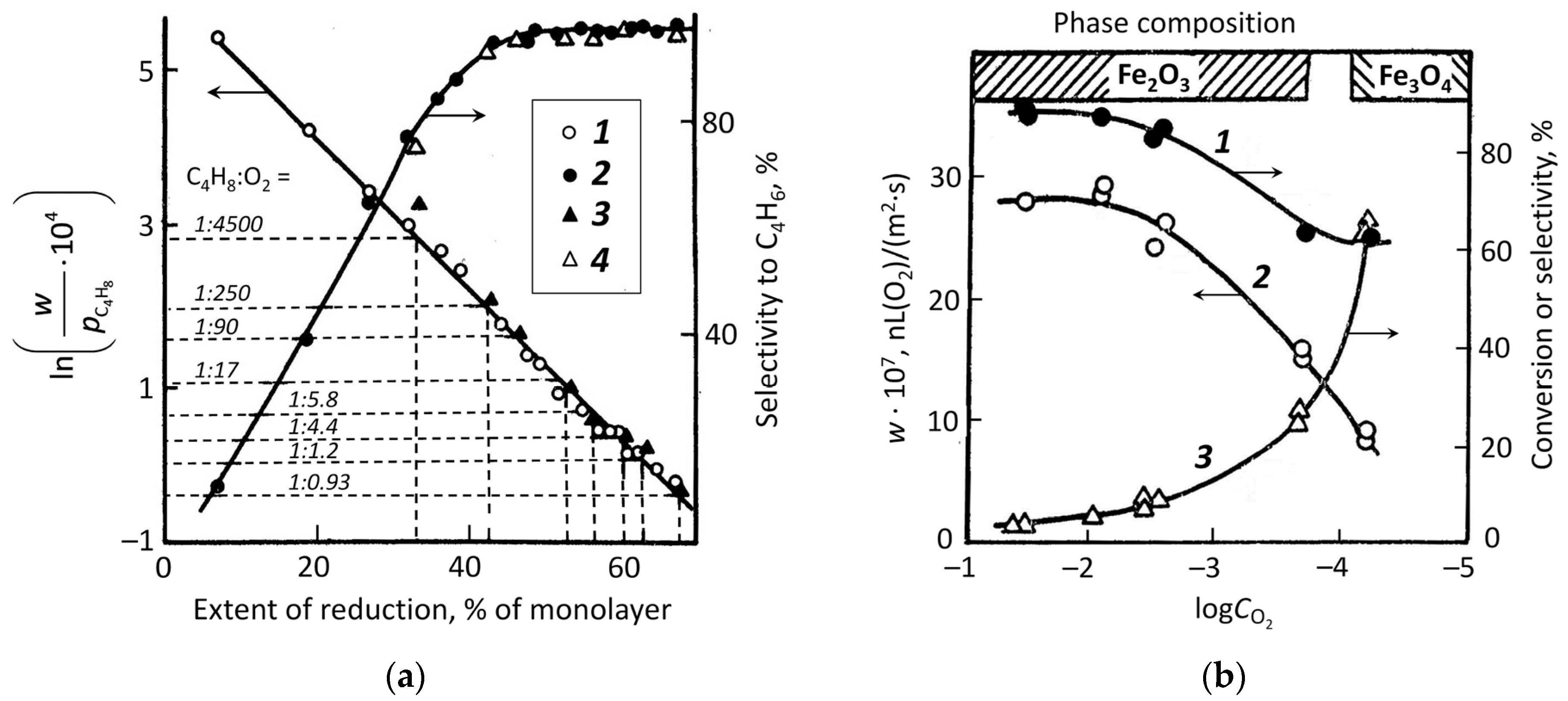
The concept of the effect of reaction medium on the state and properties of solid catalysts was confirmed in a number of experimental studies by Boreskov and his co-workers (S. A. Ven’yaminov, V. I. Savchenko, T. V. Andrushkevich, and others), in which the above-listed kinds of changes were proved to occur with the catalysts. For example, in the study of the oxidative dehydrogenation of 1-butene on an iron antimony oxide catalyst [192], it was shown that with a decrease in the excess oxygen in the reaction mixture, the extent of reduction of the catalyst increases, which results in a decrease in catalytic activity but at the same time to an increase in selectivity to 1,3-butadiene (Figure 4a). When performing the same reaction on a ferric oxide catalyst, a decrease in the oxygen concentration in the reaction mixture leads to the phase transformation of Fe2O3 to Fe3O4 (Figure 4b) [193].
Another interesting example of a change in the catalyst surface composition and catalytic properties during a reaction was provided by Tamara V. Andrushkevich who studied the mechanism of oxidation of acrolein to acrylic acid over a V2O5-MoO3/SiO2 catalyst [194,195]. It was found that while approaching a steady state, the catalyst is reduced to an extent of about 5% of monolayer, which is accompanied by the removal of surface oxygen and a decrease in the oxidation state of vanadium (V+5 → V+4). This leads to an increase in the reaction rate for six times, the acrolein conversion from less than 10% to 40%, and the selectivity to acrylic acid from 55% to 98%.
Summarizing his views on the dynamic behavior of solid catalysts during the catalytic reaction [189,196,197,198,199], Boreskov expressed the essence of the concept in the form of a general rule: “Under the influence of the reaction medium, solid catalysts change their chemical composition, surface structure, and catalytic properties. Each reaction mixture composition and temperature corresponds to a specific steady state of the catalyst, irrespective of its initial state” [197] (p. 4). Accordingly, the kinetic equations of heterogeneous catalytic reactions must include an additional multiplier denoting the effect of the reaction medium on the catalyst:
r = F C i = R C i f C i ,
where r is the rate of catalytic reaction, F(Ci) is the experimentally observed dependence of the reaction rate on the reagent concentrations at a steady state of the catalyst, R(Ci) is a factor determined by the chemical composition of the catalyst, depending on the composition of the reaction mixture, and f(Ci) is the concentration dependence of the reaction rate on the composition of the reaction mixture at a constant catalyst composition (When speaking about the kinetics of heterogeneous catalytic reactions, it is worth mentioning that the fundamental quantity of turnover frequency (TOF), which is now commonly used to measure the catalyst activity, was proposed by Boudart [200,201], who warned against misinterpretation of this quantity and emphasized that “[…] identification and counting [of active sites] must be ideally carried out in situ, i.e., during the catalytic reaction” [201] (p. 662)).
The rate at which steady state is reached is crucial. When the composition and structure of the catalyst surface layer change, approaching steady state always involves stages different from those of a steady-state catalytic reaction. For example, approaching steady state in oxidation reactions involves the incorporation of chemisorbed oxygen into the surface layer of oxide catalyst. In many cases, approaching steady state occurs slower than the catalytic reaction itself, and the catalyst can be in unsteady state for a long time, slowly changing its properties upon contact with the reaction medium. Boreskov made the following remark on this matter: “The unsteady-state catalysts can possess higher activity and selectivity than the steady-state ones, which opens up wide possibilities to increase the efficiency of commercial catalytic processes” [198] (p. 233). It is relevant to note here that from the 1970s to the 1990s, the theory and practice of heterogeneous catalytic processes under forced unsteady-state conditions were intensively developed especially thanks to the research of Yurii Sh. Matros [199,202,203,204]. It has been shown that implementing a catalytic process under unsteady-state conditions significantly increases its efficiency due to such concentration and temperature regimes and catalyst state that cannot be achieved under steady-state conditions. In practice, forced unsteady-state conditions can be obtained in the reverse flow system in which the reaction mixture flow through a fixed-bed reactor is periodically reversed (Matros reactor). This approach has been successfully implemented at a number of industrial chemical plants, e.g., for the oxidation of SO2 to SO3 over V2O5/SiO2 catalyst in sulfuric acid production, for the oxidation of butane to maleic anhydride over a vanadium phosphorus oxide catalyst, for the incineration of volatile organic compounds in waste gases using MnOx/Al2O3 catalyst, and for the reduction of nitrogen oxides with ammonia using V2O5/Al2O3 catalyst. The state-of-the art of reverse-flow catalytic technology was recently reviewed in [205,206]. The presented examples are important because the dynamic state of the catalyst is not a secondary complication but a functional variable of the process. Periodic changes in flow direction, temperature profile, and reaction mixture composition affect the oxidation state, surface oxygen coverage, and active-site population of the catalyst bed. As a result, catalytic activity and selectivity are controlled through the coupled evolution of the reaction medium, thermal balance, and catalyst state, which directly illustrates Boreskov’s concept of the catalyst—reaction medium as a unified dynamic system. Overall, fundamental research into unsteady-state catalytic processes is an excellent example in catalysis science, where a theoretical concept has led to novel results translated into real practical applications in chemical industry.
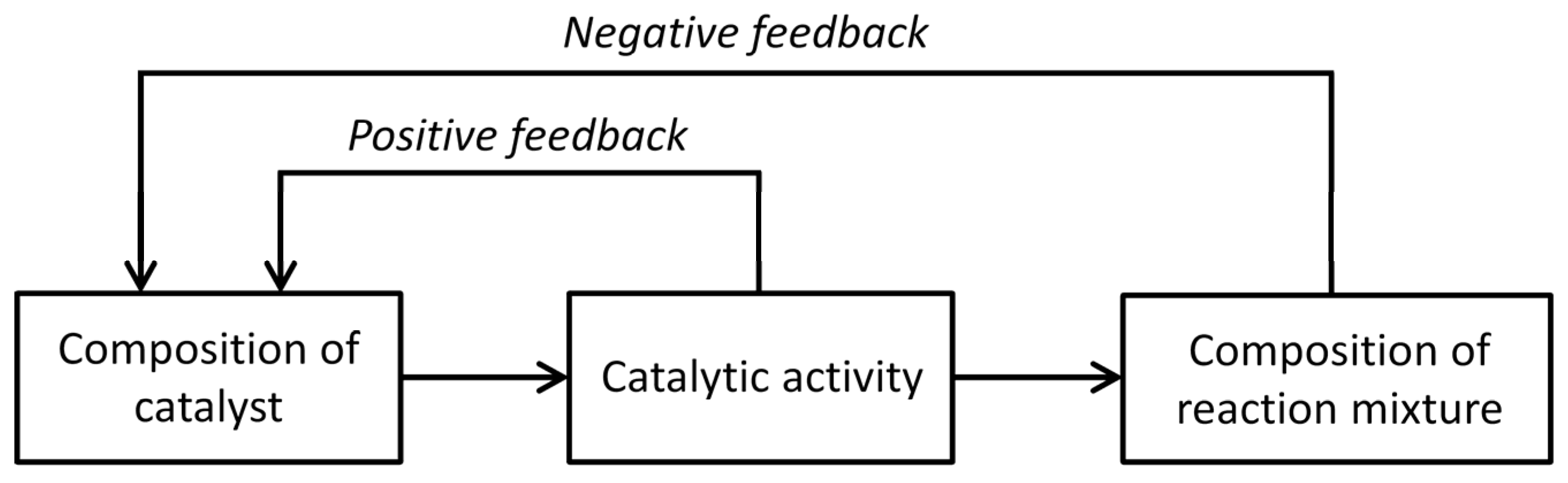
In close connection with the research of Boreskov and his followers, various aspects of the effect of reaction medium on catalysts were also explored by many other leading scientists, such as Aleksei A. Slinkin [145,146], Evgenii D. Shchukin [207,208], and Aleksandr Ya. Rozovskii [209,210,211]. In particular, Rozovskii, developing the Boreskov principle on the interrelationship and interdependence of a catalyst and a reaction medium, showed the possibility of the emergence of self-regulation in catalytic systems due to the conjugation between the catalytic reaction and the transformations of the catalyst itself. Rozovskii noted that “the catalytic system is formed during the catalytic process under the simultaneous influence of the reaction mixture and the catalytic reaction” [211] (pp. 225–226). In open (flow) catalytic systems, the catalytic reaction can influence the properties of the catalyst in such a way that when the composition of the reaction mixture is far from equilibrium, the catalyst composition changes in a direction that increases its catalytic activity, i.e., a positive (self-reinforcing) feedback arises in the catalytic system (Figure 5). As the reaction mixture composition approaches the equilibrium one, the catalyst activity decreases, and as it moves away from equilibrium, the number of active sites and catalytic activity increase. Thus, spontaneous changes in the catalyst composition affect its activity and the composition of the products in such a way as to compensate for changes in the composition of the reaction mixture, i.e., a negative (balancing) feedback arises in the catalytic system. Rozovskii experimentally confirmed the occurrence of self-regulation in catalytic systems and proposed the corresponding kinetic models for a number of both heterogeneous and homogeneous processes.
In summing up our consideration of the concept first put forward by Boreskov for elucidating the effect of the reaction medium on the composition, structure, and properties of catalysts, we should emphasize its invaluable importance for the progress in heterogeneous catalysis that has been observed over the past half century [212,213]. The significance of Boreskov’s concept was pointed out by Michel Boudart with the following words which remain relevant to this day: “This was a seminal idea first outlined by Boreskov in the sixties. Today [in 1997] this idea is being actively developed using surface science methods” [181] (p. 23). Indeed, it must be acknowledged that understanding the importance of considering the catalyst-reactant system as a unified dynamic one ensured the intensive development of in situ surface science techniques aimed at studying the surface of solid catalysts under working conditions.

4.2. Role of Surface Science in Elucidating the Dynamic Nature of Working Catalysts

When analyzing the progress in understanding heterogeneous catalysis over the past decades, it is impossible not to notice that this progress has been significantly driven by the development of surface science and the emergence of powerful surface-sensitive methods that allow us to gain a deeper insight into structural changes in the catalyst surface during adsorption and catalysis. From a historical perspective, the difference between the early active-site concepts and modern surface science approaches is not only instrumental but also epistemological. In the classical period, catalyst dynamics was inferred indirectly from changes in activity, selectivity, poisoning behavior, post-reaction morphology, or kinetic anomalies. Modern in situ and operando techniques transform this inference into direct or quasi-direct observation by correlating the evolution of structure, oxidation state, coordination environment, surface composition, and catalytic performance under reaction conditions. Thus, the historical concepts supplied the conceptual language of active sites and catalyst reconstruction, whereas modern methods provide the experimental means to follow how these sites are created, transformed, and lost during catalysis.
Physical methods have become particularly widespread for studying solid surfaces since the late 1940s. As already noted above, Gwathmey and co-workers found by electron microscopy that the surface of a copper crystal is restructured during the reaction between H2 and O2 [185]. Furthermore, they showed that the Cu(100) and Cu(111) faces differ in their catalytic activity in this reaction. Independently, Simon Z. Roginskii and his colleagues conducted a detailed electron microscopic investigation of the so-called catalytic corrosion—the phenomenon of etching the surface of metal catalysts under the influence of a reaction [214,215,216] (see also Section 3.2, p. 10). One of the conclusions of these investigations is that “during the catalytic oxidation of hydrogen on palladium, the surface of the latter undergoes profound structural changes mediated by surface crawling of palladium atoms”, and “surface activation with oxygen and deactivation with hydrogen do not produce these changes” [215] (p. 1160). Thus, by the 1950s it was reliably found using electron microscopy (although only for a few cases of catalysts and catalytic reactions) that the structural changes occurring in working catalysts are closely related with the catalytic reaction itself.
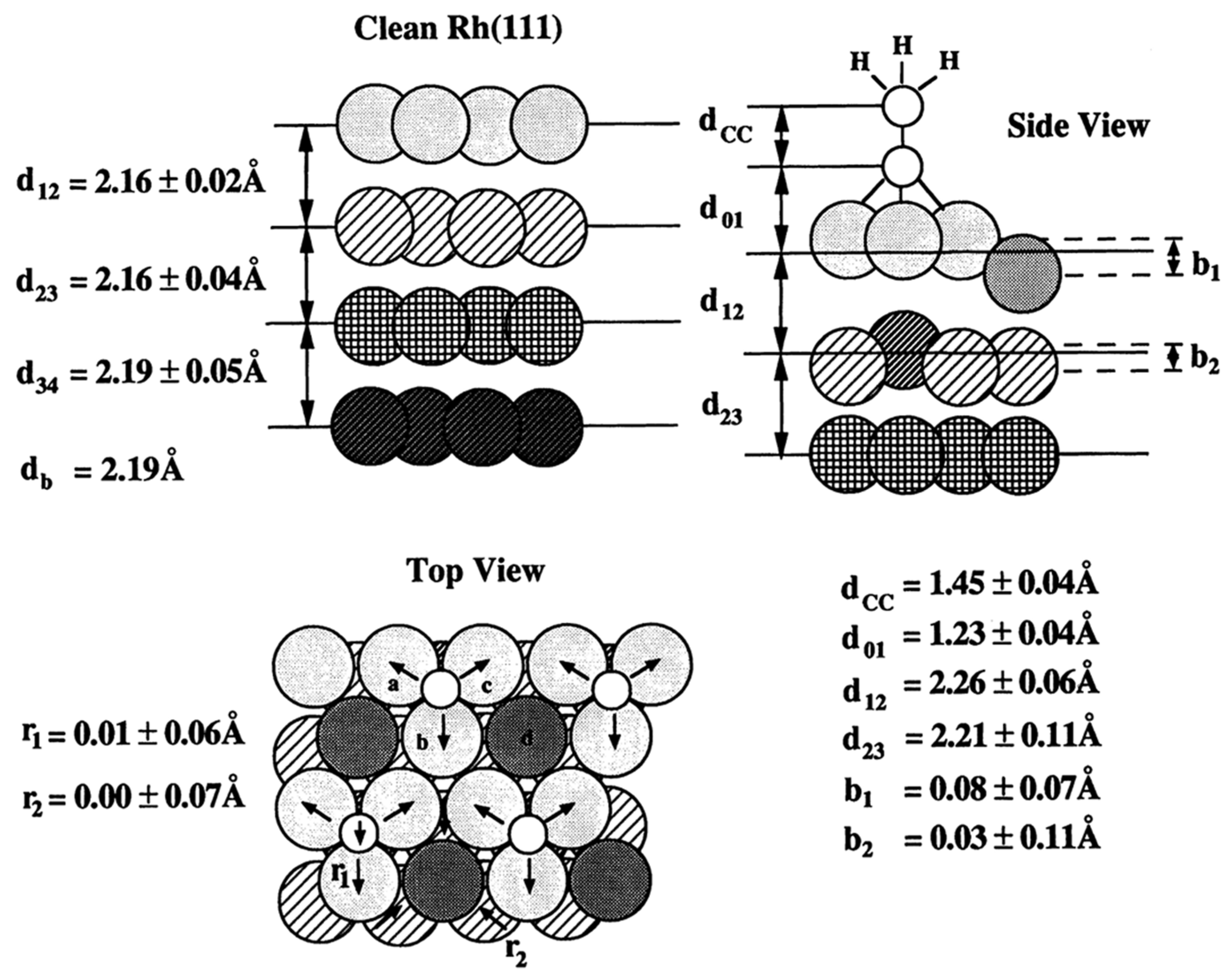
Since about the early 1960s there has been an interest in studying idealized surfaces, i.e., specific well-defined facets of single crystals, under ultra-high vacuum (UHV) conditions. This model approach allows the direct determination of catalytically active structures on the catalyst surface. Pioneering works using low-energy electron diffraction (LEED) to study the surfaces of single crystals were carried out by Lester Germer [217] and Harrison Farnsworth [218]. Soon, many other scientists have joined these studies, evolving methods to examine crystalline surfaces in applications to heterogeneous catalysis. Progress in this direction was facilitated by the development of UHV technology (pressures lower than 10−9 Torr) and surface-sensitive techniques, such as LEED, Auger electron spectroscopy (AES), X-ray photoelectron spectroscopy (XPS), and high-resolution electron energy loss spectroscopy (HREELS). The evolution of surface science methods and their significance for the progress of heterogeneous catalysis up to the 21st century have already been discussed in detail elsewhere [37,219,220,221]. In connection with the issues discussed in the present historical survey concerning the dynamic nature of heterogeneous catalysts, we will focus only on the outstanding works of Gábor Somorjai and Gerhard Ertl.
Significant contribution made by Somorjai is that his studies of the single-crystal surfaces using surface science techniques laid the foundation for understanding heterogeneous catalysis at the atomic-molecular level [222]. In 1965 Somorjai and co-workers used LEED to study the structure of the clean Pt(100) crystal face and found that it undergoes local reconstruction in vacuum, i.e., exhibits a dynamic nature even in the absence of foreign molecules [223]. Since the 1970s Somorjai’s research group began to study the surface structure of catalytically active metals, such as Pt, Pd, Rh, Fe, with foreign molecular species adsorbed on them. Somorjai summarized the results of these and many other of his studies in a number of reviews [224,225,226,227,228] and in a book [229]. Briefly, Somorjai particularly utilized the LEED surface crystallography method which allows for the precise determination of locations of atoms both in the metal substrate and adsorbate layers. In 1976 the LEED surface crystallography was first used by Somorjai’s group for the structural analysis of acetylene and ethylene chemisorption on the Pt(111) surface [230,231]. Subsequently, the adsorption structures of other simple molecules, such as CO and NO, were intensively studied using different metal substrates. As a result, the phenomenon of adsorbate-induced restructuring of metal surfaces was discovered [232,233,234,235]. This phenomenon is caused by the weakening of metal–metal bonds in the crystal lattice during adsorption, which leads to the relocation of metal atoms around the adsorption site and optimization of the adsorbate–substrate bond strength (Figure 6). In the first comprehensive review devoted to this phenomenon, Somorjai particularly emphasized that “the surface structure cannot be viewed as being static during adsorption or during catalytic reactions but changes markedly as the nature and concentration of adsorbates are varied” [233] (pp. 202–203).
Adsorbate-induced restructuring explains the similarity between the structure of adsorbed molecules on metal surfaces and that of organometallic cluster compounds. This phenomenon also explains the high catalytic activity of low-coordination metal sites, as they are more easily restructured due to a smaller number of nearest-neighbor metal atoms. Thus, adsorbate-induced restructuring “can be the reason why heterogeneous metal catalysts and other chemically active metal systems (metalloprotein enzymes, for example) are used in small cluster forms: they are more flexible to rearrange upon the adsorption of reactants to produce chemical change” [227] (p. 2974). This important statement expresses the essence of the concept of a flexible surface, which Somorjai put forward in 1991 [236,237]. From a thermodynamic standpoint, adsorbate-induced surface restructuring occurs more readily when the surface is more open, i.e., where atoms have only a few nearest neighbors. Somorjai called such surfaces flexible, in contrast to rigid surfaces which are closely packed (e.g., the face-centered cubic (111) surfaces) and hardly restructured. Clearly, chemically active rough surfaces are flexible. The most flexible are the atomic clusters in which individual atoms can easily move around due to low coordination in any location. Chemisorption can result in complete restructuring of clusters, since the strength of chemisorption bonds easily compensates for the weakening of the few metal–metal bonds. Thus, restructuring is driven by thermodynamic forces and occurs in the direction of strengthening the binding and stabilization of the adsorbate/surface complex. An important principle of the flexible surface concept is that restructuring events can occur on different time scales as follows: they can correspond in time to chemisorption (<10−3 s), catalytic reaction (seconds), or can occur over a long period of time (hours). In the latter case, restructuring is the initial stage of deeper structural rearrangements controlled by atomic diffusion (for example, the sulfur-induced restructuring of the Ni(111) crystal face to the Ni(100) one). If restructuring occurs on the time scale of catalytic reaction, then oscillatory behavior can appear in which the reaction rate periodically alternates between two values.
The theory of oscillatory reactions on solid surfaces was worked out by Gerhard Ertl for the case of CO oxidation catalyzed by the Pt(110) surface [238,239,240,241,242]. Ertl showed that the initial adsorption of CO from a mixture with O2 on a clean Pt(110) surface causes local reconstruction of the (1 × 2) structure to the (1 × 1) one as soon as the CO coverage exceeds a value of 0.2 monolayers (Figure 7a). After this reconstruction, the coverage of O increases, since the oxygen sticking coefficient on the newly formed (1 × 1) surface is about 50% higher than that on the less reactive (1 × 2) surface. This leads to an increase in the reaction rate and to enhanced formation of CO2. When the adsorbed CO is consumed in the reaction, the reverse (1 × 1) → (1 × 2) transformation occurs causing a decrease in the reaction rate. Multiple repetitions of this cycle manifest themselves as temporal oscillations of the reaction rate (Figure 7b).
Ertl called this oscillatory catalytic system “self-organizing” and developed a kinetic model including three coupled nonlinear differential equations with three variables as follows: the CO and O coverages and the fraction of the (1 × 1) surface structure. A description of this model is beyond the scope of the present review, and for more details one can refer to both Ertl’s works cited above and modern textbooks on heterogeneous catalysis [5,7,13]. Here, we will only note that Ertl’s concept of self-organization due to generation of transient surface structures during a catalytic reaction is very similar in essence to that later proposed by Védrine to elucidate the cyclic changes in the state of active sites (“breathing”) during oxidative reactions [11,169] (see Section 3.4, p. 16). This similarity of the two different concepts gives reason to believe that the dynamic nature of heterogeneous catalysts, as they manifest during a catalytic reaction, can be considered in a uniform manner regardless of which paradigm is adopted.
Thus, as can be seen from the above, modern views on the fact that solid catalysts under operating conditions are not static participants but change their initial state with the generation of catalytically active surface entities have been developed over the past 70 years. During this time, these views have received comprehensive experimental confirmation and theoretical justification. One of the modern definitions of a heterogeneous catalyst, taking into account its dynamic nature, was given by Robert Schlögl: “A heterogeneous catalyst is a functional material that continually creates active sites with its reactants under reaction conditions. These sites change the rates of chemical reactions of the reactants localized on them without changing the thermodynamic equilibrium between the materials” [12] (p. 3466).
At the same time, the above concepts of the dynamic nature of solid catalysts consider those changes under working conditions that actually occur only in two dimensions, i.e., within the solid surface. More profound changes in the catalyst during a reaction, especially the well-known phenomena of partial or complete detachment of the catalytically active component from the surface due to interactions with the reaction medium (e.g., volatilization, leaching, and dissolution), are usually considered separately as processes of catalyst degradation (or depletion) leading to irreversible loss of the active component and catalytic activity [18,19,20,21,22]. A detailed review of these phenomena in heterogeneous catalysis is provided for example by Argyle and Bartholomew [19]. As discussed above in Section 3.2 and Section 3.3, back in 1925 Armstrong and Hilditch speculated [94,95,96] and more than 30 years later Bussière et al. [115] and Danchevskaya and Kobozev [114,116,117,118,119,120,121,122,123,124] experimentally proved for metal catalysts that catalytic reactions occur not only on the solid surface but also outside it with the participation of catalytically active species (metal atoms or clusters) removed from the surface. Only relatively recently has it become clear that studies of heterogeneous catalysts cannot be complete and comprehensive without taking into account all possible types of the catalyst dynamic behavior, the control of which opens up the possibility of developing highly efficient catalytic technologies [243,244,245,246]. In this regard, the concept of cocktail-type catalysis provides a broader and more general perspective on dynamic phenomena in catalysis.

5. The Concept of Cocktail-Type Catalysis

In essence, the concept of cocktail-type catalysis describes catalytic systems (i.e., the catalyst together with the reaction medium) as unified dynamic ones in which heterogeneous and homogeneous processes take place in a close relationship with each other. It should be noted in advance that the dynamic phenomena occurring in catalysts during the formation of cocktail-type catalytic systems were experimentally discovered long before the concept itself was put forward. Leaching is one such phenomenon that has been observed for quite some time when using heterogeneous metal catalysts in liquid-phase organic reactions. As noted above, Armstrong and Hilditch, in support of their hypothesis, pointed to cases of the appearance of colloidal nickel in the reaction mixture after the hydrogenation of natural oils on a Ni-kieselguhr catalyst. Moreover, Armstrong and Hilditch suggested that the leached Ni species participate in the catalytic reaction and can attach to the surface of the parent catalyst. Much later, in the early 1970s, Tsutomu Mizoroki and co-workers pointed out the key role of the leaching phenomenon in the Pd-catalyzed arylation of alkenes with iodobenzene [247,248]. According to the mechanism proposed by Mizoroki, palladium black is not a real catalyst in this cross-coupling reaction but acts as a reservoir for soluble Pd0 species which catalyze the reaction. Since then, up to the present time, the phenomenon of leaching has received much attention in the research of various heterogeneous catalysts in organic reactions [17,20,23,24,25,244,249,250,251].
As for homogeneous catalysts, since the theory of intermediate compounds was generally accepted to explain homogeneous catalysis which therefore did not seem to be such an unusual phenomenon as the heterogeneous one (as discussed above in Section 2.1), it was long believed that homogeneous catalysts do not change their initial state upon contact with the reaction medium (except, of course, for those changes that are necessary for the catalytic reaction to proceed according to the theory of intermediate compounds). This fully applies to homogeneous catalysis by transition metal complexes and organometallic compounds. This important area of catalysis was dramatically developed beginning in the late 1930s, when Otto Roelen discovered the hydroformylation of alkenes in the presence of HCo(CO)4 and Walter Reppe developed acetylene chemistry (“Reppe chemistry”) using metal carbonyls [37,41,42,252,253,254]. After World War II, numerous homogeneous metal-catalyzed processes were investigated and then introduced into the chemical industry, such as the selective oxidation of ethylene to acetaldehyde on a PdCl2-CuCl2 system (the Wacker–Hoechst process, 1960), hydrogenation of substituted alkenes using RhCl(PPh3)3 catalyst (Wilkinson’s catalyst, 1965), rhodium-catalyzed carbonylation of methanol to produce acetic acid (the Monsanto process, 1966), propylene epoxidation with tert-butyl hydroperoxide using a soluble molybdenum complex as a catalyst (the Halcon process, 1969), hydrocyanation of 1,3-butadiene to adiponitrile using nickel(0) complexes (the DuPont process, 1971), and many others [37,41,42,252].
With the rapid development of homogeneous metal catalysis, experimental evidence has begun to accumulate, indicating the dynamic behavior of metal complex and organometallic catalysts under working conditions. For example, it was found [211] that rhodium carbonyl in the course of hydroformylation of 2-butene initially reacts with hydrogen to produce catalytically active rhodium carbonyl hydride which can be involved in the formation of inactive rhodium clusters (Figure 8a). Another example of the dynamic behavior of a homogeneous metal catalyst in contact with reagents was provided by Zamaraev for the molybdenum-catalyzed epoxidation of cyclohexene with organic hydroperoxides (ROOH; R = t-Bu, PhMe2C) in solutions [10,255,256]. Using in situ 95Mo NMR spectroscopy, it was proved that the starting complex MoO2(acac)2, when exposed to reagents, is converted into a set of MoVI complexes bearing cyclohexane-1,2-diol ligands (L) as follows: MoxLy(OR) with different x:y ratios and MoL(OOR). The latter alkylperoxo complex oxidizes cyclohexene to cyclohexene oxide, and the resulting alkoxo complexes MoxLy(OR) react with hydroperoxide to form an alcohol ROH and restore MoL(OOR) (Figure 8b). A similar mechanism is realized when using Mo(CO)6 instead of MoO2(acac)2.
Of particular interest to organic chemists is the palladium complex with dibenzylideneacetone (dba), which is commonly used as a precursor of soluble Pd0 molecular species in various cross-coupling reactions, such as the Suzuki–Miyaura, Sonogashira, Negishi, Buchwald–Hartwig, Stille, and Heck reactions [257]. In 2012 Valentine P. Ananikov’s research group conducted a detailed structural study of commercial Pd2dba3 samples and found that they contain up to 40% of Pd nanoparticles (NPs) with sizes ranging from 10 to 200 nm [258]. These Pd NPs originated from the parent complex can participate in catalytic reactions together with dissolved molecular species. The case of Pd2dba3 is a striking example demonstrating that palladium molecular complexes, clusters, and NPs coexist in the reaction mixture and jointly contribute to the catalytic reaction.
Already in the same year of 2012, Valentine P. Ananikov and Irina P. Beletskaya, having generalized numerous similar cases of the dynamic behavior of transition metal catalysts in liquid-phase organic reactions, put forward the concept of a cocktail-type catalysis [259], which has since been analyzed and described in more detail in a number of works by Ananikov himself and his co-workers [260,261,262,263,264,265,266,267,268] as well as by other authors [269,270,271]. Within this concept, the catalyst is considered as a complex dynamic system of multiple catalytically active forms that arise from the original catalyst by its reconstruction and transformation under the action of the reaction medium, depending on the operating conditions (Figure 9). The formation of a cocktail-type catalytic system can proceed through the “bottom-up” pathway, starting from dissolved molecular complexes which are transformed under reaction conditions into metal clusters and NPs, i.e., nanoscale forms of the catalyst. This pathway is realized through clustering and aggregation by oriented attachment, atom-by-atom growth, and hybrid growth (Figure 10a). When using heterogeneous catalysts, such as supported metal catalysts, a cocktail-type catalytic system is formed through the “top-down” pathway. In this case, the interaction between the reaction medium and the supported metal NPs results in the leaching of single metal atoms that either remain near the surface or leave it as molecular complexes (Figure 10b). In addition, metal NPs can be partially or completely destroyed to give metal clusters.
Depending on how many forms of catalyst are active in a particular reaction, the following two types of cocktail systems should be distinguished:
  • A cocktail of catalysts. Such a system contains metal complexes, clusters, and NPs, which make comparable contributions to a catalytic reaction;
  • A cocktail of species. Such a system also contains metal complexes, clusters, and NPs, but only one of them makes a major contribution to a catalytic reaction.
Thus, the generation of active forms of a metal catalyst and their interconversions during a catalytic reaction are described for both homogeneous and heterogeneous catalytic systems. Obviously, if the dynamic processes occur quite intensively, the boundary between homogeneous and heterogeneous catalysis becomes blurred, making the catalyst behavior very difficult to study and predict. However, recent advances have been made in understanding the nature of cocktail-type catalytic systems through the use of powerful analytical techniques for their monitoring. The transformations of dissolved metal complexes and clusters in reaction mixtures can be studied using methods such as NMR spectroscopy, electrospray ionization high-resolution mass spectrometry (ESI-HRMS), inductively coupled plasma atomic emission spectroscopy (ICP-AES), and X-ray absorption spectroscopy (XAS). To characterize nanoscale components of cocktail-type systems, conventional scanning electron microscopy (SEM), transmission electron microscopy (TEM), and a number of structural methods should be applied. The formation of metal NPs can be detected by the so-called “nanofishing” approach that involves trapping NPs from reaction solutions using a standard carbon-coated copper grid for electron microscopy [272]. Excellent reviews have recently been published on modern in situ and operando techniques that provide deep insights into the complex nature and functioning of cocktail-type catalytic systems in real time [267,268]. In general, identification of different forms of a catalyst, their quantitative determination by a set of complementary analytical methods, and theoretical DFT calculations—all this together makes it possible to assess the role of each component of the dynamic catalytic systems and thus to model the evolution of catalytic cocktails during the course of a reaction [273,274]. It is important to note that evidence of the presence of catalytically active species detached from the catalyst surface should not be based solely on the detection of metal in the liquid or gas phase. More compelling evidence requires a combination of complimentary criteria as follows: quantitative detection of leached or volatilized metal species, correlation of their concentration with the rate or selectivity, hot-filtration or phase-separation experiments, poisoning or scavenging tests selective for soluble species, trapping of metal NPs or clusters, and spectroscopic identification of molecular or cluster intermediates under reaction conditions. Only such a combined analysis allows one to distinguish the loss of inactive forms from the genuine participation of detached species in the catalytic cycle.
As an example of the successful application of a set of methods to reveal the mechanism of catalyst transformations under reaction conditions, we can cite the results of a recent study on the behavior of (1,3-dimethyl-1,3-dihydro-2H-benzimidazol-2-ylidene) diiodo(pyridine)palladium, (BIMe)PdI2Py, during the hydrogenation of diphenylacetylene in a solution of DMF containing KOH [275] (BIMe belongs to the class of N-heterocyclic carbenes (NHCs) which have recently come into widespread use as ligands for organometallic catalysts [276,277]. Pd-NHC catalysts demonstrate high efficiency in a wide range of organic reactions including hydrogenations. At the same time, these catalysts are quite labile and readily form cocktail-type catalytic systems under reaction conditions). Using ESI-HRMS, 1H NMR spectroscopy, TEM, and SEM/EDS, it was found that the chosen palladium complex, even under mild reaction conditions (at ambient temperature and slight H2 pressure), forms a cocktail system consisting of multiple catalytically active species (Figure 11).
Initially, the starting complex (BIMe)PdI2Py reacts with the solvent, yielding cyanide-containing complexes which then react with the free BIMe ligand, molecular hydrogen, and an alkaline additive to produce mononuclear and binuclear Pd complexes of varying composition. Simultaneously, the NHC-H and NHC=O couplings lead to the destruction of the starting complex, ultimately forming Pd NPs:
Chemistry 08 00079 i001
Chemistry 08 00079 i002
The Pd NPs then aggregate to give a fine powder precipitated from the reaction solution. Importantly, removal of the ligands and destruction of the starting complex do not result in a loss of catalytic activity. Instead, the hydrogenation of diphenylacetylene continues with the participation of Pd NPs. The increased selectivity to (Z)-stilbene (60–80% at >93% conversion of diphenylacetylene) is maintained if the palladium precipitate is not removed from the reaction mixture. This result allowed the authors to conclude that Pd NPs catalyze the reaction jointly with dissolved palladium complexes and apparently act as reservoirs of active species required for the reaction to proceed.
In concluding this brief consideration of the concept of cocktail-type catalysis, we note that it has proven extremely fruitful in describing the dynamic nature of transition metal catalysts in liquid-phase organic reactions. Over the past nearly 15 years, this concept has received numerous confirmations, mainly for palladium and platinum catalysts in cross-coupling reactions. However, newly emerging experimental data support the validity of the concept for a wider range of both metals (or metal compounds) as catalysts and different organic reactions. For example, Ananikov’s group studied various Cu2O and CuO catalysts in C–S cross-coupling reactions and showed for the first time that a metal oxide can also serve as a source of catalytically active species for solution-state homogeneous catalysis (copper thiolate complexes in this particular case) [278]. Just recently, the research collaboration of Vidar Jensen’s and Kyoko Nozaki’s groups, having studied the performance of iridium complex with 1,5-cyclooctadiene, IrH(COD)(PPh3)2, in the hydrodeoxygenation of phenols, came to the conclusion that only the cooperative action (synergy) of the dissolved Ir molecular species and Ir NPs forming a catalytic cocktail ensures a high yield of the target products [279].
Undoubtedly, the concept of cocktail-type catalysis represents a significant step forward in a unified description of the dynamic behavior of homogeneous and heterogeneous catalytic systems. At the same time, it should be recognized that this concept has been reliably confirmed only for metal-containing catalysts and their functioning in liquid-phase organic reactions (although Ananikov and his co-workers have made attempts to extend the concept to a wider range of catalysts, not only metal ones, and reactions including gas-phase reactions, both organic and inorganic ones [260,267]). Thus, the concept of cocktail-type catalysis, on the one hand, covers a broad range of reactions and catalysts, but, on the other hand, this range is narrow enough to believe this concept is universal for entire catalysis. In this regard, the question inevitably arises about the limits of applicability of the concept. The analysis of this issue is beyond the scope of the present historical survey and will be one of the subjects for future consideration in the next second part of our investigation.

6. Conclusions and Outlook

From the above, it is clear that the ideas that a catalyst is not simply a static participant in a catalytic reaction but changes its initial state under the action of the reaction medium arose approximately 100 years ago and have undergone intensive development up to the present day. This development is illustrated by the timeline in Figure 12 and by Table 1, which trace the transition from early descriptive and kinetic definitions of catalysis, through the emergence of surface-based and localized activity concepts, to the recognition that catalysts change their state under operating conditions. The final stage is represented by cocktail-type catalysis in which molecular, cluster, and nanoparticle species are treated as dynamically interconverting components of one catalytic system. Obviously, the emergence of early ideas on the catalyst dynamics (Taylor, Armstrong and Hilditch) became possible only after the principles of physical chemistry were introduced into the practice of catalytic research, i.e., when catalysis became a full-fledged scientific discipline. The elucidation of heterogeneous catalytic phenomena from a rigorous molecular-kinetic point of view can be considered a starting point for the intensive development of views on the dynamic behavior of solid catalysts. This development occurred primarily from the following two perspectives: from the standpoint of the concept of active sites, i.e., from Taylor’s paradigm, and somewhat later from the standpoint of the adsorption theory of catalysis, i.e., from Langmuir’s paradigm.
Charlotte Vogt and Bert Weckhuysen [16] propose to consider these paradigms separately. Langmuir’s paradigm of heterogeneous catalysis simplistically elucidates surface reactions in two spatial dimensions according to the “checkerboard” model and assumes a greater or lesser catalytic activity of certain facets of the crystalline surface (a “polycracy” of equivalent surface sites). Taylor’s paradigm views heterogeneous catalysis rather in three dimensions and allows that only certain surface atoms or atomic clusters exhibit catalytic activity (an “oligarchy” of surface sites). Both paradigms, despite noticeably different views on the nature of the active catalyst surface and different approaches to its study, nevertheless ultimately lead to very similar views on the dynamic nature of solid surfaces. In our opinion, the key role here is played by the general concept of catalyst dynamics developed by Boreskov and his school of thought. Based on the correct view that heterogeneous catalytic phenomena are chemical in nature, Boreskov’s concept thereby serves as a link between various specific concepts of the dynamic behavior of catalysts. On the other hand, while recognizing the comprehensive and universal nature of dynamic phenomena in heterogeneous catalysis, as many authors do, one should also recognize these phenomena as a manifestation of a fundamental law of nature, as did, for example, Zamaraev, who compared the change in the initial state of a catalyst upon contact with a reaction medium with Newton’s third law: “Reconstruction of the surface of heterogeneous catalysts under the influence of reaction mixture demonstrates that a rule resembling Newton’s third law in mechanics is valid for heterogeneous catalysis, namely, “the action is equal to the counteraction”. If the catalyst is powerful enough to perturb the reaction mixture via intermediate chemical interactions to such an extent that it starts to react, then the reaction mixture must be equally powerful to perturb substantially the state of the catalyst surface via the same intermediate chemical interactions. Because of this the state of the catalyst surface in the process of catalytic reaction may be substantially different from its state before or after the reaction” [10] (p. 24).
Given the universal nature of the dynamic behavior of heterogeneous catalysts under reaction conditions, it would be surprising if this law of catalyst dynamics were not observed in other types of catalysis, in particular, in homogeneous catalysis. However, as a historical investigation has shown, the concept of the dynamic nature of homogeneous catalysts arose much later. Apparently, this was a consequence of the long-standing dominance of the theory of intermediate compounds that are formed and decomposed as a result of a certain sequence of elementary steps such as the ligand exchange, inner-sphere deprotonation, oxidative addition, reductive elimination, insertion, etc. [280,281]. This theory, being simple and convenient for explaining the mechanism of homogeneous catalytic reactions, was extremely useful at the initial stage of the formation of catalysis science. However, with subsequent development, it actually proved to be a hindrance to the advancement of ideas about the variable, labile, state of catalysts under reaction conditions. On the other hand, it is well known that homogeneous catalysts were primarily used by organic chemists who focused mainly on the synthesis of a particular organic product without considering the catalyst as a subject for separate study. A turning point in views on homogeneous catalysts occurred after the accumulation of a sufficient amount of experimental data attesting to the dynamic nature of even the simplest catalysts, necessitating a detailed study not only of catalytic reactions but also of the catalysts themselves, even those whose composition, structure, and properties had previously seemed well-known and reproducible.
As one consequence of this kind of research, we have highlighted the concept of cocktail-type catalysis. The modern integrative formulation of cocktail-type catalysis plays the role of a conceptual bridge that unifies previously separate views of homogeneous and heterogeneous catalysis by treating the catalyst not as a single static entity, but as a dynamic system of interconverting active forms generated under operating conditions. Key importance of this concept is that it gives a common language for describing both bottom-up evolution from molecular species to clusters and nanoparticles and top-down evolution from heterogeneous particles through leaching, fragmentation, and release of soluble active species. In this way, cocktail-type catalysis provides a modern integrative description of catalyst dynamics, explaining why the boundary between homogeneous and heterogeneous catalysis can become blurred.
Thus, recognizing the universal role played in catalysis by dynamic phenomena occurring with catalysts, the following questions should be asked, the answers to which could ensure further progress in deep understanding the essence of catalysis:
  • What are the limits of applicability of existing concepts on the catalyst dynamics?
  • Can these concepts be formulated as a single unified concept or theory?
  • Can a universal concept of the dynamic behavior of catalysts play a key unifying role for the modern science of catalysis?
Answering these questions, which will be analyzed in detail in the second part of this work, requires further consideration of several areas that have recently attracted particular attention from researchers and are closely related to the dynamic behavior of catalysts under reaction conditions, particularly metal catalysts. These relevant research areas include:
The characteristics of dynamic phenomena occurring with catalysts whose active sites are located on the surface of metal nanoparticles or are attributed to single atoms. A number of issues related to this topic are discussed in a recent review [282], which presents an analysis of developments in the field of characterization (description) of such nanocatalysts, including the latest experimental achievements and computational results. The influence of the heterogeneity of active sites on their dynamics is analyzed, as a result of which catalytic cooperativity can arise between them.
The role of crystal defects and grain boundaries in the formation of dynamic active sites. Crystal defects and grain boundaries disrupt the periodic symmetry of the lattice and act as structural and electronic “hot spots” where dynamic active sites are continuously generated during catalytic reactions under the influence of the reaction medium. Recent studies have demonstrated that targeted modification of defect density and grain boundary architecture (catalytic grain engineering) may become a leading strategy for the synthesis of highly efficient catalysts. Among the methods for implementing such engineering solutions, pulsed laser ablation, electrodeposition, and vapor-phase growth can be highlighted. Materials obtained through catalytic grain engineering already demonstrate significant potential in various catalytic applications [283].
The relationship between migration and surface segregation of catalytically active atoms and existing mechanisms of catalyst deactivation. Typically, at elevated temperatures, individual metal atoms and/or their clusters migrate across the support surface and aggregates, which reduces the surface area of the active catalyst component and its activity (sintering effect). Similar dynamic processes involving atoms of substrate molecules (e.g., carbon atoms) migrating to the same region as the catalytically active atoms can combine with the latter into a single n-atomic ensemble, which has reduced catalytic activity (poisoning effect). Furthermore, due to the complex surface topography and the presence of thermally unstable structures, surface atoms of the support can participate in the dynamics of active sites, which can lead to decreased accessibility of the latter to reagent molecules (blocking effect). To stabilize catalytically active surface nanostructures and increase their resistance to deactivation, it is necessary to reduce the mobility of atoms within these nanostructures, which is achieved, for example, by creating electronic and/or spatial restrictions (“traps”). A number of issues related to this topic have been considered in recent reviews [284,285].
Reversible and irreversible processes of catalyst surface reconstruction. In practical terms, the distinction between reversible and irreversible reconstruction should be based not only on estimated energy barriers but also on the experimentally observable recovery after perturbation. The most critical parameters are: restoration of the initial structure and catalytic performance after changing the gas or liquid composition back to its original state; the presence or absence of hysteresis during temperature, pressure, potential, or concentration cycling experiments; the time scale of structural relaxation relative to catalytic turnover; retention or loss of the active component as determined by elemental balance; and reversibility of particle size, oxidation state, coordination environment, and surface phase composition. Therefore, in situ and operando methods are most informative when combined with kinetic measurements under deliberately cycled reaction conditions, since such experiments allow one to distinguish adaptive reconstruction from irreversible sintering, leaching, segregation, poisoning, or phase transformation [286].
The reaction environment as a critical factor determining the appearance and disappearance of active sites. Obviously, the composition of the reaction medium is a key factor determining the dynamics of the generation and destruction of active sites, their number, type, and catalytic efficiency. The generation of active sites is determined mainly by the nature of the reagents and their interactions with the support surface and the active site precursor. During such interactions, phase transitions and processes of segregation of the active component, reconstruction of its surface, as well as irreversible chemical transformations can occur. Due to the diversity of factors determining the dynamics of the appearance/disappearance of active sites and the extreme complexity of the mutual action of these factors on each other (manifestation of additivity, synergism, and antagonism), approaches based on machine learning are used to take into account the effect of these factors on a specific catalytic process. These issues are discussed in a number of recent reviews [286,287,288,289,290,291,292,293]. Modern experimental confirmation of the concept of dynamic reconstruction of active sites is associated with the development of in situ and operando methods and the accumulation of data on the structural and functional changes in catalysts during reactions. Computer modeling allows the study of dynamic interactions in catalytic systems, including changes in the electronic structure, coordination environment, and surface topology [294,295].
Conceptual transition between heterogeneous and homogeneous catalysis. In the context of catalyst dynamics, the transition between heterogeneous and homogeneous catalysis is not merely a matter of immobilizing molecular complexes on solid surfaces or dispersing solid-derived species in solution. More fundamentally, this is the recognition that a catalytic system can continuously move between surface-bound, molecular, cluster, nanoparticle, and dissolved states under operating conditions. A heterogeneous catalyst can serve as a reservoir of soluble active species, while a molecular catalyst can generate clusters or nanoparticles that participate in the reaction. Therefore, the boundary between heterogeneous and homogeneous catalysis becomes operational rather than absolute: it depends on which catalyst forms are present, how rapidly they interconvert, and which of them dominate the catalytic turnover under given reaction conditions. This dynamic view provides a more natural conceptual basis for interpreting leaching, aggregation, nanoparticle formation, and catalyst deactivation not as isolated phenomena but as interrelated manifestations of catalyst evolution.

Author Contributions

Conceptualization, R.M.M.; writing—original draft preparation, R.M.M.; writing—review and editing, R.M.M., V.A.L. and A.V.L.; visualization, R.M.M. All authors have read and agreed to the published version of the manuscript.

Funding

The work was supported by the Ministry of Science and Higher Education of the Russian Federation within the governmental assignment for Boreskov Institute of Catalysis (project FWUR-2024-0039).

Data Availability Statement

No new data were created or analyzed in this study.

Acknowledgments

R.M.M. expresses his sincere gratitude to Elena G. Karnaukhova for her assistance in providing some hard-to-find sources. In addition, R.M.M. thanks Olga B. Belskaya for useful discussions.

Conflicts of Interest

The authors declare no conflicts of interest.

Abbreviations

acacAcetylacetonate
AESAuger electron spectroscopy
BIMe1,3-Dimethyl-1,3-dihydro-2H-benzimidazol-2-ylidene
COD1,5-Cyclooctadiene
dbaDibenzylideneacetone
DFTDensity functional theory
DMFN,N-Dimethylformamide
EDSEnergy-dispersive X-ray spectroscopy
ESI-HMRSElectrospray ionization high-resolution mass spectrometry
EtEthyl
HREELSHigh-resolution electron energy loss spectroscopy
ICP-AESInductively coupled plasma atomic emission spectroscopy
LEEDLow-energy electron diffraction
MeMethyl
NHCsN-heterocyclic carbenes
NMRNuclear magnetic resonance
NPsNanoparticles
PhPhenyl
PyPyridine
SEMScanning electron microscopy
t-Butert-butyl
TEMTransmission electron microscopy
TOFTurnover frequency
UHVUltra-high vacuum
XASX-ray absorption spectroscopy
XPSX-ray photoelectron spectroscopy

References

  1. Kung, H.H.; Kung, M.C. Inspiration from nature for heterogeneous catalysis. Catal. Lett. 2014, 144, 1643–1652. [Google Scholar] [CrossRef]
  2. Coppens, M.-O.; Weissenberger, T.; Zhang, Q.; Ye, G. Nature-inspired, computer-assisted optimization of hierarchically structured zeolites. Adv. Mater. Interfaces 2021, 8, 2001409. [Google Scholar] [CrossRef]
  3. Wang, K.-Y.; Zhang, J.; Hsu, Y.-C.; Lin, H.; Han, Z.; Pang, J.; Yang, Z.; Liang, R.-R.; Shi, W.; Zhou, H.-C. Bioinspired framework catalysts: From enzyme immobilization to biomimetic catalysis. Chem. Rev. 2023, 123, 5347–5420. [Google Scholar] [CrossRef]
  4. Wang, Y.; Jia, G.; Yang, P.; Zhang, L.; Wong, K.-Y. Bioinspired design of heterogenous single-atomic-site catalysts for electrocatalysis and photocatalysis. Adv. Mater. 2025, 37, 2502131. [Google Scholar] [CrossRef] [PubMed]
  5. Chorkendorff, I.; Niemantsverdriet, J.W. Concepts of Modern Catalysis and Kinetics, 3rd ed.; Wiley-VCH: Weinheim, Germany, 2017. [Google Scholar]
  6. Poovan, F.; Chandrashekhar, V.G.; Natte, K.; Jagadeesh, R.V. Synergy between homogeneous and heterogeneous catalysis. Catal. Sci. Technol. 2022, 12, 6623–6649. [Google Scholar] [CrossRef]
  7. Reschetilowski, W. Einführung in die Heterogene Katalyse, 2nd ed.; Springer Spektrum: Berlin/Heidelberg, Germany, 2025. (In German) [Google Scholar]
  8. Taylor, H. Some aspects of catalytic science. Adv. Catal. Relat. Subj. 1957, 9, 1–7. [Google Scholar]
  9. van Santen, R.A. Mechanisms in Heterogeneous Catalysis; World Scientific Publishing Europe: London, UK, 2024; Chapter 7; pp. 646–691. [Google Scholar]
  10. Zamaraev, K.I. Catalysis by molecular design. Top. Catal. 1996, 3, 1–76. [Google Scholar] [CrossRef]
  11. Védrine, J.C. Revisiting active sites in heterogeneous catalysis: Their structure and their dynamic behavior. Appl. Catal. A Gen. 2014, 474, 40–50. [Google Scholar] [CrossRef]
  12. Schlögl, R. Heterogeneous catalysis. Angew. Chem. Int. Ed. 2015, 54, 3465–3520. [Google Scholar] [CrossRef]
  13. van Santen, R.A. Modern Heterogeneous Catalysis: An Introduction; Wiley-VCH: Weinheim, Germany, 2017. [Google Scholar]
  14. Tanaka, K. Dynamic Chemical Processes on Solid Surfaces: Chemical Reactions and Catalysis; Springer Nature: Singapore, 2017. [Google Scholar]
  15. Pan, Y.; Shen, X.; Yao, L.; Bentalib, A.; Peng, Z. Active sites in heterogeneous catalytic reaction on metal and metal oxide: Theory and practice. Catalysts 2018, 8, 478. [Google Scholar] [CrossRef]
  16. Vogt, C.; Weckhuysen, B.M. The concept of active site in heterogeneous catalysis. Nat. Rev. Chem. 2022, 6, 89–111. [Google Scholar] [CrossRef]
  17. Durán Pachón, L.; Rothenberg, G. Transition-metal nanoparticles: Synthesis, stability and the leaching issue. Appl. Organomet. Chem. 2008, 22, 288–299. [Google Scholar] [CrossRef]
  18. Moulijn, J.A.; van Diepen, A.E.; Kapteijn, F. Deactivation and regeneration. In Handbook of Heterogeneous Catalysis, 2nd ed.; Ertl, G., Knözinger, H., Schüth, F., Weitkamp, J., Eds.; Wiley-VCH: Weinheim, Germany, 2008; Volume 4, pp. 1829–1846. [Google Scholar]
  19. Argyle, M.D.; Bartholomew, C.H. Heterogeneous catalyst deactivation and regeneration: A review. Catalysts 2015, 5, 145–269. [Google Scholar] [CrossRef]
  20. Sádaba, I.; López Granados, M.; Riisager, A.; Taarning, E. Deactivation of solid catalysts in liquid media: The case of leaching of active sites in biomass conversion reactions. Green Chem. 2015, 17, 4133–4145. [Google Scholar] [CrossRef]
  21. Liu, S.; Zhu, M.; Iqbal, M. Research progress on stability of solid acid catalysts. Catal. Surv. Asia 2020, 24, 196–206. [Google Scholar] [CrossRef]
  22. Martín, A.J.; Mitchell, S.; Mondelli, C.; Jaydev, S.; Pérez-Ramírez, J. Unifying views on catalyst deactivation. Nat. Catal. 2022, 5, 854–866. [Google Scholar] [CrossRef]
  23. Redón, R.; Peña, N.G.G.; Crescencio, F.R. Leaching in metal nanoparticle catalysis. Recent Pat. Nanotechnol. 2014, 8, 31–51. [Google Scholar] [CrossRef] [PubMed]
  24. Bourouina, A.; Meille, V.; de Bellefon, C. About solid phase vs. liquid phase in Suzuki-Miyaura reaction. Catalysts 2019, 9, 60. [Google Scholar] [CrossRef]
  25. Galushko, A.S.; Ilyushenkova, V.V.; Burykina, J.V.; Shaydullin, R.R.; Pentsak, E.O.; Ananikov, V.P. The fast formation of a highly active homogeneous catalytic system upon the soft leaching of Pd species from a heterogeneous Pd/C precursor. Inorganics 2023, 11, 260. [Google Scholar] [CrossRef]
  26. Flytzani-Stephanopoulos, M.; Schmidt, L.D. Morphology and etching processes on macroscopic metal catalysts. Prog. Surf. Sci. 1979, 9, 83–111. [Google Scholar] [CrossRef]
  27. Wei, T.-C.; Phillips, J. Thermal and catalytic etching: Mechanisms of metal catalyst reconstruction. Adv. Catal. 1996, 41, 359–421. [Google Scholar]
  28. Vinnik, M.I. Mechanism of acid catalysis in solutions. Kinet. Catal. 1980, 21, 111–127. [Google Scholar]
  29. Kazanskii, V.B. Modern ideas about the mechanisms of homogeneous and heterogeneous acid catalysis: Similarities and differences. Russ. Chem. Rev. 1988, 57, 1109–1123. [Google Scholar] [CrossRef]
  30. Agarwal, P.K.; Bernard, D.N.; Bafna, K.; Doucet, N. Enzyme dynamics: Looking beyond a single structure. ChemCatChem 2020, 12, 4704–4720. [Google Scholar] [CrossRef]
  31. Corbella, M.; Pinto, G.P.; Kamerlin, S.C.L. Loop dynamics and the evolution of enzyme activity. Nat. Rev. Chem. 2023, 7, 536–547. [Google Scholar] [CrossRef]
  32. Aykac Fas, B.; Akbas Buz, Z.E.; Haliloglu, T. Global dynamics behind enzyme catalysis, evolution, and design. Curr. Opin. Struct. Biol. 2025, 94, 103131. [Google Scholar] [CrossRef]
  33. Ipatieff, V.N.; Blokh, M.A. The Catalytic Phenomena in Nature; Scientific Chemical and Technical Publishing House: Petrograd, RSFSR, 1922; pp. 12–76. (In Russian) [Google Scholar]
  34. Mittasch, A.; Theis, E. Von Davy und Döbereiner Bis Deacon, Ein Halbes Jahrhundert Grenzflächenkatalyse; Verlag Chemie: Berlin, Germany, 1932. (In German) [Google Scholar]
  35. Mittasch, A. Kurze Geschichte der Katalyse in Praxis und Theorie; Julius Springer: Berlin, Germany, 1939. (In German) [Google Scholar]
  36. Kuznetsov, V.I. The Development of the Science of Catalysis; Nauka: Moscow, Russia, 1964. (In Russian) [Google Scholar]
  37. Zecchina, A.; Califano, S. The Development of Catalysis: A History of Key Processes and Personas in Catalytic Science and Technology; John Wiley & Sons: Hoboken, NJ, USA, 2017. [Google Scholar]
  38. Kuznetsov, V.I. The development of basic ideas in the field of catalysis. Chymia 1966, 11, 179–204. [Google Scholar] [CrossRef]
  39. Laidler, K.J. The development of theories of catalysis. Arch. Hist. Exact Sci. 1986, 35, 345–374. [Google Scholar] [CrossRef]
  40. Davis, B.H. Development of the science of catalysis. In Handbook of Heterogeneous Catalysis, 2nd ed.; Ertl, G., Knözinger, H., Schüth, F., Weitkamp, J., Eds.; Wiley-VCH: Weinheim, Germany, 2008; Volume 1, pp. 16–37. [Google Scholar]
  41. Smith, J.K. History of catalysis. In Encyclopedia of Catalysis; Horváth, I.T., Ed.; John Wiley & Sons: Hoboken, NJ, USA, 2003; Volume 3, pp. 447–479. [Google Scholar]
  42. van Santen, R. Catalysis in perspective: Historic review. In Catalysis: From Principles to Applications; Beller, M., Renken, A., van Santen, R., Eds.; Wiley-VCH: Weinheim, Germany, 2012; Chapter 1; pp. 3–19. [Google Scholar]
  43. Augustine, R.L. Whither goest thou, catalysis. Catal. Lett. 2016, 146, 2393–2416. [Google Scholar] [CrossRef]
  44. Balandin, A.A. Present state of the catalysis problem and the theoretical basis of the search for catalysts. Bull. Acad. Sci. USSR Div. Chem. Sci. 1955, 4, 557–570. [Google Scholar] [CrossRef]
  45. Berzelius, J. Årsberättelse om Framstegen i Fysik Och Kemi; P. A. Norstedt & Söner: Stockholm, Sweden, 1835; pp. 239–247. (In Swedish) [Google Scholar]
  46. Berzelius. Some ideas on a new force acting in the combinations of organic compounds. Lond. Edinb. Philos. Mag. J. Sci. 1837, 10, 490–492. [Google Scholar]
  47. Armstrong, H.E. Opening address to the Chemical Section of the British Association [continued]. Nature 1885, 32, 467–472. [Google Scholar]
  48. Mitscherlich, E. Lehrbuch der Chemie, 2nd ed.; Ernst Siegfried Mittler: Berlin, Germany, 1833; Volume 1, pp. 97–107. (In German) [Google Scholar]
  49. Mitscherlich, E. Ueber die Aetherbildung. Ann. Phys. Chem. 1834, 31, 273–282. (In German) [Google Scholar] [CrossRef]
  50. Mitscherlich, E. Ueber die chemische Zersetzung und Verbindung mittelst Contactsubstanzen. Ann. Phys. Chem. 1842, 55, 209–229. (In German) [Google Scholar] [CrossRef]
  51. Désormes, C.B.; Clément, N. Théorie de la fabrication de l’acide sulfurique. Ann. Chim. 1806, 59, 329–339. (In French) [Google Scholar]
  52. Liebig, J. Ueber die Erscheinungen der Gährung, Fäulniß und Verwesung und ihre Ursachen. Ann. Pharm. 1839, 30, 250–287. (In German) [Google Scholar] [CrossRef]
  53. Liebig, J. Handbuch der Chemie mit Rücksicht auf Pharmacie: Als Neue Bearbeitung des Ersten Bandes von Geiger’s Handbuch der Pharmacie; C. F. Winter: Heidelberg, Germany, 1843; Volume 1, pp. 37–84. (In German) [Google Scholar]
  54. Hjelt, E. Geschichte der Organischen Chemie von ältester Zeit bis zur Gegenwart; Friedr. Vieweg & Sohn: Braunschweig, Germany, 1916; Chapter 17; pp. 362–401. (In German) [Google Scholar]
  55. Berthelot, M. La Synthèse Chimique; Germer Baillière: Paris, France, 1876; Book 1; pp. 64–98. (In French) [Google Scholar]
  56. Laidler, K.J. The World of Physical Chemistry; Oxford University Press: New York, NY, USA, 1995. [Google Scholar]
  57. Denisov, E.T.; Sarkisov, O.M.; Likhtenshtein, G.I. Chemical Kinetics: Fundamentals and New Developments; Elsevier Science: Amsterdam, The Netherlands, 2003; Chapter 1; pp. 1–15. [Google Scholar]
  58. Ostwald, W. Ueber Katalyse. In Verhandlungen der Gesellschaft Deutscher Naturforscher und Ärzte, 73. Versammlung zu Hamburg, 22–28 September 1901; F.C.W. Vogel: Leipzig, Germany, 1901; Part 1; pp. 184–202. (In German) [Google Scholar]
  59. Ostwald. Catalysis. Nature 1902, 65, 522–526. [Google Scholar] [CrossRef]
  60. Ostwald, W. Über Katalyse. Vortrag gehalten in Stockholm am 12. Dezember 1909 nach Empfang des Nobelpreises für Chemie. In Les Prix Nobel en 1909; Hasselberg, K.B., Pettersson, S.O., Mörner, K.A.H., af Wirsén, C.D., Santesson, M.C.G., Eds.; P. A. Norstedt & Söner: Stockholm, Sweden, 1910. (In German) [Google Scholar]
  61. Schwab, G.-M. Catalysis from the Standpoint of Chemical Kinetics; D. Van Nostrand Company: New York, NY, USA, 1937. [Google Scholar]
  62. Brönsted, J.N. Acid and basic catalysis. Chem. Rev. 1928, 5, 231–338. [Google Scholar] [CrossRef]
  63. Spitalsky, E. Über die kinetischen Gesetze der homogenen Katalyse. Z. Phys. Chem. Stöchiom. Verwandtschaftsl. 1926, 122, 257–286. (In German) [Google Scholar] [CrossRef]
  64. Spitalsky, E.; Koboseff, N. Über die kinetischen Gesetze der homogenen Katalyse. Experimentelle Untersuchung des inneren Mechanismus einer homogenen katalytischen Reaktion. Z. Phys. Chem. Stöchiom. Verwandtschaftsl. 1927, 127, 129–177. (In German) [Google Scholar] [CrossRef]
  65. Faraday, M. Experimental researches in electricity—Sixth series. Philos. Trans. R. Soc. Lond. 1834, 124, 55–76. [Google Scholar] [CrossRef]
  66. Playfair, L. On transformations produced by catalytic bodies. Mem. Proc. Chem. Soc. Lond. 1848, 3, 348–370. [Google Scholar]
  67. Langmuir, I. The mechanism of the catalytic action of platinum in the reactions 2CO + O2 = 2CO2 and 2H2 + O2 = 2H2O. Trans. Faraday Soc. 1922, 17, 621–654. [Google Scholar] [CrossRef]
  68. Lloyd, L. Handbook of Industrial Catalysts; Springer Science + Business Media: New York, NY, USA, 2011. [Google Scholar]
  69. Maxted, E.B. Catalysis and Its Industrial Applications; J. & A. Churchill: London, UK, 1933. [Google Scholar]
  70. Kuznetsov, V.I. The Development of Catalytic Organic Synthesis; Nauka: Moscow, Russia, 1964. (In Russian) [Google Scholar]
  71. Sabatier, P. La catalyse par les métaux communs. Rev. Gen. Sci. Pures Appl. 1905, 16, 842–850. (In French) [Google Scholar]
  72. Sabatier, P. La méthode d’hydrogénation directe par catalyse. Conférence faite à Stockholm le 11 décembre 1912 devant l’Académie des Sciences de Suède. In Les Prix Nobel en 1912; Hasselberg, K.B., Pettersson, S.O., Mörner, K.A.H., Santesson, M.C.G., Eds.; P. A. Norstedt & Söner: Stockholm, Sweden, 1913. (In French) [Google Scholar]
  73. Sabatier, P. Catalysis in Organic Chemistry; D. Van Nostrand Company: New York, NY, USA, 1922; Chapter 3; pp. 37–57. [Google Scholar]
  74. Nernst, W. Theorie der Reaktionsgeschwindigkeit in heterogenen Systemen. Z. Phys. Chem. Stöchiom. Verwandtschaftsl. 1904, 47, 52–55. (In German) [Google Scholar] [CrossRef]
  75. Bodenstein, M.; Fink, C.G. Heterogene katalytische Reaktionen. V. Allgemeine Bemerkungen. Z. Phys. Chem. Stöchiom. Verwandtschaftsl. 1907, 60, 46–69. (In German) [Google Scholar] [CrossRef]
  76. Bodenstein, M. Katalyse und Katalysatoren. Chem.-Ztg. 1902, 26, 1075–1079. (In German) [Google Scholar]
  77. Bodenstein, M. Ein Beitrag zur Theorie der katalytischen Hydrierung durch Platin. Justus Liebigs Ann. Chem. 1924, 440, 177–185. (In German) [Google Scholar] [CrossRef]
  78. Zelinsky, N.D. Katalyse und Formänderung der Molekeln. Ber. Dtsch. Chem. Ges. 1925, 58, 2755–2763. (In German) [Google Scholar] [CrossRef]
  79. Langmuir, I. The constitution and fundamental properties of solids and liquids. Part I. Solids. J. Am. Chem. Soc. 1916, 38, 2221–2295. [Google Scholar] [CrossRef]
  80. Langmuir, I. The adsorption of gases on plane surfaces of glass, mica and platinum. J. Am. Chem. Soc. 1918, 40, 1361–1403. [Google Scholar] [CrossRef]
  81. Langmuir, I. Chemical reactions on surfaces. Trans. Faraday Soc. 1922, 17, 607–620. [Google Scholar] [CrossRef]
  82. Taylor, H.S. A theory of the catalytic surface. Proc. R. Soc. Lond. Ser. A 1925, 108, 105–111. [Google Scholar] [CrossRef]
  83. Taylor, H.S. Fourth report of the Committee on contact catalysis. J. Phys. Chem. 1926, 30, 145–171. [Google Scholar] [CrossRef]
  84. Rideal, E.K. Concepts in catalysis. The contributions of Paul Sabatier and of Max Bodenstein. J. Chem. Soc. 1951, 1640–1647. [Google Scholar] [CrossRef]
  85. Lattes, A. De l’hydrogénation catalytique à la théorie chimique de la catalyse: Paul Sabatier, chimiste de génie, apôtre de la décentralisation. C. R. Chim. Acad. Sci. Ser. IIc Chim. 2000, 3, 705–709. (In French) [Google Scholar] [CrossRef]
  86. Ertl, G. Reactions at surfaces: Bodenstein’s impact and some current aspects. In Gas Phase Chemical Reaction Systems: Experiments and Models 100 Years After Max Bodenstein; Wolfrum, J., Volpp, H.-R., Rannacher, R., Warnatz, J., Eds.; Springer: Berlin/Heidelberg, Germany, 1996; pp. 245–252. [Google Scholar]
  87. Roberts, M.W. Development of the industrial relevance of catalysis and its physiochemical basis (1860–1940). Catal. Lett. 2000, 67, 5–13. [Google Scholar] [CrossRef]
  88. Swenson, H.; Stadie, N.P. Langmuir’s theory of adsorption: A centennial review. Langmuir 2019, 35, 5409–5426. [Google Scholar] [CrossRef]
  89. Rideal, E.K.; Taylor, H.S. Catalysis in Theory and Practice, 2nd ed.; Macmillan and Co.: London, UK, 1926. [Google Scholar]
  90. Mitchell, J.A. Heterogeneous catalysis. J. Chem. Educ. 1932, 9, 261–271. [Google Scholar] [CrossRef]
  91. Rideal, E.K. The hydrogenation of ethylene in contact with nickel. J. Chem. Soc. Trans. 1922, 121, 309–318. [Google Scholar] [CrossRef]
  92. Burwell, R.L., Jr. Manual of symbols and terminology for physicochemical quantities and units—Appendix II. Definitions, terminology and symbols in colloid and surface chemistry. Part II: Heterogeneous catalysis. Pure Appl. Chem. 1976, 46, 71–90. [Google Scholar]
  93. Taylor, H.S. Über aktive Stellen an Katalysatoren. Z. Elektrochem. Angew. Phys. Chem. 1929, 35, 542–549. (In German) [Google Scholar] [CrossRef]
  94. Armstrong, E.F.; Hilditch, T.P. A study of catalytic actions at solid surfaces. Part XII.—Some observations relative to those particles of a catalyst which participate in chemical change. Proc. R. Soc. Lond. Ser. A 1925, 108, 111–120. [Google Scholar] [CrossRef]
  95. Armstrong, E.F.; Hilditch, T.P. Catalysis at solid surfaces. Chem. Ind. 1925, 44, 701–709. [Google Scholar]
  96. Armstrong, E.F.; Hilditch, T.P. La catalyse par les surfaces solides. In Structure et Activité Chimiques: Deuxième Conseil de Chimie Tenu à Bruxelles du 16 au 24 Avril 1925; Gauthier-Villars: Paris, France, 1926; pp. 493–518. (In French) [Google Scholar]
  97. Hulett, G.A.; Berger, H.W. Volatilization of platinum. J. Am. Chem. Soc. 1904, 26, 1512–1515. [Google Scholar] [CrossRef]
  98. Salanov, A.N.; Serkova, A.N.; Zhirnova, A.S.; Isupova, L.A.; Parmon, V.N. Formation of etching structures on the surface of polycrystalline platinum in the course of catalytic oxidation of ammonia with air at 1133 K. Kinet. Catal. 2025, 66, 88–109. [Google Scholar] [CrossRef]
  99. Tyrański, M.; Bujalski, J.M.; Orciuch, W.; Makowski, Ł. Study of the ammonia oxidation process on platinum gauze and catalyst degradation phenomenon—CFD simulation with surface reaction kinetics and catalyst entrained particles motion and deposition tracking. Chem. Eng. Res. Des. 2025, 217, 416–439. [Google Scholar] [CrossRef]
  100. Simonne, D.; Coati, A.; Vlad, A.; Garreau, Y.; Voisin, B.; Richard, M.I.; Resta, A. Linking surface reconstructions to catalytic selectivity on Pt(100) during ammonia oxidation. ACS Catal. 2026, 16, 599–613. [Google Scholar] [CrossRef]
  101. Schwab, G.-M.; Pietsch, E. Zur Topochemie der Kontaktkatalyse. Z. Phys. Chem. Abt. B 1928, 1, 385–408. (In German) [Google Scholar] [CrossRef]
  102. Schwab, G.-M.; Pietsch, E. Die Lokalisierung der Katalysatorwirkung vom Standpunkt des Experiments. Zur Topochemie der Kontaktkatalyse. III. Z. Elektrochem. Angew. Phys. Chem. 1929, 35, 573–582. (In German) [Google Scholar] [CrossRef]
  103. Zelinsky, N.D.; Balandin, A.A. Kinetik der katalytischen Dehydrogenisation des Dekahydronaphthalins. Z. Phys. Chem. Stöchiom. Verwandtschaftsl. 1927, 126, 267–289. (In German) [Google Scholar] [CrossRef]
  104. Balandin, A.A. Zur Theorie der heterogenen katalytischen Reaktionen. Multipletthypothese. Modell der Dehydrierungskatalyse. Z. Phys. Chem. Abt. B 1929, 2, 289–316. (In German) [Google Scholar] [CrossRef]
  105. Balandin, A.A. Spaltungsreaktionen bei der Hydrierungskatalyse in Gegenwart von Nickel. Über die Rolle des Katalysators in der heterogenen Katalyse. Z. Phys. Chem. Abt. B 1929, 3, 167–194. (In German) [Google Scholar] [CrossRef]
  106. Balandin, A.A. Academician Nikolai Dmitrievich Zelinsky (on his 85th birthday). Vestn. Akad. Nauk SSSR 1946, 16, 79–90. (In Russian) [Google Scholar]
  107. Balandin, A.A. The nature of active centers and the kinetics of catalytic dehydrogenation. Adv. Catal. Relat. Subj. 1958, 10, 96–129. [Google Scholar]
  108. Balandin, A.A. Modern state of the multiplet theory of heterogeneous catalysis. Adv. Catal. Relat. Subj. 1969, 19, 1–210. [Google Scholar]
  109. Balandin, A.A. Development of a unified theory of catalysis. Regarding the structural and energy factors. Khim. Nauka Prom-St. 1959, 4, 655–661. (In Russian) [Google Scholar]
  110. Kobosev, N.I. A theory of the formation of catalytically active “ensembles” on surfaces. I. Acta Physicochim. URSS 1938, 9, 805–844. [Google Scholar]
  111. Kobosev, N.; Nikolaev, L.; Zubovich, I.; Goldfeld, J. The “ensemble” and “aggravation” principles in catalysis. I. Fluctuation analysis of active centres catalysis on the region of precrystalline structures. Acta Physicochim. URSS 1946, 21, 289–320. [Google Scholar]
  112. Kobozev, N.I. Physical and mathematical basis for the theory of active centers. Usp. Khim. 1956, 25, 545–631. (In Russian) [Google Scholar]
  113. Kobosew, N.I.; Lebedew, W.P.; Malzew, A.N. Die Bestimmung der Zusammensetzung, Zahl und absoluten Wirksamkeit katalytisch aktiver Zentren. Z. Phys. Chem. 1961, 217, 1–41. (In German) [Google Scholar] [CrossRef]
  114. Kobozev, N.I. Adsorption catalysts and the theory of active centers. An essay on the development of the theory of active ensembles and aggravation. In Modern Problems of Physical Chemistry; Gerasimov, Y.I., Akishin, P.A., Eds.; Moscow University Publishing: Moscow, Russia, 1968; Volume 3, pp. 3–60. (In Russian) [Google Scholar]
  115. Bussière, P.; Domanski, B.; Eyraud, C.; Prettre, M. Sur l’évaporation du platine au cours de la combustion du méthane (utilisation de 197Pt). C. R. Hebd. Seances Acad. Sci. 1956, 243, 1870–1872. (In French) [Google Scholar]
  116. Danchevskaya, M.N.; Kobozev, N.I. Catalysis by metal vapours. I. Catalytic properties of zinc and cadmium vapours. Russ. J. Phys. Chem. 1960, 34, 823–826. [Google Scholar]
  117. Danchevskaya, M.N.; Panasyuk, G.P.; Kobozev, N.I. Mass-spectrometric investigation of the mechanism of the dehydrogenation of methyl alcohol in zinc vapour. Russ. J. Phys. Chem. 1961, 35, 1044–1047. [Google Scholar]
  118. Danchevskaya, M.N.; Kobozev, N.I.; Moiseev, Y.V. Catalysis by metal vapours. II. Kinetics and mechanism of the decomposition of methanol in zinc and cadmium vapours. Russ. J. Phys. Chem. 1962, 36, 1171–1175. [Google Scholar]
  119. Danchevskaya, M.N.; Kobozev, N.I.; Pankrushev, Y.A. Catalysis by metal vapours. III. Catalytic cracking of hydrocarbons in zinc vapour. Russ. J. Phys. Chem. 1964, 38, 231–234. [Google Scholar]
  120. Peretyaka, A.R.; Danchevskaya, M.N.; Kobozev, N.I. Catalysis by metal vapours. IV. Homomolecular hydrogen isotope exchange reaction. Russ. J. Phys. Chem. 1971, 45, 216–218. [Google Scholar]
  121. Peretyaka, A.R.; Danchevskaya, M.N.; Kobozev, N.I. Catalysis by metal vapours. V. Para-ortho hydrogen conversion. Russ. J. Phys. Chem. 1971, 45, 333–335. [Google Scholar]
  122. Danchevskaya, M.N.; Kobozev, N.I.; Moiseev, Y.V.; Torbin, S.N. Catalysis by metal vapours. VI. Dehydrogenation of isopropyl alcohol. Russ. J. Phys. Chem. 1972, 46, 527–529. [Google Scholar]
  123. Danchevskaya, M.N.; Kobozev, N.I.; Galan-Sanches, N.I.; Torbin, S.N. Catalysis by metal vapours. VII. Catalytic decomposition of butyl and isobutyl alcohols in zinc vapour. Russ. J. Phys. Chem. 1974, 48, 435–436. [Google Scholar]
  124. Danchevskaya, M.N.; Torbin, S.N. The mechanism of the dehydrogenation of ethanol catalysed by atomic zinc vapour. Russ. J. Phys. Chem. 1978, 52, 254–255. [Google Scholar]
  125. Dolgoplosk, B.A.; Oreshkin, I.A.; Soboleva, T.V. The reactions of hydrocarbons under the influence of transition metal atoms and ions in the gas phase at room temperature. Russ. Chem. Rev. 1987, 56, 28–35. [Google Scholar] [CrossRef]
  126. Fialko, E.F.; Kikhtenko, A.V.; Goncharov, V.B.; Zamaraev, K.I. Ion cyclotron resonance study of CO oxidation in the gas phase in the presence of rhenium cations with carbonyl and oxygen ligands. Comparison with heterogeneous catalysis. Catal. Lett. 1996, 41, 7–11. [Google Scholar] [CrossRef]
  127. Böhme, D.K.; Schwarz, H. Gas-phase catalysis by atomic and cluster metal ions: The ultimate single-site catalysts. Angew. Chem. Int. Ed. 2005, 44, 2336–2354. [Google Scholar] [CrossRef] [PubMed]
  128. Lang, S.M.; Bernhardt, T.M. Gas phase metal cluster model systems for heterogeneous catalysis. Phys. Chem. Chem. Phys. 2012, 14, 9255–9269. [Google Scholar] [CrossRef]
  129. Li, X.-N.; Zou, X.-P.; He, S.-G. Metal-mediated catalysis in the gas phase: A review. Chin. J. Catal. 2017, 38, 1515–1527. [Google Scholar] [CrossRef]
  130. Panchenkov, G.M.; Lebedev, V.P. Chemical Kinetics and Catalysis; Mir Publishers: Moscow, Russia, 1976; Chapter 11; pp. 458–534. [Google Scholar]
  131. Nikolaev, L. Théorie des ensembles actifs de Kobozev. J. Chim. Phys. Phys.-Chim. Biol. 1954, 51, 777–780. (In French) [Google Scholar]
  132. Gil’debrand, E.I. Low concentration catalysts on carriers. Int. Chem. Eng. 1966, 6, 449–480. [Google Scholar]
  133. Mal’tsev, A.N. Theory of active ensembles for catalysis by N. I. Kobozev (on the 50th anniversary of the theory). Vestn. Mosk. Univ. Ser. 2 Khim. 1989, 30, 323–329. (In Russian) [Google Scholar]
  134. Carrà, S.; Ragaini, V.; Guella, F. Active centers in cyclohexene disproportionation on supported palladium. J. Catal. 1967, 8, 261–271. [Google Scholar] [CrossRef]
  135. Carrà, S.; Ragaini, V. On the mechanism of cyclohexene disproportionation catalyzed by supported palladium. Tetrahedron Lett. 1967, 8, 1079–1082. [Google Scholar] [CrossRef]
  136. Ragaini, V.; Forni, L.; Mao, L.V. Kinetic study and catalyst structural analysis for the dehydrogenation-hydrogenolysis of n-pentane over Ru-Al2O3 catalysts. J. Catal. 1975, 37, 339–347. [Google Scholar] [CrossRef]
  137. Krishnasamy, V.; Mathur, P.; Balasubramanian, K. Ensembling parameters for the dehydrogenation of Δ3-carene, α-pinene, β-pinene and camphene over platinum-alumina catalyst. Chem. Eng. Commun. 1983, 23, 115–123. [Google Scholar] [CrossRef]
  138. Krishnasamy, V.; Balasubramanian, K. Ensembling and monolayer parameters for the dehydrogenation of cyclohexane over Pt/Al2O3 catalyst. J. Catal. 1984, 90, 351–357. [Google Scholar] [CrossRef]
  139. Pilic, B.; Stoiljkovic, D.; Bakocevic, I.; Jovanovic, S.; Panic, D.; Korugic-Kara, L. Charge percolation mechanism of Ziegler—Natta polymerization: Part II: Importance of support nanoparticles. In New Polymeric Materials; Korugic-Karasz, L.C., MacKnight, W.J., Martuscelli, E., Eds.; American Chemical Society: Washington, DC, USA, 2005; Chapter 16; pp. 215–228. [Google Scholar]
  140. Boudart, M.; Aldag, A.W.; Ptak, L.D.; Benson, J.E. On the selectivity of platinum catalysts. J. Catal. 1968, 11, 35–45. [Google Scholar] [CrossRef]
  141. Boudart, M. Catalysis by supported metals. Adv. Catal. Relat. Subj. 1969, 20, 153–166. [Google Scholar]
  142. Dowden, D.A. Electronic structure and ensembles in chemisorption and catalysis by binary alloys. In Catalysis: Proceedings of the Fifth International Congress on Catalysis, Miami Beach, FL, USA, 20–26 August 1972; Hightower, J.W., Ed.; North-Holland Publishing Company: Amsterdam, The Netherlands, 1973; Volume 1, pp. 621–631. [Google Scholar]
  143. Ponec, V.; Sachtler, W.M.H. The reactions between cyclopentane and deuterium on nickel and nickel-copper alloys. J. Catal. 1972, 24, 250–261. [Google Scholar] [CrossRef]
  144. Sachtler, W.M.H.; van Santen, R.A. Surface composition and selectivity of alloy catalysts. Adv. Catal. 1977, 26, 69–119. [Google Scholar]
  145. Slinkin, A.A. Problems in the study of supported metal catalysts. Russ. Chem. Rev. 1980, 49, 404–413. [Google Scholar] [CrossRef]
  146. Slinkin, A.A. Structure and catalytic properties of deposited metals. Itogi Nauk. Tekh. Ser. Kinet. Katal. 1982, 10, 5–114. (In Russian) [Google Scholar]
  147. Martin, G.A. A quantitative approach to the ensemble model of catalysis by metals. Catal. Rev.-Sci. Eng. 1988, 30, 519–562. [Google Scholar] [CrossRef]
  148. Martin, G.A. Variation of the number of metal atoms involved in active sites and of the true activation energy of hydrocarbon conversion and CO hydrogenation over metals. Bull. Soc. Chim. Belg. 1996, 105, 131–137. [Google Scholar] [CrossRef]
  149. Sachtler, W.M.H. Ensemble and ligand effects in metal catalysis. In Handbook of Heterogeneous Catalysis, 2nd ed.; Ertl, G., Knözinger, H., Schüth, F., Weitkamp, J., Eds.; Wiley-VCH: Weinheim, Germany, 2008; Volume 3, pp. 1585–1593. [Google Scholar]
  150. Guo, Y.; Wang, M.; Zhu, Q.; Xiao, D.; Ma, D. Ensemble effect for single-atom, small cluster and nanoparticle catalysts. Nat. Catal. 2022, 5, 766–776. [Google Scholar] [CrossRef]
  151. Nakaya, Y.; Furukawa, S. Catalysis of alloys: Classification, principles, and design for a variety of materials and reactions. Chem. Rev. 2023, 123, 5859–5947. [Google Scholar] [CrossRef]
  152. Pisarzhevskii, L.V. On the mechanism of catalysis by metals and metal oxides. Zh. Russ. Fiz.-Khim. O-Va Chast. Khim. 1929, 61, 1609–1634. (In Russian) [Google Scholar]
  153. Lennard-Jones, J.E. Processes of adsorption and diffusion on solid surfaces. Trans. Faraday Soc. 1932, 28, 333–359. [Google Scholar] [CrossRef]
  154. Taylor, H.S. The activation energy of adsorption processes. J. Am. Chem. Soc. 1931, 53, 578–597. [Google Scholar] [CrossRef]
  155. Taylor, H.S. Chemical reactions at surfaces. Chem. Rev. 1931, 9, 1–46. [Google Scholar] [CrossRef]
  156. Schwab, G.-M. Metal electrons and catalysis. Trans. Faraday Soc. 1946, 42, 689–697. [Google Scholar] [CrossRef]
  157. Dowden, D.A. Heterogeneous catalysis. Part I. Theoretical basis. J. Chem. Soc. 1950, 242–265. [Google Scholar] [CrossRef]
  158. Dowden, D.A.; Reynolds, P.W. Some reactions over alloy catalysts. Discuss. Faraday Soc. 1950, 8, 184–190. [Google Scholar] [CrossRef]
  159. Burch, R. Importance of electronic ligand effects in metal alloy catalysts. Acc. Chem. Res. 1982, 15, 24–31. [Google Scholar] [CrossRef]
  160. Ponec, V. Alloy catalysts: The concepts. Appl. Catal. A Gen. 2001, 222, 31–45. [Google Scholar] [CrossRef]
  161. Chen, W.; Qian, G.; Wang, H.; Chen, D.; Zhou, X.; Yuan, W.; Duan, X. Rationalizing the d-band model from theory to practice in catalyst design. J. Am. Chem. Soc. 2025, 147, 46729–46744. [Google Scholar] [CrossRef]
  162. Vol’kenshtein, F.F. Effect of small quantities of impurities on the catalytic activity of ionic catalysts. Zh. Fiz. Khim. 1950, 24, 1068–1082. (In Russian) [Google Scholar]
  163. Boudart, M. Electronic chemical potential in chemisorption and catalysis. J. Am. Chem. Soc. 1952, 74, 1531–1535. [Google Scholar] [CrossRef]
  164. Hauffe, K. Über den Mechanismus von Gasreaktionen an Oberflächen halbleitender Katalysatoren. Adv. Catal. Relat. Subj. 1957, 9, 187–203. (In German) [Google Scholar]
  165. Wolkenstein, T. The electron theory of catalysis on semiconductors. Adv. Catal. Relat. Subj. 1960, 12, 189–264. [Google Scholar]
  166. Vol’kenshtein, F.F. Experiment and the electronic theory of catalysis. Russ. Chem. Rev. 1966, 35, 537–546. [Google Scholar] [CrossRef]
  167. Vol’kenshtein, F.F. The Electronic Theory of Catalysis on Semiconductors; The Macmillan Company: New York, NY, USA, 1963. [Google Scholar]
  168. Thon, N.; Taylor, H.A. Kinetics of active centers in surface-catalyzed reactions. J. Am. Chem. Soc. 1953, 75, 2747–2750. [Google Scholar] [CrossRef]
  169. Védrine, J.C. The role of redox, acid-base and collective properties and of cristalline state of heterogeneous catalysts in the selective oxidation of hydrocarbons. Top. Catal. 2002, 21, 97–106. [Google Scholar] [CrossRef]
  170. Taylor, H.S. Active centers. In Twelfth Report of the Committee on Catalysis, National Research Council; John Wiley & Sons: New York, NY, USA, 1940; Chapter 4; pp. 41–52. [Google Scholar]
  171. Taylor, H.S. Contact catalysis between two world wars. Am. Sci. 1946, 34, 553–572. [Google Scholar]
  172. Taylor, H.S. The heterogeneity of catalyst surfaces for chemisorption. Adv. Catal. Relat. Subj. 1948, 1, 1–26. [Google Scholar]
  173. Taylor, H.S. 5th Spiers Memorial Lecture. Catalysis: Retrospect and prospect. Discuss. Faraday Soc. 1950, 8, 9–18. [Google Scholar] [CrossRef]
  174. Taylor, H. Surface catalysis. Annu. Rev. Phys. Chem. 1961, 12, 127–150. [Google Scholar] [CrossRef]
  175. Boudart, M. Four decades of active centers. Am. Sci. 1969, 57, 97–111. [Google Scholar]
  176. Boudart, M. Concepts in heterogeneous catalysis. In Interactions on Metal Surfaces; Gomer, R., Ed.; Springer: Berlin/Heidelberg, Germany, 1975; Chapter 7; pp. 275–298. [Google Scholar]
  177. Boudart, M. Heterogeneous molecular catalysis: Oxymoron or reality? J. Mol. Catal. A Chem. 1997, 120, 271–280. [Google Scholar] [CrossRef]
  178. Rideal, E.K. Concepts in Catalysis; Academic Press: London, UK, 1968; Chapter 2; pp. 4–42. [Google Scholar]
  179. Kemball, C. Hugh Stott Taylor. 6 February 1890–17 April 1974. Biogr. Mem. Fellows R. Soc. 1975, 21, 517–547. [Google Scholar] [CrossRef][Green Version]
  180. Likholobov, V.A. On the 100th anniversary of the introduction of the concept of “active sites in catalysis”. Katal. Byull. 2025, 5–13. Available online: https://elibrary.ru/item.asp?id=82384837 (accessed on 31 May 2026). (In Russian)
  181. Likholobov, V.A. Development of the concept of “active sites in catalysis”: Michel Boudart. Katal. Byull. 2025, 9–28. Available online: https://elibrary.ru/item.asp?id=82943353 (accessed on 31 May 2026). (In Russian)
  182. Balandin, A.A.; Kotelkov, N.Z. Dehydrogenation and decomposition of cyclohexane at high temperatures over metal catalysts. Zh. Prikl. Khim. 1942, 15, 139–150. (In Russian) [Google Scholar]
  183. Tovbin, M.V.; Baram, O.M. On the role of polymorphic transformations in the mechanism of heterogeneous catalytic reactions. Ukr. Khim. Zh. 1957, 23, 567–572. (In Russian) [Google Scholar]
  184. Leidheiser, H., Jr.; Gwathmey, A.T. The catalytic reaction of hydrogen and oxygen on plane faces of a single crystal of copper. J. Am. Chem. Soc. 1948, 70, 1200–1206. [Google Scholar] [CrossRef] [PubMed]
  185. Gwathmey, A.T.; Cunningham, R.E. The influence of crystal face in catalysis. Adv. Catal. Relat. Subj. 1958, 10, 57–95. [Google Scholar]
  186. Tamaru, K. Adsorption measurements during surface catalysis. Adv. Catal. Relat. Subj. 1964, 15, 65–90. [Google Scholar]
  187. Boreskov, G.K. Mechanism of action of solid catalysts. In Heterogeneous Catalysis in the Chemical Industry: Proceedings of the All-Union Conference of 1953; Boreskov, G.K., Naberezhnykh, M.E., Pshezhetskii, S.Y., Slin’ko, M.G., Temkin, M.I., Cherednichenko, V.M., Eds.; Goskhimizdat: Moscow, Russia, 1955; pp. 5–28. (In Russian) [Google Scholar]
  188. Boreskov, G.K. The development of the concepts of the nature of heterogeneous catalysis. Kinet. Catal. 1977, 18, 910–918. [Google Scholar]
  189. Boreskov, G.K. Heterogeneous Catalysis; Zamaraev, K.I., Khasin, A.V., Eds.; Nova Science Publishers: New York, NY, USA, 2003. [Google Scholar]
  190. Boreskov, G.K. Interaction between the catalyst and the reacting system. Zh. Fiz. Khim. 1958, 32, 2739–2747. (In Russian) [Google Scholar]
  191. Boreskov, G.K. The effects of the interaction of the reactants with the catalyst on the kinetics of catalysed reactions. Russ. J. Phys. Chem. 1959, 33, 243–246. [Google Scholar]
  192. Boreskov, G.K.; Ven’yaminov, S.A.; Sazonova, N.N. Investigation of the effect of the composition of the reaction mixture on the composition and properties of the catalyst in the oxidative dehydrogenation of butene-1 over an iron/antimony catalyst. Dokl. Akad. Nauk SSSR 1978, 240, 619–622. (In Russian) [Google Scholar]
  193. Sazonova, N.N.; Ven’yaminov, S.A.; Boreskov, G.K. Investigation of the mechanism of mild oxidation of hydrocarbons on solid oxide catalysts. I. Influence of the reaction medium on the catalytic properties of an iron oxide catalyst in the oxidative dehydrogenation of butylenes. Kinet. Katal. 1973, 14, 1169–1174. (In Russian) [Google Scholar]
  194. Andrushkevich, T.V.; Popova, G.Y. Mechanism of heterogeneous oxidation of acrolein to acrylic acid. Russ. Chem. Rev. 1991, 60, 1023–1034. [Google Scholar] [CrossRef]
  195. Andrushkevich, T.V. Heterogeneous catalytic oxidation of acrolein to acrylic acid: Mechanism and catalysts. Catal. Rev.-Sci. Eng. 1993, 35, 213–259. [Google Scholar] [CrossRef]
  196. Boreskov, G.K. Influence of changes in the composition of the catalyst on the kinetics of reactions of heterogeneous catalysis. Kinet. Catal. 1972, 13, 493–502. [Google Scholar]
  197. Boreskov, G.K. Influence of the reaction medium on the properties of solid catalysts. Kinet. Catal. 1980, 21, 1–10. [Google Scholar]
  198. Boreskov, G.K. Kinetics of heterogeneous catalytic reactions taking into account the influence of reaction mixtures on catalysts. In Proceedings of the 8th International Congress on Catalysis, Berlin (West), Germany, 2–6 July 1984; Verlag Chemie: Weinheim, Germany, 1984; Volume 3, pp. 231–242. [Google Scholar]
  199. Boreskov, G.K. Changes in the properties of solid catalysts in a reaction medium and their effect on the kinetics of heterogeneous catalytic reactions. Izv. Khim. 1984, 17, 60–70. (In Russian) [Google Scholar]
  200. Boudart, M.; Djéga-Mariadassou, G. Kinetics of Heterogeneous Catalytic Reactions; Princeton University Press: Princeton, NJ, USA, 1984. [Google Scholar]
  201. Boudart, M. Turnover rates in heterogeneous catalysis. Chem. Rev. 1995, 95, 661–666. [Google Scholar] [CrossRef]
  202. Boreskov, G.K.; Matros, Y.S. Unsteady-state performance of heterogeneous catalytic reactions. Catal. Rev.-Sci. Eng. 1983, 25, 551–590. [Google Scholar] [CrossRef]
  203. Matros, Y.S. Catalytic Processes Under Unsteady-State Conditions; Elsevier Science Publishers: Amsterdam, The Netherlands, 1989. [Google Scholar]
  204. Zagoruiko, A.N. Unsteady catalytic processes and sorption-catalytic technologies. Russ. Chem. Rev. 2007, 76, 639–654. [Google Scholar] [CrossRef]
  205. Zagoruiko, A.N.; Bobrova, L.; Vernikovskaya, N.; Zazhigalov, S. Unsteady-state operation of reactors with fixed catalyst beds. Rev. Chem. Eng. 2021, 37, 193–225. [Google Scholar] [CrossRef]
  206. Zazhigalov, S.; Elyshev, A.; Zagoruiko, A. Modeling of unsteady-state catalytic and adsorption–catalytic processes: Novel reactor designs. In Mathematical Modeling of Complex Reaction Systems in the Oil and Gas Industry; Ancheyta, J., Zagoruiko, A., Elyshev, A., Eds.; John Wiley & Sons: Hoboken, NJ, USA, 2024; Chapter 4; pp. 138–167. [Google Scholar]
  207. Shchukin, E.D. Correlation of a break and rearrangement of interatomic bonds in a solid phase and molecules of a medium during catalysis. In Mechanism of Catalysis; Boreskov, G.K., Andrushkevich, T.V., Eds.; Nauka: Novosibirsk, Russia, 1984; Part 2; pp. 142–154. (In Russian) [Google Scholar]
  208. Shchukin, E.D.; Bessonov, A.I.; Kontorovich, S.I.; Polukarova, Z.M.; Savenko, V.I.; Sokolova, L.N.; Margolis, L.Y.; Amelina, E.A.; Burenkova, L.N.; Romanovskii, B.V. Physicochemical mechanics of fine-pore catalysts in active media. Mater. Sci. 2003, 39, 334–350. [Google Scholar] [CrossRef]
  209. Rozovskii, A.Y. The influence of the reaction medium on a catalyst under catalysis conditions. Dokl. Phys. Chem. 1963, 151, 749–751. [Google Scholar]
  210. Rozovskii, A.Y. Action of the reaction mixture on a catalyst, and the self-regulation effect in catalysis. Kinet. Catal. 1967, 8, 974–987. [Google Scholar]
  211. Rozovskii, A.Y. Catalyst and Reaction Medium; Kolbanovskii, Y.A., Ed.; Nauka: Moscow, Russia, 1988. (In Russian) [Google Scholar]
  212. Parmon, V.N. A life devoted to catalysis. On the centenary of the birth of Academician G. K. Boreskov. Her. Russ. Acad. Sci. 2007, 77, 275–282. [Google Scholar] [CrossRef]
  213. Andrushkevich, T.V.; Bukhtiyarov, V.I. Scientific heritage of Georgii Konstantinovich Boreskov. Kinet. Catal. 2019, 60, 123–136. [Google Scholar] [CrossRef]
  214. Roginskii, S.Z.; Tret’yakov, I.I.; Shekhter, A.B. Electron microscopic study of the surface of working catalysts. I. Application of the method of shadow replicas to studying changes of catalysts under the influence of the catalyzed reaction. Zh. Fiz. Khim. 1949, 23, 50–56. (In Russian) [Google Scholar]
  215. Roginskii, S.Z.; Tret’yakov, I.I.; Shekhter, A.B. Electron microscopic study of the surface of working catalysts. II. Change of the surface of bulk palladium during catalytic oxidation of hydrogen. Zh. Fiz. Khim. 1949, 23, 1152–1160. (In Russian) [Google Scholar]
  216. Shekhter, A.B.; Tret’yakov, I.I. Electron microscopic investigation of changes in the surface of solid catalysts during operation. Bull. Acad. Sci. USSR Div. Chem. Sci. 1953, 2, 397–402. [Google Scholar] [CrossRef]
  217. Germer, L.H. A new electron diffraction technique, potentially applicable to research in catalysis. Adv. Catal. Relat. Subj. 1962, 13, 191–201. [Google Scholar]
  218. Farnsworth, H.E. The clean single-crystal-surface approach to surface reactions. Adv. Catal. Relat. Subj. 1964, 15, 31–63. [Google Scholar]
  219. Roberts, M.W. The impact of surface physics and the emergence of new experimental methods (1945–1965). Catal. Lett. 2000, 67, 23–29. [Google Scholar] [CrossRef]
  220. Roberts, M.W. Surface sensitive spectroscopies and their impact on catalysis (1970–1999). Catal. Lett. 2000, 67, 41–53. [Google Scholar] [CrossRef]
  221. Sinfelt, J.H. Role of surface science in catalysis. Surf. Sci. 2002, 500, 923–946. [Google Scholar] [CrossRef]
  222. Altman, E.I.; Freund, H.-J.; Bahnemann, D.W.; Chaudret, B.; Fout, A.R.; Gellman, A.J.; Ward, T.R.; Zaera, F.; Cremer, P.; Yang, P.; et al. In memory of Gabor Somorjai (1935–2025). Catal. Lett. 2025, 155, 397. [Google Scholar] [CrossRef]
  223. Hagstrom, S.; Lyon, H.B.; Somorjai, G.A. Surface structures on the clean platinum (100) surface. Phys. Rev. Lett. 1965, 15, 491–493. [Google Scholar] [CrossRef]
  224. Somorjai, G.A. Surface science and heterogeneous catalysis. Chimia 1981, 35, 1–9. [Google Scholar] [CrossRef]
  225. Somorjai, G.A. The surface science of heterogeneous catalysis. Surf. Sci. 1994, 299–300, 849–866. [Google Scholar] [CrossRef]
  226. Somorjai, G.A. Modern surface science and surface technologies: An introduction. Chem. Rev. 1996, 96, 1223–1235. [Google Scholar] [CrossRef]
  227. Somorjai, G.A. The development of molecular surface science and the surface science of catalysis: The Berkeley contribution. J. Phys. Chem. B 2000, 104, 2969–2979. [Google Scholar] [CrossRef]
  228. Somorjai, G.A.; Li, Y. Impact of surface chemistry. Proc. Natl. Acad. Sci. USA 2011, 108, 917–924. [Google Scholar] [CrossRef] [PubMed]
  229. Somorjai, G.A. Introduction to Surface Chemistry and Catalysis; John Wiley & Sons: New York, NY, USA, 1994. [Google Scholar]
  230. Kesmodel, L.L.; Stair, P.C.; Baetzold, R.C.; Somorjai, G.A. Surface structure and bonding of acetylene to the platinum (111) surface. Phys. Rev. Lett. 1976, 36, 1316–1319. [Google Scholar] [CrossRef]
  231. Kesmodel, L.L.; Dubois, L.H.; Somorjai, G.A. LEED analysis of acetylene and ethylene chemisorption on the Pt(111) surface: Evidence for ethylidyne formation. J. Chem. Phys. 1979, 70, 2180–2188. [Google Scholar] [CrossRef]
  232. Somorjai, G.A.; Van Hove, M.A. Surface restructuring as a mechanism for bond breaking and catalytic reactions at metal surfaces. Catal. Lett. 1988, 1, 433–437. [Google Scholar] [CrossRef]
  233. Somorjai, G.A.; Van Hove, M.A. Adsorbate-induced restructuring of surfaces. Prog. Surf. Sci. 1989, 30, 201–231. [Google Scholar] [CrossRef]
  234. Somorjai, G.A. Surface reconstruction and catalysis. Annu. Rev. Phys. Chem. 1994, 45, 721–751. [Google Scholar] [CrossRef]
  235. Van Hove, M.A.; Somorjai, G.A. Adsorption and adsorbate-induced restructuring: A LEED perspective. Surf. Sci. 1994, 299–300, 487–501. [Google Scholar] [CrossRef]
  236. Somorjai, G.A. The flexible surface. Correlation between reactivity and restructuring ability. Langmuir 1991, 7, 3176–3182. [Google Scholar] [CrossRef]
  237. Somorjai, G.A.; Rupprechter, G. The flexible surface: Molecular studies explain the extraordinary diversity of surface chemical properties. J. Chem. Educ. 1998, 75, 161–176. [Google Scholar] [CrossRef]
  238. Ertl, G. Oscillatory catalytic reactions at single-crystal surfaces. Adv. Catal. 1990, 37, 213–277. [Google Scholar]
  239. Ertl, G. Restructuring and self-organization in reactions on metal surfaces. J. Mol. Catal. 1992, 74, 1–9. [Google Scholar] [CrossRef]
  240. Ertl, G. Non-linear dynamics: Oscillatory kinetics and spatio-temporal pattern formation. In Handbook of Heterogeneous Catalysis, 2nd ed.; Ertl, G., Knözinger, H., Schüth, F., Weitkamp, J., Eds.; Wiley-VCH: Weinheim, Germany, 2008; Volume 3, pp. 1492–1516. [Google Scholar]
  241. Ertl, G. Reactions at surfaces: From atoms to complexity (Nobel Lecture). Angew. Chem. Int. Ed. 2008, 47, 3524–3535. [Google Scholar] [CrossRef]
  242. Ertl, G. Reactions at Solid Surfaces; John Wiley & Sons: Hoboken, NJ, USA, 2009. [Google Scholar]
  243. Newton, M.A. Dynamic adsorbate/reaction induced structural change of supported metal nanoparticles: Heterogeneous catalysis and beyond. Chem. Soc. Rev. 2008, 37, 2644–2657. [Google Scholar] [CrossRef]
  244. Sievers, C.; Noda, Y.; Qi, L.; Albuquerque, E.M.; Rioux, R.M.; Scott, S.L. Phenomena affecting catalytic reactions at solid-liquid interfaces. ACS Catal. 2016, 6, 8286–8307. [Google Scholar] [CrossRef]
  245. Wang, H.; Wu, Y.; Luo, Q.; Wu, H.; Xiao, F.-S.; Wang, L. Managing dynamic catalyst changes to upgrade reactors and reaction processes. Nat. Chem. Eng. 2025, 2, 169–180. [Google Scholar] [CrossRef]
  246. Du, X.; Fan, Y.; Fan, J.; Wang, X.; Li, R.; Bao, W.; Fu, Q. Dynamic evolution of catalyst structure for tuned catalytic performance in CO2 hydrogenation. JACS Au 2026, 6, 2100–2114. [Google Scholar] [CrossRef]
  247. Mizoroki, T.; Mori, K.; Ozaki, A. Arylation of olefin with aryl iodide catalyzed by palladium. Bull. Chem. Soc. Jpn. 1971, 44, 581. [Google Scholar] [CrossRef]
  248. Mori, K.; Mizoroki, T.; Ozaki, A. Arylation of olefin with iodobenzene catalyzed by palladium. Bull. Chem. Soc. Jpn. 1973, 46, 1505–1508. [Google Scholar] [CrossRef]
  249. Sheldon, R.A.; Wallau, M.; Arends, I.W.C.E.; Schuchardt, U. Heterogeneous catalysts for liquid-phase oxidations:  Philosophers’ stones or Trojan horses? Acc. Chem. Res. 1998, 31, 485–493. [Google Scholar] [CrossRef]
  250. Biffis, A.; Zecca, M.; Basato, M. Palladium metal catalysts in Heck C–C coupling reactions. J. Mol. Catal. A Chem. 2001, 173, 249–274. [Google Scholar] [CrossRef]
  251. Gladysz, J.A. The experimental assay of catalyst recovery: General concepts. In Recoverable and Recyclable Catalysts; Benaglia, M., Ed.; John Wiley & Sons: Chichester, UK, 2009; Chapter 1; pp. 1–14. [Google Scholar]
  252. Parshall, G.W. Industrial applications of homogeneous catalysis. A review. J. Mol. Catal. 1978, 4, 243–270. [Google Scholar] [CrossRef]
  253. Cornils, B.; Herrmann, W.A.; Rasch, M. Otto Roelen, pioneer in industrial homogeneous catalysis. Angew. Chem. Int. Ed. Engl. 1994, 33, 2144–2163. [Google Scholar] [CrossRef]
  254. Hummel, H.G. Walter Reppe, 1892–1969. Chem. Ber. 1984, 117, I–XXI. (In German) [Google Scholar]
  255. Talsi, E.P.; Klimov, O.V.; Zamaraev, K.I. Characterization with 95Mo, 17O, 1H NMR and EPR of alkylperoxo, alkoxo, peroxo and diolo molybdenum (VI) complexes formed in the course of catalytic epoxidation of cyclohexene with organic hydroperoxides. J. Mol. Catal. 1993, 83, 329–346. [Google Scholar] [CrossRef]
  256. Zamaraev, K. New possibilities of NMR in mechanistic studies of homogeneous and heterogeneous catalysis. J. Mol. Catal. 1993, 82, 275–324. [Google Scholar] [CrossRef]
  257. Tsuji, J.; Fairlamb, I.J.S. Tris(dibenzylideneacetone)dipalladium–chloroform. In Handbook of Reagents for Organic Synthesis. Catalyst Components for Coupling Reactions; Molander, G.A., Ed.; John Wiley & Sons: Chichester, UK, 2008; pp. 602–607. [Google Scholar]
  258. Zalesskiy, S.S.; Ananikov, V.P. Pd2(dba)3 as a precursor of soluble metal complexes and nanoparticles: Determination of palladium active species for catalysis and synthesis. Organometallics 2012, 31, 2302–2309. [Google Scholar] [CrossRef]
  259. Ananikov, V.P.; Beletskaya, I.P. Toward the ideal catalyst: From atomic centers to a “cocktail” of catalysts. Organometallics 2012, 31, 1595–1604. [Google Scholar] [CrossRef]
  260. Kashin, A.S.; Ananikov, V.P. Catalytic C–C and C–heteroatom bond formation reactions: In situ generated or preformed catalysts? Complicated mechanistic picture behind well-known experimental procedures. J. Org. Chem. 2013, 78, 11117–11125. [Google Scholar] [CrossRef]
  261. Eremin, D.B.; Ananikov, V.P. Understanding active species in catalytic transformations: From molecular catalysis to nanoparticles, leaching, “Cocktails” of catalysts and dynamic systems. Coord. Chem. Rev. 2017, 346, 2–19. [Google Scholar] [CrossRef]
  262. Chernyshev, V.M.; Denisova, E.A.; Eremin, D.B.; Ananikov, V.P. The key role of R–NHC coupling (R = C, H, heteroatom) and M–NHC bond cleavage in the evolution of M/NHC complexes and formation of catalytically active species. Chem. Sci. 2020, 11, 6957–6977. [Google Scholar] [CrossRef]
  263. Prima, D.O.; Kulikovskaya, N.S.; Galushko, A.S.; Mironenko, R.M.; Ananikov, V.P. Transition metal ‘cocktail’-type catalysis. Curr. Opin. Green Sustain. Chem. 2021, 31, 100502. [Google Scholar] [CrossRef]
  264. Galushko, A.S.; Kashin, A.S.; Eremin, D.B.; Polynski, M.V.; Pentsak, E.O.; Chernyshev, V.M.; Ananikov, V.P. Introduction to dynamic catalysis and the interface between molecular and heterogeneous catalysts. In Nanoparticles in Catalysis: Advances in Synthesis and Applications; Philippot, K., Roucoux, A., Eds.; Wiley-VCH: Weinheim, Germany, 2021; Chapter 2; pp. 13–42. [Google Scholar]
  265. Chernyshev, V.M.; Ananikov, V.P. Nickel and palladium catalysis: Stronger demand than ever. ACS Catal. 2022, 12, 1180–1200. [Google Scholar] [CrossRef]
  266. Kostyukovich, A.Y.; Sahharova, L.T. Dynamic ‘cocktail’-type catalytic systems in C–N bond formation reactions. Russ. Chem. Rev. 2025, 94, RCR5181. [Google Scholar] [CrossRef]
  267. Prima, D.O.; Vatsadze, S.Z. Cocktail-type catalysis: An emerging concept in metal-mediated transformations. Organometallics 2025, 44, 1337–1357. [Google Scholar] [CrossRef]
  268. Galushko, A.S.; Cherepanova, V.A.; Ananikov, V.P. Totally defined catalysis as a new paradigm for describing catalytic systems by combining advanced analytics and machine learning techniques. Adv. Organomet. Chem. 2025, 84, 255–285. [Google Scholar]
  269. Egorov, M.P.; Lee, V.Y.; Alabugin, I.V. Cocktail of catalysts: A dynamic advance in modern catalysis. Chemistry 2025, 7, 109. [Google Scholar] [CrossRef]
  270. Maximov, A.L.; Egorov, M.P. Discovery and development of cocktail-type catalysis. Chin. J. Catal. 2025, 78, 7–24. [Google Scholar] [CrossRef]
  271. Pagliaro, M.; Muscolo, A.; Russo, M.; Mauriello, F.; Avellone, G.; Calabrò, P.S.; Ciriminna, R. How are discoveries in chemistry made? Insight from three discoveries and their impact. Chemistry 2025, 7, 200. [Google Scholar] [CrossRef]
  272. Galushko, A.S.; Gordeev, E.G.; Kashin, A.S.; Zubavichus, Y.V.; Ananikov, V.P. Visualization of catalyst dynamics and development of a practical procedure to study complex “cocktail”-type catalytic systems. Faraday Discuss. 2021, 229, 458–474. [Google Scholar] [CrossRef]
  273. Polynski, M.V.; Ananikov, V.P. Modeling key pathways proposed for the formation and evolution of “cocktail”-type systems in Pd-catalyzed reactions involving ArX reagents. ACS Catal. 2019, 9, 3991–4005. [Google Scholar] [CrossRef]
  274. Patil, E.D.; Burykina, J.V.; Eremin, D.B.; Boiko, D.A.; Shepelenko, K.E.; Ilyushenkova, V.V.; Chernyshev, V.M.; Ananikov, V.P. Quantitative determination of active species transforming the R-NHC coupling process under catalytic conditions. Inorg. Chem. 2024, 63, 2967–2976. [Google Scholar] [CrossRef]
  275. Saybulina, E.R.; Mironenko, R.M.; Galushko, A.S.; Ilyushenkova, V.V.; Izmailov, R.R.; Ananikov, V.P. Mechanistic analysis of transformative Pd/NHC catalyst evolution in the 1,2-diphenylacetylene semihydrogenation using molecular hydrogen. J. Catal. 2024, 430, 115293. [Google Scholar] [CrossRef]
  276. Peris, E. Smart N-heterocyclic carbene ligands in catalysis. Chem. Rev. 2017, 118, 9988–10031. [Google Scholar] [CrossRef]
  277. Nahra, F.; Cazin, C.S.J. Sustainability in Ru- and Pd-based catalytic systems using N-heterocyclic carbenes as ligands. Chem. Soc. Rev. 2021, 50, 3094–3142. [Google Scholar] [CrossRef]
  278. Panova, Y.S.; Kashin, A.S.; Vorobev, M.G.; Degtyareva, E.S.; Ananikov, V.P. Nature of the copper-oxide-mediated C–S cross-coupling reaction: Leaching of catalytically active species from the metal oxide surface. ACS Catal. 2016, 6, 3637–3643. [Google Scholar] [CrossRef]
  279. Gjermestad, C.S.; Seki, R.; Kusumoto, S.; Occhipinti, G.; Le Roux, E.; Nozaki, K.; Jensen, V.R. Stirred, not shaken: Pre-made catalyst cocktail enables arene-selective hydrodeoxygenation of phenols. ACS Catal. 2026, 16, 6228–6233. [Google Scholar] [CrossRef]
  280. Gates, B.C.; Katzer, J.R.; Schuit, G.C.A. Chemistry of Catalytic Processes; McGraw-Hill: New York, NY, USA, 1979; Chapter 2; pp. 112–183. [Google Scholar]
  281. van Leeuwen, P.W.N.M. Homogeneous Catalysis: Understanding the Art; Kluwer Academic Publishers: Dordrecht, The Netherlands, 2004; Chapter 2; pp. 29–61. [Google Scholar]
  282. Jangid, P.; Chaudhary, S. Stochastic dynamics of nanoparticle catalysis: A discrete-state perspective. Mater. Horiz. 2026, 13, 2152–2172. [Google Scholar] [CrossRef]
  283. Shooshtari Gugtapeh, H.; Aghaii, A.H.; Simchi, A. A critical review on the role of structural defects in electrochemical nitrate reduction catalysts: From mechanisms to formation strategies. J. Environ. Chem. Eng. 2025, 13, 120221. [Google Scholar] [CrossRef]
  284. Anekwe, I.M.S.; Isa, Y.M. Unlocking catalytic longevity: A critical review of catalyst deactivation pathways and regeneration technologies. Energy Adv. 2025, 4, 1075–1113. [Google Scholar] [CrossRef]
  285. Kityk, A.; Sadeghi, B.; Pavlik, V.; Hnatko, M.; Balog, M. Unveiling structure-performance relationships in HER catalysts for sustainable and scalable hydrogen production. Mater. Rep. Energy 2026, 6, 100407. [Google Scholar] [CrossRef]
  286. Zhan, Y.; Yang, T.; Liu, S.; Yang, L.; Wang, E.; Yu, X.; Wang, H.; Chou, K.-C.; Hou, X. In situ characterization method to reveal the surface reconstruction process of an electrocatalyst. Nanomaterials 2025, 15, 917. [Google Scholar] [CrossRef]
  287. Araújo, T.P.; Mitchell, S.; Pérez-Ramírez, J. Design principles of catalytic materials for CO2 hydrogenation to methanol. Adv. Mater. 2024, 36, 2409322. [Google Scholar] [CrossRef] [PubMed]
  288. Chen, S.; Farzinpour, F.; Kornienko, N. Dynamic active sites behind Cu-based electrocatalysts: Original or restructuring-induced catalytic activity. Chem 2025, 11, 102575. [Google Scholar] [CrossRef]
  289. Feng, Y.; Chen, Y.; Zheng, L.; Chen, X.; Li, T.; Zhao, W. Descriptors construction and application in catalytic site design. iScience 2025, 28, 113080. [Google Scholar] [CrossRef]
  290. Wang, B.; Zheng, S.; Wu, J.; Li, J.; Pan, F. Inverse design of catalytic active sites via interpretable topology-based deep generative models. npj Comput. Mater. 2025, 11, 147. [Google Scholar] [CrossRef]
  291. Li, N.; Xu, J.; Gao, W.; Wan, S.; Xu, X.; Yan, B.; Wang, J.; Chen, G. Machine learning-enabled advanced oxidation processes: Catalytic active site engineering, oxidation pathway regulation, and reaction condition optimization. Chem. Eng. J. 2026, 528, 172413. [Google Scholar] [CrossRef]
  292. Hu, Y.; Tian, S.; Li, Y. Machine learning empowered single particle collision electrochemistry: A bridge from reaction mechanisms to energy and environmental applications. J. Environ. Chem. Eng. 2026, 14, 123032. [Google Scholar] [CrossRef]
  293. Li, A.; Oh, R.; Ren, Y.; Zhao, L.; Huang, X.J. Machine learning for advanced oxidation catalysis: From descriptors to inverse design. Mol. Catal. 2026, 596, 115889. [Google Scholar] [CrossRef]
  294. Chen, L.; Ding, X.; Wang, Z.; Xu, S.; Jiang, Q.; Dun, C.; Urban, J.J. Advances in in situ/operando techniques for catalysis research: Enhancing insights and discoveries. Surf. Sci. Technol. 2024, 2, 9. [Google Scholar] [CrossRef]
  295. Zhang, H.; Chen, L.; Dong, F.; Lu, Z.; Lv, E.; Dong, X.; Li, H.; Yuan, Z.; Peng, X.; Yang, S.; et al. Dynamic transformation of active sites in energy and environmental catalysis. Energy Environ. Sci. 2024, 17, 6435–6481. [Google Scholar] [CrossRef]
Figure 1. Lag in fundamental understanding relative to practical progress in heterogeneous catalysis. Reproduced from Ref. [5] with permission of Wiley-VCH, copyright 2017.
Chemistry 08 00079 g001
Figure 2. Representation of a portion of a nickel crystal surface in cross section according to Taylor’s concept. Singly, doubly, and triply unsaturated Ni atoms on the surface are highlighted in blue, purple, and red, respectively. Figure made by the authors according to Ref. [82], no permission needed.
Chemistry 08 00079 g002
Figure 3. Mosaic structure of the catalyst surface and the emergence of atomic ensembles according to Kobozev’s theory: (a) random distribution of catalyst atoms across migration regions; (b) association of atoms into ensembles within migration regions; (c) energy relief of the catalyst surface, where migration regions are depicted as energy funnels at the bottom of which ensembles are formed. Adapted with permission from Ref. [112].
Chemistry 08 00079 g003
Figure 4. (a) Changes in activity, selectivity, and extent of reduction of the Fe2O3-Sb2O4 catalyst in the oxidative dehydrogenation of 1-butene with variations in the reaction mixture composition: activity (1) and selectivity (2) upon the reduction of the oxidized catalyst with the C4H8/He mixture, activity (3) and selectivity (4) under steady-state conditions; adapted with permission from Ref. [192]. (b) The effect of the reaction mixture composition (oxygen concentration) on the activity, selectivity, and phase composition of the Fe2O3 catalyst: conversion of 1-butene (1), reaction rate (2), selectivity to 1,3-butadiene (3); adapted with permission from Ref. [193].
Chemistry 08 00079 g004
Figure 5. Self-regulation in catalytic systems involving specific interactions between the catalyst and the reaction mixture. Figure made by the authors according to Ref. [211], no permission needed.
Chemistry 08 00079 g005
Figure 6. Local restructuring of the Rh(111) surface induced by ethylene chemisorption at 300 K as determined by LEED surface crystallography: the rhodium atoms are displaced from the bonding site, the neighbor rhodium atom moves downward, and the rhodium atom in the second layer moves upward. Reproduced from Ref. [226] with permission of American Chemical Society, copyright 1996.
Chemistry 08 00079 g006
Figure 7. The CO-induced (1 × 2) → (1 × 1) reconstruction of the Pt(110) surface (a) and onset of temporal oscillations in the rate of CO2 formation on a Pt(110) surface at T = 470 K and p CO  = 3 × 10⁻⁵ mbar (b). Adapted from Ref. [241] with permission of Wiley-VCH, copyright 2008.
Chemistry 08 00079 g007
Figure 8. Examples of the dynamic behavior of homogeneous metal catalysts under working conditions: (a) rhodium carbonyl during the hydroformylation of 2-butene is first converted into catalytically active rhodium carbonyl hydride which can react with the initial carbonyl to form larger Rh clusters [211]; (b) generation and interconversions of alkoxo and alkylperoxo molybdenum(VI) complexes during the epoxidation of cyclohexene with organic hydroperoxides (in benzene solution, at 80 °C) [255]. Figure made by the authors, no permission needed.
Chemistry 08 00079 g008
Figure 9. Formation of cocktail-type catalytic systems due to the dynamic behavior of metal catalysts under working conditions. Reproduced from Ref. [263] with permission of Elsevier, copyright 2021.
Chemistry 08 00079 g009
Figure 10. (a) Clustering of soluble metal species and cluster aggregation (growth) to form NPs: (1) oriented attachment, (2) atom-by-atom growth, (3) hybrid growth; (b) generation of different metal species during leaching processes: (1) local leaching, (2) leaching of soluble monometallic species, (3) leaching of metal clusters, (4) crushing of metal nanoparticle. Figure made by the authors according to Ref. [261], no permission needed.
Chemistry 08 00079 g010
Figure 11. Dynamic behavior of the (BIMe)PdI2Py complex during the hydrogenation of diphenylacetylene. Pd-containing ions were identified by ESI-HRMS. Adapted from Ref. [275] with permission of Elsevier, copyright 2024.
Chemistry 08 00079 g011
Figure 12. Historical evolution of concepts leading to the modern view of catalyst dynamics. Figure made by the authors, no permission needed.
Chemistry 08 00079 g012
Table 1. Historical sequence of concepts contributing to the modern view of catalyst dynamics.
Time PeriodMain ConceptMain Conceptual ContributionRelevance to Catalyst Dynamics
1830sBerzelius’ catalysis and Mitscherlich’s contact actionCatalysis was recognized as a distinct class of chemical phenomenaThe catalyst was identified as a special participant of chemical transformation, although its internal changes were not yet considered
Late 19th–early 20th centuryOstwald’s kinetic definition and the theory of intermediate compoundsCatalysis was placed within chemical kinetics and thermodynamicsThe catalyst was mainly treated as a rate-modifying component regenerated in the catalytic cycle
1900s–1920sSabatier’s chemical theory and Langmuir’s adsorption theorySurface interaction and chemisorption became central to heterogeneous catalysisThe surface became the key object for explaining catalytic action
1925Taylor’s active-site conceptCatalytic activity was attributed to specific unsaturated surface atomsActive sites were proposed as non-equivalent and potentially mobile entities
1925–1930sArmstrong–Hilditch hypothesis and Balandin’s multiplet theoryDetached atoms and geometrically defined atomic groups were considered as catalytic entitiesThe catalyst surface was no longer viewed as a rigid uniform plane
1938–1970sKobozev’s theory of active ensemblesCatalytic activity was assigned to mobile atomic ensembles on the support surfaceActive sites were treated as dynamic clusters capable, in some cases, of leaving the surface
1950s–1960sElectronic theory of catalysisActive sites were assigned to unbound electrons and electron holes in solidsActive sites—unbound electrons and electron holes—were treated as dynamic entities that are generated under the action of reaction medium
1960s–1980sBoreskov’s concept of the catalyst–reaction medium systemThe catalyst and reaction medium were considered as a unified interacting systemCatalyst composition and surface state were recognized as dependent on operating conditions
1970s–2000sSurface science, flexible surfaces, oscillatory catalysisAdsorbate-induced restructuring and self-organization of surfaces were directly studiedDynamic reconstruction became experimentally observable
2012s–presentAnanikov’s cocktail-type catalysisMolecular, cluster, nanoparticle, and surface-bound forms were treated as interconverting catalytic componentsHomogeneous and heterogeneous catalysis became linked through dynamic catalyst evolution
Disclaimer/Publisher’s Note: The statements, opinions and data contained in all publications are solely those of the individual author(s) and contributor(s) and not of MDPI and/or the editor(s). MDPI and/or the editor(s) disclaim responsibility for any injury to people or property resulting from any ideas, methods, instructions or products referred to in the content.