


Abstract
An effective strategy for significantly enhancing photocatalytic activity of composite materials is to construct heterojunctions. Herein, a series of imidazole-modified heterostructured g-C3N4/SnO (CNIS) Z-scheme photocatalysts were prepared by calcination methods, leading to superior photocatalytic performance than pure SnO and imidazole-modified g-C3N4. Rhodamine B (Rh B) aqueous solution was taken as the target pollutant, and the result presented that both imidazole modification and the Z-scheme heterojunction construction benefited from significant enhancement in photocatalytic activity. Moreover, it is revealed that electrons were transferred from imidazole-modified g-C3N4 to SnO through the interface of the composite by XPS analysis. Under visible light (>420 nm) irradiation, the built-in electric field, band edge bending, and Coulomb interaction work synergistically to drive the recombination of relatively useless electrons and holes in the hybrid. As a result, the residual electrons and holes, which possess enhanced reducibility and oxidizability, endow the composite with exceptional redox capability. This research can not only deepen our comprehension of designing and fabricating innovative Z-scheme heterojunction photocatalysts but also presents an effective approach to tackle environmental pollution issues in the future.
1. Introduction
Recently, the explosive growth in energy demands has exacerbated environmental pollution and health degradation caused by fossil fuel consumption [1]. Environmental pollution, particularly the prevalence of organic pollutants (e.g., organic dyes and antibiotics) in water bodies, poses substantial risks to human health and ecological systems [2]. Semiconductor-based photocatalysts have emerged as one of the most promising technologies for addressing energy and environmental challenges, attributed to their advantages of low cost, facile preparation, high light sensitivity, superior efficiency, and rapid reaction kinetics [3]. In recent years, graphitic carbon nitride (g-C3N4) has garnered extensive attention as a potential organic polymeric photocatalyst for efficient photodegradation of organic pollutants and hydrogen evolution. This is due to its excellent physicochemical properties, including thermodynamic stability, suitable bandgap, and high polymeric flexibility [4,5]. However, despite these favorable characteristics, g-C3N4 still exhibits inherent limitations such as low optical absorption, low intrinsic active site density, rapid recombination of photogenerated charge carriers, and poor electrical conductivity [6].
Against this backdrop, g-C3N4 has been extensively doped with non-metallic elements (B, O, S, and I) through the substitution of carbon or nitrogen atoms [7,8]. Such significant modification of the band structure effectively enhances the redox potential of g-C3N4 [9]. For example, Zhang et al. reported the first synthesis of imidazole-modified g-C3N4 via a facile one-pot thermally induced co-condensation method. The as-prepared imidazole-modified g-C3N4 exhibited remarkably enhanced and highly stable photocatalytic performance in hydrogen evolution, photodegradation of water contaminants, and selective photo-oxidation of benzyl alcohol, demonstrating its versatility as a multi-functional photocatalyst [10]. Li and co-workers fabricated highly crystalline N-doped g-C3N4 using urea and imidazole as precursors, through a straightforward precursor-reforming and thermal condensation approach. For the optimized photocatalyst, its degradation efficiency toward Rhodamine B (Rh B) reached up to 93.5%, which is nearly double that of pristine bulk g-C3N4 (47%) [11].
Stannous oxide (SnO), a typical p-type semiconductor, has found widespread application in diverse fields, such as thin film transistors, complementary metal oxide semiconductor (CMOS) devices, lithium/sodium-ion battery anode materials, and ferroelectric field-effect memory [12,13,14]. Notably, SnO exhibits excellent hole mobility, which stems from the low defect-formation energy of Sn vacancies and the contribution of Sn 5s orbitals near the valence band (VB), which further facilitates the separation of photogenerated electron–hole pairs [15,16,17,18]. Huang et al. introduced SnO microplates as a photocatalytic promoter for enhancing H2 evolution and photodegradation [19]. Leveraging these prominent advantages, SnO holds great potential as a universal auxiliary component for improving the photocatalytic performance of g-C3N4.
To the best of our knowledge, there have been no systematic studies on either the synthesis of imidazole-functionalized g-C3N4/SnO (abbreviated as CNIS) composites or their utilization in the photocatalytic degradation of organic pollutants. In this work, we propose a simple two-step calcination strategy for the preparation of CNIS heterojunctions. Notably, the as-fabricated CNIS composites showed a significant enhancement in photocatalytic performance. Through X-ray photoelectron spectroscopy (XPS) and ultraviolet–visible diffuse reflectance spectroscopy (UV-Vis DRS) analyses, it was found that the Z-scheme heterojunction established between imidazole-functionalized g-C3N4 and SnO was critical for enhancing the photocatalytic activity in the degradation of Rh B.
2. Materials and Methods
All the chemicals/reagents were used as received without further purification. Melamine powder (99%), imidazole (99%), Na2CO3 (99.5%), SnCl2 (99%) and anhydrous ethanol solution (AR) were bought from Aladdin, Shanghai, China.
2.1. Sample Synthesis Procedure
2.1.1. Synthesis of g-C3N4 (CN)
The g-C3N4 sample was synthesized from melamine through a thermal decomposition method. Specifically, 5 g of melamine was placed in a crucible, which was then placed in a muffle furnace without a lid and calcined with the ventilation hood open. The calcination program involved heating from room temperature to 550 °C at a rate of 5 °C/min and holding at 550 °C for 4 h, followed by natural cooling. The resulting light-yellow solid was ground in a mortar to obtain a powdery solid.
2.1.2. Synthesis of Imidazole-Modified g-C3N4 (CNI Series)
In total, 5 g of melamine was placed in a mortar, and different amounts of imidazole (5 mg, 15 mg, 25 mg, 50 mg, 500 mg) were added and ground for 30 min. The solid was then placed in a crucible without a lid and calcined in a muffle furnace with the ventilation hood open. The calcination program was the same as that for the preparation of g-C3N4. After calcination, the solid was ground again in a mortar to obtain yellowish-brown powdery samples (labeled as CNI-0.1, CNI-0.3, CNI-0.5, CNI-1, CNI-10). As the amount of imidazole increased, the color of the resulting material deepened.
2.1.3. Synthesis of SnO
A total of 6.32 g of Na2CO3 was dissolved in 40 mL of deionized water, and 2.844 g of SnCl2 was dissolved in 10 mL of deionized water. Both solutions were mixed uniformly using a magnetic stirrer. Subsequently, the SnCl2 solution was slowly added dropwise to the Na2CO3 solution, and the mixture was stirred for 1 h, turning into a gray viscous solution. The solution was then placed in a water bath at 80 °C for 2 h, during which the solution turned from gray to dark black, and a black solid was formed. The black solid was washed twice with deionized water and once with anhydrous ethanol, and then dried in a forced-air oven to obtain 1.615 g of black solid, which was ground to obtain SnO powder. The centrifugation program involved centrifugation at 8000 r/min for 20 min, with washing using deionized water and ethanol to remove impurities and other substances. The drying program was set at 80 °C for 2 h.
2.1.4. Synthesis of Imidazole-Modified g-C3N4/SnO (CNIS Series)
In total, 0.7 g of CNI-0.5% was placed in 30 mL of anhydrous ethanol, and different amounts of SnO (21 mg, 35 mg, 70 mg, 105 mg, 140 mg) were added and stirred for 1 h using a magnetic stirrer to mix uniformly. The mixture was then dried in a forced-air oven and ground to obtain powdery samples (CNIS-3, CNIS-5, CNIS-10, CNIS-15, CNIS-20). The drying program was set at 120 °C for 1 h. In our case, we selected the sample synthesized using 0.7 g of CNI-0.5 with 70 mg of SnO as the optimum sample (CNIS-10) for further investigations, which is referred to as CNIS throughout this manuscript.
2.2. Characterization
The phase compositions of the samples were analyzed via XRD on a Bruker D8 powder diffractometer, Karlsruhe, Germany, with Cu-Kα radiation (λ = 1.5418 Å) employed as the X-ray source. Morphological observations of the samples were conducted using a Carl Zeiss MERLIN SEM, New York, NY, USA. The surface elemental valence states of the products were characterized by XPS using a Thermo Scientific ESCALAB 250Xi spectrometer, Waltham, MA, USA, which utilizes an Al-Kα X-ray source; all acquired XPS spectra were calibrated against the binding energy of the C 1s peak (284.8 eV). Additionally, the ultraviolet–visible (UV-vis) absorption spectra of the samples were recorded using a Hitachi U-4100 spectrophotometer, Tokyo, Japan. Photoluminescence measurements employed an Edinburgh FLS1000-STM spectrometer, Waltham, UK (365 nm excitation for emission; 375 nm pulsed laser for time-resolved decay). Functional group characterizations of the samples were conducted using a Bruker INVENIO Fourier transform infrared (FTIR) spectrophotometer (diffuse reflectance mode), Ettlingen, Germany.
2.3. Evaluation of Photodegradation of Rh B
To evaluate the photocatalytic performance of the materials, Rh B with a concentration of 5 ppm was used as the target pollutant for degradation experiments to assess the oxidative ability of the photocatalytic materials to generate holes. The photodegradation experimental setup was produced by Aulight (Beijing, China). The specific steps for the photodegradation of Rh B are as follows: Accurately measure 100 mL of the 5 ppm Rh B solution using a graduated cylinder and place it in a 150 mL beaker with a magnetic stirrer. Add 40 mg of catalyst material to the beaker and place it in a dark environment on a magnetic stirrer for dark adsorption–desorption equilibrium for 30 min. Turn on the xenon lamp with a filter (λ > 420 nm) and measure the light power density at the liquid surface of the beaker using a light power meter. Adjust the current and the distance between the xenon lamp and the liquid surface to fix the light power density at 150 mW/cm2. After the dark adsorption, use a dropper to take 4 mL of the solution and place it in a centrifuge tube and keep it in the dark. Turn on the xenon lamp and, through the calibrated current and distance, ensure that the light power density fluctuates within a small range around 150 mW/cm2. Subsequently, take samples every 20 min until 80 min, resulting in a total of 6 samples. Place the 6 samples in the centrifuge, centrifuge at a speed of 10,000 r/min for 20 min, for a total of 3 times. Measure the absorption values of the 6 samples using a UV-Vis spectrophotometer and normalize the data to obtain the photocatalytic degradation data of Rh B. Plug the raw data into the following equation to obtain the degradation efficiency:
where η, C0, and Ct represent the degradation efficiency of Rh B, the initial concentration of Rh B, and the concentration at time t, respectively. Three independent Rh B degradation experiments were performed for each of the representative samples (CN, SnO, CNI-0.5, and CNIS-10), using exactly the same procedure as detailed above. The recycling experiment was conducted on the CNIS-10 sample for five cycles. After each run, the catalyst was recovered by centrifugation, washed thoroughly with deionized water and ethanol, dried at 60 °C, and then reused in the subsequent cycle.
η = C0/(C0 − Ct) × 100%,
3. Results and Discussion
3.1. Structural Characterization
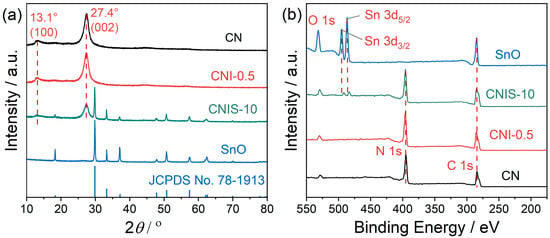
X-ray diffraction analysis (XRD) was performed on different catalyst materials to determine their structures. As shown in Figure S1a, for pure g-C3N4 (labeled CN), there are two distinct characteristic diffraction peaks at 2θ = 13.1° and 27.4° [20]. The peak at 13.1° corresponds to the (100) crystal plane of the tri-s-triazine ring in g-C3N4, which is a characteristic diffraction peak of the interlayer stacking of aromatic compounds. The peak at 27.4° corresponds to the (002) crystal plane of g-C3N4, which is a characteristic diffraction peak of melon-like compounds. With the doping of different amounts of imidazole, the diffraction peak corresponding to the (002) plane gradually broadens and weakens, indicating that imidazole doping reduces the crystallinity of g-C3N4, leading to the formation of defects [21]. As the concentration of imidazole doping increases, the defect concentration in g-C3N4 also increases. When the doping mass of imidazole is 10% of melamine, there are still obvious diffraction peaks near 13.1° and 27.4°, similar to pure g-C3N4, indicating that doping with imidazole up to 10% by mass does not hinder the polycondensation reaction of melamine [22].
As shown in Figure S1b, the diffraction spectrum of the synthesized SnO can be perfectly matched with the standard diffraction card of SnO, ref. [23], indicating that SnO was successfully synthesized through the experiment. By controlling the different masses of SnO to composite with g-C3N4, not only are there characteristic diffraction peaks of g-C3N4 located at 13.1° and 27.4° in its XRD pattern, but also the other diffraction peaks can be one-to-one matched with those of SnO, indicating that g-C3N4 and SnO have been successfully compounded. As the loading amount of SnO increases, the intensity of the diffraction peaks corresponding to SnO gradually increases and the coherent scattering regions (CSRs) of CNIS samples show only a slight increasing trend (Table S1). For a clear comparison, the XRD pattern of CN, CN-0.5, CNIS-10 and SnO are shown in Figure 1a.
Figure 1.
The structure, surface chemistry state, and elemental composition of typical samples: (a) XRD patterns; (b) XPS full spectra.
XPS is commonly used to detect the surface elements and valence states of photocatalytic materials. Figure 1b shows the XPS full spectra of CN, CNI-0.5, CNIS-10 and SnO. It can be seen that both CN and CNI-0.5 contain carbon and nitrogen elements. Compared with CN, the XPS full spectrum of CNI-0.5 contains the characteristic X-ray peak of oxygen atoms, which is due to the presence of water molecules on the surface of the catalyst material [24]. The XPS full spectrum of SnO contains the characteristic X-ray peaks of tin and oxygen elements, and the XPS full spectrum of CNIS-10 also contains the characteristic X-ray peaks of carbon and nitrogen elements in addition to those of tin and oxygen elements. This result also confirms the successful compounding of g-C3N4 and SnO. The XPS data comparison of CN and CNI-0.5 is shown in Table 1. The N/C ratio of CN is 1.343, which is close to the theoretical value of g-C3N4. The N/C ratio of CNI-0.5 is 1.035, which is significantly lower than that of CN. The main reason is that the doping of imidazole may introduce additional carbon sources, thereby significantly reducing the N/C ratio of CNI-0.5 [10].
Table 1.
The XPS data comparison of CN and CNI-0.5.
For further investigation of the structure, the functional groups of the obtained samples were confirmed by FTIR spectroscopy. The FTIR spectrum (Figure S2) of the pure g-C3N4 shows the typical stretching vibration bands belonging to C-N heterocycles (1200–1650 cm−1), N-H (3100–3300 cm−1), and the breathing mode of s-triazine ring units (811 cm−1). Compared with the IR spectrum of pure CN, the bands of IR indicate that the chemical structure of g-C3N4 has not been destroyed after doping and loading.
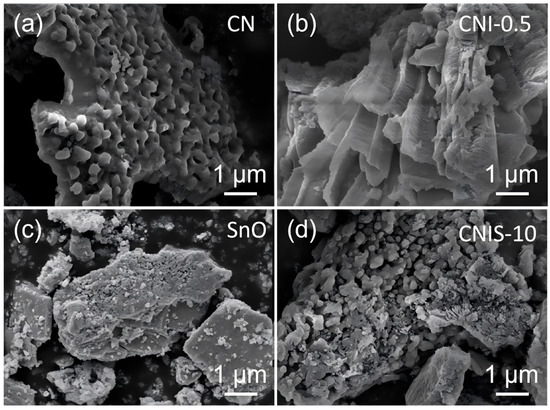
Scanning Electron Microscopy (SEM) is commonly used to observe the morphological characteristics of photocatalytic materials. As shown in Figure 2a, CN has a two-dimensional layered structure and porous structure similar to graphene, with a thickness of about 250 nm. This is consistent with previous literature, indicating that g-C3N4 is composed of layered structures held together by van der Waals forces [25]. Therefore, it is also possible to prepare two-dimensional g-C3N4 nanosheets by disrupting the van der Waals forces between layers. In Figure 2b, g-C3N4 modified with imidazole (CNI-0.5) has a more pronounced layered structure, and the thickness of the layered structure is reduced, which is conducive to the diffusion of photogenerated carriers from the interior of the material to the surface for participation in reactions, thereby enhancing the catalytic effect [26]. SnO with a distinct layered structure, shown in Figure 2c, is composed of nanosheets with lengths of 1–2 μm and thicknesses of 50–100 nm. This structure is conducive to increasing the specific surface area of the material, increasing the number of active sites, and thereby enhancing the catalytic performance [17]. Since both SnO and g-C3N4 have distinct layered structures, the morphology of CNIS-10 does not change significantly after the combination of SnO and g-C3N4 (Figure 2d). The porous structure of g-C3N4 is in contact with the layered structure of SnO, thereby providing new pathways for the diffusion of electrons and holes. However, excessive loading of SnO may reduce the specific surface area of the material, thereby inhibiting the performance of the composite photocatalytic material.
Figure 2.
SEM images of (a) CN, (b) CNI-0.5, (c) SnO and (d) CNIS-10.
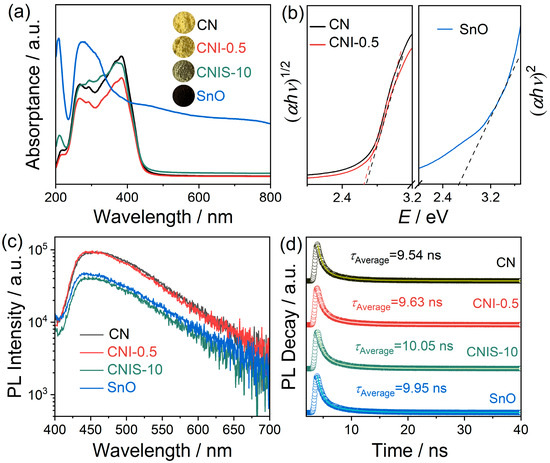
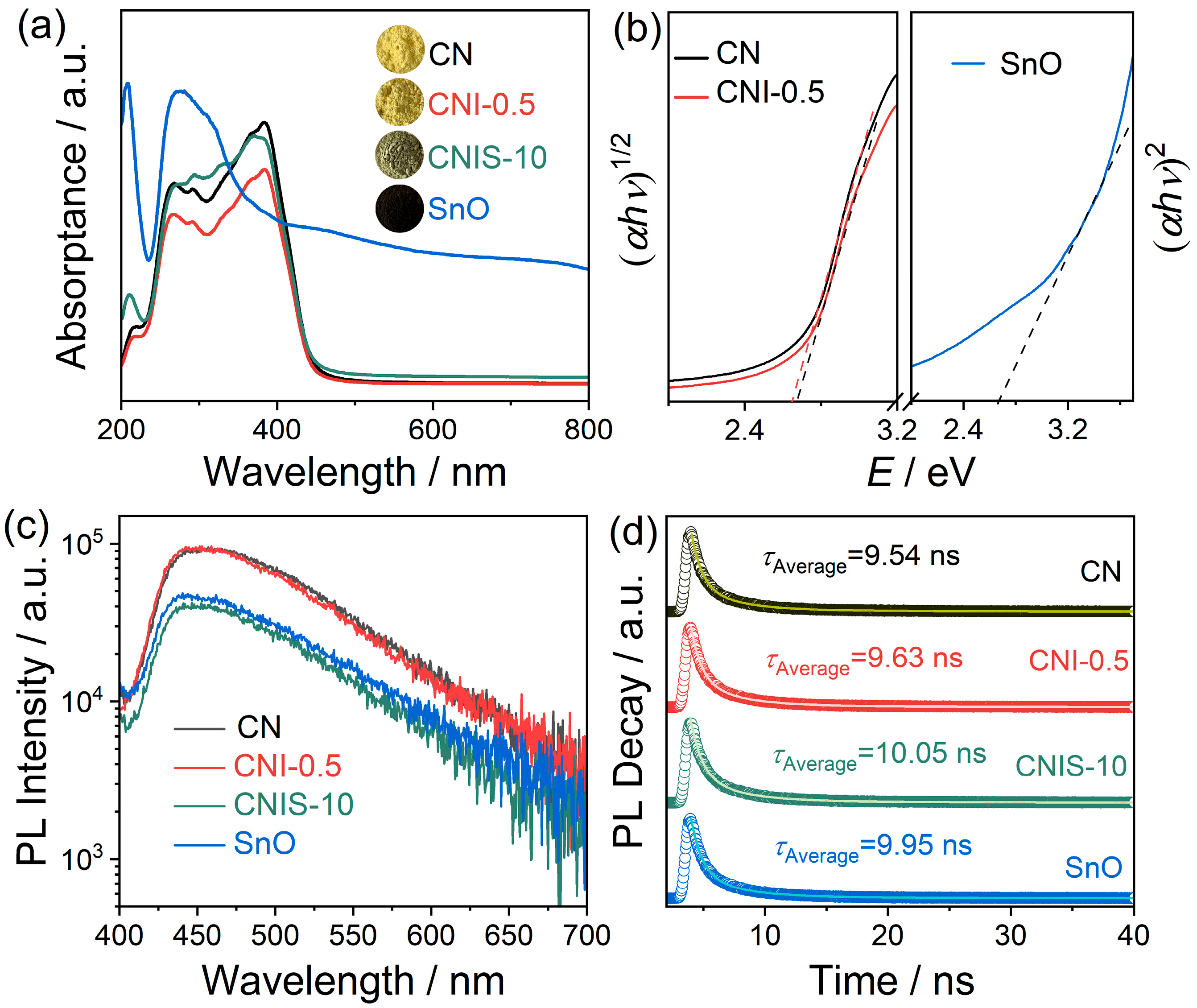
The performance of photocatalytic materials is also closely related to their bandgap structure [27]. As shown in Figure 3a, the UV-Vis absorption spectra of CN, SnO and CNI-0.5 indicate different absorption edges for g-C3N4 with different defect concentrations. The bandgap of CNI-0.5 and SnO is calculated by Tauc plot shown in Figure 3b and Table 2, and it indicates that the visible light absorption of some imidazole-doped g-C3N4 has been enhanced to a certain extent. In addition to the electron transition from the intrinsic HOMO level to the LUMO level, additional electron transition modes have appeared, which may be attributed to the additional carbon species introduced by imidazole modification [28]. The absorption edges of the g-C3N4 samples shift slightly with different defect concentrations, which is consistent with the changes in their bandgaps (see Table S2) [29]. By compositing CNI-0.5 with different concentrations of SnO, CNIS achieved an enhanced light absorption capacity and high utilization of photogenerated electrons and holes.
Figure 3.
(a) UV-vis absorption spectra, (b) bandgap calculated by Tauc plot curve, (c) PL and (d) TRPL curves of CN, SnO, CNI-0.5 and CNIS-10.
Table 2.
Bandgaps with experiment errors of different samples.
To further verify the effect of the imidazole doping and SnO, PL measurements were carried out on CN, SnO, CNI-0.5 and CNIS-10 samples. It is well known that PL can study the efficiency of charge carrier separation and transfer in semiconductors. The PL spectra in Figure 3c show an apparent decrease in the characteristic peak of g-C3N4 (~466 nm) after the loading of SnO. Furthermore, the time-resolved fluorescence decay curves of the CN, SnO, CNI-0.5 and CNIS-10 were also measured and shown in Table 3. As shown in Figure 3d, the average fluorescence lifetime of CN (9.54 ns) is prolonged to 10.05 ns after the doping of imidazole and loading of SnO. The decreased PL intensity and increased fluorescence lifetime provide strong evidence for the accelerated electron transfer and suppressed recombination of charge carriers by doping imidazole and decorating SnO on the CN.
Table 3.
PL lifetimes with experiment errors of different samples.
3.2. Photocatalytic Properties Characterization
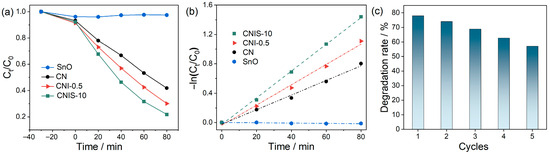
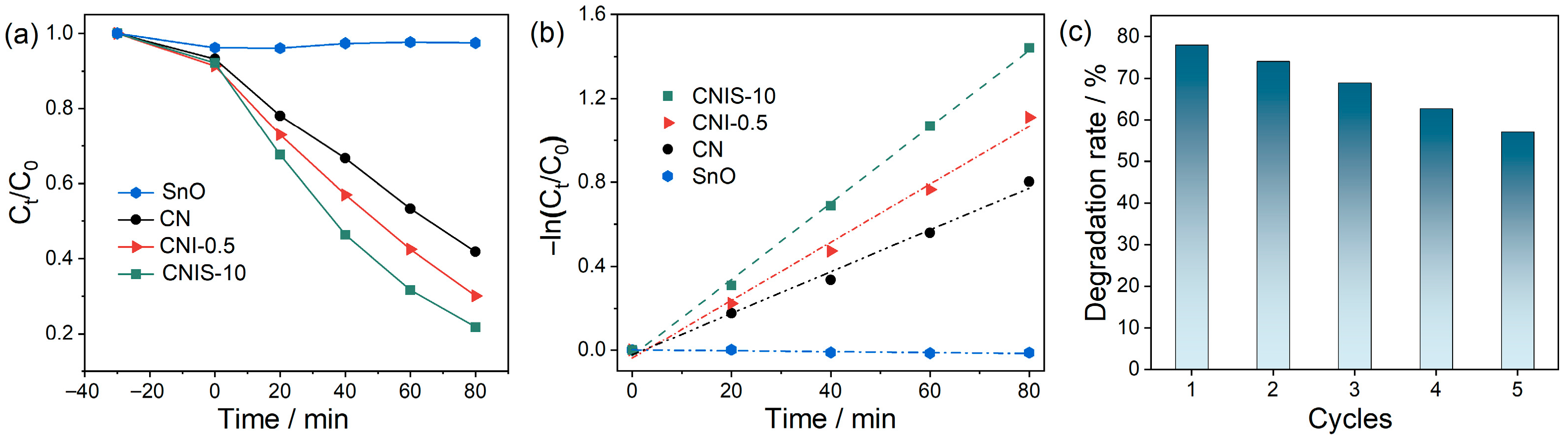
The photocatalytic properties were characterized by degrading Rh B. For bare CN, a 58.21% removal of Rh B was reached, and CNI exhibits an improved photocatalytic activity because of imidazole doping [10]. The obvious enhancement is considered to result from the decreased recombination of photogenerated electrons and holes. Among all imidazole-doping samples (Figure S4a), the CNI-0.5 showed the highest rate. Once the doping concentration of imidazole exceeds 1%, the photocatalytic activity decreases. Due to the addition of SnO, CNIS reached a 78% removal of Rh B, which is almost two times greater than CN and 50 times greater than SnO, and the optimum concentration of SnO is 10% (Figure S4b). First-order kinetic reactions of all samples are proven, as shown in Figure S4c,d. The calculated rate constants with experimental errors for all samples are summarized in Table S3. The obvious enhancement of photocatalytic activity is considered to result from the accelerated charge transfer in the heterojunction. The results for representative samples are more clearly presented in Figure 4a,b. Above all, these results suggest that the introduction of both imidazole and SnO with CN is an effective way to prepare CN-based photocatalysts with a significant photocatalytic performance. The detailed mechanism will be discussed in the following sections. Moreover, recycling experiments for the best-performing photocatalyst (CNIS) in the photodegradation of Rh B under identical conditions are performed. After each run, the catalyst was recovered by centrifugation, washed thoroughly with deionized water and ethanol, dried at 60 °C, and then reused in the next cycle. As shown in Figure 4c, the photodegradation rate dropped from 78% to 57% after five consecutive cycles; the loss in activity may be attributed to the unavoidable mass loss of the catalyst during recovery and/or the partial adsorption of intermediates on the catalyst surface. Although our photocatalyst shows satisfactory reusability, its stability still needs improvement.
Figure 4.
(a) Time-dependent photocatalytic Rh B degradation curves, (b) kinetic plots of ln(C/C0) versus irradiation time for the photodegradation of RhB over different samples and (c) the stability and reusability of the CNIS-10 photocatalyst.
To further position our results within the current literature [30,31,32,33,34], we compared the photocatalytic performance of our system with representative recent studies on g-C3N4-based materials for Rh B degradation under light irradiation in Table 4. It is well recognized that the reported degradation efficiencies and rate constants are highly sensitive to experimental conditions, including light intensity, spectral distribution, catalyst dosage, and initial pollutant concentration, which complicates direct comparison across different studies.
Table 4.
Comparison of this work with previously reported data for RhB photodegradation.
Nevertheless, existing reports consistently demonstrate that g-C3N4-based heterostructures can achieve efficient Rh B degradation within comparable time scales under irradiation. In this context, the activity of the present g-C3N4/SnO heterojunction lies within the typical range of reported systems. More importantly, by maintaining identical reaction conditions across all samples, our results clearly demonstrate that the performance enhancement originates from the formation of the heterojunction, highlighting the role of interfacial charge transfer rather than external operational factors.
3.3. Photocatalytic Mechanism
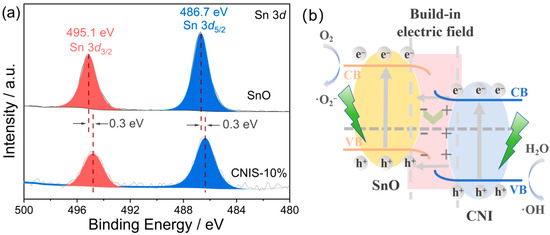
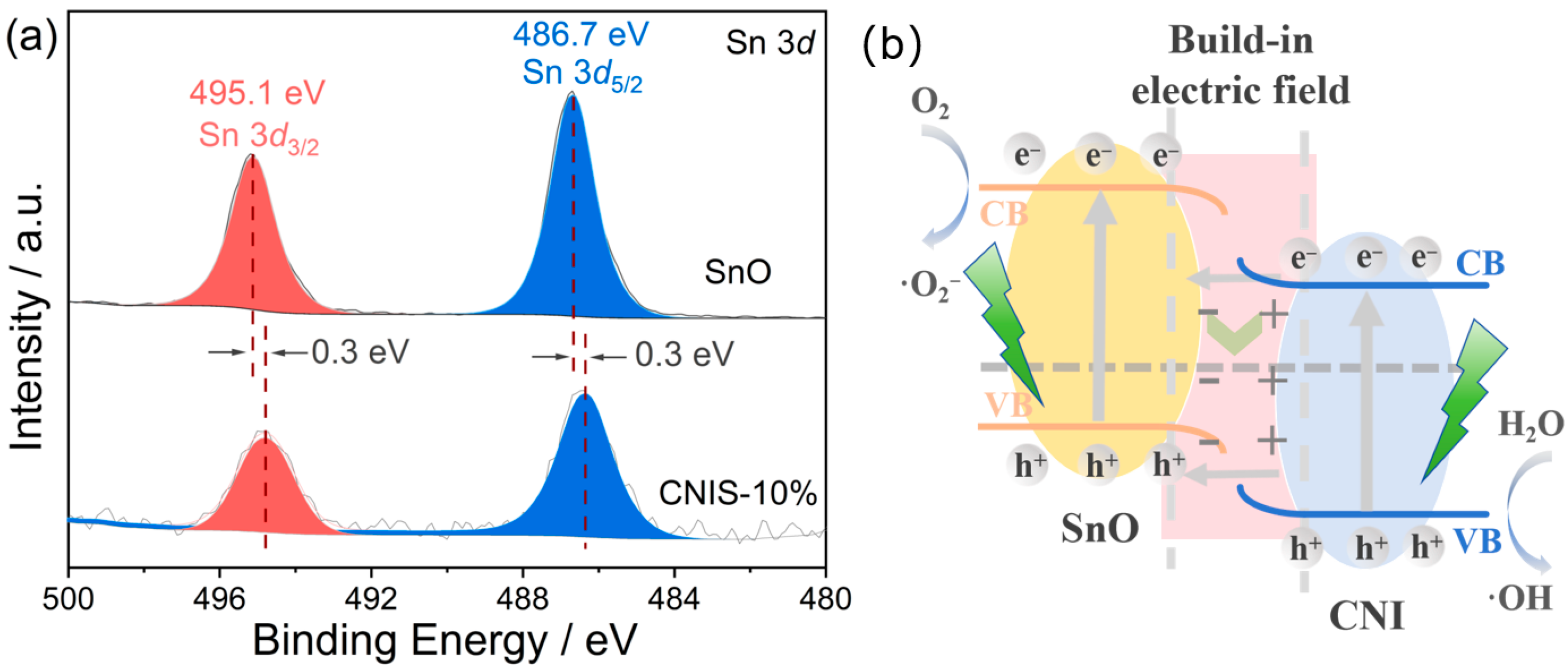
The XPS Sn spectra of SnO and CNIS-10 is used to study the photocatalytic mechanism, which is shown in Figure 5a. As shown in Figure 5a, the Sn3d5/2 and Sn3d3/2 peaks of SnO at 486.7 and 495.13 eV correspond to the Sn2+ state [35]. Compared with SnO, the binding energy of the two peaks corresponding to Sn3d of CNIS-10 has decreased, indicating that some electrons have transferred from g-C3N4 to SnO [36,37]. Figure 5b shows the photocatalytic mechanism for SnO-modified imidazole-doped g-C3N4. There is a difference in carrier concentration between p-type SnO and n-type g-C3N4, which causes electrons to diffuse from g-C3N4 to SnO, while the diffusion direction of holes is opposite. Subsequently, immobile positive and negative ions interact on both sides of the interface to form an internal electric field. When balanced, the direction of the electric field is from g-C3N4 to SnO. During illumination, photogenerated electrons and holes are separated through the internal electric field. Electrons in the conduction band of nitrogenized carbon flow to the valence band of SnO, thereby achieving efficient separation of photogenerated carriers [19].
Figure 5.
(a) The XPS Sn 3d spectra of SnO and CNIS-10; (b) schematic diagram of the photocatalytic mechanism: photo-induced generation of charge carriers/transfer and photocatalytic Rh B degradation.
4. Conclusions
In summary, a series of g-C3N4-modified materials were synthesized through imidazole modification. Rh B was used as the target pollutant to evaluate the photocatalytic oxidation performance through photocatalytic degradation experiments. The experimental results showed that the degradation effect of g-C3N4-modified materials doped with 0.5% imidazole was the best, which was 1.39 times higher than that of pure g-C3N4. To solve the problem of low separation efficiency and high recombination rate of photogenerated carriers, SnO was introduced as a co-catalyst on the basis of imidazole-modified g-C3N4 through the water bath synthesis method. Since g-C3N4 and SnO have different work functions, and g-C3N4 is an n-type semiconductor while SnO is a p-type semiconductor, the formation of an internal electric field when they come into contact can accelerate the migration and separation of carriers, thereby enhancing the catalytic performance. When the composition of SnO was 10%, 78% of Rh B was degraded within 80 min, demonstrating strong degradation efficiency. Based on the above experimental results, the experimental ideas of defect engineering and the introduction of co-catalytic materials will have great application potential in the future industrialization of photocatalysis. Despite the high activity, powdered photocatalysts face challenges in recovery and reuse, and the energy-intensive synthesis (e.g., high-temperature calcination) remains a concern for large-scale application. To address the decline in photocatalytic performance, future studies could immobilize the catalyst on a support to facilitate reuse, apply a regeneration step between cycles (e.g., thermal treatment or solvent washing), or explore more robust synthesis methods to enhance structural stability.
Supplementary Materials
The following supporting information can be downloaded at: https://www.mdpi.com/article/10.3390/chemistry8050056/s1, Figure S1: (a) XRD patterns of CNI series; (b) XRD patterns of CNIS series. Figure S2: The FTIR of typical samples. Figure S3: (a) UV-vis absorption spectra of CN, SnO and CNI series; (b) bandgap calculated by Tauc plot curve. Figure S4: Time-dependent photocatalytic Rh B degradation curves of (a) CNI series and (b) CNIS series; (c,d) Kinetic plots of ln(C/C0) versus irradiation time for the photodegradation of RhB over different samples. Table S1: CSR of CN series samples. Table S2: Bandgaps with experiment errors of CNI series samples. Table S3. The reaction rate constants with the experimental errors for all samples.
Author Contributions
Writing—original draft preparation, H.Y. and X.W.; writing—review and editing, J.Y. and Y.F.; visualization, S.H.; supervision, Z.J. and R.F.; project administration, H.Y.; funding acquisition, H.Y. All authors have read and agreed to the published version of the manuscript.
Funding
This research was funded by the Scientific Research Project of Tianjin Municipal Education Commission, grant number 2021KJ041.
Data Availability Statement
The data that support the findings of this study are available from the corresponding author upon reasonable request.
Conflicts of Interest
The authors declare no conflicts of interest.
Abbreviations
The following abbreviations are used in this manuscript:
| Rh B | Rhodamine B |
| g-C3N4 | graphitic carbon nitride |
| CN | g-C3N4 |
| CMOS | complementary metal oxide semiconductor |
| VB | valence band |
| CB | conduction band |
| SnO | Stannous oxide |
| CNIS | imidazole-functionalized g-C3N4/SnO |
| CNI | imidazole-functionalized g-C3N4 |
| XPS | X-ray photoelectron spectroscopy |
| UV-Vis DRS | ultraviolet–visible diffuse reflectance spectroscopy |
| XRD | X-ray diffraction analysis |
| SEM | Scanning Electron Microscopy |
| FTIR | Fourier transform infrared spectrophotometer |
References
- Zheng, M.-W.; Lin, C.-W.; Chou, P.-H.; Chiang, C.-L.; Lin, Y.-G.; Liu, S.-H. Highly effective degradation of ibuprofen by alkaline metal-doped copper oxides via peroxymonosulfate activation: Mechanisms, degradation pathway and toxicity assessments. J. Hazard. Mater. 2024, 462, 132751. [Google Scholar] [CrossRef] [Scilit]
- Negash, A.; Mohammed, S.; Weldekirstos, H.D.; Ambaye, A.D.; Gashu, M. Enhanced photocatalytic degradation of methylene blue dye using eco-friendly synthesized rGO@ZnO nanocomposites. Sci. Rep. 2023, 13, 22234. [Google Scholar] [CrossRef] [Scilit]
- Chakravorty, A.; Roy, S. A review of photocatalysis, basic principles, processes, and materials. Sustain. Chem. Environ. 2024, 8, 100155. [Google Scholar] [CrossRef] [Scilit]
- Ong, W.-J.; Tan, L.-L.; Ng, Y.H.; Yong, S.-T.; Chai, S.-P. Graphitic Carbon Nitride (g-C3N4)-Based Photocatalysts for Artificial Photosynthesis and Environmental Remediation: Are We a Step Closer to Achieving Sustainability? Chem. Rev. 2016, 116, 7159–7329. [Google Scholar] [CrossRef] [Scilit]
- Huang, S.; Yi, H.; Zhang, L.; Jin, Z.; Long, Y.; Zhang, Y.; Liao, Q.; Na, J.; Cui, H.; Ruan, S.; et al. Non-precious molybdenum nanospheres as a novel cocatalyst for full-spectrum-driven photocatalytic CO2 reforming to CH4. J. Hazard. Mater. 2020, 393, 122324. [Google Scholar] [CrossRef] [Scilit]
- Wang, J.; Wang, S. A critical review on graphitic carbon nitride (g-C3N4)-based materials: Preparation, modification and environmental application. Coord. Chem. Rev. 2022, 453, 214338. [Google Scholar] [CrossRef] [Scilit]
- Arumugam, M.; Tahir, M.; Praserthdam, P. Effect of nonmetals (B, O, P, and S) doped with porous g-C3N4 for improved electron transfer towards photocatalytic CO2 reduction with water into CH4. Chemosphere 2022, 286, 131765. [Google Scholar] [CrossRef] [Scilit] [PubMed]
- Ma, X.; Li, Y.; Jiang, C.; Chen, S.; Liu, H.; Zhang, Y.; Zhang, Q.; Du, F. Elements Doping Strategy for Improving the Thermoelectric Properties of g-C3N4/SWCNT Composite Films. ACS Appl. Mater. Interfaces 2025, 17, 14510–14519. [Google Scholar] [CrossRef] [Scilit] [PubMed]
- Zhu, D.; Zhou, Q. Nitrogen doped g-C3N4 with the extremely narrow band gap for excellent photocatalytic activities under visible light. Appl. Catal. B Environ. 2021, 281, 119474. [Google Scholar] [CrossRef] [Scilit]
- Zhang, L.; Liu, Q.; Chai, Y.; Ren, J.; Dai, W.-L. Imidazole modified g-C3N4 photocatalyst: Structural characterization and versatile energy applications. Appl. Surf. Sci. 2018, 430, 316–324. [Google Scholar] [CrossRef] [Scilit]
- Qi, H.; Liu, Y.; Li, C.; Zou, X.; Huang, Y.; Wang, Y. Precursor-reforming protocol to synthesis of porous N-doped g-C3N4 for highly improved photocatalytic water treatments. Mater. Lett. 2020, 264, 127329. [Google Scholar] [CrossRef] [Scilit]
- Wang, Z.; He, X.; Zhang, X.-X.; Alshareef, H.N. Hybrid van der Waals p-n Heterojunctions based on SnO and 2D MoS2. Adv. Mater. 2016, 28, 9133–9141. [Google Scholar] [CrossRef] [Scilit] [PubMed]
- Yue, W.; Yang, S.; Ren, Y.; Yang, X. In situ growth of Sn, SnO on graphene nanosheets and their application as anode materials for lithium-ion batteries. Electrochim. Acta 2013, 92, 412–420. [Google Scholar] [CrossRef] [Scilit]
- Chen, M.; Chao, D.; Liu, J.; Yan, J.; Zhang, B.; Huang, Y.; Lin, J.; Shen, Z.X. Rapid Pseudocapacitive Sodium-Ion Response Induced by 2D Ultrathin Tin Monoxide Nanoarrays. Adv. Funct. Mater. 2017, 27, 1606232. [Google Scholar] [CrossRef] [Scilit]
- Cui, Y.; Wang, F.; Iqbal, M.Z.; Wang, Z.; Li, Y.; Tu, J. Synthesis of novel 3D SnO flower-like hierarchical architectures self-assembled by nano-leaves and its photocatalysis. Mater. Res. Bull. 2015, 70, 784–788. [Google Scholar] [CrossRef] [Scilit]
- Cui, Y.; Wang, F.; Iqbal, M.Z.; Li, Y.; Toufiq, A.M.; Wang, Z.; Wang, Z.; Ali, S. Synthesis of nanoflakes-based self-assembling crossed structure of stannous oxide and photocatalysis property. Cryst. Res. Technol. 2015, 50, 210–214. [Google Scholar] [CrossRef] [Scilit]
- Liang, L.; Sun, Y.; Lei, F.; Gao, S.; Xie, Y. Free-floating ultrathin tin monoxide sheets for solar-driven photoelectrochemical water splitting. J. Mater. Chem. A 2014, 2, 10647–10653. [Google Scholar] [CrossRef] [Scilit]
- Zhang, R.; Kuang, J.; Lu, Q.; Wang, Q.; Sun, P.; Liu, W.; Yin, S.; Cao, W. Tunable thickness and band structure of SnO sheets for improved photocatalytic activity. CrystEngComm 2020, 22, 2219–2226. [Google Scholar] [CrossRef] [Scilit]
- Huang, S.; Jin, Z.; Yi, H.; Yang, Z.; Long, Y.; Liao, Q.; Chen, J.; Cao, Y.; Ruan, S.; Zeng, Y.-J. Stannous oxide promoted charge separation in rationally designed heterojunction photocatalysts with a controllable mechanism. Dalton Trans. 2018, 47, 12734–12741. [Google Scholar] [CrossRef] [Scilit]
- Li, K.; Jiang, Y.; Rao, W.; Li, Y.; Liu, X.; Zhang, J.; Xu, X.; Lin, K. Cooperative coupling strategy for constructing 0D/2D carbon nitride composites with strengthened chemical interaction for enhanced photocatalytic applications. Chem. Eng. J. 2022, 431, 134075. [Google Scholar] [CrossRef] [Scilit]
- Li, Y.; Ren, Z.; He, Z.; Ouyang, P.; Duan, Y.; Zhang, W.; Lv, K.; Dong, F. Crystallinity-defect matching relationship of g-C3N4: Experimental and theoretical perspectives. Green Energy Environ. 2024, 9, 623–658. [Google Scholar] [CrossRef] [Scilit]
- Hussain, S.A.; Hu, J.; Liu, H.; Aslam, F.; Khan, S.; Khan, L.; Jiao, F. Preparation of C-doped g-C3N4 by Co-polycondensation of melamine and sucrose for improved photocatalytic H2 evolution. Int. J. Hydrogen Energy 2024, 87, 705–712. [Google Scholar] [CrossRef] [Scilit]
- Zhang, F.; Zhu, J.; Zhang, D.; Schwingenschlögl, U.; Alshareef, H.N. Two-Dimensional SnO Anodes with a Tunable Number of Atomic Layers for Sodium Ion Batteries. Nano Lett. 2017, 17, 1302–1311. [Google Scholar] [CrossRef] [Scilit] [PubMed]
- Krishna, D.N.G.; Philip, J. Review on surface-characterization applications of X-ray photoelectron spectroscopy (XPS): Recent developments and challenges. Appl. Surf. Sci. Adv. 2022, 12, 100332. [Google Scholar] [CrossRef] [Scilit]
- Wang, Y.; Liu, L.; Ma, T.; Zhang, Y.; Huang, H. 2D Graphitic Carbon Nitride for Energy Conversion and Storage. Adv. Funct. Mater. 2021, 31, 2102540. [Google Scholar] [CrossRef] [Scilit]
- Li, Y.; Gu, M.; Zhang, X.; Fan, J.; Lv, K.; Carabineiro, S.A.C.; Dong, F. 2D g-C3N4 for advancement of photo-generated carrier dynamics: Status and challenges. Mater. Today 2020, 41, 270–303. [Google Scholar] [CrossRef] [Scilit]
- Gan, J.; Wang, H.; Hu, H.; Su, M.; Chen, F.; Xu, H. Efficient synthesis of tunable band-gap CuInZnS decorated g-C3N4 hybrids for enhanced CO2 photocatalytic reduction and near-infrared-triggered photodegradation performance. Appl. Surf. Sci. 2021, 564, 150396. [Google Scholar] [CrossRef] [Scilit]
- Jiang, Y.; Lin, Z.; Zhang, Y.; Lai, Y.; Liang, D.; Yang, C. Facile synthesis of porous C-doped C3N4: Fast charge separation and enhanced photocatalytic hydrogen evolution. New J. Chem. 2020, 44, 17891–17898. [Google Scholar] [CrossRef] [Scilit]
- Li, Y.; Wu, S.; Huang, L.; Wang, J.; Xu, H.; Li, H. Synthesis of carbon-doped g-C3N4 composites with enhanced visible-light photocatalytic activity. Mater. Lett. 2014, 137, 281–284. [Google Scholar] [CrossRef] [Scilit]
- Gupta, S.; Kumar, R. Unveiling of Interfacial Charge Carrier Dynamics in rGO Wrapped g-C3N4/SnO2 Heterostructure for Enhanced Adsorption and Sunlight-Driven Photocatalysis. Langmuir 2025, 41, 16160–16179. [Google Scholar] [CrossRef] [Scilit]
- Abdelaziz, A.A.; Mohamed, H.S.H.; Khabiri, G. Construction of hierarchically porous O-doped g-C3N4@SnO2 QDs heterostructure for unprecedentedly enhanced photocatalytic performance. Appl. Mater. Today 2025, 42, 102617. [Google Scholar] [CrossRef] [Scilit]
- Chen, Y.; Tang, D.; Wang, Z.; Yin, M.; Yang, Q.; Zhou, Y.; Cheng, Z.; Wang, Z.; Zhang, K.; Zhou, L. Sn-bridge type-II PCN/Sn/SnO heterojunction with enhanced photocatalytic activity. Semicond. Sci. Technol. 2020, 35, 115015. [Google Scholar] [CrossRef] [Scilit]
- Ali, G.; Zaidi, S.J.A.; Basit, M.A.; Park, T.J. Synergetic performance of systematically designed g-C3N4/rGO/SnO2 nanocomposite for photodegradation of Rhodamine-B dye. Appl. Surf. Sci. 2021, 570, 151140. [Google Scholar] [CrossRef] [Scilit]
- Masoud, A.; Ahmed, M.A.; Kühn, F.; Bassioni, G. g-C3N4 nanosheet-loaded Bi2WO6 nanoplates for improving photocatalytic degradation of organic pollutants. J. Organomet. Chem. 2025, 1042, 123892. [Google Scholar] [CrossRef] [Scilit]
- Grutsch, P.A.; Zeller, M.V.; Fehlner, T.P. Photoelectron spectroscopy of tin compounds. Inorg. Chem. 1973, 12, 1431–1433. [Google Scholar] [CrossRef] [Scilit]
- Tian, J.; Zhang, L.; Fan, X.; Zhou, Y.; Wang, M.; Cheng, R.; Li, M.; Kan, X.; Jin, X.; Liu, Z.; et al. A post-grafting strategy to modify g-C3N4 with aromatic heterocycles for enhanced photocatalytic activity. J. Mater. Chem. A 2016, 4, 13814–13821. [Google Scholar] [CrossRef] [Scilit]
- Low, J.; Jiang, C.; Cheng, B.; Wageh, S.; Al-Ghamdi, A.A.; Yu, J. A Review of Direct Z-Scheme Photocatalysts. Small Methods 2017, 1, 1700080. [Google Scholar] [CrossRef] [Scilit]

Disclaimer/Publisher’s Note: The statements, opinions and data contained in all publications are solely those of the individual author(s) and contributor(s) and not of MDPI and/or the editor(s). MDPI and/or the editor(s) disclaim responsibility for any injury to people or property resulting from any ideas, methods, instructions or products referred to in the content. |
© 2026 by the authors. Licensee MDPI, Basel, Switzerland. This article is an open access article distributed under the terms and conditions of the Creative Commons Attribution (CC BY) license.