


Abstract
Cyclodepsipeptides constitute a structurally diverse class of natural products composed of amino acid and hydroxy acid residues interconnected through both amide and ester bonds. Among them, xylaroamide A, a cyclic heptadepsipeptide, was recently identified from an endolichenic Xylaria species via a molecular networking-guided discovery approach. Despite xylaroamide A exhibiting intriguing structural features and notable bioactivity potential, its total synthesis has thus far remained unexplored. Herein, we report the first total synthesis of xylaroamide A, achieved through a hybrid solid/solution-phase synthetic approach. The linear precursor was assembled in accordance with the native amino acid sequence via Fmoc-based solid-phase peptide synthesis, incorporating the preassembled ester fragment at a later stage of assembly. Subsequent macrocyclization took place under high-dilution conditions to furnish the target cyclodepsipeptide. The structure of the synthetic product was confirmed by means of optical rotation and NMR and MS spectroscopic analyses, which exhibited good agreement with the reported data for the natural product. This work establishes a reliable and efficient synthetic route to xylaroamide A and provides a foundation for further bioactivity and structure optimization investigations.
1. Introduction
Cyclic depsipeptides represent an important class of natural products that have been isolated from a wide range of organisms, including algae, terrestrial plants, and marine species [1,2,3,4]. In these molecules, one or more amino acid residues are replaced by hydroxy acids, resulting in the incorporation of ester bonds within the macrocyclic framework [5,6,7]. Such structural features contribute to considerable molecular diversity and are frequently associated with notable biological activities, including antitumor, antifungal, antiviral, antimalarial, and antitrypanosomal effects [8,9,10,11]. Because of these properties, cyclic depsipeptides have attracted sustained interest as potential lead structures for the development of therapeutics and agrochemicals [12,13,14,15,16].
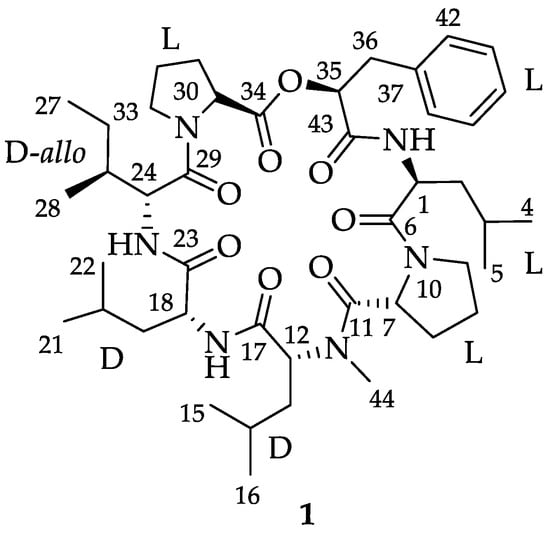
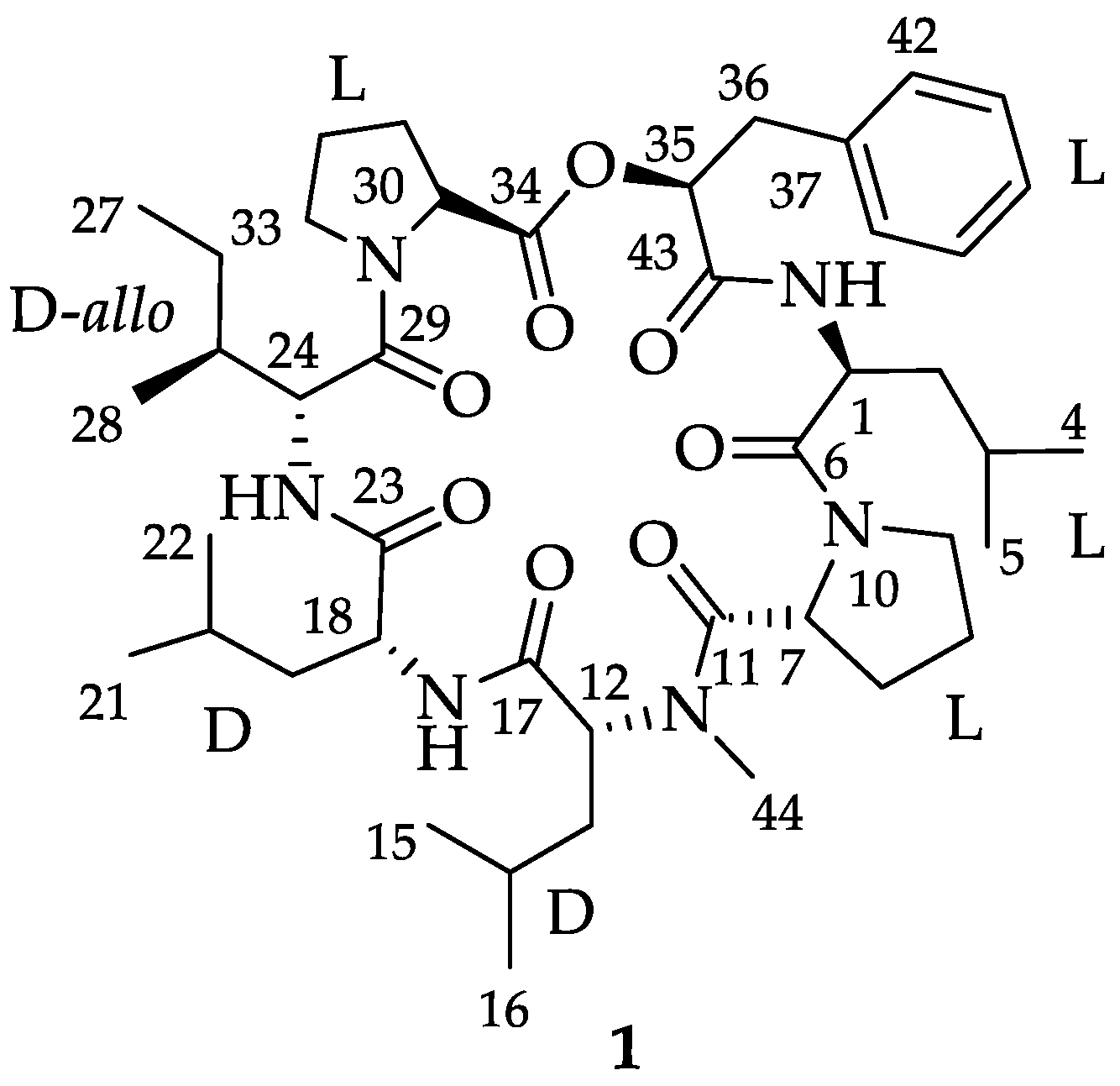
Xylaroamide A (1, Figure 1) is a cyclic heptadepsipeptide recently discovered from a lichen-derived endophytic Xylaria species through MS/MS-based molecular networking [17]. Structurally, it contains a 21-membered macrocycle composed of six amino acid residues and one α-hydroxy acid unit, (S)-2-hydroxy-3-phenylpropanoic acid (L-Ph-Lac), connected through an ester linkage. The peptide backbone includes three L-configured residues (L-Leu, two L-Pro) together with three D-configured residues (D-Leu, D-Ile, N-Me-D-Leu), conferring pronounced stereochemical complexity. The combination of D- and L-amino acids enhances conformational rigidity [18], while the N-methylated D-leucine residue may improve proteolytic stability and promote conformational preorganization.
Figure 1.
Structure of xylaroamide A.
Biological evaluation revealed that xylaroamide A exhibits potent anticancer activity, inhibiting the proliferation of HT29 and RKO (colon), H1299 and PC-9 (lung), and BT-549 (triple-negative breast cancer) cell lines, with IC50 values of 2.5–12 μM. Notably, BT-549 cells are the most sensitive (IC50 = 2.5 μM), with activity exceeding that of cisplatin (IC50 = 8.6 μM), while normal human mammary epithelial cells are less affected, indicating selectivity. These results highlight its potential as a lead compound for the development of therapies targeting triple-negative breast cancer.
Despite its intriguing structural features and promising biological activity, xylaroamide A has not yet been accessed through chemical synthesis. The presence of a depsipeptide linkage, multiple stereogenic centers, and an N-methylated residue poses considerable synthetic challenges. Moreover, the limited availability of the natural product restricts further biological studies and the exploration of structure–activity relationships. These considerations prompted us to investigate a practical synthetic approach to this molecule. Herein, we describe the first total synthesis of xylaroamide A, which provides a reliable platform for further biological evaluation and structure–activity optimization.
2. Materials and Methods
2.1. Materials
All commercially available reagents were purchased from commercial suppliers and used without further purification. All reagents and solvents were reagent or HPLC grade. 1H/13C NMR spectra were recorded on a Bruker spectrometer at 400/100 MHz (Billerica, MA, USA) in the indicated solvents. Chemical shifts (δ) were expressed in ppm with reference to the solvent signals (DMSO, 1H: 2.54 ppm, 13C: 40.45 ppm; CDCl3, 1H: 7.26 ppm; 13C: 77.00 ppm), and coupling constants (J) are reported in Hz. Standard acronyms representing multiplicity are used as follows: brs = broad singlet, s = singlet, d = doublet, t = triplet, and m = multiplet. All NMR experiments were obtained using standard pulse sequences supplied by the vendor. Thin-layer chromatography (TLC) was conducted on Whatman glass-backed plates coated with 0.25 mm layers of silica gel 60. Column chromatography was carried out on silica gel (200–300 mesh, Qingdao Marine Chemical Molecules Factory, Qingdao, China). The MS instrument was purchased from Agilent Technology (Hong Kong, China) Co., Ltd. The infrared spectrum (IR) was collected in the range of 400–4000 cm−1 using a Magna-IR 550 spectrometer (Thermo Fisher Scientific, Waltham, MA, USA).
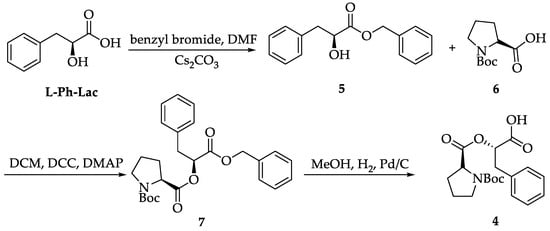
2.2. Synthesis of Ester Building Block 4 [19]
A 25 mL round-bottomed flask equipped with a magnetic stir bar was charged with (S)-2-hydroxy-3-phenylpropionic acid (1.0 g, 6.0 mmol, 1.0 equiv), Cs2CO3 (2.2 g, 6.6 mmol, 1.1 equiv), and anhydrous DMF (4.0 mL). The resulting white suspension was stirred at room temperature for 40 min and then cooled to 0 °C in an ice-water bath. Benzyl bromide (0.7 mL, 6.1 mmol, 1.0 equiv) was added dropwise via syringe over 5 min. The reaction mixture was stirred at 0 °C for 1 h, then allowed to warm to room temperature and stirred for an additional 18 h. The reaction was quenched by the addition of water (20.0 mL) and transferred to a separatory funnel. The aqueous layer was extracted with ethyl acetate (3 × 45 mL). The combined organic layers were washed successively with saturated NaHCO3 (40.0 mL), water (40.0 mL), and brine (20.0 mL), dried over anhydrous Na2SO4, filtered and concentrated under reduced pressure. The crude product was purified by means of column chromatography on silica gel (petroleum ether/ethyl acetate = 8:1, v/v) to afford compound 5 as a colorless oil (1.6 g, 95.2%). 1H NMR (400 MHz, CDCl3) δ: 7.41–7.14 (m, 10H), 5.19 (d, J = 1.7 Hz, 2H), 4.50 (dd, J = 6.6, 4.7 Hz, 1H), 3.14 (dd, J = 13.9, 4.7 Hz, 1H), 2.99 (dd, J = 13.9, 6.5 Hz, 1H).
To a solution of compound 5 (1.3 g, 5.1 mmol) in anhydrous CH2Cl2 (25.0 mL), Boc-L-proline 6 (1.7 g, 7.8 mmol), DMAP (0.15 g, 1.2 mmol), and DCC (1.6 g, 7.8 mmol) were added sequentially at 0 °C. The resulting mixture was warmed to room temperature and stirred for 18 h. After completion, the reaction mixture was filtered to remove the insoluble dicyclohexylurea (DCU) byproduct, and the filtrate was concentrated in vacuo. The crude product was purified by means of column chromatography on silica gel (petroleum ether/ethyl acetate = 12:1, v/v) to furnish compound 7 as a colorless oil (1.9 g, 90.5%) with an HPLC purity of 95.7% (Figure S11).
Infrared Spectroscopy (IR): Approximately 1 mg of the compound was mixed with 200 mg of spectroscopic-grade KBr and ground thoroughly in a mortar with a pestle until a uniform fine powder with an average particle size below 2 μM was obtained. The mixture was then transferred into a mold and pressed under a pressure of about 10 t/cm2 for 2 min to form a uniform, translucent pellet. Infrared spectra were recorded on a Magna-IR 550 FT-IR spectrometer in the range of 400–4000 cm−1.
Compound 7: 1H NMR (400 MHz, CDCl3) δ: 7.38–7.11 (m, 10H), 5.42–5.23 (m, 1H), 5.20–4.99 (m, 2H), 4.43–4.20 (m, 1H), 3.54–3.27 (m, 2H), 3.24–3.04 (m, 2H), 2.26–1.90 (m, 2H), 1.70 (tdd, J = 19.9, 12.6, 6.9 Hz, 2H), 1.47 (d, J = 9.7 Hz, 3H), 1.36 (d, J = 6.4 Hz, 3H), 1.26 (s, 3H); 13C NMR (100 MHz, CDCl3) δ 171.48, 168.12, 152.66, 133.95, 128.22, 127.57, 127.50, 127.45, 127.43, 127.36, 126.01, 78.74, 72.32, 66.19, 57.46, 45.20, 36.21, 27.40, 27.05, 22.23. FT-IR (KBr, cm−1): 2976 (m), 2361 (w), 1745 (s), 1700 (s), 1271 (s), 1175 (s), 699 (s), 495 (s). HRESIMS m/z: [M + 1]+ Calcd for C26H32NO6 454.2224, Found 454.2219.
A solution of compound 7 (2.0 g, 4.5 mmol) in MeOH (50.0 mL) was treated with 10% Pd/C (200.0 mg, 1.7 mmol). The reaction flask was evacuated and purged with hydrogen gas three times, and the mixture was then stirred at room temperature under a hydrogen atmosphere (1 atm, balloon) for 6 h. After completion, the reaction mixture was filtered through a Celite pad, which was rinsed with MeOH. The combined filtrate was concentrated in vacuo to afford compound 4 as a colorless oil in 98.3% yield. The product was obtained in sufficient purity (96.2%, Figure S12) to be used directly in the subsequent step without further purification. 1H NMR (400 MHz, DMSO-d6) δ: 7.25 (dd, J = 18.9, 6.1 Hz, 5H), 5.13 (m, 1H), 4.28–4.03 (m, 1H), 3.35–3.22 (m, 2H), 3.21–2.99 (m, 2H), 2.21–1.87 (m, 2H), 1.76–1.64 (m, 2H), 1.45–1.09 (m, 12H); 13C NMR (100 MHz, DMSO-d6) δ 172.71, 170.83, 152.28, 136.99, 129.55, 128.70, 127.09, 79.14, 73.64, 60.20, 49.04, 36.94, 28.51, 28.10, 23.25. FT-IR (KBr, cm−1): 3480 (w), 2978 (m), 2358 (w), 1753 (s), 1705 (s), 1401 (s), 1163 (s), 700 (s). HRESIMS m/z: [M − 1]+ Calcd for C19H24NO6 362.1609, Found 362.1608.
2.3. Synthesis of Xylaroamide A
2.3.1. Loading First Amino Acid Fmoc-D-Isoleucine to 2-CTC Resin for the Synthesis of 9
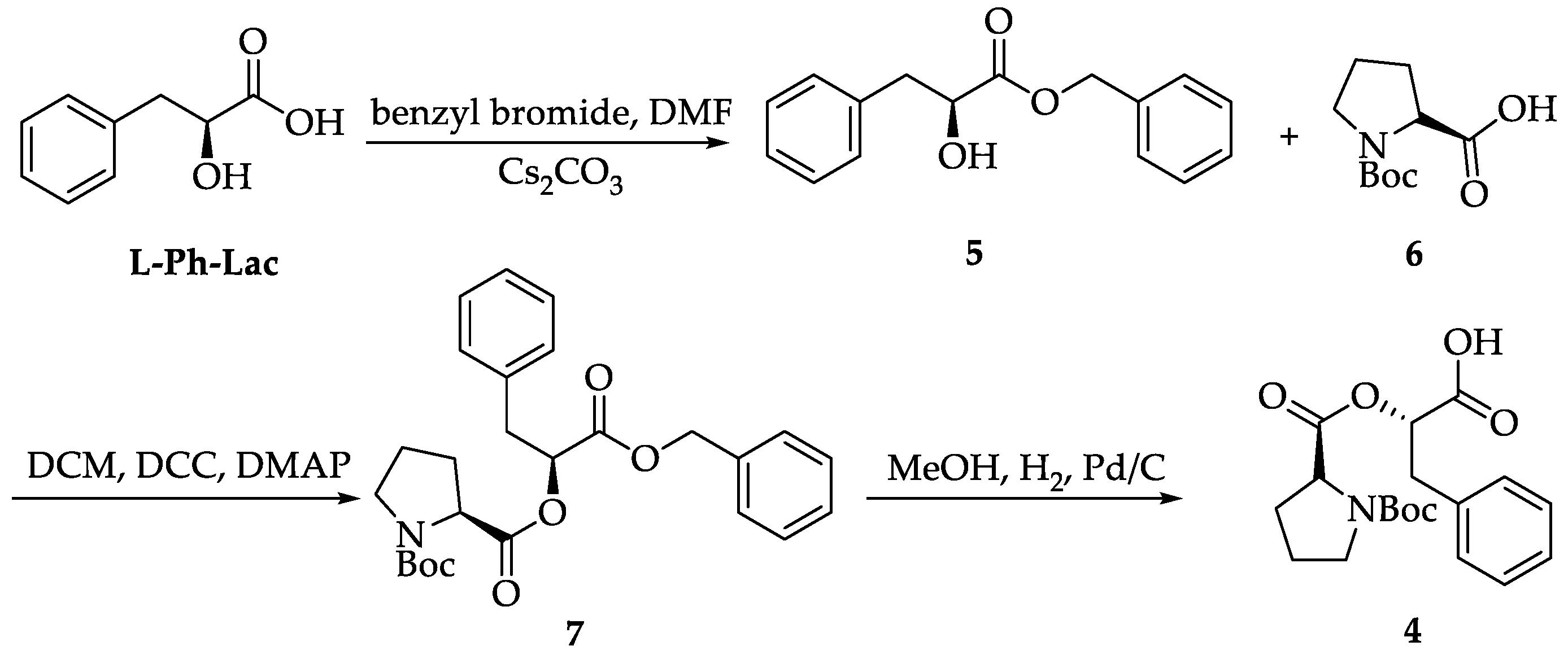
A 25 mL fritted peptide synthesis vessel was charged with 2-chlorotrityl chloride resin (CTC resin, 0.30 g, loading: 1.18 mmol/g). The resin was preswelled in DCM (10 mL) at room temperature with gentle agitation at ambient temperature for 30 min, after which the solvent was removed by suction using a Pasteur pipette bulb. A solution of Fmoc-D-isoleucine (0.38 g, 3.54 mmol, 3.0 equiv) and collidine (0.30 mL, 2.27 mmol, 6.0 equiv) in anhydrous DCM (8.0 mL) was then added to the swollen resin. The suspension was agitated at room temperature for 8 h to allow anchoring of the amino acid onto the resin. Upon completion, the reaction mixture was drained, and the resin was washed successively with DCM (3 × 5 mL) and DMF (3 × 5 mL). Unreacted sites were capped by treating the resin with a DCM/MeOH/DIPEA solution (17:2:1, v/v/v, 10 mL) under agitation for 50 min. The resin was subsequently washed with alternating portions of DCM (3 × 5 mL) and DMF (3 × 5 mL), affording the loaded resin ready for subsequent chain elongation.
2.3.2. Synthesis of the Chain Peptide on Resin 10
Fmoc deprotection:
The resin-bound amino acid 9 was treated with 20% piperidine in DMF (2 mL) in a fritted peptide synthesis vessel and agitated for 15 min. After draining, the resin was washed sequentially with DCM (3 × 5 mL) and DMF (3 × 5 mL). The deprotection step was then repeated once under identical conditions to ensure complete removal of the Fmoc protecting group.
Amino acid coupling:
A coupling solution consisting of Fmoc-D-leucine (0.39 g, 1.06 mmol), HATU (0.40 g, 1.06 mmol), and DIPEA (0.60 mL, 3.40 mmol) in anhydrous DMF (2 mL) was added to the deprotected resin. The suspension was agitated on an orbital shaker at room temperature for 3 h. Upon completion, the reaction mixture was drained, and the resin was washed with alternating portions of DCM (3 × 5 mL) and DMF (3 × 5 mL) to yield the 2-chlorotrityl chloride resin-bound dipeptide.
Peptide chain elongation:
The peptide chain was subsequently extended by iterative repetition of the above deprotection and coupling using, in sequence, Fmoc-N-methyl-D-leucine (1.06 mmol), Fmoc-L-proline (1.06 mmol), Fmoc-L-leucine (1.06 mmol), and building block 4 (1.06 mmol). Following the final coupling step, the terminal Fmoc group was removed through treatment with 20% piperidine in DMF (2 × 10 min). The resin was then thoroughly washed with alternating DCM (3 × 5 mL) and DMF (3 × 5 mL) to furnish the fully assembled heptapeptide anchored to the 2-chlorotrityl chloride resin 10.
2.3.3. Cleavage of the Peptide from Resin to Synthesize 2
The resin-bound peptide 10 was treated with a cleavage solution of 0.5% trifluoroacetic acid in DCM (7.50 mL) in a fritted peptide synthesis vessel and agitated on an orbital shaker for 20 min. The cleavage solution was then drained into a 100 mL round-bottom flask, and the resin was subsequently washed with DCM (3 × 5 mL). The cleavage and washing solutions were combined, and this cleavage/washing cycle was repeated twice to ensure complete cleavage. The combined organic phases were concentrated under reduced pressure to afford the crude peptide 11 (Rf = 0.25, DCM/MeOH = 5:1, v/v) as a pale yellow solid, which was used directly in the subsequent step without further purification.
The crude peptide 11 was dissolved in DCM (2.0 mL) in a 25 mL round-bottom flask and cooled to 0 °C. Trifluoroacetic acid (2.0 mL) was then added dropwise, and the reaction mixture was stirred for 30 min to remove the Boc protecting group. After completion, the reaction mixture was concentrated under a gentle stream of nitrogen to yield the fully deprotected linear peptide 2. This was followed by precipitation and washing with cold diethyl ether, yielding the crude product. Since peptides 2 and 11 were directly carried forward into subsequent reactions without purification, no spectra characterization data were collected for these intermediates.
2.3.4. Macrolactamization to Xylaroamide A
The crude linear peptide 2 (0.10 g, 0.12 mmol, 1.0 equiv) was dissolved in DCM (80 mL) in a 250 mL round-bottom flask. A solution of HATU (0.09 g, 0.24 mmol, 2.0 equiv) and HOAt (0.03 g, 0.24 mmol, 2.0 equiv) in anhydrous DMF (1 mL) was added dropwise under stirring. The reaction mixture was cooled to 0 °C, after which DIPEA (94 μL, 0.54 mmol, 4.5 equiv) was added dropwise. The reaction was then allowed to warm to room temperature and stirred for 48 h.
Upon completion, the reaction was quenched with 0.1 M HCl (60 mL) and extracted with DCM (3 × 60 mL). The combined organic extracts were sequentially washed with saturated NaHCO3 (2 × 20 mL) and brine (2 × 30 mL), then dried over anhydrous Na2SO4, filtered, and concentrated under reduced pressure to yield a pale yellow oil.
The crude cyclized product was purified by means of preparative reversed-phase HPLC on a YMC-Pack C18 column (YMC, Kyoto, Japan), (ODS-A, 12 nm, 5 μm particle size). Elution was performed with methanol/water (80:20, v/v) at a flow rate of 2 mL/min and monitored at 215 nm, with the target compound eluting at 9.1 min. A sample loading of 2 mg per injection was applied. The collected fractions were combined and concentrated under reduced pressure to afford the desired cyclodepsipeptide as a colorless amorphous powder in 8.1% yield from compound 8, with an HPLC purity of 97.5% (Figure S14).
1H NMR (400 MHz, DMSO-d6) δ: 8.29 (d, J = 6.7 Hz, 1H), 7.60 (d, J = 9.3 Hz, 1H), 7.23 (overlapped, 1H), 7.22 (overlapped, 2H), 7.05 (overlapped, 2H), 7.04 (d, J = 7.0 Hz, 1H), 5.07 (dd, J = 4.1, 11.4 Hz, 1H), 4.91 (dd, J = 6.6, 1.9 Hz, 1H), 4.78 (t, J = 7.7 Hz, 1H), 4.56 (t, J = 10.5 Hz, 1H), 4.54 (m, 1H), 4.20 (dd, J = 1.8, 9.1 Hz, 1H), 4.09 (t, J = 7.2 Hz, 1H), 3.79 (dt, J = 1.6, 7.5 Hz, 1H), 3.61 (dt, J = 2.2, 8.9 Hz, 1H), 3.50 (overlapped, 1H), 3.47 (overlapped, 1H), 3.30 (dd, J = 6.4, 14.2 Hz, 1H), 2.94 (s, 3H), 2.15 (m, 2H), 1.91 (m, 1H), 1.81 (m, 1H), 1.74 (m, 1H), 1.73 (m, 1H), 1.71 (m, 1H), 1.63 (m, 1H), 1.61 (m, 1H), 1.58 (m, 1H), 1.55 (m, 2H), 1.52 (m, 1H), 1.35 (m, 2H), 1.33 (m, 2H), 1.29 (m, 1H), 1.16 (m, 1H), 1.09 (m, 1H), 0.96 (overlapped, 3H), 0.89 (d, J = 6.4 Hz, 3H), 0.87 (d, J = 6.6 Hz, 3H), 0.85 (m, 3H), 0.83 (d, J = 6.3 Hz, 3H), 0.83 (t, J = 6.9 Hz, 3H), 0.81 (d, J = 5.8 Hz, 3H), 0.77 (d, J = 6.5 Hz, 3H). 13C NMR (100 MHz, DMSO-d6) δ 174.05, 172.91, 170.45, 170.30, 169.85, 168.55, 168.21, 135.37, 129.45, 128.08, 126.84, 74.48, 59.51, 56.26, 55.73, 54.37, 50.08, 49.85, 46.79, 45.98, 41.10, 38.02, 35.44, 35.27, 34.42, 30.63, 27.85, 26.11, 25.12, 24.59, 24.36, 23.84, 23.71, 23.38, 23.33, 23.27, 21.83, 20.99, 20.66, 15.17, 11.82. ESIMS: m/z [M + Na]+ Calcd for C44H68N6NaO8, 831.5, Found 831.5.
2.3.5. Optical Rotation Measurement of Xylaroamide A
The optical rotation of synthetic xylaroamide A was measured at 589 nm and 25 °C using a Rudolph Autopol IV automatic polarimeter (Rudolph, Research Analytical, Hackettstown, NJ, USA) with methanol as solvent. The compound was dissolved to a concentration of 0.1 g/100 mL, and the specific rotation was recorded as [α]25D = −7.8.
3. Results and Discussion
3.1. Synthesis of Xylaroamide A
Careful optimization is essential to minimize competing side reactions, including C-terminal epimerization, cyclooligomerization, and intermolecular polymerization, which can substantially reduce yield and purity. Cyclization sites with minimal steric hindrance typically provide higher efficiency, while proline residues often facilitate macrocyclization due to their conformational rigidity, which reduces the entropic barrier. Additionally, peptide sequences containing alternating D- and L-amino acids or capable of forming intramolecular hydrogen bonds may adopt preorganized conformations, further enhancing cyclization efficiency [20].
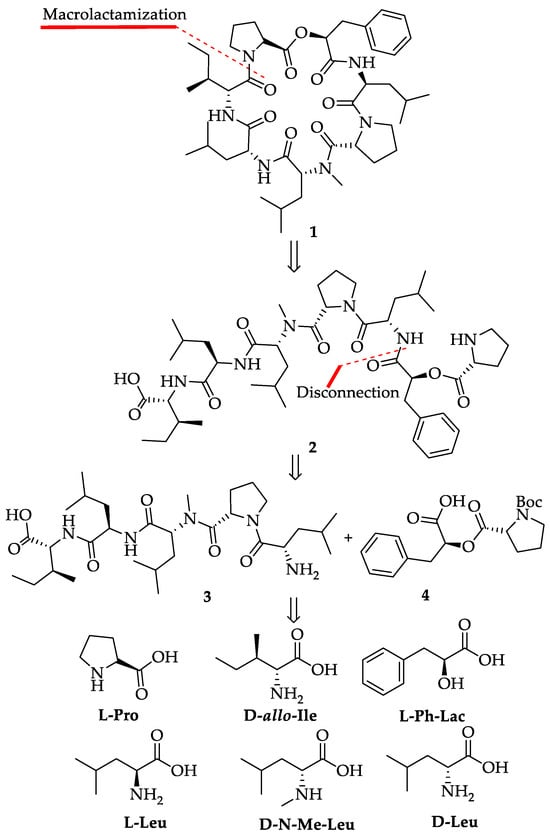
In the retrosynthetic analysis of xylaroamide A, selecting an appropriate cyclization site was crucial, as it defines the linear precursor sequence and directly affects macrocyclization efficiency. Several potential disconnection sites were considered. Macrocyclization via ester bond formation (macrolactonization) was anticipated to be more challenging and less efficient than amide bond formation. Consequently, the bond between the D-Ile and L-Pro residues was chosen as the cyclization site, enabling macrocycle formation through intramolecular macrolactamization. This site is additionally favorable because the adjacent proline residue may help preorganize the peptide backbone, promoting ring closure. Based on this strategy, linear precursor 2 was identified as the key intermediate. Further disconnection between the L-Ph-Lac and L-Leu residues afforded peptide 3 and ester fragment 4, both of which could be assembled from commercially available building blocks, including D-allo-Ile, D-Leu, N-Me-D-Leu, L-Pro, L-Leu, and L-Ph-Lac (Figure 2).
Figure 2.
Retrosynthetic analysis of xylaroamide A.
Because ester bond formation is generally more challenging in peptide synthesis, ester fragment 4 was prepared at an early stage of synthesis. L-Ph-Lac was first benzylated under cesium carbonate to afford the corresponding benzyl ester 5 in 95.2% yield. Subsequent coupling with Boc-L-Pro 6 proceeded smoothly to furnish intermediate 7 in 90.5% yield [19]. Finally, catalytic hydrogenolysis removed the benzyl protecting group, giving the desired ester fragment 4 in 98.3% yield (Scheme 1). To further verify that the absolute configuration of intermediate 7 was retained from its starting material, (±)-Ph-Lac was subjected to the same synthetic procedure to afford a diastereomeric mixture of 7. The diastereomeric mixture was then combined with intermediate 7 (purity: 95.7%, Figure S11), and HPLC analysis showed an increased peak at the same retention time as intermediate 7, confirming that the chiral centers remained unchanged during ester bond formation (Figure S12).
Scheme 1.
Synthetic route of ester 4.
With fragment 4 in hand, focus shifted to the assembly of linear precursor 2. Peptide synthesis can generally be achieved via solution- or solid-phase approaches, each suited to different levels of structural complexity [21,22,23,24]. Solution-phase synthesis often suffers from oligomerization, C-terminal epimerization, and cumbersome purification [25]. By contrast, solid-phase synthesis (SPPS) simplifies purification and limits intermolecular side reactions, making it particularly suitable for assembling complex peptide sequences. Among SPPS methodologies, the Boc/benzyl strategy requires strong acidic conditions (HF) for global deprotection [26,27], whereas the Fmoc/tBu protocol employs base-labile Fmoc protection and acid-labile side-chain protecting groups, allowing milder and operationally convenient deprotection steps [28]. Considering the safety concerns associated with HF, the Fmoc/tBu SPPS approach was adopted for the synthesis of linear precursor 2.
The linear assembly commenced with loading Fmoc-D-Ile onto 2-chlorotrityl chloride (2-CTC) resin in the presence of collidine, affording the corresponding amino acid-loaded resin 9 (Scheme 2) [29,30]. Remaining reactive sites on the resin were subsequently capped with MeOH under DIPEA to avoid undesired side reactions during chain elongation. Sequential Fmoc deprotection (20% piperidine in DMF) followed by coupling of the next Fmoc-protected amino acid using HATU/DIPEA enabled efficient chain elongation [31]. Notably, alternative coupling reagents such as DCC/HOBt, HBTU, and EDCI/HOBt were also evaluated but gave incomplete conversions, whereas HATU provided consistently higher coupling efficiency, particularly for sterically hindered residues such as N-Me-D-Leu. The peptide sequence was assembled through sequential incorporation of Fmoc-D-Leu, Fmoc-N-Me-D-Leu, Fmoc-L-Pro, and Fmoc-L-Leu, followed by coupling of ester fragment 4, ultimately furnishing the fully assembled resin-bound peptide 10.
Scheme 2.
Synthesis of xylaroamide A.
The resin-bound peptide 10 was cleaved from the 2-CTC resin under mild acidic conditions (0.5% TFA in DCM). Subsequent removal of the N-terminal Boc group with 50% TFA in DCM afforded crude linear peptide 2, which was obtained through precipitation and washing with cold diethyl ether. Macrocyclization was then performed under high-dilution conditions to minimize intermolecular oligomerization. Treatment of linear peptide 2 with HATU/HOAt in the presence of DIPEA in anhydrous DMF at room temperature for 48 h afforded the desired macrocyclic product. LC-MS monitoring of the cyclization reaction revealed no additional peaks with the same molecular weight as xylaroamide A, indicating that no detectable epimerization occurred during the cyclization step. After purification by means of preparative reversed-phase HPLC, cyclodepsipeptide 1 was obtained in 8.1% yield from the initial Fmoc-D-Ile. Alternative coupling conditions, including HBTU/DIPEA and EDCI/HOBT, were also evaluated; however, all of these conditions provided lower yields than the HATU/HOAt system.
3.2. Comparison of Synthetic and Natural Xylaroamide A by Means of NMR, MS, and Optical Rotation
The NMR spectroscopic data of synthetic xylaroamide A were compared in detail with reported data for natural xylaroamide A (Table 1). The 1H NMR spectra displayed identical signal patterns and multiplicities, with chemical shift deviations (Δδ) less than 0.04 ppm. Likewise, the 13C NMR signals showed deviations of no more than 0.2 ppm across all resonances. Mass spectrometric analysis further revealed a molecular ion peak consistent with the calculated value. Furthermore, solid-phase peptide synthesis is well known to effectively minimize racemization during peptide bond formation, supporting the stereochemical integrity of the synthesized compound. In addition, under identical conditions, the optical rotation of synthetic xylaroamide A was determined to be −7.8, which matches that of its natural counterpart (−8.0) [17]. Taken together, these results confirm that the synthetic xylaroamide A is identical to the isolated natural product.
Table 1.
Comparison of 1H and 13C NMR data for synthetic xylaroamide A and natural xylaroamide A (r.t., DMSO-d6) a.
4. Conclusions
In summary, we report the first total synthesis of xylaroamide A. Our strategy combines the solution-phase preparation of a key ester-containing building block with stepwise Fmoc-based solid-phase peptide synthesis to construct the linear peptide precursor. The absolute configuration of the key ester building block was confirmed through controlled experiments. Optimized intramolecular macrolactamization efficiently furnished the target macrocycle. The structure of the synthetic xylaroamide A was fully confirmed by means of optical rotation and NMR and MS analyses, showing agreement with the natural product. This work demonstrates a reliable approach to xylaroamide A and provides a foundation for future synthetic and biological studies.
Supplementary Materials
The following supporting information can be downloaded at https://www.mdpi.com/article/10.3390/chemistry8050055/s1. Figure S1: The 1H NMR spectrum of compound 5; Figure S2: The 1H NMR spectrum of compound 7; Figure S3: The 13C NMR spectrum of compound 7; Figure S4: The 1H NMR spectrum of compound 4; Figure S5: The 13C NMR spectrum of compound 4; Figure S6: The 1H NMR spectrum of synthetic xylaroamide A; Figure S7: The 13C NMR spectrum of synthetic xylaroamide A; Figure S8: HRMS of compound 7; Figure S9: HRMS of compound 4; Figure S10: MS of synthetic xylaroamide A; Figure S11: HPLC purity analysis of compound 7; Figure S12: HPLC analysis of the diastereomeric 7 + compound 7; Figure S13: HPLC purity analysis of compound 4; Figure S14: HPLC purity analysis of synthetic xylaroamide A.
Author Contributions
R.W.: investigation and writing—original draft; D.Q.: investigation; Y.S.J.: formal analysis and writing—original draft; X.X.: formal analysis; L.L.W.: validation, writing—review and editing; Y.F.: formal analysis; H.B.: formal analysis; Y.G.: supervision, conceptualization, funding acquisition, project administration, and writing—review and editing; S.S.: supervision, project administration, writing—review and editing, and conceptualization. All authors have read and agreed to the published version of the manuscript.
Funding
This research work was financially supported by the National Natural Science Foundation of China (No. 21967005), the Natural Science Foundation of Guangxi (No. 2023GXNSFAA026340, 2025GXNSFAA069947), and the Research Start-up Foundation of Guangxi Minzu University (No. 2019KJQD07).
Institutional Review Board Statement
Not applicable.
Informed Consent Statement
Not applicable.
Data Availability Statement
The original contributions presented in this study are included in the article/Supplementary Materials. Further inquiries can be directed to the corresponding authors.
Conflicts of Interest
The authors declare no conflict of interest.
References
- Marchi, R.D.; Mayer, J.P.; Gelfanov, V.M. Max bergmann award lecture: Macromolecular medicinal chemistry as applied to metabolic diseases. J. Pept. Sci. 2018, 24, 3056–3065. [Google Scholar] [CrossRef] [Scilit]
- Ji, A.X.; Bodanszky, M. Cyclization studies with a model pentapeptide. J. Pept. Sci. 2009, 22, 590–596. [Google Scholar] [CrossRef] [Scilit] [PubMed]
- Rochon, K.; Proteau-Gagné, A.; Bourassa, P.; Nadon, J.F.; Côte, J.; Bournival, V.; Gobeil, F.; Guérin, B.; Dory, Y.L.; Gendron, L. Preparation and evaluation at the delta opioid receptor of a series of linear leu-enkephalin analogues obtained by systematic replacement of the amides. ACS Chem. Neurosci. 2013, 4, 1204–1216. [Google Scholar] [CrossRef] [Scilit]
- Fernández, R.; Pérez, M.; Losada, A.; Reboredo, S.; Gómez-San, J.A.; Martín, M.J.; Francesch, A.; Munt, S.; Cuevas, C. Isolation and Total Synthesis of PM170453, a New Cyclic Depsipeptide Isolated from Lyngbya sp. Mar. Drugs 2024, 22, 303. [Google Scholar]
- Wang, X.; Gong, X.; Li, P.; Lai, D.; Zhou, L. Structural Diversity and Biological Activities of Cyclic Depsipeptides from Fungi. Molecules 2018, 23, 169. [Google Scholar] [CrossRef] [Scilit] [PubMed]
- Sivanathan, S.; Scherkenbeck, J. Cyclodepsipeptides: A Rich Source of Biologically Active Compounds for Drug Research. Molecules 2014, 19, 12368–12420. [Google Scholar] [CrossRef] [Scilit]
- Ramadhani, D.; Maharani, R.; Gazzali, A.M.; Muchtaridi, M. Cyclic Peptides for the Treatment of Cancers: A Review. Molecules 2022, 27, 4428. [Google Scholar] [CrossRef] [Scilit] [PubMed]
- Wang, L.; Wang, N.; Zhang, W.; Cheng, X.; Yan, Z.; Shao, G.; Wang, X.; Wang, R.; Fu, C. Therapeutic peptides: Current applications an future directions. Signal Transduct. Target. Ther. 2022, 7, 48. [Google Scholar] [CrossRef] [Scilit]
- Alonzo, D.A.; Schmeing, T.M. Biosynthesis of depsipeptides, or Depsi: The peptides with varied generations. Protein Sci. 2020, 29, 2316–2347. [Google Scholar] [CrossRef] [Scilit]
- Evans, B.J.; King, A.T.; Katsifis, A.; Matesic, L.; Jamie, J.F. Methods to Enhance the Metabolic Stability of Peptide-Based PET Radiopharmaceuticals. Molecules 2020, 25, 2314. [Google Scholar] [CrossRef] [Scilit]
- Buchanan, D.; Mori, S.; Chadli, A.; Panda, S.S. Natural cyclic peptides: Synthetic strategies and biomedical applications. Biomedicines 2025, 13, 240. [Google Scholar] [CrossRef] [Scilit]
- Andavan, G.S.B.; Lemmens-Gruber, R. Cyclodepsipeptides from marine sponges: Natural agents for drug research. Mar. Drugs 2010, 8, 810–834. [Google Scholar] [CrossRef] [Scilit] [PubMed]
- Moss, G.P.; Smith, P.A.S.; Tavernier, D. Glossary of class names of organic compounds and reactivity intermediates based on structure (IUPAC Recommendations 1995). Pure Appl. Chem. 1995, 67, 1307–1375. [Google Scholar] [CrossRef] [Scilit]
- Chen, N.; Tian, X.; Liu, B.; Zhu, T.; Zhao, J.; Li, T. Cyclodepsipeptides: Isolation, Bioactivities, Biosynthesis and Total Synthesis. Mini-Rev. Org. Chem. 2025, 22, 99–120. [Google Scholar] [CrossRef] [Scilit]
- Chen, N.; Huang, R.; Lan, H.; Jokela, J.; Wei, H.; Zhi, S.; Liu, L. Cyclic peptides from cyanobacteria: Structural insights, biological functions, and mechanisms of cyclization. Algal Res. 2025, 86, 103925. [Google Scholar] [CrossRef] [Scilit]
- He, C.; Jing, X.; Liu, B.; Liu, F.; Jin, K. Efficient Synthesis of Clovibactin and Its Analogues: Promoting the Discovery of More Potent Antibiotics via Multiple Screenings. ACS Infect. Dis. 2025, 11, 2568–2576. [Google Scholar] [CrossRef] [Scilit]
- Luo, M.; Chang, S.; Li, Y.; Xi, X.; Chen, M.; He, N.; Wang, M.; Zhao, W.; Xie, Y. Molecular networking-based screening led to the discovery of a cyclic heptadepsipeptide from an endolichenic Xylaria sp. J. Nat. Prod. 2022, 85, 972–979. [Google Scholar] [CrossRef] [Scilit]
- Armstrong, D.W.; Berthod, A. Occurrence of D-amino acids in natural products. Nat. Prod. Bioprospect. 2023, 13, 47. [Google Scholar] [CrossRef] [Scilit]
- Kaur, H.; Harris, P.W.R.; Little, P.J.; Brimble, M.A. Total Synthesis of the Cyclic Depsipeptide YM-280193, a Platelet Aggregation inhibitor. Org. Lett. 2015, 17, 492–495. [Google Scholar] [CrossRef] [Scilit]
- Carpino, L.A.; EI-Faham, A. Effect of Tertiary Bases on O-Benzotriazolyluronium Salt-Induced Peptide Segment Coupling. J. Org. Chem. 1994, 59, 695–698. [Google Scholar] [CrossRef] [Scilit]
- Biron, E.; Chatterjee, J.; Ovadia, O.; Langenegger, D.; Brueggen, J.; Hoyer, D.; Schmid, H.A.; Jelinek, R.; Gilon, C.; Hoffman, A. Improving oral bioavailability of peptides by multiple N-methylation: Somatostatin analogues. Angew. Chem. Int. Ed. 2008, 47, 2595–2599. [Google Scholar] [CrossRef] [Scilit] [PubMed]
- White, C.J.; Yudin, A.K. Contemporary strategies for peptide macrocyclization. Nat. Chem. 2011, 3, 509–524. [Google Scholar] [CrossRef] [Scilit] [PubMed]
- Lundquist, J.T.; Pelletier, J.C. A new tri-orthogonal strategy for peptide cyclization. Org. Lett. 2002, 4, 3219–3221. [Google Scholar] [CrossRef] [Scilit]
- Cai, Z.; Liu, L.; Zou, C.; Jiang, X.; Wang, G.; He, X.; Zhuang, W.; Yang, C.; Yao, Y.; Sun, X.; et al. Peptide synthesis: A review of classical and emerging methods. Biofabrication 2026, 18, 012001. [Google Scholar]
- Fuse, S. Accelerating innovation in peptide synthesis through continuous-flow. Org. Biomol. Chem. 2025, 23, 1062810645. [Google Scholar] [CrossRef] [Scilit]
- Paquette, A.R.; Boddy, C.N. Macrocyclization strategies for the total synthesis of cyclic depsipeptides. Org. Biomol. Chem. 2023, 21, 8043–8053. [Google Scholar] [CrossRef] [Scilit]
- Merrifield, R.B. Solid phase peptide synthesis I. The synthesis of a tetrapeptide. J. Am. Chem. Soc. 1963, 85, 2149–2154. [Google Scholar] [CrossRef] [Scilit]
- Noki, S.; de la Torre, B.G.; Albericio, F. Safety-catch linkers for solid-phase peptide synthesis. Molecules 2024, 29, 1429. [Google Scholar] [CrossRef] [Scilit]
- Atherton, E.; Fox, H.; Harkiss, D.; Logan, C.J.; Sheppard, R.C.; Williams, B.J. A mild procedure for solid phase peptide synthesis: Use of fluorenylmethyloxycarbonylamino-acids. J. Chem. Soc. Chem. Commun. 1978, 13, 537–539. [Google Scholar] [CrossRef] [Scilit]
- Barlos, K.; Chatzi, O.; Gatos, D.; Stavropoulos, G. 2-chlorotrityl chloride resin. Studies on anchoring of Fmoc-amino acids and peptide cleavage. Int. J. Pep. Protein Res. 1991, 37, 513–520. [Google Scholar]
- Lopez, J.; Beck, J.; Bucher, C.; Berthelmann, A.; Markos, S.; Eissler, S. Missing Link: Enabling Loading of 2-Chlorotrityl resin in N-Butylpyrrolidinone as a Green Solvent. Org. Process Res. Dev. 2022, 26, 1450–1457. [Google Scholar] [CrossRef] [Scilit]

Disclaimer/Publisher’s Note: The statements, opinions and data contained in all publications are solely those of the individual author(s) and contributor(s) and not of MDPI and/or the editor(s). MDPI and/or the editor(s) disclaim responsibility for any injury to people or property resulting from any ideas, methods, instructions or products referred to in the content. |
© 2026 by the authors. Licensee MDPI, Basel, Switzerland. This article is an open access article distributed under the terms and conditions of the Creative Commons Attribution (CC BY) license.