Review

Recent Advances in Antiaromatic Metallacycles Through Computational Chemistry Methods

1
State Key Laboratory of Fine Chemicals, Dalian University of Technology, Panjin 124221, China
2
School of Chemical Engineering, Ocean and Life Sciences, Dalian University of Technology, Panjin 124221, China
3
Leicester International Institute, Dalian University of Technology, Panjin 124221, China
*
Author to whom correspondence should be addressed.
Chemistry 2026, 8(4), 54; https://doi.org/10.3390/chemistry8040054

Submission received: 3 March 2026 / Revised: 12 April 2026 / Accepted: 15 April 2026 / Published: 21 April 2026

Abstract

In recent years, antiaromatic compounds have gained significant attention in optoelectronic materials, catalytic synthesis, and biomedicine due to their unique electronic structures and properties, emerging as a research frontier in organic chemistry. Over the past five years, a variety of novel antiaromatic metallacycles have been reported. Their electronic structures, however, differ significantly from those of conventional antiaromatic systems due to the involvement of transition metal d orbitals. In this context, computational methods, particularly density functional theory, play an important role in evaluating and understanding antiaromaticity. This paper reviews representative examples of antiaromatic metallacycles reported in the past five years, with particular emphasis on the critical role of computational chemistry methods in characterizing their antiaromatic nature, aiming to provide valuable insights for future research in this rapidly evolving area.

1. Introduction

Aromaticity, which is a fundamental concept in chemistry, has attracted the attention of chemists for nearly 200 years and has been evolving since Faraday isolated benzene in 1825 [1]. Notably, in recent years, antiaromatic compounds have received considerable attention from the academic community due to their breakthrough applications in materials science, catalytic conversion, and drug discovery. However, the intrinsic thermodynamic instability and high chemical reactivity of these species continue to pose significant challenges for their synthesis and characterization.
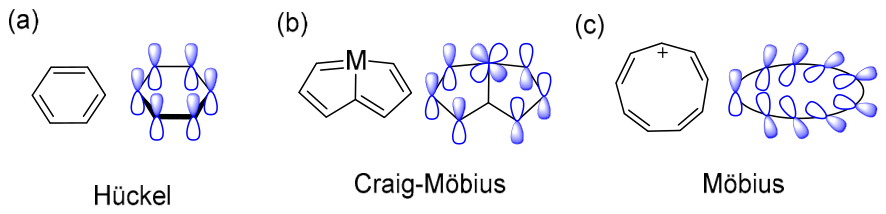
The definitions of aromaticity and antiaromaticity remain elusive at present. The widely accepted classification of aromaticity and antiaromaticity is mainly based on Hückel aromaticity [2], Baird’s aromaticity [3], and Möbius aromaticity [4,5]. In 1931, Hückel formulated the well-known [4n + 2] rule [2]: in a planar, monocyclic system of sp2-hybridized atoms, species with (4n + 2) π electrons are considered aromatic (Figure 1a). In 1967, Breslow introduced the concept of antiaromaticity for systems containing 4n π electrons as a supplement to aromaticity [6]. Earlier, in 1958, Craig first described a distinct type of aromaticity based on orbital symmetry in planar systems, typically referred to as Craig-type aromaticity (Figure 1b) [4]. In this case, the required orbital phase inversion is achieved through the d orbitals with pπ–dπ delocalization [7,8]. Subsequently, in 1964, Heilbronner first proposed Möbius aromaticity, which is distinct from the classical Hückel aromaticity [5]: cyclic 4n electron annulenes in the ground state may exhibit Möbius aromaticity if they adopt a twisted Möbius-strip geometry due to the phase inversion of the p-atomic orbitals (Figure 1c). In 1972, Baird argued that exceptions to the Hückel rule occur not only in Möbius topologies but also in the triplet state. Specifically, he proposed that when molecules are in their first excited triplet state, a planar conjugated ring system with 4n delocalized π electrons exhibits aromaticity [3]. In addition, based on the types of orbitals involved in delocalization, aromaticity can be further divided into σ aromaticity [9,10,11], π aromaticity, δ aromaticity [12], etc.
Common antiaromatic organic compounds include cyclobutadiene and [4n] π-electron annulenes, and this area has been comprehensively reviewed in the previous studies [13]. With the large-scale synthesis of organometallic compounds and the increasingly detailed investigations of their properties, a number of antiaromatic metal compounds have been reported over the past five years. Due to the involvement of transition-metal d orbitals, these metal compounds exhibit electronic structure characteristics that differ from those of conventional aromatic systems, rendering classical criteria such as Hückel’s rule difficult to apply [14].
Currently, experimental criteria commonly used to assess antiaromaticity in organometallic compounds include coplanarity, bond-length equalization, NMR chemical shifts, and reactivity [15]. However, these experimental criteria cannot directly measure antiaromaticity, since the determination of antiaromaticity mainly relies on evaluating the degree of electron delocalization, while experimental methods cannot directly observe transition states nor electron flow [16,17].
In contrast, computational chemistry offers a range of characterization methods based on density functional theory (DFT) calculations [18,19,20], including nucleus-independent chemical shift (NICS) [21], anisotropy of the induced current density (AICD) [22], and gauge-including magnetically induced currents (GIMIC) [23,24] for magnetic properties, as well as the aromatic stabilization energy (ASE) [25] for energy properties. Therefore, computational chemistry methods are significant for understanding the antiaromaticity of these compounds and classifying their different types of antiaromaticities.
Although we and our collaborators have previously reviewed the synthesis, structures, and general antiaromatic features of metallacycles using both computational and experimental approaches [26], a dedicated discussion from the computational perspective on how to determine and analyze antiaromaticity in these systems is still warranted due to the difficulty analyzing the antiaromaticity in metallacycles through experimental observations alone. This paper reviews representative examples of antiaromatic metallacycles reported over the past five years, with a particular focus on the critical role of computational chemistry methods in characterizing their antiaromatic nature. We aim to provide valuable insights for future research in this rapidly evolving area.

2. Useful Computational Methods

Computational chemistry methods for evaluating antiaromatic properties primarily involve magnetic, energetic, geometric, and orbital-based criteria. Given that methods based on magnetic properties are the most widely applied, we will briefly introduce the prevalent magnetic evaluation methods in this section, along with their strengths and weaknesses.

2.1. NICS

NICS can be regarded as a magnetic criterion that utilizes absolute magnetic shielding to determine aromaticity or antiaromaticity [21]. Originally, the NICS method quantifies aromaticity and antiaromaticity via calculating the negative value of absolute isotropic magnetic shielding at a ghost atom in the ring center, denoted as NICS(0) [21]. To mitigate the interference from in-plane σ-bonds at the ring center, NICS(1) was introduced by positioning the ghost atom 1 Å above the plane, thereby better reflecting π-electron delocalization [27]. Moreover, compared to the NICSiso, which represents an unweighted average of the three spatial components (xx, yy, and zz), the NICS(1)zz value, based on the NICS(1) and obtained by extracting only the tensor component perpendicular to the molecular plane (zz component), more effectively isolates the π-system’s characteristics by eliminating the magnetic contributions from the σ-electronic framework [27]. Owing to its conceptual simplicity and computational convenience, the NICS method has been widely used across various molecular architectures. It is a widely accepted qualitative criterion that a negative NICS value is associated with aromatic character, whereas a positive value denotes antiaromatic character [21]. For instance, the NICS(1)zz values of the classic antiaromatic compounds cyclobutadiene and pentalene are both positive, reported to be +65.1 ppm [28] and 58.2 ppm [29], respectively.
However, the NICS method is highly sensitive to local chemical effects, including contributions from in-plane local σ-bond electrons, lone pairs, and locally polarized electrons [30]. In particular, when evaluating metallacycles, NICS values may be affected by strong local paramagnetic currents around transition metal centers [31,32,33]. These magnetic responses, which arise from symmetry-allowed occupied-to-unoccupied excitations involving low-energy unoccupied orbitals [34,35], generate pronounced shielding or deshielding effects depending on their regions, yielding misleading NICS values especially when sampled by ghost atoms placed in the vicinity of the metal [36]. Consequently, this may contribute to the possible misassignment of antiaromatic character. In addition, for complex polycyclic systems, reliance on a single NICS value is insufficient to accurately capture local and global current-density distributions [30,37]. Therefore, a direct quantitative comparison of NICS magnitudes between structurally distinct systems could be misleading when assessing their relative antiaromatic strengths.

2.2. AICD

AICD serves as a representation of electron delocalization by calculating the anisotropic tensor of the magnetically induced current [22]. It evaluates electron delocalization by analyzing the direction of the induced current in a molecule subjected to an external magnetic field perpendicular to the molecular plane [22]. In aromatic systems, a clockwise ring current is generated, whereas antiaromatic systems exhibit a counterclockwise ring current. In contrast, nonaromatic systems display only locally anisotropic induced currents around individual atoms and do not sustain a continuous ring current [38]. By plotting isosurface maps of the anisotropic induced current density, the AICD method visualizes the direction of the induced current, directly reflecting the extent of electron delocalization and the orientation of ring currents, thus allowing for the assessment of antiaromaticity [39]. Nevertheless, this approach only provides a qualitative description of the current flow. Since the results may be sensitive to the choice of DFT and CSGT methods, precise quantification of the current magnitude remains challenging [39]. Furthermore, the visualization of ring currents via AICD can become ambiguous in complex, non-planar systems. Consequently, it is generally recommended to couple AICD with other analytical techniques to achieve multidimensional cross-validation.

2.3. GIMIC

GIMIC is an analytical tool that extracts induced current densities from nuclear magnetic shielding calculations [23,24]. It calculates the induced current-density vector field of a molecular system by processing the density matrix together with the magnetic-field derivative matrix, thereby enabling quantitative analysis of the current strength and direction at different positions within the molecule [23,24]. Compared with the AICD method, the GIMIC method can quantitatively determine the current intensity of a specific chemical bond by defining a cross-sectional plane and calculating the integrated flux of the current vector. This provides an objective and comparable metric for evaluating antiaromaticity, compensating for the shortcomings of the AICD method, which is mainly limited to qualitative visual analysis [24]. Moreover, while the original GIMIC program itself primarily relies on the total current density [40], making it difficult to disentangle the independent σ- and π-electron contributions, a new approach developed by Nasibullin et al. can successfully assess orbital contributions to magnetically induced current-density susceptibilities through gauge-including atomic orbitals [41]. Despite the advancement in GIMIC, it is often combined with the other methods to provide a more comprehensive and convincing assessment of the antiaromaticity of metallacycles.

3. Antiaromatic Compounds

3.1. Compounds with Antiaromatic Four-Membered Rings

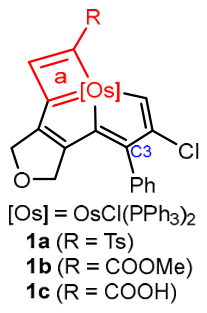
Similar to annulene [28] (cyclobutadiene), which possesses an intrinsically unstable antiaromatic framework characterized by a counterclockwise ring current observed in both AICD and GIMIC analyses, fused osmium heterocyclic cyclobutadiene compounds (1ac) were synthesized by Xia et al. in 2022 [42] (Figure 2). In these compounds, the osmium-containing cyclobutadiene ring exhibits antiaromatic character. Theoretical calculations were then carried out on a simplified model of 1a, in which the PPh3 ligand was replaced by PH3 and the phenyl group attached to C3 was omitted. The osmium cyclobutadiene unit displays a positive NICS(1)zz value of +25.8 ppm and a significant counterclockwise ring current in the AICD plot, indicating its antiaromaticity.

3.2. Compounds with Antiaromatic Five-Membered Rings

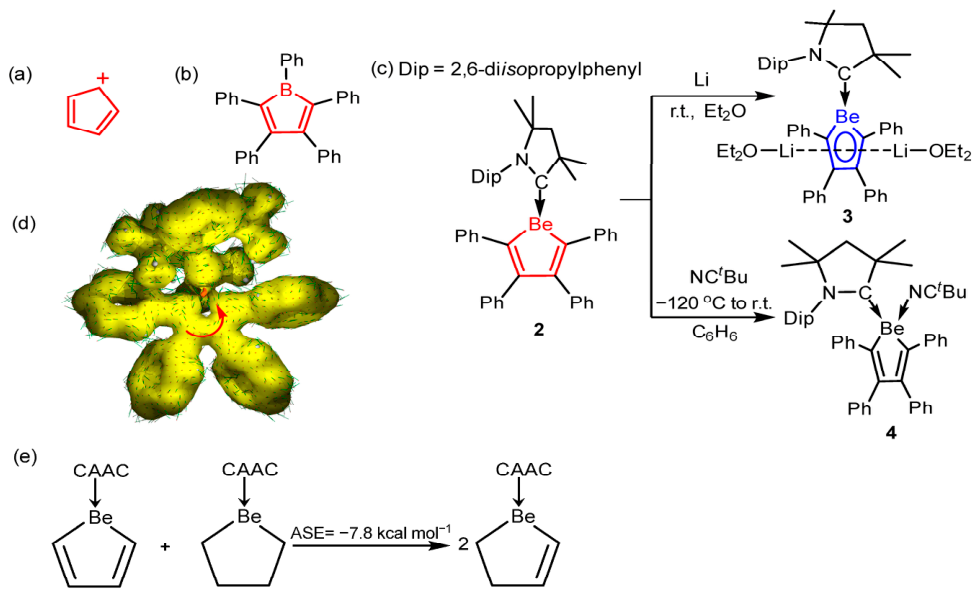
The cyclopentadienyl cation (Figure 3a) is a prototypical antiaromatic organic species, formally derived from cyclopentadiene by hydride abstraction and containing four π-electrons. According to Hückel’s 4n π-electron rule (n = 1), this electronic configuration renders the system antiaromatic, resulting in reduced stability compared with analogous nonaromatic or aromatic counterparts. In the 20th century, pentaphenylborole, another 4 π-electron heterocyclopentadiene (Figure 3b), was also identified as antiaromatic, as evidenced by a positive NICS(1)zz value of +26.1 ppm [43,44,45].
It was not until 2020 that the beryllium-containing heterocyclopentadiene 2, [(CAAC)BeC4Ph4] (Figure 3c), which contains four π electrons, was confirmed by Braunschweig et al. to be antiaromatic [46]. The complex comprises a cyclic (alkyl)(amino)carbene (CAAC) ligand coordinated to beryllium and a C4Ph4 fragment that provides the four π electrons. Reduction of 2 yields aromatic beryllole 3, which is a dianionic metallole, whereas addition of a second Lewis acceptor (t-BuNC, tert-butyl isocyanide) produces beryllole 4, which is essentially nonaromatic (showing negligible antiaromatic character). NICS calculations show that the NICS(1)zz and NICS(-1)zz values, evaluated 1 Å above and below the BeC4 ring plane, are +14.1 ppm and +13.5 ppm, respectively, indicating that it is antiaromatic. In addition, AICD analysis (Figure 3d) reveals a counterclockwise ring current, which is a characteristic of an antiaromatic system. The ASE of the simplified structure of compound 2 (where the Ph groups are replaced by H atoms) was calculated to be negative (Figure 3e), indicating destabilization of the ring and further supporting the antiaromatic character of the four-π-electron BeC4 ring in 2. The experiment also demonstrated the transformation of the antiaromatic beryllole 2 into aromatic and non-aromatic compounds.
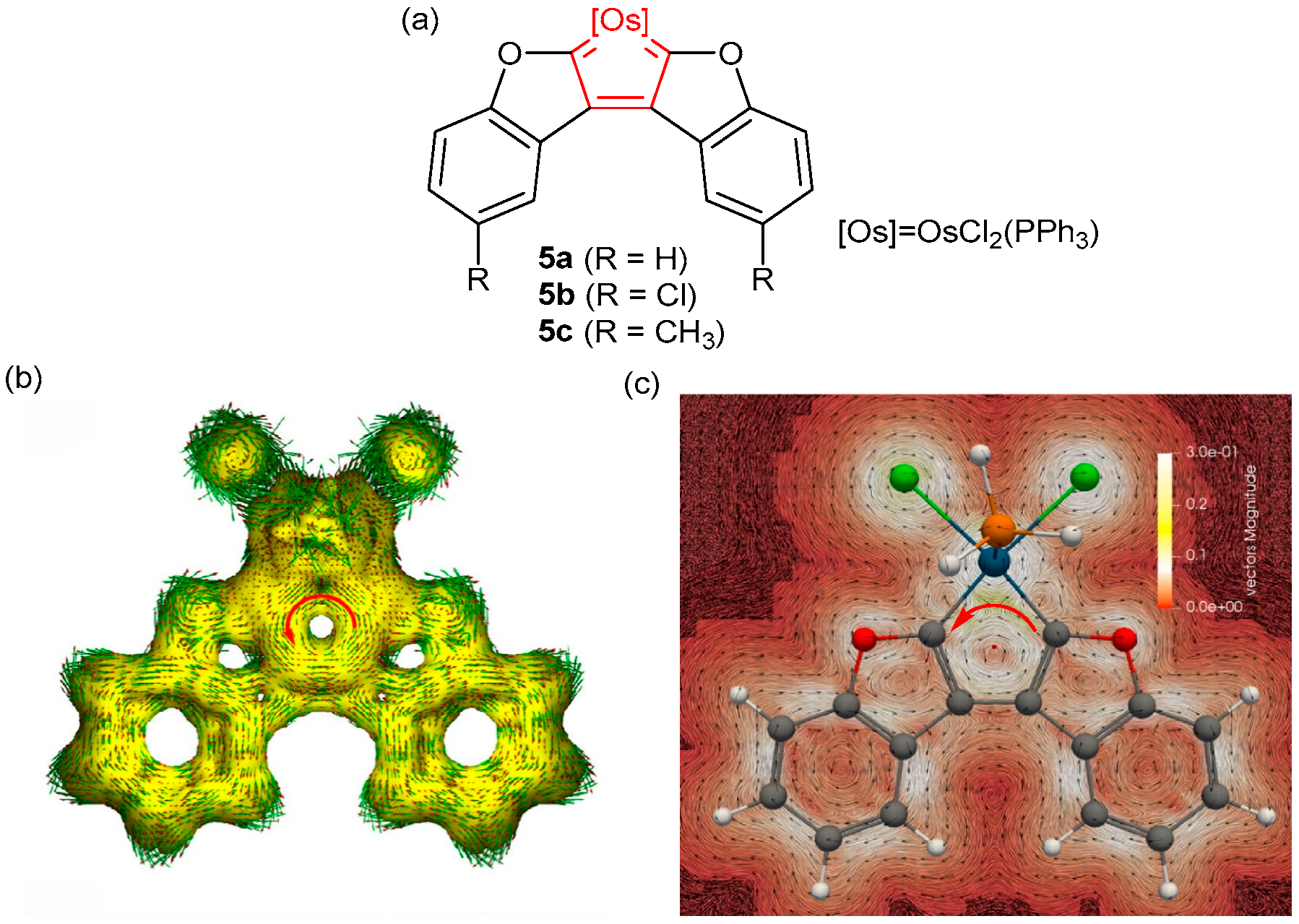
In 2024, Fu et al. [47] first investigated the antiaromatic properties of the metal cyclopentadienyl compound MC4R4. Single-crystal X-ray diffraction was used to determine the structure of 5a, revealing that it contains a fused pentacyclic structure with a localized five-membered OsC4 ring in the center (Figure 4a). The calculation results indicate that the NICS(1)zz value of the OsC4 ring in the model compound 5M ([Os]=OsCl2(PH3)2) of 5a is +35.19 ppm, and a counterclockwise ring current is observed in both the AICD and GIMIC plots, confirming the antiaromatic character of the osmium-cyclopentadienyl ring (Figure 4b,c). Furthermore, electronic structure analysis indicates that the three occupied π molecular orbitals form a 5-center 6-electron (5c-6e) Craig-type antiaromatic system.
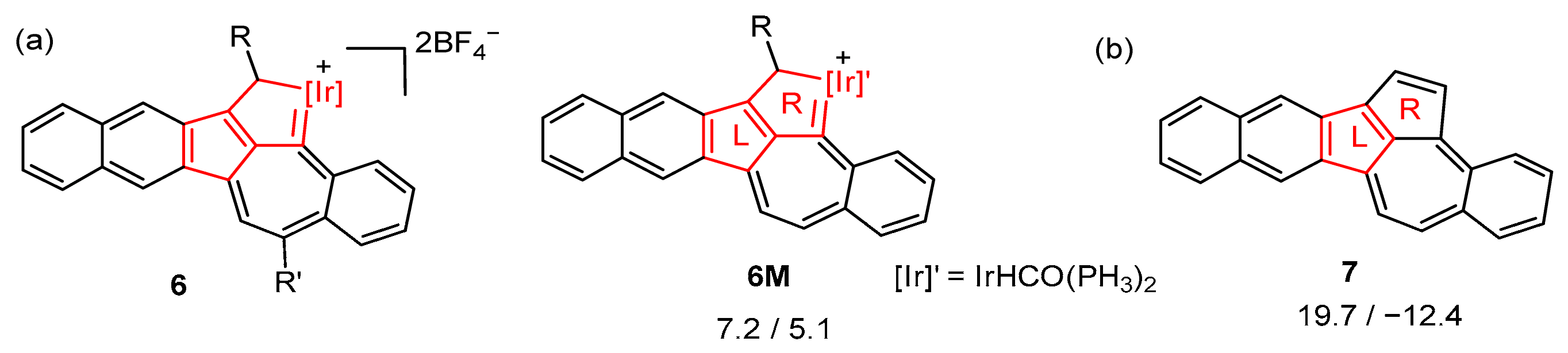
In 2024, Xia et al. [48] synthesized a novel azulene–metallacyclopentadiene–fused pentacene analog 6 (Figure 5a). Single-crystal X-ray diffraction confirmed that the compound consists of an azulene-fused pentacene moiety and a conjugated five-membered metallacycle. To facilitate the calculations, a simplified model complex 6M, in which the PPh3 ligand was replaced by PH3 and the aryl substituents were omitted, was employed to evaluate the aromaticity of compound 6. The positive NICS(1)zz values (+7.2 ppm for ring L and +5.1 ppm for ring R), together with the AICD analysis showing counterclockwise ring currents, indicate weak antiaromaticity in the five-membered rings. In addition, enhanced absorption in the low-energy region was observed for complex 6, which can be ascribed to the conjugated aryl substituents that shift the energy level of the pentacene HOMO and reduce the HOMO–LUMO energy gap.
In molecule 7, which corresponds to the replacement of the iridium fragment in 6M with a CH group, it was proposed that a competitive intramolecular charge transfer occurs from the electron-rich seven-membered ring to the electron-deficient five-membered rings L and R [49] (Figure 5b). Since ring R can participate in the overall aromaticity, charge transfer from the seven-membered ring is more likely to favor ring R rather than ring L, therefore giving rise to aromaticity in ring R and antiaromaticity in ring L. Compared with compound 7, complex 6M exhibits reduced π-conjugation due to the incorporation of a metal fragment into the R ring, while the fused L and R rings can be regarded as a metallacyclopentadiene analog showing antiaromaticity. Thus, this distinctive structure contributes to its characteristic antiaromaticity.
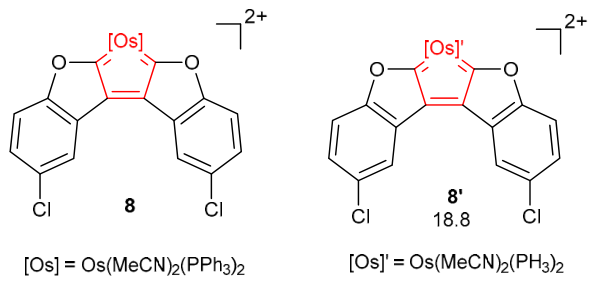
In 2025, Bai et al. reported the Craig-Möbius antiaromaticity of the five-membered metal ring in the osmacyclopentatriene dication 8 (Figure 6) [50]. Single-crystal X-ray diffraction results showed that the central part of the cation is a localized five-membered OsC4 ring with significant bond-length alternation. To simplify calculations, the researchers constructed a model compound 8′ by replacing PPh3 with PH3. Regarding the magnetic criteria, calculations show that the NICS(1)zz value of its metal ring is 18.8 ppm, revealing its antiaromatic properties. Furthermore, AICD and GIMIC analyses both show significant counterclockwise paratropic ring currents on the OsC4 ring, with pronounced current intensities between −3.45 and −4.55 nA/T, further verifying its antiaromaticity. Regarding the energy criteria, the isodesmic reaction energies are calculated to be negative, indicating that the metal ring is thermodynamically relatively unstable. Electronic structure analysis shows that, unlike the traditional Hückel antiaromatic system which follows the 4n electron rule, 8′ possesses three π molecular orbitals, one of which involves pπ-dπ interactions, resulting in a phase shift in the orbital of the central Os atom. This forms a 5-center, 6-electron (5c-6e) Craig-Möbius system, explaining the unique antiaromatic nature of this substance.

3.3. Compounds with Multiple Antiaromatic Rings

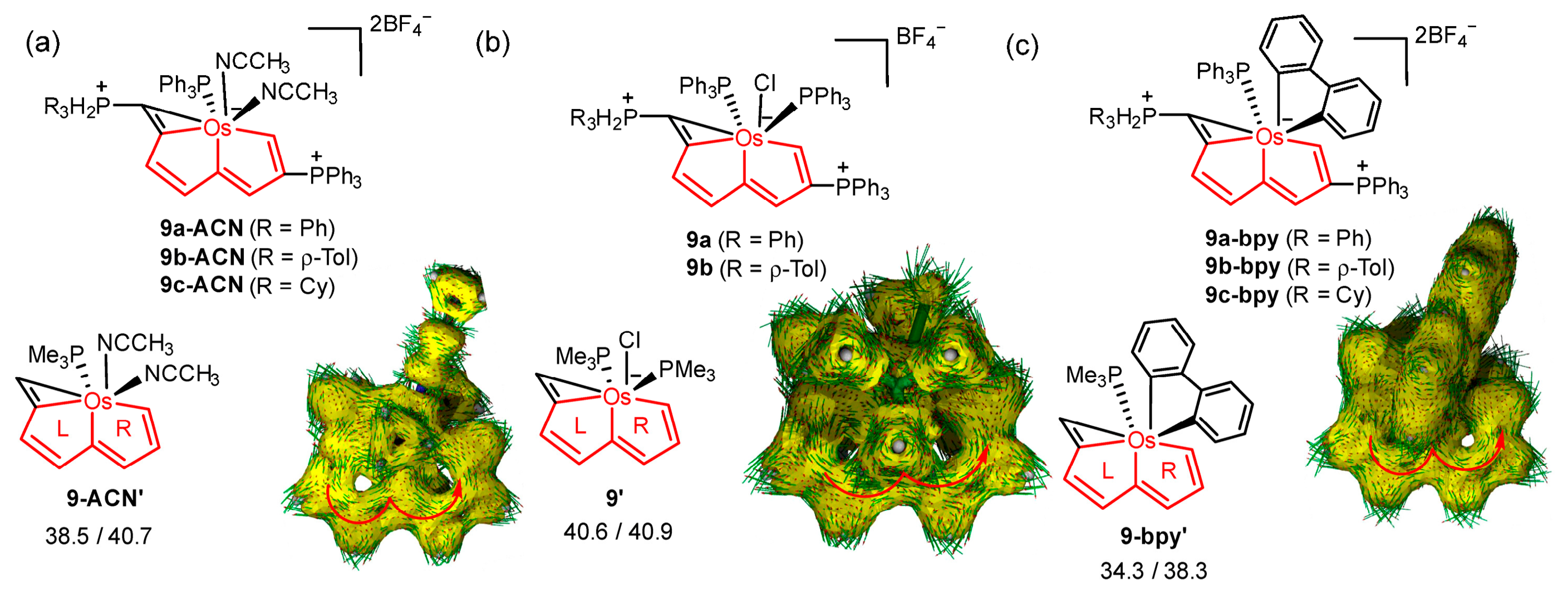
Pentalene is an ortho-fused bicyclic hydrocarbon composed of two cyclopentadiene rings. It contains eight π-electrons and is a prototypical antiaromatic conjugated polycyclic hydrocarbon [51]. In 2022, Chen et al. [15] reported the first planar Craig-type antiaromatic compound containing [4n + 2] π-electrons, a finding that complements ongoing studies in π-aromaticity and antiaromaticity. Aromatic osmapentalene compounds were deprotonated to afford eight corresponding antiaromatic complexes, as shown in Figure 7 (9-CAN, 9b-CAN, 9c-CAN, 9a, 9b, 9a-bpy, 9b-bpy, and 9c-bpy corresponding to variations in the ligand at Os and substituents on the three-membered ring).
To investigate the properties of the eight antiaromatic complexes, simplified models 9′, 9-ACN′, and 9-bpy′ were constructed by replacing the PPh3 ligand and PR3 substituents with smaller PMe3 ligands and hydrogen atoms. The NICS(0)zz values for the five-membered rings of 9′ (denoted as ring L and ring R) are +40.6 and +40.9 ppm, respectively, and positive NICS(0)zz values are also obtained for 9-ACN′ (+38.5 ppm for ring L and +40.7 ppm for ring R) and 9-bpy′ (+34.3 ppm for ring L and +38.3 ppm for ring R). A significant counterclockwise ring current is observed in the AICD plots of all three model complexes. Analysis of their electronic structures indicates that the five occupied π molecular orbitals collectively form an eight-center ten-electron (8c-10e) Craig-type antiaromatic system.
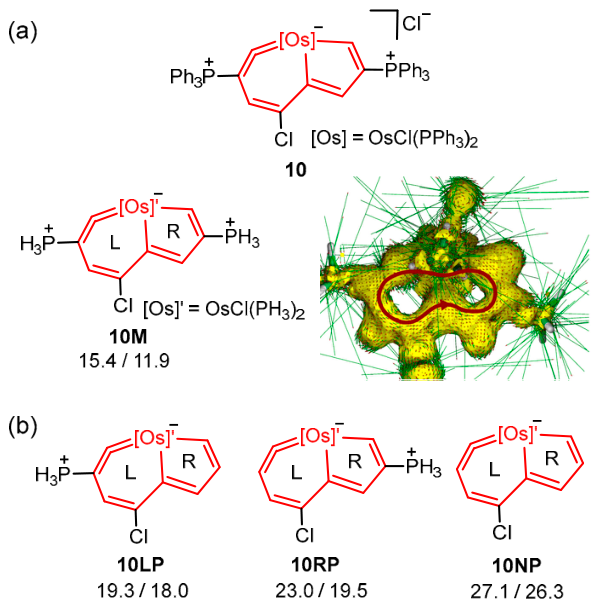
In 2023, Xia et al. [52] reported a highly distorted, antiaromatic metallacyclic compound 10 containing a cyclic metal-vinyl unit (Figure 8a). Single-crystal X-ray diffraction analysis confirmed that it adopts a fused iso-metallabenzene framework with pronounced alternation of single and double C–C bonds. To probe its aromaticity, DFT calculations were carried out on a simplified model complex 10M, in which the PPh3 ligand was replaced by the smaller PH3 ligand. Positive NICS(1)zz values (+15.4 ppm for ring L; +11.9 ppm for ring R) indicate antiaromatic character, and the larger NICS value for ring L suggests that ring L is more antiaromatic than ring R, consistent with a greater shielding effect in ring L. This assignment is supported by AICD analysis, which reveals a counterclockwise ring current delocalized along the periphery of the fused rings.
To further understand the aromaticity of complex 10, the effect of phosphorus substituents on 10 was investigated, including 10LP, 10RP, and 10NP (Figure 8b). Calculation results indicate that the NICS(1)zz values for these three complexes become progressively more positive as the number of phosphorus substituents decreases. Among them, the NICS(1)zz values of 10NP are +27.1 ppm for the L ring and +26.3 ppm for the R ring. These results suggest that the presence of phosphorus substituents can mitigate the antiaromaticity of 10. Moreover, the study also found that phosphorus substituents on the L ring have a greater impact on relieving antiaromaticity than those on the R ring, since the NICS(1)zz value of 10LP is slightly lower than that of 10RP. Therefore, incorporation of phosphorus substituents contributes to the stabilization of the antiaromatic system, an effect that has also been observed in metal bridgehead naphthalenes [53]. Overall, the stabilization of 10 can be attributed to the transition metal’s involvement in relieving ring strain and the phosphorus substituents’ contribution to reducing antiaromaticity.

3.4. Antiaromatic Porphyrinoids

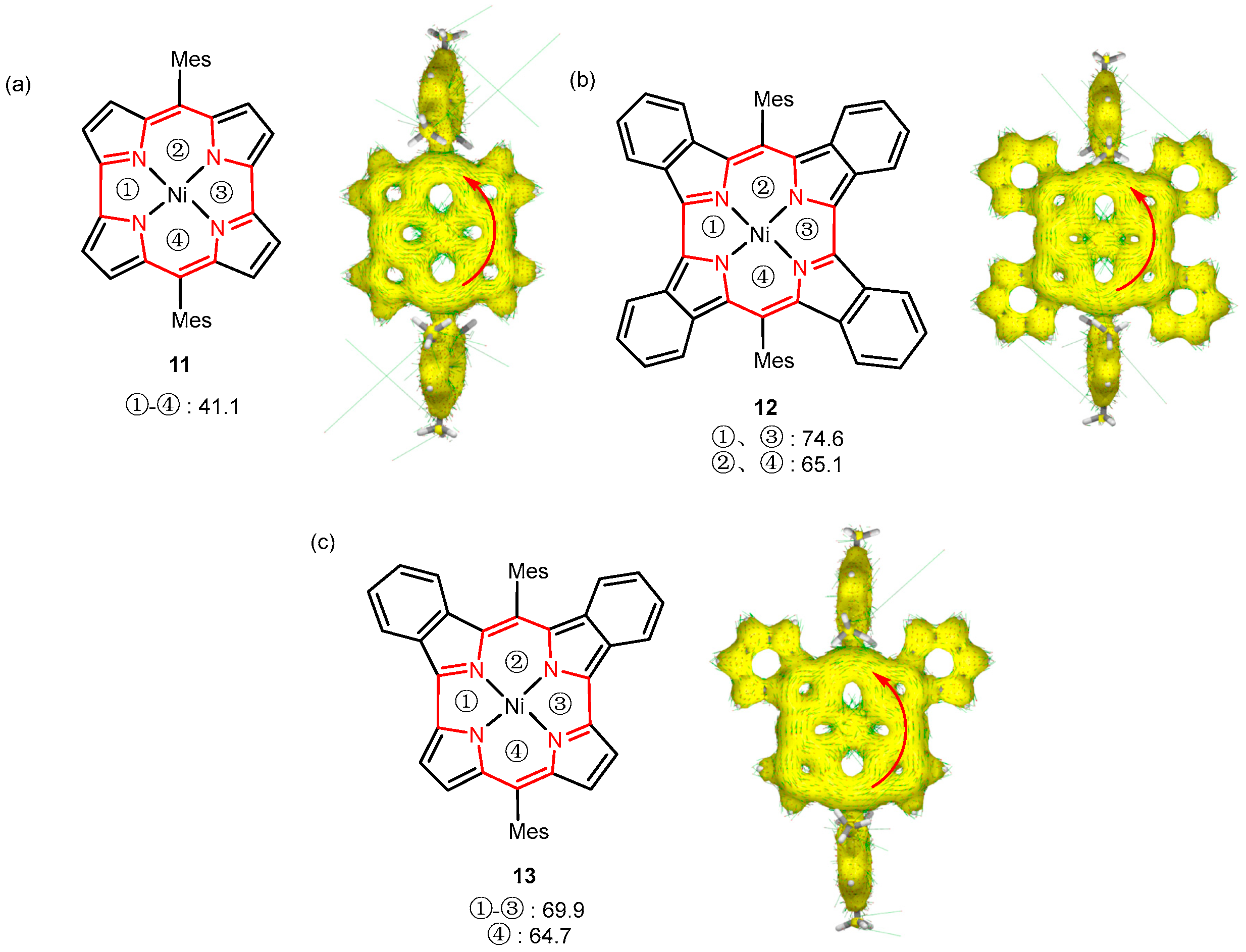
Porphyrinoids are a class of molecules based on pyrrole subunits and exhibiting structures and properties similar to those of porphyrins. Norcorrole is a macrocyclic molecule generated by the removal of two meso carbons from the aromatic framework of porphyrin, possessing a 16π-electron antiaromatic framework [54,55]. Benzo-fusion generally enhances the stability of antiaromatic compounds while simultaneously weakening their antiaromaticity. However, the norcorrole system exhibits the opposite phenomenon. In 2018, Shinokubo et al. [56] synthesized nickel-coordinated norcorrole compounds 11, 12, and 13 (Figure 9). DFT calculations reveal that the NICS(0) values of the four central rings are all substantially positive, ranging from +41.4 ppm to +74.6 ppm. In addition, a pronounced counterclockwise ring current is observed in the AICD plot. The incorporation of the fused benzene ring narrows the HOMO–LUMO energy gap, significantly enhancing the paramagnetic ring current and the antiaromaticity of the norcorrole 16π-electron framework.
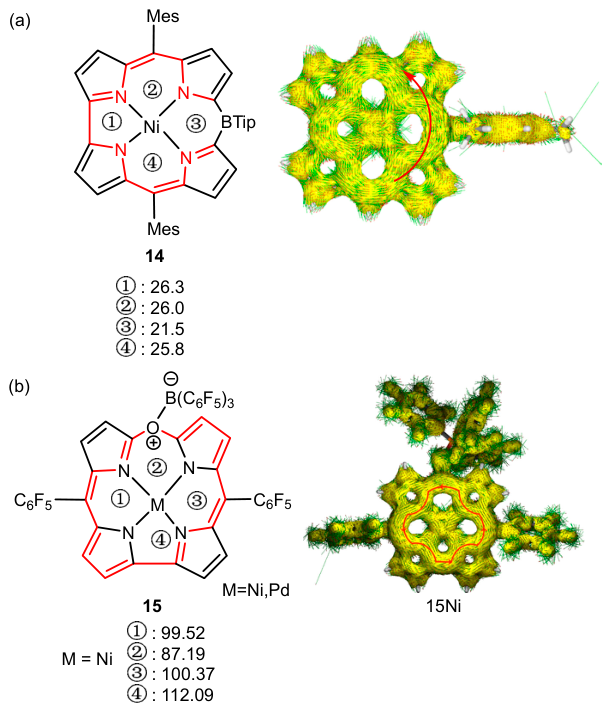
In 2019, Shinokubo et al. [57] synthesized a Ni(II) 10-boracorrole complex 14 (Figure 10a). 1H NMR spectroscopy of 14 indicates pronounced antiaromatic characteristics. Additionally, DFT calculations show markedly positive NICS(0) values in rings ①–④, and counterclockwise ring currents around the four rings can be observed in the AICD plot. Further analysis reveals that there exists effective p π * conjugation, which substantially lowers the LUMO energy level, resulting in a narrow HOMO–LUMO gap and a weak near-infrared absorption band.
In 2021, Osuka et al. [58] obtained an antiaromatic metal carboride derivative 15 (Figure 10b) through different metal coordination and Lewis acid interactions, and proved the antiaromaticity of the series of products by spectroscopic characterization, single-crystal X-ray diffraction, and DFT calculations. DFT calculations indicate that 15Ni exhibits distinctly positive NICS(1)zz values in rings ①–④, accompanied by an obvious counterclockwise ring current in the AICD plots. Notably, the addition of Lewis acid tris(pentafluorophenyl)borane effectively promotes the polarization of the carbonyl group and significantly enhances the antiaromaticity of the carboride 16π-electron framework.
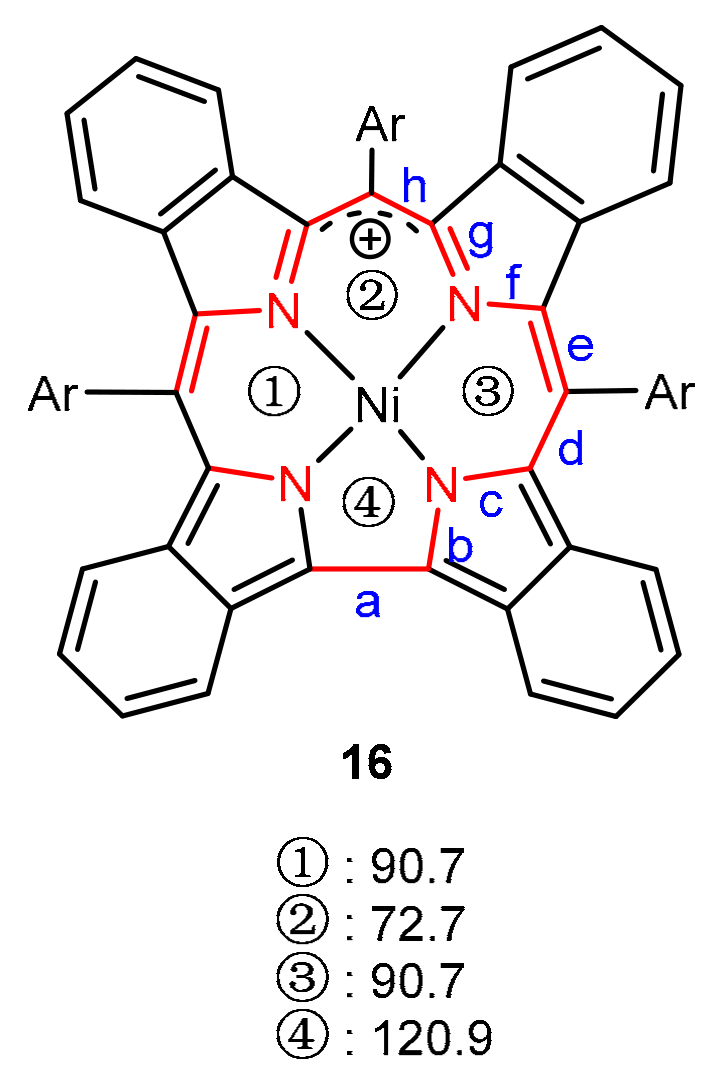
In 2022, Shen et al. [59] synthesized an electrically neutral, nickel-coordinated benzo-corrole radical with excellent photostability, thermal stability, and efficient photothermal-conversion performance. This 17π-electron nickel radical can be converted into the corresponding 16π-electron antiaromatic cation 16 via a single-electron redox process. The NICS(1)zz values of rings ①–④ in compound 16 are 90.7 ppm, 72.7 ppm, 90.7 ppm, and 120.9 ppm, respectively, indicating the antiaromatic character of its central rings (Figure 11). Meanwhile, the current intensities from bond a to bond h were calculated by numerical integration, with the integration object being the current flowing in the cross-sectional plane perpendicular to the selected bond. The current strengths of bonds a–h are −49.1, −39.3, −29.4, −40.7, −40.8, −29.2, −23.2, and −34.5 nA/T, respectively, forming a counterclockwise ring current, indicating its antiaromaticity.
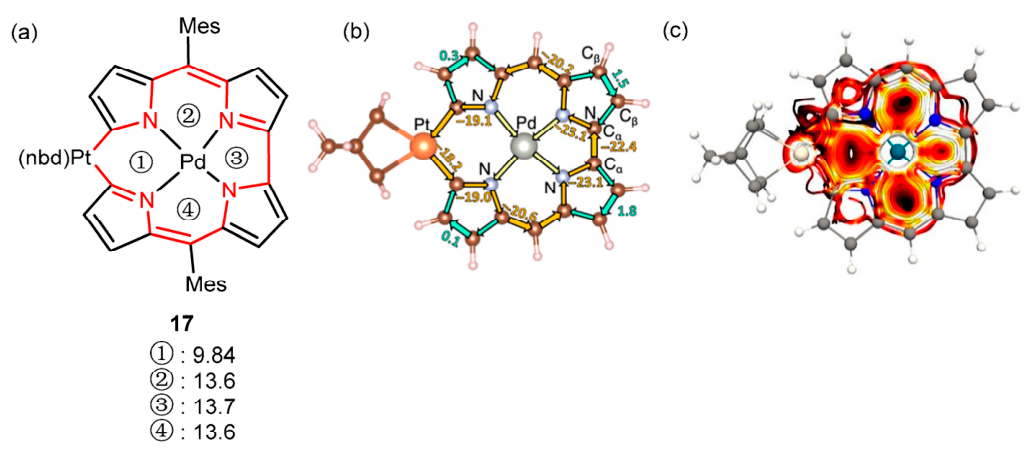
In 2024, Hiroshi et al. [60] synthesized Pd(II) 10-platinacorrole complexes with norbornadiene (NBD) ligands (Figure 12a), and confirmed the planar structure of the NBD complex by single-crystal X-ray diffraction and DFT calculations. The NICS(1)zz values of rings ①–④ in compound 17 were 9.84 ppm, 13.6 ppm, 13.7 ppm and 13.6 ppm, respectively, indicating the antiaromatic character of its central ring. Meanwhile, the current density susceptibility of its simplified model complex (with mesityl groups replaced by hydrogen atoms) was analyzed via current intensity studies adopting the GIMIC method by integrating the current density flowing through cross-sections perpendicular to selected bonds. The current strength of the bond (yellow) ranged from −23.1 to −18.2 nA/T, forming a counterclockwise ring current (Figure 12b,c), indicating its antiaromaticity. The 5dyz and 5dzx orbitals at the Pt center of the complex effectively overlap with the 2pz orbitals of adjacent carbon atoms, thus forming the effective π-conjugation through the Pt center which results in a distinct antiaromatic character for compound 17. Further investigations of the magnetic properties of compound 17, based on spectroscopic analysis and DFT calculations, reveal a significant counterclockwise ring current and a narrow HOMO-LUMO gap.

4. Conclusions

Aromaticity and antiaromaticity, as core concepts in chemistry, have continuously driven the in-depth development of theoretical and experimental investigations since their discovery. Research on antiaromaticity has not only deepened our understanding of the nature of chemical bonds but also provided important support for the design of functional molecules. In this article, we introduce several useful DFT-based computational methods and summarize their application to typical metallacycles, covering four-membered rings, five-membered rings, multiple ring systems, and porphyrinoids, which demonstrates that modern computational chemistry methods possess sufficient accuracy and reliability, providing a solid foundation for the design and synthesis of antiaromatic molecules.
However, despite significant progress, many challenges remain to be addressed. A major issue is the lack of a unified standard for evaluating antiaromaticity by computational chemistry methods [61]. Although the antiaromaticity can now be assessed using energetic, magnetic, structural, and orbital indices, these indices are not strictly equivalent and may not always lead to fully consistent assignments, which may in some cases complicate or even bias the judgement of antiaromaticity. Furthermore, some computational methods may be over-relied upon or applied beyond their optimal scope of applicability when evaluating antiaromaticity, yielding unreliable assessments [62]. Such misapplications often stem from the unjustified extrapolation of a method’s applicability or the incorrect selection of computational parameters. As previously noted, relying solely on NICS for transition-metal-containing metallacycles is problematic due to the interference from local magnetic contributions [30,37]. These issues warrant the attention of researchers in both computational chemistry and experimental chemistry.

Author Contributions

Resources, L.Z. and Y.W.; writing—original draft preparation, L.Z. and Y.W.; writing—review and editing, Y.L.; supervision, Y.L.; project administration, Y.L.; funding acquisition, Y.L. All authors have read and agreed to the published version of the manuscript.

Funding

This research was supported by the National Natural Science Foundation of China (21903010).

Data Availability Statement

No new data were created or analyzed in this study. Data sharing is not applicable to this article.

Conflicts of Interest

The authors declare no conflicts of interest.

References

  1. Babbage, C.; Herschel, J.F.W. XXI. Account of the repetition of M. Arago’s experiments on the magnetism manifested by various substances during the act of rotation. Philos. Trans. R. Soc. London 1825, 115, 467–496. [Google Scholar] [CrossRef]
  2. Hückel, E. Quantentheoretische Beiträge zum Benzolproblem. I. Die Elektronenkonfiguration des Benzols und verwandter Verbindungen. Z. Phys. 1931, 70, 204–286. [Google Scholar] [CrossRef]
  3. Baird, N.C. Quantum Organic Photochemistry. II. Resonance and Aromaticity in the Lowest 3.Pi..Pi.* State of Cyclic Hydrocarbons. J. Am. Chem. Soc. 1972, 94, 4941–4948. [Google Scholar] [CrossRef]
  4. Craig, D.P.; Paddock, N.L. A Novel Type of Aromaticity. Nature 1958, 181, 1052–1053. [Google Scholar] [CrossRef]
  5. Heilbronner, E. Hückel molecular orbitals of Möbius-type conformations of annulenes. Tetrahedron Lett. 1964, 5, 1923–1928. [Google Scholar] [CrossRef]
  6. Breslow, R.; Groves, J.T.; Ryan, G. Cyclopropenyl Cation. J. Am. Chem. Soc. 1967, 89, 5048. [Google Scholar] [CrossRef]
  7. Lin, X.; Wei, M.; Mo, Y. Craig Excited-State Aromaticity in Metallabenzenes: How, When, and Why? J. Am. Chem. Soc. 2026, 148, 7044–7055. [Google Scholar] [CrossRef]
  8. Rabe, A.; Wang, Q.; Sundholm, D. Unraveling the Enigma of Craig-Type Möbius-Aromatic Osmium Compounds. Dalton Trans. 2024, 53, 10938–10946. [Google Scholar] [CrossRef]
  9. Benson, S.W.; Cruickshank, F.R.; Golden, D.M.; Haugen, G.R.; O’Neal, H.E.; Rodgers, A.S.; Shaw, R.; Walsh, R. Additivity Rules for the Estimation of Thermochemical Properties. Chem. Rev. 1969, 69, 279–324. [Google Scholar] [CrossRef]
  10. Zhu, C.; Zhou, X.; Xing, H.; An, K.; Zhu, J.; Xia, H. σ-Aromaticity in an Unsaturated Ring: Osmapentalene Derivatives Containing a Metallacyclopropene Unit. Angew. Chem. Int. Ed. 2015, 54, 3102–3106. [Google Scholar] [CrossRef] [PubMed]
  11. Wu, W.; Ma, B.; I-Chia Wu, J.; von Ragué Schleyer, P.; Mo, Y. Is Cyclopropane Really the σ-Aromatic Paradigm? Chem. Eur. J. 2009, 15, 9730–9736. [Google Scholar] [CrossRef] [PubMed]
  12. Zhai, H.; Averkiev, B.B.; Zubarev, D.Y.; Wang, L.; Boldyrev, A.I. δ Aromaticity in [Ta3O3]. Angew. Chem. Int. Ed. 2007, 46, 4277–4280. [Google Scholar] [CrossRef]
  13. Lavendomme, R.; Yamashina, M. Antiaromaticity in Molecular Assemblies and Materials. Chem. Sci. 2024, 15, 18677–18697. [Google Scholar] [CrossRef]
  14. Zhu, C.; Xia, H. Carbolong Chemistry: A Story of Carbon Chain Ligands and Transition Metals. Acc. Chem. Res. 2018, 51, 1691–1700. [Google Scholar] [CrossRef]
  15. Chen, L.; Lin, L.; Nath, A.R.; Zhu, Q.; Chen, Z.; Wu, J.; Wang, H.; Li, Q.; Lin, W.-F.; Zhu, J.; et al. Synthesis and Characterization of Craig-Type Antiaromatic Species with [4n + 2] π Electrons. Proc. Natl. Acad. Sci. USA 2023, 120, e2215900120. [Google Scholar] [CrossRef]
  16. Zhu, Q.; Chen, S.; Chen, D.; Lin, L.; Xiao, K.; Zhao, L.; Solà, M.; Zhu, J. The Application of Aromaticity and Antiaromaticity to Reaction Mechanisms. Fundam. Res. 2023, 3, 926–938. [Google Scholar] [CrossRef] [PubMed]
  17. Sundholm, D.; Fliegl, H.; Berger, R.J.F. Calculations of Magnetically Induced Current Densities: Theory and Applications. WIREs Comput. Mol. Sci. 2016, 6, 639–678. [Google Scholar] [CrossRef]
  18. Becke, A.D. Density-Functional Thermochemistry. III. The Role of Exact Exchange. J. Chem. Phys. 1993, 98, 5648–5652. [Google Scholar] [CrossRef]
  19. Lee, C.; Yang, W.; Parr, R.G. Development of the Colle-Salvetti Correlation-Energy Formula into a Functional of the Electron Density. Phys. Rev. B 1988, 37, 785–789. [Google Scholar] [CrossRef]
  20. Hay, P.J.; Wadt, W.R. Ab Initio Effective Core Potentials for Molecular Calculations. Potentials for K to Au Including the Outermost Core Orbitals. J. Chem. Phys. 1985, 82, 299–310. [Google Scholar] [CrossRef]
  21. Schleyer, P.V.R.; Maerker, C.; Dransfeld, A.; Jiao, H.; Van Eikema Hommes, N.J.R. Nucleus-Independent Chemical Shifts: A Simple and Efficient Aromaticity Probe. J. Am. Chem. Soc. 1996, 118, 6317–6318. [Google Scholar] [CrossRef]
  22. Herges, R.; Geuenich, D. Delocalization of Electrons in Molecules. J. Phys. Chem. A 2001, 105, 3214–3220. [Google Scholar] [CrossRef]
  23. Jusélius, J.; Sundholm, D.; Gauss, J. Calculation of Current Densities Using Gauge-Including Atomic Orbitals. J. Chem. Phys. 2004, 121, 3952–3963. [Google Scholar] [CrossRef]
  24. Fliegl, H.; Taubert, S.; Lehtonen, O.; Sundholm, D. The Gauge Including Magnetically Induced Current Method. Phys. Chem. Chem. Phys. 2011, 13, 20500. [Google Scholar] [CrossRef]
  25. Dewar, M.J.S.; Schmeising, H.N. A Re-Evaluation of Conjugation and Hyperconjugation: The Effects of Changes in Hybridisation on Carbon Bonds. Tetrahedron 1959, 5, 166–178. [Google Scholar] [CrossRef]
  26. Li, L.; Li, Y.; Jiang, W.; Bai, W. Recent Advances in Antiaromatic Metallacycles. Dalton Trans. 2025, 54, 4432–4436. [Google Scholar] [CrossRef]
  27. Solà, M.; Feixas, F.; Jiménez-Halla, J.O.C.; Matito, E.; Poater, J. A Critical Assessment of the Performance of Magnetic and Electronic Indices of Aromaticity. Symmetry 2010, 2, 1156–1179. [Google Scholar] [CrossRef]
  28. Esselman, B.J.; McMahon, R.J. Effects of Ethynyl Substitution on Cyclobutadiene. J. Phys. Chem. A 2012, 116, 483–490. [Google Scholar] [CrossRef] [PubMed]
  29. Baranac-Stojanović, M.; Stojanović, M. The Effect of Two Types of Dibenzoannulation of Pentalene on Molecular Energies and Magnetically Induced Currents. Phys. Chem. Chem. Phys. 2019, 21, 3250–3263. [Google Scholar] [CrossRef] [PubMed]
  30. Mayer, P.J.; Ottosson, H. False Identification of (Anti)Aromaticity in Polycyclic Molecules in Ground and Excited States Through Incorrect Use of NICS. J. Phys. Org. Chem. 2025, 38, e70000. [Google Scholar] [CrossRef]
  31. Cuyacot, B.J.R.; Badri, Z.; Ghosh, A.; Foroutan-Nejad, C. Metallaaromaticity—A Protean World. Phys. Chem. Chem. Phys. 2022, 24, 27957–27963. [Google Scholar] [CrossRef]
  32. Badri, Z.; Pathak, S.; Fliegl, H.; Rashidi-Ranjbar, P.; Bast, R.; Marek, R.; Foroutan-Nejad, C.; Ruud, K. All-Metal Aromaticity: Revisiting the Ring Current Model among Transition Metal Clusters. J. Chem. Theory Comput. 2013, 9, 4789–4796. [Google Scholar] [CrossRef]
  33. Cuyacot, B.J.R.; Foroutan-Nejad, C. [{Th(C8H8)Cl2}3]2− Is Stable but Not Aromatic. Nature 2022, 603, E18–E20. [Google Scholar] [CrossRef] [PubMed]
  34. Novotny, J.; Komorovsky, S.; Marek, R. Paramagnetic Effects in NMR Spectroscopy of Transition-Metal Complexes: Principles and Chemical Concepts. Acc. Chem. Res. 2024, 57, 1467–1477. [Google Scholar] [CrossRef] [PubMed]
  35. Cuyacot, B.J.R.; Foroutan-Nejad, C. Aromatic, or Antiaromatic, That Is the Question. ChemRxiv 2021. Preprints. [Google Scholar] [CrossRef]
  36. Foroutan-Nejad, C. Is NICS a Reliable Aromaticity Index for Transition Metal Clusters? Theor. Chem. Acc. 2015, 134, 8. [Google Scholar] [CrossRef]
  37. Kleinpeter, E.; Koch, A. Identification and Quantification of Local Antiaromaticity in Polycyclic Aromatic Hydrocarbons (PAHs) Based on the Magnetic Criterion. Org. Biomol. Chem. 2024, 22, 3035–3044. [Google Scholar] [CrossRef]
  38. Blasco, D.; Sundholm, D. The Aromatic Nature of Auracycles and Diauracycles Based on Calculated Ring-Current Strengths. Dalton Trans. 2024, 53, 10150–10158. [Google Scholar] [CrossRef] [PubMed]
  39. Geuenich, D.; Hess, K.; Köhler, F.; Herges, R. Anisotropy of the Induced Current Density (ACID), a General Method to Quantify and Visualize Electronic Delocalization. Chem. Rev. 2005, 105, 3758–3772. [Google Scholar] [CrossRef]
  40. Sundholm, D.; Dimitrova, M.; Berger, R.J.F. Current Density and Molecular Magnetic Properties. Chem. Commun. 2021, 57, 12362–12378. [Google Scholar] [CrossRef]
  41. Nasibullin, R.T.; Dimitrova, M.; Valiev, R.R.; Sundholm, D. Orbital Contributions to Magnetically Induced Current Densities Using Gauge-Including Atomic Orbitals. Chem. Sci. 2025, 16, 8040–8052. [Google Scholar] [CrossRef]
  42. Zhuo, K.; Liu, Y.; Ruan, K.; Hua, Y.; Lin, Y.-M.; Xia, H. Ring Contraction of Metallacyclobutadiene to Metallacyclopropene Driven by π- and σ-Aromaticity Relay. Nat. Synth. 2022, 2, 67–75. [Google Scholar] [CrossRef]
  43. Eisch, J.J.; Hota, N.K.; Kozima, S. Synthesis of Pentaphenylborole, a Potentially Antiaromatic System. J. Am. Chem. Soc. 1969, 91, 4575–4577. [Google Scholar] [CrossRef]
  44. Eisch, J.J.; Galle, J.E.; Kozima, S. Bora-Aromatic Systems. Part 8. The Physical and Chemical Consequences of Cyclic Conjugation in Boracyclopolyenes. The Antiaromatic Character of Pentaarylboroles. J. Am. Chem. Soc. 1986, 108, 379–385. [Google Scholar] [CrossRef] [PubMed]
  45. Braunschweig, H.; Fernández, I.; Frenking, G.; Kupfer, T. Structural Evidence for Antiaromaticity in Free Boroles. Angew. Chem. Int. Ed. 2008, 47, 1951–1954. [Google Scholar] [CrossRef] [PubMed]
  46. Roy, D.K.; Tröster, T.; Fantuzzi, F.; Dewhurst, R.D.; Lenczyk, C.; Radacki, K.; Pranckevicius, C.; Engels, B.; Braunschweig, H. Isolation and Reactivity of an Antiaromatic s-Block Metal Compound. Angew. Chem. Int. Ed. 2021, 60, 3812–3819. [Google Scholar] [CrossRef]
  47. Fu, B.; Wang, Y.; Zhao, Y.; Li, Y.; Jiang, W.; Bai, W. Antiaromatic Metallacyclopentatriene Complexes. J. Am. Chem. Soc. 2024, 146, 30790–30795. [Google Scholar] [CrossRef]
  48. He, Y.; Zhu, Y.; Luo, M.; Xia, H. A Nonalternant Analogue of Pentacene Incorporating a Non-Terminal Azulene Unit. Chin. Chem. Lett. 2025, 36, 110463. [Google Scholar] [CrossRef]
  49. Ong, A.; Tao, T.; Jiang, Q.; Han, Y.; Ou, Y.; Huang, K.; Chi, C. Azulene-Fused Acenes. Angew. Chem. Int. Ed. 2022, 61, e202209286. [Google Scholar] [CrossRef]
  50. Fu, B.; Zhao, Y.; Li, Y.; Jiang, W.; Bai, W. Osmacyclopentatrienyl Radicals with a Delocalized Unpaired Electron. Chin. Chem. Lett. 2025; in press. [CrossRef]
  51. Barboza, C.A.; Barboza, E.; Arratia-Perez, R.; Carey, D.M.-L. Methylation and the System-Size Effect over the Structural, Electronic, Magnetic (NICS) and Reactive Properties of Pentalene Derivatives. Chem. Phys. Lett. 2012, 545, 88–94. [Google Scholar] [CrossRef]
  52. Li, Q.; Hua, Y.; Tang, C.; Chen, D.; Luo, M.; Xia, H. Isolation, Reactivity, and Tunable Properties of a Strained Antiaromatic Osmacycle. J. Am. Chem. Soc. 2023, 145, 7580–7591. [Google Scholar] [CrossRef]
  53. Tang, C.; Zhao, Y.; Wu, J.; Chen, Z.; Liu, L.L.; Tan, Y.-Z.; Zhu, J.; Xia, H. Releasing Antiaromaticity in Metal-Bridgehead Naphthalene. J. Am. Chem. Soc. 2021, 143, 15587–15592. [Google Scholar] [CrossRef] [PubMed]
  54. Shafie, S.A.; Nozawa, R.; Takano, H.; Shinokubo, H. Radical Reactivity of Antiaromatic Ni(II) Norcorroles with Azo Radical Initiators. Beilstein J. Org. Chem. 2024, 20, 1967–1972. [Google Scholar] [CrossRef]
  55. Ghosh, A.; Wasbotten, I.H.; Davis, W.; Swarts, J.C. Norcorrole and Dihydronorcorrole: A Predictive Quantum Chemical Study. Eur. J. Inorg. Chem. 2005, 2005, 4479–4485. [Google Scholar] [CrossRef]
  56. Yoshida, T.; Takahashi, K.; Ide, Y.; Kishi, R.; Fujiyoshi, J.; Lee, S.; Hiraoka, Y.; Kim, D.; Nakano, M.; Ikeue, T.; et al. Benzonorcorrole NiII Complexes: Enhancement of Paratropic Ring Current and Singlet Diradical Character by Benzo-Fusion. Angew. Chem. Int. Ed. 2018, 57, 2209–2213. [Google Scholar] [CrossRef]
  57. Omori, H.; Shinokubo, H. Ni(II) 10-Boracorrole: An Antiaromatic Porphyrinoid Containing a Boron Atom at the Meso-Position. Organometallics 2019, 38, 2878–2882. [Google Scholar] [CrossRef]
  58. Ueta, K.; Kim, J.; Ooi, S.; Oh, J.; Shin, J.; Nakai, A.; Lim, M.; Tanaka, T.; Kim, D.; Osuka, A. Meso-Oxoisocorroles: Tunable Antiaromaticity by Metalation and Coordination of Lewis Acids as Well as Aromaticity Reversal in the Triplet Excited State. J. Am. Chem. Soc. 2021, 143, 7958–7967. [Google Scholar] [CrossRef]
  59. Gao, H.; Wu, F.; Zhao, Y.; Zhi, X.; Sun, Y.; Shen, Z. Highly Stable Neutral Corrole Radical: Amphoteric Aromatic–Antiaromatic Switching and Efficient Photothermal Conversion. J. Am. Chem. Soc. 2022, 144, 3458–3467. [Google Scholar] [CrossRef]
  60. Miwa, K.; Yokota, T.; Wang, Q.; Sakurai, T.; Fliegl, H.; Sundholm, D.; Shinokubo, H. Metallaantiaromaticity of 10-Platinacorrole Complexes. J. Am. Chem. Soc. 2024, 146, 1396–1402. [Google Scholar] [CrossRef]
  61. Ding, W.; Zhang, Z.; Chen, X.; Zhan, C. Assessment of the Performance of Six Indices in Predicating the Aromaticity of Planar Porphyrinoids. J. Mol. Model. 2023, 29, 83. [Google Scholar] [CrossRef] [PubMed]
  62. Ottosson, H. A Focus on Aromaticity: Fuzzier than Ever Before? Chem. Sci. 2023, 14, 5542–5544. [Google Scholar] [CrossRef] [PubMed]
Figure 1. Aromaticity types and representative molecules. (a) Benzene; (b) metallapentalene; (c) cyclononatetraenyl cation.
Chemistry 08 00054 g001
Figure 2. The structure of the fused osmacyclobutadiene compound and its simplified model [42].
Chemistry 08 00054 g002
Figure 3. (a) Structure of the cyclopentadienyl cation; (b) structure of pentaphenylborole; (c) structure and transformation of the beryllole compound 2; (d) AICD plot of compound 2; (e) reaction equation for the ASE of the model complex of compound 2 [43,44,45,46]. Reproduced with permission from [46]. Copyright 2021 Wiley-VCH Verlag GmbH & Co. KGaA.
Chemistry 08 00054 g003
Figure 4. (a) Structure of the metallacyclopentatriene compound 5; (b) AICD plot of the model compound 5M of 5a; (c) GIMIC map of the model compound 5M of 5a [47]. Reproduced with permission from [47]. Copyright 2024 American Chemical Society.
Chemistry 08 00054 g004
Figure 5. (a) Structure of the azulene-fused metallapentalene pentacene analog 6 and the NICS(1)zz value of its model complex 6M. (b) Structure of azulene-cyclopentadiene-fused pentacene analog compound 7 and its NICS(1)zz values [48].
Chemistry 08 00054 g005
Figure 6. Structure of the osmacyclopentatriene dication 8 and its model complex 8′ with the NICS(1)zz value (in ppm) [50].
Chemistry 08 00054 g006
Figure 7. (a) Structure of compound 9-ACN along with the NICS(0)zz values and AICD plot of its model complex 9-ACN’; (b) structure of compound 9 along with the NICS(0)zz values and AICD plot of its model complex 9′; (c) structure of compound 9-bpy along with the NICS(0)zz values and AICD plot of its model complex 9-bpy′ [15]. Reproduced with permission from [15]. Copyright 2023 National Academy of Sciences.
Chemistry 08 00054 g007
Figure 8. (a) Structure of the antiaromatic metall complex 10, along with the NICS(1)zz values (in ppm) and AICD plot of its model complex 10M; (b) structure of the phosphorus-substituted derivatives 10LP, 10RP, and 10NP, along with their respective NICS(1)zz values [52]. Reproduced with permission from [52]. Copyright 2023 American Chemical Society.
Chemistry 08 00054 g008
Figure 9. (a) Structure of nickel-coordinated norcorrole compound 11, (b) nickel-coordinated norcorrole compound 12, (c) nickel-coordinated norcorrole compound 13, along with NICS(0) values (in ppm) and AICD plots [56]. Reproduced with permission from [56]. Copyright 2018 Wiley-VCH Verlag GmbH & Co. KGaA.
Chemistry 08 00054 g009
Figure 10. (a) The structure of the Ni(II) 10-boraporphyrin complex 14, along with its NICS(0) values and AICD plot [57]; reproduced with permission from [57]. Copyright 2019 American Chemical Society. (b) The structure of the metal corrole derivative 15, along with the NICS(1)zz value and AICD plot of its nickel complex 15Ni [58]. Reproduced with permission from [58]. Copyright 2021 American Chemical Society.
Chemistry 08 00054 g010
Figure 11. The structure of the Ni-coordinated benzocorrole cation 16 and NICS(1)zz value [59].
Chemistry 08 00054 g011
Figure 12. (a) The structure of the Pd(II) 10-Pt(NBD)- heteroporphyrin complex 17 and its NICS(1)zz value; (b) GIMIC analysis showing the current density susceptibility of the NBD model complex; (c) GIMIC analysis of the counterclockwise paratropic ring current in compound 17 [60]. Reproduced with permission from [60]. Copyright 2024 American Chemical Society.
Chemistry 08 00054 g012
Disclaimer/Publisher’s Note: The statements, opinions and data contained in all publications are solely those of the individual author(s) and contributor(s) and not of MDPI and/or the editor(s). MDPI and/or the editor(s) disclaim responsibility for any injury to people or property resulting from any ideas, methods, instructions or products referred to in the content.