


Abstract
The scientific problem addressed in this study is how a continuous mechanical architecture can maintain stable lettuce handling while improving treatment-medium access to irregular, overlapping leaf surfaces. We formulate this problem as a morphology-informed design and evaluation task. The proposed machine integrates soil removal, a reserved vision-based yellow-leaf detection and root-trimming station, multi-angle disinfection, water–air washing, combined airflow drying, film wrapping, weighing, and boxing modules on a chain-conveyor platform with bowl-shaped fixtures. The evaluation follows a design-to-evidence workflow: lettuce morphology and process requirements are mapped to module geometry; chain, lead-screw, gear, and motor parameters are checked analytically; an application-oriented geometric spray-coverage model tests fixed versus swinging bilateral nozzles; static finite element analysis screens the frame under defined design loads; and prototype assembly verifies spatial compatibility. The covered-surface proxy increased from 7.24% for fixed bilateral spraying to 13.58% for a ±35° swinging case under explicit screening assumptions, while the frame analysis gave 0.0224 mm maximum deformation and 7.30 MPa maximum von Mises stress. These outputs support a preliminary, mechanically feasible platform and a testable explanation for why adjustable spray orientation may improve access to complex lettuce surfaces. They do not constitute measured cleaning, microbial, trimming, drying, packaging, throughput, or reliability performance.
1. Introduction
The demand for fresh-cut and ready-to-eat vegetables has increased rapidly with the expansion of central kitchens, fresh-produce distribution systems, and consumer preference for convenient and standardized food products. Lettuce is one of the most widely consumed leafy vegetables, but its postharvest processing remains mechanically challenging. The leaves are arranged in overlapping layers and form deep internal grooves and narrow gaps, where soil particles, organic residues, and microorganisms may be retained. Previous studies have shown that the surface topography of leafy vegetables can reduce the effectiveness of washing and disinfection, because contaminants may be protected within grooves, stomata, or other microstructures [1,2]. Conventional washing systems, including flume washing and spray washing, are widely used in industrial processing, but their cleaning efficiency can be limited by insufficient contact between the washing medium and complex leaf surfaces [3,4]. In addition, several preprocessing operations, such as yellow-leaf removal, root trimming, drying, wrapping, and boxing, still rely partly on manual handling or independent single-function equipment, which reduces processing continuity and increases the difficulty of standardization.
To improve the safety and quality of fresh produce, many studies have investigated advanced washing and sanitizing technologies. Gaseous ozone has been studied because of its diffusivity and potential to reach areas that are difficult for liquid sanitizers to access [5]. Other emerging methods, such as ultrasound-assisted treatment, cold plasma, and microbubble or nanobubble technologies, have also been explored to enhance contaminant removal and microbial inactivation [6,7,8]. Equipment-level innovations have also been reported. For example, in-flight washing has been proposed to improve contact between the washing medium and lettuce surfaces compared with conventional flume systems [9]. These studies provide useful technical routes for individual treatment steps. However, studies of integrated agricultural machinery, automated primary handling, and packaging generally emphasize mechanical coordination and material transfer, whereas washing studies often evaluate only one treatment step. The present work addresses this engineering integration problem and does not claim that the proposed structure has already demonstrated food-safety or product-quality performance.
Recent progress has also been made in the mechanization and automation of leafy-vegetable handling. Automatic lettuce-harvesting mechanisms have integrated cutting and leaf-removal functions to reduce field labor requirements [10]. Primary-processing and packaging machines have been developed to combine selected handling operations [11], and reviews of fresh-produce equipment have highlighted the need to coordinate product handling, cleaning, and sanitation within a hygienic processing line. In parallel, inline monitoring and control strategies for sanitizer concentration, pH, and wash-water quality have been investigated to support more stable disinfection management in fresh-produce processing [12,13,14]. These studies indicate a clear trend toward automated and controllable processing systems. Nevertheless, for lettuce postharvest processing, an engineering gap remains in the development of a compact mechanical platform that can connect soil removal, yellow-leaf and root trimming, disinfection, washing, drying, wrapping, weighing, and boxing in a continuous workflow.
From a mechanical-design perspective, such a system must solve several coupled problems. First, individual lettuce heads must be transferred between stations with stable positioning and limited mechanical damage. Second, the trimming, spraying, washing, drying, and wrapping modules must be spatially compatible within a compact frame. Third, the drive and transmission components must provide sufficient torque, speed, positioning resolution, and motion stability for intermittent and continuous operations. Fourth, the supporting frame must maintain adequate stiffness and strength under the defined design loads. Fluid-mechanics studies on cleaning and decontamination also suggest that spray direction, impingement, airflow assistance, and medium distribution are important structural factors for treating complex surfaces [15]. Therefore, before cleaning efficiency, microbial reduction, or product quality can be fully evaluated, the preliminary mechanical feasibility of an integrated lettuce-processing machine should first be established.
To address this need, this study asks the following scientific design question: can a morphology-informed continuous machine architecture simultaneously stabilize lettuce posture, connect multiple postharvest operations, and improve the geometric access of washing media to overlapping leaf surfaces while remaining mechanically feasible under explicit design cases? The working expectation is that bowl-shaped fixtures reduce posture variation, bilateral and swinging spray directions increase the accessible surface proxy, and the resulting transmission/frame design remains feasible within the recorded motor and load parameters. To examine this question, the study uses a staged design-to-evidence methodology described in Section 3.5. The main contributions are (1) a morphology-informed modular mechanical layout for continuous lettuce postharvest processing; (2) structural designs that connect handling requirements to the geometry of trimming, spraying, washing, drying, wrapping, weighing, and boxing modules; (3) analytical and parameterized checks of the principal transmission components; (4) a geometric spray-coverage model and parameter-window analysis for the proposed swinging nozzle architecture; and (5) prototype assembly and static finite element screening of the integrated frame. The present work therefore contributes a mechanically explicit research framework and preliminary evidence chain. Cleaning efficiency, disinfection performance, leaf damage, throughput, and resource consumption remain hypotheses for controlled validation rather than claims of completed experiments.
Scientific Question and Methodological Framework
Lettuce is not treated here as a geometrically uniform object. Its overlapping leaves, internal grooves, fragile outer layers, and variable posture create a coupled design problem: the conveyor must stabilize the product without excessive contact, while spray, air, imaging, trimming, and wrapping elements must reach the product without interfering with one another. The central scientific question is therefore whether a mechanically integrated architecture can convert these morphology and process constraints into a verifiable chain of design decisions.
The study evaluates this question at three linked levels. At the system level, module order, transfer posture, and installation space are evaluated from the continuous material-flow requirement. At the component level, motor, chain, lead-screw, and gear parameters are evaluated using force, speed, torque, resolution, and contact-ratio calculations. At the application level, a geometry-based spray model evaluates whether changing nozzle orientation increases the portion of a corrugated lettuce surface that can be reached by effective spray directions. These levels are connected by the static frame analysis and the assembled prototype, but none is interpreted as a substitute for controlled food-processing experiments.
The resulting evidence chain is intentionally bounded: design calculations test internal mechanical consistency; the spray model tests a geometric access mechanism; finite element analysis tests a stated static load case; and the prototype photograph tests spatial integration. The research outcome is consequently a testable mechanical explanation and evaluation framework, not a claim of validated cleaning or food-safety performance.
2. Mechanical Architecture and Module Design
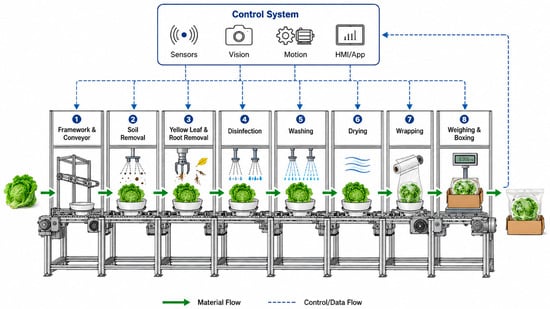
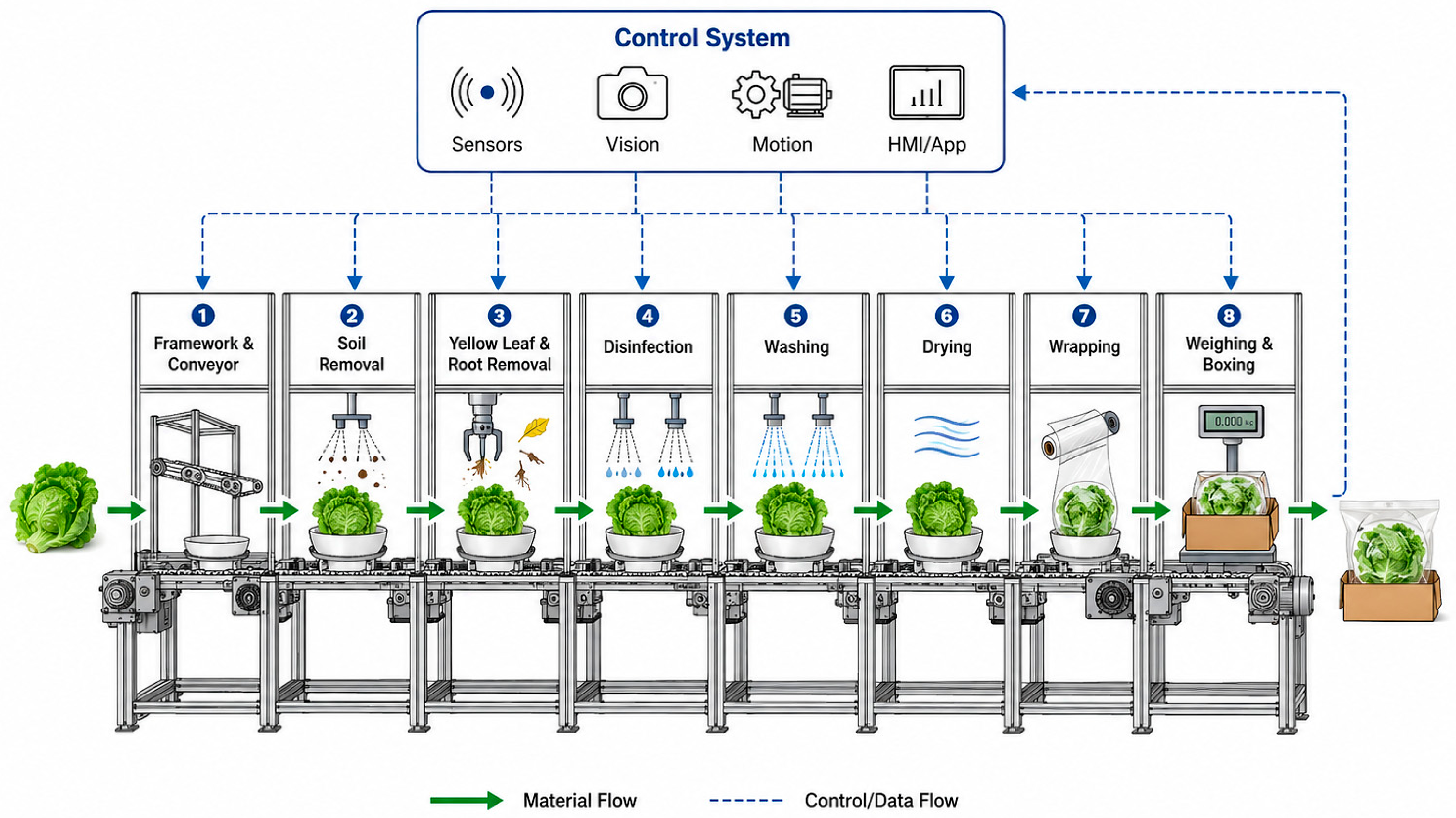
The proposed machine was designed as a continuous mechanical platform for lettuce postharvest processing. The design focuses on reducing discontinuity among processing steps and providing a structural basis for subsequent evaluation of cleaning quality, leaf protection, and processing efficiency. Figure 1 is a schematic process-flow representation and is not drawn to scale.
Figure 1.
Overall workflow and module arrangement of the integrated lettuce-processing machine (not to scale; arrows indicate material flow and module order).
The machine integrates several functional modules along a linear conveyor path, including soil removal, yellow-leaf and root trimming, disinfection, washing, drying, wrapping, weighing, and boxing. A control-system interface is reserved for future coordination of sensors, actuators, and the human-machine interface, providing a basis for later automated operation.
The following sections detail the design of each core module, identify the principal components, and describe the supporting mechanical framework.
2.1. Frame and Conveyor Platform
The frame and conveyor form the basic mechanical platform of the integrated machine. The machine adopts an aluminum-alloy truss structure to provide installation support for the conveyor, sensors, motors, laser unit, spraying units, fan units, wrapping mechanism, and weighing structure. The truss layout was selected to provide sufficient rigidity while maintaining accessibility for assembly, maintenance, and module adjustment. In Figure 2, the principal elements are the truss frame, conveyor rail, drive and driven sprockets, bowl-shaped fixtures, and mounting brackets.
Figure 2.
Aluminum-alloy truss frame and conveyor-support structure, including the conveyor rail, sprockets, bowl-shaped fixtures, and mounting brackets.
A chain conveyor equipped with bowl-shaped fixtures is used to transfer individual lettuce heads. The fixture diameter, depth, spacing, material, and allowable lettuce-size range are design parameters that must be finalized against the target product population. These parameters determine positioning stability, contact area, and the risk of mechanical damage to the leaves [10]. This arrangement is intended to reduce direct compression of the leaves and provide repeatable positioning for subsequent trimming, spraying, washing, drying, and wrapping operations. Vibration-damping components are arranged at key support positions to improve positioning stability during operation.
2.2. Soil-Removal Module
The soil-removal module was designed as a preliminary impurity-removal unit before disinfection and washing. As shown in Figure 3, the module consists of the conveyor-side frame brackets, two vertical air ducts, nozzle outlets, and the upstream and downstream conveyor path. The ducts are installed on both sides of the conveyor, and the nozzles are arranged to generate intersecting air streams toward the lettuce surface and internal gaps as the lettuce passes through the station.
Figure 3.
Bilateral air-duct structure for preliminary soil removal, showing the opposing ducts and nozzle outlets along the conveyor path.
This module is intended to loosen soil particles and fine debris with limited direct mechanical contact. The fixed bilateral layout simplifies maintenance and cleaning, while the frame-mounted ducts maintain the intended relative position to the conveyor. The actual soil-removal efficiency requires controlled evaluation under different lettuce sizes, postures, airflow rates, and conveyor speeds; no such performance dataset is claimed here.
2.3. Yellow-Leaf and Root-Trimming Module
The yellow-leaf and root-trimming module was designed to combine leaf-region positioning, non-contact removal, and root cutting within one processing station. As shown in Figure 4, the principal components are the photoelectric sensor, camera/laser mount, lifting and rotating platform, guide structure, bottom cutting mechanism, and frame supports. When a lettuce head reaches the target position, the photoelectric sensor triggers intermittent stopping of the conveyor to provide a stable posture for scanning and trimming.
Figure 4.
Structure of the yellow-leaf and root-trimming module, including the sensor, camera/laser mount, lifting platform, guide structure, and bottom cutting mechanism.
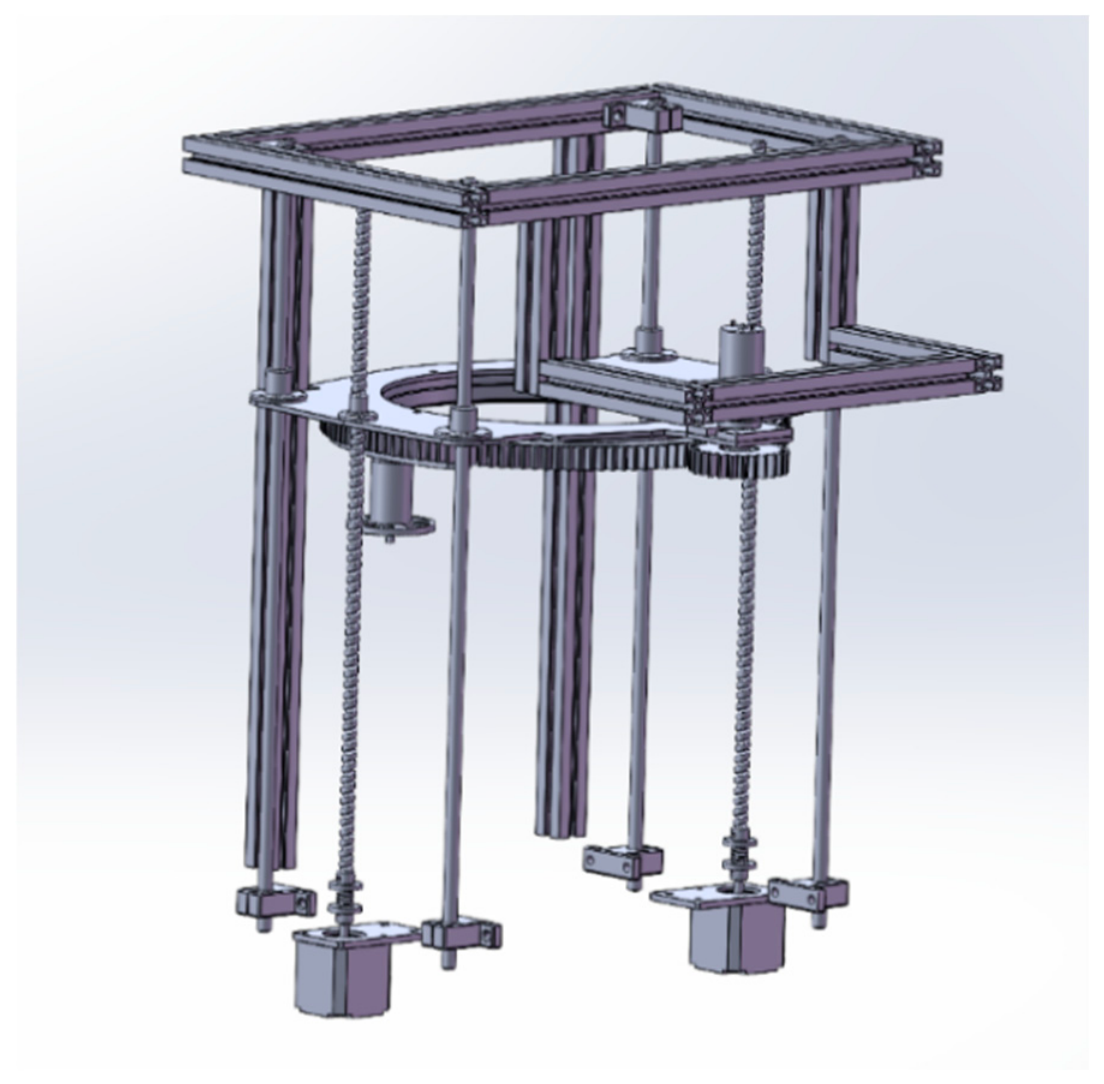
A lifting and rotating platform carries the camera and laser unit, as shown in Figure 5. The platform includes the vertical guide, lead-screw lifting elements, rotating support, camera mount, and laser mount. It enables vertical adjustment and circumferential scanning of the lettuce head. The vision unit is reserved for acquiring multi-view images to locate yellow or damaged leaf regions, following the general feasibility of machine-vision-based abnormal lettuce leaf detection reported in previous studies [16]. After the yellow-leaf removal process, the bottom cutting mechanism is used for root trimming.
Figure 5.
Lifting and rotating platform for visual scanning and laser positioning, including the vertical guide, lead-screw lift, rotating support, camera mount, and laser mount.
By integrating visual scanning, laser removal, and root cutting into one station, this module reduces the need for separate preprocessing units and provides a mechanical basis for future evaluation of recognition accuracy, laser-removal efficiency, trimming quality, and leaf damage. These performance quantities remain unverified in the present study.
2.4. Disinfection Module
The disinfection module was designed to provide a multi-directional spraying structure before the washing stage. As shown in Figure 6, the principal components are the bilateral misting units, adjustable nozzles, supporting brackets, conveyor passage, and top-mounted circulation fan. The bilateral arrangement allows disinfectant mist to be supplied from both sides of the conveyor, while the top fan promotes internal airflow within the module.
Figure 6.
Bilateral misting and air-circulation structure of the disinfection module, including adjustable misting nozzles and the top-mounted circulation fan.
During operation, the nozzles are intended to generate fine droplets toward the outer surface and gaps of the lettuce head. The nozzle positions and spray angles can be adjusted according to lettuce size and posture. This structure is intended to improve the spatial distribution of disinfectant and reduce insufficiently treated areas. However, actual disinfection performance depends on disinfectant type, concentration, droplet size, contact time, pH, flow rate, and organic load [12]. These variables were not measured in the current prototype record.
2.5. Washing Module
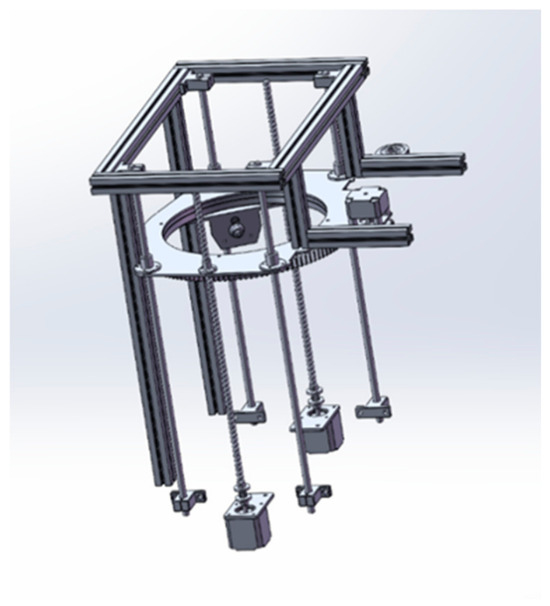
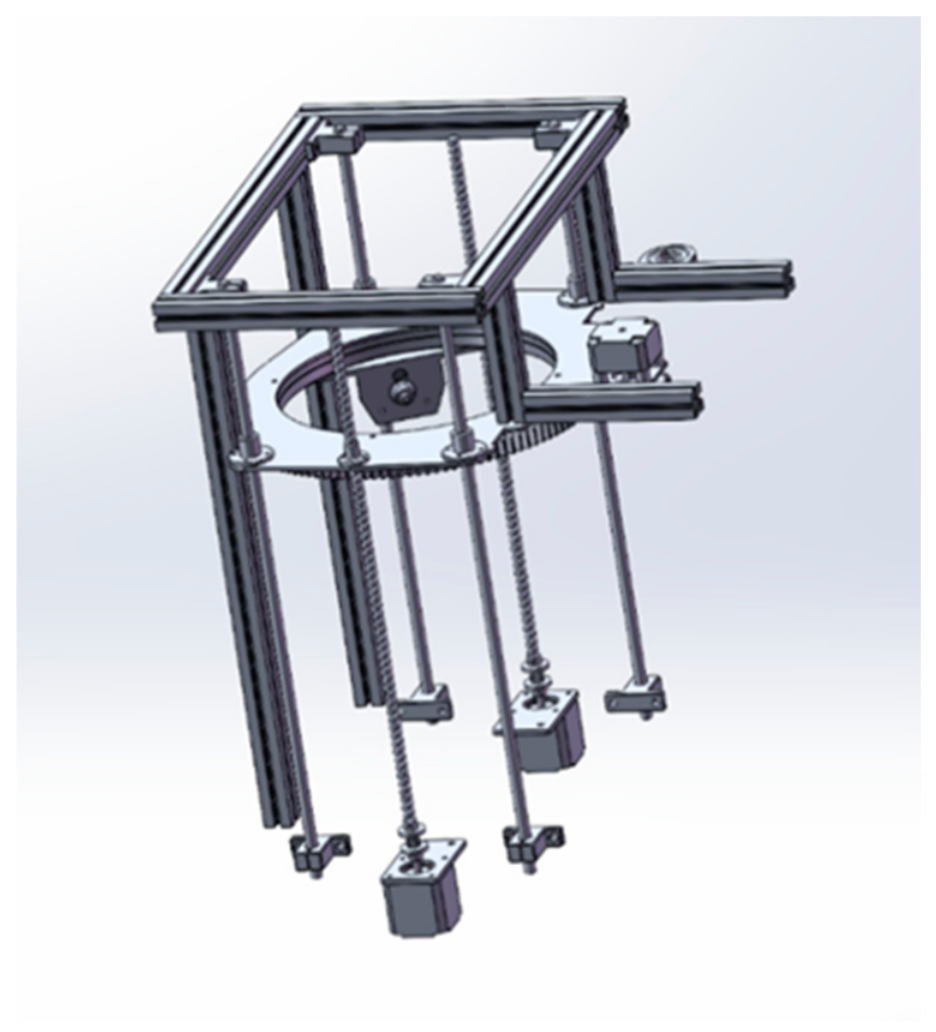
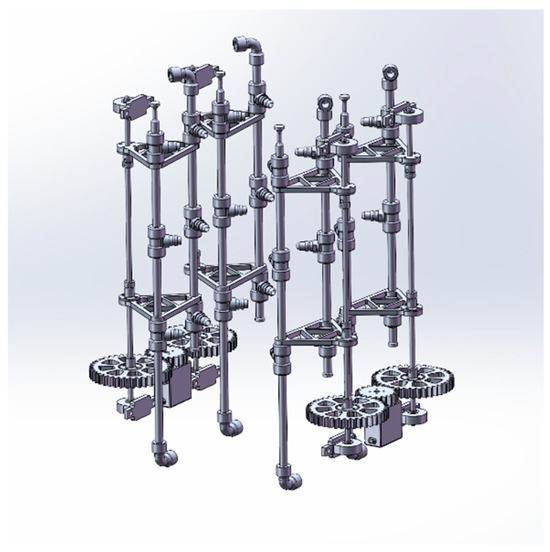
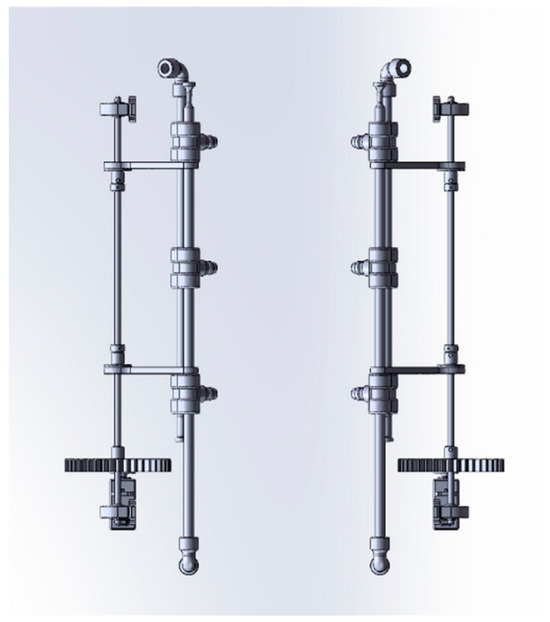
The washing module was designed to remove residual soil, disinfectant, and loose impurities after the disinfection stage. As shown in Figure 7, the module consists of the bilateral spray supports, water and air nozzles, swing/rotation base, gear transmission, conveyor passage, and frame brackets. The multiple nozzles are arranged on both sides of the conveyor, enabling the washing medium to act on the lettuce from different directions during conveying.
Figure 7.
Bilateral water–air spray washing unit, showing the spray supports, nozzle arrangement, conveyor passage, and swing/rotation base.
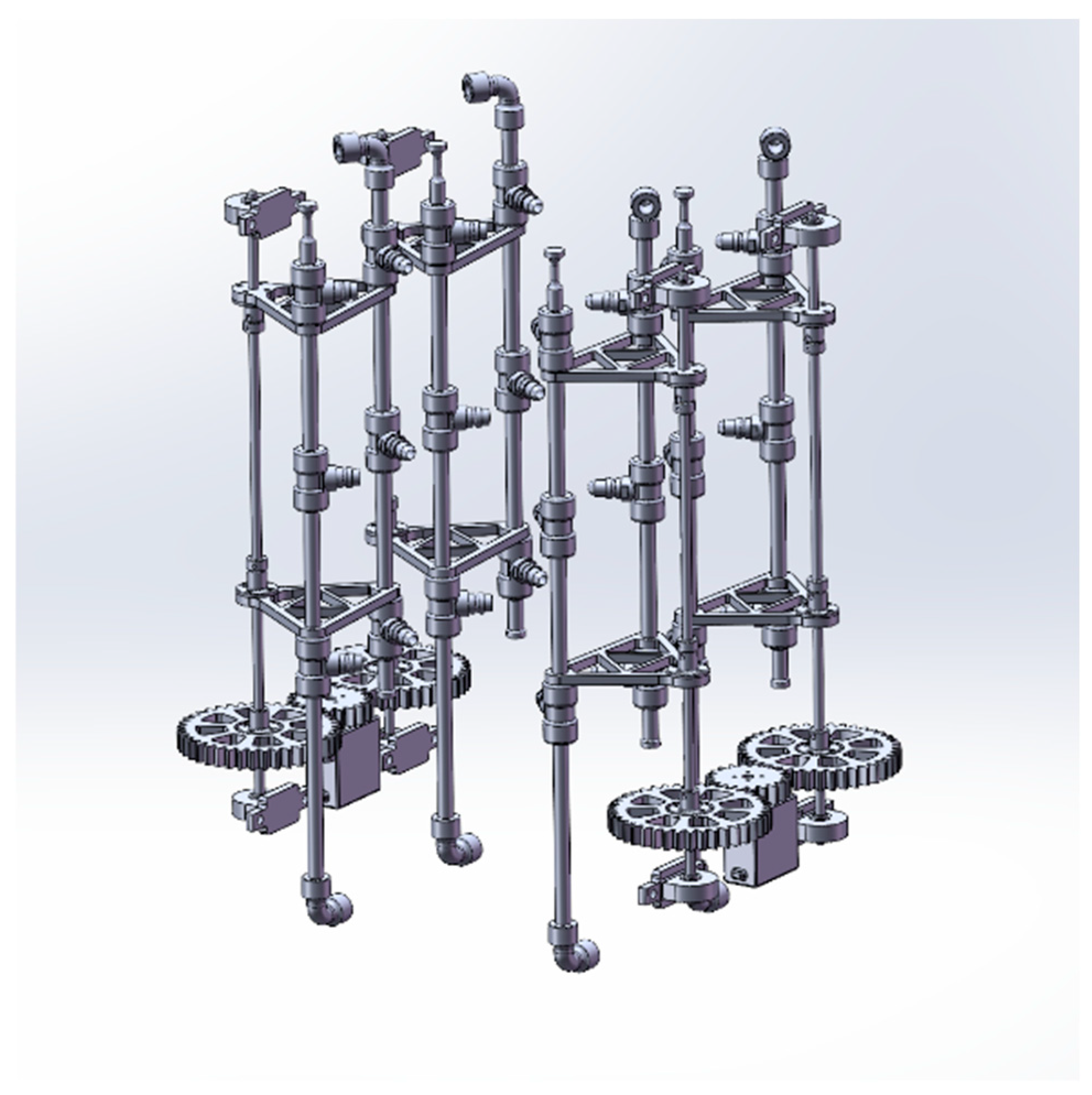
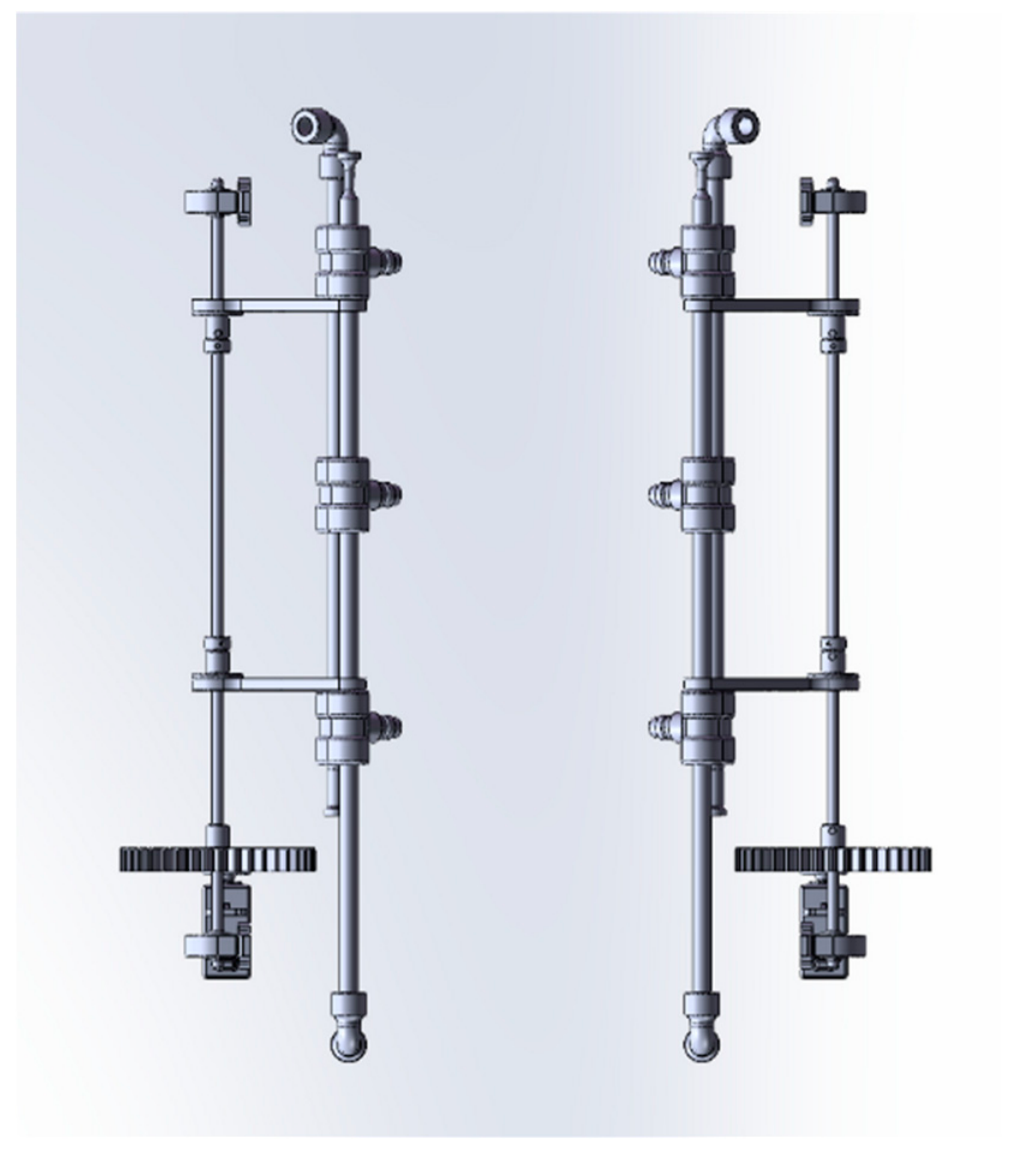
The bilateral parallel spray units are shown in Figure 8. During operation, the nozzles deliver a water–air mixture toward the lettuce surface and internal gaps. Compared with a single-direction spray structure, the bilateral arrangement is expected to improve spray coverage and reduce untreated areas. This arrangement is consistent with fluid-mechanics considerations in surface cleaning, where spray direction, impingement, and medium distribution influence contaminant removal from complex surfaces [15]. The spray pressure, angle, and flow rate can be adjusted according to lettuce size and cleaning requirements, but the present article does not report measured cleaning efficiency.
Figure 8.
Bilateral parallel water–air spray unit used to provide opposing treatment directions across the lettuce surface.
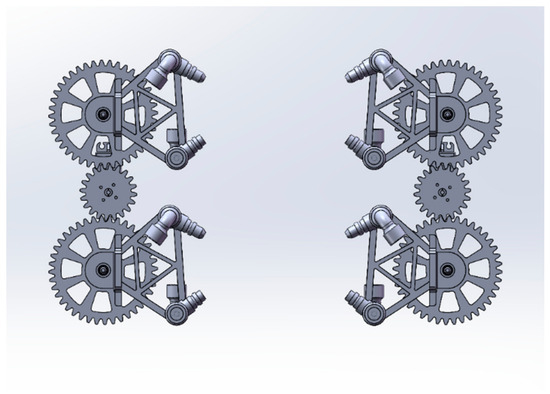
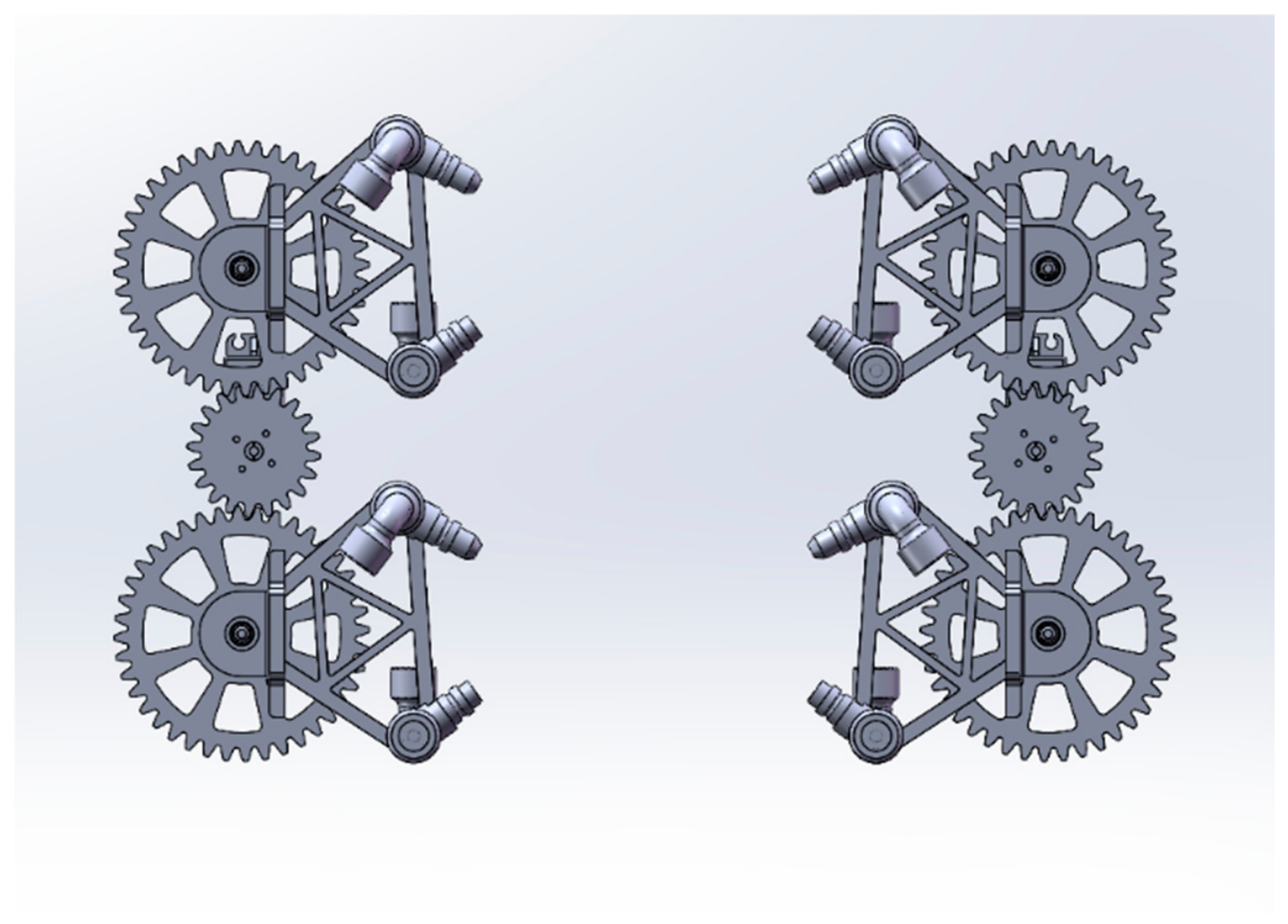
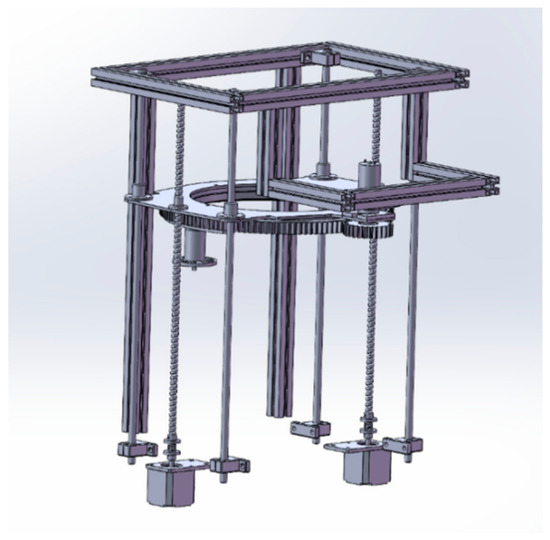
To further improve spray coverage, the spray units are mounted on a swinging and rotating gear base, as shown in Figure 9. The base, gear pair, nozzle supports, and frame-mounted shaft allow the nozzle direction to change during washing, enabling the water–air spray to cover the lettuce from multiple angles. This structure provides a mechanical basis for continuous multi-angle washing before the drying stage. The actual cleaning efficiency and leaf-damage rate should be quantified in future controlled experiments.
Figure 9.
Swinging and rotating gear base for dynamic nozzle adjustment, showing the gear pair, nozzle supports, and frame-mounted shaft.
2.6. Drying Module
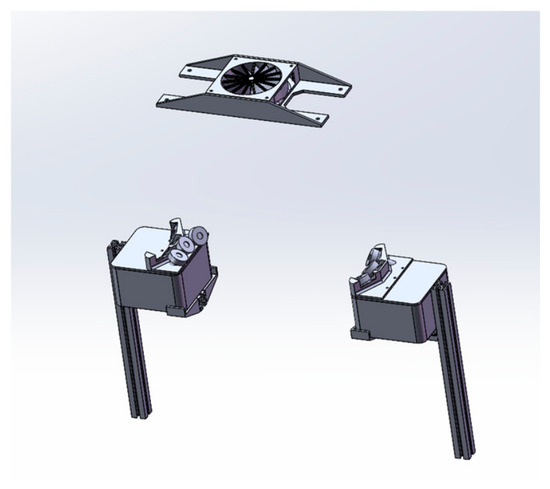
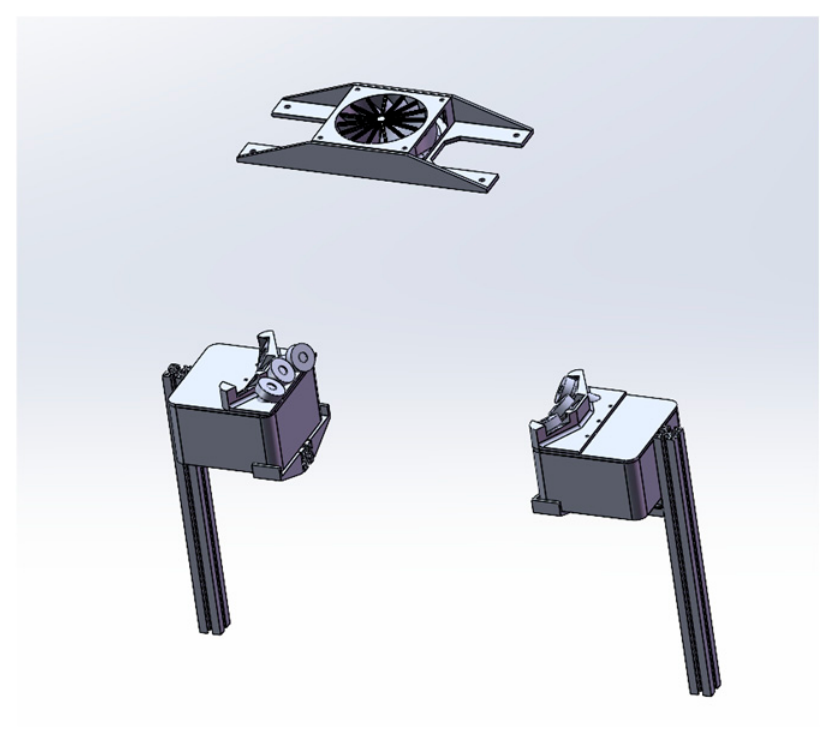
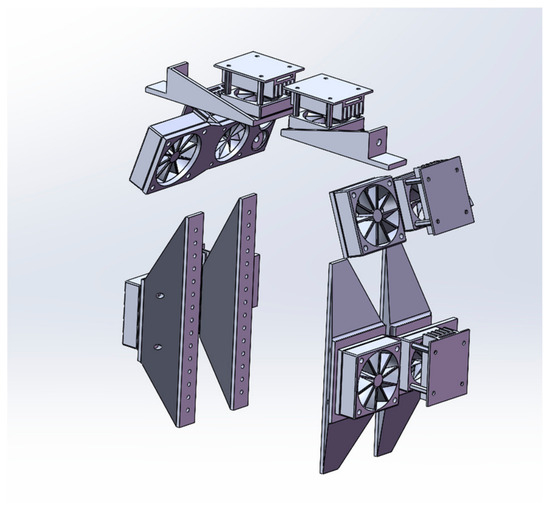
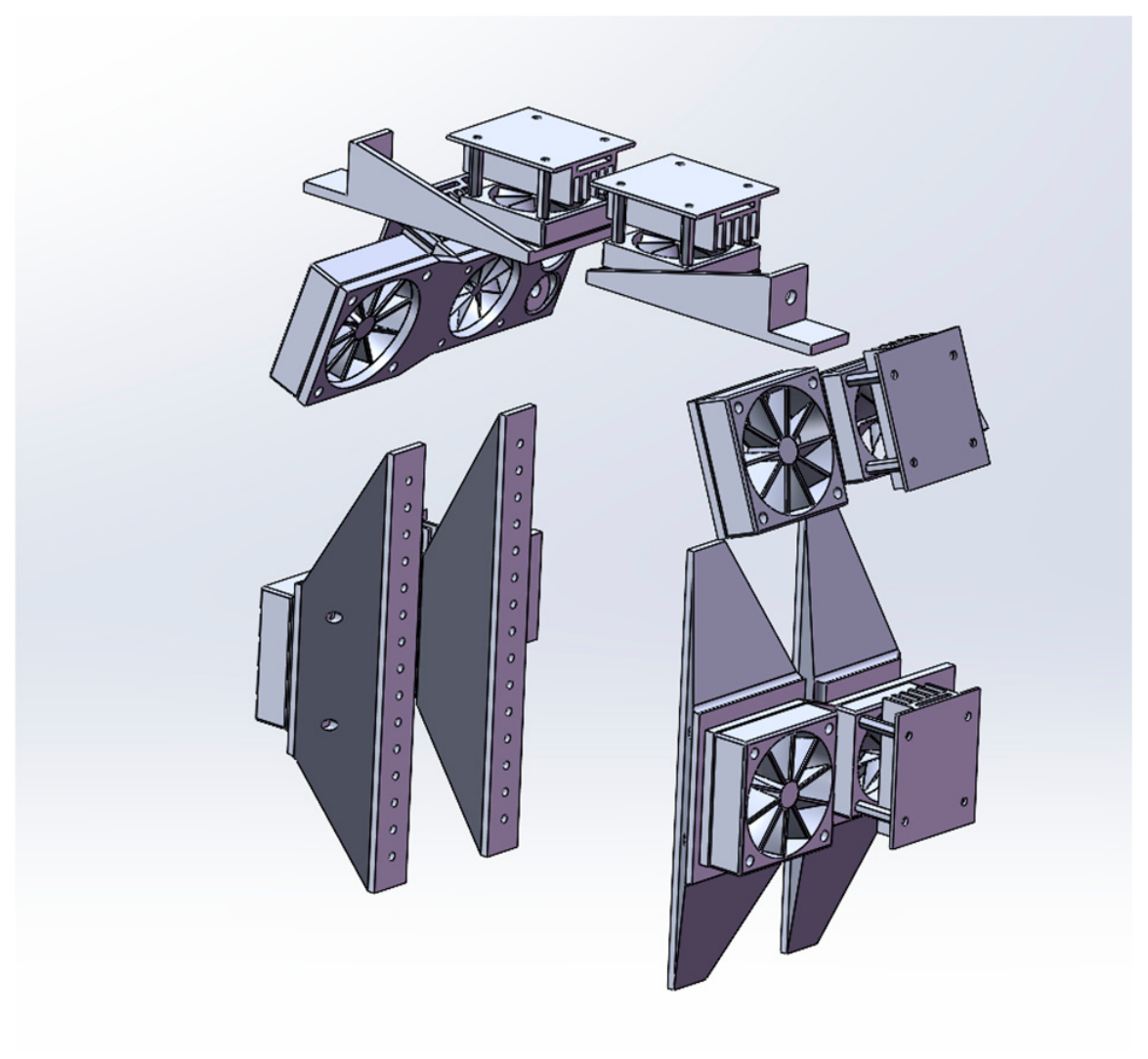
The drying module was designed to reduce surface moisture after washing and to prepare the lettuce for subsequent wrapping. As shown in Figure 10, the principal components are the side-mounted ambient-air fans, top-mounted warm-air fan, fan brackets, airflow passages, and conveyor support. The side fans provide lateral airflow to remove water droplets from the outer leaf surface, while the top fan supplies downward airflow to assist moisture removal in the upper and inner leaf regions.
Figure 10.
Combined ambient-air and warm-air drying units, showing the lateral fans, top fan, brackets, and airflow passages.
The fan positions and airflow directions are arranged according to the conveyor path and the posture of the lettuce in the bowl-shaped fixture. This configuration provides a mechanical basis for improving drying uniformity before wrapping. The actual drying efficiency, leaf water loss, appearance quality, and storage performance require subsequent evaluation under different airflow rates, temperatures, and drying times. The available materials do not contain such measurements.
2.7. Wrapping Module
The wrapping module was designed to complete the mechanical transition from drying to final packaging. As shown in Figure 11, the principal components are the lifting guide, lead-screw-driven vertical adjustment mechanism, rotating winding structure, film support, and frame brackets. This configuration allows the wrapping unit to adapt to the height and position of the lettuce head carried by the bowl-shaped fixture.
Figure 11.
Lifting and winding assembly of the wrapping module, showing the vertical adjustment mechanism, rotating winding structure, and film support.
During operation, the lettuce is conveyed to the wrapping station and positioned under the winding assembly. The lifting mechanism adjusts the working height of the wrapping unit, while the rotating winding structure applies cling film to the outer surface of the lettuce. The coordinated motion of the vertical adjustment mechanism and rotating assembly is a design intent; wrapping quality and film tension were not experimentally evaluated in this study.
This module provides a mechanical basis for standardized wrapping within the continuous production line and reduces the need for manual transfer between washing, drying, and packaging operations. The wrapped lettuce is then transferred to the weighing and boxing module for final packaging verification. Actual packaging quality remains to be validated.
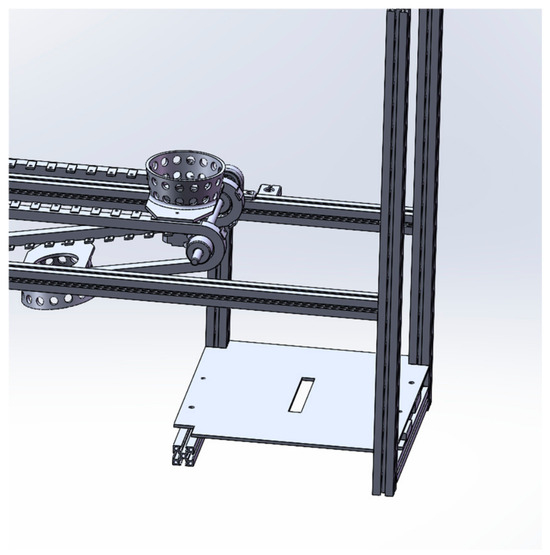
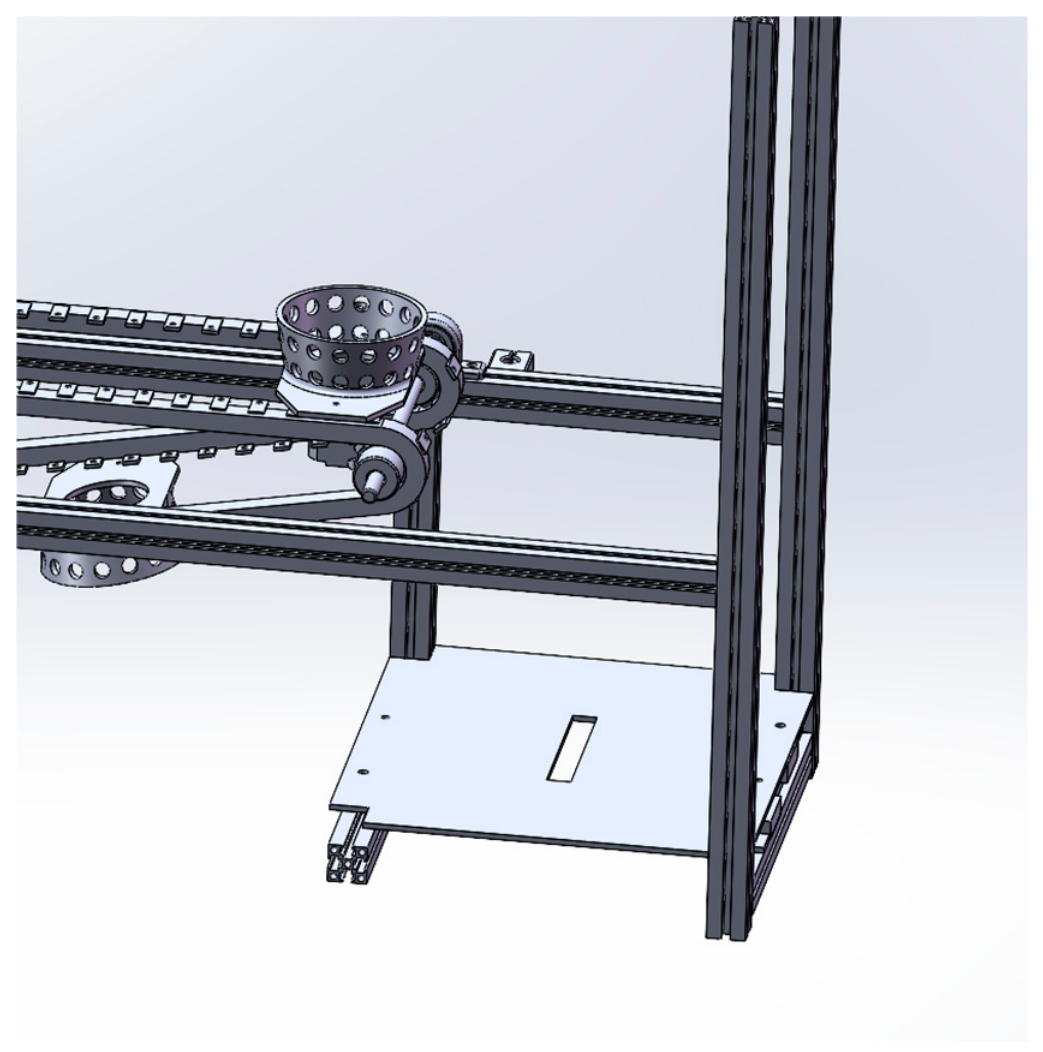
2.8. Weighing and Boxing Module
The weighing and boxing module is arranged at the end of the processing line to support final packaging and weight measurement. As shown in Figure 12, the principal components are the floating weighing platform, load cell, conveyor transfer surface, box support, vibration-reduction elements, and frame brackets. After wrapping, the lettuce is transferred to the weighing position together with the bowl-shaped fixture or packaging container, where the load cell records the product weight.
Figure 12.
Floating weighing platform of the weighing and boxing module, showing the load cell, transfer surface, box support, and vibration-reduction elements.
The weighing platform is installed beneath the conveyor path so that the product can be measured with limited interruption to the production sequence. The floating platform structure allows the weighing unit to cooperate with conveyor movement and the transfer process between wrapping and boxing. To improve measurement stability, the weighing area can be equipped with structural supports and vibration-reduction components. The measurement accuracy of the assembled unit was not recorded in the available materials.
The measured weight data can be used for packaging verification and production records. This module also provides an interface for future traceability and digital process management when combined with image data, processing parameters, and packaging records. After weighing, the lettuce is transferred to the boxing position for final packaging. The functional data link is reserved for future control implementation and was not validated in the present study.
3. Design Calculations and Preliminary Feasibility Analysis
To preliminarily verify the mechanical feasibility of the proposed integrated machine, the main drive and transmission components were checked through basic mechanical calculations. The analysis focused on whether the selected motors and transmission mechanisms could satisfy continuous conveying, intermittent positioning, vertical lifting, rotary scanning, and oscillating spraying. Specifically, the motor configuration, chain drive, lead-screw drive, and gear transmission were evaluated in terms of torque capacity, conveying speed, lifting load, command resolution, and meshing continuity. The calculations use the recorded design parameters and standard mechanical-design relationships [17]. A separate parameterized check was used to report the sensitivity of screw torque to the assumed lifting load. These calculations are design verification, not experimental processing-performance results.
3.1. Motor Selection
The machine uses both stepper motors and DC gear motors according to the motion requirements of different modules, as summarized in Table 1. The stepper motor is used in mechanisms requiring position control, including the two lead-screw lifting drives and the lifting/rotating platform. The selected 42 mm stepper motor has a rated torque of 0.4 N·m and a step angle of 1.8°. With the adopted microstepping setting, it provides a theoretical command resolution for intermittent positioning and vertical adjustment; this value does not represent measured positioning accuracy.
Table 1.
Motor configuration of the main drive positions.
For continuous or rotary motion, including chain conveying, root cutting, and rotary-table driving, a 370 DC gear motor is used. The motor provides an output torque of 0.49 N·m and a no-load speed of 27 rpm. The listed motor positions are design positions in the prototype layout; their synchronization and continuous-operation stability require a future controller-level test.
3.2. Chain-Drive Calculation
The conveyor adopts a single-strand 06B-1 roller chain with a pitch (p) of 6.35 mm. The checked segment is the loaded drive branch between the motor-driven sprocket and the first conveyor support. The driving and driven sprockets have the same number of teeth (z = 12), so that the transmission ratio is 1:1. The pitch radius (R) of the sprocket can be calculated as
Substituting the values gives R ≈ 0.0123 m. The tensile force F1 on the chain generated by the motor torque Tm (0.49 N·m) is
The motor-derived chain force is 39.8 N. The previously reported 210 N chain capacity was removed because no traceable supplier datasheet was retained. For a nominal factor of safety of 3, the selected chain would need a verified allowable load of at least 119.5 N; this must be checked against the manufacturer’s data before production. The linear speed v of the chain, determined by the motor speed n1 of 27 rpm, is
The resulting chain speed is suitable for a low-speed transfer design, but it does not by itself establish processing throughput. Because the driving and driven sprockets have the same number of teeth, the ideal output speed and torque ratio is 1:1. Actual speed, slip, start-up transient, and positioning repeatability require measurements during operation.
3.3. Lead-Screw Drive Calculation
The lifting mechanism is driven by two trapezoidal lead screws. The 3 kg value is treated explicitly as a design-case upper bound for the lift assembly, not as a measured payload; the available records do not contain a mass measurement. Assuming the design-case load is evenly shared by the two screws, the axial force acting on one screw is:
The torque T required to drive this load, considering a screw diameter dm of 8 mm, a lead p of 2 mm, and a friction coefficient μ of 0.15, is approximated by:
For the 3 kg design case, this required torque is much lower than the stepper motor’s rated torque of 0.4 N·m. The theoretical linear command resolution per microstep Δx is reported by the equation below. This is a command-resolution value, and actual positioning accuracy depends on the mechanical factors discussed below.
The computed value is a theoretical command resolution only. Actual positioning accuracy depends on mechanical clearance, screw backlash, guide-rail accuracy, assembly precision, motor-speed-dependent torque, synchronization error, and control stability. These quantities were not measured in the available prototype record.
3.4. Gear-Transmission Calculation
A gear pair is used for the oscillating motion in the washing module. The pinion has 20 z1 and the gear has 40 teeth z2, with a module m of 2 mm, resulting in a 2:1 reduction ratio. The pitch diameters are d1 = mz1 = 40 mm and d2 = mz2 = 80 mm, with a center distance a of 60 mm. A key performance metric for gears is the transverse contact ratio εα, which should be greater than 1.2 for smooth operation. It is calculated using the addendum radii ra and base circle radii rb:
The calculated contact ratio is 1.5366, exceeding the geometric threshold of 1.2 for continuous tooth engagement. This result supports preliminary geometric feasibility, but it does not establish gear strength, wear life, lubrication adequacy, or dynamic impact performance. More details about the parameters can be seen in Table 2.
Table 2.
Main mechanical parameters, design cases, and verification results.
Overall, the calculations support the preliminary mechanical feasibility of the selected drive and transmission components under the stated design cases. The chain calculation provides the motor-derived drive force and conveying speed; the lead-screw calculation provides a load-parametric torque check; and the gear calculation verifies geometric meshing continuity. The results support prototype assembly and static structural screening, but they do not replace chain-life, bearing-life, shaft-strength, modal, fatigue, buckling, or continuous-operation testing.
3.5. Methodological Framework and Evaluation Protocol
The evaluation protocol was designed to separate the scientific mechanism of interest from supporting engineering checks. The mechanism of interest is morphology-informed access: whether a bilateral spray arrangement with controlled nozzle motion can increase the geometrically reachable portion of a corrugated lettuce surface. The supporting checks establish whether the architecture can be assembled and driven under the recorded design parameters.
The protocol contains four steps. First, lettuce morphology and process requirements are translated into module interfaces, transfer posture, nozzle arrangement, and installation constraints. Second, the chain, lead-screw, gear, and motor subsystems are evaluated using recorded parameters and explicit design cases. Third, the fixed and swinging washing configurations are compared using the same surface geometry, nozzle spacing, spray-cone angle, incidence threshold, and exposure threshold; the output is a covered-surface proxy and not a cleaning-efficiency measurement. Fourth, the resulting loads are applied to a preliminary static frame model and compared with the prototype assembly evidence. This sequence provides a traceable link from the research question to the reported metrics.
The primary interpretation is therefore comparative and mechanistic: a larger geometric coverage proxy under the swinging condition supports the proposed access mechanism, while the analytical and finite element calculations indicate whether the required hardware is internally feasible for the stated cases. The protocol does not test microbial reduction, soil removal, leaf damage, drying rate, packaging quality, throughput, or long-duration reliability. Those quantities require controlled experiments with measured product, process, and machine-response data.
4. Prototype Assembly and Preliminary Structural Verification
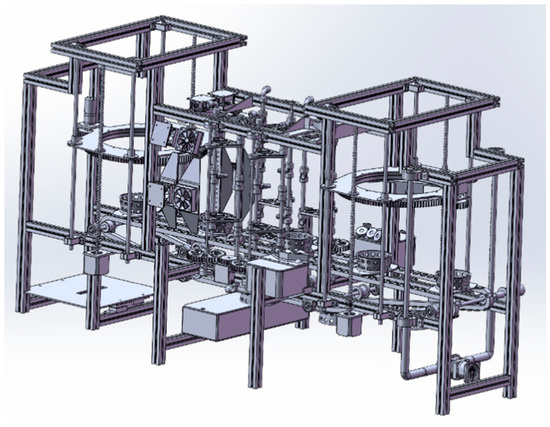
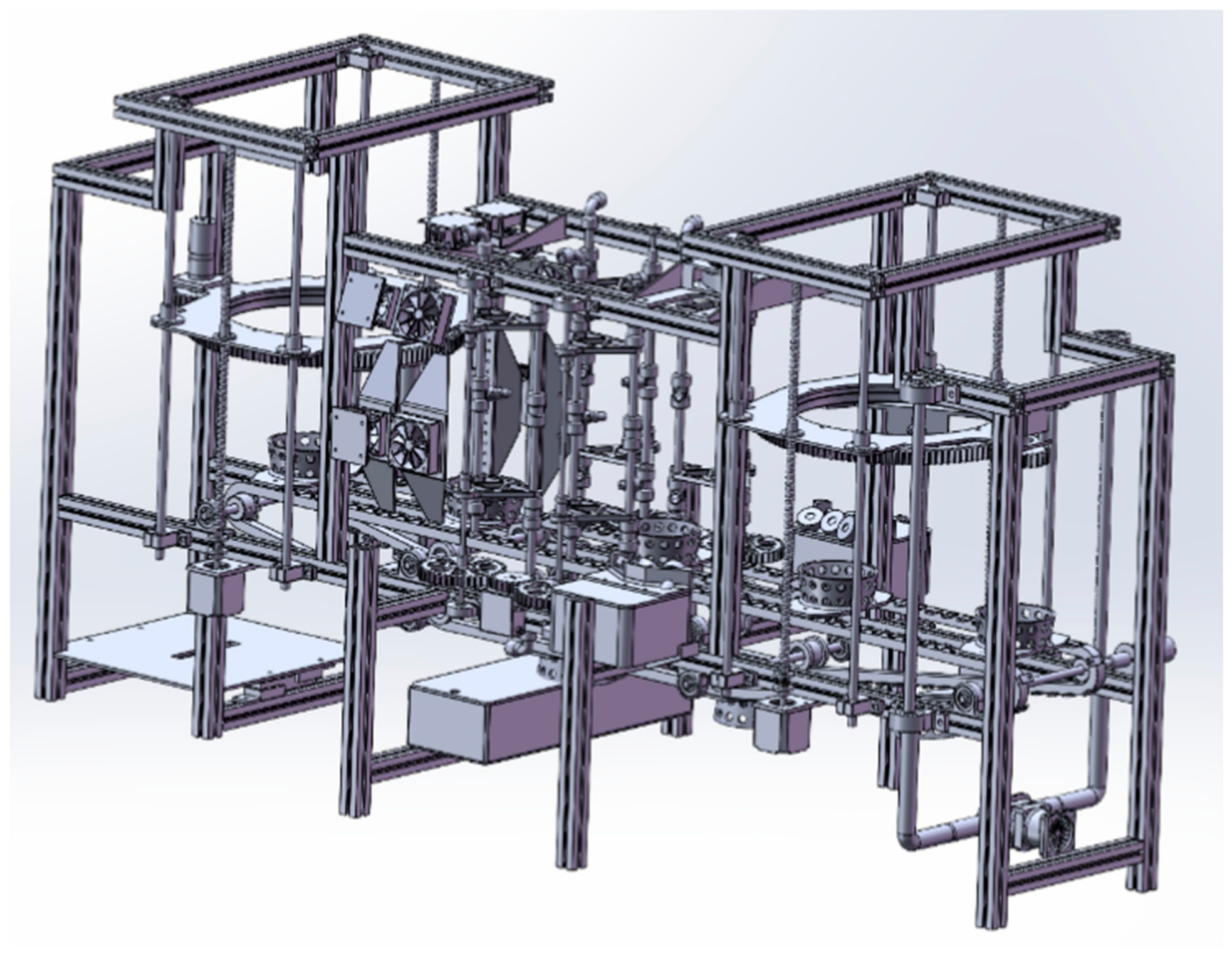
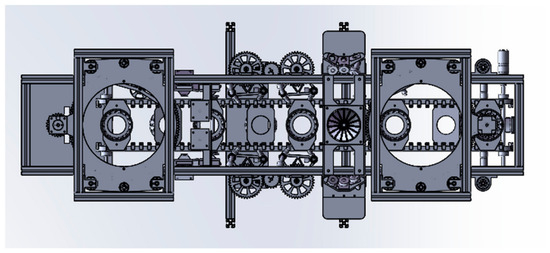
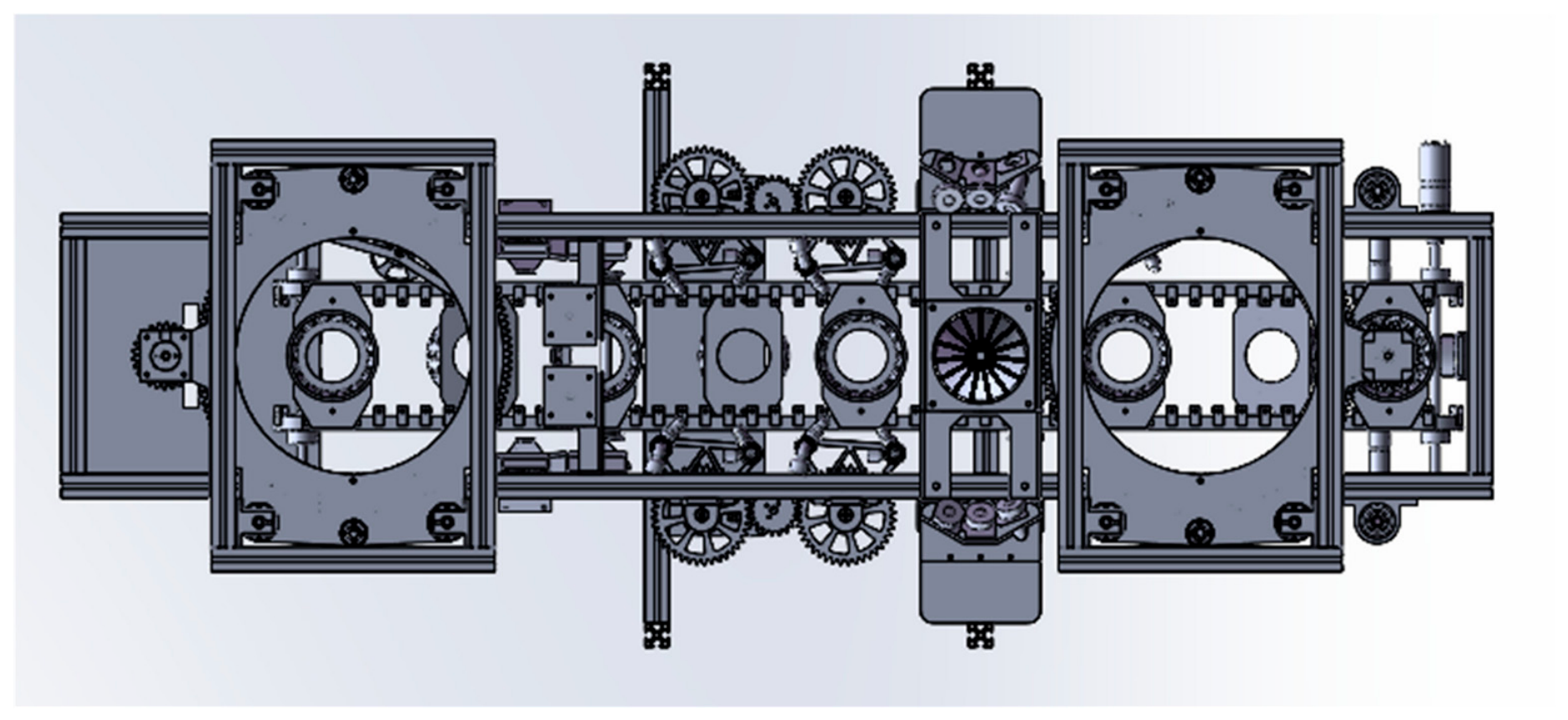
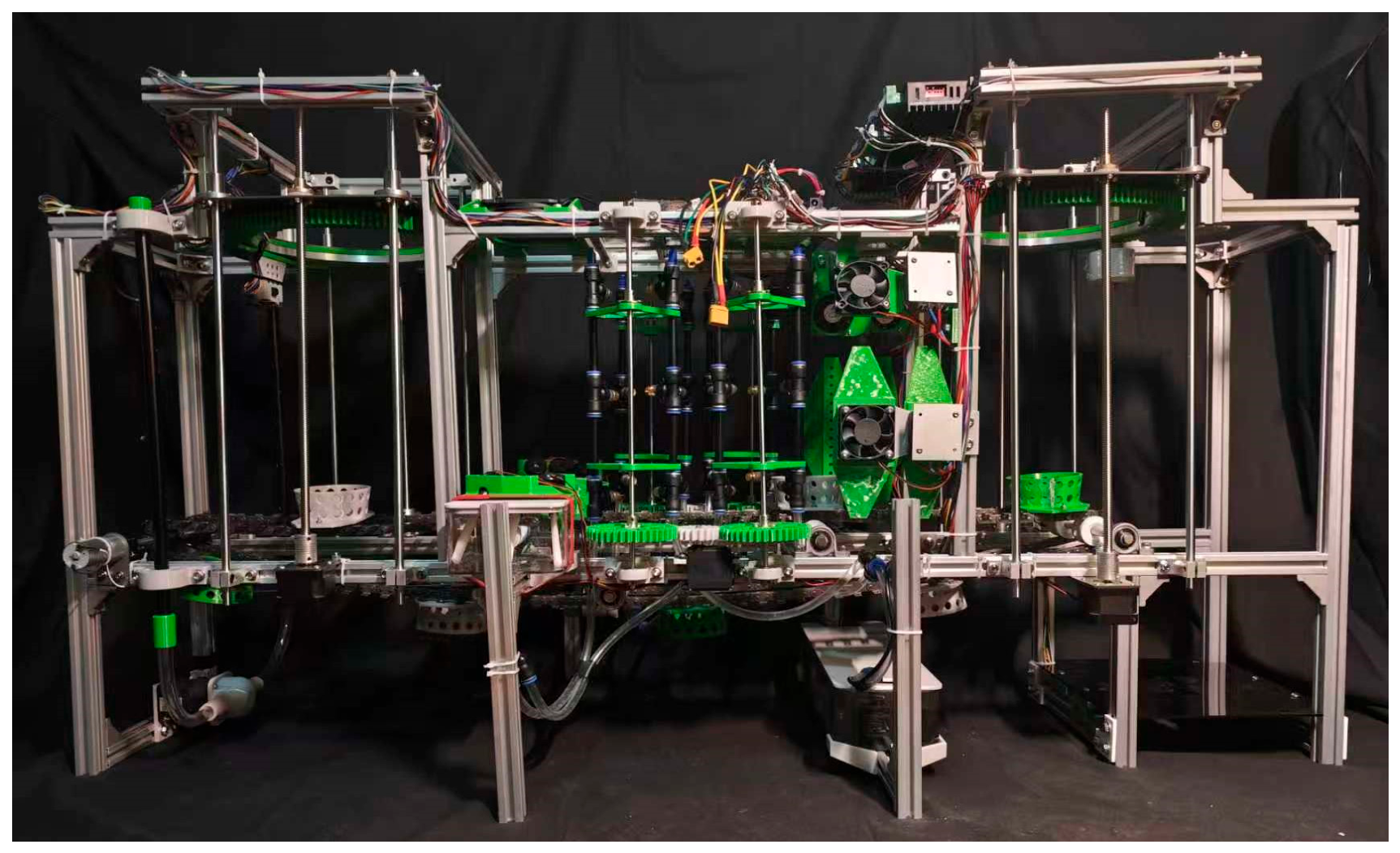
Based on the modular design and mechanical calculations described above, the integrated lettuce-processing machine was further developed through three-dimensional layout design, prototype assembly, and finite element analysis. The purpose of this section is to verify the preliminary mechanical feasibility of the proposed structure, including spatial compatibility, assemblability, and the stiffness and strength of the main supporting frame. Figure 13, Figure 14 and Figure 15 documents the assembled hardware. It is not a functional processing-performance test: no controlled cleaning, trimming, drying, packaging, or continuous-run dataset was retained. The structural verification in this section is therefore interpreted as a preliminary mechanical screen.
Figure 13.
General layout of the integrated lettuce-processing machine. This installed CAD layout exposes the frame, supports, and mechanical subassemblies; it is distinct from the not-to-scale workflow schematic in Figure 1.
Figure 14.
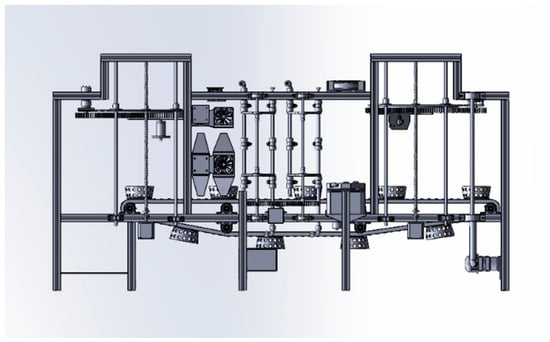
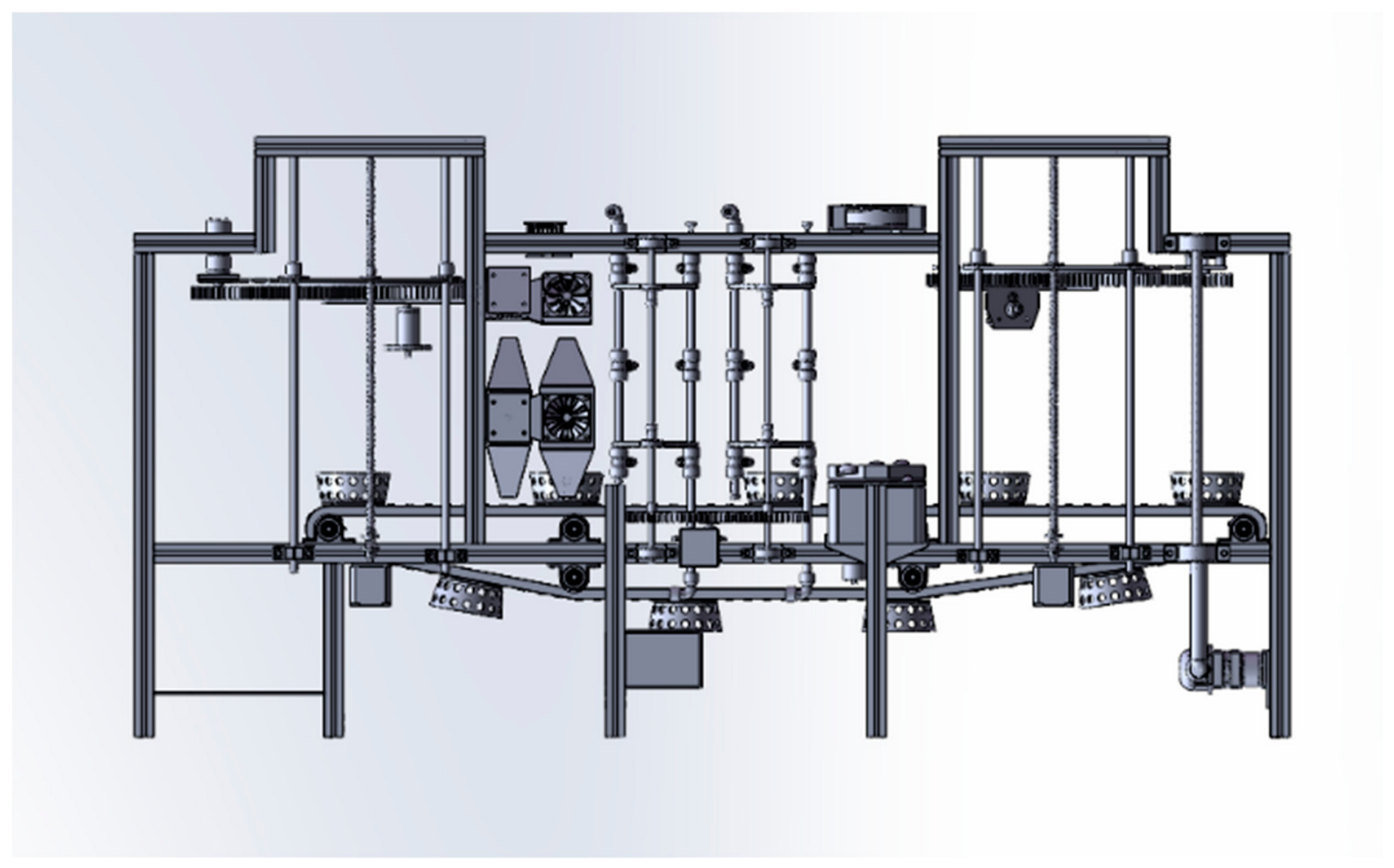
Top view of the module installation, used to inspect relative station positions, transfer distance, and available installation space.
Figure 15.
Photograph of the completed prototype assembly. The photograph demonstrates physical integration and spatial compatibility, not functional-processing performance.
4.1. Layout Design and Prototype Assembly
Figure 13 shows the general layout of the integrated lettuce-processing machine. The main functional modules are arranged along a linear conveyor path, including soil removal, yellow-leaf and root trimming, disinfection, washing, drying, wrapping, and weighing/boxing. The aluminum-alloy frame provides the installation basis for the conveyor, bowl-shaped fixtures, spraying units, fan units, lifting mechanisms, rotating components, wrapping unit, and weighing structure. Figure 1 is a process-flow schematic that groups functions into workflow blocks, whereas Figure 13 is an installed CAD layout that exposes the frame, supports, and mechanical subassemblies. The apparent difference is therefore a difference in abstraction and view, not a change in the intended processing sequence.
The top view of the installation is shown in Figure 14. From this view, the relative positions of the conveyor, functional modules, rotating mechanisms, and supporting frame can be observed more clearly. The processing stations are arranged according to the designed material-flow direction, which reduces unnecessary transfer distance and supports continuous operation. The top-view layout also helps verify whether sufficient installation space is available for key components, such as the chain conveyor, washing mechanism, wrapping structure, and weighing unit. The detailed component descriptions in Section 2.1, Section 2.2, Section 2.3, Section 2.4, Section 2.5, Section 2.6, Section 2.7 and Section 2.8 should be read together with Figure 2, Figure 3, Figure 4, Figure 5, Figure 6, Figure 7, Figure 8, Figure 9, Figure 10, Figure 11 and Figure 12.
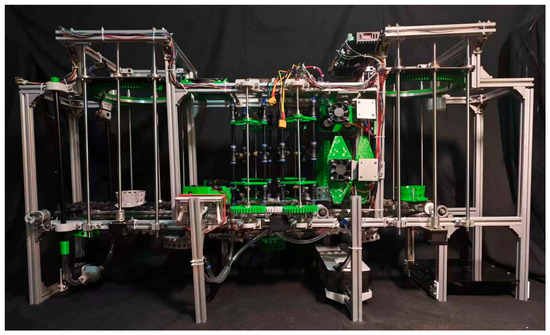
Figure 15 presents a photograph of the completed prototype assembly. The prototype demonstrates that the designed modules can be physically integrated into a single processing system. The conveyor, bowl-shaped fixtures, spraying components, fan units, lifting and rotating mechanisms, wrapping mechanism, and weighing structure were assembled on the common frame. The photograph therefore provides evidence of spatial compatibility, accessibility, and physical assembly of the principal modules. It does not provide evidence of cleaning efficiency, microbial reduction, leaf-damage rate, throughput, resource consumption, synchronization, or long-duration reliability because no controlled operational test record is available.
4.2. Finite-Element Structural Verification
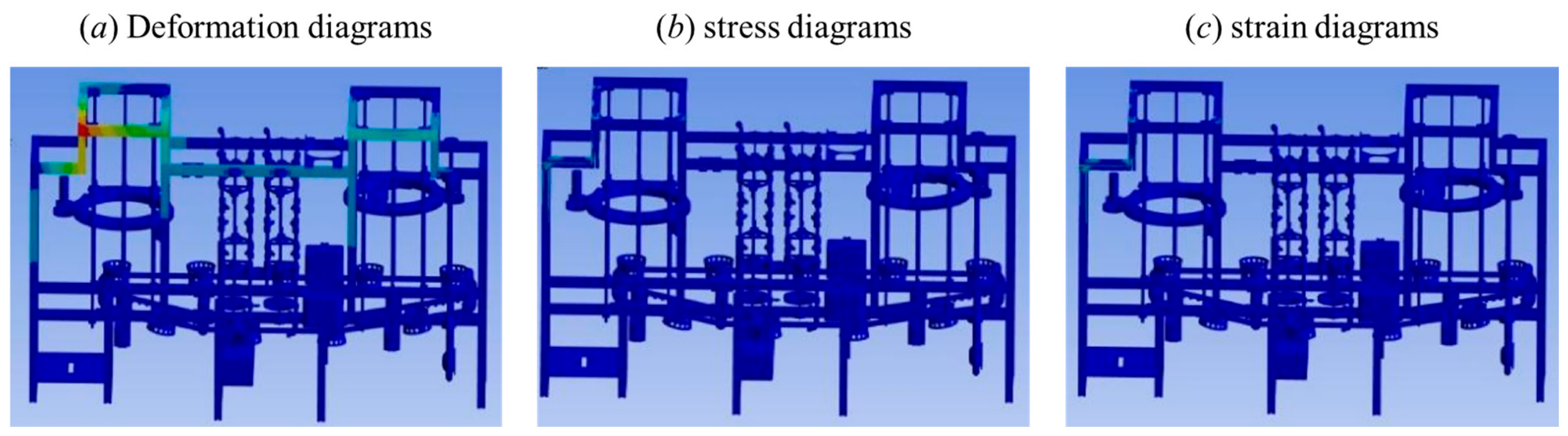
To further evaluate the stiffness and strength of the main supporting frame, a static finite element analysis was conducted under explicitly defined preliminary design conditions. The frame was modeled using representative isotropic aluminum-alloy properties corresponding to a 6061-T6 reference condition: Young’s modulus 69 GPa, Poisson’s ratio 0.33, density 2700 kg/m3, and yield strength 240 MPa. The support positions at the bottom of the frame were fully constrained. The reported load components were the motor-derived horizontal chain force of 39.8 N at the drive-sprocket interface and a 29.43 N vertical lifting design load distributed as 14.72 N at each of the two lead-screw interfaces; module self-weight was applied at the corresponding mounting locations in the original model. No measured dynamic excitation, fatigue cycle, or transient start-up load was imposed. The model was used to calculate total deformation, von Mises equivalent stress, and equivalent elastic strain. The load cases and assumptions are summarized in Table 2.
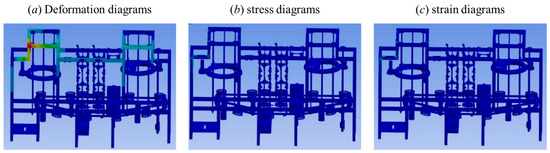
As shown in Figure 16, the maximum total deformation of the main frame was 0.0224 mm, occurring only at local positions of the structure. The maximum von Mises equivalent stress was 7.30 MPa, and the maximum equivalent elastic strain was 3.71 × 10⁻⁵. Using the representative 6061-T6 yield strength stated above gives a stress ratio of approximately 32.9. These results indicate elastic behavior for the stated static screening case. They should not be interpreted as certification against modal resonance, vibration, fatigue, buckling, bearing life, or dynamic loading.
Figure 16.
Static structural analysis results of the main frame under the stated preliminary load cases: (a) total deformation, (b) von Mises equivalent stress, and (c) equivalent elastic strain. The closer the colour is to red, the greater the tendency for stress or deformation; the closer it is to blue, the more stable it is.
The finite element results indicate that the main frame has sufficient preliminary stiffness and strength for the stated static design case. Together with the layout design, prototype assembly, and parameterized mechanical verification, they support the conclusion that the structure is mechanically feasible as a platform for subsequent control-system development and functional testing. A complete dynamic and reliability assessment would require the full mass distribution, joint stiffness, drive profiles, measured vibration, and repeated-operation data, which are not available in the current study.
4.3. Application-Oriented Cleaning-Coverage Simulation
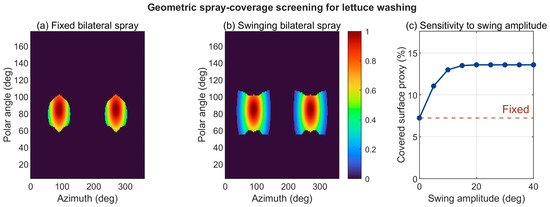
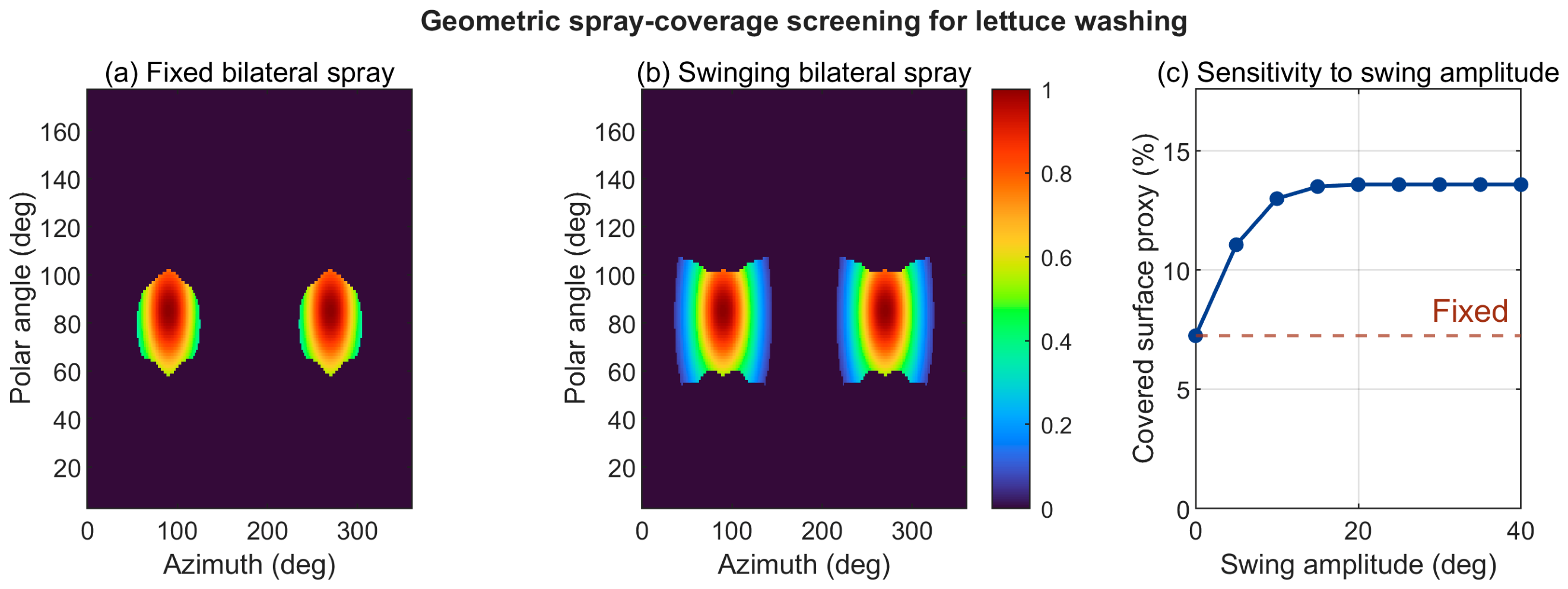
To examine the application relevance of the bilateral water–air washing unit and the swinging/rotating nozzle base, an application-oriented geometric spray-coverage simulation was constructed. The lettuce head was represented by an ellipsoidal surface with azimuthal corrugation as a proxy for overlapping leaves and longitudinal grooves. Two bilateral nozzles were placed at a representative module-scale spacing, and a conical spray model used an assumed 20° half-angle, a 0.20 incidence threshold, and a 0.12 normalized exposure threshold. The fixed case used one bilateral orientation, whereas the swinging case evaluated nozzle yaw angles from −35° to 35° in 5° increments. A surface location was counted as covered when at least one nozzle orientation reached it with sufficient incidence and in-cone alignment.
Under the stated screening assumptions, the covered-surface proxy increased from 7.24% for the fixed bilateral orientation to 13.58% for the ±35° swinging case, an increase of 6.34 percentage points. The sensitivity curve reached a plateau near 15–20° swing amplitude in this simplified geometry. These results support the mechanical rationale for adjustable nozzle orientation and identify spray-cone angle, nozzle distance, incidence threshold, and exposure threshold as parameters for future calibration. Because the model does not include water-film dynamics, droplet breakup, soil adhesion, microbial inactivation, leaf damage, or measured flow rates, the result is a geometric coverage screen rather than a cleaning-efficiency experiment.
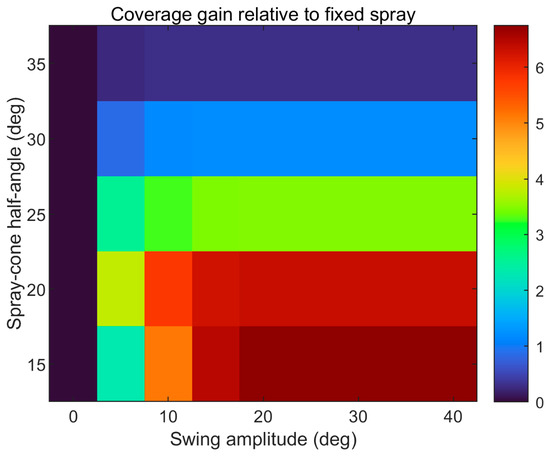
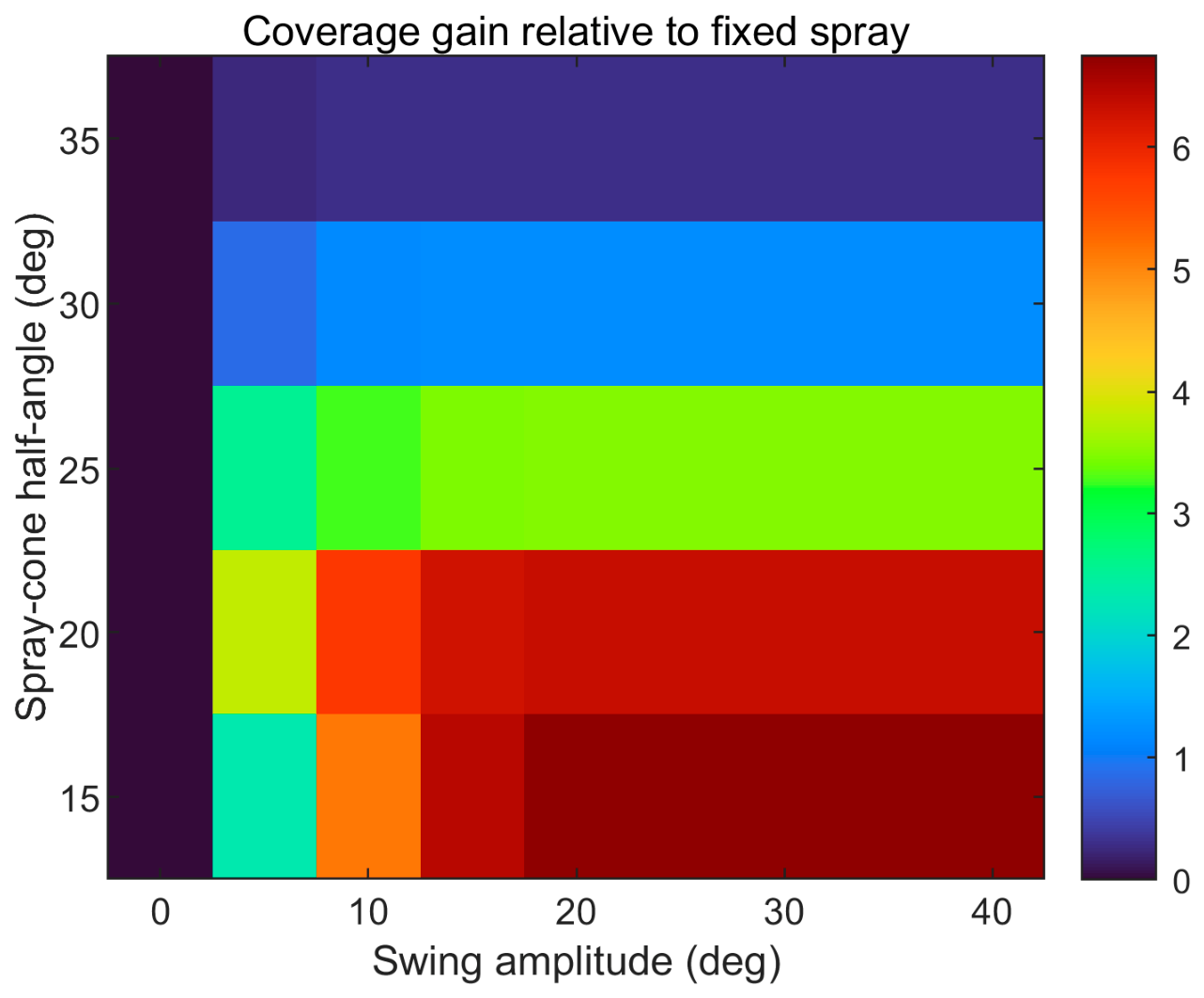
To test whether the application-oriented conclusion is sensitive to the principal geometric settings, the calculation uses the same lettuce-surface geometry, nozzle spacing, incidence criterion, and exposure criterion as Figure 17. It is intended as a parameter-window check for the proposed washing design, rather than as a substitute for a controlled cleaning experiment. Figure 18 maps the coverage gain relative to fixed bilateral spraying over the nozzle swing amplitude and spray-cone half-angle.
Figure 17.
Application-oriented geometric spray-coverage simulation for the lettuce washing module. (a) Fixed bilateral spray; (b) swinging bilateral spray; and (c) sensitivity of the covered-surface proxy to swing amplitude. The metric indicates whether a modeled surface location is reached by at least one effective spray direction under the stated assumptions; it is not a measured cleaning-efficiency percentage.
Figure 18.
Parameter-window simulation of the covered-surface gain relative to fixed bilateral spraying as a function of nozzle swing amplitude and spray-cone half-angle. Values are percentage-point differences under the same geometric screening assumptions.
The parameter-window check predicts a non-negative gain for every tested combination. At the 20° half-angle used for the main case, the gain increases from 0.00 percentage points at 0° swing to 6.34 percentage points at 20° swing and then reaches a plateau in this simplified geometry. At a 15° half-angle, the gain reaches 6.74 percentage points, whereas at 35° it is only 0.30 percentage points. This trend supports the use of adjustable nozzle orientation while showing that the benefit depends on spray-cone geometry; the values remain geometric screening outputs and require calibration against measured spray and cleaning data.
Parameterized mechanical verification. Using the recorded motor, sprocket, screw, and gear parameters, an independent calculation gave a chain force of 39.837 N, a chain speed of 0.034777 m/s (0.450 Hz drive frequency), a single-screw force of 14.715 N and torque of 0.013513 N·m for the explicit 3 kg design case, and a gear contact ratio of 1.5366. The corresponding nominal stepper-torque margin is 29.60. A 1–5 kg sensitivity check gives torque margins of 88.80, 44.40, 29.60, 22.20, and 17.76, respectively. These results are reproducible parameterized calculations and should not be interpreted as measured processing performance or a substitute for modal, fatigue, buckling, or continuous-operation tests.
5. Discussion
This study addresses a morphology-informed mechanical research problem: how to connect continuous transfer, multi-stage processing, and directional treatment access for lettuce with overlapping leaves, internal grooves, fragile surfaces, and variable posture. The proposed system connects soil removal, yellow-leaf and root trimming, disinfection, washing, drying, wrapping, weighing, and boxing along one conveyor line. The scientific contribution is not the observation that a lightly loaded frame remains below a nominal yield limit; that result is a necessary engineering screen but is insufficient by itself. The stronger contribution is the traceable evaluation framework linking lettuce morphology and process requirements to fixture geometry, module interfaces, transmission calculations, a geometric spray-access mechanism, and static structural feasibility [18]. The application-oriented simulation in Figure 17 and Figure 18 provides a comparative test of the proposed access mechanism, while the prototype and finite element results define the boundary within which that mechanism could be implemented.
The use of a chain conveyor with bowl-shaped fixtures is central to the proposed mechanical architecture. The fixtures are designed to support individual lettuce heads and maintain their approximate posture during transfer between stations. This provides a basis for subsequent visual scanning, trimming, spraying, washing, drying, and wrapping. The modular arrangement also allows each processing unit to be adjusted or optimized independently while remaining part of a continuous production line. This design is particularly relevant for lettuce because its grooves and internal gaps can limit the contact between treatment media and leaf surfaces.
Several functional modules were designed to address specific mechanical requirements in lettuce processing. The yellow-leaf and root-trimming module integrates visual scanning, laser removal, and mechanical cutting into one station, reducing the need for separate preprocessing steps. The disinfection and washing modules use bilateral misting, assisted air circulation, bilateral water–air spraying, and a swinging nozzle base to provide a structural basis for multi-directional media distribution. These designs are consistent with previous studies emphasizing the importance of sanitizer management, water quality control, and washing conditions in fresh-produce processing [19,20,21,22]. The drying, wrapping, weighing, and boxing modules further extend the system from wet processing to final packaging and provide an interface for future process recording and traceability.
The mechanical calculations, parameterized verification, and finite element analysis support the preliminary feasibility of the proposed design. The chain-drive calculation gave a motor-derived chain force of 39.8 N and a chain speed of 0.0348 m/s. The lead-screw calculation gave 0.0135 N·m per screw for the explicit 3 kg design case, with a nominal torque margin of 29.6 relative to the 0.4 N·m stepper rating. The gear calculation gave a contact ratio of 1.5366. The finite element analysis showed a maximum frame deformation of 0.0224 mm, a maximum von Mises stress of 7.30 MPa, and a maximum equivalent elastic strain of 3.71 × 10⁻⁵ for the stated static case. These values are reproducible design checks, not functional-processing measurements.
It should be noted that the present work verifies the mechanical feasibility of the integrated structure rather than the complete processing performance of the machine. The effects of operating parameters on cleaning efficiency, microbial reduction, trimming accuracy, leaf damage, drying efficiency, throughput, resource consumption, packaging quality, conveyor positioning repeatability, synchronization, and continuous-operation stability still require systematic experimental evaluation. Modal, vibration, fatigue, buckling, shaft-strength, bearing-life, chain-life, and dynamic-loading analyses also remain future work because the required mass, stiffness, excitation, and time-history data were not retained. Future work will therefore focus on controlled functional testing, microbial validation, parameter optimization, dynamic verification, and control-system development.
6. Conclusions
This study proposed an automated integrated machine for continuous lettuce postharvest processing and verified its preliminary mechanical feasibility. The machine integrates soil removal, yellow-leaf and root trimming, disinfection, washing, drying, wrapping, weighing, and boxing modules on a chain-conveyor platform with bowl-shaped fixtures. This modular layout provides a continuous mechanical structure for transferring individual lettuce heads through multiple processing stations.
Mechanical calculations and a parameterized verification showed that the recorded motor, chain, lead-screw, and gear parameters satisfy the stated preliminary design cases: the chain force is 39.8 N, the chain speed is 0.0348 m/s, the 3 kg lifting design case requires 0.0135 N·m per screw, and the gear contact ratio is 1.5366. Prototype assembly demonstrated physical integration of the functional modules. Static finite element analysis further showed a maximum deformation of 0.0224 mm, a maximum von Mises stress of 7.30 MPa, and a maximum equivalent elastic strain of 3.71 × 10⁻⁵ under the stated loading conditions.
Overall, the results provide a preliminary answer to the research question. A morphology-informed continuous architecture can be assembled with stable bowl-fixture transfer, connected module interfaces, and mechanically feasible transmission and frame design cases; moreover, the geometric screening predicts greater reachable surface coverage when the bilateral nozzles swing across multiple orientations. The evidence supports the proposed mechanism and platform, but it does not establish measured cleaning efficiency, microbial reduction, trimming accuracy, leaf protection, drying performance, packaging quality, throughput, resource consumption, or long-duration reliability. These claims require controlled operating tests and dynamic/reliability verification using measured product, process, and machine-response data.
Author Contributions
Conceptualization, Y.L. and W.Z.; methodology, Y.L.; validation, Y.L. and W.Z.; formal analysis, Y.L.; investigation, Y.L. and W.Z.; writing—original draft preparation, T.L.; writing—review and editing, T.L. and Y.W.; visualization, Y.W. All authors have read and agreed to the published version of the manuscript.
Funding
This research received no external funding.
Institutional Review Board Statement
Not applicable.
Informed Consent Statement
Not applicable.
Data Availability Statement
The manuscript contains the available design parameters, prototype photographs, and preliminary static-structural results. No controlled functional-processing or continuous-operation dataset was generated or retained for this study; such data will be collected in future validation work.
Conflicts of Interest
The authors declare no conflicts of interest.
References
- Doan, H.K.; Antequera-Gómez, M.L.; Parikh, A.N.; Leveau, J.H. Leaf surface topography contributes to the ability of Escherichia coli on leafy greens to resist removal by washing, escape disinfection with chlorine, and disperse through splash. Front. Microbiol. 2020, 11, 1485. [Google Scholar] [CrossRef] [Scilit]
- Gunathilaka, G.U.; Li, H.; Zhang, W.; Ryser, E.T. Persistence of Silver Nanoparticles Sorbed on Fresh-Cut Lettuce during Flume Washing and Centrifugal Drying. J. Food Prot. 2023, 86, 100097. [Google Scholar] [CrossRef] [Scilit]
- Matthews, K.R. Leafy vegetables. In The Produce Contamination Problem; Elsevier: Amsterdam, The Netherlands, 2014; pp. 187–206. [Google Scholar]
- Mulugeta, E.; Geyer, M. Characterising the washing processes of vegetables and potatoes. Biosyst. Eng. 2005, 91, 441–453. [Google Scholar] [CrossRef] [Scilit]
- Shynkaryk, M.V.; Pyatkovskyy, T.; Mohamed, H.M.; Yousef, A.E.; Sastry, S.K. Physics of fresh produce safety: Role of diffusion and tissue reaction in sanitization of leafy green vegetables with liquid and gaseous ozone-based sanitizers. J. Food Prot. 2015, 78, 2108–2116. [Google Scholar] [CrossRef] [Scilit]
- Jin, Y.; Adhikari, A. Recent Developments and Applications of Food-Based Emulsifiers from Plant and Animal Sources. Colloids Interfaces 2025, 9, 61. [Google Scholar] [CrossRef] [Scilit]
- Jin, Y.; Adhikari, A. Emerging and innovative technologies for the sanitization of fresh produce: Advances, mechanisms, and applications for enhancing food safety and quality. Foods 2025, 14, 1924. [Google Scholar] [CrossRef] [Scilit]
- Patil, A.; Somvanshi, S.B.; Sawale, M.; Desai, K.; Ozadali, F.; Benyathiar, P.; Mishra, D.K. Advances in Microbubble Technologies for Food Sanitization: A Comprehensive Review. Compr. Rev. Food Sci. Food Saf. 2025, 24, e70230. [Google Scholar] [CrossRef] [Scilit]
- Zhou, B.; Luo, Y.; Teng, Z.; Pearlstein, D.; Millner, P.D.; Pearlstein, A.J. Assessment of a novel in-flight washing device: Microbial reduction and food quality of chopped iceberg lettuce during storage. Food Control 2021, 120, 107538. [Google Scholar] [CrossRef] [Scilit]
- Liu, R.; Dong, M.; Xiao, Q.; Lv, C.; Zhang, Z. Design, Analysis, and Experiment of an Automatic Lettuce-Harvesting Mechanism. Chin. J. Mech. Eng. 2025, 38, 175. [Google Scholar] [CrossRef] [Scilit]
- Yi, H. Vegetable Primary Processing and Packaging Integrated Machine. In Proceedings of the 2026 5th International Conference on Electronics Technology and Artificial Intelligence (ETAI); IEEE: New York, NY, USA, 2026. [Google Scholar]
- Tuytschaever, T.; Chys, M.; Viaene, K.; Sampers, I. Enhancing water efficiency in the processing of leafy greens: Efficacy of inline Chlorine and pH control systems in reducing microbial contamination and limiting DBP formation. Chemosphere 2025, 374, 144205. [Google Scholar] [CrossRef] [Scilit]
- Lopez-Galvez, F.; Allende, A.; Gil, M.I. Recent progress on the management of the industrial washing of fresh produce with a focus on microbiological risks. Curr. Opin. Food Sci. 2021, 38, 46–51. [Google Scholar] [CrossRef] [Scilit]
- López-Gálvez, F.; Gómez, P.A.; Artés, F.; Artés-Hernández, F.; Aguayo, E. Interactions between microbial food safety and environmental sustainability in the fresh produce supply chain. Foods 2021, 10, 1655. [Google Scholar] [CrossRef] [Scilit]
- Landel, J.R.; Wilson, D.I. The fluid mechanics of cleaning and decontamination of surfaces. Annu. Rev. Fluid Mech. 2021, 53, 147–171. [Google Scholar] [CrossRef] [Scilit]
- Jin, X.; Jiao, H.; Zhang, C.; Li, M.; Zhao, B.; Liu, G.; Ji, J. Hydroponic lettuce defective leaves identification based on improved YOLOv5s. Front. Plant Sci. 2023, 14, 1242337. [Google Scholar] [CrossRef] [Scilit]
- Nisbett, J.K.; Budynas, R.G. Shigley’s Mechanical Engineering Design; McGraw-Hill: New York, NY, USA, 2024. [Google Scholar]
- Leaman, S.M.; Kerr, J.; Salas, S.; Malik, A.; Suslow, T.V.; Wiedmann, M.; Davis, D.A. Fresh Produce Harvesting Equipment-A Review of Cleaning and Sanitizing Practices and Related Science. Food Prot. Trends 2023, 43, 128. [Google Scholar] [CrossRef] [Scilit]
- Guo, M.; Tian, S.; Wang, W.; Xie, L.; Xu, H.; Huang, K. Biomimetic leaves with immobilized catalase for machine learning-enabled validating fresh produce sanitation processes. Food Res. Int. 2024, 179, 114028. [Google Scholar] [CrossRef] [Scilit]
- Banach, J.; Zwietering, M.; Van der Fels-Klerx, H. Multi-criteria decision analysis to evaluate control strategies for preventing cross-contamination during fresh-cut lettuce washing. Food Control 2021, 128, 108136. [Google Scholar] [CrossRef] [Scilit]
- Sun, Y.; Zhao, X.; Ma, Y.; Ma, Z.; He, Z.; Zhao, W.; Wang, P.; Zhao, S.; Wang, D. Investigation on the microbial diversity of fresh-cut lettuce during processing and storage using high throughput sequencing and their relationship with quality. Foods 2022, 11, 1683. [Google Scholar] [CrossRef] [Scilit]
- Cuggino, S.G.; Possas, A.; Posada-Izquierdo, G.D.; Theumer, M.G.; Pérez-Rodríguez, F. Unveiling fresh-cut lettuce processing in argentine industries: Evaluating salmonella levels using predictive microbiology models. Foods 2023, 12, 3999. [Google Scholar] [CrossRef] [Scilit]

Disclaimer/Publisher’s Note: The statements, opinions and data contained in all publications are solely those of the individual author(s) and contributor(s) and not of MDPI and/or the editor(s). MDPI and/or the editor(s) disclaim responsibility for any injury to people or property resulting from any ideas, methods, instructions or products referred to in the content. |
© 2026 by the authors. Licensee MDPI, Basel, Switzerland. This article is an open access article distributed under the terms and conditions of the Creative Commons Attribution (CC BY) license.