


Abstract
Pastures are the primary food source for cattle, yet their productivity is often limited by management practices and water scarcity. In this context, approaches capable of representing nonlinear relationships and handling uncertainties can support sustainable water management. The objective of this study was to develop and compare fuzzy inference systems (FISs) to predict the instantaneous water use efficiency (iWUE) in a forage species subjected to organic and mineral fertilization under different levels of water deficit. The models were built in MATLAB R2024a using Mamdani and Sugeno inference methods. Input variables (fertilization and water deficit) were represented by triangular, trapezoidal, and Gaussian membership functions, while the output variable (iWUE) was modeled using triangular, trapezoidal, and Gaussian membership functions in the Mamdani system and singleton functions in the Sugeno system. Different defuzzification strategies were evaluated, resulting in 21 fuzzy systems. The results showed satisfactory model performance, with coefficients of determination above 0.90 and strong agreement between observed and simulated values. The Mamdani system with trapezoidal membership functions and centroid defuzzification achieved the best predictive performance (R2 = 0.9846, NSE = 0.9887, RMSE = 0.0923). The response surface generated by the best-performing fuzzy system indicated a smaller reduction in iWUE under organic fertilization compared to mineral fertilization as water deficit intensified. The developed fuzzy systems demonstrated potential to represent the interaction between nutritional management and water availability, supporting decision-making in forage production systems.
1. Introduction
Pasture-based livestock production systems play a fundamental role in global food security, accounting for a substantial proportion of worldwide meat and milk production [1]. Tropical forage grasses represent the primary feed source in these systems and are therefore essential for maintaining livestock productivity [2].
However, the sustainability of pasture-based systems has been increasingly threatened by climate change and soil degradation processes. These factors intensify water scarcity, increase variability in water availability, and negatively affect forage growth, physiology, and persistence under water deficit conditions [3,4,5]. In tropical regions such as Brazil, where livestock production relies heavily on extensive grazing systems, these challenges are particularly relevant [6]. The country contains vast pasture areas distributed across different regions, supporting a substantial portion of national livestock production [7].
Among Brazilian states, Minas Gerais stands out as one of the leading producers of meat and milk, with livestock systems predominantly based on pasturelands [8]. In these systems, forage grasses belonging to the genera Brachiaria, Panicum, and Andropogon are widely cultivated due to their adaptation to tropical edaphoclimatic conditions [9]. Nevertheless, forage productivity is frequently reduced by soil degradation, inadequate management practices, and increasing limitations in water availability [10].
Under this scenario, sustainable management strategies are required to improve both forage productivity and resource use efficiency. Among these strategies, organic fertilization has gained increasing attention because of its ability to improve soil physical and chemical properties, enhance water retention, stimulate microbial activity, and increase nutrient availability to plants [11,12,13]. In regions with intensive dairy production, such as Minas Gerais, Compost Barn systems have been increasingly adopted, generating large amounts of organic bedding residues [14]. When properly managed, these materials can be recycled as organic fertilizers in pasture systems, contributing to nutrient cycling, soil health improvement, carbon sequestration [15,16], while also representing a strategy aligned with the principles of circular agriculture.
Although mineral fertilizers are widely used to increase agricultural productivity, excessive application, particularly of nitrogen fertilizers, may contribute to soil degradation and increased nitrous oxide (N2O) emissions, a potent greenhouse gas [17,18]. Furthermore, these inputs are associated with high production costs and market fluctuations related to import dependence and geopolitical factors. Consequently, organic fertilizers have emerged as increasingly attractive alternatives because they combine agronomic, environmental, and economic benefits, reducing dependence on chemical fertilizers and potentially improving plant performance under water limited conditions.
Water use efficiency (WUE) is an important indicator of plant performance under limited water availability and is commonly used to assess crop responses to water stress [18,19,20]. WUE can be evaluated using agronomic metrics, such as biomass production per unit of water consumed, or physiological metrics derived from gas exchange measurements [21]. In physiological studies, instantaneous water use efficiency (iWUE) is commonly expressed as the ratio between net photosynthetic rate (An) and transpiration rate (E), providing a direct indicator of plant responses to water stress conditions [22,23]. Because iWUE reflects the balance between carbon assimilation and water loss, it represents a valuable tool for evaluating plant adaptation to water deficit [24].
Several approaches have been employed to estimate WUE and support water management strategies. In recent years, artificial intelligence (AI) techniques have been increasingly applied in agriculture to model complex relationships associated with crop productivity, irrigation management, and water-use efficiency [25,26]. Machine learning approaches such as Artificial Neural Networks (ANNs), Support Vector Machines (SVMs), Random Forest (RF), and Adaptive Neuro-Fuzzy Inference Systems (ANFISs) have demonstrated high predictive performance for agricultural and environmental variables [27,28,29]. Studies have successfully applied ANFIS models to estimate crop productivity and water-use efficiency under different irrigation strategies, highlighting the potential of AI-based tools to improve agricultural decision-making [30,31].
Among AI techniques, fuzzy logic has attracted considerable attention because it can incorporate uncertainty, expert knowledge, and nonlinear interactions into the modeling process [32,33]. Fuzzy-based models have been successfully applied in agriculture for irrigation management, crop productivity prediction, and environmental decision-making. Examples include the development of intelligent irrigation control systems, the prediction of maize yield under different fertilization strategies, and the estimation of snap bean productivity using environmental and soil variables [34,35,36].
Despite the wide range of applications, studies investigating the role of fertilization sources in water-use efficiency, particularly under water deficit conditions, remain scarce. This knowledge gap is especially relevant because fertilization strategies can directly influence plant water relations through changes in soil water retention, nutrient availability, and physiological performance. Furthermore, fuzzy systems can effectively represent the nonlinear and uncertain interactions between fertilization management and water stress conditions.
In this context, the novelty of the present study lies in integrating fertilization sources (organic and mineral) and water deficit levels into a fuzzy inference framework parameterized using experimental data obtained under controlled conditions. Although fuzzy logic is already widely used in agriculture, the specific combination involving fertilization sources, water deficit, and instantaneous water use efficiency (iWUE) in tropical forages has not yet been reported in the literature. Thus, this study offers a relevant contribution by demonstrating the potential of fuzzy inference systems to capture the complexity of physiological responses related to water use in forage production systems.
Therefore, this study aimed to develop and compare fuzzy inference systems for predicting instantaneous water use efficiency (iWUE) in forage grass cultivated under organic and mineral fertilization and subjected to different levels of water deficit.
2. Materials and Methods
2.1. Study Area and Experimental Design
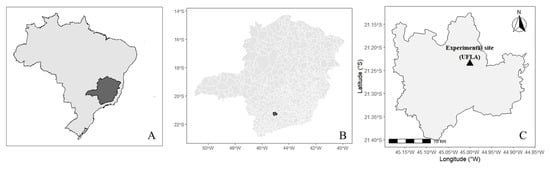
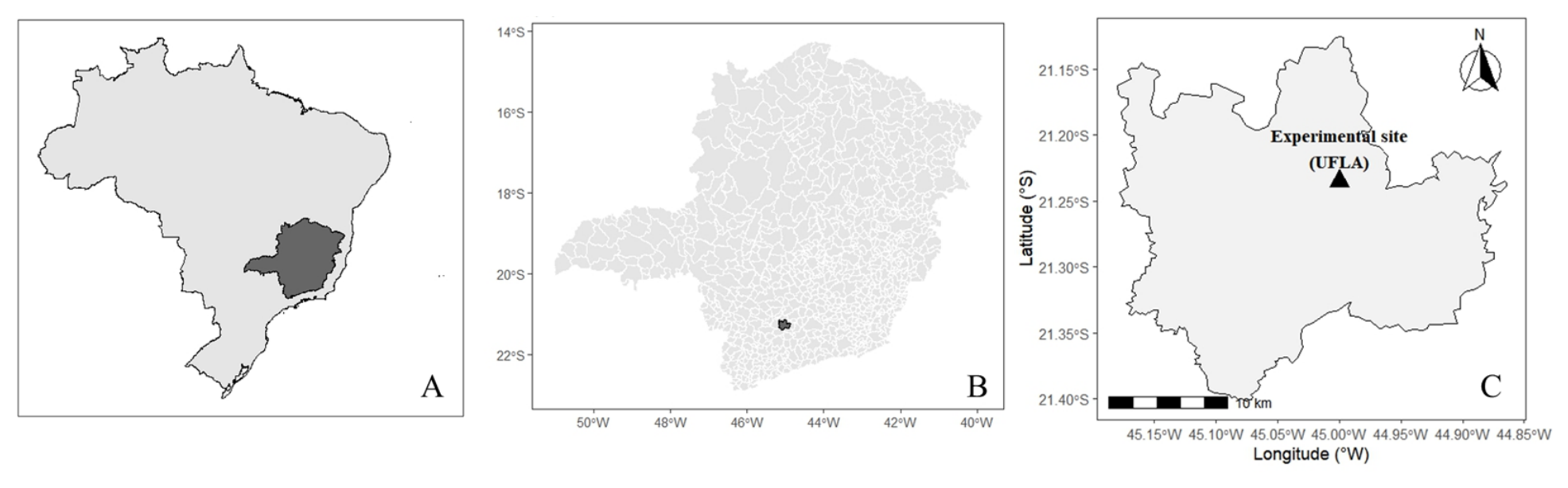
The study was conducted at the Laboratory of Constructions, Animal Environment, and Sustainability, part of the Department of Agricultural Engineering at the Federal University of Lavras (UFLA), located in Lavras, Minas Gerais State, Brazil (Figure 1). The site is situated at an average altitude of 910 m, with geographic coordinates of 21°14′06″ S latitude and 45°00′00″ W longitude. According to the Köppen climate classification, the region has a Cwa climate characterized by dry winters and predominantly rainy summers with an average annual precipitation of 1530 mm and an average annual temperature of 19.4 °C [37].
Figure 1.
Geographic location of the study area. (A) Minas Gerais State highlighted within Brazil; (B) municipality of Lavras located in southern Minas Gerais; and (C) location of the experimental site at the Federal University of Lavras (UFLA) (21°14′06″ S, 45°00′00″ W; 910 m altitude), Lavras, Minas Gerais, Brazil.
The experiment employed both organic fertilization, using stabilized Compost Barn bedding, and conventional mineral fertilization for the cultivation of Panicum maximum cv. Miyagui. The plants were grown in pots inside a greenhouse. Seedlings were subjected to water stress periods, as described in detail below. To predict instantaneous water use efficiency (iWUE), fuzzy inference systems were developed based on the methodologies proposed by [38,39].
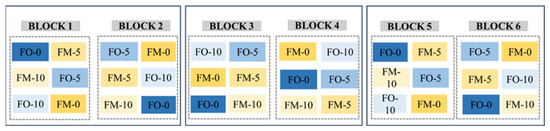
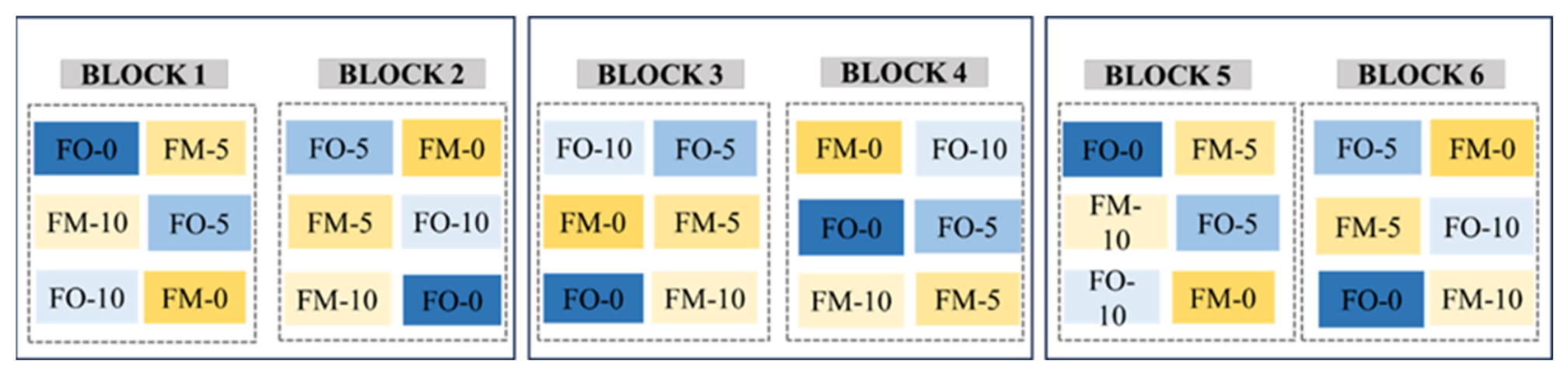
The experimental design was a randomized complete block design (RCBD) in a 2 × 3 factorial arrangement (Figure 2). The first factor was the type of fertilization (mineral and organic), and the second factor was water deficit duration (0, 5, and 10 days). The experiment included six replicates per treatment. Each experimental unit consisted of a 5 dm3 pot containing four plants, resulting in a total of 36 experimental units.
Figure 2.
Schematic representation of the experimental layout. FO-D0 = organic fertilization without water deficit; FO-D5 = organic fertilization with 5 days of water deficit; FO-D10 = organic fertilization with 10 days of water deficit; FM-D0 = mineral fertilization without water deficit; FM-D5 = mineral fertilization with 5 days of water deficit; and FM-D10 = mineral fertilization with 10 days of water deficit.
2.2. Experimental Setup
Soil samples were collected from an area within the UFLA campus, at a depth of 0 to 40 cm. The samples were sieved and sent to the Soil Analysis Laboratory of the Department of Soil Science (DCS) at UFLA for physical and chemical characterization. The soil was classified as a Eutrophic Red Latosol with clayey texture (Table 1).
Table 1.
Physical–chemical properties of the soil (0–40 cm) used in the experiment.
The organic compost used in this study was bedding material obtained from a Compost Barn dairy cattle confinement system. Its basic composition consists of sawdust and manure produced by dairy cows managed in this system. The material was collected following a standardized methodology [40], with samples taken from multiple points within the system to form a composite sample. The collected material was then left to rest for a period of two weeks. After this resting period, a subsample was sent to the laboratory for chemical characterization, following the procedures described by [41], as shown in Table 2.
Table 2.
Chemical characterization of the organic compound from the Compost Barn system used in the experiment.
Based on the results of the chemical composition of the organic compound, the application rate was calculated to provide 250 kg ha−1 of nitrogen, an amount within the recommended range for pasture establishment, which ranges from 100 to 400 kg ha−1 [42]. The required dose was determined based on the nitrogen content of the organic material, resulting in the equivalent of 25.773 kg ha−1 of compound. This amount was later converted to volume per pot (Table 3). Organic compost was manually incorporated into the soil one week before sowing to improve homogenization and ensure gradual nutrient availability to the plants.
Table 3.
Quantity of nutrients present in the applied dose of organic compound.
Mineral fertilization was established based on the recommendations for potted crops, following the criteria proposed by [43], with appropriate adaptations. The objective was to equalize the nitrogen content provided by the organic compost, ensuring equivalence between fertilizer sources and enabling a valid comparison between treatments. To ensure consistency between treatments, the concentrations of the macronutrients calcium (Ca), phosphorus (P), and sulfur (S) in the organic compost were adjusted through supplementation with mineral fertilizers. Simultaneously, the levels of potassium (K) and magnesium (Mg) in the mineral fertilizer were increased to match the higher concentrations of these nutrients already present in the organic compost (Table 4).
Table 4.
Nutrient equalization adapted from Malavolta [43].
The mineral sources used in the experiment were: ammonium nitrate (NH4NO3), diammonium phosphate ((NH4)2HPO4), potassium chloride (KCl), magnesium sulfate heptahydrate (MgSO4·7H2O), calcium sulfate dihydrate (CaSO4·2H2O), zinc sulfate heptahydrate (ZnSO4·7H2O), copper sulfate pentahydrate (CuSO4·5H2O), ferrous sulfate heptahydrate (FeSO4·7H2O), and boric acid (H3BO3). All fertilizers were dissolved in distilled water to obtain a homogeneous solution. Subsequently, 20 mL of the nutrient solution was applied to each pot one day before sowing to ensure uniform nutrient distribution among treatments.
The forage cultivar used in the experiment was Panicum maximum cv. Miyagui. Sowing was performed on 28 September 2023, with 30 seeds evenly distributed per 5 dm3 pot. After seedling emergence, thinning was performed to maintain four seedlings per pot, selected based on their superior vegetative vigor.
2.3. Application of Water Deficit
To determine field capacity (FC) and permanent wilting point (PWP), a disturbed subsample of the soil and compost-incorporated soil was used. The samples were previously saturated in PVC cylinders (5 cm diameter × 1 cm height) in triplicate and subjected to potentials of −10 kPa using a tension table and −1500 kPa using a Richards porous plate extractor, until water drainage ceased. Subsequently, the material was oven-dried at 65 °C for 24 h and then weighed. Gravimetric content (%) was 35.62% and 26.47% for the FC and PWP of the pure soil, respectively, and 36.86% and 26.88% for the FC and PWP of the compost-incorporated soil, determined according to Equation (1).
where Mu = mass of wet soil; Ms = mass of dry soil; Mv = mass of the empty cylinder.
Ug (%) = (Mu − Ms)/(Ms − Mv) × 100
Water restriction was imposed during specific periods previously defined in this study, aiming to evaluate the potential of organic compost compared to mineral fertilizer on water-use efficiency in forages under water-deficit conditions. Water-deficit treatments of 5 and 10 days, simulating a short-term dry spell, were applied after plant establishment and a uniformity cut.
Irrigation was conducted using the gravimetric method, with daily weighing to monitor water loss via evapotranspiration and to replenish the corresponding volume to field capacity. The control treatment received daily irrigation throughout the experiment. During water restriction periods, pots were weighed daily without water replacement to track the dynamics of water loss. At the end of the respective stress periods, irrigation was restored to field capacity.
2.4. Determination of Instantaneous Water Use Efficiency (iWUE)
Instantaneous water use efficiency (iWUE) was determined based on gas exchange measurements performed at the end of each water restriction period. Net photosynthetic rate (A, μmol CO2 m−2 s−1) and transpiration rate (E, mmol H2O m−2 s−1) were measured using an infrared gas analyzer (IRGA; LI-6400, LI-COR Biosciences, Lincoln, NE, USA). Instantaneous water use efficiency was calculated as the ratio between carbon assimilation and water loss through transpiration (iWUE = A/E), following a widely adopted approach in physiological studies assessing plant responses to water stress [44,45]. Measurements were conducted between 08:00 and 10:00 h.
2.5. Development of Fuzzy Models
Based on the experimental dataset, a random data split was performed, with 80% of the observations used for system development and 20% reserved for validation. The 80/20 division between training and validation datasets is a widely adopted practice in the development of fuzzy systems [46,47,48], as it ensures a robust training sample for model calibration, enhances the identification of relevant patterns, and provides adequate generalization capability when applied to unseen data.
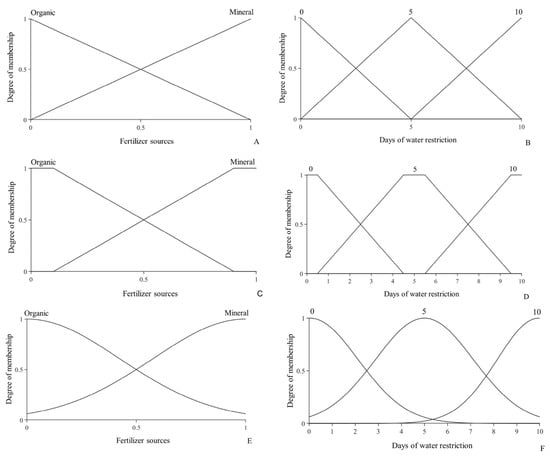
Fuzzy models were developed using the MATLAB® Fuzzy Logic ToolboxTM, implementing the Mamdani and Takagi–Sugeno inference approaches. The input variables consisted of fertilization source (organic and mineral) and water deficit level (0, 5, and 10 days without irrigation), which were represented by triangular, trapezoidal, and Gaussian membership functions (Figure 3). Although fertilization source is a nominal categorical variable, it was encoded as 0 (organic) and 1 (mineral) to enable its incorporation into the fuzzy model input structure. Within the fuzzy modeling framework, this representation is consistent with the concept of fuzzy dummy variables, which allow categorical information to be integrated into numerical systems without imposing linearity or continuity between classes [49].
Figure 3.
Triangular (A,B), trapezoidal (C,D) and Gaussian (E,F) association functions for the input variables fertilizer sources and days of water restriction.
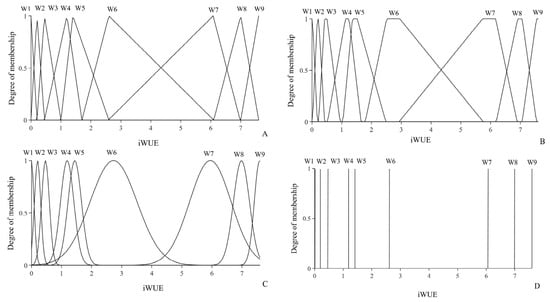
The output variable, instantaneous water use efficiency (iWUE), was defined based on the range of values observed experimentally. It was represented by nine fuzzy linguistic sets (W1–W9), distributed across the universe of discourse of the response variable. In the Mamdani systems, these sets were represented by triangular, trapezoidal, and Gaussian membership functions (Figure 4A–C), while in the Sugeno systems, they were represented by singleton functions (Figure 4D). The central values of the output sets were established based on the distribution of the experimental iWUE data to represent the entire observed range of the variable.
Figure 4.
Output variable instantaneous water use efficiency (iWUE) represented by (A) triangular, (B) trapezoidal and (C) Gaussian membership functions, in Mamdani’s inference, and by (D) singleton sets, in Sugeno’s inference.
As inference methods varied between the two proposed models, the defuzzification strategies applied were also varied. For the Mamdani inference system, five defuzzification techniques were evaluated: centroid (center of area), bisector, smallest of maxima (SOM), mean of maxima (MOM), and largest of maxima (LOM). For the Sugeno inference system, two approaches were assessed: weighted sum (WTsum) and weighted average (WTaver). Thus, all possible combinations of defuzzification methods were explored. Varying and substituting these parameters contributes to the selection of more representative models with lower prediction error, while also promoting greater practicality, reduced computational cost, and improvements in accuracy and processing speed [50,51].
Based on the combinations of input variables and using experimental data as a reference, six fuzzy rules were developed (Table 5). These rules correspond to all combinations between the two fertilization sources and the three water deficit levels. The rule base was constructed with the support of three experts, following the methodology proposed by [52], to reduce inconsistencies in rule formulation. The rule consequents (W2, W4, W5, W7, and W8) were assigned to the fuzzy sets that best represented the iWUE levels observed for each experimental combination.
Table 5.
Fuzzy rules used to estimate instantaneous water use efficiency (iWUE) as a function of fertilization source and water deficit levels.
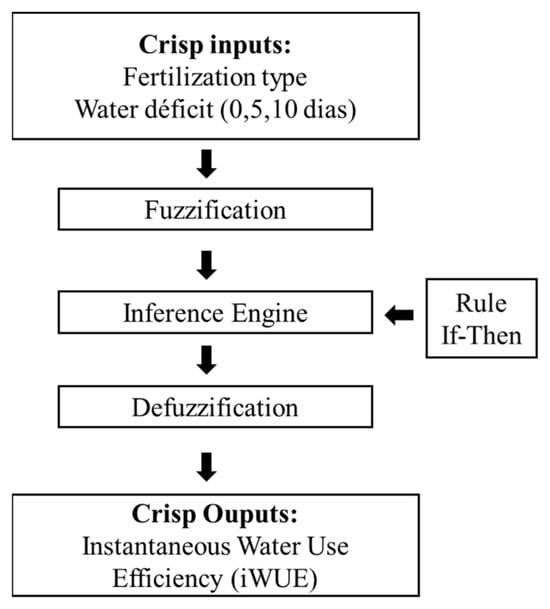
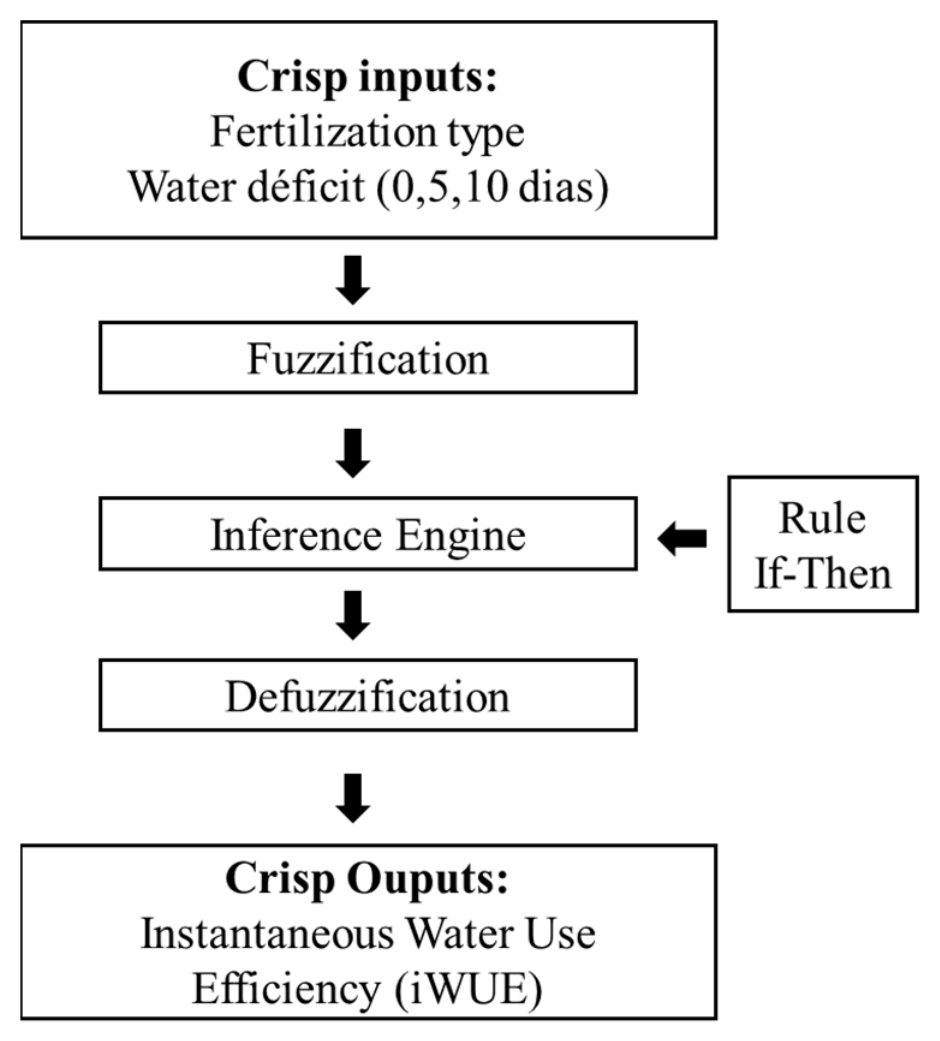
Each rule was assigned a weight equal to 1. This procedure was adopted to avoid changes in the output variable domain and to ensure that the observed differences among models resulted exclusively from the representation forms of membership functions, inference methods, and defuzzification procedures [50,51,53]. Although the rule base was built from experimental knowledge, the final estimates were generated through the fuzzy inference process involving the simultaneous activation of membership functions, rule aggregation, and defuzzification, allowing continuous responses within the studied domain. A flowchart of the FIS development steps is shown in Figure 5.
Figure 5.
Diagram the functioning of the fuzzy inference system developed to predict instantaneous water use efficiency (iWUE).
2.6. Model Performance Analysis
The performance of the fuzzy inference systems (FISs) was evaluated by comparing the simulated data with the experimental data using statistical indices, including standard deviation (σ), mean absolute error (MAE), mean absolute percentage error (MAPE), coefficient of determination (R2), mean squared error (MSE), root mean squared error (RMSE), biased integrated absolute error (BIAS), and the Nash–Sutcliffe efficiency index (NSE), calculated according to Equations (2)–(9), respectively. In addition, water use efficiency values obtained from the experiment were compared with those simulated by the FIS using Student’s t-test (p < 0.05).
where n = the total number of samples, Pi = the predicted value of the ith sample, Oi = the observed value of the ith sample, = the mean of the predicted values, and Ō = the mean of the observed values.
3. Results
3.1. Accuracy of Fuzzy Inference Systems (FISs)
The comparison of the statistical indicators σ, Ep, Ea, RMSE, MSE, BIAS, NSE, R2, and the t-test between experimental and simulated data for the developed Mamdani and Sugeno FIS models is presented in Table 6. Among the 21 systems evaluated, only one system (Gaussian membership function with Sugeno inference and WTsum defuzzification) showed a statistically significant difference according to Student’s t-test (p < 0.05), indicating a discrepancy between observed and predicted mean values. For the remaining systems, no significant differences were observed (p > 0.05). These results indicate that the models adequately represented the central tendency of the data and did not exhibit systematic bias in iWUE estimates.
Table 6.
Statistical indicators of the different fuzzy inference system structures tested.
Among the fuzzy systems evaluated, systems 1, 8, 13, 14, 17, 18, and 19 exhibited the best statistical performances. Among these, system 8, which consisted of trapezoidal membership functions, Mamdani inference, and centroid defuzzification, stood out due to its lower σ (0.2383), MAE (0.3371), RMSE (0.0923) and MSE (0.1743) values, as well as high NSE (0.9887) and R2 (0.9846). Although this system was the best performer, the remaining models also demonstrated satisfactory performance, indicating the potential of the developed FIS.
3.2. Validation of Simulated and Observed Water Use Efficiency for the Best FIS
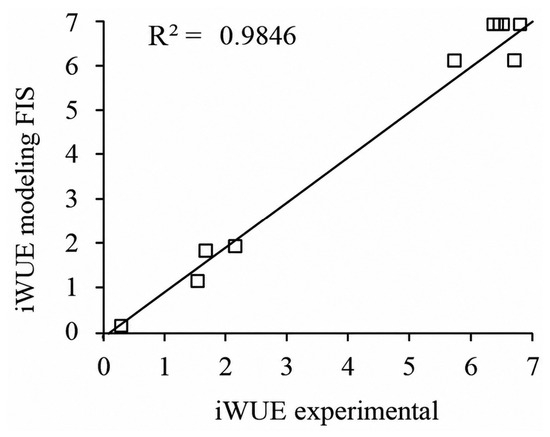
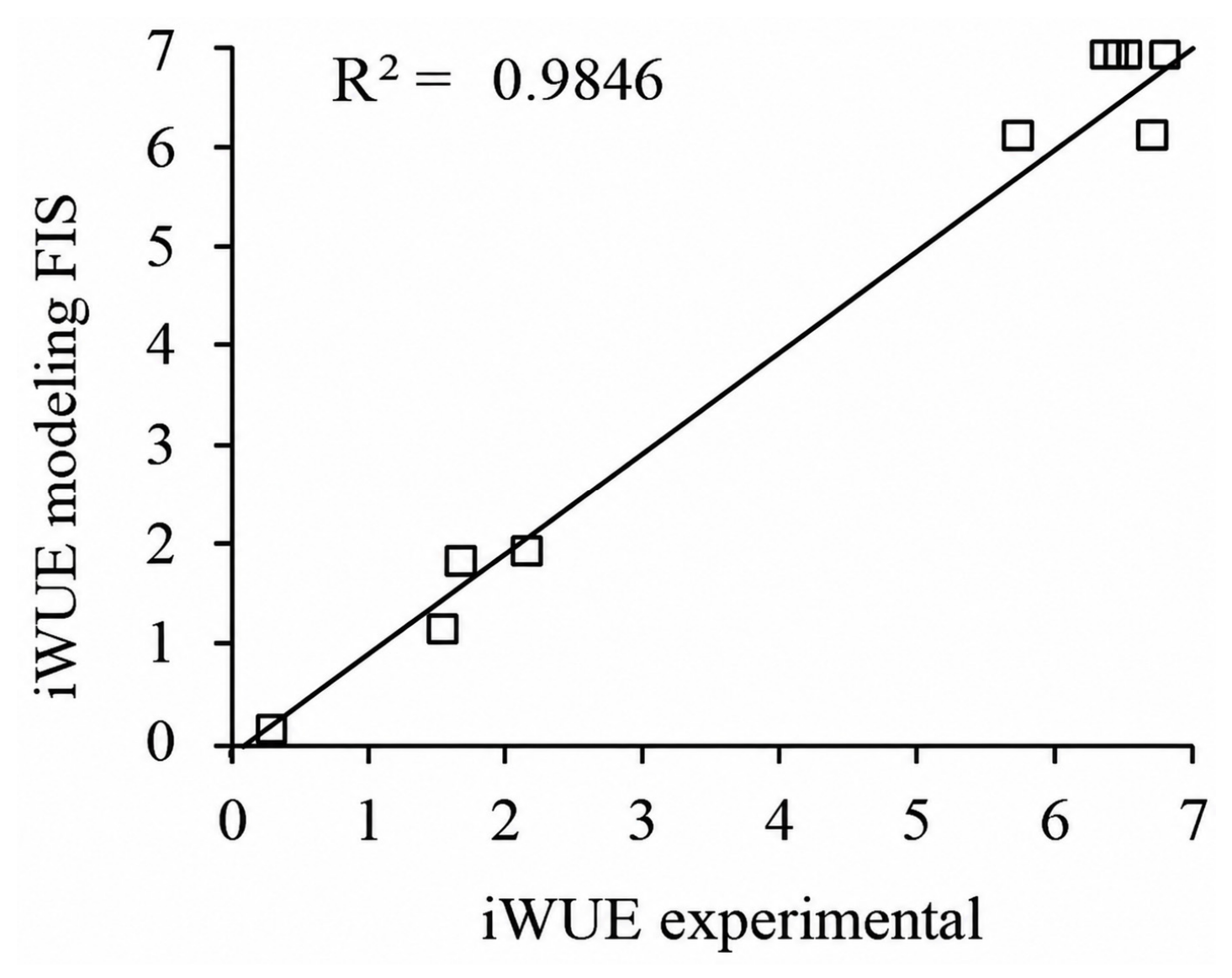
All tested models yielded a coefficient of determination (R2) ranging from 0.9621 to 0.9849 (Table 6), indicating that 96–98% of the variability in the observed instantaneous water use efficiency (iWUE) was explained by the models. These results suggest that the models successfully captured the relationship between the input variables (fertilization type and water deficit) and the output variable, demonstrating the consistency of the developed systems. Figure 6 presents the relationship between observed and simulated values generated by the best-performing fuzzy inference system (System 8).
Figure 6.
Functional relationship between the experimentally obtained and predicted values of instantaneous water use efficiency (iWUE) using fuzzy inference systems configured with trapezoidal membership functions and centroid defuzzification.
The model fitted the experimental iWUE data, showing strong agreement between simulated and observed values, as evidenced by the high coefficient of determination (R2 = 0.9846). This agreement is reflected in the close alignment of data points along the 45° reference line, demonstrating that the fuzzy system effectively captured the relationship between fertilization sources, water deficit levels, and crop response.
Although small discrepancies were observed at some intermediate points, likely due to transitions between linguistic categories or the inherent variability of the experimental data, the model exhibited internal consistency. These are desirable features for applications involving variables with nonlinear or uncertain behavior.
3.3. Three-Dimensional Visualization of FIS Performance Under Fertilization and Water Deficit Scenarios
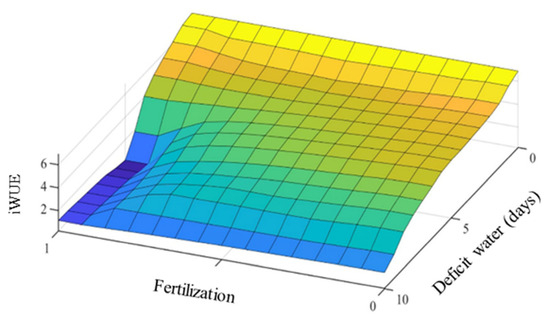
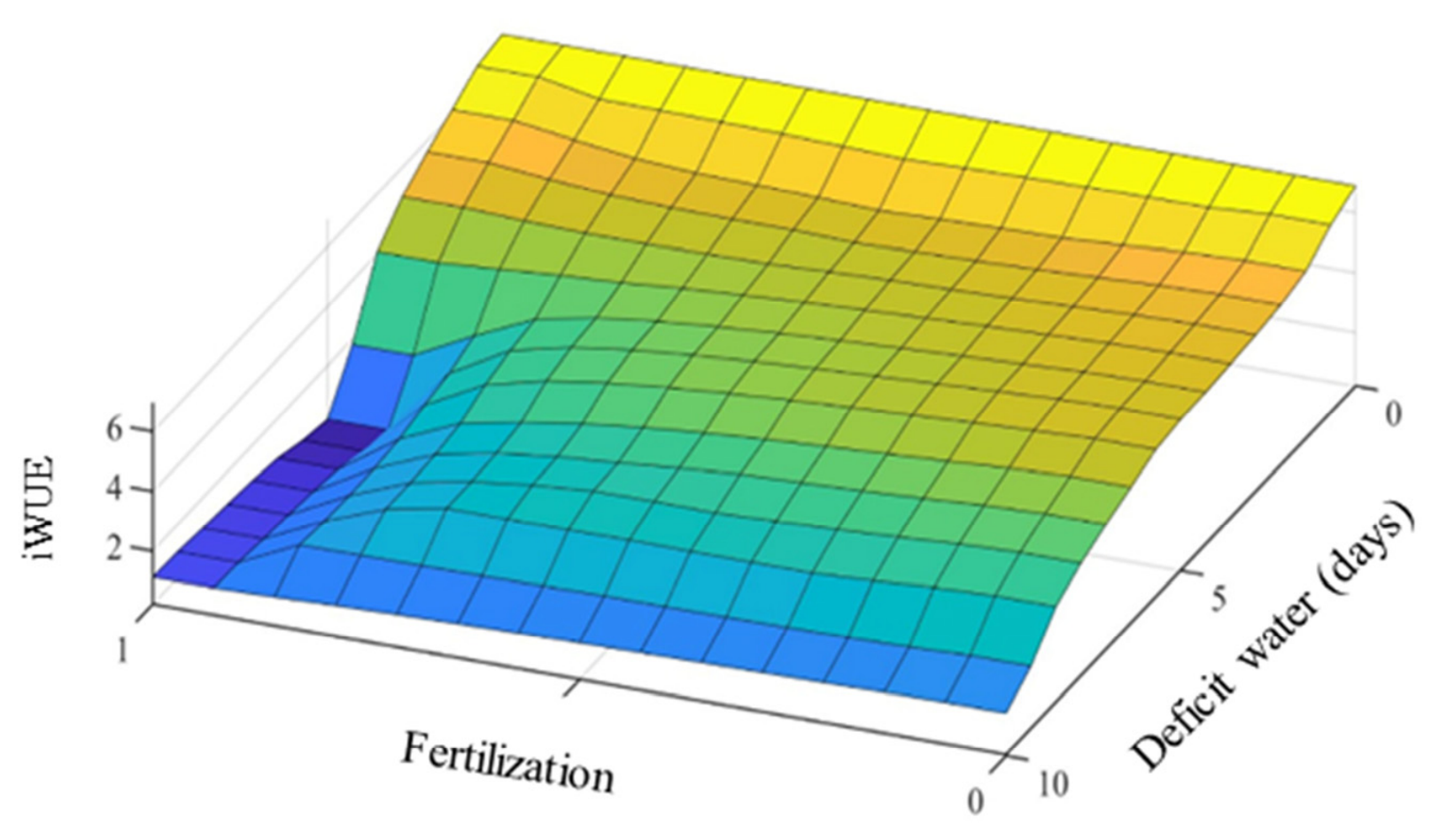
Figure 7 presents the three-dimensional response surface of iWUE in the forage crop as a function of fertilization sources (organic and mineral) and water deficit levels (0, 5, and 10 days), based on the best-performing fuzzy model. A reduction in iWUE was observed with increasing water deficit, as indicated by the bluish tones. This decline was more pronounced under mineral fertilization (X = 1), whereas organic fertilization (X = 0) resulted in a more stable WUE under stress conditions.
Figure 7.
Response surface of instantaneous water use efficiency (iWUE) as a function of different fertilization sources (organic and mineral) under water deficit conditions, using the fuzzy model configured with trapezoidal membership functions, Mamdani inference, and centroid defuzzification.
The smooth transitions observed in the 3D surface suggest that the effects of fertilization source and water deficit levels occur in a continuous manner. This gradual behavior is consistent with the adaptive response of plants to management variations and highlights the fuzzy models’ ability to represent complex, nonlinear interactions among factors. Consequently, the smooth response surface provides continuity in model predictions, avoiding abrupt transitions between treatment levels and offering a continuous realistic representation of plant responses to water and nutrient management.
4. Discussion
4.1. Performance Evaluation of Fuzzy Inference Systems (FISs)
Among all 21 fuzzy inference systems (FISs) developed in this study, the best performance was observed in 11 of them, as evidenced by low and optimal statistical metrics [54,55,56]. These results indicate the potential of the proposed FIS models for simulating instantaneous water use efficiency (iWUE) under different fertilization sources both organic and mineral and across various water deficit levels.
In the literature, few studies directly model water use efficiency using physiological or management-related variables, particularly those based on fuzzy logic. For comparative purposes, the results of this study were benchmarked against widely used algorithms for modeling complex systems, including artificial neural networks (ANNs), adaptive neuro-fuzzy inference systems (ANFISs), and Mamdani and Sugeno fuzzy models applied to different crops, considering performance metrics such as the coefficient of determination (R2) and the root mean square error (RMSE).
Among the limited number of available studies, ref. [57] simultaneously modeled crop evapotranspiration and maize water use efficiency using artificial neural networks, achieving an RMSE of 0.91 and an R2 of 0.99. Similarly, ref. [58] estimated reference evapotranspiration using a standard ANFIS and optimized hybrid versions (ANFIS–WCA, ANFIS–MFO, and ANFIS–WCMFO), reporting RMSE values of 0.259, 0.241, 0.252, and 0.220, respectively.
Ref. [59] applied machine learning techniques to estimate wheat yield, including artificial neural networks, least-squares support vector regression (LS-SVR), and neuro-fuzzy systems, obtaining RMSE values of 0.425, 0.472, and 0.440, respectively.
Within the specific context of fuzzy models applied to agriculture, ref. [60] developed a Mamdani FIS with trapezoidal membership functions to predict lettuce leaf number, achieving an RMSE of 1.20 and an R2 of 0.98. Ref. [61] employed a Takagi–Sugeno model to estimate photosynthesis based on environmental and physiological variables, reporting an RMSE of 1.01 and an R2 of 0.95.
Considering these studies, the results obtained in the present work, particularly for system 8 (RMSE = 0.0923; R2 = 0.9846), are comparable to or superior to those reported for ANN-, ANFIS-, and FIS-based models applied to different crops and environmental conditions. These findings highlight the strong performance of the proposed FIS in representing iWUE under different fertilization sources and levels of water deficit.
4.2. Validation and Response Surface Analysis of the Best FIS Model
The coefficient of determination (R2) is an important and useful metric for evaluating the overall performance of a model, as it describes the variability of experimental data [62]. Similar results have been reported in the literature for different machine learning algorithms applied to complex agricultural systems. Ref. [63] employed support vector regression (SVR) to predict the photosynthetic rate of cucumber based on environmental variables and reported correlation coefficients of 0.99. Ref. [64], using artificial neural networks and fuzzy logic to predict lettuce growth and quality, observed R2 values ranging from 0.82 to 0.96. Similarly, ref. [65] applied ANFIS models to predict potato growth and yield under different irrigation regimes, obtaining R2 values between 0.72 and 0.97.
Although the crops and predicted variables differ, these studies report performance metrics comparable to those obtained in the present work (R2 = 0.9846), reinforcing the suitability of fuzzy systems for modeling agricultural processes characterized by nonlinearity, uncertainty, and multiple management factors. These findings support the choice of the fuzzy system adopted in this study, as its performance is consistent with results reported for state-of-the-art models.
Instantaneous water use efficiency (iWUE) depends on several factors, including soil management conditions [66,67]. In this context, improving iWUE through fertilizer management is an urgent and crucial need [68], particularly in climate change scenarios. In our study, based on the three-dimensional response surface, mineral fertilization promoted higher iWUE under favorable water availability, which may be associated with rapid nutrient solubility and uptake, particularly nitrogen [69].
However, as water deficit increased, iWUE decreased, likely due to the lower solubility of mineral fertilizers in drier soils and increased salinity, which can exacerbate osmotic stress [70]. In contrast, organic fertilization, which initially resulted in lower iWUE due to the gradual release of nutrients, showed potential greater resilience as water deficit intensified. Previous studies have reported that organic fertilization increases water use efficiency under water deficit conditions [71,72,73]. Ref. [74], evaluating organic sources (biochar, compost, and vermicompost) combined with mineral fertilization under deficit irrigation, reported that organic inputs promoted higher iWUE under reduced water availability.
These conditions can be attributed to improvements in soil physical properties promoted by organic matter, especially increased water retention and structural stability [75,76], which favor greater water availability in the rhizosphere and enhance the resilience of the soil–plant system, reflected in the crop’s physiological response. Furthermore, the more gradual N release from the organic source may have contributed to better synchronization between nutrient supply and crop metabolic demand, favoring the maintenance of carbon assimilation per unit of water transpired.
Although previous studies have shown positive effects of organic fertilization on water use efficiency, the results presented here provide a distinct contribution by directly comparing the iWUE dynamics between organic and mineral sources under different water deficit intensities in a forage species. This approach highlights that, although mineral fertilizers promote immediate gains, their efficiency is more vulnerable to water scarcity, whereas organic fertilization shows greater stability, possibly associated with nutrient release dynamics and changes in the soil environment.
The absolute differences in iWUE between fertilization sources were relatively small. Nevertheless, these increments may translate into agronomic advantages under water deficit conditions, especially in forage systems that depend on production stability. Beyond its effect on iWUE, the use of organic compost derived from dairy production systems incorporates circular economy principles into agriculture, adding value to local residues and reducing dependence on mineral fertilizers. This represents a sustainable strategy to mitigate the impacts of water scarcity.
4.3. Combined Fertilization Approaches for Sustainable Water Management
Organic fertilization, alone or combined with mineral fertilizers, effectively increases productivity and optimizes water use under water stress. The combined approach provides both rapid nutrient availability (from mineral sources) and continuous supply (from organic inputs) [77]. Additionally, organic sources improve soil physical properties such as bulk density, porosity, and water storage effects that mineral fertilizers alone do not always achieve [78].
Supporting this approach, ref. [79] observed higher kodo millet productivity when NPK was integrated with cattle manure, attributed to a more balanced nutrient supply. Similarly, ref. [80] reported that combined chemical and organic fertilization in rainfed maize improved soil water status, grain yield, and water use efficiency. Ref. [81] found that integrating organic and mineral sources in rice cultivation maintained productivity while reducing NH3 emissions and increasing nitrogen use efficiency.
These findings align with our fuzzy model response surface (Figure 5), which showed greater iWUE stability under organic fertilization during prolonged deficit. This suggests that integrating both sources could combine rapid early establishment (mineral) with stress resilience (organic). Thus, combining organic and mineral fertilizers offers a more efficient and sustainable management strategy, especially under water scarcity.
4.4. Limitations and Future Perspectives
Despite the satisfactory performance of the selected fuzzy model, some limitations should be considered when interpreting the results. The model was developed using data obtained from a single experiment conducted under specific cultivation conditions, which may limit its extrapolation to different environments and management practices. Furthermore, the dataset used in this study may limit the model’s generalization capability and increase the influence of characteristics specific to the experimental conditions evaluated.
The model was structured using a limited number of input variables, namely fertilization source and water deficit duration. Although this approach enhances the simplicity and interpretability of the system, it may not fully capture the complexity of the factors influencing instantaneous water use efficiency. Furthermore, although the model showed satisfactory performance during the validation procedures, its generalization capability should be further assessed using independent datasets. Therefore, the predictions generated by the model should be interpreted within the range of experimental conditions evaluated in this study.
These limitations also provide opportunities for future research. Future studies may expand the dataset by conducting experiments under different environmental conditions, growing seasons, and management practices, thereby representing a broader range of scenarios and improving the models’ generalization capability. The inclusion of additional agronomic, physiological, and environmental variables may further enhance the robustness and predictive performance of the system. Furthermore, the use of independent datasets for external validation, together with comparisons against other modeling approaches, may provide a more comprehensive assessment of the model’s generalization capability and strengthen the reliability, robustness, and applicability of fuzzy inference systems as decision support tools for sustainable agricultural management.
5. Conclusions
Fuzzy logic adequately reproduced the experimental iWUE patterns within the limitations of the available dataset. Among the evaluated models, the system based on trapezoidal membership functions, Mamdani inference, and centroid defuzzification showed the best performance, as indicated by the validation metrics.
From an agronomic perspective, the fuzzy model indicated that organic fertilization derived from composted bedding material was associated with a smaller reduction in iWUE under increasing water deficit compared with mineral fertilization, suggesting greater stability under stress conditions. Beyond its direct contribution to forage systems, organic compost also shows potential for application in annual crops, expanding opportunities for sustainable agricultural practices aimed at improving iWUE. These findings reinforce the importance of integrating organic sources to increase agricultural system resilience under water deficit.
Fuzzy systems represent a promising tool for precision agriculture, enabling reliable prediction of combined management effects on water use efficiency. The proposed fuzzy system has potential for future integration with IoT sensors for real-time water management, although this was not tested here. Future studies with larger datasets are needed to validate this integration and real-time monitoring.
Author Contributions
Conceptualization, M.P.d.A., A.T.C. and M.E.S.; methodology, M.P.d.A., M.E.S., B.C.A., B.M.S. and L.C.d.S.; software, M.P.d.A., B.C.A. and R.d.S.A.; validation, M.P.d.A. and T.Y.J.; formal analysis, M.P.d.A., B.C.A. and F.S.; investigation, M.P.d.A., R.d.S.A., L.B.M. and S.E.I.R.; resources, B.M.S., L.C.d.S., V.B.d.S.B. and D.B.M.; data curation, M.P.d.A., R.d.S.A., L.B.M. and S.E.I.R.; writing—original draft preparation, M.P.d.A. and A.T.C.; writing—review and editing, F.S. and T.Y.J.; visualization, M.P.d.A. and A.T.C.; supervision, M.P.d.A. and A.T.C.; project administration, M.P.d.A., A.T.C. and M.E.S.; funding acquisition, F.S., V.B.d.S.B. and D.B.M. All authors have read and agreed to the published version of the manuscript.
Funding
This research received no external funding.
Institutional Review Board Statement
Not applicable.
Informed Consent Statement
Not applicable.
Data Availability Statement
The data presented in this study are available upon request from the corresponding author.
Conflicts of Interest
The authors declare no conflicts of interest.
References
- Rapiya, M.; Mndela, M.; Ramoelo, A. Sustainable food systems through livestock–pasture integration. Agriculture 2025, 15, 967. [Google Scholar] [CrossRef] [Scilit]
- Jayasinghe, J.M.P.; Pembleton, K.G.; Donaghy, D.J.; Ramilan, T.; Barber, D.G. Long-term evaluation of pasture production, seasonality, and variability: An application of the DairyMod pasture model for three tropical species. Eur. J. Agron. 2024, 156, 127103. [Google Scholar] [CrossRef] [Scilit]
- Bashiru, H.A.; Oseni, S.O. Simplified climate change adaptation strategies for livestock development in low-and middle-income countries. Front. Sustain. Food Syst. 2025, 9, 1566194. [Google Scholar] [CrossRef] [Scilit]
- Poornimadarshini, S. Assessing Soil Erosion and Land Degradation Impacts on Forage Availability and Livestock Productivity Using GIS-Based RUSLE Modelling. Natl. J. Anim. Health Sustain. Livest. 2024, 2, 20–27. [Google Scholar] [CrossRef]
- Melo, C.D.; Maduro Dias, C.S.; Wallon, S.; Borba, A.E.; Madruga, J.; Borges, P.A.; Elias, R.B. Influence of climate variability and soil fertility on the forage quality and productivity in Azorean pastures. Agriculture 2022, 12, 358. [Google Scholar] [CrossRef] [Scilit]
- Ferrazza, R.D.A.; Castellani, E. Analysis of Brazilian livestock transformations: A focus on dairy farming. Ciênc. Anim. Bras. 2021, 22, e68940. [Google Scholar] [CrossRef] [Scilit]
- Zuffo, A.M.; Steiner, F.; Aguilera, J.G.; Ratke, R.F.; Barrozo, L.M.; Mezzomo, R.; Ancca, S.M. Selected indices to identify water-stress-tolerant tropical forage grasses. Plants 2022, 11, 2444. [Google Scholar] [CrossRef] [Scilit] [PubMed]
- Osei-Amponsah, R.; Dunshea, F.R.; Leury, B.J.; Cheng, L.; Cullen, B.; Joy, A.; Chauhan, S.S. Heat stress impacts on lactating cows grazing Australian summer pastures on an automatic robotic dairy. Animals 2020, 10, 869. [Google Scholar] [CrossRef] [Scilit] [PubMed]
- Bolfe, É.L.; Victoria, D.D.C.; Sano, E.E.; Bayma, G.; Massruhá, S.M.F.S.; Oliveira, A.F. Potential for agricultural expansion in degraded pasture lands in Brazil based on geospatial databases. Land 2024, 13, 200. [Google Scholar] [CrossRef] [Scilit]
- Sloat, L.L.; Gerber, J.S.; Samberg, L.H.; Smith, W.K.; Herrero, M.; Ferreira, L.G.; West, P.C. Increasing importance of precipitation variability on global livestock grazing lands. Nat. Clim. Change 2018, 3, 214–218. [Google Scholar] [CrossRef] [Scilit]
- Xu, X.; Bi, R.; Song, M.; Dong, Y.; Jiao, Y.; Wang, B.; Xiong, Z. Organic substitutions enhanced soil carbon stabilization and reduced carbon footprint in a vegetable farm. Soil Tillage Res. 2024, 236, 105955. [Google Scholar] [CrossRef] [Scilit]
- Ejaz, M.K.; Aurangzaib, M.; Iqbal, R.; Shahzaman, M.; Habib-ur-Rahman, M.; El-Sharnouby, M.; El Sabagh, A. The use of soil conditioners to ensure a sustainable wheat yield under water deficit conditions by enhancing the physiological and antioxidant potentials. Land 2022, 11, 368. [Google Scholar] [CrossRef] [Scilit]
- Khan, M.T.; Aleinikovienė, J.; Butkevičienė, L.M. Innovative organic fertilizers and cover crops: Perspectives for sustainable agriculture in the era of climate change and organic agriculture. Agronomy 2024, 14, 2871. [Google Scholar] [CrossRef] [Scilit]
- Mota, V.C.; Damasceno, F.A.; Leite, D.F. Fuzzy clustering and fuzzy validity measures for knowledge discovery and decision making in agricultural engineering. Comput. Electron. Agric. 2018, 150, 118–124. [Google Scholar] [CrossRef] [Scilit]
- Galama, P.J.; Van Dooren, H.J.C.; Eilers, C.H.A.M. Learning from drivers and conflicts around bedded pack barns. In Proceedings of the 10th European IFSA Symposium, Aarhus, Denmark, 1–4 July 2012. [Google Scholar]
- Adhikari, K.; Hartemink, A.E. Linking soils to ecosystem services—A global review. Geoderma 2016, 262, 101–111. [Google Scholar] [CrossRef] [Scilit]
- Liu, B.; Wang, X.; Ma, L.; Chadwick, D.; Chen, X. Combined applications of organic and synthetic nitrogen fertilizers for improving crop yield and reducing reactive nitrogen losses from China’s vegetable systems: A meta-analysis. Environ. Pollut. 2021, 269, 116143. [Google Scholar] [CrossRef] [Scilit] [PubMed]
- Li, Z.; Yang, Y.; Wang, X.; Qi, Y.; Yang, X. Linking N2O emissions and nos Z gene abundance: A meta-analysis of organic carbon amendments in agricultural soils. Plant Soil 2025, 515, 613–627. [Google Scholar] [CrossRef] [Scilit]
- Hatfield, J.L.; Dold, C. Water-use efficiency: Advances and challenges in a changing climate. Front. Plant Sci. 2019, 10, 103. [Google Scholar] [CrossRef] [Scilit] [PubMed]
- Fahad, S.; Bajwa, A.A.; Nazir, U.; Anjum, S.A.; Farooq, A.; Zohaib, A.; Huang, J. Crop production under drought and heat stress: Plant responses and management options. Front. Plant Sci. 2017, 8, 1147. [Google Scholar] [CrossRef] [Scilit] [PubMed]
- Thakur, M.; Kumar, R. Mulching: Boosting crop productivity and improving soil environment in herbal plants. J. Appl. Res. Med. Aromat. Plants 2021, 1, 100287. [Google Scholar] [CrossRef] [Scilit]
- Santana, T.A.; Oliveira, P.S.; Silva, L.D.; Laviola, B.G.; Almeida, A.A.F.; Gomes, F.P. Water use efficiency and consumption in different Brazilian genotypes of Jatropha curcas L. subjected to soil water deficit. Biomass Bioenergy 2015, 75, 119–125. [Google Scholar] [CrossRef] [Scilit]
- Bing, X.; Fang, K.; Gong, X.; Wang, W.; Xu, C.; Li, M.; Zhou, F. The intra-annual intrinsic water use efficiency dynamics based on an improved model. Clim. Change 2022, 172, 16. [Google Scholar] [CrossRef] [Scilit]
- Pan, S.; Wang, X.; Yan, Z.; Wu, J.; Guo, L.; Peng, Z.; Liu, L. Leaf stomatal configuration and photosynthetic traits jointly affect leaf water use efficiency in forests along climate gradients. New Phytol. 2024, 244, 1250–1262. [Google Scholar] [CrossRef] [Scilit] [PubMed]
- Ruiz-Real, J.L.; Uribe-Toril, J.; Torres Arriaza, J.A.; Pablo Valenciano, J. A look at past, present, and future trends in artificial intelligence research in agriculture. Agronomy 2020, 10, 1839. [Google Scholar] [CrossRef] [Scilit]
- Vallejo-Gomez, D.; Osorio, M.; Hincapie, C.A. Smart irrigation systems in agriculture: A systematic review. Agronomy 2023, 13, 342. [Google Scholar] [CrossRef] [Scilit]
- Mohammed, M.; Hamdoun, H.; Sagheer, A. Toward sustainable farming: Implementing artificial intelligence to predict optimum water and energy requirements for sensor-based micro irrigation systems powered by solar PV. Agronomy 2023, 13, 1081. [Google Scholar] [CrossRef] [Scilit]
- Elshaikh, A.; Elsheikh, E.; Mabrouki, J. Applications of artificial intelligence in precision irrigation. J. Environ. Earth Sci. 2024, 6, 176–186. [Google Scholar] [CrossRef] [Scilit]
- Wang, K.; Jin, Y. Mapping walnut water stress with high resolution multispectral UAV imagery and machine learning. arXiv 2023, arXiv:2401.01375. [Google Scholar] [CrossRef] [Scilit]
- Dehghanisanij, H.; Emami, H.; Emami, S.; Rezaverdinejad, V. A hybrid machine learning approach for estimating the water-use efficiency and yield in agriculture. Sci. Rep. 2022, 12, 6728. [Google Scholar] [CrossRef] [Scilit] [PubMed]
- Dehghanisanij, H.; Salamati, N.; Emami, S.; Emami, H.; Fujimaki, H. An intelligent approach to improve date palm crop yield and water productivity under different irrigation and climate scenarios. Appl. Water Sci. 2023, 13, 56. [Google Scholar] [CrossRef] [Scilit] [PubMed]
- Kambalimath, S.; Deka, P.C. A basic review of fuzzy logic applications in hydrology and water resources. Appl. Water Sci. 2020, 10, 191. [Google Scholar] [CrossRef] [Scilit]
- Morain, A.; Ilangovan, N.; Delhom, C.; Anandhi, A. Artificial intelligence for water consumption assessment: State of the art review. Water Resour. Manag. 2024, 38, 3113–3134. [Google Scholar] [CrossRef] [Scilit]
- Singh, A.K.; Tariq, T.; Ahmer, M.F.; Sharma, G.; Bokoro, P.N.; Shongwe, T. Intelligent control of irrigation systems using fuzzy logic controller. Energies 2022, 15, 7199. [Google Scholar] [CrossRef] [Scilit]
- Godinho, E.Z.; Lima, C.F.; Gasparotto, H.V.; Almeida, L.L.P. Fuzzy modeling of the effects of the use of mineral and organic fertilizers on the productivity of second crop corn. Braz. J. Biosyst. Eng. 2022, 16, 1119. [Google Scholar] [CrossRef] [Scilit]
- Upadhya, S.M.; Mathew, S. Implementation of Fuzzy Logic in Estimating Yield of a Vegetable Crop. J. Phys. Conf. Ser. 2020, 1427, 012013. [Google Scholar] [CrossRef] [Scilit]
- Dantas, A.A.A.; Carvalho, L.G.; Ferreira, E. Classificação e tendência climática em Lavras, MG. Ciênc. Agrotec. 2007, 31, 1862–1866. [Google Scholar] [CrossRef] [Scilit]
- Mamdani, E.H. Application of fuzzy algorithms for control of simple dynamic plant. In Proceedings of the Institution of Electrical Engineers; IEEE: New York, NY, USA, 1974; Volume 121, pp. 1585–1588. [Google Scholar] [CrossRef] [Scilit]
- Takagi, T.; Sugeno, M. Fuzzy identification of systems and its applications to modeling and control. IEEE Trans. Syst. Man Cybern. 1985, 1, 116–132. [Google Scholar] [CrossRef] [Scilit]
- Cetesb. Aplicação de Lodos Sistemas de Tratamento Biológico em Áreas Agrícolas—Critérios para Projeto e Operação: Manual Técnico, 1997. Available online: https://supremoambiental.com.br/wp-content/uploads/2018/07/norma-tecnica-cetesb-1999-aplicacao-de-lodos-de-tratamento-biologico-em-areas-agricolas.pdf (accessed on 1 July 2023).
- Tedesco, M.J.; Gianello, C.; Bissani, C.A.; Bohnen, H.; Volkweiss, S.J. Análises de Solo, Plantas e Outros Materiais, Segunda Edição, 2nd ed.; Departamento de Solos da Universidade Federal do Rio Grande do Sul: Porto Alegre, Brazil, 1995. [Google Scholar]
- Mello, S.Q.S.; França, A.F.D.S.; Lanna, A.C.; Bergamaschine, A.F.; Klimann, H.J.; Rios, L.C.; Soares, T.V. Adubação nitrogenada em capim-mombaça: Produção, eficiência de conversão e recuperação aparente do nitrogênio. Ciên. Anim. Bras. 2008, 9, 935–947. Available online: https://revistas.ufg.br/vet/article/view/1231 (accessed on 30 July 2023).
- Malavolta, E. Manual de Química Agrícola: Adubos e Adubação, Terceira Edição; Ceres: São Paulo, Brazil, 1981. [Google Scholar]
- Santos, L.C.D.; Martins, G.S.; Benevenute, P.A.N.; Sousa, L.J.; Santos, F.R.D.; Andrade, O.V.S.; Lopes, G. Soil application of selenium in wheat (Triticum aestivum L.) under water stress improves grain quality and reduces production losses. Plants 2024, 13, 3460. [Google Scholar] [CrossRef] [Scilit] [PubMed]
- Almeida, E.C.; Pereira, F.H.F.; Ferreira, K.N.; Sena Rodrigues, A.C.; Araújo, R.H.C.R.; Souza, J.E.J.; Rocha, J.L.A. Physiological, productive, and nutritional performance of tomato plants treated with iron and zinc nanoparticles via foliar application under deficit irrigation. Horticulturae 2025, 11, 1228. [Google Scholar] [CrossRef] [Scilit]
- Anu Priya, S.; Khanaa, V. An intelligent air quality prediction system using neuro-fuzzy temporal classifier with spatial constraints. In Computational Intelligence for Clinical Diagnosis; Springer: Cham, Switzerland, 2023; pp. 161–175. [Google Scholar] [CrossRef] [Scilit] [PubMed]
- Aprilianti, R.; Purnamasari, I.; Prangga, S. Peramalan jumlah wisatawan mancanegara di provinsi kalimantan timur menggunakan fuzzy backpropagation neural network. J. Stat. Comput. 2023, 2, 1–11. [Google Scholar] [CrossRef] [Scilit]
- Jain, P.; Tiwari, A.K.; Som, T. Enhanced prediction of anti-tubercular peptides from sequence information using divergence measure-based intuitionistic fuzzy-rough feature selection. Soft Comput. 2021, 25, 3065–3086. [Google Scholar] [CrossRef] [Scilit]
- Gonzalez, G.; Valentín, M. Anova Difuso Bicriterio I. Trabajos de Estadística; Springer: Berlin/Heidelberg, Germany, 1986; Volume 1, pp. 67–80. [Google Scholar]
- Amaral, B.C.; Bahuti, M.; Junior, T.Y.; Abreu, L.H.P.; Lima, R.R.; Campos, A.T.; Fassani, E.J. Proficiencies of different fuzzy inference systems in predicting the production performance of broiler chickens. Comput. Electron. Agric. 2023, 209, 107860. [Google Scholar] [CrossRef] [Scilit]
- Bahuti, M.; Junior, T.Y.; Lima, R.R.; Fassani, É.J.; Ribeiro, B.P.V.B.; Campos, A.T.; Abreu, L.H.P. Statistical and fuzzy modeling for accurate prediction of feed intake and surface temperature of laying hens subjected to light challenges. Comput. Electron. Agric. 2023, 211, 108050. [Google Scholar] [CrossRef] [Scilit]
- Cornelissen, A.M.G.; Van den Berg, J.; Koops, W.J.; Kaymak, U. Elicitation of expert knowledge for fuzzy evaluation of agricultural production systems. Agric. Ecosyst. Environ. 2003, 95, 1–18. [Google Scholar] [CrossRef] [Scilit]
- Maziero, L.P.; Chacur, M.G.M.; Cremasco, C.P.; Putti, F.F.; Gabriel Filho, L.R.A. Fuzzy system for evaluating bovine fertility according to semen characteristics. Livest. Sci. 2022, 256, 104821. [Google Scholar] [CrossRef] [Scilit]
- Bhagya Raj, G.V.S.; Dash, K.K. Comprehensive study on applications of artificial neural network in food process modeling. Crit. Rev. Food Sci. Nutr. 2022, 62, 2756–2783. [Google Scholar] [CrossRef] [Scilit] [PubMed]
- Caro, D.; Ippolito, M.; Cannarozzo, M.; Provenzano, G.; Ciraolo, G. Assessing the performance of the Gaussian Process Regression algorithm to fill gaps in the time-series of daily actual evapotranspiration of different crops in temperate and continental zones using ground and remotely sensed data. Agric. Water Manag. 2023, 290, 108596. [Google Scholar] [CrossRef] [Scilit]
- Vishwakarma, D.K.; Kumar, R.; Kumar, A.; Kushwaha, N.L.; Kushwaha, K.S.; Elbeltagi, A. Evaluation and development of empirical models for wetted soil fronts under drip irrigation in high-density apple crop from a point source. Irrig. Sci. 2023, 41, 663–686. [Google Scholar] [CrossRef] [Scilit]
- Faloye, O.T.; Ajayi, A.E.; Babalola, T.; Omotehinse, A.O.; Adeyeri, O.E.; Adabembe, B.A.; Fashina, A. Modelling crop evapotranspiration and water use efficiency of maize using artificial neural network and linear regression models in biochar and inorganic fertilizer-amended soil under varying water applications. Water 2023, 15, 2294. [Google Scholar] [CrossRef] [Scilit]
- Adnan, R.M.; Mostafa, R.R.; Islam, A.R.M.T.; Kisi, O.; Kuriqi, A.; Heddam, S. Estimating reference evapotranspiration using hybrid adaptive fuzzy inferencing coupled with heuristic algorithms. Comput. Electron. Agric. 2021, 191, 106541. [Google Scholar] [CrossRef] [Scilit]
- Zhou, J.; Wang, D.; Maroufpoor, S.; Band, S.S. Sensitivity analysis of wheat yield based on growing degree days in different growth stages: Application of machine learning approach enhanced by grey systems theory. Comput. Electron. Agric. 2023, 210, 107876. [Google Scholar] [CrossRef] [Scilit]
- Putti, F.F.; Cremasco, C.P.; Neto, A.B.; Barbosa, A.C.K.; Júnior, J.F.D.S.; Reis, A.R.D.; Filho, L.R.A.G. Fuzzy modeling development for lettuce plants irrigated with magnetically treated water. Plants 2023, 12, 3811. [Google Scholar] [CrossRef] [Scilit] [PubMed]
- García-Rodríguez, L.D.C.; Morales-Viscaya, J.A.; Prado-Olivarez, J.; Barranco-Gutiérrez, A.I.; Padilla-Medina, J.A.; Espinosa-Calderón, A. Fuzzy mathematical model of photosynthesis in jalapeño pepper. Agriculture 2024, 14, 909. [Google Scholar] [CrossRef] [Scilit]
- García-Rodríguez, L.D.C.; Prado-Olivarez, J.; Guzmán-Cruz, R.; Rodríguez-Licea, M.A.; Barranco-Gutiérrez, A.I.; Perez-Pinal, F.J.; Espinosa-Calderon, A. Mathematical modeling to estimate photosynthesis: A state of the art. Appl. Sci. 2022, 12, 5537. [Google Scholar] [CrossRef] [Scilit]
- Gao, P.; Hu, J. An efficient regulation model of light environment for greenhouse cucumber. In ASABE Annual International Virtual Meeting; American Society of Agricultural and Biological Engineers: St. Joseph, MI, USA, 2021; Volume 2100375. [Google Scholar] [CrossRef] [Scilit]
- Chang, C.L.; Chung, S.C.; Fu, W.L.; Huang, C.C. Artificial intelligence approaches to predict growth, harvest day, and quality of lettuce (Lactuca sativa L.) in a IoT-enabled greenhouse system. Biosyst. Eng. 2021, 212, 77–105. [Google Scholar] [CrossRef] [Scilit]
- Elsayed, S.; El-Hendawy, S.; Khadr, M.; Elsherbiny, O.; Al-Suhaibani, N.; Dewir, Y.H.; Darwish, W. Integration of spectral reflectance indices and adaptive neuro-fuzzy inference system for assessing the growth performance and yield of potato under different drip irrigation regimes. Chemosensors 2021, 9, 55. [Google Scholar] [CrossRef] [Scilit]
- Hajek, O.L.; Kaplan, N.E.; Azad, S.; Fay, P.A.; Khorchani, M.; Nelson, A.M.; Hoover, D.L. Variation in patterns of production and water-use efficiency among agroecosystems. Sci. Total Environ. 2025, 995, 180115. [Google Scholar] [CrossRef] [Scilit] [PubMed]
- Zheng, J.; Fan, J.; Zhang, F.; Yan, S.; Guo, J.; Chen, D.; Li, Z. Mulching mode and planting density affect canopy interception loss of rainfall and water use efficiency of dryland maize on the Loess Plateau of China. J. Arid Land 2018, 10, 794–808. [Google Scholar] [CrossRef] [Scilit]
- Zhang, S.; Sadras, V.; Chen, X.; Zhang, F. Water use efficiency of dryland maize in the Loess Plateau of China in response to crop management. Field Crops Res. 2014, 163, 55–63. [Google Scholar] [CrossRef] [Scilit]
- Alzamel, N.M.; Taha, E.M.; Bakr, A.A.; Loutfy, N. Effect of organic and inorganic fertilizers on soil properties, growth yield, and physiochemical properties of sunflower seeds and oils. Sustainability 2022, 14, 12928. [Google Scholar] [CrossRef] [Scilit]
- Machado, R.M.A.; Serralheiro, R.P. Soil salinity: Effect on vegetable crop growth. Management practices to prevent and mitigate soil salinization. Horticulturae 2017, 3, 30. [Google Scholar] [CrossRef] [Scilit]
- Ebrahimi, M.; Souri, M.K.; Mousavi, A.; Sahebani, N. Biochar and vermicompost improve growth and physiological traits of eggplant (Solanum melongena L.) under deficit irrigation. Chem. Biol. Technol. Agric. 2021, 8, 19. [Google Scholar] [CrossRef] [Scilit]
- Wang, L.; Li, Q.; Coulter, J.A.; Xie, J.; Luo, Z.; Zhang, R.; Deng, X.; Li, L. Winter wheat yield and water use efficiency response to organic fertilization in northern China: A meta-analysis. Agric. Water Manag. 2020, 229, 105934. [Google Scholar] [CrossRef] [Scilit]
- Keabetswe, L.; Shao, G.C.; Cui, J.; Lu, J.; Stimela, T. A combination of biochar and regulated deficit irrigation improves tomato fruit quality: A comprehensive quality analysis. Folia Hortic. 2019, 31, 181–193. [Google Scholar] [CrossRef] [Scilit]
- El-Fattah, D.A.; Hashem, F.A.E.; Abd-Elrahman, S.H. Impact of applying organic fertilizers on nutrient content of soil and lettuce plants, yield quality and benefit-cost ratio under water stress conditions. Asian J. Agric. Biol. 2022, 2, 202102086. [Google Scholar] [CrossRef] [Scilit]
- Mostafa, H.H.A.; Hefzy, M.; Zahran, M.M.A.A.; Refai, E.F.S. Response of lettuce (Lactuca sativa L.) plants to application of compost levels under various irrigation regimes. Mid. East J. Agric. Res. 2019, 2, 662–674. [Google Scholar]
- Kiboi, M.N.; Ngetich, K.F.; Fliessbach, A.; Muriuki, A.; Mugendi, D.N. Soil fertility inputs and tillage influence on maize crop performance and soil water content in the Central Highlands of Kenya. Agric. Water Manag. 2019, 217, 316–331. [Google Scholar] [CrossRef] [Scilit]
- Chatzistathis, T.; Kavvadias, V.; Sotiropoulos, T.; Papadakis, I.E. Organic fertilization and tree orchards. Agriculture 2021, 11, 692. [Google Scholar] [CrossRef] [Scilit]
- Ye, L.; Zhao, X.; Bao, E.; Li, J.; Zou, Z.; Cao, K. Bio-organic fertilizer with reduced rates of chemical fertilization improves soil fertility and enhances tomato yield and quality. Sci. Rep. 2020, 10, 177. [Google Scholar] [CrossRef] [Scilit] [PubMed]
- Rangaiah, K.M.; Nagaraju, B.; Kasturappa, G.; Kadappa, B.P.; Narayanaswamy, U.K.S.; Sab, M.S.H.; Dey, P. Optimizing nutrient management for Kodo millet (Paspalum scrobiculatum L.) in the Alfisols of Southern India through modeling soil, plant, and fertilizer interactions. Sci. Rep. 2024, 14, 31852. [Google Scholar] [CrossRef] [Scilit] [PubMed]
- Wang, H.; Li, X.; Tan, J. Interannual variations of evapotranspiration and water use efficiency over an oasis cropland in arid regions of North-Western China. Water 2020, 12, 1239. [Google Scholar] [CrossRef] [Scilit]
- Shang, B.; Tian, T.; Mo, Y.; Zhang, H.; Zhang, K.; Agathokleous, E.; Feng, Z. Combined application of organic and inorganic fertilizers sustained rice yields and N accumulation and decreased soil-canopy system NH3 emission. Agric. Ecosyst. Environ. 2025, 377, 109260. [Google Scholar] [CrossRef] [Scilit]

Disclaimer/Publisher’s Note: The statements, opinions and data contained in all publications are solely those of the individual author(s) and contributor(s) and not of MDPI and/or the editor(s). MDPI and/or the editor(s) disclaim responsibility for any injury to people or property resulting from any ideas, methods, instructions or products referred to in the content. |
© 2026 by the authors. Licensee MDPI, Basel, Switzerland. This article is an open access article distributed under the terms and conditions of the Creative Commons Attribution (CC BY) license.