1. Introduction
Sweet potato, just like any other crop, is susceptible to diseases, which tend to hinder its productivity and yield. Sweet potato diseases are prevalent in small-scale farms, which are characterized by a lack of financial resources to minimize or avoid the impact of these diseases. These diseases often manifest on sweet potato leaves, making sweet potato leaves a suitable crop parameter for monitoring infected sweet potato. An infected sweet potato leaf may exhibit mild circular spots or light-green patterns along its veins, subsequently causing leaf deformation, mosaic symptoms, yellowing, vein clearing, dwarfing, stunting, and wilting [
1]. These diseases tend to be exacerbated when climate patterns shift to foster favorable conditions for these diseases [
2]. Thompson and Domola [
3] identified four most common diseases that are prevalent on sweet potato leaves, and these are the sweet potato feathery mottle virus (SPFMV), sweet potato mild mottle virus (SPMMV), sweet potato chlorotic stunt virus (SPCSV), sweet potato virus C (SPVC) and sweet potato virus disease (SPVD). The leaves infected with these diseases often experience reduction in chlorophyll content and subsequently photosynthetically active radiation [
4]. Therefore, accurate characterization and spatial partitioning of infected sweet potato leaves are important for understanding distribution and for informed decision making regarding appropriate intervention strategy for improving yield [
5].
Conventionally, detection of infected sweet potato leaves is usually based on the detection of leaf deformation using the on-site visual observation. However, this approach is subjective, laborious, time-consuming, costly [
6], limited to detection of leaf deformation and cannot differentiate various types of leaf infections. As such, this approach is often accompanied by sampling of deformed leaves for laboratory diagnosis of infections. Moreover, this approach is only effective when a leaf exhibits clearly visible symptoms, which usually manifest at the middle to late stage of infection [
7]. This is because disease often starts on a single leaf, making it impossible to detect through visual inspection at an early stage. As such, implementation of early intervention process to manage the infection before it spreads throughout the entire field becomes impossible [
7]. However, visual observation and laboratory diagnosis approaches can be integrated with modern technologies to enhance detection of leaf deformation for infection diagnosis. Remote sensing technology has demonstrated the ability to overcome the limitations associated with the visual observation approach in detecting leaf detection. Deformed leaves may exhibit spectral reflectance properties that are different from healthy leaves, making it possible to spectrally characterize them [
8,
9,
10]. When crop leaf is infected, its internal structure, leaf water content and pigment contents change, making remote sensing a viable tool to analyze their spectral reflectance deviation from healthy leaves [
11,
12]. Moreover, remote sensing techniques are deployed in the detection of infected crops [
13], without causing damage to crops.
Satellite sensors such as Landsat generations [
14,
15] and Sentinel-2 multispectral imager [
16] have been used to detect infected crops, taking advantage of their visible-near-infrared (VIS-NIR) and shortwave infrared (SWIR) spectral wavelengths sensitive to changes in leaf deformation. Nonetheless, these multispectral sensors have shown limitations to distinctly identify infected crops in small-scale farm plots whose sizes are characteristically smaller than spatial resolutions of these sensors. Unmanned aerial vehicle (UAV) multispectral imaging systems have demonstrated their efficacy in mapping crops over small-scale plots due to their ultra-high spatial resolution [
17]. These systems can offer detailed information about crop health at a spatial resolution of a few centimeters [
18]. Several studies have deployed these imaging systems to characterize infected crops [
19,
20]. However, these systems are also not without limitations; despite their ultra-high spatial resolution, the end products of these systems are highly susceptible to noise because of their ability to detect very small, trivial land features that subsequently cause spectral confusion. Non-imaging hyperspectral system offers ultra-high spectral resolution data, making it suitable for identifying specific infected crops based on detailed spectral signatures [
21]. Using this system, even a slight deviation in the reflectance properties of an infected leaf can be detected [
22]. This is because non-imaging systems acquire spectral information about crops at leaf scale, in contrast to UAV systems that attain crop information at canopy scale. In this study, it is envisaged that using crop spectral data acquired at leaf scale to spatially partition UAV image can offer an effective way for spatially characterizing infected sweet potato leaves.
Spatial partitioning of crop characterization on canopy scale can be achieved by thresholding of UAV imagery based on non-imaging hyperspectral data acquired on a leaf scale [
23]. Despite its status as an ancient image classification method and recent advances in pattern cognizance through machine/deep learning approaches [
19,
24], recent studies continue to recommend thresholding (rule-based classifiers) for spatial partitioning of image [
25,
26,
27]. In particular, a multilevel thresholding (MLT) classifier was established to segment the image into multiple categories. This approach also proved to be able to partition complex features in an image [
27], just like spectrally overlapping features. The relevance of this approach in the current study was to overcome limitations associated with conventional classification approaches that rely on empirical or arbitrarily defined thresholds, as this study attempts to spatially partition infected sweet potato crops by utilizing spectral reflectance thresholds obtained directly from descriptive statistics of laboratory-confirmed deformed leaf samples. However, optimization of thresholding is required if accurate image partitioning is to be achieved. Several approaches have been devised to improve thresholds and minimize uncertainties in established classes. These approaches include interquartile range [
28], k-sigma [
29], percentile [
30], maximum [
31] and Kernel density estimation [
32]. Among these methods, the k-sigma approach displayed simplicity; it relies on the mean and standard deviation computed from datasets assumed to be normally distributed [
33].
In their study to detect infected maize crops, Nkuna et al. [
2] used the spectral indices derived from spectral signatures acquired from the non-imaging hyperspectral sensing system. Feng et al. [
8] used hyperspectral non-imaging system to monitor mildew disease severity in wheat. Lowe et al. [
7] also detected and classified the early onset of plant disease based on hyperspectral analysis techniques. Based on a literature search, we noted that studies that use non-imaging hyperspectral reflectance data to spatially partition infected crops are lacking. The novelty of this study lies in the integration of non-imaging hyperspectral ASD data with UAV multispectral imagery to derive physically informed thresholds for the spatial classification of infected sweet potato crops. These thresholds are subsequently transferred to UAV-derived spectral bands to enable the spatial configuration of infection patterns. This approach is one of a kind since it links field-based spectral measurements with aerial imagery for improved disease detection in smallholder crop farming systems.
4. Discussion
Crop diseases constitute a significant constraint to sweet potato production in small-scale farms [
38]. However, accurate determination of spatial patterns in sweet potato crop diseases is challenging when carried out using a conventional field inspection method. In this study, we investigated the prospect of spatially partitioning the UAV imagery to uncover spatial distribution of infected sweet potato crops by using hyperspectral reflectance data acquired from the ASD field spectrometer. The information on crop conditions acquired through remote sensing technology offers invaluable information on crop production and yield estimates [
39]. According to the results obtained from the current study, our discussion is structured to address the subsequent questions:
What are the general conditions of sweet potato crops?
What are the causes of the deformation of sweet potato leaves in the experimental site?
To what extent can UAV multispectral imagery and non-imaging hyperspectral data spectrally characterize sweet potato diseases?
How effective is the multi-value thresholding segmentation classifier in spatially partitioning infected sweet potato crop?
The identification of deformed leaf samples followed a multi-stage approach. Visual inspection was initially used to identify deformed leaves in the field for sampling purposes. These samples were then subjected to laboratory analysis to determine the specific causes of deformation. Spectral reflectance disparities between the deformed samples and the healthy leaf were analyzed. The classification of UAV imagery was subsequently performed using ASD-derived spectral thresholds rather than visual interpretation. The laboratory analysis results of the diagnosed leaf samples revealed nutrient deficiency, SPVC, insect damage, mechanical damage and fungi isolation as the factors affecting sweet potato crops. Mulabisana et al. [
40] also noted the frequent occurrence of SPVC in the Dzimauli small-scale farms. Mechanically damaged leaves are attributed to recurrent weed removal process during different crop growth stages. Wright et al. [
41] and Patel et al. [
42] also noted that laboratory diagnostic technique is a useful screening method for evaluating the susceptibility of sweet potato to infection. However, this approach has limitations as it is expensive, time consuming and may delay disease response. Although these limitations are common when using this approach, this approach provides more accurate point-based information regarding crop conditions than other approaches such as remote sensing, which still requires validation using the same laboratory technique.
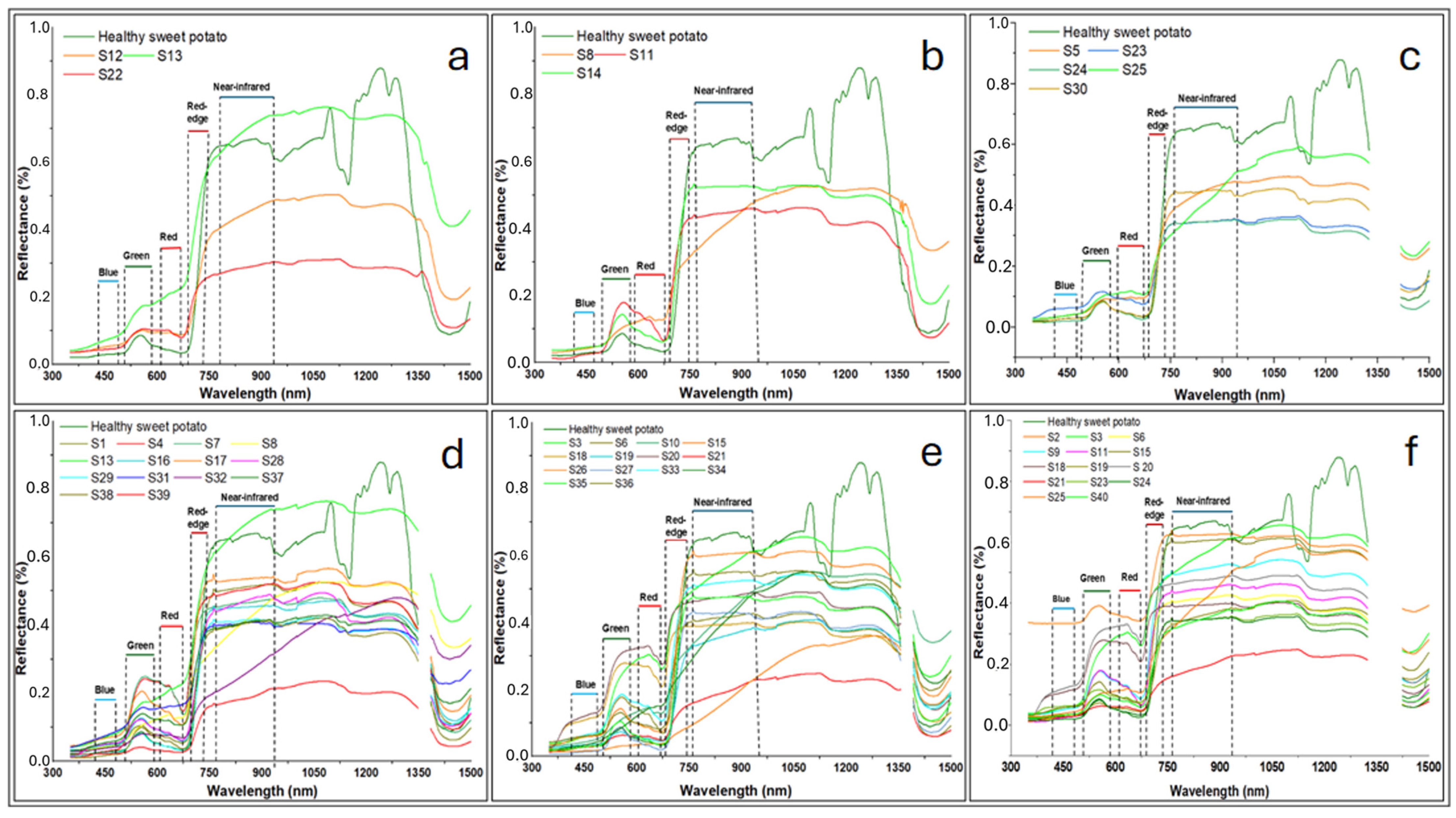
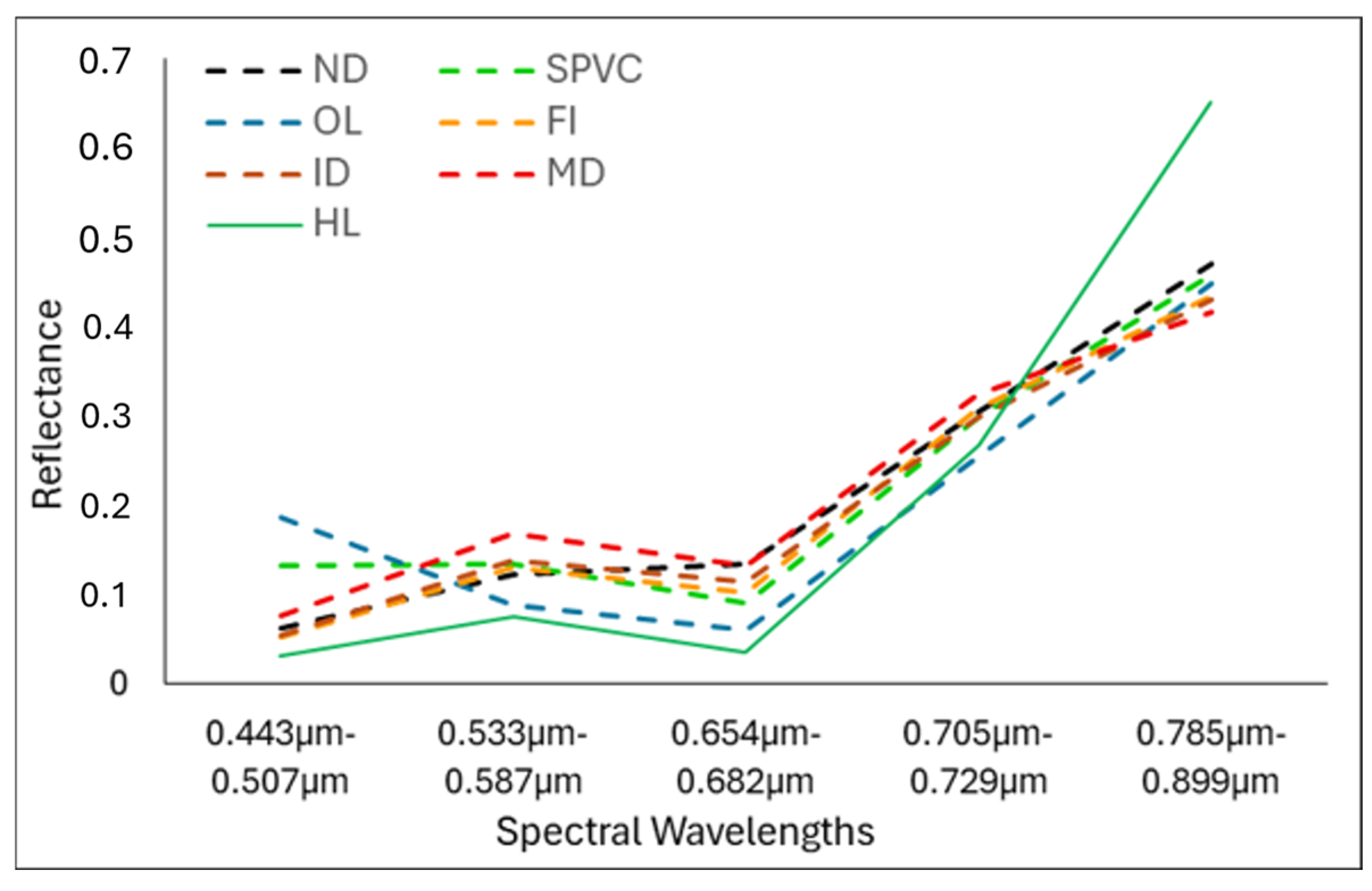
The results obtained from non-imaging field spectrometry revealed high reflectance of all leaf deformation types in the green (500–600 nm), and red (600–700 nm) bands, and low reflectance in the near-infrared (700–1300 nm) when compared to healthy sweet potato leaf (
Figure 2). By implications, these spectral wavelengths can be used in differentiating deformed sweet potato leaves from healthy ones. Nkuna et al. [
2] noted that disease severity in crops can be characterized by analyzing deviation of spectral reflectance between healthy and infected crops. However, construction of spatial continuity in crop deformed leaves using non-imaging hyperspectral remote sensing technology is a challenging task. This was supported by Bai et al. [
43] who stated that although hyperspectral remote sensing techniques are important in crop disease detection, studies still emphasize the need to advance this approach from different perspectives.
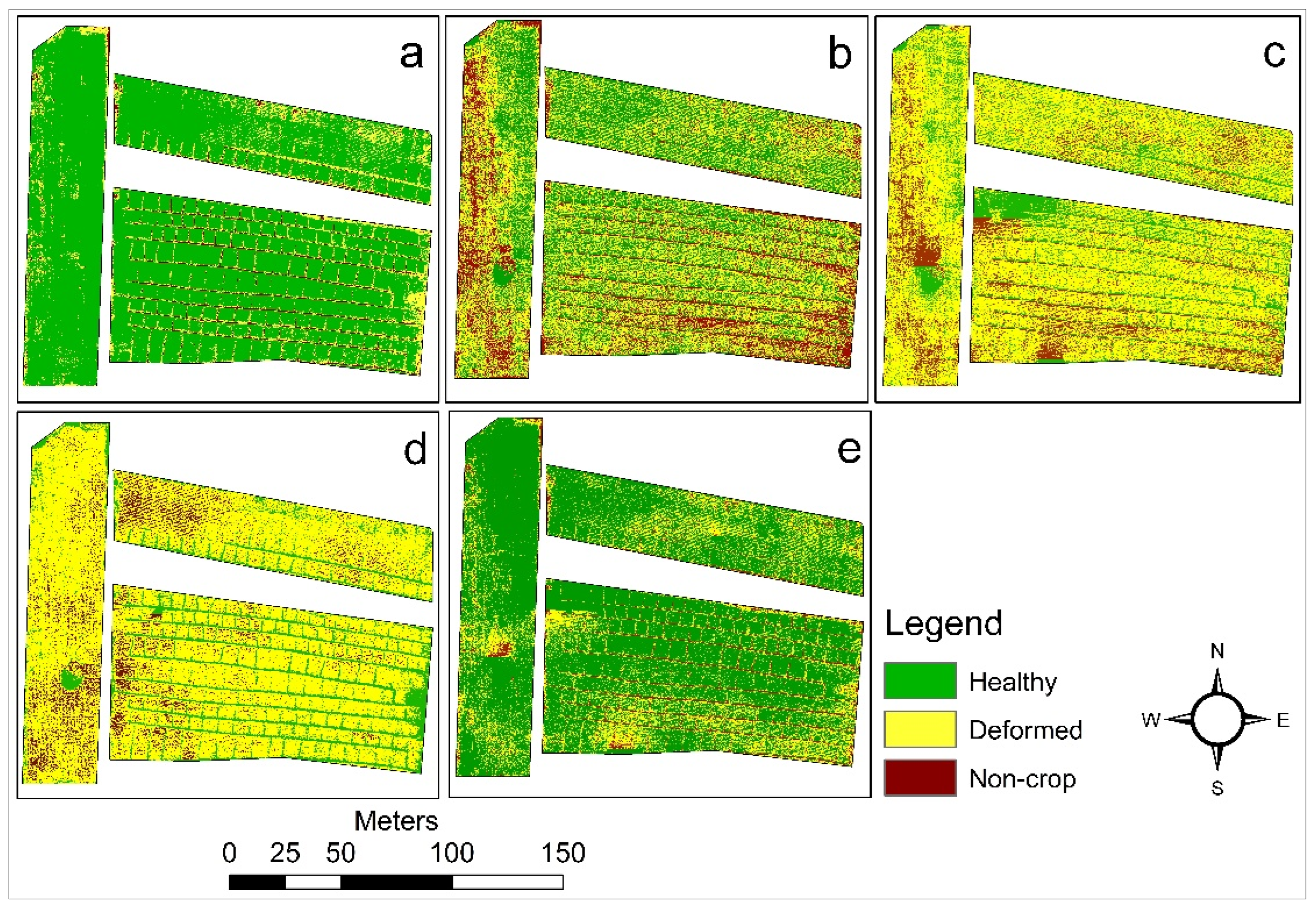
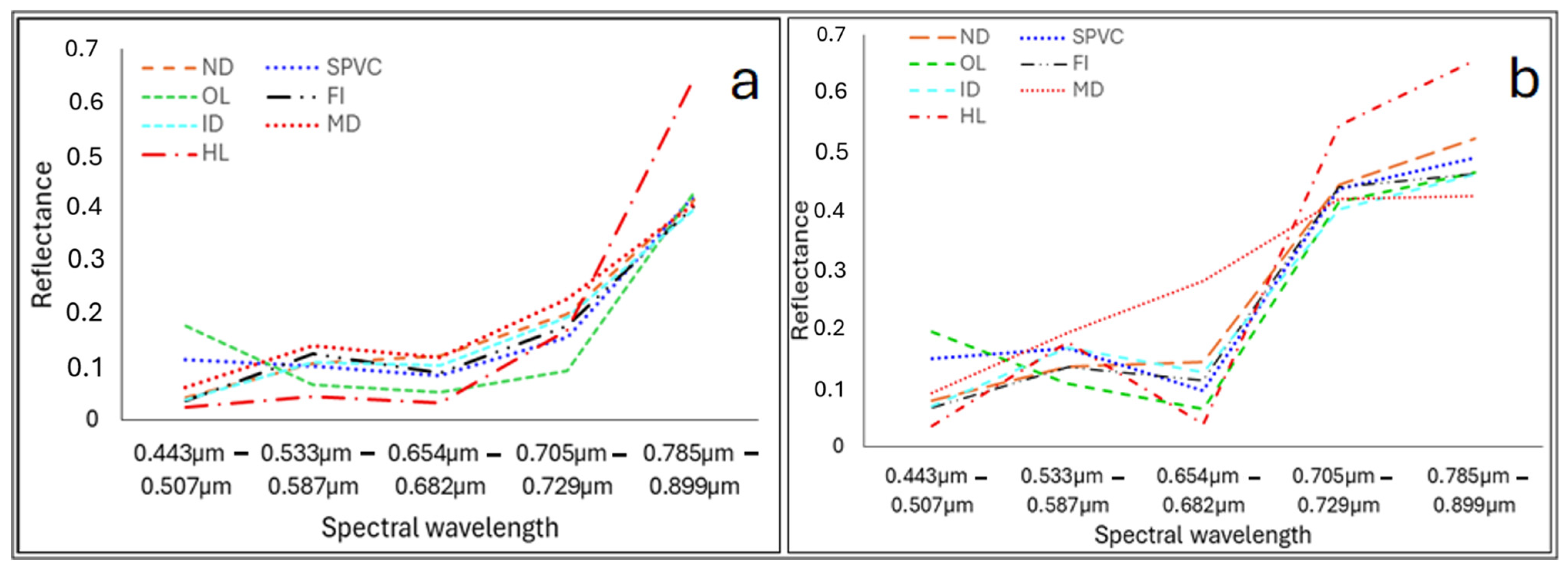
It is important to note that the thresholds used in this study were not predefined prior to classification. Instead, they were derived from descriptive statistics of ASD spectral reflectance data collected from laboratory-confirmed leaf deformation types. This ensured that the threshold values used in the classification process were empirically based and representative of actual crop infection conditions. However, the overlap results revealed spectral overlaps across almost all the surveyed leaf deformation types. This constrained the spatial configuration of sweet potato crops based on leaf deformation types. Instead, sweet potato crops were generally segmented by applying minimum and maximum reflectance values of the entire dataset. Although studies noted the efficacy of mean spectral reflectance values as threshold [
44,
45], this approach tends to undermine variations in crop reflectance as result of varying illumination intensity [
23]. Moreover, it must be noted that a framework for facilitating both the selection of the most suitable thresholding method for a particular domain and the application of thresholds to facilitate the classification of spectrally overlapping crops is unavoidable. Results obtained from this study showed that, despite the optimization of thresholds through the k-sigma technique, spatial partitioning of various sweet potato leaf deformations is a challenging issue [
46]. Moreover, overlapping cases often exist in the proximity of the decision boundary [
47], making the learning process a major issue [
48].
The inability to spatially partition sweet potato crops based on leaf deformation types could be attributed to a lack of a clear framework for detecting infection-related hyperspectral features, coupled by a lack of practical case studies [
49]. For instance, a virus can cause leaf damage by degrading pigment and wilting a leaf structure, which may subsequently cause nutrient deficiencies [
50]. This makes it difficult to spectrally distinguish nutrient deficit-related spectral signature from spectral signatures of a leaf affected by some viruses and bacteria. Furthermore, the temporal dimension of disease symptoms in crops is important and must be considered during crop disease monitoring process. Whereas short-term diseases often exhibit changes in photosynthetic, respiratory and transpiration potential of a leaf, long-term diseases may have more persistent impact on crop growth and development [
51]. Kranner et al. [
52] also noted that crop response to infection often exhibits nonlinear patterns.
Because UAV systems normally take more time to scan the ground when compared with satellite systems, different UAV image tiles may be subjected to different turbulence, different incidence angles, different illumination, or different signal processing chains [
53,
54]. Therefore, integration of these variables in infected crop classification is recommended. In the current study, effects of these variables on the reflectance quality of deformed leaves were not considered, necessitating them as a direction for future study. Haralick et al. [
55] showed that combining spectral information with texture features can further enhance the accuracy of classification. We encourage that future studies evaluate the efficacy of other thresholding optimization techniques in handling leaf deformation types with reflectance overlaps. This is because various types of crops exhibit unique textural properties [
48] regardless of similarity in their spectral properties. This distinct textural characteristic plays an important role in distinguishing different land features that exhibit significant similar spectral properties [
20]. Against the backdrop provided, issues that emanated from the findings of this study underscores the need to further pursue alternative approaches for spectrally distinguishing various causes of sweet potato leaf deformation.