


Abstract
The Neolithic site of Mulino Fiaccati/Le Rocche, near Roccapalumba in the Sicilian interior, has yielded an unusually rich ceramic assemblage recovered from a fissure exposed by modern quarrying. Typological analysis and a radiocarbon date of 4783–4553 BC (2σ) confirm its Middle Neolithic attribution. The ceramics include undecorated wares, Stentinello II/Western Stentinello-type pottery, and trichrome painted vessels, with a fragment tentatively linked to the bichrome facies. The materials studied are under the guardianship of the Soprintendenza per i Beni Culturali e Ambientali di Palermo. An integrated archaeometric approach, combining petrographic thin-section analysis with a geological survey of local raw materials, identifies multiple locally produced ceramic fabrics and demonstrates deliberate selection and modification of clay resources. The results indicate on-site production for all major classes, with only a few impressed–incised vessels originating elsewhere in the Sicani Mountains, pointing to regional exchange. Technological choices such as tempering and the use of ochres reveal a sophisticated operational knowledge and challenge long-standing assumptions that fine painted ceramics were imported into Sicily. These findings provide the first scientific evidence for local production of trichrome wares and offer new insights into functional differentiation within the ceramic repertoire. Ongoing analyses aim to build a broader archaeometric database for Sicilian Neolithic ceramics and to clarify production systems, resource use, and inter-community interactions.
1. Introduction
The materials examined in this study originate specifically from the Mulino Fiaccati/Le Rocche spot and were collected by the Soprintendenza per i Beni Culturali e Ambientali di Palermo in 2016 at the base of a narrow fissure located on a sheer rock face.
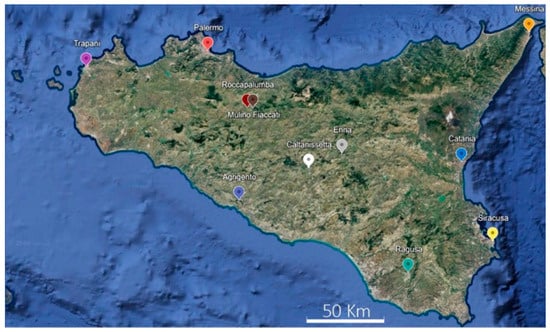
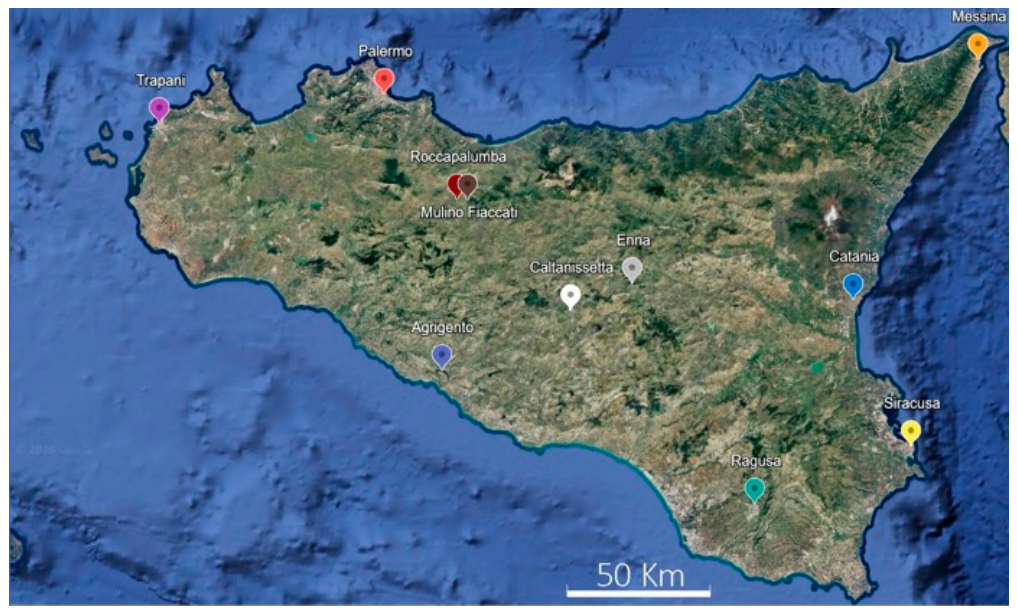
The Mulino Fiaccati/Le Rocche site, located within the municipality of Roccapalumba, a small town of approximately 3000 inhabitants in the Sicilian interior, about 70 km southeast of Palermo (Figure 1), has produced an exceptionally rich assemblage of archaeological materials dating to the Middle Neolithic. The attribution to the Sicilian Middle Neolithic is based on a detailed typological analysis of the recovered materials [1], as well as on radiocarbon dating carried out on a fragment of cervid antler, which yielded a calibrated date consistent at the 2σ level of 4783–4553 BC. Specifically, the analyzed ceramic assemblage was assigned to three main classes: undecorated (undecorated) pottery, Stentinello II or Western Stentinello-type pottery, and trichrome pottery, with a small number of uncertain fragments possibly attributable to the previous painted facies.
Figure 1.
Satellite image of Sicily highlighting the Mulino Fiaccati/Le Rocche site location (near Roccapalumba) in relation to the region’s major cities (i.e., Palermo, Catania, Trapani and Siracusa).
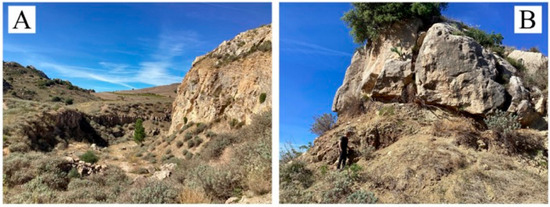
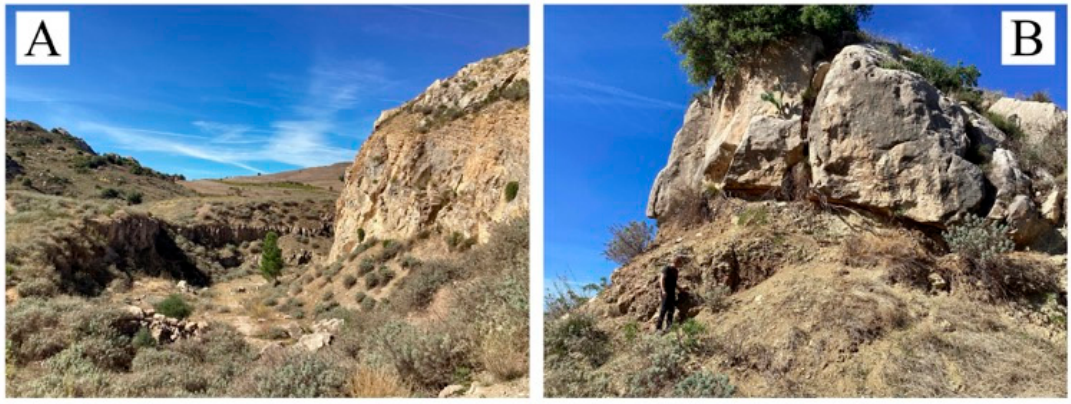
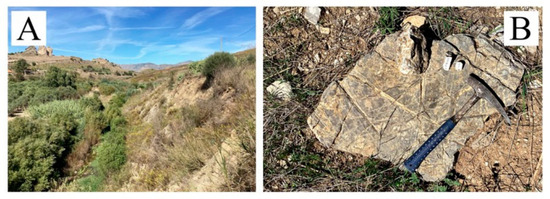
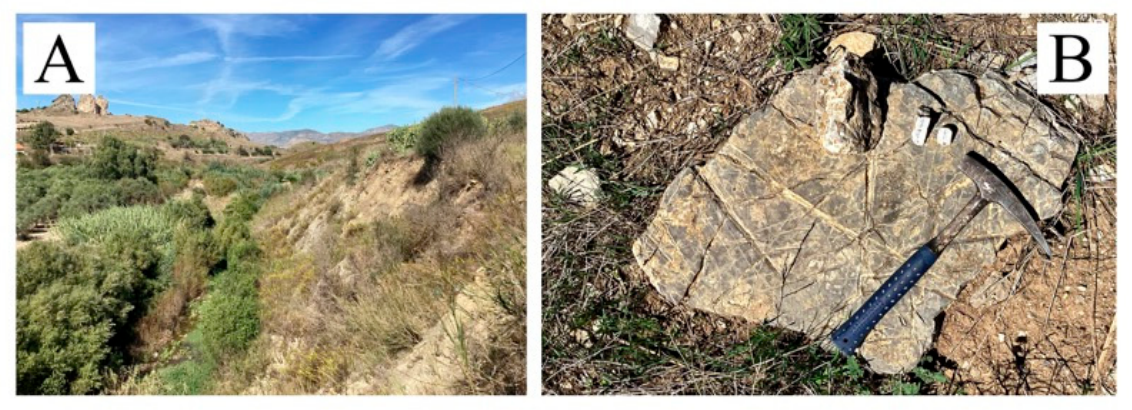
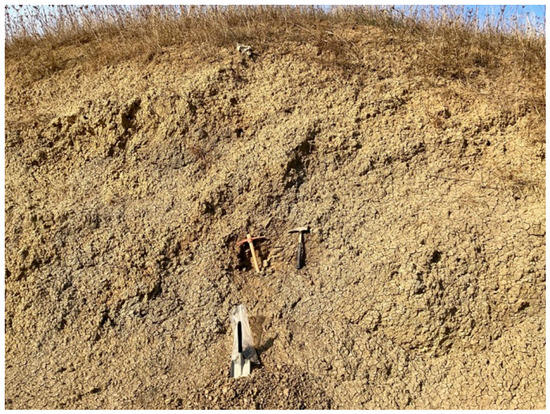
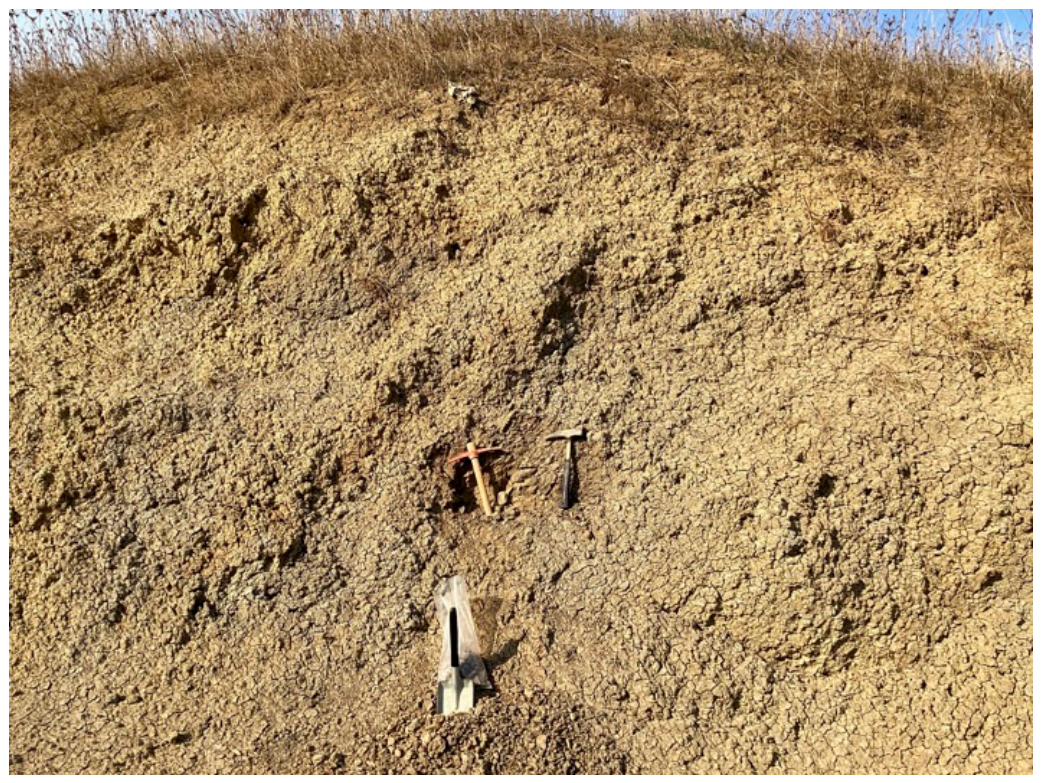
The area underwent significant quarrying activity during the 1970s, which severely altered its morphology and now prevents further investigations that could shed light on the nature of the deposit (Figure 2A,B).
Figure 2.
(A) Panoramic view of the open-pit quarry established approximately 30 years ago in the Mulino Fiaccati/Le Rocche site area; (B) location where the ceramic fragments under investigation were recovered.
In this context, the nature of the deposit remains uncertain, exceptionally rich, yet clearly unusual in terms of the types of materials recovered. The richness and complexity of the archaeological record suggest that the deposit formed through the gradual accumulation of refuse linked to the village’s long-term occupation [2]. We agree with this view, although the motivations for the discard—intentional or incidental—cannot be firmly established. This raises further questions. The associated village has not yet been securely located, and this spatial gap limits efforts to clarify the deposit’s origin. If the settlement stood atop the escarpment, an anthropogenic discard would be plausible; however, if it lay upstream near the Fiume Torto and local resources, the deposit’s formation would need reconsideration, and the recovered materials would require a different interpretive framework. Based on these premises, this study applies a standardized archaeometric protocol to analyze Neolithic ceramic materials. The initial approach combined petrographic analysis of ceramic fabrics, conducted via polarizing microscopy on thin sections, with a detailed geological survey of the area surrounding the site, aimed at identifying raw geomaterials that may have been exploited during the Neolithic period. The primary objective was to establish criteria for distinguishing locally produced ceramics from those potentially imported from other contemporary sites within the same region. Informed by newly acquired experimental data, and pending further laboratory evaluation of the suitability of local raw materials for ceramic production, the study seeks to address key questions regarding the technological capabilities achieved at the site. Ultimately, these findings contribute to a broader understanding of the region’s material culture and the strategies employed in the exploitation of available geological resources.
2. The Archaeological Context and Typological Classification of the Ceramic Materials
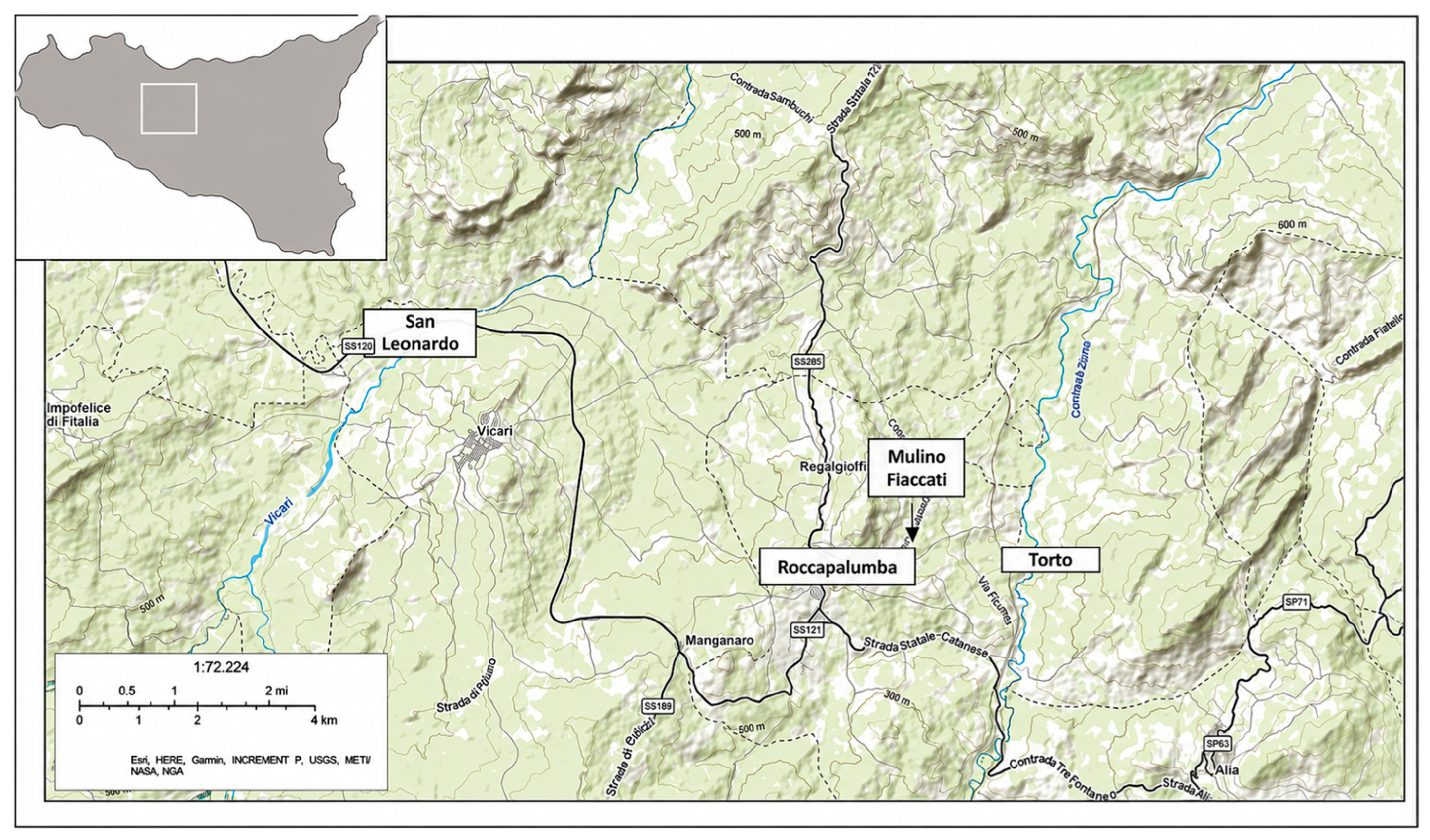
As outlined in the introduction, the Neolithic site of Fiaccati/Le Rocche lies near Roccapalumba (Palermo), a municipality positioned in the mid-valley of the Fiume Torto River (Figure 3). Scholarly attention to the site is relatively recent. It was first recorded in 1932 by the geologist Ramiro Fabiani during his field surveys, but no further investigations followed for several decades. Interest was renewed only in 1979, when a geology student submitted a report that brought the site to the attention of Vincenzo Tusa, who subsequently entrusted its study to Giovanni Mannino [3]. After an initial inspection, a field survey was conducted in 1980, during which several ceramic fragments were collected, and a small test excavation was carried out.
Figure 3.
Topographic map of the valley between the San Leonardo and Fiume Torto rivers, indicating the position of the Mulino Fiaccati/Le Rocche site relative to the nearby town of Roccapalumba.
The materials recovered during this campaign are currently housed in the Antonio Salinas Archaeological Museum in Palermo [4]. To date, these artifacts have never undergone comprehensive archaeological or archaeometric analysis and remain unpublished, aside from brief archaeological notes [3,5].
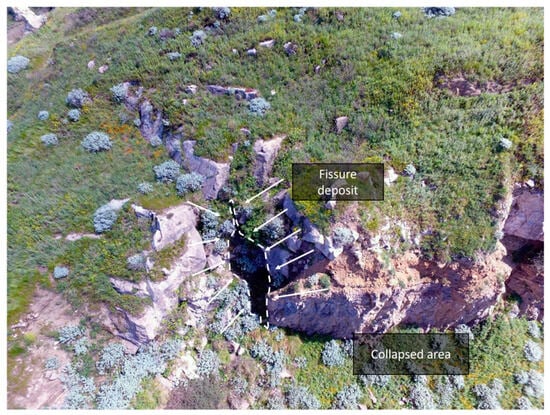
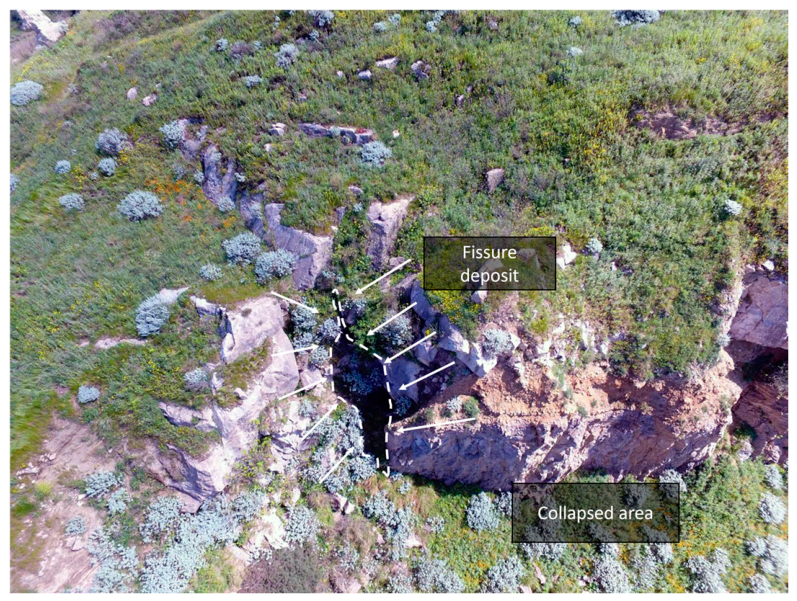
In 2016, an additional assemblage of materials, originating from a collapsed section (Figure 4), with approximate dimensions of about 10 m, was submitted to the Palermo Superintendence. These materials were thoroughly typologically and morphologically analyzed and published [1].
Figure 4.
Drone image of the collapsed area and of the wide fissure in which the ceramic artifacts under study were discovered (photo by Giuseppe Sferruzza).
As previously noted, a carefully selected subset of Neolithic ceramics from this assemblage was employed in the present archaeometric research. In brief, the recovered materials fall into several distinct categories. A substantial assemblage of ceramics was identified, stylistically attributable to the Middle Neolithic period. These include fine undecorated wares, painted ceramics in bichrome and trichrome styles, and evolved/western variants of the Stentinello cultural complex.
The faunal assemblage comprises several species, indicating varied exploitation of animal resources, though the domestic triad—cattle, sheep/goats, and pigs—clearly predominates, reflecting its central role in Neolithic subsistence. Their prevalence points to routine husbandry, slaughtering, and the use of meat and secondary products. In addition to dietary waste, some bones show modifications linked to toolmaking—such as shaping, scraping, or polishing—demonstrating that selected skeletal elements were repurposed as implements. Overall, the remains document a broad spectrum of activities, from food processing to craft production involving worked bone. Additionally, the lithic industry is well represented, comprising artifacts made of flint, obsidian, and polished stone. A radiocarbon analysis conducted by R. Miccichè on a cervid antler produced a calibrated date range (2σ) of 4783–4553 BCE [1] (p. 33). This places the chronological horizon of the assemblage firmly within the Middle Neolithic, consistent with typological assessments of the material culture.
Based on these findings, the site of Mulino Fiaccati/Le Rocche can be interpreted as hosting a prehistoric community with fully Neolithic characteristics, engaged in both animal husbandry and agriculture and demonstrating a notable level of technological sophistication. Furthermore, the richness and volume of the archaeological record suggest a relatively substantial population inhabiting the settlement.
The material selected for archaeometric analysis consists of 30 ceramic fragments, evenly distributed among the three most representative ceramic classes from the Mulino Fiaccati/Le Rocche site. Although the number of fragments is not particularly high, it is nonetheless statistically significant for the intended analytical purposes. The selected samples were taken from a collection that has not yet been drawn or cataloged, currently stored in the Roccapalumba warehouses and held under the supervision of the Superintendence for Cultural Heritage of the Province of Palermo.
As previously mentioned, the 30 collected samples belong to three categories: the trichrome painted class, the fine-grained undecorated class, and the so-called western variants of the Stentinello class.
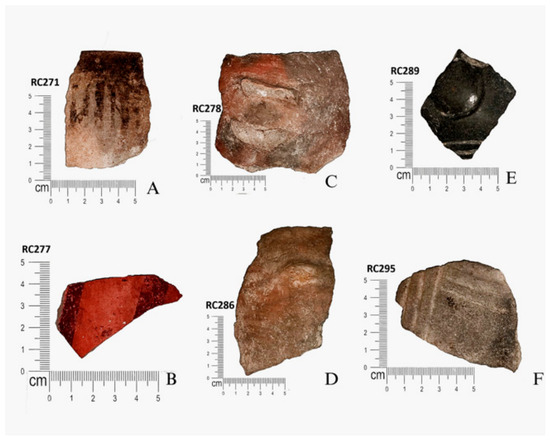
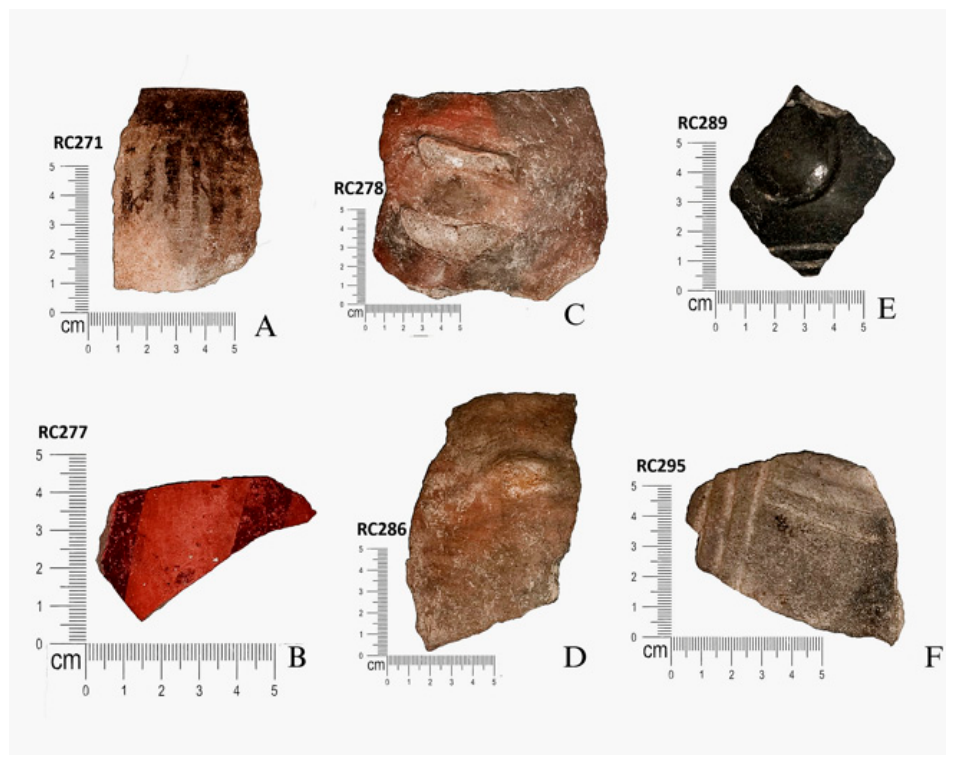
With regard to the painted ceramic class, ten samples were selected to represent the range of decorated pottery types found at the site (Table S1A). Among these, several fragments exhibit thicker walls, likely corresponding to large containers and/or wide-necked vessels, specifically, samples coded RC268, RC269, RC272, and RC273. The remaining samples are representative of smaller-sized vessels, yet still typologically and morphologically attributable to closed forms and/or cooking pots. These fragments feature painted decorations consisting of black bands and stripes, with one exception, sample RC277, which displays a reddish hue. Finally, sample RC271 stands apart from the rest due to its distinct decorative morphology, characterized by a black stripe beneath the rim from which a linear drip motif extends (Figure 5A). The macroscopic examination of the 10 ceramic pastes selected for this class, based on fresh fracture observations, reveals a generally homogeneous composition, with minor, yet expected, variations linked to the nature and concentration of inclusions. The ceramic matrix is predominantly characterized as a fine-grained, highly purified paste with a dominant pinkish-grayish hue, containing sparse sandy inclusions, mostly fine in size (less than 0.3 mm). In several instances, the paste displays the typical “sandwich” structure, marked by a pinkish outer layer and a dark gray to black core (Figure 5B).
Figure 5.
(A,B) Macroscopic photographs of painted ceramic samples RC271 (trichrome) and RC277 (possible bichrome). (C,D) Macroscopic photographs of undecorated ceramic samples RC278 and RC2876. (E,F) Macroscopic photographs of incised/excised Stentinello II ware: RC289 with an elliptical incision and RC295 with parallel horizontal incisions.
The selection of undecorated ceramic samples appears visually very homogeneous (Table S1B). Typologically, the assemblage is predominantly composed of closed-form vessels, with surface treatments characterized by a smoothing/burnishing process (Figure 5C). When observed in fresh fracture, the ceramic paste is generally less refined compared to the previously described class. It exhibits a grayish-pink coloration and contains sandy inclusions, mostly medium-sized, therefore ranging between 0.2 and 0.5 mm (Figure 5D).
Finally, the excised impressed ceramic samples belonging to the late/western Stentinello class are those labeled RC288 through RC297 in Table S1C. These fragments are primarily decorated using excision techniques, displaying bands, and, more commonly, an elliptical motif that may be interpreted as a symbolic representation of the sun. This “solar motif” is particularly distinctive and, thus far, has no known parallels, except for a single specimen from the Neolithic site of Piano dei Cardoni on the volcanic island of Ustica, located approximately 70 km from the harbor of Palermo [6], which, however, features a painted rather than excised decoration. Based on this uniqueness, scholar F. Iannì [1] has designated this decorative style as the “Roccapalumba style” (Figure 5E). Additionally, the majority of the fragments exhibit surface treatments consistent with smoothing or burnishing techniques (Figure 5F). From a textural standpoint, detailed macroscopic analysis reveals a relatively well-refined ceramic body. The sandy inclusions are predominantly fine-grained, and the matrix exhibits a grayish-pink hue. In some specimens, most notably RC297, a distinct sandwich-like structure with a central “black core” is present, likely reflecting variations in oxygen fugacity within the firing atmosphere.
3. Geolithological Outlines and Clay-Rich Ceramic Raw Materials Within the Investigated Area
The sedimentary successions of Sicily span a chronostratigraphic interval ranging from the Late Triassic (approximately 220 million years ago) to the Present. Regional facies analysis indicates that rock assemblages from the early Permian to the Paleogene represent the sedimentary cover of distinct paleogeographic domains, which were part of the Tethys Ocean and the African continental margin prior to their deformation. The dominant lithotypes consist of carbonate and siliciclastic rocks, encompassing both arenaceous and pelitic facies. By contrast, comparable carbonate and siliciclastic deposits of Neogene–Quaternary age were formed during the deformation of these domains, as evidenced by field surveys [7,8,9]. When considering clayey deposits, it should be emphasized that they extend across more than 10,000 km2 of Sicily, accounting for over 40% of the island’s surface.
In the western sector, these deposits, predominantly of Oligo-Miocene age, are particularly extensive and have long been recognized for their exceptional suitability in ceramic production [10].
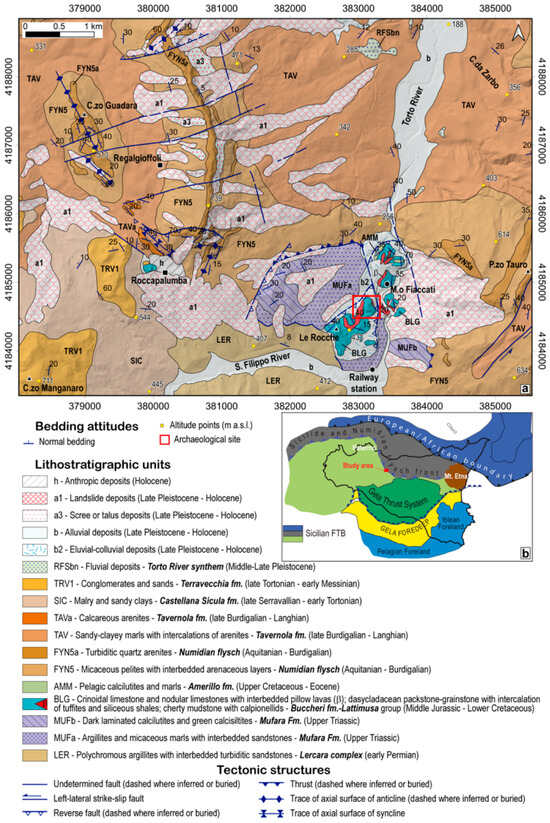
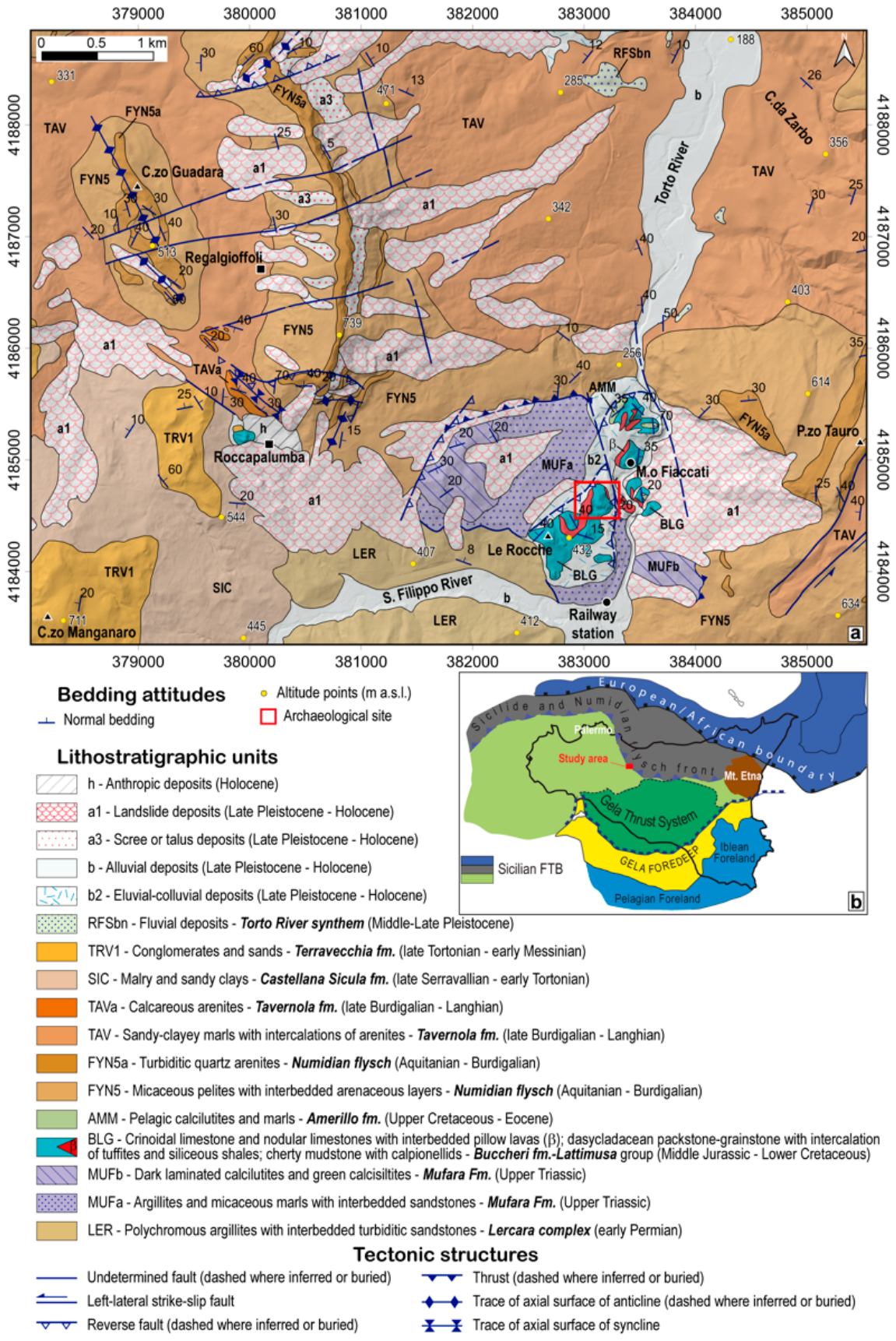
The study area, including the Mulino Fiaccati/Le Rocche site, lies within Foglio 609 ‘Termini Imerese–Capo Plaia’ [11] of the Geological Survey of Italy (ISPRA), as well as the adjoining Foglio 608 ‘Caccamo’ [12]. The southeastern margin of Foglio 608 covers the modern settlement of Roccapalumba, while the southwestern margin of Foglio 609 includes the site where the ceramic artifacts were recovered and the surrounding zone from which raw materials were likely sourced (Figure 6).
Figure 6.
Geological sketch map of the study area (a), modified from [11,12]. New field surveys in the southern sector completed the geological and structural mapping and provided bedding-attitude measurements. The map was produced in QGIS 3.16 using a 5 m resolution DEM as topographic base. (b) Structural map of the main elements of the Sicilian collisional complex (modified from [8,9]).
Foglio 608 comprises six stratigraphic–structural units, each formed by multiple geological formations: units deformed from the Sicilide Domain, the Numidian Flysch, the Lercara Basin (Permian–Triassic basement), the Imerese Domain, the Sicanian Basin, and the Trapanese carbonate–pelagic platform. Foglio 609 similarly consists of six units derived from the deformation of the Sicilide Domain, the Numidian Flysch, the Lercara Basin, the Imerese Domain, the Panormide Domain, and the Trapanese Domain.
From a geomorphological point of view, the Roccapalumba area is characterized by a predominantly hilly landscape, shaped by moderate carbonate reliefs, which are occasionally marked by steep slopes. The landscape is shaped by several fluvial valleys, where outcrops of clays, silty–sandy clays, and sandstones form rounded prominences that accentuate the crests of the carbonate ridges (see Figure 2A, Figure 3 and Figure 4). The rocky outcrop that characterizes the Mulino Fiaccati/Le Rocche site, where most of the ceramic fragments were recovered from a large sediment-filled fracture, is composed of limestone belonging to the Buccheri formation and Lattimusa unit (Trapanese Domain), consisting of reddish and gray nodular limestone with ammonites and belemnites, and gray bioclastic packstone/grainstone (Figure 7A), Middle Jurassic–Lower Cretaceous in age [12,13]. The outcropping lithotype appears as thick beds intersected by a dense network of veins filled with sparry calcite (Figure 7B).
Figure 7.
(A) Perspective view of the area between the carbonate reliefs of Le Rocche (upper left) and the Mulino Fiaccati locality (in the background, upper center). (B) Slab of grayish limestone representative of the Buccheri Formation, cut by numerous veins of sparry calcite. This material was found in close proximity to the location where the studied ceramic artifacts were recovered.
Within this complex geological framework, the area surrounding the study site exhibits outcrops of various geomaterials representative of the previously described stratigraphic–structural units [11,12]. Among these, several clay-rich deposits, potentially suitable for use as ceramic raw materials, are exposed within a 50 km radius, including: Numidian Flysch—Geraci Siculo member (FYN-5 on the geological map); Tavernola formation (TAV); marne di San Cipirello unit (CIP); Castellana Sicula formation (SIC); and Terravecchia formation (TRV).
The Geraci Siculo member of the Numidian Flysch (FYN-5) consists of terrigenous deposits (pelitic and arenaceous facies), predominantly turbiditic in origin, that accumulated between the late Oligocene and Early Miocene across a broad sector of the central Mediterranean region. It consists of beds of quartzose sandstones and conglomerates with quartz pebbles in an arenitic–pelitic matrix (FYN5a), interbedded with thick pelitic deposits. Within the pelites, sporadic levels containing reworked fragments of biocalcarenites may occur, as well as benthic and planktonic foraminifera. The syndepositional sandy fraction is sporadic and consists of quartz (monocrystalline and polycrystalline), with much smaller amounts of K-feldspar, plagioclase, and mica. The primary fossil content is generally sparse; however, the few diagnostic planktonic foraminifera recovered have been attributed to the Oligocene and Early Miocene. Sandy–pelitic strata crop out within 1–2 km to the east–southeast and north of the Fiaccati/Le Rocche site, also extending along the banks of the Fiume Torto River.
The Tavernola formation (TAV) comprises grayish green to whitish marls and clays, interbedded with yellowish-green, quartz-rich sandstones characterized by abundant glauconitic grains. The calcareous fraction is notably fossiliferous, containing planktonic and benthic foraminifera, as well as rare calcareous nannofossils. Locally, calcareous arenites (“Lucina” limestones) intercalated within the marly clayey lithotypes are present (TAVa). Integrated biostratigraphic analysis, based on calcareous plankton assemblages, places these deposits within the late Burdigalian to Langhian interval. It extensively crops out 1–2 km to the north and northeast of the Fiaccati/Le Rocche site.
The Castellana Sicula Formation (SIC) is a newly defined lithostratigraphic unit named after the outcrop near Castellana Sicula in the Madonie Mountains. It consists of alternating grayish-green sandy pelites—with rare planktonic and benthic foraminifera—and quartzose sandstones and sands. Integrated planktonic foraminiferal and calcareous nannofossil assemblages date these deposits to the late Serravallian–early Tortonian. Owing to subsidence and strong terrigenous input, fossils are often poorly preserved and taxonomically limited. The formation crops out widely west of Fiaccati/Le Rocche, with a silty to very fine sandy framework dominated by quartz and subordinate feldspar and mica, and is exposed 3–4 km north and northeast of the site.
The Terravecchia Formation (TRV) shows alternating reddish ortho- and paraconglomerates with polytypic clasts (TRV1), grayish-yellow quartz-lithic sands and sandstones, and clayey–marly pelites. The silty-clay to marly facies is assigned to the late Tortonian–early pre-evaporitic Messinian, though biostratigraphy is hindered by sparse calcareous plankton and frequent reworked benthic foraminifera. In the study area, pelitic facies—potentially suitable for ceramic production—are underrepresented compared to the more extensive conglomeratic and arenaceous–sandy facies cropping out 4–5 km west of Fiaccati/Le Rocche.
The Marne di San Cipirello unit (CIP) crops out broadly in central–western Sicily, especially in the Sicani Mountains and the Trapani area. It comprises grayish-bluish marls and clayey marls rich in planktonic foraminifera and calcareous nannoplankton, with sporadic quartzose and quartz–mica sandstone beds. Fossil assemblages place these deposits in the late Langhian–early Tortonian. They occur about 30 km west–southwest (Corleone) and 25 km northwest (Marineo) of Fiaccati/Le Rocche.
4. Analytical Methods
Polarized transmitted light optical microscopy (PLM) was performed on thin sections (0.03 mm thick) prepared from all 30 ceramic samples selected for this study. Detailed microscopic analysis was carried out using a Leica DLM/LSP polarizing microscope equipped with a DC 200 digital imaging system. Additionally, panoramic observations at a wider field of view were conducted on the same uncovered thin sections using a Dino-Lite digital microscope (model AM4113T-FVW; 200× magnification; 1280 × 1024-pixel resolution), employing a combination of reflected and digitally polarized light. These complementary microscopic techniques, optimally suited for ceramic petrography, enabled a comprehensive characterization of the ceramic paste, including both monomineralic grains and lithic fragments.
The analysis encompassed the relative abundance, mineralogical composition, morphology, and size distribution of aplastic grains, together with the abundance and morphology of macropores, birefringence characteristics, and the textural homogeneity of the groundmass. This methodological framework is widely acknowledged as the most effective approach for establishing the geological provenance of both monomineralic granules and lithic fragments [10,14,15,16,17].
The relative abundance of aplastic inclusions larger than 0.06 mm (modal mineralogy expressed as area percentage) was assessed semi-quantitatively using comparison charts calibrated through conventional point-counting procedures [18].
5. Results and Discussion
5.1. Petrographic Characterization of Painted Ceramic Class
The samples assigned to this typological class exhibit ceramic pastes that are generally poor in sand-sized grains (Table S2). Among the ten analyzed specimens, two (RC269, RC270) contain very low amounts of aplastic inclusions, ranging from 3% to 7% by area. Seven samples (RC268, RC272, RC273, RC274, RC275, RC276, RC277) show moderate inclusion contents, reaching up to 15% by area. A single specimen (RC271) presents a comparatively higher proportion of aplastic inclusions, with tempering amounting to 25% by area. However, this apparent textural discrepancy should be reconsidered considering the very fine grain size of the aplastic fraction; it is therefore best interpreted as a natural, “physiological” feature rather than evidence of intentional tempering. Sedimentary deposits are known to record, layer by layer, the changing inputs to a basin. As a result, minor variations in size distribution and abundance of the sandy fraction within a single clay outcrop are expected and should be regarded as natural, even when the raw material derives from the same procurement area.
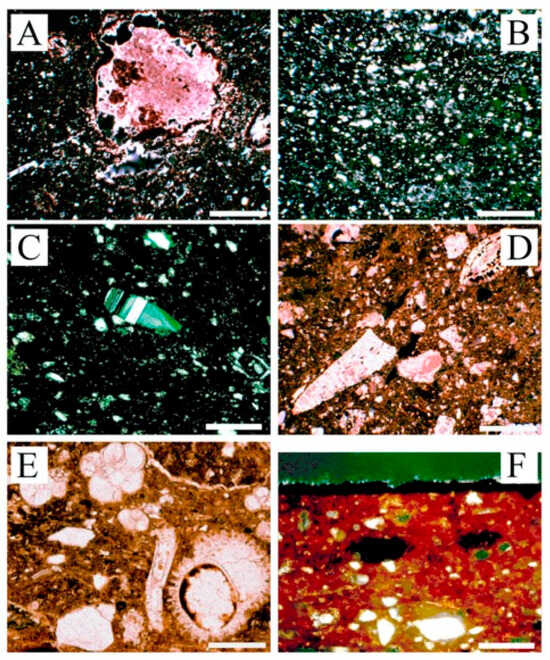
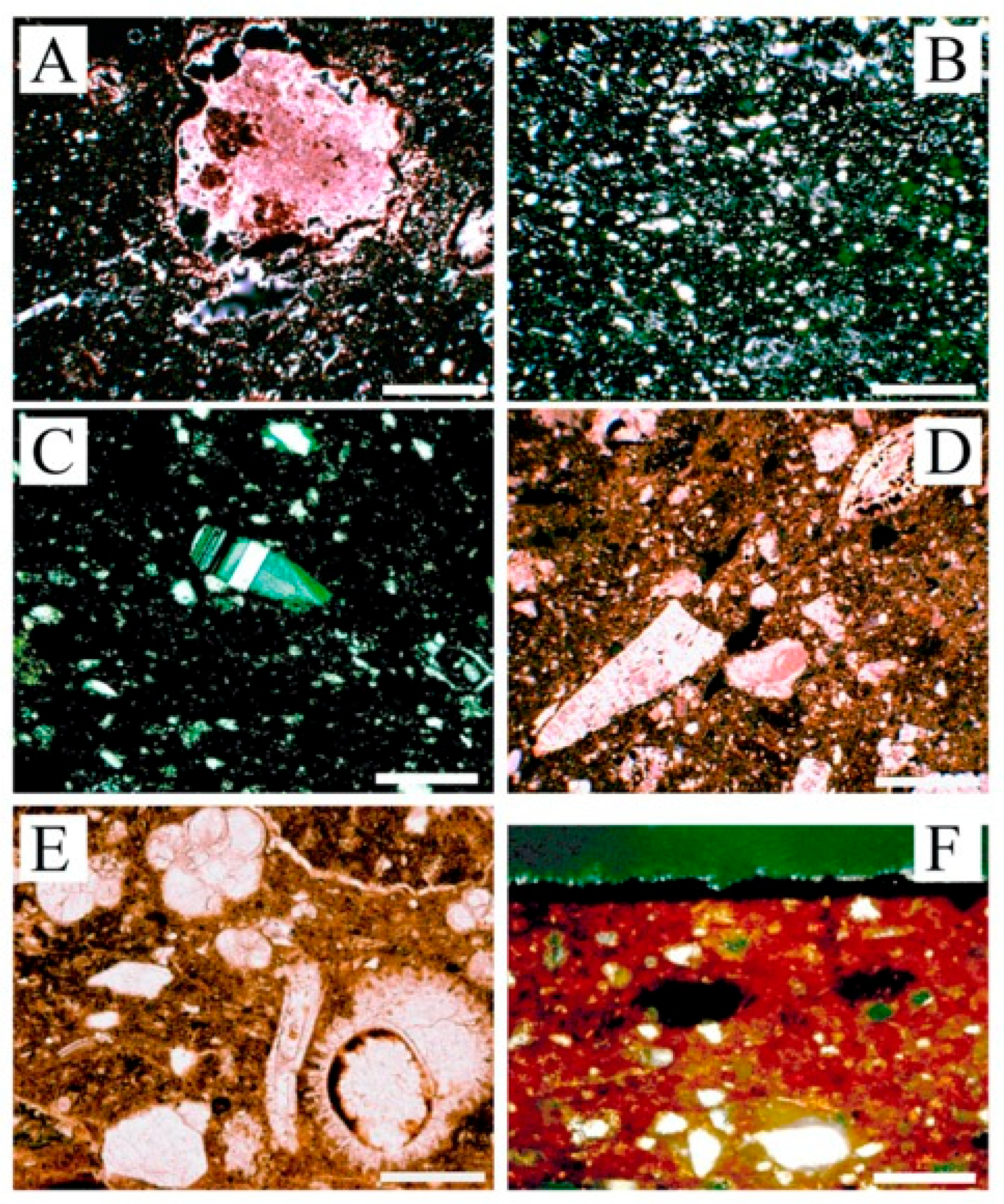
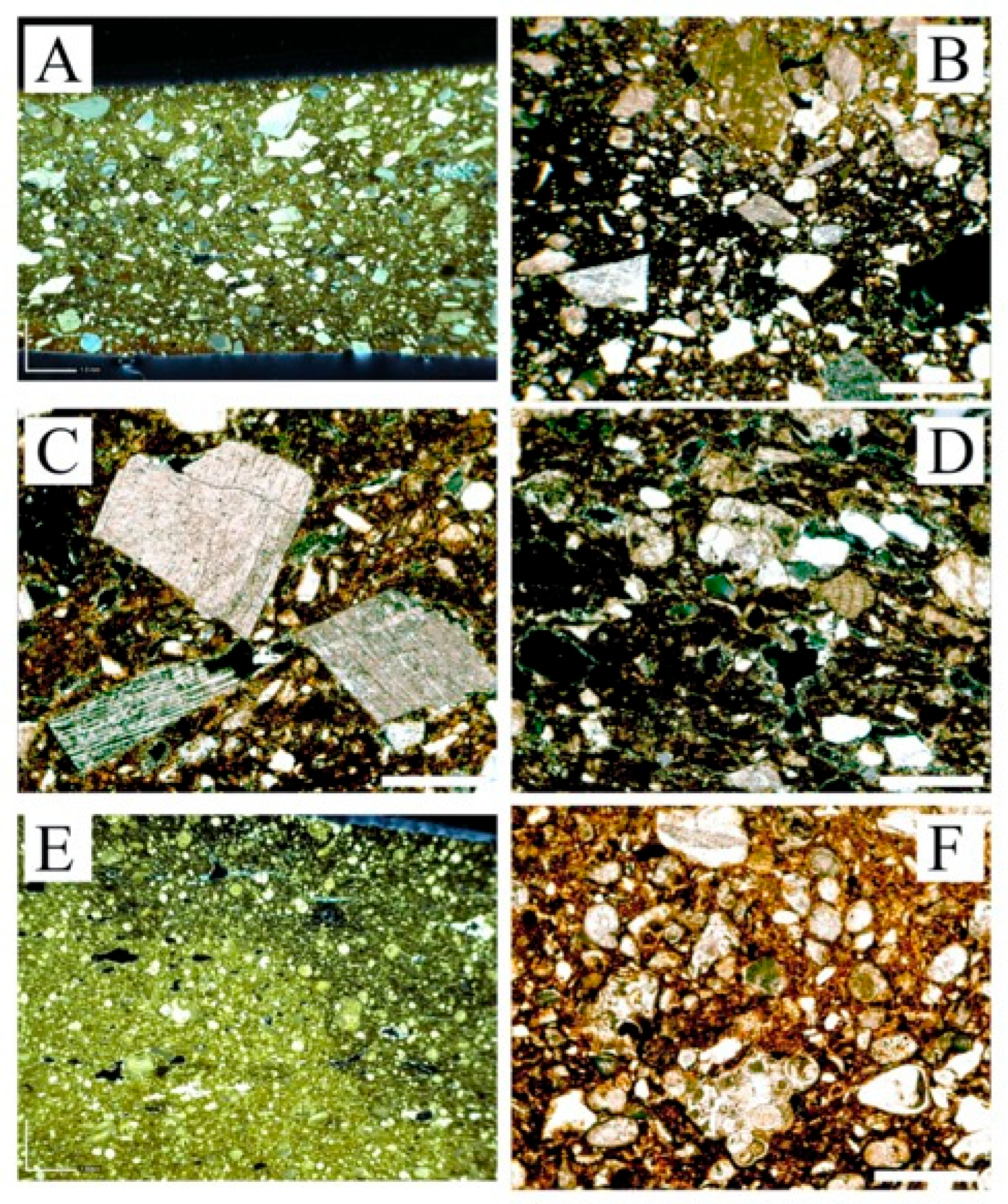
Regarding the ceramic body’s groundmass, only three samples (RC268, RC272, RC276) show merely occasional lump formations. In contrast, the remaining specimens present a markedly heterogeneous matrix, characterized by common to sporadic aggregates of poorly integrated clay particles and iron-oxide-rich lumps. This microstructural feature is usually interpreted as indicative of sub-optimal processing of the clay paste during the manufacturing stage. Nevertheless, the presence of such lumps does not appear to have significantly compromised the vessel’s final aesthetic quality. In other words, it reflects a more rudimentary handling of the same raw material, likely performed by different hands than those responsible for the relatively more homogeneous pastes, which contain far fewer lumps. Moreover, the groundmass of all samples contains variable amounts of microcrystalline calcite lumps, ranging from common to sporadic and rare (Figure 8A). These features, which form through the decomposition of microfossils or calcareous lithic fragments during firing, are commonly referred to in the literature as “micrite clots.” [19].
Figure 8.
(A) RC269: large clot of microcrystalline calcite (micrite), likely formed by thermal decomposition of a calcareous bioclast or lithic fragment (XPL, scale bar = 0.5 mm); (B) RC268: very-fine-to-fine aplastic inclusions of quartz (dominant) and subordinate feldspars, homogeneously dispersed in an optically inactive groundmass (XPL, scale bar = 0.1 mm); (C) RC273: details of a polysynthetically twinned plagioclase grain, ~0.15 mm in size (XPL, scale bar = 0.5 mm); (D) RC271: coarse-to-medium-sand-sized aplastic inclusions represented by bioclasts and calcarenite fragments (XPL, scale bar = 0.5 mm); (E) RC271: remains of planktonic and benthic foraminifera (PPL, scale bar = 0.1 mm); (F) RC276: details of the black paint layer, regular and only 0.01–0.02 mm thick (XPL, scale bar = 0.1 mm).
From a compositional perspective, as will be described below, all samples representative of the painted ceramic class show sufficiently similar and recurrent features, suggesting that they were produced from the same clayey raw material. In fact, the relatively fine size of the aplastic inclusions (essentially monomineral grains), with a consistent predominance of clasts falling within the categories of coarse silt and very fine sand (approximately 0.04–0.15 mm), indicates that they constitute a syngenetic solid skeleton of the clay deposit rather than temper arbitrarily added to the plastic material. Since the aplastic inclusions are predominantly silicate in nature, fine-grained, and relatively dispersed (low packing density), the resulting base paste is lightweight and well-suited for the production of delicate artifacts with comparatively thin walls. Specifically, in the vast majority of samples (8 out of 10), among the aplastic grains, monocrystalline quartz predominates (with polycrystalline quartz being much less common), followed by considerably smaller amounts of feldspars (K-feldspar and plagioclase) and white mica (Figure 8B,C).
Only two samples (RC271 and RC277) exhibit a different composition, in which calcareous lithic fragments and bioclasts, both more or less altered by the firing process, are overall more abundant than the siliciclastic components. However, differences are also evident between the microfabrics of samples RC271 and RC277. The former (RC271) shows fragments of biocalcarenite partially altered by the firing process, along with numerous poorly preserved shells of benthic and planktonic foraminifera like Globigerinoides sp. (Figure 8D,E). The latter (RC277) has a paste much more consistent with the majority of the painted ceramic samples selected for analysis, although it is characterized by several ghost traces of benthic foraminifera shells (Rotaliida) with an amygdaloid shape, filled with secondary microsparite crystallizations. At first glance, these results could be taken to imply that RC271 was manufactured using a clay source distinct from that employed for the majority of the painted ceramic assemblage.
All painted ceramic samples were also externally treated with a layer of refined clay, which appears to serve as a preparatory function for pigment applications, essentially acting as a slip. This layer was clearly made from the same clay used to shape the ceramic body, though it was slightly more purified, containing a lower percentage of fine sand inclusions. This decorative layer was itself likely created using ochres (easily available within the same clay deposits) properly diluted in water. The thickness of the preparation layer corresponds to approximately 0.2–0.4 mm, while the pictorial layer ranges from 0.01 to 0.03 mm (Figure 8F). Microscopic observations also enabled a preliminary estimation of the firing temperatures of the selected painted ceramic samples based on several diagnostic features. These include the optical activity of the groundmass (specifically, the presence or absence of aggregate birefringence), the identification of cast pores produced by the decomposition of calcareous foraminiferal tests at temperatures above 800 °C, the occurrence of micrite clots and the development of newly formed birefringent microcrystalline phases along pore margins, such as calcium-rich anhydrous silicates and alumino-silicates. Considered together, these indicators consistently suggest firing temperatures exceeding 800 °C. This assessment remains preliminary and general, pending further analyses (e.g., XRPD and SEM-EDS), and is based solely on XPL and PPL observations of the groundmass and carbonate inclusions. One sample, RC271, deviates from this pattern. Although the fragment appears superficially overfired, several calcareous bioclasts remain relatively intact, indicating exposure to temperatures below 800 °C. The dark brownish-black coloration of the groundmass under crossed polarizers is most plausibly attributed to a low-oxygen (reducing) atmosphere during the final stage of firing and possibly also during the initial phase of cooling.
5.2. Petrographic Characterization of Undecorated Ceramic Class
The samples selected as representative of the undecorated ceramic class exhibit, even at the macroscopic scale, a paste with a lower degree of purification than that observed in the painted ceramics. They are also characterized by a distinct assortment of whitish aplastic inclusions. Microscopic analysis confirms a markedly higher density of these inclusions: six of the ten specimens display an estimated inclusion abundance of 30–40% by area (packing), based on a semi-quantitative assessment of packing under polarized light microscopy (Table S3). This corresponds to a ceramic body densely saturated with aplastic inclusions, a condition that would theoretically enhance the mechanical strength of the artifact. Among the analyzed specimens, those coded RC278, RC279, RC280, RC281, RC282, and RC283 exhibited the highest packing. Other samples show a slightly lower but still considerable packing, around 25–30% of the area (RC285, RC286, RC287). Finally, only one sample (RC284) displays a relatively lower aplastic inclusion density, nearly consistent with several samples of the painted ware class, estimated between 15% and 20% of the area. Considering the grain-size distribution of the aplastic inclusions, all samples selected autoptically as representative of this ceramic class are dominated by particles ranging from 0.2 to 0.5 mm (Table S3). Coarse sandy grains (0.5–1 mm) are also clearly present, and very coarse grains (1–2 mm) occur more sporadically. The MGS (Maximum Grain Size) is consistently greater than 1.4 mm and reaches up to 4 mm. The groundmass of the undecorated ceramic fragments exhibits a consistently homogeneous dispersion of aplastic grains, with only minimal poorly integrated clumps, indicating thorough clay preparation prior to shaping. One specimen (RC284) departs from this pattern, displaying a comparatively more heterogeneous distribution marked by several clumps composed of clay micelles and weakly crystalline iron oxides. In general, the textural characteristics described above are sufficient to delineate several distinctive traits typical of a petrographically defined paste group. A heavily tempered ceramic body is generally linked to specific functional requirements, often associated with particularly demanding or rough use conditions.
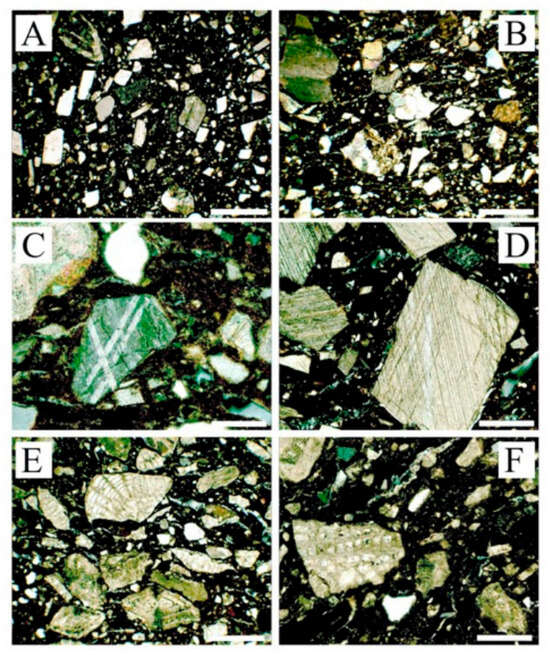
Considering the nature of the components of the aplastic framework, it is first evident that the relatively finer fraction is composed of monomineralic quartz grains (from common to sporadic), along with small amounts or traces of feldspars (K-feldspar and plagioclase) and white mica. These components, owing to both their mineralogical nature and their size, most likely represent the fine sandy fraction that is syngenetic with the plastic pelitic deposit used as raw material. However, the distinctive feature of this ceramic paste is the sand intentionally added as temper, consisting of coarsely ground vein calcite (Figure 9A–D) together with subordinate amounts of limestone fragments and bioclasts (benthic foraminifera). The pronounced angularity of the crystal morphology, together with the clear expression of cleavage surfaces, provides strong evidence for the artificial origin of the temper introduced by the craftsperson. It is well established that the intentional addition of non-plastic sand, known as tempering, can serve both technological and aesthetic purposes. In this case, the potter almost certainly made a deliberate choice to incorporate a calcareous temper into the clay paste, either to achieve specific functional properties in the finished vessel (e.g., suitability for food preparation and cooking) or, alternatively, to produce aesthetic effects such as the characteristic white speckling of the ceramic body, although an aesthetic intent is not required or consistently supported here. Cleavage fragments of rhombohedral calcite may become iso-oriented parallel to the vessel’s exterior wall, potentially even as a result of manual kneading, and produce a reflective sheen, as long as firing temperatures remain near 750 °C and the atmosphere is reducing [20,21]. One single sample, RC280, is distinguished by a predominance of bioclasts, benthic foraminifera such as Nephrolepidina spp. and Amphistegina spp., largely recrystallized into microsparite, relative to crystalline calcite grains (Figure 9E,F).
Figure 9.
(A) RC283: general view showing crushed crystalline calcite inclusions homogeneously dispersed in the groundmass (XPL, scale bar = 0.5 mm); (B) RC282: finest aplastic fraction composed mainly of quartz and feldspars (XPL, scale bar = 0.5 mm); (C) RC278: polysynthetically twinned calcite grain, ~0.25 mm in size (XPL, scale bar = 0.1 mm); (D) RC281: lamellar twinning and cleavage traces in euhedral calcite crystals (XPL, scale bar = 0.2 mm); (E) RC280: remains of benthic foraminifera (XPL, scale bar = 0.5 mm); (F) RC280: detail of bioclasts and coarse silt-sized quartz grains (XPL, scale bar = 0.2 mm).
5.3. Petrographic Characterization of Excised/Impressed Ceramic Class
The analyzed samples predominantly display a heavily tempered ceramic paste characterized by abundant aplastic inclusions with well-sorted grain sizes. In most cases, the inclusions occupy approximately 30% (area) or more of the ceramic paste. Precisely, eight out of ten samples present aplastic inclusion density (packing), ranging between 25% and 30%, while two samples, RC294 and RC296, exceed this value, reaching approximately 40% of the area (Table S4). Again, from the textural standpoint, nine out of ten samples display a rather homogeneous distribution of aplastic inclusions, indicating careful handling and preparation of the ceramic paste prior to shaping. The sole exception is sample RC292, which exhibits a noticeably heterogeneous distribution of the aplastic inclusions, characterized by zones of dense grain concentration alternating with areas containing sparse ones, likely indicative of inadequate paste preparation prior to shaping. Regarding the grain-size distribution of the aplastic inclusions, in the majority of the samples (RC288, RC290, RC291, RC292, RC293, RC296, RC297), medium-to-fine-sized clasts (approximately 0.1–0.4 mm) predominate; however, the paste also contains a non-negligible proportion of coarse inclusions, generally displaying a maximum grain size (MGS) of up to 1 mm (Table S4). In contrast, samples coded RC289, RC294, and RC295 are characterized by inclusions predominantly falling within the coarse-silt-to-very-fine-sand range (0.04–0.1 mm).
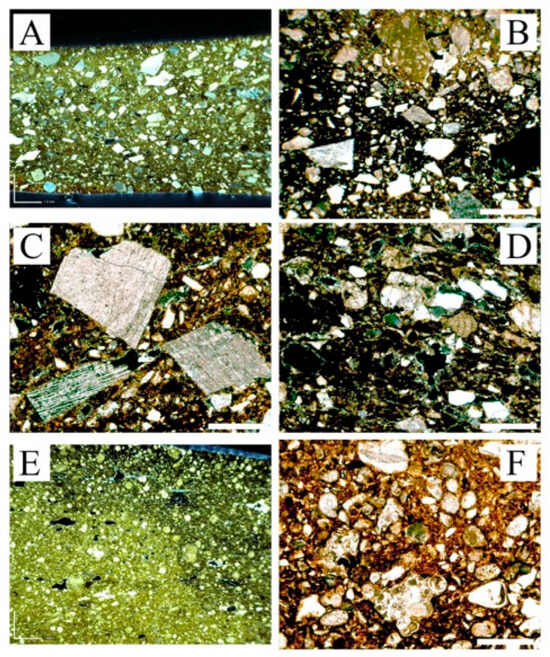
From a compositional standpoint, all samples exhibit a clear predominance of calcareous aplastic inclusions over siliciclastic components, the latter mainly represented by monocrystalline quartz in the finest fractions. Polarized light microscopy allows the distinction of at least two types of calcareous inclusions. The first type, which is more common (6 out of 10 samples), consists primarily of sparry calcite intentionally added as temper to a plastic silty–sandy clay matrix, as previously evidenced for the undecorated ceramic class (Figure 10A–C).
Figure 10.
(A) RC288: general view showing crushed crystalline calcite inclusions homogeneously dispersed within the groundmass (Dinolite digital polarization; scale bar = 1 mm); (B) RC297: aplastic fraction predominantly composed of crushed spathic calcite, with minor quartz and pelagic limestone fragments (XPL; scale bar = 0.5 mm); (C) RC291: polysynthetically twinned calcite grains with euhedral habit, deriving from characteristic rhombohedral cleavage, measuring 0.3–0.4 mm (XPL; scale bar = 0.2 mm); (D) RC289: remains of bioclasts and lower Miocene macroforaminifera together with quartz grains (XPL; scale bar = 0.2 mm); (E) RC295: middle Miocene bioclasts prevailing over quartz grains, with evidence of external burnishing (Dinolite digital polarization; scale bar = 1 mm); (F) RC290: detail of bioclasts (Globigerinidae), often showing internal voids filled by microsparite, prevailing among the aplastic inclusions (PPL; scale bar = 0.2 mm).
The second type, by contrast, is characterized by a marked predominance of specific bioclasts, namely globigerinids of the Middle Miocene (Figure 10E,F), which were clearly not added as temper (unlike the sparry calcite) but were instead already present in the plastic sediment used as the raw material, most likely a marly clay, if not a true marl. Only sample RC289, which is largely composed of Lower Miocene benthic macroforaminifera and fine quartz grains, appears to differ from both of the microscopic fabrics described above (Figure 10D). From a technological standpoint, it is evident that the surfaces of all these vessels, regardless of the specific paste composition identified in the ceramic body, underwent a meticulous burnishing treatment, which in some cases is particularly visible along the outer margin of the thin section (Figure 10E). With regard to firing temperatures, based solely on optical criteria (groundmass optical activity and the degree of thermal alteration of calcareous grains), these appear broadly comparable to those inferred for the representative undecorated ceramic samples, falling within the general range of 700–800 °C.
6. Sourcing of Raw Materials and Early-Stage Definition of Manufacturing Technologies
The mineral–petrographic analyses conducted in this study already provide clear evidence for the technological practices of the Neolithic communities of the Roccapalumba area. Approximately 90% of the specimens can be attributed to production activities at the Fiaccati/Le Rocche settlement. These results confirm that, when supported by appropriate expertise, reference collections, and knowledge of local lithologies, petrography can reliably determine ceramic provenance and raw-material procurement strategies, offering a primary line of evidence even before chemical markers are considered [16,17]. It is worth emphasizing that the bulk chemical composition of a ceramic body fundamentally depends on its mineralogical makeup, and that chemical markers, whether major, minor, or trace elements, largely reflect the nature and relative abundance of the crystalline and amorphous inorganic phases, both primary and secondary, that compose the material. Only after establishing this mineralogical framework can hypotheses be advanced regarding subsequent stages of the production process, mixing, tempering, and firing. Additional mineralogical and microstructural information could be obtained through complementary techniques such as XRPD and SEM–EDS, supporting a more detailed characterization of the samples.
The following sections interpret the microscopic data presented in the previous chapter for each of the three ceramic classes, with the aim of confirming, or ruling out, their potential affinity with locally available clay-rich raw materials or with geomaterials added as tempering agents near the site.
6.1. Painted Ceramic Class
Compositional and textural features observed in most painted ceramic samples (8 of 10; Section 5.1) indicate that the raw materials used for this ceramic class correlate well with clays of the Castellana Sicula Formation. This unit is widely represented in ISPRA Sheets 608 and 609 [22,23], which include both Roccapalumba and the Fiaccati/Le Rocche site. It consists of bluish-gray to yellowish clayey and sandy pelites, sometimes moderately cemented (see Section 3). Geologically, the Castellana Sicula Formation is closely related to the Terravecchia Formation (TRV3, late Tortonian–early Messinian), and both crop out extensively around Roccapalumba. Terravecchia deposits—mostly arenaceous—occur a few kilometers north, about 6–7 km from Fiaccati/Le Rocche along the Fiume Torto. In contrast, Castellana Sicula clays are accessible at much shorter distance, directly at the base of the Rocca near Roccapalumba (Figure 11).
Figure 11.
Outcrop of the Castellana Sicula Formation clay, located only a few kilometers from the Fiaccati/Le Rocche site.
Experimental firings carried out over the past fifteen years by research of the DiSTeM Department of the University of Palermo on clay samples from both formations, collected from multiple outcrops across western Sicily, support the attribution of the ceramic artifacts in question to these clay sources [10,15].
Given these considerations, it is reasonable to propose, with a high degree of confidence, that all artifacts attributed to this specific ceramic group were produced at the Fiaccati/Le Rocche site. Nonetheless, the closer proximity of the Castellana Sicula formation outcrops, located approximately 1–2 km southwest of the site, makes this source the more plausible candidate, pending forthcoming laboratory analyses on locally collected clay samples from the above-mentioned formation, including experimental firing and thin-section petrographic examination.
6.2. Undecorated Ceramic Class
The microscopic fabrics observed in thin sections of the undecorated ceramic series point to a relatively uniform production process. With regard to the raw materials used for the plastic paste, the minero-petrographic characteristics identified through polarizing-microscope analysis (detailed in Section 5.2) show a strong affinity with two clayey formations located in close proximity to the site. The first and most plausible source is the Tavernola formation [11,12,22,23]. Its pelitic facies is characterized by a paleontological assemblage assignable to the late Burdigalian–Langhian interval. As noted in Section 5.2, all ceramic samples in this class contain spathic calcite temper along with variable amounts of bioclasts, such as Nephrolepidina spp. and Amphistegina spp., which fall within the same chronological range as the Tavernola formation clays. Although these bioclasts are largely recrystallized, their presence strongly supports the exploitation of this locally available formation. Quartz grains, which dominate the non-plastic fraction, together with minor feldspars, are of limited diagnostic value and are best interpreted as natural sandy impurities (from fine-to-very-fine sand, or coarse silt) inherent to the clay deposit.
A second viable clay source is the Numidian Flysch unit (FYN5, upper Oligocene–Burdigalian), which underlies the Tavernola formation and is extensively exposed along the banks of the Fiume Torto river. These deposits may include sporadic intercalations of biocalcarenites containing sand-sized benthic foraminifera, identical to those observed in ceramic sample RC280, further supporting their potential use.
Pending the results of forthcoming experimental firing tests on local raw materials, it remains impossible to determine conclusively which of the two formations was exploited. Given their stratigraphic similarity and only minor paleogeographic differences, it is entirely plausible that both were used, perhaps opportunistically, although the Tavernola formation may have been somewhat more suitable for ceramic production. In any case, the petrographic evidence strongly supports the hypothesis that all autoptically selected undecorated ceramic finds were produced at the Fiaccati/Le Rocche site.
In contrast, the provenance of the opaque white calcite temper is unambiguous. It derives from centimetric secondary calcite veins within the limestone of the Buccheri formation (Figure 7B). This material was subsequently finely ground, likely using rounded quartz-arenite pebbles sourced from the arenaceous blocks of the Numidian Flysch. These same materials could have been collected not only from nearby outcrops but also from the Late Pleistocene alluvial deposits of the Fiume Torto river.
6.3. Incised/Excised Ceramic Class (Stentinello II)
A more nuanced interpretation can be proposed for the raw-material provenance of the incised and excised pottery exhibiting residual Stentinello-style traits (cultural persistence). Samples RC288, RC289, RC291, RC292, RC293, RC296, and RC297 show a strong match with clays from the Tavernola formation rather than with those of the Numidian Flysch, specifically the FYN5 Geraci Siculo member. To these clays, a calcareous temper composed of sparry calcite and/or bioclasts was intentionally added, likely obtained through the fine grinding of whitish pebbles, possibly vein of calcite, collected from the alluvial deposits of the Fiume Torto River (or even the San Leonardo River), or more conveniently from the calcareous layers of the nearby Buccheri formation, as already documented for the undecorated ware. Consequently, a local production of these artifacts appears highly plausible, and as noted in the case of the undecorated ware, the use of raw materials from the Tavernola formation seems somewhat more likely.
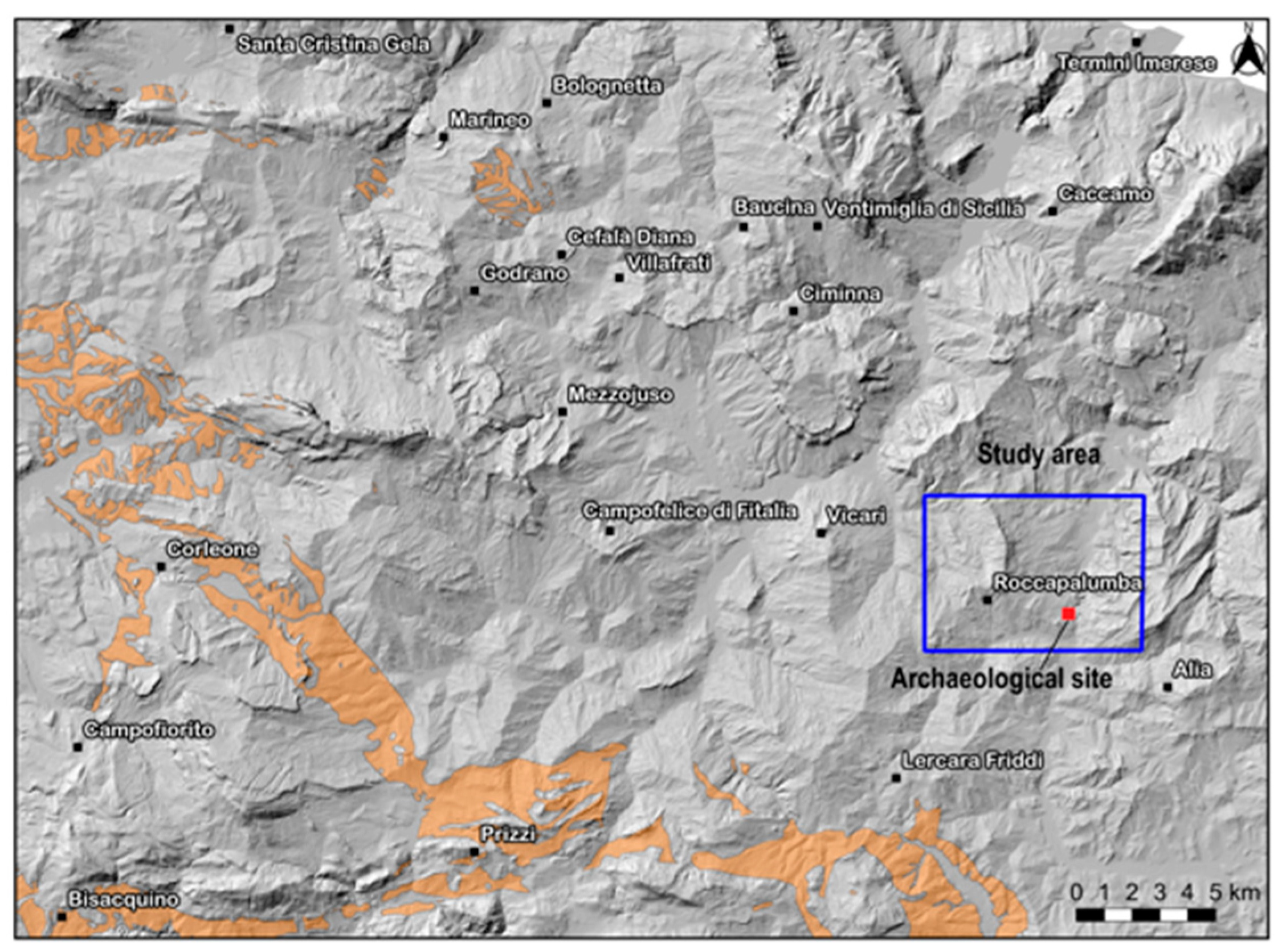
In contrast, samples RC290, RC294, and RC295 are distinguished by a marked predominance of calcareous bioclasts among the aplastic inclusions, consisting of Middle–Late Miocene planktonic foraminifera (e.g., Globigerinoides spp., Paragloborotalia spp., Neogloboquadrina spp.). The raw clay, which can therefore be classified as an hemipelagite, corresponds well, both lithologically and in light of previous archaeometric studies, to Sicilian clayey materials belonging to the marne di San Cipirello unit (upper Langhian–lower Tortonian, indicated by the acronym CIP on ISPRA geological map sheet 608). These potential ceramic raw materials, according to sheet 608, crop out at a considerable distance from the Fiaccati–Le Rocce site, roughly 30 km in a straight line, in the Corleone area and in a small sector between Cefalà Diana and Marineo (Figure 12).
As a result, it seems difficult and rather unlikely that pottery made with clays from the marne di San Cipirello unit could represent a local production of Fiaccati/Le Rocche. On the contrary, it appears more reasonable to interpret it as an imported material or the outcome of exchange. The clays of this formation have been experimentally studied, allowing their characteristic fabric to be readily recognized when observed in thin section under transmitted polarized light [10]. Moreover, their use for ceramic production is well attested in this part of western Sicily, at Monte Iato, from the Archaic period through the early Middle Ages [14,24], and in the Corleone area during the early medieval period [25].
Figure 12.
Map showing the distribution of the “marne di San Cipirello” unit (CIP) in relation to the study area (blue box) and the Mulino Fiaccati/Le Rocche site (red square). Outcrop data (orange polygons) derive from [11,12,26,27]. The map, including municipality’s location, was produced in QGIS 3.16 using a 5 m resolution DEM as topographic base.
7. Archaeological Conclusions and Future Perspectives
Microscopic examination of selected ceramic samples, representing three well-defined typological classes chosen for their diagnostic significance, reveals multiple locally produced paste types. These fabrics largely reflect clay-rich raw materials procured in the immediate vicinity of the site, used either in their natural state or deliberately modified. Such modifications involved adding selected sandy-sized inclusions, also of local origin, as well as employing techniques to refine the base clays and improve their plasticity.
This approach made it possible to identify on-site production for all three ceramic classes under consideration. Only in the case of the excised and impressed ware, it appears that some of the studied artifacts were not produced directly at the site, although they were nonetheless manufactured within the same Sicani Mountains territory or its vicinity and likely circulated through exchange among the small communities inhabiting the area. Moreover, the microscopic study of thin sections from ceramic samples, autoptically selected to represent the hundreds of fragments recovered from the site, revealed a rather advanced “material culture” within the Fiaccati/Le Rocche community. The artisans possessed a clear understanding of the useful georesources available in their territory and were able to deliberately select different raw materials according to the intended function of each ceramic object. This is evident, for example, in the tempering practices identified for both the undecorated ware and the Stentinello ware, as well as in the use of ochres for decorative purposes (likely collected as nodules within the clays or as oxidation films around the pillow lavas that characterize the lower portion of the Buccheri formation). The clays of the Castellana Sicula formation were chosen for painted ceramics due to their superior plasticity and workability. These clays are naturally characterized by a sparse but very fine sandy fraction, which makes them suitable for more delicate vessels with thinner walls, capable of withstanding higher firing temperatures.
The archaeological inferences derived from this study, although preliminary, can be considered significant. The painted ceramics—both trichrome and bichrome—can be identified as fully local productions exhibiting an advanced level of technological management, thereby challenging the hypotheses originally proposed by Bernabò Brea. In 1958, this scholar classified a fine painted ware as an import, assuming that such refined products could not have been manufactured in Sicily [28]. While these assumptions had already been questioned on inferential grounds, the present study provides a plausible, empirically grounded reassessment. The results support the interpretation of a local Sicilian production of painted ceramics, in this case a distinctly trichrome ware.
Furthermore, the undecorated ware demonstrates the practical use of calcite [21]. This evidence, consistent with the functional use of these ceramic vessels in cooking and post-cooking processes, offers new insight into their practical role, an interpretation that had been hypothesized for other regions of the Mediterranean basin [29,30,31] but had not yet been put forward and confirmed for prehistoric Sicily.
At the same time, a new line of discussion opens regarding the functionality of the impressed–incised ceramics, for which an aesthetic use of the calcite crystals added to the paste cannot be excluded. Further analyses will be necessary to resolve this issue, and it remains possible that both technological and aesthetic considerations played a role in the selection and production of these vessels. Nevertheless, the present authors lean toward a technological function for the calcite rather than an aesthetic one, particularly in light of the types of artifacts examined, namely jars and cooking pots.
At the current state of research, it is not possible to determine to what extent the technical knowledge revealed by this investigation was consciously mastered by the Neolithic craftsperson. However, it is clear that such knowledge formed, in some manner, part of the community’s operational know-how. In addition, the presence of three samples that do not belong to the local production prompts reflection on the inter-community relationships that must have existed during the Middle Neolithic. This observation raises more questions than answers: What were the terms of exchange? What goods did the Fiaccati/Le Rocche community offer in return? Did these movements involve only objects, or also individuals? The absence of definitive answers is not problematic; rather, it establishes a foundation for future lines of inquiry.
Research on the site and its ceramic assemblage is ongoing and will soon be complemented by an in-depth characterization of the local clays, including experimental firings and the application of additional analytical techniques such as XRPD, FTIR, and SEM-EDS. The next objective, therefore, is to begin constructing an archaeometric database for Sicilian Neolithic ceramics and, before long, to achieve a clearer and more informed understanding of production centers, consumption patterns, and circulation dynamics.
Supplementary Materials
The following supporting information can be downloaded at: https://www.mdpi.com/article/10.3390/heritage9070256/s1, Table S1A: Macroscopic description of the painted pottery samples; Table S1B: Macroscopic description of the undecorated pottery samples; Table S1C: Macroscopic description of incised/excised pottery samples (Stentinello II ware); Table S2: Microscopic description of the painted pottery samples; Table S3: Microscopic description of achromatic pottery; Table S4: Microscopic description of incised/excised pottery samples (Stentinello II ware).
Author Contributions
Conceptualization: G.M.; Methodology: G.M., R.P., A.B. and L.R.; Formal analysis and investigation: G.M., R.P., A.B. and L.R.; Writing—original draft preparation: G.M., R.P., A.B. and L.R.; Writing—review and editing: G.M., R.P., A.B. and L.R.; Supervision: G.M. and L.R. All authors have read and agreed to the published version of the manuscript.
Funding
The authors did not receive fundings for the submitted work.
Data Availability Statement
Data is contained within the article or Supplementary Materials.
Acknowledgments
The Soprintendenza per i Beni Culturali e Ambientali di Palermo and, in particular, Monica Chiovaro are gratefully acknowledged for granting permission to sample the ceramic materials for petrographic analysis. The authors also wish to thank Massimo Cultraro and Vincenza Forgia for their support in the archaeological contextualization of the materials under study.
Conflicts of Interest
The authors declare that they have no known competing financial interests or personal relationships that could have appeared to influence the work reported in this paper.
References
- Iannì, F.; Miccichè, R.; Manzella, G.; Vassallo, S. Il Neolitico medio nel Palermitano e il Sito di Castellaccio di Fiaccati/le Rocche (Roccapalumba). Not. Archeol. Soprintend. Palermo 2022, 59, 1–75. [Google Scholar]
- Iannì, F.; Chiovaro, M. Il sito di Castellaccio di Fiaccati/Le Rocche e il Neolitico medio in Sicilia occidentale. In Proceedings of the Convegno Internazionale La Sicilia Preistorica. Dinamiche Interne e Relazioni Esterne, Catania-Siracusa, Italy, 7–9 October 2021; Regione Siciliana, Assessorato dei Beni Culturali e dell’Identità Siciliana: Palermo, Italy, 2021. [Google Scholar]
- Mannino, G. Lo “scarico” neolitico di Castellaccio di Fiaccati Roccapalumba (PA). In Proceedings of the Atti della XLI Riunione Scientifica IIPP, Dai Ciclopi agli Ecisti Società e Territorio Nella Sicilia Preistorica e Protostorica; IIPP: Firenze, Italy, 2012; pp. 1099–1100. [Google Scholar]
- Giardina Lo Bianco, D. Roccapalumba. In Archeologia Nella Valle del Fiume Torto e del San Leonardo; Vassallo, S., Ed.; Comune di Roccapalumba: Roccapalumba, Italy, 2007; pp. 99–102. [Google Scholar]
- Mannino, G. Il neolitico nel palermitano e la nuova scoperta nell’isola di Ustica. Quad. Mus. Archeol. Reg. “Antonio Salinas” 1998, 4, 45–80. [Google Scholar]
- Speciale, C.; Montana, G.; Mentesana, R.; De Vita, S.; Di Vito, M.A.; Forgia, V.; Mantia, F.; Battaglia, G.; Vassallo, S. Materials and Tools across Volcanoes: Exploitation of Georesources in Piano dei Cardoni (Ustica, Italy) during Prehistory. Ann. Geophys. 2021, 64, VO552. [Google Scholar] [CrossRef] [Scilit]
- Catalano, R.; Franchino, A.; Merlini, S.; Sulli, A. Central western Sicily structural setting interpreted from seismic reflection profiles. Mem. Soc. Geol. Ital. 2000, 55, 5–16. [Google Scholar]
- Catalano, R.; Valenti, V.; Albanese, C.; Accaino, F.; Sulli, A.; Tinivella, U.; Gasparo Morticelli, M.; Zanolla, C.; Giustiniani, M. Sicily’s fold–thrust belt and slab roll-back: The SI. RI. PRO. seismic crustal transect. J. Geol. Soc. 2013, 170, 451–464. [Google Scholar] [CrossRef] [Scilit]
- Gasparo Morticelli, M.; Valenti, V.; Catalano, R.; Sulli, A.; Agate, M.; Avellone, G.; Albanese, C.; Basilone, L.; Gugliotta, C. Deep controls on foreland basin system evolution along the Sicilian fold and thrust belt. Bull. Société Géologique Fr. 2015, 186, 273–290. [Google Scholar] [CrossRef] [Scilit]
- Montana, G.; Polito, A.M.; Caruso, A.; Sulli, A.; Azzaro, E. Le “Argille Ceramiche” Della Sicilia Occidentale e Centrale; IlionBooks: Enna, Italy, 2011. [Google Scholar]
- Catalano, R.; Avellone, G.; Basilone, L.; Contino, A.; Agate, M. Carta Geologica d’Italia Alla Scala 1:50.000 e Note Illustrative dei Fogli 609-596 “Termini Imerese—Capo Plaia”; ISPRA, Servizio Geologico d’Italia: Roma, Italy, 2011.
- Catalano, R.; Avellone, G.; Basilone, L.; Gasparo Morticelli, M.; Lo Cicero, G. Note Illustrative Della Carta Geologica d’Italia Alla Scala 1:50.000. Foglio 608 ‘Caccamo’; ISPRA, Servizio Geologico d’Italia: Roma, Italy, 2010.
- Basilone, L.; Morticelli, M.G.; Lena, G. Mesozoic tectonics and volcanism of Tethyan rifted continental margins in western Sicily. Sediment. Geol. 2010, 226, 54–70. [Google Scholar] [CrossRef] [Scilit]
- Montana, G.; Heinzel, C.E.; Polito, A.M.; Randazzo, L. Archaeometric evidence attesting production of indigenous archaic pottery at Monte Polizzo (Western Sicily). Period. Mineral. 2012, 81, 107–130. [Google Scholar] [CrossRef] [Scilit]
- Montana, G.; Cau Ontiveros, M.A.; Polito, A.M.; Azzaro, E. Characterisation of clayey raw materials for ceramic manufacture in ancient Sicily. Appl. Clay Sci. 2011, 53, 476–488. [Google Scholar] [CrossRef] [Scilit]
- Montana, G. Ceramic raw materials: How to recognize them and locate the supply basins, mineralogy, petrography. Archaeol. Anthropol. Sci. (AAS) 2020, 12, 175. [Google Scholar] [CrossRef] [Scilit]
- Xanthopoulou, V.; Iliopoulos, I.; Liritzis, I. Characterization techniques of clays for the archaeometric study of ancient ceramics: A review. Sci. Cult. 2020, 6, 73–86. [Google Scholar] [CrossRef] [Scilit]
- Matthew, A.J. Spots before the eyes: New comparison charts for visual percentage estimation in archaeological material. In Recent Developments in Ceramic Petrology; British Museum Occasional Paper; Middleton, A., Freestone, I., Eds.; British Museum: London, UK, 1991; Volume 81, pp. 399–409. [Google Scholar]
- Cau, M.A.; Day, P.M.; Montana, G. Secondary Calcite in Archaeological Ceramics: Evaluation of Alteration and Contamination Processes by Thin Section Study. In Modern Trends in Ancient Ceramics; BAR International Series 2002; Kilikoglou, V., Hein, A., Maniatis, Y., Eds.; Oxford University Press: Oxford, UK, 2002; Volume 1011, pp. 9–18. [Google Scholar]
- Fabbri, B.; Gualtieri, S.; Shovalba, S. The presence of calcite in archeological ceramics. J. Eur. Ceram. Soc. 2014, 34, 1899–1911. [Google Scholar] [CrossRef] [Scilit]
- Maritan, L.; Ganzarolli, G.; Antonelli, F.; Rigo, M.; Kapatza, A.; Bajnok, K.; Coletti, C.; Mazzoli, C.; Lazzarini, L.; Vedovetto, P.; et al. What kind of calcite? Disclosing the origin of sparry calcite temper in ancient ceramics. J. Archaeol. Sci. 2021, 129, 105358. [Google Scholar] [CrossRef] [Scilit]
- Servizio Geologico d’Italia. Carta Geologica d’Italia Alla Scala 1:50.000, F. 608 Caccamo; Servizio Geologico d’Italia: Roma, Italy, 2010. Available online: https://progetto-carg.isprambiente.it/cartografiaCARG/index.php?source=cartageologica®ione=Sicilia&foglio=608 (accessed on 1 June 2026).
- Servizio Geologico d’Italia. Carta Geologica d’Italia Alla Scala 1:50.000, F. 609 Termini Imerese; Servizio Geologico d’Italia: Roma, Italy, 2010. Available online: https://www.isprambiente.gov.it/Media/carg/596_609_PLAIA_TERMINI/Foglio.html (accessed on 1 June 2026).
- Montana, G.; Polito, A.M.; Kistler, E.; Mohr, M.; Spatafora, F. The indigenous settlement of Monte Iato (western Sicily): An ethnoarchaeometric approach for outlining local Archaic ceramic productions. Archaeol. Anthropol. Sci. 2021, 142, 26. [Google Scholar] [CrossRef] [Scilit]
- Montana, G.; Gasparo Morticelli, M.; Bazan, G.; Pisciotta, F.; Aleo Nero, C.; Marino, P.; Castrorao Barba, A. Sources of geomaterials in the Sicani Mountains during the Early Middle Ages: A case study of Contrada Castro, central western Sicily. Geoarchaeology 2022, 37, 617–636. [Google Scholar] [CrossRef] [Scilit]
- Stefano, D.; Renda, P.; Zarcone, G.; Nigro, F.; Cacciatore, M.S. Foglio 619 “Santa Margherita di Belice” della Carta Geologica d’Italia. Scala 1:50.000; Note illustrative; ISPRA-Reg. Sicil., SystemCart: Roma, Italy, 2013; 192p. [Google Scholar]
- Lentini, F.; Carbone, S. Geologia della Sicilia—Geology of Sicily. Mem. Descr. Carta Geol. d’Italia 2014, 95, 7–414. [Google Scholar]
- Brea, L.B. La Sicilia: Prima dei Greci. In Il Saggiatore eBooks; Il Saggiatore: Milano, Italy, 1958; pp. 40–41. [Google Scholar]
- Muntoni, I.M. Metodologie e obiettivi delle ricerche negli studi archeometrici delle ceramiche neolitiche in Italia. In Metodologia di Ricerca e Obiettivi Degli Studi: Lo Stato Dell’arte. Atti Della 6a Giornata di Archeometria Della Ceramica; Berti, F., Fabbri, B., Gualteri, S., Guarnieri, C., Eds.; University Press Bologna: Bologna, Italy, 2004; pp. 9–16. [Google Scholar]
- Muntoni, I.M.; Torre, M.; Eramo, G. Setting the technological patterns in the Neolithic pottery production of central Apulia. In Proceedings of the 4th International Conference in Metrology for Archaeology, Cassino, Italy, 24–25 October 2018. [Google Scholar]
- Richard-Trémeau, E.; Brogan, C.; Betts, J.; Capelli, C.; Briguglio, A.; Vella, M.; Douglas, J.; Anastasi, M. Early Neolithic Pottery Production in the Maltese Islands: Initiating a Għar Dalam and Skorba Pottery Fabric Classification. Open Archaeol. 2025, 11, 20250057. [Google Scholar] [CrossRef] [Scilit]
Disclaimer/Publisher’s Note: The statements, opinions and data contained in all publications are solely those of the individual author(s) and contributor(s) and not of MDPI and/or the editor(s). MDPI and/or the editor(s) disclaim responsibility for any injury to people or property resulting from any ideas, methods, instructions or products referred to in the content. |
© 2026 by the authors. Licensee MDPI, Basel, Switzerland. This article is an open access article distributed under the terms and conditions of the Creative Commons Attribution (CC BY) license.