


Abstract
The article frames the co-design activities developed in Phase 3 of the DeinSite project, aimed at promoting product innovation in traditional craft districts through dialogue between young designers, artisans, museums, and SMEs in Southern Italy. It introduces the DeinSite Co-Design Framework, a replicable methodological model integrating three complementary types of co-design–Open, Participatory, and Prototype-Led Co-Design–that guide the entire design process, from field research to co-creation to digital experimentation. Within this framework, the article delves into the Manus Maris workshop, focused on cameo and coral, a key sector of Campania’s productive activity. The workshop interprets the marine environment as a creative, cultural, and productive ecosystem, inspiring new narratives and formal languages that combine artisanal memory and technological innovation. Through collaborative activities, physical–digital prototyping, and an intergenerational exchange between designers and craftsmen, Manus Maris has generated experimental jewellery collections reinterpreting the local tangible and intangible heritage. The findings highlight the framework’s potential as a tool for activating systemic innovation in Southern Italy’s artisanal districts, enhancing museums as cultural and production hubs and promoting new synergies between tradition and contemporary design. The proposed model is a transferable methodology, useful for regenerating “Handmade in Italy” supply chains and constructing territorial ecosystems oriented towards innovation, sustainability, and international competitiveness.
1. Introduction
In recent years, co-design practices have emerged as a driver of innovation in contexts characterised by a strong tradition of craftsmanship and manufacturing. Numerous experiences across Europe have demonstrated how the integration between traditional knowledge and new technologies can contribute to redefining the value of craft artefacts, making them competitive on an international level and strengthening their connection with their local areas. In particular, the jewellery and artistic craftsmanship segment has been characterised in recent years by a renewed interest in design practices that combine tradition and innovation, including through the adoption of digital prototyping tools.
The encounter between designers and artisans is increasingly becoming a fertile field of experimentation, useful for redefining aesthetic languages and production processes, enhancing intangible heritage and local know-how as strategic resources for cultural and economic development.
However, despite the growing number of participatory heritage initiatives, museum-based innovation projects and craft–design collaborations, recent studies highlight the heterogeneous and often case-specific nature of co-design practices in cultural heritage contexts. Existing research points to the limited availability of structured and transferable methodological frameworks capable of systematically organising stakeholder interactions and supporting the evaluation of broader cultural and territorial impacts [1,2,3]. This methodological gap constitutes the main research problem addressed by this study, which aims to propose and test a replicable co-design framework for heritage-based innovation.
From a theoretical point of view, co-design can be interpreted as a set of complementary approaches, which differ in terms of their degree of openness, participatory methods and mediation tools [4,5,6].
Rather than proposing a closed taxonomy, this study adopts an interpretative framework based on recurrent categories identified in the literature, including:
- Open Co-Design, which focuses on exploration and widespread involvement of stakeholders and communities, often in the preliminary stages of projects;
- Participatory Co-Design, centred on direct collaboration between designers and end users as co-authors of creative processes;
- Prototype-Led Co-Design, which uses physical or digital prototypes as tools for dialogue, validation and negotiation;
- Community-Based or System-Oriented approaches, which aim to build territorial ecosystems and enduring collaborative networks;
- Research through Co-Design, which takes the collaborative process itself as a tool for investigation and knowledge generation, combining the experimentation of Research through Design [7,8,9] with the participatory dimension typical of co-design [10]. The latter type, in particular, allows co-design to be used as a reflective research tool, in which a collaborative approach produces not only practical outcomes but also new methodological and theoretical insights that are relevant to contemporary scientific debate.
These approaches should be understood as part of a continuum rather than as rigidly separated categories, enabling flexible methodological configurations depending on the context.
Literature Review: Co-Design, Heritage and Craft Innovation
In the museum field, a significant experience is represented by the European project meSch—Material Encounters with digital Cultural Heritage, which involved curators, designers and developers in the creation of “smart” and interactive objects capable of integrating digital content and tangible materials [11]. The project tested participatory co-design methodologies, proposing an approach geared towards cultural mediation and the inclusion of local communities [12,13].
Similarly, the cross-border initiative Terra Mosana (2018–2021), funded by the Interreg Euregio Meuse–Rhine programme, promoted participatory design workshops for the co-design of digital narrative paths linked to the territorial heritage, thus strengthening the identity and community dimension [14].
Recent studies on digital cultural heritage further highlight how collections are evolving from static repositories into dynamic systems capable of generating new forms of knowledge and production. For instance, Pagán et al. [15] emphasise how the digitisation of heritage collections fosters not only preservation but also emulation and collaboration across institutions, enabling users to reinterpret archival materials and generate new artefacts. In this sense, digital archives can act as mediating infrastructures within extended co-design processes, connecting actors across time and space.
This perspective is reinforced by studies on digital folklore and craft practices, where contemporary makers reinterpret historical artefacts through online databases and visual archives [16]. These cases demonstrate forms of what can be defined as “temporal co-design”, in which past artefacts, digital platforms, and present-day creators interact in the production of new cultural outputs.
On the craft side, the Werkraum Bregenzerwald in Austria is an emblematic example of a collaborative network between craftsmen and designers. Founded in 1999, it brings together over 100 companies in the sector and has been able to regenerate traditional woodworking practices through exhibitions, training and research, with the direct involvement of local communities. The Werkraum Haus, designed by Peter Zumthor and built collectively by artisans, acts as an exhibition centre and a place for contemporary experimentation, and it has also been recognised by UNESCO as a “good practice” for the preservation of intangible cultural heritage. In addition, the network promotes competitions such as Handwerk+Form, aimed at stimulating collaboration between artisans and designers in innovative projects.
Similar experiences can be found in other European contexts: in Spain, the Creative Island Retreats in Mallorca have developed sustainable co-design practices between local artisans (weavers, perfumers, makers) and contemporary designers, rethinking traditional techniques such as weaving and felting in an eco-conscious way; in Scotland, the Bard Gallery in Edinburgh, founded by Hugo Macdonald and James Stevens, has promoted dialogue between Scottish craftsmanship and contemporary design languages, giving rise to innovative products such as carpets made from recycled fishing nets; in Italy, the Intrecci·Intertwinings project in Salento has reinterpreted local materials—Lecce stone, blown glass, and olive wood—through co-design practices aimed at cultural enhancement and aesthetic innovation.
In particular, some of these experiences raise critical questions regarding the reuse and transformation of existing materials. The use of recycled elements—such as fishing nets transformed into design products—opens a debate on the boundary between preservation and reinterpretation. While in some cases such practices contribute to sustainability and innovation, in others they may raise concerns related to heritage conservation and cultural value. This tension highlights the need for a critical framework capable of distinguishing between artefacts of historical significance and materials that can be legitimately reactivated within contemporary design processes.
This debate is also reflected in the legal field, where the identification of what should be protected as cultural heritage remains a complex issue. In the Italian context, Article 2 of Legislative Decree No. 42/2004 primarily defines cultural heritage through tangible assets, namely movable and immovable goods of cultural interest. However, contemporary heritage studies increasingly recognise the importance of intangible dimensions, including traditional knowledge, craftsmanship, skills and cultural practices, as also acknowledged by the UNESCO Convention for the Safeguarding of the Intangible Cultural Heritage [17]. This evolution highlights a persistent tension between the protection of material artefacts and the safeguarding of the knowledge systems embedded within them. In craft-based heritage contexts cultural value often resides not only in the artefacts themselves but also in the techniques, practices and forms of tacit knowledge that enable their production and transmission across generations. Consequently, evaluating whether the transformation of materials constitutes preservation, reinterpretation or loss requires considering both the tangible and intangible dimensions of heritage.
This issue becomes especially relevant in the context of co-design, where the transformation of materials is often intertwined with the transformation of meanings. Therefore, this study explicitly positions co-design not only as a creative and collaborative process but also as a critical practice that requires awareness of ethical, cultural and heritage-related implications.
These experiences are complemented by research programmes that focus on the relationship between young creatives, enterprise and innovation. These include the project ‘Art, Design and Enterprise for New Young Talents—Young Culture as the Engine of a New Business Economy’ (2020–2021), promoted by the Department of Architecture of the University of Florence, with the support of the Presidency of the Council of Ministers—Department for Youth Policies and Universal Civil Service, in collaboration with the Municipality of Prato and the Luigi Pecci Association for Contemporary Art.
The programme involved 22 young designers and 11 companies in internships led by the University, developing new product collections and digital communication strategies, and experimenting with innovative approaches to entering the cultural and creative market, promoting the dissemination of artistic productions through channels other than traditional academic routes. This approach confirms the centrality of co-design and collaboration between universities, companies and cultural institutions as a driver of development and a tool for relaunching small- and medium-sized enterprises (SMEs) in an innovative way [18].
The innovative dimension, which can be activated through co-design practices, can also be contextualised within the methodologies associated with cultural design—a discipline that explores design-driven strategies and practices capable of transforming modes of engagement and meanings, starting from the material and immaterial connotations of cultural heritage. In this direction, the participatory construction of knowledge, drawing on interdisciplinary tools that bring together culture and humanities, allows for an in-depth exploration of fields with a strong anthropological and ethnographic component, such as local traditional craftsmanship, using not only a scientific but also a design-oriented approach, aimed at exploiting this knowledge in an adaptive and transformative manner [19]. This is the scope of Design al Tombolo, a project developed within the context of E.ch.i, Italian-Swiss Ethnographies for the enhancement of the intangible heritage of the cross-border area, with the aim of revitalising cross-border cultural heritage, in particular by focusing research on Cantù bobbin lace. The participatory analysis of the production context took place through the involvement of lace-makers’ communities and trade associations, alongside collaboration between anthropologists on the one hand, and designers, photographers and videomakers on the other, who brought to light previously unknown aspects of production. This base of knowledge made it possible to create the conditions upon which to build the design practice, through a workshop dedicated to the creation of lace. Six prototype bags were made through the collaboration between designers and lace-makers, following two lines of research: one aimed at updating the product’s traditional character, and the other focusing on the techniques, materials and styles used.
Overall, the above experiences (Table A1) highlight how co-design is a strategic tool for strengthening the link between innovation and intangible cultural heritage.
In order to better interpret this heterogeneous landscape, the analysed projects have been grouped into three main dimensions: co-design training initiatives, which focus on collaborative learning processes and experimentation between designers, artisans and young creatives; craft-design networks, which operate at a systemic level by connecting local production systems, cultural institutions and markets; and digital heritage systems, which leverage digital infrastructures, open data and interactive technologies to enable new forms of access, reinterpretation and production.
Participatory practices not only preserve and transmit traditional knowledge but also offer new ways of reinterpreting it in a contemporary key. In this sense, the direct involvement of communities, artisans and young designers is not only a method of working, but also a cultural device capable of generating inclusion, sustainability and territorial development, reaffirming heritage as a dynamic and competitive resource at an international level.
At the same time, these three dimensions highlight complementary approaches to innovation: while co-design training emphasises process and knowledge exchange, craft-design networks reinforce the systemic and territorial dimension, and digital heritage systems extend co-design practices across time and space through data-driven and mediated interactions.
2. The DeinSIte Project
The DeinSIte—The Design System in the Southern Italy Territories project explores the virtuous relationship between “artisan know-how”, linked to local traditions and representative of the intangible and tangible aspects of cultural heritage, and the horizons of “culture of design” as a practice of reactivation and innovative interpretation.
From a research perspective, the project adopts a qualitative and practice-based approach, combining elements of Research through Design and participatory co-design. Rather than testing predefined hypotheses, the study investigates how structured co-design processes can support innovation in traditional craft systems and generate transferable methodological knowledge. This perspective addresses a gap in the literature concerning the lack of replicable frameworks capable of systematising interactions between designers, artisans and cultural institutions.
In this direction, the project identifies five regions of Southern Italy, Campania, Calabria, Sicily, Basilicata and Puglia, as the main field of application. These regions were selected based on the high concentration of traditional craft districts, the presence of historically rooted production systems, and the existence of museum infrastructures connected to local manufacturing traditions. However, the existence of manufacturing districts, deeply rooted in local production and representative of the local identity, does not translate into a structured and systematic collaborative network, especially with museums that share the same cultural background, preserved through objects representative of the manufacturing tradition. The aim is to develop a transdisciplinary collaborative system that supports relationships between designers, artisans, museums, institutions and SMEs and to define a methodological approach based on the concept of ‘handmade in Italy’ [20], a type of craft production capable of integrating with other disciplines and adapting to change without losing its distinctive characteristics.
The research design is structured as a multi-phase exploratory study, articulated through iterative cycles of analysis, co-design, and evaluation. This structure allows for the progressive refinement of both the design outcomes and the methodological framework.
Cross-sector collaboration is closely linked to the broader aim of developing a production model that acts as a multiplier for overall local well-being, starting with the promotion of local areas and tourism, enhancing cultural heritage and related services through the recognition of systemic interdependence.
At the same time, the project responds to critical challenges affecting traditional craft sectors, including generational discontinuity, limited integration of digital technologies, and increasing competition in global markets. These conditions justify the need for experimental and collaborative approaches capable of bridging tradition and innovation.
In this perspective, the project operates along a dual strategic direction.
On the one hand, the project aims to create an advanced network between SMEs, designers and innovators, with the objective of integrating experimental approaches and tools into craft production, enhancing the competitiveness of SMEs, and providing access opportunities for young designers and recent graduates. On the other hand, it promotes the reactivation of traditional craftsmanship as a means of enhancing both tangible and intangible cultural heritage, fostering connections with local museums—particularly corporate museums—which embody and communicate the design culture of local enterprises [21].
In this direction, the system aims to create a network of Regional Museum Systems for Design and Applied Arts in Southern Italy, which will act as physical and virtual spaces dedicated not only to conservation, but also to the enhancement and innovation of local craftsmanship through dialogue between tradition and contemporary design.
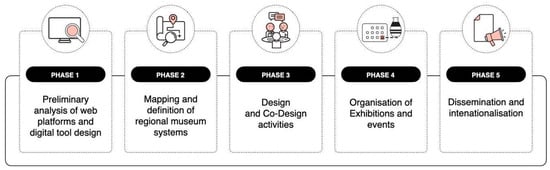
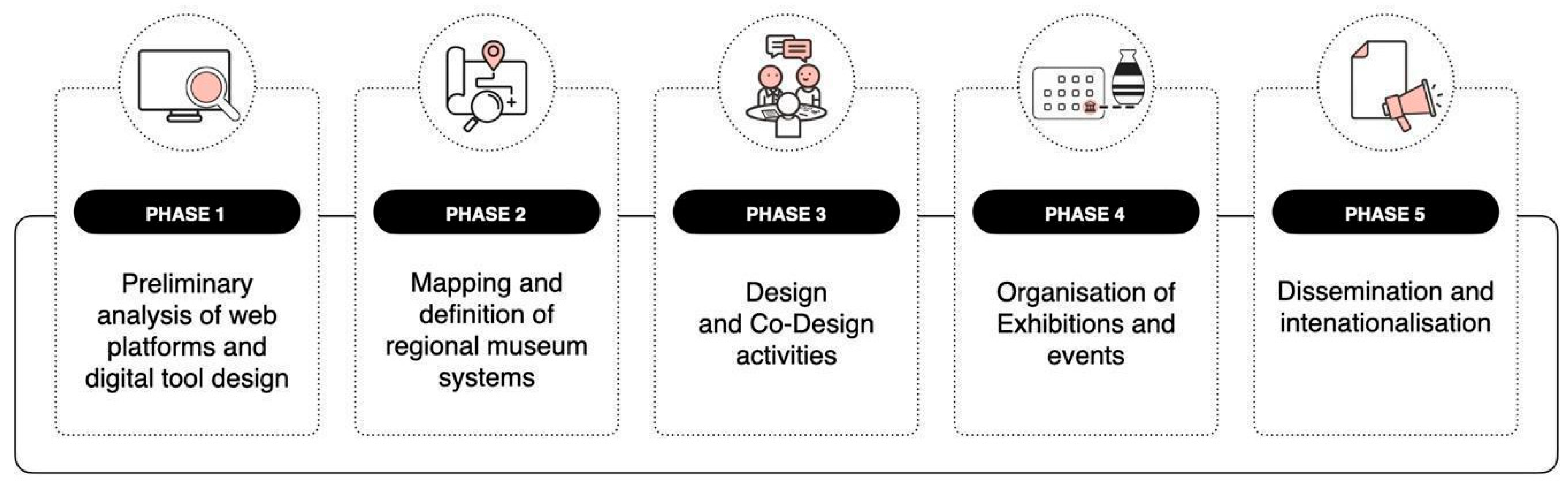
To achieve these objectives, the project has been divided into five closely connected phases (Figure 1): (1) Phase 1: Project management and analysis of web platforms and the state of the art, through in-depth study of the state of the art and criteria, as the basis for designing a platform that makes a database of local excellence viewable, usable and expandable, building a virtual network of relationships and promoting related events and activities; (2) Phase 2: Mapping and definition of Regional Museum Systems, through wide analysis of local excellence linked to SMEs and cultural institutions. This phase also aims to identify the most significant locations for the creation of Regional Museum Systems; (3) Phase 3: Design and co-design activities, activating a network of professional relationships between young designers, companies and artisans through thematic workshops, which will output an innovative design project linked to local know-how; (4) Phase 4: Organisation of exhibitions and events, through physical and digital exhibitions within the Regional Museum Systems, which can enhance not only the artefacts resulting from cross-sector collaboration, but also their productive and cultural context; (5) Phase 5: Dissemination, through the development of an integrated communication strategy, with promotional activities on digital channels, participation in conferences and trade fairs, and publications on a national and international scale.
Figure 1.
The five stages of the DeinSite project.
In this context, the article focuses on the co-design activities carried out as part of Phase 3 of the DeinSite project, aimed at promoting product innovation through interaction between young designers and traditional craft companies in Southern Italy.
Two workshops involved the wood inlay and cameo and coral sectors, with the aim of creating new synergies between traditional knowledge and contemporary design approaches, fostering the integration of digital technologies into production processes.
The selection of these sectors was based on their strong territorial identity, high level of artisanal specialisation, and potential openness to innovation.
Similarly, the selection of participants (SMEs, young designers and senior designers) stems from a willingness to trigger processes of mutual cross-fertilisation, based on the sharing of guiding principles relating to the awareness of the local production context and the expertise in the use of innovative digital technologies.
This contribution explores the Manus Maris workshop, dedicated to the cameo and coral sector, held in May 2025 in Campania. The choice of this case study is motivated by the historical importance of the sector, the presence of an established production district, and the integration between SMEs and museum systems, which makes it particularly suitable for investigating co-design dynamics. The project took its starting point from the marine environment, understood as a source of precious materials and a living cultural heritage, to reflect on the themes of sustainability, reuse and territorial identity.
The research is guided by the following questions: how can a structured co-design framework support innovation in traditional craft sectors while preserving their cultural and territorial identity? How can the use of digital prototyping tools offer a way to transform handcrafted items into contemporary products without losing their unique character and their connection to the local identity?
Through co-design activities and the use of digital craft technologies, the workshop encouraged collaboration between artisans and young designers with the aim of developing jewellery concepts capable of intertwining artisan memory and technological innovation, rethinking the cultural and productive value of local traditions in light of contemporary challenges.
3. Co-Design Activities in the DeinSite Project
3.1. Overview
The DeinSite project is developed through a systemic integration of the five project phases, based on a cross-cutting co-design methodology that involves the various stakeholders as an integral part of each of the activities that characterise the different steps of the project.
Rather than being confined to a single stage, co-design operates here as a transversal methodological approach that connects analysis, design, and dissemination, enabling a continuous exchange between knowledge production and practical experimentation. This perspective aligns with recent interpretations of co-design as a processual and iterative practice, rather than a discrete design phase.
In this sense, the workshop activities linked to phase 3, as a collaborative bridge between craft enterprises and young designers, are contextualised within a broader model of knowledge of the local context, linked to the mapping of local excellence in SMEs (phase 2), developed through the participation of those directly involved.
This integration highlights a key methodological aspect of the project: the design phase is not conceived as an isolated creative moment, but as the outcome of a structured research process grounded in contextual analysis.
This cognitive approach has made it possible to identify the productive concentrations linked to the traditional identity of the territory, not only from the point of view of SMEs and their technological and entrepreneurial capabilities, but also in relation to the wider territorial system and therefore in connection with museums and local institutions. In this perspective, traditional craftsmanship is interpreted as a complex socio-technical system, in which production, culture, and territorial identity are deeply interconnected. The research, combining quantitative and qualitative analysis [22] of SMEs and cultural institutions, has been guided by close collaboration with stakeholders. However, it is important to note that the mapping process is not neutral: it reflects interpretative choices related to what is considered “excellence” and “representative” within the local context. This implies that the selection of case studies is inherently selective and shaped by both research objectives and stakeholder engagement.
The mapping constituted the fundamental prerequisite for the start of the design phase of the thematic workshops, allowing the identification of productive contexts with a strong artisan component, whose potential can be enhanced and expanded through the integration of innovative approaches.
3.2. Research and Preparation
The selection of production areas linked to wood inlay, cameo and coral, explored in two parallel workshops, is the result of a research phase that examined craft production in depth, considering how excellence can be reinterpreted in light not only of respect for the past, but also of the capacity for transformation and collaboration with other disciplines. This phase plays a crucial methodological role, as it establishes the conditions under which co-design can operate effectively. Rather than starting from predefined design briefs, the process is grounded in an exploratory understanding of materials, techniques, and socio-cultural contexts.
This phase has been structured through the creation of a digital database of SMEs and museums in the sector, using Google Forms as a data collection tool, starting from both online research and meetings with stakeholders, based on interviews, on-site visits and observations. The use of both desk research and fieldwork enabled the integration of explicit knowledge (documented data) and tacit knowledge (practices, skills, narratives), which is essential in craft-related contexts.
Four parameters guided the identification of the products of interest, covered by the workshops: the typicality of the artefacts, in the field of woodworking and jewellery production, the techniques of wood inlay and coral and cameo production were selected respectively, whose products are characterised by a strong identity and typological recognisability; the territorial roots, characterised by a high production rate in specific significant places, the city of Sorrento in the case of wood inlay and the production centres of Naples, Marcianise and Torre del Greco in the case of cameo and coral jewellery, and such as to be represented through a network of public and private museums; the handmade craft production, as these are two production methods that require a component of workmanship that is almost exclusively represented by handcrafting, through a specific ritual, and which nevertheless show a potential openness to innovation; the spread of corporate museums, as a narrative capacity of the SMEs involved, not only with reference to an archival dimension, but also as a field for presenting experiments and innovations. These criteria led to the selection of sector areas in which technological and collaborative innovation is particularly challenging, while also taking into consideration companies that demonstrate openness to a cross-sector approach. Rather than functioning as rigid selection filters, these criteria acted as interpretative dimensions guiding the identification of contexts with high potential for experimentation. Rather than functioning as rigid selection filters, these criteria acted as interpretative dimensions guiding the identification of contexts with high potential for experimentation. This choice stems from the possibility of envisaging an innovative reinterpretation, both from a production standpoint and from a cultural and regional promotion standpoint.
Within this scenario, the Manus Maris workshop focuses on cameo and coral jewellery production, highlighting how mapping constituted the prerequisite for the design phase of the workshop itself. In this sense, mapping is not understood as a purely descriptive activity, but as a critical research tool that informs and orients the subsequent co-design process. Through mapping, it was possible to highlight that the Campania jewellery district, officially established in 2024 thanks to the collaboration between Tarì, Oromare and Borgo Orefici, the three largest aggregators of SMEs in the sector, has created a territorial network in which the enterprise component is linked to a long-standing cultural dimension of jewellery production, including public and private museums. This organisational structure makes the district particularly relevant for co-design experimentation, as it enables interactions between production systems, cultural institutions and innovation networks. Within the jewellery sector, the production of cameo and coral artefacts is an example of a relationship historically rooted in the Torre del Greco and Naples area, which has a strong production outlook in the Marcianise hub. In the context of an overall account of local production, the identification of five museums, including four corporate museums and one public museum with strong links to the local production context, highlights the historical and socio-cultural perspective that cameos and coral have in the area (Table A2). The presence of these institutions further reinforces the interpretation of the territory as a cultural-production system, where heritage and manufacturing are deeply interconnected. Given that there are more than 2300 SMEs active in the jewellery sector [23], the selection of six companies is linked to the aim of identifying a production capable of recounting the transversality and historicity of cameo and coral production, open to that filter of innovative excellence that focuses on the integration of the contemporary (Table A3). This selection is not intended to be statistically representative; rather, it follows a qualitative logic aimed at capturing a diversity of approaches in terms of tradition, innovation, and openness to collaboration.
Today, these companies preserve the techniques and technologies associated with cameo and coral production, showing varying degrees of openness to innovation in the tools and techniques they use, especially with regard to the materials they work with, the types of artefacts they produce, and their collaboration with other sectors. This variability constitutes a relevant analytical dimension, as it allows the observation of how different attitudes towards innovation influence the co-design process and its outcomes. In this light, we can understand the potential of the strategy in terms of promoting the local territories and of innovating in a sector so deeply rooted in tradition. The participation as project partners of the Oromare Centre and the company Cameo Italiano was a key factor in the development of a co-design practice, considering the involvement of a large-scale aggregator and a historic company that is nevertheless open to experimentation, starting with the introduction of artefacts not traditionally associated with the sector, such as in watchmaking. Their involvement ensured both access to a structured production network and the presence of actors already engaged in innovation processes, thus facilitating the implementation of experimental co-design practices. The involvement of the Coral Museum is a key point in understanding the cultural and territorial context of production.
More broadly, the inclusion of museum institutions within the research process supports their interpretation not only as repositories of heritage, but as active mediators within the co-design ecosystem, capable of connecting cultural memory with contemporary design practices.
3.3. Theoretical Framework and Co-Design Model
Within a complex productive and cultural framework such as that of cameos and coral, the DeinSite system aims to integrate a methodological framework based on the principles of co-design as a driver of cultural and craftsmanship innovation, combining participatory, open and prototyping-based approaches [4,5,6]. Rather than proposing a rigid classification, this framework is intended as an interpretative structure that supports the organisation and analysis of the co-design practices developed within the project.
In this context, co-design is conceived not only as a creative method, but as a systemic and collaborative process that brings together artisans, designers, museums, institutions and local communities in the regeneration of traditional crafts. The theoretical foundations derive from the Scandinavian tradition of participatory design, focused on inclusion and shared authorship, and extend to contemporary developments in design-driven innovation and design for social innovation. Within this perspective, co-design is understood as a relational process in which different forms of knowledge—technical, tacit and cultural—are negotiated and combined, rather than simply integrated.
According to Sanders & Stappers [10], co-design represents a space for “collective creativity” in which professional and non-professional actors collaborate on an equal footing, combining experiential, tacit and technical knowledge. However, recent studies have also highlighted that such collaboration may involve asymmetries and differing levels of expertise, which require mediation and facilitation within the design process.
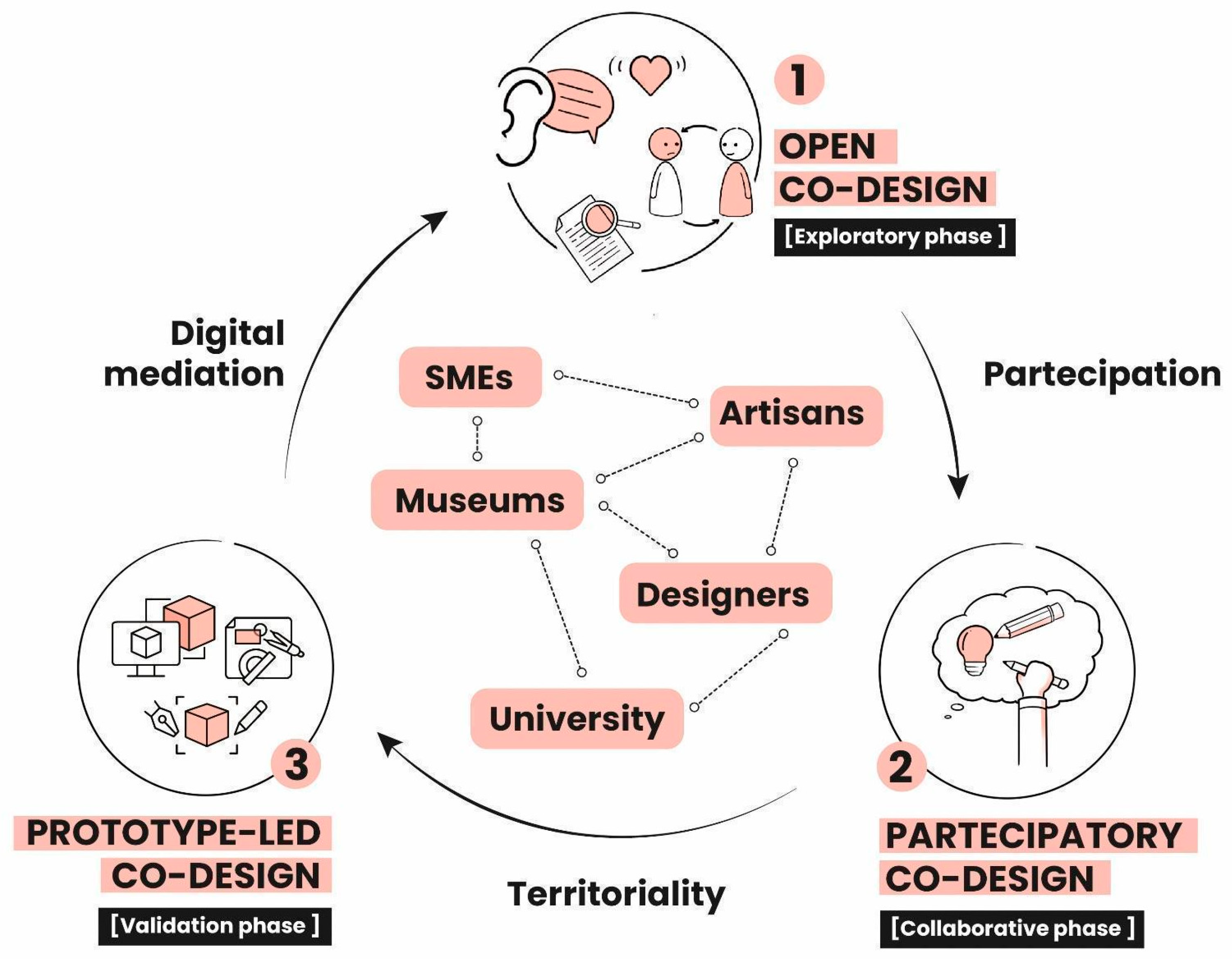
In the context of cultural heritage, this approach takes on specific value because it allows communities and operators to reinterpret their tangible and intangible heritage through new forms of production, storytelling and digital experimentation. At the same time, this reinterpretation raises critical questions regarding the balance between preservation and transformation, especially when traditional practices and materials are involved. Within the DeinSite project, this theoretical framework is structured into a three-stage iterative model, outlined as follows:
- Open Co-Design (Exploratory phase)
The initial phase is dedicated to contextual research and stakeholder involvement, using the open co-design methodology. Through mapping activities, interviews and on-site observations, local production districts, museums and cultural institutions are identified and engaged, contributing to the definition of the main topics of the project. Open co-design workshops serve to explore opportunities for innovation and build a shared cultural and conceptual foundation. In this phase, mapping acts not only as a descriptive tool, but as a critical device that shapes the direction of the design process by selecting and framing relevant actors and contexts.
- 2.
- Participatory Co-Design (Collaborative phase)
Once the thematic and territorial framework has been defined, collaborative sessions are organised to encourage co-creation between artisans and designers. This phase includes brainstorming, drawing, material exploration, and collective discussion activities, based on a participatory co-design approach. Designers and artisans work as co-authors, combining traditional techniques and contemporary design languages, fostering an inter-generational and interdisciplinary exchange of knowledge. This collaborative condition does not imply the absence of hierarchies, but rather the construction of a shared space in which different competences are progressively aligned through interaction.
- 3.
- Prototype-Led Co-Design (Validation phase)
The final phase is dedicated to experimentation and tangible validation through prototyping. Digital models and low-fidelity prototypes are collaboratively developed, which act as mediators between manual craftsmanship and digital fabrication. As highlighted by Hornecker & Buur [24] tangible artifacts operate as catalysts of dialogue and negotiation, transforming the prototype into a cultural interface in which tradition and innovation converge. In this sense, the prototype is not only a technical output, but also a relational tool that enables the translation and negotiation of different design perspectives.
The resulting model (Open–Participatory–Prototype-Led Co-Design) forms the methodological backbone of DeinSite. Its structure derives from the integration of theoretical contributions and empirical observations and is therefore intended as adaptable rather than prescriptive.
It promotes a cross-cutting dialogue between tangible and digital practices, connecting material culture, technological innovation, and territorial identity. This integration highlights the systemic nature of the approach, in which design operates as a mediator between production processes, cultural heritage and local development.
Museums and local enterprises are thus reimagined as active hubs of innovation, capable of transforming heritage spaces into living laboratories for design experimentation, where knowledge, creativity and practice coexist. This perspective aligns with recent interpretations of cultural heritage as a dynamic and generative system, rather than a static repository of artefacts.
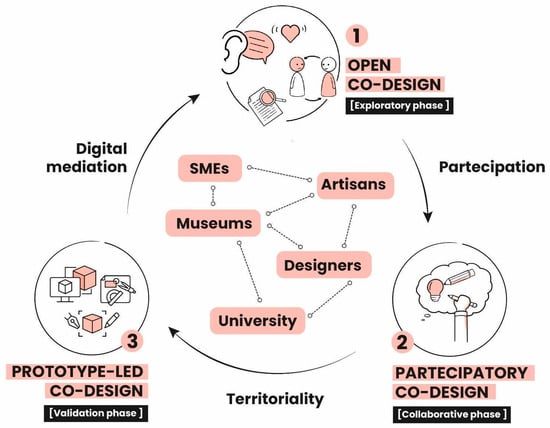
The DeinSite Co-Design Framework (Figure 2) can therefore be described as a replicable and adaptable model for heritage-based innovation in Southern Italy, structured around three guiding principles:
Figure 2.
Schematic representation of the “DeinSite Co-Design Framework” model.
- Participation: ensuring shared authorship, inclusion and intergenerational exchange;
- Territoriality: rooting innovation in local productive and cultural ecosystems;
- Digital Mediation: promoting hybrid practices between traditional craftsmanship and digital manufacturing.
These principles should be understood as guiding orientations rather than fixed criteria, allowing the framework to be applied flexibly in different contexts.
The Manus Maris workshop, described in the following sections, represents a concrete application of this model, demonstrating how co-design can act as a cultural catalyst to renew the tradition of cameos and coral through collaborative and technologically integrated practices. At the same time, it provides an opportunity to critically observe the conditions, potentials and limitations of the proposed framework in a real-world context. The overall structure of the workshop is outlined below, starting with the preparatory activities, which provided the knowledge and methodological basis for the articulation of the activities, followed by an in-depth description of the three phases identified.
3.4. Workshop Implementation
The preparatory activities focused on an in-depth analysis of the local production context, based on meetings with artisans and companies, in order to build a complex picture of the materials, traditional techniques and market dynamics related to the cameo and coral sector. At this stage, the involvement of experts in the sector was crucial, allowing for an understanding of both the technological connotations of the material and its cultural and historical tradition. At the same time, we developed the workshop’s project topic: the marine environment as a creative and productive ecosystem, a symbolic and material place from which to rethink the relationship between natural resources, material culture and innovation.
Participants have been selected to ensure a balance between different competences: young designers have been chosen based on their educational background and interest in digital fabrication, while the senior designers have been involved for use of digital manufacturing technologies applied to the jewellery sector and for their ability to use different materials and technologies in an experimental way. The selection of senior designers as project tutors has also been guided by the aim of training young designers in the use of new technologies, demonstrating sensitivity and consistency with a complex sector with historical and socio-cultural connotations such as cameo and coral jewellery.
In addition to the selection criteria adopted for young and senior designers, the involvement of the other stakeholder categories was guided by purposive criteria aimed at ensuring the representation of the main actors of the Campania cameo and coral ecosystem. SMEs were selected based on their active role within the local production district and their capacity to provide production knowledge and feasibility assessments. Artisans were involved because of their recognised expertise in traditional cameo and coral manufacturing techniques and their ability to transfer tacit knowledge embedded in local craft practices. Museums were selected according to their relevance to the preservation, interpretation and dissemination of local cultural heritage, acting as mediators between heritage conservation and contemporary innovation. University researchers participated on the basis of their expertise in design research, co-design methodologies, cultural heritage enhancement and digital fabrication, supporting methodological development and knowledge transfer. Designers were involved as innovation agents capable of translating heritage values and artisanal knowledge into contemporary design proposals. The combination of these stakeholders was intended to integrate complementary forms of knowledge and expertise, creating a collaborative environment capable of connecting heritage preservation, craft production, design innovation and research activities.
This conceptual framework led to the development of tools and methodologies to facilitate dialogue between designers and artisans during operational activities.
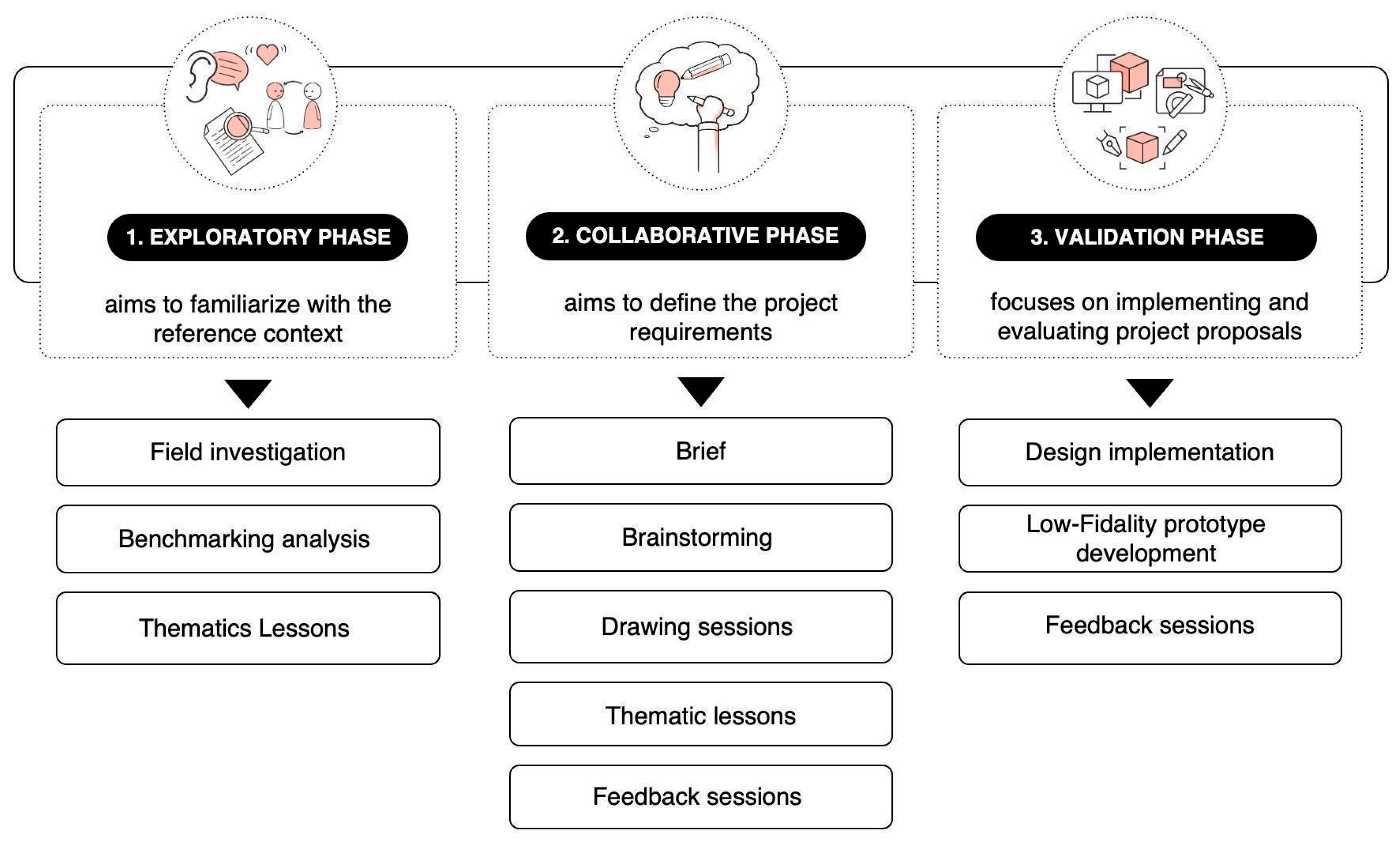
The workshop followed a model divided into three main phases: exploratory phase, collaborative phase and validation phase. The use of a cross-cutting co-design approach shaped the methodological perspective, linking the three phases and activating a series of collaborative activities aimed at stimulating discussion among participants and generating project proposals that integrated craftsmanship with the potential of digital technologies (Figure 3).
Figure 3.
Overview of the three phases of the workshop and the methodologies used.
3.4.1. Exploratory Phase
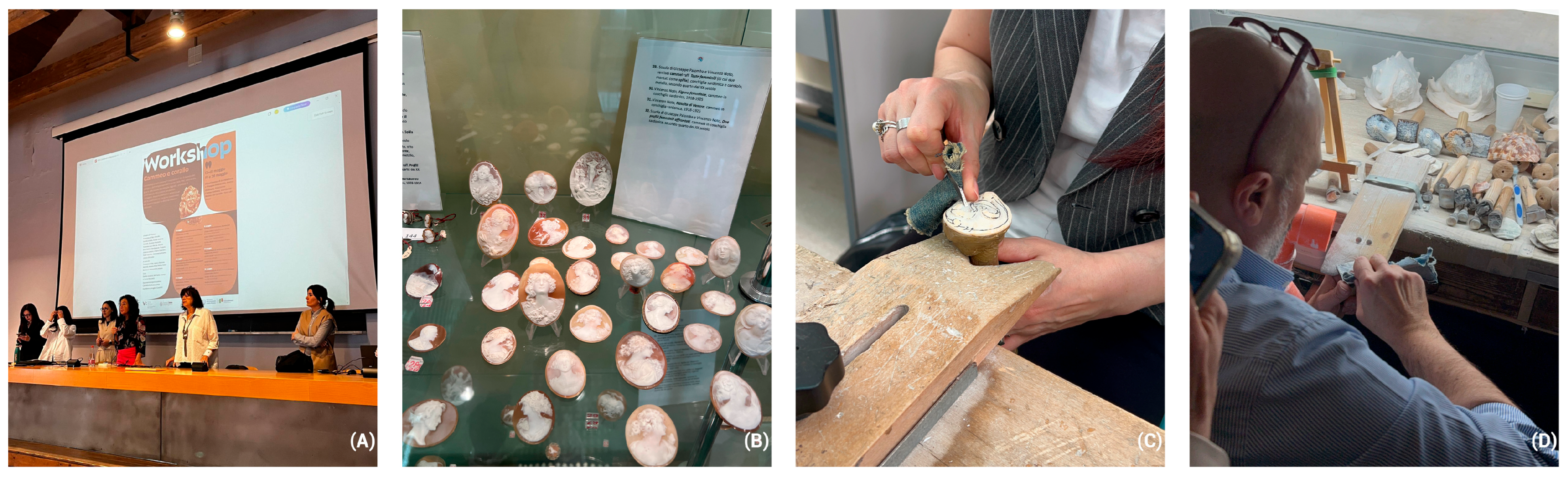
The exploratory phase (Table 1) aims to familiarise participants with the context of reference, starting with the preparatory activities of mapping and meeting with stakeholders, aimed at collecting data for a systemic overview of cameo and coral jewellery production in the Campania region. This phase is structured around thematic conferences that provide a general overview of the project and a specific in-depth analysis of the production and cultural context of the workshop, involving experts in the field. Participants systematised data on coral and cameo production through benchmarking activities, supplemented by desk research. These activities were accompanied by direct knowledge of the production context through visits to companies, supported by interviews and on-site observations, as well as visits to museums representative of the context (Figure 4).
Table 1.
Activities developed during the initial exploratory phase.
Figure 4.
Main activities carried out during phase 1 of the workshop: (A) Thematic lessons; (B) visit to the coral museum; (C) meeting with artisans; (D) visit to the company.
3.4.2. Collaborative Phase
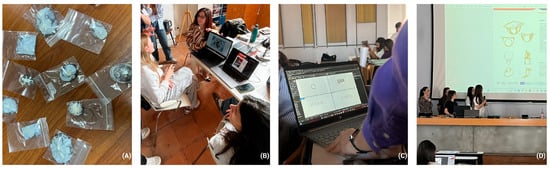
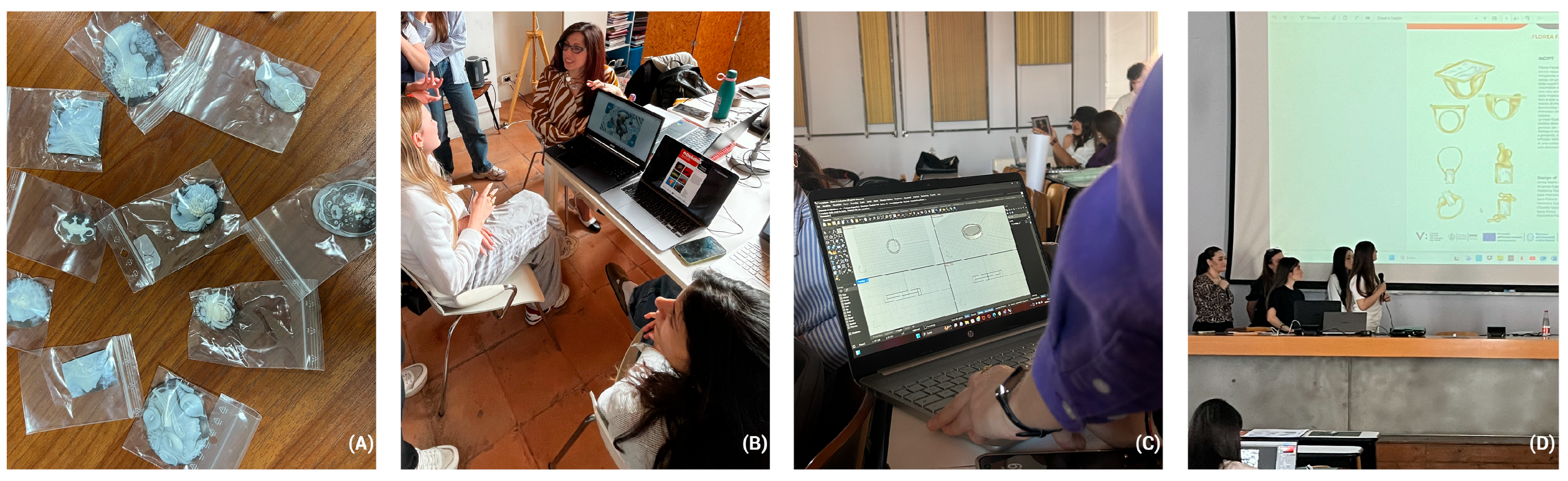
The collaborative phase (Table 2) involved the co-design process of project development, starting with the definition of the design requirements, through the launch of the brief and the provision of the semi-finished products as a design basis. The topic has been explored initially through collective brainstorming activities, identifying keywords to investigate the concept of the marine environment and reinterpret it in light of the principles of sustainability, reuse, and formal innovation. This phase is based on four main activities, carried out in parallel and integrated with each other: the concept development, through the production of mood boards and preparatory sketches, is followed by drawing sessions, which deepens the project by translating it into two-dimensional and three-dimensional drawings, investigating its typological, dimensional and material characteristics; thematic lessons, conducted by the designer, provided the necessary tools for digital modelling and 3D printing for the next prototyping phase. Each of the phases is accompanied by meetings with stakeholders, through different feedback sessions, in order to activate a network of discussion and exchange of knowledge during the intermediate stages of project development (Figure 5).
Table 2.
Activities developed during the second collaborative phase.
Figure 5.
Pictures illustrating the activities undertaken during phase 2 of the workshop: (A) Provision of semi-finished products; (B) concept development; (C) thematic lessons; (D) feedback sessions.
3.4.3. Validation Phase
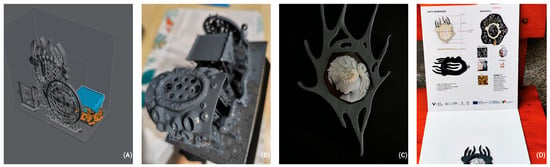
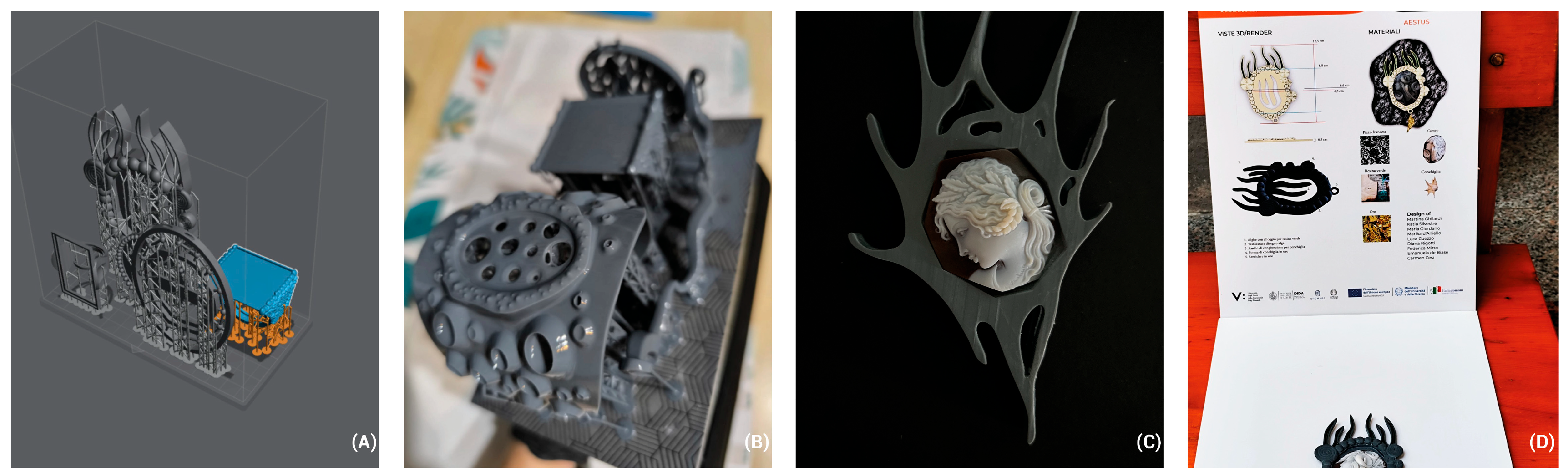
The validation phase (Table 3) aims to develop low-fidelity prototypes as a basis for implementing and evaluating participants’ design proposals. This phase is developed through design implementation workshops, translating drawings into three-dimensional models compatible with digital printing, produced using Rhinoceros software 2025. The prototyping activities involved the use of digital modelling and 3D printing tools, with the aim of exploring new morphologies and expressive languages for handcrafted jewellery, in constant dialogue with traditional processing techniques. The collaboration between designers and artisans made it possible to translate design insights into concrete prototypes, enhancing the local heritage through contemporary forms of expression and production. The prototypes were presented to the network of stakeholders in order to investigate the feasibility of the techniques and the typological, material and dimensional characteristics of the projects developed. This phase involves future implementation, with the three-dimensional printing of high-fidelity prototypes and the presentation of the final artefacts (Figure 6).
Table 3.
Activities developed during the validation phase.
Figure 6.
Prototype construction phases: (A) Software prototyping; (B) Three-dimensional printing; (C) Low-fidelity prototype; (D) Presentation in feedback sessions.
3.4.4. Integration of Co-Design Typologies in the Manus Maris Methodology
In the case of the Manus Maris workshop, this methodological structure has been translated into a dynamic operational process, which has allowed for the progressive integration of different forms of collaboration and knowledge production. The application of the framework in the Manus Maris workshop has allowed for the concrete translation of the theoretical structure of the DeinSite project into an iterative operational model, by illustrating a representative application scenario, transposed into a real-world context, to highlight the limitations and opportunities for the implementation in future configurations.
The process progressively combined different types of co-design, resulting in a hybrid methodological system:
- In the exploratory phase, Open Co-Design principles have been adopted, through the mapping of local knowledge and expertise, meetings with coral and cameo artisans, and discussions with museums and local operators, aimed at involving stakeholders and building a common cultural base. This phase aimed to build a shared language and identify the workshop’s reference topics, encouraging the sharing of values and visions among participants.
- In the laboratory phase, focused on collaboration between artisans and designers, Participatory Co-Design prevailed, facilitating the co-creation of shared ideas and concepts. Designers and artisans worked as co-authors of open creative processes. Through collective ideation, brainstorming, and concept development, participants co-designed new formal and narrative interpretations of jewellery, based on a constant dialogue between traditional craftsmanship and contemporary design languages. In this phase, the role of designers was mainly that of facilitators and creative mediators, capable of translating tacit knowledge and material practices into shared design forms.
- In the experimentation and prototyping phase, the process was based on Prototype-Led Co-Design, using physical and digital prototypes as tools for dialogue and mutual validation. The use of 3D printing and digital modelling techniques made it possible to develop hybrid artefacts, capable of acting as cultural mediators between manual tradition and technological innovation, making the dialogue between “craftsmanship” and “design thinking” visible.
- The entire process was configured within a Community-Based and System-Oriented perspective, as the workshop helped to activate lasting connections and relationships between artisans, museum institutions, universities and local business systems. This approach made it possible to position the Manus Maris experience not as an isolated event, but as a systemic device for the innovation of local artisan heritage.
- Finally, as an integral part of an applied research project, the workshop can also be interpreted as a case of Research through Co-Design, in which the collaborative process itself has become a tool for producing knowledge, both in terms of tangible results (artefacts and prototypes) and in terms of methodological advancement.
Each phase was documented and critically reflected upon, contributing to the definition of a replicable and scientifically based model for craft and cultural innovation.
The DeinSite Co-Design Framework is thus a concrete expression of the project’s methodological paradigm, capable of integrating participatory, systemic and reflective approaches in a continuous cycle of exploration, co-creation and experimentation (Table 4). In the case of the Manus Maris workshop, this approach made it possible to build a collaborative process in which dialogue between artisans, designers and institutions generated new forms of material and cultural innovation, translating the theoretical principles of the project into operational practices. This methodological articulation forms the basis for the analysis of the project and experiential results, illustrated in the following section, dedicated to the Discussion, highlighting the main Outcomes of the Workshop.
Table 4.
Types of co-design associated with the DeinSIte Co-Design Framework model.
4. Discussion
The Deinsite Co-Design Framework is constructed as a replicable methodological model, using the thematic context of the Manus Maris workshop as a landmark case of co-design approach as a generative system. Despite in the theoretical context as well in international and nation collaborative and interdisciplinary projects emerge the growing relevance of co-design as a strategic approach for bridging tradition and innovation, there is still a need to better understand how these practices can be structured into transferable models, particularly in contexts characterised by strong territorial identities such as Southern Italy. In this sense, the results of the Manus Maris workshop provide a first response to the research question concerning how a structured co-design framework can support innovation while preserving cultural and territorial identity. The findings suggest that structuring co-design into interconnected phases—exploration, collaboration and prototyping—enables the alignment of different actors and knowledge systems, allowing innovation processes to emerge without detaching them from their cultural roots.
When compared with previous studies on co-design and heritage innovation, the results of the Manus Maris workshop reveal several points of convergence. Similar to the meSch project, the results confirm the importance of museums and cultural institutions as active mediators within collaborative innovation processes rather than passive repositories of heritage. Likewise, experiences such as Werkraum Bregenzerwald and other craft–design initiatives have highlighted the value of long-term interaction between designers and artisans in fostering innovation while preserving local identity. The similarity of these results can be explained by the shared adoption of participatory approaches that facilitate knowledge exchange among heterogeneous actors and strengthen the relationship between heritage and contemporary design practices. At the same time, some significant differences emerge. Unlike many previous experiences, which are often presented as context-specific case studies or project-based initiatives, the DeinSite Co-Design Framework seeks to formalise the process into a structured and transferable methodological model. Furthermore, while projects such as Intrecci·Intertwinings primarily focus on experimentation with craft techniques and product development, Manus Maris adopts a broader systemic perspective, integrating museums, SMEs, universities and designers within a single innovation ecosystem. The explicit integration of digital prototyping tools within a three-phase co-design process also distinguishes the proposed framework from previous studies, extending the role of technology beyond production support towards cultural mediation and collaborative knowledge creation.
This proposal and the testing of the Deinsite co-design framework aim to fill this gap, presenting a set of findings that are significant not only in relation to the specific case study but which have the potential to be applied to further contexts. The model is proposed as a strategic tool for the regeneration of artisan excellence in Southern Italy, capable of combining design, innovation and local tradition. More specifically, the framework demonstrates how the integration of co-design training, craft-design networks and digital mediation tools can generate a systemic approach to innovation, in which local identity is not reduced to a constraint but becomes an active driver of the design process.
The effectiveness of this approach can be attributed to the complementary contribution of the stakeholder categories involved. SMEs, artisans, museums, universities and designers brought together different forms of production, cultural, research and design knowledge, enabling the construction of a shared innovation ecosystem grounded in local heritage.
Through the application of a participatory and cross-sectoral approach, the DeinSite Co-Design Framework can serve as a foundation for future co-design initiatives aimed at developing sustainable creative and productive ecosystems, capable of strengthening territorial identity and generating new economic and narrative opportunities for artisan districts in Southern Italy (Table 5).
Table 5.
Output of the Manus Maris workshop.
The Manus Maris workshop is not an isolated experience but configured itself as a veritable laboratory of creative contamination, in which artisan knowledge, deeply rooted in the tradition of cameos and coral, encountered the most advanced digital technologies. The initiative generated a series of jewellery concepts and prototypes that not only reinterpret historical techniques in a contemporary key, but also expand their expressive language, opening up new perspectives for dialogue between tradition and innovation.
The collections developed explored new formal configurations, drawing inspiration from the marine environment as a creative and productive ecosystem: a symbolic and material place where natural resources, material culture and new design practices intertwine. This approach allowed for experimentation with hybridisations between natural materials and digital manufacturing processes, renewing the aesthetic codes of artisan jewellery and suggesting new languages for the future of the sector.
The results show that digital prototyping tools can effectively support the transformation of handcrafted artefacts into contemporary products when they are used as mediating devices rather than substitutive technologies. In the Manus Maris workshop, digital tools did not replace manual skills, but enabled their reinterpretation, facilitating the exploration of new forms, scales and material combinations while maintaining a strong connection with traditional techniques and local identity.
The experience highlighted the potential of digital technologies not only as production tools, but also as cultural mediators capable of enhancing craftsmanship, preserving its memory and at the same time transforming it in a contemporary key. The prototypes created during the workshop therefore have a dual value: on the one hand, they are experimental design objects, and on the other, they become testimonies of an intangible heritage that is reinterpreted without being distorted.
This dual condition suggests that innovation in craft contexts does not necessarily imply a loss of authenticity but can instead emerge from a process of translation between past and present, mediated by design and technology.
The overall result demonstrated how the co-design approach can be a strategic resource for strengthening the link between artisan businesses and new generations of designers, creating not only professional networks and stimuli for innovation, but also new shared narratives capable of recounting the territories and their traditions. Through a process involving research, co-design and prototyping, participants had the opportunity to acquire practical and interpersonal skills, engaging with the real dynamics of production and initiating an intergenerational exchange that lies at the heart of knowledge transfer.
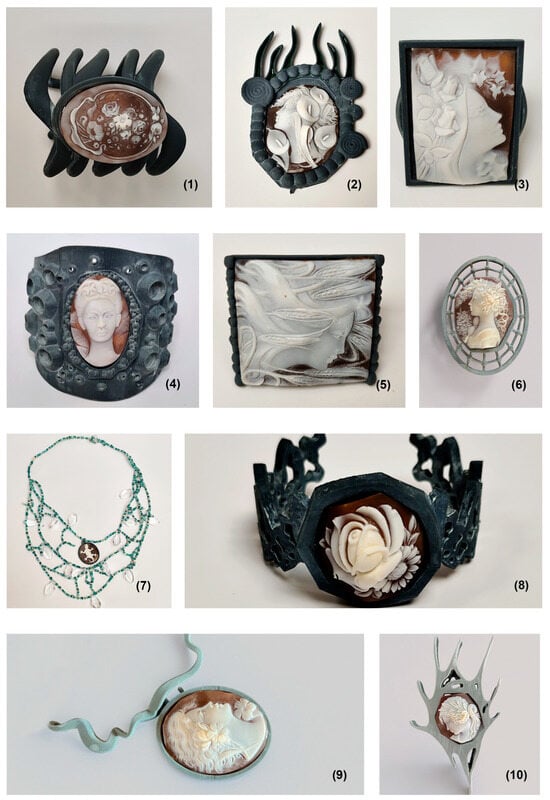
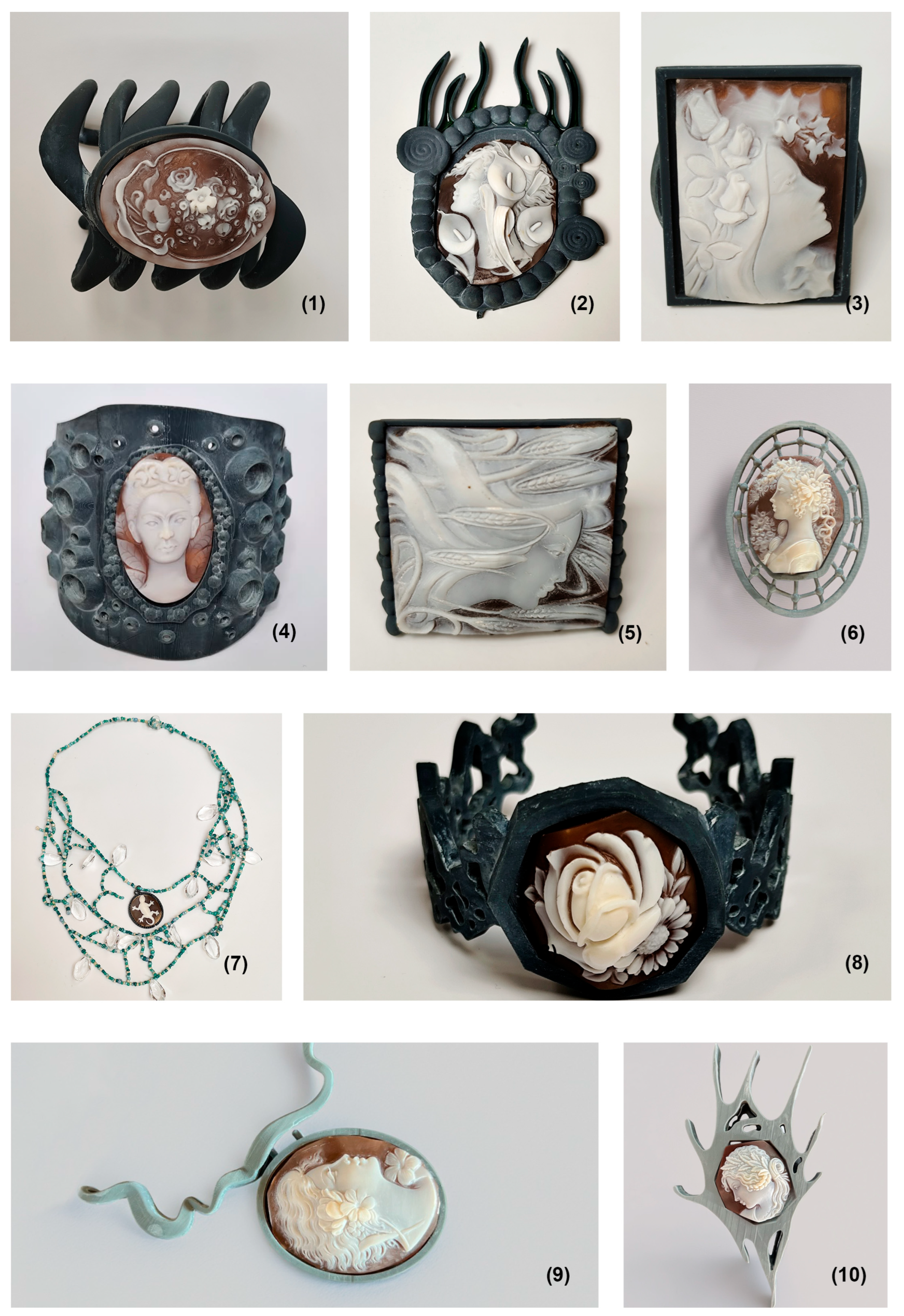
With ten jewellery prototypes, Manus Maris does not merely propose new forms and materials: it suggests a vision for the future of artisan design, where digital innovation becomes a lever for enhancing local heritage, creatively reusing resources and constructing contemporary imagery linked to the sea as a place of memory, transformation and beauty (Table 6; Figure 7).
Table 6.
Ten projects developed during the Manus Maris workshop.
Figure 7.
The 10 jewellery prototypes developed during the workshop: (1) Flucutus Altus; (2) Anemòfore; (3) Florea Facies; (4) Mariscò; (5) Saxum; (6) Thalassae; (7) Reptilia; (8) Bruma; (9) Aestus; (10) Panta Rei.
5. Conclusions
The Manus Maris workshop highlighted the value of co-design as a tool for innovating the cameo and coral sector in Campania, combining traditional knowledge and contemporary languages with a view to sustainability, identity, and innovation.
Overall, the study answers the research questions by demonstrating that a structured co-design framework can support innovation in traditional craft sectors by organising collaboration, mediating between different forms of knowledge and embedding design processes within local cultural systems, while digital prototyping tools can enable the transformation of handcrafted artefacts into contemporary products when used to extend—rather than replace—artisan practices.
The project helped to strengthen awareness of local heritage as a resource for the future, offering young designers a concrete opportunity for growth and craft businesses new prospects for development. In line with the objectives of the DeinSite project, the experience reaffirmed the role of Regional Museum Systems not only as places of conservation, but as active spaces of cultural production, capable of connecting tradition, innovation, and territories, becoming true hubs of permanent innovation.
At the same time, the workshop provided an opportunity to develop a critical reflection on the effectiveness of co-design in traditional craft contexts. While an effective approach to regenerating the local productive and cultural fabric has proven effective, several critical issues have emerged: cultural barriers and resistance to change; long lead times for innovation metabolism; and the need for corporate reorganization to integrate digital technologies in a structured manner.
These aspects highlight that the adoption of co-design and digital tools requires not only methodological frameworks, but also organisational and cultural transformations within craft enterprises and local systems.
This study also presents some limitations. The research is based on a single case study and involves a limited number of participants, which constrains the generalisability of the results. In addition, the evaluation focuses primarily on qualitative observations developed within the timeframe of the workshop, without addressing the long-term impact on production systems and market dynamics.
A further limitation concerns continuity: so that such experiences do not remain isolated cases, it will be necessary to strengthen the systematic production of results, accompanying prototypes towards real industrial application and ensuring the creation of stable networks between companies, institutions, and designers. Only in this way will it be possible to transform episodic experiments into lasting innovation practices capable of truly impacting local production districts.
Overall, Manus Maris’ results have be enhanced through dissemination actions, exhibitions, publications and internationalisation events, giving visibility to Campania’s excellence and fostering dialogue with new generations of designers and future interpreters of contemporary design. The development of a digital platform dedicated to the visualization, use, and expansion of a database of local excellence has been conceived as a connection and promotion tool. It allowed for the construction of a virtual network of relationships between businesses, institutions, designers, and local communities, as well as promoting the dissemination and valorisation of related events and activities, thus strengthening the project’s continuity and sustainability over time.
From this perspective, the integration between local co-design practices and digital infrastructures represents a key direction for future developments, enabling hybrid and scalable models of craft innovation.
The transferability of the DeinSite Co-Design Framework lies in the adaptability of its three methodological phases—Open Co-Design, Participatory Co-Design and Prototype-Led Co-Design—to different cultural heritage and creative production contexts. In university settings, the framework may support interdisciplinary design studios by combining heritage exploration, stakeholder engagement and prototype development within project-based learning activities. In museum contexts, it can be adopted as a methodology for activating collections as resources for co-creation, involving local communities, creative professionals and cultural institutions in collaborative design processes. More broadly, the framework may be adapted to other craft districts and cultural ecosystems by maintaining its methodological phases while redefining actors, heritage resources and design challenges according to local conditions.
Future research could address these limitations by applying the proposed framework in different craft sectors and geographical contexts and by integrating quantitative and longitudinal methods to assess economic, cultural and social impacts over time. Furthermore, the relationship between co-design practices and digital heritage infrastructures—particularly in relation to data-driven systems, artificial intelligence and distributed collaboration—represents a promising area for further investigation. In parallel, future developments of the project foresee the launch of new open calls aimed at expanding the network of participants and fostering new opportunities for connection and collaboration through co-design practices and workshop-based activities.
The tested methodology, based on research, co-design, and collaborative prototyping, is a model that can be replicated in other artisanal districts of Southern Italy, contributing to the construction of an ecosystem capable of integrating design, craftsmanship, and innovation. From this perspective, DeinSite confirms its mission: to promote a future in which cultural heritage becomes a lever for sustainable and identity-based development, capable of strengthening the competitiveness of territories and fueling new forms of narrative and cultural production.
Author Contributions
Conceptualization, F.T. and M.D.M.; methodology, A.B., E.I. and A.M.; data curation, E.I. and A.M.; writing—original draft preparation, E.I. and A.M.; writing—review and editing—Section 1 and Section 3.4.4, E.I.; Section 2 and Section 5, F.T. and M.D.M.; Section 3.1 and Section 3.2. A.M.; Section 3.3, A.B.; Section 3.4.1, Section 3.4.2 and Section 3.4.3. A.B. and A.M.; Section 4, A.B., E.I. and A.M.; visualization, E.I. and A.M.; supervision, F.T. and M.D.M.; project administration, F.T. and M.D.M. All authors have read and agreed to the published version of the manuscript.
Funding
This work was supported by the PRIN 2022 research project The Design System in the Southern Italy Territories: Design and Craftsmanship of Excellence for the Made in Italy Development and the Engagement of Local Knowledge (DeinSIte); PRIN: Projects of Relevant National Interest—Call 2022 (Project Number: 20229NW8M9, CUP: B53D23005720006). The project is funded by the European Union—NextGenerationEU and the Italian Ministry of University and Research (MUR) under the National Recovery and Resilience Plan (PNRR), Mission 4, Component 2, Investment 1.1. In particular, this work is based on the results achieved in Phase 3 of the DeinSIte project. Project website: https://www.deinsite.it (accessed on 14 May 2026). The content of this publication does not reflect the official opinion of the Ministry of University and Research. Responsibility for the information and views expressed in the publication lies entirely with the authors.
Data Availability Statement
Data are contained within the article.
Acknowledgments
The DeinSIte project is developed by the Research Unit of the University of Florence, coordinated by Francesca Tosi (Principal Investigator, with scientific consultancy from Claudio Gambardella), and by the Research Unit of the University of Campania “Luigi Vanvitelli”, coordinated by Maria Dolores Morelli. We thank all those who contributed to the development of the Manus Maris workshop, including the companies Oromare and Cameo Italiano in Marcianise, the Coral Museum in Torre del Greco, Danila Jacazzi, Raffaella Aversa and Laura Ricciotti, Carmela Barbato, senior designer Linda Gambero, Angela Caterini, and all the young designers who took part and engaged actively in the project.
Conflicts of Interest
The authors declare no conflict of interest.
Appendix A
Table A1.
References/sources of national and international projects.
Appendix B
Appendix B.1
Table A2.
Museums that meet the 4 selection criteria for the Campania jewellery district.
Appendix B.2
Table A3.
SMEs that meet the 4 selection criteria for the Campania jewellery district.
References
- Maye, L.; Claisse, C. Co-Design within and between Communities in Cultural Heritage: Current and Open Questions. Multimodal Technol. Interact. 2023, 7, 1. [Google Scholar] [CrossRef] [Scilit]
- Bosco, A.; Gasparotto, S.; Lengua, M. Participatory Flows: A Comparative Analysis of Co-Design Processes in the Field of Cultural Heritage. Strateg. Des. Res. J. 2023, 15, 92–106. [Google Scholar] [CrossRef] [Scilit]
- Nikolakopoulou, V.; Koutsabasis, P. The ‘making’ of participatory and co-design for digital experiences in cultural heritage: A review. CoDesign 2025, 21, 876–902. [Google Scholar] [CrossRef] [Scilit]
- Sanders, E.B.N.; Stappers, P.J. Co-creation and the new landscapes of design. Co-Des. 2008, 4, 5–18. [Google Scholar] [CrossRef] [Scilit]
- Rizzo, F. Strategie di Co-Design. Teorie, Metodi e Strumenti per Progettare Con Gli Utenti; FrancoAngeli: Milano, Italy, 2009. [Google Scholar]
- Manzini, E. Design, When Everybody Designs: An Introduction to Design for Social Innovation; MIT Press: Cambridge, MA, USA, 2015. [Google Scholar]
- Frayling, C. Research in Art and Design; Royal College of Art Research Papers; Royal College of Art (RCA): London, UK, 1994; Volume 1. [Google Scholar]
- Gaver, W. What should we expect from research through design? In Proceedings of the SIGCHI Conference on Human Factors in Computing Systems; Association for Computing Machinery (ACM): New York, NY, USA, 2012; pp. 937–946. [Google Scholar]
- Zimmerman, J.; Stolterman, E.; Forlizzi, J. An analysis and critique of Research through Design: Towards a formalization of a research approach. In Proceedings of the 8th ACM Conference on Designing Interactive Systems, Aarhus, Denmark, 16–20 August 2010; Association for Computing Machinery (ACM): New York, NY, USA, 2010; pp. 310–319. [Google Scholar]
- Sanders, E.B.N.; Stappers, P.J. Probes, toolkits and prototypes: Three approaches to making in codesigning. CoDesign 2014, 10, 5–14. [Google Scholar] [CrossRef] [Scilit]
- Petrelli, D.; Not, E.; Damala, A.; van Dijk, D.; Lechner, M. meSch–material encounters with digital cultural heritage. In Euro-Mediterranean Conference; Springer International Publishing: Cham, Switzerland, 2014; pp. 536–545. [Google Scholar]
- Risseeuw, M.; Cavada, D.; Not, E.; Zancanaro, M.; Marshall, M.; Petrelli, D.; Kubitza, T. An authoring environment for smart objects in museums: The meSch approach. In CEUR Workshop Proceedings; RWTH Aachen University: Aachen, Germany, 2016. [Google Scholar]
- Bosco, A.; Gasparotto, S.; Zannoni, M. Design processes for enhancing museums through the use of technology and the involvement of local communities. Strateg. Des. Res. J. 2019, 12, 261–275. [Google Scholar]
- Nofal, E. Participatory design workshops: Interdisciplinary encounters within a collaborative digital heritage project. Heritage 2023, 6, 2752–2766. [Google Scholar] [CrossRef] [Scilit]
- Pagán, E.; Martínez Roig, E.; Gaitán Salvatella, M.; León Muñoz, A.; Sevilla Peris, J.; Vernus, P.; Puren, M.; Rei, L.; Mladenič, D. Open Access to Data about Silk Heritage: A Case Study in Digital Information Sustainability. Sustainability 2023, 15, 14340. [Google Scholar] [CrossRef] [Scilit]
- Brovarets, T. Apocalyptic Motifs on Century-Old Ukrainian Rushnyks Through Today’s Digital Folklore Communication. Colloq. Humanist. 2022, 11, 2713. [Google Scholar] [CrossRef] [Scilit]
- UNESCO. Convention for the Safeguarding of the Intangible Cultural Heritage. 2003. Available online: https://ich.unesco.org/doc/src/15164-EN.pdf (accessed on 30 May 2025).
- Tosi, F.; Becchimanzi, C.; Pistolesi, M.; Iacono, E.; Brischetto, A. Design, Handicraft and Made in Italy for Sustainability and Innovation: The Tuscany Case Study. In For Nature/With Nature: New Sustainable Design Scenarios; Gambardella, C., Ed.; Springer Nature: Cham, Switzerland, 2024; pp. 215–226. [Google Scholar]
- Guglielmetti, I. Cultural Design: Un tentativo interdisciplinare sperimentato nel progetto Design al tombolo. Antropologia 2015, 2, 141–156. [Google Scholar]
- Gambardella, C. Handmade in Italy; Altralinea Edizioni: Firenze, Italy, 2020. [Google Scholar]
- Gambardella, C.; Siegemund, J.; Ozbil, A. Officiamuseumed. The Mediterranean Museum System of Design and Applied Arts. In Le vie dei Mercanti_ X Forum Internazionale di Studi; La Scuola di Pitagora editrice: Naples, Italy, 2012. [Google Scholar]
- Gibson, W.J.; Brown, A. Working with Qualitative Data; SAGE Publications: Thousand Oaks, CA, USA, 2009. [Google Scholar]
- Confindustria Campania. Rapporto PMI Campania; Confindustria Campania: Naples, Italy, 2023. [Google Scholar]
- Hornecker, E.; Buur, J. Getting a grip on tangible interaction: A framework on physical space and social interaction. In Proceedings of the SIGCHI Conference on Human Factors in Computing Systems, Montréal, QC, Canada, 22–27 April 2006; Association for Computing Machinery: New York, NY, USA, 2006; pp. 437–446. [Google Scholar]

Disclaimer/Publisher’s Note: The statements, opinions and data contained in all publications are solely those of the individual author(s) and contributor(s) and not of MDPI and/or the editor(s). MDPI and/or the editor(s) disclaim responsibility for any injury to people or property resulting from any ideas, methods, instructions or products referred to in the content. |
© 2026 by the authors. Licensee MDPI, Basel, Switzerland. This article is an open access article distributed under the terms and conditions of the Creative Commons Attribution (CC BY) license.