


Abstract
Contemporary art is part of societal transformations reflecting socio-economic challenges and needs within specific geographical environments. This exploratory visitor-centered assessment case study aims to investigate how the National Museum of Contemporary Art (MNAC) leverages temporary and permanent exhibitions not only as a form of artistic expression but also as a strategic tool for cultural accessibility. Interviews and field research were used to collect both visitor answers and observational data, which were further processed in the study with the help of word clouds, correlations, and statistical tests, particularly used to analyze nominal and categorical data. The main results show an important attractiveness of MNAC for educated and informed audiences, both residents and international visitors, who perceive the museum as moderately accessible, with further gaps to be addressed for people with different types of impairments. The main results of the exploratory factor analysis (EFA) (significant loads of underlying factors for internal physical and cognitive accessibility) underscore the relevance of adopting a holistic accessibility paradigm in the design and optimization of museum products.
1. Introduction
Artworks and dedicated museums are part of contemporary societies, reflecting socio-economic and political dynamics [1] and functioning as responsive, synergistic spaces within their surrounding environments, even generating, in certain cases, important restructuring and urban regeneration effects [2]. Art museum visitors gather in heterogeneous groups of cultural tourists who are attracted by a common interest in visiting art museums and galleries in search of both cultural assets and exhibitions and museum experiences [3]. Despite the fact that they display an evolving paradigm, fighting more and more against elitism and the stereotypical image of art museums exclusively connected to an educated audience [4], museums are basically places of edutainment, mainly addressing culture consumers but playing an educational function as well [4,5].
Particularly involving a themed tourist gaze and demonstrating attempts to reconstruct tourism products based on an important material legacy while coping with “unstable concepts of national heritage and national past” [6] (p. 158), the post-socialist ‘landscape swap’ [7] is clearly illustrated in large cities in Central and Eastern Europe (CEE), especially in capital cities such as Bucharest (Romania). The art production and consumption within this urbanscape [8] became part of the post-socialist evolving city’s spatial distribution [9], being similar to other urban territories worldwide.
In this context, the National Museum of Contemporary Art—MNAC Bucharest—becomes an interesting case study, as it is one of the most representative institutions in Romania that displays a combination of architectural heritage and avant-garde artistic expression while being located within the controversial megalomanic building of the Parliament Palace, defined as a representative monument of totalitarianism in Central and Eastern Europe [6].
As contemporary art is gaining significant recognition in public preferences and museum accessibility is becoming a fundamental criterion for cultural institutions, MNAC exhibitions are establishing themselves as essential tools for attracting a diverse audience through relevant themes, bold artist selection, and curatorial excellence. More than just artistic events, these exhibitions are accompanied by a series of related events (workshops, guided tours, debates, and performances) that facilitate the active involvement of visitors and allow the cultural discourse to be adapted to the varied needs of the public.
Accessibility to cultural heritage goes beyond physical access for people with disabilities and represents a holistic, comprehensive concept relevant to all visitors. It involves complex interactions between visitors and cultural sites, including cognitive and emotional dimensions [10], making accessibility a key institutional asset for visitors’ meaningful experiences. Although numerous efforts have been made to define accessibility in relation to the needs of persons with disabilities [11] and to conceptualize it as a multidisciplinary and multisequential concept [12] as well as a normative and complex objective [13], relatively few studies approach accessibility from the opposite perspective—namely, that of the context itself, which is often difficult to access, interpret, and understand due to its multifactorial nature. Accordingly, this paper embraces this original, less-studied approach, focusing on the holistic accessibility paradigm from a visitor-centered perspective, which addresses all visitors and their accessibility perception for a cultural heritage site. It adopts a case study approach and employs a mixed-methods research design to examine how contemporary art and MNAC are rendered accessible to in situ visitors. The study is exploratory in nature and is intended to be extended through subsequent stages of field research, incorporating experimental approaches and comparative perspectives. This initial stage provides a preliminary exploratory visitor-centered assessment of the attractiveness of MNAC and seeks to stimulate further research on the museum, as well as on the appeal of the immersive heritage and contemporary art exhibitions in post-communist Bucharest. Rather than offering an exhaustive analysis, the paper aims to provide insights into tourist accessibility within this increasingly popular cultural heritage segment in the Romanian capital, focusing on a representative case embodied by a dedicated art museum.
The exploratory study mainly addresses two key research questions:
- (1)
- Is MNAC—Bucharest an attractive tourist site? And for whom?
- (2)
- How do visitors perceive the accessibility of this museum within a holistic accessibility framework?
2. Literature Review and Study Background
2.1. A Contemporary Holistic Framework for Tourist Accessibility in Art Museums
The notion of tourist accessibility has generated vivid interest in the research world, and many studies have focused on this topic, but mainly address the transport and physical accessibility components [14]. With the increasing use of technology, recent studies consider not only physical barriers but also the need to enhance inclusiveness in digital accessibility [15]. Accessibility is therefore considered an essential element in the tourism industry and defines equitable and dignified usage of tourism products and services from multiple perspectives, including mobility, vision, hearing, and cognitive dimensions of access [16]. Similarly to other domains, it involves a holistic approach [17] and projects the design of multistakeholder collaborative products [18].
Increasing accessibility in tourist attraction buildings, such as museums, should be a priority in light of inclusive community development and sustainable tourism growth, considering the equitable rights of people with disabilities to access these places [19]. Accessible tourism refers more and more nowadays to holistic tourist accessibility as a recent concept, reshaping the whole tourist environment and integrating multiple elements that contribute to tourist access, understanding, and experience connected to tourist objectives and attractions [20]. Tourist places should be accessed in a comfortable manner by all people regardless of age and health condition [21] to achieve tourists’ satisfaction during their trips [22].
Leiras et al. [23] insisted on the holistic vision of accessibility and remarked on the increased attention granted by the recent scientific literature for enhancing tourism accessibility for people with disabilities (PwD) through the identification and removal of physical, social, and communication barriers [24,25], while underscoring the need to develop and analyze to a greater extent factors and models defining accessibility and competitive advantages for tourism destinations challenged to embrace business opportunities generated by growing contingents of aging tourists [26]. Museums, defined as spaces of interaction “where people can engage with history, art, and science” and which should generate accessible, inclusive, and engaging experiences for visitors [27], currently face a very difficult and complex task. Museum accessibility, in the broad sense, is not limited to physical barriers but includes components such as digital infrastructure aiming to enhance visitor experiences through innovative and inclusive products [27]; the quality and clarity of signage; informational content reflected by structured analysis and, overall, a leveraged curatorial activity in light of recent trends in tourism and hospitality [28]; modes of interaction; sensory atmosphere; and even the subjective perception of cultural comfort.
Within the contemporary societal paradigm, which underscores inclusiveness, mental health, and social well-being as foundational elements of resilience, contemporary art museums are particularly defined in terms of connectivity, interoperability, and multimodality [18], with art perceived as a cultural and social integrative element and a linking variable between people and their surrounding geographies [29].
In this sense, MNAC, as a cultural institution of national importance, must be analyzed not only in terms of the artistic value of its collections but also in terms of the extent to which it allows and facilitates a complete and accessible visitor experience. Holistic approaches to museums’ audience engagement represent a supportive element for increasing sustainability and resilience for this type of cultural institution, and they should focus on the qualitative and participative visitor experiences to become more inclusive spaces [30].
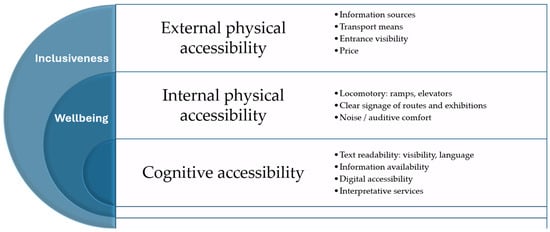
If considering the general accessibility attributes of destinations [23], adapted in this specific research for tourist objectives sites such as museums, the conceptual framework highlights a multidimensional concept for which at least physical and cognitive tourist accessibility should be assessed (Figure 1).
Figure 1.
Theoretical framework for a holistic approach to tourist museum accessibility.
2.2. Art Exhibitions as a Factor Enhancing Inclusive Tourist Access, Social Participation, and Audience Well-Being
In inclusive and democratic societies, access to culture should not remain an elitist privilege. Thus, it becomes essential for contemporary art museums to adapt their infrastructure, communication, and cultural mediation policies to respond to the diverse needs of the public—from foreign tourists to young people, people with disabilities, the elderly, or socially vulnerable groups—and provide barrier-free environments that encourage equitable, wider access to culture [31].
Nowadays, museums attempt to detach themselves from elitism [4] and aim to attract and gradually engage broader audiences. For contemporary art exhibitions, this growing preference for inclusive types of visual expression is cultivated by the international trend of technology—empowered immersive exhibitions, supported by major cultural institutions and curatorial networks.
Studies showed that museums and art galleries as cultural attractions within tourism destinations are preferred by tourists displaying high levels of education and income [32]. Contemporary art, by its conceptual and experimental nature, attracts a niche target audience, made up of educated people who are open to new means of expression and visual meanings. Tourist encounters with art exhibitions, such as painting landscapes, and visitors’ perceptions and cognitive responses to different forms of paintings displayed by most contemporary art galleries and museums, such as in the case of MNAC Bucharest, remain less explored by the scientific literature [33]. Besides generating affective-cognitive responses, art creates connections for visitors between landscape cognition on the one hand and both sense-making and involvement on the other [34].
For contemporary art museums, which in many cases display original perspectives and appeal to technology-driven effects in an attempt to achieve inclusive, interactive, sensory experiences, mental cognitive accessibility and emotional reactions play an essential role, offering unique engagement opportunities [35]. Moreover, audience experience is a key element in shaping and further informally promoting and delivering the message of an exhibition and artworks [36]. Museums are considered by scientific studies to be remarkable educational sites, with learning treated rather as an active process [37,38].
Therefore, inclusive accessibility for various types of visitors is one of the main basic conditions allowing for the learning and interpreting processes to take place. In the case of contemporary art, inclusive museums and holistic accessibility refer not only to the inclusion of museum visitors with disabilities but also to different segments of the general public belonging to various age groups, educational backgrounds, or environments, and those who are more or less trained and experienced in consuming different multisensory perspectives envisaged within the contemporary art participatory painting landscapes. Besides their educational function, art exhibitions and dedicated museums have also been linked in recent studies to improvements in mental well-being and to health promotion within the complex and expansive concept of creative health [39], as well as to the idea of therapeutic escape or therapeutic creativity, which have emerged mainly in the post-pandemic period [40].
Museums, in general, are perceived as catalysts of social inclusion and facilitators of social participation [41], both reflecting and fostering synergies with their surrounding geographical environments.
Art exhibitions represent “social nodes” that enable communication and the sharing of emotions and experiences [29], while also connecting people, strengthening communities, and facilitating social and cultural integration.
New spatial pattern restructuring in favor of contemporary art production and consumption is particularly emphasized for post-socialist urban landscapes, such as the one at Bucharest, which displays an asynchronous integration into the capitalist art markets and postmodern discourses and consumption [9]. The delayed CEE initiatives for contemporary art institutions development were determined by profound societal and economic transformations and were often part of creativity-driven urban regeneration processes initiated after 1989 in post-communist societies [42].
3. Data and Methods
3.1. Data Collection
In this context, this exploratory case study research attempts to define the main elements of the cultural heritage-scape and tourists’ perceived accessibility at MNAC Bucharest at a specific moment, possibly in connection with other variables and concepts (e.g., psychological well-being), within a mixed-method study. The study approaches a holistic accessibility paradigm (Figure 1) for the national contemporary art museum in Bucharest, considering consumers’ needs and opinions in relation to MNAC. The study employed a visitor survey conceived as a structured interview, which limited biased answers and errors while facilitating the comparison of responses, as well as empirical quantitative statistics and tests and qualitative analyses of the final sample obtained. The interview form comprised two parts and included various types of questions as part of the mixed method strategy of results analysis. Its first part aimed to collect socio-demographic data (e.g., age, gender, education level, occupation, residence place, and visitor type (domestic/international), while the second, comprising a total of 19 questions, referred exclusively to holistic accessibility elements, trying to evaluate visitors’ perceptions of accessibility while visiting museum exhibitions curated during the analyzed period.
Within this second part of the interview form, several types of questions were used as follows:
- –
- Closed questions, including:
- ○
- Dichotomous questions (e.g., if this was the first visit to MNAC, if visitors have ever previously visited other contemporary art exhibitions, the ease of accessing the museum website, the ease of finding the museum’s entrance, and the need for a museum guide);
- ○
- Likert scale questions were mainly one-item questions connected with main accessibility factors (e.g., the perception of the entrance fee, the quality of wayfinding inside the museum, the existence of ramps and facilities for persons with locomotory disabilities, accessibility of information, availability of foreign-language information, noise level within the museum, appreciation of the exhibition content, and the cognitive accessibility of the museum content/exhibitions);
- ○
- Rank order questions (e.g., asking visitors to mention how often they visit museums in general, to name their sources of information before the MNAC visit, the first three most important aspects of museum accessibility, and the most attractive museum spaces within the building).
- –
- Open-ended questions demanded free answers about the reason for visiting the museum and the exhibition found most interesting.
Both the number and type of questions were chosen to keep survey completion short, ensuring a high level of engagement and efficacy typical for in situ research [43] while managing to capture opinions on the complex concept of visitor accessibility as connected with the studied theoretical frame (Figure 1). Limiting the number of questions and answer duration was essential, as interviews were completed through face-to-face survey encounters performed by the second author of this paper between February and April 2025 as part of the fieldwork dedicated to their dissertation thesis. Fieldwork was therefore a resource-intensive activity that had to be performed in a limited time duration. Recruitment was performed through random sampling at the museum exit. For representativeness, both weekend and weekday periods were covered. In the end, a satisfactory research sample was obtained in a relatively short time while disposing of limited operational human resources for field research. Review studies on museum digital content and visitor perceptions about immersive experiences [44] indicate substantial variability in sample sizes across empirical studies. For this research, a total of 84 answers were obtained, which were further analyzed to reveal key aspects of perceived accessibility within the holistic accessibility framework. Several factors support the acceptability of the sample size in this study. These include its exploratory nature, centered on two broad research questions; the adoption of a mixed-methods approach; and the limited accessibility of the target population, which was recruited through both random and voluntary participation within a constrained timeframe. Taken together, these conditions justify the use of the sample for subsequent analysis and the application of appropriate statistical techniques, while acknowledging its limitations and pointing toward the need for more narrowly defined and extensive future research.
In situ observation of the main curatorial events in the museum and main public facilities of the building: ramps, the main entrance, doors, corridors and interior pathways, stairways, elevators, the accessible cafeteria, and information about main exhibitions and the displayed artworks completed the survey information with objective elements observed by the researchers.
3.2. Data Processing
Once the data were collected, cleaning and coding procedures were carried out to enable subsequent analysis using various software tools. The difficulties imposed by nominal data and categories were mitigated by the transformation of nominal—string into ordinal—categorical ranking variables, which allowed data processing through descriptive quantitative statistics and adapted tests for multi-item analysis. Therefore, empirical quantitative statistics were performed using SPSS v.30 software.
According to the type of obtained data, more complex descriptive statistics (crosstab and Fisher’s Exact Tests or Fisher-Freeman-Halton Exact Test for larger tables) are particularly useful for small sample sizes. Among non-parametric statistics, correlations suited for ordinal data and ranks were also performed, providing a more robust analysis for more limited datasets, and were found useful, similar to other tourism studies analyzing observational or perceptual data [45,46]. These were used to generate summary results in the form of a table from data that intersect. Both two-way and multiway tables generating panels of associated statistics were created. Data that were crossed were mostly the accessibility and perception variables (ordinal variables—Likert scale) with independent (predictor) variables (also ordinal or categorical variables) (e.g., age, gender, education, occupation, and residence).
Crosstabs, underscoring differences across various socio-demographic categories as associated with perception variables upon museum accessibility, represented a largely used method in order to fulfill specific objectives in the study. Crosstabs and correlations revealed the manner in which independent variables, such as age, education level, origin, or prior visitation experience, and dependent variables connected to various items within the holistic accessibility paradigm were influenced by individual perception.
For qualitative variables and nominal data, Voyant tools version 2.2 for visualization of word clouds, their links, and associated statistics connected to their frequency and connectivity were also used [47].
Considering the exploratory nature of this visitor-centered perception study, which investigates holistic accessibility in a cultural heritage context, in this case for a contemporary art museum, exploratory factor analysis (EFA) proved to be a particularly suitable and effective method. Widely used in the analysis of multi-item questionnaire data, especially in medical and social sciences [48], EFA enables the identification of underlying relationships among multiple variables.
In this study, converging structures of interrelated factors influencing the analyzed main components were examined using Principal Component Analysis (PCA). This technique focuses on shared variance among variables—here, the elements representing different dimensions of the holistic accessibility paradigm.
Due to constraints in time and human resources, as well as the requirements of real-time, in situ interview methods [43], the analysis relied on single-item variables (each corresponding to one survey question). While this approach limits depth, it facilitated data processing and enabled the identification of key components through data reduction and the grouping of correlated variables.
To complement PCA, parallel analysis (Monte Carlo simulation) was conducted to determine the appropriate number of factors to retain, based on eigenvalues exceeding the 95th percentile of randomly generated data. This procedure was implemented in IBM SPSS Statistics using an adapted version of the rawpar.sps script [49]. For further interpretations, both oblique (direct oblimin) and orthogonal (varimax) rotations were applied. Despite the relatively small dataset, both methods produced consistent results, with high factor loadings and significant correlations observed for the same components complementing each other and finally validating results. To enhance interpretability, coefficients below 0.30 were suppressed from the output matrices. To evaluate the internal consistency of the newly formed subscales, a reliability analysis was also conducted using Cronbach’s Alpha statistical indicator.
4. Results
4.1. Main Socio-Demographic Characteristics of the Study Sample
The total of 84 respondents in our study sample represented a rather homogenous group, consisting of youth and adult visitors, mainly aged between 31 and 65 years (three-quarters of the interviewees), with 25% aged between 18 and 30 (Table 1). Female respondents predominated, accounting for 65% of the total, while 86% were urban residents. Most respondents are employed and hold university or postgraduate degrees (a significant proportion of 85%). Although the sample is dominated by Romanian residents, it is important to notice the considerable share of international visitors (approximately 30% of the total). Most respondents (approximately two-thirds) are occasional visitors to art museums and have previously attended other contemporary art exhibitions (over 75% of interviewees), indicating that this type of museum is frequented by an informed public with a certain level of education, accustomed to engaging with modern art.
Table 1.
Socio-demographic variables of MNAC visitors in the study sample.
4.2. MNAC Contemporary Art Exhibitions in the Bucharest City Center Urbanscape
Considered relatively new in the urbanscape of the Bucharest city center and located in a new glass wing of one of the largest administrative buildings in the world, the National Museum of Contemporary Art—MNAC –stands out due to its controversial location within the very large edifice of the Palace of Parliament, formerly the communist megalomanic building called Casa Poporului (The House of People/the Republic) [50,51]. A concluding result in terms of physical accessibility shows that half of the international respondents and one out of five respondents living in Bucharest struggled to find the museum entrance. Less known and visible, the museum is mainly informally promoted, with friends and work colleagues being the main sources of information for our sample respondents. In fact, almost 75% of respondents were on a first visit to MNAC, and one of the main reasons for visiting the museum was to discover this lesser-known tourist attraction and its content (over 40% of respondents).
During the field research, a series of permanent and temporary exhibitions aiming to attract both specialized and broad public visitors were hosted by MNAC Bucharest (Table 2).
Table 2.
Exhibitions on view during the field documentation period at MNAC Bucharest.
The exhibitions on view at MNAC Bucharest during the field documentation phase, therefore, define a momentous visual landscape presented by a national reference museum institution within the center of the capital city of Romania. The themes approached by the exhibitions in February to April 2025 focused on art techniques (e.g., Urban Steps Powered by Molotov Romania—a pioneering street art and graffiti exhibition; Leviathan—offering direct access to main storage racks of the museum’s collection, displaying for the visitor thousands of stored artworks usually reserved only for specialists and curatorial staff) as well as history, as related to Eastern European geographies and the post-socialist controversial and challenging period (e.g., The Twist—focusing on the historical background from a contemporary geopolitical and power dynamics perspective (The TWIST); the evolution of Croatian visual art in Yugoslavia, representing a break from Soviet socialist realism and an expression of the experimental art boom in 1960).
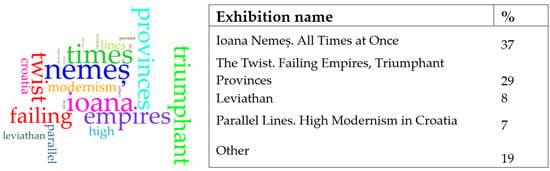
Mirroring the factual objective data, the answers offered by the respondents when asked which exhibition sparked their interest most in the museum mostly underscored the exhibition of Ioana Nemeș entitled All Times at Once (37% of answers) (Figure 2), followed by The Twist, Falling Empires, Triumphant Provinces (29% of respondents) (Figure 2). Other exhibitions that particularly caught the interest of respondents were Leviathan—In the Guts of the Collection, which presented a unique, labyrinthic perspective on the museum’s not exhibited but creatively exposed artifacts and collections, and Parallel Lines: High Modernism in Croatia, a unique international collection reflecting a part of recent history in Eastern Europe marked by profound social transformations and ideological conflicts.
Figure 2.
A word cloud summary of responses to the question about the most interesting exhibition visited at MNAC Bucharest.
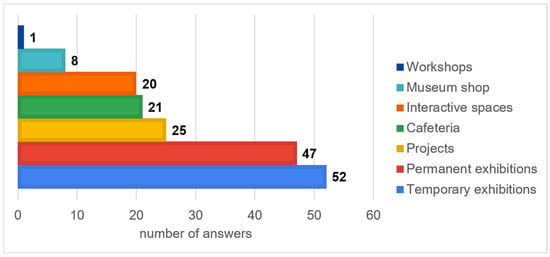
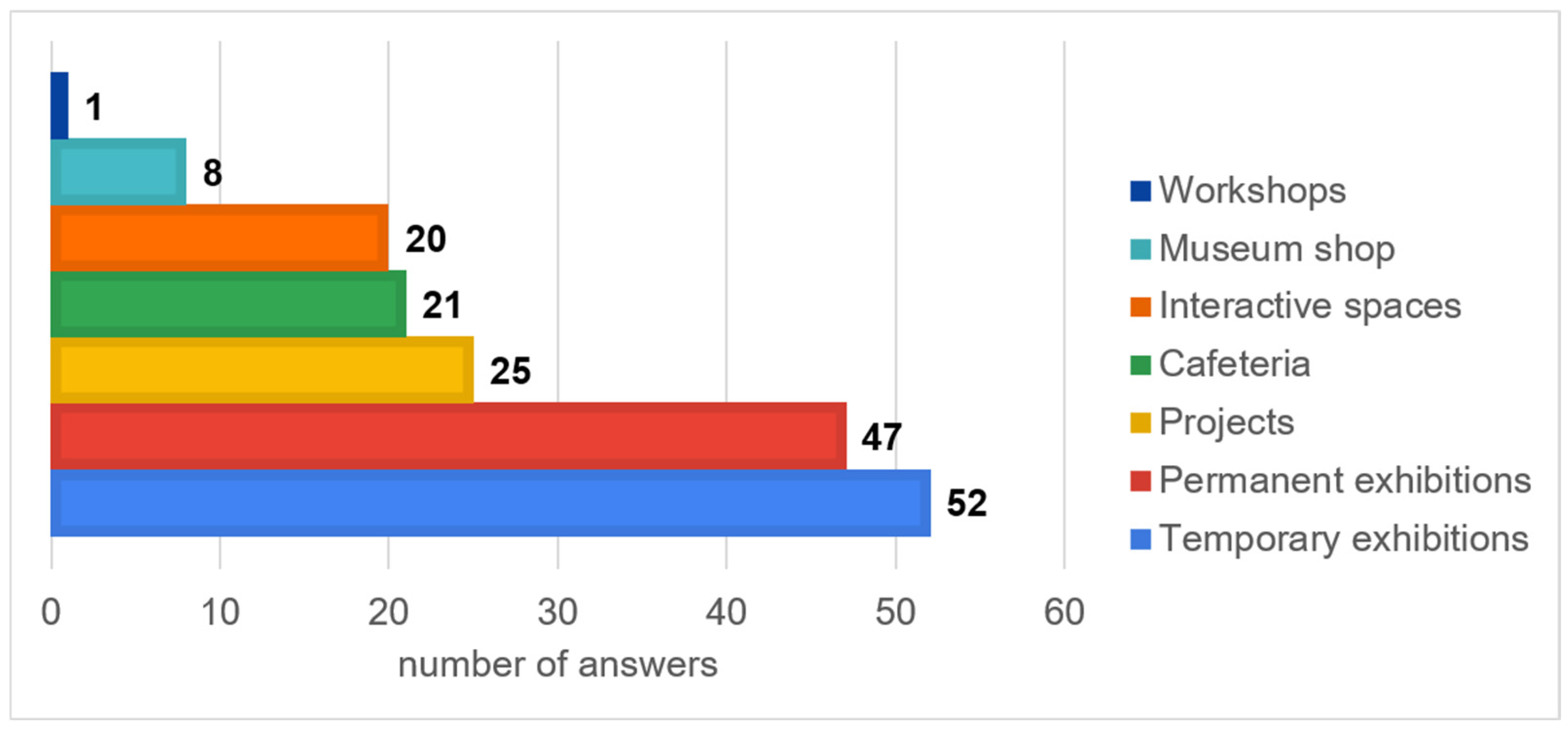
Besides the temporary and permanent exhibitions, two main reasons for visiting MNAC, according to respondents, were the museum’s projects, as well as the socialization and leisure spaces, such as the interactive spaces and the roof cafeteria, which is an attraction in itself (Figure 3).
Figure 3.
The answers to the question, “What were the points of interest for you at MNAC?”.
4.3. Elements of Holistic Accessibility Related to MNAC—Bucharest
External physical accessibility, analyzed through the information sources consulted by visitors prior to their visit to the National Museum of Contemporary Art Bucharest, highlights the predominance of informal promotional channels. Nearly half of the respondents reported learning about the museum through friends or colleagues. The remaining visitors cited a variety of sources, with television, the internet, and outdoor advertising among the most frequently mentioned, collectively accounting for more than a quarter of responses.
In terms of economic accessibility, most respondents consider the entrance fee to MNAC acceptable, with a significant proportion of younger respondents perceiving it as acceptable (over half of youth and over three-quarters of adult respondents), but also as low or very low. These responses correspond to the general admission and reduced ticket prices of approximately €7 and €1.5 per person, respectively.
The Fisher’s Exact Test result for the association between age and the perception of price shows a significant correlation between the two variables within the sample analyzed (Table 3) with a value of p < 0.05, which rejects the null hypothesis. The effect size for this relation is a moderate one with values of 0.419 for Phi and Cramer’s V symmetric measures and an exact significance of 0.005.
Table 3.
Fisher’s Exact Test result for the crosstabulation between age and perception of entrance fee at MNAC.
An important element of external physical accessibility within the studied context was the ease of finding the museum entrance, which displayed significant associations with the independent variables of gender, the type of tourists, and occupation. In the case of gender, women found the entrance in a higher proportion (85%) than men (60% within gender); in terms of tourist provenance only half of international tourists, compared with 80% of domestic visitors, found it. Both associations showed moderate or small-to-moderate effect sizes and therefore not very strong association between the analyzed variables (with values of 0.283 and 0.251 for Cramer’s V variable, respectively). Another statistically significant association was found between finding the entrance and occupation variables (p = 0.002), with a stronger relationship, as indicated by a Cramer’s V of 0.417, p = 0.006, and a crosstab displaying students in a high proportion (53.3%) not able to find the museum’s entrance. The result shows the difficulty of those not familiar with Bucharest’s urbanscape (e.g., international tourists or students residing for a short time in Bucharest) to cope with the excessive dimensions and urban accessibility of this particular museum.
The internal physical accessibility displayed a significant association between the quality of wayfinding inside the museum (an item mirroring the clear signage of museum routes and exhibitions) and gender and occupation as independent variables (p = 0.048 and p = 0.037, respectively, for the Fisher-Freeman-Halton Exact Test) with a rather strong relationship underscored by a Cramer’s V of 0.325, p = 0.048 and 0.349, p = 0.036, respectively. Similar to external physical accessibility, women respondents found their way more easily and very easily in a higher proportion than men (40% compared to 30% and 39% compared to 27%, respectively, within gender), while employed respondents and adults found their way easily in a higher proportion than students. An interesting result was the relationship between the quality of wayfinding inside the museum and visitors who were not on their first visit to the museum, which was both significant (p = 0.048) and strong (Cramer’s V of 0.334, p = 0.042). The corresponding crosstab showed that almost 20% of respondents who were not there for their first visit found the quality of wayfinding inside the museum unsatisfactory.
In terms of perception of the physical accessibility for people with reduced mobility, employed respondents considered it acceptable in a higher proportion and unsatisfactory in an obviously lower proportion than students, who proved to be more critical of museum infrastructure in terms of internal mobility (e.g., ramps, elevators). Visitors who were not on their first visit also proved to be more critical, considering this type of infrastructure to be unsatisfactory (27%) and acceptable rather than good in a higher proportion than tourists visiting the museum for the first time. Both associations (between the physical accessibility for people with reduced mobility as a dependent variable and occupation or first visit as independent variables) proved to be statistically significant (p = 0.038 and p = 0.012, respectively, for the Fisher-Freeman-Halton Exact Test) with a strong relationship, as indicated by a Cramer’s V of 0.347, p = 0.036 and of 0.386, p = 0.010, respectively.
The noise level was generally evaluated as very satisfactory, with a higher-than-expected proportion of positive responses, particularly among visitors from rural environments. Notably, no respondents described the museum as very noisy. This perception can be attributed to the building’s solid structure and massive construction, which provide effective sound insulation, despite its location within a densely populated urban area characterized by significant traffic congestion. The relation between the perceived noise level and residential environment was found to be significant p = 0.009, underscoring a strong connection for a Cramer’s V of 0.420, p = 0.006.
In terms of cognitive accessibility, the accessibility of information and the readability of texts accompanying exhibited objects are considered accessible or very accessible by over two-thirds of respondents in both age groups. In terms of education, both university graduates and students and young respondents with only a high school diploma report, to a greater extent, that information about exhibitions at MNAC is only partially accessible, confirming the more exigent evaluation of youth in terms of cognitive accessibility and/or possibly a less trained public in dealing with contemporary art exhibitions and their content, manner of exposure, etc.
Regarding the availability of information in foreign languages, over three-quarters of respondents consider it to be good or acceptable. A more demanding segment of the public for this criterion—particularly university graduates and international tourists—tends, to a greater extent, to rate this type of information as only slightly satisfactory.
Regarding the accessibility of exhibition content, a notable proportion of respondents—28.6% of younger participants and 23.5% of those with a university education—consider it difficult to understand, highlighting once again the need for a highly educated and culturally informed audience to engage with such art collections and exhibitions.
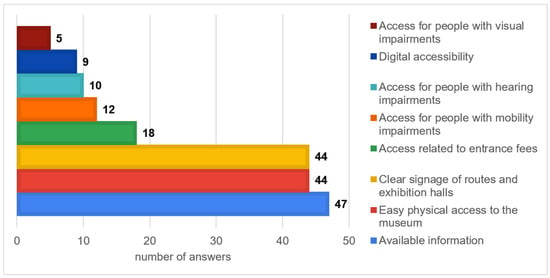
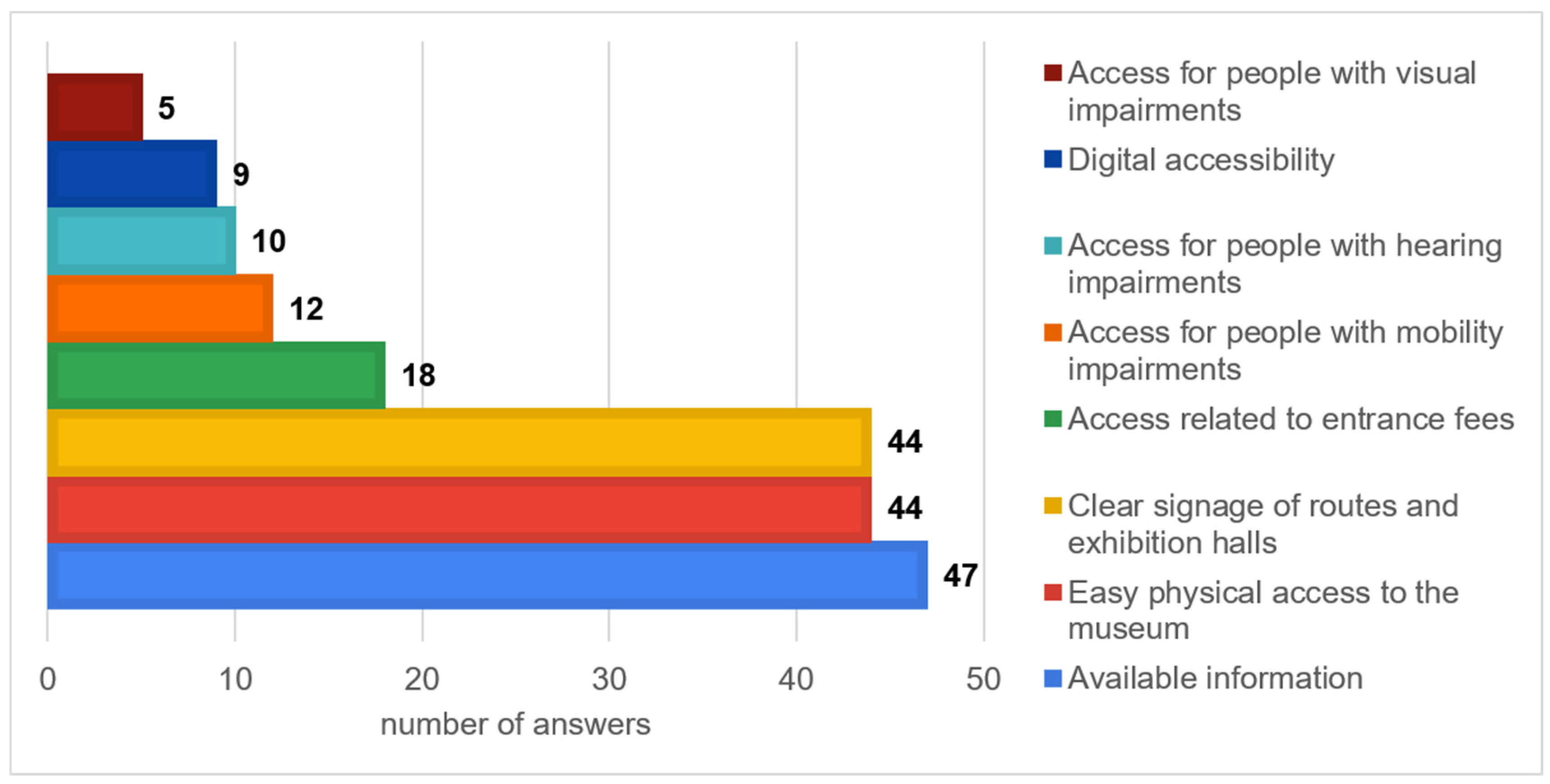
When asked which elements they consider most important as current contribution for museum’s holistic accessibility, most respondents identified information about exhibitions, ease of physical access and of wayfinding within the museum, and, to a lesser extent, price accessibility. Accessibility for people with different types of impairments (locomotor, auditory, and visual), as well as digital accessibility, was selected by relatively few respondents, highlighting clear gaps that need to be addressed to improve these aspects by museum management in the future (Figure 4).
Figure 4.
The answers to the question, “Which of the following aspects do you consider most important for MNAC accessibility?”.
In terms of cognitive access to the museum’s exhibition content, all respondents considered it accessible to a greater or lesser extent, with younger respondents and high school graduates more frequently than adults and university graduates rating MNAC as only moderately accessible.
In terms of cognitive accessibility, the association between the general accessibility of museum content as a dependent variable and gender as an independent variable proved to be significant, with a p = 0.041 for the Fisher-Freeman-Halton Exact Test, with a relationship that is rather moderate as indicated by a Cramer’s V of 0.278, p = 0.039. Women declared the content of MNAC accessible and very accessible in a higher proportion than men, who considered it moderately accessible, emphasizing a more critical attitude and observed deficiencies during their experience.
The Spearman correlation coefficient showed for this variable a positive statistical relationship between the accessibility of content in the museum and the frequency of museum visits in general. The most frequent museum visitors, or those familiar with museum visits in general, were the ones able to understand the content of exhibitions and displayed objects to a larger extent (Table 4). This result reiterates the importance of repeated visits and revisit rates as elements that enhance accessibility and, therefore, are key factors contributing to successful visits and tourist satisfaction.
Table 4.
Spearman correlation coefficient between the frequency of museum visits and the accessibility of museum content.
4.4. Results of Exploratory Factor Analysis for MNAC’s Perceived Accessibility Paradigm
By applying Principal Component Analysis (PCA) as a practical implementation of exploratory factor analysis (EFA), incorporating linear dimensionality reduction, a correlation matrix was generated. This matrix revealed statistically significant relationships among variables, with correlation coefficients predominantly ranging from moderate to strong, while remaining within acceptable limits that avoid multicollinearity. A close analysis of the questionnaire content, along with assumptions about underlying correlations between factors as well as the application of anti-image during the early analysis and pre-testing phases, led to the exclusion of certain variables from the final factor analysis (FA). Specifically, variables related to perceptions of entrance fees and physical barriers for people with locomotor disabilities were removed. In the end, PCA was applied to a final dataset comprising six variables with their categorical encoding (10.B—quality of wayfinding in the museum; 11.B—accessibility of information; 12.B—availability of information in foreign languages; 14.B—perceived noise level; 18.B—accessibility of exhibition content; 19.B—general accessibility of the museum), generating the correlation matrix below (Table 5).
Table 5.
Correlation matrix obtained by PCA in SPSS.
The Kaiser–Meyer–Olkin Measure of Sample Adequacy obtained a value of 0.793, confirming the data had sufficient shared variance and the sample was adequate for FA. The Bartlett’s Test of Sphericity value of p < 0.001 confirmed statistically significant, powerful correlations among sample variables to support the factor model. The table of communalities (Table 6) shows that all variables are well-represented in the factor solution, each variable sharing adequate variance with the factor structure.
Table 6.
Communalities of the variable data included in the FA.
Based on Kaiser’s criterion (eigenvalues > 1.0), the analysis successfully extracted two distinct factors, which combined to explain 67.53% of the total variance:
- −
- Factor/Component 1 (Eigenvalue = 3.04) explained the majority of the variance at 50.71%.
- −
- Factor/Component 2 (Eigenvalue = 1.01) accounted for an additional 16.81% of the variance.
Exceeding the standard 60% threshold, the cumulative value explained by the model factors makes it a strong and robust solution, also acceptable for an exploratory data analysis in social or human sciences [52].
The pattern matrix and structure matrix were evaluated simultaneously to determine the item compositions of the two components. Considering their highest primary loading in the Pattern Matrix, Component 1 is defined by five items: 19.B (loading = 0.788), 10.B (loading = 0.783), 18.B (loading = 0.769), 11.B (loading = 0.678), and 12.B (loading = 0.675) and represents Accessibility. Component 2 is strongly and uniquely defined by a single item: 14.B (loading = 0.950) and could represent the comfort during the visit and, therefore, the Well-being variable.
While items 10.B and 12.B displayed shared variance across both dimensions in the Structure Matrix due to the underlying relationship between the components, their primary weights in the Pattern Matrix justify their retention under the Accessibility dimension. This mathematical split is further supported by the initial Correlation Matrix, which reveals that item 14.B (noise level) behaves distinctly, showing very weak and non-significant correlations with Accessibility items like 11.B (r = 0.086, p = 0.220) and 18.B (r = 0.103, p = 0.175), while the remaining five items maintain moderate-to-strong internal correlations ranging up to (r = 0.662).
Finally, the Component Correlation Matrix revealed a positive correlation of 0.230 between Accessibility and Well-being. This statistically justifies the application of an oblique (Oblimin) rotation, confirming that while the two dimensions represent distinct conceptual constructs, they remain positively interrelated for cultural heritage contexts such as art museums and exhibitions.
The Accessibility subscale, consisting of five items (10.B, 11.B, 12.B, 18.B, and 19.B), also demonstrated excellent internal consistency, with an overall Cronbach’s alpha coefficient of 0.817, safely exceeding the conventional social sciences threshold of 0.70. An inspection of the Item-Total Statistics table confirmed that all items contributed positively to the scale’s reliability. The corrected item-total correlations were strong, ranging from 0.555 to 0.698. Furthermore, the Cronbach’s Alpha if Item Deleted column indicated that removing any individual item would fail to improve the overall reliability of the scale, as all potential deleted alpha values remained below the current value of 0.817. Consequently, all five items were retained to compute the composite score for the Accessibility dimension.
To determine the optimal number of components to retain, Kaiser’s criterion (eigenvalues > 1.0) was evaluated alongside Horn’s Parallel Analysis, utilizing a Monte Carlo permutation approach (based on 3000 resampled datasets, evaluated at the 95th percentile criterion). The empirical eigenvalue for the first component (3.043) comfortably exceeded the 95th percentile random data threshold (1.535), confirming its statistical robustness. For the second component, the empirical eigenvalue (1.009) satisfied Kaiser’s criterion by remaining above 1.0, though it fell below the conservative parallel analysis threshold (1.291).
Despite the parallel analysis suggestion to collapse the items into a single dimension, a two-component solution was conceptually and structurally retained for the final model for the following reasons:
- −
- Clear theoretical frameworks that operationally separate and distinctively define the concepts of Accessibility and Well-being.
- −
- The exceptionally clean and distinct loading structure obtained in the Pattern Matrix, where item 14.B uniquely and robustly defined the second component (0.950).
- −
- The practical requirement to explain a comprehensive proportion of data variance, as retaining the second component increases the cumulative explained variance from 50.71% to a highly acceptable 67.53%.
- −
- Although not directly relevant to accessibility, factor 14.B suggests the emergence of a related concept—well-being—which appears to be interconnected with accessibility in shaping visitors’ experiences within cultural heritage contexts. This relationship may be particularly significant for immersive cultural experiences, such as those found in contemporary art, and could warrant consideration as a distinct criterion in future analyses of accessibility-related variables.
5. Discussion and Conclusions
Art exhibitions may be perceived as vital platforms for cultural and educational exchange [35], and museums should integrate design aspects and principles to enhance learning and understanding [53] for various groups of visitors and an increasingly heterogeneous audience.
The present exploratory visitor-centered case study assessment attempted to understand how cultural events organized within national museums (particularly in the context of contemporary art) can serve as mechanisms for social openness and inclusion, thereby helping to expand the general public’s access to cultural heritage. This study aimed to investigate how the National Museum of Contemporary Art (MNAC) leverages temporary and permanent exhibitions not only as a form of artistic expression but also as a strategic tool for cultural accessibility and possibly well-being.
Relatively new in the Bucharest urban landscape and paradoxically located in the controversial Palace of Parliament, formerly known as Casa Poporului, which was built on a grand scale following a model of monumental architecture often associated with authoritarian regimes [54] in their attempt to legitimize power and intimidate, MNAC is a representative illustrative example for the holistic accessibility paradigm in which the host building may impose physical and psychological barriers rather than foster inclusiveness. Historically designed to isolate and intimidate rather than invite, and serving as an emblematic example of architecture used as an instrument of ideological projection [55], the building reflects deeply polarized local opinions. At the same time, it ranks among the top three most attractive and promoted tourist destinations in Bucharest, particularly for international visitors [56]. This paradox raises important questions to be examined within the framework of the “holistic accessibility” paradigm, with a particular emphasis on inclusiveness. In light of its research question, the present study underscores that MNAC is visited by both domestic and international audiences, mainly informed by informal sources. Results show that the museum functions as a familiar destination, attracting repeat visitors and benefiting from informal networks of promotion. On the other hand, it also emerges as a significant attraction for first-time visitors, who discover it through very diverse information channels. This reflects the museum’s distinctive content and its appeal as a leisure-oriented cultural destination in its own right. Visitors are predominantly adults and young people with a high level of education, generally accustomed to engaging with modern art and interested in exhibitions, but also leisure spaces and events in the museum, which determine an important revisit rate. Despite the difficulty in finding the museum’s entrance, the relevance of the themes addressed in both permanent and temporary exhibitions, the bold artistic selection, and the careful balance between established names and emerging artists, while underscoring the evolving post-socialist geographies within this European region, contribute to a rather inclusive and attractive dynamic museum discourse. Many of the exhibitions presented succeed in impressing through the symbolic power and conceptual depth of the works on display, two of the best examples being Ioana Nemeș’s All Times at Once and The Twist: The Triumph of the Province, the Twilight of Empires, which add an introspective and provocative dimension to contemporary visual discourse. MNAC’s additional leisure-designated areas, representing an exception in the autochthonous urbanscape, represent an attraction next to its innovative programs and socio-educational initiatives. Visitor engagement and educational programs are a focal point of MNAC institutional development strategies and guided tours, including special tours led by exhibition curators or creative workshops and experimental events tailored to different age groups to promote art education, cultural mediation, critical thinking, and creativity, which are essential illustrative elements in this respect. One should mention playful workshops for children, familiarizing children with the museum while encouraging visual expression, such as: “Draw Your Favorite Spot in the Museum” and “Plant-Based Nutrition Through Art”; teenagers and young adult workshops, encouraging self-reflection and identity expression and connecting personal interests with exhibition themes, such as “CV—A Written Selfie and What’s in the Frame?”, and complex cultural events designed for adult audiences that blend art and interdisciplinary dialogue, such as “The Institute of Play, Sonic Explorations” and “Hill: Reenactment”.
Consequently, MNAC Bucharest declares itself a model of best practice in the realm of cultural accessibility, demonstrating a committed vision regarding the social role of art and the ability of exhibitions to transform the museum space into a place of interaction, diversity, and belonging, and confirming Eastern European tendencies to transform museums into participatory, inclusive institutions [57]. Thus, MNAC not only opens doors to contemporary art but keeps them wide open for everyone, demonstrating that exhibitions can transcend mere aesthetic contemplation and become real bridges toward inclusion, dialogue, and authentic cultural participation.
In this context, our exploratory study focused on visitor-centered perceptions of museum accessibility and was designed to provide a multi-dimensional and sequential assessment of accessibility. This approach aimed to generate an objective perspective that may support stakeholders in identifying and implementing targeted measures to enhance the accessibility characteristics of their cultural heritage sites.
If, in economic terms, MNAC in Bucharest is perceived as being accessible and very accessible, internal and cognitive accessibility is considered mainly acceptable with respect to wayfinding inside the museum, while the accessibility of information and the readability of texts accompanying exhibited objects are considered accessible or very accessible by most respondents. Accessibility for people with different types of impairments is to be carefully addressed for improvements as a vital element for this concept in light of current development trends. Cognitive access to the museum’s exhibition shows the importance of repeated visits as a key element enhancing accessibility for visitors and their overall visit satisfaction.
Variables related to both internal physical and cognitive accessibility—such as the quality of wayfinding and the overall accessibility of the museum—showed statistically significant associations when analyzed in relation to independent variables such as gender and/or occupation. These findings underscore the need for tailored museum promotion strategies and dedicated products that account for market segmentation based on the preferences and needs of different visitor groups. Such an approach is considered essential for the development and positioning of tourism destinations and products, as it enables the effective identification and targeting of specific tourist segments [58].
A key result of the exploratory factor analysis (EFA) underscores the relevance of adopting a holistic accessibility paradigm in the design and optimization of museum products. The factor structure indicates that both internal physical accessibility and cognitive accessibility load significantly on dimensions influencing visitor experience. Furthermore, the emergence of well-being-related components suggests their integration as complementary latent constructs within the accessibility framework. In this sense, contemporary art exhibitions should be conceptualized through a multidimensional model that incorporates physical, cognitive, and affective variables. Such an approach is essential for enhancing visitor satisfaction and for operationalizing inclusive cultural experiences across diverse audience segments.
Exploratory in nature and conducted under constraints of limited time and human resources, this research has several inherent limitations that should be acknowledged and addressed by future studies on this topic. The most significant limitation stems from the sample’s perspective on accessibility, which included only young people and adults without apparent impairments. The restricted timeframe allocated to the research, combined with the on-site administration of interviews by a single researcher and the reliance on voluntary, random sampling, limited the inclusiveness of the data collection process. In particular, it was not possible to obtain responses from visitors with disabilities, whose perspectives would require more complex, tailored instruments and adapted questionnaire formats. Consequently, the findings do not fully capture accessibility issues across all user groups. Within these constraints, the primary objective of the study was to identify distinct visitor segments and to analyze their evaluations of museum accessibility within a holistic framework. The approach aimed to generate a relatively neutral and objective assessment of accessibility perceptions, rather than an in-depth, group-specific analysis. At the same time, the specific nature of contemporary art exhibitions renders the perspective of cognitive accessibility among non-disabled visitors equally relevant. In this context, cognitive accessibility emerges as a critical dimension of the visitor experience, extending beyond disability-focused frameworks that are predominantly emphasized in the mainstream scientific literature on the topic. However, incorporating the perspectives of vulnerable demographic groups in future research would provide important added value and enhance the relevance of the findings from the standpoint of beneficiaries and users of accessibility initiatives, tools, and strategies.
Author Contributions
Conceptualization, A.-I.L.-D. and A.I.; data curation, A.-I.L.-D. and A.I.; formal analysis, A.-I.L.-D., A.I. and C.T.; funding acquisition, A.-I.L.-D. and C.T.; methodology, A.-I.L.-D.; software, A.-I.L.-D.; validation, A.-I.L.-D. and C.T.; writing—original draft preparation, A.-I.L.-D., A.I. and C.T.; writing—review and editing, A.-I.L.-D. and C.T.; supervision, A.-I.L.-D. and C.T.; project administration, A.-I.L.-D. All authors have read and agreed to the published version of the manuscript.
Funding
This research received no external funding.
Institutional Review Board Statement
This study was conducted according to the guidelines of the Declaration of Helsinki and approved by the Ethics Committee of Bucharest University (document no. 121/14.08.2025).
Informed Consent Statement
Informed consent was obtained from all subjects involved in the study.
Data Availability Statement
The data presented in this study are available on request from the corresponding author.
Acknowledgments
The field research and part of the analyses in this study were part of the overall research for the dissertation thesis performed by the second author of this paper. The authors would like to state that preliminary results from this research were presented at the IACuDiT 12th International Conference, Management, Culture and Arts Synergies for Future Innovative Tourism Development, held on 2–4 September 2025, Ionian Academy, Corfu Island, Greece. A conference paper will be published in the corresponding conference proceedings, Synergizing Management, Culture, and Arts for Tourism Development: 12th International Conference, IACuDiT, Corfu, Greece, 2025, scheduled for publication in August 2026. The manuscript submitted here is original, and none of the results or analyses presented in this paper have been previously published elsewhere. The authors would like to thank the anonymous reviewers for their constructive and extensive comments and helpful and detailed suggestions, which greatly contributed to the final version of our paper.
Conflicts of Interest
The authors declare no conflicts of interest.
References
- Ioannides, E.; Pantagoutsou, A.; Jury, H. Contemporary artworks as transformational objects in art psychotherapy museum groupwork. Arts Psychother. 2021, 73, 101759. [Google Scholar] [CrossRef] [Scilit]
- Franklin, A. Journeys to the Guggenheim Museum Bilbao: Towards a revised Bilbao Effect. Ann. Tour. Res. 2016, 59, 79–92. [Google Scholar] [CrossRef] [Scilit]
- Gurel, E. Exploring omnivores and univores in art museums. J. Hosp. Tour. Manag. 2023, 55, 101–107. [Google Scholar] [CrossRef] [Scilit]
- Hanquinet, L.; Savage, M. ‘Educative leisure’ and the art museum. Mus. Soc. 2012, 10, 42–59. [Google Scholar] [CrossRef] [Scilit]
- Fulkova, M. The Orbis Pictus we all live in: Coding the World with differently abled visitors in the Gallery of Contemporary Art. Procedia Soc. Behav. Sci. 2011, 30, 2525–2534. [Google Scholar] [CrossRef] [Scilit]
- Light, L. Gazing on communism: Heritage tourism and post-communist identities in Germany, Hungary and Romania. Tour. Geogr. 2000, 2, 157–176. [Google Scholar] [CrossRef] [Scilit]
- Czepczynski, M. Cultural Landscapes of Post-Socialist Cities Representation of Powers and Needs; Routledge: New York, NY, USA, 2016. [Google Scholar]
- Pal, S. Politics of Urbanscape: Transfiguring the Image of Kolkata. Procedia Technol. 2016, 24, 1766–1773. [Google Scholar] [CrossRef] [Scilit]
- Działek, J. Evolution of the territorial field of art in a post-socialist city. Distribution patterns of private contemporary art galleries in Krakow, Poland, between 1989 and 2019. City Cult. Soc. 2021, 27, 100402. [Google Scholar] [CrossRef] [Scilit]
- Bellanca, C.; Mora Alonso-Muñoyerro, S.; Antonini Lanari, C. Accessibility of Cultural Heritage. Ochr. Dziedzictwa Kult. 2022, 13, 51–68. [Google Scholar] [CrossRef] [Scilit]
- Silva, L.; Pimentel, B.; Duarte, B.; Escarpini, R.; Sousa, L.; Cruz, N.; Silva, R. Accessibility by Design: A Systematic Review of Inclusive E-Book Standards, Tools, and Practices. Sustainability 2025, 17, 11173. [Google Scholar] [CrossRef] [Scilit]
- Charitakis, S. Access Denied: The Role of the European Union in Ensuring Accessibility Under the United Nations Convention on the Rights of Persons with Disabilities; Intersentia: Cambridge, UK, 2018. [Google Scholar]
- Ferri, D. Advancing an Embodied Understanding of Accessibility for Persons with Disabilities. J. Hum. Rights Pract. 2024, 17, huae049. [Google Scholar] [CrossRef] [Scilit]
- Masiero, L.; Hrankai, R. Modeling tourist accessibility to peripheral attractions. Ann. Tour. Res. 2022, 92, 103343. [Google Scholar] [CrossRef] [Scilit]
- Lisney, E.; Bowen, J.P.; Hearn, K.; Zedda, M. Museums and Technology: Being Inclusive Helps Accessibility for All. Mus. J. 2013, 56, 353–361. [Google Scholar] [CrossRef] [Scilit]
- Santana-Santana, S.B.; Peña-Alonso, C.; Pérez-Chacón Espino, E. Assessing physical accessibility conditions to tourist attractions. The case of Maspalomas Costa Canaria urban area (Gran Canaria, Spain). Appl. Geogr. 2020, 125, 102327. [Google Scholar] [CrossRef] [Scilit]
- Kelly, B.; Phipps, L.; Swift, E. Developing a Holistic Approach for E-Learning Accessibility. Can. J. Learn. Technol. 2004, 30, 1–14. [Google Scholar] [CrossRef] [Scilit]
- Rodríguez Guillén, D.; Clemente Soler, J.A.; Solano Lucas, J.C. Building accessible destinations. Tourism, transport and disability in Europe. Soc. Sci. Humanit. Open 2025, 11, 101557. [Google Scholar] [CrossRef] [Scilit]
- Jamaludin, M.; Kadir, S.A. Accessibility in Buildings of Tourist Attraction: A case studies comparison. Procedia Soc. Behav. Sci. 2012, 35, 97–104. [Google Scholar] [CrossRef] [Scilit]
- Rubio-Escuderos, L.; Ullán de la Rosa, F.J.; García-Andreu, H. What is stopping the process? Analysis of obstacles to accessible tourism from a stakeholders’ perspective. J. Destin. Mark. Manag. 2025, 36, 100879. [Google Scholar] [CrossRef] [Scilit]
- Buhalis, D.; Michopoulou, E. Information-enabled tourism destination marketing: Addressing the accessibility market. Curr. Issues Tour. 2011, 14, 145–168. [Google Scholar] [CrossRef] [Scilit]
- Devile, E.; Kastenholz, E. Accessible tourism experiences: The voice of people with visual disabilities. J. Policy Rese. Tour. Leis. Events. 2018, 10, 265–285. [Google Scholar] [CrossRef] [Scilit]
- Leiras, A.; Domínguez-Vila, T.; Magano, J. Accessible tourist destinations: A bifactorial image model of perceived image. Tour. Manag. Perspect. 2025, 58, 101400. [Google Scholar] [CrossRef] [Scilit]
- Aguilar-Carrasco, M.J.; Gielen, E.; Vallés-Planells, M.; Galiana, F.; Riutort-Mayol, G. Assessment of barriers for people with disability to enjoy national parks. Front. Psychol. 2023, 13, 1058647. [Google Scholar] [CrossRef] [Scilit] [PubMed]
- Qiao, G.; Cao, Y.; Zhang, J. Accessible tourism—Understanding blind and vision-impaired tourists’ behaviour towards inclusion. Tour. Rev. 2023, 78, 531–560. [Google Scholar] [CrossRef] [Scilit]
- Moreno-Manzo, J.; Coromina, L.; Gassiot-Melian, A. Examining the structural relationships between perceived value, satisfaction and loyalty among disabled tourists in two world heritage sites. Consum. Behav. Tour. Hosp. 2024, 19, 37–54. [Google Scholar] [CrossRef] [Scilit]
- Cipparrone, A.; Elbasheer, M.; Longo, F.; Mirabelli, G.; Nicoletti, L.; Solina, V. Integrating Industry 4.0/5.0 Technologies for Accessible and Engaging Museum Experiences. Procedia–Comput. Sci. 2025, 253, 3227–3234. [Google Scholar] [CrossRef] [Scilit]
- Richards, G. The curatorial turn in tourism and hospitality. Int. J. Contemp. Hosp. Manag. 2024, 36, 19–37. [Google Scholar] [CrossRef] [Scilit]
- Kühnapfel, C.; Trupp, M.; Pelowski, M.; Fingerhut, J. On the impact of public art: How engaging in a pedestrian-level exhibition improves neighborhood connectedness and well-being. Wellbeing Space Soc. 2025, 8, 100252. [Google Scholar] [CrossRef] [Scilit]
- Vázalová Gartnerová, E. Strategic Audiencing: Best Practices for a Holistic Approach to Audience Engagement in Museums. J. Mus. Educ. 2025, 1–19. [Google Scholar] [CrossRef] [Scilit]
- Marconcini, S. Inclusive Design Strategies for Museums. Targets and Remarks for Wider Access to Culture. Ochr. Dziedzictwa Kult. 2022, 14, 23–32. [Google Scholar] [CrossRef] [Scilit]
- Dragicevic, M.; Letunic, S. Should museums and art galleries be just “for arts’ sake” or should they suit the needs of tourists? Procedia Econ. Fin. 2014, 15, 1197–1200. [Google Scholar] [CrossRef] [Scilit]
- Hu, M.; Yu, K.; Zeng, Z.; Zhang, H.; Zhang, J. How are painting landscapes perceived and experienced as tourist attractions?——A grounded theory study. J. Hosp. Tour. Manag. 2026, 67, 101465. [Google Scholar] [CrossRef] [Scilit]
- Kaplan, S.; Kaplan, R. Creating a larger role for environmental psychology: The Reasonable Person Model as an integrative framework. J. Environ. Psychol. 2009, 29, 329–339. [Google Scholar] [CrossRef] [Scilit]
- Ho, H.P.; Ramesh, V.; Zaloudek, I.; Rikhtehgar, D.J.; Wang, S. Enhancing Visitor Engagement in Interactive Art Exhibitions with Visual-Enhanced Conversational Agents. In Proceedings of the 30th International Conference on Intelligent User Interfaces (IUI ‘25); Association for Computing Machinery: New York, NY, USA, 2025; pp. 660–671. [Google Scholar]
- Edmonds, E.A. Chapter 2—Human Computer Interaction, Art and Experience. In Interactive Experience in the Digital Age; Springer Series on Cultural Computing; Springer: Cham, Switzerland, 2014; pp. 11–23. [Google Scholar]
- Hooper-Greenhill, E. Measuring learning outcomes in museums, archives and libraries: The learning impact research project (LIRP). Int. J. Herit. Stud. 2004, 10, 151–174. [Google Scholar] [CrossRef] [Scilit]
- De Backer, F.; Peeters, J.; Buffel, T.; Kindekens, A.; Romero Reina, V.; Elias, W.; Lombaerts, K. An Integrative Approach for Visual Arts Mediation in Museums. Procedia Soc. Behav. Sci. 2014, 143, 743. [Google Scholar] [CrossRef] [Scilit]
- Hugh-Jones, S.; Ray, S.; Wilding, A.; Sutton, M.; Humphrey, N.; Munford, L. Does regular engagement with arts and creative activities improve adolescent mental health and wellbeing? A systematic review and assessment of causality. SSM–Population Health 2025, 31, 101845. [Google Scholar] [CrossRef] [Scilit] [PubMed]
- Rugkhapan, N.T.; Natakun, B. From art escape to Artscape. Ann. Tour. Res. 2025, 115, 104033. [Google Scholar] [CrossRef] [Scilit]
- Murzyn-Kupisz, M.; Hołuj, D. Museums and Coping with Overtourism. Sustainability 2020, 12, 2054. [Google Scholar] [CrossRef] [Scilit]
- Taraba, J.; Forgaci, C.; Romein, A. Creativity-driven urban regeneration in the post socialist context—The case of Csepel Works, Budapest. J. Urban Des. 2022, 27, 161–180. [Google Scholar] [CrossRef] [Scilit]
- Aasvik, O.; Hagenzieker, M.; Ulleberg, P. “I trust Norway”—Investigating acceptance of shared autonomous shuttles using open and closed questions in short-form street interviews. Transp. Res. Interdiscip. Perspect. 2025, 31, 101414. [Google Scholar] [CrossRef] [Scilit]
- Li, J.; Zheng, X.; Watanabe, I.; Ochiai, Y. A systematic review of digital transformation technologies in museum exhibition. Comput. Hum. Behav. 2024, 161, 108407. [Google Scholar] [CrossRef] [Scilit]
- Teles da Mota, V.; Farías-Torbidoni, E.; Pickering, C. Visitation to National Parks: Harnessing user-created content from a citizen science platform to assess temporal and spatial patterns in tourism and recreation. J. Outdoor Recreat. Tour. 2025, 52, 100976. [Google Scholar] [CrossRef] [Scilit]
- Shimhanda, M.N.; Mogomotsi, P.K.; Rutina, L.P. Exploring stakeholder perceptions of wildlife tourism in the Mudumu North Complex, Zambezi region, Namibia: Implications for sustainable community-based conservation. Reg. Sci. Policy Pract. 2026, 18, 100268. [Google Scholar] [CrossRef] [Scilit]
- Mareci, A.; Dumitrache, L.; Nae, M.; Tudoricu, A.; Cioclu, A. A Qualitative Exploration of Experiences of Asylum Seekers and People with Refugee Backgrounds in Accessing the Education System in Romania. Sustainability 2023, 15, 4120. [Google Scholar] [CrossRef] [Scilit]
- Harkin, D.L.; Little, J.-A.; McCullough, S.J. What are the most salient visuoperceptual reading symptoms to identify visual stress in adults? Using exploratory factor analysis to develop the Ulster visual stress questionnaire. Vis. Res. 2025, 235, 108668. [Google Scholar] [CrossRef] [Scilit] [PubMed]
- O’Connor, B.P. SPSS and SAS programs for determining the number of components using parallel analysis and Velicer’s MAP test. Behav. Res. Methods Instrum. Comput. 2000, 32, 396–402. [Google Scholar] [CrossRef] [Scilit] [PubMed]
- Ioan, A. Bucharest’s National Museum of Contemporary Art in the Big House. Artmargins—Contemporary Art Across the Evolving Global Peripheries. Published 29 April 2008. Available online: https://artmargins.com/bucharests-national-museum-of-contemporary-art-in-the-big-house/ (accessed on 22 May 2026).
- Ionescu, A.; Lequeux-Dincă, A.-I.; Roangheș-Mureanu, A.M. Assessment of Museum Visitors’ Accessibility: The Case Study of the National Museum of Contemporary Art (MNAC) in Bucharest. In Synergizing Management, Culture, and Arts for Tourism Development; Katsony, V., Ed.; Springer Proceedings in Business and Economics; Springer: Cham, Switzerland, 2026; Volume 2. [Google Scholar]
- Hamina, S. Data Reduction Using Principal Component Analysis: Theoretical Underpinnings and Practical Applications in Public Health. J. Contemp. Med. Educ. 2024, 14, 1–14. [Google Scholar]
- Kasemsarn, K.; Nickpour, F. Museum Presentations for Older Adults: A Review of Universal Design for Learning (UDL) Integration with Digital Storytelling (DST) Guidelines. Heritage 2025, 8, 189. [Google Scholar] [CrossRef] [Scilit]
- Debruyne, N.; Nazarska, G. Contentious heritage spaces in post-communist Bulgaria: Contesting two monuments in Sofia. J. Hist. Geogr. 2024, 83, 176–190. [Google Scholar] [CrossRef] [Scilit]
- Istrefaj (Koliçi), M. An Interpretation of Albanian Socialist Architecture through the Lenses of Tourism Architecture, Memory, and Ideology. In Proceedings of the ARCHTHEO ’25 XIX. International Theory and History of Architecture Conference Proceedings, Istanbul, Turkey, 12 December 2025; pp. 291–302. [Google Scholar]
- Lequeux-Dincă, A.-I.; Gheorghilaș, A.; Tudor, E.-A. Empowering Urban Tourism Resilience Through Online Heritage Visibility: Bucharest Case Study. Urban Sci. 2025, 9, 63. [Google Scholar] [CrossRef] [Scilit]
- Nagy, S. Inclusive Museums in Eastern Europe Social Networks and Institutional Transformation in the Field of Art. Int. J. Incl. Mus. 2014, 6, 13–23. [Google Scholar] [CrossRef] [Scilit]
- Hernández, J.M.; Kirilenko, A.P.; Stepchenkova, S. Network approach to tourist segmentation via user generated content. Ann. Tour. Res. 2018, 73, 35–47. [Google Scholar] [CrossRef] [Scilit]

Disclaimer/Publisher’s Note: The statements, opinions and data contained in all publications are solely those of the individual author(s) and contributor(s) and not of MDPI and/or the editor(s). MDPI and/or the editor(s) disclaim responsibility for any injury to people or property resulting from any ideas, methods, instructions or products referred to in the content. |
© 2026 by the authors. Licensee MDPI, Basel, Switzerland. This article is an open access article distributed under the terms and conditions of the Creative Commons Attribution (CC BY) license.