


Abstract
This article interrogates the ontological paradox of Jordan’s abandoned vernacular villages (kirbeh), which persist as “villages of two times”—simultaneously abandoned yet present for nearby communities. Existing heritage frameworks, focused on material authenticity and physical integrity, cannot fully account for places that endure through absence rather than preservation. In response, we propose a biaxial ontological framework that explains how fragmentation generates new significance over time—a process conventional fragmentation theory overlooks because it treats breakage as loss rather than as what we term “productive fragmentation.” Specifically, the biaxial framework reveals that as material fragments decay and disperse (horizontal axis), they simultaneously acquire temporal depth and existential meaning (vertical axis). This dual process, which we term “productive fragmentation,” is the paper’s core contribution. Drawing on twenty-four semi-structured interviews across five villages, the study advances this biaxial framework by fusing fragmentation theory with concepts of deep urbanity, generative decay, time rupture, and existential displacement. The key finding is that disintegration generates new significance: fragments become more, not less, meaningful as they decay. The framework distinguishes a horizontal axis (spatial dispersal as collage and palimpsest) from a vertical axis (coexistence of multiple temporalities and anchoring of identity across generations). The implication is a paradigm shift: abandoned vernacular heritage embodies a distinct form of life—lived in the enduring presence of absence. By this phrase, we mean that community members experience the abandoned village not as a dead past but as an active presence—through memories, return visits, stories, and portable fragments like soil or keys—even as its material fabric decays. Absence here is not emptiness but a different mode of being present.
1. Introduction: The Village of the Unfinished Exodus—Rethinking Fragmented Vernacularism in Jordan
The story of Jordan’s vernacular architecture remains incomplete. It is conventionally told as a narrative of two distinct entities: the vibrant, living “new” village and its abandoned, decaying predecessor, the kirbeh (ruin). Yet for communities that live in the new, the old persists as a parallel present—a spatial and temporal fragment vital to collective identity. We call this a “village of two times.” This dual reality challenges heritage studies. As Baglioni [1] notes, kirbeh encodes an ongoing affective relationship that traditional preservation paradigms—focused on material authenticity and physical integrity—fail to accommodate [2]. The central problem is not merely decay, but that existing frameworks cannot explain how a place exists primarily as an experience of absence.
Existing scholarship examines Jordan’s abandoned villages from several partial perspectives. Typological studies produce rich inventories [1,3,4] but treat fragmentation as an obstacle to documentation. Recent work explores vernacular elements in contemporary design [5,6] or material qualities of vernacular housing [7]. Preservation approaches diagnose abandonment as loss and advocate adaptive reuse [2,4]. Al Rabady and Abu-Khafajah employ a decolonial lens, positioning local communities as “active knowledge agents” ([8], p. 12). Our biaxial framework complements this decolonial work: decolonial critique asks who assigns meaning; our framework asks how a place persists through absence. The two are interdependent. However, as discussed in Section 5.3, the biaxial framework does not address political-economic conditions (land tenure, state neglect, labor migration) that produced abandonment—a deliberate delimitation.
A crucial gap remains. Typological work frames fragmentation as degradation; preservation treats abandonment as a problem; decolonial theory focuses on social construction rather than ontology. What is missing is a framework that addresses the kirbeh on its own terms—one that accounts for a place enduring through its brokenness, not despite it. This is the central insight of what we call “productive fragmentation”: breakage is not terminal decay but a mode of persistent existence.
This study introduces “fragmented vernacularism” as a new conceptual lens: breakage is not terminal decay but a mode of persistent existence. We develop a biaxial ontological framework integrating fragmentation theory [9,10] with perspectives on temporal simultaneity, generative decay, and existential displacement. As Immonen argues, fragmentation theory has been productively applied to urban heritage contexts, but its potential for theorizing abandonment as a generative condition remains underexplored [11]. The primary aim is a robust theoretical framework for understanding Jordan’s “villages of two times,” pursued through twenty-four interviews across five villages—Samad, Deir al-Samadia, Gharisa, Al-Samakiya, and Badhan—guided by three questions: (1) What is the ontology of these villages—how do they exist as simultaneously present and absent? (2) How can fragmentation theory, enhanced by temporality and displacement, explain this complexity? (3) How do fragmentation, enchainment, and accumulation influence materiality, temporality, and meaning?
2. Conceptual Framework: The Vernacular Fragment as Biaxial Ontological Node
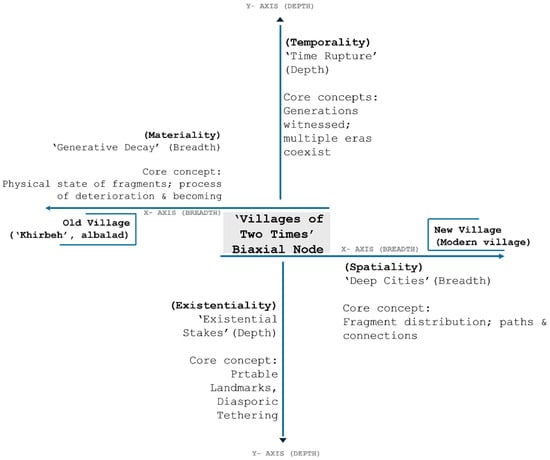
Theorizing abandoned-yet-inhabited settlements requires a framework addressing material, temporal, and existential complexity. We introduce the fragment as a biaxial ontological node. This section shows that fragmentation theory alone does not fully address spatial, temporal, and existential dimensions. We explicitly distinguish two axes: (1) a horizontal axis of spatial dispersal (collage, palimpsest, fragmentation); and (2) a vertical axis of temporal and existential depth (stratigraphy, time rupture, generative decay, existential accumulation). No existing framework integrates both. The biaxial node fills this gap.
2.1. Foundational Theory: Vernacular Fragmentation
John Chapman’s fragmentation theory [9] reinterprets broken objects: breakage is a social act, not “rubbish” [9]. Objects left behind continue to carry meaning [9]. Three concepts anchor this framework. Fragmentation refers to the creation and movement of pieces across locations, establishing relationships through enchainment—how fragments sustain social bonds across time and space via pars pro toto (the part standing for the whole) [9,10]. Accumulation involves collecting objects to build social or economic capital [9,11]. The fragment’s “in-between state” confers dual capacity to reference its original whole and acquire new meanings [11,12]. However, fragmentation theory alone cannot fully account for abandoned villages’ spatial, temporal, and existential complexity. This study extends fragmentation theory by developing the concept of “productive fragmentation”—a process in which breakage generates new significance rather than merely documenting loss. As Immonen notes, “fragmentation is not merely a destructive process but also a creative one” when understood through the lens of how fragments acquire new meanings in new contexts ([11], p. 348).
2.2. Enriching the Framework: Toward a Biaxial Model
- Spatiality: Deep cities.
Stratigraphy visualizes time depth through vertical layers [13,14]; collage captures juxtaposition of unrelated elements [14,15]; palimpsest reveals successive rewritings [14,16,17]. Together, these portray abandoned settlements as dynamic palimpsests of ongoing meaning.
- Materiality: Generative decay.
DeSilvey’s curated decay asks whether memory can be uncoupled from material stasis ([18], p. 4). Disintegration can be culturally meaningful; meaning develops through transformation ([18], p. 5).
- Temporality: Time rupture.
Wang’s time rupture illuminates how historical breaks entail simultaneity—the coexistence of multiple temporalities within one space ([19], p. 1965), producing a “heterogeneous sense of time” ([19], p. 1972).
- Existentiality: Existential accumulation.
Tonner draws on Heidegger’s “care” (Sorge) to explain why fragments matter existentially [20]. Chapman’s enchainment operates existentially. Gooch’s “extended life course theory” proposes “posthumous personhood” [21]. Butler’s “memory-in-exile” and Hoskins’s “portable landmarks” show how fragments anchor identity across displacement [22,23].
- Relating to decolonial scholarship.
Al Rabady and Abu-Khafajah [8] argue local communities are “active knowledge agents.” The biaxial framework complements rather than replaces this: decolonial work addresses authority; our framework addresses mode of being. A potential tension exists: our focus on existential meaning might depoliticize abandonment. We acknowledge this and return to it in Section 5.3.
2.3. Fragmented Vernacularism and the Biaxial Ontological Node
“Fragmented vernacularism” differs from “living heritage” (which assumes continuity of use), “intangible cultural heritage” (focusing on knowledge not fabric), and “heritage from below” (highlighting agency). It theorizes how communities maintain relationships with places no longer functionally occupied, embracing material decay as productive. It fills a gap in post-abandonment settings where use has ceased but attachment has not. This is the essence of “productive fragmentation”: the generation of new significance through material disintegration.
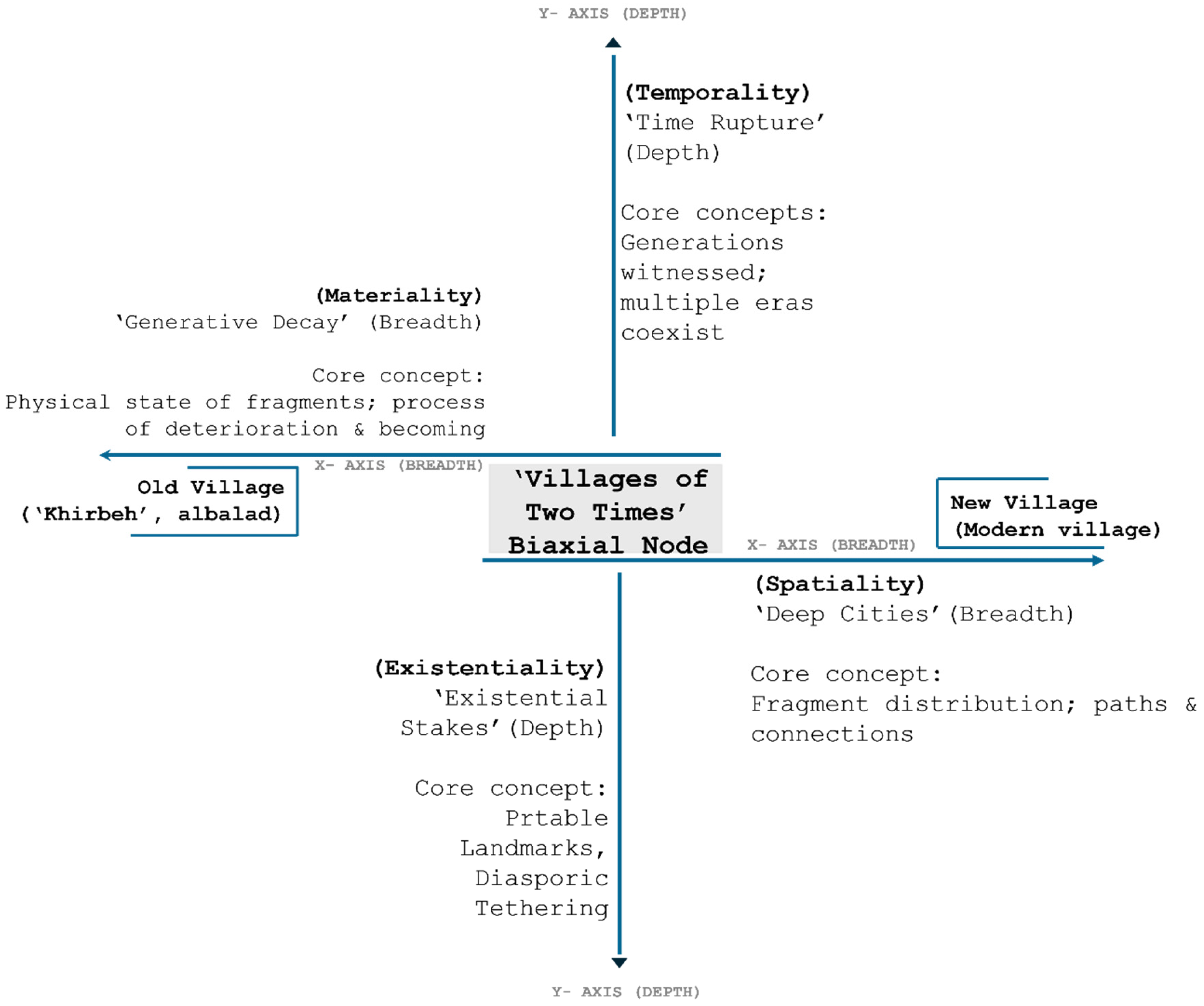
The biaxial ontological node operationalizes this (Figure 1). The horizontal axis captures spatial distribution (collage, palimpsest, fragmentation). The vertical axis captures temporal-existential depth (stratigraphy, time rupture, enchainment, existential accumulation). At their intersection, materiality, social relations, and meaning converge. Table 1 presents the analytical framework.
Figure 1.
The biaxial ontological node: where horizontal dispersal meets vertical depth, forming the “village of two times.” The fragment stands at the intersection of space and time, presence and absence, and material decay and existential persistence. Source: The authors.
Table 1.
Biaxial Ontology of Vernacular Fragmentation: The Conceptual Framework.
To avoid ambiguity, we specify the framework’s three purposes. Descriptively, it explains how abandoned villages persist through fragmentation (Section 4, Section 4.1, Section 4.1.1, Section 4.1.2, Section 4.1.3, Section 4.2, Section 4.2.1, Section 4.2.2, Section 4.2.3, Section 4.2.4, Section 5 and Section 5.1). Theoretically, it revises Chapman’s accumulation concept by showing how fragments gain meaning without being collected (Section 5.1). Normatively, it recommends heritage practices that support rather than arrest decay (Section 6.2). These purposes are distinct yet interrelated.
Readers primarily interested in empirical findings may proceed directly to Section 4; theoretical concepts are reintroduced there only as needed.
3. Research Design and Methodology
3.1. Case Study Strategy
Qualitative, multi-site case study design enabled in-depth exploration of abandoned villages’ ontological condition within real-world settings. Multi-site design captured regional variation across Jordan’s governorates (Irbid, Ajloun, Zarqa, Karak, northern Jordan).
3.2. Case Selection
Five villages purposively selected: Samad (Irbid), Deir al-Samadia (Ajloun), Gharisa (Zarqa), Al-Samakiya (Karak), Badhan (northern Jordan) (Table 2) (Figure 2, Figure 3, Figure 4 and Figure 5). Criteria: (1) abandonment primarily 1960s–1970s (Jordan’s main rural-urban migration period); (2) strong ongoing community ties; (3) geographic distribution; (4) accessibility; (5) absence of major state-led preservation.
Table 2.
Case Study Village Characteristics.
Figure 2.
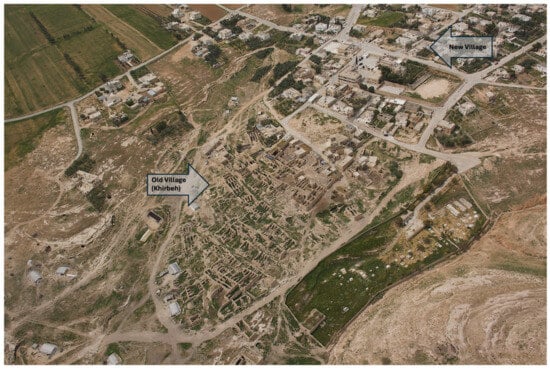
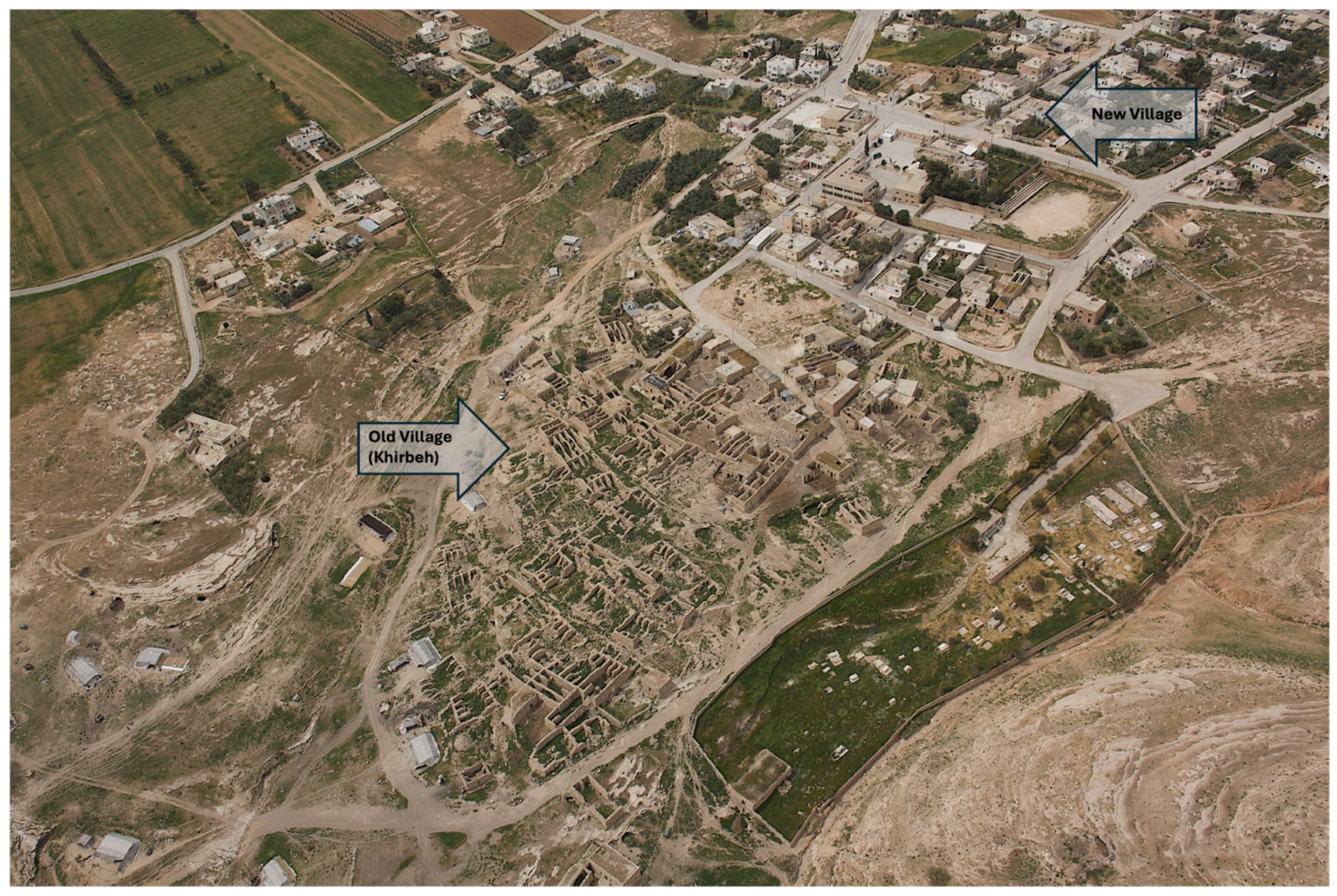
Al-Samakiya as a “village of two times”: old village (al-balad/kirbeh) in foreground, new village (Modern Smakieh) beyond. Arrows and labels “Old Village (Kirbeh)” and “New Village (Modern Smakieh)” have been added to the original aerial photo to improve readability. Source: APAAME_20070417_RHB-0368. Photographer: Robert Howard Bewley. Credit: Aerial Photographic Archive for Archaeology in the Middle East. CC BY-NC-ND.
Key similarities across all five villages: continued presence of family lineages, geographical proximity of new settlements to old villages, and absence of state preservation intervention.
3.3. Population and Sampling
Target population as presented in Table 3: (a) community members from the five villages; (b) heritage officials and tourism/culture professionals; (c) vernacular heritage experts. Sample of 24 participants selected through purposive then snowball sampling. Data saturation was assessed concurrently: after 20 interviews, no new themes emerged for the three research questions. The following categories stabilized by interview 18: (1) material fragmentation as generative; (2) portable landmarks; (3) practices of return; (4) emotional attachment as longing/loss; (5) intergenerational transmission; (6) absence as presence. Interviews 19–20 added confirmatory instances; 21–24 confirmed existing categories.
Table 3.
Participant Demographic Characteristics (Anonymized).
The sample includes 15 men and 9 women, with an age range of 28–82 years. Eight participants lived in the old village for more than 30 years; six are current residents of adjacent new villages; all report returning at least seasonally. This demographic spread supports the breadth of the biaxial framework across generations and genders.
3.4. Data Collection
Semi-structured interviews (n = 24) were the primary data source. The interview guide (see Data Availability Statement) covered: (1) memories of life before abandonment; (2) reasons for departure; (3) current return practices; (4) meanings attached to material fragments; (5) attitudes toward preservation, decay, and inheritance. All interviews in Arabic, 30–60 min, recorded with consent, transcribed verbatim. Translation followed forward-translation verified by bilingual researchers; back-translation of a 20% sample ensured conceptual accuracy, especially for kirbeh. Site observations used a standardized protocol (built fabric, paths, open spaces, signs of recent use). Document analysis provided context.
3.5. Data Analysis
Systematic thematic analysis: (1) transcripts coded iteratively using deductive codes (fragmentation, enchainment, accumulation, horizontal/vertical axes) and inductive codes (e.g., “absence is part of us”)—coding in Arabic to preserve nuance; (2) data organized into themes aligned with three ontologies and three scales (fragment, village, landscape); (3) constant comparison across villages and participant groups; (4) member-checking with five community elders, who confirmed the biaxial model resonated with their experience. Positionality addressed by inviting participants to challenge interpretations.
Codebook Structure
Codes were developed deductively from the biaxial framework (e.g., horizontal axis = spatial dispersal codes) and inductively from participant language (e.g., “absence is part of us” (Table 4)). Inter-coder reliability was not formally calculated because coding was conducted collaboratively by both authors; disagreements (fewer than 5% of segments) were resolved through discussion.
Table 4.
Codebook with Frequencies.
3.6. Ethical Considerations
Institutional ethical approval granted. Written consent obtained. Pseudonyms used except when officials explicitly agreed to identification.
3.7. Limitations
Several limitations apply. First, snowball sampling may underrepresent individuals who have severed ties. Findings reflect those who maintain connection. Second, one author has prior publications in Jordanian heritage studies; to mitigate bias, the second author conducted all interviews independently, and member-checking invited challenge. Third, the framework is developed from five Jordanian villages with specific characteristics (abandonment 1960s–1970s, continued family ties, no major state intervention). The biaxial ontology may be most applicable where (a) communities remain geographically proximate to abandoned sites, (b) family lineages persist, (c) no large-scale preservation or tourism has intervened. Applicability may be limited where abandonment was forced by conflict, communities are fully displaced without return, or material fabric is completely erased. Fourth, we exclude economic and political dimensions of abandonment intentionally—the framework addresses existential, material, and social ontology, not political economy. Fifth, we did not identify participants with purely negative or severed ties. This may reflect sampling or cultural desirability bias; the framework may not account for complete rupture or indifference.
4. Analysis: The Biaxial Ontological Node in Jordan’s ‘Villages of Two Times’
This section presents analysis of interview and observational data in two movements: (1) theory-driven dimensional analysis applying three ontologies (objective, constructive, existential); (2) empirically driven scale analysis across fragment, village, and landscape scales. Each subsection integrates participant quotations.
4.1. Dimensional Analysis: The Three Ontologies of the Biaxial Node
4.1.1. The Objective Ontology of Material Remains: Fragmented Vernacularism
Material remains function as active carriers of historical and thermal knowledge (Figure 3, Figure 4 and Figure 5). In Badhan: “The village possesses a unique charm… particularly in its construction compared with modern buildings” (B2, 2024). This highlights material intelligence in traditional techniques. Deir al-Samadia: “The village… essentially comprised three villages built one atop the other… Roman era, and the ancient era” (D3, 2024)—a layered palimpsest.
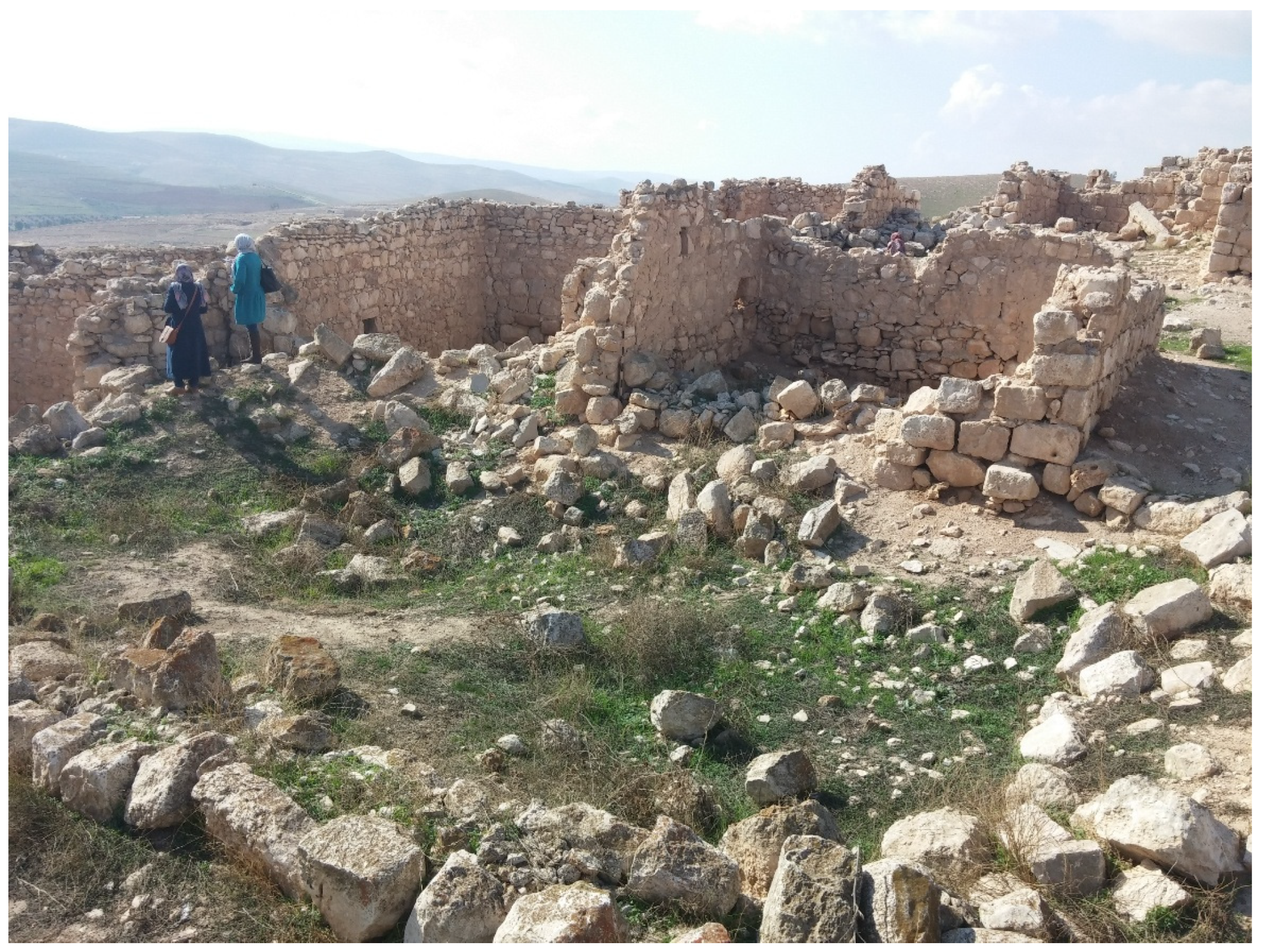
The defining feature is absence. Gharisa: “When they moved from ‘the village without roofs’ to the current village, they took the roofs with them… Now, what remains are only the stones and mud, so Gharisa is solid with all the stories of its people” (G2, 2024). Missing roofs enable a different kind of presence: absence makes stories visible. As another participant: “The absence is part of us now… The empty rooms there are full of memories. So the absence is not empty—it is full” (G3, 2024).
Figure 3.
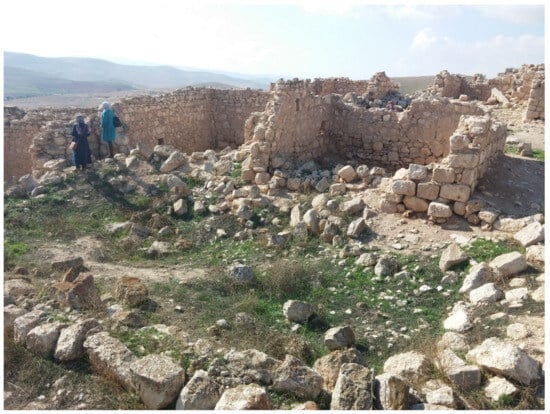
Badhan: Vacant spaces where stones “speak.” The stone construction (locally quarried limestone, dry-stacked with mud mortar), cylindrical arched corridors (vaulted roofs that span without timber), and mud finishes (applied as a thermal regulator) exemplify material intelligence: the stones’ thermal mass absorbs heat by day and releases it at night; the arched corridors channel airflow for passive cooling; and mud finishes provide humidity buffering. These features instantiate embodied knowledge systems that modern concrete construction has abandoned. Though abandoned, such spaces retain their thermal wisdom and historical presence. Source: The authors.
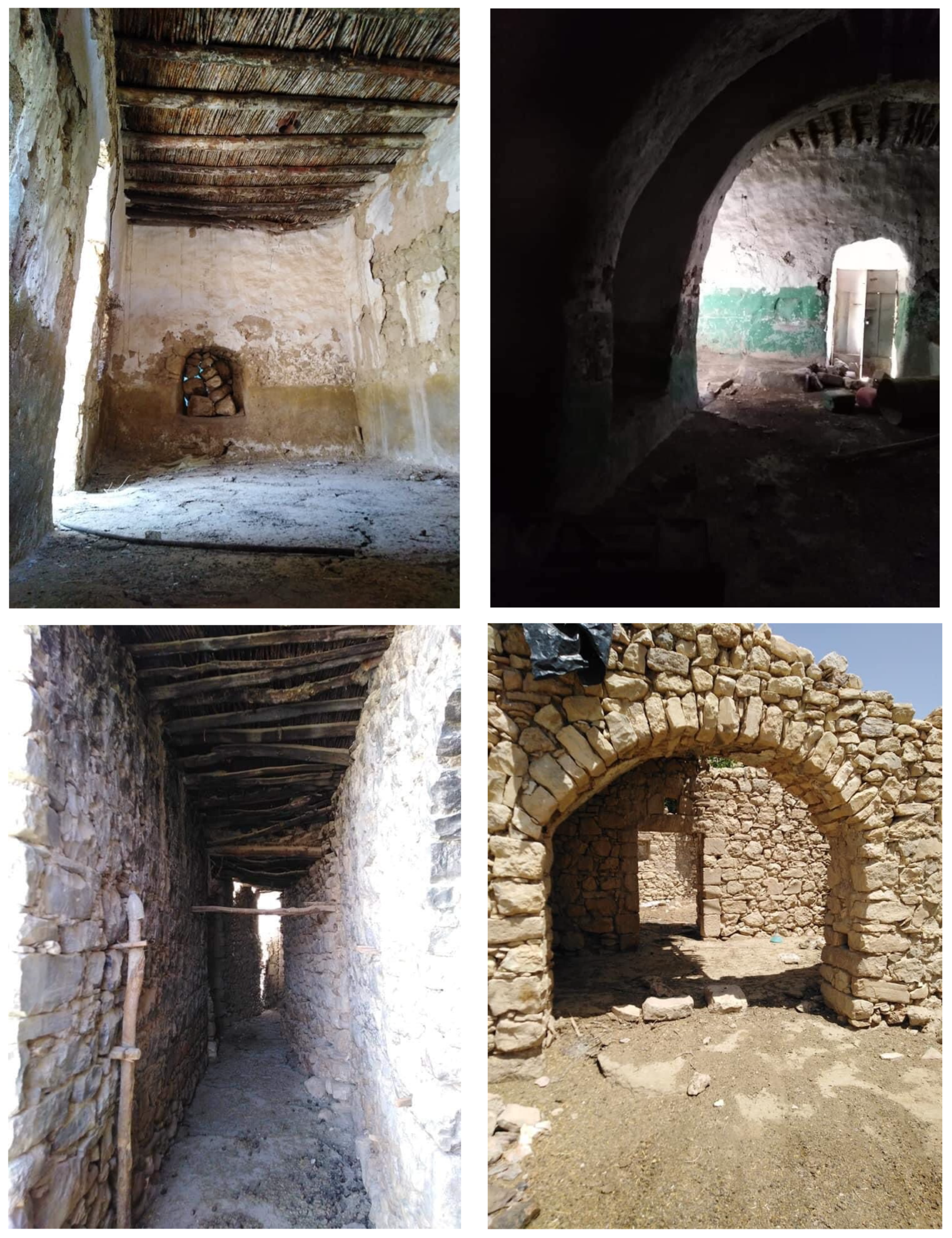
Figure 4.
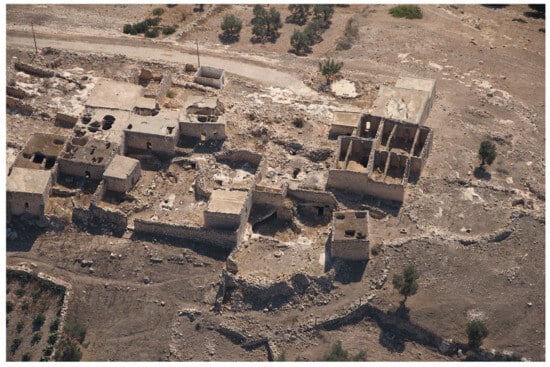
Where absence testifies: Al-Samakiya’s roofless structures embody the paradox of fragmented vernacularism. Sources: The upper image: APAAME (Aerial Photographic Archive for Archaeology in the Middle East), 2007, es-Simakiyyah (Miller #94). Reference: APAAME_20070417_FFR-0270. Photographed by Francesca Radcliffe. Copyright: Creative Commons Attribution-Noncommercial-No Derivative Works; the lower image: the authors.
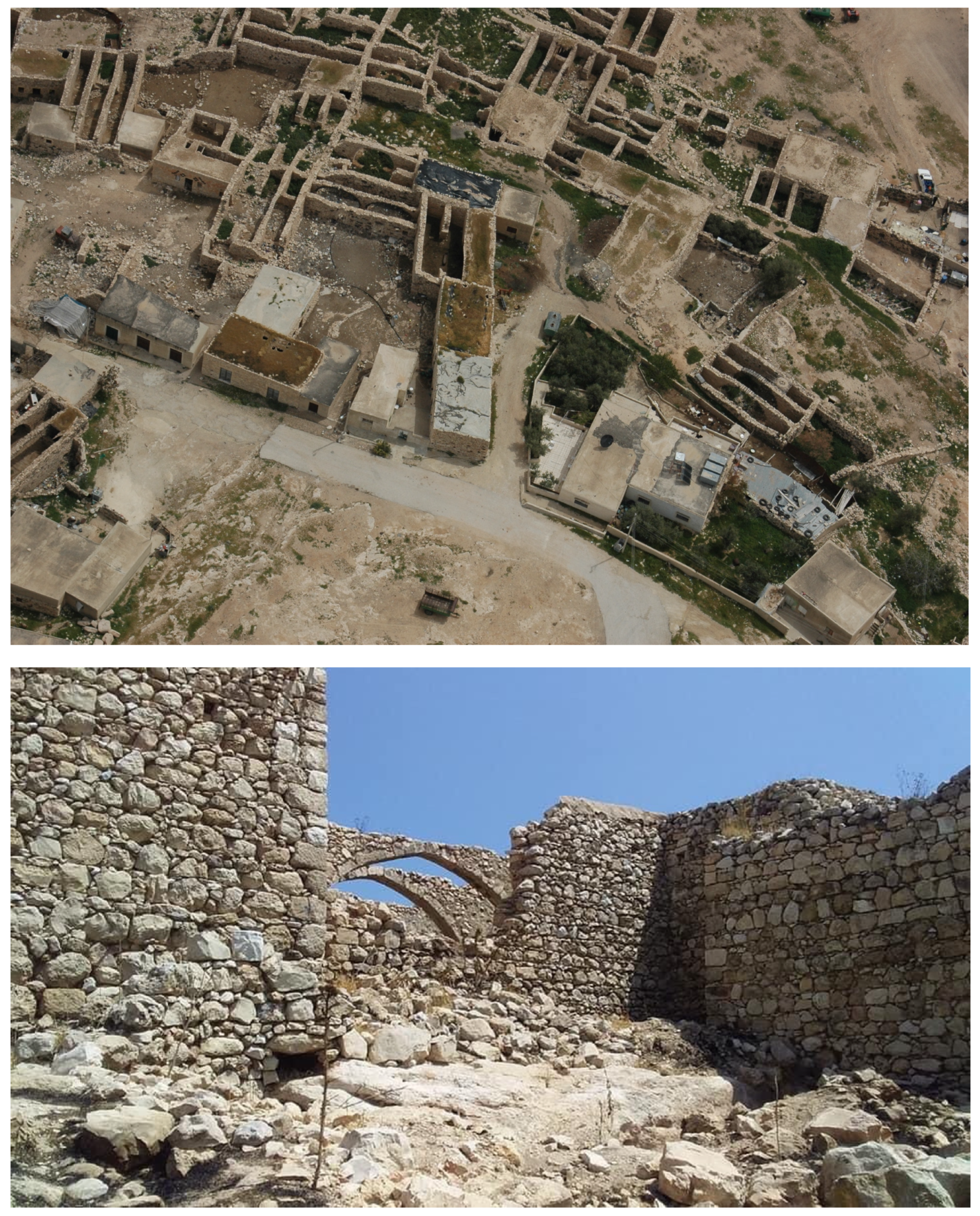
Figure 5.
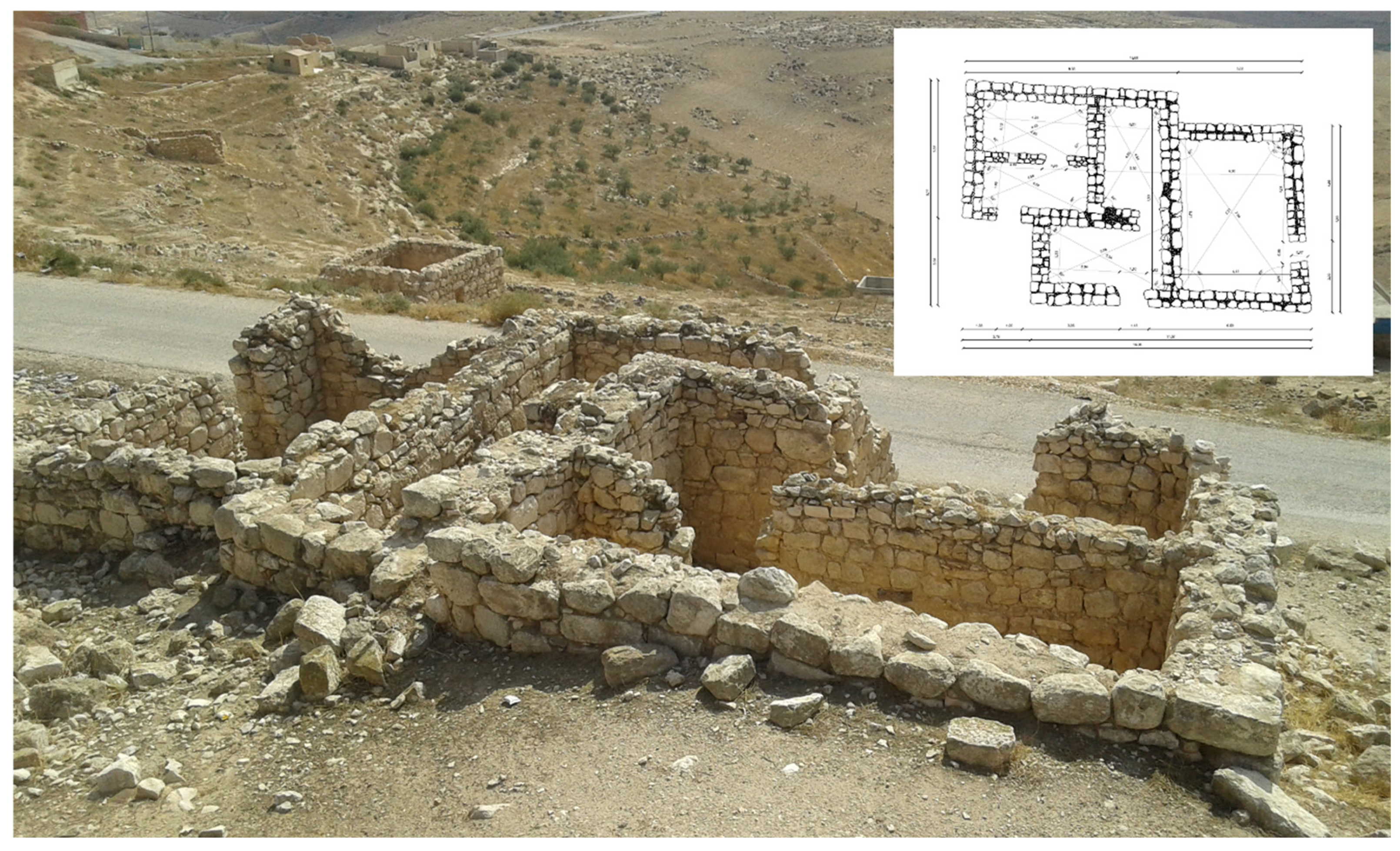
Walls that witness solidarity: attached houses in Gharisa. Points of attachment are indicated by white arrows: shared party walls (vertical arrows) that reduce heat loss and structural costs; contiguous roof terraces (horizontal arrows) that enable movement between households without descending to ground level; and intersecting wall junctions (circled) where load-sharing creates structural interdependence. These spatial relations—walls built literally touching, doorways aligned between houses, and communal ovens embedded in shared walls—physically encode the kinship bonds described by participants. Source: The authors.
4.1.2. The Constructive Ontology of Relational Networks: Social-Cultural Enchainment
The constructive ontology operates through five analytically distinct patterns, consolidated as shown in Table 5.
Table 5.
Constructive Ontology: Four Thematic Categories.
- The Village as Bond: Social Cohesion Materialized (includes interfaith harmony). Participants consistently emphasized that the old village formed the basis of social unity (Figure 6). A Gharisa resident reflected: “This village united us; it was the link between us, our relatives, and everyone… Therefore, this village is the link that connects us and brings us together” (G1, 2024). The village acts as a “landscape of attachment,” a spatial configuration that organizes social ties. Another participant confirmed, “These buildings were instrumental in bringing people together” (G1, 2024). The physical layout actively shapes social reality. A Samad resident recalled: “In the past, everyone was like one family, and they all used to gather and visit each other. Even though their problems were solved together, they were like one big family. Everyone in the village was related, and we were all like cousins, despite the different family names. People were all kind and had good manners” (S3, 2024). The village was not just a backdrop for social life but its active shape. When that spatial arrangement was abandoned, the social fabric it held together began to unravel.
- The Village as Bridge: Interfaith Harmony and Shared Heritage. A key aspect of this constructive ontology is the way villages built relationships across religious differences. Several participants from Samad village described living near Christian families, a relationship that has since diminished. A Samad resident recalled: “Christians lived with us in the village, and we were like brothers with them, and our relationship remains good with them. Father Nabil Khoury and Nabil Hajaj’s farm still stands in our village, near Samad School. Even during Ramadan, they would reach out to us. They used to communicate with Muslims during Ramadan and distribute aid to the poor” (S2, 2024). Another participant elaborated: “Christians also lived here, but most of them emigrated outside Jordan, and some moved to nearby villages and different provinces. We were like one big family with Christians” (S2, 2024). The village’s physical layout—houses close together, shared pathways, common spaces—facilitated this interfaith closeness. The subsequent dispersal of Christian families coincides with the village’s abandonment, suggesting that the loss of place and the weakening of interfaith bonds are connected.
- The Village as Anchor: Practices of Return Across Absence. The constructive ontology extends beyond those who stayed to include those who left. Practices of return—Eid visits, family gatherings, and pilgrimages to ancestral homes—reveal ongoing connections despite the distances migration creates. A Deir al-Samadia participant described: “For me, I lived there until I was 16 years old. The village served as a refuge for travelers stranded on the road. In earlier times, anyone hungry or thirsty would come to the village without restaurants. This is history, true history” (D3, 2024). This memory positions the village as a central node in regional hospitality networks. For those who have permanently left, the village remains a point of reference (Figure 7). A Samad participant noted: “All the people who left the village wish to return to it, but there is something that prevents them. Whenever my relatives visit the village, they come directly to my house to see how I have adapted to life here after living in the city. Some of my relatives even stay overnight at my house” (S3, 2024). The village keeps bringing the scattered together, uniting them through kinship and memory. Those who stay act as anchors for those who left—living pieces that represent the whole to the absent.
- The Village as Wound: Emotional Ties and the Persistence of Attachment. The emotional dimension of these relationships emerged powerfully in participants’ accounts. A resident of Samad shared: “There are people who visit the village at night, sit, and cry because they long for the old village. They cry over the village’s current state, thinking about how it used to be and how it is now. People have a strong emotional connection to this village” (SA2, 2024). This weeping is not mere sentiment; it is an acknowledgment of loss that affirms connection. To cry over the village’s current condition is to testify that it still matters. Another participant from Deir al-Samadia described this bond as spiritual grounding: “Indeed, this village is significant for us, serving as a spiritual connection. It’s like our spiritual anchor, and we must preserve it” (D2, 2024). The anchor metaphor is fitting: the village keeps people steady amid change, offering orientation and stability even amid abandonment.
- The Village as Thread: The Link Across Generations. The constructive ontology also operates across time, connecting generations through a shared attachment to place. An elder from Deir al-Samadia explained: “The village represents the past, present, and future all together. As they say, those who have no past have no future. Regarding the past, it embodies our ancient heritage. Even rulers seek legitimate claims to their authority, and this village has a legitimate claim specific to us, indicating that we have long-standing roots there” (D2, 2024). The village thus demonstrates a presence that transcends any single generation. Being from Deir al-Samadia means having roots that extend beyond individual lifespans. As another participant noted, “The village represents the past, present, and future. It’s where we were born, where we live our lives, and where we’ll eventually return to be buried” (S1, 2024). The cycle of birth, life, and death centers on the village—a place that holds the dead and awaits the living.
Figure 6.
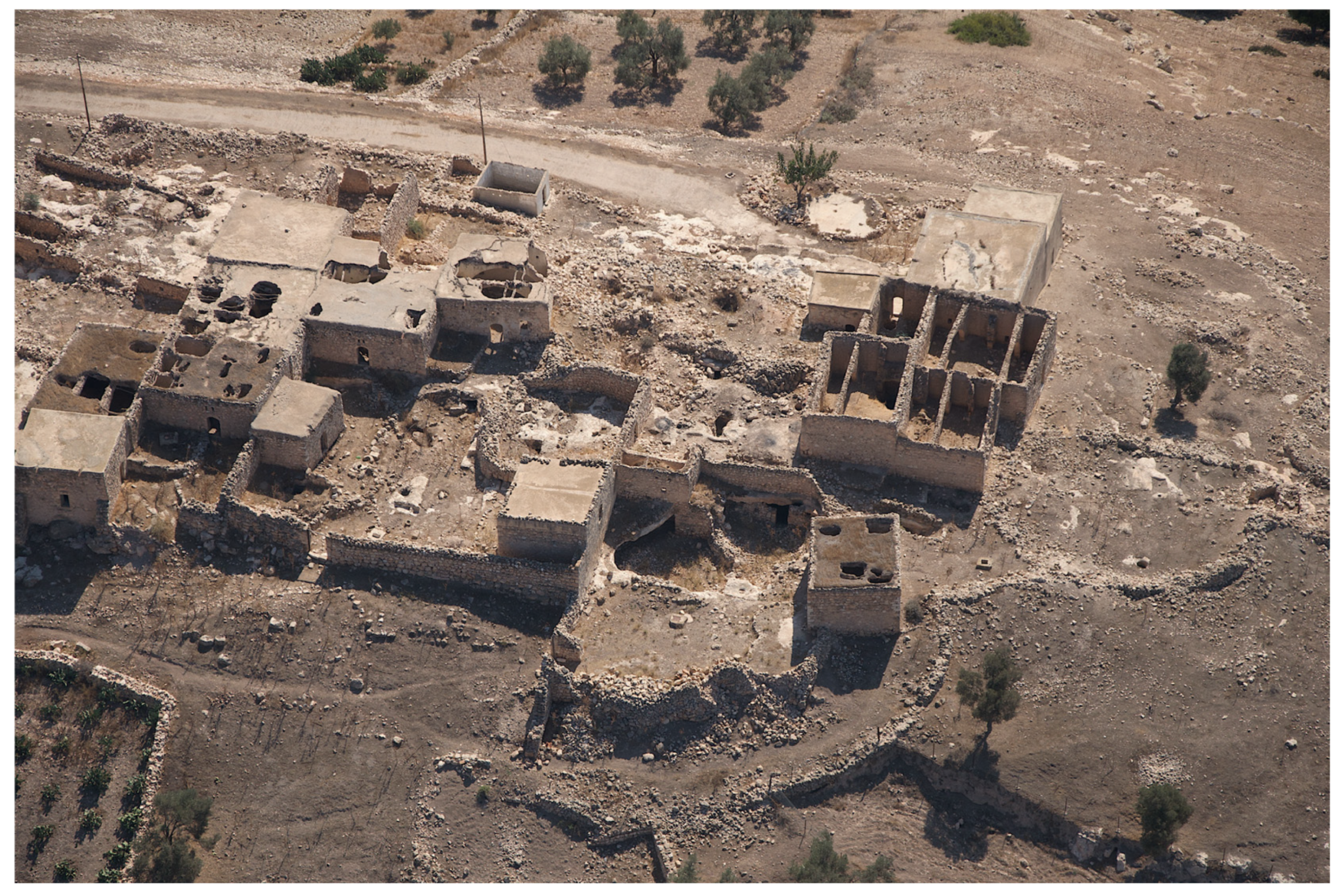
Deir es-Simadiyyeh el-Janubi (Deir al-Samadia) from above. Its architectural logic—attached walls, shared spaces, defensive clustering—encodes the kinship bonds that once animated the site. Source: APAAME (Aerial Photographic Archive for Archaeology in the Middle East). 2014. Deir es-Simadiyyeh el-Janubi. Reference: APAAME_20141012_REB-0487. Photographed by Robert Howard Bewley. 12 October 2014.
Figure 7.
Return to Gharisa: young people visiting the ancestral village. Source: The Authors.
4.1.3. The Existential Ontology of Identity and Being: Existential Accumulation
Existential accumulation refers not to collecting objects for economic gain but to enriching meaning within fragments and constructing a sense of place within people. This is a key manifestation of “productive fragmentation”: as material fragments decay, they acquire existential depth rather than losing value. We ground this in phenomenological literature: following Tonner [20], the village matters because it is an object of care (Sorge); following Gooch [21], posthumous personhood extends identity beyond biological life; following Hoskins [23], portable landmarks anchor being across displacement. As Immonen observes in the context of urban heritage, “fragments are not simply remnants of a lost whole but active agents in the production of new meanings” ([11], p. 352). The Jordanian case extends this insight to abandoned vernacular settlements, where fragments become anchors of existential continuity across generations.
- Roots Run Deep: Place as Constitutive of Being. Participants consistently described the village as central to their identity. A Gharisa resident explained: “I feel connected to the village because it embodies our foundation; it represents our culture and humanity. It is the core of our existence, fundamental to who we are” (G1, 2024). This language of foundation, core, and essence positions the village not as one identity among many but as the very ground of identity. Another participant echoed: “These buildings and the village symbolize our history and identity, and we lived and grew up in them, so it’s impossible to forget them. They are the pride of our village” (G3, 2024). The village is not separate from identity but constitutes it—to forget the village is to forget oneself. This existential dimension also shapes the experience of return: “When we go, it’s like all the harvests come back. I see my father there, my uncle, the way we used to work together” (S1, 2024). This transcends memory; it is a mode of presence—the dead made present through the places they inhabited.
- The Soil We Keep: Portable Landmarks and the Accumulation of Place. The most powerful expression of existential ontology appears in stories of homeland soil brought to graves abroad. A Samad participant recounted: “The migrants’ last wish was to take soil from the village of Samad and place it on their graves in America. One of the migrants passed away in America and told them his last wish was to be brought to his house in the old village of Samad, and indeed, they buried him in his house in Samad and later moved him to Al-Hoson. This illustrates how deeply rooted individuals are in their land, their history, and their heritage” (S1, 2024). Another participant offered more detail: “In 1911, five residents of our village went to America. In 1922, two of them returned, and in 1964, the other two came back. The fifth person, from the Namari family, remained in America. When the four who returned from America came back, they built houses in this village. The fifth person from the Namari family who stayed in America instructed his children that when he died, they should bring soil from Samad village and place it on his grave in America. This shows their deep loyalty and love for this village. Indeed, the children of the deceased came and took stones and soil to place on their father’s grave in America. Although their children and grandchildren do not know the village of Samad, if you ask them, they will tell you they are from Samad, even if they have never visited it” (S4, 2024). Soil from Samad, transported across oceans, becomes what Hoskins [23] calls a “portable landmark,” a tangible fragment that roots identity in foreign soil. The American grave, covered with homeland earth, becomes part of Samad—transplanted. The deceased rests not in foreign ground but in earth made familiar by the fragments brought from home. Equally powerful is how identity persists across generations that have never seen the village. The migrant’s children and grandchildren, though they have never visited Samad, still identify as from Samad. The village lives in them not through personal experience but through the soil fragment marking their ancestor’s grave and the story that sustains its meaning.
- The Village We Carry Within: Accumulation of Place in Persons. Existential ontology also manifests in those who stay. A Samad resident who returned to the village reflected: “I was born in this village, grew up, became a young man, a father, and a grandfather. I have lived through all the stages of my life in this village, experiencing three generations—the old, the middle, and the new” (S3, 2024). The village coheres in this person as a layered history of a lifetime—childhood, youth, adulthood, old age—all rooted in the same place. For others, accumulation takes different forms. A participant who stayed due to economic constraints reflected: “I live in this village primarily because of the modest resources, and I remained here as a companion to my father, while all my brothers moved and settled in different provinces. When my father passed away, the circumstances didn’t allow me to leave. If my situation had been better, I would have moved like my brothers. We have a strong bond with this village, regardless of whether others know it; they just know it by its name, Samad. There’s something that attracts them to this village” (S4, 2024). Here, staying was not optional—yet the bond persists. The village draws those who remain, not through romantic sentiment but through lived experience.
- When Letting Go Becomes Growing: Dissolution and Transformation. The existential ontology also encompasses the paradox of dissolution: as fragments decay, they acquire new meaning. As one participant noted, “The village and its buildings are just a place for memories” (G2, 2024). This shift into memory is not loss but transformation. Buildings no longer offer shelter, yet they continue to serve as vessels of remembrance. Their physical decay increases their existential significance. As DeSilvey suggests, decay can be generative [18]. The empty room becomes more alive than the occupied one; the missing roof exposes the house to memory. Another participant captured this paradox in a single image: “The absence is part of us now” (G3, 2024). Absence is not emptiness but presence—a presence carried within those who remember.
4.2. Scale Analysis: The Biaxial Node in Operation—Convergence Across Scales
The three ontologies do not operate in isolation but intersect through lived experience. This section presents findings on their convergence across the scales of fragment, village, and landscape.
4.2.1. At the Scale of the Fragment: The Stone That Holds Time
The fragment is the primary site where objective, constructive, and existential ontologies converge—the point where these three dimensions coalesce most intensely. As a Gharisa participant stated: “We transported these stones with our families on camels, horses, and donkeys, so these buildings represent our lives before. These buildings and the village symbolize our history and identity, and we lived and grew up in them, so it’s impossible to forget them. They are the pride of our village” (G3, 2024). A single stone is simultaneously objective (a material fact that can be transported and built), constructive (a node in a chain of family relationships), and existential (a symbol of identity and pride). Another participant described this multiplicity: “They were built from stone and mud, and each stone carries a memory. This old Gharisa was inhabited by all the families of the Zyoud tribe” (G4, 2024). Each stone bears memory—not metaphorically but physically. The material serves as a mnemonic device, a family history archive, and an emblem of tribal identity.
Cross-referencing observational data with interview claims: Across all five villages, we observed that doorways facing east or south (capturing winter sun) aligned with participants’ statements about thermal comfort; similarly, wall attachment points observed in Gharisa (Figure 5, white arrows) matched all five Gharisa participants’ descriptions of kinship-based construction. No observational disconfirmation was found for any participant’s claim about material layout.
4.2.2. At the Scale of the Village: The Field Where Bonds Are Woven
At the village level, spatial distribution (horizontal axis) and temporal depth (vertical axis) converge to form a network of relationships in which each fragment connects to the entire system. Here, the biaxial ontology functions as a field in which fragments are scattered across space while accumulating temporal depth. As a Deir al-Samadia participant described: “The village has existed for a long time, and we have been in Deir al-Samadia for generations, which reflects our deep roots in the area” (D2, 2024). The village layout—its arrangement of houses, paths, and open spaces—also records its history. Each generation has left marks that subsequent generations interpret and reinscribe. Another participant observed: “The village is situated on a hill open to the west and in all directions. The houses are attached, providing shelter from the northwest, northeast, and all around. The buildings relate to a gap in the center. You might find something built in the middle, giving the structures a somewhat circular shape with an empty space in the middle” (D3, 2024). This description reveals how spatial arrangements encode social bonds. The attached houses, the central open space, and the defensive layout—all reflect kinship ties and mutual protection that endure across generations.
4.2.3. At the Scale of the Landscape: The Stretched Community Sustained
At the landscape scale, the village emerges as a community spread across space, with old and new settlements linked by horizontal pathways of return and vertical threads of memory. The biaxial ontology here clarifies the connection between the old village and the new, two sites separated horizontally yet linked vertically through time. A Gharisa participant explained: “We abandoned the old village but dug an artesian well and moved to this area from the old village” (G3, 2024). The move was not a rupture but a relocation. The new village is not a replacement for the old but its continuation through different means. The artesian well connected the new settlement to the old water from the same source, families from the same lineage, memories from the same past. This expansive landscape is sustained by practices of return. As another participant described: “We don’t sever ties with the Deir, nor do our relatives; we visit it and relax. There’s history that speaks to our presence and continuity, telling stories of many simple yet significant events” (D2, 2024). The landscape spanning two eras thus manifests a connection, sustained by the annual return of the living to the places of the dead. The paths linking the new village to the old are more than physical routes; they are temporal corridors through which the past enters the present.
4.2.4. The Generative Paradox of the Biaxial Node: The More It Breaks, the More It Holds
The biaxial node reveals a paradox: as fragments break apart horizontally through decay and dispersal, they simultaneously gain vertical depth through memory, meaning, and identity. At the intersection of horizontal spread and vertical depth, this paradox becomes intelligible. This is the core of “productive fragmentation”: material disintegration and existential accumulation are not opposites but two dimensions of the same process. A participant articulated it: “When you come here and see the olive trees, the buildings, and everything, and then you look at the village without roofs and remember it, you say, ‘Oh, those were the good old days, how wonderful they were.’ This is our history” (G1, 2024). The stones stand tall not despite the absence of roofs, but because of what they symbolize. Their strength is both physical and symbolic—they are “solid with stories.” The village’s material decay enables it to embody its true essence. Another participant offered a complementary insight: “These buildings are our history; our history resides in these buildings” (D2, 2024). History inheres in buildings—not as abstract knowledge but as tangible presence. Their ongoing existence, even in decay, ensures that history endures. As Immonen argues, “fragmentation can be understood as a productive force that generates new relationships between people, places, and the past” ([11], p. 354).
5. Discussion: From ‘Biaxial Node’ to ‘Biaxial Being’
5.1. The Descriptive Function of the Biaxial Ontology
Findings demonstrate that Jordan’s vernacular villages resist reduction to any single ontology. Objective ontology describes stones and walls, but not why they matter. Constructive ontology highlights social meanings but cannot fully account for presence beyond narrative. Existential ontology examines identity but must remain grounded in material realities.
The biaxial ontology integrates these. The horizontal axis (spatial distribution) encompasses fragments, pathways, empty spaces. The vertical axis (temporal-existential depth) encompasses multiple temporalities and identity-anchoring processes. At their intersection, a biaxial node forms where fragments reveal temporal depth, spatial connection, and accumulated meaning. This is “productive fragmentation” in action: breakage generates new significance rather than merely documenting loss.
The findings necessitate revising Chapman’s concept of accumulation [9]. Chapman characterizes accumulation as amassing objects for social or economic capital ([11], p. 349). In Jordanian communities, accumulation operates differently: it is not collecting objects but deepening meaning in fragments and building connections with people. The stone “of the different times” has grown vertically, acquiring meaning with each generation. Ingold’s “weathering” [24] illuminates this: exposure endows things with depth. As DeSilvey writes, “It is possible to see a fullness in the current state of the structure as it sheds one arrangement of matter to adopt another” ([18], p. 3). We adopt DeSilvey, Fredheim, and colleagues’ “adaptive release”: “ways of valuing the material past that do not necessarily involve accumulation and preservation—ways that instead countenance the release of some of the things we care about into other systems of significance” ([25], p. 421). The soil fragment exemplifies this release.
Enchainment also deepens. Chapman showed fragments sustain social ties across distance [10]. Jordanian communities show enchainment persists indefinitely. When a visitor sits “in the place where my father and family used to sit” (D1, 2024), the fragment enacts connection across absence. Immonen’s work on urban heritage fragmentation similarly emphasizes that “fragments carry the potential to forge new chains of meaning across time and space” ([11], p. 358). In the Jordanian context, these chains are existential as much as social.
5.2. From Description to Normative Obligations
The preceding analysis is descriptive. Section 6.2 moves to normative recommendations for heritage practitioners. This transition requires explicit justification. The move from descriptive ontology to normative obligation is not logical entailment but practical alignment. If heritage practitioners accept (a) that these villages embody a distinct, meaningful mode of existence for communities, and (b) that heritage practice has a professional responsibility to respect and support existing meaning-making rather than replace it, then practitioners ought to act in ways that sustain rather than disrupt the biaxial relations described. Our normative recommendations are therefore conditional on those two premises. We do not claim ontology prescribes action; rather, if one adopts a preservation-alternative ethic of supporting community-articulated values, the biaxial framework provides guidance on appropriate forms of support.
5.3. What the Biaxial Framework Does Not Explain
The biaxial framework effectively explains how fragments persist, how absence becomes presence, and how multiple temporalities coexist. However, it does not explain the economic drivers of abandonment (e.g., land tenure systems that made rural property difficult to inherit, state subsidies favoring urban migration, labor markets drawing younger generations to cities). Nor does it explain political dimensions: why the Jordanian state did not intervene, whether land ownership disputes block reuse, or how national heritage laws classify (or fail to classify) kirbeh sites. These phenomena lie outside the framework by design: the biaxial ontology addresses existential, material, and social meaning, not political economy. We recommend future research integrate biaxial ontology with political-economic analysis.
6. Conclusions
6.1. Toward an Ontology of Fragmented Persistence
Jordan’s vernacular villages show heritage is both horizontal—walked through, recorded, documented in fragments—and vertical—felt, remembered, haunted by depth. They manifest a “heterogeneous sense of time” ([19], p. 1972). As Chapman emphasized, the fragment’s value lies in its capacity to “presence the Other” ([9], p. 30). In villages of two times, that Other includes builders, ancestors, the remembering, the returning. Revising Chapman’s accumulation is essential: accumulation means not merely collecting but gathering—deepening meaning in fragments and establishing place in people. This is “weathering” [24] and “adaptive release” [25,26]. It is also the practical realization of “productive fragmentation”: the transformation of material loss into existential gain.
Although grounded in Jordanian cases, the biaxial ontology may be generative for other post-abandonment landscapes across the Middle East and North Africa where similar processes of vernacular displacement and enduring attachment occur. Comparative case studies are needed to test transferability. Transferability depends on: (a) communities remain geographically proximate to abandoned sites; (b) family or tribal lineages persist across generations; (c) abandonment occurred within living memory or two generations; (d) no large-scale state-led preservation or tourism has fundamentally altered the site; (e) portable fragments (soil, stones, keys) are culturally meaningful. Where these hold, the framework may apply. Where not—forced displacement without return, or complete material erasure—substantial adaptation would be required.
6.2. Implications for Heritage Practice
For heritage practitioners, this framework signals a shift from preservation to support—assisting communities in their evolving relationships with places rather than arresting decay. Drawing directly on our findings, we offer the following as possible directions rather than strict obligations:
- Recognize portable heritage (soil, stones, keys) as meaningful, as demonstrated by Samad migrants who requested homeland soil for graves abroad. Document not only standing structures but also fragments communities carry.
- Value multiple time periods coexisting without imposing a single linear narrative, as reflected in Deir al-Samadia’s “three villages built one atop the other.”
- Promote practices of return (Eid visits, storytelling gatherings, pilgrimages) rather than restricting access for preservation.
- Attend to identity, belonging, and continuity across generations—beyond architecture or archaeology alone—as illustrated by Gharisa: “The absence is part of us now.”
6.3. Final Reflections
Fragments matter within the biaxial framework because of what they signify to those who remember. As Tonner concludes, the study of material remains ultimately concerns “the question of what it means to be human” [20]. Though abandoned, the Jordanian village persists through fragments, memories, and returns. As one participant reflected, “The absence is part of us now” (G3, 2024). Absence becomes presence, carried in fragments that connect being across oceans and generations. The village of two times teaches that being in fragments is not being less but being different—existing in the mode of memory, surviving through those who carry its stones in their hearts and its soil on their graves. The fragment endures not despite its incompleteness but because of it. This is the enduring lesson of productive fragmentation: disintegration, when witnessed and remembered, becomes a mode of persistence.
Author Contributions
Both authors contributed significantly to the study’s conception and design. R.A.-R. assisted in developing the theoretical framework, particularly the biaxial ontological model and the integration of fragmentation theory with perspectives on time rupture and existential displacement. She conducted the data analysis and authored the paper. A.K. conducted the fieldwork, including all interviews and site observations. Both authors participated in interpreting the data, drafting and critically revising the manuscript, and approving the final version for submission. Both authors agree to be responsible for all aspects of the work. All authors have read and agreed to the published version of the manuscript.
Funding
This research received no external funding. The APC was funded by Al-Ahliyya Amman University.
Data Availability Statement
The interview guide is available from the corresponding author upon request. The datasets generated and analyzed are not publicly available due to the sensitive nature of the information and to protect participant confidentiality, as described in the consent process. The corresponding author can provide anonymized interview transcripts upon reasonable request, subject to institutional review and approval. All photographs taken by the authors are available for research purposes upon request. Third-party aerial photographs are available from the Aerial Photographic Archive for Archaeology in the Middle East (APAAME) under Creative Commons licenses, as cited in figure captions.
Acknowledgments
The authors sincerely thank the communities of Samad, Deir al-Samadia, Gharisa, Al-Samakiya, and Badhan for their generosity, hospitality, and willingness to share their memories and experiences. Special thanks go to the elderly who entrusted us with their stories and to the families who opened their homes to us. The authors are also grateful to the heritage officials and professionals who provided valuable insights and facilitated access to local resources. Additionally, the authors acknowledge the Aerial Photographic Archive for Archaeology in the Middle East (APAAME) for making its extensive collection available under Creative Commons licenses, which greatly enhanced the visual documentation of these remarkable landscapes.
Conflicts of Interest
The authors declare that they have no competing interests, whether financial or non-financial, that could potentially influence the work reported in this paper.
Abbreviation
APAAME: Aerial Photographic Archive for Archaeology in the Middle East.
References
- Baglioni, E. Jordanian vernacular architecture. In Vernacular Architecture: Towards a Sustainable Future; Mileto, C., Vegas, F., García Soriano, L., Cristini, V., Eds.; CRC Press/Taylor & Francis: Boca Raton, FL, USA, 2015; pp. 105–110. [Google Scholar]
- Al-Nammari, F.M. The preservation of vernacular architecture in Jordan: Development chances lost. In 6th US/ICOMOS International Symposium: Managing Conflict and Conservation in Historic Cities: Integrating Conservation with Tourism, Development and Politics; US/ICOMOS: Washington, DC, USA, 2003; p. 17. [Google Scholar]
- Khammash, A. Notes on Village Architecture in Jordan; University Art Museum, University of Southwestern Louisiana: Lafayette, LA, USA, 1986; ISSN OCLC 16082793. [Google Scholar]
- Zeadat, Z.F. Adaptive reuse challenges of Jordan’s heritage buildings: A critical review. Int. J. Urban Sustain. Dev. 2024, 16, 95–107. [Google Scholar] [CrossRef] [Scilit]
- Tarrad, M.; Abu-baker, D. A Proposed New Contemporary Vernacular Architecture as an Expression of The Spirit of Age-Design Principles: A Case Study of Ajloun, Jordan. Archit. Plan. J. 2020, 25, 5. [Google Scholar] [CrossRef] [Scilit]
- Elnaklah, R.; Catalani, A. Adopting Vernacular Building Design Strategies for Contemporary Green Building. ARPHA Proc. 2024, 7, 59–64. [Google Scholar] [CrossRef] [Scilit]
- Amro, D.K.; Ammar, S.M. Vernacular elements as indicators for sustainable interior environment: Housing in Jordan. In Green Buildings and Renewable Energy: Med Green Forum 2019—Part of World Renewable Energy Congress and Network; Springer International Publishing: Berlin/Heidelberg, Germany, 2019; pp. 169–179. [Google Scholar]
- Al Rabady, R.; Abu-Khafajah, S. The history of Jordan: Biblical archaeology and local heritage-making within a discourse on epistemological (dis)continuity. Contemp. Levant. 2023, 8, 52–69. [Google Scholar] [CrossRef] [Scilit]
- Chapman, J. Fragmentation in Archaeology: People, Places and Broken Objects in the Prehistory of South Eastern Europe, 1st ed.; Routledge: London, UK, 2000. [Google Scholar]
- Chapman, J.C.; Gaydarska, B.I. Parts and Wholes. Fragmentation in Prehistoric Context, 1st ed.; Oxbow Books: Oxford, UK, 2006. [Google Scholar]
- Immonen, V. Urban Heritage, and the Theory of Fragmentation: The Development of Archaeology in the City of Turku, Finland. Herit. Soc. 2024, 17, 346–366. [Google Scholar] [CrossRef] [Scilit]
- Sörman, A.; Noterman, A.A.; Fjellström, M. Fragmentation in archaeological context—Studying the incomplete. In Broken Bodies, Places and Objects: New Perspectives on Fragmentation in Archaeology; Sörman, A., Noterman, A.A., Fjellström, M., Eds.; Routledge: London, UK, 2023; pp. 1–22. [Google Scholar] [CrossRef] [Scilit]
- Fouseki, K.; Guttormsen, T.; Swensen, G. (Eds.) Heritage and Sustainable Urban Transformations: Deep Cities, 1st ed.; Routledge: London, UK, 2019. [Google Scholar]
- Guttormsen, T.S. Archaeology as conceptual tool in urban planning. In Heritage as a Driver for Sustainable Cities—Deep Cities; Fouseki, K., Guttormsen, T.S., Swensen, G., Eds.; Routledge: London, UK, 2020; pp. 35–54. [Google Scholar]
- Rowe, C.; Koetter, F. Collage City; MIT Press: Cambridge, MA, USA, 1978. [Google Scholar]
- Huyssen, A. Present Pasts: Urban Palimpsests and the Politics of Memory; Stanford University Press: Redwood City, CA, USA, 2003. [Google Scholar]
- Bartolini, N. Critical urban heritage: From palimpsest to brecciation. Int. J. Herit. Stud. 2014, 20, 519–533. [Google Scholar] [CrossRef] [Scilit]
- DeSilvey, C. Curated Decay: Heritage Beyond Saving; University of Minnesota Press: Minneapolis, MN, USA, 2017. [Google Scholar]
- Wang, K. Time rupture in urban heritage: Based on the case of shanghai. GeoJournal 2022, 88, 1965–1977. [Google Scholar] [CrossRef] [Scilit]
- Tonner, P. Did Homo erectus dwell? Heidegger, archaeology and the future of phenomenology. In Heidegger in the Twenty-First Century; Georgakis, T., Ennis, P.J., Eds.; Contributions to Phenomenology; Springer: Dordrecht, The Netherlands, 2015; Volume 80, pp. 141–165. [Google Scholar]
- Gooch, E. The Extended Life Course in Ancient Athens: Material Culture as Evidence for Children’s Identities Beyond Embodied Existence. J. Mediterr. Archaeol. 2024, 37, 3–30. [Google Scholar] [CrossRef] [Scilit]
- Butler, B. Obligations towards ‘re-housing’ ‘memory-in-exile’ and ‘persons and heritage-in-extremis’: From archons to besieged subjects and beyond. Open Access J. Archaeol. Anthropol. 2019, 1, 1–4. [Google Scholar] [CrossRef] [Scilit]
- Hoskins, J. Agency, biography and objects. In Agency, Biography and Objects; Tilley, C., Keane, W., Küchler, S., Rowlands, M., Spyer, P., Eds.; SAGE Publications Ltd.: Thousand Oaks, CA, USA, 2006; pp. 74–84. [Google Scholar] [CrossRef] [Scilit]
- Ingold, T. Lines: A Brief History, 1st ed.; Routledge: London, UK, 2007. [Google Scholar]
- DeSilvey, C.; Fredheim, H.; Fluck, H.; Hails, R.; Harrison, R.; Samuel, I.; Blundell, A. When Loss is More: From Managed Decline to Adaptive Release. Hist. Environ. Policy Pract. 2021, 12, 418–433. [Google Scholar] [CrossRef] [Scilit]
- Rawashdeh, S. British Scholar Explores Forgotten Rural Heritage of Jordan’s Villages. The Jordan Times, 19 October 2017. Available online: https://jordantimes.com/news/local/british-scholar-explores-forgotten-rural-heritage-jordan%E2%80%99s-villages (accessed on 19 October 2017).

Disclaimer/Publisher’s Note: The statements, opinions and data contained in all publications are solely those of the individual author(s) and contributor(s) and not of MDPI and/or the editor(s). MDPI and/or the editor(s) disclaim responsibility for any injury to people or property resulting from any ideas, methods, instructions or products referred to in the content. |
© 2026 by the authors. Licensee MDPI, Basel, Switzerland. This article is an open access article distributed under the terms and conditions of the Creative Commons Attribution (CC BY) license.