


Abstract
This paper assesses the use of ‘plastic age’ and ‘glass age’ terms, using a bibliometric approach to identify their proponents, purposes, and connections to debates in Anthropocene and heritage studies. This study explores how glass and plastic have been portrayed as age-defining materials and how this concept relates with what is expected to be preserved for future generations. Are these materials so ubiquitous that they become invisible? If visible, are they considered waste or heritage? Both materials appear in the Anthropocene discussion as stratigraphic indicators. The term ‘glass age’ is related with the marketing of glass (not only new glass formulations and new products, but also as an alternative to other more polluting materials), and the term ‘plastic age’ appears to be related to the multitude of plastics in our everyday lives and all the problems associated with their disposal. Although there are few examples of bibliometric research on glass and plastic as heritage, there is currently great investment in the study of glass and plastic from the perspective of conservation viability; this perspective needs to be promoted so that these materials can be included in heritage policies and museum collections as a reflection of today’s society.
1. Introduction
Ages, epochs, and periods: these terms, used interchangeably, refer to a ‘historically significant quantity of elapsed time’ and are essential objects of inquiry for historians [1] (p. 2). The periodisation of mental and physical dimensions in human history, identifying its criteria, continuities, and turning points, although not new, has become a matter of broader discussion among historians since the institutionalisation of history as a discipline in the nineteenth century. Resulting from the analysis of material collections of museums, Stone, Bronze, and Metal ‘Ages’ were coined as such in the early nineteenth century to periodise prehistoric times [2] (p. 1).
Nowadays, the use of the term ‘age’ has been trivialised, referring either to criteria such as technological systems (space, information) or materials (glass, steel, aluminium, plastic), also based on technology. Technology (and capitalism) is ‘at the core’ of yet another epoch, the Anthropocene [3]. Unfolding in a wider time scale, the Anthropocene, the ‘Age of Men’, in which socio-technical systems play an important role, considers that humans have become geological agents, and although it was rejected in March 2024 as a ‘formal unit of the Geologic Time Scale’ by the International Commission on Stratigraphy Subcommission on Quaternary Stratigraphy, it ‘will remain an invaluable descriptor of human impact on the Earth system’ which should ‘continue to be used’ by ‘Earth and environmental scientists (…), social scientists, politicians and economists, as well as by the public at large’ [4].
Historians, particularly historians of technology, are participating in the discussion on the Anthropocene, pointing to the coalescence of human and natural (geological) histories and times, and the importance of assessing these traditional ‘divides’ [5,6]. Considering human and geological time scales together, or that the distinction between human history and natural history ‘has begun to collapse’ in the Anthropocene, as historian Dipesh Chakrabarty [5] has argued, can complicate narratives about eras but can also bring to the forefront the question about the discourses on how human-made (technological) materials have played and are playing a role in defining how we think of epochs and civilisation(s) and how these are historically situated phenomena.
For historians and philosophers of science and technology, the ‘concept of the Anthropocene provides a platform to connect/discuss different issues (…) and at differing registers of analysis (…) serving as a “trading zone”’, while, at the same time, providing for a ‘novel heuristic (…) concerning the binomial naturalization of technology/technologization of nature’ [3] (p. 4). This ‘trading zone’ can frame discussions about traditional ‘divides’ (‘natural’/‘cultural’), technological materials, ‘environmental concerns’, and what can be preserved as a marker of today’s civilisation for the future or what processes prevail to define the values ascribed to them so that they can be discussed as heritage [7].
In heritage studies, scholars discussing heritage in the Anthropocene (see, for instance, [8,9]) have discussed different approaches and alternatives to the ‘social construction of heritage’: either a collaborative and material discursive heritage making process, in which the ‘divide’ between natural (the non-human) and cultural (human) heritage is questioned, namely in the light of ‘indigenous ontologies’ and non-universal conceptions of heritage [7]; or a critique of the constructivist approach as an anti-essentialist view on heritage, and defending how universal scales for heritage definition might be more effective in protecting heritage that is ‘threatened by destruction in the Anthropocene’ [10]. Other scholars, such as the archaeologist Cornelius Holtorf, propose more people-centred and global (rather than object-centred and nation-state-focused) criteria for defining world heritage for the Anthropocene, citing examples that draw ‘attention to planetary questions that concern all humanity’ and the consequences of human actions on the environment [11]. These examples include technological materials such as plastics and nuclear waste.
With this study, we aim to critically assess the current use of the terms ‘plastic age’ and ‘glass age’ and how they relate with current debates in Anthropocene and heritage studies. Organisations such as the Smithsonian Museum Conservation Institute and the company Corning (which holds a Museum of Glass) are promoting discussions and agendas on the ‘plastic age’ and the ‘glass age’, respectively. We want to identify through a bibliometric approach who else is proposing these terms and for what purpose. We want to answer questions such as how have materials such as glass and plastic been portrayed as materials that define ages? And how does this relate to what is expected to be preserved for future generations? Are these materials so ubiquitous that they become invisible? If visible, are they considered waste or heritage?
With more than 5000 years of existence, glass is part of almost every aspect of human life. Plastic, with a far more recent history, is a ubiquitous material whose production has surpassed that of other older materials. Glass and plastic share characteristics that make them suitable for performing the same functions and possess aspects that unite them and distinguish them. Thus, initially, the plastic industry evolved directly from the glass industry, its workers, and its expertise (both in Portugal and elsewhere) [12] and p. 3 in [13]. On the one hand, due to its negative impact on the environment, plastic has hypervisibility today. On the other hand, despite the fact that glass has afforded substantial technical developments (e.g., optical fibre) and has also been universally used, it never had major visibility in the public realm. For different reasons, up to this point, glass and plastic have not been a priority when it comes to heritage preservation in non-specialist institutions.
Following this introduction, we present a preliminary reflection on ‘heritage futures’ and the Anthropocene, and then use a bibliometric approach to map the terms ‘plastic age’ and ‘glass age’.
2. The Power of Classification of the Past and Heritage Futures (and Presents): Excess, Waste, and Heritage in the Anthropocene
It is common in the heritage field to say that we keep patrimony for the next generation, but it begs the question, is all heritage for future generations?
The idea of preserving heritage for future generations was already present in the late nineteenth century, namely in John Ruskin’s work ‘The Lamp of Memory’:
It [historical buildings] belongs as much to those who are to come after us, and whose names are already written in the book of creation, as to us; (…) We have no right whatever to touch them. They are not ours. They belong to those who built them, and partly to all the generations of mankind who are to follow us [14] [also cited in [15]].
This idea was restated in the Venice Charter (1964), which became a landmark on heritage conservation: ‘[as] bearers of spiritual messages from the past (…), humanity considers itself responsible for preserving its heritage for future generations’ [16].
Giving institutional support for heritage preservation, in 1972, the General Conference of the United Nations of Educational Scientific and Culture Organisation (UNESCO) adopted the Convention Concerning the Protection of the World Cultural and Natural Heritage, which defined, in articles 1 and 2, what should be considered ‘cultural heritage’ and as ‘natural heritage’, as well as, in article 4, that ‘Each State Party to this Convention recognises that the duty of ensuring the identification, protection, conservation, presentation and transmission to future generations of the cultural and natural heritage (…)’ [17].
Since the late twentieth century, the concept of heritage has been changing, namely in the typologies of heritage and whether more recent time periods should be addressed. Questions have arisen, such as the concept of antiquity that Eusebi Casanelles i Rahola argues in relation to industrial heritage, a typology that received greater interest in the last twenty years. According to Casanelles i Rahola, we need to rethink the concept of antiquity because we are the first generation to classify the cultural goods that we have utilised [18].
The practice of heritage classification and conservation has been based on values forged during the time when only monuments (a monumental perspective) were considered heritage. Riegl was the first author, in 1903, to approach the difference between intentional and non-intentional monuments [19]. While the first are constructed a priori, the second have no intention of being, but become a monument a posteriori through the attribution of values. Since the Venice Charter (1964), the intent of conservation was stipulated ‘to safeguard… [monuments]… no less as works of art than as historical evidence’ and that the aim of the restoration was ‘to preserve and reveal the aesthetic and historic value of the monument…’ [16]. Beyond aesthetic, historic, and social (with its strong symbol of ‘identity’) values, there are many other motivations such as political, spiritual, cultural, and economic to approach different ways of valuing and preserving heritage [20] (p. 8). Expanding the scope of heritage, today, conservation is understood as maintaining the cultural significance of a heritage object or place, and this is a process which starts with the attribution of cultural values [21] (p. 158). The concept of ‘future generations’ is closely related to the notion of ‘intergenerational responsibility’ [15] (p. 25). This idea is well exemplified by the United Nations General Assembly’s Report of the World Commission on Environment and Development: Our Common Future in 1987, also known as the ‘Brundtland Report’. This report presents visions of possible futures and is a landmark in popularising and defining the concept of ‘sustainable development’ as ‘meeting the needs of the present without compromising the ability of future generations to satisfy their own needs’ [22]. The notion of intergenerational responsibility, as Harrison (2020) discusses, is closely related with the central argument of the Our Common Future’s report, since sustainability aims to preserve resources, the environment, and heritage for future generations [15] (pp. 25, 26).
The values associated with cultural heritage are inherently tied to the process of signification [20,21,23]. As these values change over time, future generations will inevitably need to reassess and resignify the attribution of value in different ways than today [24]. This is exemplified by recent iconoclastic protests (2020), where debates about racial justice and history memory—for instance in the context of the Black Lives Matter movement—have led to the defacement or removal of monuments associated with slavery, colonisation, and other forms of oppression [25]. Far from being a simple issue, these episodes underscore that heritage (or patrimonialisation) is not static: it must be recontextualised and resignified to align with shifting social values. Françoise Choay had already addressed this phenomenon when reflecting on the vandalism during the French Revolution, arguing that a ‘break with the past does not imply abolish its memory, nor destroy its moments, but preserving both in a dialectical movement that goes beyond its original historical meaning by integrating it into a new semantic stratum’ [26] (p. 117).
Following this line of thought and recognising that cultural values and heritage are dialectical, even when international guidelines advocate the preservation of heritage for future generations, the choices are made in the present. Furthermore, we cannot deny that heritage is also protected and conserved for current generations. Heritage, as we call it, is identified and selected because it is valuable to us now. These present decisions actively shape the future by determining how we understand and assign significance. Rodney Harrison has approached heritage as future-making practices and makes an interesting connection between what are ‘futures’ related to the conservation of ‘natural’ and ‘cultural’ heritage [15]. Rather than simply preserving the past, heritage conservation often projects a vision of the future. This involves decisions about what is worth saving, creating a sense of continuity, and planning for how future generations will engage with heritage, especially in the context of environmental and cultural challenges.
Framing future heritage and environmental issues within the argument that we need to choose what to preserve for future generations, it seems that what is not selected to be preserved (materials, places, and even traditions) is not good for future generations and that can be considered ‘waste’ from both a cultural and material perspective. The ‘profusion’ of ‘stuff’ is already being questioned by heritage scholars, who ask whether there are ‘too many things to keep for the future’ [27]. We can ask ourselves if the potential heritage we are ‘producing’ has too much volume to safeguard, particularly since the development of industrialised capitalism and the mass consumption of manufactured goods and its ‘planned obsolescence’ [27] (pp. 159 ff.). It is important to recognise that emotions are part of the processes of attributing value to things in order to define strategies to ‘cope’ with ‘profusion’, which include, for instance, museums having a ‘periodic review of heritage listing’ and giving objects a ‘new life’ and ‘new homes’, not necessarily considering them as waste [28]. But objects that are discarded, such as architectural remains, documents, or even waste, may, in the future, be revalued and recognised as heritage through the process of resignification [24]. For instance, in the field of archaeology, many finds are typically waste or discarded objects such as ceramics, tools, or household utensils, which provide information that helps us understand ancient societies [29].
Mass produced technological materials that are considered one of the causes of the profusion of objects (to keep as heritage or to discard) may be yet at the core of another discussion: even when considered visible waste, or invisibilised through the banalisation of its use, these materials may become visible again to the point of being proposed as symbols of an era, namely by geologists, as ‘technofossils’ of the Anthropocene [30]. This duality—between invisible ubiquity and visible waste1—raises a paradox: what we discard and classify as ‘waste’ may become the legacy we leave behind. In this context, materials such as glass and plastic, which today are viewed as waste, may be reinterpreted by future generations [24] as part of the heritage of the Anthropocene [11].
3. Materials and Methods—A Bibliometric Analysis of the Terms in Question
We are interested in looking at the narratives of technological materials as markers of ages within the Anthropocene and how they can be framed as heritage, their ambiguities, and tensions. Furthermore, as markers of ‘ages’, we are interested in understanding the ways in which they are considered, either as heritage to preserve or waste to discard, the values attributed, and the role that visibilisation or invisibilisation processes might play. To achieve this, we have carried out a bibliometric analysis for the terms in question.
Bibliometric studies have been carried out in various fields of research, including heritage studies, and provide valuable insights through an extensive quantitative analysis of publications, focusing on the evolution of a discipline, concepts, researchers and their affiliations, or research topics [31,32,33].
Pursuing the objective of identifying when, where, and under which contexts the terms ‘plastic age’ and ‘glass age’ appeared, we carried out an analysis using the software Bibliometrix (v4.0.0). This is an open-source tool for quantitative research in scientometrics and bibliometrics that includes all the main bibliometric methods of analysis [34]. Bibliometrix works with and provides bibliographic data from Scopus, Clarivate Analytics’ Web of Science, PubMed, Digital Science Dimensions, and Cochrane databases. Using Bibliometrix2, we focused mainly on Web of Science and Scopus. After searching the databases, the files were processed using RStudio software (v2022.02.3+492), which generated two documents: one containing the bibliometric data (quantitative) for analysis on the Bibliometrix website, and the other an Excel file that allows us to view the macro data (qualitative). From these data, we analysed whether the title, abstract, and, when in doubt, the full article was related to the focus of our research. Relevant documents were selected by distinguishing the existence of a correlation between the keywords (presented in Table 1) from simply being present in the same text. Additionally, we conducted a preliminary search on JSTOR. We performed five sets of analysis, with different combinations of keywords, either in English, Portuguese, and French, according to the following table:
Table 1.
Keywords used in Bibliometrix search.
The selection of keywords and their combinations was guided by the exploratory and heuristic objectives of this study. The bibliometric strategy was designed to reveal how these materials are framed discursively as age-defining concepts and to explore their intersection with debates related to the Anthropocene and heritage.
Using paired expressions such as ‘plastic age’/’age of plastic’ and ‘glass age’/’age of glass’ enables us to identify the explicit conceptual use of these terms in the literature. Including Portuguese and French expressions such as ‘era do plástico’ and ‘era do vidro’ (plastic age and glass age) reflects the international and multilingual nature of heritage and Anthropocene debates, as well as the strong presence of these languages in scholarship on material culture, environmental humanities, and heritage studies. Although English dominates scientific publishing, limiting the search to a single language could result in epistemic blind spots.
The subsequent keyword combinations—plastic/Anthropocene (PA), glass/Anthropocene (GA), plastic/heritage (PH), and glass/heritage (GH)—were selected to trace how these materials circulate across the environmental, geological, and heritage-related literature. Together, these searches enabled us to identify not only quantitative asymmetries, but also the ways in which plastic and glass are mobilised within scholarly discourse, and the resulting silences and absences. In this sense, the bibliometric approach adopted here functions as a methodological tool to reveal patterns of visibility and neglect which need further investigation.
4. Results
This section presents the results of the bibliometric analysis of the terms ‘plastic age’ and ‘glass age’, as well as their intersections with the Anthropocene and heritage-related literature, as schematised in Table 1.
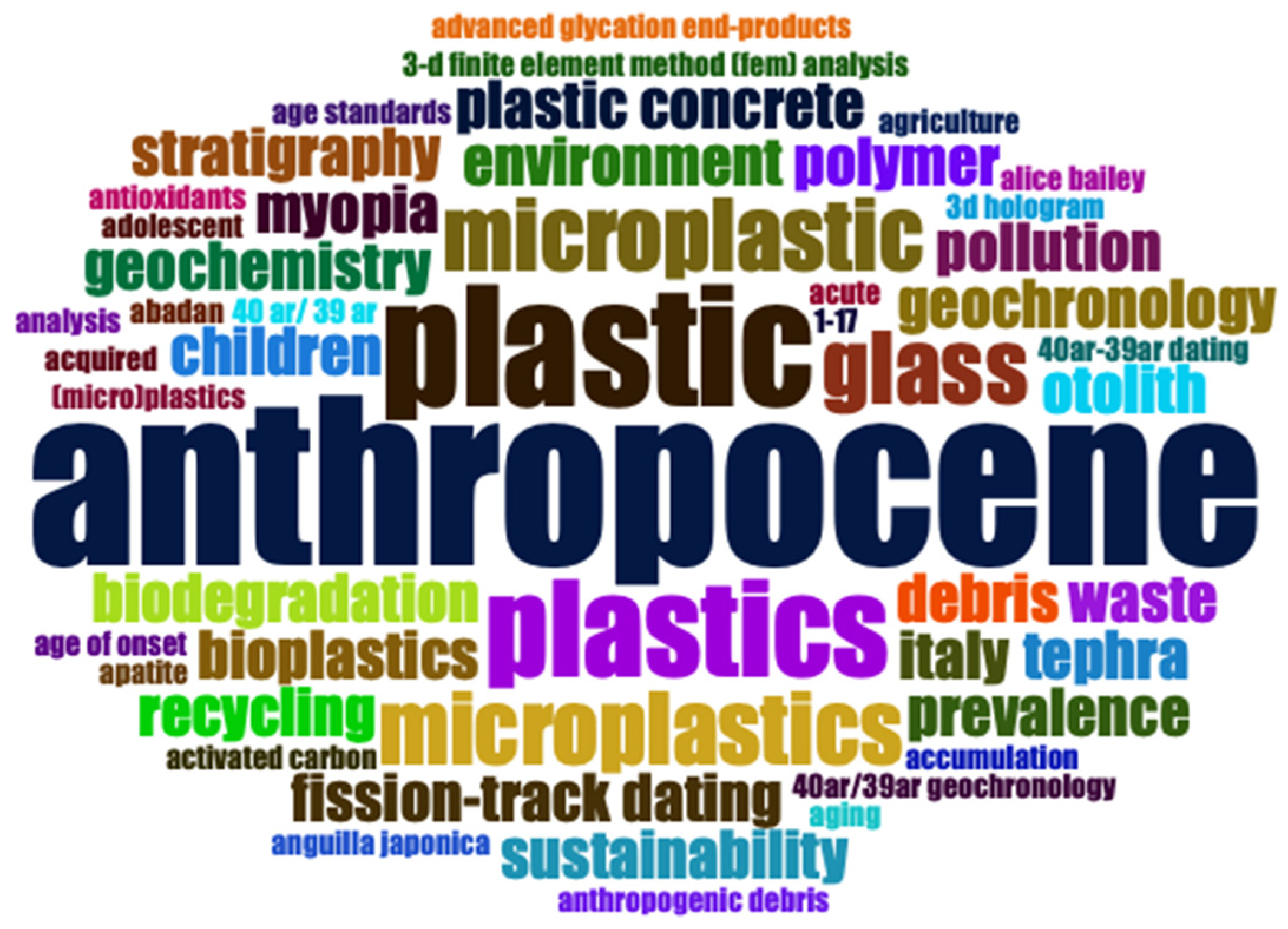
The first search (PG) was carried out by combining variations of “plastic age” and “glass age” in English, Portuguese, and French. This search resulted in 44 documents in Web of Science and 124 in Scopus. The most cited author is Bigazzi G., whose documents focus on the ‘age of glass’ as the ‘time of glass’ and its dating [35]. The keywords most cited by authors are ‘Anthropocene’, followed by ‘plastic’, ‘plastics’, and ‘glass’, and the most frequently used words are ‘plastics’, ‘glass’, and, interestingly, ‘child’3. The term ‘glass’ is associated with ophthalmological issues and the use of eyeglasses. Many articles study the chronological age of glass and refer to the ‘glass age’ in a similar fashion to Bigazzi’s approach. Some of these articles discuss consumption and alternatives to biodegradable plastics, mentioning the ‘age of plastic’ or the ‘plastic age’. This expression is commonly cited to reinforce arguments, as a rhetorical argument, though often without further scientific references. Figure 1 shows the resulting word cloud of the authors’ keywords found in the PG search.
Figure 1.
Word cloud of author keywords found in PG search. Source: Bibliometrix.
From this initial corpus, 31 documents were identified as directly relevant to the objectives of this study. Most references associated with the ‘Anthropocene’ are related to the presence of microplastics. Furthermore, authors such as Gałuszka & Migaszewski and Irabien et al. discuss the presence of glass microspheres in the Earth’s structure [36,37].
What we conclude from this keyword search is that not only plastic, but also glass, is associated with the Anthropocene. The ‘age of plastic’ is most often discussed in terms of the overproduction and overuse of plastics, generally carrying a negative connotation. In contrast, the expression ‘age of glass’ is used in a positive manner. Few authors, such as Morse and Evenson and the company Corning Inc., explore the term ‘age of glass’ [38,39]. However, it seems to be a business-related issue, as the company is responsible for the entire production of Gorilla Glass (used for mobile phone screens) and optical fibre, essential for the internet. In a preliminary literature search with the same keywords, we found another author who explores the ‘age of glass’ in his book The Age of Glass: A Cultural History of Glass in Modern and Contemporary Architecture [40]. Eskilson argues that glass has been the main material used in architecture since the second half of the twentieth century, both in buildings and in design architecture for spatial functions.
In the second search, we used the keywords ‘plastic’ and ‘Anthropocene’ (PA). As expected, many articles focus on global changes due to anthropogenic activities and the future of oceans in relation to pollution and plastics. The word ‘Anthropocene’ is used in various ways, including ‘Age of Humans’, ‘Age of Anthropocene’, and ‘anthroposphere’.
A relevant aspect is that 49 of the 132 articles found cite the word ‘microplastic’. As expected, within the 132 documents, the most frequently used author keyword is ‘Anthropocene’. The most productive author in this search is Vermaire, who studies microplastic pollution (see, for instance, [41]). The Anthropocene Working Group—established in 2009 at the International Commission on Stratigraphy to study the Anthropocene as a geological time—has a wide range of publications with highly cited manuscripts, such as Waters et al. [42] with 992 citations, and Zalasiewicz et al. [43,44] with 307 and 140 citations, respectively, the first of which proposes plastic as a stratigraphic indicator of the Anthropocene. The most relevant journal is Science of the Total Environment, with 13 articles. Out of the 132 documents, 31 were identified as potentially relevant to our research, with 4 overlapping with the previous search. The search for ‘plastic’ and ‘Anthropocene’ is closely linked to the production, pollution, and impact of plastics on the Earth as a result of human activities.
The search for ‘glass’ and ‘Anthropocene’ (GA) yielded interesting outcomes. Given the small number of documents found (17), the emphasis shifts towards a qualitative approach, where topics such as sustainability, ocean pollution, and the presence of anthropogenic materials in animals predominate. The first article relating glass and the Anthropocene dates back to 2014. Notably, one article connects glass and the Anthropocene in the context of the rise of electronic waste (e-waste). Of the 17 articles identified in the databases, only 4 were deemed relevant to our research, and 3 of these had already been included in previous searches.
We also explored the academic discourse surrounding plastic and glass in relation to heritage. To do this, we conducted two separate searches: one with the keywords ‘plastic’ and ‘heritage’ (PH) and another with ‘glass’ and ‘heritage’ (GH).
The PH search resulted in 574 documents. The most relevant sources were Key Engineering Materials, followed by journals focused on material culture or heritage. In this set, ‘cultural heritage’ emerged as the most frequently cited author keyword. This search encompassed a wide range of themes, including numerous articles related to medicine—specifically, plastic surgery and plastic materials crucial for medical interventions. These findings highlight the technological development of these materials. Although 574 documents were found, contrary to what was expected, only 16 were considered relevant to our research. As this selection was first based on an analysis of the titles, the results suggest that the titles might not always clearly reflect the content of the paper. The 16 selected articles include themes associated with the Anthropocene [45,46] and the degradation/conservation of plastic in cultural heritage contexts [47,48,49,50]. One of the main concerns here is how to preserve plastic materials that are deteriorating. While most discussions about plastic focus on issues of longevity and overaccumulation, this perspective offers a counterpoint, emphasising the need to conserve plastic heritage and the challenges involved. The paucity of articles selected in the PH search may be indicative of the fact that conservation is not always explicitly associated with heritage as a keyword, despite the importance of conserving plastic heritage.
The GH (‘glass’ and ‘heritage’) search yielded the largest number of documents in the entire study, with 546 results on Web of Science and 772 on Scopus. After disregarding duplicates, a substantial number of documents (901) combining ‘glass’ and ‘heritage’ remained. Given this fact, a thorough analysis of the results was not carried out. Although many of the results were outside this study’s focus, some valuable insights emerged. The oldest document in this set, from 1971, discusses ‘electrostatic lenses’. The most cited document, authored by Janssens et al. [51], explores various applications of X-ray microscopic fluorescence and associated methods in the analysis of materials of cultural value, such as historic glass. The three most relevant sources were the journals Key Engineering Materials, Heritage Science, and the Journal of Cultural Heritage, which align with the most frequently cited author keywords: ‘cultural heritage’, ‘glass’, and ‘heritage’. Similarly, the most frequent words were ‘glass’, ‘cultural heritage’, and ‘glass ceramics’. None of these documents mentioned the terms ‘Anthropocene’ and just two used ‘glass microspheres’. In summary, from a broad perspective, the search seems to predominantly have uncovered studies in which glass is linked to equipment used for observing, analysing, and evaluating cultural objects and monuments, but it does not seem that there is often a direct correlation between the keywords ‘glass’ and ‘heritage’.
In addition to the bibliometric analysis in Web of Science and Scopus, we conducted a search on JSTOR, which includes journals, books, images, and primary sources. The search for ‘age of plastic’ and ‘plastic age’ provided a lot of information related to a child’s plastic age and also to plastic medical intervention. Only more recently has the number of documents on production, consumption, pollution, and the Anthropocene increased, but without adding substantial new studies or new perspectives from previous searches already mentioned in this study. Examples are Thompson et al. with the article ‘Our Plastic Age’, presenting the positive and negative perspectives of plastic and citing the book Plastic by Yarsley et al., in which the authors address plastic in the visual arts [52,53]. Also, Ore uses the term ‘age of plastic’ in the context of developing synthetic materials, beginning with bakelite, and Lane presents plastic both as a revolutionary material and as a ‘waste’ causing environmental pollution, focusing on the African continent [54,55]. However, the search with ‘glass age’ and ‘age of glass’ resulted in a more positive bias.
The earliest source we found advocating the idea that we are living in an ‘age of glass’ is from 1919, in an article titled ‘The Age of Glass’ published in Scientific American with no designated author. The article highlights the significance of glass in the early twentieth century, emphasising its role in everyday life—from windows that keep out wind and weather to lamps that illuminate the night. It praises glass for its qualities of strength, transparency, and impermeability, and for its role in scientific instruments like microscopes and telescopes, which opened new frontiers in science and medicine, including cataract surgery. Other innovations, such as photography, were made possible because of glass, as well as artistic elements in architecture like those found in churches and other buildings. The article concludes with the following:
If there is still a shadow of doubt as to the significance of glass in modern civilization, let us but estimate the daily attendance at the moving picture theaters, remembering that without the camera’s glass eye the whole performance would be impossible. No glass, no movies. Glass has been known from antiquity, but its common use is comparatively recent. Ours has been spoken of as the age of steel. It might equally be pronounced the age of glass [56].
Another document from 1932, titled ‘Modern German Glass’ by Weigelt & Christensen, states the following: ‘The raw materials are furnished by the country itself and, speaking in the lingo of the industrial arts, ‘we live in the age of glass’. This is true not only of Germany but of almost every other civilized country’ [57]. In 1945, Van Antwerpen wrote in Scientific American that ‘a post-war age of glass, in which new and strange duties will be performed by that material, is predicted by Professor Alexander Silverman, head of the Department of Chemistry at the University of Pittsburgh and one of the nation’s leading authorities in glass technology’ [58]. He further elaborates that glass would be used to enhance comfort and that its progress in manufacturing and technology over the past 50 years had been unprecedented. The glass industry, already highly valued, was expected to grow even further. Scientific American continued to be an important source and in the September 1945 issue published an article about glass titled ‘Light and Progress’ [59]. This article takes a historical approach to the use of glass to introduce American glass. The publication also featured advertisements highlighting the significance of glass in various industries. For instance, Bausch & Lomb promoted optical glass and contact lenses; Corning advertised its research capabilities, including the development of more than 25,000 glass formulas such as Pyrex; Wollensak Lenses promoted optical glass for sports instruments like binoculars; Univis Lens Company offered multifocal ophthalmic lenses; and the Ilex Optical Company provided information on the new Ilex Acme Synchro Shutter. In discussing the contemporary context, Campbell & Peck note the proliferation of glass in all aspects of American life, from architecture to functional items like plates and electrical components. They conclude as follows: ‘When the war ends, the glass industry will start a period of unlimited expansion. (…) America is on the threshold of an age of brightness, an age of cleanliness, an age of glass’ [59]. The post-war expectations for the growth of the American glass industry were indeed high.
We also found a review of the book Nineteenth Century Glass: Its Genesis and Development by Albert Christian Revi, reviewed by H. Jack Haden in 1961 in the journal Technology and Culture, which had been recently created (1959) as the journal of the Society for the History of Technology [60]. The review describes the book as a valuable contribution to the history of glassmaking and decoration, both technologically and artistically, asserting that the nineteenth century was the ‘Golden Age of Glass’.
In this line of thinking, Konvitz suggests that the nineteenth century was the ‘First Industrial Age of iron, steam, and coal’, while the twentieth century was the ‘Second Industrial Age of glass, petroleum, and electricity’ (as cited in [61]).
In a review of the book British Glass 1800–1914 by Hajdamach, the reviewer Snavely describes it as a celebration of the golden age of British glass, which he believes could also be considered the golden age of glass more generally, as no other single century or place produced such an impressive array of shapes, colours, and techniques [62].
Certainly, one of the reasons for this claim is the Pilkington Company, founded in 1826, which for more than a century was one of the largest glass companies in the United Kingdom [63]. To promote the use of glass as a building material, Pilkington established ‘The Glass Age Development Committee’ in 1937. This committee aimed to propose solutions for urban planning in London using the structural and decorative properties of glass. One of their ambitious projects was the ‘Sea City’ proposal of 1968—a glass and concrete offshore city designed to house 21,000 people.
Another noteworthy mention is the review by Ian Morley of Isobel Armstrong’s book Victorian Glassworlds: Glass Culture and the Imagination, 1830–1880 [64]. Armstrong argues that the Victorian era was an ‘age of glass manufacture and extensive glass usage’, where glass transitioned from an ancient material to one that provided a new environment of mass transparency.
One of the most interesting articles we found in JSTOR is ‘…Not Just Glass’ by Smith, which discusses the improvements and versatility of glass due to recent scientific research [65]. Despite being written in 1935, the article’s content could very well be relevant today, as it presents different models of glass, their uses, and how they have impacted modern society.
The higher number of results for glass in the JSTOR search reflect the fact that it is an older material that has been used and studied for longer, whereas plastic has a far more recent history.
Taken together, these results reveal significant quantitative and thematic asymmetries in the academic use of the terms ‘plastic age’ and ‘glass age’, as well as their links to debates surrounding the Anthropocene and heritage.
5. Discussion
Building on the bibliometric patterns identified in the results, this discussion briefly reflects on what the observed asymmetries between plastic and glass reveal about heritage thinking in the Anthropocene. The bibliometric results highlight a persistent imbalance in how plastic and glass are framed as age-defining materials. While plastic is strongly associated with environmental degradation, pollution, and stratigraphic visibility in Anthropocene debates, glass is more frequently discussed in terms of technological innovation, analytical utility, and industrial progress. These divergent framings shape how each material is positioned in relation to waste and heritage.
This imbalance may also be partly explained by the role of antiquity and temporal depth in heritage recognition. As discussed in industrial heritage scholarship [18], materials and technologies tend to acquire heritage value once they are sufficiently distanced from the present. Yet we are now the first generation to recognize as heritage objects and materials that we have created and continue to use. This reinforces the perception that age and historical remoteness remain central criteria in heritage-making processes.
Returning to the central question of this article—waste or heritage—the findings suggest that both materials occupy an ambiguous position, with plastic presenting as paradoxical. It is ubiquitous in use, but suffers from what one may term ‘negative hypervisibility’. It becomes most visible when it fails—when it becomes litter, ocean pollution, or microplastics in the food chain. Furthermore, the literature on plastic materials in cultural heritage primarily focuses on the conservation challenges they present. Thus, the bibliometric results imply that this highly visible material is framed as a problem. As for glass, it possesses a ‘functional invisibility’, for instance the invisible infrastructure of the ‘information age’ (optical fibres, screens). Because it is perceived as inert and generally recyclable, it escapes the ‘waste’ discourse that makes plastic so visible, thereby remaining largely unexamined as a problematic stratigraphic agent in the broader Anthropocene debate.
Our search for ‘plastic’ and ‘heritage’ highlighted a struggle: curators and conservators are attempting to designate plastic objects as heritage (design icons or everyday items part of our history and material culture) once the material starts to chemically degrade. There is a conflict here between the macroscopic desire to preserve plastic for future generations and the microscopic reality of the material becoming waste (microplastics). Plastic is simultaneously the unwanted legacy of the Anthropocene (waste) and a fragile cultural signifier requiring urgent conservation (heritage). The ‘glass’ and ‘heritage’ search yielded more results, previously explained as it being part of analytical equipment used to characterise heritage objects. Nevertheless, it may also suggest that glass is becoming more accepted as heritage, not requiring the same discursive ‘fight’ for recognition that plastic does. However, modern industrial glass (the marker of the ‘glass age’) is largely absent from this heritage discourse, which focuses on ancient materials, sending the message that age (or our notion of old and ancient) matters.
From a heritage futures perspective [7,11,15], these asymmetries matter because they influence which material legacies are recognized, curated, or neglected in the present. Decisions about disposal or conservation are not neutral acts, but forms of future-making that determine what will endure as heritage.
The limited engagement of heritage-related research with plastic and glass as cultural and temporal phenomena highlights a significant discrepancy between the material realities of the Anthropocene and the current framework of heritage.
The bibliometric data seem to indicate a divergence in what will be left for the future. We are inadvertently preserving a massive record of plastic waste (the ‘technofossils’ cited in the PA search), while actively struggling to preserve specific plastic cultural objects due to degradation. Conversely, we are preserving some historical glass heritage, but potentially overlooking the preservation of the specific glass technologies (smartphones, fibre optics) that actually define our current ‘glass age’.
In the context of the Anthropocene, the ‘waste’ we try to hide (plastic pollution) is becoming the most enduring ‘heritage’ we leave behind, fulfilling the definition of an unintended monument. Meanwhile, the intentional monuments of our age—our technological glass interfaces—remain historically undervalued in the heritage sector.
6. Conclusions
The bibliometric analysis undertaken in the framework of this study resulted in over 1700 references, which shows the presence and relevance of exploring the correlation between the keywords glass and plastic ‘ages’, the Anthropocene, and heritage.
Historically, materials such as stone, bronze, and metal were used as markers of different eras [66]. With the consciousness that ‘ages’ were categorised through the analysis of the quality and quantity of materials found in museums, it becomes clear that what we decide to preserve in museums and heritage institutions today will highly likely be used by future generations to study, characterise, and judge our era.
In the context of the Anthropocene, mass-produced synthetic materials such as glass and plastics emerge as potential markers of this new epoch. These materials share the characteristics of omnipresence in contemporary society, being widely used in various objects and deemed essential in sectors such as transportation, medicine, communication, and architecture. However, due to their ubiquity, they often become ‘invisible’ in everyday life. During this study, a question has arisen that reveals a tension: are these materials and their remains considered waste of this epoch, or, if they are being questioned as marks of an epoch, are they to be considered part of the heritage of the Anthropocene?
The main results of this work reveal that glass, although appearing represented in the bibliographic research related to heritage, is apparently more connected with what it allows for in terms of analytical equipment such as microscope lenses, rather than having a strong correlation with the keyword heritage. On the other hand, plastic appears widely mentioned as a material related to pollution.
Despite the large number of results obtained for the searches using ‘plastic’/’glass’ and ‘heritage’ and the increasing movement of studies focusing on these materials as heritage (see, for instance, [50,67]), our results do not clearly illustrate this trend. One possible explanation for the low correlation between these keywords might be the fact that documents’ titles do not emphasise nor entirely reflect their content. In particular, research addressing the conservation, degradation, or material instability of plastics may not explicitly use the term ‘heritage’, being more frequently framed within chemistry, conservation science, or materials science. This means that plastic remained partially invisible to this keyword-based bibliometric search, which included ‘heritage’ as a keyword, but not ‘conservation’.
The term ‘glass age’ is apparently related with the marketing of glass (not only new glass formulations and new products but also as an alternative to other more pollutant materials) and the term ‘plastic age’ appears related to the multitude of plastic in our everyday life and all the problems associated with its disposal.
The current demonisation of plastic and the invisibility of glass might compromise the preservation of these heritages for present and future generations. Bibliometric analysis elucidates discursive asymmetries, providing a reflexive mechanism for scholars to observe how specific materials are hyper-problematised relative to those unexamined. This process informs critical heritage discourse by highlighting the mechanisms through which values are constructed, negotiated, and projected into the future. Will the results of this research inform the discussion on how the concepts of ‘glass age’ or the ‘plastic age’ influence heritage policies? Will these concepts influence what museums decide to incorporate and preserve for present and future generations? As future work, the authors believe that analysing the debates on the ‘plastic’ and the ‘glass’ ‘ages’ might contribute to increasing our knowledge of how they impact heritage policies at several governance levels (institutional, local, national, or even international). Furthermore, it will be paramount to look at different museum collections and understand where these materials are represented and how they represent today’s society.
Author Contributions
Conceptualization, I.C., J.L.F. and M.L.S.; methodology, B.B.; software, B.B.; validation, All; formal analysis, B.B. and M.L.S.; investigation, B.B.; resources: All; data curation, All; writing—original draft preparation, All; writing—review and editing, All; visualization, All; supervision, M.L.S. and J.L.F.; project administration, I.C. and J.L.F.; funding acquisition, I.C. and J.L.F. All authors have read and agreed to the published version of the manuscript.
Funding
This work was supported by the by the Portuguese Research Council, FCT—Fundação para a Ciência e a Tecnologia, I.P./MECI through national funds, under the research project «EXPL/ART-OUT/0146/2021», HERIT-AGES. Plastic and Glass ‘Ages’ for whom? Exploring new avenues for valuing and preserving heritage for the future (http://doi.org/10.54499/EXPL/ART-OUT/0146/2021); through PIDDAC, under the research units CIUHCT (Interuniversity Center for the History of Science and Technology), UID/00286/2025, and UIDB/00286/2020, (https://doi.org/10.54499/UIDB/00286/2020), and VICARTE-Vidro e Cerâmica para as Artes, UID/00729/2025 (https://doi.org/10.54499/UID/00729/2025), UID/PRR/00729/2025 (https://doi.org/10.54499/UID/PRR/00729/2025, VICARTE/NOVA-FCT and LA/P/0008/2020—LAQV), and UID/00729/2020 (https://doi.org/10.54499/UIDP/00729/2020).
Data Availability Statement
The original contributions presented in this study are included in the article. Further inquiries can be directed to the corresponding authors.
Conflicts of Interest
The authors declare that there are no potential conflicts of interest.
Notes
| 1 | See, for instance, the ‘plastic trash’ found on beaches in Holtorf [11]. |
| 2 | The bibliometric research was carried out in 2022; therefore, subsequent publications are not within the scope of the research. |
| 3 | The word ‘child’, as the third most cited term, is related to the ‘plastic age’ in the context of the plasticity of child development. |
References
- Le Goff, J. Must We Divide History into Periods? Columbia University Press: New York, NY, USA, 2015; ISBN 978-0-231-17300-1. [Google Scholar]
- Madden, O.; Charola, A.E.; Cobb, K.C. The Age of Plastic: Ingenuity and Responsibility, Proceeding of the 2012 MCI Symposium; Smithsonian Contributions to Museum Conservation; Smithsonian Institution Scholarly Press: Washington, DC, USA, 2017. [Google Scholar] [CrossRef] [Scilit]
- Diogo, M.P.; Leme, J.L.C.; Scarso, D. Introduction: Prometheus in the Garden of Eden. Essays on the Anthropocene. HoST—J. Hist. Sci. Technol. 2022, 16, 3–15. [Google Scholar] [CrossRef] [Scilit]
- Joint Statement by the IUGS and ICS on the Vote by the ICS Subcommission on Quaternary Stratigraphy. Available online: https://stratigraphy.org/news/152 (accessed on 29 September 2024).
- Chakrabarty, D. The Climate of History: Four Theses. Crit. Inq. 2009, 35, 197–222. [Google Scholar] [CrossRef] [Scilit]
- Diogo, M.P.; Louro, I.; Scarso, D. Uncanny Nature. Why the Concept of Anthropocene Is Relevant for Historians of Technology. ICON 2017, 23, 25–35. [Google Scholar]
- Harrison, R. Beyond “Natural” and “Cultural” Heritage: Toward an Ontological Politics of Heritage in the Age of Anthropocene. Herit. Soc. 2015, 8, 24–42. [Google Scholar] [CrossRef] [Scilit]
- Harrison, R.; DeSilvey, C.; Holtorf, C.; Macdonald, S.; Bartolini, N.; Breithoff, E.; Fredheim, H.; Lyons, A.; May, S.; Morgan, J.; et al. Heritage Futures. Comparative Approaches to Natural and Cultural Heritage Practices; UCL Press: London, UK, 2020; ISBN 978-1-78735-601-6. [Google Scholar]
- Shepherd, N. (Ed.) Rethinking Heritage in Precarious Times: Coloniality, Climate Change, and Covid-19; Routledge: London, UK, 2023; ISBN 978-1-003-18843-8. [Google Scholar]
- Solli, B.; Burström, M.; Domanska, E.; Edgeworth, M.; González-Ruibal, A.; Holtorf, C.; Lucas, G.; Oestigaard, T.; Smith, L.; Witmore, C. Some Reflections on Heritage and Archaeology in the Anthropocene. Nor. Archaeol. Rev. 2011, 44, 40–88. [Google Scholar] [CrossRef] [Scilit]
- Holtorf, C. Towards a World Heritage for the Anthropocene. In Rethinking Heritage in Precarious Times: Coloniality, Climate Change, and COVID-19; Shepherd, N., Ed.; Routledge: London, UK, 2023; pp. 111–126. ISBN 978-1-003-18843-8. [Google Scholar]
- Costa, C.; Baptista, R. Organizational Heritage and Entrepreneurship: Steven Klepper’s Theories Reflected in the Emergence and Growth of the Plastic Molds Industry in Portugal. In Entrepreneurship, Human Capital, and Regional Development; Baptista, R., Leitão, J., Eds.; International Studies in Entrepreneurship; Springer International Publishing: Cham, Switzerland, 2015; Volume 31, pp. 281–293. ISBN 978-3-319-12870-2. [Google Scholar]
- Garcia-Rejon, A. Advances in Blow Moulding Process Optimization; Rapra Review Reports; Rapra Technology Ltd.: Shrewsbury, UK, 1995; ISBN 978-1-85957-050-0. [Google Scholar]
- Ruskin, J. The Seven Lamps of Architecture; Allen, G., Ed.; Library Edition; Hazell, Watson, and Viney, Ltd.: Aylesbury, UK, 1889; Volume VI. [Google Scholar]
- Harrison, R. Heritage as Future-Making Practices. In Heritage Futures: Comparative Approaches to Natural and Cultural Heritage Practices; Harrison, R., DeSilvey, C., Holtorf, C., Macdonald, S., Bartolini, N., Breithoff, E., Fredheim, H., Lyons, A., May, S., Morgan, J., et al., Eds.; UCL Press: London, UK, 2020; pp. 20–50. ISBN 978-1-78735-600-9. [Google Scholar]
- ICOMOS. International Charter for the Conservation and Restoration of Monuments and Sites; ICOMOS: Venice, Italy, 1964. [Google Scholar]
- UNESCO. Convenção para a Protecção do Património Mundial, Cultural e Natural; UNESCO: Paris, France, 1972. [Google Scholar]
- Casanelles i Rahóla, E. Nuevo concepto de Patrimonio Industrial, evolución de su valoración, significado y rentabilidad en el contexto internacional. Bienes Cult. Rev. Del Inst. Del Patrim. Histórico Español 2007, 7, 59–70. [Google Scholar]
- Riegl, A. O Culto Moderno Dos Monumentos: A Sua Essência e a Sua Origem, 1st ed.; Perspectiva: São Paulo, Brazil, 2014; ISBN 978-85-273-1005-5. [Google Scholar]
- Avrami, E.C.; De la Torre, M.; Mason, R.; Getty Conservation Institute. Values and Heritage Conservation: Research Report; Getty Conservation Institute: Los Angeles, CA, USA, 2000. [Google Scholar]
- de la Torre, M. Values and Heritage Conservation. Herit. Soc. 2013, 6, 155–166. [Google Scholar] [CrossRef] [Scilit]
- Our Common Future: Report of the World Commission on Environment and Development; United Nations: Geneva, Switzerland, 1987.
- Fredheim, L.H.; Khalaf, M. The Significance of Values: Heritage Value Typologies Re-Examined. Int. J. Herit. Stud. 2016, 22, 466–481. [Google Scholar] [CrossRef] [Scilit]
- Smith, L. Uses of Heritage; Heritage Studies; Routledge: London, UK, 2010; ISBN 978-0-415-31831-0. [Google Scholar]
- McAtackney, L. Heritage, Social Justice and Black Lives Matter in Ireland during COVID-19. In Rethinking Heritage in Precarious Times: Coloniality, Climate Change, and COVID-19; Shepherd, N., Ed.; Routledge: London, UK, 2023; pp. 169–185. ISBN 978-1-003-18843-8. [Google Scholar]
- Choay, F. Alegoria do Património; Edições 70: Lisbon, Portugal, 2014; ISBN 978-972-44-1274-0. [Google Scholar]
- Macdonald, S.; Morgan, J.; Fredheim, H.; Penrose, S. Too Many Things to Keep for the Future? In Heritage Futures. Comparative Approaches to Natural and Cultural Heritage Practices; Harrison, R., DeSilvey, C., Holtorf, C., Macdonald, S., Bartolini, N., Breithoff, E., Fredheim, H., Lyons, A., May, S., Morgan, J., Eds.; Comparative Approaches to Natural and Cultural Heritage Practices; UCL Press: London, UK, 2020; pp. 155–168. ISBN 978-1-78735-601-6. [Google Scholar]
- Macdonald, S.; Morgan, J.; Fredheim, H.; Penrose, S. Doomed? In Heritage Futures. Comparative Approaches to Natural and Cultural Heritage Practices; Harrison, R., DeSilvey, C., Holtorf, C., Macdonald, S., Bartolini, N., Breithoff, E., Fredheim, H., Lyons, A., May, S., Morgan, J., Eds.; Comparative Approaches to Natural and Cultural Heritage Practices; UCL Press: London, UK, 2020; pp. 238–248. ISBN 978-1-78735-601-6. [Google Scholar]
- Schiffer, M.B. Behavioral Archeology; Studies in Archeology; Academic Press: New York, NY, USA, 1976; ISBN 978-0-12-624150-1. [Google Scholar]
- Zalasiewicz, J.; Williams, M.; Waters, C.N.; Barnosky, A.D.; Haff, P. The Technofossil Record of Humans. Anthr. Rev. 2014, 1, 34–43. [Google Scholar] [CrossRef] [Scilit]
- Donthu, N.; Kumar, S.; Mukherjee, D.; Pandey, N.; Lim, W.M. How to Conduct a Bibliometric Analysis: An Overview and Guidelines. J. Bus. Res. 2021, 133, 285–296. [Google Scholar] [CrossRef] [Scilit]
- Hérubel, J.-P.V.M. Historical Bibliometrics: Its Purpose and Significance to the History of Disciplines. Libr. Cult. 1999, 34, 380–388. [Google Scholar]
- Vlase, I.; Lähdesmäki, T. A Bibliometric Analysis of Cultural Heritage Research in the Humanities: The Web of Science as a Tool of Knowledge Management. Humanit. Soc. Sci. Commun. 2023, 10, 84. [Google Scholar] [CrossRef] [Scilit] [PubMed]
- Bibliometrix. Available online: https://www.bibliometrix.org/home/index.php/layout/bibliometrix (accessed on 12 May 2022).
- Laurenzi, M.A.; Balestrieri, M.L.; Bigazzi, G.; Hadler Neto, J.C.; Iunes, P.J.; Norelli, P.; Oddone, M.; Osorio Araya, A.M.; Viramonte, J.G. New Constraints on Ages of Glasses Proposed as Reference Materials for Fission-Track Dating. Geostand. Geoanalytical Res. 2007, 31, 105–124. [Google Scholar] [CrossRef] [Scilit]
- Gałuszka, A.; Migaszewski, Z.M. Glass Microspheres as a Potential Indicator of the Anthropocene: A First Study in an Urban Environment. Holocene 2018, 28, 323–329. [Google Scholar] [CrossRef] [Scilit]
- Irabien, M.J.; Cearreta, A.; Gómez-Arozamena, J.; García-Artola, A. Holocene vs. Anthropocene Sedimentary Records in a Human-Altered Estuary: The Pasaia Case (Northern Spain). Mar. Geol. 2020, 429, 106292. [Google Scholar] [CrossRef] [Scilit]
- Morse, D.L.; Evenson, J.W. Welcome to the Glass Age. Int. J. Appl. Glass Sci. 2016, 7, 409–412. [Google Scholar] [CrossRef] [Scilit]
- Corning. The Glass Age|Corning. Available online: https://www.corning.com/cala/pt/innovation/the-glass-age.html (accessed on 16 March 2022).
- Eskilson, S. The Age of Glass: A Cultural History of Glass in Modern and Contemporary Architecture; Bloomsbury Academic: New York, NY, USA, 2018; ISBN 978-1-4742-7836-2. [Google Scholar]
- Vermaire, J.C.; Pomeroy, C.; Herczegh, S.M.; Haggart, O.; Murphy, M. Microplastic Abundance and Distribution in the Open Water and Sediment of the Ottawa River, Canada, and Its Tributaries. FACETS 2017, 2, 301–314. [Google Scholar] [CrossRef] [Scilit]
- Waters, C.N.; Zalasiewicz, J.; Summerhayes, C.; Barnosky, A.D.; Poirier, C.; Gałuszka, A.; Cearreta, A.; Edgeworth, M.; Ellis, E.C.; Ellis, M.; et al. The Anthropocene Is Functionally and Stratigraphically Distinct from the Holocene. Science 2016, 351, aad2622. [Google Scholar] [CrossRef] [Scilit]
- Zalasiewicz, J.; Waters, C.N.; Ivar do Sul, J.A.; Corcoran, P.L.; Barnosky, A.D.; Cearreta, A.; Edgeworth, M.; Gałuszka, A.; Jeandel, C.; Leinfelder, R.; et al. The Geological Cycle of Plastics and Their Use as a Stratigraphic Indicator of the Anthropocene. Anthropocene 2016, 13, 4–17. [Google Scholar] [CrossRef] [Scilit]
- Zalasiewicz, J.; Waters, C.N.; Summerhayes, C.P.; Wolfe, A.P.; Barnosky, A.D.; Cearreta, A.; Crutzen, P.; Ellis, E.; Fairchild, I.J.; Gałuszka, A.; et al. The Working Group on the Anthropocene: Summary of Evidence and Interim Recommendations. Anthropocene 2017, 19, 55–60. [Google Scholar] [CrossRef] [Scilit]
- Mytum, H.; Meek, J. The Iron Age in the Plastic Age: Anthropocene Signatures at Castell Henllys. Antiquity 2021, 95, 198–214. [Google Scholar] [CrossRef] [Scilit]
- Pétursdóttir, Þ. Climate Change? Archaeology and Anthropocene. Arch. Dial. 2017, 24, 175–205. [Google Scholar] [CrossRef] [Scilit]
- Blank, S. An Introduction to Plastics and Rubbers in Collections. Stud. Conserv. 1990, 35, 53–63. [Google Scholar] [CrossRef] [Scilit]
- de Sá, S.F.; Da Cruz, S.M.; Callapez, M.E.; Carvalho, V. Plastics That Made History—The Contribution of Conservation Science for the History of the Portuguese Plastics Industry. Conserv. Patrim. 2020, 35, 85–100. [Google Scholar] [CrossRef] [Scilit]
- Manfredi, M.; Barberis, E.; Marengo, E. Prediction and Classification of the Degradation State of Plastic Materials Used in Modern and Contemporary Art. Appl. Phys. A 2017, 123, 35. [Google Scholar] [CrossRef] [Scilit]
- Shashoua, Y. Mesocycles in Conserving Plastics. Stud. Conserv. 2016, 61, 208–213. [Google Scholar] [CrossRef] [Scilit]
- Janssens, K.; Vittiglio, G.; Deraedt, I.; Aerts, A.; Vekemans, B.; Vincze, L.; Wei, F.; De Ryck, I.; Schalm, O.; Adams, F.; et al. Use of Microscopic XRF for Non-Destructive Analysis in Art and Archaeometry. X-Ray Spectrom. 2000, 29, 73–91. [Google Scholar] [CrossRef]
- Thompson, R.C.; Swan, S.H.; Moore, C.J.; vom Saal, F.S. Our Plastic Age. Philos. Trans. R. Soc. B Biol. Sci. 2009, 364, 1973–1976. [Google Scholar] [CrossRef] [Scilit]
- Yarsley, V.E.; Couzens, E.G. Plastics; Pelican Book; Penguin Books: Harmondsworth, UK, 1945. [Google Scholar]
- Ore, J. Mobile Home Syndrome: Engineered Woods and the Making of a New Domestic Ecology in the Post-World War II Era. Technol. Cult. 2011, 52, 260–286. [Google Scholar] [CrossRef] [Scilit]
- Lane, W. Oceans of Plastics: Developing Effective African Policy Responses; South African Institute of International Affairs: Johannesburg, South Africa, 2018. [Google Scholar]
- The Age of Glass. Sci. Am. 1919, 121, 440. Available online: http://www.jstor.org/stable/24991567 (accessed on 27 November 2025).
- Weigelt, H.; Christensen, E.O. Modern German Glass. Am. Mag. Art 1932, 24, 35–48. [Google Scholar]
- Van Antwerpen, F.J. Where Research Is King. Sci. Am. 1945, 172, 35–37. [Google Scholar] [CrossRef] [Scilit]
- Campbell, J.; Peck, A.P. Light and Progress. Sci. Am. 1945, 173, 137–150. [Google Scholar] [CrossRef] [Scilit]
- Haden, H.J. Review of Nineteenth Century Glass: Its Genesis and Development. Technol. Cult. 1961, 2, 68–70. [Google Scholar] [CrossRef] [Scilit]
- Melosi, M.V. The Place of the City in Environmental History. Environ. Hist. Rev. 1993, 17, 1–23. [Google Scholar] [CrossRef] [Scilit]
- Snavely, L. Review of British Glass 1800–1914, by C. R. Hajdamach. Art Doc. J. Art Libr. Soc. N. Am. 1993, 12, 173–174. [Google Scholar]
- Barker, T.C. An Age of Glass: Pilkington, the Illustrated History; Boxtree Publ: London, UK, 1994; ISBN 978-1-85283-455-5. [Google Scholar]
- Morley, I. Review of Victorian Glassworlds: Glass Culture and the Imagination, 1830–1880. J. Br. Stud. 2009, 48, 1018–1020. [Google Scholar] [CrossRef] [Scilit]
- Smith, P.H. ……Not Just Glass. Sci. Am. 1935, 153, 314–317. [Google Scholar] [CrossRef] [Scilit]
- Eskildsen, K.R. The Language of Objects: Christian Jürgensen Thomsen’s Science of the Past. Isis 2012, 103, 24–53. [Google Scholar] [CrossRef] [Scilit]
- Rodrigues, A.J. The Glass Collection of Ferdinand II in Museu Nacional de Arte Antiga: Study and Preservation. Ph.D. Thesis, NOVA University of Lisbon, Lisbon, Portugal, 2018. [Google Scholar]

Disclaimer/Publisher’s Note: The statements, opinions and data contained in all publications are solely those of the individual author(s) and contributor(s) and not of MDPI and/or the editor(s). MDPI and/or the editor(s) disclaim responsibility for any injury to people or property resulting from any ideas, methods, instructions or products referred to in the content. |
© 2026 by the authors. Licensee MDPI, Basel, Switzerland. This article is an open access article distributed under the terms and conditions of the Creative Commons Attribution (CC BY) license.