Article

A Multi-Technique Study of 49 Gold Solidi from the Late Antique Period (Late 4th–Mid 6th Century AD)


1
Dipartimento di Scienze Chimiche e Farmaceutiche, Università degli Studi di Trieste, Via Licio Giorgieri, 1, 34127 Trieste, Italy
2
Dipartimento di Matematica, Informatica e Geoscienze, Università degli Studi di Trieste, Via Edoardo Weiss, 2, 34128 Trieste, Italy
3
Dipartimento di Studi Umanistici, Università degli Studi di Trieste, Via Lazzaretto Vecchio, 8, 34124 Trieste, Italy
*
Authors to whom correspondence should be addressed.
Heritage 2026, 9(1), 38; https://doi.org/10.3390/heritage9010038
Submission received: 30 September 2025 / Revised: 9 January 2026 / Accepted: 15 January 2026 / Published: 20 January 2026

Abstract

This study investigates 49 gold solidi issued between the 4th and 5th century AD to determine their chemical composition. The coins were first catalogued by recording mass, diameter, and thickness. All specimens underwent non-destructive µ-EDXRF analysis to identify main elements, followed by semi-quantitative fineness evaluation. To validate these results, six coins were randomly micro-sampled: material was dissolved in aqua regia and analysed by ICP-AES for gold quantification and ICP-MS for high precision trace element determination. The non-destructive analyses showed consistently high gold percentages, confirming authenticity and the extensive use of this noble metal during the studied period. Two distinct groups were identified based on the XRF Pt/Pd ratio, suggesting the use of gold from different sources. Comparison of μ-EDXRF and ICP-AES gold contents shows no statistically significant differences; however, this apparent agreement should be interpreted cautiously, as it mainly reflects the limited resolving power of ICP-AES at very high gold concentrations rather than definitive evidence for the absence of surface-related effects. Trace elements analysis detected low concentrations of Cu, Sn, and Pb suggesting the use of alluvial gold for minting. The presence and correlation of terrigenous elements (Al, Ca, Ti, Cr, Mn, Fe, Ni, Zn, Sr) indicate soil as the burial site.

1. Introduction

Gold (Au) has been one of the earliest metals intentionally exploited by human societies, due to its natural occurrence in native form, its chemical stability and its ductility. The earliest known crafted gold artefacts—most famously those from the Varna I cemetery in Bulgaria—date to the mid-5th millennium BC and bear witness to a sophisticated early metallurgy in the Chalcolithic Balkans [1]. From antiquity onwards, gold circulated widely as a prestige material and, later, as a monetary standard that shaped political and economic systems across the Mediterranean [2].
From the first appearance of coinage in the late 7th century BC, the challenges associated with separating gold from silver (Ag) led to widespread use of electrum [3,4]. Advances in refining technologies, however, enabled the production of high-purity gold coinage already by the 6th century BC, as shown by the analyses of the Sardis finds [2]. In the Late Roman and Early Byzantine periods, the solidus became the Empire’s foundational gold denomination. Introduced by Constantine around AD 310 and struck at 1/72 of the Roman pound (i.e., an individual weight of about 4.55 g), the solidus maintained remarkable stability in weight and appearance, although variations in purity and minor-element content reflect administrative changes and economic fluctuations [5,6]
Scientific analysis of ancient coins plays a fundamental role in numismatic studies, because it allows the reconstruction of minting practices, alloy composition, circulation, debasement episodes and—potentially—the provenance of the metal (ore source) used. Chemical analyses carried out over the past decades demonstrate that Late Antique gold coins usually contain very high gold percentages, but their silver, copper (Cu) and platinum-group element (PGE) contents can vary significantly [7,8]. These minor and trace elements are crucial indicators of both the refining technology and the geological origin of the metal. Platinum (Pt) and palladium (Pd) are generally more stable than other PGEs during ancient gold refining processes, particularly during cementation and cupellation. Although experimental studies indicate that slight depletion of Pt and Pd may occur under specific cementation conditions, their concentrations are typically less affected than those of other trace elements, making them informative indicators of refining processes and, to some extent, of the original metal source [9,10,11,12].
The archaeometric study of gold coinage has increasingly relied on multi-technique approaches capable of assessing both surface and bulk compositions [13]. While bronze [14] and silver-copper alloy coins [15] commonly undergo surface enrichment or depletion—often caused by soil encrustations, superficial contaminants, or localized chemical alterations—gold artefacts generally exhibit negligible corrosion and thus much more limited surface modification. Recent large-scale studies on Roman gold coinage, notably those conducted within the Gold Coinage in the Roman World Project, have demonstrated that for well-preserved gold coins the compositional differences between surface and bulk are generally negligible. For these reasons, the integration of non-destructive techniques (e.g., X-Ray Fluorescence, XRF) with micro-destructive techniques can maximize the information extracted from precious, archaeologically valuable specimens while minimizing damages [16,17,18]. The combined use of XRF, LA-ICP-MS and muonic X-ray emission spectroscopy has shown a strong agreement between surface-sensitive and sub-surface analyses for Roman aurei and solidi, in contrast to what is commonly observed for silver coinages, where intentional surface enrichment has been clearly documented [19,20]. In particular, depth-profiling investigations using negative muons revealed surface-enriched layers extending up to several hundred micrometres in silver coins, whereas no comparable compositional gradients were detected in Roman gold coinage [21].
This study examines a group of 49 Late Antique gold coins—47 solidi and 2 tremisses—issued in the mints of Constantinople, Thessaloniki, and Ravenna (Table 1). The coins were provided to the authors without any accompanying archaeological documentation; according to the information received, they reportedly originated from a hoard in the Balkan region, although the exact discovery context remains unknown. Spanning from the reign of Gratian (AD 367–383) to that of Justinian I (AD 527–565), this coherent assemblage offers a valuable opportunity to reconsider the fineness, metallurgical variability, and trace elements signatures of gold coinage in Late Antiquity.
The aims of this research are therefore:
  • to quantify major, minor and trace elements using combined XRF and Inductively Coupled Plasma (ICP) approach;
  • to investigate the presence of PGEs (Pt, Pd) as potential indicators of ore sources and refining practices;
  • to assess the consistency between surface and bulk compositional information obtained by different analytical techniques.
Through this integrated analytical strategy, the study contributes new insights into minting procedures, metallurgical choices, and the circulation of gold in the eastern Mediterranean between late 4th to mid 6th century AD.

2. Materials and Methods

2.1. Chemicals and Apparatuses

All chemicals used were of analytical quality. Nitric acid (67–69% v/v) and hydrochloric acid (30% v/v) were sourced from VWR (Milan, Italy). Water conforming to reagent grade standards was generated using a Millipore purification pack system (MilliQ water from Millipore, Burlington, MA, USA).
All 49 coins were catalogued with a sequential number and photographed. The average mass (N = 3) was determined by using an analytical weigh scale (Sartorius Series CPA225D) with a capacity of 220 g, a readability of 0.01 mg, linearity ≤ 0.03 mg, standard deviation ≤ 0.02 mg, and a stabilisation time of ≤6 s. Furthermore, with the assistance of Vernier callipers, the diameter and thickness of each coin were measured at three different points.
A 99.9% Au reference sample (4.0 × 4.0 × 0.52 mm, 0.2 g), satin-finishing and pickled, was produced by a professional goldsmith to support semi-quantitative analysis.

2.2. µ-EDXRF

Surface compositions were obtained using an ARTAX 200 micro-XRF spectrometer (provided by Bruker Nano GmbH in Berlin, Germany). This instrument is equipped with an air-cooled Mo X-ray fine focus tube (maximum 50 kV, 1 mA, 40 W), which is controlled by a compact high-voltage generator unit and features a 650 µm collimator.
Additionally, it has a Peltier-cooled XFlash® silicon drift detector with 10 mm2 of active area and an energy resolution of <150 eV for Mn–Kα at 100 kcps. A CCD camera with 500 × 582 pixels is integrated for sample positioning. The instrument’s focal spot measures 1.2 × 0.1 mm2, offering a lateral resolution of 0.2 mm, and it includes a 100 µm beryllium window.
We utilised the ARTAX control semi-quantitative XRF software (version 5.3.14.0, licensed by Bruker AXS Microanalysis GmbH, Berlin, Germany) for both hardware control and the evaluation of analytical data. Data were represented in the form of counts per second (cps) versus energy (keV). The instrumental settings were configured as follows: X-ray tube = 30 W, Mo target voltage U = 50 kV, current I = 700 µA, and an acquisition time of 60 s (live time). The collimator was set at 650 µm in an air environment.
The elements examined included gold (Au) Lα1 9.71 keV, silver (Ag) Kα1 22.16 keV, copper (Cu) Kα1 8.05 keV, palladium (Pd) Kα1 21.18 keV, platinum (Pt) Lγ1 12.93 keV, iron (Fe) Kα1 6.40 keV, nickel (Ni) Kα1 7.48 keV, strontium (Sr) Kα1 14.16 keV, calcium (Ca) Kα1 3.69 keV, potassium (K) Kα1 3.31 keV, manganese (Mn) Kα1 5.89 keV, titanium (Ti) Kα1 4.51 keV, vanadium (V) Kα1 4.51 keV, and zinc (Zn) Kα1 8.64 keV.
Four spectra were acquired for each coin, consisting of two on the obverse (recto) and two on the reverse (verso).
Attempts were made to avoid encrusted or corroded micro-areas, some soil-derived inclusions were unavoidable due to the long-term burial environment, the fragility of the patinas, and the decision to avoid mechanical or chemical cleaning that could alter the surface composition. This constraint is well recognised in studies of buried gold artefacts. While different instruments and specific settings were used, our approach is broadly consistent with established µ-EDXRF procedures for the analysis of ancient coinages, as reported in Green et al. [19], Bayazit and Seker [22], Buccolieri et al. [23], and Marussi et al. [17].

2.3. Sample Preparation for ICP Analyses

Since Inductively Coupled Plasma-Atomic Emission Spectroscopy (ICP-AES) and Inductively Coupled Plasma-Mass Spectrometry (ICP-MS) require solution-based analysis, sampling is necessary. Micro-destructive sampling was carried out on six coins (Table 2) using a professional cutter to extract small flakes from the coin edges to avoid affecting iconography or legends [16,17]. The coins were selected randomly, based solely on analytical and conservation criteria (variation in thickness, preservation state, and inclusion of one tremissis), as no contextual or numismatic information was available at the time of analysis. The collected material was weighed using an analytical weigh scale (Sartorius Series CPA225D) The obtained flakes (about 7 mg) were dissolved in aqua regia (3:1 HCl:HNO3), and heated overnight to promote the dissolution. The solutions were then appropriately diluted in a 100 mL volumetric flask (class A) with MilliQ water for subsequent analyses.
The thickness of the collected flakes, corresponding to several tenths of a millimetre, ensures that the subsequent analyses probe a greater depth of the metal than the surface-sensitive XRF measurements employed in this study or typical LA-ICP-MS analyses, providing complementary information on the coin’s internal composition.

2.4. ICP-AES

Gold was quantified using an ICP-AES spectrometer (PerkinElmer® Optima™ 8000, Waltham, MA, USA).
Calibration, which was linear within the concentration range of 0.1–10 mg L−1, was conducted following the dilution of a multi-standard solution with an initial concentration of 10 mg L−1 for ICP analysis (Periodic Table Mix 2 for ICP TraceCERT®, Sigma-Aldrich, St. Louis, MO, USA). The limit of detection (LOD) for the solution samples at the operating wavelength (242.795 nm) was 0.02 mg L−1. The coefficients of variation for repeatability (RSD %) were determined to be less than 5%.
The accuracy of the analysis and the matrix effect were evaluated by means of laboratory-fortified samples prepared by spiking a standard solution different from that employed for instrument calibration into actual samples.

2.5. ICP-MS

Trace metal concentrations were determined using an ICP-MS NexION 350x Spectrometer from PerkinElmer (Waltham, MA, USA) equipped with an ESI SC autosampler. The quantified elements were: silver (Ag), copper (Cu), platinum (Pt), palladium (Pd), tin (Sn), lead (Pb), mercury (Hg), aluminium (Al), calcium (Ca), iron (Fe), titanium (Ti), strontium (Sr), chromium (Cr), manganese (Mn), nickel (Ni), and zinc (Zn). Particular attention was given to PGEs (Pt, Pd), as they are robust indicators of ore sources. The analysis was conducted in KED mode (Kinetic Energy Discrimination), with ultra-high purity helium (at a flow rate of 4.8 mL min−1) used to prevent interference caused by cell-formed polyatomic ions.
Calibration of the instrument, which was linear within the concentration range of 0.5–100 µg L−1, was carried out following the dilution of multi-standard solutions initially at a concentration of 10 mg L−1 for ICP analysis (Periodic Table Mix 1 for ICP TraceCERT® and Periodic Table Mix 2 for ICP TraceCERT®, Sigma-Aldrich, St. Louis, MO, USA). The composition of the samples was determined using the calibration curve method obtained by analysing standard solutions. The LOD for each element were as follows: Ag 0.02 µg L−1, Cu 0.20 µg L−1, Pt 0.005 µg L−1, Pd 0.005 µg L−1, Sn 0.07 µg L−1, Pb 0.06 µg L−1, Hg 0.01 µg L−1, Al 0.10 µg L−1, Ca 1.2 µg L−1, Fe 1.5 µg L−1, Ti 0.05 µg L−1, Sr 0.05 µg L−1, Cr 0.10 µg L−1, Mn 0.03 µg L−1, Ni 0.20 µg L−1, and Zn 0.09 µg L−1.

2.6. Data Analysis

Consistency between surface (µ-EDXRF) and near-bulk (ICP-AES) results was assessed using a paired t-test for repeated measurements and Bland–Altman analysis. All analyses were performed within the R software environment for statistical computing and graphics (R version 4.1.2 “Bird Hippie”), on a commercially available workstation (x86_64-apple-darwin17.0 64-bit).

3. Results

3.1. Preliminary Non-Invasive Investigation by µ-EDXRF

The measurement of the physical characteristics showed good uniformity and conservation of the samples. The measured masses ranged from 4.22 to 4.54 g, with an average of 4.39 g, which is very close to the theoretical value of 4.50 g [5]. The two tremisses also had an average mass of 1.49 g and 1.50 g, matching the one-third ratio [24].
Each solidus was analysed by μ-EDXRF spectroscopy at four points (two on the recto, presenting the emperor’s face, and two on the verso). Spectra were highly consistent, except in the presence of visible surface concretions. These produced a distinct Ca Kα peak (3.69 keV) and attenuated Au lines. Other elements (K, Mn, Ti, V, and Zn), probably related to the burial site, were identified in some coins [18].
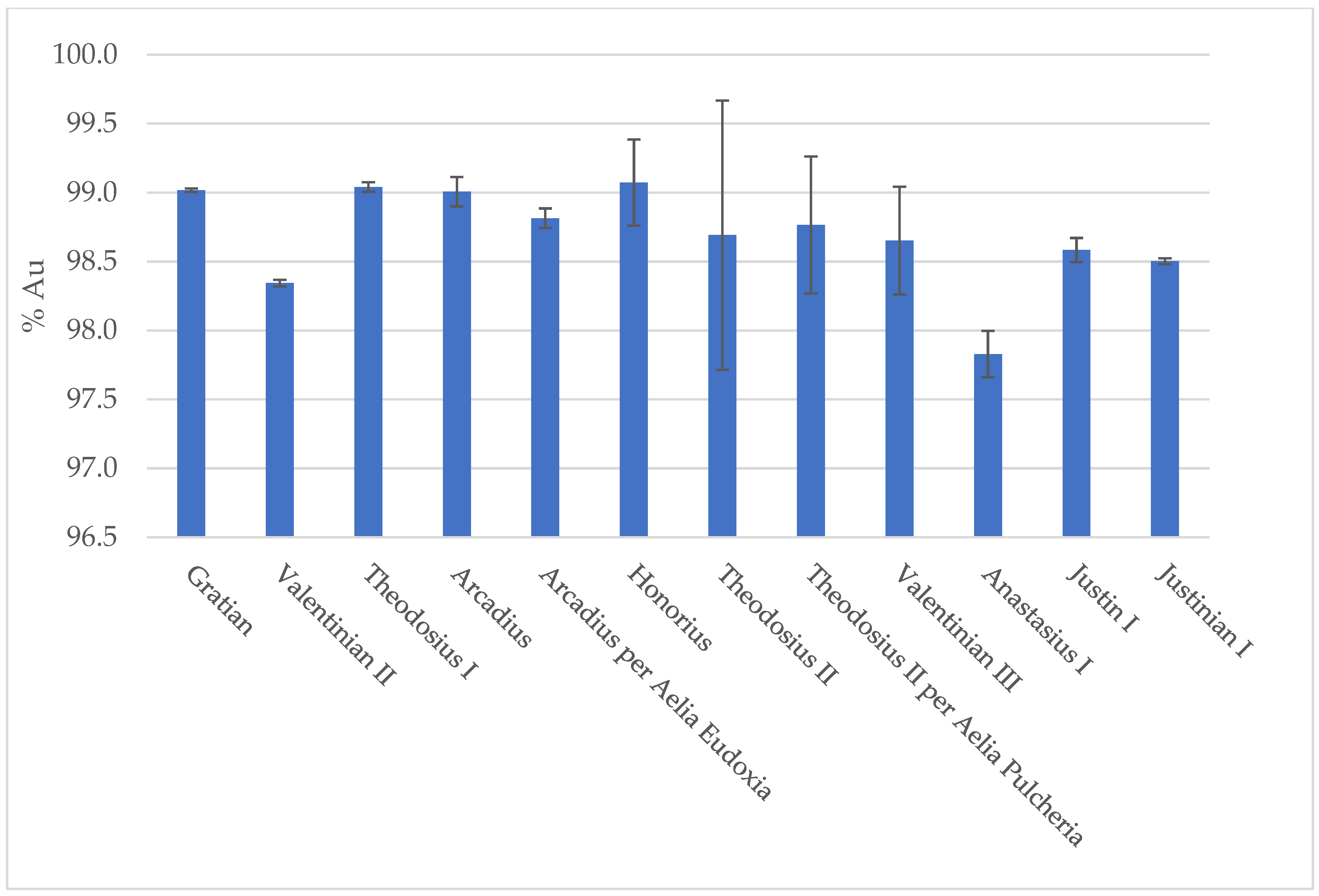
A semi-quantitative estimate of the gold content in the coins was obtained by normalizing the area of the Au Lα peak (9.67 keV) to the sum of the peak areas of the major elements (Au, Ag, Cu, Pt, and Pd) (Figure 1). The solidi are grouped according to the authority. A 99.9% gold standard, treated with satin-finishing and pickling processes, was used to validate the calculation procedure. As these gold coins are well-preserved, it could be reasonably assumed that the surface is representative of the entire sample [25]. The coins show uniformly high gold content (>97%), in agreement with previous work indicating that the Constantinopolitan gold coinage remained essentially unalloyed until the end of the 9th century [26].
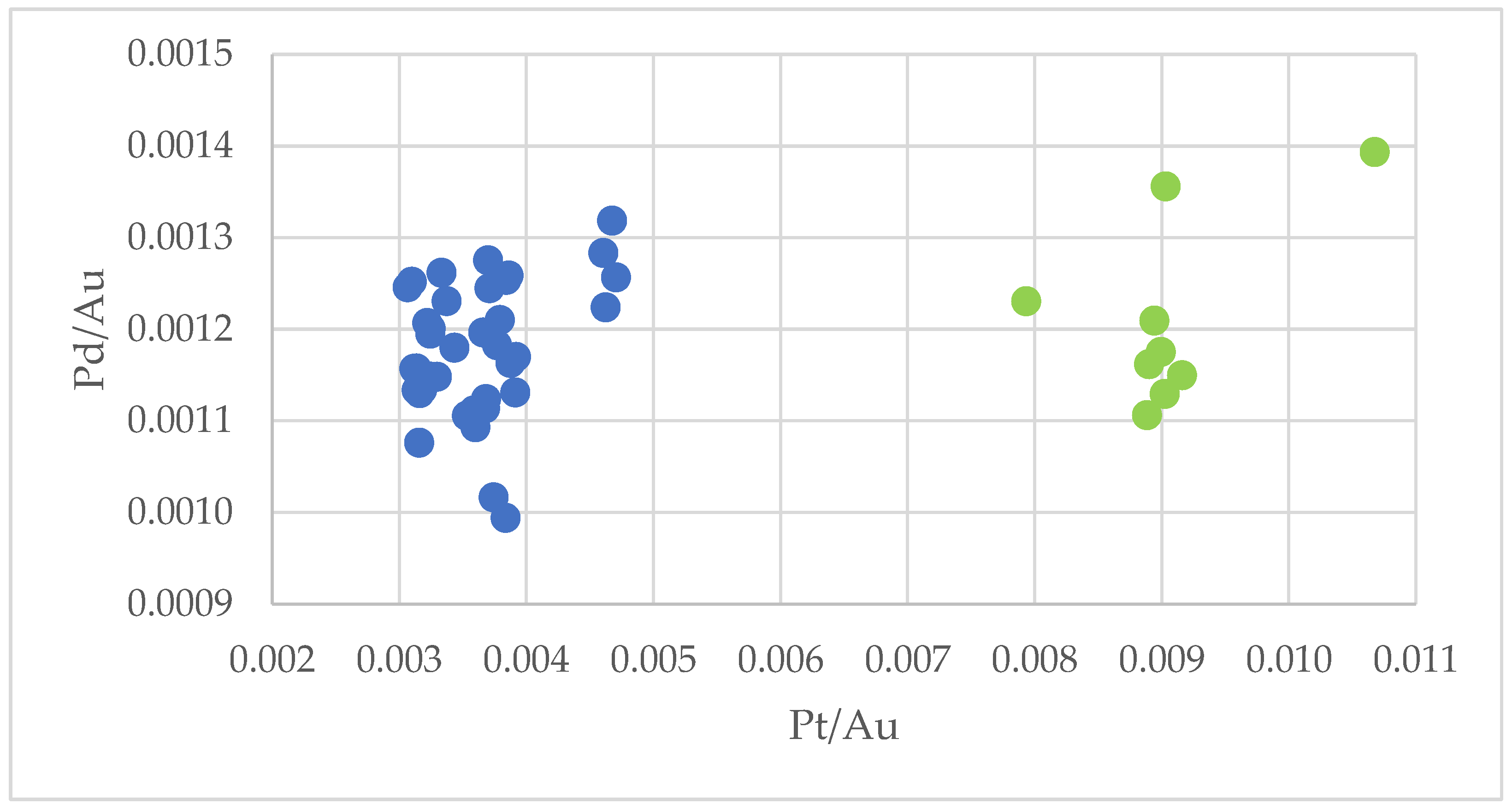
The ratios between Cu, Ag, Pt, and Pd were also calculated. Two discrete compositional groups emerged when considering the Pt/Pd ratio: Group A (37 coins) with an average ratio of 3.1 ± 0.4 and Group B (9 coins) with an average Pt/Pd ratio of 7.5 ± 0.5 (Table S1). Three coins (No. 13, 36 and 46) were not considered because their Pd peaks were at the background level of the instrument. The existence of two coherent Pt/Pd clusters (Figure 2) suggests that the coins—although recovered together—may tentatively reflect two geologically distinct gold sources or the incorporation of recycled metal circulating through different supply networks.

3.2. Determination of Trace Elements by ICP-MS

The ICP-MS results, expressed in mg kg−1 (Table 3), support the interpretation that the analysed coins were produced from alluvial gold containing naturally occurring impurities, with minimal intentional alloying. Copper contents are consistently below 2 wt%, while Sn and Pb are present only at trace levels. The low Sn concentrations likely reflect incidental cassiterite inclusions, a recognised feature of placer gold deposits, rather than metallurgical additions.
Coin No. 1 displays detectable Hg amounts (around 60 mg kg−1). Despite this, its mass and Au content rule out the possibility of surface gilding or counterfeiting, and the mercury is likely residual from geological or metallurgical processes [27,28].
Although μ-EDXRF analysis identified two Pt/Pd groups, the limited number of ICP-MS samples, combined with the bulk nature of the micro-destructive analyses, prevented a robust validation of this surface-based pattern. Nevertheless, all micro-sampled coins show Pt content higher than Pd content.
A bivariate analysis based on a correlation matrix of characteristic soil elements (Al, Ca, Ti, Cr, Mn, Fe, Ni, Zn, and Sr) was performed to investigate the nature of surface encrustations (Table 4). Strong positive correlations among these elements indicate a shared geochemical signature typical of continental (terrigenous) soils, distinguishing them from anthropogenic or alluvial sources. In fact, the correlations observed between Cr, Mn, Fe, and Ni confirm that iron and nickel have a terrigenous origin, as well as Zn, which positively correlates with Ca, Al, and Sr, supporting their interpretation as soil-derived contaminants rather than alloy components.

3.3. Inter-Technique Comparison of Gold Fineness Estimates

Micro-sampling of six coins (five solidi and one tremissis) allowed a limited assessment of gold fineness using ICP-AES, providing an independent check on the high Au contents inferred from μ-EDXRF analyses. The dissolved fragments yielded Au concentrations consistent with very fine gold alloys (Table S2), in agreement with the presence of the “OB” inscription on the reverse, traditionally interpreted as an indication of refined gold (obryzum) rather than a guarantee of absolute chemical purity [29].
It must be stressed, however, that the primary objective of the ICP-AES measurements was not to resolve subtle surface–bulk compositional gradients, but rather to provide a semi-quantitative estimate of near-bulk fineness while preserving the integrity of the coins. In gold alloys with Au contents exceeding ~95–98%, the analytical uncertainties associated with ICP-AES become large relative to the magnitude of any expected surface enrichment effects, limiting the method’s sensitivity to small compositional differences.
For this reason, the investigation of potential surface alteration phenomena relies mainly on the comparison between surface-sensitive μ-EDXRF and high-precision ICP-MS data. While μ-EDXRF probes only the outermost layers of the coins (with a penetration depth of approximately 8–60 µm [30]), ICP-MS provides more precise quantitative information on trace elements and bulk-related elemental ratios.
A comparison between μ-EDXRF and ICP-AES Au gold contents for the six micro-sampled coins is reported in the Supplementary Materials (Figure S1). Statistical testing (paired t-test and Bland–Altman analysis) indicates that the observed offsets are not statistically significant. This apparent agreement should be interpreted cautiously, as it primarily reflects the limited resolving power of ICP-AES at very high gold concentrations rather than conclusive evidence for the absence of surface enrichment.
Overall, the combined μ-EDXRF and ICP-MS results—supported by comparison with published bulk analyses—indicate that surface effects, if present, are minor and do not substantially bias the compositional assessment of Late Antique gold coinage.

4. Discussion

The multi-analytical approach confirms that the coins under study were manufactured from exceptionally pure gold, in keeping with the long-recognized stability of Late Roman and Early Byzantine gold objects [6,7]. While an indirect estimate of gold content can be obtained by subtracting the sum of trace elements measured by ICP-MS from 100%, this approach does not account for light elements (C, O, N, S) or other minor constituents. Gold fineness was primarily evaluated through the use of µ-EDXRF and ICP-MS, which indicate high Au contents that fall within the range reported for contemporary issues from other hoards and museum collections [13,31,32].
Comparative data from the literature further support our results. A solidus of Julian II has been reported with a gold content of about 95.2% [19]. For Theodosius II, both bulk and surface analyses conducted on museum collections consistently indicate high fineness. In particular, XRF and LA-ICP-MS measurements on coins from the Ashmolean Museum generally report gold contents between approximately 98.6% and 99.7% [33]. Comparable values have been obtained through Proton Activation Analyses (PAA) carried out by Morrisson et al. [34], which typically range from about 98.65% to 99.43%. Similarly, Biborski and Biborski reported gold contents of around 99.2% for a solidus of Theodosius II from Prełuki, Sanok County [35]. These independent datasets are fully consistent with the low Ag and Cu concentrations measured by ICP-MS in our Theodosian issues, which imply gold purities close to 99%. Later issues of Valentinian III are reported to contain slightly lower gold contents, just above 96% [36], suggesting that some of the coins analysed here may belong to the earlier phases of his coinage.
As an additional check, gold content was also measured directly using ICP-AES on micro-sampled fragments. While this provided an independent estimate of fineness, the method’s limited precision at very high Au concentrations means that these results should be regarded as indicative only and do not provide definitive information on potential surface-related effects.
The consistently low concentrations of Cu, Ag, Pb, and Sn measured in bulk samples are compatible with the exploitation of natural alluvial placers, characterized by minimal alloying and limited geochemical impurities [37]. Similar trace-element signatures have been reported for Late Antique and Byzantine coinage, where alluvial gold was often minimally processed aside from cupellation and salt cementation [9,11,27]. The sporadic detection of Sn and Pb agrees with previous observations that minor inclusions—often inherited from cassiterite (SnO2) or galena (PbS) present in alluvial deposits—may occasionally survive metallurgical refining [38,39,40,41]. The available data do not allow attribution to specific mining regions or geological contexts. Provenance considerations should therefore be regarded as indicative and exploratory, rather than conclusive.
A particularly noteworthy outcome of the non-destructive screening is the identification of two distinct Pt/Pd ratios. Platinum-group elements have emerged as tracers for reconstructing geological sources and bullion circulation pathways in ancient gold [10,12]. The separation between the two Pt/Pd groups in our dataset is evident at the surface-analysis level. However, this distinction is not reproduced by the micro-destructive analyses, most likely due to the very limited number of coins subjected to ICP-based techniques (6 out of 49). Such a small subset is unlikely to capture the full compositional variability highlighted by the XRF results across the entire assemblage. Consequently, the lack of full agreement between μ-EDXRF and ICP-MS for Pt/Au and Pd/Au ratios reflect limitations in sample representativity and trace-level sensitivity, rather than invalidating the analytical approach.
A comparison between μ-EDXRF and ICP-AES Au contents for these six coins is reported in the Supplementary Material (Figure S1). Statistical testing indicates that the observed offsets are not statistically significant. However, this apparent agreement should be interpreted cautiously, as it primarily reflects the limited resolving power of ICP-AES at very high gold concentrations rather than conclusive evidence for the absence of minor surface effects. Overall, the combined μ-EDXRF and ICP-MS results indicate that surface effects, if present, are minor and do not substantially bias the compositional assessment of these coins.
The metallurgical and compositional homogeneity observed across most specimens is in accord with historical reconstructions of Late Antique minting policies, which emphasized strict control over gold purity [3,5,29]. Slight deviations among specimens attributed to different mints likely reflect subtle differences in refining efficiency or bullion procurement, rather than intentional debasement. The presence of two Pt/Pd groups within a single hoard may reflect the circulation of gold from different geological provinces within the Eastern Mediterranean. In this region, multiple mining districts—particularly in Anatolia—are known to have been exploited during the Roman and Byzantine periods, suggesting a potentially diverse metal supply network in Late Antiquity [40].
On the whole, the combined use of surface-sensitive and bulk analytical methods provides a useful framework for discussing the metallurgical characteristics of these coins within the broader context of Late Antiquity. While the results are consistent with the generally high purity documented for imperial gold coinage, they also point to subtle compositional and technological features that may reflect the complexity of metal circulation and refining practices during this period.

5. Conclusions

Thanks to the availability of a gold standard, it was possible to semi-quantitatively determine the gold content in all 49 Late Antique gold coins. The results obtained from non-invasive analysis with µ-EDXRF showed that no minting debasement occurred during the period when the coins under study were issued (AD 367–565). Furthermore, no forgeries were identified, confirming that in the 4th–mid 6th centuries, the Roman and Byzantine Empires had a high availability of gold for coin production. The Pt/Pd ratio is indicative of potential information about the origin of gold, as these two elements are not significantly affected by metallurgical refining processes. By comparing the areas of the non-interfering peaks Lγ1 of Pt and Kα1 of Pd, two compositional groups were distinguished, consisting of 37 and 9 coins, respectively. Out of the total of 49 solidi, three coins did not show the characteristic palladium peaks.
The specimens investigated in this study hold high historical value, which is why micro-destructive analyses were performed on only six coins, selected using a blind method to avoid experimenter’s bias. A few milligrams of samples were collected from the edges of the coins. Although the sampling method used had some limitations due to the scarcity of material obtained, it provided representative samples of the gold solidi under study for the purpose of quantifying the principal metal and trace elements.
Direct gold determination by ICP-AES provided an independent estimate of fineness; however, the limited precision of this technique at very high gold concentrations restricts its resolving power for assessing subtle surface-related effects.
Regarding trace elements, quantified by ICP-MS, the presence of tin and the low concentrations of copper and lead suggest that the gold used to produce the six analysed coins had alluvial origin. However, any provenance-related interpretation remains tentative and represents a perspective for future research based on larger datasets and comparative reference materials. The Pt/Pd ratios obtained by the micro-destructive technique did not show any particular trend, perhaps due to the limited number of samples chosen for sampling. The gold content estimated indirectly by subtracting trace-element percentages from 100% was consistent with published values for contemporary solidi, supporting the reliability of our approach. Finally, the analysis and quantification of the main terrigenous elements showed positive correlations between Cr, Mn, Fe, and Ni, and between Ca, Al, and Sr, leading to the conclusion that the burial site of the coins was the soil.

Supplementary Materials

The following supporting information can be downloaded at https://www.mdpi.com/article/10.3390/heritage9010038/s1. Table S1: Pd/Au, Pt/Au and Pt/Pd ratios of the 49 gold coins. Three coins (No. 13, 36 and 46) exhibited comparable Pd peaks within the background noise of the instrument, so the calculation of Pt/Pd ratio was not possible; Table S2: Average content of trace metals expressed in mg kg−1 for the six coins selected for the ICP-MS analysis. Concentrations are reported concerning the mass of material sampled and dissolved. Figure S1: Average gold percentage obtained by µ-EDXRF in blue and by ICP-AES in orange. Error bars express standard deviations.

Author Contributions

G.M.: investigation, data curation, and writing—original draft; M.C.: data curation; S.F.: data curation; E.P.: supervision and writing—review and editing; B.C.: conceptualization and resources; G.A.: conceptualization and supervision. All authors have read and agreed to the published version of the manuscript.

Funding

This research received no external funding.

Data Availability Statement

The data presented in this study are available on request from the corresponding author.

Conflicts of Interest

The authors declare no conflicts of interest.

Abbreviations

The following abbreviations are used in this manuscript:
ADAnno Domini
BCBefore Christ
µ-EDXRFmicro–Energy Dispersive X-Ray Fluorescence
ICP-AESInductively Coupled Plasma-Atomic Emission Spectroscopy
ICP-MSInductively Coupled Plasma-Mass Spectrometry
LODLimit of Detection
PAAProton Activation Analysis

References

  1. Leusch, V.; Armbruster, B.; Pernicka, E.; Slavčev, V. On the invention of gold metallurgy: The gold objects from the Varna Ii cemetery (Bulgaria)—technological consequence and inventive creativity. Camb. Archaeol. J. 2015, 25, 353–376. [Google Scholar] [CrossRef]
  2. Guerra, M.F.; Calligaro, T. Gold cultural heritage objects: A review of studies of provenance and manufacturing technologies. Meas. Sci. Technol. 2003, 14, 1527–1537. [Google Scholar] [CrossRef]
  3. Kemmerer, E.W. Gold and the Gold Standard; Ludwig von Mises Institute: Auburn, AL, USA, 2009. [Google Scholar]
  4. Van Alfen, P.G.; Wartenberg, U.; Fischer-Bossert, W.; Gitler, H.; Konuk, K.; Lorber, C. White Gold: Studies in Early Electrum Coinage; American Numismatic Society: New York, NY, USA, 2020. [Google Scholar]
  5. Carlà, F. L’oro Nella Tarda Antichità: Aspetti Economici e Sociali; Collana del Dipartimento di storia dell’Università di Torino; S. Zamorani: Torino, Italy, 2009. [Google Scholar]
  6. Oddy, A.; La Niece, S. Byzantine gold coins and jewellery: A study of gold contents. Gold Bull. 1986, 19, 19–27. [Google Scholar] [CrossRef]
  7. Morrisson, C. Numismatique et histoire, l’or monnayé de Rome à Byzance: Purification et altérations. Comptes Rendus Des Séances De L’académie Des Inscr. Et Belles-Lett. 1982, 126, 203–223. [Google Scholar] [CrossRef]
  8. Guerra, M.F. Elemental analysis of coins and glasses. Appl. Radiat. Isot. 1995, 46, 583–588. [Google Scholar] [CrossRef]
  9. Guerra, M.F.; Calligaro, T. Gold traces to trace gold. J. Archaeol. Sci. 2004, 31, 1199–1208. [Google Scholar] [CrossRef]
  10. Van Loon, L.L.; Banerjee, N.R.; Hinds, M.W.; Gordon, R.; Bevan, G.; Burgess, R.W. Rapid, quantitative, and non-destructive SR-WD-XRF mapping of trace platinum in Byzantine Roman Empire gold coins. J. Anal. At. Spectrom. 2018, 33, 1763–1769. [Google Scholar] [CrossRef]
  11. Berger, D.; Brauns, M.; Brügmann, G.; Pernicka, E.; Lockhoff, N. Revealing ancient gold parting with silver and copper isotopes: Implications from cementation experiments and for the analysis of gold artefacts. Archaeol. Anthropol. Sci. 2021, 13, 143. [Google Scholar] [CrossRef]
  12. Blet-Lemarquand, M.; Nieto-Pelletier, S.; Téreygeol, F.; Suspène, A. Are platinum and palladium relevant tracers for ancient gold coins? Archaeometallurgical and archaeometric data to study an antique numismatic problem. In Archaeometallurgy in Europe IV; Montero-Ruiz, I., Perea, A., Eds.; Consejo Superior de Investigaciones Cientificas: Madrid, Spain, 2017; pp. 19–28. [Google Scholar]
  13. Carlomagno, I.; Zeller, P.; Amati, M.; Aquilanti, G.; Prenesti, E.; Marussi, G.; Crosera, M.; Adami, G. Combining synchrotron radiation techniques for the analysis of gold coins from the Roman Empire. Sci. Rep. 2022, 12, 15919. [Google Scholar] [CrossRef]
  14. Di Turo, F.; Coletti, F.; De Vito, C. Investigations on alloy-burial environment interaction of archaeological bronze coins. Microchem. J. 2020, 157, 104882. [Google Scholar] [CrossRef]
  15. Ager, F.J.; Gómez-Tubío, B.; Paúl, A.; Gómez-Morón, A.; Scrivano, S.; Ortega-Feliu, I.; Respaldiza, M.A. Combining XRF and GRT for the analysis of ancient silver coins. Microchem. J. 2016, 126, 149–154. [Google Scholar] [CrossRef]
  16. Crosera, M.; Baracchini, E.; Prenesti, E.; Giacomello, A.; Callegher, B.; Oliveri, P.; Adami, G. Elemental characterization of surface and bulk of copper-based coins from the Byzantine-period by means of spectroscopic techniques. Microchem. J. 2019, 147, 422–428. [Google Scholar] [CrossRef]
  17. Marussi, G.; Crosera, M.; Prenesti, E.; Cristofori, D.; Callegher, B.; Adami, G. A multi-analytical approach on silver-copper coins of the roman empire to elucidate the economy of the 3rd Century A.D. Molecules 2022, 27, 6903. [Google Scholar] [CrossRef] [PubMed]
  18. Marussi, G.; Crosera, M.; Prenesti, E.; Callegher, B.; Baracchini, E.; Turco, G.; Adami, G. From collection or archaeological finds? A non-destructive analytical approach to distinguish between two sets of bronze coins of the Roman Empire. Molecules 2023, 28, 2382. [Google Scholar] [CrossRef]
  19. Green, G.A.; Ishida, K.; Hampshire, B.V.; Butcher, K.; Pollard, A.M.; Hillier, A.D. Understanding Roman Gold Coinage Inside Out. J. Archaeol. Sci. 2021, 134, 105470. [Google Scholar] [CrossRef]
  20. Green, G.A.; Ishida, K.; Domoney, K.; Agoro, T.; Hillier, A.D. Negative muons reveal the economic chaos of Rome’s AD 68/9 Civil Wars. Archaeol. Anthropol. Sci. 2022, 14, 165. [Google Scholar] [CrossRef]
  21. Hampshire, B.V.; Butcher, K.; Ishida, K.; Green, G.; Paul, D.M.; Hillier, A.D. Using negative muons as a probe for depth profiling silver roman coinage. Heritage 2019, 2, 400–407. [Google Scholar] [CrossRef]
  22. Bayazït, M.; Şeker, N. Archaeometric investigation of gold coins (Byzantine Period, Romanus III) by means of portable XRF: Characterization and comparison. Bitlis Eren Üniversitesi Fen Bilim. Derg. 2022, 11, 1159–1174. [Google Scholar] [CrossRef]
  23. Buccolieri, G.; Sarcinelli, G.; Serra, A.; Giuseppe, G.; Castellano, A.; Buccolieri, A. Compositional study of gold coins hoard from Ordona (South Italy) using ED-XRF. Int. J. Conserv. Sci. 2025, 16, 769–780. [Google Scholar] [CrossRef]
  24. Gennari, A. Un mezzo tremisse inedito di Eraclio I (610–641). Con annesso un catalogo dei mezzi tremissi ad oggi noti. Rev. Numismática Hécate 2018, 5, 55–63. [Google Scholar]
  25. Cataldo, M.; Clemenza, M.; Ishida, K.; Hillier, A.D. A novel non-destructive technique for cultural heritage: Depth profiling and elemental analysis underneath the surface with negative muons. Appl. Sci. 2022, 12, 4237. [Google Scholar] [CrossRef]
  26. Oddy, A. Studies in Early Byzatine Gold Coinage; Hahn, W., Metcalf, W.E., Eds.; Numismatic Studies; American Numismatic Society: New York, NY, USA, 1988; Available online: http://numismatics.org/digitallibrary/ark:/53695/nnan92935 (accessed on 1 October 2023).
  27. Habashi, F. Gold—An Historical Introduction. In Gold Ore Processing: Project Development and Operations; Adams, M.D., Ed.; Elsevier: Amsterdam, The Netherlands, 2016; pp. 1–20. [Google Scholar]
  28. Reiff, F.; Bartels, M.; Gastel, M.; Ortner, H. Investigation of contemporary gilded forgeries of ancient coins. Fresenius J. Anal. Chem. 2001, 371, 1146–1153. [Google Scholar] [CrossRef] [PubMed]
  29. Hendy, M.F. Studies in the Byzantine Monetary Economy C.300-1450; Cambridge University Press: Cambridge, UK, 1985. [Google Scholar]
  30. Guerra, M.F. Physicochemical approaches to gold and silver work: An overview. In Chemical Analysis in Cultural Heritage; Sabbatini, L., van der Werf, D., Eds.; W. de Gruyter: Berlin, Germany, 2018; Volume 4, Available online: https://www.degruyter.com/document/doi/10.1515/psr-2018-0015/html (accessed on 2 October 2023).
  31. Cruz, J.; Corregidor, V.; Alves, L.C.; Carvalho, P.A.; Fonseca, M. Analysis of a gold solidus of roman emperor Valentinian I. Microsc. Microanal. 2013, 19, 139–140. [Google Scholar] [CrossRef][Green Version]
  32. Morrisson, C.; Barrandon, J.-N.; Brenot, C. Composition and technology of ancient and medieval coinages: A Reassessment of analytical results. Mus. Notes Am. Numis. Soc. 1987, 32, 181–209. [Google Scholar]
  33. Green, G.A. Gold Coinage in the Roman World: Function and Production. Ph.D. Thesis, University of Warwick, Coventry, UK, 2020. [Google Scholar]
  34. Morrisson, C.; Brenot, C.; Callu, J.P.; Barrandon, J.N.; Poirier, J.; Halleux, R. L’Or monnayé I. Purification et altérations de Rome à Byzance; Éditions du Centre National de la Recherche Scientifique; Cahiers Ernest Babelon 2; Centre National de la Recherche Scientifique: Paris, France, 1985. [Google Scholar]
  35. Biborski, M.; Biborski, M. Theodosius II’s solidus from Prełuki, Sanok County in material and traseological examinations. Acta Archaeol. Carpathica 2019, 54, 285–292. [Google Scholar] [CrossRef]
  36. Kent, J.P.C. The Roman Imperial Coinage—The Divided Empire and the Fall of the Western Parts 395–491; Spink and Son Ltd.: London, UK, 1994; Volume X. [Google Scholar]
  37. Morteani, G.; Northover, J.P. Prehistoric Gold in Europe: Mines, Metallurgy and Manufacture; Springer Science & Business Media: Berlin/Heidelberg, Germany, 2013. [Google Scholar]
  38. Schlosser, S.; Reinecke, A.; Schwab, R.; Pernicka, E.; Sonetra, S.; Laychour, V. Early Cambodian gold and silver from Prohear: Composition, trace elements and gilding. J. Archaeol. Sci. 2012, 39, 2877–2887. [Google Scholar] [CrossRef]
  39. Constantinescu, B.; Vasilescu, A.; Radtke, M.; Reinholz, U. Micro-SR-XRF studies for archaeological gold identification—the case of Carpathian gold and Romanian museal objects. Appl. Phys. A 2010, 99, 383–389. [Google Scholar] [CrossRef]
  40. Pitarakis, B. Mines anatoliennes exploitées par les Byzantins: Recherches récentes. Rev. Numis. 1998, 6, 141–185. [Google Scholar] [CrossRef]
  41. Dube, R. Interrelation between gold and tin: A historical perspective. Gold Bull. 2006, 39, 103–113. [Google Scholar] [CrossRef][Green Version]
Figure 1. The gold content obtained from the ratio of the Au Lα peaks and the sum of the peak areas of the major elements (Au, Ag, Cu, Pt, and Pd). Error bars express the standard deviation.
Heritage 09 00038 g001
Figure 2. Platinum and palladium contents normalised to gold for all the 49 coins under study. In blue are highlighted the solidi with an average Pt/Pd ratio of 7.5, whereas in green are those with an average ratio between the two elements of 3.1.
Heritage 09 00038 g002
Table 1. List of coins under study. Each coin has been assigned a sequential number from 1 to 49. Asterisks (*) indicate coins subjected to micro-sampling.
EmperorPeriod of
Issue (AD)
Number of SamplesSample Code
Gratian367–383111
Valentinian II375–378133
Theodosius I379–395215; 20
Arcadius395–40861 *; 4; 8; 12 *; 16; 24
Arcadius
for Aelia Eudoxia
400–40412
Honorius395–423106; 7; 9; 10; 13; 14; 18; 22; 23; 30
Theodosius II408–450143; 5 *; 17; 19; 21; 26; 28; 34; 39; 42 *;
45 *; 46; 47; 48
Theodosius II
for Aelia Pulcheria
414–453227; 38
Valentinian III425–455929; 31; 35; 36 *; 37; 40; 41; 43; 44
Anastasius I491–518132
Justin I518–527125
Justinian I527–565149
Table 2. The six coins micro-sampled with their respective codes and issuing emperors (1–10 scale).
Heritage 09 00038 i001Heritage 09 00038 i002Heritage 09 00038 i003Heritage 09 00038 i004Heritage 09 00038 i005Heritage 09 00038 i006
Solidus no. 1, Arcadius
(AD 395–408)
Solidus no. 5, Theodosius II
(AD 408–450)
Solidus no. 12, Arcadius
(AD 395–408)
Heritage 09 00038 i007Heritage 09 00038 i008Heritage 09 00038 i009Heritage 09 00038 i010Heritage 09 00038 i011Heritage 09 00038 i012
Solidus no. 36, Valentinian III
(AD 425–455)
Tremisses no. 42, Theodosius II
(AD 408–450)
Solidus no. 45, Theodosius II
(AD 408–450)
Table 3. Average content of trace metals expressed in mg kg−1 for the six coins selected for the ICP-MS analysis. Concentrations are reported concerning the mass of material sampled and dissolved.
Coin NumberEmperorAgCuPtPdHgPbSnNiAlCaTiCrMnFeZnSrTotal
1Arcadius116299.139.42.5360.03.941372764.1654.02.5047139.625391.44<0.644892
12Arcadius162713444914.41.0630.850.823.04.2635.32.44<1.242.582663.65<0.642644
5Theodosius II11,514221915123.15.3081.319.747.461.218543.0730.512.687950.211.216,963
42Theodosius II20775142618.320.6115335.010.62.8732.72.22<1.2413.9173415.1<0.644860
45Theodosius II547942238421.24.7831.641.820.854.321042.4224.621.5158932.312.810,246
36Valentinian III2235119024828.91.1825.310.11298<1.7277.61.07182214496604.280.9916,747
Table 4. Correlation matrix for the bulk data set (bivariate analysis) for the terrigenous elements. Values greater than 0.5 or lower than −0.5 are in bold.
NiAlCaTiCrMnFeZnSr
Ni1.000
Al−0.4151.000
Ca−0.3590.9861.000
Ti−0.8790.5970.4981.000
Cr0.998−0.431−0.374−0.8731.000
Mn0.993−0.371−0.302−0.8850.9931.000
Fe0.986−0.397−0.325−0.9090.9850.9961.000
Zn−0.4130.9430.8980.587−0.438−0.377−0.3821.000
Sr−0.3350.9831.0000.476−0.350−0.277−0.3010.8941.000
Disclaimer/Publisher’s Note: The statements, opinions and data contained in all publications are solely those of the individual author(s) and contributor(s) and not of MDPI and/or the editor(s). MDPI and/or the editor(s) disclaim responsibility for any injury to people or property resulting from any ideas, methods, instructions or products referred to in the content.