


Abstract
Lead-free (1−x)(K0.49Na0.51)(Nb0.95Sb0.05)O3-xSr(Fe0.5Nb0.5)O3 [(1−x)KNNbS-xSrFNb, x = 0.01–0.07] ceramics with 0.5 wt% CuO were prepared by conventional sintering (CS) and two-step sintering (TSS). Increasing the SrFNb content drives the structure from orthorhombic–tetragonal (O-T, x ≤ 0.03) coexistence to rhombohedral–tetragonal (R-T, x ≥ 0.05) coexistence, and shifts the phase boundary toward room temperature, while Fe3+/Nb5+ B-site disorder induces polar nanoregions, diffuse dielectric behavior (dispersion index γ > 1.7) and a drop of Tm (temperature of dielectric constant maximum) from 295 °C to below room temperature. Increasing SrFNb significantly reduces the average grain size from 0.6 μm to 0.3 μm, while TSS decouples densification from grain growth, raising the maximum relative density from 92.13% to 94.51% at x = 0.05 with only a slight reduction in average grain size from 0.35 μm to 0.32 μm. These changes directly tailor the electrical properties: the near-room-temperature O-T boundary at x = 0.03 gives the best soft-type response (piezoelectric constant d33 = 133 pC/N, electromechanical coupling coefficient Kp = 0.285, remnant polarization Pr = 22.72 μC/cm2), whereas acceptor-oxygen-vacancy dipoles at x = 0.01 pin domain walls, yielding the highest mechanical quality factor Qm = 329 with low tan δ, and TSS further improves fatigue resistance. Combining SrFNb-driven structural evolution with TSS microstructural control thus offers an effective route to tailor KNN-based lead-free piezoelectrics.
1. Introduction
Piezoelectric ceramics play indispensable roles in modern electronic devices, including high-precision actuators, ultrasonic transducers, sensors, and energy harvesting systems, owing to their unique ability to convert mechanical energy into electrical signals and vice versa [1,2,3,4,5]. For decades, lead zirconate titanate (PZT)-based materials have dominated the commercial piezoelectric ceramics market due to their exceptional piezoelectric performance and temperature stability. However, the toxicity of lead oxide and growing environmental regulations have driven an urgent global pursuit of high-performance lead-free piezoelectric alternatives [5,6,7,8].
Common perovskite structure lead-free piezoelectric materials mainly include three categories, that is, potassium sodium niobate (KNN-based), barium titanate (BT-based) and bismuth sodium titanate (BNT-based). Among various lead-free piezoelectric systems, potassium sodium niobate [(K,Na)NbO3, KNN]-based ceramics have emerged as the most promising candidate to replace PZT, attributed to their high Curie temperature (TC ≈ 420 °C), excellent piezoelectric properties and environmental compatibility [9,10,11,12,13,14]. Nevertheless, KNN-based ceramics still face critical challenges that hinder their practical application, including severe volatilization of alkali elements (K+, Na+) during high-temperature sintering, poor sinterability, and relatively large strain hysteresis, which significantly degrade their performance in precision actuator applications [15,16,17].
To address these issues, two primary strategies have been extensively investigated: compositional doping modification and sintering process optimization. Regarding compositional engineering, A-site or B-site ion substitution has proven effective in tailoring phase structure and electrical properties. Particularly, Sb5+ doping at the B-site has been demonstrated to effectively shift the polymorphic phase boundary (PPB) toward room temperature and enhance the piezoelectric response [18,19,20]. Such phase-boundary (morphotropic phase boundary (MPB)/PPB) engineering was also demonstrated in other lead-free perovskites, including rhombohedral–tetragonal coexistence in BiFeO3–Bi0.5K0.5TiO3 and MnO2-modified Bi0.5(K0.2Na0.8)0.5TiO3, which markedly enhance polarization and piezoelectricity [21,22]. In addition, Sr(Fe0.5Nb0.5)O3 was selected over isovalent end-members such as BaZrO3, SrZrO3 and BaSnO3, which only shift the phase boundary without charge fluctuation or acceptor hardening, and Bi-based end-members, which suffer from Bi volatilization and a sharper TC reduction. In SrFNb, the aliovalent Fe3+/Nb5+ B-site pair creates charge and size disorder that breaks long-range ferroelectric order into polar nanoregions (PNRs), moving the phase boundary toward room temperature while retaining relatively high TC and low hysteresis; a small amount of non-stoichiometric excess Fe3+, together with B-site Cu2+ from CuO, can form acceptor-oxygen-vacancy dipoles for high Qm and low loss [23,24].
In parallel, sintering process optimization is equally crucial for achieving dense KNN-based ceramics with uniform microstructure. Conventional solid-state sintering typically requires temperatures above 1100 °C, which exacerbates alkali volatilization and leads to abnormal grain growth [10,11]. To mitigate this problem, two approaches have been widely adopted: (i) adding sintering aids such as CuO, which promotes liquid-phase sintering, reduces sintering temperature by 50–100 °C, and enhances densification through the formation of low-melting-point liquid phases [25]; (ii) unlike conventional sintering, which holds at a single high temperature where densification and grain growth occur together, so high density is reached only at the cost of grain coarsening and alkali volatilization, two-step sintering first activates densification at a higher temperature and then holds at a lower temperature, where grain-boundary migration is frozen while boundary diffusion continues [26,27]. Qiu et al. showed that CuO acts as both a sintering aid and a defect modifier in the KNN-based ceramics. The CuO-induced defect dipoles effectively pin domain walls, producing a pronounced hardening effect, in the 0.95(K0.48Na0.52)NbO3–0.05(Bi0.5Na0.5)HfO3–0.2 mol% Fe2O3–x mol% CuO ceramics, d33 reaches 340 pC/N and Qm is 256, a fourfold enhancement of Qm with only a slight reduction in d33 [28]. Tu et al. fabricated (K0.41Na0.59)(Nb0.84Sb0.06Ta0.10)O3 ceramics with CuO sintering aid via two-step sintering. CuO addition significantly enhances relative density to 98.1% and improves piezoelectric properties, achieving d33 = 265 pC/N, Qm = 420, and dielectric loss tan δ = 0.015 at optimized conditions [29]. Likewise, MnO2 was reported as an acceptor-type additive to improve the ferroelectric and piezoelectric response of BNT–BT and BKNT ceramics through defect engineering and enhanced densification [21,30]. Various sintering aids have been reported used in the KNN-based ceramics, including ZnO, LiF and borates, most of which merely promote liquid-phase densification [31]. CuO was selected because it uniquely combines densification with electrical-property control: it forms a low-melting K–Cu–Nb–O liquid phase that lowers the sintering temperature and suppresses alkali volatilization, while B-site Cu2+ acceptor-oxygen-vacancy dipoles pin domain walls, raising Qm and reducing tan δ. This dual function is synergistic with two-step sintering.
Therefore, (1−x)(K0.49Na0.51)(Nb0.95Sb0.05)O3-xSr(Fe0.5Nb0.5)O3 [(1−x)KNNbS-xSrFNb] ceramics with 0.5 wt% CuO additive were systematically fabricated using both CS and TSS methods in this work. The effects of SrFNb content and sintering strategy on phase structure, microstructure, dielectric relaxation behavior, and piezoelectric properties were comprehensively investigated. Firstly, the optimum sintering temperature was determined using the 0.95(K0.49Na0.51)(Nb0.95Sb0.05)O3–0.05Sr(Fe0.5Nb0.5)O3 composition. Then, the effects of Sr(Fe0.5Nb0.5)O3 doping amount prepared at a sintering temperature of 1200–1125 °C 4 h were further investigated. Compared with the samples prepared by CS, the samples fabricated via TSS exhibit improved properties including density, dielectric constant, ferroelectricity and piezoelectricity. This study provides valuable insights into the design of high-performance KNN-based lead-free piezoelectric ceramics with low hysteresis for actuator applications.
2. Experimental Procedure
(1−x)(K0.49Na0.51)(Nb0.95Sb0.05)O3-xSr(Fe0.5Nb0.5)O3 [(1−x)KNNbS-xSrFNb, x = 0.01–0.07] ceramics were prepared by conventional sintering (CS) and two-step sintering (TSS) methods, in which 0.5 wt% CuO (99.0%) was used as sintering additive and also induced defect dipoles [32]. Perovskite (1−x)KNNbS-xSrFNb powders were prepared using analytical purity K2CO3 (99.0%), Na2CO3 (99.8%), SrCO3 (99.0%), Nb2O5 (99.5%), Sb2O3 (99.0%) and Fe2O3 (99.0%), supplied by China National Pharmaceutical Group Co., Ltd. (Sinopharm), Beijing, China. All raw materials for preparing (1−x)KNNbS-xSrFNb were fully dried in an oven (DHG-9053A, Shanghai Jinghong Laboratory Instrument Co., Ltd., Shanghai, China) at 120 °C for 2 h and the stoichiometrically weighed raw materials were first wet-milled for 24 h in a planetary ball mill (QM-3SP2, Nanjing Nanda Instrument Co., Ltd., Nanjing, China) using zirconia (ZrO2) balls in nylon jars with anhydrous ethanol as the medium, at a ball-to-powder mass ratio of 5:1 and a rotation speed of 300 rpm; the slurry was then dried at 80 °C and passed through a 100-mesh screen. After calcination (RKJ-4-13, Hefei Kejing Instrument Co., Ltd., Hefei, China) at 850 °C for 2 h, the powders were mixed with 0.5 wt% CuO, wet-milled again in ethanol for 12 h under the same conditions, dried at 80 °C and sieved through an 80-mesh screen before granulation with 8 wt% polyvinyl alcohol (PVA) aqueous solution (Guangzhou Baichuan Chemical Co., Ltd., Guangzhou, China). Subsequently, the granulated powders were uniaxially cold-pressed at 300 MPa for 30 s into discs with 12 mm in diameter and about 1 mm in thickness (769YP-40C, Tianjin Keqi High & New Technology Corporation, Tianjin, China). The pellets were thermally treated for 2 h at 550 °C to eliminate all traces of PVA. To compensate the evaporation of alkali metals, the pellets were put into Al2O3 crucible covered with calcined KNN powder. For the 0.95KNNbS-0.05SrFNb ceramics, CS at 1160–1170 °C and TSS with varying T1 (1190–1200 °C) and holding time (4–6 h) at T2 = 1125 °C (RKJ-4-13, Hefei Kejing Instrument Co., Ltd., Hefei, China) were systematically investigated. The optimized TSS schedule (1200–1125 °C 4 h) was then applied to the x = 0.01, 0.03, and 0.07 compositions [29,33,34]. For each composition and sintering condition, at least four discs were prepared: one was used for the SEM surface observation, and the remaining three were used for electrical measurements; d33, Kp and Qm are reported as mean ± standard deviation, with d33 averaged over five points per disc. For the fixed-composition 0.95KNNbS-0.05SrFNb sintering-screening series, four discs were prepared only for the two optimized conditions (CS at 1165 °C and TSS at 1200–1125 °C 4 h).
The crystal structure and microstructure morphology of the sintered (1−x)KNNbS-xSrFNb ceramics were explored by Rigaku D/max-2500/PC X-ray Diffractometer (XRD, Rigaku Corp., Tokyo, Japan) using a Cu Kα target over 2θ = 10–90° with a step size of 0.02° and a scanning speed of 4°/min and JEOL JSM-IT100 InTouchScope scanning electron microscope (SEM, JEOL, Tokyo, Japan) operated at an accelerating voltage of 15 kV after sputter-coating with gold, separately. To explore the electrical performance, the samples were coated with silver paste and sintered at 650 °C for 30 min to form a silver electrode [35]. The ferroelectric hysteresis loop (P-E) and strain curve (S-E) were measured at room temperature using Radiant Precision Premier LC II (Radiant Technologies Inc., Albuquerque, NM, USA) under 25 kV/cm at 1 Hz. The impedance and dielectric properties were measured by HDMS-1000 measurement system (Partulab Technology Co., Ltd., Wuhan, China) from room temperature to 350 °C at a heating rate of 2 °C/min over the frequency range of 100 Hz-2 MHz. The piezoelectric performances were measured by ZJ-6A quasi-static d33/d31 measurement meter (Institute of Acoustics, Chinese Academy of Sciences, Beijing, China) and TH2826 Wide Frequency LCR Meter (Changzhou Tonghui Electronic Co., Ltd., Changzhou, China) after poled at different electric field for 4 min.
3. Results and Discussion
In this work, the 0.95KNNbS-0.05SrFNb ceramics were prepared first, and the influence of sintering temperature and strategy was investigated. Based on the optimized sintering process searched, the influence of SrFNb doping amount on structure and performance of the (1−x)KNNbS-xSrFNb ceramics was further studied.
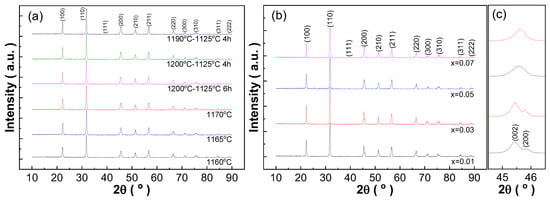
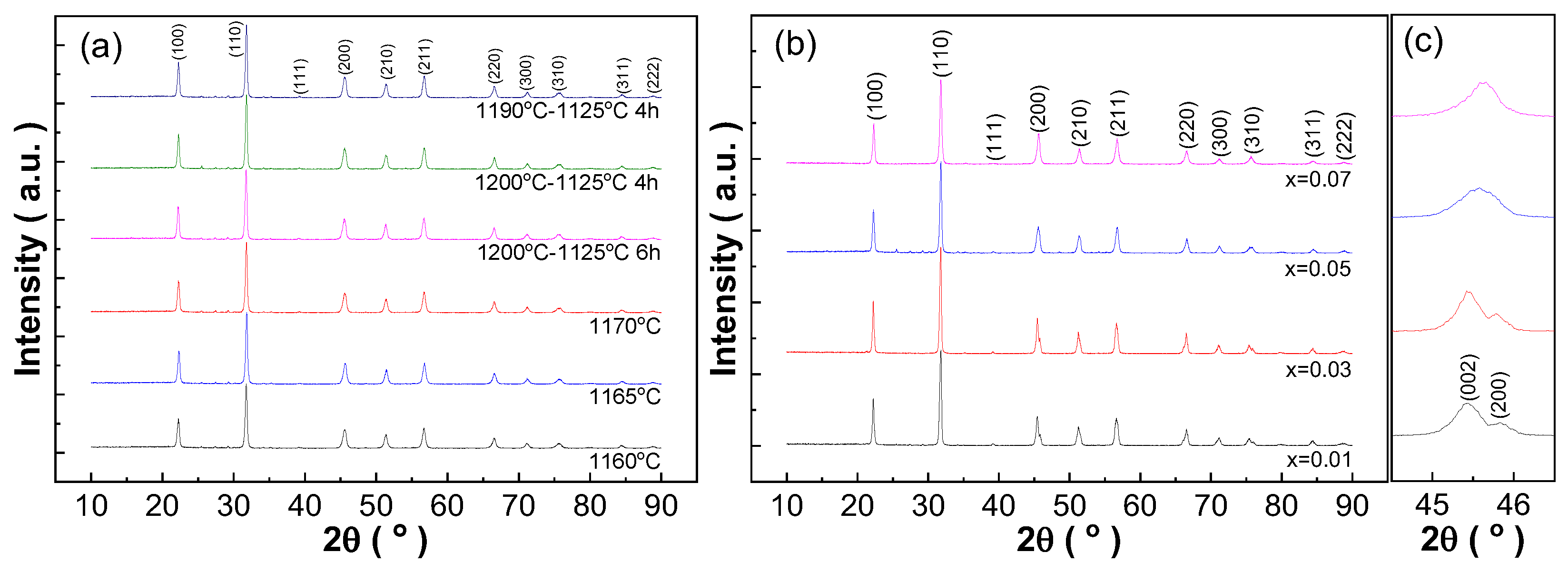
Figure 1a,b shows the XRD patterns of 0.95KNNbS-0.05SrFNb ceramics prepared by two methods at different sintering conditions and (1−x)KNNbS-xSrFNb ceramics by TSS. Overall, the XRD patterns of all samples exhibit a phase-pure perovskite structure, no detectable peaks attributable to CuO and unreacted SrFNb are observed, indicating that the added CuO and the SrFNb end-member are fully incorporated into the lattice, and the addition of SrFNb forms a homogenous solid solution over the studied range [1,36]. Every reflection can be indexed to the perovskite KNN framework, namely the (100)pc, (110)pc, (200)pc, (210)pc, (211)pc and (220)pc peaks, according to the ICDD PDF-4+ database for the orthorhombic (Amm2, PDF#04-017-0216), tetragonal (P4mm, PDF#97-018-6325) and rhombohedral (R3m, PDF#04-018-7022) polymorphs. All reflections shift systematically to lower 2θ degree with increasing SrFNb; according to the Bragg’s law, the lattice expansion moves the (110)pc and (200)pc peaks to lower 2θ angles by about 0.16° and 0.24°, confirming solid-solution formation [16,37].
Figure 1.
XRD patterns of (a) the 0.95KNNbS-0.05SrFNb ceramics sintered by CS and TSS at different temperatures, and (b) the (1−x)KNNbS-xSrFNb ceramics with different SrFNb doping contents prepared by TSS and (c) their zoom-in XRD patterns around the (200) peak.
The XRD patterns in the 2θ range of 44.5–46.5°, which highlight the characteristic peaks used to identify the KNN phase structure, are magnified in Figure 1c. It is well established that the {200}pc diffraction profile serves as a fingerprint for distinguishing the symmetry of perovskite ferroelectrics [38]. Specifically, a single peak is expected for the rhombohedral (R) phase, whereas the orthorhombic (O) phase and tetragonal (T) phase both exhibit doublet splitting but with inverted intensity ratios: the (002)pc peak is approximately twice as intense as the (020)pc peak in the O phase, while the opposite intensity ratio is observed in the T phase [38]. In the present (1−x)KNNbS-xSrFNb ceramics, as the SrFNb content increases, the phase structure evolves from an orthorhombic–tetragonal (O-T) coexistence with the O phase dominant at x = 0.01–0.03 to a rhombohedral–tetragonal (R-T) coexistence dominated by the R phase at x = 0.05–0.07. Therefore, the pronounced deviation of the relative peak intensities with 2θ around 45° from these standard ratios strongly indicates the coexistence of multiple phases rather than a single-phase structure, and the increase of SrFNb amount drives the gradual O to R transition [39,40].
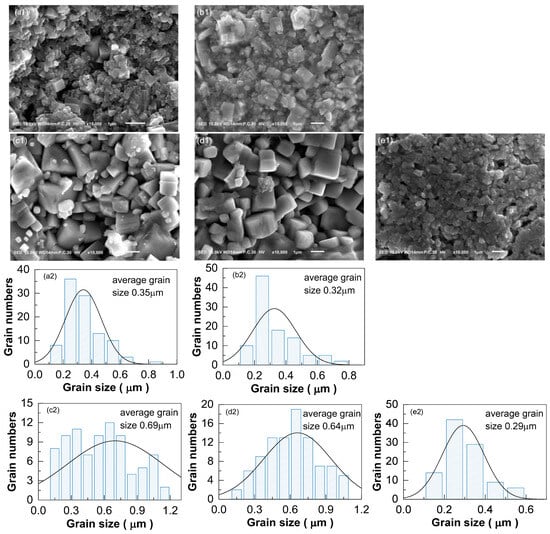
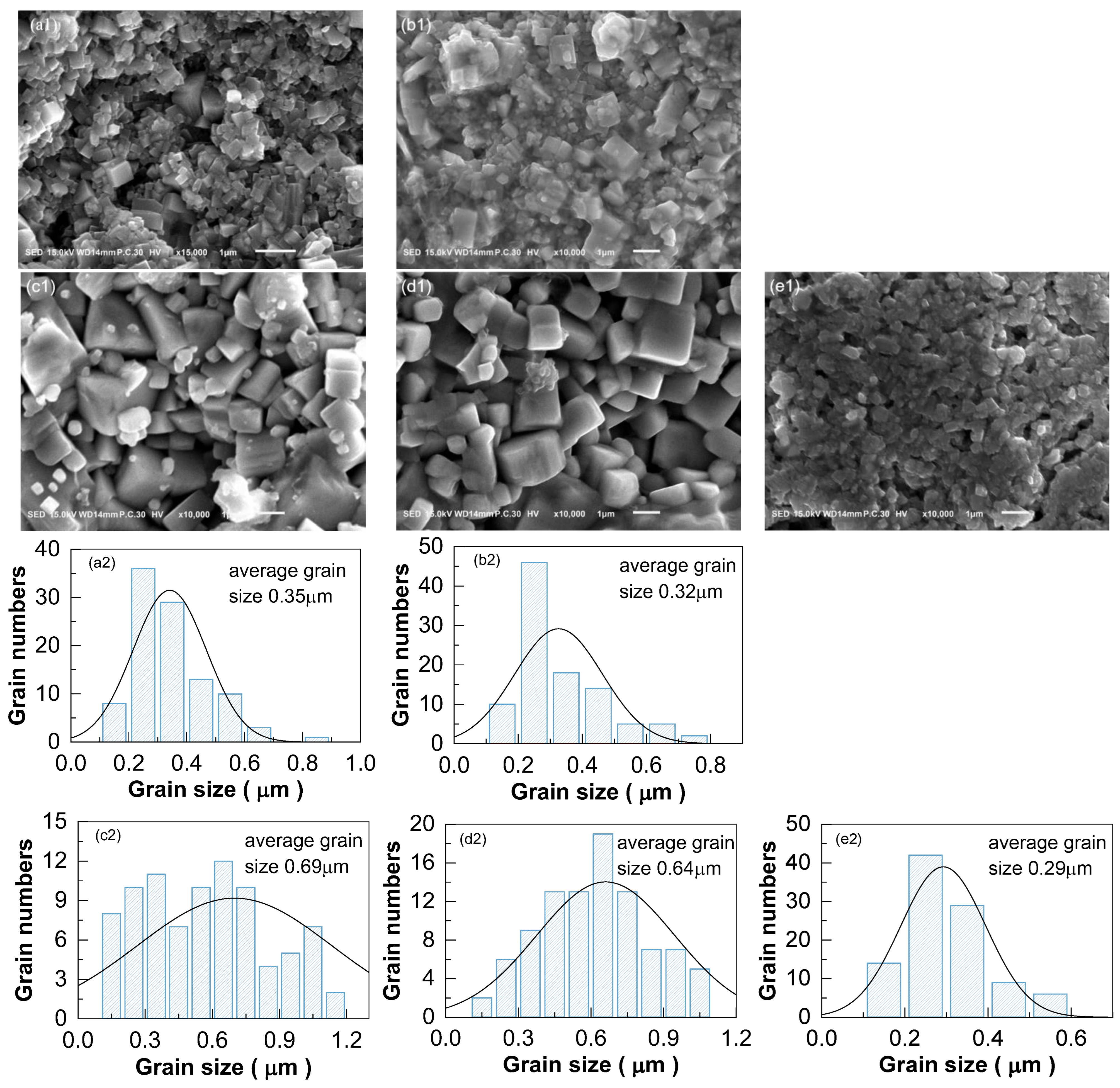
Figure 2 shows the SEM images and grain-size distributions of the 0.95KNNbS-0.05SrFNb ceramics sintered by CS (1165 °C) and TSS (1200–1125 °C, 4 h), together with the TSS ceramics of x = 0.01, 0.03, and 0.07. All specimens consist of equiaxed, submicrometer grains with well-defined boundaries, and no secondary phase or macroscopic segregation is resolvable by SEM. The x = 0.05 sample exhibits near-normal grain-size distribution and only isolated residual pores, indicating a dense but not fully pore-free microstructure. The composition series reveal a pronounced grain size reduction: the characteristic grain size is approximately 0.6 μm at x = 0.01–0.03 but decreases to about 0.3 μm at x = 0.05 and remains fine at x = 0.07. This grain-size reduction is not accompanied by monotonic densification: the relative densities of the x = 0.01, 0.03, 0.05, and 0.07 ceramics are 92.77%, 90.81%, 94.51%, and 85.96%, respectively (Table S2), showing that excessive SrFNb addition suppresses grain growth but also promotes pore retention. The x = 0.05 composition therefore achieves the best balance between fine grains and high density. For this composition, TSS increases the relative density from 92.13% to 94.51% (residual porosity from 7.87% to 5.49%) while reducing the average grain size only from 0.35 μm to 0.32 μm (Tables S1 and S2). Because the density gain is considerably larger than the change in grain size, the primary microstructural benefit of TSS enhances pore elimination, with boundary pinning preventing concomitant coarsening [16,29]. In contrast, the CuO-free (K0.48Na0.52)Nb0.965Sb0.035O3-based ceramics exhibit a coarser microstructure, with grain sizes mainly distributed in the range of 0.7–1.3 μm [41].
Figure 2.
SEM images and grain-size distribution of 0.95KNNbS-0.05SrFNb ceramics sintered at different processes (a1,a2: 1165 °C; b1,b2: 1200–1125 °C 4 h) and (1−x)KNNbS-xSrFNb ceramics with x = 0.01 (c1,c2), x = 0.03 (d1,d2), x = 0.07 (e1,e2).
The bulk density was measured by the geometric method, the theoretical unit-cell volume was derived from the Rietveld-refined lattice parameters (V = abc for the orthorhombic cell, V = a2c for the tetragonal cell, and V = a2c/2 for the rhombohedral cell in the hexagonal setting), and the theoretical density was calculated from the refined lattice parameters using ρtheo = ZM/(NAV) (where ρtheo is the theoretical density, Z is the number of formula units per unit cell, M is the molar mass of the composition, NA is Avogadro’s constant, and V is the unit-cell volume). In TSS, the high-T step (1200 °C) activates densification while the low-T step (1125 °C) freezes boundary migration but allows boundary diffusion, decoupling densification from grain growth [42]. Reduced porosity removes low-permittivity, field-concentrating voids and charge-injection sites, mainly raising εm, Pr, breakdown and fatigue resistance, and lowering loss; the fine-grained microstructure generation with CuO boundary segregation increases the boundary fraction, homogenizes the field and decreases domains, favoring switching and d33. The enhancement is therefore combined effects, i.e., the densification governs dielectric behavior and the fine-grained microstructure governs switching and piezoelectricity.
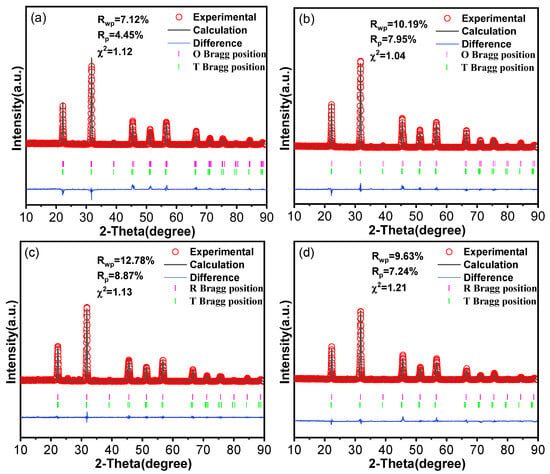
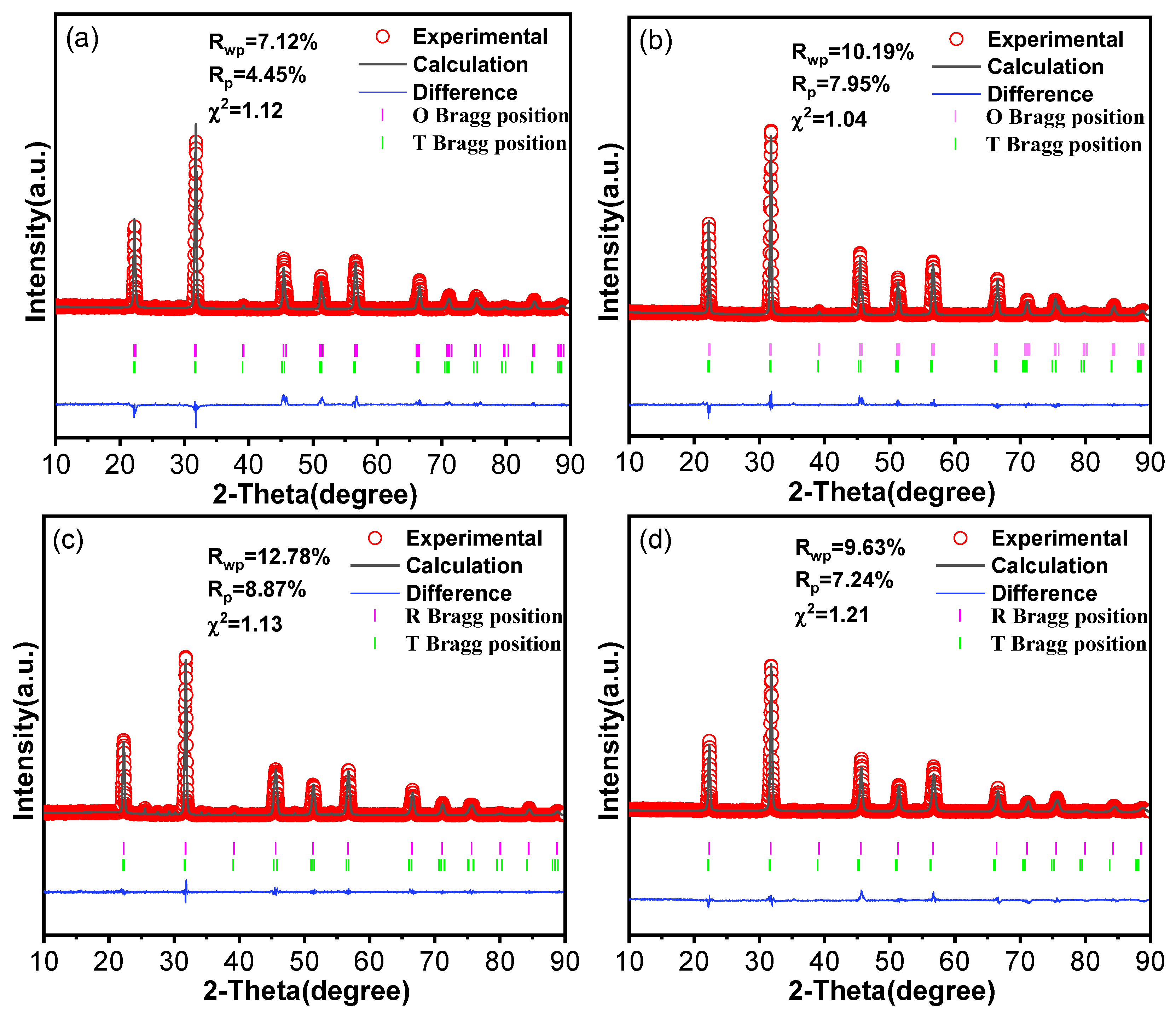
Since different phase structures will affect the electrical properties of ceramics, in order to further explain the change of phase structure, GSAS-II Rietveld is used to refine the XRD patterns, and the results are shown in Figure 3. The results of 0.95KNNbS-0.05SrFNb ceramics prepared by CS and TSS methods sintered at different conditions are shown in Figure S1. The high-quality fitting parameters (Rwp < 12.78%, χ2 < 1.21) ensures refinement reliability. With increasing the SrFNb content, the structure evolves from O-T coexistence (x ≤ 0.03, O phase > 50%) to R-T coexistence (x ≥ 0.05, R phase dominant). The O phase decreases from 70% to 0%, while the R phase increases to 77.3%, and the T phase decreases slightly to 22.7% at x = 0.07. For the x = 0.05 sample, the few weak unidentified reflections close to the detection limit were incorporated by manually adding peaks to the background function rather than modeled as a separate phase, as their crystal structure could not be determined.
Figure 3.
XRD Rietveld refinement results of (1−x)KNNbS-xSrFNb ceramics with different SrFNb doping contents prepared by TSS. (a) x = 0.01; (b) x = 0.03; (c) x = 0.05; (d) x = 0.07.
Based on valence and ionic radii Sr2+ (1.44 Å, coordination number (CN)-12), being too large for the octahedral site, enters the perovskite A-site and substitutes K+/Na+, whereas Fe3+ (0.645 Å, CN-6, high spin) and Nb5+ (0.64 Å, CN-6) occupy the B-site, replacing Nb5+/Sb5+. Then, local effective charge is induced in the (1−x)KNNbS-xSrFNb solid solution, i.e., Sr2+ substituting K+/Na+ produces +1 effective charge, and Fe3+ replacing Nb5+/Sb5+ engenders -2 effective charge; whereas these cations cancel exactly, so the (1−x)KNNbS-xSrFNb unit is self-compensating and needs no oxygen vacancies from a macro perspective, analogous to the A-site donor compensation in MnO-doped potassium sodium niobate ceramics [43]. Residual acceptor charge from CuO and excess Fe3+ is balanced by a small oxygen-vacancy concentration, forming acceptor-oxygen-vacancy dipoles; and low tan δ (<0.06) confirms few mobile vacancies. The incorporation of Sr2+ and Fe3+ ions induces A-site/B-site ionic radius mismatches, decreasing the tolerance factor and causing anisotropic lattice distortions (Table 1), which promote BO6 octahedral tilting and stabilize the R phase. The continuous composition-dependent evolution and good fitting quality rule out peak overlap, confirming a genuine structural transition. The random aliovalent ions create local fields and polar nanoregions, and shift the phase boundaries toward room temperature, while the acceptor-oxygen-vacancy dipoles pin domain walls, raising Qm and lowering dielectric loss, with a slightly higher Ec [43].
Table 1.
Structural parameters of the (1−x)KNNbS-xSrFNb ceramics with different SrFNb doping contents prepared by TSS obtained by Rietveld refinement.
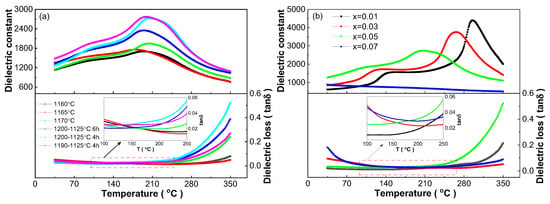
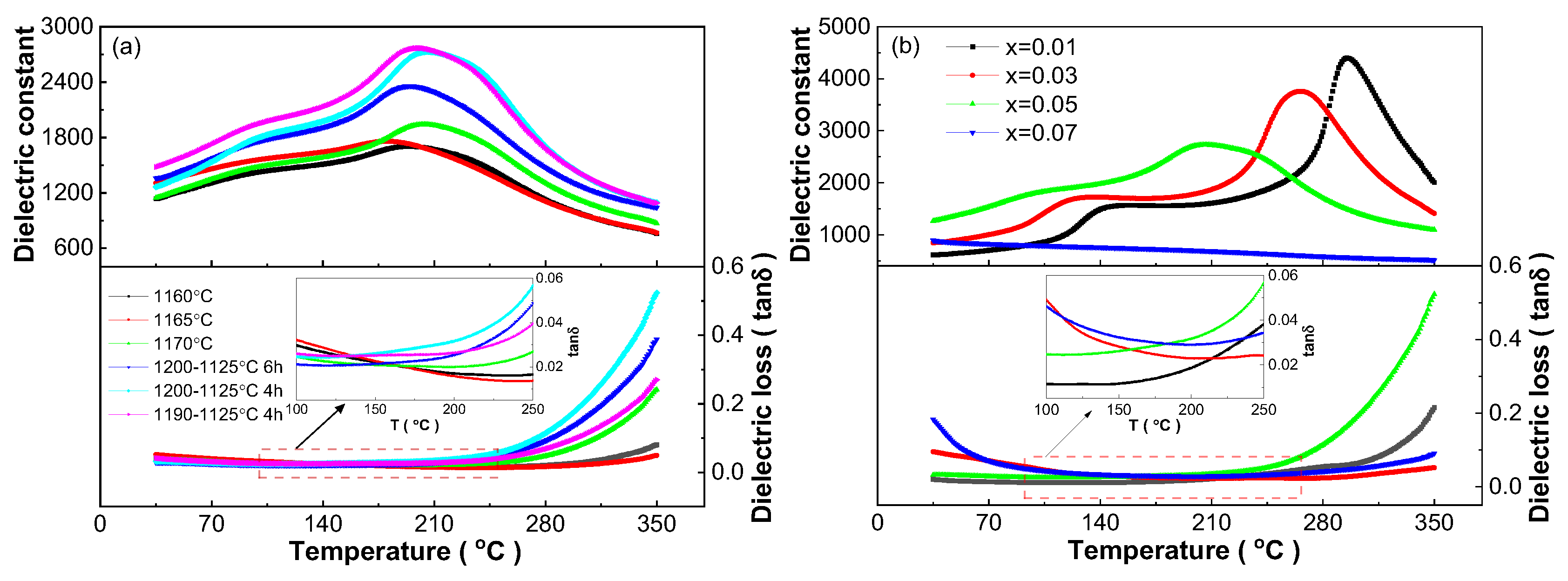
The influence of CS and TSS on dielectric performance at 100 kHz of the 0.95KNNbS-0.05SrFNb ceramics is shown in Figure 4a. As the CS single-step sintering temperature increases from 1160 °C to 1170 °C, the peak dielectric constant rises progressively and the peak profile turns sharper, suggesting that higher sintering temperature facilitates ceramic densification and grain development, and mitigates the damping effect of pore defects on polarization [35,37]. In comparison with the CS method, the TSS strategy yields further improvement in dielectric properties. Particularly, the TSS sample sintered at 1190–1125 °C 4 h achieves the maximum dielectric constant (εm) of 2768. Such phenomenon is because two-step sintering elevates the bulk density while restraining abnormal grain growth, thereby strengthening the dielectric response contributed by ferroelectric domain switching [33,42].
Figure 4.
Temperature dependence of dielectric performance for the (a) 0.95KNNbS-0.05SrFNb ceramics sintered by CS and TSS at different temperatures at 100 kHz and (b) (1−x)KNNbS-xSrFNb ceramics with different SrFNb doping contents prepared by TSS at 100 kHz.
Figure 4b shows the temperature-dependent dielectric performance of the (1−x)KNNbS-xSrFNb ceramics, tested at 100 kHz to investigate the effect of the SrFNb doping content on the dielectric properties. The x = 0.01 sample exhibits a sharp Curie peak at 295 °C as a normal ferroelectric, with the εm value of 4401. Such value is comparable to, or slightly higher than, the Curie-peak permittivity commonly reported for the KNN-based ceramics [41,44]. At x = 0.03, Tm decreases to 266 °C and TO-T approaches room temperature. At x = 0.05, Tm further decreases to 200 °C with pronounced relaxor behavior, driven by random A-site Sr2+ and B-site Fe3+/Nb5+ creating charge mismatch and local electric fields; Sr2+ also lowers the tolerance factor, promotes BO6 tilting and shifts the boundaries to room temperature, lowering Tm [24]. However, the εr versus T plot for x = 0.07 does not show a clear transition corresponding to TC, which suggests that the material is in the paraelectric phase at room temperature [45,46,47]. For dielectric loss, all samples maintain low dielectric loss tan δ (<0.06) at low-to-moderate temperatures, except the phase-boundary x = 0.03 (tan δ = 0.0952 at room temperature), where strongly enhanced domain-wall mobility raises the loss.
Figures S2 and S3 show temperature-dependent dielectric properties at several frequencies of the 0.95KNNbS-0.05SrFNb ceramics sintered at different processes and the (1−x)KNNbS-xSrFNb ceramics by TSS, from which the ferroelectrics type can be judged preliminarily. Compared with the permittivity characteristic, the loss tangent tan δ exhibits more obvious frequency dispersion phenomenon, and the tan δ value decreases significantly near the peak temperature of dielectric constant (TC or Tm depending on ferroelectrics type). The higher the frequency is, the more the dielectric loss drops around the Tm temperature, because the domain-wall and polar-nanoregion relaxation loss is frozen out at high frequency during the ferroelectric-to-paraelectric transition [48].
In order to analyze the dielectric response characteristic of ferroelectric ceramics, the Curie–Weiss law is used to fit the dielectric data of the (1−x)KNNbS-xSrFNb ceramics above the TC temperature:
where C is the Curie–Weiss constant and T0 is the Curie–Weiss temperature.
The diffuse-phase transition characteristic in the (1−x)KNNbS-xSrFNb ceramics is further studied by the exponential law:
where γ is the dispersion index and C′ is a constant. In general, when γ is 1, it indicates that the material is a normal ferroelectric, and when γ is 2, the material is a typical relaxor ferroelectric [49].
As shown in Figures S4 and S5, the dielectric response characteristics of 0.95KNNbS-0.05SrFNb ceramics sintered at different processes and (1−x)KNNbS-xSrFNb ceramics by TSS can be fitted by both Curie–Weiss law and exponential law, but all have some deviation, with the results summarized in Table 2 and Table 3. The C value of all samples has the order of 106–107 magnitude, it is significantly higher than the typical value for normal ferroelectrics (105 magnitude), indicating a marked deviation from the Curie–Weiss law in the system. All γ values lie between 1.7 and 2, indicating a diffuse-phase transition with strong relaxor character [50].
Table 2.
Summary of dielectric and relaxor-related parameters for 0.95KNNbS-0.05SrFNb ceramics sintered by CS and TSS at different temperatures.
Table 3.
Summary of dielectric and relaxor-related parameters for (1−x)KNNbS-xSrFNb ceramics with different SrFNb doping contents prepared by TSS.
For the fixed-composition 0.95KNNbS-0.05SrFNb, the diffuseness exponent broadly follows density as the sintering condition varies. The CS sample at 1165 °C reaches the highest CS density with γ = 1.923, and the TSS 1200–1125 °C 4 h sample reaches the highest TSS density with γ = 1.887, together with a higher εm of 2729. Both phenomena indicate that enhanced densification and optimized microstructure effectively boost the dielectric response while maintaining strong relaxor nature. With the increase of SrFNb amount, the γ value presents a first-increasing-then-decreasing change characteristic, and a maximum γ value of 1.908 is obtained when x = 0.03, showing the strongest relaxation degree. This density–γ correlation applies only to the fixed-composition sintering conditions; in the composition series γ is governed mainly by B-site disorder and the phase boundary besides density. This evolution demonstrates that SrFNb doping progressively intensifies the phase transition diffusion and enhances relaxor behavior. γ and the loss dispersion follow the same composition trend as the phase evolution. The large γ, the frequency dispersion of εm and tan δ, and the broadened peak with PNR formation are characteristic of relaxor ferroelectrics. The single perovskite phase, high density and uniform grains rule out macroscopic chemical inhomogeneity, confirming the dispersion is intrinsic to PNRs rather than an ordinary diffuse transition [49].
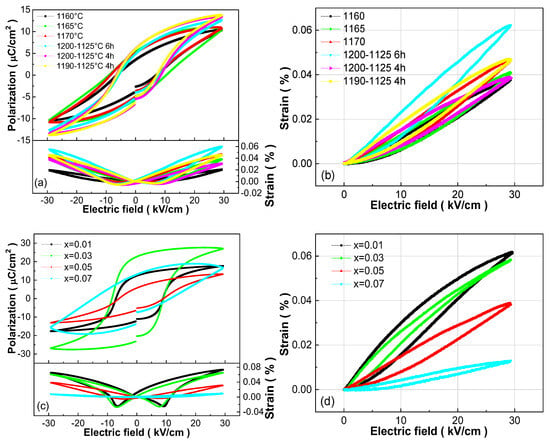
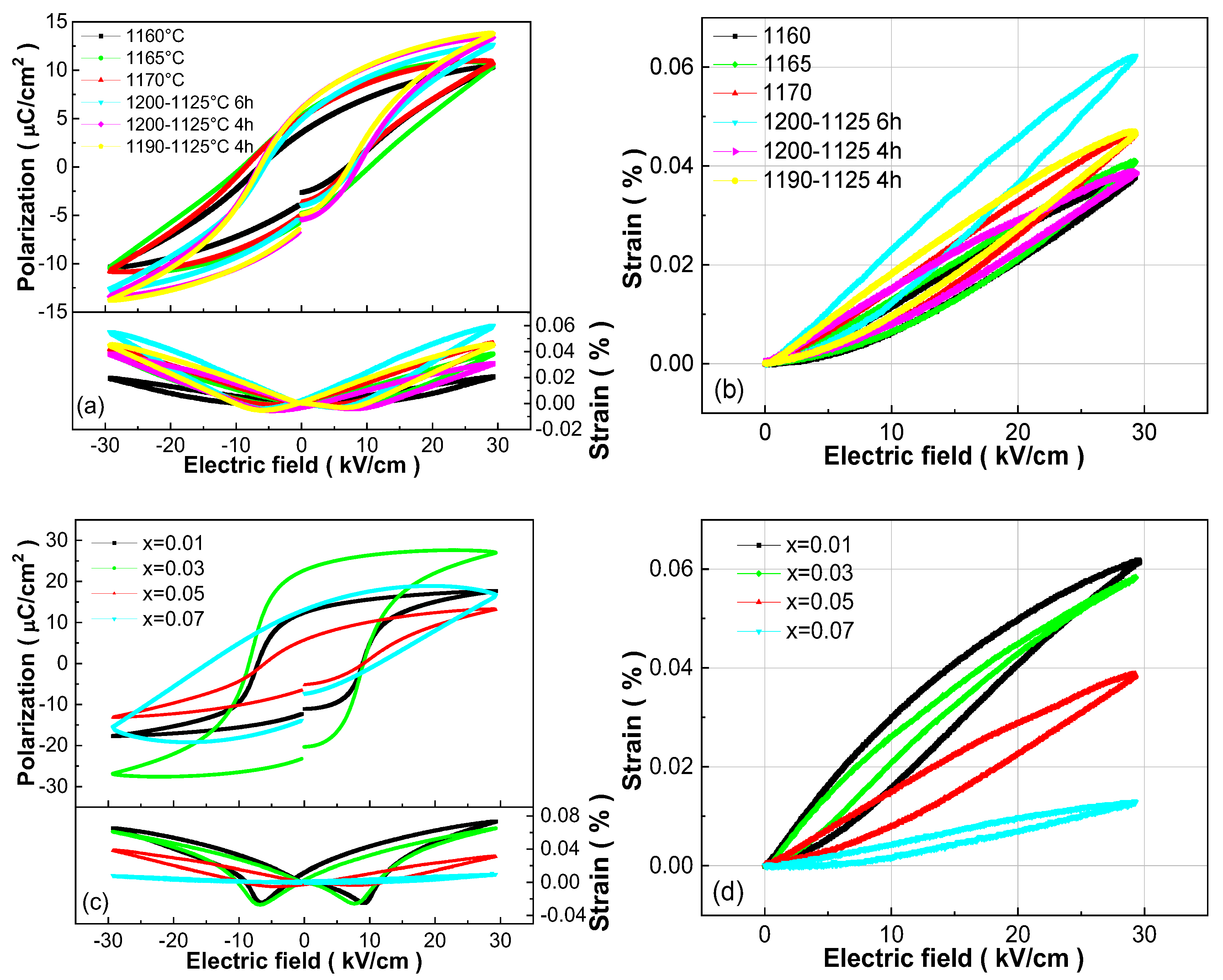
Figure 5 presents the bipolar polarization-electric field (P-E) hysteresis loops with corresponding bipolar strain–electric field (S-E) curves, as well as unipolar S-E curves of (1−x)KNNbS-xSrFNb ceramics fabricated under different sintering conditions and with different compositions. The key ferroelectric parameters, namely remanent polarization (Pr) and coercive field (Ec), derived from the P-E loops are listed in Tables S3 and S4. For the fixed composition of 0.95KNNbS-0.05SrFNb, all samples sintered via various processes exhibit well-saturated P-E loops and typical butterfly-shaped bipolar S-E curves at room temperature, verifying the stable intrinsic ferroelectricity of the SrFNb-modified KNN-based system. As shown in Figure 5a and Table S3, the Pr value of samples prepared by TSS is higher than that of samples via CS, while the Ec value is generally lower than that of conventional sintering [51]. At the sintering temperature of 1200–1125 °C 4 h, Pr, Ec and d33 all reach their respective extreme values, benefiting from the dense microstructure and uniform grain-size distribution induced by the TSS strategy. As the holding time increases, at 1200–1125 °C, the ceramic also exhibits excellent strain performance, the maximum strain is 0.064% and calculated inverse piezoelectric coefficient d33* is 207 pm/V (Figure 5b). The TSS process reduces the average grain size from 0.35 to 0.32 μm together with higher density and improved ferroelectric properties; finer, uniform grains increase the grain-boundary fraction and homogenize the field, which favors domain switching [35].
Figure 5.
0.95KNNbS-0.05SrFNb ceramics sintered by CS and TSS at different temperatures: (a) bipolar P-E loops and S-E curves; (b) unipolar S-E curves; (1−x)KNNbS-xSrFNb ceramics with different SrFNb doping contents prepared by TSS: (c) bipolar P-E loops and S-E curves; (d) unipolar S-E curves.
Under the same TSS sintering process, the effect of SrFNb doping amount on the electrical properties of (1−x)KNNbS-xSrFNb ceramics can be obtained from Figure 5c,d and Table S4. Pr and Ec reach maximum values of 22.72 μC/cm2 and 9.47 kV/cm at x = 0.03. Both Pr and Ec values first rise and then fall, mainly because the random A-site Sr2+ and B-site Fe3+/Nb5+ occupation increases chemical disorder. The heterovalent and differently sized ions create local charge and size fluctuations that break long-range ferroelectric order and stabilize polar nanoregions, enhancing the relaxor behavior [49,52,53]. The strain performance decreases with the increase of SrFNb doping content, the maximum strain is 0.063% and d33* is 206 pm/V obtained at x = 0.01, followed by a decrease to 0.013% at x = 0.07. Correspondingly, d33* decreases from 206 to 44 pm/V. The total strain consists of intrinsic converse-piezoelectric deformation, reversible domain-wall motion, irreversible non-180° switching and electrostriction, separable by comparing d33 with d33* = Smax/Emax, and by the negative strain and hysteresis. At x = 0.01–0.03, the butterfly loops with large negative strain and maximum d33* are piezoelectric/switching dominated, while the phase-boundary x = 0.03 gives the largest d33, Kp and Pr. At x = 0.05–0.07, PNRs replace macrodomains, the negative strain/hysteresis shrink and electrostriction grows; x = 0.07 is paraelectric at RT and shows the smallest strain, confirming a non-piezoelectric component at high x. Phase-boundary proximity therefore drives the piezoelectric-to-electrostrictive crossover [54].
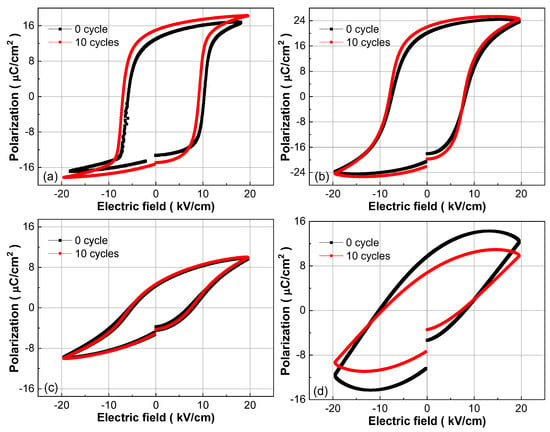
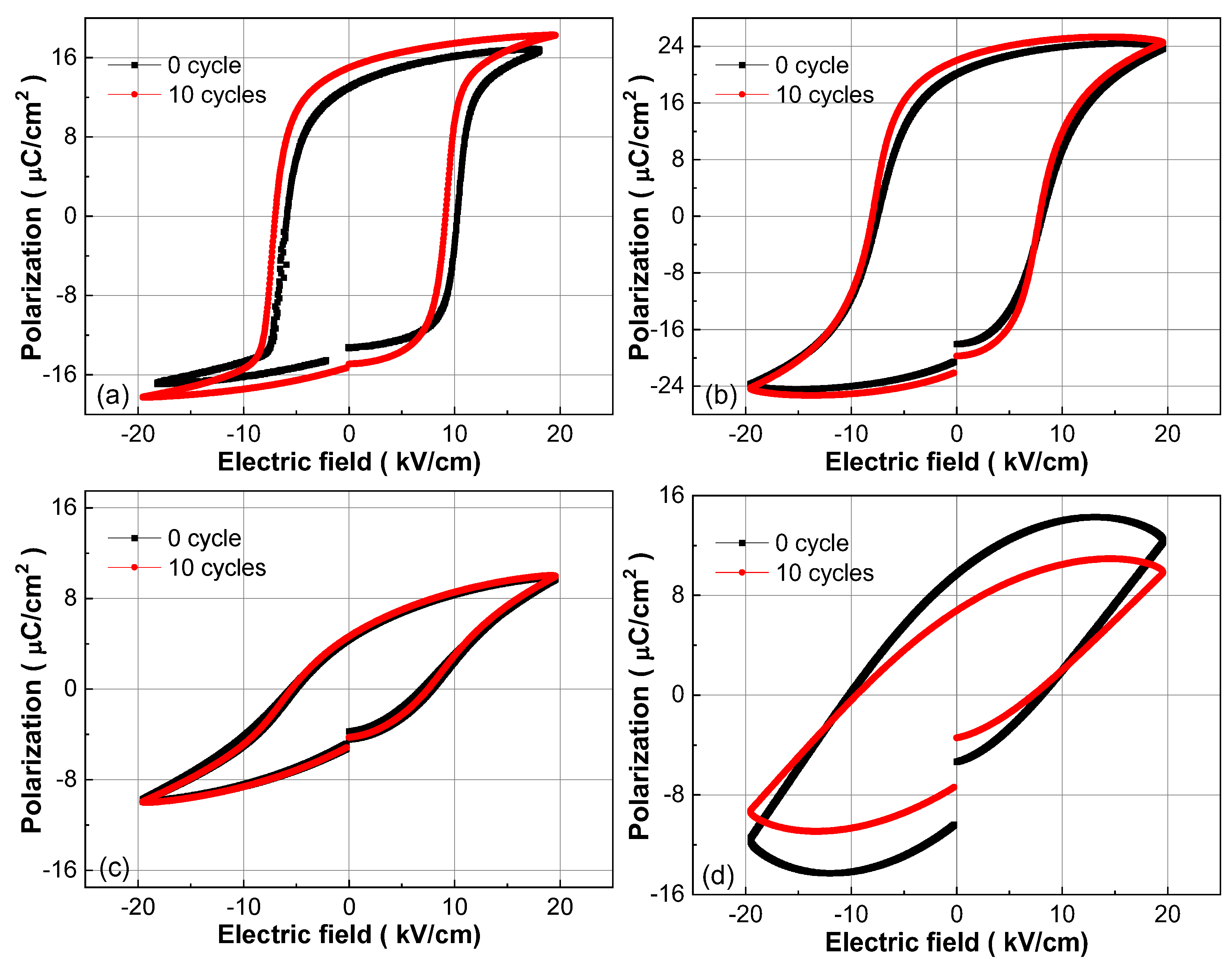
Through fatigue resistance evaluation under 20 kV/cm alternating current poling (ACP) cycling (Figure 6), (1−x)KNNbS-xSrFNb’s fatigue resistant under cyclic loading can be confirmed. For the x = 0.01 and x = 0.03 ceramics, the Pr and Ec values exhibit a slight enhancement within the span of 10 electric field cycles. (The first cycle curve of x = 0.01 sample was measured after several days of storage at room temperature, so it appears somewhat abnormal due to the existence of CuO-induced acceptor-oxygen-vacancy defect dipoles. After several cycles, the curve returns to its normal symmetric shape since the defect dipoles were disrupted [55]. At x = 0.05, the hysteresis loops remain nearly unchanged after 10 cycling with negligible attenuation of saturation and Pr. While the x = 0.07 composition suffers the most significant polarization attenuation and remarkable shrinkage of the loop area, revealing the poorest fatigue resistance. This is mainly attributed to the high porosity and the increased leakage at high SrFNb content, which facilitate charge injection and destabilize the domains under cycling [14]. With respect to the influences of sintering processes on the fatigue endurance of 0.95KNNbS-0.05SrFNb ceramics (Figure S6), all specimens exhibit excellent fatigue resistance with well-preserved hysteresis loop characteristics, except for the sample fabricated via CS sintering at 1170 °C, which retains merely 66% of its initial remanent polarization after cyclic electrical loading [6]. The performance change is a combined microstructural and electrical effects. Higher density and finer, uniform grains reduce field-concentrating pores, charge injection and microcrack initiation, while Cu/Fe acceptor-oxygen-vacancy dipoles pin domain walls and stabilize the domain configuration. The severely degraded x = 0.07 and CS 1170 °C samples support this-polarization loss is largest where porosity and mobile defects are greatest. The enhanced fatigue resistance therefore originates from the synergy of reduced porosity, grain-size reduction and defect-mediated domain pinning.
Figure 6.
Fatigue test of (1−x)KNNbS-xSrFNb ceramics with different SrFNb doping contents prepared by TSS after 10 cycles under 20 kV/cm at 10 Hz and room temperature: (a) x = 0.01; (b) x = 0.03; (c) x = 0.05; (d) x = 0.07.
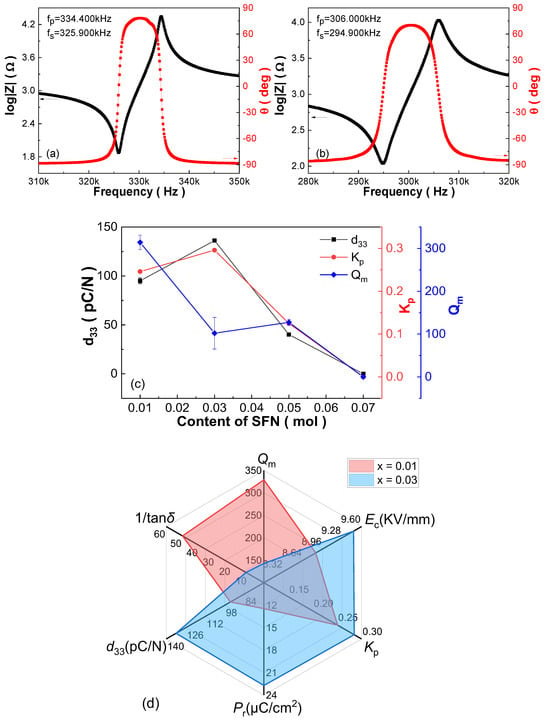
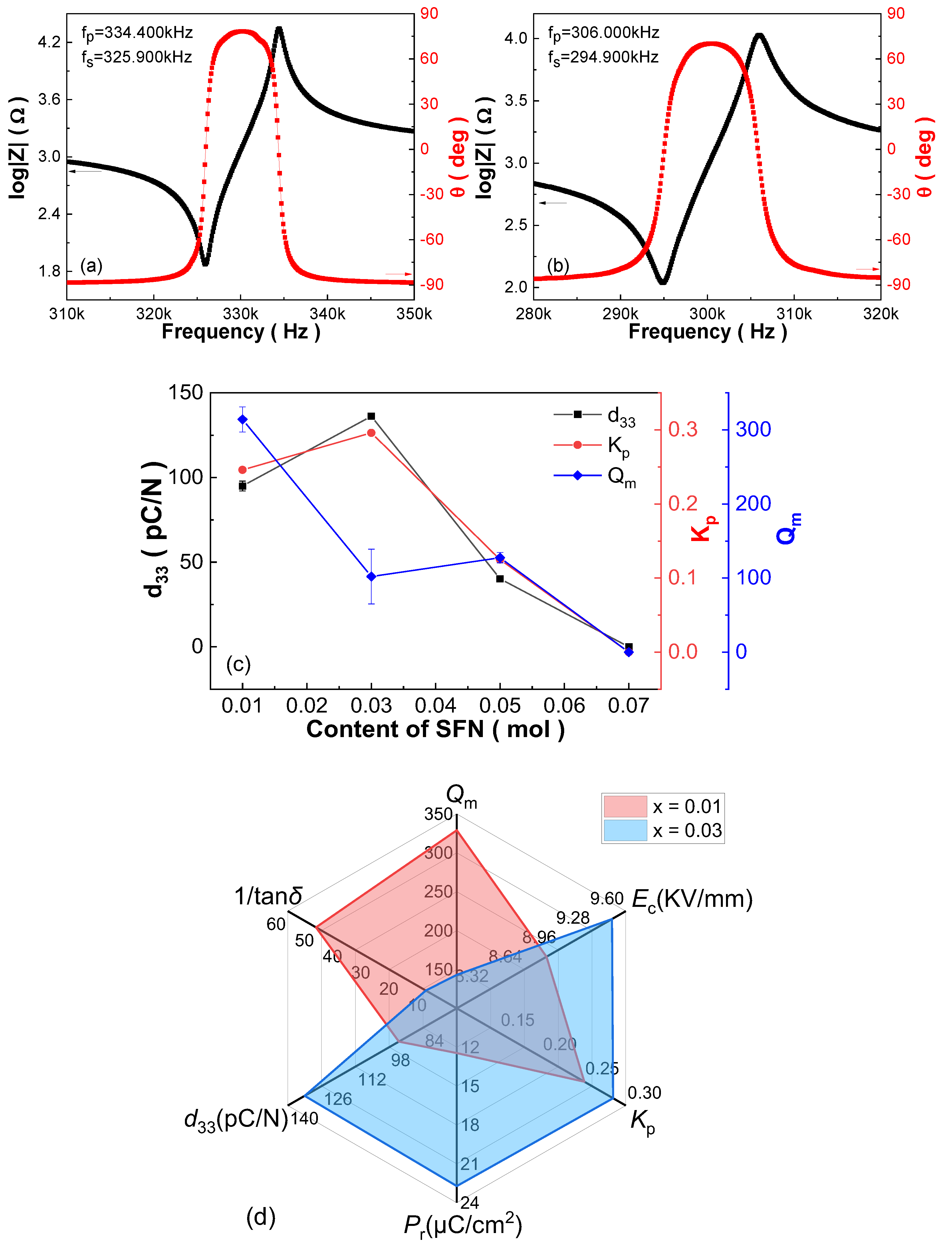
Figure 7a,b display impedance and phase angle curves of the x = 0.01 and x = 0.03 samples. Both ceramics show perfect resonance–antiresonance behavior with the phase angle approaching 90° at the resonant frequency, confirming favorable piezoelectric activity after alternating current poling. The results of 0.95KNNbS-0.05SrFNb composition under different sintering conditions are shown in Figure S7.
Figure 7.
Influence of ACP poling method on performance of (1−x)KNNbS-xSrFNb ceramics with different SrFNb doping contents prepared by TSS. Impedance and phase angle of (a) x = 0.01 and (b) x = 0.03 samples; (c) effects of SrFNb doping amounts on d33, Kp, and Qm of (1−x)KNNbS-xSrFNb ceramics; (d) comparison of comprehensive properties of x = 0.01 and x = 0.03 ceramics.
Figure 7c shows composition dependence of the d33, Qm and Kp values of (1−x)KNNbS-xSrFNb ceramics, and Table S3 shows effects of sintering conditions on electrical properties of the 0.95KNNbS-0.05SrFNb ceramics. The optimal comprehensive performance (d33 = 42 pC/N, Kp = 0.128) is achieved in the 0.95KNNbS-0.05SrFNb sample sintered at 1200–1125 °C 4 h. The d33 value demonstrates a progressive enhancement with increasing the SrFNb content, attaining a peak value of 133 pC/N at the composition of x = 0.03 before undergoing a precipitous decline. Simultaneously, the Kp value achieves its maximum value of 0.285 at this critical doping level [33]. Such results can be attributed to that the alternating electric field applied in the ACP process can effectively drive the gradual reorientation of ferroelectric domains and mitigate the pinning effect of defect dipoles [49]. In contrast, the Qm value reaches a maximum of 329 at x = 0.01 and decreases monotonously with elevating SrFNb doping level. This trend is in good agreement with the dielectric results. The sharp, low-loss ferroelectric peak at x = 0.01 corresponds to minimal energy dissipation, which in turn gives rise to the highest Qm. The high Qm at low SrFNb content is governed by acceptor hardening rather than by the perovskite composition itself, and B-site Cu2+ (and a small amount of excess Fe3+) creates oxygen-vacancy-compensated defect dipoles that establish a symmetry-conforming short-range order and an internal bias field, pinning domain walls and suppressing their vibration under resonance, which minimizes mechanical loss. Increasing SrFNb does not add acceptor charge but introduces B-site charge disorder and polar nanoregions, and moves the phase boundary to room temperature, lowering the domain-wall energy barrier and diluting the Cu2+ pinning, so the material softens and Qm decreases [43].
As shown in Figure 7d, a radar chart compares the key electrical parameters of the x = 0.01 and x = 0.03 samples. Despite a modest 30% decrease in d33, the x = 0.01 sample achieves a threefold enhancement in Qm. These two compositions can thus be categorized as relatively hard (x = 0.01) and relatively soft (x = 0.03) KNN-based piezoceramics, respectively, offering flexibility for diverse application scenarios. With further SrFNb addition, x = 0.05 and x = 0.07 fall outside the hard/soft piezoelectric classification. At x = 0.05, d33, Pr and Kp drop sharply while Qm remains moderate, not a distinctly hard or soft piezoceramic. At x = 0.07, Tm falls below room temperature, and the ceramic presents paraelectric and is essentially non-piezoelectric at room temperature [28].
4. Conclusions
Through composition design and using two types of fabrication processes, the enhanced densified (1−x)KNNbS-xSrFNb ceramics with pure phase perovskite structure were prepared under different sintering conditions, and the effects of SrFNb doping amount and sintering conditions were studied systematically. The XRD results demonstrate the presence of multiphase coexistence in the ceramics, with x = 0.01–0.07 samples located at the PPBs. Increasing SrFNb significantly reduces the average grain size from 0.6 μm to 0.3 μm. Furthermore, TSS decouples densification from grain growth, enabling the x = 0.05 ceramic to achieve the maximum relative density of 94.51% with only a slight grain refinement from 0.35 μm to 0.32 μm. Samples made with two-step sintering have better piezoelectric and ferroelectric properties than those made with conventional sintering, with the 1200–1125 °C 4 h sample reaching the highest d33 of about 42 pC/N. The (1−x)KNNbS-xSrFNb ceramics approach relaxor ferroelectrics with apparent diffusion phase transition characteristic; Tm gradually decreases and relaxation factor γ increases first and then decreases with the elevation of SrFNb doping amount. By adjusting the composition, the x = 0.01 sample has the maximum Qm = 329 and 1/tan δ = 50, and the x = 0.03 sample has the maximum d33 = 133 pC/N and Kp = 0.285, corresponding to hard ceramics and soft ceramics respectively. The TSS process can increase densification, and improve dielectric and piezoelectric properties, and the (1−x)KNNbS-xSrFNb ceramics provide flexibility for diverse application scenarios.
Supplementary Materials
The following supporting information can be downloaded at: https://www.mdpi.com/article/10.3390/ceramics9110123/s1, Figure S1: XRD Rietveld refinement results of 0.95KNNbS-0.05SrFNb ceramics sintered by CS and TSS methods at different conditions (a) 1160 °C; (b) 1165 °C; (c) 1170 °C; (d) 1200–1125 °C 6 h; (e) 1200–1125 °C 4 h; (f) 1190–1125 °C 4h; Figure S2: Effects of frequency on dielectric properties of 0.95KNNbS-0.05SrFNb ceramics sintered by CS and TSS methods at different conditions (a) 1160 °C; (b) 1165 °C; (c) 1170 °C; (d) 1200–1125 °C 6 h; (e) 1200–1125 °C 4 h; (f) 1190–112 5 °C 4 h; Figure S3: Effects of frequency on dielectric properties of (1−x)KNNbS-xSrFNb ceramics sintered by TSS. (a) x = 0.01; (b) x = 0.03; (c) x = 0.05; (d) x = 0.07; Figure S4: Linear fitting of the dielectric behavior above the TC temperature of the 0.95KNNbS-0.05SrFNb ceramics sintered by CS and TSS using 100 kHz data according to (a1)–(f1) the Curie-Weiss law and (a2)–(f2) the exponential law (a) 1160 °C; (b) 1165 °C; (c) 1170 °C; (d) 1200–1125 °C 6 h; (e) 1200–1125 °C 4 h; (f) 1190–1125 °C 4 h; Figure S5: Linear fitting of the dielectric behavior above the TC temperature of the (1−x)KNNbS-xSrFNb ceramics sintered by TSS using 100 kHz data according to (a1)–(c1) the Curie-Weiss law and (a2)–(c2) the exponential law (a) x = 0.01; (b) x = 0.03; (c) x = 0.05; Figure S6: Fatigue test of 0.95KNNbS-0.05SrFNb ceramics sintered by CS and TSS after 10 cycles under 20 kV/cm (a) 1160 °C; (b) 1165 °C; (c) 1170 °C; (d) 1200–1125 °C 6 h; (e) 1200–1125 °C 4 h; (f) 1190–1125 °C 4 h; Figure S7: Impedance and phase angle of 0.95KNNbS-0.05SrFNb ceramics sintered by CS and TSS (a) 1160 °C; (b) 1165 °C; (c) 1170 °C; (d) 1200–1125 °C 6 h; (e) 1200–1125 °C 4 h; (f) 1190–1125 °C 4 h; Table S1: Cell volume and density of 0.95KNNbS-0.05SrFNb ceramics sintered by CS and TSS methods at different conditions; Table S2: Cell volume and density of (1−x)KNNbS-xSrFNb ceramics sintered by TSS; Table S3: Pr, Ec, d33*, Kp, Qm and d33 of 0.95KNNbS-0.05SrFNb ceramics sintered by CS and TSS methods at different conditions; Table S4: Pr, Ec, d33*, Kp, Qm and d33 of (1−x)KNNbS-xSrFNb ceramics sintered by TSS.
Author Contributions
Conceptualization, B.F.; Supervision, B.F. and J.D.; Formal analysis, Y.M., S.S., B.F. and X.L.; Investigation, Y.M., B.F. and S.Z.; Data curation, Y.M., S.S. and B.F.; Writing—original draft, Y.M.; Writing—review and editing, B.F.; Funding acquisition, B.F., S.Z. and X.L.; Project administration, B.F. and J.D. All authors have read and agreed to the published version of the manuscript.
Funding
This research received no external funding.
Data Availability Statement
The raw data supporting the conclusions of this article will be made available by the authors on request.
Acknowledgments
This work was supported by the Top-notch Academic Programs Project of Jiangsu Higher Education Institutions and the Priority Academic Program Development of Jiangsu Higher Education Institutions for financial support.
Conflicts of Interest
Author Shaohua Su was employed by the company Mitai Technology (Changzhou) Co., Ltd. The other authors declare that the research was conducted in the absence of any commercial or financial relationships that could be construed as a potential conflict of interest.
References
- Tian, Y.; Liu, C.; Li, S.; Chen, M.; Liu, P.; Wu, H.; Wang, J.; Jing, Q. Unveiling Li-Doping Mechanisms in Optimising Structure and Synergistic Piezoelectric-Mechanical Properties of KNL NS-SS Lead-Free Ceramics. Mater. Sci. Eng. B 2026, 325, 119109. [Google Scholar] [CrossRef] [Scilit]
- Feng, T.; Yang, Z.; Liu, H.; Huang, H.; Hu, J.; Zhu, L.; Zhang, B.; Li, J. Simultaneous Enhancement of Piezoelectricity and Mechanical Quality Factor in Hard-Type KNN-Based Lead-Free Ceramics via Hierarchical Domain Architecture. Adv. Funct. Mater. 2025, 35, 2425699. [Google Scholar] [CrossRef] [Scilit]
- Li, H.; Chen, N.; Fan, L.; Yu, Y.; Li, S.; Du, Y.; Tan, Z.; Xing, J.; Gu, X.; Zhu, J.; et al. Harnessing the Synergistic Effects between a Polymorphic Phase Boundary and Second-Phase Hardening for Enhanced Electromechanical Compatibility in KNN-Based Ceramics. J. Mater. Chem. A 2026, 14, 14418–14429. [Google Scholar] [CrossRef] [Scilit]
- Su, C.; Wang, X.; Wang, Z.; Chen, F.; Shen, C.; Hao, H.; Yao, Z.; Cao, M.; Liu, H. A Relationship between Defect Engineering and Pyroelectric Response Mechanism of Mn-doped KNN-based Ceramics. J. Am. Ceram. Soc. 2025, 108, e20532. [Google Scholar] [CrossRef] [Scilit]
- Yuan, L.; Li, B.; Dai, Y. Defect Dipole-Mediated Hardening in CuO-Doped KNN-BNZ Lead-Free Ceramics. Ceram. Int. 2026, 52, 463–469. [Google Scholar] [CrossRef] [Scilit]
- Pan, Y.; Feng, X.; Zhang, Z.; Ding, Y.; Li, F.; Zhang, S.; Zheng, T.; Wu, J. Ion-Channel-Mediated Gradient Acceptor Distribution for Hard Lead-Free Piezoceramics. Mater. Horiz. 2026, 13, 2817–2829. [Google Scholar] [CrossRef] [Scilit] [PubMed]
- Lv, X.; Wang, X.; Shi, X.; Kong, J.; Huang, H.; Hu, T.; Fu, Z.; Lyu, J.; Ma, Y.; Zhang, X.; et al. Beyond Phase Boundaries: Atomic Mechanisms Governing Structure and Property Variations in (K, Na)NbO3-Based Ferroelectrics. Nat. Commun. 2025, 17, 859. [Google Scholar] [CrossRef] [Scilit] [PubMed]
- Sikdar, A.; Nandi, S.; Sanga, A.P.; Roy, S.; Dasgupta Ghosh, B. Silver-Modified KNN Perovskite: A Lead-Free Route to High-Performance Energy Storage and Piezoelectric Energy Harvesting. Ceram. Int. 2026, 52, 13985–13995. [Google Scholar] [CrossRef] [Scilit]
- Li, H.; Chen, N.; Xing, J.; Liu, W.; Tan, Z.; Chen, H.; Tang, M.; Mo, M.; Zhu, J. Simultaneous Enhancement of Piezoelectricity and Curie Temperature in KNN-Based Ceramics via a Multiple Formula Solid Solution. J. Mater. Chem. C 2025, 13, 5307–5316. [Google Scholar] [CrossRef] [Scilit]
- Hua, Y.; Tang, L.; Qian, J.; Wang, S.; Ge, G.; Lin, J.; Zhai, J. Outstanding Comprehensive Piezoelectric Properties in KNN-Based Ceramics via Co-Optimization of Crystal Structure and Grain Orientation. Acta Mater. 2025, 297, 121378. [Google Scholar] [CrossRef] [Scilit]
- Yang, H.; Tang, L.; Han, S.; Hua, Y.; Lin, J.; Qian, J.; Shen, B.; Jiang, G.; Zhai, J. Ultra-Stable Thermal Piezoelectricity up to 200 °C in High-Performance KNN-Based Textured Piezoceramics. Adv. Funct. Mater. 2025, 35, 202507702. [Google Scholar] [CrossRef] [Scilit]
- Wang, L.; Su, C.; Liao, Y.; Hao, H.; Liu, H. Phase Tuning on BiCoO3 Modified KNN Ceramics with Increased Overall Pyroelectric Properties and High Curie Temperature. J. Eur. Ceram. Soc. 2025, 45, 117372. [Google Scholar] [CrossRef] [Scilit]
- Li, Y.; Peng, Z.; Chai, Q.; Wang, Y.; Nie, X.; Wei, L.; Liang, P.; Wu, D.; Chao, X.; Yang, Z. Enhanced Piezoelectricity and Lager Strain in Bi0.5Li0.5HfO3 Doped Sodium Potassium Niobate-Based Ceramics with High Curie Temperatures. Ceram. Int. 2025, 51, 20992–20998. [Google Scholar] [CrossRef] [Scilit]
- Estrella-Nuñez, J.; Moya-Canul, K.M.; Serralta-Macias, J.J.; Olguín, D.; Yáñez-Limón, J.M. Study on the Structural, Ferroelectric, and Optical Properties of KNN Ferroelectric Ceramics Doped with Cu. J. Electroceram. 2025, 54, 335–350. [Google Scholar] [CrossRef] [Scilit]
- Nie, J.; Qiu, N.; Zhang, S.; He, Q.; Chen, X.; Han, Y.; Tian, Y.; Tian, C. Enhanced Strain Properties in KNN-Based Lead-Free Piezoelectric Multilayer Actuators by Low-Temperature Texture Engineering. ACS Omega 2025, 10, 38995–39001. [Google Scholar] [CrossRef] [Scilit] [PubMed]
- Huang, Y.; Song, X.; Sun, R.; Jiang, H.; Du, P.; Luo, L. Enhanced Electrical Properties of Lead-Free Sodium Potassium Niobate Piezoelectric Ceramics Prepared via Cold Sintering Assisted Sintering. J. Mater. Chem. C 2025, 13, 93–102. [Google Scholar] [CrossRef] [Scilit]
- Azadeh, M.; Zhao, C.; Pawadi, A.; Gao, S.; Frömling, T. Effect of Iron Acceptor Doping and Calcium Donor Doping in Potassium Sodium Niobate-based Lead-free Piezoceramics. J. Am. Ceram. Soc. 2024, 107, 4949–4961. [Google Scholar] [CrossRef] [Scilit]
- Liao, Y.; Su, C.; Hao, H.; Wang, L.; Yao, Z.; Cao, M.; Shen, C.; Liu, H. Effect of Sb Doping on Pyroelectric Properties of KNN-based Ceramics. J. Am. Ceram. Soc. 2025, 108, e20549. [Google Scholar] [CrossRef] [Scilit]
- Gaur, R.; Rawat, S.; Singh, S. Influence of La Doping on Structural, Dielectric, Ferroelectric, and Energy Storage Properties of (K0.5Na0.5)NbO3 Ceramics. Solid State Ion. 2026, 442, 117226. [Google Scholar] [CrossRef] [Scilit]
- Cheng, M.; Huang, F.; Hussain, F.; Dai, J.; Fan, Z.; Yue, W.; Deng, Y.; Zhang, Y.; Ming, J.; Abu Abdeen, M.; et al. Enhancing Piezoelectric Performance in KNN Ceramics via Sb-BNZ Synergistic Doping. Ceram. Int. 2026, 52, 22658–22664. [Google Scholar] [CrossRef] [Scilit]
- Hussain, A.; Nawaz, S.; Jabeen, N.; Zafar, R.; Qaiser, M.A.; Abbas, Z.; Ahmed, F.; Khan, M.U.; Waseem, M.; Aslam, S. Enhanced Ferroelectric and Piezoelectric Response by MnO2 Added Bi0.5(K0.2Na0.8)0.5TiO3 Ceramics. J. Solid State Chem. 2022, 306, 122716. [Google Scholar] [CrossRef] [Scilit]
- Hussain, A.; Zheng, P.; Xu, X.; Chen, X.; Li, T.; Wang, Y.; Yuan, G.; Yin, J.; Liu, Z. Structural and Electrical Properties of Multiferroic (1-x)BiFeO3-xBi0.5K0.5TiO3 Ceramics. J. Alloys Compd. 2016, 678, 228–233. [Google Scholar] [CrossRef] [Scilit]
- Zhang, Y.; Liang, H.; Liu, Y.; Li, D.; Dong, S.; Wang, J.; Li, W.; Nan, C.-W. Boosting Capacitive Energy Storage in Relaxor Ferroelectrics through Polymorphic Phase Engineering. Sci. Adv. 2026, 12, eaeb7173. [Google Scholar] [CrossRef] [Scilit] [PubMed]
- He, W.; Liu, H. Tuning Polarization of Sodium Niobate-Based Ceramics by Introducing Sr(Fe0.5Nb0.5)O3. J. Mater. Sci. Mater. Electron. 2023, 34, 1777. [Google Scholar] [CrossRef] [Scilit]
- Wang, B.; Zhang, F.; Yang, Y.; Liu, F.; Liu, Z.; Liu, Z.; Li, Y. Microstructure and Electrical Properties of (K0.48Na0.52)0.97Li0.03NbO3-0.03CaZrO3 Lead-Free Piezoceramics with (4CuO–TiO2–2Nb2O5) Additive. Ceram. Int. 2021, 47, 18886–18892. [Google Scholar] [CrossRef] [Scilit]
- Karacasulu, L.; Vakifahmetoglu, C. Cold Sintering Assisted Two-Step Sintering of Potassium Sodium Niobate (KNN) Ceramics. Mater. Sci. Eng. B 2023, 297, 116709. [Google Scholar] [CrossRef] [Scilit]
- Serrazina, R.; Tkach, A.; Pereira, L.; Senos, A.M.O.R.; Vilarinho, P.M. Flash Sintered Potassium Sodium Niobate: High-Performance Piezoelectric Ceramics at Low Thermal Budget Processing. Materials 2022, 15, 6603. [Google Scholar] [CrossRef] [Scilit] [PubMed]
- Qiu, X.; Wu, C.; Tan, D.Q.; Liang, R.; Liu, C.; Ma, Y.; Zhang, X.; Wei, S.; Zhang, J.; Tan, Z.; et al. Excellent Hardening Effect in Lead-Free Piezoceramics by Embedding Local Cu-Doped Defect Dipoles in Phase Boundary Engineering. Nat. Commun. 2025, 16, 2894. [Google Scholar] [CrossRef] [Scilit] [PubMed]
- Tu, L.T.U.; Vuong, L.D.; Dat, T.N.; Tung, V.T. Effects of CuO Doping on the Sintering Behavior and Piezoelectric Properties of Lead-Free (K0.41Na0.59)(Nb0.84Sb0.06Ta0.10)O3 Ceramics. Appl. Phys. A 2025, 131, 210. [Google Scholar] [CrossRef] [Scilit]
- Hussain, A.; Jabeen, N.; Hassan, N.U.; Rasheed, S.; Idrees, A.; Eldin, S.M.; Ouladsmane, M.; Khan, S.; Akkinepally, B.; Javed, M.S. Structural, Piezoelectric and Ferroelectric Analysis of 0.96Bi0.5Na0.5TiO3-0.06BaTiO3: Xwt%MnO2 Ceramics for High-Tech Applications. Ceram. Int. 2023, 49, 27848–27854. [Google Scholar] [CrossRef] [Scilit]
- Zhang, N.; Zheng, T.; Wu, J. Lead-Free (K,Na)NbO3-Based Materials: Preparation Techniques and Piezoelectricity. ACS Omega 2020, 5, 3099–3107. [Google Scholar] [CrossRef] [Scilit] [PubMed]
- Iacomini, A.; Garroni, S.; Mulas, G.; Enzo, S.; Cappai, L.; Mureddu, M.; Cau, C.; García, A.; Pardo, L. Processing, Phase Evolution and Electrical Properties of “Lead Free” KNN–BF–CuO Eco-Piezoceramic from Mechanochemically Activated Precursors. Open Ceram. 2022, 9, 100247. [Google Scholar] [CrossRef] [Scilit]
- Zhou, Y.; Fang, B.; Zhang, S.; Lu, X.; Ding, J. Enhancing Densification and Electrical Properties of KNN-Based Lead-Free Ceramics via Two-Step Sintering. J. Korean Ceram. Soc. 2022, 59, 551–564. [Google Scholar] [CrossRef] [Scilit]
- Li, W.; Fang, B.; Lu, X.; Zhang, S.; Ding, J. (Bi0.5Na0.5)(Zr0.97W0.01Fe0.02)O3 Doping Effects on KNN-Based Lead-Free Ceramics Prepared via Two-Step Sintering Technique. Int. J. Appl. Ceram. Technol. 2024, 21, 515–524. [Google Scholar] [CrossRef] [Scilit]
- Yang, X.; Fang, B.; Zhang, S.; Lu, X.; Ding, J. Reducing Sintering Temperature While Optimizing Electrical Properties of BCZT-Based Lead-Free Ceramics by Adding MnO2 as Sintering Aid. Materials 2025, 18, 1888. [Google Scholar] [CrossRef] [Scilit] [PubMed]
- Li, P.; Xu, F.; Lu, G.; Zhao, R.; Deng, H.; Kang, W.; Hao, J.; Li, W. Decoupling the Inverse Relationship between Giant Piezoelectricity and High Curie Temperature in (K,Na)NbO3-Based Ceramics. Ceram. Int. 2026, 52, 22571–22577. [Google Scholar] [CrossRef] [Scilit]
- Pan, Y.; Feng, J.; Huang, L.; Xu, Z.; Chen, Y. New Insight on Two-Step Sintering Process of Lead-Free (K, Na)NbO3-Based Piezoelectric Ceramics. Mater. Today Commun. 2023, 34, 105340. [Google Scholar] [CrossRef] [Scilit]
- Wen, Y.; Fan, G.; Hao, M.; Wang, Y.; Chen, X.; Zhang, Q.; Lv, W. Balanced Development of Piezoelectricity and Curie Temperature in KNN-BC-xBNH Lead-Free Ceramics. J. Electron. Mater. 2020, 49, 931–936. [Google Scholar] [CrossRef] [Scilit]
- Li, Y.; Cui, A.; Dai, K.; Yan, Y.; Jiang, K.; Shang, L.; Zhu, L.; Li, Y.; Zhang, J.; Lv, X.; et al. Deciphering the Structural Heterogeneity Behaviors of (K, Na)NbO3-Based Piezoelectric Ceramics with Multi-Scale Analyses. Acta Mater. 2024, 265, 119612. [Google Scholar] [CrossRef] [Scilit]
- Liu, Y.; Fan, J.; Qi, X.; Shen, B.; Zhang, R.; Yao, K. Adaptive Ferroelectric States in KNN-Based Piezoceramics: Unveiling the Mechanism of Enhancing Piezoelectric Properties through Multiple Phase Boundary Engineering. Nano Energy 2024, 128, 109972. [Google Scholar] [CrossRef] [Scilit]
- Zhang, J.; Liu, Z.; Zhang, T.; Liu, Y.; Lyu, Y. High Strain Response and Low Hysteresis in BaZrO3-Modified KNN-Based Lead-Free Relaxor Ceramics. J. Mater. Sci. Mater. Electron. 2021, 32, 16715–16725. [Google Scholar] [CrossRef] [Scilit]
- Lin, Q.; Dong, G.; Lin, J.; Yan, H.; Gao, M.; Zhao, C.; Lin, C.; Wu, X. Decoupling Densification from Grain Growth: Two-Step Sintering for High-Performance KNN-Based Piezoelectric-Transparent Ceramics. J. Eur. Ceram. Soc. 2027, 47, 118756. [Google Scholar] [CrossRef] [Scilit]
- Cao, F.; Cen, Z.; Xu, Z.; Zhang, X.; Shi, X.; Huang, H.; Liu, Z.; Liu, Y.-X.; Cai, X.; Zhu, D.; et al. Giant Electrostrain Coefficient under Low Driving Electric Field in Sodium Potassium Niobate Piezoelectric Ceramics with Symmetrical Bipolar Strain. Nat. Commun. 2025, 16, 10527. [Google Scholar] [CrossRef] [Scilit] [PubMed]
- Sompong, K.; Kaewsit, S.; Parjansri, P.; Pengpat, K.; Yongsiri, P. Effect of Quenching Technique on Electrical Properties of KNN Ceramics. Ceram. Int. 2026, 52, 19379–19391. [Google Scholar] [CrossRef] [Scilit]
- Huang, Y.; Wu, Y.; Wu, T.; Chen, J.; Wang, S.; Xue, K.-H.; Fu, Z.; Dong, W.; Zheng, T.; Zhang, S.; et al. Unleashing Pyroelectricity Enhancement via Phase Transition–Driven Defect Alignment in KNN-Based Ferroelectrics. Sci. Adv. 2025, 11, eady5104. [Google Scholar] [CrossRef] [Scilit] [PubMed]
- Sahoo, S.; Pradhan, D.K.; Kumari, S.; Samantaray, K.S.; Singh, C.; Mishra, A.; Rahaman, M.M.; Behera, B.; Kumar, A.; Thomas, R.; et al. Compositional Induced Structural Phase Transitions in (1-x)(K0.5Na0.5)NbO3-x(Ba0.5Sr0.5)TiO3 Ferroelectric Solid Solutions. Sci. Rep. 2023, 13, 19096. [Google Scholar] [CrossRef] [Scilit] [PubMed]
- Xu, L.; Lin, J.; Yang, Y.; Zhao, Z.; Shi, X.; Ge, G.; Qian, J.; Shi, C.; Li, G.; Wang, S.; et al. Ultrahigh Thermal Stability and Piezoelectricity of Lead-Free KNN-Based Texture Piezoceramics. Nat. Commun. 2024, 15, 9018. [Google Scholar] [CrossRef] [Scilit] [PubMed]
- Liao, J.; Lv, X.; Sun, X.; Li, J.; Wang, H.; Chen, Q.; Lu, H.; Wang, D.; Bi, J.; Wu, J. Boosting Piezo-Catalytic Activity of KNN-Based Materials with Phase Boundary and Defect Engineering. Adv. Funct. Mater. 2023, 33, 2303637. [Google Scholar] [CrossRef] [Scilit]
- Yang, X.; Fang, B.; Zhang, S.; Lu, X.; Ding, J. Effects of Dy/Tb Co-Doping on Microstructure and Electrical Properties of (Ba0.85Ca0.15)(Zr0.1Ti0.9)O3 Lead-Free Ceramics. ECS J. Solid State Sci. Technol. 2025, 14, 043004. [Google Scholar] [CrossRef] [Scilit]
- Yang, X.; Wang, L.; Luo, L.; Wu, W.; Wu, B.; Li, J.; Li, J.; Zeng, T.; Xia, G. Multiscale Structural Modulation and Synergistic Enhancement of Transparency and Relaxor Behavior in La3+-Doped KNN Lead-Free Ceramics. Nanomaterials 2026, 16, 149. [Google Scholar] [CrossRef] [Scilit] [PubMed]
- Yang, Z.; Fan, Y.; Jia, Y.; Chen, X.; Shang, K.; Tang, S.; Fan, H.; Wang, W. Thermal and Electromechanical Performance in BaSnO3-Modified Potassium Sodium Niobate Piezoceramics via Two-Step Sintering. Ceram. Int. 2024, 50, 42237–42246. [Google Scholar] [CrossRef] [Scilit]
- Verma, K.; Pardeep; Goel, S.; Sharma, R. Dielectric, Ferroelectric and Piezoelectric Properties of Ho3+ Substituted (K0.5Na0.5)NbO3 Ceramics for Piezoelectric Energy Harvesters. Ceram. Int. 2026, 52, 30664–30674. [Google Scholar] [CrossRef] [Scilit]
- Zheng, K.; Xie, N.; Zhu, L.-F.; Jin, J.; Liu, P. Enhanced Piezoelectric Performance and Thermal Stability in KNN-BNZ Ceramics Modified by CaHfO3. J. Mater. Sci. Mater. Electron. 2026, 37, 379. [Google Scholar] [CrossRef] [Scilit]
- Li, Y.; Peng, Z.; Chai, Q.; Nie, X.; Chao, X.; Jin, L.; Yang, Z. Enhancing Piezoelectric Response and Electric-Field-Induced Strain in KNN-Based Ceramics for Ultrasonic Transducers. Ceram. Int. 2026, 52, 27687–27693. [Google Scholar] [CrossRef] [Scilit]
- Ma, J.; Dou, Z.; Lin, T.; Tao, C.; Chen, B.; Zhong, M.; Gong, W.; Zhou, Y.; Yao, F.; Wang, K. Enhanced Bipolar Fatigue Resistance in BaZrO3-modified (K,Na)NbO3 Lead-free Piezoceramics. J. Am. Ceram. Soc. 2025, 108, e20163. [Google Scholar] [CrossRef] [Scilit]

Disclaimer/Publisher’s Note: The statements, opinions and data contained in all publications are solely those of the individual author(s) and contributor(s) and not of MDPI and/or the editor(s). MDPI and/or the editor(s) disclaim responsibility for any injury to people or property resulting from any ideas, methods, instructions or products referred to in the content. |
© 2026 by the authors. Licensee MDPI, Basel, Switzerland. This article is an open access article distributed under the terms and conditions of the Creative Commons Attribution (CC BY) license.