


Abstract
Modern standards and requirements for ensuring the reliability and safety of transport infrastructure are aimed at shifting from routine maintenance to preventive maintenance, focused on predicting technical conditions and lifecycle management. Modern engineering approaches are based on the logic of state assessment and ensuring structural strength and dimensional stability. Therefore, they focus on recording defects or deviations from acceptable values without revealing the failure mechanism, which limits the ability to identify degradation processes and predict failures. The purpose of this article is to develop a formal conceptual framework for operationalizing process-oriented reliability analysis. Within this methodological framework, state is viewed as a snapshot of a dynamic process, while process stability is defined as the ability of a system to maintain its key behavioral characteristics under changing operating conditions and the geometric and physical–mechanical properties of system elements. The proposed framework expands on classical state-based diagnostics by introducing process invariants as prognostic indicators. The transition to trajectory-based behavior analysis allows monitoring systems to evolve into lifecycle management tools.
1. Introduction
A railway system, like any transport system, represents a complex mechanism in which each component is subject to strict rules. Transport infrastructure operates under conditions where reliability is increasingly determined not only by current state parameters, but also by the evolution of dynamic processes over time, in line with the life cycle concept. Traditional approaches to reliability assessment are predominantly state-based: they rely on threshold values of measurable parameters and classify systems as serviceable or inoperative. This is largely due to established regulatory frameworks that define compliance of operating modes and technical conditions of both system elements and track structures. Such approaches are effective in detecting existing defects, but remain limited in identifying early-stage degradation and predicting system behavior.
In railway systems, this limitation is particularly evident. Existing monitoring systems mainly assess geometric deviations or statistical indicators of track condition, although many degradation processes arise from dynamic interactions between rolling stock and track and develop long before they become observable in geometric parameters. As a result, modern diagnostic approaches often detect degradation at relatively late stages.
At the same time, recent studies indicate that this limitation is rooted in the static nature of traditional representations. Contemporary research on the wheel–rail system demonstrates a shift from static descriptions to process-based interpretations. Thus, studies of contact forces and load distribution show that the dynamic response of the system is spatially non-uniform and strongly depends on interaction conditions [1]. Even localized geometric deviations can generate complex dynamic regimes and amplify interaction forces [2], while numerical modeling shows that system behavior depends on speed-related effects, including proximity to critical dynamic states [3]. Finite element analysis confirms that contact behavior is highly sensitive to structural configuration, such as differences between ballasted and ballastless tracks [4]. Studies also show that subgrade settlement leads to cumulative changes in system dynamics over time [5], and degradation of intermediate layers alters load transfer mechanisms and dynamic response [6]. Interaction between track elements and subgrade forms complex energy propagation modes [7], while environmental factors, such as freeze–thaw cycles, further contribute to cumulative degradation [8].
Studies of wave-like wear mechanisms, including rail corrugation, show that degradation arises from self-organizing dynamic processes rather than isolated defects [9]. Onboard measurement methods confirm that corrugation signatures are embedded in the system’s dynamic response [10], while mathematical and acoustic approaches further reveal their process-driven nature [11]. Historical and theoretical analyses indicate that corrugation formation is governed by feedback between vibration, contact forces, and material response [12], which is supported by experimental studies [13]. At the same time, modern diagnostic methods show that such damage may remain hidden at early stages within dynamic signals [14].
The evolution of monitoring technologies reflects a transition from geometry-based diagnostics to the continuous observation of dynamic processes. Real-time monitoring systems enable the direct measurement of interaction dynamics under operating conditions [15]. Observation-based approaches allow the reconstruction of track irregularities from measured responses [16], and further developments enable the identification of hidden system inputs [17]. Vibration-based monitoring provides additional insight into system behavior during operation [18], while reviews confirm the effectiveness of onboard accelerometers in capturing track condition dynamics [19]. Wireless sensor networks extend monitoring to distributed systems [20], enabling detection of anomalies in critical subsystems [21] and highlighting the growing role of accelerometer-based monitoring [22].
Studies of the mechanical behavior of track components show that structural elements evolve under repeated dynamic loads. Uneven loading affects sleeper behavior and system stability [23], while unsupported sleepers significantly influence ballast performance [24]. Energy-based analysis reveals the impact of maintenance operations, such as tamping, on ballast behavior [25], and studies of turnouts identify critical degradation mechanisms and maintenance challenges [26]. Fatigue processes in track structures are also influenced by lateral forces [27], while long-term monitoring of transition zones highlights the importance of stiffness changes in system evolution [28]. Structural fatigue of bridges and rails further confirms the cumulative nature of degradation [29], supported by experimental studies of rail materials [30]. Energy-based assessment of transition structures emphasizes their role under critical loading conditions [31], while recent material studies highlight the need for improved understanding of long-term behavior [32].
Finally, railway safety research increasingly relies on evidence-based approaches aimed at identifying conditions leading to instability and derailment. Studies of fatigue reliability highlight the importance of long-term loading effects [33], while real-time hazard detection systems enable the early identification of dangerous conditions [34]. Impact-based monitoring provides new tools for derailment detection [35], and analysis of lateral and transverse forces establishes safety criteria [36,37]. Nonlinear stability studies reveal the role of track geometry and operating conditions in loss of stability [38], which is confirmed by simulation-based analyses of vehicle–track interaction [39]. Multi-sensor systems expand capabilities for anomaly detection [40], while comprehensive reviews summarize modern rail defect identification methods [41]. Data-driven approaches, including anomaly detection and machine learning, enable identification of hidden patterns in system behavior [42,43]. Earlier studies on fault detection in critical components remain relevant for understanding system vulnerabilities [44], while contact modeling studies emphasize its importance under extreme conditions [45]. Measurement-based approaches to contact force evaluation provide additional tools for real-time safety assessment [46]. Although these studies focus on specific aspects, together they indicate a broader shift toward viewing railway systems as dynamically evolving interaction processes.
Overall, these results indicate a transition from state-based descriptions to representations that reflect the evolution of interaction processes over time.
Recent advances in systems engineering, prognostics, and lifecycle management further support the need to move from state-based representations to process-oriented descriptions. In such approaches, the system is considered not as a static configuration but as a dynamic interaction regime evolving over time.
This study proposes a process-oriented framework for reliability analysis, in which system behavior is described through interaction modes and their invariant characteristics. The key idea is that stable operation corresponds to the preservation of process invariants—such as phase relationships, coherence, and structural consistency—while degradation is associated with their gradual disruption. Unlike traditional approaches that extrapolate trends in measured parameters, the proposed framework focuses on the internal structure of interaction processes. It introduces process invariants as fundamental descriptors of system behavior, enabling identification of degradation at the level of interaction modes rather than observable state variables. This allows earlier detection of instability mechanisms that remain hidden in parameter-based diagnostics.
The originality of the proposed approach lies in combining process-oriented system description, invariant-based analysis of dynamics, and wave-based representation of energy and momentum transfer. In this work, the wave representation is used as a physically grounded description of processes in continuous medium and is consistent with known dynamics of elastic and vibration phenomena in engineering systems. Within this framework, reliability is interpreted not as maintaining parameters within limits, but as the ability of the system to sustain a stable interaction regime throughout its lifecycle.
2. Materials and Methods
Reliability, functional safety, and life cycle analysis practices already de facto utilize process logic, despite formally relying on states and parameters. This leads to a methodological gap: processes are analyzed using tools designed for states. As a result, attention is focused on the outcome (failure, accident, degradation), rather than on the physical structure of the process that leads to it.
It is precisely this gap that necessitates the development of a process-oriented physics language capable of describing the dynamic resilience, degradation, and reproducibility of forms as properties of the environment, rather than as random deviations from the nominal state.
This paper does not introduce new physical entities or propose alternative fundamental equations. Instead, it reorganizes existing physical concepts based on what is considered the primary object of description: the state of the system or the process in the environment. This approach allows for the consideration of known phenomena within a unified formal framework, without confusing the results and mechanisms of their occurrence. Methodologically, the work is based on the distinction between state and process descriptions, which are then used as equal, but not identical, analytical tools.
This section presents not only the conceptual framework but also its practical interpretation in terms of measurable data and implementation steps.
2.1. Basics of Description
The basis of state description
A state is defined as a set of quantities that uniquely define a system at a fixed point in time. In this paper, state descriptions include scalar and vector fields defined in space, local environmental parameters (density, pressure, velocity, field strength), and integral characteristics calculated from these fields, as well as stationary and quasi-stationary solutions of the equations of motion.
State descriptions are effectively used to capture configurations, compare modes, and determine permissible parameter ranges. They underlie most classical formalisms and are used in this paper as a necessary, but limited, tool. In this context, a state is not treated as a physically autonomous object, but as a representation of a temporal process at a given moment.
The basis of process description
The process description in this work relies on energy and momentum transfer and their temporal characteristics, temporal correlations and characteristic scales, closed or quasi-closed transport trajectories, stable modes of wave and excitation matching, and invariants preserved under changes in local states.
Unlike the state-based approach, the process description does not require fixing the system at a specific moment in time. The primary object is the interaction mode, rather than the configuration of parameters. Geometric shape is considered a consequence of process stability.
This paper assumes that stable forms can be viewed as the result of process sustainability in the environment, allowing engineering intuition to be connected with physical formalism without loss of rigor.
Process sustainability is defined as the ability of a system to maintain a characteristic interaction regime and reproduce key structural features over time despite changes in local states and external disturbances.
An interaction regime is understood as a set of temporally and spatially consistent flows, energy exchanges, and relationships between system elements. It describes how the system operates as a whole, rather than its instantaneous parameter values.
Structural features are the characteristic spatiotemporal properties that preserve the identity of the process, including the topology of flows, phase consistency, and the repeatability of interactions.
For clarity, the distinction between state-based and process-oriented descriptions is summarized in Table 1.
Table 1.
Comparison of local states and process modes.
Table 1 emphasizes that states describe instantaneous parameters, while processes capture interaction patterns over time. Structural features represent those properties that remain constant within a process despite changes in local states. The interaction regime is treated as the main object of analysis, allowing different physical environments, such as hydrodynamics, acoustics, and electrodynamics, to be described within a unified framework of process sustainability. In this sense, any collective dynamics can be interpreted as a process, even if it is commonly described through states. For example, the interaction between a wheel and a rail can be viewed not simply as contact between two bodies, but as a stable wave process of momentum transfer.
Thus, process sustainability can be considered a universal concept applicable to both hydrodynamic vortices and mechanical motion systems.
The difference between state-based and process-oriented approaches can be summarized as shown Table 2.
Table 2.
Transformation of key engineering categories in the transition to a process-oriented paradigm.
As shown in Table 2, the proposed framework shifts the focus from discrete state evaluation to the analysis of system behavior as an evolving process.
2.2. Analysis Methods Used
The following methods are used in this work: analysis of symmetries and invariants not tied to instantaneous states, wave and modal analysis as methods for identifying stable modes, and the representation of vortex structures as closed transport processes.
Algorithmic methods and discrete models are used solely as auxiliary means of visualization and linking descriptions, but they are not considered as carriers of physical meaning.
This approach focuses on the analysis of stable forms and modes in continuous media. Issues of microscopic mechanism, as well as the reduction of processes to elementary acts of interaction, are deliberately placed outside the scope of this article. This allows us to focus on the universal properties of forms common to various physical systems.
In this context, the term “invariant” acquires a profound physical and systemic meaning. This is not simply an “unchanging value,” but a fundamental property of the system that remains constant as long as the system remains itself.
If “state” is something that changes every second (position, instantaneous velocity, pressure), then an invariant is what keeps the process within a certain structure.
For clarity, Table 3 shows the correspondence between the concepts of state, process, and invariants.
Table 3.
Hierarchical structure of technical system description: comparative analysis of state-based, process-oriented, and invariant approaches.
Table 3 effectively serves as a “transition map” to a new scientific paradigm, which consists of formalizing a three-level reliability model. Each level carries its own information and cannot be replaced by others. The comprehensive analysis of the three levels provides a complete description of the behavior of technical systems.
2.3. Invariant-Based Wave Description of Engineering Processes
The transition to process-oriented logic implies a shift from parametric control to the analysis of interaction modes, where reliability is associated with the preservation of process invariants and safety with the stability of the dynamic regime under changing conditions.
In this context, stability is understood not as maintaining a fixed state but as preserving the structure of a process. Accordingly, the methodology shifts from configuration analysis to the analysis of system behavior over time.
Wave-based representation is used as a physically grounded description of energy and momentum transfer in continuous media. It focuses on temporal organization and dynamic coordination underlying stable structures.
Within this approach, phase relationships characterize the structure of interaction, interference represents a mechanism of interaction, and time defines the evolution of the process. This allows stability to be interpreted as reproducibility of the dynamic mode rather than return to an equilibrium state.
Classical wave description methods can be interpreted as complementary tools for analyzing different aspects of system behavior. Their roles and limitations are summarized in Table 4.
Table 4.
Comparative classification of the applicability of classical wave description methods.
As shown in Table 4, each method captures only part of the interaction process. This motivates the use of an approach that considers the system as a coherent dynamic process rather than a set of local states.
The modeling approach is based on representing the interaction as a propagating excitation in the medium. Instead of analyzing isolated state parameters, the system response is described through the evolution of this excitation over time and space, taking into account wave propagation and interaction effects.
The following formulation provides a practical representation of the proposed wave-based model. In the proposed approach, the excitation force is represented through a time-dependent function F(t), which defines the phase (eikonal) of the interaction process. This phase is propagated through the system using a ray-based representation, where each ray carries the same excitation function with a time delay determined by the wave propagation velocity and the distance traveled.
At each point of the medium, the local response is formed as a superposition of incident, reflected, and refracted waves. The amplitude of the excitation decreases with distance along the ray, while the temporal shift is determined by the travel time.
The propagation velocities of longitudinal and transverse waves depend on the elastic properties of the material. Changes in the elastic modulus therefore affect the travel time of waves and modify the phase relationships between interacting wave components. While the excitation frequency remains defined by the source function F(t), the resulting superposition is altered due to changes in phase alignment and amplitude distribution.
Longitudinal waves determine the local compression and extension of the material, while transverse waves govern displacement in orthogonal directions. Their interaction defines the resulting deformation pattern in the medium.
Additionally, changes in the geometry of the system affect the propagation paths of rays, leading to variations in travel time and phase coherence. As a result, both material properties and structural configuration influence the spatiotemporal structure of the wave field and the resulting interaction mode.
The proposed invariant-based representation can be structured in terms of key elements of the interaction process, as summarized in Table 5.
Table 5.
Shift in monitoring strategies from state-based diagnostics to process-oriented (wave logic) monitoring.
Table 5 links the elements of the process description with their physical meaning and observable characteristics, providing a basis for practical analysis.
The principle of least action (Maupertuis) [47] is interpreted as a criterion of process stability, providing a formal mechanism for identifying stable trajectories in systems of different physical nature.
This formulation is used as a modeling basis for the subsequent invariant-based analysis of system behavior.
Model realization
The proposed wave-based representation can be implemented in a simplified form suitable for engineering analysis.
The excitation process is described by the function F(t), which can be approximated using harmonic or quasi-harmonic forms depending on contact conditions and system dynamics [48].
The propagation of the excitation is modeled using wave principles, where the state at each point is determined by the superposition of incident, reflected, and refracted waves, taking into account propagation velocity and geometry [49].
At each observation point, the resulting signal is analyzed to extract frequency components, phase relationships, and coherence characteristics [50]. These features are used to construct invariant descriptors of the interaction mode [51,52].
The invariants serve as input for the stability assessment procedure described in Section 2.4.
This formulation allows the proposed framework to be implemented using standard signal processing techniques and measured data.
In the context of railway systems, degradation can be interpreted as a transition of the system to a different interaction regime [53,54]. Analysis of phase structure and spectral characteristics allows early detection of such transitions before they become observable at the level of geometric parameters.
The application of this approach supports the transition from defect detection to analysis of process invariants and prediction of degradation trajectories.
2.4. Stability Assessment and Algorithmic Representation
The proposed framework allows the stability of the system to be evaluated in terms of preservation of process invariants.
The input data consist of measured signals describing system response, such as vibration, acceleration, or other monitoring parameters. These signals are first transformed into a process representation using spectral and phase analysis.
From the transformed signals, characteristic features are extracted, including dominant frequencies, phase relationships, and coherence between signal components. These features are used to construct invariant descriptors of the interaction mode.
Let denote the vector of invariant characteristics at time t, and the reference invariant state corresponding to stable system operation.
The deviation from the reference state is evaluated using a stability metric. In this work, a Lyapunov-type representation is used, where stability is associated with bounded deviation of invariants over time.
The stability index can be expressed as:
where W is a weighting matrix reflecting the relative importance of invariant components.
A decrease in indicates a deviation from the stable interaction regime and can be interpreted as the onset of degradation.
The algorithmic procedure can be summarized as follows:
- Acquisition of system response signals;
- Transformation into process representation;
- Extraction of invariant features;
- Computation of deviation from the reference state;
- Evaluation of stability index ;
- Identification of degradation trends.
This formulation links the physical model described in Section 2.3 with measurable data and provides a basis for the practical implementation of process-oriented monitoring.
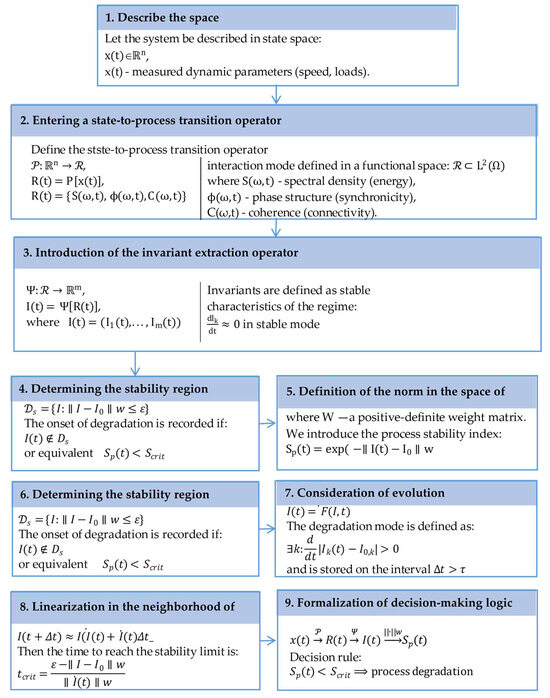
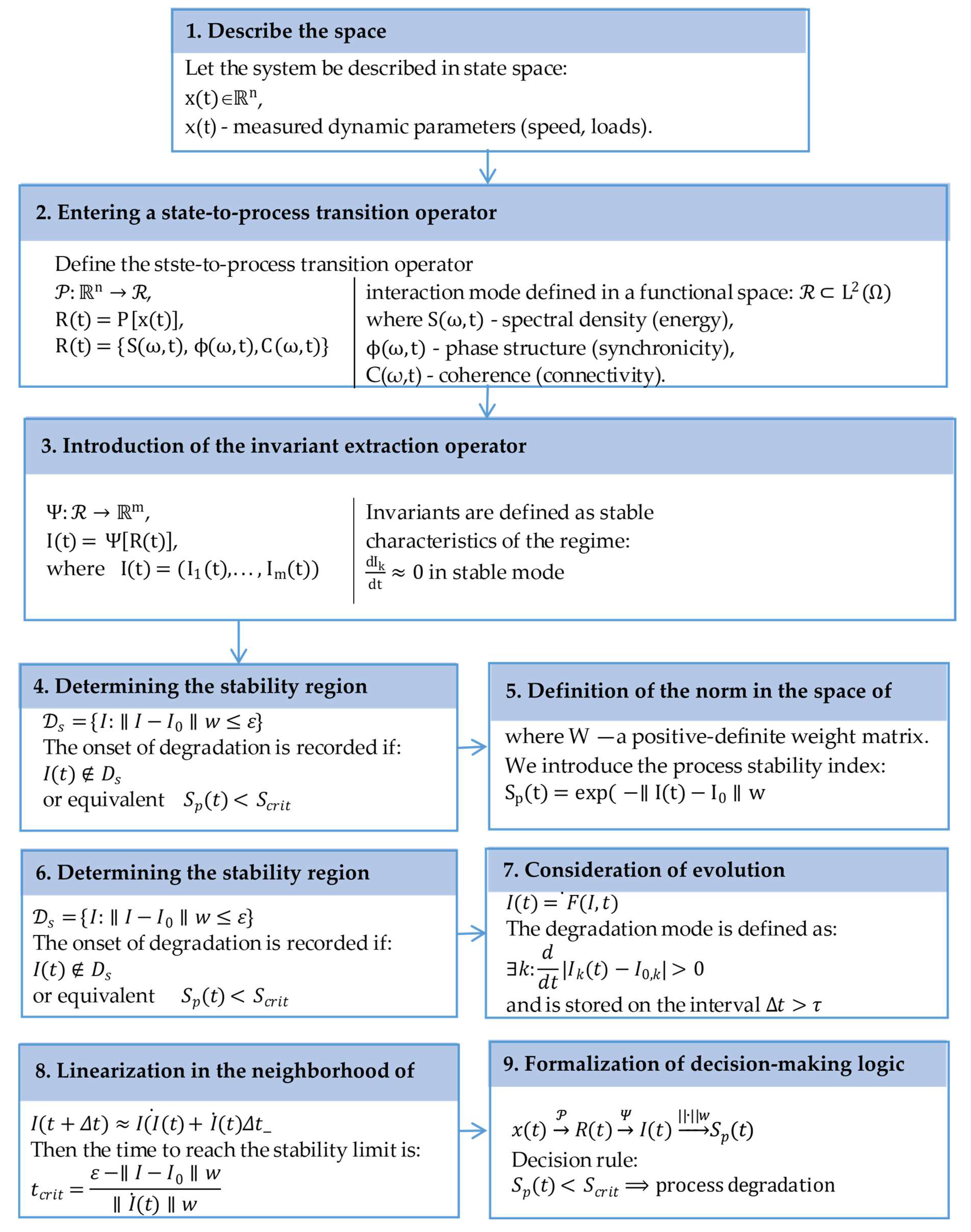
The overall structure of the proposed method is illustrated in Figure 1.
Figure 1.
Stability and degradation monitoring algorithm.
Figure 1 summarizes the transformation from measured signals to invariant-based stability assessment, linking data acquisition, signal processing, invariant construction, and decision-making.
2.5. Practical Implementation Framework
From an implementation perspective, the proposed framework can be interpreted as the following operational sequence:
- Data acquisition: Measurement of system response signals (e.g., vibration, acceleration, or geometry).
- Signal transformation: Conversion of measured signals into a process representation using spectral and phase analysis.
- Feature extraction: Identification of characteristic features such as dominant frequencies, phase relationships, and coherence.
- Invariant construction: Formation of invariant descriptors representing stable interaction modes.
- Stability assessment: Evaluation of deviation from the reference invariant state using a stability metric.
- Decision-making: Identification of degradation trends and prediction of system evolution.
Thus, the proposed methodology provides a direct transformation from measured signals to invariant-based stability indicators, enabling practical implementation in engineering monitoring systems.
Moreover, the proposed methodology is designed to operate on data typically available in existing railway monitoring systems, such as vibration, acceleration, and track geometry measurements. It does not require fundamentally new sensing principles, but rather introduces a different interpretation of already available data.
3. Results
This section presents the results of applying the proposed process-oriented framework to reliability assessment and life-cycle analysis of railway systems.
3.1. Transition from State-Based Diagnostics to Process-Oriented Reliability Assessment
As noted above, classical reliability analysis is based on a state-based representation of the system and follows threshold logic. Failure detection is accomplished by comparing measured parameters with acceptable limits corresponding to established technical condition standards. If these limits are exceeded, a failure is recorded.
Within the proposed approach, reliability is viewed as the system’s ability to maintain the structure of the interaction process over time. Accordingly, the diagnostic procedure is transformed from an assessment based on threshold values to an analysis of the invariant characteristics of the interaction mode.
Changes in geometry and physical and mechanical characteristics lead to a change in the phase structure of the process. This makes it possible not only to identify the initial stages of degradation but also to predict the progression of the process when planning restoration measures.
Thus, degradation is interpreted as a gradual loss of consistency in the dynamic behavior of the system, rather than as a discrete event associated with the exceeding of individual parameters. This enables the degradation process to be analyzed and managed over time.
As a result, reliability assessment becomes a continuous process, reflecting the evolution of system behavior throughout its entire life cycle.
3.2. Limitations of Existing Monitoring Systems in Life-Cycle Context
Modern railway monitoring systems are actively developing and include a wide range of methods aimed at assessing infrastructure condition. In particular, significant attention is paid to track geometry monitoring, vibration-based diagnostics, and analysis of dynamic system response [55,56,57,58,59,60].
Existing approaches encompass both the evaluation of track geometric condition and its stability [55,56], as well as methods based on measured dynamic responses and vibration signals for assessing the condition of infrastructure components [57,58,59]. In addition, integrated monitoring approaches using GNSS and IMU data are being developed to improve the accuracy of track condition assessment [60].
Despite differences in implementation, measurement techniques, and data types, these approaches share a common methodological basis: they rely on the analysis of system state parameters and their deviation from predefined thresholds. As a result, they primarily capture the geometric or dynamic manifestation of degradation rather than its underlying physical mechanisms.
From a life-cycle perspective, this leads to a fundamental limitation. Degradation processes originate at the level of dynamic interaction between system elements, while measurable state parameters reflect these changes only after they have accumulated to a detectable level. In railway systems, this is associated with wave propagation of dynamic loads through the rail–sleeper–ballast–subgrade structure, leading to gradual deterioration of material properties and load distribution.
Consequently, geometric defects often appear at later stages of degradation, when a significant portion of the structural capacity has already been consumed. This explains practical observations where track sections with acceptable geometric parameters exhibit accelerated degradation and repeated defects after maintenance. This limitation is summarized in Table 6.
Table 6.
Comparison of state-based monitoring approaches and their ability to capture degradation processes.
Thus, the key constraint of existing monitoring systems is not associated with specific measurement technologies but with the underlying state-based representation of system behavior, which does not capture the evolution of degradation processes over time.
This motivates the transition to a process-oriented framework, in which degradation is analyzed as an evolving interaction process rather than as a set of discrete state deviations.
3.3. Process-Oriented Interpretation of System Degradation and Evolution
Within the proposed model, the system’s response to dynamic loading can be represented in terms of invariant characteristics of the interaction process. Furthermore, the regulatory constraints used to assess the track’s geometric condition can be interpreted in terms of permissible levels of deforming force work. Since the magnitude of the work is determined by the interaction parameters and structural properties, it is directly related to the structure of the system’s dynamic response.
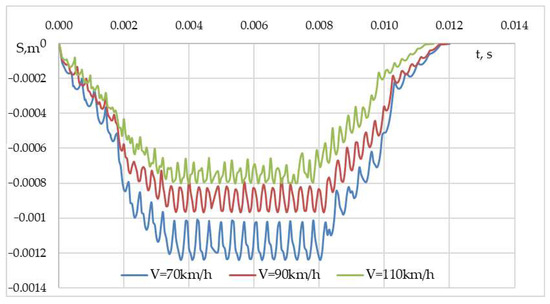
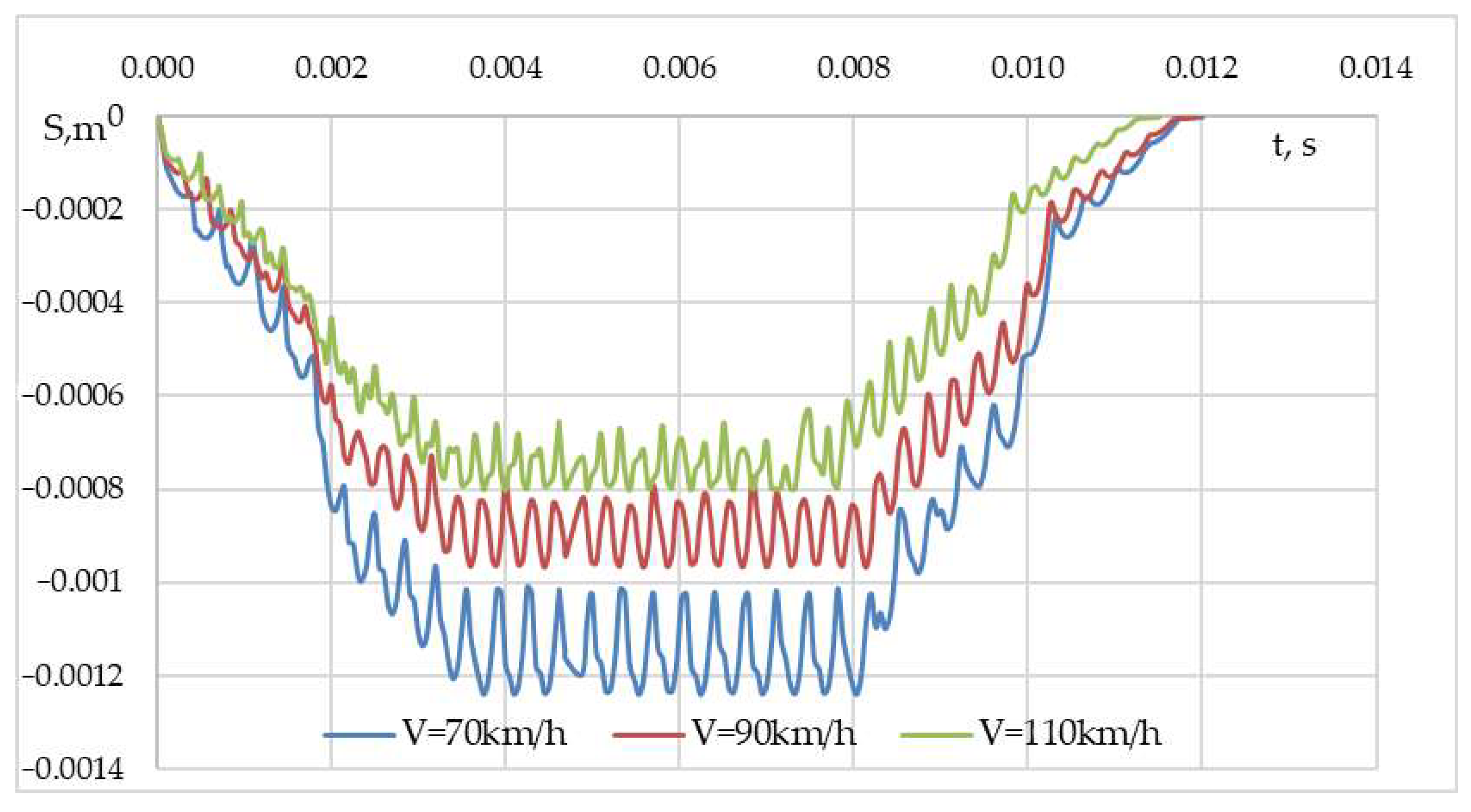
Therefore, the invariant process characteristics presented in Figure 2 can be viewed as reflecting the same physical constraints that are specified in the regulatory framework through the limit values of geometric deviations.
Figure 2.
Oscillation amplitudes of the track structure cross-section under the wheel passage over time [50].
This allows us to establish a connection between the regulatory criteria, the integral energy characteristic of the process, and the invariant description of the dynamic interaction.
Figure 2 shows a simplified invariant describing the track structure’s response to dynamic wheel loads at speeds of 70, 90, and 110 km/h. The assessment is performed on the rail cross-section for the case of a centrally positioned wheelset.
The results show that the response structure changes depending on operating conditions, reflecting the transformation of the interaction process under dynamic loading. These changes characterize the evolution of the system’s behavior and can be used to assess its stability during rolling stock movement.
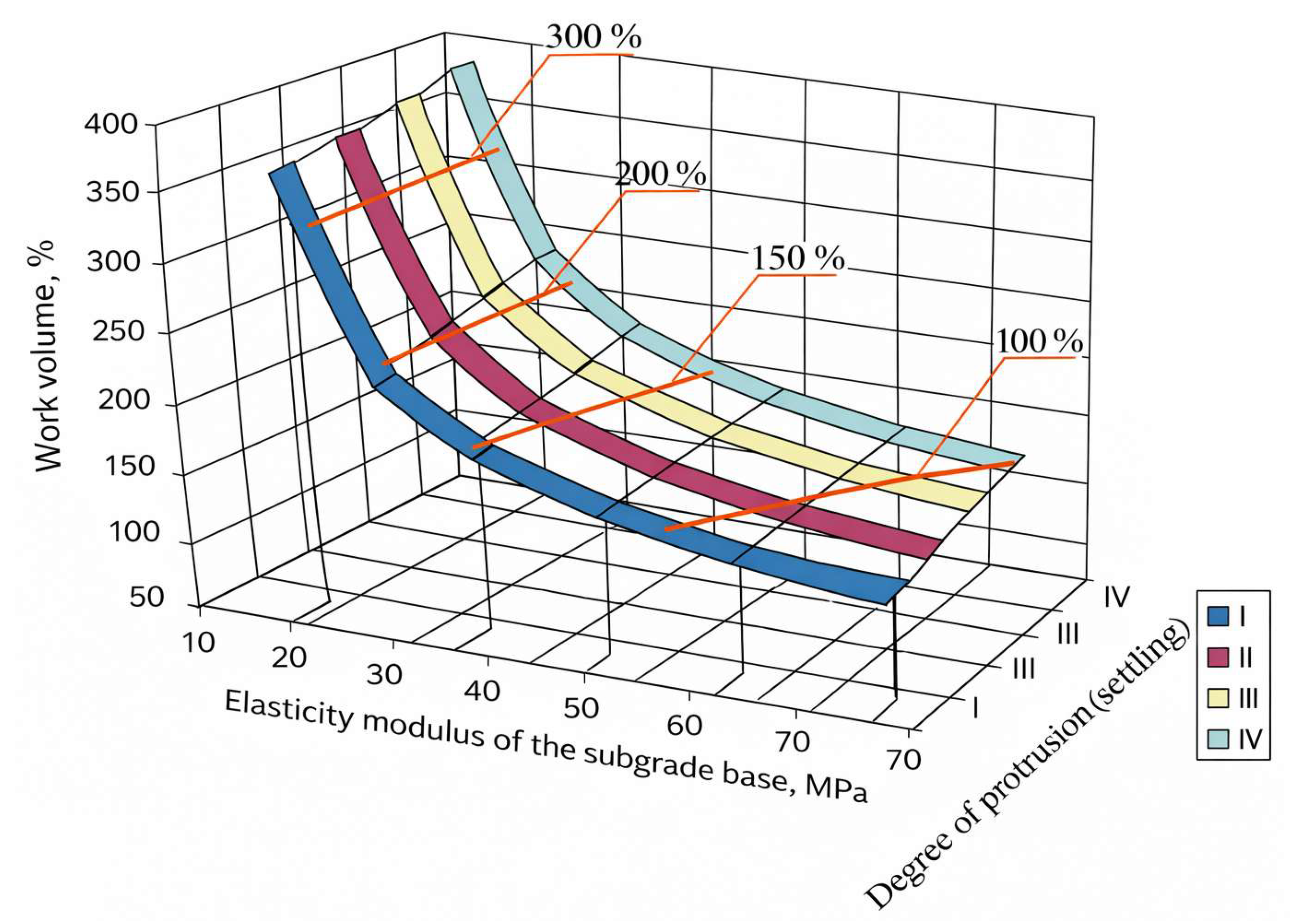
To quantify the degradation effect, the work of the forces acting on the track is considered as an integral characteristic of the process.
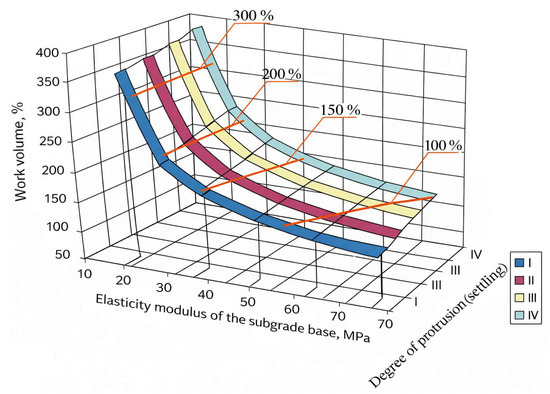
Figure 3 shows the relationship between the work of deformation, the elastic modulus of the subgrade, and the degree of settlement. It is shown that a decrease in rigidity and an increase in geometric irregularities lead to a significant increase in the work of deformation.
Figure 3.
Dependence of the volume of work of vertical forces on the values of the elastic modulus of the sub-rail foundation and the presence of subsidence.
This allows us to interpret the work of deformation as a parameter characterizing the degree of track wear.
Comparing the values of the work of deformation obtained under actual operating conditions with the corresponding reference (standard) values allows us to assess the degree of wear, predict the scope of repair work, and determine its completion time.
Thus, the proposed approach establishes a direct link between dynamic interaction processes, accumulated structural degradation, and life-cycle management of railway infrastructure.
3.4. Semi-Empirical Case Study and Stability Assessment
To illustrate the practical application of the proposed framework, a semi-empirical case study was performed based on a simplified representation of wheel–rail interaction.
The excitation process is described by .
Two scenarios were considered:
Scenario A: Nominal conditions corresponding to stable system behavior;
Scenario B: Degraded conditions associated with reduced stiffness and increased irregularities.
The system response was analyzed using spectral, phase, and coherence characteristics, and the corresponding invariant descriptors were constructed.
The results are summarized in Table 7.
Table 7.
Comparison of signal characteristics and the stability index under nominal and degraded conditions.
Table 7 compares the key characteristics of the system response under nominal and degraded conditions. It shows that amplitude-based indicators remain within nominal limits in both cases, while significant differences appear in spectral characteristics and phase structure. In particular, phase relationships become less coherent and spectral characteristics shift, indicating a transformation of the interaction process.
To quantify these changes, the stability index () is used as a normalized measure of deviation from the reference state. The exponential form of the index provides a convenient representation of stability in the range from 0 to 1.
When the deviation from the reference state is zero, the exponent equals zero and = 1, corresponding to a fully stable system. As the deviation increases due to degradation, the value of decreases and asymptotically approaches zero.
This interpretation allows the stability index to be directly associated with the evolution of system degradation.
In accordance with the degradation rule defined in the algorithm (Section 2.4, step 9), a decrease in over time reflects the transition of the system to a less stable interaction regime and can be used to identify degradation trends.
Furthermore, the results of Section 3.3 enable the reinterpretation of existing regulatory criteria in terms of the proposed stability index. Since geometric limits can be expressed through the corresponding levels of deformation work, and these in turn are related to invariant characteristics of the process, it becomes possible to define a critical stability threshold .
This threshold corresponds to the limiting state defined in current standards and provides a unified representation of regulatory requirements within the process-oriented framework.
Thus, the proposed approach enables a direct transformation from measured signals to invariant-based stability indicators, linking physical system behavior, degradation processes, and normative criteria within a unified life-cycle assessment framework.
3.5. Implications for Reliability and Life-Cycle Engineering
The obtained results demonstrate that reliability can be interpreted as a dynamic characteristic associated with the preservation of process structure over time.
This leads to several key implications.
First, reliability assessment becomes continuous and process-based, allowing evaluation of system condition at any stage of the life cycle.
Second, safety is no longer defined by fixed states, but by the control of degradation trajectories, enabling adaptive and predictive maintenance strategies.
Third, degradation is treated as an inherent part of system operation, which allows its evolution to be predicted and managed.
Finally, the use of process invariants provides a basis for integrating physical modeling with engineering monitoring systems, enabling more effective life-cycle management of railway infrastructure.
Overall, the proposed framework establishes a direct link between system dynamics, reliability assessment, and life-cycle engineering, providing a unified approach to monitoring and managing railway systems.
4. Discussion
The results obtained demonstrate that the proposed process-oriented approach to reliability assessment and lifecycle management of railway systems enables a new interpretation of degradation processes compared to traditional methods based on state analysis.
Unlike classical approaches, in which diagnostics are based on parameter monitoring and their comparison with limit values, the proposed model considers the system as a set of interacting processes. This allows for the analysis of not only recorded deviations but also the structure of the dynamic interaction itself, which changes during operation.
The results presented in Section 3 demonstrate that changes in spectral characteristics, phase structure, and signal consistency occur before they manifest themselves in track geometric parameters. This explains the observed situation in which track sections that meet regulatory geometric requirements can exhibit accelerated degradation and the recurrence of defects after repairs.
An important result of this work is the establishment of a connection between normative criteria, physical interaction processes, and the invariant description of the system. As shown in Section 3.3, normative constraints defined as limiting geometric deviations can be interpreted through the work of deforming forces, which serves as an integral characteristic of the process. This, in turn, allows us to link the normative framework with the invariant characteristics of the dynamic response.
The introduction of the stability index () allows us to move to a normalized representation of the system’s state, in which deviations from the reference mode are reflected in the range from 0 to 1. In the absence of deviations, the index value tends to one, which corresponds to a stable system state. As degradation progresses, the index value decreases, reflecting the loss of consistency in the interaction process. This interpretation corresponds to the degradation rule embedded in the algorithm and allows us to use the stability index to analyze the evolution of the system’s state over time.
It is also shown that existing regulatory requirements can be unified by introducing a critical value for the stability index . This value corresponds to the limit states specified in regulatory documentation and enables the integration of existing criteria within a process-oriented approach.
From an engineering perspective, this represents a shift from threshold logic to degradation trajectory analysis, which allows not only for failure detection but also for predicting the progression of the process and optimizing repair timelines.
It should be noted that the presented results were obtained using a simplified model of wheel–rail interaction, which imposes certain limitations on their generalization. Furthermore, the accuracy of determining invariant characteristics depends on the quality and resolution of the measurement data.
At the same time, the proposed approach can be implemented using data already available in existing monitoring systems, such as vibration, acceleration, and track geometry measurements, without the need for fundamentally new sensor technologies.
Thus, the proposed process-oriented approach provides a coherent link between dynamic interaction processes, degradation accumulation and the lifecycle management of railway infrastructure, creating a basis for the transition to more effective monitoring and maintenance strategies.
5. Conclusions
This paper proposes a process-oriented approach for the reliability assessment and lifecycle management of railway systems, based on the analysis of invariant characteristics of dynamic interactions.
It is shown that traditional diagnostic methods based on state analysis and parameter thresholds detect changes that have already occurred but do not reflect degradation processes at early stages. In contrast, the proposed approach considers the system as a set of interacting processes, enabling the detection of changes in the structure of the dynamic response before geometric defects appear.
A connection is established between regulatory criteria, physical interaction processes, and the invariant description of the system. It is shown that regulatory constraints can be interpreted through the work of deforming forces, enabling a transition to a unified representation of the system state in the form of a stability index.
The introduction of the stability index () provides a normalized assessment of the system state and enables the analysis of the evolution of degradation over time. A method for determining the critical value corresponding to regulatory limit states is proposed.
The results demonstrate that the proposed approach enables a transition from threshold diagnostics to degradation process analysis, providing a basis for predicting condition and optimizing repair schedules.
The practical significance of this work lies in the fact that the proposed approach can be implemented using data already used in existing monitoring systems, without the need to introduce new measuring instruments.
Thus, the proposed process-oriented approach enables the integration of physical models, signal processing methods, and regulatory requirements into a unified system for the reliability assessment and lifecycle management of railway infrastructure.
Funding
This research received no external funding.
Data Availability Statement
The original contributions presented in this study are included in the article. Further inquiries can be directed to the author.
Conflicts of Interest
The author declares no conflicts of interest.
References
- Wang, K.; Zheng, K.; Cai, Y. Study of the spatial distribution of vertical and longitudinal acceleration and sensor installation position of ballast track based on wheel-rail coupling model. PLoS ONE 2025, 20, e0319803. [Google Scholar] [CrossRef] [Scilit] [PubMed]
- Wang, P.; Ma, Q.; Liu, J.; Xu, J. Switch Rail Reduction Value Deviation’s Impact on Wheel–Rail Dynamic Interaction and Its Efficient Identification Method: A Numerical and Experimental Study. Appl. Sci. 2024, 14, 12047. [Google Scholar] [CrossRef] [Scilit]
- Sayeed, A.; Shahin, M.A. Three-dimensional numerical modelling of ballasted railway track foundations for high-speed trains with special reference to critical speed. Transp. Geotech. 2016, 6, 55–65. [Google Scholar] [CrossRef] [Scilit]
- Rhylane, H.; Ajdour, M. Investigating Wheel–Rail Contact Behavior on Ballasted and Non-ballasted Tracks Using Finite Element Simulation. Iran J. Sci. Technol. Trans. Civ. Eng. 2025, 50, 845–864. [Google Scholar] [CrossRef] [Scilit]
- Jiang, H.; Li, Y.; Wang, Y.; Yao, K.; Yao, Z.; Xue, Z.; Geng, X. Dynamic performance evaluation of ballastless track in high-speed railways under subgrade differential settlement. Transp. Geotech. 2022, 33, 100721. [Google Scholar] [CrossRef] [Scilit]
- Chen, X.; Pei, Y.; Liu, K. Dynamic Response of Train–Ballastless Track Caused by Failure in Cement–Asphalt Mortar Layer. Buildings 2025, 15, 334. [Google Scholar] [CrossRef] [Scilit]
- Liu, J.; Zhou, W.; Cao, J.; Li, X.; Jin, Y.; Ye, Q.; Feng, G. Dynamic performance of a slab track–concrete box subgrade under a double-line high speed railway. PLoS ONE 2024, 19, e0311969. [Google Scholar] [CrossRef] [Scilit]
- Gao, L.; Luo, L.; Lu, D.; Wei, B.; Hawng Nan, L.W. Dynamic Response of Railway Subgrade Under Train Load and Freeze–Thaw Action. Appl. Sci. 2025, 15, 1735. [Google Scholar] [CrossRef] [Scilit]
- Choi, J.-Y.; Jeong, C.M.; Kim, S.-H. Maintenance Method for Rail Corrugation Considering Wheel–Rail Interaction Force. Appl. Sci. 2025, 15, 3915. [Google Scholar] [CrossRef] [Scilit]
- De Rosa, A.; Luber, B.; Müller, G.; Fuchs, J. Methodology to Detect Rail Corrugation from Vehicle On-Board Measurements by Isolating Effects from Other Sources of Excitation. Appl. Sci. 2024, 14, 8920. [Google Scholar] [CrossRef] [Scilit]
- Soto-Ocampo, C.R.; Cano-Moreno, J.D.; Maroto, J.; Mera, J.M. A Mathematical Methodology for the Detection of Rail Corrugation Based on Acoustic Analysis: Toward Autonomous Operation. Mathematics 2025, 13, 2815. [Google Scholar] [CrossRef] [Scilit]
- Wang, Q.-A.; Huang, X.-Y.; Wang, J.-F.; Ni, Y.-Q.; Ran, S.-C.; Li, J.-P.; Zhang, J. Concise Historic Overview of Rail Corrugation Studies: From Formation Mechanisms to Detection Methods. Buildings 2024, 14, 968. [Google Scholar] [CrossRef] [Scilit]
- Zhang, P.; Li, Z. Experimental study on the development mechanism of short pitch corrugation using a downscale V-Track test rig. Tribol. Int. 2023, 180, 108293. [Google Scholar] [CrossRef] [Scilit]
- Li, W.; Liu, Y.; Yuan, X.; Li, Q.; Zhou, G. Rail hidden damage detection based on the modal curvature differences method. Adv. Mech. Eng. 2024, 16, 16878132241279500. [Google Scholar] [CrossRef] [Scilit]
- Guillén, A.; Guerrero-Bustamante, O.; Iglesias, G.R.; Moreno-Navarro, F.; Sol-Sánchez, M. Design of Sensorized Rail Pads for Real-Time Monitoring and Predictive Maintenance of Railway Infrastructure. Infrastructures 2025, 10, 45. [Google Scholar] [CrossRef] [Scilit]
- Alfi, S.; Santelia, M.; La Paglia, I.; Di Gialleonardo, E.; Facchinetti, A. Identification of Railway Vertical Track Alignment via the Unknown Input Observer. Appl. Sci. 2025, 15, 11332. [Google Scholar] [CrossRef] [Scilit]
- La Paglia, I.; Santelia, M.; Alfi, S.; Di Gialleonardo, E.; Facchinetti, A. An Application of the Unknown Input Observer Algorithm for the Identification of Vertical Railway Track Irregularity. In Proceedings of the Sixth International Conference on Railway Technology: Research, Development and Maintenance (Railways 2024), Prague, Czech Republic, 3–5 September 2024; Civil-Comp Press: Edinburgh, UK, 2024; Volume 7, p. 19.5. [Google Scholar] [CrossRef] [Scilit]
- Popa, G.; Oprea, R.A.; Tudor, E.; Gheti, M.A.; Munteanu, I.S. Vibration Measurement and Monitoring in Railway Vehicles. Technologies 2025, 13, 370. [Google Scholar] [CrossRef] [Scilit]
- Bravo, I.; Alvarado, U.; Nieto, J.; Ciáurriz, P. On-board accelerometers in railway track condition monitoring. A systematic review. Transp. Res. Interdiscip. Perspect. 2025, 33, 101572. [Google Scholar] [CrossRef] [Scilit]
- Zanelli, F.; Mauri, M.; Castelli-Dezza, F.; Sabbioni, E.; Tarsitano, D.; Debattisti, N. Energy Autonomous Wireless Sensor Nodes for Freight Train Braking Systems Monitoring. Sensors 2022, 22, 1876. [Google Scholar] [CrossRef] [Scilit]
- Debattisti, N.; Zanelli, F.; Giulietti, N.; Mauri, M.; Castelli-Dezza, F. Anomaly detection of high-speed train braking system based on wireless sensors network. Measurement 2025, 253, 117774. [Google Scholar] [CrossRef] [Scilit]
- Tudor, E.; Vasile, I.; Lipcinski, D.; Dumitru, C.; Tănase, N.; Drăghici, F.; Popa, G. Accelerometers in Monitoring Systems for Rail Vehicle Applications: A Literature Review. Appl. Syst. Innov. 2025, 8, 70. [Google Scholar] [CrossRef] [Scilit]
- Czyczuła, W.; Błaszkiewicz-Juszczęć, D. Influence of Non-Uniform Rail Loads on the Rotation of Railway Sleepers. Appl. Sci. 2024, 14, 2746. [Google Scholar] [CrossRef] [Scilit]
- Liu, D.; Su, C.; Zhang, D.; Lan, C. The Influence of an Unsupported Sleeper on the Vertical Bearing Characteristics of Heavy-Haul Railway Ballast. Materials 2024, 17, 1434. [Google Scholar] [CrossRef] [Scilit] [PubMed]
- Chi, Y.; Xiao, H.; Zhang, Z.; Wang, Y.; Qian, Z.; Nadakatti, M.M. Investigating the impact of tamping on ballast bed in railway turnout areas: Insights from discrete element method analysis of energy evolution. Transp. Geotech. 2024, 46, 101243. [Google Scholar] [CrossRef] [Scilit]
- Loidolt, M.; Marschnig, S.; Bürgler, M.; Berghold, A.; Dornig, P.; Ossberger, U. Quality Behaviour of Turnouts: Comparison, Problem Specification and Recommendation of Measures. Appl. Sci. 2023, 13, 10665. [Google Scholar] [CrossRef] [Scilit]
- Liu, P.; Liu, Y.; Huang, J.; Bao, J.; Liu, J.; Cheng, X. Experimental Study on Fatigue Performance of CRTS III Ballastless Track-Girder System Considering Transverse Wheel–Rail Force. Coatings 2025, 15, 399. [Google Scholar] [CrossRef] [Scilit]
- Hodas, S.; Izvoltova, J.; Vrchovsky, E. The Long-Term Inspection and Monitoring of Transition Zones with a Sudden Change in Railway Track Stiffness. Infrastructures 2025, 10, 109. [Google Scholar] [CrossRef] [Scilit]
- Zhang, H.; Chen, S.; Zhang, W.; Liu, X. Service Life Evaluation of Curved Intercity Rail Bridges Based on Fatigue Failure. Infrastructures 2024, 9, 139. [Google Scholar] [CrossRef] [Scilit]
- Xu, D.; Liu, G.; Wang, X.; Liu, H. Experimental Study on Fatigue Performance of Steel Used in U75V Rails. Materials 2025, 18, 4706. [Google Scholar] [CrossRef] [Scilit]
- Jain, A.; Metrikine, A.V.; Steenbergen, M.J.M.M.; van Dalen, K.N. Railway Transition Zones: Energy Evaluation of a Novel Transition Structure for Critical Loading Conditions. J. Vib. Eng. Technol. 2025, 13, 15. [Google Scholar] [CrossRef] [Scilit]
- Setiawan, D.M. Advancing asphaltic rail tracks: Bridging knowledge gaps and challenges for sustainable railway infrastructure. J. Mech. Behav. Mater. 2025, 34, 20250043. [Google Scholar] [CrossRef] [Scilit]
- Zhao, G.; Xin, C.; Wang, M.; Zhang, M. Research on the Fatigue Reliability of a Catenary Support Structure Under High-Speed Train Operation Conditions. Buildings 2025, 15, 3542. [Google Scholar] [CrossRef] [Scilit]
- Yürekli, Y.; Özarpa, C.; Avcı, İ. Real-Time Railway Hazard Detection Using Distributed Acoustic Sensing and Hybrid Ensemble Learning. Sensors 2025, 25, 3992. [Google Scholar] [CrossRef] [Scilit] [PubMed]
- Wang, W.; Cheng, X.; Cai, G.; Zhang, Y. An Approach for Real-Time Monitoring of Train Derailments: An Impact-Based Monitoring Method. In Proceedings of the 11th European Workshop on Structural Health Monitoring (EWSHM 2024), Potsdam, Germany, 10–13 June 2024; German Society for Non-Destructive Testing (DGZfP): Potsdam, Germany, 2024; Volume 29, p. 340. [Google Scholar] [CrossRef] [Scilit]
- Stoilov, V.; Sinapov, P.; Slavchev, S.; Maznichki, V.; Purgic, S. Analysis of Lateral Forces for Assessment of Safety against Derailment of the Specialized Train Composition for the Transportation of Long Rails. Appl. Sci. 2024, 14, 860. [Google Scholar] [CrossRef] [Scilit]
- Stoilov, V.; Slavchev, S.; Maznichki, V.; Purgic, S. Method for Theoretical Assessment of Safety against Derailment of New Freight Wagons. Appl. Sci. 2023, 13, 12698. [Google Scholar] [CrossRef] [Scilit]
- Chuadchim, P.; Ngamkhanong, C.; Aela, P.; Jing, G.; Kaewunruen, S. Nonlinear buckling analysis of curved railway tracks considering unbalanced cant and train speed. Sci. Rep. 2025, 15, 11062. [Google Scholar] [CrossRef] [Scilit]
- Sowiński, B.; Stelmach, A.; Chudzikiewicz, A. Simulation Analysis of the Influence of Changes in Track Parameters on Running Safety of a Rail Vehicle. Energies 2021, 14, 5882. [Google Scholar] [CrossRef] [Scilit]
- Shi, T.; Guo, P.; Wang, R.; Ma, Z.; Zhang, W.; Li, W.; Fu, H.; Hu, H. A Survey on Multi-Sensor Fusion Perimeter Intrusion Detection in High-Speed Railways. Sensors 2024, 24, 5463. [Google Scholar] [CrossRef] [Scilit]
- Wang, Y.; Miao, B.; Zhang, Y.; Huang, Z.; Xu, S. Review on Rail Damage Detection Technologies for High-Speed Trains. Appl. Sci. 2025, 15, 7725. [Google Scholar] [CrossRef] [Scilit]
- Bałdyga, M.; Barański, K.; Belter, J.; Kalinowski, M.; Weichbroth, P. Anomaly Detection in Railway Sensor Data Environments: State-of-the-Art Methods and Empirical Performance Evaluation. Sensors 2024, 24, 2633. [Google Scholar] [CrossRef] [Scilit]
- Frej, D.; Pawlik, L.; Wilk-Jakubowski, J.L. Machine Learning, Neural Networks, and Computer Vision in Addressing Railroad Accidents, Railroad Tracks, and Railway Safety: An Artificial Intelligence Review. Appl. Sci. 2026, 16, 1184. [Google Scholar] [CrossRef] [Scilit]
- Hamadache, M.; Dutta, S.; Olaby, O.; Ambur, R.; Stewart, E.; Dixon, R. On the Fault Detection and Diagnosis of Railway Switch and Crossing Systems: An Overview. Appl. Sci. 2019, 9, 5129. [Google Scholar] [CrossRef] [Scilit]
- Cai, G.; Zhu, Z.; Gong, W.; Zhou, G.; Jiang, L.; Ye, B. Influence of Wheel-Rail Contact Algorithms on Running Safety Assessment of Trains under Earthquakes. Appl. Sci. 2023, 13, 5230. [Google Scholar] [CrossRef] [Scilit]
- Bulduk, N.; Metin, M. A Novel Measurement-Based Computational Method for Real-Time Distribution of Lateral Wheel–Rail Contact Forces. Machines 2025, 13, 1105. [Google Scholar] [CrossRef] [Scilit]
- Bondarenko, I. Wave, Form, Motion: Maupertuis’ Principle as the Basis of A New Physical Logic; Zhurfond: Dnipro, Ukraine, 2025; Available online: https://www.amazon.com/ (accessed on 5 February 2026).
- Bondarenko, I.; Lunys, O.; Neduzha, L.; Keršys, R. Dynamic Track Irregularities Modeling when Studying Rolling Stock Dynamics. In Proceedings of the 23rd International Conference Transport Means, Palanga, Lithuania, 2–4 October 2019; pp. 1014–1019. [Google Scholar]
- Bondarenko, I.; Keršys, A.; Neduzha, L. Assessment of the Railway Track Deformability Behaviour as the Parameter of Operational Availability Function. In Proceedings of the 25th International Conference Transport Means, Kaunas, Lithuania, 6–8 October 2021; pp. 644–648. [Google Scholar]
- Bondarenko, I.; Severino, A.; Olayode, I.O.; Campisi, T.; Neduzha, L. Dynamic Sustainable Processes Simulation to Study Transport Object Efficiency. Infrastructures 2022, 7, 124. [Google Scholar] [CrossRef] [Scilit]
- Bondarenko, I.; Campisi, T.; Tesoriere, G.; Neduzha, L. Using Detailing Concept to Assess Railway Functional Safety. Sustainability 2023, 15, 18. [Google Scholar] [CrossRef] [Scilit]
- Bondarenko, I.; Neduzha, L. Development Genesis of Functional Safety on the Example of an Element of the Railways Infrastructure Subsystem. In TRANSBALTICA XIV: Transportation Science and Technology, Proceedings of the 14th International Conference TRANSBALTICA, Vilnius, Lithuania, 14–15 September 2023; Prentkovskis, O., Yatskiv (Jackiva), I., Skačkauskas, P., Karpenko, M., Stosiak, M., Eds.; Lecture Notes in Intelligent Transportation and Infrastructure; Springer: Cham, Switzerland, 2024; pp. 524–533. [Google Scholar] [CrossRef] [Scilit]
- Bondarenko, I.; Lukoševičius, V.; Neduzha, L. Novel ‘Closed’-System Approach for Monitoring the Technical Condition of Railway Tracks. Sustainability 2024, 16, 3180. [Google Scholar] [CrossRef] [Scilit]
- Bondarenko, I. Sustainable Railway Infrastructure: Modernization Strategies for Integrating 1520 mm and 1435 mm Gauge Systems. Sustainability 2025, 17, 5768. [Google Scholar] [CrossRef] [Scilit]
- Ngamkhanong, C.; Kaewunruen, S.; Costa, B.J.A. State-of-the-Art Review of Railway Track Resilience Monitoring. Infrastructures 2018, 3, 3. [Google Scholar] [CrossRef] [Scilit]
- Kampczyk, A.; Rombalska, K. Configuration of the Geometric State of Railway Tracks in the Sustainability Development of Electrified Traction Systems. Sensors 2023, 23, 2817. [Google Scholar] [CrossRef] [Scilit]
- Milosevic, M.D.G.; Pålsson, B.A.; Nissen, A.; Nielsen, J.C.O.; Johansson, H. Condition Monitoring of Railway Crossing Geometry via Measured and Simulated Track Responses. Sensors 2022, 22, 1012. [Google Scholar] [CrossRef] [Scilit]
- Burnać, K.; Haladin, I.; Vranešić, K. Evaluation of Rail Corrugation and Roughness Using In-Service Tramway Bogie Frame Vibrations: Addressing Challenges and Perspectives. Infrastructures 2025, 10, 209. [Google Scholar] [CrossRef] [Scilit]
- Liang, J.; Sun, J.; Jiang, Y.; Pan, W.; Jiao, W. Advances and Challenges in the Hunting Instability Diagnosis of High-Speed Trains. Sensors 2024, 24, 5719. [Google Scholar] [CrossRef] [Scilit]
- Judek, S.; Wilk, A.; Koc, W.; Lewiński, L.; Szumisz, A.; Chrostowski, P.; Grulkowski, S.; Szmagliński, J.; Michna, M.; Karwowski, K.; et al. Preparatory Railway Track Geometry Estimation Based on GNSS and IMU Systems. Remote Sens. 2022, 14, 5472. [Google Scholar] [CrossRef] [Scilit]

Disclaimer/Publisher’s Note: The statements, opinions and data contained in all publications are solely those of the individual author(s) and contributor(s) and not of MDPI and/or the editor(s). MDPI and/or the editor(s) disclaim responsibility for any injury to people or property resulting from any ideas, methods, instructions or products referred to in the content. |
© 2026 by the author. Published by MDPI on behalf of the International Institute of Knowledge Innovation and Invention. Licensee MDPI, Basel, Switzerland. This article is an open access article distributed under the terms and conditions of the Creative Commons Attribution (CC BY) license.