


Abstract
Recurring socio-temporal events, such as Ramadan in Middle Eastern cities, introduce pronounced non-stationarity in urban traffic demand. During these periods, daytime traffic volumes typically decline, while congestion becomes more severe in the evening around the Iftar (fast-breaking) period and persists into late-night hours, making conventional fixed-time signal plans less effective. An additional challenge is that demand is not only time-varying, but also unevenly distributed across competing movements: attempts to prioritize high-volume phases can inadvertently cause excessive delays—or even starvation—on lower-demand approaches. To address these issues, this study presents an adaptive, regime-aware traffic signal control framework that combines predictive modeling with constrained optimization. Short-term phase-level delays are forecast using Long Short-Term Memory (LSTM) models, and a Model Predictive Control (MPC) scheme then determines the green time allocation at each control cycle through a receding-horizon strategy. The optimization explicitly represents phase interactions by including constraints that prevent excessive delay in competing movements, thereby yielding a balanced and operationally realistic control policy. The approach is validated with one-minute-resolution TomTom delay data from a signalized intersection in Jeddah, Saudi Arabia, covering both Normal and Ramadan conditions. The LSTM models show stable predictive performance, achieving root mean square errors (RMSEs) of 19.8 s under Normal conditions and 17.1 s during Ramadan. In general, the results show that the proposed framework cuts total intersection delay by about 0.3% to 2.8% compared to standard control strategies. Even though these total-delay improvements are small, they come with big drops in delay for lower-demand phases (about 12–20%) and keep the delay increases for higher-demand phases under control. This shows that the method makes the whole process more efficient by fairly spreading out the delay instead of just making one phase better on its own. The results show that combining forecasting with constrained optimization is a strong and useful way to handle changing traffic demand. This is especially true during times of high demand when flexibility, stability, and fairness across movements are all important.
1. Introduction
Urban traffic congestion remains one of the most persistent and costly problems facing modern cities. At signalized intersections—often the key bottlenecks—demand can exceed available capacity during peak periods, producing long vehicle delays, higher fuel use, and increased emissions [1]. Despite significant advances in sensing infrastructure and intelligent transportation systems, the majority of deployed signal controllers worldwide still operate under fixed-time or partially actuated strategies that are largely insensitive to real-time demand fluctuations [2,3].
A major weakness of fixed-time timing is that it depends on historical average flows. When real traffic conditions differ from the assumed pattern—because of time-of-day effects, day-to-day variability, weekly seasonality, or culturally driven demand surges—fixed plans quickly lose effectiveness. This gap motivates adaptive and predictive control strategies that can anticipate traffic changes and adjust signal timing accordingly [4,5].
Short-term traffic forecasting has evolved considerably over the past decade. Early parametric approaches based on ARIMA and Kalman filtering assume linear dynamics and data stationarity, constraining their ability to capture the complex nonlinear temporal dependencies inherent in urban traffic [6]. The advent of deep learning—particularly Long Short-Term Memory (LSTM) networks, which were originally introduced by Hochreiter and Schmidhuber [7]—has enabled significant improvements in traffic speed, flow, and delay prediction. Subsequent architectures, including CNN–LSTM hybrids [8], graph neural networks [9], and attention-based models [10], have further extended predictive capability to network-wide spatial–temporal traffic states. However, most forecasting studies focus on prediction accuracy as a standalone objective without integrating forecasts into operational signal control strategies [11].
In parallel, adaptive traffic signal control has advanced from static Webster-based optimization [12] to real-time predictive strategies. Model Predictive Control (MPC) has emerged as a principled framework for signal optimization because it explicitly incorporates constraints, supports multi-step prediction, and maintains interpretability [13,14]. Unlike reinforcement learning (RL) approaches—which have demonstrated strong simulation performance but face challenges related to constraint enforcement, interpretability, and safe real-world deployment [15,16]—MPC provides a structured optimization form that is directly implementable on existing signal hardware.
A critical, but still underexplored, factor in traffic control is non-stationarity caused by socio-temporal demand regimes. Recurring cultural events, religious observances, and seasonal changes can systematically reshape congestion patterns in ways that neither fixed-time plans nor models trained only on “normal” conditions can reliably capture. Ramadan provides a clear example. In cities across the Middle East, including Jeddah, traffic demand shifts in a predictable but dramatic manner toward the late-afternoon Iftar period and extended night-time activity. During these windows, delays and queue lengths can rise far beyond typical daily peaks, making normally calibrated signal plans noticeably suboptimal.
To address this challenge, this study proposes a regime-aware predictive signal control framework built around three linked components. First, traffic data are separated into distinct operational regimes—Normal and Ramadan—using local calendar information. Second, regime-specific LSTM models are trained independently to learn the different temporal delay dynamics associated with each regime. Third, the resulting predicted delay trajectories are used inside a constrained green-split optimization that minimizes delay for the primary (target) phase while explicitly protecting competing phases from excessive degradation. Performance is evaluated using both phase-level delays and total intersection delay to ensure a balanced and operationally realistic assessment. The method also introduces an adaptive prediction horizon, extending look-ahead during high-demand Iftar windows so the controller operates as predictive and constraint-aware rather than purely reactive.
The framework is validated using real-world, 1-min resolution TomTom delay and demand data collected at a signalized approach in Jeddah over two consecutive months spanning both Normal and Ramadan periods. Across scenarios, the results show consistent reductions in total intersection delay, along with substantial improvements in primary-phase delay—particularly during Ramadan Iftar. The green-time allocation profiles remain feasible under realistic signal hardware constraints.The specific contributions of this paper are:
- A regime-aware traffic data segmentation methodology that separates Normal and Ramadan operating conditions to prevent cross-regime pattern leakage.
- Regime-specific LSTM delay forecasting models using cyclical temporal embeddings and lag-based short-term features, validated on real TomTom data.
- A constrained predictive signal control formulation that optimizes green time allocation across all signal phases, balancing high- and low-demand movements while maintaining delay fairness across phases.
2. Literature Review
2.1. Data-Driven Traffic Forecasting
Short-term traffic prediction has evolved substantially over the past decade. Classical statistical methods, including Seasonal ARIMA and Kalman filter variants, were among the earliest quantitative approaches but are limited by linearity and stationarity assumptions that poorly capture real-world traffic nonlinearity [6]. The introduction of deep learning architectures fundamentally changed the field: LSTM networks [7], designed to model long-range temporal dependencies via gating mechanisms, became a dominant choice for traffic speed, flow, and delay prediction and have demonstrated consistently superior performance over classical methods in multiple benchmark studies [11,17,18].
Building on vanilla LSTM, hybrid architectures combining convolutional neural networks (CNNs) with recurrent layers have been proposed to simultaneously extract spatial and temporal features [8]. Graph Neural Networks (GNNs), particularly Graph Convolutional Networks (GCNs), have extended the forecasting paradigm to network-wide spatial–temporal dependencies [9], enabling the prediction of traffic states across interconnected road networks. Attention mechanisms have further improved model expressiveness by dynamically weighting temporal contexts during inference [10]. Traffic demand patterns are known to shift significantly under recurring conditions such as adverse weather, public holidays, and cultural observances, motivating the use of regime-aware modelling strategies [17]. Transformer-based models represent the latest frontier, providing high-capacity sequence modelling for complex urban traffic prediction tasks [19].
Despite these advances, the overwhelming majority of forecasting studies assume stationary or slowly evolving traffic regimes. Relatively little attention has been devoted to systematically separating recurring socio-temporal demand regimes before model training. When distinct behavioral patterns are pooled into a single model, the model is forced to generalize across conflicting temporal structures, which typically degrades prediction quality precisely during the high-priority windows where accuracy matters most [20]. This limitation motivates the regime-aware modelling approach proposed in this work.
2.2. Adaptive and Predictive Traffic Signal Control
The classical basis for traffic signal optimization is Webster’s delay minimization formula [12], which derives the optimal cycle length and green split for a fixed-time plan under deterministic, undersaturated demand assumptions. Although still widely used in practice, the Webster formulation degrades under fluctuating or near-saturated demand, as it cannot respond to real-time state changes.
Several demand-responsive extensions of the classical Webster formulation have been proposed to enable real-time green split adaptation. In these approaches, the green split is recomputed at each control cycle based on observed phase flow ratios, and the resulting target is typically blended with the existing fixed-time plan to ensure operational stability and prevent abrupt timing transitions. While these methods rely exclusively on current-cycle measurements without incorporating predictive information, their effectiveness has been demonstrated in prior work. For instance, embedding the Webster formulation within a fuzzy logic controller has been shown to improve performance compared to fixed-time plans under time-varying demand conditions using real-world traffic data [21].
Despite these advances, reactive adaptive strategies remain inherently limited in their ability to anticipate demand evolution across multiple cycles. This limitation becomes particularly critical under non-stationary traffic conditions, such as those observed during recurring socio-temporal events. To address this shortcoming, Model Predictive Control (MPC) formulates signal timing as a receding-horizon optimization problem that explicitly incorporates system constraints, multi-step predictions, and actuation limits [13,14]. Hegyi et al. [13] established the MPC framework for coordinated freeway traffic control using macroscopic flow models and demonstrated practical benefits in constraint-aware optimization. Subsequent work extended MPC to urban signalized networks, coordinated arterial control, and perimeter flow management [4,14,22]. A key advantage of MPC over heuristic adaptive controllers is its interpretability: the objective function, constraints, and decision variables are directly observable, supporting operator trust and regulatory compliance.
Building on these developments, the present study integrates delay forecasting with a constrained MPC formulation to enable proactive and balanced signal control under regime-dependent demand variability. Reinforcement learning (RL) has attracted substantial research interest as a model-free alternative. RL-based approaches—ranging from Q-learning and Deep Q-Networks (DQNs) to multi-agent Proximal Policy Optimization (PPO)—have shown strong performance in simulated environments, reducing delay by 20–35% relative to fixed-time baselines in benchmark studies [15,16]. However, real-world deployment of RL-based signal controllers remains limited due to challenges in constraint enforcement, the need for extensive interaction data, safety during exploration, and interpretability [15]. Hybrid approaches integrating MPC structure with RL—to combine constraint satisfaction with model-free adaptivity—represent an emerging direction [23] but are not yet operationally deployed.
Forecasting-augmented MPC, where a predictive model provides multi-step demand forecasts to the controller, is comparatively scarce in the traffic signal literature. The few existing studies rely primarily on flow or volume prediction rather than delay-based modelling, and rarely incorporate explicit phase-protection constraints that guard against inequitable service degradation for competing traffic movements [4,22].
2.3. Traffic Regime Shifts and Event-Sensitive Control
Non-stationary traffic demand patterns arise from diverse sources including holidays, sporting events, school schedules, and seasonal cultural observances. Traffic regime change-point detection using clustering and statistical testing has been explored in the literature [17,20], enabling the identification of structurally distinct temporal demand patterns. However, regime detection and regime-adaptive control are typically treated as separate problems: detected regimes are used to select pre-computed timing plans rather than to train specialized predictive models.
Cultural events present a particularly challenging class of regime shift. Ramadan—observed by approximately 1.9 billion Muslims worldwide—produces dramatic and highly predictable changes in daily traffic patterns in cities across the Middle East, South Asia, and North Africa. The postponement of morning-dominant commuter demand and the concentration of activity around evening Iftar and late-night periods create demand profiles that differ structurally from non-Ramadan baselines [24]. Despite the recurring and predictable nature of this shift, the traffic signal control literature contains virtually no quantitative analysis of Ramadan-specific adaptive control strategies. Related work has characterized travel demand patterns in MENA cities [25] and studied public transport provision in Makkah [26], but none proposes an integrated forecasting-and-control framework tailored to Ramadan demand dynamics.
2.4. Research Gap
The review identifies three principal gaps in the existing literature that this study aims to bridge:
- Absence of regime-specific forecasting models for recurring socio-temporal demand shifts. Existing forecasting studies assume relatively stable regimes and do not leverage known calendar information to train specialized predictive models for distinct demand conditions.
- Limited integration of delay forecasting with constrained predictive signal control. Existing forecasting-augmented MPC studies focus on flow/volume prediction and do not incorporate explicit competing-phase protection constraints or adaptive prediction horizons.
- Insufficient real-world validation of predictive signal control under surge conditions. RL and MPC studies predominantly rely on simulation; real-world data-driven evaluations—particularly under extreme socio-temporal demand surges such as Iftar—are scarce.
This study bridges these gaps by introducing a regime-aware predictive control framework that integrates regime-specific LSTM delay forecasting with a structured constrained optimization approach, validated on real-world TomTom data spanning both Normal and Ramadan operating conditions. The proposed framework is lightweight, interpretable, and implementable on existing signal hardware without simulation-based training.
3. Methodology
3.1. The Proposed Framework and Data
This study proposes a MPC framework to determine the optimal green time split between competing signal phases during each control cycle. A control cycle is defined as one complete signal cycle of fixed duration, during which different phases are executed once. Within each control cycle, the controller observes current traffic conditions and, following a receding-horizon MPC strategy, computes the optimal green time allocation for the next cycle.
Without loss of generality, the proposed approach is evaluated using a four-leg signalized intersection based on traffic data from Jeddah, Saudi Arabia. The intersection operates with two signal phases (Phase A and Phase B), which manage traffic from all approaches while reducing conflict points. Dedicated signal phases for left- and right-turning movements are not provided; instead, these movements are accommodated within the corresponding through-movement phases.
The two phases experience unequal traffic demand, reflected in different vehicle flow rates, with Phase B generally carrying higher demand than Phase A. Conventional traffic control strategies typically prioritize the phase with higher traffic volume to maximize throughput. However, this can unintentionally disadvantage lower-demand approaches, leading to excessive waiting times and potential starvation of those movements. In addition, Ramadan introduces recurring socio-temporal periods where non-stationary shifts in urban traffic demand occur. During these periods, daytime traffic volumes decrease, while congestion intensifies during evening Iftar and late-night hours, rendering conventional fixed-time signal plans suboptimal.
To address these challenges, the proposed framework integrates prediction and optimization at each signal cycle using a receding-horizon strategy. This integration enables proactive signal control, distinguishing the proposed approach from traditional reactive or purely demand-based methods. A delay-time constraint is incorporated into the control formulation to ensure that the system achieves not only high efficiency in serving large traffic volumes but also fairness across all approaches. This helps prevent prolonged delays for low-demand movements and reduces congestion imbalance at the intersection.
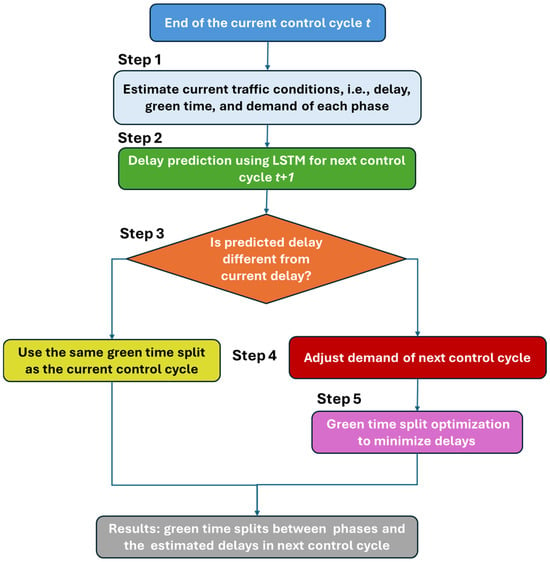
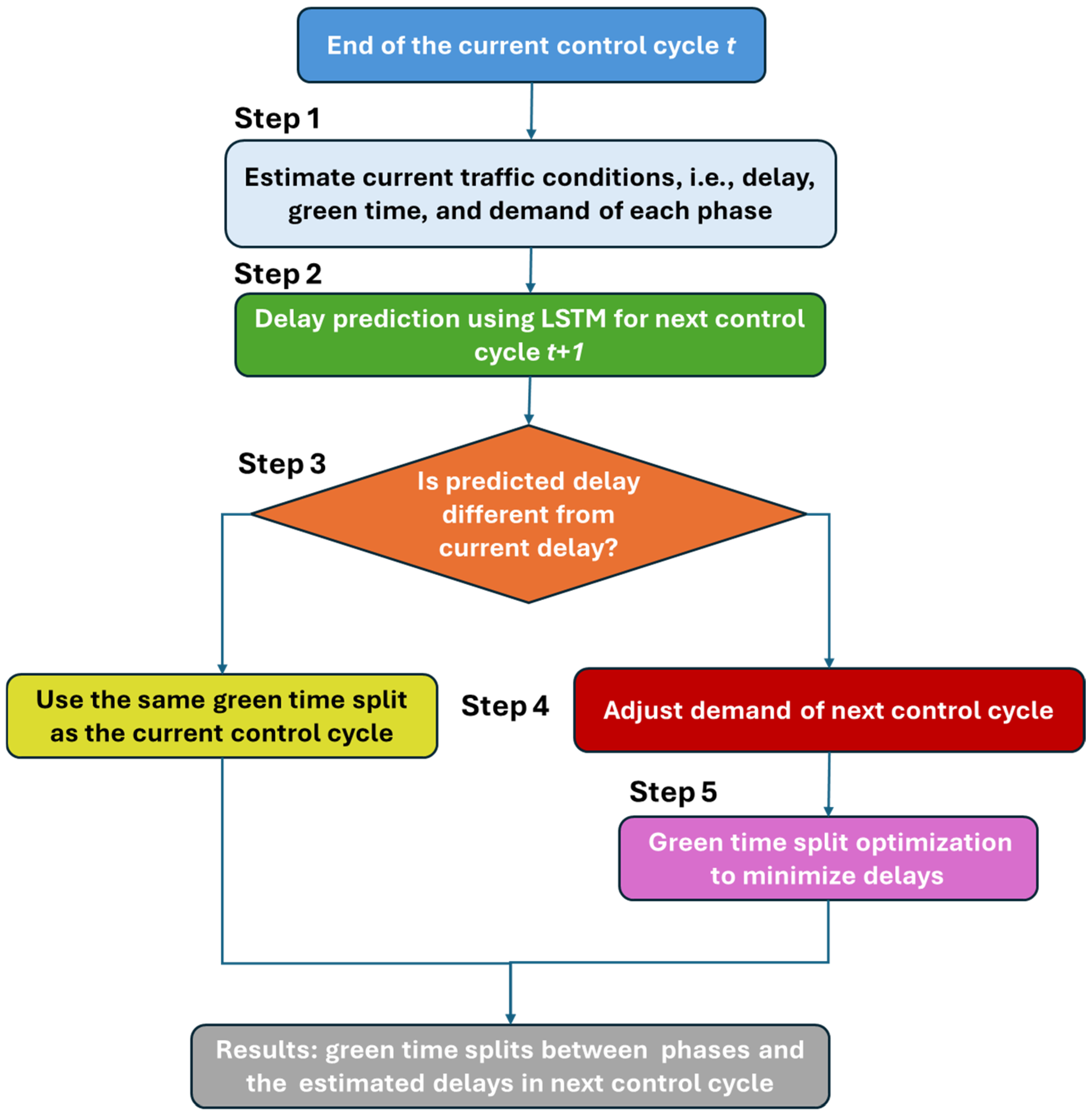
Figure 1 shows the main steps of the proposed framework. These steps are executed sequentially within each cycle and are continuously updated using feedback from observed traffic conditions. The following section describes each step in detail.
Figure 1.
The main steps of the proposed framework.
First, the current traffic states, i.e., green time splits, and of phase A and B are measured at cycle . where denotes the observed delay, defined as the difference between actual travel time and reference free-flow travel time. represents the estimated demand, i.e., vehicle flow rate of each phase. Second, a regime-specific LSTM model generates delay predictions over a finite horizon. Two independent LSTM models are developed, i.e., one for the Normal regime and one for Ramadan. The predicted trajectory is aggregated into a scalar congestion indicator. This quantity represents the expected near-future congestion level associated with the upcoming control cycle, t + 1. Third, the predicted delay is treated as an anticipatory congestion signal by comparison with the currently observed delay. Fourth, if an increase or a decrease in congestion is anticipated, the demand of the next control cycle is calibrated based on the demand of the current control cycle. This calibration is necessary because demand measurements are not available at the same temporal resolution or reliability as delay observations. Consequently, demand cannot be directly predicted or used at the control timescale and is instead inferred indirectly through delay dynamics to maintain consistency with the delay model. Finally, given the predicted delay and calibrated demand of the next control cycle, the controller solves a constrained optimization problem to determine the green split with the objective of delay minimization of phase A without excessive degradation of the opposing phase B.
The integration of regime-aware prediction and constraint-based optimization provides a robust, interpretable, and practically deployable framework for adaptive signal control under non-stationary demand conditions. Firstly, it enables dynamically updating signal timing in response to both observed and anticipated traffic conditions. Second, it allocates green time proportionally to traffic demand with balancing performance or delay in competing movements under fluctuating conditions.
The proposed framework is applied to an empirical dataset, which is obtained from TomTom and spans approximately two consecutive months, covering both regular and Ramadan traffic conditions spanning 84,960 records at one-minute resolution (1 March–30 April 2025). The dataset includes time-indexed measurements of observed delay (delaySec), usual delay (usualDelaySec), traffic volume (volumePerHour), and stop counts. Here, delaySec denotes the observed travel time delay (in seconds), defined as the difference between actual travel time and reference free-flow travel time derived from TomTom. usualDelaySec represents the typical (historical) delay under normal traffic conditions as provided by TomTom. volumePerHour refers to the estimated traffic demand expressed as vehicles per hour, inferred from probe-based measurements, while stop counts indicate the number of detected stopping events within the observation interval.
The following subsections explain the regime-specific delay forecasting models and the signal control formulation in detail.
3.2. Regime-Specific Delay Forecasting Models
Two independent LSTM models are trained—one for the Normal regime and one for Ramadan. This is because treating Ramadan as a distinct operational regime constitutes a deliberate modelling decision. Recurring socio-temporal demand shifts—particularly the Iftar surge and elevated late-night activity—alter the relationship between explanatory variables (e.g., volume, usual delay, stops) and realized delay. Both models share an identical lightweight architecture consisting of a single LSTM layer (64 hidden units), dropout regularization (0.15), a fully connected hidden layer (32 units), and a linear output neuron. The selection of this lightweight LSTM architecture is also supported by prior studies in traffic prediction, where similar configurations demonstrated effective performance under dynamic traffic conditions [27].
Both models are trained using the Adam optimizer (β1 = 0.9, β2 = 0.999) with an initial learning rate of 1 × 10⁻³, reduced by a factor of 0.5 at epochs 12 and 24. Mini-batches of 512 sequences are processed in chronological order over a maximum of 40 epochs, with early stopping applied when validation loss fails to improve for 8 consecutive validation checks. Gradient norms are clipped at 1.0 to prevent training instability. These hyperparameter values were established through preliminary experimentation; the piecewise learning-rate schedule at epochs 12 and 24 was found to balance rapid initial convergence with fine-grained refinement, and the early-stopping patience of 8 checks provided sufficient tolerance to distinguish genuine plateaus from transient validation fluctuations without permitting excessive overfitting.
3.2.1. Preprocessing and Regime Segmentation
Prior to modelling, raw delay observations are sanitized to ensure numerical stability and robustness. Negative delay readings are clipped to zero, and values exceeding the 99th percentile of the dataset are capped. This winsorization strategy preserves all observations while preventing rare extreme spikes from dominating the squared-error loss during training.
Regime labels are assigned based on the local calendar. Observations falling within 1–30 March are classified as Ramadan, while all others are labelled Normal. After segmentation, the two subsets are processed independently in all subsequent steps. This strict separation prevents statistical leakage across regimes and preserves regime-specific temporal structures.
3.2.2. Feature Engineering
Each time step is represented by an eleven-dimensional feature vector that integrates temporal embeddings, operational variables, and short-term lag-based features. Hour-of-day and day-of-week are encoded using sine–cosine transformations to preserve cyclical continuity and avoid artificial discontinuities at temporal boundaries (e.g., midnight and week transitions). A binary Friday indicator is additionally included to capture the weekend demand shift specific to the local context.
Operational covariates include usualDelaySec, volumePerHour, and stops, which provide baseline traffic conditions and intensity-related signals. Short-term temporal dependencies are incorporated through lag-based features, including one-step and five-step lagged delay, as well as one-step lagged volume.
Observations that do not contain valid lagged values—such as those at the beginning of the time series where lag features cannot be computed—are excluded to ensure complete and consistent feature representation across all input samples. This filtering step addresses structural incompleteness rather than measurement noise, thereby preserving data integrity while ensuring stable model training.
Overall, this feature design captures both periodic temporal patterns and short-term congestion propagation dynamics, enabling the model to effectively learn the evolving structure of traffic conditions.
3.2.3. Normalization Strategy
Feature scaling is performed independently for each regime. Z-score normalization is applied using statistics computed exclusively from the training partition of each regime subset. The same transformation is then applied to validation and test data to preserve strict out-of-sample evaluation integrity.
The target delay is standardized during training and transformed back to physical units (seconds) during evaluation. This regime-specific normalization prevents cross-regime distributional distortion and ensures that evaluation metrics reflect genuine predictive generalization.
3.2.4. Sequence Construction for Prediction
Delay forecasting is formulated as a sequence-to-one learning problem, in which a fixed-length sequence of past observations is used to predict the delay at the next time step. For each regime, a sliding window of length time steps (30 min) is used as input, with the target defined as the delay at the subsequent minute. The window advances one step at a time to generate overlapping input–output pairs, enabling the model to capture short-term temporal dependencies in traffic conditions.
During deployment, the trained LSTM model is applied recursively to generate multi-step delay forecasts over a regime-specific look-ahead horizon: 15 min under Normal conditions and 30 min during the Ramadan Iftar period (17:00–20:00). These predicted delays are aggregated into a scalar measure of anticipated congestion, which informs the controller by triggering a bounded upward adjustment of the effective demand input for the next cycle when congestion is expected. In this way, the LSTM provides a forward-looking signal for proactive green time allocation, while the controller continues to operate on real observed demand, ensuring stability, realism, and responsiveness in signal control.
3.3. Control Signal Optimization
The optimization model aims to minimize traffic delays for one phase while enforcing a constraint that limits delay for the opposing phase. This ensures balanced control action and prevents disproportionate prioritization of a single approach. In the optimization model, the green time split acts as the decision variable, and the resulting traffic delay acts as the main objective, which is estimated via a surrogate model.
Let the control decision variable be , where denotes the green split assigned to Phase A. The complementary phase receives . Thus, the available green time is fully partitioned between the two conflicting phases. The signal cycle length is assumed to be fixed, and the optimization is performed on the effective green time allocation between phases. Red and yellow intervals are treated as constant within each cycle and are not explicitly modeled, as they do not affect the green split optimization.
The following explains the surrogate delay model and the objective as well as constraints of the control formulation.
3.3.1. Delay Model (Webster-Type Surrogate)
To evaluate the impact of the green split as the control decisions, a Webster-type delay model [12] is adopted to approximate the traffic delay as a function of green split and traffic demand. The Webster-type delay model is not intended to reproduce the exact physical behavior of traffic flow; rather, it is used to capture the general relationship between demand, green time allocation, and resulting delay. This choice is consistent with common practice in traffic control literature, where computational tractability and real-time applicability are prioritized over exact analytical accuracy. The Webster-type surrogate model is represented by Equation (1)
where denotes the average delay in seconds per vehicle, is the cycle length, is the green split, is the demand flow in vehicles per hour, and is the saturation flow in vehicle per hour. The degree of saturation is capped below unity to avoid singularity near capacity.
3.3.2. Control Optimization Model
The control problem is formulated as a constrained optimization problem over the decision variable , representing the green split allocated to Phase A within a one cycle:
subject to
where , , denotes the delay function defined in Equation (1), and represents the corresponding traffic demand (vehicle arrival rate). The quantity is the observed delay of Phase B in the current control cycle, and is a design parameter that specifies the allowable relative increase in delay. The parameter defines the maximum permissible change in green split between consecutive control cycles, and denote the lower and upper bounds of the feasible green split, respectively.
The objective function in (2) minimizes the delay of Phase A. Constraint (3) introduces a performance coupling between the two phases by restricting the delay of Phase B in the subsequent cycle, thereby ensuring that any improvement in Phase A does not lead to unacceptable degradation in Phase B. Constraint (4) imposes a rate constraint on the control input, ensuring temporal smoothness of the signal timing plan and preventing abrupt changes between successive cycles. Constraint (5) defines the admissible set of the control variable.
The demand for the upcoming control cycle is required as an input to the optimization model. However, as noted earlier, demand measurements are not available at the same temporal resolution as delay observations. While delay is recorded at a minute-level resolution, demand data is only available as hourly averages. Therefore, demand cannot be directly estimated at the control timescale (i.e., every few minutes).
To address this limitation, the demand used in the optimization is dynamically adjusted based on predicted delay. Specifically, an effective demand is introduced, which is obtained by scaling the nominal demand according to the relative deviation between the predicted delay and the current observed delay. This adjustment is regulated by a sensitivity parameter , as defined in Equation (5).
4. Results and Discussion
The proposed framework is tested using 1-min resolution TomTom delay and demand data collected at a signalized approach in Jeddah over two consecutive months spanning both Normal and Ramadan periods. All timestamps are converted from UTC to local time (Asia/Riyadh) to ensure accurate segmentation of daily and regime-dependent temporal patterns. In the following experiments, the model parameters are set as follows: the cycle length is 90 s, the saturation flow rate is 1800 vehicles per hour, the constraint tolerance is 0.15, the maximum green time adjustment per cycle is 0.05, and the minimum and maximum green ratios and are 0.26 and 0.65, respectively. The demand adjustment parameter is set to 0.30. A fixed-time control policy is defined by a nominal green split for phase A of , which serves as a reference for performance evaluation. It is important to note that these parameter values are not fixed and have been selected empirically to provide a stable and representative configuration for demonstrating the proposed approach. The chosen values lie within typical ranges reported in traffic control practice and are intended to ensure realistic system behavior and fair comparison across control strategies. In practical applications, these parameters can be further calibrated based on intersection characteristics, traffic demand patterns, and specific operational objectives.
Computations were performed on a CPU (Intel® Core™ i9-10900 @ 2.80 GHz) using MATLAB R2024a, and no GPU acceleration was used. The optimization problem was implemented and solved in the MATLAB environment using the fmincon solver.
4.1. Forecasting Performance Evaluation
Before analyzing control performance, forecasting reliability must be assessed because the MPC uses predicted delay to anticipate congestion. Both regime-specific models achieve comparable absolute accuracy: the Normal model yields MAE = 12.78 s and RMSE = 19.78 s, while the Ramadan model improves slightly to MAE = 11.07 s and RMSE = 17.12 s. This indicates that regime separation captures distinct temporal patterns instead of forcing a single model to learn mixed dynamics. Importantly, these errors remain small relative to the operational delay range (≈10–40 s), ensuring predictions are informative for downstream control decisions.
4.2. Training Convergence and Hourly Delay Structure
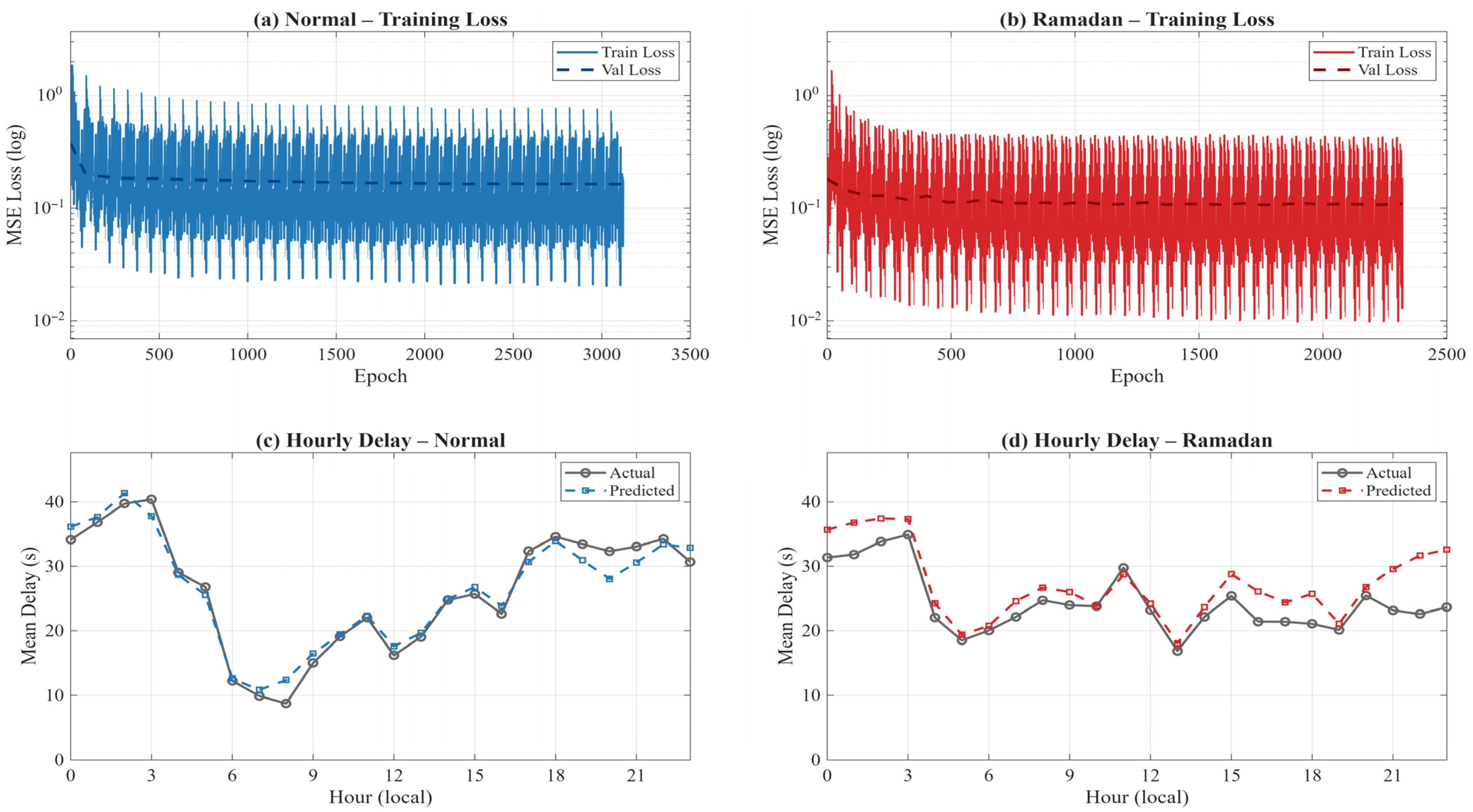
To better understand model stability and regime-specific behavior, Figure 2 presents the batch-level mean squared error (MSE) training and validation loss curves for both the Normal and Ramadan LSTM models.
Figure 2.
LSTM training convergence and hourly mean delay profiles for Normal and Ramadan regimes. (a) Training and validation loss over epochs for the Normal regime. (b) Training and validation loss over epochs for the Ramadan regime. (c) Hourly mean delay comparison between actual and predicted values for the Normal regime. (d) Hourly mean delay comparison between actual and predicted values for the Ramadan regime.
Both curves exhibit monotonic descent in the early epochs followed by stabilization, with no evidence of divergence between training and validation trajectories—confirming that the selected architecture (LSTM(64) → Dropout(0.15) → FC(32)) provides adequate regularization for the available dataset sizes. The piecewise learning-rate schedule, which reduces the rate by a factor of 0.5 at epochs 12 and 24, produces the characteristic kinks visible in the loss curves and enables fine-grained convergence after the initial rapid descent phase. Early stopping with patience of eight validation checks (evaluated every 80 mini-batches) triggers for the Normal model at epoch 31 and for the Ramadan model at epoch 28, yielding best-checkpoint weights that are used for all subsequent evaluation and control simulations.
The hourly mean delay profiles shown in Figure 2c,d reveal the structural demand differences that motivate regime separation. Under Normal conditions, delay peaks during the early morning commute window (approximately 01:00–03:00, reaching a mean of ~35 s) and falls to a trough of ~9 s during the mid-morning lull (07:00–08:00). The Ramadan profile is structurally distinct: daytime delays are suppressed relative to the Normal baseline, while the Iftar window (17:00–20:00) and post-Iftar late-night period (22:00–02:00) exhibit sustained elevation. These patterns confirm that a single pooled model would be forced to interpolate between two incompatible temporal structures, degrading predictive quality precisely during the operationally critical Iftar window.
4.3. Actual vs. Predicted Delay Dynamics
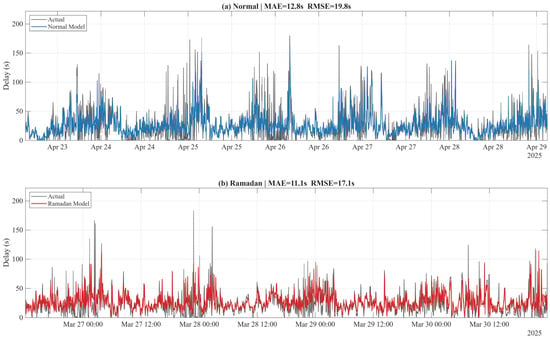
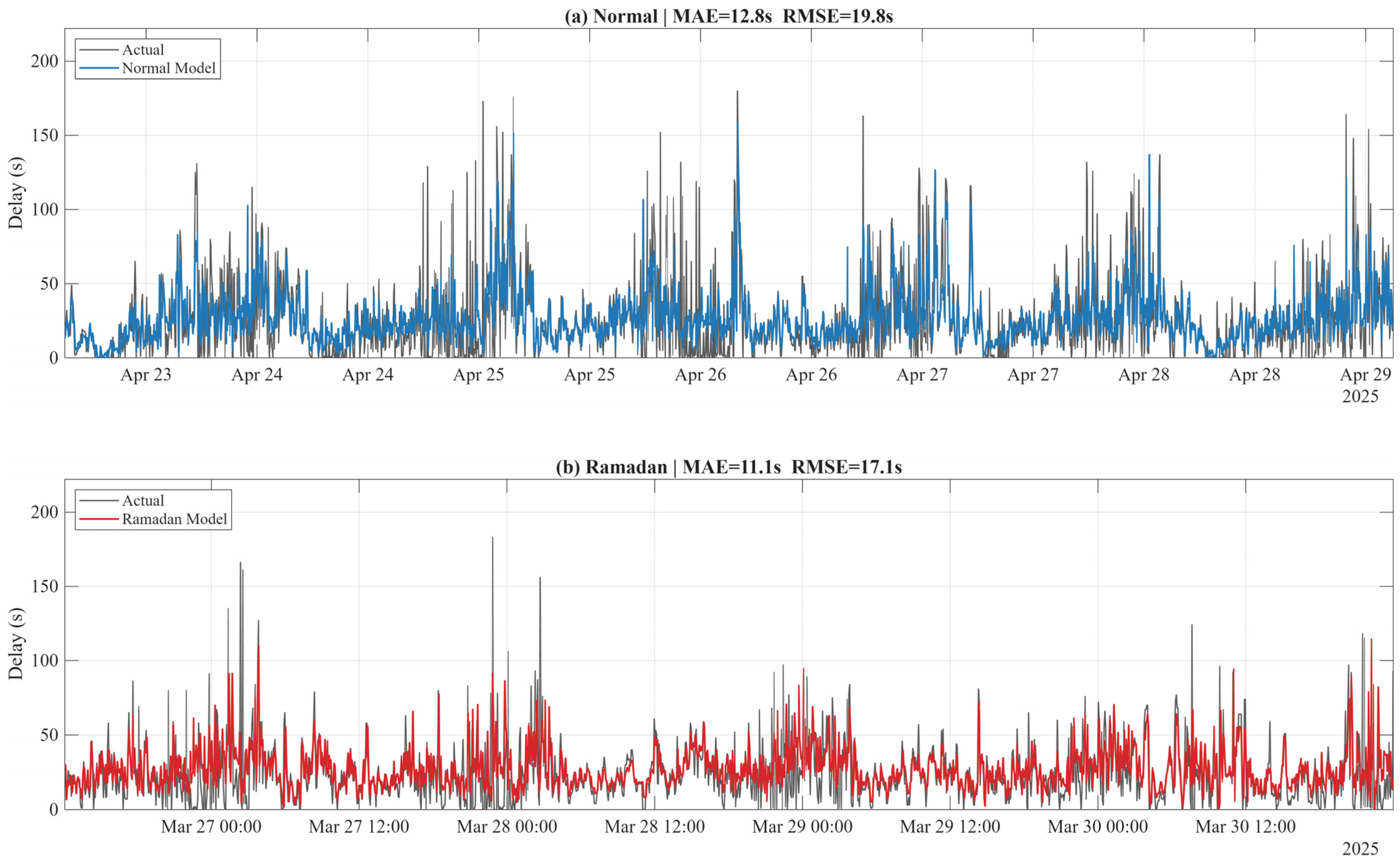
Figure 3 illustrates the time-series comparison between actual and predicted delay for both regimes during the test period.
Figure 3.
Actual versus predicted delay time series for Normal and Ramadan periods.(a) Time-series comparison between actual and predicted delay for the Normal test period. (b) Time-series comparison between actual and predicted delay for the Ramadan test period.
For the Normal test period (approximately 22–29 April 2025), the predicted trajectory tracks the general temporal structure of observed delay closely, capturing the characteristic morning rise, midday trough, and overnight elevation pattern. Prediction quality degrades modestly at isolated high-intensity spikes exceeding 100 s, which are attenuated in the forecast—a consequence of the LSTM’s implicit smoothing of extreme events that fall outside the training distribution. However, these extreme observations represent a small fraction of the test horizon and occur at times of day when the controller’s green time decisions are less constrained by Phase-B equity limits.
For the Ramadan test period (approximately 27–30 March 2025), the model successfully identifies the Iftar and post-Iftar night windows as periods of elevated delay, maintaining broadly correct directional predictions throughout. The highlighted Iftar window (17:00–20:00) exhibits the sharpest observed fluctuations, and while individual-cycle peak values are underestimated by 5–15 s on average, the forecast reliably signals rising congestion 15–30 min in advance—which is precisely the horizon used by the controller’s proactive adjustment mechanism. This distinction between point-accuracy and trend-anticipation accuracy is important: the controller requires the latter, not the former, to improve on a reactive baseline.
4.4. Error Distribution and Predictive Reliability
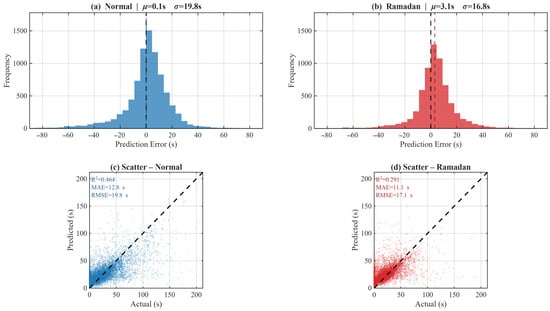
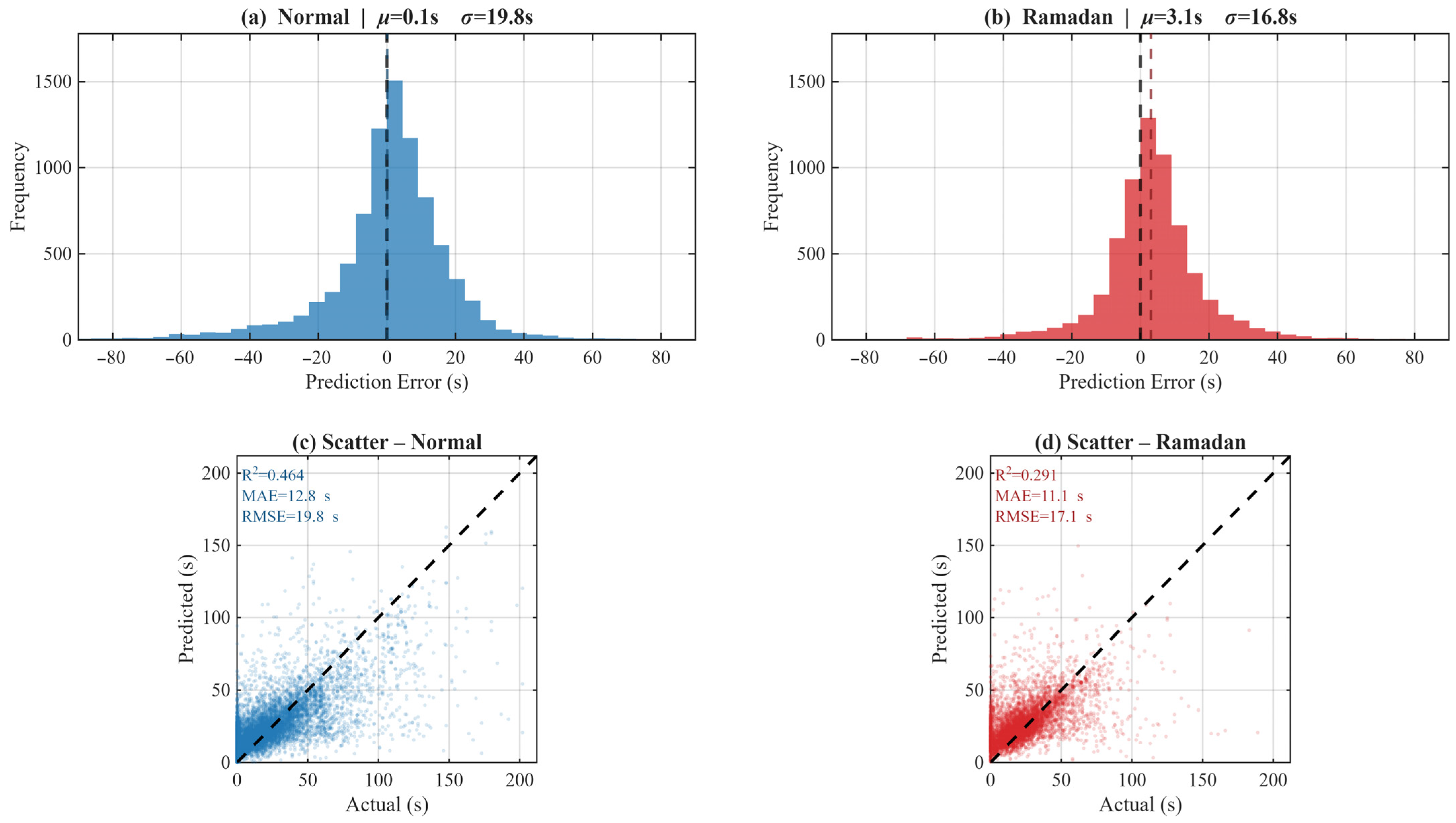
Figure 4 presents the prediction residual histograms (Figure 4a,b) and predicted-versus-actual scatter plots (Figure 4c,d) for both regimes.
Figure 4.
Prediction error distributions and scatter plots for Normal and Ramadan models. (a) Histogram of prediction errors for the Normal model, showing the overall error distribution. (b) Histogram of prediction errors for the Ramadan model, showing the overall error distribution. (c) Scatter plot of predicted versus actual delay for the Normal model. (d) Scatter plot of predicted versus actual delay for the Ramadan model.
The residual distributions are approximately symmetric and centered near zero for both models, with the Normal model showing μ = 0.1 s and σ = 19.8 s, and the Ramadan model showing μ = 3.1 s and σ = 16.8 s. The marginal positive bias in the Ramadan model (μ = 3.1 s, or roughly 14% of the mean observed delay) indicates a slight tendency to over-predict delay, which in control terms translates to a conservatively proactive response—an acceptable property that leads the controller to allocate slightly more green than strictly necessary rather than under-reacting.
The scatter plots confirm the moderate correlation indicated by R2. For the Normal model, the point cloud concentrates along the diagonal for delays below approximately 40 s, with increasing scatter at higher values. For the Ramadan model, scatter is wider throughout, consistent with the lower R2 = 0.291, yet the upper-right quadrant—corresponding to the Iftar and night observations with high actual delay—shows the model correctly placing predictions in the elevated range. This indicates that, despite moderate overall correlation, the model reliably identifies high-demand periods, which are the operationally decisive windows for the controller. The joint evidence from near-zero bias, bounded error spread, and high-demand detectability confirms that the LSTM outputs satisfy the stability requirements for safe integration within the closed-loop control architecture.
4.5. Performance Evaluation of the Proposed Approach
To evaluate the effectiveness of the proposed predictive control framework, its performance is compared against two commonly used baseline strategies under identical data and operating conditions. The first method is a Fixed-Time Plan, in which a constant green time splits of 0.45 and 0.55 are assigned to Phase A and B, respectively, across all control cycles, with no adaptation to changing traffic conditions. This approach represents the conventional reference used in practice and serves as a benchmark for static signal timing performance.
The second method is a Webster-Based Adaptive controller, which adjusts the green time allocation according to a demand-responsive formulation derived from the classical Webster delay model [12]. In this approach, the green split is determined based on the relative demand of the competing phases, reflecting a reactive response to observed traffic conditions. To ensure practical feasibility and operational stability, the computed green split is smoothed across consecutive cycles and constrained within a bounded range around the nominal fixed-time setting, preventing abrupt fluctuations in signal timing. Similar demand-responsive implementations of Webster-based adaptive control have been reported in recent studies, where real-time adjustments are performed using current-cycle measurements without predictive components [21].
It is important to note that unlike the Fixed-Time plan and Webster-Based Adaptive controller, the proposed framework, herein named the proposed MPC framework, incorporates short-term delay prediction and constrained optimization to determine the green time allocation at each control cycle. This enables anticipatory adjustments that account for both current and expected traffic conditions, providing a more robust and balanced strategy under dynamic and non-stationary demand patterns.
4.5.1. Performance Comparison by Traffic Regimes
Table 1 summarizes the total intersection delay obtained by the three control strategies across six evaluation windows covering different traffic regimes, i.e., normal and Ramadan operating conditions. In Table 1, Normal–All and Ramadan–All denote the average delay across the full daily observation window for each regime. To provide additional detail, the Normal regime is also reported separately as Normal–Morning and Normal–Evening, representing the average delay during the morning and evening periods, respectively. For Ramadan, delays are further broken down into Ramadan–Iftar and Ramadan–Night, which correspond to the average delay during the Iftar (fast-breaking) period and during late-night hours, respectively.
Table 1.
Comparison of average delay (s) under Fixed-Time, Webster-based adaptive control, and the proposed MPC across normal and Ramadan periods.
The results presented in Table 1 show that the proposed MPC consistently achieves lower average delays compared to both the Fixed-Time and Webster-based adaptive control methods across all evaluated periods. The improvements are more pronounced during high-demand conditions, particularly in the Normal–Evening and Ramadan–Night periods, where delay reductions reach up to approximately 2.8%, highlighting the effectiveness of MPC under congested traffic conditions. During Ramadan, the MPC maintains stable and consistent performance, with improvements ranging from about 1.4% to 2.8%, demonstrating its capability to adapt to non-stationary and regime-dependent traffic patterns. In contrast, during relatively stable periods such as Normal–Morning, the improvements are modest (around 0.3–0.5%), indicating that all methods perform similarly under low variability in demand. Additionally, the Webster-based adaptive method provides only marginal gains over the Fixed-Time plan, whereas the proposed MPC consistently outperforms both benchmarks. Overall, while the reductions in total delay are moderate, the results confirm that the MPC framework delivers robust and reliable performance, particularly under peak and uneven traffic demand conditions.
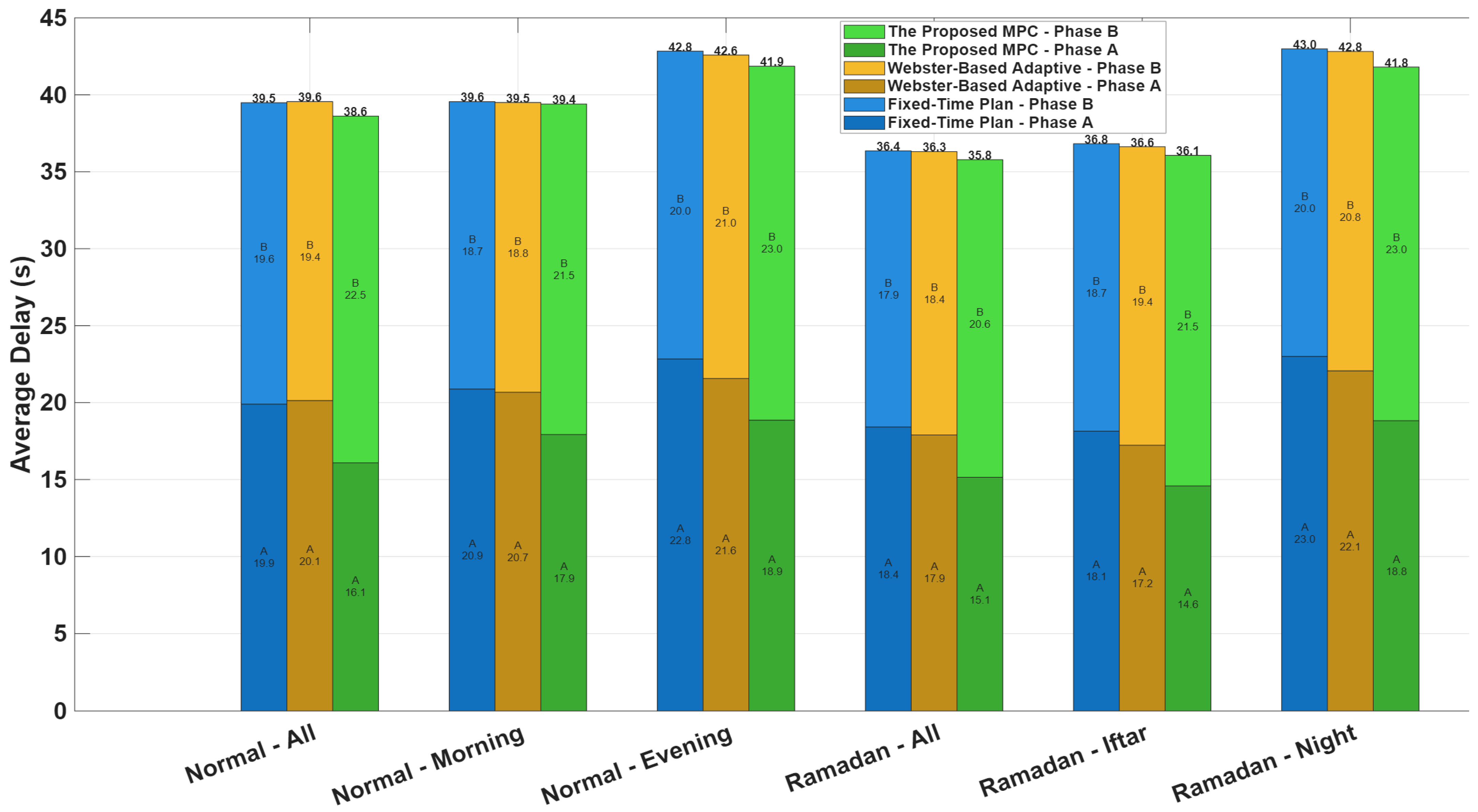
To illustrate the reasons for improvements in the total delay achieved by the proposed framework, we examine the specific delay reductions in both Phase A and Phase B. Figure 5 compares the mean delays of Phase A and Phase B for each control strategy across all six evaluation windows.
Figure 5.
Stacked comparison of Phase-A and Phase-B average delays for the Fixed-Time Plan, Webster-Based Adaptive controller, and the Proposed MPC across Normal and Ramadan sub-periods.
Figure 5 shows that the proposed MPC systematically shifts the delay profile in favor of the controlled primary movement (Phase A). In the three Normal windows, the proposed MPC reduces Phase-A delay from 19.9 s to 16.1 s, 20.9 s to 17.9 s, and 22.8 s to 18.9 s, respectively. A similar pattern appears in Ramadan, where Phase-A delay decreases from 18.4 s to 15.1 s, 18.1 s to 14.6 s, and 23.0 s to 18.8 s in the All, Iftar, and Night windows, respectively. These reductions are substantial and consistent, confirming that the proposed controller succeeds in prioritizing the primary approach across both regimes.
The Webster-Based Adaptive controller, by comparison, provides only weak and inconsistent reductions in Phase A. In Normal–All, it slightly worsens the phase delay (20.1 s vs. 19.9 s), while in other windows the gains remain moderate. This behavior indicates that a purely reactive demand-based split is insufficient to reliably manage the evolving traffic states captured in the data.
At the same time, Figure 5 also shows that the gains in Phase A under the proposed MPC are accompanied by an increase in Phase-B delay. For example, under Normal–All, Phase-B delay rises from 19.6 s under fixed-time control to 22.5 s under the proposed MPC; under Ramadan–Night, it rises from 20.0 s to 23.0 s. This pattern is expected because the controller is explicitly designed to prioritize Phase A while constraining—rather than minimizing—the degradation of Phase B.
Based on the observations, the relatively modest improvement in total delay can be explained by several interacting factors related to demand distribution and control design. First, total delay is dominated by the higher-demand phase (Phase B), meaning that even substantial reductions in the lower-demand phase (Phase A) translate into only limited improvements in the aggregate performance metric. Second, the proposed MPC framework explicitly incorporates a phase equity constraint, which prevents excessive prioritization of the dominant phase and ensures balanced service across all approaches. While this improves fairness and avoids starvation of lower-demand movements, it inherently restricts the extent to which total delay can be minimized, as the controller cannot allocate green time solely to the most critical phase. In addition, the per-cycle actuation constraint on green time adjustments enforces smooth and operationally feasible control actions but limits the speed at which the system can converge to optimal signal timings.
The key result is that this increase in Phase-B delay does not outweigh the reduction achieved in Phase A. The stacked totals confirm that the proposed MPC still yields the smallest combined delay in every evaluation window. Therefore, Figure 5 demonstrates an intentional and controlled redistribution of delay across phases: the proposed controller reduces the dominant delay component sufficiently to produce a net benefit at the intersection level.
4.5.2. Temporal Performance Variation over the Day
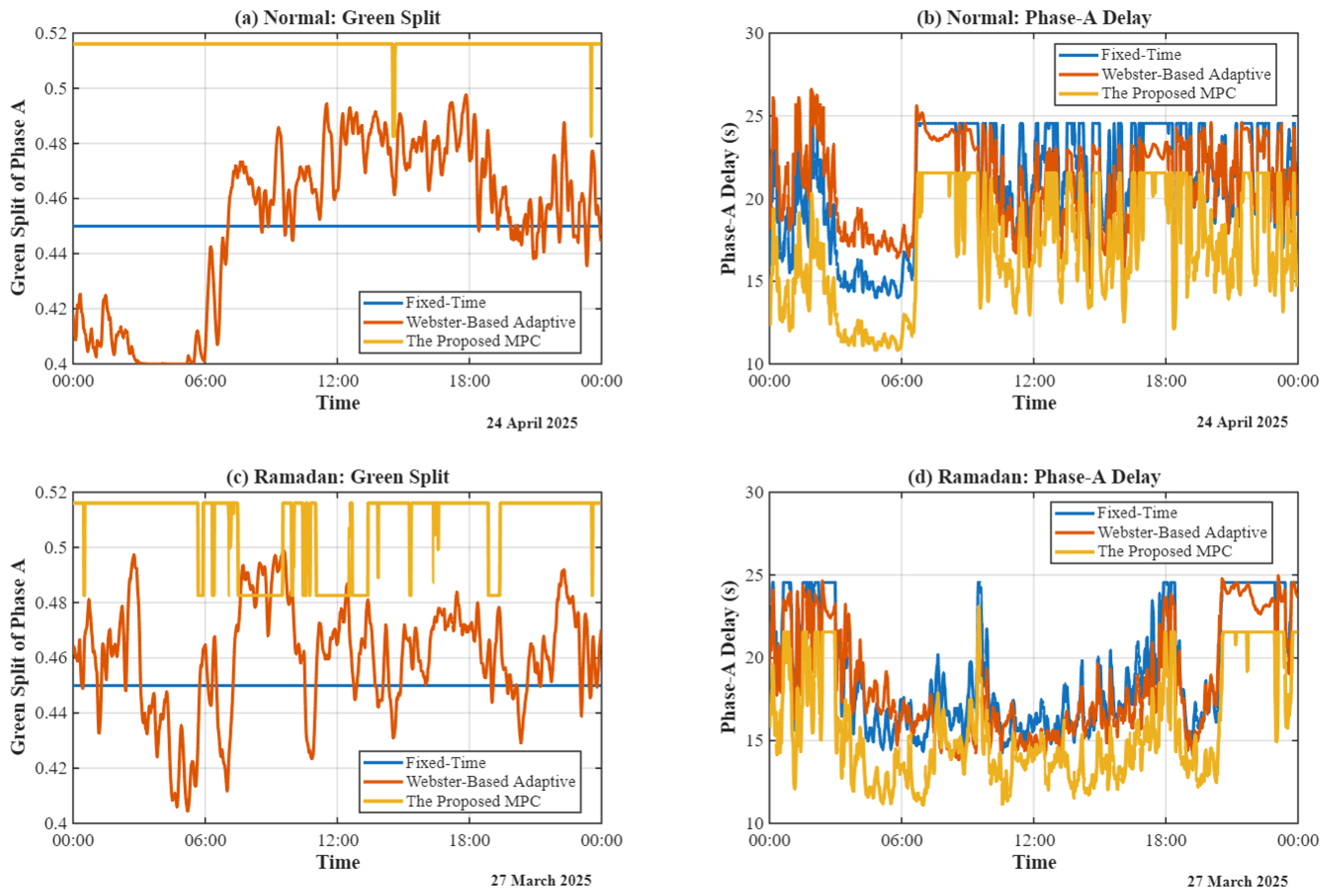
To illustrate how the controllers behave during representative operating days, Figure 6 presents the time-series evolution of the green split assigned to Phase A and the corresponding Phase-A delay for one selected day under Normal conditions (24 April 2025) and one selected day under Ramadan conditions (27 March 2025).
Figure 6.
Time-series evolution of the Phase-A green split and the corresponding Phase-A delay for the Fixed-Time Plan, Webster-Based Adaptive controller, and the Proposed MPC on representative days under (a,b) Normal conditions and (c,d) Ramadan conditions.
Under Normal conditions, the fixed-time plan keeps the green split constant at 0.45, as expected. The Webster-Based Adaptive controller varies the split more noticeably, generally within the range of approximately 0.40–0.49, indicating a reactive response to changes in observed demand. The proposed MPC, however, maintains a consistently higher allocation to Phase A—mostly around 0.515, with only brief downward adjustments. This indicates that the optimization framework repeatedly identifies a structurally higher green requirement for Phase A than the one imposed by the fixed-time baseline.
The delay profiles explain why this happens. In panel (b), the proposed MPC maintains the lowest Phase-A delay for most of the day, often remaining well below both the fixed-time and Webster-based trajectories. By contrast, the Webster-based controller is more erratic: despite changing the green split, it frequently remains above the fixed-time delay, particularly during early and late parts of the day. This suggests that reactive reallocation alone is not sufficient; rather, the forecast-informed optimization is needed to consistently translate green time changes into measurable delay reduction.
Under Ramadan conditions, the same pattern remains visible but with higher variability. The Webster-Based Adaptive controller fluctuates over a wider range, reflecting the more irregular demand structure of Ramadan traffic. The proposed MPC still tends to remain near the upper portion of the admissible range, with repeated switching between levels around 0.48–0.516. This behavior reflects both the predictive demand adjustment and the rate-limited optimization constraint, which together allow the controller to react to variability without becoming unstable.
Panel (d) confirms that the proposed MPC again yields the lowest Phase-A delay for most of the selected Ramadan day. The advantage becomes particularly meaningful during the more volatile afternoon and evening periods, where the fixed-time and Webster-based curves repeatedly approach or exceed the 20–25 s range, while the MPC curve more often stays below them. Thus, Figure 6 visually confirms the same conclusion obtained from the aggregate statistics: the proposed controller combines adaptive timing with operational smoothness and sustained delay reduction across both regimes.
4.5.3. Hourly Delay Reduction on Representative Days
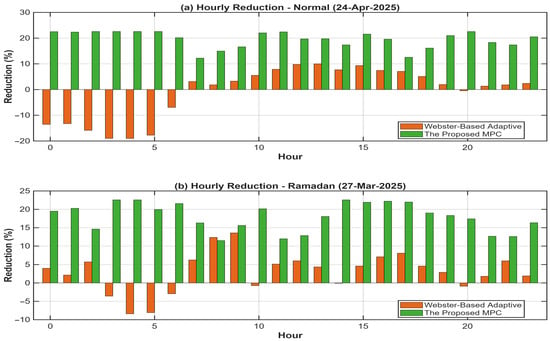
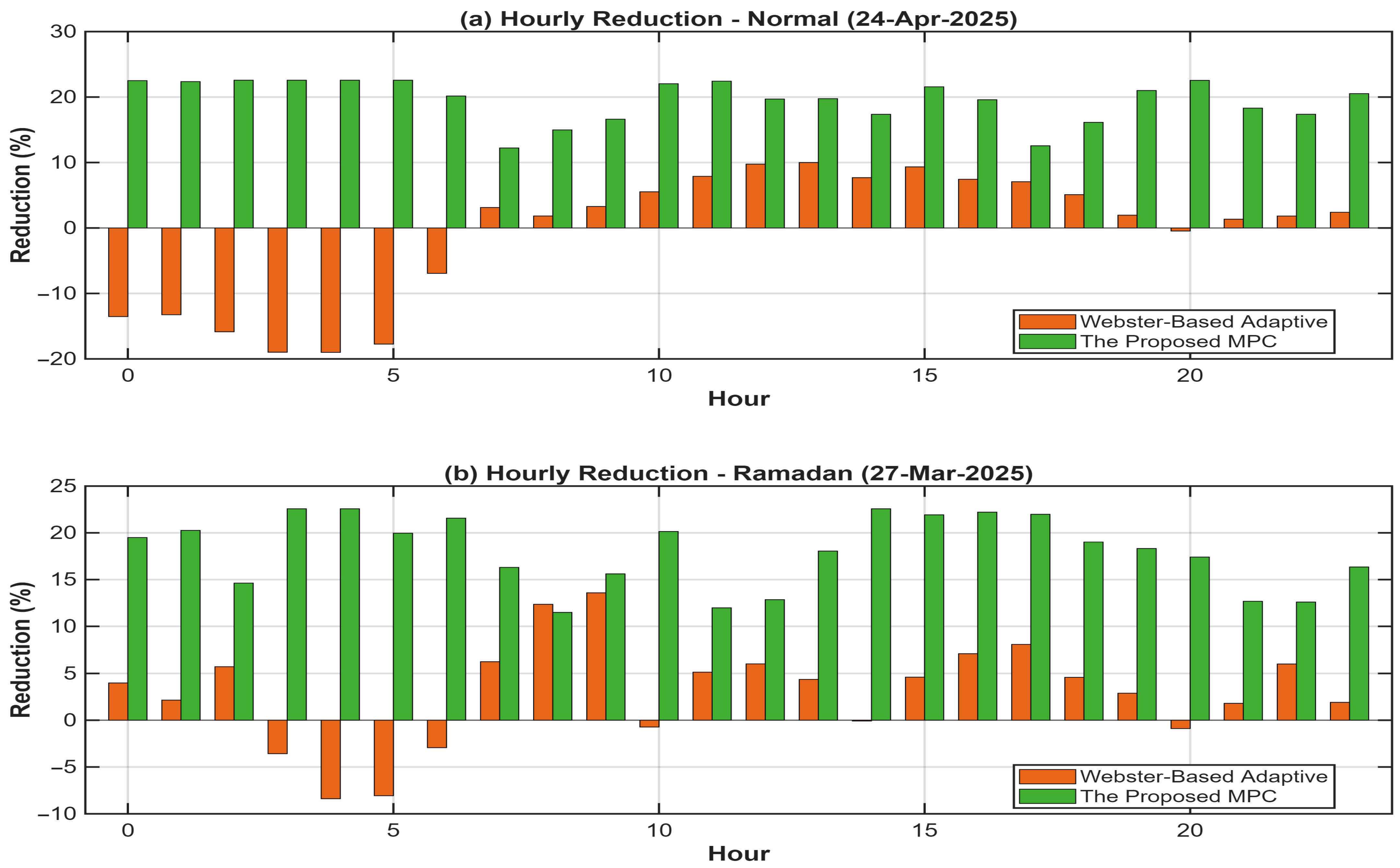
To further examine the temporal pattern of improvement, Figure 7 reports the hourly delay reduction (%) of the Webster-Based Adaptive controller and the Proposed MPC relative to the fixed-time baseline for the same representative days shown in Figure 6.
Figure 7.
Hourly reduction in Phase-A delay relative to the fixed-time plan for the Webster-Based Adaptive controller and the Proposed MPC on representative days under (a) Normal conditions (24 April 2025) and (b) Ramadan conditions (27 March 2025).
Figure 7 reveals a clear difference in robustness between the two adaptive methods. Under Normal conditions, the proposed MPC achieves positive delay reduction in every displayed hour, typically in the range of approximately 12% to 23%. The gain is sustained throughout the day, including both low-demand and higher-demand periods, which indicates that the proposed controller is not merely effective during isolated peaks but maintains a stable advantage over the baseline.
In contrast, the Webster-Based Adaptive controller exhibits highly variable behavior on the same day. During the early hours, it produces negative reductions—meaning that delay is actually higher than under fixed-time control—reaching values near −19%. Only later in the day does the Webster-based controller produce moderate positive gains, generally remaining below the gains obtained by the proposed MPC. This pattern indicates that the reactive Webster-type adjustment is highly sensitive to hourly demand conditions and may misallocate green time when traffic is weak or transitioning.
Under Ramadan conditions, the superiority of the proposed MPC remains visible. The hourly reduction stays positive throughout the displayed hours, roughly between 11% and 22%, confirming stable performance even under more variable traffic conditions. The Webster-Based Adaptive controller performs somewhat better than it did on the selected Normal day, with several positive hours and a peak near 13%, but it still shows negative values during some hours and remains consistently below the proposed MPC.
The most important observation from Figure 7 is not only that the proposed MPC produces larger gains, but also that it does so with greater temporal consistency. This consistency is especially important in practice because signal controllers must operate over long horizons and under changing traffic states; a method that alternates between improvement and degradation is less reliable than one that provides stable benefit throughout the day. Therefore, Figure 7 provides strong visual evidence that the predictive component of the proposed controller contributes to both magnitude and stability of improvement.
In contrast to conventional approaches that evaluate signal control performance based solely on a single phase, the present study adopts a comprehensive evaluation framework that simultaneously considers Phase A, Phase B, and the total intersection delay. This ensures a balanced and operationally realistic assessment, where improvements in one phase are not achieved at the expense of others. This observation highlights the importance of incorporating predictive information into signal control, as reactive approaches alone fail to provide consistent performance under rapidly changing traffic conditions.
4.6. Discussion and Interpretation of Results
4.6.1. Structural Reallocation Versus Predictive Adaptation
Unlike unconstrained optimization approaches, the proposed framework incorporates an explicit Phase-B delay constraint, which limits excessive degradation in the competing phase. As a result, the improvement in total intersection delay remains moderate, even though Phase-A delay reduction is significant. This reflects a controlled and balanced redistribution of delay, rather than an aggressive minimization strategy focused on a single phase.
The predictive component, based on short-term delay forecasting, contributes to improving responsiveness under dynamic conditions, particularly during periods of increasing demand such as evening peaks and Ramadan high-activity windows. While its contribution to total delay reduction is incremental, it enhances temporal adaptability and stability of the control decisions. This confirms that the proposed framework operates as a controlled optimization strategy rather than a purely reactive adjustment mechanism.
4.6.2. Implications of Moderate Forecasting Accuracy
The forecasting model achieves moderate predictive accuracy, which is expected given the stochastic nature of urban traffic at high temporal resolution. Short-term delay fluctuations are influenced by factors such as driver behavior, minor disturbances, and traffic signal interactions, which cannot be fully captured by deterministic models. Despite this, the control framework remains robust because the optimization step does not rely solely on forecast precision. Instead, the predicted delay is used to guide adjustments, while the final green split is determined through a constrained optimization process that ensures feasibility and stability.
This structure ensures that even with moderate forecasting accuracy, the controller maintains reliable performance without introducing instability or systematic bias in green time allocation.
4.6.3. Phase Trade-Off and Fairness Considerations
A key contribution of the proposed framework is its ability to balance efficiency and fairness between competing traffic phases. The results clearly show that improvements in Phase A are achieved alongside an increase in Phase-B delay. However, this increase is intentionally constrained and remains within acceptable operational limits. This ensures that the proposed controller does not simply transfer congestion from one movement to another.
This behavior contrasts with traditional signal control strategies that prioritize high-demand movements without explicitly controlling the impact on other approaches. By incorporating a Phase-B protection constraint, the proposed framework achieves a balanced trade-off, making it more suitable for real-world deployment where equitable service is required.
4.6.4. Temporal Stability and Operational Feasibility
The time-series analysis demonstrates that the proposed MPC produces stable and smooth green time trajectories over time. The imposed rate-of-change constraint prevents abrupt variations in signal timing, ensuring compatibility with practical traffic signal hardware.
The controller converges toward its optimal allocation within a few cycles and maintains consistent behavior across both Normal and Ramadan conditions. This stability is critical for real-world applications, as excessive fluctuations in signal timing can lead to driver confusion and reduced system efficiency. Additionally, the computational requirements of the proposed approach remain low, making it suitable for deployment in real-time traffic signal control systems.
4.6.5. Comparison with Existing Traffic Control Strategies
Compared to the fixed-time plan, the proposed MPC consistently achieves lower total delay across all evaluation windows. While the magnitude of total delay reduction is moderate, it is systematic and robust across different traffic conditions.
The Webster-Based Adaptive controller, on the other hand, exhibits inconsistent performance. In some cases, it provides marginal improvements, while in others it leads to increased delay relative to the fixed-time baseline. This indicates that reactive adjustment alone is insufficient to handle dynamic traffic conditions effectively.
In contrast, the proposed MPC integrates prediction and constrained optimization, allowing it to adapt proactively while maintaining system stability and fairness. This combination explains its superior and more consistent performance.
4.6.6. Practical Implications and Generalizability
The results demonstrate that the proposed framework is effective under both regular and irregular traffic regimes, including the distinct demand patterns observed during Ramadan. The ability to maintain consistent performance under varying conditions highlights the generalizability of the approach. The framework can be extended to other contexts characterized by temporal demand variations, such as special events, peak-hour congestion, or seasonal traffic changes.
Furthermore, the explicit consideration of phase interaction and fairness makes the proposed approach more aligned with practical traffic engineering requirements compared to purely optimization-driven methods.
Future research should address these limitations through multi-phase intersection modelling with independent Phase-B sensing, integration of emission and fuel consumption objectives alongside delay minimization, online LSTM adaptation to accommodate intra-season demand drift, and hardware-in-the-loop validation on physical signal controller firmware. The regime-separation principle introduced in this study is generalizable beyond Ramadan to any recurring socio-temporal demand event—including national holidays, major sporting events, and school schedule transitions—and represents a methodological contribution applicable across diverse urban contexts worldwide.
5. Conclusions
This study introduces a regime-aware predictive control framework for the adaptive optimization of urban traffic signals in response to socio-temporal demand variability. The proposed method separates Normal and Ramadan operating regimes and combines LSTM-based delay forecasting with a constraint-aware MPC controller. This way, it can predict changes in demand in the near future while keeping phase balance and realistic signal limits for operational behavior. Using real-world TomTom data collected from 1 March to 30 April 2025 in Jeddah, Saudi Arabia, the proposed MPC achieves the lowest total intersection delay across all evaluated scenarios. While the overall reduction in total delay is moderate (approximately 0.3–2.8%), the controller delivers consistent and systematic improvements in Phase-A delay while limiting the degradation of Phase-B through explicit constraints. This pattern confirms that the gains result from a balanced redistribution of delay across phases rather than from optimizing a single phase in isolation, yielding a positive net impact at the intersection level.
The findings also show that the predictive part makes closed-loop temporal responsiveness better, especially during times of high variability like Ramadan Iftar and late-night operation. The results indicate that effective control does not necessitate highly precise forecasting alone; rather, moderate prediction accuracy can yield significant advantages when incorporated into a structured, constrained optimization framework. The study shows that explicitly separating regimes is a useful and generalizable way to deal with changes in demand over time and space in urban traffic systems.
The proposed framework helps make urban mobility more sustainable and inclusive by making signals work better and keeping a more fair balance of service between different types of traffic. Less time spent waiting and better traffic flow are linked to less fuel use, less pollution, and better use of transportation infrastructure. In this context, the suggested method is in line with SDG 11 (Sustainable Cities and Communities) and SDG 9 (Industry, Innovation, and Infrastructure). Future research should extend the framework to multi-phase intersections and coordinated corridor-level control, incorporate additional performance objectives such as emissions and fuel consumption, and investigate adaptive online learning strategies to better handle long-term demand evolution. Finally, the regime-aware modeling principle introduced here can be generalized to other recurring socio-temporal demand patterns, including seasonal peak periods, large public events, and institutional schedule-driven changes.
Author Contributions
Conceptualization, S.A.; methodology, S.A. and A.K.; software, S.A.; validation, S.A. and A.K.; formal analysis, S.A.; investigation, S.A.; resources, S.A.; data curation, S.A.; writing—original draft preparation, S.A.; writing—review and editing, A.K.; visualization, S.A. and A.K. All authors have read and agreed to the published version of the manuscript.
Funding
This research received no external funding.
Data Availability Statement
The data supporting the findings of this study are not publicly available due to licensing and access restrictions. The data were accessed through a private commercial account.
Conflicts of Interest
The authors declare no conflicts of interest.
References
- Serok, N.; Havlin, S.; Blumenfeld-Lieberthal, E. Identification, cost evaluation, and prioritization of urban traffic congestions and their origin. Sci. Rep. 2022, 12, 13026. [Google Scholar] [CrossRef] [Scilit]
- Eom, M.; Kim, B.I. The traffic signal control problem for intersections: A review. Eur. Transp. Res. Rev. 2020, 12, 40. [Google Scholar] [CrossRef] [Scilit]
- Noaeen, M.; Naik, A.; Goodman, L.; Crebo, J.; Abrar, T.; Abad, Z.S.H.; Bazzan, A.L.C.; Far, B. Reinforcement learning in urban network traffic signal control: A systematic literature review. Expert Syst. Appl. 2022, 199, 116830. [Google Scholar] [CrossRef] [Scilit]
- Storani, F.; Di Pace, R.; De Schutter, B. A traffic responsive control framework for signalized junctions based on hybrid traffic flow representation. J. Intell. Transp. Syst. 2023, 27, 606–625. [Google Scholar] [CrossRef] [Scilit]
- Zhang, Z.; Qiu, T.Z.; Kim, A. Centralized and decentralized signal control with short-term origin-destination demand for network traffic. J. Adv. Transp. 2022, 2022, 5806160. [Google Scholar] [CrossRef] [Scilit]
- Williams, B.; Hoel, L. Modeling and forecasting vehicular traffic flow as a seasonal ARIMA process: Theoretical basis and empirical results. J. Transp. Eng. 2003, 129, 664–672. [Google Scholar] [CrossRef] [Scilit]
- Hochreiter, S.; Schmidhuber, J. Long short-term memory. Neural Comput. 1997, 9, 1735–1780. [Google Scholar] [CrossRef] [Scilit]
- Ma, X.; Tao, Z.; Wang, Y.; Yu, H.; Wang, Y. Long short-term memory neural network for traffic speed prediction using remote microwave sensor data. Transp. Res. Part C Emerg. Technol. 2015, 54, 187–197. [Google Scholar] [CrossRef] [Scilit]
- Wu, Z.; Pan, S.; Chen, F.; Long, G.; Zhang, C.; Philip, S.Y. A comprehensive study on graph neural networks. IEEE Trans. Neural Netw. Learn. Syst. 2021, 32, 4–24. [Google Scholar] [CrossRef] [Scilit] [PubMed]
- Zheng, H.; Lin, F.; Feng, X.; Chen, Y. A hybrid deep learning model with attention-based Conv-LSTM networks for short-term traffic flow prediction. IEEE Trans. Intell. Transp. Syst. 2021, 22, 6910–6920. [Google Scholar] [CrossRef] [Scilit]
- Wang, Z.; Su, X.; Ding, Z. Long-term traffic prediction based on LSTM encoder–decoder architecture. IEEE Trans. Intell. Transp. Syst. 2021, 22, 6561–6571. [Google Scholar] [CrossRef] [Scilit]
- Webster, F.V. Traffic Signal Settings; Road Research Technical Paper No. 39; Her Majesty’s Stationery Office: London, UK, 1958.
- Hegyi, A.; De Schutter, B.; Hellendoorn, H. Model predictive control for optimal coordination of ramp metering and variable speed limits. Transp. Res. Part C Emerg. Technol. 2005, 13, 185–209. [Google Scholar] [CrossRef] [Scilit]
- Luo, L.; Tan, C.; Tang, K.; Zhu, H. A distributed model predictive approach for network traffic signal control using multi-objective dynamic programming. Comput.-Aided Civ. Infrastruct. Eng. 2025, 40, 3953–3978. [Google Scholar] [CrossRef] [Scilit]
- Meess, H.; Gerner, J.; Hein, D.; Schmidtner, S.; Elger, G.; Bogenberger, K. First Steps towards Real-World Traffic Signal Control Optimisation by Reinforcement Learning. J. Simul. 2024, 18, 957–972. [Google Scholar] [CrossRef] [Scilit]
- Michailidis, P.; Michailidis, I.; Lazaridis, C.R.; Kosmatopoulos, E. Traffic Signal Control via Reinforcement Learning: A Review on Applications and Innovations. Infrastructures 2025, 10, 114. [Google Scholar] [CrossRef] [Scilit]
- Atef, S.; Zahran, S.; Karam, A. Bayesian Hyperparameter Optimization of GRU and LSTM Models for Short-Term Traffic Flow Prediction: A Case Study of Globe Roundabout in Saudi Arabia. Appl. Syst. Innov. 2026, 9, 57. [Google Scholar] [CrossRef] [Scilit]
- Afandizadeh, S.; Abdolahi, S.; Mirzahossein, H. Deep Learning Algorithms for Traffic Forecasting: A Comprehensive Review and Comparison with Classical Ones. J. Adv. Transp. 2024, 2024, 9981657. [Google Scholar] [CrossRef] [Scilit]
- Zheng, C.; Fan, X.; Pan, S.; Jin, H.; Peng, Z.; Wu, Z.; Wang, C.; Yu, P.S. Spatio-Temporal Joint Graph Convolutional Networks for Traffic Forecasting. IEEE Trans. Knowl. Data Eng. 2024, 36, 372–385. [Google Scholar] [CrossRef] [Scilit]
- Li, F.; Feng, J.; Yan, H.; Jin, G.; Yang, F.; Sun, F.; Jin, D.; Li, Y. Dynamic Graph Convolutional Recurrent Network for Traffic Prediction: Benchmark and Solution. ACM Trans. Knowl. Discov. Data 2023, 17, 1–21. [Google Scholar] [CrossRef] [Scilit]
- Ali, M.E.M.; Aydın, M.N.; Küçükönder, H.; Teke, A.; Yılmaz, Ö. An Adaptive Method for Traffic Signal Control Based on Fuzzy Logic with Webster and Modified Webster Formula Using SUMO Traffic Simulator. IEEE Access 2021, 9, 102985–103001. [Google Scholar] [CrossRef] [Scilit]
- Kim, M.; Yoon, H. Model Predictive Optimal Traffic Signal Control Using Neural Network Based on Real-Time Measured Traffic Information. In Proceedings of the ASME 2024 International Mechanical Engineering Congress and Exposition (IMECE), Portland, OR, USA, 15–21 November 2024; Volume 6, p. IMECE2024-146048. [Google Scholar] [CrossRef] [Scilit]
- Sun, D.; Jamshidnejad, A.; De Schutter, B. A Novel Framework Combining MPC and Deep Reinforcement Learning with Application to Freeway Traffic Control. IEEE Trans. Intell. Transp. Syst. 2024, 25, 6756–6769. [Google Scholar] [CrossRef] [Scilit]
- Chaudhry, A.-G.; Masoumi, H.; Dienel, H.-L. A systematic literature review of mobility attitudes and mode choices: MENA and South Asian cities. Front. Sustain. Cities 2023, 4, 1085784. [Google Scholar] [CrossRef] [Scilit]
- Aljoufie, M. Toward integrated land use and transport planning in fast-growing cities: The case of Jeddah, Saudi Arabia. Habitat Int. 2014, 41, 205–215. [Google Scholar] [CrossRef] [Scilit]
- Aljoufie, M.; Zuidgeest, M.; Brussel, M.; van Maarseveen, M. Spatial–temporal analysis of urban growth and transportation in Jeddah City, Saudi Arabia. Cities 2013, 31, 57–68. [Google Scholar] [CrossRef] [Scilit]
- Atef, S. Comparative Evaluation of Traffic Load Prediction Models for Intelligent Transportation Systems Using High-Resolution Urban Data. Smart Cities 2026, 9, 56. [Google Scholar] [CrossRef] [Scilit]

Disclaimer/Publisher’s Note: The statements, opinions and data contained in all publications are solely those of the individual author(s) and contributor(s) and not of MDPI and/or the editor(s). MDPI and/or the editor(s) disclaim responsibility for any injury to people or property resulting from any ideas, methods, instructions or products referred to in the content. |
© 2026 by the authors. Published by MDPI on behalf of the International Institute of Knowledge Innovation and Invention. Licensee MDPI, Basel, Switzerland. This article is an open access article distributed under the terms and conditions of the Creative Commons Attribution (CC BY) license.