


Abstract
Since the compressor system in underground gas storage (UGS) facilities operates under highly dynamic and complex injection conditions, traditional rule-based operation and mechanism-based modeling approaches prove inadequate for meeting the stringent requirements of high-accuracy prediction under such variable conditions. To address this, a data-driven two-phase prediction framework for compressor energy consumption is proposed. In the first phase, a convolutional neural network with efficient channel attention (CNN-ECA) is developed to accurately forecast key operating condition parameters. Based on these outputs, the second phase employs a compressor performance prediction model to estimate unit energy consumption with improved precision. In addition, a hybrid prediction strategy integrating a Transformer architecture is introduced to capture long-range temporal dependencies, thereby enhancing both single-step and multi-step forecasting performance. The proposed method is evaluated using operational data from eight compressors at the Xiangguosi underground gas storage. Experimental results show that the framework achieves high prediction accuracy, with a MAPE of 4.0779% (single-step) and 4.2449% (multi-step), outperforming advanced benchmark models.
1. Introduction
Underground gas storage (UGS) facilities constitute critical infrastructure within natural gas transmission and storage systems, enabling seasonal peak shaving, supply security, and improved energy utilization efficiency. During the gas injection phase, multi-unit coordinated control of compressor systems serves as the operational core of surface facilities, where multiple compressors operate collaboratively to meet injection pressure requirements. The operational efficiency and energy consumption of compressor systems not only determine the overall operating cost of UGS facilities but also directly influence the economic performance and safety of the broader gas pipeline network. However, in real-world engineering environments, operating conditions during gas injection are highly complex. Compressor systems exhibit strong time-varying characteristics, nonlinear dynamics, and multi-variable coupling effects, making accurate performance prediction inherently challenging. Despite this complexity, most UGS sites still rely heavily on operator experience for compressor scheduling decisions. Such empirical dispatching strategies often fail to provide reliable energy consumption forecasting, thereby limiting the effectiveness of coordinated compressor operation and optimization [1].
At present, research on compressor performance prediction has evolved into several methodological paradigms, including mechanism-based modeling, similarity conversion approaches, and data-driven techniques. Among them, mechanism-based models simulate internal thermodynamic processes through physical equations and provide theoretical foundations for performance analysis. Sieros et al. [2] proposed an analytical representation of compressor performance and validated its effectiveness through experimental studies. Similarly, Yan et al. [3] developed a performance prediction model for compressors under varying operating conditions. However, such models require detailed characterization of internal compressor processes and are therefore difficult to generalize under complex, time-varying operating conditions. Similarity conversion approaches aim to address discrepancies between design performance curves and actual operating behavior. Li et al. [4] developed a centrifugal compressor performance conversion tool based on similarity theory, while Zhu [5] applied the method to production forecasting in underground gas storage systems. Xie et al. [6] established the actual performance curves of a centrifugal compressor based on the similarity principle. Their results showed that the actual curves exhibited a clear shift toward the lower right compared with the factory curves, highlighting the necessity of accounting for real operating conditions in performance prediction. Nevertheless, similarity-based methods rely heavily on prior knowledge and simplifying assumptions, making them insufficient for accurately representing nonlinear and dynamic characteristics present in real-world operating environments [4,5].
Data-driven approaches leverage machine learning and deep learning techniques to predict compressor performance. Zhang et al. [7] employed an IPSO-LSSVM model to forecast outlet parameters of centrifugal compressors. Xu et al. [8] developed a reciprocating compressor condition monitoring system based on a GA-BP framework. Ma et al. [9] proposed a LR-GA-BP algorithm for predicting the performance of cracking gas compressors, achieving notable improvements in prediction accuracy. In addition, Zuo et al. [10] combined Variational Mode Decomposition (VMD) with a Particle Swarm Optimization-Support Vector Machine (PSO-SVM) model to capture non-stationary vibration signals, enhancing model robustness. Yu et al. [11] introduced a model based on a Chaotic Improved Whale Optimization Algorithm-Backpropagation Neural Network (CIWOA-BPNN), in which the improved whale optimization algorithm was employed to optimize neural network weights, further improving performance. Zhan et al. [12] utilized a Radial Basis Function (RBF) neural network to calculate the thermodynamic performance of refrigeration compressors. Chen [13] explored the application of a backpropagation neural network in centrifugal compressor performance prediction. Despite these advancements, neural network-based models still face limitations in feature extraction and temporal dependency modeling, which may constrain their predictive accuracy and generalization under complex, time-varying operating conditions.
In recent years, deep learning models have demonstrated significant potential in the state prediction of energy and power equipment due to their strong nonlinear fitting capabilities and sequence modeling capacity. Chu et al. [14] combined convolutional neural network (CNN) with long short-term memory (LSTM) networks and incorporated an attention mechanism to achieve high-precision estimation of lithium-ion battery health. Similarly, Zhang et al. [15] and Ye et al. [16] achieved favorable results in power load forecasting and wind power prediction using LSTM and Bi-LSTM networks, respectively, achieving favorable predictive performance. Bai et al. [17] experimentally demonstrated that CNN can achieve strong performance across various sequence modeling tasks. In a related study, Zhang et al. [18] developed a hybrid deep learning model and successfully applied it to the predictive maintenance of natural gas compressors. Wu et al. [19] investigated industrial energy consumption forecasting based on multi-source data, providing a practical example for data-driven energy efficiency management. Recently, the Transformer architecture has emerged as an advanced method for sequence modeling. Leveraging the self-attention mechanism, Transformers dynamically compute the relevance between any two time points in a sequence, enabling the accurate capture of long-range dependencies [20]. This characteristic allows Transformers to outperform traditional Recurrent Neural Network (RNN) and CNN models in numerous time-series prediction tasks [21,22]. For instance, Huang et al. [23] applied Transformer networks to electric load forecasting, demonstrating their superiority in handling highly volatile sequences.
Although studies have made significant progress in compressor performance analysis and state prediction, several limitations remain when addressing energy consumption forecasting for reciprocating compressor systems in UGS facilities. First, most existing models directly map historical operational data to energy consumption metrics without explicitly modeling the influence of operating condition variations on energy use. This approach results in limited physical interpretability. In industrial prediction tasks, incorporating physically meaningful intermediate variables and adopting a hierarchical prediction structure can enhance both the interpretability and reliability of forecasting models [24]. Second, most of the prior research has focused on single-step prediction, lacking the capability for continuous multi-day forecasting of operating conditions and energy consumption. This limitation restricts the application of such models in supporting periodic operation planning in UGS facilities. Third, existing models are typically developed for individual compressor units, and few studies have addressed the coordinated prediction of energy consumption for compressor systems.
To address the strong time-varying characteristics of operating conditions and the performance heterogeneity among individual units in reciprocating compressor systems at UGS facilities, this study proposes a two-phase prediction framework that jointly integrates average operating condition forecasting with individual performance modeling. The framework decomposes the traditional unit energy consumption prediction task into two physically interpretable sub-tasks. In the first phase, key operating condition parameters for the upcoming day are accurately predicted using a CNN with Efficient Channel Attention (CNN-ECA). In the second phase, unit-specific energy consumption models are constructed, leveraging the predicted average operating conditions to forecast the energy consumption of each compressor. Furthermore, to provide continuous and reliable predictions to support coordinated scheduling of compressor systems, a Transformer architecture, which can capture long-range temporal dependencies, was incorporated into the first phase to enhance multi-step recursive forecasting of both future operating conditions and unit energy consumption over multiple days. The main contributions of this study are summarized as follows:
- (1)
- A data-driven two-phase performance prediction method for compressor systems is proposed. By integrating continuous forecasting of average operating condition parameters with discrete prediction of individual unit energy consumption, the framework achieves accurate unit-level energy consumption predictions for the entire compressor group.
- (2)
- A CNN-ECA is developed to capture inter-channel feature dependencies, significantly improving the single-step prediction accuracy of operating condition parameters across the compressor group.
- (3)
- A hybrid prediction strategy combining CNN-ECA and Transformer is introduced for injection-phase compressor group energy forecasting. By incorporating the Transformer to capture long-range temporal dependencies of operating condition parameters, the approach complements the short-term predictive capability of CNN-ECA, yielding superior performance in both single-step and multi-step forecasting tasks.
The remainder of this paper is organized as follows. Section 2 presents the relevant theoretical foundations. Section 3 provides a detailed description of the proposed two-phase prediction framework. Section 4 reports the experimental results based on historical operational data from the Xiangguosi UGS compressor group. Finally, Section 5 concludes the study.
2. Theoretical Foundations
2.1. Basic Theory of CNN
CNN is a feedforward neural network characterized by local connectivity, weight sharing, and hierarchical feature representation. Originally developed for image recognition, it has recently demonstrated strong feature extraction capabilities in time-series data processing. CNN achieves efficient feature learning by integrating convolutional layers, pooling layers, and fully connected layers. Among these, the convolutional layer is the core component of CNN, where local features are extracted through a sliding-window operation of convolutional kernels over the input data. Specifically, for an input sequence , the convolution operation can be expressed by Equation (1).
where denotes the convolutional kernel weights, b is the bias term, represents the activation function, and k is the size of the convolutional kernel. This operation effectively captures local dependencies within the input sequence, enhancing the model’s ability to perceive key features. Subsequently, the feature maps are downsampled through a pooling layer, which retains the most salient features while improving the model’s generalization capability. Max pooling, one of the most used pooling operations, can be expressed as:
where s denotes the pooling stride. Finally, the fully connected layer maps the high-level features extracted by the network to the output, thereby completing the regression or classification task.
2.2. Efficient Channel Attention
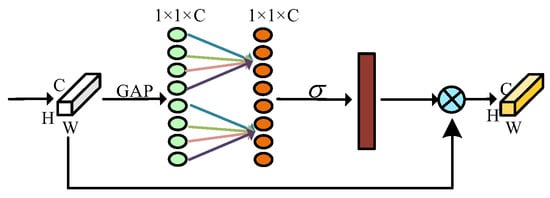
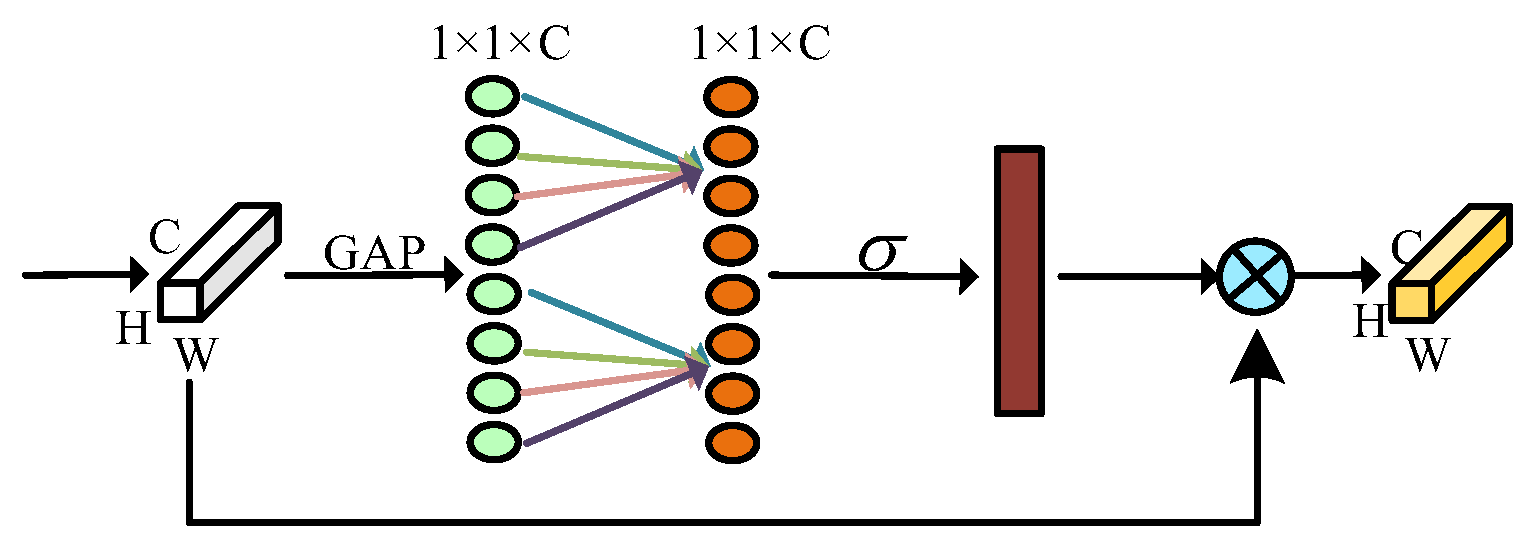
The attention mechanism was originally developed in the field of computer vision, with the core idea of simulating the human ability to focus on critical information. It assigns different weights to different parts of the input features, thereby enhancing the model’s capability to extract salient features [18]. Among various attention mechanisms, ECA is a lightweight and effective channel attention module [25]. By avoiding the complex fully connected layers, ECA significantly reduces the computational cost while effectively capturing cross-channel interactions. Its architecture is illustrated in Figure 1.
Figure 1.
The basic structure of the ECA module.
First, ECA applies global average pooling (GAP) to the input feature map X, compressing the spatial information of each channel into a single scalar to obtain the global feature for each channel. Then, an adaptive function is used to determine the appropriate convolutional kernel size k and perform cross-channel interactions. Finally, a Sigmoid function generates the channel-wise weight vector , which is multiplied element-wise with the original input feature map to produce the attention-weighted feature map . The ECA process can be expressed mathematically by Equations (3)–(7).
Here, denotes the feature value at spatial location of the c-th channel, and represents the globally pooled feature of the c-th channel. C is the total number of channels, γ and b are nonlinear parameters, and denotes the Sigmoid activation function.
2.3. Transformer
The Transformer is a neural network model based on the self-attention mechanism. Unlike CNN and RNN, the Transformer relies entirely on self-attention to capture dependencies within a sequence and can process all positions of the sequence in parallel, resulting in superior efficiency and performance for long-sequence tasks [17]. The core Transformer architecture consists of an encoder and a decoder. The encoder is composed of multiple identical layers, each containing a multi-head self-attention module and a feedforward neural network, which together encode the input sequence into context-aware representations. Each layer of the decoder contains, in addition to a multi-head self-attention module and feedforward network, an encoder–decoder attention layer. This allows the decoder to simultaneously attend to the entire encoder output and the previously generated output sequence when producing each output element, effectively integrating input information to perform sequence-to-sequence mapping.
The Multi-Head Attention (MHA) mechanism is a key component of the Transformer, consisting of several parallel self-attention layers [26]. Each attention head independently projects the input sequence, enabling it to capture diverse dependencies across different positions in the sequence and thereby enhancing the model’s ability to represent complex temporal patterns. Specifically, for each attention head, the input sequence is linearly transformed into query (Q), key (K), and value (V) matrices, from which attention weights are computed. The outputs of MHA are then concatenated and passed through a linear transformation to obtain the final output representation. The computation of MHA can be expressed as Equation (8), while the computations for each individual attention head are given by Equations (9)–(12).
where h denotes the total number of attention heads, is the output layer weight matrix, and represents the dimension of the key vectors. , and correspond to the linearly projected query, key, and value matrices for the -th attention head, while , and denote the corresponding weight matrices of the i-th attention head.
3. Energy Consumption Prediction Method
3.1. Data Description and Preprocessing
The data used in this study were obtained from the on-site monitoring and data acquisition system deployed at the Xiangguosi underground gas storage facility. The facility is equipped with eight DTY4000 reciprocating compressors (Xiangguosi UGS, Chongqing, China), and the system automatically and continuously monitors and records the operating parameters of each unit. To meet the daily scheduling and management requirements of the gas storage operation, the raw monitoring data were aggregated into daily average values, which formed the basic time series dataset used in this study. The compressor data covered the period from January 2018 to July 2025. The collected parameters include daily processed gas volume in cubic meters, specific energy consumption in kilowatt-hours per cubic meter, inlet pressure in megapascals, and outlet pressure in megapascals. Among these variables, specific energy consumption is the key indicator of compressor energy efficiency and serves as the final prediction target of the proposed two-stage forecasting framework. In addition, the compression ratio, calculated as the ratio of outlet pressure to inlet pressure, is used as an important dimensionless parameter for analysis. It should be noted that the long-term data acquisition process inevitably introduces data imperfections. Therefore, systematic data processing and cleaning were performed. Missing values were filled using the mean values of adjacent time periods, and outliers were identified and removed based on the three-sigma criterion.
The experimental data were divided into operating condition prediction data and specific energy consumption prediction data, corresponding to the two stages of the proposed framework. In the first stage, the objective is to predict the average compression ratio and the average outlet pressure of the compressor group. Both the training and testing data in this stage were constructed from the system-level average operating condition series. Specifically, the daily average values of the operating parameters were calculated across all active compressors to form a complete system average operating condition sequence. Data from 2018 to 2024 were used for training, while data from 2025 were used for testing. A sliding window with a size of seven days was applied to generate the model input samples. In the second stage, separate datasets were constructed for each compressor and used for model training and evaluation. The inputs to each dataset consist of historical average operating condition parameters, while the output is the specific energy consumption of the corresponding compressor. For each compressor, the historical data were randomly split into training, validation, and testing sets with a ratio of 7:1:2. The validation set was used for model selection and hyperparameter tuning, the training set was used for model fitting, and the testing set was used for final performance evaluation.
3.2. Two-Phase Prediction Method for Compressor Systems
To overcome the limitations of conventional unit energy consumption prediction methods that directly map historical data to energy metrics, resulting in low interpretability and limited multi-step forecasting capability, a two-phase prediction method for compressor group energy consumption is proposed. The method decomposes the energy consumption prediction task into two stages: forecasting the average operating conditions of the compressor group and predicting the energy consumption of individual compressors. This decomposition enhances both the interpretability and practical applicability of the overall prediction model.
CNNs possess strong capabilities for extracting local temporal features, while ECA can adaptively identify the importance of channel features, thereby enhancing the model’s ability to capture critical operating condition information. Therefore, in the first phase, a CNN-ECA based model is constructed to perform single-step forecasting of the average operating conditions of the compressor group. In addition, to provide continuous and reliable energy consumption predictions for long-term scheduling of the compressor group, a Transformer, which is well-suited for modeling long-term sequences, is incorporated into the first phase to enable multi-step forecasting of the average operating condition parameters.
In the second phase, unit-specific energy consumption prediction models are constructed for each reciprocating compressor, which, combined with the outputs from the first phase, provide overall energy consumption forecasts for the entire compressor group. First, the models are trained using historical operating conditions and the corresponding energy consumption data of each compressor. Candidate models are then systematically evaluated on a validation set, and the model exhibiting the lowest error across multiple metrics is selected as the final prediction model for each compressor. The predicted future average operating conditions of the compressor group from the first phase are used as inputs to these models, enabling the estimation of unit energy consumption under the corresponding operating conditions.
3.3. Prediction Method for Compressor Systems
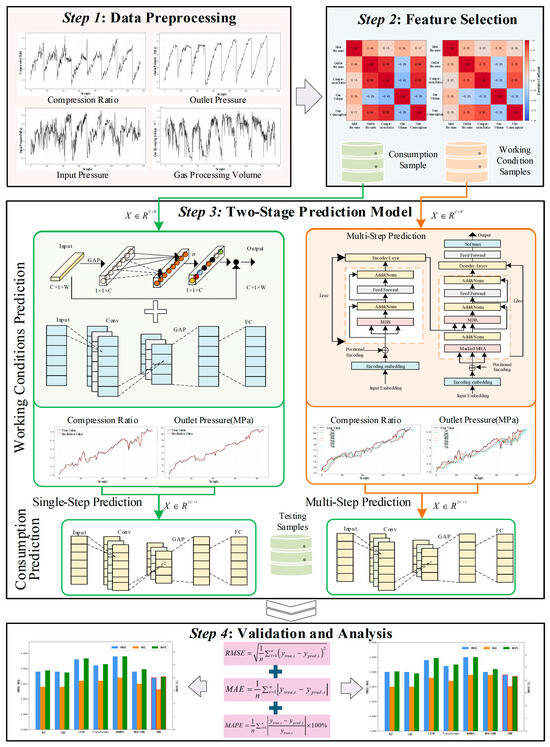
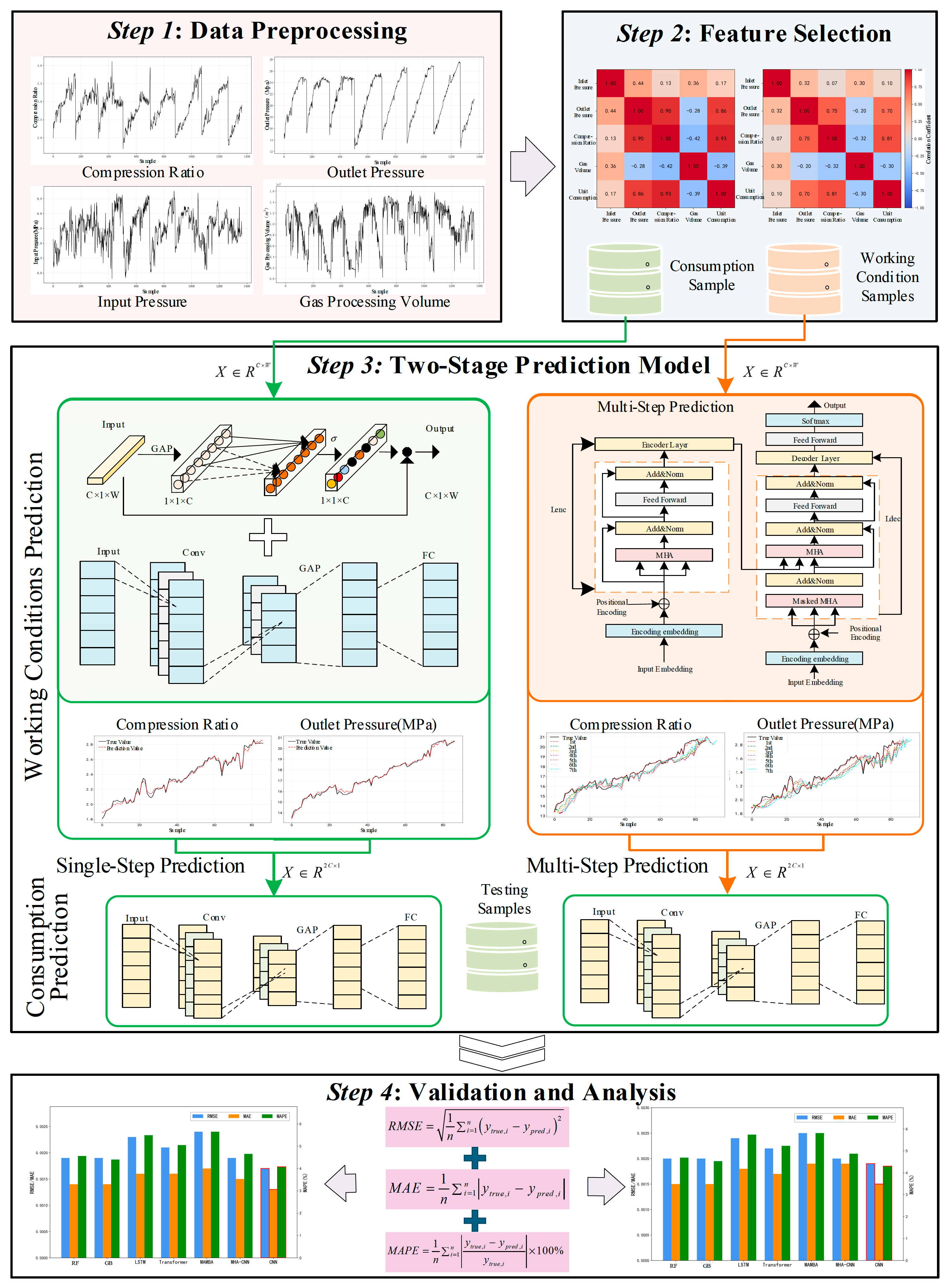
The workflow of the proposed data-driven two-phase framework for predicting the unit energy consumption of compressor systems in underground gas storage is illustrated in Figure 2 and mainly includes the following steps:
Figure 2.
The two-phase framework for compressor-group unit energy consumption prediction.
Step 1: Data preprocessing. Historical operational data of the compressor group are preprocessed to improve data quality. Based on the cleaned data, two datasets are constructed: one for group-level average operating conditions and another for the unit energy consumption of individual compressors.
Step 2: Feature selection. The relationships between operating-condition parameters and unit energy consumption are analyzed, and parameters exhibiting strong relevance to energy consumption are selected for prediction.
Step 3: Two-phase modeling for compressor-group energy consumption prediction. In the first phase, CNN-ECA and Transformer models are developed to predict future average operating conditions of the compressor group, and model training is conducted using the group-level operating-condition dataset. In the second phase, multiple CNN-based models are built for individual compressors to estimate unit energy consumption, and each model is trained on discrete operational and energy consumption data of the corresponding compressor.
Step 4: Model testing and analysis. The two-phase framework is applied to real prediction tasks for performance evaluation. The future average operating conditions predicted in the first phase are fed into the individual compressor models to obtain accurate single-step and multi-step unit energy consumption predictions for the entire compressor group.
4. Results and Discussion
4.1. Experimental Setup
To validate the effectiveness of the proposed method, historical operational data were collected from eight DTY4000 compressors operating at the Xiangguosi UGS. The dataset covered the period from 2018 to 2025 and included the daily gas throughput, compressor energy consumption, inlet and outlet pressures, and unit energy consumption. Outliers were first detected and removed using the 3δ criterion. Subsequently, missing values were imputed using mean substitution to ensure dataset completeness and consistency.
The parameter configurations for all models used in the proposed two-phase and dual-model collaborative prediction framework for UGS compressor systems are summarized in Table 1. BN denotes batch normalization, and ConvBlock refers to a convolutional block composed of a one-dimensional convolution layer, a pooling layer, and a ReLU activation function. During training, the initial learning rate was set to 0.01 and decayed by a factor of 0.02 every 40 epochs following a dynamic learning schedule.
Table 1.
The parameter configurations for all models in the proposed method.
Mean Absolute Error (MAE), Root Mean Square Error (RMSE), and Mean Absolute Percentage Error (MAPE) were adopted as the metrics for evaluating model prediction accuracy. The expressions for these three metrics are given in Equations (13)–(15).
where N denotes the total number of test samples, represents the predicted value, and represents the true value.
It should be noted that all experiments were conducted on a computer equipped with an Intel Core i7-9750 processor, 8 GB of RAM, and an NVIDIA GeForce RTX 1650 graphics card.
4.2. Feature Selection
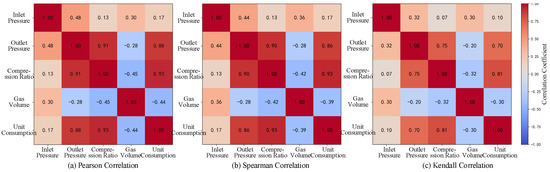
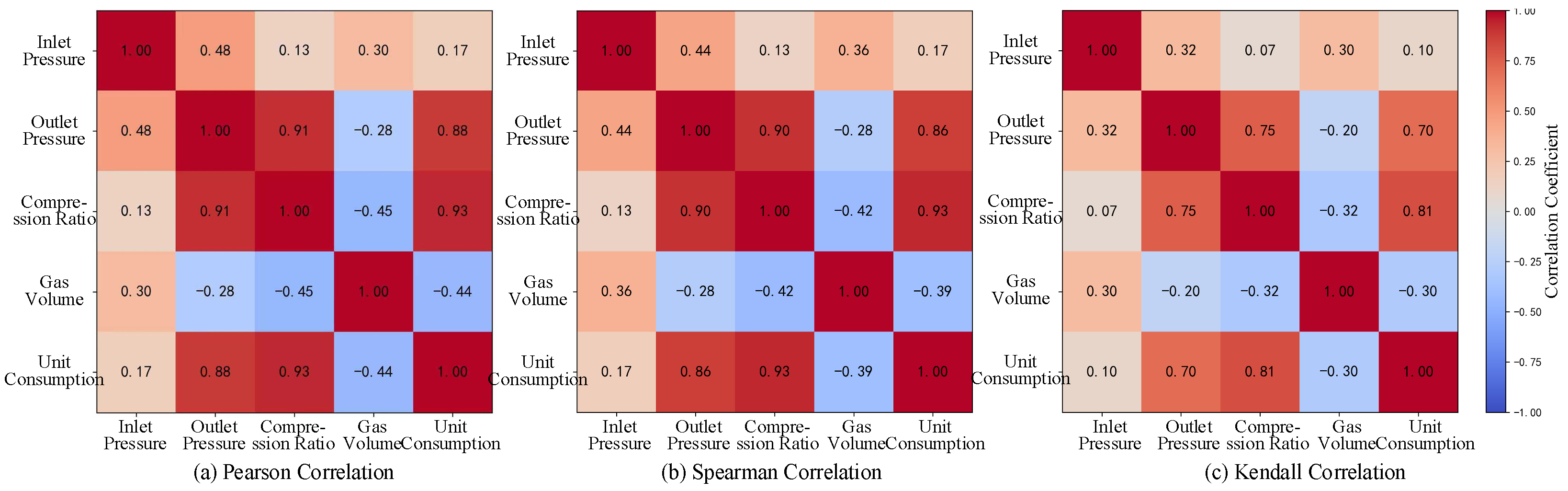
In the prediction of unit energy consumption for compressor systems in UGS, using all operating-condition parameters may introduce redundant features. Therefore, Pearson correlation analysis [26], Spearman correlation analysis [27], and Kendall correlation analysis [28] were employed to quantify the relationships between the operating-condition parameters of all individual compressors and their corresponding unit energy consumption. This analysis allows for the selection of features that are strongly correlated with energy consumption. The heatmap of the correlation analysis is shown in Figure 3. Both the compression ratio and outlet pressure exhibited strong positive correlations with unit energy consumption, with Pearson correlation coefficients exceeding 0.7, Spearman correlation coefficients exceeding 0.8, and Kendall coefficients remaining above 0.7. Accordingly, the compression ratio and outlet pressure were selected as the key operating-condition parameters for the compressor group in subsequent prediction tasks.
Figure 3.
Heatmap of the correlation between operating-condition parameters and compressor unit energy consumption.
4.3. Experimental Evaluation of Unit Energy Consumption Prediction
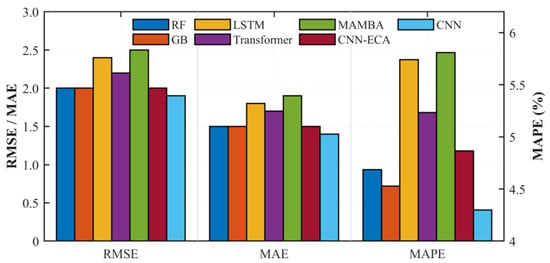
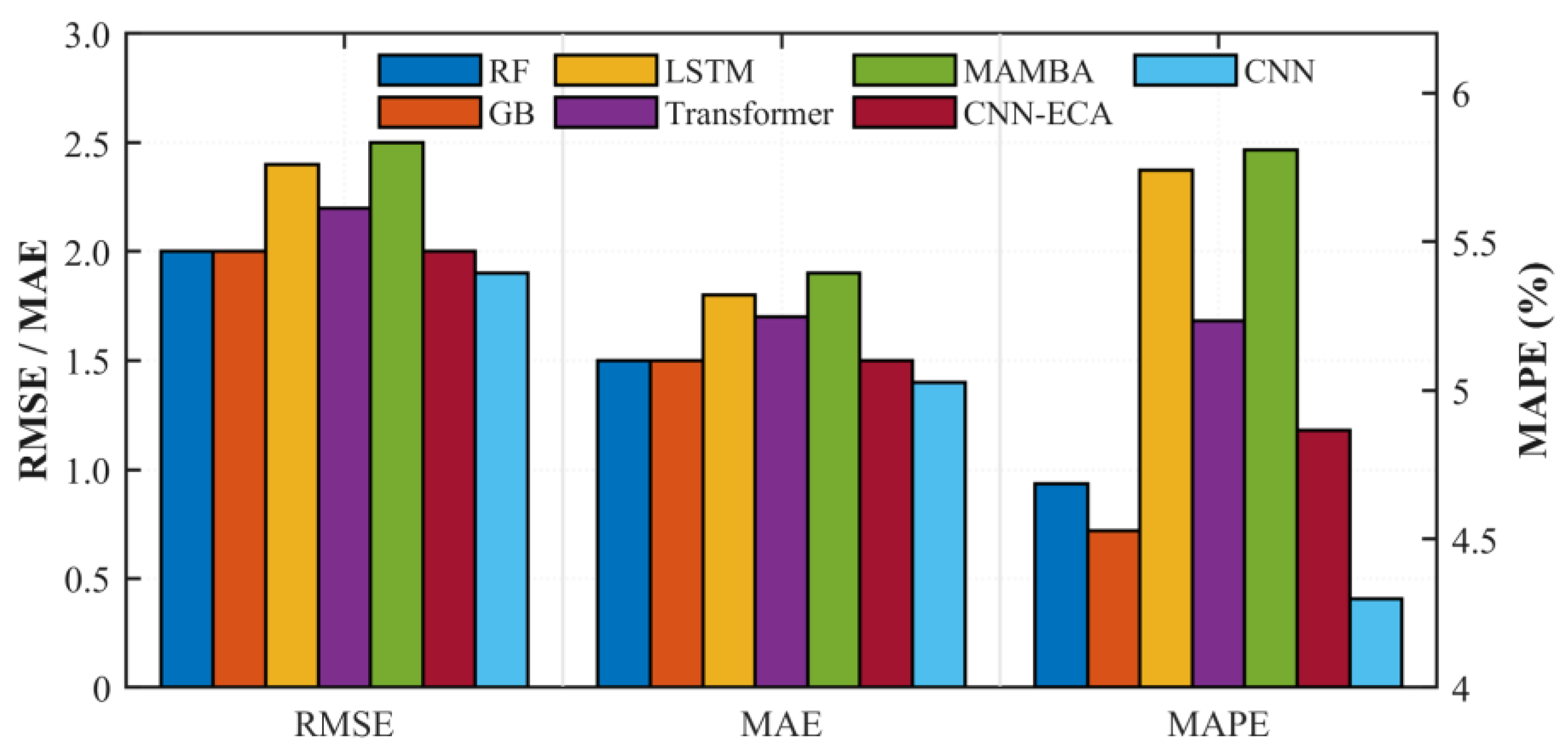
The unit energy consumption prediction of the UGS compressor group constitutes the foundational component of the overall two-phase energy consumption prediction framework. To this end, multiple machine learning and deep learning models were developed for s unit energy consumption prediction, including Random Forest (RF) [29], Gradient Boosting (GB) [30], LSTM, Transformer, MAMBA [31], CNN-ECA, and CNN. All models were trained using the single-consumption training set and subsequently evaluated on the validation set. The prediction results of all models, as well as their training time and inference time, are presented in Table 2. When the true compressor ratio and discharge pressure were provided as inputs, the CNN model achieved the best performance for unit energy consumption prediction on the validation set. Its RMSE, MAE, and MAPE reached as low as 0.0022, 0.0016, and 4.0937%, respectively, outperforming all comparative methods. This demonstrates that the CNN model effectively captures the nonlinear mapping between operating parameters and unit energy consumption, while its relatively simple architecture reduces the risk of overfitting.
Table 2.
Results and computational efficiency of different unit energy consumption prediction models on the validation dataset.
It is worth noting that the CNN outperformed the other methods in this prediction task. This advantage mainly arises from the nature of compressor specific energy consumption prediction, which aims to map two key operating parameters, namely the compression ratio and the outlet pressure of a given day, to the corresponding specific energy consumption. While maintaining sufficient fitting capability, CNNs feature a moderate number of parameters and a concise architecture, which leads to a lower risk of overfitting at the current data scale. In contrast, architectures such as Transformers, which are designed for complex sequence modeling, provide stronger representation capacity. However, their large parameter size and internal attention mechanisms introduce unnecessary computational complexity for this task. This not only increases the training and inference time but also makes the models more prone to fitting noise and spurious fluctuations in the training data. As a result, they struggle to consistently capture the mapping between key operating parameters and compressor specific energy consumption. Furthermore, in terms of computational efficiency, the CNN achieved the highest prediction accuracy while requiring only 140.9800 s for training and 0.1410 s for inference. Compared with the other models, it therefore demonstrates superior computational efficiency and strong potential for practical engineering applications. Based on these results, CNN was selected as the unit energy consumption prediction model for the second phase of the two-phase energy consumption prediction framework.
4.4. Two-Phase Unit Energy Consumption Prediction Experiments
The CNN-ECA model was employed to predict the average compression ratio and discharge pressure of the compressor group. The predicted operating-condition parameters were then fed into the CNN models for individual compressors to obtain unit energy consumption predictions. To evaluate the effectiveness of CNN-ECA for single-day operating-condition forecasting, several advanced time-series prediction models, including LSTM, Transformer, MAMBA, TCN, as well as conventional CNN and CNN with MHA (CNN-MHA) were used for comparison. The prediction results for average operating conditions are summarized in Table 3. For single-step compression ratio prediction, CNN-ECA achieved RMSE, MAE, and MAPE values of 0.0313, 0.0235, and 1.0280%, respectively, significantly outperforming the conventional CNN, which yielded 0.0422, 0.0329, and 1.4080%. In single-step discharge pressure prediction, CNN-ECA attained RMSE, MAE, and MAPE values as low as 0.1510, 0.1141, and 0.6600%, while the best-performing alternative, CNN-MHA, achieved 0.2207, 0.1590, and 0.9000%, respectively. These results demonstrate that incorporating ECA into CNN enables the model to focus more effectively on critical features, thereby achieving more accurate predictions of single-day future operating-condition parameters.
Table 3.
Single-step prediction results of key compressor operating-condition parameters.
To comprehensively evaluate the practical applicability of the proposed prediction models, the computational efficiency of different methods was further compared, as summarized in Table 3. In the single-step operating condition prediction task, the CNN-ECA model achieved the highest prediction accuracy while maintaining computational resource consumption at an acceptable range for engineering practice. Specifically, its single inference time was only 0.1540 s, and the training time was 214.1600 s, which meets the real-time requirements of on-site scheduling systems. These results indicate that the performance gains introduced by incorporating the efficient channel attention mechanism in CNN-ECA significantly outweigh the slight increase in computational cost. As a result, the model achieves a favorable balance between prediction accuracy and computational efficiency, making it well-suited for practical deployment in complex industrial environments where both accuracy and usability are critical.
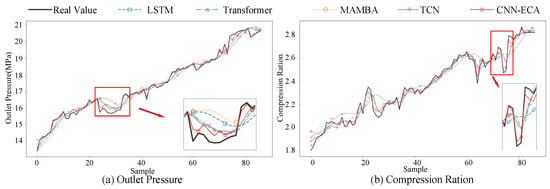
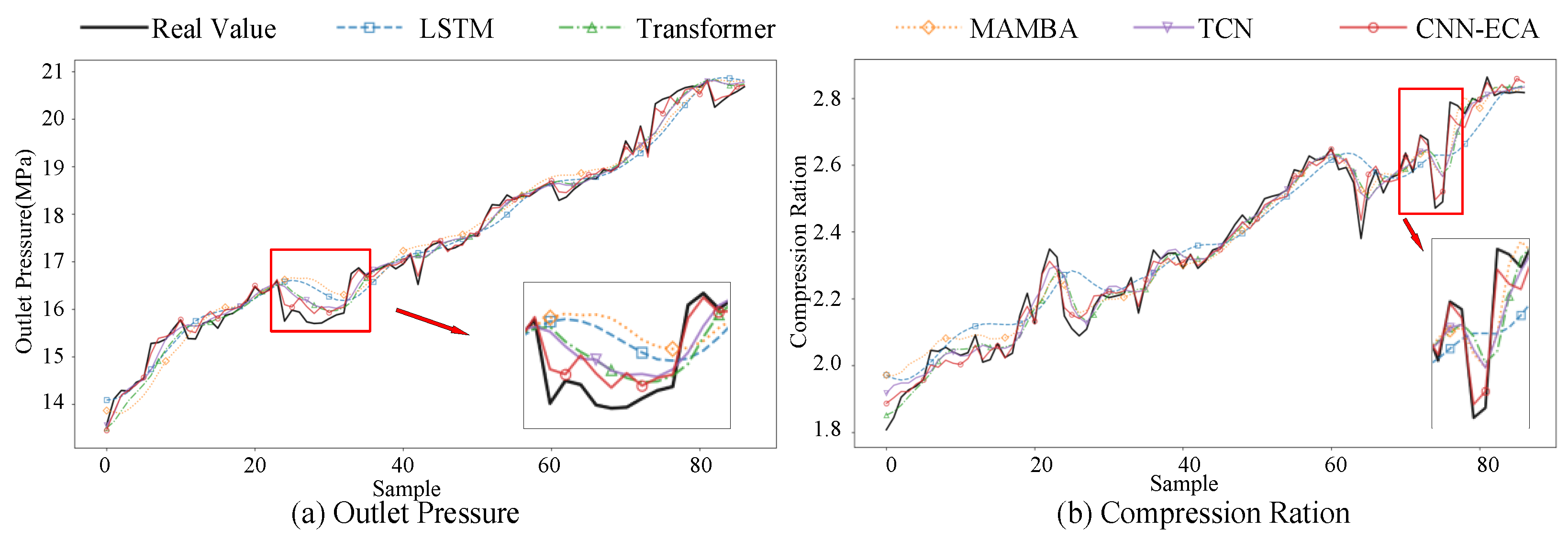
Figure 4 illustrates the predicted average compression ratio and discharge pressure of the compressor group using different operating-condition forecasting models. The results indicate that compared with other models, the proposed CNN-ECA model produced predictions that most closely matched the actual operating conditions, effectively capturing the dynamic trends of the real system. These findings further confirm the superiority of CNN-ECA in single-step prediction tasks for key operating-condition parameters.
Figure 4.
Single-step prediction results of discharge pressure and compression ratio.
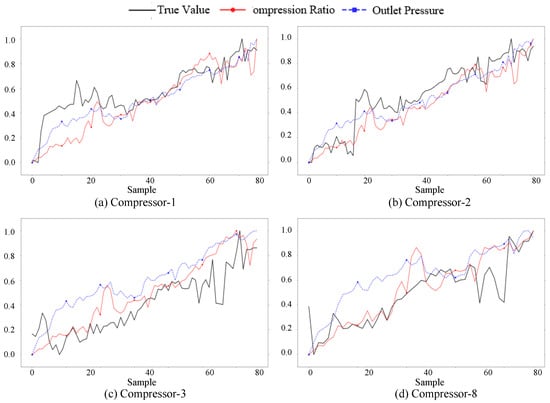
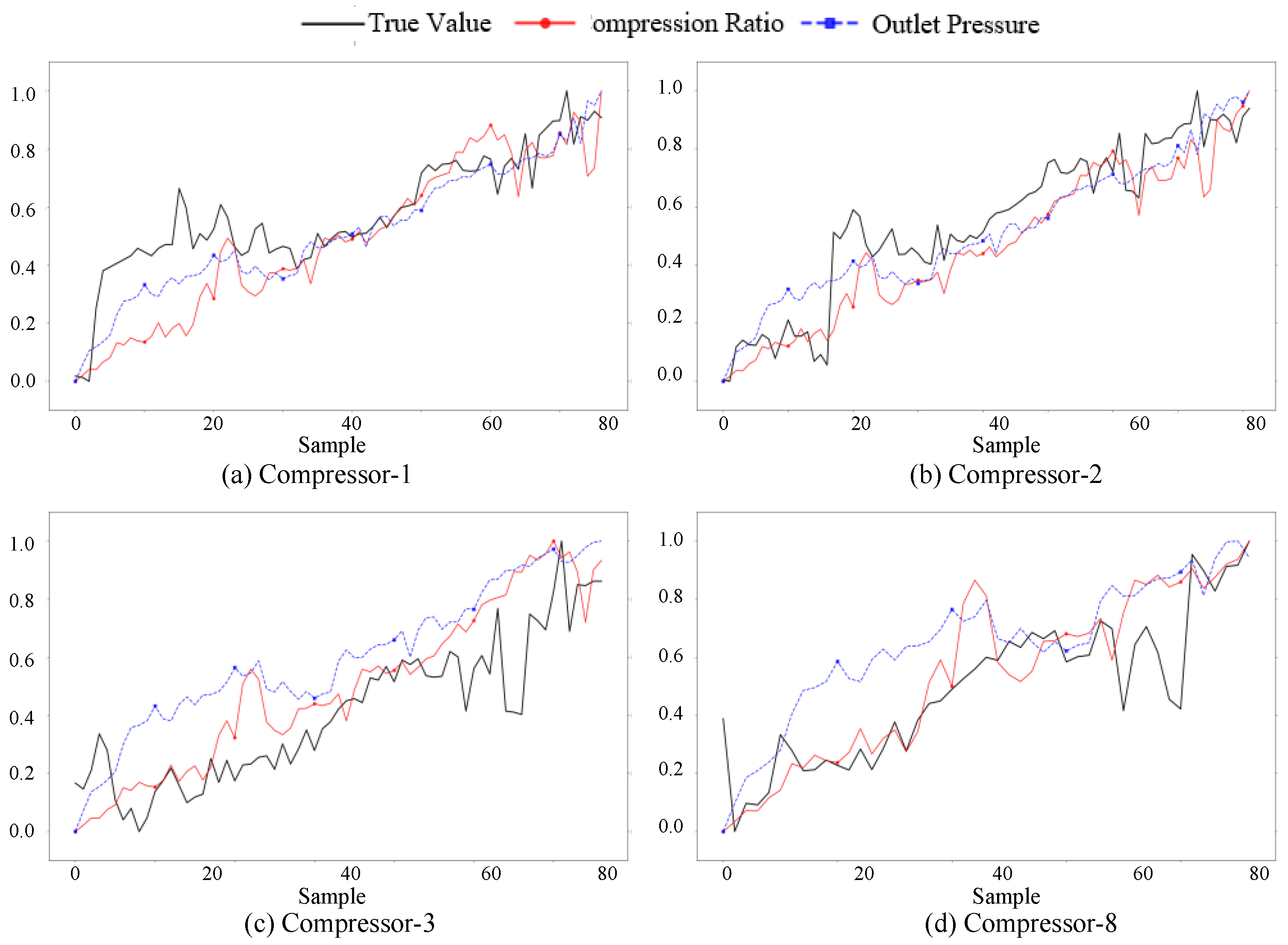
To illustrate how variations in the first-stage predicted parameters affect the second-stage outputs, Figure 5 presents the normalized ground-truth curves of specific energy consumption for four representative compressors in 2025. The normalized curves of outlet pressure and compression ratio predicted in the first stage are also shown. Although the specific energy consumption differed among individual compressors, it exhibited temporal trends similar to those of the predicted outlet pressure and compression ratio. When the outlet pressure and compression ratio increased, the specific energy consumption of the compressors also showed an increasing trend. This consistency indicates that using outlet pressure and compression ratio as inputs to the second-stage specific energy consumption prediction model has a clear physical basis and provides meaningful interpretability.
Figure 5.
First-stage prediction results and compressor specific energy curve graph.
To systematically evaluate the impact of different operating-condition forecasting models on the final unit energy consumption prediction accuracy, the predicted operating-condition parameters from various models were fed into the trained CNN-based unit energy consumption prediction models for individual compressors. The resulting prediction performance of the compressor group is presented in Table 4. Specifically, for each first-phase model, the predicted future operating conditions were input into the CNN-based models of all eight compressors to obtain the group-level unit energy consumption predictions, with RMSE, MAE, and MAPE reported. The results indicate that when operating-condition information predicted by the CNN-ECA model was used as input for the unit energy consumption prediction models, the compressor systems achieved the best prediction performance, with RMSE, MAE, and MAPE reaching 0.0017, 0.012, and 4.0780%, respectively. These findings further validate the superiority of CNN-ECA in operating-condition prediction and demonstrate the effectiveness of the proposed two-phase energy consumption prediction framework.
Table 4.
Prediction results under different operating-condition forecasting models.
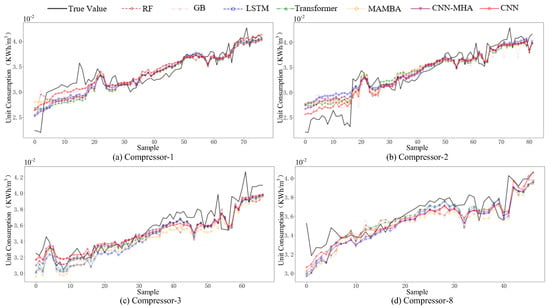
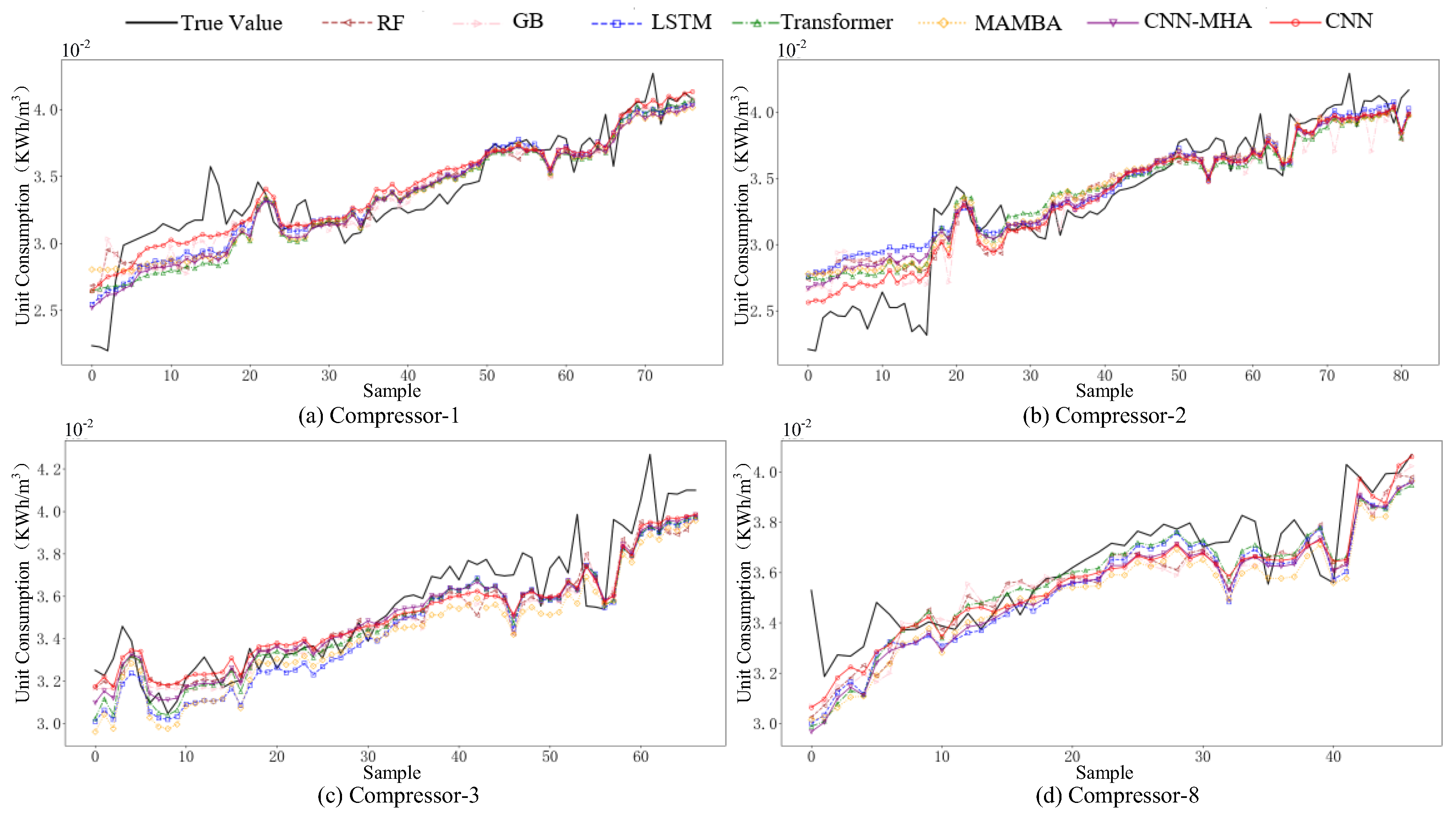
To visually assess the performance of the proposed two-stage approach in compressor specific energy consumption prediction, the compression ratio and outlet pressure predicted by the CNN-ECA operating condition model were used as inputs. Figure 6 compares the single-step energy consumption prediction results of the proposed CNN-based model with those of other methods for four representative compressors. As shown in Figure 6, although the baseline levels and fluctuation characteristics of specific energy consumption differed across compressors due to performance differences, the predicted curves produced by the proposed method closely matched the ground-truth values for all four units. More importantly, while minor fluctuations remained, the predictions accurately captured the main variation trends of the true values, as well as the timing of peaks and troughs. This demonstrates the strong generalization capability and high prediction accuracy of the proposed method.
Figure 6.
Compressor energy consumption prediction results.
To evaluate the superiority of the proposed two-phase energy consumption prediction method, a single-phase compressor unit energy consumption prediction approach was constructed for comparison. This single-phase method directly uses historical operating-condition data as input to predict the unit energy consumption of each compressor. It should be noted that in the two-phase method, the operating-condition prediction model is CNN-ECA, while the unit energy consumption prediction model is CNN. To ensure fairness, the single-phase model was constructed by directly concatenating CNN-ECA and CNN, with identical parameter settings for each module.
Table 5 presents the individual unit energy consumption prediction results for all eight compressors, as well as the overall compressor group predictions. At the individual compressor level, the two-phase prediction framework outperformed the single-phase direct prediction method across all three evaluation metrics for all eight compressors. Specifically, for No. 4 compressor, the two-phase method reduced the predicted MAPE from 7.7148% to 4.8124%, demonstrating a substantial improvement. This highlights the effectiveness of the proposed two-phase method in achieving accurate predictions even for compressors with significant performance variability.
Table 5.
Compressor systems unit energy consumption prediction results under two-phase and single-phase prediction frameworks.
At the group level, the two-phase prediction method consistently yielded lower average error metrics compared with the single-phase approach. Notably, the average RMSE decreased from 0.0033 to 0.0017, and the average MAPE decreased from 5.7381% to 4.0779%. Overall, the two-phase prediction method not only provides a degree of physical interpretability but also demonstrates superior predictive accuracy for both individual compressors and the overall compressor systems.
4.5. Multi-Step Unit Energy Consumption Prediction Experiments
The multi-day variation trends of compressor operating conditions and unit energy consumption are of significant value for UGS compressor scheduling. Therefore, a multi-step unit energy consumption prediction experiment was conducted to evaluate the effectiveness of the proposed dual-model collaborative method in recursive multi-step forecasting tasks. Taking the recursive prediction of compressor operating conditions over the following week as an example, the prediction results of various models are presented in Table 6.
Table 6.
Multi-step recursive prediction results of key compressor parameters.
The results indicate that the Transformer model demonstrates a clear advantage in multi-step recursive forecasting. For multi-step compression ratio prediction, Transformer achieved RMSE, MAE, and MAPE values of 0.0869, 0.0683, and 2.7951%, respectively, significantly lower than CNN-ECA, which yielded 0.1032, 0.0840, and 3.4942%. For multi-step discharge pressure prediction, Transformer attained RMSE, MAE, and MAPE values of 0.4104, 0.3347, and 1.8831%, outperforming CNN-ECA’s 0.5887, 0.4833, and 2.7554%, respectively. This superior performance is attributed to the Transformer’s fully self-attention-based architecture, which effectively captures the global dependencies and long-term trends within the input sequence, making it more robust than models that focus primarily on local features when recursively forecasting multi-day future operating conditions.
It is worth noting that although the results in Table 3 indicate that the Transformer did not achieve the highest computational efficiency, the multi-step recursive prediction results of operating parameters in Table 6 demonstrate that it delivered the best overall performance in this task. Multi-step forecasting is primarily used to anticipate key parameters over a future horizon for periodic planning and start–stop strategy formulation, where real-time requirements are less stringent than those of single-step prediction. In this context, despite its longer inference time, the Transformer can fully exploit its strength in capturing long-term dependencies. This makes it more suitable for supporting coordinated scheduling and energy efficiency optimization decisions in compressor group operations.
Furthermore, to provide a more detailed explanation of the advantages exhibited by the Transformer in multi-step prediction, Table 7 and Table 8 present the multi-step recursive forecasting results of operating parameters obtained using different methods. As shown in these tables, when the recursive prediction horizon exceeded two days, the Transformer-based model consistently outperformed all comparison models in terms of RMSE, MAE, and MAPE. These results further confirm the effectiveness of the Transformer in capturing long-term temporal dependencies.
Table 7.
The multi-step recursive prediction results of the compression ratio for different methods.
Table 8.
The multi-step recursive prediction results of the outlet pressure for different methods.
Figure 7 illustrates the multi-step unit energy consumption prediction obtained by inputting the Transformer-predicted multi-step operating-condition parameters into the second-phase unit energy consumption prediction models. The results show that the two-phase unit energy consumption prediction framework, combining Transformer and CNN, achieved RMSE and MAPE values of only 0.0019 and 4.2449%, respectively, fully satisfying the requirements for UGS compressor scheduling. Furthermore, an analysis of the second-phase predictions using different unit energy consumption prediction models indicates that CNN-based predictions yielded the best performance, further validating the effectiveness of selecting the unit energy consumption prediction model based on the validation dataset.
Figure 7.
Multi-step unit energy consumption prediction results of the compressor systems based on the two-phase prediction framework.
In summary, the proposed two-phase prediction framework demonstrates clear advantages over single-phase unit energy consumption prediction for compressor systems. By collaboratively employing CNN-ECA and Transformer-based operating-condition forecasting models in the first phase, the framework achieves accurate single-step and multi-step predictions of operating-condition parameters. This enables precise modeling of both daily and multi-day trends in compressor systems’ unit energy consumption, thereby providing critical decision support for the formulation of periodic UGS scheduling plans.
5. Conclusions
To address the limitations of traditional mechanistic models and experience-based scheduling methods under complex and dynamic operating conditions, this study proposes a data-driven Two-phase Energy Consumption Prediction framework for UGS compressor groups. The framework decomposes the overall prediction task into two collaborative phases: system-average operating-condition forecasting and individual compressor unit energy consumption prediction. In the first phase, a CNN-ECA model enhanced with channel attention was employed to achieve high-precision single-step prediction of key compressor operating parameters. In the second phase, the predicted operating conditions from the first phase are utilized to perform fine-grained prediction of an individual compressor’s daily unit energy consumption. To improve stability and generalization in long-term scheduling scenarios, a dual-model collaborative prediction mechanism was introduced, incorporating Transformer for operating-condition forecasting to capture long-term dependencies, thereby enhancing robustness and accuracy in multi-step prediction tasks. Experimental results demonstrate that the proposed CNN-ECA model outperformed existing advanced methods in single-step compressor operating-condition prediction. Furthermore, the two-phase prediction strategy significantly surpassed the single-phase approach in both predictive performance and interpretability. At the industrial application level, this study was based on historical operating data from compressors in a real underground gas storage facility. The validated two-stage approach can provide effective decision support for the optimized operation of gas storage systems, thereby establishing a solid foundation for industrial deployment. Moreover, due to the stringent requirements of continuous process industries for production stability, safety, and cost control, conducting real-time parameter intervention tests in operating facilities entails substantial engineering challenges, including shutdown risks and high costs. Therefore, in the next stage of this research, deploying the proposed method in industrial field applications for validation and further optimization has been identified as a primary objective.
Author Contributions
Conceptualization, Y.Y. and D.T.; methodology, Y.Y., G.Y., J.Y. and J.M.; software, J.Z. and Z.H.; validation, Y.Y. and Z.H.; formal analysis, D.T. and J.Z.; investigation, D.T. and T.J.; resources, Y.Y., G.Y. and T.J.; data curation, D.T., J.Y. and G.Y.; writing—original draft, Y.Y., D.T. and Z.H.; writing—review and editing, J.M.; visualization, J.Y. and T.J.; supervision, J.M.; funding acquisition, D.T. and J.M. All authors have read and agreed to the published version of the manuscript.
Funding
This research was funded by the Southwest Oil and Gas Field Innovation Fund Project (grant number JS2025-54), the Science and Technology Research Program of Chongqing Municipal Education Commission (grant numbers KJZD-K202300611 and KJQN202300640), and the Natural Science Foundation of Chongqing (grant number CSTB2025NSCQ-GPX1292).
Data Availability Statement
Data will be made available on request.
Conflicts of Interest
Authors Ying Yang, De Tang, Guicheng Yu, Junchi Zhou, Jinsong Yang and Tingting Jiang were employed by the Chongqing Xiangguosi Gas Storage Co., Ltd. The remaining authors declare that the research was conducted in the absence of any commercial or financial relationships that could be construed as a potential conflict of interest.
References
- Wang, K.X.; Zuo, Z.T.; Liang, Q.; Guo, W.B.; Chen, H.S. Review of Performance Prediction Methods for Centrifugal Compressors. Energy Storage Sci. Technol. 2023, 12, 3435–3444. [Google Scholar]
- Sieros, G.; Stamatis, A.; Mathioudakis, K. Jet engine compressor and turbine performance map analytical representation. J. Propuls. Power 1998, 14, 837–846. [Google Scholar]
- Yan, X.; Zuo, Z.T.; Liang, Q.; Yang, H.T.; Chen, H.S. Research on the Performance Prediction Model of Centrifugal Compressor with Adjustable Guide Vanes for Variable Operating Conditions. Proc. CSEE 2016, 36, 3381–3390. [Google Scholar]
- Li, X.P.; Zhuo, M.H.; Lü, B.P.; Wan, J. Development and application of performance conversion software for centrifugal compressors. Oil Gas Storage Transp. 2013, 32, 824–828. [Google Scholar]
- Zhu, X.P. A multi-objective optimization prediction model for gas withdrawal volume in gas storage. Oil Gas Storage Transp. 2024, 43, 96–102. [Google Scholar]
- Xie, H.; Zhang, S.Y.; Yang, B. Research on the Application of Similarity Principle in Centrifugal Compressors. Chin. J. Eng. Thermophys. 2021, 42, 2525–2535. [Google Scholar]
- Zhang, P.; Li, Y.M.; Wang, G.L.; Wei, G.F. A performance prediction method for centrifugal compressors based on IPSO-LSSVM. Oil Gas Storage Transp. 2023, 42, 79–86. [Google Scholar]
- Xu, M.Z.; Liu, H.M.; Yi, X.Z.; Zhou, Y.H.; Wan, J.F.; Chen, L.; Cao, Z.Y. Condition monitoring and predictive maintenance of reciprocating compressors based on GA-BP. China Pet. Mach. 2024, 52, 1–6. [Google Scholar]
- Ma, F.F.; Xiong, D.; Sun, T.D.; Ouyang, F.S. Performance Prediction Model for Cracking Gas Compressor in Ethene Unit. J. East China Univ. Sci. Technol. 2021, 47, 177–182. [Google Scholar]
- Zhu, W.Y.; Liu, J.H.; Yang, J.M.; Liu, Z.; Hou, L. Prediction Method of Centrifugal Compressor Performance Curve Based on BOA-BPNN. Pet. Mach. 2025, 53, 1–9. [Google Scholar]
- Yu, J.P.; Hu, S.; Liu, X.W.; Tian, Y.W.; Qiu, H.W.; Akoto, E. Research on efficiency prediction method of reciprocating air compressor based on digital twin technology. J. Lanzhou Univ. Technol. 2024, 50, 48–52. [Google Scholar]
- Zhan, T.; Zhang, C.L.; Wang, X.L.; Ding, G.L. Thermodynamic performance calculation of refrigeration compressor based on RBF network. J. Shanghai Jiaotong Univ. 2001, 35, 1172–1174. [Google Scholar]
- Chen, L.J.; Gao, M.P.; Tian, L.; Li, S. Method for Generating Adaptive Performance Curves of Centrifugal Natural Gas Compressors. Oil Gas Storage Transp. 2023, 42, 430–437. [Google Scholar]
- Chu, Y.; Chen, Y.F.; Mi, Y. A CNN-LSTM lithium battery state of health estimation method based on attention mechanism. Chin. J. Power Sources 2022, 46, 634–637+651. [Google Scholar]
- Zhang, Y.F.; Ai, Q.; Lin, L.; Yuan, S.; Li, Z.Y. A regional-level ultra-short-term load forecasting method based on deep long short-term memory network. Power Syst. Technol. 2019, 43, 1884–1891. [Google Scholar]
- Ye, L.J.; Pei, S.L.; Dong, S.; Tan, L. Wind Power Prediction Based on Deep Residual Bi-LSTM. Mod. Electron. Technol. 2025, 48, 113–119. [Google Scholar]
- Bai, S.; Kolter, J.Z.; Koltun, V. An empirical evaluation of generic convolutional and recurrent networks for sequence modeling. arXiv 2018, arXiv:1803.01271. [Google Scholar] [CrossRef] [Scilit]
- Zhang, F.; Wang, X.L. Deep Learning-Based Fault Diagnosis and Intelligent Operation of Centrifugal Pumps: Models, Challenges, and Perspectives. J. Manuf. Sci. Mech. Eng. 2025, 3, 37–52. [Google Scholar] [CrossRef] [Scilit]
- Wu, H.Y.; Ma, J.X.; Zhang, C.Y.; Zhou, H.; Bian, S.M.; Zeng, M. Urban integrated energy demand forecasting method considering multi-station fusion. IOP Publ. 2021, 651, 022084. [Google Scholar] [CrossRef] [Scilit]
- Vaswani, A.; Shazeer, N.; Parmar, N.; Uszkoreit, J.; Jones, L.; Gomez, A.N.; Kaiser, Ł.; Polosukhin, I. Attention is all you need. In Advances in Neural Information Processing Systems; Curran Associates: Red Hook, NY, USA, 2017; pp. 5998–6008. [Google Scholar]
- Kitaev, N.; Kaiser, Ł.; Levskaya, A. Reformer: The efficient transformer. arXiv 2020, arXiv:2001.04451. [Google Scholar] [CrossRef] [Scilit]
- Aliyari, M.; Ayele, Y.Z. Application of artificial neural networks for power load prediction in critical infrastructure: A com-parative case study. Appl. Syst. Innov. 2023, 6, 115. [Google Scholar] [CrossRef] [Scilit]
- Huang, F.H.; Zhao, H.L.; Yi, P.Y.; Li, P.D.; Peng, J. An improved transformer method for power load forecasting. Mod. Electr. Power 2023, 40, 50–58. [Google Scholar]
- Rajbhandari, Y.; Marahatta, A.; Ghimire, B.; Shrestha, A.; Gachhadar, A.; Thapa, A.; Chapagain, K.; Korba, P. Impact study of temperature on the time series electricity demand of urban nepal for short-term load forecasting. Appl. Syst. Innov. 2021, 4, 43. [Google Scholar] [CrossRef] [Scilit]
- Wang, Q.L.; Wu, B.G.; Zhu, P.F.; Li, P.H.; Zuo, W.M.; Hu, Q.H. ECA-Net: Efficient channel attention for deep convolutional neural networks. In Proceedings of the IEEE/CVF Conference on Computer Vision and Pattern Recognition, Seattle, WA, USA, 13–19 June 2020; pp. 11534–11542. [Google Scholar]
- Pearson, K. Notes on regression and inheritance in the case of two parents. Proc. R. Soc. Lond. 1895, 58, 240–242. [Google Scholar] [CrossRef] [Scilit]
- Spearman, C. The proof and measurement of association between two things. Am. J. Psychol. 1904, 15, 72–101. [Google Scholar] [CrossRef] [Scilit]
- Kendall, M.G. A new measure of rank correlation. Biometrika 1938, 30, 81–93. [Google Scholar] [CrossRef] [Scilit]
- Breiman, L. Random forests. Mach. Learn. 2001, 45, 5–32. [Google Scholar] [CrossRef] [Scilit]
- Friedman, J.H. Greedy function approximation: A gradient boosting machine. Ann. Stat. 2001, 29, 1189–1232. [Google Scholar] [CrossRef] [Scilit]
- Gu, A.; Dao, T. Mamba: Linear-time sequence modeling with selective state spaces. arXiv 2023, arXiv:2312.00752. [Google Scholar] [CrossRef] [Scilit]

Disclaimer/Publisher’s Note: The statements, opinions and data contained in all publications are solely those of the individual author(s) and contributor(s) and not of MDPI and/or the editor(s). MDPI and/or the editor(s) disclaim responsibility for any injury to people or property resulting from any ideas, methods, instructions or products referred to in the content. |
© 2026 by the authors. Published by MDPI on behalf of the International Institute of Knowledge Innovation and Invention. Licensee MDPI, Basel, Switzerland. This article is an open access article distributed under the terms and conditions of the Creative Commons Attribution (CC BY) license.