Article

A Multi-Stage Algorithm of Fringe Map Reconstruction for Fiber-End Surface Analysis and Non-Phase-Shifting Interferometry


by
Ilya Galaktionov
1,2,3,* and
Vladimir Toporovsky
1,3
1
Quantum Center, Moscow Technical University of Communications and Informatics, Aviamotornaya str., Bld. 8a, Moscow 111024, Russia
2
Physics Department, Moscow Polytechnic University, Bolshaya Semenovskaya str., Bld. 38, Moscow 107023, Russia
3
Space Technologies Design Department, Moscow Institute of Physics and Technology, Institutskiy per., Bld. 9, Dolgoprudny 141700, Russia
*
Author to whom correspondence should be addressed.
Appl. Syst. Innov. 2026, 9(2), 31; https://doi.org/10.3390/asi9020031
Submission received: 23 November 2025 / Revised: 20 January 2026 / Accepted: 21 January 2026 / Published: 27 January 2026
(This article belongs to the Section Information Systems)

Abstract

Interferometers are essential tools for quality control of optical surfaces. While interferometric techniques like phase-shifting interferometry offer high accuracy, they involve complex setups, require stringent calibration, and are sensitive to phase shift errors, noise, and surface inhomogeneities. In this research, we introduce an alternative algorithm that integrates Moving Average and Fast Fourier Transform (MAFFT) techniques with Polynomial Fitting. The proposed method achieves results comparable to a Zygo interferometer under standard conditions, with an error margin under 2%. It also maintains measurement stability in noisy environments and in the presence of significant local inhomogeneities, operating in real-time to enable wavefront measurements at 30 Hz. We have validated the algorithm through simulations assessing noise-induced errors and through experimental comparisons with a Zygo interferometer.

1. Introduction

As is widely recognized, Fizeau first utilized the equal-thickness fringes observed on a wedge-shaped glass plate illuminated by monochromatic light [1,2]. The Fizeau interferometer serves as a high-resolution spectral analyzer, typically comprising two highly reflective plane mirrors positioned at a slight angle to one another—generally less than one milliradian. In experiments, the angle of the incoming beam is measured relative to the interferometer itself. Variations in the optical path length between its two arms induce interference fringes at a fixed distance from the wedge, typically captured by a photodetector such as a CCD or CMOS camera. Points that align with the same fringe center correspond to identical optical path-length differences, while adjacent fringe centers differ by half a wavelength. Fringe sharpness is optimized when illumination is slightly off-axis, resulting in multiple reflections directed toward the wedge’s apex [3,4,5]. Introducing a slight tilt between the reference surface and the surface under examination allows any deviation from uniformly spaced, straight fringes in the interferogram to indicate an aberration in the optical surface being tested.
Numerous studies have analyzed interference fringes since the mid-twentieth century. In the 1950s, it was established that applying a silver coating to plate surfaces enhances fringe brightness and definition. Comprehensive investigations into multiple-beam interference within a wedge have revealed that fringes can exhibit asymmetry and may even display secondary maxima [6,7]. Numerical simulations of fringe profiles in transmission have indicated the presence of small secondary maxima on one side of the primary transmitted peak. This substructure and the asymmetry of the main peak are considered limitations of the Fizeau interferometer, as they can compromise measurement accuracy [8,9]. The complex mechanisms underlying reflection fringe formation have been discussed in several works [10]. Recent interest in wedge-shaped interferometry has been renewed in connection with laser applications, where multiple-beam Fizeau fringes are readily observable at a distance from the wedge when using a laser beam. Employing linearly spaced main fringes—as opposed to Fabry–Perot rings—can be advantageous for measuring laser wavelengths. Recent research has predominantly focused on phase-shifting interferometry, which has become a standard technique. Researchers continue to seek improvements in interferometric methods. For instance, the authors of [11] proposed a phase-shifter correction method based on an ultra-high linearity phase shifter for Fizeau interferometry, effectively reducing phase-shifting errors and improving precision. Conversely, the authors of [12] introduced an advanced simultaneous phase-shifting Fizeau interferometer characterized by high imaging resolution and measurement accuracy. In [13], the authors re-analyzed misalignment aberrations by considering the observational coordinate system and experimentally evaluated these aberrations, including retrace errors. Dr. Ramadan, in [14], examined the intensity distribution of fringes in transmission in relation to the real path of the interfered multiple beams. In [15], the authors investigated a large-aperture Fizeau interferometer using optical phase-shifting methods based on low-coherence lasers. Additionally, the authors of [16] proposed a novel dynamic Fizeau interferometer that relies on lateral displacements of point sources, making it immune to retrace errors and poor contrast and thus suitable for large-aperture optics. Phase-shifting interferometry has proven to be a precise and effective technique for measuring reflective surfaces across various applications [17], including optical testing, surface profiling, surface roughness estimation, and surface displacement measurement [18].
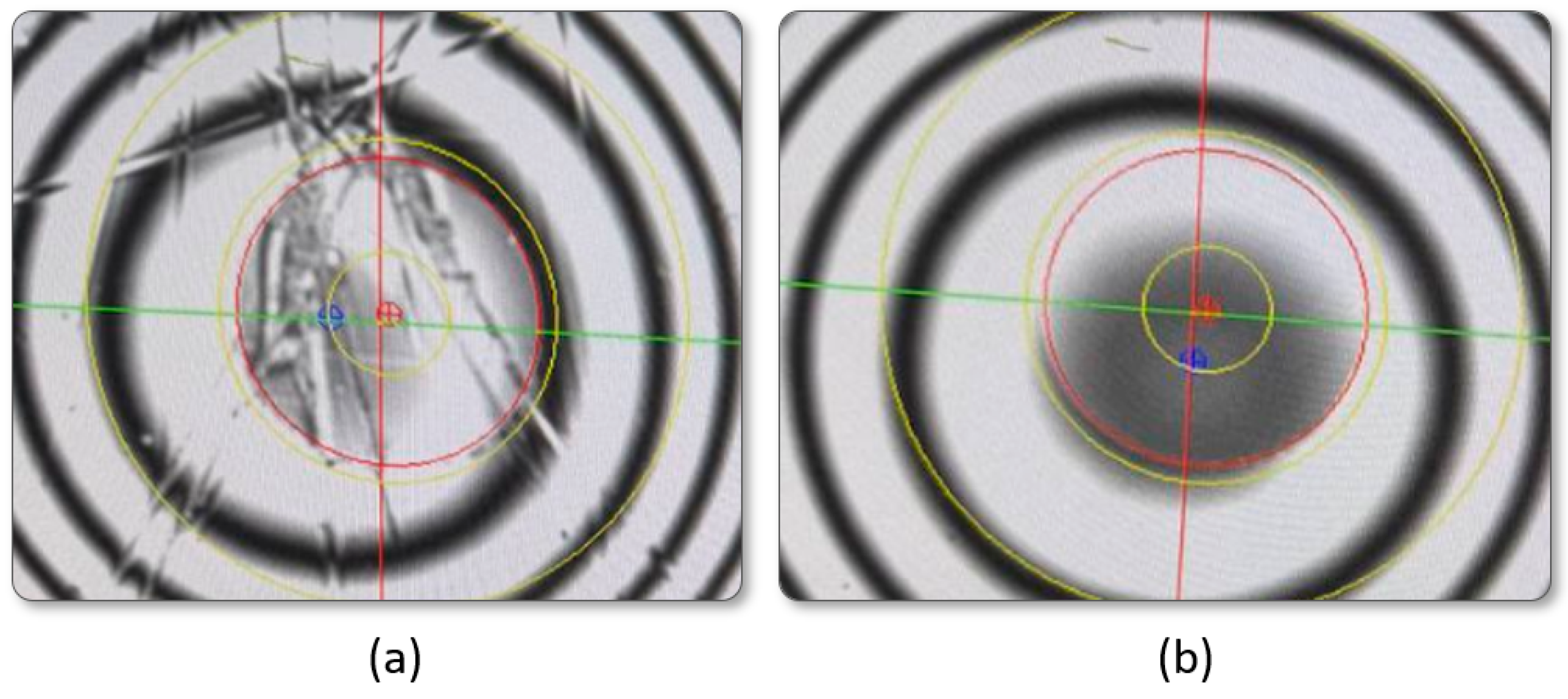
A significant body of research is devoted to the analysis of fiber-end surface profiles [19,20,21]. The challenge lies in the need to define the profile with high accuracy due to possible cleaved facets. An example of a fiber-end surface before and after proper polishing is presented in Figure 1.
Despite its advantages, conventional phase-shifting interferometry presents several drawbacks. Phase-shifting interferometers are highly sensitive to environmental conditions such as temperature fluctuations, vibrations, and air turbulence. Their optical setups are often complex, requiring precise component alignment. Furthermore, the technique has a limited dynamic range; it often struggles when the optical path difference exceeds a certain threshold, leading to phase wrapping and measurement ambiguity. Accurate measurements typically demand meticulous calibration, which can be time-consuming and may introduce errors if not performed correctly. The accuracy of the phase shifts themselves can be compromised by factors like light source instability and component precision. Additionally, the acquired data require complex processing algorithms for interpretation, increasing computational demands and often necessitating specialized software. Finally, interference fringe visibility can be reduced by issues such as limited source coherence and optical aberrations, potentially diminishing measurement reliability.
Conversely, non-phase-shifting reconstruction techniques also exhibit several limitations: (1) difficulty in accurately locating fringe centers, (2) irregularly spaced data points, as fringe centers do not align with a regular grid, and (3) a trade-off between resolution and the number of usable data points, where closely spaced fringes may be reconstructed with significant error [22].
A limited number of studies on non-phase-shifting interferometry exist in the literature. This work began with the 1982 paper by Mitsuo Takeda et al. [23], which proposed an FFT-based interferometry method. Their approach enabled the automatic discrimination between wavefront elevation and depression through computer processing of a non-contour fringe pattern. A key limitation of this method was its sensitivity to unwanted variations in fringe pattern parameters. Such limitations can be addressed by fringe-scanning techniques, but these require precise moving components. In contrast, the algorithm presented in this research requires no moving parts. Qian Kemao conducted extensive research on applying the two-dimensional windowed Fourier transform for fringe pattern analysis [24]. He developed and tested two algorithms, one based on filtering and the other on similarity measurements. The applications of his method are vast, ranging from strain determination and phase unwrapping to fault detection and fringe segmentation. However, the algorithm is complex and may be excessive for simpler cases without closed fringe patterns. Another contemporary approach is the application of neural networks. Deep learning, a powerful machine learning technique that uses multi-layered artificial neural networks, has shown great success in numerous data-rich applications [25,26,27,28]. For instance, Shijie Feng et al. demonstrated experimentally that a deep neural network can substantially enhance the accuracy of phase demodulation from a single fringe pattern [25]. Their deep-learning-based framework rapidly predicts the background image, enabling high-accuracy, edge-preserving phase reconstruction without human intervention.
In this research, we aim to address known issues in non-phase-shifting interferometry by developing the Moving Average and Fast Fourier Transform (MAFFT) algorithm for interference fringe reconstruction. We have developed a desktop application written in C# 7.3 using the .NET Framework 4.8. This algorithm is designed for use in conventional non-phase-shifting Fizeau interferometers. Extensive testing of an initial version revealed a high sensitivity to noise in the registered signal, regardless of its origin [29]—be it from the digital camera, the optical path, or surface inhomogeneities like dust. To mitigate these issues, we developed and tested the MAFFT algorithm, which consists of four main components: a Moving Average smoothing procedure, a Fast Fourier Transform filtration procedure, the determination of fringe extremum values, and Polynomial Fitting [30,31,32,33,34] of various orders (2nd, 3rd, and 4th) to smooth the resultant fringe curves.

2. Materials and Methods

2.1. A Fizeau Interferometer Scheme

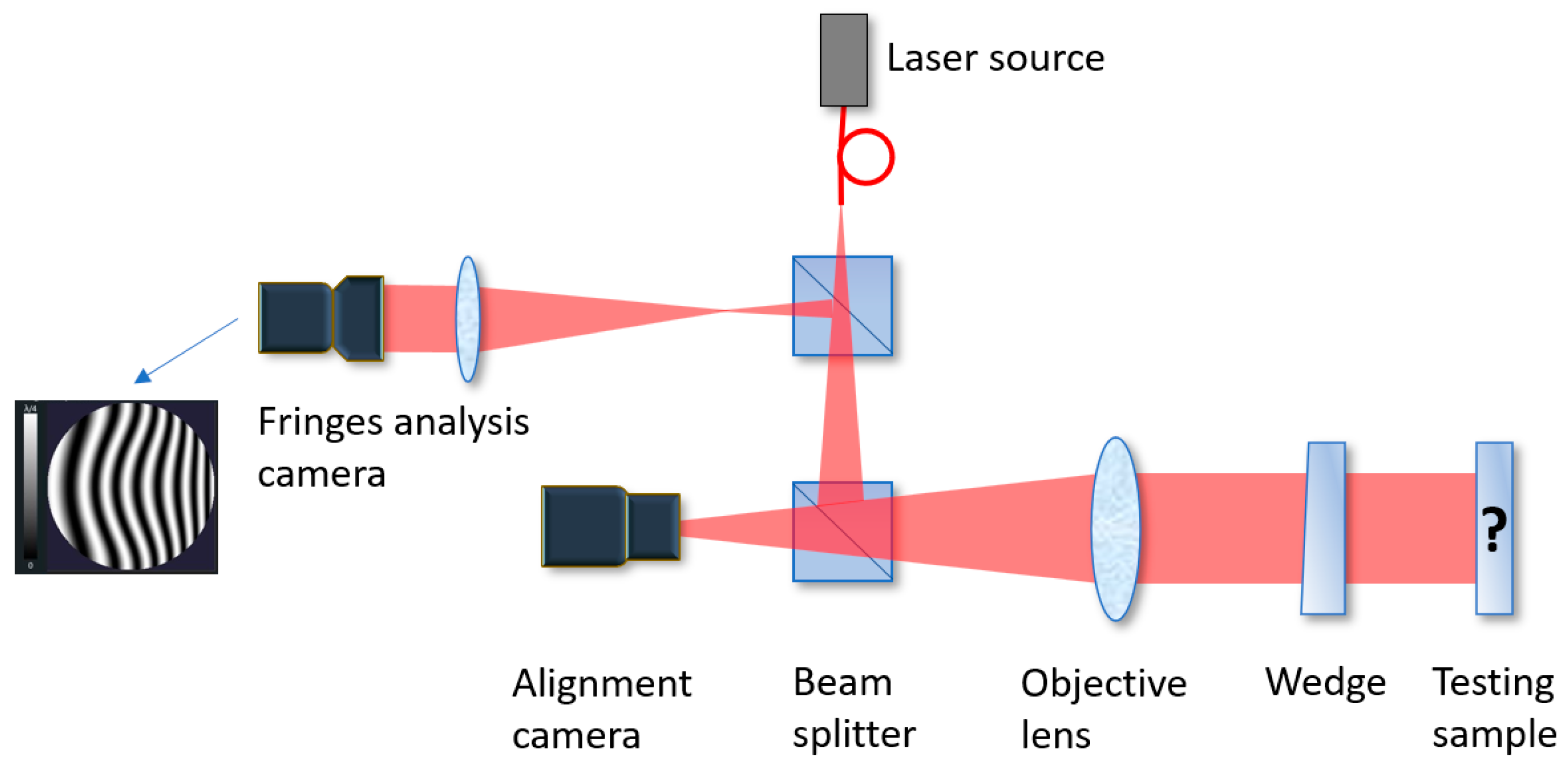
An optical scheme of a conventional Fizeau interferometer [35] is illustrated in Figure 2.
A fiber-coupled He-Ne laser emits radiation that first traverses a beam splitter before reflecting off a second beam splitter. The laser beam is directed toward an objective lens, passes through a reference surface configured as a wedge, reflects off a test surface (i.e., etalon or deformable mirror, either mechanical, MEMS, spatial light modulators, piezoelectric mirror [36,37,38,39,40], bimorph [41,42,43,44], or stacked-actuator mirror [45,46]), and subsequently returns to be captured by a camera designated for fringe analysis. To ensure that the beam size is compatible with the aperture of the camera sensor, a variable focal objective with adjustable magnification is utilized in conjunction with a CCD camera. Additionally, an auxiliary alignment camera can be employed to facilitate precise adjustments of the optical components. Such an interferometer with the proposed optical scheme might be constructed in the laboratory. The possible measurement accuracy is up to λ/10, corresponding to the amplitude of the wavefront. Furthermore, the device can enable real-time measurement of aberrations at a frequency of up to 30 Hz (depending on the camera used). The acquisition was performed using a camera operating at 50 frames per second (fps), corresponding to a 20 ms exposure cycle per frame, with an image resolution of 1920 × 1080 pixels. The computational pipeline, comprising tasks such as extremum detection and moving-average filtration, required approximately 10 ms to execute per frame. Consequently, the total cycle time for acquisition and processing was roughly 33 ms. This benchmark was obtained on a standard laptop equipped with an Intel Core i5-3xxx series CPU. It is important to note that the current software implementation has not undergone specific optimization for computational efficiency. Code optimization to further reduce processing latency is a planned objective for the second version of the software.
The optical surface under test was evaluated using both the Zygo interferometer and the conventional Fizeau interferometer. The measurement results, along with a detailed description of the developed algorithm, are presented in the subsequent sections.

2.2. Algorithm for Fringe Reconstruction

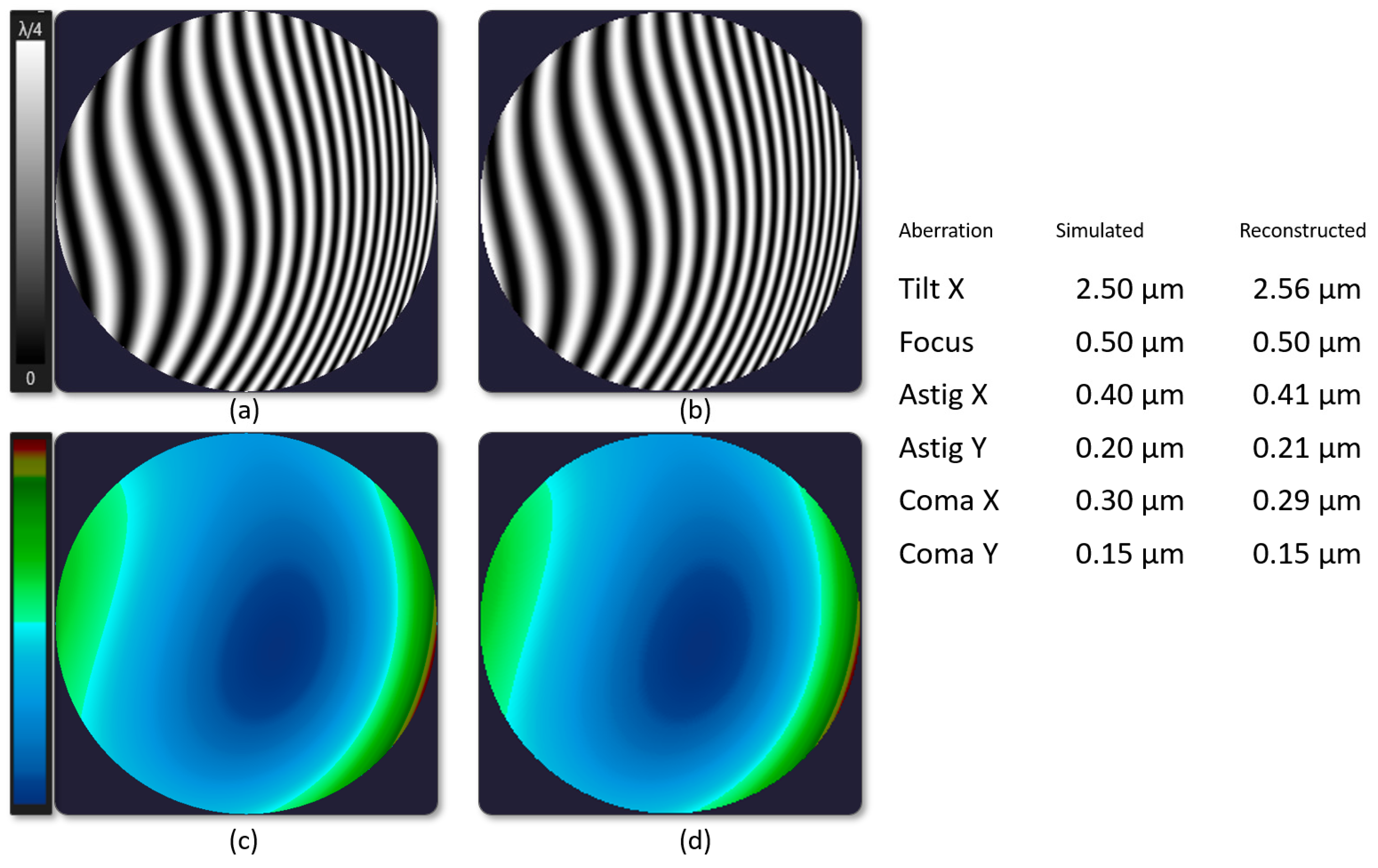
Prior to describing the algorithm itself, it is worth noting that the algorithm works with significantly tilted wavefronts. Nevertheless, it allows us to reconstruct the whole wavefront surface and then remove the tip-tilt and piston aberrations and finally achieve the reconstruction of the surface under test. This approach is different from the commonly used approaches, and in the next section, we analyze its results and compare them to the results from well-established techniques. As an example, Figure 3a presents the simulated fringe pattern that includes a set of aberrations, i.e., defocus, coma, and astigmatism. The following sub-figures demonstrate how the algorithm processes the fringe pattern, reconstructs it and the final result obtained with the tip-tilt and piston removed from the representation.
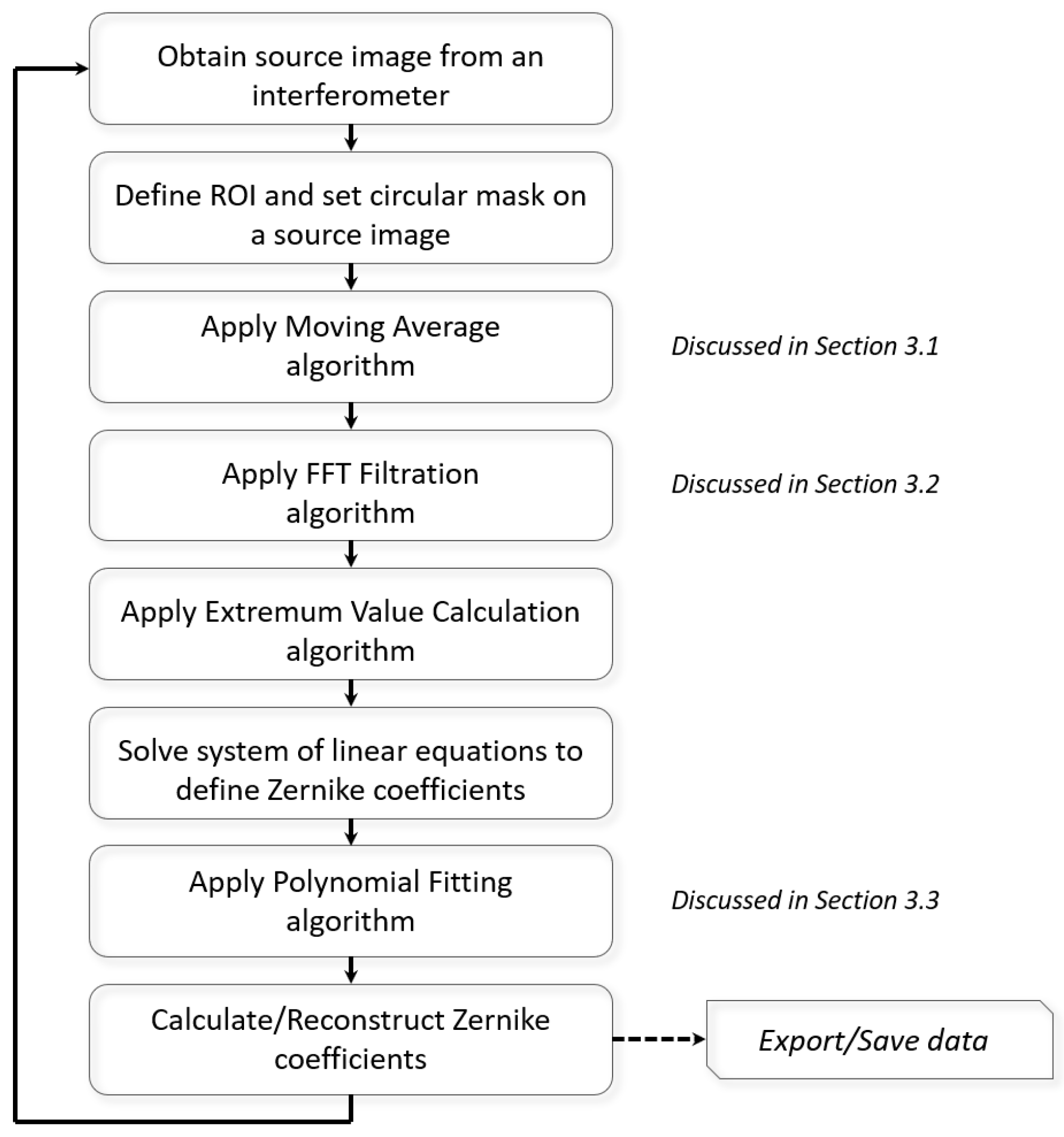
Accurate identification of extremum values presents a considerable challenge in the analysis of interference fringe images. To address this issue, we developed an algorithm that effectively eliminates false extremum values and enables precise determination of their positions. The flow chart of the developed algorithm is presented in Figure 4.
The primary steps of this algorithm are described in sections below.

2.2.1. Image Filtering Using the Moving Average Algorithm

Given that the source image obtained from the interferometer may contain noise, a filtering process is employed to smooth the intensity distribution. The Moving Average algorithm [47] is utilized as a filtering procedure, which first smooths the pixel brightness along the X-axis first and subsequently along the Y-axis. Equations (1) and (2) illustrate the recalculation of the brightness of a pixel at coordinates (x,y) based on the brightness levels of neighboring pixels:
I x , y = I x 2 , y + 3 · I x 1 , y + 4 · I x , y + 3 · I x + 1 , y + I ( x + 2 , y ) ,
I x , y = I x , y 2 + 3 · I x , y 1 + 4 · I x , y + 3 · I x , y + 1 + I ( x , y + 2 ) ,
where I x , y denotes the brightness level of the pixel at coordinates x , y .
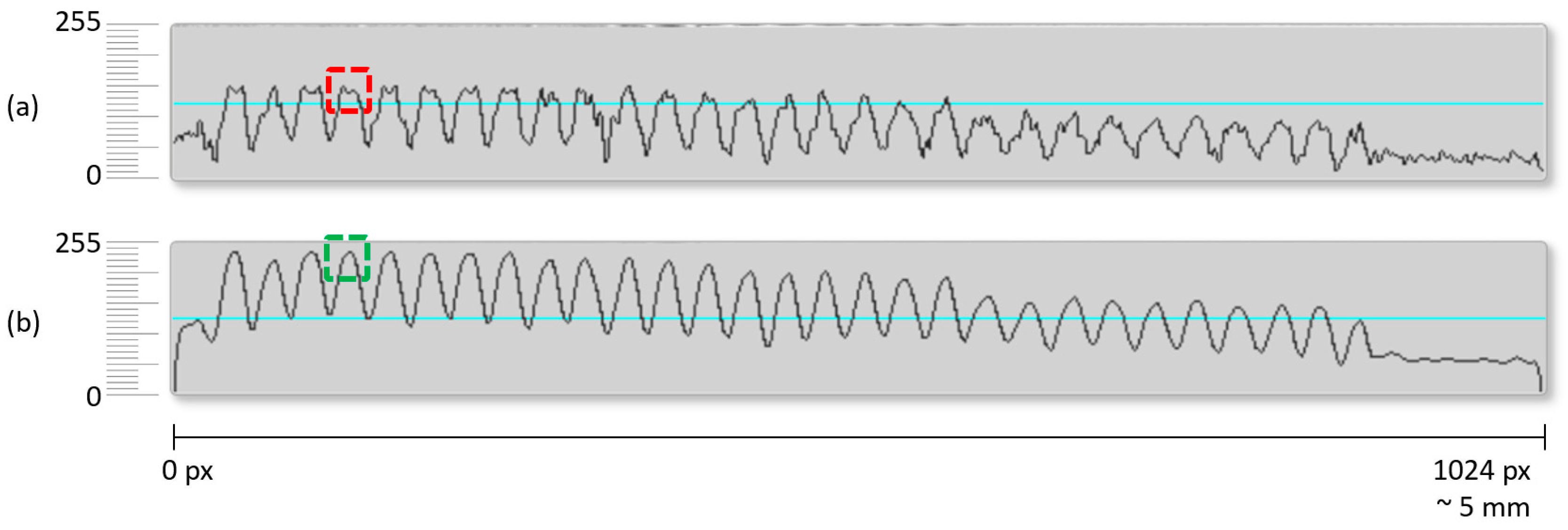
Since the extremum calculation algorithm analyzes pixels individually, it is crucial to utilize denoised values. Figure 5 illustrates the necessity of employing a filtering algorithm for accurate extremum calculation.
The Moving Average algorithm is applied to the source image of the interference fringes multiple times to achieve an optimal level of intensity smoothness. Further details regarding this process will be discussed in Section 3.1.

2.2.2. Image Filtering Using the Fast Fourier Transform Filtration Algorithm

While the Moving Average algorithm is effective for eliminating small-scale inhomogeneities, it is inadequate for addressing large-scale inhomogeneities that can lead to false-positive extremum values. To mitigate this limitation, the Fast Fourier Transform (FFT) filtration algorithm [48,49] has been implemented, with its primary steps outlined below.
1.
An array of brightness values from the region of interest is subjected to a forward Fast Fourier Transform (FFT). A matrix of complex numbers is constructed, wherein the real parts correspond to the brightness values, and the imaginary parts are initialized to zero.
2.
The forward Fast Fourier Transform is executed on this matrix.
3.
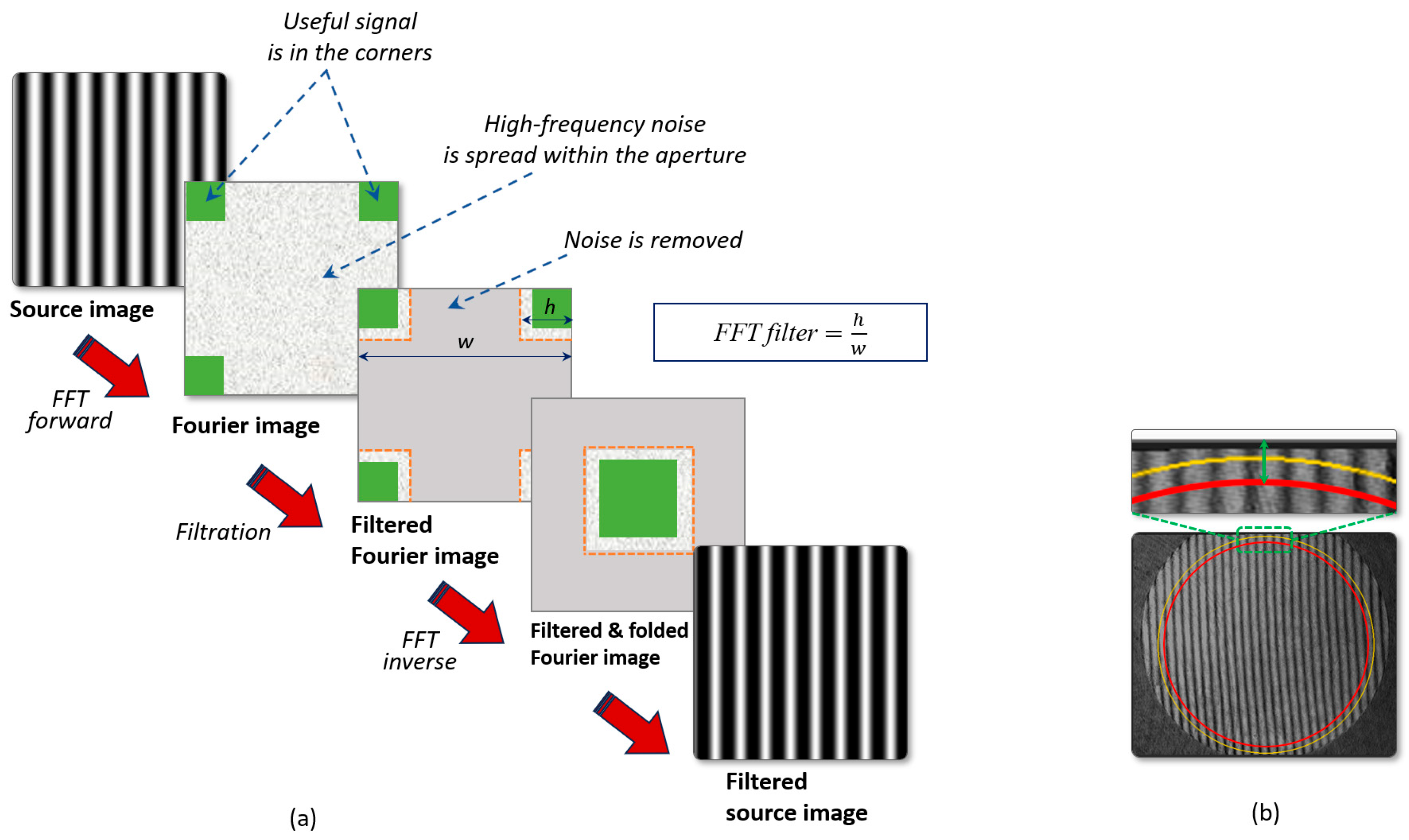
A filtration procedure is subsequently applied (as illustrated in Figure 6). It is well-established that the useful signal is retained in the corners of the resulting two-dimensional matrix following the forward FFT, while high-frequency components, which represent noise in this context, are dispersed throughout the remainder of the matrix. Consequently, the FFT filter parameter is defined, which establishes a relationship between the dimensions of the corner square (containing the useful signal) and the overall dimensions of the square matrix where the FFT is applied. All values outside the designated FFT filter regions are set to zero. This process effectively filters out high-frequency components corresponding to noise while preserving the useful signal.
4.
Following the filtration, an inverse Fast Fourier Transform is performed.
5.
The resultant filtered image of the fringe map is obtained and is available for further analysis.
Figure 6. (a) Graphical representation of the Fast Fourier Transform (FFT) filtration algorithm; (b) a schematic representation of a feature to prevent “ringing” artifacts due to abrupt FFT mask.
Asi 09 00031 g006
It should be noted that the mask for the FFT filtration algorithms is square and has abrupt edges which can lead to “ringing” artifacts, also known as the Gibbs phenomenon. As is known, these artifacts occur when a sharp discontinuity or abrupt edge in an image is transformed into the frequency domain using FFT. This results in artificial oscillations or “ringing” near the edges in the reconstructed spatial domain image. In order to overcome this issue, we set a gap of a few pixels between the edge of the processed image and the region of interest (yellow circular mask) where the calculations are performed. Figure 6b demonstrates this gap—a first part of the gap is between the edge of the image and the yellow mask, and a second part of the gap is between the yellow and red circular masks.
Our experimental investigations revealed that the effective gap size (in pixels) for stable phase reconstruction is independent of the overall dimensions of the interference image. Specifically, we empirically determined that a gap of 5 pixels was sufficient to yield consistent results across a wide range of image sizes—from 64 × 64 pixels up to 2048 × 2048 pixels. This finding was obtained using a camera with a pixel size of 5.5 µm, indicating that the optimal gap is defined in the pixel domain rather than by an absolute physical dimension.
This empirically derived value of 5 pixels is in close agreement with the theoretical work of Kemao [49], which recommends a window size of approximately 4 pixels for similar filtering operations. Consequently, the selection of this parameter can be guided by a straightforward empirical rule: a gap size of 4 to 5 pixels is generally effective for achieving stable performance across diverse experimental conditions.

2.2.3. Extremum Value Calculation Algorithm

Upon completion of the filtration process, the algorithm for calculating extremum values is initiated. The intensity distribution, represented as a two-dimensional matrix of pixel brightness (with 256 shades of gray), is analyzed row by row. The extremum values are identified and marked within each row, with each extremum corresponding to the maximum intensity of the fringe for that specific row of pixels. Given that the interference fringe image is 8-bit, the maximum achievable brightness value is 255 in shades of gray. The initial idea of the extremum calculation algorithm was proposed and briefly described in [50]. However, it lacked stability, robustness, computational efficiency, and it was not optimized for noisy conditions.
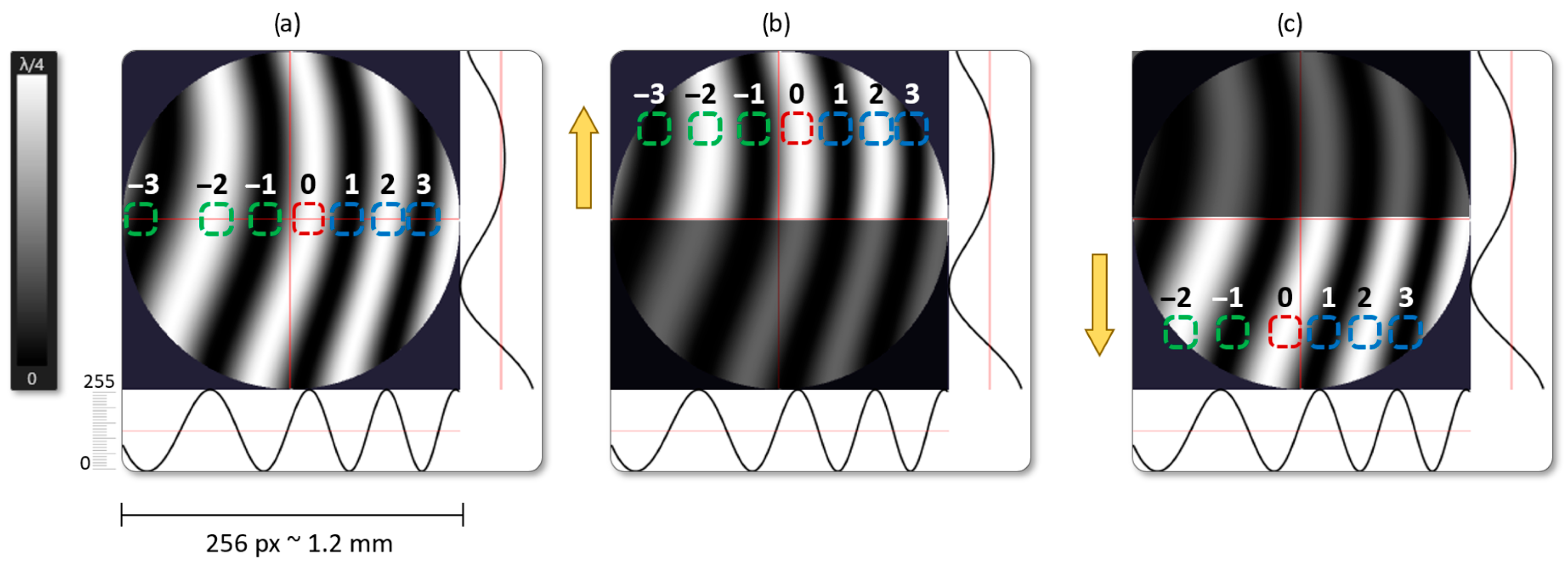
Initially, the row containing the greatest number of extremum values is selected. Typically, this corresponds to the central line of the image. Pixels within this row are examined sequentially to the right and left of the center, and a unique phase value is assigned to each identified extremum. For instance, the phase value of the central extremum is designated as 0, the first extremum to the right is assigned a phase value of 1, and so forth, while the first extremum to the left is assigned a phase value of −1, and so on (Figure 7a).
Subsequently, the same procedure is applied to the upper (Figure 7b) and lower (Figure 7c) halves of the image. The algorithm then continues to search for extremum values along the remaining rows of the image, utilizing the unique phase values derived from the central line. This process yields a matrix of phase values W ( x , y ) , where each unique coordinate x , y corresponds to a specific fringe.

2.2.4. Calculation of the Phase Values Matrix

To represent the phase map in an analytical form [51,52], Zernike polynomials were employed [53,54,55,56]. A matrix of Zernike polynomial values was constructed by evaluating these polynomials at the coordinates of the phase values identified previously. Zernike polynomials can be expressed in polar coordinates, as illustrated in Equation (3):
Z n l ρ , ϑ = R n l ρ · cos l · ϑ f o r l 0 R n l ρ · sin l · ϑ f o r l > 0 R n l ρ =   R n n 2 m ρ   = s = 0 m ( 1 ) s · n s ! s ! · m s ! · n m s ! · ρ n 2 s ,
where R n l denotes the radial polynomials; n, l are non-negative integers with the condition that n > l ; ϑ represents the azimuthal angle; and ρ indicates the radial distance, where 0 ρ 1 .
For convenience, a single-index notation is commonly adopted:
Z j ρ , ϑ = Z n l ρ , ϑ ,
where j = n n + 2 / 2 + l / 2 . Consequently, the matrix of Zernike values Z will be populated as follows:
Z i = Z 1 ( x 1 , y 1 ) Z 2 ( x 1 , y 1 ) Z 1 ( x 2 , y 1 ) Z 2 ( x 2 , y 1 ) Z N ( x 1 , y 1 ) Z N ( x 2 , y 1 ) Z 1 ( x k , y k ) Z 2 ( x k , y k ) Z N ( x k , y k ) ,
where N is the number of Zernike polynomials utilized, k is the number of determined extremum values at the coordinates ( x i , y i ) .

2.2.5. Solution of the System of Linear Equations

Upon obtaining a matrix of calculated phase values and a vector of measured phase values, a system of linear algebraic equations can be formulated as follows:
Z 1 ( x 1 , y 1 ) Z 2 ( x 1 , y 1 ) Z 1 ( x 2 , y 2 ) Z 2 ( x 2 , y 2 ) Z N ( x 1 , y 1 ) Z N ( x 2 , y 2 ) Z 1 ( x N , y N ) Z 2 ( x N , y N ) Z M ( x N , y N ) a 1 a 2 a M = W ( x 1 , y 1 ) W ( x 2 , y 2 ) W ( x N , y N ) ,
In this equation, W ( x , y ) represents the matrix of phase values derived from the analysis of interference fringes, as detailed in Section 2.2.3. The term Z i x , y denotes the matrix of calculated Zernike polynomial values, while a i refers to the vector of Zernike coefficients, and N indicates the total number of Zernike polynomials utilized.
The set of Zernike coefficients is determined by solving this system of linear equations [57]. Subsequently, the wavefront of the measured optical surface can be analytically described and reconstructed.

2.2.6. Polynomial Fitting Algorithm

To enhance the smoothness of the reconstructed interference fringe curves, a fourth-order Polynomial Fitting algorithm, which has demonstrated efficacy in addressing this challenge [58,59,60,61,62,63,64,65,66,67,68,69]. The algorithm utilized the x , y coordinates of each phase value from the matrix W ( x , y ) and approximated these values using second-, third- and fourth-order polynomials. By formulating a least squares problem, the approximation coefficients C0C4 were derived. The new Y coordinate φ y _ n e w for each point along the identified interference fringe curve was recalculated based on the original Y values φ y o l d using the established Equations (7)–(9):
φ y _ n e w = C 0 + C 1 · φ y o l d + ( C 2 · φ y o l d ) 2
φ y _ n e w = C 0 + C 1 · φ y o l d + C 2 · φ y o l d 2 + ( C 3 · φ y o l d ) 3
φ y _ n e w = C 0 + C 1 · φ y o l d + C 2 · φ y o l d 2 + ( C 3 · φ y o l d ) 3 + ( C 4 · φ y o l d ) 4
As stated above, the calculation of the unknown coefficients is performed by solving the system of linear equations:
A · x = b , x = A 1 · b
where A is the matrix comprising the phase values obtained from direct measurements, and b is the coordinates vector, and x is the vector of unknown coefficients.
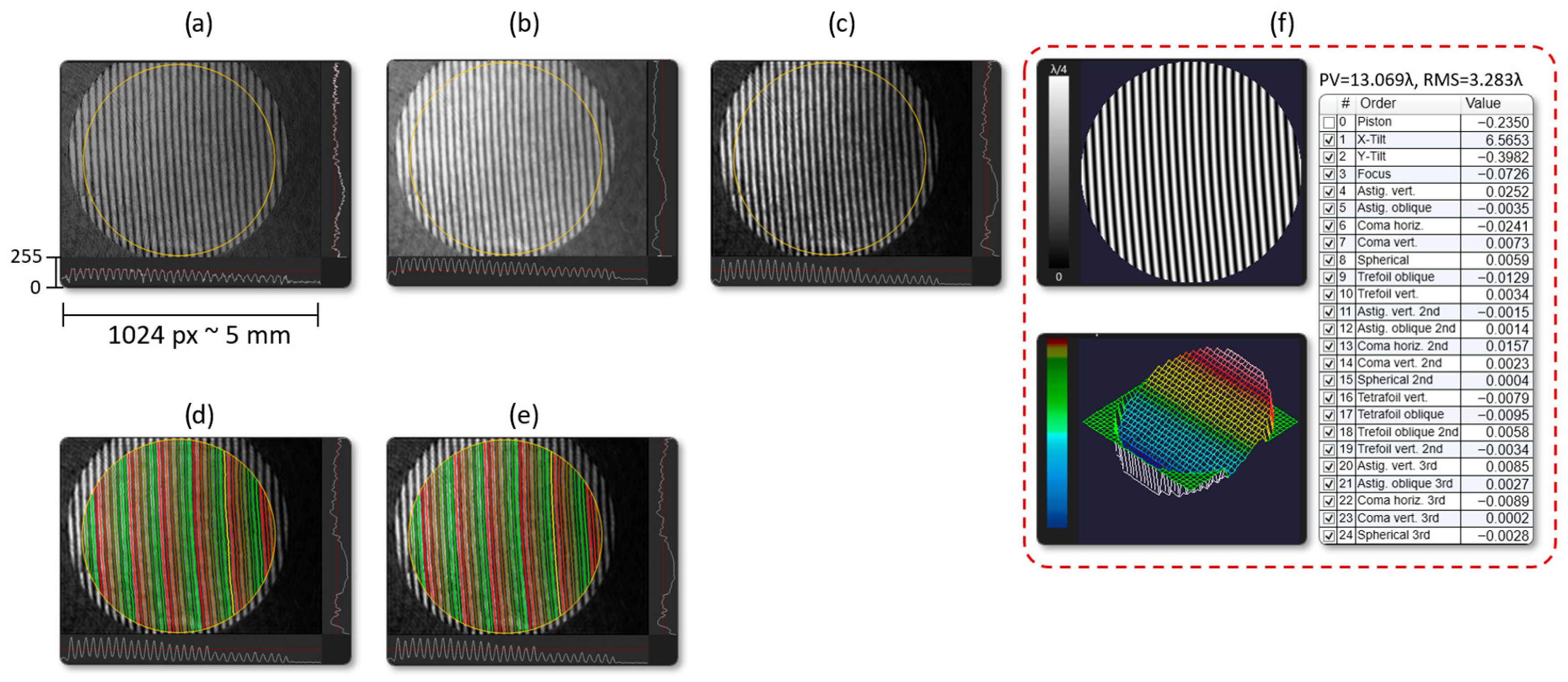
Each step of the reconstruction algorithm, along with its corresponding graphical representation, is illustrated in Figure 8.
Following the implementation of the algorithm, a verification procedure was conducted.

2.3. Algorithm Verification

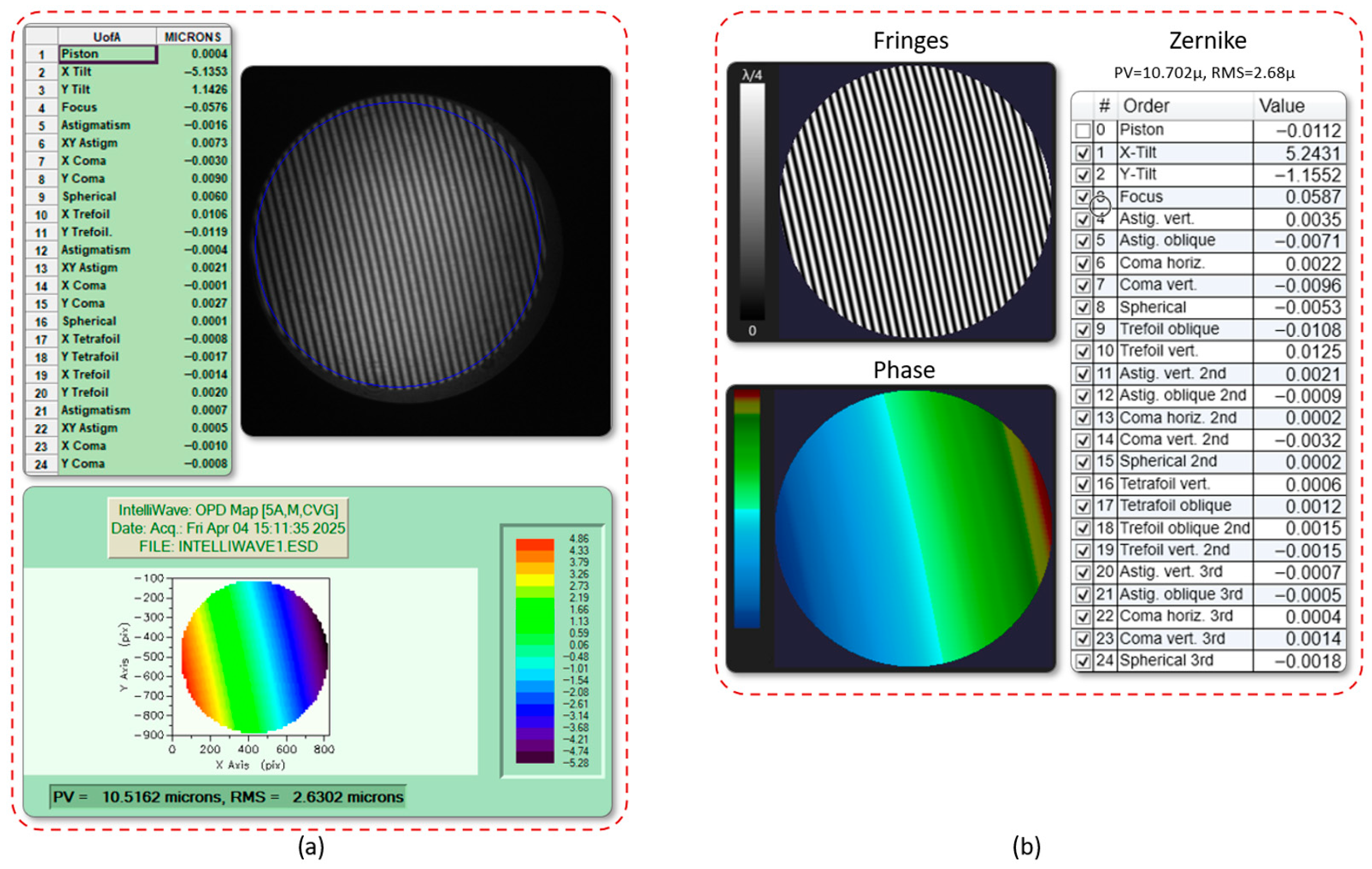
To validate the algorithm for reconstructing interference fringes, an optical surface was measured using both the Zygo interferometer, employing a phase-shifting technique, and a conventional Fizeau interferometer, utilizing the developed algorithm. The results obtained from both instruments are presented in Figure 9.
It is noteworthy that the difference in PV between the two measurements reaches 0.2 μm across the entire aperture, including contributions from Tip and Tilt aberrations. The associated error is less than 2%. We performed a series of comparative measurements, analyzing approximately 30 to 40 distinct optical surfaces. Raw interferometric data for each surface was acquired and exported in BMP format. These fringe patterns were subsequently processed using our custom software implementing the developed algorithm.
For consistency in the comparative analysis, the sampling regions analyzed in software were precisely matched to those defined during the initial physical measurements conducted with the Zygo interferometer. All measurements were performed in a temperature-controlled environment, with ambient variations limited to a range of approximately 2–3 °C.
The total measurement error of our method, quantified relative to the Zygo reference, was observed to vary between 1.4% and 2.0%. For conciseness in the manuscript, we reported the supremum (maximum) value of this range.
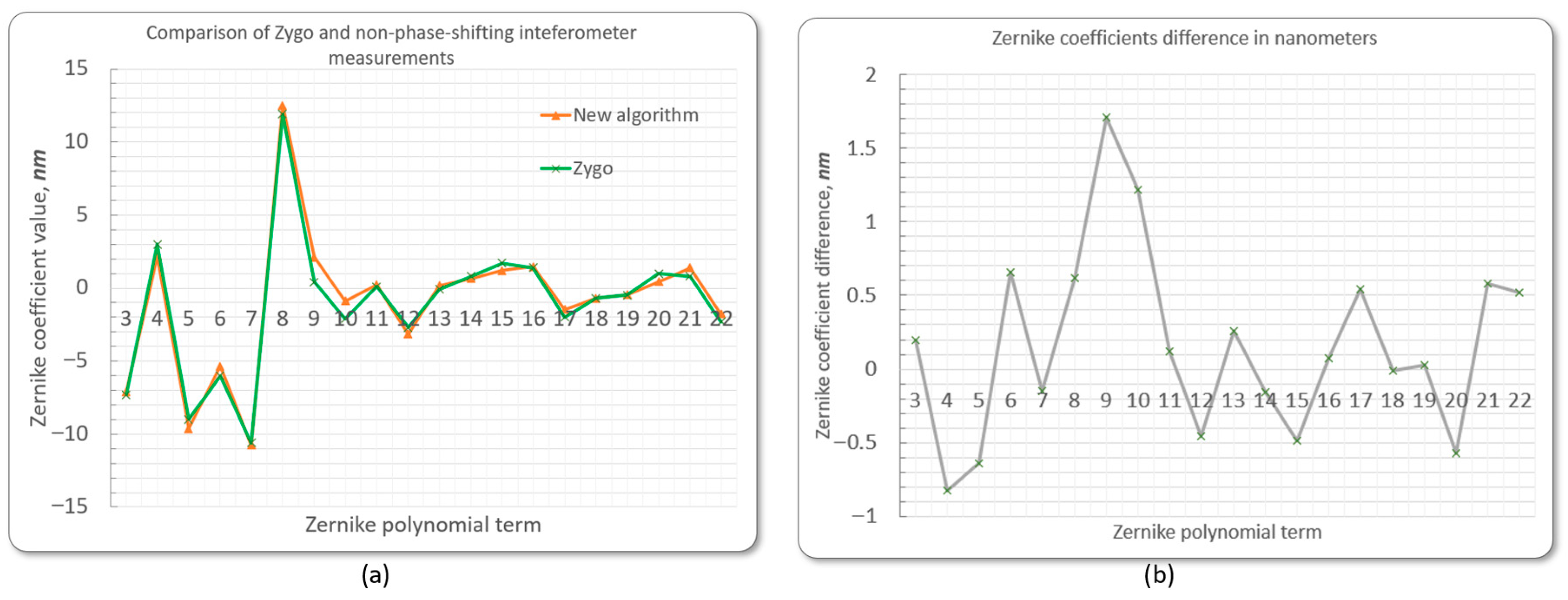
A comprehensive analysis of the Zernike decomposition for both the Zygo and Fizeau interferometers is illustrated in Figure 10.
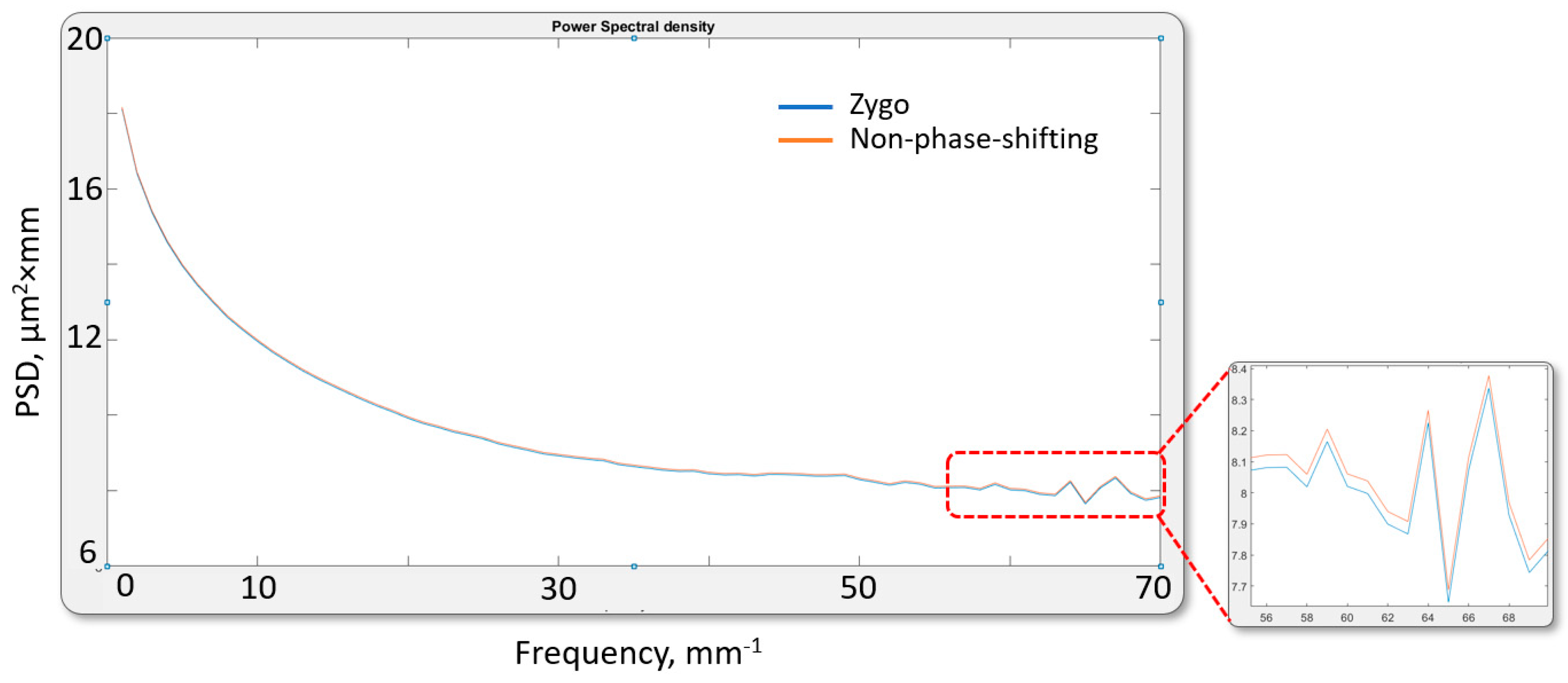
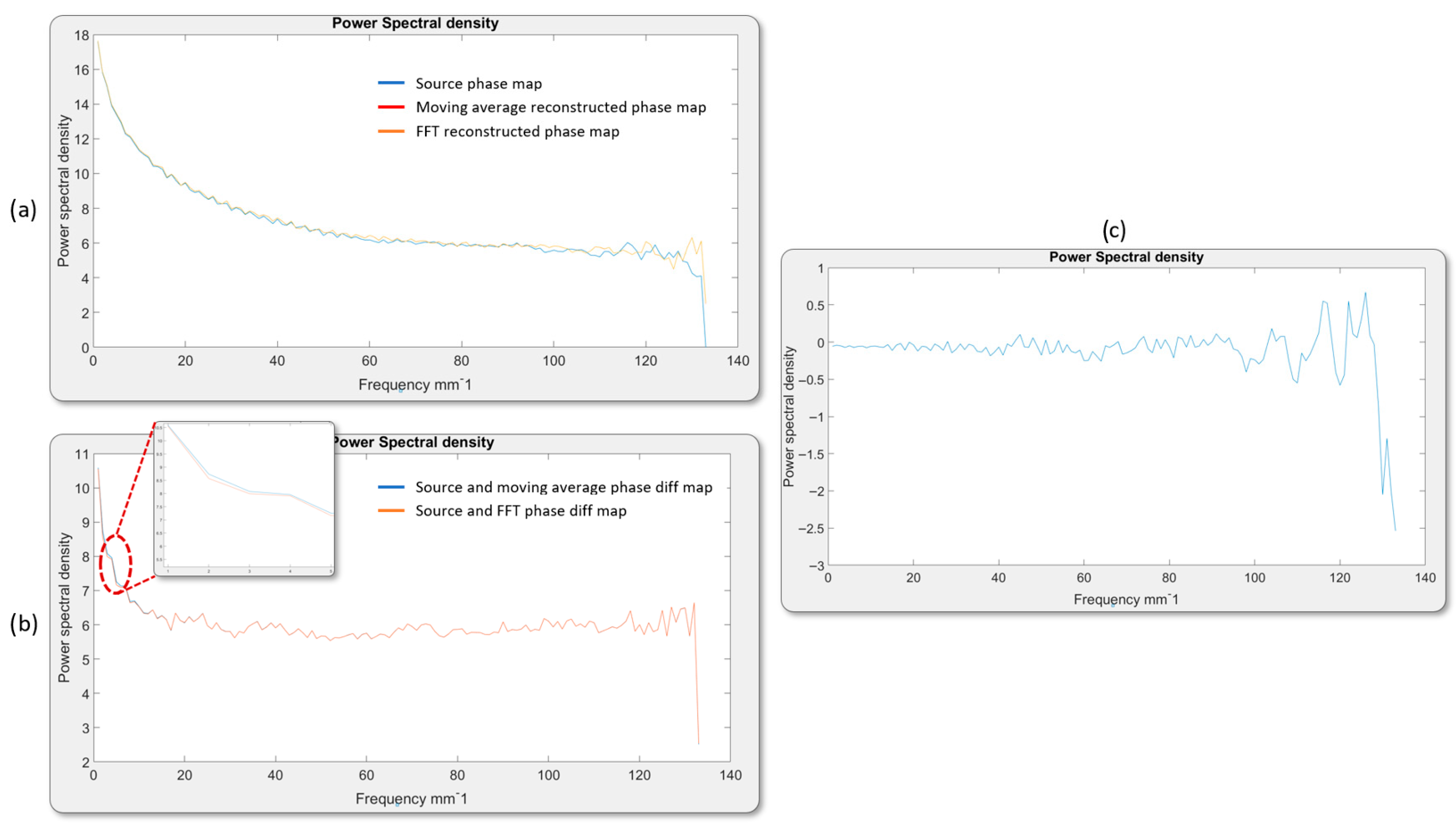
Figure 11 presents the power spectral density (PSD) charts [70,71,72,73,74] of the phase surfaces for both the Zygo and Fizeau interferometer measurements of the same optical surface. It is evident that there is minimal difference under ideal measurement conditions (absence of noise, vibrations, etc.).
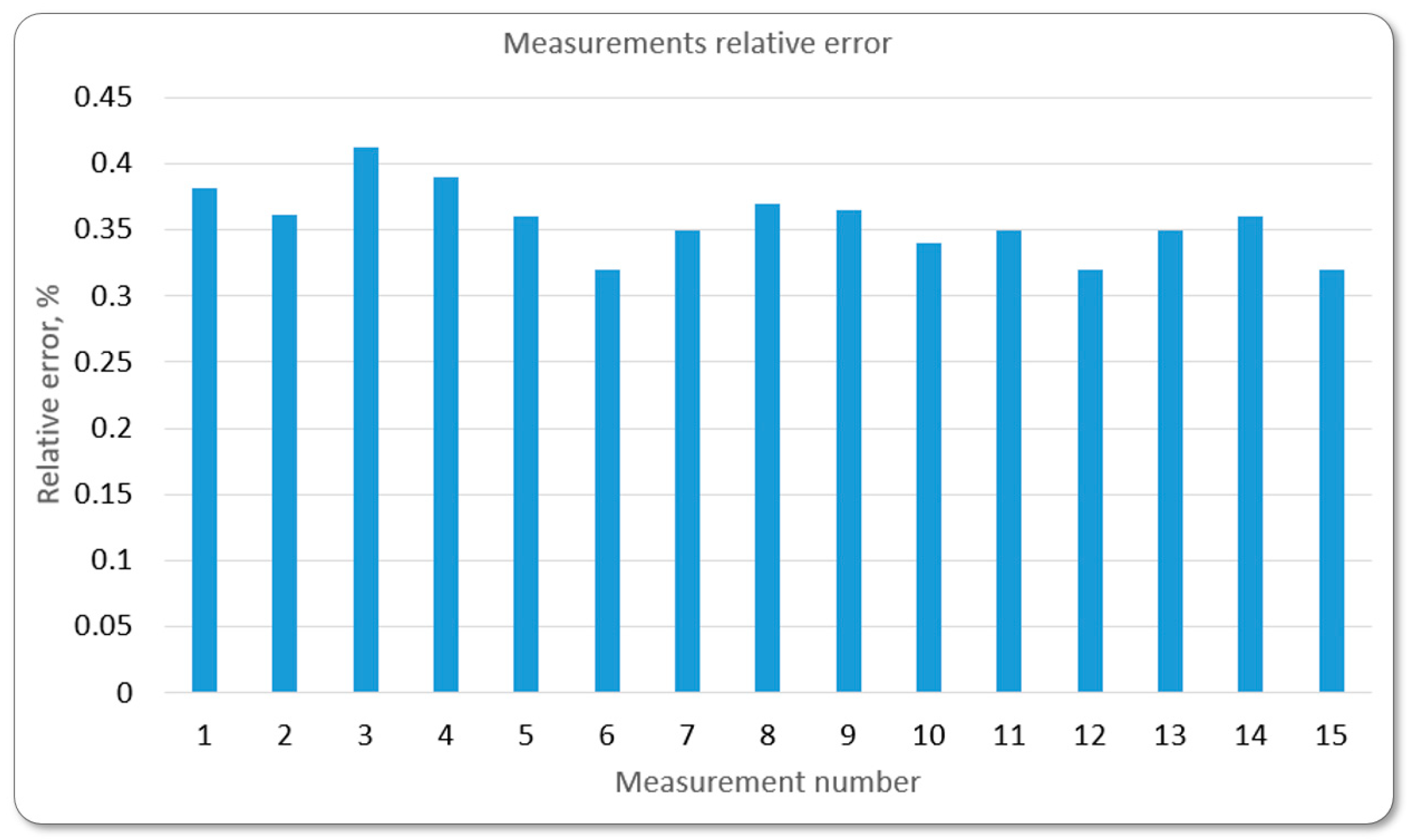
We also performed the measurement repeatability analysis of the developed algorithm. The relative error of the repeated measurements under realistic conditions was equal to 0.36%. The measurement results are provided in Figure 12.
Despite the effectiveness of the interference fringe reconstruction algorithm, certain limitations exist. The orientation of the fringes should ideally be vertical, with a permissible deviation of up to ±45° from the vertical axis. Additionally, the number of fringes should range from 3 to 50 (for image resolution of 256 pixels–the algorithm requires at least 5 pixels per one fringe in order to correctly identify it), the optical surface under examination must be clean (ideally free from dust and significant scratches), and the noise level should be kept low. The first two limitations are relatively minor and can be easily addressed, whereas the latter two may hinder the accurate recognition and analytical approximation of the fringe pattern. In the subsequent section, we will discuss common challenges encountered in the reconstruction of noisy fringe patterns and provide a thorough analysis of the developed algorithm.
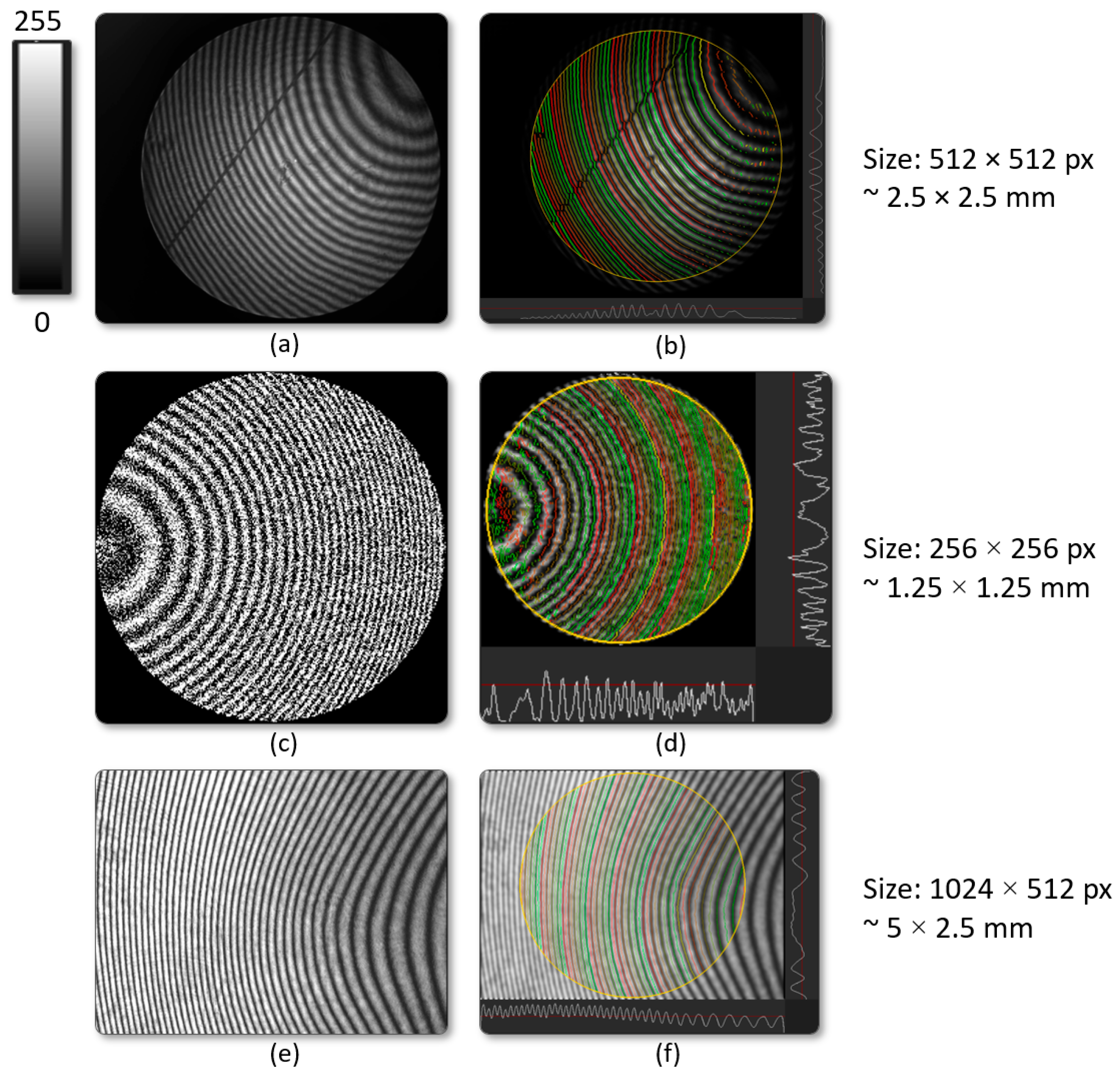
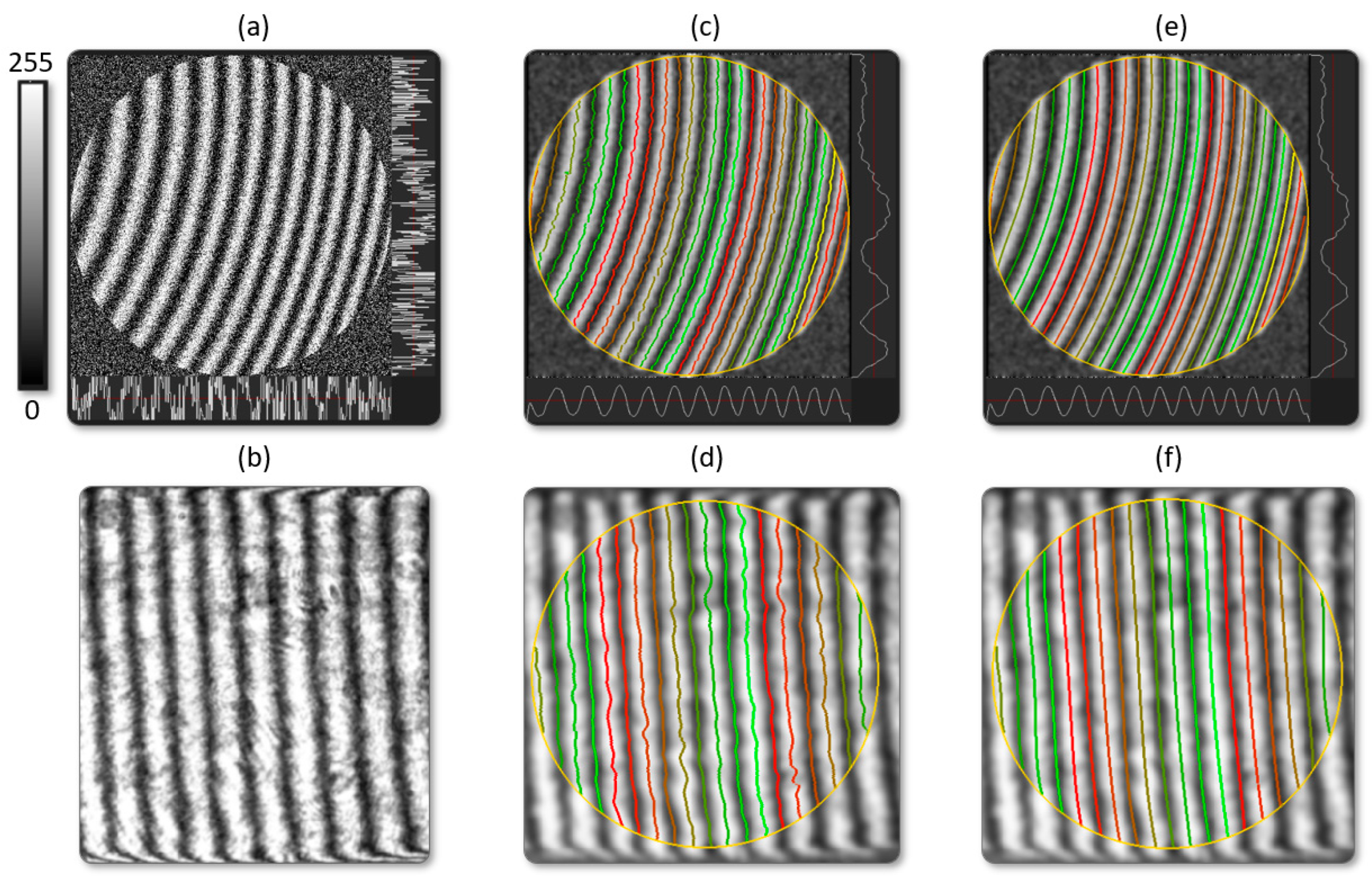
Despite the aforementioned limitations, the algorithm allows to resolve more complex patterns than shown below in the manuscript. Below (Figure 13) are a few examples of experimentally obtained interference images and results of how the algorithm resolves it. It can be seen that despite the artifact (black slant line) on the first image, the algorithm successfully reconstructs the fringes. The noisy and bended fringes can also be resolved, as shown in second and third lines of the figure.
The first two limitations mentioned above are relatively minor and can be addressed, whereas the latter two may hinder the accurate recognition and analytical approximation of the fringe pattern.
The first limitation, which pertains to the vertical orientation of the fringe patterns, can be addressed by controlling the overall tilt of the fringe configuration. If the tilt exceeds a predetermined threshold, the calculation of extremum values should be conducted with reference to the X-axis rather than the Y-axis of the image. An alternative approach involves rotating the source image to maintain the vertical orientation of the fringes.
The second limitation relates to the maximum number of fringes that can be resolved, a constraint primarily attributed to the pixel resolution of the employed CCD sensor. Enhancing the resolution or reducing the pixel size can mitigate this issue, as the core algorithm for extremum determination requires each fringe to span several pixels in width for accurate recognition.
Regarding the cleanliness of the optical surface under examination, this limitation can be effectively addressed through the implementation of the proposed FFT Filtration algorithm, as demonstrated in the subsequent sections. The FFT Filtration procedure successfully eliminates false interference patterns generated by dust particles on the optical surface.
Finally, the issue of noise levels presents another significant limitation. In this context, a combined application of both the Moving Average and FFT Filtration algorithms can effectively mitigate the noise problem, as will be illustrated in the following sections.
In the subsequent section, we will discuss common challenges encountered in the reconstruction of noisy fringe patterns and provide a thorough analysis of the developed algorithm.

3. Results and Discussion

3.1. Analysis of the Moving Average Algorithm

Initially, the impact of the Moving Average algorithm (Equations (1) and (2)) on the accuracy of interference fringe reconstruction was investigated. The base theory behind the ability of the moving average and fast Fourier transform algorithms to decrease the noise levels using amplitude/frequency cut-off, coefficient scaling, etc., might be found at [75,76,77,78].
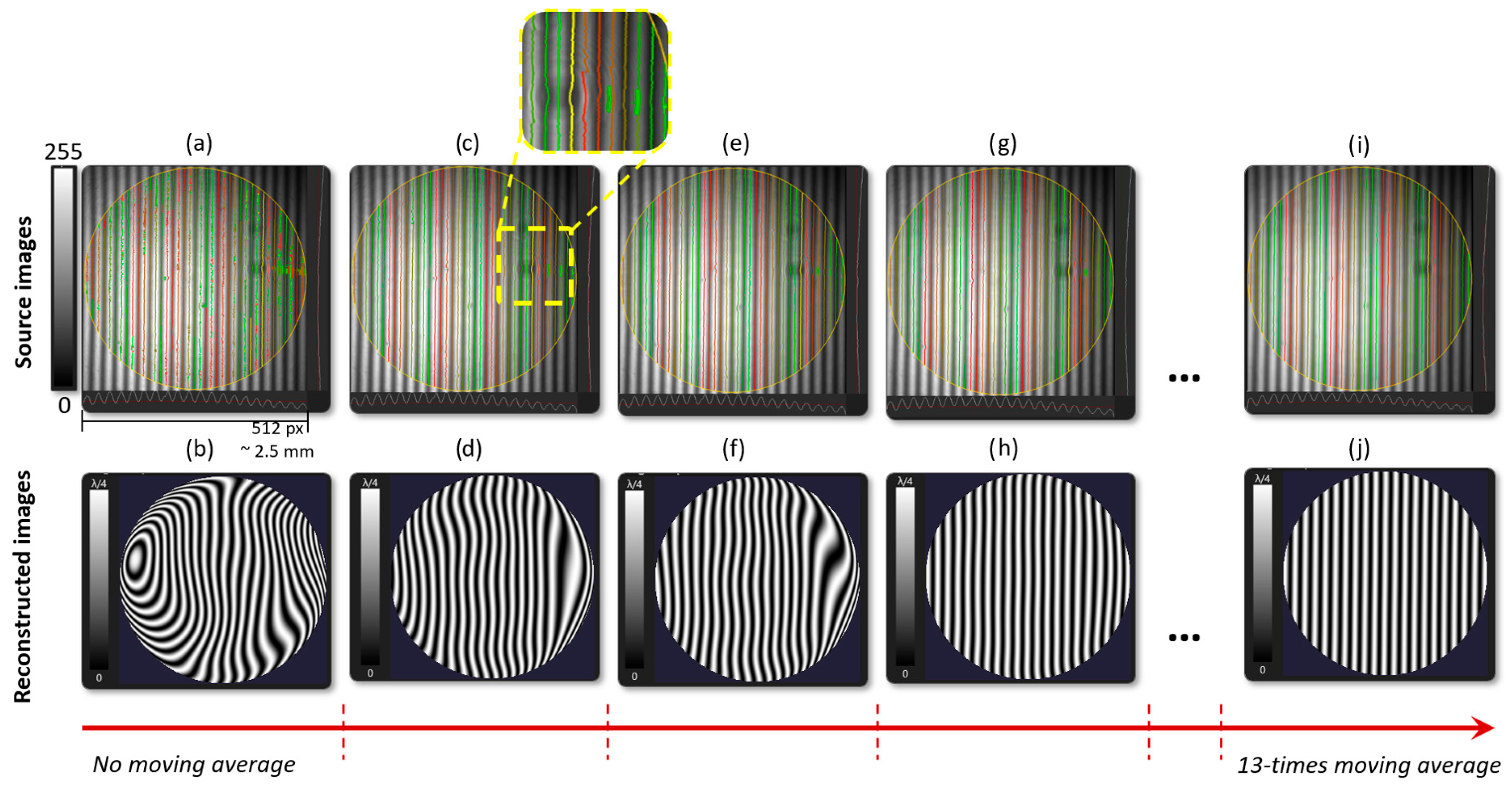
An experimental image of interference fringes was acquired, and a circular mask was defined to delineate the area of interest for subsequent calculations. Phase extremum values were computed, followed by the reconstruction of the fringe map. The Moving Average algorithm was then applied once to smooth the intensity distribution of the original fringe map, and the phase extremum values were recalculated. This smoothing procedure was repeated for a total of 13 iterations, with the Moving Average algorithm being applied to the previously smoothed image at each step. The results of fringe reconstruction at various levels of smoothness are illustrated in Figure 14.
It is evident that without the smoothing of the intensity distribution using the Moving Average algorithm, erroneous reconstruction results are produced (Figure 15a). This outcome is attributed to the specific nature of the fringe reconstruction algorithm, which determines the extremum phase values for each pixel. Ideally, each fringe should be represented by a single-color curve, indicating that the phase values have been accurately defined. Figure 14a,c,e,g exhibit incorrectly defined fringes, as indicated by the presence of multiple colors per fringe, a phenomenon clearly illustrated in the inset of Figure 14c.
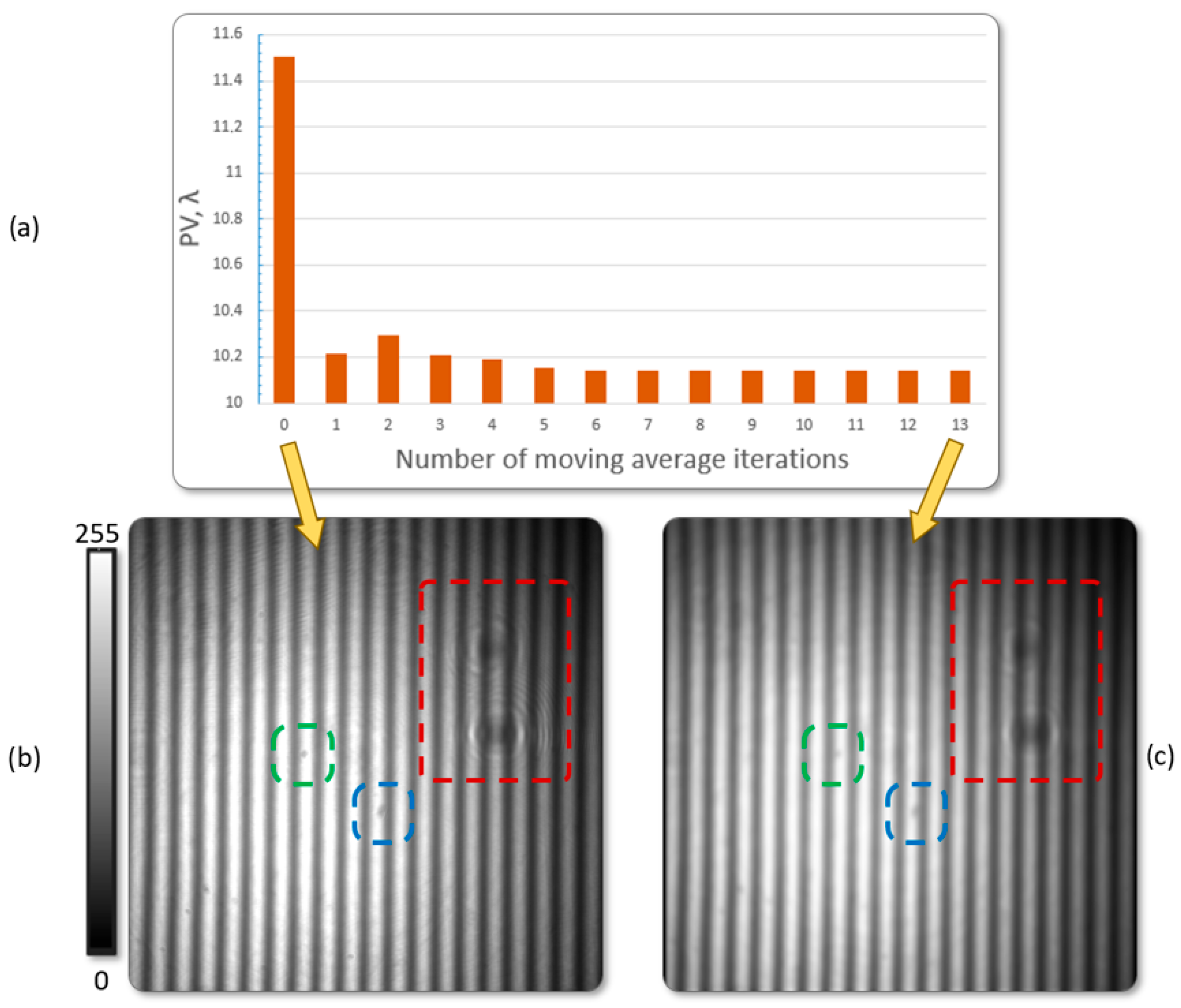
The application of the Moving Average algorithm at least once substantially enhances the final results, as demonstrated in Figure 14c,d when compared to Figure 14a,b. However, the reconstructed fringe image does not yet match the original fringe image. To ascertain the optimal number of iterations for the Moving Average algorithm, an analysis of the peak-to-valley (PV) values for varying numbers of iterations was conducted, as shown in Figure 15.
Figure 15a illustrates that a minimum of six iterations of the Moving Average algorithm is necessary to achieve the desired accuracy in fringe reconstruction. Figure 15c indicates that inhomogeneities become less pronounced and are smoothed, facilitating a more precise determination of phase extremum values along the corresponding fringe.
Though, the Moving Average algorithm demonstrates rather high efficiency in smoothing an image, caution is needed when applying it since this algorithm has one significant drawback—it may overlook important high-frequency components when set a high smoothing filter value.
Additionally, an analysis of the algorithm’s efficiency under varying conditions was performed. It was found that the minimal number of Moving Average iterations required is four for slightly blurred fringe images and six to seven for moderately blurred or noisy images.

3.2. Analysis of the Fast Fourier Transform Filtration Algorithm

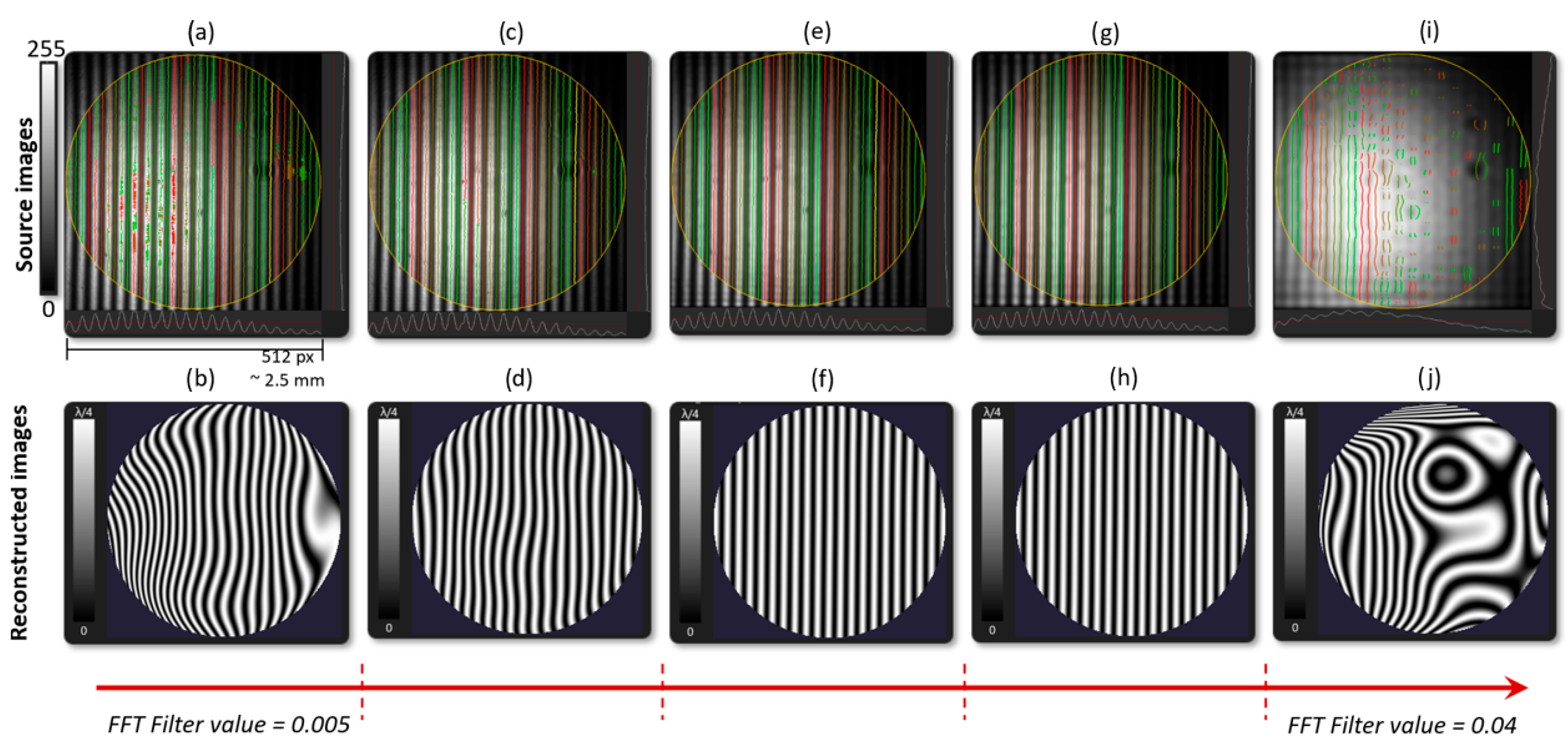
As outlined in Section 2.2.2, the Fast Fourier Transform (FFT) filtration algorithm defines a filter parameter that corresponds to the ratio between the width of the central square, which contains the useful signal, and the width of the entire square over which the FFT is applied. By adjusting this FFT filter parameter, the strength of the filtration process can be controlled. The results of the FFT filtration algorithm at various filter values are illustrated in Figure 16.
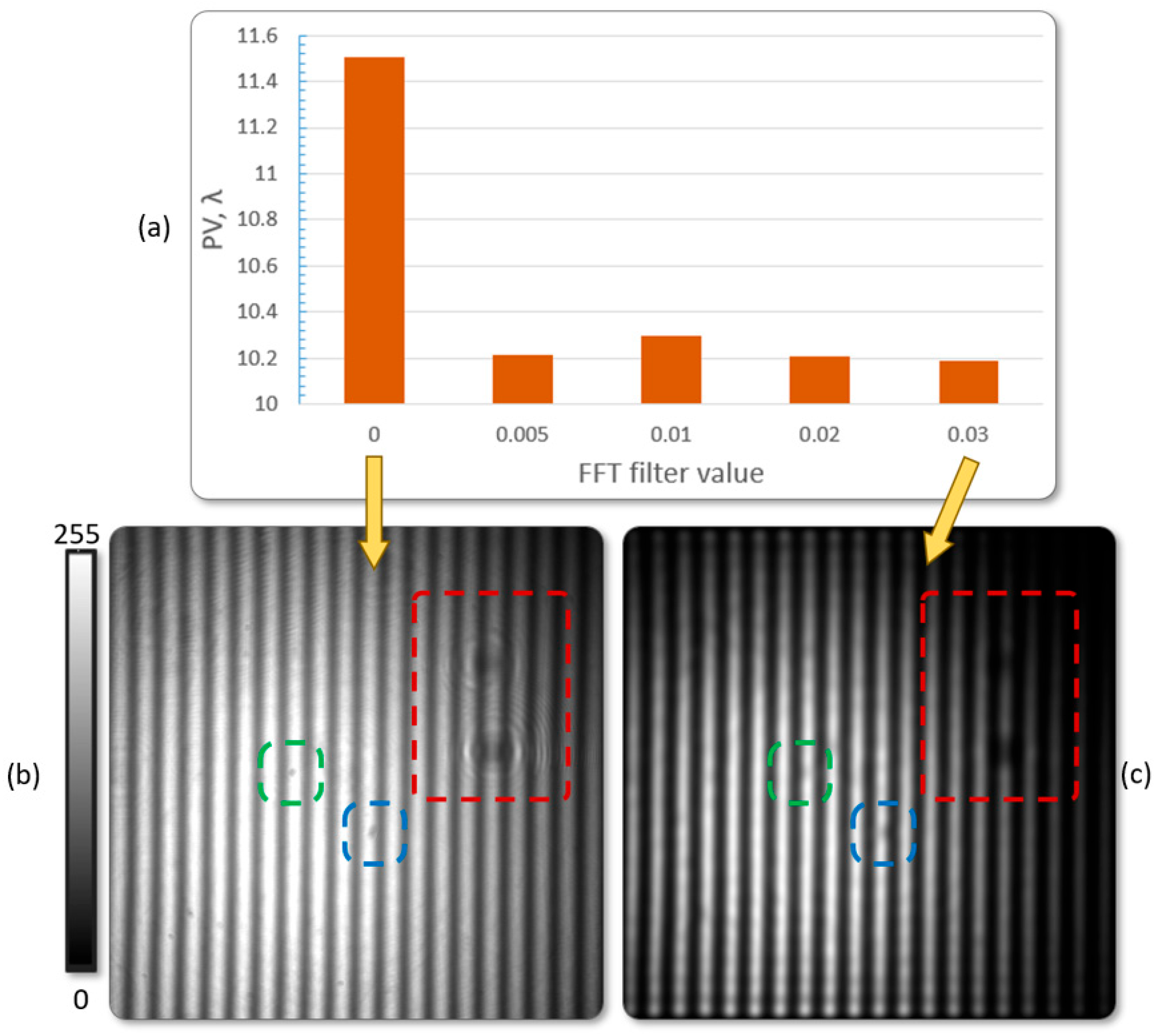
It is evident that the FFT filtration algorithm has a limitation: if the FFT filter value is excessively high, the useful signal may be lost, as demonstrated in Figure 16i,j, leading to erroneous results. This scenario illustrates a situation in which the algorithm inadvertently attempts to nullify the useful signal, as depicted in Figure 6. Consequently, the FFT filtration algorithm exhibits greater sensitivity compared to the Moving Average algorithm, although it converges more rapidly and efficiently. The relationship between the peak-to-valley (PV) values of the reconstructed wavefront and the FFT filter value is presented in Figure 17. Figure 17b,c indicates that the FFT filtration algorithm effectively mitigates the effects of dust inhomogeneities in comparison to the Moving Average algorithm. Nevertheless, it should be noted, that FFT is widely used in a vast variety of applications, including free space optics communications, beam shaping, etc.
A comparative analysis of the efficiency of the FFT filtration algorithm applied to fringe images exhibiting varying levels of noise and blur was conducted. The findings indicate that the optimal FFT filter value ranges from 0.01 to 0.02 for most scenarios, while it may be necessary to increase this value to 0.04 for images with significant noise.
Analysis of Figure 16a and Figure 17a reveals that the variation in results between the first and final iterations of the algorithm is not particularly pronounced, with differences not exceeding 3%. However, a closer examination of the bar diagrams indicates that the second iteration of both algorithms yields significantly improved results compared to the initial iteration. Consequently, it is essential to identify a stable and convergent solution that minimizes the occurrence of false-positive results. While employing multiple iterations of a Moving Average algorithm does reduce the calculation frequency, this approach inherently involves a trade-off between accuracy and the operational frequency of the application.
We conducted a quantitative comparison between the performance of the windowed Fourier transform method, as described by Kemao [49], and our developed algorithm. The reported mean phase error for Kemao’s method on the specified test fringe pattern was 0.067 radians. Under comparable conditions, our algorithm yielded results within a range of 0.062 to 0.075 radians. While the foundational theory of the windowed Fourier transform has been established for over two decades, our research emphasizes several practical enhancements within its implementation. The primary advancement lies in leveraging parallel computing architecture, which substantially reduces computation time. Although the FFT is inherently efficient, its execution time scales significantly with map size, posing a challenge for processing high-resolution images from modern cameras where the region of interest (ROI) is large. To address this, we have optimized the algorithm for parallel execution, improving its feasibility for contemporary applications. Furthermore, we have enhanced the tool’s usability by integrating an intuitive graphical interface that allows users to adjust key parameters in real-time and immediately visualize the results.
A direct, absolute comparison is somewhat limited because the original publication does not provide the precise phase map or Zernike expansion coefficients for its validation dataset. Consequently, our test dataset, while similar, may have minor inherent differences. Nevertheless, given the high degree of similarity between the methodological principles and the closely aligned error magnitudes, we conclude that both approaches achieve a similar level of phase reconstruction accuracy.

3.3. Analysis of Polynomial Fitting

Figure 18 illustrates the results obtained from a fourth-order Polynomial Fitting algorithm applied to two interference fringe images: one simulated with added noise and the other experimentally measured.
The results obtained from second, third, and fourth-order polynomial fitting were nearly identical, with the difference in peak-to-valley (PV) values ranging from 1 to 2 nm. Therefore, for the sake of clarity and simplicity, only the results of the fourth-order fitting are presented. The figure clearly demonstrates the efficacy of the Polynomial Fitting technique in accurately restoring the fringes, regardless of the noise level present.
From a computational efficiency standpoint, the second-order polynomial is indeed optimal. Our analysis shows it requires approximately 1.9 times less computation time than the fourth-order fit and 1.4 times less than the third-order fit. However, in absolute terms, the difference in processing time between these fits is negligible for practical application and does not confer a significant performance advantage.
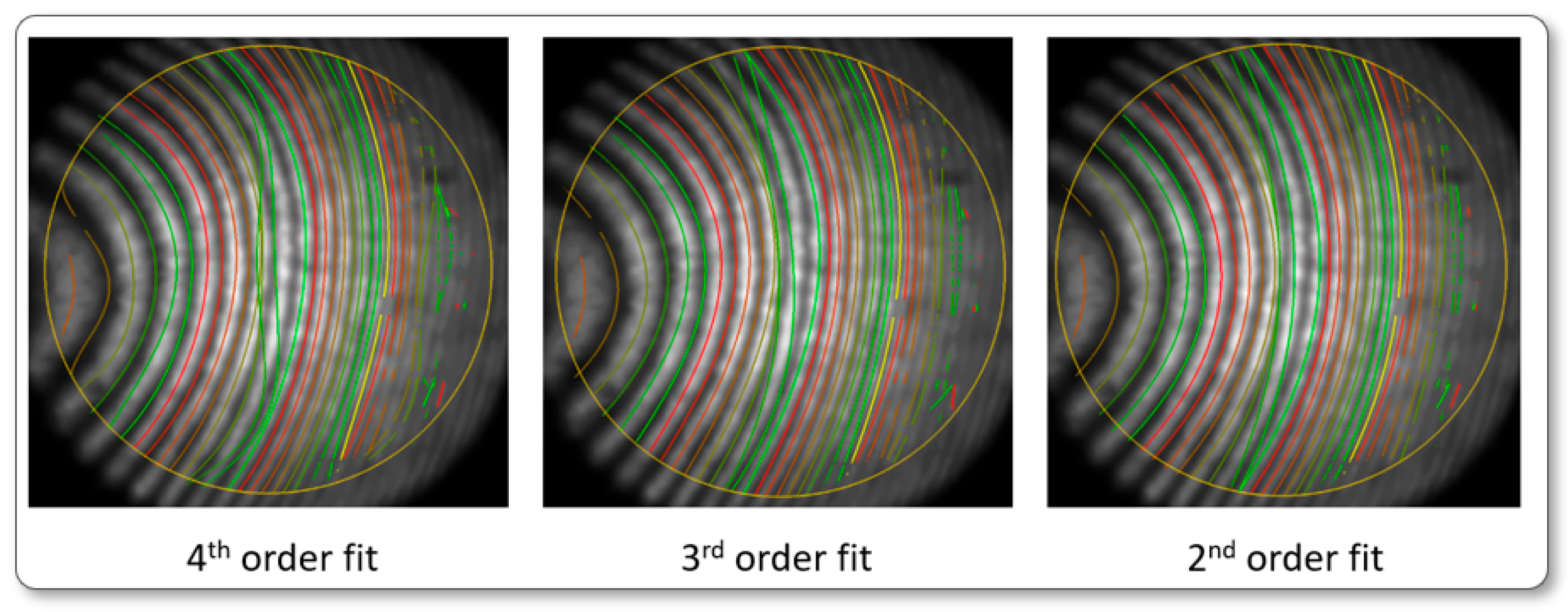
Regarding the risk of overfitting, we consider it minimal for the vast majority of optical surfaces intended for analysis with our software. The polynomial order is generally insufficient to capture high-frequency surface defects or noise in a way that would constitute meaningful overfitting of the underlying phase data. Nevertheless, we acknowledge that edge cases exist. For instance, when measuring a surface with a very large defocus component (introducing high fringe density), a fourth-order fit can indeed fail, as illustrated in Figure 19.
In this specific scenario, the higher-order terms incorrectly model the rapid phase change, leading to erroneous fringe interpolation—a clear instance of overfitting.

3.4. Error and Performance Analysis

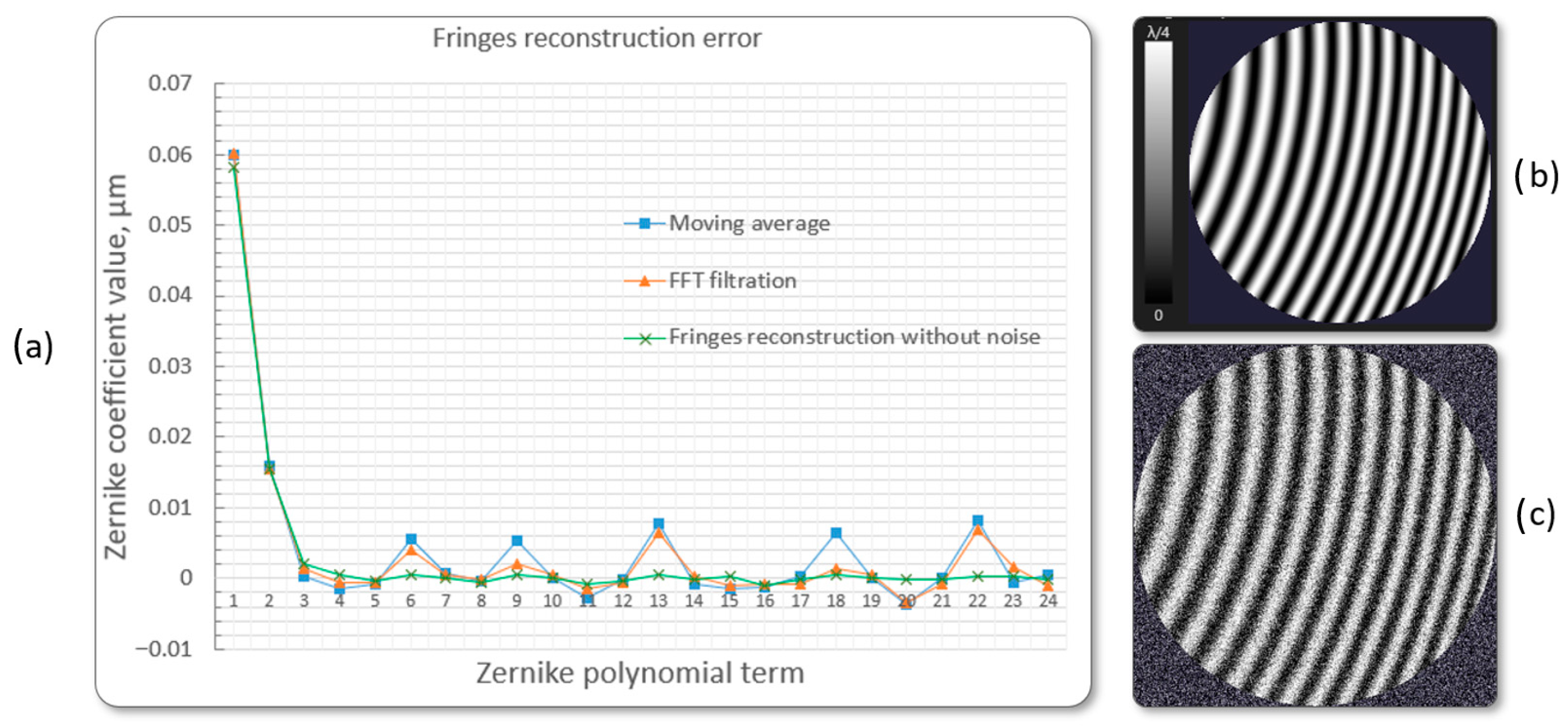
The accuracy of interference fringe reconstruction using both the Moving Average and Fast Fourier Transform (FFT) filtration algorithms was evaluated in the presence of significant noise. To facilitate this analysis, an ideal fringe pattern characterized by known Zernike coefficients—X Tip = 2 μm, Y Tilt = 0.5 μm, and Defocus = 0.15 μm—was generated. The total wavefront peak-to-valley (PV) value was determined to be 4.12 μm, while the root mean square (RMS) value was calculated as 1.031 μm. The generated fringe image was reconstructed with high precision using the developed algorithm. Subsequently, noise was introduced to the generated fringe image, and it was analyzed again. The Moving Average and FFT filtration algorithms were applied separately, and Zernike decomposition values were obtained for both methods. The differences between each Zernike term for the simulated fringe pattern and the reconstructed image were calculated and illustrated in Figure 20.
The chart in Figure 20a reveals that the largest deviations of the reconstructed fringe pattern from the original image occur for Zernike terms associated with coma aberrations (#6, #13, #22) and trefoil aberrations (#9, #18). Notably, these aberrations are absent in the simulated phase map. Interestingly, the FFT filtration algorithm fails specifically for the coma terms (#6, #13, #22), whereas the Moving Average algorithm exhibits failures for both the coma and trefoil terms.
Figure 21a presents the power spectral density (PSD) plots of three phase maps: the initial simulated phase map with predefined Zernike coefficients (as described above), one reconstructed using the Moving Average algorithm, and the other reconstructed using the FFT filtration algorithm.
Figure 21 clearly demonstrates a high degree of agreement in reconstruction results across nearly all spatial frequencies, particularly in the low to mid-frequency ranges. A noticeable discrepancy arises only at high spatial frequencies, which can be attributed to the fact that the phase surface approximation was performed using Zernike polynomials, which are inherently smooth functions. The red curve in Figure 21a is not discernible due to the negligible difference between the red and orange curves.
Figure 21b presents the PSD plot of two phase difference maps. The blue curve represents the phase difference between the simulated phase map and the one reconstructed using the Moving Average algorithm, while the red curve indicates the phase difference between the simulated phase map and the one reconstructed using the FFT filtration algorithm.
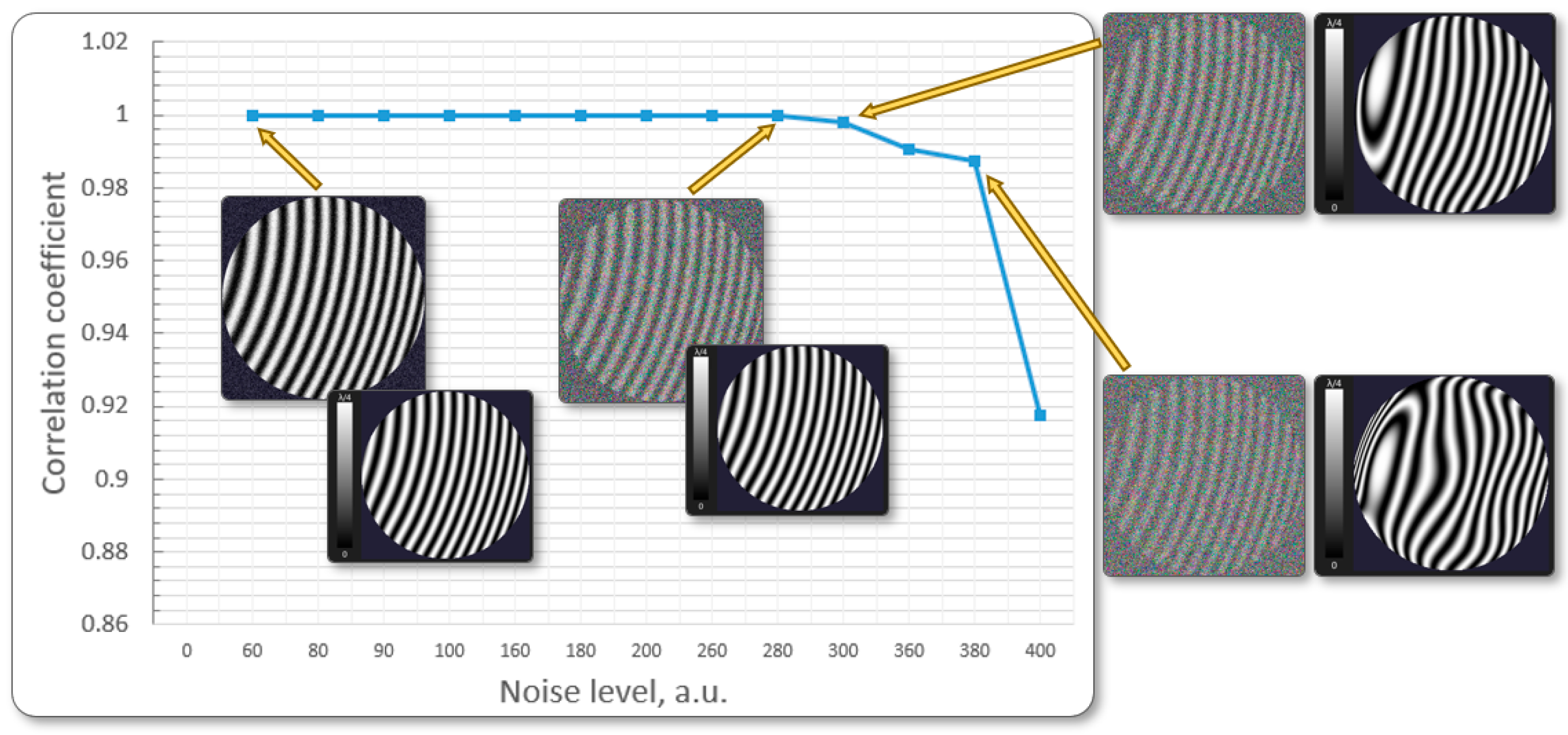
We also conducted a quantitative assessment of the robustness of our extremum detection algorithm across a spectrum of low-to-strong noise conditions (Figure 22). To simulate these conditions, we applied additive Gaussian noise to the input data at varying power levels, ranging from 60 to 400 (in arbitrary units pertinent to the experiment). For each noise level, we computed the Pearson correlation coefficient between the phase reconstructed under ideal (noise-free) conditions and the phase reconstructed from the corresponding noisy data.
As evidenced by Figure 21, the algorithm demonstrates considerable stability. It maintains an exceptionally high correlation coefficient (0.9999) with the ideal reconstruction for noise levels up to 280. A gradual degradation in reconstruction fidelity becomes apparent at noise levels of 300 and above. Significant degradation, clearly visible in the provided inset, occurs at a noise level of 380.
Regarding the complexity of the algorithm, the current implementation exhibits a runtime of O(N), which can be considered moderate in terms of efficiency. As this represents the initial version of the algorithm, there remains significant potential for performance enhancements and optimizations in subsequent iterations. Specifically, we can enhance the efficiency of the Moving Average algorithm by employing a median average kernel, rather than calculating the average sequentially by rows and then by columns, as is currently implemented. Additionally, another area identified for optimization lies within the core of the extremum calculation algorithm, which also processes the source image by iterating through rows and then columns. We intend to conduct a comprehensive performance analysis of version 1 of the algorithm, which will inform the necessary improvements to be integrated into version 2.

4. Conclusions

In this research, we developed and rigorously investigated an interference fringe reconstruction algorithm that serves as an alternative to the widely employed phase-shifting technique. This algorithm integrates the Moving Average, Fast Fourier Transform (MAFFT), and Polynomial Fitting techniques. The algorithm was validated through comparisons with a Zygo interferometer. The results demonstrated consistent performance under both standard and noisy conditions, as well as in scenarios characterized by strong local inhomogeneities. The developed software operates in real-time, enabling wavefront measurements of optical surfaces at a frequency of 30 Hz. We conducted numerical simulations to assess potential errors introduced by noise, and experiments were performed to corroborate the validity of the proposed algorithm in comparison to the Zygo interferometer.

Author Contributions

Conceptualization, I.G.; methodology, I.G.; software, I.G.; validation, I.G. and V.T.; formal analysis, V.T.; investigation, I.G.; resources, I.G. and V.T.; data curation, V.T.; writing—original draft preparation, I.G.; writing—review and editing, V.T.; visualization, I.G.; supervision, I.G.; project administration, I.G.; funding acquisition, I.G. and V.T. All authors have read and agreed to the published version of the manuscript.

Funding

This research received no external funding.

Data Availability Statement

The datasets presented in this article are not readily available because the data is a part of an ongoing study.

Acknowledgments

The authors thank the laboratory of atmospheric adaptive optics of Sadovsky Institute of Geosphere Dynamics and all technical and scientific stuff related to this laboratory for technical support and assistance.

Conflicts of Interest

The authors declare that there are no conflicts of interest.

References

  1. Tang, X.; Ou, Z. Optical interference by amplitude measurement: Spectral analysis. Phys. Rev. Res. 2025, 7, 013255. [Google Scholar] [CrossRef]
  2. Meyer, Y.H. Fringe shape with an interferential wedge. J. Opt. Soc. Am. 1981, 71, 1255–1263. [Google Scholar] [CrossRef]
  3. Jan, C.; Liu, C.; Chen, C.; Chen, Y. Optical interference system for simultaneously measuring refractive index and thickness of slim transparent plate. Opt. Lasers Eng. 2021, 145, 106668. [Google Scholar] [CrossRef]
  4. Miroshnichenko, I.P.; Parinov, I.A.; Chang, S.-H.; Lin, C.-F. Features and Functionality of the Optical Interference Meter for Measurement of Surface Displacements of Control Objects. Coatings 2021, 11, 989. [Google Scholar] [CrossRef]
  5. Lauranto, H.M.; Kajava, T.T.; Friberg, A.T. Interference pattern of the Fizeau interferometer. J. Opt. Soc. Am. A 1994, 11, 2045–2054. [Google Scholar] [CrossRef]
  6. Brossel, J. Multiple-beam localized fringes: Part I—Intensity distribution and localization. Proc. Phys. Soc. 1947, 59, 224. [Google Scholar] [CrossRef]
  7. Liang, X.; Qin, C.; Qiao, Z.; Kang, W.; Yin, H.; Dong, S.; Li, X.; Wang, S.; Su, X.; Zhang, G.; et al. Optical interference effect in the hybrid quantum dots/two-dimensional materials: Photoluminescence enhancement and modulation. Opt. Express 2022, 30, 26557–26569. [Google Scholar] [CrossRef]
  8. Born, M.; Wolf, E.; Bhatia, A.B.; Clemmow, P.C.; Gabor, D.; Stokes, A.R.; Taylor, A.M.; Wayman, P.A.; Wilcock, W.L. Principles of Optics: Electromagnetic Theory of Propagation, Interference and Diffraction of Light. In Principles of Optics; Cambridge University Press: Cambridge, UK, 1999. [Google Scholar] [CrossRef]
  9. Moreira, A.J.; Valadas, R.T.; de Oliveira Duarte, A. Optical interference produced by artificial light. Wirel. Netw. 1997, 3, 131–140. [Google Scholar] [CrossRef]
  10. Aebischer, N. Études d’interférences en ondes multiples par diagramme complexe pour visualiser les franges en réflexion. Nouv. Rev. D’optique Appliquée 1970, 1, 233. [Google Scholar] [CrossRef]
  11. Xu, T.; Wang, Z.; Jia, Z.; Chen, J.; Feng, Z.H. A dual-stage correction approach for high-precision phase-shifter in Fizeau interferometers. Opt. Lasers Eng. 2024, 178, 108205. [Google Scholar] [CrossRef]
  12. Zhu, W.; Chen, L.; Yang, Y.; Zhang, R.; Zheng, D.; Han, Z.; Li, J. Advanced simultaneous phase-shifting Fizeau interferometer. Opt. Laser Technol. 2019, 111, 134–139. [Google Scholar] [CrossRef]
  13. Kawashima, N.; Kondo, Y.; Hirai, A.; Bitou, Y. Novel analysis of alignment error on spherical Fizeau interferometer and uncertainty evaluation of sphericity calibration system based on random ball test. Opt. Lasers Eng. 2025, 184, 108646. [Google Scholar] [CrossRef]
  14. Ramadan, W.A. Intensity distribution of Fizeau fringes in transmission with the real path of the interfered multiple-beams. Opt. Lasers Eng. 2014, 58, 27–32. [Google Scholar] [CrossRef]
  15. Miao, X.; Yu, Y.; Li, A.; Ma, J.; Chen, L.; Li, J.; Wang, Q.; Wei, C.; Zhu, R.; Yuan, C. Optical phase-shifting methods based on low coherence laser for large aperture Fizeau interferometer. Opt. Lasers Eng. 2021, 140, 106513. [Google Scholar] [CrossRef]
  16. Zhu, W.; Chen, L.; Zheng, D.; Meng, S.; Yang, Y.; Liu, Z.; Han, Z.; Li, J. Dynamic Fizeau interferometer based on the lateral displacements of the point sources. Opt. Lasers Eng. 2017, 91, 216–220. [Google Scholar] [CrossRef]
  17. Lu, Q.; Han, S. Optical surface measurements of a wavelength-tuned Fizeau interferometer based on an optical power, real-time feedback and compensation system. Results Phys. 2020, 16, 102846. [Google Scholar] [CrossRef]
  18. Niu, W.; Zhong, L.; Sun, P.; Zhang, W.; Lu, X. Two-step phase retrieval algorithm based on the quotient of inner products of phase-shifting interferograms. J. Opt. 2015, 17, 085703. [Google Scholar] [CrossRef]
  19. Wang, S.; Quan, C.; Tay, C.; Reading, I.; Fang, Z. Measurement of a fiber-end surface profile by use of phase-shifting laser interferometry. Appl. Opt. 2004, 43, 49–56. [Google Scholar] [CrossRef]
  20. Schmitt, R.; König, N.; Manfrin de Araújo, E. Surface profile analysis using a fiber optic low-coherence interferometer. Proc. SPIE 2009, 7389, 738914. [Google Scholar] [CrossRef]
  21. Yildirim, M.; Okutucu-Özyurt, T.; Dursunkaya, Z. A numerical algorithm to determine straightness error, surface roughness, and waviness measured using a fiber optic interferometer. Opt. Laser Technol. 2016, 85, 19–29. [Google Scholar] [CrossRef]
  22. Phase-Shifting Interferometry for Determining Optical Surface Quality. n.d. Available online: https://www.newport.com/n/phase-shifting-interferometry-for-determining-optical-surface-quality (accessed on 1 June 2025).
  23. Takeda, M.; Ina, H.; Kobayashi, S. Fourier-transform method of fringe-pattern analysis for computer-based topography and interferometry. J. Opt. Soc. Am. 1982, 72, 156–160. [Google Scholar] [CrossRef]
  24. Kemao, Q. Two-dimensional windowed Fourier transform for fringe pattern analysis: Principles, applications and implementations. Opt. Lasers Eng. 2007, 45, 304–317. [Google Scholar] [CrossRef]
  25. Feng, S.; Chen, Q.; Gu, G.; Tao, T.; Zhang, L.; Hu, Y.; Yin, W.; Zuo, C. Fringe pattern analysis using deep learning. Adv. Photonics 2019, 1, 025001. [Google Scholar] [CrossRef]
  26. Sinha, A.; Lee, J.; Li, S.; Barbastathis, G. Lensless computational imaging through deep learning. Optica 2017, 4, 1117. [Google Scholar] [CrossRef]
  27. Rivenson, Y.; Zhang, Y.; Günaydın, H.; Teng, D.; Ozcan, A. Phase recovery and holographic image reconstruction using deep learning in neural networks. Light. Sci. Appl. 2018, 7, 17141. [Google Scholar] [CrossRef] [PubMed]
  28. Zuo, C.; Huang, L.; Zhang, M.; Chen, Q.; Asundi, A. Temporal phase unwrapping algorithms for fringe projection profilometry: A comparative review. Opt. Lasers Eng. 2016, 85, 84–103. [Google Scholar] [CrossRef]
  29. Galaktionov, I.; Kudryashov, A.; Sheldakova, J.; Nikitin, A. Laser beam focusing through the dense multiple scattering suspension using bimorph mirror. Proc. SPIE 2019, 10886, 1088619. [Google Scholar] [CrossRef]
  30. Szádeczky-Kardoss, E.; Kiss, B. Path Planning and Tracking Control for an Automatic Parking Assist System. In European Robotics Symposium; Bruyninckx, H., Přeučil, L., Kulich, M., Eds.; Springer Tracts in Advanced Robotics; Springer: Berlin/Heidelberg, Germany, 2008; Volume 44. [Google Scholar] [CrossRef]
  31. Storath, M.; Weinmann, A. Solving higher-order Mumford-Shah models. AIP Conf. Proc. 2024, 3094, 440006. [Google Scholar] [CrossRef]
  32. Schemm, J.; Vest, C. Fringe pattern recognition and interpolation using nonliear regression analysis. Appl. Opt. 1983, 22, 2850–2853. [Google Scholar] [CrossRef]
  33. Saraç, Z.; Birkök, H.; Emir, A.; Dursun, A. Phase recovery from interference fringes by Hilbert transform. Proc. SPIE 2009, 7443, 452–460. [Google Scholar] [CrossRef]
  34. Young, P.; Priambodo, P.; Maldonado, T.; Magnusson, R. Simple interferometric fringe stabilization by charge-coupled-device-based feedback control. Appl. Opt. 2006, 45, 4563–4566. [Google Scholar] [CrossRef] [PubMed]
  35. Goodwin, E.; Wyant, J.C. Field Guide to Interferometric Optical Testing. In Field Guide to Interferometric Optical Testing; SPIE Press: Bellingham, WA, USA, 2009. [Google Scholar] [CrossRef]
  36. Soloviev, A.A.; Kotov, A.V.; Martyanov, M.A.; Perevalov, S.E.; Zemskov, R.S.; Starodubtsev, M.; Aleksandrov, A.; Galaktionov, I.; Samarkin, V.; Kudryashov, A.; et al. Improving focusability of post-compressed PW laser pulses using a deformable mirror. Opt. Express 2022, 30, 40584–40591. [Google Scholar] [CrossRef] [PubMed]
  37. Skvortsov, A.A.; Zuev, S.M.; Koryachko, M.V.; Voloshinov, E.B. Specific features of motion of molten zones in the field of silicon structural inhomogeneity. Tech. Phys. Lett. 2017, 43, 705–707. [Google Scholar] [CrossRef]
  38. Skvortsov, A.A.; Pshonkin, D.E.; Koryachko, M.V.; Rybakova, M.R. The Effect of Constant Magnetic Fields on the Dynamics of Molten Zones in the Field of Structural Inhomogeneity of Silicon. Tech. Phys. Lett. 2018, 44, 498–501. [Google Scholar] [CrossRef]
  39. Liu, S.; Cheng, H.-C.; Chen, S.-H.; Lin, H.-Y.; Hsu, C.-C.; Shih, F.; Liang, K.-C.; Wu, M.; Fang, W. On the design of piezoelectric actuator for 1D MEMS scanning mirror applications. Micromech. Microeng. 2023, 33, 034002. [Google Scholar] [CrossRef]
  40. Toporovsky, V.; Samarkin, V.; Kudryashov, A.; Galaktionov, I.; Panich, A.; Malykhin, A. Investigation of PZT Materials for Reliable Piezostack Deformable Mirror with Modular Design. Micromachines 2023, 14, 2004. [Google Scholar] [CrossRef]
  41. Soloviev, A.A.; Kotov, A.V.; Perevalov, S.E.; Esyunin, M.V.; Starodubtsev, M.V.; Alexandrov, A.; Galaktionov, I.; Samarkin, V.; Kudryashov, A.; Ginzburg, V.; et al. Adaptive system for wavefront correction of the PEARL laser facility. Quantum Electron. 2020, 50, 1115–1122. [Google Scholar] [CrossRef]
  42. Koryachko, M.V.; Pshonkin, D.E.; Skvortsov, A.A. Features of melt droplet formation during electrical destruction aluminum films on the semiconductor surface. Defect Diffus. Forum 2021, 410, 737–741. [Google Scholar] [CrossRef]
  43. Kotov, A.; Perevalov, S.; Starodubtsev, M.; Zemskov, R.; Alexandrov, A.; Galaktionov, I.; Samarkin, V.; Soloviev, A. Adaptive system for correcting optical aberrations of high-power lasers with dynamic determination of the reference wavefront. Quantum Electron. 2021, 51, 593–596. [Google Scholar] [CrossRef]
  44. Skvortsov, A.A.; Koryachko, M.V.; Zuev, S.M.; Demchenkova, A.A. Melt drops movement over semiconductor surfaces controlled by electric field. Period. Tche Quim 2019, 16, 681–687. [Google Scholar] [CrossRef]
  45. Sherrit, S.; Camacho, D.; Jones, C.; Guevara, E.; Weisberg, C.; Monacelli, B.; Basinger, S.A.; Tesch, J.A.; Coste, K. Characterization and control of surface parallel mirror actuators. Proc. SPIE 2025, 13435, 134350B. [Google Scholar] [CrossRef]
  46. Skvortsov, A.; Pshonkin, D.; Kunitsyna, E.; Morgunov, R.; Beaugnon, E. Softening of the Al-Mg-Si-Fe alloy under magnetostriction of FeAl microinclusions. J. Appl. Phys. 2019, 125, 023903. [Google Scholar] [CrossRef]
  47. Chou, Y. Statistical Analysis, with Business and Economic Applications; Holt, Rinehart and Winston: New York, NY, USA, 1969; Volume 794. [Google Scholar]
  48. Rao, K.R.; Kim, D.N.; Hwang, J.J. Fast Fourier Transform—Algorithms and Applications; Springer: Dordrecht, The Netherlands, 2010. [Google Scholar] [CrossRef]
  49. Kemao, Q. Windowed Fourier transform for fringe pattern analysis. Appl. Opt. 2004, 43, 2695–2702. [Google Scholar] [CrossRef] [PubMed]
  50. Romanov, P.; Sheldakova, J.; Zavalova, V.; Alexandrov, A.; Dubikovsky, V.; Kudryashov, A. Modified interferometer fizeau for diagnostics of wide aperture optical elements. In Proceedings of the 4th International Conference on Advanced Optoelectronics and Lasers, Alushta, Ukraine, 29 September–4 October 2008; pp. 393–394. [Google Scholar] [CrossRef]
  51. Toporovsky, V.; Samarkin, V.; Kudryashov, A.; Galaktionov, I. Bimorph deformable mirror parameters optimization in atmospheric applications. Proc. SPIE 2022, 12218, 1221806. [Google Scholar] [CrossRef]
  52. Galaktionov, I.; Sheldakova, J.; Toporovsky, V.; Samarkin, V.; Kudryashov, A. Bimorph vs stacked actuator deformable mirror for laser beam focusing through a moderately scattering medium. Proc. SPIE 2021, 11672, 1167214. [Google Scholar] [CrossRef]
  53. Malacara-Hernandez, D. Wavefront fitting with discrete orthogonal polynomials in a unit radius circle. Opt. Eng. 1990, 29, 672. [Google Scholar] [CrossRef]
  54. Lakshminarayanan, V.; Flece, A. Erratum: Zernike polynomials: A guide. J. Mod. Opt. 2011, 58, 545–561. [Google Scholar] [CrossRef]
  55. Genberg, V.L.; Michels, G.J.; Doyle, K.B. Orthogonality of Zernike polynomials. In Optomechanical Design and Engineering 2002; SPIE Press: Bellingham, WA, USA, 2002; Volume 4771, pp. 276–286. [Google Scholar] [CrossRef]
  56. Wyant, J.C.; Creath, K. Basic Wavefront Aberration Theory for Optical Metrology. Appl. Opt. Opt. Eng. 1992, 11, 2. [Google Scholar]
  57. Southwell, W.H. Wavefront estimation from wavefront slope measurements. J. Opt. Soc. Am. 1980, 70, 998–1005. [Google Scholar] [CrossRef]
  58. Kounchev, O.; Render, H.; Tsachev, T. L-Spline Interpolation for Differential Operators of Order 4 with Constant Coefficients. Proc. Bulg. Acad. Sci. 2022, 75, 11. [Google Scholar] [CrossRef]
  59. Kushwaha, A.; Fernandes, B.G. Response Surface-Assisted Trust-Region Method for Optimization of Electromagnetic Devices. IEEE Trans. Magn. 2021, 57, 8300712. [Google Scholar] [CrossRef]
  60. Kong, Q.; Zhang, L.; Xu, X. Control algorithm of path planning and path tracking for automated valet parking. J. Phys. Conf. Ser. 2022, 2232, 012018. [Google Scholar] [CrossRef]
  61. Hwang, I.S.; Tsai, Y.Y.; Zeng, B.H.; Lin, C.M.; Shiue, H.S.; Chang, G.C. Integration of eye tracking and lip motion for hands-free computer access. Univers. Access Inf. Soc. 2021, 20, 405–416. [Google Scholar] [CrossRef]
  62. Andriyanov, N.A.; Dementiev, V.E.; Tashlinskiy, A.G. Detection of objects in the images: From likelihood relationships towards scalable and efficient neural networks. Comput. Opt. 2022, 46, 139–159. [Google Scholar] [CrossRef]
  63. Pinto, J.W.O.; Tueros, J.A.R.; Horowitz, B.; da Silva, S.M.B.A.; Willmersdorf, R.B.; de Oliveira, D.F.B. Gradient-free strategies to robust well control optimization. Comput. Geosci. 2020, 24, 1959–1978. [Google Scholar] [CrossRef]
  64. Zhao, H.; Li, Z.; Li, B.; Li, T. A study on input noise second-order filtering and smoothing of linear stochastic discrete systems with packet dropouts. Adv. Differ. Equ. 2020, 1, 14. [Google Scholar] [CrossRef]
  65. Muralikrishnan, S.; Bui-Thanh, T.; Shadid, J.N. A multilevel approach for trace system in HDG discretizations. J. Comput. Phys. 2020, 407, 109240. [Google Scholar] [CrossRef]
  66. Shang, R.; Lin, J.; Jiao, L.; Li, Y. SAR Image Segmentation Using Region Smoothing and Label Correction. Remote Sens. 2020, 12, 803. [Google Scholar] [CrossRef]
  67. Dong, Z.; Xu, F.; Sun, X.; Liu, W. A Laser-Based On-Machine Measuring System for Profile Accuracy of Double-Headed Screw Rotor. Sensors 2019, 19, 5059. [Google Scholar] [CrossRef] [PubMed]
  68. Storath, M.; Kiefer, L.; Weinmann, A. Smoothing for signals with discontinuities using higher order Mumford-Shah models. Numer. Math. 2018, 143, 423–460. [Google Scholar] [CrossRef]
  69. Medina, C.; Salazar, G. When can a link be obtained from another using crossing exchanges and smoothings? Topol. Appl. 2019, 260, 13–22. [Google Scholar] [CrossRef]
  70. Song, W.; Li, S.; Hou, X.; Wu, F.; Zhao, W.; Wan, Y. Absolute calibration for Fizeau interferometer with the global optimized shift-rotation method. Opt. Lasers Eng. 2014, 54, 49–54. [Google Scholar] [CrossRef]
  71. Youngworth, R.; Gallagher, B.; Stamper, B. An overview of power spectral density (PSD) calculations. Proc. SPIE 2005, 5869, 58690U. [Google Scholar] [CrossRef]
  72. Merle, E.J.; Bennett, J.M. Calculation of the power spectral density from surface profile data. Appl. Opt. 1995, 34, 201–208. [Google Scholar] [CrossRef]
  73. Babich, E.; Scherbak, S.; Lubyankina, E.; Zhurikhina, V.; Lipovskii, A. Power Spectral Density Analysis for Optimizing SERS Structures. Sensors 2022, 22, 593. [Google Scholar] [CrossRef]
  74. Riess, S.; Brendel, J.; Fischer, G. Model-based implementation for the calculation of Power Spectral Density in an FPGA system. In Proceedings of the 2013, 7th International Conference on Signal Processing and Communication Systems (ICSPCS), Carrara, Australia, 16–18 December 2013. [Google Scholar] [CrossRef]
  75. Liu, J. FFT Based Adaptive Noise Cancellation. J. Stud. Res. 2024, 13. [Google Scholar] [CrossRef]
  76. Mitic, P. Noise Reduction in a Reputation Index. Int. J. Financ. Stud. 2018, 6, 19. [Google Scholar] [CrossRef]
  77. Blackledget, J. Chapter 16—Digital Filtering in the Time Domain. In Woodhead Publishing Series in Electronic and Optical Materials, Digital Signal Processing, 2nd ed.; Blackledget, J.M., Ed.; Woodhead Publishing: Cambridge, UK, 2006; pp. 522–540. [Google Scholar] [CrossRef]
  78. Jabidin, H.; Ibrahim, S.A.; Raheem, M.M.K.; Mansoor, A.; Zan, M.S.D.; Bakar, A.A.A.; Abdul-Rashid, H.A. Analysis of combined moving-average moving-differential algorithms to enhance SNR in distributed optical fiber acoustic sensors. Results Eng. 2025, 26, 105268. [Google Scholar] [CrossRef]
Figure 1. Fiber-end surface fringes map (a) before and (b) after proper polishing.
Asi 09 00031 g001
Figure 2. Optical configuration of a Fizeau interferometer. The inset illustrates the interference fringe image that can be captured by a digital camera.
Asi 09 00031 g002
Figure 3. First column—simulated fringe (a) and phase (c) map, second column—reconstructed fringe (b) and phase (d) map. The corresponding Zernike coefficient values are provided to the right.
Asi 09 00031 g003
Figure 4. Flow chart of the developed algorithm.
Asi 09 00031 g004
Figure 5. Cross-sectional analysis of a fringe image along the X-axis: (a) prior to the application of the Moving Average algorithm, and (b) following its application. The red and green rectangles highlight the discrepancies in extremum positions between the two cross-sections.
Asi 09 00031 g005
Figure 7. Determination of extremum positions and assignment of phase values: (a) for the central line; (b) for the upper half of the image; (c) for the lower half of the image.
Asi 09 00031 g007
Figure 8. Steps of the interference fringe reconstruction algorithm: (a) the source image obtained from an interferometer, featuring a circular mask (yellow circle) that delineates the region of analysis; (b) the source image subsequent to the application of the Moving Average filtration algorithm; (c) the image from the previous step after the FFT filtration algorithm was applied; (d) calculated extremum values for each fringe (depicted by red, yellow, and green curves—these colors are used for demonstration purposes only and do not have any relation to the phase value); (e) extremum values following the application of the Polynomial Fitting algorithm; (f) the result of fringe approximation utilizing Zernike polynomials—reconstructed fringes, phase maps, and the corresponding set of Zernike coefficients.
Asi 09 00031 g008
Figure 9. Verification of the developed algorithm for interference fringe reconstruction: (a) measurement results from the Zygo interferometer; (b) results from the conventional Fizeau interferometer. The term “PV” denotes “peak-to-valley,” indicating the amplitude of aberrations, while “RMS” refers to the root mean square error.
Asi 09 00031 g009
Figure 10. Comparison of measurements obtained from the Zygo interferometer and the conventional non-phase-shifting interferometer: (a) the green curve with cross marks represents the Zernike coefficients (in nanometers) derived from the Zygo, while the orange curve with triangular marks corresponds to the Zernike coefficients obtained from the non-phase-shifting interferometer; (b) the difference (in nanometers) between the Zernike terms from both measurements.
Asi 09 00031 g010
Figure 11. Power spectral density (PSD) of the phase maps obtained from the Zygo and non-phase-shifting interferometers. The inset highlights the negligible difference between the two curves.
Asi 09 00031 g011
Figure 12. Relative error of repeated measurements using the developed algorithm.
Asi 09 00031 g012
Figure 13. Algorithm results: (a,b) image with an artifact (black slant line), (c,d) highly noised fringe pattern, (e,f) distorted fringes.
Asi 09 00031 g013
Figure 14. Analysis of the impact of the Moving Average algorithm on the accuracy of fringe reconstruction: (a) original image; (b) reconstructed fringe pattern without the application of the Moving Average algorithm; (c,d) after one iteration of the Moving Average algorithm; (e,f) after two iterations; (g,h) after three iterations; (i,j) after thirteen iterations. The inset in subfigure (c) highlights the error in fringe curve recognition due to the presence of inhomogeneities. Source image resolution is 512 × 512 pixels that is about 2.5 × 2.5 mm.
Asi 09 00031 g014
Figure 15. (a) The relationship between the PV of the reconstructed phase surface and the number of iterations of the Moving Average algorithm; (b) original image obtained from the interferometer, with red, blue, and green rectangles highlighting areas with significant inhomogeneities that induce additional aberrations; (c) original image after 13 iterations of the Moving Average algorithm.
Asi 09 00031 g015
Figure 16. Analysis of the impact of the Fast Fourier Transform filtration algorithm on the accuracy of fringe reconstruction: (a) original image; (b) reconstructed fringe image with an FFT filter value of 0.005; (c,d) with an FFT filter value of 0.01; (e,f) with an FFT filter value of 0.02; (g,h) with an FFT filter value of 0.03; (i,j) with an FFT filter value of 0.04. Source image resolution is 512 × 512 pixels that is about 2.5 × 2.5 mm.
Asi 09 00031 g016
Figure 17. (a) The relationship between the PV of the reconstructed phase surface and the filtration strength of the FFT filtration algorithm; (b) original image obtained from the interferometer, with red, blue, and green rectangles highlighting areas of significant inhomogeneities that induce additional aberrations; (c) original image after the application of the FFT filtration algorithm with an FFT filter value of 0.03.
Asi 09 00031 g017
Figure 18. (a,b) Initial noisy fringe images; (c,d) interference fringes (depicted as color curves) reconstructed using the fringe reconstruction algorithm; (e,f) interference fringes (color curves) reconstructed using the fringe reconstruction algorithm subsequent to the application of fourth-order Polynomial Fitting. Source image resolution is 256 × 256 pixels that is about 1.25 × 1.25 mm.
Asi 09 00031 g018
Figure 19. Different order fitting accuracy.
Asi 09 00031 g019
Figure 20. (a) Analysis of fringe reconstruction error under conditions of significant noise for the Moving Average and FFT filtration algorithms; (b) source simulated fringe pattern with X Tip = 2 μm, Y Tilt = 0.5 μm, Defocus = 0.15 μm; (c) noised fringe pattern for further analysis.
Asi 09 00031 g020
Figure 21. PSD plots: (a) of the initial simulated phase map reconstructed using the Moving Average and FFT filtration algorithms; (b) of phase difference maps between the initial and Moving Averaged phase, and between the initial and FFT-filtered phase; the inset in subfigure (b) illustrates the negligible difference between the two curves; (c) a difference between the PSD curves depicted in subfigure (a).
Asi 09 00031 g021
Figure 22. Performance analysis under low-to-strong noise conditions. The insets illustrate representative noisy fringe patterns alongside their corresponding reconstruction results.
Asi 09 00031 g022
Disclaimer/Publisher’s Note: The statements, opinions and data contained in all publications are solely those of the individual author(s) and contributor(s) and not of MDPI and/or the editor(s). MDPI and/or the editor(s) disclaim responsibility for any injury to people or property resulting from any ideas, methods, instructions or products referred to in the content.