


Abstract
This paper addresses a green intermodal route-planning problem considering delivery time sensitivity and cargo integrity, in which a fuzzy time window, damage costs and the carbon tax policy are comprehensively integrated. A linear route-planning model with an easily attainable global optimum solution is established to address the proposed problem, with the optimization objective of minimizing the total cost, comprising transportation-, damage- and carbon tax-related costs. Numerical experiments are conducted to verify the feasibility of problem optimization and reveal managerial insights. The feasibility verification demonstrates that the fuzzy time window enables flexible and fine-grained intermodal route design based on delivery time sensitivity, and the incorporation of damage costs has the triple benefit of reducing cargo damage, improving economic benefits and ensuring low-carbon transportation. It also demonstrates the conditional effectiveness of the carbon tax policy in reducing the carbon emissions associated with intermodal transportation. An ablation experiment further indicates that damage costs are the dominant driver of carbon emission reductions when transporting high-value cargo, with the carbon tax policy failing to achieve additional carbon emission reductions in this case when damage costs are included in the objective function. These findings provide quantitative guidance for customers, transportation service providers, and policy regulators for balancing the costs, service quality and environmental sustainability of intermodal transportation.
1. Introduction
Compared with unimodal transportation, intermodal transportation has the advantages of improved economic performance, large transportation volumes, and high safety and reliability, as well as environmentally friendly operation [1]. At present, China is promoting the trans-shipment of medium- and long-distance cargoes from road to rail and water and has highlighted the significance of developing intermodal transportation to optimize its transportation system [2]. Benefiting from the improved network connectivity, upgraded infrastructure and equipment, and sophisticated operation and management, China’s intermodal transportation has developed rapidly, with an annual growth rate of more than 25% [3], contributing to transportation structure optimization, reductions in social logistics cost, and low-carbon transportation [4]. However, in practice, intermodal transportation still suffers from setbacks due to the great difficulty of organizing transportation and poor connectivity among various transportation modes [5], which affects its efficiency and economics, lowers customer satisfaction levels, and causes loss of cargo sources.
To resolve this issue, intermodal route planning has been proposed by researchers and practitioners [6,7]. It is oriented towards customer demand and aims to design the best intermodal route to effectively connect various transportation modes through proper transfer in order to transport cargoes [8]. Intermodal route planning provides a practical solution to the organizational bottlenecks in intermodal transportation and also helps to improve customer satisfaction levels and hence attract more cargo sources for trans-shipment from road to rail and water. Although yielding significant advantages, large-volume and long-distance intermodal cargo transportation still takes a long time, which reduces efficiency and may disrupt post-transportation cargo processing. This also leads to high carbon emissions, further leading to economic burden, reduced sustainability [9], and substantial cargo damage, which causes economic loss and also affects subsequent cargo processing. In this case, addressing the above challenges through proper intermodal route planning is important for improving customer satisfaction and environmental sustainability and fully leveraging the advantages of intermodal transportation. Therefore, intermodal route planning should be optimized through a comprehensive consideration of delivery time sensitivity to improve timeliness, maintain cargo integrity by reducing damage, and achieve low-carbon transportation.
The time sensitivity of cargoes determines customer expectations regarding transportation durations [10]. Time windows have been widely used in intermodal route planning to improve the timeliness of transportation and effectively coordinate the transportation process and post-transportation cargo processing under supply chain management. Therefore, intermodal route planning with time windows is most commonly studied, with soft time windows being the most popular. They allow transportation times to be shorter or longer than the lower and upper bounds, leading to economic benefits, and have been adopted not only in intermodal route planning (e.g., Fazayeli et al. [11], Li et al. [12], Xiao et al. [13] and Escudero-Santana et al. [14]) but also in unimodal route planning (e.g., Taş et al. [15], Reis [16], Belhaiza and Laporte [17] and Zhang et al. [18]). However, using this method does not avoid overly early or delayed transportation [19]; furthermore, it depends on a penalty cost to reduce earliness and lateness, which is difficult to objectively measure in practice [20]. Therefore, to overcome these weaknesses, some studies, e.g., those by Sun et al. [9], Zhang and Han [21] and Xu et al. [22], have adopted fuzzy time windows to guarantee the timeliness of intermodal route planning. Such a time window not only has the flexibility of soft time windows but also avoids overly early and delayed transportation. A service level is used to reflect the time sensitivity of cargo transportation and customer demands regarding timeliness, which avoids the use of a subjectively determined penalty cost. However, these studies only focused on the direct adoption of fuzzy time windows and neglected to explore their feasibility in intermodal route planning or to demonstrate their practical advantages.
Container shells provide mechanical protection, with severe container failure being rare in practical intermodal transportation. However, frequent transfer operations and long-haul transportation still impose shock and vibration on the cargoes inside the containers, especially on high-value, fragile or perishable cargoes. To maintain cargo integrity and reduce damage, damage costs are formulated in intermodal route planning and are incorporated into the objective to control cargo damage and thus costs (see Kovalenko et al. [23], Pang [24], Huang et al. [25], Hu et al. [26], Chen et al. [27], Maiyar and Thakkar [28] and Ge and Sun [29]). Formulating damage costs should have benefits, and at the least should lead to reductions in cargo damage, to show that it is feasible for problem optimization. Otherwise, including them in the objective function only increases the costs of transportation, which leads to an extra economic burden for the customer. To date, only a few studies have analyzed the feasibility of incorporating damage costs into intermodal route planning [25,29]. In addition, the combination of fuzzy time windows and damage costs has not been fully modeled in the intermodal route-planning literature, and the feasibility of damage costs under different customer service levels remains unknown, which challenges their practical application in the fuzzy time window setting.
To achieve green intermodal transportation with lower carbon emissions, route planning has been investigated under the globally implemented carbon tax policy [30]. Huang et al. [25], Demir et al. [31], Ma et al. [32], Zhang et al. [33] and Duan and Heragu [34] have modeled various intermodal transportation planning problems employing this policy to realize low-carbon transportation. Cheng et al. [35] also verified that such a policy more effectively reduces carbon emissions in intermodal route planning compared with the carbon trading policy. However, similar to the consideration of damage costs, reductions in carbon emissions need to be achieved through the adoption of the carbon tax policy in green intermodal route planning. Otherwise, it only increases costs without any positive effects. Various studies have discussed the feasibility of incorporating the carbon tax policy [25,36]. However, these works did not reach a consistent conclusion. Additionally, no studies have used the carbon tax policy in intermodal route planning considering fuzzy time windows and damage costs. The feasibility of this policy in such a problem setting is unknown.
Overall, the reviewed works have advanced the relevant research field. However, the following weaknesses still exist in these studies:
(1) In the intermodal route-planning literature, fuzzy time windows, damage costs and the carbon tax policy have not been integrated into modeling, which has restricted practical improvements in timeliness, cargo integrity and environmental sustainability during intermodal transportation.
(2) Although fuzzy time windows and damage costs have been integrated into intermodal route planning, there is no evidence that damage costs reduce cargo damage or have any effect other than increasing costs across different customer service levels under these conditions, and the feasibility and practical advantages of fuzzy time windows have also not been explored.
(3) Although various articles on green intermodal route planning have verified the feasibility of the carbon tax policy, they did not reach a consistent conclusion. The feasibility of using such a policy in intermodal route planning considering fuzzy time windows and damage costs remains unclear. Furthermore, it presents the same risk as damage cost calculations, in that its employment may only increase costs.
To overcome these critical research weaknesses, a green intermodal route-planning problem considering delivery time sensitivity and cargo integrity is proposed in this paper, focusing on the following:
(1) Fuzzy time windows, damage costs and the carbon tax policy are fully integrated into intermodal route planning to balance the economic efficiency, environmental sustainability, and service quality of intermodal transportation.
(2) A linear route-planning model is proposed to deal with the considered problem, with the global optimum solution enabling a quantitative analysis and a summary of practical insights for the customer, transportation service provider and policy regulator.
(3) Systematic verification is conducted to analyze the feasibility of the problem optimization settings (i.e., fuzzy time window, damage costs and carbon tax policy) in intermodal route planning across different customer service-level thresholds under a fuzzy time window setting.
(4) An ablation experiment is conducted to explore the mechanism that motivates the carbon emission reduction in intermodal route planning and the conditions under which the carbon tax policy is feasible in green intermodal route planning. A fuzzy time window and damage costs are used to reflect delivery time sensitivity and maintain cargo integrity, respectively.
2. Problem Description
In this paper, a transportation request proposed by a customer and served by the transportation service provider through intermodal route planning is considered. The customer submits a transportation request with a given cargo volume, origin, destination and fuzzy time window for the transportation of a batch of cargoes.
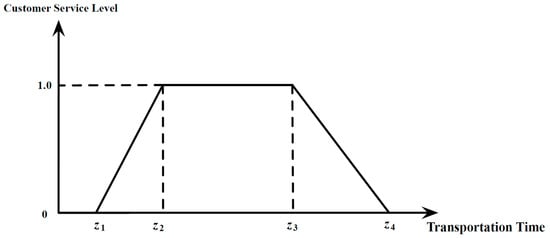
The fuzzy time window defines the customer’s acceptable time interval for cargo transportation, in which a service-level threshold is specified to reflect their tolerance for early or delayed transportation. A fuzzy time window is illustrated in Figure 1 [37] and works as follows [38].
Figure 1.
Fuzzy time window.
The fuzzy time window consists of a soft time window and a hard time window , where and . denotes the customer’s expected transportation time window, which reflects the on-time transportation requirement. Such a time window can be satisfied by setting the service-level threshold to 1.0. represents the tolerable time window for cargo transportation, in which and are the earliest and latest acceptable boundaries for transportation time, respectively.
Within the interval , the customer service level improves linearly with increasing transportation time , and . Within , the service level reaches its maximum value, that is, 1.0. Within , the service level decreases linearly with increasing transportation time , i.e., . Given the pre-specified minimum service-level threshold , the feasible transportation time interval accepted by the customer is expressed as .
The transportation service provider receives and processes the transportation request by operating an intermodal transportation network consisting of an origin, a destination, multiple transfer hubs and arcs. Rail, road and water transportation modes are available on the arcs, and transfer operations can be conducted at transfer hubs when moving cargoes between different transportation modes. Cargoes cannot be split during transportation according to the intermodal transportation standard, which means the cargo volume should be transported along a single feasible intermodal route from origin to destination.
Besides lowering the total costs of transportation to achieve economic benefits, the following three key practical goals are simultaneously considered in the decision making:
(1) Timeliness requirement: The cargo transportation duration should satisfy the service-level threshold proposed by the customer under a given fuzzy time window to ensure smooth post-transportation processing. In the proposed model, the fuzzy time window describes the acceptable time interval for cargo delivery, decided by the customer, and the service-level threshold quantifies the tolerance for early or delayed transportation. The total transportation time consists of two components: the travel time on each arc and the transfer time at transfer hubs. The time taken for travel activity is calculated by dividing the transportation distance by the mode-specific travel speed. The time taken for transfer activity is determined by multiplying the cargo volume by the transfer-specific operation time per TEU.
(2) Cargo integrity requirement: Even for containerized intermodal transportation, cargoes may suffer damage during long-distance transportation, especially at transfer hubs. Such damage mainly results from frequent loading and unloading operations, mechanical shocks and vibration during the transfer between transportation modes, drastic temperature and humidity variations, and improper handling during the transfer processes, rather than from physical damage to the container shell itself. These events may lead to partial or total loss of high-value, fragile, or perishable cargoes inside the container and cause economic losses for the customers, which disrupts further post-transportation processing. Therefore, damage costs are introduced into the objective function as the potential economic loss of cargoes along a planned route. The damage costs in the travel process are quantified by multiplying the cargo value, cargo volume, transportation distance and mode-specific damage rate per km. The damage costs of the transfer process are determined by multiplying the cargo value, cargo volume and transfer-specific damage rate per TEU.
(3) Low-carbon requirement: The carbon tax policy is introduced to reduce carbon emissions generated by travel and transfer activities during intermodal transportation. In practical policy contexts, the carbon tax imposes charges proportional to the actual carbon emissions produced by transportation. In the proposed model, the carbon tax rate represents the unit emission tax price, and it can be adjusted according to regional policy requirements. The carbon tax is calculated by multiplying the carbon tax rate by carbon emissions. The carbon emissions of the travel activity are determined by multiplying the cargo volume, mode-specific carbon emission factor and transportation distance. The carbon emissions of the transfer activity are determined by multiplying the cargo volume by the transfer-specific carbon emission factor. Consequently, the resulting carbon tax varies between different transportation modes, transportation distances and transfer activities, in contrast to a uniform per-TEU charge across all the routes.
The transportation service provider aims to select a feasible origin-to-destination intermodal route by selecting suitable transportation modes and transfer schemes. The aim of intermodal route planning is to reduce the total costs, which includes travel, transfer, carbon tax and damage costs, to balance economics, cargo integrity and environmental sustainability while satisfying the service-level constraints.
In the proposed problem, it is assumed that (1) all network-related parameters are known and deterministic; (2) the cargoes cannot be split during transportation, (3) there is only one batch of cargo; (4) cargo damage and carbon emissions occur continuously over the transportation distance and during transfer; and (5) request-related parameters including cargo volume and cargo value are considered.
3. Problem Modeling
In this section, a linear route-planning model is established to address the proposed problem. Linearity ensures that the global optimum solution can be obtained.
3.1. Symbol Definition
In this paper, the following parameters are used to construct the optimization model:
(1) Sets and indices: denotes the intermodal transportation network constructed by the transportation service provider, where represents the set of nodes (origin indexed by , destination indexed by and transfer hubs) that are indexed by , and ; is the set of transportation modes indexed by and ; and indicates the set of arcs, where is an arc from node to node . and represent the sets of predecessor and successor nodes to node , respectively, and and . and are the sets of transportation modes connecting node and running on arc , respectively, and and .
(2) Parameters: , , , and represent the transportation distance in km, transportation time in h, cost rate in CNY/TEU, carbon emission factor in kg/TEU·km and cargo damage rate per km of transportation mode on arc , respectively. , , and are the transfer time in h/TEU, cost rate in CNY/TEU, and carbon emission factor in kg/TEU for transferring cargoes from transportation mode to transportation mode at transfer hub , respectively. and are the cargo volume in TEU and fuzzy time window in h proposed by the customer, respectively, denotes the service-level threshold (i.e., the minimum acceptable level) requested by the customer, and represents the cargo value in CNY/TEU. represents the carbon tax rate in CNY/kg.
(3) Variables: is a 0–1 variable, and = 1 if the cargoes are transported via transportation mode on arc ; otherwise, = 0. is also a 0–1 variable, and = 1 if the cargoes are transferred from transportation mode to transportation mode at transfer hub ; otherwise, = 0.
3.2. Linear Route-Planning Model
Using the above defined sets, indices, parameters and variables, a linear route-planning model is formulated, whose objective is to minimize the total costs, which include transportation costs (travel and transfer costs), damage costs and carbon tax. The proposed model is linear, and its global optimum solution can be obtained using exact solution algorithms implemented in standard mathematical programming software.
The above is subject to the following:
Equation (1) is the objective that minimizes the total costs of the origin-to-destination cargo transportation to help achieve economic benefits for the customer. Equation (2) restricts the relationship between the inbound and outbound cargo flows at the origin, transfer hubs and destination. Equations (3) and (4) ensure that the cargoes are not split during transportation, while Equations (5) and (6) mean that the transfer hubs should transfer the cargoes from their inbound to outbound transportation modes to ensure a smooth flow between the travel process on arcs and the transfer process at transfer hubs. The combination of Equations (2)–(6) enforces a space- and operation-feasible intermodal route that connects the origin and destination. Equations (7) and (8) are the customer service-level constraints that ensure that the cargoes are transported within the time interval required by the customer, while Equations (9) and (10) restrict the values of variables according to their definitions.
4. Numerical Experiments
4.1. Numerical Experiment Design
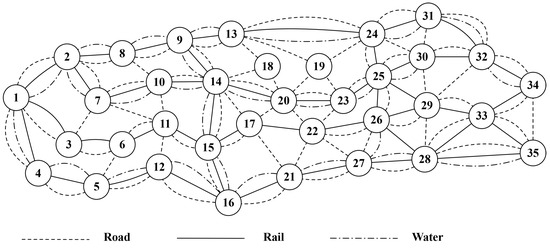
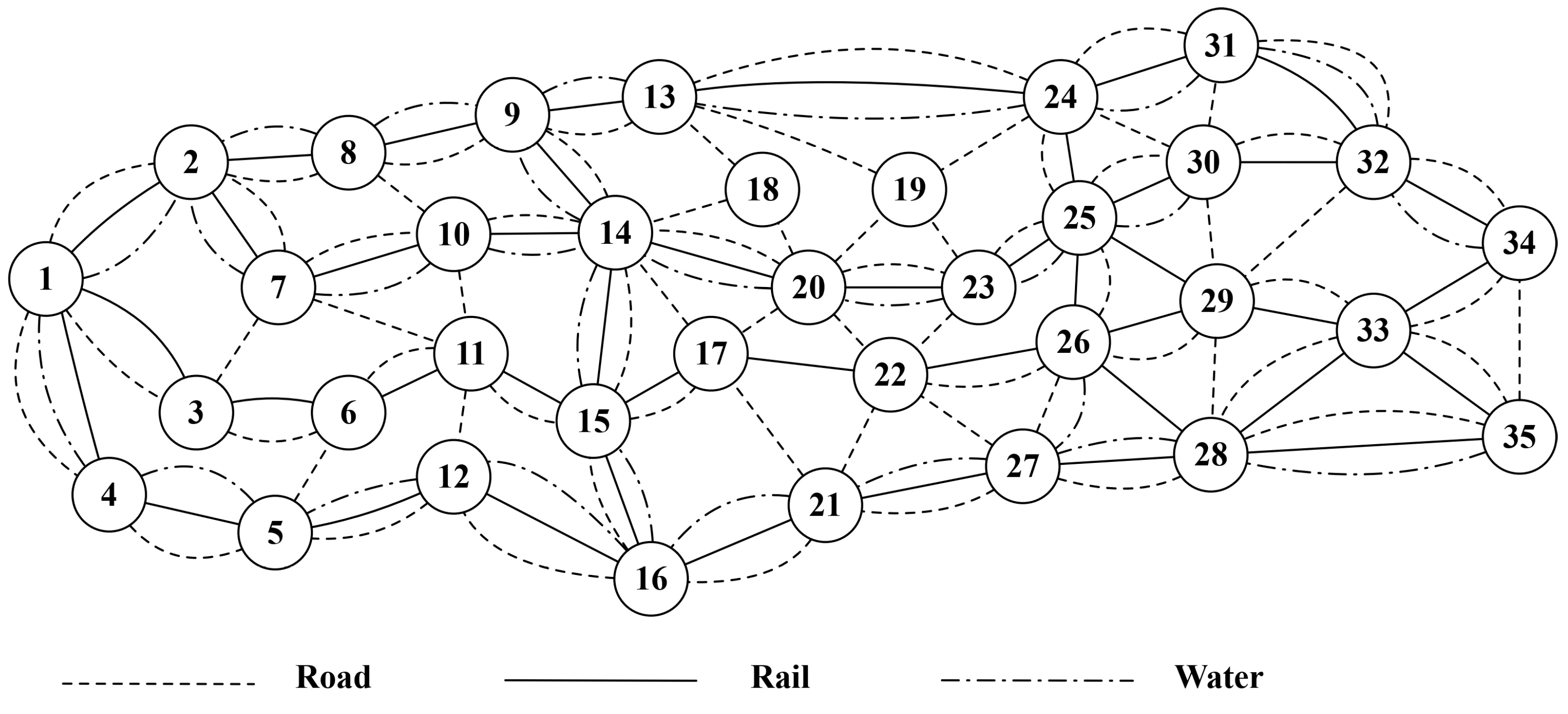
This paper presents numerical experiments to verify the feasibility of the proposed optimization settings, revealing several practical insights to support transportation organization. In the numerical experiments, the classic benchmark intermodal transportation network by Sun and Lang is adopted [39]. This standard test instance, with complete predefined nodes, arcs and alternative transportation modes, is widely employed in methodological research on intermodal routing for model validation. It does not represent an up-to-date real-world network. The network structure is illustrated in Figure 2.
Figure 2.
Structure of the intermodal transportation network adopted in the numerical experiments.
The basic topological features of this benchmark network (number of nodes, arcs and available transportation modes) are provided by Sun and Lang [39]. The transportation distances given in this reference were used; the remaining network-related parameters, including the mode-specific transportation cost rates, speeds, carbon emission factors, damage rates and transfer-specific transfer cost rates, were adopted from Huang et al. [25]. For space-saving purposes, the full original numerical tables are not reproduced here, and readers can refer to these two references for the complete raw dataset. In the numerical experiments, it was assumed that nodes 1 and 35 are the origin and destination of the cargoes requested by the customer, respectively. The customer proposes a cargo volume of 30 TEU and a fuzzy time window of [33, 40, 46, 54] h, while the cargo value is 100,000 CNY/TEU.
According to Zhu et al. [40], the carbon tax rate in China ranges from 0.22 to 2.20 CNY/kg under practical policy scenarios. A higher carbon tax rate increases the share of carbon emission costs within the total costs and could theoretically yield higher reductions in carbon emissions for intermodal transportation, as also demonstrated by Huang et al. [25]. Therefore, in the numerical experiments, a relatively high carbon tax rate of 2.20 CNY/kg was selected for the baseline scenario. It should be noted that this parameter is configurable, and different carbon tax rates can be chosen when applying the proposed model in other geographical markets.
The standard mathematical programming software Lingo 11 was employed to run the Branch-and-Bound algorithm to solve the proposed model and obtain the global optimum solution to the problem.
4.2. Optimization Results
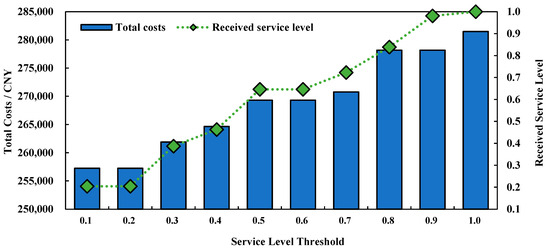
The proposed model is a parametric formulation, in which the minimum acceptable service level is adjustable and determined by the customer before solving the problem based on the time sensitivity of the cargo. To explore the problem optimization in a changing decision-making environment, this study explores optimization under minimum acceptable service levels between 0.1 and 1.0 with a step size of 0.1. The total costs and received service levels of the planned intermodal routes across different service-level thresholds are illustrated in Figure 3.
Figure 3.
Results of intermodal route-planning optimization across different service-level thresholds.
According to Figure 3, with an increasing service-level threshold, the total costs of the planned intermodal route increase and the service level received by the customer improves in a stepwise manner. When the service-level threshold increases from 0.1 to 1.0, the total costs increase by an average of 9.4%, and the service level received by the customer reaches 1.0, which means transportation can be provided on time to the customer, ensuring “just-in-time” post-transportation processing of time-sensitive cargo.
The timeliness and economics of intermodal transportation conflict with each other, and an optimum service-level threshold does exist. The customer should thus balance the two objectives according to the budget they have prepared for the transportation request and the time sensitivity of cargo transportation in the following manner:
(1) For time-sensitive cargoes, the customer should pay more attention to the timeliness of transportation to support fixed post-transportation cargo processing and should be willing to pay more for transportation. A high service-level threshold (e.g., ≥ 0.8) matches this scenario. For regular cargo, the customer may prefer reduced total transportation costs to make more profits and feel less constrained by the transportation time interval. In this case, a low-to-moderate service-level threshold (e.g., 0.1~0.5) is appropriate, since it allows the model to select cost-efficient intermodal routes.
(2) For the transportation service provider, the fuzzy time window enables customized services with differentiated prices for heterogeneous transportation requests. Instead of applying unified rigid time requirements for all transportation requests, they can establish interactive communication with the customer. Before route planning, the transportation service provider needs to collect information including cargo attributes, post-transportation cargo-processing schedules and customer budgets to determine a reasonable service-level threshold.
(3) For supply chain collaboration, the service-level threshold can serve as a negotiation indicator between the customer and the transportation service provider. The customer should quantify the required punctuality as an explicit service-level indicator rather than proposing a vague requirement. A clear service-level threshold helps to reduce disputes caused by early or delayed transportation.
4.3. Feasibility Verification
In this section, feasibility is systematically verified to indicate that the proposed problem optimization settings can improve the optimization performance.
4.3.1. Feasibility of the Fuzzy Time Window
The fuzzy time window is compared with the soft time window to demonstrate its feasibility. The objective of intermodal route planning under the soft time window is shown in Equation (11):
where is the penalty cost rate in CNY/TEU·h, and and are the non-negative earliness and lateness in h caused by early and delayed transportation, respectively.
Equations (7) and (8) are replaced by Equations (12) and (13) to establish the optimization model based on a soft time window, as follows:
The results of intermodal route-planning optimization under a soft time window with different penalty cost rates are presented in Table 1.
Table 1.
Optimization results under a soft time window.
As indicated in Table 1, the optimization results under a soft time window are highly sensitive to the subjective penalty parameter. A lower penalty cost rate (30~90 CNY/TEU·h) does not lead to improved timeliness and only increases the total costs, since the results under these parameters are the same as those for the situation in which time constraints are not considered.
The service level received by the customer can be enhanced only when the penalty cost rate reaches 120 CNY/TEU·h or more. However, with an increase in the penalty cost rate, there is a direct and sharp improvement in the received service level from 0.204 to 0.981, which leads to a coarse-grained intermodal route design. Moreover, even with an increase in the penalty cost rate to 210 CNY/TEU·h, on-time transportation cannot be achieved using a soft time window. Therefore, it fails to match the requirements of time-sensitive transportation.
By contrast, the fuzzy time window avoids the drawbacks caused by a subjective penalty parameter. The service-level threshold is directly used as an adjustable input provided by the customer, enabling fine-grained control over transportation timeliness. The transportation service provider can obtain various solutions by simply improving the threshold to consider both time-sensitive cargoes and regular cargoes requiring on-time and cost-effective transportation, respectively.
From a practical managerial perspective, use of the fuzzy time window provides a more operable tool for the transportation service provider. The provider can communicate with the customer to quantify punctuality requirements into an explicit service-level threshold. This mechanism reduces the uncertainty of parameter setting in model implementation and facilitates customized planning for heterogeneous transportation requests. In summary, the integration of fuzzy time windows is feasible and practically valuable for intermodal route planning.
4.3.2. Feasibility and Effects of Damage Costs
Damage costs are initially calculated to maintain cargo integrity during intermodal route planning. To fully explore the potential effects of formulating damage costs on problem optimization, the optimization results with and without damage costs are compared across different service-level thresholds.
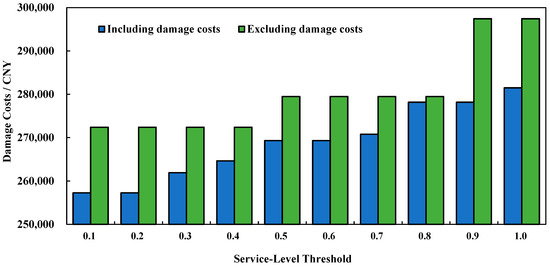
Figure 4 compares the damage costs when they are included in the total costs of the planned intermodal route and the actual damage costs without their consideration.
Figure 4.
Resulting actual damage costs of the planned intermodal routes with and without damage costs.
As shown in Figure 4, formulating the damage costs reduces the overall damage level by an average of 39.8%, indicating that the cargo integrity is better maintained. This helps to reduce unexpected economic losses caused by cargo damage and enables more efficient cargo utilization in post-transportation processing.
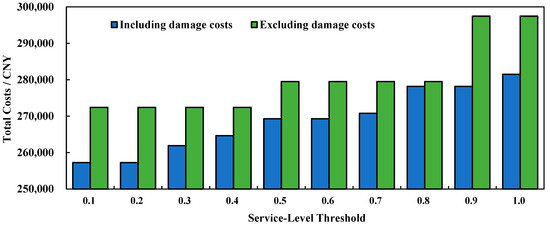
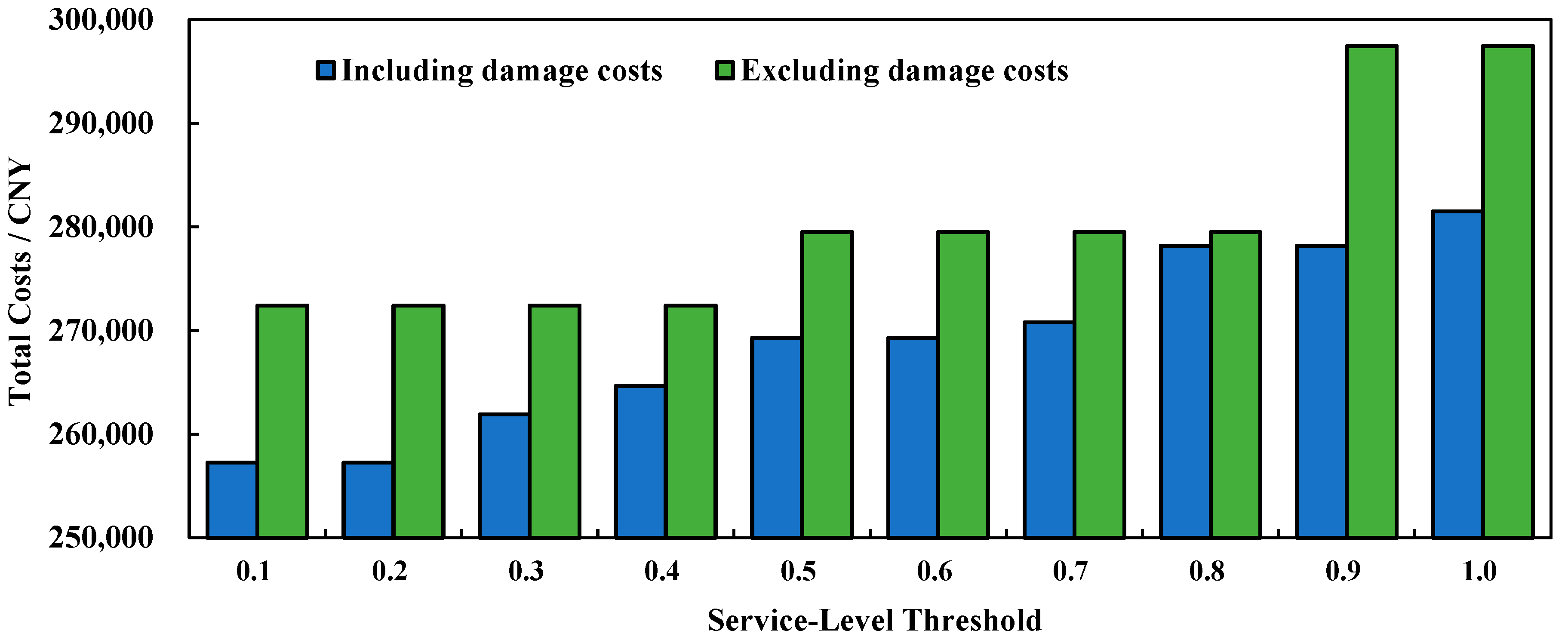
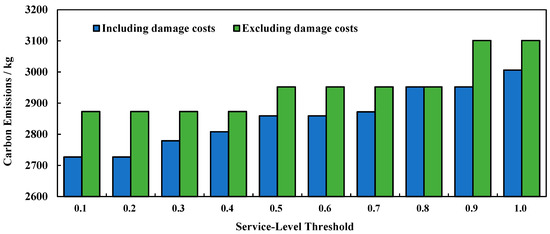
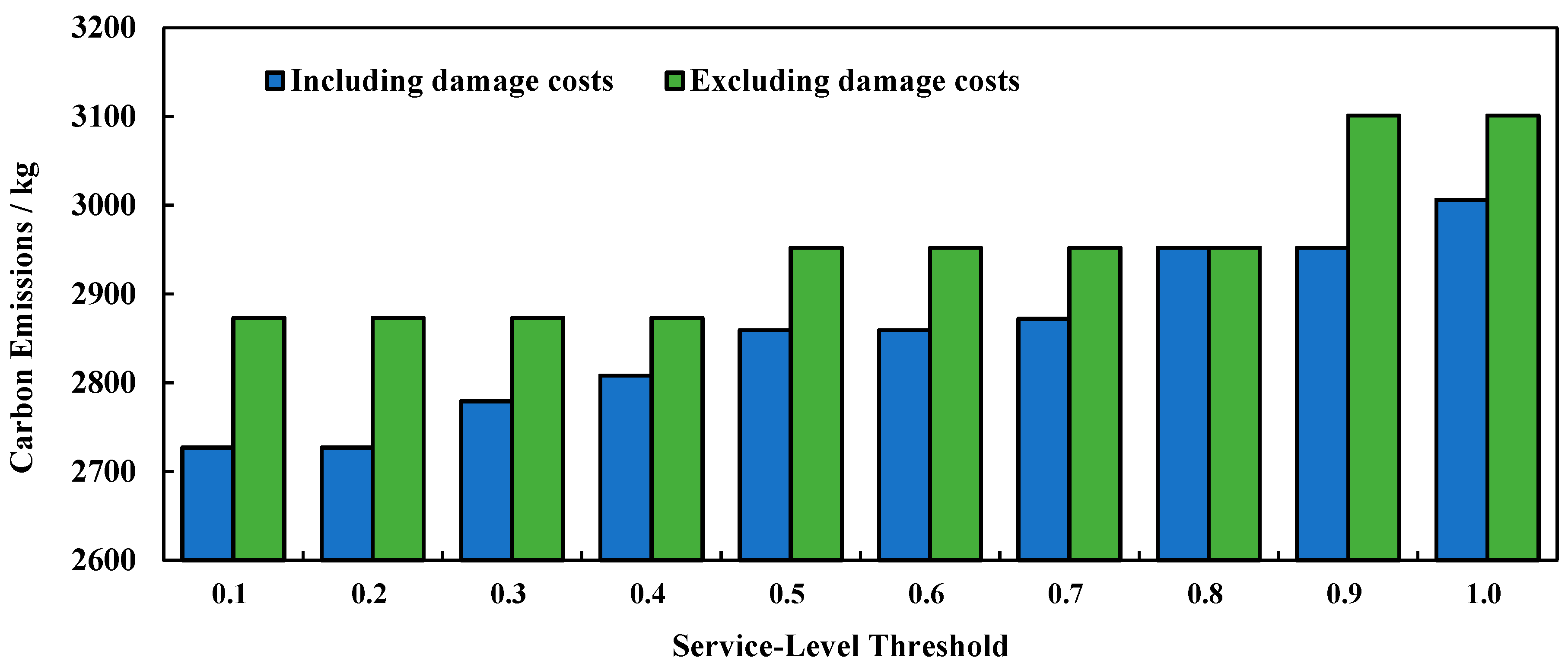
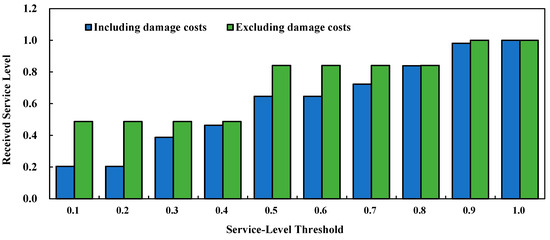
In the following, the total costs, carbon emissions and received service levels of the planned intermodal routes are presented across different service-level thresholds, as illustrated in Figure 5, Figure 6 and Figure 7. It should be noted that the total costs of the planned intermodal route without damage costs are the result of the sum of transportation, carbon tax and actual damage costs.
Figure 5.
Total costs of the planned intermodal routes with and without damage costs.
Figure 6.
Carbon emissions for the planned intermodal routes with and without damage costs.
Figure 7.
Received service levels for the planned intermodal routes with and without damage costs.
According to Figure 5 and Figure 6, including damage costs reduces the total costs and the carbon emissions by an average of 4.1% and 3.3%, respectively, across different service-level thresholds. Therefore, such a formulation leads not only to maintained cargo integrity but also to both economic and environmental benefits. However, Figure 7 shows that including the damage costs lowers the service level received by the customer within the threshold of [0.1, 0.9]. For time-insensitive cargoes, although neglecting the damage costs improves the service level, the total cost of transportation increases, which can be seen in Figure 5. For the transportation of time-insensitive cargoes, more attention should be paid to the economics of transportation than the improvement in service level. Furthermore, for time-sensitive cargoes, when the damage costs are included, a slight decrease in service level can result in a significant reduction in the total costs. Consequently, it is still necessary to include the damage costs regardless of the cargo’s time sensitivity.
Above all, the effects of damage costs on problem optimization are three-fold: they preserve cargo integrity, lower total costs and reduce carbon emissions. These findings supplement those of Huang et al. [25] and Ge and Sun [29]. For customers, especially those transporting high-value, fragile or perishable cargoes, incorporating damage costs into the optimization has more effects than simply reducing direct economic losses. The customer should appropriately consider cargo damage in transportation decision making, rather than simply focusing on transportation costs, as this enables a comprehensive improvement in cargo integrity and environmental performance, alongside economic benefits.
From the perspective of the transportation service provider, assessments of damage costs should be embedded into intermodal route planning. Only considering direct transportation and transfer costs, while ignoring potential cargo damage costs, may generate seemingly low-cost routes, but these are accompanied by hidden damage risks. The service provider should introduce these assessments to screen out routes with high damage risks. This will help to decrease post-transportation cargo claims, improve cargo transportation quality, and enhance overall customer satisfaction levels.
To sum up, consideration of damage costs is practically feasible and valuable for intermodal route planning under fuzzy time windows, bringing multi-dimensional benefits for practical transportation organization.
4.3.3. Feasibility of Carbon Tax Policy
To reveal the feasibility of incorporating the carbon tax policy into intermodal route planning under fuzzy time windows considering damage costs, referring to Huang et al. [25], the carbon emissions of the planned intermodal routes with and without the carbon tax policy, and the planned minimum-emission intermodal routes that are generated following adopting Equation (14) as the objective, are compared.
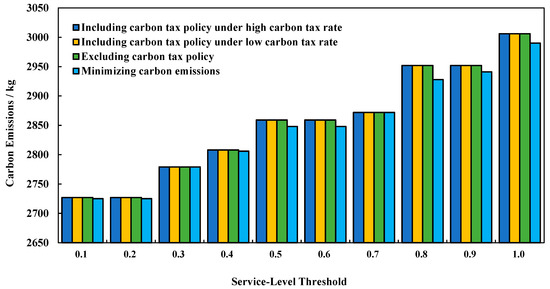
In this analysis, three types of cargo are considered: low-value cargoes ( = 1000 CNY/TEU), medium-value cargoes ( = 10,000 CNY/TEU) and high-value cargoes ( = 10,000 CNY/TEU). Furthermore, two carbon tax rates are considered: a low carbon tax rate of 0.22 CNY/kg and a high carbon tax rate of 2.20 CNY/kg. Figure 8 illustrates the results of the comparison for high-value cargo.
Figure 8.
Carbon emissions of the planned intermodal routes for high-value cargoes with and without the carbon tax policy and of the planned minimum-emission intermodal routes.
Table 2 and Table 3 show the results of the comparison for the transportation of medium- and low-value cargoes.
Table 2.
Carbon emissions of the planned intermodal routes for medium-value cargoes with and without the carbon tax policy and of the planned minimum-emission intermodal routes.
Table 3.
Carbon emissions of the planned intermodal routes for low-value cargoes with and without the carbon tax policy and of the planned minimum-emission intermodal routes.
Figure 8 indicates that including the carbon tax policy does not reduce carbon emissions across all the service-level thresholds when considering the intermodal transportation of high-value cargo, regardless of the tax rate value, since the carbon emissions are equal to those determined when excluding the policy.
However, as indicated in Table 2 and Table 3, for medium- and low-value cargoes, including the carbon tax policy, considering a high carbon tax rate can achieve significant reductions in carbon emissions across all the service-level thresholds compared to the situation in which carbon emissions are minimized. In contrast, the low carbon tax rate is only effective in a few cases (i.e., = 0.1, 0.2 and 0.8 for medium-value cargoes and = 0.9 for low-value cargoes).
These results suggest that the effectiveness of the carbon tax policy is conditional on the relative balance cost between cargo damage and carbon emissions, rather than holding universally in all intermodal transportation contexts.
4.4. Ablation Experiment
An ablation experiment was conducted to identify which module is effective in reducing carbon emissions for high-value cargo transportation, as well as the conditions under which the carbon tax policy can achieve reductions in carbon emissions for the intermodal transportation of high-value cargo. The results of the ablation experiment are listed in Table 4.
Table 4.
Carbon emissions of the planned intermodal routes for high-value cargoes under different modeling settings.
As shown in Table 4, when damage costs are incorporated into the objective function for high-value cargo transportation, neither high nor low carbon tax rates can lead to additional reductions in carbon emissions; carbon emissions remain identical regardless of the implementation of the carbon tax policy. This indicates that damage costs act as the dominant driver of carbon emission reductions within the proposed model framework.
However, removing damage costs from the objective function is not a sufficient condition to ensure the effectiveness of the carbon tax policy. When damage costs are excluded, only the high carbon tax rate yields evident reductions in carbon emissions. Under the low carbon tax rate, carbon emissions remain unchanged compared to the scenario without the carbon tax policy, even when damage costs are excluded. This further demonstrates that the carbon tax policy can only effectively reduce carbon emissions when both damage costs are excluded from the objective and the carbon tax rate is sufficiently high.
For transportation service providers serving customers with high-value cargoes, considering damage costs is an effective approach not only for ensuring cargo integrity but also for reducing carbon emissions. Exploiting this coupling mechanism is a win–win scenario for practitioners regarding cargo integrity and environmental sustainability and does not require additional dedicated carbon-oriented investments.
Policy regulators should recognize the conditional effectiveness of the carbon tax policy regarding its integration into the model. The performance of the carbon tax policy depends on the following factors, namely (i) the cargo value and inclusion of damage costs in the objective and (ii) the absolute magnitude of the carbon tax. For intermodal transportation of high-value cargoes, simply implementing the carbon tax policy—even at a relatively high carbon tax rate—does not generate extra emission reduction benefits. Supplementary policy instruments incentivizing damage reduction are therefore preferable for such scenarios.
5. Conclusions
5.1. Summary
In this study, a green intermodal route-planning problem considering delivery time sensitivity and cargo integrity, into which fuzzy time windows, damage costs and the carbon tax policy are comprehensively integrated, was investigated. A linear route-planning model was constructed to minimize the total costs of intermodal transportation and also ensure a space- and operation-feasible intermodal route that satisfies the customer’s punctuality requirements.
Numerical experiments were first carried out to reveal the trade-off between the punctuality and cost of intermodal transportation. Further verification of the numerical experiment feasibility indicated that using the fuzzy time window leads to a flexible and fine-grained intermodal route design based on delivery time sensitivity, and the damage costs have a triple effect on problem optimization regarding cargo integrity, economic benefits and environmental sustainability.
However, this study demonstrates that incorporating the carbon tax policy does not lead to additional reductions in carbon emissions during the transportation of high-value cargoes considering a fuzzy time window and damage costs. A further ablation experiment demonstrated that, in this case, the damage costs serve as the dominant driver of carbon emission reductions in the proposed model, and the carbon tax policy only has an emission-reduction function after excluding damage costs from the objective function.
The model proposed in this paper is generalizable and is not restricted to the Chinese market. In the numerical experiments, China-specific cost-, time-, speed-, damage- and emission-related parameters were used for illustration purposes. When applying the proposed model to European, North American or other intermodal transportation markets, researchers can replace these region-dependent parameters to reflect local regulatory and market conditions, while keeping the model structure and solution logic unchanged.
5.2. Main Contributions
This study makes three major contributions to the literature on intermodal route planning, as follows:
(1) A fuzzy time window, damage costs and the carbon tax policy are integrated into a unified intermodal route-planning framework. A solvable linear route-planning model is established to jointly optimize the economics, cargo integrity, punctuality and environmental sustainability of intermodal transportation.
(2) Systematic feasibility verification is performed through a comparative experiment to verify the practical advantages of the fuzzy time window over the soft time window. The triple effect of damage costs is further quantified, and the effectiveness of the carbon tax policy under varying customer service-level requirements is tested.
(3) The ablation experiment identifies that incorporating damage costs indirectly promotes carbon emission reductions in the intermodal transportation of high-value cargo and confirms that damage costs should be removed from the objective function to ensure an effective carbon tax policy.
5.3. Practical Insights
For the customer, transportation decision making based purely on cost is insufficient. The customer should quantify timeliness requirements in an explicit service-level threshold with a fuzzy time window, instead of providing ambiguous time requirements. Moreover, damage costs should be incorporated into transportation evaluation. Optimizing for lower cargo damage can simultaneously improve cargo integrity, control budget and reduce carbon emissions without extra low-carbon investment.
For the transportation service provider, customized transportation services should be developed for diverse transportation requests. They can communicate with the customer in advance to decide on a reasonable service-level threshold and adopt the proposed model to generate tailored intermodal routes. They should also avoid an over-reliance on carbon tax as the only low-carbon method, and when cargo integrity requirements are prominent, they can take advantage of the low-carbon effects achieved by lowering damage costs.
The policy regulator should recognize that the carbon tax policy exhibits conditional effectiveness, depending on the relative magnitude of damage costs and carbon taxes. For intermodal transportation of high-value cargo, simply implementing a carbon tax policy does not achieve additional reductions in carbon emissions when damage costs are considered during optimization, even under a high carbon tax rate. Under such circumstances, supplementary policy instruments that incentivize damage reduction are recommended, since reducing damage costs can simultaneously achieve carbon emission reductions. For medium- and low-value cargoes, the carbon tax policy has its intended emission-reduction effect only when a sufficiently high carbon tax rate is adopted.
5.4. Limitations and Future Work
Although the proposed model provides an effective optimization framework for intermodal transportation routing considering carbon tax policy, delivery time sensitivity and cargo integrity requirements, this study still has several limitations, and some simplifications were made that should be acknowledged.
(1) All numerical experiments were implemented on a benchmark network widely adopted in Chinese scenarios. The applicability of the proposed model for European or North American cases remains to be verified. Significant differences in network parameters, transportation pricing mechanisms and carbon tax policies might influence the conclusions drawn in this paper. The generalizability of the proposed model thus needs further verification.
(2) The proposed model incorporates a fixed transfer time at transfer nodes, which is included in the calculation of total transportation time. However, the schedules of transportation modes and associated hub waiting times are not explicitly modeled. In the proposed model, it is assumed that the transfer operation can be carried out immediately when the cargoes arrive at the nodes, without pre-handling or waiting for scheduled transportation modes. This simplification makes the optimized transportation time slightly idealized.
(3) In this paper, the routing problem is formulated in a deterministic environment, where it is assumed that all the parameters—including network parameters, cargo volumes and carbon tax rates—are fixed and known in advance. However, in practical operations, these parameters often exhibit uncertainty: the cargo volume varies with market demand, carbon tax rates may be adjusted by policymakers, and network parameters are influenced by traffic conditions, weather and other factors.
Future research can extend this paper in three directions, corresponding to the above limitations, as follows:
(1) Additional numerical experiments based on real-world intermodal networks in China, Europe and North America can be conducted. By introducing region-specific network parameters, transportation pricing rules and carbon tax policies, the cross-regional generalizability of the proposed model can be further examined.
(2) Future work can integrate hub waiting times and schedule constraints of transportation modes into the optimization so that the model better reflects real-world hub operations. The influence of the schedules on the route planning for intermodal transportation can be revealed by comparison with the results of the model proposed in this paper.
(3) Fuzzy optimization [9], stochastic programming [41] or robust optimization [42] can be adopted to handle the uncertainties of network parameters, cargo volumes and carbon tax rates. This extension could help generate more robust routes that can be adapted to the dynamic market demand, policy adjustments and the real-time operational conditions of intermodal networks.
Author Contributions
Conceptualization, Y.G. and Y.S.; methodology, Y.G. and Y.S.; software, Y.G. and Y.S.; validation, Y.G. and Y.S.; formal analysis, Y.G. and Y.S.; investigation, Y.G. and Y.S.; resources, Y.S.; data curation, Y.S.; writing—original draft preparation, Y.G. and Y.S.; writing—review and editing, Y.S.; visualization, Y.S.; supervision, Y.S.; funding acquisition, Y.S. All authors have read and agreed to the published version of the manuscript.
Funding
This research was funded by the Shandong Provincial Natural Science Foundation of China under Grant No. ZR2023MG020.
Data Availability Statement
All data generated or analyzed during this study are included in this paper.
Conflicts of Interest
The authors declare no conflicts of interest.
References
- Tong, H.; Peng, J.; Zhang, Y.; Fang, T.; Zhang, J.; Men, Z.; Liu, Y.; Wu, L.; Wang, T.; Ren, F. Environmental benefit analysis of “road-to-rail” policy in China based on a railway tunnel measurement. J. Clean. Prod. 2021, 316, 128227. [Google Scholar] [CrossRef] [Scilit]
- Göçmen, E.; Erol, R. The problem of sustainable intermodal transportation: A case study of an international logistics company, Turkey. Sustainability 2018, 10, 4268. [Google Scholar] [CrossRef] [Scilit]
- The State Council of the People’s Republic of China. China’s Intermodal Transportation Maintains over 25 pct Annual Growth. Available online: https://english.www.gov.cn/archive/statistics/202410/11/content_WS67090ec4c6d0868f4e8ebb74.html (accessed on 11 October 2024).
- Zhang, W.; Yi, K.; Huang, Z.; Chen, J.; Wu, X.; Wu, J. Multimodal transport path planning for new international land-sea trade corridor of China based on deep reinforcement learning. J. Transp. Geogr. 2026, 132, 104587. [Google Scholar] [CrossRef] [Scilit]
- Du, J.; Ku, Y. Deep reinforcement learning for intermodal transport optimization considering uncertainty. Transp. Lett. 2026, 18, 1251–1269. [Google Scholar] [CrossRef] [Scilit]
- Karam, A.; Jensen, A.J.K.; Hussein, M. Analysis of the barriers to multimodal freight transport and their mitigation strategies. Eur. Transp. Res. Rev. 2023, 15, 43. [Google Scholar] [CrossRef] [Scilit]
- Caris, A.; Macharis, C.; Janssens, G.K. Decision support in intermodal transport: A new research agenda. Comput. Ind. 2013, 64, 105–112. [Google Scholar] [CrossRef] [Scilit]
- Mandouri, J.; Taha, A.F.; Baroud, H.; Philip, C.; Johnson, P.; Mahmassani, H.; Durango-Cohen, P. An intermodal freight optimization and routing model: Balancing cost, emissions, and time in multimodal network design. Transp. Res. Part C Emerg. Technol. 2026, 192, 105907. [Google Scholar] [CrossRef] [Scilit]
- Sun, Y.; Yu, N.; Huang, B. Green road–rail intermodal routing problem with improved pickup and delivery services integrating truck departure time planning under uncertainty: An interactive fuzzy programming approach. Complex Intell. Syst. 2022, 8, 1459–1486. [Google Scholar] [CrossRef] [Scilit]
- Yang, J.; Liang, D.; Zhang, Z.; Wang, H.; Bin, H. Path optimization of container multimodal transportation considering differences in cargo time sensitivity. Transp. Res. Rec. J. Transp. Res. Board 2024, 2678, 1279–1292. [Google Scholar] [CrossRef] [Scilit]
- Fazayeli, S.; Eydi, A.; Kamalabadi, I.N. Location routing problem in multimodal transportation network with time windows and fuzzy demands: Presenting a two-part genetic algorithm. Comput. Ind. Eng. 2018, 119, 233–246. [Google Scholar] [CrossRef] [Scilit]
- Li, L.; Zhang, Q.; Zhang, T.; Zou, Y.; Zhao, X. Optimum route and transport mode selection of multimodal transport with time window under uncertain conditions. Mathematics 2023, 11, 3244. [Google Scholar] [CrossRef] [Scilit]
- Xiao, H.; Gong, H.; Wang, X.; Hang, B. Routes choice in the international intermodal transportation networks under the soft time window. Wirel. Commun. Mob. Comput. 2022, 2022, 3355883. [Google Scholar] [CrossRef] [Scilit]
- Escudero-Santana, A.; Muñuzuri, J.; Cortés, P.; Onieva, L. The one container drayage problem with soft time windows. Res. Transp. Econ. 2021, 90, 100884. [Google Scholar] [CrossRef] [Scilit]
- Taş, D.; Dellaert, N.; van Woensel, T.; de Kok, T. The time-dependent vehicle routing problem with soft time windows and stochastic travel times. Transp. Res. Part C Emerg. Technol. 2014, 48, 66–83. [Google Scholar] [CrossRef] [Scilit]
- Reis, M.J.C.S. An adaptive hybrid metaheuristic for solving the vehicle routing problem with time windows under uncertainty. Comput. Mater. Contin. 2025, 85, 3023–3039. [Google Scholar] [CrossRef] [Scilit]
- Belhaiza, S.; Laporte, G. A data-driven heuristic for the dynamic vehicle routing problem with multiple soft time windows. Comput. Oper. Res. 2026, 187, 107341. [Google Scholar] [CrossRef] [Scilit]
- Zhang, K.; He, F.; Zhang, Z.; Lin, X.; Li, M. Multi-vehicle routing problems with soft time windows: A multi-agent reinforcement learning approach. Transp. Res. Part C Emerg. Technol. 2020, 121, 102861. [Google Scholar] [CrossRef] [Scilit]
- Taş, D.; Jabali, O.; van Woensel, T. A vehicle routing problem with flexible time windows. Comput. Oper. Res. 2014, 52, 39–54. [Google Scholar] [CrossRef] [Scilit]
- Tang, J.; Pan, Z.; Fung, R.Y.K.; Lau, H. Vehicle routing problem with fuzzy time windows. Fuzzy Sets Syst. 2009, 160, 683–695. [Google Scholar] [CrossRef] [Scilit]
- Zhang, M.; Han, X. Low-carbon multimodal transportation path optimization based on multi objective fuzzy chance-constrained programming. J. Comput. Appl. 2023, 43, 636–644. [Google Scholar]
- Xu, W.; Fu, B.; Jeong, W. Optimization of railway multimodal transport routes with fuzzy time window under uncertain demand. J. Eng. Sci. Technol. Rev. 2025, 18, 118–125. [Google Scholar] [CrossRef] [Scilit]
- Kovalenko, A.; Mathisen, T.A.; Pruyn, J. Generalized transport costs in intermodal shipping: The context of the Northeast Passage. J. Shipp. Trade 2024, 9, 25. [Google Scholar] [CrossRef] [Scilit]
- Pang, X. Research on optimizing transportation along the Belt and Road under multi-modal transportation model. Front. Soc. Sci. Technol. 2025, 7, 39–44. [Google Scholar] [CrossRef] [Scilit]
- Huang, Y.; Sun, Y.; Zhang, C. Intermodal routing problem for high-value goods under capacity information uncertainty and carbon tax policy: A fuzzy chance-constrained programming with necessity measure. Int. J. Fuzzy Syst. Appl. 2025, 14, 1–18. [Google Scholar]
- Hu, G.; Zhang, S.; Ding, F.; Cheng, Y.C. Optimization of multimodal transportation routes for refrigerated goods under uncertain demand. Sustainability 2026, 18, 2230. [Google Scholar] [CrossRef] [Scilit]
- Chen, W.; Gong, H.; Fang, X. Multimodal transportation route optimization considering transportation carbon tax and quality commitment. J. Railw. Sci. Eng. 2022, 19, 34–41. [Google Scholar]
- Maiyar, L.M.; Thakkar, J. Environmentally conscious logistics planning for food grain industry considering wastages employing multi-objective hybrid particle swarm optimization. Transp. Res. Part E Logist. Transp. Rev. 2019, 127, 220–248. [Google Scholar] [CrossRef] [Scilit]
- Ge, Y.; Sun, Y. Modeling an on-time and reliable intermodal routing problem for time-sensitive cargoes considering cargo damage and uncertain demand. Appl. Syst. Innov. 2026, 9, 192. [Google Scholar] [CrossRef] [Scilit]
- Köppl, A.; Schratzenstaller, M. Carbon taxation: A review of the empirical literature. J. Econ. Surv. 2022, 37, 1353–1388. [Google Scholar] [CrossRef] [Scilit]
- Demir, E.; Burgholzer, W.; Hrušovský, M.; Arıkan, E.; Jammernegg, W.; Van Woensel, T. A green intermodal service network design problem with travel time uncertainty. Transp. Res. Part B Methodol. 2016, 93, 789–807. [Google Scholar] [CrossRef] [Scilit]
- Ma, C.; Kang, W.; Zhou, M.; Liu, Y.; Feng, J.; Wang, X. Study on optimization of multimodal transportation path of Jiamusi grain considering cargo loss under low carbon policy. Sci. Rep. 2026, 16, 5366. [Google Scholar] [CrossRef] [Scilit] [PubMed]
- Zhang, X.; Chen, H.; Zhang, H.; Yuan, X. Dual objective multimodal transportation path optimization based on different carbon tax mechanisms under uncertain demand. J. Highw. Transp. Res. Dev. 2025, 19, 52–60. [Google Scholar] [CrossRef] [Scilit]
- Duan, X.; Heragu, S. Carbon emission tax policy in an intermodal transportation network. In Proceedings of the 2015 Industrial and Systems Engineering Research Conference, Nashville, TN, USA, 30 May–2 June 2015; pp. 566–574. [Google Scholar]
- Cheng, X.Q.; Jin, C.; Wang, C.; Mamatok, Y. Impacts of different low-carbon policies on route decisions in intermodal freight transportation: The case of the west river region in China. In Proceedings of the International Forum on Shipping, Ports and Airports (IFSPA); Hong Kong Polytechnic University: Hong Kong, China, 2019. [Google Scholar]
- Huang, Y.; Sun, Y.; Zhang, C. Modeling a green intermodal routing problem with soft time window considering interval fuzzy demand. Appl. Sci. 2025, 15, 12839. [Google Scholar] [CrossRef] [Scilit]
- Teimouri, S.; Zare, H.K.; Saber, M.; Nezhad, F. Location-routing problem with fuzzy time windows and traffic time. Int. J. Supply Oper. Manag. 2014, 1, 38–53. [Google Scholar] [CrossRef] [Scilit] [PubMed]
- López-Castro, L.F.; Montoya-Torres, J.R. Vehicle routing with fuzzy time windows using a genetic algorithm. In Proceedings of the 2011 IEEE Workshop on Computational Intelligence in Production and Logistics Systems (CIPLS); IEEE: New York, NY, USA, 2011; pp. 1–6. [Google Scholar]
- Sun, Y.; Lang, M. Bi-objective optimization for multi-modal transportation routing planning problem based on Pareto optimality. J. Ind. Eng. Manag. 2015, 8, 1195–1217. [Google Scholar] [CrossRef] [Scilit]
- Zhu, M.; Chen, M.; Kristal, M. Modelling the impacts of uncertain carbon tax policy on maritime fleet mix strategy and carbon mitigation. Transport 2018, 33, 707–717. [Google Scholar] [CrossRef] [Scilit]
- Uddin, M.; Huynh, N. Reliable routing of road-rail intermodal freight under uncertainty. Netw. Spat. Econ. 2019, 19, 929–952. [Google Scholar] [CrossRef] [Scilit]
- Pishvaee, M.S.; Razmi, J.; Torabi, S.A. Robust possibilistic programming for socially responsible supply chain network design: A new approach. Fuzzy Sets Syst. 2012, 206, 1–20. [Google Scholar] [CrossRef] [Scilit]

Disclaimer/Publisher’s Note: The statements, opinions and data contained in all publications are solely those of the individual author(s) and contributor(s) and not of MDPI and/or the editor(s). MDPI and/or the editor(s) disclaim responsibility for any injury to people or property resulting from any ideas, methods, instructions or products referred to in the content. |
© 2026 by the authors. Published by MDPI on behalf of the International Institute of Knowledge Innovation and Invention. Licensee MDPI, Basel, Switzerland. This article is an open access article distributed under the terms and conditions of the Creative Commons Attribution (CC BY) license.