


You are currently viewing a new version of our website. To view the old version click .

Quaternary, Volume 1, Issue 2

September 2018 - 10 articles

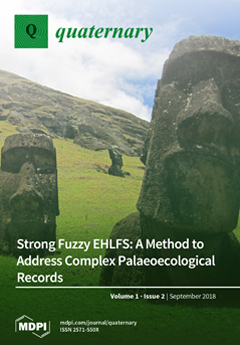
Cover Story: Quaternary records usually involve complex environmental–landscape–human relationships, but they are often interpreted using too simple deterministic approaches. The strong fuzzy EHLFS (Environmental–Human–Landscape Feedbacks and Synergies) approach combines the multiple-working-hypotheses framework with falsification and strong inference in order to interpret multidisciplinary palaeoecological evidence in terms of interrelated environmental, ecological, and cultural processes. Late Holocene socio-ecological changes on Easter Island, traditionally attributed to anthropogenic causes, acquire a new dimension under the strong fuzzy EHLFS approach. View Paper here.
  • Issues are regarded as officially published after their release is announced to the table of contents alert mailing list .
  • You may sign up for email alerts to receive table of contents of newly released issues.
  • PDF is the official format for papers published in both, html and pdf forms. To view the papers in pdf format, click on the "PDF Full-text" link, and use the free Adobe Reader to open them.

Articles (10)

  • Article
  • Open Access
18 Citations
8,589 Views
32 Pages

11 September 2018

The article attests the presence of the genus Rucervus in the paleontological record of Europe and presents the description of new species of large-sized deer Rucervus radulescui sp. nov. from the Early Pleistocene of Valea Grăunceanului (Southern Ro...

  • Feature Paper
  • Article
  • Open Access
19 Citations
7,195 Views
28 Pages

Episodic Sedimentary Evolution of an Alluvial Fan (Huangshui Catchment, NE Tibetan Plateau)

  • Linman Gao,
  • Xianyan Wang,
  • Shuangwen Yi,
  • Jef Vandenberghe,
  • Martin R. Gibling and
  • Huayu Lu

3 September 2018

Alluvial-fan successions record changes in hydrological processes and environments that may reflect tectonic activity, climate conditions and changes, intrinsic geomorphic changes, or combinations of these factors. Here, we focus on the evolution of...

  • Feature Paper
  • Article
  • Open Access
22 Citations
7,237 Views
22 Pages

Anatomy, Age and Origin of an Intramontane Top Basin Surface (Sorbas Basin, Betic Cordillera, SE Spain)

  • Martin Stokes,
  • Anne Mather,
  • Angel Rodes,
  • Samantha Kearsey and
  • Shaun Lewin

24 August 2018

Collisional mountain belts commonly develop intramontane basins from mechanical and isostatic subsidence during orogenic development. These frequently display a relict top surface, evidencing a change interval from basin infilling to erosion often vi...

  • Feature Paper
  • Article
  • Open Access
22 Citations
4,994 Views
23 Pages

Specifying the External Impact on Fluvial Lowland Evolution: The Last Glacial Tisza (Tisa) Catchment in Hungary and Serbia

  • Jef Vandenberghe,
  • Cornelis (Kees) Kasse,
  • Dragan Popov,
  • Slobodan B. Markovic,
  • Dimitri Vandenberghe,
  • Sjoerd Bohncke and
  • Gyula Gabris

16 August 2018

External impact on the development of fluvial systems is generally exerted by changes in sea level, climate and tectonic movements. In this study, it is shown that a regional to local differentiation of fluvial response may be caused by semi-direct e...

  • Article
  • Open Access
14 Citations
5,132 Views
16 Pages

The Paradise Lost of Milia (Grevena, Greece; Late Pliocene, Early Villafranchian, MN15/MN16a): Faunal Composition and Diversity

  • Evangelos Vlachos,
  • Evangelia Tsoukala,
  • Evelyne Crégut-Bonnoure,
  • Claude Guérin and
  • Dick Mol

9 August 2018

(1) Background: Over the last decades, important fossil records of Late Pliocene mammals and reptiles have been unearthed in Milia, Grevena (N Greece). This assemblage shows a remarkable composition and diversity, including the partial skeletons of m...

  • Feature Paper
  • Article
  • Open Access
28 Citations
7,185 Views
24 Pages

7 August 2018

Recently collected fossil material in the Villafranchian locality of Sésklo, as well as a re-evaluation of a pre-existing, partly-published museum collection, allow the recognition of a lower faunal level in the locality, older than the main Equus-do...

  • Feature Paper
  • Article
  • Open Access
2 Citations
5,889 Views
15 Pages

1 August 2018

Eight anatomically and taxonomically different finds are presented in this paper, and they belong to four taxa: woolly mammoth (Mammuthus primigenius), giant deer (Megaloceros giganteus), red deer (Cervus elaphus), and dog (Canis familiaris). All spe...

  • Feature Paper
  • Commentary
  • Open Access
15 Citations
4,040 Views
17 Pages

31 July 2018

Although the interpretation of Quaternary records of interrelated environmental–ecological–human processes is necessarily complex, it is often addressed using too-simple deterministic approaches. This paper suggests a holistic framework c...

  • Feature Paper
  • Article
  • Open Access
20 Citations
7,200 Views
21 Pages

Small mammal remains obtained from the European localities dated to the Eemian (Mikulino) age have been analyzed for the first time at a regional scale based on the present biogeographical regionalization of Europe. The regional faunas dated to the w...

Get Alerted

Add your email address to receive forthcoming issues of this journal.

XFacebookLinkedIn
Quaternary - ISSN 2571-550X