Skip Content
You are currently on the new version of our website. Access the old version .

Colloids and Interfaces

Colloids and Interfaces is an international, peer-reviewed, open access journal on colloids and interfaces chemistry published bimonthly online by MDPI.

All Articles (593)

In this preliminary study, chitosan-based molecularly imprinted polymers crosslinked with glutaraldehyde were synthesized and evaluated for the selective removal of m-cresol, a volatile phenol associated with the sensory defect known as smoke taint in wine. Three formulations of chitosan-based molecularly imprinted polymers (MIP-Gs) were synthesized using glutaraldehyde as a crosslinker and m-cresol as a template. Non-imprinted polymers (NIP-Gs) served as controls. The polymers were characterized by Fourier-transform infrared spectroscopy, thermogravimetric analysis, and scanning electron microscopy, which confirmed successful crosslinking and structural differences between MIPs and NIPs. Adsorption performance was evaluated using solid-phase extraction cartridges packed with the synthesized polymers, employing a Cabernet Sauvignon wine. The MIPs exhibited higher adsorption efficiency and selectivity toward m-cresol compared to NIPs, achieving removal rates of 15% to 40%, depending on polymer formulation and analyte concentration. Molecular dynamics simulations were used to investigate polymer–analyte interactions at the molecular level, providing mechanistic insight into the preferential binding of m-cresol within the imprinted cavities. Physicochemical analyses of red wine showed that m-cresol removal occurred with minimal impact on key phenolic parameters, supporting the functional selectivity of MIPs. These results demonstrate that chitosan-based MIPs constitute a promising class of materials for selective adsorption applications in complex liquid systems.

6 February 2026
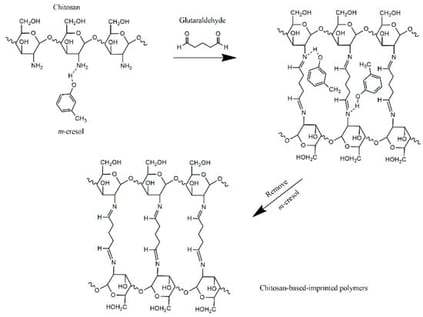
Schematic illustration of the steps for the synthesis of chitosan-based imprinted polymers.

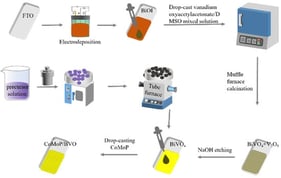
Herein, a cobalt–molybdenum bimetallic oxide precursor was synthesized via a hydrothermal route, followed by a phosphidation strategy in a tube furnace to produce a CoMoP cocatalyst. Subsequently, a CoMoP/BiVO4 composite photoanode was successfully constructed by loading the CoMoP cocatalyst onto the surface of an electrodeposited BiVO4 film using a drop-casting method. A suite of analytical tools such as TEM, XRD, and XPS was utilized to comprehensively examine the material morphology and crystalline features, verifying that CoMoP was effectively anchored on the BiVO4 surface with intimate interfacial contact. Photoelectrochemical (PEC) performance testing indicated that the composite photoanode achieved optimal performance with a 200 µL loading of the CoMoP dispersion (2 mg/mL). Under front-side illumination, the photocurrent density of the CoMoP/BiVO4 composite photoelectrode reached a photocurrent density of 2.8 mA/cm2 at 1.23 V (vs. RHE), which is approximately 3.1 times higher than that of unmodified BiVO4 (0.9 mA/cm2). Under back-side illumination, the composite photoanode generated 3.5 mA/cm2, representing a 2.3-fold improvement over the 1.5 mA/cm2 recorded for bare BiVO4. The bandgap energy of BiVO4 was determined to be approximately 2.44 eV based on UV–vis absorption spectra and the corresponding Tauc plot. Owing to its metallic nature, CoMoP exhibits strong broadband absorption in the visible-light region and does not display an intrinsic semiconductor bandgap behavior. Combined with photoluminescence (PL) spectroscopy and PEC results, it was demonstrated that the CoMoP loading effectively promoted interfacial charge separation and transport while accelerating water oxidation kinetics. These results demonstrate that the CoMoP/BiVO4 system serves as an advanced semiconductor material with excellent performance for photoelectrocatalytic water splitting.

6 February 2026

Schematic illustration of the synthesis procedure for pristine BiVO4 and CoMoP/BiVO4 electrodes.

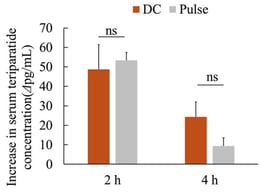
This study aimed to evaluate the feasibility and safety of pulsed-current iontophoresis (IP) for the transdermal delivery of teriparatide, a therapeutic peptide for osteoporosis. Female rats were subjected to in vivo iontophoretic administration under constant or pulsed-current conditions. Serum teriparatide concentrations, skin irritation scores, and transepidermal water loss (TEWL) were assessed. After 2 h of IP, serum teriparatide concentrations reached 53.3 ± 4.0 pg/mL with pulsed current and 48.8 ± 12.6 pg/mL with constant current, confirming successful transdermal absorption of teriparatide (≈4 kDa) into systemic circulation. Skin irritation was significantly reduced under pulsed-current conditions, as indicated by lower erythema, edema, and TEWL values, despite identical total current exposure. These results suggest that intermittent current application during pulsed-current IP alleviates local electrical stress through partial depolarization and may provide a delivery efficiency comparable to that of constant direct current IP while improving tolerability. Overall, pulsed-current IP enables noninvasive and effective systemic delivery of peptide drugs with minimized skin irritation, representing a promising alternative to injection-based administration for macromolecular therapeutics.

29 January 2026

Changes in serum teriparatide concentration (Δpg/mL) up to 4 h after the start of iontophoretic administration. Data are expressed as mean ± standard error of the mean (SEM) (n = 6, 0.6 mA constant direct current (DC); n = 4, 1.2 mA pulsed current). The Mann–Whitney U test, ns, not significant.

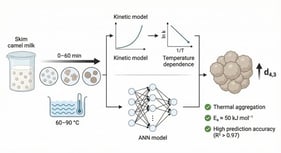
This study investigated heat-induced protein aggregation in skim camel milk by monitoring changes in the volume-weighted mean particle size (d4,3) during isothermal heating (60–90 °C, up to 60 min, four temperature levels and 25 time–temperature conditions). Pronounced increases in d4,3 with both time and temperature confirmed significant thermal aggregation. The reaction kinetics were described using a generalized exponential growth model, which fitted well at intermediate temperatures (e.g., coefficient of determination (R2) = 0.901 at 70 °C and 0.959 at 80 °C) but deviated at the lower (60 °C) and upper (90 °C) extremes, reflecting more complex behavior. Arrhenius analysis of the rate constant yielded an activation energy of 50.61 kJ mol−1, lower than values typically reported for bovine milk systems, indicating that camel milk proteins require less thermal input to aggregate. In parallel, a machine learning model implemented as an artificial neural network (ANN) predicted d4,3 from time-temperature inputs with high accuracy (R2 > 0.97 across training, validation, and testing), capturing nonlinear patterns without mechanistic assumptions. Together, the kinetic and ANN approaches provide complementary insights into the heat sensitivity of camel milk proteins and offer predictive tools to support the optimization of thermal processing, formulation, and quality control in dairy applications.

28 January 2026

The particle size distributions of skim camel milk during isothermal heating at 60, 70, 80, and 90 °C at different time intervals.

News & Conferences

Issues

Open for Submission

Editor's Choice

Reprints of Collections

Advances in Functional Thin Films
Reprint

Advances in Functional Thin Films

Editors: Ricardo Lopez Anton, Jose Maria De Teresa, Sion Federico Olive Méndez
Recent Advances in Emulsions and Applications
Reprint

Recent Advances in Emulsions and Applications

Editors: César Burgos-Díaz, Mauricio Opazo-Navarrete, Eduardo Morales

Get Alerted

Add your email address to receive forthcoming issues of this journal.

XFacebookLinkedIn
Colloids Interfaces - ISSN 2504-5377