Review

Hydrogels as Reversible Adhesives: A Review on Sustainable Design Strategies and Future Prospects


by
Monica Tonelli
and
Massimo Bonini
*
Department of Chemistry “Ugo Schiff” and CSGI, University of Florence, Via della Lastruccia 3, Sesto Fiorentino, 50019 Florence, Italy
*
Author to whom correspondence should be addressed.
Colloids Interfaces 2025, 9(6), 84; https://doi.org/10.3390/colloids9060084
Submission received: 30 October 2025 / Revised: 29 November 2025 / Accepted: 4 December 2025 / Published: 8 December 2025
(This article belongs to the Section Application of Colloids and Interfacial Aspects)

Abstract

Reversible adhesives enable temporary yet robust bonding between surfaces, allowing controlled detachment without structural or interfacial damage. This capability is gaining increasing recognition as a crucial requirement for sustainable technologies, where repairability, reusability, and minimal waste are key objectives. Among the diverse strategies explored for reversible adhesion (including supramolecular assemblies, bioinspired dry adhesives, and stimuli-responsive polymers), hydrogel-based systems have emerged as particularly versatile candidates due to their tunable mechanics, elasticity, and intrinsic biocompatibility. Recent studies highlight the use of renewable or biodegradable polymers to develop sustainable, water-rich hydrogel networks with controllable adhesive properties, minimizing environmental impact while maintaining performance. Despite these advances, significant challenges still hinder full implementation: biopolymer-based systems such as chitosan or starch often exhibit strong but poorly controllable adhesion, compromising reversibility and reusability. This review provides a comprehensive overview of strategies for developing hydrogel-based reversible adhesives, focusing on sustainable material selection, molecular design principles, and the underlying mechanisms of bonding and debonding. Furthermore, characterization methodologies, from conventional mechanical testing to surface-sensitive and dynamic techniques, are discussed in detail to establish structure–property–function relationships. Finally, emerging directions and application opportunities are outlined, offering a framework for the rational design of next-generation, sustainable adhesive systems.

Graphical Abstract

1. Introduction

1.1. History of Adhesion and Adhesives

Adhesives have played a vital role in everyday life since the dawn of civilization. These substances, whether referred to as adhesives, glues, or sealants, can create a lasting bond between surfaces through the process of adhesion, which occurs when two materials are brought into intimate contact, enabling mechanical forces to be transmitted across their shared interface [1].
The use of adhesives dates to prehistory, where naturally sticky substances were gradually exploited by early humans and later refined into simple formulations, likely including by-products of heating or cooking processes [2]. One of the oldest known examples of adhesive hafting derives from stone flakes discovered in 2001 at the Campitello Quarry in central Italy, where birch-bark tar residues were dated to the late Middle Pleistocene (ca. 200,000 BC) [3]. Additional archeological evidence confirms that birch-bark pitch, bitumen, and collagen- or resin-based glues were widely utilized across different regions and time periods [4,5,6,7,8]. These early adhesives were empirically derived from animal, plant, and mineral sources, evolving from the inherent bonding capacity of natural materials toward increasingly deliberate preparation methods [2,9].
As civilizations advanced, protein- and carbohydrate-based glues were progressively refined for use in furniture making, construction, and shipbuilding. Ancient Egyptians, for example, employed adhesives from diverse sources, and classical authors such as Pliny the Elder provided detailed accounts of adhesive materials used in antiquity [10].
Despite these developments, adhesive technology remained largely empirical for many centuries. Aside from the introduction of rubber-based formulations (identified as early as 1791) and pyroxylin cements, major progress was limited until the 20th century, when the advent of synthetic chemistry enabled the emergence of structural adhesives based on phenolic resins, epoxies, cyanoacrylates, and polyurethanes [11].
These materials revolutionized adhesion through their unprecedented bonding strength and durability, expanding applications across aerospace, automotive, and construction industries. Parallel to these technological developments, foundational scientific insights into adhesion emerged from the works of Young, Dupré, and Kelvin, who defined key concepts such as surface tension and intermolecular forces, principles that remain central to modern adhesion theories [12].
In the past two decades, increasing demand for sustainable and reversible bonding has catalyzed the development of soft, multifunctional materials. In this context, hydrogels, discovered in the 1960s by Wichterle and Lim and widely applied across biomedical and technological fields [13], have gained significant attention as promising candidates for achieving reversible and environmentally conscious adhesion.

1.2. Relevance of Adhesion in Today’s Landscape

Nowadays, adhesion is a ubiquitous phenomenon promoting a vast spectrum of technologies, from conventional consumer goods to highly specialized biomedical and electronic applications [14]. As a matter of fact, modern manufacturing relies extensively on adhesive bonding as a joining strategy, often surpassing mechanical fastening or welding due to advantages in weight reduction, stress distribution, and material compatibility. In sectors such as aerospace and automotive, lightweight composite structures are enabled by high-performance adhesives [15,16], while in the packaging sector, adhesives play a central role in ensuring integrity, barrier properties, and recyclability [17,18].
Beyond structural applications, adhesion has also become a functional design tool in emerging technologies. In flexible and wearable electronics, for example, self-adhesiveness is a key parameter when designing new devices, which should provide not only a robust bonding, but also reversibility, biocompatibility, stretchability, electrical insulation, or even conductivity [19,20,21]. In this context, reversible and stimuli-responsive adhesives are gaining more and more attention. Hydrogels, in particular, allow for the design of practical and versatile devices that are able to adhere in wet environments, respond to external stimuli, and integrate with biological systems, while allowing for disassembly, recycling, and reduced ecological impact [19,22].

1.3. Content of This Review

This review offers an overview of reversible adhesion, with particular emphasis on hydrogel-based systems as sustainable and multifunctional materials. The aim is to clarify how molecular design, interfacial chemistry, and environmental responsiveness can be rationally combined to achieve controllable and eco-efficient adhesion across diverse conditions, addressing the growing interest in alternatives to conventional permanent adhesives.
The review is organized into six main sections. Section 2 introduces the fundamental theories and mechanisms of adhesion, distinguishing between permanent and reversible bonding. Section 3 presents established strategies for achieving reversible adhesion and highlights the unique structural and dynamic features that make hydrogels particularly versatile adhesive materials. Section 4 discusses sustainability as a guiding principle in adhesive design, including material selection, commercial considerations, and end-of-life aspects. Section 5 summarizes the principal methods used to characterize adhesive performance, with particular attention to reversible and hydrogel-based systems. Section 6 reviews recent advances and representative examples of hydrogel adhesives across bioinspired, biomedical, and technological applications. Finally, Section 7 outlines the remaining scientific challenges and future perspectives for the development of sustainable, high-performance adhesive systems.

2. Theory of Adhesion

A scientific understanding of adhesion as an interfacial phenomenon emerged much later, in the 19th and early 20th centuries, with the development of surface chemistry and colloid science. Foundational work by Young [23], Dupré [24], and Gibbs [25] established key concepts of wetting and surface energy, which remain essential for describing adhesive interactions.
By the mid-20th century, the advent of synthetic polymers and industrial adhesives prompted systematic studies of adhesion. Researchers sought to rationalize why adhesives performed differently across substrates, leading to the formulation of the “classical theories of adhesion” [26,27,28,29]. These frameworks (mechanical interlocking, adsorption, diffusion, electrostatic attraction, and chemical bonding) are still widely used today, although modern studies increasingly emphasize their combined contributions rather than isolated effects. Advances in experimental tools, such as electron microscopy, spectroscopy, and atomic force microscopy, further deepened understanding by enabling direct characterization of adhesive interfaces at the molecular and nanoscale [30,31,32,33]. In parallel, biological research highlighted natural adhesion strategies in organisms like mussels [34], geckos [35,36,37], and barnacles [38,39], inspiring new biomimetic design principles that have shaped contemporary adhesive science [40].

2.1. Fundamental Concepts

Adhesion is the phenomenon by which two different materials are held together at their interface by physical or chemical interactions. It is distinct from cohesion, which refers to the internal strength of a bulk material. While cohesion determines whether the adhesive layer itself will remain intact, adhesion governs whether two separate phases will remain joined under stress. A quantitative description of adhesion often invokes the work of adhesion (Wa), defined by the Dupré equation [24] as the energy required to separate two materials in contact:
Wa = γA + γB − γAB
where γA and γB are the surface energies of the two contacting materials and γAB is the interfacial free energy. A high work of adhesion generally corresponds to stronger interfacial bonding, but in practice the relationship between theory and performance is complex because adhesion rarely arises from a single mechanism.

2.2. Mechanisms of Adhesion

Although adhesion mechanisms rely on distinct contributions, they frequently operate simultaneously [41,42,43]. This overlap provides the rationale for the development of multiple, complementary adhesion theories aimed at describing the full complexity of interfacial bonding:
  • Mechanical interlocking [43,44]. Adhesive penetration into surface roughness, pores, or undercuts provides an anchoring effect once hardened. Relevant for porous or textured substrates such as wood, textiles, and etched metals.
  • Adsorption and wetting theory [45,46]. Molecular-level forces (van der Waals, hydrogen bonding, dipole–dipole, or acid–base interactions) dominate when a liquid adhesive wets a surface. Surface energy and contact angle govern wetting and spreading.
  • Electrostatic theory [47,48]. Interfacial adhesion may arise from the formation of an electrical double layer between materials of differing electronic structure, generating Coulombic attraction.
  • Diffusion theory [44,49]. In polymer-based systems, interpenetration of polymer chains across the interface creates an entangled interphase region, enhancing adhesion through physical entanglement.
  • Chemical bonding theory [50,51]. Strong covalent, ionic, or coordination bonds form directly between adhesive and substrate functional groups. Epoxy resins, for instance, can covalently bond to hydroxylated surfaces.
  • Thermodynamic approach [23,46,52]. Adhesion can be interpreted as interfacial free-energy minimization, where spreading and stability are determined by surface energies and the spreading coefficient.
Table 1 provides an overview of the fundamental adhesion mechanisms, together with illustrative examples of materials or systems where each mechanism is dominant.

2.3. Types of Adhesives and Bonding Modes

Adhesives can be classified according to composition, curing mechanism, or functional performance, and these criteria often overlap. Common categories include:
  • Structural adhesives (e.g., epoxies, urethanes, acrylics): designed for permanent, load-bearing joints [53,54,55].
  • Pressure-sensitive adhesives (PSAs): soft viscoelastic materials that establish adhesion under light pressure, common in tapes and labels [56,57].
  • Reversible or stimuli-responsive adhesives: systems capable of switching between adhesive and non-adhesive states when triggered by temperature, pH, light, hydration, or other stimuli [58].
  • Natural adhesives offer an additional category, as biological systems provide inspiration for strong, reversible adhesion under challenging conditions. Examples include mussel foot proteins that form covalent catechol bonds in wet environments, and gecko footpads that rely on hierarchical fibrillar structures for van der Waals adhesion [37,59].
Beyond material composition, adhesives can also be distinguished by their bonding mode (specifically, whether the joint is designed to be permanent or reversible).
Permanent adhesives rely on strong interfacial chemical interactions and high cohesive strength, producing durable bonds that are not intended to be separated without damage. These systems are highly effective in structural applications but pose challenges for disassembly, recycling, or repair processes [44,60,61].
Reversible adhesives, by contrast, exploit dynamic and weaker interactions, such as hydrogen bonding, ionic crosslinks, metal–ligand coordination, or supramolecular host–guest complexes, or incorporate stimuli-responsive mechanisms that enable controlled debonding [59,62].
The central challenge lies in balancing adhesion strength with reversibility: materials must provide sufficient interfacial strength for practical use, while still allowing clean, on-demand detachment. This functional trade-off has motivated increasing interest in soft, dynamic materials such as hydrogels, which combine tunable chemistry, reversible crosslinking, and environmental responsiveness. As a result, hydrogels have emerged as a promising platform for next-generation sustainable and reversible adhesives, as discussed in the following sections.

2.4. Commercially Available Adhesive Products

The global adhesive market is primarily dominated by conventional formulations based on petroleum-derived polymers such as epoxies, polyurethanes, acrylics, and cyanoacrylates (see Figure S1 in the Supplementary Materials). These systems account for the majority of global adhesive consumption due to their high mechanical strength, strong interfacial bonding, and resistance to heat, moisture, and chemicals. Their versatility supports a wide range of industrial sectors, notably construction, automotive, aerospace, packaging, electronics, and healthcare [44,60,61].
Epoxy adhesives represent one of the largest product categories, valued for their excellent load-bearing capacity and environmental durability. They are widely employed in aerospace composites, automotive assembly, electronics encapsulation, and structural bonding in construction, and are also extensively used as protective coatings [63,64,65]. Notable commercial examples include 3M™ Scotch-Weld™, Henkel Loctite™ EA series, and Huntsman Araldite™ formulations [61,66].
Polyurethane adhesives offer a balance of flexibility, toughness, and chemical resistance, making them ideal for automotive interior and exterior assemblies, construction joints and flooring, textile laminates, and footwear manufacturing. Leading commercial products include SikaBond™, Bostik™ XPU series, and 3M™ DP620NS [60,67].
Acrylic-based PSAs dominate the tape, label, and medical dressing markets, owing to their viscoelastic behavior and ease of application. Acrylic PSAs are used in packaging tapes, optical films, automotive trim bonding, and transdermal patches. Representative products include 3M™ VHB™ tapes and Avery Dennison™ adhesive films [68,69].
Cyanoacrylates, known for their rapid cure and high bonding strength on diverse substrates, are widely utilized in consumer repair, electronic device assembly, and medical tissue adhesives. Common examples include Loctite™ Super Attak and Permabond™ 101 [70,71,72].
Hot-melt adhesives, typically based on ethylene–vinyl acetate, polyolefins, or polyamides, are prevalent in packaging, bookbinding, furniture assembly, and textile lamination, with products such as Bostik™ Thermogrip™ and Henkel™ Technomelt™ [73,74].
In contrast, the commercialization of sustainable or bio-based adhesives remains in an early stage. These formulations, derived from renewable feedstocks such as starch, lignin, proteins, or polysaccharides, are increasingly explored to reduce dependence on fossil resources and improve end-of-life recyclability. Key application sectors include paper and packaging, wood composites, and furniture manufacturing, where moderate strength and biodegradability are acceptable. Examples include EcoSynthetix™ EcoSphere (starch-based latex) and Kiilto™ Biomelt (bio-based hot-melt adhesive). However, limitations in water resistance, mechanical performance, and scalability continue to hinder broader industrial adoption [75,76,77].
Finally, hydrogel-based reversible or stimuli-responsive adhesives are emerging as next-generation systems for biomedical, soft robotics, and flexible electronic applications. Although several prototypes have demonstrated robust, on-demand detachment, commercial products have not yet reached the market, as most developments remain at the research or early pilot scale [62,78,79,80,81].

2.5. Adhesive Landscape in Market and Research Perspectives

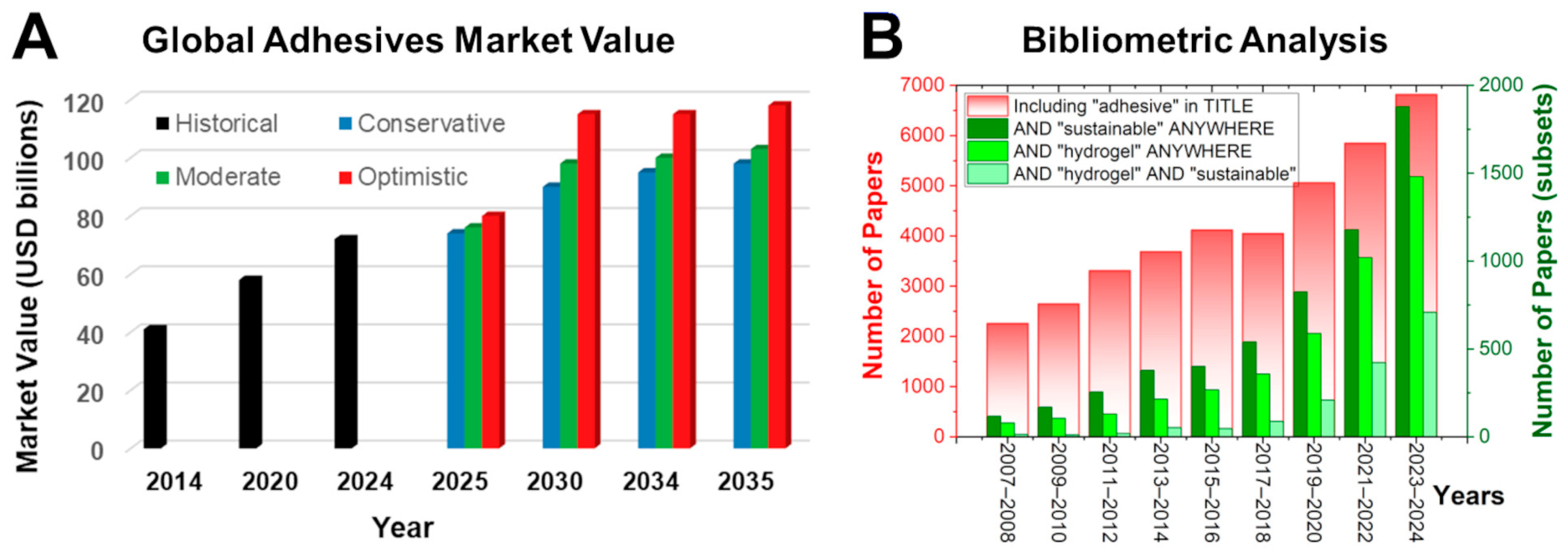
According to the consolidated market analysis discussed in the Supplementary Materials (Section S1), the global adhesives sector has experienced steady growth over the past decade and is expected to continue expanding in the coming years. Recent assessments [82,83,84,85,86,87,88,89,90,91,92,93,94,95] place the current market value at approximately USD 70–80 billion, with forecasts surpassing USD 100 billion within the next decade. These projections correspond to a Compound Annual Growth Rate (CAGR) of roughly 4–6%, consistent across the independent industry surveys summarized in Section S1.
Figure 1A integrates these findings by combining available historical benchmarks with three forecast scenarios (conservative, moderate, and optimistic) constructed from the range of publicly accessible market analyses discussed in Section 1 in the Supplementary Materials. Historical data points (e.g., 2014 and 2020) were extracted from industry association reports, while future values were derived from multiple overlapping projections. Together, these trends provide a representative growth envelope for the global adhesives market and contextualize the economic relevance of emerging sustainable and reversible adhesive technologies.
Within this landscape, bio-based adhesives currently occupy a relatively small but rapidly expanding segment. As detailed in the Supplementary Materials, their present market share is estimated at approximately 2–5% of global revenues. Despite performance limitations compared with established petroleum-derived systems, particularly regarding water resistance and mechanical strength, the adoption of bio-based formulations is accelerating. Increasing regulatory pressure, sustainability targets, and consumer-driven demand are expected to at least double their market share by 2030–2035 (see Section S1.7 in the Supplementary Materials), positioning bio-based systems among the fastest-growing categories in the sector.
Figure 1B complements this outlook with a bibliometric perspective, illustrating how research activity has evolved over the same period. The bibliometric analysis, compiled through structured Google Scholar™ searches, covers publications from 2007 to 2024 and reports the total number of papers including the term “adhesive” in the title (left axis), along with subsets whose full text contains “sustainable”, “hydrogel”, or both (right axis). While adhesive-related publications show steady and continuous growth, studies focused on sustainability or hydrogel-based systems display markedly faster expansion, particularly in the last decade. This emerging trend underscores a clear shift in scientific attention toward environmentally responsible and soft-material adhesive technologies. Full search strings, methodological details, and regression analyses are provided in Supplementary Materials (Section S2, Table S1 and Figure S2).

3. Reversible Adhesion

3.1. Already Explored Strategies

As discussed in the previous section, the increasing demand for sustainable design, recyclability, and adaptive functionality has underscored the need for reversible adhesive systems. In this context, reversible adhesives are engineered to establish strong interfacial bonding while allowing controlled detachment and repeated reattachment. Unlike conventional permanent adhesives, which rely on irreversible covalent crosslinking or mechanical interlocking, reversible adhesives leverage dynamic interactions and material adaptability. These mechanisms enable multiple adhesion–debonding cycles, providing functionalities that are critical for biomedical devices, soft robotics, wearable electronics, and sustainable manufacturing. Contemporary strategies for reversible adhesion include supramolecular and non-covalent interactions, dynamic covalent bonds, self-healing polymer networks and interfacial adaptability. Some examples from the literature are reported in Table 2, together with the associated advantages and limitations.
A particularly active subset of reversible adhesives is represented by switchable adhesives, where dynamic control over interfacial bonding offers repeated use, spatial selectivity, and facilitates integration into smart device architectures [99]. Contemporary research increasingly exploits external stimuli as tunable triggers to modulate adhesive interaction. According to Tan et al., these adhesives undergo on-demand transitioning between “On” and “Off” adhesion states and they can be categorized by their adhesion switching mechanism or by the type of stimuli that can be used to control a physicochemical transformation able to activate an adhesion switching mechanism which in turn causes reversible bonding (e.g., temperature, light, electricity, magnetism, and chemical agents) [100].
Within this framework, hydrogels provide an especially versatile platform for achieving reversible adhesion. Their hydrated polymer networks enable intimate contact with substrates, while dynamic bonds (hydrogen bonds, ionic interactions, or supramolecular associations) mediate adhesion that is both strong and reversible. By coupling these intrinsic dynamic interactions with external stimuli, hydrogel-based systems can achieve finely tunable, repeatable adhesion, making them promising candidates for applications ranging from biomedical interfaces to soft robotics to retrofit applications [101,102].

3.2. Hydrogels

Hydrogels are three-dimensional (3D) polymer networks capable of retaining large amounts of water within their structure. They are typically fabricated through the crosslinking of polymer chains to form stable networks. Among the various crosslinking methods, two fundamental strategies are employed: physical and chemical crosslinking. Physical crosslinks arise from non-covalent interactions such as ionic/electrostatic interaction, hydrogen bonding, crystallization/stereo-complex and hydrophobic interactions. They can also result from thermally induced sol–gel transitions, based on lower or upper critical solution temperatures, or from ultrasonication-mediated phase transitions. Chemical crosslinks involve covalent bonding mechanisms, including photo-polymerization, enzyme-induced crosslink, and various “click” chemistry reactions including Michael type-addition, Diels–Alder cycloaddition, oxime formation, and Schiff base formation [103]. Hydrogels can be synthesized from a wide range of precursors, including natural polymers (e.g., alginate, chitosan, gelatin, hyaluronic acid), chemically modified biopolymers or synthetic polymers (e.g., polyacrylamide (PAAm), polyethylene glycol, and polyvinyl alcohol) [104,105,106,107,108,109]. This versatility allows precise control over their chemical composition, degradation profile, and mechanical performances.
The reversible nature of hydrogels arises not only from their dynamic chemistry but also from the interplay between interfacial interactions and bulk mechanical behavior. In this context, it is useful to distinguish the two main contributions that govern hydrogel adhesion.
Hydrogel adhesives operate through a combination of interfacial adhesion, driven by surface chemistry, wetting, and displacement of interfacial water layers, and bulk dissipation, governed by viscoelastic losses, reversible sacrificial bonds, and network architecture. The balance between these mechanisms strongly depends on loading mode and environmental conditions. For example, peel tests largely reflect dissipative energy release within the hydrogel matrix and often result in cohesive failure, whereas tack tests at short contact times are more sensitive to interfacial bond formation and frequently exhibit adhesive failure. Lap-shear tests probe both contributions simultaneously, with the observed failure mode dictated by network toughness and interfacial bonding quality.
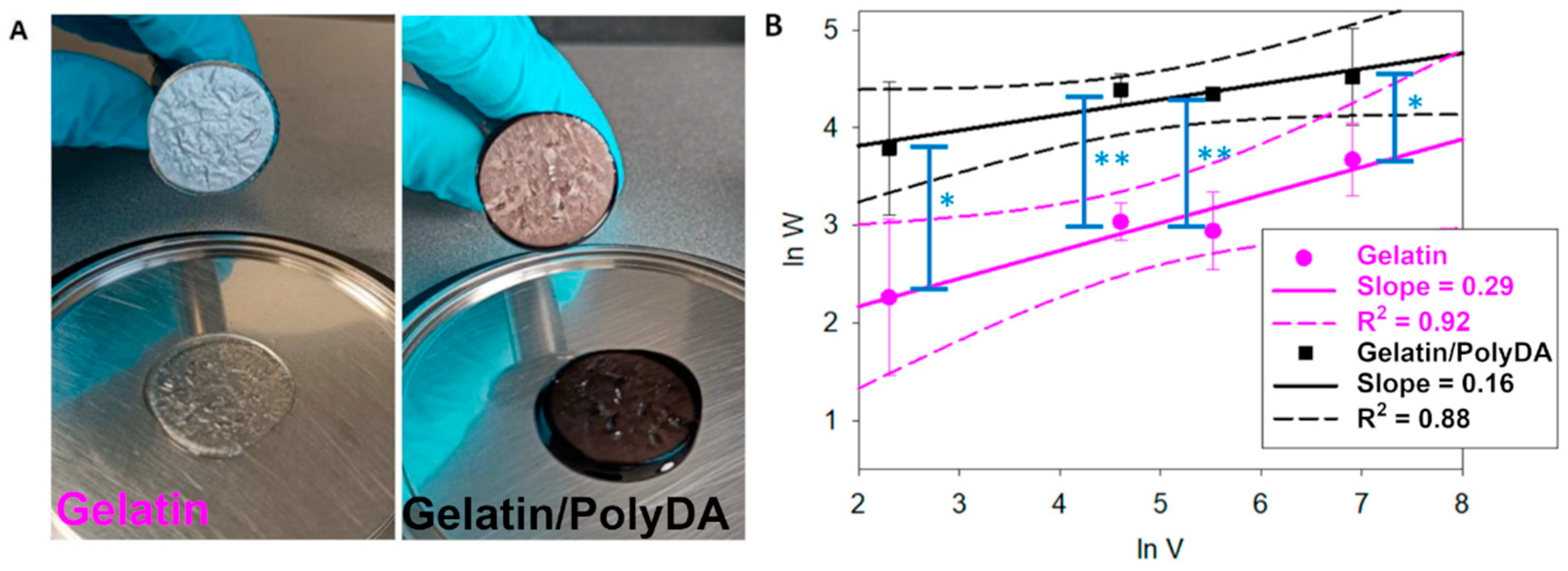
Because these behaviors depend on dynamic bonding, the kinetics of reversible motifs play a central role in determining macroscopic adhesion. The characteristic relaxation time (τ) or association (kon) and dissociation rates (koff) set the timescale for reversible versus dissipative responses. When deformation is slower than 1/τ, reversible bonds reorganize during loading, producing moderate adhesion and reversible-set behavior; at rates faster than 1/τ, bond rupture becomes effectively irreversible, yielding higher peak forces and dissipative, often cohesive, failure. Plotting adhesion strength against pulling rate (rate × τ) defines a characteristic triggerable debonding window, showing how hydrogel adhesion can be modulated by strain rate. Such rate-dependent adhesion trends have been reported across diverse hydrogel systems [110,111,112,113], where measurements of pull-off force or peel energy as a function of deformation rate reveal characteristic interfacial and bulk-dominated properties. Figure 2 illustrates this behavior using a representative system from a catechol-based hydrogel adhesive, obtained combining gelatin and polydopamine (PolyDA), in which adhesion strength extracted from rate-controlled pull-off tests increases sharply with loading rate.
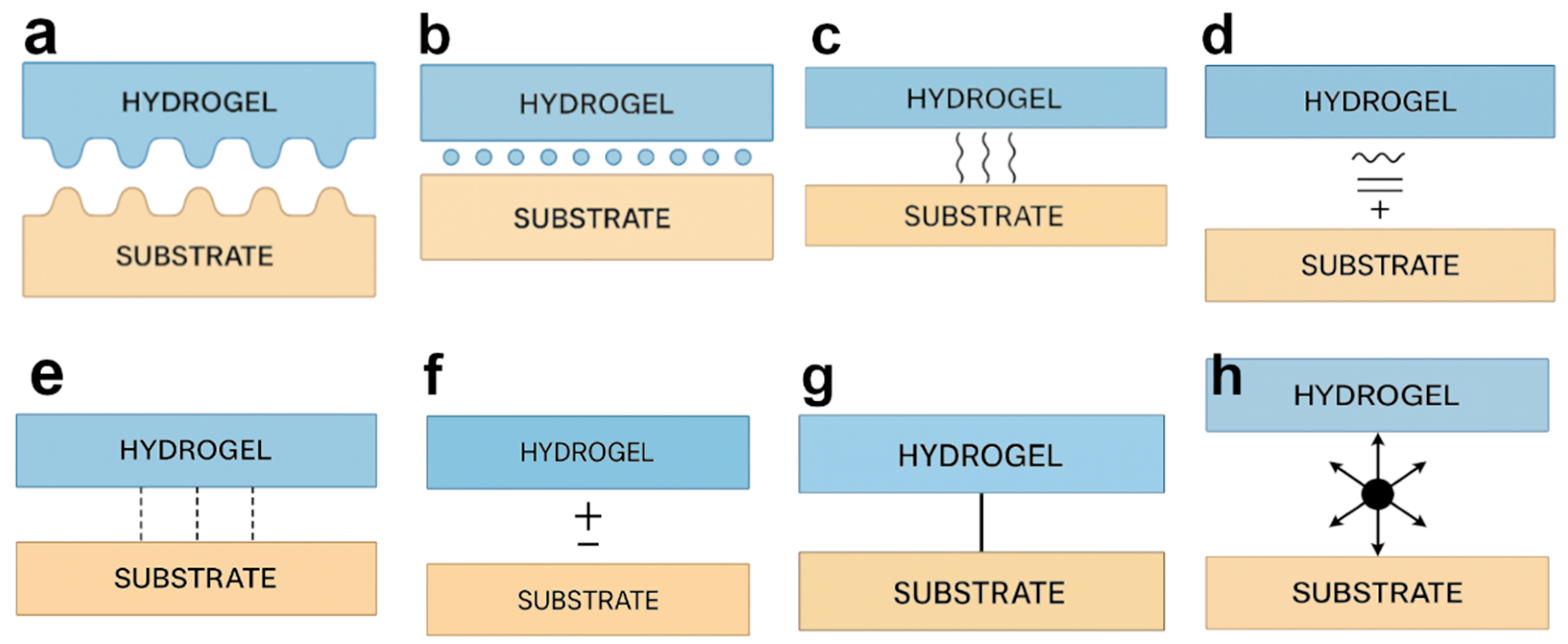
This mechanistic framework links hydrogel structure and bonding dynamics to their macroscopic performance and provides a conceptual basis for the design strategies and material examples discussed in the following sections. Therefore, from an adhesive perspective, hydrogels present several intrinsic advantages. Numerous comprehensive reviews have explored their adhesive properties (including strength, reversibility, stability, and responsiveness to environmental stimuli), particularly in biomedical contexts [102,114,115,116]. Their low polymer-chain density imparts softness and flexibility (Young’s modulus from ∼0.1 kPa to ∼100 MPa, depending on polymer composition and concentration, crosslinking density, swelling ratio, temperature, presence of additives, and other factors [117]), while their high water content ensures hydration, facilitates ion and molecule diffusion, and supports stimuli-responsive behavior. The hydrated networks also form intimate contact with wet or irregular surfaces, an essential feature for biomedical applications where traditional adhesives often fail. Moreover, by tailoring their molecular design through the incorporation of dynamic bonds, functional motifs, or hybrid backbones, hydrogels can achieve reversible and strong yet reversible adhesion. According to Bovone et al., effective adhesion depends on the interplay among bond chemistry, interfacial topology, and the surface properties of the adherends [78]. As discussed in the previous section, various bonding mechanisms can be utilized in hydrogel systems. According to Xiao et al., the adhesion mechanisms of hydrogel are numerous and complicated [118]: in fact, Figure 3 summarizes the main adhesion mechanisms of hydrogels (mechanical interlocking, wet adhesion, diffusion, Van der Waals forces, hydrogen bonding, ionic bond, and covalent bond).

4. Formulation of Adhesives Towards Sustainability

4.1. From Conventional to Sustainable Formulations

Conventional commercial adhesive formulations have historically prioritized performances, such as strength, durability, and versatility, over environmental responsibility. Most industrial adhesives are derived from petrochemical feedstocks and often contain volatile organic compounds (VOCs), toxic curing agents, or non-degradable polymers. These systems exhibit high environmental persistence, limited recyclability, and potential occupational and environmental hazards.
The growing emphasis on green chemistry and circular economy principles has redirected research efforts toward sustainable adhesive design, seeking materials that balance bonding performances with renewability, recyclability, and reduced toxicity. However, despite technical advances, economic factors have often limited their large-scale commercialization [17].
Sustainable formulations increasingly employ: (1) Natural polymers, such as polysaccharides (e.g., cellulose, starch, chitosan) and proteins (e.g., gelatin, soy), (2) Polyesters derived from renewable monomers (e.g., polylactic acid, polyhydroxyalkanoates), (3) Polymers obtained through microbial fermentation (e.g., polyhydroxy-butyrate, polyhydroxy-valerate) [119]. Significant progress has also been achieved by eliminating VOCs in pretreatment steps and replacing solvents with aqueous systems [120].
These bio-inspired strategies not only replace fossil-derived components but also introduce intrinsic features such as biodegradability, and potential features such as self-healing, and responsiveness to environmental stimuli. Nevertheless, bio-based polymers often suffer from lower mechanical stability, batch-to-batch compositional variability, and limited long-term durability when compared to synthetic analogues. For these reasons, hybrid systems integrating renewable or degradable segments within synthetic matrices have emerged as promising alternatives that balance performance, cost, and sustainability [119,121].

4.2. End of Life, Recyclability, and Environmental Footprint

Sustainability must consider the entire material life cycle, from synthesis to disposal. Ideally, sustainable materials should be derived from a renewable source, enable recycling or reuse, and exhibit low toxicity and optimal biodegradability [122].
Traditional thermoset adhesives are irreversibly crosslinked, preventing the separation and recycling of bonded components. In contrast, recent developments in chemically recyclable or stimuli-debondable adhesives allow controlled disassembly, aligning with circular economy goals and enabling repairable, sustainable products [121].
Similarly, biodegradable adhesives play a crucial role in biomedical and environmentally transient applications, where materials must safely degrade after use. Hydrogels derived from natural polymers are highly biocompatible and biodegradable, typically degrading through hydrolytic or enzymatic pathways and leaving minimal residues [123].
It is important to remark here that adhesives are indispensable across diverse industrial sectors, including packaging, transportation, construction, electronics and biomedicine, each with unique functional and environmental requirements. Accordingly, sustainability must be context-dependent: while some applications can benefit from natural polymers and/or recyclable formulations (e.g., in packaging and consumer goods), others still require synthetic systems to ensure durability, stability, or regulatory compliance (e.g., aerospace, automotive, or advanced biomedical adhesives).
Thus, sustainable adhesive design must strategically balance functional performances with ecological responsibility depending on the target use. In this framework, it is also interesting to note that in 2020, Eisen et al. stated in their comprehensive overview of the latest papers on bio-based adhesive technologies that the environmental performance of industrial bio-based adhesives is still very controversial and mostly based on assumptions of theoretical and unproven products [124].

4.3. Regulatory Aspects

Despite the growing interest in sustainable adhesives, standardized definitions, testing protocols, and quantitative sustainability metrics remain limited. Few current standards explicitly address sustainability in terms of carbon footprint, bio-based content, or recyclability rate. Existing regulatory frameworks, such as the European Chemicals Agency’s Registration, Evaluation, Authorization and Restriction of Chemicals (REACH) regulation, focus primarily on the control and reduction of hazardous substances [125,126].
According to recent literature, the key objectives of sustainable adhesive assessment include the incorporation of renewable bio-based starting materials and the minimization of nonrenewable energy use, often expressed as total Primary Energy Non-Renewable Total (PENRT) [75,127].
Developing unified sustainability standards and robust life-cycle assessment (LCA) metrics will be essential to harmonize industrial practices, facilitate certification and strengthen consumer trust [124]. To enable a systematic and comparable evaluation of different adhesive systems, a concise and pragmatic assessment checklist could be adopted, in alignment with the need for unified LCA metrics and regulatory clarity. Key criteria should include: (i) bio-based content (assessed according to recognized standards such as ASTM D6866), (ii) Volatile organic compounds content and emission profile, (iii) recyclability or triggerable debonding fraction, (iv) PENRT or other simplified indicators of energy and resource demand, (v) potential leachables and associated toxicological considerations, (vi) durability, and (vii) compliance with emerging regulatory frameworks (e.g., restrictions on microplastics or selected monomers).
However, it should be acknowledged that, as long as the global economic system remains growth-driven, complete sustainability in adhesive technology cannot be fully achieved since material production and energy use are fundamentally constrained by the laws of thermodynamics [120].

5. Characterization and Performance Evaluation

Quantitative assessment of adhesion performance is crucial for correlating material design with practical function [128]. Adhesion is an inherently interfacial phenomenon that depends not only on the chemical nature of the adhesive and substrate, but also on viscoelasticity, surface roughness, contact time, and environmental conditions [44,129]. For hydrogel-based reversible adhesives, these dependencies are further complicated by the dynamic nature of water-mediated interactions and environmental responsiveness [78,130,131]. Consequently, reliable characterization requires integrating classical adhesion tests with surface-sensitive and dynamic analytical techniques that capture both macroscopic and molecular contributions to adhesion and reversibility [112]. This section provides the experimental and analytical foundations necessary to validate performance and guide future optimization, which is fundamental for the critical evaluation of emerging adhesive systems. Together, these metrics enable direct comparison of reversible adhesives across different chemistries and testing conditions, establishing standardized performance benchmarks crucial for sustainable material design.

5.1. Conventional Adhesion Tests

Conventional mechanical tests remain the foundation for quantifying adhesive strength. These methods are standardized and allow comparisons across different formulations and substrates [132]. Importantly, their implementation relies on precise mechanical instrumentation, typically universal testing machines (UTMs), texture analyzers, or microforce testers, which enable controlled loading and accurate force–displacement measurements. Table 3 provides a comparative summary of conventional tests, together with their relevance for hydrogel adhesion.

5.1.1. Peel Tests

Peel tests measure the force required to separate an adhesive layer from a substrate at a controlled rate and angle, typically 90° or 180° [133]. The peel strength reflects the balance between interfacial adhesion and viscoelastic energy dissipation within the adhesive [134]. These tests are commonly performed using UTMs equipped with custom peel fixtures or texture analyzers capable of maintaining constant peel angles and rates [135]. For hydrogel-based adhesives, which are often soft and hydrated, the peel test provides insight into wet adhesion mechanisms and the role of polymer chain mobility. Peel resistance can vary significantly with peeling rate and water content, highlighting the interplay between reversible bonding and dissipative energy losses (e.g., hydrogen bonding or ionic coordination) [136].

5.1.2. Tack Tests

Tack measures the instantaneous adhesion developed upon brief contact under low pressure and is particularly relevant for skin patches, biomedical interfaces, and soft robotic applications [137]. Tack tests are typically performed on probe-tack instruments or rheometers in tack mode, where a flat-ended probe contacts and retracts from the adhesive at controlled speeds while recording force–displacement curves [134]. Hydrogels with fast-forming reversible bonds (e.g., catechol-based, supramolecular, or ionic crosslinks) can display high tack yet maintain reversibility, making this test ideal for quantifying rapid, repeatable adhesion.

5.1.3. Shear and Lap Shear Tests

Shear tests evaluate resistance to parallel forces at the interface, providing a measure of cohesive strength under sustained load. Lap shear geometries are especially useful for assessing load-bearing or structural performance. These tests are generally conducted on UTMs or microforce testers fitted with lap-joint clamps to ensure uniform stress distribution. For reversible hydrogels, cyclic shear or step-strain tests can reveal hysteresis, stress relaxation, and self-recovery behavior, properties that directly connect mechanical performance to reversibility and dynamic bonding [138].

5.1.4. Compression and Tensile Tests

Although not strictly considered as adhesion tests, uniaxial tensile and compression measurements provide valuable information about bulk mechanical integrity and deformation behavior, both of which influence adhesive performance. These experiments, typically carried out using UTMs or custom mechanical testing rigs, enable quantification of stress–strain relationships, elastic modulus, and failure energy. For hydrogels, such measurements are essential to assess the interplay between network elasticity, water content, and reversible bonding [139].

5.2. Surface and Interfacial Characterization

While mechanical tests provide quantitative measures of macroscopic adhesion strength, a deeper understanding of the underlying adhesion mechanisms requires investigation of the interfacial region at the micro- and nanoscale. Adhesion originates from a complex interplay of physical, chemical, and topographical factors at the contact interface, which cannot be fully captured by bulk measurements alone [118,140]. To elucidate these interfacial phenomena, a variety of analytical techniques have been developed and adapted [141]. The following overview presents a non-exhaustive selection of commonly employed methods, highlighting their principles, capabilities, and relevance to the study of reversible and hydrogel-based adhesives.

5.2.1. Atomic Force Microscopy (AFM)

AFM-based force spectroscopy measures nanoscale adhesion forces between a probe and surface, allowing direct quantification of single-bond interactions or mapping of adhesion heterogeneity [142]. For hydrogels, AFM can reveal the contribution of specific reversible motifs [143,144], such as hydrogen bonding, π–π stacking, or metal–ligand coordination to total adhesion energy [145].

5.2.2. Surface Energy and Contact Angle Measurements

Contact angle measurements provide information on surface wettability and energy, influencing initial contact and bonding strength. Dynamic contact angle hysteresis can capture how water migration or swelling alters adhesion over time [146], an especially critical factor for hydrogels where interfacial hydration governs performance [147].

5.2.3. Rheology and Dynamic Mechanical Analysis

Rheological characterization quantifies the viscoelastic balance between storage (G′) and loss (G″) moduli. Time–temperature superposition and frequency sweeps provide insight into bond dynamics and recoverability [148]. The ability of a hydrogel adhesive to dissipate and restore energy under cyclic strain directly correlates with reversible adhesion capacity.

5.2.4. Spectroscopic and Microscopic Analyses

Spectroscopic methods such as Fourier transform infrared, Raman, or X-ray photoelectron spectroscopy can identify chemical changes at the interface, including oxidation of catechols, ion exchange, or polymer rearrangement during adhesion/debonding [149]. Confocal or fluorescence microscopy enables visualization of diffusion processes or interpenetration between adhesive and substrate, particularly for hydrated biological tissues.

5.2.5. Emerging Techniques

Other valuable methods include micro- and nano-indentation and rheology for probing local mechanical heterogeneity [150], scratch and fracture testing for evaluating wear and failure mechanisms, and in situ optical or scattering techniques (e.g., neutron or X-ray) for observing interfacial evolution during adhesion and debonding. The study of water properties through spectroscopical or thermal analyses can also be very useful, as it plays a key role in determining the final structural and characteristics of hydrogel [151]. Additionally, Quartz Crystal Microbalance with Dissipation provides nanogram-level sensitivity to mass exchange and viscoelastic changes in hydrated or dynamic systems [152], offering insights into reversible adhesion kinetics [153,154].

5.3. Metrics for Reversibility and Reusability

Beyond measuring absolute adhesion strength, evaluating the reversibility and reusability of hydrogel adhesives is essential for understanding their functional lifetime and sustainability. Reversible adhesion implies that the adhesive can undergo repeated bonding and debonding cycles without significant loss of performance or structural integrity. Quantitative metrics are therefore needed to assess fatigue resistance, recovery, and environmental stability.

5.3.1. Cyclic Adhesion–Debonding Tests

Reversibility is commonly quantified by performing repeated adhesion–debonding cycles under identical conditions while monitoring changes in peak adhesion force or work of separation [155]. The adhesion retention ratio, defined as the percentage of initial adhesion maintained after a given number of cycles, is a straightforward indicator of reusability. Cyclic tests can be implemented in peel, tack, or shear configurations using UTMs or probe-tack instruments. For hydrogel-based systems, performance typically depends on reversible network dynamics (e.g., hydrogen bonding, metal–ligand coordination) and water retention.

5.3.2. Fatigue and Creep Resistance

Long-term mechanical durability can be probed through cyclic loading or sustained shear tests to evaluate fatigue life and creep behavior. Reversible hydrogels that rely on dynamic covalent or supramolecular bonds often exhibit time-dependent recovery, which can be characterized by tracking residual deformation, energy dissipation, or hysteresis reduction over successive cycles [156].

5.3.3. Environmental Stability

Hydrogels are highly sensitive to environmental factors such as humidity, temperature, pH, and ionic strength. Stability testing under controlled environmental chambers or rheo-mechanical setups can reveal the influence of these parameters on adhesion retention. Reporting adhesion metrics before and after environmental exposure (e.g., hydration–dehydration cycles, temperature fluctuations) provides insight into practical performance and lifetime.

5.3.4. Self-Healing and Recovery Metrics

In dynamic or supramolecular hydrogels, the ability to restore adhesion after mechanical damage or debonding can be quantified using recovery efficiency, typically expressed as the ratio of recovered to initial adhesion strength after a resting period. Complementary rheological measurements of modulus recovery after large strain can support these observations, linking macroscopic reversibility to molecular-level dynamics [157].
To complement this overview of characterization methods and to provide readers with a clearer picture of how hydrogel-based reversible adhesives perform under diverse testing conditions, we have compiled a comparative summary of representative systems drawn from recent literature. As highlighted throughout this section, cross-study comparison is often complicated by variations in testing geometry, loading rate, substrate type, hydration state, and environmental conditions, which can lead to substantial differences in reported values. The systems selected here reflect the major application categories discussed in the revised manuscript and illustrate the range of characterization approaches and performance metrics typically reported. Table 4 therefore serves as a practical reference, consolidating typical test methods, key experimental parameters, and representative performance values for different classes of hydrogel adhesives, and offering a concise, application-oriented complement to the methodological framework outlined above.

6. Latest Developments in Hydrogel-Based Adhesives

Hydrogels have long attracted attention for their exceptional combination of biocompatibility, elasticity, and intrinsic self-healing capability. As introduced earlier, their high water content and soft, hydrated structure closely mimic the extracellular matrix, making them ideal materials for biomedical applications such as drug delivery, wound dressings, and tissue regeneration scaffolds [185]. Beyond these traditional domains, recent advances in tough, stimuli-responsive, and optically tunable hydrogel systems have broadened their utility to antibacterial fibers [186,187], and to soft robotics, wearable sensors, and flexible electronics [107,188,189,190,191].
For instance, hybrid double-network hydrogels, which combine covalent and ionic crosslinking motifs, can achieve fracture energies approaching 9000 J m−2, comparable to that of natural rubber (~10,000 Jm−2). Remarkably, certain dynamic hydrogel formulations can withstand multiple deformation cycles, exhibiting strain-induced strengthening rather than mechanical failure. Despite these notable advances in bulk hydrogel mechanics, hydrogel-based adhesives, which must simultaneously provide high interfacial strength, reversibility, and long-term stability, often still fall short of desired performance benchmarks. Bridging this gap demands rational material design strategies that couple mechanical robustness with interfacial chemistry, dynamic bonding, and controlled reversibility [80,192].
Recent developments in hydrogel adhesives can be broadly categorized according to their biological inspiration, functional mechanism, and target application, as summarized in the following subsections. From bioinspired underwater adhesives [193] to biomedical sealants and robotic actuators, hydrogel-based systems are redefining the frontiers of reversible, adaptive, and multifunctional bonding technologies. Their success ultimately depends on precise interfacial engineering, tunable network architecture, and responsiveness to external stimuli. While challenges remain in achieving the optimal balance between toughness, durability, and biocompatibility, the convergence of bioinspired design and advanced polymer chemistry is paving the way toward a new generation of smart, sustainable, and high-performance adhesive materials for both biological and technological applications.
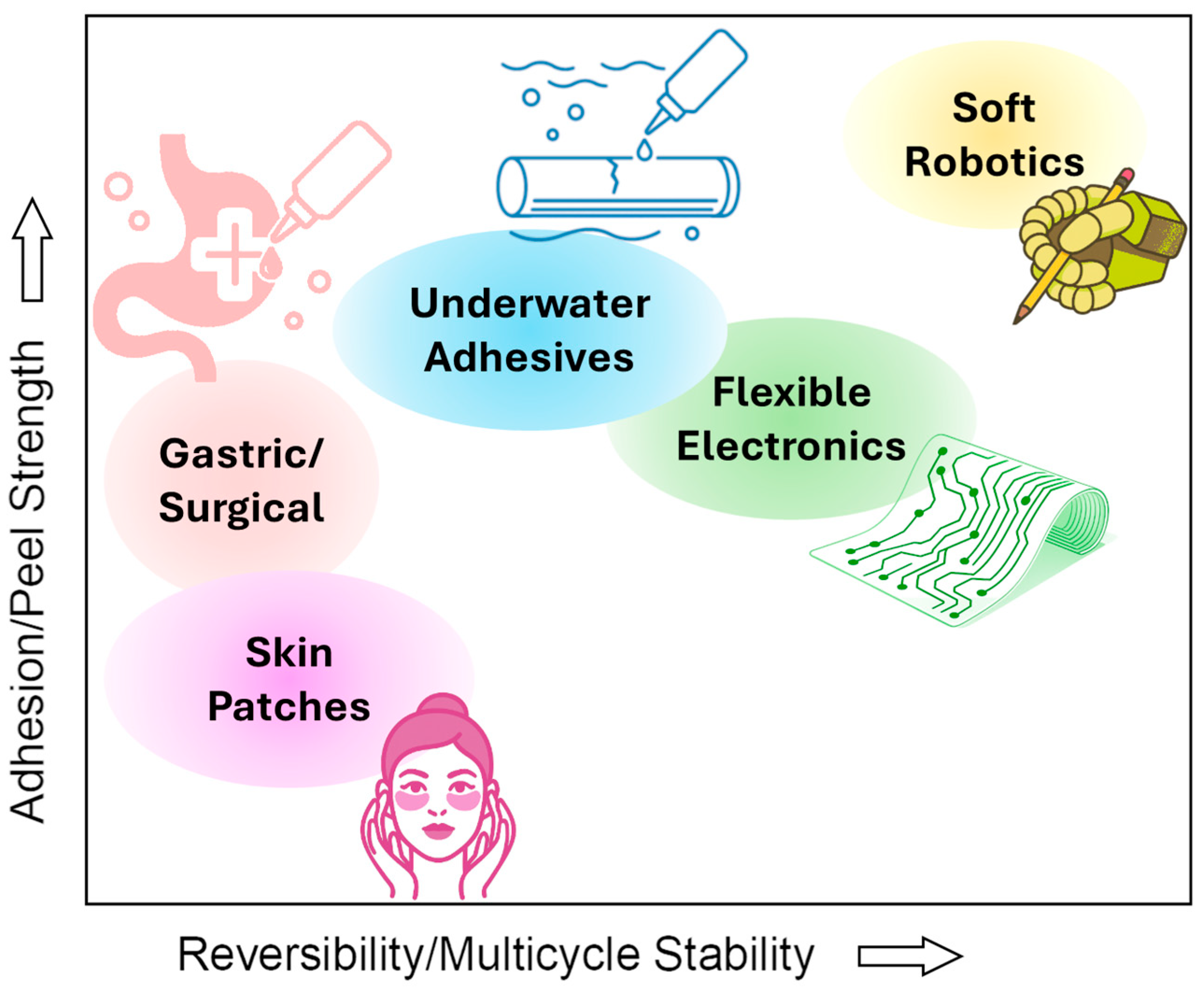
To account for the distinct requirements of different application categories, an application map is provided in Figure 4, illustrating how adhesion strength and reversibility vary across representative use cases. Biomedical skin patches, for instance, require gentle and painless removal, resulting in low-to-moderate adhesion and limited cycling, and therefore fall in the lower-left region of the map. Gastric and surgical adhesives must withstand fluid pressure and tissue motion, placing them at higher adhesion levels, yet they remain fundamentally single-use materials, keeping them on the low end of the reversibility axis. Underwater adhesives occupy a medium-to-high adhesion range and exhibit moderate reversibility, as they must displace interfacial water and maintain attachment under flow, even though many formulations are still designed for one-time use. Flexible electronics demand adhesives that remain attached through repeated bending and stretching, while still allowing controlled removal; they therefore cluster in the mid-to-high adhesion region and toward higher cycle stability. Soft robotics applications sit at the extreme of both axes, as they require strong adhesion in the “on” state combined with robust performance over many attachment–detachment or deformation cycles. Together, these regions highlight the diverse performance windows relevant to hydrogel-based adhesives and offer a practical framework for matching material design to specific biomedical and soft-engineering needs.

6.1. Bioinspired Hydrogel Adhesives

Nature offers a vast repertoire of reversible and robust adhesion strategies evolved to function under complex, often wet, environmental conditions. Marine organisms (e.g., mussels, barnacles, sandcastle worms), terrestrial species (e.g., geckos, tree frogs), and cephalopods (e.g., octopuses) exhibit specialized micro- and nanoscale architectures combined with unique adhesive chemistries that have inspired a new generation of synthetic hydrogel designs [80,166,194].
These biological mechanisms—based on catechol-mediated bonding, suction-driven attachment, capillary effects, and protein-assisted adhesion—have become foundational for the development of bioinspired hydrogels capable of achieving strong, reversible, and wet adhesion [195].
According to recent literature, achieving robust underwater adhesion typically relies on a sequence of interrelated processes: (1) removal or displacement of the substrate’s hydration and ion layers, (2) formation of strong interfacial bonding through covalent, ionic, or supramolecular interactions, and (3) reinforcement of the bulk adhesive to resist crack propagation during loading and debonding (see, e.g., [196]). Over the past years, numerous underwater adhesives have been developed using diverse bioinspired strategies; however, the design of systems that can be directly applied and rapidly form durable adhesion under seawater conditions remains at an early stage. Achieving fast, stable, and reversible bonding in fully submerged environments continues to represent a significant challenge for the field.
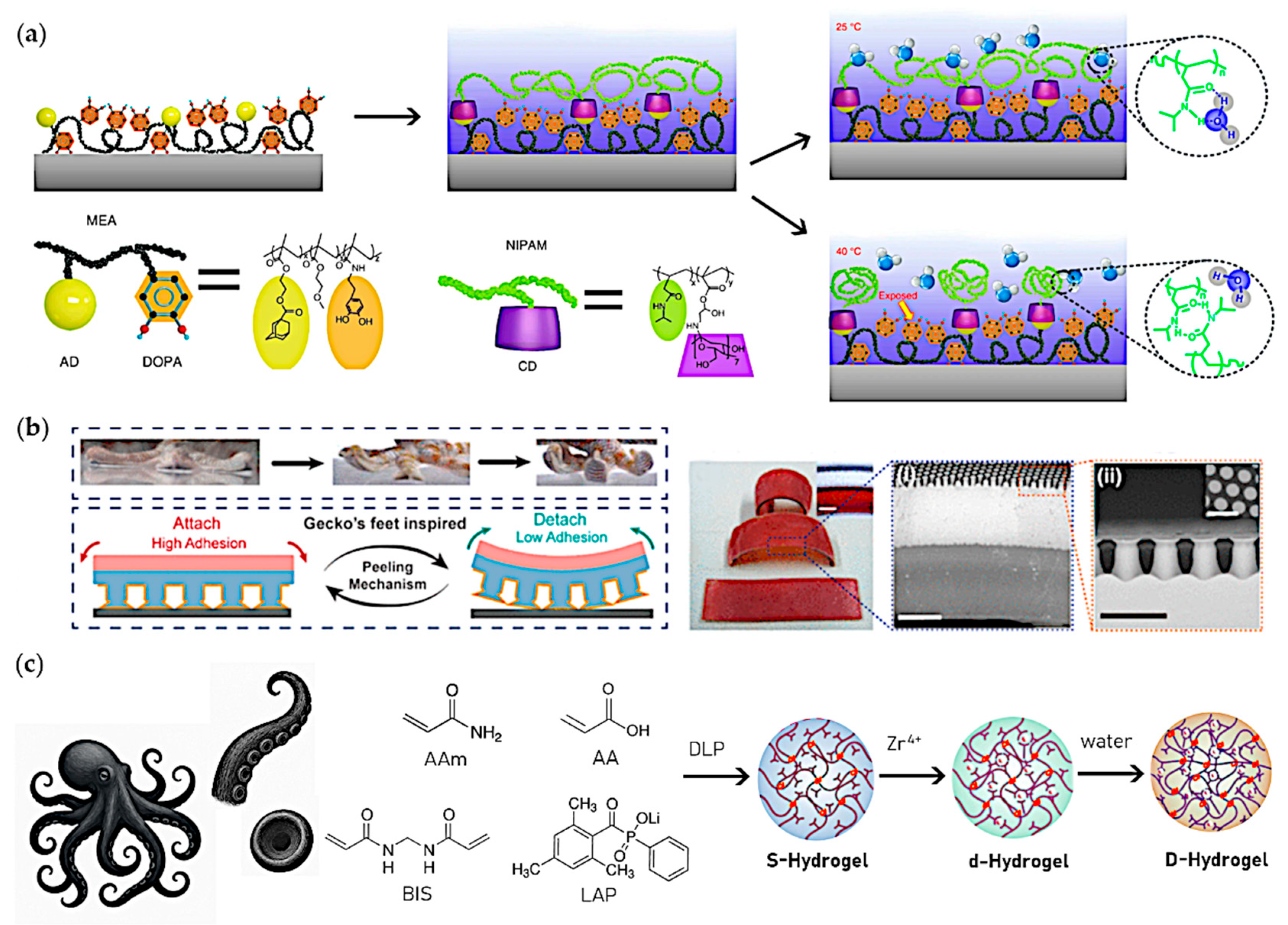
Among the most influential bioinspired strategies is mussel-inspired catechol chemistry. Over the past decade, the remarkable wet adhesion strength of mussel foot proteins has been successfully mimicked through the incorporation of 3,4-dihydroxy-L-phenylalanine (DOPA), whose catechol groups mediate reversible redox and coordination interactions. Zhao et al. engineered a temperature-responsive hydrogel adhesive based on DOPA-functionalized polymers and host–guest crosslinking where catechol moieties act as interfacial anchors and β-cyclodextrin/adamantane pairs provide dynamic network junctions. (Figure 5a). Their system is constructed through dip-coating a DOPA-adamantane-methoxyethyl acrylate copolymer (pDOPA-AD-MEA) onto a substrate, followed by the self-assembly of a β-cyclodextrin-modified poly(N-isopropylacrylamide) layer (pNIPAM-CD) through host–guest recognition. The responsiveness derives from the well-known lower critical solution temperature (LCST) transition of pNIPAM: below the LCST, the swollen pNIPAM chains form hydrogen bonds with water and shield the underlying DOPA groups, reducing adhesion; above the LCST, chain collapse exposes the catechol units, markedly enhancing interfacial bonding. This architecture therefore enables reversible, temperature-triggered switching between low- and high-adhesion states under wet conditions, providing a versatile platform for tunable underwater adhesion [99].
Another prominent class of bioinspired reversible adhesives is based on gecko adhesion, which relies on hierarchical micro- and nanoscale structures that enable strong yet reversible attachment to both dry and wet surfaces, including vertical and inverted substrates. Although numerous efforts have attempted to replicate this architecture, synthetic analogues often fall short of the durability, contamination resistance, and multi-cycle reversibility exhibited by natural setae. Artificial micro- and nanopillar arrays have therefore been developed using template-assisted lithographic methods in polymers such as polyvinylsiloxane, Poly(dimethylsiloxane) (PDMS), and polyurethane, often combined with functional coatings to enhance interfacial interactions [167,194].
A representative system is the multilayered, self-peeling dry/wet adhesive reported by Zhang et al. [162], which integrates mushroom-shaped PDMS micropillars with a thermo-responsive PAAm–pNIPAM–polyacrylic acid(PAA)/Fe hydrogel layer and a mussel-inspired copolymer coating. The adhesive is fabricated by replicating an elastic PDMS pillar array and subsequently chemically bonding a dual-crosslinked PAAm–PNIPAM–PAA/Fe hydrogel onto the unstructured side of the PDMS sheet via photo-initiated radical polymerization. This architecture effectively mimics the natural rolling-in and rolling-out motion of gecko toes: below the LCST, the hydrogel is more swollen and the structure remains relaxed, whereas above the LCST, differential contraction induces curvature that drives controlled attachment or self-peeling. As a result, the system exhibits temperature-dependent, reversible adhesion in both dry and wet environments. Moreover, the incorporation of Fe3O4 nanoparticles into the hydrogel enables Near-Infrared (NIR)-triggered heating, allowing remote activation of the self-peeling mechanism for underwater object manipulation, capture, and release (Figure 5b).
Octopus-inspired adhesives provide another compelling example of bioinspired hydrogel design. In nature, octopuses achieve robust yet reversible attachment to dry, wet, flat, or curved surfaces through suction-based mechanisms: soft muscular suckers deform to expel air or water and generate negative pressure during attachment, and detachment occurs as the cavity refills. Inspired by this principle, Wang et al. fabricated patterned hydrogel suckers using digital light–processing 3D printing, starting from a photocurable AAm/AA precursor solution containing N,N′-methylene-bis-acrylamide as the chemical crosslinker, Lithium phenyl-2,4,6-trimethylbenzoylphosphinate as the photoinitiator, and tartrazine as the photoabsorber. Exposure to 405 nm light produced the primary S-hydrogel structure via radical copolymerization. Subsequent immersion in ZrOCl2 induced a second, metal–coordination crosslinking step between Zr4+ ions and the carboxyl groups of the poly(AAm–AA) chains, yielding a tough, water-resistant double-crosslinked d-hydrogel. After dialysis to remove excess ions, the resulting 3D-printed suction structures exhibited strong and reversible, suction-mediated adhesion in both air and underwater environments, enabling precise gripping, release, and object manipulation under diverse conditions (Figure 5c) [163].
Yue et al. recently developed another interesting gecko-inspired polymer film. The authors report the preparation of a photoresponsive polymer film (poly(dodecyl glyceryl itaconate) crosslinked by azobenzene moieties) exhibiting reversible expansion/contraction under UV irradiation. In the designed adhesive, azo-C12 liquid crystalline monomer presents a structure able to switch from trans to cis under UV light irradiation, allowing for stimulus-controlled reversible shape changes and thus adhesion reversibility [197].
In summary, bioinspired hydrogel adhesives demonstrate that nature’s design principles, from catechol-mediated chemistry to micro/nanoscale structuring and stimuli-responsive actuation, can be strategically combined to yield reversible, high-performance wet adhesion. This synergy defines a powerful framework for developing multifunctional, adaptive, and sustainable adhesive systems across both biological and technological domains.

6.2. Biomedical Hydrogel Adhesive

Hydrogel adhesives have become increasingly fundamental in wound sealing, surgical repair, and implantable devices, owing to their tissue-like hydration, flexibility, and tunable interfacial chemistry. Compared to conventional commercial sealants, hydrogel-based systems allow precise tailoring of chemical composition, rapid adhesion to moist tissues, and biocompatible degradation or removal on demand. Key requirements for medical adhesives include rapid hemostasis, strong yet reversible bonding, and minimal tissue damage upon detachment [79,80,81,194]. In clinical applications, medical adhesives must effectively prevent blood loss, gas leakage, and exposure to tissue fluids, as well as protect against infection or contact with digestive fluids, while still enabling on-demand removal when necessary. For example, topical hydrogel adhesives designed for medical affixation and skin bioelectronic devices may require moderate adhesion strength to allow easy removal and repeated application, enabling multiple reuses without damaging the tissue. In contrast, hydrogel adhesives intended for wound closure or long-term tissue regeneration demand tough, durable adhesion capable of withstanding pressure variations and dynamic tissue deformation, including contraction, expansion, and stretching, to ensure that the adhesive remains in situ throughout the entire tissue healing process [115,198].
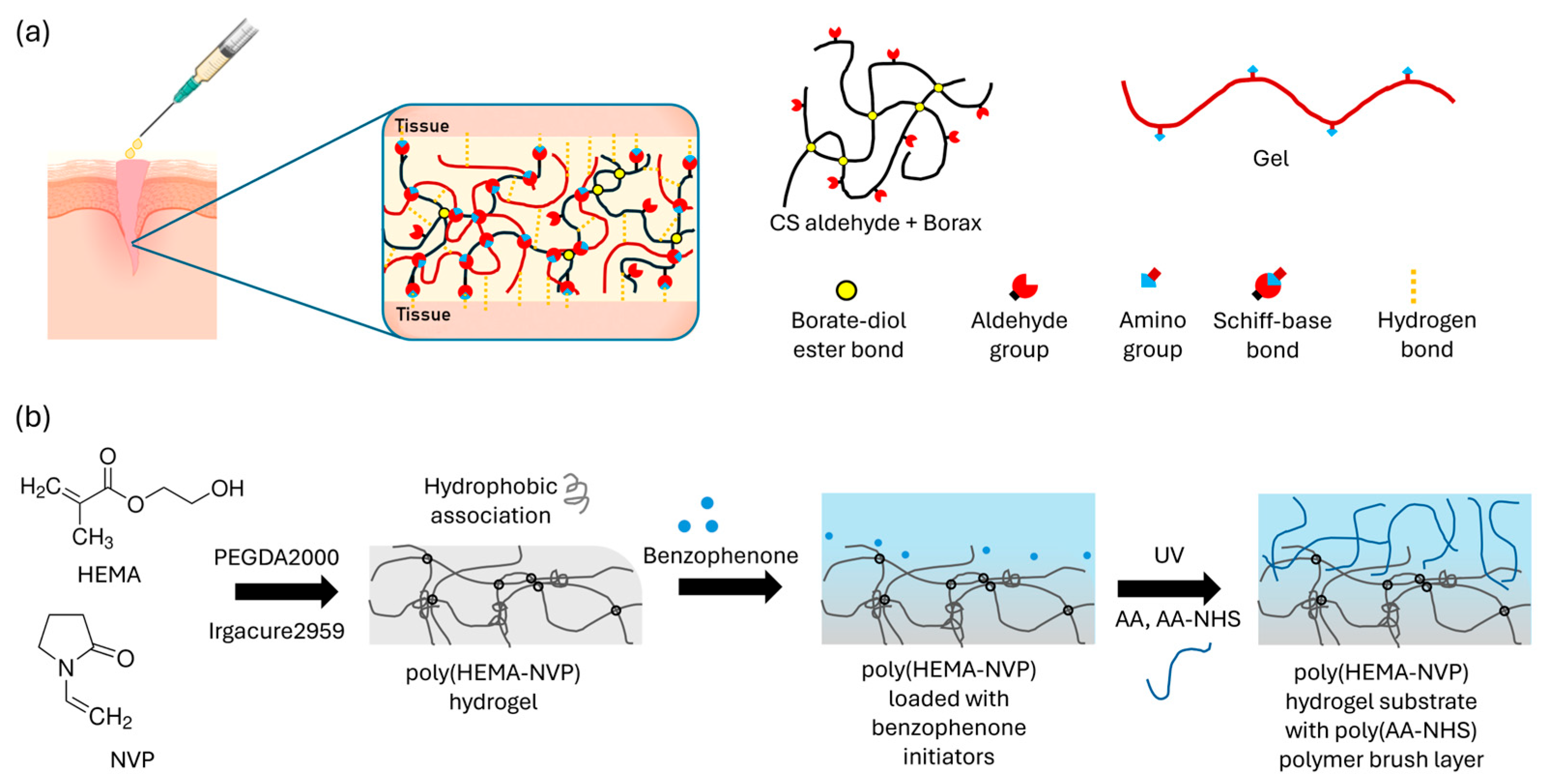
Recent developments place increasing emphasis on multifunctional hydrogels that combine injectability, self-healing, and stimuli-responsive adhesion for biomedical applications. A representative example is the injectable gelatin–chitosan (Gel–CS) hydrogel developed by Zhou et al. [199], which is crosslinked through a combination of dynamic Schiff-base bonds and borate–diol complexation. In this design, aldehyde-modified CS reacts with gelatin to form reversible imine linkages, while borax promotes additional dynamic crosslinking through interactions with diol groups. The resulting network can be injected into irregularly shaped defects, where it rapidly conforms to the tissue geometry and forms strong adhesion via Schiff-base formation and hydrogen bonding. Notably, the system remains detachable upon cooling because the dynamic crosslinks reorganize at lower temperatures, enabling controlled adhesion and removal. This multifunctional Gel–CS hydrogel demonstrates promising performance for in vivo bleeding control and soft-tissue sealing in minimally invasive surgical procedures (Figure 6a).
Another major challenge for biomedical hydrogel adhesives is maintaining adhesion in acidic environments, such as the gastric lumen. Conventional hydrogel adhesives often swell excessively under low pH, leading to deterioration of adhesive performance and unsuitable behavior for gastric applications. Although numerous self-healing hydrogel adhesives have been explored for wound closure and tissue repair, only a few have been successfully applied to gastric perforation repair due to these limitations [200,201,202,203].
Addressing this issue, Chen et al. [174] developed an acid-tolerant hydrogel bioadhesive (ATGel) consisting of a hydrophobic, acid-resistant polymeric substrate coupled with an adhesive polymer brush layer, forming a robust interface with strong adhesion and acid tolerance (Figure 6b). The poly(HEMA–NVP) substrate was synthesized via copolymerization of hydroxyethyl methacrylate (HEMA), N-vinylpyrrolidone (NVP), poly(ethylene glycol) diacrylate (PEGDA) as a crosslinker, and Irgacure® 2959 as a photoinitiator, yielding a dense, hydrophobic network. This dry film is subsequently loaded with benzophenone initiators, enabling the photografting of AA and N-hydroxysuccinimide (NHS) acrylate to form the poly(AA–NHS) brush layer. Phase segregation induced by hydrophobic associations contributes to acid tolerance, allowing the hydrogel to retain adhesion in highly acidic gastric fluid (pH 1–3). The resulting asymmetric hydrogel benefits from hydrophobic-phase segregation, which suppresses acid-induced swelling and preserves strong adhesion even in gastric fluid (pH 1–3). In preclinical models, ATGel enables sutureless repair of gastric perforations, providing superior sealing, durability, and biostability compared to existing clinical adhesives (Figure 6b).
Several examples in the literature also describe bio-based hydrogel adhesives for wound closure inspired by natural systems, with particular emphasis on mussel-inspired adhesion mechanisms [169,170,171,172].
Overall, biomedical hydrogel adhesives illustrate how careful design of network architecture and interfacial chemistry can achieve robust yet reversible adhesion, biocompatibility, and functional responsiveness, providing promising strategies for clinical translation and advancing tissue regeneration technologies.

6.3. Hydrogel Adhesives in Soft Robotics and Flexible Electronics

In parallel, hydrogel-based adhesives are revolutionizing soft robotics, flexible sensors, and wearable bioelectronics, where strong yet reversible bonding, stretchability, and conductivity are critical. Flexible electronics have become essential in human health monitoring and diagnostics, capable of detecting physical signals (e.g., strain and motion) and electrophysiological signals (e.g., electrocardiogram, electroencephalogram and electromyogram).
Conductive hydrogels integrate 3D hydrated polymer networks with electronic or ionic pathways, enabling them to serve as both structural scaffolds and functional sensors. Compared to traditional metal-based stretchable sensors, hydrogel systems provide tissue-like mechanical properties, self-healing capability, and biocompatibility, making them ideal for human–machine interfaces [80]. These smart hydrogels can convert external stimuli—including heat, pressure, voice, strain, and light—into measurable electrical signals, while maintaining high stretchability, sensitivity, light weight, potential self-healing, flexibility, and biocompatibility [22].
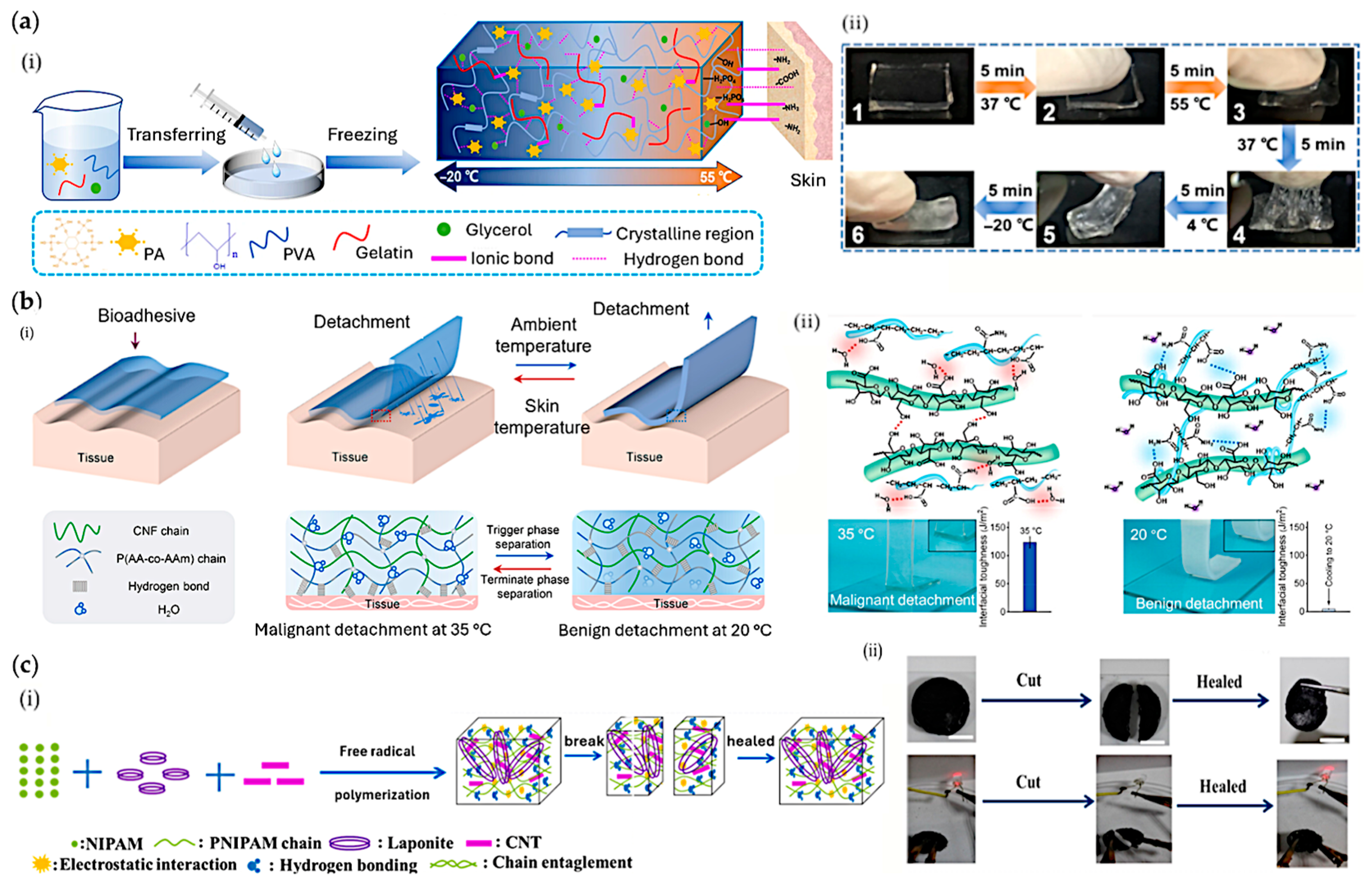
Recent progress in hydrogel adhesives has increasingly focused on physically responsive systems that allow controlled detachment through external triggers such as temperature changes, NIR irradiation, or UV exposure. A representative example is the temperature-responsive poly(vinyl alcohol)(PVA)–phytic acid(PA)–gelatin(Gel) hydrogel developed by Liu et al. [179], in which reversible ionic and hydrogen bonds form between PA and the functional groups of PVA and gelatin. This dynamic network can be thermally modulated: at body temperature, bond reorganization allows on-demand detachment, while the material can be recycled and reused following simple reprocessing. When applied to skin, the hydrogel conforms well to complex geometries and provides reliable electromechanical sensing of heartbeat, joint motion, and speech with minimal irritation (Figure 7a).
Conductive polymer-based hydrogels represent another important class of adaptive adhesive materials, particularly for wearable electronics and multimodal sensing. Systems incorporating polypyrrole, poly(3,4-ethylenedioxythiophene):poly(styrene sulfonate), or poly(AA-co-AAm) exhibit high sensitivity, flexibility, and tunable environmental responsiveness [204]. Within this family, poly(AA-co-AAm) serves as a versatile temperature-sensitive matrix capable of reversible phase separation. Zhang et al. exploited this behavior to develop a cellulose nanofibril/poly(AA-co-AAm) hydrogel (CNF/poly(AA-co-AAm)), in which strong hydrogen bonding between CNFs and copolymer chains enhances toughness and interfacial adhesion. Mild temperature variations drive phase separation in the copolymer, enabling reversible switching of the hydrogel’s mechanical integrity and adhesive strength, making it well-suited for adaptive wearable devices and reconfigurable interfaces (Figure 7b) [180].
Similarly, Deng et al. introduced 3D-printable nanocomposite hydrogels combining laponite nanoclay, multiwalled carbon nanotubes, and N-isopropyl-AAm. Polymerization of NIPAM in the presence of laponite yields a physically crosslinked, conductive network endowed with temperature and NIR responsiveness, stretchability, and rapid self-healing. These multifunctional hydrogels demonstrate sensitive detection of finger, elbow, and knee motion, as well as pressure detection, highlighting their potential as multimodal interfaces bridging biological motion and soft robotic actuation (Figure 7c) [21]. Such systems exemplify how hydrogel adhesives can serve as dynamic, stimuli-responsive platforms for wearable electronics, soft robotics, and adaptive biointerfaces.
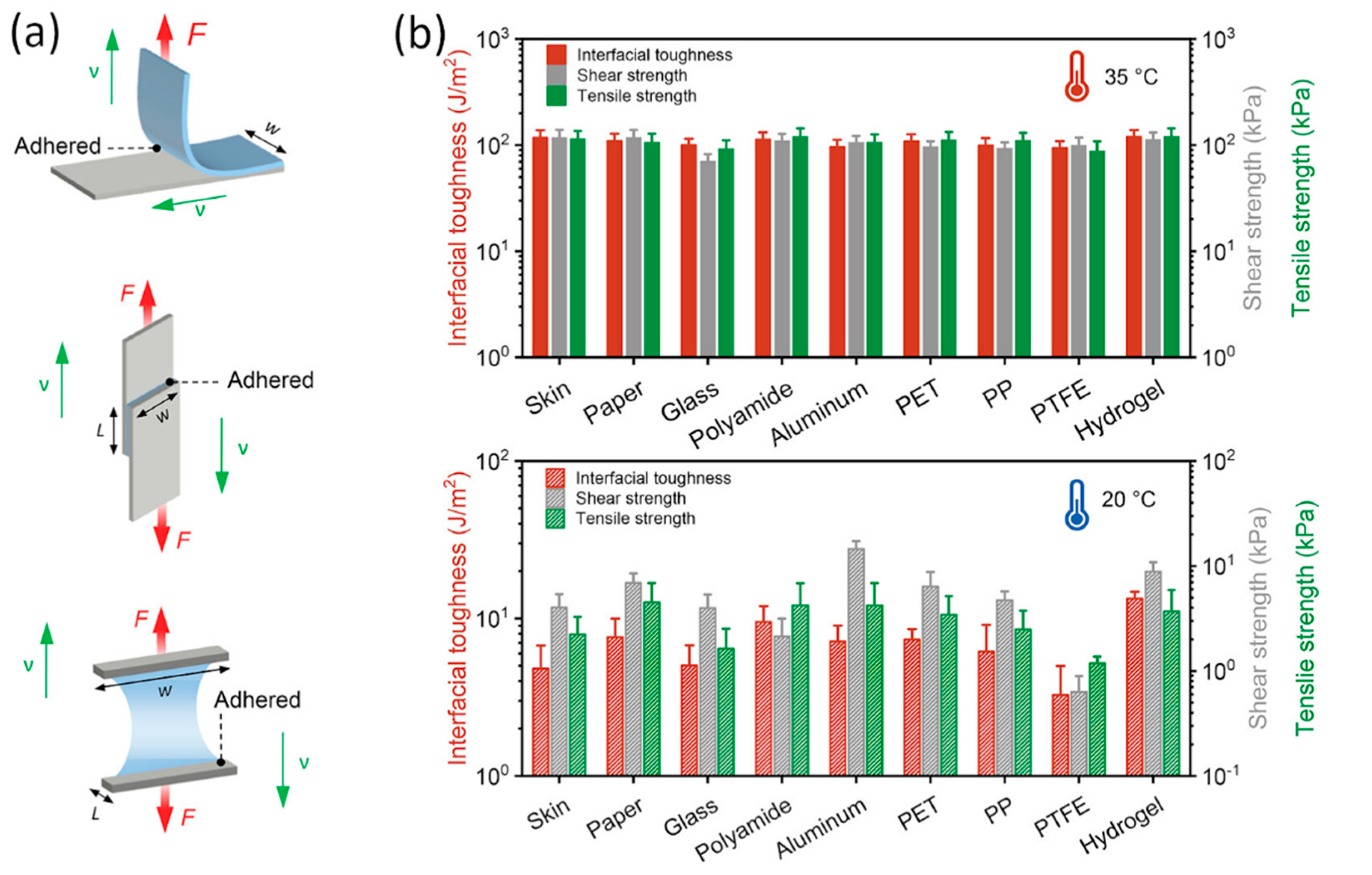
These examples illustrate how integrating conductive components and stimuli-responsive polymer networks within hydrogels can generate adaptive adhesive systems that bridge the gap between structural functionality and electronic intelligence. As a matter of fact, these examples display triggerable reversible bonding, allowing for an easy attachment/detachment of the adhesives upon application of external stimuli. In particular, numerous recent efforts in the field lead to the development of temperature-sensitive hydrogel adhesives, whose adhesive forces are strongly affected by local temperature changes [179,180,182,184], as displayed in Figure 8, where CNF/P(AA-co-AAm) hydrogels (preparation details in Figure 7b) can switch freely between strong adhesion (at a skin temperature of 35 °C) and high robustness (at an ambient temperature of 20 °C) [180]. At the same time, it is important to remark here that self-adhesive materials generally adhere and peel at different strain rates or frequencies, meaning that adhesion forces are rate-dependent, and influenced by the testing velocity [110,111,112,113,205,206]. In this framework, recent efforts in this field highlight a shift from static adhesives toward smart, stimuli-responsive hydrogel interfaces that integrate mechanical adaptability, electrical functionality, and reversible bonding.

7. Conclusions and Future Directions

Reversible hydrogel-based adhesives represent a rapidly evolving frontier at the intersection of soft materials, interfacial science, and sustainable design. Their unique ability to combine robust adhesion with controlled detachment has opened up new opportunities across biomedical devices, soft robotics, wearable electronics, and sustainable manufacturing. However, their broader adoption is still limited by a series of scientific, technological, and economic challenges that must be addressed through coordinated, multidisciplinary research.
Key challenges in hydrogel adhesion include achieving strong and durable bonding in wet and dynamic environments, optimizing molecular design for targeted adhesion properties, balancing biochemical functionality with mechanical performance, and ensuring long-term stability through improved fatigue resistance, tissue integration, swelling control, and biodegradability. Despite recent progress, additional scientific challenges remain, including establishing clearer structure–property–function relationships, improving adhesion under physiologically relevant or fluctuating conditions, enhancing cyclic durability during repeated attachment–detachment events, and integrating multifunctionality without compromising stability or sustainability. Furthermore, the development of predictive models and more consistent testing methodologies tailored to soft, water-rich, and reversible adhesives is still needed to guide future material design and enable meaningful comparison across studies.
In summary, current advances demonstrate that hydrogels can achieve tunable and reversible adhesion through multi-network architectures, dynamic covalent or supramolecular bonding, and bioinspired structural motifs. These systems offer distinctive advantages such as softness, biocompatibility, and environmental responsiveness, yet intrinsic limitations remain. Their water-dependent structure, although beneficial for flexibility and biological integration, can compromise stability under varying humidity, salinity, or temperature conditions. Moreover, many formulations still rely on synthetic or metal-containing precursors, raising concerns regarding biodegradability, recyclability, and cost.
Our analysis highlights that many of the most promising formulations succeed only within narrow environmental windows and rely on chemistries whose long-term stability and sustainability remain unresolved. Moreover, the comparison across studies reveals some inconsistency in testing parameters and environmental conditions, which further complicates performance improvements.
Future research directions should therefore concentrate on several key areas:
  • Sustainable Material Development: the transition toward bio-derived, biodegradable, and non-toxic hydrogel networks is essential. Renewable polymers such as polysaccharides, proteins, and microbial biopolymers should be explored to replace petrochemical or metal-based components. As evidenced by our survey, only a small fraction of current systems fully integrates sustainability considerations at the material and process level, evidencing the need for design frameworks that balance performance with environmental impact. Integrating LCA and end-of-life analysis into early design stages will ensure a realistic path toward environmentally responsible adhesives.
  • Mechanistic Understanding and Standardization: although numerous chemistries and formulations have been proposed, a clear structure–property–function relationship is still lacking. In fact, the variety of testing procedures and environmental conditions documented in this review evidenced that cross-study comparisons can be extremely challenging. Establishing standardized adhesion testing protocols, predictive models, and inter-laboratory benchmarks will be vital to enable meaningful comparison and industrial translation.
  • Integration with Smart and Hybrid Technologies: the next generation of hydrogel adhesives should incorporate multifunctionality, such as electrical conductivity, self-healing, or antimicrobial activity, without compromising reversibility or sustainability. Hybrid architectures combining organic networks with bioactive fillers, nanocellulose, or biodegradable conductive components could bridge mechanical adaptability with advanced functionality.
  • Environmental Stability and Durability: Improving hydrogel performance in humid, saline, or dynamically loaded environments remains a major challenge. Strategies such as hierarchical crosslinking, hybrid nanofiller reinforcement, and double-network formation may enhance mechanical resilience while maintaining reusability and biocompatibility. Yet, as shown in this review, most high-performance systems still rely on laboratory-scale methods with limited prospects for scale-up, indicating a need for process-oriented innovation.
  • Scalability and Circularity: To enable real-world application, synthetic routes must be simplified, energy use reduced, and compatibility with scalable manufacturing (e.g., printing or coating) ensured. Developing chemically recyclable or stimuli-debondable hydrogel adhesives could support circular economy models and extend material lifetime.
In conclusion, hydrogel-based reversible adhesives are poised to redefine adhesion science through their combination of adaptability, biocompatibility, and sustainability. Their evolution now depends on harmonizing performance, functionality, and environmental responsibility, advancing from promising laboratory prototypes to truly circular, smart, and sustainable adhesive systems capable of meeting the demands of future technologies.

Supplementary Materials

The following supporting information can be downloaded at: https://www.mdpi.com/article/10.3390/colloids9060084/s1, Figure S1: Overview of adhesive market segmentation by chemistry, technology, and application sector; Table S1: Search strings used for the search in Google ScholarTM; Figure S2: Bibliometric trends obtained from Google Scholar™ (2007–2024, biennial sampling) using four nested search strings: (a) intitle:adhesive; (b) intitle:adhesive sustainable; (c) intitle:adhesive hydrogel; and (d) intitle:adhesive hydrogel sustainable. Each plot reports the number of peer-reviewed articles retrieved at two-year intervals together with the corresponding regression fit (linear or exponential) and R2 value. Full search strings, exclusion criteria, and workflow details are provided in Table S1.

Author Contributions

Conceptualization, M.T. and M.B.; data curation, M.T. and M.B.; writing—original draft preparation, M.T. and M.B.; writing—review and editing, M.T. and M.B.; visualization, M.T. and M.B.; project administration, M.T. and M.B.; funding acquisition, M.B. All authors have read and agreed to the published version of the manuscript.

Funding

This research was funded by CSGI (Consorzio Interuniversitario per lo Sviluppo dei Sistemi a Grande Interfase) and MIUR-Italy (‘‘Progetto Dipartimenti di Eccellenza 2023–2027 DICUS 2.0” allocated to Department of Chemistry ‘‘Ugo Schiff”, University of Florence). The research was also funded under: National Recovery and Resilience Plan (NRRP), Mission 4 Component 2 “Dalla ricerca all’impresa”—Call for tender No. 341 of 15/03/2022 of Italian Ministry of Research funded by the European Union—NextGen-erationEU, CUP: B83C22004890007, Project title “3A-ITALY—Made-in-Italy circolare e sostenibile.”; Plantform project, n° F/310143/01-03/X56, “Accordo per l’innovazione 18/10/2023”, Ministry of Enterprise and Made in Italy; European Union Next-Generation EU, Mission 4 Component 2-Project (2022NHBS9Z) CUP D53D23011920006, E53D23010890006, and B53D2301794006.

Conflicts of Interest

The authors declare no conflicts of interest.

Abbreviations

The following abbreviations are used in this manuscript:
AAAcrylic acid
AAmAcrylamide
AFMAtomic force microscopy
ATGelAcid-tolerant hydrogel
CAGRCompound annual growth rate
CDβ-cyclodextrin
CNFCellulose nanofibril
CNTCarbon nanotubes
CSChitosan
DOPA3,4-dihydroxy-l-phenylalanine
GelGelatin
HEMAHydroxyethyl methacrylate
LCALife-cycle assessment
LCSTLower critical solution temperature
MEAMethoxyethyl acrylate
NHSN-hydroxysuccinimide
NIRNear-infrared
NVPN-vinylpyrrolidone
PAPhytic acid
PAAPoly(acrylic acid)
PAAmPolyacrylamide
PEGDApoly(ethylene glycol) diacrylate
PDMSPoly(dimethylsiloxane)
PENRTPrimary Energy Non-Renewable Total
pNIPAMpoly(N-isopropylacrylamide)
PSAPressure-sensitive adhesives
PVAPoly(vinyl alcohol)
REACHEuropean Chemicals Agency’s Registration, Evaluation, Authorization and Restriction of Chemicals
UTMUniversal testing machine
VOCVolatile organic compounds

References

  1. Upadhyaya, S.; Devi, M.; Borah, S.; Sarma, N.S. Organic Polymers for Adhesive Applications: History, Progress, and the Future. In Organic Polymers in Energy-Environmental Applications; John Wiley & Sons, Ltd.: Hoboken, NJ, USA, 2024; pp. 491–512. ISBN 978-3-527-84281-0. [Google Scholar]
  2. Fay, P.A. A History of Adhesive Bonding. In Adhesive Bonding, 2nd ed.; Woodhead Publishing Series in Welding and Other Joining Technologies; Adams, R.D., Ed.; Woodhead Publishing: Cambridge, UK, 2021; pp. 3–40. ISBN 978-0-12-819954-1. [Google Scholar]
  3. Mazza, P.P.A.; Martini, F.; Sala, B.; Magi, M.; Colombini, M.P.; Giachi, G.; Landucci, F.; Lemorini, C.; Modugno, F.; Ribechini, E. A New Palaeolithic Discovery: Tar-Hafted Stone Tools in a European Mid-Pleistocene Bone-Bearing Bed. J. Archaeol. Sci. 2006, 33, 1310–1318. [Google Scholar] [CrossRef]
  4. Pawlik, A.F.; Thissen, J.P. Hafted Armatures and Multi-Component Tool Design at the Micoquian Site of Inden-Altdorf, Germany. J. Archaeol. Sci. 2011, 38, 1699–1708. [Google Scholar] [CrossRef]
  5. Stacey, R.J.; Dunne, J.; Brunning, S.; Devièse, T.; Mortimer, R.; Ladd, S.; Parfitt, K.; Evershed, R.; Bull, I. Birch Bark Tar in Early Medieval England—Continuity of Tradition or Technological Revival? J. Archaeol. Sci. Rep. 2020, 29, 102118. [Google Scholar] [CrossRef] [PubMed]
  6. Niekus, M.J.L.T.; Kozowyk, P.R.B.; Langejans, G.H.J.; Ngan-Tillard, D.; Van Keulen, H.; Van Der Plicht, J.; Cohen, K.M.; Van Wingerden, W.; Van Os, B.; Smit, B.I.; et al. Middle Paleolithic Complex Technology and a Neandertal Tar-Backed Tool from the Dutch North Sea. Proc. Natl. Acad. Sci. USA 2019, 116, 22081–22087. [Google Scholar] [CrossRef] [PubMed]
  7. Urem-Kotsou, D.; Stern, B.; Heron, C.; Kotsakis, K. Birch-Bark Tar at Neolithic Makriyalos, Greece. Antiquity 2002, 76, 962–967. [Google Scholar] [CrossRef]
  8. Sauter, F.; Varmuza, K.; Werther, W.; Stadler, P. Studies in Organic Archaeometry V1: Chemical Analysis of Organic Material Found in Traces on an Neolithic Terracotta Idol Statuette Excavated in Lower Austria. Arkivoc 2002, 2002, 54–60. [Google Scholar] [CrossRef]
  9. Solazzo, C.; Courel, B.; Connan, J.; Van Dongen, B.E.; Barden, H.; Penkman, K.; Taylor, S.; Demarchi, B.; Adam, P.; Schaeffer, P.; et al. Identification of the Earliest Collagen- and Plant-Based Coatings from Neolithic Artefacts (Nahal Hemar Cave, Israel). Sci. Rep. 2016, 6, 31053. [Google Scholar] [CrossRef]
  10. Rackham, H. (Translator) Pliny, Natural History, Volume II: Books 3–7; Harvard University Press: Cambridge, MA, USA, 1942; ISBN 978-0-674-99388-4. [Google Scholar]
  11. Donkerwolcke, M.; Burny, F.; Muster, D. Tissues and Bone Adhesives—Historical Aspects. Biomaterials 1998, 19, 1461–1466. [Google Scholar] [CrossRef]
  12. Kim, D.-I.; Grobelny, J.; Pradeep, N.; Cook, R.F. Origin of Adhesion in Humid Air. Langmuir 2008, 24, 1873–1877. [Google Scholar] [CrossRef]
  13. Buwalda, S.J.; Boere, K.W.M.; Dijkstra, P.J.; Feijen, J.; Vermonden, T.; Hennink, W.E. Hydrogels in a Historical Perspective: From Simple Networks to Smart Materials. J. Control. Release 2014, 190, 254–273. [Google Scholar] [CrossRef]
  14. Wahab, M.A. Joining Composites with Adhesives: Theory and Applications; DEStech Publications, Inc.: Lancaster, PA, USA, 2015; ISBN 978-1-60595-093-8. [Google Scholar]
  15. Bhowmik, S.; Bonin, H.W.; Bui, V.T.; Weir, R.D. Modification of High-Performance Polymer Composite through High-Energy Radiation and Low-Pressure Plasma for Aerospace and Space Applications. J. Appl. Polym. Sci. 2006, 102, 1959–1967. [Google Scholar] [CrossRef]
  16. Bhowmik, S.; Benedictus, R.; Poulis, J.A.; Bonin, H.W.; Bui, V.T. High-Performance Nanoadhesive Bonding of Titanium for Aerospace and Space Applications. Int. J. Adhes. Adhes. 2009, 29, 259–267. [Google Scholar] [CrossRef]
  17. Ashley, R.J.; Cochran, M.A.; Allen, K.W. Adhesives in Packaging. Int. J. Adhes. Adhes. 1995, 15, 101–108. [Google Scholar] [CrossRef]
  18. Versino, F.; Ortega, F.; Monroy, Y.; Rivero, S.; López, O.V.; García, M.A. Sustainable and Bio-Based Food Packaging: A Review on Past and Current Design Innovations. Foods 2023, 12, 1057. [Google Scholar] [CrossRef]
  19. Wang, Z.; Song, H.; Chen, L.; Li, W.; Yang, D.; Cheng, P.; Duan, H. 3D Printed Ultrasensitive Graphene Hydrogel Self-Adhesive Wearable Devices. ACS Appl. Electron. Mater. 2022, 4, 5199–5207. [Google Scholar] [CrossRef]
  20. Zhou, H.; Lai, J.; Jin, X.; Liu, H.; Li, X.; Chen, W.; Ma, A.; Zhou, X. Intrinsically Adhesive, Highly Sensitive and Temperature Tolerant Flexible Sensors Based on Double Network Organohydrogels. Chem. Eng. J. 2021, 413, 127544. [Google Scholar] [CrossRef]
  21. Yang, M.; Zhu, X.; Wu, X.; Dai, K.; Wan, P. Flexible conformally adhesive hydrogel electronics. Matter 2025, 8, 102276. [Google Scholar] [CrossRef]
  22. Chen, Z.; Chen, Y.; Hedenqvist, M.S.; Chen, C.; Cai, C.; Li, H.; Liu, H.; Fu, J. Multifunctional Conductive Hydrogels and Their Applications as Smart Wearable Devices. J. Mater. Chem. B 2021, 9, 2561–2583. [Google Scholar] [CrossRef]
  23. Young, T. III. An Essay on the Cohesion of Fluids. Phil. Trans. R. Soc. 1805, 95, 65–87. [Google Scholar] [CrossRef]
  24. Dupré, A. Théorie Mécanique de la Chaleur; Gauthier-Villars: Paris, France, 1869. [Google Scholar]
  25. Gibbs, J.W. On the Equilibrium of Heterogeneous Substances. Am. J. Sci. 1878, s3-16, 441–458. [Google Scholar] [CrossRef]
  26. Harrison, N.L.; Harrison, W.J. The Stresses in an Adhesive Layer. J. Adhes. 1972, 3, 195–212. [Google Scholar] [CrossRef]
  27. Papadakis, E.P. Nonuniform Pressure Device for Bonding Thin Slabs to Substrates. J. Adhes. 1972, 3, 181–194. [Google Scholar] [CrossRef]
  28. Wool, R.P.; O’Connor, K.M. Craze Healing in Polymer Glasses. Polym. Eng. Sci. 1981, 21, 970–977. [Google Scholar] [CrossRef]
  29. Fowkes, F.M. Role of Acid-Base Interfacial Bonding in Adhesion. J. Adhes. Sci. Technol. 1987, 1, 7–27. [Google Scholar] [CrossRef]
  30. Ciferri, A. Molecular Recognition at Interfaces. Adhesion, Wetting and Bond Scrambling. Front. Chem. 2022, 10, 1088613. [Google Scholar] [CrossRef]
  31. Chen, D.; Kang, Z.; Hirahara, H.; Li, W. Interfacial Nanoconnections and Enhanced Mechanistic Studies of Metallic Coatings for Molecular Gluing on Polymer Surfaces. Nanoscale Adv. 2020, 2, 2106–2113. [Google Scholar] [CrossRef]
  32. Ouyang, Q.; Ishida, K.; Okada, K. Investigation of Micro-Adhesion by Atomic Force Microscopy. Appl. Surf. Sci. 2001, 169–170, 644–648. [Google Scholar] [CrossRef]
  33. Horiuchi, S. Electron Microscopy for Visualization of Interfaces in Adhesion and Adhesive Bonding. In Interfacial Phenomena in Adhesion and Adhesive Bonding; Horiuchi, S., Terasaki, N., Miyamae, T., Eds.; Springer Nature: Singapore, 2024; pp. 17–112. ISBN 978-981-99-4456-9. [Google Scholar]
  34. Waite, J.H.; Tanzer, M.L. Polyphenolic Substance of Mytilus Edulis: Novel Adhesive Containing L-Dopa and Hydroxyproline. Science 1981, 212, 1038–1040. [Google Scholar] [CrossRef]
  35. Autumn, K.; Liang, Y.A.; Hsieh, S.T.; Zesch, W.; Chan, W.P.; Kenny, T.W.; Fearing, R.; Full, R.J. Adhesive Force of a Single Gecko Foot-Hair. Nature 2000, 405, 681–685. [Google Scholar] [CrossRef]
  36. Boesel, L.F.; Greiner, C.; Arzt, E.; del Campo, A. Gecko-Inspired Surfaces: A Path to Strong and Reversible Dry Adhesives. Adv. Mater. 2010, 22, 2125–2137. [Google Scholar] [CrossRef]
  37. Lee, H.; Lee, B.P.; Messersmith, P.B. A Reversible Wet/Dry Adhesive Inspired by Mussels and Geckos. Nature 2007, 448, 338–341. [Google Scholar] [CrossRef]
  38. Kamino, K. Mini-Review: Barnacle Adhesives and Adhesion. Biofouling 2013, 29, 735–749. [Google Scholar] [CrossRef] [PubMed]
  39. Liang, C.; Strickland, J.; Ye, Z.; Wu, W.; Hu, B.; Rittschof, D. Biochemistry of Barnacle Adhesion: An Updated Review. Front. Mar. Sci. 2019, 6, 565. [Google Scholar] [CrossRef]
  40. Heinzmann, C.; Weder, C.; Espinosa, L.M. de Supramolecular Polymer Adhesives: Advanced Materials Inspired by Nature. Chem. Soc. Rev. 2016, 45, 342–358. [Google Scholar] [CrossRef] [PubMed]
  41. Gardner, D.J. (Ed.) Theories and Mechanisms of Adhesion. In Handbook of Adhesive Technology; CRC Press: Boca Raton, FL, USA, 2017. [Google Scholar]
  42. Allen, K.W. “At Forty Cometh Understanding”: A Review of Some Basics of Adhesion over the Past Four Decades. Int. J. Adhes. Adhes. 2003, 23, 87–93. [Google Scholar] [CrossRef]
  43. Wake, W.C. Theories of Adhesion and Uses of Adhesives: A Review. Polymer 1978, 19, 291–308. [Google Scholar] [CrossRef]
  44. Kinloch, A.J. Adhesion and Adhesives; Springer Netherlands: Dordrecht, The Netherlands, 1987; ISBN 978-90-481-4003-9. [Google Scholar]
  45. Langmuir, I. The Adsorption of Gases on Plane Surfaces of Glass, Mica and Platinum. J. Am. Chem. Soc. 1918, 40, 1361–1403. [Google Scholar] [CrossRef]
  46. Israelachvili, J.N. (Ed.) Intermolecular and Surface Forces, 3rd ed.; Academic Press: San Diego, CA, USA, 2011; p. iii. ISBN 978-0-12-375182-9. [Google Scholar]
  47. Verwey, E.J.W.; Overbeek, J.T.G.; van Nes, K. Theory of the Stability of Lyophobic Colloids: The Interaction of Sol Particles Having an Electric Double Layer; Elsevier Publishing Company: New York, NY, USA, 1948. [Google Scholar]
  48. Wolloch, M. Interfacial Charge Density and Its Connection to Adhesion and Frictional Forces. Phys. Rev. Lett. 2018, 121, 026804. [Google Scholar] [CrossRef]
  49. Voyutskii, S.S.; Vakula, V.L. The Role of Diffusion Phenomena in Polymer-to-Polymer Adhesion. J. Appl. Polym. Sci. 1963, 7, 475–491. [Google Scholar] [CrossRef]
  50. Plueddemann, E.P. Silane Coupling Agents; Springer US: Boston, MA, USA, 1991; ISBN 978-1-4899-2072-0. [Google Scholar]
  51. Kinloch, A.J.; Young, R.J. Fracture Behaviour of Polymers; Springer Netherlands: Dordrecht, The Netherlands, 1995; ISBN 978-94-017-1596-6. [Google Scholar]
  52. Good, R.J. Contact Angle, Wetting, and Adhesion: A Critical Review. J. Adhes. Sci. Technol. 1992, 6, 1269–1302. [Google Scholar] [CrossRef]
  53. Zalucha, D.J.; Abbey, K.J. The Chemistry of Structural Adhesives: Epoxy, Urethane, and Acrylic Adhesives. In Kent and Riegel’s Handbook of Industrial Chemistry and Biotechnology; Kent, J.A., Ed.; Springer US: Boston, MA, USA, 2007; pp. 591–622. ISBN 978-0-387-27843-8. [Google Scholar]
  54. Hartshorn, S.R. (Ed.) Structural Adhesives; Springer US: Boston, MA, USA, 1986; ISBN 978-1-4684-7783-2. [Google Scholar]
  55. Aronovich, D.A.; Boinovich, L.B. Structural Acrylic Adhesives: A Critical Review. In Progress in Adhesion and Adhesives; John Wiley & Sons, Ltd.: Hoboken, NJ, USA, 2021; pp. 651–708. ISBN 978-1-119-84670-3. [Google Scholar]
  56. Mapari, S.; Mestry, S.; Mhaske, S.T. Developments in Pressure-Sensitive Adhesives: A Review. Polym. Bull. 2021, 78, 4075–4108. [Google Scholar] [CrossRef]
  57. Pradeep, S.V.; Kandasubramanian, B.; Sidharth, S. A Review on Recent Trends in Bio-Based Pressure Sensitive Adhesives. J. Adhes. 2023, 99, 2145–2166. [Google Scholar] [CrossRef]
  58. Blelloch, N.D.; Yarbrough, H.J.; Mirica, K.A. Stimuli-Responsive Temporary Adhesives: Enabling Debonding on Demand through Strategic Molecular Design. Chem. Sci. 2021, 12, 15183–15205. [Google Scholar] [CrossRef] [PubMed]
  59. Ahn, B.K. Perspectives on Mussel-Inspired Wet Adhesion. J. Am. Chem. Soc. 2017, 139, 10166–10171. [Google Scholar] [CrossRef] [PubMed]
  60. Ebnesajjad, S. Handbook of Adhesives and Surface Preparation; Elsevier: Amsterdam, The Netherlands, 2011; ISBN 978-1-4377-4461-3. [Google Scholar]
  61. Petrie, E.M. Handbook of Adhesives and Sealants, 3rd ed.; McGraw-Hill Education: New York, NY, USA, 2021; ISBN 978-1-260-44044-7. [Google Scholar]
  62. Li, J.; Celiz, A.D.; Yang, J.; Yang, Q.; Wamala, I.; Whyte, W.; Seo, B.R.; Vasilyev, N.V.; Vlassak, J.J.; Suo, Z.; et al. Tough Adhesives for Diverse Wet Surfaces. Science 2017, 357, 378–381. [Google Scholar] [CrossRef] [PubMed]
  63. Chopra, I.; Ola, S.K.; Priyanka; Dhayal, V.; Shekhawat, D.S. Recent Advances in Epoxy Coatings for Corrosion Protection of Steel: Experimental and Modelling Approach-A Review. Mater. Today Proc. 2022, 62, 1658–1663. [Google Scholar] [CrossRef]
  64. Poornima Vijayan, P.; Formela, K.; Saeb, M.R.; Chithra, P.G.; Thomas, S. Integration of Antifouling Properties into Epoxy Coatings: A Review. J. Coat. Technol. Res. 2022, 19, 269–284. [Google Scholar] [CrossRef]
  65. Tonelli, M.; Perini, I.; Ridi, F.; Baglioni, P. Improving the Properties of Antifouling Hybrid Composites: The Use of Halloysites as Nano-Containers in Epoxy Coatings. Colloids Surf. A Physicochem. Eng. Asp. 2021, 623, 126779. [Google Scholar] [CrossRef]
  66. Baldan, A. Adhesively-Bonded Joints and Repairs in Metallic Alloys, Polymers and Composite Materials: Adhesives, Adhesion Theories and Surface Pretreatment. J. Mater. Sci. 2004, 39, 1–49. [Google Scholar] [CrossRef]
  67. Sonnenschein, M.F. Polyurethanes: Science, Technology, Markets, and Trends, 2nd ed.; Wiley Series on Polymer Engineering and Technology Ser; John Wiley & Sons, Inc.: Hoboken, NJ, USA, 2021; ISBN 978-1-119-66947-0. [Google Scholar]
  68. Creton, C. Pressure-Sensitive Adhesives: An Introductory Course. MRS Bull. 2003, 28, 434–439. [Google Scholar] [CrossRef]
  69. Benedek, I.; Feldstein, M.M. Technology of Pressure-Sensitive Adhesives and Products; CRC Press: Boca Raton, FL, USA, 2008; ISBN 978-1-4200-5941-0. [Google Scholar]
  70. Raja, P.R. Cyanoacrylate Adhesives: A Critical Review. Rev. Adhes. Adhes. 2016, 4, 398–416. [Google Scholar] [CrossRef]
  71. Bré, L.P.; Zheng, Y.; Pêgo, A.P.; Wang, W. Taking Tissue Adhesives to the Future: From Traditional Synthetic to New Biomimetic Approaches. Biomater. Sci. 2013, 1, 239–253. [Google Scholar] [CrossRef] [PubMed]
  72. Duffy, C.; Zetterlund, P.B.; Aldabbagh, F. Radical Polymerization of Alkyl 2-Cyanoacrylates. Molecules 2018, 23, 465. [Google Scholar] [CrossRef] [PubMed]
  73. Gharde, S.; Sharma, G.; Kandasubramanian, B. Hot-Melt Adhesives: Fundamentals, Formulations, and Applications: A Critical Review. In Progress in Adhesion and Adhesives; John Wiley & Sons, Ltd.: Hoboken, NJ, USA, 2021; pp. 1–28. ISBN 978-1-119-84670-3. [Google Scholar]
  74. Li, W.; Bouzidi, L.; Narine, S.S. Current Research and Development Status and Prospect of Hot-Melt Adhesives: A Review. Ind. Eng. Chem. Res. 2008, 47, 7524–7532. [Google Scholar] [CrossRef]
  75. Arias, A.; González-Rodríguez, S.; Vetroni Barros, M.; Salvador, R.; de Francisco, A.C.; Moro Piekarski, C.; Moreira, M.T. Recent Developments in Bio-Based Adhesives from Renewable Natural Resources. J. Clean. Prod. 2021, 314, 127892. [Google Scholar] [CrossRef]
  76. Pizzi, A. Recent Developments in Eco-Efficient Bio-Based Adhesives for Wood Bonding: Opportunities and Issues. J. Adhes. Sci. Technol. 2006, 20, 829–846. [Google Scholar] [CrossRef]
  77. Alexandra Heinrich, L. Future Opportunities for Bio-Based Adhesives—Advantages beyond Renewability. Green Chem. 2019, 21, 1866–1888. [Google Scholar] [CrossRef]
  78. Bovone, G.; Dudaryeva, O.Y.; Marco-Dufort, B.; Tibbitt, M.W. Engineering Hydrogel Adhesion for Biomedical Applications via Chemical Design of the Junction. ACS Biomater. Sci. Eng. 2021, 7, 4048–4076. [Google Scholar] [CrossRef]
  79. Zhao, Y.; Song, S.; Ren, X.; Zhang, J.; Lin, Q.; Zhao, Y. Supramolecular Adhesive Hydrogels for Tissue Engineering Applications. Chem. Rev. 2022, 122, 5604–5640. [Google Scholar] [CrossRef]
  80. Liu, X.; Yu, H.; Wang, L.; Huang, Z.; Haq, F.; Teng, L.; Jin, M.; Ding, B. Recent Advances on Designs and Applications of Hydrogel Adhesives. Adv. Mater. Interfaces 2022, 9, 2101038. [Google Scholar] [CrossRef]
  81. Pei, X.; Wang, J.; Cong, Y.; Fu, J. Recent Progress in Polymer Hydrogel Bioadhesives. J. Polym. Sci. 2021, 59, 1312–1337. [Google Scholar] [CrossRef]
  82. FEICA (Association of the European Adhesive &Sealant Industry). The European Adhesive and Sealant Industry Facts & Figures 2014. Available online: https://www.feica.eu/application/files/4315/4089/9443/factandfigures14.pdf (accessed on 26 November 2025).
  83. FEICA (Association of the European Adhesive & Sealant Industry). The European Adhesive and Sealant Industry Facts & Figures 2020. Available online: https://www.vlk.nu/stream/feica-facts-and-figures-2020.pdf (accessed on 26 November 2025).
  84. The Business Research Company. Adhesives Market Report 2025—Key Trends and Growth Insights. Available online: https://www.thebusinessresearchcompany.com/report/adhesives-global-market-report (accessed on 25 November 2025).
  85. Mordor Intelligence. Adhesives Market Size & Share Analysis—Industry Research Report—Growth Trends. Available online: https://www.mordorintelligence.com/industry-reports/global-adhesives-market (accessed on 24 November 2025).
  86. Expert Market Research. Adhesives and Sealants Industry Trends and Innovations. Available online: https://www.expertmarketresearch.com/reports/adhesives-and-sealants-market-innovations (accessed on 25 November 2025).
  87. Expert Market Research. Sealants and Adhesives Market Size, Share, Trends, 2034. Available online: https://www.expertmarketresearch.com/reports/sealants-adhesives-market (accessed on 25 November 2025).
  88. Straits Research. Adhesives and Sealants Market|Forecast, Drivers, and Challenges By 2033. Available online: https://straitsresearch.com/report/adhesives-and-sealants-market (accessed on 25 November 2025).
  89. Mordor Intelligence. Adhesives Market Share, Size & Growth Outlook to 2030. Available online: https://www.mordorintelligence.com/industry-reports/global-adhesives-market (accessed on 25 November 2025).
  90. Future Market Insights. Industrial Adhesives Market|Global Market Analysis Report—2035. Available online: https://www.futuremarketinsights.com/reports/industrial-adhesives-market (accessed on 24 November 2025).
  91. Market Data Forecast. Automotive Adhesives & Sealants Market Size Report, 2033. Available online: https://www.marketdataforecast.com/market-reports/automotive-adhesives-and-sealants-market (accessed on 26 November 2025).
  92. Market Data Forecast. Europe Adhesives and Sealants Market Size & Growth, 2033. Available online: https://www.marketdataforecast.com/market-reports/europe-adhesives-sealants-market (accessed on 26 November 2025).
  93. Market Data Forecast. Surgical Sealants and Adhesives Market Size, 2033. Available online: https://www.marketdataforecast.com/market-reports/surgical-sealants-and-adhesives-market (accessed on 26 November 2025).
  94. Global Market Insights. Adhesives and Sealants Market Report (2024). Available online: https://www.gminsights.com/industry-analysis/adhesives-and-sealants-market-report (accessed on 30 October 2025).
  95. Ceresana. Adhesives Market Analysis 2032—Global. Available online: https://ceresana.com/en/produkt/adhesives-market-report-world (accessed on 26 November 2025).
  96. Pal, T.S.; Raut, S.K.; Singha, N.K. Mussel-Inspired Catechol-Functionalized EVA Elastomers for Specialty Adhesives; Based on Triple Dynamic Network. Chem. Mater. 2025, 37, 2516–2534. [Google Scholar] [CrossRef]
  97. Liu, Z.; Tang, Y.; Chen, Y.; Lu, Z.; Rui, Z. Dynamic Covalent Adhesives and Their Applications: Current Progress and Future Perspectives. Chem. Eng. J. 2024, 497, 154710. [Google Scholar] [CrossRef]
  98. Condò, I.; Giannitelli, S.M.; Lo Presti, D.; Cortese, B.; Ursini, O. Overview of Dynamic Bond Based Hydrogels for Reversible Adhesion Processes. Gels 2024, 10, 442. [Google Scholar] [CrossRef] [PubMed]
  99. Zhao, Y.; Wu, Y.; Wang, L.; Zhang, M.; Chen, X.; Liu, M.; Fan, J.; Liu, J.; Zhou, F.; Wang, Z. Bio-Inspired Reversible Underwater Adhesive. Nat. Commun. 2017, 8, 2218. [Google Scholar] [CrossRef]
  100. Tan, Y.L.; Wong, Y.J.; Ong, N.W.X.; Leow, Y.; Wong, J.H.M.; Boo, Y.J.; Goh, R.; Loh, X.J. Adhesion Evolution: Designing Smart Polymeric Adhesive Systems with On-Demand Reversible Switchability. ACS Nano 2024, 18, 24682–24704. [Google Scholar] [CrossRef]
  101. Tang, S.; Feng, K.; Yang, R.; Cheng, Y.; Chen, M.; Zhang, H.; Shi, N.; Wei, Z.; Ren, H.; Ma, Y. Multifunctional Adhesive Hydrogels: From Design to Biomedical Applications. Adv. Healthc. Mater. 2025, 14, 2403734. [Google Scholar] [CrossRef]
  102. Yuen, H.Y.; Bei, H.P.; Zhao, X. Underwater and Wet Adhesion Strategies for Hydrogels in Biomedical Applications. Chem. Eng. J. 2022, 431, 133372. [Google Scholar] [CrossRef]
  103. Hu, W.; Wang, Z.; Xiao, Y.; Zhang, S.; Wang, J. Advances in Crosslinking Strategies of Biomedical Hydrogels. Biomater. Sci. 2019, 7, 843–855. [Google Scholar] [CrossRef]
  104. Muir, V.G.; Burdick, J.A. Chemically Modified Biopolymers for the Formation of Biomedical Hydrogels. Chem. Rev. 2021, 121, 10908–10949. [Google Scholar] [CrossRef]
  105. Priya, A.S.; Premanand, R.; Ragupathi, I.; Bhaviripudi, V.R.; Aepuru, R.; Kannan, K.; Shanmugaraj, K. Comprehensive Review of Hydrogel Synthesis, Characterization, and Emerging Applications. J. Compos. Sci. 2024, 8, 457. [Google Scholar] [CrossRef]
  106. Tordi, P.; Gelli, R.; Tamantini, S.; Bonini, M. Alginate Crosslinking beyond Calcium: Unlocking the Potential of a Range of Divalent Cations for Fiber Formation. Int. J. Biol. Macromol. 2025, 306, 141196. [Google Scholar] [CrossRef] [PubMed]
  107. Tordi, P.; Ridi, F.; Samorì, P.; Bonini, M. Cation-Alginate Complexes and Their Hydrogels: A Powerful Toolkit for the Development of Next-Generation Sustainable Functional Materials. Adv. Funct. Mater. 2025, 35, 2416390. [Google Scholar] [CrossRef]
  108. Gelli, R.; Del Buffa, S.; Tempesti, P.; Bonini, M.; Ridi, F.; Baglioni, P. Multi-Scale Investigation of Gelatin/Poly (Vinyl Alcohol) Interactions in Water. Colloids Surf. A Physicochem. Eng. Asp. 2017, 532, 18–25. [Google Scholar] [CrossRef]
  109. Mugnaini, G.; Gelli, R.; Mori, L.; Bonini, M. How to Cross-Link Gelatin: The Effect of Glutaraldehyde and Glyceraldehyde on the Hydrogel Properties. ACS Appl. Polym. Mater. 2023, 5, 9192–9202. [Google Scholar] [CrossRef]
  110. Hirtzel, J.; Leks, G.; Favre, J.; Frisch, B.; Talon, I.; Ball, V. Strongly Metal-Adhesive and Self-Healing Gelatin@Polydopamine-Based Hydrogels with Long-Term Antioxidant Activity. Antioxidants 2023, 12, 1764. [Google Scholar] [CrossRef]
  111. Dai, B.; Cui, T.; Xu, Y.; Wu, S.; Li, Y.; Wang, W.; Liu, S.; Tang, J.; Tang, L. Smart Antifreeze Hydrogels with Abundant Hydrogen Bonding for Conductive Flexible Sensors. Gels 2022, 8, 374. [Google Scholar] [CrossRef]
  112. Wu, H.; Sariola, V.; Zhao, J.; Ding, H.; Sitti, M.; Bettinger, C.J. Composition—Dependent Underwater Adhesion of Catechol—Bearing Hydrogels. Polym. Int. 2016, 65, 1355–1359. [Google Scholar] [CrossRef]
  113. Yuan, Z.; Duan, X.; Su, X.; Tian, Z.; Jiang, A.; Wan, Z.; Wang, H.; Wei, P.; Zhao, B.; Liu, X.; et al. Catch Bond-Inspired Hydrogels with Repeatable and Loading Rate-Sensitive Specific Adhesion. Bioact. Mater. 2023, 21, 566–575. [Google Scholar] [CrossRef]
  114. Yang, J.; Bai, R.; Chen, B.; Suo, Z. Hydrogel Adhesion: A Supramolecular Synergy of Chemistry, Topology, and Mechanics. Adv. Funct. Mater. 2020, 30, 1901693. [Google Scholar] [CrossRef]
  115. Polymeric Tissue Adhesives|Chemical Reviews. Available online: https://pubs.acs.org/doi/10.1021/acs.chemrev.0c00798 (accessed on 25 October 2025).
  116. Bouten, P.J.M.; Zonjee, M.; Bender, J.; Yauw, S.T.K.; van Goor, H.; van Hest, J.C.M.; Hoogenboom, R. The Chemistry of Tissue Adhesive Materials. Prog. Polym. Sci. 2014, 39, 1375–1405. [Google Scholar] [CrossRef]
  117. Zhang, Y.; Tan, Y.; Lao, J.; Gao, H.; Yu, J. Hydrogels for Flexible Electronics. ACS Nano 2023, 17, 9681–9693. [Google Scholar] [CrossRef] [PubMed]
  118. Xiao, Z.; Li, Q.; Liu, H.; Zhao, Q.; Niu, Y.; Zhao, D. Adhesion Mechanism and Application Progress of Hydrogels. Eur. Polym. J. 2022, 173, 111277. [Google Scholar] [CrossRef]
  119. Yu, L.; Dean, K.; Li, L. Polymer Blends and Composites from Renewable Resources. Prog. Polym. Sci. 2006, 31, 576–602. [Google Scholar] [CrossRef]
  120. Packham, D.E. Adhesive Technology and Sustainability. Int. J. Adhes. Adhes. 2009, 29, 248–252. [Google Scholar] [CrossRef]
  121. Mulcahy, K.R.; Kilpatrick, A.F.R.; Harper, G.D.J.; Walton, A.; Abbott, A.P. Debondable Adhesives and Their Use in Recycling. Green Chem. 2022, 24, 36–61. [Google Scholar] [CrossRef]
  122. Rao, Y.; Wan, G. Sustainable Adhesives: Bioadhesives, Chemistries, Recyclability, and Reversibility. In Advances in Structural Adhesive Bonding, 2nd ed.; Woodhead Publishing in Materials; Dillard, D.A., Ed.; Woodhead Publishing: Cambridge, UK, 2023; pp. 953–985. ISBN 978-0-323-91214-3. [Google Scholar]
  123. Zöller, K.; To, D.; Bernkop-Schnürch, A. Biomedical Applications of Functional Hydrogels: Innovative Developments, Relevant Clinical Trials and Advanced Products. Biomaterials 2025, 312, 122718. [Google Scholar] [CrossRef]
  124. Eisen, A.; Bussa, M.; Röder, H. A Review of Environmental Assessments of Biobased against Petrochemical Adhesives. J. Clean. Prod. 2020, 277, 124277. [Google Scholar] [CrossRef]
  125. Understanding REACH—ECHA. Available online: https://echa.europa.eu/regulations/reach/understanding-reach (accessed on 25 October 2025).
  126. McDonough, K.; Hall, M.J.; Wilcox, A.; Menzies, J.; Brill, J.; Morris, B.; Connors, K. Application of Standardized Methods to Evaluate the Environmental Safety of Polyvinyl Alcohol Disposed of down the Drain. Integr. Environ. Assess. Manag. 2024, 20, 1693–1705. [Google Scholar] [CrossRef]
  127. Chen, H.; Wu, Q.; Ren, X.; Zhu, X.; Fan, D. A Fully Bio-Based Adhesive with High Bonding Strength, Low Environmental Impact, and Competitive Economic Performance. Chem. Eng. J. 2024, 494, 153198. [Google Scholar] [CrossRef]
  128. Adhesive Standards—Standards Products—Standards & Publications—Products & Services. Available online: https://store.astm.org/products-services/standards-and-publications/standards/adhesive-standards.html (accessed on 25 October 2025).
  129. Tonelli, M.; Gelli, R.; Giorgi, R.; Pierigè, M.I.; Ridi, F.; Baglioni, P. Cementitious Materials Containing Nano-Carriers and Silica for the Restoration of Damaged Concrete-Based Monuments. J. Cult. Herit. 2021, 49, 59–69. [Google Scholar] [CrossRef]
  130. Raos, G.; Zappone, B. Polymer Adhesion: Seeking New Solutions for an Old Problem. Macromolecules 2021, 54, 10617–10644. [Google Scholar] [CrossRef]
  131. Sun, Z.; Li, Z.; Qu, K.; Zhang, Z.; Niu, Y.; Xu, W.; Ren, C. A Review on Recent Advances in Gel Adhesion and Their Potential Applications. J. Mol. Liq. 2021, 325, 115254. [Google Scholar] [CrossRef]
  132. Demiral, M. Strength in Adhesion: A Multi-Mechanics Review Covering Tensile, Shear, Fracture, Fatigue, Creep, and Impact Behavior of Polymer Bonding in Composites. Polymers 2025, 17, 2600. [Google Scholar] [CrossRef]
  133. Rezaee, M.; Tsai, L.-C.; Haider, M.I.; Yazdi, A.; Sanatizadeh, E.; Salowitz, N.P. Quantitative Peel Test for Thin Films/Layers Based on a Coupled Parametric and Statistical Study. Sci. Rep. 2019, 9, 19805. [Google Scholar] [CrossRef]
  134. Pandey, V.; Fleury, A.; Villey, R.; Creton, C.; Ciccotti, M. Linking Peel and Tack Performances of Pressure Sensitive Adhesives. Soft Matter 2020, 16, 3267–3275. [Google Scholar] [CrossRef]
  135. Xiang, Y.; Hwang, D.; Wan, G.; Niu, Z.; Ellison, C.J.; Francis, L.F.; Calabrese, M.A. Mechanics of Peeling Adhesives from Soft Substrates: A Review. J. Appl. Mech. 2025, 92, 020801. [Google Scholar] [CrossRef]
  136. Bartlett, M.D.; Case, S.W.; Kinloch, A.J.; Dillard, D.A. Peel Tests for Quantifying Adhesion and Toughness: A Review. Prog. Mater. Sci. 2023, 137, 101086. [Google Scholar] [CrossRef]
  137. Han, G.-Y.; Hwang, S.-K.; Cho, K.-H.; Kim, H.-J.; Cho, C.-S. Progress of Tissue Adhesives Based on Proteins and Synthetic Polymers. Biomater. Res. 2023, 27, 57. [Google Scholar] [CrossRef]
  138. Nguyen, K.D.Q.; Dejean, S.; Nottelet, B.; Gautrot, J.E. Mechanical Evaluation of Hydrogel–Elastomer Interfaces Generated through Thiol–Ene Coupling. ACS Appl. Polym. Mater. 2023, 5, 1364–1373. [Google Scholar] [CrossRef]
  139. Gandin, A.; Murugesan, Y.; Torresan, V.; Ulliana, L.; Citron, A.; Contessotto, P.; Battilana, G.; Panciera, T.; Ventre, M.; Netti, A.P.; et al. Simple yet Effective Methods to Probe Hydrogel Stiffness for Mechanobiology. Sci. Rep. 2021, 11, 22668. [Google Scholar] [CrossRef] [PubMed]
  140. Raghuwanshi, V.S.; Garnier, G. Characterisation of Hydrogels: Linking the Nano to the Microscale. Adv. Colloid Interface Sci. 2019, 274, 102044. [Google Scholar] [CrossRef] [PubMed]
  141. Al-Amiery, A.A.; Fayad, M.A.; Abdul Wahhab, H.A.; Al-Azzawi, W.K.; Mohammed, J.K.; Majdi, H.S. Interfacial Engineering for Advanced Functional Materials: Surfaces, Interfaces, and Applications. Results Eng. 2024, 22, 102125. [Google Scholar] [CrossRef]
  142. Pan, Z.; Fu, Q.-Q.; Wang, M.-H.; Gao, H.-L.; Dong, L.; Zhou, P.; Cheng, D.-D.; Chen, Y.; Zou, D.-H.; He, J.-C.; et al. Designing Nanohesives for Rapid, Universal, and Robust Hydrogel Adhesion. Nat. Commun. 2023, 14, 5378. [Google Scholar] [CrossRef]
  143. Megone, W.; Roohpour, N.; Gautrot, J.E. Impact of Surface Adhesion and Sample Heterogeneity on the Multiscale Mechanical Characterisation of Soft Biomaterials. Sci. Rep. 2018, 8, 6780. [Google Scholar] [CrossRef]
  144. Stetter, F.W.S.; Kienle, S.; Krysiak, S.; Hugel, T. Investigating Single Molecule Adhesion by Atomic Force Spectroscopy. J. Vis. Exp. 2015, 96, 52456. [Google Scholar] [CrossRef]
  145. Wang, J.; Han, J.-Q.; Yan, Y.; Yu, M.-N.; Feng, Q.-Y.; Xie, L.-H. Nanomechanical Characterization via Atomic Force Microscopy. ACS Appl. Mater. Interfaces 2025, 17, 55689–55705. [Google Scholar] [CrossRef]
  146. Bioinspired Chemical Design to Control Interfacial Wet Adhesion: Chem. Available online: https://www.cell.com/chem/fulltext/S2451-9294%2823%2900082-7?utm_source=chatgpt.com (accessed on 25 October 2025).
  147. Eral, H.B.; ’T Mannetje, D.J.C.M.; Oh, J.M. Contact Angle Hysteresis: A Review of Fundamentals and Applications. Colloid Polym. Sci. 2013, 291, 247–260. [Google Scholar] [CrossRef]
  148. Oyen, M.L. Mechanical Characterisation of Hydrogel Materials. Int. Mater. Rev. 2014, 59, 44–59. [Google Scholar] [CrossRef]
  149. Wang, H.; Li, X.; Li, M.; Wang, S.; Zuo, A.; Guo, J. Bioadhesion Design of Hydrogels: Adhesion Strategies and Evaluation Methods for Biological Interfaces. J. Adhes. Sci. Technol. 2023, 37, 335–369. [Google Scholar] [CrossRef]
  150. Schmidt, R.F.; Kiefer, H.; Dalgliesh, R.; Gradzielski, M.; Netz, R.R. Nanoscopic Interfacial Hydrogel Viscoelasticity Revealed from Comparison of Macroscopic and Microscopic Rheology. Nano Lett. 2024, 24, 4758–4765. [Google Scholar] [CrossRef]
  151. Water as a Probe of the Colloidal Properties of Cement|Langmuir. Available online: https://pubs.acs.org/doi/10.1021/acs.langmuir.7b02304 (accessed on 29 October 2025).
  152. Voinova, M.V.; Rodahl, M.; Jonson, M.; Kasemo, B. Viscoelastic Acoustic Response of Layered Polymer Films at Fluid-Solid Interfaces: Continuum Mechanics Approach. Phys. Scr. 1999, 59, 391–396. [Google Scholar] [CrossRef]
  153. Dixon, M.C. Quartz Crystal Microbalance with Dissipation Monitoring: Enabling Real-Time Characterization of Biological Materials and Their Interactions. J. Biomol. Tech. 2008, 19, 151–158. [Google Scholar] [PubMed]
  154. Tonda-Turo, C.; Carmagnola, I.; Ciardelli, G. Quartz Crystal Microbalance with Dissipation Monitoring: A Powerful Method to Predict the in Vivo Behavior of Bioengineered Surfaces. Front. Bioeng. Biotechnol. 2018, 6, 158. [Google Scholar] [CrossRef] [PubMed]
  155. Zhang, M.; Gao, Z.; Hakobyan, K.; Li, W.; Gu, Z.; Peng, S.; Liang, K.; Xu, J. Rapid, Tough, and Trigger—Detachable Hydrogel Adhesion Enabled by Formation of Nanoparticles In Situ. Small 2024, 20, 2310572. [Google Scholar] [CrossRef]
  156. Bai, R.; Yang, J.; Suo, Z. Fatigue of Hydrogels. Eur. J. Mech.-A/Solids 2019, 74, 337–370. [Google Scholar] [CrossRef]
  157. Karvinen, J.; Kellomäki, M. Characterization of Self-Healing Hydrogels for Biomedical Applications. Eur. Polym. J. 2022, 181, 111641. [Google Scholar] [CrossRef]
  158. Yan, Y.; Huang, J.; Qiu, X.; Zhuang, D.; Liu, H.; Huang, C.; Wu, X.; Cui, X. A Strong Underwater Adhesive That Totally Cured in Water. Chem. Eng. J. 2022, 431, 133460. [Google Scholar] [CrossRef]
  159. Zhu, X.; Wei, C.; Chen, H.; Zhang, C.; Peng, H.; Wang, D.; Yuan, J.; Waite, J.H.; Zhao, Q. A Cation—Methylene—Phenyl Sequence Encodes Programmable Poly (Ionic Liquid) Coacervation and Robust Underwater Adhesion. Adv. Funct. Mater. 2022, 32, 2105464. [Google Scholar] [CrossRef]
  160. Wei, X.; Chen, D.; Zhao, X.; Luo, J.; Wang, H.; Jia, P. Underwater Adhesive HPMC/SiW-PDMAEMA/Fe3+ Hydrogel with Self-Healing, Conductive, and Reversible Adhesive Properties. ACS Appl. Polym. Mater. 2021, 3, 837–846. [Google Scholar] [CrossRef]
  161. Li, A.; Jia, Y.; Sun, S.; Xu, Y.; Minsky, B.B.; Stuart, M.A.C.; Cölfen, H.; Von Klitzing, R.; Guo, X. Mineral-Enhanced Polyacrylic Acid Hydrogel as an Oyster-Inspired Organic–Inorganic Hybrid Adhesive. ACS Appl. Mater. Interfaces 2018, 10, 10471–10479. [Google Scholar] [CrossRef] [PubMed]
  162. Zhang, Y.; Ma, S.; Li, B.; Yu, B.; Lee, H.; Cai, M.; Gorb, S.N.; Zhou, F.; Liu, W. Gecko’s Feet-Inspired Self-Peeling Switchable Dry/Wet Adhesive. Chem. Mater. 2021, 33, 2785–2795. [Google Scholar] [CrossRef]
  163. Wang, Y.; Liu, D.; Wang, C.; Wu, J.; Xu, X.; Yang, X.; Sun, C.; Jiang, P.; Wang, X. 3D Printing of Octopi-Inspired Hydrogel Suckers with Underwater Adaptation for Reversible Adhesion. Chem. Eng. J. 2023, 457, 141268. [Google Scholar] [CrossRef]
  164. Lee, H.; Um, D.; Lee, Y.; Lim, S.; Kim, H.; Ko, H. Octopus—Inspired Smart Adhesive Pads for Transfer Printing of Semiconducting Nanomembranes. Adv. Mater. 2016, 28, 7457–7465. [Google Scholar] [CrossRef]
  165. Rao, P.; Sun, T.L.; Chen, L.; Takahashi, R.; Shinohara, G.; Guo, H.; King, D.R.; Kurokawa, T.; Gong, J.P. Tough Hydrogels with Fast, Strong, and Reversible Underwater Adhesion Based on a Multiscale Design. Adv. Mater. 2018, 30, 1801884. [Google Scholar] [CrossRef]
  166. Yi, H.; Lee, S.H.; Seong, M.; Kwak, M.K.; Jeong, H.E. Bioinspired Reversible Hydrogel Adhesives for Wet and Underwater Surfaces. J. Mater. Chem. B 2018, 6, 8064–8070. [Google Scholar] [CrossRef]
  167. Tan, D.; Wang, X.; Liu, Q.; Shi, K.; Yang, B.; Liu, S.; Wu, Z.; Xue, L. Switchable Adhesion of Micropillar Adhesive on Rough Surfaces. Small 2019, 15, 1904248. [Google Scholar] [CrossRef]
  168. Bian, S.; Hao, L.; Qiu, X.; Wu, J.; Chang, H.; Kuang, G.; Zhang, S.; Hu, X.; Dai, Y.; Zhou, Z.; et al. An Injectable Rapid—Adhesion and Anti—Swelling Adhesive Hydrogel for Hemostasis and Wound Sealing. Adv. Funct. Mater. 2022, 32, 2207741. [Google Scholar] [CrossRef]
  169. Zheng, Y.; Baidya, A.; Annabi, N. Molecular Design of an Ultra-Strong Tissue Adhesive Hydrogel with Tunable Multifunctionality. Bioact. Mater. 2023, 29, 214–229. [Google Scholar] [CrossRef]
  170. Yuk, H.; Varela, C.E.; Nabzdyk, C.S.; Mao, X.; Padera, R.F.; Roche, E.T.; Zhao, X. Dry Double-Sided Tape for Adhesion of Wet Tissues and Devices. Nature 2019, 575, 169–174. [Google Scholar] [CrossRef]
  171. Pandey, N.; Hakamivala, A.; Xu, C.; Hariharan, P.; Radionov, B.; Huang, Z.; Liao, J.; Tang, L.; Zimmern, P.; Nguyen, K.T.; et al. Biodegradable Nanoparticles Enhanced Adhesiveness of Mussel—Like Hydrogels at Tissue Interface. Adv. Healthc. Mater. 2018, 7, 1701069. [Google Scholar] [CrossRef] [PubMed]
  172. Du, D.; Chen, X.; Shi, C.; Zhang, Z.; Shi, D.; Kaneko, D.; Kaneko, T.; Hua, Z. Mussel-Inspired Epoxy Bioadhesive with Enhanced Interfacial Interactions for Wound Repair. Acta Biomater. 2021, 136, 223–232. [Google Scholar] [CrossRef] [PubMed]
  173. Li, C.; Qian, Y.; Zhang, X.; Wang, R. Robust-Adhesion and High-Mechanical Strength Hydrogel for Efficient Wet Tissue Adhesion. J. Mater. Chem. B 2025, 13, 2469–2479. [Google Scholar] [CrossRef] [PubMed]
  174. Chen, X.; Zhang, J.; Chen, G.; Xue, Y.; Zhang, J.; Liang, X.; Lei, I.M.; Lin, J.; Xu, B.B.; Liu, J. Hydrogel Bioadhesives with Extreme Acid—Tolerance for Gastric Perforation Repairing. Adv. Funct. Mater. 2022, 32, 2202285. [Google Scholar] [CrossRef]
  175. Nishiguchi, A.; Kurihara, Y.; Taguchi, T. Underwater-Adhesive Microparticle Dressing Composed of Hydrophobically-Modified Alaska Pollock Gelatin for Gastrointestinal Tract Wound Healing. Acta Biomater. 2019, 99, 387–396. [Google Scholar] [CrossRef]
  176. Yu, J.; Qin, Y.; Yang, Y.; Zhao, X.; Zhang, Z.; Zhang, Q.; Su, Y.; Zhang, Y.; Cheng, Y. Robust Hydrogel Adhesives for Emergency Rescue and Gastric Perforation Repair. Bioact. Mater. 2023, 19, 703–716. [Google Scholar] [CrossRef]
  177. Wang, W.; Zeng, Z.; Xiang, L.; Liu, C.; Diaz-Dussan, D.; Du, Z.; Asha, A.B.; Yang, W.; Peng, Y.-Y.; Pan, M.; et al. Injectable Self-Healing Hydrogel via Biological Environment-Adaptive Supramolecular Assembly for Gastric Perforation Healing. ACS Nano 2021, 15, 9913–9923. [Google Scholar] [CrossRef]
  178. Hu, X.; Grinstaff, M.W. Advances in Hydrogel Adhesives for Gastrointestinal Wound Closure and Repair. Gels 2023, 9, 282. [Google Scholar] [CrossRef]
  179. Liu, W.; Xie, R.; Zhu, J.; Wu, J.; Hui, J.; Zheng, X.; Huo, F.; Fan, D. A Temperature Responsive Adhesive Hydrogel for Fabrication of Flexible Electronic Sensors. npj Flex. Electron. 2022, 6, 68. [Google Scholar] [CrossRef]
  180. Zhang, L.; Wang, S.; Wang, Z.; Liu, Z.; Xu, X.; Liu, H.; Wang, D.; Tian, Z. Temperature-Mediated Phase Separation Enables Strong yet Reversible Mechanical and Adhesive Hydrogels. ACS Nano 2023, 17, 13948–13960. [Google Scholar] [CrossRef]
  181. Deng, Z.; Hu, T.; Lei, Q.; He, J.; Ma, P.X.; Guo, B. Stimuli-Responsive Conductive Nanocomposite Hydrogels with High Stretchability, Self-Healing, Adhesiveness, and 3D Printability for Human Motion Sensing. ACS Appl. Mater. Interfaces 2019, 11, 6796–6808. [Google Scholar] [CrossRef] [PubMed]
  182. Zhang, Z.; Zhang, H.; Wang, L.; Lin, X.; Zhang, J.; Zhang, H.; Jiang, X.; Zhang, K.; Liu, J. Thermoresponsive Dynamic Wet-Adhesive Epidermal Interface for Motion-Robust Multiplexed Sweat Biosensing. Biosens. Bioelectron. 2025, 290, 117949. [Google Scholar] [CrossRef] [PubMed]
  183. He, Z.; Zhou, Z.; Yuan, W. Highly Adhesive, Stretchable, and Antifreezing Hydrogel with Excellent Mechanical Properties for Sensitive Motion Sensors and Temperature-/Humidity-Driven Actuators. ACS Appl. Mater. Interfaces 2022, 14, 38205–38215. [Google Scholar] [CrossRef] [PubMed]
  184. Zhang, C.; Zhou, Y.; Han, H.; Zheng, H.; Xu, W.; Wang, Z. Dopamine-Triggered Hydrogels with High Transparency, Self-Adhesion, and Thermoresponse as Skinlike Sensors. ACS Nano 2021, 15, 1785–1794. [Google Scholar] [CrossRef]
  185. Gelli, R.; Del Buffa, S.; Tempesti, P.; Bonini, M.; Ridi, F.; Baglioni, P. Enhanced Formation of Hydroxyapatites in Gelatin/Imogolite Macroporous Hydrogels. J. Colloid Interface Sci. 2018, 511, 145–154. [Google Scholar] [CrossRef]
  186. Tordi, P.; Gelli, R.; Ridi, F.; Bonini, M. A Bioinspired and Sustainable Route for the Preparation of Ag-Crosslinked Alginate Fibers Decorated with Silver Nanoparticles. Carbohydr. Polym. 2024, 326, 121586. [Google Scholar] [CrossRef]
  187. Tordi, P.; Ridi, F.; Bonini, M. A Green and Sustainable Approach for the Preparation of Cu-Containing Alginate Fibers. Colloids Surf. A Physicochem. Eng. Asp. 2023, 677, 132396. [Google Scholar] [CrossRef]
  188. Tordi, P.; Montes-García, V.; Tamayo, A.; Bonini, M.; Samorì, P.; Ciesielski, A. Ionically Tunable Gel Electrolytes Based on Gelatin-Alginate Biopolymers for High-Performance Supercapacitors. Small 2025, 21, 2503937. [Google Scholar] [CrossRef]
  189. Jeong, Y.; Tordi, P.; Tamayo, A.; Han, B.; Bonini, M.; Samorì, P. Mimicking Synaptic Plasticity: Optoionic MoS2 Memory Powered by Biopolymer Hydrogels as a Dynamic Cations Reservoir. Adv. Funct. Mater. 2025, e09607. [Google Scholar] [CrossRef]
  190. Tordi, P.; Tamayo, A.; Jeong, Y.; Bonini, M.; Samorì, P. Multiresponsive Ionic Conductive Alginate/Gelatin Organohydrogels with Tunable Functions. Adv. Funct. Mater. 2024, 34, 2410663. [Google Scholar] [CrossRef]
  191. Tordi, P.; Tamayo, A.; Jeong, Y.; Han, B.; Al Kayal, T.; Cavallo, A.; Bonini, M.; Samorì, P. Fully Bio-Based Gelatin Organohydrogels via Enzymatic Crosslinking for Sustainable Soft Strain and Temperature Sensing. Adv. Funct. Mater. 2025, e20762. [Google Scholar] [CrossRef]
  192. Yang, Y.; Ren, Y.; Song, W.; Yu, B.; Liu, H. Rational Design in Functional Hydrogels towards Biotherapeutics. Mater. Des. 2022, 223, 111086. [Google Scholar] [CrossRef]
  193. Li, M.; Mao, A.; Guan, Q.; Saiz, E. Nature-Inspired Adhesive Systems. Chem. Soc. Rev. 2024, 53, 8240–8305. [Google Scholar] [CrossRef] [PubMed]
  194. Li, W.; Yang, X.; Lai, P.; Shang, L. Bio-inspired Adhesive Hydrogel for Biomedicine—Principles and Design Strategies. Smart Med. 2022, 1, e20220024. [Google Scholar] [CrossRef]
  195. Chen, Y.; Meng, J.; Gu, Z.; Wan, X.; Jiang, L.; Wang, S. Bioinspired Multiscale Wet Adhesive Surfaces: Structures and Controlled Adhesion. Adv. Funct. Mater. 2020, 30, 1905287. [Google Scholar] [CrossRef]
  196. Fan, H. Getting Glued in the Sea. Polym. J. 2023, 55, 653–664. [Google Scholar] [CrossRef]
  197. Yue, Y.; Norikane, Y.; Nishibori, E. Biomimetic Adhesion/Detachment Using Layered Polymers with Light—Induced Rapid Shape Changes. Angew. Chem. Int. Ed. 2025, 64, e202503748. [Google Scholar] [CrossRef]
  198. Ho, M.H.; Van Hilst, Q.; Cui, X.; Ramaswamy, Y.; Woodfield, T.; Rnjak-Kovacina, J.; Wise, S.G.; Lim, K.S. From Adhesion to Detachment: Strategies to Design Tissue--Adhesive Hydrogels. Adv. NanoBiomed. Res. 2024, 4, 2300090. [Google Scholar] [CrossRef]
  199. Zhou, L.; Dai, C.; Fan, L.; Jiang, Y.; Liu, C.; Zhou, Z.; Guan, P.; Tian, Y.; Xing, J.; Li, X.; et al. Injectable Self—Healing Natural Biopolymer—Based Hydrogel Adhesive with Thermoresponsive Reversible Adhesion for Minimally Invasive Surgery. Adv. Funct. Mater. 2021, 31, 2007457. [Google Scholar] [CrossRef]
  200. Yan, Y.; Xu, S.; Liu, H.; Cui, X.; Shao, J.; Yao, P.; Huang, J.; Qiu, X.; Huang, C. A Multi-Functional Reversible Hydrogel Adhesive. Colloids Surf. A Physicochem. Eng. Asp. 2020, 593, 124622. [Google Scholar] [CrossRef]
  201. Wang, L.; Gao, G.; Zhou, Y.; Xu, T.; Chen, J.; Wang, R.; Zhang, R.; Fu, J. Tough, Adhesive, Self-Healable, and Transparent Ionically Conductive Zwitterionic Nanocomposite Hydrogels as Skin Strain Sensors. ACS Appl. Mater. Interfaces 2019, 11, 3506–3515. [Google Scholar] [CrossRef]
  202. Pei, X.; Zhang, H.; Zhou, Y.; Zhou, L.; Fu, J. Stretchable, Self-Healing and Tissue-Adhesive Zwitterionic Hydrogels as Strain Sensors for Wireless Monitoring of Organ Motions. Mater. Horiz. 2020, 7, 1872–1882. [Google Scholar] [CrossRef]
  203. Qu, J.; Zhao, X.; Liang, Y.; Zhang, T.; Ma, P.X.; Guo, B. Antibacterial Adhesive Injectable Hydrogels with Rapid Self-Healing, Extensibility and Compressibility as Wound Dressing for Joints Skin Wound Healing. Biomaterials 2018, 183, 185–199. [Google Scholar] [CrossRef]
  204. Cheng, T.; Wang, F.; Zhang, Y.-Z.; Li, L.; Gao, S.-Y.; Yang, X.-L.; Wang, S.; Chen, P.-F.; Lai, W.-Y. 3D Printable Conductive Polymer Hydrogels with Ultra-High Conductivity and Superior Stretchability for Free-Standing Elastic All-Gel Supercapacitors. Chem. Eng. J. 2022, 450, 138311. [Google Scholar] [CrossRef]
  205. Shi, Y.; Wu, B.; Sun, S.; Wu, P. Peeling–Stiffening Self—Adhesive Ionogel with Superhigh Interfacial Toughness. Adv. Mater. 2024, 36, 2310576. [Google Scholar] [CrossRef]
  206. Shioya, M.; Kuroyanagi, Y.; Ryu, M.; Morikawa, J. Analysis of the Adhesive Properties of Carbon Nanotube- and Graphene Oxide Nanoribbon-Dispersed Aliphatic Epoxy Resins Based on the Maxwell Model. Int. J. Adhes. Adhes. 2018, 84, 27–36. [Google Scholar] [CrossRef]
Figure 1. (A) Global adhesives market trend combining historical data with conservative, moderate, and optimistic forecasts derived from the consolidated analysis in the Supplementary Materials (Section S1). (B) Bibliometric trends (2007–2024) obtained from Google Scholar™ showing the total number of publications with “adhesive” in the title (left axis) and the corresponding subsets whose full text includes “sustainable”, “hydrogel”, or both (right axis). Full search strings, methodology, and regression analyses are provided in the Supplementary Materials (Section S2).
Colloids 09 00084 g001
Figure 2. (A) Photographs of the cohesive nature of gelatin hydrogels: with and without PolyDA. (B) Logarithm of the tensile work per unit area, W (J/m2), as a function of the peeling rate, v (µm/s). Straight lines represent the linear regressions, whereas the dashed lines correspond to the limits of 95% confidence intervals. Blue data represent mean ± SD from three independent experiments (one-way ANOVA tests, *: p < 0.05, **: p < 0.01). Readapted from [110] under open access Creative Commons CC BY 4.0 license.
Colloids 09 00084 g002
Figure 3. Adhesion mechanisms of hydrogels: (a) mechanical interlocking, (b) wet adhesion, (c) diffusion theory, (d) Van der Waals force, π-π stacking, electrostatic force, (e) hydrogen bond, (f) ionic bond, (g) covalent bond and (h) coordination complex.
Colloids 09 00084 g003
Figure 4. Application map illustrating the typical adhesion strength (y-axis) and reversibility/multi-cycle stability (x-axis) required across representative hydrogel-based adhesive applications. Colored regions indicate characteristic performance windows for different applications.
Colloids 09 00084 g004
Figure 5. (a) Temperature-responsive mussel-inspired hydrogel adhesive based on DOPA anchoring and β-cyclodextrin/adamantane host–guest crosslinking. Below the LCST, swollen pNIPAM shields adhesive groups, whereas above the LCST chain collapse exposes DOPA and enhances wet adhesion. Readapted from [99] under open access Creative Commons CC BY license. (b) Gecko-inspired adhesive integrating mushroom-shaped PDMS micropillars with a thermo-responsive hydrogel layer, enabling temperature-controlled attachment and self-peeling behavior. Readapted with permission from [162]. (i): the scale bar is 300 μm; (ii): the scale bar is 100 μm. (c) Octopus-inspired hydrogel adhesive featuring 3D-printed suction structures and Zr4+-induced double crosslinking, enabling reversible suction-based adhesion in air and underwater.
Colloids 09 00084 g005
Figure 6. (a) Schematic diagram showing injectable Gel-CS hydrogel crosslinked through dynamic Schiff-base and borate–diol interactions, enabling shape-adaptive, reversible tissue adhesion. (b) Schematic diagram showing the formation of ATGel adhesive combining a hydrophobic poly(HEMA–NVP) substrate (grey net) with an adhesive poly(AA–NHS) brush layer (blue lines), enabling strong adhesion and stability in highly acidic gastric environments [174].
Colloids 09 00084 g006
Figure 7. (a) Schematic illustration for the preparation of the PVA/PA/Gel hydrogel (i), together with pictures showing the film treated with different temperatures (ii). Readapted from [179] under open access Creative Commons CC BY 4.0 license. (b) Schematic diagram for the preparation of a CNF/P(AA-co-AAm) hydrogel (i), and comparison of the interfacial adhesive behavior at temperature around the phase separation temperature of the polymer (ii). Readapted with permission from [197]. (c) Illustration of the preparation of conductive nanocomposite hydrogels based on nanoclay (laponite), multiwalled carbon nanotubes (CNT), and NIPAM (i), and demonstration of their self-healing properties (ii). Conductive nanocomposite NIPAM-based hydrogel exhibiting temperature/NIR responsiveness and self-healing behavior after being cut into two halves (top) and its application in electronic circuit (bottom). Readapted with permission from [21].
Colloids 09 00084 g007
Figure 8. (a) Schematic illustrations of the experimental setups for the measurement of interfacial toughness (top), shear strength (middle), and tensile strength (bottom). (b) Interfacial toughness, shear strength, and tensile strength of CNF/P(AA-co-AAm) adhesive hydrogels adhered to various substrates at 35 °C (top) and 20 °C (bottom). Readapted with permission from [180].
Colloids 09 00084 g008
Table 1. Mechanisms of Adhesion and Representative Systems.
MechanismDescriptionTypical Systems/Examples
Mechanical interlockingAdhesive penetrates surface roughness, pores, or undercuts, providing anchoring once hardenedPorous/rough substrates. Wood, textiles, etched metals. Nanocellulose-based wood adhesives, starch/protein blends, bio-inspired micropillar or fibrillar surfaces.
Adsorption/WettingMolecular forces (van der Waals, H-bonding, dipole–dipole, acid–base) dominate; spreading governed by surface energy and contact angleLiquid adhesives on smooth surfaces, coatings, and sealants. Chitosan or gelatin hydrogels, catechol-functional adhesives, bio-polyurethane dispersions, plant-derived polysaccharide adhesives.
ElectrostaticAdhesion arises from formation of an electrical double layer, generating Coulombic attractionPolymers, ceramics, charged surfaces. Alginate–chitosan polyelectrolyte complexes, charged hydrogel interfaces, ionic coordination hydrogels
DiffusionPolymer chains interpenetrate across interface, forming entangled interphasePolymer–polymer interfaces. Thermoplastics, hydrogel adhesives. Interpenetrating-network hydrogels, reversible hydrogels, thermoresponsive systems.
Chemical bondingCovalent, ionic, or coordination bonds form between adhesive and substrate functional groupsEpoxy resins on hydroxylated surfaces, metal–organic adhesives, catechol–metal coordination hydrogels, Schiff-base chitosan/gelatin adhesives, enzyme-cured bioadhesives.
ThermodynamicAdhesion interpreted as minimization of interfacial free energy; spreading coefficient governs stabilityGeneral principle for liquid spreading and interface energetics. Bio-emulsified adhesive systems, surfactant-modified biopolymers, low-surface-tension bio-derived formulations
Table 2. Strategies for reversible adhesion with representative examples from literature.
MechanismExamplesAdvantagesLimitations
Supramolecular assemblyCatechol-metal coordination, boronic ester covalent bonding and hydrogen bonding [96].Strong wet adhesion, reversibility.Environmental sensitivity.
Dynamic covalent bondsTransesterification, disulfide bond, boronic ester bonds, Schiff base, Diels-Alder, and others [97].Self-healing, shape-memory, stress-relaxation, enhanced malleability and recycling.Environmental sensitivity, chemical and engineering complexities
Self-healing polymer networksH-bonding, host–guest interaction, metal–ligand coordination, π-π stacking, and electrostatic interactions [20,21,98].Versatility, reversibility.Limited strength of adhesion and mechanical robustness.
Interfacial adaptability (van der Waals forces) Gecko-inspired micro- and nano-structured fibrillar surfaces [36].No chemical modification required, reversibility upon mechanical action, adaptability to irregular surfacesLow load capacity; environmental sensitivity.
Table 3. Conventional tests, together with their relevance for hydrogel adhesion.
Test TypeGeometryMeasured PropertyTypical InstrumentationTypical ApplicationRelevance for Hydrogels
Peel90° or 180° separationPeel strength (N m−1)UTM with peel fixture, texture analyzerThin films, biomedical patchesSensitive to viscoelastic dissipation and hydration
TackContact/
retraction
Peak adhesion force (N)Probe-tack tester, rheometer (tack mode)Instant bonding (skin, robotics)Captures rapid reversible bonding
Shear/Lap ShearParallel loadingShear strength (MPa)UTM with lap joint clampsStructural, cohesive testsEvaluates durability and cyclic recovery
Tensile/CompressionUniaxial loadingStress–strain behavior, modulusUTM, microforce testerBulk mechanical performanceRelates network elasticity to adhesion stability
Table 4. Comparison of selected hydrogel-based samples.
System ExamplesTypical CharacterizationExperimental DetailsValues
Underwater adhesives [158,159,160,161]Underwater adhesion strengthUTM lap-shear test, 5–50 mm/min, different adhesion times, various substrates15–300 kPa
Bioinspired structured hydrogels [162,163,164,165,166,167]Adhesion strengthVarious devices, dry and wet environment~50–280 kPa
Self-healing adhesives for wound closure [168,169,170,171,172,173]Lap-shear strength, porcine skin tissueASTM F225533–160 kPa
Burst pressureASTM F2392>200 mmHg
Acid-tolerant injectable bioadhesives [174,175,176,177,178]Adhesion strengthVarious devices and tissues6–120 kPa
Burst pressureCustom-made setup~250 mm Hg
Physically responsive wearable adhesives [179,180,181,182,183,184]Lap-shear adhesion strengthSelf-adhesion, UTM, tensile test machine; skin tissues or solid substrates3–120 kPa adhesion force, load-bearing capacity of 100–200 g
AdaptabilityTests on volunteersGood adhesion, easy peel off without residue/irritation
Cyclic retention3–10 cycles, 2–3 days testsLittle adhesion strength fluctuations (0–15%)
Disclaimer/Publisher’s Note: The statements, opinions and data contained in all publications are solely those of the individual author(s) and contributor(s) and not of MDPI and/or the editor(s). MDPI and/or the editor(s) disclaim responsibility for any injury to people or property resulting from any ideas, methods, instructions or products referred to in the content.