Review

Lipid-Based Colloidal Nanocarriers for Site-Specific Drug Delivery

1
Catalysis Research Center, Department of Physical Chemistry, School of Natural Sciences, Technical University of Munich, Lichtenbergstr. 4, 85748 Garching, Germany
2
Iguana Biotechnology GmbH, Sendlingerstr. 60, 80331 Munich, Germany
3
Department of Medicine II, University Hospital, Ludwig Maximilian University Munich, Marchioninistraße 15, 81377 Munich, Germany
*
Authors to whom correspondence should be addressed.
Colloids Interfaces 2026, 10(1), 7; https://doi.org/10.3390/colloids10010007
Submission received: 28 October 2025 / Revised: 20 December 2025 / Accepted: 30 December 2025 / Published: 4 January 2026
(This article belongs to the Special Issue Feature Reviews in Colloids and Interfaces)

Abstract

Lipid nanoparticles (LNPs) are now the go-to method for delivering genetic medicines, backed by real-world use in patients. Things like which fats they are made of, their shape at the molecular level, how ingredients mix, and how they are built, matter a lot. This review attempts to take a close look at how different components, such as ionizable lipids, auxiliary lipids (DSPC, DOPE), cholesterol, and PEG-based lipids, affect the bioavailability of LNPs. It also focuses on key functions of LNPs, including packaging genetic material, escaping cellular traps, spreading in the body, and remaining active in the blood. New data show that lipids with the right handedness and highly sensitive chiroptical quality control can sharpen delivery accuracy and boost transport rates, turning stereochemistry into a practical design knob. Rather than simply listing results, we examine real-world examples that are already used to regulate gene expression, enhance mRNA expression, splenic targeting, and show great potential for gene repair, protein replacement, and DNA base-editing applications. Also, recent advances in AI-based designs for LNPs that take molecular shape into account and help speed up modifications to lipid arrangements and mixture configurations are highlighted. In summary, this paper presents a practical and scientific blueprint to support smarter production of advanced LNPs used in genetic medicine, addressing existing obstacles, balanced with future opportunities.

1. Introduction

The area of nanotechnology has transformed contemporary pharmaceutical research by providing innovative approaches to drug delivery for effective, safe, and on-demand delivery [1]. Many traditional drug formulations exhibit drawbacks to drug delivery like poor solubility, short circulation time, rapid clearance, and non-specific bio-distribution, leading to diminished therapeutic effectiveness and increased systemic toxicity [2,3,4]. To overcome those limitations, we developed nanocarrier-based systems (typically consisting of lipids or polymers) to improve the stability of the drug, improve pharmacokinetic properties, and enable targeted delivery [5]. Among nanoscale carriers, lipid-based colloidal nanocarriers have attracted the most interest because they are biocompatible, biodegradable, and have a diverse range of structure types [6].
These carriers consist of liposomes, solid lipid nanoparticles (SLNPs), and nanostructured lipid carriers (NLCs), and enable the encapsulation of hydrophilic and lipophilic drugs to protect the drugs from degradation while allowing controlled release [7,8,9]. The lipid structures of these carriers mimic the natural biological membranes, permitting cellular uptake and improved therapeutic benefit [10]. Recently, there has been a general boost to utilize chirality, specifically also in biologically related fields [11,12]. This has not only motivated advances in linear and nonlinear chiroptical methods for spectroscopy [13,14,15,16,17], microscopy [18] and mapping enantiomeric excess [19,20], but also in the emergence of enhanced design strategies for lipid-based materials. It is shown that chirality-controlled LNPs boost mRNA transfection up to 5.3-fold versus achiral analogues, while enantiomer-dependent immunological responses can differ by more than 1000-fold in adjuvant potency, underscoring stereochemistry as a potent yet mostly ignored design lever [21,22]. Additionally, the potential to modify the surface of the nanocarrier with targeting ligands allows for site-specific delivery of an active ingredient, with retention in diseased tissues (tumors, inflamed or infected tissues, etc.) [23,24]. The advantages of selective targeting include reduced off-target effects, improved drug bioavailability and improved patient adherence [25,26]. In recent years, there has been important work on lipid-based nanocarriers (LBNs) for oncology, gene therapy, vaccines, and chronic disease treatment. Continued improvements in lipid chemistry, formulation design, and methods continue to refine site-specific targeting, as well as safety and efficacy [27].
The purpose of this review is to provide a comprehensive overview of lipid-based colloidal nanocarriers, focusing on their types, physicochemical properties, mechanisms of site-specific drug delivery, recent advancements, challenges, and future perspectives in targeted therapeutic applications.

2. Types of Lipid-Based Nanocarriers

Lipid-based colloidal nanocarriers refer to a large and versatile group of nanosystems designed to improve the solubility, stability, bioavailability, and site-specific delivery of therapeutic agents [28]. They have the structural and compositional variation to encapsulate a diverse range of molecules, including hydrophilic, lipophilic, and amphiphilic molecules, addressing key limitations associated with conventional dosage forms [3,29,30]. Due to their compatibility for biological applications and lipid structure, these nanocarriers can effectively imitate natural cell membranes to enhance interactions across biological barriers [25]. LBNs can generally be classified into four categories based on their physical structure and composition: vesicular systems, solid lipid systems, hybrid systems, and emulsion-based systems [31,32,33].
Vesicular systems are among the most utilized lipid nanocarriers in research, and liposomes are the prototypical representative of this type of lipid-based carrier [33]. Liposomes are spherical vesicles consisting of one or more phospholipid bilayers that encapsulate an aqueous core [34]. This structure allows both hydrophilic (aqueous phase) and lipophilic (lipid bilayer) drugs to be simultaneously encapsulated [35]. The biocompatibility and low toxicity of liposomes along with their surface properties being engineered for controlled and targeted drug delivery have placed them among the most desirable of lipid-based dosage forms [29]. The surface of liposomes can also be functionalized for stability or for targeting receptor-mediated mechanisms with molecules such as polymers (e.g., PEG) or ligands (e.g., antibodies and peptides) to alter circulation time or improve stability [28].
Solid lipid-based systems, including SLNs and NLCs, were developed as stable alternatives to traditional liposomes and polymeric nanoparticles [27]. SLNs are made of solid lipids that are safe for use, and surfactants are utilized to stabilize the lipids, providing effective protection to sensitive drugs and allowing for sustained drug delivery. The solid crystalline structure of SLNs may also prevent full drug incorporation and can also lead to drug expulsion during storage [36]. NLCs were developed to alleviate these issues by mixing solid with liquid lipids to enable a less ordered matrix to allow for greater drug accommodation, prevent drug expulsion, and enhance long-term stability [37].
Lipid-Polymer Hybrid Nanoparticles (LPHNs) are examples of hybrid systems that take advantage of the mechanical strength and tunable release properties of polymers while utilizing the favorable biocompatibility of lipids [38]. The structural characteristics of LPHNs enable precise control over release kinetics and also improve drug protection, making them favorable drug carriers for peptides, nucleic acids, and anticancer agents [28].
Lastly, emulsion-based systems, like Nanoemulsions and Self-Emulsifying Drug Delivery Systems (SEDDS), are thermodynamically stable combinations of oils, surfactants, and co-surfactants that form oil-in-water droplets at the nanosize spontaneously after diluting [26,29]. These systems effectively enhance the solubility and oral bioavailability of poorly water-soluble drugs [39]. They are also a convenient means for drug delivery because of easy preparation, scalability, and exceptionally high loading capacity [32].
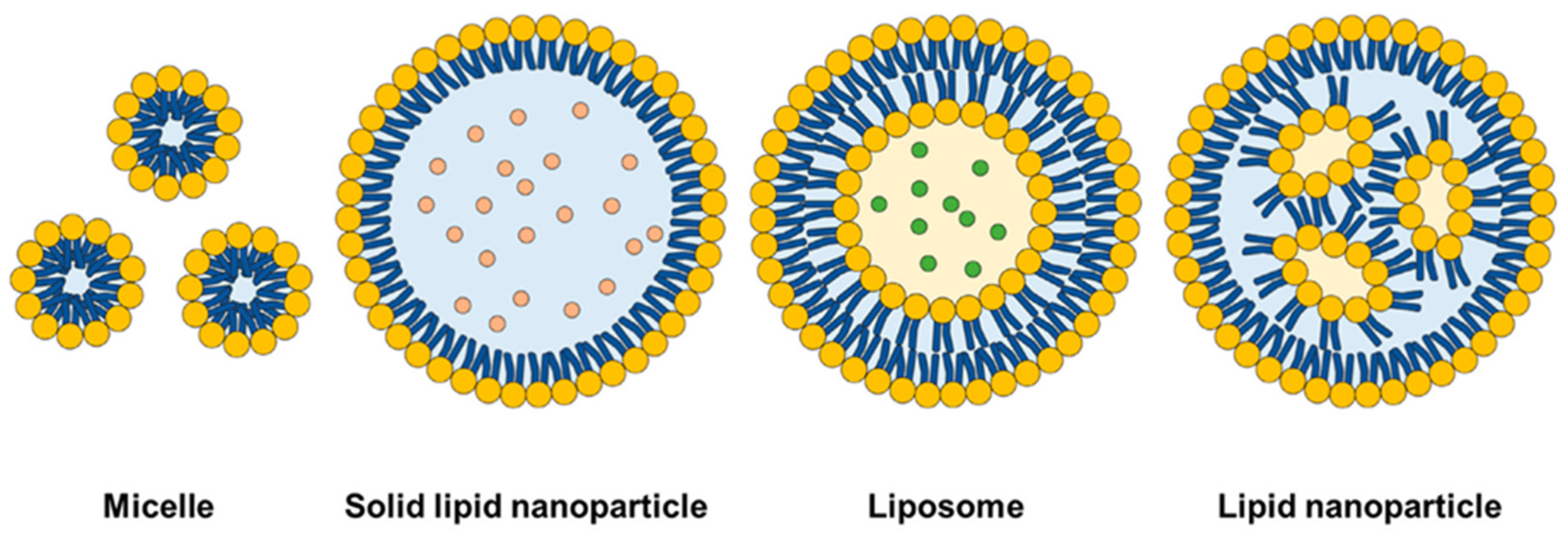
Figure 1 displays a comparison of four prominent lipid nanoplatforms: micelles, SLNs, liposomes, and lipid–polymer hybrid nanoparticles. The construction of each carrier is shown to clearly demonstrate its particular structure, whether it is micelles shown as small spheres corresponding to a monolayer, SLNs with crystalline lipids in the core, liposomes as one or more phospholipid bilayers encapsulating an aqueous lumen, or hybrid particles that have a polymer core with a lipid shell. This figure reinforces the message of the manuscript that the selection of geometry of the carrier dictates which class of drug (hydrophilic, lipophilic or amphiphilic) can be incorporated for loading and released.
As outlined above, LBNs are a flexible platform that can be used for a variety of therapeutic applications. The selection of the system depends on the physicochemical properties of the drug, the rate of release desired, and the site of action, highlighting LBNs as useful technologies in the future of modern targeted drug delivery. A summary of recent research on lipid-based colloidal nanocarriers, highlighting their structural characteristics is presented in Table 1.

3. LNP Structure and Role in Nucleic Acid Therapeutics

LNPs are typically spherical carriers composed of lipid assemblies that enclose an aqueous interior, offering advantages such as straightforward formulation, spontaneous self-assembly, biocompatibility, high bioavailability, and the capacity to encapsulate large therapeutic cargos. These features have positioned LNPs as the preferred delivery platform for many FDA-approved nanomedicines [44]. Clinically, they have been widely applied for the transport of both small-molecule drugs and macromolecular therapeutics, particularly nucleic acids.
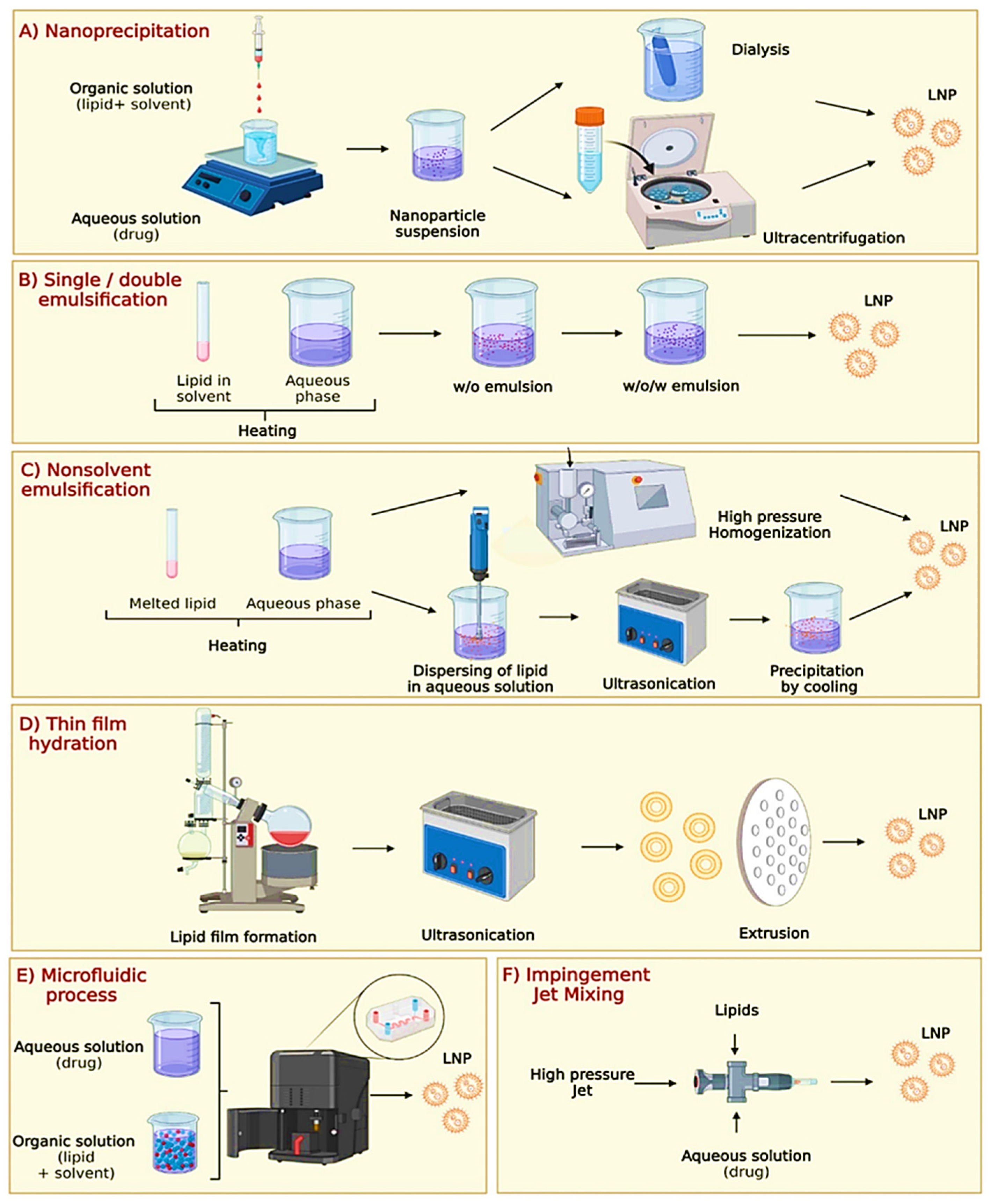
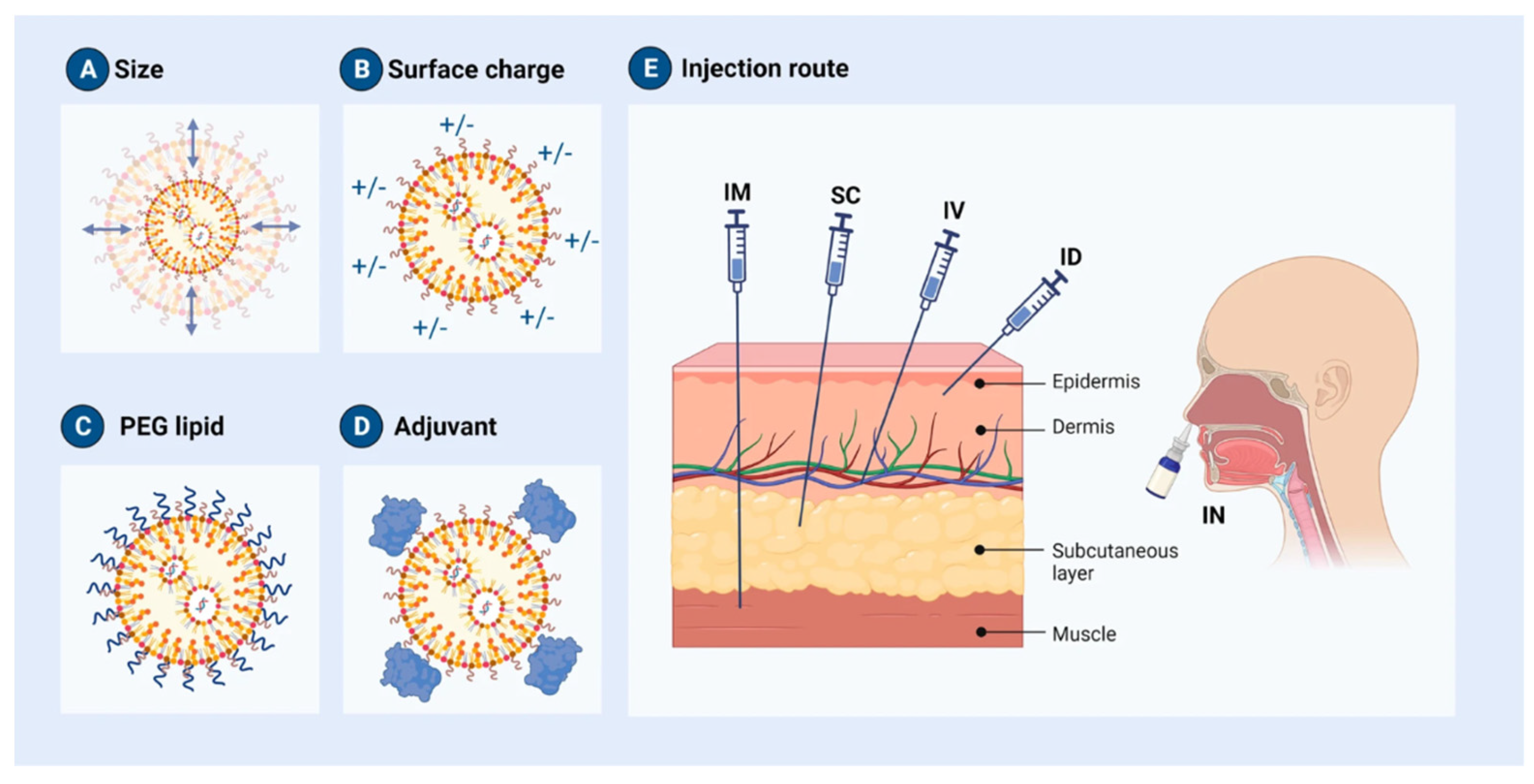
In contrast to conventional bilayer liposomes, LNPs possess a more intricate internal organization that confers greater physical stability. Their size, surface charge, and surface functionalization can be precisely engineered during formulation to enhance stability and optimize biological performance. Following administration, LNPs are taken up by cells, enabling release of the encapsulated nucleic acids into the cytosol, where they can exert their intended biological function [45,46]. Because naked mRNA is rapidly degraded by ribonucleases and exhibits poor intracellular stability due to its large size, negative charge, and chemical fragility, lipid-based nanocarriers such as LNPs are essential to protect these molecules and ensure their efficient and targeted delivery. LNPs can be synthesized using a variety of laboratory and industrial techniques, each offering distinct advantages in terms of particle size control, encapsulation efficiency, and scalability (Figure 2).
Common laboratory-scale methods include nanoprecipitation, where lipids spontaneously assemble upon solvent exchange, and single or double emulsification, which are frequently used for encapsulating hydrophilic or hydrophobic payloads. Nonsolvent emulsification and thin film hydration are additional classical approaches that allow formation of stable lipid vesicles with tunable composition. On the other hand, microfluidic platforms and impingement jet mixers represent more advanced techniques capable of producing LNPs with narrow size distributions and high reproducibility, making them particularly suitable for industrial-scale production. The choice of synthesis method is critical, as it directly influences LNP physicochemical properties, stability, and ultimately their delivery performance in therapeutic applications [28].

3.1. Material Considerations and Structural Design of LNPs for mRNA Therapeutics

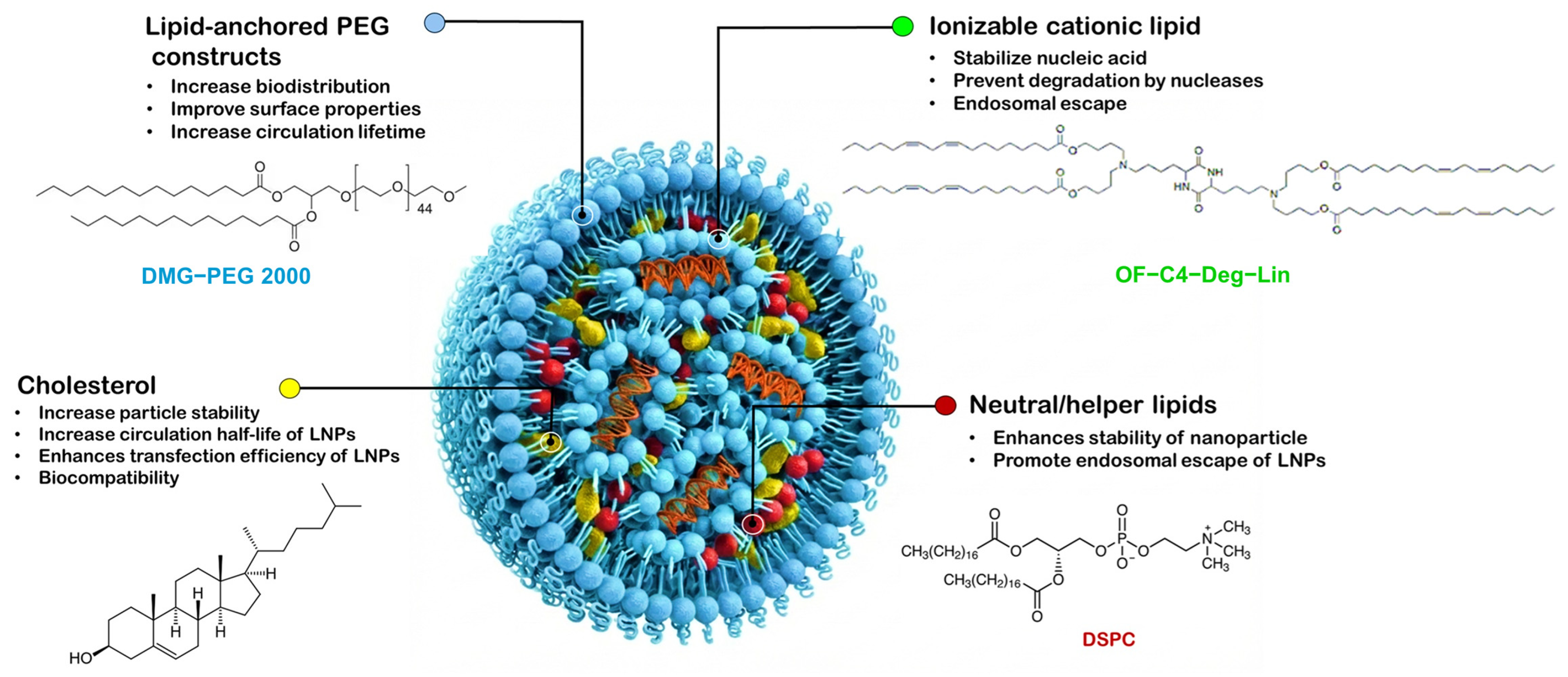
Lipid nanoparticles are commonly constructed from four principal lipid components (see Figure 3, Table 2): (i) Ionizable cationic lipids, which enable nucleic acid complexation and intracellular delivery; (ii) Helper lipids, which enhance particle stability and delivery efficiency; (iii) Cholesterol, which reinforces structural integrity; and (iv) PEGylated lipids, which reduce immune recognition and prolong systemic circulation [47].
Among these, ionizable lipids are the core functional elements, driving efficient nucleic acid encapsulation, improving stability, and enabling pH-responsive delivery.

3.1.1. Ionizable Cationic Lipid

Ionizable lipids, including OF-C4-Deg-Lin and FTT5, become protonated under acidic conditions, acquiring a positive charge within cellular and endosomal environments while remaining largely neutral at physiological blood pH. This pH-responsive behavior enables effective complexation and protection of nucleic acids against nuclease-mediated degradation. Upon endosomal acidification, the resulting positive charge promotes cellular internalization and facilitates endosomal membrane disruption, thereby enhancing cytosolic release of the encapsulated cargo [47,48].

3.1.2. Neutral/Helper Phospholipids

In addition to ionizable lipids, LNPs contain helper lipids, primarily phospholipids such as phosphatidylethanolamine (DOPE) and phosphatidylcholine (DSPC). These lipids enhance particle stability, maintain membrane integrity, and improve delivery efficiency. DOPE and DSPC contribute to transfection by promoting membrane fusion and stabilizing LNP structure through their acyl chain geometries [49]. They also facilitate endosomal escape, with the relative ratio of lipids critically influencing nanoparticle performance. DOPE is particularly effective for mRNA delivery because it can transition from a stable lamellar phase to a less stable hexagonal phase, promoting membrane fusion, whereas phosphatidylcholine-rich lipids tend to inhibit fusion-mediated endosomal escape [50].

3.1.3. Cholesterol

Recent studies have shown that the hydrophobic and rigid lipid cholesterol intercalates between other lipids in the vesicle membrane, modulating membrane stiffness and structural integrity, which enhances particle stability. Incorporation of cholesterol also improves delivery efficiency, prolongs nanoparticle circulation half-life, and boosts transfection by facilitating membrane fusion and endosomal release. For instance, Patel et al. demonstrated that LNPs containing cholesterol analogues with C-24 alkyl phytosterols (eLNPs) exhibited increased cellular uptake and retention, leading to more efficient and sustained mRNA release [51]. Higher cholesterol content lowers the membrane transition temperature of LNPs and enhances biocompatibility, given cholesterol’s natural presence in biological membranes.

3.1.4. Lipid Anchored Polyethylene Glycol (PEG) Constructs

PEG-lipid constructs, consisting of polyethylene glycol (PEG) chains attached to alkyl anchors, integrate into the LNP surface to provide steric stabilization. Incorporation of PEG-lipids reduces opsonization by serum proteins and clearance by the reticuloendothelial system, thereby enhancing biodistribution. PEGylation also influences nanoparticle size and surface charge, prevents protein adsorption, minimizes aggregation, and prolongs circulation time [52]. Moreover, the PEG layer can facilitate receptor-mediated cellular uptake through dynamic exchange with serum proteins like ApoE [53]. However, PEG–lipids can also sterically and electrostatically hinder interactions with endosomal membranes, which may transiently limit endosomal escape.
Table 2. Illustrates the chemical structures of various lipids employed in LNPs for nucleic acid delivery.
LipidFunctionRef.
Cationic ionizable lipids
Colloids 10 00007 i001 OF-Deg-Lin Selective delivery of nucleic acids, such as mRNA, siRNA, and other therapeutic oligonucleotides, into B lymphocytes[54]
Colloids 10 00007 i002 OF-C4-Deg-Lin Selective delivery of nucleic acids, including siRNAs, mRNAs, microRNAs (miRNAs)[55]
Colloids 10 00007 i003 FTT5 in vivo delivery of nucleic acids, including mRNA encoding human factor VIII, base-editing components (such as guide RNAs and editor mRNAs), siRNAs, and other therapeutic oligonucleotides[56]
Colloids 10 00007 i004 Dlin-MC3-DMA Used in albumin receptor-mediated delivery of mRNA to the liver[57]
Colloids 10 00007 i005 OF-02 Enhanced hepatic delivery of nucleic acids, including mRNA, siRNA, and other therapeutic oligonucleotides, enabling efficient gene expression or silencing in the liver.[58]
Colloids 10 00007 i006 A6 Albumin receptor mediated mRNA delivery[57]
Neutral/helper lipids
Colloids 10 00007 i007 DSPC Used in mRNA vaccines and vaccine candidates, including COVID-19.[50]
Colloids 10 00007 i008 DOPE Facilitates the delivery of a broad range of nucleic acids, including mRNA, siRNA, microRNA (miRNA), and other therapeutic oligonucleotides, by promoting membrane fusion and endosomal escape.[59]
PEG lipids
Colloids 10 00007 i009 DMG-PEG 2000 Used in the delivery of nucleic acids, including mRNA vaccines and vaccine candidates (such as COVID-19 vaccines), as well as other therapeutic RNAs like siRNA and microRNA, where it enhances nanoparticle stability, circulation time, and reduces immune recognition.[50]
Colloids 10 00007 i010 ALC-0159 Facilitates the delivery of nucleic acids, including mRNA vaccines (e.g., COVID-19 vaccines) and other therapeutic RNAs such as siRNA and microRNA, by improving nanoparticle stability, circulation time, and reducing immune clearance.[50]

4. Role of Ionizable Lipids in Nucleic Acid Delivery

RNA-based therapeutics encompass a broad range of modalities, including antisense oligonucleotides, small interfering RNAs, microRNAs, messenger RNAs, and CRISPR–Cas9 systems guided by single-guide RNAs, enabling precise regulation or modification of virtually any gene. Despite their therapeutic versatility, RNA molecules are inherently unstable in biological environments and face significant barriers to cellular entry due to their size and strong negative charge [60].
Lipid nanoparticles have emerged as a clinically viable strategy to overcome these challenges, enabling efficient RNA delivery to target cells and opening new avenues for treating severe diseases, including viral infections such as COVID-19. Standard LNP formulations are composed of four key components: an ionizable lipid, a phospholipid, cholesterol, and a PEGylated lipid. Among these, ionizable lipids are central to RNA protection and intracellular delivery.
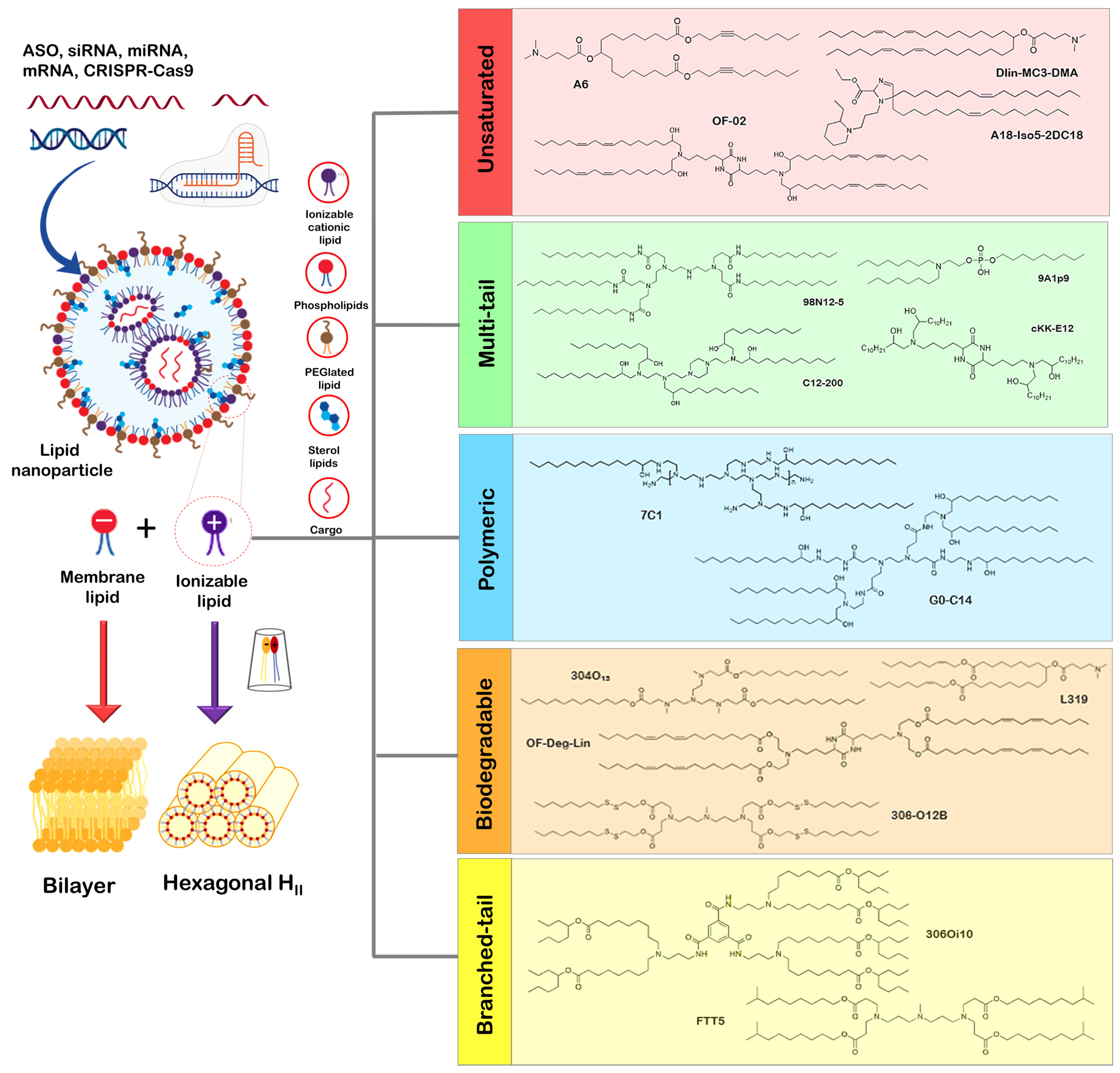
The types of ionizable lipids are shown in Figure 4. These lipids condense RNA during formulation under acidic conditions through electrostatic interactions, while remaining largely neutral at physiological pH to reduce systemic toxicity [61]. Following cellular uptake, endosomal acidification leads to protonation of these lipids, promoting their interaction with negatively charged endosomal phospholipids. This interaction generates cone-shaped lipid complexes that destabilize the bilayer membrane, driving a transition toward nonlamellar phases that facilitate membrane disruption, endosomal escape, and cytosolic release of the RNA cargo.
Since the introduction of ionizable lipids in 2008, a wide variety of chemical structures have been developed to enhance delivery efficiency and safety. Organizing these lipids into structure-based categories provides a useful framework for understanding their function and supports the rational design of next-generation ionizable lipids. Currently, five major structural classes dominate RNA delivery applications, reflecting this continued evolution in lipid design.

4.1. Unsaturated Ionizable Lipids

The degree of tail unsaturation strongly affects the fluidity and delivery efficiency of ionizable lipids. Introducing cis double bonds promotes nonbilayer phase formation, enhancing membrane disruption and payload release. For example, the linoleyl tail was incorporated into DLin-MC3-DMA (MC3), enabling robust hepatic gene silencing and leading to the first FDA-approved siRNA drug, Onpattro®. Unsaturated lipids also improve mRNA delivery: OF-02 showed high hepatic mRNA expression, A6 enhanced membrane fusion and albumin-mediated delivery, and A18-Iso5-2DC18 delivered mRNA vaccines while activating the STING pathway. However, unsaturation alone does not guarantee efficient in vivo delivery, highlighting the need for rational design and screening [62].

4.2. Multi-Tail Ionizable Lipids

Multi-tail lipids, with three or more tails, form more cone-shaped structures that enhance endosomal disruption. Easily synthesized via combinatorial chemistry, they have yielded potent hepatic gene knockdown candidates (e.g., 98N12-5, C12-200, cKK-E12). While initially for siRNA, multi-tail lipids can be optimized for mRNA delivery; for instance, optimized C12-200 increased mRNA expression sevenfold and has been applied in CAR-T cell engineering and prenatal protein replacement. Novel multi-tail ionizable phospholipids, such as 9A1P9, further improve tissue-selective mRNA delivery and gene editing by promoting membrane destabilization and cargo release [60,62]. Despite their advantages, their stable backbones and low degradability necessitate careful evaluation of toxicity and immunogenicity.

4.3. Ionizable Polymer-Lipids

Ionizable polymer-lipids are generated by attaching alkyl tails to cationic polymers, enhancing particle formation via hydrophobic interactions. Screening of 500 polymer-lipid hybrids identified 7C1, a C15 epoxide-modified low-molecular-weight polyethyleneimine, as highly effective for non-liver siRNA delivery. 7C1 preferentially transfects endothelial cells, particularly in the lung, achieving ~80% gene knockdown in non-human primates with minimal toxicity [63].
Re-optimized formulations have also silenced genes in bone marrow endothelial cells, potentially modulating hematopoietic activity. Other polymer-lipids derived from poly(amido amine) and poly(propylenimine) dendrimers similarly target liver endothelium and lung vasculature, demonstrating preferential endothelial transfection. However, tropism can be influenced by LNP formulation; for instance, G0-C14 co-formulated with accessory excipients effectively delivers RNA therapeutics to tumors, highlighting its potential in cancer therapy. Despite these advantages, polymer-lipids remain complex mixtures of substitution products, and their polycationic, non-degradable backbones pose challenges for clinical translation [62,64].

4.4. Biodegradable Ionizable Lipids

To minimize accumulation and side effects, especially for RNA therapeutics requiring repeated dosing, ionizable lipids are designed to degrade into non-toxic metabolites after delivery. A common approach is introducing ester bonds, stable at physiological pH but hydrolyzed enzymatically in tissues and cells. For instance, L319, a biodegradable analog of MC3 with primary ester substitutions, maintained in vivo potency while improving clearance and tolerability. Ester position and steric effects significantly influence lipid potency and elimination [62].
Combinatorial synthesis using alkyl amines and acrylate tails has yielded diverse biodegradable ionizable lipids. Acrylate-based lipids with tertiary amines, at least three O13 tails, and pKa 5.5–7.0, such as 304O13, show strong in vivo gene silencing with lower toxicity than non-degradable analogs like C12-200. Balancing activity and degradability is key; secondary esters offer improved stability over primary esters.
Degradable lipids can also enable organ-specific delivery: OF-Deg-Lin, a degradable OF-02 analog, efficiently transfected splenic lymphocytes, achieving >85% protein expression in the spleen. Bioreducible ionizable lipids, incorporating disulfide bonds sensitive to the intracellular reductive environment, have successfully delivered ASOs and CRISPR/Cas9 components with good tolerability. For example, 306-O12B outperformed MC3 in liver genome editing of Angptl3 without significant toxicity or off-target effects [65]. Challenges remain in synthesis complexity and potential premature release, which may limit broader application.

4.5. Branched-Tail Ionizable Lipids

Tail branching, along with length and saturation, significantly affects ionizable lipid performance. Lipids with methacrylate tails (1C branch near the head) generally show lower efficacy than acrylate-based lipids. In contrast, lipids containing isodecyl acrylate (Oi10, 1C branch at the tail end) markedly increase hepatic mRNA expression (>10-fold) compared to linear analogs, likely due to improved endosomal escape and the cone-shaped lipid structure [62,66].
The lead branched-tail lipid, 306Oi10, efficiently co-delivered multiple RNA cargos to the liver, transfecting over 80% of hepatocytes, Kupffer cells, and endothelial cells, supporting combined gene silencing, expression, and editing applications [67]. Similarly, lipids with branched ester chains, such as FTT5, show higher liver transfection than linear ester analogs, benefiting from slower degradation. FTT5 effectively delivers large mRNAs for protein supplementation and base-editing therapies, highlighting tail branching as a key design feature in LNP development [68].

5. Key Properties and Design Factors

The effectiveness, performance, and clinical translation of LBNs rely heavily on a variety of physiochemical properties and design considerations. The most important physiochemical property is size, as this property influences how particles distribute in vivo, the extent of cellular uptake, and clearance rates [69]. Smaller sized nanocarriers can penetrate tissues (e.g., tumors) more readily and are taken up by target cells to a greater degree than larger particles, which are more easily recognized and cleared rapidly by the reticuloendothelial system. Thus, an understanding of how size-effects distribution is particularly important to maximize pharmacokinetics and therapeutic efficacy [70].
Surface charge, or zeta potential, is another important attribute associated with in vivo performance, which can affect circulation time, protein adsorption to the granulocyte surface, and interactions with biological membranes. Due to the attraction of negatively charged cell surfaces, positively charged nanoparticles may result in enhanced tissue uptake in the targeted tissue. On the downside, positively charged nanoparticles may also result in greater plasma protein binding and even faster clearance from circulation [71]. Neutral or slightly negatively charged nanoparticles promote longer circulation time while exhibiting reduced immunogenicity and lower sensitivity to aggregate [72].
The lipid composition of a nanocarrier can also affect drug encapsulation capacity, drug release rate, and biocompatibility. Selection of natural or synthetic lipids as well as selection of solid versus liquid lipids can affect the stability of the nanocarrier and compatibility with different drug molecules [73,74]. For example, solid lipids tend to provide extended release; on the other hand, when used with liquid lipids or hybrid agents (solid plus liquid), they may improve loading and limit potential leakage. Stability against aggregation, hydrolysis, and oxidation is relevant in preserving functionality while storing and administering in vivo [28]. Formulation strategies for creating robust, reproducible, and clinically translatable nanocarriers include surface modification through cyclodextrins, improved lipids, polymer-mediated stabilization, and incorporating antioxidants and carefully choosing stabilizers during the formulation process [75].
Beyond size or charge tuning, molecular chirality is emerging as an independent precision lever. Enantiopure lipids assemble into twisted ribbons, helices, or starfish bilayers whose interfacial tension can be switched in real time, affording reconfigurable carriers that respond to shear or temperature gradients [76]. Embedding azobenzene-based chiral lipids further introduces light-, solvent- and temperature-responsive supramolecular chirality, enabling on-demand shape change and controlled payload release [77]. Recent advances in alkynyl/alkynyl levers and N-sulfinylimine additions now deliver gram-scale access to stereo-defined lipid tails and head-groups, making chirality-by-design compatible with large-scale LNP manufacturing [78,79], highlighting that stereochemical purity is no longer a synthetic curiosity but a formulation variable that can be programmed to control membrane curvature, endosomal escape and ultimately therapeutic potency.
Lipid chirality and biological targeting outcomes are naturally connected. Phenomenologically, the following mechanisms explain how lipid chirality is translated into selective biological targeting. Most importantly, biological membranes are homochiral interfaces in which stereochemistry governs molecular recognition. Chiral lipid headgroups or ligands can stereomatch, or stereomismatch, the chiral glycerol backbone of membrane phospholipids. This directly alters binding free energy and local membrane structure. Theoretically, stereoselective preferences were demonstrated by simulations of chiral gold nanoparticles, which show that one enantiomer binds more strongly to lipid bilayers because its surface ligands stereomatch lipid headgroups. This interaction stabilizes distinct lipid conformations and lowers interaction energies, particularly for anionic lipids where stereochemistry and electrostatics act together [80]. Experiments with chiral phospholipid bilayers also show that replacing chiral phospholipids with achiral lipids or opposite enantiomers eliminates selectivity, demonstrating that stereospecific packing controls barrier crossing [81]. Intrinsic membrane chirality also regulates peptide binding as shown for phospholipid membranes, where replacing enantiomers alter the affinity of the membrane-binding peptide kalata B1 in a mirror-image manner, directly linking lipid stereochemistry to functional potency [82]. These effects tune adhesion strength, insertion depth, membrane order, and receptor accessibility.
These initial stereochemical interactions propagate to cellular and tissue-level targeting outcomes. Chiral nanocarriers exploit lipid-mediated recognition to bias uptake pathways. Cysteine-capped chiral supraparticles show that D-enantiomeric assemblies adhere more strongly to cell-derived chiral lipid layers and display 3- to 4-fold higher internalization across multiple cancer cell lines [83]. Measurements of adhesion and thermodynamics confirm more stable interactions with phospholipid and cholesterol membranes. Chiral peptide amphiphile assemblies also interact stereospecifically with negatively charged phospholipid vesicles. One stereochemical configuration exhibits higher lipid affinity and greater membrane-mediated cytotoxicity, directly linking chirality-dependent lipid binding to biological outcome [84]. Lipid chirality further acts as a kinetic gate for transport. Chiral phospholipid bilayers permit faster permeation of biological L-amino acids and dipeptides than their D counterparts, due to precise three-dimensional complementarity at the lipid interface [81]. Chirality also reorganizes membrane domains. Enantiomeric glycolipids bind Shiga toxin with similar affinity but generate protein domains of different height and curvature, altering membrane tubulation and internalization routes [85]. Lipid chirality also regulates pathological protein behavior. D-aspartate–modified phospholipids more effectively inhibit amyloid nucleation and elongation than L analogues by altering electrostatic interactions at the membrane interface [86].
Collectively, careful tuning of particle size, surface charge, lipid composition, stability, and chirality is integral to designing and formulating lipidic nanocarriers. By optimizing these variables, drug efforts can be made. In summary, due diligence in tuning the particle size, surface charge, lipid constituent, stability, and chirality is important for the design of lipid-based nanocarriers. These considerations will improve drug delivery, targeting efficiency, and make treatment safer and more reliable [87].
A set of schematics shows in Figure 5, how incremental changes in PEG-lipid content, phospholipid head-groups, or adjuvant addition dramatically alter nanoparticle diameter, zeta potential, and in vivo fate. One panel compares neutral, slightly negative, and cationic surfaces, while another depicts identical cores coated with varying PEG lengths, explaining the text’s assertion that “small modifications can alter LNP properties.” Arrows link each tweak to downstream effects such as longer circulation, altered organ tropism, or enhanced endosomal escape, mirroring the manuscript’s design guidelines.

6. Mechanisms of Targeted Drug Delivery

The LNPs can achieve targeted drug delivery through a combination of strategies for passive and active targeting and stimuli-responsive systems that respond to the local microenvironment [49]. These approaches ultimately aim to enhance the therapeutic efficacy while reducing systemic toxicity and off-target effects [89].
Passive targeting is achieved using the enhanced permeability and retention (EPR) effect, which has the highest efficacy in tumor tissue and sites of inflammation. The EPR effect is influenced by the leaky vasculature and poor lymphatic drainage characteristic of pathological sites, which allows for preferential accumulation of nanoparticles at the site of disease [46,73]. The size, shape, and surface properties of the particles will impact on the delivery process associated with EPR by influencing circulation time, tissue penetration, and retention. For passive targeting via the EPR effect, LBNs are effective when between 50–200 nm, which includes a significant increase in tissue penetration and prolonged systemic circulation [69,90].
Active targeting involves modifying the surface of nanocarriers with supported ligands, antibodies, peptides, or aptamers, which bind to unique receptors present on the surface of malignant cells [28]. This receptor mediated transport enhances the uptake through endocytosis and selective accumulation of the drug. Chirality driven targeting is operational at the lipid bilayer-membrane interface: d-chiral LNP’s increase mRNA transfection 5-fold, by stereoselectively engaging with phospholipid and receptors grooves that enhance clathrin mediated uptake, while enantiopure surface ligands are simultaneously directed to organ-specific accumulation and decrease off-target clearance [21,91,92]. Surface modifications such as PEGylation can also influence circulation times and reduce non-specific clearance while still allowing ligands to engage with target receptors [93].
Stimuli-responsive targeting provides additional specificity, through controlled release of drug once triggered by local environment, such as pH, temperature, redox potential, or enzymatic activity [94]. For example, an acidic tumor microenvironment, elevated reactive oxygen species or overexpression of a specific enzyme can trigger drug release from nanocarrier at disease site, which localizes drug to site of disease, and minimizes off-target exposure to healthy tissues [95].
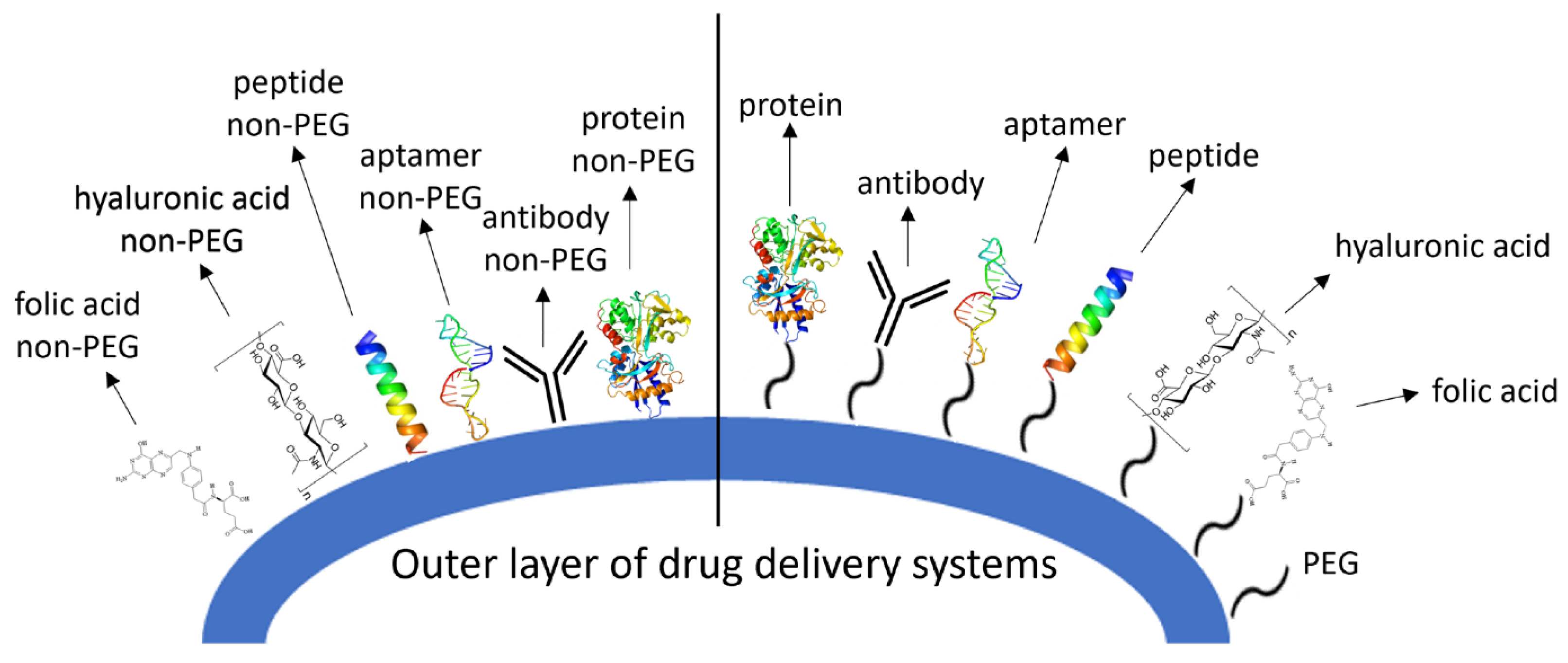
Figure 6 illustrates the influence of PEGylation on the landscape of surface ligands of lipid-based nanocarriers. This conceptual illustration shows how PEGylation can enhance circulation time and improve site-specific delivery of nanocarriers.
As previously discussed, passive accumulation, ligand-mediated recognition, and stimuli-triggered release can be incorporated into LBNs to facilitate controlled, site-selective delivery [49]. Together, these strategies can promote the development of multifunctional systems that maximize drug bioavailability, minimize systemic toxicity, and optimize clinical outcomes in the fields of cancer therapy, infectious diseases, and chronic conditions. Table 3 summarizes the recent advances in targeted delivery via lipid-based colloidal nanocarriers.

7. Recent Developments and Applications

In recent times, developments in LBNs have centered around multifunction and hybrid systems that combine therapeutic delivery with targeting, imaging, and/or controlled release. A major advancement in this area is modifying the nanocarrier surfaces with PEG, referred to as PEGylation [107]. This strategy can improve systemic circulation of the nanocarrier by decreasing opsonization and/or immune recognition, thereby increasing the accumulation of the nanocarrier in target tissues. PEGylation can also provide stability and extended half-life that is critical for repeated or long-term drug delivery [108].
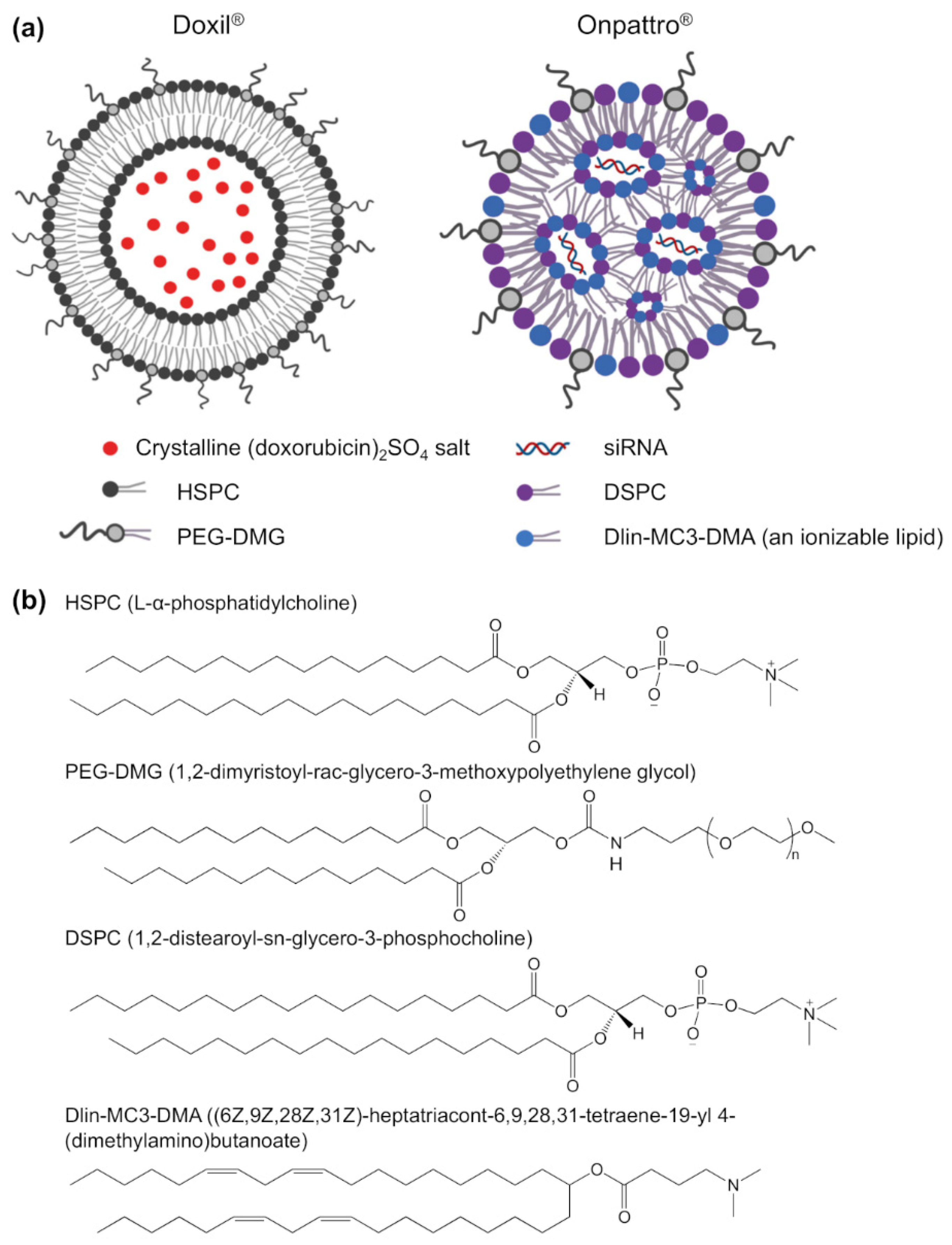
The FDA-approved LBNs illustrated in Figure 7, Doxil® and Onpattro®, illustrate the compositional flexibility that enables their therapeutic application. Doxil® is a stealth liposome with aqueous-based doxorubicin encapsulated in its core, and the Onpattro® LNP is an siRNA-loaded LNP wherein nucleic acids are complexed within a solid-phase lipid format. The figure identifies the different chemical building blocks comprised in the formulations: HSPC (Hydrogenated Soy Phosphatidylcholine) and DSPC (1,2-Distearoyl-sn-glycero-3-phosphocholine) form the rigid and stable bilayers within the liposomes; PEG-DMG (Polyethylene Glycol–Dimyristoyl Glycerol) forms a hydrophilic surface layer, reducing protein adsorption, increasing circulation half-life, and preserving ligands functionality; and the ionizable lipid forming a part of the nanoparticle system, Dlin-MC3-DMA (Dilinoleylmethyl-4-dimethylaminobutyrate) facilitates the nucleic acid encapsulation and subsequent endosomal release. The components highlighted in formulations such as Doxil® and Onpattro® illustrate how similar lipid building blocks can be used in different arrangements to form carriers that have different structural, functional, and therapeutic properties.
Lipid-polymer conjugates and lipid-inorganic composites, as examples of hybrid nanocarriers, provide the synergistic benefit of lipid biocompatibility and flexibility together with polymer/inorganic mechanical strength, tunable release profiles, and stimuli-response [110]. Hybrid nanocarrier systems also facilitate combinations of precise control of drug release kinetics and control over targeted delivery systems and can also include imaging agents for theranostic applications. For example, fluorescent or magnetic nanoparticles can be combined with lipid carriers to track agent bio-distribution, tumor localization, or therapeutic efficacy in real-time [111].
LBNs have shown great promise in a variety of biomedical applications [112]. For oncology applications, LBNs can manage direct delivery of chemotherapeutic agents, nucleic acids, and immunomodulators to tumors, improving therapeutic responses and limiting off-target toxicity [113]. Pulmonary and neurological drug delivery has improved due to the greater penetration and biocompatibility of LBNs to provide non-invasive routes of administration. LBNs have also garnered great public attention as a promising delivery vehicle for vaccines; most importantly, recent developments have showcased the rapid use of mRNA vaccines against COVID-19, which utilize LBNs to protect, stabilize, and effectively deliver charging RNA liable nucleic acids [112,114].
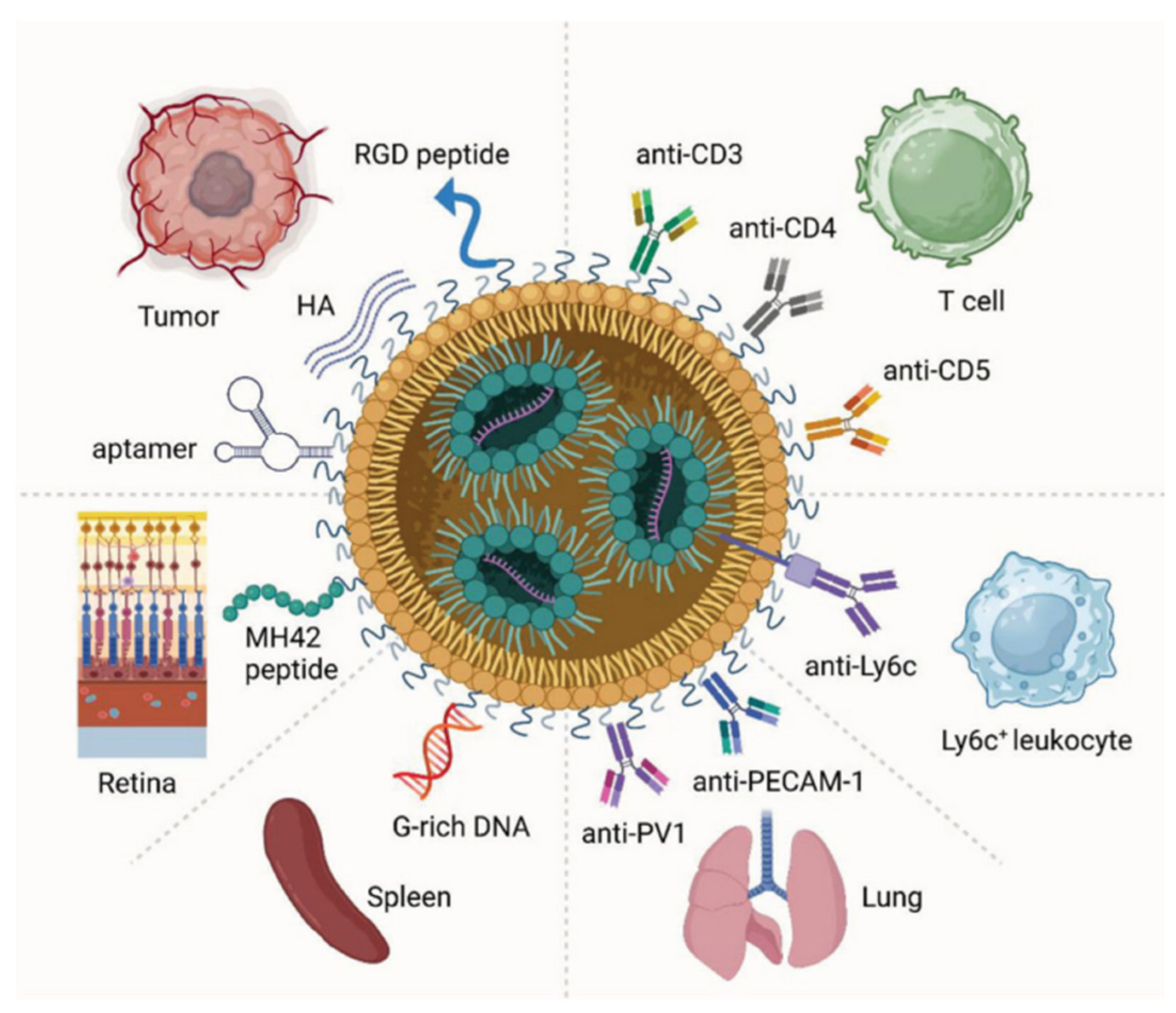
Figure 8 depicts a single LPN that is adorned with interchangeable surface ligands, representing a modular targeting approach for site-specific delivery. The nanoparticle has an attachment of RGD peptides to bind integrins that are overexpressed on tumor cells; anti-CD3 and anti-CD4 antibodies to engage T-cell populations; anti-Ly6c antibodies directed against myeloid cells; and DNA aptamers that referenced retinal endothelium. Each ligand is linked to short PEG chains, which demonstrate “plug-and-play” surface engineering of the LPN. The figure has illustrated that the arrangement of ligands in space and length of PEG spacers are essential for promoting receptor-medicated uptake cellular uptake while inhibiting recognition and clearance by the immune system.
Nucleic acid-based gene therapies, which use DNA or RNA molecules such as mRNA, siRNA, and CRISPR–Cas9 components, represent a transformative shift in modern medicine. Unlike traditional pharmacological treatments that mainly act on proteins, these therapies intervene at the level of genetic instructions to add, replace, edit, or silence genes, offering the potential for long-lasting or even permanent therapeutic effects. The clinical translation of these approaches depends critically on advanced drug delivery systems, particularly LNPs, which are engineered to overcome key biological barriers such as nucleic acid instability in systemic circulation and limited cellular uptake. Table 4 highlights representative applications of LNPs across different gene therapy modalities. By addressing diseases at their genetic root, these delivery systems provide a versatile platform for treating a broad range of conditions that were previously considered undruggable or required lifelong conventional therapies.
Other contemporary applications are in oral and topical delivery, gene therapy, and biologics delivery including peptides and proteins. Current research is focused on developing lipid nanocarriers liposomes that are stimuli-responsive and functionalized with ligands that release cargo upon specific pH, enzyme, or redox conditions, facilitating enhanced site-specific delivery and therapeutic activity [110]. Harvesting chirality in LNPs have moved from curiosity to performance-critical excipients d-chiral LNPs surface-decorated with cobalt-oxide nanocrystals boost luciferase/EGFP mRNA transfection 5.3-fold versus racemic controls [21]. Large-scale asymmetric syntheses of chiral tails and head-groups are now compatible with micro-fluidic LNP production, and in-line chiroptical monitoring with high ee resolution, during continuous flow is in reach, giving manufacturers a real-time chirality specification for regulatory dossiers. In sum, these advances demonstrate the versatility and potential of LBNs in modern medicine, forming a platform for precision therapeutics, diagnostics, and combination therapies.

8. AI-Driven Acceleration of Stereochemistry-Aware LNP Design

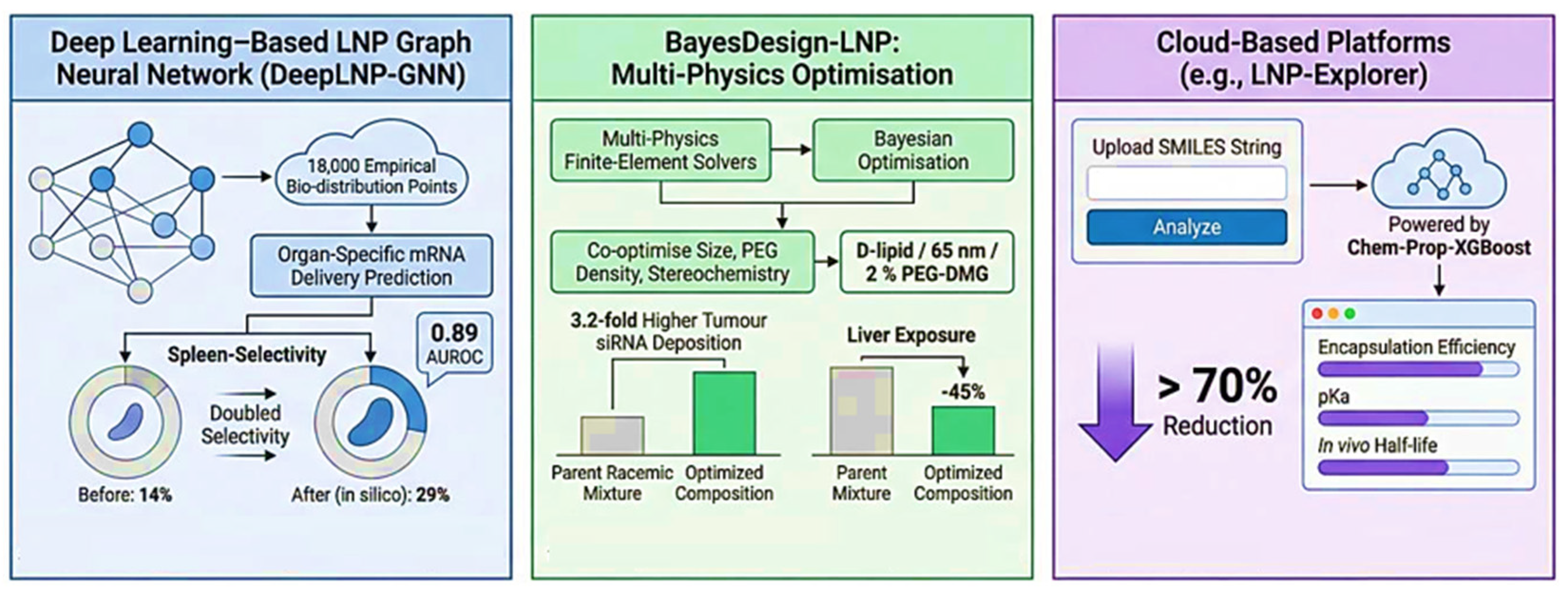
Concrete AI implementations are already shortening the LNP development cycle. Figure 9, provides an overview of three LNP design-based AI platforms, including deep learning-based LNP graph neural network (DeepLNP-GNN), BayerDesign-LNP, and cloud-based platforms. DeepLNP-GNN employs a graph-neural-network trained on 18000 empirical bio-distribution points to predict organ-specific mRNA delivery with 0.89. Area Under the Receiver Operating Characteristic (AUROC) curve; using this dashboard, investigators reformulated an ionisable lipid in silico that doubled spleen-selectivity (14% → 29%) before any wet-lab synthesis [113]. Similarly, BayesDesign-LNP couple’s multi-physics finite-element solvers with Bayesian optimisation to co-optimise size, PEG density and stereochemistry; the algorithm proposed a D-lipid/65 nm/2% PEG-DMG composition that showed 3.2-fold higher tumour siRNA deposition in mice compared with the parent racemic mixture while reducing liver exposure by 45% [131].
Cloud-based platforms such as “LNP-Explorer” (powered by ChemProp-XGBoost) now allow formulators to upload a Simplified Molecular Input Line Entry System (SMILES) string and receive a ranked list of predicted encapsulation efficiency, pKa and in vivo half-life within minutes, eliminating >70% of early-stage synthesis iterations [132]. These examples illustrate that AI is not merely conceptual but is already a practical accelerator for precision, stereochemistry-aware LNP engineering.

9. Scalability and Reproducibility in Large-Scale LBN Production

Despite promising preclinical data, the transition of lipid-based nanocarriers (LBNs) from bench to bedside is often hindered by batch-to-batch variability, poor scalability, and lack of process analytical technologies (PAT). These issues are exacerbated when moving from microfluidic or T-junction mixing platforms (typically used in academic settings) to continuous-flow manufacturing systems required for GMP-grade production.
Recent studies highlight that particle size distribution (PSD) and encapsulation efficiency (EE) can fluctuate significantly when scaling from 1 mL/min to >100 mL/min flow rates, primarily due to local lipid concentration gradients and uncontrolled nucleation kinetics [132]. For instance, Desai et al. demonstrated that increasing the total flow rate (TFR) from 12 to 120 mL/min in a staggered herringbone mixer led to a 30% increase in polydispersity index (PDI) and a 20% drop in siRNA encapsulation efficiency, unless compensated by real-time inline dilution and temperature-controlled lipid hydration.
To address these issues, quality-by-design (QbD) frameworks are now being integrated into LNP manufacturing. Buya et al. (2024) introduced a design-of-experiments (DoE) model for NanoAssemblr® Blaze systems, identifying critical process parameters (CPPs) such as lipid: mRNA ratio, flow rate ratio (FRR), and acoustic mixing frequency as key determinants of reproducibility [133]. Their model achieved <2% batch-to-batch size variation across 10 pilot-scale batches (1–10 L), a significant improvement over conventional solvent-injection methods.
Moreover, real-time release testing (RTRT) is emerging as a regulatory-enabling tool. In a 2023 EMA pilot study, Onpattro®’s follow-on formulation replaced 28-day sterility tests with 90 min endotoxin + sub-visible particle assays, reducing lot disposition time by 6 weeks [134]. This was made possible by inline dynamic light scattering (DLS) and nanoparticle tracking analysis (NTA) modules integrated into the production line.
From a formulation perspective, lipid oxidation and hydrolysis during long-term storage remain underreported scalability bottlenecks. Kamiya et al. (2022) showed that DSPC-based LNPs stored at 4 °C for 6 months exhibited 15% cholesterol oxidation, leading to membrane rigidity loss and premature mRNA release [75]. This was mitigated by nitrogen-blanketed packaging and antioxidant-incorporated lipid films, extending shelf-life to >12 months.
Finally, AI-driven process optimization is beginning to play a role. Moradi Kashkooli et al. (2025) used Bayesian optimization to co-optimize PEG density, lipid saturation, and microfluidic flow conditions, achieving 3.2-fold higher tumor siRNA deposition while reducing liver exposure by 45% all before any wet-lab synthesis [131]. Taken together, these advances suggest that scalability is no longer a black box, but a parameterized, model-driven process. Researchers are encouraged to adopt QbD-aligned microfluidic platforms, inline PAT tools, and AI-assisted formulation loops to ensure reproducibility and regulatory readiness from the earliest development stages.

10. Challenges and Future Outlook

Although lipid-based colloidal nanocarriers seem to have significant potential for targeted drug delivery, multiple challenges still exist to hinder their eventual clinical translation. A major barrier is large-scale production [135]. While liposomes, SLNs, NLCs, and hybrid nanocarriers can be made at the laboratory scale with well-established methods, scaling them to larger amounts often comes with new problems in reproducibility and consistency of batch-to-batch, particle size distribution, and drug encapsulation efficiency. Maintaining structural integrity and drug physicochemical properties is essential for therapeutic efficacy and regulatory functions [133].
Another large barrier is regulatory approval. Especially for new formulations and surface-functionalized systems, regulatory authorities require robust safety, pharmacokinetic and toxicity data [134]. Long-term biocompatibility, immunogenicity, and the possibility of non-target tissues allowing for accumulation of nanocarriers, all needs to be evaluated. Stability under physiological and storage conditions also continues to be problematic, as all components of the lipid can lead to unwanted functionality due to oxidation, hydrolysis, or aggregation [136].
In the future, customized lipid formulations designed for specific disease states in individual patients could improve therapeutic effectiveness substantially [137]. AI-assisted design and computational modeling could be employed to develop optimum nanocarrier characteristics, including particle size, surface charge, and density of ligand binding, which optimize targeting performance. Alternative green synthesis methodologies would also reduce the manufacturing impact on the ecosystem, while maintaining carrier performance [131,132].
The European Medicines Agency’s 2023 “Quality-by-Design for LNPs” reflection paper was successfully piloted by the Onpattro® follow-on program, where real-time release testing (RTRT) replaced the traditional 28-day sterility end-tests with validated 90 min endotoxin and sub-visible particle assays, reducing lot disposition time by six weeks [134].
On the manufacturing front, a continuous-flow microfluidic platform (NanoAssemblr® Blaze) achieved 10 kg h−1 production of mRNA-LNP under GMP with <2% batch-to-batch size variation [133]. These precedents confirm that enantiopure lipid carriers are no longer academic curiosities but emerging clinical realities with defined regulatory roadmaps.
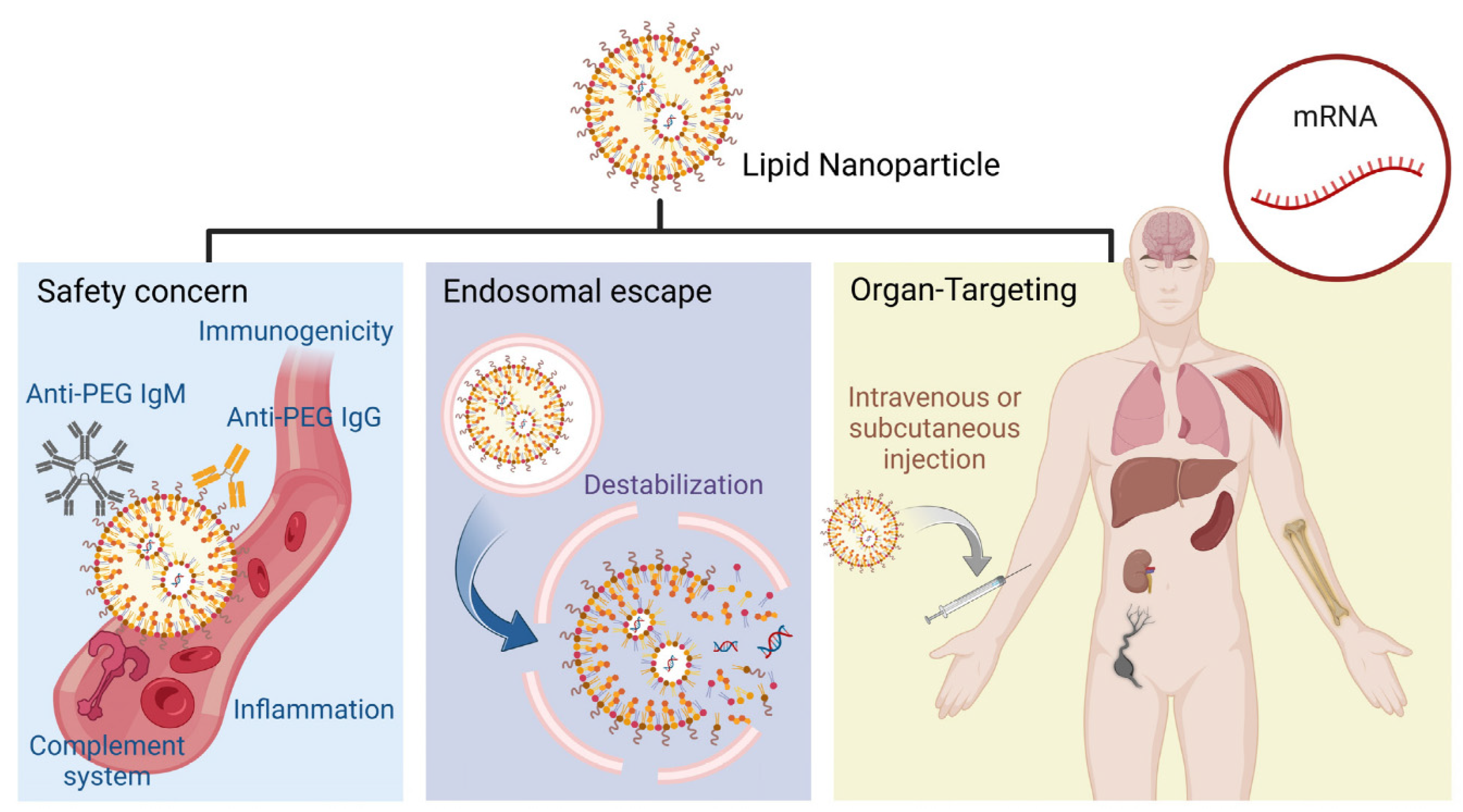
Figure 10 depicts the timeline of an intravenously injected LNP to achieve organ selective mRNA delivery. The LNP travels through the bloodstream and to the site of action, including transient activation of the complement system, escape from the endosome, and eventual protein expression in hepatocytes. Each surrounding icon highlights safety concerns including anti-PEG Ig M/G (Immunoglobulin M/G) spikes, transient complement activation, and increased potential for release of inflammatory cytokines. The figure serves to remind the reader of the caution expressed in the manuscript regarding the balance between organ targeting for therapy and immunogenicity and off-target inflammation during the process, and the need for cleverer LNP designs to enhance potency while reducing the long-term adverse effects of immune responses.
Future research will likewise center on analyzing interactions between lipids and cells on a molecular level, which will provide for controlled cellular uptake, endosomal escape, and intracellular trafficking. Stimuli-responsive and multifunctional carriers that incorporate therapeutic and diagnostic capabilities (theranostic) are likely to be central to the field of precision medicine [131]. Solutions to these questions through innovative technology, regulatory, and design will also expedite the translation of LBNs to clinically viable, safe, and efficacious site-specific drug delivery systems. Table 5 lists the most recent research achievements addressing challenges faced by lipid-based colloidal nanocarriers.

11. Conclusions

Lipid-based colloidal nanocarriers represent a mature and versatile class of delivery systems that have reshaped the landscape of targeted drug delivery. Their inherent biocompatibility, structural tunability, and ability to encapsulate a wide range of therapeutic cargos have enabled successful clinical translation across multiple modalities, most notably in nucleic acid therapeutics. As outlined in this review, rational control over lipid composition, particle size, surface chemistry, and formulation architecture directly determines bio-distribution, cellular uptake, and therapeutic efficacy. Advances in ionizable lipid design, helper lipid selection, PEGylation strategies, and cholesterol incorporation have significantly improved nucleic acid protection, endosomal escape, and in vivo stability. In parallel, emerging evidence highlights lipid chirality as an additional design parameter capable of modulating membrane interactions, immune responses, and organ-specific delivery. Together, these developments underscore the transition of lipid nanocarriers from empirically optimized formulations toward increasingly mechanism-informed and precision-engineered systems. Despite these achievements, several challenges remain. Scalable and reproducible manufacturing, long-term stability, immunogenicity, and predictable targeting beyond the liver continue to limit broader clinical application. Addressing these issues will require integrated approaches that combine quality-by-design manufacturing, advanced analytical tools, and data-driven formulation strategies. In this context, AI-assisted design and modeling are expected to play a growing role in accelerating formulation optimization and improving translational reliability. Current clinical successes, including approved LNP based siRNA therapeutics, liposomal chemotherapeutics, and mRNA vaccines, together with an expanding pipeline of lipid nanocarrier systems in clinical trials for gene editing, protein replacement, and cancer immunotherapy, demonstrate the robustness and adaptability of this platform. Looking forward, continued refinement of lipid chemistry, incorporation of stereochemical control, and alignment of formulation design with regulatory and manufacturing requirements will be critical to fully realize the potential of lipid-based colloidal nanocarriers in targeted and personalized medicine.

Author Contributions

Conceptualization, K.S., A.K., B.K. and H.M.; resources, K.S. and A.K.; writing—original draft preparation, K.S., H.M. and B.K.; writing, review and editing, K.S., A.K., B.K. and H.M.; visualization, K.S.; project administration, K.S. and A.K.; funding acquisition, A.K. and K.S. All authors have read and agreed to the published version of the manuscript.

Funding

This research was funded by DFG, grant number KA4166/6-1.

Data Availability Statement

No new experimental or analytical data were generated for this study. This review article is based on the analysis and synthesis of data reported in previously published studies. The sources used in this work were primarily identified through comprehensive searches of the Web of Science database and by referencing articles published in reputable, peer-reviewed scientific journals. All data supporting the findings of this review are available within the cited references.

Acknowledgments

During the preparation of this manuscript, the authors used ChatGPT-5 for the purpose of integrating the discussed topics into a coherent narrative within the review. The authors have reviewed and edited the output and take full responsibility for the content of this publication.

Conflicts of Interest

Authors Behnam Kalali and Hassan Moeini were employed by the company Iguana Biotechnology GmbH. The remaining authors declare that the research was conducted in the absence of any commercial or financial relationships that could be construed as a potential conflict of interest.

Abbreviations

The following abbreviations are used in this manuscript:
SLNPsSolid Lipid Nanoparticles
LBNPsLipid-based nanoparticles
NLCsNanostructured Lipid Carriers
EPREnhanced Permeability and Retention
LBNsLipid-Based Nanocarriers
LPHNsLipid-Polymer Hybrid Nanoparticles
SEDDSSelf-Emulsifying Drug Delivery Systems
LNPLipid Nanoparticle
PEGPolyethylene Glycol
HSPCHydrogenated Soy Phosphatidylcholine
DSPC1,2-Distearoyl-sn-glycero-3-phosphocholine
DOPEDioleoylphosphatidylethanolamine
PEG-DMGPolyethylene Glycol–Dimyristoyl Glycerol
Dlin-MC3-DMADilinoleylmethyl-4-dimethylaminobutyrate
CholCholesterol
IVISIn Vivo Imaging System
DeepLNP-GNNDeep Learning–Based Lipid Nanoparticle Graph Neural Network
AUROCArea Under the Receiver Operating Characteristic
SMILESSimplified Molecular Input Line Entry System
RTRTReal-Time Release Testing

References

  1. Yew, Y.P.; Shameli, K.; Mohamad, S.E.; Lee, K.X.; Teow, S.Y. Green synthesized montmorillonite/carrageenan/Fe3O4 nanocomposites for pH-responsive release of protocatechuic acid and its anticancer activity. Int. J. Mol. Sci. 2020, 21, 4851. [Google Scholar] [CrossRef]
  2. Jazayeri, S.D.; Ideris, A.; Zakaria, Z.; Shameli, K.; Moeini, H.; Omar, A.R. Cytotoxicity and immunological responses following oral vaccination of nanoencapsulated avian influenza virus H5 DNA vaccine with green synthesis silver nanoparticles. J. Control. Release 2012, 161, 116–123. [Google Scholar] [CrossRef]
  3. Yusefi, M.; Chan, H.Y.; Teow, S.Y.; Kia, P.; Soon, M.L.K.; Che Sidik, N.A.; Shameli, K. 5-fluorouracil encapsulated chitosan-cellulose fiber bionanocomposites: Synthesis, characterization and in vitro analysis towards colorectal cancer cells. Nanomaterials 2021, 11, 1691. [Google Scholar] [CrossRef]
  4. Kartouzian, A.; Heiz, A.; Shameli, K.; Moeini, H. Polyethylenimine-Conjugated Au-NPs as an Efficient Vehicle for in vitro and in vivo DNA Vaccine Delivery. Int. J. Nanomed. 2025, 20, 4021–4034. [Google Scholar] [CrossRef]
  5. Rehman, M.; Tahir, N.; Sohail, M.F.; Qadri, M.U.; Duarte, S.O.D.; Brandão, P.; Esteves, T.; Javed, I.; Fonte, P. Lipid-based nanoformulations for drug delivery: An ongoing perspective. Pharmaceutics 2024, 16, 1376. [Google Scholar] [CrossRef]
  6. Karmaker, S.; Rosales, P.D.; Tirumuruhan, B.; Viravalli, A.; Boehnke, N. More than a delivery system: The evolving role of lipid-based nanoparticles. Nanoscale 2025, 17, 11864–11893. [Google Scholar] [CrossRef] [PubMed]
  7. Jiang, Y.; Li, W.; Wang, Z.; Lu, J. Lipid-based nanotechnology: Liposome. Pharmaceutics 2023, 16, 34. [Google Scholar] [CrossRef] [PubMed]
  8. Mall, J.; Naseem, N.; Haider, M.F.; Rahman, M.A.; Khan, S.; Siddiqui, S.N. Nanostructured lipid carriers as a drug delivery system: A comprehensive review with therapeutic applications. Intell. Pharm. 2025, 3, 243–255. [Google Scholar] [CrossRef]
  9. Upadhyay, P.; Aslam, R.; Tiwari, V.; Upadhyay, S. Lipid-based nanocarrier drug delivery approach for biomedical application. Curr. Nanomater. 2024, 9, 92–108. [Google Scholar] [CrossRef]
  10. Liu, Y.; Castro Bravo, K.M.; Liu, J. Targeted liposomal drug delivery: A nanoscience and biophysical perspective. Nanoscale Horiz. 2021, 6, 78–94. [Google Scholar] [CrossRef]
  11. Kartouzian, A.; Cameron, R.P. Unlocking the hidden dimension: Power of chirality in scientific exploration. Philos. Trans. R. Soc. A—Math. Phys. Eng. Sci. 2024, 382, 20230321. [Google Scholar] [CrossRef] [PubMed]
  12. Barron, L.D. Symmetry and Chirality: Where Physics Shakes Hands with Chemistry and Biology. Isr. J. Chem. 2021, 61, 517–529. [Google Scholar] [CrossRef]
  13. Kartouzian, A. Spectroscopy for model heterogeneous asymmetric catalysis. Chirality 2019, 31, 641–657. [Google Scholar] [CrossRef]
  14. Ristow, F.; Liang, K.; Pittrich, J.; Scheffel, J.; Fehn, N.; Kienberger, R.; Heiz, U.; Kartouzian, A.; Iglev, H. Large-area SHG-CD probe intrinsic chirality in polycrystalline films. J. Mater. Chem. C 2022, 10, 12715–12723. [Google Scholar] [CrossRef]
  15. von Weber, A.; Jakob, M.; Kratzer, E.; Kartouzian, A.; Heiz, U. In situ Second-Harmonic Generation Circular Dichroism with Submonolayer Sensitivity. Chemphyschem 2019, 20, 134–141. [Google Scholar] [CrossRef] [PubMed]
  16. Xue, Y.; Fehn, N.; Brandt, V.K.; Stasi, M.; Boekhoven, J.; Heiz, U.; Kartouzian, A. Tunable induced circular dichroism in gels. Chirality 2022, 34, 550–558. [Google Scholar] [CrossRef] [PubMed]
  17. Heister, P.; Lünskens, T.; Thämer, M.; Kartouzian, A.; Gerlach, S.; Verbiest, T.; Heiz, U. Orientational changes of supported chiral 2,2′-dihydroxy-1,1′binaphthyl molecules. Phys. Chem. Chem. Phys. 2014, 16, 7299–7306. [Google Scholar] [CrossRef]
  18. Pittrich, J.; Liang, K.V.; Dörringer, L.; Kienberger, R.; Heiz, U.; Kartouzian, A.; Iglev, H. From molecules to materials: SHG-CD microscopy of structured chiral films. Appl. Surf. Sci. 2025, 680, 161331. [Google Scholar] [CrossRef]
  19. Liang, K.; Ristow, F.; Li, K.; Pittrich, J.; Fehn, N.; Dörringer, L.; Heiz, U.; Kienberger, R.; Pescitelli, G.; Iglev, H.; et al. Negative Nonlinear CD-ee Dependence in Polycrystalline BINOL Thin Films. J. Am. Chem. Soc. 2023, 145, 27933–27938. [Google Scholar] [CrossRef]
  20. Panagiotopoulou, C.; Liu, S.P.; Pittrich, J.; Iglev, H.; Deschler, F.; Kartouzian, A. Chiroptical Amplification Beyond Enantiopurity in Chiral Films. Adv. Opt. Mater. 2025, 13, e01895. [Google Scholar] [CrossRef]
  21. Lee, J.; Jung, W.; Lee, D.; Kang, M.; Chung, H.J.; Yeom, J. Chirality-Controlled Lipid Nanoparticles for mRNA Delivery. ACS Appl. Mater. Interfaces 2025, 17, 18150–18159. [Google Scholar] [CrossRef]
  22. Xu, L.; Wang, X.; Wang, W.; Sun, M.; Choi, W.J.; Kim, J.-Y.; Hao, C.; Li, S.; Qu, A.; Lu, M.; et al. Enantiomer-dependent immunological response to chiral nanoparticles. Nature 2022, 601, 366–373. [Google Scholar] [CrossRef]
  23. Anwar, D.M.; Hedeya, H.Y.; Ghozlan, S.H.; Ewas, B.M.; Khattab, S.N. Surface-modified lipid-based nanocarriers as a pivotal delivery approach for cancer therapy: Application and recent advances in targeted cancer treatment. Beni-Suef Univ. J. Basic Appl. Sci. 2024, 13, 106. [Google Scholar] [CrossRef]
  24. Garbati, P.; Picco, C.; Magrassi, R.; Signorello, P.; Cacopardo, L.; Dalla Serra, M.; Faticato, M.G.; De Luca, M.; Balestra, F.; Scavo, M.P.; et al. Targeting the gut: A systematic review of specific drug nanocarriers. Pharmaceutics 2024, 16, 431. [Google Scholar] [CrossRef]
  25. Giordano, A.; Provenza, A.C.; Reverchon, G.; Baldino, L.; Reverchon, E. Lipid-based nanocarriers: Bridging diagnosis and cancer therapy. Pharmaceutics 2024, 16, 1158. [Google Scholar] [CrossRef]
  26. Izadiyan, Z.; Misran, M.; Kalantari, K.; Webster, T.J.; Kia, P.; Basrowi, N.A.; Rasouli, E.; Shameli, K. Advancements in Liposomal Nanomedicines: Innovative Formulations, Therapeutic Applications, and Future Directions in Precision Medicine. Int. J. Nanomed. 2025, 20, 1213–1262. [Google Scholar] [CrossRef] [PubMed]
  27. Bukke, S.P.N.; Venkatesh, C.; Bandenahalli Rajanna, S.; Saraswathi, T.S.; Kusuma, P.K.; Goruntla, N.; Balasuramanyam, N.; Munishamireddy, S. Solid lipid nanocarriers for drug delivery: Design innovations and characterization strategies—A comprehensive review. Discov. Appl. Sci. 2024, 6, 279. [Google Scholar] [CrossRef]
  28. Mehta, M.; Bui, T.A.; Yang, X.; Aksoy, Y.; Goldys, E.M.; Deng, W. Lipid-based nanoparticles for drug/gene delivery: An overview of the production techniques and difficulties encountered in their industrial development. ACS Mater. Au 2023, 3, 600–619. [Google Scholar] [CrossRef] [PubMed]
  29. Patel, D.; Patel, B.; Thakkar, H. Lipid based nanocarriers: Promising drug delivery system for topical application. Eur. J. Lipid Sci. Technol. 2021, 123, 2000264. [Google Scholar] [CrossRef]
  30. Kumar, R.; Dkhar, D.S.; Kumari, R.; Divya; Mahapatra, S.; Dubey, V.K.; Chandra, P. Lipid based nanocarriers: Production techniques, concepts, and commercialization aspect. J. Drug Deliv. Sci. Technol. 2022, 74, 103526. [Google Scholar] [CrossRef]
  31. Khan, S.; Sharma, A.; Jain, V. An overview of nanostructured Lipid Carriers and its application in drug delivery through different routes. Adv. Pharm. Bull. 2023, 13, 446–460. [Google Scholar] [CrossRef]
  32. Alam, M.; Rizwanullah, M.; Mir, S.R.; Amin, S. Promising prospects of lipid-based topical nanocarriers for the treatment of psoriasis. OpenNano 2023, 10, 100123. [Google Scholar] [CrossRef]
  33. Chelliah, R.; Rubab, M.; Vijayalakshmi, S.; Karuvelan, M.; Barathikannan, K.; Oh, D.-H. Liposomes for drug delivery: Classification, therapeutic applications, and limitations. Next Nanotechnol. 2025, 8, 100209. [Google Scholar] [CrossRef]
  34. Pande, S. Liposomes for drug delivery: Review of vesicular composition, factors affecting drug release and drug loading in liposomes. Artif. Cells Nanomed. Biotechnol. 2023, 51, 428–440. [Google Scholar] [CrossRef] [PubMed]
  35. Bunjes, H.; Unruh, T. Characterization of lipid nanoparticles by differential scanning calorimetry, X-ray and neutron scattering. Adv. Drug Deliv. Rev. 2007, 59, 379–402. [Google Scholar] [CrossRef] [PubMed]
  36. Tang, C.-H.; Chen, H.-L.; Dong, J.-R. Solid lipid nanoparticles (SLNs) and nanostructured lipid carriers (NLCs) as food-grade nanovehicles for hydrophobic nutraceuticals or bioactives. Appl. Sci. 2023, 13, 1726. [Google Scholar] [CrossRef]
  37. Haider, M.; Abdin, S.M.; Kamal, L.; Orive, G. Nanostructured lipid carriers for delivery of chemotherapeutics: A review. Pharmaceutics 2020, 12, 288. [Google Scholar] [CrossRef] [PubMed]
  38. Ferreira Soares, D.C.; Domingues, S.C.; Viana, D.B.; Tebaldi, M.L. Polymer-hybrid nanoparticles: Current advances in biomedical applications. Biomed. Pharmacother. 2020, 131, 110695. [Google Scholar] [CrossRef]
  39. Khan, M.S.; Baskoy, S.A.; Yang, C.; Hong, J.; Chae, J.; Ha, H.; Lee, S.; Tanaka, M.; Choi, Y.; Choi, J. Lipid-based colloidal nanoparticles for applications in targeted vaccine delivery. Nanoscale Adv. 2023, 5, 1853–1869. [Google Scholar] [CrossRef]
  40. Kim, S.; Choi, B.; Kim, Y.; Shim, G. Immune-Modulating Lipid Nanomaterials for the Delivery of Biopharmaceuticals. Pharmaceutics 2023, 15, 1760. [Google Scholar] [CrossRef]
  41. Senjab, R.; Alsawaftah, N.M.; AbuWatfa, W.; Husseini, G. Advances in liposomal nanotechnology: From concept to clinics. RSC Pharm. 2024, 1, 928–948. [Google Scholar] [CrossRef]
  42. Viegas, C.; Patrício, A.B.; Prata, J.M.; Nadhman, A.; Chintamaneni, P.K.; Fonte, P. Solid lipid nanoparticles vs. Nanostructured lipid carriers: A comparative review. Pharmaceutics 2023, 15, 1593. [Google Scholar] [CrossRef]
  43. Godase, S.S.; Kulkarni, N.S.; Dhole, S.N. A comprehensive review on novel lipid-based nano drug delivery. Adv. Pharm. Bull. 2024, 14, 34–47. [Google Scholar] [CrossRef]
  44. Mitchell, M.J.; Billingsley, M.M.; Haley, R.M.; Wechsler, M.E.; Peppas, N.A.; Langer, R. Engineering precision nanoparticles for drug delivery. Nat. Rev. Drug Discov. 2021, 20, 101–124. [Google Scholar] [CrossRef]
  45. Eygeris, Y.; Gupta, M.; Kim, J.; Sahay, G. Chemistry of Lipid Nanoparticles for RNA Delivery. Acc. Chem. Res. 2022, 55, 2–12. [Google Scholar] [CrossRef]
  46. Schoenmaker, L.; Witzigmann, D.; Kulkarni, J.A.; Verbeke, R.; Kersten, G.; Jiskoot, W.; Crommelin, D.J.A. mRNA-lipid nanoparticle COVID-19 vaccines: Structure and stability. Int. J. Pharm. 2021, 601, 120586. [Google Scholar] [CrossRef]
  47. Tilstra, G.; Couture-Senécal, J.; Lau, Y.M.A.; Manning, A.M.; Wong, D.S.M.; Janaeska, W.W.; Wuraola, T.A.; Pang, J.; Khan, O.F. Iterative Design of Ionizable Lipids for Intramuscular mRNA Delivery. J. Am. Chem. Soc. 2023, 145, 2294–2304. [Google Scholar] [CrossRef]
  48. Kanasty, R.; Dorkin, J.R.; Vegas, A.; Anderson, D. Delivery materials for siRNA therapeutics. Nat. Mater. 2013, 12, 967–977. [Google Scholar] [CrossRef] [PubMed]
  49. Hou, X.; Zaks, T.; Langer, R.; Dong, Y. Lipid nanoparticles for mRNA delivery. Nat. Rev. Mater. 2021, 6, 1078–1094. [Google Scholar] [CrossRef] [PubMed]
  50. Tenchov, R.; Bird, R.; Curtze, A.E.; Zhou, Q. Lipid Nanoparticles─From Liposomes to mRNA Vaccine Delivery, a Landscape of Research Diversity and Advancement. ACS Nano 2021, 15, 16982–17015. [Google Scholar] [CrossRef] [PubMed]
  51. Patel, S.; Ashwanikumar, N.; Robinson, E.; Xia, Y.; Mihai, C.; Griffith, J.P., 3rd; Hou, S.; Esposito, A.A.; Ketova, T.; Welsher, K.; et al. Naturally-occurring cholesterol analogues in lipid nanoparticles induce polymorphic shape and enhance intracellular delivery of mRNA. Nat. Commun. 2020, 11, 983. [Google Scholar] [CrossRef]
  52. Knop, K.; Hoogenboom, R.; Fischer, D.; Schubert, U.S. Poly(ethylene glycol) in drug delivery: Pros and cons as well as potential alternatives. Angew. Chem. Int. Ed. Engl. 2010, 49, 6288–6308. [Google Scholar] [CrossRef]
  53. Kim, J.; Eygeris, Y.; Gupta, M.; Sahay, G. Self-assembled mRNA vaccines. Adv. Drug Deliv. Rev. 2021, 170, 83–112. [Google Scholar] [CrossRef] [PubMed]
  54. Fenton, O.S.; Kauffman, K.J.; Kaczmarek, J.C.; McClellan, R.L.; Jhunjhunwala, S.; Tibbitt, M.W.; Zeng, M.D.; Appel, E.A.; Dorkin, J.R.; Mir, F.F.; et al. Synthesis and Biological Evaluation of Ionizable Lipid Materials for the In Vivo Delivery of Messenger RNA to B Lymphocytes. Adv. Mater. 2017, 29, 1606944. [Google Scholar] [CrossRef]
  55. Fenton, O.S.; Kauffman, K.J.; McClellan, R.L.; Kaczmarek, J.C.; Zeng, M.D.; Andresen, J.L.; Rhym, L.H.; Heartlein, M.W.; DeRosa, F.; Anderson, D.G. Customizable Lipid Nanoparticle Materials for the Delivery of siRNAs and mRNAs. Angew. Chem. Int. Ed. Engl. 2018, 57, 13582–13586. [Google Scholar] [CrossRef]
  56. Zhang, X.; Zhao, W.; Nguyen, G.N.; Zhang, C.; Zeng, C.; Yan, J.; Du, S.; Hou, X.; Li, W.; Jiang, J.; et al. Functionalized lipid-like nanoparticles for in vivo mRNA delivery and base editing. Sci. Adv. 2020, 6, eabc2315. [Google Scholar] [CrossRef]
  57. Miao, L.; Lin, J.; Huang, Y.; Li, L.; Delcassian, D.; Ge, Y.; Shi, Y.; Anderson, D.G. Synergistic lipid compositions for albumin receptor mediated delivery of mRNA to the liver. Nat. Commun. 2020, 11, 2424. [Google Scholar] [CrossRef] [PubMed]
  58. Fenton, O.S.; Kauffman, K.J.; McClellan, R.L.; Appel, E.A.; Dorkin, J.R.; Tibbitt, M.W.; Heartlein, M.W.; DeRosa, F.; Langer, R.; Anderson, D.G. Bioinspired Alkenyl Amino Alcohol Ionizable Lipid Materials for Highly Potent In Vivo mRNA Delivery. Adv. Mater. 2016, 28, 2939–2943. [Google Scholar] [CrossRef]
  59. Evers, M.J.W.; Kulkarni, J.A.; van der Meel, R.; Cullis, P.R.; Vader, P.; Schiffelers, R.M. State-of-the-Art Design and Rapid-Mixing Production Techniques of Lipid Nanoparticles for Nucleic Acid Delivery. Small Methods 2018, 2, 1700375. [Google Scholar] [CrossRef]
  60. Swingle, K.L.; Hamilton, A.G.; Mitchell, M.J. Lipid Nanoparticle-Mediated Delivery of mRNA Therapeutics and Vaccines. Trends Mol. Med. 2021, 27, 616–617. [Google Scholar] [CrossRef]
  61. Han, X.; Mitchell, M.J.; Nie, G. Nanomaterials for Therapeutic RNA Delivery. Matter 2020, 3, 1948–1975. [Google Scholar] [CrossRef]
  62. Han, X.; Zhang, H.; Butowska, K.; Swingle, K.L.; Alameh, M.-G.; Weissman, D.; Mitchell, M.J. An ionizable lipid toolbox for RNA delivery. Nat. Commun. 2021, 12, 7233. [Google Scholar] [CrossRef]
  63. Krohn-Grimberghe, M.; Mitchell, M.J.; Schloss, M.J.; Khan, O.F.; Courties, G.; Guimaraes, P.P.G.; Rohde, D.; Cremer, S.; Kowalski, P.S.; Sun, Y.; et al. Nanoparticle-encapsulated siRNAs for gene silencing in the haematopoietic stem-cell niche. Nat. Biomed. Eng. 2020, 4, 1076–1089. [Google Scholar] [CrossRef]
  64. Lin, Y.X.; Wang, Y.; Ding, J.; Jiang, A.; Wang, J.; Yu, M.; Blake, S.; Liu, S.; Bieberich, C.J.; Farokhzad, O.C.; et al. Reactivation of the tumor suppressor PTEN by mRNA nanoparticles enhances antitumor immunity in preclinical models. Sci. Transl. Med. 2021, 13, eaba9772. [Google Scholar] [CrossRef]
  65. Qiu, M.; Glass, Z.; Chen, J.; Haas, M.; Jin, X.; Zhao, X.; Rui, X.; Ye, Z.; Li, Y.; Zhang, F.; et al. Lipid nanoparticle-mediated codelivery of Cas9 mRNA and single-guide RNA achieves liver-specific in vivo genome editing of Angptl3. Proc. Natl. Acad. Sci. USA 2021, 118, e2020401118. [Google Scholar] [CrossRef]
  66. Hajj, K.A.; Ball, R.L.; Deluty, S.B.; Singh, S.R.; Strelkova, D.; Knapp, C.M.; Whitehead, K.A. Branched-Tail Lipid Nanoparticles Potently Deliver mRNA In Vivo due to Enhanced Ionization at Endosomal pH. Small 2019, 15, e1805097. [Google Scholar] [CrossRef]
  67. Ball, R.L.; Hajj, K.A.; Vizelman, J.; Bajaj, P.; Whitehead, K.A. Lipid Nanoparticle Formulations for Enhanced Co-delivery of siRNA and mRNA. Nano Lett. 2018, 18, 3814–3822. [Google Scholar] [CrossRef] [PubMed]
  68. Sabnis, S.; Kumarasinghe, E.S.; Salerno, T.; Mihai, C.; Ketova, T.; Senn, J.J.; Lynn, A.; Bulychev, A.; McFadyen, I.; Chan, J.; et al. A Novel Amino Lipid Series for mRNA Delivery: Improved Endosomal Escape and Sustained Pharmacology and Safety in Non-human Primates. Mol. Ther. 2018, 26, 1509–1519. [Google Scholar] [CrossRef]
  69. Haghighi, E.; Abolmaali, S.S.; Dehshahri, A.; Mousavi Shaegh, S.A.; Azarpira, N.; Tamaddon, A.M. Navigating the intricate in-vivo journey of lipid nanoparticles tailored for the targeted delivery of RNA therapeutics: A quality-by-design approach. J. Nanobiotechnol. 2024, 22, 710. [Google Scholar] [CrossRef]
  70. Li, H.; Jin, K.; Luo, M.; Wang, X.; Zhu, X.; Liu, X.; Jiang, T.; Zhang, Q.; Wang, S.; Pang, Z. Size dependency of circulation and biodistribution of biomimetic nanoparticles: Red blood cell membrane-coated nanoparticles. Cells 2019, 8, 881. [Google Scholar] [CrossRef] [PubMed]
  71. Rasmussen, M.K.; Pedersen, J.N.; Marie, R. Size and surface charge characterization of nanoparticles with a salt gradient. Nat. Commun. 2020, 11, 2337. [Google Scholar] [CrossRef]
  72. Danaei, M.; Dehghankhold, M.; Ataei, S.; Hasanzadeh Davarani, F.; Javanmard, R.; Dokhani, A.; Khorasani, S.; Mozafari, M.R. Impact of particle size and polydispersity index on the clinical applications of lipidic nanocarrier systems. Pharmaceutics 2018, 10, 57. [Google Scholar] [CrossRef]
  73. Kong, W.; Wei, Y.; Dong, Z.; Liu, W.; Zhao, J.; Huang, Y.; Yang, J.; Wu, W.; He, H.; Qi, J. Role of size, surface charge, and PEGylated lipids of lipid nanoparticles (LNPs) on intramuscular delivery of mRNA. J. Nanobiotechnol. 2024, 22, 553. [Google Scholar] [CrossRef] [PubMed]
  74. Vasileva, O.; Zaborova, O.; Shmykov, B.; Ivanov, R.; Reshetnikov, V. Composition of lipid nanoparticles for targeted delivery: Application to mRNA therapeutics. Front. Pharmacol. 2024, 15, 1466337. [Google Scholar] [CrossRef]
  75. Kamiya, M.; Matsumoto, M.; Yamashita, K.; Izumi, T.; Kawaguchi, M.; Mizukami, S.; Tsurumaru, M.; Mukai, H.; Kawakami, S. Stability study of mRNA-lipid nanoparticles exposed to various conditions based on the evaluation between physicochemical properties and their relation with protein expression ability. Pharmaceutics 2022, 14, 2357. [Google Scholar] [CrossRef] [PubMed]
  76. Gibaud, T.; Barry, E.; Zakhary, M.J.; Henglin, M.; Ward, A.; Yang, Y.; Berciu, C.; Oldenbourg, R.; Hagan, M.F.; Nicastro, D.; et al. Reconfigurable self-assembly through chiral control of interfacial tension. Nature 2012, 481, 348–351. [Google Scholar] [CrossRef] [PubMed]
  77. Duan, P.; Li, Y.; Li, L.; Deng, J.; Liu, M. Multiresponsive Chiroptical Switch of an Azobenzene-Containing Lipid: Solvent, Temperature, and Photoregulated Supramolecular Chirality. J. Phys. Chem. B 2011, 115, 3322–3329. [Google Scholar] [CrossRef]
  78. Xu, T.; Wang, J.-Y.; Wang, Y.; Jin, S.; Tang, Y.; Zhang, S.; Yuan, Q.; Liu, H.; Yan, W.; Jiao, Y.; et al. C(sp)-C(sp) Lever-Based Targets of Orientational Chirality: Design and Asymmetric Synthesis. Molecules 2024, 29, 2274. [Google Scholar] [CrossRef]
  79. Wang, Y.; Xu, T.; Jin, S.; Wang, J.-Y.; Yuan, Q.; Liu, H.; Tang, Y.; Zhang, S.; Yan, W.; Jiao, Y.; et al. Design and Asymmetric Control of Orientational Chirality by Using the Combination of C(sp2)-C(sp) Levers and Achiral N-Protecting Group. Chem.–A Eur. J. 2024, 30, e202400005. [Google Scholar] [CrossRef]
  80. Liu, J.; Deng, C.; Yang, L.; Ma, H.; Gao, C.; Li, S.; Zhao, J.; Yue, T. Decoding Chiral Interactions: Molecular Insights into the Selective Binding of Nanoparticles at Biological Interfaces. J. Phys. Chem. Lett. 2025, 16, 6040–6051. [Google Scholar] [CrossRef]
  81. Hu, J.; Cochrane, W.G.; Jones, A.X.; Blackmond, D.G.; Paegel, B.M. Chiral lipid bilayers are enantioselectively permeable. Nat. Chem. 2021, 13, 786–791. [Google Scholar] [CrossRef]
  82. Henriques, S.T.; Peacock, H.; Benfield, A.H.; Wang, C.K.; Craik, D.J. Is the Mirror Image a True Reflection? Intrinsic Membrane Chirality Modulates Peptide Binding. J. Am. Chem. Soc. 2019, 141, 20460–20469. [Google Scholar] [CrossRef]
  83. Yeom, J.; Guimaraes, P.P.G.; Ahn, H.M.; Jung, B.-K.; Hu, Q.; McHugh, K.; Mitchell, M.J.; Yun, C.-O.; Langer, R.; Jaklenec, A. Chiral Supraparticles for Controllable Nanomedicine. Adv. Mater. 2020, 32, 1903878. [Google Scholar] [CrossRef]
  84. Sato, K.; Ji, W.; Álvarez, Z.; Palmer, L.C.; Stupp, S.I. Chiral Recognition of Lipid Bilayer Membranes by Supramolecular Assemblies of Peptide Amphiphiles. ACS Biomater. Sci. Eng. 2019, 5, 2786–2792. [Google Scholar] [CrossRef] [PubMed]
  85. Eghiaian, F. Lipid Chirality Revisited: A Change in Lipid Configuration Transforms Membrane-Bound Protein Domains. Biophys. J. 2015, 108, 2757–2758. [Google Scholar] [CrossRef]
  86. Wang, X.; Wang, C.; Chu, H.; Qin, H.; Wang, D.; Xu, F.; Ai, X.; Quan, C.; Li, G.; Qing, G. Molecular chirality mediated amyloid formation on phospholipid surfaces. Chem. Sci. 2020, 11, 7369–7378. [Google Scholar] [CrossRef] [PubMed]
  87. Zhang, H.; Barz, M. Investigating the stability of RNA-lipid nanoparticles in biological fluids: Unveiling its crucial role for understanding LNP performance. J. Control. Release 2025, 381, 113559. [Google Scholar] [CrossRef]
  88. Lee, Y.; Jeong, M.; Park, J.; Jung, H.; Lee, H. Immunogenicity of lipid nanoparticles and its impact on the efficacy of mRNA vaccines and therapeutics. Exp. Mol. Med. 2023, 55, 2085–2096. [Google Scholar] [CrossRef] [PubMed]
  89. Mendes, B.B.; Conniot, J.; Avital, A.; Yao, D.; Jiang, X.; Zhou, X.; Sharf-Pauker, N.; Xiao, Y.; Adir, O.; Liang, H.; et al. Nanodelivery of nucleic acids. Nat. Rev. Methods Primers 2022, 2, 24. [Google Scholar] [CrossRef]
  90. Di, J.; Xu, Y.; Li, T. Critical quality attributes of lipid nanoparticles and in vivo fate. Asian J. Pharm. Sci. 2025, 20, 101092. [Google Scholar] [CrossRef]
  91. Dilliard, S.A.; Siegwart, D.J. Passive, active and endogenous organ-targeted lipid and polymer nanoparticles for delivery of genetic drugs. Nat. Rev. Mater. 2023, 8, 282–300. [Google Scholar] [CrossRef]
  92. Liu, Z.; Chen, J.; Xu, M.; Ho, S.; Wei, Y.; Ho, H.-P.; Yong, K.-T. Engineered multi-domain lipid nanoparticles for targeted delivery. Chem. Soc. Rev. 2025, 54, 5961–5994. [Google Scholar] [CrossRef]
  93. Li, L.; Wang, H.; Ye, J.; Chen, Y.; Wang, R.; Jin, D.; Liu, Y. Mechanism study on nanoparticle negative surface charge modification by ascorbyl palmitate and its improvement of tumor targeting ability. Molecules 2022, 27, 4408. [Google Scholar] [CrossRef]
  94. Zöller, K.; Haddadzadegan, S.; Lindner, S.; Veider, F.; Bernkop-Schnürch, A. Design of charge converting lipid nanoparticles via a microfluidic coating technique. Drug Deliv. Transl. Res. 2024, 14, 3173–3185. [Google Scholar] [CrossRef]
  95. Imtiaz, S.; Ferdous, U.T.; Nizela, A.; Hasan, A.; Shakoor, A.; Zia, A.W.; Uddin, S. Mechanistic study of cancer drug delivery: Current techniques, limitations, and future prospects. Eur. J. Med. Chem. 2025, 290, 117535. [Google Scholar] [CrossRef] [PubMed]
  96. Apostolou, M.; Fatokun, A.A.; Assi, S.; Khan, I. Targeted Lipid-Based Drug Delivery Systems for Lung Cancer Therapy. Appl. Sci. 2024, 14, 6759. [Google Scholar] [CrossRef]
  97. Hariri, A.; Mirian, M.; Zarepour, A.; Khosravi, A.; Iravani, S.; Zarrabi, A. Lipid nanoparticles driving mRNA vaccine innovations: From concept to clinic. Appl. Mater. Today 2025, 44, 102786. [Google Scholar] [CrossRef]
  98. Hajiaghapour Asr, M.; Dayani, F.; Saedi Segherloo, F.; Kamedi, A.; Neill, A.O.; MacLoughlin, R.; Doroudian, M. Lipid nanoparticles as promising carriers for mRNA vaccines for viral lung infections. Pharmaceutics 2023, 15, 1127. [Google Scholar] [CrossRef]
  99. Sujeevan, O. Lipid-based nanoparticles and their recent advances. GSC Adv. Res. Rev. 2024, 18, 182–188. [Google Scholar] [CrossRef]
  100. Antonara, L.; Triantafyllopoulou, E.; Chountoulesi, M.; Pippa, N.; Dallas, P.P.; Rekkas, D.M. Lipid-based drug delivery systems: Concepts and recent advances in transdermal applications. Nanomaterials 2025, 15, 1326. [Google Scholar] [CrossRef] [PubMed]
  101. Cheng, Z.; Fobian, S.-F.; Gurrieri, E.; Amin, M.; D’Agostino, V.G.; Falahati, M.; Zalba, S.; Debets, R.; Garrido, M.J.; Saeed, M.; et al. Lipid-based nanosystems: The next generation of cancer immune therapy. J. Hematol. Oncol. 2024, 17, 53. [Google Scholar] [CrossRef]
  102. Swetha, K.; Kotla, N.G.; Tunki, L.; Jayaraj, A.; Bhargava, S.K.; Hu, H.; Bonam, S.R.; Kurapati, R. Recent advances in the lipid nanoparticle-mediated delivery of mRNA vaccines. Vaccines 2023, 11, 658. [Google Scholar] [CrossRef]
  103. Shah, S.; Madhu, H.; Soniwala, M.; Mori, D.; Vyas, A.; Chauhan, A.; Prajapati, B. Lipid-Based Nanoparticles; Wiley-Scrivener: Hoboken, NJ, USA, 2024; pp. 241–273. [Google Scholar] [CrossRef]
  104. Waheed, I.; Ali, A.; Tabassum, H.; Khatoon, N.; Lai, W.-F.; Zhou, X. Lipid-based nanoparticles as drug delivery carriers for cancer therapy. Front. Oncol. 2024, 14, 1296091. [Google Scholar] [CrossRef] [PubMed]
  105. Meulewaeter, S.; Zhang, Y.; Wadhwa, A.; Fox, K.; Lentacker, I.; Harder, K.W.; Cullis, P.R.; De Smedt, S.C.; Cheng, M.H.Y.; Verbeke, R. Considerations on the design of lipid-based mRNA vaccines against cancer. J. Mol. Biol. 2024, 436, 168385. [Google Scholar] [CrossRef] [PubMed]
  106. Uti, D.E.; Alum, E.U.; Atangwho, I.J.; Ugwu, O.P.-C.; Egbung, G.E.; Aja, P.M. Lipid-based nano-carriers for the delivery of anti-obesity natural compounds: Advances in targeted delivery and precision therapeutics. J. Nanobiotechnol. 2025, 23, 336. [Google Scholar] [CrossRef] [PubMed]
  107. Santhanakrishnan, K.R.; Koilpillai, J.; Narayanasamy, D. PEGylation in pharmaceutical development: Current status and emerging trends in macromolecular and immunotherapeutic drugs. Cureus 2024, 16, e66669. [Google Scholar] [CrossRef]
  108. Kong, L.; Campbell, F.; Kros, A. DePEGylation strategies to increase cancer nanomedicine efficacy. Nanoscale Horiz. 2019, 4, 378–387. [Google Scholar] [CrossRef]
  109. Thi, T.T.H.; Suys, E.J.A.; Lee, J.S.; Nguyen, D.H.; Park, K.D.; Truong, N.P. Lipid-Based Nanoparticles in the Clinic and Clinical Trials: From Cancer Nanomedicine to COVID-19 Vaccines. Vaccines 2021, 9, 359. [Google Scholar] [CrossRef]
  110. Rahat, I.; Yadav, P.; Singhal, A.; Fareed, M.; Purushothaman, J.R.; Aslam, M.; Balaji, R.; Patil-Shinde, S.; Rizwanullah, M. Polymer lipid hybrid nanoparticles for phytochemical delivery: Challenges, progress, and future prospects. Beilstein J. Nanotechnol. 2024, 15, 1473–1497. [Google Scholar] [CrossRef]
  111. Sivadasan, D.; Sultan, M.H.; Madkhali, O.; Almoshari, Y.; Thangavel, N. Polymeric lipid hybrid nanoparticles (PLNs) as emerging drug delivery platform-A comprehensive review of their properties, preparation methods, and therapeutic applications. Pharmaceutics 2021, 13, 1291. [Google Scholar] [CrossRef]
  112. Wu, Y.; Yu, S.; de Lázaro, I. Advances in lipid nanoparticle mRNA therapeutics beyond COVID-19 vaccines. Nanoscale 2024, 16, 6820–6836. [Google Scholar] [CrossRef] [PubMed]
  113. Zhang, Y.; Wang, J.; Xing, H.; Liu, C.; Zha, W.; Dong, S.; Jiang, Y.; Li, X. Enhanced immunogenicity induced by mRNA vaccines with various lipid nanoparticles as carriers for SARS-CoV-2 infection. J. Mater. Chem. B Mater. Biol. Med. 2023, 11, 7454–7465. [Google Scholar] [CrossRef]
  114. Cai, Y.; Liao, J.; Tan, H. mRNA-lipid Nanoparticle Vaccines: Structure and Delivery. Highlights Sci. Eng. Technol. 2023, 36, 1459–1467. [Google Scholar] [CrossRef]
  115. Zong, Y.; Lin, Y.; Wei, T.; Cheng, Q. Lipid Nanoparticle (LNP) Enables mRNA Delivery for Cancer Therapy. Adv. Mater. 2023, 35, 2303261. [Google Scholar] [CrossRef]
  116. Adams, D.; Gonzalez-Duarte, A.; O’Riordan, W.D.; Yang, C.-C.; Ueda, M.; Kristen, A.V.; Tournev, I.; Schmidt, H.H.; Coelho, T.; Berk, J.L.; et al. Patisiran, an RNAi Therapeutic, for Hereditary Transthyretin Amyloidosis. N. Engl. J. Med. 2018, 379, 11–21. [Google Scholar] [CrossRef]
  117. Gillmore, J.D.; Gane, E.; Taubel, J.; Kao, J.; Fontana, M.; Maitland, M.L.; Seitzer, J.; O’Connell, D.; Walsh, K.R.; Wood, K.; et al. CRISPR-Cas9 In Vivo Gene Editing for Transthyretin Amyloidosis. N. Engl. J. Med. 2021, 385, 493–502. [Google Scholar] [CrossRef] [PubMed]
  118. Chen, C.Y.; Tran, D.M.; Cavedon, A.; Cai, X.; Rajendran, R.; Lyle, M.J.; Martini, P.G.V.; Miao, C.H. Treatment of Hemophilia A Using Factor VIII Messenger RNA Lipid Nanoparticles. Mol. Ther. Nucleic Acids 2020, 20, 534–544. [Google Scholar] [CrossRef]
  119. Gurevitz, C.; Bajaj, A.; Khera, A.V.; Do, R.; Schunkert, H.; Musunuru, K.; Rosenson, R.S. Gene therapy and genome editing for lipoprotein disorders. Eur. Heart J. 2025, 46, 3420–3433. [Google Scholar] [CrossRef] [PubMed]
  120. Gao, S.; Li, N.; Gao, S.; Xue, Q.; Ying, J.; Wang, S.; Tao, X.; Zhao, J.; Mao, Y.; Wang, B.; et al. Neoadjuvant PD-1 inhibitor (Sintilimab) in NSCLC. J. Thorac. Oncol. 2020, 15, 816–826. [Google Scholar] [CrossRef]
  121. Huang, C.; Li, H.; Duan, X.; Zhang, P.; Qi, S.; Du, J.; Song, X.; Tong, A.; Yu, G. Inhaled non-viral delivery systems for RNA therapeutics. Acta Pharm. Sin. B 2025, 15, 2402–2430. [Google Scholar] [CrossRef]
  122. Yamazaki, K.; Kubara, K.; Ishii, S.; Kondo, K.; Suzuki, Y.; Miyazaki, T.; Mitsuhashi, K.; Ito, M.; Tsukahara, K. Lipid nanoparticle-targeted mRNA formulation as a treatment for ornithine-transcarbamylase deficiency model mice. Mol. Ther. Nucleic Acids 2023, 33, 210–226. [Google Scholar] [CrossRef] [PubMed]
  123. An, D.; Schneller, J.L.; Frassetto, A.; Liang, S.; Zhu, X.; Park, J.S.; Theisen, M.; Hong, S.J.; Zhou, J.; Rajendran, R.; et al. Systemic Messenger RNA Therapy as a Treatment for Methylmalonic Acidemia. Cell Rep. 2017, 21, 3548–3558. [Google Scholar] [CrossRef] [PubMed]
  124. Zhang, Y.; Rabinovsky, R.; Deforzh, E.; Kobayashi, A.; Kuzkina, A.; Varghese, J.F.; Rai, D.; Korecka, J.A.; Khurana, V.; Murugaiyan, G.; et al. Lipid nanoparticle formulation for gene editing and RNA-based therapies for glioblastoma. Neuro-Oncology 2025, noaf162. [Google Scholar] [CrossRef] [PubMed]
  125. Tong, H.; Ma, Z.; Yu, J.; Li, D.; Zhu, Q.; Shi, H.; Wu, Y.; Yang, H.; Zheng, Y.; Sun, D.; et al. Optimizing Peptide-Conjugated Lipid Nanoparticles for Efficient siRNA Delivery across the Blood–Brain Barrier and Treatment of Glioblastoma Multiforme. ACS Chem. Biol. 2025, 20, 942–952. [Google Scholar] [CrossRef]
  126. Neganova, M.E.; Aleksandrova, Y.R.; Sukocheva, O.A.; Klochkov, S.G. Benefits and limitations of nanomedicine treatment of brain cancers and age-dependent neurodegenerative disorders. Semin. Cancer Biol. 2022, 86, 805–833. [Google Scholar] [CrossRef]
  127. Sukocheva, O.A.; Liu, J.; Neganova, M.E.; Beeraka, N.M.; Aleksandrova, Y.R.; Manogaran, P.; Grigorevskikh, E.M.; Chubarev, V.N.; Fan, R. Perspectives of using microRNA-loaded nanocarriers for epigenetic reprogramming of drug resistant colorectal cancers. Semin. Cancer Biol. 2022, 86, 358–375. [Google Scholar] [CrossRef]
  128. Golubovskaya, V.; Sienkiewicz, J.; Sun, J.; Huang, Y.; Hu, L.; Zhou, H.; Harto, H.; Xu, S.; Berahovich, R.; Bodmer, W.; et al. mRNA-Lipid Nanoparticle (LNP) Delivery of Humanized EpCAM-CD3 Bispecific Antibody Significantly Blocks Colorectal Cancer Tumor Growth. Cancers 2023, 15, 2860. [Google Scholar] [CrossRef]
  129. Rojas, L.A.; Sethna, Z.; Soares, K.C.; Olcese, C.; Pang, N.; Patterson, E.; Lihm, J.; Ceglia, N.; Guasp, P.; Chu, A.; et al. Personalized RNA neoantigen vaccines stimulate T cells in pancreatic cancer. Nature 2023, 618, 144–150. [Google Scholar] [CrossRef]
  130. Polack, F.P.; Thomas, S.J.; Kitchin, N.; Absalon, J.; Gurtman, A.; Lockhart, S.; Perez, J.L.; Marc, G.P.; Moreira, E.D.; Zerbini, C.; et al. Safety and Efficacy of the BNT162b2 mRNA Covid-19 Vaccine. N. Engl. J. Med. 2020, 383, 2603–2615. [Google Scholar] [CrossRef]
  131. Moradi Kashkooli, F.; Bhandari, A.; Gu, B.; Kolios, M.C.; Kohandel, M.; Zhan, W. Multiphysics modelling enhanced by imaging and artificial intelligence for personalised cancer nanomedicine: Foundations for clinical digital twins. J. Control. Release 2025, 386, 114138. [Google Scholar] [CrossRef]
  132. Desai, N.; Rana, D.; Patel, M.; Bajwa, N.; Prasad, R.; Vora, L.K. Nanoparticle therapeutics in clinical perspective: Classification, marketed products, and regulatory landscape. Small 2025, 21, e2502315. [Google Scholar] [CrossRef]
  133. Buya, A.B.; Mahlangu, P.; Witika, B.A. From lab to industrial development of lipid nanocarriers using quality by design approach. Int. J. Pharm. X 2024, 8, 100266. [Google Scholar] [CrossRef]
  134. Souto, E.B.; Blanco-Llamero, C.; Krambeck, K.; Kiran, N.S.; Yashaswini, C.; Postwala, H.; Severino, P.; Priefer, R.; Prajapati, B.G.; Maheshwari, R. Regulatory insights into nanomedicine and gene vaccine innovation: Safety assessment, challenges, and regulatory perspectives. Acta Biomater. 2024, 180, 1–17. [Google Scholar] [CrossRef] [PubMed]
  135. Islam, S.; Ahmed, M.M.S.; Islam, M.A.; Hossain, N.; Chowdhury, M.A. Advances in nanoparticles in targeted drug delivery—A review. Results Surf. Interfaces 2025, 19, 100529. [Google Scholar] [CrossRef]
  136. Ahmad, A.; Imran, M.; Sharma, N. Precision nanotoxicology in drug development: Current trends and challenges in safety and toxicity implications of customized multifunctional nanocarriers for drug-delivery applications. Pharmaceutics 2022, 14, 2463. [Google Scholar] [CrossRef]
  137. Shi, Y.; Li, X.; Li, Z.; Sun, J.; Gao, T.; Wei, G.; Guo, Q. Nano-formulations in disease therapy: Designs, advances, challenges, and future directions. J. Nanobiotechnol 2025, 23, 396. [Google Scholar] [CrossRef] [PubMed]
  138. Wang, J.; Ding, Y.; Chong, K.; Cui, M.; Cao, Z.; Tang, C.; Tian, Z.; Hu, Y.; Zhao, Y.; Jiang, S. Recent Advances in Lipid Nanoparticles and Their Safety Concerns for mRNA Delivery. Vaccines 2024, 12, 1148. [Google Scholar] [CrossRef]
  139. Xu, X.; Xia, T. Recent advances in site-specific lipid nanoparticles for mRNA delivery. ACS Nanosci. Au 2023, 3, 192–203. [Google Scholar] [CrossRef]
Figure 1. Types of lipid-based nanoparticles [40].
Colloids 10 00007 g001
Figure 2. LNP synthesis methods used in laboratory and industrial settings include (A) nanoprecipitation, (B) single and double emulsification, (C) nonsolvent emulsification, (D) thin-film hydration, (E) microfluidic processing, and (F) impingement jet mixing [28].
Colloids 10 00007 g002
Figure 3. Schematic illustration of LNPs showing the integration of ionizable lipids, helper lipids, PEG-lipids, and cholesterol to encapsulate and protect nucleic acids while enhancing structural stability. This organized assembly optimizes bio-distribution by reducing rapid systemic clearance, prolonging circulation time, and enabling efficient cellular uptake followed by endosomal escape.
Colloids 10 00007 g003
Figure 4. Mechanism of endosomal disruption by ionizable lipids and major structural classes. Protonated ionizable lipids form cone-shaped ion pairs with anionic endosomal phospholipids, destabilizing the lipid bilayer and promoting endosomal escape. Based on structural features, RNA-delivering ionizable lipids are broadly classified as unsaturated, multi-tail, polymeric, biodegradable, or branched-tail lipids [62].
Colloids 10 00007 g004
Figure 5. Small modifications can alter LNP properties: (A) Changing PEG ratio or preparation affects size. (B) Surface charge adjusted via phospholipid composition. (C) PEG–lipid variants influence size, zeta potential, and stability. (D) Adjuvants enhance immune response in mRNA vaccines. (E) LNPs can be administered intravenously (IV), intramuscularly (IM), intradermally (ID), subcutaneously (SC), or intranasally (IN), depending on the target site and desired immune response. Reprinted with permission from [88].
Colloids 10 00007 g005
Figure 6. Comparison of drug delivery systems with and without surface modifications, highlighting PEGylation on the right side and unmodified surfaces on the left [96].
Colloids 10 00007 g006
Figure 7. (a) Structures of Doxil® and Onpattro® (patisiran), the first FDA-approved liposome and LNP, respectively, created using BioRender.com; (b) Chemical structures of the respective lipids contained within Doxil® and Onpattro® [109].
Colloids 10 00007 g007
Figure 8. Representative surface modification strategies for LNP targeting. Reprinted with permission from [115].
Colloids 10 00007 g008
Figure 9. Artificial-intelligence-guided optimization cycle for next-generation LNPs. Uploading a SMILES string to cloud platforms such as DeepLNP-GNN or LNP-Explorer instantly predicts organ-selective mRNA delivery (0.89 AUROC), encapsulation efficiency, pKa and in vivo half-life. Bayesian co-optimization of size, PEG density and lipid stereochemistry yields an in silico composition (D-lipid/65 nm/2% PEG-DMG) that doubles spleen selectivity (14 → 29%) and triples tumor siRNA deposition while cutting liver exposure by 45%, eliminating >70% of wet-lab iterations before a single synthesis step.
Colloids 10 00007 g009
Figure 10. LPNs for organ-specific mRNA delivery and associated safety considerations [138].
Colloids 10 00007 g010
Table 1. Summary of recent research on lipid-based colloidal nanocarriers, highlighting their structural characteristics, advantages, limitations, and therapeutic applications.
TypeKey Structure/CompositionAdvantagesLimitationsApplicationsRef.
LiposomesPhospholipid bilayers with an aqueous coreBiocompatible, modifiable surface, can load both hydrophilic & lipophilic drugsExcessive,
stability issues
Cancer therapy, vaccines, liver disorders[41]
SLNsSolid lipid matrix stabilized by surfactantsGood protection of sensitive drugs; controlled release; improved stabilityCrystalline lipid matrix may limit drug loading, drug expulsion during storage.Various bioactives, ocular, oral delivery[42]
NLCsBlend of solid + liquid lipids forming imperfect matrixIncreased drug loading capacity, better long-term stability, improved release profileStill relatively novel; formulation complexity may increase costPoorly soluble drugs, nutraceuticals, brain delivery[8]
LPHNsLipid core or shell combined with polymeric layerCombines benefits of both lipids & polymers: tunable release, enhanced protection, targeting possibilitiesMore complex to manufacture; potential regulatory hurdlesPeptides, nucleic acids, anticancer agents[5]
SEDDSOil + surfactant/co-surfactant forming nanosized oil-in-water dropletsExcellent for enhancing solubility of poorly water-soluble drugs; simple preparation and scalabilityPotential for surfactant-related toxicity; sometimes limited target specificityOral delivery of BCS class II/IV drugs, nutraceuticals[43]
Note: The first bold column represents the different categories of lipid nanoformulations discussed in this review.
Table 3. Recent studies, innovations, and advances regarding lipid-based colloidal nanocarriers for targeted delivery of therapeutics, with relevant advances and targeted diseases as well as applications.
Key Information Key FindingRef.
LNPs enhance mRNA stability and deliveryIonizable lipids and microfluidic synthesis improve safety and scalability of mRNA vaccines[97]
LNPs enable efficient and stable delivery of mRNA vaccines for respiratory virusesLNPs composed of ionizable lipids, PEG, and cholesterol improve mRNA protection, targeting, and vaccine efficacy[98]
LNPs enhance drug solubility, stability, and targeted deliveryLNPs improve pharmacokinetics and therapeutic effects but require solutions for leakage, stability, and immunogenicity challenges[99]
LNPs enable efficient and biocompatible transdermal drug deliverySystems like liposomes, SLNs, NLCs, and ethosomes enhance skin penetration and API efficacy but require optimization for large scale and stable formulations[100]
LNPs enhance the delivery and efficacy of cancer immunotherapiesLNPs improve targeting, reduce toxicity, and modulate the tumor microenvironment, addressing key limitations in immune checkpoint and cellular therapies[101]
LNPs are essential carriers for efficient mRNA delivery in vaccinesIonizable lipids play a key role in mRNA complexing and delivery, advancing COVID-19 vaccine design and other therapeutic applications[102]
LNPs improve vaccine delivery, stability, and immune responseSLNs and nanostructured lipid carriers enhance antigen targeting and adjuvant effects but face challenges in safety, stability, and large-scale production.[103]
LNPs are biocompatible carriers that improve targeted cancer drug deliveryDifferent types of LNPs, including their synthesis and characterization methods, are highlighted, and recent developments and their applications in various cancer therapies are emphasized[104]
Therapeutic effectiveness relies on delivery efficiency, and LNPs are promising carriersLNPs enhance mRNA and vaccine delivery with improved stability and efficacy[39]
mRNA vaccines are a promising cancer therapy, with recent clinical trials showing potential. Cancer mRNA vaccines differ from COVID-19 vaccines in mRNA design, lipid carriers, and administration routesHow lipid composition in vaccine design affects efficacy and safety, and summarizes strategies and next-generation mRNA vaccines that are being developed for cancer treatment[105]
LNP enable targeted delivery of mRNA therapeutics for vaccines, cancer, and genetic diseasesLNP lipid composition affects bio-distribution, guiding optimized organ-specific mRNA delivery[74]
Obesity is a global health issue, and natural anti-obesity compounds face delivery challengesLNPs improve delivery, stability, and efficacy of these compounds for precision obesity treatment[106]
Table 4. LNP-based nucleic-acid therapeutics for gene silencing, mRNA replacement and CRISPR editing in current clinical use and development.
Disease/Application AreaNanocarrier TypeTherapeutic CargoDevelopment StageExpanded Description & Key Source (DOI)Ref.
Transthyretin amyloidosis (ATTR)MC3-based ionizable LNPssiRNA (Patisiran/Onpattro®)FDA-approvedFirst approved LNP-siRNA therapy; liver-targeted silencing of TTR mRNA with sustained clinical benefit. [116]
ATTR (in vivo gene editing)Ionizable LNPsCas9 mRNA + sgRNA (NTLA-2001)Phase I/IIFirst systemic CRISPR-Cas9 therapy in humans achieving permanent gene disruption in vivo. [117]
Hemophilia AIonizable LNPs (MC3-like)mRNA encoding Factor VIIIPreclinical/early clinicalTransient hepatic expression of factor VIII demonstrates non-viral protein replacement using LNPs. [118]
Familial hypercholesterolemiaLNPs/Viral VectorsCRISPR/Cas9 Clinical Trials (Phase 1/2)Aims to permanently lower LDL-C by “knocking out” genes that inhibit LDL receptor recycling. High durability expected [119]
Alpha-1 antitrypsin deficiencyLNPsmRNA or CRISPR componentsPreclinicalLNP delivery explored for restoring functional AAT protein or correcting mutant alleles in liver. [120]
Pulmonary diseasesNon-viral vectors, Inhalable LNPsmRNA/siRNA/ASOsPreclinical/translationalAerosolization allows for the nebulization of mRNA-loaded LNPs, enabling uniform distribution across the lung surface. [121]
Ornithine transcarbamylase deficiency (OTC)Liver-targeted LNPsmRNA/human OTCPreclinicalIntravenously delivered hOTC mRNA encapsulated in LNPs effectively restores the urea cycle. The mRNA produces hOTC proteins that localize to the mitochondria of hepatocytes, forming a functional homotrimer. [122]
Methylmalonic acidemia (MMA)Ionizable LNPsmRNA encoding metabolic enzymesPreclinicalmRNA-LNP restores MUT; cuts toxins 80%; saves lives [123]
Glioblastoma (GBM)-Brain CancerModified ionizable LNPsCRISPR-Cas9/mRNA/sgRNAPreclinicalLNP-mediated CRISPR editing suppresses tumor growth and improves survival in GBM models. [124]
Glioblastoma (RNA interference)LNP modified with Angiopep-2 peptidetargeting Polo-like Kinase 1 (PLK1)PreclinicalA peptide-conjugated LNP system designed to cross the blood–brain barrier (BBB). The Angiopep-2 modification enables significant brain accumulation. [125]
Brain mRNA delivery (neurological research)MC3-based LNPsReporter or therapeutic mRNAPreclinicalIntracerebral LNP injection enables widespread mRNA expression in CNS tissue. [126]
Colorectal cancer (CRC)Ionizable LNPsmRNA (e.g., TRAIL, p53)PreclinicalLNP-mediated mRNA delivery induces apoptosis and suppresses tumor growth in CRC models. [127]
Colorectal cancer immunotherapyLNP-mRNABispecific antibody mRNA (EpCAM-CD3)PreclinicalIn situ production of bispecific antibodies via LNPs enhances anti-tumor immune responses. [128]
Personalized cancer vaccinesLNP-mRNA vaccinesNeoantigen-encoding mRNAPhase II/IIILNP-based mRNA vaccines (e.g., mRNA-4157/V940) induce tumor-specific T-cell responses. [129]
COVID-19 and infectious diseasesIonizable LNPsmRNA vaccines (Spike protein)ApprovedLNPs enable rapid, scalable mRNA vaccination with strong efficacy and acceptable safety.[130]
Table 5. Recent research achievements addressing challenges and advancing lipid-based nanocarriers.
Key Information Key FindingRef.
LNPs stabilize and deliver mRNA vaccines efficientlyAdvances in lipid design, targeting, and scalable production improve mRNA vaccine efficacy and safety[97]
Lipid-based nanoparticles (LBNPs) are widely used for drug delivery in cancer, offering advantages in both preclinical and clinical settingsAdvances include novel lipid formulations, targeted delivery strategies, and understanding lipid–drug interactions to improve biodistribution, with future potential from machine learning (ML) and data-driven LBNPs design[104]
LNPs are effective RNA delivery systems, but targeted delivery to specific organs requires careful optimization of lipid compositionRecent advances show that modifying lipid types, apparent pKa, and cholesterol content can redirect LNPs to organs like the spleen, lungs, and pancreas, though some targets like the brain and eyes still need direct administration strategies[74]
LBNPs offer a non-invasive, biocompatible route for transdermal drug delivery, improving skin penetration and therapeutic effectivenessAdvances in liposomes, ethosomes, SLNs, transferosomes, and nanostructured lipid carriers enhance efficacy, reduce side effects, and highlight the importance of physicochemical characterization for clinical translation[100]
LBNPs improve delivery, stability, and targeted action of anti-obesity compounds, enabling precision and individualized therapyRecent advances focus on smart tissue targeting, stimulus-responsive activation, and interdisciplinary strategies to overcome scalability, regulatory, and clinical translation challenges[106]
LBNPs are biocompatible carriers that improve solubility, stability, and targeted delivery of hydrophilic and hydrophobic drugsAdvances address challenges like drug leakage, stability, and immunogenicity, while optimizing encapsulation, pharmacokinetics, and therapeutic efficacy[99]
LNPs protect unstable mRNA and enable targeted delivery, improving the safety and efficacy of mRNA therapiesLNPs allow organ-, tissue-, or cell-specific mRNA delivery, enhancing therapeutic effects while minimizing off-target adverse effects[139]
LNPs are advanced carriers for in vivo mRNA delivery, critical for COVID-19 vaccines and other therapies, with ionizable lipids playing a central roleLNP composition is optimized for vaccines, genome editing, and protein therapy, addressing challenges in efficiency, safety, and delivery against SARS-CoV-2 variants.[102]
LNPs enhance cancer immunotherapy by improving delivery, targeting, and modulation of the immune system, addressing limitations like low accumulation and toxicityLNPs enable nucleic acid delivery, stimulus-responsive and biomimetic therapies, and enhanced immunotherapy, with ongoing clinical challenges[101]
Lipid-based mRNA vaccines are promising for cancer therapy, with differences from COVID-19 vaccines in mRNA modification, lipid carriers, and administration routesLipid composition and vaccine design influence immune targeting, efficacy, and safety, with strategies and next-generation vaccines being developed to enhance cancer immunotherapy[105]
LBNPs improve delivery, stability, and targeted action of natural anti-obesity compounds, addressing poor bioavailability and rapid metabolismAdvanced, functionalized, and stimulus-responsive nanocarriers enhance precision obesity therapy, though challenges remain in scalability, regulatory approval, and long-term safety[106]
Disclaimer/Publisher’s Note: The statements, opinions and data contained in all publications are solely those of the individual author(s) and contributor(s) and not of MDPI and/or the editor(s). MDPI and/or the editor(s) disclaim responsibility for any injury to people or property resulting from any ideas, methods, instructions or products referred to in the content.