Article

Evaluation of Pulsed Current Iontophoresis for Enhancing the Transdermal Absorption of the Osteoporosis Drug Teriparatide


1
Faculty of Pharmaceutical Sciences, Tokyo University of Science, 6-3-1 Niijuku, Katsushika-ku 125-8585, Tokyo, Japan
2
Bio-Pharma Research Laboratories, Kaneka Corporation, 1-8 Miyamae-cho, Takasago-cho, Takasago 676-8688, Hyogo, Japan
3
Faculty of Pharmaceutical Sciences, Josai International University, 1 Gumyo, Togane 283-8555, Chiba, Japan
*
Author to whom correspondence should be addressed.
Colloids Interfaces 2026, 10(1), 15; https://doi.org/10.3390/colloids10010015
Submission received: 12 December 2025 / Revised: 15 January 2026 / Accepted: 23 January 2026 / Published: 29 January 2026

Abstract

This study aimed to evaluate the feasibility and safety of pulsed-current iontophoresis (IP) for the transdermal delivery of teriparatide, a therapeutic peptide for osteoporosis. Female rats were subjected to in vivo iontophoretic administration under constant or pulsed-current conditions. Serum teriparatide concentrations, skin irritation scores, and transepidermal water loss (TEWL) were assessed. After 2 h of IP, serum teriparatide concentrations reached 53.3 ± 4.0 pg/mL with pulsed current and 48.8 ± 12.6 pg/mL with constant current, confirming successful transdermal absorption of teriparatide (≈4 kDa) into systemic circulation. Skin irritation was significantly reduced under pulsed-current conditions, as indicated by lower erythema, edema, and TEWL values, despite identical total current exposure. These results suggest that intermittent current application during pulsed-current IP alleviates local electrical stress through partial depolarization and may provide a delivery efficiency comparable to that of constant direct current IP while improving tolerability. Overall, pulsed-current IP enables noninvasive and effective systemic delivery of peptide drugs with minimized skin irritation, representing a promising alternative to injection-based administration for macromolecular therapeutics.

1. Introduction

Macromolecular therapeutics such as peptides, nucleic acids, and antibodies possess the advantage of selectively activating target cells or biomolecules, thereby achieving high therapeutic efficacy with fewer adverse effects compared with small-molecule drugs. Consequently, the number of approved biopharmaceuticals has been increasing each year [1]. However, when administered to the body, macromolecules are readily degraded by digestive enzymes in the stomach and small intestine, making parenteral injection the most common route of administration. Injection-based delivery, however, is associated with pain and infection risks, which can lead to poor patient compliance [2]. For example, teriparatide, a therapeutic peptide for osteoporosis, is clinically available as a subcutaneous injection, with nausea (20.3%) and vomiting (11.4%) reported as its major adverse effects [3]. These adverse reactions may result from transient increases in serum calcium concentration after administration [4]. Therefore, transdermal administration could potentially mitigate such side effects by preventing a rapid rise in serum drug levels.
Nevertheless, drugs suitable for transdermal delivery are generally limited to small-molecule compounds with moderate lipophilicity, and macromolecular drugs are known to have extremely poor transdermal permeability [5,6,7]. This limitation arises primarily from the stratum corneum, which serves as a strong barrier that restricts the permeation of drugs and foreign substances [8]. In recent years, physical enhancement techniques have been developed to overcome this barrier and facilitate transdermal drug absorption. Representative examples include electroporation [7], sonophoresis [9], and microneedle technologies [10]. In this study, we focused on iontophoresis (IP), a technique that enhances drug permeation across the skin using a weak electric current. IP can deliver drugs through low-resistance pathways such as hair follicles and sweat ducts with minimal skin damage [11], and recent reports have suggested that even macromolecules can reach the dermal layer via this method [12]. Furthermore, combined approaches integrating IP with other physical methods such as microneedles or sonophoresis have also been actively investigated [7,13]. In addition, the development of IP devices controllable via mobile terminals such as smartphones has been progressing [14], suggesting that such systems could contribute to personalized medicine by improving patient convenience and treatment versatility.
Conventional IP generally employs a constant direct current (DC) mode, in which a fixed current is continuously applied. Although this approach can enhance drug transport efficiency, it can also induce skin polarization and irritation proportional to the current density, potentially leading to structural and functional skin damage [15,16]. Although using a lower current intensity can minimize irritation, the amount of delivered drug remains limited. Even for iontophoretic transdermal systems approved by the U.S. Food and Drug Administration (FDA) [16], all of which adopt the DC mode, commercialization was discontinued due to device malfunction or skin irritation, highlighting the safety limitations of this method [17,18]. Thus, improving drug delivery efficiency while minimizing skin irritation remains a critical challenge.
Previous studies have explored pulsed-current iontophoresis as an approach aimed at reducing skin irritation while maintaining or enhancing drug delivery efficiency compared with the DC method. Previous studies comparing pulsed and DC iontophoresis have reported that, under in vitro conditions using excised rat skin, pulsed currents in the frequency range of 10–1000 Hz can achieve Na+ delivery efficiencies comparable to those of DC, provided that the average current is matched between conditions [19]. In addition, in vivo studies in rats evaluating changes in skin resistance immediately after the initiation of IP (within the first 8 s) have suggested that pulsed-current application suppresses the decrease in skin resistance observed with DC, indicating a potential advantage in preserving skin barrier function [20]. Based on these findings, pulsed-current IP has been employed in subsequent transdermal drug delivery studies as a drug administration method expected to reduce skin irritation [21,22]. In fact, several in vivo studies have demonstrated the feasibility of pulsed-current IP for the transdermal delivery of macromolecular drugs. It has been reported that heparin with a molecular weight of approximately 4000 was administered using IP with a 2200 Hz pulsed current, resulting in enhanced transdermal permeability and pharmacological efficacy [23]. In another study, transdermal administration of teriparatide using IP with a 50 kHz pulsed current was shown to achieve systemic exposure and to improve bone mineral density in ovariectomized osteoporotic rat models [24,25]. However, in this study, alcohol cleansing of the application site was performed prior to IP, and thus, the contribution of alcohol-induced alterations in skin barrier function to the observed enhancement in transdermal absorption cannot be excluded [26]. Moreover, neither of these studies that achieved macromolecular transdermal drug delivery conducted a quantitative evaluation of skin irritation, leaving uncertainty as to whether skin irritation was sufficiently suppressed under the applied conditions. In addition, both studies employed pulsed current exclusively, without directly comparing drug delivery efficiency with that achieved using DC. Accordingly, although pulsed-current IP has been employed in transdermal drug delivery studies as a stimulation mode expected to reduce skin irritation compared with DC, comprehensive in vivo studies directly comparing pulsed current and DC in terms of both drug delivery efficiency and skin irritation remain insufficient.
In our previous studies, we demonstrated that IP using a low-frequency pulsed current at 10 Hz may induce less skin irritation than DC and other pulsed-frequency conditions. Furthermore, in vitro experiments using excised rat skin revealed that, under conditions where the total applied charge was matched, low-frequency pulsed currents around 10 Hz significantly increased the cumulative amount of drug permeated through the skin compared with DC [27]. Therefore, in this study, we employed teriparatide, a peptide drug for osteoporosis with a molecular weight of approximately 4000, as a model macromolecule and evaluated its in vivo transdermal absorption and skin irritation under pulsed-current IP, comparing these outcomes with those obtained using the DC method.

2. Materials and Methods

2.1. Materials

Isoflurane for animals was purchased from Mylan Inc. (Pittsburgh, PA, USA). Atipamezole hydrochloride was purchased from Kyoritsu Seiyaku Corp. (Ibaraki, Japan). Vetorphale® 2.5 mL (butorphanol tartrate 5.0 mg/mL) was purchased from Meiji Seika Pharma Co., Ltd. (Tokyo, Japan). Dormicam Injection® 2 mL (midazolam 5.0 mg/mL) was purchased from Maruishi Pharmaceutical Co., Ltd. (Osaka, Japan). Domitor® 0.75 mL (medetomidine hydrochloride 1.0 mg/mL) was purchased from Nippon Zenyaku Kogyo Co., Ltd. (Fukushima, Japan). Teriparatide acetate was purchased from Sichuan Jisheng Biopharmaceutical Co., Ltd. (Leshan, China). HS-Human PTH (1-34) ELISA 96-Test kit and HUMAN PTH Sample Diluent were purchased from Immutopics, Inc. (San Clemente, CA, USA). Dulbecco’s phosphate-buffered saline (PBS) was purchased from Nissui Pharmaceutical Co., Ltd. (Tokyo, Japan). Otsuka normal saline was purchased from Otsuka Pharmaceutical Factory, Inc. (Tokushima, Japan). All other chemicals were of the highest reagent grade commercially available.

2.2. Animals

Female Sprague-Dawley rats (14 weeks old, purchased from Sankyo Labo Service Corporation, Inc., Tokyo, Japan) were used for all experiments. The animals had free access to food and water in an animal room maintained at a stable temperature of 23 °C ± 2 °C and relative humidity of 55% ± 15% under a 12-h light/dark cycle (lights on at 8:00 a.m. and off at 8:00 p.m.). All animal experiments were conducted in accordance with protocols approved by the Institutional Animal Care and Use Committee of Tokyo University of Science (approval no. Y21052, Y24006)

2.3. In Vivo Evaluation of Serum Teriparatide Concentration After Iontophoretic Administration

All subsequent experiments were conducted under the same environmental conditions as described in Section 2.2. Female rats were first subjected to brief inhalation anesthesia by exposing them to approximately 2 mL of isoflurane absorbed in a towel. Subsequently, a mixed anesthetic solution was prepared by combining 0.75 mL of Domitor®, 2 mL of Dormicum® Injection, and 2.5 mL of Vetorphale®, and diluting the mixture with physiological saline to a total volume of 50.0 mL [28]. The mixture was administered intraperitoneally at a dose of 0.5 mL per 100 g body weight to induce general anesthesia. After induction, the rats were fixed in the supine position with their limbs secured using adhesive tape. The hair on the abdomen, from the lower rib cage to the inguinal region, was shaved using an electric clipper. The procedure was performed with particular care to prevent accidental skin injury. After shaving, the skin surface was gently wiped with purified water and Kimwipes to remove any remaining hair or debris without causing damage.
For iontophoresis, Ag/AgCl electrodes (3M™ Red Dot™ Resting ECG Electrode 2360, Solventum Corporation, Maplewood, MN, USA) were used. Four layers of medical gauze (2 cm × 2 cm) were prepared and impregnated with 0.5 mL of teriparatide acetate solution (0.15 mg/mL in saline). The drug-loaded gauze was placed on the electrode and attached to the skin as the anode. Similarly, four layers of medical gauze impregnated with 0.5 mL of PBS were placed on another electrode and attached to the skin as the cathode. Iontophoretic administration was performed under two conditions: DC and pulsed current. A programmable DC voltage/current generator (ADCMT 6144, ADC Corporation, Saitama, Japan) was used for the DC mode, while a function generator (SG-4222, Iwatsu Electric Co., Ltd., Tokyo, Japan) was used for the pulsed-current mode. The electrical parameters were set as follows: 0.6 mA (current density 0.15 mA/cm2) for the DC group, and rectangular pulses of 1.2 mA (current density 0.3 mA/cm2) with a 50:50 duty cycle for the pulsed-current group. These current settings were selected to ensure that the total electrical charge (mA·min) was equivalent between the two groups. The electrodes and gauze were fixed in place with double layers of nonwoven surgical tape (Surgical Tape-21N, No. 50; Nichiban Co., Ltd., Tokyo, Japan), and IP was performed for 2 h. After the experiment, blood samples were collected, and the animals were euthanized by isoflurane inhalation. Blood sampling was conducted at three time points: before drug administration (0 h), at the end of IP (2 h), and two hours after completion (4 h). The collected blood was incubated in a water bath at 37 °C to promote coagulation and then centrifuged at 10,000× g for 10 min at 4 °C using a high-speed refrigerated centrifuge (KITMAN-24, Tommy Seiko Co., Ltd., Tokyo, Japan). The obtained serum was stored overnight at 4 °C, and the serum concentration of teriparatide was measured using an ELISA kit (60-3900, Immutopics, Inc., San Clemente, CA, USA) on the following day. Fluorescence detection was performed using an ARVO™ X4 Multimode Plate Reader (2030, PerkinElmer Inc., Waltham, MA, USA). In addition, drug delivery efficiency was calculated based on the actual applied dose (75 µg), the area under the concentration–time curve (AUC) up to 4 h calculated by the trapezoidal method, and the estimated total blood volume of rats calculated using the following equation: total blood volume (mL) = 0.77 + 0.06 × body weight (g) [29].

2.4. Evaluation of Skin Irritation After Iontophoretic Application

Rats were anesthetized, fixed, and shaved in the same manner as described in Section 2.3. The experimental groups consisted of three conditions: a 0.6 mA DC group (current density 0.15 mA/cm2), a 1.2 mA DC group (current density 0.3 mA/cm2), and a 1.2 mA pulsed-current group (current density 0.3 mA/cm2). For iontophoresis, gauze pads impregnated with 0.5 mL of physiological saline and 0.5 mL of PBS were used for the anode and cathode, respectively. The anode was attached to the lower abdominal region and the cathode to the upper abdominal region. Both electrodes were fixed with surgical tape as described in Section 2.3, and IP was performed for 2 h. The electrode positions were marked with black dots to ensure consistent placement. If the markings became indistinct after the following day, they were remarked only when the same position could be accurately identified. The degree of erythema, edema, and crust formation at the application site was visually assessed and scored. Evaluations were conducted relative to the baseline condition (0 h), at 0.5, 1, 1.5, 2, 26, and 50 h after the start of IP.
Skin reactions were scored according to the Organisation for Economic Co-operation and Development (OECD) Test Guideline 404 [30] using a five-point scale as follows: Erythema formation: none (0), very slight, barely perceptible (1), well-defined (2), moderate (3), and severe (4); edema formation: none (0), very slight, barely perceptible (1), slight, well-defined (2), moderate (3), and severe, extending beyond the exposure area (4); crust formation: none (0), very slight, barely perceptible (1), well-defined (2), moderate (3), and severe (4).

2.5. Evaluation of Skin Barrier Function by TEWL Measurement After Iontophoretic Application

In the experiment described in Section 2.4, TEWL at the application site was measured up to 50 h after the start of the experiment using an open-chamber Tewameter® (TM 300, Courage + Khazaka electronic GmbH, Köln, Germany). Before each measurement, the hair around the measurement area was shaved using an electric clipper. The surrounding skin was then gently wiped with purified water, and any residual moisture was carefully removed with a Kimwipe prior to measurement.

2.6. Data Analysis

All data are presented as the mean ± standard error of the mean. The data were analyzed using one-way ANOVA to compare among three or more groups, followed by Tukey–Kramer or Dunnett’s tests, as appropriate. The Mann–Whitney U test was used for comparisons between two groups. p < 0.05 was considered statistically significant. In addition, the Hodges–Lehmann estimator with its 95% confidence interval was calculated to quantify the between-group difference. Analyses were performed with GraphPad Prism 10 (GraphPad Software, San Diego, CA, USA).

3. Results

3.1. In Vivo Serum Teriparatide Concentration After Iontophoretic Administration

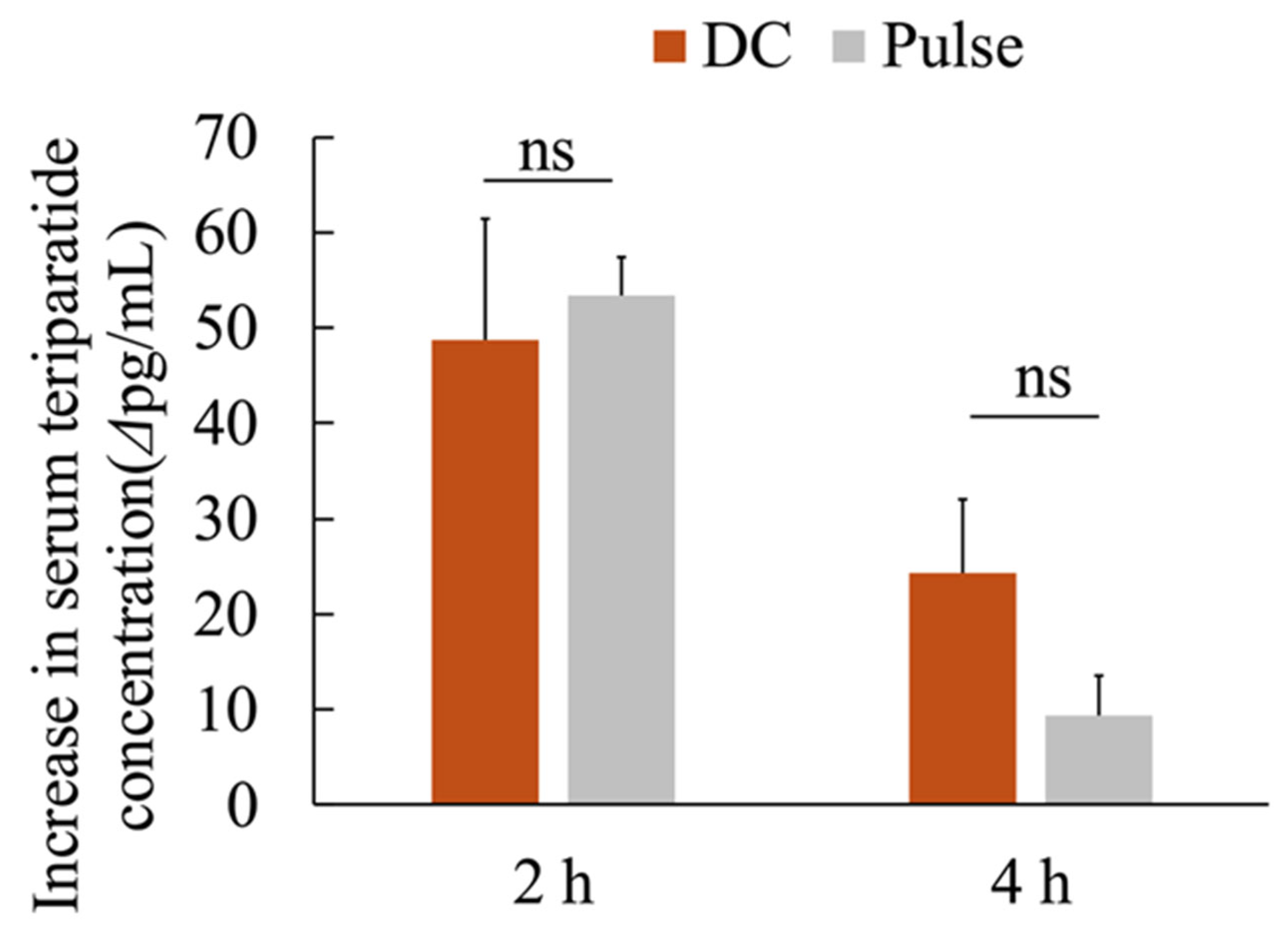
The time course of changes in serum teriparatide concentration following drug administration is shown in Figure 1. At the end of IP, the serum concentration increased to 53.3 ± 4.0 pg/mL in the pulsed-current group and 48.8 ± 12.6 pg/mL in the DC group; the mean difference estimated by the Hodges–Lehmann method between groups was 7.615 pg/mL (95% confidence interval: −41.02~38.13 pg/mL). Two hours after the completion of administration (4 h after the start of IP), the serum concentration markedly decreased in both groups; however, it did not return completely to the baseline level, indicating a residual elevation. Although the serum concentration tended to be slightly higher in the DC group than in the pulsed-current group, no statistically significant difference was observed between the two groups. In addition, the drug delivery efficiency, calculated based on the estimated amount of drug that entered the systemic circulation relative to the applied dose, was 0.60% in the pulsed-current group and 0.63% in the DC group.

3.2. Skin Irritation Responses Following Iontophoretic Application

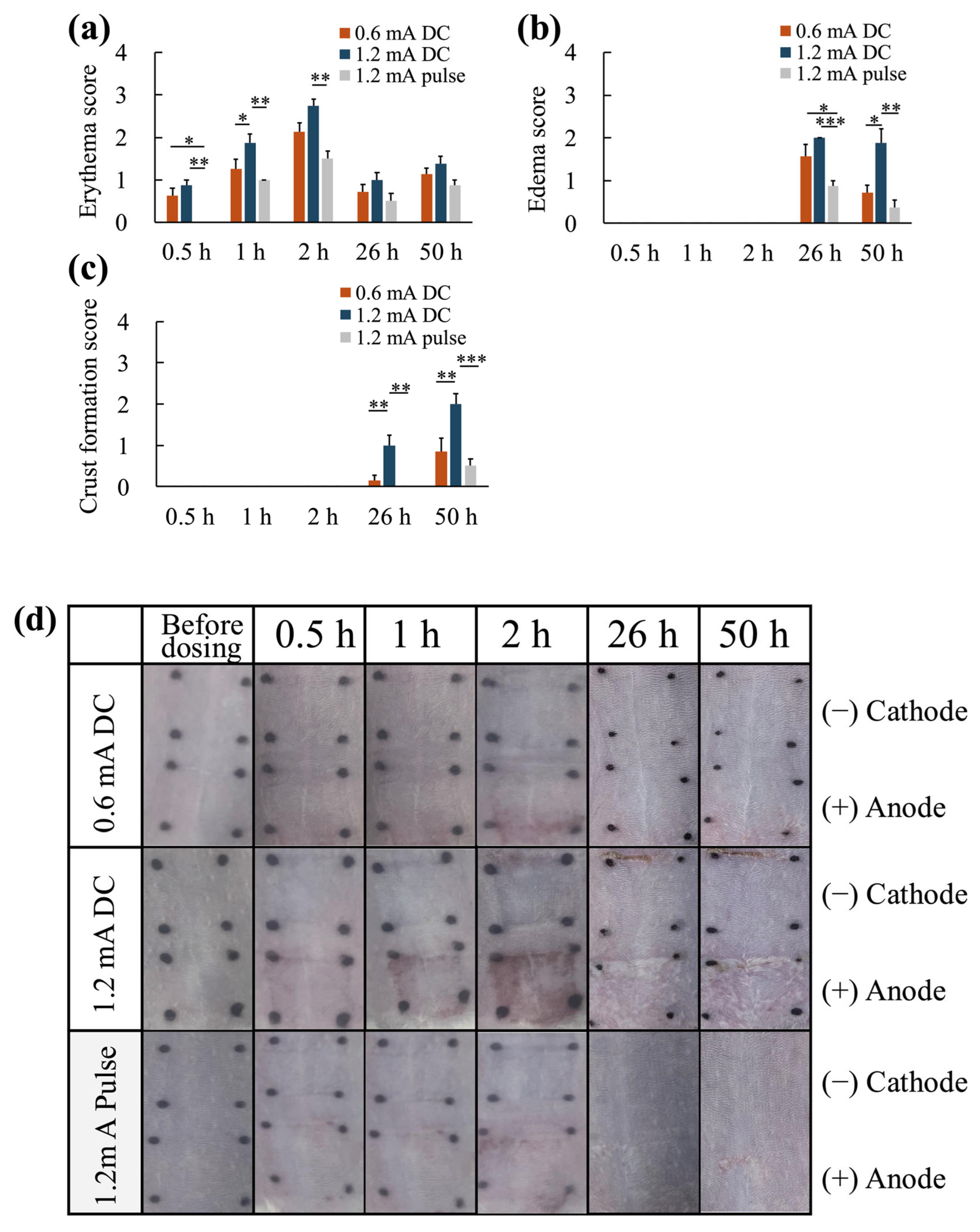
The time course of erythema scores at the application sites up to 50 h after the start of IP is shown in Figure 2a. In the DC groups, slight erythema was observed as early as 0.5 h after the start of the experiment, and the scores reached their maximum at 2 h. Compared with the 1.2 mA DC group, the 0.6 mA DC group showed significantly lower erythema scores at 0.5 and 1 h. In contrast, the 1.2 mA pulsed-current group exhibited significantly lower erythema scores at all time points of 0.5, 1, and 2 h. At 26 h after the start of the experiment, erythema temporarily subsided, whereas mild erythema reappeared at 50 h. The time course of edema scores is shown in Figure 2b. No edema was observed immediately after IP in any group; however, at 26 h, the 1.2 mA DC group exhibited the highest edema score. Compared with the 0.6 mA DC group, the 1.2 mA pulsed-current group showed significantly lower edema scores. At 50 h, no notable change was observed in the 1.2 mA DC group, while a decreasing trend in edema scores was found in both the 1.2 mA pulsed-current and 0.6 mA DC groups. The time course of crust formation scores is shown in Figure 2c. Mild crust formation was observed at 26 h and 50 h after the start of IP, with the highest scores recorded in the 1.2 mA DC group. Representative photographs of the application sites over time are shown in Figure 2d. Pronounced skin irritation reactions were particularly observed in the lower abdominal region where the anode was applied.

3.3. TEWL Following Iontophoretic Application

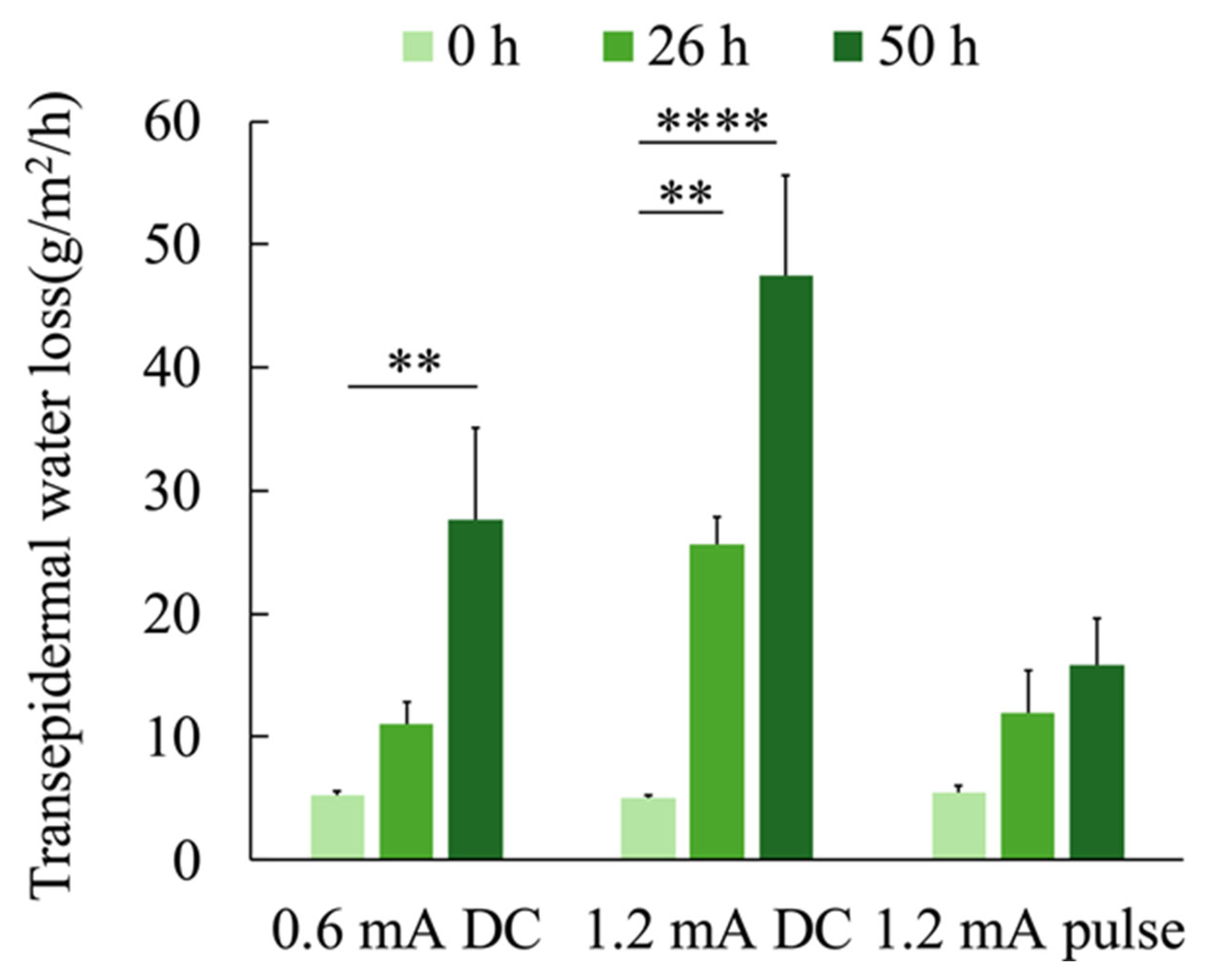
The changes in TEWL at the anodal application sites from before the start of the experiment to 50 h after are shown in Figure 3. Before drug administration, the TEWL in each group was approximately 5 g/m2/h, which was comparable to the reported values for normal rat skin measured using a similar open-chamber method [31]. In the 1.2 mA pulsed-current group, TEWL showed a slight increase, reaching 15.8 ± 4.1 g/m2/h at 50 h after the start of the experiment; however, this change was not statistically significant. In contrast, in the 1.2 mA DC group, TEWL increased to 25.7 ± 2.3 g/m2/h at 26 h after the start of the experiment, representing a statistically significant increase from baseline. At 50 h, TEWL showed a further increase, reaching 47.5 ± 8.7 g/m2/h. In the 0.6 mA DC group, TEWL reached 27.6 ± 8.2 g/m2/h at 50 h after the start of the experiment, representing a statistically significant increase from baseline. At the cathodal sites, TEWL at 50 h after the start of the experiment was 9.8 ± 3.8 g/m2/h in the 1.2 mA pulsed-current group, 12.6 ± 3.0 g/m2/h in the 1.2 mA DC group, and 9.2 ± 2.9 g/m2/h in the 0.6 mA DC group, with no clear differences observed among the groups.

4. Discussion

This study suggests that IP using a 10 Hz pulsed current may provide comparable transdermal delivery of teriparatide to that of DC iontophoresis, while reducing skin irritation at the application site. In both the 0.6 mA DC and 10 Hz pulsed-current groups, serum teriparatide concentrations increased by approximately 50 pg/mL after 2 h of administration. In this context, serum teriparatide concentrations were not assessed under 1.2 mA DC, as preliminary studies demonstrated marked skin irritation at this current density. In conventional transdermal drug delivery, compounds with molecular weights exceeding 500 Da are generally considered incapable of penetrating the skin by passive diffusion [5]. However, recent studies have focused on combining physical enhancement techniques to enable the transdermal delivery of macromolecular drugs. In particular, electrical stimulation by IP has been reported to activate and transiently open gap junctions and tight junctions within the stratum corneum, allowing macromolecules to penetrate the skin through intercellular pathways [12]. Furthermore, skin appendages such as hair follicles and sweat glands extend into the dermis and possess lower electrical resistance compared with the stratum corneum, thereby serving as preferential routes for drug transport during IP [32]. In this study, it is presumed that teriparatide was delivered into the systemic circulation through one or both of these pathways. Previous studies have shown that subcutaneous administration of teriparatide at a dose of at least 0.3 μg/kg improved bone mineral density [33]. Therefore, when this method is applied to osteoporosis therapy, periodic transdermal administration using the present iontophoretic approach may produce comparable bone-forming effects, suggesting its potential as a promising therapeutic strategy.
The skin irritation after drug administration was evaluated using visual scoring of erythema, edema, and crust formation, together with TEWL measurement. The scoring method adopted for skin irritation assessment followed the OECD guideline [30], which is widely used in studies involving other physical transdermal enhancement techniques [34]. Transepidermal water loss represents the amount of non-sweat water evaporated per unit area of the epidermis and is commonly employed as an indicator of skin barrier function [35]. Based on the results of scoring and TEWL measurements, it was confirmed that skin irritation under DC conditions increased in proportion to current intensity. Under pulsed-current conditions with a 1.2 mA (50:50 duty cycle), compared with constant-current IP at 0.6 mA with an equivalent total applied charge (mA·min), reductions in erythema irritation scores at 0.5 h and edema irritation scores at 26 h after the start of IP were observed, and the increase in TEWL was also suppressed, indicating reduced skin irritation. This finding suggests that the repeated on–off application of pulsed current may allow depolarization of the skin surface, thereby suppressing localized current density. In addition, previous in vitro studies using human epidermal membranes reported that decreasing the frequency of the pulsed current reduces skin electrical resistance [36]. This finding supports the possibility that, under the low-frequency pulsed-current condition adopted in this study, reduced skin resistance may have improved electrical conductivity and enhanced the stability of drug delivery. Therefore, compared with the DC mode, the low-frequency pulsed current may provide more efficient transdermal delivery of drugs, achieving comparable delivery efficiency with reduced skin irritation, suggesting its potential as a safer administration technique.
Most previous studies comparing pulsed and DC iontophoresis have been conducted as in vitro experiments using small-molecule drugs, and the present findings regarding the transdermal delivery of a macromolecular drug are consistent with those reports showing little difference between current modes. In our previous study, which served as the conceptual basis of this work, higher drug delivery efficiency was obtained with pulsed current compared with DC [27]. However, in that study, the total applied charge was equalized by doubling the application time in the pulsed-current condition, and this longer application period itself could have affected skin permeability and barrier function, potentially influencing the results. In contrast, in the present study, the application time and average current density were matched between the DC and pulsed current, enabling a more direct comparison.
As a limitation of this study, although rats were used because their skin structure closely resembles that of humans, rat skin has a higher follicular density and a thinner stratum corneum compared with human skin. Therefore, the amount of drug delivery might have been overestimated [37]. Consequently, when applying this transdermal method to humans, further optimization may be required to ensure sufficient drug delivery. To overcome this limitation, further optimization of iontophoretic conditions will be required when translating this transdermal approach to humans. The findings of this study provide insight into the selection of appropriate iontophoretic current conditions and suggest the potential applicability of low-frequency pulsed-current IP as a minimally invasive transdermal delivery method for other macromolecular drugs.

5. Conclusions

This study suggests that a low-frequency pulsed current at 10 Hz may provide transdermal delivery of teriparatide comparable to that achieved with DC iontophoresis under the same total applied charge, while significantly reducing skin irritation. IP is a promising technique to enhance transdermal drug delivery, but safety concerns such as skin irritation remain unresolved. In this study, we employed a pulsed-current IP method, which is expected to improve both drug delivery efficiency and local safety compared with the conventional DC mode, and evaluated serum drug concentrations and post-application skin responses in rats. Pulsed-current IP successfully achieved transdermal delivery of teriparatide, a drug used for the treatment of osteoporosis, showing serum drug levels comparable to those obtained with DC. Furthermore, in the skin irritation assessment, TEWL increased to 27.6 ± 8.2 g/m2/h at 50 h in the 0.6 mA DC group, indicating a significant increase from baseline; in contrast, the 1.2 mA pulsed-current group showed a TEWL of 15.8 ± 4.1 g/m2/h, with no statistically significant increase from baseline. Consistent with these results, the skin irritation score tended to be lower under the pulsed-current condition. In summary, these findings suggest that pulsed-current IP represents a novel and safe approach that may contribute to the development of transdermal delivery systems for macromolecular therapeutics.

Author Contributions

Conceptualization, H.O. and A.S.; methodology, R.S., H.O., T.I., I.T. and A.S.; validation, R.S., H.T., H.O., T.I., I.T. and A.S.; formal analysis, R.S., H.T., H.O., T.I., I.T. and A.S.; investigation, R.S. and H.T.; resources, H.O., T.I. and A.S.; data curation, R.S., H.O., T.I. and A.S.; writing—original draft preparation, R.S., I.T. and A.S.; writing—review and editing, H.O., T.I., I.T. and A.S.; visualization, R.S., I.T. and A.S.; supervision, H.O. and A.S.; project administration, R.S., H.O. and A.S.; funding acquisition, H.O. and A.S. All authors have read and agreed to the published version of the manuscript.

Funding

This research was supported by KANEKA CORPORATION, Japan, under a collaborative research agreement.

Data Availability Statement

The raw data supporting the conclusions of this article will be made available by the authors on reasonable request.

Conflicts of Interest

This study was performed as a collaborative research project with KANEKA CORPORATION, Japan.

Abbreviations

The following abbreviations are used in this manuscript:
AUCArea Under the Concentration–Time Curve
DCConstant Direct Current
FDAFood and Drug Administration
IPIontoPhoresis
OECDOrganisation for Economic Co-operation and Development
PBSPhosphate-Buffered Saline
TEWLTransEpidermal Water Loss

References

  1. Gary, W.; Walsh, E. Biopharmaceutical benchmarks 2022. Nat. Biotechnol. 2022, 40, 1722–1760. [Google Scholar] [CrossRef]
  2. Bajracharya, R.; Song, J.G.; Back, S.Y.; Han, H.-K. Recent advancements in non-invasive formulations for protein drug delivery. Comput. Struct. Biotechnol. J. 2019, 17, 1290–1308. [Google Scholar] [CrossRef]
  3. Nakamura, T.; Sugimoto, T.; Nakano, T.; Kishimoto, H.; Ito, M.; Fukunaga, M.; Hagino, H.; Sone, T.; Yoshikawa, H.; Nishizawa, Y.; et al. Randomized Teriparatide [Human Parathyroid Hormone (PTH) 1–34] Once-Weekly Efficacy Research (TOWER) Trial for Examining the Reduction in New Vertebral Fractures in Subjects with Primary Osteoporosis and High Fracture Risk. J. Clin. Endocrinol. Metab. 2012, 97, 3097–3106. [Google Scholar] [CrossRef]
  4. Neer, R.M.; Arnaud, C.D.; Zanchetta, J.R.; Prince, R.; Gaich, G.A.; Reginster, J.-Y.; Hodsman, A.B.; Eriksen, E.F.; Ish-Shalom, S.; Genant, H.K.; et al. Effect of parathyroid hormone (1–34) on fractures and bone mineral density in postmenopausal women with osteoporosis. N. Engl. J. Med. 2001, 344, 1434–1441. [Google Scholar]
  5. Bos, J.D.; Meinardi, M.M.H.M. The 500 Dalton rule for the skin penetration of chemical compounds and drugs. Exp. Dermatol. Viewp. 2000, 9, 165–169. [Google Scholar]
  6. Karande, P.; Mitragotri, S. Enhancement of transdermal drug delivery via synergistic action of chemicals. Biochim. Biophys. Acta-Biomembr. 2009, 1788, 2362–2373. [Google Scholar]
  7. Abbasi, M.; Heath, B. Iontophoresis and electroporation-assisted microneedles: Advancements and therapeutic potentials in transdermal drug delivery. Drug Deliv. Transl. Res. 2025, 15, 1962–1984. [Google Scholar]
  8. Phatale, V.; Vaiphei, K.K.; Jha, S.; Patil, D.; Agrawal, M.; Alexander, A. Overcoming skin barriers through advanced transdermal drug delivery approaches. J. Control. Release 2022, 351, 361–380. [Google Scholar] [CrossRef]
  9. Park, J.; Lee, H.; Lim, G.-S.; Kim, N.; Kim, D.; Kim, Y.-C. Enhanced transdermal drug delivery by sonophoresis and simultaneous application of sonophoresis and iontophoresis. AAPS PharmSciTech 2019, 20, 96. [Google Scholar] [CrossRef]
  10. Nagarkar, R.; Singh, M.; Nguyen, H.X.; Jonnalagadda, S. A review of recent advances in microneedle technology for transdermal drug delivery. J. Drug Deliv. Sci. Technol. 2020, 59, 101923. [Google Scholar] [CrossRef]
  11. Andrade, J.F.M.; Cunha-Filho, M.; Gelfuso, G.M.; Gratieri, T. Iontophoresis for the cutaneous delivery of nanoentraped drugs. Expert Opin. Drug Deliv. 2023, 20, 785–798. [Google Scholar] [CrossRef] [PubMed]
  12. Fukuta, T.; Oshima, Y.; Michiue, K.; Tanaka, D.; Kogure, K. Non-invasive delivery of biological macromolecular drugs into the skin by iontophoresis and its application to psoriasis treatment. J. Control. Release 2020, 323, 323–332. [Google Scholar] [CrossRef] [PubMed]
  13. Noh, G.; Keum, T.; Seo, J.-E.; Bashyal, S.; Eum, N.-S.; Kweon, M.J.; Lee, S.; Sohn, D.H.; Lee, S. Iontophoretic transdermal delivery of Human Growth Hormone (hGH) and the combination effect of a new type Microneedle, Tappy Tok Tok®. Pharmaceutics 2018, 10, 153. [Google Scholar] [CrossRef] [PubMed]
  14. Mori, K.; Yamazaki, K.; Takei, C.; Oshizaka, T.; Takeuchi, I.; Miyaji, K.; Todo, H.; Itakura, S.; Sugibayashi, K. Remote-controllable dosage management through a wearable iontophoretic patch utilizing a cell phone. J. Control. Release 2023, 355, 1–6. [Google Scholar] [CrossRef]
  15. Prasad, R.; Koul, V.; Anand, S. Biophysical assessment of DC iontophoresis and current density on transdermal permeation of methotrexate. Int. J. Pharm. Investig. 2011, 1, 234–239. [Google Scholar] [CrossRef]
  16. Wang, Y.; Zeng, L.; Song, W.; Liu, J. Influencing factors and drug application of iontophoresis in transdermal drug delivery: An overview of recent progress. Drug Deliv. Transl. Res. 2022, 12, 15–26. [Google Scholar] [CrossRef]
  17. Uppal, N.; Anderson, T.S. Learning from the opioid epidemic: Preventing the next healthcare marketing crisis. J. Gen. Intern. Med. 2021, 36, 3553–3556. [Google Scholar] [CrossRef]
  18. Loder, E.W.; Rayhill, M.; Burch, R.C. Safety problems with a transdermal patch for migraine: Lessons from the development, approval, and marketing process. Headache J. Head Face Pain 2018, 58, 1639–1657. [Google Scholar] [CrossRef]
  19. Bagniefski, T.; Burnette, R.R. A comparison of pulsed and continuous current iontophoresis. J. Control. Release 1990, 11, 113–122. [Google Scholar] [CrossRef]
  20. Kanebako, M.; Inagi, T.; Takayama, K. Evaluation of skin barrier function using direct current II: Effects of duty cycle, waveform, frequency and mode. Biol. Pharm. Bull. 2002, 25, 1623–1628. [Google Scholar] [CrossRef][Green Version]
  21. Cázares-Delgadillo, J.; Planard-Luong, L.; Gregoire, S.; Serna-Jiménez, C.E.; Singhal, M.; Kalia, Y.N.; Merino, V.; Merino-Sanjuán, M.; Nácher, A.; Martínez-Gómez, M.A.; et al. Investigation of different iontophoretic currents profiles for short-term applications in cosmetics. Pharmaceutics 2018, 10, 266. [Google Scholar] [CrossRef]
  22. Kamchai, S.; Kevin, L.S.; Doungdaw, C. Effect of pulsed direct current on iontophoretic delivery of pramipexole across human epidermal membrane in vitro. Pharm. Res. 2021, 38, 1187–1198. [Google Scholar] [CrossRef]
  23. Pacini, S.; Punzi, T.; Gulisano, M.; Cecchi, F.; Vannucchi, S.; Ruggiero, M. Transdermal delivery of heparin using pulsed current iontophoresis. Pharm. Res. 2006, 23, 114–120. [Google Scholar] [CrossRef] [PubMed]
  24. Suzuki, Y.; Iga, K.; Yanai, S.; Matsumoto, Y.; Kawase, M.; Fukuda, T.; Adachi, H.; Higo, N.; Ogawa, Y. Iontophoretic pulsatile transdermal delivery of human parathyroid hormone (1–34). J. Pharm. Pharmacol. 2001, 53, 1227–1234. [Google Scholar] [CrossRef] [PubMed]
  25. Suzuki, Y.; Nagase, Y.; Iga, K.; Kawase, M.; Oka, M.; Yanai, S.; Matsumoto, Y.; Nakagawa, S.; Fukuda, T.; Adachi, H.; et al. Prevention of bone loss in ovariectomized rats by pulsatile transdermal iontophoretic administration of human PTH (1–34). J. Pharm. Sci. 2002, 91, 350–361. [Google Scholar] [CrossRef] [PubMed]
  26. Fujii, M.; Ohara, R.; Matsumi, A.; Ohura, K.; Koizumi, N.; Imai, T.; Watanabe, Y. Effect of alcohol on skin permeation and metabolism of an ester-type prodrug in Yucatan micropig skin. Eur. J. Pharm. Sci. 2017, 109, 280–287. [Google Scholar] [CrossRef]
  27. Kaneka Corporation. Iontophoresis Device. Patent No. WO2024/203812 A1, 3 October 2024. [Google Scholar]
  28. Kawai, S.; Takagi, Y.; Kaneko, S.; Kurosawa, T. Effect of three types of mixed anesthetic agents alternate to ketamine in mice. Exp. Anim. 2011, 60, 481–487. [Google Scholar] [CrossRef]
  29. Lee, H.; Blaufox, M. Blood volume in the rat. J. Nucl. Med. 1985, 26, 72–76. [Google Scholar]
  30. OECD. OECD Guidelines for Testing of Chemicals; TG404; OECD: Paris, France, 2015. [Google Scholar]
  31. Scott, R.C.; Oliver, G.J.A.; Dugard, P.H.; Singh, H.J. A comparison of techniques for the measurement of transepidermal water loss. Arch. Dermatol. Res. 1982, 274, 57–64. [Google Scholar] [CrossRef]
  32. Hasan, M.; Khatun, A.; Kogure, K. Iontophoresis of biological macromolecular drugs. Pharmaceutics 2022, 14, 525. [Google Scholar] [CrossRef]
  33. Pacheco-Costa, R.; Campos, J.F.; Katchburian, E.; de Medeiros, V.P.; Nader, H.B.; Nonaka, K.O.; Plotkin, L.I.; Reginato, R.D. Modifications in bone matrix of estrogen-deficient rats treated with intermittent PTH. BioMed Res. Int. 2015, 2015, 454162. [Google Scholar] [CrossRef]
  34. Yun, T.-S.; Song, B.; Hwang, Y.-R.; Jin, M.; Seonwoo, H.; Kim, D.; Kim, H.W.; Kim, B.C.; Kim, D.; Park, B.; et al. Safety of applying influenza-antigen-coated microneedles to rat skin and the antigen specific immune response in vivo. J. Pharm. Investig. 2024, 54, 631–642. [Google Scholar] [CrossRef]
  35. Green, M.; Feschuk, A.M.; Kashetsky, N.; Maibach, H.I. Normal TEWL-how can it be defined? A systematic review. Exp. Dermatol. 2022, 31, 1618–1631. [Google Scholar] [CrossRef]
  36. Xu, Q.; Kochambilli, R.P.; Song, Y.; Hao, J.; Higuchi, W.I.; Li, S.K. Effects of alternating current frequency and permeation enhancers upon human epidermal membrane. Int. J. Pharm. 2009, 372, 24–32. [Google Scholar] [CrossRef]
  37. Jung, E.C.; Howard, I.M. Animal models for percutaneous absorption. In Topical Drug Bioavailability, Bioequivalence, and Penetration; Springer: New York, NY, USA, 2015; pp. 21–40. [Google Scholar]
Figure 1. Changes in serum teriparatide concentration (Δpg/mL) up to 4 h after the start of iontophoretic administration. Data are expressed as mean ± standard error of the mean (SEM) (n = 6, 0.6 mA constant direct current (DC); n = 4, 1.2 mA pulsed current). The Mann–Whitney U test, ns, not significant.
Colloids 10 00015 g001
Figure 2. Skin irritation scores after iontophoretic application up to 50 h: (a) erythema, (b) edema, (c) crust formation, and (d) representative images of application sites up to 50 h after the start of IP, with the cathodal electrode positioned on the upper region and the anodal electrode on the lower region of each image. Data are expressed as mean ± SEM (n = 8 up to 2 h and n = 7 at 26 h and 50 h, 0.6 mA DC; n = 8, 1.2 mA DC; n = 8, 1.2 mA pulsed current). Tukey–Kramer test, * p < 0.05, ** p < 0.01, *** p < 0.001.
Colloids 10 00015 g002
Figure 3. TEWL at the anodal application sites up to 50 h after iontophoretic application. Data are expressed as mean ± SEM (n = 8 up to 2 h and n = 7 at 26 h and 50 h, 0.6 mA DC; n = 8, 1.2 mA DC; n = 8, 1.2 mA pulsed current). Dunnett’s test, ** p < 0.01, **** p < 0.0001.
Colloids 10 00015 g003
Disclaimer/Publisher’s Note: The statements, opinions and data contained in all publications are solely those of the individual author(s) and contributor(s) and not of MDPI and/or the editor(s). MDPI and/or the editor(s) disclaim responsibility for any injury to people or property resulting from any ideas, methods, instructions or products referred to in the content.