


Abstract
Retrieval-augmented generation and structured agent memory are commonly treated as competing ways to ground large language models. Our results show that their relative value changes with the task and that neither retrieved similarity nor graph association is sufficient evidence for an answer. We present a task-adaptive two-layer methodology combining a compact, reviewed knowledge layer for orientation and cross-source synthesis with a versioned evidence layer for exact lookup and claim support. A router selects the representation, while an independent admission stage checks named entities, time, source role, contradiction, and provenance. A controlled course-grounding study reveals a task-conditional crossover within Course 2: the distilled Body of Knowledge (BoK) trails plain RAG by 1.07 points on lookup and leads by 0.62 points on synthesis. Across a 72-question three-course lookup panel, RAG leads by 2.17 points; Course 1 synthesis is near parity. Complementary, position-debiased LLM-judged mastery comparisons favor the BoK on both courses. The standing representation is reduced 22–35-fold. An observational production case over a 289,642-chunk evidence base illustrates why candidate discovery, packet selection, and evidence admission require separate gates. The contribution is a tested method for assigning retrieval, structure, and evidence admission distinct responsibilities within one grounded agent architecture.
1. Introduction
Agents operating over organizational knowledge face two conflicting demands. They need broad access to detailed source material, but they also need a compact representation of the concepts, relations, and decisions that organize that material. Raw retrieval is strong when the requested fact appears in a local passage. It is weaker when an answer must connect several modules, preserve a named entity across hops, reconcile sources, or recognize that the corpus does not support the requested claim. A compact knowledge representation provides global orientation, but its compression can remove the surface detail that makes lookup easy.
This tension is often framed as a contest between RAG and knowledge graphs, memory systems, summaries, or distilled knowledge. That framing encourages a single representation to serve every query. It also conflates two different decisions: which material is useful for discovery, and which material is sufficient to support an answer. A passage can be highly similar to a question yet refer to the wrong model version. A graph neighbor can provide a useful route yet fail to establish the requested relation. More retrieval therefore does not automatically yield more evidence.
We encountered both problems while evaluating a course-to-BoK distillation pipeline and later operating a large bilingual knowledge service. The controlled study produced an initially uncomfortable result: plain RAG decisively beat the structured representation on lookup, and the full curated pipeline sometimes lost to an unmerged fact ablation. Most notably, within Course 2 the BoK-minus-RAG difference changed from −1.07 on lookup to +0.62 on synthesis. Complementary reference-free, LLM-judged mastery comparisons also favored the BoK. The production system exposed the complementary failure: expanding retrieval and graph discovery improved candidate coverage but could still deliver an insufficient final packet or substitute a topically adjacent entity.
These observations led to a different methodology. We separate a compact reviewed knowledge layer from a broad versioned evidence layer. We route queries according to their information operation rather than selecting one universally preferred representation. Finally, we place a governed evidence-admission stage between discovery and generation. The method returns a partial result or UNKNOWN when a material claim cannot be closed to permitted evidence.
The article makes four contributions:
- 1.
- It provides controlled evidence for task crossover: structured knowledge loses on lookup but reaches near-parity or wins on synthesis depending on corpus and model, with complementary LLM-judged mastery preferences favoring the compact representation.
- 2.
- It formulates an empirically motivated task-adaptive two-layer architecture in which structured knowledge, raw retrieval, association, and evidence admission have distinct responsibilities.
- 3.
- It reports an observational production design-study case illustrating why corpus breadth, reranking, ANN, graph discovery, and admission gates must be evaluated as separate stages.
- 4.
- It releases the evaluation protocol, row-level outputs, aggregate receipts, and schemas as supporting reproducibility artifacts.
We do not claim universal superiority over RAG, GraphRAG, long context, or agent-memory systems. The architectural claim is narrower: a grounded agent needs both task-appropriate discovery and explicit control over what counts as evidence.
2. Related Work
RAG grounds generation in passages retrieved from an external corpus. Early retrieval-augmented pretraining, dense passage retrieval, and few-shot retrieval-augmented language models established complementary ways to couple a parametric generator with an external index [1,2,3,4]. Recent work systematically analyzes retrieval-augmented pipelines in applied clinical domains [5,6]. Late-interaction retrieval provides a further efficiency–quality tradeoff between bi-encoder retrieval and full cross-encoding [7].
Recent systems also make retrieval conditional rather than uniform. FLARE retrieves during generation, Self-RAG learns retrieval and critique decisions, and corrective or complexity-adaptive systems gate additional retrieval when the initial evidence is inadequate [8,9,10,11]. These systems motivate routing, but they do not by themselves define which retrieved item may support a claim.
GraphRAG and related systems introduce entities, relations, communities, or hierarchical summaries to support global questions [12]. G-Retriever similarly uses graph structure to retrieve subgraphs for textual graph question answering [13]. Roadmap work argues for treating LLMs and knowledge graphs as complementary, interoperable substrates [14].
RAPTOR and HippoRAG organize retrieval through hierarchies or memory-inspired graphs [15,16]. HybridRAG, KAG, and LightRAG likewise combine retrieval with structured organization [17,18,19]. These methods primarily change how candidates are represented or discovered. Our methodology is compatible with them but treats their output as candidates rather than automatically admissible answer evidence.
Research on externalized memory gives agents persistent stores, reflective traces, skills, and cognitive architectures [20,21,22,23,24]. A distilled BoK is one such externalized representation. Our controlled study asks when that representation helps relative to retrieving the underlying text, holding the answerer and context budget fixed.
Evaluation approaches such as RAGAS, ARES, RAGChecker, FActScore, ALCE, CiteEval, and Sufficient Context separate retrieval quality, attribution, factuality, and answerability [25,26,27,28,29,30,31,32]. We extend this separation architecturally. A query creates typed obligations over entity, relation, time, source role, and provenance. Relevance is useful for finding candidates, but support requires that the obligations be satisfied. The contribution lies in combining this explicit discovery/admission separation with the measured task crossover to assign each layer a distinct responsibility. It builds on existing hybrid retrieval and verification components rather than claiming those components individually as new.
Long-context studies and benchmarks show that nominal context length does not guarantee reliable use of evidence distributed across that context [33,34,35]. Our results likewise show that standing corpus size, per-query context, task type, and evidence quality must be distinguished.
3. Task-Adaptive Two-Layer Methodology
3.1. Two Knowledge Substrates
Let the evidence layer, , be a versioned corpus generation. Each record is bound to a source identity, revision, content hash, access/rights class, exact span, and, where relevant, a validity interval. This layer preserves searchable breadth and is the final source of factual support.
Let the compact knowledge layer, , contain reviewed facts, concepts, skills, relations, dossiers, and navigation links derived from . It is smaller, deduplicated, and organized for global orientation and synthesis. Every unit retains provenance pointers into , but an entry in is not automatically sufficient evidence for every claim that can be associated with it.
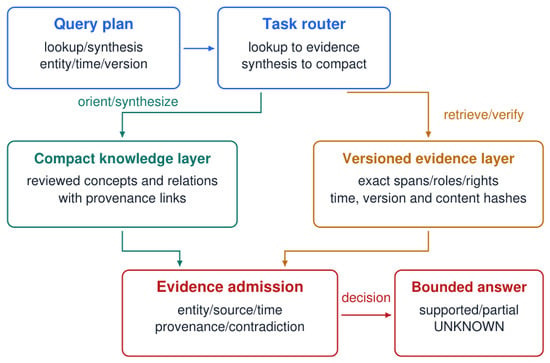
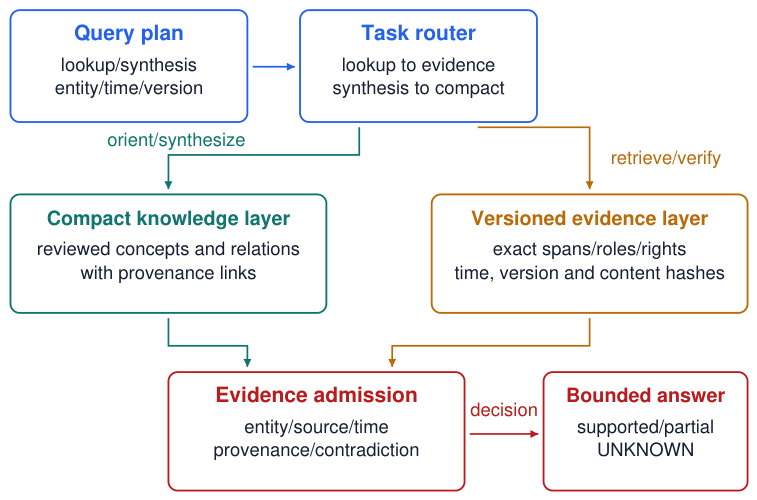
Figure 1 summarizes the separation of routing, discovery, and evidence admission. The separation resolves a false choice. is optimized for navigability and integration; is optimized for coverage, exactness, and auditability. Compression is allowed to lose surface form because lookup remains available in the evidence layer.
Figure 1.
Task-adaptive two-layer architecture. Task routing and candidate discovery are separated from claim-level evidence admission.
3.2. Query Classification and Routing
A query plan identifies the information operation before retrieval:
- Exact or local lookup;
- Cross-source synthesis;
- Multi-hop comparison or reconciliation;
- Current/temporal fact;
- Named-entity or version-specific request;
- Unsupported or out-of-scope request.
The default routing rule derived from our controlled results is deliberately simple: lookup queries prefer raw retrieval, while synthesis queries prefer the compact knowledge layer and use the evidence layer to close material claims. Temporal, named-entity, and comparison queries add exact-anchor and source-role requirements. Routing may use lexical, dense, graph, hierarchy, or catalog lanes; the architecture does not require a particular retriever. Table 1 fixes the default vocabulary used throughout.
Table 1.
Query operations, default routes, and the obligations their admission stage adds.
3.3. Discovery Is Not Evidence
For query q, retrieval and navigation produce a candidate set . An admission policy constructs a bounded Evidence Packet . The packet is therefore a decision product, not simply the top-k records.
For each material answer claim, the query plan declares obligations:
- Required entity and version anchors;
- Relation or claim type;
- Time scope and freshness;
- Permitted source roles;
- Independent-source or diversity requirements;
- Contradiction and counter-evidence policy;
- Acceptable multi-hop paths;
- Conditions for partial support or abstention.
An association can expand , but only an admitted span can support a claim. This distinction prevents a common error: a well-connected or highly similar record being presented as evidence for a different named object.
3.4. Claim Closure and Fail-Closed Behavior
Let denote the material claims in a candidate answer. For a claim , closure is PASS only if permitted spans satisfy its entity, time, role, provenance, and support obligations. A violated obligation is FAIL. Missing evidence or missing policy state is UNKNOWN, never an implicit pass.
Generation receives the frozen Evidence Packet and unresolved-obligation list. After generation, material claims are checked again against the packet. The system emits a supported answer, a bounded partial answer, or an explicit unknown. This makes abstention a property of evidence state rather than model confidence alone.
3.5. Corpus Lifecycle
The architecture treats corpus growth as a governed lifecycle:
- 1.
- Ingest sources with stable identities and rights metadata;
- 2.
- Preserve exact revisions and spans;
- 3.
- Construct or update the compact knowledge layer;
- 4.
- Build retrieval indexes without changing the release contents;
- 5.
- Qualify ranking and admission policies on frozen regressions;
- 6.
- Activate a complete generation atomically with rollback;
- 7.
- Diagnose new questions as retrieval bugs, stale facts, corpus gaps, architecture limits, or out-of-scope requests;
- 8.
- Acquire new evidence only for confirmed, bounded gaps.
The goal is not maximum corpus size. It is fewer repeated unsupported answers at an acceptable review, latency, and refusal cost.
4. Controlled Evaluation of Representation and Routing
4.1. Corpora and Representations
The controlled study uses three course corpora with different formats and provenances: Course 1 (305 structured documents; 3.01 million characters; 566 distilled facts), a single-transcript pilot corpus (53.5 K ASR characters; 144 facts), and Course 2 (103 mixed-format documents; 2.61 million characters; 880 facts). To respect source-licensing and trademark boundaries, the manuscript uses neutral labels for the two principal corpora and does not redistribute their raw instructional content. The evaluation artifacts (question banks, model outputs, judgments, protocol, and aggregate results) are public in the K-Forge release even though the source instructional documents are not. This enables audit and reanalysis of the reported evaluations; rerunning source ingestion, BoK construction, and answer generation end to end requires access to the proprietary source corpora. The two fully curated corpora compress by approximately 34.6× and 22.5×, respectively. Table 2 summarizes the three corpora.
Table 2.
Corpora and compact representations. Document and character counts are recomputed exactly from source manifests; fact counts come from frozen curation reports.
The historical lookup panel compares no context, plain dense RAG, GraphRAG, A-Mem, Graphiti, an unmerged naive_kg, and the full distilled BoK. The primary synthesis release focuses on RAG, naive_kg, and the BoK under matched context budgets, with a no-context arm used to gate course-specific questions.
RAG retrieves raw chunks by cosine similarity. naive_kg applies the same per-document extraction family as the BoK but removes liveness filtering and cross-lesson merge. The full BoK contains provenance-tagged facts, concepts, and skills after curation and semantic merge. RAG’s top-k context establishes the per-question character budget; the other representations are packed to the same budget where enough material exists.
4.2. Tasks
Lookup questions are generated from individual lessons across Bloom levels L1–L6 (remember, understand, apply, analyze, evaluate, and create) and are answerable from a local source passage. They intentionally test RAG in its strongest regime.
Synthesis questions require integration across modules, transfer to a new scenario, or reconciliation of multiple concepts. A no-context answerability gate filters questions answerable without course context. The fixed answerer, claude-sonnet-4-6, answers each candidate without course material; a cross-vendor judge, gpt-4o, scores correctness against the reference on a 1–10 scale. Questions scoring below 6 are retained; those scoring 6 or above are excluded. Missing scores are not admitted. The released evaluation lineage contains 234 retained synthesis questions: 156 on Course 1 and 78 on Course 2.
4.3. Answerers and Judges
The original lookup experiment used a fixed answerer and two blind judges. The synthesis study expanded to ten proprietary and open-weight answerer models and three cross-vendor judges under a common scale-anchored correctness/groundedness rubric. Per-judge results were retained because small effects near parity are sensitive to judging scale and LLM judges have documented position and self-preference biases [36].
A second evaluation changes the construct rather than the answers. Three judges compare BoK and RAG responses pairwise, in both presentation orders, asking which better demonstrates command of the course. A win is strict when the preference is position-consistent. A 36-answer blind human check by a domain expert produced Pearson (r = 0.91), Spearman (0.87), and 94% agreement within one point with the aggregate judges. The labeler was a co-author; this is a validation check, not an independent human study or an independent validation of the mastery construct.
4.4. Reproducibility
The public release records version 1.2—DOI: https://doi.org/10.5281/zenodo.20634103—with 7818 answer rows and 28,593 judgment rows under CC BY 4.0. Its verifier checks file presence, QID joins, judge fields, duplicates, configuration names, row counts, version, and DOI consistency. On the released archive the verifier completes with zero failures and zero warnings. The deterministic reanalysis and visualization scripts in the release were implemented with AI assistance (see Acknowledgments) and regenerate the reported numbers from frozen row-level inputs.
The configuration, Bloom-level, corpus/embedder, and model-by-corpus comparisons are descriptive analyses. Reported 95% bootstrap intervals are unadjusted for multiple comparisons, and the lookup Wilcoxon p-value is nominal. The within-Course-2 lookup/synthesis contrast is the central empirical comparison; secondary contrasts characterize its scope rather than provide multiplicity-adjusted confirmatory evidence.
5. Controlled Results
5.1. RAG Wins Lookup
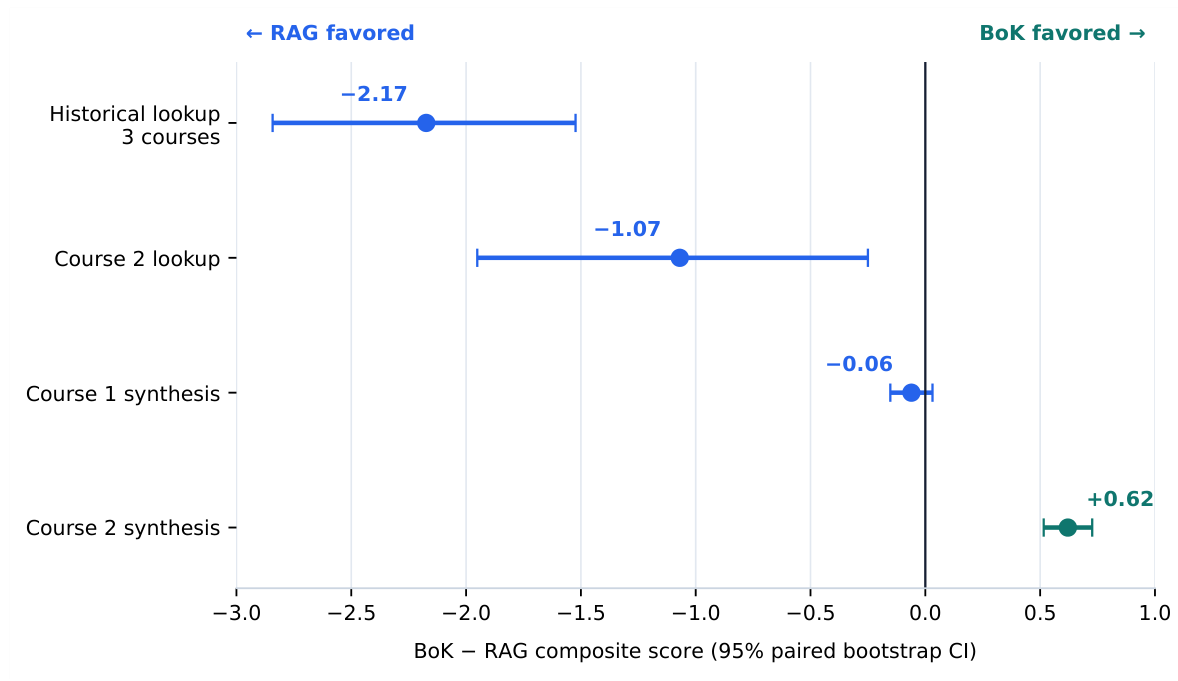
In the original 72-question, three-course lookup panel, RAG achieved a mean composite score of 8.54 versus 6.37 for the full BoK: a paired BoK-minus-RAG difference of −2.17 points (seeded-bootstrap 95% CI, −2.84 to −1.52), Cohen’s , and Wilcoxon . RAG won at every Bloom level, although its lead was smallest at L6. The result falsifies a universal “distillation beats retrieval” claim. Table 3 reports the full seven-configuration panel.
Table 3.
Historical three-course lookup panel: mean composite score (correctness, groundedness, and Bloom competency averaged per judge, then judge-aggregated) over the pooled 72-question set. Each system is scored on the questions it covers.
Table 4 decomposes the paired lookup difference by Bloom level, including the pairs that individually favor RAG.
Table 4.
Lookup BoK-minus-RAG paired difference by Bloom level (72-question pooled panel, judge-aggregated composite).
The curation ablation was also negative. naive_kg, which retained 9072 unmerged facts on the largest course, outperformed the 566-fact curated BoK on lookup. Compression and merge reduced the retrievable surface, discarding detail rewarded by reference-based QA. This is not an implementation footnote; it is the reason the architecture retains a raw evidence layer.
5.2. Synthesis Produces a Task Crossover
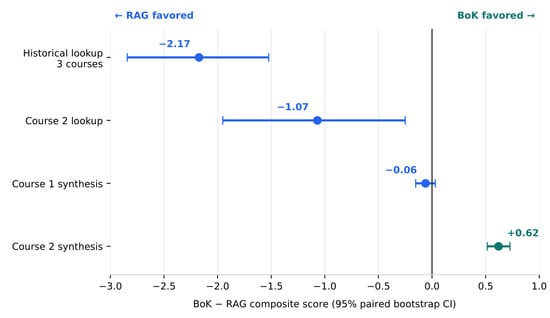
The clearest crossover occurs within Course 2. The BoK exceeds RAG on synthesis by 0.62 points (95% CI, 0.52 to 0.73), with a positive direction for nine of ten answerer models. On lookup in that same corpus, the BoK-minus-RAG difference is −1.07 points (95% CI, −1.95 to −0.25). This within-corpus sign change provides the central empirical motivation for task-adaptive routing (Figure 2). The task panels use different question sets and evaluation protocols.
Figure 2.
Task crossover in BoK-minus-RAG differences. The sign changes from lookup to synthesis; intervals use paired bootstrap resampling with a fixed seed (20,260,828) and are unadjusted for multiple comparisons.
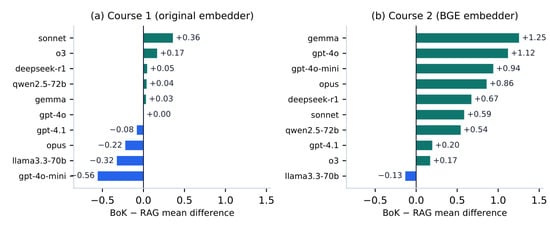
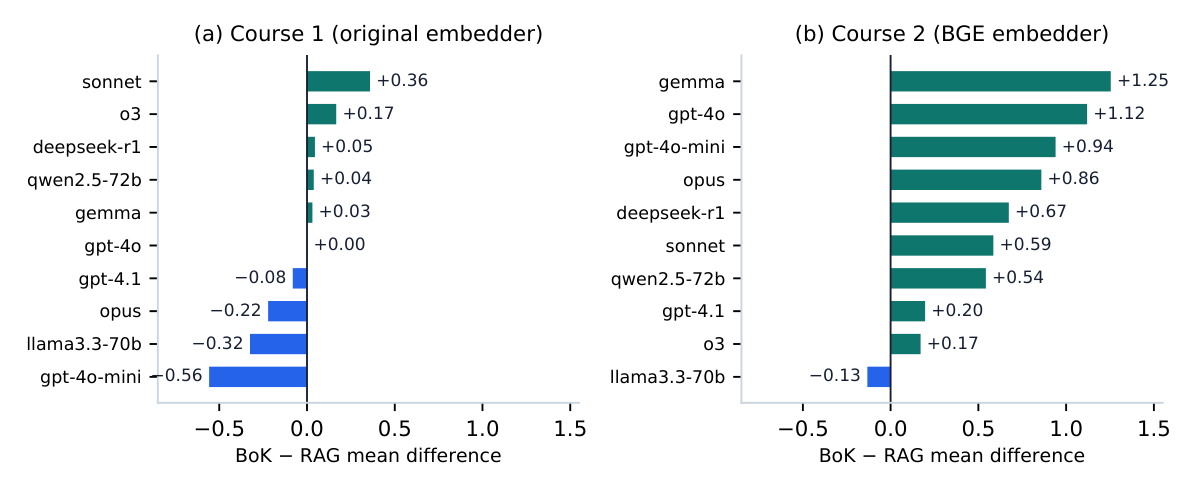
On Course 1 synthesis, the complete-pair ten-model, three-judge mean was 7.056 for RAG and 6.996 for the BoK, a difference of −0.06 points (95% CI, −0.15 to 0.03), indicating near-parity (Table 5). Because Course 1 was originally evaluated with a different embedder from Course 2, we repeated it with the BGE embedder used for Course 2. The difference remained near-parity at 0.04 points (95% CI, −0.09 to 0.17; Table 5), so the cross-corpus contrast is not explained by the embedder change.
Table 5.
Synthesis BoK-minus-RAG comparison under complete three-judge pairs (three judges averaged per answer, paired by model and question; 95% confidence intervals from seeded paired bootstrap).
The effect is still conditional: per-model synthesis differences (Figure 3) range from negative for some weaker models to positive for several stronger reasoners, with exceptions, and the corpus comparison confounds instructional provenance with language and modality. Both boundaries are revisited in the Limitations.
Figure 3.
Per-answerer BoK-minus-RAG synthesis differences under the complete-pair three-judge mean: (a) Course 1 with the original embedder; (b) Course 2 with BGE. Course 1 is near parity in aggregate; nine of ten answerers favor the BoK on Course 2.
5.3. Mastery and Compactness
Reference-based QA rewards overlap with a source-derived answer. The reference-free, LLM-judged mastery evaluation asks a different question: which response better integrates and commands the course material? Under the strict position-consistent rule, the BoK was preferred 171 times versus 76 RAG preferences on Course 1, with 214 ties (Table 6). On Course 2, the counts were 150 versus 3, with 75 ties. Including weak, position-inconsistent preferences yields 176 versus 78 and 156 versus 3, respectively; we treat those as a sensitivity analysis rather than the headline. Exact two-sided sign tests at the question level, netting each question’s strict preferences across the three judges, give 91 BoK-favoring versus 42 RAG-favoring questions on Course 1 (23 net ties; ) and 66 versus 2 on Course 2 (10 net ties; ). As elsewhere, these p-values are nominal.
Table 6.
Strict position-consistent mastery preferences and standing-representation compression. Inclusive counts (parentheses) add weak, position-inconsistent preferences and serve as a sensitivity analysis.
These comparisons use the same answers, so the reversal demonstrates construct sensitivity in evaluation. It does not prove that an LLM-defined notion of mastery is the uniquely correct one. Independent blinded expert ratings would strengthen validation of this complementary result. Its architectural implication is safer: verbatim correctness and integrated command are different workloads and should not force the same representation.
The compact layer also reduces the standing representation from 3.01 M to 87 K characters on Course 1 and from 2.61 M to 116 K on Course 2. Per-query context is budget-matched, so this is not a claim of cheaper answer generation. It is a claim about the representation a router can survey, load, and transfer.
5.4. A Simple Routing Policy
A task-only policy routes lookup to RAG and synthesis to the BoK. Across 20 synthesis cells (two corpora by ten models), always-RAG scored 6.97, always-BoK 7.25, and a per-cell oracle 7.32. The simple rule captured 81.1% of the oracle improvement with 0.75 sign accuracy. A more detailed per-model rule uses each model’s synthesis winner on one corpus to predict its winner on the other, with BoK selected when its mean exceeds RAG and RAG otherwise. Applying both leave-one-corpus-out directions gives 20 predictions and 0.70 sign accuracy. This exploratory transfer check favors the simpler task rule as a practical starting point; prospective routing evaluation remains future work.
6. Production Case Study: Concierge
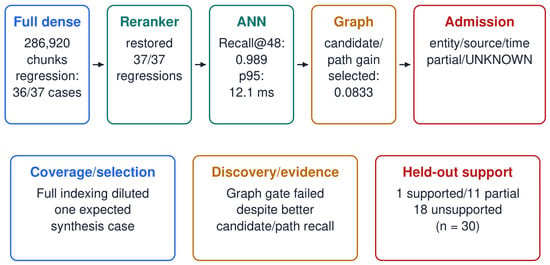
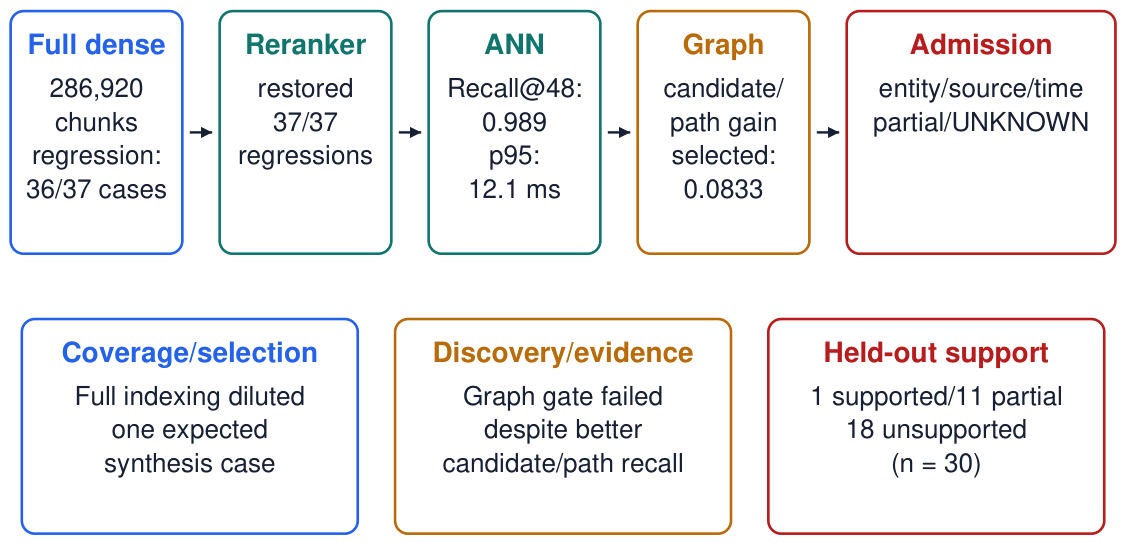
This single-system observational design study documents how the architecture informed qualification decisions across successive frozen releases (Figure 4). It complements the controlled representation study with engineering evidence about retrieval, selection, and admission. The interventions were not a factorial test of the full architecture.
Figure 4.
Production qualification stages. Separate checks assess retrieval, selection, and evidence admission across successive releases.
6.1. Full Breadth Can Dilute Selective Signal
The production evidence layer evolved from a selective vector surface to a full dense index. One frozen release contained 286,920 chunks. Encoding every chunk passed integrity checks but caused one of 37 deterministic retrieval regression cases to lose the expected tools/skills synthesis: additional nearest neighbors diluted the former selective signal. Adding the pinned multilingual BGE reranker restored the suite to 37/37. The incident illustrates the practical distinction between corpus coverage and final selection quality.
Question-driven enrichment later produced a 289,642-chunk generation with 49 atomic reviewed facts, 41 reviewed source items, and ten focused dossiers. New depth was added through exact spans and independent review rather than bulk ingestion alone.
6.2. ANN Preserved the Qualified Behavior
For the later 289,642-vector release, the selected USearch/HNSW path achieved a mean Recall@48 of 0.9892 with a minimum case recall of 0.9375. Its p95 retrieval time was approximately 12.1 ms versus 662.1 ms for the matched exact search. Exact + BGE and ANN + BGE produced the same status distribution on a separate 50-question development set: 13 passed, 21 needed review, and 16 failed. This set assesses the later release under its frozen downstream policy; it is distinct from the 37-case retrieval regression suite and the 30-question held-out panel reported below. This result supports replacing exact dense search with qualified ANN under a frozen downstream policy; it does not imply that the 16 failures were solved.
6.3. Graph Discovery Improved Paths, Not Selected Evidence
A reviewed association sidecar used 45 source-closed nodes and 50 admitted edges. Relative to flat retrieval, candidate recall increased from 0.9833 to 1.0000, selected recall from 0.9333 to 0.9500, multi-hop candidate completeness from 0.75 to 1.00, and path recall from 0 to 0.6667. Multi-hop selected completeness, however, remained 0.0833. The graph found useful routes but the final packet-selection bottleneck remained.
The registered promotion thresholds were not met, so the graph was not activated. This negative decision is important to the architecture: an improvement in discovery does not justify promotion unless admitted evidence and downstream behavior also improve.
6.4. Named-Anchor Failure and Fail-Closed Correction
The initial graph route expanded generic related topics for deliberately unknown named subjects. In a mixed query, resolving one common entity initially masked the fact that the comparison target was absent. The corrected planner requires every explicit named/version anchor to appear in answerable flat evidence before association traversal. If any anchor remains unresolved, graph expansion is blocked and the gap is preserved. After the correction, a focused five-case unsupported-subject diagnostic passed 5/5 with zero association candidates, zero false associations, and complete source closure. The first anchor-gated rerun had already eliminated four of the five regression failures introduced by graph expansion.
This incident provides the concrete motivation for evidence admission. Semantic proximity and graph connectivity were useful for discovery but unsafe as substitutes for the missing named evidence.
6.5. Naturalistic Held-Out Boundary
After development-driven enrichment, a frozen 30-question naturalistic set was evaluated against a single frozen configuration, with claude-opus-4-8 as the diagnostic LLM evaluator. It judged the selected evidence fully supportive for one question, partially supportive for 11, and unsupported for 18. Across all 30 cases, the largest labeled classes were semantic-neighbor substitution (11) and corpus gaps (6): topically related passages often did not establish the requested claim, while other questions required absent source material. No held-out result was used to modify that generation.
The set shows something narrower than a production accuracy estimate: passing deterministic regressions and expanding a corpus do not establish that naturalistic questions are answerable. The architecture must preserve corpus gaps and refusals as valid outcomes.
7. Discussion
7.1. The Methodological Result
The empirical evidence rejects representation monism. RAG is the appropriate default for local factual retrieval. A compact structured layer can match or exceed it when questions require integration across a rich corpus, but the effect depends on corpus and answerer. The method therefore assigns representations to tasks rather than searching for a globally winning store.
The production evidence adds a second separation. Retrieval answers “what might be useful?” Evidence admission answers “what may support this claim?” ANN, reranking, graphs, and summaries can all improve the first question without settling the second.
The diagnostics above also show what the admission layer contributes on its own. Five of five deliberately unsupported named subjects were blocked from association traversal with zero false associations, an anchor-gated rerun eliminated four of the five regression failures that graph expansion had introduced, and unsupported naturalistic questions surfaced as explicit gaps rather than fluent substitutions. Measuring this benefit end-to-end, including its refusal cost on answerable questions, remains future work.
7.2. Why Two Layers Are Preferable to One Hybrid Index
A single hybrid score can combine lexical, dense, and graph signals, but it still collapses different responsibilities into one ranking. The two-layer architecture preserves the compact map needed for orientation while retaining exact source material for audit and current facts. Admission policies operate over typed obligations rather than assuming that a higher fused score means stronger support.
7.3. Practical Guidance
- Use raw retrieval for local lookup and exact quotation.
- Use compact structured knowledge for synthesis, planning, and global orientation, then close factual claims to evidence.
- Treat graph traversal as a candidate generator.
- Evaluate candidate recall and selected-packet quality separately.
- Qualify ANN against an exact oracle under the same downstream policy.
- Diagnose repeated misses before adding sources; many failures are planning, entity, freshness, or admission problems rather than corpus gaps.
- Preserve UNKNOWN when a required named entity, version, time, or source role cannot be closed.
7.4. Dataset as a Supporting Artifact
The K-Forge release, protocol, judgments, aggregate files, and schemas make the controlled study inspectable. The primary contribution is the methodology derived from and bounded by the results.
8. Limitations
The controlled synthesis comparison uses two principal corpora. Authorship, language, and modality are partially confounded, so the Course 2 advantage cannot be generalized into a validated measure of instructional quality.
Most answer scoring and all mastery comparisons use LLM judges. Position debiasing, cross-vendor agreement, and the human check reduce but do not eliminate construct and self-preference risks. The human check is small and was performed by a co-author.
The question banks were model-generated, albeit by a vendor distinct from the BoK extraction pipeline and filtered through a no-context gate. Generated questions may preserve stylistic or coverage biases.
The production case study is observational and generation-specific. Its interventions were not a single randomized factorial experiment. It documents implementation feasibility, observed failure modes, and qualification decisions; it does not estimate a universal end-to-end effect.
The naturalistic held-out set contains only 30 questions. Failure-class counts are diagnostic. They must not be generalized to all users or domains.
The architecture depends on the quality of its source identities, time metadata, review policy, and claim decomposition. Formal gates can faithfully enforce a bad policy. Governance does not remove the need for subject expertise.
Finally, the study does not establish that every application requires a distilled knowledge layer. For small, stable, lookup-dominated corpora, strong RAG may be the simpler and better design.
9. Responsible Release and Reproducibility
The public package includes questions, answers, judgments, aggregate results, protocol prompts, context-size metadata, verification code, and license metadata. Raw proprietary course material and private production content are excluded. Concierge evidence is released only as permitted aggregates, schemas, synthetic fixtures, and provenance-safe receipts. Credentials, user conversations, private paths, and non-redistributable Evidence Packets are excluded.
Every manuscript number is bound to either row-level release data or a frozen experiment receipt.
10. Conclusions
Our experiments began with a comparison between distilled knowledge and RAG and ended with an architectural result. RAG won where the answer was local and verbatim. Structured knowledge became competitive where the task required integration, and complementary LLM-judged mastery comparisons favored the compact representation on both courses. Production experience then showed that broader and more connected discovery did not guarantee admissible evidence.
The resulting method gives each component a narrower job. A compact knowledge layer supplies orientation and synthesis. A versioned evidence layer supplies exact support. A task router selects the appropriate route. An admission stage decides whether discovered material closes the query’s obligations. Unresolved claims remain partial or unknown.
This division is less dramatic than declaring a universal winner between RAG and structured memory, but it is better supported by the evidence and more useful for building grounded agents.
Author Contributions
Conceptualization, A.V., T.P., D.I. and T.O.; methodology, A.V., T.P. and T.O.; software and data curation, T.P. and D.I.; validation, A.V., D.I. and T.O.; writing—original draft preparation, A.V.; writing—review and editing, A.V., T.P., D.I. and T.O.; visualization, A.V. All authors have read and agreed to the published version of the manuscript.
Funding
This research received no external funding.
Data Availability Statement
The K-Forge Evaluation Dataset v1.2 is openly available under CC BY 4.0 at Zenodo, https://doi.org/10.5281/zenodo.20634103. It contains the public questions, model outputs, judgments, aggregate results, protocol, context-size metadata, and verification code used in the controlled study. Proprietary course source documents and private production content cannot be publicly shared; the corresponding production findings are reported only as aggregate, provenance-safe receipts in this article.
Acknowledgments
During the preparation of this manuscript, the authors used OpenAI Codex (CLI version 0.149.1) to implement deterministic reanalysis and visualization scripts and to assist with manuscript revision and format checks. The authors reviewed and edited all outputs and take full responsibility for the content of the publication. No new experimental judgments or source data were generated by Codex for the reported study.
Conflicts of Interest
All authors are employees of 8Hats Lab, whose Concierge system is examined in the production case study.
Abbreviations
| ANN | approximate nearest-neighbor search |
| BoK | Body of Knowledge |
| LLM | large language model |
| RAG | retrieval-augmented generation |
References
- Guu, K.; Lee, K.; Tung, Z.; Pasupat, P.; Chang, M.W. Retrieval Augmented Language Model Pre-Training. In Proceedings of the 37th International Conference on Machine Learning, Virtual, 13–18 July 2020; Volume 119, pp. 3929–3938. Available online: https://proceedings.mlr.press/v119/guu20a.html (accessed on 28 August 2026).
- Lewis, P.; Perez, E.; Piktus, A.; Petroni, F.; Karpukhin, V.; Goyal, N.; Küttler, H.; Lewis, M.; Yih, W.; Rocktäschel, T.; et al. Retrieval-Augmented Generation for Knowledge-Intensive NLP Tasks. In Proceedings of the Advances in Neural Information Processing Systems 33 (NeurIPS 2020), Virtual, 6–12 December 2020; Volume 33, pp. 9459–9474. Available online: https://proceedings.neurips.cc/paper_files/paper/2020/hash/6b493230205f780e1bc26945df7481e5-Abstract.html (accessed on 2 October 2026).
- Karpukhin, V.; Oğuz, B.; Min, S.; Lewis, P.; Wu, L.; Edunov, S.; Chen, D.; Yih, W. Dense Passage Retrieval for Open-Domain Question Answering. In Proceedings of the 2020 Conference on Empirical Methods in Natural Language Processing (EMNLP), Virtual, 16–20 November 2020. [Google Scholar] [CrossRef] [Scilit]
- Izacard, G.; Lewis, P.; Lomeli, M.; Hosseini, L.; Petroni, F.; Schick, T.; Dwivedi-Yu, J.; Joulin, A.; Riedel, S.; Grave, E. Atlas: Few-shot Learning with Retrieval Augmented Language Models. J. Mach. Learn. Res. 2023, 24, 1–43. [Google Scholar] [CrossRef] [Scilit]
- Bora, A.; Cuayáhuitl, H. Systematic Analysis of Retrieval-Augmented Generation-Based LLMs for Medical Chatbot Applications. Mach. Learn. Knowl. Extr. 2024, 6, 2355–2374. [Google Scholar] [CrossRef] [Scilit]
- Lahiri, A.K.; Hu, Q.V. AlzheimerRAG: Multimodal Retrieval-Augmented Generation for Clinical Use Cases. Mach. Learn. Knowl. Extr. 2025, 7, 89. [Google Scholar] [CrossRef] [Scilit]
- Khattab, O.; Zaharia, M. ColBERT: Efficient and Effective Passage Search via Contextualized Late Interaction over BERT. In Proceedings of the 43rd International ACM SIGIR Conference on Research and Development in Information Retrieval, Virtual, 25–30 July 2020; pp. 39–48. [Google Scholar] [CrossRef] [Scilit]
- Jiang, Z.; Xu, F.F.; Gao, L.; Sun, Z.; Liu, Q.; Dwivedi-Yu, J.; Yang, Y.; Callan, J.; Neubig, G. Active Retrieval Augmented Generation. In Proceedings of the 2023 Conference on Empirical Methods in Natural Language Processing, Singapore, 6–10 December 2023. [Google Scholar] [CrossRef] [Scilit]
- Asai, A.; Wu, Z.; Wang, Y.; Sil, A.; Hajishirzi, H. Self-RAG: Learning to Retrieve, Generate, and Critique through Self-Reflection. In Proceedings of the International Conference on Learning Representations, Vienna, Austria, 7–11 May 2024; Available online: https://openreview.net/forum?id=hSyW5go0v8 (accessed on 2 September 2026).
- Yan, S.Q.; Gu, J.C.; Zhu, Y.; Ling, Z.H. Corrective Retrieval Augmented Generation. arXiv 2024, arXiv:2401.15884. [Google Scholar]
- Jeong, S.; Baek, J.; Cho, S.; Hwang, S.J.; Park, J.C. Adaptive-RAG: Learning to Adapt Retrieval-Augmented Large Language Models through Question Complexity. In Proceedings of the 2024 Conference of the North American Chapter of the Association for Computational Linguistics: Human Language Technologies, Mexico City, Mexico, 16–21 June 2024. [Google Scholar] [CrossRef] [Scilit]
- Edge, D.; Trinh, H.; Cheng, N.; Bradley, J.; Chao, A.; Mody, A.; Truitt, S.; Metropolitansky, D.; Ness, R.O.; Larson, J. From Local to Global: A Graph RAG Approach to Query-Focused Summarization. arXiv 2024, arXiv:2404.16130. [Google Scholar] [CrossRef] [Scilit]
- He, X.; Tian, Y.; Sun, Y.; Chawla, N.V.; Laurent, T.; LeCun, Y.; Bresson, X.; Hooi, B. G-Retriever: Retrieval-Augmented Generation for Textual Graph Understanding and Question Answering. In Proceedings of the Advances in Neural Information Processing Systems 37, Vancouver, BC, Canada, 10–15 December 2024; Volume 37. [Google Scholar] [CrossRef] [Scilit]
- Pan, S.; Luo, L.; Wang, Y.; Chen, C.; Wang, J.; Wu, X. Unifying Large Language Models and Knowledge Graphs: A Roadmap. IEEE Trans. Knowl. Data Eng. 2024, 36, 3580–3599. [Google Scholar] [CrossRef] [Scilit]
- Sarthi, P.; Abdullah, S.; Tuli, A.; Khanna, S.; Goldie, A.; Manning, C.D. RAPTOR: Recursive Abstractive Processing for Tree-Organized Retrieval. In Proceedings of the International Conference on Learning Representations, Vienna, Austria, 7–11 May 2024; Available online: https://openreview.net/forum?id=GN921JHCRw (accessed on 2 September 2026).
- Gutiérrez, B.J.; Shu, Y.; Gu, Y.; Yasunaga, M.; Su, Y. HippoRAG: Neurobiologically Inspired Long-Term Memory for Large Language Models. In Proceedings of the Advances in Neural Information Processing Systems 37 (NeurIPS 2024), Vancouver, BC, Canada, 10–15 December 2024; Volume 37. [Google Scholar] [CrossRef] [Scilit]
- Sarmah, B.; Mehta, D.; Hall, B.; Rao, R.; Patel, S.; Pasquali, S. HybridRAG: Integrating Knowledge Graphs and Vector Retrieval Augmented Generation for Efficient Information Extraction. In Proceedings of the 5th ACM International Conference on AI in Finance, Brooklyn, NY, USA, 14–17 November 2024. [Google Scholar] [CrossRef] [Scilit]
- Liang, L.; Bo, Z.; Gui, Z.; Zhu, Z.; Zhong, L.; Zhao, P.; Sun, M.; Zhang, Z.; Zhou, J.; Chen, W.; et al. KAG: Boosting LLMs in Professional Domains via Knowledge Augmented Generation. In Proceedings of the ACM Web Conference 2025 (Companion Volume), Sydney, NSW, Australia, 28 April–2 May 2025. [Google Scholar] [CrossRef] [Scilit]
- Guo, Z.; Xia, L.; Yu, Y.; Ao, T.; Huang, C. LightRAG: Simple and Fast Retrieval-Augmented Generation. In Proceedings of the Findings of the Association for Computational Linguistics: EMNLP 2025, Suzhou, China, 4–9 November 2025. [Google Scholar] [CrossRef] [Scilit]
- Packer, C.; Wooders, S.; Lin, K.; Fang, V.; Patil, S.G.; Stoica, I.; Gonzalez, J.E. MemGPT: Towards LLMs as Operating Systems. arXiv 2023, arXiv:2310.08560. [Google Scholar] [CrossRef] [Scilit]
- Park, J.S.; O’Brien, J.C.; Cai, C.J.; Morris, M.R.; Liang, P.; Bernstein, M.S. Generative Agents: Interactive Simulacra of Human Behavior. In Proceedings of the 36th Annual ACM Symposium on User Interface Software and Technology, San Francisco, CA, USA, 29 October–1 November 2023; pp. 1–22. [Google Scholar] [CrossRef] [Scilit]
- Shinn, N.; Cassano, F.; Gopinath, A.; Narasimhan, K.; Yao, S. Reflexion: Language Agents with Verbal Reinforcement Learning. In Proceedings of the Advances in Neural Information Processing Systems, New Orleans, LA, USA, 10–16 December 2023; Volume 36. [Google Scholar]
- Sumers, T.R.; Yao, S.; Narasimhan, K.; Griffiths, T.L. Cognitive Architectures for Language Agents. arXiv 2023, arXiv:2309.02427. [Google Scholar]
- Zhang, Z.; Dai, Q.; Bo, X.; Ma, C.; Li, R.; Chen, X.; Zhu, J.; Dong, Z.; Wen, J.R. A Survey on the Memory Mechanism of Large Language Model-based Agents. ACM Trans. Inf. Syst. 2025, 43, 1–47. [Google Scholar] [CrossRef] [Scilit]
- Es, S.; James, J.; Espinosa-Anke, L.; Schockaert, S. RAGAS: Automated Evaluation of Retrieval Augmented Generation. In Proceedings of the 18th Conference of the European Chapter of the Association for Computational Linguistics: System Demonstrations, St. Julian’s, Malta, 17–22 March 2024. [Google Scholar] [CrossRef] [Scilit]
- Saad-Falcon, J.; Khattab, O.; Potts, C.; Zaharia, M. ARES: An Automated Evaluation Framework for Retrieval-Augmented Generation Systems. In Proceedings of the 2024 Conference of the North American Chapter of the Association for Computational Linguistics: Human Language Technologies, Mexico City, Mexico, 16–21 June 2024. [Google Scholar] [CrossRef] [Scilit]
- Ru, D.; Qiu, L.; Hu, X.; Zhang, T.; Shi, P.; Chang, S.; Jiayang, C.; Wang, C.; Sun, S.; Li, H.; et al. RAGChecker: A Fine-grained Framework for Diagnosing Retrieval-Augmented Generation. In Proceedings of the Advances in Neural Information Processing Systems 37 (NeurIPS 2024), Vancouver, BC, Canada, 10–15 December 2024; Volume 37. [Google Scholar] [CrossRef] [Scilit]
- Min, S.; Krishna, K.; Lyu, X.; Lewis, M.; Yih, W.; Koh, P.W.; Iyyer, M.; Zettlemoyer, L.; Hajishirzi, H. FActScore: Fine-grained Atomic Evaluation of Factual Precision in Long Form Text Generation. In Proceedings of the 2023 Conference on Empirical Methods in Natural Language Processing, Singapore, 6–10 December 2023; pp. 12076–12100. [Google Scholar] [CrossRef] [Scilit]
- Gao, T.; Yen, H.; Yu, J.; Chen, D. Enabling Large Language Models to Generate Text with Citations. In Proceedings of the 2023 Conference on Empirical Methods in Natural Language Processing, Singapore, 6–10 December 2023. [Google Scholar] [CrossRef] [Scilit]
- Xu, Y.; Qi, P.; Chen, J.; Liu, K.; Han, R.; Liu, L.; Min, B.; Castelli, V.; Gupta, A.; Wang, Z. CiteEval: Principle-Driven Citation Evaluation for Source Attribution. In Proceedings of the 63rd Annual Meeting of the Association for Computational Linguistics (ACL 2025), Vienna, Austria, 27 July–1 August 2025; pp. 32759–32778. [Google Scholar] [CrossRef] [Scilit]
- Joren, H.; Zhang, J.; Ferng, C.S.; Juan, D.C.; Taly, A.; Rashtchian, C. Sufficient Context: A New Lens on Retrieval Augmented Generation Systems. arXiv 2024, arXiv:2411.06037. [Google Scholar] [CrossRef] [Scilit]
- Rashkin, H.; Nikolaev, V.; Lamm, M.; Aroyo, L.; Collins, M.; Das, D.; Petrov, S.; Tomar, G.S.; Turc, I.; Reitter, D. Measuring Attribution in Natural Language Generation Models. Comput. Linguist. 2023, 49, 777–840. [Google Scholar] [CrossRef] [Scilit]
- Liu, N.F.; Lin, K.; Hewitt, J.; Paranjape, A.; Bevilacqua, M.; Petroni, F.; Liang, P. Lost in the Middle: How Language Models Use Long Contexts. Trans. Assoc. Comput. Linguist. 2024, 12, 157–173. [Google Scholar] [CrossRef] [Scilit]
- Bai, Y.; Lv, X.; Zhang, J.; Lyu, H.; Tang, J.; Huang, Z.; Du, Z.; Liu, X.; Zeng, A.; Hou, L.; et al. LongBench: A Bilingual, Multitask Benchmark for Long Context Understanding. In Proceedings of the 62nd Annual Meeting of the Association for Computational Linguistics, Bangkok, Thailand, 11–16 August 2024. [Google Scholar] [CrossRef] [Scilit]
- Hsieh, C.P.; Sun, S.; Kriman, S.; Acharya, S.; Rekesh, D.; Jia, F.; Zhang, Y.; Ginsburg, B. RULER: What’s the Real Context Size of Your Long-Context Language Models? arXiv 2024, arXiv:2404.06654. [Google Scholar]
- Zheng, L.; Chiang, W.L.; Sheng, Y.; Zhuang, S.; Wu, Z.; Zhuang, Y.; Lin, Z.; Li, Z.; Li, D.; Xing, E.P.; et al. Judging LLM-as-a-Judge with MT-Bench and Chatbot Arena. In Proceedings of the Advances in Neural Information Processing Systems 36 (NeurIPS) Datasets and Benchmarks Track, New Orleans, LA, USA, 10–16 December 2023. [Google Scholar]

Disclaimer/Publisher’s Note: The statements, opinions and data contained in all publications are solely those of the individual author(s) and contributor(s) and not of MDPI and/or the editor(s). MDPI and/or the editor(s) disclaim responsibility for any injury to people or property resulting from any ideas, methods, instructions or products referred to in the content. |
© 2026 by the authors. Licensee MDPI, Basel, Switzerland. This article is an open access article distributed under the terms and conditions of the Creative Commons Attribution (CC BY) license.