


Abstract
Geopolymers are a new breed of construction materials that are environmentally friendly and replace old Portland cement. These materials are produced through the alkaline activation of industrial and agricultural waste rich in aluminosilicates. The growing interest in sustainable building solutions has driven research into their development. Palm oil fuel ash (POFA) and waste ceramic tile powder (WTCP) are both highly rich in reactive aluminosilicates and widely recommended for the production of sustainable geopolymers. This study aims to evaluate the suitability of POFA and WTCP as sustainable alternatives to conventional binders and to identify the potential advantages of each waste material in developing eco-friendly, high-performance geopolymers. The results indicate that specimens prepared with a high content (50 wt%) of POFA or WTCP, incorporating fly ash and slag, can achieve compressive strengths of up to 50 MPa after 28 days of curing. However, increasing the proportion of POFA or WTCP from 50% to 60% and 70% resulted in a significant reduction in compressive strength. In contrast, specimens containing higher proportions of POFA and WTCP demonstrated superior durability when exposed to aggressive environments. In summary, the findings indicate that WTCP is more suitable than POFA for producing geopolymers as eco-friendly construction materials. Its superior reactivity, workability, early-age strength development, and durability make it a promising precursor for sustainable applications in the construction sector.
1. Introduction
Geopolymers and their aluminosilicate-based composites are regarded as promising substitutes for traditional cement because of their beneficial features, such as environmental sustainability, high durability, resistance to elevated temperatures, harsh conditions, and corrosion, along with their adaptable material properties [1,2,3]. The adoption of geopolymers has the potential to lower CO2 emissions from the cement sector by as much as 50% [4] while also decreasing energy demand during production. In addition, the ability to incorporate diverse industrial and agricultural waste into geopolymer synthesis further enhances their value as eco-friendly construction materials [5]. Market projections indicate that the global geopolymer sector will reach USD 14.1 billion by 2027 [6], with an anticipated growth rate of 36.5% in 2028 [7].
Geopolymers can be synthesized by activating various waste materials rich in aluminosilicate (AS) compounds [8,9,10], including palm oil fuel ash (POFA) [11,12,13,14], fly ash (FA) [15,16,17], and ground blast-furnace slag (GBFS) [18,19], using highly alkaline solutions. The effects of individual and combined uses of FA, GBFS, POFA, and metakaolin (MK) as binders have been reported in previous studies [20,21,22]. In the production of geopolymers, FA is often combined with GBFS [23,24,25]. FA, a residue from thermal power plants, is generated during electricity production and contains high levels of amorphous alumina and silica [26,27,28]. GBFS, a residue from iron ore smelting that is quickly cooled to produce a glassy, hydraulically reactive material, also plays a vital role in geopolymer formation [29]. When used together with FA, GBFS helps overcome various challenges in the manufacturing process and improves both the fresh and mechanical properties of the resulting materials [30,31,32]. The inclusion of appropriate materials, including POFA and WTCP waste, provides an effective alternative to reduce dependence on FA and GBFS while producing geopolymer concrete with excellent strength and durability [33,34].
There has been major research on enhancing the strength of geopolymer materials and examining the mechanisms that govern the geopolymerization process. Various studies [35,36,37] have investigated the structure of binders in Na2SiO-activated GBFS-ASs systems, with a focus on the influence of AS addition on the resulting binder strength. Silva and Sagoe-Crenstil [38] examined the effects of the Al2O3/SiO2 ratio on the setting and hardening behavior of geopolymer systems and found that it had a strong effect on both setting time and final strength. Similarly, Chindaprasirt et al. [39] examined the impact of SiO2/Al2O3 and Na2O/SiO2 ratios on setting time, workability, and compressive strength and found that 2.87–4.79 and 1.2–1.4 were the best ratios of binder to use in SiO2/Al2O3 and SiO2/Na2O, respectively. Moreover, Bernal and Provis [40] discussed the stability of alkali-activated materials, with a focus on recent advancements and findings, and performed speeded-up degradation experiments to determine the influence of high CO2, sulfate, and chloride concentrations on material behavior.
Significant volumes of palm oil waste are produced by agro-industries in Indonesia, Malaysia, and Thailand, where the ash of palm oil is generated as a result of palm oil processing [41,42]. Moreover, with the continuous expansion of palm oil plantations, the production of POFA is expected to rise [43]. POFA is produced through the combustion of oil palm clinkers, empty fruit bunches, and shells during the generation of electricity [11,44]. Despite its abundance, this material, which has little to no market value, is typically disposed of in ponds or lagoons [45] as landfill, posing significant environmental challenges. Recent studies [46,47], however, have opened new opportunities for developing sustainable materials utilizing POFA and other palm oil industry by-products. This advancement has stimulated further research since POFA is recognized as a silica-rich material and classified as a pozzolanic substance [48]. It is frequently utilized as a partial replacement for cement in standard concrete to enhance both its strength and durability [43,45,49,50]. The previous literature [14,51,52] indicates that the performance of geopolymers containing POFA is influenced by multiple factors, including the Si/Al ratio, the POFA content in binary or ternary blends, the molarity of the alkaline solution, chemical composition and dosage (solution-to-binder ratio), and curing conditions. Most previous studies reported that compressive strength values ranged from 25 to 65 MPa when approximately 30% POFA was combined with GBFS, FA, and rice husk ash under different curing conditions [53,54,55,56,57]. Geopolymers containing POFA have demonstrated excellent resistance to high temperatures as well as to sulfate and acid attacks [54,58].
On the other hand, ceramic powder represents a major waste product from the ceramic and construction industries and is often recycled and utilized as a binder in modified cement and geopolymer materials [59,60]. Fernandes et al. [61] reported that waste generated during various production stages in the ceramic industry can account for approximately 3–7% of total manufacturing output. Thus, industries will have to think of other ways of managing this waste, including creating products of value by recycling waste [62]. The use of ceramic waste in concrete, whether as a binder or as a partial replacement for aggregates [63], contributes to improved workability, strength, and durability. Numerous studies have shown that the construction industry can enhance its sustainability and efficiency by effectively converting industrial waste into functional geopolymer concretes [64,65]. Pacheco et al. [59] reported that incorporating ceramic waste powder into cement or geopolymer concrete enhances both durability and strength, primarily because of its pozzolanic characteristics and large aluminosilicate reactivity.
With the noted benefits of POFA and WTCP in improving strength and durability, as well as their high aluminosilicate reactivity and wide availability in Southeast Asia, this study evaluates and compares the effect of high-volume POFA and WTCP on the performance of an FA–GBFS geopolymer system. The study characterizes their chemical and mineral features. In addition, the workability and the early- and late-age strength evolution of geopolymers incorporating different levels of POFA and WTCP are measured and discussed. Finally, the effects of high replacement levels on microstructure and gel formation are assessed and reported.
2. Methodology
2.1. Preparation of Raw Materials
The binders employed in this research were supplied by a single supplier and stored in sealed black plastic containers to prevent contamination. GBFS, FA, POFA, and waste WTCP were used as binders to produce the geopolymer specimens. GBFS and FA were used in their original form, while POFA and WTCP were pre-processed in the laboratory before use. The low-calcium content (FA) of Tanjung Bin Power Station in Malaysia was used as the source of aluminosilicate and meets the ASTM C618 requirements of Class N pozzolans. The principal calcium source was ground granulated blast-furnace slag (GBFS), which is of Ipoh, Malaysia, origin. This GBFS has cementitious properties and pozzolanic properties, unlike other additional cementitious materials. Its hydraulic activity with water and its structure, which is composed of about 90% calcium silicate plus alumina, satisfy the requirements of a pozzolanic material in ASTM C618.
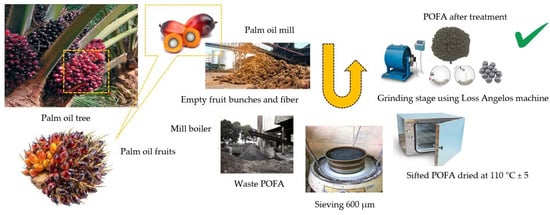
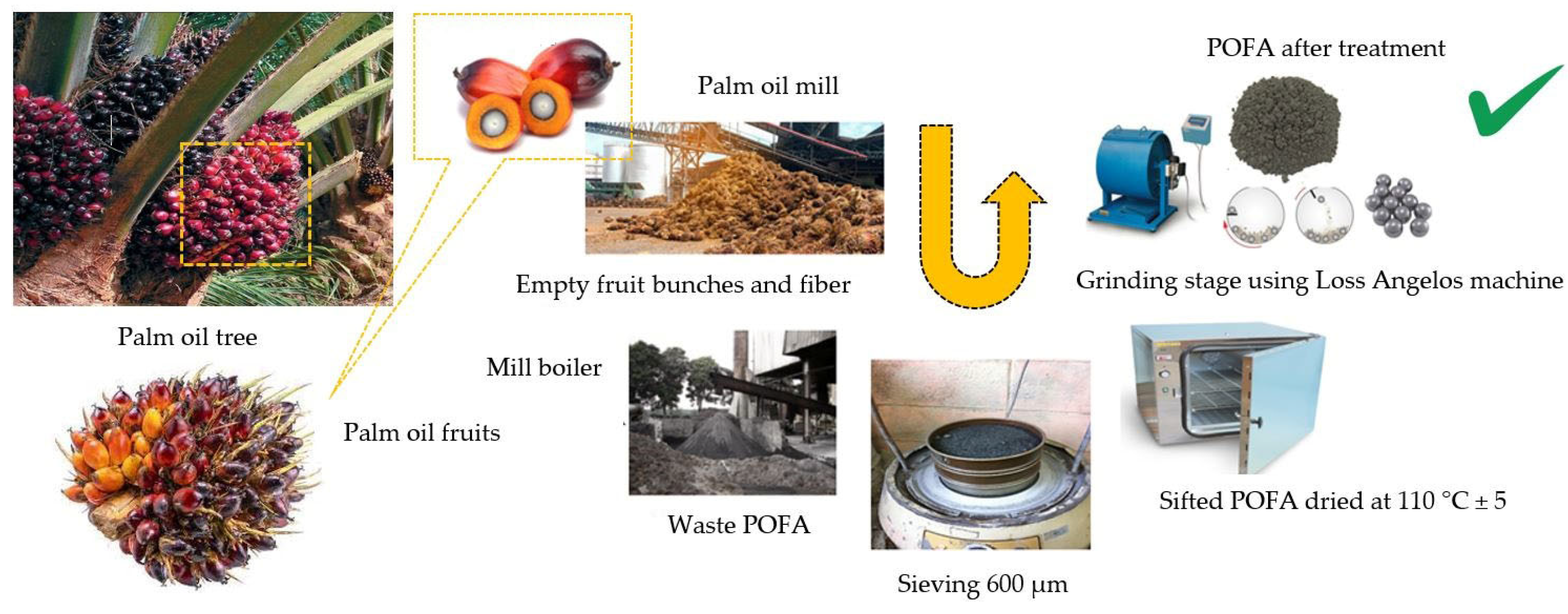
POFA is a by-product of power generation as palm oil mills burn the fiber, empty fruit bunches, and shells of palm oil. In this research, POFA was acquired in a plant called Kilang Sawit PPNJ Kahang in Johor, Malaysia. The first ash collected was on an outlet that is not located close to the combustion chamber of the boiler. To remove moisture, the raw material was first reduced to a fine powder using a 600 µm mesh and then dried at a temperature of 110 °C over 24 h. The dry ash was once more sieved through a 300 µm mesh after drying in order to achieve a better quality of ash by eliminating all other coarse grains. The portion passing through the 300 µm sieve was subsequently milled for six hours in a Los Angeles abrasion machine equipped with 15 stainless steel balls, each 50 mm in diameter. The drum operated at a rotational speed of 32–35 rpm. Particle fineness was monitored at 1 h intervals, as the grinding duration directly affects the reduction in particle size. The percentage of particles retained on the 45 µm sieve declined progressively with a longer grinding time, and by the end of the process, all ash particles were fine enough to pass through the 45 µm sieve. Figure 1 presents the preparation procedure for POFA.
Figure 1.
POFA treatment process from palm oil fruit waste.
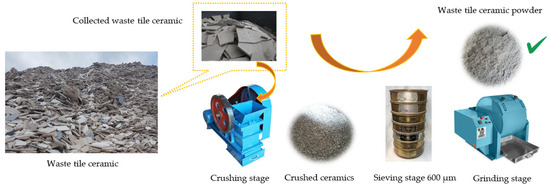
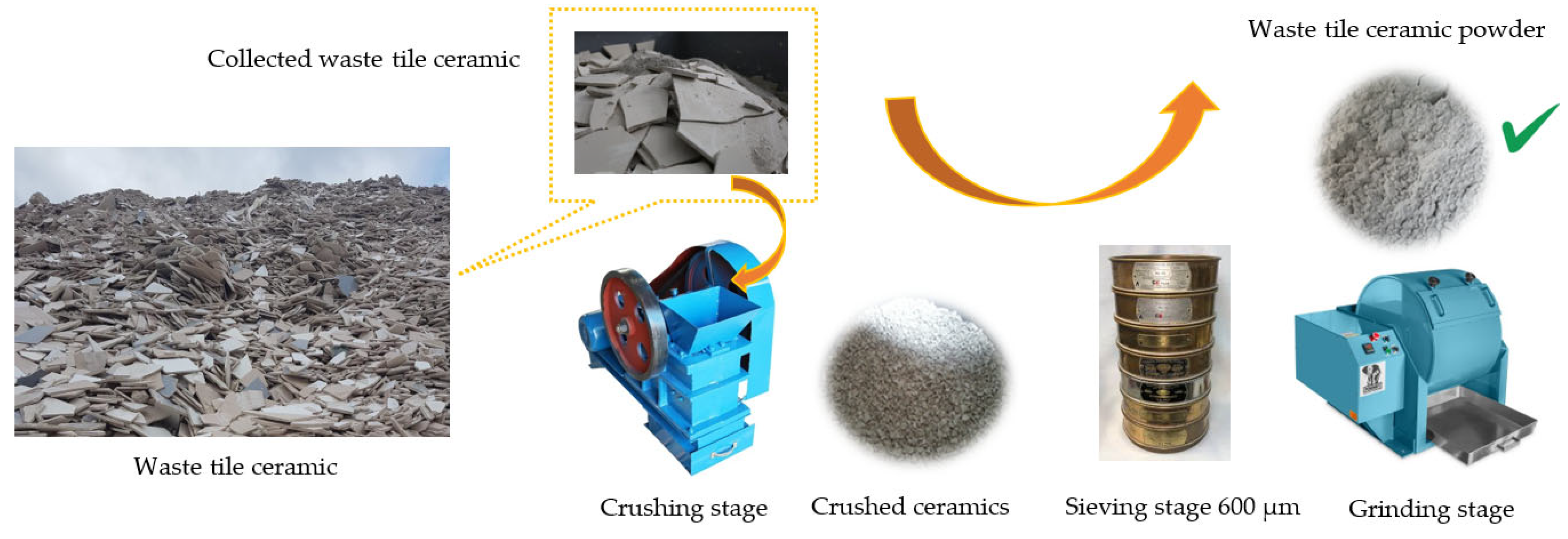
In this study, ceramic waste was obtained from construction activities in Johor, Malaysia. The material was first crushed utilizing a Los Angeles abrasion machine and subsequently passed through a 600 µm sieve to eliminate larger particles. The sieved ceramic fraction was further milled for six hours, with particle fineness assessed at one-hour intervals. The resulting powder was collected and incorporated into the mixing process. Figure 2 depicts the ceramic waste treatment process.
Figure 2.
Prepared waste ceramic powder from waste tile ceramics.
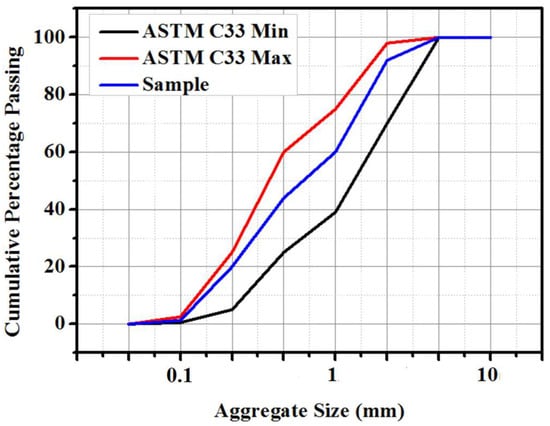
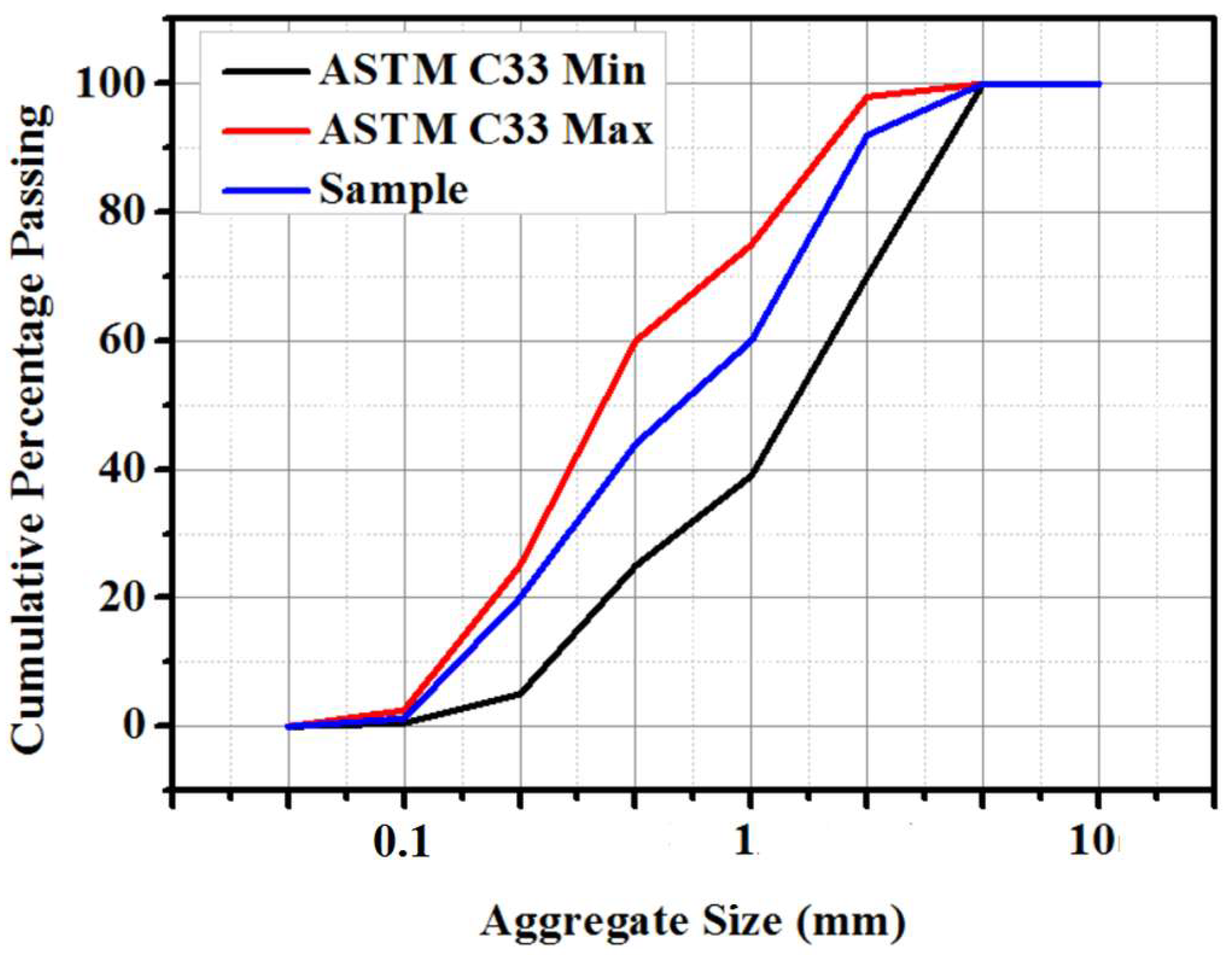
To cast the mortar specimens for their intended application, naturally sourced siliceous river sand was utilized as the fine aggregate. The sand was cleaned in accordance with the ASTM C117 standard to remove silt as well as other impurities and subsequently oven-dried for 24 h at 60 °C to regulate moisture content. Then, the material was sieved and classified to comply with ASTM C33/C33M specifications, as illustrated in Figure 3. The fine aggregate demonstrated a fineness modulus of roughly 2.9 as well as a specific gravity of 2.6.
Figure 3.
Sieve analysis of used river sand used as fine aggregates to prepare the geopolymer mortar specimens based on ASTM C33.
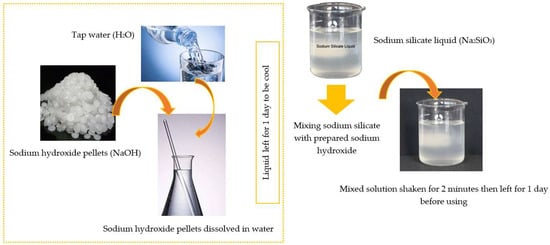
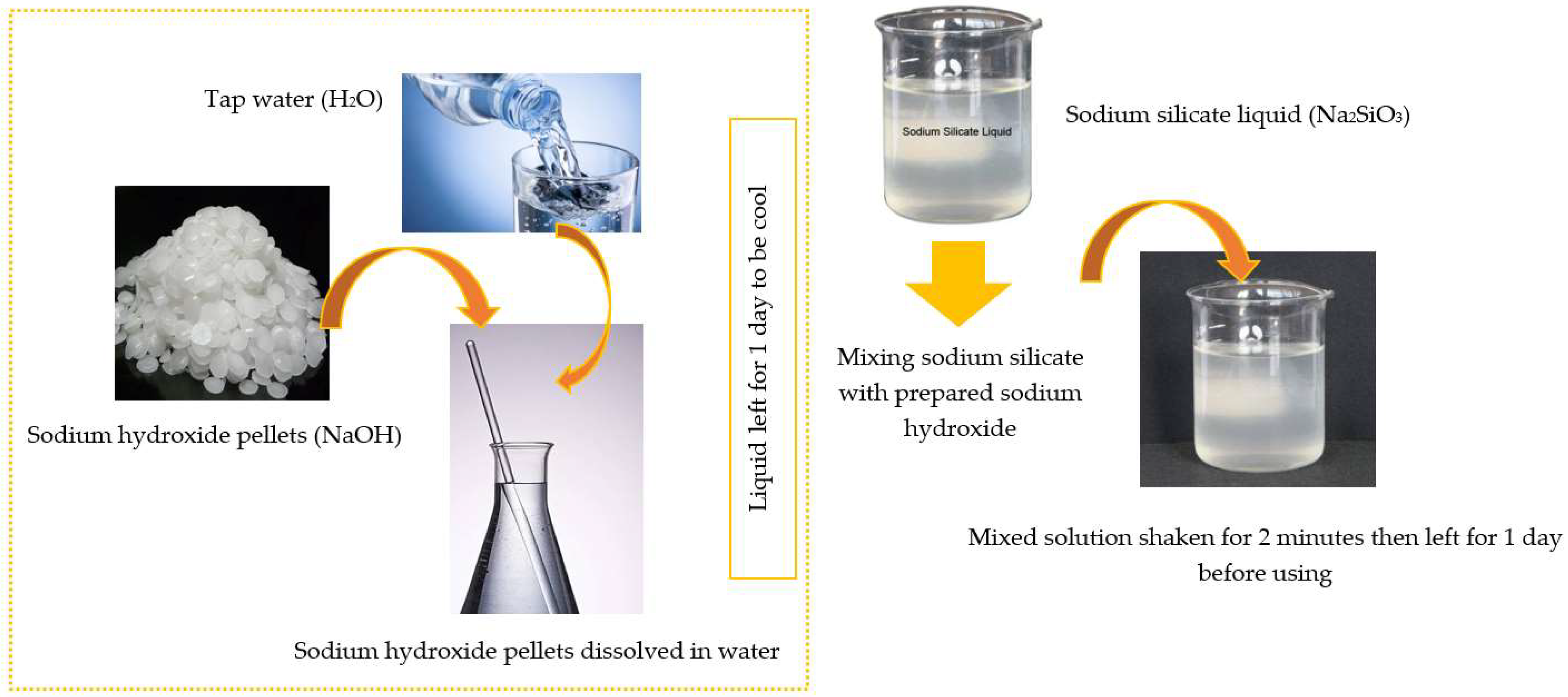
The alkaline activator is prepared as a blended solution of NaOH and Na2SiO3, which synergistically activate the silica and alumina that exist in various waste-derived materials. A brief description of each component is provided below. Analytical-grade sodium silicate, obtained from QREC (Malaysia), comprises 55.8 wt% H2O, 29.5 wt% SiO2, and 14.7 wt% Na2O. In this research, analytical-grade sodium hydroxide pellets with 98% purity (QREC, Malaysia) were also utilized. These pellets were dissolved in water to create a 2 M sodium hydroxide solution, which was subsequently chilled for 24 h prior to being combined with the sodium silicate solution [66]. The final alkaline activator was formulated with a SiO2/Na2O ratio of 1.2, and the Na2SiO3-to-NaOH ratio (NS:NH) was kept constant at 0.75 across all mixtures. The preparation procedure is illustrated in Figure 4.
Figure 4.
Preparation procedure for the alkaline activator solution.
2.2. Mix Design
To accomplish the objectives of this research, two binder systems were established using high volumes of POFA or WTCP in combination with FA and GBFS. In all mixtures, the POFA or WTCP content was maintained within 50–70% of the total binder mass used in the mortar specimens. For each level, FA was incorporated at 0–30% and GBFS at 20–50%. Since FA, GBFS, POFA, and WTCP have different chemical compositions and varying amounts of reactive silica, alumina, and calcium, the mortar performance is strongly affected by the CaO/Al2O3, CaO/SiO2, and SiO2/Al2O3 ratios. Therefore, different mix proportions with various ratios of CaO/Al2O3, CaO/SiO2, and SiO2/Al2O3 were prepared in line with ASTM C109/C109M. As illustrated in Table 1, ternary blends were produced by combining GBFS, FA, and POFA or GBFS, FA, and WTCP at different levels. All mix proportions were measured by weight.
Table 1.
Geopolymer mix design with varying contents of high-volume POFA and WTCP.
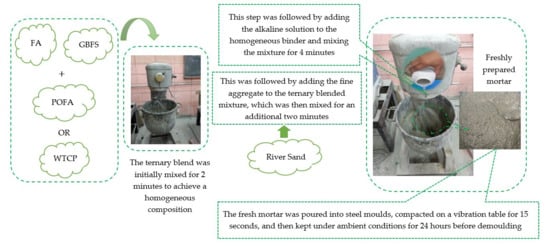
A blended alkaline activator was prepared by mixing sodium silicate and sodium hydroxide by weight, and the solution was chilled to reach room temperature before use because of the heat generated during preparation. Then, the geopolymer mortars were produced by first mixing GBFS, FA, and POFA or GBFS, FA, and WTCP in dry form for two minutes to achieve a uniform blend, as illustrated in Figure 5. The alkaline solution was then incorporated to activate the mixture, followed by an additional four minutes of mixing at medium speed. The fresh mortar was placed into molds in two layers, with each layer compacted for 15 s on a vibration table to release trapped air.
Figure 5.
Procedure for the preparation of high-volume POFA or WTCP geopolymer mortar specimens.
In accordance with ASTM C579, cube specimens measuring 50 × 50 × 50 mm were prepared for compressive strength testing, and prisms of 40 × 40 × 160 mm were fabricated to assess flexural strength. Cylinders measuring 75 mm in diameter and 150 mm in height were used for tensile and slant shear assessments. Prior to casting, all molds were lightly coated with engine oil to ensure easy demolding. Following casting, the specimens underwent 24 h of curing in ambient conditions (27 ± 1.5 °C and 75% relative humidity) and were then demolded and maintained under the same environment until testing.
2.3. Test Procedures
A particle size analyzer (PSA) is employed to measure the particle size distribution of binder materials, utilizing the principle of laser scattering. This test is carried out to examine the changes in POFA and WTCP particle sizes before and after grinding and to measure the particle sizes of GBFS and FA. A wetting method is applied, in which the particles are dispersed in distilled water to prevent agglomeration. The Brunauer–Emmett–Teller (BET) method is employed to determine the specific surface area of FA, GBFS, POFA, and WTCP by measuring the physical adsorption of gas molecules on the solid surface, typically performed at liquid nitrogen temperature. The chemical compositions of GBFS, FA, POFA, and WTCP were identified by employing X-ray fluorescence (XRF) spectroscopy. In this technique, the sample is exposed to a high-intensity X-ray beam emitted from a radioisotope source, which ejects the inner-shell electrons of the atoms. The electrons are restored to their initial energy levels and thus give out fluorescent X-rays. These X-rays are emitted, and the energies of the X-rays are measured using an energy-dispersive detector to determine the elements that make up the elements, and the intensities of the X-rays are measured to determine the concentrations of the elements.
The fresh properties of the geopolymer mortar are evaluated using the modified flow table technique on the basis of the ASTM C230 standard, which is effective in testing the spread of geopolymer pastes and mortars. The geopolymer material setting behavior is categorized into the initial and final setting time, which are usually measured by the Vicat apparatus, as per ASTM C191. Compressive strength testing is undertaken on adequately cured specimens at 7 and 28 days after the procedures, as per ASTM C109/C109M. Each curing age experiment involves three specimens. The samples are prepared and positioned in place between the upper and lower bearing plates before testing, as specified by the standard. A constant loading rate of 2.5 kN/s is used until failure. The testing equipment automatically calculates and registers the density and compressive strength of each specimen according to the weight and dimension data that is given.
The characterization of crystalline materials is usually performed using the X-ray diffraction (XRD, Rigaku, Singapore) method, which is a fast, non-destructive method. XRD was used in this research to identify and study the mineral composition of the binders. The method is sensitive in giving important data about structural characteristics, such as phase composition, crystal orientation, and lattice parameters. The specimen to be tested was taken from the samples and previously tested specimens of compressive strength at 28 days and then ground into fine powder. Scans in XRD (θ–2θ) were carried out with a 2θ range of 5–90° at a step size of 0.020° and scan time of 15.4 s/step. XRD data were analyzed using MDI Jade software (version 6.5) and Match software (version 3.10.2.173) to confirm the glassy nature of the specimens.
Splitting tensile strength tests were carried out in accordance with ASTM C496/C496M on appropriately cured cylindrical specimens measuring 75 × 150 mm, evaluated at 7 and 28 days. Flexural strength, also termed the modulus of rupture, bending strength, or fracture strength, reflects a brittle material’s resistance to deflection when subjected to loading. This property was assessed in accordance with ASTM C78/C78M using prism specimens of 40 × 40 × 160 mm, assessed at 7 and 28 days using a modified configuration. The results of both the flexural strength and splitting tensile tests were directly recorded from the testing apparatus.
In accordance with ASTM C642, water absorption testing was performed on the geopolymer specimens. Cube samples with dimensions of 50 × 50 × 50 mm were prepared, cured, and subsequently submerged in water at 27 °C for a duration of 24 h. Following saturation, the specimens were suspended and fully submerged to record the saturated mass (Ws). They were subsequently dried in a ventilated oven for more than 24 h at 105 °C, after which the dry mass (Wd) was measured. The final absorption value represents the average of three specimens.
Acid exposure primarily deteriorates mortar by dissolving the binder matrix, resulting in the affected geopolymers having reduced strength. In this experiment, the acid resistance of the geopolymer mixtures was assessed using a 10% H2SO4 solution (QREC, Johor Bahru, Malaysia) prepared with deionized water. Samples that had been cured after 28 days were weighed and then immersed in the acid solution after 365 days. Replacement of the solution every two months ensured that there was a constant pH in the course of the experiment. The specimens were assessed in terms of visual inspection, weight loss, pulse velocity tests, and residual compressive strength (according to the procedures described in ASTM C267 (2012))[67].
3. Results and Discussion
3.1. Raw Material Characterization
The materials had different colors; FA was gray, GBFS off-white, POFA dark gray, and WTCP light gray. To determine the particle size distributions of FA, GBFS, POFA, and WTCP, a particle size analyzer was used. The median sizes of the particles were around 10, 12.8, 8.2, and 35 µm, respectively. Moreover, particles of FA, GBFS, and POFA were distributed at 45 µm or below, and 90% of WTCP sieved through the 45 µm mesh. POFA had a smaller particle size than both FA and GBFS, whereas WTCP was comparatively coarse after half a day of grinding. These findings meet the pozzolanic criteria requirements of ASTM C618, which require no less than 66% of the particles to penetrate the 45 µm sieve.
POFA was found to have the highest value of specific surface area at 23.1 m2/g, followed by FA, GBFS, and WTCP, which were found to have specific surface areas of 18.1, 13.6, and 12.2 m2/g, respectively. The low specific gravity and small fine particle size of POFA added to its larger surface area. On the other hand, WTCP had the least specific surface area (12.2 m2/g), as it had a larger particle size of 35 µm. These results verify that the specific surface area depends very much on the size of the particle and specific gravity directly, with coarser materials having lower specific surface area values.
The chemical composition of FA, GBFS, POFA, and WTCP was identified by X-ray fluorescence spectroscopy, as shown in Table 2. Silica and alumina were the main oxides, previously determined at 86% in FA, 68.45% in POFA, 41.7% in GBFS, and 84.8% in WTCP. GBFS had the highest calcium oxide content of 51.8%, which was higher than other materials. Silica, alumina, and calcium oxide levels are of the essence to geopolymer synthesis because they help in the formation of N-A-S-H, C-A-S-H, and C-S-H gels in geopolymerization. Low concentrations of potassium oxide (K2O) were found in FA, GBFS, and WTCP but were significantly high in POFA (8.6%). Conversely, the amount of sodium oxide (Na2O) within WTCP was significant (13.5%). Since K2O and Na2O are known to affect alkaline activation, their concentrations have a great effect on the geopolymerization process. The weight lost from FA, GBFS, POFA, and WTCP when heated to a high temperature (750 ± 50 °C) was measured using the loss on ignition (LOI) lab test. The LOI values for FA, GBFS, and WTCP were low, but POFA had a higher LOI of 1.73%, which is consistent with the ASTM C618 standard [68].
Table 2.
FA, GBFS, POFA, and WTCP’s chemical composition using XRF testing.
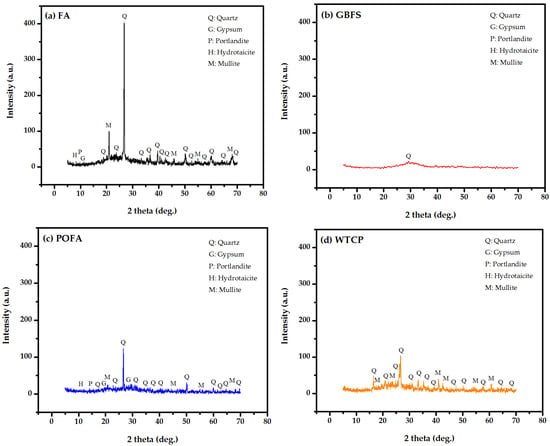
Figure 6 shows the XRD patterns of FA, GBFS, POFA, and WTCP. The XRD data of FA, POFA, and WTCP show different diffraction peaks in the range of 2θ = 16–30°, and these are signified by crystalline silica and alumina. Other crystalline peaks were also seen, of which the formation was credited to the quartz and mullite. On the other hand, the XRD pattern of GBFS shows that it is largely amorphous in form, as evidenced by the lack of sharp diffraction peaks. The proportion of reactive silica and calcium contents is important in forming the GBFS, and the high percentage of reactive silica and calcium, which is amorphous, makes it appropriate for the production of geopolymers. However, to compensate for the content of Al2O3, which is comparatively low (10.49 wt%) in GBFS, the addition of FA became necessary.
Figure 6.
XRD analysis of binder materials: (a) FA, (b) GBFS, (c) POFA, and (d) WTCP.
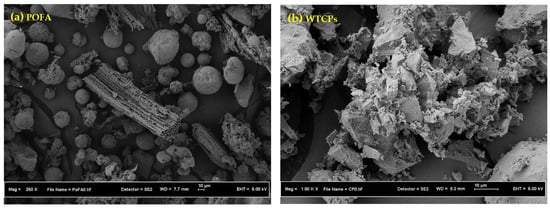
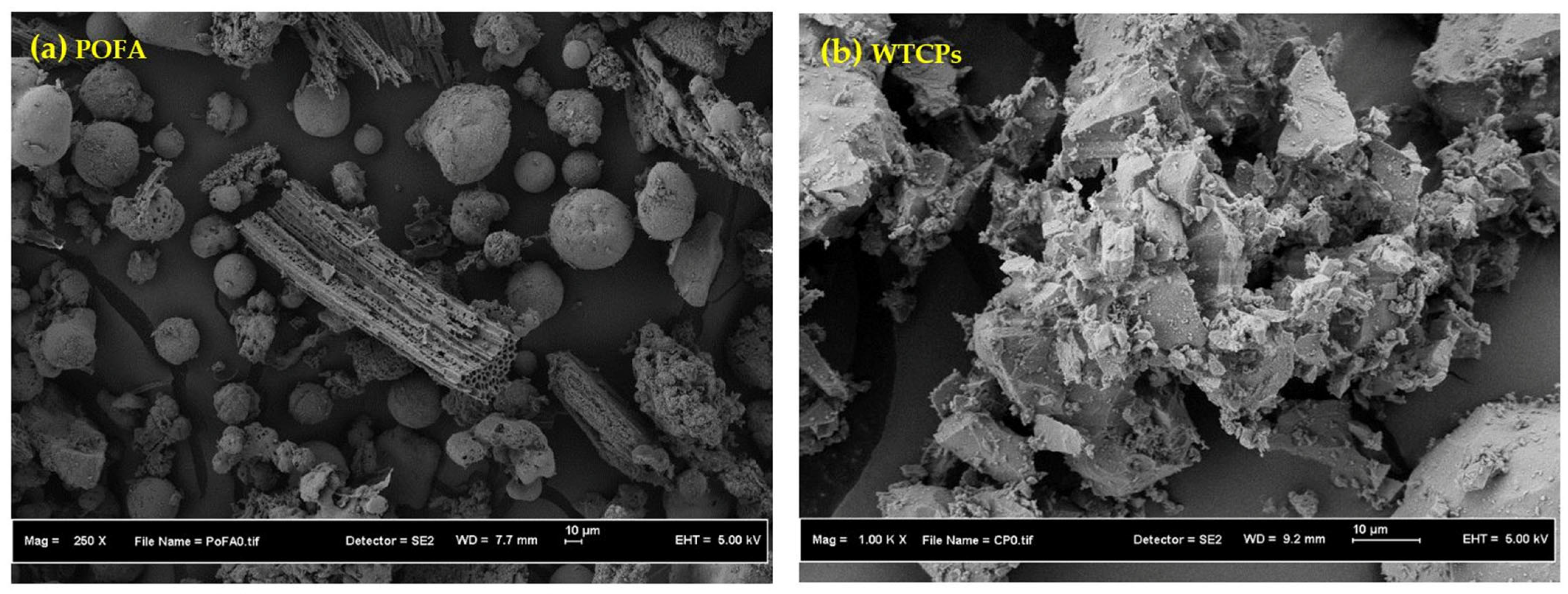
The surface morphology of POFA and WTCP was evaluated using scanning electron microscopy (SEM), and the resulting micrographs are presented in Figure 7. POFA exhibited weathered particles derived from ground spherical particles, resulting in a mixture of spherical and irregularly shaped morphologies (Figure 7a). In addition, WTCP showed predominantly irregular and angular particle shapes (Figure 7b).
Figure 7.
Surface morphology of raw materials used for geopolymer preparation: (a) POFA and (b) WTCP.
3.2. Geopolymer Fresh Properties
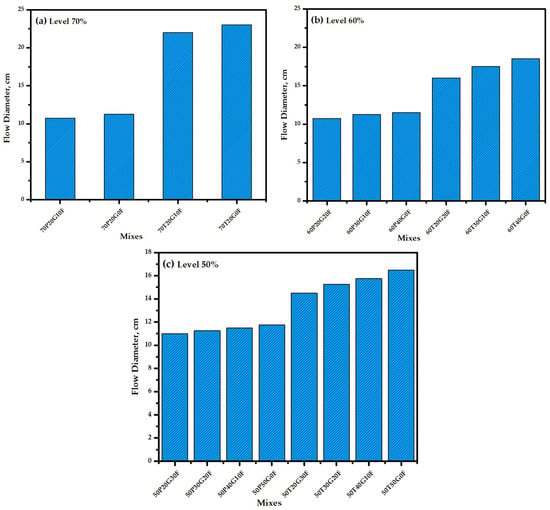
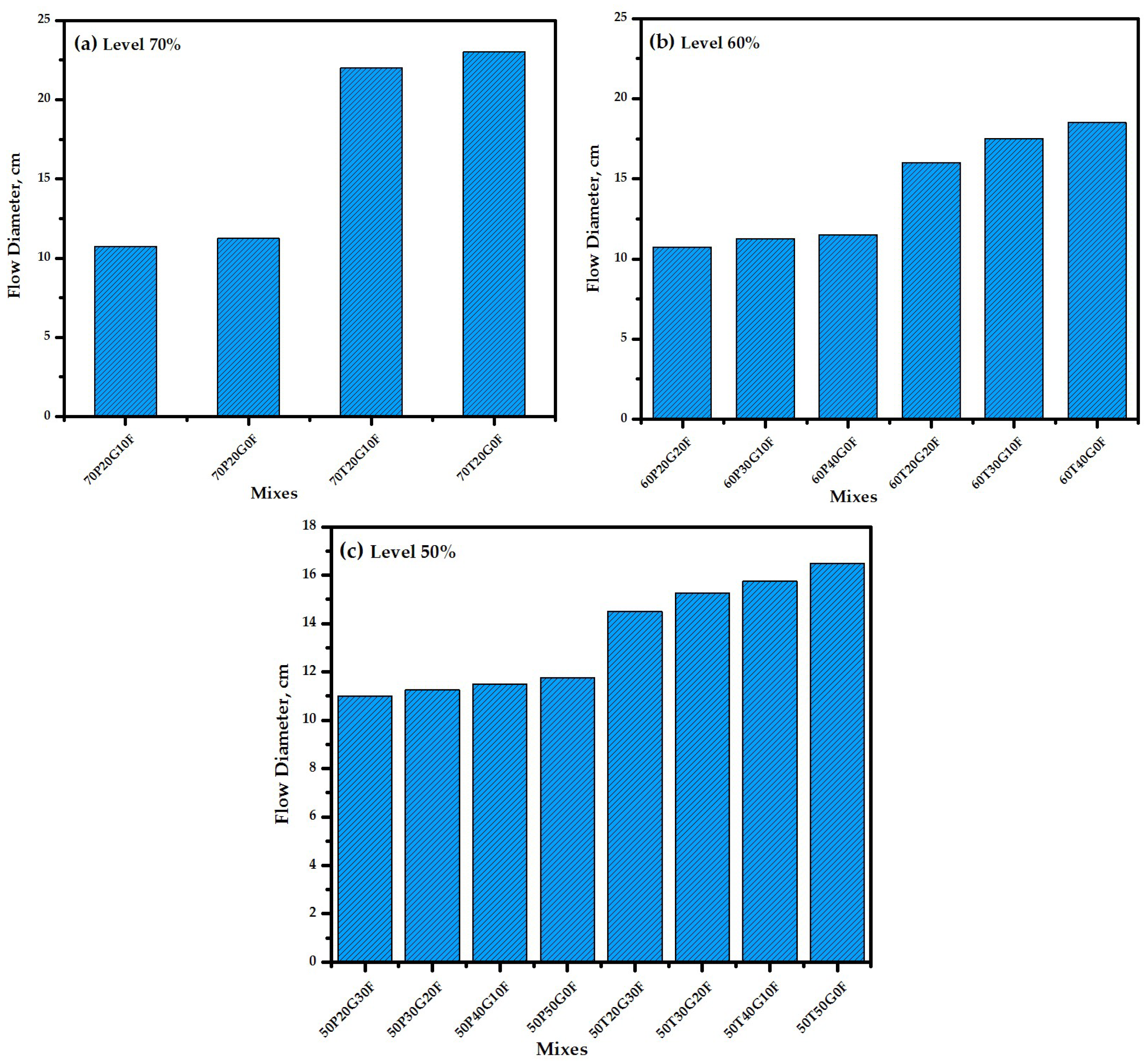
This section discusses the effect of high-volume POFA and WTCP (50, 60, and 70%) on the workability of mortar in terms of flowability and setting time. Figure 8 shows the experimental values of the flow diameters of mortars using high POFA and WTCP content incorporating FA and GBFS binders. The findings clearly indicated that mortar flowability decreases as the POFA content of the mortar is increased to 70%. On the contrary, mortars with high WTCP content show that the flow diameter increases as the level of replacement is raised to 70% from 50%. But in all mixtures with a higher FA percentage, the lower workability was observed. Mixtures that included WTCP had a greater workability than those that included POFA, as shown in Figure 8a. In particular, the 70% POFA and 30% GBFS mixture resulted in a flow diameter of 11.25 cm, but the mixture with 70% WTCP was 23 cm. The workability when 10 percent of FA was added to partially replace GBFS was 10.75 cm with a high-volume POFA mixture and 22 cm with a WTCP mixture.
Figure 8.
Geopolymer flowability influenced by high-volume content of POFA and WTCP: (a) 7%, (b) 60%, and (c) 50%.
The same trend was followed with mixtures of 60% POFA or WTCP. The 60% POFA mixture reached a flow diameter of 11.5 cm, and the 60% WTCP mixture had a higher workability with a flow diameter of 18.5 cm. In the 60% POFA mixture (Figure 8b), the replacement of GBFS with 10% and 20% FA lowered the flowability from 11.5 cm to 11.25 cm and 10.75 cm, respectively. On the same note, when GBFS was substituted by 10% and 20% FA in the 60% WTCP mixture, the flow diameter was reduced to 17.5 cm and 16 cm, respectively. In the case of the 50% POFA mixture (Figure 8c), all samples had lower workability than their WTCP counterparts. Gradually increasing the FA content as a GBFS replacement by 0% to 10, 20, and 30% decreased the flowability from 11.75 cm to 11.5, 11.25, and 11 cm, respectively. The same tendency was seen in the 50 percent WTCP mixture as the replacement of FA was increased to 10%, 20%, and 30%, with workability decreasing to 16.5 cm, 15.75 cm, and 14.5 cm, respectively.
The results establish that an increase in POFA in tertiary blends reduces the workability of geopolymer mortars significantly. As in prior studies [69], materials that have a large specific surface area have a negative influence on the flowability of the mortar. According to Hassan et al. [70,71], POFA has a high specific surface area of 23.75 m2/g because of the porous and irregular morphology of the particles. Consequently, an increased POFA content raises both the surface area and the volume fraction of the binder, thereby leading to greater water demand to maintain sufficient workability.
However, the higher workability of the WTCP mixtures compared to the POFA mixtures is mainly due to variations in the physical characteristics of the binders. The relatively low specific surface area of WTCP, in contrast to GBFS, POFA, and FA, substantially contributes to improving the flowability of the geopolymer mixtures [72,73]. Reducing the proportion of GBFS and replacing it with WTCP decreases the reaction rate, which in turn improves workability. In contrast, increasing the FA content has a negative impact on the mortar’s workability.
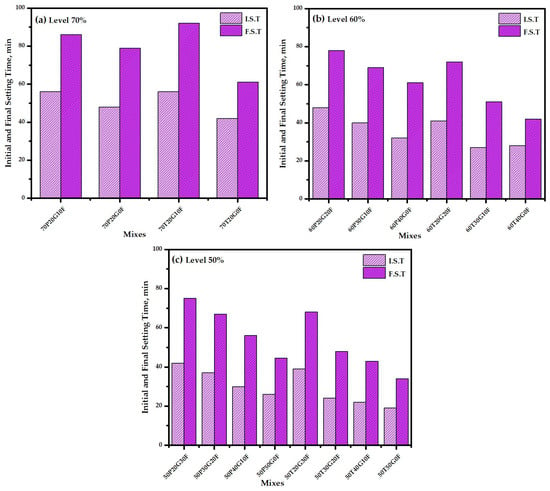
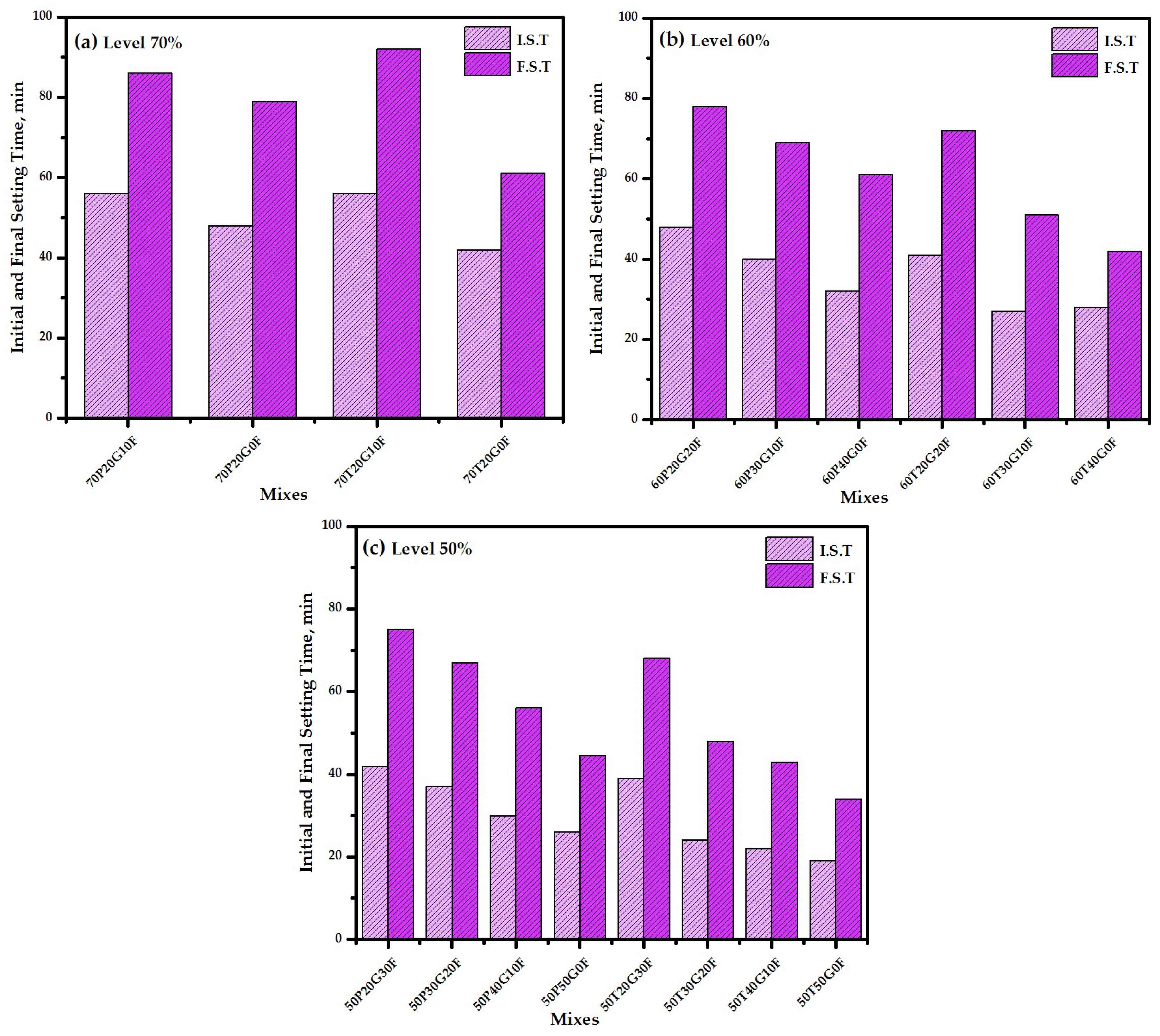
Figure 9 illustrates both the setting times (initial setting (I.S) and final setting (F.S)) of geopolymer pastes produced with varying proportions of POFA or WTCP in combination with FA and GBFS. For all mixtures, increasing the POFA or WTCP content from 50% to 60% and 70% resulted in a significant rise in both the I.S and F.S. In addition, pastes containing higher volumes of POFA exhibited slightly longer setting times than those made with WTCP. At each high replacement level, incorporating FA to replace a portion of GBFS further extended the setting times by slowing the geopolymerization reaction and delaying gel formation.
Figure 9.
Setting times of geopolymers prepared with a large volume content of POFA and WTCP: (a) 7%, (b) 60%, and (c) 50%.
For the mixtures with 70% POFA, the I.S and F.S were 48 and 79 min, respectively, increasing to 56 and 86 min when 10% of the GBFS was replaced by FA, as shown in Figure 9a. Similarly, mixtures with 70% WTCP showed an increase in setting times from 42 and 61 min to 56 and 92 min with the same FA replacement. Reducing the POFA and WTCP content to 60% (Figure 9b) and 50% (Figure 9c) resulted in shorter initial setting times, decreasing from 48 to 32 and 26 min for POFA mixtures and from 42 to 28 and 19 min for WTCP mixtures. The final setting times also dropped from 79 to 61 and 44 min for POFA and from 61 to 42 and 34 min for WTCP. However, at both the 60% and 50% replacement levels, substituting 10% to 30% of GBFS with FA produced longer setting times (I.S and F.S).
Based on the raw materials’ chemical composition (Table 2), increasing the POFA content elevated the silicate level to above 55% while decreasing the calcium and aluminum contents to under 20% and 10%, respectively. Consequently, C-S-H and C-A-S-H phase formation was minimized and the setting times were prolonged [74,75]. The mixture that recorded the highest initial and final setting times of 56 and 86 min was 70% POFA, 20% GBFS, and 10% FA. These results suggest that replacing GBFS with FA at large POFA concentrations always affected the initial and final setting times.
In high-volume WTCP paste mixtures, the setting time was found to reduce significantly with the increase in GBFS content and decrease in WTCP content. The impact of FA on both the initial and final setting times was pronounced across all high-volume WTCP mixtures, with higher FA proportions causing a marked prolongation of setting times. As presented in Table 2, the elevated SiO2 content (64%) combined with a low CaO content (10%) accelerated the chemical reactions, thereby contributing to the extended setting behavior of the geopolymers [76].
3.3. Compressive Strength Development
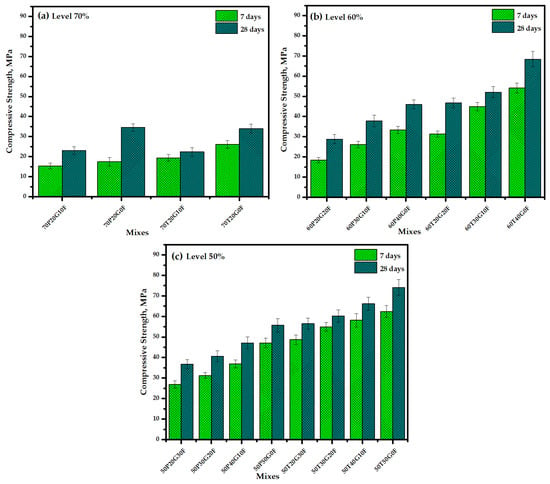
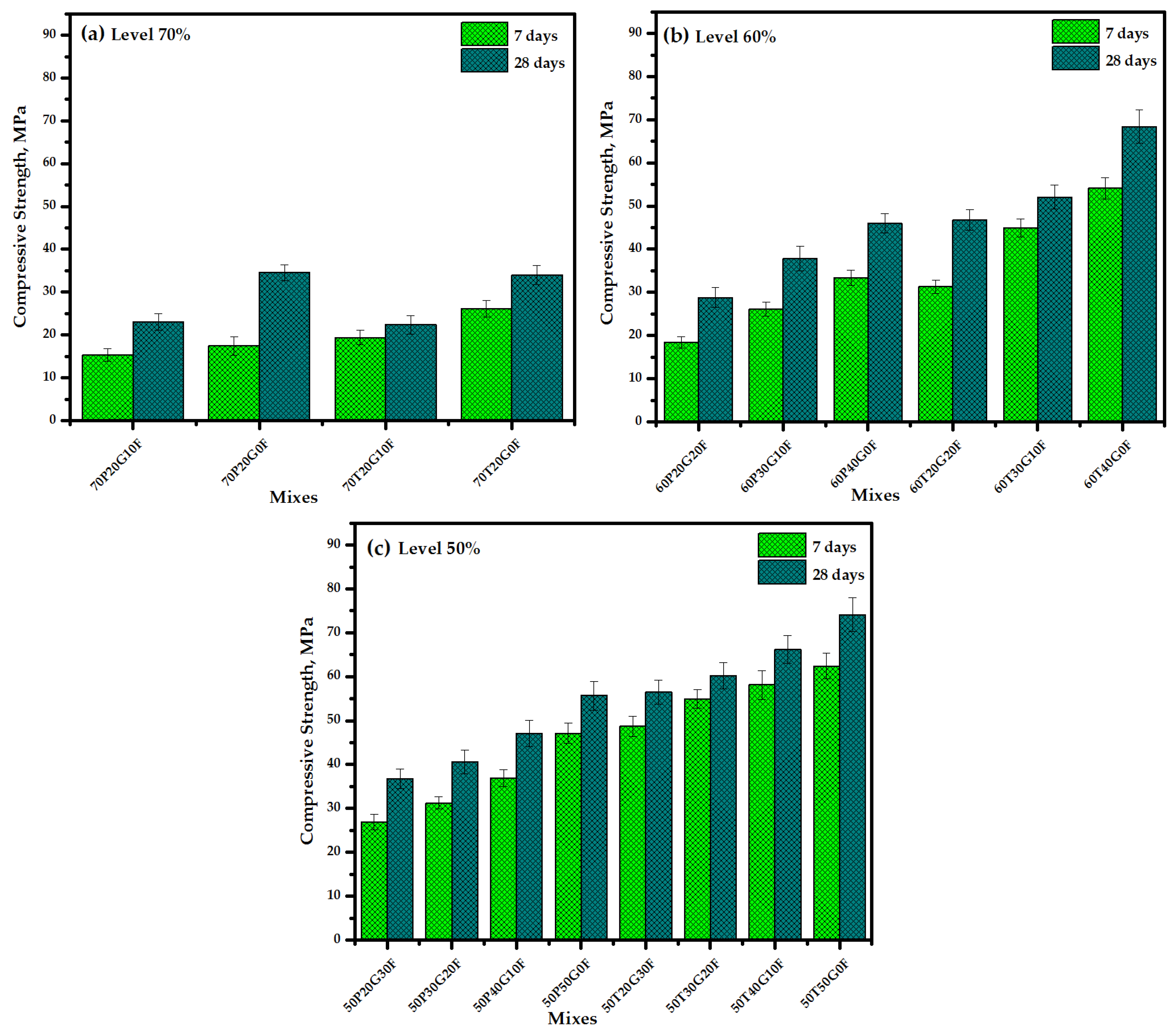
The effect of increasing POFA or WTCP content in FA–GBFS binders and curing age on the geopolymers’ strength development was examined, and the obtained strength outcomes are illustrated in Figure 10. For all specimens, the geopolymers’ strength values increased with longer curing periods, from 7 to 28 days. However, the strength declined as the POFA or WTCP content was enhanced from 50% to 60% and 70%. At every replacement level, substituting a larger portion of GBFS with FA yields a substantial drop in compressive performance.
Figure 10.
Effect of varying high volume of POFA/ WTCP on geopolymers’ strength development: (a) 70%, (b) 60%, and (c) 50% at ages of 7 and 28 days.
At 7 days, specimens with 70% POFA achieved 14.7 MPa compared to 26.1 MPa for those containing 70% WTCP (Figure 10a). When 10% FA was used to replace GBFS, the strength further declined to 15.3 MPa in the POFA mixture and 19.4 MPa in the WTCP mixture. However, at 28 days, the 70% POFA mixture recorded a slightly higher strength (34.5 MPa) than the corresponding WTCP mixture (34.0 MPa). Replacing GBFS with 10% FA again caused strength losses, dropping to 23.1 MPa and 22.4 MPa for the POFA and WTCP mixtures, respectively.
For the 60% binder level, specimens containing WTCP demonstrated higher strength than those with POFA at both 7 and 28 days, achieving 54.1 and 68.4 MPa, respectively, in comparison to 33.4 MPa and 45.9 MPa for POFA (Figure 10b). FA replacement continued to show a negative effect. In 60% POFA specimens, replacing GBFS with 10% and 20% FA reduced the compressive strength from 33.4 MPa to 26.1 MPa and 18.4 MPa at 7 days, while at 28 days, it reduced from 45.9 MPa to 37.8 MPa and 28.8 MPa. Likewise for the 60% WTCP specimens, the strength declined from 54.1 MPa to 44.9 MPa and 31.1 MPa at 7 days, while after 28 days, it reduced from 68.4 MPa to 52.1 and 46.7 MPa.
Figure 10c illustrates the strength development results for mixtures containing 50% POFA or WTCP. The WTCP mixtures developed significantly higher strength than POFA mixtures at both curing ages. However, both systems were highly sensitive to FA content. For 50% POFA mixtures, substituting GBFS with 10%, 20%, and 30% FA reduced the strength from 47.1 MPa to 36.9 MPa, 31.2 MPa, and 26.8 MPa at 7 days and from 55.6 MPa to 47.1 MPa, 40.6 MPa, and 36.8 MPa at 28 days. The same decreasing trend was observed in 50% WTCP specimens, where the strength decreased from 62.4 MPa to 58.2 MPa, 54.9 MPa, and 48.7 MPa at 7 days and from 74.1 MPa to 66.2, 60.2, and 56.5 MPa at 28 days as FA increased from 10% to 30%.
The findings reveal that compressive strength declines as the POFA replacement level increases, with reductions of 17.4% and 37.9% observed at 60% and 70% POFA, respectively. Enhancing the POFA content while decreasing the GBFS proportion from 50% to 20% results in a higher silicate content but lower calcium and alumina concentrations within the geopolymer matrix. This adjustment raises the SiO2/Al2O3 ratio to as high as 8.6, influencing the formation of N–C–A–S–H gels given the greater reactivity of alumina relative to silica [41,42]. Likewise, the decline in calcium oxide from 31.2% to 22.3% as POFA increases from 50% to 70% adversely affects the progress of C–A–S–H and C–S–H gels. Consequently, compressive strengths of 45.9 MPa and 34.5 MPa were achieved at 60% and 70% POFA, respectively, compared to 55.6 MPa at 50% POFA replacement.
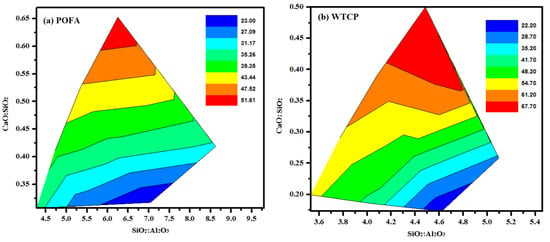
The strength values are strongly governed by the ratios of silicate to aluminum and calcium to silicate. Increasing POFA raises the SiO2/Al2O3 ratio while reducing the CaO/SiO2 ratio, producing lower strengths. A minimum strength of 23 MPa was observed when the SiO2/Al2O3 ratio ranged between 5.4 and 7.6 and the CaO/SiO2 ratio was below 0.31. When the CaO/SiO2 ratio increased from 0.31 to 0.60, the values of strength improved from 23 MPa to 51.6 MPa, even at a similar silicate-to-aluminum ratio (Figure 11a). Furthermore, reducing the SiO2/Al2O3 ratio from 7.6 to 4.4, which increased the alumina content from FA, enhanced the compressive strength to 35.2 MPa under the same CaO/SiO2 ratio (0.31). As shown in Figure 11, higher proportions of calcium oxide and alumina, combined with lower silicate content, consistently increased the strength. The highest strength values, exceeding 50 MPa, were achieved when CaO rose above 26% and Al2O3 exceeded 8% while SiO2 dropped below 50%. Previous studies [41,77,78] similarly report that increasing calcium and alumina while reducing silicate enhances C–A–S–H and C–S–H gel formation, resulting in higher strength.
Figure 11.
Effect of SiO2-to-Al2O3 and CaO-to-SiO2 ratios on the geopolymers’ strength development of (a) POFA and (b) WTCP.
Compared with high-volume POFA specimens, the superior performance of WTCP-based mixtures is ascribed to the high reactivity of amorphous silica in their composition. However, increasing WTCP from 50% to 60% and 70% caused strength reductions due to low calcium and excess silica, producing fewer C–S–H gels and weakening the geopolymer matrix. Likewise, replacing GBFS with higher FA increased silica and alumina but reduced calcium, which decreased the strength from 74.1 MPa to 56.5 MPa as the calcium content dropped from 30% to 10%. The limited formation of C–S–H gels, caused by insufficient calcium, was the primary factor in this strength loss [79].
The strength of high-WTCP specimens was also determined by the CaO/SiO2 and SiO2/Al2O3 ratios, with greater silica content causing further strength reductions (Figure 10b). Specimens with SiO2/Al2O3 ratios of 4.5 or above and CaO/SiO2 ratios below 0.20 showed low strength values of 22.2 MPa. In contrast, lowering the SiO2/Al2O3 ratio while maintaining a similar CaO/SiO2 ratio produced strengths above 50 MPa, especially when the SiO2-to-Al2O3 ratio decreased from 4.5 to 3.6. The largest recorded strength, 67 MPa at 28 days, was obtained when the CaO/SiO2 ratio exceeded 0.40. Overall, the strength declined as silica and alumina increased and calcium decreased. The strong influence of CaO content is linked to the low molarity of the alkaline solution (2M), which made the geopolymerization process highly dependent on amorphous calcium from GBFS in these mortars [72].
3.4. Splitting Tensile Strength
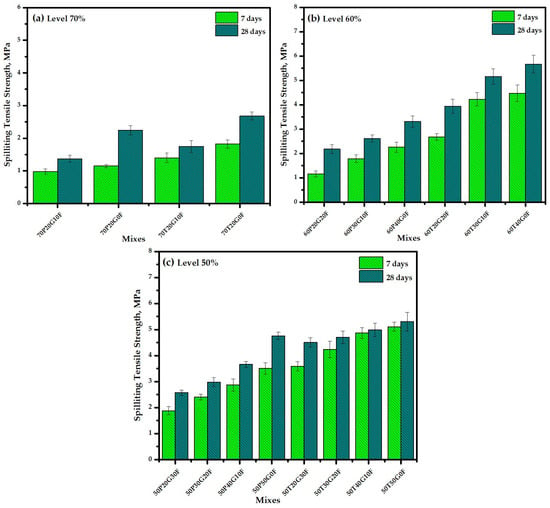
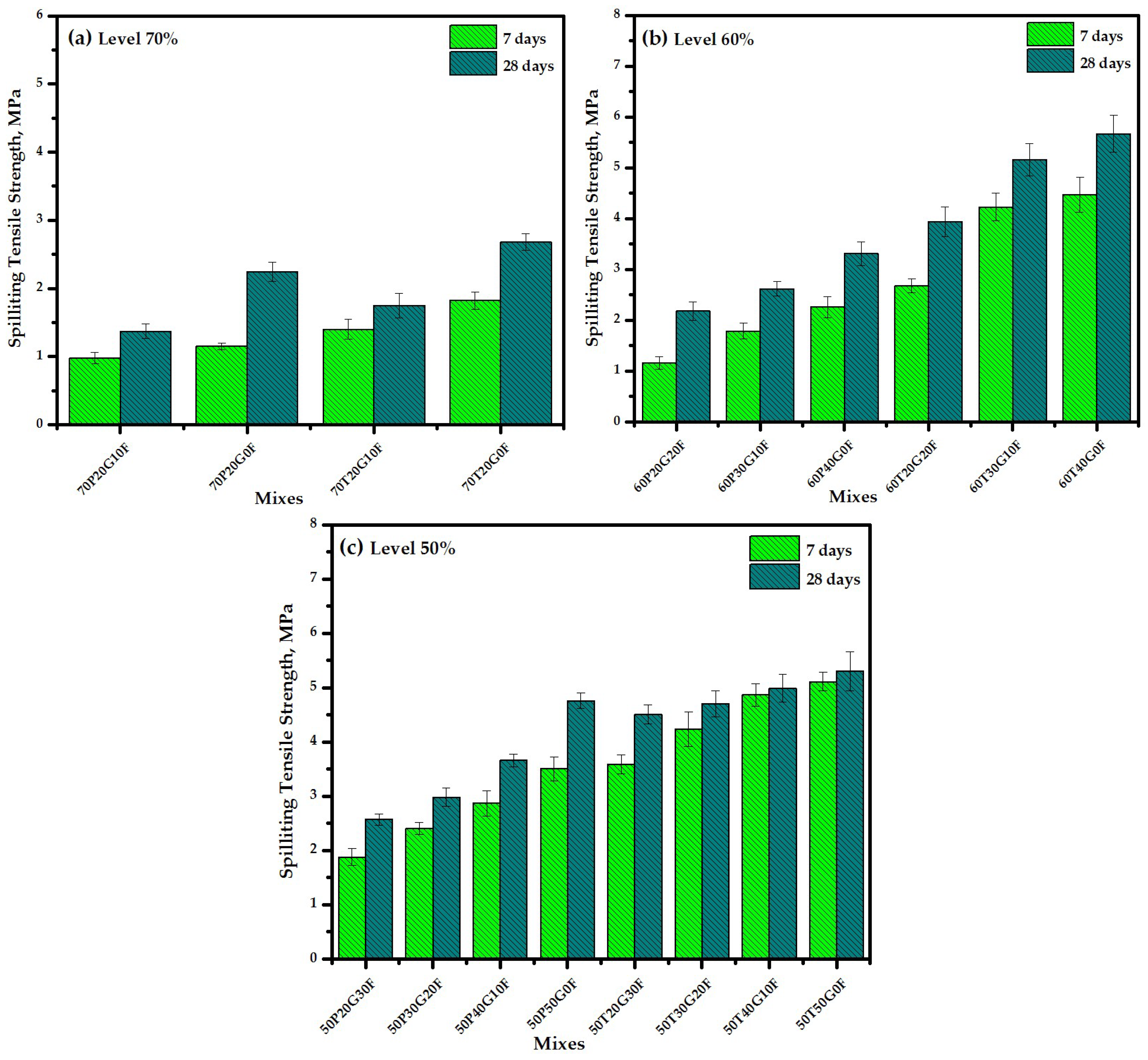
The splitting tensile strength results for the geopolymer specimens incorporating high levels of POFA or WTCP with a FA–GBFS binder at 7 and 28 days are presented in Figure 12. Overall, the splitting tensile strength improved with curing age but decreased as the POFA or WTCP content was enhanced from 50% to 60% and 70%. At each replacement level, substituting GBFS with FA further reduced the tensile strength. However, specimens containing high volumes of WTCP exhibited superior performance to those containing POFA.
Figure 12.
Geopolymer tensile strength development at volumes of POFA and WTCP: (a) 70% (b) 60%, and (c) 50%.
At 28 days, the specimen with a 50:50 POFA–GBFS ratio was taken as the control, achieving a strength of 4.8 MPa. Increasing the POFA content reduced the strength value from 3.3 MPa at 60% POFA to 2.3 MPa at 70% POFA (Figure 12a). The results for mixes comprising 50%, 60%, and 70% POFA with FA as a GBFS substitute are shown in Figure 10a–c, where a negative correlation was found between tensile strength and FA content. Higher FA content led to a reduction in compressive strength, with the lowest compressive strength of 1.4 Mpa recorded in the matrix made of 70% POFA, 20% GBFS, and 10% FA. This is due to the presence of high silicate and low calcium levels, which inhibited the development of C–S-H gel, weakening the bond strength [80].
Likewise, for the ceramic specimens, it was observed that the tensile strength reduced as the WTCP content improved from 50% to 60% and 70% and reduced further with higher FA content as a GBFS replacement. At 7 days, early strength was significantly affected by WTCP content, with the mix containing 70% WTCP showing only 1.82 MPa compared with 5.11 MPa for the 50% WTCP mix (Figure 12b,c). The splitting tensile strength declined from 5.3 MPa at 50% WTCP to 2.7 MPa at 70% WTCP at 28 days. The higher WTCP content reduced the calcium available and slowed C–S–H gel formation [19], leading to lower tensile strength. A negative correlation between FA content and tensile strength was also found in this batch. The lowest 28-day tensile strength (1.7 MPa) was recorded for the mix containing 70% WTCP, 20% GBFS, and 10% FA.
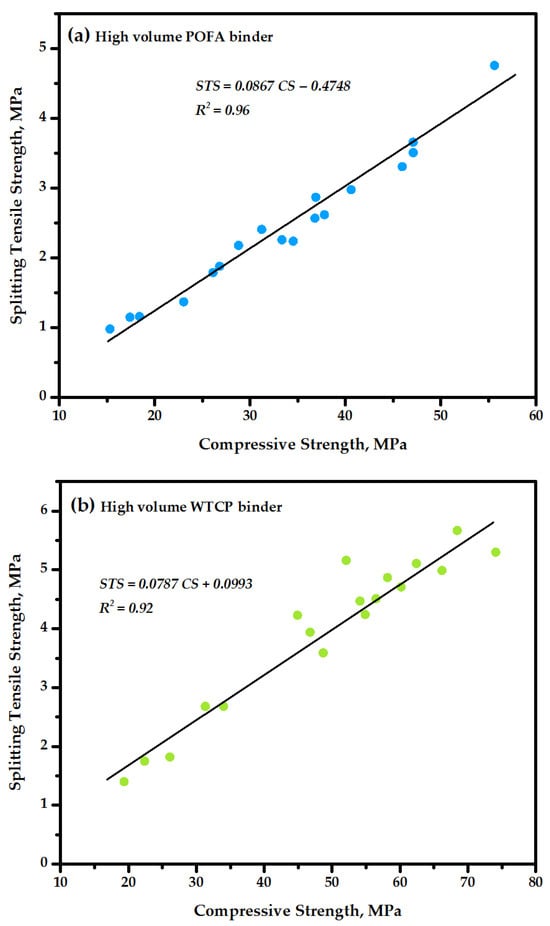
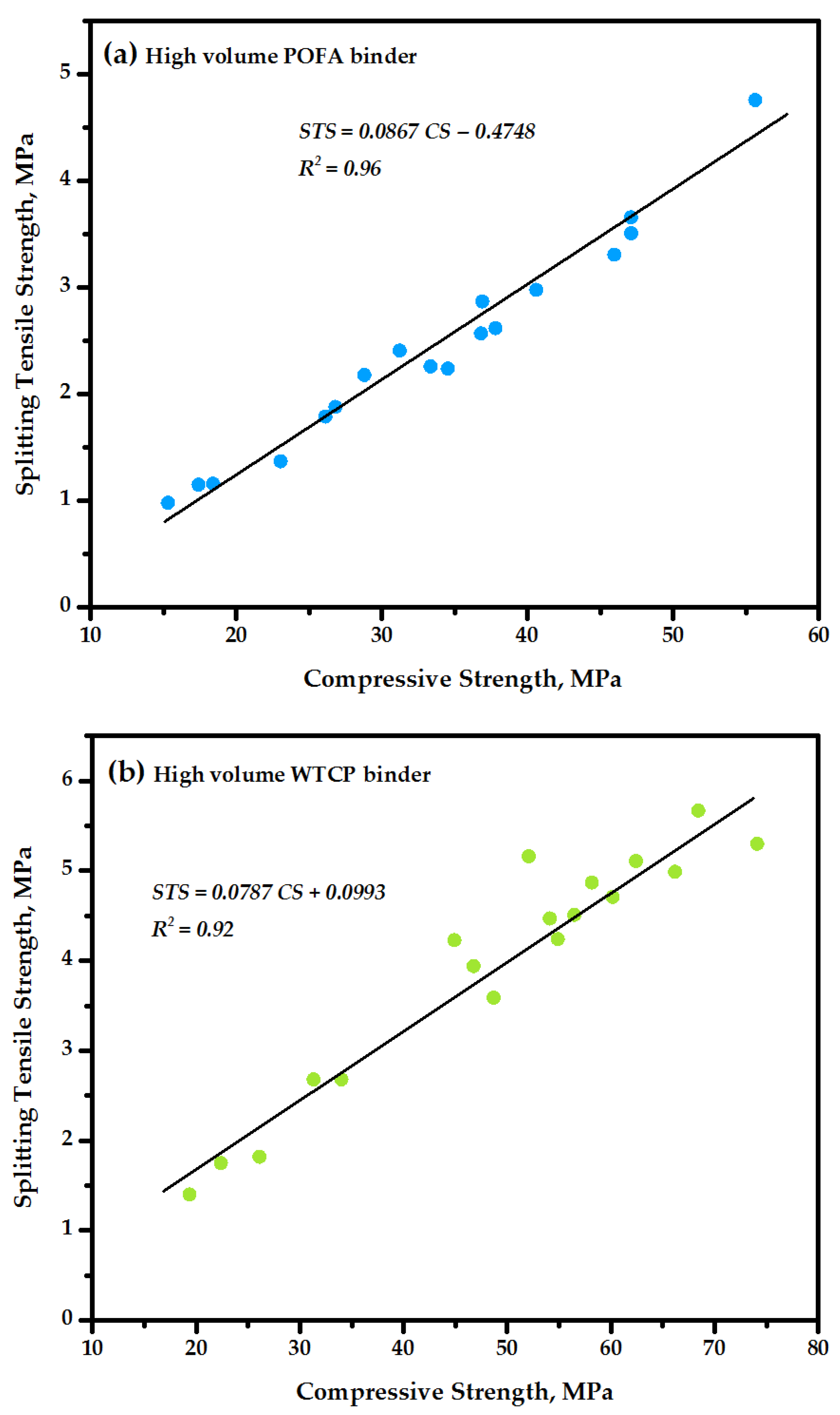
The results obtained for geopolymer tensile strength with a high POFA content exhibited a positive linear correlation with their compressive strength, as illustrated in Figure 13a. A linear regression analysis was used to relate the experimental data based on Equation (1), yielding an R2 value of 0.96 and indicating a high degree of confidence:
Figure 13.
The relationship between the reported compressive and splitting tensile strengths for geopolymers prepared with a high volume of (a) POFA and (b) WTCP.
Figure 13b shows the relationship between splitting tensile strength and compressive strength for the specifications containing a large percentage of WTCP. The experimental data were fitted using a linear regression analysis, whereby an R2 value of 0.92 was obtained, showing a very high level of reliability.
3.5. Flexural Strength
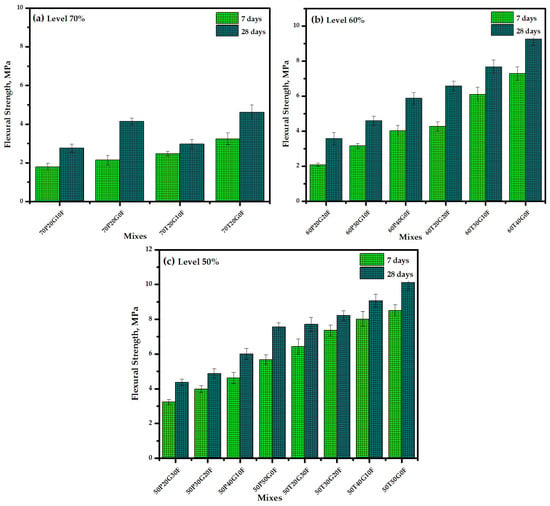
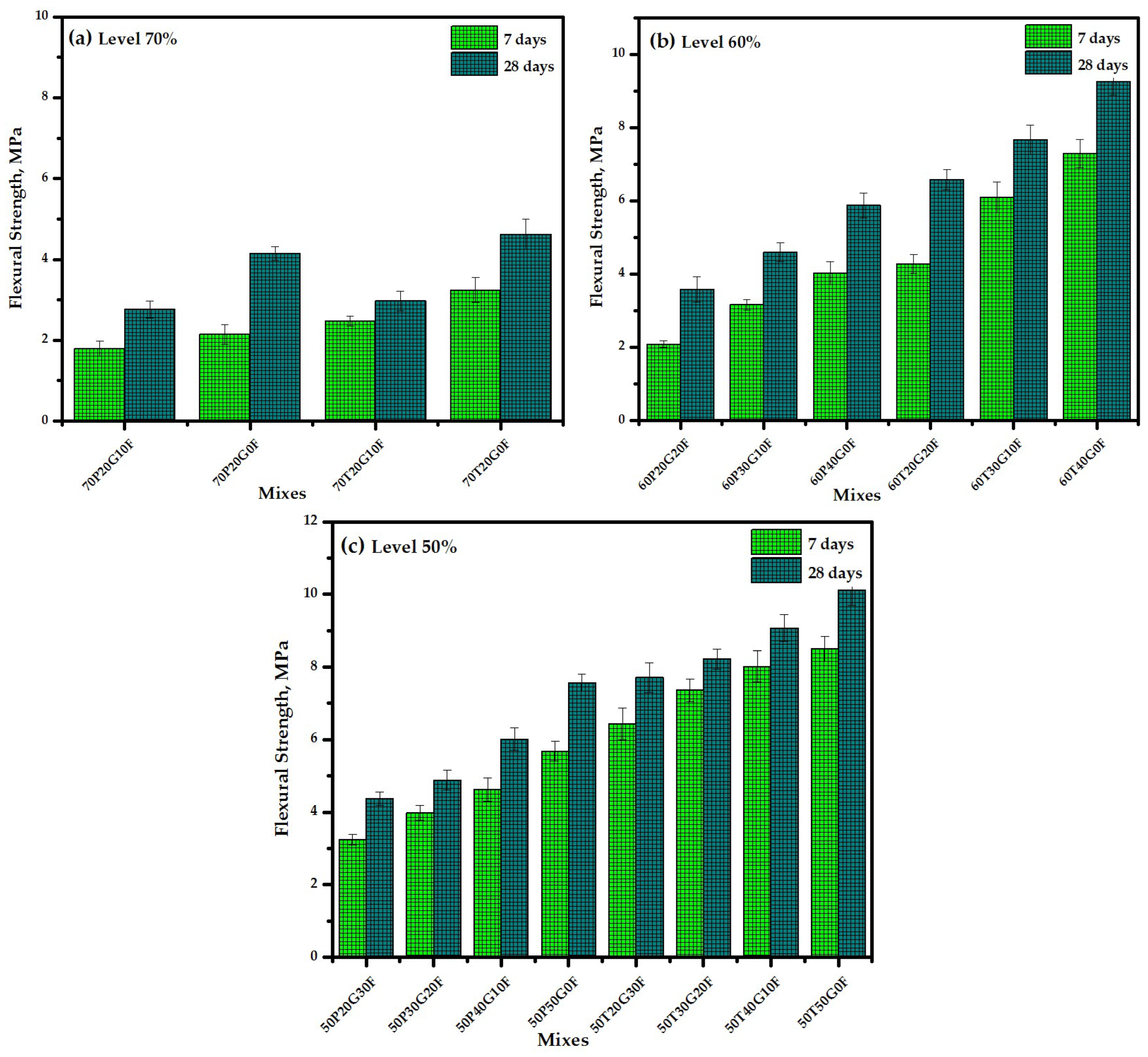
Figure 14 presents the flexural strength development of FA-GBFS geopolymers prepared with varying high levels (50–70%) of POFA and WTCP. For all geopolymer mixes, flexural strength increased with extended curing periods. Nevertheless, the specimens with the presence of WTCP always showed better performance than those with POFA. When the content of POFA, WTCP, and FA was increased in both forms of mortar, flexural strength decreased noticeably.
Figure 14.
Flexural strength values of the FA-GBFS geopolymer containing a high volume of POFA or WTCP: (a) 70%, (b) 60%, and (c) 50%.
POFA contents of 50, 60 and 70% were used to determine the flexural strength of the geopolymer mortars after 7 days and 28 days, as seen in Figure 14a–c. The level of strength correlated negatively with the content of POFA at early and late ages. The flexural strength at 7 days declined to 2.14 Mpa when POFA rose to 70% when compared to the 5.68 Mpa at 50%. The same was noted at 28 days, and the strength reduced to 4.1 Mpa as compared to 7.6 Mpa. Also, early- and late-age values of strength reduced further as FA content increased. The poorest strength at 28 days was in the mix that included 70% POFA, 20% GBFS, and 10% FA. This decrease in strength was mainly explained by the decreased calcium concentration caused by the high POFA and FA concentration.
This substitution effect on flexural strength development was also strong when GBFS was replaced with 50–70% WTCP. At 7 days, the strength decreased from 8.49 MPa to 3.24 MPa as the WTCP content increased from 50% to 70%. A comparable trend was found at 28 days, in which the strength reduced from 10.1 MPa to 4.6 MPa. Figure 14a–c also illustrates the impact of FA as a substitute for GBFS at each WTCP level. In all cases, higher FA content resulted in lower flexural strength. The lowest 28-day value (3.0 MPa) was recorded for the mixture comprising 70% WTCP, 20% GBFS, and 10% FA. This reduction is consistent with the established relationship that the formation of C–S–H gel is positively correlated with GBFS content [81].
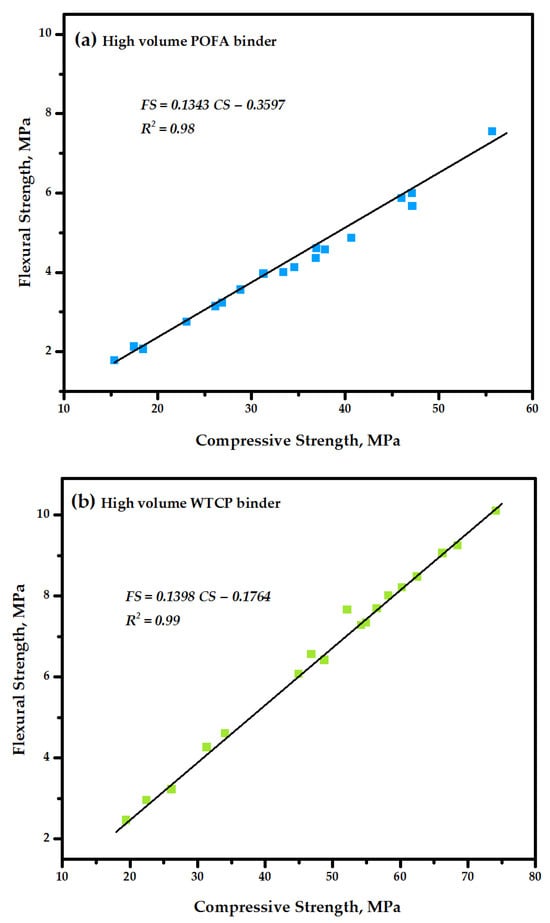
Figure 15a presents the correlation between compressive strength and flexural strength in geopolymers with a high proportion of POFA. A linear regression analysis was conducted on the experimental data using Equation (3). The coefficient of determination, R2 ≈ 0.98, for all specimens demonstrates a strong and consistent linear correlation:
Figure 15.
The compressive strength vs. flexural strength relationship of (a) POFA and (b) WTCP.
Figure 15b presents the relationship between the compressive strength and flexural strength of GPMs containing a high proportion of WTCP. A linear regression analysis was applied using Equation (4) to relate the experimental data, resulting in an R2 value of 0.99, which demonstrates a strong and consistent relationship:
3.6. Water Absorption Capacity
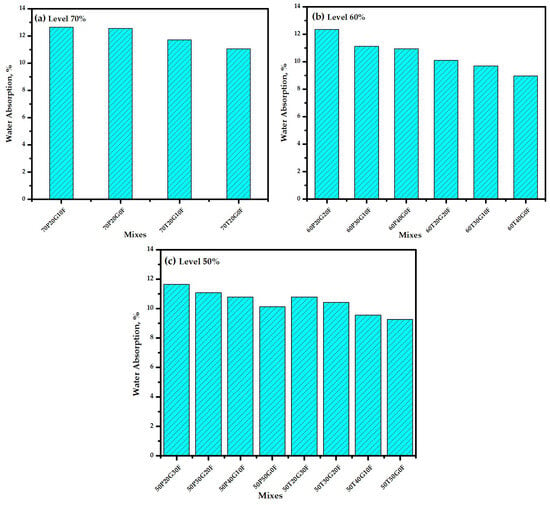
The water absorption of the geopolymer specimens was markedly influenced by the elevated proportions of POFA and WTCP, displaying a distinct increasing trend as the content of POFA, WTCP, or FA in the geopolymer matrix improved, as illustrated in Figure 16. On the whole, the specimens containing a greater amount of WTCP had lower values of water absorption. Moreover, the findings showed that the amount of water that was absorbed increased significantly with greater levels of POFA used to replace GBFS. Specifically, water absorption rose from 10.1% to 10.9% and 12.6% once the POFA content rose from 50% to 60% and 70%, respectively (Figure 16a–c). In addition, the impact of FA as a substitute for GBFS was examined for specimens with 50%, 60%, and 70% POFA. For geopolymers comprising 50% POFA, water absorption improved from 10.1% to 10.8%, 11.1%, and 11.6% when the FA replacement level rose from 0% to 10%, 20%, and 30%, respectively. The rise in water absorption was ascribed to the weaker microstructure and larger number of pores in specimens containing high POFA content (70%).
Figure 16.
Measurement of water absorption of geopolymers prepared using a high volume of POFA or WTCP: (a) 70%, (b) 60%, and (c) 50%.
Figure 16a–c presents the effect of high-volume WTCP (70%, 60%, and 50%) on the FA–GBFS geopolymer’s water absorption. Water absorption increased in direct proportion to the WTCP content. Replacing GBFS with higher amounts of WTCP caused water absorption to rise from 7.3% to 7.9% and 10.1% as the WTCP content increased from 50% to 60% and 70%, respectively. FA was explored as a partial substitute for GBFS in the specimens with 50%, 60%, and 70% of WTCP. The results showed that water absorption increased progressively as the levels of FA replacement increased. In particular, water absorption values were 7.3%, 8.6%, 9.4%, and 9.8% in the case of FA contents of 0%, 10%, 20%, and 30%, respectively. This tendency was explained by the lack of geopolymerization at high WTCP and FA contents, which led to a more porous microstructure and more voids. Also, the increase in WTCP and FA percentages is likely to have increased the content of unreacted and partially reacted particles, which formed a less compact and porous geopolymeric mesh.
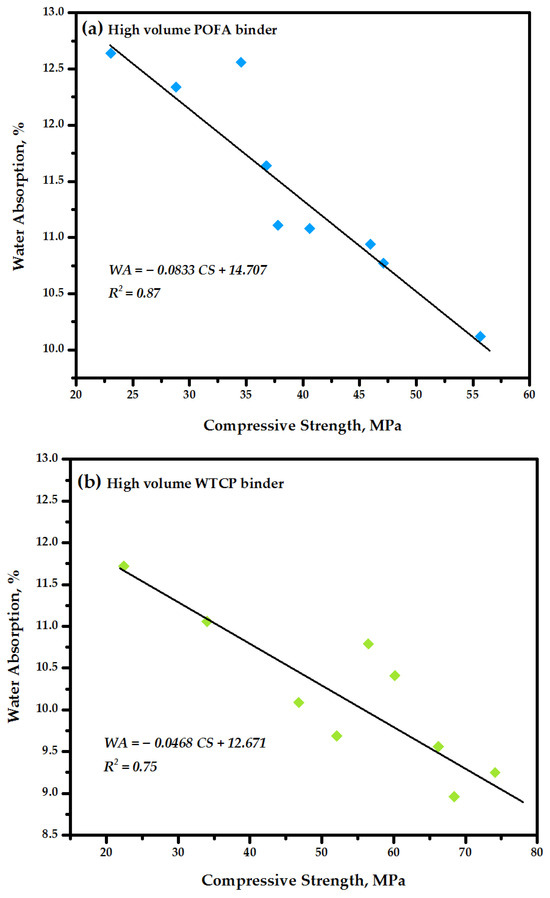
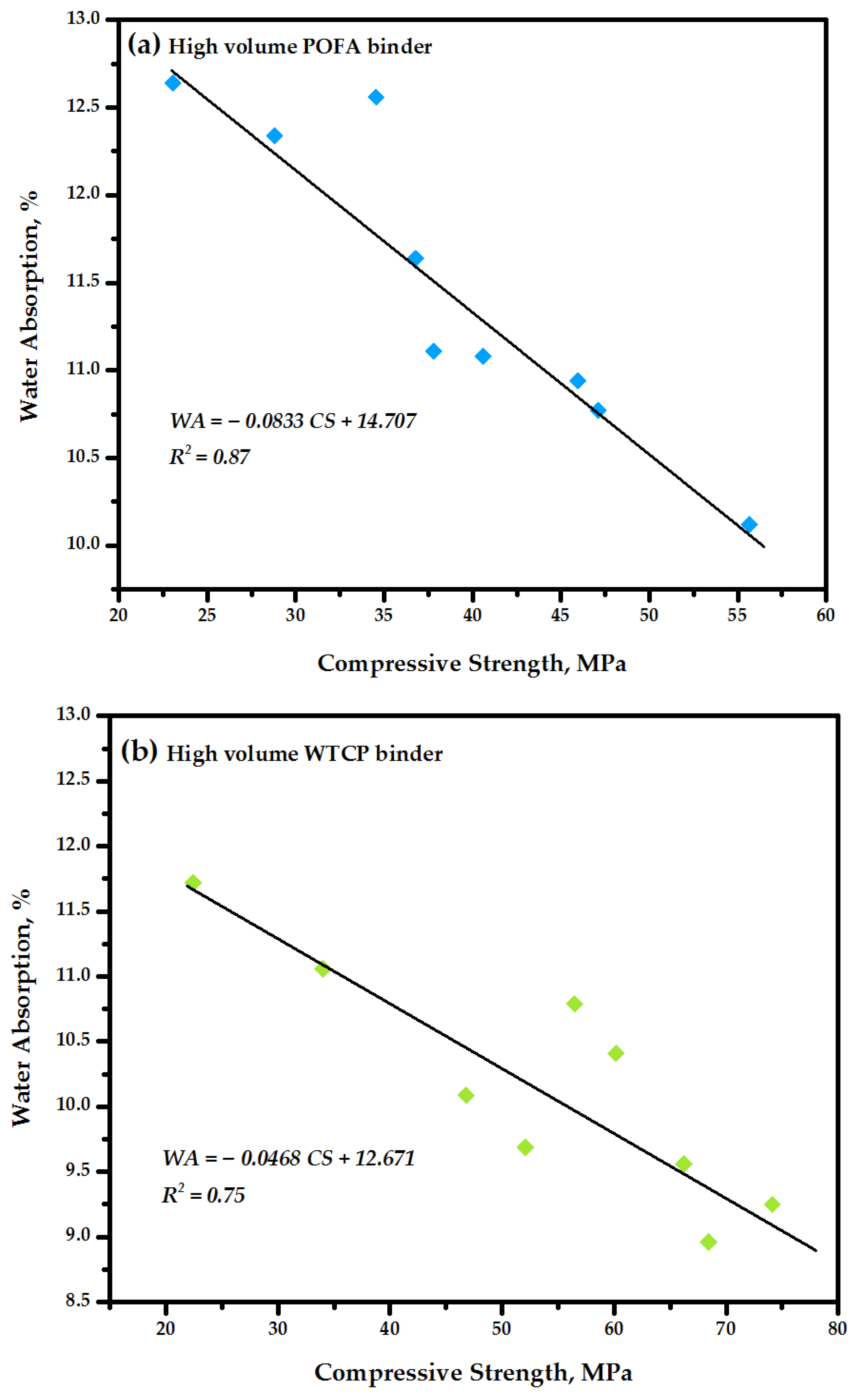
Figure 17a illustrates the association of water absorption and compressive strength in geopolymers prepared using high-volume POFA. The results show that water uptake reduces with the strength of compressibility. An analysis of linear regression was carried out to provide a linear relationship between the experimental points, as presented in Equation (5), with a resulting R2 of 0.87. This value indicates a high level of credibility in the determined relationship:
Figure 17.
Correlation between the compressive strength of geopolymers and water absorption for high-volume (a) POFA and (b) WTCP specimens.
Figure 17b depicts an inverse connection between water absorption and compressive strength. The lowest observed water absorption was 7.3%, whereas the highest compressive strength reached 74.1 MPa. A linear regression analysis was performed to establish a connection between the experimental data, as depicted in Equation (6), resulting in an R2 value of 0.75. This outcome demonstrates a relatively strong level of confidence in the proposed model, expressed as follows:
3.7. Microstructure Properties
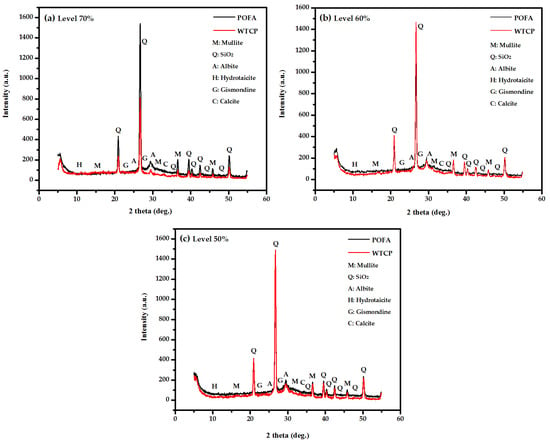
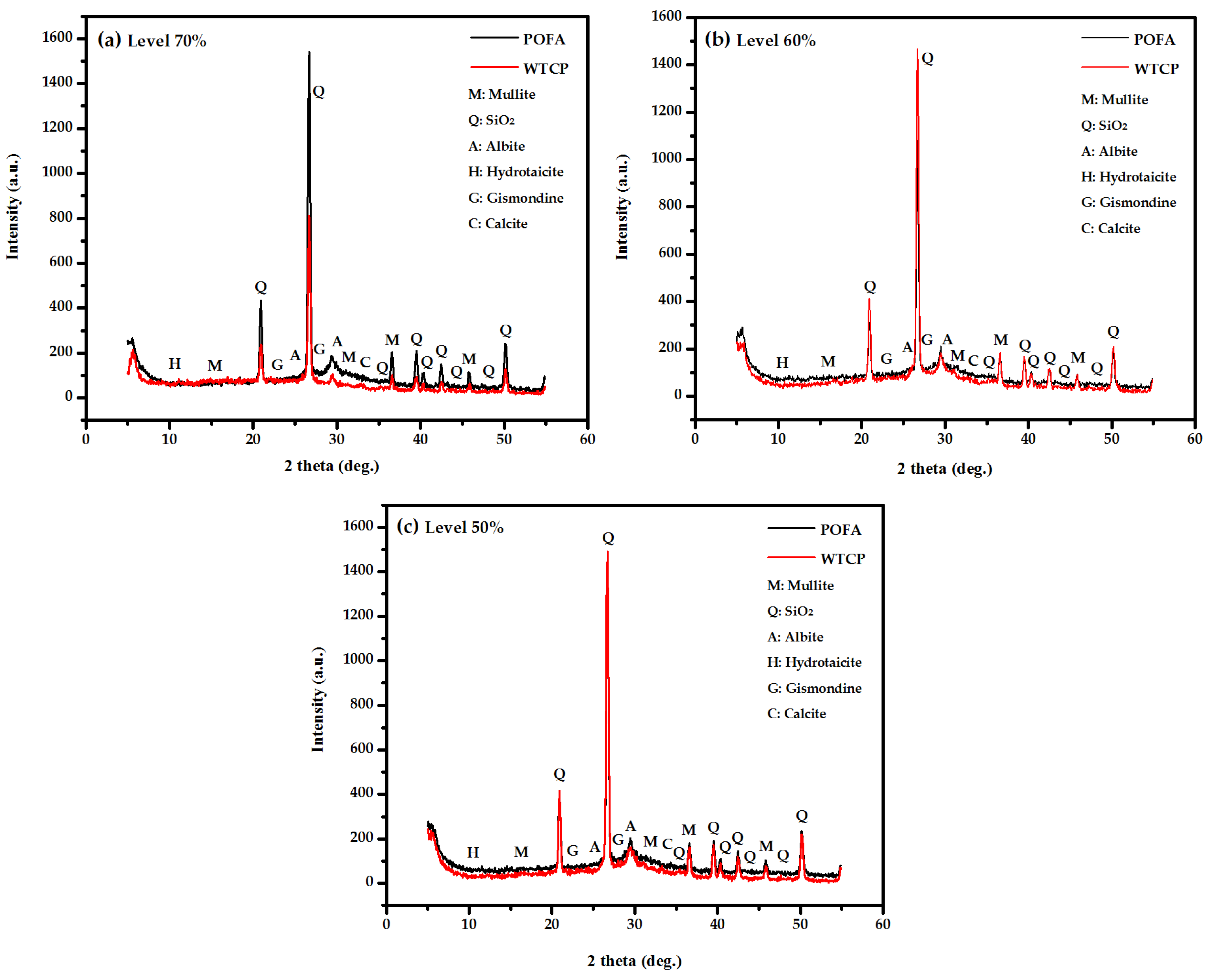
Figure 18 presents the XRD patterns of geopolymers incorporating high volumes (50%, 60%, and 70%) of POFA or WTCP with an FA–GBFS binder. In the POFA-based samples, the amorphous phase decreased as the POFA content rose from 50% to 70%, accompanied by the appearance of sharper crystalline peaks. As the POFA content rose, the intensity of the quartz peaks at 21.4° and 27.8° was enhanced, with the quartz peak at 27.8° becoming especially prominent. At 27.8°, the albite peak observed at lower POFA levels was replaced by quartz when POFA reached 60% and 70%. Increasing the POFA content also caused additional changes in the XRD pattern, including the substitution of nepheline by mullite at 24° and the substitution of hydrotalcite and calcite by mullite. At 70% POFA, several new crystalline phases appeared, including a quartz–muscovite peak at 36.5°, which was associated with the high potassium (K2O) content (8.6%) in the mix. The recorded drop in the strength value, from 55.6 MPa to 45.9 Mpa and 34.5 Mpa with POFA contents of 50%, 60%, and 70%, respectively, was attributed to the lower formation of C-S-H and higher crystallinity of quartz. In the WTCP-based samples, increasing the ceramic content resulted in a decline in the intensity of albite and gismondine peaks, notably at 29.3° and 30°. Higher WTCP proportions resulted in a greater amount of unreacted silicate and diminished C–S–H formation, which was consistent with the strength value reduction from 74.1 MPa to 34.0 MPa after 28 days.
Figure 18.
Effect of POFA and FA on the XRD pattern of FA-GBFS pastes: (a) 70%, (b) 60%), and (c) 50%.
3.8. Durability Perfomance
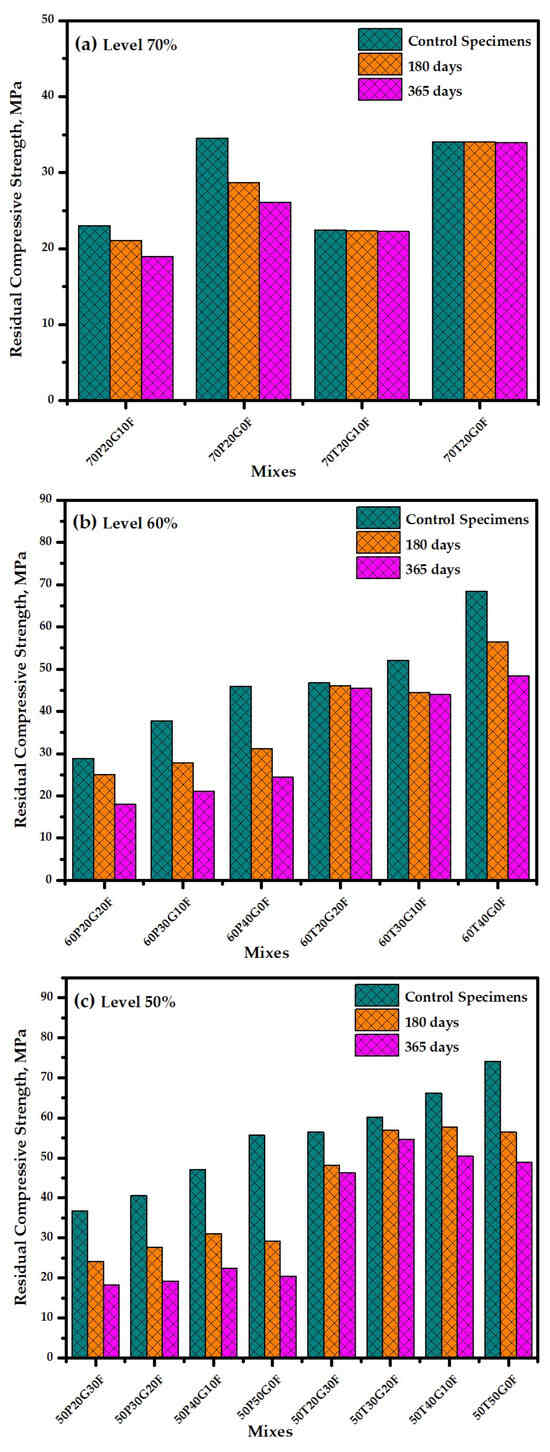
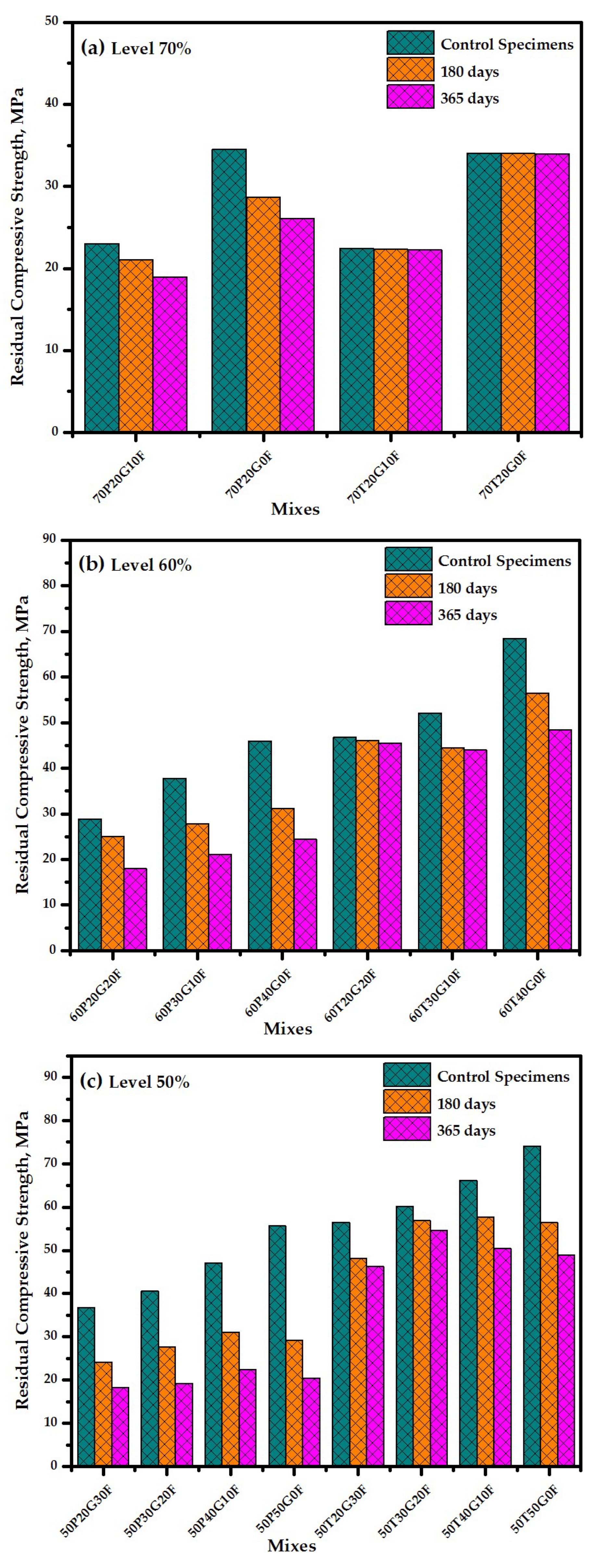
Figure 19 presents the impact of high-volume POFA and WTCP on the sulfuric acid resistance of FA–GBFS geopolymers, evaluated through residual compressive strength. At all replacement levels, specimens containing WTCP consistently outperformed those with POFA. Overall, both durability and strength retention increased as the content of POFA or WTCP was raised from 50% to 60% and 70%. Additionally, at each replacement level, partially substituting GBFS with FA markedly improved the geopolymers’ resistance under aggressive environmental conditions.
Figure 19.
Residual compressive strength for the high-volume POFA or WTCP geopolymer specimens exposed to 10% H2SO4 acid solution for 6 and 12 months (a) 70%, (b) 60%), and (c) 50%.
For geopolymer mixtures containing POFA, increasing the POFA proportion in the matrix enhanced resistance to sulfuric acid attack. As the POFA content improved from 50% to 60% and 70%, the residual compressive strength improved from 37% to 53% and 76%, respectively. In addition, substituting GBFS with FA optimized performance; in mixtures with 50% POFA, the residual compressive strength increased from 37% to 49% as the FA replacement level rose from 0% to 30%. Beyond compressive strength, weight loss is commonly used as an indicator to assess acid resistance [82]. As presented in Table 3, increasing POFA content from 50% to 60% and 70% reduced weight loss from 0.20% to 0.17% and 0.12%, respectively. The same pattern was observed when FA was partially substituted for GBFS in the 50% POFA mixtures, with weight loss decreasing with the increase in FA percentage (0.20–0.13%). Such improvements can be explained by the decreased calcium hydroxide formation and gypsum growth prevention in the geopolymer structure [54].
Table 3.
Weight loss, UPV reading, and loss of geopolymer strength values of cubes exposed to sulfuric acid attack for 180 and 365 days.
The same was found in the WTCP mixtures, as the higher the percentage of WTCP and FA, the better the levels of durability were determined by the higher residual strength, smaller weight loss, and less internal cracking (in terms of UPV measurements). Table 3 gives a synopsis of the compressive strength left after 6 and 12 months of exposure to sulfuric acid, and the residual compressive strength shows a strong positive correlation between WTCP content and material durability. Increasing WTCP from 50% to 60% and 70% raised the residual strength from 66% to 73% and 99%, respectively. Likewise, in the 50% WTCP mixtures, substituting GBFS with FA increased the residual strength from 66% to 87% as the FA content was raised from 0% to 30%. UPV readings confirmed a reduction in internal cracking with increasing WTCP and FA. Weight loss also declined as WTCP increased, decreasing from 2.5% to 1.5% and 0.01% for 50%, 60%, and 70% replacement levels, respectively. A comparable reduction was found with higher FA content. Previous studies [54,83,84,85] have also reported that higher silica, alumina, and sodium contents limit gypsum formation and improve the overall durability of geopolymers. The reduced performance of mixtures containing 50% POFA or WTCP is attributed to the high CaO content in the binder matrix derived from GBFS, which promotes increased gypsum formation when the specimens are exposed to acidic environments. Gypsum formed during acid attack reacts with calcium aluminate phases in the geopolymer paste matrix to produce ettringite [86]. The formation of ettringite increases tensile stresses, which promotes cracking and surface peeling. These reaction products are soft, mobile, and gelatinous, causing surface softening and progressive degradation of the concrete specimens [87]. This behavior demonstrates the combined corrosive effect of sulfuric acid and the contribution of expansive products to the accelerated deterioration of concrete.
4. Conclusions
This study extensively examined the influence of significant volumes of POFA or WTCP on FA-GBFS-based geopolymer performance. Based on the findings obtained, the study concluded the following:
- i.
- Geopolymer mixtures with high proportions of POFA demonstrated lower flowability than those containing WTCP. The workability of the geopolymer mixtures decreased as the POFA content increased from 50% to 70%. In contrast, a high ceramic powder content in the matrix substantially enhanced flowability. For both geopolymer systems, the partial replacement of GBFS with FA led to a reduction in the measured flow diameter. Moreover, in both high-volume POFA and WTCP mixtures, increasing the replacement level from 50% to 60% and 70% resulted in longer initial and final setting times. Notably, mixtures with higher POFA content exhibited the greatest delay in setting.
- ii.
- The geopolymer compressive strength values are strongly affected by the proportions of POFA and WTCP, showing an inverse relationship between strength and the amounts of POFA, WTCP, and FA. Increasing the POFA or WTCP content from 50% to 70% led to a decrease in values of strength from 55.6 MPa to 34.5 MPa for POFA and from 74.1 MPa to 34.0 MPa for WTCP, respectively.
- iii.
- A comparable trend was found for both the splitting tensile and flexural strengths, where the strength values decreased as the POFA and WTCP content increased from 50% to 60% and 70%. A linear correlation was also identified between compressive strength and both tensile and flexural strengths. In contrast, the water absorption of the suggested geopolymer increases with higher proportions of POFA and WTCP in the matrix.
- iv.
- The microstructural analysis (XRD) indicates that higher contents of POFA and WTCP result in an increased presence of unreacted particles and a reduced proportion of amorphous phases (less dense gels). This microstructural change significantly diminishes bonding strength, leading to lower compressive, tensile, and flexural performance.
- v.
- The incorporation of POFA and WTCP into geopolymer matrices significantly improves durability under aggressive environmental conditions. Specimens containing higher proportions of POFA or WTCP (70%) demonstrated superior performance to those with 50% or 60% content. Overall, WTCP-based specimens exhibited greater stability in acidic environments, as indicated by the higher residual strength, lower weight loss, and fewer internal cracks, in comparison to POFA-based specimens.
5. Applications, Opportunities, and Recommendations for Future Investigation
From the results obtained for the proposed geopolymers, such as high early strength and durability in aggressive environments, it is clear that they are suitable for several applications:
- i.
- They can be used for the structural and non-structural elements of blocks, pavers, screeds, and precast panels as well as for eco-friendly concrete repair materials to replace the commercial ones on the market.
- ii.
- The high workability of WTCP materials make them suitable for self-compacting and pumpable concretes.
- iii.
- The high resistance to acid attack makes the proposed geopolymers suitable for marine structural elements.
Opportunities:
- i.
- The adoption of these types of materials in the construction industry can contribute to abundant feedstocks and the circular economy. Palm oil processing produces large volumes of POFA in Southeast Asia; ceramic tile manufacturing and construction generate tile waste worldwide. Using this waste reduces landfill demand and raw-material extraction.
- ii.
- Utilizing large amounts of POFA or WTCP in geopolymer systems can cut CO2 emissions compared with OPC-based mixes.
- iii.
- Both POFA and WTCP supply amorphous aluminosilicate, which can enhance high-temperature stability and reduce porosity in some mixes. These properties allow tailored mixes for durability or heat resistance.
- iv.
- In terms of economic and supply-chain benefits, local availability lowers transport costs in producing regions (Malaysia and Indonesia), which can make geopolymer products cost-competitive for precast plants and local construction markets.
- v.
- The growing demand for low-carbon construction products and circular-economy policies create a market pull for validated low-carbon binders and recycled-content building materials.
Recommendations for Future Investigation:
- i.
- Life cycle assessments (LCA) and techno-economic analyses comparing geopolymer mixes with conventional OPC mixes at realistic plant scale in target regions;
- ii.
- Composite solutions for fiber-reinforced geopolymer mixes, nano-additives, and hybrid OPC–geopolymer binders to bridge performance gaps;
- iii.
- Drying shrinkage and creep of geopolymer prepared with a large amount of POFA or/and WTCP at early ages in cold environments (freezing–thawing cycles) and aggressive environments (acid, sulfate, and elevated temperatures).
Author Contributions
Conceptualization, A.M.M. and G.F.H.; methodology, G.F.H.; software, A.M.M.; validation, G.F.H. and A.M.M.; formal analysis, G.F.H.; investigation, A.M.M.; resources, G.F.H.; data curation, G.F.H.; writing—original draft preparation, G.F.H.; writing—review and editing, A.M.M.; visualization, A.M.M.; supervision, G.F.H.; project administration, A.M.M.; funding acquisition, G.F.H. and A.M.M. All authors have read and agreed to the published version of the manuscript.
Funding
This research was supported by Universiti Tun Hussein Onn Malaysia (UTHM) under the Tier 1 Research Grant [vote Q Q866].
Data Availability Statement
The raw data supporting the conclusions of this article will be made available by the authors on request.
Acknowledgments
The authors thank EcoStruct Building Technologies B.V. for their support and cooperation in the conducting of this research.
Conflicts of Interest
Ghasan Fahim Huseien was employed by EcoStruct Building Technologies B.V. The remaining authors declare that the research was conducted in the absence of any commercial or financial relationships that could be construed as a potential conflict of interest.
References
- Asim, N.; Badiei, M.; Shakeri, M.; Emdadi, Z.; Samsudin, N.A.; Soltani, S.; Mohammad, M.; Amin, N. Development of green photocatalytic geopolymers for dye removal. Mater. Chem. Phys. 2022, 283, 126020. [Google Scholar] [CrossRef] [Scilit]
- Bai, T.; Song, Z.; Wang, H.; Wu, Y.; Huang, W. Performance evaluation of metakaolin geopolymer modified by different solid wastes. J. Clean. Prod. 2019, 226, 114–121. [Google Scholar] [CrossRef] [Scilit]
- Alhassan, M.; Alkhawaldeh, A.; Betoush, N.; Alkhawaldeh, M.; Huseien, G.F.; Amaireh, L.; Elrefae, A. Life cycle assessment of the sustainability of alkali-activated binders. Biomimetics 2023, 8, 58. [Google Scholar] [CrossRef] [Scilit]
- Davidovits, J. Global warming impact on the cement and aggregates industries. World Resour. Rev. 1994, 6, 263–278. [Google Scholar]
- Rahimpour, H.; Amini, A.B.; Sharifi, F.; Fahmi, A.; Zinatloo-Ajabshir, S. Facile fabrication of next-generation sustainable brick and mortar through geopolymerization of construction debris. Sci. Rep. 2024, 14, 10914. [Google Scholar] [CrossRef] [Scilit] [PubMed]
- Asim, N.; Badiei, M.; Samsudin, N.A.; Mohammad, M.; Razali, H.; Hui, D. Clean technology option development for smart and multifunctional construction materials: Sustainable geopolymer composites. J. Build. Eng. 2024, 94, 109932. [Google Scholar] [CrossRef] [Scilit]
- El-Sayed, A.; Abdallah, H.; Abdel-Goad, M.; Abobeah, R.; Amin, S.K. Preparation and optimization of eco-friendly inorganic geopolymer membrane. Int. J. Environ. Sci. Technol. 2025, 22, 16021–16042. [Google Scholar] [CrossRef] [Scilit]
- Roy, D. Hydration, structure, and properties of blast furnace slag cements, mortars, and concrete. J. Proc. 1982, 79, 444–457. [Google Scholar]
- Turner, L.K.; Collins, F.G. Carbon dioxide equivalent (CO2-e) emissions: A comparison between geopolymer and OPC cement concrete. Constr. Build. Mater. 2013, 43, 125–130. [Google Scholar] [CrossRef] [Scilit]
- Provis, J.L. Geopolymers and other alkali activated materials: Why, how, and what? Mater. Struct. 2014, 47, 11–25. [Google Scholar] [CrossRef] [Scilit]
- Ismail, M.; Yusuf, T.O.; Noruzman, A.H.; Hassan, I. Early strength characteristics of palm oil fuel ash and metakaolin blended geopolymer mortar. Adv. Mater. Res. 2013, 690, 1045–1048. [Google Scholar] [CrossRef] [Scilit]
- Khankhaje, E.; Hussin, M.W.; Mirza, J.; Rafieizonooz, M.; Salim, M.R.; Siong, H.C.; Warid, M.N.M. On blended cement and geopolymer concretes containing palm oil fuel ash. Mater. Des. 2016, 89, 385–398. [Google Scholar] [CrossRef] [Scilit]
- Salami, B.A.; Johari, M.A.M.; Ahmad, Z.A.; Maslehuddin, M. Impact of added water and superplasticizer on early compressive strength of selected mixtures of palm oil fuel ash-based engineered geopolymer composites. Constr. Build. Mater. 2016, 109, 198–206. [Google Scholar] [CrossRef] [Scilit]
- Salih, M.A.; Farzadnia, N.; Ali, A.A.A.; Demirboga, R. Effect of different curing temperatures on alkali activated palm oil fuel ash paste. Constr. Build. Mater. 2015, 94, 116–125. [Google Scholar] [CrossRef] [Scilit]
- Horpibulsuk, S.; Rachan, R.; Raksachon, Y. Role of fly ash on strength and microstructure development in blended cement stabilized silty clay. Soils Found. 2009, 49, 85–98. [Google Scholar] [CrossRef] [Scilit]
- Adeyemi, A.O. Compressive Strength of Concrete and Mortar Containing Ashes as Partial Replacement for Cement. Doctoral Dissertation, Ahmadu Bello University, Zaria, Nigeria, 2014. [Google Scholar]
- Panias, D.; Giannopoulou, I.P.; Perraki, T. Effect of synthesis parameters on the mechanical properties of fly ash-based geopolymers. Colloids Surf. A Physicochem. Eng. Asp. 2007, 301, 246–254. [Google Scholar] [CrossRef] [Scilit]
- Cheng, T.; Chiu, J. Fire-resistant geopolymer produced by granulated blast furnace slag. Miner. Eng. 2003, 16, 205–210. [Google Scholar] [CrossRef] [Scilit]
- Deb, P.S.; Nath, P.; Sarker, P.K. The effects of ground granulated blast-furnace slag blending with fly ash and activator content on the workability and strength properties of geopolymer concrete cured at ambient temperature. Mater. Des. 2014, 62, 32–39. [Google Scholar] [CrossRef] [Scilit]
- Weng, T.-L.; Lin, W.-T.; Cheng, A. Effect of metakaolin on strength and efflorescence quantity of cement-based composites. Sci. World J. 2013, 2013, 606524. [Google Scholar] [CrossRef] [Scilit]
- Hawa, A.; Tonnayopas, D.; Prachasaree, W. Performance evaluation and microstructure characterization of metakaolin-based geopolymer containing oil palm ash. Sci. World J. 2013, 2013, 857586. [Google Scholar] [CrossRef] [Scilit]
- Alengaram, U.J.; Al Muhit, B.A.; bin Jumaat, M.Z. Utilization of oil palm kernel shell as lightweight aggregate in concrete–A review. Constr. Build. Mater. 2013, 38, 161–172. [Google Scholar] [CrossRef] [Scilit]
- Duan, P.; Yan, C.; Zhou, W.; Luo, W. Fresh properties, mechanical strength and microstructure of fly ash geopolymer paste reinforced with sawdust. Constr. Build. Mater. 2016, 111, 600–610. [Google Scholar] [CrossRef] [Scilit]
- Abdollahnejad, Z.; Pacheco-Torgal, F.; Félix, T.; Tahri, W.; Aguiar, J.B. Mix design, properties and cost analysis of fly ash-based geopolymer foam. Constr. Build. Mater. 2015, 80, 18–30. [Google Scholar] [CrossRef] [Scilit]
- İlkentapar, S.; Atiş, C.; Karahan, O.; Avşaroğlu, E.G. Influence of duration of heat curing and extra rest period after heat curing on the strength and transport characteristic of alkali activated class F fly ash geopolymer mortar. Constr. Build. Mater. 2017, 151, 363–369. [Google Scholar] [CrossRef] [Scilit]
- Huseien, G.F.; Mirza, J.; Ismail, M.; Ghoshal, S.; Hussein, A.A. Geopolymer mortars as sustainable repair material: A comprehensive review. Renew. Sustain. Energy Rev. 2017, 80, 54–74. [Google Scholar] [CrossRef] [Scilit]
- Rihan, M.A.M.; Onchiri, R.O.; Gathimba, N.; Sabuni, B. Assessing the Durability Performance of Geopolymer Concrete Utilizing Fly Ash and Sugarcane Bagasse Ash as Sustainable Binders. Open Ceram. 2024, 20, 100687. [Google Scholar] [CrossRef] [Scilit]
- Gopalakrishna, B.; Dinakar, P. An innovative approach to fly ash-based geopolymer concrete mix design: Utilizing 100% recycled aggregates. Structures 2024, 66, 106819. [Google Scholar] [CrossRef] [Scilit]
- Feng, B.; Lu, Z.; Zhang, Y.; Zhang, X.; He, L.; Li, Y. Physical, mechanical properties and microstructure of waste GBFS-based geopolymer incorporated with metakaolin and SiC whiskers (SiCw). J. Build. Eng. 2024, 91, 109653. [Google Scholar] [CrossRef] [Scilit]
- Kubba, Z.; Huseien, G.F.; Sam, A.R.M.; Shah, K.W.; Asaad, M.A.; Ismail, M.; Tahir, M.M.; Mirza, J. Impact of curing temperatures and alkaline activators on compressive strength and porosity of ternary blended geopolymer mortars. Case Stud. Constr. Mater. 2018, 9, e00205. [Google Scholar] [CrossRef] [Scilit]
- Huseien, G.F.; Hamzah, H.K.; Sam, A.R.M.; Khalid, N.H.A.; Shah, K.W.; Deogrescu, D.P.; Mirza, J. Alkali-activated mortars blended with glass bottle waste nano powder: Environmental benefit and sustainability. J. Clean. Prod. 2020, 243, 118636. [Google Scholar] [CrossRef] [Scilit]
- Huseien, G.F.; Shah, K.W. Durability and life cycle evaluation of self-compacting concrete containing fly ash as GBFS replacement with alkali activation. Constr. Build. Mater. 2020, 235, 117458. [Google Scholar] [CrossRef] [Scilit]
- Huseien, G.F.; Sam, A.R.M.; Shah, K.W.; Mirza, J. Effects of ceramic tile powder waste on properties of self-compacted alkali-activated concrete. Constr. Build. Mater. 2020, 236, 117574. [Google Scholar] [CrossRef] [Scilit]
- Huseien, G.F.; Tahir, M.M.; Mirza, J.; Ismail, M.; Shah, K.W.; Asaad, M.A. Effects of POFA replaced with FA on durability properties of GBFS included alkali activated mortars. Constr. Build. Mater. 2018, 175, 174–186. [Google Scholar] [CrossRef] [Scilit]
- Eryılmaz, K.; Polat, R. Sustainable concrete production: Mechanical and durability behaviour of slag-based geopolymer containing recycled geopolymer aggregate. J. Build. Eng. 2024, 96, 110512. [Google Scholar] [CrossRef] [Scilit]
- Faridmehr, I.; Nehdi, M.L.; Huseien, G.F.; Baghban, M.H.; Sam, A.R.M.; Algaifi, H.A. Experimental and informational modeling study of sustainable self-compacting geopolymer concrete. Sustainability 2021, 13, 7444. [Google Scholar] [CrossRef] [Scilit]
- Assi, L.N.; Carter, K.; Deaver, E.; Ziehl, P. Review of availability of source materials for geopolymer/sustainable concrete. J. Clean. Prod. 2020, 263, 121477. [Google Scholar] [CrossRef] [Scilit]
- De Silva, P.; Sagoe-Crenstil, K. The effect of Al2O3 and SiO2 on setting and hardening of Na2O–Al2O3–SiO2–H2O geopolymer systems. J. Aust. Ceram. Soc. 2008, 44, 39–46. [Google Scholar]
- Chindaprasirt, P.; De Silva, P.; Sagoe-Crentsil, K.; Hanjitsuwan, S. Effect of SiO2 and Al2O3 on the setting and hardening of high calcium fly ash-based geopolymer systems. J. Mater. Sci. 2012, 47, 4876–4883. [Google Scholar] [CrossRef] [Scilit]
- Bernal, S.A.; Provis, J.L. Durability of Alkali-Activated Materials: Progress and Perspectives. J. Am. Ceram. Soc. 2014, 97, 997–1008. [Google Scholar] [CrossRef] [Scilit]
- Ranjbar, N.; Mehrali, M.; Behnia, A.; Alengaram, U.J.; Jumaat, M.Z. Compressive strength and microstructural analysis of fly ash/palm oil fuel ash based geopolymer mortar. Mater. Des. 2014, 59, 532–539. [Google Scholar] [CrossRef] [Scilit]
- Ranjbar, N.; Mehrali, M.; Alengaram, U.J.; Metselaar, H.S.C.; Jumaat, M.Z. Compressive strength and microstructural analysis of fly ash/palm oil fuel ash based geopolymer mortar under elevated temperatures. Constr. Build. Mater. 2014, 65, 114–121. [Google Scholar] [CrossRef] [Scilit]
- Tangchirapat, W.; Saeting, T.; Jaturapitakkul, C.; Kiattikomol, K.; Siripanichgorn, A. Use of waste ash from palm oil industry in concrete. Waste Manag. 2007, 27, 81–88. [Google Scholar] [CrossRef] [Scilit]
- Yusuf, T.O.; Ismail, M.; Usman, J.; Noruzman, A.H. Impact of blending on strength distribution of ambient cured metakaolin and palm oil fuel ash based geopolymer mortar. Adv. Civ. Eng. 2014, 2014, 658067. [Google Scholar] [CrossRef] [Scilit]
- Awal, A.A.; Hussin, M.W. The effectiveness of palm oil fuel ash in preventing expansion due to alkali-silica reaction. Cem. Concr. Compos. 1997, 19, 367–372. [Google Scholar] [CrossRef] [Scilit]
- Alengaram, U.J.; Mahmud, H.; Jumaat, M.Z. Enhancement and prediction of modulus of elasticity of palm kernel shell concrete. Mater. Des. 2011, 32, 2143–2148. [Google Scholar] [CrossRef] [Scilit]
- Mo, K.H.; Alengaram, U.J.; Jumaat, M.Z. A review on the use of agriculture waste material as lightweight aggregate for reinforced concrete structural members. Adv. Mater. Sci. Eng. 2014, 2014, 365197. [Google Scholar] [CrossRef] [Scilit]
- Salami, B.A.; Johari, M.A.M.; Ahmad, Z.A.; Maslehuddin, M. Durability performance of Palm Oil Fuel Ash-based Engineered Alkaline-activated Cementitious Composite (POFA-EACC) mortar in sulfate environment. Constr. Build. Mater. 2017, 131, 229–244. [Google Scholar] [CrossRef] [Scilit]
- Awal, A.A.; Hussin, M.W. Effect of palm oil fuel ash in controlling heat of hydration of concrete. Procedia Eng. 2011, 14, 2650–2657. [Google Scholar] [CrossRef] [Scilit]
- Chindaprasirt, P.; Rukzon, S.; Sirivivatnanon, V. Resistance to chloride penetration of blended Portland cement mortar containing palm oil fuel ash, rice husk ash and fly ash. Constr. Build. Mater. 2008, 22, 932–938. [Google Scholar] [CrossRef] [Scilit]
- Salih, M.A.; Ali, A.A.A.; Farzadnia, N. Characterization of mechanical and microstructural properties of palm oil fuel ash geopolymer cement paste. Constr. Build. Mater. 2014, 65, 592–603. [Google Scholar] [CrossRef] [Scilit]
- Salih, M.A.; Farzadnia, N.; Ali, A.A.A.; Demirboga, R. Development of high strength alkali activated binder using palm oil fuel ash and GGBS at ambient temperature. Constr. Build. Mater. 2015, 93, 289–300. [Google Scholar] [CrossRef] [Scilit]
- Islam, A.; Alengaram, U.J.; Jumaat, M.Z.; Bashar, I.I. The development of compressive strength of ground granulated blast furnace slag-palm oil fuel ash-fly ash based geopolymer mortar. Mater. Des. 2014, 56, 833–841. [Google Scholar] [CrossRef] [Scilit]
- Ariffin, M.; Bhutta, M.; Hussin, M.; Tahir, M.M.; Aziah, N. Sulfuric acid resistance of blended ash geopolymer concrete. Constr. Build. Mater. 2013, 43, 80–86. [Google Scholar] [CrossRef] [Scilit]
- Karim, M.; Zain, M.F.M.; Jamil, M.; Lai, F. Fabrication of a non-cement binder using slag, palm oil fuel ash and rice husk ash with sodium hydroxide. Constr. Build. Mater. 2013, 49, 894–902. [Google Scholar] [CrossRef] [Scilit]
- Yusuf, M.O.; Johari, M.A.M.; Ahmad, Z.A.; Maslehuddin, M. Evolution of alkaline activated ground blast furnace slag–ultrafine palm oil fuel ash based concrete. Mater. Des. 2014, 55, 387–393. [Google Scholar] [CrossRef] [Scilit]
- Yusuf, M.O.; Johari, M.A.M.; Ahmad, Z.A.; Maslehuddin, M. Effects of H2O/Na2O molar ratio on the strength of alkaline activated ground blast furnace slag-ultrafine palm oil fuel ash based concrete. Mater. Des. 2014, 56, 158–164. [Google Scholar] [CrossRef] [Scilit]
- Hussin, M.; Bhutta, M.; Azreen, M.; Ramadhansyah, P.; Mirza, J. Performance of blended ash geopolymer concrete at elevated temperatures. Mater. Struct. 2015, 48, 709–720. [Google Scholar] [CrossRef] [Scilit]
- Pacheco-Torgal, F.; Jalali, S. Reusing ceramic wastes in concrete. Constr. Build. Mater. 2010, 24, 832–838. [Google Scholar] [CrossRef] [Scilit]
- Faridmehr, I.; Huseien, G.F. Correction to: Beneficiating ceramic waste in sustainable concrete pavement: Multi-objective optimization using artificial neural networks. Discov. Appl. Sci. 2025, 7, 1397. [Google Scholar] [CrossRef] [Scilit]
- Fernandes, M.; Sousa, A.; Dias, A. Environmental Impacts and Emissions Trading-Ceramic Industry: A Case Study; Technological centre of ceramics and glass, Portuguese association of ceramic industry: Coimbra, Portugal, 2004. [Google Scholar]
- Samadi, M.; Hussin, M.W.; Lee, H.S.; Sam, A.R.M.; Ismail, M.A.; Lim, N.H.A.S.; Ariffin, N.F.; Khalid, N.H.A. Properties of mortar containing ceramic powder waste as cement replacement. J. Teknol. 2015, 77, 93–97. [Google Scholar] [CrossRef] [Scilit]
- Senthamarai, R.; Manoharan, P.D.; Gobinath, D. Concrete made from ceramic industry waste: Durability properties. Constr. Build. Mater. 2011, 25, 2413–2419. [Google Scholar] [CrossRef] [Scilit]
- Limbachiya, M.; Meddah, M.S.; Ouchagour, Y. Use of recycled concrete aggregate in fly-ash concrete. Constr. Build. Mater. 2012, 27, 439–449. [Google Scholar] [CrossRef] [Scilit]
- Heidari, A.; Tavakoli, D. A study of the mechanical properties of ground ceramic powder concrete incorporating nano-SiO2 particles. Constr. Build. Mater. 2013, 38, 255–264. [Google Scholar] [CrossRef] [Scilit]
- Hamzah, H.K.; Huseien, G.F.; Asaad, M.A.; Georgescu, D.P.; Ghoshal, S.; Alrshoudi, F. Effect of waste glass bottles-derived nanopowder as slag replacement on mortars with alkali activation: Durability characteristics. Case Stud. Constr. Mater. 2021, 15, e00775. [Google Scholar] [CrossRef] [Scilit]
- ASTM C267; Standard test methods for chemical resistance of mortars, grouts, and monolithic surfacings and polymer concretes. ASTM International: West Conshohocken, PA, USA, 2012; pp. 1–7.
- ASTM C618; Standard Specification for Coal Fly Ash and Raw or Calcined Natural Pozzolan for Use in Concrete. ASTM International: West Conshohocken, PA, USA, 2012; pp. 1–6.
- Kabir, S.; Alengaram, U.J.; Jumaat, M.Z.; Sharmin, A.; Islam, A. Influence of molarity and chemical composition on the development of compressive strength in POFA based geopolymer mortar. Adv. Mater. Sci. Eng. 2015, 2015, 647071. [Google Scholar] [CrossRef] [Scilit]
- Hassan, I.; Ismail, M.; Noruzman, A.H.; Yusuf, T.O.; Mehmannavaz, T.; Usman, J. Characterization of some key Industrial Waste products for sustainable Concrete production. Adv. Mater. Res. 2013, 690, 1091–1094. [Google Scholar] [CrossRef] [Scilit]
- Hassan, I.O.; Ismail, M.; Forouzani, P.; Majid, Z.A.; Mirza, J. Flow characteristics of ternary blended self-consolidating cement mortars incorporating palm oil fuel ash and pulverised burnt clay. Constr. Build. Mater. 2014, 64, 253–260. [Google Scholar] [CrossRef] [Scilit]
- Huseien, G.F.; Sam, A.R.M.; Shah, K.W.; Asaad, M.A.; Tahir, M.M.; Mirza, J. Properties of ceramic tile waste based alkali-activated mortars incorporating GBFS and fly ash. Constr. Build. Mater. 2019, 214, 355–368. [Google Scholar] [CrossRef] [Scilit]
- Hamzah, H.K.; Georgescu, D.P.; Khalid, N.H.A.; Hussein, G.F. Strength performance of free cement mortars incorporating fly ash and slag: Effects of alkaline activator solution dosage. Open J. Sci. Technol. 2020, 3, 87–98. [Google Scholar] [CrossRef] [Scilit]
- Suwan, T.; Fan, M.; Braimah, N. Internal heat liberation and strength development of self-cured geopolymers in ambient curing conditions. Constr. Build. Mater. 2016, 114, 297–306. [Google Scholar] [CrossRef] [Scilit]
- Huseien, G.F.; Baghban, M.H.; Faridmehr, I.; Dong, K. Optimizing Mix Design for Alkali-Activated Concrete: A Comprehensive Review of Critical Selection Factors. CivilEng 2025, 6, 43. [Google Scholar] [CrossRef] [Scilit]
- Huseien, G.F.; Joudah, Z.H.; Baghban, M.H.; Khalid, N.H.A.; Faridmehr, I.; Dong, K.; Li, Y.; Gu, X. Sustainability of Recycling Waste Ceramic Tiles in the Green Concrete Industry: A Comprehensive Review. Buildings 2025, 15, 2406. [Google Scholar] [CrossRef] [Scilit]
- Sugama, T.; Brothers, L.; Van de Putte, T. Acid-resistant cements for geothermal wells: Sodium silicate activated slag/fly ash blends. Adv. Cem. Res. 2005, 17, 65–75. [Google Scholar] [CrossRef]
- Kumar, S.; Kumar, R.; Mehrotra, S. Influence of granulated blast furnace slag on the reaction, structure and properties of fly ash based geopolymer. J. Mater. Sci. 2010, 45, 607–615. [Google Scholar] [CrossRef] [Scilit]
- Huseien, G.F.; Sam, A.R.M.; Shah, K.W.; Mirza, J.; Tahir, M.M. Evaluation of alkali-activated mortars containing high volume waste ceramic powder and fly ash replacing GBFS. Constr. Build. Mater. 2019, 210, 78–92. [Google Scholar] [CrossRef] [Scilit]
- Huseien, G.F.; Shah, K.W. Performance evaluation of alkali-activated mortars containing industrial wastes as surface repair materials. J. Build. Eng. 2020, 30, 101234. [Google Scholar] [CrossRef] [Scilit]
- Song, S.; Jennings, H.M. Pore solution chemistry of alkali-activated ground granulated blast-furnace slag. Cem. Concr. Res. 1999, 29, 159–170. [Google Scholar] [CrossRef] [Scilit]
- Makhloufi, Z.; Bederina, M.; Bouhicha, M.; Kadri, E.-H. Effect of mineral admixtures on resistance to sulfuric acid solution of mortars with quaternary binders. Phys. Procedia 2014, 55, 329–335. [Google Scholar] [CrossRef] [Scilit]
- Ahmed, M.A.B.; Mohd Warid, H.; Khairunisa, M.; Mohamed, I.E.G. Performance of high strength POFA concrete in acidic environment. Concr. Res. Lett. 2010, 1, 14–18. [Google Scholar]
- Bamaga, S.; Ismail, M.A.; Majid, Z.; Ismail, M.; Hussin, M. Evaluation of sulfate resistance of mortar containing palm oil fuel ash from different sources. Arab. J. Sci. Eng. 2013, 38, 2293–2301. [Google Scholar] [CrossRef] [Scilit]
- Noruzman, A.; Ismail, M.; Bhutta, M.; Yusuf, T.; Shehu, I.; Hassan, I. Strength and durability characteristics of polymer modified concrete incorporating Vinyl acetate effluent. Adv. Mater. Res. 2013, 690, 1053–1056. [Google Scholar] [CrossRef] [Scilit]
- Joudah, Z.H.; Khalid, N.H.A.; Baghban, M.H.; Faridmehr, I.; Khamehchi, M.; Huseien, G.F. Enhancing Sulphate and Sulphuric Acid Resistance of Low-Carbon Concrete Using Waste Ceramic Tiles and Silica Nanoparticles Synthesized from Recycled Bottle Glass. Results Eng. 2025, 29, 108415. [Google Scholar] [CrossRef] [Scilit]
- Asaad, M.A.; Huseien, G.F.; Memon, R.P.; Ghoshal, S.; Mohammadhosseini, H.; Alyousef, R. Enduring performance of alkali-activated mortars with metakaolin as granulated blast furnace slag replacement. Case Stud. Constr. Mater. 2022, 16, e00845. [Google Scholar] [CrossRef] [Scilit]

Disclaimer/Publisher’s Note: The statements, opinions and data contained in all publications are solely those of the individual author(s) and contributor(s) and not of MDPI and/or the editor(s). MDPI and/or the editor(s) disclaim responsibility for any injury to people or property resulting from any ideas, methods, instructions or products referred to in the content. |
© 2026 by the authors. Licensee MDPI, Basel, Switzerland. This article is an open access article distributed under the terms and conditions of the Creative Commons Attribution (CC BY) license.