
Computational Design Strategies and Software for Lattice Structures and Functionally Graded Materials

 , , and
Abstract
1. Introduction
2. Fundamental Concepts and Design Parameters
2.1. Lattice Structure Characteristics
2.1.1. Unit Cell Morphology
2.1.2. Relative Density
2.1.3. Tessellation Strategies
2.2. Types of Lattice Structures
- Strut-Based Lattice Structures: Strut-based lattices consist of rod-like elements (beams or struts) connected at nodes. Classification by coordination and topology includes simple cubic (6-connected, bending-dominated), body-centered cubic/BCC (14-connected, stretch-dominated), face-centered cubic/FCC (12-connected), octet truss (12-connected, Maxwell stable, highly efficient), Kelvin (14-sided tetrakaidecahedron cell), and diamond (4-connected tetrahedral network). By mechanical behavior [5], lattices are either bending-dominated (lower stiffness, higher energy absorption) or stretch-dominated (higher stiffness, more efficient load transfer).
- Surface-Based Lattice Structures (TPMS): Triply Periodic Minimal Surfaces (TPMS) are mathematical surfaces with zero mean curvature that repeat periodically in three dimensions. Major TPMS families include Schwarz surfaces (Primitive/P with simple cubic symmetry, Diamond/D with body-centered cubic symmetry, and IWP/I-WP wrapped package with complex cubic symmetry), Schoen surfaces (Gyroid/G with cubic symmetry and no straight lines, and I-Graph with body-centered symmetry), and Fischer-Koch surfaces (Neovius and F-RD/Fischer-Koch S). TPMS lattices can be realised as sheet networks (material follows the minimal surface) or solid networks (material fills regions on one or both sides of surface) [13].
- Hybrid and Custom Lattice Structures: These include functionally graded lattices (spatially varying cell size, strut thickness, or topology), multi-scale hierarchical lattices (lattices of lattices), interpenetrating lattices (multiple independent lattice networks occupying the same volume), and stochastic/random lattices (non-periodic arrangements such as Voronoi and random beam networks).
2.3. Functionally Graded Materials
2.3.1. Gradient Functions
2.3.2. Volume Fraction Laws
2.3.3. Multi-Material Complexity
2.4. Homogenization and Multiscale Approaches
2.4.1. Homogenization Framework
2.4.2. Concurrent Multiscale Design
3. Geometric Representations in Lattice and FGM Design
3.1. NURBS-Based Representations
3.2. Mesh-Based Representations
3.3. Voxel-Based Representations
3.4. Implicit Surface Representations
4. Design Strategies: Parametric and Non-Parametric Approaches
4.1. Parametric Design Strategies
4.1.1. Rule-Based Parametric Systems
4.1.2. Topology Optimization Approaches
4.2. Non-Parametric Design Strategies
4.2.1. Data-Driven Design and Reverse Engineering
4.2.2. Generative and AI-Driven Design
5. Computational Methods: Simulation and Optimization
5.1. FEA for Lattice Structures
5.2. Constitutive Modeling for FGMs
5.3. Computational Efficiency Strategies
5.4. Isogeometric Analysis (IGA)
5.5. Optimization Frameworks
Multi-Disciplinary Optimization Workflow Platforms
6. Software Platforms, Tools, and Additive Manufacturing Integration
6.1. Specialised Lattice Design Platforms
6.2. Industrial AM Preparation & Optimization (AM Software)
6.3. Mainstream CAD with Lattice Capabilities
6.4. FEA and Simulation-Driven Optimization
6.5. Grasshopper Ecosystem (Computational Design)
6.6. Open-Source & Research Tools
6.7. Integration with Additive Manufacturing Workflows
7. Machine Learning Integration for Lattice Structures and Functionally Graded Materials
7.1. Surrogate Modeling and Property Prediction
7.1.1. Neural Network Architectures for Lattice Design
7.1.2. Dataset Considerations and Training Efficiency
7.2. Generative Design and Inverse Workflows
7.2.1. Inverse Design Strategies for Functionally Graded Lattices
7.2.2. Bayesian Optimization and Active Learning
7.2.3. Functionally Graded Design Acceleration
7.3. Interpretability and Design Insight
7.4. Methodological Challenges, Reproducibility, and Outlook
7.4.1. Dataset Limitations and Standardization
7.4.2. Manufacturability and Experimental Validation
7.4.3. Physics-Informed and Hybrid Approaches
8. Computational Strategies for Modeling Lattice and Functionally Graded Materials
8.1. Computational Challenges in Lattice Modeling
8.2. Geometric Modeling Operations
8.2.1. Boundary Generation and Mesh Creation
8.2.2. Stress Relief Through Junction Blending
8.2.3. Boundary Conformity Strategies
8.2.4. Property Variation Through Offsetting
8.3. Boolean and Topological Operations
8.4. Current Capabilities and Future Directions
9. Challenges and Future Directions
9.1. Computational Challenges
9.1.1. Scalability and Optimization Complexity
9.1.2. Multiscale Coupling
9.1.3. Uncertainty Quantification and Robust Design
9.2. Manufacturing and Design Integration
9.2.1. Process Aware Design Optimization
9.2.2. Machine Learning Validation Requirements
9.3. Standardization and Interoperability
9.3.1. Data Format Maturation
9.3.2. Software Ecosystem Fragmentation
10. Conclusions
10.1. Path Forward: Recommendations for Researchers and Industry
10.1.1. For Academic Research Communities
10.1.2. For Industry Practitioners
10.1.3. For Manufacturing Integration
Author Contributions
Funding
Data Availability Statement
Conflicts of Interest
Abbreviations
| 3MF | 3D Manufacturing Format |
| AM | Additive Manufacturing |
| AMF | Additive Manufacturing File |
| B-rep | Boundary Representation |
| BCC | Body-Centered Cubic |
| BO | Bayesian Optimization |
| CAD | Computer-Aided Design |
| CNN | Convolutional Neural Network |
| CSG | Constructive Solid Geometry |
| CT | Computed Tomography |
| DfAM | Design for Additive Manufacturing |
| DLS | Digital Light Synthesis |
| DNN | Deep Neural Network |
| F-rep | Function Representation |
| FCC | Face-Centered Cubic |
| FEA | Finite Element Analysis |
| FEM | Finite Element Method |
| FGM | Functionally Graded Material |
| GANs | Generative Adversarial Networks |
| GNN | Graph Neural Network |
| GPU | Graphics Processing Unit |
| GTO | Generative Topology Optimization |
| IGA | Isogeometric Analysis |
| LPBF | Laser Powder Bed Fusion |
| MDO | Multi-Disciplinary Optimization |
| ML | Machine Learning |
| MLP | Multilayer Perceptron |
| NURBS | Non-Uniform Rational B-Splines |
| PINN | Physics-Informed Neural Network |
| RL | Reinforcement Learning |
| RVE | Representative Volume Element |
| SDF | Signed Distance Function |
| SHAP | Shapley Additive Explanations |
| SIMP | Solid Isotropic Material with Penalization |
| STL | Standard Tessellation Language/Stereolithography |
| TPMS | Triply Periodic Minimal Surfaces |
| VAE | Variational Autoencoder |
References
- Zou, Q.; Luo, G. Geometric Modeling for Microstructure Design and Manufacturing: A Review of Representations and Modeling Algorithms. Comput.-Aided Des. 2025, 180, 103834. [Google Scholar] [CrossRef]
- Gibson, L.J.; Ashby, M.F. Cellular Solids: Structure and Properties, 2nd ed.; Cambridge University Press: Singapore, 1997; ISBN 978-0-521-49911-8. [Google Scholar]
- Jiao, P.; Mueller, J.; Raney, J.R.; Zheng, X.; Alavi, A.H. Mechanical Metamaterials and Beyond. Nat. Commun. 2023, 14, 6004. [Google Scholar] [CrossRef] [PubMed]
- Benedetti, M.; du Plessis, A.; Ritchie, R.O.; Dallago, M.; Razavi, N.; Berto, F. Architected Cellular Materials: A Review on Their Mechanical Properties towards Fatigue-Tolerant Design and Fabrication. Mater. Sci. Eng. R Rep. 2021, 144, 100606. [Google Scholar] [CrossRef]
- Ashby, M.F. The Properties of Foams and Lattices. Philos. Trans. R. Soc. Math. Phys. Eng. Sci. 2006, 364, 15–30. [Google Scholar] [CrossRef] [PubMed]
- Lee, J.-H.; Singer, J.P.; Thomas, E.L. Micro-/Nanostructured Mechanical Metamaterials. Adv. Mater. 2012, 24, 4782–4810. [Google Scholar] [CrossRef]
- Kladovasilakis, N.; Tsongas, K.; Karalekas, D.; Tzetzis, D. Architected Materials for Additive Manufacturing: A Comprehensive Review. Materials 2022, 15, 5919. [Google Scholar] [CrossRef]
- Chen, D.; Gao, K.; Yang, J.; Zhang, L. Functionally Graded Porous Structures: Analyses, Performances, and Applications—A Review. Thin-Walled Struct. 2023, 191, 111046. [Google Scholar] [CrossRef]
- Zhong, H.Z.; Mo, H.X.; Liang, Y.; Song, T.; Li, C.W.; Shen, G.; Das, R.; Gu, J.F.; Qian, M. Design of Conformal Lattice Metamaterials for Additive Manufacturing. Curr. Opin. Solid State Mater. Sci. 2024, 30, 101162. [Google Scholar] [CrossRef]
- Veloso, F.; Gomes-Fonseca, J.; Morais, P.; Correia-Pinto, J.; Pinho, A.C.M.; Vilaça, J.L. Overview of Methods and Software for the Design of Functionally Graded Lattice Structures. Adv. Eng. Mater. 2022, 24, 2200483. [Google Scholar] [CrossRef]
- Wade, C.; Williams, G.; Connelly, S.; Kopec, B.; MacCurdy, R. OpenVCAD: An Open Source Volumetric Multi-Material Geometry Compiler. Addit. Manuf. 2024, 79, 103912. [Google Scholar] [CrossRef]
- Almesmari, A.; Alagha, A.N.; Naji, M.M.; Sheikh-Ahmad, J.; Jarrar, F. Recent Advancements in Design Optimization of Lattice-Structured Materials. Adv. Eng. Mater. 2023, 25, 2201780. [Google Scholar] [CrossRef]
- Al-Ketan, O.; Lee, D.-W.; Abu Al-Rub, R.K. Mechanical Properties of Additively-Manufactured Sheet-Based Gyroidal Stochastic Cellular Materials. Addit. Manuf. 2021, 48, 102418. [Google Scholar] [CrossRef]
- Jones, R.M. Mechanics Of Composite Materials, 2nd ed.; CRC Press: Boca Raton, FL, USA, 2018; ISBN 978-1-315-27298-6. [Google Scholar]
- Reddy, J.N. Analysis of functionally graded plates. Int. J. Numer. Methods Eng. 2000, 47, 663–684. [Google Scholar] [CrossRef]
- Tsukamoto, H. A Mean-Field Micromechanical Formulation of a Nonlinear Constitutive Equation of a Two-Phase Composite. Comput. Mater. Sci. 2010, 50, 560–570. [Google Scholar] [CrossRef]
- Guedes, J.; Kikuchi, N. Preprocessing and Postprocessing for Materials Based on the Homogenization Method with Adaptive Finite Element Methods. Comput. Methods Appl. Mech. Eng. 1990, 83, 143–198. [Google Scholar] [CrossRef]
- Shu, Z.; Gao, L.; Li, H. A Multivariate Level Set Method for Concurrent Optimization of Graded Lattice Structures with Multiple Microstructure Prototypes. Comput. Methods Appl. Mech. Eng. 2024, 425, 116962. [Google Scholar] [CrossRef]
- Porterfield, A. Crystallon. Available online: https://github.com/fequalsf/Crystallon (accessed on 17 November 2025).
- Pufferfish. Available online: https://www.food4rhino.com/en/app/pufferfish (accessed on 20 November 2025).
- Oenning, R. Ryein/Dendro. Available online: https://github.com/ryein/dendro (accessed on 17 November 2025).
- Grasshopper. Available online: https://www.grasshopper3d.com/ (accessed on 20 November 2025).
- Implicit Modeling for Engineering Design. Available online: https://www.blakecourter.com/2019/01/22/ntopology-implicit-why.html (accessed on 20 November 2025).
- Nickels, L. Software Toolkits for Architected Materials, Lightweighting, and More. Met. Powder Rep. 2020, 75, 203–206. [Google Scholar] [CrossRef]
- Rosen, D.W. Computer-Aided Design for Additive Manufacturing of Cellular Structures. Comput.-Aided Des. Appl. 2007, 4, 585–594. [Google Scholar] [CrossRef]
- Bendsøe, M.P.; Sigmund, O. Topology Optimization; Springer: Berlin/Heidelberg, Germany, 2004; ISBN 978-3-642-07698-5. [Google Scholar]
- Wang, M.Y.; Wang, X.; Guo, D. A Level Set Method for Structural Topology Optimization. Comput. Methods Appl. Mech. Eng. 2003, 192, 227–246. [Google Scholar] [CrossRef]
- Duysinx, P.; Bendsøe, M.P. Topology Optimization of Continuum Structures with Local Stress Constraints. Int. J. Numer. Methods Eng. 1998, 43, 1453–1478. [Google Scholar] [CrossRef]
- Zheng, B.; Jin, Z.; Hu, G.; Gu, J.; Yu, S.-Y.; Lee, J.-H.; Gu, G.X. Machine Learning and Experiments: A Synergy for the Development of Functional Materials. MRS Bull. 2023, 48, 142–152. [Google Scholar] [CrossRef]
- Zeng, Q.; Zhao, Z.; Lei, H.; Wang, P. A Deep Learning Approach for Inverse Design of Gradient Mechanical Metamaterials. Int. J. Mech. Sci. 2023, 240, 107920. [Google Scholar] [CrossRef]
- Echeta, I.; Dutton, B.; Leach, R.K.; Piano, S. Finite Element Modelling of Defects in Additively Manufactured Strut-Based Lattice Structures. Addit. Manuf. 2021, 47, 102301. [Google Scholar] [CrossRef]
- Somnic, J.; Jo, B.W. Status and Challenges in Homogenization Methods for Lattice Materials. Materials 2022, 15, 605. [Google Scholar] [CrossRef] [PubMed]
- Weeger, O.; Boddeti, N.; Yeung, S.-K.; Kaijima, S.; Dunn, M.L. Digital Design and Nonlinear Simulation for Additive Manufacturing of Soft Lattice Structures. Addit. Manuf. 2019, 25, 39–49. [Google Scholar] [CrossRef]
- modeFRONTIER Multidisciplinary Design Optimization Software. Available online: https://engineering.esteco.com/modefrontier/ (accessed on 20 November 2025).
- Simcenter HEEDS. Available online: https://plm.sw.siemens.com/en-US/simcenter/integration-solutions/heeds/ (accessed on 20 November 2025).
- Carbon Design Engine—A New Way to Design 3D Printed Products. Carbon. Available online: https://www.carbon3d.com/products/carbon-design-engine (accessed on 20 November 2025).
- 3D Printing Generative Design Software|Altair Sulis. Available online: https://altair.com/sulis (accessed on 20 November 2025).
- Synera|The AI Agents Platform for Engineers. Available online: https://www.synera.io/ (accessed on 20 November 2025).
- Hyperganic Launches HyDesign for Creating 3D Printed Lattice Structures. Available online: https://www.engineering.com/hyperganic-launches-hydesign-for-creating-3d-printed-lattice-structures/ (accessed on 20 November 2025).
- General Lattice. Available online: https://www.generallattice.com/ (accessed on 20 November 2025).
- Fusion 360 with Netfabb. Available online: https://www.autodesk.com/products/netfabb (accessed on 20 November 2025).
- Materialise Magics|3D Printing Data and Build Preparation Software. Available online: https://www.materialise.com/en/industrial/software/magics-data-build-preparation (accessed on 20 November 2025).
- Materialise 3-Matic Industrial|3D Data Optimization Software. Available online: https://www.materialise.com/en/industrial/software/3-matic (accessed on 20 November 2025).
- Fusion 360 Help|Modify Volumetric Properties of a Solid Body. Available online: https://help.autodesk.com/view/fusion360/ENU/?guid=SLD-CREATE-VOLUMETRIC-LATTICE (accessed on 20 November 2025).
- Software Solutions for 3D CAD, Design and Product Development|SOLIDWORKS. Available online: https://www.solidworks.com/ (accessed on 20 November 2025).
- NX Software|Siemens Software. Available online: https://plm.sw.siemens.com/en-US/nx/ (accessed on 20 November 2025).
- Introducing Lattice in NX. Available online: https://community.sw.siemens.com/s/article/introducing-lattice-in-nx (accessed on 20 November 2025).
- CATIA. Available online: https://www.3ds.com/products/catia (accessed on 20 November 2025).
- Transform Design and Manufacturing with Simulation-Driven Insights. Available online: https://altair.com/inspire (accessed on 20 November 2025).
- One Model, One Solver, One Optimizer|Altair® OptiStruct®. Available online: https://altair.com/optistruct (accessed on 20 November 2025).
- Ansys|Engineering Simulation Software. Available online: https://www.ansys.com/ (accessed on 20 November 2025).
- Ansys SpaceClaim|3D CAD Modeling Software. Available online: https://www.ansys.com/products/3d-design/ansys-spaceclaim (accessed on 20 November 2025).
- COMSOL: Multiphysics Software for Optimizing Designs. Available online: https://www.comsol.com/ (accessed on 20 November 2025).
- Abaqus Finite Element Analysis|SIMULIA—Dassault Systèmes. Available online: https://www.3ds.com/products/simulia/abaqus (accessed on 20 November 2025).
- Kurtz, A. Dnkrtz/Intralattice. Available online: https://github.com/dnkrtz/intralattice (accessed on 17 November 2025).
- Dbt-Ethz/Axolotl_Python. Available online: https://github.com/dbt-ethz/Axolotl_Python (accessed on 17 November 2025).
- Al-Ketan, O.; Abu Al-Rub, R.K. MSLattice: A Free Software for Generating Uniform and Graded Lattices Based on Triply Periodic Minimal Surfaces. Mater. Des. Process. Commun. 2021, 3, e205. [Google Scholar] [CrossRef]
- Maskery, I.; Parry, L.A.; Padrão, D.; Hague, R.J.M.; Ashcroft, I.A. FLatt Pack: A Research-Focussed Lattice Design Program. Addit. Manuf. 2022, 49, 102510. [Google Scholar] [CrossRef]
- Perez-Boerema, F.; Barzegari, M.; Geris, L. A Flexible and Easy-to-Use Open-Source Tool for Designing Functionally Graded 3D Porous Structures. Virtual Phys. Prototyp. 2022, 17, 682–699. [Google Scholar] [CrossRef]
- Marten STL Lattice Generator. Available online: https://www.mathworks.com/matlabcentral/fileexchange/48373-stl-lattice-generator (accessed on 20 November 2025).
- Fogleman, M. Sdf. Available online: https://github.com/fogleman/sdf (accessed on 17 November 2025).
- Li, J.; Pokkalla, D.K.; Wang, Z.-P.; Wang, Y. Deep Learning-Enhanced Design for Functionally Graded Auxetic Lattices. Eng. Struct. 2023, 292, 116477. [Google Scholar] [CrossRef]
- Yue, T.; He, J.; Li, Y. Machine-Learning-Assisted Molecular Design of Innovative Polymers. Acc. Mater. Res. 2025, 6, 1033–1045. [Google Scholar] [CrossRef]
- Gongora, A.E.; Friedman, C.; Newton, D.K.; Yee, T.D.; Doorenbos, Z.; Giera, B.; Duoss, E.B.; Han, T.Y.-J.; Sullivan, K.; Rodriguez, J.N. Accelerating the Design of Lattice Structures Using Machine Learning. Sci. Rep. 2024, 14, 13703. [Google Scholar] [CrossRef]
- Zheng, X.; Zhang, X.; Chen, T.; Watanabe, I. Deep Learning in Mechanical Metamaterials: From Prediction and Generation to Inverse Design. Adv. Mater. 2023, 35, 2302530. [Google Scholar] [CrossRef]
- Wang, J.; Panesar, A. Machine Learning Based Lattice Generation Method Derived from Topology Optimisation. Addit. Manuf. 2022, 60, 103238. [Google Scholar] [CrossRef]
- Shen, S.C.; Buehler, M.J. Nature-Inspired Architected Materials Using Unsupervised Deep Learning. Commun. Eng. 2022, 1, 37. [Google Scholar] [CrossRef]
- Wang, Y.; Zeng, Q.; Wang, J.; Li, Y.; Fang, D. Inverse Design of Shell-Based Mechanical Metamaterial with Customized Loading Curves Based on Machine Learning and Genetic Algorithm. Comput. Methods Appl. Mech. Eng. 2022, 401, 115571. [Google Scholar] [CrossRef]
- Verma, C.S.; Rankouhi, B.; Suresh, K. A Combinatorial Approach for Constructing Lattice Structures. J. Mech. Des. 2020, 142, 041404. [Google Scholar] [CrossRef]
- Wu, Y.; Gupta, A.; Kurzeja, K.; Rossignac, J. CHoCC: Convex Hull of Cospherical Circles and Applications to Lattices. Comput.-Aided Des. 2020, 129, 102903. [Google Scholar] [CrossRef]
- Zou, Q.; Gao, Y.; Luo, G.; Chen, S. Meta-Meshing and Triangulating Lattice Structures at a Large Scale. Comput.-Aided Des. 2024, 174, 103732. [Google Scholar] [CrossRef]
- Liu, Z.; Xia, L. Feature-Preserving Mesh Generation and Simulation for Implicitly Represented Lattice Structures. Adv. Eng. Softw. 2026, 212, 104065. [Google Scholar] [CrossRef]
- Zhao, Y.; Zou, Q.; Luo, G.; Wu, J.; Chen, S.; Gao, D.; Xuan, M.; Wang, F. TPMS2STEP: Error-Controlled and C2 Continuity-Preserving Translation of TPMS Models to STEP Files Based on Constrained-PIA. Comput.-Aided Des. 2024, 173, 103726. [Google Scholar] [CrossRef]
- Chen, Y. A Mesh-Based Geometric Modeling Method for General Structures. American Society of Mechanical Engineers Digital Collection, 3 June 2008; pp. 269–281. [Google Scholar]
- Pasko, A.; Fryazinov, O.; Vilbrandt, T.; Fayolle, P.-A.; Adzhiev, V. Procedural Function-Based Modelling of Volumetric Microstructures. Graph. Models 2011, 73, 165–181. [Google Scholar] [CrossRef]
- Liu, S.; Liu, T.; Zou, Q.; Wang, W.; Doubrovski, E.L.; Wang, C.C.L. Memory-Efficient Modeling and Slicing of Large-Scale Adaptive Lattice Structures. J. Comput. Inf. Sci. Eng. 2021, 21, 061003. [Google Scholar] [CrossRef]
- Liu, B.; Wei, X.; Cao, W.; Lu, P.; Wang, X. A Novel Method to Design Gradient Porous Structures with Conformal Density. Thin-Walled Struct. 2024, 197, 111623. [Google Scholar] [CrossRef]
- Aremu, A.O.; Brennan-Craddock, J.P.J.; Panesar, A.; Ashcroft, I.A.; Hague, R.J.M.; Wildman, R.D.; Tuck, C. A Voxel-Based Method of Constructing and Skinning Conformal and Functionally Graded Lattice Structures Suitable for Additive Manufacturing. Addit. Manuf. 2017, 13, 1–13. [Google Scholar] [CrossRef]



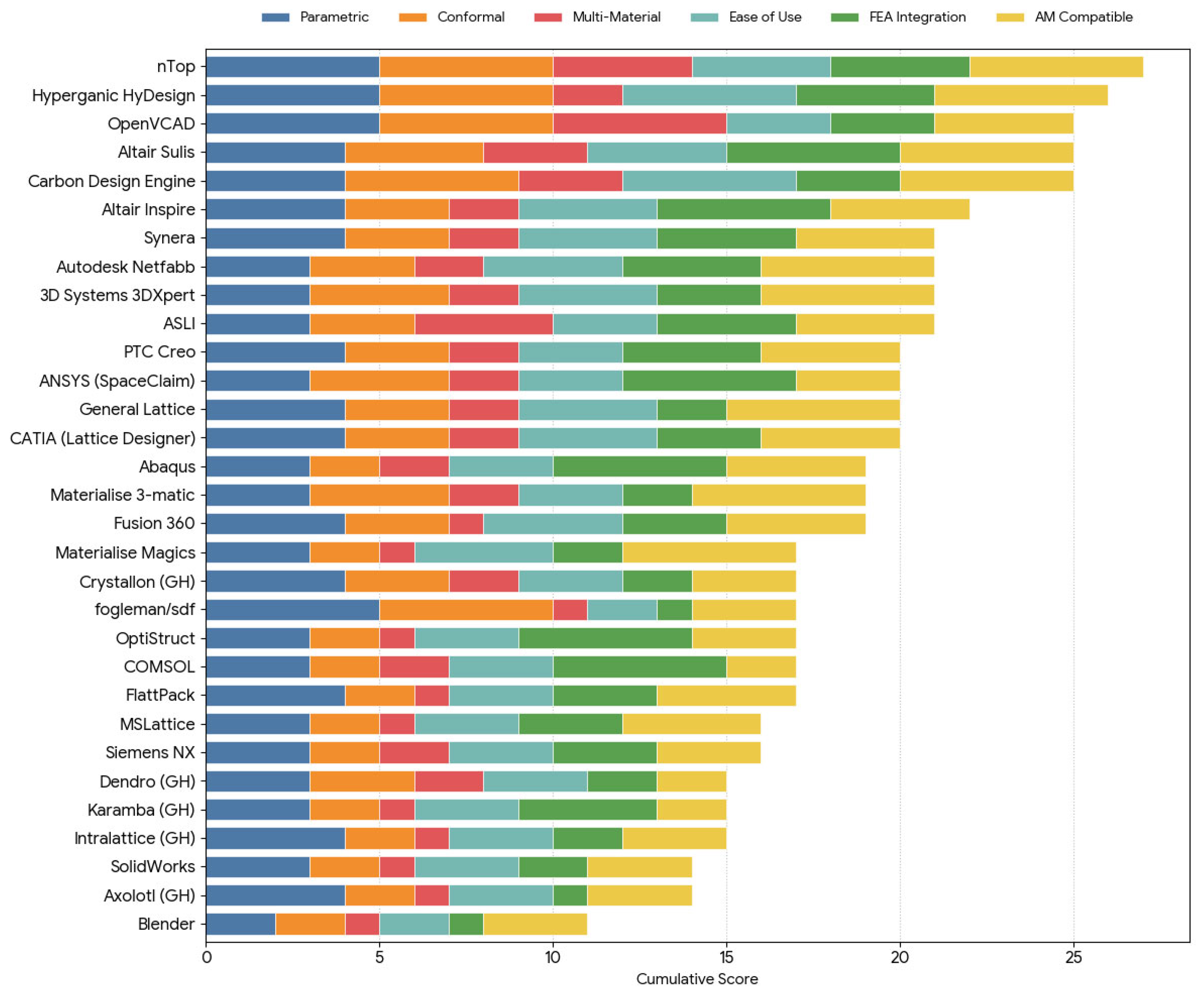
| Software | Lattice Types | Parametric | Conformal | Multi-Material | Ease of Use | FEA Integration | AM Compatible |
|---|---|---|---|---|---|---|---|
| nTop | TPMS, Strut, Custom | 5 | 5 | 4 | 4 | 4 | 5 |
| Altair Sulis | TPMS, Strut | 4 | 4 | 3 | 4 | 5 | 5 |
| Carbon Design Engine | Various | 4 | 5 | 3 | 5 | 3 | 5 |
| Synera | TPMS, Strut (via partner) | 4 | 3 | 2 | 4 | 4 | 4 |
| Hyperganic HyDesign | TPMS, Custom | 5 | 5 | 2 | 5 | 4 | 5 |
| Autodesk Netfabb | Strut, Unit Cell Lib. | 3 | 3 | 2 | 4 | 4 | 5 |
| 3D Systems 3DXpert | Strut, Conformal | 3 | 4 | 2 | 4 | 3 | 5 |
| Materialise Magics | Strut, Unit Cell Lib. | 3 | 2 | 1 | 4 | 2 | 5 |
| Materialise 3-matic | Strut, Conformal | 3 | 4 | 2 | 3 | 2 | 5 |
| General Lattice | Strut, Custom | 4 | 3 | 2 | 4 | 2 | 5 |
| Fusion 360 | TPMS, Volumetric | 4 | 3 | 1 | 4 | 3 | 4 |
| PTC Creo | Strut, GTO | 4 | 3 | 2 | 3 | 4 | 4 |
| SolidWorks | Strut, Limited TPMS | 3 | 2 | 1 | 3 | 2 | 3 |
| Siemens NX | TPMS, Strut | 3 | 2 | 2 | 3 | 3 | 3 |
| CATIA (Lattice Designer) | TPMS, Strut | 4 | 3 | 2 | 4 | 3 | 4 |
| Altair Inspire | TPMS, Strut | 4 | 3 | 2 | 4 | 5 | 4 |
| OptiStruct | Density-based | 3 | 2 | 1 | 3 | 5 | 3 |
| ANSYS (SpaceClaim) | Custom, Conformal | 3 | 4 | 2 | 3 | 5 | 3 |
| COMSOL | Custom (scripting) | 3 | 2 | 2 | 3 | 5 | 2 |
| Abaqus | Integrated Module | 3 | 2 | 2 | 3 | 5 | 4 |
| ASLI | TPMS | 3 | 3 | 4 | 3 | 4 | 4 |
| FlattPack | TPMS | 4 | 2 | 1 | 3 | 3 | 4 |
| OpenVCAD | Lattice, TPMS, Custom | 5 | 5 | 5 | 3 | 3 | 4 |
| MSLattice | TPMS | 3 | 2 | 1 | 3 | 3 | 4 |
| Crystallon (GH) | TPMS, Strut | 4 | 3 | 2 | 3 | 2 | 3 |
| Axolotl (GH) | TPMS (Isosurface) | 4 | 2 | 1 | 3 | 1 | 3 |
| Intralattice (GH) | TPMS, Strut | 4 | 2 | 1 | 3 | 2 | 3 |
| Dendro (GH) | Volumetric | 3 | 3 | 2 | 3 | 2 | 2 |
| Karamba (GH) | Custom/Structural | 3 | 2 | 1 | 3 | 4 | 2 |
| fogleman/sdf | Custom (SDF) | 5 | 5 | 1 | 2 | 1 | 3 |
| Blender | Voxel/Custom | 2 | 2 | 1 | 2 | 1 | 3 |
Disclaimer/Publisher’s Note: The statements, opinions and data contained in all publications are solely those of the individual author(s) and contributor(s) and not of MDPI and/or the editor(s). MDPI and/or the editor(s) disclaim responsibility for any injury to people or property resulting from any ideas, methods, instructions or products referred to in the content. |
© 2026 by the authors. Licensee MDPI, Basel, Switzerland. This article is an open access article distributed under the terms and conditions of the Creative Commons Attribution (CC BY) license.
Share and Cite
Prisecaru, D.A.; Ulerich, O.; Calin, A.; Paduraru, G.I. Computational Design Strategies and Software for Lattice Structures and Functionally Graded Materials. J. Compos. Sci. 2026, 10, 32. https://doi.org/10.3390/jcs10010032
Prisecaru DA, Ulerich O, Calin A, Paduraru GI. Computational Design Strategies and Software for Lattice Structures and Functionally Graded Materials. Journal of Composites Science. 2026; 10(1):32. https://doi.org/10.3390/jcs10010032
Chicago/Turabian StylePrisecaru, Delia Alexandra, Oliver Ulerich, Andrei Calin, and Georgiana Ionela Paduraru. 2026. "Computational Design Strategies and Software for Lattice Structures and Functionally Graded Materials" Journal of Composites Science 10, no. 1: 32. https://doi.org/10.3390/jcs10010032
APA StylePrisecaru, D. A., Ulerich, O., Calin, A., & Paduraru, G. I. (2026). Computational Design Strategies and Software for Lattice Structures and Functionally Graded Materials. Journal of Composites Science, 10(1), 32. https://doi.org/10.3390/jcs10010032