


Abstract
Nitrogen cycling during the biological treatment of organic waste is governed by a consortium of microorganisms whose activity determines whether nitrogen is conserved as a fertiliser resource or lost as ammonia, nitrous oxide, or dinitrogen. Composting and anaerobic digestion are the dominant biological platforms for organic waste valorisation, yet they impose contrasting selective pressures on nitrogen-cycling guilds. In composting, thermophilic conditions and fluctuating oxygen availability shape sequential communities of ammonifiers, ammonia oxidisers, and denitrifiers, with volatilisation and incomplete denitrification as principal loss pathways. In anaerobic digestion, nitrification is effectively absent and high organic nitrogen loading generates free ammonia that inhibits methanogenic archaea, constraining process stability and reshaping community structure toward ammonia-tolerant taxa. This review synthesises understanding of the functional guilds, enzymes, and regulatory genes involved in nitrogen mineralisation, nitrification, denitrification, and ammonia assimilation across both systems. It sets out the feedstock categories and regulatory frameworks that constrain treatment and product use, the operating parameters governing nitrogen retention, and the strategies used to mitigate loss, including additives, bioaugmentation, ammonia stripping, and struvite precipitation. We propose a comparative framework that positions the two systems along a shared continuum of microbial nitrogen regulation, in which redox regime determines which transformation pathways are available while pH, temperature, carbon-to-nitrogen ratio, moisture, and retention time govern the magnitude of loss. Attention is given to how upstream process outcomes determine nitrogen use efficiency and environmental risk after land application. We conclude by identifying research gaps, including paired cross-system studies, standardised molecular monitoring, field-scale validation, and harmonised quality standards.
1. Introduction
The global nitrogen cycle now operates beyond a proposed safe Earth system boundary [1]. Anthropogenic release of reactive nitrogen has risen sharply since industrialisation, driven mainly by fertiliser application and fossil fuel combustion [2]. Many regions already exceed thresholds set to protect groundwater and prevent eutrophication, whereas other regions retain scope to intensify nitrogen use safely [3]. This unevenness suggests that uniform reduction targets are unlikely to be appropriate everywhere. Strategies that recover nitrogen already present in a system may therefore be more useful than simply cutting new inputs. Biological treatment of organic waste is one such recovery strategy. Composting and anaerobic digestion convert manure, food waste, and sewage sludge into products suitable for land application, with digestate returning nitrogen, phosphorus, and potassium to agricultural soils in plant-available forms within a circular bioeconomy framing [4]. Composting achieves a comparable nutrient return through a different process pathway, and the difference between those pathways is the subject of this review.
Both processes lose nitrogen as they operate. Composting nitrogen loss occurs mainly through ammonia volatilisation and incomplete denitrification, both of which lowers final product quality and contributes to air pollution [5]. Anaerobic digestion loses nitrogen differently. Nitrogen-rich feedstocks generate free ammonia during degradation, and high concentrations can inhibit the archaea responsible for methane production [6]. This creates a direct trade-off between feedstock nitrogen content and process stability. Microbial community composition governs nitrogen fate in both systems, and microbial agents can regulate which functional guilds dominate during treatment [7]. The guilds carrying that flux are not the same in each system, since nitrification depends on oxygen and is therefore relevant to composting rather than to digestion itself, where nitrogen accumulates as total ammoniacal nitrogen [8]. This places microbial ecology, not reactor engineering alone, at the centre of nitrogen retention outcomes.
Despite this shared microbial basis, composting and anaerobic digestion research has developed separately. Composting reviews focus on aerobic nitrification and denitrification pathways [5], whereas anaerobic digestion reviews focus on ammonia toxicity thresholds and recovery methods [6]. Few reviews compare the two systems within a single analytical frame. This review addresses that gap. We treat composting and anaerobic digestion as two expressions of one underlying problem, since both require microbial communities to partition incoming nitrogen between retention and loss. The conceptual advance offered here is not a claim that the same guilds operate in both systems. It is that both systems draw on the same set of nitrogen transformation nodes, and that they differ in which of those nodes carries appreciable flux and in what constrains it. Redox regime sets which nodes are thermodynamically available, while pH, the free ammonia fraction, C/N ratio, temperature, substrate composition, and retention time govern how much nitrogen is lost through them. We compare the dominant pathways, functional genes, and mitigation strategies of each system directly. This comparison identifies which principles transfer across systems and which do not. Section 2 sets out how the literature underpinning this comparison was identified and selected.
2. Scope and Literature Selection
This review is a structured narrative synthesis rather than a systematic review, and the basis on which studies were identified and retained is set out here so that the scope and limits of the comparison are transparent. The literature was identified through Web of Science, Scopus, and PubMed, supplemented by forward and backward citation tracking of retained articles. Searches were conducted between June 2026 and August 2026 and updated immediately before submission. Search strings combined a treatment term with a nitrogen process term, pairing compost or composting with ammonia volatilisation, nitrous oxide, nitrification, denitrification, or nitrogen retention, and pairing anaerobic digestion, digester, or digestate with ammonia inhibition, total ammoniacal nitrogen, free ammonia, or methanogenesis. Further searches targeted functional gene markers using amoA, nxrA, nxrB, nirK, nirS, nosZ, and nifH as query terms, mitigation strategies involving biochar, zeolite, microbial inoculation, bioaugmentation, ammonia stripping, or struvite, as well as post-application performance by pairing compost or digestate with yield, nitrogen use efficiency, nitrate leaching, or phytotoxicity. Regulatory sources were identified separately by searching for the governing European Union instruments alongside comparative analyses of national compost and digestate standards.
Publications from 2020 onward were prioritised, and earlier work would have been retained only where it provided foundational evidence for which no updated equivalent existed. In the event, no pre-2020 source met that condition, and every study cited here dates from 2020 or later. Peer-reviewed primary studies, meta-analyses, and reviews reporting quantitative nitrogen measurements, molecular or functional gene data, or field performance data were eligible for inclusion. Preference was given to primary experimental studies where a quantitative claim could be traced to a specific measurement, with reviews and meta-analyses used for synthesised effect sizes and for framing. Conference abstracts, preprints, non-peer-reviewed reports, and studies reporting no nitrogen-specific outcome were excluded. Screening proceeded from title and abstract to full text, and retained studies were read in full before any quantitative value was carried into the text or tables.
Three limitations follow from this approach and qualify the interpretation of the evidence presented in later sections. First, the composting and anaerobic digestion literatures were searched separately and then compared, because few studies address both systems together, so the comparison assembled here is synthetic rather than drawn from paired experiments. Second, the mitigation efficiencies reported throughout this review originate from studies differing in feedstock, reactor scale, and operating conditions, and the percentage values quoted are therefore indicative of direction and approximate magnitude rather than directly comparable across studies. Third, because screening was not conducted against a pre-registered protocol, selection reflects the judgement of the authors, and the review makes no claim to exhaustive coverage of either literature. All three limitations are returned to in Section 10.
3. Fundamentals of Microbial Nitrogen Cycling Relevant to Organic Waste Systems
Nitrogen entering a composting pile or an anaerobic digester arrives mostly as organic nitrogen bound in protein, amino acids, and nucleic acids. Heterotrophic bacteria convert this organic nitrogen to ammonia through mineralisation, also called ammonification [7]. This step does not depend on a single dedicated enzyme system. It results instead from the combined proteolytic and deaminating activity of diverse heterotrophs degrading organic matter for carbon and energy [7]. Once ammonium accumulates, its fate diverges depending on oxygen availability. Under aerobic conditions, ammonia-oxidising bacteria and ammonia-oxidising archaea perform the first and rate-limiting step of nitrification, oxidising ammonia to hydroxylamine by means of ammonia monooxygenase, a copper-dependent membrane enzyme whose alpha subunit is encoded by amoA [9]. The archaeal and bacterial forms of this enzyme differ in subunit composition, which may partly explain why ammonia-oxidising archaea and bacteria respond differently to the same environmental conditions [9].
A third functional group, comammox Nitrospira, complicates this picture. These organisms complete the entire oxidation of ammonia to nitrate within a single cell, rather than dividing the task between separate ammonia oxidisers and nitrite oxidisers [10]. Comammox Nitrospira activity is inhibited at the high ammonium concentrations typical of nitrogen-rich waste streams [10]. This matters directly for composting and digestate systems, where ammonium routinely exceeds the concentrations under which comammox organisms lose activity. Canonical ammonia-oxidising bacteria appear to tolerate higher ammonium levels, which may explain their frequent dominance over comammox populations in manure-derived systems, although direct comparative evidence from composting and digester matrices remains limited.
Nitrite produced by ammonia oxidisers is then oxidised to nitrate by nitrite-oxidising bacteria using nitrite oxidoreductase, whose alpha and beta subunits are encoded by nxrA and nxrB, with Nitrobacter and Nitrospira differing in the cellular orientation of the enzyme [11]. Because both nitrification steps require oxygen, nitrate is generated in situ only where oxygen is available. Within an otherwise aerobic compost pile, nitrate formed in oxic zones becomes available for denitrification at anoxic microsites. In a strictly anaerobic digester, by contrast, nitrate is not generated internally and is present only when introduced with the feedstock, so denitrification is correspondingly limited. Denitrifying bacteria reduce nitrate stepwise to nitrite, nitric oxide, nitrous oxide, and finally dinitrogen gas, with the nitrite reduction step catalysed by one of two functionally interchangeable but phylogenetically distinct enzymes encoded by either nirK or nirS [12]. Organisms carrying nirK and organisms carrying nirS rarely co-occur within the same cell, and their relative abundance shifts with substrate and management conditions [12]. The final step, reduction of nitrous oxide to dinitrogen, depends on nitrous oxide reductase, encoded by nosZ. Organisms carrying nosZ are the only known biological sink for nitrous oxide [13]. This makes the nirK-to-nosZ and nirS-to-nosZ gene ratios a useful, if imperfect, indicator of whether a system is likely to emit nitrous oxide or to complete denitrification to inert dinitrogen.
A separate pathway competes directly with denitrification for the same nitrate pool. Dissimilatory nitrate reduction to ammonium, or DNRA, reduces nitrate to ammonium rather than to gaseous nitrogen [14]. DNRA tends to dominate over denitrification when organic carbon is abundant relative to nitrate, a condition common in the early, carbon-rich stages of both composting and anaerobic digestion [14]. Because DNRA retains nitrogen within the system as ammonium instead of losing it as a gas, its relative activity against denitrification has direct consequences for the nitrogen content of the finished product, a point returned to in Section 6, Section 7 and Section 9.
A less well characterised regulatory layer acts on these same guilds from outside conventional microbial ecology. Bacteriophage predation can lyse ammonifying and denitrifying bacteria and release the nitrogen held in their biomass [15]. That evidence comes from rhizosphere and paddy soils rather than from composting piles or digesters, and its relevance to engineered waste treatment conditions remains to be established. Together, these pathways of mineralisation, nitrification, nitrite oxidation, denitrification, and DNRA form the shared vocabulary used throughout this review. Which of them carries appreciable flux depends on the feedstock supplied and the conditions maintained, and Section 4 and Section 5 address these in turn before Section 6 and Section 7 examine how composting and anaerobic digestion select for different balances among them.
4. Classification, Characteristics, and Regulatory Status of Organic Feedstocks
4.1. Feedstock Categories and Nitrogen-Relevant Characteristics
Composting and anaerobic digestion draw on overlapping feedstock streams, and much of the nitrogen behaviour of each system is determined before treatment begins by the composition of the material entering it. Digestate characteristics and quality depend on the input feedstocks and on the operating conditions of the plant rather than on the digestion process alone [16]. Compost composition is governed in the same way, since the feedstock supplies both the nitrogen pool and the carbon that determines how much of that pool is immobilised rather than mineralised [5].
Five broad categories account for most material processed by either route. Livestock manures and slurries are proteinaceous and nitrogen-rich, and they arrive with a substantial fraction of their nitrogen already in ammoniacal form. Source-separated food waste and the organic fraction of municipal solid waste are readily degradable and moderately nitrogen-rich, and they dominate the municipal waste stream in many low- and middle-income settings [17]. Sewage sludge and biosolids carry high nitrogen content alongside the contaminant burden that drives their separate regulatory treatment. Crop residues and lignocellulosic green waste are carbon-rich and nitrogen-poor, and they function principally as bulking and carbon-balancing materials rather than as nitrogen sources. Agro-industrial and slaughterhouse residues are the most nitrogen-dense category and the most likely to generate inhibitory ammonia concentrations during digestion. Table 1 summarises these categories alongside their nitrogen-relevant properties and regulatory classification. The practical consequence is that feedstock choice sets the nitrogen loading and the initial speciation, while process conditions determine what happens to that nitrogen subsequently. Digestate composition varies widely as a result, and this variability constrains how far results from any single study can be generalised to other feedstocks [18].
Table 1.
Categories of organic feedstock used in composting and anaerobic digestion, their nitrogen-relevant characteristics, and their regulatory classification within the European Union. Nitrogen richness is expressed relative to the other categories rather than as an absolute threshold, since reported values vary widely with source and season [16,18]. Regulatory entries follow the Waste Framework Directive and the Fertilising Products Regulation as summarised by Prasad and Foster [19].
4.2. Regulatory Frameworks Governing Feedstock Use and Product Placement
Legal frameworks determine which feedstocks may be processed, how the resulting product is classified, and how much of it may be applied to land, and these frameworks differ substantially between jurisdictions. Within the European Union, the Waste Framework Directive, as amended in 2018, made separate collection of food and garden biowaste mandatory from December 2023, which directly affects the quality and consistency of feedstock reaching treatment facilities [19]. The Fertilising Products Regulation establishes harmonised requirements for compost and digestates placed on the internal market, and end-of-waste status allows a treated output to cease being classified as waste when it meets the relevant criteria [19]. Application rates are constrained separately. Under the Nitrates Directive the European Union caps livestock manure nitrogen, including manure-derived digestate, at 170 kg N per hectare per year in nitrate vulnerable zones, whereas the United Kingdom permits up to 250 kg N per hectare per year [18]. Limits outside vulnerable zones, and for digestates derived from non-manure feedstocks, are set nationally and may be higher. In several other major biogas-producing countries no specific application limit applies, and rates are determined case by case [18]. Heavy metals and pathogens are regulated across most of these frameworks, but no specific limits exist for antibiotics or microplastics despite their environmental significance [18]. Beneath this apparent harmonisation, national standards remain heterogeneous. A comparison of Irish compost and digestate standards against equivalent frameworks elsewhere found substantial variation in the stability and phytotoxicity testing methods used to certify a product as safe for land application [19]. This heterogeneity complicates direct comparison of product quality across studies and countries. These frameworks govern what may be processed and where the product may go, but they do not determine how nitrogen behaves during treatment. That depends on the conditions maintained inside the pile or the reactor, which Section 5 addresses.
5. Process Conditions Governing Nitrogen Transformation
5.1. Conditions Governing Nitrogen Retention During Composting
Composting performance depends on a small set of interacting parameters that together determine microbial activity and the partitioning of nitrogen between retention and loss. A meta-analysis of 123 biochar-amended composting studies recommended a carbon-to-nitrogen ratio of 20 to 30, a moisture content of 55% to 65%, a pH of 7.5 to 8.5, an electrical conductivity below 4 mS per cm, and a biochar dose of 10% to 20% by dry weight as the parameter set giving the most reliable trace gas mitigation [20]. These values describe conditions under which loss is minimised rather than thresholds beyond which the process fails, since composting proceeds across a considerably wider range. The carbon-to-nitrogen ratio is the parameter most directly tied to nitrogen fate, because it determines whether incoming nitrogen is assimilated into microbial biomass or released as ammonium in excess of microbial demand. Biochar’s ammonia mitigation was strongest where the ratio exceeded 30, which is consistent with carbon limitation restraining mineralisation, while low ratios leave surplus nitrogen available for volatilisation [20]. Moisture content operates less directly, since it governs the distribution of oxygen through the pore network and therefore determines how much of the pile interior remains anoxic, which in turn shapes the balance between nitrification and denitrification described in Section 3.
Temperature and pH act together on the ammonia equilibrium. The thermophilic phase raises both, and ammonia volatilisation during composting is driven by this combination rather than by either factor alone [5]. Conditions below pH 7.5 also reduce the mitigating effect of biochar, so pH influences not only the loss pathway itself but the efficacy of the interventions used against it [20]. Aeration rate, particle size, and process duration modify these effects by controlling oxygen supply and the duration of the thermophilic phase, and the composting microflora shifts across that phase sequence in the pattern described in Section 6.
5.2. Conditions Governing Nitrogen Behaviour During Anaerobic Digestion
Anaerobic digestion is configured against a different set of constraints, because the limiting concern is not nitrogen loss to the atmosphere but inhibition of the methanogenic community by nitrogen retained in the liquid phase. Digestion proceeds across a pH range of approximately 5.5 to 8.5, but methanogens are sensitive to pH and perform best near neutrality [21]. A carbon-to-nitrogen ratio of 20 to 30 is likewise favourable, and continuous stirred-tank reactors are typically operated at hydraulic retention times of 10 to 25 days, with organic loading rate and retention time adjusted together to prevent volatile fatty acid accumulation [21]. Temperature regime interacts with nitrogen behaviour in a way that has no direct composting equivalent. Thermophilic operation accelerates hydrolysis and ammonification, but it also shifts the ammonia equilibrium toward the un-ionised free ammonia species that is toxic to methanogens, so the same temperature increase that improves conversion rate raises inhibition risk [6]. Free ammonia concentration rather than total ammoniacal nitrogen is therefore the operationally meaningful variable, and it is set jointly by total ammoniacal nitrogen, pH, and temperature rather than by nitrogen loading alone. The tolerance limits of the microbial community to this accumulation are not fixed, as Section 7 describes.
5.3. Parameters Common to Both Systems
Table 2 sets these parameter ranges side by side. What the comparison shows is that composting and anaerobic digestion are configured differently on largely the same variables. Both operate within a similar carbon-to-nitrogen window, both are sensitive to pH and temperature, and in both systems the ammonia equilibrium responds to pH and temperature in the same direction. The difference lies in the consequence of that response, since in composting a shift toward free ammonia produces atmospheric loss while in digestion it produces process inhibition. This matters for how the comparative framework in Section 8 should be read. The pathways available differ between the two systems, but the magnitude of nitrogen loss or inhibition within either is governed by this shared parameter set. Oxygen availability alone therefore does not account for the divergent nitrogen behaviour of the two systems, a qualification developed further in Section 8.
Table 2.
Operating parameters governing nitrogen transformation in composting and anaerobic digestion, with the principal nitrogen consequence of each. Composting ranges are those recommended for reliable trace gas mitigation in a meta-analysis of 123 biochar-amended composting studies [20]. Anaerobic digestion ranges follow reported operating practice for organic solid waste [21]. Values indicate conditions favourable to nitrogen retention or process stability rather than absolute operating limits.
6. Nitrogen Cycling in Composting
6.1. Nitrogen Transformation Across Composting Phases
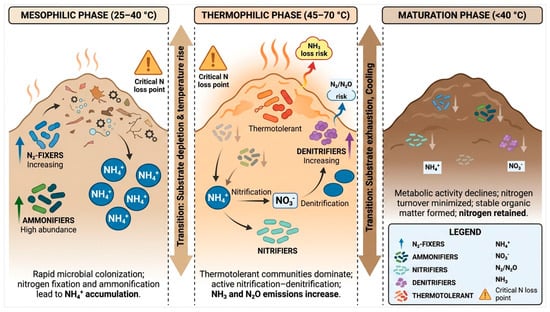
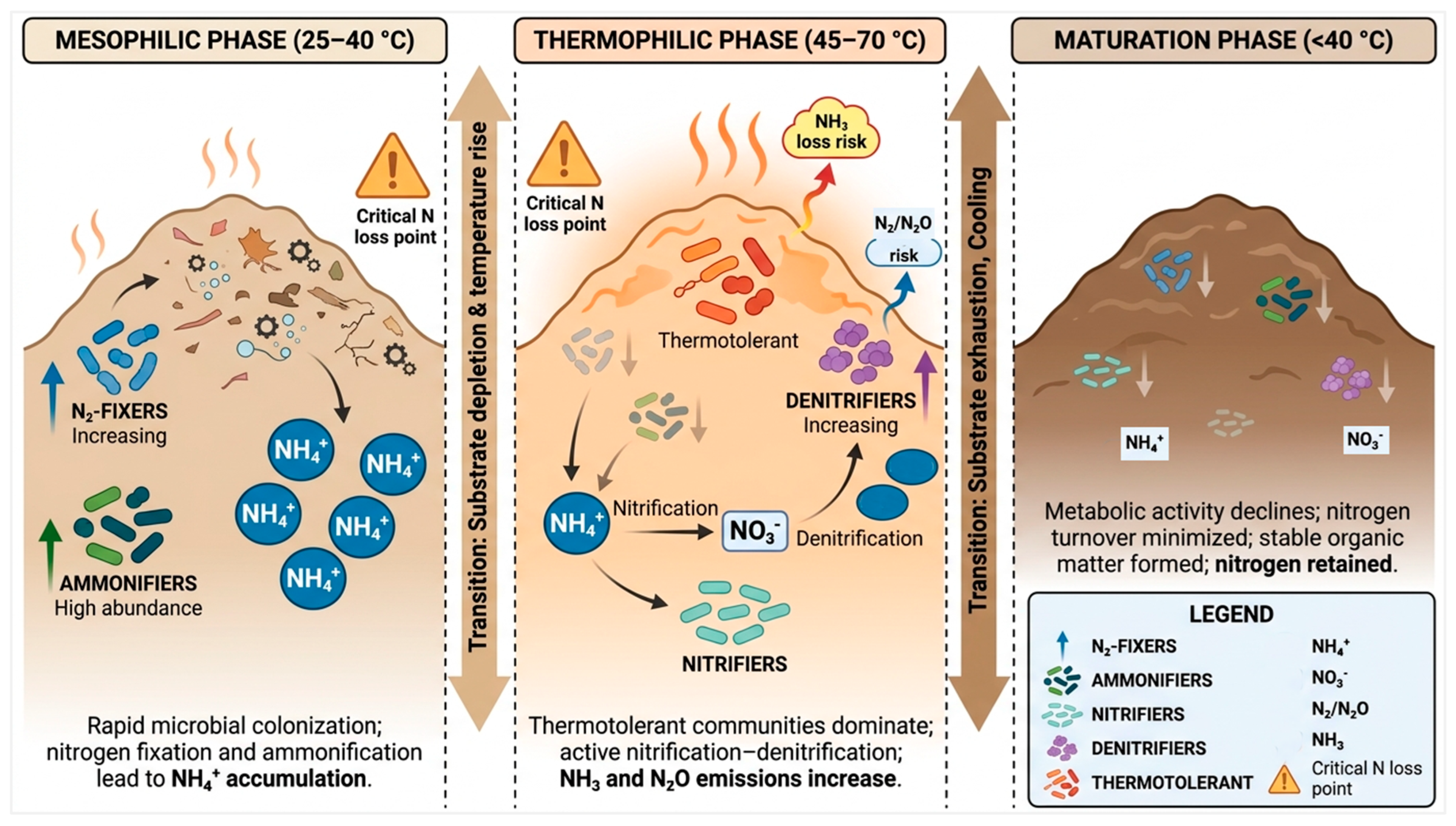
Composting proceeds through a sequence of thermally defined phases, and the microbial populations responsible for nitrogen transformation shift markedly across this sequence. During the mesophilic phase, populations associated with nitrogen fixation, nitrate reduction, and ammonification increase in relative abundance, then decline as the pile enters the thermophilic phase while populations associated with denitrification continue to increase [22]. By the maturation phase, denitrification-associated populations also decline, alongside most other nitrogen-transforming guilds, as the system stabilises [22]. This pattern means that the risk of nitrogen loss is not constant across a composting cycle but concentrated at specific transitions, particularly the shift into and out of the thermophilic phase. Figure 1 summarises this phase-dependent succession alongside the corresponding shifts in functional gene abundance.
Figure 1.
Nitrogen transformation across the mesophilic, thermophilic, and maturation phases of composting. The figure tracks the relative abundance of functional guilds associated with nitrogen fixation, ammonification, nitrification, and denitrification across the three phases, showing the rise of nitrogen-fixing and ammonifying populations in the mesophilic phase, their decline alongside a rise in denitrifying populations through the thermophilic phase, and the general decline of all nitrogen-transforming guilds by maturation [22]. Points of ammonia volatilisation risk and nitrous oxide emission risk are marked at the phase transitions where they are most pronounced [5].
6.2. Functional Microbial Guilds and Gene Abundance Dynamics
Manipulating the composition of the microbial community can shift this succession toward greater nitrogen retention. Inoculating pig and chicken manure compost with a mixed Bacillus and Saccharomyces cerevisiae consortium increased the abundance of amoA, nxrA, and nifH gene copies while simultaneously reducing the abundance of nirK, nirS, and nosZ genes [23]. This shift toward ammonia oxidation and nitrogen fixation genes, and away from denitrification genes corresponded to a 9% increase in total nitrogen content in the finished compost [23]. Because nirK, nirS, and nosZ declined together, this result is best read as a contraction of the denitrifying guild as a whole rather than as a change in the nirK-to-nosZ or nirS-to-nosZ ratio introduced in Section 3, and a smaller denitrifying population offers less capacity to convert nitrate to gaseous products of any kind. Gene abundance indexes the genetic potential for a transformation rather than the flux carried, and the absence of standardised quantification methods for compost matrices, discussed in Section 10, limits how far such ratios can be compared between studies.
6.3. Nitrogen Loss Pathways: Ammonia Volatilisation and N2O Emission
The dominant nitrogen loss pathways in composting are ammonia volatilisation, driven by the high pH and elevated temperature of the thermophilic phase, and nitrous oxide emission, arising from incomplete denitrification at anoxic microsites within an otherwise aerobic pile [5]. In an unamended kitchen waste compost, ammonium nitrogen loss during the thermophilic phase reached 42.6% [24]. The relative magnitude of these two pathways depends heavily on aeration and moisture management, which determine how much of the pile interior remains anoxic despite bulk aerobic conditions, as set out in Section 5.
6.4. Mitigation Strategies
Physical additives are among the most consistently effective interventions for reducing composting nitrogen loss, although the reported magnitude of that effect varies between synthesised estimates. A global meta-analysis of 125 studies found that biochar amendment reduced nitrous oxide emissions by 43.49% and ammonia emissions by 47.59%, while also lowering the finished compost’s ammonium nitrogen content by 34.96% and raising its nitrate nitrogen content by 32.54% [25]. A separate meta-analysis of 123 studies reported reductions of 49.8% for nitrous oxide and 35.9% for ammonia, together with a 41.3% reduction in total nitrogen loss [20]. The two syntheses agree on the direction of the effect but differ substantially on its magnitude, particularly for ammonia, which illustrates that percentage efficiencies drawn from studies differing in feedstock, dose, scale, and operating conditions should be read as indicative rather than as directly comparable quantities.
Combining biochar with zeolite produces an additional effect beyond either amendment alone. In kitchen waste composting, a combined biochar-and-zeolite treatment reduced ammonium nitrogen loss during the thermophilic phase to 31.3%, compared with 42.6% in an unamended control, while increasing the abundance of microorganisms associated with nitrification genes and decreasing those associated with denitrification genes [24]. The mechanism appears to be partly physical, since the porous structure of biochar and zeolite adsorbs inorganic nitrogen directly, and partly microbial, since the same amendments reshape the balance between nitrifying and denitrifying guilds [24]. This result comes from a single bench-scale kitchen waste trial, and whether the same combined effect holds at operational scale or with other feedstocks remains to be established. Microbial inoculation, discussed above for its effect on gene abundance, functions as a complementary biological strategy alongside these physical additives rather than a substitute for them. Table 3 sets out these composting strategies alongside their anaerobic digestion counterparts, with feedstock and scale reported for each so that the efficacy values are read in context.
Table 3.
Mitigation and recovery strategies applicable to composting and anaerobic digestion, with mechanism of action, feedstock, scale, and reported efficacy. Reported efficacy is not directly comparable across rows. The feedstock and scale behind each are given in the third column.
7. Nitrogen Cycling in Anaerobic Digestion
7.1. Nitrogen Loading, Ammonia Generation, and Free Ammonia Toxicity
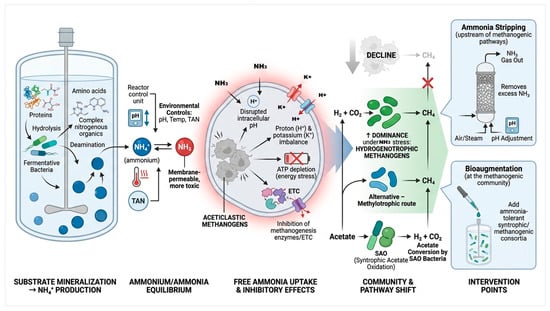
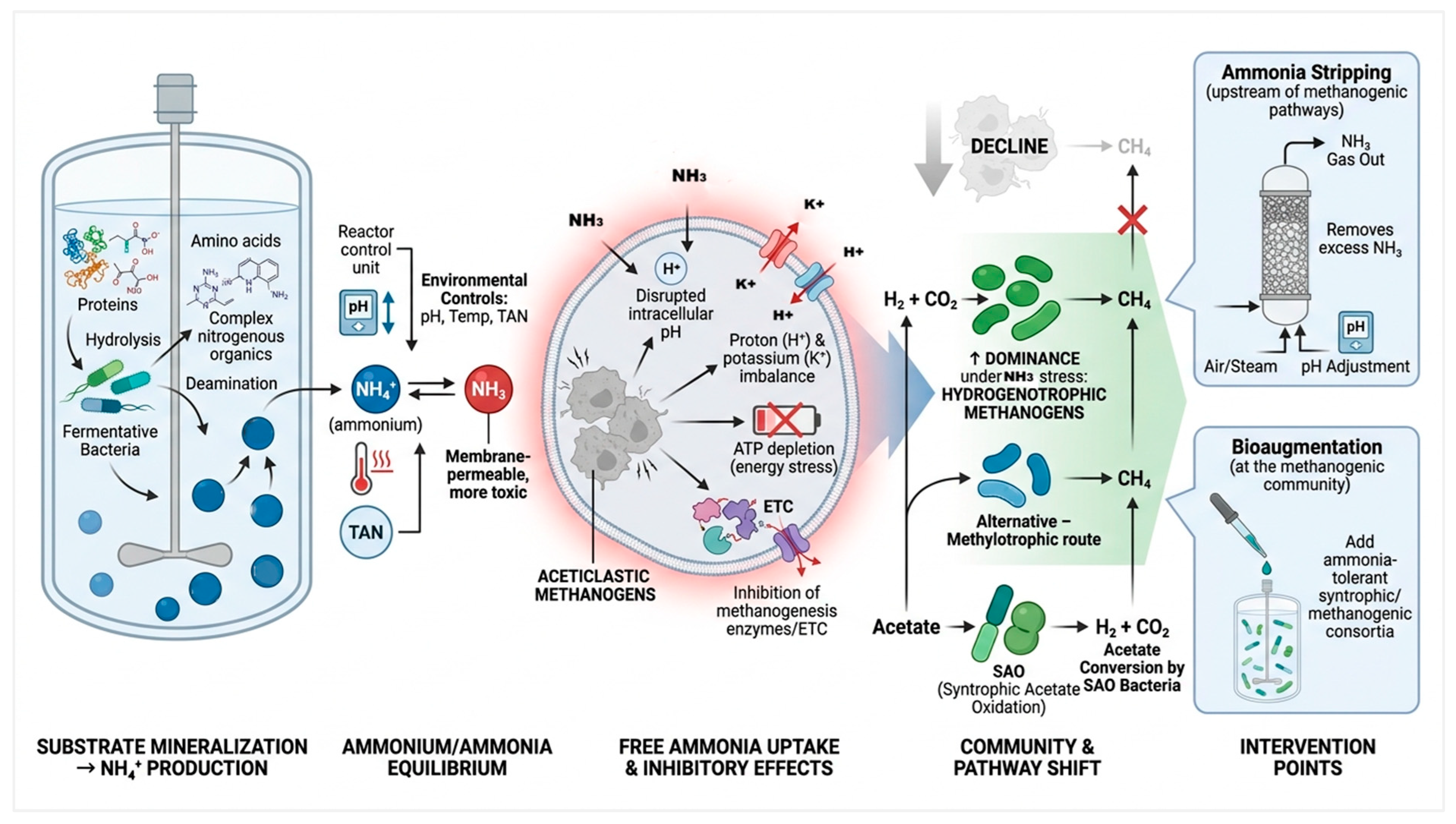
Anaerobic digestion is frequently applied to the same nitrogen-rich feedstocks favoured for composting, including livestock manure and food waste, because these substrates also offer high energy content for biogas production [21]. This overlap in feedstock creates a shared vulnerability. As organic nitrogen mineralises inside the digester, total ammoniacal nitrogen accumulates steadily, and a portion of this pool exists as un-ionised free ammonia, which is the more toxic species toward methanogens [6]. The size of that fraction is set by pH and temperature as well as by nitrogen loading, as described in Section 5. Digester communities are not fixed in their tolerance to this accumulation. Batch reactors adapted over more than 20 months reached ammonium concentrations of 20 g NH4+-N per litre without acidification or loss of methane production [8]. This adaptation was tracked at the strain level, showing that lineages of the hydrogenotrophic archaeon Methanoculleus bourgensis, alongside the putative syntrophic acetate oxidiser Acetomicrobium, accumulated positively selected mutations under sustained ammonia pressure rather than being replaced wholesale by different taxa [8]. Both the timescale and the matrix qualify this result, since adaptation achieved over more than 20 months in mesophilic batch reactors fed a synthetic casein medium does not indicate that a full-scale reactor treating real feedstock under variable loading would tolerate comparable concentrations. Figure 2 illustrates this inhibition pathway and the points at which the mitigation strategies discussed below intervene.
Figure 2.
Mechanistic overview of ammonia inhibition during anaerobic digestion and adaptive methanogenic pathway shifts. The figure traces the pathway from organic nitrogen mineralisation to free ammonia accumulation, its action on methanogenic archaea, and the resulting shift in dominant methanogenic pathway from aceticlastic toward hydrogenotrophic and methylotrophic routes under ammonia stress [28]. Points of intervention for bioaugmentation and ammonia stripping are marked at the corresponding stages of the pathway, with stripping shown as transfer of ammonia to the gas phase for capture in an acid absorber rather than as a precipitation step [8].
7.2. Microbial Community Shifts and Ammonia-Tolerant Taxa
The mechanism by which ammonia inhibits methanogenesis has been resolved in some detail for Methanosarcina barkeri, a species commonly dominant in ammonia-stressed digesters. Rising total ammoniacal nitrogen triggers upregulation of genes involved in nitrogen acquisition and assimilation, with transcription of some methanogenesis genes also increasing during the initial stages of exposure [28]. Ammonia tolerance differs by methanogenic pathway within the same organism. Aceticlastic methanogenesis is more sensitive to rising ammonia than hydrogenotrophic or methylotrophic methanogenesis [28]. This pathway-specific sensitivity helps explain why ammonia-stressed digesters commonly shift toward hydrogenotrophic methanogens as the dominant route to methane, since this pathway tolerates higher free ammonia concentrations than the acetate-splitting route it displaces. This mechanism has been characterised in a single species, and the extent to which it generalises across the methanogenic community remains to be established.
7.3. Strategies for Ammonia Inhibition Mitigation
Because digester communities can adapt to elevated ammonia given sufficient time, deliberately accelerating this adaptation through bioaugmentation is one of the most direct mitigation strategies available. Introducing a nondomesticated mixed microbial consortium into an ammonia-inhibited continuous stirred-tank reactor fully counteracted the ammonia toxicity effect on methane production, with the bioaugmented methanogens establishing a fourfold increase in abundance relative to the unaugmented control [26]. This is consistent with the introduced culture outcompeting the resident community rather than merely coexisting with it, although abundance of data alone do not establish displacement. A 36% improvement in methane production was reported for commercial-scale application, but this figure is an extrapolation from laboratory data rather than a measured full-scale outcome [26].
A separate mitigation strategy removes nitrogen from the system rather than building microbial tolerance to it. Ammonia stripping physically recovers nitrogen from digestate before or after digestion, transferring ammonia to the gas phase where it is captured in an acid absorber, typically as an ammonium salt. A full-scale air-bubble stripping reactor treating livestock manure digestate recovered ammonia without any alkaline reagent dosing, since the pH of the digestate rose spontaneously to 10 under the tested operating conditions [27]. Stripping efficiency in this system improved with higher temperature and greater airflow, reaching its best-tested performance at 68 °C [27]. Unlike bioaugmentation, which preserves nitrogen within the digester as a resource for the finished digestate, stripping actively removes nitrogen from the system, producing a separate recoverable ammonia stream while lowering the nitrogen content of the digestate itself. This distinction matters for the downstream agronomic value of the digestate discussed in Section 9, since the two strategies pull in opposite directions with respect to how much nitrogen ultimately reaches the field. Efficiencies reported for both strategies derive from different reactor configurations and scales. Table 3 records the feedstock and scale behind each figure.
8. Comparative Synthesis: Composting vs. Anaerobic Digestion as Nitrogen-Regulating Systems
Composting and anaerobic digestion operate at opposite ends of the same redox axis, and that difference determines which nitrogen transformation pathways are thermodynamically available in each. Composting maintains bulk aerobic conditions that favour ammonia oxidation and, at anoxic microsites, incomplete denitrification, so its dominant loss pathway is gaseous, split between ammonia volatilisation and nitrous oxide emission (Table 4). Anaerobic digestion excludes oxygen entirely, which removes nitrification as a pathway altogether and instead concentrates nitrogen as accumulating free ammonia, a liquid-phase toxicant rather than a gas-phase loss. Where composting loses nitrogen mostly to the atmosphere during active decomposition, anaerobic digestion retains nitrogen within the digestate but risks losing the process itself, since sufficient free ammonia can suppress methanogenesis before nitrogen ever leaves the system.
Table 4.
Comparative summary of nitrogen transformation in composting and anaerobic digestion, based on primary experimental studies. Entries are drawn from studies differing in feedstock and scale and describe system behaviour under the conditions reported rather than general thresholds. Mitigation efficacies are given separately in Table 3.
Redox regime alone does not determine how much nitrogen is lost. The magnitude of loss in either system depends on the parameters set out in Section 5, since pH and temperature govern the free ammonia fraction in both, the carbon-to-nitrogen ratio determines how much nitrogen exceeds microbial demand, and moisture and aeration determine how much of a compost pile remains anoxic despite bulk aerobic conditions. Two facilities running the same process under different conditions can therefore produce substantially different nitrogen outcomes, and the divergence between composting and digestion should be read as a difference in available pathways rather than as a complete explanation of observed nitrogen behaviour.
This contrast carries through to the mitigation strategies each system favours. Composting mitigation strategies work by either adsorbing nitrogen physically, as biochar and zeolite do, or by shifting the balance of functional genes toward ammonia oxidation and away from denitrification through microbial inoculation (Section 6.4). Anaerobic digestion mitigation strategies instead work by either building microbial tolerance to the ammonia already present, through bioaugmentation with ammonia-adapted consortia, or by physically removing ammonia from the liquid phase through stripping (Section 7.3). Despite this surface difference, the two mitigation logics are not as distinct as they first appear. Both composting’s microbial inoculation and anaerobic digestion’s bioaugmentation intervene at the level of community composition, deliberately introducing or enriching a functional guild rather than relying on the resident community to adapt unassisted. Both biochar-and-zeolite addition in composting and ammonia stripping in anaerobic digestion intervene at the physical level, removing or immobilising nitrogen rather than working through microbial metabolism at all. Figure 2 marks where both classes of intervention act within the digestion pathway, while Figure 1 shows the corresponding phase-dependent points where composting’s physical and microbial interventions are best timed.
Recognising this shared structure has practical implications beyond the two systems considered in isolation. Since composting and anaerobic digestion often treat feedstocks from the same agricultural or municipal waste streams, several facilities now sequence the two processes rather than choosing between them, typically digesting the readily degradable fraction of a waste stream first and composting the digestate afterward to stabilise it further and recover additional nutrient value [29]. This integrated approach implicitly treats composting and anaerobic digestion as complementary stages of one nitrogen-regulating system rather than as competing technologies, which is consistent with the framework proposed in this review. Table 4 sets the two systems side by side across their dominant transformations, functional guilds, loss pathways, and reported adaptation limits.
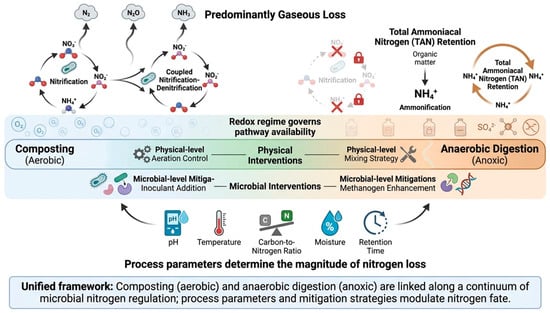
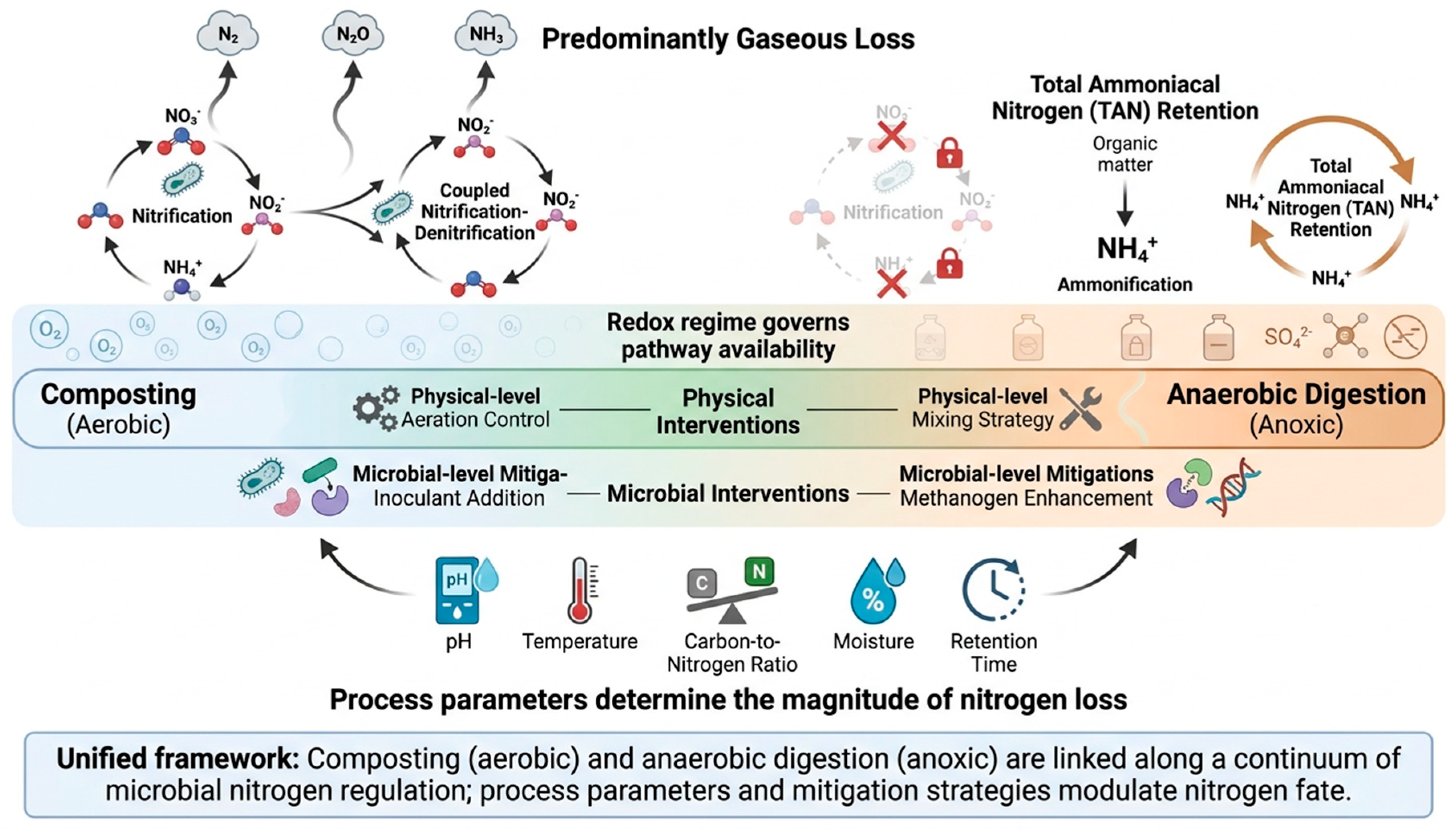
Figure 3 makes this framework explicit. Rather than presenting composting and anaerobic digestion as two unrelated case studies, the figure positions both along a shared continuum defined by redox regime and the nitrogen transformation nodes that regime makes available, with the parameters that modulate loss magnitude shown as modifiers acting on both systems. Composting occupies the aerobic region, where nitrification and coupled nitrification–denitrification carry appreciable flux, and anaerobic digestion occupies the anoxic region, where those nodes are effectively closed and ammonification dominates, with mitigation strategies from Table 3 mapped onto the continuum according to whether they intervene physically or microbially. This positioning is the review’s central comparative claim, that the two most common biological treatments for organic waste nitrogen are not separate technologies requiring separate literatures, but two operating points on one underlying regulatory system that draws on the same set of transformation nodes introduced in Section 3. The claim is not that the same functional guilds are active in both systems, since the guilds carrying flux differ, but that the same transformation nodes define the space within which each system operates and that the parameters governing flux through those nodes are largely shared.
Figure 3.
Unified conceptual framework integrating composting and anaerobic digestion along a continuum of microbial nitrogen regulation. Composting occupies the aerobic region of the continuum, where nitrification and coupled nitrification–denitrification carry appreciable flux and loss is predominantly gaseous. Anaerobic digestion occupies the anoxic region, where those nodes are effectively closed, ammonification dominates, and nitrogen is retained as total ammoniacal nitrogen [8]. Process parameters including pH, temperature, carbon-to-nitrogen ratio, moisture, and retention time are shown as modifiers acting on both systems, since redox regime determines which pathways are available while these parameters determine the magnitude of loss through them [20,21]. Mitigation strategies are mapped onto the continuum according to whether each intervenes at the physical or microbial level [29].
9. From Process to Product: Nitrogen Recovery and Agronomic Valorisation
9.1. Nitrogen Retained Through Treatment
Everything discussed in Section 6, Section 7 and Section 8 ultimately determines a single practical outcome, how much of the nitrogen that entered a compost pile or digester is still present, in a plant-available form, when the finished product leaves the treatment system. This retained fraction is not fixed by feedstock nitrogen content alone. It is the net result of the balance between the microbial pathways that conserve nitrogen, such as ammonia oxidation and DNRA, and those that lose it, such as volatilisation and denitrification, discussed throughout Section 6 and Section 7. Digestate in particular carries a distinct nitrogen profile compared with compost, since anaerobic conditions favour retention of nitrogen as ammonium rather than its oxidation to nitrate, and this ammonium-dominant profile has direct consequences for how the product performs once applied to soil [4].
Biological treatment is not the only route to a usable nitrogen product from organic waste. The ammonia stripping strategy introduced in Section 7 recovers nitrogen physically rather than biologically, transferring ammonia to the gas phase for capture in an acid absorber, most commonly as an ammonium sulfate solution [30]. Struvite precipitation is a separate recovery route rather than a subsequent step. Struvite is a crystalline mineral composed of equimolar magnesium, ammonium, and phosphate, so its formation requires suitable magnesium and phosphate sources alongside the ammonium already present, and magnesium addition is usually necessary because digestate is typically magnesium limited relative to the stoichiometric requirement. Precipitation is strongly pH dependent, and the technology is used principally for phosphorus recovery rather than as a primary route to nitrogen [30]. A field trial applying wastewater-recycled struvite to a wheat–soybean double-crop system reported crop performance comparable to conventional mineral fertiliser sources, although nitrogen and magnesium were not balanced across the phosphorus treatments in that experiment, so it does not establish nitrogen equivalence [31]. What these two routes share is that nitrogen removed from a digester need not leave the nutrient economy. What separates them is the product recovered, the reagent requirement, and which nutrient each principally targets, and the two should not be collapsed into a single stripping-to-struvite pathway.
9.2. Agronomic Performance as a Biofertiliser
Field evidence indicates that both compost and digestate can perform comparably to synthetic fertiliser, though not always to the same degree or through the same nitrogen pathway. A four-year field trial in southern Germany found that digestate applied at up to 265 kg N ha−1 increased winter wheat yield by 53% to 83% relative to an unfertilised control [32]. A meta-analysis of 40 fertilisation experiments worldwide placed the mean apparent nitrogen fertiliser replacement value of digestate at 0.78, significantly below mineral fertiliser, and found that individual observations ranged from below zero to above unity, a variability only partly explained by digestate and soil characteristics [33]. Digestate nitrogen is therefore high in value for an organic fertiliser but neither equivalent to mineral nitrogen nor reliably predictable from feedstock alone.
A three-year field experiment with subsurface drip-irrigated tomato tested food waste and green waste composts across a range of compost rates and mineral nitrogen levels using 15N-labelled fertiliser. In the second and third years, both composts maintained or increased yield relative to no compost where mineral nitrogen was withheld or supplied at 70% of the recommended rate, indicating that compost substituted for part of the mineral nitrogen requirement [34]. Nitrogen use efficiency in the compost treatments was nevertheless lower than in the no-compost treatments at the 70% and 85% nitrogen levels, which is consistent with compost acting as a slow-release nitrogen source and priming soil nitrogen mineralisation rather than delivering nitrogen on the same timescale as mineral fertiliser [34]. The practical implication is that compost can reduce mineral nitrogen requirement without necessarily improving the efficiency with which applied nitrogen is recovered in the same season.
Evidence from multi-year field trials also cautions against assuming that amendment benefits demonstrated during treatment carry through to the field. In a three-year field experiment, biochar mixed with cattle slurry before application consistently reduced crop yield and nitrogen uptake, with the reductions reaching significance in the third year and nitrogen use efficiency declining significantly, while biochar applied alone produced no yield effect in any year [35]. A four-year organic field study of biochar and compost amendments similarly found that yield responses were confined to the first trial year, although soil organic carbon stocks increased across all treatments [36]. These trials test biochar as a soil amendment applied with organic fertiliser rather than as a composting additive, so they do not contradict the emission reductions reported for biochar-amended composting in Section 6.4. What they indicate is that benefits established at the treatment stage should not be assumed to transfer to agronomic performance after land application, since the two are measured in different compartments and over different timescales.
A separate 15N-labelling study tracing manure compost, urea, and maize root residue simultaneously found that wheat nitrogen use efficiency from manure compost was comparable to that from maize root residue, at approximately 29%, while urea achieved a higher nitrogen use efficiency of 55% in total wheat biomass [37]. This gap does not necessarily indicate that compost nitrogen is agronomically inferior overall, since compost nitrogen release is slower and more gradually synchronised with crop uptake across a season, but it does mean that a grower substituting compost for urea on a nitrogen-equivalent basis should not expect an identical short-term recovery rate.
9.3. Nitrate Leaching, Nitrous Oxide Risk, and Phytotoxicity
The agronomic value of compost and digestate depends on product maturity, and immature material carries risks that a finished, stable product does not. A survey of municipal solid waste compost samples found that a high proportion were immature by germination index standards [38]. Applying immature compost or digestate to soil risks nitrogen immobilisation and phytotoxic effects on germinating seedlings, effectively working against the nitrogen retention gains described in Section 9.1 by making the retained nitrogen temporarily unavailable or actively harmful to the crop it was meant to feed.
Beyond maturity, the nitrogen product’s origin also shapes its post-application environmental footprint. A field comparison applying urea, compost, and digestate side by side to tropical pasture reported the highest nitrous oxide emission under the digestate treatment and the lowest under compost, whose emission intensity was comparable to that of an unfertilised control [39]. Compost may also alter the fate of the mineral nitrogen applied alongside it, since the same three-year tomato experiment reported retention of fertiliser nitrogen in the compost-amended treatments [34]. A separate field comparison of raw dairy manure composted dairy manure, and synthetic fertiliser on leachate water quality under corn found that treatment source shaped nutrient concentrations reaching the leachate, underscoring that composting itself, not just the choice between organic and synthetic nitrogen, measurably altering the downstream water-quality outcome [40]. Taken together, these two comparisons suggest that composting’s stabilisation of nitrogen, which lowers the ammonium-dominant, readily mineralisable pool that digestate retains, may carry a real environmental payoff after land application, not just a processing-stage one, although both comparisons are single-site field trials and the magnitude of that difference is likely to be site and climate dependent.
9.4. Toward Integrated Nitrogen Management
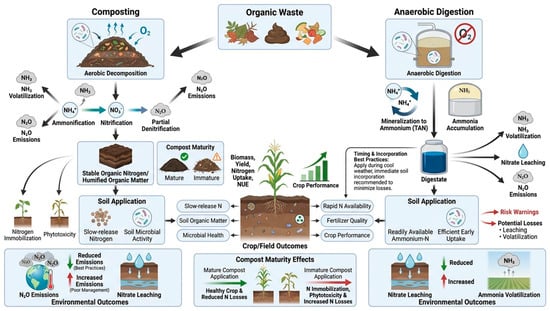
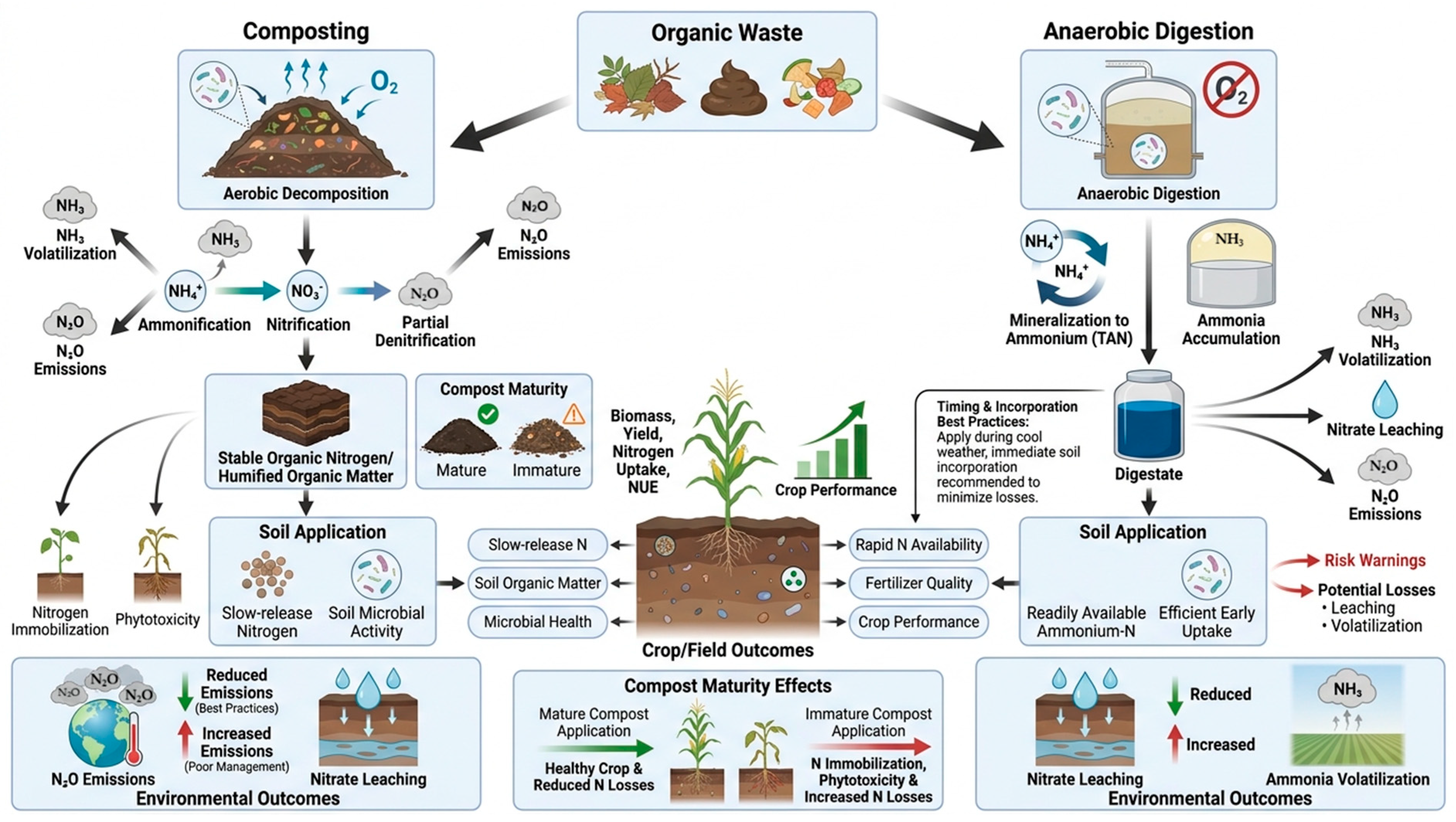
These process-to-product linkages support the case for treating composting and anaerobic digestion as complementary rather than competing, a theme introduced in Section 8. Facilities that sequence anaerobic digestion followed by composting of the digestate can recover energy from the readily degradable fraction of a waste stream while using composting to stabilise the remaining material and reduce the phytotoxicity and nitrous oxide risks just described [29]. Figure 4 closes the comparative framework introduced in Figure 3 by mapping this full pathway, from feedstock nitrogen through microbial process outcome to finished product nitrogen use efficiency and environmental risk.
Figure 4.
Integrated synthesis linking microbial nitrogen transformations during composting and anaerobic digestion to fertiliser quality, agronomic nitrogen use efficiency, and environmental outcomes following land application. The figure traces two parallel pathways, one for compost and one for digestate, each showing how the balance of retention and loss pathways established during treatment carries through to field-level nitrogen use efficiency [32,33], post-application nitrous oxide and leaching risk [39,40], and the maturity-dependent risk of nitrogen immobilisation or phytotoxicity upon land application [38].
10. Knowledge Gaps and Future Directions
10.1. Cross-System Microbiome Comparison
The comparative framework developed in Section 8 rests on synthesising the separately published composting and anaerobic digestion literatures rather than on studies that measure both systems side by side using a shared methodology. Few studies apply the same isotopic or molecular toolkit across aerobic and anaerobic treatment of the same waste stream. One exception used a 15N stable isotope pool dilution approach to directly compare aerobic and anaerobic nitrogen cycling within a single landfill simulation experiment, finding that reactive nitrogen loss was strongly triggered by aeration while fully anaerobic reactors remained comparatively stable in their nitrogen isotope signature [41]. This kind of paired, methodologically consistent comparison remains rare between composting and anaerobic digestion specifically, and expanding it represents a direct way to test the comparative framework proposed in this review rather than infer it from separately conducted studies. Until such studies exist, the framework should be read as a synthesis proposed for testing rather than as a conclusion established by direct measurement.
10.2. Molecular Monitoring Tools
Quantifying the functional genes discussed throughout Section 3, Section 4, Section 5, Section 6 and Section 7 depends on qPCR methods that are not yet standardised across laboratories. A recently developed multi-amplicon synthetic DNA standard was designed specifically to reduce the cost and inconsistency of preparing separate standard curves for each nitrogen-cycling gene target, covering AOA and AOB amoA, nirK, nirS, and nosZ, and includes a non-target spike sequence to estimate DNA extraction efficiency [42]. Nitrite oxidation and nitrogen fixation markers such as nxrA, nxrB, and nifH fall outside that panel, so the gene set discussed in Section 6.2 and Section 7.2 is not yet covered by a single standardised assay. Tools of this kind have so far been validated primarily in agricultural soils rather than in composting or digester matrices, which present their own extraction challenges due to high organic matter content and, in digestate, high moisture and ammonium concentrations. A recent methodological review of compost microbiome research similarly concluded that integrating multiple molecular approaches, including metagenomics, metatranscriptomics, and metaproteomics, improves resolution of microbial and metabolic dynamics across composting phases, but noted that no single method yet provides a complete picture on its own [43]. This limitation bears directly on the gene-abundance findings reported in Section 6.2 and Section 7.2, since gene abundances and ratios such as nirK-to-nosZ index genetic potential rather than measured flux, and are quantified by methods that differ between the studies compared. Adapting and validating standardised gene quantification tools specifically for composting and digester conditions would allow the phase-dependent and system-dependent patterns described in Section 6 and Section 7 to be compared quantitatively across studies rather than qualitatively.
10.3. Field-Scale and Pilot-Scale Validation
Many of the mechanistic findings summarised in Section 6 and Section 7 originate from laboratory-scale or bench-scale reactors, and it remains uncertain how consistently these findings translate to full-scale operation. A bibliometric and experimental review of anaerobic digestion sludge microstructure research found that approximately 65% of experimental studies were conducted at laboratory scale with limited pilot-scale validation, identifying this as a significant gap in confirming whether laboratory findings hold at pilot and industrial scales [44]. This validation gap applies with comparable force to the mitigation strategies discussed in Section 6 and Section 7, since biochar dosing, bioaugmentation inoculum survival, and ammonia stripping efficiency can all be sensitive to reactor geometry and mixing conditions that differ substantially between bench- and full-scale systems. It applies most directly to the 36% methane improvement reported for bioaugmentation, which is an extrapolation to commercial scale rather than a measured full-scale result, and to the combined biochar and zeolite effect, which rests on a single bench-scale kitchen waste trial.
10.4. Co-Occurring Risks Beyond Nitrogen
Nitrogen is not the only constituent whose fate is shaped by the microbial community dynamics discussed throughout this review. A study combining metagenomics and untargeted metabolomics in an integrated anaerobic digestion and composting system treating the organic fraction of municipal solid waste found that antibiotic resistance dynamics shifted across the treatment train in ways that tracked microbial community change rather than remaining constant [45]. This finding is a reminder that the same microbial guilds regulating nitrogen retention and loss, discussed in Section 6, Section 7 and Section 8, are also implicated in the fate of co-occurring contaminants, and that mitigation strategies optimised for nitrogen retention should be evaluated for their effect on these co-occurring risks rather than assessed for nitrogen outcomes in isolation. Regulatory frameworks reinforce this point, since heavy metals and pathogens are controlled across most jurisdictions while antibiotics and microplastics are not, as noted in Section 4.2.
10.5. Policy Harmonisation and Geographic Unevenness
The agronomic and environmental outcomes described in Section 9 depend on compost and digestate meeting consistent quality standards, and current standards vary considerably by jurisdiction, as Section 4.2 sets out. That variation compounds a separate geographic imbalance in the underlying research base. A systematic review of anaerobic digestion implementation in developing countries found that despite organic waste comprising most of the municipal solid waste in many low- and middle-income settings, anaerobic digestion adoption for municipal biowaste remains comparatively rare there relative to rural manure-based applications [17]. This regional imbalance in adoption and evidence parallels a similar geographic unevenness recently flagged in the broader nitrogen management literature [46], suggesting that the evidence base underlying this review, like that literature, is not uniformly distributed across the regions where organic waste treatment is most needed.
10.6. Limitations of the Present Synthesis
Three limitations of this review follow from the approach described in Section 2 and qualify its conclusions. The composting and anaerobic digestion literatures were searched separately and then compared, so the framework is assembled from studies not designed for cross-system comparison. The quantitative efficiencies cited throughout are not commensurable, having been measured under different feedstocks, doses, scales, and operating conditions, and the divergence between two biochar meta-analyses reported in Section 6.4 indicates that even synthesised estimates of the same intervention differ substantially. Several of the mechanistic findings relied upon derive from single studies or single organisms, including the ammonia inhibition mechanism characterised in Methanosarcina barkeri and the combined biochar and zeolite effect demonstrated in one bench-scale trial, and these should be treated as working evidence rather than as established generalisations.
10.7. Priorities for Future Research
Drawing these threads together, five priorities stand out. First, paired studies applying a shared isotopic or molecular methodology across composting and anaerobic digestion of the same feedstock would test the comparative framework proposed in Section 8 directly rather than by inference. Second, standardised molecular monitoring tools validated specifically for compost and digester matrices would allow the gene-abundance findings summarised throughout Section 6 and Section 7 to be compared quantitatively across studies. Third, pilot- and full-scale validation of the mitigation strategies discussed in Section 6.4 and Section 7.3 would clarify which laboratory-demonstrated efficacies hold under field conditions. Fourth, consistent reporting of feedstock, scale, and operating conditions alongside reported efficiencies would allow future syntheses to reconcile rather than merely juxtapose divergent estimates. Fifth, harmonised quality standards for compost and digestate, informed by research conducted across a wider geographic range than the current evidence base reflects, would support the integrated nitrogen management approach outlined in Section 9.
11. Conclusions
This review treated composting and anaerobic digestion not as separate waste treatment technologies but as two expressions of a single underlying problem, the microbial regulation of nitrogen fate under contrasting redox conditions. That framing has held, with one qualification. Composting selects for aerobic nitrogen transformation, and its dominant loss pathway runs through the atmosphere as ammonia and nitrous oxide. Anaerobic digestion excludes oxygen, concentrating nitrogen instead as free ammonia in the liquid phase, where the risk is not atmospheric loss but suppression of the microbial process itself. The qualification concerns what the two systems share. It is not the set of active microbial guilds, since nitrification depends on oxygen and carries no appreciable flux inside a strictly anaerobic digester, reopening only during digestate storage or aerated post-treatment. What they share is the set of nitrogen transformation nodes available in principle, and the parameters that govern flux through whichever nodes are open. Redox regime determines which pathways are thermodynamically available. The parameters pH, temperature, carbon-to-nitrogen ratio, moisture, and retention time determine how much nitrogen is lost through them, and these act in the same direction in both systems even though the consequence differs, producing volatilisation in one and process inhibition in the other. Recognising this division between pathway availability and flux magnitude is the conceptual advance this review offers beyond summarising two separate literatures. That structure carries consequences beyond the treatment process. The nitrogen retained through composting or digestion, and the pathways that produced that retention, shape how the finished product performs in the field, from its fertiliser replacement value relative to mineral nitrogen to its risk of causing nitrous oxide emission or phytotoxicity if applied before maturity. Facilities that sequence digestion with composting already exploit this continuum, recovering energy from the readily degradable fraction while relying on aerobic stabilisation to reduce the risks digestate alone would carry. Substantial gaps remain. The framework rests on synthesis rather than paired measurement, molecular tools are not standardised for these matrices, reported efficiencies are not comparable across studies, and validation at operational scale and across a wider geographic range is lacking.
Author Contributions
Conceptualization, B.A., A.H. and A.A.; software, B.A., A.H. and A.A.; validation, B.A., A.H., A.A., I.O.J., F.C. and N.I.; formal analysis, B.A., A.H. and A.A.; data curation, B.A., A.H., A.A., I.O.J., F.C. and N.I.; writing—original draft preparation, B.A., A.H. and A.A.; writing—review and editing, B.A., A.H., A.A., I.O.J., F.C. and N.I. All authors have read and agreed to the published version of the manuscript.
Funding
This research received no external funding.
Data Availability Statement
No new data were created or analyzed in this study.
Acknowledgments
This work was supported by the NSW Decarbonisation Innovation Hub (Decarb Hub) and its Land and Primary Industries Network (LPIN). This research was also supported by the Commonwealth through an Australian Government Research Training Program Scholarship [https://doi.org/10.82133/C42F-K220]. During the preparation of this manuscript, the authors used FigureLabs Workspace 4.1v (web-based platform, accessed June 2026) for image and figure generation. The authors have reviewed and edited the output and take full responsibility for the content of this publication.
Conflicts of Interest
The authors declare no conflict of interest.
References
- Rockström, J.; Gupta, J.; Qin, D.; Lade, S.J.; Abrams, J.F.; Andersen, L.S.; Zhang, X. Safe and just Earth system boundaries. Nature 2023, 619, 102–111. [Google Scholar] [CrossRef] [Scilit] [PubMed]
- Gong, C.; Tian, H.; Liao, H.; Pan, N.; Pan, S.; Ito, A.; Zaehle, S. Global net climate effects of anthropogenic reactive nitrogen. Nature 2024, 632, 557–563. [Google Scholar] [CrossRef] [Scilit] [PubMed]
- Schulte-Uebbing, L.F.; Beusen, A.H.; Bouwman, A.F.; De Vries, W. From planetary to regional boundaries for agricultural nitrogen pollution. Nature 2022, 610, 507–512. [Google Scholar] [CrossRef] [Scilit] [PubMed]
- Zapata-Morales, A.L.; Moreno-Andrade, I. Valorization of digestates from organic solid waste as fertilizers, soil improvers, and agricultural prebiotics: Panorama and perspectives. 3 Biotech 2025, 15, 333. [Google Scholar] [CrossRef] [Scilit] [PubMed]
- Hoang, H.G.; Thuy, B.T.P.; Lin, C.; Vo, D.-V.N.; Tran, H.T.; Bahari, M.B.; Le, V.G.; Vu, C.T. The nitrogen cycle and mitigation strategies for nitrogen loss during organic waste composting: A review. Chemosphere 2022, 300, 134514. [Google Scholar] [CrossRef] [Scilit] [PubMed]
- Yang, J.; Zhang, J.; Du, X.; Gao, T.; Cheng, Z.; Fu, W.; Wang, S. Ammonia inhibition in anaerobic digestion of organic waste: A review. Int. J. Environ. Sci. Technol. 2025, 22, 3927–3942. [Google Scholar] [CrossRef] [Scilit]
- Sun, L.; Guan, W.; Tai, X.; Qi, W.; Zhang, Y.; Ma, Y.; Sun, X.; Lu, Y.; Lin, D. Research progress on microbial nitrogen conservation technology and mechanism of microorganisms in aerobic composting. Microb. Ecol. 2025, 88, 19. [Google Scholar] [CrossRef] [Scilit] [PubMed]
- Bucci, L.; Ghiotto, G.; Zampieri, G.; Raga, R.; Favaro, L.; Treu, L.; Campanaro, S. Adaptation of anaerobic digestion microbial communities to high ammonium levels: Insights from strain-resolved metagenomics. Environ. Sci. Technol. 2024, 58, 580–590. [Google Scholar] [CrossRef] [Scilit] [PubMed]
- Hodgskiss, L.H.; Melcher, M.; Kerou, M.; Chen, W.; Ponce-Toledo, R.I.; Savvides, S.N.; Wienkoop, S.; Hartl, M.; Schleper, C. Unexpected complexity of the ammonia monooxygenase in archaea. ISME J. 2023, 17, 588–599. [Google Scholar] [CrossRef] [Scilit] [PubMed]
- Sakoula, D.; Koch, H.; Frank, J.; Jetten, M.S.M.; van Kessel, M.A.H.J.; Lücker, S. Enrichment and physiological characterization of a novel comammox Nitrospira indicates ammonium inhibition of complete nitrification. ISME J. 2021, 15, 1010–1024. [Google Scholar] [CrossRef] [Scilit] [PubMed]
- Su, Z.; Liu, T.; Guo, J.; Zheng, M. Nitrite oxidation in wastewater treatment: Microbial adaptation and suppression challenges. Environ. Sci. Technol. 2023, 57, 12557–12570. [Google Scholar] [CrossRef] [Scilit] [PubMed]
- Sun, H.; Jiang, S. A review on nirS-type and nirK-type denitrifiers via a scientometric approach coupled with case studies. Environ. Sci. Process. Impacts 2022, 24, 221–232. [Google Scholar] [CrossRef] [Scilit] [PubMed]
- Intrator, N.; Jayakumar, A.; Ward, B.B. Aquatic nitrous oxide reductase gene (nosZ) phylogeny and environmental distribution. Front. Microbiol. 2024, 15, 1407573. [Google Scholar] [CrossRef] [Scilit] [PubMed]
- Wang, C.; He, T.; Zhang, M.; Zheng, C.; Yang, L.; Yang, L. Review of the mechanisms involved in dissimilatory nitrate reduction to ammonium and the efficacies of these mechanisms in the environment. Environ. Pollut. 2024, 345, 123480. [Google Scholar] [CrossRef] [Scilit] [PubMed]
- Ali, B.; Khan, M.; Osama, M.; Iftikhar, H.; Zaman, P.; Khan, M.N.; Imran, A.; Imin, N.; Khan, Z. Phages as metabolic switches in plant-associated microbiomes: Implications for climate-smart agriculture. J. Basic Microbiol. 2026, 66, e70186. [Google Scholar] [CrossRef] [Scilit] [PubMed]
- Romio, C.; Ward, A.J.; Møller, H.B. Characterization and valorization of biogas digestate and derived organic fertilizer products from separation processes. Front. Sustain. Food Syst. 2024, 8, 1415508. [Google Scholar] [CrossRef] [Scilit]
- Ibarra-Esparza, F.E.; González-López, M.E.; Ibarra-Esparza, J.; Lara-Topete, G.O.; Senés-Guerrero, C.; Cansdale, A.; Forrester, S.; Chong, J.P.J.; Gradilla-Hernández, M.S. Implementation of anaerobic digestion for valorizing the organic fraction of municipal solid waste in developing countries: Technical insights from a systematic review. J. Environ. Manag. 2023, 347, 118993. [Google Scholar] [CrossRef] [Scilit] [PubMed]
- Sobhi, M.; Elsamahy, T.; Zakaria, E.; Gaballah, M.S.; Zhu, F.; Hu, X.; Dong, R. Characteristics, limitations and global regulations in the use of biogas digestate as fertilizer: A comprehensive overview. Sci. Total Environ. 2024, 957, 177855. [Google Scholar] [CrossRef] [Scilit] [PubMed]
- Prasad, M.; Foster, P. Comprehensive evaluation and development of Irish compost and digestate standards for heavy metals, stability and phytotoxicity. Environments 2023, 10, 166. [Google Scholar] [CrossRef] [Scilit]
- Xu, J.; Xiong, Z. Biochar amendments mitigate trace gas emissions in organic waste composting: A meta-analysis. Nitrogen Cycl. 2025, 1, e005. [Google Scholar] [CrossRef] [Scilit]
- Kumar, D.J.P.; Mishra, R.K.; Chinnam, S.; Binnal, P.; Dwivedi, N. A comprehensive study on anaerobic digestion of organic solid waste: A review on configurations, operating parameters, techno-economic analysis and current trends. Biotechnol. Notes 2024, 5, 33–49. [Google Scholar] [CrossRef] [Scilit] [PubMed]
- Liu, X.; Rong, X.; Yang, J.; Li, H.; Hu, W.; Yang, Y.; Jiang, G.; Xiao, R.; Deng, X.; Xie, G.; et al. Community succession of microbial populations related to CNPS biological transformations regulates product maturity during cow-manure-driven composting. Bioresour. Technol. 2023, 369, 128493. [Google Scholar] [CrossRef] [Scilit] [PubMed]
- Cao, R.; Huang, Y.; Li, R.; Li, K.; Ren, Z.; Wu, J. Regulation of nitrogen transformation and microbial community by inoculation during livestock manure composting. Environ. Microbiol. Rep. 2024, 16, e13256. [Google Scholar] [CrossRef] [Scilit] [PubMed]
- Mi, J.; Hou, L.; Hou, Y.; Song, C.; Pan, L.; Wei, Z. Enhancing compost quality: Biochar and zeolite’s role in nitrogen transformation and retention. Sci. Total Environ. 2025, 963, 178490. [Google Scholar] [CrossRef] [Scilit] [PubMed]
- Zou, J.; Hua, Y.; Cheng, Y.; Mo, L.; Tang, S.; Chen, F.; Jiang, Q.; He, J.; Huang, M.; Zhao, L.; et al. A holistic assessment of biochar amendment effects on compost maturation: A meta-analysis. Biochar X 2025, 1, e005. [Google Scholar] [CrossRef] [Scilit]
- Li, C.; Lü, F.; Peng, W.; He, P.; Zhang, H. Efficacy of bioaugmentation with nondomesticated mixed microbial consortia under ammonia inhibition in anaerobic digestion. Bioresour. Technol. 2024, 391, 129954. [Google Scholar] [CrossRef] [Scilit] [PubMed]
- Abbà, A.; Domini, M.; Baldi, M.; Pedrazzani, R.; Bertanza, G. Ammonia recovery from livestock manure digestate through an air-bubble stripping reactor: Evaluation of performance and energy balance. Energies 2023, 16, 1643. [Google Scholar] [CrossRef] [Scilit]
- Duan, H.; He, P.; Zhang, H.; Shao, L.; Lü, F. Metabolic regulation of mesophilic Methanosarcina barkeri to ammonium inhibition. Environ. Sci. Technol. 2022, 56, 8897–8907. [Google Scholar] [CrossRef] [Scilit] [PubMed]
- Cucina, M. Integrating anaerobic digestion and composting to boost energy and material recovery from organic wastes in the Circular Economy framework in Europe: A review. Bioresour. Technol. Rep. 2023, 24, 101642. [Google Scholar] [CrossRef] [Scilit]
- Lorick, D.; Macura, B.; Ahlström, M.; Grimvall, A.; Harder, R. Effectiveness of struvite precipitation and ammonia stripping for recovery of phosphorus and nitrogen from anaerobic digestate: A systematic review. Environ. Evid. 2020, 9, 27. [Google Scholar] [CrossRef] [Scilit]
- Omidire, N.S.; Brye, K.R. Wastewater-recycled struvite as a phosphorus source in a wheat–soybean double-crop production system in eastern Arkansas. Agrosyst. Geosci. Environ. 2022, 5, e20271. [Google Scholar] [CrossRef] [Scilit]
- Winkhart, F.; Schmid, H.; Hülsbergen, K.-J. Effects of biogas digestate on winter wheat yield, nitrogen balance, and nitrous oxide emissions under organic farming conditions. Agronomy 2024, 14, 1739. [Google Scholar] [CrossRef] [Scilit]
- Smit, M.F.; Vonk, W.J.; Hijbeek, R. A variable residue: Meta-analysis on the nitrogen fertilizer replacement value of anaerobic digestate. Eur. J. Agron. 2026, 172, 127845. [Google Scholar] [CrossRef] [Scilit]
- Haas, S.M.; Horwath, W.R.; Zhu-Barker, X. Effects of food waste and green waste composts on yield and nitrogen-use efficiency in irrigated tomato crops. Agron. J. 2024, 116, 1717–1729. [Google Scholar] [CrossRef] [Scilit]
- Jaufmann, E.; Schmid, H.; Hülsbergen, K.-J. Effects of biochar in combination with cattle slurry and mineral nitrogen on crop yield and nitrogen use efficiency in a three-year field experiment. Eur. J. Agron. 2024, 156, 127168. [Google Scholar] [CrossRef] [Scilit]
- Jaufmann, E.; Schmid, H.; Hülsbergen, K.-J. Soil carbon accrual and yield response to biochar and compost in a four-year organic field study. Nutr. Cycl. Agroecosyst. 2025, 131, 213–235. [Google Scholar]
- Liu, L.; Liu, Z.; Ouyang, Z. Nitrogen use efficiency from manure, fertilizer, and maize root to wheat uptake in a one-year 15N labeling field study. Agric. Ecosyst. Environ. 2024, 365, 108931. [Google Scholar] [CrossRef] [Scilit]
- Sadeghi, S.; Nafez, A.H.; Nikaeen, M.; Mohammadi, F.; Jafary Tady, D.; Hatamzadeh, M. Microbial indicators in municipal solid waste compost and their fate after land application of compost. J. Environ. Health Sci. Eng. 2022, 21, 85–92. [Google Scholar] [CrossRef] [Scilit] [PubMed]
- Reis, S.D.d.S.d.; Orrico Junior, M.A.P.; Tomazi, M.; Orrico, A.C.A.; Cunha, S.d.S.; Amaral, I.P.d.O. Feasibility of organic fertilization for reducing greenhouse gas emissions compared to mineral fertilization. Grasses 2025, 4, 26. [Google Scholar] [CrossRef] [Scilit]
- Airee, S.; Mukherjee, A.; Bhandari, A.; Gebremedhin, M.; Chiluwal, A. Effects of nutrient management on soil health and leachate water quality in a corn agroecosystem. Front. Soil Sci. 2026, 6, 1781461. [Google Scholar] [CrossRef] [Scilit]
- Fricko, N.; Wanek, W.; Fellner, J. Applying the 15N labelling technique to material derived from a landfill simulation experiment to understand nitrogen cycle processes under aerobic and anaerobic conditions. Biodegradation 2022, 33, 557–573. [Google Scholar] [CrossRef] [Scilit] [PubMed]
- Gillespie, C.J.; Sit, T.L.; Loucanides, A.J.; Hu, J.; Matusko, B.E.; Terwilliger, N.R.; Shi, W.; Steffen, S.M.; Woodley, A.L.; Hu, S. Multi-amplicon nitrogen cycling gene standard: An innovative approach for quantifying N-transforming soil microbes in terrestrial ecosystems. Soil Biol. Biochem. 2024, 195, 109461. [Google Scholar] [CrossRef] [Scilit]
- Phokas, A.; Pissaridou, P.; Rodosthenous, J.; Hadjimichael, C.; Omirou, M. Evolution of modern methods to understand the microbial community and metabolic dynamics of compost. In Composting of Farm Residues by Nature-Based Solutions: A Potential Key Towards Sustainable Agricultural Practices; Springer Nature: Cham, Switzerland, 2026; pp. 153–176. [Google Scholar]
- Li, Y.; Campos, L.C.; Hu, Y. The role of sludge microstructure in enhancing anaerobic digestion: A comprehensive review combining bibliometric and experimental insights. Environ. Dev. Sustain. 2025, 1–35. [Google Scholar] [CrossRef] [Scilit]
- Fanfoni, E.; Bellassi, P.; Fontana, A.; Sinisgalli, E.; Rocchetti, G.; Piccinini, S.; Morelli, L.; Cappa, F. Metagenomics and untargeted metabolomics reveal antibiotic resistance dynamics in an anaerobic digestion–composting system treating organic fraction of municipal solid waste. Environ. Microbiome 2025, 20, 106. [Google Scholar] [CrossRef] [Scilit] [PubMed]
- Ali, B.; Waheed, A.; Afridi, M.S.; Hafeez, A.; Imin, N. Closing the nitrogen gap: Emissions, efficiency, and sensor-based monitoring in agricultural systems. Nitrogen 2026, 7, 74. [Google Scholar] [CrossRef] [Scilit]

Disclaimer/Publisher’s Note: The statements, opinions and data contained in all publications are solely those of the individual author(s) and contributor(s) and not of MDPI and/or the editor(s). MDPI and/or the editor(s) disclaim responsibility for any injury to people or property resulting from any ideas, methods, instructions or products referred to in the content. |
© 2026 by the authors. Licensee MDPI, Basel, Switzerland. This article is an open access article distributed under the terms and conditions of the Creative Commons Attribution (CC BY) license.