


Abstract
Tropical pastures form the basis of livestock production in Brazil; however, their productive potential is limited by soil acidity and low nutrient availability. The objective of this study was to evaluate the interactions between biomass ash and nitrogen application rates on the soil pH, SPAD index, leaf area, shoot dry mass, and root dry mass of Marandu grass (Urochloa brizantha cv. Marandu) grown in an Oxisol. A randomized block design was used in a 5 × 5 factorial scheme, consisting of five ash rates (0, 10, 20, 30, and 40 g dm−3) using Eucalyptus-derived plant biomass ash and five nitrogen rates (0, 100, 200, 300, and 400 mg dm−3), with four replications. The treatments with ash significantly increased the soil pH, whereas the nitrogen treatments promoted leaf expansion and increased the SPAD index. Significant interactions were observed for the SPAD index, leaf area, and shoot biomass. The results indicated that plant biomass ash acted effectively as a soil acidity corrector, increasing the soil pH from 4.3 to a maximum of 6.8. The root dry mass increased independently with ash application up to 28 g dm−3 and with the nitrogen supply up to the estimated dose of 222 mg dm−3. The data were subjected to statistical analysis using R software version 4.1.2. Plant biomass ash corrects soil acidity and positively affects nitrogen fertilization to enhance the morphophysiological development and root growth of grass, indicating that it is a sustainable fertilizer for pasture management.
1. Introduction
Tropical pastures form the foundation of livestock production in Brazil, with Urochloa brizantha cv. Marandu being among the most widely cultivated forage species in the country because of its adaptability to the edaphoclimatic conditions of the Cerrado, dry matter productivity, tolerance to spittlebugs, and nutritional value [1,2,3,4,5]. This species exhibits a robust root system, which contributes to the improvement of soil physical and chemical properties through the addition of organic matter and nutrient cycling, such as nitrogen, phosphorus, and potassium [6,7,8,9].
A large proportion of these pastures are established on highly weathered soils, such as Oxisols, which are widely distributed across Brazil. These soils exhibit high acidity, typically with a pH lower than 5.5, high levels of exchangeable aluminium, and low natural fertility [10], factors that limit root growth, tillering, and forage productivity [11]. The correction of soil acidity through liming and fertilisation, particularly nitrogen fertilisation, is a practice commonly adopted to mitigate these limitations.
Nitrogen is the most required nutrient for tropical grasses, being essential for the synthesis of proteins, chlorophyll, and enzymes. Its deficiency reduces the production of photosynthetic pigments and compromises vigour, regrowth, and dry matter accumulation of the forage, particularly in tropical regions with low availability of this nutrient in the soil [12,13,14].
Urea, owing to its high concentration and relatively lower cost, is the main source of N used in pastures. However, its application may result in losses through ammonia (NH3) volatilization, particularly under high temperatures and high humidity, reducing the efficiency of nitrogen use by plants. Additionally, the nitrification of urea may contribute to soil acidification because of the release of H+ ions into the soil solution [13,14,15,16].
In this context, there has been increasing interest in alternative inputs. Plant biomass ash, a residue generated from the combustion of plant material in energy production systems, has been investigated as an agricultural input. This residue is alkaline because of the presence of oxides, hydroxides, and carbonates of calcium, magnesium, and potassium and may act as a soil acidity amendment in a manner similar to that of lime [17,18,19]. The application of ash generally increases the availability of phosphorus, potassium, calcium, and magnesium in the soil [20,21]. Studies with Urochloa brizantha have indicated that rates between 9 and 24 t ha−1 under field conditions increase P and K levels and reduce soil bulk density, thus promoting root development [20,22]. The residual effect may persist for several years [23,24].
Plant biomass ash has a low nitrogen content [19]. As soil pH influences nutrient availability and root development, it is hypothesized that the improvement in soil chemical conditions provided by ash may increase the utilization of nitrogen applied via fertilizers. A study by [25] indicated that ash may act as a sorbent for ammonium (NH4+) in acidic soils, reducing nitrogen losses and increasing its retention in the soil–plant system. Furthermore, its combined application with mineral fertilizers can increase plant N uptake [17,23]. On the other hand, the acidifying effect of nitrogen fertilization may be partially offset by the alkaline character of the ash.
The central hypothesis of this study is that the combination of biomass ash and nitrogen fertilisation creates a complementary interaction that optimises nutrient efficiency, potentially reducing the required rates of mineral N. Understanding this interaction is crucial to establishing sustainable nutrient cycling pathways in tropical forage production. Optimising the simultaneous application of biomass ash and nitrogen can reduce dependence on conventional inputs, improve nitrogen use efficiency, and provide a low-cost, eco-friendly strategy for pasture maintenance. Despite this potential, studies evaluating the interaction between plant biomass ash and nitrogen in the cultivation of Urochloa brizantha are still limited. In light of the above, the aim of this study was to evaluate the interaction between rates of plant biomass ash and nitrogen on soil pH, SPAD index, leaf area, shoot dry matter, and root dry matter of palisade grass (Urochloa brizantha cv. Marandu) cultivated in an Oxisol.
2. Materials and Methods
2.1. Experimental Site
The experiment was conducted from July to November 2024 in a greenhouse belonging to the Postgraduate Programme in Agricultural Engineering at the Instituto de Ciências Agrárias e Tecnológicas da Universidade Federal de Rondonópolis, located in the municipality of Rondonópolis, Mato Grosso, Brazil, at the geographical coordinates 16°27′49″ S and 54°34′46″ W, with an altitude of 290 m above sea level (a.s.l.). In accordance with the Köppen climate classification, the region’s climate is Aw, characterized as tropical.
2.2. Soil and Sample Preparation
The soil used in the experiment was classified as a Latosol according to the Brazilian Soil Classification System [10], which is equivalent to the Oxisol order in the USDA Soil Taxonomy [26]. The soil was collected using a Dutch auger (Sondaterra, Piracicaba, Brazil) from the 0–20 cm layer in an area under remnant Cerrado vegetation located within the Universidade Federal de Rondonópolis, at the coordinates 16°27′33.9″ S and 54°35′01.6″ W.
After collection, the soil was air-dried, clod-broken, sieved through a 4 mm mesh and subsequently used to fill the experimental units (pots). For chemical and particle size analyses, the soil was sieved through a 2 mm mesh, following the standard procedure for soil fertility analysis [27]. The chemical characterization indicated an acidic soil, with a pH (CaCl2) of 4.3, a sum of bases (SB) of 0.8 cmolc dm−3, a cation exchange capacity (CEC) of 5.6 cmolc dm−3, a base saturation (V) of 13.5%, and an aluminum saturation (m) of 44.4%. The exchangeable calcium and magnesium contents were 0.5 and 0.2 cmolc dm−3, respectively, while the aluminum content was 0.6 cmolc dm−3. The phosphorus and potassium availability were 1.5 and 18 mg dm−3, respectively, with an organic matter content of 2.13%. In terms of particle size, the soil contained 33% sand, 10% silt, and 57% clay and was classified as having a clayey texture.
2.3. Characterization of Plant Biomass Ash
The plant biomass ash used in the experiment was obtained from the combustion of eucalyptus biomass (Eucalyptus sp.) in a furnace from an agro-industry located in the municipality of Rondonópolis, Mato Grosso, Brazil. The collected material was chemically characterized prior to the establishment of the experiment, with the aim of assessing its agronomic potential as a nutrient source and as a soil acidity amendment.
To evaluate its potential as a fertilizer, the contents of macronutrients and micronutrients were determined according to the methodology described by [28]. The results indicated a N concentration of 4.9 g kg−1, a P2O5 concentration of 7.9 g kg−1, a K2O concentration of 32.5 g kg−1, and a SO4 concentration of 6.0 g kg−1. Among the basic cations, the contents were 49.6 g kg−1 for Ca and 42.0 g kg−1 for Mg. For the micronutrients, the values were 0.4 g kg−1 for B, 0.1 g kg−1 for Cu, 7.2 g kg−1 for Fe, 0.4 g kg−1 for Mn, and 0.2 g kg−1 for Zn.
To assess its corrective potential, parameters related to ash alkalinity were determined according to the methodology proposed by [29]. The ash presented a pH of 10.67 in CaCl2, as well as CaO and MgO contents of 91.0 and 65.0 g kg−1, respectively. The material showed a neutralizing value (NV) of 30% and a relative total neutralizing value (RTNV) of 24.8%.
2.4. Experimental Design and Treatments
The experimental design was a randomized block design in a 5 × 5 factorial scheme, corresponding to five doses of plant biomass ash (0, 10, 20, 30, and 40 g dm−3) combined with five nitrogen doses (0, 100, 200, 300, and 400 mg dm−3), using urea as the nitrogen source. Four replicates were used, totaling 100 experimental units, consisting of pots with a soil capacity of 1.5 dm3. The pots had a circular shape with a top diameter of 16 cm, a base diameter of 9.5 cm, and a height of 13 cm.
2.5. Experimental Setup and Management
The plant biomass ash doses were initially weighed and incorporated into the soil corresponding to each treatment. After homogenization, the soil was placed in plastic bags and subjected to an incubation period of 20 days, with the moisture maintained at 60% of the soil’s water-holding capacity. After the incubation period, the soil was transferred to pots with a capacity of 1.5 dm3, constituting the experimental units.
In each experimental unit, 15 palisade grass (Urochloa brizantha cv. Marandu) seeds were sown. At 15 days after plant emergence (DAE), the plants were thinned, five plants were maintained per pot, and those that presented the greatest vigor were selected.
Nitrogen fertilization was carried out using urea (45% N) as the nitrogen source. The first application occurred at 15 DAE, which coincided with the thinning stage. The doses corresponding to the treatments (0, 100, 200, 300, and 400 mg dm−3) were diluted in containers containing 1.25 L of water. Subsequently, 50 mL of the solution was applied to each experimental unit as a surface application to the soil, according to the respective treatment. After the nitrogen solution was applied, an additional 50 mL of water was added to each pot to promote fertilizer infiltration into the soil.
Following each forage cutting evaluation (30 and 60 DAE), the designated nitrogen doses were reapplied in full (with no splitting within cycles) to ensure that each subsequent growth period was subjected to the exact same initial nutrient concentration. At 90 DAE (third cut), no further nitrogen application was carried out, as this period coincided with the end of the experimental phase.
Throughout the entire experimental period, soil moisture was maintained at approximately 60% of the soil water-holding capacity in the pots, and the gravimetric method was used to control irrigation. For this purpose, the pots were weighed daily, and the amount of water required to replace that lost through plant evapotranspiration was added.
2.6. Analyzed Variables
2.6.1. Soil pH
Active soil acidity (pH in CaCl2) was determined before the experiments were performed to establish the baseline value (pH 4.3). At the end of the experimental period (after the final harvest of the plants), soil samples were collected from each individual pot, air-dried, sieved (2 mm), and analyzed following the same methodology as that described in [30] to evaluate the final pH shifts promoted by the treatments, as presented in the Results section.
2.6.2. SPAD Index
The leaf chlorophyll index was measured using a portable SPAD-502 Plus chlorophyll meter (Konica Minolta, Tokyo, Japan). The instrument was automatically calibrated prior to each measurement session using its internal standard panel. Readings were taken before each cut (30, 60, and 90 DAE) on five fully expanded leaves per pot, which were considered diagnostic leaves (the last fully expanded leaf with a visible ligule). For each leaf, the reading was performed in the central region of the leaf blade, and the values were subsequently averaged per experimental unit based on the five diagnostic leaves. The measurements were taken on the uppermost fully expanded leaf in the central portion, carefully avoiding the thick central midrib to ensure consistency between replicates, and the mean value for each experimental unit was calculated.
2.6.3. Leaf Area
The total leaf area was determined using an area meter (model LI-3100, LI-COR, Lincoln, NE, USA), which was calibrated prior to operation. Immediately following the destructive plant harvesting, the green leaf blades were detached and transferred to the laboratory to prevent wilting. The samples were meticulously flattened and manually distributed along the conveyor belt of the meter, ensuring that the leaf blades did not overlap or fold as they passed through the optical scanning mechanism, thus ensuring accurate and reproducible measurements. The results are expressed in cm2 pot−1.
2.6.4. Shoot Dry Mass
After each cut (30, 60, and 90 DAE), the plant material (leaves + stems) was placed in properly identified paper bags and dried in a forced-air oven at 65 °C for 72 h. After this period, the material was weighed using an analytical balance to obtain the shoot dry mass, expressed in g pot−1.
2.6.5. Root Dry Mass
At the end of the experiment (90 DAE), the roots were separated from the soil by washing under running water over a 2 mm mesh sieve. The material was then placed in paper bags and dried in a forced-air oven at 65 °C for 72 h to obtain the root dry mass, expressed in g pot−1.
2.7. Statistical Analysis
The data were subjected to the Shapiro–Wilk and Kolmogorov–Smirnov tests to assess the normality of the residuals. Analysis of variance (ANOVA) was subsequently performed using the F test. In cases where significant effects were observed, linear and quadratic regression analyses were carried out. When significant interactions between factors were detected, response surface models were fitted, with model selection based on the Akaike information criterion (AIC) (Table S1), using the ExpAnalysis3d package [31] in the R software version 4.1.2. [32]. For variables evaluated across multiple growth stages, separate analyses of variance (ANOVA) were performed independently for each specific evaluation period (30, 60, and 90 DAE).
3. Results and Discussion
3.1. Soil pH
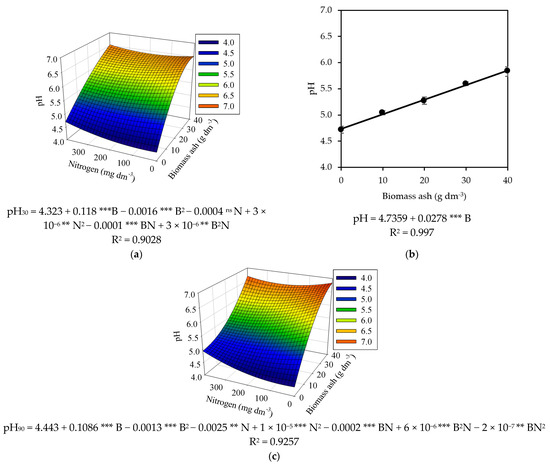
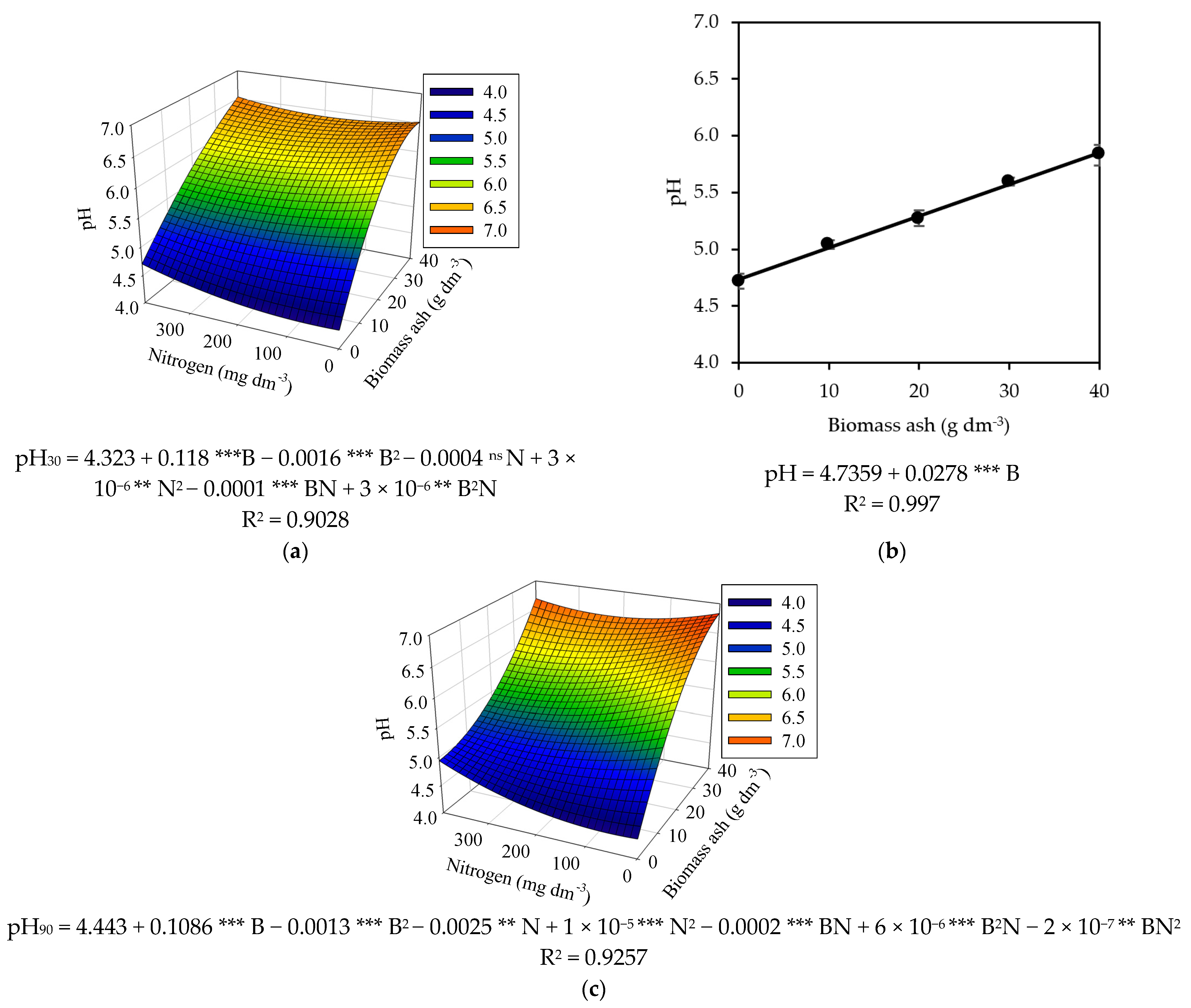
Soil active acidity (pH in CaCl2) was significantly influenced by the interaction between plant biomass ash and nitrogen doses at 30 and 90 days after plant emergence (DAE), whereas only the isolated effect of biomass ash was significant at 60 DAE (p ≤ 0.001; Table S2).
At 30 DAE, the soil pH ranged from a minimum of 4.31 (41.4 mg dm−3 of N without ash) to a maximum of 6.53 under the highest combined doses of both treatments (Figure 1a). At 60 DAE, the pH increased linearly with biomass ash application, reaching 5.84 at the maximum dose of 40 g dm−3, regardless of nitrogen fertilization (Figure 1b). At the final evaluation (90 DAE), the lowest pH value (4.33) was estimated at a nitrogen dose of 58.43 mg dm−3 without ash, while the exclusive application of 40 g dm−3 of plant biomass ash resulted in the highest pH value of 6.84 (Figure 1c).
Figure 1.
Soil pH at 30 (a), 60 (b), and 90 (c) days after the emergence of Urochloa brizantha cv. Marandu as a function of plant biomass ash and nitrogen doses. ***, **, and ns: significant at the 0.0001 and 0.01 levels, and not significant according to the F-test, respectively.
The absence of interactions between plant biomass ash and nitrogen dose at 60 DAE indicates that the effects of these factors on soil pH occurred independently. The increase in pH observed with ash application is associated with the presence of alkaline compounds, such as oxides, hydroxides, and carbonates of Ca, Mg, and K, which are capable of neutralizing H+ ions in the soil solution [33]. These compounds, upon solubilization, release OH− and HCO3− ions, promoting an increase in pH and a reduction in exchangeable acidity [17,18,34,35].
Considering the initial soil pH (4.3 in CaCl2), which is typical of acidic Latosols from the Cerrado, the increase in pH toward near neutrality observed in this study (approximately 2.4 units) is related to the high alkalinity of the ash used, which presented a pH of 10.67 in CaCl2. This confirms the potential of this residue as a soil acidity amendment [36,37]. Correcting soil acidity is necessary because it reduces the toxicity of elements such as aluminum, manganese, and iron, which can inhibit plant growth and nutrient uptake, including nitrogen, under acidic conditions [17,24,38].
Similar results have been reported in the literature, with increases in soil pH following the application of highly alkaline ashes, which are often comparable to or even greater than those obtained with conventional soil amendments [34,39,40].
The increase in pH even after 90 DAE indicates a residual effect of the plant biomass ash associated with the gradual release of these alkaline compounds, as observed in long-term studies involving the application of this residue [23,41]. This residual effect is essential for system sustainability, as it maintains a favorable root environment for longer periods, reducing the need for frequent reapplications [24,42].
The acidifying effect of nitrogen fertilization was observed only at 90 DAE, when urea application promoted a reduction in soil pH. This reaction is associated with the nitrification of ammonium derived from urea, a process that releases H+ into the soil solution, resulting in net acidification [14,15,16]. The quadratic response observed for nitrogen doses indicates that, beyond a certain level of fertilization, the soil system exhibits buffering capacity, limiting further reductions in pH [43]. Despite this acidifying effect, the combined application of this process with plant biomass ash can partially mitigate this process, as the ash supplies alkaline ions that neutralize some of the H+ ions released during nitrification, creating a more balanced chemical environment [42,44].
3.2. SPAD Index
The SPAD index was significantly affected by the interaction between plant biomass ash and nitrogen dose at 30 DAE, whereas at 60 DAE, only the individual effects of both factors were significant (p ≤ 0.0001; Table S2). Conversely, at the final evaluation at 90 DAE, a significant response was exerted exclusively by the plant biomass ash dose (Table S2).
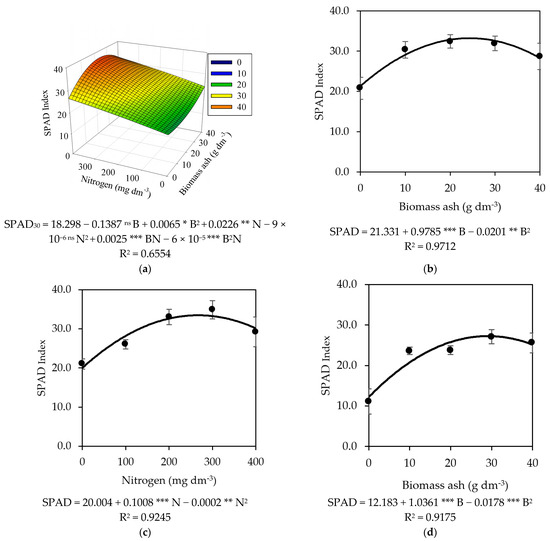
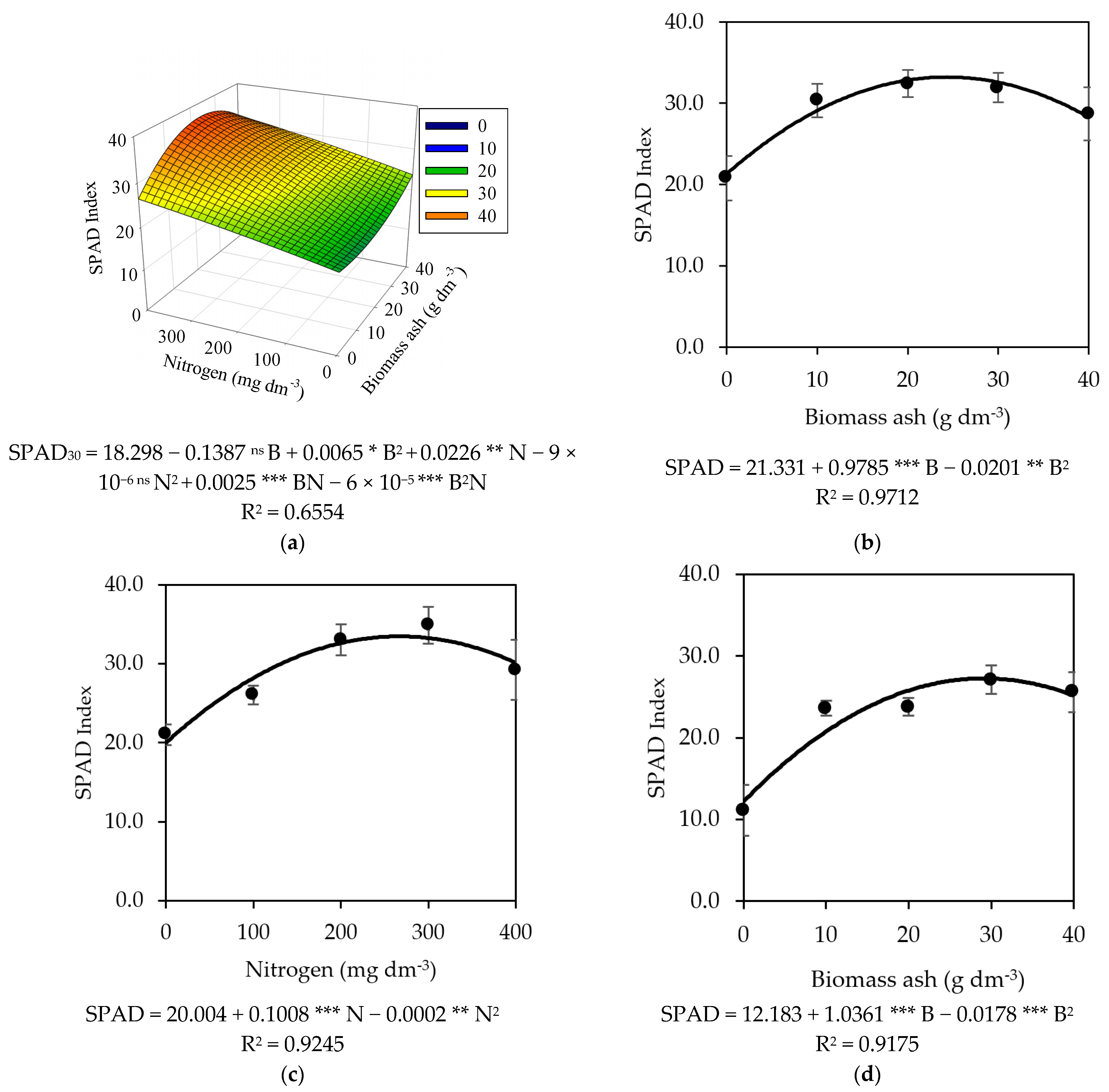
The plant biomass ash and nitrogen doses promoted increases in the SPAD index of Urochloa brizantha cv. Marandu (Figure 2). At 30 DAE, the estimated SPAD index ranged from a minimum of 18.19 (at a biomass ash dose of 10.79 g dm−3 without nitrogen application) to a maximum of 36.82 at a biomass ash dose of 23.82 g dm−3 combined with 400 mg dm−3 of nitrogen (Figure 2a). At 60 DAE, a quadratic response was observed for both factors, with maximum estimated values of 33.25 units at a biomass ash dose of 24.34 g dm−3 and 32.71 units at a nitrogen dose of 252 mg dm−3 (Figure 2b,c). At 90 DAE, the highest estimated SPAD index value was 27.26 units at the estimated biomass ash dose of 29.1 g dm−3 (Figure 2d).
Figure 2.
SPAD index of Urochloa brizantha cv. Marandu as a function of plant biomass ash and nitrogen dose at 30 (a), 60 (b,c), and 90 (d) days after plant emergence (DAE). ***, **, *, and ns: significant at the 0.0001, 0.01 and 0.05 levels, respectively, and not significant according to the F test.
The absence of a significant interaction between plant biomass ash and nitrogen dose indicates that the effects of these factors on the SPAD index occurred independently at 60 and 90 DAE. The SPAD index is strongly correlated with the leaf nitrogen content and is widely used as an indirect indicator of plant nutritional status [45,46]. The increases observed in the SPAD index as a function of plant biomass ash dose demonstrate an improvement in the nutritional status of palisade grass. This effect results from both an increase in soil pH and the supply of nutrients present in the ash, particularly magnesium.
Magnesium occupies a central position in the chlorophyll molecule and acts as an activator of several enzymes involved in photosynthesis. Approximately 2.7% of the molecular mass of chlorophyll is composed of magnesium, and approximately 20% of the total magnesium present in leaves is associated with this molecule, highlighting its importance in chlorophyll synthesis and photosynthetic activity. Thus, the supply of magnesium from the ash contributes directly to the increase in the chlorophyll concentration in the leaves, which is reflected in the higher SPAD index values observed in palisade grass.
Similar results have been reported in studies involving the application of plant biomass ash to cultivars of Urochloa brizantha, in which fertilization promoted an increase in the SPAD index throughout the growth cycle [21]. These studies reported SPAD index values ranging from approximately 46 to 56 in the initial evaluations, with a decline in subsequent assessments, as observed in the present study.
With respect to the nitrogen doses, the highest SPAD index values observed in the initial evaluations confirm the direct relationship between nitrogen availability and the chlorophyll concentration in the leaves. The authors of [47] reported SPAD index values ranging from 33 to 38 in Urochloa brizantha cv. Paiaguás under nitrogen fertilization, which confirms the positive response of this indicator to increased nitrogen availability.
Nitrogen plays a fundamental role in the structure and function of the photosynthetic apparatus and is an essential component of proteins and enzymes associated with carbon assimilation. In C4 grasses, such as Urochloa brizantha, a significant portion of leaf nitrogen is associated with enzymes such as phosphoenolpyruvate carboxylase, which are responsible for the initial fixation of CO2, as well as ribulose-1,5-bisphosphate carboxylase/oxygenase (RuBisCO) [48,49].
The absence of a significant effect of nitrogen dose at 90 DAE is associated with the dynamics of urea in the soil, with availability decreasing over the course of the cycle because of plant uptake, microbial immobilization processes, and possible ammonia volatilization losses following urea hydrolysis [14,15,16]. In contrast, the persistence of the effects of ash up to 90 DAE highlights its residual characteristics, resulting in the gradual release of nutrients and improving soil chemical conditions [23,40,41].
3.3. Leaf Area
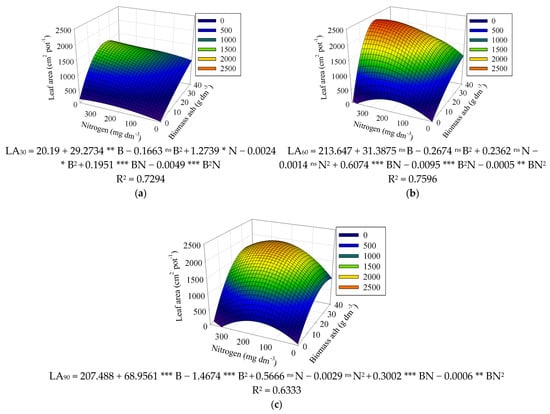
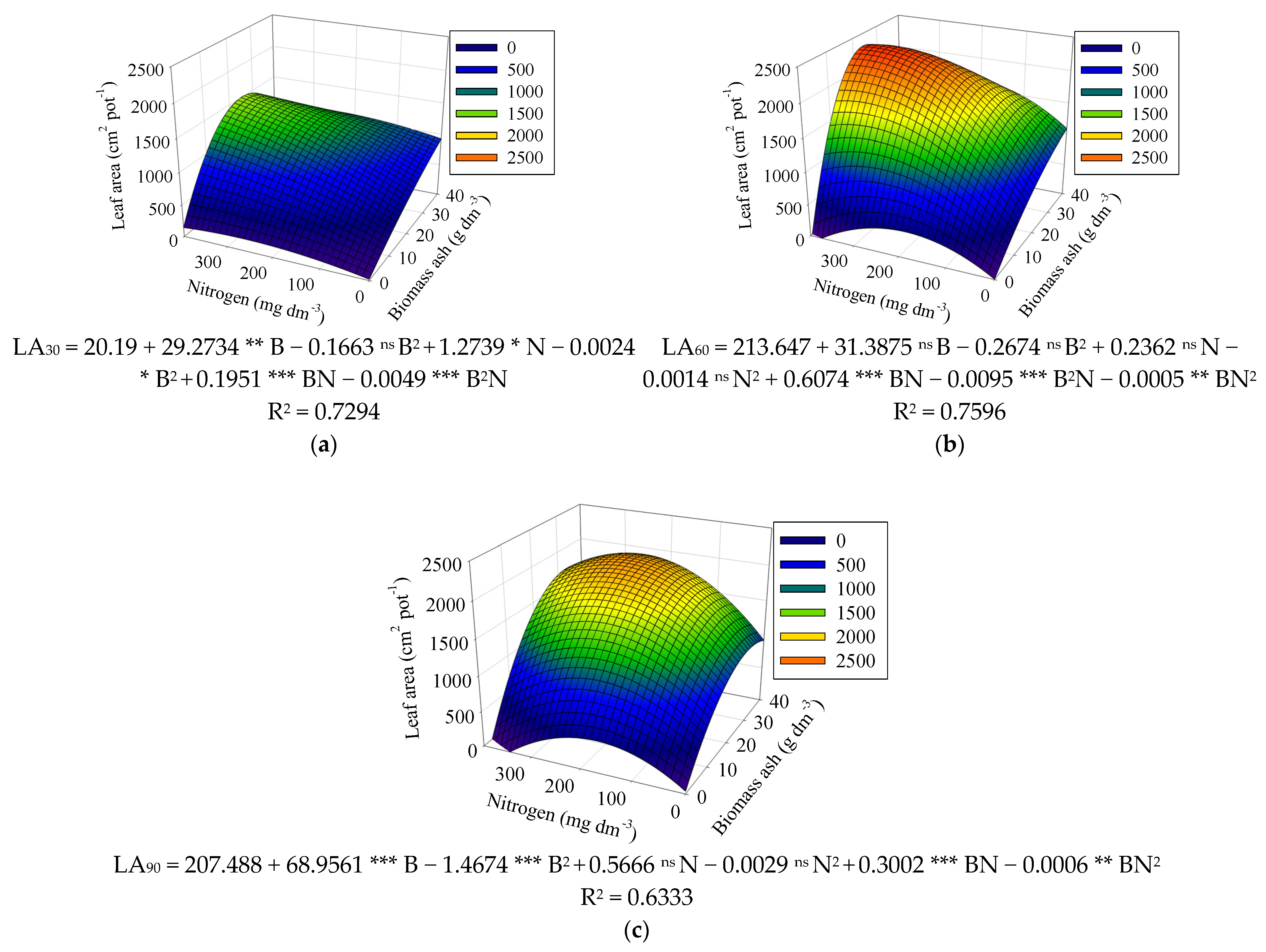
The leaf area of Urochloa brizantha cv. Marandu was significantly influenced (p ≤ 0.001) by the interaction between plant biomass ash and nitrogen doses across all three evaluation periods (Table S2).
Treatments involving the incorporation of plant biomass ash and nitrogen promoted significant increases in the leaf area of Urochloa brizantha cv. Marandu (Figure 3). At 30 DAE, the smallest leaf area was observed in the treatment without the addition of plant biomass ash and nitrogen, corresponding to 20.19 cm2 pot−1, whereas the estimated doses of 20.17 g dm−3 of ash and 400 mg dm−3 of nitrogen resulted in the largest leaf area of 1502.19 cm2 pot−1 (Figure 3a). At 60 DAE, a nitrogen dose of 373.0 mg dm−3 without the addition of plant biomass ash resulted in the smallest leaf area of Urochloa brizantha cv. Marandu (2.37 cm2 pot−1), whereas the largest leaf area (2332.96 cm2 pot−1) was observed at doses of 24.27 g dm−3 of ash and 359.5 mg dm−3 of nitrogen (Figure 3b). After 90 days after plant emergence, the smallest leaf area was 12.20 cm2 pot−1 at doses of 2.70 g dm−3 of ash and 395.5 mg dm−3 of nitrogen, whereas the largest leaf area corresponded to 1990.93 cm2 pot−1 at doses of 32.36 g dm−3 of ash and 256.18 mg dm−3 of nitrogen (Figure 3c).
Figure 3.
Leaf area of Urochloa brizantha cv. Marandu under different doses of plant biomass ash and nitrogen at 30 (a), 60 (b), and 90 (c) days after plant emergence. ***, **, *, and ns: significant at the 0.0001, 0.01 and 0.05 levels, respectively, and not significant according to the F test.
The response observed at 30 DAE indicates that, during the initial establishment phase, leaf growth was influenced by improvements in soil chemical conditions promoted by plant biomass ash and by nitrogen availability. The increase in leaf area with ash application shows that this residue acts as a soil conditioner, supplying essential nutrients and reducing acidity in highly weathered soils [11]. Plant biomass ash contains concentrations of potassium and calcium, and nutrients associated with enzyme activation, osmotic regulation, and cell elongation processes that directly influence leaf blade growth [49,50].
The response to nitrogen corroborates the role of this nutrient as one of the main limiting factors for the initial development of tropical forage grasses. Nitrogen is directly involved in the synthesis of proteins, enzymes, and chlorophyll, stimulating cell division and leaf blade elongation and thereby promoting the rapid expansion of the photosynthetically active area [51,52,53].
The significant interaction between plant biomass ash and nitrogen indicates that the efficiency of nitrogen fertilization depends on the soil fertility conditions promoted by ash application. The combination of doses that resulted in the greatest increase in leaf area revealed that a balanced nutrient supply increased the uptake and utilization of nitrogen by palisade grass. In addition to potassium and calcium, ash provides phosphorus, an essential nutrient for root system development and for increasing soil exploration capacity, thereby contributing to greater nutrient uptake [20,54,55].
At 90 DAE, the largest leaf area was estimated in combination with a higher proportion of ash relative to nitrogen, suggesting a residual effect of the plant biomass ash on improving soil chemical properties, thereby allowing the maintenance of leaf growth with a lower relative nitrogen input. This behavior is consistent with studies evaluating base-rich residues that increase nitrogen use efficiency in forage production systems, reducing losses and improving nutrient availability in the rhizosphere [56].
The increase in leaf area in Urochloa brizantha is a fundamental morphogenetic response for the productivity of the forage system, as leaves are the main organs responsible for the interception of photosynthetically active radiation and the production of photoassimilates [37].
3.4. Dry Mass (Shoot and Root)
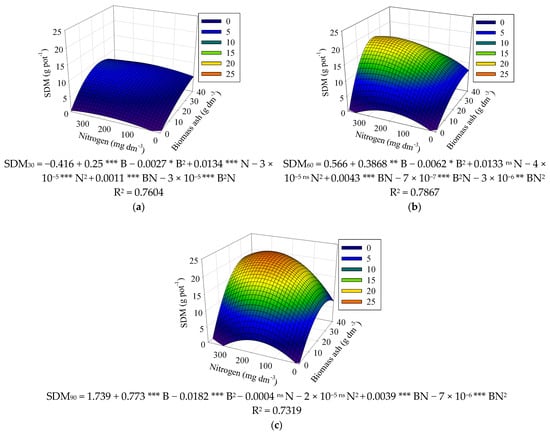
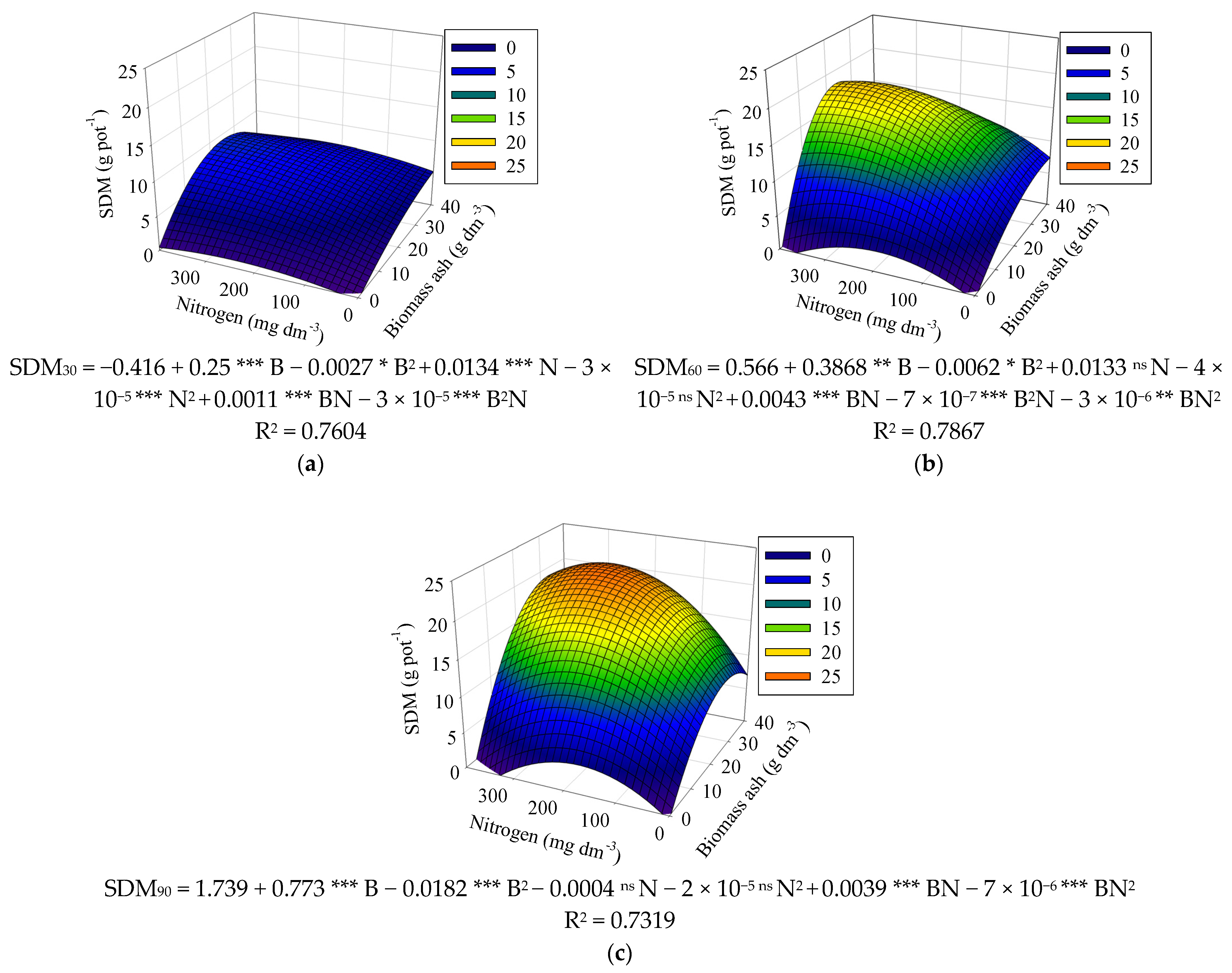
The shoot dry mass (SDM) of Urochloa brizantha cv. Marandu was significantly influenced (p ≤ 0.001) by the interaction between biomass ash and nitrogen dose at 30, 60, and 90 days after emergence (DAE) (Table S2).
At all evaluation times, there was a significant increase in SDM with increasing treatment dose (Figure 4). At 30 DAE, the dose of 1.80 g dm−3 of biomass ash without nitrogen addition resulted in the lowest SDM, corresponding to 0.025 g pot−1, whereas the highest SDM was 9.11 g pot−1 at 25.17 g dm−3 of biomass ash combined with the highest nitrogen dose (Figure 4a). At 60 DAE, the lowest SDM was 0.02 g pot−1 at the estimated doses of 0.90 g dm−3 and 9.00 mg dm−3, whereas the highest SDM was 18.43 g pot−1 at estimated doses of 24.27 g dm−3 of biomass ash and 337.08 mg dm−3 of nitrogen, respectively (Figure 4b). At 90 DAE, the lowest SDM was 0.006 g pot−1, which was observed at a dose of 328.1 mg dm−3 without the addition of biomass ash. Conversely, the highest SDM was 21.54 g pot−1, recorded at the estimated dose of 31.46 g dm−3 of biomass ash and 269.66 mg dm−3 of nitrogen (Figure 4c).
Figure 4.
Shoot dry mass of Urochloa brizantha cv. Marandu subjected to biomass ash and nitrogen doses at 30 (a), 60 (b), and 90 (c) days after plant emergence. ***, **, *, and ns: significant at the 0.0001, 0.01 and 0.05 levels, respectively, and not significant according to the F test.
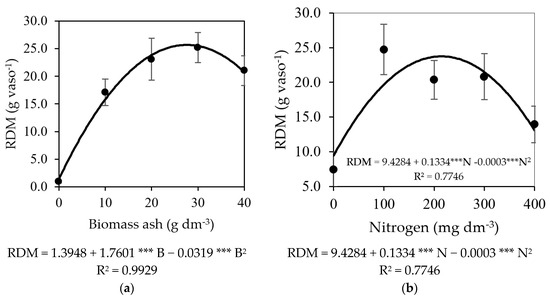
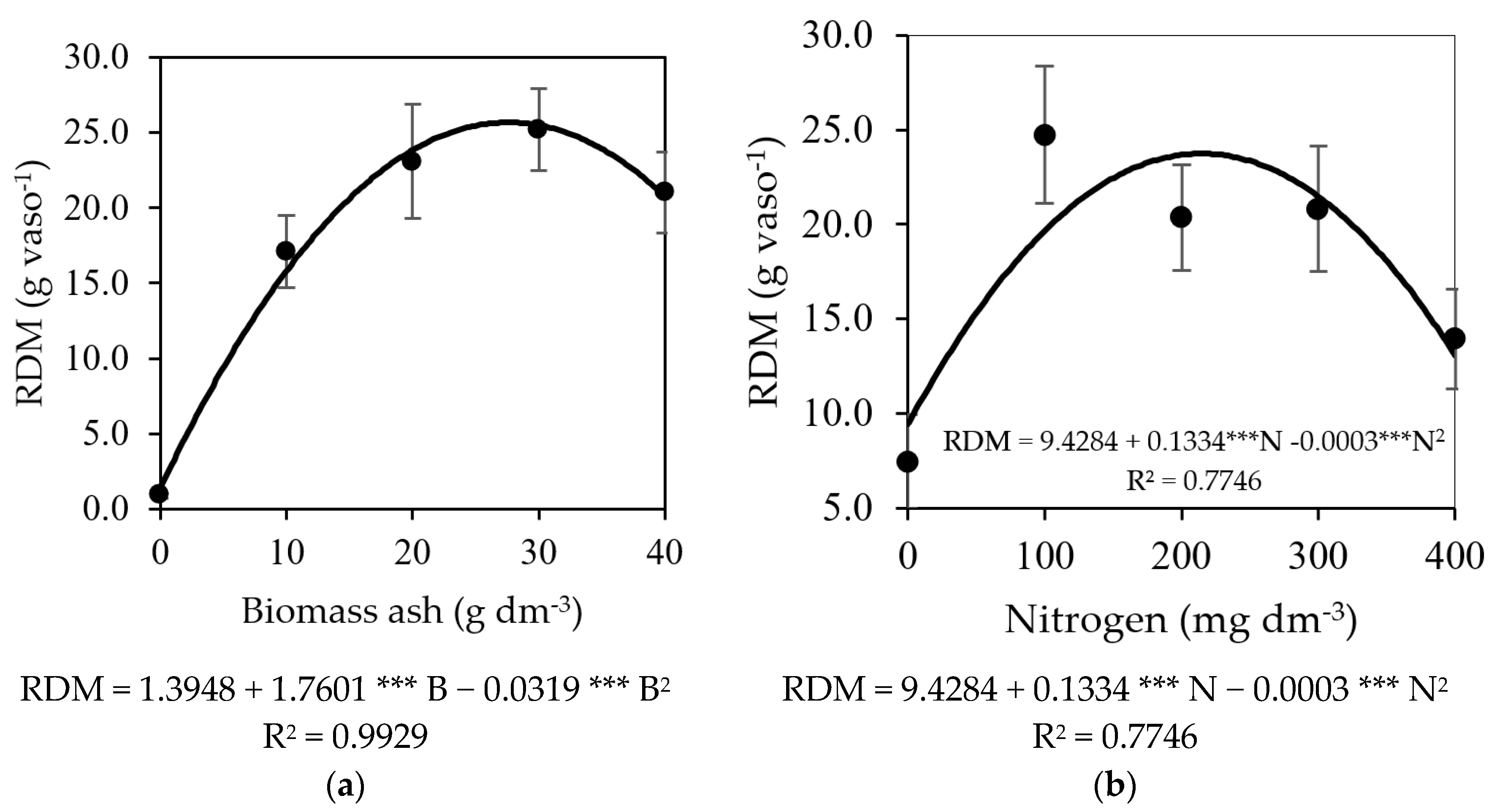
The root dry mass (RDM) of Urochloa brizantha cv. Marandu was significantly influenced (p ≤ 0.0001) by biomass ash and nitrogen dose, with no significant interaction between the factors in the evaluations performed (Table S2).
As a function of the biomass ash dose, a quadratic response was observed, with the highest root dry mass of 25.67 g pot−1 at a dose of 27.58 g dm−3, corresponding to a 94.6% increase compared with that in the treatment without biomass ash (Figure 5a). For nitrogen doses, a quadratic response was also observed, with a maximum root dry mass of 24.25 g pot−1 at a dose of 222.3 mg dm−3, representing a 61.12% increase compared with that in the treatment without nitrogen fertilization (Figure 5b).
Figure 5.
Root dry mass of Urochloa brizantha cv. Marandu subjected to different biomass ash (a) and nitrogen (b) doses at 90 days after plant emergence. ***: significant at the 0.0001 level according to the F test.
The root dry mass of Marandu grass was influenced by the biomass ash content and nitrogen dose, and both factors contributed independently to root system development. The increase in root mass with ash application is associated with improvements in soil chemical conditions, as this residue acts by increasing soil pH and supplying essential nutrients such as calcium, phosphorus, and potassium [34,56,57,58]. In acidic tropical soils, the correction of soil acidity and the increased availability of these nutrients favor root growth and increase the ability of plants to absorb water and nutrients.
Among the nutrients supplied by ash, phosphorus plays a fundamental role in root development, as it is involved in cell division processes, the formation of meristematic tissues, and root expansion [21]. Calcium contributes to the stability of cell walls and to root growth, promoting cell elongation and the development of the root system [11].
In terms of nitrogen dose, the increase in root mass is related to the role of this nutrient in plant metabolism. Nitrogen is involved in the synthesis of proteins, enzymes, and chlorophyll, and it also acts directly on photosynthetic activity. The increased availability of nitrogen promotes the production of photoassimilates, which are translocated to the root system and sustain root growth. Similar results were reported by [59], who reported a maximum root dry mass of 33.45 g pot−1 in Piatã grass (Urochloa brizantha cv. BRS Piatã) with the application of 262 mg dm−3 of nitrogen, a value close to that obtained in the present study.
4. Conclusions
The application of biomass ash corrects soil acidity by increasing the soil pH proportionally to the applied dose. The use of this residue, associated with nitrogen fertilization, promotes a positive interaction that enhances the nutritional status, leaf area expansion, and shoot dry mass accumulation of Marandu grass. The maximum vegetative performance and biomass accumulation are optimized over time under combinations ranging from 24.27 to 31.46 g dm−3 of plant biomass ash combined with 269.66 to 337.08 mg dm−3 of nitrogen. The root dry mass increased independently with ash application up to 28 g dm−3 and with the nitrogen supply up to the estimated dose of 222 mg dm−3.
Plant biomass ash represents a viable technical alternative for nutrient recycling and soil acidity correction in acidic Oxisols, significantly increasing the early productive potential of Urochloa brizantha cv. Marandu within a circular economic framework.
Supplementary Materials
The following supporting information can be downloaded at: https://www.mdpi.com/article/10.3390/nitrogen7020056/s1, Table S1: Adjustment of response surfaces for soil pH, SPAD index, leaf area (LA), and shoot dry mass (SDM) of Urochloa brizantha cv. Marandu subjected to biomass ash (B) and nitrogen (N) doses at 30, 60, and 90 days after plant emergence (DAE); Table S2: Analysis of variance for soil pH, SPAD index, leaf area (LA), shoot dry mass (SDM), and root dry mass (RDM) of Urochloa brizantha cv. Marandu subjected to biomass ash (B) and nitrogen (N) doses at 30, 60, and 90 days after plant emergence (DAE).
Author Contributions
N.d.V.T.: conceptualization, methodology, data curation, software, and writing—original draft. E.M.B.-S. and T.J.A.d.S.: conceptualization, resources, writing—review and editing, and project administration. N.P.R.d.O., I.A.C.e.S., L.A.M.M., A.F.S. and H.L.A.: formal analysis, data curation, investigation, writing—original draft, and writing—review and editing. S.L.G., M.K. and T.F.D.: data curation, investigation, validation, and writing—review and editing. All authors have read and agreed to the published version of the manuscript.
Funding
This research received no external funding.
Data Availability Statement
The data presented in this study are available upon request from the corresponding author.
Conflicts of Interest
The manuscript data are original, and the manuscript has not been submitted to any other publication, either in whole or in part, or in any other format or language. The authors have no conflicts of interest to declare.
References
- Pinc, M.M.; Cione Junior, D.A.; Bazzanella Neto, M.; Polli, E.; Dalmagro, M.; Donadel, G.; Otênio, J.K.; Alberton, O. Growth and Nutrition of Urochloa brizantha cv. Marandu Inoculated with Plant Growth Promoting Bacteria and Under Different Doses of Nitrogen. Res. Soc. Dev. 2020, 9, e7309108925. [Google Scholar] [CrossRef] [Scilit]
- Dijkstra, D.D.; Backes, C.; Santos, A.J.M.; Teodoro, A.G.; Fernandes, P.B.; Tomazello, D.A.; de Freitas, P.V.D.X.; Ribon, A.A.; Sousa, J.E.R.; Emerenciano Neto, J.V. The Combination of Sulfur and Nitrogen Fertilization Has a Direct Impact on the Recovery Process of Degraded Pastures in Tropical Climates. Grassl. Sci. 2025, 71, 118–125. [Google Scholar] [CrossRef] [Scilit]
- Dijkstra, D.D.; Backes, C.; Santos, A.J.M.; Baião, D.C.; Teodoro, A.G.; Ribon, A.A. Recovery of Braquiária Marandu Pasture with Application of nitrogen and Sulfur. Obs. Econ. Latinoam. 2024, 22, e3994. [Google Scholar] [CrossRef] [Scilit]
- Heinrichs, R.; Grano, F.G.; Bueno, L.G.D.F.; Soares Filho, C.V.; Fagundes, J.L.; Rebonatti, M.D.; Oliveira, K.D. Brachiaria Sp Yield and Nutrient Contents after Nitrogen and Sulphur Fertilization. Rev. Bras. Cienc. Solo 2013, 37, 997–1003. [Google Scholar] [CrossRef] [Scilit]
- Pietramale, R.T.R.; Paschoaloto, J.R.; Valentim, J.K.; Marques, O.F.C.; Leite, B.K.V.; Petromali, G.F.S.G.; de Castilho, V.A.R.; Barbosa, D.K.; Ruviaro, C.F.; Oliveira Neto, S.S.; et al. Produção de Capim Marandu em Condições Deficitárias de Nutrientes em Diferentes Épocas de Corte. Res. Soc. Dev. 2020, 9, e170943058. [Google Scholar] [CrossRef] [Scilit]
- de Fernandez, M.B.G.; dos Leal, O.A.; Júnior, A.P.; de Islabão, L.O.; Silveira, L.M.; Nogueira, H.L.; Rocha, J.V.P.; Nascimento, B.B.; de Oliveira, N.L.; Oliveira, M.D.S.D.; et al. First Assessment of Soil Mesofauna, Microbiota, and Humic Substances Associations in a Minesoil Revegetated with Four Grasses in Brazil: An 18-Year Field Study. Eur. J. Soil Biol. 2023, 118, 103533. [Google Scholar] [CrossRef] [Scilit]
- Stumpf, L.; Pauletto, E.A.; Pinto, L.F.S. Soil Aggregation and Root Growth of Perennial Grasses in a Constructed Clay Minesoil. Soil Tillage Res. 2016, 161, 71–78. [Google Scholar] [CrossRef] [Scilit]
- Cá, J.; Lustosa Filho, J.F.; da Silva, N.R.; de Castro, C.R.T.; de Oliveira, T.S. C and N Stocks in Silvopastoral Systems with High and Low Tree Diversity: Evidence from a Twenty-Two Year Old Field Study. Sci. Total Environ. 2022, 833, 155298. [Google Scholar] [CrossRef] [Scilit]
- da Silva, M.B.; de Camargos, L.S.; Teixeira Filho, M.C.M.; Souza, L.A.; Coscione, A.R.; Lavres, J.; Abreu-Junior, C.H.; He, Z.; Zhao, F.; Jani, A.D.; et al. Residual Effects of Composted Sewage Sludge on Nitrogen Cycling and Plant Metabolism in a No-till Common Bean-Palisade Grass-Soybean Rotation. Front. Plant Sci. 2023, 14, 1281670. [Google Scholar] [CrossRef] [Scilit]
- Santos, H.G.; Jacomine, P.K.T.; Anjos, L.H.C.; Oliveira, V.A.; Lumbreras, J.F.; Coelho, M.R.; Almeida, J.A.; Araújo Filho, J.C.; Lima, H.N.; Marques, F.A.; et al. Sistema Brasileiro de Classificação de Solos, 6th ed.; Embrapa: Brasília, Brazil, 2025. [Google Scholar]
- Rocha, R.A.D.S.; da Silva, T.J.A.; Bonfim-Silva, E.M.; Duarte, T.F.; Oliveira, N.P.R. de Cultivation of Urochloa brizantha Under Different Soil Densities and Doses of Wood Ash. Rev. Bras. Eng. Agrícola Ambient. 2023, 27, 230–238. [Google Scholar] [CrossRef] [Scilit]
- Bezerra, G.M.O.; Batista, C.D.S.; de Queluz, D.H.A.; de Coelho, G.J.; de Mariano, D.C.; Simões, P.H.O.; dos Santos, P.M.; de Viégas, I.J.M.; Okumura, R.S.; Maciel, R.P. Productive Performance of Brachiaria brizantha cv. Paiaguás in Response to Different Inoculation Techniques of Azospirillum brasilense Associated with Nitrogen Fertilization in the Brazilian Amazon. Nitrogen 2025, 6, 47. [Google Scholar] [CrossRef] [Scilit]
- Corrêa, D.C.D.C.; da Cardoso, A.S.; Ferreira, M.R.; Siniscalchi, D.; Gonçalves, P.H.d.A.; Lumasini, R.N.; Reis, R.A.; Ruggieri, A.C. Ammonia Volatilization, Forage Accumulation, and Nutritive Value of Marandu Palisade Grass Pastures in Different N Sources and Doses. Atmosphere 2021, 12, 1179. [Google Scholar] [CrossRef] [Scilit]
- Gazola, B.; Mariano, E.; Mota Neto, L.V.; Rosolem, C.A. Greenhouse Gas and Ammonia Emissions from a Maize-Soybean Rotation Under No-Till as Affected by Intercropping with Forage Grass and Nitrogen Fertilization. Agric. For. Meteorol. 2024, 345, 109855. [Google Scholar] [CrossRef] [Scilit]
- Delbem, F.C.; Scabora, M.H.; Filho, C.V.S.; Heinrichs, R.; Crociolli, C.A.; Cassiolato, A.M.R. Fontes e Doses de Adubação Nitrogenada Na Atividade Microbiana e Fertilidade Do Solo Cultivado Com Brachiaria brizantha. Acta Sci. Agron. 2011, 33, 361–367. [Google Scholar] [CrossRef] [Scilit]
- Longo, R.M.; Melo, W.J. de Hidrólise Da Uréia Em Latossolos: Efeito Da Concentração de Uréia, Temperatura, PH, Armazenamento e Tempo de Incubação. Rev. Bras. Cienc. Solo 2005, 29, 651–657. [Google Scholar] [CrossRef] [Scilit]
- Albuquerque, A.R.L.; Merino, A.; Angélica, R.S.; Omil, B.; Paz, S.P.A. Performance of Ash from Amazonian Biomasses as an Alternative Source of Essential Plant Nutrients: An Integrated and Eco-Friendly Strategy for Industrial Waste Management in the Lack of Raw Fertilizer Materials. J. Clean. Prod. 2022, 360, 132222. [Google Scholar] [CrossRef] [Scilit]
- Santás-Miguel, V.; Fernández-Sanjurjo, M.J.; Núñez-Delgado, A.; Álvarez-Rodríguez, E.; Díaz-Raviña, M.; Arias-Estévez, M.; Fernández-Calviño, D. Use of Biomass Ash to Reduce Toxicity Affecting Soil Bacterial Community Growth Due to Tetracycline Antibiotics. J. Environ. Manag. 2020, 269, 110838. [Google Scholar] [CrossRef] [Scilit] [PubMed]
- Demeyer, A.; Voundi Nkana, J.C.; Verloo, M.G. Characteristics of Wood Ash and Influence on Soil Properties and Nutrient Uptake: An Overview. Bioresour. Technol. 2001, 77, 287–295. [Google Scholar] [CrossRef] [Scilit]
- Oliveira, W.C.M.; Bonfim-Silva, E.M.; Ferraz, A.P.F.; Guimarães, S.L.; Silva, T.J.A.; Duarte, T.F. Soil Quality Indicators for Urochloa brizantha Fertilized with Wood Ash. Rev. Bras. Eng. Agríc. Ambient. 2023, 27, 241–249. [Google Scholar] [CrossRef] [Scilit]
- Bonfim-Silva, E.M.; Pereira, M.T.J.; Da Silva, T.J.A.; Fenner, W. Potential of Wood Ash as a Fertilizer in BRS Piatã Grass Cultivation in the Brazilian Cerrado Soil. Am. J. Plant Sci. 2017, 08, 2333–2344. [Google Scholar] [CrossRef]
- do Espírito Santo, É.S.; Bonfim-Silva, E.M.; de Sousa, H.H.F.; da Silva, T.J.A.; Pacheco, A.B.; Fenner, W. Rehabilitation of Pasture Fertilized with Wood Ash and Its Application Management in the Brazilian Cerrado. Aust. J. Crop Sci. 2018, 12, 1685–1694. [Google Scholar] [CrossRef] [Scilit]
- Johansen, J.L.; Nielsen, M.L.; Vestergård, M.; Mortensen, L.H.; Cruz-Paredes, C.; Rønn, R.; Kjøller, R.; Hovmand, M.; Christensen, S.; Ekelund, F. The Complexity of Wood Ash Fertilization Disentangled: Effects on Soil PH, Nutrient Status, Plant Growth and Cadmium Accumulation. Environ. Exp. Bot. 2021, 185, 104424. [Google Scholar] [CrossRef] [Scilit]
- Mendes, L.A.; Avellan, A.; Cruz, N.C.; Palito, C.; Römkens, P.F.A.M.; Amorim, M.J.B.; Tarelho, L.A.C.; Rodrigues, S.M. Biomass Ash Formulations as Sustainable Improvers for Mining Soil Health Recovery: Linking Soil Properties and Ecotoxicity. Environ. Pollut. 2021, 291, 118165. [Google Scholar] [CrossRef] [Scilit]
- Moure Abelenda, A.; Semple, K.T.; Lag-Brotons, A.J.; Herbert, B.M.J.; Aggidis, G.; Aiouache, F. Impact of Sulphuric, Hydrochloric, Nitric, and Lactic Acids in the Preparation of a Blend of Agro-Industrial Digestate and Wood Ash to Produce a Novel Fertiliser. J. Environ. Chem. Eng. 2021, 9, 105021. [Google Scholar] [CrossRef] [Scilit]
- Soil Survey Staff. Keys to Soil Taxonomy, 13th ed.; USDA Natural Resources Conservation Service: Washington, DC, USA, 2022. [Google Scholar]
- Teixeira, P.C.; Donagemma, G.K.; Fontana, A.; Teixeira, W.G. Manual de Métodos de Análise de Solo, 3rd ed.; Embrapa: Brasília, Brazil, 2017. [Google Scholar]
- Alcarde, J.C. Manual de Análise de Fertilizantes; FEALQ: Piracicaba, Brazil, 2009. [Google Scholar]
- Alcarde, J.C.; Rodela, A.A. Avaliação Química de Corretivos de Acidez Para Fins Agrícolas: Uma Nova Proposição. Sci. Agric. 1996, 53, 211–216. [Google Scholar] [CrossRef] [Scilit]
- EMBRAPA—Empresa Brasileira de Pesquisa Agropecuária. Manual de Métodos de Análise de Solo, 2nd ed.; Claessen, M.E.C., Ed.; EMBRAPA—CNPS: Rio de Janeiro, Brazil, 1997.
- Azevedo, A.M. ExpAnalysis3d: Pacote Para Analise de Experimentos Com Graficos de Superficie Resposta, R Package Version 0.1.3; Comprehensive R Archive Network (CRAN): Vienna, Austria, 2025. Available online: https://CRAN.R-project.org/package=ExpAnalysis3d (accessed on 20 February 2026).
- R Core Team. R: A Language and Environment for Statistical Computing; Foundation for Statistical Computing: Vienna, Austria, 2025. [Google Scholar]
- Nkana, J.C.V.; Demeyer, A.; Verloo, M.G. Availability of Nutrients in Wood Ash Amended Tropical Acid Soils. Environ. Technol. 1998, 19, 1213–1221. [Google Scholar] [CrossRef] [Scilit]
- Adotey, N.; Harrell, D.L.; Weatherford, W.P. Characterization and Liming Effect of Wood Ash Generated from a Biomass-Fueled Commercial Power Plant. Commun. Soil Sci. Plant Anal. 2018, 49, 38–49. [Google Scholar] [CrossRef] [Scilit]
- Wu, S.; Zhuang, X.; Ma, M.; Niu, L.; Wang, J.; Xi, F. Substantial CO2 Uptake by Biomass Ashes Under Natural Condition in China. Sci. Total Environ. 2024, 954, 176460. [Google Scholar] [CrossRef] [Scilit] [PubMed]
- Guerra, G.L.; Becquer, T.; Vendrame, P.R.S.; Galbeiro, S.; Brito, O.R.; da Silva, L.D.D.F.; Felix, J.C.; Lopes, M.R.; Henz, É.L.; Mizubuti, I.Y. Nutritional Evaluation of Brachiaria brizantha cv. Marandu Cultivated in Soils Developed from Basalt and Sandstone in the State of Paraná. Semin. Cienc. Agrar. 2019, 40, 469. [Google Scholar] [CrossRef] [Scilit]
- Costa, A.B.G.; Difante, G.S.; Campelo, B.A.M.; Gurgel, A.L.C.; Costa, C.M.; Theodoro, G.F.; Silva, Á.T.A.; Emerenciano Neto, J.V.; Dias, A.M.; Fernandes, P.B. Morphogenetic, Structural and Production Traits of Marandu Grass Under Nitrogen Rates in Neo Soil. Arq. Bras. Med. Vet. Zootec. 2021, 73, 658–664. [Google Scholar] [CrossRef] [Scilit]
- Cruz-Paredes, C.; López-García, Á.; Rubæk, G.H.; Hovmand, M.F.; Sørensen, P.; Kjøller, R. Risk Assessment of Replacing Conventional P Fertilizers with Biomass Ash: Residual Effects on Plant Yield, Nutrition, Cadmium Accumulation and Mycorrhizal Status. Sci. Total Environ. 2017, 575, 1168–1176. [Google Scholar] [CrossRef] [Scilit]
- Javed, B.; Katanda, Y.; Nadeem, M.; Wickremasinghe, T.; Farhain, M.M.; Thomas, R.; Galagedara, L.; Guo, X.; Cheema, M. Effectiveness of Wood Ash and Paper Sludge as Liming and Nutrient Sources for Annual Ryegrass Grown in Podzolic Soils of Newfoundland. Soil Sci. Soc. Am. J. 2024, 88, 792–802. [Google Scholar] [CrossRef] [Scilit]
- Lupwayi, N.Z.; Arshad, M.A.; Azooz, R.H.; Soon, Y.K. Soil Microbial Response to Wood Ash or Lime Applied to Annual Crops and Perennial Grass in an Acid Soil of Northwestern Alberta. Can. J. Soil Sci. 2009, 89, 169. [Google Scholar] [CrossRef] [Scilit]
- Pitman, R.M.; Vanguelova, E.I.; Benham, S. Soil Change and Broadleaf Tree Growth 10 Years after Wood Ash and Brash Co-Application to a Clearfelled Lowland Conifer Site in Britain. For. Int. J. For. Res. 2024, 97, 76–93. [Google Scholar] [CrossRef] [Scilit]
- Munawar, M.A.; Khoja, A.H.; Naqvi, S.R.; Mehran, M.T.; Hassan, M.; Liaquat, R.; Dawood, U.F. Challenges and Opportunities in Biomass Ash Management and Its Utilization in Novel Applications. Renew. Sustain. Energy Rev. 2021, 150, 111451. [Google Scholar] [CrossRef] [Scilit]
- Buthelezi, K.; Buthelezi-Dube, N. Effects of Long-Term (70 Years) Nitrogen Fertilization and Liming on Carbon Storage in Water-Stable Aggregates of a Semi-Arid Grassland Soil. Heliyon 2022, 8, e08690. [Google Scholar] [CrossRef] [Scilit]
- Shi, R.; Li, J.; Jiang, J.; Mehmood, K.; Liu, Y.; Xu, R.; Qian, W. Characteristics of Biomass Ashes from Different Materials and Their Ameliorative Effects on Acid Soils. J. Environ. Sci. 2017, 55, 294–302. [Google Scholar] [CrossRef] [Scilit]
- Hughes, M.P.; Wuddivira, M.N.; Mlambo, V.; Jennings, P.G.A.; Lallo, C.H.O. Non-Destructive Foliar Chlorophyll Measurement Has the Potential to Predict Crude Protein Concentration and In Vitro Ruminal Organic Matter Digestibility in Bracharia decumbens Herbage. Anim. Feed Sci. Technol. 2014, 195, 14–27. [Google Scholar] [CrossRef] [Scilit]
- Simili, F.F.; Barbosa, K.R.S.; Augusto, J.G.; Menegatto, L.S.; Mendonça, G.G.; Bonacim, P.M.; de Andrade Gimenes, F.M.; Savegnago, R.P. Study of the Chemical Composition of Urochloa brizantha Using the SPAD Index, Neural Networks, Multiple Linear Models, Principal Components and Cluster Analysis. Anim. Feed Sci. Technol. 2019, 258, 114307. [Google Scholar] [CrossRef] [Scilit]
- Domingues, A.A.; Santos, A.J.M.; Backes, C.; Rodrigues, L.M.; Teodoro, A.G.; Bessa, S.V.; Ribon, A.A.; Giongo, P.R.; de Godoy, L.J.G.; de Resende, C.C.F. Nitrogen Fertilization of Paiaguás Grass: Production and Nutrition. Rev. Agric. Neotrop. 2021, 8, e5918. [Google Scholar] [CrossRef] [Scilit]
- Sharkey, T.D. Discovery of the Canonical Calvin–Benson Cycle. Photosynth. Res. 2019, 140, 235–252. [Google Scholar] [CrossRef] [Scilit]
- Taiz, L.; Zeiger, E.; Moller, I.M.; Murphy, A. Fundamentos de Fisiologia Vegetal, 1st ed.; Artmed: Guelph, ON, Canada, 2021. [Google Scholar]
- Rakesh, B.; Chitdeshwari, T.; Mohanapriya, G. Fascinating Role of Nanosilica in Mitigating Drought and Nutrient Stress—A Review. Plant Stress 2024, 14, 100672. [Google Scholar] [CrossRef] [Scilit]
- Rincón, A.; Flórez, H.; Ballesteros, H.; León, L.M. Effects of Fertilization of Brachiaria humidicola cv. Llanero on Pasture in the Foothills Region of the Llanos Orientales, Colombia. Trop. Grassl.-Forrajes Trop. 2018, 6, 158–168. [Google Scholar] [CrossRef] [Scilit]
- Rodrigues, L.F.; Dos Santos, A.C.; Silveira, O.; Dos Santos, J.G.D. Productivity of Urochloa brizantha “Marandu” Influenced by Strategic Rest Periods and Nitrogen Levels. Semin. Cienc. Agrar. 2017, 38, 3203–3213. [Google Scholar] [CrossRef] [Scilit]
- Sales, K.C.; Cabral, C.E.A.; Abreu, J.G.; Barros, L.V.; Silva, F.G.; Cabral, C.H.A.; Santos, A.R.M.; Silva Junior, C.A.; Campos Filho, J.B. What Is the Maximum Nitrogen in Marandu Palisadegrass Fertilization? Grassl. Sci. 2020, 66, 153–160. [Google Scholar] [CrossRef] [Scilit]
- Muricy, J.F.; Silva, F.F.; Dutra, G.C.; Neto, T.M.; Dutra, I.C.; Santosv, C.J.; Silva, R.R.; Hermógenesv, R.S.; Cerqueira, F.F.; Pires, A.J.V.; et al. Liquid Fertilization and Conventional Fertilization on Soil Fertility and Agronomic and Morphophysiological Characteristics of Brachiaria brizantha cv. Braúna Grass. Agron. Res. 2025, 23, 867–881. [Google Scholar] [CrossRef]
- Pinheiro, V.L.; Mendonça, A.S.; Cruz, D.H.G.; Araújo, L.C.; Andrade, K.S.P.; Rocha, T.C.; Rodrigues, W.P. Structural Traits, Production, Biomass Allocation, and Changes in Leaf Investment in Megathyrsus maximus cv. MG12 Paredão Under Nitrogen Fertilization and Cutting Intervals. Nitrogen 2025, 6, 12. [Google Scholar] [CrossRef] [Scilit]
- Schlichting, A.F.; Bonfim-Silva, E.M.; José Araújo da Silva, T. Application of Solid Waste from Industry in Pasture, as a Destination Alternative. Commun. Soil Sci. Plant Anal. 2021, 52, 1912–1926. [Google Scholar] [CrossRef] [Scilit]
- Bhandari, D.; Arlović, S.; Galić, M.; Bilandžija, N.; Leto, J.; Bilandžija, D. Influence of Biomass Ash Fertilization on Soil PH, CaCO3, K2O and P2O5 under Miscanthus x Giganteus. J. Cent. Eur. Agric. 2024, 25, 833–841. [Google Scholar] [CrossRef] [Scilit]
- Ots, K.; Tilk, M.; Aguraijuja, K. The Effect of Oil Shale Ash and Mixtures of Wood Ash and Oil Shale Ash on the Above- and Belowground Biomass Formation of Silver Birch and Scots Pine Seedlings on a Cutaway Peatland. Ecol. Eng. 2017, 108, 296–306. [Google Scholar] [CrossRef] [Scilit]
- de Morais, L.P.; Bonfim-Silva, E.M.; Pacheco, A.B.; Abreu, J.G.D.; da Silva, T.J.; Polizel, A.C. Nitrogen and Potassium in the Cultivation of Piatã Grass in Brazilian Cerrado Soil. Rev. Bras. Eng. Agrícola Ambient. 2016, 20, 984–989. [Google Scholar] [CrossRef] [Scilit]
Disclaimer/Publisher’s Note: The statements, opinions and data contained in all publications are solely those of the individual author(s) and contributor(s) and not of MDPI and/or the editor(s). MDPI and/or the editor(s) disclaim responsibility for any injury to people or property resulting from any ideas, methods, instructions or products referred to in the content. |
© 2026 by the authors. Licensee MDPI, Basel, Switzerland. This article is an open access article distributed under the terms and conditions of the Creative Commons Attribution (CC BY) license.